Shared posts

31 Jan 19:27

6 Strategic Plan Templates For Online Communities

by Richard Millington

Introduction

If you don’t have a clear and simple strategic plan you’re either relying on guesswork or using whichever tactics drive the most engagement.

Doing this work at the professional level is all about executing a strategic plan. It’s where you know your goals, you know your objectives, you know your strategy, and then you execute the tactics best designed to achieve that strategy.

In this post, I want to outline six broad strategic plans which have been successful for clients we’ve worked with in the past (or, in one case, a course student). Consider these ‘off the shelf’ strategies you can use for your community work.

Don’t use them wholesale, but adapt them to suit your needs.


Template 1: Advocacy Communities

Advocacy communities are designed to get customers to plead the case of the brand to non-customers.

Picture these efforts on a continuum. At one extreme you have cult fans who support you because they love you. Supreme and HarleyDavidson probably fall into this group. At the other extreme, you have reward/incentive-driven communities. Most of Influitive’s clients fall into this group.

Between the two, you have word-of-mouth marketing efforts. This is when when people who know you/like you share something you’ve created because it’s remarkable, involves them, or helps the audience look good.

Key Behaviors

The most common behaviors here, in order of value, are typically:

  • Direct selling/referrals to others. If a customer personally invites someone else to become a customer for the brand or make referrals to a sales team to someone who would be a good fit for the product, that’s a big win.
  • Writing customer reviews. This includes writing positive reviews on sites like Amazon, Goodreads, TrustRadius, and any other comparison site.
  • Creating brand-related content. This is when a customer creates positive articles, videos, or podcasts about the product. Gamers do this on Twitch and YouTube all the time.
  • Sharing content on news/content on social. This is where members share discounts, announcements of new releases, or any other brand-content to others.


Strategic Plan Template – Video Game Advocacy

The challenge here is to design community objectives (member behaviors) which achieve two goals. First, they must directly help the community achieve its goal and second, they must match what different member segments are likely to do.

Our strategic plan may look like the below:


All of this should be based upon research. By the end you should have a small list of 5 to 7 tactics which you will commit significant resources to executing. If you get this right, each member segment will be making their best possible contributions to the community.


Template 2: Engagement-Driven, Advertising-Supported, Communities

There is only one kind of community where maximizing engagement is a reasonable target and these are communities driven by advertising.

Most of the big social networks (Facebook, LinkedIn, Twitter, Pinterest) fall into this category. As do sites like Reddit, StackOverflow, and Nextdoor (plenty of smaller, hobbyist, sites fall into this category too).

Key Behaviors

The key things you need members to do here typically include:

  • Getting members to organize members in their own groups. A key principle of exponential engagement growth is fostering sub-groups to increase advertising inventory and member time on platform. This means identifying and nurturing people to run parts of the community.
  • Ensuring members join and participate in these groups. You can’t have successful groups unless you can get members to join and participate in these groups.
  • Keep members actively engaged. You need to persuade people to visit and participate frequently to keep the community going.


Strategic Plan Template – An Engagement Platform

The challenge for an engagement-driven community is growing at high-speed. This example included the following:
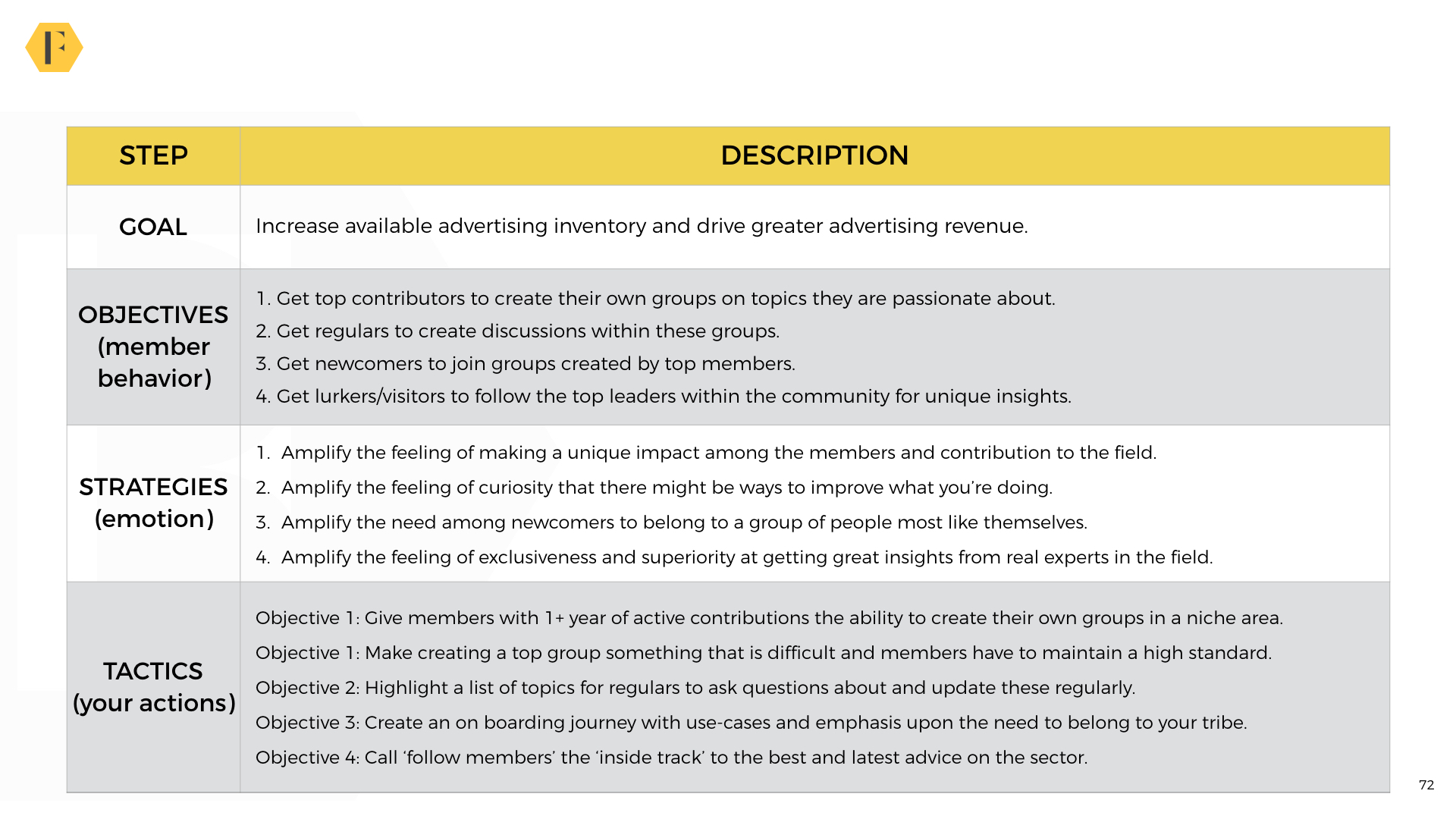
For each group you want to amplify a unique motivation. This motivation will be very different for top contributors compared with, say, newcomers or lurkers/visitors. As the platform grows larger, you will need far more specific segmentation of the audience.


Template 3: Lead Identification/Generation Communities

Lead generation (and identification) is one of the most underutilized uses for a community. Members provides useful information which could identify them as potential leads for the sales team.

Bringing a list of 50+ leads to your next meeting is a good way to build internal support. However, be careful not to invade the privacy of your members or spam them with unwanted offers. Any outreach from a brand representative needs to be done with careful consideration towards the mindset of the member.

Key Behaviors

Members can identify themselves as leads in multiple ways. These usually include:

  • Downloading content/attending webinars. Members who submit their details to download product/service related content/attend webinars can be considered as strong community leads.
  • Sharing problems the product can solve. If members share a problem which the company can solve, someone can reach out to them and ask if they would like help.
  • Creating content which attracts more search traffic. If members create content which attracts high search traffic, this could generate leads through natural awareness.
  • Pre-purchase behaviors. Using a lead-scoring system, you might identify potential leads through the discussions and posts members click on.
  • Completing surveys. Occasionally, members might reveal themselves as fitting a lead profile through completion of a survey.


Strategic Plan Template – A Large Consultancy Company

Developing a strategic plan for a consultancy company tends to be easier than any other goals. Note, below, the type of platform you use to build this kind of community might be different from a support or advocacy community. Sometimes, you might not need much member to member engagement at all.


Each of the objectives above should help drive increased search traffic and identify leads within the community.


Template 4: Innovation and Insights Communities

We’ve covered this recently. There are plenty of ways members can help drive new insights and innovation. These typically come in the forms of:

Key Behaviors

  • Generating product ideas. This covers all solicited ideas in ideation-driven platforms.
  • Voting on product ideas. This is self-explanatory, members vote on the ideas they like best.
  • Providing feedback on the product/service. This includes every complaint, bug, or frustration members express which can be useful feedback.
  • Participating in surveys/interviews. This is useful solicited qualitative and quantitative feedback.
  • Expressing sentiment. If you track what members say they like or dislike you can gather a lot of useful insights.
  • Engaging in trackable behavior. This includes tracking specific behavior and outcomes e.g. what content or discussions people like best.

Ideation/soliciting ideas tends to gain the more attention but is also the least successful. Better feedback usually comes in response to things members can see, touch, and do.


Strategic Plan Template – SaaS company

Many SaaS companies are gradually shifting their community from customer support to insights and innovation. This means rethinking what members are going to do within the community. A recent strategic template included:
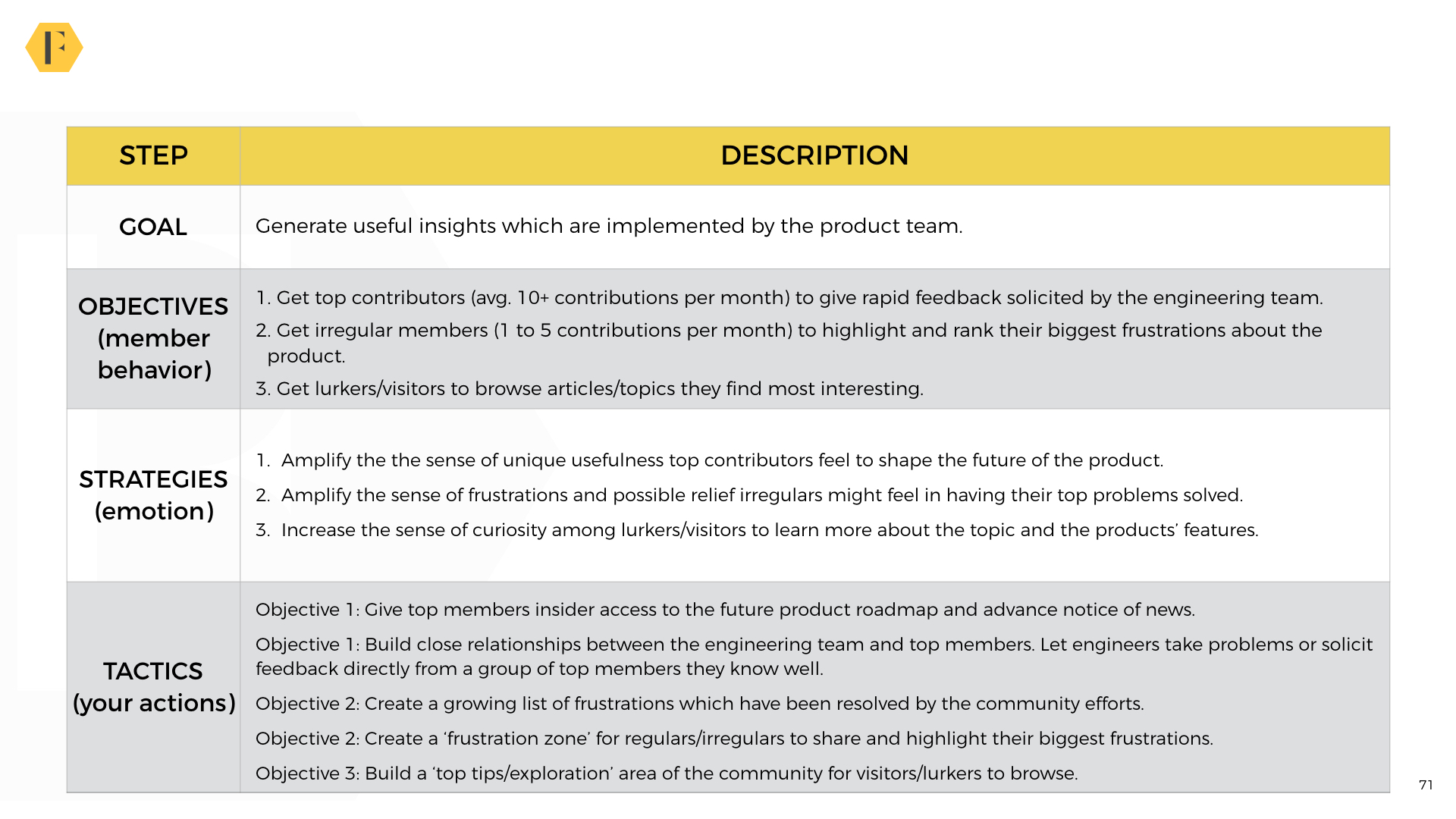

This approach aims to maximize the number of valuable insights generated by the community. We could equally add surveys/interviews at convenient times as an additional objective here.

From this, you should be able to use our insights report template and capture the main insights for the engineering team.


Template 5: Support Objectives

Support communities are the easiest type of community to create.

You launch a platform for people with a lot of questions and divert traffic from your website to this platform. It’s also the easiest community type to connect to direct cost savings. Most organizations with 100k+ customers should consider building a support community.

Key Behaviors

  • Asking questions in the community (instead of support channels). This is obviously a critical behavior for a support community to succeed.
  • Answering questions in the community (with empathy!). This is equally as important. Questions without solutions are worse than no questions at all.
  • Searching for an answer in the community. The majority of members should be able to find the answer without asking a question.
  • Voting and rating answers in the community. You need help from members to vote and rate answers within the community. This helps the best solutions rise to the top.


Strategic Plan Template – A Large Consultancy Company

Strategic plans for support communities are usually fairly transferable from one type of community to the next. The key difference is you usually don’t have regulars. You usually have top contributors, a small group of irregulars, then a large group of lurkers and visitors.


There are other ways to achieve these objectives (especially with top contributor programs), but the objectives usually remain relatively the same. Most internal collaboration communities would also fall under this category.


Template 6: Knowledge-Sharing Communities

Knowledge management (KM) communities (and Communities of Practice) are unique in they often span many of the different archetypes above.

However, the typical KM community emphasizes documenting and keeping knowledge up to date. This saves people time and helps them do better work.

Key Behaviors

The key behaviors here usually include:

  • Documenting a best practice/lesson learned/templates. This includes actions taken, what worked, where to find useful information, revenue spent, how it was measured etc..This also covers templates for future projects.
  • Keeping and updating previous content. Once content has been shared, it needs to be kept relevant and updated in a systematic way.
  • Tagging and properly storing information. People need to be able to find the information. This means it need to be stored in the right place, with searchable names, and properly tagged.

This is a simplistic overview that becomes more complex as the volume of information increases (e.g. what if you have 5 different versions of templates floating around or 50,000 employees across 8 languages?)


Strategic Plan Template – A Management Consultancy

KM communities will have the most flexibility among the strategies you can deploy. Sometimes appeals to honor and pride work well and sometimes appeals to collective rewards work, and sometimes fear of punishment works best.
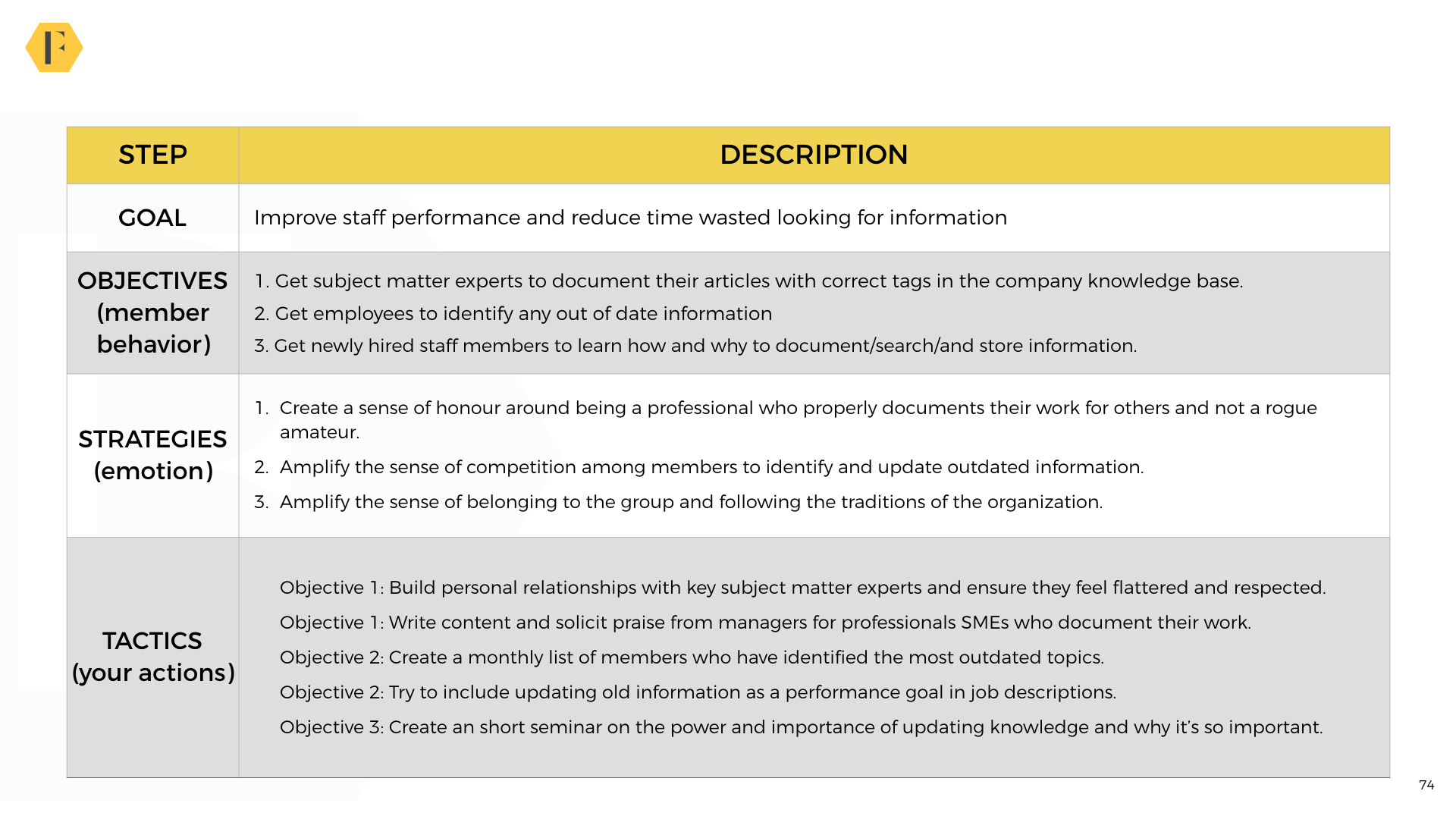

Above we’ve largely used appeals to the better nature of members rather than resorting to punishments. But you can adapt as needed.

Summary

This isn’t a definitive list of community types. There are plenty of communities based around collective action, crowdsourced fundraising, and plenty other archetypes.

This should, however, cover the most common community goals and the kinds of strategic plans you might develop to support them.

There are multiple different ways to achieve the same community goals through different objectives, strategies, and tactics. The principle is to ensure everything matches up in the most direct and logical way possible. The templates above might help.

p.s. We’ve opened registration for our Strategic Community Management course.

31 Jan 19:24

Some b/s detection regarding the Apple HomePod experiences

by Volker Weber

record-336626 1280

Apple is running a marketing blitz for the HomePod and those bloggers rub me the wrong way since they don't ask some important questions. Apple compares the HomePod to the Sonos One and the Amazon Echo. Let me lay down my questions for you:

  • HomePod does room correction on the fly. It's a setup step for Sonos One. Has Apple applied Trueplay Tuning for their demo setup?
  • HomePod is as expensive as two Sonos One. How does it compare to a Sonos One stereo pair properly tuned to the room?
  • If it does not matter that HomePod is more expensive than Sonos One, how does it compare to a Sonos player up to twice the price like the Playbase or Play:5?
  • Sonos lets you add multiple Spotify users who don't cross pollute their music taste. How does that work for HomePod?
  • Can you hook up your vinyl?

I believe HomePod is a great product. But it is going to only work for you if you are all in on Apple. No Spotify, no Tidal, no Deezer or any of the other dozens of music services. No music shared on your LAN. Not even Tunein Radio.

31 Jan 19:24

Twitter Favorites: [shawnmicallef] Passable by night - in a few hours ruined by salt https://t.co/VzIE4r5puX

Platonic Doug Ford @shawnmicallef
Passable by night - in a few hours ruined by salt pic.twitter.com/VzIE4r5puX
31 Jan 19:24

Raspberry Crusoe: how a Pi got lost at sea

by Alex Bate

The tale of the little HAB that could and its three-month journey from Portslade Aldridge Community Academy in the UK to the coast of Denmark.

PACA Computing on Twitter

Where did it land ???? #skypaca #skycademy @pacauk #RaspberryPi

High-altitude ballooning

Some of you may be familiar with Raspberry Pi being used as the flight computer, or tracker, of high-altitude balloon (HAB) payloads. For those who aren’t, high-altitude ballooning is a relatively simple activity (at least in principle) where a tracker is attached to a large weather balloon which is then released into the atmosphere. While the HAB ascends, the tracker takes pictures and data readings the whole time. Eventually (around 30km up) the balloon bursts, leaving the payload free to descend and be recovered. For a better explanation, I’m handing over to the students of UTC Oxfordshire:

Pi in the Sky | UTC Oxfordshire

On Tuesday 2nd May, students launched a Raspberry Pi computer 35,000 metres into the stratosphere as part of an Employer-Led project at UTC Oxfordshire, set by the Raspberry Pi Foundation. The project involved engineering, scientific and communication/publicity skills being developed to create the payload and code to interpret experiments set by the science team.

Skycademy

Over the past few years, we’ve seen schools and their students explore the possibilities that high-altitude ballooning offers, and back in 2015 and 2016 we ran Skycademy. The programme was simple enough: get a bunch of educators together in the same space, show them how to launch a balloon flight, and then send them back to their students to try and repeat what they’ve learned. Since the first Skycademy event, a number of participants have carried out launches, and we are extremely proud of each and every one of them.

The case of the vanishing PACA HAB

Not every launch has been a 100% success though. There are many things that can and do go wrong during HAB flights, and watching each launch from the comfort of our office can be a nerve-wracking experience. We had such an experience back in July 2017, during the launch performed by Skycademy graduate and Raspberry Pi Certified Educator Dave Hartley and his students from Portslade Aldridge Community Academy (PACA).

Dave and his team had been working on their payload for some time, and were awaiting suitable weather conditions. Early one Wednesday in July, everything aligned: they had a narrow window of good weather and so set their launch plan in motion. Soon they had assembled the payload in the school grounds and all was ready for the launch.

Dave Hartley on Twitter

Launch day! @pacauk #skycademy #skypaca #raspberrypi

Just before 11:00, they’d completed their final checks and released their payload into the atmosphere. Over the course of 64 minutes, the HAB steadily rose to an altitude of 25647m, where it captured some amazing pictures before the balloon burst and a rapid descent began.

Portslade Aldridge Community Academy Skycademy Raspberry Pi Portslade Aldridge Community Academy Skycademy Raspberry Pi

Soon after the payload began to descend, the team noticed something worrying: their predicted descent path took the payload dangerously far south — it was threatening to land in the sea. As the payload continued to lose altitude, their calculated results kept shifting, alternately predicting a landing on the ground or out to sea. Eventually it became clear that the payload would narrowly overshoot the land, and it finally landed about 2 km out to sea.

Portslade Aldridge Community Academy Skycademy Raspberry Pi High Altitude Ballooning

The path of the balloon

It’s not uncommon for a HAB payload to get lost. There are many ways this can happen, particularly in a narrow country with a prevailing easterly wind like the UK. Payloads can get lost at sea, land somewhere inaccessible, or simply run out of power before they are located and retrieved. So normally, this would be the end of the story for the PACA students — even if the team had had a speedboat to hand, their payload was surely lost for good.

A message from Denmark

However, this is not the end of our story! A couple of months later, I arrived at work and saw this tweet from a colleague:

Raspberry Pi on Twitter

Anyone lost a Raspberry Pi HAB? Someone found this one on a beach in south western Denmark yesterday #UKHAS https://t.co/7lBzFiemgr

Good Samaritan Henning Hansen had found a Raspberry Pi washed up on a remote beach in Denmark! While walking a stretch of coast to collect plastic debris for an environmental monitoring project, he came across something unusual near the shore at 55°04’53.0″N and 8°38’46.9″E.

This of course piqued my interest, and we began to investigate the image he had shared on Facebook.

Portslade Aldridge Community Academy Skycademy Raspberry Pi High Altitude Ballooning

Inspecting the photo closely, we noticed a small asset label — the kind of label that, over a year earlier, we’d stuck to each and every bit of Skycademy field kit. We excitedly claimed the kit on behalf of Dave and his students, and contacted Henning to arrange the recovery of the payload. He told us it must have been carried ashore with the tide some time between 21 and 27 September, and probably on 21 September, since that day had the highest tide over the period. This meant the payload must have spent over two months at sea!

From the photo we could tell that the Raspberry Pi had suffered significant corrosion, having been exposed to salt water for so long, and so we felt pessimistic about the chances that there would be any recoverable data on it. However, Henning said that he’d been able to read some files from the FAT partition of the SD card, so all hope was not lost.

After a few weeks and a number of complications around dispatch and delivery (thank you, Henning, for your infinite patience!), Helen collected the HAB from a local Post Office.

Portslade Aldridge Community Academy Skycademy Raspberry Pi High Altitude Ballooning

SUCCESS!

We set about trying to read the data from the SD card, and eventually became disheartened: despite several attempts, we were unable to read its contents.

In a last-ditch effort, we gave the SD card to Jonathan, one of our engineers, who initially laughed at the prospect of recovering any data from it. But ten minutes later, he returned with news of success!

Portslade Aldridge Community Academy Skycademy Raspberry Pi Portslade Aldridge Community Academy Skycademy Raspberry Pi Portslade Aldridge Community Academy Skycademy Raspberry Pi Portslade Aldridge Community Academy Skycademy Raspberry Pi

Since then, we’ve been able to reunite the payload with the PACA launch team, and the students sent us the perfect message to end this story:

Portslade Aldridge Community Academy Skycademy Raspberry Pi High Altitude Ballooning

The post Raspberry Crusoe: how a Pi got lost at sea appeared first on Raspberry Pi.

31 Jan 19:22

Throwing Stones

by pricetags

From The Sun:

(Todd Stone supporter Dan) Doyle provides Stone with some cover, even on the 2015 transit referendum. It was a bad idea and poor policy, but Stone was obligated to follow through after Clark made a promise at the last minute of the 2013 election campaign.

I don’t think it had any chance of success,” Doyle said. “He had a very tough job and we put him in a tough spot.”

Think about that: no chance of success.  The BC Liberals were so contemptuous of the needs of Metro Vancouver that they forced a pointless, destructive, expensive referendum on us, gave no support, and then, when it failed, had nothing to offer.  Except blame.

Todd Stone was Minister of Transportation.  After Clark, has he apologized?  Not really.

In running for leader, has he developed any policy, with specifics, that would indicate a real understanding of Metro’s transportation needs.  Only generalities:

However, he specifically promises this:

  • … working with local governments to immediately begin work on a replacement for the George Massey Tunnel suitable for commuters and local communities.

And this:

  • I would begin a conversation with Metro Vancouver residents and local governments about the potential to consolidate all transportation assets – roads, highways, bridges, tunnels – under one Regional Major Roads Authority to make transportation decisions.

So: another authority in competition with TransLink with a mandate to consolidate “all transportation assets” – which means only roads, highways, tunnels and bridges.

Transit, apparently, is not a transportation asset.  That says so much.


31 Jan 19:21

Heritage Week – Feb 19-25

by pricetags

February 19 – 25 is Heritage Week in BC and across Canada.

The theme of ‘Heritage Stands the Test of Time’ honours the endurance of heritage sites and buildings and their cultural significance as well as their contribution to a sustainable future.


Wednesday, Feb 21: Places That Matter: Community Celebration & Proclamation Reading

Celebrate the local, cultural and lesser known history of our city with a free evening of storytelling, community and refreshments. Local comedian Morgan Brayton will serve as MC introducing several speakers connected to Places That Matter sites.

Kitsilano Neighbourhood House, 2305 W 7th Ave.

6:30pm – 9pm

FREE


Saturday, Feb 24: Gastown Revisited

Since its designation as a heritage district in 1971, Gastown has continued to evolve and adapt to a changing city. On this walking tour, historian John Atkin explores some of the more recent interventions. Join us to discover there’s more to the district than initially meets the eye.

Gastown

10 am – 12 noon

$15


Sunday, Feb 25: Sunday Morning at Punjabi Market

Enjoy a morning of cultural stories and local history starting at All India Sweets and Restaurant, one of our Places That Matter sites. Enjoy authentic chai and treats and hear about the people, businesses and stories that make this part of town so special. Then enjoy a walking tour of the area that highlights the past and looks towards the future of this vibrant area.

All India Sweets and Restaurant, 6560 Main St.

9:30 am – 12 pm

$25


Tickets and Information about VHF Heritage Week events visit here.

Or call 604 264 9642

31 Jan 19:21

Toronto Tech Events to give you Major FOMO for 2018

by Samantha Lloyd

Last night was the first of many Hackernest and Toronto tech events that’ll be happening this year – and it was a great way to kick it all off! Despite the horribly cold and snowy weather, Hackernest had a full house for the event. Their gracious hosts, WeWork on Richmond Street, had an awesome loft space and a stocked bar ready for the action. Hundreds of tech lovers and developers came out for a night of networking, drinks, and learning about new projects happening in their community.

Hover loves sponsoring events like Hackernest. It brings together a group of like-minded individuals looking to better their city through technological pursuits. Similarly, TechTO offers a night out with Toronto techies, hearing keynote speeches from some awesome minds in the biz. It’s a night packed with networking opportunities and the chance to pitch yourself or your idea to everyone attending in the always-hilarious and nerve-wracking microphone toss. Another event, DevTO offers a place where developers can get together and solve their dev problems with their mentors and peers. At all these events, you’re able to meet people who are launching new businesses and hiring in the tech field. All these events are meant to inspire the dev community (and those who want to be part of it) to continue working hard towards their goals and to use their skills for the greater good.

Love tech but would opt for working over networking? Hackernest has got a worldwide event just for you! Fishackathon is approaching this February 10th to 11th, and Hackernest is calling for participants across the globe to create sustainable solutions to protect our waters and preserve our planet. This competition offers prizes and the chance to compete globally. We love a good hackathon and this one is going to be a big one. Whether you’re recruiting talent, looking for work, or just there to compete, hackathons provide a great opportunity to show off your skills in innovation.

If you ever can’t make these awesome tech events, know that Hover is here to provide live coverage on our social feeds. Pretend you were there to avoid that major FOMO. Find us sponsoring or attending tech events near you! And, if you do come, don’t forget to say hi to us at our booth – our swag is pretty awesome.

31 Jan 19:21

Is Seth Godin right about the future of publishing?

by Josh Bernoff

With Amazon and ebooks swallowing so much of the book business, Seth Godin has set out a new vision for publishers. I don’t think they can follow his lead. As the book business shrinks, you’ll have to make your own way, through either luck or pay-for-play. Seth’s post, on the site of his publishing venture … Continued

The post Is Seth Godin right about the future of publishing? appeared first on without bullshit.

31 Jan 19:21

“The Daily Miracle” and the Decline of the New York Subway

by pricetags

Stephen Wilkinson sends along “this snazzy little piece on the NYC subway” from the New York Times.  For a documentary that explains everything from signaling systems to bond issuance fees, it’s very entertaining – a good example of the new direction of journalism in a post-print age.


31 Jan 19:20

Microsoft Word :: A huge endorsement

by Volker Weber

When the world's most successful writer uses Microsoft Word, then that's quite an endorsement. This is how Microsoft Word looks like when I write. The typeface is 12 pt Cousine, line spacing is 1.15. All toolbars are hidden.

Sketch

31 Jan 19:20

How Moving Apigee Sense to GCP Reduced Our “Data Litter”

by SridharR

In the year-plus since Apigee joined the Google Cloud family, we’ve had the opportunity to deploy several of our services to Google Cloud Platform (GCP). Most recently, we completely moved Apigee Sense to GCP to use its advanced machine learning capabilities. Along the way, we also experienced some important performance improvements as judged by a drop in what we call “data litter.”

In this post, we explain what data litter is, and our perspective on how various GCP services keep it at bay. Through this account, you may come to recognize your own application, and come to see data litter as an important metric to consider.

First, let’s take a look at Apigee Sense and its application characteristics. At its core, Apigee Sense protects APIs running on Apigee Edge from attacks and unwanted exploitation. Those attacks are usually performed by automated processes, or "bots," which run without the permission of the API owner. Sense is built around a four-element "CAVA" cycle: collect, analyze, visualize and act. It enhances human vigilance with statistical machine learning algorithms.

We collect a lot of traffic data as a by-product of billions of API calls that pass through Apigee Edge daily. The output end of each of the four elements in the CAVA cycle is stored in a database system. Therefore, the costs, performance and scalability of data management and data analysis toolchains are of great interest to us.

Read the whole story on the Google Cloud Platform blog

31 Jan 19:16

The Best Running Jacket (But We Don’t Recommend It)

by James Austin
The Best Running Jacket (But We Don’t Recommend It)

After 30 hours spent researching more than 100 running jackets and running in 14 of them, we’ve determined that there’s really no such thing as a good running jacket. Every running jacket we tested failed to provide the right balance of weatherproofing and breathability—which convinced us that those running in inclement weather would be better off wearing a base layer and windbreaker. However, if you have your heart set on a running jacket, the women’s and men’s Patagonia Airshed Pullovers were the most breathable models we tested.

31 Jan 19:07

Bike Lanes, Vancouver and the 21st Century

by Sandy James Planner
mkalus shared this story from Price Tags.

vancouver-bike-lane

No one will argue with advocating for better walking facilities~wider sidewalks, brushed concrete with non-glare finishes, benches and amenities to make walking and wayfinding by foot  in Metro Vancouver safe, comfortable and convenient. The very same can be said about having separated bike lanes so that cyclists no matter what their age and ability can safely and conveniently cycle.  Studies have shown that people who walk or cycle to local shops and services go more often and spend more on a monthly basis than people who travel by cars. Biking instead of driving reduces air pollution, provides exercise and increases health. Being active is vital for personal and community health, connection and society. Biking does that. It’s the right thing to encourage.

So why is it that this is not universally recognized as something that all members of Vancouver City Council advocate? Why is the NPA, one of the parties on Vancouver Council voting against bike lane development, most notably on the Cambie Street bridge that has already seen a decrease in vehicular traffic since 2010 and an increase in people choosing to cycle? At most, car traffic will experience a ten second delay with the implementation of the recently approved trial bike lane.

Adrienne Tanner in the Globe and Mail observed that “It seems that almost everyone in the world except the NPA accepts that separated bike lanes are safer – and cities are rushing to build them. Manhattan is spending millions on more protected bike lanes (they already have 725 kilometres), and Portland has made them the default design for all new construction. Other Canadian cities, such as Calgary and Edmonton, are adding separated lanes. And Montreal’s new mayor has plans to more than double the number of protected lanes in her city.”

Jimmy Thompson in The Tyee makes it even clearer. Protected bike lanes reduce cyclist injuries and increase the volumes of people cycling. Women are more likely to commute by bike with protected bike lanes. Bike lanes mean fewer conflicts, and in Toronto driving times actually decreased by several minutes in the Bloor Street Bike Lane Study..

In the Vancouver NPA’s policy page from the summer of 2017 they maintain  the “support of properly planned bike lanes that do not negatively impact our city, its residents, or businesses. We believe bike lanes can be built with the safety of residents in mind, while also having a positive effect on traffic flow and mobility that does not negatively impact the movement of goods and services or sacrifice ease of access to local businesses.”  Why are they not supporting them?

Having separated bike lanes means that people who normally drive can try biking, and those that do not give up driving will have less congestion on the road. In a Canadian city with arguably one of the best year round climates for biking, the development of separated bike lanes should be championed, not discouraged. It’s time to get on the same page for  developing a city that is safe, comfortable and convenient for all active transportation users, many of whom will be looking at party policy for voting in the next municipal election.

vaccxmas2010-400x299

photo credit: Jean @cyclewriteblog


31 Jan 19:06

Education’s dirty little secret

files/images/1_Qt5T96493za5KXM-GY6XOQ.jpeg

David McQueen, TallBlackOneSugar, Feb 02, 2018


Icon

Writing about "how some schools maintain these outstanding high level attainment grades," David McQueen writes "they weed out the ones who might make the figures not look too good." This, he said, is widespread. "In the main they were black boys who were excluded for behaviour reasons but a quick chat with some of the pupils showed that they were under attaining and moved out." I can't verify whether this assertion is true, but I would suggest that the idea of having 'elite schools' and 'league tables' can certainly lead to these sorts of suspicions and accusations.

Web: [Direct Link] [This Post]
31 Jan 18:52

Shaw to offer buyouts to 6,500 Shaw, Freedom Mobile employees

by Sameer Chhabra
An image showing the Shaw Communications logo

Regional telecom Shaw Communications is offering approximately 6,500 Shaw and Freedom Mobile staff buyouts in what the company is calling a “total business transformation initiative.”

Shaw will begin implementing its “Voluntary Departure Program” on January 31st, 2018. Employees will have until February 14th, 2018 to decide whether or not to accept the buyout package.

According to a January 30th, 2018 media release, Shaw expects approximately 10 percent of its workforce to accept the buyout.

“This is a program that is intended to reduce our workforce while not penalizing employees for our operational transformation,” said Jay Mehr, president of Shaw Communications, in the same January release.

Shaw says that the restructuring is a multi-year initiative “designed to make Shaw a company that can execute quicker, function more efficiently, and connect Canadians to the world around them better than ever before.”

“As we reinvent our customer delivery model to be more digital, online or e-care, we’re very pleased to offer generous packages to our team members throughout the organization who have built this company.”

According to the telecom giant — which chiefly operates in Alberta, British Columbia, Saskatchewan, Manitoba and Ontario — the goal is to refocus the company’s efforts to a more self-serve model geared towards customers navigating Shaw’s services through web and mobile apps.

“Our agents in contact centres and our technicians will still be able to deal with more complex questions and situations, but we are committed to listening better to our customers and changing our operating model to better suit their preferences for services when they want and how they want it,” said Jay Mehr, president of Shaw Communications in the same January media release.

According to MediaCorp’s ‘Canada’s Top 100 Employers 2018’ list, Shaw Communications has 10,668 full-time employees and 1,396 part-time employees. It’s unclear if those numbers include Freedom Mobile’s employees.

Shaw Communications announced in December 2015 that it would purchase regional carrier Wind Mobile for an estimated $1.6 billion CAD. In the process Wind Mobile rebranded to Freedom Mobile.

Shaw announced on January 15th, 2018 that it would shut down its Freedom Mobile call centre in Windsor, Ontario. The shut down was protested by United Steelworkers National Local 1944.

Freedom Mobile reported 1,147,173 subscribers as of Q4 2017, with an estimated revenue of $1.24 billion CAD for all of 2017.

Have you been affected by Shaw’s restructuring? MobileSyrup would like to hear from you. Contact us at info@mobilesyrup.com.

Source: Shaw

Update 30/01/2018 (2:28PM): Story updated with additional reporting.

The post Shaw to offer buyouts to 6,500 Shaw, Freedom Mobile employees appeared first on MobileSyrup.

31 Jan 18:52

Apple is pushing back the release of key iOS 12 features, says report

by Patrick O'Rourke
iPhone X camera

It looks like Apple-related reports and rumours aren’t slowing down anytime soon.

This particular rumour will be of interest to those who feel the quality of Apple’s software has taken a dip lately. Along with the annual release of a new, upgraded iPhone model, Apple typically also rolls out a major iOS update every year.

For example, iOS 11 brought ARKit, a file management app, and desktop-like navigation features to the iPad. With iOS 12, iPhone and iPad users will likely see fewer major feature additions than in the past.

Apple was reportedly working on new features like a redesigned home screen app grid, a multiplayer mode for augmented reality games and, most interestingly, a framework that will allow third-party developers to merge their iOS and macOS applications together.

Key features like combining iOS and macOS apps under one umbrella are still on schedule for this year. However, other less integral, but still flashy changes, have been delayed in an effort to improve the operating system’s overall stability.

iOS’s homescreen redesign has been held back until 2019 according to people familiar with the matter, says Bloomberg’s often-reliable Mark Gurman. Apple has also delayed a revamped Photos app that features an improved photo management algorithm. That said, Bloomberg says that a less substantial updates to Photos is still coming this year.

Other features set to still arrive this year include the ability to better monitor how long apps are being used by kids, as well as updates to Apple’s FaceTime video service.

Last week, Apple uncharacteristically revealed on its own websites several of the features it will add to iOS via 11.3. In this update Apple says it’s adding a feature that allows users to toggle a framework that slows down iPhone performance in favour of prolonged battery stability, on and off. AR app improvements, security features for HomeKit-enabled and more, are also set to arrive as part of iOS 11.3.

Bloomberg also recently released a report that Apple is working on creating its own processor for Mac laptops, as well as a subsequent report indicating that the company isn’t planning to release an iPhone SE 2 this year.

Source: Bloomberg 

The post Apple is pushing back the release of key iOS 12 features, says report appeared first on MobileSyrup.

31 Jan 18:52

Snapchat launches major ‘Bitmoji Deluxe’ update to Bitmoji

by Mackenzie Allen

Snapchat has announced an update to its Bitmoji animated avatar app, simply called “Bitmoji Deluxe.”

The update adds “additional skin tones, hairstyles, hair colors, facial features, accessories and more,” as Snapchat hopes to allow users to create Bitmojis which more closely resemble themselves. Changes made to your avatar will also be previewed before confirmation, making selecting the right combination of attributes less of a guessing game.

Another new feature allows users to take a selfie off of which to base the Bitmoji during the creation process.

To update to Bitmoji Deluxe, simply go to the app’s Settings tab and choose ‘Change Avatar Style.’ Users attached to their old avatars will be able to stick with the Bitmoji ‘Classic’ and Bitstrips options as well.

Source: Snapchat

The post Snapchat launches major ‘Bitmoji Deluxe’ update to Bitmoji appeared first on MobileSyrup.

31 Jan 18:52

U.S. government reportedly investigating Apple over iPhone slow-down controversy

by Patrick O'Rourke
iPhone X

Apple is under investigation by both the U.S. Department of Justice (DOJ) and the Securities and Exchange Commission (SEC) for intentionally slowing down older iPhones, in an effort to maintain battery stability in older devices.

According to a report from Bloomberg, both government agencies are looking into whether or not Apple violated securities laws with an iOS update that intentionally slowed down older iPhones.

Apple also faces a criminal investigation in France, a country where planned obsolescence — intentionally ensuring products are no longer viable after a specified period of time — is illegal.

The Cupertino computing giant is also under investigation by an Italian antitrust organization, and faces multiple class action lawsuits in the U.S.

Bloomberg’s report states that the U.S. government’s investigations are in the early stages. It’s currently unclear if the DOJ or the SEC will press charges.

In late December 2017, Apple confirmed that iPhones with older batteries were being intentionally slowed down by the company as the power sources aged, in order to ensure that phones remained stable. Apple received significant backlash over transparency surrounding the issue and eventually launched a $35 CAD battery replacement program.

IOS 11.3, Apple’s next major mobile operating system update, is set to include the ability for users to turn the performance throttling feature on and off — though Apple warns this could result in smartphones inadvertently rebooting.

The update is also set to add features that make battery health more transparent to users.

Source: Bloomberg 

The post U.S. government reportedly investigating Apple over iPhone slow-down controversy appeared first on MobileSyrup.

30 Jan 05:53

Quote: The Zen of Car Share

by pricetags

From The Sun on the VanCity car-share report:

Younger car-share members are least likely to say they enjoy not owning a car.

“They are also the most likely to say they would sacrifice things such as chocolate and ice cream, an annual vacation and their sense of smell for 12 months in exchange for the free use of a private car for a year,” says Changing Gears.

The report also found that: Psychological benefits attributed  to car-sharing include freedom and peace of mind.

30 Jan 05:52

Facebook Only Cares About Facebook

files/images/lead_960.3.jpg

Ethan Zuckerman, The Atlantic, Feb 01, 2018


Icon

This is a good article with a poor title. The overall gist is that it is Facebook, and not the user, that controls the algorithm. So whether or not changes to the algorithm eliminate fake news (spoiler: they won't) there isn't really anything the user can do about it. Enter a "provocation" created by Zuckerman and colleagues:  gobo.social, a customizable news aggregator. It allows you to customize your newsfeed from Facebook and Twitter. I tried it out; the Twitter authentication failed but Facebook worked. Howver, "Facebook only allows us to show you Facebook Pages (the pages that are being de-prioritized in the News Feed changes), not posts from your friends, crippling its functionality as a social-network aggregator." 

Web: [Direct Link] [This Post]
30 Jan 05:48

What's behind the soaring cost of college textbooks

files/images/eye_on_money.PNG

Kathy Kristof, CBS, Feb 01, 2018


Icon

Digital technologies have made just about everything cheaper and more accessible, but textbook publihers have managed to use it to make education more expensive for students. That's the overarching message in this news report from the United States. "The main culprit? Textbooks bundled with 'access codes' that expire at the end of the semester. These access codes largely force students to buy books at retail prices at campus bookstores and render the texts worthless in the resale market." You might think this is an advantage for open educational resources. "With open educational resources, there are no access codes, and students never lose access to their core content," said Nicole Finkbeiner, associate director of institutional relations for OpenStax. But let's not forget about the bundling of OERs with software students have to pay for - and to which, just like textbooks, they lose access to after a year or two.

Web: [Direct Link] [This Post]
30 Jan 05:48

Apple 1Q18 Earnings Expectations

by Neil Cybart

If Apple's 4Q17 amounted to a throwaway quarter, 1Q18 earnings will prove to be much more important for Apple. For the first time in six years, Apple's FY1Q results will reflect a full flagship iPhone launch. Typically, iPhone launches have been split between Apple's FY4Q and FY1Q. On top of it all, this wasn't just any iPhone launch as it was Apple's first flagship iPhone to begin at $1,000. The iPhone X will have a major impact on Apple's 1Q18 results. 

The following table contains my Apple 1Q18 estimates. The ingredients are in place for Apple to beat consensus and its own revenue guidance. 

My full perspective and commentary behind these estimates are available to Above Avalon subscribers. (Become a subscriber to access my 6,000-word Apple 1Q18 earnings preview available here. To sign up, visit the subscription page.)

Items Worth Watching

There are five variables worth watching when Apple releases earnings on Thursday.

  • iPhone ASP. iPhone unit sales won't tell the full story as to how the iPhone business performed during 1Q18. Instead, iPhone average selling price (ASP) will provide useful clues for determining how iPhone X sold. I expect Apple to report the largest quarterly sequential jump in iPhone ASP on record because of strong iPhone X sales. The dramatic jump in iPhone ASP is the primary reason why my revenue estimate is 10% above the top of Apple's 1Q18 guidance range. 
  • iPad ASP. While Apple is expected to report continued iPad unit sales growth, iPad ASP will provide clues as to whether the low-end 9.7-inch iPad, the iPad Pro, or a combination of the two sold well. 
  • Other Products. The "Other Products" line item will include Apple Watch and AirPods revenue. Both products likely saw very strong sales momentum during the holiday season as Apple wearables are quickly connecting with the mass market. 
  • China. The underlying fundamentals found with Apple's China business have been trending stronger than consensus assumes. There is a possibility that China was the primary driver for iPhone X sales, which will have a major impact on Apple's overall results. In addition, there have been signs of broad Apple ecosystem strength in China as seen with non-iPhone sales.
  • 2Q18 Guidance. There's never an Apple quarter in which management's revenue guidance isn't an item worth watching. Apple's 2Q18 revenue guidance will give us a look at how the company is thinking about the broader iPhone upgrade cycle as we move away last year's iPhone launches.

1Q18 Expectation Meters

Each quarter, I publish expectation meters ahead of Apple's earnings release. Given the significant amount of modeling work that goes into each of my Apple financial estimates, these expectation meters turn single-point estimates into ranges in order to more accurately judge Apple's quarterly performance.

In each expectation meter, the grey shaded area is my expectation range. In most cases, a result that falls within this range signifies that the product or variable being measured is performing as expected. A result that lands in the green shaded area denotes strong performance and likely leads me to raise my assumptions and estimates going forward. Vice-versa, a result that lands in the red shaded area has the opposite effect and leads me to reduce my assumptions. 

I am publishing four expectations meters for Apple's 1Q18: iPhone unit sales, iPhone ASP, iPad unit sales, and 2Q18 guidance.

My iPhone unit sales expectation range stretches from 80M to 84M iPhones. An iPhone unit sales result within this range would be labeled as "expected." A result that exceeds 84M iPhones would be viewed as strong, while a sub-80M iPhone result would lead me to reassess my sales expectations going forward. 

Screen Shot 2018-01-29 at 2.18.40 PM.png

For the first time, an iPhone ASP expectation meter is being shared. This reflects the importance found with the variable for Apple's 1Q18 earnings. An iPhone ASP below $750 would come in well below my expectations and point to sales momentum being found with lower-cost iPhone options.

Screen Shot 2018-01-29 at 2.24.48 PM.png

The iPad is the second-best selling Apple product category. Accordingly, the product remains a good reflection of how the broader Apple ecosystem is trending, especially in terms of emerging markets, enterprise, and education.

Based on consensus, sell-side analysts expect Apple to earn $68B of revenue in 2Q18. Expectations have been declining in recent weeks as a growing number of analysts think strong 1Q18 iPhone results may have been a result of demand being pulled ahead from 2Q18.

Screen Shot 2018-01-29 at 4.20.27 PM.png

Revenue guidance in the $65B to $70B vicinity would likely be viewed positively while revenue closer to $60B would be viewed more negatively. It is worth pointing out that Apple reported $54B of revenue in 2Q17. 

Above Avalon subscribers have access to my full 1Q18 earnings preview (four parts):

  1. Setting the Stage
  2. iPhone Sales Estimate
  3. iPad, Apple Watch, Mac, Services Estimates
  4. Revenue, EPS, 2Q18 Guidance, Big Picture

Subscribers will also receive my exclusive earnings reaction emails containing all of my thoughts and observations on Apple's 1Q18 earnings report and conference call. To read my Apple earnings preview and receive my earnings reaction notes, sign up at the subscription page

30 Jan 05:47

Twitter Favorites: [bmann] Ok Vancouver that is a pretty glorious landscape. Less monsoon-Ing while we were moving would have been nice. https://t.co/eSfCqNlLxm

Boris Mann @bmann
Ok Vancouver that is a pretty glorious landscape. Less monsoon-Ing while we were moving would have been nice. pic.twitter.com/eSfCqNlLxm
30 Jan 05:47

Twitter Favorites: [DenimAndSteel] Ahh a break in the rain and a burst of sunshine. Sweet rainbow as a bonus for so much rain today https://t.co/eh837CHd78

Denim & Steel @DenimAndSteel
Ahh a break in the rain and a burst of sunshine. Sweet rainbow as a bonus for so much rain today pic.twitter.com/eh837CHd78
30 Jan 05:46

After Surgery in Germany, I Wanted Vicodin, Not Herbal Tea

mkalus shared this story .

With mounting panic, I decided to speak to the anesthesiologist, my last resort.

This time, I used a different tactic. I told him how appalled I had been when my teenager was given 30 Vicodin pills after she had her wisdom teeth removed in the United States. “I am not looking for that,” I said, “but I am concerned about pain management. I won’t be able to sleep. I know I can have ibuprofen, but can I have two or three pills with codeine for the first few nights? Let me remind you that I am getting an entire organ removed.”

The anesthesiologist explained that during surgery and recovery I would be given strong painkillers, but once I got home the pain would not require narcotics. To paraphrase him, he said: “Pain is a part of life. We cannot eliminate it nor do we want to. The pain will guide you. You will know when to rest more; you will know when you are healing. If I give you Vicodin, you will no longer feel the pain, yes, but you will no longer know what your body is telling you. You might overexert yourself because you are no longer feeling the pain signals. All you need is rest. And please be careful with ibuprofen. It’s not good for your kidneys. Only take it if you must. Your body will heal itself with rest.”

I didn’t mention that I use ibuprofen like candy. Why else do they come in such jumbo sizes at American warehouse stores? Instead, I thought about his poetic explanation of pain as my guide, although his mention of “just resting” was disturbing. What exactly is resting?

I know how to sleep but resting is an in-between space I do not inhabit. It’s like an ambiguous place that can be reached only by walking into a magic closet and emerging on the other side to find a dense forest and a talking lion, a lion who can guide me toward the owl who supplies the forest with pain pills.

“I do have another question,” I said. “Stool softeners — certainly, you prescribe those? That’s pretty standard with anesthesia throughout the modern world, I believe.”

“You won’t need those,” he answered in his calm voice. “Your body will function just fine. Just give it a day or two. Drink a cup of coffee, slowly. And whatever you do, do not get it in a to-go cup. You must sit in one place and enjoy this cup, slowly.”

His gentle suggestion to trust my body almost brought me to tears. It reminded me of the poster in my doctor’s waiting room, the one informing us that herbal tea is the first remedy to try when we have a cold. The first remedy I try is the decongestants I bring with me from the United States. I can’t find those in Germany, nor can I find the children’s cough medicine that makes my child drowsy. I also import that.

Come to think of it, I bring a lot of medicine with me from the United States, all over the counter, all intended to take away discomfort. The German doctors were telling me that being uncomfortable is O.K.

My first night home after surgery, I didn’t sleep well because of the pain from the carbon dioxide pumped into my body for the laparoscopy. Had I had something to knock me out, I would have taken it.

In the morning, my husband propped me up in bed and brought me a pot of tea. I was tired and uncomfortable, and I was bored. An entire day lay ahead of me. I was dreading it.

I took two ibuprofens that first day. In hindsight, I didn’t need them, but I felt like I should take something. What I really needed was patience pills, and a few distractions. The hardest part of my recovery was lingering in bed, or on the sofa, feeling the discomfort and boredom as time ticked by slowly. I didn’t feel like reading or doing much of anything. I watched a few movies and many episodes of “Antiques Roadshow.”

Every day, my body felt a little better. I drank mint tea. I drank fennel tea. I drank homemade chai with ginger, cardamom and pepper. I drank coffee slowly, enjoying every sip. I lingered in that in-between space.

After a week, I took the tram to the doctor’s office to have my stitches removed. My doctor, with her usual cup of chamomile tea in hand, remarked on my progress. “I rested,” I told her. Normally, I would have said, “I did nothing,” but I didn’t say that. I had been healing, and that’s something.

I did say that this story is not about the benefits of universal health care, but for the sake of accuracy, let me add that this hysterectomy was not without cost. After my surgery, I had to pay $25 for the taxi ride home.

Continue reading the main story
30 Jan 05:45

Why I Am Moving Work Futures to Substack from Medium

by Stowe Boyd

Every beginning is some other beginning’s end | Seneca

Today I am announcing that I am moving Work Futures from Medium to a new publishing platform, Substack. Sign up for the mailing list, here, or subscribe, here.

To get the short version: You can read the bolded subtitles in the following sections if you’re in a hurry and just want the bullet points.

Why Leave Medium?

Short version: Medium has changed its model several time, and there’s no place for independent publications or direct subscription-based writing.

To a great extent, my leaving Medium is due to changes in Medium’s plans, over the years. Medium has pivoted several times after starting with the goal of supporting publishers trying to develop magazine-like businesses on a neutral social content management platform with a collection of innovative social features to attract readers. The company built a few publications of its own, and began to build an advertising network that would support those publications — like Backchannel and Matter — and that other publishers could leverage for revenue.

But Ev Williams decided the ad revenue model was too retro — and maybe he’s right — so he shut that ad network down, sold off or shut down his publications (like Backchannel to Wired), and pivoted to a Huffington Post mega-magazine model, but supported by user membership fees to get access to the ‘best’ content.¹

This has whipsawed a lot of publishers who bought the earlier vision — like me — and who at the least have diminished their expectations for Medium, if they haven’t simply bailed.

The more obvious and direct membership model, where users could subscribe to specific writers or publications, may have been discussed by Williams and his team, but never saw the light of day. Instead, Medium would become the overarching brand — and perhaps ultimately the only brand — and anyone participating was, for all intents and purposes, a freelancer working for an Uber-esque Medium.

I’ve been recruited three times to be part of various writers-for-hire models at Medium, and I tried to play each time. But they kept changing the models at a pace faster than the editorial calendars. I did write one piece for Backchannel, never connected in the second iteration when they were calling for pitches, but I did post a bunch of content under the third era, the current for-fee model.

Note that at different times I’ve been one of the top writers on Medium for economics, futures, and leadership, and sometimes all three at once. But that never translated into any enduring or secure relationship. But that fits the precarious freelancer model, again.

I admit to deep ambivalence about Medium, and my relationship with it. I will remain a reader, since there’s a lot of great writing here. But how much original content I write there remains to be seen. Without the draw of my own publication, it seems like just another LinkedIn or Forbes, except the opportunity to make a few bucks. Just another person moonlighting.

Again, like Uber. I like the ride-hailing service model for its utility, but I don’t agree with its business model, and I wouldn’t like to drive for Uber, I don’t think. Yes, I think the Uber analogy holds. Medium built and manages the platform that connects readers to writers, they set the prices, control the interactions, and run the money side. The writers control nothing except their content, and even that is overseen by Medium.

Did you know that a for-fee post cannot discuss Medium? And that for-fee posts can not include links for signing up to mailing lists, or to tip the writer? Once you put the Uber placard in the window, it all works according to their model.

What About Work Futures, The Publication and Community?

Short version: I am pushing so that Work Futures will continue, but not on Medium, and not as it is.

I started Work Futures in late 2015 on Medium as ‘a virtual institute and global council of work futurists’ and over the intervening years involved several dozen participants, who have contributed their writing and interactions with a community of over 10 thousand followers. Out of a few hundred posts we’ve had over 30 essays with over a thousand views, and a post of mine — 10 work skills for the postnormal era — has over 25 thousand views, alone. And we’ve had, I like to believe, a corresponding influence on discourse about the future of work.

By almost any measure, a small-scale success, at the least.

One of my goals was to create a source of revenue for contributors, including myself. I admit, that lacking any significant source of revenue, I didn’t talk about revenue much with contributors, but I have always hoped to get there. And in fact, that seemed to be one thing Medium was offering: the promise of revenue.

So, looking back, I’m proud of what we did at Medium, but sad that the initial vision — an ad supported publication focused on the future of work — did not materialize.

Also, my thoughts about community have changed. While Medium offers innovative social affordances, like side notes, those affordance aren’t publication-centric. So, if I comment or repost to a post by Esko Kilpi on Work Futures, the comment or repost isn’t part of the publication. It’s linked to the post, yes, and to Esko, yes. But Medium never provided me the mechanisms as a publisher to highlight community interactions. For example, there’s no way to feature interactions like those on the publication’s home page. And this is only one small example.

And now that Medium is moving away from publications, there likely won’t be much innovation there. (Did you know Medium no longer supports integrating domain names with publications? Existing ones are grandfathered, but Medium won’t guarantee they will forever. So, the writing’s on the wall.)

So, sometime late tonight on 29 January 2018, I am deleting the Medium publication Work Futures. Note: the posts won’t disappear: they will live on. But the binder will be gone.

Why Substack?

Short version: I needed a single platform to manage publishing, newsletters, and subscriptions. And I was hoping for a company obsessively focused on writers. That’s Substack.

Starting last year, I began to look into a different model of publishing: subscription-based publishing, and especially newsletters.² Individuals like Ben Thompson and Ben Evans had been on my radar for years, and publications like TheInformation were making waves. I was also tracking services like Patreon, Steady, Bounce, and Drip.

In the six months I’ve been on the search for a platform that I could restart Work Futures with a new model, a combination of publishing, newsletter, and subscription services. (For those heart souls that have followed my wanderings in the wilderness, I applaud your persistence.) I’ve experimented with Patreon and Steady, sent newsletters with Moonmail, Revue, and TinyLetter, and created social communities with Slack and Mobilize. I can confidently say that I know more about these tools — their strengths and weaknesses — than anyone should.

The good news is that a few months ago I read about a new start-up that was developing a writer-focused offering, one that would purpose-built to make a single solution so a writer can post public and subscriber-only writings on the same platform, email content to subscribers or a mailing list of followers, and handle the back-office details of collecting money, mailing list management, and other administrivia.

That platform is Substack, and as of today, Work Futures is hosted there.

I’ve been very impressed with the team at Substack, founders Hamish McKenzie and Chris Best, and the tech folks behind them. Substack is in beta, and I think I am the fifth or sixth writer signing with them, so this is new days. In fact, I think I was the first to use some of the new on-boarding tools last week.

I am joining a stellar group of writers:

  • Bill Bishop has been writing Sinocism, an email newsletter about China, since 2011, and was the first to join Substack.
  • Kelly Dwyer has covered the NBA for 20 years, and has joined Substack after 10 years at Yahoo Sports.
  • Mallory Ortberg — one of the cofounders of The Toast, now deadpooled — has launched The Shatner Chatner on Substack.

The Future of Work Futures

Short version: Work Futures is an exploration of critical themes of the future, present, and past of work, an outgrowth and continuation of the focus of the Medium years. However, I plan to invest more interaction with the community, and through regular updates, polls, and Q&A, and a Slack for Work Futures members.

What makes Work Futures different, and what I want to continue is the unique perspective and voice I bring to my line of inquiry:

Unlike a lot of other writing about work, my approach is not rah-rah aspirational mumbo-jumbo intended to motivate would-be business leaders, a recapitulation of the sayings of famous entrepreneurs, or the tired repetition of conventional, oppressive, bronze-age wisdom.
As my decades of writing and research shows, I’m interested in digging into the economics, politics, history, technologies, and future of work, from the viewpoint of the individual, the workforce, and the business, and I have little tolerance for unsupported biases masquerading as universal truth.

Going forward, I will be focused on a mix of long-format essays, daily curation of must-reads, and a steady stream of observations and perceptions. I’ve brought over great deal of existing content, a hundred or so of the most popular posts from Work Futures on Medium, as well as newsletter content from the experiments of the past months. The contributions of others at Work Futures can still be found at their respective accounts³, by the same titles.

I will be also be offering up observations of the work involved building out the new Work Futures, and the new shape of the community, much of which will be free and open. One big change is that subscribers not only get access to subscriber-only materials — like the early versions of the essays forming my work-in-process, A Working Future — but I have launched a Work Futures Slack community for subscribers, too.

Sign up for the mailing list, here, or subscribe, here.

I started this post with a quote from Seneca,

Every beginning is some other beginning’s end.

There is a real snake-biting-its-tail feeling about a time like this, as the line suggests. But there’s also a feeling of disjunction, of puncturing some barrier, of leaving things behind in order to get ahead.

And of course, as the musician Skillex hints, it’s not all up to us:

The future is an accident.

Footnotes

¹ Note that HuffPost recently shut down the 100K+ unpaid subscriber base, and moved to a paid writer model. Maybe Medium has another pivot coming, too.

² Few know that I led a successful newsletter — Business Process Strategies, where I wrote about business process, collaboration, groupware, workflow, etc. — in the pre-internet era, from 1994–1999. If fact, after a few years I bought it from the publisher, Cutter, ran it for a few years more, sold it to John Wiley&Sons, and wrote for them for another year.

³ I have a redirection system set up that I believe will direct you to existing posts, so if you are relying on a URL like ‘http://workfutures.io/10-work-skills-for-the-postnormal-era-2c07a1009a25’ that URL will take you to the new location of that post.

29 Jan 21:51

Melody and Ray on the Cambie View Corridor

by pricetags

Some correspondence between Chinatown advocate Melody Ma and past-planning director Ray Spaxman is worth sharing:

Hi Ray,

I’m Melody Ma who does a lot of advocacy for Chinatown. As you may know, the Northeast False Creek plans are going to city council. There are three buildings by Concord and Pavco that will be penetrating the Cambie/10th view cone in exchange for CACs and other public amenities. The renderings here.

I’m shocked that there is very little public fuss about this since we’re selling off an irreplaceable public asset that you worked so hard to preserve for us.

Melody

   ______________

Hello Melody,

I fear that one of my long-felt fears is coming to significance in today’s zoning and development processes. The attractiveness of income to the city coffers from CACs have become so important to current city budgets that Councillors must feel the conflict between the goal of what I have long called “neighbourliness” and the city’s income goals.

We must also work on a better understanding of what is involved in “selling zoning”. The significance of view corridors ( which policies should also be revisited) will lose out to the bigger and more easily understood desire for density and income.

Ray


29 Jan 21:25

The Best Plug-In Smart Outlet

The Best Plug-In Smart Outlet

A smart plug can make magic, turning any electronic device into one that can be controlled remotely or put on a schedule. That means you’ll never have to enter a dark room or worry that you left the curling iron plugged in. We recommend the Wemo Mini, a reliable Wi-Fi smart plug that works with most major smart-home platforms, including Amazon Alexa, Apple HomeKit, and Google Assistant.

29 Jan 21:25

Slate’s journalists on the joys and headaches of unleashing creative energy

by Ben Taylor

Slate journalists at a podcast recordingWhere do you get your creative energy, and how do you keep it flowing? At a special live taping of Slate’s Culture Gabfest and Represent podcasts—recorded at the 2018 Sundance Film Festival and sponsored by Dropbox—Editor in Chief Julia Turner quizzed the team on just that. How does film critic Dana Stevens stay motivated? What does culture writer Aisha Harris do when she gets stuck? And why does critic-at-large Stephen Metcalf purposely ignore his readers for half of his creative process? Here’s a rundown of their best tips, many of which can apply to just about anyone, creative or not.

Dana Stevens on what to do when you don’t know where you’re going

“Writing a book is like driving a car at night…You only need to see as far ahead as your headlights will show you.”

A prolific film critic, Slate’s Dana Stevens recently began working on a book about early Hollywood icon Buster Keaton—a project much larger in scope than a 900-word review. She says she doesn’t always know where the book is going, but she’s found inspiration in advice from American novelist E. L. Doctorow. “Writing a book is like driving a car at night,” Dana quoted, “You only need to see as far ahead as your headlights will show you. That’s far enough to get you the whole way.”

Whether you’re writing a novel or developing new software, sometimes it’s enough just to know the next step or two. Dana quipped that actually having a complete outline could possibly make her a stronger writer, but for her, the headlight approach works.

Stephen Metcalf on ignoring your audience until you’re ready to meet them
Slate's journalists during a podcast recording

Most writing, you’ve got to lose the reader…You go down away from the sunlight really really far, and then you come back up, and as you find the reader, you’re somehow co-writing it together.

Former Hillary Clinton speechwriter and Slate critic-at-large Stephen Metcalf had a glib response to Julia’s opening question about his creative process. “I am neither creative, nor do I have a process.”

Still, he went on to emphasize how important it is to avoid giving people exactly what they want. “Most writing, you’ve got to lose the reader…You go down away from the sunlight really really far, and then you come back up, and as you find the reader, you’re somehow co-writing it together.” Steve says what readers secretly want is to be surprised, to read something fresh and unexpected. And the only way to do that is to go out on your own for awhile.

It’s a theme reminiscent of Tim Cook’s mindset in the world of tech—to make products “people didn’t know they wanted and now they can’t live without.” Or to put it in Steve’s words, “You don’t want to tell the reader what they already know.”

Julia Turner on finding the team role you do best

I’ve constructed my life to never write.

Slate’s editor-in-chief laughed after hearing her fellow panelist’s answers. “I’ve constructed my life to never write, and these people all write things.” She says she couldn’t turn off the part of her brain that thinks like the reader. Still, the fact Steve does more writing and she does more editing works just fine. It’s the perfect tandem for producing a surprising piece that nonetheless sticks with the reader.

Julia lives in a world of writers, but she’s found a way to contribute—and even lead—without doing as much writing herself. It’s a helpful reminder for people in any industry. What job can you do well, even if it’s not the first one that comes to mind?

Aisha Harris on what to do when you’re stuck
Slate's journalists during a podcast recording

When you get stuck, just write.

Culture writer and host of Slate’s Represent podcast Aisha Harris rarely knows how she wants a new story to begin. But she’s learned that’s not a problem. “I start writing and then I finally find the lede, but I’ve already written 800 words, and I’m like, ‘Oh, I’ve got to move this to the top of the page.’” Aisha trusts that her creative energy will find its way to the answer—she just needs to warm it up first. It’s advice she gives to anyone suffering from a creative block. “When you get stuck, just write.” Steve also thanked Dana for giving him similar advice. “If you’re really stuck, just write a sentence and make sure that it’s true.”

We’d like to thank Slate for giving us a window into their unique creative processes. Whether it’s burrowing their way underground before returning to the surface, or learning to do a different role to play to their strengths, these journalists have found distinct ways to tap into their creative energy. Let’s keep it flowing.

Listen to the full episodes here:

More from the 2018 Sundance Film Festival
7 takeaways from the 2018 Sundance Film Festival
Tell your story, not theirs: The case against conventional wisdom in film
8 more ways you can use Dropbox for your next film

29 Jan 21:25

Twitter Favorites: [katherinebailey] There really is a philosophy of everything https://t.co/DDufo4ZIUQ

Katherine Bailey @katherinebailey
There really is a philosophy of everything pic.twitter.com/DDufo4ZIUQ