
My latest for the @nytimes. The Strava debacle shows that individualized "informed consent" is not sufficient for d… twitter.com/i/web/status/9…

This is an interesting move. I’ve long thought of OpenShift as “Kubernetes for grown-ups”, and Tectonic does have a few nice twists, so I’ll be tracking this over the next few months.

Also known as waffle charts. Using animated transitions between values, you can allow for comparisons between categories. Read More



I had wanted to resume my habit of strolling around Toronto on a Sunday morning. Then I recalled that I hadn't gone for a run in a few days, and decided to go for a jog instead. After two years of living here, this city is still new to me, so I took the opportunity to pick a random point and make a randomly generated route that I could run. Vancouver-based app RunGo would provide the turn-by-turn direction this time, as the app I previously relied on seems to be defunct.
This run would take me from Davisville Station, south on Yonge, and then east on St. Clair, where I would veer into David Balfour Park. (I would later learn, through the Yelp review, that the park is popular for cruising.) A rivine bisects the park, so the hills are long and sometimes muddy, and going up the stairs made it impractical to cross railroad tracks. (I had to go under it, not over it in this case.) That took me to Mt. Pleasant Rd., which is not pleasant at all. The entrance to the park is car-friendly, not person-friendly, so I had to dash across an uncontrolled intersection with no crosswalk. I failed to heed my own instructions, that is, to take a look at the route in Google Street View before setting out. The rest of the run, which I mostly walked, took me through TK and over the railway I couldn't cross earlier, using the Summerhill railway Footbridge. I saw a half dozen giant inflatable Santas, and at the end, I walked through the humongous Mt. Pleasant Cemetery. I reflected on how both Vancouver and Toronto have cemeteries in a place called Mt. Pleasant, and both are named Mt. Pleasant Cemetary, and both have wide streets running through them.
The “run” took me an hour and a half, though it was still a great way to see a strange city. You can see the route I created (imported to RunGo) vs. the actual route I took. I played the usual place-based games (Foursquare's Swarm, Fog of World, and even fired up Ingress to see what I should be looking at). Strava crashed a number of times, though I used the GPX from RunGo to upload my activity. It was smart to bring my battery pack, as the number of location apps running in the background took my level down to 16 percent.
To help prevent third party data leakage while browsing privately, Firefox Private Browsing Mode will remove path information from referrers sent to third parties starting in Firefox 59.

An example of personal health data being sent to third parties from healthcare.gov. Source: EFF
When you click a link in your browser to navigate to a new site, the new site you visit receives the exact address of the site you came from through the so-called “Referrer value”. For example, if you came to this Mozilla Security Blog from reddit.com, the browser would send blog.mozilla.org this:
Referer: https://www.reddit.com/r/privacy/comments/Preventing_data_leaks_by_stripping_path_information_in_HTTP_Referrers/
This leaks user data to websites, telling websites the exact page you were looking at when you clicked the link. To make things worse, browsers also send a referrer value when requesting sub-resources, like ads, or other social media snippets integrated in a modern web site. In other words, embedded content also knows exactly what page you are visiting
Most sites log this data for operational and statistical purposes. Many sites also log this data to collect as much information about their users as possible. They can then use that data for a variety of purposes, or even sell that data – e.g., for re-targeting.
While the data above may not be a problem, consider this example:
Referer: https://www.

healthcare.gov/see-plans/85601/results/?county=04019&age=40&smoker=1&pregnant=1&zip=85601&state=AZ&income=35000
EFF researchers discovered this leak of personal health data from healthcare.gov to DoubleClick. As indicated, the referrer in this case leaks information about your age, your zip code, whether you are a smoker or not, and potentially even your income. Other companies (link1, link2) have disclosed similar vulnerabilities and leaks.
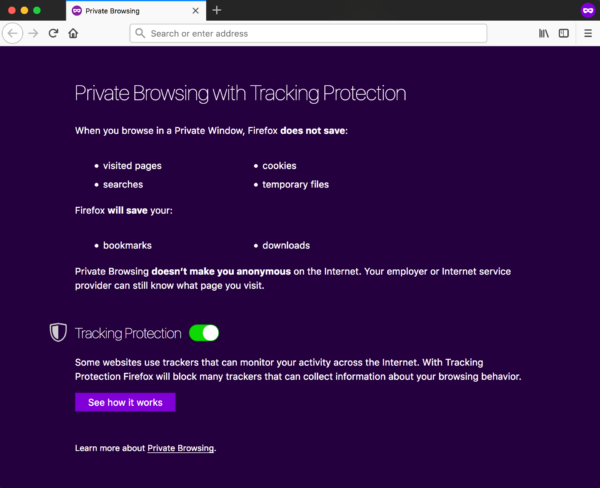
To prevent this type of data leakage when Firefox users are browsing privately, we are changing the way Firefox sends referrers in Private Browsing Mode.
Starting with Firefox 59, Private Browsing will remove path information from referrer values sent to third parties (i.e. technically, setting a Referrer Policy of strict-origin-when-cross-origin).
In the previous examples, this setting would remove the path and query string data from the referrer values so that they are stripped down to:
Referer: https://www.reddit.com/
and
Referer: https://www.healthcare.gov/
This change prevents site authors from accidentally leaking user data to third parties when their users choose Private Browsing Mode. We made this change only after first ensuring that this would have minimal to no effect on web usability.
Vendors and authors continue to propose changes to Referrers to improve web privacy, security, and functionality.
In 2014, the W3C Web Application Security Working Group started its Referrer Policy Recommendation. This Policy lets vendors and authors control referrer values. For example, it defines a secure-by-default no-referrer-when-downgrade policy for user agents, which does not send referrers to HTTP resources from an HTTPS page. In Firefox Regular and Private Browsing Mode, if a site specifically sets a more restrictive or more liberal Referrer Policy than the browser default, the browser will honor the websites request since the site author is intentionally changing the value.
Users can also change their default referrer options in Firefox. These will override the browser’s default Referrer Policy and override the site author’s Referrer Policy, putting the users choice first.
The post Preventing data leaks by stripping path information in HTTP Referrers appeared first on Mozilla Security Blog.

Dock.io,
Feb 04, 2018

This is an alpha release of an application that uses blockchain technology to link the data in your various accounts around the internet. "Most people have dozens of profiles online, many of which include information that is not up to date, resulting in lost time and opportunities. dock.io solves this by connecting different websites and apps you use, allowing you to save information to one source, and control how and where your information is used across the web," wrote Remote.com CEO Nick Macario by email today while announcing their partnership with Dock. I like the idea of Dock.io but it feels skeevy because of the way it offers me money to invite people to connect. I get the sense that Dock wants to centralize all my information (and then what, sell it?) and my concern about that is precisely why my information is scattered across multiple services.
Web: [Direct Link] [This Post]Gord Price: I’ve been predicting the rise of the “Transportation Service Provider” – a consolidator of every mode of movement imaginable, integrated with technology, and designed to provide consumers with a suite of services for which they pay, as with telecommunications, one provider with a lot of money. Assuming a single provider or oligopoly can emerge.
So look to see some of the giants try to get even bigger and more diverse as fast as possible in order to dominate the market. Here’s the latest example.
SAN FRANCISCO — It’s Uber, but for bicycles.
For the first time in Uber’s history, the company is offering rides on roads in the United States using something other than cars. Starting next week, it will let certain users in San Francisco reserve pedal-assist electric bicycles through its app. The idea is that people will see the bicycles as a cheaper and faster alternative — not a huge stretch of the imagination for anyone who has been stuck in Friday evening gridlock traffic in San Francisco.
Uber is not supplying its own bicycles. It is working with Jump Bikes, a bike-sharing service that secured a permit in January to put 250 motorized bicycles — making it easier to tackle San Francisco’s steep hills — in locations throughout the city.
The pilot program is the latest indication of Uber’s ambitions to move beyond its ride-hailing origins. It is also working on autonomous trucking services, while aggressively expanding into the food delivery market with Uber Eats.

When you think about your favorite day of work, what comes to mind? Was it the day you answered 80 emails in an two-hour sprint? Or was it the day you discovered a new way to solve a problem you’d wrestled with for weeks? Chances are, you remember the day you did your best work better than the day you did the most work.
Why is that? When it seems like every app is asking you to fill every minute with new activities to track, measure, and optimize, sometimes just chasing an idea can feel gratifying. Creativity isn’t the enemy of productivity. It’s the fuel that keeps the engine running. That’s what we mean when we talk about creative energy, and why Dropbox is so passionate about finding ways to keep it flowing. We want to put the grind behind us. We want to make work feel less like a hamster wheel and more like a Sunday drive. Here are five steps to get started.
Creativity is hard to quantify. It can’t be measured by how many ideas you produce in an eight-hour day. It’s all about the impact—not just on your business, but on you and how you feel about your work. When you’re in a “flow state,”1 you lose track of time. That’s a good thing. When you’re lost on a train of thought, you’re not watching the clock. You’re not waiting to slide down the dinosaur. And you’re not worrying about a deadline.
As Art Markman points out, “Productive people move through the tasks they have to accomplish in a systematic way… They make effective and efficient use of their time. Creativity… doesn’t.”2 Part of the reason is, creative problem solving can take an immense amount of research. It often requires more input than output. That doesn’t mean the time spent isn’t productive.
Step one: Stop searching for more efficient ways to do the same thing over and over. Set aside an hour a week devoted to a new project. Spend that time doing something you want to do, instead of something you’ve been asked to do. See how it feels to play with an idea instead of working on one. Does that hour of exploration seem to go faster than your weekly status meeting?
Even on productive days, it can feel like you’re adding mileage without moving anywhere. That’s especially true when you spend your whole day picking the low-hanging fruit of easy-to-finish tasks. But you’re not a hamster, and your job’s not the wheel. Studies show everyone wants meaningful work—not just millennials.3 If you feel trapped in a never-ending cycle of tasks and to-dos, though, it can be hard to see the big-picture purpose of your job.
Step two: Take a break from repetitive tasks and spend a day working on big ideas with an eye on long-term goals. At Dropbox, we encourage our teams to step away from their day-to-day work and devote a week to exploring blue-sky ideas. It’s more than just a break from our routine. Some Hack Week projects have led to the development of new features, like Dropbox Smart Sync.
What happens when we minimize chores and make more time for meaningful work? Shifting focus from quantity to quality might sound like it could threaten the bottom line of businesses. But recent research4 shows that companies with a culture of innovation actually see payoffs in terms of growth and profitability.
The push for productivity doesn’t seem to end when business hours are over. You can see its effect on our relationship to entertainment, too. Second screening is proof that we’re trying to make even our downtime more productive. Technology has made us super-efficient consumers of media. You probably watch more movies and hear more music now than you did as a kid. But do you feel more entertained? Or do you feel stressed by the fear of missing out?
Step three: Instead of passively scrolling through 25 headlines, try reading two full long-form articles. Or instead of watching 10 online videos, pick one new movie to watch. Taking deeper dives into one story might give you the same kind of fix, but with a more satisfying result.
Time is a limited resource. But creativity doesn’t have to compete with productivity for your attention. It’s a matter of finding balance—and changing the way we measure the value of both. Learning how to find creative flow is time well spent when employees feel valued for the impact of their ideas as much as the number of hours they work.
Some companies obsess over growth and push to produce more every year. But overwhelming workloads can lead to employee burnout5 when hiring hasn’t kept up with growth. Could they improve employee retention just by shifting the way they measure results? And are workers less likely to burn out when they feel like they’re doing meaningful work?
Step four: Think of a new way to quantify your work. Stop keeping track of the number of boxes you tick, and start thinking more about exploring new ways to do old tasks. Create a spreadsheet to capture fringe ideas for projects. Challenge yourself to spend a few more minutes every week daydreaming.
When you’re struggling to solve a problem, it’s easy to get into the habit of endlessly researching how others have approached similar issues. But sometimes concentrating harder is the opposite of what you need to do. Studies show6 that letting your mind wander can make creative problem solving easier. So it’s helpful to unplug from external sources and turn to your instincts. And though your job title might make you think you’re not creative, anytime you’re using your imagination to solve a problem, you’re tapping into your creativity.
Step five: Next time you’re writing and having trouble finding the right words, resist the urge to sit down and scroll through an online Thesaurus. Get up, go outside, and take a walk around the block. Instead of fixating on the search for the perfect word, clear your mind and give your total attention to your senses. Forgetting about the problem for a few minutes might make it easier for the solution to present itself naturally.

1 https://www.psychologytoday.com/blog/the-playing-field/201402/flow-states-and-creativity
2 https://hbr.org/2015/11/to-get-more-creative-become-less-productive
3 https://hbr.org/2017/07/every-generation-wants-meaningful-work-but-thinks-other-age-groups-are-in-it-for-the-money
4 https://sloanreview.mit.edu/article/are-innovative-companies-more-profitable/
5 https://hbr.org/2017/04/employee-burnout-is-a-problem-with-the-company-not-the-person
6 https://www.scientificamerican.com/article/allowing-the-mind-to-wander-aids-creativity/


We could be excused for thinking that Micro.blog is like App.net — a Twitter alternative greeted with enthusiasm but that eventually closed.
It’s not the same thing, though, and I’ll explain why.
Micro.blog is not an alternative silo: instead, it’s what you build when you believe that the web itself is the great social network.
That’s the important part: even if Micro.blog doesn’t last (though I believe it will), the idea — that the web itself is where we are and where we talk to each other — will continue.
And: Micro.blog could be just one of thousands of similar services. And those services would all work together, because they’re made of web-stuff.
Pick your year. I like 2003, since that was when I released NetNewsWire 1.0, an early Mac RSS reader. You might prefer 2000 (nice round number) or 2005 (things were a bit more advanced).
But if you think of the years 1995-2005, you remember when the web was our social network: blogs, comments on blogs, feed readers, and services such as Flickr, Technorati, and BlogBridge to glue things together. Those were great years — but then a few tragedies happened: Google Reader came out, and then, almost worse, it went away. Worse still was the rise of Twitter and Facebook, when we decided it would be okay to give up ownership and let just a couple companies own our communication.
Even if those companies had the public interest in mind — and they most definitely do not — they hold far too much power over something too fundamental to give up: our own human voices.
Twitter and Facebook are convenient, sure, but so are fossil fuels, and the cost was similarly unknown for a long time. But now we have some idea just how bad these things are for the world.
Micro.blog rewinds us to 2005 (or pick your year) — but, also, it has learned the lesson that people really like a timeline of short posts. People like being able to write and reply easily to other people. Good to know!
When you post to Micro.blog, you’re posting to an actual blog with an RSS feed and everything. The blog might be hosted by Micro.blog, or it might be some other blog somewhere else. (Could be a WordPress blog, for instance.)
Your posts are just a normal, everyday part of the open web. At this writing, mine appear on micro.inessential.com — but it’s on my to-do list to have those appear on my main blog (this blog) instead. (Probably won’t happen until after I ship the app I’m currently working on.)
And this is how it used to be, and how it never should have stopped being: my blog is me on the web. I own my blog: I own me.
And so everyone who follows me on Micro.blog sees my blog posts, and I see theirs. Simple.
And anyone who wants to could just read my blog in an RSS reader instead. All good, all open.
Replies are a little trickier. (Micro.blog is not a finished thing — the-web-as-social-network is not a finished thing, and, we hope, never will be. That’s totally fine.)
Replies don’t appear on your blog (though this could become an option, I suppose) — but they are sent as a WebMention when possible, which means even replies are part of the open web. You can read more about replies and @-mentions on the help site.
I expect this area to get more work in the future, especially as it’s part of the key to making Micro.blog part of the great social network but not the great social network (the web itself).
If you’re running the Micro.blog app on your iPhone or Mac, it really does look like a slimmed-down Twitter. This is by design. But don’t let that deceive you.
If the web is a river, Micro.blog is water, where Twitter and Facebook are dams.
You might think this is too difficult for normal people, that it’s all too nerdy, and that it won’t make headway against Twitter, so who cares.
My reply: it’s okay if this is a work in progress and isn’t ready for everybody yet. It’s okay if it takes time. We don’t know how it will all work in the end.
We’re discovering the future as we build it.

Apple has just published its financial results for Q1 2018. The company posted revenue of $88.3 billion. Apple sold 13.2 million iPads, 77.3 million iPhones, and 5.1 million Macs during the quarter.
“We’re thrilled to report the biggest quarter in Apple’s history, with broad-based growth that included the highest revenue ever from a new iPhone lineup. iPhone X surpassed our expectations and has been our top-selling iPhone every week since it shipped in November,” said Tim Cook, Apple’s CEO. “We’ve also achieved a significant milestone with our active installed base of devices reaching 1.3 billion in January. That’s an increase of 30 percent in just two years, which is a testament to the popularity of our products and the loyalty and satisfaction of our customers.”
Apple's revenue guidance for Q1 2018 fell between $84 billion and $87 billion, with gross margin estimated to be between 38% and 38.5%.
Going into today’s earnings call, Nasdaq reported on analysts’ earnings expectations:
The Zacks Consensus Estimate for revenues is currently pegged at $86.02 billion, reflecting year-over-year growth of almost 10%. The Zacks Consensus Estimate for earnings increased 6 cents to $3.81 over the last 30 days, reflecting 13.4% growth over the year-ago quarter.
In a research note, independent Apple analyst Neil Cybart noted that "for the first time in six years, Apple's FY1Q results will reflect a full flagship iPhone launch". Cybart estimated revenue of $95.6B (with a 22% YoY growth) and iPhone sales of 82 million units. Other analysts polled by Philip Elmer-DeWitt (both Wall Street professionals and independents) had estimates ranging from $85B revenue to $90B.
In the year-ago quarter (Q1 2017), Apple earned $78.4 billion in revenue. During that quarter Apple sold 78.3 million iPhones, 13 million iPads, and 5.4 million Macs.
Apple's active install base of iOS devices has grown to 1.3 billion – a 30% growth over the past two years.
This is Apple's fifth consecutive quarter with double-digit growth in all geographic segments.
Revenue from the iPhone 8 and X lines was the highest in the company's history of previous iPhone releases.
Apple passed 240 million paid subscriptions across their services – a 30 million increase in the past 90 days alone.
Apple Pay has hit 50% year-over-year growth in merchant adoption, now accepted at more than half American retail locations. Apple Pay is available in 20 markets.
Apple Watch has seen 50% growth in unit sales and revenue for the fourth consecutive quarter.
Worldwide, 50% of iPad sales were to first-time buyers and switchers.
Worldwide, 60% of Mac sales were to first-time buyers and switchers – in China, the number goes up to 90%.
Mac unit sales are up 13% year-over-year in emerging markets.
According to data by NPD, iPad has 46% share of U.S. tablet market – up from 36% last year.
Apple is rolling out a new initiative called 'Apple at Work' to make it easier to get Apple products to employees.
Tim Cook: "Customer satisfaction for iPhone X is literally off the charts."
Tim Cook: "I don’t want to say what else we may do with AR, but I could not be happier with how things are going right now."
Apple did not consider "in any way, shape, or form" what the discounted battery replacement program would do to iPhone upgrade rates.
Below, we've compiled a graphical visualization of Apple's Q1 2018 financial results.
(Tap the charts to open them in full-screen.)


There are now about 800m iPhones in use, over 3bn total smartphones, and around 5bn total mobile phones.
— Benedict Evans (@BenedictEvans) February 1, 2018
Here’s guidance for March quarter. Revenue between $60 and $62 billion. Gross margin between 38% and 38.5%. Tax rate about 15%. Tax reform allow pursuit of more optimal cash position.
— Six Colors liveblog (@sixcolorsevent) February 1, 2018
Love Luca’s little shout out to Italy’s Impresa San Paolo #AAPL
— Carolina Milanesi (@caro_milanesi) February 1, 2018
Apple wearables revenues was up 70% year-over-year. Second-best category in terms of revenue growth (behind iPhone).
— Neil Cybart (@neilcybart) February 1, 2018
App Store saw quarterly store visitors, transacting accounts, and paying accounts, all saw new all-time highs. Record # of purchases in Christmas week. $300 million in purchases on New Year’s Day alone.
— Six Colors liveblog (@sixcolorsevent) February 1, 2018
Apple active device base of 1.3bn (versus 1bn 2 years ago) indicates a lengthening lifespan (often across multiple owners). iPhones now probably lasting 3.5-4 years, iPad 5 years.
— Benedict Evans (@BenedictEvans) February 1, 2018
Worth noting that Apple’s $88.3 billion in revenue was *more* than the high-end of their guidance, which was “just” $87 billion.
— Six Colors liveblog (@sixcolorsevent) February 1, 2018
My estimate for iPhone units was expecting a lot more iPhone 8 with an average pricing of $710. Actual ASP was $796. A LOT of iPhone X were sold.
— Horace Dediu (@asymco) February 1, 2018
iPhone's sold in first quarter:
Q1 2018: 77.3 million
Q1 2017: 78.3 million
Q1 2016: 74.8 million
Q1 2015: 74.5 million
Q1 2014: 51.0 million
Q1 2013: 47.8 million
Q1 2012: 37.0 million
Q1 2011: 16.2 million
Q1 2010: 8.7 million
Q1 2009: 4.4 million
Q1 2008: 2.3 million— Jon Erlichman (@JonErlichman) February 1, 2018
The *average* analyst revenue estimate of $87.3B is at Apple’s previous high-end, so Apple must beat its own guidance or analysts will say they “missed.” https://t.co/oLxfI9nDDU
— MacJournals.com (@macjournals) February 1, 2018
Club MacStories offers exclusive access to extra MacStories content, delivered every week; it's also a way to support us directly.
Club MacStories will help you discover the best apps for your devices and get the most out of your iPhone, iPad, and Mac. Plus, it's made in Italy.
Join Now
Cupertino computing giant Apple reported its first-quarter 2018 results Thursday evening.
The company generated $88.29 billion USD in revenue from October 2017 to December 30th 2017, representing a 13 percent increase over Q4 2017.
In a February 1st, 2018 media release, Apple said that the company’s Q1 2018 performance represented its greatest quarter ever.
Apple also revealed that it sold 77.31 million iPhones, 13.17 million iPads and 5.11 million Mac computers in Q1 2018.
“We’re thrilled to report the biggest quarter in Apple’s history, with broad-based growth that included the highest revenue ever from a new iPhone lineup,” said Tim Cook, Apple’s CEO, in the same February media release.
According to Cook, sales of the company’s iPhone X smartphone “surpassed our expectations” and has been the company’s top-selling iPhone “every week since it shipped in November [2017].”
In a February 1st, 2018 investor call, Cook added that that iPhone X was the best-selling smartphone in the world in December 2017, according to industry analysts Canalys.
The iPhone X launched on November 3rd, 2018.
Looking ahead to Q2 2018, Apple expects between $60 billion USD and $62 billion USD in revenue.
Apple’s stock closed at $167.78 USD on Thursday evening, representing a 0.21 percent increase since markets opened this morning.
More to come…
Source: Apple
The post Apple reports Q1 2018 revenue of $88.3 billion USD, sold 77 million iPhones appeared first on MobileSyrup.

Sony has confirmed its flagship phones will receive two years’ worth of software updates.
Xperia Blog — a blog site that focuses on Sony smartphones — spotted the following statement within the Sony Mobile Android Upgrade Policy:
“We aim to support all premium range devices with the latest Android updates for two years after the device has launched. We may choose not to upgrade a mid-range or entry-level device if testing does not meet our exacting standards and we feel the hardware isn’t capable of delivering a stable user experience.”
Sony declaring its support for all premium range phones with Android updates for two years is promising for owners of Sony Xperia XZ1-like phones. However, choosing not to update mid-range or entry-level devices is far from groundbreaking.
The Japan-based company is expected to unveil the 5.7-inch Sony Xperia XZ2 Pro at Mobile World Congress at the end of the month. Rumours indicate that the XZ2 Pro features an OLED display with a 4K resolution as well as Qualcomm’s Snapdragon 845 chipset, 6GB of RAM, 128GB of on-board storage and expandable storage via a microSD card.
Source: Sony Via: XperiaBlog
The post Sony flagships will get two years of Android updates appeared first on MobileSyrup.
A powerpoint presentation by Dale Bracewell (Manager of Transportation Planning, City of Vancouver) via Twitter
Three sample slides


mkalus
shared this story
from  Price Tags. Price Tags.
|

There are four main elements to protecting the lives of vulnerable users of the street system. Vulnerable users are defined as those not encased in the steel shell of a car and include cyclists and pedestrians. The best way to reduce fatalities and serious injuries is to enhance visibility, reduce speeds on roads and highways, change driver behaviour and have better designed roads that “drive” at the speed limit intended. For a vulnerable road user, if you are hit by a vehicle at 50 kilometers an hour you have a 10 per cent chance of survival. Had that vehicle been travelling at 30 kilometers an hour, your chance of survival after being crashed by a vehicle climbs to 90 per cent. That is why the Chief Medical Health Officer of B.C., Dr. Perry Kendall has been advocating for 30 kilometer an hour limits within cities and on treaty lands.
In Great Britain, the Chief Constable of Police for Britain’s roads has asked for the end of the ten per cent buffer where motorists are not being charged if they are going ten per cent over the speed limit. In the British example, a motorist going 35 miles per hour in a 30 mile per hour zone would avoid a ticket. Let’s say no more, states the Chief Constable. The rationale? “Let’s change the message – we are proud to be law enforcers. I do not want the public to be surprised, I want them to be embarrassed when they get caught… They need to understand the law is set at the limit for a reason.”The Chief Constable also thought that subjecting violators to speed awareness courses would have more of an impact than a fine or point demerits on a licence. As he observed “They should not come whinging to us about getting caught. If booked at 35 or 34 or 33 (in a 30mph zone) that cannot be unfair because they are breaking the law.”
Locally in Metro Vancouver the Chief Constable for the Delta Police Department, Chief Neil Dubord went on record about road violence in the City of Delta, noting that in 2016 with a 100,000 population that there were eight road deaths. He noted at the time “ Our traffic investigators look for root causes in order to focus our prevention efforts on three things: engineering, education and enforcement.” “The common thread in the fatal accidents in 2016 was not about road design or engineering; each one had some element of speed and/or distraction. And, most importantly, they were all preventable.”
In 2017, with their focus on speed enforcement and distraction, the Delta Police Department issued 20 per cent more traffic violation tickets (8,079), and were a visible presence on the roads and in the community. Traffic fatalities were reduced by 50 per cent, and there were no pedestrian fatalities in 2017. Enforcing speed limits and dealing with driver distraction meant that more families were not ripped apart by road violence. Kudos to Chief Dubord and the Delta Police Department who have gone on record and who are proactively working to achieve Vision Zero-no traffic fatalities or road violence injuries within the City of Delta.


Wir müssen diesen Menschen zuhören, so lange es sie noch gibt. Und zwar nicht die 3-Minuten-Zusammenfassung in der Tagesschau, sondern die ganze bittere Geschichte.
Dear Ethereum community (and wonderful Etherheads!),
Today, January 31, 2018, is my last day as Executive Director of the Ethereum Foundation.
I’m pleased to have been able to guide the Foundation as ED with my fellow directors, team leads, and outstanding group of team members, each of whom has contributed to our current position of strength. Taking the Foundation from what was an early stage startup to one of stability, with the infrastructure and resources to support the changes, improvements and challenges to come was no small feat in blockchain and cryptoland!
We have gone through a lot together to successfully move through several stages of growth in the last 2.5+ years. As a result, the Ethereum Foundation has become stronger, more solid and capable as an organization, entity and leading contributor in both the Ethereum community and the greater world of emergent tech.
Now that the Foundation has successfully launched Frontier, released Homestead and Metropolis-1 (aka Byzantium), and has the resources to continue supporting its mission and related projects, teams and goals, I feel satisfied the critical work I was tasked with has been done so that the next part of the journey may take place as envisioned.
I would like to take this opportunity to urge the community to give the incoming Executive Director and all new team members a warm and open-minded welcome as well as the time needed for organizational changes of this nature.
To my beloved team members, there are no words to express the effect and experience of working with you in the past years. You will forever be a significant part of my life and I will be rooting for you at the Foundation or wherever life takes you as I commence my own new phase.
As I will be taking care of a number of long overdue matters of a personal nature, I would like to ask our community and the media to focus on the exciting forward-looking developments at the Foundation, in the Ethereum community and in the growing global blockchain ecosystem.
I wholeheartedly wish the very best for the Foundation, the new team members and those of us who carry on here as we brave the new world to evolve and shine both together and separately.
Ming Chan
Executive Director (August 1, 2015 – January 31, 2018)
Ethereum Foundation
The post To Infinity and Beyond! appeared first on Ethereum Blog.
|
mkalus
shared this story
from Price Tags:
|
|
| If the fines don't hurt / outstrip potential profits than it's just the "cost of doing business". |

Almost 8,000 apartments were returned to the rental market in Berlin last year thanks to strict property laws introduced in 2016, according to figures from the Senate Department for Urban Development and Housing published by German media on Sunday.
About half of those had been used as vacation rentals through services such as Airbnb, which have long been criticized for their effect on housing markets worldwide. The remaining 3,915 apartments returned to the long-term residential market had simply sat empty. …
The law, the Zweckentfremdungsverbotsgesetz, introduced fines of up to €100,000 ($125,000) for landlords illegally renting out their property for short-term stays. Since the law came into force, more than €2.6 million euros of fines have been imposed, according to RBB.


Check out episode #7 (I wish we had called it 007) where Ken Case talks about all the good stuff coming up in 2018.
There will be new releases of OmniOutliner, OmniPlan, and OmniGraffle — plus a whole bunch of great stuff for OmniFocus 3.0 for Mac and iOS, including tags, JavaScript scripting, and OmniFocus for the web.
You can subscribe to the podcast or just listen to this episode — there’s a player on the page. Or you can read the transcript.
* * *
I’ve been wondering if other companies in our world are doing similar podcasts.
There is the Supertop Podcast from our friends who make Castro. And there are much larger companies (such as Microsoft) who create videos and podcasts.
It may be that Omni’s size is somewhat unique in the Mac and iOS world: it’s big enough that we won’t run out of people to interview and topics to talk about, which could be tricky for a 5- or 10-person company. And it’s small enough to still be intimate — my goal is to eventually interview every single person who works here. (Though, of course, people can decline: it’s not required!)
Anyway: there was a time before companies had blogs, and now they have blogs. I wonder if more and more companies will find value in having a podcast too.
(And a Slack group. And a Micro.blog account.)

Steven Loomis,
Learning Solutions,
Feb 03, 2018

While there is merit to this post I think the way it conflates different senses of 'adaptation' undermine its core message. We really have three very different senses of adaptation at work here: first, Darwin's concept of species adaptation in evolution; second, variability of individual responses to changing circumstances; and third, rule-based selection of responses based on varying trigger events. That's why the reference to the Darwin Awards and the Natureismetal subreddit is so inappropriate in this context. And even within these definitions there is a misunderstanding of adaptation; while we read that "organizations and workers recognize - we must be fast and nimble to survive" I can think of many occasion in which slowing down, acting wisely, adopting a defensive posture and waiting it out are much better survival mechanisms.
Web: [Direct Link] [This Post]
As reported in the Richmond News seniors who receive Old Age Security and Canada Pension Plan benefits of $586 and $866 a month respectively are still unable to pay the cost of a bachelor apartment rental in Richmond.The Canada Mortgage and Housing Corporation statistics show that in 10 years a one bedroom rental unit in Richmond has risen 44 per cent to $1,185 a month.
Few people who have worked all their lives come forward to say they are living below the poverty line. But Judy Lyk, a retired social worker has. A single mother of three was unable to save for retirement and also had financial problems that led to a bankruptcy. The lack of affordable adequate housing is what Richmond’s Chimo Community Services calls a “significant contributor to domestic crisis situations.” Ms Lyk was found living in a community shelter and represents the expanding realm of homelessness. One of the first occupants of a 129 unit subsidized rental building, Ms. Lyk is left with $250 a month for food and sundries as the rent even with a subsidy for the small bachelor apartment is $880.
Diane Sugars the executive director of Chimo community services observes “People have this idea of a person with addiction, or a man sitting in a doorway. It’s not that; it’s changed. It’s seniors, yes, but it’s also families who are faced with the inability to meet their rent. If they’re evicted, they struggle to find a place with affordable rent.” While an additional 130 subsidized units have been built annually in Richmond, more subsidized rental units are needed especially for families and seniors who “fall off the ladder” in a tight housing market.


Further to this post, a box with the beginnings of a Jackson Pollock reproduction on Victoria Drive between Parker and Napier in front of one of the buildings of the Britannia Lodge care centre.
Note: I’m writing this post on my personal blog as this isn’t an official Moodle pronouncement, just some experimentation.
I’m leading Project MoodleNet, which will be “a new open social media platform for educators, focused on professional development and open content”. There are decisions I have to make, and these need to be based on criteria, prioritisation, etc.
One of the things I’m keen to do with the professional social networking component of Project MoodleNet is to ensure that it’s decentralised. By this I mean that, unlike Twitter and Facebook and Instagram, it won’t be a ‘silo’ of information.
Instead, Project MoodleNet will be federated in a way which allows information to flow between instances. It’s well explained in this article, which includes the following diagram which outlines the technical protocols on which a number of options are based:
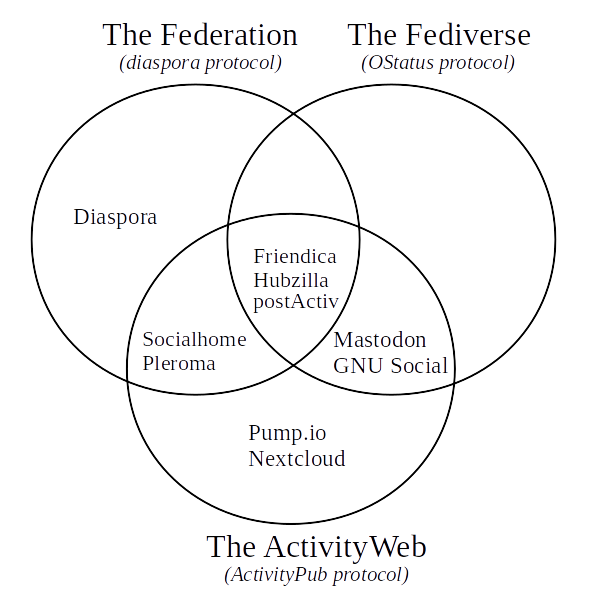
As you can see, the ActivityPub protocol is definitely a candidate for the professional social network aspect of Project MoodleNet. Last week it became a W3C recommended standard.
For less technical readers, the upshot of this is that users can send messages, files, and (most importantly) emojis to anyone on any server that uses the ActivityPub protocol. Products and services built upon this protocol may look and feel very different, but all of the data is interoperable.
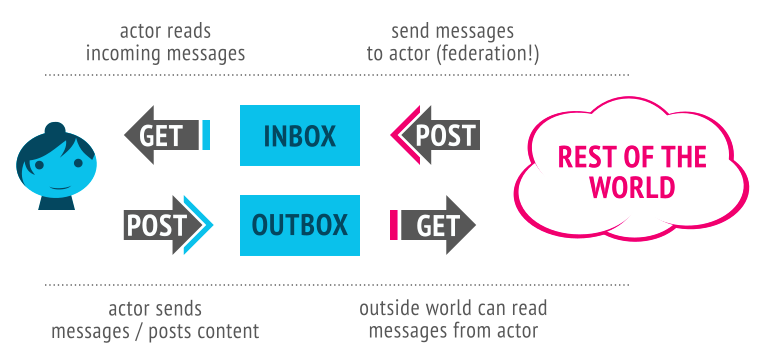
The W3C specification, which includes these diagrams, is surprisingly readable!
Mastodon is a social network which was originally built on the OStatus protocol, but which is now also compatible with ActivityPub. I’m a member of the social.coop instance, although there’s no limit on the number of different accounts you can hold on different instances.
Although they have a common basis, you find differences between Mastodon instances. For example, some have a particular focus, meaning that the stream of updates you get from your own instance might be focused on gaming, or education, or LGBT rights. There’s also differences between the kind of languages and content allowed by instances.
No matter which instance you’re on, however, you can follow anyone from any instance. You can see this in the screenshot below.
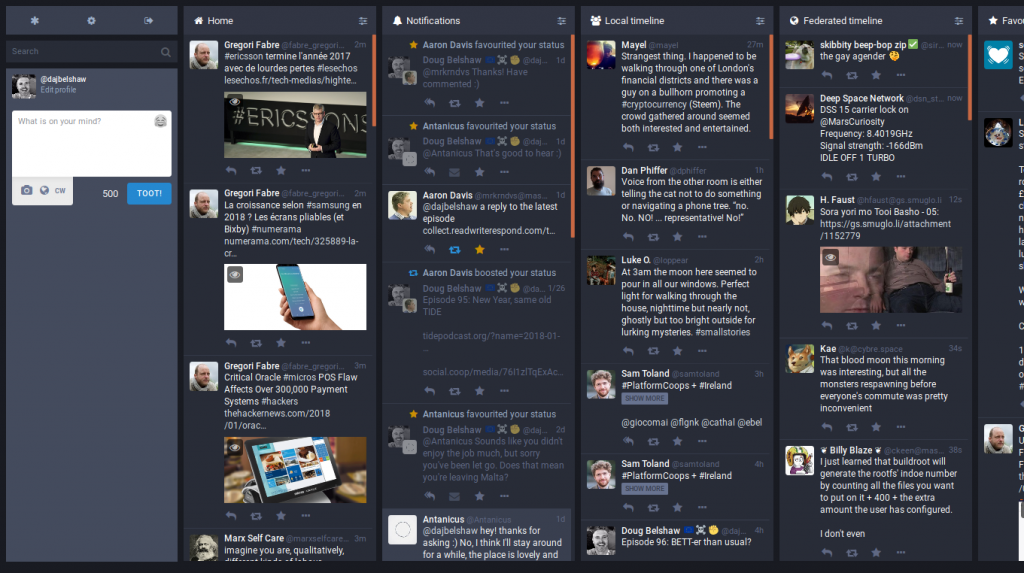
From left to right:
In practice, it’s a lot like TweetDeck (I think on purpose).
I wanted to have access to a testing version of Mastodon to look at the administration and moderation functionality. Paul Greidanus was kind enough to spin up an instance which, for obvious reasons, isn’t federated to the rest of the network.
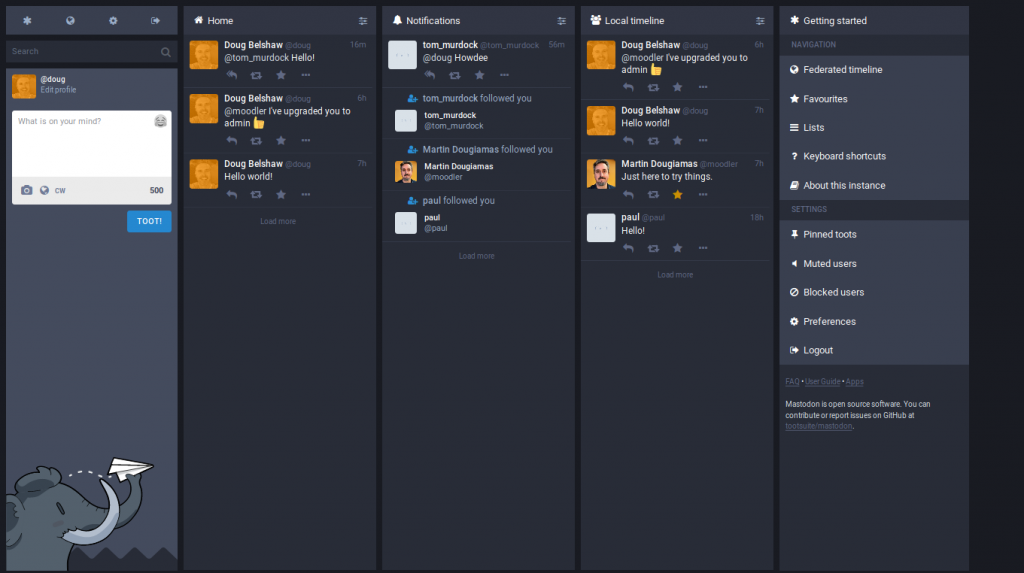
I closed self-registration and invited some Moodle staff to create an account via a special link. As you can see, it was pretty quiet. That’s OK, however, as I’m really just interested in the moderation and admin functionality.
To access the additional options available as a moderator and/or admin exist in the same place as user settings. It’s a nice touch, and the way that it’s presented makes it easy to focus on what you want to achieve, rather than getting sidetracked with technical stuff.

The audit log shown in the screenshot above is useful, particularly for GDPR compliance, and reporting reasons.
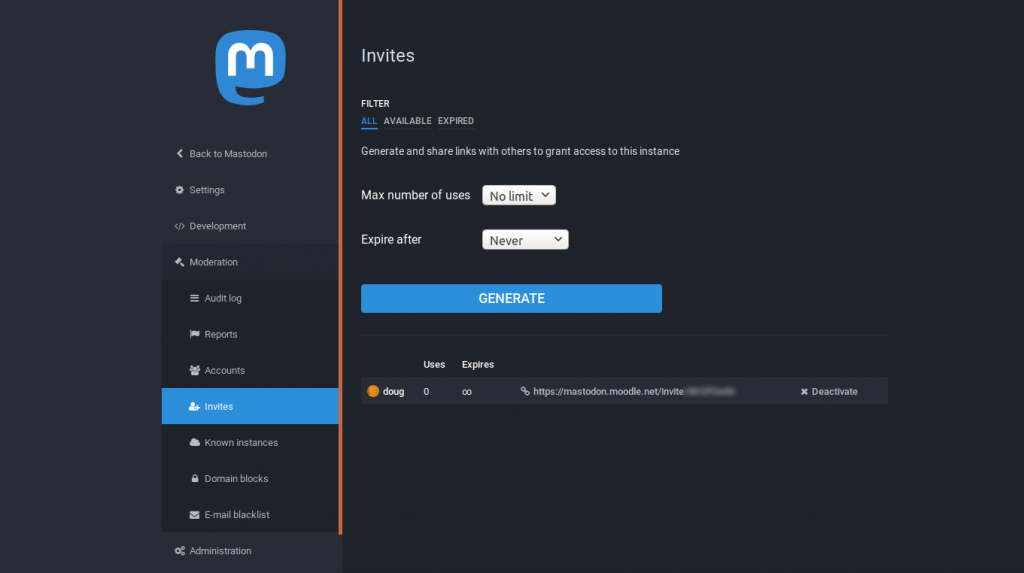
This is also the place where you can generate invitations, which can have a maximum number of uses and/or expire after a certain time. There’s also functionality around blocking email addresses from certain domains from registering.
On the admin side of things, this is where you can configure the public description of the instance, add contact details, and specify the rules and other guidelines.

The thing that interested me most, however, was CUSTOM EMOJIS:

Finally, there’s various technical reports, and queries you can run from a technical point of view.
I have to say that I wasn’t expecting the moderation and admin side of Mastodon to be so… user-friendly. It’s incredibly easy and intuitive to use, although it does mean delving into the code if, say, you want to change the default background colour to orange!
The next thing to do is to experiment with Hubzilla, which is also mentioned on the Venn diagram earlier in this post. It’s important to experiment both technically and with users, and weigh all of these things against the principles that underpin Project MoodleNet.
Exciting times!
Main image by Slava Bowman used under a CC0 license
If you use Sublime text for coding or taking notes, then turning on autosave might be super useful. This ensures that my files get saved and synced to dropbox without me having to do anything, so I can always pick up where I left off on a different machine.
PhyiscsGirl: Can you see this type of light? (YouTube, 9:45min) “Polarized light is an unusual form of light. Can humans see when light is polarized?”
By the way, you can train yourself into seeing the polarization of light. The video mentions staring at a lcd screen for a while and tilting your head to see Haidinger’s brush. You can do the same thing with the sky on a clear day. After practicing this for a bit, you’ll be able to detect the polarization of the sunlight easier and easier.
Auf deutsch heißt das Phänomen übrigens Haidinger-Büschel.
It’s pretty rare for the same company to feature in two consecutive Weekly Articles; yesterday’s announcement of a health care initiative involving Amazon, though, is not only incredibly intriguing, it also fits directly into some of the most important themes on Stratechery. I couldn’t resist.
From a joint press release:
Amazon, Berkshire Hathaway and JPMorgan Chase & Co. announced today that they are partnering on ways to address healthcare for their U.S. employees, with the aim of improving employee satisfaction and reducing costs. The three companies, which bring their scale and complementary expertise to this long-term effort, will pursue this objective through an independent company that is free from profit-making incentives and constraints. The initial focus of the new company will be on technology solutions that will provide U.S. employees and their families with simplified, high-quality and transparent healthcare at a reasonable cost.
Tackling the enormous challenges of healthcare and harnessing its full benefits are among the greatest issues facing society today. By bringing together three of the world’s leading organizations into this new and innovative construct, the group hopes to draw on its combined capabilities and resources to take a fresh approach to these critical matters…
The effort announced today is in its early planning stages, with the initial formation of the company jointly spearheaded by Todd Combs, an investment officer of Berkshire Hathaway; Marvelle Sullivan Berchtold, a Managing Director of JPMorgan Chase; and Beth Galetti, a Senior Vice President at Amazon. The longer-term management team, headquarters location and key operational details will be communicated in due course.
I’ve gotten more and more questions from readers about the possibilities of Amazon and health care, even before this announcement. I’ve been surprised, to be honest, but perhaps I shouldn’t be: I was the one who declared on The Bill Simmons Podcast that “Amazon’s goal is to basically take a skim off of all economic activity”, and given that health care was 17.9% of GDP in 2016, well, I guess that means I predicted this!
What is “this”, though? It certainly is tempting to jump immediately to a possible end game predicated on the ideas I have laid out in The Amazon Tax, Amazon’s New Customer, and Amazon Go and the Future:
Amazon could then go in one of two directions. First, Amazon could start to backwards integrate into its suppliers’ business; there are hints the company is already exploring pharmaceutical sales, and the Wall Street Journal says the idea was broached. That said, I actually think this is less likely; insurance operates best at more scale, not less: first and foremost, the larger the pool, the more risk can be spread, as well as obvious efficiency gains in administration. More scale also gives more bargaining power over other parts of the healthcare chain. Three companies, large though they may be, aren’t going to be as effective as large insurers, no matter how well-managed they may be.
What would make more sense to me is that, having first built an interface for its employees, and then a standardized infrastructure for its health care suppliers, is that Amazon converts the latter into a marketplace where PBMs, insurance administrators, distributors, and pharmacies have to compete to serve employees. And then, once that marketplace is functioning, Amazon will open the floodgates on the demand side, offering that standard interface to every large employer in America.
This is certainly ambitious enough — basically intermediating U.S. employers and the U.S. healthcare industry — but in fact this only sets the stage for the wholesale disruption of American healthcare. First, Amazon could not only open up its standard interface to other large employers, but small-and-medium sized businesses, and even individuals; in this way the Amazon Health Marketplace could aggregate by far the most demand for healthcare.
Consolidating demand by offering a superior user experience is how aggregators gain power; given the scenario I just sketched out, Aggregation Theory has a prediction about what might happen next:
Once an aggregator has gained some number of end users, suppliers will come onto the aggregator’s platform on the aggregator’s terms, effectively commoditizing and modularizing themselves. Those additional suppliers then make the aggregator more attractive to more users, which in turn draws more suppliers, in a virtuous cycle.
This means that for aggregators, customer acquisition costs decrease over time; marginal customers are attracted to the platform by virtue of the increasing number of suppliers. This further means that aggregators enjoy winner-take-all effects: since the value of an aggregator to end users is continually increasing it is exceedingly difficult for competitors to take away users or win new ones.
The key words there are “commoditize and modularize”, and this is where the option I dismissed above comes into play, but not in the way most think: Amazon doesn’t create an insurance company to compete with other insurance companies (or the other pieces of healthcare infrastructure); rather, Amazon makes it possible — and desirable — for individual health care providers to come onto their platform directly, be that doctors, hospitals, pharmacies, etc.
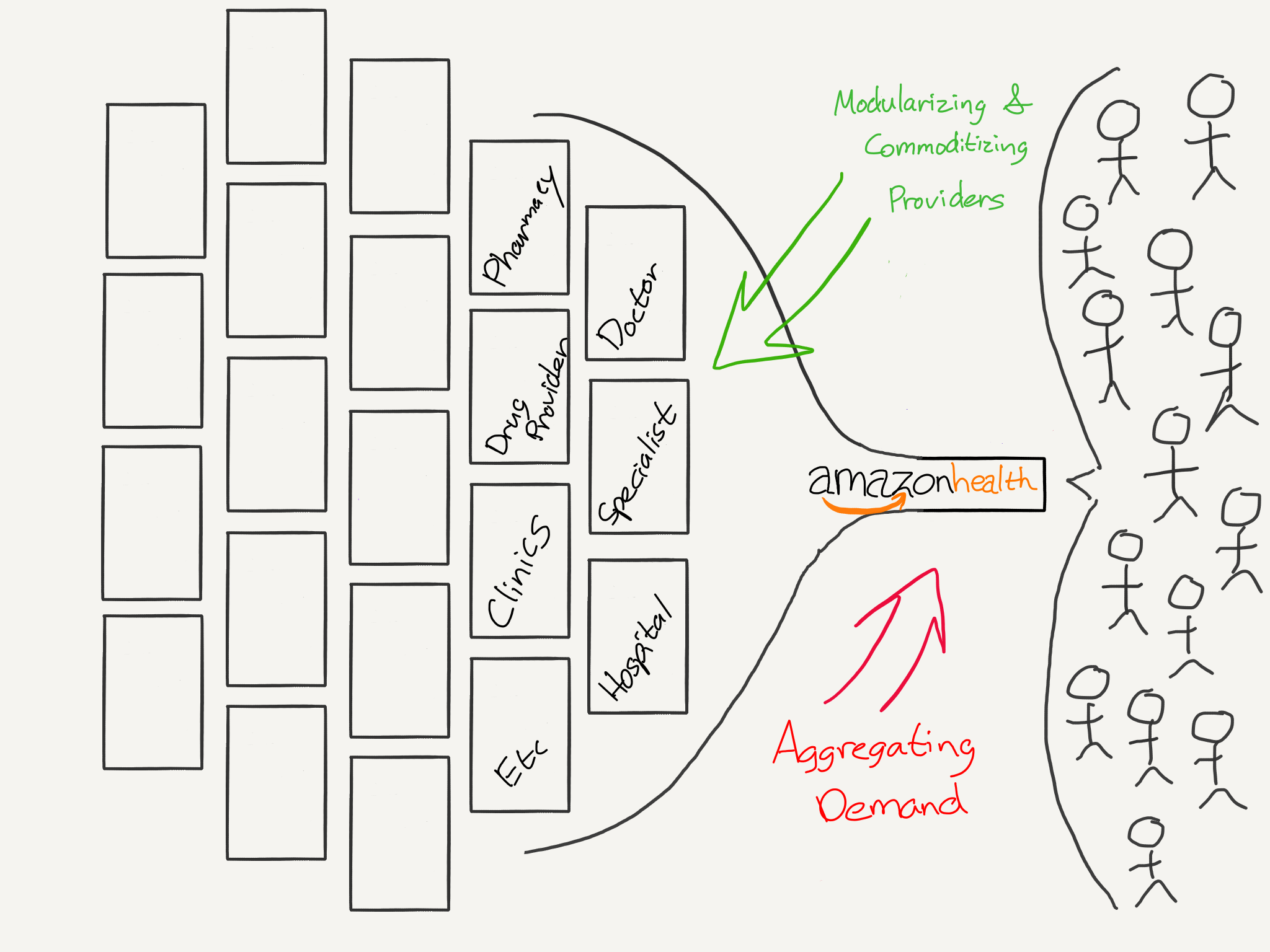
After all, if Amazon is facilitating the connection to patients, what is the point of having another intermediary? Moreover, by virtue of being the new middleman, Amazon has the unique ability to consolidate patient data in a way that is not only of massive benefit to patients and doctors but also to the application of machine learning.
Of course that leaves the insurance piece, which makes Berkshire Hathaway a useful partner; conveniently, Berkshire Hathaway is not in the health insurance business, but rather the health reinsurance business — that is, they insure the insurers. Or, to put it another way, they don’t provide any of the services that Amazon Health Marketplace might make obsolete, and specialize in the one thing Amazon Health Services would need.
Oh, and this will be really expensive, and take years to get off the ground. It certainly would be helpful to have access to financing and capital markets, which means it would be very helpful to partner with JPMorgan Chase & Company. The skills these three companies bring to bear seems far more relevant than the number of employees (and besides, the company alliance approach to traditional health care has been done).
Needless to say, what I just sketched out is extremely ambitious; it is easy to let one’s mind run wild when it comes to a company without a name, a management team, or a location. Moreover, the press release was quite modest in its ambitions; I quoted it above, but here is the relevant piece again:
The three companies, which bring their scale and complementary expertise to this long-term effort, will pursue this objective through an independent company that is free from profit-making incentives and constraints. The initial focus of the new company will be on technology solutions that will provide U.S. employees and their families with simplified, high-quality and transparent healthcare at a reasonable cost.
Ah yes, “technology solutions”. We’ve certainly seen that before, and it hasn’t worked.
That, though, is where the previous line comes in: the scenario that I sketched out above is wildly profitable, to be sure, but only years down the road when demand is fully aggregated and Amazon Health Marketplace is taking a skim off of every transaction; if short-term profit isn’t the goal, long-term goals become much more realistic.
And there it is, in the first sentence: “this long-term effort.” These three companies are clear up-front that this isn’t a one-off effort; there is the commitment to the long-term, and while “technological solutions” seems like a short-term play, I just explained why that is the place the start. Aggregators win with products that are simple, high-quality, and easy to understand — exactly what this press release promised.
I’m not a healthcare expert by any means; I know enough to know that the U.S. system is incredibly complex, bedeviled by incentive problems, and tied up in all kinds of messy ways with regulations (mostly justified!).
At the same time, the U.S. healthcare system is inextricably tied up with the post-World War 2 order; indeed, the entire reason employers are so important to the system is because of World War 2 regulations that instituted price controls on wages, incentivizing employers to use benefits as a means of attracting workers (this was further enshrined by making healthcare benefits tax-exempt).
That system, though, is under more duress than ever. I wrote in TV Advertising’s Surprising Strength — and Inevitable Fall:
What should be terrifying to television executives is that all of those pieces that make television advertising the gold mine that it has been are under the exact same threat that TV watching itself is: the threat of the Internet. Start with the top 25 advertisers in the U.S.…
Notice that the vast majority of the industries on on this list are dominated by massive companies that compete on scale and distribution. CPG is the perfect example: building a “house of brands” allows a company like Procter & Gamble to target demographic groups even as they leverage scale to invest in R&D, bring down the cost of products, and most importantly, dominate the distribution channel (i.e. retail shelf space). Said retailers, meanwhile, are huge in their own right, not only so they can match their massive suppliers at the bargaining table but also so they can scale logistics, inventory management, store development, etc. Automobile companies, meanwhile, are not unlike CPG companies: they operate a “house of brands” to serve different demographics while benefitting from scale in production and distribution; the primary difference is that they make money through one large purchase instead of over many smaller purchases over time.
Note [that nearly all] of the companies on this list are threatened by the Internet.
My thesis in that article — repeated in Dollar Shave Club and the Disruption of Everything and The Sports Linchpin — is that the post-World War 2 economic system was deeply intertwined and interdependent, and that the root of everything was control of distribution. The Internet, though, made the distribution of information free, upsetting not just information providers like publishers, but all industries; it follows, then, that to the extent that the current health care system is built on that post-World War 2 order, such is the extent to which it is vulnerable.
That is not to say its collapse is imminent — quite the opposite, in fact. Each seemingly distinct industry, by virtue of being interdependent on others, supports each other. My expectation, then, is not that the Internet methodically disrupts industry after industry in some sort of chronological order, but rather that the entire edifice lasts far longer than technologists think, only to one day collapse far quicker than anyone expected.
The ultimate winners of this shakeout, then, are not only companies that are building businesses predicated on the Internet, but just as importantly, are willing and able to build those businesses with the patience that will be necessary to wait for the old order to collapse, particularly if that collapse happens years or decades after the underlying business models are rotten.
There is no more patient company than Amazon.


