Shared posts

06 Feb 22:53

Google Won’t Take Down ‘Pirate’ VLC With Five Million Downloads

by Andy
mkalus shared this story from TorrentFreak.

VLC is the media player of choice for Internet users around the globe. Downloaded for desktop at least 2,493,000,000 times since February 2005, VLC is an absolute giant. And those figures don’t even include GNU/Linux, iOS, Android, Chrome OS or Windows Phone downloads either.

Aside from its incredible functionality, VLC (operated by the VideoLAN non-profit) has won the hearts of Internet users for other key reasons, not least its commitment to being free and open source software. While it’s true to say that VLC doesn’t cost a penny, the term ‘free’ actually relates to the General Public License (GPL) under which it’s distributed.

The GPL aims to guarantee that software under it remains ‘free’ for all current and future users. To benefit from these protections, the GPL requires people who modify and redistribute software to afford others the same freedoms by informing them of the requirement to make source code available.

Since VLC is extremely popular and just about as ‘free’ as software can get, people get extremely defensive when they perceive that a third-party is benefiting from the software without adhering to the terms of the generous GPL license. That was the case beginning a few hours ago when veteran Reddit user MartinVanBallin pointed out a piece of software on the Google Play Store.

“They took VLC, put in ads, didn’t attribute VLC or follow the open source license, and they’re using Media Player Classics icon,” MartinVanBallin wrote.

The software, found here, is called 321 Media Player and has an impressive 4.5 score from more than 101,000 reviews. Despite not mentioning VLC or the GPL, it is based completely on VLC, as the image below (and other proof) shows.

VLC Media Player 321 Media Player

TorrentFreak spoke with VideoLAN President Jean-Baptiste Kempf who confirmed that the clone is in breach of the GPL.

“The Android version of VLC is under the license GPLv3, which requires everything inside the application to be open source and sharing the source,” Kempf says.

“This clone seems to use a closed-source advertisement component (are there any that are open source?), which is a clear violation of our copyleft. Moreover, they don’t seem to share the source at all, which is also a violation.”

Perhaps the most amazing thing is the popularity of the software. According to stats provided by Google, 321 Media Player has amassed between five and ten million downloads. That’s not an insignificant amount when one considers that unlike VLC, 321 Media Player contains revenue-generating ads.

Using GPL-licensed software for commercial purposes is allowed providing the license terms are strictly adhered to. Kempf informs TF that VideoLAN doesn’t mind if this happens but in this case, the GPL is not being respected.

“A fork application which changes some things is an interesting thing, because they maybe have something to give back to our community. The application here, is just a parasite, and I think they are useless and dangerous,” Kempf says.

All that being said, turning VLC itself into adware is something the VideoLAN team is opposed to. In fact, according to questions answered by Kempf last September, the team turned down “several tens of millions of euros” to turn their media player into an ad-supported platform.

“Integrating crap, adware and spyware with VLC is not OK,” Kempf informs TF.

TorrentFreak contacted the developer of 321 Media Player for comment but at the time of publication, we were yet to receive a response. We also asked for a copy of the source code for 321 Media Player as the GPL requires, but that wasn’t forthcoming either.

In the meantime, it appears that a small army of Reddit users are trying to get something done about the ‘rogue’ app by reporting it as an “inappropriate copycat” to Google. Whether this will have any effect remains to be seen but according to Kempf, tackling these clone versions has proven extremely difficult in the past.

“We reported this application already more than three times and Google refuses to take it down,” he says.

“Our experience is that it is very difficult to take these kinds of apps down, even if they embed spyware or malware. Maybe it is because it makes money for Google.”

Finally, Kempf also points to the obviously named “Indian VLC Player” on Google Play. Another VLC clone with up to 500,000 downloads, this one appears to breach both copyright and trademark law.

“We remove applications that violate our policies, such as apps that are illegal,” a Google spokesperson informs TorrentFreak.

“We don’t comment on individual applications; you can check out our policies for more information.”

Source: TF, for the latest info on copyright, file-sharing, torrent sites and more. We also have VPN discounts, offers and coupons

06 Feb 22:53

Apple files patent for stylus that draws on any surface

by Patrick O'Rourke
Apple patent about air stylus

It looks like Apple plans to reimagine the capabilities of the stylus.

The company filed a patent for a stylus that works on any surface, not just touch-sensitive displays. It looks like it could even allow users to draw in midair.

The application describes a pen that’s capable of being monitored by a force sensor located in the tip of the stylus. The pen can also be tracked using built-in motion and orientation sensors, a camera and an “electromagnetic or sound-based triangulation scheme”. Essentially, it sounds like future Apple devices could feature multiple sensors to allow them to track the company’s new stylus in 3D space.

According to the filing, the pen is capable of drawing 3D text and drawings as well, allowing it to act like a 3D doodler of sorts. The patent was originally filed back in July 2016, but was just published in late January, which isn’t unusual in the patent space.

Apple Stylus patent

The Apple Pencil, the company’s current stylus, only works with various iterations of the iPad Pro, including the most recently released 10.5-inch iPad Pro. Samsung also offers the S Pen with its Galaxy Note and Microsoft sells the Surface Pen for its various Surface devices, including even the pricey Surface Studio.

It’s interesting that this patent looks at the concept of a stylus from a three dimensional perspective. While I’ve never found much use for a stylus given my lack of artistic ability, I can see designers finding the ability to create an object in midair very useful.

Of course, going hands-on with the concept could tell a different story, especially since the tactile sensation of drawing or creating a design is gone when you aren’t actually creating on a physical surface.

As always, it’s important to note that just because a patent has been filed and published, it doesn’t mean that an actual product will stem from it.

Source: WIPO Via: The Verge 

The post Apple files patent for stylus that draws on any surface appeared first on MobileSyrup.

06 Feb 22:53

“Does anything say …” – 2

by pricetags

Does anything say ‘Canadian culture’ better than Canada Post Star Trek stamps?


(Add your “Does anything say …” observations in the Comments.)


06 Feb 22:53

Announcing “Project Things” – An open framework for connecting your devices to the web.

by Mozilla

Last year, we said that Mozilla is working to create a framework of software and services that can bridge the communication gap between connected devices. Today, we are pleased to announce that anyone can now build their own Things Gateway to control their connected device directly from the web.

We kicked off “Project Things”, with the goal of building a decentralized ‘Internet of Things’ that is focused on security, privacy, and interoperability. Since our announcement last year, we have continued to engage in open and collaborative development with a community of makers, testers, contributors, and end-users, to build the foundation for this future.

Today’s launch makes it easy for anyone with a Raspberry Pi to build their own Things Gateway. In addition to web-based commands and controls, a new experimental feature shows off the power and ease of using voice-based commands. We believe this is the most natural way for users to interact with their smart home. Getting started is easy, and we recommend checking out this tutorial to get connected.

The Future of Connected Devices

Internet of Things (IoT) devices have become more popular over the last few years, but there is no single standard for how these devices should talk to each other. Each vendor typically creates a custom application that only works with their own brand. If the future of connected IoT devices continues to involve proprietary solutions, then costs will stay high, while the market remains fragmented and slow to grow. Consumers should not be locked into a specific product, brand, or platform. This will only lead to paying premium prices for something as simple as a “smart light bulb”.

We believe the future of connected devices should be more like the open web. The future should be decentralized, and should put the power and control into the hands of the people who use those devices. This is why we are committed to defining open standards and frameworks.

A Private “Internet of Things”

Anyone can build a Things Gateway using popular devices such as the Raspberry Pi. Once it is set up, it will guide you through the process of connecting to your network and adding your devices. The setup process will provide you with a secure URL that can be used to access and control your connected devices from anywhere.

Powerful New Features

Our latest release of the Things Gateway has several new features available. These features include:

  • The ability to use the microphone on your computer to issue voice commands
  • A rules engine for setting ‘If this, then that’ logic for how devices interact with each other
  • A floor-plan view to lay out devices on a map of your home
  • Additional device type support, such as smart plugs, dimmable and colored lights, multi-level switches and sensors, and “virtual” versions of them, in case you don’t have a real device
  • An all-new add-on system for supporting new protocols and devices
  • A new system for safely authorizing third-party applications (using OAuth)

Built for hackers everyone

If you have been following our progress with Project Things, you’ll know that up to now, it was only really accessible to those with a good amount of technical knowledge. With today’s release, we have made it easy for anyone to get started on building their own Things Gateway to control their devices. We take care of the complicated stuff so that you can focus on the fun stuff such as automation, ‘if this, then that’ rules, adding a greater variety of devices, and more.

Getting Started

We have provided a full walkthrough of how to get started on building your own private smart home using a Raspberry Pi. You can view the complete walkthrough here.

If you have questions, or you would like to get involved with this project you can join the #iot channel on irc.mozilla.org and participate in the development on GitHub. You can also follow @MozillaIoT on twitter for the latest news.

For more information, please visit iot.mozilla.org.

The post Announcing “Project Things” – An open framework for connecting your devices to the web. appeared first on The Mozilla Blog.

06 Feb 18:27

Paulo Freire

files/images/Friere.jpg

Kim Díaz, Internet Encyclopedia of Philosophy, Feb 08, 2018


Icon

The entry for Paulo Freire in the Internet Encyclopedia of Philosophy has just been updated. It's worth taking a few moments to read if you are not familiar with the man or his work. "A native of Brazil, Freire's goal was to eradicate illiteracy among people from previously colonized countries and continents. His insights were rooted in the social and political realities of the children and grandchildren of former slaves. His ideas, life, and work served to ameliorate the living conditions of oppressed people."

Web: [Direct Link] [This Post]
06 Feb 18:27

Lire RSS Client Adds Deeper iOS 11 Drag and Drop Support

by Federico Viticci

At the end of last year in my annual Must-Have Apps roundup, I covered lire, an RSS client for iPhone and iPad that, despite having been around for several years, had flown under my radar until its iOS 11 update.

I wrote:

I settled on lire, an RSS reader that's been around for years and that never grabbed my attention before. lire has been fully redesigned for iOS 11, taking advantage of Apple's large title design style to neatly indicate different folders and sections. In addition to a clean design that feels good on the iPhone X and iPad Pro, lire has two peculiarities: it supports all the most popular RSS services (including Inoreader) and it comes with its own text extraction tool to load the full text of truncated stories. The full-text option can be enabled on a per-site basis, and it works well in combination with caching for read articles. lire looks native to iOS in a way that the official apps by Inoreader, NewsBlur, and Feedly don't, and it's actively supported by its developer with frequent updates.

I've been using lire in combination with Inoreader since November; four months later, I still haven't found any other RSS reader that mixes iOS 11's aesthetic with support for all the most popular RSS services. Unlike other apps, lire looks native to iOS 11 and it lets you choose the sync service you prefer. Plus, the ability to load specific websites in full-text mode and a pure black theme make lire a fantastic reading experience on the iPhone X as well.

With today's 3.0.32 update, developer Kunal Sood has brought deep integration with iOS 11's drag and drop to lire, shipping one of the best implementations of the feature on both the iPhone and iPad. Which isn't surprising considering that lire's drag and drop enhancements have been directly inspired by Bearalready a terrific example of what developers can build with drag and drop in iOS 11.

Just like in Shiny Frog's Bear, lire now lets you drop one or multiple articles into a floating "action bar" that only appears once you start dragging. Dropping multiple articles into the bar reveals options to star, read later, or share them at once. As with Bear's drop bar, this technique of revealing a contextual menu only during a drag operation is well suited for the iPad, but it works well on the iPhone too, simplifying operations that would otherwise require a variety of taps and swipes.

In my experience (I've been using a beta version of this feature for a while now), lire's action bar has proven to be a faster way to save multiple stories from my RSS into other apps' extensions, such as the aforementioned Bear or Things. I've also found the floating bar to be useful to star multiple articles in a single action.

Multiple articles shared from lire's action bar with the Bear extension.

Multiple articles shared from lire's action bar with the Bear extension.

Thanks to Apple's native drag and drop framework, lire's action bar doesn't block interactions with the app: while you're holding a stack of articles, you can keep scrolling and refresh your feed list and continue using the app until you're ready to drop your drag item into the bar. I'm a fan of this functionality (and I hope that more developers steal the idea) because it allows me to perform common actions without having to learn different sets of gestures and shortcuts for each app.

Of course, if you're an iPad user, you can also drag articles out of lire and drop them into any other destination, where they'll be pasted as URLs. Alternatively, you can select some text from inside the article view on iPad and drag it onto another app. Selected text will be exposed to the destination app as plain text, rich text, and HTML (you can see these data types through Gladys), which makes lire an ideal companion for writing apps that support insertion of formatted text, such as Notes, Bear, or Ulysses.

When dropping a rich text selection (containing an image) from lire into Ulysses, for instance, Ulysses can see lire's rich text and intelligently convert it to Markdown with an inline image attachment.

A selection from lire being dropped in Ulysses, where it'll maintain the image attachment and text styles.

A selection from lire being dropped in Ulysses, where it'll maintain the image attachment and text styles.

Lire's deep support for drag and drop and the flexibility of Apple's framework are perhaps even more impressive when using the RSS app alongside Gladys and Notes: the popular shelf app can store all the data formats available for article text clipped from lire; the latter can receive a selection from an article and retain images, formatted text, and links.

Lire's article text, saved in Gladys, can be exported to Apple Notes as RTFD.

Lire's article text, saved in Gladys, can be exported to Apple Notes as RTFD.

There are other noteworthy additions in lire's latest update (3D Touch is now available in article lists; there are better controls for offline article caching), but the app's fantastic integration with drag and drop is the highlight of this release. This is how I would expect all RSS readers for iOS 11 to work now: a floating bar for batch operations on selected articles, and support for exporting RTF and HTML from an article's view. Lire gets both right.

I highly recommend lire if you've been looking for an RSS client that looks modern and native to iOS 11; and if you subscribe to a lot of feeds or peruse RSS as part of your daily work, I suggest you play around with lire's new drag and drop features alongside other iOS 11 apps.

Lire is available on the App Store at $6.99.


Support MacStories Directly

Club MacStories offers exclusive access to extra MacStories content, delivered every week; it's also a way to support us directly.

Club MacStories will help you discover the best apps for your devices and get the most out of your iPhone, iPad, and Mac. Plus, it's made in Italy.

Join Now
06 Feb 18:26

Auf der Zielgeraden :: Kickstarter-Kampagne für iA Writer for Windows

by Volker Weber

Sketch

Vor einer Woche hatte ich mir die Kickstarter-Kampagne für iA Writer for Windows näher angeschaut und war der Ansicht, das würde eher knapp ausgehen. Seitdem schlossen sich täglich rund ein Dutzend Basic Supporter und vielleicht drei Premium Supporter an. Und brachten damit nur 2262 CHF zusätzlich ein. Damit drohte die Kampagne zu scheitern. Allerdings fanden sich drei Supporter, die noch einmal 2527 CHF in den Klingelbeutel warfen und damit ist iA Writer näher an die Zielgerade gerutscht. Die jetzt noch fehlenden 2094 CHF sind für die verbleibenden knapp vier Tage ein steiles Ziel, aber ich bin mir sicher, dass es mindestens einen weiteren weißen Ritter gibt, der den Deckel am Ende voll macht.

Update Mittwoch: Es hat (auch durch vowe.net) noch mal einen ganzen Schwung neuer Unterstützer gegeben. Dazu kamen noch zwei großzügigere Spender, die das Projekt über die Ziellinie geschoben haben. Zwei Tage habt Ihr noch Zeit, Euch zu beteiligen.

19 CHF sind 16,39 €, ein absoluter Witz für diese tolle Software. Ich würde Euch raten, das zu unterstützen.

Wer kein Windows, aber dafür Mac oder iPhone/iPad hat, sollte iA Writer schon lange haben:

More >

06 Feb 18:26

Recreational marijuana to be sold through private, government-run stores in B.C. - The Globe and Mail

mkalus shared this story .

VANCOUVER

British Columbia will create a retail system for recreational cannabis that is almost identical to the one for alcohol, but like most other provinces, will not allow the two substances to be sold together in private or public stores once Ottawa legalizes it this summer.

Solicitor-General Mike Farnworth released more details for the province's legal cannabis framework on Monday. He noted that his NDP government heeded the advice of the country's top public-health experts to ban the sales of cannabis next to alcohol. The province's biggest public unions had pushed for co-location, which only Nova Scotia and the Northwest Territories have approved. However, it will be legal in some rural areas, just as the province now allows alcohol to be sold next to tobacco in special cases, he added.

As is the case with alcohol, municipalities will have the final word on if and where they want cannabis sold, with the provincial Liquor Control and Licensing Branch in charge of licensing cannabis retailers and making sure they comply with the law.

Story continues below advertisement

"It's going to take some time before we get the entire retail system up and running," he said. "We fully anticipate all levels of government will need to continue to assess and refine cannabis policy and regulation in the months and years to come."

He said the province is creating an online sales portal and the first standalone government store is expected to be selling product by "late summer," which is unlikely to coincide with Ottawa's promise to end prohibition in July.

To hasten the licensing process, the provincial liquor agency will allow applicants to start registering for a retail licence this spring, he said.

Those now operating illegal dispensaries, more than a hundred of which exist across the province, will be allowed to apply for a licence, as will those with criminal records for drug offences and other "low risk" activities. But entry into the legal sector will be granted on a case-by-case basis and those with ties to organized crime won't be allowed , Mr. Farnworth said.

Commercial producers now licensed by Ottawa to grow medical cannabis won't be allowed to open their own stores – as in Alberta – and entrepreneurs will be prohibited from selling any products from producers to which they are linked. As well, the provincial agency will have to approve the commercial name of each store, with the words dispensary, apothecary or pharmacy outlawed because they blur the line between recreational and medical cannabis.

The B.C. government announced in December that 19 would be the minimum age to possess up to 30 grams.

On Monday, Mr. Farnworth announced more rules, including allowing people to smoke cannabis in public places where tobacco smoking and vaping are permitted, although it will be banned in vehicles and in areas frequented by children, including beaches, parks and playgrounds. Provincial rules for marijuana cultivation will align with the federal government's proposal, allowing adults to grow up to four plants per household, but landlords are allowed to prohibit cultivation and use by tenants.

Story continues below advertisement

Story continues below advertisement

The B.C. government will also create a 90-day driving ban for those caught drug-impaired while driving, and it will increase training for law enforcement officers to recognize impairment.

06 Feb 18:25

Lululemon CEO resigns, firm says he ‘fell short’ on code of conduct - The Globe and Mail

mkalus shared this story .

Lululemon Athletica Inc. CEO Laurent Potdevin has abruptly resigned, as the fitness-clothing company said the executive "fell short" of its standards of conduct.

Mr. Potdevin resigned Feb. 2. Lululemon announced the news late on Monday.

The specific reasons for Mr. Potdevin's resignation, which includes stepping down from Lululemon's board of directors, were unclear. The company cited its commitment to the "highest levels" of integrity and personal respect. Lululemon spokeswoman Shahed Larson said the company would not comment further "out of respect for the individuals involved."

Story continues below advertisement

A person familiar with the matter said there were several instances in which Mr. Potdevin didn't meet Lululemon's conduct standards. But the person wouldn't say whether Mr. Potdevin's resignation was in any way related to the #MeToo movement. The issue of the treatment of women in the workplace has been prominent since last fall, and numerous high-profile men in an array of professions have stepped down because of allegations of misconduct.

Mr. Potdevin joined the company four years ago, as founder Chip Wilson gave up his position as board chairman. Mr. Wilson retreated amid controversial statements at the time about women's body sizes. Mr. Potdevin, who previously had a 15-year tenure as chief executive of Burton Snowboards Inc., oversaw a strong, but choppy period in Lululemon's history.

The stock rose and fell sharply several times but, over all, has climbed about two-thirds from when he started, close to a record high.

While the Vancouver company searches for a new CEO, it will be led by Glenn Murphy, Lululemon's chairman, whose new title will be executive chairman. Three other executives are also taking on new responsibilities. Mr. Murphy joined the board last April. He was previously chairman and CEO of clothing retailer Gap Inc. from 2007 through 2014.

Mr. Murphy, in a statement, spoke of Lululemon's company culture in the late-Monday announcement of Mr. Potdevin's resignation.

"Culture is at the core of Lululemon, and it is the responsibility of leaders to set the right tone in our organization," Mr. Murphy's statement said. "Protecting the organization's culture is one of the board's most important duties."

The vague nature of Lululemon's statement will hurt the brand, said retail analyst Neil Saunders of consultancy GlobalData Retail.

Story continues below advertisement

Story continues below advertisement

"You can't just put out a statement and say he fell short," Mr. Saunders said. "It's not about being nosy or salacious gossip. It's obviously serious. They pride themselves on being open. People will not rest until they come clean. It's a massive PR misstep."

Mr. Saunders noted that while a connection with #MeToo was speculative, it was another reason Lululemon should be more upfront about the reasons behind Mr. Potdevin's resignation, especially considering that the company's brand is in part centred on strong women.

BMO Nesbitt Burns analyst John Morris said Mr. Potdevin's departure could be "modestly disruptive" to Lululemon's business, but added that Mr. Murphy is "highly qualified" and his Gap experience will help as interim Lululemon boss.

Mr. Wilson, the company founder who is still a large shareholder, had battled with Lululemon in recent years when Mr. Potdevin was at the helm. On Monday, Mr. Wilson said in a statement that Mr. Potdevin's resignation "marks an opportunity to secure a culturally aligned leader" that better represents the company's character.

In agreeing to his resignation, Mr. Potdevin will receive US$3.35-million in a lump-sum cash payment, Lululemon said in a regulatory filing on Monday. Mr. Potdevin will receive an additional US$1.65-million over 18 months in equal monthly instalments, starting in April.

Mr. Morris noted the separation agreement between the company and Mr. Potdevin includes a 24-month, non-solicitation agreement. This means Lululemon has a low risk of losing other top executives, according to Mr. Morris. "Retaining top talent should ease the relative volatility compared with other unexpected CEO departures," Mr. Morris said in a note to clients.

Story continues below advertisement

The three Lululemon executives whose roles have expanded are: Celeste Burgoyne, executive vice-president of the Americas; Stuart Haselden, chief operating officer; and Sun Choe, senior vice-president of merchandising.

"We believe this trio of leaders will take Lululemon from strength to strength," Mr. Murphy said in his statement.

Mr. Saunders, the retail analyst, said Mr. Potdevin's resignation is a negative for Lululemon's business outlook.

"It's bad news, regardless of what is alleged to have happened," Mr. Saunders said. "This was a successful CEO."

Lululemon on Monday reiterated its goal to reach US$4-billion in annual revenue in 2020. The number was put forth a month ago.

Lululemon has said its fiscal 2018 net revenue – for the year ended Jan. 28, 2018 – would be about US$2.63-billion, up about 12 per cent from US$2.34-billion in fiscal 2017.

06 Feb 18:25

Twitter Favorites: [matttomic] Did you know there's a subdivision in Mississauga near 401 & Mavis named entirely after baseball players? There's… https://t.co/HPK7Dt7Ycd

ℳatt @matttomic
Did you know there's a subdivision in Mississauga near 401 & Mavis named entirely after baseball players? There's… twitter.com/i/web/status/9…
06 Feb 18:25

Twitter Favorites: [bmann] I am unreasonably excited by the meme possibilities of this DOGE-ETH bridge. https://t.co/LZK4pFA9Fl

Boris Mann @bmann
I am unreasonably excited by the meme possibilities of this DOGE-ETH bridge. twitter.com/rzurrer/status…
06 Feb 18:25

Twitter Favorites: [counti8] The default condition of most the universe most of the time: unconscious and disordered. The default condition of… https://t.co/aEI4spa3AY

Karen Quinn Fung 馮皓珍 @counti8
The default condition of most the universe most of the time: unconscious and disordered. The default condition of… twitter.com/i/web/status/9…
06 Feb 18:25

(New) Diversity & Inclusion In Open Source — Community Call!

by Emma
 

Last year, after three months of qualitative and quantitative research, we published a series of recommendations for D&I in open source. Since this time, we’ve been busy implementing many of those in our work — like these new principles for inclusive volunteer leadership , processes for effectively responding to Community Participation Guideline Reports and investment in Metrics that Matter for D&I in Open Source. To name only a few.

Let’s Work Together!

One thing we heard over, and over again in our research was the belief that to move the needle on diversity in open source — and tech overall, we must move to be more intentional in our collaboration across projects and communities.

To explore this concept, I’ll be sharing the insights from our recent D&I in FOSS survey in the launch of our first D&I in Open Source Community Call! February 28th 9AM PST (your time)

With over 200 projects represented, we learned a lot… not only from responses, but from the challenge of creating an inclusive survey — with privacy, respect and safety of people at center.

Please join this first call to help shape what comes next. What are you working on, what do you need help with? What speakers would you like to see invited?


We’ll be running this call using Vidyo (which has video and phone-in), as well as Telegram (for those with bandwidth issues, or who prefer text-based interactions). You can sign up here for a calendar invite. Agenda outline here. Please reach out directly to Emma (eirwin @ mozilla dot com)

FacebookTwitterGoogle+Share

06 Feb 18:25

Intel made smart glasses that look normal

by Rui Carmo

These would totally work for me (although my prescription is challenging). Even with the limited resolution, notifications and some contextual prompts would be tremendously helpful throughout the day.

I can almost forgive them saying they’ll use JavaScript to code for it.

06 Feb 18:24

Scissors congruence

by Nathan Yau

The Wallace–Bolyai–Gerwien theorem says that if you have two polygons of equal area, you can cut one into pieces, and then place them back together to form the second piece. Dima Smirnov and Zivvy Epstein made an interactive to demonstrate. Draw two shapes and watch the magic happen.

Tags: geometry, theorem

06 Feb 18:24

Personalized Learning Is a Problem of Privilege

files/images/personalized-1516413278.jpg

Paul France, EdSurge, Feb 09, 2018


Icon

Yes it's another rant against personalization but there are also some interesting things in this article. First is this: "We often conflate individualization with personalization." According to Paul France, 'individualization' means " to have the assistance of a complex technological algorithm to assign activities to children," which he says is " impersonal and dehumanizing" and " focuses on consumption of educational material instead of interaction with meaningful provocations." But what is 'personalization'?

We read " Tools that minimize complexity, make educators more powerful, connect individuals, or redefine learning tasks can contribute to a more personal learning environment." But that's personal learning, much like I define it, " making learning personal by amplifying our humanity, not limiting it." It appears that 'personalized' learning falls somewhere in between. "'Personalized learning” tools don’t fulfill real needs," writes France. "Rather, they serve perceived needs that have been fueled by privilege." Me, I'm happy to lump 'personalized' and 'individualized' together. But for those who need it, there's a distinction there.

Web: [Direct Link] [This Post]
06 Feb 18:24

Automated vehicles: The problem with cyclists

by pricetags
mkalus shared this story from Price Tags.

From Slate:

Autonomous cars have a potentially fatal flaw: They struggle to detect and react to cyclists on the road. According to a January 2017 report by IEEE Spectrum, bicycles are generally considered “the most difficult detection problem that autonomous vehicle systems face.”

… we’re increasingly learning that A.I. can amplify our own biases and human failings. If humans aren’t doing a good job of detecting and preventing vehicle-bike collisions, how can we create machines that do the job even better?

One solution presented …(is) bicycle-to-vehicle communications. Instead of just autonomous vehicles (or all motorized vehicles) on the road being able to wirelessly communicate their position and intentions with one another, bikes would be able to join the party. The proposed technology would be brand agnostic, something any cyclist could affix to herself or her bike. …

There’s one problem: This is cheating. Autonomous cars, out there beta testing on U.S. roads today, can accurately detect other vehicles, pedestrians, even big game charging suddenly across a street. Forcing cyclists alone to strap a sensor onto their backs feels like a crutch, a cop-out. …

The problem is that it requires everyone to take part, which poses several noteworthy financial and logistical questions, such as who pays for this system, how it’s deployed, how it’s enforced, and whether pedestrian and traffic laws would need to be changed in order to facilitate cooperative behavior. (For example, stricter jaywalking laws to ensure pedestrians only cross in places self-driving cars expect them to.)

In this scenario, autonomous car success hinges on a large number of difficult-to-control variables. But if the cars themselves are able to successfully sense and react to their surroundings, from a cyclist taking the lane to a toddler dashing into the street, the only variable that needs controlling is the technology itself. …

Bicycle-to-vehicle communication is a good idea and could be useful in certain scenarios, such as when visibility is low—at night or in the rain—or on tricky, twisty back roads with blind corners. But if cars are going to drive the roads without human help, they need to be able to handle all of the challenges that come with it, regardless of whether they’re wirelessly connected to the world around them.


06 Feb 18:24

SotD: Both Sides Now

Anyone’s list of top songwriters would include Joni Mitchell, and any list of her top songs would include Both Sides, Now. There’s little I can say that will add value here, just give it a listen and it’ll improve your day, any day.

Joni Mitchell

Notes

It was recorded by Judy Collins first, not Ms Mitchell. Speaking of “recorded-by”, check the list of cover versions, helpfully organized by decade; oh my goodness gracious.

I can remember once when I was stage manager for a concert, during the endless hours of take-down, load-out, and clean-up, someone put a tape on the auditorium PA that had a cover by a warm-voiced male singer, and since it was only a half-hour tape I heard it like six times, and to this day it remains the voice I hear when I think of the song. I was convinced it was Don McLean, but can find no evidence for the existence of such a recording.

Anyhow, one of the most beautiful melodies ever written by anyone, and perfect lyrics full of grace and wisdom.

This is part of the Song of the Day series (background).

Links

Spotify playlist. This tune on Amazon, Spotify, iTunes. There’s lots of live video from all ages of Joni Mitchell’s career, but this very early one made me smile. Admirers of Ms Mitchell will probably enjoy sampling this 1965 Canadian TV broadcast featuring the very young Joni when she had another last name. Her star power, even back then, is obvious.

06 Feb 18:23

Barbot 4: the bartending Grandfather clock

by Alex Bate

Meet Barbot 4, the drink-dispensing Grandfather clock who knows when it’s time to party.

Barbot 4. Grandfather Time (first video of cocktail robot)

The first introduction to my latest barbot – this time made inside a grandfather clock. There is another video where I explain a bit about how it works, and am happy to give more explanations. https://youtu.be/hdxV_KKH5MA This can make cocktails with up to 4 spirits, and 4 mixers, and is controlled by voice, keyboard input, or a gui, depending which is easiest.

Barbot 4

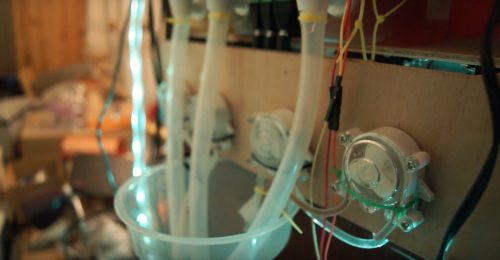
Robert Prest’s Barbot 4 is a beverage dispenser loaded into an old Grandfather clock. There’s space in the back for your favourite spirits and mixers, and a Raspberry Pi controls servo motors that release the required measures of your favourite cocktail ingredients, according to preset recipes.

Barbot 4 Raspberry Pi drink-dispensing robot

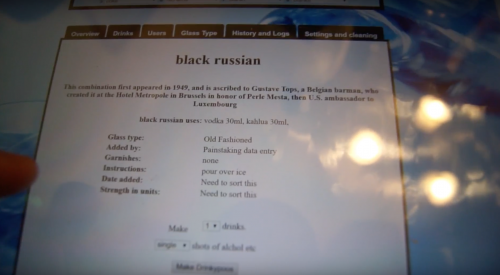
The clock can hold four mixers and four spirits, and a human supervisor records these using Drinkydoodad, a friendly touchscreen interface. With information about its available ingredients and a library of recipes, Barbot 4 can create your chosen drink. Patrons control the system either with voice commands or with the touchscreen UI.

Barbot 4 Raspberry Pi drink-dispensing robot

Robert has experimented with various components as this project has progressed. He has switched out peristaltic pumps in order to increase the flow of liquid, and adjusted the motors so that they can handle carbonated beverages. In the video, he highlights other quirks he hopes to address, like the fact that drinks tend to splash during pouring.

Barbot 4 Raspberry Pi drink-dispensing robot

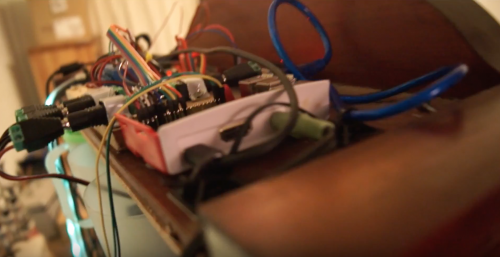
As well as a Raspberry Pi, the build uses Arduinos. These control the light show, which can be adjusted according to your party-time lighting preferences.

An explanation of the build accompanies Robert’s second video. We’re hoping he’ll also release more details of Barbot 3, his suitcase-sized, portable Barbot, and of Doom Shot Bot, a bottle topper that pours a shot every time you die in the game DoomZ.

Automated bartending

Barbot 4 isn’t the first cocktail-dispensing Raspberry Pi bartender we’ve seen, though we have to admit that fitting it into a grandfather clock definitely makes it one of the quirkiest.

If you’ve built a similar project using a Raspberry Pi, we’d love to see it. Share your project in the comments, or tell us what drinks you’d ask Barbot to mix if you had your own at home.

The post Barbot 4: the bartending Grandfather clock appeared first on Raspberry Pi.

06 Feb 18:23

Trespassing as a scientific technique

by russell davies

This moment from Neuropolis: A Brain Science Survival Guide

"In his 1940 lecture series Dynamics of Psychology, however, German psychologist Wolfgang Köhler praised ‘trespassing as a scientific technique’, on the grounds that what is merely special data in one field may turn out to have much broader significance in another. Now this doesn’t mean the trespasser sees the big picture in a way that eludes everyone else. Trespassing can be helpful by accidentally treading spores from one field into another, where they unexpectedly start fizzing and wriggling into life. Or the trespasser might find fertilizer sacks full of rubble and rusty cogs blocking the entrances to badger setts. Certainly one of the great joys of researching this book has been to disinter fascinating brain science buried under all the reductive bluster."

Chimed rather well with this story of minimum description length and why hiring the 'best' people produces the least creative results :

"While in graduate school in mathematics at the University of Wisconsin-Madison, I took a logic course from David Griffeath. The class was fun. Griffeath brought a playfulness and openness to problems. Much to my delight, about a decade later, I ran into him at a conference on traffic models. During a presentation on computational models of traffic jams, his hand went up. I wondered what Griffeath – a mathematical logician – would have to say about traffic jams. He did not disappoint. Without even a hint of excitement in his voice, he said: ‘If you are modelling a traffic jam, you should just keep track of the non-cars.’ "

06 Feb 18:22

RT @archillect: pic.twitter.com/s20WmvCiv9

by archillect
mkalus shared this story from primalpoly on Twitter.


Posted by archillect on Tuesday, February 6th, 2018 3:40am
Retweeted by primalpoly on Tuesday, February 6th, 2018 8:22am


597 likes, 131 retweets
06 Feb 18:22

Straßenverkehrsordnung dem Radfahrboom anpassen!

by noreply@blogger.com (Christine Lehmann)
mkalus shared this story from Radfahren in Stuttgart.

Unsere Straßenverkehrsordnung ist rückständig, was den Radverkehr betrifft. 

Für Autofahrer wird ständig modernisiert, aber so manche Regeln für den Radverkehr sind seit dem 2. Weltkrieg nicht mehr angefasst worden. Wenn wir wollen, dass Regeln eingehalten werden, müssen sie verständlich sein und sich auf die Realität auf der Straße beziehen. Außerdem müssen sie die modernen Fahrräder berücksichtigen.

Wir Radler können zwar nicht auf die Bundesregierung setzen, aber sehr wohl auf die verkehrspolitischen Sprecher anderer Parteien, die im Verkehrsausschuss sitzen. Denen schlage ich hier ein paar Punkte vor, die dringend der Wirklichkeit angepasst werden müssen.

1. Aufhebung der Radwegbentuzungspflicht. (StVO § 2 Ansatz 4.

Begründung: Radwege sind zwar gut für Radfahrende, wenn sie sie bequemer und sicherer zum Ziel bringen. Und sie sollten auch ausgeschildert sein, damit ihre Weiterführung oder ihr Beginn aus einiger Entfernung über eine Kreuzung hinweg sichtbar ist. Aber Viele Radwege sind zu schlecht (zu schmal, zu hopplig, zu gefährlich wegen zahlreicher Ein- und Ausfahrten oder an Kreuzungen) und leiten Radler auf Umwegen oder über Steilstücke zum Ziel, während der gerade Weg auf der Fahrbahn ihnen verboten wird.

Jetzt könnte man natürlich die blauen Radwegschilder überall abbauen, wo eine Radinfrastruktur auf den Boden gemalt ist (so wie bei den so genannten Schutzstreifen), aber die blauen Schilder sind als Verbotsschilder für andere Verkehrsteilnehmer, Autofahrer und Fußgänger, nützlich und sinnvoll. So wie das blaue Fußgängerschild ein Verbotsschild für Autofahrer und Radfahrer ist, kein Gebotsschild für Fußgänger. (Allerdings gibt es für Fußgänger das grundsätzliche Gebot, den Gehweg zu benutzen, StVO § 25).

Deshalb plädiere ich dafür, die Benutzungspflicht für beschilderte Radwege aufzuheben.
Wenn Radfahrenden auf einer Fahrbahn aus Sicherheitsgründen verboten werden soll, steht das Schild "Radfahren verboten" (Verkehrzeichen Nr. 254) zur Verfügung.

2. Eindeutige Erlaubnis des Personentransports auf drei- oder vierrädrigen Rikschas oder Fahrradkutschen.  

Begründung: Rikschas oder Velotaxis sind eine gute und moderne Form des Personentransports in Innenstädten, die heute noch als verboten gilt, weil auf Rädern nur Kinder, aber keine Erwachsenen transportiert werden dürfen. Velotaxis müssen von örtlichen Behörden genehmigt werden und meist ergehen Auflagen an ihre Betreiber, die nicht immer logisch wirken.
Das Oberlandesgericht Dresden hat der üblichen Auslegung des entsprechhenden Paragrafen schon 2003 widersprochen und darauf hingewiesen, dass sich §21, Absatz 3 eher auf die Frage abzielt, wie alt ein Radfahrer mindestens sein muss (16 Jahre), um Kinder auf dem Fahrrad transportieren zu dürfen. Daraus kann nicht abgleitet werden, dass nur Kinder bis 8 Jahre transportiert werden dürfen, zumal damals Fahrradrikschas, wie sie heute herumfahren, nicht bekannt waren und deshalb auch nicht berücksichtigt wurden.

Ich schlage vor, dass Rikschas wie Fahrräder behandelt werden. Wenn sie dafür ausgelegt sind, dürfen damit dann auch auf privaten (nicht kommerziellen) Fahrten Personen jeden Alters befördert werden. Da man eine Verantwortung für diese Fahrgäste hat, sollte eine Haftpflichtversicherung obligatorisch sein, die Personenschäden abdeckt (so wie das Autofahrer haben müssen). Man könnte beispielsweise überlegen, ob man Rikschas Kennzeichen als Versicherungsnachweis auferlegt.

3. Grüner Pfeil für Radfahrende, die das Abbiegen bei Rot für Autofahrer erlauben. 

An geeigneten Kreuzung oder T-Kreuzungen können Zusatzschilder den Radfahrenden erlauben, nach einem Stopp nach rechts abzubiegen oder geradeaus weiterzufahren, wenn die Straße frei ist (und keine Fußgänger gefährdet werden).
Begründung: Radfahrer brauchen nicht den Platz, den Autos brauchen, wenn sie nach rechts abbiegen. Für Radfahrer ist das lange Stehen an roten Ampeln anstrengend und auch nicht notwendig. Wird es dann grün müssen sie sich beim Start dem Stellungskampf mit dem Autofahrer stellen, der gleichzeitig nach rechts einbiegt und dabei den Radler unbedingt überholen will. Gerade das mit dem Autoverkehr gemeinsame Starten an Ampeln, die grün werden, bringt Radfahrende immer wieder in gefährliche Situationen und stresst im Übrigen auch Autofahrer erheblich.

Deshalb schlage ich vor, dass Radlern grundsätzlich per Zusatzschild (oder auch in einer allgemeinen Regelung ohne Zusatzschild) die Weiterfahrt bei roter Ampel für Autofahrer erlaubt wird, wenn sie dabei rechts den Bordstein neben sich haben (beim Rechtsabbiegen und an T-Kreuzungen).

Niederlande, Foto: Blogleser Christian
4. Kreisverkehre für Radfahrende sicher machen.

Begründung: Kreisverkehre sind tatsächlich gefährlich für Radfahrende und beim Radverkehr Unfallschwerpunkte.
Radfahrende können ihre Fahrt durch einen Kreisverkehr nur dann unbeschadet überstehen, wenn sie nicht außen am Rand herum fahren, sondern mitten auf der Kreisfahrbahn. Denn sie müssen unbedingt verhindern, dass ein Autofahrer sich in Versuchung sieht, sie innen zu überholen und sie beim Hinausfahren zu schneiden, umzufahren oder gar zu töten. In den Niederlanden ist bei innerstädtischen (kleinen) Kreisverkehren deshalb die Radspur mitten auf die Fahrbahn gemalt.
In Deutschland schließt die ERA Radspuren auf Kreisverkehren aus und behandelt sie als Mischverkehrszonen. Radstreifen hören vor dem Kreisverkehr auf. Das macht Radfahrstreifen auf Strecken mit Kreisverkehren für viele Radfahrende unattraktiv, weil ihnen der Stellungskampf an der Einfahrt mit den Autos gefährlich erscheint.

Ich schlage vor, dass für kleine Kreisverkehre meist innerorts Markierungsstandards entwickelt und vorgeschrieben werden, die Radfahrenden ausdrücklich Platz einräumen und verhindern, dass sie von Autofahrern im Kreisverkehr überholt werden.

5. Praktikable rechtliche Regelungen für S-Pedelecs schaffen

Die schnellen Pedelecs, bei denen die Elektrounterstützung erst ab 45 km/h gedrosselt wird, sind gute Verkehrsmittel für Fahrradpendler, die lange Strecken fahren. Derzeit lösen sie Schreckensvisionen von rasenden Radlern aus, die man von Radwegen und der üblichen über Gehwege geführten Radinfrastruktur fern halten will. Außerhalb geschlossener Ortschaften darf man mit einem E-Bike (E-Mofa) zwar Radwege benutzen, mit einem S-Pedelec aber nicht (StVO §2 Abs. 4).

Man erwartet, dass S-Pedlecs auf Autostraßen fahren. In Stuttgart sind aber zentrale Tallängsstraßen für als Kraftfahrstaßen ausgeweisen und damit für den Radverkehr gesperrt, was dazu führt, das S-Pedlec-Fahrer beispielsweise nicht von Cannstatt durch den Schwanenplatztunnel und die Cannstatter Straße nach Stuttgart fahren dürfen. Über den Radweg am Leuze dürfen sie aber auch nicht. Die Gesetzgebung muss hier der Realität und den Schwächen der Infrastruktur angepassst werden. Bei einem S-Pedelecfahrer argumentiert man bislang, die Radwege seien für 45 km/h nicht ausgelegt, deshalb müssten sie für S-Pedelcs verboten sein. Aber ein Auto kann 200 km/h fahren, dennoch lässt man es in Innenstadtbereiche und Tempo-30-Zonen oder auf Wegen fahren, die für Tempo 200 nicht ausgelegt sind. Man geht davon aus, dass sich Autofahrer an Geschwindigkeitsbegrenzungen halten und so fahren, wie es die Infrastruktur zulässt. Das kann man auch von S-Pedelec-Radlern erwarten und fordern.

Deshalb schlage ich vor, dass man die mit blauen Schildern versehene Radinfrastruktur grundsätzlich für S-Pedelecs freigibt. Man könnte zugleich festlegen, dass auf Radwegen innerorts nicht schneller geradelt wird als mit einem Rennrad gefahren werden kann (um die 30 km/h). Ohnehin lässt der Innenstadtverkehr für Radfahrer selten eine höhere Geschwindigkeit zu und angepasstes Fahrverhalten ist auch für S-Pedelec-Fahrer so wie für jeden anderen Pflicht.

6. Überholregeln für Radfahrende ausformulieren (StVO § 5)

Radfahrende dürfen an einer Ampel langsam rechts an einer Autoschlange vorbeifahren und sich vorne aufstellen. Setzt sich die Schlange in Bewegung, müssen Radler sich in zwischen die Autos einfädeln. Radfahrende dürfen auch ein Auto, das links abbiegen will und bremst, rechts überholen. Die Frage ist aber: Dürfen Radfahrer Autos auch links überholen, etwa links an einer Schlange vorbei vorfahren oder ein langsam fahrendes Auto links überholen? Bei einer Antwort auf diese Frage bewegen wir uns im Bereich des "Ich glaube" und "Ich denke". Die StVO sagt dazu nichts, was Radfahrende betrifft. Sie beschreibt nur das Rechtsüberholen an Autoschlangen.

Deshalb schlage ich vor, dass bei den Überholregeln in § 5 der StVO der Radverkehr in diesem Punkt so behandelt wird, dass keine Fragen offen bleiben. Das Linksüberholen von Autos sollte Radfahrenden erlaubt sein.

7. Geschwindigkeitsbegrenzung bei freigegebenen Gehwegen besser definieren.

Viel zu viele Gehwege sind fürs Radfahren freigegeben, und Radler nutzen sie wie Radwege. Wo keine Leute gehen, fahren sie natürlich nicht Schrittgeschwindigkeit (3-5 km/h). Sie fahren so schnell, wie sie situationsgegeben können, und machen nur langsam, wenn sie Fußgänger/innen begegnen oder sie überholen. Dabei gilt derzeit immer Schrittgeschwindigkeit, auch wenn man die deutsche Grammatik sehr gut beherrschen muss, um die Regel auch so auszulegen. In Anlage 2 der StVO heißt es: "Ist durch Zusatzzeichen die Benutzung eines Gehwegs für eine andere Verkehrsart erlaubt, muss diese auf den Fußgängerverkehr Rücksicht nehmen. Der Fußgängerverkehr darf weder gefährdet noch behindert werden. Wenn nötig, muss der Fahrverkehr warten; er darf nur mit Schrittgeschwindigkeit fahren." Je nachdem, wie man das Semikolon bewertet, ist der nachfolgende Satz "er darf nur mit Schrittgeschwindigkeit fahren" ein Anhang zur Begegnung mit Fußgängern, was bedeuten würde, dass man nur dann Schrittgeschwindigkeit fahren muss. Wertet man das Semikolon als Ersatz für einen Punkt, dann herrscht generell Schrittgeschwindigkeit. Betrachtet man den Satz aber als einen, der dem Passus über die Begegnung mit Fußgängern folgt, dann kann man ihn auch nur auf die letzte Aussage beziehen, nämlich dass der Radler, wenn nötig, warten muss. Gemeint ist allerdings nach gängiger Auffassung eine generelle Schrittgeschwindigkeit auf für Radfahrer freigegebenen Gehwegen.

Deshalb schlage ich vor, dass Schrittgeschwindigkeit auf für Radfahrer freigegebenen Gehwegen nicht generell angeordnet wird, dass jedoch eindeutig gesagt wird, dass Radfahrende Schrittgeschwindigkeit fahren müssen, wenn sie Fußgängern begegnen oder sie überholen oder sich zwischen ihnen durchschlängeln. Wenn nötig müssen Radfahrende auch warten.

Alternativ dazu schlage ich vor, dass man das Radfahren auf Gehwegen generell verbietet, es sei denn das blaue Schild Geh-/Radweg erlaubt es (es wäre dann kein verpflichtender Radweg mehr). Bei einer solchen Beschilderung müssen Radfahrer nicht generell Schrittgeschwindigkeit fahren, aber natürlich sehr wohl mit dem Fußgängerverkehr angepasster Geschwindigkeit.

Die Zweimeter-Regel übrigens, ist keine Bundessache, sondern Landesgesetz. Und obgleich der Landesverkehrsminister das Verbot für Radler auf Waldwegen unter zwei Metern Breit zu fahren, gerne aufheben würde, so ist der Landwirtschaftsminister von der anderen Partei strikt dagegen.


06 Feb 18:22

Give up Avocado on Toast, Gain a Deposit for Housing? A 26 year old’s View of Buying in London

by Sandy James Planner

5760


From the always affable Daily Scot, Scot Bathgate sends this rather cheeky article from The Guardian where 26-year-old Elle Hunt who defines herself as “squarely a millennial” decides to account for all her purchases to see if she can save up for a down payment on a place. And she is in London England. As Ms. Hunt notes “House prices have grown faster than rents and incomes, moving far beyond what is considered affordable, especially for twentysomethings. The only people my age I know who have bought a house have done so outside London, as part of a couple, with help from their parents or all three. But you wouldn’t know that from the commentators who argue that a deposit would be within the grasp of all millennials – if only we would cut back on takeaway coffee and avocado toast.”

“But I find the argument that I could afford a house simply by going without luxuries for a few years hard to swallow… But I have decided to test my assumption that, as a single twentysomething committed to living in a major city, I will never be able to buy a house.”

Ms. Hunt uses a money-saving “expert” to record all of her spending  for a month. Realizing she needs a mortgage of around 350,000 British Pounds (which is over $612,000 Canadian dollars) the “expert” suggests she won’t be able to save up, and asks if she has a Significant Other.

Ms. Hunt records all of her  purchases and thoughts over the month and at the end, the money “expert” tells Ms. Hunt that “on the basis of my salary and my spending, Lewis believes home ownership is within my grasp – even outside a relationship. I am astonished. Scanning my spending diary, he says it would be “very possible” for me to save from £400 to as much as £700 of my disposable income each month by cutting back on coffees, lunches out, rounds at the pub and holidays. “Let’s be blunt: you do not need a money-saving expert to tell you that.”

Of course it would take four to eight years to reach a ten per cent deposit of  35,000 British pounds, and that is assuming ten per cent down and prices staying stable. “But I have to want it, the money expert continues. He has pages of evidence that I do not. “The most telling point in the whole thing, for me, was this line: ‘Brought lunch in, felt smug about it.’ If you were deliberately saving for a house, that would be habitual. It would not be smug.” Elle Hunt’s journal entries of spending and wit are available here.

5184


06 Feb 18:20

Fun with numbers

(I work for Mozilla. None of this is secret. None of this is official Mozilla policy. Not speaking for Mozilla here.)

Guess what? According to Emil Protalinski at VentureBeat, the browser wars are back on.

Google is doubling down on the user experience by focusing on ads and performance, an opportunity I’ve argued its competitors have completely missed.

Good point. Jonathan Mendez has some good background on that.

The IAB road blocked the W3C Do Not Track initiative in 2012 that was led by a cross functional group that most importantly included the browser makers. In hindsight this was the only real chance for the industry to solve consumer needs around data privacy and advertising technology. The IAB wanted self-regulation. In the end, DNT died as the IAB hoped.

As third-party tracking made the ad experience crappier and crappier, browser makers tried to play nice. Browser makers tried to work in the open and build consensus.

That didn't work, which shouldn't be a surprise. Imagine if email providers had decided to build consensus with spammers about spam filtering rules. The spammers would have been all like, "It replaces the principle of consumer choice with an arrogant 'Hotmail knows best' system." Any sensible email provider would ignore the spammers but listen to deliverability concerns from senders of legit opt-in newsletters. Spammers depend on sneaking around the user's intent to get their stuff through, so email providers that want to get and keep users should stay on the user's side. Fortunately for legit mail senders and recipients, that's what happened.

On the web, though, not so much.

But now Apple Safari has Intelligent Tracking Prevention. Industry consensus achieved? No way. Safari's developers put users first and, like the man said, if you're not first you're last.

And now Google is doing their own thing. Some positive parts about it, but by focusing on filtering annoying types of ad units they're closer to the Adblock Plus "Acceptable Ads" racket than to a real solution. So it's better to let Ben Williams at Adblock Plus explain that one. I still don't get how it is that so many otherwise capable people come up with "let's filter superficial annoyances and not fundamental issues" and "let's shake down legit publishers for cash" as solutions to the web advertising problem, though. Especially when $16 billion in adfraud is just sitting there. It's almost as if the Lumascape doesn't care about fraud because it's priced in so it comes out of the publisher's share anyway.

So with all the money going to fraud and the intermediaries that facilitate it, local digital news publishers are looking for money in other places and writing off ads. That's good news for the surviving web ad optimists (like me) because any time Management stops caring about something you get a big opportunity to do something transformative.

Small victories

The web advertising problem looks big, but I want to think positive about it.

  • billions of web users

  • visiting hundreds of web sites

  • with tens of third-party trackers per site.

That's trillions of opportunities for tiny victories against adfraud.

Right now most browsers and most fraudbots are hard to tell apart. Both maintain a single "cookie jar" across trusted and untrusted sites, and both are subject to fingerprinting.

For fraudbots, cross-site trackability is a feature. A fraudbot can only produce valuable ad impressions on a fraud site if it is somehow trackable from a legit site.

For browsers, cross-site trackability is a bug, for two reasons.

  • Leaking activity from one context to another violates widely held user norms.

  • Because users enjoy ad-supported content, it is in the interest of users to reduce the fraction of ad budgets that go to fraud and intermediaries.

Browsers don't have the solve the whole web advertising problem to make a meaningful difference. As soon as a trustworthy site's real users look diffferent enough from fraudbots, because fraudbots make themselves more trackable than users running tracking-protected browsers do, then low-reputation and fraud sites claiming to offer the same audience will have a harder and harder time trying to sell impressions to agencies that can see it's not the same people.

Of course, the browser market share numbers will still over-represent any undetected fraudbots and under-represent the "conscious chooser" users who choose to turn on extra tracking protection options. But that's an opportunity for creative ad agencies that can buy underpriced post-creepy ad impressions and stay away from overvalued or worthless bot impressions. I expect that data on who has legit users—made more accurate by including tracking protection measurements—will be proprietary to certain agencies and brands that are going after customer segments with high tracking protection adoption, at least for a while.

Bonus links

Now even YouTube serves ads with CPU-draining cryptocurrency miners http://arstechnica.com/information-technology/2018/01/now-even-youtube-serves-ads-with-cpu-draining-cryptocurrency-miners/ … by @dangoodin001

Remarks delivered at the World Economic Forum

Improving privacy without breaking the web

Greater control with new features in your Ads Settings

PageFair’s long letter to the Article 29 Working Party

‘Never get high on your own supply’ – why social media bosses don’t use social media

Can you detect WebDriver sessions from inside a web page? https://hoosteeno.com/2018/01/23/can-you-detect-webdriver-sessions-from-inside-a-web-page/ … via @wordpressdotcom

Making WebAssembly even faster: Firefox’s new streaming and tiering compiler

Newsonomics: Inside L.A.’s journalistic collapse

The State of Ad Fraud

The more Facebook examines itself, the more fault it finds

In-N-Out managers earn triple the industry average

Five loopholes in the GDPR

Why ads keep redirecting you to scammy sites and what we’re doing about it

https://digiday.com/media/local-digital-news-publishers-ignoring-display-revenue/

Website operators are in the dark about privacy violations by third-party scripts

Mark Zuckerberg's former mentor says 'parasitic' Facebook threatens our health and democracy

Craft Beer Is the Strangest, Happiest Economic Story in America

The 29 Stages Of A Twitterstorm In 2018

How Facebook Helped Ruin Cambodia's Democracy

How Facebook’s Political Unit Enables the Dark Art of Digital Propaganda

Firefox 57 delays requests to tracking domains

Direct ad buys are back in fashion as programmatic declines

‘Data arbitrage is as big a problem as media arbitrage’: Confessions of a media exec

Why publishers don’t name and shame vendors over ad fraud

News UK finds high levels of domain spoofing to the tune of $1 million a month in lost revenue • Digiday

The Finish Line in the Race to the Bottom

Something doesn’t ad up about America’s advertising market

Fraud filters don't work

Ad retargeters scramble to get consumer consent

06 Feb 18:19

No Massey Bridge Decision but Delta Gets A Casino Right Beside Tunnel!

by Sandy James Planner

delta-casino

Despite all you have been reading in the Vancouver Sun and other media sources about casinos and money laundering, the City of Delta is going full steam ahead with their application for a casino “entertainment complex” with 162,678 square feet, 47,000 square feet of which will be the new casino. This new addition to gambling will be located on the site of the Delta Town and Country Inn (owned by Ron Toigo of White Spot)  with a total of 800 parking spaces for customers.

As reported in the Delta Optimist there are a series of open houses with representatives from Gateway Casinos and the B.C. Lottery Corporation present. The casino in Richmond is not too happy either, thinking that their clientele will drive to this new location on the Delta side of the Massey Tunnel.  At the first open house the public wanted to know how this 70 million dollar gambling facility would impact traffic. And they also wanted to know why this was being built if there was no decision on upgrading the Massey crossing yet.

The City of Delta had estimated that they will glean up to two million dollars as their cut from the gambling. But last week the lottery corporation  “estimates revenue coming to Delta will be at the top end of its initial $1.5 million to $3 million projection based on the casino opening with 500 slot machines, a figure BCLC  has termed as a conservative estimate. The proposed Delta casino would be built to house up to 600 slot machines to accommodate potential future growth.” You can find out more about Delta’s new casino at the City of Delta’s website here.

There are also two more meetings coming up  Feb. 7 at the Sungod Recreation Centre in North Delta and Feb. 8 at the Harris Barn in Ladner from 4 to 8 p.m. A ‘multi-civic committee meeting” will be held on February 15 at 7 p.m. at the same location .It appears that this casino application is being fast tracked and will be before council in April with the public hearing scheduled for May.

gateway-casino-proposal-delta

06 Feb 18:18

Nougat becomes most used version of Android, Oreo passes 1 percent

by Rose Behar
android nougat statue at google campus - nougat bell

Move over Marshmallow — there’s a new most used Android dessert version in town.

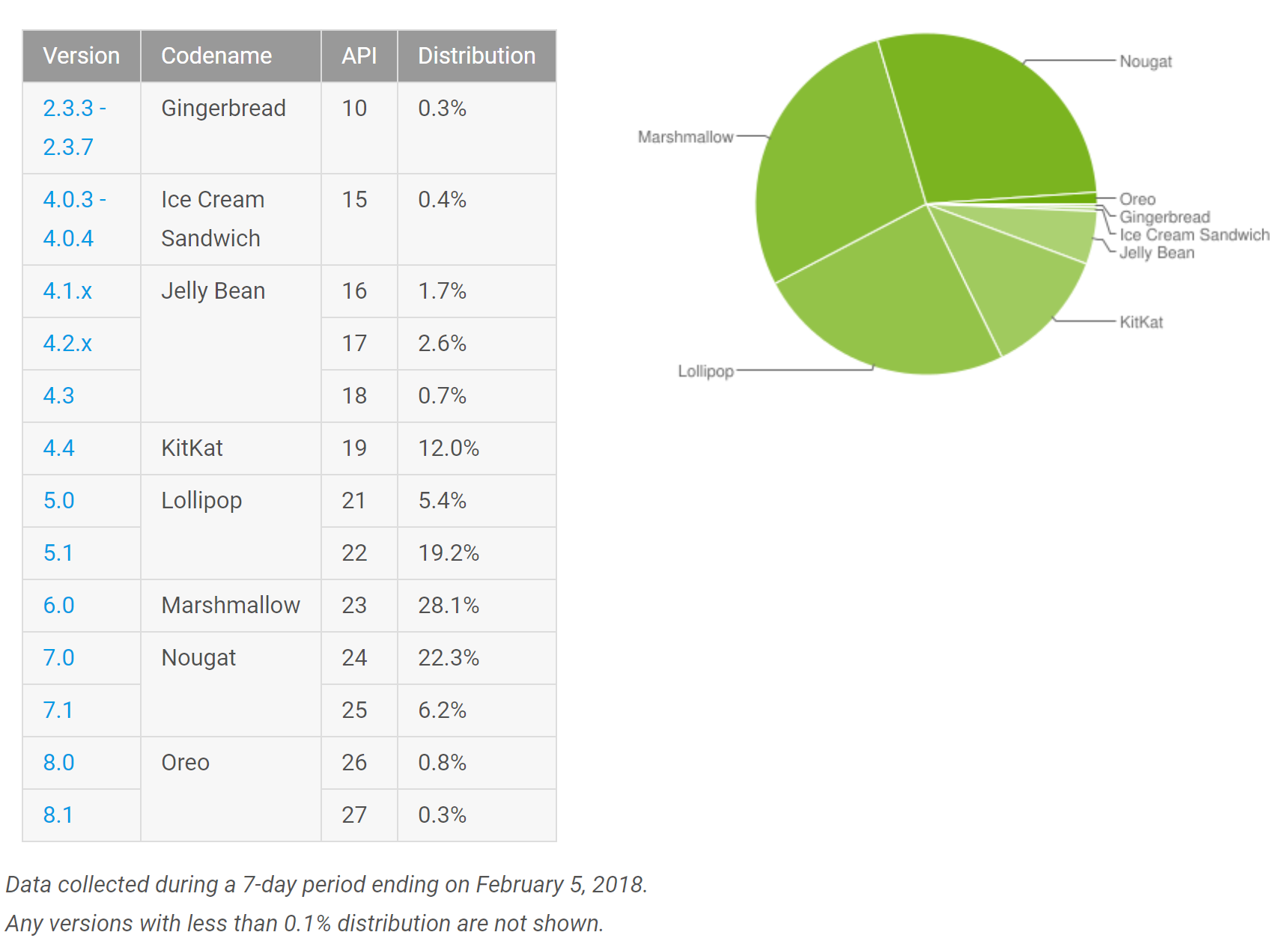
That’s right, Nougat has risen to become the most broadly represented version of Android within the operating system. The latest Android distribution numbers from Google show Nougat runs on 28.5 percent of all Android devices. This just barely edges out Marshmallow, the previous OS version, at 28.1 percent. Now that’s progress.

But, lest we forget, Nougat is still one generation behind the current OS version, Oreo. That iteration of Android was first made available a little over six months ago, and has just now surpassed 1 percent representation across all Android devices. It now sits at 1.1 percent, a significant uptick from 0.7 percent measured last month.

The data was gathered over a seven-day period ending February 5th, 2018. For last month’s numbers, check here.

Source: Android Developers  

The post Nougat becomes most used version of Android, Oreo passes 1 percent appeared first on MobileSyrup.

06 Feb 18:18

Samsung’s dual camera tech is making its way to budget phones

by Igor Bonifacic
Samsung Galaxy Note 8

While dual camera smartphones became more mainstream in 2017, we could see their popularity explode in 2018 thanks to Samsung. On Tuesday, the South Korean company revealed its new ‘ISOCELL Dual’ camera modules for entry-level to mid-range smartphones.

These modules will allow smartphone OEMs to integrate dual camera systems that provide either improved low-light performance or a bokeh depth-of-field effect into their lower-priced devices.

Samsung plans to sell the camera module in two different configurations. One of the modules will feature two 8-megapixel sensors designed for low-light shooting, while the other will feature one 13-megapixel sensor and one 5-megapixel sensor that will work together to deliver portrait bokeh shots.

When Samsung sells these modules to smartphone OEMs, it will throw in the necessary software to make each module the complete package.

We’ll likely see the company’s ISOCELL Dual modules start to make their way into both the company’s own smartphones and into devices from other manufacturers over the course of 2018.

Source: Samsung

The post Samsung’s dual camera tech is making its way to budget phones appeared first on MobileSyrup.

06 Feb 18:18

Why a Non-Smartwatch May Be the Smart Choice

by MobileSyrup
Vincero Watches

Nowadays, timepieces typically fall into one of two categories. Either they take the smartwatch approach with sleek designs and cutting-edge tech that’s good until the next company keynote (looking at you, Apple), or they adopt the minimalist path with constructions that are much less complex and say little about the wearer.

The truth is that we all have our smartphone glued to our sides and laptops or tablets at an arm’s reach, and it’s high time we consider the timeless appeal of owning a classic watch. High-quality watches — like those from Vincero Watches — not only bolster your style, but are an investment in the future. Unlike the boom-and-bust nature of the smartwatch market, classic watches will last for years to come — and don’t require frequent updates or charging sessions.

Vincero

Vincero is making a case for the modern, luxury watch with its focus on quality and affordable pricing options. Here are three reasons why you should consider swapping your smartwatch for a modern style:

1. It will complement your style and identity.

Smartwatches are undoubtedly popular, but their cookie cutter designs come at a cost to your style. A timepiece, on the other hand, can speak to the host of characteristics and traits that make you uniquely yourself. It can make a bold statement by giving you a distinct style, and not just allow you to blend in with the rest of the smartwatch crowd. Whether you favor a bold, matte black piece or the elegant design of a watch with marble inlays, the watches at Vincero Watches have a diverse selection that cater to a variety of tastes.

2. A classic watch lets you take a step back from all those notifications.

When it comes to staying connected, smartwatches can’t be beaten. But, sometimes they do their job a little too well, bombarding you with a tornado of notifications that can take you out of the moment. Conversely, a classic watch lets you look sharp and focus on the important things, like a nice date or an important interview without the frequent interruptions.

3. Classic watches don’t go out of style.

As previously mentioned, smartwatches don’t offer much in the realm of longevity, and minimalist timepieces generally don’t make thoughtful heirlooms. Meanwhile, Vincero understands that purchasing a luxury watch is a long-term investment, which is why their timepieces are handcrafted with premium components and hand-checked for quality. So, in addition to looking good in the long term, they function for years to come.

Why Vincero Collective

Vincero Collective was founded by a trio of aspiring entrepreneurs who sought to change the way watches were being sold. While the market prioritized cost over quality and big-name stores over small boutiques, Vincero Collective aims to deliver timepieces that boast bold, uncompromising designs, a quality manufacturing process, and a direct-to-you business model that allows for ethically produced products without any retail markups.

Plus, Vincero’s California-based team offers free worldwide shipping and a 30-day return policy. Vincero’s watches start at $185 CAD [$150 USD], and you can start browsing them here.

The post Why a Non-Smartwatch May Be the Smart Choice appeared first on MobileSyrup.

06 Feb 18:17

Fido increases international roaming service fees to $12 per day

by Rose Behar
Fido

Fido has joined its parent company Rogers in increasing international prices for its daily roaming feature to $12 per day.

Fido Roam previously cost $10 per day, capped at 10 days per billing cycle when it came to international roaming outside the U.S.

Now the roaming charge is capped at 15 days per billing cycle, making the highest charge per bill for the service $180, rather than $100.

As for U.S. roaming, Fido’s charge remains $6 per day (increased from $5 in August), but the cap is also increasing to 15 days, making the highest charge per bill $90, up from $60.

Fido customers currently traveling in the U.S. and internationally will see the new fees reflected on their next monthly bill if their billing cycle resets on or after February 28th.

Fido Roam allows subscribers to use their domestic talk, text and data in the U.S. and over 100 other international locations for a daily fee.

Bell-owned competitor Virgin Mobile also announced a recent increase to its roaming program, Roam Sweet Roam. The carrier is bumping the price of its U.S. roaming rate for unlimited text, talk and 100MB of daily data to $6 per day, from $5, on March 12th. The charge is capped at 20 days per billing cycle, making it $120 per bill at the top end.

Virgin’s international roaming fee remains at $10 per day, capped at 20 days per billing cycle for now.

Meanwhile, Telus-owned Koodo charge customers $7 per day to use their domestic plan in the U.S. and $10 per day in other international locations, capped at $100 per billing cycle for both.

Source: Fido

The post Fido increases international roaming service fees to $12 per day appeared first on MobileSyrup.

06 Feb 18:16

The Daily Durning~Digitized Surveillance in Cities in China

by Sandy James Planner


china3_custom-ef0a511cd17bdc22f2869b582014f9702bcfd7d3-s900-c85

The New York Times  has written about the increasing invasion of personal information and biometric data in China where cities store this material in databases along with assigned identification numbers for each citizen.  In an area close to Mongolia  “The system crunches all of this into a composite score that ranks you as “safe,” “normal” or “unsafe.” Based on those categories, you may or may not be allowed to visit a museum, pass through certain neighborhoods, go to the mall, check into a hotel, rent an apartment, apply for a job or buy a train ticket. Or you may be detained to undergo re-education, like many thousands of other people.”

The New York Times article is specifically writing about the targeting of the indigenous Uighurs in the western region of Xinjiang, and compares this new “digitized surveillance” as a modern take on conventional controls reminiscent of the Cultural Revolution in the 1960s and ’70s.”

The Daily Durning~Tom Durning sends the video below which illustrates the new facial recognition software that can now pinpoint citizens on the street in the City of Guiyang. Using sophisticated software every face is matched with an identity card and the movements of citizens can be followed by the week. As the reporter notes “If you have nothing to hide, you have nothing to fear.”


c-china-rtx14w1p-kim-kyung-hoon

VID-20171216-WA0007