Nice. George Veletsianos writes " Educational Technology was a print-only publication. However, Howard Lipsitz, Larry’s brother, has collaborated with JSTOR to preserve Larry’s legacy and make all articles available online where they can be read for free. Here’s the Educational Technology magazine archives (1966-2017)."
This 'I' in this post is the author, Christine Peterson. She describes in this post her contribution to the origin of the term 'open source'. " The introduction of the term 'open source software' was a deliberate effort to make this field of endeavor more understandable to newcomers and to business, which was viewed as necessary to its spread to a broader community of users," she writes. The account seems plausible to me, and the alternative names discussed (including especially 'freeware', a cousin of the then widely used 'shareware') are familiar to me from the community at the time. Via David Wiley.
More and more people got “online” and more sophisticated social networks emerged. Centralized and monetized networks, run by corporations with shareholders and venture capitalists wanting a good return on their investments.
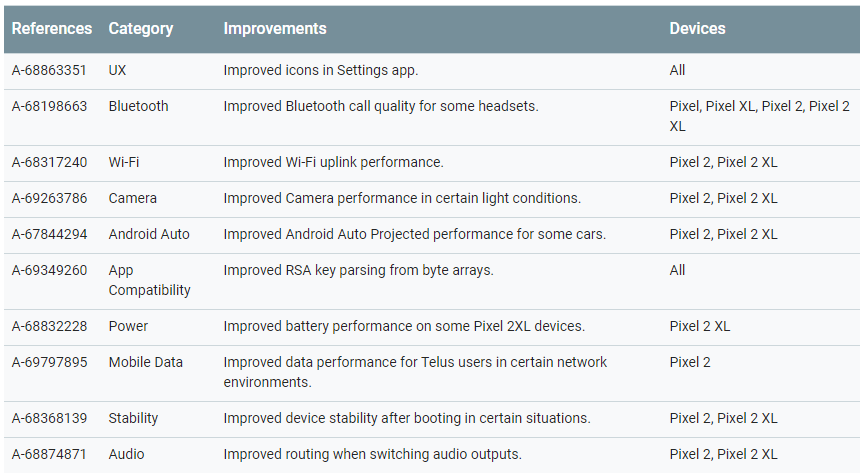
Images detailing the February 2018 Android updates coming to the Pixel and Pixel 2 phones, as well as the Pixel C, Nexus 5X and Nexus 6P are now available at the Google Developer site.
The updates can be manually installed today, with OTA updates expected to roll out soon.
In general, the updates will all bug fixes and other improvements, although the changes vary depending on the device. The full breakdown is as follows:
Which of these Pixel or Nexus devices do you have? Let us know in the comments.
It's that time of year again, Punxsutawney Phil had his time in the sun and gave us his predictions is it an early spring or more winter?
The groundhog has spoken and six more weeks of winter is what is on the horizon.
If Phil is right, (he often isn't) we could be in store for up to 6 more weeks of chilly weather. Have no fear however, because our guide on how to cycle through the cold with ease has got you covered!
Another interesting fact, according to the Center for Disease Control (CDC), is that February is the month that the flu season usually hits its peak in the United States.
Now, do not panic. You don't have to mix several garlic cloves into your morning juice, and smell like a vampire hunter for the rest of the week (even though it could probably help).
According to the following experts, you can actually avoid the flu by simply hopping on your ebike, regularly.
Professor Tim Noakes, of Exercise and Sports Science at the University of Cape Town, South Africa, explains how mild exercise, such as riding an electric bike, prompts our bodies to release a protein called endogenous pyrogen. This protein increases the body’s temperature, making it more hostile to invading bugs, while also increasing the activity of our white blood cells. These vital cells are responsible for the disposing of harmful viruses.
Even if you have not officially caught the flu, if you feel like you might be getting sick, any form of exercise can bolster your immune system. Your electric bike is the perfect tool for the job. Cycle with low-impact and at your own pace to break a sweat without overdoing it.
Cycle more for an overall healthier lifestyle and strengthened immune system. A study, in the British Journal of Sports Medicine, that was carried out by academics at the Appalachian State University in North Carolina, found that taking part in exercise regularly means that the body becomes more vigilant to viruses and bacteria that can cause conditions such as the common cold.
Darius Kazemi, 135.295@tinysubversions
I just realized that Yahoo! Pipes was probably my introduction to functional programming, even though I had no idea… twitter.com/i/web/status/9…
Hover is proudly sponsoring this year’s global Fishackathon event. HackerNest and Hover want you to get out there and face the issue of overfishing head on. Hover’s goal in sponsoring this initiative is to encourage the tech community to make a difference with their skills and creativity. Tie in your tech chops to your passion of saving our oceans. We are excited to see what solutions you come up with to solve HackerNest’s unique set of challenges.
Overfishing has had a devastating impact on our marine environment, leaving over 55% of our world’s reefs threatened by overfishing practices. Overfishing has led to the depletion of key species in the reefs, which has had a negative chain reaction on the coral reefs and the ocean’s apex predators. The ocean ecosystem has a cause-and-effect on the rest of the planet and an impact on global weather events. In turn, these global weather events cause a rise in ocean temperatures, which leads to devastating El Niños and hurricanes. Protecting our marine environment is a key aspect to slowing the effects of global warming on our planet.
As a techie, you’re likely thinking, “I know that global warming sucks, but what do I have to do with saving the oceans? How can I make a difference from behind my screen?” The answer is that you can make a difference from your computer. Not only that, but we are relying on you to do so. HackerNest’s upcoming event, Fishackathon is waiting for you to sign up and enter your solution to one of the world’s greatest problems. Come out to see these two worlds collide from February 10th – 11th, with a worldwide hackathon competition.
Fishackathon has many challenges for you to take on. With approximately 500 million people worldwide relying on the fishing industry for work, they are looking for you to come up with a solution that strikes a balance between the fishing industry, and the needs of our planet. Over 3 billion people obtain 20% of their animal protein from fish, and many island and coastal communities rely on it heavily. So, how do you ensure that this is a food source that can be sustained over a long period of time and for future generations? There is a much needed change that has to take place across the enforcement of fishing regulations and laws, the market for fish, and with the overall sustainability of the fishing industry.
Developers, designers, tech lovers, and ocean lovers unite next weekend to come up with a digital solution for these unique sets of challenges. Get your team ready to solve a real world problem, under the mentorship and guidance of experts in the field. Fishackathon is happening in over 40 cities in 30 countries. Find a Fishackathon happening in your city. There are a lot of prizes to be won, including the chance to have your product incubated or accelerated to go to market. Don’t miss this opportunity to use your incredible skills to address a real world problem and make a huge impact. The Global Winner of Fishackathon 2018 will receive the help they need to get their product to market, secure their first customers, and prepare to scale (no fish pun intended!) their solution to take on the world.
You could be responsible for building the next big thing to save our oceans. So – what are you waiting for? Sign up for Fishackathon Toronto here. Hover is here, cheering you on!
Late last week, Apple pulled popular messaging app Telegram — and its recently released offshoot, Telegram X — from the iOS App Store.
At the time, the only explanation for the removal was a tersely worded statement from Telegram CEO Pavel Durov saying that Apple had removed the two apps due to their inclusion of “inappropriate content.”
“We were alerted by Apple that inappropriate content was made available to our users and both apps were taken off the App Store,” wrote Durov at the time. “Once we have protections in place we expect the apps to be back on the App Store.”
It turns out an oversight by Telegram had allowed the company’s userbase to view and exchange child pornography.
In an email obtained and verified by 9to5Mac, Apple’s Phil Schiller explains what happened to a user who emailed him about the removal:
“The Telegram apps were taken down off the App Store because the App Store team was alerted to illegal content, specifically child pornography, in the apps,” wrote Schiller. “After verifying the existence of the illegal content, the team took the apps down from the store, alerted the developer, and notified the proper authorities, including the NCMEC (National Center for Missing and Exploited Children).”
Schiller then goes on to write:
“The App Store team worked with the developer to have them remove this illegal content from the apps and ban the users who posted this horrible content. Only after it was verified that the developer had taken these actions and put in place more controls to keep this illegal activity from happening again were these apps reinstated on the App Store.”
For what it’s worth, it took Telegram all of a day to put in the proper protections. However, this isn’t the first time the company has run into issues involving its less savoury users. Last year, Indonesia threatened to ban the app if the company didn’t take a more active roll in stopping the spread “radical and terrorist propaganda.”
Gone With A Shot? Hopeful New Signs Of Relief For Migraine Sufferers.
“Humans have suffered from migraines for millennia. Yet, despite decades of research, there isn’t a drug on the market today that prevents them by targeting the underlying cause. All of that could change in a few months when the FDA is expected to announce its decision about new therapies that have the potential to turn migraine treatment on its head.
The new therapies are based on research begun in the 1980s showing that people in the throes of a migraine attack have high levels of a protein called calcitonin gene–related peptide (CGRP) in their blood.”
China’s central bank, the People’s Bank of China, has announced that it aims to crackdown on cryptocurrency trading with bans on both domestic and international trading platforms, The Paper reported on Sunday (in Chinese). According to the report, supervision of cryptocurrency trading will continue to increase. This will include bans on related commercial activity and […]
Daily Simpsons@dailysimpsons
Marge's suit was modeled on an actual Chanel suit, and also the type of dresses that former First Lady Jacqueline K… twitter.com/i/web/status/9…
Quite a number of network operators are in the processes of shutting down their 2G or 3G networks or have already done so. A major example is AT&T who has switched off their 2G network back in 2017. In other words, they are now only running on their UMTS and LTE networks. So what will happen once they switch off UMTS as well?
Perhaps the thought might still seem a bit far fetched as many would argue that they still need their 3G network for voice telephony. I would hold against this view, however, that AT&T’s LTE coverage is probably pretty close or even exceeds their UMTS coverage area by now. Also, they’ve been at the forefront of rolling out VoLTE for IP based voice telephony on LTE over the past few years and I would be surprised if they are still selling any non-VoLTE devices today. In addition, the average usage period of a smartphone before it gets replaced is 18 months. Put all of this together and in, let’s say 2 years from now, there will only be a few non-VoLTE capable devices of their subscribers in their network. At this point they could switch-off their UMTS network and in the process they would get rid of a lot of very old legacy core network infrastructure, i.e. the whole circuit switched MSC and IN infrastructure. In addition they could get rid of a lot of CS/VoLTE interworking procedures such as all the different flavors of SRVCC (Single Radio Voice Call Continuity) that are making life difficult.
Yes, circuit switching has been virtualized many years ago and all circuit switched telephony traffic is transferred over IP right up to the base stations by now. But it’s a crutch, it should go when the time has come.
But….
So while all of this sounds nice and well there is one little problem: Roaming. While the industry has made tremendous progress with LTE and VoLTE for ‘home subscribers’, there is close to zero progress when it comes to VoLTE roaming. Except for a few examples such as VoLTE roaming agreements between Japanese and Korean network operators, pretty much all others around the world rely on CS-fallback to GSM or UMTS for voice telephony when their subscribers roam in other LTE networks.
It’s not rocket science to introduce S-8 based VoLTE roaming but it seems not to be a high priority for many network operators so far. After all, a critical mass needs to be reached, i.e. enough other network operators have to support S-8 based VoLTE roaming before both GSM and UMTS can be switched-off in one’s network without loosing a significant amount of roaming revenue. So a lot of network operators driven by their CFO rather than innovation might wonder why they should be one of the first, it just costs money they won’t get back in this quarter or the next. And who cares about a few years down the road?
The way I see it, roaming is going to be THE major stumbling block to switching-off both GSM and UMTS in a network. Unless, of course a network operator is not interested in the roaming revenue, which I think is unlikely.
Except…
There actually ARE a few network operators that are not getting a lot of roaming revenue today! Take Verizon for example. Their 2G/3G network is based on CDMA so they probably only have a handful of inbound roaming agreements as only very few devices sold elsewhere around the world support legacy CDMA. So perhaps Verizon or one of the few others that never made the jump to 3GPP GSM/UMTS for 2G/3G will go to LTE&5G-only in the not too distant future!?
Andrew Vaillencourt has created what I would call "Military Sci-Fi" series with "The Fixer". The main character is a former military cyborg named "Roland" who after being "discharchged" from military service finds himself in the seeder parts of Boston where he tires to atone for his perceived sins.
He is known as "Tank", standing at 7 Feet and almost 900 pounds.
Book 1: Ordnance
In "Ordnance" we are being introduced to Tank by Lucia, the daughter of one of the scientists who more than 30 years ago created him and also ended up saving him. Because one of the things the military did was install an "override", when orders came that where a violation of laws or ethically questionable he and his team mate had no choice. The military overrode his free will and had an AI cause the carnage, something that causes him grief to this day, as he was along for the ride and didn't "come back" until he woke up on a pile of dead bodies.
The world he now lives in is one of thieves and criminals, and with Lucia's father being kidnapped by another one of his creators he is now given the chance to not only pay back his saviour by helping his daughter, but also to exact some revenge along the way.
The world that Vaillencourt builds in the first book is entertaining. It's a mixture of a Noir crime novel with some rather violent action segments. In some ways he reminds of Richard K. Morgan's writing style in the Takeshi Kovac series, though I would have to say it's much less "brainy" than the Kovac series.
What it is though is entertaining, in a Michael Bay action movie kinda way.
Book 2: Hell Follows
"Hell Follows" picks up where "Ordnance" has left off. After Roland had his payback and ended up with Lucia as his partner she quickly takes charge "of business". The first order is that Roland injects himself more into the criminal machinations within Boston's Underworld, only to find himself at the centre of what appears to be an all out gang war. Or rather, someone from the outside seems to be interested in taking over from "The Chairman".
What follows is a trip out of Earth and an involvement with some intergalactic shady organizations and of course, intrigue and piracy.
The second book is a slight departure from the first one in as far as it leans more heavily on the "SciFi" aspect. We get a better insight into how business and people work in this universe, from harsh mining planets, to "neutral star systems" where all kinds of savoury and unsavoury characters interact.
Of course, much like the first book, what Roland does has far reaching consequences to his own community back home.
Much like the first book it's a fun, fast Michael Bay'esque read.
Book 3: Hammer and Nails
Within the universe timeline we're now six months down from where the first book started and things haven't really slowed down. Now someone seems to try to take Tank out, but without really trying too hard, so what's going on?
Turns out, old grudges are still trying to get settled and the new power balance in Boston is far from settled down either. To that end, we get another fast paced and violent book with a good sense of humour.
I would say it is a worthy continuation of the first two and I did find enjoyment in it. The right thing for a lazy afternoon where you just want to not think too much.
Verdict
So is the series worth a read? If you enjoy MilSciFi and "pop corn" flicks then this is a fun read. There are no deep themes, or even overly deep characters, though on the flip side none of the characters is a paper cutout either. They're interesting and do have personality.
So maybe my comparison to Michael Bay is a bit unfair. It's definitely more entertaining and less stupid, but it's also not Tolstoy or Clark.
This is a
song by Leonard Cohen, but I’m talking about it as
performed by
Jennifer Warnes. It may not even be Warnes’ best cover of a Cohen tune, but it’s
good enough to be any day’s song, and the recording is special.
Many years ago, Jennifer Warnes released
Famous Blue Raincoat, a collection of Cohen songs, and sold lots. It’s a fantastic
record; Warnes inhabits Cohen’s tunes completely. Which is a neat trick, since she’s got a big, creamy voice as wide as
a river and smooth as satin, while Cohen’s voice is exactly none of those things. And I love almost all of Cohen’s albums; but this is
very special stuff.
It’s tough picking just one of these songs for -of-the-day service. Probably my favorite is the title tune; when Jennifer sings
“Thanks (pause) for the trouble you took (pause) from her eyes, I thought it was
there (pause) for good…” — stone would melt.
But I’m going with Joan of Arc for a couple of reasons. The first is the magisterial, arching video performance
linked below. The second is…
Audiophilia
This is one of my major vices. I’m a worshipper of well-produced audio; there are blog manifestoes
here and
here. Anyhow, Famous Blue Raincoat is that rare thing, an
audiophile fave that also has great music on it. If you go to an audio trade show and visit a suite where they’re showing a hundred
thousand dollars worth of gear, it wouldn’t be surprising at all to hear Warnes singing Cohen.
In particular, it wouldn’t be surprising to hear Joan of Arc. Just on this song, Leonard drops by to sing it as a
duet with Jennifer. It’s pretty awesome, and the way their voices are recorded, flowing around and over each other, is super
awesome. Which is to say, if you find yourself in the presence of something that claims to be a good audio system, you might want
to put this on and see what you think. Warning: This could lead to an expensive hobby.
The song
It’s a dialog between Joan and the fire that’s burning her at the stake. Which, while tragic, isn’t as morbid as it sounds.
Leonard Cohen is good at words not just music, and finds the triumph in the tragedy. Also the tune is memorable, the arrangement is
masterful, and did I mention it sounds great?
Spotify
playlist.
Joan of Arc on Amazon,
iTunes,
Spotify.
Now, as for live video, pull up a chair, find yourself a hanky, and check out
this live performance, with a full orchestra and total commitment, in Belgium in
1992. It turns out to have been a big enough hit that they put it on the
20th-anniversary edition of
the album (cover pictured above) and you can get it separately:
Spotify,
iTunes,
Amazon.
Now, I’ve probably offended some Cohen fans (like my brother for example) by gushing over the Warnes performance. For them, here
are performances by Mr Cohen both
younger and
older, both as duets, with fine female
singers. Also, a high-intensity performance (no video) by Joan Baez.
But my heart belongs to Jennifer’s.
Earlier this month, I set a resolution to blog more and use social media less. While I still need to work on blogging more, I'm certainly spending less time on Facebook. I'm halfway there. So far, only my mom has complained about me spending less time on Facebook.
This morning when my alarm woke me up at 4:45am, I took it a step further. Most mornings, I spend ten minutes checking Facebook on my phone. Today, however, I deleted the Facebook application from my phone, rolled out of bed and started my workday. Great!
As an advocate for the open web, I've written a lot about the problems that Facebook and other walled gardens pose. While I have helped raise awareness and have contributed time and money to winning back the open web, I haven't fully embraced the philosophy on my own site. For over 12 years, I've blogged on my own domain and have used Open Source software instead of using a third party service like Blogger or Medium, but I can't say the same about sharing my photos or social media updates. This has bothered me for some time.
I felt even more motivated to make a change after watching David Letterman's new Netflix series. During a conversation with his first guest, President Obama, Letterman shared the fear that his son will one day ask, "Wait a minute. You knew this was a problem, and you didn't do anything about it?". Letterman's sentiment mirrors Jeff Bezos' regret minimization framework; when you look back on your life, you want to minimize the number of regrets you have. It's a principle I like to live by.
Today is not only the day I uninstalled Facebook from my phone, but it's the day I fully embrace and extend my new year's resolution. Not only would I like to use social media less, I want to take back control over my social media, photos and more. I also want to contribute more to the open web in the process — it will be a worthwhile personal challenge for 2018.
Huge turn out for the 2018 Coldest Day of the Year Ride
With rides starting from all ends of the city, over 100 turn out to show support for year-round bike infrastructure
No winter is complete for Toronto’s cycling community without Cycle Toronto’s annual Coldest Day of the Year Ride. This year marks the first time the ride started east of the Don River (at Alexander the Great Parkette) to show support for bike lanes on Danforth Avenue. Roughly two hundred people rode their bikes in the snow and temperatures of -5 Celsius.
Group start at High Park. Photo by Jun Nogami.
Leading up to the ride, I took part in a small group ride from High Park which picked up a few other riders along the way. Marvin Macaraig of Scarborough Cycles also organized a ride coming from the east, while a few ambitious folks from the Durham Region Cycling Coalition arrived by GO Train.
Opening remarks by Councillors McMahon and Fletcher.
Some opening remarks were made by Councillors Paula Fletcher and Mary-Margaret McMahon; both of whom strongly support bike lanes on The Danforth (which the east-end councillors like to refer to as 'the Danny'). While McMahon didn’t take part in the ride, she did wear a bicycle-themed toque. Kevin Cooper, Campaigns and Engagement Manager, and Jared Kolb, Executive Director from Cycle Toronto also had a few words, while Sam Perry – who has lead numerous group rides for Cycle Toronto – highlighted the route.
Map of this year's ride. Note Google Maps used Adelaide Street instead of King Street.
The ride first headed along Danforth Avenue and across the Bloor Viaduct, which unfortunately does not have bollards during the winter months. The City has been removing them each winter, apparently for snow clearing purposes even though all the other bollards around the city are not removed during winter. Fortunately, they will be back permanently starting next winter according to Councillor Fletcher.
A few cargo bikes could be found during the ride
The ride then used protected bike lanes on Sherbourne where a "Watch Your Speed" sign gave "speeding" cyclists a friendly reminder.
Cyclists on Sherbourne photo by Jun Nogami.
After Sherbourne, cyclists turned onto Richmond Street and made a U-turn at Yonge to the King Street Pilot. The pilot allows bicycle riders to go straight through whereas motorists are forced to turn right after one block.
Riding along the King Street Pilot
People of all ages and abilities could be seen along the ride. Some children and cargo bikes were there, as well as a mobile bike mechanic with Urbane Cyclist. For those who didn’t have bikes – or prefer not to use them in the winter – Bike Share Toronto provided free two-hour rides. Finally, one rider gave a whole new meaning to “Viking Biking” with a knitted Viking toque.
This Viking hat gives "Viking Biking" a whole new meaning
After the chilly 6.5-kilometre ride, we arrived at Betty’s on King Street for a bit of social time with food, drink, and lively conversation. Given the limited space upstairs, those wishing to order food and drink wrote their orders on pieces of paper and used paper clips to send them down the wire to the lower level.
Post-ride social at Betty's on King
Thanks to the Toronto Police for providing escorts along the ride, as well as to Cycle Toronto for keeping this annual tradition aimed to promote winter cycling going.
Police escorting riders across the Bloor Viaduct.
You can read Jun Nogami’s take here, while you can find more pictures in this Flickr album.
The transition period to the new European privacy regulations, GDPR, will end in May after which compliance is needed. To me the GDPR is extremely interesting. First because it introduces a few novel concepts. Second because good data governance means openness, personal data protection and information security are all approached in the same way, which makes the GDPR important for my open data work. That open data work has been steadily shifting towards creating meaningful digital-first data governance.
One of the exciting novel concepts in the GDPR is that the legal obligations follow the data. The GDPR applies to any organisation holding data about EU citizens, regardless where they reside themselves. Another is that EU citizens must be able to clearly understand how data about them is collected and used. Terms of service where the snake hides on page 312 of a document full of legalese is no longer acceptable. This means that your data usage must be out in the open, as every individual has the right to verify how their own data is being collected, stored and used, as well as to export that data and withdraw consent. Compliance is recast from being a disadvantage to being a precondition and source of competition. To me it seems the GDPR is bringing the law much closer to our digital times. It paves the way for ‘ethics by design’ concerning data, and use it as a distinguishing factor. It also sets a de-facto global standard (although not everyone seems to realize yet).
The GDPR creates or reinforces a range of rights in law. Some of my clients have mentioned how they perceive this as a large heap of new work, but to me that’s not really true. It is true if you approach the GDPR as yet another administrative exercise to proof you are compliant, yet that is the old way of approaching privacy: Do whatever you want internally, and take precautions on the edges with the outside world. To reliably implement the GDPR and to be able to provide audit trails and pro-active proof of compliance (note that absence of this ability is interpreted as non-compliance), the most efficient way forward is embedding compliance in the data systems themselves. The ‘by design’ approach is mandatory for new systems. Knowing where in your data sets personal data resides, having consent as part of the metadata etc. This brings personal data protection firmly at the level of data governance and at the level of data system and structure design. Openness, personal data protection and information security can no longer be gates put around the data, but need to be part of the data, an ‘everything by design’ approach.
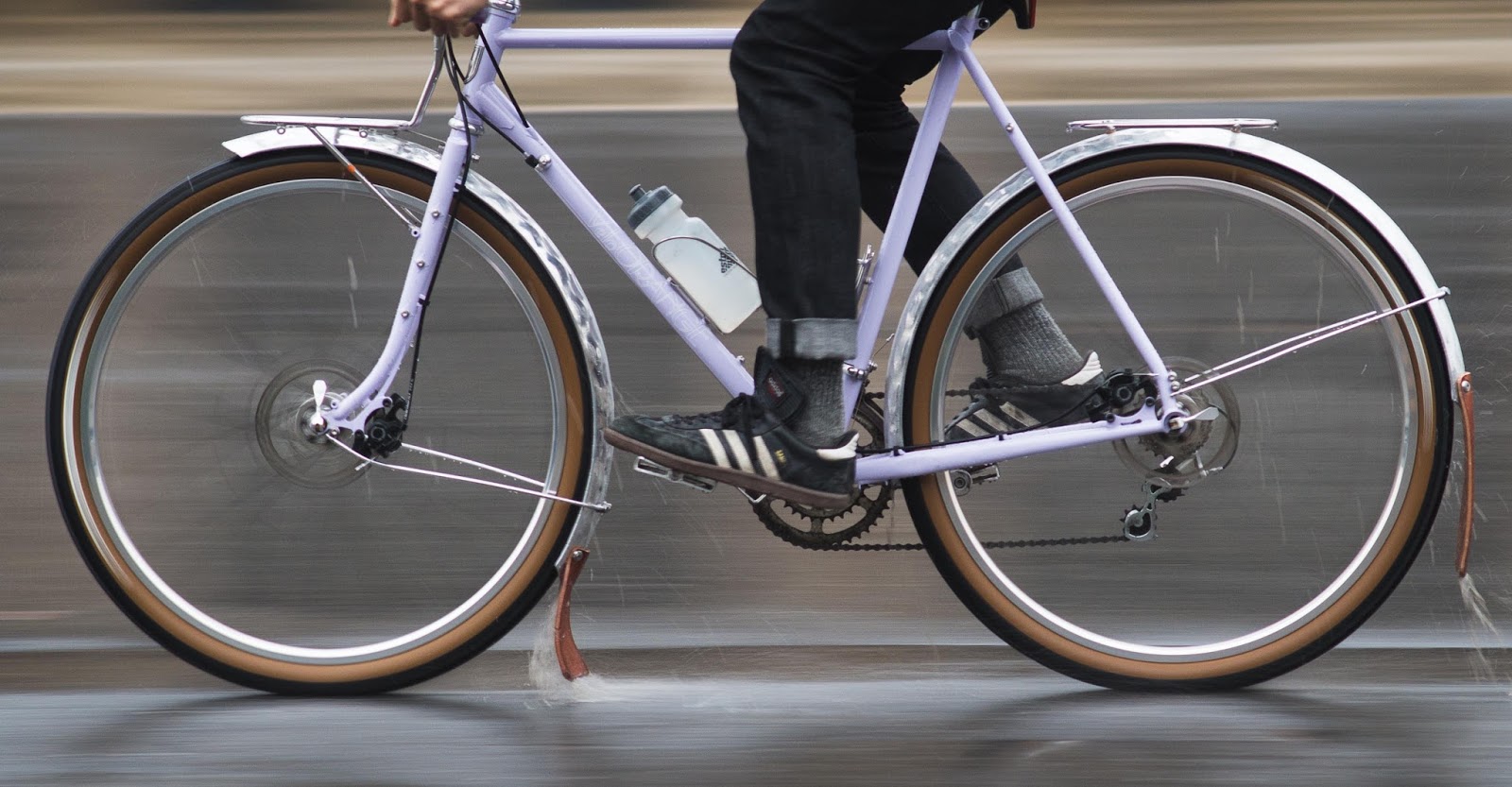
The combination of full coverage fenders and mud flaps serve two very important purposes: 1) keeping your feet and bottom bracket clean and 2) ensuring your riding friends will ride with you again by preventing road grime from spraying up into their faces.
Ideally, the front mud flap should be very low to cover the most spray area, almost dragging. I like curling the front flap so that curbs don't catch the fender when hopping off.
The rear flap should be sufficiently long as well. VO now offers matching Rear Mud Flaps in the same colors as the front: Black, Espresso, and Honey.
They're 24.5cm long and have a very similar silhouette as the front, just longer. They weigh 105g and include all the hardware needed to mount to your fender. All you need to do is drill two holes.
A side note: We work really hard to minimize waste from the hides we use, and that means we get a few "imperfect" flaps. These cuts are just as good and functional as the "perfect" ones but have more character - I prefer these. They usually have cuts, thinner sections, etc - these are cow hides, remember. If you want a flap has has imperfections and is wabi-sabi, let us know in the comment section of your order.
Forgive the personal aside, but our family bought some furniture yesterday, and it wasn’t half bad. We’re moving house, and I’m hopeful it will be the last time for a while; given my personal history that is saying something.
By my count this will be my 12th apartment since I graduated from college, and it never made much sense to invest in anything beyond Ikea. Sure, that number is a bit extreme, but from my perspective the optionality that comes from the willingness to move around was worth the packing pain; now that my kids are in school and my career die cast — at least for the time being — the prospect of staying put for more than a year or two comes as a relief.
In other words, I’m hitting middle age, with the change in circumstances and priorities that entails.
iPod on Windows
Apple, at least in human terms, is officially over the hill: the company’s 40th birthday was last April. In truth, though, the first Apple died and was reborn in 1997 with the return of Steve Jobs, at a time when the company was weeks away from bankruptcy.
The cover of the June, 1997 edition of Wired
What happened next is certainly familiar to everyone reading this: after slashing products and re-focusing the company around a dramatically simplified product line, Jobs shepherded the introduction of the iMac and, three years after that, the iPod. Perhaps no decision looms larger, though, than releasing iTunes — the software yin to the iPod’s hardware yang — for Windows. Erstwhile Apple analyst Gene Munster told the San Francisco Chronicle:
For Apple, the Windows version of iTunes is part of a “very slow but real shift” in strategy, said Gene Munster, senior research analyst with U.S. Bancorp Piper Jaffray. “They’ve tried everything to get their installed base to grow, but it just doesn’t grow. What you’re going to see in the coming years is a different Apple.” Ironically, Munster said iTunes for Windows may ultimately help sell more iPods but fewer Macintoshes, because it works well enough with a PC.
In fact, the opposite occurred — at least in the long run. The iPod took off like a rocket, dominating the portable music industry until it was killed by the smartphone, specifically the iPhone. And, over time, more and more satisfied iPod and iPhone customers began considering Macs; macOS devices have outgrown the overall market (which is shrinking) nearly every quarter for years.
That’s a side story though: while the iPod and the first few editions of the iPhone needed a PC, the latter eventually became independent, an effectively full-fledged computer in its own right. Indeed, most consumer electronics devices now presume that the customer has a smartphone, which makes sense: nearly everyone that has a PC has a smartphone, but there are around a billion people who only have the device in their pocket.
And, come Friday, there will be at least one prominent device for sale that requires not just a smartphone but an iOS device specifically: HomePod.
The HomePod Strategy
The strategy around the HomePod, at least from my perspective, is far more fascinating than the device itself; while it does sound great (at least in the controlled press briefing where I heard it), I have an Echo Dot (and a Google Home-controlled Chromecast, for that matter) connected to my living room stereo that sounds better.
To get a full music library with either, though, requires a separate music subscription — Spotify in my case. And while I am the sort of profitable (for the music industry) idiot that pays for effectively the same service twice,1 most people only subscribe to one music service. And, for iPhone users, which service is that likely to be? Unsurprisingly, given its prominence on the device combined with Apple customer loyalty, the answer, at least in the United States, is increasingly Apple Music. From the Wall Street Journal:
Apple Inc.’s streaming-music service, introduced in June 2015, has been adding subscribers in the U.S. more rapidly than its older Swedish rival — a monthly growth rate of 5% versus 2% — according to people in the record business familiar with figures reported by the two services. Assuming that clip continues, Apple will overtake Spotify in the world’s biggest music market this summer. Apple’s music-streaming service has been quietly gaining ground in part thanks to the popularity of the company’s devices: Apple Music comes preloaded on all iPhones, Apple Watches and other hardware the company sells.
That last sentence explains why this isn’t a surprise; my criticism of Apple Music when it launched was not a statement on whether or not the service would be successful, but whether or not it was worth the trouble, particularly in terms of focus. I wrote in a Daily Update later that year:
One interesting angle to [a Taylor Swift exclusive] is that the fact Apple Music exists for Android likely makes it much more palatable for Swift than an Apple-specific service would be. But, that leads to the natural question: what ultimate benefit is Apple deriving from however much they are paying Swift, or from Apple Music as a whole? I know many of you are sick of me asking this question, and, in fact, I am an Apple Music subscriber myself: I find the integration with the Apple Watch to be particularly useful when driving around with two music-loving kids in the backseat of my car. My issue, rather, is about opportunity cost: why can’t Apple architect their platform so that other services can fulfill this low-margin middle-person role, freeing up resources to focus on the sorts of things that only Apple can do?
HomePod is the best answer yet, and I have to admit, I’m pretty impressed by Apple’s foresight.
The Apple Music Bridge
One more important piece of background: CEO Tim Cook and CFO Luca Maestri have been pushing the narrative that Apple is a services company for two years now, starting with the 1Q 2016 earnings call in January, 2016. At that time iPhone growth had barely budged year-over-year (it would fall the following three quarters), and it came across a bit as a diversion; after all, it’s not like the company was changing its business model. I wrote at the time:
As I’ve written innumerable times, services (horizontal) and hardware (vertical) companies have very different strategic priorities: the former ought to maximize their addressable market (by, say, making a cheaper iPhone), while the latter ought to maximize their differentiation. And, Cook’s answer made clear what Apple’s focus remains:
Our strategy is always to make the best products…We have the premium part of our line is the 6s and the 6s Plus. We also have a mid-price point, with the iPhone 6 and the iPhone 6 Plus. And we continue to offer the iPhone 5s in the market and it continues to do quite well. And so we offer all of those and I don’t see us deviating from that approach.
To be clear, I think this is the exact right approach for Apple…But let’s be honest: that means Apple is not a services company; they have a nice services revenue stream, but the company is rightly judged now and for the foreseeable future on the performance of its hardware.
I still think this was the right strategic analysis — Apple’s services differentiate its hardware, as opposed to its hardware existing to push Apple’s services — but it was the wrong financial analysis: Apple’s services may be exclusive to Apple devices,2 but Apple’s install base is so large — 1.3 billion devices, according to Thursday’s 1Q 2018 earnings call — that Services revenue will inevitably rise with a user base that is both growing in terms of numbers and usage, and that is meaningful indeed ($8.5 billion last quarter alone).
Apple Music, though, simply isn’t that meaningful financially, though, no matter how fast it has grown: 36 million at $10/month each is just over $1 billion in revenue a quarter (likely less, given that user number includes folks on family plans); more importantly, actual profit may very well be negative, given that the vast majority of revenue goes to record labels and publishers (as a point of comparison, Spotify is reported to operate in the red). It simply isn’t a part of the Services financial story (which is first and foremost the App Store, followed by Google search payments).
What HomePod shows, though, is that Apple Music is part of the strategy story. Remember, strategically speaking, the point of services is to differentiate hardware. To that end, HomePod is not exclusive to Apple devices to prop up Apple Music; rather, Apple Music is exclusive to HomePod to sell speakers.3 Most commentary has assumed that:
Customer wants HomePod
Therefore, customer subscribe to Apple Music
Apple profits
Again, this doesn’t make sense because Apple Music isn’t profitable!
Instead, I think the order goes like this:
Customer owns an iPhone
Customer subscribes to Apple Music because it is installed by default on their iPhone
As an Apple Music subscriber, customer only has one choice in smart speakers: HomePod (and to make the decision to spend more money palatable, Apple pushes sound quality),4 from which Apple makes a profit
In this view, Apple Music serves as a “bridge” to translate iPhone market share into smart speaker share; services is a means, not an end, which is exactly what we should expect from a company with Apple’s vertical business model.
The Apple Squeeze
This fact — that Apple is a vertical company that makes money by selling hardware at a profit — explains two comments by Cook that stood out on last week’s earnings call.
First was the insistence that analysts evaluate Apple according to iPhones sold per week, not per quarter, the reason being that 1Q 2018 had 13 weeks while 1Q 2017 had 14. That’s fine as far as it goes: Apple sold fewer iPhones last quarter than it did a year ago, but more per week. A year ago, though, Apple was bragging about “all-time unit and revenue records for iPhone”, when in fact the per-week number was lower than 1Q 2016.
Apple’s sudden insistence on per-week numbers is like a company complaining about currency: sure, it matters, but executives only make a big deal out of it when they are trying to divert attention from something else — in this case, stagnant iPhone unit growth.
Charging its best customers more for iPhones wasn’t the only reason Apple’s revenue was higher, though: remember that Apple is making more off of every customer over time via Services. And there is one more piece: Apple is selling its best customers more and more devices.
Devices > Users
This was the second Cook comment that stood out, in response to a question about how many users Apple had (emphasis mine):
We’re not releasing a user number, because we think that the proper way to look at it is to look at active devices. It’s also the one that is the most accurate for us to measure. And so that’s our thinking behind there.
Cook — who repeated the sentiment later in the call — couldn’t have given a more strident example of how every company is best viewed according to the dictates of their business model. If companies are what they measure, then what matters to Apple is the number of devices sold, not the number of users. Indeed, the user is a means to the end of selling a device — and ideally more than one at a time!
Consider nearly every major Apple product announcement of the last decade:
iPad: Standalone, but thanks to Apple’s push for unified apps, is immediately rendered more valuable if a customer already owns an iPhone and has bought multiple apps
Apple TV: Standalone, but thanks to Apple’s push for unified apps and AirPlay protocol, is immediately rendered more valuable if a customer already owns an iPhone
Apple Watch: Only works with an iPhone, which means by definition it can only be sold to an existing Apple customer
AirPods: Work with all phones, but better on iPhone, which, conveniently enough, dropped the headphone jack the same time AirPods were announced
HomePod: Only works with an iOS device, which means by definition it can only be sold to an existing Apple customer (with Apple Music as a push)
Apple’s growth is almost entirely inwardly-focused when it comes to its user-base: higher prices, more services, and more devices.
Apple’s Middle Age
This is by no means a condemnation of Apple. Every single move I’ve described above is justified by two circumstances in particular.
First, as a general rule, challengers pursue interoperability while incumbents strive for incompatibility. This is Strategy 101: seek to fight battles where you have the greatest advantage. When Apple was making the iPod, its advantage was a superior device; making that device interoperable with Windows let Apple fight the portable music player battle on its terms. Today, though, Apple already has dominant market share: better to make its devices exclusive to its ecosystem, preventing rivals from bringing their own advantage (superior voice assistants, in the case of Alexa and Google Assistant) to bear.
Secondly, the high-end smartphone market — that is, the iPhone market — is saturated. Apple still has the advantage in loyalty, which means switchers will on balance move from Android to iPhone, but that advantage is counter-weighted by clearly elongating upgrade cycles. To that end, if Apple wants growth, its existing customer base is by far the most obvious place to turn.
In short, it just doesn’t make much sense to act like a young person with nothing to lose: one gets older, one’s circumstances and priorities change, and one settles down. It’s all rather inevitable.
Keep in mind, the swashbuckling Apple — the one led by Steve Jobs, not Tim Cook — that looms so large in everyone’s imaginations, couldn’t have had more different circumstance. Jobs was a product and execution genius, but in truth we have no idea how he would deal with the strategy questions facing Cook. Making iTunes for Windows was as correct strategically as is making HomePod exclusive to iOS devices; that the former fits ones’ mental model of how a company “should” operate is a matter of circumstance, not principle.
So it was for every Jobs decision: expanding the iPod market with the Mini wasn’t disrupting itself, it was a means of making more money. An even starker example is the iPhone: cannibalizing oneself is a whole lot less impressive when the cannibalizing product has a higher ASP and higher margins. This is to take nothing away from either decision, simply to note that it’s a lot easier to make decisions everyone loves when the overall market is growing.
The fact of the matter is that Apple under Cook is as strategically sound a company as there is; it makes sense to settle down. What that means for the long run — stability-driven growth, or stagnation — remains to be seen.
My reasoning: Apple Music for the car (Siri integration), and Spotify for everywhere else; Spotify Connect is excellent
Except for Apple Music on Android
Sonos does not count! You can’t use voice. In usage it is no different than using another smart speaker via Bluetooth
You can play other streaming service on HomePod, but only via the increasingly archaic AirPlay protocol; similarly, you can play Apple Music on an Echo or Google Home, but only via the similarly limited Bluetooth protocol
Samsung will unveil the Galaxy S9 at its Unpacked event on February 25th. With the event being only 20 days away, rumours continue to come out about the upcoming phone.
The latest leak centres around the colours of the Samsung Galaxy S9 and S9+. Prolific leaker Evan Blass unveiled the full colour lineup for the upcoming phablet. The colours are: ‘Midnight Black,’ ‘Lilac Purple,’ ‘Titanium Gray’ and ‘Coral Blue.’ Blass also tweeted a render of both S9 variants in the ‘Lilac Purple’ colour.
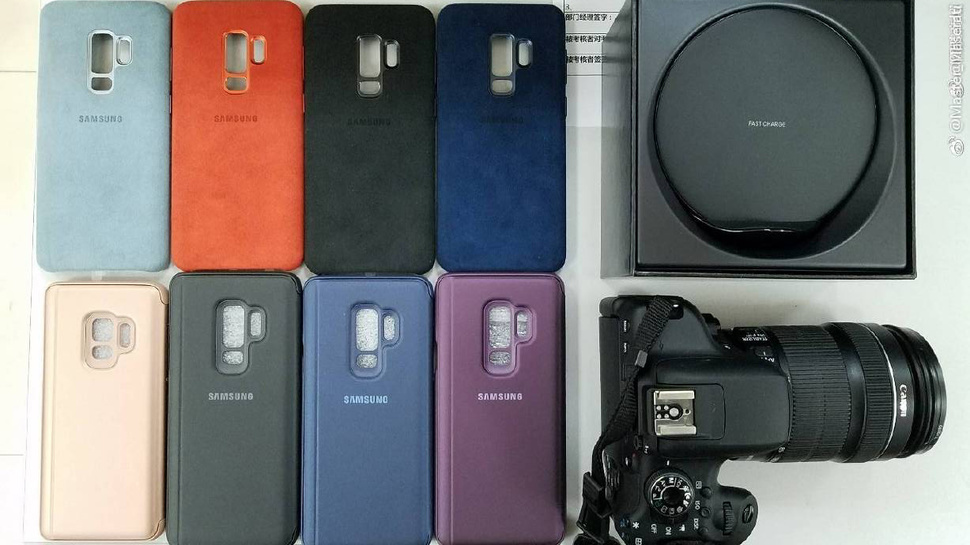
Another leak from @Hackersimar, a contributor to SlashLeaks, shows off alleged cases for both the Samsung Galaxy S9 and Galaxy S9+ and a charging accessory. The tweet shows off how cases would accommodate the camera setups of the two devices. The cases for the Galaxy S9+ appear to feature dual-lens cut outs. Meanwhile, the single Galaxy S9 case has a hole for a single lens.
This points to the past rumours claiming that the Galaxy S9 has a variable aperture rear camera. A device with a variable aperture has the ability to switch between multiple different aperture sizes. In the case of the Galaxy S9 rumours claim it can switch between f/1.5 and f/2.4 apertures. While the Galaxy S9+ uses two different lenses, one features the f/1.5 aperture while the other a f/2.4 aperture.
The case also shows that Samsung will place the fingerprint sensor below the camera setup, similar to the Samsung Galaxy A8.
The charging accessory, in the photo, says “fast charger” and looks to be some sort wireless fast charger for the device.
While theses cases look promising and colour options, nothing is absolute until Samsung unveils the Galaxy S9 later this month.
Autonomous cars have a potentially fatal flaw: They struggle to detect and react to cyclists on the road. According to a January 2017 report by IEEE Spectrum, bicycles are generally considered “the most difficult detection problem that autonomous vehicle systems face.”
… we’re increasingly learning that A.I. can amplify our own biases and human failings. If humans aren’t doing a good job of detecting and preventing vehicle-bike collisions, how can we create machines that do the job even better?
One solution presented …(is) bicycle-to-vehicle communications. Instead of just autonomous vehicles (or all motorized vehicles) on the road being able to wirelessly communicate their position and intentions with one another, bikes would be able to join the party. The proposed technology would be brand agnostic, something any cyclist could affix to herself or her bike. …
There’s one problem: This is cheating. Autonomous cars, out there beta testing on U.S. roads today, can accurately detect other vehicles, pedestrians, even big game charging suddenly across a street. Forcing cyclists alone to strap a sensor onto their backs feels like a crutch, a cop-out. …
The problem is that it requires everyone to take part, which poses several noteworthy financial and logistical questions, such as who pays for this system, how it’s deployed, how it’s enforced, and whether pedestrian and traffic laws would need to be changed in order to facilitate cooperative behavior. (For example, stricter jaywalking laws to ensure pedestrians only cross in places self-driving cars expect them to.)
In this scenario, autonomous car success hinges on a large number of difficult-to-control variables. But if the cars themselves are able to successfully sense and react to their surroundings, from a cyclist taking the lane to a toddler dashing into the street, the only variable that needs controlling is the technology itself. …
Bicycle-to-vehicle communication is a good idea and could be useful in certain scenarios, such as when visibility is low—at night or in the rain—or on tricky, twisty back roads with blind corners. But if cars are going to drive the roads without human help, they need to be able to handle all of the challenges that come with it, regardless of whether they’re wirelessly connected to the world around them.
Maybe our long-time fixation with cold and the coldest places on earth is trying to tell us something we don't want to admit
Polish mountaineer Adam Bielecki looks on after a training at the Piec Stawow valley as they prepare for the expedition to scale K2 near Zakopane, Poland on Dec. 12, 2017.
I've ski-mountaineered in the Canadian Rockies just enough to understand three of its pleasures: the unforgettable beauty of its silent snow-draped mountains; the rare companionship of people who rely on one another; and the clarifying satisfaction of undertaking crucial tasks step by small, reliable step. Everything becomes simple. Still, I wouldn't go anywhere near the Poles.
I don't mean the ones at the north and south axes of the Earth. I mean the expedition of 13 Polish climbers who at this very moment are attempting to be the first human beings to successfully climb to the top of K2, the second highest mountain in the world, in the middle of winter.
Winter is the distinguishing detail here. Only 302 climbers have ever made it to the summit of K2, and all of them did it in summertime. Even then another 84 people, or roughly one in five, died trying. To give you some sense of how challenging the climb is, ten times as many people have stood atop Mount Everest.
Story continues below advertisement
It's hard even to fantasize being there. The main obstacles to climbing K2 in winter are the wind, which comes screeching down the Karakoram range like a hooligan at hurricane speeds, and the freakish cold, which thanks to the wind can drop to -80 degrees. (Tires freeze square at -34 degrees.) A frozen hurricane is precisely what you don't want to experience when you are clinging by a rope and your crampons in chest-deep snow to the near vertical icewalls of K2. (The mountain looks like a sheet thrown over a couple of pikes.)
Only 302 climbers have ever made it to the summit of K2, and all of them did it in summertime.
Artura Hajzera
In winter, when days are deeply bracketed by darkness, a total of 10 days are clear enough to climb. The Poles are prepared to wait 65 days under K2, which regularly releases avalanches and yak-sized blocks of ice. The air at base camp alone has half the oxygen it does at sea level. (And Krzysztof Wielicki, the expedition's leader, is 67 years old.) Even getting to the mountain is a challenge. The Poles landed in Islamabad on December 29, and took seven days to trek through knee-deep snow to establish their base camp at 5,150 m. Last week they established Camp II, at 6,300 m. They have 2,311 m to go. On second thought I still don't want to be there.
So why do the Poles? That's an interesting question, and central to the mystery of how extreme cold fascinates and obsesses us as much as it makes us dive under the covers. Mountain climbing caught on in Poland during the Cold War, when the country squirmed under the heavy fist of the Soviet Union and alpinism became a metaphor for reaching free of the bear. (The Czechs, by comparison, turned to tennis, a game enclosed by lines.) The collapse of communism meant Polish climbers could travel and spread their cold-weather prowess around the globe: they're responsible for the first winter ascents of nine of the 13 highest peaks on earth. The Poles say they want to claim K2 for the glory of Poland, just as the British, the Norwegians, the Russians, the Americans and the Swedes (among others) pushed for the poles in the past.
Nationalism may be the public motive, but our cultural obsession with extreme cold is also deeper and more private, as unconscious as it is tenacious. What is it about the sub-zero that, however unpleasant, grabs and holds our attention, as it has for centuries and throughout this skintight winter? Extreme cold shrinks and clarifies the effort of human existence to its simplest X-ray form, to survival and our starkest motives. Maybe our long-time obsession with cold and the coldest places on earth is trying to tell us something we don't want to admit.
The main obstacles to climbing K2 in winter are the wind and the freakish cold.
Allan Hartley/Alamy Stock Photo
Heat and cold – other people have said this – are mankind's oldest metaphors for emotion. Hot is Satan's domain, the realm of anger and jealousy, but cold has always denoted absence, deprivation, emptiness, a vacuum: "the coold of deeth" (Chaucer), "the colde of ynwarde high dysdeyn, colde of dyspite" (Lydgate), the cold of infidelity, of fear, of grief, of human desertion. It is the state of "the north syde of the world" (Mandeville's Travels), where most of us never venture. (Slightly more than 0.2 per cent of Canada's population lives in the Arctic – that is, where the average daily summer temperature doesn't rise above 10 degrees, which in turn accounts for 40 per cent of the country's land mass.) Cold kills faster, not with inflammation and excess, as heat does, but with absence. Hypothermia sets in when the body's core temperature falls below 35 degrees. About 80 Canadians die every year of exposure.
Cold snaps are rarer and more compelling than heat waves. Nobody talked about anything else during North America's post-Christmas "bomb cyclone." Going outside into -20-degree-air was like stepping into an alternate universe that was missing an essential element – moisture, for instance. Pants felt like steel pipes. Before the cold snap, I was in Fort Lauderdale, Fla. It was so hot you couldn't jog comfortably once the sun rose above the rooflines of the houses at 9 o'clock in the morning. The heat seemed to loosen everything – time, expectations, modesties. I saw people wearing invisible thongs and bikini bottoms that said "Mike's Bitch" and T-shirts featuring a neon green figure raising its arms over the slogan "I pooped today!" People go outside when it's hot, which brings them together in a steaming voyeuristic mass by the border of the sea. I kept jumping into the pool to cool off, but also to be alone.
But back in Toronto, at -18 degrees, the streets of downtown Toronto were deserted. I could feel the precise outline of my body. Sharp cold feels brand new, every time.
Story continues below advertisement
The cold snap hit -38 degrees (with wind chill) in Ottawa over the Christmas stretch, making it colder than Ulan Bator, usually the coldest capital on Earth, where it was only -24 degrees. Even Gainsville, Fla., saw freezing rain. Cups of hot water instantly condensing into ice fog as they were thrown into the air became a meme; so did Calgarian Chris Ratzlaff's video of a soap bubble forming and freezing and shattering (over a million views). The penguins at the Calgary Zoo had to be moved inside, another detail that captured global attention. Still, no place came close to the coldest temperature ever recorded in Canada, -63 degrees in Snag, Yukon, in 1947.
Polish mountaineers Piotr Snopczynski, Piotr Tomala and Rafal Fronia wait to check-in before the departure of the Polish national team for the expedition to scale K2 in December 2017.
KACPER PEMPEL/REUTERS
Cold is physical: intellectually, verbally, it's harder to describe than heat, because it's harder to stay outside to pay attention to its details, and harder to write those details down. Batteries die, phones freeze, pens gel. When someone describes cold well, we notice.
As recently as a generation ago, Canadian literature was famous for its cold scenes, from the snowy winter poetry of Montreal's Marco Fraticelli to Wayne Johnson's legendary scene in Colony of Unrequited Dreams, in which a settlement of sealers are found frozen upright, mid-chat. It was the height of fashion in Victorian England to track the hardships of British polar explorers. "North Pole" even became Cockney rhyming slang for "arsehole," as Francis Spufford points out in I May Be Some Time: Ice and the English Imagination. Willfully risking death by extreme cold was something gentlemen did, because they could afford noble Tennysonian ideas about striving and seeking and finding and never yielding. Working class people thought they were nuts. Several polar expressions even became Victorian idioms: too far north described someone either plastered or too clever by half, like a Geordie or a Scotsman.
But our climatological vocabulary for cold has receded under the glare of global warming. Last year was the third hottest on record since record-keeping began in 1880, according to scientists at NASA – after 2016 and 2015 respectively. Meanwhile the historic Polish K2 expedition has fewer than 5,000 Twitter followers. When I asked Katherine Barber, the former editor-in-chief of the Canadian Oxford Dictionary who now writes the popular Wordlady blog to scour her records and Twitter for the phrase "cold enough to," she discovered only a handful of original-sounding locutions of frozeness, among them "cold enough to freeze the balls off a pool table," and "cold enough to freeze the nuts of the Guy Lombardo Bridge," credited to Kathie Lee Gifford one morning on the Today show, but which Ms. Barber also found recorded as "cold enough to freeze the nuts off the Capilano Bridge," suggesting to Ms. Barber that the expression may have reached North American "catch phrase status." Otherwise, she insisted, the language being used of late to describe the cold is both "literal and boring."
Even the Inuit – who as everyone knows have dozens of words to describe the Arctic's many different grinds of snow and their uses – have only three to describe cold. The difference between them – this is so Inuit! – lies in whether the thing that is cold is a person, an animal or an object. Cold is inexpressibly monolithic even for those who know it intimately – even meteorologists. "It becomes a challenge to keep people informed when the third winter storm in a pattern of three moves in," Josh Erdman, senior meteorologist at <a href="http://weather.com" rel="nofollow">weather.com</a>, told me in early January. "It becomes a challenge to be a wordsmith and still be accurate after a stall like that," stalls being an increasingly common feature of climate change. But some thresholds are universal, Mr. Erdman added. "There's just something about saying 'below zero' [Fahrenheit]. And especially days when the daytime temperature doesn't get above zero. That's really uncomfortable."
Polski Himalaizm Zimowy is pictured while climbing K2.
Artura Hajzera
So what is it about the cold that obsesses us, even if we can't describe it? Winter mountaineers are rarely much help expressing why they try the harrowing things they do. As they fix lines and ladders to and from Camp 2 this week (there will be four camps in all, the last at 8,000 metres, leaving a stagger to the summit), the Poles on wintry K2 have so far restricted their commentary to a few photographs and maps, and a Facebook page where the most common phrase is "Today no going up."
Story continues below advertisement
Their enemy, of course, is not just the cold, but the way it paralyzes human capability. David Young, who wrote the play Inexpressible Island about Robert Falcon Scott's fatal failure to be first to the South Pole in 1912, described "cold as an existential threat – cold that's colder than whale shit, cold as Satan's testicles, colder than Uranus, bad marriage cold." He was in Seville, Spain, writing a novel, when I telephoned. Cold, he said, is as complicated as love, at least when it is the kind of cold where you step outside in your pyjamas to get the newspaper or the mail and realize you could die if the door locks behind you. "We all talk about the discomfort of cold," Young said. "But some of us talk about the existential threat of it." He thinks the Poles on K2 are after the same thing Sir John Franklin and Robert Scott and Ernest Shackleton were after, risking their own and other peoples' lives to explore the deadly extremes we are willing to endure to get to the frozen ends of the Earth, if also for the glory of national pride. "We are talking about the limits of human experience," Young said.
"Should those limits even matter," I asked, "given the more pressing problems that face the world?" I was thinking about, say, the hundreds of thousands of Rohingya refugees who have fled since last August, a similar number of Dreamers who may be deported in March, the 500,000 homeless North Americans.
"I think they do. Because they are all demonstrations of the limits of human capacity."
That's the time-honoured romantic view, the struggle between survival and catastrophe that climbers embrace, that cold-lovers welcome, that politicians exploit. Others belittle it as patriarchal, colonialist and old-fashioned. But maybe we all misunderstand a deeper reason we are obsessed with the cold, why we're thrilled to endure something we claim to fear and dislike so much.
David Young counts five essential "cold-lit classics" in the revised Canadian edition of The Book Of Lists, published last fall. (It's a terrific book, perfect for the boudoir or the bathroom.) He leads with The Worst Journey in the World, Apsley Cherry-Garrard's famous memoir of Scott's failed 1910-1913 expedition to claim the South Pole (where the air was so cold it shattered their teeth). He ends with Francis Spufford's brilliant and beautiful I May Be Some Time.
"I am just going outside and may be some time" is what Captain Lawrence Oates said one evening in 1912 (at least by the account of Scott, whom Oates disliked) as he snuck away from their windtorn shelter to lie down and die in an Antarctic snow drift. Oates, suffering from frostbite and gangrene, was convinced he was impeding Scott's return from the Pole. He was wrong: Scott and his remaining two companions died 12 or 13 days later – Scott wasn't sure, because cold freezes time as well – just 11 miles short of their objective.
I am just going outside and may be some time. The sentence perfectly exemplifies the English and Western ideal of polar exploration: that men will behave like gentlemen, according to the rules, even in the coldest and most inhuman circumstances. For all the frigidity of Edwardian society – a culture that sent its children away to boarding school at the age of four and cheered and shamed a generation of men into the massacres of the First World War – Scott discovered a place that was colder still. For all the lives frozen in Soviet-dominated Poland, the K2 expedition today finds itself in an environment that makes even that homeland look cozy by comparison.
If we can survive this, we somehow understand as we step outside into the brain-bracing air, we can survive anything, even the chilly inhumanity of our own behaviour.
From Microsoft to Apple, a number of leaks surfaced last week in the smartphone world.
Here’s a breakdown of everything, including leaked patents, rumours, and speculation. Note these leaks encompass everything from Saturday, January 27th to Friday, February 2nd.
Apple
KGI Securities’ Ming-Chi Kuo — as reported by MacRumors— does not expect there to be a 2018 iPhone SE 2, along with the three iPhone devices that the company has already planned. Furthermore, when the iPhone SE 2 is released, Kuo only expects minor improvements over the previous iPhone SE. Kuo says the device will not feature wireless charging or Face ID.
The China-based company will unveil its next flagship on March 27th. While we’re not 100 percent sure of the name, Huawei has sent out press invites to an event revealing new flagships. Huawei has set the event for March 27th in Paris.
For more on the Huawei flagship invite click here.
In other Huawei news, rumours indicate that the company’s next flagship will be called the P20 and not the P11. The news comes from Roland Quandt who tweeted out the codenames and colours of the Huawei P20, Huawei P20 Plus and Huawei P20 Lite.
The Wi-Fi Alliance has approved an Asus smartphone with the model number ‘Asus_X00QD.’ Rumours indicates that this phone may be the Asus ZenFone 5 Max.
For more on the Asus ZenFone 5 Max Wi-Fi certification click here.
Microsoft
A patent published on February 1st reveals that Microsoft has looked into developing a foldable smartphone. The patent filing indicates that Microsoft will add what the company calls a ‘live hinge’ feature.
For more on the Microsoft foldable smartphone click here.
Vivo
Vivo is rumoured to unveil an android smartphone with 10GB of RAM. This device, called the Vivo Xplay7, will be the first ever phone with 10GB of RAM. Further, it’ll feature an 18:9 aspect ration and Qualcomm’s Snapdragon 845 chipset.
Until now, the custom image processing unit (IPU) — a first for Google when it comes the company creating its own smartphones — has just been hanging out, takinfg up space in the Pixel 2 and Pixel 2 XL.
That’s set to change, now. Google has revealed plans to activate the Pixel 2’s Visual Core processor. What remains unclear is why the Visual Core wasn’t already up and running when the Pixel 2 was first released.
“As you might imagine, building hardware takes quite awhile. So yes, we have been working on this for a long time,” said Ofer Shacham, engineering manager for the Pixel Visual Core, emphasizing that Google needed third-party developers to integrate the photography-focused SoC’s unique capabilities in their apps first, before activating the hardware.
Even without the Pixel Visual Core though, the Pixel 2 features one of the most well-regarded smartphone cameras out there right now.
Google says that through computational photography and machine learning — which powers the tech giant’s unique HDR+ technology — the Pixel Visual Core improves the image quality of third-party apps by allowing users to shoot high-quality photos directly in applications.
This means that once the Pixel Visual Core is active, HDR+ will be directly accessible through social media platforms like Facebook and Instagram. Google says that this feature was previously only available directly through the Pixel’s stock camera app, forcing those who wanted to take advantage of HDR+, to take a photo with the standard Pixel camera app. To be clear, the Pixel 2 was already capable of HDR+ prior to the Visual Core’s activation, but only through the stock camera app.
While not a monumental change, this does make the process of quickly shooting photos and posting them to various social media platform that much easier. There are other, arguably more interesting benefits that come from the Visual Core Chip coming alive, too.
Because HDR+ is no longer being handled by the Qualcomm Snapdragon 835 processor inside the Pixel 2, Google says that the smartphone should also now feature improved battery life and overall performance.
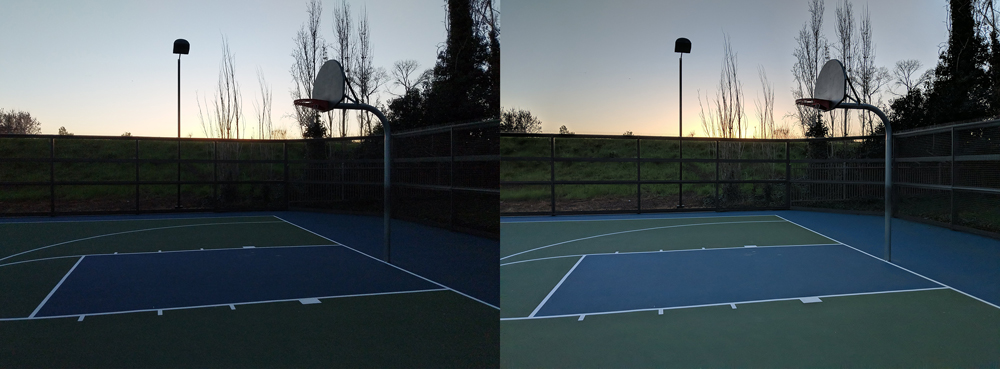
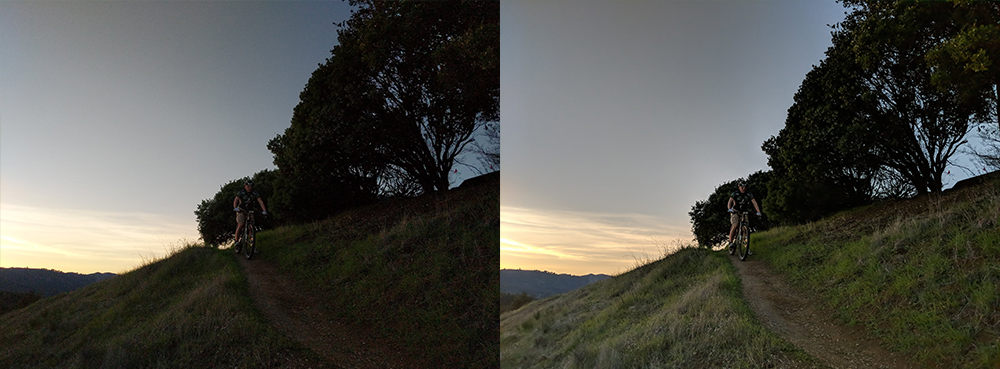
But what is HDR+ and why should you even care about it? Think of the technoloy as an upgraded version of standard HDR: Instead of just three photos, HDR Plus shoots up to 10 images that are all underexposed, then “chops them into little bits.” This has a significant impact on low-light performance, according to Issac Reynolds, Google’s Pixel Camera project manager.
“Once you take those 10 equally underexposed photos, we average them together… It’s like taking a very long exposure — like a one-second exposure — but because we’ve chopped it up into 10 short ones, it looks very sharp,” says Reynolds.
The Visual Core was first activated in the most recent developer preview of Android 8.1. Now, the chip’s functionality is rolling out to all users. While Google says the update is coming as part of the Pixel 2’s February security update, it could take a number of days (even a week in some cases) for it to hit your particular device, depending on carrier approval.
Looking to the future, Schaham isn’t ruling out utilizing the Pixel Core for other purposes, though won’t confirm if the custom silicon is capable of handling processes that aren’t photography related.
“This of course lends itself to other things that we might plan to do in the future,” says Schaham.
This strategy also makes sense given Google recently hired Manu Gulati, an Apple micro-architect who worked on the company’s chip development for almost 8 years.
While it’s likely the changes the Visual Core makes to the overall performance and experience the Pixel 2 and Pixel 2 XL offers the end-user, this could be the first step in a new direction for Google’s hardware development strategy.
Google also says that new augmented reality stickers themed around winter sports are on the way later this week just in time for the Winter Olympics.
Canadian national media conglomerate Bell Media has launched its bite-sized SnackableTV streaming service on Android.
The service offers users short clips from television shows and news programs licensed by Bell.
According to a February 5th, 2018 media release, SnackableTV will also be the “exclusive home” for content derived from Kevin Hart’s Laugh Out Loud app — a streaming service available in the U.S., but that has yet to make its way to Canadians.
Additionally, Bell has ordered a short-form version of Letterkenny to debut on the SnackableTV service. Full episodes of Letterkenny are otherwise available on Bell’s CraveTV streaming service.
“Today’s launch of SnackableTV represents an innovative, all-Canadian solution that addressed an open space in today’s user landscape, providing short-form premium content tailored for Canadian audiences and advertisers like,” said Randy Lennox, president of Bell Media, in the same February release. “As SnackableTV grows, so will its inventory of popular news, comedy and entertainment offerings as we leverage some of the most sought-after entertainment brands, both in Canada and from around the world.”
The service is branded by Bell as a “free-to-consumer, ad-supported short-form video content hub,” which translates to mean that users can watch free clips from shows licensed to Bell in a singular app.
In many ways, the app functions quite a bit like a licensed version of YouTube, with the caveat being that users can’t upload content to SnackableTV.
Instead, users are only able to view short clips from television programs, without needing to worry about potentially infringing on copyright because the app’s contents are maintained by Bell.
SnackableTV’s launch comes at an interesting time in Canada’s media history. Last week, roughly 25 Canadian media companies came together to support the foundation of an anti-piracy coalition with the aim to give copyright owners the ability to block access to websites carrying copyright-infringing media.
SnackableTV can therefore be seen as Bell’s way of providing Canadians with access to similar content that one might search for on YouTube, but in a service maintained by one of Canada’s largest media conglomerates.
SnackableTV is free-to-download on Android and iOS.
… having lived in the beautiful red-dot city state for two and half years, and seeing up close the experience of public housing in Singapore, one is struck by elements of the Singapore housing experience that are striking for its foresight and, yes, its replicability! …
How has Singapore succeeded where so many other countries have failed dismally? At the risk of over-simplification, there seem to be four essential ingredients to this astonishing success story:
1. The importance of neighborhoods.
… the careful bottom-up design of neighborhoods matters a lot! …
Singapore got this fundamental fact right early on. Housing estates are carefully designed with mixed-income housing, each having access to high-quality public transport and education, and the famous Singapore hawker centers where all income classes and ethnicities meet, socialize, play, and dine together on delicious and affordable food. …
The apartment blocks are designed to encourage the “kampong” (social cohesion) spirit with the “void decks” (vacant spaces on the ground levels of the HDB blocks) and common corridors (common linked spaces that provide access to individual units on the same floor) that foster interactions between neighbors.
2. The smart use of urban density.
This has been done by carefully designing the height and proportion of buildings in relation to one another. Dr. Liu Thai Ker, the legendary Singaporean urban planner, compares this to a chess board where no two pieces are of the same height. …
Buildings are also interspaced with high quality green open spaces.
3. An integrated approach to housing—from planning and design, through land assembly and construction, to management and maintenance.
The Housing & Development Act (1960) gave the Housing and Development Board, as the apex housing agency, the lead role across the housing value chain. In most countries, access to land for affordable housing is a critical constraint. In Singapore in 1967, the Land Acquisition Act empowered the country to acquire land at low cost for public use.
Today, 90% of land is owned by the state as opposed to 49% in 1965. Great emphasis is placed on standardization and efficiencies in construction management. …
They are immaculately maintained. In 1989, Town Councils were introduced to empower local elected representatives and residents to run their own estates. Today, there are 16 Town Councils managing the HDB housing estates in Singapore.
4. Long-term and strong political commitment.
The popular and political support for public housing in Singapore is strong and stable. And this has meant a high level of public subsidies to HDB (in 2017 this was S$1.19 billion).







![[Book] The Fixer Serie Book 1 - 3](https://c1.staticflickr.com/5/4754/40089777661_23758d9b18_o.jpg)
![[Book] The Fixer Serie Book 1 - 3](https://c1.staticflickr.com/5/4660/40089997761_aa8e380f16_o.jpg)
![[Book] The Fixer Serie Book 1 - 3](https://c1.staticflickr.com/5/4625/39378503964_451fb4fc59_o.jpg)
![[Book] The Fixer Serie Book 1 - 3](https://c1.staticflickr.com/5/4747/25217653887_588fd9c7ef_o.jpg)


 Kevin Marks's Known site.