Shared posts

02 Mar 07:13

Remember the winter

by Tom MacWright

In San Francisco, and to a lesser extent the world, Machine Learning is a two-word explanation for how the future will be better. Startups will succeed because they leverage machine learning. Your money will be managed better, and your alarm system will be able to detect and categorize motion because of machine learning. Machine learning is the reason why companies can claim higher valuations and why we shouldn’t worry about self-driving cars deciding to drive off the highway.

I share much of this optimism, but think there’s more to the story. Like any hot trend, the fervor behind machine learning lacks context - especially historical context, and an understanding of the dynamics at work to make us optimistic about technology in general.

  1. Optimism about AI may be cyclical
  2. Technological progress is as much a result as it is a cause of hype cycles. There are three other components that all are critical for keeping the cycle alive:
    • Benefactors
    • Expectations
    • Speculative pressure

Let’s dive in.

Optimism about AI has been cyclical

In the history of artificial intelligence, an AI winter is a period of reduced funding and interest in artificial intelligence research. The term was coined by analogy to the idea of a nuclear winter. The field has experienced several hype cycles, followed by disappointment and criticism, followed by funding cuts, followed by renewed interest years or decades later.

If you aren’t familiar with the concept of AI winter, I’d recommend it. It’s an idea that AI funding and optimism is cyclical. The winters were roughly around 1966, 1969, 1974, and 1987 - years when companies went out of business (Symbolics) or critical reports were filed. After the initial crash, AI became a forgotten subject - a field with scant support in academia or industry.

So far I haven’t met anyone who had heard of the AI winter before, despite it being a well-established historical idea. We’ve forgotten how often we’ve fallen short of our plans. It’s hard to imagine what it’d be like in 1968 when the Mother of all demos occurred. Surely, at that rate of progress, anything seemed possible. Imagine fast-forwarding to the MS-DOS era, and wondering if you had gone backwards or forwards in time. Time is a flat circle.

I should probably reiterate that this blog post isn’t a bet against AI. The AI winter may well be over permanently, and we all could live the remainder of our lives performing manual labor for cruel digital androids. When that happens, you’ll be free to mock me for my pessimism (or was it optimism), and I’ll cede the point, but it won’t be of much use by then.

Now, why has AI been cyclical? I’ll go over some reasons why it, like any technology trend, is volatile, but why it’s cyclical, well: as best as I can describe it, we keep extrapolating the future from early results, and we keep thinking that we’re on a path to strong AI, even when we’re only solving a fraction of that problem.

Strong AI is, well - artificial general intelligence. Like the kind of general intelligence that humans and other organisms have, with its non-linear thought and tricky ways of reasoning. It’s hard, really hard. And I’d expect some of the champions of AI to claim, well - we aren’t really aiming for that. But are we? The framing of current AI is clearly human, with human voices and names.

The past cycles ended when we realized that we weren’t on a track to general intelligence, and that the fashionable next-generation technology had clear and crippling limitations. That, combined with centralized funding sources meant that the industry was fragile and could be knocked off-balance by a few damaging reports. And, of course, a breakdown in consumer sentiment and trust: a shift back to thinking that, no, computers were not about to become our friends. The actual ‘AI’ that shipped to consumers was disappointing and convinced people that computers were still more like calculators than organisms.

1. Benefactors

A lot of groundbreaking research in technology is funded either by a monopoly or the government.

Engelbart’s work was funded by DARPA. So was the Internet. Unix was funded by Bell Labs in the 1970s - before Bell Labs was broken up, because of monopoly dealings.

As of now, Google funds a large portion of the hit computer science papers - like The Case for Learned Index Structures. Amazon’s doing much of the cutting-edge work in voice recognition, and Apple’s teams are at the bleeding edge of on-device machine learning.

All those companies are tarred as monopolies. There are calls to ‘break them up’. They’re cheating on their taxes, dominating entire markets, and getting massive fines for breaking anti-monopoly rules.

Fiction celebrates the ‘Project X’ efforts of monopolies: look at Tony Stark (Iron Man), Bruce Wayne (Batman), or Lex Luthor. And, heck, it’s cool to look at what was created in the days of excess at Bell Labs, projects like Plan 9. But these high-budget long-shot projects were enabled by the kind of margins you collect as an entrenched monopoly, and ended when the monopolies ended.

As much as it’s cool that the domination of Amazon gives us zany projects like an enormous clock built into the side of a mountain and rocket company, one has to ask: what would have happened if there wasn’t that much slack in the market, so to speak? And what might happen to these playboy billionaire dreams if the SEC wakes up?

And the flipside of huge benefactors is a lack of diversity in funding. The era when a vast majority of AI funding originated from the government was probably the peak of funding concentration, but what we have today isn’t all that different - a few nation-state-sized companies, many investors that share the same general thinking, and then a smattering of small companies that rely on those investors. Concentrated sources of investment mean that only a few people have to change their minds in order to tank an entire industry.

2. Expectations

We expect Siri to work. In the early days of Siri, when people who start human-sounding conversations with Siri - ‘Hey Siri, what do you think about them forty-niners?’ and be surprised by Siri’s dumbfounded reply. We were ready to believe that in world with barely-working infrastructure, egregious privacy & security problems - we were ready to believe that humanoids were real.

In part, this is because consumer approval of Apple was at such a high level.

And partly because our memory is so short. We had Ask.com in 1996, but it didn’t live up to the stated goal of answering questions, in the general sense. We had Clippy, but hated it. Dragon NaturallySpeaking was pretty decent in 1997.

Anyway, 6 years after the release of Siri, voice recognition has improved greatly, and so has artificial intelligence. I’d also wager that some of the uptick in Siri-like interfaces is because we’ve started to accommodate the machine: cued by marketing material and conversations with friends, we now have a pretty clear idea of what Siri, Google, or Cortana can and can’t do. We know the questions to ask. We still believe in super-intelligence, but when talking to computers, we avoid sensitive topics that’d embarrass both of us.

At the edges, there are whispers about the downsides. That AI can be racist. That even highly-lauded algorithms, like Google Translate, have no ‘common sense’.. That traditional ideas of debugging have no meaning in AI - we can visualize the mechanism, but only at a high level of abstraction, and diagnosing or precluding behaviors is exceedingly difficult.

The funniest example is Facebook’s M personal assistant, which unintentionally recreated the original Turk - heavily hyped at its time of release - it would use conditional random fields and maximum entropy classifiers in tandem with a team of humans, and then artificial intelligence (es?) that would listen in and learn from the conversations. Eventually it’d just be artificial intelligence, and Facebook would be able to fire the contract workers they initially employed to train the robots.

But, well, they didn’t - it only reached 30% automation. Its users likely optimistically believed that they were talking to androids, but they were only talking to contract workers. It was harder than they expected. If you look around, there are other big misses, like IBM Watson, which was a true marketing home run, delivered a tiny fraction of its touted abilities.

3. Speculative pressure

This one’s possibly a bit insider baseball, but, well - startup trends are as much a result of the funding environment as anything else. Big investors see a trend, or they see one company hit a ‘home run’, and they want that again. There’s a WeChat or a Google or a Facebook, and, though that company is doing great, maybe they discovered a new market, and there’s more room at the edges? What about the startup that does almost the same thing, but just for the enterprise market, or just for the teens?

These trends flow in and out quickly. Chatbots were big in the recent past. Social was a big keyword, as was location. Apps were born in the Foursquare-adjacent era, and they’re gone, or they’ve pivoted. Startups – despite their reputation for doing everything fast – aren’t made that quickly, so they soft-pivot. If they use simple linear regression, that’s enough to add ‘machine learning’ to a PowerPoint pitch. So quickly we get applications that leverage machine learning to optimize their dog-walking routes or bouquet selection.

Like M, maybe they really are, or maybe it’s a little bayesian math and a lot of contract employees.

End/FAQ

Perhaps the winter is over forever:

“At the same time, I don’t think there will be an ‘AI winter’ again, where hype cycles happen and there’s no more funding, and so on, because AI is now running in production,” Richard Socher said during an onstage interview at a Bloomberg event today. “Google search and social media, and now enterprises, are using AI on an ongoing basis — they’re seeing great returns on those investments.”

“There’s definitely hype,” adds Ng, “but I think there’s such a strong underlying driver of real value that it won’t crash like it did in previous years.”

Some of the recent boom in AI/ML has been the result of genuine innovation. Neural networks, tensors, and increasing efficiency hardware efficiency mean that artificial intelligence is concretely better today than it was in the recent past.

But too often we’re drawing a straight line from where we are to the utopian future, and assuming that future is right around the corner. What looks like a technological revolution right now is also a lucky alignment of economics and consumer attitudes, all of which are fickle and constantly changing.

What might happen is that machine learning succeeds despite the public’s lack of trust, and it becomes an antagonist. Products will advertise that they’re curated by humans, or at least that there are human moderators. That’ll become a selling point, that there is common sense that catches self-reinforcing evil cycles in feed-organization and other mechanisms. Companies use machine learning behind the scenes, but it disappears from their product marketing.

Or perhaps what we’re seeing right now is the validation / invalidation of the technology in different domains. It’ll succeed in recognition and categorization tasks to the point that programmers will be able to call a detect() routine and it ‘just works.’ We’ll gradually forget it was ever a hot trend, and just rely on that part of computing being fixed. But we’ll also forget about the hype that this was going to solve everything, and the rest of our technology landscape will look pretty much the same.

Or, maybe, it’ll all just work out. I kind of like Umer Mansoor’s take the best:

AI is not magic and the hype will die down, but the next AI winter will be more like a California winter, not a Canadian one.


  • You’re so wrong! I might be! In some ways I hope I am - I hope the good things about AI come true. But I don’t want to be right or wrong here - predicting the future is pretty dumb. I’m just trying to remember the past and see a more sophisticated narrative than tech futurism currently permits.
  • You’re really mixing AI and ML as terms. They have dictionary definitions! How could you? The terms are conflated in common usage.
  • You have X factually wrong. Let me know! I’m always there at @tmcw on Twitter or my email on /about.
02 Mar 07:13

Good Boys

by Rahel Aima

When I’m sad or feeling defeated or simply tired from the business of living extremely online, I make a beeline for my favorite boys. Scooping into that lipid layer of animal videos that provides all the comfort of a favorite book or record while allowing you to stay logged on. I used to adore the twitter account @round_boys, the progenitor of a new viral ecology in which every charmingly rotund creature is a superstar. Roundboy likenesses would be reposted — and significantly, rarely modified — so many times that it could be impossible to identify the original. Moreover, to do so would be entirely beside the point. Since that account has been suspended for copyright infringements, I’ve been checking in on my best longboys instead, particularly an oriental shorthair cat named Teddy featured with three of his siblings on the Instagram @hobbikats. Teddy is strikingly green-eyed with oversize, batlike ears. He is exquisitely  long of limb and even longer of face and tail, resembling nothing so much as a piebald Adam Driver. He stretches so languorously that just looking can loosen your spine. He cascades over sofas as if arranged by a master draper, and most of all, he honks, in mellifluous bell tones so beautiful that you question whether he is really a cat. Or in the language of the day: he stretch, he drape, he honcc.

The less we know about the animals in question, the richer their potential for virality

Roundboys and longboys both fall under the umbrella of the very, very good boy: They’re the thicc cat who greedily inhales the watermelon, the pudgy bird who melts in the palm of the hand, the surpassingly fat tiger, the Falstaffian, jolly seal. Even the adjectives we deploy to connote their roundness are so pleasing: chubby, plump, roly-poly. Contrary to all the other kinds of boy we’ve collectively come to side-eye — the fuckboi, the softboy, and the cuckboy are the most egregious, but boys’ clubs in general seem to be in crisis at the time of this writing — these are boys that nearly everyone can get behind. We might wonder just why are they called longboys and roundboys, but not longgirls and roundgirls? Is it an attempt to bypass the sexualized connotations of fetishizing pubescence and describing larger women are as curvaceous or voluptuous or Rubinesque, unlike the silky golden retriever-like dignity and capability implied in words like portly, corpulent, or stout? A #notallroundboys attempt to rehabilitate boyhood as the once unassailable logic of boys will be boys crumbles? An extension of the maxim that all dogs regardless of gender — and by extension, perhaps, all animals — are exceedingly good? Online, everyone knows you’re a good boy.

“Looking at cats” was once a common catch-all for things people do online, especially at peak in the age of “I Can Haz Cheezburger” memes. Cats’ market share of the online gif economy has since waned, with the explosion of popular accounts dedicated to the appreciation of nature’s strangest, weirdest, and heretofore least known species. Maybe we’ve become inured to the black-bordered impact of mass-generated memes, tired of the “lolcats” brand of pranky humor. They can hardly compare, anyway, to the sheer delight of the pygmy jerboa, essentially a fuzzy M&M with a tail, or to the endearingly gloopy defeat of the blobfish, beloved for its status as the world’s ugliest animal, or the grabby, spiralized scooching of a pangolin climbing a tree, its scales rippling so winningly like a particularly snouty mermaid.

The most exciting thing about longboy Teddy, however, is that his honking is consistently tuned at a single note, F#, the dissonance of most modern American car horns. That adult cats only meow to communicate with humans — not other cats — suggests the delicious possibility that Teddy might have learned to vocalize in concert with car horns on the streets outside. Perhaps it is his method of communicating with all non-cats — the potted plant as well as the refrigerator in a kind of sonic internet of honks. Most likely, I’m projecting, but isn’t that what animals on the internet have always been for? There’s something remarkable in the way that animals, even one as singular as Teddy, lose their particular, unique auras when scrubbed of their context, attribution, and even exif data, and uploaded online. We see them as generic: an animal, a longboy or a roundboy; a furry canvas upon which to superimpose the most human of behaviors or motives. The less we know about the animals in question, the richer their potential for virality: They become timelessly applicable in a wild variety of situations. Virality, in turn, becomes a summing up, creating the velocity for these peculiar new forms, as we now know them, to make an affective print on the official taxonomic encyclopedia of life.


About a decade ago, a study found that the television you watched as a child affected the color of your dreams. Essentially, if you are over 55 and grew up watching black-and-white TV, chances are your dreams are monochrome. Otherwise, you likely dream in color, which makes me wonder whether there are groups of people who dream in the color palettes of their earliest interfacing with computers? In the 8-bit of the earliest arcade shooters, or the dithered 16-color palette of ’90s Sierra adventure games? More recent studies suggest video games indeed have an analogous effect. Gamers, who are used to manipulating their environments, report far higher levels of lucid dreaming, disembodied observer dreams, and dream control and are less prone to motion sickness. Apps like Vine or Snapchat or Instagram stories work in the same way. Just like the those old black-and-white televisions, their technological parameters restructure how we perceive the things that these apps depict — animals included.

You’ve probably heard that Inuit and Sami peoples have dozens of words for snow: Animal videos work similarly, but as a kind of glossary of wonderful feelings

The Himba provide a particularly interesting case study in that they have only five color categories to encompass the spectrum of visible light: borou for blue–green, for example, or serandu for red, orange, and pink, and intriguingly, zoozu for black and dark shades of other colors. As a result, even as they might find it difficult to separate what an English speaker would understand as red or brown (dumbu), they are much more adept at distinguishing between shades of one color. Put another way, the grammar that underwrites their language means they are much more attuned to other color qualities besides shade, like saturation, luminosity, or brightness, which we might arrive at only after interfacing with a different kind of technological language: Photoshop or another editing software. Just as we gain tactile knowledge through time and exposure — handling a fruit to gauge ripeness, fingering fabrics to assess production quality, knowing just how much pressure to apply with a chisel — the technological restructuring of platforms like Vine or Instagram accord us a new range of affective motion, revealing new layers to pleasure.

In linguistics, the Sapir-Whorf hypothesis posits that language heavily influences the structure of thought and experience. The Pirahã people of Brazil, whose language does not feature numbers but instead has concepts of “small,” “‘somewhat larger,” and “many,” have difficulty counting to 10. Similarly, many languages do not distinguish between the colors green and blue; speakers instead see something like “grue.” Old English speakers had only the very literal geoluread, or yellow-red, to describe the spectrum of shades between those two primary poles, now known broadly as “orange.” Does this mean that they, like those without separate words for blue and green, were supposedly unable to perceive specificities of orange, or to pick out individual shades such as carrot, papaya, apricot or tangerine? (I similarly wonder whether this lack was why European racial classifications assigned colors like red and yellow to large swathes of the world.)

Under the aegis of this theory, though, language has the power to expand perception as well as limit it. Perhaps our cultural perception is likewise widened by new types of affective media in vast circulation — animals, though disappearing, are leaving mimetic traces behind, and memes become language. You’ve probably heard that Inuit and Sami peoples have dozens if not more words for snow: Animal videos work similarly, but as a kind of glossary of wonderful feelings, a solitaire endgame in which the suits are 🙊, 😀, 😊, and 🤗.

This new economy of animal images and videos has come to replace the once frequent animal interactions we might have once had before urbanization and mechanization. They create a nostalgia for animals we would have never seen without them, capturing the impossible and the impossibly rare. But the new techniques also encourage a kind of emotional projection. Infinite looping gifs, Instagram stories, and features like Boomerang, which repeats a short motion back and forth, work as a kind of synecdochal butchery, reducing an animal to an isolated constituent part or motion: That sudden wobbliness and narcoleptic bellyflop that reminds you you’re so very tired too. The destructive dog that’s too ashamed to meet its owner’s eye, the rat taking a shower for a few seconds, soaping itself up with surprisingly humanlike motions.

This new economy of animal images and videos creates a nostalgia for animals we would have never seen without them

The thing is, Grumpy Cat isn’t actually grumpy, Tuna the Dog (probably) isn’t a competitive worrier, and Lil Bub in’t constantly thirsty or sticking her tongue out at the world; the rat wasn’t merrily soaping itself so much as frantically trying to get the untasty and potentially toxic substance off its fur. Yet like Teddy, they exist within the looped clip as a non-linguistic description of a particular, or peculiar experience of interspecies interaction. We see none of the aspects of animal care that make them pets rather than spectacles. Experiencing these animals only in six-to-60 second increments, we see them only at their snuggliest, their cutest, their weirdest, their funniest, their least animal-like and most bizarrely human, their most likely to be named viral.


I need to take a minute here to tell you about my favorite Good Boy, @dog_feelings, or “Thoughts of Dog.” This Twitter account is run by the same person — or quite possibly management firm, given its wild popularity — as the rating account @dog_rates. The exuberance of its littermate is eschewed here for a rather more sober look into the thoughts of one nameless dog, his love of peanut butter, sticks, snoozles, stretchems and snuggles, his important job featuring long shifts of monitoring the lone skittle under the fridge, and philosophical chats with his beloved stuffed fren Sebastian. Unless you happened to catch his introduction Sebastian is never physically described, and becomes an abstracted distillation of all our internet animal frens. I imagine him as a little lion or mini-me Dog, of the please do talk to me and my son again and again variety; others might conjure up a teddy bear or or bunny or penguin. It was only when the account began promoting Valentine’s day cards at the Dog Rates store that I learnt that Sebastian was, most jarringly and incongruously, a small belly-seamed elephant. (Has Dog’s gender ever been established? I read him as male.) On the occasions where Dog reminds his fans that he loves them, he opines wisely on affection and fidelity with a matter of fact gravitas that feels all the more heartwarming:

i had a long talk. with my fren. about how to spot. a fake ball throw. the optimal strategy. is to follow the ball. with your eyes. instead of your heart

In the logic of Dog, of course everyone is good and the world is wonderful and in it for the hugs if true. Dog knows this to be fact and can’t even begin to fathom that you might not, but regardless Dog is patient and loving, and if you took the time to realize the same, and learn to talk like Dog, then you could be frens with the world too. Have you ever noticed how all dogs get at least 12/10, while lizards are rated a little more conservatively with a starting rating of 9?

Tonally, Dog’s positivity is a little more measured and tempered than their buyer testimonials (A+++ QUALITY PRODUCT! WOULD BUY AGAIN!!!) in a way that almost suggests this ecology of animal memes has matured from both the mass-produced manufacturing of meme generation and the relentless bombast of the Upworthy model. It has moved to a more tertiary economy of service memification that increasingly looks to weaponize not just attention but affect. Consider the way that publications like Salon have very recently begun offering the option to let them leverage your computing power using in-browser cryptocurrency mining as an alternative to disabling adblock, a consensual version of the technology’s revival in the seedier, scammier side of the internet at the close of 2017. The animal meme industry is doing the same thing, but what it’s mining and monetizing is the viewer’s emotional response itself. Animals, being singular yet not individualistic, model a way in which viral amplification (replication) can, contra Walter Benjamin’s “aura,” work to actually enhance the aura of a piece of content.

This is aura as Coachella flower crown, whose power lies in its utterly banal genericness despite its specificity — the awkwardly swole sentient night brace infomercial that is the Chinese water deer, perhaps — and in this it is more akin to Benjamin’s “traces” — debris, remnants — which he describes in The Arcades Project as having “the appearance of a nearness, however removed the thing that left it behind may be.” Benjamin links the trace to the discontinuous experience of the hunt, as well as literary study, “the fundamentally unfinishable collection of things worth knowing, whose utility depend on chance,” and what could possibly be more worth knowing than roundboys?

Maybe all this positivity, constructed as it is, means we’re beginning to take self-care seriously, whether it’s learning about pH levels and acid mantles or checking in with friends and learning how to take care of each other. In embracing the aura of the general, perhaps we are beginning to lose our selfish particularities to become multiple, one or several frens. In recent years the way we talk about self-care has moved away from the language of individualist indulgence and “me time” to consider it as nothing less than the acts of love necessary for everyday survival: not accessories to the struggle so much as an integral facet of it. When Assata Shakur said, “we must love each other and support each other,” she almost certainly did not mean looking at animals on the internet, yet today they function as the same thing. Pictures of puppies aren’t going to end police brutality or dismantle the prison-industrial complex, but maybe they can keep us going so that we can do the work that will.


This essay is part of a collection on the theme of AURA. Also from this week, Apoorva Tadepalli on when to-do lists become decorative, and Rob Arcand on using blockchains to try to protect art.

02 Mar 07:13

Typographical Era: Magnifying Human Error in the Digital Age

by Randall Amster

A dirty old chair with the words "My mistakes have a certain logic" stenciled onto the back.

You may have seen the media image that was circulating ahead of the 2018 State of the Union address, depicting a ticket to the event that was billed under a typographical error as the “State of the Uniom.” This is funny on some level, yet as we mock the Trump Administration’s foibles, we also might reflect on our own complicity. As we eagerly surround ourselves with trackers, sensors, and manifold devices with internet-enabled connections, our thoughts, actions, and, yes, even our mistakes are fast becoming data points in an increasingly Byzantine web of digital information.

To wit, I recently noticed a ridiculous typo in an essay I wrote about the challenges of pervasive digital monitoring, lamenting the fact that “our personal lives our increasingly being laid bare.” Perhaps this is forgivable since the word “our” appeared earlier in the sentence, but nonetheless this is a piece I had re-read many times before posting it. Tellingly, in writing about a panoptic world of self-surveillance and compelled revelations, my own contributions to our culture of accrued errors was duly noted. How do such things occur in the age of spellcheck and autocorrect – or more to the point, how can they not occur? I have a notion.

To update Shakespeare, “the fault is not in our [software], but in ourselves.” Despite the ubiquity of online tracking and the expanding potency of “Big Data” to inform decisional processes in a host of spheres, there remains one persistent design glitch in the system: humanity. We may well have “data doubles” emerging in our wake as we surf upon the web, and the predictive powers of search engines, advertisers, and political strategists may be increasing, but there are still people inside these processes. As a tech columnist naturally observed, “a social network is only as useful as the people who are on it.”

Simply put, not everything can be measured and quantified—and an initial “human error” is only likely to be magnified and amplified in a fully wired world. We might utter a malapropism or a Freudian slip in conversation, and in a bygone era one might have stumbled onto a hapax, which is a word used one time in a body of work (such as the term “sassigassity,” used by Charles Dickens only once, in his short story “A Christmas Tree”). In the online realm, where our work’s repository is virtually unlimited, solitary and even nonsensical uses can carom around the cavern, becoming self-coined additions to the lexicon.

Despite the amplificatory aspects of new media, typos themselves certainly aren’t new. An intriguing illustration from earlier stirrings of a mechanical age is that of Anne Sexton and her affinity for errors, as described in chapter eight of Lyric Poetry: The Pain and the Pleasure of Words, by Mutlu Konuk Blasing:

In the light of the lies and truths of the typewriter—of its blind insight, so to speak—Sexton’s notorious carelessness not just with spelling but with typing has a logic. She lets typos stand in her letters, and sometimes she will comment on them, presumably spending at least as much time as it would take her to strike out and correct…. ‘Perhaps my next book should be titled THE TYPO,’ she writes. This would have been a good title. She is both typist and the typo-error she produces—both an agent and the mangling of the agent on the typewriter, which tells the lie/truth that she/we? want to hear: ACTUALLY THE TYPEWRITER DOESN’T know everything.

Indeed, neither the typewriter nor its contemporary digital extrapolations can know everything. The errors in our texts (virtual or print) are reflections of ourselves, things that we generate and which in turn produce us as well. The 1985 dystopian film Brazil captures the essence of this dualism, as a clerical error—caused when a “fly in the ointment” alters a single typewriter keystroke—sets in motion a darkly comedic and deadly chain of events. The film’s protagonist internalizes his inadvertent error, which taps into his lingering sense that the whole society is a mistake—ultimately leading him to seek an escape that can only yield one possible conclusion: a grim cognitive dissonance stuck at the lie/truth interface.

Such dystopic visions reflect an Orwellian tradition of blunt instruments of control and bleak outcomes, playing on fears of an authoritarian world that tries to perfect human nature by severely constraining it. This is an endeavor of demonstrable folly, yet one that ingeniously enshrines absurdity at the core of its totalitarian project. Variations on the genre’s defining themes likewise devolve upon society’s tendency to centralize baseline errors, yielding subjects ruled not by pain but pleasure and systems of control based on reverberation. Reflecting on how a “brave new world” of distraction and titillation merges with one where the exponential growth of media becomes the paramount message, Florence Lewis (a school teacher, author, and self-described “hypo-typo”) encapsulated the crux of the dilemma (circa 1970):

I used to fear Big Brother. I feared what he could do and was doing to language, for language was sacred to me. Debase a man’s language and you took away thought, you took away freedom. I feared the cliché that defended the indefensible…. Simply because we are so bombarded by media, simply because our technology zooms in on us every day, simply because quiet and slow time is so hard to find, we now need more than ever the control of the visual line. We need to see where we are going. As of this moment, we just appear to be going and going in every direction. What I am suggesting is that in a world gone Zorba, it will not be a big brother who will watch over us but a Mustapha Mond [the figurehead from Aldous Huxley’s Brave New World], dispensing light shows, feelies, speed, acid, talkathons. It will be a psychedelic new world and, I fear, [Marshall] McLuhan will be its prophet.

These are prescient words on many levels, reminding us of the plasticity of human development and the rapidity of sociotechnical change. As adaptive creatures, we’re capable of ostensibly normalizing around all sorts of interventions and manipulations, amending our language and personae to fit the tenor of the times. Is there a limit to how much can be accepted before flexibility reaches its breaking point? A revealing paper on the “Technopsychology of IoT Optimization in [the] Business World” sheds some light on this, highlighting the ways in which our tendency as end-users to accept and appropriate new technologies into our lives is the precondition for Big Data companies to be able to “mine and analyze every log of activities through every device.” In other words, the threshold “error” is our complicity, rather than the purveyors’ audacity (or, perhaps more accurately, their sassigassity). And one of the ways this is fostered is by amplifying our fallibility and projecting it back to us across myriad platforms.

The measure of how far our perceptual apparatuses can go thus seems to reside less in the hands of Big Tech’s innovation teams, and more so in our own willingness to accept (and utilize) their biophysical and psychological incursions. The commodification of users’ attention is alarming, but the structural issues in society that make this a viable point of monetization and manipulation have been written into the code for decades. Modern society itself almost reads like one great typographical projection, a subconscious longing for someone to step in and put things right. Our errors not only go untended, however, but are magnified through thoughtless repetition in the hypermedia echo chamber. The age of mechanization, coinciding with the apotheosis of instrumental rationality, may in reality be a time of immanent entropy as meaning itself unravels and the fabric of sociability is undermined by reckless incommensurability.

An object case with real-world (and potentially disastrous) implications was the recent chain of events that led an emergency services worker to trigger the ballistic missile alert system in Hawaii. As the New York Times reported (in a telling correction to its initial article), “the worker sent the alert intentionally, not inadvertently, after misunderstanding a supervisor’s directions.” This innocuous-sounding revision indicates that the episode was due to a human error, which had occurred within (and was intensified by) a human-designed system that allowed a misunderstanding to be broadcast instantaneously. Try as they might, such Dr. Strangelove scenarios will be impossible to eliminate even if the system is automated; indeed, and more to the point, automating decisional systems will only reinforce existing disharmonies.

Humans, we have a problem. It’s not that we’re designed poorly, but more so that we’ve built a world at odds with our field-tested evolutionary capacities. To err may well be human, but we’ve scaled up the enterprise to engraft our typos into the macroscopic structures themselves; like Anne Sexton, we are both the progenitors of typographical errors, and the products of them. There’s an inherent fragility in this: at the local-micro scale errors are mitigated by redundancy, and “disparate realities begin to blend when their adherents engage in face-to-face conversation.” By contrast, current events appear as the manifestation of a political typo writ large, as the inevitable byproduct of a system that amplifies, reifies, and rewards erroneous thought and action—especially when it is spectacular, impersonal, and absurd.

Twitter users have long requested an ‘edit’ function on the site, but fixing our cultures and politics will require more than a new button on which to click. As Zeynep Tufekci observed (yes, on Twitter): “No easy way out. We have to step up, as people, to rebuild new institutions, to fix and hold accountable older ones, but, above all, to defend humane values. Human to human.” Technology can facilitate these processes, but simply pursuing progress for its own sake (or worse, for mercenary ends) only further instantiates errors. Indeed, if we’re concerned about the condition of our union, we might also be alarmed about the myriad ways in which technology is impacting our perception of the uniom as well.


Randall Amster, Ph.D., is a teaching professor in justice and peace studies at Georgetown University in Washington, DC, and is the author of books including Peace Ecology. All typos and errata in his writings are obviously the product of intransigent tech issues. He cannot be reached on Twitter @randallamster.

Image credit: theihno

02 Mar 07:13

Transition from Scratch to Python with FutureLearn

by Dan Fisher

With the launch of our first new free online course of 2018 — Scratch to Python: Moving from Block- to Text-based Programming — two weeks away, I thought this would be a great opportunity to introduce you to the ins and outs of the course content so you know what to expect.

Moving from Scratch to Python – free online learning

Learn how to apply the thinking and programming skills you’ve learnt in Scratch to text-based programming languages like Python.

Take the plunge into text-based programming

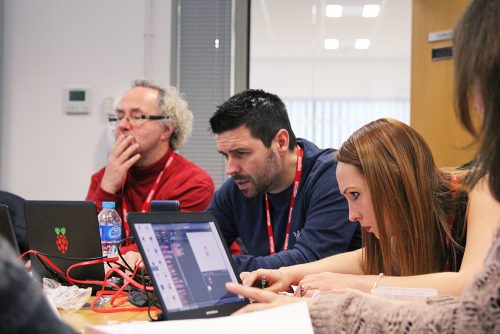
The idea for this course arose from our conversations with educators who had set up a Code Club in their schools. Most people start a club by teaching Scratch, a block-based programming language, because it allows learners to drag and drop blocks of pre-written code into a window to create a program. The blocks automatically snap together, making it easy to build fun and educational projects that don’t require much troubleshooting. You can do almost anything a beginner could wish for with Scratch, even physical computing to control LEDs, buzzers, buttons, motors, and more!

Scratch to Python FutureLearn Raspberry Pi

However, on our face-to-face training programme Picademy, educators told us that they were finding it hard to engage children who had outgrown Scratch and needed a new challenge. It was easy for me to imagine: a young learner, who once felt confident about programming using Scratch, is now confused by the alien, seemingly awkward interface of Python. What used to take them minutes in Scratch now takes them hours to code, and they start to lose interest — not a good result, I’m sure you’ll agree. I wanted to help educators to navigate this period in their learners’ development, and so I’ve written a course that shows you how to take the programming and thinking skills you and your learners have developed in Scratch, and apply them to Python.

Scratch to Python FutureLearn Raspberry Pi

Who is the course for?

Educators from all backgrounds who are working with secondary school-aged learners. It will also be interesting to anyone who has spent time working with Scratch and wants to understand how programming concepts translate between different languages.

“It was great fun, and I thought that the ideas and resources would be great to use with Year 7 classes.”
Sue Grey, Classroom Teacher

What is covered?

After showing you the similarities and differences of Scratch and Python, and how the skills learned using one can be applied to the other, we will look at turning more complex Scratch scripts into Python programs. Through creating a Mad Libs game and developing a username generator, you will see how programs can be simplified in a text-based language. We will give you our top tips for debugging Python code, and you’ll have the chance to share your ideas for introducing more complex programs to your students.

Scratch to Python FutureLearn Raspberry Pi

After that, we will look at different data types in Python and write a script to calculate how old you are in dog years. Finally, you’ll dive deeper into the possibilities of Python by installing and using external Python libraries to perform some amazing tasks.

By the end of the course, you’ll be able to:

  • Transfer programming and thinking skills from Scratch to Python
  • Use fundamental Python programming skills
  • Identify errors in your Python code based on error messages, and debug your scripts
  • Produce tools to support students’ transition from block-based to text-based programming
  • Understand the power of text-based programming and what you can create with it

Where can I sign up?

The free four-week course starts on 12 March 2018, and you can sign up now on FutureLearn. While you’re there, be sure to check out our other free courses, such as Prepare to Run a Code Club, Teaching Physical Computing with a Raspberry Pi and Python, and our second new course Build a Makerspace for Young People — more information on it will follow in tomorrow’s blog post.

The post Transition from Scratch to Python with FutureLearn appeared first on Raspberry Pi.

02 Mar 07:13

Final steps in my GDPR journey

by Doug Belshaw

After being away for a couple of weeks in Australia and the USA, I’m back home. It’s time, therefore, to finish off the Futurelearn course I started around Understanding the General Data Protection Regulation (GDPR).

It’s a four-week course, and I’ve written about what I’ve learned over the past three weeks’ worth of material in the following posts:

What follows, therefore, is about the final week — entitled ‘Responsibilities, liabilities and penalties’. I’m digging into in this area because I’m leading the  MoodleNet project. However, I’m writing here instead of on the project blog as I’m still coming to grips with all that GDPR means in practice.


I like the way that the course organisers frame the final section of this course:

As individuals or natural persons, you should know that most of the activities that you daily perform, all the forms that you are asked to fill in and most of the technology that you use on a daily basis leave a trail of personal data behind. Collecting data, analysing and linking different databases create the possibility to learn very personal information about you and obtain details about your life and life of those who you care about. More than you would have ever thought. More than you even remember. To give but one example: 4 pictures of you placed on the Internet allow facial recognition programs to find you again when crossing the street. Given this situation, you need protection.

Supervisory bodies

As per the title of this week’s course title, the focus is all about how GDPR will be enforced:

These enforcement mechanisms include a number of measures and instruments:

  • The establishment of national supervisory authorities (and the Lead Supervisory Authority in case of cross-border data transfers) and of the European Data Protection Board (Chapter 6);
  • Arrangements to streamline legal compliance, including codes of conduct (Article 40), data protection certifications (Article 42), binding corporate rules (Article 47) and standard (contractual) data protection clauses (Article 46);
  • Rights of data subjects, including the right to lodge a complaint and the right to an effective judicial remedy (Chapter VIII);
  • A multi-layered mechanism to protect the transfer of personal data of EU citizens outside the EU (Chapter V);
  • Liabilities and sanctions for violation of laws (Chapter VIII);
  • The role of Member States in compliance and implementation.

The EU provides a way to ensure local colour and context is respected, while enforcing a European-wide framework. The aim is to prevent safe havens for bad actors:

Each national supervisory authority is empowered to monitor any data processing activity that takes place within its territory (jurisdiction). It is also charged with the task to monitor any data processing activities that target data subjects residing in its territory, even in those situations where the activities are carried out by non-EU data controllers or processors. However, since in an online environment data does not always respect borders, the territorial jurisdiction of a national supervisory authority is not always clear cut.

As a result:

For avoiding situations in which more than one national supervisory authority are competent, the GDPR has introduced the legal concept of the lead supervisory authority or LSA.

When national supervisory authorities realise that a case brought before them has a cross-border dimension… they refer the case to the LSA which decides if it will handle the case or not within three weeks. Article 56 GDPR provides that the lead supervisory authority for cross-border processing of data will be the authority that is competent to supervise the entity engaged in data processing of individuals in different countries or, the authority competent to supervise the main establishment of the data controller or processor in case this has different establishments in several Member States.

So taking the example of the UK (where I live) there’s a national supervisory authority which is then subject to the lead supervisory authority. That, in turn, is subject to the European Data Protection Board:

To ensure the consistent application of the GDPR throughout the EU an important role will be played by the European Data Protection Board (the Board).

Even though the denomination looks new, the Board in itself is the continuation of the existing Article 29 Working Party which was established under the old Data Protection Directive 95/46/EC.

[…]

The old Article 29 Working Party was often criticised for not adequately consulting stakeholders before taking decisions. In reaction to this criticism, the Board is required to consult interested parties where appropriate. This would of course benefit data controllers or processors that might be affected by the decisions adopted.

So it sounds like the EU have learned their lesson:

Similarly with the Article 29 Working Party, the Board is composed of the heads of national supervisory authorities and the European Data Protection Supervisor (EDPS), or their representatives. The EDPS’s voting powers are restricted to those decisions that would be applicable to the EU institutions.

The Board also includes a representative of the European Commission who, however, does not have a right to vote so as to ensure the independence of the Board. There seems to be an implicit suggestion that the European Commission has exercised too much influence over the Article 29 Working Party in the past and the GDPR wants to ensure that this will not be the case in the future.

There’s some great provisions in the GDPR but I have to wonder just how quickly some of the decisions and actions will be taken:

Together with the establishment of the Lead Supervisory Authority presented in the previous step, the consistency mechanism is intended to avoid such situations. When it is clear that the decision of a supervisory authority will have an EU-wide impact, or when a request comes from a national supervisory authority, the Chair of the European Data Protection Board or from the European Commission, the Board issues a non-binding decision on a specific case. The national supervisory authority dealing with the case shall take utmost account of the decision of the Board or shall inform the Board in the case in which it does not intend to follow its opinion.

Codes of conduct

Part of any compliance system involves self-regulation, and the GDPR is no different. I like the ‘code of conduct’ approach in this regard:

For controllers and processors, codes of conduct are an important tool for achieving legal compliance and creating evidence to support this. Member states’ supervisory authorities, the board, and the commission encourage drafting codes of conduct. Such codes of conduct can be prepared, amended, or extended by associations and other bodies representing categories of controllers and processors. Codes of conduct need to include measures specifying the application of the GDPR, This includes, for example, the collection and pseudonymisation of personal data, exercise of data subjects’ rights, and notification of a data breach. Codes of conduct contain mechanisms that enable supervisory authorities to carry out mandatory monitoring of compliance. Drafts, amendments, or extensions of codes of conduct need to be submitted to the supervisory authority for approval.

Companies and other organisations have to ‘walk the walk’, though, and not just have their documentation in place:

Apart from supervisory authorities, other competent bodies with an appropriate level of expertise and accreditation can also monitor compliance with codes of conduct. Drafting codes of conduct is one thing. Committing to them is another. It is important in the sense that it can provide evidence that controllers and processors comply with the GDPR. This not only counts for controllers and processors within the EU, but also for those who are not subject to the GDPR in order to provide appropriate data protection safeguards.

Binding corporate rules

One way of moving beyond a code of conduct is for large, multi-national organisations to implement ‘binding corporate rules’:

Binding corporate rules (BCRs) are internal rules adopted by multinational groups of companies. They define the group’s global policy with regard to the international transfers of personal data to companies within the same group that are located in countries which do not provide an adequate level of protection. They are legally binding and approved by the competent supervisory authority in accordance with the consistency mechanism.

These rules are beneficial for the organisation (efficiency / consistency), for the EU (compliance) and for the end user (transparency).

The GDPR allows for personal data to be transferred outside the EU, but not just anywhere:

As a general rule, transfers of personal data to countries outside the European Economic Area may take place if these countries are deemed to ensure an adequate level of data protection.

Article 45 GDPR provides that the third countries’ level of personal data protection is assessed by the European Commission. According to the GDPR, the Commission’s adequacy decision may be limited also to specific territories or to more specific sectors within a country. A current list of countries that have been evaluated as having an adequate level of data protection can be found here.

The example given in the course is of Japan, which isn’t currently listed as having adequate protections. However:

Personal data can be transferred to a third country even in the absence of an adequacy decision:

(i) if the controller or processor exporting the data has himself provided for appropriate safeguards; and

(ii) on the condition that enforceable data subject rights and effective legal remedies are available in the given country.

At the end of the day, it’s the organisation’s responsibility as the data controller to comply wih the GDPR:

In accordance with the provisions in Chapter VIII, controllers and processors are legally liable for damages caused by data processing activities which infringe the GDPR. A controller is liable for all damages caused by processing activities. A processor is liable for not complying with its obligations or for acting outside or contrary to lawful instructions of a controller. A data subject who has suffered material or non-material damages as a result of a violation of the GDPR has the right to receive compensation for damages…

Fines

So now we get to the interesting part. What can the EU actually do about GDPR infringement?

According to Article 83 GDPR, the fines may, depending on the infringed provision of the GDPR, amount to a maximum of 20 million Euros, or, if this is a higher amount, to 4% of the total worldwide annual turnover of an undertaking. For example, a failure to implement the data protection by design and by default is subject to a maximum fine of only 10 million Euros or 2% of the total worldwide annual turnover of an undertaking. On the other hand, violating the basic principles of data processing, including the conditions for obtaining a valid consent as well as non-compliance with a supervisory authority’s order may result in the highest fine of 20 million Euros or 4% of the total worldwide annual turnover.

That’s obviously a lot of money, but it’s a sliding scale:

What the amount of a fine will be at the end will depend on the nature, gravity and duration of the infringement as well as on its character – if there was intention or negligence from the undertaking. The supervisory authority must ensure that the administrative fines would be in each specific case proportionate to the infringement and at the same time also effective and dissuasive. As a result, not all infringements of the GDPR will lead to those serious fines mentioned above.

The good thing, however, is that the fines are calculated on global revenues, rather than just the amount the organisation makes in the EU:

Once the GDPR becomes applicable, the impact of a fine on data controllers and processors, even if not reaching the maximum amount established in Article 83 GDPR, could be significant. Also, in those situations in which a global organisation has only a small establishment in the territory of the European Union, or is completely based in third countries but it targets the processing of personal data of EU citizens, the fine would be based on the total worldwide annual turnover. Thus, following the data protection rules as established by the GDPR should be taken seriously both by EU and foreign organisations.

Conclusion

I’m hopeful that the GDPR is going to help the legal system catch up with some of the technology that’s permeated our lives over the last couple of decades. Time will tell, of course…


Image by the Latvian State Chancellery used under a Creative Commons Attribution-NonCommercial-NoDerivs 2.0 Generic license

02 Mar 07:12

We Told You So

Just as all the tax-cut detractors said would happen, US companies are acting in the...
02 Mar 07:12

The Dropbox Comp

by Ben Thompson

I am usually quite conservative when it comes to how much time, data, and effort I am willing to put into a product from a new startup: too many go out of business or are acquired-and-sunset, and who wants to go to the effort twice?

Dropbox, though, was something else entirely: the initial release in 2008 was so good, and filled such a need, that I switched all of my most important data there immediately and I’ve never left, even though I have lots of free data storage included with other SaaS software plans. Indeed, I was so convinced that Dropbox wasn’t going anywhere that I felt no compunction about using Dropbox (plus a bit of Apple Script) as a de facto syncing system for a school I was working at; it has been ten years, the school has expanded to multiple locations, and every classroom still has the exact same set of files thanks to a product that does exactly what it promises. And now the company behind it is going public — I knew it!

Still, even if the utility and durability of Dropbox’s product was immediately apparent, the long-run trajectory of its business is, even with the release of the company’s S-1, less so.

Dropbox Versus Box and the Question of Lifetime Value

Dropbox and Box have always been compared, and for a rather obvious reason: the core offering of both companies is cloud storage. Said comparison, though, mostly serves to highlight that while the two companies might have similar products, there are so many other ways to be different.

First and foremost, Box has, since the earliest days of the company, been focused on enterprise customers, while Dropbox started out as a consumer product. I explained why this mattered in 2014’s Battle of the Box:

Dropbox’s model makes sense theoretically, but it ignores the messy reality of actually making money. After all, notably absent from my piece on Business Models for 2014 was consumer software-as-a-service. I’m increasingly convinced that, outside of in-app game purchases, consumers are unwilling to spend money on intangible software. That is likely why Dropbox has spent much of the last year pivoting away from consumers to the enterprise.

There are multiple reasons why the latter is a more attractive target for all software-as-a-service companies, especially those focused on data:

  • Consumers need to be convinced of the value of their data…
  • Consumers have multiple free options…
  • Consumers are hard to market to…
  • For consumers, collaboration is an edge case…
  • Building a platform for consumers is incredibly difficult…

I concluded by arguing that $10 million invested in Box at its-then $2 billion valuation was a better bet than the same $10 million invested in Dropbox at its-then $10 billion valuation; given that Box has a $3.2 billion market capitalization while Dropbox is hoping its IPO will clear that same $10 billion mark, I’m (fake) rich!

Dropbox, though, has indeed pivoted: the company said in its S-1:

Of our 11 million paying users, approximately 30% use Dropbox for work on a Dropbox Business team plan, and we estimate that an additional 50% use Dropbox for work on an individual plan, collectively totaling approximately 80% of paying users.

Still, significant differences remain: Dropbox’s customer base, thanks to all those consumers, is over 500 million users (Dropbox announced 500 million signups last March, but explained in its S-1 that it had culled what were apparently ~100 million inactive accounts over the last year), while Box, as of last quarter, had only 57 million registered accounts. On the other hand, 17% of Box’s users had paid accounts; only 2% of Dropbox’s did. This contrast in efficiency gets at the biggest difference between the two companies: to whom they sell, and how they go about doing so.

Box sells to big companies using a traditional sales force; free accounts exist primarily to enable temporary collaboration with paid accounts, as well as trials. There is a self-
serve option, but that’s not the point: Box notes in its financial filings that “Our marketing strategy also depends in part on persuading users who use the free version of our service to convince decision-makers to purchase and deploy our service within their organization”. In other words, when it comes to Box’s ideal customer, the CIO decides for everyone all at once.

For Dropbox, on the other hand, self-serve is the most important channel by far. The company brags that “We generate over 90% of our revenue from self-serve channels — users who purchase a subscription through our app or website.” Dropbox has a sales team, but as it notes in its S-1, the team “focuses on converting and consolidating these separate pockets of usage into a centralized deployment. Nearly all of our largest outbound deals originated as smaller self-serve deployments.”

There are pros and cons to both approaches. Start with the obvious difference: customer acquisition cost. While the two companies spent a comparable amount on sales and marketing in the third quarter of 2017 ($81.7 million for Box, and $74.7 million for Dropbox1), for Box that represented 63% of revenue; for Dropbox it was only 26%.2

However, the two numbers aren’t as comparable as they seem: specifically, Box’s Sales and Marketing includes the infrastructure and support costs of those free users; Dropbox’s doesn’t. Rather, the company includes those costs in its Cost of Revenue, which is a big reasons Dropbox’s gross margin of 68% trails Box’s 73%.3 And, by extension, we don’t really know what Dropbox’s customer acquisition cost is.

There is another advantage of selling to top-down decision-makers: the opportunity to build solutions for specific needs, and charge accordingly. This has enabled Box to achieve negative churn: in all of its cohorts the company is increasing its revenue-per-user by a faster rate than it is losing users overall, which means revenue-per-cohort increases over time. The company explained this in its amended S-1:

Our business model focuses on maximizing the lifetime value of a customer relationship. We make significant investments in acquiring new customers and believe that we will be able to achieve a positive return on these investments by retaining customers and expanding the size of our deployments within our customer base over time…

We experience a range of profitability with our customers depending in large part upon what stage of the customer phase they are in. We generally incur higher sales and marketing expenses for new customers and existing customers who are still in an expanding stage…For typical customers who are renewing their Box subscriptions, our associated sales and marketing expenses are significantly less than the revenue we recognize from those customers.

box1

Box went on to give numbers for specific cohorts; Dropbox, unfortunately, was significantly less specific:

As we continue to innovate and optimize our go-to-market strategy, we have successfully increased monetization for subsequent cohorts. Comparing January cohorts from the last three years, at virtually every point in time after signup, the January 2017 cohort generated a higher monthly subscription amount than the January 2016 cohort, which in turn generated a higher monthly subscription amount than the January 2015 cohort.

This sounds good, until you actually try to figure out what it means. Is the January 2017 cohort monetizing more because users are paying more quickly, or because there are more users? How many of those users are churning, and is there an increase in revenue-per-customer to counteract that?

Dropbox’s S-1 doesn’t give the answer to the first two questions, but the answer to the third seems to be “no”. Average revenue per paying user is actually down from 2015 ($113.54 to $111.91), although slightly up from 2016 ($110.54). Given the model, though, this isn’t a surprise: the only way to serve a massive user-base efficiently is to have a fairly standardized offering; creating and selling differentiating features that increase the average revenue per paying customer doesn’t scale.

There is one other big advantage in terms of Dropbox’s model, at least from a founder and early investor perspective: the tradeoff of Box earning ever-increasing amounts of revenue per paying customer is the amount it takes to land that customer in the first place. This is why Box’s losses were so large, and why founder and CEO Aaron Levie was so diluted by the time the company finally IPO’d (Levie owned just over 5% of Box at the time of IPO). Dropbox founder and CEO Drew Houston, on the other hand, still owns 25%, and early investor Sequoia Capital another 23%; a founder retaining that much ownership is much more characteristic of a consumer company than an enterprise one — which is exactly how Dropbox started.

Dropbox Versus Atlassian and the Question of Market Size

Still, Houston’s ownership stake pales in comparison to Scott Farquhar and Mike Cannon-Brookes, co-founders and co-CEOs of Atlassian, who owned 37.7% of the company each when it IPO’d two years ago. Not coincidentally, Atlassian was very much a pioneer in the self-serve model when it comes to enterprise software, and as I wrote at the time of their S-1, it helped that the company was selling to developers:

Agile was largely developer-driven, another factor that worked in JIRA and Atlassian’s favor. Developers are, quite obviously, much more willing to do their own research on products, download and trial software from the Internet, and if they like it, proselytize to other developers even if they don’t work for the same company. In other words, of all the different types of enterprise software, development tools are uniquely suited to spreading somewhat virally without the need for a traditional sales force.

One of the big questions at the time of Atlassian’s IPO was just how big their market was — specifically, could the company start selling beyond its developer base? So far the results are encouraging: JIRA Service Desk, the company’s attempt to expand its JIRA project management software to non-developer teams, is in over 25,000 organizations, and the company overall continues to grow both by adding new customers and by selling more products to existing customers.

This is the second question for Dropbox, beyond the uncertainty around its customer acquisition costs and churn: to what extent can it expand its market? On the positive side, those 500 million users are all potential customers; on the other, the vast majority of them have avoided paying for ten years — the proportion of paid users has barely budged over time. And again, Dropbox hasn’t developed ways for its already paying customers to pay it more.

The potential is certainly there: note that Atlassian’s growth, with a similar model to Dropbox’s, is far out-pacing Box’s — 42% in 3Q 2017 (Atlassian’s FY Q1 2018), compared to 26% — but then again it is far out-pacing Dropbox’s 30% as well. That Dropbox’s revenue growth is slowing suggests the company is ultimately a niche player.

Dropbox Versus Slack and the Question of the Enterprise OS

I once thought that Dropbox — and Box, for that matter — could be more than that; in 2014 I wrote Box, Microsoft, and the Next Enterprise Platform:

Pure storage isn’t a great business. The cost is trending towards zero, as noted by Levie himself. Data, though, is priceless; it can’t be replaced, and it’s the essence of what makes a particular organization unique…Just because the operating system is no longer the platform does not mean that the need – and opportunity – for a platform does not exist. Something needs to tie together all those computing devices, and data, which needs to be everywhere, is the logical place to start.

Dropbox made a similar argument in its S-1:

Our modern economy runs on knowledge. Today, knowledge lives in the cloud as digital content, and Dropbox is a global collaboration platform where more and more of this content is created, accessed, and shared with the world. We serve more than 500 million registered users across 180 countries…

Our market opportunity has grown as we’ve expanded from keeping files in sync to keeping teams in sync. Today, Dropbox is well positioned to reimagine the way work gets done. We’re focused on reducing the inordinate amount of time and energy the world wastes on “work about work” — tedious tasks like searching for content, switching between applications, and managing workflows.

The shift in focus from data to people is one I made myself in 2015; commenting on that Box OS article above, I wrote:

I think, in retrospect, I outsmarted myself: companies aren’t made of data, they’re made of people, just like every other single institution on earth. And, as I noted in the context of Facebook, what people love to do, more than anything else in the world, is communicate. Why wouldn’t you start there?

To that end Dropbox is marketing itself to investors as a collaboration company, and heavily emphasizing Dropbox Paper. In the meantime, though, another company — the one I was writing about in that excerpt — has entered the scene: Slack.

It’s hard to see anyone — including Microsoft — having a bigger opportunity than Slack.4 The trend in every aspect of computing is higher and higher levels of abstraction, and that doesn’t apply just to things like programming languages. In the case of platforms, the operating system of the PC used to really matter, and then the Internet came along and it didn’t. Similarly, in mobile, the operating system, whether that be iOS or Android, used to really matter, but now it doesn’t. In the consumer space, Facebook or WeChat runs on both, and that is far more important to the day-to-day experience of the vast majority of people.

It turns out that “mobile” is not about devices, but rather, at a fundamental level, about computing anywhere; to differentiate between PCs or phones is an ultimately meaningless exercise. They are simply different form factors of effectively identical devices, the purpose of which is to connect us to the cloud (consumer or enterprise). And, by extension, if the device is simply an implementation detail, then the operating system that runs on that device is a detail of a detail.

What matters — what always matters! — is what actual users want to do, and what jobs they want to accomplish. And, whatever they want to do almost certainly involves communicating, which means Slack and its competitors are the best-placed to be the foundational platform of the cloud epoch. More broadly, humans are social creatures: why should we be surprised that social networks are primed to be the most important businesses of all?

It’s been two years since I wrote that, and while Slack is still growing, albeit more slowly, the question of which company controls the future of enterprise computing remains an open one. Is it Amazon via infrastructure, Microsoft via infrastructure and identity and email, Slack via chat? Google via all-of-the-above?

What seems clear is that it won’t be Dropbox — both because files weren’t the right route and also because the company spent far too much time and energy chasing a non-existent consumer opportunity — but that’s ok. There is still value — at least $10 billion in value, I’d bet — in doing a job and doing it well, whether that be as a startup in 2008 or a public company in 2018. We still need to share files (and yes, collaborate on them), and will need to do so for a very long time, and Dropbox does it better than anyone. I just wish Dropbox’s S-1 didn’t make it so difficult to figure out just how much value there might be.

  1. This number jumped to $102.9 million in the fourth quarter, which is a much larger jump than any previous fourth quarter, perhaps in anticipation of the IPO filing
  2. Per the previous footnote, in the fourth quarter sales and marketing was 34% of revenue
  3. More on Dropbox’s dropping Cost of Revenue tomorrow
  4. Note that I said “opportunity”; opportunity means it’s possible, not that it’s necessarily going to happen
02 Mar 07:11

Nike’s usability failure on the Apple Watch exposes what smartwatches could be

by charlie

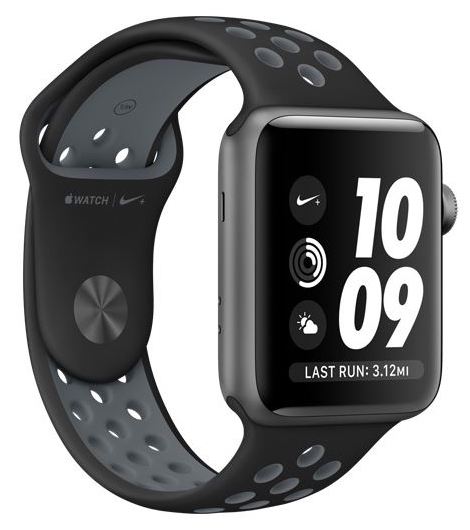
One of the chief reasons I bought an Apple Watch was for Nike Run Club (what used to be called Nike+).[1] But the Nike software’s bugginess and some missed design elements has made Nike Run Club one of the most frustrating pieces of my watch. If Apple Watch is to be the forefront of smartwatches, then they need to whip companies like Nike to make full use of the interaction potential of wrist-based interactive surfaces.

Read on for more.

Surfaces
I got my first smartwatch in 2005. At that time, smartphones were establishing themselves as the convergence point for web, information, media, and social interaction. As I used that smartwatch (also purchased for running), I saw the way a second surface could enhance my phone, provide me with glanceable and immediate information, and allow me to extend my interaction with my phone, which might be in my pocket or in my armband.

Apple Watch as a slave 
Most of the apps on the Apple Watch only use the phone for connectivity. For the most part, they don’t share information back with the phone. They are not an extension of the phone, but a replication. There are apps that do have an awareness of what I have on my phone, though it’s more of a phone to watch sharing rather than a two-way collaboration – the watch is slave to the phone.

For example, if I set an alarm on my watch, it doesn’t show up in the alarm list on my phone. Oddly, if I set an alarm on my phone, it does ring and can be silenced from the watch. And I can control my phone-based music and podcasts from my phone, but I need to start them on my phone.

By the way, I don’t count things like email, texts, reminders, and calendars as being shared between phone and watch. Those things have established synchronizations across all related devices, so I don’t count the use of those on the watch as having anything to do with the phone (though, more on this below).

Nike minus 
Based on my previous experience with running watches and my long time use of Nike+, I had high expectation for Apple’s Nike+ Apple Watch. When it works, it mostly delivers what I want – a glanceable read-out of my run on my wrist, and the ability to pause or end a run without pulling my phone out of the armband.

But the app misses a few key usability features. For starters, the app is flaky, half the time it won’t start on the watch or doesn’t know I started a run on the phone. This is the app itself – in my 10+ years using Nike+, the app always seemed to be designed by marketers, not true product developers. No other app on the phone seems to miss a trick when controlling my phone (albeit, I’ve only seen Apple apps do the remote control).

The app on the watch does know (when it works) that I’ve started a run on my phone and provides running data and the ability to pause and stop the run. But what irks me is that if you start the run on your watch, it does NOT turn on the app on the phone. The phone app does know if you’ve started a run on the watch, because a few times when there were issues, the phone app told me that the watch was also recording a run.[2]

What?

Apple Watch as surface 
What I have always expected from a wrist-based surface is that it be an extension of my phone. I should be able to initiate things on the watch that are reflected on the phone. And vice versa.

For example, if I start a run on my watch, then Nike Run Club on the phone should start and I should have the same experience as if I had initiated the run on my phone.

Also, if I have an app on the phone and on the watch, there should be some way to effect a handoff so I can start one place and continue elsewhere. For example, if I check a calendar entry on the watch, I can then go straight to the entry on my phone for more detail or interaction.

Why does this matter? Divergence.
Gartner, on the eve of the Mobile World Congress, reported the first ever decline in global smartphone shipments. They attribute this, though, to lack of low-cost options, folks holding on to their existing phones longer, and longer upgrade cycles.

But let me suggest this: might it be due to the increasing number of surfaces we now interact with?

The growth of smartphones was characterized by the increasing convergence of computation, data, media, social connections, and attention in smartphones. But in the past years, we’ve slowly diverged, especially with home hubs for music and information, smart devices being spread across the home, smart cars, and, of course, the proliferation of wearables, particularly smartwatches.

We are finally entering into a real ubiquitous computing era, and this is wearing down the smartphone’s central role. As we accumulate a cluster of devices we interact with or own, we need to update our current model of interaction, where everything is a slave to the phone. We need a model where all the devices are aware of each other and share the load; where what we do is handed off between devices as we move to the more appropriate surface or interaction interface. So long as all our devices are slaves to the smartphone, our user experience will be tethered to the phone.

Tellingly, the onboarding process for the Apple Watch basically can be summarized as “Do as I do on my phone.” Can we go beyond that?

Glimpse of how it can be 
In many ways, Apple has made us less focused on the primacy of the smartphones. Apple implemented Handoff between iPhone and Mac, so you can start actions one place and complete elsewhere. iCloud keeps our media, messages, and content synchronized for every device we use, so getting a new device just means signing into your account. (OK, so I’m a bit of an Apple-head)

This divergence beyond the smartphone will force developers to be cleverer as to how we make use of the seams between devices, be more cognizant of the benefits of different surfaces of interaction, and strive for a higher bar of usability across multiple usability challenges and environments.

Exciting, no?

What do you think?

[1] The other chief reason was that I needed a more secure and private notification method.
[2] I can’t stand error messages that know what’s wrong but make me do the corrective action, rather than fixing it themselves.

02 Mar 07:11

3 Regular-Looking Pants that Work Well as Cycling Pants

by Average Joe Cyclist

3 Regular-Looking Pants that Work Well as Cycling PantsJust because you’re jumping on your bike, doesn’t mean you have to change your entire outfit. More and more innovative brands are popping up that bridge the gap between sporty apparel and regular, everyday clothes. There’s no prerequisite to dress up in Lycra just because you’re riding a bicycle. In fact, there are many options when it comes to pants that are both stylish and functional. Here are three of my favorite regular pants that do a great job as cycling pants: DUER No Sweat Pants, Resolute Bay Cycling Jeans, and SPOKE Bulletproof Chinos.

The post 3 Regular-Looking Pants that Work Well as Cycling Pants appeared first on Average Joe Cyclist.

02 Mar 07:11

Canon Adds EOS M50 Model

Canon today announced the EOS M50, and interesting mix of advancements and simplifications that speaks towards the direction of where Canon is headed.

bythom canon eosm50

At first glance, the new camera looks like an EOS M5 with a different swivel to the rear LCD. …

02 Mar 07:11

Serving Up Some Yo La Tengo

by Reverend

This has been quite a semester for shared hosting servers. We spun up D.O.A., Sebadoh, and Wire in January alone, but the hits just keep on coming at Reclaim Hosting. While I was back in Fredericksburg two weeks ago I was binge listening to Yo La Tengo. I could not get enough, and given they’ve been making music since the mid 80s there was plenty to choose from. When we decided we needed a fourth shared hosting server this semester*—there was no question this one would be dedicated to the indie-rock royalty from Hoboken, New Jersey.

Yo La Tengo

My introduction to Yo La Tengo started fairly late with their 1995 album Electr-O-Pura and then their 1997 masterpiece I Can Hear the Heart Beating as One. The latter is one of my favorite albums of all-time, and songs like “Sugar Cube,” “Autumn Sweater,” and “Little Honda” (a Beach Boys cover) offer a brilliant insight to this bands metaphorical agility, emo inclinations, and exhilarating joyrides that characterize so much of their music.  

I also love their long, hypnotic instrumentals like “Heard You Looking” off their 1993 album Painful, or “Blue Line Swinger” off Electr-O-Pura:

Or their love ballad “You Can Have it All” (another cover) off And Then Nothing Turned Itself Inside-Out.

I could go on like this for a while. But I’m sure you get the point. And unlike most of the bands we name servers after, Yo La Tengo is still going strong after 30 years as a band, with an album due out in March and a tour that will bring them to Italy in May. So with that, I leave you with another ear worm from their album Fade, “Ohm:”

It’s hard not to respect the range, lasting power, and sense of joy this band brings to their work, and that might be one of the reasons they’re quickly becoming an all-time favorite.


*The fact we retired the Minutemen, Hüsker Dü, and Butthole Surfers servers last month and migrated all existing accounts to Wire, D.O.A., and Sebadoh respectively drove a significant amount of the server setup mania the last two months.

02 Mar 07:10

Racket Love

by Eugene Wallingford

Racket -- "A Programmable Programming Language" -- is the cover story for next month's Communications of the ACM. The new issue is already featured on the magazine's home page, including a short video in which Matthias Felleisen explains the idea of code as more than a machine artifact.

My love of Racket is no surprise to readers of this blog. Still one of my favorite old posts here is The Racket Way, a write-up of my notes from Matthew Flatt's talk of the same name at StrangeLoop 2012. As I said in that post, this was a deceptively impressive talk. I think that's especially fitting, because Racket is a deceptively impressive language.

One last little bit of love from a recent message to the Racket users mailing list... Stewart Mackenzie describes his feelings about the seamless interweaving of Racket and Typed Racket via a #lang directive:

So far my dive into Racket has positive. It's magical how I can switch from untyped Racket to typed Racket simply by changing #lang. Banging out my thoughts in a beautiful lisp 1, wave a finger, then finger crack to type check. Just sublime.

That's what you get when your programming language is as programmable as your application.

02 Mar 07:10

Instagram is killing the way we experience art

files/images/unnamed1.jpg

Anne Quito, Quartzy, Mar 01, 2018


Icon

This article isn't recommending that you leave your phone behind, but it does say you should leave it in your pocket and look at the art for a while before pulling it out to take a photo. Maybe for all of 17 seconds? That's how long we spent in 2001, before we all had smartphones. As someone who spent a lot of time in galleries both before and after digital photography, I prefer 'after' much more. I get to have a memory of the visit, and not merely the fuzzy one in my brain that erodes away over time.

Web: [Direct Link] [This Post]
02 Mar 07:10

Reviewing Ethics

I used to do quite a bit of reviewing on TripAdvisor; enjoyed the feeling of contributing and used the service when picking hotels and restos. But then I realized that this little warm glow was really all about making money for Silicon Valley VCs, and I have a major attitude problem about that. Which raises the issue; Is it ethically OK to participate in review sites at all? [Spoiler: Yeah, sometimes, but definitely not on Google Maps.]

Now, as for TripAdvisor, turns out the original VCs got their exit in 2004 when IAC snapped up the site, then it was spun off as part of Expedia, then split with Expedia with an add-on IPO in 2011. So I guess, these days, it’s just a company. And yeah, when I play its game, I am in fact making money for its shareholders. But I guess this is one of the more harmless corners of capitalism.

Except for, maybe not. The whole reviews business has been a fruitful source of stories about corruption and chicanery and below-the-surface you-are-the-product worst practices. I know that at Amazon, where the reviews aren’t the business but are a really big deal, we deploy really smart people who work really hard and apply really advanced technology to keep them usefully clean. With the best will in the world (which these people have, I know some), it’s nontrivial; the bad actors are people whose livelihoods depend on gaming the system. News flash: Being smart and working hard are not attributes restricted to the good guys.

But let’s assume a reviewing business manages to run clean and doesn’t have too many hidden agendas. I guess I’m having a hard time convincing myself you should never play. Maybe I’ll start doing a few TripAdvisor reviews again. Back in 2014, I tossed in a glowing review for a charming little hotel near Barcelona Sants train station, and for some reason really a lot of people found it useful, and (confession) that made me happy. And after all, I use the service.

But not Google Maps!

Last year in Map Review Fear, I worried out loud about the awesome power of Google Maps paired with Google Reviews. Since then, I read The Case Against Google, and I’ve pretty well convinced myself that the maps/reviews combo is pure evil.

Because, among other things, the Maps/Reviews interface is really freaking good. Whenever I sit down anywhere, my notifications start offering me pictures of where I am, invitations to contribute more, and then, with careful low-key tactfulness, wonder if it could ask me a couple of questions about this joint I’m sitting in: Good place to take kids? Got parking?

And I’m 100% sure that the Googlers building this thing are comfortable in their skins because all they’re doing is… making the maps more useful! Right? Why shouldn’t the review be right there on the map, which is where you already are when you’re trying to decide where to go, aren’t you? And pictures, and facts about children and parking?

But as The Case Against piece illustrates, the “make it more useful” story aligns so smoothly with the “how Google gets a universal monopoly on everything” story that you just can’t possibly ignore the congruence. So for damn sure I’m not going to join that dance any more, and regret the times I have.

Here’s a radical idea: Google Maps has become a utility. Practically speaking, it’s a service that nearly everyone uses that you need to accomplish some of the basics of modern life. We let utilities be privately owned, and we let them be monopolies, and we let their owners make quite a lot of money, but we fence them in, and I think that’s OK.

Call me crazy, but I’d pass legislation to keep Google from doing what they’re doing. They should be able to sell space on the maps, and they should be able to provide quality filters, and collect feedback on reviews and downgrade or upgrade them accordingly. But no damn way should they own the map and the crowdsourced value-adds on the map.

The map is not the territory, they say, but if we don’t watch out Big G is gonna own both.

02 Mar 07:10

My Affordable City: Young Couple Planning for the Future, Renting in Vancouver

image

My Affordable City is a series profiling people in cities to learn more about their housing situation, how they budget for urban life, and what cost-saving tips they can share. Email me if you, or someone you know, wants to participate!

Mitchell Reardon is an urban planner, working with companies such as Happy City and IBI Group. He lives in a rented one-bedroom apartment in Vancouver’s Kitsilano neighbourhood with his partner Jessica, a marketing coordinator.

In our interview, Mitchell shares his concerns about the lack of stability that comes with renting a home and he offers some great tips on how to save money in one of the world’s most expensive cities.

How much of your monthly income goes toward housing?
About 25%.

Are you satisfied with your current housing situation?
Overall, yes. We’ve made this into our home; it’s comfortable. Almost everything we need is available within walking distance, and it’s easy to get around by bike. The beach and downtown are close by. On the other hand, being close to a planned Broadway subway stop, there’s a good chance that our building will be sold and demolished. There haven’t been any upgrades in the building for some time and repairs are often slow. Looking forward, it’s too small and not well suited for a little one.

Is unaffordability affecting your quality of life?
It adds uncertainty to our lives. Our building seems likely to be sold in the next few years, which means a move, and substantial rent increase. Long-term, unaffordability makes it hard to think about putting down permanent roots here and making a clear plan for the future.

image

Describe any lifestyle changes you have made to afford living in your city.
We prepare lunches nearly every day and don’t eat out often. We tend to meet friends at each other’s places, in the mountains or at the beach – free spaces. We’ve never owned a car; so it’s not a change, but living car-light certainly makes Vancouver more affordable. Those are some of the smaller things, but there are life-cycle points as well. At a time where friends elsewhere are settling down, only a handful of our Vancouver friends are married and only one pair has a child. It’s a lifestyle extension, rather than change, but definitely feels like a way to cope with the high cost of living here.

What are your favourite low budget activities in the city?
Outdoor stuff for sure. The beaches and North Shore are treasures. An early bird season pass at Mount Seymour is $340. We spend a lot of winter nights up there! Finding great places to camp. Biking around the city, exploring its nooks and crannies. Public space improvements, using public grants or with the Vancouver Public Space Network are rewarding activities, too.

What are your money saving tips for living in the city?
Avoid car ownership if possible. Between bikes, car share and transit, it’s pretty easy to get around this city and its surroundings. Cooking with friends lets you get social over food without a big bill. Find the deals.

image

Will you stay there long term? Why or why not?
We’d like to stay, but are far from certain.

What do you think needs to be done to make city living more affordable?
On the housing supply-side, we need greater support for community land trusts, co-operatives and co-housing initiatives, in addition to more market rental units. More private dwelling construction is also part of the solution, but it should be in concert with demand-side measures. I think we should also look more closely at bank lending practices on second homes. Norway now requires 40% equity financing for mortgages on second homes, compared to 15% for mortgages on primary residences.

Affordability goes beyond housing, too. Making it easy for everyone in Vancouver to get around by transit and active mobility will help our dollars go further. To this end, I think the “affordable density” around transit stations outlined in the City of Vancouver Housing Strategy is particularly important.

Protecting and adding to Vancouver’s wonderful free spaces, like our city beaches, swaths of the North Shore and high-quality public spaces will ensure that we have free or inexpensive recreation at our fingertips as well.

Over the past 18 months, I think we’ve seen a big shift in perception and policy from municipal and provincial governments. The City of Vancouver’s new housing strategy and measures like the empty homes tax and the Province of BC’s foreign ownership tax are promising.

While these measures would have been welcome two years earlier, they are signs that decision-makers are repairing the connection between housing and the diversity of people who call Vancouver home.

Thanks, Mitchell and Jessica!

image
02 Mar 07:03

Nokia Mobile macht alles richtig

by Volker Weber

Von weniger als 100 Euro bis zu den Top-Smartphones liefert Nokia Mobile ein unverbasteltes Android One, dazu verbesserte Kameras in wertigen Gehäusen. Letztes Jahr haben sie 70 Millionen Telefone verkauft. Es würde mich nicht wundern, wenn sie dieses Jahr noch einmal enorm zulegen.

28 Feb 02:44

OMG

by Stephen Rees

I am seriously contemplating leaving the Green Party of BC because of this tweet from our beloved leader

Screen Shot 2018-02-25 at 7.04.09 PM

And because that link won’t work here is one that will

Now here are three images I have downloaded this weekend

Daily Arctic TempIce extentSea Ice bering

Now I am not a climate scientist like Andrew Weaver. But I did watch that video on the NP link. I thought the estimates of the world’s potential refinery capacity for heavy oil was very informative. The calculations of how much oil is in the tar sands – and how long it will last – terrifying. And the idea that there will still be gas stations, but there won’t be any arctic ice appalling.

And I have one question for Andrew Weaver. What part of “keep it in the ground” did you not understand?

Screen Shot 2018-02-26 at 7.34.59 AM.png

This from the Washington Post via Clean Energy Review – the Post is, of course, behind a paywall; sorry about that.

28 Feb 02:43

The true cost of Fracking

by Stephen Rees

This Eye-Opening Infographic May Surprise You
There are significant pros and cons, making fracking a highly controversial issue.
By Reynard Loki / AlterNet May 23, 2016,

the-true-cost-of-fracking-dv3

28 Feb 02:42

We Love Data And Hate Science

by noreply@blogger.com (BOB HOFFMAN)

To the naive mind collecting data sounds like science. It is not.

A datum is the result of an instance of observation. But observations do not become science until they are made sense of.

People observed the movements of planets for thousands of years. They kept intricate charts. But for all those years no one could explain the seemingly incomprehensible movement of those planets.

And then Copernicus came along and in one simple theory explained what for millennia seemed beyond comprehension. The planets moved the way they did because they were circling the sun, not the earth.

That's what science does. It takes data and makes sense out of it.

Today the advertising industry has unimaginable quantities of data and hardly an ounce of science. Ask any advertising person for data about the Google or Facebook buy they made and you will get reams of papers and stacks of charts and tons of reports. You will get a festival of data.

Then ask that person to name one - just one - major consumer-facing brand of anything that has been built by advertising on Google or Facebook. I promise you, you will get a blank stare. Believe me I've tried it.

And yet, it is almost universally agreed that the primary objective of advertising is to build a successful brand.

So the question is this: If advertising's highest calling is to build a successful brand, and we have no examples of successful brands being built on either Google or Facebook, what is the science behind our obsession with these media?

What is the science behind all the data that has led to the incredible dominance of Google and Facebook if there is not a single instance anyone can find of either of them having achieved the primary goal of advertising?

Where is the science that makes sense of all the data?

Data is just a bunch of bricks laying around. Science takes those bricks and makes a house out of them. Right now we have no house. What data has given the ad industry is mostly just big piles of bricks.

28 Feb 02:42

China to open its first high-speed smart highway by 2022 with eyes on Germany’s limitless Autobahns

by Frank Hersey
Hangzhou and Ningbo will be linked by China’s first smart high-speed highway in time for the 2022 Asian Games in Hangzhou. With six lanes in each direction, the 161km route through Zhejiang will use navigational and sensor technology to increase the speed of traffic to 120km/h. An underground charging system will effectively “electrify” the road […]
28 Feb 02:42

Sony Revises the Base A7 to Mark III

At the trade show for wedding and portrait photographers in Las Vegas (WPPI) Sony today revealed the third iteration of the A7 (no r, no s) model, the A7M3. As you might guess, it bears a strong resemblance to the way the A7r third generation update was made: add the joystick, double up the SD slots behind a door lock (though mismatching UHS-II and UHS-I slots), change to the bigger battery, adjust the grip a bit, add no crop 4K video.

28 Feb 02:37

Twitter Favorites: [marksiegal] We finally watched the movie version of Wonder. It was definitely among the better adaptations I've seen, and I lik… https://t.co/OAAhwaJ0Du

Mark Siegal @marksiegal
We finally watched the movie version of Wonder. It was definitely among the better adaptations I've seen, and I lik… twitter.com/i/web/status/9…
28 Feb 02:37

Twitter Favorites: [ccg] The fun thing about being mistakenly referenced as the Canadian Coast Guard is that my mentions blow up in English AND French.

ccg @ccg
The fun thing about being mistakenly referenced as the Canadian Coast Guard is that my mentions blow up in English AND French.
28 Feb 02:37

Twitter Favorites: [shawnmicallef] “I resign/will not be running” is the I Am Spartacus of Ontario.

Shawn Micallef @shawnmicallef
“I resign/will not be running” is the I Am Spartacus of Ontario.
28 Feb 02:36

Recommended on Medium: Using a Bitcoin ATM to withdraw CAD in Victoria

I’m in Victoria for a couple of days and I’ve been exploring the city. I went past a hemp clothing store and saw a sign for a Bitcoin ATM and decided to try it out.

A good point to make is that while I am working on a company that deals with blockchain tech and cryptocurrencies, I personally don’t really hold much crypto, other than to experiment with. I don’t have “trader” mentality so I focus a lot on the technology and the community. The bitcoins I sold I mostly got from Earn.com.

BitBrokers at Hemp & Company

Here’s the BitBrokers sign that explains a bit of background.

I probably should have taken a photo of the whole machine. It’s a big box that has a number of different slots and printers and cameras.

This is the welcome screen. I picked Sell Bitcoins.

I found this next screen very confusing. “For how much cash you want to sell?” isn’t the correct way to say this. I knew how much BTC I had, how much would the machine give me?

Maybe “How much cash would you like to withdraw?” might be better wording.

I finally figured this out and thought I’d take out $80CAD.

I did try the “Buy Bitcoins” option as well just to see. That green “Preview” box is a live camera view for scanning QR codes. Crypto wallets are one of the apps that have really taught people that QR codes are a thing again.

Back to the flow of selling BTC for CAD.

I skipped photographing several screens here.

One prompted me to enter a phone number for SMS updates. This was a great idea, but either I typed my phone number in wrong (the touchscreen double entered numbers and was hard to backspace) or it didn’t work at all.

The other screen displayed an address and a QR code of the address I should send BTC to. As noted above in the final screen, I needed to do it within 60 minutes.

The machine also printed out a ticket, again with the QR code that I needed to send to. This made it easy to open my crypto wallet and scan the address to send to.

On my end, I hit send and then my crypto wallet gave me updates on confirmations. Unfortunately, the store was closing and the transaction didn’t confirm by the time I had to leave.

The next day I came back and selected “Redeem Ticket”. This meant aligning the QR code of the ticket with the Preview box until it scanned. Having been folded in my pocket overnight, this took some doing.

Finally, success! The machine spat out four $20CAD bills.

In case you’re wondering, I turned it into meat & beer for a delicious birthday dinner ;)

End Notes

I need to sit down and figure out all the fees I was charged and what the conversion rate actually was. I paid a lot to go from BTC>CAD.

But, if the store had been open longer, I could’ve completed the whole transaction within about 10 minutes. Too slow for an ATM use case, very fast for an investment account to cash withdrawal.

Usability was terrible. The touchscreen was bad, the UI was not clear/badly written, and the camera and how to use it was both bad and unclear. So I guess this is a novelty? Or no competition?

In emerging markets, regular ATMs are rare. But everywhere there are agents that take in mobile money and hand out cash, or take in cash to turn it into mobile money. I can see SMS or USSD interfaces working peer to peer, or for smartphones, a direct model with QR codes shown on screen / scanned with camera on the phone. I’ve been handing out Dogecoin using the iOS dough wallet and it’s been working great.

Merchants taking crypto directly is most interesting. I have some thoughts on “regional tokens” that I think builds the right kind of community and usage.


Using a Bitcoin ATM to withdraw CAD in Victoria was originally published in Boris Mann’s Blog on Medium, where people are continuing the conversation by highlighting and responding to this story.

28 Feb 02:36

Twitter Favorites: [Lisa03755] The Black Museum episode is the definitely the best Black Mirror episode I've watched so far. https://t.co/IJrY8fwbcL

Lisa || AlphaVert @Lisa03755
The Black Museum episode is the definitely the best Black Mirror episode I've watched so far. en.m.wikipedia.org/wiki/Black_Mus…
28 Feb 02:28

The Best Rechargeable AA and AAA Batteries

The Best Rechargeable AA and AAA Batteries

Through more than 1,000 hours of controlled tests, 20 hours of real-world tests, and years of use, we’ve found that all brand-name rechargeable batteries perform better than outdated reputations suggest, and they cost less than a nickel per charge over their lifetime. Energizer Recharge Universal batteries have reliably good prices and easy availability, but we’d grab Panasonic Eneloop batteries or other top brands anytime they’re on sale.

28 Feb 02:24

Google developer confirms dark theme not coming to Android

by Brad Bennett
Photo of Androids version of Twitter running in night mode on Twitter.

Late last week, a developer at Google posted in the issue tracking board that night mode would be coming to Android.

Users were thrilled to read this news but unfortunately, this will not be the case.

As speculations increased online, Google clarified that the dark mode was a developer option, and is intended to be a tool to help developers create and test apps that utilize a night mode feature like Twitter.

In a separate statement posted to the Google Issues Tracker, an internal developer clarified:

“What we *have* added in a future Android release is a developer-facing setting (via Developer Options) to toggle the -night UI mode qualifier, which will make it easier for developers to create and test apps that implement night mode. This qualifier has been in the platform since Froyo (SDK 8) and globally modifiable via UiModeManager since Marshmallow (SDK 23); however, there was never an explicit toggle made available anywhere in Settings.”

Many users were excited about the launch of a dark theme to help with reading their phones late at night. Unless it gets added fully to Android, however, it seems this feature is still going to be restricted to specific apps like Twitter or YouTube and not system wide like in the operating system of OnePlus designed phones.

Google has decided to forgo the addition of a night mode but it seems like it’s building support for this type feature into the OS.

Source: 9-5 Google, via Engadget

The post Google developer confirms dark theme not coming to Android appeared first on MobileSyrup.

28 Feb 02:24

Upcoming iPhone X model rumoured to feature 6.5-inch display, gold colour

by Dean Daley
iPhone X

Previous rumours have indicated that Apple will launch three new iPhone X devices this year — an upgraded iPhone X, a larger (and upgraded) iPhone X and a cheaper variant to the iPhone X.

According to Bloomberg’s Mark Gurman, who cites people familiar with the source, the largest of the three models will have a display that will near 6.5-inches.

Gurman says that Apple is testing prototypes of the larger variant with a display resolution of 2688 x 1242 pixels.

The phone’s codename is ‘D33,’ according to Bloomberg‘s anonymous sources.

The larger phone is also expected to feature an OLED display and stainless steel sides. The company is reportedly working on a gold colour for the new handset.

The cheaper iPhone X will use an LCD display and will continue to use Apple’s Face ID. This phone will use an aluminum frame, rather than a stainless steel one.

Bloomberg further suggests that the phone will explore the idea of a dual-SIM. However, Gurman notes the company is also working on implementing eSIM technology in an upcoming iPhone model.

According to well-regarded KGI Securities’ analyst Ming-Chi Kuo, the LCD iPhone X will have a 6.1-inch display, while the smaller model will feature the same 5.8-inch display size as the current iPhone X.

The price of the phone is rumoured to range from $649 to $749 USD (approximately $826 to $953 CAD).

Source: Bloomberg

The post Upcoming iPhone X model rumoured to feature 6.5-inch display, gold colour appeared first on MobileSyrup.

28 Feb 02:24

Apple to discontinue iTunes Store support for first-gen Apple TV, Windows XP, Vista in May 2018

by Sameer Chhabra
iTunes Windows Store

Cupertino computing giant Apple has announced that, as of May 25th, 2018, anyone running iTunes on a Windows XP or Windows Vista computer will no longer be able to make purchases through the iTunes Store.

In a February 26th, 2018 media release, Apple said that it plans on introducing security changes to prevent “older Windows PCs from using the iTunes Store.”

Users will also be unable to redownload previous purchases from the iTunes store to their computers.

Older Windows computers will still be able to run the iTunes program, but the app itself will also not be supported by Apple.

Microsoft’s mainstream support for Windows XP ended on April 14th, 2009, while extended support ended on April 8th, 2014.

Microsoft ceased its mainstream support for Vista on April 12th, 2012, while extended support ceased on April 11th, 2017.

Apple further announced that its first-generation Apple TV set-top boxes will be prevented from accessing the iTunes store.

“This device is an obsolete Apple product and will not be updated to support these security changes,” reads an excerpt from the February Apple media release.

Only second-generation or later Apple TVs will be able to access the iTunes Store.

Source: Apple

The post Apple to discontinue iTunes Store support for first-gen Apple TV, Windows XP, Vista in May 2018 appeared first on MobileSyrup.