Shared posts

28 Feb 02:42

Becoming Pure

by jennydavis

Augmented reality makes odd bed fellows out of pleasure and discomfort. Overlaying physical objects with digital data can be fun and creative. It can generate layered histories of place, guide tourists through a city, and gamify ordinary landscapes.  It can also raise weighty philosophical questions about the nature of reality.

The world is an orchestrated accomplishment, but as a general rule, humans treat it like a fact. When the threads of social construction begin to unravel, there is a rash of movement to weave them back together. This pattern of reality maintenance, potential breakdown and repair is central to the operation of self and society and it comes into clear view through public responses to digital augmentation.

A basic sociological tenet is that interaction and social organization are only possible through shared definitions of reality. For meaningful interaction to commence, interactants must first agree on the question of “what’s going on here?”. It is thus understandable that technological alteration, especially when applied in fractured and nonuniform ways, would evoke concern about disruptions to the smooth fabric of social life. It is here, in this disruptive potential, that lie apprehensions about the social effects of AR.

When Pokémon Go hit the scene, digital augmentation was thrown into the spotlight. While several observers talked about infusions of fun and community into otherwise atomized locales, another brand of commentary arose in tandem. This second commentary, decidedly darker, portended the breakdown of shared meaning and a loosening grip on reality. As Nathan Jurgeson said at the time, “Augmented reality violates long-held collective assumptions about the nature of reality around us”. But, Jurgenson points out, reality has always been augmented and imperfectly shared. The whole purpose of symbol systems is that they represent what can’t be precisely captured. Symbols are imperfect proxies for experience and are thus necessary for communication and social organization.

What AR does is explicate experiential idiosyncrasies and clarify that the world is not, and needn’t be, what it seems. This explication disrupts smooth flows of interaction like a glitch in the social program. It reveals that reality is collaboratively made rather than a priori. It’s easy to think that augmented reality will be the end of Truth, but such a concern presumes that there was a singular Truth to begin with.

While Pokémon Go faded quickly into banality, underlying anxieties remained salient. Such anxieties about the imminent fall of shared meaning have resurfaced in response to Snapchat’s rollout of a new custom lens feature. “Lenses,” available for about $10 each, build on the company’s playful aesthetic and use of AR as an integral feature of digital image construction and sharing. The idea is that users can create unique lenses for events and special occasions as a fun way to add an element of personal flair. The use of augmented reality is not new for the company, nor is personalization, but this feature is the first to make AR customizable.

Customizable AR takes on a relatively benign form in its manifestation through Snap Lenses. The idea of customizable augmentation, however, creates space for critical consideration about what it means to filter, frame, and rearrange reality with digital social tools.

The capacity to alter an image and then save that image as a documented memory potentially distorts what is and what was and replaces it with what we wish it had been. The wish, the desire, made tangible through augmented alteration, ostensibly changes the facts until facts become irrelevant, truth becomes fuzzy, and representations are severed from their referents.

Anxieties about losing a firm grip on the world are thus amplified through customizability, as the distorting augmented lens adheres not even to a shared template, but is subject to the whims and fancies of each unique person. This is essentially the argument put forth by Curtis Silver at Forbes in his article “Snapchat Now Lets Users Further Disassociate From Reality With Custom Lens Creation”.

Silver contends that customizable Snap Lenses will be the straw that breaks the camel’s back as users escape objectivity and get lost in the swirls of personalized augmentation. “Lenses is a feature in Snapchat that allows users to create a view of a reality that simply does not exist” he writes.  “Now those users can create lenses to fit their actual reality, further blurring the already fragile and thin lines separating perception from real life.” He worries that customizable augmentation not only blurs reality but also indulges idealized images of the self that are inherently unattainable. With personalized augmentation, warns Silver “ [w]e begin to actually believe we are that glowing, perfect creature revealed through Snapchat lenses”.

Silver is not alone. His piece joins a flurry of commentators worrying over reality disintegration caused by “mixed reality” tools—a trend that began long before Snap made AR customizable.

Arguments about the loss of reality via augmentation–though tapping into critical contemporary questions– miss two crucial points. First, social scientists and philosophers have long rejected the idea of a single shared reality. Second, even if there were one shared reality, it’s far from clear that augmentation would muddy it.

As Jurgenson pointed out in his analysis of Pokémon Go, social thinkers have long understood reality as collaboratively constructed. The social world is a process of becoming rather than a stable fact. George Herbert Mead famously said people have multiple selves, a self for every role that they play, while W.I. Thomas declared that reality is that which is real in its consequences. We can even think of widespread truisms like “beauty is in the eye of the beholder” and it becomes clear that selves and realities are neither singular nor revealed but multiple and constructed. The very idea of distorting reality is built on a faulty premise—that reality is concrete and clear cut.

From the starting point of reality as process rather than fact, augmentation doesn’t so much distort the truth but underline and entrench a shared standard.

Augmentation is defined by its relation to a referential object. In the course of daily life, that referential object—agreed upon reality—persists largely unnoticed. Society and interaction work because their construction is ambient and shared meanings can go unsaid. Imposing augmentation makes a referential object obvious. What was unnoticed is now perceived. It’s not simply there, it’s marked as there first. By imagining and externalizing what could be, augmentation gives new meaning to what is.

Augmentation imbues referential objects with newfound authenticity, rendering them raw through juxtaposition. Just as the #nofilter selfie becomes a relevant category only in the face of myriad filters, the pre-augmented world only emerges as “natural” in comparison to that which is digitally adorned.

Snap’s customizable lens feature enables a playful relationship to the world. That playfulness doesn’t loosen our collective grip on reality but produces a reality that is retrospectively concretized as real.  The fear of Lenses as a distorting force not only (incorrectly) assumes a singular true reality, it misses the flip side—Lenses reinforce the idea of shared reality by superimposing something “augmented” on top. Playing with imagery (through lenses, filters etc.) casts the original image as pure and unfiltered. The augmented image gives new character to its original as an organic capture and the idea of shared meaning reasserts itself with fervor renewed.


Jenny Davis is on Twitter @Jenny_L_Davis

Headline pic via: source

28 Feb 02:42

Frequently Unanswered Questions about the Federation of Black Canadians

by Desmond Cole
26167860_1539569389458700_171603142858889840_n

Federation of Black Canadians chairperson Justice Donald McLeod (right) poses with former governor general Michaëlle Jean in December 2017

The Federation of Black Canadians seems to be sensitive to criticism. Myself and many others have been asking questions about the group’s ethics, membership, and potential conflicts of interest. On Sunday February 25, steering committee member Ebyan Farah, who is the spouse of federal Liberal cabinet minister Ahmed Hussen, abruptly left her position. FBC has also halted most of its social media activity, and repeatedly removed all the content from its website.

On Monday February 26, FBC published a new “frequently asked questions” page on its website. Within a couple of hours the page was gone and, as of the publication of this piece, it has not been replaced. I anticipated this possibility and took screenshots of the entire page before FBC removed it. Although the “frequently asked questions” section doesn’t actually answer many of its own questions, it reveals an organization willing to do the absolute minimum to address real concerns about its operations.

Screen Shot 2018-02-27 at 6.23.04 AM

The above explanation for Ebyan Farah’s quick departure is very confusing. It does not explain who asked Farah to join the group, or why she was able to do so given her relationship with Hussen, the federal minister of citizenship, immigration and refugees. The claim that Farah received clearance from the Liberal Party ethics commission is truly bizarre: it’s not up to the federal Liberals to decide who is ethically fit to lobby their own members, who form the government of Canada.

FBC says Farah’s “term of service on the steering committee ended on February 25, 2018.” This convenient timing does not explain why the other steering committee members’ terms are still ongoing, and suggests they all have different terms of service.

screen-shot-2018-02-26-at-10-27-01-am.png

As you can see above, FBC does not answer its own question, ” do you work with LGBT organizations?” The group says it has “no problem” doing so, but puts the onus on those groups to reach out. FBC then immediately pivots to mention renowned University of Toronto professor and writer Rinaldo Walcott, who identifies as queer.

This awkward reference to Walcott seems to be FBC’s version of “we have a gay friend,” and has nothing to do with FBC’s seemingly non-existent work with organizations that represent LGBT people. Walcott confirmed with me this morning that FBC did not contact him before using his name in this way.

FBC seems particularly shook by the criticism that it is not partnering with groups that represent the LGBT communities. The now-removed FAQ included a separate section entitled “lgbt” which simply repeated the identical information contained in the “do you work with LGBT organizations?” section

FBC references Black Lives Matter Toronto, but fails to clarify that it does not work with the group, or with any BLM chapter in Canada. Again, FBC puts the onus on these groups to include themselves in its work. The Federation mentions a “Trailblazer Award” given to BLMTO, but fails to clarify that Michaëlle Jean Foundation, not FBC, gave out that award. As I have previously documented, this is not the first time in FBC’s young history that it has attempted to take credit for another organization’s actions.

Screen Shot 2018-02-26 at 10.27.25 AM

The above “communications” section makes it clear that FBC populated its e-mail list from the National Black Canadians Summit, which was organized by Michaëlle Jean Foundation. It seems MJF simply transferred its contacts to FBC without seeking the permission of summit guests.

The Federation also says here that its website was taken down once for “regular maintenance.” This does not explain the numerous other times the site has appeared without any content. Also, it doesn’t explain why the “frequently asked questions” page featuring this content is no longer available.

Screen Shot 2018-02-26 at 10.27.50 AM

Under “ethics,” the Federation says its chairperson Justice Donald McLeod, has “received the appropriate clearances” from the independent ethics committee of the Ontario Court of Justice to participate with the group. While it would be great to see evidence of these clearances, I doubt the ethics committee gave McLeod the right to act as a lobbyist. As you will see below, FBC acknowledges that it is actively lobbying the federal government. Social media posts from Liberal MPs show that McLeod is aggressively leading the lobbying efforts.

In a CBC news story published this morning, McLeod says his meetings with several prominent Liberal party members in 2017 “had nothing to do with lobbying.” He added,  “We’re telling [them] things that they didn’t know.” We are meant to believe that McLeod, an Ontario judge who chairs a national organization, has simply been meeting with high-level politicians to educate them, that he wants nothing in return, not even policy change on this issues he brings up. What, then, is the point of FBC and why is it asking Black people for our money and support?

Screen Shot 2018-02-26 at 10.28.03 AM

FBC defends McLeod’s activism by saying that other judges have engaged in “non-traditional community leadership.” Note that none of the examples given above have anything to do with lobbying. If the FBC cannot acknowledge that the complaint about McLeod is his position in lobbying the federal government while being a judge, it cannot address the apparent conflict.

Screen Shot 2018-02-26 at 10.28.18 AM

The finances section says a lot about the National Black Canadian Summit, and the Michaëlle Jean Foundation—it contains absolutely no information about the finances of FBC. However, it is important to note how often FBC masks itself under the operations of MJF in order to claim credit for things it has not done, or to avoid responsibility for its actual operations.

Screen Shot 2018-02-26 at 10.31.55 AM.pngScreen Shot 2018-02-26 at 10.30.20 AM

Screen Shot 2018-02-26 at 10.30.40 AM

In my last post about FBC, I noted that it has no formal governance structure, bylaws or memberships, and that none of the personnel currently leading the group have been elected. FBC confirms as much in the above sections. It’s really interesting and sad that FBC feels comfortable accepting donations and lobbying the government before any of these structures are in place.

Also, it is very important to note that FBC says it “currently” receives no government funding. I believe that will change in the future thanks to McLeod’s lobbying efforts, and his apparent conflict of interest relates directly to the prospect of FBC receiving government funding in the future.

Screen Shot 2018-02-26 at 10.31.01 AM

Under “government relations,” FBC curiously claims it has two agendas. The first agenda comes from a “national working paper” written in 2016. FBC references this document often but has never shared it. The second agenda is a “national platform being developed via consultations with regional coalitions and interested stakeholders.” FBC doesn’t tell us how it prioritizes its two agendas or what happens if they conflict. The lack of clarity is baffling.

FBC also acknowledges in this section that it is indeed engaged in lobbying, including a “Lobby Day” organized on February 12. This is clear evidence of FBC’s relationship with government and it raises further concerns about the roles of Justice McLeod and Ebyan Farah.

Screen Shot 2018-02-26 at 10.31.16 AM

In an attempt to claim it is a non-partisan group, FBC lists members of different political parties that attended the Summit in December. This is another example of the Federation’s bait-and-switch tactics —Michaëlle Jean Federation organized the summit and sent out invitations, not FBC.

screen-shot-2018-02-26-at-10-31-36-am.png

Many observers have criticized FBC for its public silence on the plight of Black people in peril from police, the criminal justice system, and the immigration system. For example, the Federation has never publicly mentioned Abdoul Abdi, a young man facing deportation to Somalia after his legal guardian, the government of Nova Scotia, failed to apply for his citizenship. Nor has the federation made any public statement about Dafonte Miller, a black youth who was attacked by two brothers, one of whom is a Toronto police officer—Miller lost his left eye as a result of the beating.

The official-sounding talk above about “criteria” does not explain the group’s silence about youths like Miller and Abdi. However, if we consider that FBC is led by a sitting Ontario judge and has been directed in part by the spouse of the immigration minister, it is easier to understand the silence. Legitimate fears by McLeod and Farah of conflict of interest undoubtedly affect the group’s advocacy.


The “frequently asked questions” section was supposed to answer many legitimate criticisms within Black communities about FBC. The document does reveal some important details about FBC, which raises the most obvious question: why did the group take the time to create and post this info, only to remove the same day? It is yet another unanswered question for a group struggling to justify its existence and its questionable behaviour.

28 Feb 02:42

Microsoft CEO talks about immigration, empathy, and cricket

This past Sunday, “CBS Sunday Morning” aired my profile of Satya Nadella, who’d worked at Microsoft for 25 years before being chosen to become the third CEO in Microsoft’s history. (You can watch the CBS story here.)

Nadella’s thoughtful, gentle personal style could not be more different from the brash, aggressive approaches of Bill Gates and Steve Ballmer. So far, his style seems to be working: Microsoft’s (MSFT) stock has more than doubled in the three years he’s been at the helm.

I spent an entire day with Nadella, including some time in his home with his wife Anu and son Zain. As always, we had time for only pieces of the interview on TV — so here’s a more complete edited transcript.

image
Satya Nadella sat down for an interview for “CBS Sunday Morning.”

Pogue: In your book, “Hit Refresh,” you talk a lot about empathy and compassion. Bill Gates and Steve Ballmer, during their tenures here, had terrific strengths, but I’m not sure compassion would be the word that jumps out.

Nadella: In their own way, I feel that they have a lot of that, very deep. But when I think about empathy or compassion, pick your word, I just don’t think that this is a soft skill that’s nice. I think it’s a business essential.

And I’ll tell you why. We are in the business of meeting unmet, unarticulated needs of customers all over the world, long before even they can articulate it. If we can do that, then we will be successful. If we can’t, we won’t. It’s an essential skill, an essential attribute, for product creation.

Pogue: And yet at this time in America, compassion seems harder to come by than in other times.

Nadella: I’m a product of two amazingly unique American things. One is American technology reaching me where I was growing up, and making it possible for me to dream; the other is the enlightened American immigration policy, allowing me to come and live that dream.

When I sit here, as unlikely CEO of Microsoft, both of those come to mind. So I’m long-term optimistic. I always will say that in the U.S., the real currency is that ability to take differences and bring people together to make our society a stronger society.

Pogue: What is your relationship with the president?

Nadella: I’ve had a chance to meet him a couple times. Once before he was inaugurated, in Trump Tower, and once after, when he called all the tech leaders to meetings in the White House. Good conversations.

I mean, one of the core goals that the administration has is to modernize the government, the technology. And we obviously have longstanding relationships with all the government agencies, and it’s much needed.

Pogue: But what about this initiative, the DACA repeal? Sending home children of undocumented immigrants in this country? A number of them work here at Microsoft. You’ve publicly disagreed with that.

Nadella: Absolutely. Wherever there is any public policy that is not sympathetic to diversity and inclusion, foundational human values that we care deeply about, our employees care deeply about, we’re gonna be very principled in our opposition to it.

Pogue: And you have offered to do something for the employees of Microsoft who will be affected by this DACA repeal…

Nadella: We’ll fight on their behalf, in the courts. We will intervene wherever and however possible. Like we are in other areas, like privacy.

Pogue: Having read the book, you strike me as a kinder, gentler CEO. It seems you want people to get along. For example, you express frustration at the fiefdoms and bickering you inherited among Microsoft employees. You inherited lawsuits that had been dragging on in court, with Samsung and others, and you said, “Guys, guys, guys. Can’t we work it out?” And you raised a lot of eyebrows when you started writing Microsoft Office products for your direct competitors, like iPhones.

Is that a good characterization of your style?

Nadella: Yeah. It is. It’s not about viewing this as zero sum. It’s being able to face up to the realities. I like to describe this as courage in the face of reality.

But at the same time, looking back at our history has been helpful. The number of billion-dollar franchises that were built on Windows is far greater than any other platform. So I said, “Okay. Let’s start viewing today’s world with what made us good in the first place.” So when it comes down to, “hey, there are a billion smartphones!”, it only makes business sense for us to make sure our customers can use our applications and our cloud services on them.

Pogue: Your new strategy is “Cloud first, mobile first.”

Nadella: Actually, we’ve updated that.

There is more technology in our life, not less, with each passing day. We started with mainframes, and then to PCs, which we had on our desks. Now we have smartphones in our pockets. Now we have sensors that go beyond the pocket — on your wrist, or holographic or mixed reality computing, where what you see is a mix of the analog and the digital world.

image
Microsoft’s Alex Kipman shows me his team’s Hololens, an augmented-reality visor.

So we are in the secular march to more and more computing in our lives. So what technological paradigm makes all this possible? That’s what we describe as the intelligent cloud and the intelligent edge. We’re evolving to more of an intelligent cloud and an intelligent edge, which means that you’re going to have many, many devices.

Pogue: So the cloud is, in super simple terms, the control center that’s on the internet; what’s the “edge”?

Nadella: All the devices, and the application experiences that span all the devices.

Pogue: That’s where the edge of the cloud meets the real world?

Nadella: That’s correct. That’s a great way to describe it.

You will go from device to device, whether it’s in a conference room, your work, or in your home. You’re gonna have thermostats, TVs, speakers, PCs, phones, and your app is going to be spread across all of it. The experience is going to be spread across all of it. It’s enabling you to be mobile, as opposed to the device being mobile — that’s the architecture that we’re moving towards.

Pogue: Microsoft famously missed the boat on smartphones. I actually liked Windows 10 on the phone a lot — why did it fail?

Nadella: Sometimes these digital ecosystems have real “network effects.” The first one to the market shapes it, and then there’s always room for the second one. But whenever it comes down to third or fourth ecosystems, they’re hard.

The lesson I learned from our own obsession of PC being “the hub for all things, for all time to come,” is that there’s no such thing as one device that’s going to be the hub for all things for all time to come! Everybody thinks that the current devices is the last device you’ll ever need — until it’s not.

And so the question is then, what is the constant here? The constant is the person. And so if you start building useful services to them, that span all their devices… Whether it’s a phone, a PC, a large screen in my office, a speaker — all of them are Office 365 devices.

Pogue: Cloud services has been a big push of yours, right? Where you provide other companies with these gigantic data farms that are too expensive and technical to run themselves?

Nadella: Absolutely. This is a push that actually Steve got started, and while working for Steve, I started some of our infrastructure side.

These are fast-growth businesses. We now have in excess of $20 billion run rate — and growing at a very, very fast clip. And so it requires both a significant amount of capital investment, and great innovation in software. And we’re excited about the future. For example, one of the big, new things that we are doing is, how do we infuse into all of our cloud services artificial intelligence?

You can now use PowerPoint, and while you’re presenting, automatically translate what you are saying into 60-plus languages simultaneously. That’s AI in action. But every app developer on Azure [Microsoft’s suite of cloud services] has access to that same capability, and that’s really what’s on our agenda.

Pogue: You’re really doubling down on Microsoft’s investments in AI. But some experts, Elon Musk and Stephen Hawking, are deeply concerned about our rush into artificial intelligence. They’re saying, “Slam on the brakes,” not slam on the accelerator.

Nadella: The way I come at it is perhaps a little more pragmatic.

The rate of progress in AI is stunning, there’s no question. But anything like AGI, or Artificial General Intelligence, we are some ways away. That’s where the machine is as good as a human being in everything.

Think about humans. We can be put in a new environment. We’ll learn. We’ll adapt. But the roadmap to achieving something like that in AI is a long ways away. We are very, very early on.

But to your point, we as creators of AI have a real responsibility to make some design decisions. We should build AI that we can be accountable. I don’t want us to abdicate. “Oh, we created some program that learns. We don’t know how it learns.” That’s just not a way for us to proceed.

Pogue: In your book, you write movingly about the birth of your son, Zain, who’s quadriplegic; there’s an implication that that event changed you.

Nadella: Yeah. There have been a few moments where, in my personal life, there were really these “hit refresh” moments, and Zain’s birth clearly was one such. A few hours before Zain was born, if somebody had asked me, “What are the things that you are thinking about?”, I would have been mostly thinking about, “How will our weekends change?” And childcare, and what have you.

Obviously, after he was born, our life drastically changed. My wife Anu had to drop out of the workforce to take care of him fulltime. To be able to see the world through his eyes, and then recognize my responsibility towards him, has shaped a lot of who I am today, and shaped even how I show up in other places, whether it’s at work or with my other children.

image
Satya and Anu Nadella met in India when they were in elementary school.

Pogue: So that empathy has even changed how you lead?

Nadella: When you lead, there’s no way you can motivate anyone if you can’t see the world through their eyes.

There’s no way you can get people to bring their A game if you can’t create an environment in which they can contribute. But creating that environment requires you to be in touch with, what are they seeking? What motivates them? What drives them? What are their needs?

And, of course, the fact that you practice empathy at work will only make you a better parent, a better partner, and a better person all around.

Pogue: Well, I know one thing you probably miss, having moved to America. You have no one to talk to about cricket.

Nadella: Well, I mean, it’s no longer true! Because in this connected world of ours — one of my subscriptions is for a TV channel. And so I’m watching cricket all the time.

Pogue: All right, we have about 10 seconds left. Explain to me the rules of cricket.

Nadella: No. (laughs)

David Pogue, tech columnist for Yahoo Finance, welcomes non-toxic comments in the Comments below. On the Web, he’s davidpogue.com. On Twitter, he’s @pogue. On email, he’s poguester@yahoo.com. You can sign up to get his stuff by email, here.  

28 Feb 02:41

Snow on City Maintained Public Walkways ~Asking for a Friend

by Sandy James Planner
mkalus shared this story from Price Tags:
That was indeed bizarre to see. Not only that but also a weird mush-mash if cleared and not cleared bike paths. Having said that. Private properties often weren’t cleared either. Let’s ok’ing at you, Esso gas station at Burrard and Davie.


IMG_8045

Urbanist, designer and artist Frank Ducote took these photos of the Vancouver pedestrian pathways along the sea wall during the weekend. These pathways are the responsibility of the City of Vancouver to be accessible and safe.  While the bikeways were cleared and lauded on social media, the walkways for pedestrians? Not so much. And surprisingly when Frank Ducote posted this photo on his facebook page, seven former City of Vancouver staffers responded about the lack of cleared, safe walkable sidewalks. Walkers are the most vulnerable users and they include the elderly, disabled and children. On a brilliant snowy Vancouver weekend, they want to get out and use the city too.

One former City staff walked along Seaforth Park and onto Burrard Bridge, noting that the “sidewalk was slippery with lots of pedestrians, cleared bike paths but with no cyclists. Crazy”. Well, perhaps not crazy to support both walking and cycling as active transportation modes. But if walking is the first mode that all users do on a day-to-day basis, why can’t the City do a better job at making these sidewalks safe, comfortable and secure? It is the City’s responsibility. If  the City can clear bikeways, can the same attention be given to sidewalks in the public realm? While the city is looking for volunteer Snow Angels in residential areas to help folks that cannot clean their own sidewalk, can the City maintain the public pathways in their jurisdiction? Is it time to have a clear pedestrian plan and direct focused  advocacy for universal  walkability issues at the municipal level?

Asking for a friend.

snowysidewalk


28 Feb 02:40

Engagement in a Time of Polarization

by Stephen Downes
I'm preserving my contributions to this online discussion because other people's discussion boards tend to disappear over time. Also, the course is (I think) hidden behind a login.

A Wider Sense of Polarization, Its Purpose, and Its Resolution 

I was disappointed in Tufekci's Chris Gilliard's paper. It looks at polarization from a very narrow perspective. I think we could have had a much wider discussion of the phenomenon that included, at the very least, some of the following:
  • the use of polarization on radio between Hutu and Tutsi in Rwanda
  • the emphasis on boys only in videogames by the advertising industry, resulting in a gender bias in tech
  • polarization over slavery prior to the U.S. civil war
  • the Nazi's use of polarization in German society
  • religious polarization in Northern Ireland
  • manufactured polarization between the ANC and the Inkatha Freedom Party by the apartheid South African government
  • the fallacy of the false dilemma in philosophical discourse
  • the exploitation of divisions between Sunni and Shiite in Syria and Iraq
What these examples should tell us very clearly is the following:
  • there is little, if any, distinction between digital and non-digital polarization
  • polarization is caused by many technologies and not just social media, and not, therefore, by properties unique to social media
  • polarization is not only used by the rich to divide the poor; it is used by fanatics of all stripes
  • it is not always based on race, and when it is, the 'races' in question are often artificial constructs
  • the truth (or justice, or value, or resolution, or whatever) is not always in the middle
With respect to the resolution of polarization, the terms of engagement vary
  • it's not about compromise; you can't stop being Zulu, you can't accept some aspects of slavery
  • the issue isn't engagement per se, but rather, is other a third party that is manipulating engagement
  • there's a fine line between recognizing injustices of the past (as in Reconciliation) and explitiung them (as in the Tufekci reference to the "poisonous tree")
  • there have to be rules of engagement, and sometimes these rules exclude certain objectives, expressions and points of view (specifically, those that demean, belittle, or advocate violence against others)
I still haven't found better means of addressing polarization than those I have espoused in the past: autonomy, diversity, openness, and interactivity.


Dave Cormier's Response


I'm just wondering which article you are talking about? Are you referring to the video included here or did I miss something?

It seems like you're saying that because polarization has existed before and that it has been caused by other technologies (a sound example might be the pamphlets that circulated as the printing press first started to kick ier. n) that there is not a polarization unique to social media. I spent half an hour today telling teachers here in PEI the opposite. It is true that polarization is not 'only' used by the powerful to stay empowered, and is also used by fanatics, but it is its cynical use by the powerful that is particularly disturbing to me.

I don't think anyone is suggesting that polarization started 4 years ago. I do sense that engagement has changed in the passed 4 years however. I know many, many colleagues who are tracked and hunted online (many of whom are women) and are afraid to engage in things like openness as a way of addressing polarization. It was differently difficult to silence people in the commons when 'voice' was something that was published and sent around on dead trees. Now their voice in places like twitter can be tracked and responded to with a cynical, purposeful vengeance that shuts down any chance of autonomy, marginalizes diversity, closes openness and makes interactivity a serious risk.

that's unique to social media.

My Reply

I think it's actually Chris Gilliard. Maybe. The name was very difficult to find when I was writing the response. https://hypervisible.com/polarization/power-technology/(It's hard to take people seriously as social media experts when they don't even put their full name on their web page).

Anyhow. I think you were misinforming PEI teachers. The powerful have always cynically used polarization to get their way. William Randolph Hearst used it to start a war! The British used it to subjugate India. The examples are legion.

If there is any difference today, it's at the opposite end of the spectrum. Fringe groups and fanatics have an easier time leveraging polarization than they used to. But what we've seen is that this, too, is co-opted by the rich and powerful. Eg. witness the Russians taking over the business of far right trolling.

People have been tracked and haunted forever. Think of McCarthyism. Think of the Stasi. Think of the KKK. When publishing was dead-tree only, it was very easy to control the voice of the people. As we used to say in the Canadian University Press, "Freedom of the press belongs to those who own the presses." I spent what felt like a lifetime defending the underground press in the pre-internet era. Yes there were zines and pamphlets and the like. But vengeance-free activism? No such luck.

Again, in social media, if there is anything different, it's at the other end of the scale. It's easier to be anonymous online. You could not possibly reach a country or a planet without everyone knowing who you were in the pre-internet era. But now, we can have a Banksy. We can have an Anonymous.
If you're thinking of activities that used to be closed, like classrooms and club meetings, yes, that's changed. But that's not social media, that's digital video recorders. You can still have privacy if you ban cameras. But yeah, it's harder.

But we could never have classes or meetings that extended beyond the bounds of a room or a community. There really wasn't such a thing as distance classrooms (the interaction in distance education was 99% one-to-one). So we have a new capacity to have online classes, but this capacity is accompanied by online digital recording.

But if you don't think things like outing and doxxing and trolling and leaking of secrets existed before social media, or even before the internet, then you're mistaken. Think of Alan Turing. Think of the Pentagon Papers. Think of Matthew Shepard. Even the attacks on Kathy Sierra happened before social media (it was 11 years ago).

The main reason I linger on this is to stress and underline that responses unique to social media will not address the issue, because they will be too narrow and not address root causes. We have in fact always tolerated the sort of behaviour that people today are finding appalling when in clear view on social media. Understanding this will help us understand what's going wrong with social media, and society in general, and will more likely lead us to a positive outcome.

There were some other responses to this thread, which I read and found interesting and worthwhile. 

From Bonnie Stewart

So thinking about your point, Stephen, re "there have to be rules of engagement, and sometimes these rules exclude certain objectives, expressions and points of view (specifically, those that demean, belittle, or advocate violence against others)" - how do we get to those rules in a diverse society where we don't have shared channels of communications or (maybe?) shared concepts of reality? The us/them thinking extends back before social media and the internet and has precedents throughout history, but our current form of political engagement relies heavily on media for truth-making and media itself is both polarized AND benefits across the board from the creation of us/them stories. So what channels can we use to set those rules? 


Problems With Four Moves
(Me again, starting a different thread)


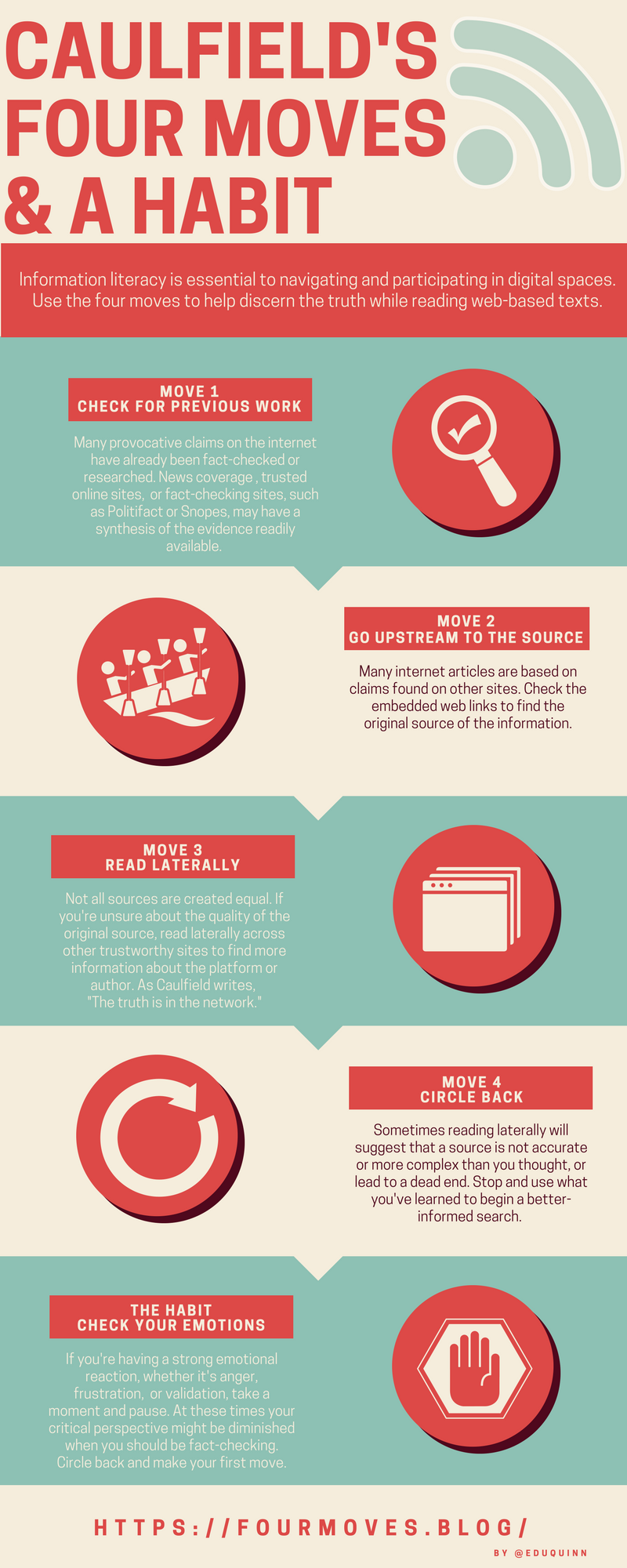
While I appreciate Mike Caulfield's intent in offering this process, and while it offers some valuable suggestions, I am concerned that it is not an appropriate mechanism for critically evaluating online reports.

I am most concerned about approaches based on evaluating the credibility of a source. I think it's really hard to determine whether a source in general is credible, and additionally, whether a particular report in an otherwise credible source is credible.

For example, the infographic includes news coverage as being among trusted sources. When I taught critical thinking I would use news articles in my classes as examples of unreliable sources. My class and I would analyze the evidence of bias in source selection, poorly constructed arguments and explanations, factual errors, and more. These persisted across editorials, letters to the editor, columnists and news coverage.

The first 'move' is always to determine what is being said, how it is being supported, and what the evidence there is for it (if any). This allows us to make a preliminary assessment. When we identify invalid argumentation, informal fallacies, equivocation and ambiguity, and weak explanations we should begin to question the source, no matter how credible it is.

The second move is to check the assertions of fact against what we already know. For example, think of the child who was told "Australia is not a country" by a teacher. Our own factual knowledge is not perfect, of course, and we should always be open to other possibilities. But assertions contrary to our own everyday experience and common sense should be questioned.

If the assertion has survived to this point (and a painfully large number of assertions do not) then then next step is to confirm or verify the assertions. These vary depending on the type of argument or explanation, and the standards also vary. A statement of fact needs observers or tangible consequences; a statistical generalization needs a sufficiently large representative sample. The method of 'going to the source' is one way of doing this, but the purpose here isn't to assess the source, it's to assess the evidence.

In journalism, the standard rule (often broken) is that a fact is not published unless it is verified by two independent sources that were in a position to know. There is also what Carnap called the 'requirement of total evidence', which means that a narrow view or single perspective shouldn't be trusted. We need to avoid 'conformation bias', where we are considering only those sources or arguments favourable to our own beliefs.

Finally, yes, you should be self-aware, but ultimately, your own reaction to the story is irrelevant. It doesn't matter whether it makes you happy or angry. It's not that you should be dispassionate - "Reason," said Hume, "is and ought to be the slave of the passions." If something matters to you, there is all the more reason why you want to make sure you have it right.

There's a lot more to evaluating news and opinions than I've outlined here, but these should point you in the right direction. My rules, in summary: Question authority. Trust yourself. Avoid errors in reasoning. Verify.


28 Feb 02:40

5 questions to improve collaboration

by Sage Cohen
Illustration for blog post on questions to improve collaboration
Illustration by Justin Tran

Everyone works differently. The better you understand who your teammates are and how they operate, the better equipped you’ll be to collaborate with them. Start by asking these five questions.

1. What is your personal workstyle?

When I was a senior writer at an agency, my creative team met regularly to brainstorm concepts for ad campaigns. While most of my colleagues preferred to work collaboratively, I knew I needed to start the process alone. As soon as the creative brief was available, I’d take a walk and start capturing ideas on index cards. Showing up to the kick-off with a few solid concepts to contribute helped me relax and participate far more effectively in the group process.

When the creative director asked about my solo prep time, he understood my workstyle better and built time for my process into our schedules. This small adaptation benefited me, my team, and our clients. You may be able to make similar refinements — and create significant improvements — just by asking colleagues about what works best for them:

  • Do you tend to be the first to finish or the last to get started?
  • Are you more of a team player or a lone wolf?
  • What are the ideal circumstances for you to meet your deadlines?
  • How do you like to receive feedback?
  • Do you prefer to be on stage or behind the curtain?

Or you could use the assessment featured in the Harvard Business Review to discover and compare the unique way people think and process information. The more you understand about your colleagues’ workstyles, the better you’ll be able to keep in step, all the way across the finish line.

2. What is your personality type?

It’s natural to expect others around us to have similar ways of being and working—and it can be frustrating and confusing when they don’t. Having a sense of your teammates’ personalities can help you anticipate how they’re inclined to create, converse, and collaborate.

While personality tests may not be at the peak of scientific rigor, they can still offer fun and helpful reference points for how we are similar and how we differ. For a shared reference point, consider inviting them to take one of these popular self-tests.

The insight you get can help increase understanding and empathy. And it may even help leverage individual strengths toward group efforts.

3. What are your power hours?

No one benefits from an 8 a.m. presentation if the presenter doesn’t come to life until noon. Nor does it make sense for a team to do its high-stakes creative work during their late afternoon slump—or maybe it does! Recent research reveals this inspiration paradox: innovation and creativity are greatest when we are not at our best.

While your power hours are great for tasks that challenge us and demand your attention, they’re not optimal for insight problems that benefit from thinking outside the box. When it comes to optimal creative time, it turns out morning people have more insights in the evening. And night owls are more likely to have breakthroughs in the morning.

Inquiring about colleagues’ power hours can help you navigate the paradoxes of optimal performance by engaging and protecting “challenge” hours and “creative” hours for everyone’s benefit.

Go from first draft to final deliverable with Dropbox Professional

4. Who are your heroes?

A person’s heroes reveal the realms (such as history, entertainment, or politics) and archetypes (such as hero, explorer, or creator) they most identify with. Imagine the immediate impression you’d have of your contact in Accounts Payable if she said her hero was Dolly Parton, Elastigirl, Serena Williams, or Sojourner Truth. With this fun reference point, you could seek common ground and find ways to draw on her strengths in your shared work. (Elastigirl could surely make a budget S-T-R-E-T-C-H, right?)

Make sure to learn not just who your teammates’ heroes are—but what they admire about them—to get a sense of how they see themselves. Another way to get playful about archetypes is to find a cultural reference that speaks to you all, such as:

  • What would your Hogwarts House be?
  • Which Star Wars character do you identify with?
  • Which Brady Bunch kid did you want to be?

5. What is your cathedral?

In my book Fierce on the Page, I share the parable of a traveler in medieval times who came upon a stonemason at work. He asked, “What are you doing?” The man looked weary and unhappy. He responded, “Can’t you see I am cutting and laying down stone? My back is killing me, and I can’t wait to stop.”

The traveler continued on his way and came upon a second stonemason. “What are you doing?” he asked. “I’m building a wall,” said the stonemason. “I’m grateful to have this work so I can support my family.”

As the traveler walked on, he encountered a third stonemason who seemed to be doing exactly the same work as the previous two. He asked the man, “What are you doing?” The man stood up straight. His face was radiant. He looked up at the sky and spread his arms wide. “I am building a cathedral,” he answered.

Even in a team of people technically doing the same work, everyone brings a unique sense of purpose and motivation. The more closely we can understand and align these, the more likely we are to collectively create a cathedral that inspires us all and makes a real difference. Ask your teammates:

Don’t forget to ask yourself these questions, as well. When you know your own workstyle, preferences, and tendencies, you’ll have more insight about how you relate to others. So, you’ll be better equipped to bring your “A game” to every collaboration—and support others in doing the same.

Sage Cohen is the author of Fierce on the Page, The Productive Writer, Writing the Life Poetic, and the poetry collection Like the Heart, the World. Since founding Sage Cohen Global in 1997, she’s been developing communication, education, and empowerment solutions that help people and businesses change the conversation.

Go from first draft to final deliverable

28 Feb 02:40

Will Vero be your next social network?

by Volker Weber

Screenshot 20180227-144835~2[7198]

The closest I ever got to the perfect social network was Path, eight years ago, when they would only allow you to have 50 friends. It allowed you to quickly share photos with your best friends without worrying too much about going public with everything. At the time, Facebook was already acting weird. But then Path needed to make their investors happy with growth and it all went downhill from there.

Google+ was the next one, but it's circles were too difficult to understand, and somehow Google ended up being the bad guy and Facebook the good one. Weird. I have friends who still use Google+, but it never resonated with many of them. Then came Ello, and it launched before it was mobile. That was a missed opportunity. Like Google+ it still exists, but it did not pull people away from Facebook.

Vero might be the next dead social network, and they just don't know it yet. It has two interesting properties:

  • You can follow people like you do on Twitter. You don't actually have to know them. Just follow them because they are interesting.
  • You can also connect with other people like you do on Facebook. You will put those connections into one of three buckets: Acquaintences, Friends and Close Friends.

When you post something to your timeline, you can share it with only your close friends, your friends, your acquaintences or your followers. It's like Googe+ circles, just a lot easier. People you connected to don't know in which bucket they are. I set myself simple rules: acquaintences are people I actually know and met, friends have been at my house, close friends have stayed here.

Currently Vero is completely overwhelmed by its sudden popularity. Give it a few days until the situation improves.

More >

28 Feb 02:40

WatchKit as a “Sweet Solution”

by Federico Viticci

Marco Arment (who's been struggling with Watch app development for a while now) makes the case for WatchKit to be either discontinued or substantially expanded as, in its current form, it hinders the creation of more powerful apps.

Developing Apple Watch apps is extremely frustrating and limited for one big reason: unlike on iOS, Apple doesn’t give app developers access to the same watchOS frameworks that they use on Apple Watch.

Instead, we’re only allowed to use WatchKit, a baby UI framework that would’ve seemed rudimentary to developers even in the 1990s. But unlike the iPhone’s web apps, WatchKit doesn’t appear to be a stopgap — it seems to be Apple’s long-term solution to third-party app development on the Apple Watch.

When I first read his post, I thought that asking Apple to discontinue and replace WatchKit was perhaps too much. But after spending some time reorganizing my Watch favorites and complications last night and this morning, I agree with Marco. My favorite apps on the Watch are all made by Apple and are not based on WatchKit. The only exception is Workouts++ (which, as a workout app, has specific privileges). The only third-party Watch apps I regularly use besides Smith's app are Things and Shazam (which is somewhat ironic) and they're both accessed via complications; they're okay, but I don't love them because they're often slow to sync data with their iPhone counterparts or take too long to launch and be in a usable state. When I'm out and about, I still don't trust Watch apps to be as reliable as iPhone apps.

Despite three years of watchOS updates and more powerful hardware (I use a Series 3), the Apple Watch still doesn't feel like the rich, diverse, and vibrant app platform that the iPhone is. Some might say that's precisely the point – it doesn't have to be because the Watch works best through notifications and complications. However, I often ask myself if such argument is the wearable equivalent of Aesop's sour grapesreal Watch apps wouldn't make sense anyway. Like Marco, I wonder what would happen if only Apple exposed real watchOS development tools to app makers.

→ Source: marco.org

28 Feb 02:39

Vancouver Civic Election: A Candidate’s Statement – Tanya Paz

by pricetags

Price Tags will post candidate’s statements – who they are, what they’ll do – for the upcoming party nominations and civic election.  


I’m Tanya Paz and I’m seeking the Vision nomination for councillor in this Fall’s election.

I’m someone who helps shape cities. I’m best known for my work locally, nationally, and internationally in sustainable transportation, making cities accessible and navigable through carsharing and bike sharing. My work locally with Modo, Mobi, Veemo, and Vancouver Coastal Health has helped people change their ways of getting around.

Since 2012 I have spent countless hours volunteering for the City’s Active Transportation Policy Council, advising City Council, the Park Board, and Vancouver School Board on walking, bicycling, skateboarding, and transit. I’ve served as Chair since 2013 and have been an outspoken leader for our community.

I moved to Vancouver to go to UBC in 1991 and have lived here since. Growing up in a diverse family an hour east of here, I feel I can represent so many Vancouverites who know that our strength is in our unique and diverse backgrounds coming together for a common vision.

I have also worked in affordable housing. I worked for Community Housing Land Trust Foundation and Co-op Housing Federation of BC in the mid to late 90s, advocated for affordable housing, including Mole Hill and co-op housing in Metro Vancouver. I also helped overhaul the Co-op Association Act in BC.

After that, I was recruited to Modo; I was second-in-command there for 13 years, building systems and relationships to expand carsharing to various municipalities and co-founding the international Car Sharing Association and the Federation of Canadian Carsharing Co-ops.

By striving towards social justice through sound policy and civic actions, we can make our city an incredible place to live.

Tanya’s website here.

28 Feb 02:39

SotD: Can’t Get There From Here

For a lot of bands, there’s one song that’s special because it’s the first one you heard on the radio and you thought Who’s that?! I don’t know if Can’t Get There From Here is my absolute favorite R.E.M. song; Man on the Moon has great surge-and-flow, Losing My Religion is the greatest car singalong ever. But anyhow, it’s a fine piece of work.

Fables cover Fables cover

Side-note: The title of the song is inconsistent, sometimes appearing with the apostrophe, sometimes without.

This was in the early eighties, I had a long commute to work and at that point there was a Vancouver radio station that played interesting new stuff, and I heard a lot of later-famous bands there before most people did. Can’t Get There exploded out from between the other songs, somehow louder and brighter, even though I know pop music has its dynamic range compressed like hell so it always sounds loud.

I read in Wikipedia that Fables of the Reconstruction (Can’t Get There‘s album) was a pain to produce, was poorly reviewed, and didn’t sell that well, and R.E.M. remained cult-only for a few more years. People are crazy, I think almost every song is brilliant; in particular, Driver 8.

This is part of the Song of the Day series (background).

Links

Spotify playlist. This tune on iTunes, Spotify, Amazon. There’s quite a bit of live video, but this German show from when the song was brand-new, albeit with fuzzy video, is a remarkably good performance, a reminder how accomplished a band R.E.M. was, combining precision and Dionysian mania. A treat. Also, Michael Stipe has hair.

28 Feb 02:38

Smart Makerspace: A Web Platform Implementation

files/images/smart_makerspace.PNG

Gabriel Licks, Adriano Teixeira, Kris Luyten, International Journal of Emerging Technologies in Learning, Mar 02, 2018


Icon

The idea of a 'smart makerspace' is that it is a space for making things (software, designs, products, whatever) supported with a type of web assistant or guide to help people get past the initial challenge of making things with new technology. This was the idea behind AutoDesk's Smart Makerspace (more) and also Harvard's Guerilla Makerspace. The current project (17 page PDF) seeks to overcome some limitations inherent in these projects, providing "instead of a workbench, a web platform that runs in the user’s laptop for accompanying the maker tasks. It also goes around some issues identified in the previous implementation, related to having the need of separate power-tools and a workbench for each user."

Web: [Direct Link] [This Post]
28 Feb 02:38

Boycott frenzy, “discrimination,” and the tyranny of efficiency

by Josh Bernoff

In the wake of the school shooting in Florida and NRA president Wayne LaPierre’s statement that the right to bear arms is “granted by God to all Americans as our American birthright,” a slew of companies from Delta Airlines and Hertz to MetLife have ended discount programs with the NRA. Now people are calling for … Continued

The post Boycott frenzy, “discrimination,” and the tyranny of efficiency appeared first on without bullshit.

28 Feb 02:38

A Systematic Review of Second Language Learning with Mobile Technologies

files/images/as-languageapps-1.jpg

Veronica Persson, Jalal Nouri, International Journal of Emerging Technologies in Learning, Mar 02, 2018


Icon

This article (23 page PDF) is "a systematic literature review of the research done in mobile assisted second language learning (MASLL) published since 2010." 54 articles were selected for review. The review breaks down the studies by type of review, technologies used, mobile applications used, hardware, pedagogical practices, and learning impact. "All of them agree on the positive impact of mobile devices for enhancing the L2 (second language) learning process," write the authors. In general, mobile devices are used "as a tool to improve vocabulary learning and general skills development, underrepresenting how mobile technologies can improve the reading, writing, listening and oral skills."

Web: [Direct Link] [This Post]
28 Feb 02:38

TILT Episode 001 – Brian Lamb and RRU’s LRNT 525 class

files/images/amigos-800x510.jpg

D'Arcy Norman, D'Arcy Norman Dot Net, Mar 02, 2018


Icon

Visit the link to listen to an episode 001 podcast, and stay for the vintage photo of 'the three amigos' in their halcyon days visiting in Vancouver. D'Arcy Norman writes, "I was fortunate to be invited to chat with Brian Lamb and Royal Roads University’s LRNT 525 class, nominally to talk about institutional change management and decision making, but it turned into a wide-ranging discussion of innovation and the tension between creativity and enterprise-scale."

Web: [Direct Link] [This Post]
28 Feb 02:38

LambdUp 2017: A Theory of Functional Programming [TALK]

by Eric Normand

There are two common questions we hear from outside the functional programming community: ‘What is functional programming?’, and ‘Why should I use it?’. I have struggled to find good answers to these questions. In this talk, we will look at the existing definition and I will present a formulation I’ve been working on that attempts to answer both of these questions, and also why functional programming is so special.

Video

Video + Slides


LambdUp 2017

Slides

A Theory of Functional Programming LambdUp

Download slides

Transcript

Thank you so much. I’m so happy to be invited here to speak. Prague is a beautiful city and I’m glad to see so many people into functional programming. And I’ve never really done functional programming in Europe so this is pretty cool. I was walking around Prague yesterday, I did not get accosted by any Devils luckily but I did see a St. Nicholas. Ah! There we go!

Okay. So who knows who this is? It’s Isaac Newton and one of the most famous things Isaac Newton did was to formulate a theory of mechanics and kinematics. And we all know these three laws of motion that are attributed to Newton.

And the thing about them is they’re very clear and concise laws stated in a mathematical way that talks about the relationships between just a handful of concepts. So we have force, mass, distance, and time. And it’s become the prototype for other scientific theories. It’s the thing that they try to be like. A very concise few concepts a lot of abstraction.

Now what did Newtonian mechanics replace? Well this is Aristotle. And so before Newton kind of formalized this, the most common form of physics was Aristotelian physics. And it had concepts like this. This is just a small excerpt of the total number of concepts. One concept is ideal speed. And that says that small things move faster than big things. And then there’s natural place which says that rocks like to be close to the earth and then water likes to be on top of that and then air likes to be on top of that.

So if you move them they’ll like naturally go back to their natural place. Then there’s natural motion which is like when you’re walking and you’re your generating your own like smooth motion. Versus unnatural motion which is when you like get jostled and pushed by something acting on you and so that’s unnatural to the object.

And this dominated for over a thousand years and people are always figuring out corner cases and stuff. But you see the the type of theory is different. This Aristotelian physics is like just pointing at stuff. It’s like, oh! Small things move fast and rocks like to sink. This is pointing at phenomena and trying to come up with some explanation for that particular thing. Whereas in Newtonian, it comes up with a coherent theory with relationships among the entities that in some sense is it’s like a whole view of the world. Instead of these pointing things.

So I’m trying to do something like this for the question of what is functional programming? If you google it today, you’ll get a bunch of people explaining trying to explain what functional programming is. I feel like it’s very much this kind of Aristotelian kind of thing where people are like: oh pure functions! Oh no side effects! Immutable values and they’re just pointing. They’re just pointing at little phenomena and not coming up with a coherent whole. And I think that’s a detriment to the community because someone who doesn’t know functional programming and is trying to learn about it, they are not gonna be convinced about using it by these definitions.

If you say there’s no side effects, is people are like how do you get anything done? Like how do you send an email? How do you do network programming? So I’m I’m trying to develop a theory that answers these questions in the Newtonian style. So my talk is called A theory of Functional Programming. It’s a theory. I’m trying to build this myself from, I don’t know. I feel like I’m good at this kind of theory building. So that’s why I’m taking a stab at it and no one has done it yet so why not me?

My name is Eric Normand. I run a company called PurelyFunctional.tv where I teach Clojure and functional programming. Mostly in written and video form. If you go to the web site within the Czech Republic, you’ll get a discount code. So if you’re visiting from out of the country, you might want to sign up now. If you’re here and if you’re not visiting, if you live here, well sign up sooner rather than later. But the code will be good forever. Okay I’m also running a conference in New Orleans it’s called ClojureSYNC. It’s all about Clojure and you can get 10% off if you use that code. Also check out the website. We have great speakers. Alright! Let’s get started.

So we all know that functional programming people will say it’s a programming paradigm right? So they contrast it to imperative or object oriented. So I looked up the word paradigm like what does that actually mean, and I like this dictionary definition. I’ll just go over some pieces of it so it’s a philosophical or theoretical framework or worldview. So it’s not saying you know, when you never start talking about worldviews, you got to bring in relativism. So it’s not saying that this is a better worldview than others.

It’s just a different perspective on a problem but it’s a framework. It’s a way of thinking. It’s a set of tools that you have to solve a problem. It’s got theories, laws, generalizations. What what are the pieces of the theory is laws and laws are relationships between generalizations concepts.

And it also contains the basic assumptions and the ways of thinking. So when we when I build a theory of this and I say we because I want everyone to participate it’s I don’t want it to just be mine it’s got to be shared. So I’ll say we. So when we’ll building this, it has to take into account that it’s not about any particular language or anything like that it’s about the way we sink. Okay. Just to revisit, what is functional programming? This is the question we’re trying to answer.

So I have some more specific goals for my theory. So I want to explain what it is that we actually do? So not from an academic perspective but from an industry perspective. What are we actually doing when we call it when we do what we call functional programming? And it has to be in terms that we can all understand even if we’re not functional programmers.

We have to be able to use the concepts in it to explain why it has advantages over other paradigms. And especially the people who haven’t done FP. That’s one of the big problems is that, we have is that once you try it, you like it, but before you give it a chance, it might not make much sense. I want to avoid focusing on features. I feel like the functional world needs to be a little bit more unified in terms of you know, taking a stance on the important things instead of in fighting about you know, do you have pure functions and type-checking? That kind of thing.

So it’s not, we’re just gonna not talk about features at all in the theory. And then it has to give explanatory and predictive power. A good theory gives you something new that you didn’t have before. Besides just pointing at stuff and explaining stuff you already have. You should be able to make draw conclusions from those things that you didn’t draw before. And then finally, I feel like we should all agree. We should be able to come to a consensus about the terms we use and things like that.

Okay! Let’s get into it. My theory. So the world is divided into three domains. Three types of things. Actions, data, and calculations. And we’ll go over each of these.

So actions is, this is the dictionary definition. It’s process of doing something, having some kind of effect, trying to achieve an aim. This is what we typically call effects or side effects. I use the term because well, we can talk about that on the couch. Why I’m avoiding this term but it affects this kind of a problematic term. So the way you could tell if something is an action is whether it matters when you call it or how many times you call it.

Okay. So have some examples. Sending a message over the network depending on the message. The content of the message when you send it could be important. It could come before or after another message. And so that order matters. What matters also sending multiple messages might have a different meaning from sending one. Writing to the file system if you read and write to the file on the disk. Other things can read it so it depends on if you wrote first or they read first. What effect the system is going to have? And then, of course, in memory, changing mutable state or even reading from it when you read from it is important.

Okay. Data. Data is very easy I think. It’s so clear about what it’s. What it is is factual information used as a basis for reasoning discussion or calculation. But some properties of data that make it fall into this category it’s inert. It doesn’t do anything. It just is what it is. It’s another way of saying it’s self identical. It’s serializable very often, meaning you can come up with some linear encoding and bytes or in an ASCII or something to put it on the wire. But it requires interpretation because it’s inert, it needs something to read it. Just like if you had some text it requires a person to read it to make any sense out of it. Data is the same. So these examples I’m sure are just super clear so I’m not even gonna read them.

And then, finally calculations. There wasn’t a good definition for calculations. They would always say like calculations are the product of calculating and calculating is the act of making calculations. So I had some I had to use computation as my definition instead of calculation. But this is what where we put all the mathematical functions and the pure functions that we we think of in functional programming. The characteristic that makes them calculations is that, they’re outside of time. Their mathematical relationship defined it. Doesn’t matter when you run them doesn’t even matter if you run them. The relationship will still hold.

There also preferentially transparent which is another way of saying you have you don’t you can run it zero times and it has the same effect. You can replace the function call with its results at compile time. So you don’t even have to run it at run time. Some examples list concatenation and summing numbers. I think this should all be clear. In fact, it might even be like too obvious. And you might be wondering why I’m up here talking about it and spending all your time talking about this. But if you google for a definition of functional programming, no one is saying this. So I feel like yes, it’s obvious but someone has to write this down and someone has to do the SEO and get on the front page of Google. And so I’m just gonna do it.

Another thing you might be wondering is, yes this is obvious, doesn’t everyone do this? Doesn’t everyone think about actions and calculations and data? So let’s contrast, let’s contrast this with object-oriented programming, and as a paradigm, how it divides up the world? So it also divides it into three categories of things. You’ve got objects references to those objects and messages that you can pass to any object that you have a reference to.

So notice there’s no easy way to translate between object-oriented programming and functional programming. It’s not that they’re incompatible, they’re just two different angles looking at the same problem. But they’re both compatible. They’re seeing the same thing but they’re seeing different images right? Two-dimensional images because of the angle. So you could make data out of objects right? And you can say well this message is actually going to be pure. So it’s a calculation and could do that but you’d have to do that yourself to make the translation. There’s no simple way to translate between them.

Okay so just real quickly. Just to make sure this is super clear. How is it implemented in Haskell? How is functional programming in this theory implemented? So in Haskell, we have data types, built-in types, and we can define new types and that’s the data. And then in the calculations are functions and in Haskell, all the functions are pure. So that’s already done for us. And then the actions are this special type in the Haskell language called IO. So all of the actions go under that.

And then in Clojure, it’s different because there’s no type system and the semantics are a little different. So you have their built-in types and your collections of those types and stuff. That’s the data. But then in Clojure, if you want calculations, you have to manually make your function pure because you could do impure stuff in your function. So if you keep your function pure, just by hand you can say that’s a calculation and people do this. This is the idiomatic way of writing Clojure code. Say, oh! These are all pure functions. And then you have impure functions or your actions. So if you need to print to the screen or something you put it in an action. You put it in a function and you call it any prints of the screen.

Okay, so I hope that’s all obvious because I’m gonna go further in. Because that was just laying the groundwork. Just the initial definitions. When we talk about functional programming, we often talk about first-class functions. So you can pass a function to another function. Or you can return a function from a function. But in functional programming, everything is first-class. Your data is first-class, your calculations are first-class, and your actions are first-class. So you can pass actions around. Compose them up just like you typically would think of posing up calculations. And I would argue that this is the minimal set feature set you need to do functional programming.

So let me give an example. In JavaScript, there are things that are not first-class. For instance, the plus operator is not first-class. You can’t pass that as an argument to another function. but you can make something that does plus first-class you can make a function that does plus. That takes two arguments and wraps up that plus. And now you have something first-class that does the equivalent thing. So you could do a similar thing in in Java where you make a sort of a pure object that only does certain calculations in a pure way. And you can say those are my calculations. You can wrap it all up even if you don’t have first-class functions.

Okay and this is also an important thing but it’s it’s kind of hard to explain. But the idea is that, these domains really are separate. There we are allowed to draw these lines. I want to make that clear. So in the data domain, we can make operations that compose two bits of data and get a new bit of data out right? So we can stay in this domain of data and not leave.

Just some examples. Addition of numbers, concatenation of lists or strings, and then we have calculations. You can do the same thing. You can take two calculations and make a new calculation. You don’t have to leave the domain. Some examples of these kinds of composition. You have function composition which is kind of chaining the return of one to the argument of the next. And then juxtapose. Which is run both and put the results in a tuple.

And then, finally actions are also a domain that you can stay in. So you can have actions and compose them. Say in sequence or in parallel and they remain actions. Okay so I feel like that’s an important idea that you can stay in each domain because what happens is, actions are contagious. And this gets that why we avoid side effects when we don’t have to use them.

Actions combined with other things remain actions. So once you introduce side effects, everything that uses that thing it also could have a side effect. So just to make it like mathematically notation, you have a calculation and you combine it with an action, you’re gonna get an action out. And if you have data and you combine it with an action, so you like hard code of value in the data, you’re gonna get an action out.

So just as an example. If you had the function, it’s a pure function square and you make a thing that takes the number squares it. And then prints it, that whole thing is also an action. Same if you do it the other way. You do read which is an action parse is just string to number let’s say. So it’s pure. But when you compose them, now you got an action. So the actions have not been properly quarantine.

Some things about calculations that are kind of corollaries to what we talked about. They’re amenable to algebraic manipulation. Which means that you can do a lot of static analysis about them. And you can use the algebraic properties and the symbolic nature of our languages to do some cool stuff. There tor incomplete which is good but that introduces known problems like the halting problem. And then they’re opaque. So you never know what a function is gonna do until you run it in general, you know you know some functions are easy and we’ll, you can analyze some functions. But not all functions.

Okay. And then data. The nice thing about data is it’s it is inert. And it’s kind of self describing. It’s just all out there like this is what I am. I’m just some data. And the problem with that is, it needs to be interpreted right? You can’t just say: Okay, go run like you can a function. But it also means it can represent something else. It’s self identical but it could also be the identity of another thing. Which that’s that’s interesting of itself. Also, due to data structure as a study. We know the Big O complexities of a lot of data structures. So it’s got guaranteed like performance it. You know if you’re using a map you know it’s constant time reads stuff like that.

Okay now the generative part that I talked about. In the 30 minutes I have. I don’t have time to go deep into this but this is something where we’re actually able to generate potential refactorings of our code. Just by looking at the consequences of our definition. So if you take an action, that action might have been composed of an action and a calculation. So we can separate those two out. You can separate out all the pure stuff into its own thing and compose them back again later. And you’ll have the same semantics of your code. Same with data. You could have a hard-coded value in there that you pull out as a parameter. And now you have an action and data separate. And the same goes for calculations. You can pull the data out you can also take two calculations and separate them into calculations.

But notice we can’t do that with if we have a calculation, we know we’re not going to get an action. There’s no way to pull an action out of a calculation. It’s pure you can’t pull the impure part out. And that’s interesting. We I mean we knew that but we didn’t have a way to say that before.

Okay. And now here’s a question. Why is it that object-oriented programs and imperative programmers are a little afraid when you say we don’t like actions? We don’t like effects? Or side effects? And my answer to this is that, actions are the universal thing. Like you can do everything with actions. You can’t do everything with data right? You can’t just have a bunch of strings on your hard drive and like things are gonna run right? You need to have some code.

So we know through the lambda calculus that calculations themselves functions can represent data. So you can encode numbers and other data structures in functions and have a complete set of data that the kind of stuff all the types that we’re used to. But what you can’t get out of lambda calculus out of pure functions is, sending an email or launching a missile. Like you can never do that.

So you need actions. And actions are universal because you can just encode a turing machine that just mutates stuff and does the calculations and the data. So when an imperative programmer is like we don’t really want so many actions. They’re like but that’s the that’s the thing that lets you do everything else. And our job is to convince them that that that’s true. But it is really nice that you get all these properties like algebraic reasoning when you separate out the calculations from the actions.

Aright. Another interesting idea is what counts as an action? So we said before that calculations are timeless. But actions are bound in time. So a pure function is a calculation. And reading and writing to disk is an action. So if I have a pure function, I would typically just put it in the calculations without thinking. But what if that function takes 24 hours to complete? All of a sudden when I run it, is kind of important right?

If I need the data now, I should have started yesterday. And I’m not gonna if I start now, I’m not gonna get the answer until tomorrow. That’s bound in time for sure. Typically our functions take less than milliseconds to run. So we don’t think about this. But there is some line somewhere that you have to decide for yourself. At what point does this function become if it runs long enough? At what point does it become an action right? So that’s supposed to be animated but it just jumped.

Alright. Similarly, typically if I’m reading and writing to disk, I would put it in this column as an action. Except what if I do it to a temporary file that has a name that nothing can guess. And before it’s before anything else can read it I’m already done and I deleted and clean it up. And I use it as a buffer. I just need a little bit more memory. And I just like do some calculations and store as like scratch paper right?

Well then you might say, that’s actually a calculation. From the outside, it doesn’t have any noticeable effects because we know that really, our computers are just doing actions right? That there every instruction in the machine code writes to a register or reads from memory somewhere some mutable thing. And we’re the ones or our languages are the ones imposing the discipline of not trampling over each other’s memory and and having a stack discipline. and things like that. So actually there is no calculation right? We have to make the calculation as functional programmers. So we get to choose where this line is.

So in Haskell, there’s a thing called unsafe perform IO which lets you take an action something in IO and run it as if it were pure. So it the IO type is gone. So it’s just a function now. So the type checker is happy. And as long as you are okay with the mutation and stuff happening, and you can treat it like a pure function.

Now in Clojure and in JavaScript, we play fast and loose all the time with this. So for instance, I’ll write a pure function. And then I like what is this thing even doing? I put a print line in there and I see and so now it’s impure. But like it’s just for me the developer and then I deleted and so it didn’t really matter.

Okay. More about the generative stuff. So there’s enough study of functions and the algebraic manipulation of functions. That I feel like if someone’s like: Well what about this functions? Can you tell me more about it? I can just say here’s Lambda Calculus. You know you can read all about that.

But the interesting part that I feel like functional programmers are actually generating new stuff about is the actions. And people talk about we’re avoiding actions. All that you know we’re avoiding side-effects. And that’s not really true. I think it’s more fair to say that we’re making actions safer right? And so if we take this idea that it’s either how many times they run or when they run. We can actually divide up the space of actions into what’s important.

So actions. If we say how many times they run? In this idea we can say that there’s in general functions are they always matter. If they run zero times, it’s different from one time. It’s different from more times. This is certainly true for launching a missile. Launching zero missiles is way different from launching one missile. It’s different from launching two missiles. And sending an email you know, if you don’t send it, it’s totally different from sending it ten times. Then we have the actions that are idempotent. So this means that zero is different. So sending it zero times is different from one time. But then, that second time it’s the same. It doesn’t matter if you sent it ten times versus one time. And we call that impotent.

So if you’re gonna set the read flag on a on a file on your file system to true. If you set it again to true, it’s the same. It hasn’t changed anything. Same for like pressing an elevator button. You press it zero times, you know you’re not gonna get picked up by the elevator. But you press it one time then you will second time it’s not gonna have any effect. Then finally, we have actions that are totally free of side effects. So zero times, one time, more times. It’s all the same. Still matters when they run. But it doesn’t matter how many times. And so this is stuff like get requests. It has no external visible change to the world. Is that my signal? Yeah. Okay. I’m gonna continue.

Last slide. So then we have actions and when they run, and this I’ve divided into different semantics that we’ve come up with in the functional world. Like if you had a transactional read. It doesn’t it still matters when they run. But you have a guarantee that you’re never gonna read an inconsistent value. A value when but you know during a transaction, you’ll always read either before or after. So even though you still matter when they run, like you you’re guaranteed that it’s at least consistent.

Transactional or serialized rights, so the same with writing. It doesn’t matter. You can’t guarantee any particular order of the rights. But we do know that it is in some order things don’t happen at the same time. And then finally exactly once reads so you could have a queue that has tasks that you need to do. And you can guarantee that only one thread will pull that task off of the queue. The other ones are still waiting for their tasks. So you don’t have it run twice. Because two threads got it. So those things help us reason about the actions. Okay my time is up I’m gonna be over here on the couches so when when you want to talk I’ll be right there. Thank you very much!

The post LambdUp 2017: A Theory of Functional Programming [TALK] appeared first on LispCast.

28 Feb 02:36

Twitter Favorites: [Lesley_NOPE] This shot was taken at 6:49am fam. The mornings are getting brighter and the days longer! https://t.co/B8wgt7M3ok

Only my mom calls me Sleeven @Lesley_NOPE
This shot was taken at 6:49am fam. The mornings are getting brighter and the days longer! pic.twitter.com/B8wgt7M3ok
28 Feb 02:36

Twitter Favorites: [c_9] oh no what have i done https://t.co/oFnLvmuEBN

Cameron MacLeod @c_9
oh no what have i done pic.twitter.com/oFnLvmuEBN
28 Feb 02:36

Twitter Favorites: [bmann] Now that our coffee infrastructure is complete, I’m working on @FinhavenHQ approach to tokenizing donuts (dangers o… https://t.co/Q6QCo1wicN

Boris Mann @bmann
Now that our coffee infrastructure is complete, I’m working on @FinhavenHQ approach to tokenizing donuts (dangers o… twitter.com/i/web/status/9…
28 Feb 02:35

Wind in the Sony Marketing Sails

Consider:

bythom monster2
  • "Sony Introduces a New Monster" --Andy's Travel Blog
  • "The Mini A9" --Steve Huff
  • "a $2000 full-frame mirrorless camera that should terrify Canon and Nikon" --Verge
  • "$2000 A7 III Might Mean My Panasonic GH5 is Trash Now" -- Alex Cranz

28 Feb 02:35

Sensor Hub Almost Back in Action

by Ton Zijlstra

This fall my Measure Your City sensor hub fell out of a tree during a storm. It seemed to be damaged, so I put it aside until I could think how or when to reinstate it. Later on I noticed from the log files that it seemed to have stopped working before it fell from the tree but I did not think it important. A few weeks ago I handed the sensor hub in with the team of Measure Your City that does repairs. It turns out the sensor hub was fully functional except for …. the batteries.

The problem was the firmware using too much battery power. Which is problematic given the stated aim of these LoRa sensors, to work on low power for a long time.
With a firmware upgrade and fresh batteries, the sensor hub is now back in action. The past day I’ve used it to measure the relative humidity in various rooms around the house as we suspected it might be too dry (it was, around 30-35% humidity). As there are 2 similar sensor hubs nearby, we are not without info on current outside conditions. I’ll reinstate the sensor hub outside again this weekend.

Meanwhile my own sensor hub as well as the two others a street away, use my recently installed The Things Network gateway to transport the data to the Measure Your City back-end. The gateway also sees several other sensors sending data through the gateway, although I don’t know what type of sensors those are.

Screenshot of the data passing through the gateway. The device in the first line is my own sensor hub.


28 Feb 02:28

The Best DSLR for Beginners

by Mike Perlman
The Best DSLR for Beginners

The Nikon D3500 is the best DSLR camera for a beginner looking to step up their photography skills. It offers outstanding image quality for its price and a truly useful Guide Mode that helps you learn along the way. It boasts excellent battery life, easy smartphone connectivity, 1080/60p video with silent autofocus, and intuitive controls in a highly portable and lightweight body.

28 Feb 02:27

10 Cheap, Unexpected Kitchen Essentials We Rely On

by WC Staff
10 Cheap, Unexpected Kitchen Essentials We Rely On

Here at Wirecutter, some of us spend a lot of time in the kitchen. We go to work and chop mountains of produce or sauté batch after batch of chicken pieces, and then we go home and cook dinner. In all that time (as well as in our past lives working in restaurants and test kitchens), we’ve found a handful of small, simple tools that help our kitchens run more smoothly. These are the unexpected essentials we rely on to help us stay organized, cook efficiently, and clean up fast on a daily basis.

28 Feb 02:26

[For Members] How to Make Unit Charts with Icon Images in R

by Nathan Yau

Make the unit chart less abstract with icons that represent the data, or use this in place of a bar chart. Read More

28 Feb 02:26

New free online course about building makerspaces

by Andrew Collins

Helping people to get into making is at the heart of what we do, and so we’ve created a brand-new, free online course to support educators to start their own makerspaces. If you’re interested in the maker movement, then this course is for you! Sign up now and start learning with Build a Makerspace for Young People on FutureLearn.

Building a makerspace – free online learning

Find out how to create and run a makerspace for young people. Look at the pedagogy and approaches behind digital making.

Dive into the maker movement

From planning to execution, this course will cover everything you need to know to set up and lead your very own makerspace. You’ll learn about different approaches to designing makerspace environments, understand the pedagogy that underpins the maker movement, and create your own makerspace action plan. By the end of the course, you will be well versed in makerspace culture, and you’ll have the skills and knowledge to build a successful and thriving makerspace in your community.

Raspberry Pi Makerspace FutureLearn Online Course

Let makerspace experts lead your journey

This new course features five fantastic case studies about real-life makerspace educators. They’ll share their stories of starting a makerspace: what worked, what didn’t, and what’s next on their journey. Hear from Jessica Simons as she describes her experience starting the MCHS Maker Lab, connect with Patrick Ferrell as he details his teaching at the Jocelyn H. Lee Innovation Lab, and learn from Nick Provenzano as he shares his top tips on how to ensure the legacy of your makerspace. These accomplished educators will give you their practical advice and expert insights, helping you learn the best practices of starting a makerspace environment.

Raspberry Pi Makerspace FutureLearn Online Course

Connect with educators worldwide

By taking this course, you’ll also be connecting with talented and like-minded educators from across the globe. This is your opportunity to develop a community of practice while learning from fellow teachers, librarians, and community leaders who are also engaged in the maker movement.

“I like this course and how it progresses from introducing the concept of makerspaces and how they have come to education, all the way through to creating my own action plan to get started.”— Makerspace Educator in Hayward, California USA

Sign up now

The first run of our Build a Makerspace for Young People course starts on 12 March 2018. You can sign up and access all content for four weeks. After that period, we’ll run the course again multiple times throughout the year. Enjoy, and happy making!

The post New free online course about building makerspaces appeared first on Raspberry Pi.

28 Feb 02:26

What I don't get about Marketing

I want to try to figure out something I still don't understand about Marketing.

First, read this story by Sarah Vizard at Marketing Week: Why Google and Facebook should heed Unilever’s warnings.

All good points, right?

With the rise of fake news and revelations about how the Russians used social platforms to influence both the US election and EU referendum, the need for change is pressing, both for the platforms and for the advertisers that support them.

We know there's a brand equity crisis going on. Brand-unsafe placements are making mainstream brands increasingly indistinguishable from scams. So the story makes sense so far. But here's what I don't get.

For the call to action to work, Unilever really needs other brands to rally round but these have so far been few and far between.

Other brands? Why?

If brands are worth anything, they can at least help people tell one product apart from another.

Think Small VW ad

Saying that other brands need to participate in saving Unilever's brands from the three-ring shitshow of brand-unsafe advertising is like saying that Volkswagen really needs other brands to get into simple layouts and natural-sounding copy just because Volkswagen's agency did.

Not everybody has to make the same stuff and sell it the same way. Brands being different from each other is a good thing. (Right?)

generic food

Sometimes a problem on the Internet isn't a "let's all work together" kind of problem. Sometimes it's an opportunity for one brand to get out ahead of another.

What if every brand in a category kept on playing in the trash fire except one?

Bonus links

28 Feb 02:25

Google Clips Goes up for Sale Again

by Evan Selleck
For a very brief period of time, Google Clips went up for sale back in January. However, that didn’t last long at all, and the device was put up on a waitlist soon after. Continue reading →
28 Feb 02:24

Huawei and Bell trial fixed wireless alternative to traditional broadband in rural Ontario

by Rose Behar
Huawei

Huawei and Bell are partnering to offer a wireless alternative to slow and unstable rural internet in Southwestern Ontario.

The two companies announced today that trial customers in Orangeville, Bethany and Feversham, Ontario are now subscribed to a wireless service that takes over from traditional broadband.

“Out in the rural areas, this is a good solution,” said Bell’s director of technology development, Bruce Rodin, in an interview with MobileSyrup, stating that the carrier has always been conscious of the rural-urban divide when it comes to quality, reliable internet service.

Rodin explained that this solution guarantees 25Mbps and can reach theoretical speeds of up to 1Gbps. Right now, Bell and Huawei say it’s averaging 30Mbps to 40Mbps speeds in most trial homes, which is a significant speed increase for some testers.

Pictured above: Bell executive vice president and CTO Stephen Howe on the right and president of Huawei Canada, Steve Lu on the left.

While the lower limit speed of 25Mbps isn’t exactly the speediest connection, it offers an element of reliability that’s critical to the success of using fixed wireless as a broadband alternative.

This means customers can rely on the wireless solution in an area where their wired internet alternative is only average single-digit Mbps speeds, making for a significant improvement.

The solution makes use of Huawei equipment, both through tower deployments in the area, as well as a cylindrical device called a ‘CPE’ that goes inside the customer’s home.

The device, which is about the height of a cereal box, uses a sub-6GHz connection, though Huawei and Bell note they are also testing 28GHz millimeter wave (mmWave) spectrum together.

The service routes through a regular Home Hub 3000 router, the kind used for Bell’s wired Fibre internet.

Huawei’s technology uses  Massive MIMO and eight-branch transmit and eight-branch receive (8T8R) technologies, paving the way towards 5G. Massive MIMO is known as one of the key 5G technologies, and refers to the use of multiple antennas in an access point that allow for simultaneous transfer and receipt.

Bell says it plans to deploy this fixed wireless to between 20 and 30 communities this year in Ontario and Quebec. It’s also considering some service areas in Atlantic Canada.

Bell has yet to indicate what pricing is for this trial service.

Huawei recently announced Telus employee trials of a similar fixed wireless device in Vancouver. In that trial, Telus and Huawei are using high-frequency CPEs that operates on mmWave spectrum, allowing for 5G speeds that can hitting peaks of up to 2Gbps in the more dense, urban environment.

Photography by Patrick O’Rourke. 

The post Huawei and Bell trial fixed wireless alternative to traditional broadband in rural Ontario appeared first on MobileSyrup.

28 Feb 02:24

Sonos One Alexa voice control now available in Canada

by Igor Bonifacic
The new Sonos One speaker

After launching here in the Great White North without support for Amazon’s voice-activated personal assistant, Alexa is now available on Sonos One smart speakers in Canada.

Starting today, Canadians use Alexa to issue voice commands to their Sonos One speaker. To enable the functionality, all Sonos One users need to do is download a free software update to their speaker, and ensure they have the Alexa app, available on iOS and Android, installed on their smartphone or tablet.

The voice-activated personal assistant is currently fully compatible with Amazon Music, Spotify, iHeartRadio and TuneIn. For all the other more than 80 music services that the speaker manufacturer supports, including Apple Music, Bandcamp and SoundCloud, Sonos users can still use voice commands to control playback (saying commands like pause, skip and volume up or down), they just need to first queue up the song using the Sonos app.

For those with an older Sonos speaker, starting today it’s also possible to control those units using Alexa. However, either an accompanying Sonos One unit or one of Amazon’s Echo speakers is required.

As with other Alexa-enabled devices, the Sonos One is fully compatible with all of Alexa’s other skills, which means Canadian users can ask the personal assistant for things like forecast updates from the Weather network, traffic reports from CBC Radio and more.

Previously, Alexa voice control was only available on Sonos One units in the U.S., U.K. and Germany. For the moment, only English is supported.

Later this year, Sonos will update the Sonos One to support Google Assistant as well.

“We are all about giving customers the freedom to choose the streaming services and voice assistants they want in their homes, and bringing Alexa to our entire home sound system in Canada is a big milestone for us,” said Antoine Leblond, vice-president of software at Sonos, in a February 27th press release sent to MobileSyrup.

“With the Sonos One, we took everything people love about Sonos – an agnostic approach with streaming partners, amazing sound quality, flexibility with multi-room or stereo-pairing capability, a thoughtfully designed speaker that’s easy to use — and added voice as another means to getting music lovers to the songs and sonic content they love.”

The Sonos One is available for $249 in Canada, in either black or white, via Amazon.ca and other major retailers across the country. The smart speaker first launched in Canada on October 24th, 2017.

In his review of the Sonos One, MobileSyrup‘s Ted Kritsonis praised the Sonos One, awarding it a nine out of 10.

The post Sonos One Alexa voice control now available in Canada appeared first on MobileSyrup.

28 Feb 02:24

‘Hundreds’ of Tim Hortons locations hit with computer virus, leading to potential lawsuit [Update]

by Bradly Shankar
Tim Hortons location

Forget ‘Roll Up the Rim’ — it might be time to roll up to court.

Hundreds of Tim Hortons locations have reportedly suffered from computer outages caused by some sort of malware, resulting in many frustrated franchisees threatening to sue parent company Restaurant Brands International.

The virus first affected Tim Hortons’ point-of-sale (POS) terminals a week ago, an anonymous source told BNN. It’s currently unclear exactly how many locations may have been affected, but the source said the number is in the “hundreds”.

“The cash registers just plain don’t work,” the source also told BNN. “Many of the stores had to close totally. Some had to close their drive-thrus and have customers go into the stores to one or two working registers.” However, a possible cause for the issue was not given.

Twitter user Ben Verret also shared a photo of a customer-facing computer with an error message in Lévis, Quebec. According to the message, “a recent hardware or software change might have caused this” issue with the store’s computer systems.

As a result, a lawyer for the Great White North Franchisee Association (GWNFA), which represents Tim Hortons franchisees, has written a letter to Restaurant Brands CEO Daniel Schwartz insisting a meeting be convened no later than Friday, March 2nd.

The letter, which was obtained by BNN, states that Restaurant Brands must compensate franchisees for the outages, which have resulted in lost sales, labour costs and spoiled food.

Tim Hortons has not yet commented on the matter.


Update – 27/02/18 at 2:32pm ET: Tim Hortons has confirmed to the Canadian Press that no personal or banking information on customers has been compromised in the outages. The restaurant chain also said the issue has almost entirely been resolved, stating that only a small number of restaurants are still being affected.

Image credit: Wikimedia Commons

Via: BNN

The post ‘Hundreds’ of Tim Hortons locations hit with computer virus, leading to potential lawsuit [Update] appeared first on MobileSyrup.

28 Feb 02:23

Computer problems affecting Air Canada web and mobile check-in

by Bradly Shankar
Air Canada plane

Air Canada is experiencing computer outages that are disrupting its check-in processes, the airline has confirmed.

In a tweet issued this afternoon, Air Canada says airport check-in issues have been resolved, though web and mobile check-in, as well as customer call centres, are still affected.

Air Canada’s statement comes after many customers complained about airline service on Twitter, citing check-in problems both online and in airports.

Air Canada hasn’t revealed what caused the computer issues, although the airline say it’s “working hard to get [them] resolved.”

It’s worth noting that hundreds of Tim Hortons locations have recently been plagued by system outages as well, although there is no indication of any connection between the two businesses’ problems.

Via: CBC

The post Computer problems affecting Air Canada web and mobile check-in appeared first on MobileSyrup.