This is something we all must undertake at some point, and to this end there is an article on the Thunderbird support forum that offers a number of methods. See here
I am writing this because really the article is inadequate, but attempts to improve it run into issues with Linux and OSX. So here the discussion is about windows only and will offer instruction that assume you have not changed some fundamental options in Thunderbird.
While the vast majority of Thunderbird users do not change the location of their profile, or change the folder ("Local Directory") used to store the mail data for an account. It is possible to do both things and is one of the reasons the instructions on the support site are not as good as they should be.
So check the following in your old device.
Local Directory
Right click the account in the folder pane in Thunderbird.
Select properties
In the server Settings for the account look at the "Local Directory"
In the above image I have removed the parts of the path that are specific to any one computer. The remaining information is consistent with all versions of Windows since XP. The part that needs to be checked to ensure it is set to a default location is \appdata\Roaming\Thunderbird. If your path does not contain this string. These instructions are not for you.
Profile folder location
On the help menu select troubleshooting information.
Click open folder beside "Profile Folder"
Windows file manager will open.
Again check the profile location contains \appdata\Roaming\Thunderbird. This is the default location of the profile and unless it has been actively changed will show in the path at the top of the explorer window.
If the above two checks show \appdata\Roaming\Thunderbird then proceed with the profile size check and actual copy below.
Size check and copy
Old device.
Windows key + R
Type %appdata%
In the Windows explorer window that opens select the Thunderbird folder with your mouse in the left hand pane.
Right click the Thunderbird folder with your mouse and select properties from the menu that appears. Take note of the size of the Thunderbird folder and the number of files.
Select a USB device with sufficient free space to hold your profile folder and copy the folder to it.
Right click the Thunderbird folder on the USB drive and confirm it is the same number of file and folders as you noted earlier. If it is different then the copy will most likely not be complete.
New Device
Windows key + R
Type %appdata%
Copy the Thunderbird folder from your USB device and drop it onto the appdata folder in the windows file manager. If there was no Thunderbird folder before, one should be created. If there was one you should be prompted to replace files.
Install Thunderbird. Or start it if you previously installed it..
Apple released watchOS 4.2 in December with new workout APIs for skiing and snowboarding workouts. Those additions have allowed third-party developers to offer an enhanced workout experience to Apple Watch Series 3 users when they hit the slopes. In a press release today, which was timed with the release of updates to several popular skiing apps, Apple said:
Developers are taking advantage of the built-in GPS and altimeter in Apple Watch Series 3 as well as custom workout APIs released in watchOS 4.2 to enable tracking of specialized metrics. App updates for snoww, Slopes, Squaw Alpine, Snocru and Ski Tracks now track new metrics on the slopes including:
Total vertical descent and horizontal distance
Number of runs
Average and maximum speeds
Total time spent
Calories burned
The new workout features include other benefits for skiers and snowboarders too:
Apps can auto pause and resume and users will get credit towards their Activity rings; workout information will also be recorded to the Health app on iPhone with user permission. Using Siri, users can start Slopes and snoww to track their runs using just their voice.
There’s more Apple could do to improve the overall experience of developing for watchOS, but it’s good to see the workout APIs continue to expand and third-party developers take advantage of them.
Support MacStories Directly
Club MacStories offers exclusive access to extra MacStories content, delivered every week; it's also a way to support us directly.
Club MacStories will help you discover the best apps for your devices and get the most out of your iPhone, iPad, and Mac. Plus, it's made in Italy.
Ed Stack, CEO of Dick’s Sporting Goods, appeared on Good Morning America to announce the company would no longer sell assault rifles like the AR-15 or high-capacity ammunition clips. While companies like Delta and FedEx are hedging their positions, Dick’s statement demonstrates a clear stand on the issue. Such a statement comes with risks, but … Continued
Sketch, the popular design app from Bohemian Coding, received a big update today, but perhaps the most interesting aspect of the update is the incorporation of Apple’s official iOS 11 design template. An earlier update of Sketch added Libraries, sets of design assets that can be saved, reused, and shared. With the new version of Sketch released today, those Libraries can be stored in Sketch Cloud and shared with other Sketch users who can download and subscribe to them.
The utility of the new feature is highlighted by the inclusion of Apple’s official iOS 11 UI Assets as a Shared Library.
We’re really excited to say that we’ve integrated Apple’s iOS 11 design template into Sketch, and can now offer this invaluable resource as a built-in Library.
The Apple iOS UI library has all of the components you’ll need to start working on your next project, carefully crafted for Sketch. This expansive Library includes everything, from tab bars and status bars to buttons and switches, ready to be inserted into your latest designs.
Users can download the iOS 11 design template from the Libraries tab of Sketch’s Preferences. Once downloaded, users will receive notifications of updates to the templates.
Sketch’s latest release also adds prototyping. The feature allows users to link artboards and add animated transitions. Prototypes can be previewed in Sketch, using Bohemian Coding’s Mirror iOS app, or using Sketch Cloud.
To get a sense of what can be done with Sketch’s new prototyping feature, check out the video below by Sam Beckett, who has worked with MacStories in the past on Federico’s iOS concept videos.
Support MacStories Directly
Club MacStories offers exclusive access to extra MacStories content, delivered every week; it's also a way to support us directly.
Club MacStories will help you discover the best apps for your devices and get the most out of your iPhone, iPad, and Mac. Plus, it's made in Italy.
Another Song of the Day that got here because it’s on the radio right now, and I smile every time they play it. The lyric in full
says “I wish I knew you when I was young.” It resonates pretty deep for someone of my age. Of course, the guys in the band (The Revivalists)
are young, but that doesn’t seem to get in the way.
This is the one, I’m sure you’ve heard it recently: You shine like a star /
You know who you are /
You're everything beautiful…
The Revivalists are a bunch of white boys from New Orleans; until I started poking around to write this piece I didn’t realize
they were a big complicated band with a horn section and a steel guitar, who stretch out in songs and go in surprising instrumental
directions. I think I’ve become a fan.
Spotify
playlist.
This tune on
Amazon,
iTunes,
Spotify.
Live video
from Tipitina’s in New Orleans, which is a pretty cool venue, been there a
couple of times (Maria Muldaur and Trombone Shorty).
“dead cells”, they say of hair, same thing about nails, skin, too, that sloughs off tempers, hurts, lusts, and regrets, which send the heart hurtling in Hades
caterwauling
flailing braided hair of nymphs, could they have been instruments of execution? and the mane of golden boys, pennants in the eyes of virgins… unbeknownst dripping of night
a prolonged moon
on hair that has found its own rights and freedom, denuded by tectonic eruptions spewing inner fire, deluded by the burst of spring that by the time it booms, a live head
I wouldn't say I buy into the Benefit Mindset as branded here but I learned a lot about managing to benefits while I was a program manager a few years ago and appeciate several aspects of the concept. The core idea is to examine a product or service from the perspective of the benefits it produces (as opposed to its function or output). A benefit can be financial (more revenue, lower costs) but if often non-financial (happiness, security, comfort, speed, style). This article, in my view, interprets the concept very narrowly: "Acceptance and affinity are especially important in the classroom... Feelings of community and collaboration make learning meaningful." These may be among the benefits of a classroom, but other people may be seeking much more tangible benefits.
Twitter had previously shared that it was working on a new feature, Bookmarks, which would let users privately save tweets for later. Today the company announced that Bookmarks have officially launched and are beginning to roll out to all users across iOS, Android, and Twitter's mobile site.
As part of this launch, the Direct Message button previously available on every tweet is being replaced by a new Share button – hit Share, and you'll see the following three options:
Send via Direct Message
Add Tweet to Bookmarks
Share Tweet via...
The latter option will load the system share sheet on iOS.
Tweets added to your Bookmarks are available only for your private viewing, and they can be found by opening the app's sidebar and hitting the Bookmarks menu option. You can see the whole process of how Bookmarks work in the tweet below.
Found something historic? Don’t want to forget a joke? Article that you want to read later?
Save the Tweet with Bookmarks, and come back to it whenever you want. Only you can see your Bookmarks. pic.twitter.com/fM2QLcOYNF
Everyone will have their own purposes for using Bookmarks, but for my own use, I'm considering saving links shared on Twitter for reading later. Normally I do this by saving to Safari Reading List, but Bookmarks may be a simpler alternative. Also, anytime I come across a tweet I want to share with my wife at the end of the day, Bookmarks should be a perfect fit for that.
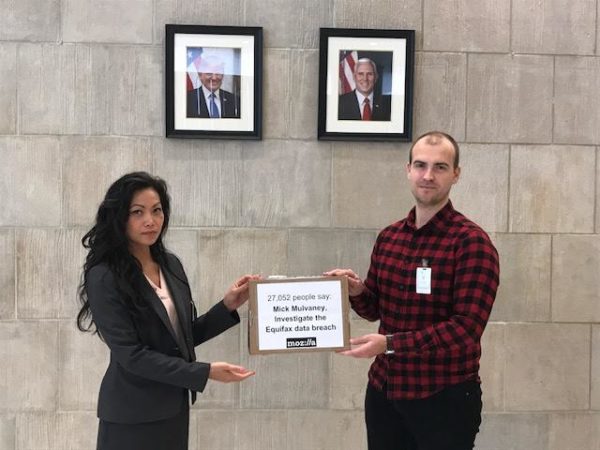
Today, Mozilla is delivering a petition signed by 27,000 Americans to the Consumer Financial Protection Bureau
Today, Mozilla is visiting the Consumer Financial Protection Bureau (CFPB) in Washington, D.C. with 27,052 signatures and a loud message: “Mick Mulvaney, don’t let Equifax off easy.”
Last year’s Equifax data breach was a seismic event: Tens of millions of Americans had their personal information — from Social Security numbers to home addresses — pilfered by hackers, exposing them to fraud and identity theft. Equifax customers in other countries, like the UK and Canada, were also affected.
Then, earlier this month, we learned the breach may have been worse than expected, with Americans’ tax IDs and driver’s license numbers swept up in the hack, too.
This bad news broke just days after an astonishing development: The CFPB is not pursuing an investigation into the 2017 breach.
While the previous CFPB director had ordered a full investigation, the new head, Mick Mulvaney, hasn’t taken any steps forward, like ordering subpoenas for Equifax executives.
Earlier this month, Mozilla launched a petition urging Mulvaney to move forward with the investigation. Today, the CFPB accepted our petition, and Mozilla delivered all 27,052 signatures to the bureau’s headquarters in downtown D.C. What’s next: Mozilla will await a potential response from the bureau.
Says Marilia Monteiro, Mozilla Tech Policy Fellow and former Policy Manager at the Brazilian Ministry of Justice’s Consumer Office:
“Just like faulty brakes in a car or expired food, security breaches can have major effects on our lives. Data breaches don’t just expose consumers’ critical information — they also expose a company’s failure to provide necessary safeguards essential to their service or products. Companies like Equifax must be held accountable. Not doing so sets a bad precedent, especially in countries where the biggest personal databases are government-managed and citizens lack consent. To truly give consumers control of their data, we must ensure the rules are always applied.”
Says Ashley Boyd, Mozilla’s VP of Advocacy:
“At Mozilla, we believe individuals’ security and privacy on the internet are fundamental and must not be treated as optional. It’s a belief enshrined in our founding principles. The decision not to pursue a robust investigation into Equifax is a violation of that belief, and so Mozilla — and tens of thousands of Americans — are urging Mulvaney to change course.”
Mozilla’s Jon Lloyd, right, delivers 27,000 signature to the CFPB
How do you capture small, human moments in a way that feels true to life? In the lead up to the 90th Academy Awards, we’ve been exploring how several different filmmakers create, collaborate, and take risks. We recently caught up with James Laxton—the cinematographer from last year’s Best Picture winner, Moonlight—to hear all about his creative process. Here’s how James thinks about film, from the importance of creative tools to the power of trusting your collaborators.
On how it feels to break into the limelight
It’s been awhile since that Oscar night. How does it all feel?
Oh my gosh. Yeah—there were definitely some emotions which came about that I’ve never experienced before. That was all new for me. [chuckle] That kind of excitement, and anxiety, and stress, and wonderful, loving feelings as well. It was all a bit of a mixture—a stew of emotions.
I walked away from that experience with a sense of belonging. We made Moonlight so far out of studio systems and no one knew who we were. We were very much off the radar. Maybe now, people have a bit of an idea as to what we can do. It definitely got us in the game.
And you are now an Oscar-nominated cinematographer!
Literally every single person in that category for me is someone that I’ve looked up to for a number of years. [Editor’s note: The cinematography nominees last year were Laxton himself, Bradford Young for Arrival, Linus Sandgren for La La Land (won); Greg Fraser for Lion, and Rodrigo Prieto for Silence.] To be in that group of people—and associated with those names and that amount of talent—it was an honor. It meant a great deal to me just because I wanted to be a cinematographer for a very long time.
My mom’s in the business, so I’ve known about that position since I was a child. I’ve been obsessed with those guys for as long as they’ve had careers. And so to spend time with them, get to know them, and to be honored to be nominated with them was definitely something that I’ll never forget.
On how James got started with Moonlight writer and director Barry Jenkins
How do you think your craft has evolved since you first worked with Barry Jenkins on the 2003 short film, My Josephine?
It’s funny. My Josephine was technically the first time we actually collaborated tangibly on a project. Our friendship came before that collaboration, because we were actually roommates. So [we’d already] watched films together, had conversations about the visual language of the medium itself. I think we fell into a bit of a collaboration that I would say it hasn’t changed very much, to be totally honest.
Paramount to any process of collaboration is trust. And you gain that from experiences.
I don’t know that we speak differently or communicate differently today than we did then, oddly enough. I think that has to do with this immense amount of trust that the two of us share. We’re excited about ideas we both come up with and trust one another to extend that within those parameters. That’s how we made My Josephine, and it’s how we made Moonlight, and that’s probably how we’ll continue to share ideas as time goes on as well.
On how building trust leads to creative freedom
What’s the secret sauce for a great collaboration?
There’s all kinds of technical processes that one goes through to find collaboration. And a lot of that has to do with the tools and techniques that you use to communicate ideas between parties. But I think prior to that, obviously paramount to any process of collaboration is trust. And you gain that, I think, from experiences.
A family, for example, has trust because you grew up with a family, and then you have these experiences within that dynamic that then you grow out of. And then you look back and share those moments with your brother or sister, mother or father and say, “We went through this together, and now, I can trust you with anything because we journeyed and grew together as partners.”
I think the same could be said for any kind of collaboration in business, or in my case, in filmmaking. So, I think experiences are a big part of it and a journey that you share with people along the way. Growing throughout that experience as artists is what made the partnership with Barry and the [entire] Moonlight team work. We opened up and took a journey in Miami for a couple of months. One of the things that Barry does very, very well is he allows his collaborators to feel a part of that journey, and I think trust comes inherently in that process.
Then you start to share ideas. If you have this backbone of trust, you can admit that you don’t quite know what someone’s getting at right away, but you trust in that person that they are onto something.
For example, I don’t know how often Barry really says no to an idea I come up with right off the bat. [chuckle] and I think I reciprocate that as well. If he has an idea, my initial instinct is always to say, “Alright, let’s explore this,” even if I don’t quite understand it. Whether it’s a lens choice or a lighting choice, or whatever it might be, to go along with it. And what oftentimes happens is five or 10 minutes later it clicks—then we keep going down the path for a little while. And all that is based on this level of trust. When I come up with a wacky idea that I think is interesting, if that trust wasn’t already there, I don’t know that he would be open to trying it.
You might not even be on the set yet, you might just be in a conversation, you might be meeting in a cafe, you might be having dinner with someone, but the idea that you’re at least with a human being who is open enough to say, “Let’s go through this journey for a little while with some open-mindedness, and see where it goes.” I think that’s a big part of, for me anyway, what the collaborative process is all based upon.
On the challenges of working with new collaborators
So what happens when you don’t have being roommates to build upon, how do you forge a creative partnership?
It’s tough, yeah. It’s so hard. I think on some level it’s almost like speed dating. [chuckle] You have to have a way about yourself that you can ideally, as quickly as possible, get to know someone.
The idea of how to use a tool properly, what uses it has for you—that’s always been something I’ve engaged with.
Aside from working with Barry, I’ve had projects where you’re hired on to do a film, and you might have, say, four weeks of pre-production. So the idea is, within that four weeks, you have to get to know someone really, really deeply. And that’s actually the biggest challenge, more than it is technically getting the equipment out there and ordering the stuff and hiring the camera department and the lighting departments.
What’s the hardest part about that four weeks, I’ve always found, is finding a way to understand the director’s personality and vision and engagement and how they like to work. It’s hard. I actually don’t have any secrets about that. [chuckle]
On the importance of creative tools
What’s your relationship like with technology? Obviously you’re fluent in all things cameras and lenses, but are you someone who embraces technology?
Learning about tools is something I’ve always been interested in. My dad is a carpenter in San Francisco and so I grew up also working with him. Having this hands-on craftsman perspective of my process—I think it stems from that. The idea of how to use a tool properly, what uses it has for you—that’s always been something I’ve engaged with. And couple that with hanging out with my mom on set when I was a 12-year-old kid—she’d oftentimes drop me off at the camera truck and ask the guys to take care of me for the day, [chuckle] I was always excited about that because, to me, the camera department always had the cool toys.
Big crews and lots of support can sometimes be cumbersome. So we took a small crew, a short shooting schedule, and embraced that conceptually.
So I love the idea of learning about new tools, new technology, how to implement them creatively and use them to a function that supports a narrative or supports a tone that you’re looking for now.
That’s always been my process creatively—to have the idea first and then see how to functionally break it down to maybe make sure it’s achievable on the set.
Where have you been able to create an idea by having to discover new technology or bring something new on set?
In Moonlight, the whole visual concept was all about immersiveness, placing the audience directly into the character’s perspective as he goes through his journey. So for us, that meant having the lens as close as possible all the time. And what we learned was we had to use diopters to be successful. Diopters are these things that go in front of the lens that almost look like filters, but then what they do is they allow the focus to shift to a much closer distance. And there’s a lot of technical drawbacks to them. You can’t, for example, go from super close to infinity on the lens, but they do allow you to place the camera much closer to the subject than you would without one.
So the idea to use diopters came after the fact. It was all about, “Let’s make it so they come really close and let’s see what we can do to help us achieve that idea.”
On the benefits of working with a smaller team and a lower budget
You were a one-man camera band on a 25-day shoot! How did you pull that off?
Something Barry and I like is “tempo effect,” when there’s a bit of a pace to things. You can use quickness and speed with agility when you don’t have a massive machine behind you. Big crews and lots of support can sometimes be cumbersome, as well as not supportive. So we took a small crew, a short shooting schedule, and embraced that conceptually.
For example, if Moonlight was made for $50 million, it probably wouldn’t have been as good of a movie, to be honest with you. [Editor’s note: Moonlight only cost about $1.5 million to make.] We might be driving nicer cars but the movie probably wouldn’t be as good. And I think that’s a lot to do with just the material matching the creative. Clearly, we pushed hard and we definitely did as much as we could with the money, so we really stretched the dollar very far. But the roughness, the way the camera moves sometimes in a non-technically precise fashion, I think that only adds to the experience—you feel the artifice of the camera in that.
I love watching for intimacy between characters through the lens. I get a lot out of having an experience in a moment, and then being able to be express it and share it with an audience.
I think that can be a good thing at times. It can be disarming. It can maybe be reminiscent of home movies on some level. Because your stepfather’s operating or your cousin’s operating the camera and it’s crazy. But I think all these things subconsciously lend themselves to some kind of honesty and truth that I think we all associate with as audience members. So, [chuckle] this is a weird answer, but on some level, I think, that the pace and the tempo and the small crew only adds to the film and the end result.
So the limitations that you had in terms of time and budget were things you embraced? Because it matched what the story was trying to achieve?
Yeah. For example, take the swimming scene. We shot that scene in an hour and a half. [chuckle] Because, a lot of it had to do with a storm approaching and things like that, but there’s energy that comes from just getting the camera out there quickly, doing a quick lesson, almost live on camera with those two fantastic performers. I think that energy was present in that moment physically, in Miami in the oceans on that day. It’s very palpable in those images when you see them.
As an audience member, you react to them accordingly and you feel very present in that moment too. If we, for example, shot that scene in a big tank in Los Angeles in Hollywood—with blue screen all around it to make it perfectly exposed—we would complement it later with the effects. But I think all that tangibility and emotional truth that you feel [in the final scene] comes when you see those mistakes, when you see the sky sort of over-exposed at times. All of those things are inherent in the speed and process that we’re going through on that day. I think that’s a great example of where our process, while being challenging, actually was a massive aid to the end result.
On finding your source of creative energy
You mentioned energy there. Where do you draw your creative energy? Where does that come from?
I have an obsessive trait of being very quiet and watchful of people’s interactions. Then what I get to do on set is be peaceful and watchful with characters’ interactions. I love watching for intimacy between characters. That’s something I love and have a great deal of affection for when I see it through the lens. I see characters captured and presented in a way that might allow someone watching the film to have the same experience that I did. Something I get a lot out of is having an experience in a moment, and then being able to be express it and share it with an audience.
A large part [of staying focused] can be attributed to a great crew that is able to do their job and be sensitive to what we all need as creative collaborators on the set.
As a child, I was very watchful and quiet, and I loved new experiences with different kind of people. I lived in San Francisco in a pretty multi-cultural environment. When I went to go play soccer with people after school, this idea of cultures interacting with each other was something I was always very engaged with and really loved. And I think that continues through my adult life, and has transitioned into wanting to share those ideas with people. So, to be able to capture moments within people and characters and cultures and things like that and then present them to people is something I really love. I feel energized when those things happen.
On relying on your team to stay focused
How do you think about focus and being able to realize a vision, even with distractions?
I think a large part of that I will have to attribute to the crew. These are people that didn’t get to stand up on that stage at the Oscars with us, but it should be told there’s no wayI would be able to focus on the creative process if we didn’t have those people making sure we were protected in that bubble, so to speak. A large part [of staying focused] can be attributed to a great crew that is able to do their job and be sensitive to what we all need as creative collaborators on the set.
The obvious stuff is just making sure you are present in that moment as an artist and you’re listening and you’re watching in a way that is sensitive to everyone else’s creative process. But that wouldn’t be able to happen without those people behind the scenes doing their work, moving the lights, making sure they’re working properly, making sure the props are in place properly and the continuity of all those things.
As a cinematographer, you have to, at some point, let go of those things and allow those people to do their jobs. Some people are obsessive and they wanna meddle in everything, but I find myself trying to let those people do their jobs the way they do, in a way that allows me to focus on what I want out of the process. But it was hard. It was challenging in many ways. We were shooting in real places with real life happening outside those doors and down the street. I think we all knew we needed to stay in that moment, and that was enabled by the crew that was around us.
As one of the world’s major mobile operators, Telenor has been connecting people and empowering societies for more than 160 years, from telephone calls to text messages and, more recently, through APIs.
We’ve long recognized the potential of APIs. In Norway, back in the 1990s, we started offering APIs to our business partners that enabled customers to buy ringtones and logos for personalizing the mobile phone—a novel concept at the time.
Today, APIs have become the foundation of the digital transformations happening in organizations around the world. If data is the new oil, then APIs are the pipelines.
Controlling how data moves through pipelines
Over time, we have built and maintained our own solutions for the APIs we offered partners, enabling them to deliver more features and services to customers. But we realized that managing exposed APIs was a bigger job than our current staffing could handle.
Rather than add more headcount, we explored API platform options. We needed a platform that offered API management and access control, so we could control which data that flows through the pipelines and to whom. It was also important to adopt an API platform that would make it easy to deploy new functionality and enable us to monetize API transactions.
A few years ago, we chose Apigee because it checked those (and other) boxes. Initially, Apigee served as the API gateway for our My Telenor app, which enables Telenor customers to interact with their accounts, such as finding out how much data they’ve used in their plan.
Launching our self-service API development portal
More recently, using Apigee we launched the Telenor Developer Portal in Norway, a self-service API development portal with an easy-to-use graphical interface. Our partners had been asking for our help in digitizing their businesses. They wanted APIs from us that would enable them to integrate to our services and help them digitize their processes.
With APIs, we can provide our partners and customers with more agile service deployments, information consistency, and more secure information flow. Security is even more important today as the EU’s GDPR (General Data Protection Regulation) compliance goes into effect. We’re able to have strong authentication and authorization using our APIs, which makes it possible to integrate a variety of information systems and apps from partners that wouldn’t be possible otherwise, such as financial or human resource systems.
Through open APIs, partners can connect their customers to new or enhanced services such as Mobile Payments, Bank ID on Mobile, Mobile Enterprise Network (that gives an overview of all fixed, mobile, and IP-telephony in an enterprise) and Internet of Things (IoT) applications, to name a few.
Selling APIs like any other product
Our new portal enables us to sell and manage APIs as we would other products. It’s completely connected into our billing system, so partners can easily buy an API from the portal and be billed for it automatically—no manual assistance needed from us.
Signing the contract for using the APIs is also done digitally by “click to accept.” The goal is to do everything we can to make our APIs accessible to partners and easily manageable through the graphical interface. We ran a project together with Accenture and Evry to make the complete solution for managing APIs as products. Apigee contributed with a technical expert in the starting phase of our project.
Currently, we have around 20 API products on the portal and over 260 partners are integrated. On our Apigee gateway we now have over 140 API proxies, and many of them have the potential to become new API products.
Like every other major company today, we’re going through a complete digital transformation of our business, and APIs are key to that transformation. For example, we’ve installed the Apigee Edge gateway in all of Telenor Group’s global business units. This can enable us to use the same API development platform throughout the company, and to scale and expose global APIs as needed.
The Apigee monetization module has made it easier to monetize our various APIs, such as charging per transaction via our Mobile User Info API or Device Detection APIs. Overall, we have had a significant amount in direct revenues year over year from our APIs.
Since we’ve been in the API business for years, some of our APIs come from other platforms besides Apigee. As a result, currently, we have a fragmented way of exposing APIs. We’re planning to move most of the work we do with APIs to Apigee to have a unified overview of all our customers and their APIs.
This unified overview will make management significantly easier and help us to immediately know who’s accessing what data from which pipeline. It’s already making a difference, in fact. We can now trace live traffic in the pipelines and see who is using the APIs much easier and faster than before.
Helping partners on their transformation journey
Going forward, we expect significant growth in our business as more enterprise partners around the world increasingly require APIs. We’re in a very good position to help our partners innovate with new services and features—to help them on the digital transformation journey they need to take, to stay competitive.
At Telenor, we have a storied past—160 years is a long time for any company. But it is also 160 years with proven ability to innovate and adapt to changes. This, plus our love for APIs of course, makes us well positioned for our digital transformation journey ahead.
Telenor is one of the world’s major mobile operators across Scandinavia, Central Eastern Europe, and Asia. Elisabeth Falck is product manager for APIs in Telenor Norway’s Business Division and is responsible for the Telenor Developer Portal, new APIs, and is heading Telenor Norway’s API council. Lars Thingstad is System Expert in Telenor Norway’s Technology department and is responsible for the Apigee Edge Gateway in Telenor Norway.
Come hear the Telenor story in person at our I Love APIs 2018 stop in London March 6, where Elisabeth will joint our "Digital Innovators Up Close" session. Register today!
Hover is excited to announce that our partner, Volusion will be participating in the South by Southwest (SXSW) Conference from March 9th to March 17th. SXSW is happening out of Austin, Texas and aims to provide an opportunity for global professionals at every level to participate, learn, and network.
SXSW is an annual conference that allows attendees to connect and discover the latest and upcoming trends in film, culture, music, and technology. It’s a truly awesome event that gives you the choice between different tracks to register for and attend, based on your interests across the industries. We can’t wait to share what Volusion and Hover have in-store for you at the conference.
Volusion is an all-in-one ecommerce solution for entrepreneurs and business owners to sell their products and services. Their platform includes everything you need for a successful ecommerce business, from a website builder, to shopping cart software, to marketing tools. More than 180,000 entrepreneurs have used Volusion to build their e-commerce stores.
Volusion’s goal for the SXSW conference? To get your ecommerce platform launched! Volusion will be taking you through the process of going live with your new online store. Hover will be providing a FREE domain name to every participant who goes through the process of building their e-commerce brand with Volusion. You can choose from some of our Top Level Domains (TLDs) to launch your online store.
You can find Volusion at the ShipStation Lounge Experience on March 13th at the Vuka Gather space for a day full of all things e-commerce. The ShipStation Lounge Experience is free to register and will be offering a day of networking, food, drinks, and panelists. Volusion will be set up to provide you the opportunity to launch your e-store that same day! Volusion experts will be available to walk you through the process, where you can get a domain name from us, a website design, payments setup, discounted shipping rates, and more. Yes, it’s all for free. Entry is first-come, first-serve, so register today and be sure to be there early!
Will you be attending the SXSW Conference? Volusion can’t wait to meet you there. Register today and keep a watch on Hover’s Twitter for shares from Volusion’s experience at the event.
Our home audio streamer Airfoil enables you to send any audio from your computer to AirPlay, Bluetooth, and Chromecast devices. We also expand that ecosystem with our companion app, Airfoil Satellite. Using Airfoil Satellite, you can send audio to Macs, PCs, iOS devices, and more.
Today, we’re thrilled to add an Android version to the Airfoil Satellite family!1 With Airfoil Satellite for Android, you can stream audio from a Mac or PC to any modern Android device (running Android 6 and up). In addition to receiving audio wirelessly, Airfoil Satellite for Android can also remotely control both Airfoil itself, as well as playback from supported source applications.2
Get It Free, Right Now
Airfoil Satellite for Android is an entirely free companion to our paid Airfoil applications. The new Airfoil Satellite for Android 2.0 is available for immediate download from our site. Get full details and download the app from the Airfoil Satellite for Android page.
Footnotes:
We formerly offered an application called Airfoil Speakers for Android which could receive audio from Airfoil, but did not offer remote control of Airfoil or supported audio sources. The new Airfoil Satellite for Android brings the Android platform to full parity with iOS when it comes to Airfoil, and it inherits the old app’s release history.
Speaking of the old app, if you have an older Android device running Android 2.3 through 5.1.1, get Airfoil Speakers for Android from our Legacy page. With it, you can turn those older devices into dedicated Airfoil outputs. ↩︎
See a list of sources supported for remote control on Mac and Windows. ↩︎
It was Fall of 2015 when the team at Mission Bicycle decided to up the ante on commuter bicycles yet again. We had been dreaming for years about tackling security and safety as part of our bicycle design. But some questions began to bubble. How could we improve safety and security without sacrificing minimalism and charisma? How could we take a gorgeous, customizable, minimal, and in many ways ideal city bike, and add usefulness without taking away it’s beauty?
We needed an idea that struck a chord with our brand and vision: customizable, minimal maintenance, subtly gorgeous bikes for commuting city streets daily and nightly. We knew that whatever we designed would need to seamlessly integrate into our meticulously designed frame: any new feature and the bike needed to become and act as one.
As it turns out, we had no shortage of ideas. Said ideas included but were not limited to the improvement and integration of things like cargo racks, security locks, child seats, GPS, speaker systems for horns, lighting, road lasers, wheel locks, and a whole laundry list of others that didn’t quite stick when we chucked them at the wall.
One quick thing to mention about the product ideation process at Mission Bicycle: We encourage everyone to share their ideas, always, no matter how truly terrible they are. Tweak that bad idea a little and you very well may be on to something genius. Some of our best innovations have been born from and prefaced with the phrase “I have a really bad idea…”
So we let all of our ideas, both radiant and horrible, marinate and cross-pollinate until early 2016. That is when design work began in earnest.
Project Objective:
Create a quietly beautiful bicycle design that subtly integrates hidden features. Closer to a traditional bike than an e-bike, and very much at home in a city.
Design Objectives:
Here were our specific design objectives:
Lean and minimalist
Functionality hidden as much as possible without compromising usability
Built on the current Mission Bicycle while also showing progression
And with that, many ideas were dropped like hot potatoes. In fact, after tossing the ideas around for months on end, only one remained. We kept coming back to a simple fact that was brought up by company owner Zack Rosen.
“Cars come standard with lighting, so why shouldn’t bikes?”
Simple, beautiful, and super-bright integrated lighting was to be our next major undertaking as a bicycle company.
But this would be a huge challenge for us. We knew everything about bikes, but we had never tackled electronics before. We knew we would need help.
So we enlisted the help of an electrical engineering friend, Mark Sires of Santa Cruz, CA. He’d made a major breakthrough on a key problem that was stumping many a great mind around the Bay Area we had posed this challenge to: How does one route the cables through the entire bike and potentially through the fork without making them vulnerable?
Sires had the right stuff for the job. He’d get the ball rolling on the ambitious project with the accompaniment of his longtime co-engineer Dan Freeman and our now beloved employee, Ashton Smith, a bike-savvy industrial design student who’d been referred to us by one of his professors.
The development team:
So this became our bicycle design team:
Mark Sires: Mechanical Engineer and man who sparked the integrated lights.
Dan Freeman: Electrical Engineer, and long time co-engineer of Mark’s.
Ashton Smith: Industrial Designer and aspiring mad scientist.
Josh Philippi: Production Manager, and in-house realist with a BS in mechanical engineering.
Jefferson McCarley: Project Manager, idea guy, and hands down best facial hair in the game.
With a full team in place, the future of the project was starting to look…”bright.”
Light puns aside, the team had serious decisions to make in where to strategically place the lighting, how to power it, and a laundry list of other electronics related details we won’t bore you with . A conveniently paraphrased version of the thought process behind our new design looks like this:
First things first, power.
It might sound overboard to some, but we actually created our own custom removable battery for this project. “Why?” would be a completely fair question to ask right now. In response, we’d say because to achieve the level of simplicity and function for this project, it was the best option. We don’t settle for less around here.
Something you may or may not know about most run-of-the-mill bikes featuring integrated electronics is that they require you to plug the entire bike into the wall- Far from ideal in an urban apartment where every square inch of real estate matters. Our San Francisco customers will be especially thankful for this foresight.
We wanted our user to be able to charge anywhere. On the desk at work, at the bedside stand, in the DMV- anywhere. So, rather than using a traditional "star nut" inside the fork, we utilized this space to hold the proprietary battery. The system is fairly complicated, but Ashton and Jefferson collaborated with a company that made something similar. They built on these pre-existing plans to develop the perfect solution for our project.
As for the battery itself, we started with the most durable option we could source, the 18650 (famously used in Tesla vehicles,) and modified it’s positive and negative connections to sit as concentric rings on the bottom of the battery. We wired a micro-usb port into the top for easy universal charging, and viola. A working, removable, durable, battery for use in the head tube of our bike. Click on, click off, untwist the top cap and pull it out when you feel like charging.
The headlight debate.
Would full-on headlights be nice? For sure. Are they absolutely necessary? Absolutely not. As a company with a focus on city riding, it just didn’t make sense. With street lights on every corner, the urban commuter’s need for a light to see is, in reality, much less necessary than a light to be seen by cars, trucks, buses, and the like. Also factored in was the demand for long battery life, which doesn’t go hand in hand with a powerful headlight. In short, a be seen style light was settled on and after riding it for months, we find it to be plenty bright on the darkest of commutes.
Placement and shape.
Things started off smooth. Everyone agreed pretty quickly that the front light should be piped through the fork, and that the rear light should be routed up through the seat tube and into the seat post. The rear lighting was a cinch and came quite naturally, as we adapted a light post we already loved. Shining brightly in a trailing motion à la Knight Rider, our rear lighting was sorted.
The front lights, on the other hand, were a bit tricky and took considerably more drawing board time to finally come out with something inherently Mission. They needed to be functional, but also represent the brand ethos of minimalism and understatedness. Idea after idea was thrown out until it was discovered that by running LEDs unconventionally down the inside of the fork blades at a slight angle, we were able to house them discreetly, keep them protected, and allow them to throw a beautiful cross beam, offering near 360 degree visibility of the rider.
Printed circuit boards.
“The brain” and the button board were a massive team effort that included physical design by Mark, UX and UI by Ashton, and Electrical Programming by Dan and Mihai. They manage all of the power and behaviors of the lights, while taking up minimal space. Their clean design allows the user an intuitive experience sans clutter or ugly parts showing.
3D printed parts and button design.
Mark kept his 3D printer going nearly 24/7 for the duration of the project, as our small quantities couldn't justify having big injection molds made. In addition to cost effectiveness, 3D printing them in Santa Cruz allowed us to get our hands on them hot off the press, and make adjustments on the fly. Possibly the biggest win to come of this was our final version of the button, and we'll just say that a lot more goes into a button than one might think. The look, the feel, and the tactile "click!", all needed to be spot on, not to mention keeping water out and staying durable. Ashton and Mark were head to head on this one for a while, eventually working out a great solution with many many "learning opportunities" along the way.
Minor additional changes. Should we add anything?
Short answer, yes. Branding is something we’ve battled with off and on for years. We never wanted to be the company that throws a huge logo across the downtube and makes you, our customer, ride around town as a rolling Mission Bicycle Billboard. We won’t name names. The thought has always been that our bikes are designed by you, and should serve as a rideable reflection of your personal style. That’s what we’re all about. Having said that, we wanted to brand our bikes moving forward, but in a subtle way that no other bike company has ever done before. The solve comes as a classy set of M’s adorning the upper outsides of our new fork blade. Beautifully welded, understated, unconventional, and a testament to what we stand for here at Mission.
As a last treat, we figured we’d give in, only slightly, to the fat tire craze that seems to have swept the bike world these past few years. Our new forks have opened up to fit a 32c tire, for all our customers looking to get a softer ride on their commute or even add a little tread to their tire. It’s no mountain bike, but we’re confident your new bike won’t shy away from the occasional fire road.
We’d go on to spend over a year prototyping, riding, wiring, rewiring, troubleshooting, breaking and rebuilding various versions of what would become the bike we are officially releasing today. As a whole, this project took years of collective effort from our staff and we couldn’t have done it without each and every one of them. Cars come with lights, and now so do our bikes.
No longer will lights be remembered, forgotten, lost, or stolen. They’ll just be with you, wherever life takes you. We hope you enjoy the ride as much as we do.
With that, we’re happy to announce the addition of integrated lighting as a standard option on all Mission Bicycles moving forward, AND as a bright new addition to our online builder.
There’s something gratifying about toggling between day and night modes while designing the bike of your dreams. Trust us. Check it out here.
Scientists of all stripes are beginning to discover that the primary tool of science — analysis, the separation of things into ‘discrete’ parts and the modeling of their ‘separate’ behaviour to try to explain cause and effect (and everything else) — is pretty seriously flawed. As a result, their models of reality are beginning to converge with those of some modern philosophers.
Gould and Lewontin have written that the attempt to study genes, organisms and their environments as if they were separate entities is a largely hopeless process, because these elements of life co-evolve in such an intricately intertwined and complex way that teasing them apart is impossible. We are, they explain, pluralities, and inextricable parts of everything-that-is.
Cohen and Stewart have written that our sense of being separate ‘selves’ is a mental construct, an unreal ‘figment of reality’, and that this sense was an exaptation — an accidental consequence — of our brains’ “feature detection system” (the centralized capacity to recognize qualities outside the ‘complicity’ of the body’s constituent organs and environments that evolved for their collective benefit), when that system turned inward and began to explore and try to make sense of ‘itself’.
Radical non-duality asserts that this illusory sense of separation is unnecessary and even deleterious to our bodies’ functioning, causing needless anxiety and suffering that accompanies the delusion of personal agency, responsibility, control, choice and free will.
Cognitive scientists are now confirming that this separate ‘self’ can indeed not be located, and that the brain’s apparent ‘decisions’ are actually after-the-fact rationalizations for what the embodied and enculturated complicity we think of as ‘us’ has already begun to do. The only way the brain can ‘make sense’ of actions, once it tries to factor a separate self with agency into its equations, is to incorrectly attribute decisions to its ‘self’ — and then second-guess, regret, blame or congratulate its ‘self’ for them.
Some physicists are now doubting the existence of time as anything more than a mental construct. Just as the brain (the feature detection system) assigns colours and other qualities to what it ‘sees’, when those colours aren’t real, just a coding system, it assigns times to what it ‘recalls’, when there is actually no past or future. It’s a convenient way for the brain to categorize, but it seemingly does not represent anything real. Everything-that-is is timeless. Eliminating time from what is allegedly real vastly improves and simplifies many scientific models, from quantum theory to astrophysics.
None of this is currently helpful, or even especially useful, which is undoubtedly why neither scientists nor philosophers coming to this realization (often reluctantly) are talking about it very openly. Science, and the brain, hate anything too complex to be known and understood and acted upon — it prevents them from doing their work, and casts profound doubt on their hard-won models of what is. Even some radical nonduality proponents worry aloud (needlessly IMO) that most people (or at least their brains) can’t handle the truth that the self, and free will, don’t exist (and that life, therefore, has no meaning, and that nothing matters).
It would profoundly change the nature of both science and philosophy to acknowledge that reality is not knowable, not explainable, that nothing is separate, and that everything-that-is is a mystery. The word mystery has the same root as the word mute, and neither scientists nor philosophers like to be rendered mute.
Nevertheless, I believe it will come to that. Scientists can only ignore the facts for so long before reluctantly relenting. And we are such curious creatures that we would prefer accepting mystery to being lied to. And if we in fact have no real selves and no free will, that acceptance won’t change our behaviours, and might relieve some of the guilt, fear and other stressful feelings that stem from a belief in our agency over our actions. That might in turn begin to modify our enculturation of our children and each other. I have a fanciful idea that, in time (our species are after all newcomers to life) this might lead to us doing much less, and just being more — and ultimately ceasing our incessant chatter about what to do and what we think we know, and becoming, once again, mostly mute, simply enjoying the wonder of all-that-is.
In the meantime, while it can’t be helped, we have no choice but to suffer with the illusion of our separation, our self-hood, and our supposed agency. It gives the term ‘separation anxiety’ a whole new spin. It’s an affliction, as real to ‘us’ as a lifelong hallucination, and it’s highly contagious. Collectively, it’s what I have called ‘civilization disease’ — the mental and often physical illness that accompanies the stress of believing what seems obvious (and what we’re told) but which is in fact completely fabricated by the brain in its obsession to try to make sense of everything, including its apparent self.
It seems to be in the nature of the self to try (hopelessly unfortunately, since it has no agency) to maximize pleasure and minimize pain. Modern humans have found many ways (drugs, amusements, comforts and distractions) to escape the pain of civilization disease. No blame in that — we have no choice after all, and our embodied and enculturated conditioning naturally tends us towards such preferences. This is what radical nonduality refers to as “making the prison of the self more comfortable”.
The creature apparently writing this seems to have an innate preference for comforts over other forms of escape. I like to read and learn new things, to lie on a warm beach, to surround myself with beauty. I like tart flavours, moody lights, well-crafted music, writing, art, and other gentle sensory pleasures.
I have lost much of my interest in conversation and in story (whether written or in audiovisual formats); these are too personal, now, too close to the bone of self, too much a reminder of the disease. Even my short stories, now, are about rejection of the old stories, and about imagining what might be possible if we can move past them.
I know that in writing all this I am running the risk of annoying readers who find this message disturbing, or even see it as evidence of mental illness or indoctrination. I ran the same risk when ten years ago I began conveying my then-new belief that our civilization is inevitably in its final decades, and could not and should not be ‘saved’. This blog has always chronicled my evolving sense of what’s possible and what’s true, and I’m not about to self-censor now. I’m not looking for anything from readers; if you find this interesting or even comforting, that’s great, but if you don’t please just stop reading and go read something elsewhere that resonates more for you.
Coming up, some new poetry and music I’ve been working on.
Prior to the release of the Mozilla Observatory in June of 2016, I ran a scan of the Alexa Top 1M websites. Despite being available for years, the usage rates of modern defensive security technologies was frustratingly low. A lack of tooling combined with poor and scattered documentation had led to minimal awareness around countermeasures such as Content Security Policy (CSP), HTTP Strict Transport Security (HSTS), and Subresource Integrity (SRI).
Since then, a number of additional assessments have done, including in October 2016 and June 2017. Both of those surveys demonstrated clear and continual improvement in the state of internet security. But now that tools like the Mozilla Observatory, securityheaders.io and Hardenize have become more commonplace, has the excitement for improvement been tempered?
Improvement across the web appears to be continuing at a steady rate. Although a 19% increase in the number of sites that support HTTPS might seem small, the absolute numbers are quite large — it represents over 83,000 websites, a slight slowdown from the previous survey’s 119,000 jump, but still a great sign of progress in encrypting the web’s long tail.
Not only that, but an additional 97,000 of the top websites have chosen to be HTTPS by default, with another 16,000 of them forbidding any HTTP access at all through the use of HTTP Strict Transport Security (HSTS). Also notable is the jump in websites that have chosen to opt into being preloaded in major web browsers, via a process known as HSTS preloading. Until browsers switch to HTTPS by default, HSTS preloading is the best method for solving the trust-on-first-use problem in HSTS.
Content Security Policy (CSP) — one of the most important recent advances due to its ability to prevent cross-site scripting (XSS) attacks — continues to see strong growth. Growth is faster in policies that ignore inline stylesheets (CSS), perhaps reflecting the difficulties that many sites have with separating their presentation from their content. Nevertheless, improvements brought about by specification additions such as 'strict-dynamic' and policy generators such as the Mozilla Laboratory continue to push forward CSP adoption.
Mozilla Observatory Grading
Despite this progress, the vast majority of top websites around the web continue not to use Content Security Policy, Strict Transport Security, or Subresource Integrity. As these technologies — when properly used — can nearly eliminate huge classes of attacks against sites and their users, they are given a significant amount of weight in Observatory scans.
As a result of their low usage rates amongst top websites, they typically receive failing grades from the Observatory:
Grade
April 2016
October 2016
June 2017
February 2018
% Change
A+
.003%
.008%
.013%
.018%
+38%
A
.006%
.012%
.029%
.011%
-62%
B
.202%
.347%
.622%
1.08%
+74%
C
.321%
.727%
1.38%
2.04%
+48%
D
1.87%
2.82%
4.51%
6.12%
+36%
F
97.60%
96.09%
93.45%
90.73%
-2.9%
We do see some significant improvements. As 976,930 scans were successfully completed in the last survey, a decrease in failing grades by 2.9% implies that over 27,000 of the top sites in the world have improved from a failing grade in the last eight months alone. Note that the drop in A grades is due to a recent change where extra credit points can no longer be used to move up to an A grade..
Thus far, over 140,000 websites around the web have directly used the Mozilla Observatory to improve their grades, indicated by making an improvement to their website after an initial scan. Of these 140,000 websites, over 2,800 have improved all the way from a failing grade to an A or A+ grade.
When I first built the Observatory at Mozilla, I had never imagined that it would see such widespread use. 6.6M scans across 2.3M unique domains later, it seems to have made a significant difference across the internet. I couldn’t have done it without the support of Mozilla and the security researchers who have helped to improve it.
Please share the Mozilla Observatory so that the web can continue to see improvements over the years to come!
For several years I have been saying that I can't think of any famous consumer-facing brands that have been built primarily by online advertising.
Whenever I write this I get one comment that is absolutely predictable. I usually get it from people who have an economic or ideological reason to defend digital advertising, but sometimes it's from people who just don't think too well. The response is, "oh yeah, how about Google and Facebook and Amazon?"
So once and for all let me deal with this so the next hundred times I get this comment I can just reply with a link to this post.
Google, Facebook and Amazon were not brands built by advertising.
There are several ways brands become big and famous. Advertising is only one of them. The other ways include: word of mouth, PR, news media coverage, ubiquitous public visibility (wide distribution.) These "non-advertising" ways usually revolve around uniqueness.
In other words, for many famous brands advertising plays a large role in their success. For some it plays little or no role.
I believe in the case of most of the famous web endemic brands -- those brands that live on the web like Facebook, Google and Amazon -- advertising played little to no role in their success. This is also true of a few non-web-native brands like Tesla.
It's my belief that advertising had very little to do with the success of Google, Amazon, Facebook and Tesla. They became famous primarily through news media coverage and word of mouth resulting from being unique.
I can think of a hundred Coke, Nike, McDonald's or Apple ads I've seen. I can recall only a handful of ads for the Google, Amazon and Facebook brands combined.
One of the confusing factors is that some of these companies - in particular Google and Facebook - make almost all their money from advertising. But as brands, they did not need much advertising to become famous. Mass media did it for them.
Getting back to the issue in question, it is my contention that Google, Amazon and Facebook did not rely on advertising for their success in the same way that Coke, Apple, Nike, or McDonald's did.
I still maintain that it is very hard to find any famous consumer-facing brands that were built by online advertising.
It’s been an exciting couple of weeks here in PEI. We’ve launched the first part of the training and discussion for our maker cart project. We’ve been working on pulling together all our information pieces on supporting technology in the system. We spoke with the principals about our work and have had a fair number of them reach out excited to get involved. We’ve been thinking about how technology can support language arts. We’ve been working towards better basic training in technology in the form of google certified educator. We’ve been thinking about how we can improve our wireless infrastructure in the long term. The digital strategy committee approach (yup, I suggested we solve a problem with a committee) has been fantastic. As always… getting the decision making worked out is a critical step in the process, many thanks to the leadership in k12 here for letting us set it up.
Digital Practices
Dedicated time-for-learning is critical for digital transformation (or, really, any change project). While we are planning learning events with teachers for both the maker work and with google, getting time-for-learning with the curriculum consultants and the coaches is just as important. This week we start a 2 month-ish course on digital practices. The course itself is based on the ed366 course I taught at UPEI for years, but modified for smaller class sizes and the more specific use case of being within an education system.
‘Digital Practices’ are the things that I do that are born out of the affordances of our digital communications platforms. It is an assemblage of the digital skills i might have mediated through the digital literacy and habits that i have acquired. Or, to put it more simply, it’s ‘being digital’.
It’s tricky business, talking about this stuff, and it inevitably leads to some contradictions. One of the biggest advantages of digital spaces, from my perspective, is the return to orality. When we depend on a finished text (say, a printed book) to arrive to us in the mail, we are the receivers of the knowledge that is contained therein. I can certainly work through that text with my other, previous learnings, but I never get a chance to contribute, to ask questions that can get answers… I’m not part of the knowledge creation process. When we think of an oral discussion (at least, a good one) there is a chance for both sides to contribute, a chance for us to move together to a new understanding. Digital spaces allow for this to happen with text. We can collaborate on something that becomes knowledge through our interactions with it.
It’s not all sunshine and roses of course. Collaborative texts tend to reduce themselves to consensus… which can be nice, but can sometimes privilege existing ideas over new ones. There is much greater safety in sending out a printed text that people read when you’re not in the room. If the reader hates it, or it makes them angry, you are not in the immediate line of fire. These advantages and disadvantages need new social norms… new practices to make them effective and still maintain our own healthy relationships. These digital practices need to be negotiated, they need to be talked about out loud in ways that many of our 20th century practices don’t. I’m going to run a course about this. It’s going to be fun. A few opening thoughts…
Tools vs. practices
Years of teaching courses like this have lead me to believe that most people are coming expecting to learn ‘how to use a bunch of tools’. I can totally understand this. You see people using tools, they claim to be effective with them, you too want to use the tools. Truth be told the ‘how’ of these tools has simplified (in most cases) to the point where the technical using of them is an almost incidental part of the learning process. There’s all the world of difference between ‘learning how to use a hashtag’ and ‘knowing how to use a hashtag to avoid getting it hijacked’. One involves knowing that when you put a character (#) in front of a word it becomes a tag, and the other involves hours of working in an environment to come to understand how twitter spam/trolls work. People will probably learn how to use tools in the course, but I probably wont be teaching much of it.
Complexity
I’m still pretty stuck on the idea of complexity being important when teaching digitally mitigated practice. I think that separating things to learn out into simple, complicated and complex concepts allows us to make space between things that are easily accomplished by more rote means and those that require us to settle into a concept and work our way around inside of it.
Maker
There’s always been a maker strand in my work, but I’ve never formally acknowledged it. I was uncomfortable with the term, but the last six months preparing a maker project here in PEI has led me to feel much better about it. I’m expecting to have a big solid maker section in this course and to use it to demonstrate differing analogue/digital approaches to learning/teaching with it. Do I need to have ideas for the kids before I arrive? How do I structure student lead ideation so that all my students can succeed and I don’t make it teacher centric? Is the internet really full of good ideas? How can I work with other teachers to create more relevant ideation spaces?
Community as Curriculum
It always come back to this for me. I feel more strongly about it now then when i first wrote it 10 years ago. The goal for me is for each person in this course to be able to be able to become a member of a conversation in a community of knowing in the subject. Can you pass? Can you engage? Do you know how to ask questions? Do you speak the language? Can you help? We learn to become members in a community of knowing by practicing and learning together. When the community is the curriculum.
Citizenship
At the end of the day practices lead to citizenship, as they do in the rest of our lives. The ways in which we interact with each other, with our community, our schools ourselves… these all make up our actions as citizens. As more and more of our communications are mediated through the internet, more and more of our lives as citizens are mediated through it as well. If our schools prepare citizens, it is essential that they prepare them for being good citizens, online or offline.
From Park People.ca and Ken Greenberg comes the video by Garrick Mason “Something New from Something Old” describing some unique and some familiar concepts in making great public spaces. Using conversations with urbanists in New York City and in Toronto, the film explores how low density streets can give up much space for the car, but space for humans walking and biking is still a street fight. Opportunities for more green space has come with the “glacial recedence of industrial uses that have revealed new opportunities. Eric Landau with the Brooklyn Trust describes how the area under DUMBO (Down under the Manhattan Bridge Overpass) has been transformed from industrial to park space. With ten per cent of the area being developed to cover the operational and maintenance costs of the new Brooklyn Park, former five acre industrial docking piers have been transformed into park experiences, each with their own unique purpose and use.
Opening up with music that was first performed by singers on New York City’s Highline, the film discusses the importance of public/private financing, noting that redeveloping green space as amenities creates real estate value for surrounding properties.
As the film maker observes: ” I decided to ask experts, designers, and planners involved in some of the highest profile conversion projects in Toronto and New York City about the rationale behind these conversions, the challenges involved in designing under such novel constraints, and the difficult issues — like funding, accessibility, benefit sharing — that come with them. Their answers were both fascinating and encouraging, pointing to a world in which the development of cities will have more to do with gracefully evolving in place than with spreading outwards to infinity. ”
You can watch the video on Vimeo by clicking on the blue tab on the “Sorry” link below.
Price Tags Vancouver will be following the civic election, and posting the statements of all candidates running for City of Vancouver Council. Here is the statement from Brandon Yan:
I’m Brandon Yan and I’m seeking a OneCity Council nomination for Vancouver’s civic election in October 2018.
I am an optimistic 31 year old and a passionate community advocate for sustainability, affordability, education, and human rights. Currently, I am the Education Director for Out On Screen, one of Vancouver’s leading arts and advocacy non-profits. In that role, I’ve collaborated across political parties and within government ministries to affect positive policy change for LGBT2Q+ youth in BC – crucial experience for the complex work that needs to be done on City Council in advancing equality and inclusion in our city. I believe that the core to any good policy or decision-making is keeping in focus the people who you intend to lift up. I believe the cause to help others should transcend politics.
I was born in Vancouver and I have lived and worked in the region for most of my life. For the last 4 years, I’ve called Kitsilano home, renting one of Vancouver’s elusive pet-friendly apartments with my partner Sam and our two dogs. I completed my Masters in Urban Studies at SFU researching civic education and public engagement practices in the City of Surrey, and I have also served on the City of Vancouver’s City Planning Commission from 2014 to 2016.
Based on my conversations with Vancouverites and based on my own experiences, I’ve decided to highlight a few areas where I’ll be focusing some of my attention:
RENTER REPRESENTATION Renters comprise more than 50% of Vancouver households and yet very few renters sit on Vancouver City Council. With a vacancy rate below 1%, renters deserve more representation to support the creation of more rental homes and to also ensure tenant’s rights are protected.
THE REGION AS A SOLUTION Vancouver’s problems are bigger than the city itself; the housing and opioid crises don’t end at our municipal borders. Effective government and effective solutions will mean working with our neighbours, improving our relationships to each other, and moving forward together. This includes local First Nations and the Urban Indigenous community.
POVERTY IS NOT A CRIME While forces of inequity cause people to sleep on sidewalks and in cars and tent cities, their right to exist in these spaces is often called into question or criminalized through anti-homeless, anti-poor bylaws and other dehumanizing strategies that deny them basic human dignity. The City must ensure that its actions don’t further harm or stigmatize those living in precarious housing and shelter situations.
YES FUN CITY Vancouver’s heart and soul are found in its people and in its arts and cultural communities. From our street festivals like Khatsahlano, Greek and Italian Days, and Vaisakhi to the work of Youth Collaborative for Chinatown and BEATS Magazine, these things people together across cultures and generations. We don’t need to fight for beauty, we just need to work to recognize and celebrate it and do more for our artists and arts and cultural groups so that they can continue to inspire us.
I hope to bring my experience and regional perspective to work on these issues and opportunities facing Vancouver today. We know we’ve got work to do, so let’s work together.
Schöne These von Grafikdesigner und Typograf Kurt Weidemann, die ich dennoch nicht abschließend und endgültig bewerten mag. Und bei der ich an Graffiti denken muss. Jenes, das die meisten da draußen nicht ganz so geil finden. Aber das nur mal am Rande.
Earlier this week, it was debunked that Google was bringing a dark mode to Android, but it was discovered on Feb 27th, 2018 that a dark mode was making its way into developer builds of Chrome OS.
This dark mode turns the app launcher and the system tray from white to black. Even this simple tweak could bring Chrome OS up to par with the dark mode on MAC OS and Windows 10 anniversary.
Consumers have been asking Google to bring a dark mode to Android and Chrome OS to make all of its products up to the same standard as YouTube.
So far, if you wanted to implement dark mode on Chrome OS, you need to be in the developer channel and look for the new system menu.
While a dark mode can help with some eye strain on mobile where the screen is more predictable, it does allow uses a small form of customization that has been unavailable on Chrome OS.
Hopefully Google will announce an official update soon and all Chrome OS users can try out this new visual tweak.








 As one of the world’s major mobile operators, Telenor has been connecting people and empowering societies for more than 160 years, from telephone calls to text messages and, more recently, through APIs.

 Our home audio streamer
  Today, we’re thrilled to add an Android version to the Airfoil Satellite family!





 Das Kraftfuttermischwerk.

