Shared posts

20 Mar 19:50

“Tillerson is gone – the first Cabinet secretary ever to be fired by tweet”

by Andrea

The New Yorker: Rex Tillerson Gets Fired the Day After He Criticized Russia. By John Cassidy.

““There is never a justification for this type of attack – the attempted murder of a private citizen on the soil of a sovereign nation – and we are outraged that Russia appears to have again engaged in such behavior,” Tillerson’s statement said. “From Ukraine to Syria – and now the UK – Russia continues to be an irresponsible force of instability in the world, acting with open disregard for the sovereignty of other states and the life of their citizens. We agree that those responsible – both those who committed the crime and those who ordered it – must face appropriately serious consequences. We stand in solidarity with our Allies in the United Kingdom and will continue to coordinate closely our responses.”

This was arguably the strongest condemnation of Russian behavior that the Trump Administration has ever issued. And it turned out to be one of Tillerson’s final official acts as Secretary of State. At 8:44 A.M. on Tuesday, Donald Trump announced Tillerson’s firing on Twitter. “Mike Pompeo, Director of the CIA, will become our new Secretary of State,” Trump wrote. “

Link via Garret.

20 Mar 19:50

Firefox Performance Update #3

by Mike

Hi! I’ve got another slew of Firefox performance work to report today.

Special thanks to the folks who submitted things through this form to let me know about performance work that’s taken place recently! If you’ve seen something fixed lately that’ll likely have a positive impact on Firefox performance, let me know about it!

So, without further ado, here are some of the folks who have made some nice improvements to Firefox performance lately. Thanks for making Firefox faster and better!

20 Mar 19:50

Every Function Has a Superpower. What’s Yours?

by Adam Nash

Over the course of my career, I’ve been fortunate enough to work in a variety of different functions.  No matter whether it is engineering, design, product, or service, every role has its own unique set of requirements and challenges.

Maybe that’s why I have always believed strongly that software is a team sport. If you want to build exceptional products, you have to find a way to harness the unique and diverse viewpoints of a team of professionals across a wide variety of functions.

Unfortunately, even at great companies, there is a repeated pattern where people in some functions feel disempowered. This doesn’t need to be the case.

Every function has a superpower. Make sure you know what yours is.

Every Function Has Value

Hypergrowth software companies are relentless in their pursuit of efficiency. Everyone who joins a new company dreams of building something new, something better than the companies that came before it. As a result, startups are always questioning the breakdown of functions in older, more established companies. In addition, resources are always tight, as companies stretch to make every dollar of funding count.

Unfortunately, this also means that many startups repeat the same mistakes over and over again when it comes to recognizing the value of different functions in a modern software company. This can be compounded by having a founding team or early employees who have never worked in those functions before.

You don’t really know a function until you know someone who is exceptional at it.

Inevitably, most startups, even when they have grown to hundreds of people, have gaps in their understanding and appreciation of some functions.

Avoiding Decision By Committee

Besides the lumpy build-out of different functions at fast-growing companies, the need for fast decision making also tends to bias the product process.

Great companies tend to be opinionated in their decision-making process around product, and those processes can vary significantly. Some companies may overweight decisions from engineering, others might look to a strong product function. There are companies that are largely sales-driven, and others that rely on general managers. There are companies where decision-making is hierarchical, deferring to the CEO or founder for key product calls, and others where decision-making is distributed broadly to the teams.

This isn’t surprising, however, because there is a direct tension at companies between the speed of execution and the exhaustiveness of a process. As a result, almost every product-centric company seeks to avoid “decision by committee” by assigning decision responsibility to a function or a hierarchy.

No matter what system exists, there are always people and functions that feel disempowered by the process.

Know Your Superpower

While you may not be the one to make the final product decision, it is a mistake to feel disempowered. Your function has unique value, and you can dramatically shape any product decision through your efforts.

The key is to know your superpower.

Every function has one. Here are just a few examples:

  • Engineering. Every engineer has the ability to take what is and isn’t possible off the table. I’ve seen product strategy discussions completely changed in a single weekend by engineers building something that no one else had even considered. The power to create is an awesome one, and the best engineers use this power to open the eyes of their teammates to what can be accomplished.
  • Design. Most people can’t visualize the different options that are possible around a given feature or product, and design has the power to reshape discussions completely based on visualization. Design can eliminate theoretical options, define the choices available, and most importantly trigger a deep, emotional response to certain choices in decision makers.
  • Product. At some companies, product managers have procedural power to make decisions. However, the most effective product managers use their power to frame the discussion with strategy and metrics to help drive decisions. The power to define the framework for a decision often is the power to control the decision.
  • Client Service. If you spend your day talking to real customers about real problems every day, you have amazing power to bring issues to the fore. Sometimes a decision is swayed by the scale of the problem, other times by the severity. Never underestimate the power of narrative, driven by real customer stories, to shape decisions on product and prioritization.

Every function has a superpower and everyone has the ability to do the extra work necessary to tap the unique capabilities and resources of their function to use that power to shape decisions. It requires work, but no matter what your function or role is, you can heavily influence critical decisions.

You just need to find your superpower.


20 Mar 19:50

Raspberry Pi 3 Model B+ on sale now at $35

by Eben Upton

Here’s a long post. We think you’ll find it interesting. If you don’t have time to read it all, we recommend you watch this video, which will fill you in with everything you need, and then head straight to the product page to fill yer boots. (We recommend the video anyway, even if you do have time for a long read. ‘Cos it’s fab.)

A BRAND-NEW PI FOR π DAY

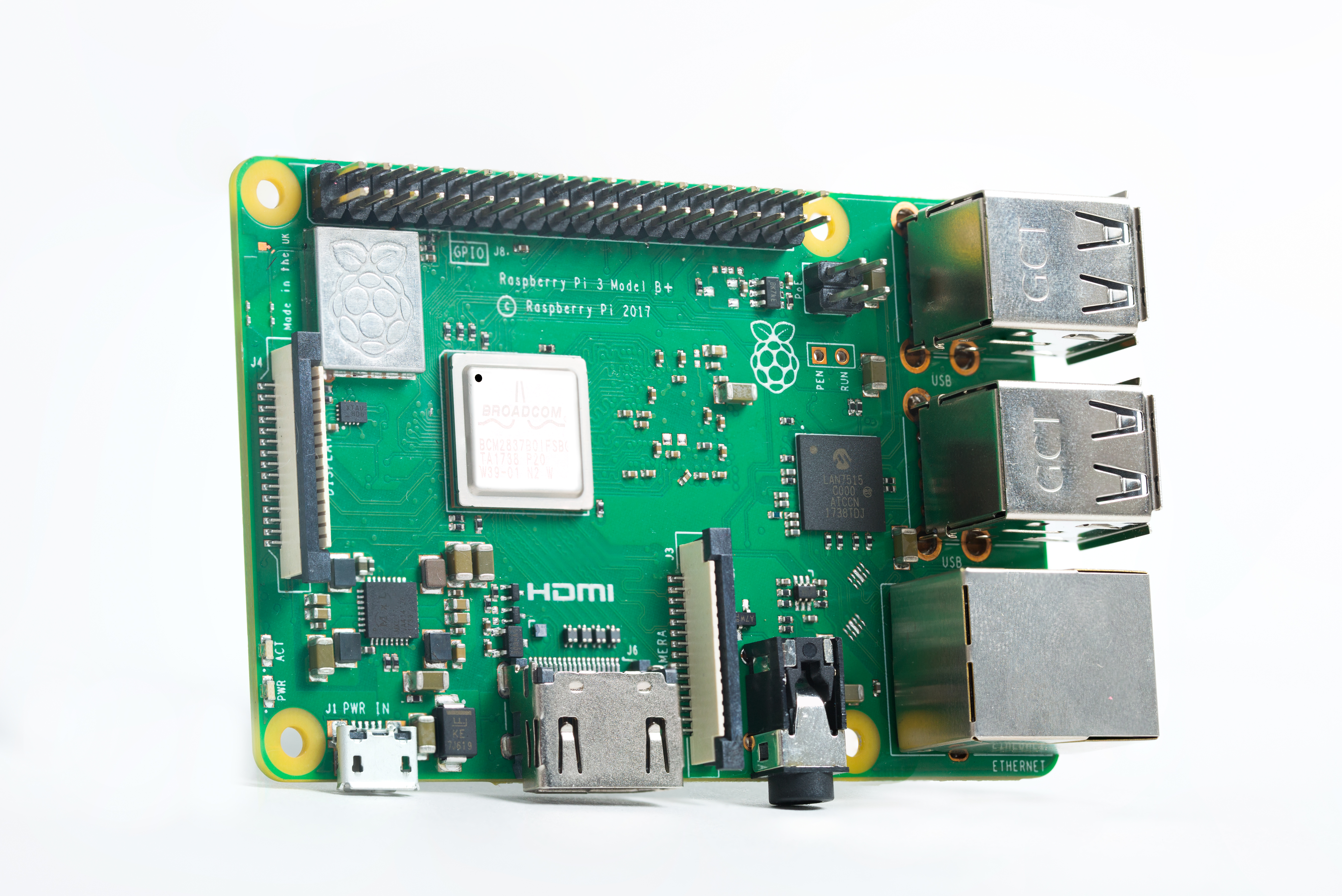
Raspberry Pi 3 Model B+ is now on sale now for $35.

If you’ve been a Raspberry Pi watcher for a while now, you’ll have a bit of a feel for how we update our products. Just over two years ago, we released Raspberry Pi 3 Model B. This was our first 64-bit product, and our first product to feature integrated wireless connectivity. Since then, we’ve sold over nine million Raspberry Pi 3 units (we’ve sold 19 million Raspberry Pis in total), which have been put to work in schools, homes, offices and factories all over the globe.

Those Raspberry Pi watchers will know that we have a history of releasing improved versions of our products a couple of years into their lives. The first example was Raspberry Pi 1 Model B+, which added two additional USB ports, introduced our current form factor, and rolled up a variety of other feedback from the community. Raspberry Pi 2 didn’t get this treatment, of course, as it was superseded after only one year; but it feels like it’s high time that Raspberry Pi 3 received the “plus” treatment.

So, without further ado, Raspberry Pi 3 Model B+ is now on sale for $35 (the same price as the existing Raspberry Pi 3 Model B), featuring:

  • A 1.4GHz 64-bit quad-core ARM Cortex-A53 CPU
  • Dual-band 802.11ac wireless LAN and Bluetooth 4.2
  • Faster Ethernet (Gigabit Ethernet over USB 2.0)
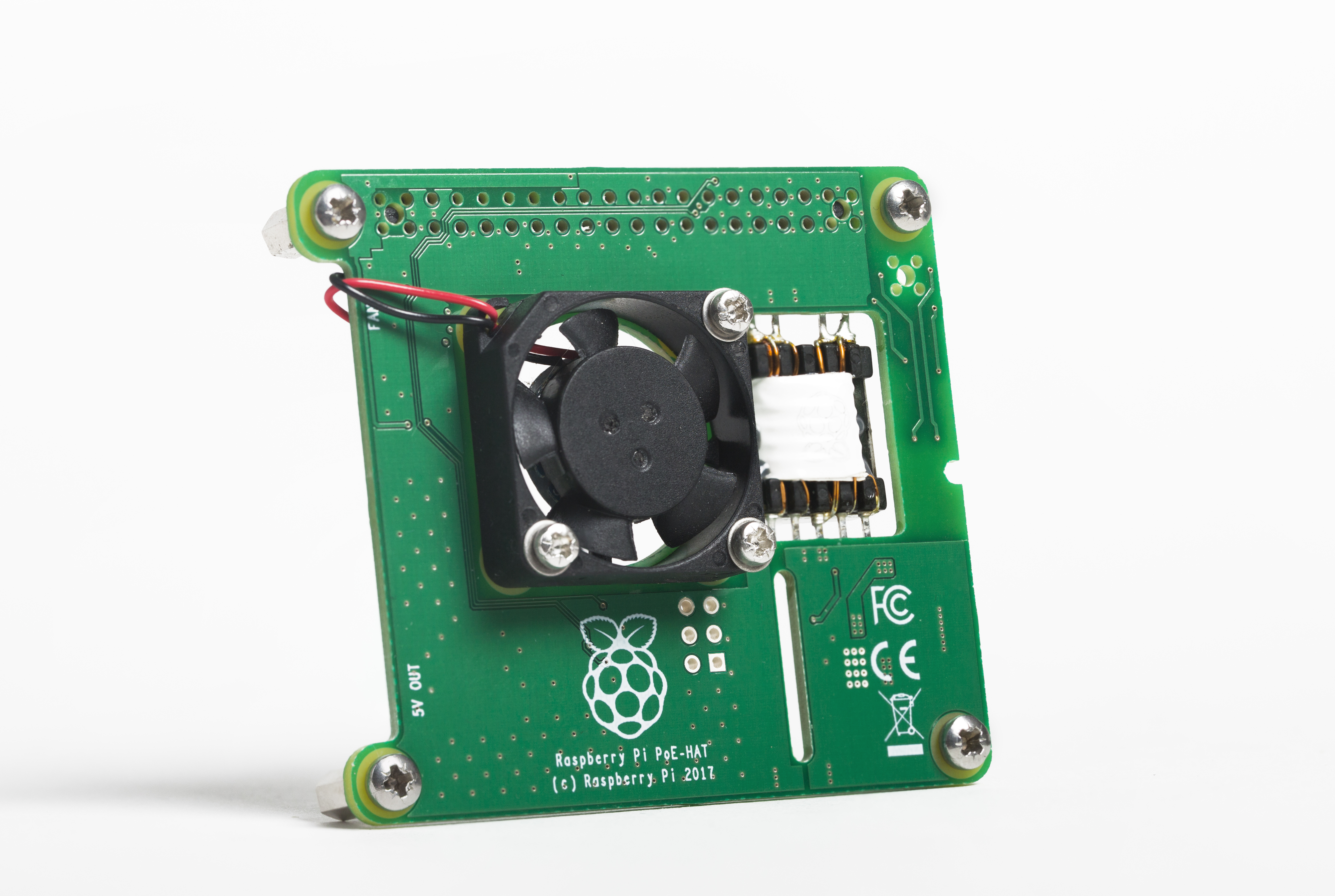
  • Power-over-Ethernet support (with separate PoE HAT)
  • Improved PXE network and USB mass-storage booting
  • Improved thermal management

Alongside a 200MHz increase in peak CPU clock frequency, we have roughly three times the wired and wireless network throughput, and the ability to sustain high performance for much longer periods.

Behold the shiny

Raspberry Pi 3B+ is available to buy today from our network of Approved Resellers.

New features, new chips

Roger Thornton did the design work on this revision of the Raspberry Pi. Here, he and I have a chat about what’s new.

Introducing the Raspberry Pi 3 Model B+

Raspberry Pi 3 Model B+ is now on sale now for $35.

The new product is built around BCM2837B0, an updated version of the 64-bit Broadcom application processor used in Raspberry Pi 3B, which incorporates power integrity optimisations, and a heat spreader (that’s the shiny metal bit you can see in the photos). Together these allow us to reach higher clock frequencies (or to run at lower voltages to reduce power consumption), and to more accurately monitor and control the temperature of the chip.

Dual-band wireless LAN and Bluetooth are provided by the Cypress CYW43455 “combo” chip, connected to a Proant PCB antenna similar to the one used on Raspberry Pi Zero W. Compared to its predecessor, Raspberry Pi 3B+ delivers somewhat better performance in the 2.4GHz band, and far better performance in the 5GHz band, as demonstrated by these iperf results from LibreELEC developer Milhouse.

Tx bandwidth (Mb/s) Rx bandwidth (Mb/s)
Raspberry Pi 3B 35.7 35.6
Raspberry Pi 3B+ (2.4GHz) 46.7 46.3
Raspberry Pi 3B+ (5GHz) 102 102

The wireless circuitry is encapsulated under a metal shield, rather fetchingly embossed with our logo. This has allowed us to certify the entire board as a radio module under FCC rules, which in turn will significantly reduce the cost of conformance testing Raspberry Pi-based products.

We’ll be teaching metalwork next.

Previous Raspberry Pi devices have used the LAN951x family of chips, which combine a USB hub and 10/100 Ethernet controller. For Raspberry Pi 3B+, Microchip have supported us with an upgraded version, LAN7515, which supports Gigabit Ethernet. While the USB 2.0 connection to the application processor limits the available bandwidth, we still see roughly a threefold increase in throughput compared to Raspberry Pi 3B. Again, here are some typical iperf results.

Tx bandwidth (Mb/s) Rx bandwidth (Mb/s)
Raspberry Pi 3B 94.1 95.5
Raspberry Pi 3B+ 315 315

We use a magjack that supports Power over Ethernet (PoE), and bring the relevant signals to a new 4-pin header. We will shortly launch a PoE HAT which can generate the 5V necessary to power the Raspberry Pi from the 48V PoE supply.

There… are… four… pins!

Coming soon to a Raspberry Pi 3B+ near you

Raspberry Pi 3B was our first product to support PXE Ethernet boot. Testing it in the wild shook out a number of compatibility issues with particular switches and traffic environments. Gordon has rolled up fixes for all known issues into the BCM2837B0 boot ROM, and PXE boot is now enabled by default.

Clocking, voltages and thermals

The improved power integrity of the BCM2837B0 package, and the improved regulation accuracy of our new MaxLinear MxL7704 power management IC, have allowed us to tune our clocking and voltage rules for both better peak performance and longer-duration sustained performance.

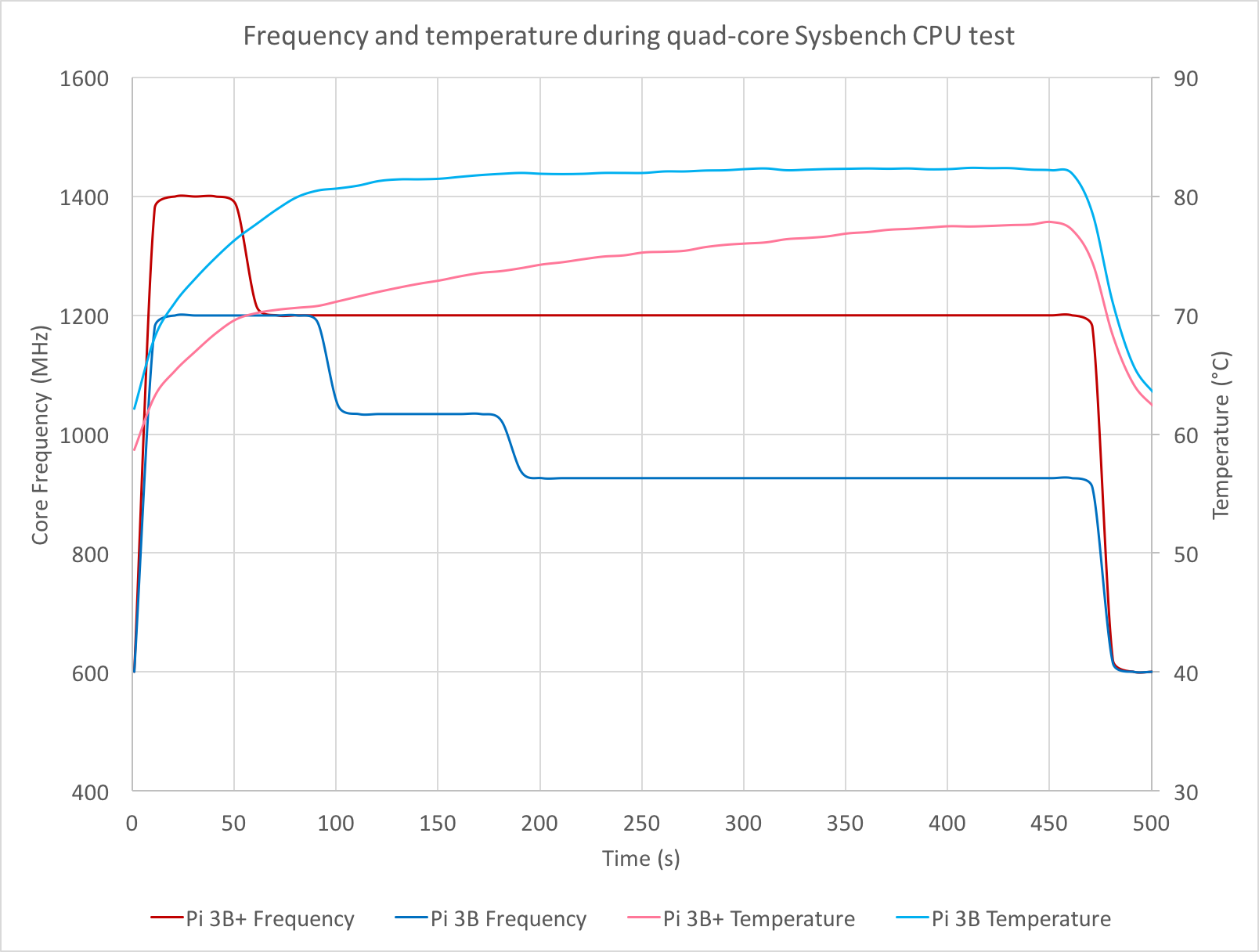
Below 70°C, we use the improvements to increase the core frequency to 1.4GHz. Above 70°C, we drop to 1.2GHz, and use the improvements to decrease the core voltage, increasing the period of time before we reach our 80°C thermal throttle; the reduction in power consumption is such that many use cases will never reach the throttle. Like a modern smartphone, we treat the thermal mass of the device as a resource, to be spent carefully with the goal of optimising user experience.

This graph, courtesy of Gareth Halfacree, demonstrates that Raspberry Pi 3B+ runs faster and at a lower temperature for the duration of an eight‑minute quad‑core Sysbench CPU test.

Note that Raspberry Pi 3B+ does consume substantially more power than its predecessor. We strongly encourage you to use a high-quality 2.5A power supply, such as the official Raspberry Pi Universal Power Supply.

FAQs

We’ll keep updating this list over the next couple of days, but here are a few to get you started.

Are you discontinuing earlier Raspberry Pi models?

No. We have a lot of industrial customers who will want to stick with the existing products for the time being. We’ll keep building these models for as long as there’s demand. Raspberry Pi 1B+, Raspberry Pi 2B, and Raspberry Pi 3B will continue to sell for $25, $35, and $35 respectively.

What about Model A+?

Raspberry Pi 1A+ continues to be the $20 entry-level “big” Raspberry Pi for the time being. We are considering the possibility of producing a Raspberry Pi 3A+ in due course.

What about the Compute Module?

CM1, CM3 and CM3L will continue to be available. We may offer versions of CM3 and CM3L with BCM2837B0 in due course, depending on customer demand.

Are you still using VideoCore?

Yes. VideoCore IV 3D is the only publicly-documented 3D graphics core for ARM‑based SoCs, and we want to make Raspberry Pi more open over time, not less.

Credits

A project like this requires a vast amount of focused work from a large team over an extended period. Particular credit is due to Roger Thornton, who designed the board and ran the exhaustive (and exhausting) RF compliance campaign, and to the team at the Sony UK Technology Centre in Pencoed, South Wales. A partial list of others who made major direct contributions to the BCM2837B0 chip program, CYW43455 integration, LAN7515 and MxL7704 developments, and Raspberry Pi 3B+ itself follows:

James Adams, David Armour, Jonathan Bell, Maria Blazquez, Jamie Brogan-Shaw, Mike Buffham, Rob Campling, Cindy Cao, Victor Carmon, KK Chan, Nick Chase, Nigel Cheetham, Scott Clark, Nigel Clift, Dominic Cobley, Peter Coyle, Jon Cronk, Di Dai, Kurt Dennis, David Doyle, Andrew Edwards, Phil Elwell, John Ferdinand, Doug Freegard, Ian Furlong, Shawn Guo, Philip Harrison, Jason Hicks, Stefan Ho, Andrew Hoare, Gordon Hollingworth, Tuomas Hollman, EikPei Hu, James Hughes, Andy Hulbert, Anand Jain, David John, Prasanna Kerekoppa, Shaik Labeeb, Trevor Latham, Steve Le, David Lee, David Lewsey, Sherman Li, Xizhe Li, Simon Long, Fu Luo Larson, Juan Martinez, Sandhya Menon, Ben Mercer, James Mills, Max Passell, Mark Perry, Eric Phiri, Ashwin Rao, Justin Rees, James Reilly, Matt Rowley, Akshaye Sama, Ian Saturley, Serge Schneider, Manuel Sedlmair, Shawn Shadburn, Veeresh Shivashimper, Graham Smith, Ben Stephens, Mike Stimson, Yuree Tchong, Stuart Thomson, John Wadsworth, Ian Watch, Sarah Williams, Jason Zhu.

If you’re not on this list and think you should be, please let me know, and accept my apologies.

The post Raspberry Pi 3 Model B+ on sale now at $35 appeared first on Raspberry Pi.

20 Mar 19:49

Five Questions with Orta Therox

by The Times Open Team
Illustration by Agnes Lee/The New York Times

On February 14th, Orta Therox came by The New York Times’s office to talk about how his team at Artsy has adopted React Native, and he shared some of the ways Artsy documents its work and culture. We caught him afterwards to ask him some follow up questions. Interview by SARAH BURES

What’s your role at Artsy and what kind of work you do?
When I joined Artsy seven-ish years ago, we were a tiny team, which meant I had to wear many hats. Over time, my role became Director of Mobile, but when our team moved to React Native in 2016, we merged the mobile and web teams and I jumped back to being an individual contributor. I tend to think of my role as being an engineering janitor who has a lot of involvement with most Artsy projects.

For example, in the last week: I’ve worked on consolidating our hiring process, I’ve worked on an Augmented Reality section in the app, I’ve helped to improve TypeScript support in our web infrastructure and I’ve been maintaining our internal team navigator. So I do a mix of process, product and infrastructure.

You steered Artsy to work with open source by default. Can you talk about what that means and why it’s important to your team?
“Open Source by Default” aims to shift a team’s mindset to a place where you need to argue that code should be kept private. Our CTO, Daniel ‘dB.’ Doubrovkine, coined the phrase internally, and I helped him take that idea and turn it into policy for the team I used to lead. Before the teams merged, we were asked by a magazine to write about how we worked in the open, which turned into our manifesto. After that point, we started to implement those across other teams.

Open Source is important to me because I grew up outside of an urban center in Britain where I had very little in the way of community mentorship. Open Source gave me the ability to see how difficult things were built. I moved from being a beginner to an intermediate programmer by reading the source code that others had opened up. I became a macOS developer because of apps like Quicksilver, Adium and Colloquy. These macOS jobs evolved into iOS jobs, and now I owe my livelihood to Open Source. I choose to give back to that community by working in the open and by collaborating on the most impactful projects I can.

Everyone in the Artsy Engineering team has different relationships to Open Source. Some people just work in the open — with little thought applied to the larger community aspects of it — because it’s how we work. Others embrace the ability to showcase their work to help provide a more holistic understanding of the process.

Not all projects we work on are open source, so not all engineers work in the open. We made the conscious choice to keep some projects private: it’s Open Source by Default, not Open Source by Mandate.

One of the best tools we have in favor of policies like this is that one of Artsy’s core values is openness. We use our interactions with the Open Source community as one way of expressing that value in the engineering team.

Documentation and write-ups are obviously very important to you. What are some best practices you and your team follow for documenting your projects and technical philosophies?
I believe there are many levels to documenting a project.

You always start with the README, then you use tests to show the current priorities of a project, and you could use a VISION file to describe the long-term goals. Each escalating step talks about the “how,” so documentation, like blog posts, should be used to cement the “why.”

I spent a long time as a remote developer, which made it harder to be involved in those passing, watercooler-type talks that can cement ideas. I opted to try and use write-ups on our developer blog for ideas, major projects and achievements. It’s generally a safe assumption that people internally have read our blog posts. It takes time to do the write up, but further down the line when you’ve forgotten the context or someone else is there for the first time, being able to understand why those decisions were made really helps make everyone’s lives easier.

One of my colleagues, Ash Furrow, is really the powerhouse behind improving the state of our public documentation. He runs weekly writing workshops internally and always encourages achievements as being post-worthy. Sometimes the best practice is to have someone who cares encouraging you. It works for me.

Since Artsy has adopted React Native, you’ve held public retrospectives every six months. What do those entail and who participates?
The retrospectives are mainly triggered by a project coming to an end, or by external events as that tends to be when the topic naturally arises. We have an iOS front-end Slack channel that any engineer can contribute to; we use this channel for day-to-day coordination and for retrospective discussions. It’s quite informal; we could be discussing our slides or why linking to the app has failed again — even this interview went through that Slack channel for discussion. Our first retrospective was used to decide whether or not to continue with React Native.

We had explored other alternatives to our engineering issues at the same time, and it took roughly six months to wrap up all of these projects. We discussed our options in person, and had team meetings where we made the agreement that React Native was the right option for us. Eloy ‘alloy’ Durán, who had initially proposed React Native, summed up our team’s feelings in an announcement blog post.

In six months, I finished my first serious contributions to that codebase and understood how React Native worked, and we felt more confident in our beliefs on the trade-offs and its value. I used this as a time to collect our opinions again, and to present a nuanced take on the state of iOS development after taking some time with React Native. The next two retrospectives were written after being invited to speak on the topic of React Native, which was a perfect time for reflection.

You have this great concept of “developing at the speed of thought,” can you talk about what that means to you?
As iOS developers at Artsy, we were getting frustrated at the tools provided by Apple for building apps. We couldn’t make our own changes to them, so we actively contributed to projects used to augment Apple’s tooling. But we still had no control in the direction of where things were heading.

React Native gave us the ability to control our destiny, and the ability to iterate considerably faster on our app. Imagine that every time you wanted to see a new message from a friend on iMessage you had to shut down the app, load it up from scratch and then click on their name again. That’s what it feels like to build something with Apple’s tools as an iOS developer. It has always been that way, so it’s not strictly frustrating until someone shows you that maybe it doesn’t have to work like that. It takes looking from outside of the native development tools to really understand the trade-offs been made for you.

Seeing changes instantly as you work is “developing at the speed of thought.”

It saves a considerable amount of time and can open up a larger world of creative expression. Feedback cycles are important and when you’re spending all day, every day, working in an environment like this you can really start to thrive.

You want the connection between you and your work to be a close as possible. While you’re not quite building apps with your fingers and directly interacting with it, being able to change code and see your changes instantly brings us closer to inventing on principle.

Orta Therox is an engineer at Artsy, runs a dependency manager, a unit test tool for culture and operates on open source by default.


Five Questions with Orta Therox was originally published in Times Open on Medium, where people are continuing the conversation by highlighting and responding to this story.

20 Mar 19:48

Learning is harder in the digital world

by Jim

Snowboard lesson Most of us have crappy theories of learning. The better you were at school the more likely your theories about learning are distorted. I ran into this phenomenon while I was the Chief Learning Officer at Diamond Technology Partners in the 1990s. My partners were full of well intentioned advice about how they thought I should do my job based on their school experiences years or decades earlier in their lives. I had my own, somewhat less ill-informed, theories based on my more recent school experiences convincing my thesis committee to let me loose on the world.

Fortunately, I also made the smart decision to go find several people smarter than I was and hung around with them long enough to soak up some useful insight. Two in particular, Alan Kay and Roger Schank, were instrumental in shaking me free from my poor theories. Very different in temperament, they did agree on fundamental insights about how learning worked.

Learning is what happens when our expectations about the world collide with experience. As we adjust our expectations to be better aligned with reality we learn.

Schools are dangerous places for learning because they are too isolated from the real world. On the other hand, the real world can be straight up dangerous if we haven’t learned how to behave correctly in the situation at hand. All learning is learning by doing, whether we’re learning to turn on a snowboard or solve a differential equation. If we had unlimited time and were invulnerable, we could figure anything out on our own. As it is, it helps to have someone who knows more than we do to arrange the experiences we can learn from in a reasonable and safe sequence.

The name for this strategy is “apprenticeship” and remains the most effective from a learner-centered perspective. All other approaches are compromises to make the economics work or to solve scale mismatches between the number of those needing to learn and those with mastery to pass along. Anthropologist Lucy Suchman showed how to extend this notion of apprenticeship to all kinds of learning beyond the trade/craft connotations we attach to the word. She talked of learning and apprenticeship as a process of “legitimate peripheral participation.” You learned how to repair copiers by handing tools to the senior repair technician and carrying their bags. You learned how to handle the cash register by watching someone who already had it figured out. You learned how to put a budget together by doing the junior-level scut work of helping your boss transform a handwritten budget into a typewritten one.

It’s become a cliche that learning has become an ongoing requirement in all kinds of work. The problem isn’t simply that work demands more learning more often. The changing nature of work also makes learning qualitatively harder as well. This was never a problem for physical work and for much of the knowledge work of the 20th century. Nearly everything you might want to observe was in sight. You could watch how a repair technician selected and handled tools. You could see an editor’s corrections and notes in the margins of your manuscript.

As work has evolved to be more abstract and more mediated by technology, the task of learning has gotten harder. Whether we call it apprenticeship or legitimate peripheral participation it becomes difficult, if not impossible, in environments where you can’t see what others are doing. Previously, the learning called for within organizations occurred as a byproduct of doing work. It now takes conscious and deliberate effort to design work so that it is, in fact, learnable.

The post Learning is harder in the digital world appeared first on McGee's Musings.

20 Mar 19:48

Little-known change that would have whacked housing non-profits with big new taxes gets a negotiated tweak

by Frances Bula

We often focus on the big drivers of housing costs. But, behind those, there are many other smaller drivers — like the way your property is assessed.

This past year, housing non-profits had their properties assessed as though, any moment, their buildings could be torn down and replaced with market-condo towers.

That could never happen, for the most part, because those housing groups have legal agreements to provide units at below-market costs.

For once, however, everyone scrambled to come up with a solution that would see their assessments reduced to reflect the fact that 1. they are not going to re-develop to luxury condos, ever and 2. they are renting for below-market rates.

A good win, as I note in my story.


20 Mar 19:48

How I stream myself coding

by Chris Allen

Alright so I’ve been uploading streamed videos of myself working on programming projects for awhile now. I occasionally get asked about my setup for this, so I thought I would explain the tools I use. This might be particularly valuable as I am primarily a Linux user where some of the kit for this can be kinda rough. Further, I am very picky about my tools and ergonomics so I didn’t really want to make any sacrifices there in order to stream.

The tools

  • OBS Studio (open broadcaster): I always live stream to Twitch.tv and save to a file simultaneously.

  • Hangouts: I pull people into Hangouts that want to ask questions and to be able to see my stream without a time delay. They are not seen nor heard in the actual stream. I repeat their questions for the rest of the stream when I’m going to answer it.

  • VLC: I use this to slice out my second monitor only for the Hangout stream. Hangouts doesn’t know how to “see” a single monitor, but it can see individual applications. With that, I can just pick VLC in order to share a single monitor. Here’s my VLC script for grabbing my middle monitor.

  • Slack: Announce the stream, occasionally get comments from people.

  • Twitch.tv: live streams go here. Their live streaming and tools around it were better than YouTube’s.

  • YouTube: my video uploads go here. I process the file upload.

  • Three 23" 1080p monitors: This is actually necessary for how I do this. Here’s why:

  • Left monitor (not streamed): Monitoring Twitch.tv stream and chat in case any viewers ask questions. OBS Studio. Slack. Odds and ends.

  • Middle monitor (this is what gets streamed): usually my browser workspace (the first workspace in my XMonad configuration) or my Emacs + terminal workspace (the second workspace).

  • Right monitor (not streamed): This is devoted to VLC because I need a whole monitor to recap the middle monitor for Hangouts. This can be ditched if I’m not doing Hangouts as OBS knows how to grab a single monitor. However, I often find a friend or colleague will jump into Hangouts mid-stream so I habitually maintain the same setup so there’s minimal delay mid-stream getting them in.

  • XMonad: absolutely necessary for me to work efficiently. Lets me instantly switch workspaces on my middle monitor without perturbing my VLC workspace or my ‘dashboard’ (OBS/Hangouts/Twitch/etc.) workspace.

  • Heil PR-40 microphone and a Xenyx Q802. Not strictly necessary but stay the hell away from Blue microphones, they’re all irredeemable trash. You’re better off using a built-in mic or a webcam mic. A good middle option is a solid dynamic mic like a Shure SM58 with a USB mixer like my Xenyx. I have not actually tested a Shure SM57 or SM58 with my recording setup but a dynamic mic in general should be much better for your typical home streamer. Condenser mics seem to pick up a lot of extraneous noise that is hard to filter out or control for in a home environment. The Blue Yeti would pick up even relatively subtle background noises like the hum of my air conditioning. I had similar issues with other cheap or “cheap” condenser mics until I did some research and found out about dynamic microphones.

  • Turn on mic monitoring. Hear yourself speak. It’ll help train you out of bad vocal tics and mouth sounds. If you’ve ever pair-programmed with somebody that makes obnoxious mouth sounds then you know how important this is for your streams.

  • Play any background music into your headphones quietly and DO NOT rebroadcast it onto the stream. Almost all of my headphones are open-air cans. This means they aggressively leak sound. I’ve had YouTube yank my videos for copyright claims because a 15 second snippet of a song leaked into the mic recording. Listening to music from speakers is obviously a hard-no. Don’t annoy your viewers.

  • If possible, use a carpeted room. My home office (I exclusively work from home) is carpeted.

After the stream is done, I process the file saved by OBS with some denoising scripts to smooth out the audio. Here’s a dump of a couple of scripts I’ve kicked around:

normalize.sh

noise_reduction.sh

VIDEO_FILE=$1
VIDEO_FILE_VIDEO=${VIDEO_FILE%.*}-video.${VIDEO_FILE##*.}
VIDEO_FILE_AUDIO=${VIDEO_FILE%.*}-audio.wav
# VIDEO_FILE_AUDIO_CLEAN=${VIDEO_FILE%.*}-audio-clean.wav
VIDEO_FILE_AUDIO_CLEAN=${VIDEO_FILE%.*}-audio-noisered.wav
VIDEO_FILE_DENOISED=${VIDEO_FILE%.*}-denoised.${VIDEO_FILE##*.}
QSCALE=10

# ffmpeg -i $VIDEO_FILE -af "highpass=f=200, lowpass=f=3000" $VIDEO_FILE_DENOISED
rm -f noise_audio.wav

# ffmpeg -i $VIDEO_FILE -qscale:v $QSCALE -an $VIDEO_FILE_VIDEO
# ffmpeg -i $VIDEO_FILE -qscale:v $QSCALE $VIDEO_FILE_AUDIO
# ffmpeg -i $VIDEO_FILE -vn -ss 0:00:00 -t 0:00:02 noise_audio.wav
# ffmpeg -i $VIDEO_FILE -vn -ss 0:33:30 -t 0:33:33 noise_audio.wav
# sox noise_audio.wav -n noiseprof noise.prof
# sox $VIDEO_FILE_AUDIO $VIDEO_FILE_AUDIO_CLEAN noisered noise.prof 0.21
# sox $VIDEO_FILE_AUDIO $VIDEO_FILE_AUDIO_CLEAN noisered noise.prof 0.15
# sox $VIDEO_FILE_AUDIO $VIDEO_FILE_AUDIO_CLEAN noisered noise.prof 0.10
ffmpeg -i $VIDEO_FILE_AUDIO_CLEAN -i $VIDEO_FILE_VIDEO -qscale:v $QSCALE $VIDEO_FILE_DENOISED

If you’ve got better kit/scripts than I’ve mentioned here, please speak up! I’m always up for improving this stuff. Please contact me if you need clarification on something I’ve mentioned here or if you have questions.

Comment on microphones from my friend Tyler on Twitter

I’ve lightly edited his words here:

I take issue with your statement about blue microphones. I had a Shure SM58 and a blue spark and I liked the blue much better than the SM58. I prefer condenser microphones over dynamic microphones, I just run the gain as low as I can to make it not pick up the background. USB mics are trash.

I never messed with USB mics. I’ve exclusively had XLR microphones since I got started back in 2011. My little brother has a Blue Icicle and that is not the best experience. Constantly picking up his keyboard.

If you can pick you a Shure SM58 for 50 bucks like I did, the thing is nigh indestructible, great deal. The only reason mine doesn’t work is because I broke a solder point and I didn’t want to repair it.

It looks like they refreshed the Blue Spark with a high pass filter and a -20db pad.

My reply:

FWIW I tried setting the gain low on my Blue Yeti, it wasn’t enough. I had to scream at the mic when the gain was low enough not to pick up noise.

At time of writing, it doesn’t seem like the Blue Spark is available any more. (See above about the model refresh)

It’s possible an XLR condenser mic with a mixer could be okay for your purposes, but most of the Blue mics are USB now which severely limits their usefulness. Not my bag of chips but I wanted to include a different viewpoint.

I know this site is a bit of a disaster zone, but if you like my writing or think you could learn something useful from me, please take a look at the Haskell book I've been writing. There's a free sample available too!

Posted on March 14, 2018

20 Mar 19:48

Electrify Your Family

by dandy

Photo by Sonya Allin from "Bike Bus or Bust."

How To Electrify Your Family Bike

by Derek Rayside

Electric assist bikes, or pedelecs, are becoming more and more popular. Electric assist can be particularly helpful on a family bike, where you are typically transporting children, groceries, and sports equipment. Electric assist can help with hills, distance, and acceleration. With electric assist on your family bike, you will not be going faster than regular cyclists: the motor just helps you compensate for the extra weight of your family and their stuff. Pedelecs make a wider variety of trips feasible by bike for a greater number of people, including young families and seniors.

The prices for this technology have been steadily decreasing, and this trend will continue. The most expensive component is the battery, and batteries are seeing tremendous and continued innovation.

My family recently added an electric assist to our family tandem. Our family tandem has three pedalling positions, plus space for two more children who are not pedalling. Additionally, I help maintain the “bike bus” owned by my daughter’s daycare, which is a tricycle that can seat 6-8 toddlers (plus the adult rider.) These are both Dutch bikes, which means that they are designed for relatively flat terrain and had internal gears.

Derek Rayside, Stephanie Xie, and their children on their family tandem before electrification. Photo by Alexa Rayside, February 15, 2016.

The bike bus, owned and operated by Waterfront Montessori Children’s Centre on the Toronto Islands. Photo by Sonya Allin, dandyhorse, June 6, 2017.

The first question to ask yourself is whether you really need to electrify. If you do, then this article reviews the simplest options first, and afterwards describes the more complex solutions we used on the family tandem and the bike bus. Electrification can affect the bike’s gears and brakes, so I recommend a holistic approach to selecting the right technology for your situation.

This article recommends products from BionX and Grin Technologies (ebikes.ca). The BionX kits are amongst the easiest to install and are widely recommended by other reviewers, although I do not have personal experience with them. If those kits do not meet your needs, then I recommend products from Grin Technologies in Vancouver, which is what I used on our family tandem. They design the computers and controllers, and many accessories such as battery mounts, auxiliary input switches, torque arms, etc. They import motors from Asia, as well as brakes and torque sensors from Europe. Many other websites re-sell Grin-designed computers and controllers with different motors and batteries.

The way I think of it, BionX is like the Apple of e-bike kits: nice integrated products that work really well for most people most of the time. By contrast, Grin Technologies is like GNU/Linux: modular components that can be configured for the most challenging situations, but requiring a bit more technical expertise to install.

Justin Lemire-Elmore founded Grin Technologies (ebikes.ca) when he was an electrical engineering student at the University of British Columbia back in 2005. ElectricBikeReview.com made an excellent video interview with him in 2015.

Your local bike shop might sell and support different e-bike conversion products. If so, then those are well worth considering. A local shop that knows you, your bike, and the products they sell, is always a good option.

Thank you to readers who wrote in asking for answers to these questions. For those in America, Europe, and other parts abroad, any prices here are in Canadian dollars in the Toronto market, which might differ from your local market.

Do you need to electrify?

Do you need electric assist on your family bike? Millions of people around the world ride family bikes without electric assist. In my observation, it depends on three factors: distance, weight, and hills.

We rode our family tandem without electric assist for two years. Most of our trips are about 3km, on mostly flat roads. In that kind of distance and terrain, the weight doesn’t really matter: you can probably move 100% of your body weight in payload. For longer distances --- still on flat ground --- we found that we could go 5km about once per month, and 10km once or twice per year.

Now with our electric assist, we can go to further locations and surmount larger inclines. For example, our trip to Costco is just under 15km, and involves a bridge over the Gardiner Expressway. Getting over that bridge with groceries requires all of us pedalling hard plus the motor at full throttle. Our gross vehicle weight up this bridge is over 600 lbs.

Derek Rayside, Stephanie Xie, and their children ride their family tandem, with electric assist, home carrying groceries from Costco. Photo by Steve Russell, Toronto Star, September 29, 2017.

Before the electric assist our average speed was about 14 km/hr, and now we can average around 20 km/hr. For our everyday 3km trips this doesn’t really make a difference in time, but for trips over 10km it can matter.

My daughter’s daycare chose to electrify the bike bus because they need to go over a steep bridge, and the combined weight of the bike and the children is approaching 200% of the weight of the rider --- roughly 400 lbs gross vehicle weight.

The bike bus ascends the bridge from Algonquin Island. Photo by Sonya Allin, June 6, 2017.

Map out the routes you usually travel for family activity: How long are they? What’s the elevation like? Take a few test rides with your regular bike. Bring along a child in a trailer or on a rear child seat if you have one. Getting a physical feel for the terrain will help you determine if you will benefit from electric assist.

If you know you want electric assist, and are buying a new bike, then get one that comes with electric assist built in. Do not try to save money by doing the conversion yourself. You won’t actually save money that way, and doing the conversion is a project. I like these kinds of projects, but they still take time.

If you are in a situation of doing a conversion, then first look at kits like BionX. Those are really nice kits that are highly recommended by many reviewers: simple to install, high quality, and pleasant to ride.

Manfried Gringl started BionX in 2008, after over forty years at car parts manufacturer Magna International. BionX is head-quartered in Aurora, Ontario, with an R&D facility in Sherbrooke, Quebec. Photo by Pawel Dwulit, Toronto Star, July 24, 2009.

But those simple kits might not work for your Dutch family bike. Why? Gears.

BionX are rear-wheel kits that replace your entire rear wheel. The Dutch like internal gear hubs, so if you swap out your rear wheel then you lose your existing gears and must find a way to replace them.

Mechanical majestry 

All of these after-market conversion kits are intended to be DIY. My experience and observation is that you might want to have a good relationship with your mechanic(s) when converting a family bike --- especially a Dutch family bike. Once you get into matters like changing the gearing, brakes, fork, etc, you are moving beyond what would be involved in converting a regular bike.

I have been fortunate to have the services of a variety of excellent mechanics in the Toronto area. The heavy lifting on the family tandem conversion was done by Dan Burkhart of the Waterfront Wheelshop in Oakville (facilitated by Stuart Kinnear in Toronto). The electrical work on the bike bus was done by Amego at Richmond and Portland. Malcolm Munro at Biseagal on Carlaw has done all of the major mechanical work on the bike bus, and quite a lot on the family tandem as well. MEC on King St, Dream Cyclery on Queens Quay, and Ya Bikes! on Queen East, have all gotten us back on the road after minor mishaps.

Mechanic Malcolm Munro at his shop, Biseagal, from a profile in The Toronto Star. Photo by Eduardo Lima, Metro News, August 31, 2017.

When designing your conversion project, assess the work that needs to be done and who might have the skills and tools to do it (possibly yourself). Most of these bikes are put together using systems of not-exactly-standard parts, and when you replace one part, you’ll often find that it has an effect on the rest of the system.  So be thorough in your planning, and make no assumptions about compatibility. You might need to work with different mechanics for different aspects of the project. Not every North American mechanic wants the challenge of working on a Dutch family bike, and not every good bike mechanic wants to get involved with electric conversion kits.

Finally, my observation is that market pressures force good mechanics to charge no more than average mechanics (and sometimes even charge less). The downside of that for you is that good mechanics will have more work than they can do, so getting their time can be challenging.

What To Do About Gears?

There are four options for adding electric assist if your bike has an internal gear hub:

  1. Front wheel motor. This is what we did on our family tandem.
  2. Add external gears. This is what we did with the bike bus.
  3. Mid-drive motor. A good option if it fits.
  4. Rear wheel motor with integrated internal gear hub. A unique product worth considering.

A front wheel motor is the simplest and easiest approach. On a two-wheel bike, a front motor leaves your existing rear wheel and gearing system in tact. There are some rumours that a front wheel motor installation is not as good as a rear wheel motor installation because front motors might be less powerful, or there might not be enough weight on the front wheel and it might slip. Many motors have both rear and front wheel variants with the same power. Because family bikes typically put much more weight on the front wheel than single-person bikes, the front wheel losing traction is usually not a concern (certainly not on our family tandem).

We installed a front wheel motor on our family tandem and it works well. I think that for a tandem a front wheel motor has two additional advantages: it reduces the force going through the drive chains, and it provides redundant mobility in case one of the drive chains breaks.

The bike bus, being a tadpole tricycle (two wheels up front), required a rear wheel motor. If I were doing the bike bus electrification from scratch, I would probably choose the TDCM+IGH rear wheel motor with integrated Sturmey Archer internal gear hub (243% range). As it was, a previous volunteer parent had already installed a rear wheel motor kit and left the bike bus as single-speed. To protect the investment in the existing electrification kit, we added the external derailleur. That required some welding, which is beyond what most bike mechanics will do, and was not cheap: it ended up costing about $700 for parts and labour.

A mid-drive motor is one that attaches to your frame, usually near your pedals, instead of in the wheels. Many of the electric-assist family bikes on the market now come with mid-drive motors from either Bosch or Shimano built-in. These are great products, but usually need to be designed into the frame, and so are not suitable for after-market installations.

There are two mid-drive conversion kits that I am aware of that are suited to after-market installations: Bafang and Stoke Monkey. Both are good products that are well reviewed elsewhere. The Stoke Monkey was originally designed for the Yuba Mundo longtail bike, but could fit on other bikes. The Bafang might fit on your Dutch family bike: Urkai in Burlington installs these on Bakfiets family bikes.

What Goes Up Must Come Down: Braking

Your family bike should have a direct-drive motor paired with a controller capable of regenerative braking. The important reason is not how much power you will regenerate from braking: that really doesn’t matter. The important reason is stopping power. Once you have electric assist, you will be able to go up hills. Now you will need to get down them. The stopping power of our family tandem motor is better than even our Magura HS-33 hydraulic brakes (these are popular on Dutch family bikes with electric assist).

Your regenerative braking might be so powerful, as it is on our family tandem, that it requires a second torque arm. A torque arm is a little piece of metal that helps distribute the force of the motor on the bike frame. Without a torque arm, the motor might rip itself out of the frame. Most regular bikes require just one torque arm, to stabilize the motor when the bike is going forward. Fully loaded family bikes tend to be much heavier than regular bikes, so you will probably want a second torque arm to stabilize the motor while braking.

Torque Arm v2, designed by Grin Technologies (ebikes.ca)

Having regenerative braking capability will also help prevent your mechanical brakes from overheating on descents. With regenerative braking, the energy goes into driving the chemical reaction inside the battery, rather than just producing waste heat. If your mechanical brakes overheat, it might compromise their performance and your family’s safety.

Regenerative braking will also reduce the wear on your brake pads, which means you will replace them less frequently.

Until recently, using your regenerative braking required replacing your brake levers. For regenerative braking to work, the brake levers need to tell the motor controller when you are trying to brake. This past year, Grin and their collaborator Tim O’Brien developed the Tripwire product that attaches on to your existing brake levers. We have these on our family tandem and I recommend them.

Our family tandem originally had a Shimano IM-81 roller brake in the front wheel hub. That had to come out with the installation of the front wheel motor. Since the front fork was designed for a roller brake integrated into the front hub, it did not have braze-ons (mounts) for either disc brakes nor V-brakes. We ordered a replacement fork from our bike maker Onderwater (via Urkai in Burlington) with braze-ons for V-brakes. It appears that many of the Dutch family bike companies are using the Magura HS33 hydraulic rim brake up front, so we went with that.

How Hard Are You Pedalling?

Does your bike know how hard you are working? A torque sensor is the device that tells it whether you are pushing hard or just coasting. There are three ways that your electric bike can know to activate the motor, from most to least sophisticated:

  1. A torque sensor measures how hard you are pedalling, and then applies the electric assist proportionally. This gives the best riding experience.
  2. A cadence sensor detects if your pedals are spinning, and then applies the motor at a predetermined power level. There is a common misconception that cadence sensors detect how fast you are pedalling: most of them do not do this; they just detect whether you are pedalling or not.
  3. A manual throttle control lets you use your hands to activate the motor. It is good to have a throttle control in urban environments where there is a lot of starting and stopping. European regulations limit throttles to speeds of under 6km/h, so the throttle can be used to get the bike started, but you must pedal for the bike to really go.

Nice kits like BionX will have an integrated torque sensor. If you are assembling your own kit from components, I recommend including a torque sensor for the best ride quality. Usually these install in the bottom bracket, and require drilling a hole through the bottom bracket for the wires. The cadence sensors are typically easier to install and do not require drilling, and are significantly less expensive. When coupled with a throttle, a cadence sensor still gives a good ride quality.

If your kit uses the Cycle Analyst computer from Grin Technologies, then I also recommend getting one of their auxiliary input switches. These allow you to control the amount of electric assist while you are riding, without having to fiddle around with the computer. You will want one of these if you ride a family bike in an urban environment. For example, if I see a red light in the distance, I use the auxiliary input to turn off the electric assist: riding fast to a red and then stopping is a waste of energy and effort; better to cruise and meet the light when it turns green.

Where to mount the battery?

The two most common ways to mount a battery are on the downtube or on the rear rack. Many downtubes have braze-ons for a bottle holder, which can be used to mount a battery. For rear racks, you can add a battery mounting plate to your existing rack, or get a new rear rack that is designed for a battery. Both of these solutions allow you to lock the battery to the frame, which is important in an urban environment, because the battery is the single most expensive component of your electrification kit.

An alternative used by some recreational riders is to put the battery in a bag in the frame. If your family bike is used for transportation around town, and is left outside, then you either need to use a more secure battery mount or bring the battery inside with you at every stop.

None of these conventional options really did what I wanted for our family tandem, so I designed a custom solution with Malcolm Munro from Biseagal. I didn’t want to put the battery on our rear rack because I wanted to keep our existing child seat, didn’t want to raise it higher, didn’t want any more weight on the rear of the bike, and wanted to keep our existing rear rack. The tandem gearing reduced the width available in the frame for a downtube battery, so we couldn’t go with that option either.

In the end we used a low-profile rear rack battery mounted sideways. It fits in the frame perfectly, keeps the weight low and forward, and enables us to leave the rest of the bike unchanged. It has two components: the battery mounting bracket from Grin attached to a custom backing plate from Biseagal, which is itself secured to the bike. Grin’s bracket design cleverly has the battery twist on and off, rather than slide. Biseagal’s design of the custom backing plate is simple and elegant. All of the load bearing is in the materials: the fasteners do not bear the primary loads. The vertical load is taken by resting on the bottom tube, and the linear loads are taken by precise fit between the custom plate and existing braze-ons for the chainguard.

Custom battery mount on family tandem. The aluminum backing plate is a custom design by Malcolm Munro at Biseagal in Toronto. The black mounting bracket is a product designed by Grin Technologies (ebikes.ca) in Vancouver.

Conclusion

Adding electric assist to your family bike can increase your range, melt away hills, and help you navigate the city with greater agility. We can now run errands, such as bulk shopping, and visit friends that we could not get to by bike before. It’s an investment that pays for itself quickly, creates quality family time, and improves your health. See you in the bike lanes!

Derek Rayside, Stephanie Xie, and their children ride their family tandem, with electric assist, home carrying groceries from Costco. Photo by Steve Russell, Toronto Star, September 29, 2017.

Related on dandyhorsemagazine.com

Bike Bus or Bust

Riding Tandem with your 8-year-old

Accessible Cycling is Better Together

Cargo bikers roll out for Open Streets

Heels on Wheels Goes Tandem: Leanne Eisen
20 Mar 19:47

300+ Web Searches for Your Online Literacy Class

by mikecaulfield

Sometimes in online media literacy we need a Google search that will turn up a mixture of high quality and low quality information for students to sort through. But it’s surprisingly hard to come up with a large array of unique queries on the spot.

I generated this list of questions to ask Google, Bing, or whatever from a combination of Buzzsumo results and Google autocomplete suggestions. Quality and complexity of results may vary, and what Google returns is ever-shifting. So please check the search results before assigning them to your students as mini research projects to make sure the difficulty is right for your purpose.

Here we go:

  1. Are “Hail Satan” license plates now available in Tennessee?
  2. Are Americans flocking to Mexico for dental care?
  3. Are President Trump’s vacations bankrupting the Secret Service?
  4. Are Tasmanian tigers extinct?
  5. Are baby boomers squeezing millennials out of the housing market?
  6. Are birth control pills in our water supply causing “transgender” fish?
  7. Are children of divorce more likely to fail exams?
  8. Are children of divorced parents more likely to divorce?
  9. Are children of divorced parents more likely to leave religion?
  10. Are children reading less?
  11. Are e-cigarettes as bad for people as smoking?
  12. Are earth temperatures cooler than when Al Gore won the Nobel Prize?
  13. Are illegal aliens in Canada complaining about a lack of free housing?
  14. Are learning styles real?
  15. Are men who marry “chubby” women happier?
  16. Are millennials finding it hard to transition into adulthood?
  17. Are more terrorists right wing or left wing?
  18. Are most convicted terrorists in the U.S. citizens?
  19. Are opioids killing more people than AIDS at its peak?
  20. Are people who are late more likely to live longer?
  21. Are people who are late more successful?
  22. Can a “raw diet” cure eczema?
  23. Can adding water to whisky increase its flavor?
  24. Can an algorithm be racist?
  25. Can an algorithm catch a serial killer?
  26. Can an algorithm predict risk of suicide with 92 percent accuracy?
  27. Can baking soda cure cancer?
  28. Can cannabis cure opioid addiction?
  29. Can celery prevent chronic inflammation?
  30. Can colloidal silver cure cancer?
  31. Can dandelion weed cure cancer?
  32. Can embracing your darkest emotions improve mental health?
  33. Can magnets be used to retrieve short and long term memories?
  34. Can magnets cure cancer?
  35. Can water bottles set things on fire?
  36. Could a recent sperm count drop make humans extinct?
  37. Does happiness reduce stress?
  38. Did 2,000 old seeds grow into an extinct biblical tree?
  39. Did 200 hundred protestors demand that New York City take down a statue of Teddy Roosevelt?
  40. Did Belgium ban halal butchers?
  41. Did Belgium ban the kosher slaughter of animals?
  42. Did Black Lives Matter activists interrupt a Montreal Pride parade?
  43. Did China buy Volvo?
  44. Did China buy Walmart?
  45. Did China hack the U.S. Seventh Fleet?
  46. Did Common Core kill music programs?
  47. Did Donald Trump pay actors to cheer during his announcement he would run for president?
  48. Did France ban plastic plates and cups?
  49. Did France ban the use of Gardasil?
  50. Did George Clooney donate millions to tear down Confederate statues?
  51. Did German schools ban pork to accommodate Muslim students?
  52. Did Harvard researchers find Exxon misled public on climate science?
  53. Did Hitler execute “fake news” journalists that were telling the truth?
  54. Did Idaho health premiums spike 81 percent?
  55. Did Illinois ban travelling elephant acts?
  56. Did Iran ban Zumba?
  57. Did John McCain approach Russia for a campaign contribution?
  58. Did Joy Ann Reid retweet a hoax about President Trump hiring black actors for a Phoenix rally?
  59. Did Millennials kill Applebee’s?
  60. Did NASA predict earth will experience 15 days of darkness in November 2017?
  61. Did Nancy Pelosi’s father dedicate confederate statues?
  62. Did Obama deport more people than any president before him?
  63. Did Obama pardon 1970s terrorist Elizabeth Anna Duke?
  64. Did Obama pardon a Puerto Rican domestic terrorist?
  65. Did Obama pardon a crack dealer who went on to brutally murder a family?
  66. Did Obama refuse to pardon and army officer who killed jihadists?
  67. Did Oberlin, Ohio replace Columbus Day with Indigenous Peoples Day?
  68. Did President Trump eliminate a plastic bottle ban in National Parks?
  69. Did Putin ban fluoride in Russia?
  70. Did Robert E. Lee’s descendant denounce white supremacy at the VMAs?
  71. Did Russia ban cryptocurrencies (such as Bitcoin)?
  72. Did Russia ban the Neo-Nazi site The Daily Stormer?
  73. Did Russia ban the use of VPNs?
  74. Did Russia classify Jehovah’s Witnesses as dangerous extremists?
  75. Did Salt Lake City’s Mayor go undercover as a homeless man?
  76. Did Secretary Devos end Common Core?
  77. Did Switzerland ban animal tested cosmetics?
  78. Did Switzerland ban the import of halal meat?
  79. Did Switzerland ban the import of kosher meat?
  80. Did Switzerland ban the wearing of the burqa?
  81. Did Switzerland band certain deodorants due to cancer risk?
  82. Did Sylvia Plath not return to America because of the lack of affordable health care?
  83. Did Trump rescind Obama’s flood risk rules weeks before Harvey?
  84. Did U.S. GDP set a new record under Donald Trump?
  85. Did Wikileaks turn down leaks on Russia during the 2016 campaign?
  86. Did a Facebook AI invent its own language?
  87. Did a London police chief say that non-English speakers would get priority treatment?
  88. Did a Memphis theater stop showing Gone With the Wind due to racial insensitivity?
  89. Did a Nigerian student develop a cure for breast cancer?
  90. Did a cargo ship cross the arctic without an icebreaker for the first time ever?
  91. Did a reporter who exposed a BBC pedophilia cover-up die under suspicious circumstances?
  92. Did a severely mentally ill sperm donor father 36 kids after lying on application?
  93. Did an ancient map show Antarctica without its ice cap?
  94. Did an op-ed in the New York Times argue that raping children shouldn’t be a crime?
  95. Did hackers breach dozens of voting machines brought to a conference?
  96. Did illegal border crossings decrease by 40% in Trump’s first month as President?
  97. Did over 500 Android apps contain spyware?
  98. Did people in Baltimore vandalize a Christopher Columbus monument?
  99. Did police in Seattle bust a Satanic pedophile ring in August 2017?
  100. Did protestors in Atlanta tear down a “Peace Monument” after mistaking it for Confederate Statue?
  101. Did representative John Conyers introduce a bill for reparations?
  102. Did scientists just successfully “edit” the first human embryo ever in the U.S.?
  103. Did teens in Hawaii kill albatrosses, setting conservation efforts back 10 years?
  104. Did the Australia Weather Bureau tamper with climate numbers?
  105. Did the American Cancer Society cancel a Mar-a-Lago event?
  106. Did the Catholic Church claim child sex abuse victims ‘consented’?
  107. Did the Every Student Succeeds Act end Common Core?
  108. Did the National Cancer Institute confirm that cannibis cures cancer?
  109. Did the University of Southern California misspell Shakespeare’s name on a new statue?
  110. Did the first-ever “Customized Lipstick” store open in downtown Montreal?
  111. Did the head of Starbucks say it was OK to commit violence against whites?
  112. Did the two day care workers spend 21 years in prison over fake Satanic ritual charges?
  113. Did two Douglas County men get 33 years in prison for flying Confederate flag?
  114. Did waitress Brianna Siegel receive a $1,200 tip on a $20 bill?
  115. Do 11 California counties have more registered voters than voting age citizens?
  116. Do 96% of Trump voters stand by their decision?
  117. Do Concord grapes improve your memory?
  118. Do DNA test results change health habits?
  119. Do acts by Muslim terrorists get less press attention?
  120. Do bilingual speakers experience time differently?
  121. Do birth control pills cause brain tumors?
  122. Do changes in the sun have influence on global temperature?
  123. Do children of divorce have higher stroke risk?
  124. Do cleanses work?
  125. Do detox diets work?
  126. Do drugs kill more people than guns?
  127. Do lemons cure cancer?
  128. Do men who eat more vegetables smell sexier to women?
  129. Do nitrates cause cancer?
  130. Do nitrates cause heart attacks?
  131. Do people with an X on both palms make better leaders?
  132. Do people with blood type O get bit more by mosquitoes than blood type A?
  133. Do police arrest more people for marijuana use than all violent crimes combined?
  134. Do sanctions work?
  135. Do sanctuary cities have significantly higher crime rates?
  136. Do sanctuary cities violate federal law?
  137. Do six Baltimore schools have zero students who are proficient in math and English?
  138. Do unattractive people out earn average looking people?
  139. Do vaccines cause autism?
  140. Do vegetables have more nitrates than hot dogs?
  141. Do video games improve your memory?
  142. Do vinegar baths cure fevers?
  143. Do women have more stamina than men?
  144. Does “science say” it’s in our nature to social media “creep”?
  145. Does Facebook keep deleted posts?
  146. Does Facebook now allow users to flag things as “Literally Hitler”?
  147. Does fracking cause air pollution?
  148. Does Russia have more prostitutes than doctors, farmers, and firemen combined?
  149. Does SPAM cause cancer?
  150. Does Social Security add to the national debt?
  151. Does Social Security have a surplus?
  152. Does U.S. solar power employ more people than oil, coal, and gas combined?
  153. Does aerobic exercise increase oxygen levels?
  154. Does alcohol cure cancer?
  155. Does avocado cure eczema?
  156. Does bad weather make us horny?
  157. Does being near the ocean “change your brain”?
  158. Does caffeine trigger a taste for sweets?
  159. Does climate change cause earthquakes?
  160. Does climate change cost India $10 billion per year?
  161. Does diet soda cause heart attacks?
  162. Does dietary fiber affect blood sugar?
  163. Does dietary fiber have calories?
  164. Does drinking alcohol improve memory?
  165. Does drinking champagne prevent Alzheimers?
  166. Does eating soy cause cancer?
  167. Does exercise improve COPD?
  168. Does exercise improve your memory?
  169. Does fracking cause cancer?
  170. Does fracking cause climate change?
  171. Does fracking cause droughts?
  172. Does fracking cause earthquakes?
  173. Does franking cause sinkholes?
  174. Does lipstick cause cancer?
  175. Does loneliness cause dementia?
  176. Does loneliness cause heart disease?
  177. Does loneliness kill you?
  178. Does one child in the U.S. disappear every 40 seconds?
  179. Does oregano oil kill warts?
  180. Does oxytocin cure xenophobia?
  181. Does peanut oral immunotherapy work?
  182. Does physical activity reduce stress?
  183. Does smoking reduce obesity?
  184. Does smoking weed improve your memory?
  185. Does sniffing rosemary improve your memory?
  186. Does soda kill hundreds of thousands of people a year?
  187. Does stevia improve focus?
  188. Does stevia improve memory?
  189. Does sugar kill more people than cigarettes?
  190. Does swearing improve stamina?
  191. Does taking birth control pills increase your risk of death?
  192. Does the U.S. Navy see climate change as a threat?
  193. Does the creator of Minecraft believe Pizzagate is real?
  194. Does the president of France spend $30,000 on makeup?
  195. Does toothpaste cure acne?
  196. Does toothpaste help a burn?
  197. Does visiting the beach change your brain?
  198. Has Cuba found a cancer vaccine?
  199. Has Melania Trump issued a ban on Monsanto products in White House?
  200. Has a one trillion dollar lawsuit been filed against media for “staging” Sandy Hook?
  201. Has chlorpyrifos, a pesticide, been linked to autism?
  202. Has the U.S. killed more than 20 million people in “victim nations” since World War II?
  203. Have 59% of Millennials raised in a church dropped out?
  204. Have Greenland’s polar ice caps melted past the point of no return?
  205. Have Monarch butterfly numbers been dropping?
  206. Have anti-white hate crimes in LA nearly doubled from the previous year?
  207. Have neuroscientists discovered a song that reduces anxiety by 65 percent?
  208. How dangerous is Cancun right now?
  209. How dangerous is mold?
  210. How does childhood poverty in the U.S. compare to other nations?
  211. How have American views of Nazis changed over time?
  212. How many Indians are at risk from rising sea levels?
  213. How many Indians are in the U.S.?
  214. How many black slaves were there in 1850?
  215. How many people does air pollution kill each year?
  216. How much does U.S. life expectancy vary by county?
  217. How much more do white men make than black women?
  218. How much more expensive are elections now than the late 1800s?
  219. In June 2017, was a first grader’s artwork hung at the Met?
  220. Is Alaska’s permafrost thawing?
  221. Is America’s biggest bank stealing land from indigenous tribes?
  222. Is California about to tax clean drinking water?
  223. Is China ahead of the U.S. in robots?
  224. Is China ahead of the U.S. in solar?
  225. Is China now a majority stockholder in Walmart?
  226. Is China working on climate change?
  227. Is FIFA considering banning players from making “cross” sign?
  228. Is Fukushima dumping hundreds of tons of dangerous water into the Pacific?
  229. Is Osama Bin Laden’s son about to take over Al Qaeda?
  230. Is Sweden safe to visit?
  231. Is Vladmir Putin richer than Bill Gates and Jeff Bezos combined?
  232. Is a Kentucky coal company planning to build the state’s largest solar farm?
  233. Is alcohol a carcinogen?
  234. Is being annoyed at others chewing a sign of genius?
  235. Is being jobless better for your health than a bad job?
  236. Is cancer a fungus?
  237. Is cigar smoking safer than cigarette smoking?
  238. Is dietary fat linked to a low sperm count?
  239. Is divorce contagious?
  240. Is sitting the new smoking?
  241. Is sodium glutamate dangerous?
  242. Is sodium glutamate gluten free?
  243. Is the Spix’s macaw extinct?
  244. Is the earth flat?
  245. Should kids get anesthesia for dental work?
  246. Was Common Core a part of No Child Left Behind?
  247. Was Common Core passed by Congress?
  248. Was Common Core repealed?
  249. Was Common Core started by Obama?
  250. Was Dr. Phil cancelled in Denmark for exposing a pedophile ring?
  251. Was Hitler financed by the Federal Reserve?
  252. Was Huma Abedin’s family business owned by a violent extremist group?
  253. Was a Las Vegas school counselor caught on camera kicking an ADHD student?
  254. Was a Maryland teen barred from graduation due to “immoral” pregnancy?
  255. Was a border patrol vehicle sprayed with manure after an argument?
  256. Was a first grade student punished for “misgendering” transgender classmate?
  257. Was an Egyptian academic accused of ‘glorifying Satan’ after teaching Milton’s Paradise Lost?
  258. Was celery the “avocado toast” of the Victorian era?
  259. Were HPV vaccine deaths hidden deliberately by researchers?
  260. Were Samuel L. Jackson and Magic Johnson mistaken for ‘lazy migrants’ in Italy?
  261. Were there early democratic societies in the Americas?
  262. Were two Indian engineers recently shot in Kansas as part of a suspected hate crime?
  263. What country has the highest STD rate?
  264. What county has the highest STD rate?
  265. What county has the highest crime rate in Florida?
  266. What county in the U.S. has the highest life expectancy?
  267. What county in the U.S. has the lowest life expectancy?
  268. What happened to Sylvia Plath’s missing novel?
  269. What is the chance of an asteroid killing most human life on earth?
  270. What is the lowest approval rating a President has had?
  271. What is the most spoken language in Africa?
  272. What percentage of America’s wealth do the richest one percent hold?
  273. What percentage of American children live in poverty?
  274. What percentage of French children live in poverty?
  275. What percentage of India’s wealth do the richest one percent hold?
  276. What percentage of Japanese children live in poverty?
  277. What percentage of motorists use a mobile phone when driving?
  278. What percentage of teen cases of HIV involve gay teens?
  279. What percentage of worldwide terrorism deaths occur in Europe and America?
  280. What percentage of San Franciscans can’t afford rent?
  281. Which state had the most slaves per captia in 1850?
  282. Who runs CNN?
  283. How many people does coal kill each year?
  284. Who runs FEMA?
  285. Who runs the inquirer.net site?
  286. Why are so many Millennials living with their parents?
  287. Why has the Japanese birth rate plummeted?
  288. Will eating more salt make you healthier?
  289. Will troops be deployed to halt illegal immigration?
  290. Would 36% of Brits consider having sex with a robot?
  291. Did Black Lives Matter block emergency crews from reaching Harvey victims?
  292. Did Oregon’s Governor sign a “gun confiscation” law?
  293. Were confederate soldiers considered U.S. veterans under law?
  294. Were pyramids discovered in Antarctica?
  295. Did John McCain admit to being a “war criminal”?
  296. Did a Johns Hopkins Scientist expose risks of flu vaccine?
  297. Was Bill Clinton expelled from Oxford over a rape incident?
  298. Was Robert E. Lee opposed to Confederate monuments?
  299. Is an Ohio cemetery exhuming bodies of Confederate soldiers?
  300. Were significant numbers of Irish slaves in America?
  301. Was a cop who arrested Malia Obama found dead?
  302. Is collecting rainwater illegal in some states?
  303. Will House Bill 610 defund education?
  304. Did an elementary school in California force students to cross dress for LGBT Week?
  305. Were 98 million Americans given cancer through Polio shots?
  306. Is wrapping string around a baby’s toes dangerous?
  307. Does eating carrots improve you vision?
  308. Do Ramen noodles use a wax that causes cancer?
  309. Was the body of missing White House intern Margaret Sanguay found?
  310. Did 179 kids go missing in Indiana in the first 100 days of 2017?
  311. Is a Facebook Drug Task Force now monitoring all Facebook posts?
  312. Have crime rates in Australia increased since its gun ban?
  313. Is high salt intake associated with double the risk of heart failure?
  314. Will there be more plastic in the ocean than fish by 2050?
  315. Does lemon aroma reduce blood pressure?
  316. Does lemon scent improve concentration?
  317. Do lemons reduce blood sugar?
  318. Do lemons help diabetes?
  319. Why do so many millennials have tattoos?
  320. What percentage of millennials have tattoos?
  321. Did German almost become the official language of the U.S.?
  322. Would America have won the Revolutionary War without French support?
  323. Can vigorous coughing prevent a heart attack?
  324. Did 234 people die eating contaminated Patti Labelle sweet potato pies?
  325. Does a single volcanic eruption contribute more to global warming than 100 years of humans?
  326. Are polar bears going extinct?
  327. Is the rainforest in danger?
  328. Can wrapping yourself in plastic wrap increase weight loss?
  329. Can robots have emotions?


20 Mar 19:47

Previously unrecorded portrait of Harriet Tubman now available on Flickr

by Leticia Roncero

Here’s a piece of good news for all lovers of American history! A previously unrecorded portrait of civil rights icon Harriet Tubman is now available on the Library of Congress Flickr site, among 48 abolitionists, suffragists, teachers, and statesmen gathered together in a photo album that belonged to Emily Howland—a lifelong advocate of freedmen’s schools and women’s rights.

[Portrait of Harriet Tubman] (LOC)

The Library of Congress and the Smithsonian’s National Museum of African American History and Culture partnered to acquire the photos at auction last year. The collection, which dates back to the 1860s, was recently digitized by the Library and is now accessible to the public on Flickr!

Two images remain unidentified:

[Portrait of an unidentified woman] (LOC)
[Portrait of Isabel Howland and Herbert Howland] (LOC)

Highlights include the only known photograph of political activist John Willis Menard—the first African American man elected to the U.S. Congress, and images of Former Massachusetts U.S. Senator and abolitionist Charles Sumner, author Lydia Maria Child, Unitarian minister and women’s rights advocate William Ellery Channing, Civil War veteran Colonel C.W. Folsom, and Charles Dickens, as well as a print of a more commonly known Tubman portrait taken later in life.

We encourage all Flickr users to add their comments and engage with the collection! Are you able to identify the photos above?

20 Mar 19:47

Top Vancouver developer teams up with former Toronto head planner for massive national project to build rental

by Frances Bula

No one will ever accuse Ian Gillespie of running short of ideas.

The latest from the man who is building both Vancouver House (high-end, sold offshore, unusual building next to Granville Bridge) and, someday, a mix of social and market housing on the Stanley/New Fountain Gastown site — he has formed a non-profit that will be dedicated to building rental, tapping in to the country’s big pension funds and getting some help from CMHC (unless what as yet).

Dave Ebner’s story, with my assist, was in the Globe today.

Obviously, there’s a lot of reaction to this, since Gillespie’s company Westbank is currently best known in the city for building very expensive projects and marketing at least some of the units through the company’s overseas offices.

Just one example of the skepticism around this here

Trudeau govt reviewing request for federal funds from Ian Gillespie and Westbank to build “affordable housing.” This is outrageous. Enough w/ this privatization model, we need real public & social housing now https://www.theglobeandmail.com/real-estate/article-real-estate-developer-pitches-plan-for-50000-units-of-affordable/?cmpid=rss …#vanpoli#cdnpoli

I should note that some have privately messaged me that Gillespie’s pitch might not be the worst idea since, if the federal government is about to pour money into housing, those who have experience building thousands of units at a fairly rapid clip might be able to do the job more efficiently than non-profits, which are just learning the development game.
Here was one analysis of the Westbank idea:
there is some speculation they may want to vertically integrate the construction and maintenance/management of the units once built. If that’s their route, they will be hiring people on the nonprofit side to start planning their submissions. There is likely an air that there will be a long surge of government investment into housing again, and existing non-profits are already overloaded. There is room to grow in this market, and it seems likely Westbank is wanting to get in on it. I expect some of their competitors may be planning similar moves.
I do wonder whether, given that there are finite housing dollars, some will worry that the more that goes to a P3-type operation, the less will be available for the longstanding non-profits. I await comments on that.
On a side note, the reason I started looking into this is I had heard that Gillespie was creating a non-profit for housing, but I had heard that it was mainly so that he could bid on a current call in Vancouver for proposals to build rental housing that will rent for less than market rates.
I see from the paperwork here below that the society was created last October. Conspiracy theorists may note that the lawyer involved, Neil Kornfeld, is the same person acting for Beedie Living on the 105 Keefer site. However, I believe that’s just because he’s seen as a go-to real-estate lawyer, rather than any real link.

CREATIVE HOUSING SOCIETY

NAME OF SOCIETY:

Incorporation Number: Business Number: Filed Date and Time:

REGISTERED OFFICE ADDRESS INFORMATION Delivery Address:

1100 – 505 BURRARD ST VANCOUVER BC V7X 1M5

DIRECTOR INFORMATION
Last Name, First Name Middle Name:

GILLESPIE, IAN

Delivery Address:

501 – 1067 CORDOVA ST W VANCOUVER BC V6C 1C7

Last Name, First Name Middle Name:

KORNFELD, NEIL

Delivery Address:

1100 – 505 BURRARD ST VANCOUVER BC V7X 1M5

Last Name, First Name Middle Name:

LEUNG, JUDY

Delivery Address:

501 – 1067 CORDOVA ST W VANCOUVER BC V6C 1C7

S0068201
78983 1914 BC0001
October 10, 2017 04:24 PM Pacific Time

Mailing Address:

1100 – 505 BURRARD ST VANCOUVER BC V7X 1M5

20 Mar 19:47

Raspberry Pi 3 gets the Plus Treatment

by Rui Carmo

Networking is still hooked up via USB 2.0 internally (which is not ideal) and there’s no SATA or USB 3 support, but I like the idea of their “hardening” the electronics to ease product certification and adding PoE to improve the fit for industrial settings—it’s tacit acknowledgment that they’re seeing demand from beyond the hobbyist market.

The one thing I’m miffed about is that I would gladly swap the extra 200MHz for more RAM, but I suppose that will come in time (and is not really necessary for most IoT scenarios).

20 Mar 19:46

Book Review: Ready Player One

by Martin

Even before I started reading Artemis, I listened to an interview of Andy Weir who recommended ‘Ready Player One’ by Ernest Klein as a must read. Spielberg must have thought so, too, because he’s doing a movie on the book which is coming out this April. But I’m not a great fan of movie adaptations, too much good stuff has to be left out which I thought was another good reason to read the book right now. The story is about a dystopian future, not one of my favorites topic to read about, about computer games, also not my favorite topic, I’m not a gamer, and about the 1980s – now we start talking! So despite some skepticism and a lot speaking against it I started reading…… and was sucked in immediately by the story. Dystopian and all, it was hard to put the book down. Without spoilering more than the trailer linked to above already does, the story is about a young high school student living in the not too distant future where the real world holds little appeal for most anymore. However, there’s the OASIS, think of it as Second Life 10.0, where most of humanity now seems to spend their lives. When the creator of the OASIS, who grew up in the 1980s, dies, he leaves his fortune and control over the OASIS to the person who can find his ‘Easter egg’, a term well known to computer gamers (a hidden secret to be found in a game). Needless to say there’s a bad corporation who’s after control of the OASIS and will do just about anything to find the Easter egg first. Lot’s of other people, including the protagonist of the book don’t like the idea and set out to find the easter egg first, by solving lots of riddles that require intimate knowledge of computer games, music and many other things of the 1980s. The story telling is superb, the characters are lively and a love story is intertwined into everything as well. First rate science fiction, a must read!


20 Mar 19:46

Searching For Joy in Small Living

by Alison Mazurek
 Instead of a picture of 22 year old pouting me I thought I would share a wider angle of our main living area.

Instead of a picture of 22 year old pouting me I thought I would share a wider angle of our main living area.

In my twenties I defined myself by what I didn't like. And man there were plenty of things I didn't like. I had an opinion about everything (and I still do, some days). Somehow I thought this made me discerning and a tastemaker of sorts but when I look back I realize that it was just a survival tactic I created out of fear and insecurity. As I've aged, grown and become a mother I realize that true confidence and contentment comes from finding the positive and searching for the bright side in any scenario. I've found this active search for joy has been crucial to remaining happy in our small space. It's easy and natural to focus on what's not working and has taken effort to train my mind to find what is working and focus on the positive. 

I doubt 22 year old me could have survived in 600 square feet with 2 kids. Without too much effort I can take myself back to her and list all the things she would have found unbearable about our current living situation. 

The constant tidying necessary to keep a small space uncluttered and clean
The kitchen is always in view
The construction outside our door for the past two years
I can't access half of my closet because the mini crib is in the way
I have to make my bed and put it away every morning
There's no where to have a pile of clothes
4 people sharing one bathroom
The clothes drying rack is often in my bathtub
I only have 2 drawers and 2 small racks for my clothes
I'm almost never alone
This city is so expensive and we'll never afford anything bigger
It can be intimidating or embarrassing showing our space to a new acquaintance or friend

And if I focused on these things every day I'm sure our space would seem suffocating. Instead today I focus on the positives like....

We have a home in a beautiful Canadian city with 4 seasons
We have natural light pouring in our windows, bright white walls and comfy furniture
We are all healthy
We are lucky to have short or no commute time so we sit at the table for dinner together most nights
We have all the modern luxuries we could want like a dishwasher, washer/dryer and a cordless vaccuum
We have a small outdoor space to call our own
It doesn't take very long to clean our home from top to bottom and we spend very little time maintaining it throughout the year (leaving more time for adventures)
Less space means we spend less time and money spent buying new things and more time doing
Others have much less than we have and are satisfied.
Others live smaller and are fulfilled

The more we live like this the more I think it makes us really close and connected as a family. We have to get along, to compromise and to quickly resolve our issues. There's no where to run or hide or avoid each other. It probably makes us a little bit weird and that's ok too. Like every time Trevor goes to the bathroom, Mae says "oh where Dada go?" because her reality is that we should all be in her sight line at all times, ha! So thank goodness my 22 year old self is long gone and while the complaints are accurate, in the big picture they are trivial and even entitled.

20 Mar 19:46

Bot or Not: A Twitter user classifier

by Nathan Yau

Michael W. Kearney implemented a classifier for Twitter bots. It’s called botornot:

Uses machine learning to classify Twitter accounts as bots or not bots. The default model is 93.53% accurate when classifying bots and 95.32% accurate when classifying non-bots. The fast model is 91.78% accurate when classifying bots and 92.61% accurate when classifying non-bots.

Overall, the default model is correct 93.8% of the time.

Overall, the fast model is correct 91.9% of the time.

You can enter Twitter accounts to see what the model projects here. It’s barebones, and I’m not sure what the curve represents, but it’s fun to poke at.

Tags: bot, machine learning, Twitter

20 Mar 19:46

These Weeks in Firefox: Issue 34

by mconley

Highlights

Friends of the Firefox team

(Give a shoutout/thanks to people for helping fix and test bugs. Introductions)

Project Updates

Add-ons

Activity Stream

Browser Architecture

Mobile

Policy Engine

  • Marketing push for Firefox Quantum for ESR (aka Firefox 60) starting soon, which will be talking about this feature
  • YUKI “Piro” (from Tree Style Tabs) contributing to Policy Engine, which is great! Thank you!

Performance

Privacy/Security

Search and Navigation

Address Bar & Search
Places
More

Sync / Firefox Accounts

Test Pilot

Web Payments

20 Mar 19:46

“We have a right to a safe education.”

by Andrea

The Washington Post: Thousands of students walk out of school in nationwide gun violence protest.

Some quotes from the students – and one senator – that stroke me:

Fatima Younis, a student organizer with Women’s March Youth Empower, one of the lead coordinators of Wednesday’s walkouts:

“We want our Congress to know that some of us will be old enough to vote in the midterm elections, and the rest of us are going to be able to vote in 2020 or 2022, and they’re going to lose their job if they don’t do what we want to keep us safe”.

Dominic Barry, 16, a junior at Minnetonka High School southwest of Minneapolis-St. Paul:

“We’re tired of sitting around and listening to politicians tell us what they are going to do without ever actually doing anything. And we’re also just kind of tired of adults not making it happen — adults saying what they are going to do and then just entirely blowing us off”.

Sen. Chris Van Hollen (D-Md.):

“We need to make sure that every member of Congress, Republicans and Democrats, people of all political stripes, are more afraid of the next school massacre, more afraid of the next death on our streets, more afraid of that, than they are of the NRA. Let’s go get them.”

Gabe Ozaki, a 16-year-old junior:

[He] addressed his schoolmates first, saying, “Every person who has ever died in a school shooting started their day like we did today.” He went on to say that he thinks America is being robbed of its youth, but that he and others are energized by a wave of activism.

Larnee Satchell, 17, a senior at Hartford Magnet:

“We will not allow our elected officials to just tweet their thoughts and condolences without any gun reform. We need Congress to enact a resolution declaring gun violence a public health crisis. We need Congress to ban assault weapons and high-capacity magazines. We need Congress to expand background checks to all gun sales.”

Freshman MaKayla Woodard:

“I’m walking out because they weren’t safe and we aren’t, either” […] The teen, whose father hunts, said she wants to see stricter background checks and mental health screenings for those seeking to buy guns. And she opposes President Trump’s proposal to arm teachers, saying she worries that a police officer will mistake an armed black teacher for an aggressor. “If a cop sees a black teacher with a gun, that teacher will get shot,” she said.

Bonus article:

The Toronto Star: U.S. teacher accidentally fires his gun in the classroom. He was trained in gun use. “The incident comes amid a national debate on how to protect students from mass shootings. A male student was reported to have sustained non-life-threatening injuries.”

Arming teachers to protect children at school instead of changing gun laws sounds like a daft and downright dangerous idea to this foreigner who is not American, but is a teacher at a highschool (grades 5 through 13 here in Germany).

20 Mar 19:46

Raspbian update: supporting different screen sizes

by Simon Long

You may have noticed that we released a updated Raspbian software image yesterday. While the main reason for the new image was to provide support for the new Raspberry Pi 3 Model B+, the image also includes, alongside the usual set of bug fixes and minor tweaks, one significant chunk of new functionality that is worth pointing out.

Updating Raspbian on your Raspberry Pi

How to update to the latest version of Raspbian on your Raspberry Pi.

Compatibility

As a software developer, one of the most awkward things to deal with is what is known as platform fragmentation: having to write code that works on all the different devices and configurations people use. In my spare time, I write applications for iOS, and this has become increasingly painful over the last few years. When I wrote my first iPhone application, it only had to work on the original iPhone, but nowadays any iOS application has to work across several models of iPhone and iPad (which all have different processors and screens), and also across the various releases of iOS. And that’s before you start to consider making your code run on Android as well…

Screenshot of clean Raspbian desktop

The good thing about developing for Raspberry Pi is that there is only a relatively small number of different models of Pi hardware. We try our best to make sure that, wherever possible, the Raspberry Pi Desktop software works on every model of Pi ever sold, and we’ve managed to do this for most of the software in the image. The only exceptions are some of the more recent applications like Chromium, which won’t run on the older ARM6 processors in the Pi 1 and the Pi Zero, and some applications that run very slowly due to needing more memory than the older platforms have.

Raspbian with different screen resolutions

But there is one area where we have no control over the hardware, and that is screen resolution. The HDMI port on the Pi supports a wide range of resolutions, and when you include the composite port and display connector as well, people can be using the desktop  on a huge number of different screen sizes.

Supporting a range of screen sizes is harder than you might think. One problem is that the Linux desktop environment is made up of a large selection of bits of software from various different developers, and not all of these support resizing. And the bits of software that do support resizing don’t all do it in the same way, so making everything resize at once can be awkward.

This is why one of the first things I did when I first started working on the desktop was to create the Appearance Settings application in order to bring a lot of the settings for things like font and icon sizes into one place. This avoids users having to tweak several configuration files whenever they wanted to change something.

Screenshot of appearance settings application in Raspbian

The Appearance Settings application was a good place to start regarding support of different screen sizes. One of the features I originally included was a button to set everything to a default value. This was really a default setting for screens of an average size, and the resulting defaults would not have worked that well on much smaller or much larger screens. Now, there is no longer a single defaults button, but a new Defaults tab with multiple options:

Screenshot of appearance settings application in Raspbian

These three options adjust font size, icon size, and various other settings to values which ought to work well on screens with a high or low resolution. (The For medium screens option has the same effect as the previous defaults button.) The results will not be perfect in all circumstances and for all applications — as mentioned above, there are many different components used to create the desktop, and some of them don’t provide any way of resizing what they draw. But using these options should set the most important parts of the desktop and installed applications, such as icons, fonts, and toolbars, to a suitable size.

Pixel doubling

We’ve added one other option for supporting high resolution screens. At the bottom of the System tab in the Raspberry Pi Configuration application, there is now an option for pixel doubling:

Screenshot of configuration application in Raspbian

We included this option to facilitate the use of the x86 version of Raspbian with ultra-high-resolution screens that have very small pixels, such as Apple’s Retina displays. When running our desktop on one of these, the tininess of the pixels made everything too small for comfortable use.

Enabling pixel doubling simply draws every pixel in the desktop as a 2×2 block of pixels on the screen, making everything exactly twice the size and resulting in a usable desktop on, for example, a MacBook Pro’s Retina display. We’ve included the option on the version of the desktop for the Pi as well, because we know that some people use their Pi with large-screen HDMI TVs.

As pixel doubling magnifies everything on the screen by a factor of two, it’s also a useful option for people with visual impairments.

How to update

As mentioned above, neither of these new functionalities is a perfect solution to dealing with different screen sizes, but we hope they will make life slightly easier for you if you’re trying to run the desktop on a small or large screen. The features are included in the new image we have just released to support the Pi 3B+. If you want to add them to your existing image, the standard upgrade from apt will do so. As shown in the video above, you can just open a terminal window and enter the following to update Raspbian:

sudo apt-get update
sudo apt-get dist-upgrade

As always, your feedback, either in comments here or on the forums, is very welcome.

The post Raspbian update: supporting different screen sizes appeared first on Raspberry Pi.

20 Mar 18:44

Leaving the “Series 0” Apple Watch Behind

by Federico Viticci

I’ve been keeping an eye on the adoption of the Apple Watch Series 3 since its introduction last fall. From a development perspective the Series 3 is a delight to work with. It is fast, capable and LTE allows a wide variety of new applications (for example, the podcast support I added to Workouts++).

This stands in contrast to the challenges of working with the Series 0 (or Apple Watch (1st generation) as Apple would call it). It is just slow and honestly a bit painful to develop for. Even basic things like deploying your application to the watch can take uncomfortably long amounts of time. In daily use the Series 0 is probably “good enough” for many customers, especially with the speed/stability improvements added in watchOS 4, but as a developer I can’t wait until I no longer have to support it.

Which is why I’ve been watching the Apple Watch adoption curve within my apps (specifically Pedometer++ for this analysis) quite carefully. My personal hope is that this summer when we get watchOS 5 it will drop support for the Series 0 and free Apple to really push forward on what is possible for developers. But in order for that wish to be realistic I imagine Apple will need the daily use of those first watches to have died down significantly.

These are fascinating numbers about the adoption of different Apple Watch models by David Smith, who makes some of the best apps for the platform.

I've been wondering about when Apple could drop support for the original Apple Watch in new versions of watchOS. For context, the original iPhone, launched in 2007, couldn't be updated to iOS 4 in 2010, three years later. The Apple Watch will have its official third anniversary next month. I suppose that Apple Watch owners hold onto their devices for longer, but if old hardware is stifling innovation for the developer community who wants to push Watch apps forward (as much as that is possible with the current tools), then maybe it is time for Apple to move on.

→ Source: david-smith.org

20 Mar 18:40

The Best 27-Inch Monitor

by David Murphy and John Higgins
The Best 27-Inch Monitor

Most people buying a 27-inch monitor should get the HP Z27. It’s color accurate, it has a 4K screen, it offers plenty of useful ports, and it can charge a USB-C laptop. 4K monitors no longer cost much more than good non-4K monitors, and they also look a lot better and work with most modern computers. But if you have an older computer that can’t use a 4K monitor, if you have apps that don’t scale well, or if you want to save (a little) money, HP’s Z27n G2 is your best option.

19 Mar 15:43

Spotify Limited & Apple Records

19 Mar 15:40

reviewinhaiku:The Last Jedi


reviewinhaiku:

The Last Jedi

19 Mar 15:28

Weekly Photo Challenge: I’d rather be …

by Stephen Rees

This week’s photo challenge is headed by a picture of a sculpture of a woman sitting on a bench in a park. I’d Rather Be… is the beginning of the challenge – insert word or words of the activity you enjoy most. Ummm, no, I am not going to do that.

It reminded me of this picture, which I took in 2013, while walking with my partner.

Search

Today my partner is elsewhere, doing something very useful. But I would rather that we were together. Maybe even going for a walk somewhere like Stanley Park if the weather was nicer. Though I can’t claim that walking is my favourite activity.

Under the photo on flickr I wrote “I swear that this photo was not posed in any way. The young woman sitting next to the statue is unknown to me, and her mirroring of its pose was, I am sure, unintentional. A genuinely candid shot. ” And I also provided a link which did not actually work, so I had to update it.

The sculpture is by J Seward Johnson and is called “Search”.

19 Mar 15:28

SotD: Gimme Sympathy

I think I’m probably a big Metric fan even though I’ve never actually sent any money their way, because whenever a song comes on the radio I find myself humming and smiling. Especially Gimme Sympathy.

This is from Fantasies, released in 2009, which sure got a lot of radio play up here in Canada. Emily Haines has a fine, sweet, penetrating, voice, and major songwriting chops. Metric cuts right through the factory-produced schlock that mostly fills rock radio (and by the way always has, it’s just we forget the schlock of previous decades).

Fantasies by Metric

I haven’t seen them play, but during the 2010 Winter Olympics here in Vancouver, there was a weird but excellent concert in which a bunch of musicians not including Neil Young but including Lou Reed and Elvis Costello put on an evening of Neil Young songs. Emily Haines did A Man Needs A Maid and absolutely nailed it, one of the thrills of the evening.

[Tim, no Neil Young in this series yet, what’s up with that? -Ed.] [Yeah, where do I start? -T]

This song has beautiful chord changes, a haunting tune, and the words stick in your head too; would you rather be a Beatle or a Rolling Stone? It can hold its head high in Song Of The Day company.

This is part of the Song of the Day series (background).

Links

Spotify playlist. This tune on Spotify, Amazon, iTunes. Lovely live video.

19 Mar 15:27

SotD: Barrett’s Privateers

I suspect every Canadian of a certain age has heard this, probably on CBC or maybe sitting up late of a hazy evening. It’s a sad boisterous story of ruin at sea, men’s music written for men’s voices, and you’ll never forget it once you’ve heard it even once.

While Barrett’s Privateers initially sounds like an old folk tune, it’s nothing like that; it was written in 1976 by Stan Rogers, whose music I loved, and it really hurt when he died at age 33, yet another touring musician who went down with an airplane. It’s got some bars in 5/4 time, hardly a folk standard, and it’s sort of historically bogus. Yes, there were privateers out of Halifax during the American Revolution, but they went after unarmed merchantmen and there’s no record of any ever being sunk.

Between the Breaks by Stan Rogers

God damn them all!
I was told
we’d cruise the seas for American gold
fire no guns, shed no tears.
Now I’m a broken man on a Halifax pier
the last of Barrett’s privateers.

Rogers recorded the song at least twice, but I only have the version from Between The Breaks… Live!, which is a recording I just can’t recommend enough. On top of being loaded with fine soulful songs, it’s got this totally great you-are-there-in-the-bar sound, a thing I put on when I’m trying to impress people with what the big speakers can do. You really need to play it loud; this is five big strong Canadian Maritimer baritone men roaring out a sea-shanty, so anything less than thunderous is just not truthful.

This is part of the Song of the Day series (background).

Links

Spotify playlist. This tune on Amazon, iTunes, Spotify. The only live video that’s close is this one from a TV documentary, only OK sound and bad 70s hair. But you really need to turn that live recording off Between the Breaks way up to get the feeling.

19 Mar 15:27

SotD: Downpressor Man

In the earliest days, The Wailers were Bob Marley, Bunny Wailer, and Peter Tosh. Peter was the guy in the band who was a foot taller than everyone else; also the only one who could play any instruments. A huge guy with a huge voice, his songs never in a hurry, and there are a few that people will be listening to centuries from now. For instance, Downpressor Man.

This is from Equal Rights, a really remarkable recording that includes chestnuts like Get Up, Stand Up and Stepping Razor. It’s just a big warm slow bath end-to-end; the words and politics are cutting but the sound is gentle and cradling. It helps that Sly and Robbie are in the bend, which is to say probably the best rhythm section that has ever walked the earth, trailing clouds of ganja smoke.

Equal Rights by Peter Tosh

Peter Tosh sold quite a few records and seemed to enjoy life despite some rough patches; he was eventually gunned down in his own home in Kingston; his killer is still in jail, last time Wikipedia checked. Sadly, I never saw him live.

I’m not really sure what to say about Downpressor Man; it’s not complicated and after you’ve heard the first verse go by you know what the rest will sound like. But it sounds awfully good; a showcase for Tosh’s velvet voice, and like I said, Sly and Robbie.

Downpressor Man / where you gonna run to? … You drink your pink champagne and laugh / Ha ha ha ha … I wouldn’t like to be a flea / under your collar man / all along that day.

This is part of the Song of the Day series (background).

Links

Spotify playlist. This tune on Spotify, iTunes, Amazon. Here’s live video with decent sound and picture, although Peter’s voice doesn’t quite have the beautiful texture he captured on the self-produced Equal Rights.

19 Mar 15:19

Sony’s Explanation as to Why the Xperia XZ2 Lacks a Headphone Jack Is Lame

by Rajesh Pandey
Sony was the last major Android OEM which continued to include a headphone jack on its flagship devices. That was until the company unveiled the Xperia XZ2 and XZ2 Compact at MWC 2018. Continue reading →
19 Mar 15:18

Google Makes the Tech behind Pixel 2’s Portrait Mode Open Source

by Rajesh Pandey
Last year, Google managed to surprise everyone by introducing a very impressive Portrait mode on the Pixel 2 despite the handset coming with only a single 12MP shooter at its rear. Given that the likes of Apple, Samsung, and Huawei had to use a dual-camera setup for this, Google’s approach was not only unique, the results were surprisingly even better than what some of the phones with a dual-camera setup could capture. Continue reading →
19 Mar 15:11

Samsung Galaxy S9 vs Pixel 2 Camera Comparison: Superior Hardware Still Cannot Beat Google’s Software

by Rajesh Pandey
The 12MP rear camera of the Pixel 2 is pure magic. Thanks to Google’s HDR+ algorithm, the phone is able to capture some amazing photos that would not have been possible a year or two ago. And then, there’s the Galaxy S9. After not making any noticeable improvements to the Galaxy S8’s camera,  Samsung is back in the game this year with the dual-aperture camera of the Galaxy S9. Continue reading →