Shared posts

20 Mar 18:42

You Don’t Say

by Navneet Alang

At the end of 2013, Twitter was ablaze with one question: has Justine landed yet? Justine Sacco, a senior executive at a communications firm, tweeted an ostensibly racist joke — “Going to Africa. Hope I don’t get AIDS. Just kidding. I’m white!” — and then got on a plane without wi-fi. Reaction to the tweet spun out at the pace viral tweets occasion, and by the time she landed, thousands of shocked, angry, and abusive replies awaited her. She soon lost her job, and the entire episode became an endlessly discussed flashpoint in the discussion of public shaming, and functioned as an anchor case for filmmaker Jon Ronson’s book on the same topic.

Since then, the discourse about online reaction to inflammatory, oblivious, or prejudiced statements has mostly ossified, and one might find its most clearly exemplary expression in the phenomenon of getting “ratioed” — a term used on Twitter for when a particularly inflammatory, controversial, or plain bad tweet has vastly more replies than likes or retweets. The example crystallizes the division between two sides that has emerged around the issue: those who argue that that ratioing represents a pernicious ganging up that harms and stifles debate, and those who argue it represents the voice of both the righteous and an underclass talking back to power.

Online, the author isn’t so much dead as in a state of purgatory

There is, however, another question underlying the disagreement: should individuals who make public statements online be treated as one might in an interpersonal setting, or are they always representative of some broader ideology or structure? The question is in essence what kind of public discourse we want to have, as public discourse not only occurs online, but also takes on some uniquely online characteristics.  

But if we are asking what is the relationship between online discourse and how we treat individuals, this raises two questions in turn: what conception of the subject is put forth by this understanding of the relation between the utterance and a self? And further, what character of social discourse is produced by this digital subject?


The obvious idea simmering under the tension between an individual’s identity and the public statements she or he has made is the death of the author. The endlessly cited concept from theorist Roland Barthes claims that writing is “that neutral, composite, oblique space where our subject slips away, the negative where all identity is lost, starting with the very identity of the body writing.” In short, the capacity of writing to operate in the absence of its author reframes the notion that writing is simply an expression of a subject.

The idea started to more generally refer to a critique of authorial intent. The author, as a kind of conduit for and product of a series of intersecting ideologies, not to mention her own often unconscious processes, wasn’t the master of her own discourse, but at best another interpretive voice — but one that in truth was often absent in the experience of reading. That’s how we ended up with both the concept of reading a text against the grain, but also the situation in which a Twitter user quotes a tweet and asserts that this is what is really being said, despite the protestations of the original tweeter. When text floats freely, the interpretive context of what is said supersedes the author as a kind of guide to what it truly meant.

Arguably overlooked in the so-called death of the author, however, is the technology underlying it: the book. The book and the related technologies of its production and distribution are the things that first produced a world in which the circulation of text as representative of subjects or ideologies became the norm. But only certain people were “authors,” and thus the circulation of text was what one might call constellational. There was a network of public discourse, anchored by individual authors who were themselves representatives of various ideas and themselves. Nonetheless, the death that Barthes asserts — the link between the clear identity of a person and written text — was also enabled by the material technology of print. As scholar Walter Ong argues, writing is a technology that offloads human discourse into a transportable system of signs, erecting a kind of a wall between a literal voice and the far more diffuse authorial voice. Our ideas about the relation between the subject, the printed word, and identity are thus inevitably bound up not just with ideologies of the subject, but technologies of it, too, and writing and printed text are perhaps the most fundamental examples of the latter.

We now live in an era in which text has exploded to be everywhere, most prominently on the screens so many of us keep with us at all times. And to invoke the rhetoric of the cyber-utopians, we are all authors now, all people who are simultaneously a bodily self and a textual one, an identity located at a particular slice of space and time, and also a discursive arrangement of our statements online, an abstract conception that is an amalgam of things we have tweeted and put on Facebook and so on. If what constituted an author is that there was a body of text and statements that accompanied and often superseded a literal body, then authorship as a performance of publicness is no longer merely the domain of, say, novelists. It is everyone who has a public-facing online account.

The shift at work is that the doubled sense of both a public-facing, circulated self and a bodily self is the norm, at least in wealthy segments of societies around the globe. Online discourse is thus not simply a democratic arena, a space for public conversation, or even a raucous or angry cacophony. It is also a networked arrangement of textual subjects, or authors. That network is itself composed of statements — expressions and exclamations that form the matter of online content. We are thus caught up in two contradictory phenomena: on one hand, the tendency of text to float away from its author, suspended in that strange space in which it speaks for itself; and on the other, a cultural insistence that we link bodies to utterances. Online, the author isn’t so much dead as in a state of purgatory, neither quite dead nor exactly alive in the same way.

The question is whether or not there is something about digital sociality and culture that has done something to the statement itself, to how we understand the relation between the utterance and subject that Barthes’ concept has already interrupted. Do we read individuals differently online and in this era? And if the book produced the death of the author, then what has the internet killed?


The context of the print era was the networked discourse between authors, critics, the popular press, and public reaction. The context of online content is flatter, however, and the collapse of context we now take as a normal, if difficult part of online discourse is also the collapse of differing interpretive frames into the same space. In particular, context collapse affects performative statements the most — those expressions that are self-consciously interventions, deliberately over-the-top and intended to enter into an existing context and pull it this or that way. When someone tweets “men are trash” or “all white people are racist” their meaning is often predominantly in the fact that they are said at all — that they either exaggerate productively, or run counter to established narratives — rather than the literal interpretation of the words.

When someone tweets “men are trash” or “all white people are racist” their meaning is often predominantly in the fact that they are said at all

It is what academic writer J.L. Austin might have called the illocutionary (or perhaps perlocutionary) effect of a statement. In his How to Do Things with Words, Austin examined literally performative statements — those like “I promise” or “I do” that enact something through the act of uttering them. But he distinguished the various effects of statements: first, the locutionary effect, which is the literal meaning of a statement, e.g., that men are literally trash; then the illocutionary effect, which is what is more broadly meant or implied by the statement — here, perhaps that the assumption of men’s inherent worth is wrong; and the perlocutionary effect, which is the consequence of the thing said, which in this case may be anger, or occasionally, reflection.

Naturally, statements can have all three effects at once. Indeed, this is just the source of consternation for so many “extremely online” statements in which misreadings of which effect is being foregrounded, in addition to context collapse, end up producing differing interpretive frameworks for the same statement. The reason, for example, that phrases like “you can’t be racist against a white person” or “misandry doesn’t exist” cause such anger is not merely ignorance; it’s that there is a misreading of both the intended illocutionary effect, and the desired perlocutionary effect that gets bound up with power and the identity of the speaking subject. Political difference in the online era is often found less in explicitly stated ideological difference than in how one receives the illocutionary effect of various statements. That conflation of various locutionary effects, however, into the same receptive space is what produces online in particular as a space of such persistent conflict.

Making matters worse is the strange paradox of online discourse. On one hand, the easy markers of subject position, like the body or names, can become murkier or harder to pin down behind pseudonyms, anonymity, or a gulf in context. On the other, and even perhaps in part because of that, we have entered an age in which the desire to connect the meaning of the utterance to a subject position has intensified exponentially. What is often referred to as “identity politics” is in fact just this process: the insistence that the determining context of a statement is the identity of who is speaking. It recalls Helen Nissenbaum’s concept of context integrity, which suggests that one of the ways in which online culture or surveillance disempowers is through robbing individual moments or utterances of their context. For her part, Nissenbaum argues that reasserting the integrity of context is an important dimension of restoring privacy rights, but the concept can be extended more generally — that the dissociative nature of online discourse lends itself to an erasure of context because the pace at which the utterance spins away and multiplies from its beginnings has exponentially increased.

Online content is thus flattened, but it paradoxically produces a cultural arena in which the free floating signifiers of language cannot be allowed to drift away into apolitical nihilism, but must be firmly, aggressively positioned within a set of competing discourses. The networked discourse of online content is thus a field that positions statements in various ideologies, the very terrain of the utterance a kind of amped-up context that places each utterance in a political context whether or not the speaker desired such positioning. It is the revenge of both the death of the author and context integrity such that much of online politicking is an attempt to insist upon the “true” context, despite intent. As such, the aggregate of online discourse precedes individual statements, despite the counter-intuitive nature of the claim. The desire to put in place the statement that has been temporarily, aesthetically dislodged from a body produces a context in which what is said is already overdetermined by an ongoing political debate about what can be said, who is allowed to say it, and what is desirable to say at all.


There is thus arguably a fourth locutionary effect foregrounded online. You might call it the synecdochic-locutionary effect, or synlocutionary effect, in which a statement becomes a representative stand-in for an ideology or subject position, whether or not it was intended as such. It is produced in part by the slippage of performative statements — that we cannot help but read literally what is said with deliberate exaggeration, because that is simply how we apprehend language and its illocutionary force. But it is also produced by the contextual reception of the statement as part of a network. The utterance is always operating as a minor part of a much larger whole composed of clashing ideologies, but importantly, the statement thus becomes a representative of an identity or ideological group — that is, “just the sort of thing that type of person would say.”

Of course, this kind of systemic or contextual reception of utterance isn’t new; it is inevitable in all writing. Rather, what is novel is that it is sped up, intensified, amplified, and concentrated online. The screen itself — the Twitter feed, the Facebook timeline — demands that framing because of the aesthetics of how we receive information within it. One tweet or Facebook comment is visually indistinguishable from another, and we are thus beckoned to find ways to contextualize and generally position what appears at first glance indistinguishable from a million other such expressions. When the network of reception precedes the statements, each utterance must be violently yanked into one framework or another; there is little room in such a system for those utterances that might uncomfortably straddle contradictory frameworks at once.

A further question, however, is what the synlocutionary effect of online speech does to how we conceive of the subject. One might broadly assert that the Enlightenment subject is a sovereign individual, composed of a unique identity that expresses itself outward. One might similarly broadly suggest that the postmodern subject is both constituted externally by a series of historical processes, but also expresses its subjectivity as an intersection of a shifting relation of subject positions, the most obvious and influential of which are gender and race. But if the terrain of something like a digital subject is an overdetermined terrain of positioning, then it may be that the digital subject, rather than being an intersection of identity categories, is instead an amalgam of statements — that is, a conglomeration of utterances that in the aggregate form the subject.

To be a bit cute, digital subjectivity is about the online notion of “receipts”: It constitutes subjectivity as not the flux between subject positions but the flux between what has been said, a fact that, interestingly, appears to be true on both left and right, despite the starting disagreement about the “truth” of the Enlightenment versus poststructuralist subject. The discourse precedes the subject, and thus subsumes it. When the discourse is the ideological ground, the subject is merely occupying the terrain, finding shape and a horizon in the terms of what he or she is standing on — and that is how we are read. Barthes says, “language knows a subject not a person” — that is, language constitutes a person as a construct. The intensified digital version is that the discourse does not know a person, only the subject of ideology, positioned and framed as such.

Online content forces individuals to be representative of systems much larger than they are

When Barthes asserted the death of the author it of course created quite a reaction. Yet, if the argument’s technological predication has perhaps been overlooked, then perhaps the most famous response to Barthes can be of help in the digital age. Foucault’s ”What is an Author?” poked at Barthes’ notion of the author by complicating it, suggesting that an author is less a subject than a discursive organizing principle that helps to make sense of an oeuvre. This becomes most clear in those people Foucault calls “founders of discursivity” like Marx or Freud, whose works become discourses unto themselves. But it is true of authors generally, too — that, more than a person, “an author” is a system of thought that we use to systematically organize one piece of cultural production in relation to all the others, and the interpretive frames that position them. It is the synlocutionary effect of an author’s work: It fits into a systemic whole that asserts itself over and against any individual work, or indeed, individual author.

What happens when one asserts, even tongue-in-cheek, that “everyone is an author”? If the digital subject of online content is a conglomeration of statements, a collection of what she has said, then perhaps these authors are also subject to what Foucault calls the author function. They are subject to series of discourses of power that exceed the subject — sometimes legal, but most often social — that help us understand the subject as positioned by the record of what he or she has said. And in distinction to meta-discourses like Marxism or Psychoanalysis, the framing discursivity are more broadly ideological or political positions: leftism, conservatism, feminism and so on.

The problem is that what makes sense for the author as a kind of discursive principle to organize cultural production may be less helpful when it applies to everyone. After all, it is understandable that the constructs “Margaret Atwood” or “Tom Wolfe” supersede the actual people to whom those names refer. The question is whether or not it makes sense for the notion of the subject as an amalgam of utterances to supersede the everyday individual.


About a year after the Justine Sacco incident, journalist Sam Biddle sat down for an interview with her. Though the piece he wrote about the chat was ambivalent, Biddle — who is otherwise known to be rightly dismissive of those who make fools of themselves — was clearly sympathetic. He was widely derided for perceived softness, as Sacco’s metonymic position as a symbol of white privilege and the callousness it can produce was hard to forgive. At the same time, Biddle noted an uncomfortable fact: Sacco had clearly suffered from PTSD due to the incident.

Justine Sacco had to be punished because the terrain of online content forces individuals to be representative of systems much larger than they are. The blithe, offensively comfortable racism of Sacco’s tweet forced it to become representative of those phenomena of prejudice, such that the utterance and the subject had to be treated with the same discursive lens. The synlocutionary effect of an online statement is a necessary response to a world of context collapse — what tries to float free from consequence is snapped back into place.

The question is whether or not this represents an overcorrection, and here things become far murkier. Understanding subjects as positioned collections of utterances performs a crucial political function: It allows us to hold people to account for abuses of their privilege. By framing the subject as a series of statements that can only be contextually understood in terms of identity, we can interrogate whiteness, the patriarchy, heteronormativity, and the whole range of ideologies that form the ground of Western society.

At the same time, perhaps everything going on in cases like Sacco’s can neither be exhausted by subject position nor an amalgam of statements. Perhaps the author’s function as applied to public individuals who are normally of no particular public interest has two purposes at once: a clarifying lens that allows us to see the exercising of power, and a distorting effect that subjects individuals to a scale of response superseding any normal person’s capacity to handle.

Yet even in writing this, the above paragraph threatens to have a synlocutionary effect that supersedes any of its other locutionary effects — it becomes representative of the defense of a white woman who said a racist thing. Online, one’s political position is as much about the utterance and subject as it is a perspective on material relations or power, or rather it intensifies the relation between those two spheres.

What is clear is that simmering underneath the notion of the synlocutionary functioning of the digital subject is publicness itself. We are grappling with what it means to utter things as authors, as potentially always stand-ins for some much broader cultural debate. And with that we are stuck in the fundamental paradox of being a subject: that to other subjects, we are at best only ever an object, a thing to be placed in the appropriate context despite whatever objections we may exclaim. After all, online, a cri de coeur for one’s subjectivity is, at best, only ever one more utterance.


This essay is part of a collection on the theme of CONTENT. Also from this week, Tatum Dooley on influencers’ commitment to nothingness.


20 Mar 18:42

CONTENT

by Alexandra Molotkow

A few years ago, I was editing at a women’s interest site when the nature of the job changed, and my boss and I found ourselves having to write most of the content. I didn’t arrive at the job with a “beat” — there was no single, relevant subject I could have capably written on several times per day — so my job from 7 a.m. to 5 p.m. was to guess at the Venn overlap between my pre-existing interests and those of our readers. Often this consisted of frantically mining the minutiae of my life, hoping to churn out something less repellant than used Kleenex. The job’s best feature was also its worst: the fact that it shouldn’t have existed. In the realm of jobs that basically don’t hurt people, I couldn’t imagine a more useless one than writing about myself every day. It started to feel like slicing off bits of my skin just to chuck them into the road.

Broadcasting thoughts almost as soon as you think them means collapsing the difference between feeling and conviction — the unformed, uninvited twinges that may not have anything to do with what you really believe versus the self you’re developing in harmony with the world you want to live in. Subjects that demand research, time, and great care have to be shaved down to the most locatable takes, because it takes time to arrive at something to add, and in the meantime you have to say something. This is how it was for me, anyway. Others are better at talking in public.

Understanding the relationship between the broadcasted self and the others is a requirement not just for media jobs but of most people who communicate online.

This week we are talking about “content” — not the substance of what’s published but an orientation: a broadcasting mentality as a way of being in the world. Social media are tools for both communication and content, which is communication put to work, made into a commodity to circulate and profit from, whether in money — directly or indirectly — or attention, or both. It’s not the expression of an experience but a calculated rehashing of it, coordinated with the metrics of the platform in use. Those who successfully make a living on content have studied these metrics and, to varying degrees, absorbed them, calibrating their emotional-experiential perception to that which their public most demands.

This attitude was pronounced enough with the first flourishing of personal blogging, but the vlogger, even moreso, learns to treat all experiences, thoughts, and coincidences as potential content, sellable and consumable. Every undocumented action has an opportunity cost.

Content is not just material as in “everything is material,” the old writerly cliché. Material suggests rawness, something that needs to be processed. “Content” is material accelerated, totalized without necessarily being analyzed or synthesized. It doesn’t need to consist of life’s most painful or awkward moments repurposed; it instead presents an instrumental approach to life and social interaction for its own sake. At worst, this degrades experience and relationships, and the reality of other people, to their potential inputs — to set design.

This week Navneet Alang writes about the “synlocutionary effect” of online speech — how the utterances we make online are not so much our statements but statements subsumed by the discourse that surrounds them. Online, our statements signify a position within the ideological flow of our feeds. As a result, when we address one another in online spaces, the distinction between speaking as individuals in a social setting and as public stand-ins for broader, often political concepts becomes blurred, as do the lines between individuals and what they’re seen to represent.

Tatum Dooley investigates the de facto minimalism of the Instagram “influencer”: an all-over aesthetic that speaks to a lifestyle in full, not merely the sum of its consumer goods. Influencers, after all, peddle intimacy as content — more than a life full of covetable objects and experiences, they represent the ongoing promise that we could not only obtain such a life but also reflect it to our own publics.

Anyone with access to the internet can tap an audience, but at the cost of some mental real estate: The more we use social media, the more we restructure our language to its inputs, and the more its feeds determine the way we think about everything. In some ways this is the timeless compromise between aloneness and its opposite: We can be among others, provided we’re willing to adapt to their needs and expectations. But the “others” in this case are as much the expression and residue of the platforms themselves as they are a group of individuals. We might begin to tag and categorize our thoughts, skimming over the meaning of meaning to the product we might be sitting on.

“Everything is content” is either callous or adaptive: At best, it’s a way to redeem hardship by turning suffering into meaning for others; the vlogger might be no different from an artist in any other medium. But it reminds us that meaning, under capitalism, reduces to a product, and making our lives meaningful might offer no protection for us after all.

Featuring:

“You Don’t Say,” by Navneet Alang

“Cost of Simplicity,” by Tatum Dooley


Thank you for your consideration. Visit us next week for Real Life’s upcoming installment, PICTURES OF FOOD, featuring: cooking videos; food as sex, death, and transcendence; food’s other pleasures.

20 Mar 18:41

Reflections and Directions After PKP’s First Two Decades

files/images/locke-456x274.png

Public Knowledge Project, Mar 22, 2018


Icon

In my email this afternoon: "The Public Knowledge Project (PKP) is pleased to share our reflections on a community consultation process that saw us receive feedback from a wide range of stakeholders, including scholarly communications experts and past, present, and potential users of PKP software and services." This is the organization that creates and offers Open Journal Systems, Open Conference System, Open Havesting, and more. "PKP welcomes feedback in the form of online annotations (using Hypothesis on the report itself), public comments (on this page), or via private feedback (on this form). Your comments will ensure PKP has the best possible plan to carry it into its third decade."

Web: [Direct Link] [This Post]
20 Mar 18:41

Gimme Back My Gchat

20 Mar 18:40

A good question, from Twitter

Good question on Twitter, but one that might take more than, what is is now, 280 characters? to answer.

Why do I pay attention to Internet advertising? Why not just block it and forget about it? By now, web ad revenue per user is so small that it only makes sense if you're running a platform with billions of users, so sites are busy figuring out other ways to get paid anyway.

To the generation that never had a print magazine subscription, advertising is just a subset of "creepy shit on the Internet." Who wants to do that for a living? According to Charlotte Rogers at Marketing Week, the lack of information out there explaining the diverse opportunities of a career in marketing puts the industry at a distinct disadvantage in the minds of young people. Marketing also has to contend with a perception problem among the younger generation that it is intrinsically linked with advertising, which Generation Z notoriously either distrust or dislike.

Like the man says, Where Did It All Go Wrong?

The answer is that I'm interested in Internet advertising for two reasons.

  • First, because I'm a Kurt Vonnegut fan and have worked for a magazine. Some kinds of advertising can have positive externalities. Vonnegut was able to quit his job at a car dealership, and write full time, because advertising paid for original fiction in Collier's magazine. How did advertising lose its ability to pay for news and cultural works? Can advertising reclaim that ability?

  • Second, because most of the economic role of advertising is in an area that Internet advertising hasn't been able to get a piece of. While Internet advertising plays a game of haha, look what I tricked you into clicking on for chump change, the real money is in signal-carrying advertising that helps build brand reputation. Is it possible to make Internet advertising into a medium that can get a piece of the action?

Maybe make that three reasons. As long as Internet advertising fails to pull its weight in either supporting news and cultural works or helping to send a credible economic signal for brands then the scams, malware and mental manipulation will only continue. More: World's last web advertising optimist tells all!

20 Mar 18:40

The Facebook Brand

by Ben Thompson

Last week Reuters reported on the Harris Brand Survey:

Apple Inc and Alphabet Inc’s Google corporate brands dropped in an annual survey while Amazon.com Inc maintained the top spot for the third consecutive year, and electric carmaker Telsa Inc rocketed higher after sending a red Roadster into space.

The headline of the piece was “Apple, Google, see reputation of corporate brands tumble in survey”; one would note that the editors at Reuters apparently disagree with the poll survey respondents about what brands move the needle. But I digress.

So why are Apple and Google lower?

John Gerzema, CEO of the Harris Poll, told Reuters in an interview that the likely reason Apple and Google fell was that they have not introduced as many attention-grabbing products as they did in past years, such as when Google rolled out free offerings like its Google Docs word processor or Google Maps and Apple’s then-CEO Steve Jobs introduced the iPod, iPhone and iPad.

Ah, no Google Docs updates. Got it!

I’m obviously snarking a bit, and it is worth noting that notoriety clearly plays a role in these survey results (look no further than spot 99, where the Harvey Weinstein company makes its debut in the list). What is indisputable, though, is that brand matters — and that includes the regulatory future for Google and Facebook.

YouTube and Wikipedia

Start with Google, specifically YouTube. From The Verge:

YouTube will add information from Wikipedia to videos about popular conspiracy theories to provide alternative viewpoints on controversial subjects, its CEO said today. YouTube CEO Susan Wojcicki said that these text boxes, which the company is calling “information cues,” would begin appearing on conspiracy-related videos within the next couple of weeks…

The information cues that Wojcicki demonstrated appeared directly below the video as a short block of text, with a link to Wikipedia for more information. Wikipedia — a crowdsourced encyclopedia written by volunteers — is an imperfect source of information, one which most college students are still forbidden from citing in their papers. But it generally provides a more neutral, empirical approach to understanding conspiracies than the more sensationalist videos that appear on YouTube.

Your average college student surely knows that the real trick is to use Wikipedia to find the sources that are actually allowed by college professors: they are helpfully linked at the bottom of every article. Indeed, Wikipedia’s citation policy arguably makes it one of the more reliable sources of information out there, at least in terms of conventional wisdom. Moreover, crowd-sourcing facts, at least in theory, seems like a more scalable solution to the sheer amount of video YouTube has to deal with.

It’s also a very Google-y solution: it makes sense that a company with the motto “Organize the world’s information and make it universally accessible and useful” would, confronted with questionable information, seek to remedy it with more information. Not bothering to tell Wikipedia fits as well; Google treats the web as its fiefdom, and for good reason. Search is built on links, the fabric of the web, and is the entry-point for nearly everyone, leading websites everywhere to do Google’s bidding; excluding oneself from search is like going on a hunger strike while fed by robots — one whithers away and no one even notices. Google probably thinks Wikipedia should say “thank-you”!

That noted, it’s hard to see this having any meaningful impact: conspiracy theories and fake news generally tend to appeal primarily to people who already want them to be true; it’s hard to see a Wikipedia link making a big difference. And, of course, there are the conspiracy theories that turn out to be true, or, perhaps more commonly, the conventional wisdom that proves to be wrong.

Facebook and Cambridge Analytica

So which is Cambridge Analytica and Facebook? A year ago the New York Times reported that Cambridge Analytica’s impact on the election of Donald Trump as president was overrated:

Cambridge Analytica’s rise has rattled some of President Trump’s critics and privacy advocates, who warn of a blizzard of high-tech, Facebook-optimized propaganda aimed at the American public, controlled by the people behind the alt-right hub Breitbart News. Cambridge is principally owned by the billionaire Robert Mercer, a Trump backer and investor in Breitbart. Stephen K. Bannon, the former Breitbart chairman who is Mr. Trump’s senior White House counselor, served until last summer as vice president of Cambridge’s board.

But a dozen Republican consultants and former Trump campaign aides, along with current and former Cambridge employees, say the company’s ability to exploit personality profiles — “our secret sauce,” Mr. Nix once called it — is exaggerated. Cambridge executives now concede that the company never used psychographics in the Trump campaign. The technology — prominently featured in the firm’s sales materials and in media reports that cast Cambridge as a master of the dark campaign arts — remains unproved, according to former employees and Republicans familiar with the firm’s work.

Over the weekend the New York Times was out with a new story, entitled How Trump Consultants Exploited the Facebook Data of Millions:

[Cambridge Analytica] harvested private information from the Facebook profiles of more than 50 million users without their permission, according to former Cambridge employees, associates and documents, making it one of the largest data leaks in the social network’s history. The breach allowed the company to exploit the private social media activity of a huge swath of the American electorate, developing techniques that underpinned its work on President Trump’s campaign in 2016.

Facebook executives — on Twitter, naturally — took exception to the use of the word “breach”:

Everything was working as intended, thanks to the Graph API.

Facebook versus Google and the Graph API

Facebook introduced what it called the “Open Graph” back in 2010; CEO Mark Zuckerberg led off Facebook’s f8 developer conference thusly:

We think that what we have to show you today will be the most transformative thing we’ve ever done for the web. There are a few key themes that we are going to be talking about today. The first is the Open Graph that we’re all building together. Today, the web exists mostly as a series of unstructured links between pages, and this has been a powerful model, but it’s really just the start. The Open Graph puts people at the center of the web. It means the web can become a set of personally and semantically meaningful connections between people and things. I am FRIENDS with you. I am ATTENDING this event. I LIKE this band. These connections aren’t just happening on Facebook, they’re happening all over the web, and today, with the Open Graph, we’re going to bring all of these together.

The reference to “unstructured links” was clearly about Google, and while it’s easy to think of the two companies as a duopoly astride the web, Facebook was at the time a much smaller entity than it is today: 400 million users, still private, and a tiny advertising business relative to Google.

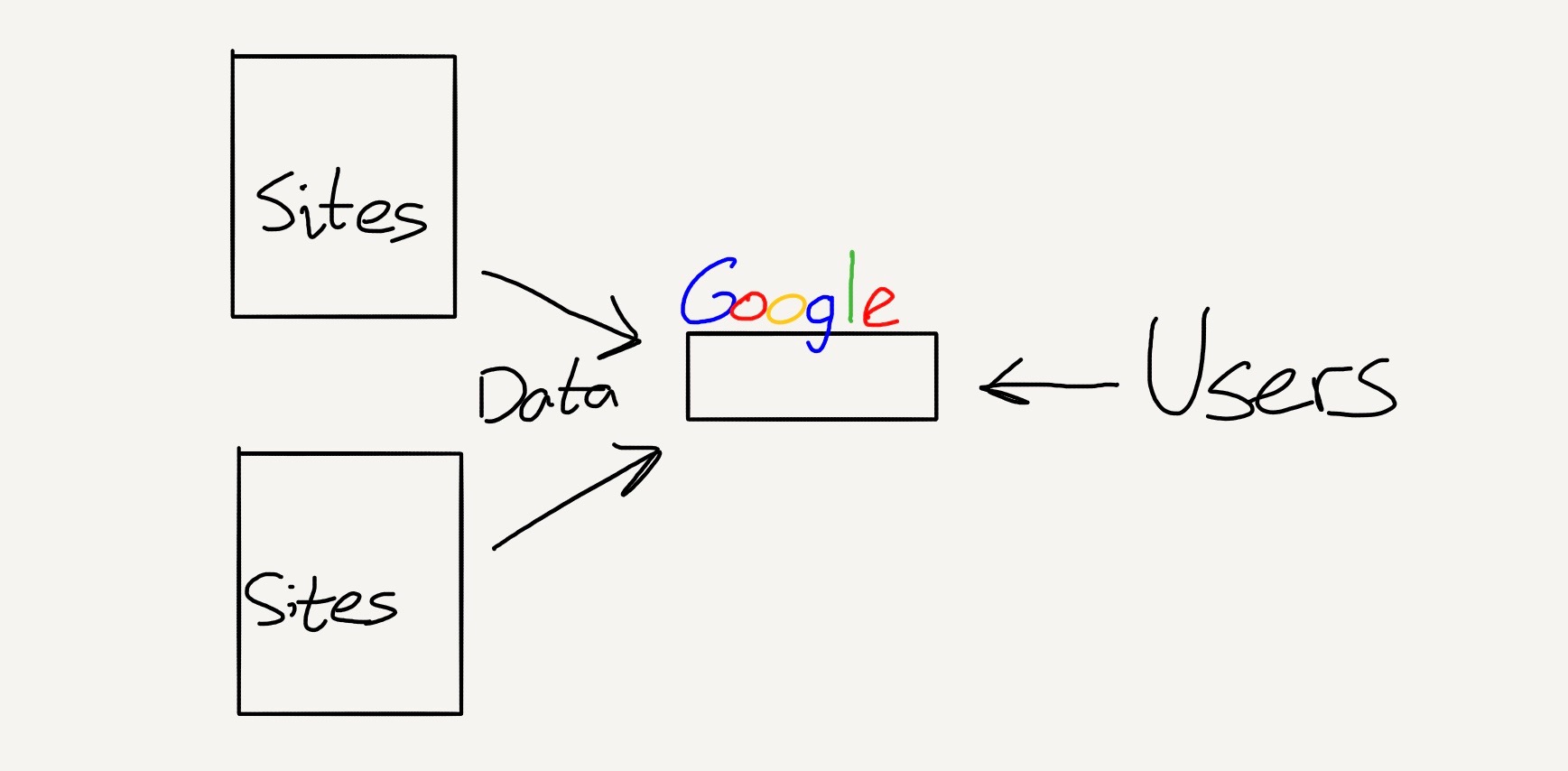
The challenge from Facebook’s perspective is the one I outlined above: Google got data from everywhere on the web because sites and applications were heavily incentivized to give it to Google so as to have a better chance of reaching end users aggregated by Google:

Sites need Google to reach users, so they give Google all their data

Facebook, meanwhile, was a closed garden. This was an advantage in that users generated Facebook’s content for them, and that said content wasn’t available to Google, but there was no obvious way for Facebook to gather data on the greater web, which is where the Open Graph came in; Facebook would give away slices of its data in exchange for data from sites and apps around the web:

To catch up with Google Facebook exchanged user data for site data

Zuckerberg said as much in his keynote:

At our first F8, I introduced the concept of the Social Graph. The idea that if you mapped out all of the connections between people and things in the world it would form this massive interconnected graph that just shows how everyone is connected together. Now Facebook is actually only mapping out a part of this graph, mostly the part around people and the relationships that they have. You guys [developers] are mapping out other really important of the graph. For example, I know Yelp is here today. Yelp is mapping out the part of the graph that relates to small businesses. Pandora is mapping out the part of the graph that relates to music. And a lot of news sites are mapping out the part of the graph that relates to current events and news content. If we can take these separate maps of the graph and pull them all together, then we can create a web that is more social, personalized, smarter, and semantically aware. That’s what we’re going to focus on today.

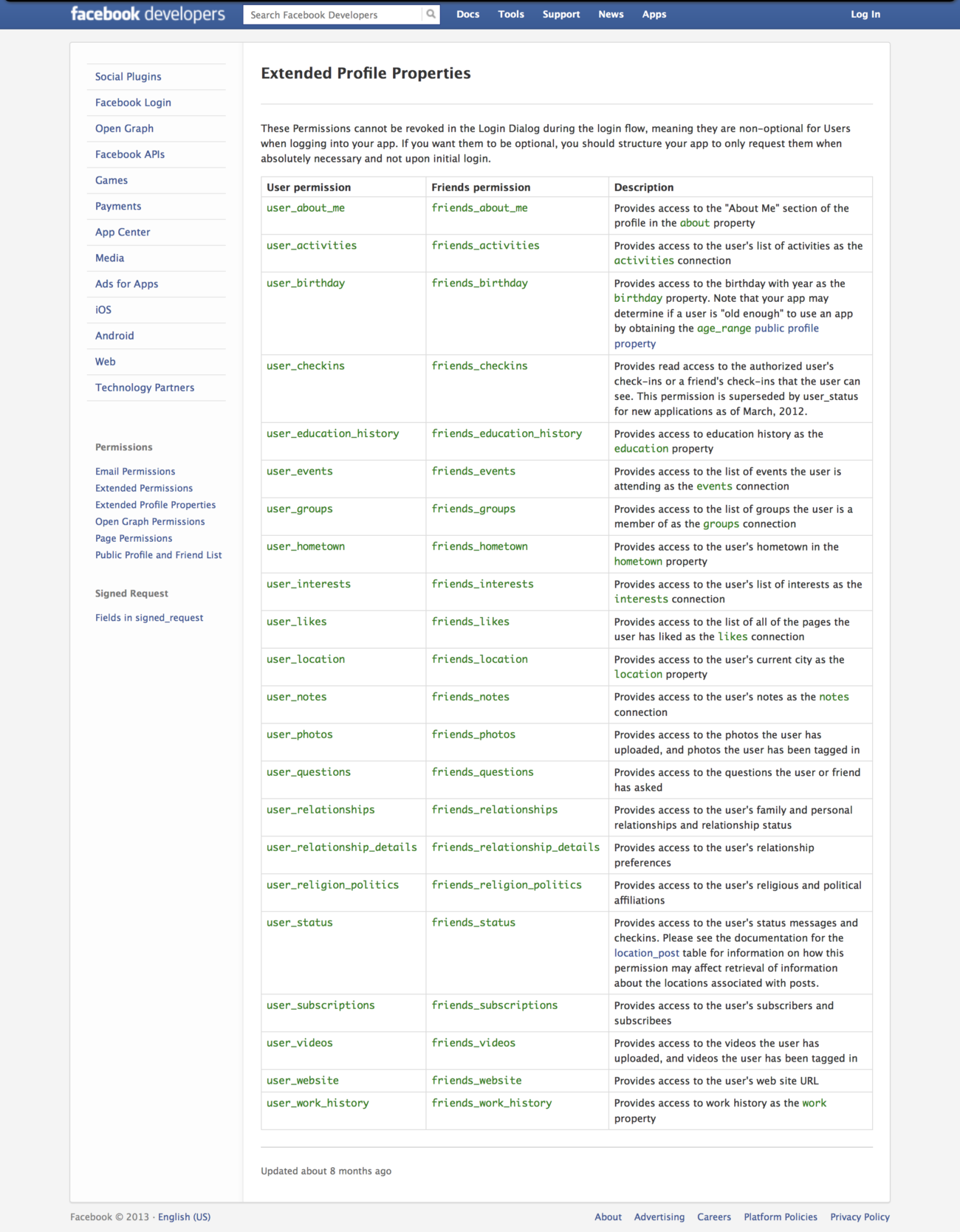
What followed was the introduction of the Graph API, which was the means by which Facebook would facilitate the data exchange, and as you can see on an old Facebook developer page, Facebook was willing to give away just about everything:

Facebook's developer page showing all of the data given to third party apps

Moreover, note that users could give away everything about their friends as well; this is exactly how the researcher implicated in the Cambridge Analytica story leveraged 270,000 survey respondents to gain access to the data of 50 million Facebook users.

Facebook finally shut down the friend-sharing functionality five years later, after it was clearly ensconced with Google atop the digital advertising world, of course.

Facebook’s Brand

That Facebook pursued such a strategy is even less of a surprise than Google’s imperious adoption of Wikipedia as conspiracy theory debunker: Facebook’s motto was “Making the world more open and connected”, and the company has repeatedly demonstrated a willingness to do just that, whether users like it or not. That’s the thing with branding: what people think about your company is not so much what you say but what you do, and that many people immediately assume the worst about Facebook and privacy is Facebook’s own fault.

To be sure, there seems to be a partisan angle as well — one didn’t see many complaints about the Obama campaign. From the Washington Post:

Early in 2011, some Obama operatives visited Facebook, where executives were encouraging them to spend some of the campaign’s advertising money with the company. “We started saying, ‘Okay, that’s nice if we just advertise,’ ” Messina said. “But what if we could build a piece of software that tracked all this and allowed you to match your friends on Facebook with our lists, and we said to you, ‘Okay, so-and-so is a friend of yours, we think he’s unregistered, why don’t you go get him to register?’ Or ‘So-and-so is a friend of yours, we think he’s undecided. Why don’t you get him to be decided?’ And we only gave you a discrete number of friends. That turned out to be millions of dollars and a year of our lives. It was incredibly complex to do.”

But this third piece of the puzzle provided the campaign with another treasure trove of information and an organizing tool unlike anything available in the past. It took months and months to solve, but it was a huge breakthrough. If a person signed on to Dashboard through his or her Facebook account, the campaign could, with permission, gain access to that person’s Facebook friends. The Obama team called this “targeted sharing.” It knew from other research that people who pay less attention to politics are more likely to listen to a message from a friend than from someone in the campaign. The team could supply people with information about their friends based on data it had independently gathered. The campaign knew who was and who wasn’t registered to vote. It knew who had a low propensity to vote. It knew who was solid for Obama and who needed more persuasion — and a gentle or not-so-gentle nudge to vote. Instead of asking someone to send a message to all of his or her Facebook friends, the campaign could present a handpicked list of the three or four or five people it believed would most benefit from personal encouragement.

This, though, is hardly a defense for Facebook: what is the company going to say, that it was exporting friend data for everyone, not just Trump? To be sure, buying the data from an academic and allegedly holding onto it violated Facebook’s Terms of Service, but “We have terms of service!” isn’t exactly a powerful branding campaign, especially given that at that same 2010 f8 Facebook had dramatically loosened those terms of service:

We’ve had this policy where you can’t store or cache data for any longer than 24 hours, and we’re going to go ahead and get rid of that policy.

(Cheering)

So now, if a person comes to your site, and a person gives you permission to access their information, you can store it. No more having to make the same API calls day-after-day. No more needing to build different code paths just to handle information that Facebook users are sharing with you. We think that this step is going to make building with Facebook platform a lot simpler.

Indeed it was.

Google, Facebook, and Regulation

Ultimately, the difference in Google and Facebook’s approaches to the web — and in the case of the latter, to user data — suggest how the duopolists will ultimately be regulated. Google is already facing significant antitrust challenges in the E.U., which is exactly what you would expect from a company in a dominant position in a value chain able to dictate terms to its suppliers. Facebook, meanwhile, has always seemed more immune to antitrust enforcement: its users are its suppliers, so what is there to regulate?

That, though, is the answer: user data. It seems far more likely that Facebook will be directly regulated than Google; arguably this is already the case in Europe with the GDPR. What is worth noting, though, is that regulations like the GDPR entrench incumbents: protecting users from Facebook will, in all likelihood, lock in Facebook’s competitive position.

This episode is a perfect example: an unintended casualty of this weekend’s firestorm is the idea of data portability: I have argued that social networks like Facebook should make it trivial to export your network; it seems far more likely that most social networks will respond to this Cambridge Analytica scandal by locking down data even further. That may be good for privacy, but it’s not so good for competition. Everything is a trade-off.

20 Mar 18:39

Ten things we miss about Hong Kong sport from the ’80s and ’90s – and why Kai Tak airport makes the list

by Nazvi Careem
If there was such as thing as the glory years of Hong Kong sport, you would most likely find them during the final two decades of the 1900s. The ’80s and ’90s were not about Hong Kong being world-beaters at any given sport, though we had one of them. Neither were they about the dawning of a great new era as Hong Kong returned to China while keeping its sporting autonomy. It was about a sporting culture that was palpably richer than it is now. Yes, the money pumped into Hong...
20 Mar 18:39

Don’t forget the feed

by Boone Gorges

Google killed Reader just over five years ago. This week, Digg decided to mark this Wood Anniversary by taking a club to its own Reader. Yet again, we oldsters find ourselves shaking our fists at Kids Today. See, for example, Bryan Alexander's thoughtful post on finding a way forward for RSS readers and RSS in general.

I celebrated this turn of events by struggling to set up an instance of Tiny Tiny RSS on my web server. Having finally figured it out, I'm pretty pleased with the functionality. One nice bit is the notice regarding "update errors":

Oh noes!

TT-RSS then has a tool for viewing a list of broken feeds. Looking through this list has been an interesting experience. For one thing, it's given me the opportunity to think about a few dozen people who have not otherwise entered my consciousness in a number of years.

More importantly, it's convinced me that the real threat to RSS is not the lack of reader software; you only need a couple of good ones to support an ecosystem. The bigger issue is that RSS content is disappearing.

The more mundane kind of problem is link rot and broken redirects. Many domains have gone away, some have moved in such a way that RSS links no longer work, some are now hidden behind password protection (Blogspot seems to be a particular offender). Web sites come and web sites go, so some of this is to be expected.

The more worrisome trend is content that's not available through RSS simply because there's no feed mechanism. A shamefully large number of my geekier aquantainces have moved their blogs to Jekyll and other static-site-generation tools, which don't appear to have feed support out of the box; and – this is the "shameful" part – since these folks, geeky as they may be, think so little of RSS, they don't bother setting up the secondary plugins or whatever necessary to serve feeds. I expect that kind of behavior from lock-up-my-content companies and technically-clueless organizations that rely heavily on proprietary and bespoke software, but not from people who ought to know better.

For all of its lumbering bloatedness, one of the truly wonderful things about CMSes like WordPress is that they give you things like RSS – along with a pile of other boring-but-critical-to-the-future-of-the-open-web tools – by default. You don't need to make the decision to support RSS readers (or responsive images, or markup that is accessible to assistive technologies, etc) – the system provides them for you, and you have to go out of your way to turn them off.

Those who build their own systems for old-school things like bloggish content distribution, or who rely on teh new hotness to do these tasks in ways that are slicker than the old-school tools, should beware the dangers of discarding the automated systems that are the result of many years and many minds and many mistakes. If you must reinvent the wheel, then do your due diligence. RSS feeds, like other assistive technologies, should not be an afterthought.

20 Mar 18:39

Kits Point and Bikes Lanes: What this is really about – 2

by pricetags

By Jeff Leigh

The Vancouver Sun has posted an editorial about the controversy regarding the proposed Kits Beach Park bike route, “Don’t Wreck Kits Beach Park with Unnecessary Bike Lane

Leaving aside the quip about chanting anti-car slogans (the advocacy group I work with has as a guiding principle respect for all transportation stakeholders – there aren’t winners and losers), there are numerous fallacies presented in the op-ed piece.  Starting with the title.  The proposal is for a low-speed path, not a bike lane.

Cyclists, on the hand, cannot safely ride through the throngs of pedestrians on the existing path — although many try — and want a route that allows them to complete a seaside circuit without interruption or the inconvenience of vehicular traffic.

We agree that riding through a throng of people walking on the existing shared path isn’t safe.  But diverting people on bikes (especially families with children) to a busy street and through a parking lot, particularly in summer, isn’t about inconvenience.  It is about safety.  It is about respecting the principles established in our city for movement, with people walking at the top of the pyramid, and people on bikes next.  Not last. And certainly not behind preserving all of the space for cars that is being championed here.

This is about park planning.  Note the photo the Vancouver Park Board use on their web site:

The matter was supposed to be decided at a Vancouver Park Board meeting this past Monday, but the board voted to refer it back to the engineering department for further study.

The construction of a bike route wasn’t supposed to be decided by Park Board Commissioners.  The recommendation by Park Board staff was simply for staff to work with City transportation engineering staff to advance designs, and develop budget cost estimates, in preparation for a full public consultation.  The Park Board Commissioners did not refer it back to Engineering, as Engineering isn’t a Park Board department.  They failed to refer it back.  They left it in limbo.  References were made in the meeting to next year’s Park Board commissioners dealing with it.

Considering that a bike lane through this park has been debated for five years or so, one might have thought that all the study would be done. But the total cost, the number of trees to be lost and other details are still unknown.

All the study was not done as Park Board staff did not start work on it until late in 2017, in response to community pressure to deal with a worsening problem.  That pressure came from the cycling community.  But also at the table with Park Board staff were local residents and representatives of various park user groups.  The costs and potential tree impacts are unknown because that work hasn’t been done yet.  The staff recommendation was for that work to be done. Park Board staff will struggle to do it without hiring outside expertise, or working collaboratively with Engineering staff, who had offered to help.

The route from Balsam Street and Cornwall Avenue in the west to Ogden Avenue and Maple Street in the northeast would result in the loss of about 930 square meters of green space, roughly the size of two basketball courts. Demonstrators before the meeting carried signs reading: “Is concrete the new green?”

There are many options that reduce that impact, and offsets that result in no net increase in paving if that is desired.  Those options are open to the Park Board. Utilizing existing pavement would be the first way to answer the concern.  That means dealing with the question of retaining all existing parking, designing a safe route down the existing service lane to the restaurant, and so on.

But if the goal is to remove paving, fine.  Should we start with the tennis courts, the basketball courts, or one or more of the three parking lots?  Or should we instead simply find a way not to encroach further. A basketball player and a tennis player holding signs saying “No Paving in the Park” may be inclined to opt for the latter.

Lowering the tone of the debate doesn’t help. Why is a safe path through the park called a cycling speedway?  Why the references to the Tour de France by path opponents? There is already a Seaside Bypass route on the street, for faster cyclists, just as there is along Charleson Road in South False Creek, and along 1st Avenue near Burrard.  Are the tennis courts in the park a Wimbledon venue?  Are the basketball courts a professional arena?  Or are all of these simply park amenities, used by people enjoying the park?

A little more balance, please.  Vancouver has a wonderful treasure in our Seaside Greenway, and the bike paths around Stanley Park, around False Creek and the length of the Seaside Greenway are heavily used and widely appreciated.  They are a tourist draw. Kitsilano Beach Park, and both residents and visitors who want to use our bike paths, deserve better than this.


Jeff Leigh is the chair of the Vancouver UBC Local Committee of HUB Cycling.

20 Mar 18:39

A Tale of Two Different Bottom Lines~McArthur Glen Mall at YVR & Tsawwassen Mills

by Sandy James Planner

mcarthur-glen-slider

It is an interesting time for regional malls in Metro Vancouver, and two new entrants in the market, McArthurGlen in Richmond by the Vancouver International Airport and the hugely overbuilt 1.2 million square foot Tsawwassen Mills Mall tell different tales.  Glen Korstrom reports in Business in Vancouver on the proposed 84,0000 square foot expansion to the existing 240,000 square feet at McArthurGlen, which its general manager claims is “the No. 1-performing outlet centre in Canada…citing $1,220 in sales per square foot per year from his mall’s more than 70 tenants.”

That amount of $1,220 sales per square foot means that the airport’s mall which focuses on sales as an outlet is number three in British Columbia after Oakridge (which makes $1,579 per square foot) and Pacific Centre (which is making $1,532 per square foot according to the Retail Council of Canada. Why is McArthur Glen doing so well? It sells discounted merchandise, its customers are locals as well as tourists from the airport, and it is well serviced by the Canada Line to the airport.

It’s been a different story at Tsawwassen Mills, which opened in October 2016. Based upon the two other mega malls (CrossIron Mills in Calgary and Vaughn Mills in Toronto) in the Ivanhoe Cambridge stable , this mall was built with  over 6,000 parking spaces  on the most arable land in Canada. Without a close ring of density and with poor public transportation connections from the region, this mall has faltered, with Retail Insider Media owner Craig Patterson saying that he has heard the mall has consistently been struggling. On Ivanhoe Cambridge’s website they confirm that retail sales are only $345 not per square foot, but per square foot of a retail unit, almost a quarter of the sales reported by McArthurGlen.

The CBC has been investigating the fact that “technological advances” have lowered consumer demand for many products, and while online shopping is still only 3.4 per cent of retail sales, online trading platforms have lessened the need to buy new things. Canada may have maxed out on the square footage of retail that can be supported, and Millennials~those born in the 1980’s and 1990’s  don’t gravitate to car ownership as much as their parents did, making them less likely to drive to a mall and more likely to shop online or stick to local stores.”

An older mall in Toronto, Yorkdale has continued to draw in customers by offering high-end shops and appealing food spectacles and stores. While retailers try to create “experiences” for their shoppers, the appeal of outside settings and main streets with a blend of shops and services seem to be setting the trend. The most successful retailers are not bundled in a mall but are independent standalones, such as Winners, Costco and Walmart.  Meanwhile many malls look at redevelopment and increasing density in the form of mixed use development  to generate much-needed income to sustain their retail operations.  A survey conducted in the winter of 2017 suggests that 7 out of 10 executives believe that aggressive adaptation to e-commerce is necessary for retail survival. But the bottom line differences at  McArthurGlen Mall and Tsawwassen Mills Mall also suggests that discounted goods offered close to consumers with access to public transit choices are important as retailing moves into a 21st century adaptation.

31947867521_c73d36e40c


20 Mar 18:38

Seen Outside the CBC Building on Hamilton Street

by Sandy James Planner

IMG_4570

So far Stephen Quinn is  not running for Mayor or Council, but this poster outside the CBC Studios express values that can also apply to a good cup of coffee as noted by Bob Kronbauer of Vancouver is Awesome. And those values are super for public office too.

Mr. Quinn is not giving up his very early morning CBC  Early Edition for the Mayor’s Chair. But whatever, we will take the words “Bold, Fair and Authentic” for coffee and for running for public office any day.

20 Mar 18:38

Vancouver Central Library Afternoon Enlightenment

by Sandy James Planner

fullsizeoutput_9fb

There’s an interesting phenomena for anyone walking in late afternoon around 350 West Georgia and going into the central atrium of the Vancouver Downtown Central Library. The sunlight angles come right through into the galleria, creating pattern on pattern, and playing with angles and light.

After a long winter, it is a great sight to see, and a few people deviated from their walking route specifically to walk through the light patterned space.


fullsizeoutput_9faIMG_4559

20 Mar 18:38

The Inevitable Occurs

by pricetags
20 Mar 18:38

Where’s the Buzz — 2018 Civic Election

by Ken Ohrn

Reaching into the vast chasm of ephemera, here’s a look at which civic parties are currently attracting people to vie for nominations.   Where do Vancouver’s hopefuls think they’ll get the most voter support for their ambitions?

Actually getting a nomination is an entirely different matter, with vote-splitting permutations being calculated over multiple dimensions in buzz-busy coffee shops all over town, no doubt.   And plenty of hopefuls who have not yet made their plans known.

All of this is subject to change immediately after publication (actually during publication, most likely).  But it’s still fun.


Considering Mayor, Council , Park and School Board hopefuls identified by Ian Bushfield of Cambie Report.
  • NPA:  15
  • Greens:  13
  • OneCity:   7
  • Vision:   4
20 Mar 18:38

Jobs Jar: Dialogue and Public Engagement Coordinator

by pricetags

SFU Morris J. Wosk Centre for Dialogue is hiring a Dialogue and Public Engagement Coordinator

With significant opportunities for learning and mentorship, this entry-level position will combine the hard work and pragmatism of a consulting practice with the satisfaction of helping to address critical public issues in ways and extend the democratic process. Parking you own political beliefs will be essential as you help to create space for others to express diverse viewpoints.

Also open to short term assignments such as co-op.


See the full job description here.

Deadline to apply is March 30, 2018 at 5:00 pm PT.

Submit a cover letter and resume with references via email to civic_engage@sfu.ca. 

20 Mar 18:38

Idleness and Ennui at Trump Tower

by pricetags

Jason Wilson is a food and travel writer, and contributor to The Washington Post.

Trump has been written about in every other genre of journalism: political, entertainment, financial, fashion, sports. Why not look at Trump, promiser of luxury experiences, through the eyes of a travel writer?

My plan was to sleep in the various Trump hotels, experience the Trump amenities, wear the Trump robe and shower cap, eat in the Trump restaurants, drink in the Trump bars — no differently than when I anonymously visit and review any other establishment in the course of a travel or food article. Given the state of things, this might have been naive, but that’s what I ended up doing.

Trump International Hotel Tower – Vancouver

It’s just after dark in Vancouver’s downtown financial district, on a chilly autumn evening, and I’m gazing up at the twisting, triangular, neo-futurist Trump International Hotel & Tower, rising 63 stories and 616 feet into the air. If you’re impressed by tall things, the Trump tower is pretty tall. But then I glance across West Georgia Street, at the Living Shangri-La tower, rising 62 stories but standing 659 feet tall. Which means that the Living Shangri-La is the tallest building here. For someone like Donald Trump who is obsessed with superlatives, it must be tough to have your name emblazoned on the second-tallest building in Vancouver.

From where I stand, the Trump International Hotel & Tower is not particularly welcoming. It’s 7:30 p.m., but I see very few lights on the higher floors, and I wonder who lives in the darkened condominiums in the upper parts of the tower. Below the condos, the hotel occupies the first 15 floors. All over the outside of the property, there are large white bloblike sculptures, as if a giant sneezed.

I’m paying nearly $300 per night to stay in one of the 147 five-star hotel rooms in the tower. When I arrived to check in, I gawked at the two Lamborghini Diablos parked in front of the hotel entrance. After I got to my room, I tried on the robe embroidered with “TRUMP,” along with the “TRUMP”-branded shower cap, in my marble-tiled bathroom. At the Trump Champagne Lounge, I ate a “delectable playful bite” — a trio of not-all-that-delectable toothpicked sliders — and ended up only ordering a cheap by-the-glass sparkling wine, since bottles on the Trump Champagne Lounge’s list range from $150 to $1,350. Throughout the lounge, which is interspersed with pillars that look like huge, gold-plated Jenga stacks, everyone else seemed to be speaking Chinese. …

On my second night in Vancouver — my final stop on this journey — I’m planning to eat at Mott 32, the “luxury Chinese” spot on the ground floor of the Trump hotel. Just as I’m about to walk back inside for dinner, a black SUV drives past with its passenger window lowered. A young woman leans out, waving two middle fingers and screaming at the top of her lungs: “F— you, Trump! F— you! F— you! F— you, Trump!” It’s like the primal shriek of a banshee. I am one of only two people standing outside the entrance, so it feels like much of her hate is being directed at me. Since I am a paying customer here, perhaps that’s her point.

After the SUV cruises on, the street is quiet again. A Trump employee standing nearby shrugs and opens the lobby door for me. His body language is similar to that of the bartender I chatted with at the Trump Champagne Lounge earlier, who grimaced when the name “Donald Trump” was uttered. “The property is actually owned by TA Global,” the bartender said, making clear that the Trump brand is licensed. “It’s like a franchise.” …

At Mott 32, the dining room is completely full and I’m seated at the bar. Mott 32 is the North American outpost of a famous Hong Kong restaurant, which has another location forthcoming in Bangkok. A critic for the Globe and Mail newspaper called it “the most noteworthy restaurant to open in Vancouver for many years.” The Filipino bartender explains that the majority of the clientele in Mott 32 speaks Mandarin and is wealthy. Scanning the full dining room, I can believe it.

At the table in front of me, a waiter carves the $95 Peking duck for a Chinese family, with several children playing on their iPads. That Peking duck is not even close to the most expensive dish on the menu: A whole suckling pig costs $495; braised whole dried fish maw, in abalone sauce, is listed at $580. (Canadian dollars, but still.) I order a few of the more affordable small dishes from the “Evening Dim Sum” menu: an unexceptional duck spring roll, some hot-and-sour Shanghai-style soup dumplings, which are surprisingly tasty, and a black truffle siu mai with Iberico pork and a soft quail egg, served at room temperature, that is just too ambitious to be anything but disappointing. The bartender makes a little joke when he serves the siu mai: “Be careful about the egg inside. It’s a soft yolk and you don’t want it all over your shirt.” …
As a jaded travel writer, someone who has stayed in many soulless hotels and eaten in many overpriced restaurants in many disappointing places, I’m completely at ease with a certain exquisite idleness and ennui. But there’s something profoundly unsettling about the sort of boredom that I’ve been feeling in the Trump properties over the past many weeks. …

I think about the woman earlier this evening who screamed from her SUV, yelling at those of us who happened to be standing in front of the silent, cold, glistening tower. It was a little over-the-top. I suspect that this type of white-hot outrage and hysteria will eventually cool. I also suspect that the era of Trump will pass soon enough. When that happens, what terrifies me is not that Trump’s presidency will have ended up as an exploding, burning disaster — but rather that it will have become something dangerously lukewarm, seeping into our identity. Kind of like that black truffle siu mai with the quail egg inside, served room temperature, with the soft yolk that threatens to ooze down the shirt of the person who ordered it.


20 Mar 14:41

What we learned about gender identity in Open Source

by Emma

In research the Open Innovation team ran in 2017 we learned that often ‘Women’ was being used as a catch all for non-male, non-binary people; and that this often results in people feeling excluded or invisible inside open source communities.

“This goes into the gender thing — a lot of the time I see non-binary people get lumped in with “women” in diversity things — which is very dysphoria-inducing, as someone who was assigned female but is definitely *not*.” — community interview

To learn more, we launched a Diversity & Inclusion in Open Source survey earlier this year, which sought to better understand how people identify, including gender-identity.

Our gender spectrum question, was purposely long — to experiment with the value people found in seeing their identity represented in a question. People from over 200 open projects participated. Amazingly, of 17 choices, each was uniquely selected, by a survey participant at least once.

7.9% ** of all respondents, selected something other than male or female; for those under the age of 40 that number was higher at 9.1% .a

In some regions, many of the gender choices felt unfamiliar or confusing — but the idea that there be more than two options was not. For example, we know that India already recognizes a ‘third gender’.

Through this experience, and other feedback we settled on a 1.0 standard for gender questions and gender pronouns for surveys, and systems.

One way your community can act on these findings, is to ensure that people can express their pronouns on profile pages, and communication channels. After our given names, pronouns are the most frequently used way of referring to each other and when we get people’s pronouns wrong, it’s no different than calling someone by the wrong name.

It’s also super-important for binary folks to take this step , by creating norms of sharing pronouns, we make it easier and safer for others.

One other way to act on this research, to ensure that if you create identity groups for women, but you mean women and non-binary — say so; invite people in by through their expressed identity.


** Responses that were deemed not to be sincere were filtered out

Join our next Diversity & Inclusion in Open Source Call — April 4th. Details in our wiki.

FacebookTwitterGoogle+Share

20 Mar 14:41

SotD: That’s Right!

This is a cheery bright fast polyrhythmic acoustic guitar instrumental by Jesse Cook. Like a few other numbers here at Song of the Day, I discovered this one by killing time in a record store; mind you, this was HMV in its declining days, not one of the cool-magnets of yore. But I loved the tune and asked the clerk and bought the record.

Vertigo by Jesse Cook

The record is called Vertigo and all of it is at least listenable and at best memorable; I’d call That’s Right! the highlight. It also has Sade guesting very prettily on a couple of numbers. On the YouTube linked below, Jesse intros the song and explains that it combines Bo Diddley and Bhangra rhythms with Zydeco accordion (played on Vertigo by Buckwheat Zydeco himself). All I know is that it gallops along like a race-horse and is major fun for the ears.

This is part of the Song of the Day series (background).

Links

Spotify playlist. This tune on Spotify, Amazon, iTunes. As for live video, this one where he explains the song is OK, but there’s nothing out there that has the explosive pace and orchestration of the recording.

20 Mar 14:40

Uber halts all self-driving car tests following fatal U.S. accident

by Bradly Shankar
Uber car pickup with app

Uber has announced that it has temporarily suspended its self-driving car tests in all cities following a fatal accident in the U.S.

According to CNBC, an unidentified woman was hit and killed by an Uber self-driving car while crossing a street in Tempe, Arizona at night.

The accident is believed to be the first known death of a pedestrian struck by an autonomous vehicle on public roads.

As a result, Uber told CNCB that the ride-sharing company has halted testing in San Francisco, Pittsburgh, Phoenix and Toronto.

A vehicle operator was in the car at the time, although there were no passengers inside, according to Tempe police.

The same spokeswoman told CNBC that the company is “fully cooperating” with local authorities, although it’s currently unclear what the company will do with its tests going forward.

Uber began testing piloted self-driving cars in Toronto last August and later obtained a permit for further testing in Ontario.

Via: CNBC

The post Uber halts all self-driving car tests following fatal U.S. accident appeared first on MobileSyrup.

20 Mar 14:40

LG makes WebOS open source in effort to expand the operating system’s market presence

by Brad Bennett

South Korean electronics giant LG has announced that it’s bringing its WebOS platform to the masses by making the operating system open source.

WebOS is a Linux based operating system that made its debut on the now-defunct Palm brand of smartphones in 2009. Since then, WebOS has evolved to be part of HP hardware, including tablets and printers, until the software was licensed to LG in 2013.

LG has been using WebOS in smart televisions and fridges, but according to a March 19th, 2018 media release, the company hopes to expand on that scope by making WebOS open source.

This move will pivot LG to better compete with Samsung’s Tizen OS as an open-source alternative to Android.

Both WebOS and Tizen can run on smart devices like set-top boxes, TVs, tablets, watches and more.

In a move to gather more support for the operating system, LG has partnered with the South Korean National IT Industry Promotion Agency (NIPA) to find viable candidates that LG will support with the goal of bringing more WebOS products to market.

For developers looking to understand the new WebOS Open Source Edition, LG has set up a website that explains how to start developing with WebOS. LG has also created forums where new WebOS developers can support one another.

“And because webOS is a Linux-kernel-based multitasking OS with support for HTML5 and CSS3, webOS will be quite familiar to even new developers,” reads an excerpt from the March media release.

Source: LG Via: Engaget

The post LG makes WebOS open source in effort to expand the operating system’s market presence appeared first on MobileSyrup.

20 Mar 14:39

Instagram rolls out in-app shopping feature to Canadian users

by Bradly Shankar
Instagram Jon Snow phone

Instagram has rolled out a feature to Canadian users that allows businesses to tag products in organic posts, offering pricing and product details on a post within the app.

The shopping feature was previously introduced in the U.S. in March 2017.

In addition to offering product information, users will also be able to tap on a tagged post in their feeds or click the ‘shop’ button on a business’ profile to learn more. On the business page’s side of the user experience, a product can be tagged in the same way that one would tag a person in a post.

Instagram shopping feature

“People come to Instagram every day to discover and shop products from businesses they love. We want that to be a seamless experience,” said Susan Rose, director of product marketing at Instagram.

“Whether it’s a local artisan, florist or clothing store, now shopping your favourite Canadian businesses has never been easier on Instagram.”

According to Instagram, over 200 million accounts visit at least one business profile a day.

The post Instagram rolls out in-app shopping feature to Canadian users appeared first on MobileSyrup.

20 Mar 14:39

Police brutality at Union Station bus terminal

by Desmond Cole
Screen Shot 2018-03-20 at 5.58.29 AM

Police brutality at Union Station bus terminal

On Sunday March 11 2018, two patrons at the Union Station GO bus terminal witnessed transit constables and Toronto police assaulting a man they identified as having mental health issues.

In a video filmed by one witness, transit constables suggest the man, whom they call “Chris,” has mental health issues, and tell him an ambulance is coming for him. But the constables then suggest the man is lying to them about his identity, and arrest him for obstruction of justice.

Constables and Toronto Police violently restrain the man for over 30 minutes—two different officers use their knees to pin the man’s head and neck to the ground. The second officer uses this dangerous technique for over eight minutes. At one point police suggest an officer with a taser is about to arrive. Police and transit constables repeatedly ask the witnesses filming them for identification, and threaten to confiscate their cell phones.

An ambulance arrives on scene after about 25 minutes—police instruct the paramedic who approaches them not to treat the man, saying he has been acting violently, and she complies. The paramedic does not even attempt to engage the man.

Police ultimately remove the man from the station in handcuffs and leg restraints. The video below has been edited for length, and to protect the man’s identity.

According to Statistics Canada, people living with mental health issues or cognitive disabilities are four times more likely to experience violence than their peers.

20 Mar 14:38

International Day of Happiness

by Helen Keegan
I didn't actually know there was an International Day of Happiness until this morning. Apparently, it's today. It's a United Nations thing and started in 2012. "It's an annual celebration of happiness as a fundamental human right and goal for all of humanity. This year's theme, #TenBillionHappy, sets our sites (sic) on the year 2050, when it is projected that 10 Billion people will inhabit the Earth. Our goal is to inspire, develop and promote initiatives with global citizens, governments, nonprofits, NGOs, and the private sector, to secure Happiness for All™ by 2050." You can find out more on the official website.

I'm all for creating more happiness where possible and there are some really simple steps you can take. This graphic from Sylvia Duckworth sums it up a treat.

Here's hoping you have a lovely day.

20 Mar 14:38

Wi-Fi, charging ports coming to ION buses connecting Kitchener and Cambridge

by Bradly Shankar
Waterloo transit

The region of Waterloo has announced that the ION buses connecting Kitchener and Cambridge will be equipped with USB charging ports and free Wi-Fi when they begin service later this month.

There will be nine ION buses in total, which will travel throughout Cambridge on a number of routes until LRT launches. Following that, they will permanently travel between the Fairway ION station in Kitchener and the Ainslie Terminal in Cambridge.

“The new ION buses will provide Cambridge residents with a high-tech, environmentally-friendly transportation option,” said Regional Chair Ken Seiling in a press release.

The announcement is part of Waterloo Region’s stage one rapid transit project.

Image credit: Region of Waterloo 

Via: CTV News

The post Wi-Fi, charging ports coming to ION buses connecting Kitchener and Cambridge appeared first on MobileSyrup.

19 Mar 15:46

Adblock Plus and deceptive dark patterns

by Don Marti

Some sites recommend Adblock Plus (or just "an ad blocker," for which Adblock Plus is often the first search result) as a privacy or security tool. But Adblock Plus uses deceptive "dark patterns" to avoid offering real privacy or security to users.

Please do not recommend either Adblock Plus or "an ad blocker" to users who are concerned about web privacy or security.

Adblock Plus runs a paid whitelisting program called "Acceptable Ads". The "Acceptable" criteria include no rules against common user privacy and security concerns, such as malvertising and PII misuse. And configuring Adblock Plus to actually provide tracking protection is complicated.

  • Go to "Filter Preferences" in the ABP menu.

  • Click "Add filter subscription"

  • No privacy lists appear on the main drop-down. You will have to hunt for them behind "Add a different subscription".

  • Scroll down and eventually find the "EasyPrivacy" entry from a long list.

  • Click "Add subscription".

So far, it's time-consuming and deliberately complicated, but not deceptive. (Keep this in mind when Adblock Plus proponents talk about how users are mad about annoying ads but don't mind tracking. If users don't mind tracking, why did Adblock Plus make it so hard to make the choice?)

Turning on a privacy list is enough of a maze to discourage users, but not deceptive deceptive. That's found in another place.

Now for the deceptive part.

Even after you go through the above five-step (!) process to find and turn on "EasyPrivacy", you're still not protected. This is not clear unless you read the fine print. The "Acceptable Ads" paid whitelisting program actually overrides your explicit EasyPrivacy choice, to allow tracking by Google, Criteo, and other companies.

In order to make your tracking protection choice take effect, you also have to turn off "Acceptable Ads" using a different option, which is labeled "Allow some non-intrusive advertising."

whitelisting screenshot

To really block trackers, un-check a box with a label that says nothing about trackers at all.

The checkbox is not even labeled "Acceptable Ads," maybe just in case a user has heard of "Acceptable Ads" and knows about the controversial paid whitelisting program.

What to do instead

The good news is that alternatives are available.

  • Instead of recommending "an ad blocker," link to a list of legit tracking protection tools, or make your own list of tools that work well with your site. It's easy to use a JavaScript browser detector like bowser to recommend an appropriate one for the user.

  • If you maintain a directory of web software, please do not list Adblock Plus in a privacy or security category.

More: Aloodo for Web Publishers

19 Mar 15:45

Use case sighting: Personal cyber insurance

by Don Marti

Aaron Harris writes,

As more things in our lives become hackable, we’ll need more help protecting ourselves from those things. Existing companies that focus on homeowner’s insurance are unlikely to understand these issues well enough to create great products.

If a user visits an insurance site for a personal cyber insurance quote, will the number be higher or lower of the user is running Privacy Badger? How about Apple Safari with Intelligent Tracking Prevention?

If you need to check a user's browser to make sure they're protected from third-party tracking and all its negative security externalities, we have a tool for that.

19 Mar 15:44

An updated description of my colour-coding scheme for highlighting and scribbling

by Raul Pacheco-Vega

In 2015, I believe, I first described the process I use to read and highlight. But that has been evolving through time. This blog post, like the one I did on an updated version of the Drafts Review Matrix, is intended to show how I read, highlight, and scribble on the margins of book chapters and journal articles. This colour-coding scheme is approximately the same that I use right now, though as I’ve mentioned before, sometimes I veer off.

There are a number of decisions that students and early career scholars ask me about. For example, how do I decide which articles I’m reading merit a memorandum, which ones merit a synthetic note, and which ones are simply a quick AIC/CSED row entry? Here’s one example of such decision. If after running an AIC Content Extraction I find that the paper is really heavy with marginalia and highlights, it would probably be wise to read it more deeply and in its entirety.

I often tweet about the fact that I match colours across. For example, if I highlight in pink, I scribble corresponding notes in pink, and I write on my Everything Notebook in the same hue.

As I mentioned on Twitter, this is more or less my colour coding scheme right now.

You can read the rest of the thread by clicking anywhere on the tweet below. Once you do, the Twitter thread will expand and you can scroll up and down to read it in its entirety. As I mention, I usually use Yellow for main-level, or key ideas. For example, each paragraph’s opening sentence (if the paper is written that way) would be highlighted with yellow. The problem I have with writers who lock their main idea in the middle of a paragraph is that you need to read an entire paragraph to “unlock it” and find THE key concept.

I normally use orange, pink, green and blue to second-, third-, fourth- and fifth-level ideas (hierarchically and sequentially organized).

This is an important component of the process. I don’t always summarize on the margins. I dialogue with the text’s author, with the literature and I also critique. I also give myself instructions on what to do with the text I’m highlight (e.g. “construct a table summarizing these insights” means I should find the most important concepts and build a table that summarizes these insights in a visual manner that is a lot more logically organized than the way in which the author is presenting these thoughts).

The side bars I use to “grab” an entire paragraph or a few sentences mean “these sentences have important ideas, and the paragraph is too long for me to try and grab only a few of them, so I’ll capture all of it”. They can also mean “this quotation looks very cool and should be sent to my Conceptual Synthesis Excel Dump”.

Hopefully this post will help others create their own colour-coding scheme.

19 Mar 15:37

An Intuitive Motor: IQ Control’s Serial-to-Position Module

by bunnie

Back when I was a graduate student, my advisor Tom Knight bestowed upon me many excellent aphorisms. One of them was, “just wrap a computer around it!” – meaning, rather than expending effort to build more perfect systems, wrap imperfection-correcting computers around imperfect systems.

An everyday example of this is the noise-cancelling headphone. Headphones offer imperfect noise cancellation, but by “wrapping a computer around it” – adding one or more microphones and a computer in the from of a digital signal processor (DSP) – the headphones are able to measure the ambient noise and drive the headphones with the exact inverse of the noise, thus cancelling out the surrounding noise and creating a more perfect listening experience.

Although the principle has found its way rapidly into consumer goods, it’s been very slow to find its way onto the engineer’s workbench. It’s the case of the cobbler’s children having no shoes.

In particular, it’s long bothered me that motors are so dumb. Motors are typically large, heavy, costly, power-hungry, and riddled with small mechanical imperfections. In comparison, microcontrollers are tiny, cheap, power-efficient, and could run software that trims imperfections while improving efficiency to the point where the motor + microcontroller combo is a win over a dumb motor on almost every metric. So why aren’t we wrapping a computer around every motor and just calling it a day?

Then one day a startup called IQ Motion Control showed me a demo of their smart motor, the IQ Position Module, at HAX in Shenzhen. My eyes instantly lit up – these guys have done it, and done it in a tasteful manner. This is the motor I’ve been waiting years for!

Meet the IQ Position Module
Simply put, the IQ Position Module is a brushless DC motor that talks serial and “thinks” at a higher level. I don’t have to design any complicated drive circuitry or buy a proprietary controller that talks some arcane or closed standard. I just plug an FTDI cable into my laptop, hook up power, clone a small git repo and I’m good to go.

Because of the microcontroller on the inside, the IQ Position Module can emulate a range of behaviors, from a simple stepper to a range of BLDC drive standards, but the real magic happens when you tell it where you want it to go and how fast, and it figures out the best way to get there.

“But wait”, you say, “my servos and brushed DC motors can do that just fine, I just control the pulse width!” This is true for crude and slow motion control applications, but if you really want to run at high speeds – like the ones achievable by a BLDC – you have to consider things like acceleration and deceleration profiles.

The video below shows what I mean. Here is a pre-production IQ Position Module that’s being commanded to turn once in two seconds; then twice, three times, and finally ten times in two seconds. The motor can go even faster, but the figurine I attached on top isn’t balanced well enough to do that safely. Notice how the speed “ramps up” and back down again, so that the motor stops with the figurine in precisely the same position at the end of every cycle, regardless of how fast I commanded the motor to turn.

That is magic.

And here’s a snippet of the core code used in the above demo, to give you an idea of how simple the API can be:

Just tell it where you want it, and by when — and the motor figures out an acceleration profile. Of course other parameters can be tweaked but the default behavior is reasonable enough!

A Motor That’s Also an Input Device
But wait! There’s more. Because this is a “direct drive” system, there’s no gears to shear. Anyone who has busted a geared servo motor by stalling or back-driving it knows what I mean. IQ Position Modules don’t have this problem. When you stop driving the IQ module – put it in a “coast” mode – it turns freely and without resistance.

This means the IQ motor doesn’t just “write” motion – it can “read” motion as well. Below is a video of a simple motion copy demo I cooked up in about an hour (including time spent refactoring the original API), where I implement bidirectional read/write of motion between two IQ Position Modules.

The ability to tolerate back-drive and also “go limp” is advantageous in robotics applications. Impact-oriented tasks — such as hammering a nail or kicking a ball — would rapidly degrade the teeth in a geared drive train. Furthermore, natural human motion incorporates the ability to go limp, such as the forward swing of a leg during walking. Finally, biological muscles are capable of applying a static force without changing position, such as when holding a cup on its sides without crushing it. Roboticists have developed a wide range of specialty actuators and techniques, including series elastic and variable stiffness actuators to address these scenarios. However, these mechanisms are often complicated and pricey.

The IQ Position Module’s lack of gearing means it’s back-drive tolerant, and it can apply an open-loop force without any risk of damage. This means you could, for example, use it to build a robot arm that can hammer a nail or pick up a cup. Robotic elements built using these would have far greater resilience to motion interference and impact forces than ones built using geared servos.

Having Fun with the IQ Position Module
While attending 34C3 back in December 2017, I managed to sit down for about an hour with my good friends Prof. Nadya Peek and Ole Steinhauer, and we built a 2-axis robot arm that could do kinesthetic learning through keyframing, using nothing more than two IQ Position Modules, a Dunkin’ Donuts box, a bunch of schwag stickers we stole from the FOSSASIA assembly, and the base plate of an old PS4 … because fail0verflow.

This was improvisational making at its best; we didn’t really plan the encounter so much as it emerged out of the chaos that is the Computer Congress. While Nadya was busy cutting, folding, and binding the cardboard into a 2-axis robot arm, Ole “joined” (#lötwat?!) together the power & serial connectors, and I furiously wrote the code that would do the learning and playback — while also doing my best to polish off a couple beers. Nadya methodically built one motion axis first, and we tested it; satisfied with the result, she built and stacked a second axis on top. With just a bit of tweaking and prodding we managed to pull off the demo below:

It’s a little janky, but given the limited materials and time frame for execution, it hints at the incredible promise that IQ Position Modules hold.

So, if you’ve ever wanted to dabble in robotics or motion control, but have been daunted by control theory and arcane driver protocols (like I’ve been), check out the IQ Position Module. They are crowdfunding now at CrowdSupply. I backed their campaign to reserve a few more Position Modules for my lab – by wrapping a smart computer around a dumb motor, they’ve created a widget that lets me go from code to physical position and back with a minimal amount of wiring and an accessible API.

Their current funding campaign heavily emphasizes the capabilities of their motor as a “better BLDC” for the lucrative drone market, and I respect their wisdom in focusing their campaign message around a single, economically significant vertical. A cardinal sin of marketing revolutionary tech is to sell it as a floor wax and a dessert topping — as painful as it may be, you have to pick just one message and push hard around it. However, I’m happy they are offering the IQ Position Module as part of the campaign, and enabling me to express my enthusiasm to the maker and robotics communities. I’ve waited too long to have a motor with this capability in my toolbox — finally, the cobbler’s children has shoes!

19 Mar 15:37

Why I Love Compact Mechanical Keyboards and You Will Too

by Nathan Edwards
Why I Love Compact Mechanical Keyboards and You Will Too

If you spend a lot of time typing at a computer, you might as well have a good keyboard. Mechanical keyboards are comfortable to type on—they have deeper key travel, more feedback, and more space between keys than laptop keyboards. But even those that lack number pads (“tenkeyless” models) are bulky and contain keys you’ll likely never use (Scroll Lock? Pause Break?). Laptop keyboards, in contrast, are conveniently compact but have jarring, shallow key travel; typing on my Touch Bar MacBook Pro feels like typing on a pizza box. Although harder to find, compact mechanical keyboards are a third, better option that combines the best of both boards.

19 Mar 15:29

16 Years of Web Hosting Changes with WordPress and Other Web Platforms: The Lessons Continue

files/images/webhosting.PNG

Wesley Fryer, Moving at the Speed of Creativity, Mar 22, 2018


Icon

Because I host my own website (as well as a half a dozen MOOCs and some other stuff) I'm always attentive to discussion of issues around web hosting. I've had good service providers and bad. This article recounts the lessons Wes Fryer has learned over almost two decades of hosting web sites. Mostly his advice makes sense to me (and one day I wish to start following it).

Web: [Direct Link] [This Post]