Shared posts

01 Apr 05:14

Marshall Mid A.N.C. :: Headphones für böse Mädchen

by Volker Weber

IMG 2672

Good Girls Go To Heaven (Bad Girls Go Everywhere) ist ein Stück von Meatloaf, wie sich die älteren vielleicht erinnern. Und Marshall Headphones gibt sich mit seiner Tattoo-Werbung gerne ein bisschen "bad". Mit bösen Mädchen ist also keine Verniedlichung gemeint. Eher das Gegenteil.

Marshall Headphones hat also nun ein neues Gerät und die Bezeichnung A.N.C. deutet auf das neue Feature hin: Aktive Geräuschunterdrückung. Zunächst zur Einordnung des Headsets: Marshall hat drei Baureihen. Monitor ist die teuerste Variante, over-the-ear, mit stabilem Bügel. Major ist die günstigste, on-ear. Und Mid liegt dazwischen, mit dem Bügel des Monitors aber den Ohrmuscheln des Major. Die Major werden allerdings gerade abverkauft . Das könnte damit zu tun haben, dass die Bügel des Major zu leicht an den Plastikteilen brechen. Die Stahlbügel sind dagegen unverwüstlich. Ich denke, es bleiben am Ende vier Modelle: Monitor und Mid, beide mit Bluetooth, mit und ohne A.N.C.. Aber soweit sind wir noch nicht.

Ich habe das Ding letzte Woche getestet und mit meinem Monitor verglichen:

IMG 2669

IMG 2668

Vier Erkenntnisse:

  1. Marshall Headphones sind laut. Wenn ich Led Zeppelin hören will, dann greife ich zum Marshall Monitor. Das können Mid und Major auch.
  2. Die Geräuschunterdrückung funktioniert. Ich hatte erwartet, dass der Monitor Over-The-Ear mehr schafft als der Mid A.N.C., aber das ist nicht der Fall.
  3. Die neue Verpackung aus einer Vinyl-Box mit einer Samt-Innenseite funktioniert. Ist das Headset drin, dann ist es durch die stabile Form gut geschützt. Nimm man es raus, lässt sich die Box flach zusammenfalten, damit sie nicht zu viel Platz beansprucht.
  4. Das Mid-Headset ist bei meinem Riesenschädel zu eng. Das Headset drückt unangenehm.

Der Style gefällt mir total gut, bei allen dreien. Was ich haben will, ist damit klar: Einen Monitor mit A.N.C., den es aber (noch) nicht gibt. Warnung an Marshall: Wenn Ihr den schickt, kriegt ihr ihn nicht zurück. Kleiner Verbesserungsvorschlag: Der Schiebeschalter rechts sollte aus dem selben Material sein wie der Steuer-Nupsi links. Was mir gut gefällt sind der goldene Schriftzug und die Box.

Den Preis finde ich zu hoch. 269 € für einen Kopfhörer mit durchschnittlichem Klang sind zu viel. Der wird locker vom Plantronics 8200 abgehängt, sowohl beim Klang und sowieso bei den Funktionen. Und der ist mittlerweile in der gleichen Preisklasse. Nimmt man sich die anderen Marshalls zum Maßstab, wird sich das Problem schnell erledigen. Monitor Bluetooth bei Marshall 249 € und bei Amazon 154 €. Der Mid Bluetooth ohne A.N.C kostet 125 € statt 199 €. Auch wenn ich das Headset für böse Mädchen empfehlen kann, würde ich erst mal den Preis abwarten.

01 Apr 05:14

"You can see that"

by Volker Weber

Sketch3

I just sat through the very absurd Huawei presentation in Paris. I have no idea why Richard Yu has to drone on and on and on and on when he clearly is not in command of the English language. "You can see that". - "You can see that". - "You can see that". - "You can see that". - "You can see that". - "You can see that". - "You can see that".

More cameras, more mexapixels, more colors, more everything. And still a blatant iPhone X ripoff, down to the features.

Huawei's technology is impressive. Everything else is not.

01 Apr 05:14

Where’s the iCloud Storage Bump for the Rest of Us?

by Federico Viticci

Dan Moren, writing for Six Colors on today's announcement of 200 GB of free iCloud storage for schools:

Look, it’s lovely that Apple has decided to give 200GB of free iCloud storage to any Apple ID associated with a teacher or student. It’s a nice gesture, and one that probably makes things a lot easier for those in school environments.

But, come on, Apple—you’re really going to leave the rest of us at 5GB?

The standard 5GB of free iCloud storage has been in place for years now, and, frankly, it’s starting to wear thin. When most iOS devices come in 32GB configurations at the smallest, and many start at 64GB, 5GB feels pretty paltry. Especially when the next step in the upgrade tier is to pay $0.99 for 50GB of storage space. I realize Services has become a moneymaker for Apple, but it just feels cheap.

I hope that increasing free storage for education is the first step towards more free iCloud for everyone this year. I wouldn't expect non-education customers to get 200 GB for free, but the measly 5 GB of free storage have become just as user-hostile as 16 GB iPhones used to be. There has to be a better solution in between.

→ Source: sixcolors.com

01 Apr 05:14

Der Stift macht den Unterschied

by Volker Weber

Sketch

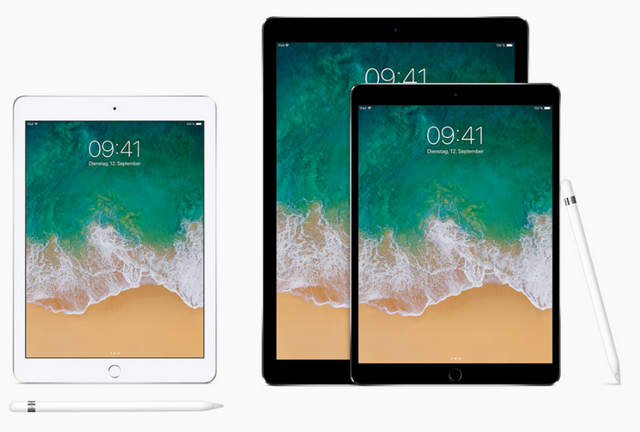
Jetzt sind eine Menge Journalisten nach Chicago gereist, um sich dort ein neues iPad anzuschauen. Schneller ist es, weil es einen schnelleren Prozessor hat, das kennt man schon. Aber es geht bei Apple um mehr. Es macht für Studenten und Schüler einen großen Unterschied, ob man auf seinem Computer auch Dinge markieren kann und kleine Anmerkungen reinkritzeln kann. Die Älteren mögen sich erinnern, wie wir früher in kopierten Skripten gearbeitet haben. Heute aber hat man kaum noch Papier. Und das markieren und annotieren mit Maus und Tastatur ist nur ein schlechter Ersatz.

Das neue Einsteiger-iPad bekommt also jetzt Support für den Apple Pencil, ein wirklich wunderbares Instrument. Bisher brauchte man dafür ein sehr viel teureren iPad Pro. Dort wird er oft gar nicht gebraucht, weil es vor allem mit einem Keyboard als Laptop-Ersatz genutzt wird. iOS kann mit dem Pencil noch wenig anfangen. Die Microsoft Office Apps unterstützen ihn, dazu eine Anzahl spezialisierter Notiz und Zeichenprogramme. Aber Surface Pro kann das alles irgendwie besser.

Apple reagiert aber weniger auf Surface als vielmehr auf die Chromebooks. Die machen bei US-amerikanischen Schule auf einmal Furore, weil sie billig, robust und vor allem supereinfach zu administrieren sind. Und die bekommen dieses Jahr auch einen Stift. Lenovo hat bereits auf der CES Geräte angekündigt, die nicht besonders elegant sind, aber locker im Schulranzen überleben.

Und hier kann Apple jetzt mithalten. Die einfachen iPads sind wirklich preiswert, im besten Sinne "von ihren Preis wert". Sie sind keineswegs billig, aber bieten sehr viel Leistung für vergleichsweise wenig Geld. Und mit dem Pencil taugen sie jetzt endlich für den ernsthaften Einsatz in der Ausbildung.

01 Apr 05:14

Most Common Occupation by Age

by Nathan Yau

As we get older, job options shift — along with experience, education, and wear on our bodies. Read More

01 Apr 05:14

Twitterrific for Mac and iOS Adds New Muting and Muffling Features, Plus Video

by John Voorhees

Twitterrific, for iOS and the Mac, has a unique, fine-grained approach to what you see in your Twitter timeline using a combination of muffles and mutes. Muffles are rules that partially hide tweets from your timeline, while mutes hide tweets entirely.

With the update to Twitterrific for Mac and iOS today, The Iconfactory has migrated muffles of users that were set up as mutes to Twitter’s mute system. Mutes can be created from the action menu that’s accessible from any tweet or a user’s profile. With the new system, a mute created in Twitterrific will sync cross-platform to all copies of Twitterrific you use and also register as a mute with Twitter, so muted users’ tweets won’t show up on Twitter.com either. Muting prevents push notifications of a muted user's tweets too.

All other muffle rules are unaffected by the change to mutes, but The Iconfactory has also extended the way muffles work. Any muffle can be applied to everyone in your timeline or just a specific person. For example, you can muffle all retweets, all retweets by a specific person, all retweets of a specific person’s tweets, or all retweets by a specific person of another person’s tweets. You can also muffle quoted tweets, quotes of particular tweets, or mentions of someone. There is a knowledge base article on The Iconfactory’s website that covers all the possibilities.

The Twitterrific update also adds support for video attachments to tweets. Videos must be less than 140 seconds long, but that’s the only limitation. On iOS, videos can be added from your photo library, if you long-press the camera icon, from any file provider, or with the app’s share extension.

The rate of updates to Twitterrific for the Mac and iOS continues to impress me and I love the addition of even more granular controls over my timeline that sync across iOS and macOS. If you haven’t tried Twitterrific in a while, it’s worth a look.

Twitterrific is available on the App Store for iOS and on the Mac App Store.


Support MacStories Directly

Club MacStories offers exclusive access to extra MacStories content, delivered every week; it's also a way to support us directly.

Club MacStories will help you discover the best apps for your devices and get the most out of your iPhone, iPad, and Mac. Plus, it's made in Italy.

Join Now
01 Apr 05:14

@TessaMakesLove

@TessaMakesLove: .@stoweboyd You have my deepest respect for talking about the ‘future of...
01 Apr 05:14

Oh Good. Support for Democracy Is a Partisan Issue Now.

Oh Good. Support for Democracy Is a Partisan Issue Now.: Americans’ attitudes about democracy are...
01 Apr 05:13

When a Greenway Gets Pink

by Ken Ohrn
01 Apr 05:13

Terms and conditions apply - what went wrong?

files/images/terms-and-conditions.jpg

Alastair Creelman, The corridor of uncertainty, Mar 30, 2018


Icon

More on the same issue. Here is Alastair Creelman: "Personalization in learning and advertising is enabled by platforms. Just as there are deep problems with personalization of advertising, we will find it is multiplied by tens of thousands when we apply it to learning. Utopian views that ignore the problems of platforms and personalization are only going to end up looking like what we are seeing now with Facebook and CA (Cambridge Analytica)."

Web: [Direct Link] [This Post]
28 Mar 17:44

Adrian Crook On Those Viaducts

by Ken Ohrn

NPA council hopeful Adrian Crook bravely tweets strong opinions on viaducts and car culture. Does this look to you like a preview of the evident internal struggle within the NPA? Hello, Glen Chernen, are you in this discussion?

AC.Viaducts


28 Mar 17:44

We’re Hiring a Build Engineer

by Ryan Sipes

We at the Thunderbird project are hiring a Build and Release Engineer. Interested in getting paid to work on Thunderbird? You’ll find information about the role ,as well as how to apply, below!

Thunderbird Build & Release Engineer

About Thunderbird
Thunderbird is a email client depended on daily by 25 million people on three platforms: Windows, Mac and Linux (and other *nix). It was developed under the Mozilla Corporation until 2014 when development was handed over to the community. The Mozilla Foundation is now the fiscal home of Thunderbird. The Thunderbird Council, who lead the community effort, has begun hiring contractors through Mozilla in support of this venture and to guarantee that all vital services are provided in a reliable fashion.

You will join the team that is leading Thunderbird into a bright future. As a build engineer you will be serving the community, empowering them to make their contributions available to over 25 million people.

The Thunderbird team works openly using public bug trackers and repositories, providing you with a premier chance to show your work to the world.

About the Contract
The Mozilla Thunderbird project is looking to hire a build and release engineer to help maintain Thunderbird. You’ll be expected to work with community volunteers, the Thunderbird Council, and other employees to maintain and improve the Thunderbird build and release process.

This is a remote, hourly 6-month contract (with the possibility of continuing). Hours will be up to 40 a week. You will be expected to have excellent written communication skills and coordinate your work over email, IRC, and Bugzilla.

As a build & release engineer for Thunderbird you will

  • Maintain and improve the Thunderbird build system to ensure that both nightly builds and releases are always possible.
  • Finalise the migration if Thunderbird’s continuous integration/deployment (CI/CD) service from Buildbot to TaskCluster.
  • Procure and maintain build infrastructure in tandem with Thunderbird’s infrastructure engineer (who is currently focused on web-based services).
  • Work with both volunteers and employees across the world to fix build issues.
  • Follow improvements made by Mozilla engineers for the Firefox build & release process and implement those for Thunderbird.
  • Collaborate with QA, Security, Localization, and Engineering for coordinated code releases for “release” builds (known as ESR) and beta builds.

Your Previous Experience

  • Have experience using build systems (preferably make).
  • Have experience setting up a continuous integration service.
  • Have solid scripting knowledge (shell, Python).
  • Experience with Buildbot and TaskCluster is highly desirable.
  • Have experience using distributed version control systems (preferably Mercurial, Git would be acceptable).
  • Some development background with Python and C is highly preferred.
  • Experience building and releasing cross-platform applications is a plus.
  • B.S. in Computer Science would be lovely, but real-world experience is preferred.

Next Steps
If this position sounds like a good fit for you, please send us your resume with a cover letter to apply@mozillafoundation.org.

A cover letter is essential to your application, as it shows us how you envision Thunderbird’s technical future. Tell us about why you’re passionate about Thunderbird and this position. Also include samples of your work as a programmer, either directly or a link. If you contribute to any open source software, or maintain a blog we’d love to hear about it.

Please note that while the Thunderbird project is a group of individuals separate from the Mozilla Foundation that works to further the Thunderbird email client, the Mozilla Foundation is the Project’s fiscal home. The Thunderbird Council, separate from Mozilla, manages the Project and will direct the software engineer’s work.

The successful applicant will be hired as freelancer (independent contractor) through the Mozilla Foundation’s third-party service Upwork. By applying to this job, you are agreeing to have your applications reviewed by Thunderbird contractors and volunteers who are a part of the hiring committee as well as by staff members of the Mozilla Foundation.

Mozilla values diversity. We do not discriminate on the basis of race, religion, color, national origin, gender, sexual orientation, age, marital status, veteran status, or disability status.

28 Mar 17:44

Der die das iPad

by Volker Weber

Sketch

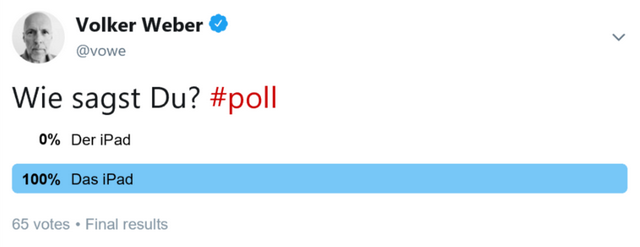
Man muss über sich selbst lachen können. Dann macht das Leben mehr Spaß. Ich habe tatsächlich immer "der iPad" gesagt. Scheint so, als ob ich da ein Geisterfahrer war.

Das iPad. Das iPad. Das iPad. Das iPad. Das iPad. Das iPad. Das iPad. Das iPad. Das iPad. Das iPad. Das iPad. Das iPad. Das iPad. Das iPad. Das iPad. Das iPad. Das iPad. Das iPad. Das iPad. Das iPad. Das iPad. Das iPad. Das iPad. Das iPad. Das iPad. Das iPad. Das iPad. Das iPad. Das iPad. Das iPad. Das iPad. Das iPad. Das iPad. Das iPad. Das iPad. Das iPad. Das iPad. Das iPad. Das iPad. Das iPad. Das iPad. Das iPad. Das iPad. Das iPad. Das iPad. Das iPad. Das iPad. Das iPad. Das iPad. Das iPad. Das iPad. Das iPad. Das iPad. Das iPad. Das iPad. Das iPad. Das iPad. Das iPad. Das iPad. Das iPad. Das iPad. Das iPad. Das iPad. Das iPad. Das iPad. Das iPad. Das iPad. Das iPad. Das iPad. Das iPad. Das iPad. Das iPad. Das iPad. Das iPad. Das iPad. Das iPad. Das iPad. Das iPad. Das iPad. Das iPad. Das iPad. Das iPad. Das iPad. Das iPad. Das iPad. Das iPad. Das iPad. Das iPad. Das iPad. Das iPad. Das iPad. Das iPad. Das iPad. Das iPad. Das iPad. Das iPad. Das iPad. Das iPad. Das iPad. Das iPad. Das iPad. Das iPad. Das iPad. Das iPad. Das iPad. Das iPad. Das iPad. Das iPad. Das iPad. Das iPad. Das iPad. Das iPad. Das iPad. Das iPad. Das iPad. Das iPad. Das iPad. Das iPad. Das iPad. Das iPad. Das iPad. Das iPad. Das iPad. Das iPad. Das iPad. Das iPad. Das iPad. Das iPad. Das iPad. Das iPad. Das iPad. Das iPad. Das iPad. Das iPad. Das iPad. Das iPad. Das iPad. Das iPad. Das iPad. Das iPad. Das iPad. Das iPad. Das iPad. Das iPad. Das iPad. Das iPad. Das iPad. Das iPad. Das iPad. Das iPad. Das iPad. Das iPad. Das iPad. Das iPad. Das iPad. Das iPad. Das iPad. Das iPad. Das iPad. Das iPad. Das iPad. Das iPad. Das iPad. Das iPad. Das iPad. Das iPad. Das iPad. Das iPad. Das iPad. Das iPad. Das iPad. Das iPad. Das iPad. Das iPad. Das iPad. Das iPad. Das iPad. Das iPad. Das iPad. Das iPad. Das iPad. Das iPad. Das iPad. Das iPad. Das iPad. Das iPad. Das iPad. Das iPad. Das iPad. Das iPad. Das iPad. Das iPad. Das iPad. Das iPad. Das iPad. Das iPad. Das iPad. Das iPad. Das iPad. Das iPad.

28 Mar 17:25

Toi toi toi

by Volker Weber

IMG 20180328 101509 (1)

Seit ein paar Wochen jetzt ohne Case. Auch schon mal runtergefallen. Bisher alles gut gegangen. :-)

Tipp: Nie mit dem Display nach unten auf den Tisch legen. Das gleitet wie ein Hovercraft.

28 Mar 17:25

Choropleth map design considerations

by Nathan Yau

Lisa Charlotte Rost for Datawrapper provides guidance for designing choropleth maps that most fairly represent your data:

Maps are not objective, but a version of reality. When creating them, lots of choices are made: What to map, how to map and whether or not to use a map in the first place. Here we’ll try to find guidelines to all of these questions, for a specific subset of maps: Choropleth maps (the ones in which each region is filled with a color that represents a value).

Rost’s other guides (line charts, area charts, pie charts, and more) are also full of practical advice. Highly recommended.

Tags: choropleth, color

28 Mar 17:24

The Best MacBooks

by Dan Frakes
The Best MacBooks

The best Mac laptop for most people is the 2018 MacBook Air. It’s fast enough for the things that most people use a computer for—Web browsing, working on documents, even light photo editing—and it has an excellent high-resolution screen, a great trackpad, enough battery life to get most people through a day of work, and a (relatively) reasonable price. Apple sells a lot of laptop models right now, but the Air offers the best combination of features, performance, and price.

28 Mar 17:24

Licensing Rogue Amoeba’s Audio Capture Technology

by Paul Kafasis

Over the years, we’ve received numerous requests from other businesses looking to license our audio capturing technology. Until now, we always declined these offers, preferring to focus on improving both the technology and our own applications which use it.

Recently, however, we revisited the possibility of licensing. Our audio capture code has been continuously improved for over a decade, and it’s now incredibly reliable. This technology is used by tens of thousands of our users every day, in Airfoil, Audio Hijack, Loopback, and Piezo. We’re tremendously confident in what we’ve built.

Because of this, we’re now pleased to announce licensing opportunities for our audio capture technology, ACE.1 ACE makes it possible for Mac apps to capture audio from one or more individual processes, as well as all audio from the entire system at once. The same power which drives some of our biggest apps is now available to outside developers as well.

If you develop an application which could benefit from audio capture2, please see our new licensing page, then get in touch!


Footnotes:

  1. ACE has had multiple names over the years, starting with “Instant Hijack” and then “Instant On”. This newest name is intended to better convey the many uses of our licensable framework. ↩︎

  2. Examples include apps dedicated to screen sharing, VNC/remote access, game streaming, and more. ↩︎

28 Mar 17:24

Librem laptop orders now shipping within a week

by Jeff

As many team members have been travelling to negotiate hardware supplies or participate in community events lately, we are taking this opportunity to give you an update on Librem laptop operations this month, while regular posts about the Librem phone are expected to resume in a week or two.

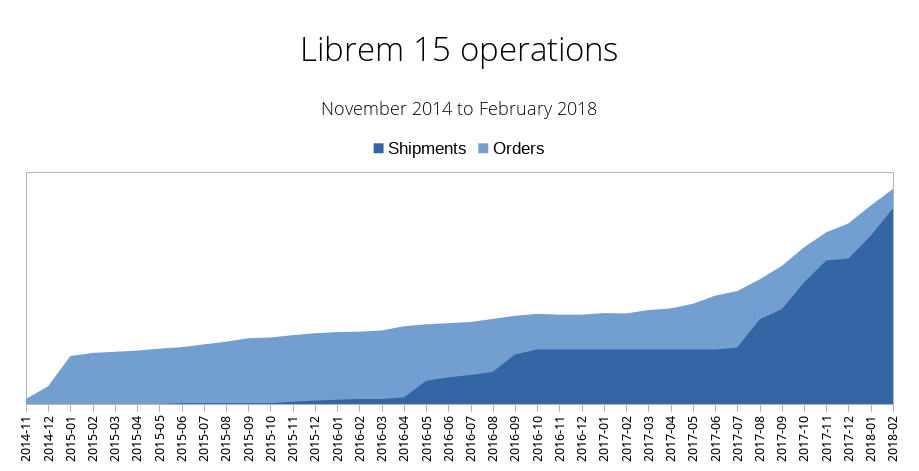
Amidst the plethora of progress we blogged about recently on the mobile and security areas of our products, we also quietly achieved a very significant milestone in the life of our organisation, from the Inventory management and logistics standpoint: the ability to fulfill orders within 5 business days (on average), thanks to the inventory of Librem 13 and Librem 15 laptops we have built up.

Indeed, as our early supporters throughout the years have demonstrated incredible patience to wait for their preorders to arrive on their doorstep, we are deeply grateful for their investment that now allows us to fulfill new orders in merely a few days instead of months. Just look at the progress we’ve made through our efforts since the beginning of Purism, where we have now caught up with the demand:

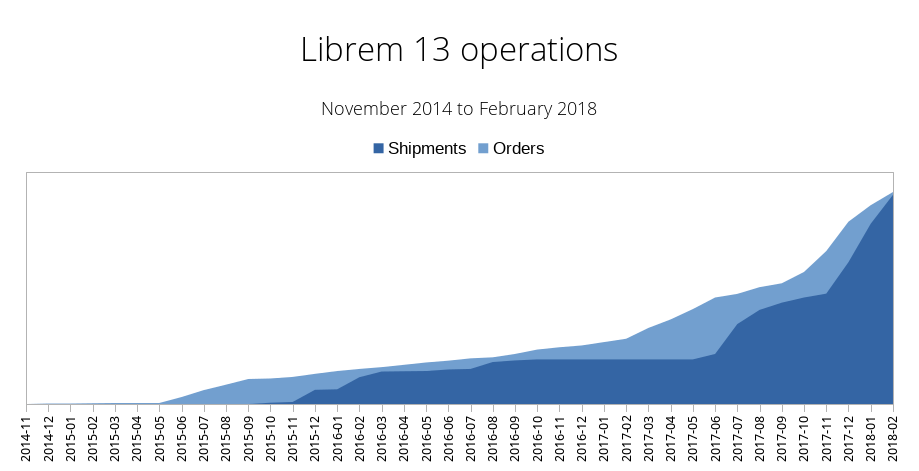
Note that the situation is even better than what the chart above indicates, as the remaining gap between orders and shipments of the Librem 15 actually represents orders from customers who have not decided what they want to do with their previous 4K order (we tried contacting those multiple times through email over the past few months and got no reply—if you are in this situation and have somehow not received emails from our ops department, please contact us with your existing order information).

The Librem 13 was introduced five months after the Librem 15, which explains the chart data starting in May 2015. We have kept the X axis the same as for the Librem 15 for comparison purposes.

The increased interest in our products is also the reason why we are now able to deliver worldwide with free shipping, and invest heavily in security by eating the cost of making TPM a standard feature on our laptop motherboards and advancing software that integrates with it, such as coreboot and Heads, where we are making significant contributions to those upstream projects, such as a menu interface for Heads or fixing various bugs in coreboot. Stay tuned for reverse engineering news in April!

Exhibiting at LibrePlanet 2018

We would like to thank all our users of Librem laptops and FSF endorsed PureOS, as well as all those that have backed the Librem 5 phone, and of course all those people who support us by feedback, kind words (we were psyched to see many of you showing support and interest at our booth at LibrePlanet last week-end!), and spreading the word. It is with this unified education approach that we can change the future of computing and digital rights for the better.

The post Librem laptop orders now shipping within a week appeared first on Purism.

28 Mar 17:22

9.7-inch iPad (2018) Hands-on: Familiar, but new

by Patrick O'Rourke
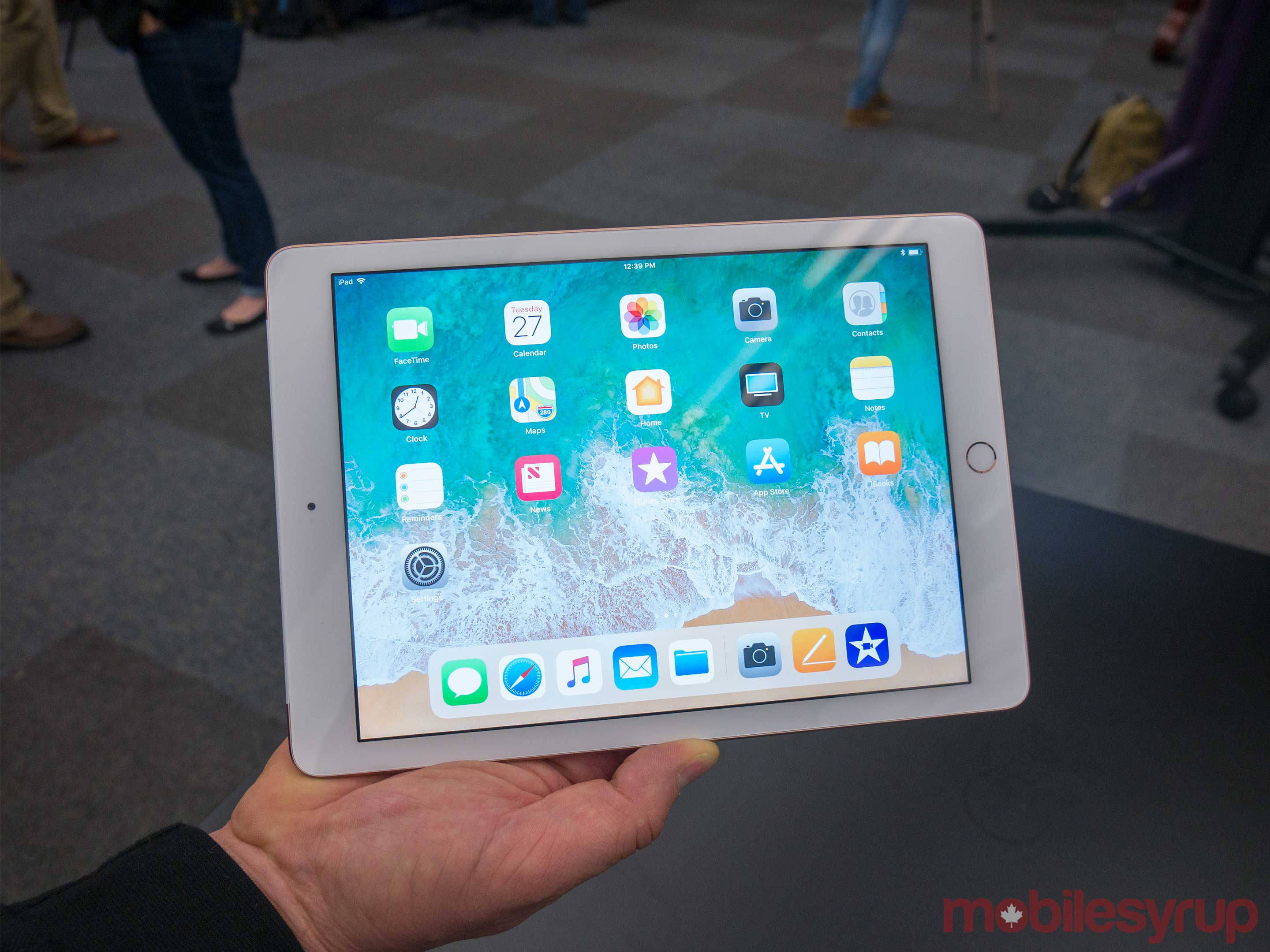
9.7-inch iPad 2018

At Lane Tech high school in Chicago, Illinois, Apple revealed its new 9.7-inch iPad — an upgraded version of the tech giant’s 2017 entry-level tablet.

Apple’s 2018 9.7-inch iPad isn’t particularly exciting, but the education-focused device does include some notable upgrades over its predecessor.

The same, but different

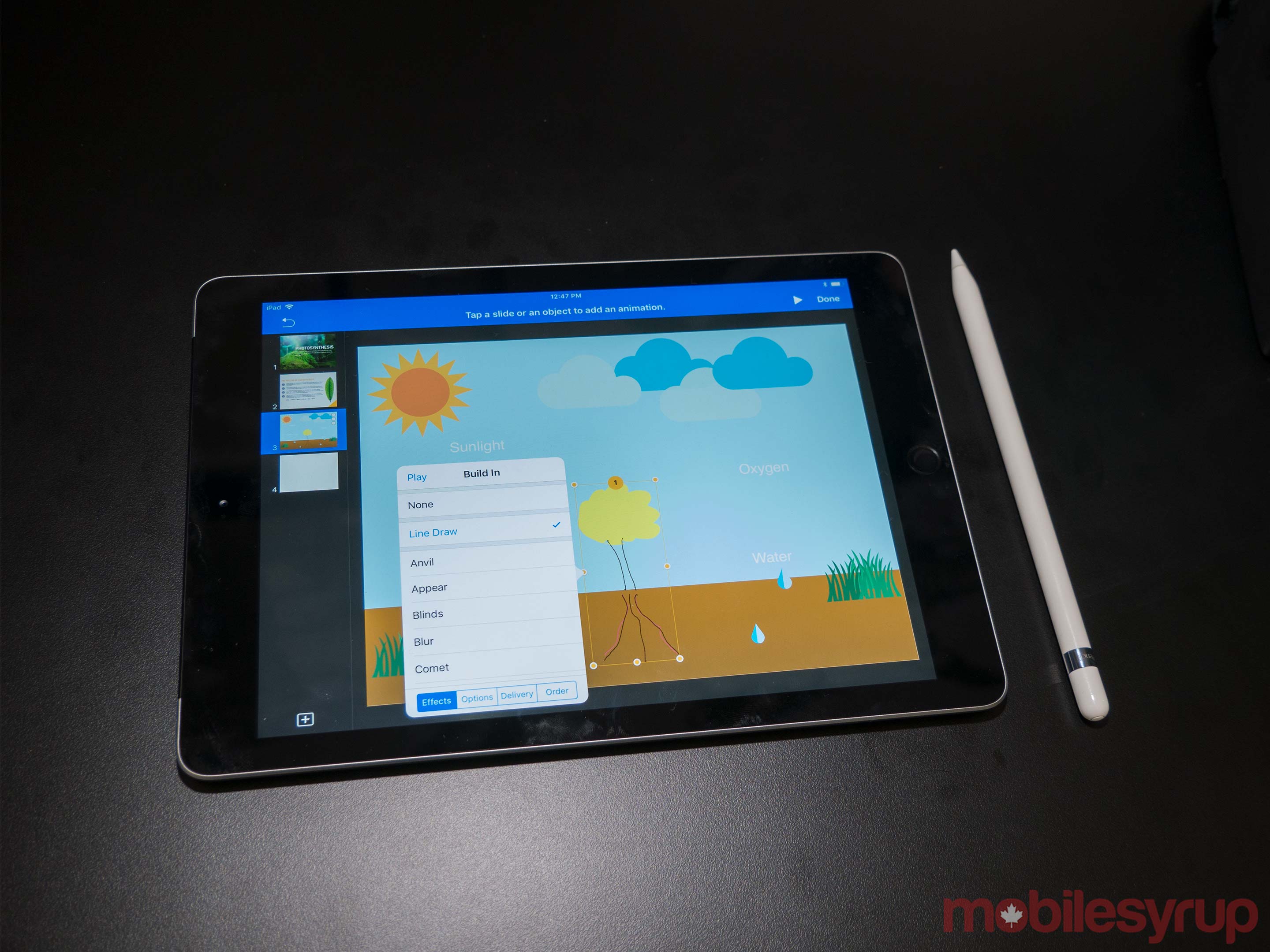
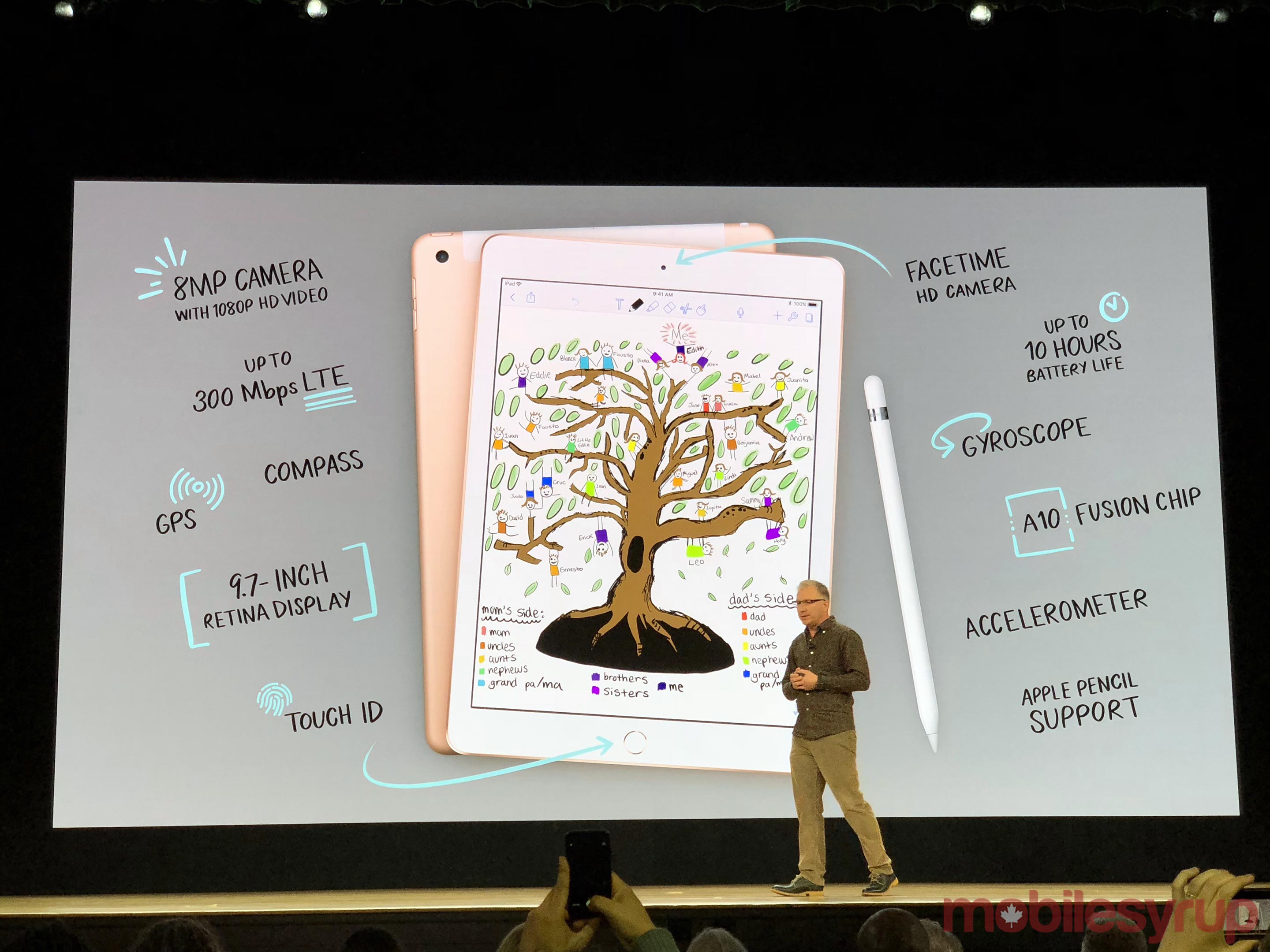
9.7-inch iPad display with Apple Pencil

For one, the new iPad now supports Apple’s Pencil stylus, which makes sense given that the company is positioning the tablet as an education device. Strangely though, the Apple Pencil is still sold separately at a cost of $129 CAD. It doesn’t look like there are any iPad-Apple Pencil bundles on the horizon, either.

The new iPad also doesn’t feature the Pro’s Apple magnetic accessory connector. This means that the Smart Keyboard remains exclusive to Apple’s higher-end iPad Pro line, which is a strange move on Apple’s part if the goal is for this tablet to become the go-to device for students and teachers.

That said, Apple uncharacteristically emphasized that the new 9.7-inch iPad is compatible with a number of third-party Bluetooth keyboards, with the company highlighting a few made by accessory manufacturer Logitech.

9.7-inch iPad 2018 back

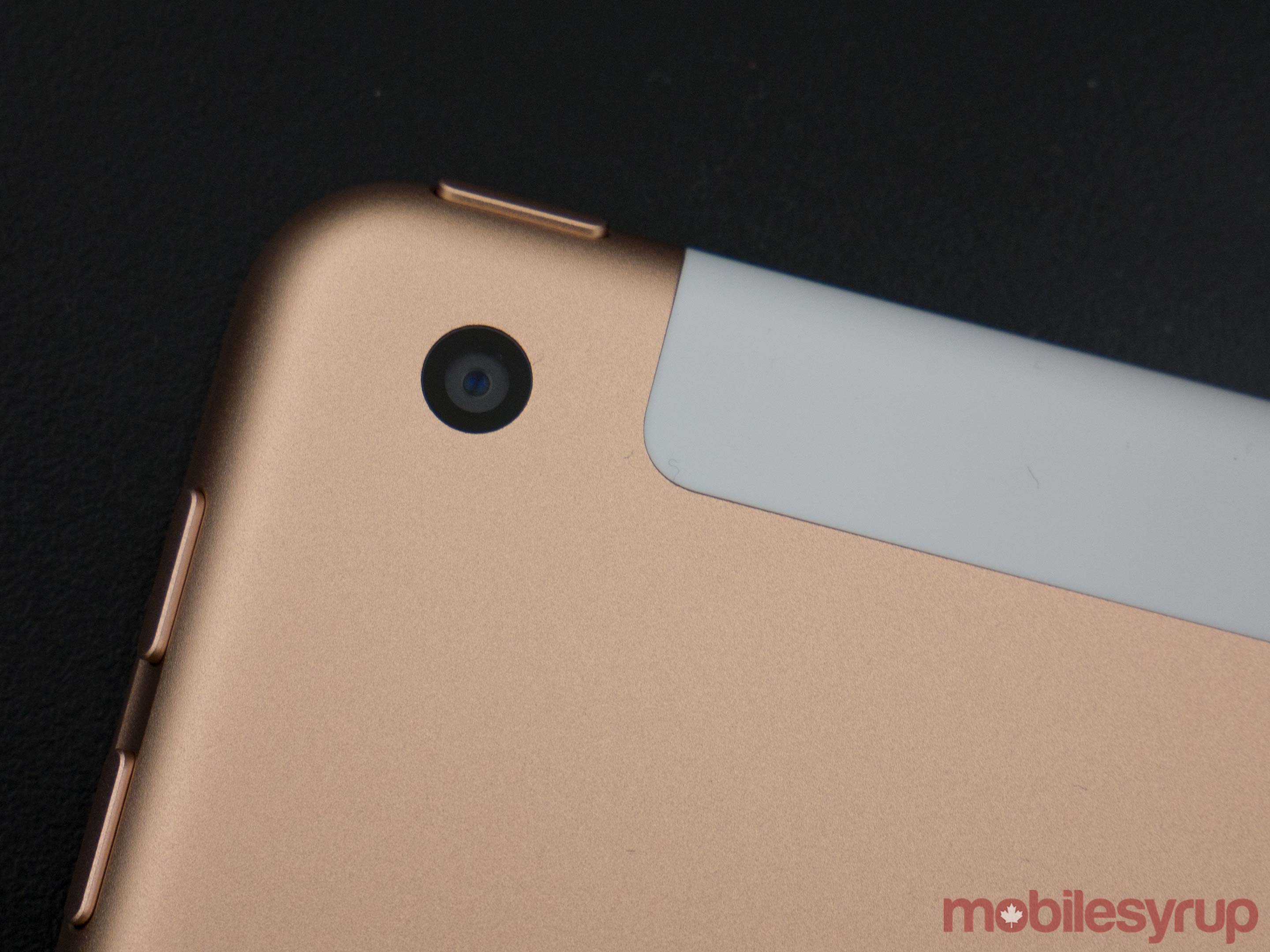
The new iPad is light, coming in at just 0.45kg (1lbs), features Apple’s A10 Fusion chip borrowed from the iPhone 7 and 7 Plus, rocks an 8-megapixel rear camera that supports 1080p video and features a front-facing shooter capable of FaceTime HD video calling. As with last year’s iPad, the new 9.7-inch tablet features 10 hours of battery life and supports optional LTE.

This year’s iPad display doesn’t, however, feature the iPad Pro’s True Tone magic — a feature I’m particularly fond of. There’s also a small air gap between the 2018 iPad’s display and the glass that encloses it. If you haven’t used an iPad Pro before though, it’s likely not something you’ll notice.

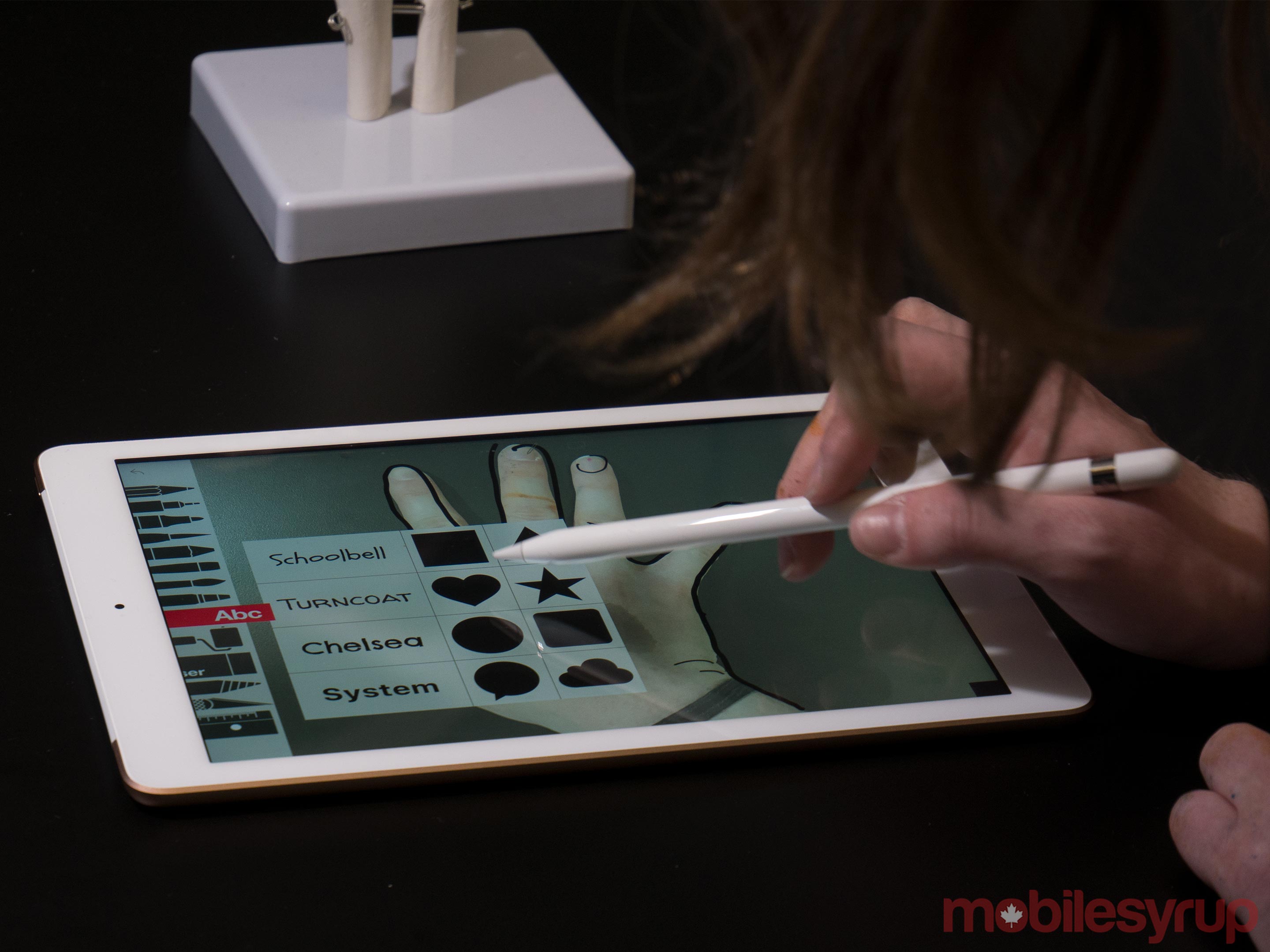
The only time the gap became an issue for me was when using the Apple Pencil to colour in a small diagram during a brief hands-on demonstration. Despite the Apple Pencil feeling accurate and responsive, the slight gap between the glass and the display’s pixels, resulted in a noticeable tactile disconnect. Again though, this might not be so noticeable if you haven’t used an iPad Pro before.

Overall, however, the 9.7-inch display looks great, measuring in at 1563 x 2048 pixels. Granted, the iPad Pro is still a significant leap in screen quality when it comes to colour reproduction and contrast — which should be expected.

9.7-inch iPad 2018 drawing with Apple Pencil

Apple’s new 9.7-inch iPad also adopts the same metal chassis with large bezels and rounded corners as last year’s lowest-end iPad. Further, the volume rocker and power button remain in the same location, along with the Touch ID fingerprint sensor located on the tablet’s bottom bezel.

If these specs and the new iPad’s overall aesthetic sound familiar, you aren’t wrong. Apart from the spec bump and Apple Pencil compatibility, in many respects the 2018 iPad is very similar to its predecessor.

Attempting to reclaim the education market

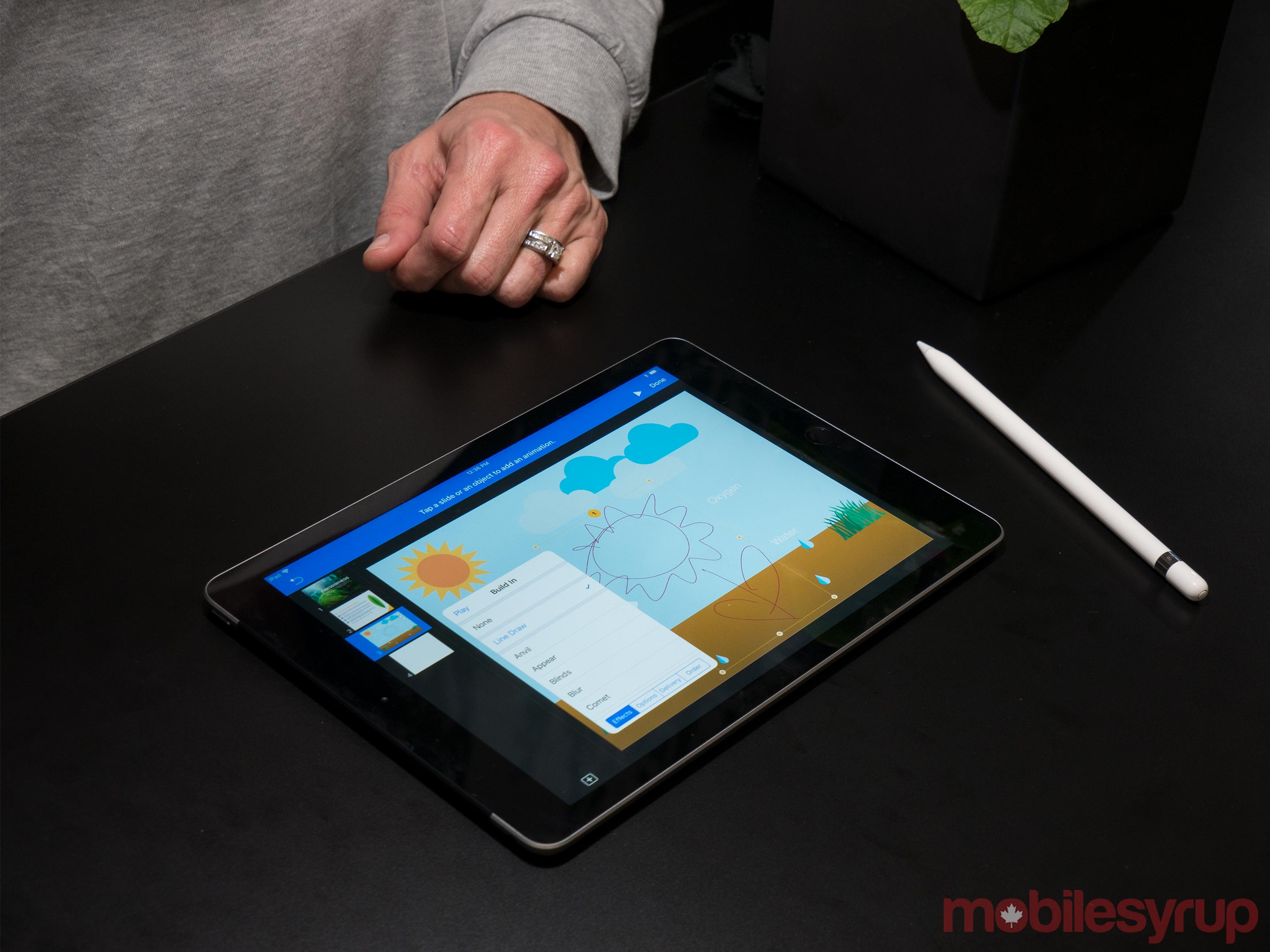
9.7-inch iPad on table

What matters in this instance is how Apple is positioning the iPad as an education tablet.

Students need to take more than just notes in the classroom — they also need to follow along with lessons and activities. On the other side of the education spectrum, teachers need to be able to mark up student’s work. These were two tasks that Apple emphasized during the company’s keynote and subsequent demos of Schoolwork, the company’s new iOS education suite of software tools for teachers and students.

In subsequent ‘classroom’ demos at Lane Tech, Apple reps showed off how the iPad can be used in the context of a variety of subjects, ranging from learning how to code to creating short video clips.

Apple’s showed off its own software, including Pages, Numbers and Keynote — which now all feature Apple Pencil compatibility — as well as some third-party apps.

9.7-inch iPad 2018 camera

The most notable example was an app that cleverly allowed students to dissect a frog in augmented reality. In terms of AR functionality, the A10 Fusion processor ensures that augmented reality experiences run slightly smoother when compared to last year’s 9.7-inch iPad. A quick demo I checked out in a classroom was impressive and looked about as good as any AR demo I’ve seen running on an iPad Pro.

An iterative upgrade

9.7-inch iPad front

Apple’s education goals are ambitious, especially in a market dominated by devices running Google’s Chrome OS and laptops powered by Microsoft’s Windows 10. It remains to be seen if Apple’s education initiatives offer enough functionality to convince cash-strapped Canadian school boards to purchase Apple’s very functional, but still pricey iPad and Apple Pencil.

Apple’s new 9.7-inch iPad costs $429 CAD, while last year’s iteration comes in at $449. This means that the company’s new iPad is only $20 cheaper than last year’s model, though this new version does include a number of upgrades.

We’ll have more on Apple’s new 9.7-inch iPad in the coming days, including a full review of the new tablet.

The post 9.7-inch iPad (2018) Hands-on: Familiar, but new appeared first on MobileSyrup.

28 Mar 17:22

Canadian Apple Watch owners can now get up to $225 in trade-in credits

by Brad Bennett

The Apple trade-in program continues to expand in Canada with the recent addition of the Apple Watch.

The program works by letting users of Apple products trade-in their existing product for store credit that can use towards a new product.

Apple Watches can be traded in for a variety of values depending on the model and the condition of the device. It’s also worth noting that when trading in a Watch, users can keep their bands and chargers for use with a future Apple Watch.

A first generation Apple Watch can be traded in for $95 CAD, and a Series 2 can be traded in for $225 CAD. To find out exactly what a Watch is worth Apple has an estimate calculator on its website.

This announcement adds Apple Watch to the other Apple products that can be traded in like the Mac, iPad and iPhone.

Source: Apple Via: iPhoneinCanada

The post Canadian Apple Watch owners can now get up to $225 in trade-in credits appeared first on MobileSyrup.

28 Mar 17:22

YouTube’s dynamic video player finally comes to Android

by Brad Bennett

In the summer of 2017, YouTube announced that its mobile apps would soon gain a dynamic video client that would scale the player to match videos that were square or shot in portrait mode.

This feature came to iOS users at the end of 2017 and it’s finally rolling out to Android today. This update helps YouTube show videos that are captured across lots of devices and time periods.

YouTube can now display almost all videos without black bars along the top or the sides on mobile and instead filling that space with video or the YouTube interface.

This move is to help YouTube keep on trend as apps like Snapchat use vertical video consistently and even popular musicians like Selena Gomez and Young Thug are releasing vertical version of their music videos online.

Source: 9to5 Google 

The post YouTube’s dynamic video player finally comes to Android appeared first on MobileSyrup.

28 Mar 17:22

Health Canada is recalling 1.5 million uncertified USB chargers

by Sameer Chhabra
USB-C

Health Canada is currently recalling roughly 1.5 million uncertified USB chargers in what the department is calling a “planned national sampling and compliance project.”

Almost of all the recalled chargers are those sold at dollar stores, convenience stores and gas stations across the country, and Health Canada says that these products “were found to pose an unacceptable risk of electric shock and fire.”

According to Health Canada, “certified products can be identified by a recognized certification mark on the product.”

“The certification mark must be on the product itself, not just the packaging,” reads an excerpt from the Health Canada website.

Anyone concerned about the quality of their USB charger can visit Health Canada’s recall website for more information and a list of recalled products.

However, if you purchased a USB charger from a dollar store or convenience store, it’s probably best to stop using the charger and replace it with something purchased directly from a manufacturer — like Apple or Samsung — or from big box stores.

Source: Health Canada

The post Health Canada is recalling 1.5 million uncertified USB chargers appeared first on MobileSyrup.

28 Mar 17:21

Massive Update to our Chromecast App!

by Jenileigh
mkalus shared this story from Blog – Plex.

Looking around at the current state of connected devices, it’s hard to imagine a time when we couldn’t just effortlessly fling whatever we wanted to watch or hear to any number of screens and speakers just waiting to do our bidding. It was over four years ago that Plex first landed on the Chromecast — that’s enough time for a budding millennial to leave for college, graduate, and move back in with their parents!

A lot has happened in the Chromecast… verse? since then. The lineup has gotten even more awesome: back in the day it was mind-blowing that you could stream anything at all to a little $30 dongle, now you can stream 4K HDR to your TV or multi-room audio to your favorite Google Home assistants strewn about your abode. “Ok, Google, text mom to make me a sandwich!”

We’ve also refreshed the Plex app for Chromecast a few times along the way. But today we’re rolling out a brand new app that’s built from the ground up using our modern web tech. This will make it possible to add awesome stuff in the future like automatic quality adjustment and live TV, but for now it’s got a great new look, better support for a wide variety of devices with Chromecast built in (including audio devices with limited memory), and lots of other nice enhancements, including:

  • Better support for photo/video slideshows
  • Improved HEVC support for NVIDIA SHIELD
  • Updated subtitles support and the ability to resize subs on the fly from the Plex web app
  • Rotten Tomatoes and IMDB critic ratings
  • Better support for more display resolutions and aspect ratios

The newest Plex for Android release (v6.15—coming soon!) will also bring the ability to fling local video files from your Android mobile to your TV via Chromecast (as well as other Plex player devices). If the video or audio format isn’t supported, not a problem! Plex for Android now supports on-the-fly transcoding, which is pretty incredible for a mobile phone.

Want in? Cool. Your Chromecast will automatically use the latest version next time you cast!

The post Massive Update to our Chromecast App! appeared first on Plex.

28 Mar 17:17

"This [the new iPad] is the second miss in a row for Apple, the first being the HomePod. And if you..."

“This [the new iPad] is the second miss in a row for Apple, the first being the HomePod. And...
28 Mar 17:15

A Theory of Functional Programming 0002

by Eric Normand

Transcript

…there. How are you doing?

All right. I am talking about, “A Theory of Functional Programming,” which is a book that I’m working on, and this is actually me working on it right now. I am going to talk about the topic, and hopefully, the transcript will turn into my book.

I talked about a lot of things last time. That was last Friday, and I know that the last thing I talked about was composition, and I don’t think I got very far into that, so I’ll talk about it.

We talked about the three domains, and how you can be in each domain, and stay in the domain. I think that’s important to prove that they do have an integrity to them, that there’s something about them. Once they’re in that domain, you can just travel around in it without changing domains.

Now one question is, “What happens when you compose across domains?” That’s interesting. If you have two pieces of data and you put them together, what do you get? You get a new piece of data. It’s still data.

If you take two calculations and you put them together, you get a new calculation. Finally, you take two actions. You put them together. You do one after the other, or you can do them both in parallel, then that is a new action. You’ve stayed in the domain.

What if you take a piece of data and you compose it with a calculation? You don’t get data, you get a calculation. The calculation will infect the data, and now you have calculation.

Similarly, if you take an action and a calculation, you put them together, you get a new action. If you have a action, which is read file in to a string. Then, you have a calculation, that is, parse the string into a piece of data, into a data structure, the thing that you get when you put them together — you read the string in from the file and then parse it — that whole thing is an action.

Similarly, if you needed to take a data structure, serialize it to a string, and then write that to disc, if you took that thing as a whole, as an unit, that’s actually an action. We see that things infect downwards. I’m saying that actions are contagious downwards, meaning if you have actions as the big whole, and then inside of that you have calculations, and inside of that you have data.

We talked about this hierarchy where we know that actions are universal. We know that there are some things within that sphere of action which we can consider to be timeless.

Yes, the plus operation does change the memory of our computer. It modifies every operation in there including addition, modifies a register. That’s where you store the answer. It reads from memory, so that memory could change at any point.

In a general sense, every operation depends on when it is run and how many times it is run. Using our language or some other discipline, we can say, “Well, that memory or the register, it’s kind of special. We’re not going to store anything important in there so that at any point we can overwrite it.”

You make all these rules, which we’ve developed. As programmers, these are good practices that we’ve developed.

If you have enough rules, you can say, “I’ve made a function that does plus, that uses the plus operator or the plus instruction that my machine understands, and it uses a stack discipline, and it does all this stuff, so you never are overwriting any memory and it’s using the arguments that are on the stack and nothing else is writing them.”

You have this illusion that you’re setting up in functional programming, that it is safe, that these things are timeless no matter when I run this function, I’m going to get the same answer.

It depends on this entire stack of disciplines that our compilers enforce, that we enforce as programmers, or that our data structures enforce. This stack with millions of little decisions that we’ve put in there in order to enforce this illusion.

The idea is that calculations are a subset of actions that are timeless and then, in that, we know that calculations, because they’re basically mathematical functions, like in a lambda calculus, that these functions can represent any data.

They can represent numbers using the Church notation and you can do operations on these numbers. You can represent everything using functions, also known as lambdas, if you’re into that.

That means that data is a subset of calculations. The reason things infect down, actions infect calculations, is because you’re just pulling it up by composing these two things, you’re getting stuff up.

Just naturally through entropy, just programming away and changing stuff without real effort, if you don’t put effort toward this, through entropy things will just naturally move up.

Your data will become calculations, will become actions, and so then your whole application is written out of actions, and through discipline and effort, energy, expenditure we can push stuff down, back down, down, down, down, down.

This is one of those imperatives of functional programming, is push stuff down as far as you can the stack because it’s going to come back up naturally. You have to put in the effort to make it go down.

Here’s another thing, when you have these compositions like an action plus a calculation equals an action, you have the reverse operation too, which is the refactoring. Instead of composing these two things together, as you would when you’re writing a function out, do this, then do that, then do that, you can pull each of those steps out as a separate component. You can actually separate out the calculation from the action.

Here’s the nice thing, you can separate it. If you have an action, you might be able to separate out a calculation from that action, and so now more of your code is in calculation as opposed to action. Similarly, you can separate out data from an action and more of your code is in data, then in action than before, and then you can separate out data from a calculation.

Now more of your stuff is in data than in calculations, so you’re making progress and you can also, obviously, take two data and separate them. That’s fine, too. You’re not going to gain very much in that.

But notice something very important, which is that, if you have data, there’s no way to pull an action out, there’s no way to pull a calculation out. That data is at the bottom of this three-tiered stack. There’s no way to get that stuff out.

That’s an important thing. If you’re looking at a calculation, you’re not going to be able to pull out an action. That’s good to know. It’s good to keep that in mind, that it’s not possible to get that.

I want to talk again about these three domains. I’m going to go into each of them and just talk about them. First, let’s talk about data. Data has several properties. The most important one is that it’s inert. This means that it does nothing.

It is also self-identical which is another way of saying it is what it is. It just is. We already defined it. It’s facts about an event that you’ve recorded. These are records. These are things you will want to keep. We spend so much energy in the real world making sure that our records last a long time.

If you go into a doctor’s office, they will have a huge filing cabinet full of old records that is actually required by law that they keep them. Maybe now they can be all electronic. I’m not up-to-date on the laws. But the point is, they’re spending a lot of time keeping those records around.

It’s a shame that when we’ve moved to computers, we default to stuff that can change. Because we’re basically riding all over those old records, throwing them out. Every time we change them, it’s like, “We don’t need that anymore.” It would be like if you went to the doctor. You got sick. You went to the doctor.

They said, “You have the flu. Here’s some medicine. Come see me in a week.” Come back in a week, and you say, “Doctor, I’m feeling better.” They say, “Great!” And they rip up that paper like you never got sick. Just throw it away. That’s not what they do. They put a new paper in that says, “New visit. Yes, now they’re better.”

They have the one that said they’re sick. They say, “You take the medicine. You’re better.” Put that in there too. Put it in the folder. File it away. We’ll see you later. Next time you come, we’ll have that. That is what we want to do in functional programming is we make some data we don’t change it. We can always make new data.

We have a lot of RAM now. I don’t want to name a date when this started happening. But we have a lot of RAM now and a lot of hard drive space and a lot of cloud storage space. We can store way more than we actually can even conceive of. For a business, you’re writing business software. It’s probably just a very negligible cost per customer.

Back in the day, what day? I don’t know. We had less. It’s getting cheaper and cheaper. There must have been a time when we had less. It was important to be able to use that space. But nowadays it doesn’t make sense. It just doesn’t make sense to throw it away for no good reason.

You might have a reason, and you need to throw it away just for the cost reason. It doesn’t make sense. Another thing about data. Data is serializable. Because it’s inert, you can represent it in a way, in bytes on a disk, and read it in later. You can send it over the wire. This is a very important property of it.

Machine code is often not something you can send over like a function. It’s very hard to send over the wire. It’s hard to store it and read it back in and use it later. It’s just not something that we have as an industry focused on being able to do. Because, and I think it is just a generally hard problem, that function probably cause other functions.

You need those functions too. It’s a problem that we have not solved yet but we have definitely solved in many times over. We haven’t solved it definitively, but many times over we’ve come up with serializable data formats. It’s just something we can do very easily. Something that’s cross-platform, that’s understood across.

It’s not a problem right now. We’ve solved it. You can use JSON, you can use XML, you can use flat text files. Whatever. It’s data. It’s serializable. The next thing is it requires interpretation. What do I mean by this? This is one of its limitations is that if you have a function, you can do science on it and figure out what does this function do?

You can pass some arguments. You might be able to figure it out. But data, like the number five, what does it mean? You need to know the context. You need to know what it’s all about. It’s something that requires meaning to be imposed on it. The cool thing about that is because it’s almost like neutral to meaning.

That means you can interpret it in two different ways. What’s an example of this? A good example. We have records of like let’s say, Sumeria. Ancient Sumer where they recorded the accounting of the trade of cattle. Someone paid taxes in head of cattle, they counted them, they made a record, and we still have that record. We found it. We dug it up.

When it was originally put like that, it’s probably done for accounting so they can keep track of the years. Are we getting more taxes every year? What parts of the country are paying more taxes? These kinds of questions are easily answered by having all these records. But we’re not using it for that, are we? We’re asking what was their economy like?

As anthropologists, asking what was the economy like? How did they collect taxes? We’re interpreting the same data in an entirely new way. Another example, a more modern example. If you store logs of Web requests. You just log every web request to a file. That Web request that came in, your server interprets it in one way.

Like, “It’s a request for this file, let me serve that file.” “It’s a request for this, let me serve that.” Later, you’re doing analysis, you’re doing some analytics. You want to know how many visitors did we add to each page? That’s a different analysis of the same data. You’re imposing a different meaning on it. This is an important aspect of data.

[pause]

Eric: I mentioned Sumer, and I think this is an important point that I didn’t get into enough. This idea of data as an inert serializable, meaning that you can make a record of it, like you can store it on a disc, and it requires interpretation, this idea goes back to the beginning of history.

People have been writing down records for a long time, and they have developed techniques of how they should be stored, what kind of stuff needs to be recorded. Someone might have written down the number five, the number six, the number seven, and someone’s like…100 years later, “What does this mean? Was this how much pieces of corn they ate?”

I don’t know what this…They’ve learned, “Let’s write it out a little more complete so that someone can understand it later.”

We’ve learned over time to make our data more self-describing, to maybe make it more redundant by having two copies of everything. All that stuff are techniques that have been passed down since this earliest time.

I think that in the computerization, and in certain practices that we do now in software, we’ve neglected that history. Functional programming, one of the things it’s doing is it’s resurrecting that, at least in industry.

It is resurrecting all these practices, that record keeping is about keeping a memory of an event. A fact about an event for as long as possible, as long as you can foresee it being needed.

[pause]

Eric: Another thing that we’ve done in computer science in general is develop data structures that can store data with certain operations, and those operations have well understood complexities, meaning their access patterns have certain speeds associated with them.

Not absolute speeds but relative speeds. It’s relative to the size of the container. One example is the tree data structure has logarithmic access to everything inside. The link list has linear access. We’ve built these data structures that have useful and coherent access patterns to them.

A HashMap has constant time lookup given the key. That’s something that we can rely on. A linked list has linear time lookup given the index, the integer that you jump into. All of these things we have known complexities for, this really helps us deal with data.

This helps us make better use of data, store it better, access it better. This, I believe, is talked about more in the functional programming community, that data and its patterns of access and storage is an important part of the story of data.

Here is one more cool thing about data, data is also universal, though it requires interpretation, like I said before. You can take a string of bytes, or you can store a computer program as a string of bytes.

You can store a computer program as a file of buffer of characters that get sense of a compiler. All of this is data. Everything is represented in data in our computers. You can represent calculations as data, and you can represent actions as data.

Definitely, you can represent data as data, but you can also represent as a pattern. Before I go on, because these two are related. Representing a program as data is a thing that we do very often in functional programming. Very often.

It’s very common to see an interpreter written right in the language for some data. Typically, we think of interpreter, you have a string of text that’s going to get parsed.

Very often in functional language, you will have a representation of a calculation or an action written right out in the literal data structures that the language gives you, which is really cool. We’re writing programs that contain programs, that run programs that have an effect that…This is where it starts to get very circular.

We’re on a universal Turing machine, we can write in a machine that runs another program that is also Turing complete, which runs another machine that’s Turing complete, etc. In functional program, you see this a lot.

It’s possible in other paradigms, but this is something that’s very commonly done in functional programming.

Two other patterns, besides this interpreter pattern, that have to do with data, two other patterns that have to do with data are configuration as data. We see this very often.

We’ll have a data file, a file on the disk, maybe it’s in XML, maybe it’s in JSON. Maybe it’s key value, like an INI file, and it configures your software.

A lot of the pieces of data that you normally hard code in there are now in this file. It’s a very common pattern. You keep all the calculations, all the actions out of there, you just put the data. Then databases. The idea of a database is a place to store your data safely and securely, and forever, basically.

What you see in functional programming is more and more the emergence of either, append only databases, where you never delete old records. You only add new records, like in a doctor’s office. Or databases that are logging.

They’re essentially the same pattern, except you’re writing the actions to take. You write actions to a log and you can always replay the log and figure out the current state.

The reason I differentiate them conceptually is because the logging ones tend to only give you the most current state. You can run it up to a certain time, but they only keep the current ones in memory. That is the most common access, but you could always run it to a certain point of time.

Anyway, it’s a very minor distinction. I’m running up on 30 minutes, which was my goal for this. I’m just going to keep talking about data instead of moving on. Another thing about data is it gives you an audit trail.

If you have this database that is append only, often in an audit — a financial audit, or a security audit, or even a bug audit — you want to know, what was the state of this system on this day, or at this time when this bug happened?

What financial transactions did this system know about at this point in time? A traditional database, meaning one that updates values in place, if it’s not designed specifically to do this, it won’t work. You won’t be able to ask, what was this system like?

I’ve written so many databases where if the user changes their password, or if the user updates some information about themselves, I just change what they had before, right in that column in their row, and we’ve forgotten what they had before.

That’s no good. Now we can’t ask this question anymore. The reason this is important is, these kind of audit trails are often overlooked in the requirements gathering.

It’s an implicit assumption that the requirements gatherers don’t write down that, “Hey, at any point I’m going to come and ask you what the system knew yesterday that opposed to what it knows today.” This is something that functional programmers are thinking about and working on.

[pause]

Eric: I talked about how data is transferable, meaning you could send it over the wire to another computer, it could read it in. That’s really just part of it being inert, and part of us having standard data formats that things can be read in regardless of the programming language. Storable forever, I talked about that. Multiple interpretations, I talked about that.

Here, I don’t want to talk too much about the problems with other paradigms, but one of the problems that functional programming addresses is that data being inert but requiring interpretation…object-oriented programming is trying to address this by attaching the runnable code to the object.

It knows how to interpret itself. It’s the object, meaning the data and the code together. You can send it a message, and it knows how to go into the data and answer the question that you’re asking it. It’s very valuable to be able to do that, it’s a great goal.

I personally believe that it is something of a pipe dream. Let me put it a better way. That with the technology that we have available and the history of data gathering that we’ve got as a civilization, storing inert data as is, without trying to attach code that we have to then run, storing it as is is our best bet right now.

That it is a fine research topic to figure out a way of attaching code that will be able to interpret the data later, but we are not there yet. As an industrial practice, I cannot recommend it. As research, I actually think it’s a pretty cool topic.

Still do better than data, because you could have that data to be self-interpreting. The practical problems that we’ve run against are that if you wrap the data in methods — in the object-oriented speak, the method — you then lose all sorts of cool properties, like being able to join it.

You have a collection of them, of the pieces of data, each one is an object. How do you join — using relational calculus or something similar — it together? It’s a very useful operation, and I don’t think that there’s a good answer.

A lot of the patterns in object-oriented programming are trying to work around this kind of problem. In functional programming, what we do is we say, we know the properties of our data structures. Just store it as data, it’s just data, put it into a data structure that allows to join, and you’re done.

We don’t need to have some kind of protocol of methods, and then some algorithm for running those methods. It’s an extra problem that we don’t need. Like I said, it’s a wonderful research problem. It’s the kind of thing where you’re like, “Look out, OK, in 100 years, maybe we’ll have solved it.”

How did we get there? You step back, then you say, OK, this is the next thing which I need to do. That’s cool. That’s awesome. As a practical industry programmer, commercial software that we’re writing, trying to make reliable systems, we’re just not there yet.

It’s my opinion. OK. I’m done. My name is Eric Normand. I’m writing a book called A Theory of Functional Programming. You have heard me talking all about data mostly. Talking about composition, talk about data, and this, hopefully, will make it into the book.

Thank you for joining me. Please subscribe, like it, do whatever, mash all the buttons. I want people to discover this far and wide. We need a definition of functional programming. Thank you very much. See you later.

The post A Theory of Functional Programming 0002 appeared first on LispCast.

28 Mar 16:47

New Apple Watch to launch later this year with 15 percent larger display: report

by Patrick O'Rourke
Apple Watch

If you’ve been hoping for a substantial Apple Watch redesign, Apple’s 4th-generation wearable could be the smartwatch you’ve been waiting for.

Often reliable KGI Securities analyst Ming-Chi Kuo claims that the new watch will feature a 15 percent larger display, which would be a substantial increase over the current 38mm and 42mm Apple Watch designs.

Along with a larger display, the new Apple Watch is also tipped to feature enhanced health monitoring and extended battery life, though Kuo doesn’t delve into specific details. The Apple Watch Series 4 is likely set to launch this Fall, according to Kuo.

KGI also predicts that Apple will sell 22 to 24 million Apple Watch models over the course of 2018, which amounts to a 30 percent increase year-over-year. In the future, Kuo expects the Apple Watch will eventually hit 50 million units in sales.

It’s likely we’ll see more rumours surrounding Apple’s 4th Generation Apple Watch pop up leading into Apple’s September 2018 product launch window.

The tech giant’s Series 3 Apple Watch is the company’s first wearable to feature LTE connectivity, untethering the smartwatch from the iPhone in a number of ways.

Source: 9to5Mac 

The post New Apple Watch to launch later this year with 15 percent larger display: report appeared first on MobileSyrup.

28 Mar 16:47

Attachment Rate

dpreview's recent interview with Fujifilm executives literally started with a comment that should be paid attention to: "Even more impressive is the lens attachment rate, as we’ve sold so many lenses as well."

28 Mar 16:47

Save the Date: Stuff That Matters Unconference in August

by Ton Zijlstra

It is still 5 months away, but if you would like to join the next edition of the Stuff That Matters Unconferences, do mark your calendar for Friday August 31st and Saturday September 1st. Tentatively themed Smart Stuff That Matters, but as usual with a twist.
The Unconference & BBQ is in honor of Elmine’s 40th birthday. Let’s throw her a party to remember!

Preliminary information can be found in the menu at the top, under STM18.

We’ve done several of these birthday unconferences in the last decade. Starting in 2008, about life-work balance (a fitting topic for a conference on your birthday), we did it again in 2010, (work on stuff that matters) and 2014 (make stuff that matters). In 2012 we did the BBQ at the End of the Universe (without an unconference). In the coming months I’ll shape the event more, and try to connect it to other initiatives in town and the region. Feel free to ping me with suggestions, or to indicate your interest in joining.

It took a while to get to another edition, longer than originally intended. Major events in our personal lives in 2015 and 2016, and moving to a different house in a different city in 2017, meant my attention was spent elsewhere. I’m looking forward to see how well an unconference can be made to work in our new home.

More info will be following soon.

28 Mar 16:47

Arbutus Greenway Crosses Broadway

by Ken Ohrn

Vancouver’s Arbutus Greenway is now one step closer to being even more delightful and ubiquitous. The controlled crossing at Broadway for people on foot and on bikes is in operation.  With it, the Greenway becomes a more safe, convenient, direct and delightful transportation corridor. And the number of people using it keeps growing, or so it seems to me.

28 Mar 16:46

Rechargeable Batteries

by Thejesh GN

We had a Bush 14 inch TV when I was a kid. We were probably one of a dozen houses that had TV. Our house used to be filled with people during cricket matches and on Sunday evenings, specially because we had an Exide1 12V car battery and our TV had a 12v DC input pin. So cricket regardless of power-cuts.

It was a refurbished battery. My father had acquired a home charger for it which was rare then. Once a week we would use the hydrometer to check the charge levels in each cell and then add distilled water to keep the proportion right. It was a nightmare to maintain the battery. That said it worked when we needed it.

We didn’t have an inverter then. I am guessing it was difficult to get or must have been expensive. So we made sure some elctronic devices at home worked on 12v DC. Like our lights, TV to Radio all ran on DC during the power cut. Of course the change wasn’t automatic. We had to manually shift to DC power. Also my father had done separate wiring for DC power inside home. It was very geeky but we had power when most of the village didn’t. 30 years later today we have a UPS running on a maintenance free Exide batteries with inverter. So much has changed. But not my interest in DIY batteries.

Rechargeable Batteries

Rechargeable Batteries

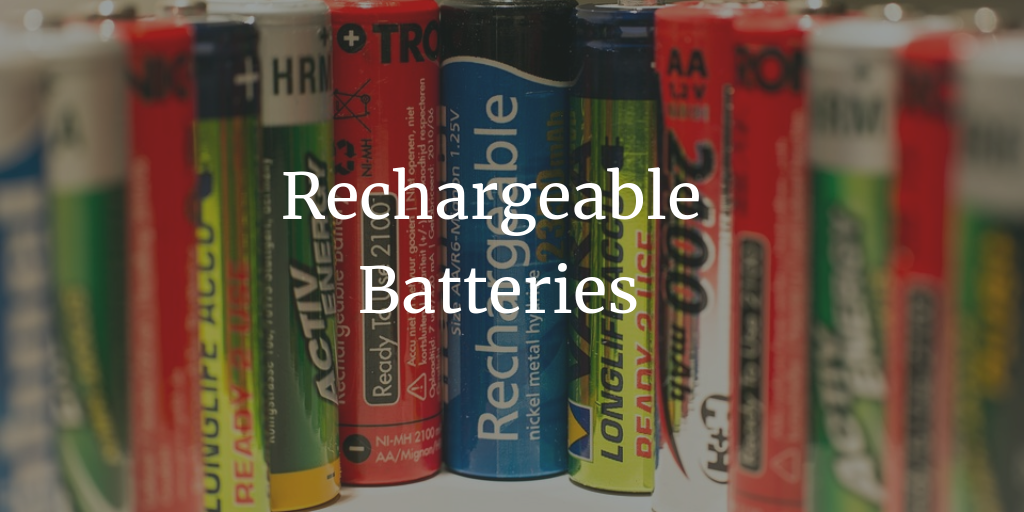
In my recent experiments, I am trying to replace all my Alkaline or Zinc Carbon, use and throw batteries with Lithium Ion or Ni-Mh rechargeable batteries. I use batteries in my radio, torch, toothbrush, presence sensor lights, IoT devices etc. So I had to choose something that works with most of my devices, has enough power and helps earth. Like usual I did my research, these are my research notes

Eneloop batteries

These are the most suggested AA batteries on CoolTools blog. Initially I got four Eneloop Pro to try. They seemed to work well like all things suggested on CoolTools blog. Then got the next set of eight regular AA Eneloops and 6 AAA Eneloops. I have been very happy about them. So what’s great about Eneloops?

Eneloop pro – AA

  • Eneloop pro are High Capacity Ni-MH ‘Low Self Discharge’ batteries
  • Eneloop Pro’s are 1.2v, 2450 mAh
  • Recharge up to 500 times
  • Holds 85% charge for up to one year
  • Can work in low temperature, as low as -4F
    As you can see its useful in high power and in extreme situations. But I think 500 cycles is small. So I got only four of them. I think they will get used mostly when I am travelling

Eneloop – AA and AAA

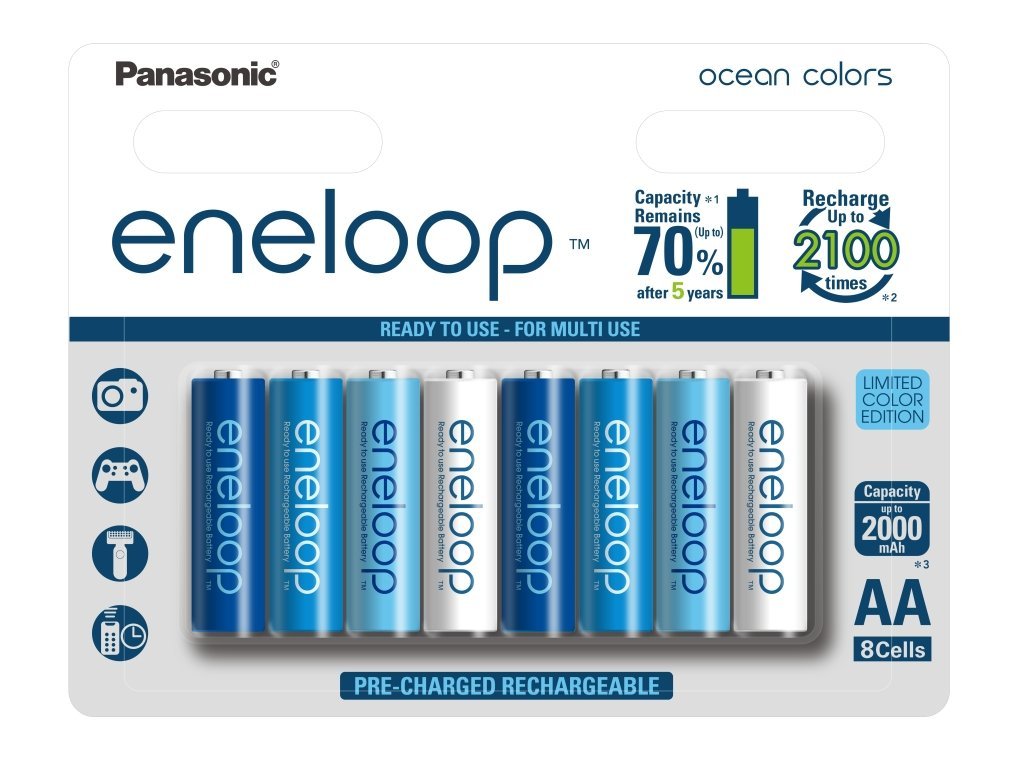
  • Eneloop are medium Capacity Ni-MH ‘Low Self Discharge’ batteries
  • Eneloop’s are 1.2v, 2000 mAh (AAA) and 800 mAh (AA)
  • Recharge up to 2000 times
  • Holds 70% charge for up to ten years
  • Can work in low temperature, as low as -4F
Eneloop Ocean Pack

Eneloop Ocean Pack

As you can see even though the capacity is lower than Pro’s, it’s life is four times more. With 2000 cycles, even if you charge/discharge every day, they can last for 5 years. I am predicting at least 10 years of life. That’s a lot of use and throw batteries saved. So I got set of Eneloop Ocean (8 AAs) and 6 of Eneloop AAAs.

What about D – Batteries?

AA to D cell Adapter

AA to D cell Adapter

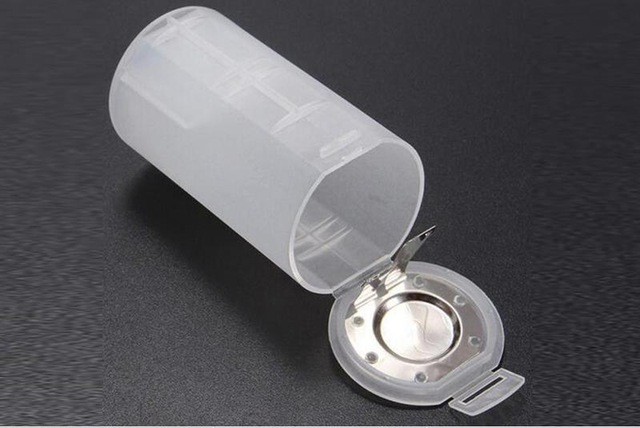
My Philips Radio uses D batteries. D cell or R20 are usually seen in big torches or desktop radios. They are 1.5v batteries and around 8000 mAh capacity 2. Instead of looking for rechargeable D batteries I thought of using AAs. The best way I have found is to use D cell adapter. It takes two AAs and puts them in parallel inside a case. The dimensions of case match the dimensions of D cell. So you could use it instead of D cell. The capacity is on the lower side but its better than using regular batteries.

Charger

I have a Panasonic BQ-CC17 charger which can charge AAA or AA Ni-MH batteries. It can charge up-to four batteries at once. Its smart enough to turn off the charging once the batteries are full. The dimensions are that of a standard wall battery charger. It’s affordable and travel friendly.

What’s next?

Along with NiMH AAAs I have started experimenting with other batteries. Most of them are Lithium Ion batteries. I am planning to buy some discarded laptop batteries and build a 12v battery pack based on 18650. 18650 are Lithium Ion 3.7v batteries. Their typical capacity can vary from 1500 to 3000mAh.

My idea is to build a standard 12v battery based on 186503. I see a lot of accessories in the market running on car’s 12v cigarette lighter adapter. So 12v DC has become like a standard power source and remains same in many countries. Initial build is going to be 3S2P (3 in series and 2 sets in parallel). That should give 3*3.7=11.1v nominal and enough mAh to run some small accessories.

I would also love to experiment with Lithium Iron Phosphate aka LiFePo4 batteries. They look like they are made for building battery packs for electric vehicles. I will keep you guys informed about my experiments.

Smart Charger – NiteCore D4

Nitecore D4 Charger

Nitecore D4 Charger

While experimenting with 18650 batteries, I wanted a charger which could charge multiple kinds of batteries and is smart about it. After quite a bit of research I settled on Nitecore D4, it can charge IMR, Li-ion, LifePO4, NiMH, Ni-CD. That’s all almost all of the battery types that I want to try. It can charge up-to 4 such batteries. It has display to show the status by battery, charging rate etc. It will auto shutdown the charging after the battery is full. It can also check for wrong polarities. It can be powered through AC 120v-240v or DC 12v. So it can be used inside house or in Car or can be attached to a solar panel. I have used it for a while and I am very happy.

  1. I am pretty sure it was Exide
  2. Typical Zinc Carbon R20
  3. Apparently Tesla car batteries are built using 18650s