After so much indulgence in the Mitfords, I wanted to revisit Jo Walton’s fine mystery of Nazi England. (I also have two writing projects in hand — one of them The Villain’s Guide To Hypertext And Web Science — for which some Jo Walton techniques might come in handy.)
Farthing is the best of the Small Change series, not least because its heroine is the most interesting. Jon Clute’s critique of the series is sensible: we never do learn how England’s sensible classes so readily acquiesced in fascism. It could perhaps happen, and we do see how some silly aristocrats could be persuaded, but Farthing doesn’t really show how stolid, sensible working folk would come to fall for it.
Then again, Clute was writing in late 2008, during the Obama transition. Reading Farthing while the Trump family loots the treasury (and sacks the Republican Party), at a time when our city’s unofficial Facebook forum is rife with anti-Semitism, the whole thing seems a lot more plausible.
I use Firefox to browse the web because it doesn't report back to Facebook or Google. It's not that I'm paranoid, but I don't trust businesses that collect and sell my data. It's also the same reason I don't use Facebook. But if you need to use Facebook for whatever reason, this might be an option. "Facebook tracks your activity across the web, thanks to a network of “Like” buttons and embedded ads. If that creeps you out Facebook Container can help... The next time you visit Facebook it will open in a new blue-colored browser tab (aka “container tab”)... If you click on a non-Facebook link or navigate to a non-Facebook website in the URL bar, these pages will load outside of the container." I also use Ublock Origin to block ads, trackers and unwanted garbage on web pages (not AdBlock Plus).
This is a nice compendium of some of the lesser-known strands of discussion around the now-boiling debate on analytics. One strand is an "MIT research project on “How to manipulate Facebook and Twitter instead of letting them manipulate you’." Another turns the whole "correlation is not causation" argument on its head (especially relevant to discussions about PISA). Another looks at the recent paper on how well you can be profiled from just 12 likes.
Yes, there are no people because it is raining—about enough to raise a shrug in Vancouver. But the real thing missing is parking. And in its place, fabulous street landscape and furniture. All parking is away in lots or under buildings or down side streets.
Guest speaker Bowinn Ma, MLA, Parliamentary Secretary for Translink, Ministry of Municipal Affairs and Housing, the Museum of Vancouver in partnership with RAIC-Architecture Canada is hosting a Mini-Charrette as part of the Built City series, exploring cost trade-offs of affordable housing and the tools used to create social connectedness through urban design.
Urban designers and experts in creating non-subsidized affordable housing will lead hands-on, design-based, problem-solving charrette workshop tables, including what transit-oriented development (TOD) might look like with a possible streetcar line.
Thought Leader, Gloria Venczel, MRAIC from RAIC-Architecture Canada, will facilitate this Saturday afternoon workshop with markers, maps, tracing paper and proforma calculators, opening up the black box of finance. Participants will look at what the comparative cost & saving levers could be for creating affordable housing for the “missing middle” and how different forms of housing tenure can help
At their education event held in Chicago earlier today, Apple announced an update for the 9.7" iPad model that, while not adopting all the features from the more powerful iPad Pro line, brings support for the Apple Pencil and includes the A10 Fusion chip.
“iPad is our vision for the future of computing and hundreds of millions of people around the world use it every day at work, in school and for play. This new 9.7-inch iPad takes everything people love about our most popular iPad and makes it even better for inspiring creativity and learning,” said Greg Joswiak, Apple’s vice president of Product Marketing. “Our most popular and affordable iPad now includes support for Apple Pencil, bringing the advanced capabilities of one of our most creative tools to even more users. This iPad also has the power of the A10 Fusion chip, combined with the big, beautiful Retina display, advanced cameras and sensors that enable incredible AR experiences simply not possible on other devices.”
Apple Pencil and iPad Pro Comparisons
As detailed by Apple's Greg Joswiak at the company's keynote, the marquee addition to the new iPad is integration with the Apple Pencil.
Using the same instant, Lightning-based pairing and tilt and pressure sensing as the iPad Pro, owners of the 9.7" iPad will be able to draw, sketch, and annotate in thousands of apps that have added Pencil integration since late 2015. Today, Apple has also announced new Pencil functionalities for their iWork suite of apps, including an upcoming Smart Annotation mode for Pages.
Notably, the new iPad, unlike the Pro models released in 2017, doesn't have a ProMotion display; for this reason, it's possible that drawing with the Pencil on a 2017 iPad Pro will still appear smoother and more fluid than on the new 9.7" model thanks to the higher display refresh rate.
The other change from the old (fifth generation) 9.7" iPad is the adoption of the A10 Fusion chip in its non-X variant (both 2017 iPad Pro models have an A10X Fusion chip). According to Apple, the A10 Fusion chip in the 9.7" iPad features a 2x CPU improvement over the A8 chip and 2.7x faster graphics; by comparison, the CPU in the A10X Fusion chip is 2.5x faster than the A8, while the graphics are 4.3x faster. Judging from these numbers, the iPad Pro remains the best iPad model for maximum graphics performance in games and other GPU-heavy applications.
Besides the lack of ProMotion technology and the A10 Fusion chip in lieu of the A10X version, it's important to call out other features missing from the new 9.7" iPad as they explain why Apple was able to add Pencil integration – an important milestone for schools – while keeping price the same ($329 for consumers; $299 for education).
Notably, in addition to ProMotion, the A10X chip, and various camera differences (which you can check out here), the new iPad does not have:
A wide color display (P3)
True Tone
Smart Connector (only Bluetooth keyboards are supported)
Optical image stabilization
4K video recording
A second-gen Touch ID sensor
A fully laminated display
A four-speaker audio system
Thus, while the Apple Pencil and A10 Fusion chip may draw some comparisons with the iPad Pro line, it's worth keeping in mind that the new 9.7" model isn't designed to be an iPad Pro competitor. Apple's main goal with this refresh was to let Apple Pencil integration trickle down into the iPad line to reach the more affordable model that can be sold for $299 to educational institutions, which are likely to gain more benefits from the Pencil and A10 Fusion chip than, say, a True Tone display or wide color.
Logitech Accessories: Crayon Pencil and Rugged Combo 2 Case
The education story around the new 9.7" iPad doesn't stop at the Apple Pencil though. In a surprising move, Apple has partnered with Logitech for the Crayon, a digital pencil that "leverages technology found in Apple Pencil" to deliver low-latency drawing with sub-pixel precision and support for tilt in a kid-friendly design perfect for students.
While the underlying technical details are unclear, here's what I was able to understand about the Crayon from Logitech's press materials. Logitech has teamed up with Apple to use some of the underlying Apple Pencil technology for input precision, palm rejection, and low latency. The Crayon works with the same apps that support Apple Pencil input and can adjust its line weight depending on the angle you're using it. Logitech's website shows Crayon being used in Apple Notes and iOS' system-wide Markup mode. According to iMore's Serenity Caldwell, the Crayon will not support pressure sensitivity and doesn't use Bluetooth.
The Crayon is exclusive to the 6th-gen 9.7" iPad and it can be charged with a Lightning connector. It has "almost" 8 hours of battery life and automatically shuts off after 30 minutes of idle time. Like the Apple Pencil, the Crayon supports a charging boost mode to provide 30 minutes of usage with just 90 seconds of charging. To pair the Crayon, however, you have to press a button for two seconds, which flashes a green indicator that "instantly" connects the device to the iPad. The indicator also flashes differently during usage to show you battery life – something the Apple Pencil doesn't offer.
In addition to a flat shape that prevents it from rolling off desks, the Crayon features a smart tip that can't be removed by kids using it – it requires a special tool. Plus, the rubber cap one the other end is tethered to the Crayon itself so it can't be misplaced.
These design decisions and the implementation of Apple Pencil technology suggest that Apple wanted to offer a Pencil-like product for younger students, and worked with Logitech to develop the Crayon. It'll be interesting to see how integrated the Crayon will be with the rest of iOS and if performance will be truly comparable with the Apple Pencil.
Today, Logitech has also announced a new version of their Rugged Combo case, simply called the Rugged Combo 2. Like its predecessor, the Rugged Combo offers protection from bumps and drops, has a pry- and spill-resistant detachable keyboard, and comes with an adjustable kickstand.
The Rugged Combo 2 supports four different modes (Typing, Viewing, Notebook, and Travel) and it magnetically connects to a custom connector attached to the case. Logitech isn't using neither Bluetooth nor the Smart Connector, but a proprietary system that sources power directly from the iPad using the Lightning port. Furthermore, the Rugged Combo 2 features a built-in holder for the Crayon and a Lightning connector pass-through that fits popular charging carts used in schools. Unlike the Crayon, the Rugged Combo 2 is compatible with both 5th and 6th-gen iPad models.
The Logitech Crayon and Rugged Combo 2 will be available for purchase to schools and school districts in the U.S. beginning this summer from apple.com/education/purchasing/. The Crayon will be available at $49.99 and the Rugged Combo 2 will be available at $99.99.
The new 9.7" iPad is available in three colors (Silver, Space Gray, and Gold) and starts at $329 for the 32 GB, WiFi-only version. More expensive 128 GB and Cellular options are also available (pricing details here). The Apple Pencil can be purchased by education customers at $89 instead of $99. As noted by MacRumors, Apple also reduced the price of AppleCare+ for the 9.7" iPad and iPad mini to $69 in the United States. The new iPad is available to order today and will arrive in more than 25 countries and regions later this week.
Everyone Can Code is a curriculum that Apple created to teach students the Swift programming language. Much of the information shared about the curriculum by Apple at its education event in Chicago today wasn’t new. However, the company did announce a new ARKit module that will be available inside Apple’s Swift Playgrounds app.
Everyone Can Create is a new, free curriculum that makes it fun and easy for teachers to integrate drawing, music, filmmaking or photography into their existing lesson plans for any subject. The new curriculum joins Apple’s successful Everyone Can Code initiative as one-of-a-kind programs for teachers that keep students excited and engaged.
Available now as a preview, new materials will continue to be added throughout the summer so teachers can use them beginning this fall. In addition, Apple Stores will provide training as part of their Today at Apple programs beginning later this spring.
The curriculum focuses on four creative areas: music, video, photography, and drawing. Everyone Can Create includes a teacher guide, student guide, lessons, ideas, and examples to assist teachers who want to incorporate the new curriculum into existing subjects like math and history.
Although the new curriculum shares a similar name with Everyone Can Code, Everyone Can Create’s approach is quite different. It’s designed to fit with existing subjects taught in schools, supplementing teachers' lessons in new and interesting ways that leverage the power of the iPad.
I thought it would be a good time to give you all a few updates on projects we've been working on as well as a few neat happenings coming up.
Our online and garage sale was a tremendous hit - this year blew our previous sales records out of the water by a very decent margin. Please know that we are working as fast as we can to pack up and process all of your orders.
We are planning to ship Polyvalents and Piolets in late-May to those who have pre-ordered. It's a slight bit later than we were aiming for, but after well over two years of development, testing, and prototyping iterations, we're happy that they're almost here! We've extended the pre-sale window to April 1st. After that, you'll have to wait until the production run arrives to our warehouse to order them.
The new VO ✕ RRB bags have arrived in our warehouse. They'll be on the site this week once they're photographed and the dust settles from our Spring Thing. Here's the last teaser before they go live, I promise.
650b x 58mm Wavy Fenders: we had to do a bit of modification to the tooling before the full production run, but they should be completed around mid-April. We'll probably air freight a whole bunch off the bat. This fenderset will cost a slight bit more than our other offerings, mostly because the tooling has been the most labor and cost intensive. Our other fender toolings use a single roller, but this one uses two - a male and female pair of rollers with a very specific amount of pressure to make sure the fender receives the pattern properly without deforming the metal or damaging its mate. By popular request, we're getting them in Noir as well as our MO, polished silver.
Adrian, Theodore, and I will be going to Eroica California! My Campeur is getting rebuilt with non-aero levers, Suntour Sprint dangler, polished 8 speed Duracé pusher, racks and LED lighting will be removed, cockpit will have Rando Bars and a Grand Cru Quill Stem, and of course, toe clips and straps. A lot of people assume the Campeur rides like a tank since it is designed for touring, but it is actually a great stripped down, lightweight roadie, too.
In addition to the ride, we will be enjoying everything the festival and Central California has to offer, as well as visiting friends up and down the coast. Of course we have an appropriate Molteni onesie for Theodore, courtesy of Clint.
Lastly, we do have an email list. We send out emails sparingly - a couple times a month and it's most often a collection of new products, blog posts you may have missed, and other VO happenings. We never buy emails and will never sell your email. You can find a signup link here: http://eepurl.com/cRu4cD
Blockchain is the biggest buzzword of the year. However, we are just now beginning to see what silly creative ways will this technology be applied. The newest example from China is a blockchain-based toothbrush by Shenzhen-based 32Teeth, currently crowdfunding the project through the JD Finance platform. The company aims to make your teeth really clean by […]
I woke up to a few tweets about Reclaim Hosting and the #deletefacebook movement. It’s been hard for me to get excited about Facebook either way. I see it as one of the more depressing malls of the web, and I try and stay away as much as possible. And beyond their horrific practices with collecting personal data, I have been equally dismayed over the past several years by their refusal to curtail predatory catfishing when brought to their attention again and again. It seems like expecting anything else from Facebook would be tantamount to expecting that Google’s “Don’t Be Evil” was anything more than a flattering slogan to sell an image.
And while I tend to agree deleting your account is not necessarily a solution and data collection needs to be regulated more stringently as it soon will be in Europe, a part of me can’t help but think what did we expect? Whether hacked or handed over, did we really doubt that sooner or later we would pay dearly for the “free” services we have gorged ourselves on for more than a decade? I guess that makes the current moment of outrage seem a bit disingenuous, or at least somewhat absurd. In the end, to be a good citizen of the web you have to be willing to take some ownership of your online presence, and that means taking the time and spending a bit of money (although not all that much) to build something on an open platform outside the corporate spaces that have become ubiquitous because we’ve often settled for less when it comes to the open web. WordPress is my drug of choice, and 13 years later it remains a robust open source community that powers near a third of all sites on the web. More than that, it makes me feel like I have far more options through this tool then just about anything else I do online, which in turn allows me to define my presence to a much greater degree, not to mention build course sites, research sites, web services, and more.
So, thanks to the tweets from Laura and Howard this morning, I think this is what my talk for PressEd Conference will be about on Thursday. I have been struggling a bit with that talk given many other folks far smarter than me will have much more interesting things to share when it comes to WordPress in education. So, maybe my 20 tweets or so can be about why using WordPress in education is more relevant than ever given the trappings of a free, but not open, web seem to be coming home to roost presently. And while Facebook is certainly the most deserving of targets for public outrage, chances are they’re not alone in their practices by any stretch of the imagination as Doc Searls blogged about the other day:
What will happen when the Times, the New Yorker and other pubs own up to the simple fact that they are just as guilty as Facebook of leaking its readers’ data to other parties, for—in many if not most cases—God knows what purposes besides “interest-based” advertising?
It’s invigorating and life-affirming to witness a broad movement of folks around the USA, led by some badass high schoolers, demand sane gun laws simply to ensure their safety at school. Something currently taken for granted here in Italy. That for me seems like a first order need—thinking of sending my kids to an American primary or secondary school only to wonder if they will make it home alive because politicians are in the NRA’s pocket is unconscionable. It’s a movement that is long overdue, and there are certainly many forces that helped give it the head of steam it has presently. I want to think the same could be true for reclaiming a bit of the open web, and would like to believe that the work a whole cadre of open educators have been pushing on for the last 10-15 years would be one practical approach, this is of particular interest to me given the perils of higher ed going down the data extraction in the name of personalization that is being pushed by the folks at EDUCAUSE under the banner of the Next Generation Digital Learning Environment (NGDLE). If we want to look at one space where the outrage around Facebook that might hit even closer to home in the context of education, it could be what companies will be extracting what data in the name of streamlined, integrated personalization environment that the NGDLE promises. Anyway, I’ll save some of this for my Tweetstorm on Thursday
But critics of the change and experts in the Census Bureau itself have said that, amid a fiery immigration debate, the inclusion of a citizenship question could prompt immigrants who are in the country illegally not to respond. That would result in a severe undercount of the population — and, in turn, faulty data for government agencies and outside groups that rely on the census. The effects would also bleed into the redistricting of the House and state legislatures in the next decade.
The full census, however, hasn’t included questions about citizenship since 1950. The Census Bureau has gathered such data in other surveys. The bureau switched the method of those surveys after the 2000 census. Today, it conducts the American Community Survey every year, which includes questions about citizenship, along with many other questions. The survey covers a sample of residents of the United States.
Experts said the Justice Department’s letter was misleading. And they questioned the Justice Department’s explanation in the letter, noting that the American Community Survey produces data on citizenship that has been used in Section 2 cases.
Mid June will see the 2018 edition of State of the Net (SOTN) take place in Trieste. SOTN is a long running series of conferences looking at how our use of the internet is changing us and our societies. The topic for this year is ‘Consequences’, one that fits right in my current phase of thinking about and reflection on the course and content of my work, so I’ve marked my calendar accordingly. Access to the conference is free, and the event is always of high quality. So if you have an opportunity to attend, do grab it.
One of the organizers of SOTN is my friend Paolo Valdemarin, whom we originally met at the first BlogTalk conference 15 years ago. I’m currently a member of the conference’s Steering Committee, and was a speaker in the 2012 edition in Trieste, and a panel moderator in the 2015 edition in Milano.
Canada’s RBC Capital has waded into the Apple rumour mill, with a new report that attempts to predict the cost of the company’s 2018 iPhone lineup.
As a refresher, multiple sources, including KGI Securities — the market analytics firm associated with noted Apple analyst Ming-Chi Kuo — and Bloomberg, have predicted Apple will release three new iPhones later this year.
More specifically, Apple will launch an updated 5.8-inch iPhone X, a new 6.5-inch ‘iPhone X Plus’ and a 6.1-inch LCD iPhone aimed at consumers who don’t want to upgrade to one of the more expensive OLED iPhones.
Building on those reports, RBC Capital analyst Amit Daryanani predicts Apple will price the base model LCD iPhone at “$700+ (USD)”, with the base model iPhone X and iPhone X Plus coming in at $899 USD and $999 USD, respectively.
In short, Apple will price the refreshed iPhone X at $100 less to make room for the larger 6.5-inch model. Interestingly, Daryanani also predicts the LCD iPhone will drive 35 to 50 percent of Apple’s sales volume.
What do you think of RBC’s predictions? Let us know in the comment section.
Tonight, March 22, 2018, advocates for safe streets held a die-in at City Hall. About 200 people turned up to lie down. Organized by Friends and Families for Safe Streets (FFSS), the event was held to draw attention to the fact that 12 people have been killed by traffic so far this year. The die-in was also timed to coincide with the meeting of City Council during which council considered proposals for pedestrian and bike infrastructure on Yonge St. between Finch and Sheppard.
The plan supported by the local councillor and recommended by staff involved narrowing the street from six lanes of car traffic to four, widening sidewalks, and adding bike lanes. This proposal was spiked at the public works and infrastructure committee (PWIC), and an alternative was put forward, preserving six lanes of traffic, and consigning the bike lanes to a side street. Unfortunately, the mayor has put his support behind this alternative because of his concern about traffic congestion. This begs the question about priorities in the city. Must we always prioritize the throughput of cars over the preferences and the quality of the public realm in any given neighbourhood?
Jess Spieker of FFSS calls everyone over to gather in front of City Hall.
She is flanked by representatives from all the groups that have banded together for tonight's event, including Walk Toronto, Advocacy for Respect for Cyclists, Doctors for Safe Cycling, and Bike Law.
People were then directed to lie down.
It is estimated that over 200 people participated in the event.
Afterwards, a group of cyclists gathered to set out on a ghost bike ride to Don Mills, to remember a cyclist that died in Don Mills last Tuesday. More pictures from the ghost bike ride can be viewed here.
This is an interesting twist on Linksys’ fate, if only because it is still indelibly associated with the WRT54G product line in my mind and it didn’t do as well under Cisco (or more recent owners) as I thought it would.
At Lane Tech high school in Chicago, Illinois today, Apple announced a new education-focused iPad, along with new software designed with teachers and students in mind.
The new iPad measure in at 9.7-inches and notably includes Apple Pencil support, a feature typically kept exclusive to Apple’s iPad Pro line. While Apple uncharacteristically highlighted a third-party keyboard during the keynote, the new 9.7-inch iPad doesn’t feature the iPad Pro’s magnetic accessory port, which means it isn’t compatible with Apple’s smart keyboard.
“Education is a big part of who we are as a company,” said Apple CEO Tim Cook, kicking off the keynote presentation held in a high school auditorium.
Apple’s Greg Joswiak, the company’s vice president of product marketing, took to the stage to reveal the new, upgraded iPad.
Specs wise, the new iPad features an 8-megapixel that’s capable of shooting 1080p video, a 9.7-inch retina display, Touch ID, up to 10 hours of battery life, a built-in gyroscope/accelerometer, and Apple Pencil support. The new iPad weighs in at 0.45kg (1lb).
The company also claims that there are 200,000 education-focused apps currently in the App Store. Pages, Notes and Keynote, three of Apple’s key iPad apps, now support the Apple Pencil. Another new education focused feature called Smart Annotation, allows teachers and students to “write and add marks directly on the page itself.” Digital book creation, which Apple says is built directly into Pages, is coming to the iPad, too.
“More and more Apple Pencil Apps just keep coming,” said Greg Joswiak, Apple’s vice president of product marketing.
The Apple Pencil won’t ship with the iPad, but the company did reveal new third-party options. Apple revealed that Logitech is working on its own stylus, dubbed ‘Crayon,’ for the iPad that’s priced at $49 USD. Apple is also boosting its free iCloud storage limit from 5GB to 200GB for students.
Apple’s new 9.7-inch iPad is priced at $429 CAD, with last year’s iteration coming in at $449. This means that the company’s new iPad is only $20 cheaper than last year’s model, though this new version does include a number of upgrades.
Five Years ago last Sunday, I launched Stratechery 1.0 with a picture of sailboats:1
A simple image. Two boats, and a big ocean. Perhaps it’s a race, and one boat is winning — until it isn’t, of course. Rest assured there is breathless coverage of every twist and turn, and skippers are alternately held as heroes and villains, and nothing in between.
Yet there is so much more happening. What are the winds like? What have they been like historically, and can we use that to better understand what will happen next? Is there a major wave just off the horizon that will reshape the race? Are there fundamental qualities in the ships themselves that matter far more than whatever skipper is at hand? Perhaps this image is from the America’s Cup, and the trailing boat is quite content to mirror the leading boat all the way to victory; after all, this is but one leg in a far larger race.
It’s these sort of questions that I’m particularly keen to answer about technology. There are lots of (great!) sites that cover the day-to-day. And there are some fantastic writers who divine what it all means. But I think there might be a niche for context. What is the historical angle on today’s news? What is happening on the business side? Where is value being created?
Since then I have written 308 Weekly Articles and 659 Daily Updates (and recorded 159 podcasts) answering exactly those questions, and, thankfully, have managed to create some value of my own: in 2014 I launched the Daily Update and have been supported by subscriptions ever since.
For a long time, though, I have wished Stratechery did a better job of providing value not just through daily emails and posts, but to the new user stumbling across the site for the first time, or the long-time reader hoping to find that one post they remember reading. This update is all about those two use cases — and yes, a new logo and visual refresh.
Explore Stratechery
There are now three ways to explore Stratechery:
Concepts: The Concepts page distills Stratechery’s archive into seven categories:
Aggregation Theory
Disruption Theory
Incentives
Media
Strategy and Product Management
Technology and Society
The Evolution of Technology
Each category has five or so sub-categories, each with a selection of relevant Stratechery articles from the last five years. This is the best place to start if you are new to Stratechery.2
Companies: The Companies page lets you quickly jump to a specific archive page for every company I have written about on Stratechery (there have been 309 of them!). Full disclosure: this section isn’t completely finished — soon every company will have featured articles that I consider my most important work about the company (right now the top eight by post count do). For now, here is what Apple looks like:
The second major addition to Stratechery is dramatically improved search, powered by Algolia. Better indexing is certainly the most important feature, but there are others:
Autocomplete: The search box in the side-bar will now auto-complete as you type, taking a first crack at getting you the exact article you were looking for. In addition, you can quickly jump to the relevant Concept, Company, or Topic page:
Instant Search: Once on the search page you can get results instantly, helping you quickly iterate on your search terms without waiting for a refresh, all with typo-tolerance and synonym search.
Facets: You can filter search results (or simply all posts) by:
Category (Articles, Daily Updates, Podcasts)
Company
Topic
Concept
This should make it far easier to find that post you remember reading way back when.
A New Logo and Visual Refresh
I am tempted to say this is the least important feature, but after all of the time I just spent reading through my archives, I know that little things like logos and look-and-feel matter just as much as the words on the page. To that end, I am extremely excited about Stratechery’s new logo:
Designed by Brad Ellis of Tall West, the new mark represents Stratechery’s emphasis on writing, the focus on technology, and, of course, my drawings.3 The Archer type-face is a call-back to Stratechery’s original Courier, and the feeling of a type-writer. I’m extremely excited, and hope you are as well.
In addition, there are now related articles under posts, the all-caps headlines are gone, and the sidebar (drop-down menu on mobile) has been reconfigured. Frankly, I remain very happy with the rest of the site: that is how good of a job Philip Arthur Moore did when he re-built my original version from scratch in 2015; he did an equally fantastic job on 4.0.
New Email
In addition, today I am launching a new template for Stratechery emails. The most apparent change for readers will be a new logo (of course), and a general clean-up of the layout. What is far more important, though, is what readers won’t see. Allow me a quick backstory:
For the first few years of the Daily Update I used a modified MailChimp template; it was functional, and most importantly, it was very easy to prepare and send emails. Unfortunately, those templates didn’t work so well in Gmail on mobile; that’s why I launched a new template last summer. It rendered correctly everywhere, but preparing each email was a laborious process that took as long as 30 minutes a day. Worse, it introduced multiple opportunities to make mistakes.
That is when Yellow Brim pretty much blew my mind. The just-launched company built not just a template, but rather a converter and template combo that renders perfect emails with nothing more than a push of the button:
I am honestly staggered at how much better it is going to make my day-to-day life. What was most impressive of all, though, was the way CEO Jacqueline Boltik took the way to deeply understand my workflow and needs, and only then came up with a solution. I can’t wait to see what she and Yellow Brim build next.
Thank You
Normally I would close this post by thanking all of you, my readers, for making this possible. That is absolutely true, and I am more grateful for your support than you can know.
On this occasion, though, I need to save my final and most fervent thanks for Daman Rangoola (warning: excessive amounts of Lakers talk behind that link). Stratechery 4.0 has been months in the making, and Daman has shouldered the biggest load by far, particularly the rich taxonomy applied to those 1,128 pieces of content. As you can tell by looking at the new features above, it is plain fact that without Daman, Stratechery 4.0 would not exist.
For now, though, I hope you enjoy the new site: explore the Concepts, Companies, Topics, and play with Search, and do let me know (via Member forum or email, not Twitter) if you find any bugs. We’ll be fixing things up for the next little bit I’m sure.
Here’s to five more years!
Please, ignore the terrible pronunciation decisions; it’s Struh-TECH-er-ee, as in the industry that I cover
I want to give recognition to Sonya Mann who came up with the original outline for the Stratechery Conceptual Framework nearly two years ago.
Apple will be releasing new versions of its Pages, Numbers and Keynotes applications, all of which will receive expanded Apple Pencil support on iPad.
Apple is also working on a feature called ‘Smart Annotation,’ that allows teachers to mark up Pages reports directly to a document, even while a student is still writing notes. The beta version is out today.
Smart Annotation isn’t ready for release just yet, but will be coming soon.
The updates are designed to make iWork more collaborative, in order to put the software suite on par with Google’s Docs, Sheets and Slides apps.
Apple will also be releasing new versions of GarageBand and Clips.
In this series of blog posts, we’ve been delving into the common ingredients we’ve discovered in working with hundreds of enterprises on their digital transformation journeys. In the the previous post, we explored the key aspects of alignment. In the final post of this series, we’ll wrap up with a discussion about the important elements of execution.
As we said in the first post of this series, aspiration is easy in business, but execution is hard. Over the years, we’ve observed many companies that try to execute their digital transformation plans but encounter strong headwinds due to a lack of executive support, basic disagreements about goals, and other problems that crop up due to insufficient vision and alignment.
When we assess execution, we look at how effectively the business can build and scale available APIs. This encompasses the software development lifecycle (SDLC), the ability to attract and retain strong technical talent, and “self-service”—the ease with which an organization’s APIs can be consumed.
Software development lifecycle (SDLC)
If you attempt to deploy an API-first approach using old governance and waterfall methods, you won’t achieve the speed, innovation, and cost reduction goals that motivated the transformation in the first place. Executing in the digital world means maintaining leverage amid ever-changing customer preferences.
To accomplish this, leading companies build APIs using modern, agile, iterative methods. Test-driven and behavior-driven design, as well as a focus on automation, are all parts of an API-first approach. Your SDLC is tightly coupled with how you fund and measure project success—in fact, it is an expression of how projects are funded and what is valued (project forecasting accuracy prioritized over customer experience, for example). Therefore, maturity in this dimension is predicated on proper alignment in leadership, metrics, and funding.
Talent
Developers are a key link in the digital value chain; they translate the raw materials of a company’s data and functions into apps and digital experiences that create value for the business. An organization’s ability to attract and develop strong technical talent is among its most important digital competencies.
Leading companies often require API skills of all software developer roles, and a solid understanding of digital business—including the role of APIs—should be required of all business roles. The API program will only produce results if it is paired with agile governance and funding, so organizations should empower developers to adopt modern development best practices such as automation and DevOps.
Talent retention is also crucial, especially as digital business skills have become more hotly coveted by employers. To keep developer engagement high and help teams produce impact, competitive enterprises establish communities of practice, including API evangelists and a developer portal to share updates, distribute best practices, and help developers more quickly and easily explore, test, and use APIs.
Self-service
Self-service is where concepts—such as API-first strategies and developer-driven value chains—meet reality. If the developers you engage (internal or external) are not able to quickly consume your APIs, the program will fail to deliver impact. The gold standard for TTFHW, or “Time to First ‘Hello World’,” is five minutes.
To meet this goal, enterprises frequently build developer portals. Fully-developed portals typically include API catalogs to help developers quickly find the resources they need; API keys, sample code, interactive documentation, and testing tools that let developers start using APIs immediately; and forums and blogs to foster community.
Next steps
Companies have always relied on one another to create business value: component suppliers feed manufacturers who feed distributors, and so on. But in the digital world, the complexity and fluidity of these relationships reach a new level.
Enterprises can extend their services with scale and speed that would have been unthinkable just a few years ago. They can focus on their core strengths while leveraging resources from other ecosystem participants, creating richer, more valuable digital experiences than most companies have the resources to produce alone and spreading their businesses to new audiences and markets. The speed of change and the range of opportunities are dizzying—which is why it’s so easy for businesses to hit hurdles or chart the wrong course.
Though there is no single “correct” path to digital competitiveness, there are common dimensions that virtually all digitally sophisticated organizations share and common relationships among those dimensions, regardless of industry.
To chart next steps, businesses should understand not only how these dimensions currently manifest within their organization but also how the dimensions interrelate—how strength in one area, such as funding, may be a prerequisite to excellence in another, such as agile software development cycles. This perspective helps business leaders to prioritize which steps, among seemingly infinite options, will actually bring the company closer to its digital transformation goals.
To help organizations with this process, we launched Apigee Compass, an online tool to help businesses chart a path through their digital transformations. Apigee Compass curates and delivers the information we've gathered and the lessons we've learned from working with Walgreens, Pitney Bowes, Magazine Luiza, Experian, and hundreds of other companies. The interactive, self-service tool can be used by anyone to assess their organization's digital maturity and chart a path to digital success.
Once you’ve assessed your business with Apigee Compass, focus on the dimensions in which your organization is weakest. Use the recommendations to understand what other dimensions this weakness affects as well as the steps you can take to remedy this weakness and advance to the next level of digital capability.
Along with a new education-focused iPad that includes keyboard and stylus support, Apple also revealed Schoolwork for iOS and Classroom for Mac, two new tools designed specifically for teachers and students.
SchoolWork is designed to be the iPad’s education hub, allowing teachers to post notifications to their class, as well as interact with students. Apps can also be designed to specifically be compatible with the SchoolWork platform.
Classroom, on the other hand, is designed to enable teachers to monitor and control students’ iPads remotely, as well as share content from an iPad on an Apple. The Mac program also lets teachers create handouts that feature documents, PDFs, links and makes the process of sending email easier. Further, the app allows teachers to monitor student progress, including student-specific tasks and grades.
“We know that our products can bring out the creative genius in every kid,” said Apple’s CEO Tim Cook during the company’s education focused event.
SchooWork is set to launch in June, says Apple.
Classroom will be available in beta form on the Mac in June, while Schoolwork will be offered in iOS in finished form in June.
I get it. Some people think there are too many guns and we need more restrictions. Others think that gun rights are individual rights and other people’s bad behavior shouldn’t determine what they can own. If you are not in favor of more gun restrictions, go ahead and argue it. You can try to convince … Continued
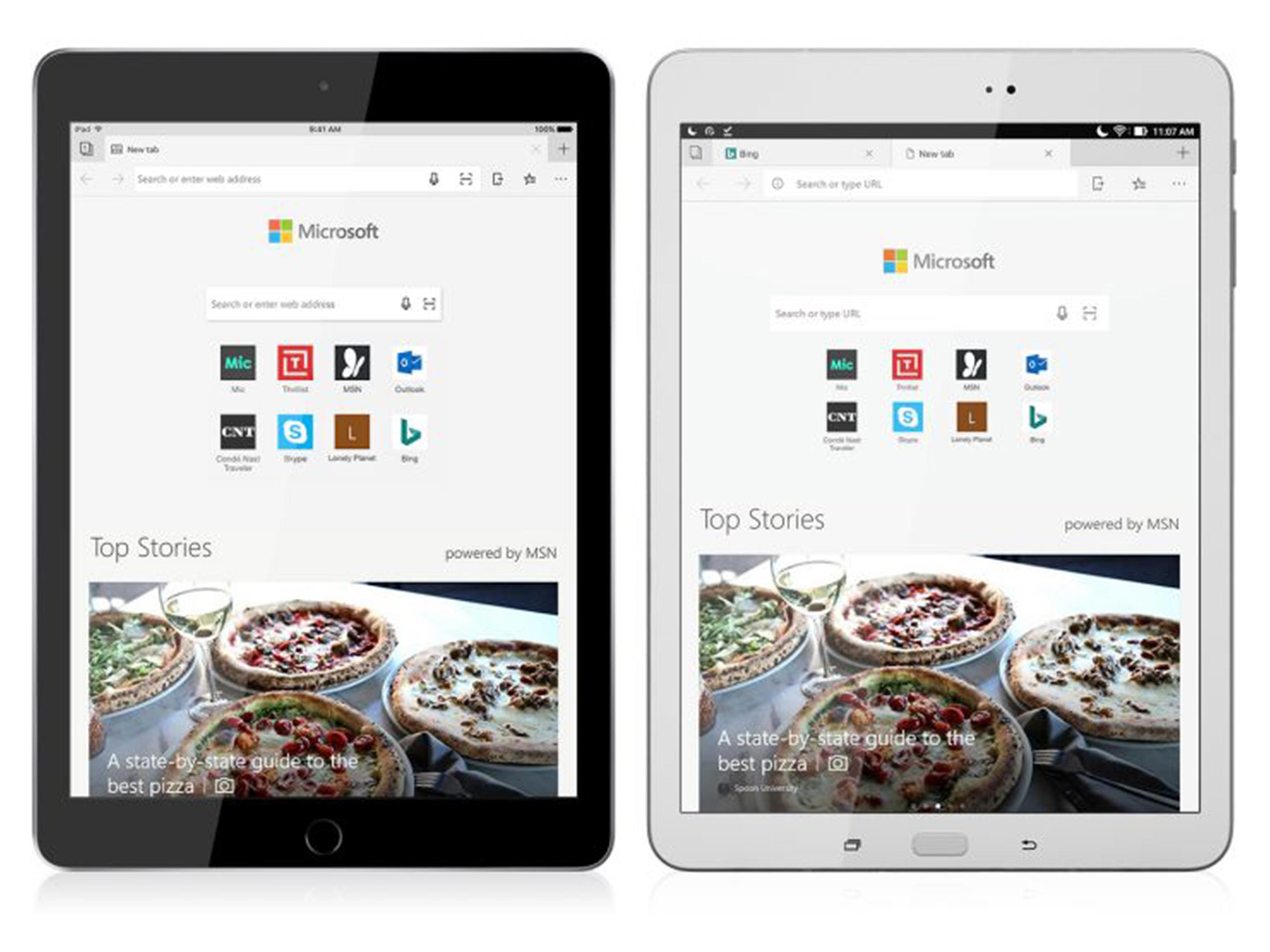
Earlier this month, Microsoft added beta support for its Edge browser on iPad. Now, it has rolled out the app for all iPad and Android tablet users.
In terms of new features, the tablet app has some of the regular Edge features like light and dark themes, ‘reading view,’ ‘roaming passwords’ and ‘favourites.’ There’s also a ‘continue on PC’ button, which lets users open a web page from their device on their PC, if both the desktop and iPad are using the same log-in information.
What is missing here is being able to ‘split screen’ this app with other iPad apps like you can with Safari.
The iOS app can be downloaded through the App Store and the Android app on Google Play.
Readers will recall I deleted Facebook a year and a half ago, citing just the sort of newsfeed manipulation we've now all come to see as harmful. If I had been able to do something about it at the time, I would have. I have spent my time since focusing on working with and developing distributed personal learning and information networks. There's no money in this. If you are required to find paying clients, you'll hear nothing but crickets (or the many voices telling you to centralize and consolidate and do analytics). The people working on Diaspora, the people working on Mastodon, the people working on SoLID - these people, and others like them, are the people who should be supported.
After testing mobile-first indexing for a year and a half, Google is finally rolling it out as its main form of website indexing today.
While this seems like a big undertaking, Google says the majority of its users are on mobile so this update will make sure their searches are more accurate.
Through indexing, Google scans what is on a webpage so it can serve it as a search result. It saves all of its results in an index so when a user searches for something it knows what to give them because it has already processed the webpage.
This new form of indexing is an effort to help mobile users get the right information, because sometimes when they search from a mobile device they’ll ping information that was indexed from a desktop webpage. This means when they view the mobile version of the same webpage, the information might not be in the same place, or visible at all.
This new update changes how Google gathers content, but not how it ranks it when things are searched. Google does mention at the bottom of the press release that “having mobile-friendly content is still helpful for those looking at ways to perform better in mobile search results.”
What do we know about helping out when friends and allies are attacked on Facebook and Twitter?
There’s a ton of research literature out there that, as we have seen, usefully identifies people who are especially vulnerable to bullies. We have technology that automatically flags people for the possible sexual interests or political sentiments. We have tools that help coordinate mobs of attackers — the 21st-century brownshirts.
But what is known about effective ways to help when you see the brownshirts marching down the virtual street, bricks and broken bottles in hand?
Today was a die in at City Hall, followed by a ghost bike ride for a cyclist that died last Tuesday in Don Mills. The die in was organized by Friends and Families for Safe Streets, timed to draw attention to the fact that so far 16 people have died in traffic this year, and that City Council is voting on a proposal to improve the public realm for the stretch of Yonge St. between Sheppard and Finch, with improvements for cyclists and pedestrians.
My photos of the die in are posted at Dandyhorse. Immediately after the die in, the ghost bike riders departed for Don Mills. The planned route was about 22 km from City Hall.
On Bay.
Signalling a left turn.
Near the Distillery District.
Along Lakeshore.
Darkness falls.
The woman to the right (I’m sorry I didn’t get her name) was absolutely determined to complete the ride. She told us that she was from Iran, and she had been arrested for riding a bike as a woman.
At the crash site.
A minute of silence.
The ghost bike.
Getting ready to depart.
A short break to warm up, and to get some carbs.
Thanks to everyone who rode with us tonight. Condolences to the family and friends of the deceased.
Good cycling jerseys vary in price from around $40 to around $140, and even more. You may be wondering: "Why would I spend that kind of money, when I already have plenty of perfectly good shirts?" The truth is that cycling jerseys have technical features that will make you more comfortable while you ride your bike. And if you are into performance cycling, a great jersey may even help you to ride faster and longer.



















 vintage everyday.




 Today was a


 Good cycling jerseys vary in price from around $40 to around $140, and even more. You may be wondering: "Why would I spend that kind of money, when I already have plenty of perfectly good shirts?" The truth is that cycling jerseys have technical features that will make you more comfortable while you ride your bike. And if you are into performance cycling, a great jersey may even help you to ride faster and longer.