Shared posts

04 Apr 14:26

Diversity & Inclusion in Open Source Community Call #2

by Emma

April 4th ! 9 AM PDT (link to your time)

Learn about the Coral Project, Blind Reviews and more! Ask for help, offer help and share your work building inclusive communities for feedback and sharing.

Ways to join:

Join the discussion and stay in touch by joining our D&I Discussion Group. If you would like to present on future calls please reach out to me directly!

FacebookTwitterGoogle+Share

04 Apr 14:26

Nokia 7 Plus, Nokia 8 Sirocco Edition, and Nokia 6 (2018) Launched in India

by Rajesh Pandey
Nokia today launched the Nokia 8 Sirocco Edition, Nokia 6 (2018), and the Nokia 7 Plus in India. The Nokia 8 Sirocco Edition and the Nokia 7 Plus were first unveiled by the company at MWC 2018 in February. Continue reading →
04 Apr 14:26

Why do people dislike online ads?

by ehsan

As part of my research on the various aspects of online advertising, one of the questions I have looked into is: why people dislike online ads?  In this post, I’m planning to go over my findings as to the underlying reasons, again, similar to the earlier post, trying to avoid using the ad industry jargon as much as possible.  Needless to say, none of this should be taken as official Mozilla position or policy.

Do people dislike online ads?

The short answer to that question is, very much so.  PageFair’s 2017 adblock report is very telling here (note that it reports data as of December 2016).  Key interesting facts to know from that report are:

  • 11% of the Internet population across desktop and mobile were blocking ads as of December 2016.
  • This number is increasing at an accelerating rate.
  • Mobile ad blocking is more common in Asia and Pacific, desktop ad blocking is more common elsewhere.
  • The growth rate of ad blocking on mobile has surpassed desktop.
  • Ad blocking growth rate on desktop continues to grow even though overall desktop usage is declining.
  • Usage in each market can be a lot higher, such as 18% overall in the US, 24% in Canada, 29% in Germany, 58% in Indonesia, etc.

Ads that people love

A discussion about why people dislike online ads often begins with the negative aspects of online advertising, and we’ll look at them.  But let’s first talk about other kinds of ads, the kind that people seem to love!  There are many different types of ads that people seem to respond positively to, and not only that, but in some cases even actively seek and remember even years later after viewing.  The examples vary depending on the country and the culture, but to give an example from the United States, the Super Bowl ads come to mind.  There are similar examples in other countries.  An interesting feature of these types of ads is that even though they can cause various controversies from time to time, people seem to actively seek them out, talk about them, and sometimes even enjoy watching them.  I remember ads of this category that I have watched many years ago.  Another interesting feature of these types of ads is that it’s very rare for people to find them online!

Ads that annoy people

There is unfortunately an abundance of various kinds of annoying ads on the Web.  Could annoying ads be the reason people dislike online ads?

This at least seems like a plausible explanation, therefore I decided to look into various reasons why people may consider ads annoying.  There has been a lot of research done around this topic in the literature, and there are some common findings based on that.  Some researchers have found that people find visually animating content (such as animations and videos) more distracting than static content, and when such animations are used in advertisement, people would find ads more annoying.  Others have found that people find ads that get in the way of something that they were trying to do more annoying than other ads (e.g., ads that obscure page content, open pop-ups, stick to the sides of the page, etc. annoy people more than ads that are merely placed next to the content that people want to read and interact with).  Another common reason in what annoys people about ads is their performance implications by slowing down page load times.

But the more interesting (and not entirely surprising) aspect of this research is how subjective the annoyance factors can be.  It seems that different people, sometimes at different times, would find different types of advertisement more annoying, but there is a lot of nuance associated with it.  At the very least, it seems that the way people engage with the content they’re interacting with can affect what types of ads they may find annoying, that is, if they’re highly involved with the content they’re viewing, the ads which they may find annoying may be different from if they only have a lower level of involvement.

Ads that scare people

One major difference between online ads and advertisements in other media is that some people may fear ads that they view online, due to the possibility of the ads delivering malware.  The PageFair 2017 adblock report is also a good source of information about this aspect of why people dislike online ads.  Almost as many people block ads to prevent being infected by malware and viruses as they do because they find ads intrusive.

Note that the people who are scared of ads have a good reason for their reservations.  The phenomenon of serving malware through ads (malvertising) has been well documented for many years in the news, and many highly popular and respectable websites (such as The New York Times and The Onion, and apps such as Spotify) have been caught serving malware through ads.  The way that these attacks work is relatively simple: the attackers convince an ad network somehow (either by subverting their IT infrastructure, or more commonly through social engineering) to serve their ads, containing the malicious code on a large number of websites that the ad network places ads on.  This, in addition to the fact that some malware served through ads doesn’t cause a visible side effect when it runs, makes seeing ads a really scary experience for some people, because they have no good way to ensure the safety of their devices when browsing the web (or using Internet enabled apps powered by ads!).

As a side note, it’s interesting to note that there is a gender disparity on the motivations to block all ads.  More women block ads out of the fear of getting infected by malware than men, and more men block ads because they find ads overly intrusive.  As I mentioned in the beginning, there is a large disparity in adblocking between desktop and mobile in most markets.  The State of Mobile Ad Blocking in 2017 report by GWI showed that women in the US seem to be less likely to be aware of the possibility of ad blocking on mobile compared to men.  Similar differences are also observed among age groups.  I have wondered whether there are gaps in public education around some of these topics which might help explain some of these results, although I haven’t been able to find much on the topic yet.

Ads that follow people

Many people who have shopped online have had the experience of looking for something to buy, and then being followed by ads for that thing for days (or weeks, sometimes months!) afterwards.  This is known as behavioral retargeting in the ad industry.  The premise for this is as follows: the advertiser is looking for consumers who are interested to buy a product, such as a shirt.  They would like to show ads for their shirt to people who would be a good target audience for buying a shirt.  In the offline world, if the advertiser were to place such an ad looking for a custom target audience, they would probably look for print magazines specializing in fashion, attire and such, based on the assumption that a subset of people who would buy and read such magazines would probably be interested in buying a shirt.  In the online world, however, the online ad industry offers a more lucrative option: showing ads for the shirt to people who have before shown real interest in buying a shirt, possibly a shirt of the same kind, color, size, etc. as the one the advertiser is looking to promote!  What could be better than this?!  The way the online ad companies do this is typically by tracking users from their online shopping carts through everywhere else on the Web as they browse, so that they can detect who abandoned a shopping cart without buying the products in it, what was in the cart, where that user is going now, which advertisers are interested to show ads for those abandoned products, and match up the two.

This is of course something that people hate a lot.  There are obvious reasons why people find this practice highly annoying.  For one thing, these ads typically don’t stop when you eventually buy the shirt in the end!  And sometimes there is not even a meaningful distinction between “shopping cart being abandoned” and “shirt being purchased”, simply because your connection may be spotty when you press Checkout, so you may go back and add the same product to the cart again and finish the checkout process after retrying.  To you, what happened was you just bought a shirt; but to the ad industry, what just happened was you just bought a shirt; and you expressed implicit interest in more shirts (due to that first shopping cart that got “abandoned” when you reloaded the hypothetical page).  More importantly, people don’t want to be reminded of every purchase decision they make online continually.  For example, women who experience miscarriage have to go through the horrific experience of being targeted as pregnant women for ad targeting afterwards.  You can imagine many other similar examples, and there is no recourse for people who find themselves in a situation like this.

Another aspect of retargeting which is less tangible but equally important is the issue of privacy.  The existing sophisticated ad targeting options on the various online ad platforms are powered by the massive amounts of data collected and shared between these platforms.  This data is often collected without the consumer’s knowledge and informed consent, and its collection and storage raises a lot of concerns.  The data, when combined and analyzed, can reveal facts about the individuals that most people consider highly private or are themselves unaware of.  Lately Facebook has been in the spotlight for the privacy implications of their data collection practices, although they’re hardly the only company involved in such practices.

Why do people dislike online ads?

After looking at all the above factors, the big question remains: why do people dislike online ads?  There is no simple answer, but it has been argued that the mass adoption of adblockers by the general population has happened as a result of ad retargeting.  This is really interesting, since as you can see above, there are certainly other reasons why people would block ads, and if you ask why adblocker users do block ads, they don’t really tell you anything about ad retargeting being the primary reason, but if you look at adblocker adoption trends, that has clearly followed the invention of ad retargeting.  Note that many of the other problems discussed above predate ad retargeting (and so do adblocker tools).

This was certainly surprising to me, so I tried to learn a bit more about the reasons.  In marketing, there is a theory behind why advertising works known as the signaling theory.  In short, the reason that advertising works is that an ad delivers a signal about a product or a brand to the viewer, in exchange for their attention.  The signal delivers information about the firm behind the product or brand, for example how big the marketing campaign behind a product is, whether a firm views a brand as a long-term consumer facing brand, whether a firm is ready to support a product in the market through supplying spare parts, services and such in the long term, etc.  The attention is the viewing focus that the viewer devotes to the ad to implicitly extract the signal out of the ad.

For example, when you see a billboard ad for a car on the highway, in addition to what the ad is explicitly telling you through the advertising message, it is also sending you a signal.  Most people realize that billboard advertisements cost a lot of money.  So if you see the same ad on the billboard while driving on the highway every day for a month, that gives you an idea on the amount of money the firm behind the car has been willing to spend on the ad campaign.  The signal that sends gives you an idea about how long that firm is likely to stay in business, how likely it will be for the firm to be able to support you as a customer should you choose to buy a car from them, and so on.  Contrast that same advertising with the same message, only delivered in a different venue, where everyone realizes it would be very cheap for the firm to place an ad.  For example, an a print ad, if it were literally the same advertisement just printed on a piece of paper and hand-delivered to your home address, would send a very different signal, especially if you knew all of your neighbors also received the same ad (but probably not people in other neighborhoods in the same city).  The signal that such an ad would send is that the firm behind the car doesn’t want to spend a lot of money advertising this car, so there must be a reason for it — maybe they aren’t willing to support the car for a long time in the market, or maybe the firm is in financial trouble, or maybe they don’t have a good marketing team, etc.  But it’s unlikely that the second ad would make you want to consider buying that car.  In fact, you would probably spend very little time dealing with that ad in the first place, as most people classify such ads as junk mail.

Armed with the knowledge of signaling theory, now you can go back and look at online ads from the perspective of what signals they deliver.  In the offline world, the print media which is respectable and has an established reader based is often a desirable place for people to place ads in.  And the desirability directly corresponds to how expensive it is to place ads there, since those ads deliver a higher signal.  But in the online world, ironically, the websites of the same media often take part in ad networks that practice ad retargeting, typically at a low cost.  This is why you can see ads for the dreaded shirt in the above example on the websites of respectable publications such as The New York Times!  And if you were before looking to buy rechargeable batteries, those ads would show up there, and so on.  Through that over time people see ads for any and everything on such respectable websites coming from known and unknown brands alike, they establish a cost estimate for how expensive it can be to place ads on these sites.  And since the retargeting behavior effectively happens everywhere on the Web these days, it’s very easy to set up these patterns as you use the Web as a normal user.  Another good example of ads that deliver a very low signal are social media ads.  It’s very difficult, if possible, for the user to distinguish an ad for a product created by an established firm from an ad for a product created by someone in their basement, especially given that the ads are often created through guides that are designed to teach people how to create well-performing ads, so the advertisement itself may look legitimate, but there is no more signal being delivered that the user can base their future decisions on.  A perfect example of this was seen last week when Facebook chose to place full-page newspaper ads in order to apologize for their data privacy scandal, and not use their own advertising network!  This is also due to the high amount of signal carried by those ads (“See how much money we are willing to spend on apologizing?  We must be taking this scandal seriously.”) where had they placed billions of online ads delivering the same message, they would be sending a very different signal.

Of course, this doesn’t mean that any high-signal ad will be loved by people, but I think this mostly suggests the reverse: any form of low-signal ad is going to hated by people!  We have many examples of these types of ads both from the offline and online world: junk mail, email spam, retargeted online ads, highly targeted and personalized ads, etc.  When you’re about to ask people for their attention to show them an ad, you’d better be providing them with some useful signal (and of course, not malware!).

04 Apr 14:26

Tabler

by Rui Carmo

I haven’t linked to any web design resources for a while, but this has such a nice clean look that I couldn’t let it sink into oblivion. The source is here, and besides the nice clean dashboard you’ll find a bunch of equally nicely laid out examples for just about anything.

04 Apr 00:37

The death of the newsfeed

by Benedict Evans

When I got married, my future wife and I were both quite sure that we would have a nice small, quiet wedding - none of these massive, extravagant parties with hundreds of people for us! We’d just invite close family and friends. Then, we actually made a list of ‘close family and friends’… and realized why people have 100 or 200 people at a wedding. You know a lot more people than you think.

I was reminded of this recently by the fact that, according to Facebook, its average user is eligible to see at least 1,500 items per day in their newsfeed. Rather like the wedding with 200 people, this seems absurd. But then, it turns out, that over the course of a few years you do ‘friend’ 200 or 300 people. And if you’ve friended 300 people, and each of them post a couple of pictures, tap like on a few news stories or comment a couple of times, then, by the inexorable law of multiplication, yes, you will have something over a thousand new items in your feed every single day.

This is the combination of two factors - Dunbar’s number (a rule of thumb that implies that you probably do know several hundred people well enough to friend them on Facebook) and ‘Zuckerberg’s law’ (the supposed tendency to share more and more on social media over time). Combine these two and you get overload.

Pushing a little further, it seems to me that Zuckerberg’s law, such as it is, is really an observation about the models for following people that social media platforms have evolved, in which sharing something onto your own feed is not the same as sending it to any particular person. You would not send 10 pictures of your child or dog to everyone in your address book very often, if ever, and most people (under 50) would not send every funny or enraging news article they see to everyone in their address book either, but the asymmetric feed makes posting at that kind of frequency normal instead of rude. Since you’re posting it to ‘your’ feed instead of sending it explicitly to someone, it’s OK to post lots and to post less important things. That, in turn, takes us to the tragedy of the commons - we’re ‘supposed’ to post stuff, but by posting stuff, we overload each other’s feeds. Facebook’s Growth team was too good at its job. 

This overload means it now makes little sense to ask for the ‘chronological feed’ back. If you have 1,500 or 3,000 items a day, then the chronological feed is actually just the items you can be bothered to scroll through before giving up, which can only be 10% or 20% of what’s actually there. This will be sorted by no logical order at all except whether your friends happened to post them within the last hour. It’s not so much chronological in any useful sense as a random sample, where the randomizer is simply whatever time you yourself happen to open the app. ’What did any of the 300 people that I friended in the last 5 years post between 16:32 and 17:03?’ Meanwhile, giving us detailed manual controls and filters makes little more sense - the entire history of the tech industry tells us that actual normal people would never use them, even if they worked. People don't file. 

This is the logic that led Facebook inexorably to the ‘algorithmic feed’, which is really just tech jargon for saying that instead of this random (i.e. 'time-based') sample of what’s been posted, the platform tries to work out which people you would most like to see things from, and what kinds of things you would most like to see. It ought to be able to work out who your close friends are, and what kinds of things you normally click on, surely? The logic seems (or at any rate seemed) unavoidable. So, instead of a purely random sample, you get a sample based on what you might actually want to see.

Unavoidable as it seems, though, this approach has two problems. First, getting that sample ‘right’ is very hard, and beset by all sorts of conceptual challenges. But second, even if it’s a sucessful sample, it’s still a sample.

Looking at the first of these, there are a bunch of problems around getting the algorithmic newsfeed sample ‘right’, most of which have been discussed at length in the last few years. There are lots of incentives for people (Russians, game developers) to try to manipulate the feed. Using signals of what people seem to want to see risks over-fitting, circularity and filter bubbles. People’s desires change, and they get bored of things, so Facebook has to keep changing the mix to try to reflect that, and this has made it an unreliable partner for everyone from Zynga to newspapers. Facebook has to make subjective judgements about what it seems that people want, and about what metrics seem to capture that, and none of this is static or even in in principle perfectible. Facebook surfs user behaviour.

It’s useful here to compare the newsfeed challenge with the Google’s search results challenge. Google has to work out the best 10 results to show, using all sorts of judgements about what signals work best and what signals matter more, just as the newsfeed does - it can’t just show you the results by some objective measure like date or file size. It can offer complex controls and filters to fiddle with, but like Facebook it has to get things right without such controls because most people won’t ever touch them. And also like Facebook, of course, it has people trying to game the system. Unlike Facebook, though, Google has explicit intent - you told it what you wanted to see. And so if Google shows me exactly what I told it I wanted, it’s succeeded, even if I ‘shouldn’t’ have searched for that. Facebook has no such direct signal. There are things it ‘shouldn’t’ show me, even if my uncle did share them. But what are those things, and who should decide, and what does the weighting look like?  

This is the challenge to getting an algorithm right, but there is also the second problem - that it’s always still a sample. Facebook has done so much development and outreach and ’growth-hacking’ to get more stuff into the feed and to make it frictionless to share that there is now far more content available to me than I can look at. It tries to show me a sample of that, and a sample that’s better than ‘whatever was posted in the last 45 minutes’. It might or might not succeed at being better, but there remains the question - do people want a sample at all, anymore?

One basic problem here is that if the feed is focused on ‘what do I want to see?’, then it cannot be focused on ‘what do my friends want (or need) me to see?’ Sometimes this is the same thing - my friend and I both want me to see that they’re throwing a party tonight. But if every feed is a sample, then a user has no way to know who will see their post. Indeed, conceptually one might suggest that they have no way to know if anyone will see this post. Of course, Facebook’s engagement teams won’t let that happen - if I feel too much that I’m shouting into the wilderness I’ll leave (this is one of Twitter’s new user problems), and so I’ll be rationed out at least enough exposure to friends and engagement feedback to keep posting. Until you don’t. But if something was really important, why would you put it on Facebook?

I think one could suggest that this is some of what’s behind the suggestions of systemically lower engagement on Facebook newsfeeds, and behind the obvious growth of person-to person chat (most obviously WhatsApp, iMessage, FB Messenger and Instagram - three of which Facebook of course owns). The social dynamics of a 1:1 chat work much more strongly against overload, and even if one person does overshare they're in a separate box, that you can mute if you like. 

Meanwhile, you could propose that the Stories format that Snap invented, and Facebook... continued to invent, is also a way to address overload: by bundling what you want to share into one unit instead of many separate items, even if you do then still share that to many people any feed is more manageable. That in turn makes easier a key Snap thesis - that though you still share things asymmetrically, there shouldn’t be an algorithm between you and your friends. That is, maybe Stories mean you share more things, but by bundling them into one thing you place less load on your friends and reduce the need for a filter. You put the structure into the content instead of the display of the content. 

There are clearly also other trends behind any swing from newsfeeds to messaging. Messaging can be more private, have less social pressure, and be more fun. A Snapchat story isn’t a permanent record and has less pressure to show off your perfection. Stickers and filters are more fun and spontaneous than Facebook’s rigid blue boxes (and the days of throwing sheep at people are gone alone with Facebooks’ platform). And some of these offer light-weight ways to interact without obligation, which was also a feature of Facebook's model, but deliver that piece of Maslow in different ways. 

The catch is that though these systems look like they reduce sharing overload, you really want group chats. And lots of groups. And when you have 10 WhatsApp groups with 50 people in each, then people will share to them pretty freely. And then you think ‘maybe there should be a screen with a feed of the new posts in all of my groups. You could call it a ‘news feed’. And maybe it should get some intelligence, to show the posts you care about most...

A pessimist might say this looks like slash & burn agriculture, or perhaps the old joke ‘No-one goes there anymore - it’s too crowded.’ That is, for social, Metcalfe’s Law might look more like a bell curve. I don’t know what the next product here will be (I didn’t create Snap, after all). But tech like this tends to move in cycles - we swing from one kind of expression to another and back again, and we might be swinging away from the feed.

Finally, any such changes have consequences for the traffic that sharing creates. 'Like' buttons made it frictionless to post any web page you want into your feed and push it to (some arbitrarily calculated percentage of) your friends, and many hands have been wrung about how much traffic this can drive and how Facebook moves things up and down the feed ranking. But sharing links inside Stories isn't the same, today, and a link you share in a WhatsApp or iMessage group with 5 friends will only be seen by them, and Facebook has no lever to pull to make this more or less visible. On the other hand,  the 'WhatsApp forward' can take such a link and send it viral across a country, and where Facebook can ultimately kill a link or an entire source across the whole site if it really wants to, it's very different for a P2P messaging app to make that call (outside China, of course). That is, the plea from many media companies to 'up-rank' their posts in the newsfeed - to make people eat their greens - and to kill 'fake news' links is at least theoretically possible on Facebook. It's not possible in iMessage - with end-to-end encryption, Apple has no idea what you’re sharing. 

04 Apr 00:37

Kindle Oasis :: Ein Luxusproblem

by Volker Weber

49348b04dda314f282b082825408eb02

Ich habe ein kleines Problem mit dem Kindle Oasis: Die Scheffin gibt ihn nicht mehr her. Wenn ich selbst mal ein Buch damit lesen will, muss ich warten bis sie "auf Arbeit" ist. Ich hatte ja noch gehofft, die goldene Rückseite gefällt ihr nicht, aber das Gegenteil ist der Fall. Im Ernst: Wir hatten schon eine ganze Reihe von Kindles, angefangen mit der zweiten Generation. Ich habe einen dunkelgrauen der dritten Generation (mit Tastatur) und danach kamen einige weitere Lesegeräte. Aber nichts liegt so gut in der Hand wie der Oasis. Der Trick ist die Alu-Rückseite, die so profiliert ist, dass man das Gerät mit ganz geringem Krafteinsatz sicher hält. Auf dem breiten Rand ruht der Daumen, so dass einem der Kindle nicht ins Gesicht fällt, wenn man auf dem Rücken liegt. Das Display ist matt, in der Sonne perfekt zu lesen und hat eine Auflösung von 300 dpi. Damit kann ich keine Pixel erkennen.

Wenn ich denn mal dran darf.

More >

04 Apr 00:29

My takeaways from Stephen Downes’ talk on personal learning

by Doug Belshaw

In general, I have great intentions to watch recorded presentations. However, in reality, just like the number of philosophy books I get around to reading in a given year, I can count the number I sit down to watch on the fingers of one hand.

I’ve been meaning to watch Stephen Downes’ talk on personal learning since he gave it at the at the Canada MoodleMoot back in February. Since I’m talking with him this afternoon about Project MoodleNet, that served as a prompt to get around to watching it.

(as an aside, it’s a blessing to be able to play YouTube videos at 1.5 or double speed — presentations, by their nature aren’t as information-dense as text!)

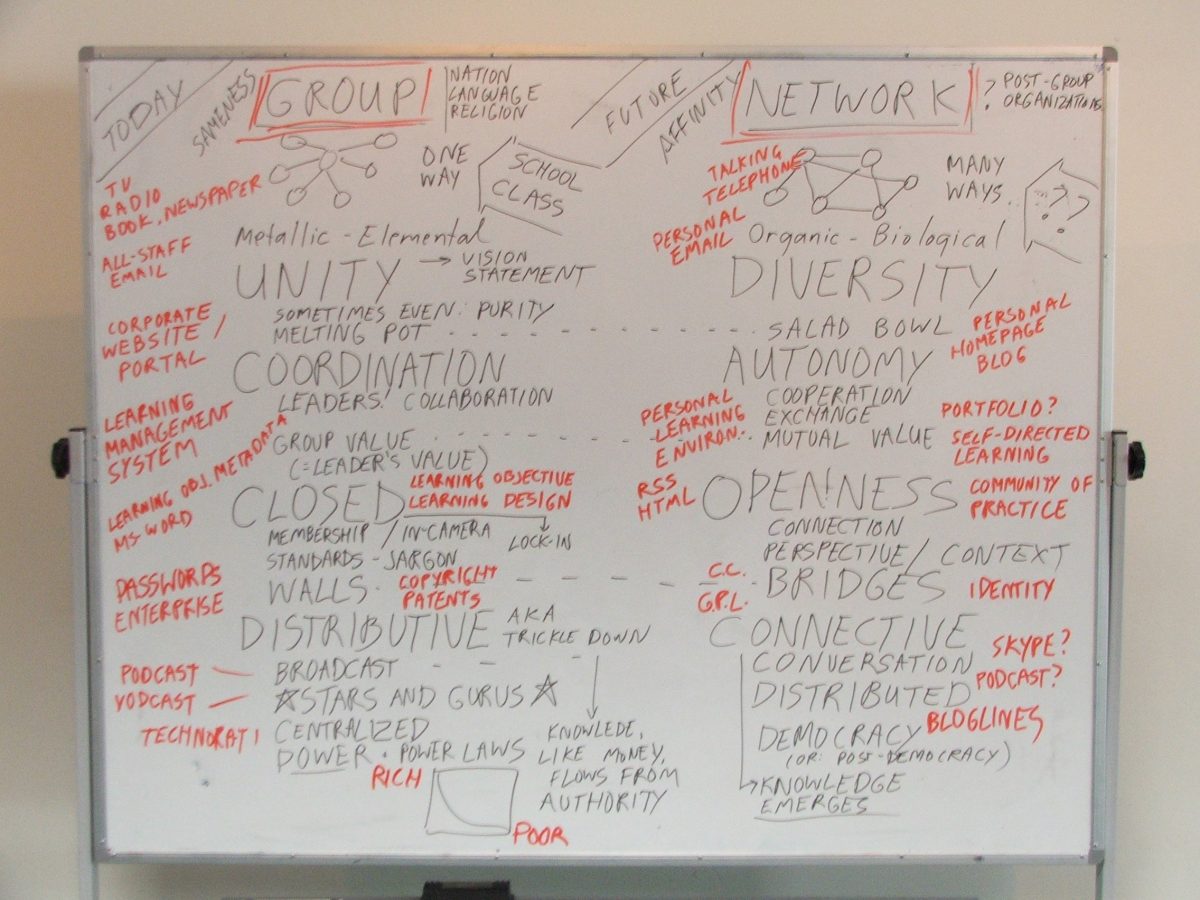
Groups vs Networks

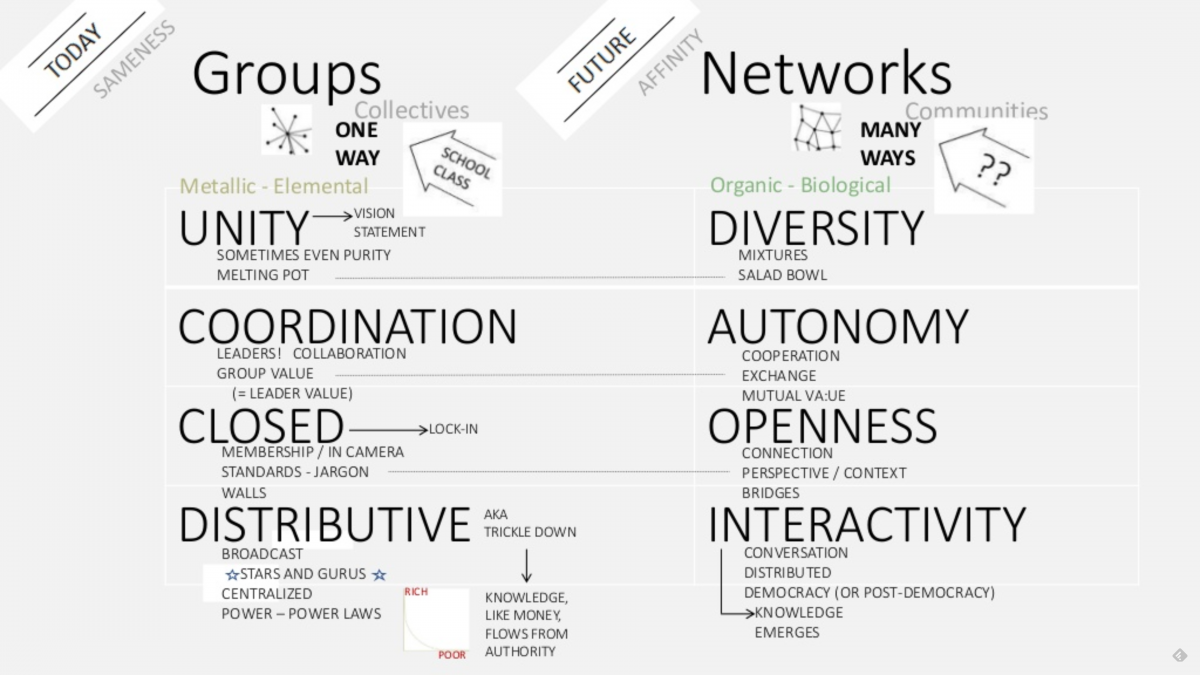
Downes has been talking about groups vs networks since before 2006. In fact, I often reference this:

Groups vs Networks

CC BY-NC Stephen Downes

The presentation builds on this, and references a tool/environment he’s built called gRSShopper.

Groups vs Networks

Downes doesn’t link any of this to politics, but to my mind this is the difference between authoritarianism and left libertarianism. As such, I think it’s a wider thing than just an approach to learning. It’s an approach to society. My experience is that some people want paternalism as it provides a comfort blanket of security.

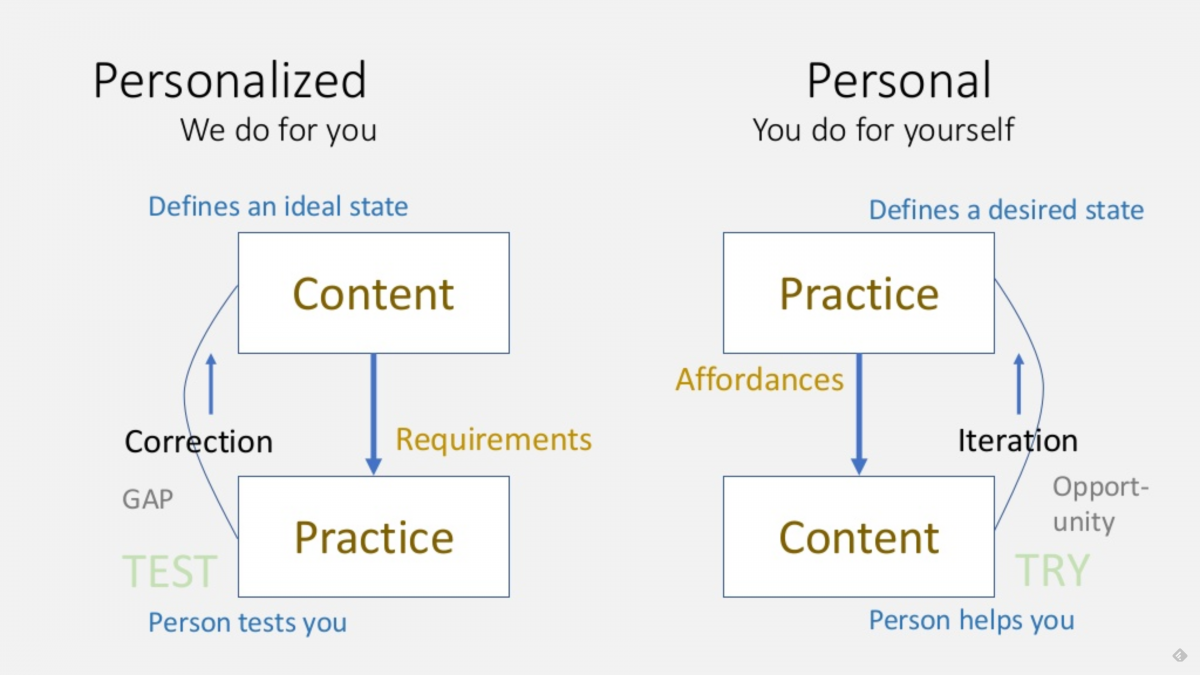
Personalized vs Personal

There’s plenty of differences between the two approaches. In his discussion of the following slide, Downes talks about the difference between a ‘custom’ car and a customised car, or an off-the-self suit versus one that’s tailored for you.

Personalized vs Personal

My position on all of this is very similar to Downes. However, I don’t think we can dismiss the other view quite so easily. There has to be an element of summative assessment and comparison for society to function — at least the way we currently structure it…

Personal Learning Environments

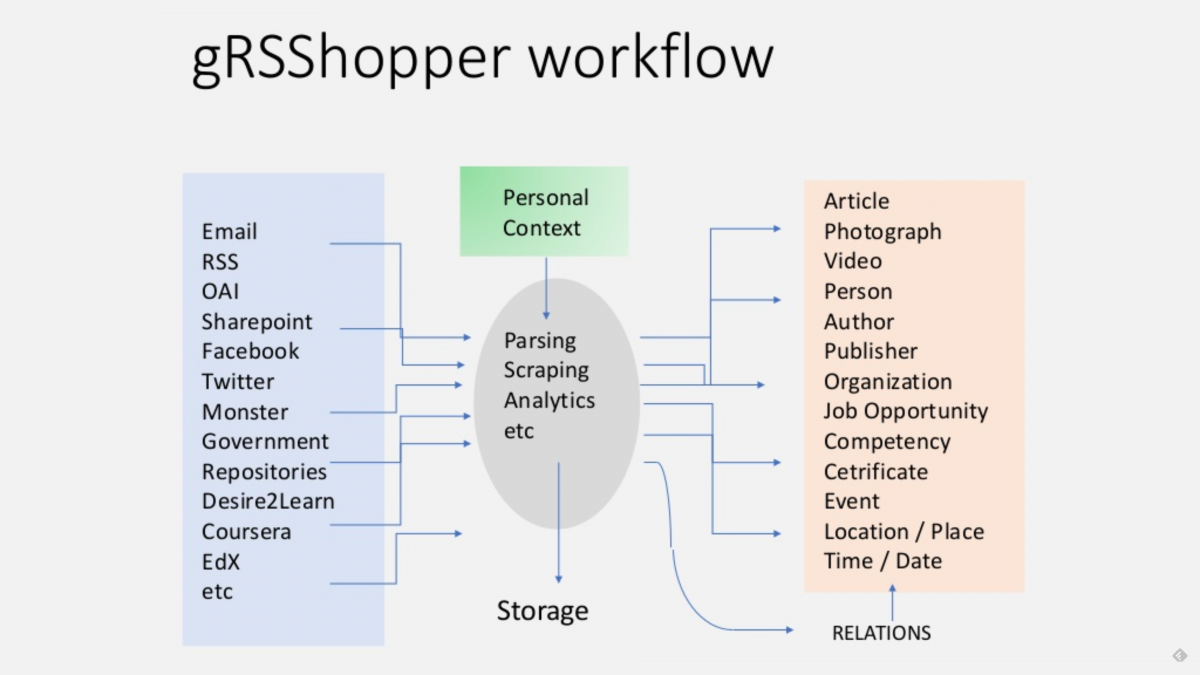
Downes’ custom-build system, gRSShopper, is built with him (the learner) in the middle. It’s a PLE, a Personal Learning Environment:

gRSShopper workflow

All of this is based on APIs that pull data from various systems, allow him to manipulate it in various ways, and then publish outputs in different formats.

Note that all of this, of course, depends upon open APIs, data, and resources. It’s a future I’d like to see, but depends upon improving the average technical knowledge and skills of a global population. At the same time, centralised data-harvesting services such Facebook are pointing in the opposite direction, and dumbing things down.

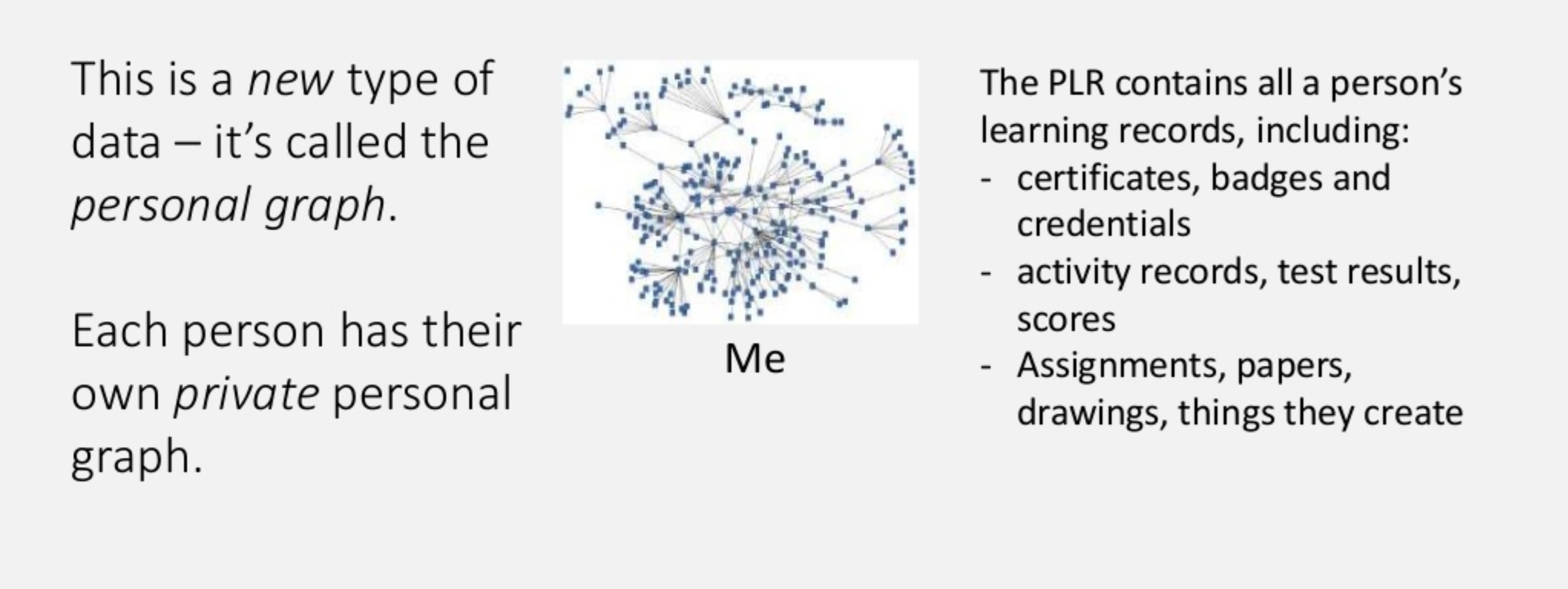
Personal Learning Record

So gRSShopper creates what Downes calls a Personal Learning Record, complete with ‘personal graph’ that is private to the learner. This is all very much in keeping with the GDPR.

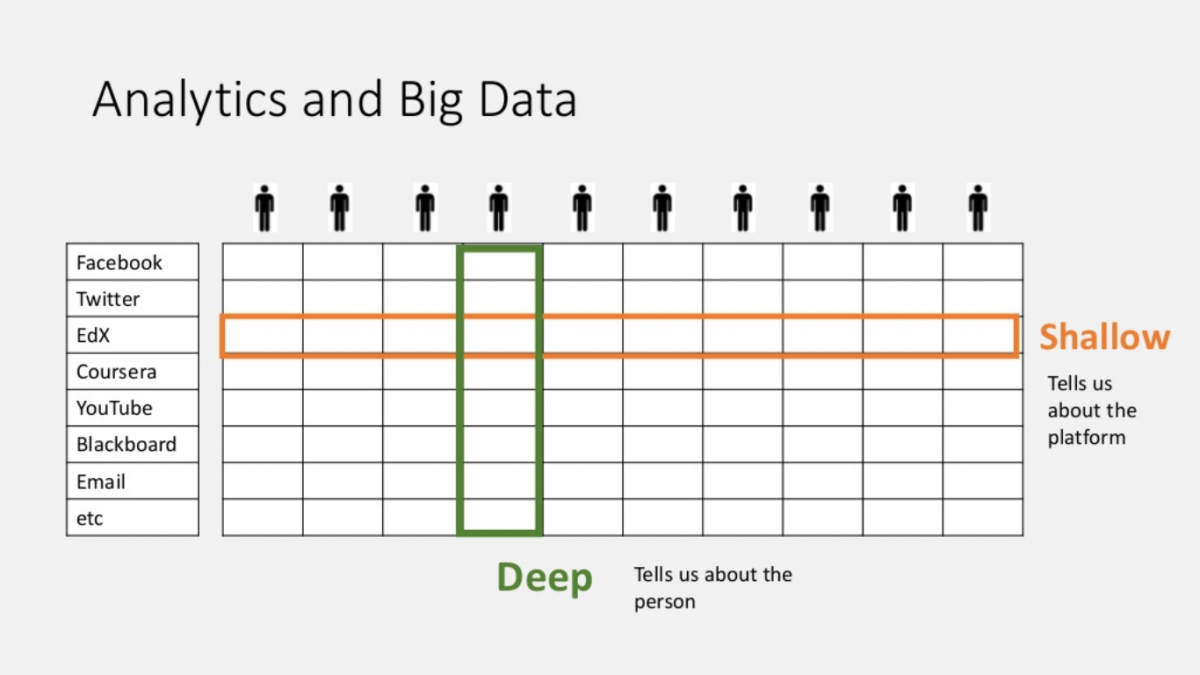
Data aggregation and analytics

The real value in all of this comes in being able to aggregate learning data from across platforms to provide insights, much as Exist does with your personal and health data.

Analytics and Big Data

Downes made comments about pulling resources and data between systems, about embedding social networks within the PLE, and browser plugins/extensions to make life easier for learners. I particularly liked his mention of not just using OERs as you learn, but creating them through the process of learning.

Conclusion

I’m looking forward to our conversation this afternoon, as I’m hoping it will either validate, or force me to rethink the current approach to Project MoodleNet.


Main image CC0 Marvin Meyer

04 Apr 00:28

Putinism, like Trumpism, is based on a cynicism. It’s based on...


Putinism, like Trumpism, is based on a cynicism. It’s based on the idea that one should have no illusions, be wise to the ways of the world. People are, as Machiavelli put it, ungrateful and deceitful, timid of danger and avid for profit. Rivalry is inevitable. Everything is partisan. Anybody or any institution that claims to be objective and above the fray is a liar.

In this world, everything is public relations, and the more shameless the charade the better because people will believe whatever is in their interest to believe.

In times of anxiety and distrust, it’s much easier to sell cynicism than idealism. 

| David Brooks, Vladimir Putin, the Most Influential Man in the World

04 Apr 00:28

Tesla comes clean about its fatal crash; Uber just cowers

by Josh Bernoff

A self-driving Uber ran over a pedestrian in Phoenix. A Tesla in autopilot mode crashed into a safety barrier and killed the driver. Tesla released a statement about the crash that delivers specifics and clarity, while Uber said very little. It’s moments like this that clarify why we tend to trust Tesla, but not Uber. … Continued

The post Tesla comes clean about its fatal crash; Uber just cowers appeared first on without bullshit.

04 Apr 00:22

Smartphone software updates

by Volker Weber

ZZ1F8582A5

Three years ago, the Galaxy S6 edge almost beat my trusted iPhone 6, which had been introduced in 2014. I was very close to switching over. Samsung just announced they are no longer providing security patches for the S6 and S6 edge. Looks like I made the right choice since the iPhone 6 is still in operation and just received the latest iOS 11.3 version. A good friend is still using an iPhone 5S from 2013, which has also been upgraded last week.

Rule of thumb: You can get at least 5 years from on iPhone and 3 years from an Android. If you are lucky.

04 Apr 00:21

The RSS Revival

by Federico Viticci

The platformization of the web has claimed many victims, RSS readers included. Google Reader's 2013 demise was a major blow; the company offed it in favor of "products to address each user's interest with the right information at the right time via the most appropriate means," as it Google executive Richard Gingras put it at the time. In other words, letting Google Now decide what you want. And the popular Digg Reader, which was born in response to that shuttering, closed its doors this week after a nearly four-year run.

Despite those setbacks, though, RSS has persisted. "I can't really explain it, I would have thought given all the abuse it's taken over the years that it would be stumbling a lot worse," says programmer Dave Winer, who helped create RSS.

I enjoyed this story on the state of RSS by Wired's Brian Barrett because it resonates with a trend I've also noticed in the past couple of years. Many of us have often praised social networks as "winners" in the battle against pure old RSS feeds, but the reality is that RSS is here to say. Perhaps, like rock and roll, RSS can never truly die.

What's even more interesting is that, beyond RSS as a protocol, RSS services and clients (web backends and apps) are improving and growing more powerful on a weekly basis now. Barrett mentioned Feedly, The Old Reader, and Inoreader (which I've been using since 2016 and offers terrific power user features); I would also add NewsBlur and Feedbin – two services that have relentlessly iterated on the RSS experience since Google Reader's demise. Just in the past few months, for instance, NewsBlur launched infrequent site stories to fix the very problem of subscribing to too many feeds, and Feedbin rolled out support for Twitter subscriptions. Both are genuine innovations that help people who want to get their news directly from the sources they choose. And if we look at the iOS side of this, apps like Fiery Feeds and lire are rethinking what advanced RSS readers for iPhone and iPad should be capable of. We wanted to do an RSS-focused episode of AppStories, and we ended up producing two of them (you can listen here and here) because there was just so much to talk about.

While millions of people may be happy getting their news from Facebook or an aggregator like Apple News (which I also use, occasionally, for more mainstream headlines), the resiliency of RSS makes me happy. There was a time when I thought all my news could come from social feeds and timelines; today, I'm more comfortable knowing that I – not a questionable and morally corrupt algorithm – fully control hundreds of sources I read each day.

→ Source: wired.com

04 Apr 00:20

What Will Amazon do with that City Data?

by Sandy James Planner

bn-vm018_seattl_gr_20171006172853

Price Tags Vancouver has been writing about the cities vying to be the next “big thing” with Amazon. As we now know, many cities have put in proposals for the next Amazon headquarters, and provided that American owned electronic and cloud computing  company with tons of incentives and concepts hoping to  woo that company to their region.

Richard Florida on Twitter asks the salient question~”Amazon now has the biggest side data base in the world with promises of incentives”. So what will they do with that?”

Richard is right. Amazon has the current snapshot of who is who in North America, and knows the capacity for employment, housing, transportation and municipal and state incentives in each of the business cases sent to them. In an editorial summit, Price Tag Vancouver editors discussed the case of the Gartner Group that started out as a research group and  eventually morphed into  an American research and advisory firm providing information technology and business leadership advice globally.  Most of us have heard of or are familiar with the The Gartner Report. Can the Amazon Global Consulting Firm be far behind?

Company Signs


04 Apr 00:20

Your new tax year countdown

by Natasha Wear

It’s nearly here! The end of the week sees the start of the 2018/19 tax year. Are your ISAs ready for it?

Here’s a quick list of what you should be thinking about:

Check where you are with this year’s allowance.

Remember, you can put up to £20,000 into an ISA this tax year. Even if you don’t have the full amount, an ISA can be a good home for any spare cash as it will continue to earn interest tax-free for years to come.

Take stock of what ISAs you’ve already got and what they’re earning you. 

While you’re thinking about this year’s ISA allowance, it’s also worth taking a view on all of the ISAs you’ve collected over the years. Some cash ISAs are earning historic lows of less than 1%, so transferring them in to a higher risk, higher earning Zopa IFISA could make a big difference to your finances.

Make any last-minute decisions about this year’s ISA.

There’s still time! Lots of people fund their ISAs in the last days of the tax year so don’t feel like you’ve missed the boat. It’s better to get this year’s tax-free allowance working, than lose it when it resets at the end of the week.

Start planning for 2018/19.

It’s time to start thinking about what you’re going to do with your ISA allowance in the new tax year. There’s lots of information about this time of year, and many ISA providers offer introductory rates to get you into their ISAs. Remember though, these deals will often expire after a year, leaving your money earning much less from year 2 onwards. We don’t do this at Zopa – our business model means you’ll continue to earn the latest market rates for as long as you’re investing in us.

Find out more about ISAs at Zopa.

When you invest your money, your capital is at risk and is not protected by the Financial Services Compensation Scheme (FSCS). Our risk statement has all the details.

The post Your new tax year countdown appeared first on Zopa Blog.

04 Apr 00:20

AirPlay Volume Bug: Goto Mute

by Quentin Carnicelli

Earlier today, we shipped an update to our home audio streamer Airfoil for Mac. The just-released version 5.7.3 works around a bug introduced by Apple in tvOS 11.3. This bug is likely to affect not just Airfoil users, but anyone who sends AirPlay audio to their Apple TV, so a summary of Apple’s bug may be helpful.

In short, for Apple TV receiving audio via AirPlay, volume handling is broken on tvOS 11.3. When the sender has its volume set to zero, audio will still be heard from the Apple TV. You can try it yourself by setting the iTunes volume slider to the far left, as seen below. Send audio to an Apple TV running tvOS 11.3, and you’ll still hear audio leaking out of the AppleTV. This issue occurs with any source sending to the device, including Apple’s iTunes and iOS, as well as previous versions of our own Airfoil.


The sending volume in iTunes is at 0, but audio will still be heard.

A little background on AirPlay volume control helps explain what’s occurring. To eliminate slider latency, AirPlay audio has its volume set on the receiving end (here, that’s the Apple TV). To do this, the sender (here, iTunes) provides the volume level using a special SET_PARAMETER volume command. As a result, adjusting the volume slider in iTunes immediately changes the remote volume, with no lag.

That volume command allows a value range of 0 dB for full volume down to -30 dB for full reduction. However, a -30 dB reduction is often not enough to mute very loud audio, so there’s also a special value to force full muting. When audio should be fully muted, a sender tells the receiver to set volume to -144 dB. The receiver then knows it should not play any audio at all.

With the tvOS 11.3 update, this mute special case is now kicking in at -145 dB, instead of -144 dB. Though it’s impossible to be certain without actually seeing Apple’s source code, this is very likely to be an off-by-one bug. Specifically, it seems that a less-than-or-equal sign got changed to a less-than.

The previous code would have looked something like this:

if $volume <= -144

    mute();

While the updated code would look like this:

if $volume < -144

    mute();

This one small change leads to a very unexpected result for users. We expect Apple will correct this bug in a future tvOS update, but until they do, iTunes and iOS sending won’t properly mute audio to the Apple TV devices.

For our part, once we understood the problem, we could update Airfoil for Mac to work around it. Be sure update to Airfoil for Mac 5.7.3, which will correctly mute audio for all versions of tvOS (Airfoil for Windows users, watch for an update coming soon as well).

04 Apr 00:20

Our Looming Tower – 2

by pricetags

Vancouver House is appearing in and above the skyline – in this case from the South False Creek greenway across from Granville Island:


04 Apr 00:20

Introducing the improved data editor

Update: The beta test is over, the feature is launched.

We rolled out an update to the data editor in Datawrapper, also known as the “Check & Describe” step.

data editor step 2

The update is part of a general code refactoring we’re going through, but we also took the opportunity to add three new features that we hope will help Datawrapper users to check their uploaded datasets.

Sort table view

Now you can sort the table view by any column. This is useful to find and check the smallest and largest values in datasets or to order by categories.

data editor step 2

Note that this sorting is only affecting the view of the data in the “Check & Describe” step. It doesn’t affect the actual order of the rows, and it doesn’t affect your charts. If you want to sort data in your charts, then you can do so in step 3: “Visualize” (depending on your chart type).

Search

When editing larger tables it can be tricky to find a specific row in the datasets. Your browser’s “Find in page” search (Strg/Cmd + F) only looked through the visible part of the table. That’s why we added a special search box that does what it’s supposed to do. Just enter a search term and use the buttons or Enter to browse through the results.

data editor step 2

Column re-ordering

In a few chart types such as the stacked bars, the order of the columns in the dataset affects the order of the bars in the chart. Previously, if you wanted to change the order you had to re-upload your data. Now you can just drag the columns around in the data table!

data editor step 2Click on the table header to select a column. You can then drag it to another position. Click on the table header again to deselect the column. ProTip: Hold Shift to select multiple columns.


Histogram view

Another exciting new feature is an integrated histogram view that opens whenever a numeric column is being selected. Histograms are charts that tell us how our values are distributed.

histogram

You can find out more about this in our Academy.

What else has changed?

The “Add column” dialog is now opening in the sidebar instead of in a popup window. (Chances are you never needed the button, but what it used to do was to open a popup window.)

If you find anything confusing about the update, please let us know via email or in the comments below.

04 Apr 00:20

The Missing Building Blocks of the Web

files/images/1_JJBUSAfM0r91ANzM5uvkQA.jpeg

Anil Dash, Glitch, Medium, Apr 06, 2018


Icon

Anil Dash, still with Glitch, is continuing to advocate "the idea that the web was supposed to be made out of countless little sites." This is something that resonates with me as well. The missing building blocks, he writes, are the technologies that made the old web work: the idea that you could view source and use what you saw to create your own web site; embedding bits and pieces of one website on another (the way we used to do with Flash, and the way I still do with videos and slide shows); having your own web address. In a follow-up article Mike Loukides adds to the list things like RSS, which creates simple syndication, along with better security and privacy.

Web: [Direct Link] [This Post]
04 Apr 00:20

Philosophical Implications of New Thought-Imaging Technology

files/images/nemrodov-eeg-head.jpg

Justin Weinberg, Daily Nous, Apr 06, 2018


Icon

We have always taken for granted the fact that our thoughts are private. The developments described in this article challenge that idea. " Dan Nemrodov at the University of Toronto-Scarborough is working on a way to use electroencephalography (EEG) and machine learning to digitally reconstruct the images that subjects are seeing. In other words, he is developing a kind of mind reading technology." More here and here. Before encoding it and signing up hundreds of millions of users, let's first ask: what are the ethical implications of this: "communications for the impaired or ill, evidence for criminal investigations, opportunities for commercial data mining, new forms of art creation, etc"? And in education: could we 'know' what a person 'knows' by using this technology to 'read' their mind?

Web: [Direct Link] [This Post]
04 Apr 00:19

In Defense of Design Thinking, Which Is Terrible

files/images/Natasha_Jen.PNG

jenkinsEar, Metafilter, Apr 06, 2018


Icon

This is a really interesting pair of presentations. In one, mostly a video, Natasha Jen criticizes the idea of design thinking. “Why did we end up with a single medium?" she asks. "Charles and Ray Eames worked in a complete lack of Post-It stickies. They learned by doing.” In response, Khoi Vinh argues, "it matters less to me whether it leads to a lot of bad design or not. What matters to me is whether it helps broaden the language of design, if it helps expand the community of design, if it helps build a world that values and understands design better than it does today." I fit more into the 'design by doing' school, though I've certainly heard from the other side around here.

Web: [Direct Link] [This Post]
04 Apr 00:19

​Postbox 6.0

pb6-main-mac@2x.png?mtime=20180403073035#asset:2114

We're excited to announce the immediate availability of Postbox 6 for Mac and PC, our next-generation email platform.

While Postbox 6 may feel familiar, under the covers it has an entirely new foundation that will improve performance, message rendering, security, memory utilization, and reliability. More vivid colors, updated themes for macOS and Windows, and over twice as fast as Postbox 5, we know you'll be as excited about this release that we are.

There are a few changes that current Postbox users should know about before installing Postbox 6, so please read on!

Migrating from Older Versions

Postbox 6 installs into new data directories which allows it to run concurrently with older versions of Postbox. If you are using version 3, 4 or 5, Postbox will offer to migrate your accounts, local mail data, user generated content, and most user preferences over from your previous install to version 6.

IMAP Limiting

Version 6 can now limit the number of messages that Postbox will fetch per folder. This feature is turned "ON" by default and is currently set at 2,000 messages (adjustable to 1,000, 2,000, 5,000, 10,000 or no limit).

You can increase these limits so see more messages in Preferences (macOS) or Options (Windows) > Accounts > [your account] > Local Storage.

Dictionaries

Postbox 6 contains a new dictionary management system. To install a Mozilla dictionary, download the dictionary to disk then go to Preferences (macOS) or Options (Windows) > Composition > Typing > Edit Dictionaries. Navigate to the downloaded dictionary file to install it.

Within the Compose window, you can quickly switch dictionaries by clicking and holding the Spelling toolbar button.

Add-ons

Postbox is built using Mozilla code, and as of Firefox Quantum, add-ons are no longer supported by the Mozilla platform. Consequently, future versions of Postbox will no longer support add-ons, starting with Postbox 6.

Add-ons from Postbox, Inc. such as Cloud File Sharing, Signatures, and Responses have been added to the core Postbox 6 product.

We fully understand that this change will be disappointing for many add-ons users, we genuinely do. But we cannot move Postbox forward while maintaining backward compatibility for an add-ons infrastructure that is no longer supported.

Hidden Settings

Most of the hidden preferences that customers have accessed through the Config Editor are now available in the UI. As such, we've removed the Config Editor from Postbox 6. We'll be adding more preferences to the UI over time, so if there's a specific preference that you are interested in, please let us know.

Domain Fencing

By popular demand, we've adjusted the colors of our Domain Fencing feature. Grey addressing bubbles are the default, and red addressing bubbles will provide a warning if you're about to send to or from the wrong domain.

How to Upgrade

If you purchased a Postbox 5 license key on or after March 1st, 2016, or a Postbox Lifetime Key on or before July 31st, 2010, then you already have a Lifetime License, and no purchase is necessary. Download and install Postbox 6, and you're good to go!

Thanks!

A special "Thank You" to all of our amazing BETA testers who assisted in the development of Postbox 6, we couldn't have done it without you!

04 Apr 00:18

Why Product Managers Should Learn to Love Deadlines

by Cliff Gilley

Introduction

Introduction Product managers and deadlines have a complicated relationship for a wide variety of reasons.  We often hate them because of the constraints that they put on us, the pressure that they exert on our development teams, and the oversight (sometimes verging on micromanagement) that comes along with them.  Yet we accept them as a necessary evil, an imposition of the real world on our blue...

Source

04 Apr 00:17

All-New Plaza of Nations

by Ken Ohrn

Built as part of Expo 86 in Vancouver, this now-decrepit Plaza and its defunct casino are the subject of a renewal proposal under the Northeast False Creek Plan.

Rezoning Application – 750 Pacific Boulevard (Northeast False Creek Sub-area 6B — Plaza of Nations)

The City of Vancouver has received a development proposal to amend CD-1 (349) (Comprehensive Development) District for Northeast False Creek Sub-area 6B (Plaza of Nations) at 750 Pacific Boulevard. The proposal is to rezone and develop the 10.28-acre site into a mixed-use development based on the Northeast False Creek Plan, including:

* a variety of terracing buildings up to 30 storeys;
* commercial uses;
* residential uses;
* social housing;
* civic facilities, including a community centre, ice rink, music presentation centre and a 69-space childcare facility; and
* a new community plaza and seawall.

Plaza.of.Nations

In case you missed the 3 open house events, you can comment ONLINE.

Things to note:  20% social housing, internal street with “..  parking to support retail”.

Thanks to Frances Bula for the heads up.

04 Apr 00:17

College for all — but not college degrees

files/images/DZONdtaVwAEIMU_.jpg

Joanne Jacobs, Linking and Thinking on Education, Apr 06, 2018


Icon

As always, I am suspicious when reading a Joanne Jacobs column, but this one seems backed by good data and (even more importantly) good intentions. In a nutshell, " More first-generation, low-income students are going to college — but not completing a degree, writes David Leonhardt in the New York Times. " Obviously this is a concern because these students are accumulating a huge debt load, but not the earning power required to offset that. " I’m convinced that the college-graduation problem is one of the big barriers to economic mobility," writes Leonhardt  in the Times. I'm thinking that whatever is preventing them from graduating is also that big barrier to economic mobility, and one that won't be addressed simply by increasing graduation rates.

Web: [Direct Link] [This Post]
04 Apr 00:17

Mozilla Brings Firefox to Augmented and Virtual Reality

by Sean White

Today, we primarily access the Internet through our phones, tablets and computers. But how will the world access the web in five years, or in ten years, and how will the web itself grow and change?

We believe that the future of the web will be heavily intertwined with virtual and augmented reality, and that future will live through browsers. That’s why we’re building Firefox Reality, a new kind of web browser that has been designed from the ground up to work on stand-alone virtual and augmented reality (or mixed reality) headsets.

(If you love mixed reality – or even if you are just a curious bystander – you can read our announcement post here.)

So why are we creating a browser for mixed reality?

Here at Mozilla, it’s our mission to ensure that the Internet is an open and accessible resource that puts people first. Currently, the world can browse the open web using our fast and privacy-focused Firefox browser, but continuing that mission in a rapidly changing world means constantly investing our time and resources into new and emerging technologies – and realities.

Mozilla has always been on the frontlines of virtual and augmented reality (see our work with WebVR, WebAR and A-Frame), and this is a mixed reality browser that is specifically built to tackle the new opportunities and challenges of browsing the immersive web.

Why is this important?

This is the first cross-platform browser for mixed reality.

Other solutions for browsing and accessing the web on stand-alone headsets exist, but they are closed, and platform specific. Firefox Reality will be independent and will work on a wide variety of devices and platforms.

This is the only open source browser for mixed reality.

Just like our Firefox browser for the desktop, all of Firefox Reality is open source. Not only does this make it easier for manufacturers to add the browser to their platform, but it provides a level of transparency that our users have come to know and expect from Mozilla.

This is a browser that is built by a company that respects your privacy.

We take privacy very seriously at Mozilla. Mixed reality is still new. We don’t yet have all the answers for what privacy looks like in this new medium, but we are committed to finding the solution. We will continue to build on the proven permissions model of the web platform, which provides even more protection than native apps provide. The Mozilla values will guide us as we create Firefox Reality, just as they do with every product we create.

This is a browser that will be fast.

We know fast. We have decades of experience with web compatibility and last year we released Firefox Quantum – a browser that was rebuilt for speed. All of that knowledge, technology, and experience will allow us create a best-in-class browser for mixed reality headsets.

This is a browser that is built for the future.

Mixed reality is the wild west. How do you type? How do you express emotion? How do you view the billions of existing 2D web pages as well as new 3D content? How do you communicate? Who maps the world and who controls what you see? Can we build on our work with voice recognition and connected devices to create a better browsing experience? We love tackling these questions. Everything is new again, and we are constantly building and experimenting to find the right answers.

Browsers are the future of mixed reality.

The future of mixed reality is about delivering experiences, not about building applications.  There shouldn’t be friction moving from one experience to another. Firefox was the first browser to implement WebVR – an open standard for sharing and enjoying virtual reality content through a web URL. This lays the groundwork for creating and delivering immersive experiences using a method that is as simple as opening a web page.

If you’d like to learn more, or view a demo of Firefox Reality running on the HTC Vive Focus, check out our Mixed Reality Blog. You can also follow us on Twitter, where we will provide updates on when Firefox Reality will be available on headsets. Until then, stay tuned. Exciting things are coming.


The post Mozilla Brings Firefox to Augmented and Virtual Reality appeared first on The Mozilla Blog.

04 Apr 00:17

How Do You Feel About Facebook? Take the Survey.

by Jen Caltrider

There’s been a lot in the news lately about how 50 million Facebook users had their information used by Cambridge Analytica, a private company, without their knowledge.

TAKE THE SURVEY

The conversation since — both online and off — has been all over the board. Some people were not at all surprised by the story, saying this has been common practice for a while. Others were shocked, worried their personal information could be used for nefarious purposes. And still others seem not to really notice the news at all.

Which left us wondering, how do most people feel about this news and about Facebook in general? We put together a fun, quick survey to try and find out how people are feeling right now. It’ll take about three minutes of your day.

TAKE THE SURVEY

We’ll use this survey to understand how we can better support and advocate for you and your personal information online. We promise not to use any of your personally identifying information on targeted ads. We promise not to sell this data to any third parties. And we promise to share the results of this survey back with you in a transparent and open way.

The post How Do You Feel About Facebook? Take the Survey. appeared first on The Mozilla Blog.

04 Apr 00:17

“Few people know more about the change of pace in travel than Bette”

by Andrea

The Washington Post: Meet the woman who’s spent 60 years making the skies a little friendlier. (Nov 25, 2017)

“It’s early on a Thursday morning and flight attendant Bette Nash has just strolled up to Gate 19 at Reagan National Airport, where American Airlines Flight 2160 bound for Boston is parked and preparing for boarding.

As she pauses at the counter to adjust her scarf, a 20-something guy looks up. He lets out a gasp.

“Oh, my God,” he says excitedly. “Are you Bette Nash? Can I have your picture?”

This is what life is like when you are Nash, 81, who has been flying since Dwight D. Eisenhower was in the White House and a ticket for a flight cost $12.”

Southern Living: Virginia Woman Celebrates 60 Years of Service in the Skies—World’s Most Senior Flight Attendant. (Nov 10, 2017)

“For years now – decades, really- Nash has been a staple on the shuttle that zips back and forth between Washington, D.C. and Boston. […]
She flies the route several times a day and then drives home at the end of her shift. While the route doesn’t have the glamour of, say, a trip to Paris or London, the regular hours were important for Nash, because it meant that she could be home for her son. Nash a single mother and her child has special needs. “I have my handicap son. I wanted to be home every night. It wasn’t a choice for me,” she told ABC.

Now, at 82 years of age, Nash may be the most senior flight attendant in the world. That hasn’t slowed her down much, though. She can still be seen working on the shuttle as it flies between Boston and D.C. She’s been on the route so long that she knows many of the passengers.”

CNN Business Traveler: Lessons from 60 years as a flight attendant. (YouTube, 4min, published on Dec 2, 2016)

Corresponding article: Meet Bette Nash: She might just be the world’s oldest serving flight attendant.

04 Apr 00:16

Deutsche Sprache – schöne Sprache

by Ronny
mkalus shared this story from Das Kraftfuttermischwerk.

Manchmal schon.


(via Kathrin)

04 Apr 00:16

Work Futures Daily — AI is Everywhere

by Stowe Boyd

But there is no agreement on the impact of AI-driven automation

2018–04–03 Beacon NY — AI is finding it’s way into every conceivable niche it seems. Australian conservationists are employing drones to track sharks, and using AI to identify Great White and other large and toothy sharks. The goal is to head off dangerous interactions with the giant beasts. Simialr projects are going on in Cape Town and California, too.

Meanwhile, Equinix is predicting customer churn with AI, in the section below.

Has AI intruded into your work or extracurricular activities? Let me know, if so, here.

Sign up here for notifications of free posts.. I’ll get you to subscribe eventually, I bet.

On Artificial Intelligence For Customer Prediction

Data center company Equinix has created an app to determine the likelihood of customer churn for its clients:

For its prediction model, a team of Equinix data scientists looked at roughly 70 attributes that could contribute to customer churn, such as how many times a customer logs into a customer portal or placed an order over a certain time period, or whether power consumption increased or decreased. Using a deep neural network, the team built a model that predicts the likelihood of customer churn over a 30-, 60- or 90-day period and says whether each customer is a high, medium or low churn risk.
[…]
In its first iteration, it predicted churn with 50% to 60% accuracy when compared to actual churn data. After months of testing and refining, it now is close to 90% accuracy.
The model runs about once every two weeks and provides and spits out the probability that each customer account might churn, along with potential reasons why. That information is fed into the company’s Salesforce.com Inc. system so sales reps can see it while working with Equinix’s roughly 9,800 customers.
“Before, customers would churn because they didn’t hear from reps,” Mr. Wagle said. “That behavior is changing.”

Just as important for a skeptical user community, they had to provide a raitonale for the churn prediction:

The biggest challenge was figuring out how to explain the model’s decision-making process.
[…]
Now, alongside the risk score, a table shows sales reps reasons that might explain the risk, such as a decrease in power consumption or an extended period without using the customer portal.

Notably, Equinix declined to explain how the technical team derived the rationale from the neural network used.

On Predicting the Impact of Automation

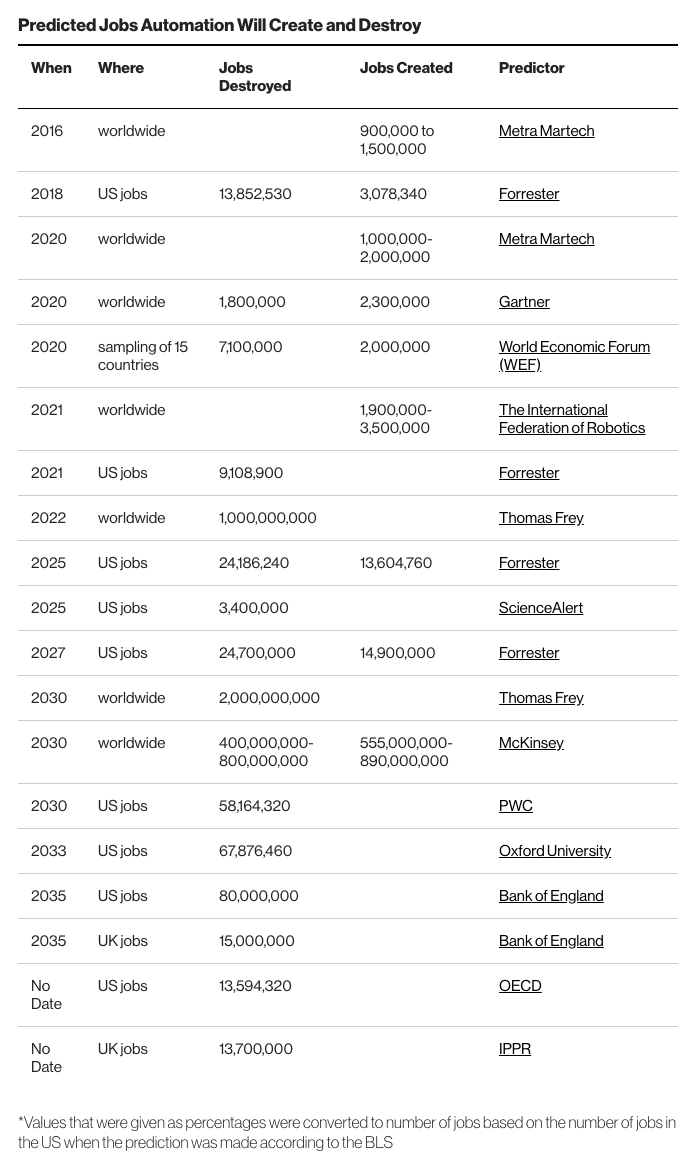
There seems to be little convergence on estimates for the impact of AI and Automation on jobs. The MIT Technology Review has collated a table:

Predictions are all over the place, no convergence, not even on the fundamental question of whether more jobs will be created versus destroyed.

Erin Winick of MIT Technology Review states,

In short, although these predictions are made by dozens of global experts in economics and technology, no one seems to be on the same page. There is really only one meaningful conclusion: we have no idea how many jobs will actually be lost to the march of technological progress.

On Unions

Unions are having a real resurgence in the US, as a bottom-up radicalization of teachers, long denied pay wage increases and confronted by attempts to cut benefits, have walked out, often surprising — or turning against — their union ‘leaders’.

Dana Goldstein reported on 2 April,

Thousands of teachers in Oklahoma and Kentucky walked off the job Monday morning, shutting down school districts as they protested cuts in pay, benefits and school funding in a movement that has spread rapidly since igniting in West Virginia this year.
In Oklahoma City, protesting teachers ringed the Capitol, chanting, “No funding, no future!” Katrina Ruff, a local teacher, carried a sign that read, “Thanks to West Virginia.”
“They gave us the guts to stand up for ourselves,” she said.
The walkouts and rallies in Republican-dominated states, mainly organized by ordinary teachers on Facebook, have caught lawmakers and sometimes the teachers’ own labor unions flat-footed. And they are occurring in states and districts with important midterm races in November, suggesting that thousands of teachers, with their pent-up rage over years of pay freezes and budget cuts, are set to become a powerful political force this fall.
The next red state to join the protest movement could be Arizona, where there is an open Senate seat and where thousands of teachers gathered in Phoenix last week to demand a 20 percent pay raise and more funding for schools.
The growing fervor suggests that labor activism has taken on a new, grass-roots form.
[…]
Lily Eskelsen García, president of the National Education Association, the nation’s largest teachers’ union, called the movement an “education spring.”
“This is the civics lesson of our time,” she said. “The politicians on both sides of the aisle are rubbing the sleep out of their eyes.”

Note that this is taking place in states where the teachers’ unions are barred by law from compelling workers to pay dues, weakening them financially.

Meanwhile, in France, Emmanuel Macron’s efforts to strip benefits from railway workers has led to the long-anticipated protests:

A strike at railway operator SNCF began Monday evening and will run through Thursday morning, with only one in every eight long-distance trains running and one-in-five shorter regional trips due to depart on Tuesday. Roughly half of RER commuter trains to Paris are running. Eurostar, which runs service between London and Paris, canceled five trains today in each direction, or about one-third of the trains it would run on a normal Tuesday.
Unions say half of SNCF workers are striking, including 77 percent of train drivers. SNCF advised passengers to postpone trips, and television stations showed footage of near empty train stations.
[…]
The strikes are the latest in a series of disruptions that started last month and also involve energy and garbage collection companies, as well as students protesting changes at state-backed universities. Demonstrations across the country have already caused severe disruption in commuter trains and school shutdowns.
Labor unions plan their biggest protest against changes at SNCF, the indebted national railroad, where Macron plans to deny future hires the job security, early retirement and special pensions of existing workers, while opening up train lines to competition. There are 36 days of strikes planned at the train operator over the coming months.
Taking on the railway company’s 74,000 workers will be tough for Macron, after he pushed through a liberalization of France’s labor code and cut taxes on capital in his first year in office. Next, he’s planning to overhaul jobless benefits, simplify France’s retirement systems and streamline parliamentary procedures.

France is deeply divided: 46% say the strike is justified, 53% say it isn’t. With the work stoppages likely to be two days out of every five, those numbers could shift: but which way?

Actually published at workfutures.substack.com.

04 Apr 00:08

Instagram limiting developer access to user data on the platform

by Bradly Shankar
Instagram app on phone

Instagram is reducing the amount of user data that developers can access on the platform.

As spotted on Twitter and website Stack Overflow, the photo-sharing platform has dropped the number of times developers can pull from Instagram’s API from 5,000 calls per hour to 200 calls per hour.

Some developers have even had access to the API cut off entirely.

It’s currently unclear what kind of data Instagram is limiting developers from accessing or which developers are affected.

As well, a reason for the new limitations has yet to be revealed.

However, Instagram parent company Facebook is currently facing widespread criticism for allowing the firm Cambridge Analytica to access private data from over 50 million user accounts.

Therefore, some developers are suggesting that the limitations have been imposed to offer increased security on Instagram as a result.

Via: TechCrunch

The post Instagram limiting developer access to user data on the platform appeared first on MobileSyrup.

04 Apr 00:08

Nokia 9 may be packing a triple rear camera setup with 4x optical zoom

by Dean Daley
Nokia's logo

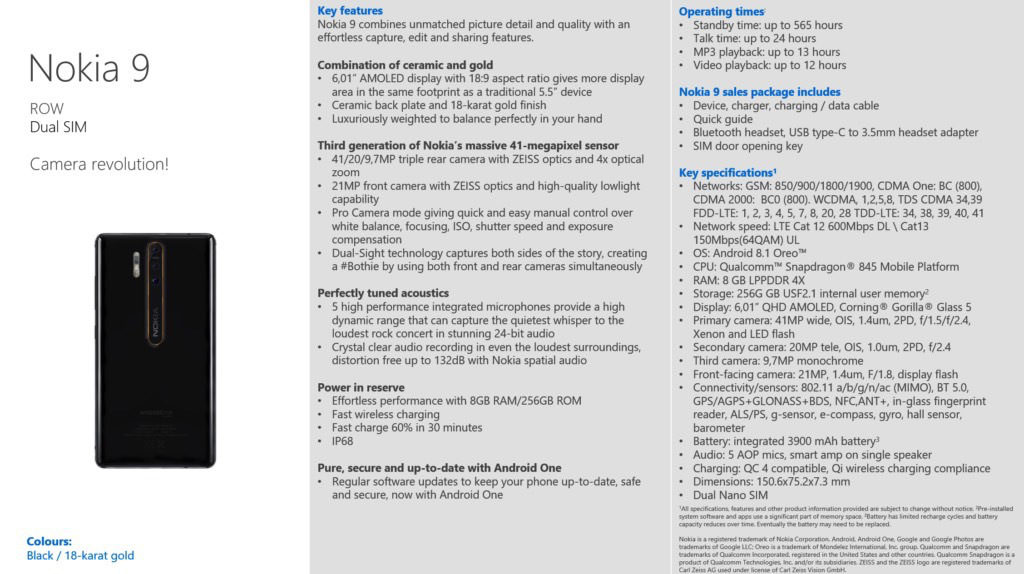
HMD Global doesn’t typically sell its smartphones in Canada, although the Nokia 9 seems like it’ll be the second smartphone to host a triple rear camera sensor.

According to Finnish-language blog SuomiMobili, the smartphone’s full specs were leaked.

The phone hosts 41, 20 and 9.7-megapixel sensors with Zeiss optics. The combination also includes a 4x optical. In comparison to the Huawei P20 which features a 40, 20 and 8-megapixel sensors with a 3x optical. It seems like HMD Global is slightly trying to up the China-based smartphone manufacturers. The phone also has a 21-megapixel Zeiss optics front-facing shooter.

Included within the specs are its 6.01-inch AMOLED display 18:9 aspect ratio, 8GB of RAM, 256GB of storage and 3,900mAh battery with wireless charging. Further, the device is also set to feature IP68 water and dust resistance.

However, take this rumour with a grain of salt. While this leak may seem official, it’s highly possible that the Nokia 9 may not have any of these specs.

The post Nokia 9 may be packing a triple rear camera setup with 4x optical zoom appeared first on MobileSyrup.