Shared posts

16 Apr 01:20

The Fermi paradox, and is "intelligence" the inevitable byproduct of any long-running evolutionary process?

I read a fascinating book recently on the Fermi Paradox, which asks the question: if there are supposedly millions of other civilizations in the galaxy, why haven’t we detected any real evidence of their existence? One class of solutions says: what happened on Earth is a fluke. We’re alone in the galaxy. Gosh, that would be disappointing! Let’s have a closer look at one piece of the puzzle.

One of the terms of the Drake equation is “the probability that intelligent life arises on a planet where life exists”. Put another way, does “intelligence”, however defined, have any special status in evolution or is it just like any other adaptive trait—no different in principle than, say, spiders evolving to spin webs or fish being able to swim? If it’s nothing special, then maybe it is a fluke that intelligence arose on Earth.

Here’s a simple argument for why evolutionary processes will, if they avoid getting stuck (more on that later), develop toward increasing levels of intelligence:

  1. Any evolutionary system (defined as a system where entities reproduce with variation and are subject to natural selection) undergoes change, often due to the evolving behavior of other organisms. For instance, when a predator evolves new behaviors, the selection pressure on its prey changes.
  2. Thus, speed in adapting to change is selected for, as is the scope of adaptations that can be made by species (I’ll call this “adaptability”). A species that can respond to change only over the course of eons is at a disadvantage to one that can respond even just a little more quickly. (Example: an organism with only hardwired evolved behaviors cannot respond in time to new behaviors evolved by one of its predators, and is less fit than an organism that can do even a tiny amount of learning to adapt to its predators)
  3. Over evolutionary timescales, we therefore see species evolve an increasing ability to adapt to their environments more quickly. This generates a positive feedback loop—when one species develops an ability to adapt more quickly, not only does this benefit that species, it also results in an environment which changes even more quickly, generating further selection pressure on other species to gain more rapid and effective means of adapting to changes.
  4. The long-term trend of this positive feedback loop is what we now call “intelligence”. Intelligence isn’t about any particular skill, it’s about the ability to adapt to an ever-expanding scope of possible changes on shorter and shorter timescales. Provided evolution does not get stuck, intelligence is the result.

Let’s look at how this has played out in biological evolution:

  • The first single-celled organisms were immobile, at the mercy of whatever the conditions of the drop of water they found themselves in. The evolution of motility allowed an organism to adapt more readily to a changing environment—it could move to new food sources, away from predators, etc.
  • Vision and other forms of sensing served a similar purpose—providing an organism with information it could use to adapt to change on shorter timescales. But with sensory input comes a need to have some ability to perform computation on that sensory input and change behavior in response to that input.
  • Having an ability to learn new behaviors, rather than merely having the function from sensory input to behavior be hard-wired was a further improvement in the speed and scope of adaptability. Any organism with even a modicum of ability to learn could be at an advantage.
  • The logical endpoint of this process is investment in a general ability to sense, learn, and implement new behaviors (what we now call “intelligence”), which can respond to change much more rapidly than the eons required to implement changes to the genetic code.
  • Language and culture is a further improvement in adaptability—it allows for a thing to be learned by just one organism, shared on very short timescales with other members of the species, and retained across generations (rather than being forgotten and relearned by each generation). Written language is a further amplifier of this effect.
  • In general, cultural and technological evolution increase the adaptability of a species much more efficiently than the slow, generational process of evolving the genetic code.
  • And so on…

A spider which has evolved over millions of years to be able to spin webs is impressive. But it’s in possession of a specialized piece of hardware. Over time, evolution discovers that a good survival strategy in a changing environment is less specialized, more general purpose hardware on which many pieces of software (learned behaviors) can all run.

Getting stuck

Even if growing intelligence is a trend in evolutionary systems, it’s very possible for evolution to get stuck in equilibria. This might not be obvious, especially if you read popular accounts of evolution where it’s easy to get the impression we have it all figured out.

To see some of the problems, consider a simple island ecosystem with only plants (who feed off sunlight), deer (who eat the plants), and wolves (who eat deer). Even if deer can in theory become more fit by becoming more capable at evading wolves (perhaps by learning to better predict wolf behavior), who is to say that such adaptations are “reachable” according to the variability available to deer? (Deer are not going to develop opposable thumbs, large brains, language, and toolmaking all in one go, and likewise for wolves.)

Other pathologies: the wolves might evolve to be so good at hunting deer that they decimate the deer populaton (which they are dependent on). With the primary food source of wolves decimated, adeptness in hunting deer is no longer selected for, and if the wolf population repopulates, who knows what adaptive traits remain (selection may shift to favoring wolves capable of going longer without food, for instance). Likewise, if deer become so good at evading wolves, the wolf population may decline and the deer may overgraze the plant population, and so on. The system can bounce cyclicly between different states, failing to make any “progress”.

Is it just a fluke that biological evolution seems to have evolved in an open-ended fashion, or do certain kinds of evolutionary systems, like the evolution of earth’s biosphere, have open-endedness as a near inevitability? And if so, how might we engineer such systems? This is a question studied in artificial life and evolutionary computation (which I studied a long time ago). At the time, no one seemed to understand these questions very well at all, and I’m curious if progress has been made.

The way I felt when studying evolutionary computation is that our understanding of evolution was roughly analogous to our understanding of flight before the invention of the airplane. We understand the basic principles at work. We suspect we could replicate the performance of evolution with an extremely detailed simulation of biological evolution (though even this is uncertain—there are questions about whether we’d end up with similar results on Earth if we just “replayed the tape”). But it isn’t clear what aspects are truly essential or if we could substantially simplify our simulations and achieve similar results.

Fermi

I don’t know how likely it is that Earth’s evolutionary process got as far as it did. I suspect there isn’t anything special about it. Time and time again, when we look at biological evolution and wonder how it ever assembled some complicated piece of biological machinery, we learn it found a way (often rediscovering the same complex structure over and over again). Seeing this kind of thing makes me hesitant to conclude that it’s a fluke evolution didn’t get stuck at the prokaryote stage or someplace else along the way to general intelligence. Perhaps there are things about biological evolution that make it unlikely to get trapped in equilibria, which we don’t fully understand yet?

I’ll close with this quote by Richard Dawkins:

Never say, and never take seriously anyone who says, “I cannot believe that so-and-so could have evolved by gradual selection”. I have dubbed this kind of fallacy “the Argument from Personal Incredulity”. Time and again, it has proven the prelude to an intellectual banana-skin experience.

I’d love to hear your thoughts on this.

16 Apr 01:20

light l16 cross-country ski cap pourover paradise - who could ask for anything more :-) ? 20180413_102244 added as a favorite.

by ǝlɐǝq ˙M ʍǝɥʇʇɐW
16 Apr 01:20

SotD: Hurt

No, not Trent Reznor singing the moany overwrought Nine Inch Nails version; I mean Johnny Cash’s take on American IV: The Man Comes Around, his last studio album. It’s grainy and sad and generally awesome. To his credit, Trent Reznor said “that song isn’t mine anymore.”

Johnny Cash American IV

That whole American IV collection is pretty great. It’s got an triumphant Bridge Over Troubled Water, sharing the vocals with Fiona Apple, a straight-ahead only-slightly-hilarious run through Depeche Mode’s Personal Jesus, a duet with Nick Cave on I’m So Lonesome I Could Cry, and a deeply beautiful performance of Danny Boy.

But Hurt is something special. Unlike Reznor, Cash doesn’t fool with the rhythm or get fancy with the phrasing, he just keeps striding and striding along this song’s very dark and narrow path; the arrangement (by Rick Rubin? It doesn’t say) is fantastic, with the brooding rhythm on an endless slow crescendo behind the voice then vanishing into silence behind Johnny’s voice.

And it’s Johnny Cash’s singing that you’re here for. His voice is like an old tree; rough, grainy, beautiful, inflexible; he doesn’t leave an atom of the song’s emotion untouched.

This is part of the Song of the Day series (background).

Links

Spotify playlist. This tune on Amazon, Spotify, iTunes. Live video? Johnny was barely alive, at the time. But the official video is quite a piece of work. Carefully conceived, it doesn’t pretend to be live, it’s nostalgia-drenched and super intense; it helps if you know some of the Johnny Cash mythology.

16 Apr 01:19

Serenity Caldwell’s 2018 iPad Review

by Federico Viticci

Serenity Caldwell, writing on iMore:

To me, the 2018 base-model 9.7-inch iPad is a special beast: It hits a line drive right through the company's fabled intersection of technology and liberal arts — and at the right price point. The iPad Pro did it first, but at a cost unattainable for all but the tinkerers and serious artists, and without iOS 11's crucial multitasking features. At $329, the iPad offers a low-end tablet experience unlike any other on the market. Add an extra $99 for Apple Pencil, and Apple has created the best device for all-purpose education, period.

But it's easy to make that claim, and a whole other thing to explain why I believe it so whole-heartedly. As a result, I decided to try and prove it: Starting with a blank page in Procreate, I created an entire iPad review video by just using my 2018 iPad, Apple Pencil, and third-party apps. My Mac came into play only once — when I uploaded my video to YouTube.

I know what you're thinking – the new iPad is "boring" compared to the iPad Pro and you don't need to watch another video about it. But trust me, you'll want to watch Serenity's review because it's unlike anything you've seen for a new iPad. Only Serenity could put this together – including the music, which she composed in GarageBand; everything was drawn, assembled, and edited on a "boring" 2018 iPad. You can watch the video below and read Serenity's technical notes here.

→ Source: imore.com

14 Apr 02:13

It's Time for an RSS Revival

files/images/rss-01.1.jpg

Brian Barrett, Wired, Apr 15, 2018


Icon

And the debate goes back and forth. " Tired of Twitter? Facebook fatigued? It's time to head back to RSS." So writes Brian Barrett in this Wired article. Mostly it profiles two remaining RSS readers, Feedly and The Old Reader. "The lasting appeal of RSS remains the parts that haven't changed: the unfiltered view of the open web, and the chance to make your own decisions about what you find there."

Web: [Direct Link] [This Post]
14 Apr 02:13

The truth matters more than which party you support

by Josh Bernoff

No matter who is president, we’ll get over it. We’ll get past Trump. We’ll get past whoever comes next. But once we cease to believe that objective truth is the baseline for every discussion, we are doomed. I was reading Facebook the other day when a high school classmate of mine posted this: I had … Continued

The post The truth matters more than which party you support appeared first on without bullshit.

14 Apr 02:12

FAQs About Hydration for Cyclists

by Average Joe Cyclist

As a cyclist, you know hydration is important — but that doesn't mean you don't have questions. For a crash course in everything you need to know about hydration, check out the following FAQs about hydration for cyclists. A little knowledge and a lot of common sense are really all you need to ensure you are sufficiently hydrated for your bike rides!



The post FAQs About Hydration for Cyclists appeared first on Average Joe Cyclist.

13 Apr 22:21

5 Simple Ways to Get a Better Night’s Sleep

by Chelle

Tips to Sleep Better London Drugs Blog

Sleep is essential for both our physical and mental wellbeing. And yet, so many of us are sleeping poorly. Experts say adults need between 7 and 9 hours of sleep per night to feel refreshed. In 2017, Statistics Canada released a report stating that one third of Canadians sleep fewer than the recommended hours.

Insufficient sleep not only leaves us tired, but it can also be linked to health issues such as weight gain, heart disease, diabetes, and depression. So what can we do to combat common sleep issues?

Limit Caffeine, Alcohol, Eating, and Liquids at Night

Sleep Habits Coffee in Bed London Drugs Blog

While we might love our afternoon java, it is not doing our sleeping patterns any favours. The stimulants in caffeine and alcohol can impair our sleep when consumed up to six hours before bed. Experts recommend sticking to decaffeinated coffee at night and limiting alcohol intake. Drinking too many liquids after dark might have you rising often to empty your bladder, and eating late at night can leave you feeling too full or make it uncomfortable to sleep.

Maintain a Consistent Bedtime Routine

Studies have shown that maintaining a consistent routine helps keep our sleep rhythms on track. As tempting as those weekend lie-ins are, it may be messing with your circadian rhythm. If you’re struggling to fall asleep on Sunday nights, try adjusting your weekend sleep to be more similar to your workday routine.

Create the Right Bedroom Environment

London Drugs Homedics Soundspa EnlivenTemperature, noise, and light in your bedroom may be affecting your ability to fall asleep—and stay asleep. We all know how hard it can be on hot summer nights! Similarly, if your bedroom thermostat is set too high in the cooler months, it can impact your ability to sleep. Keeping your bedroom environment dark is also recommended for a good night’s rest, and if you are hearing traffic noise, consider using a fan or white noise machine. Try the Homedics Soundspa Enliven from London Drugs with eight soothing sounds and an auto-off timer to gently relax.

Consider a Sleep Supplement

Better Sleep Habits Sleeping Dog London Drugs Blog

Melatonin is a very popular supplement to help with falling asleep, and is often used to treat insomnia. Alternative options are Ginko-biloba, Magnesium, and Lavender. You can find a full range of sleep supplements at London Drugs.

Talk to an Expert

Visit a London Drugs location near you and speak to one of our friendly pharmacists who can provide expert advice on improving your sleep habits. Also, are you having trouble getting your baby to sleep? Read our Q&A with Baby’s Best Sleep for answers to some common questions. Sweet dreams!

The post 5 Simple Ways to Get a Better Night’s Sleep appeared first on London Drugs Blog.

13 Apr 22:21

Work Futures Daily - A Barrage of Reports on the Future of Work

Looks like the future is about 15 minutes away, or less. 2018-04-09 Beacon NY - In just the past...
13 Apr 22:21

Steven Aquino, in Giving Tweetbot a More Access...

Steven Aquino, in Giving Tweetbot a More Accessible Design, writes that Twitter’s official client for iOS does a good job with accessibility:

The UI design is much higher contrast — Twitter for iOS even acknowledges when you have the system’s Increase Contrast setting enabled, as I do. And, crucially, the official client natively supports alt-text, which allows users to append image descriptions for the blind and low vision before tweeting.

13 Apr 22:21

Jerseys for Humboldt #HumboldtStrong

by Kelly

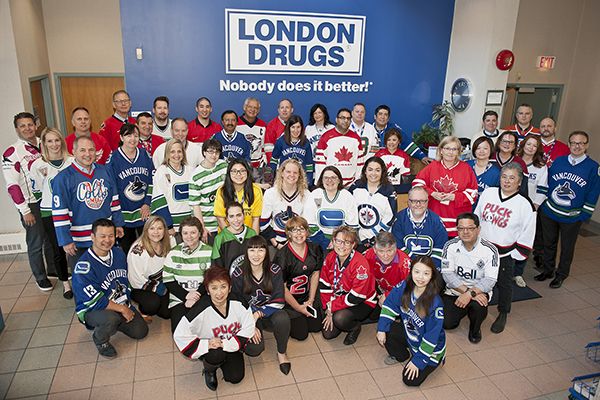
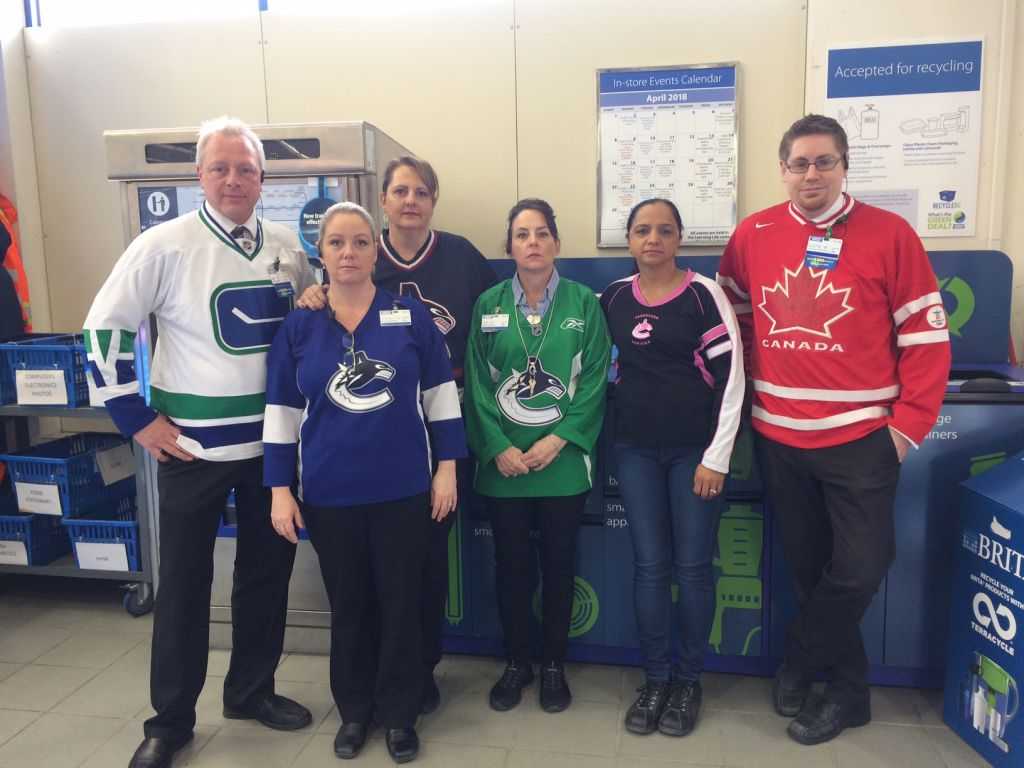
At London Drugs we are devastated by the tragedy that has unfolded in the Humboldt community. Words cannot express the sadness we feel for the team and their families.

At the same time we are extremely proud of the members of the community who have come alongside these families including the first responders and hospital workers who have worked tirelessly through this situation. We’re also proud of the way Canadians have stood together to offer whatever help we can.

We are honoured to be able to stand together with the people of Humboldt and our fellow Canadians and show them that our thoughts are with them at this time. London Drugs is with you.

If you’d like to contribute to the players and families affected, click here.

#HumboldtStrong #JerseysForHumboldt


The post Jerseys for Humboldt #HumboldtStrong appeared first on London Drugs Blog.

13 Apr 22:21

A Barrage of Reports on the Future of Work

by Stowe Boyd

Looks like the future is about 15 minutes away, or less.

2018–04–09 Beacon NY — In just the past few days, I’ve come across no less that three new reports on the future of work. They are coming from all points of the compass, and I haven’t had a chance to read them in detail, but the first order takeaway is that the domain of discourse we call ‘the future of work’ is now ground zero for a broad spectrum of policy, economic, and sociological debates.

Sign up here for notifications of free posts.. I’ll get you to subscribe eventually, I bet.

Comments from Readers

Phil Wolff (self-styled ‘GDPR wonk and wearer of appropriately industrial chic in the Pacific Northwest’) chimes in on dress codes:

I like the “dress appropriately” dress code. It decentralizes responsibility and authority. It puts the folks who know context best (which is rarely HR) in charge. They’ll balance safety, formality, utility, and enterprise values as needed instead of a priori from a distance. It also makes sense as organizational boundaries blur, more people work offsite and with control over their workplaces, and more of the workforce are free agents. If HR was in charge would you ever have been able to do a year of swag t-shirts?

Phil is referring to the time I auctioned off my body-as-billboard for 220 days, agreeing to wear sponsors’ t-shirts. I had to use a spreadsheet since I randomized which days they got.

Jim Meredith goes along with commentary from Peggy Noonan about Zuck’s dress in If Adults Won’t Grow Up, Nobody Will:

I have spent the past few days watching old videos of the civil-rights era, the King era, and there is something unexpectedly poignant in them. When you see those involved in that momentous time, you notice: They dressed as adults, with dignity. They presented themselves with self-respect. Those who moved against segregation and racial indignity went forward in adult attire — suits, dresses, coats, ties, hats — as if adulthood were something to which to aspire. As if a claiming of just rights required a showing of gravity. Look at the pictures of Martin Luther King Jr. speaking, the pictures of those marching across the Edmund Pettus bridge, of those in attendance that day when George Wallace stood in the schoolhouse door and then stepped aside to the force of the federal government, and suddenly the University of Alabama was integrated. Even the first students who went in, all young, acted and presented themselves as adults. Of course they won. Who could stop such people?
I miss their style and seriousness. What we’re stuck with now is Mark Zuckerberg’s.
Facebook ’s failings are now famous and so far include but are perhaps not limited to misusing, sharing and scraping of private user data, selling space to Russian propagandists in the 2016 campaign, playing games with political content, starving journalism of ad revenues, increasing polarization, and turning eager users into the unknowing product. The signal fact of Mr. Zuckerberg is that he is supremely gifted in one area — monetizing technical expertise by marrying it to a canny sense of human weakness. Beyond that, what a shallow and banal figure. He too appears to have difficulties coming to terms with who he is. Perhaps he hopes to keep you, too, from coming to terms with it, by literally dressing as a child, in T-shirts, hoodies and jeans — soft clothes, the kind 5-year-olds favor. In interviews he presents an oddly blank look, as if perhaps his audiences will take blankness for innocence. As has been said here, he is like one of those hollow-eyed busts of forgotten Caesars you see in museums.
But he is no child; he is a giant bestride the age, a titan, one of the richest men not only in the world but in the history of the world. His power is awesome.

I am not really down with Noonan’s perspective. I don’t buy the notion that t-shirt, jeans, hoodie is the dress of children: it was originally clothing of the working class, later adopted by left-leaning artists and the counter-culture, and now the de facto mass, informal clothing style, and still, the clothing of the working class, too.

Still and again, clothing styles change. A hundred years ago, today’s formal business suit would have been too informal for questioning in Congress. So-called morning dress would have been required: morning coat, waistcoat, striped trousers, and hat. Indicating seriousness by wearing ritually prescribed clothing is timeless, but the cut of the clothes is constantly shifting, constantly modernizing. In ten years the requirement for the tie may be old-fashioned, but men will still be wearing long pants in Congress.

On Automation

Barclays has released Robots at the Gate, where the investment bank jumps into the debate about the impact of AI-driven automation on work. The report’s authors, Ajay Rajadhyaksha and Aroop Chatterjee, work in Barclay’s Macro Research group, and come down squarely on the side of Anotherism, as in AI is ‘just another labor-saving technology’. They employ many of the common arguments — ATMs did not end bank teller jobs, ‘40% of the population used to work on farms and now only 2% do but they are employed’, and they even have a section entitled ‘This time is no different’ — but have fairly chilling data when they zoom down to specific sectors or classes of work.

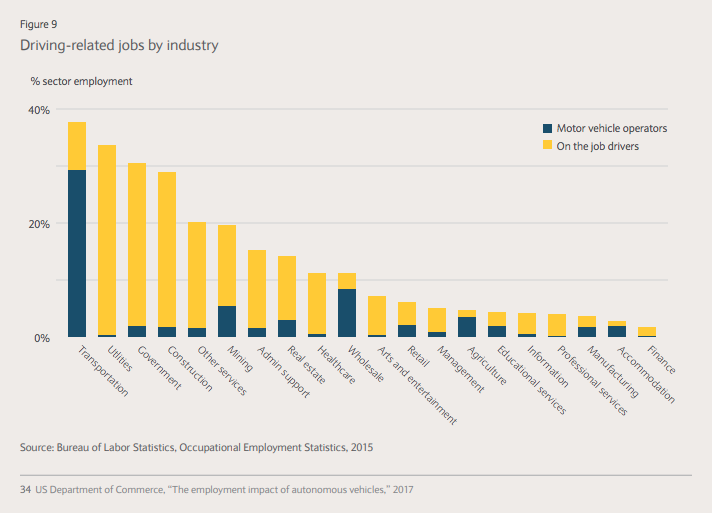
Consider this example:

And their commentary:

- Self-driving vehicles have the potential to have a large effect not only on the transportation sector, but also on other industries that rely on driving to a high degree.[³⁴] Roughly 3.9 million workers in the US directly operate motor vehicles, including 1.7 million truck drivers. A further 11.9 million workers deliver services that require vehicles. Together, these represent roughly 11% of the total workforce (Figure 9). From a capital stock perspective, motor vehicles represent roughly 12% of the total stock of equipment across all business sectors (based on Bureau of Economic Analysis data). Business investment in motor vehicles ($335bn per year) represents a little over half of the total final domestic sales.
- Autonomous vehicles’ impact depends on whether it is labour saving or productivity enhancing. For the direct motor vehicle operators, it is likely largely to have labour-saving effects. Motor vehicle operators tend to score lower on knowledge outside of their narrow field, have limited cross-functional skills, have lower education levels and so on, and automation is likely to increase unemployment levels among these workers.
- For sectors of the economy that employ individuals who use motor vehicles to deliver other services (e.g., security, electricians, mechanics of all sorts), autonomous vehicles are likely to benefit by providing greater productivity, such as the ability to focus.

So, autonomous vehicles will have an enormous impact on a long list of industries, decreasing the hours of work by people dedicated to driving. Barclay’s concedes that for many drivers, automation is likely to increase unemployment levels. And Barclay’s is making the argument in the other cases that the increased productivity coming from other classes of workers who will need to spend less time driving won’t be immediately translated into working fewers hours allocated to those workers. What is stopping their employers from simply pocketing the savings, however?

Still, the raw data is worth looking at, even if the conclusions could be reversed if an Otherist had been writing the prose.

US Policy Direction and The Future of Work

A much more helpful report, The Work Ahead, has been released by a Council on Foreign Relations’ Independent Task Force, headed by Penny Prizker and John Engler, and written by Edward Alden and Laura Taylor-Kale.

I will share the findings and recommendations from the report’s executive summary, here:

The seven major findings of the Task Force are:
1. Accelerating technological change will alter or eliminate many human jobs. Although many new jobs will be created, the higher-paying ones will require greater levels of education and training. In the absence of mitigating policies, automation and artificial intelligence (AI) are likely to exacerbate inequality and leave more Americans behind.
2. Embracing technological innovation and speeding adoption are critical for U.S. national security and economic competitiveness. Openness to trade and immigration are also vital for maintaining U.S. technological leadership.
3. Strong economic growth that leads to full employment has been the most consistently successful approach for raising the wages of Americans.
4. The lack of accessible educational opportunities that are clearly and transparently linked to the changing demands of the job market is a significant obstacle to improving work outcomes for Americans.
5. U.S. efforts to help displaced workers are inadequate. Unemployment insurance is too rigid and covers too few workers, and retraining programs are not based on the best global models.
6. Too many jobs are going unfilled because of restrictions related to credentialing, mobility, and hiring practices. More could also be done to create new opportunities in higher-unemployment regions.
7. Current workplace benefits — from sick leave to retirement plans — are too often available only to full-time employees, and are not adapted to the emerging world in which more workers are part-time, contract, or gig workers.
[…]
The seven major recommendations of the Task Force are:
1. Governments should adopt an explicit goal of creating better jobs and career paths for Americans. Initiatives should aim especially at attracting investment and revitalizing entrepreneurship.
2. The United States needs to remain a world leader in technology and innovation. This should be supported by increased public and private research and development (R&D), support for commercialization of new research, and an open door to highly skilled immigrants.
3. Governments should implement policies aimed at maintaining strong growth and demand for labor. Employers should commit themselves to a “high-road workplace” that offers employees decent pay, training, scheduling, and benefits. Special measures are needed for communities struggling to attract investment and jobs.
4. The United States should set and meet a goal of bringing postsecondary education within the reach of all Americans and linking education more closely to employment outcomes.
5. Unemployment insurance should be overhauled to reflect the realities of the current economy, and mid-career retraining programs should adopt the best features of the European “flexicurity” models.
6. Governments and employers should work to reduce barriers to labor mobility for Americans, including high housing costs, occupational licensing restrictions, and inflexible hiring practices.
7. The United States should create portable systems of employment benefits tied to individual employees rather than to jobs themselves. Employers should also help fill the gap by expanding benefits for their part-time and contingent workers.
Finally, the Task Force recommends that the president and the nation’s governors create a national commission on the U.S. workforce to carry out research, share best practices, and conduct public outreach on workforce challenges. This should be the start of an urgent effort to put workforce issues at the center of the national agenda.
At the turn of the twentieth century, when the United States was unsettled by similarly rapid technological change, the high school movement produced a boost in educational attainment that was critical to U.S. economic success and to the country’s rise to global leadership. Success in the twenty-first century will require the same type of bottom-up, cross-generational effort, with Americans demanding that governors, local leaders, businesses, and educational institutions rise to meet these challenges. There should be vigorous competition among states to pioneer new models and lead by example. The federal government needs to encourage, support, share, and build on such efforts. With such a broad-based movement, the United States can build a more productive, inclusive, and resilient economy for all Americans — becoming once again a model for the world.

Hear, hear!

I hope to have a more in detail analysis soon. [Subscribers reviewing the online version of the report will be able to see my commentary via Highly in the Work Futures Slack community’s #research channel].

Actually published at workfutures.substack.com and stoweboyd.com.

13 Apr 22:21

Electric vehicle’s experience will sell itself: Ford Asia Pacific CEO Peter Fleet

by Emma Lee
Why Ford is placing bets on electric vehicles?
13 Apr 22:20

125-250 words, 15 minutes: Setting small writing goals to build an academic writing practice

by Raul Pacheco-Vega

I have been travelling non-stop since January 2018 even though I had promised myself I would not do this ever again. But my scholarly research takes me to a number of places, including San Francisco last week for the 2018 meeting of the International Studies Association (ISA) and this week to the 2018 meeting of the American Association of Geographers (AAG).

Reading and AcWri and highlighting related content

As I have indicated before, I use conferences to force me to write full papers that I then submit to journals, or book chapters for books in which I have committed to participate. The past week and this week I have also been incredibly ill, with a cold and flu that I got during Holy Week (Easter Weekend) and then happened to get worse during my stay in San Francisco. This week, I am in New Orleans and luckily, heavily medicated and healthy again (or at least on the tail end of this awful illness). But I had not written, consistently. And even in previous weeks, my written output had been pretty minimal.

The truth is that when I am not healthy, I don’t push myself at all. If I need to take time off from waking up at 4:00am and writing for two hours, I do it. I simply sleep in, and next day or the day after, I start again. But what I’ve found this year is that I have been able to write consistently and produce more than 34,000 new words (yes, that’s thirty four thousand words) by the end of March simply by setting small writing goals.

The truth is, I’ve managed to write that many words by writing in memorandums, and setting very small goals. 125 words, 250 words. 15 minutes of continuous writing. Anything that will make my work move forward, I’ll take it. That’s also why I champion a new metric of success: instead of fixating on words written, or hours spent we could focus on sentences and paragraphs crafted.

One of the reasons why I am a big fan of small goals for everything (reading, 1 article per day, do an AIC Content Extraction and then write a Conceptual Synthesis Excel Dump (CSED) row entry, what I call the AIC-CSED reading combo, writing for 15-30 minutes, drafting 125 new words) is because it sustains what Joli Jensen calls “frequent, low-stakes contact with a writing project” (read my notes on Jensen’s Write No Matter What here).

Setting small writing goals (125 words, 15 minutes of writing) or reading (1 article per day, 1 AIC-CSED per day) allows us to stop berating ourselves for “not being productive enough”. That’s one reason why I love Tseen Kho’s article “Your Word Count Means Nothing to Me”. It’s important to remember that each person is different and that we all have different writing, reading, and researching practices. Hopefully this strategy will be helpful to others who, like me, experience fear when trying to tackle a daunting large research project.

13 Apr 22:20

En vrac du vendredi

by Tristan

Ca fait longtemps que je n’avais pas publié de EnVrac, et ça se voit, d’autant que les différents scandales Facebook nourrissent l’actualité comme jamais.

13 Apr 22:20

Why I'm automatically deleting my old tweets using AWS Lambda

by hello@vickylai.com (Vicky Lai)
From now on, my tweets are ephemeral. Here’s why I’m deleting all my old tweets, and the AWS Lambda function I’m using to do all this for free. Click here to skip to the code part. Stuff and opinions I’ve only been a one-bag nomad for a little over a year and a half. Before that, I lived as most people do in an apartment or a house. I owned furniture, more clothing than I strictly needed, and enough “stuff” to fill at least a few moving boxes.
13 Apr 22:20

SotD: Roads to Moscow

Even on the oldies stations, you never hear Al Stewart any more. In my youth he was a pretty big deal though, and had mega-hits with Year of the Cat and Time Passages. Roads to Moscow wasn’t a big hit but it was always my fave among his songs. I listened to it again the other night for the first time in years, and I was moved again by its story, and by its melodic grace.

Al’s always been a bit (to use a British word) naff; goofy-looking, yucking it up, not much of a voice, not rehearsing much. But boy, some of those songs can get their hooks into you.

Roads to Moscow is a pretty straightforward end-to-end narration of the Second World War from the point of view of an ordinary Soviet infantryman, from being overrun in Operation Barbarossa to marching inexorably on Berlin. I think it’s reasonably historically accurate. I’ll sample a few lines:

And the evening sings in a voice of amber, the dawn is surely coming
The morning road leads to Stalingrad, and the sky is softly humming
Two broken Tigers on fire in the night flicker their souls to the wind
We wait in the lines for the final approach to begin

General Guderian

“General Guderian sands at the crest of the hill…”

Go and read the whole story; it’s not long. It has a sad ending; most war stories do, but especially this one.

This is #103 in the Song of the Day series (background).

Links

Spotify playlist. This tune on Spotify, Amazon, iTunes. Here’s live grainy b&w video from 1977; but with OK sound and a good performance. I feel so sorry for the guy in the song.

13 Apr 22:20

Mid program reflections #3 – startup cadence versus agency cadence

As I write this it’s Tuesday of week 9 and it's 8.30am so there are only two of us in the office: me and the founder of one of the startups.

Week 9 marks a change of pace. For the last five weeks, "programming" (that is, meetings and workshops) has been relatively light. The focus has been on "Services"--the strategically-led creative work provided by agency teams that makes this particular startup accelerator different from the others. In addition there are weekly meetings with me that the industry universally and mysteriously calls Office Hours.


The team working on Services has produced fantastic work. It’s spot-on. The feedback has been tremendous. And the Presentations work has already resulted in exciting pitches, radically more easily understood.


Warning: working practice simplification and stereotyping ahead.

The cadence of how startups work:

Do something end-to-end, whether it's a web product, hardware prototype, or pitch deck. Get it in-front of its eventual users, customers, or consumers. The earlier and uglier the better. Observe feedback. Iterate.

The cadence of how agencies work:

Follow the process and build foundations for the first 80% of the time. Foundations are answers to questions like: what are the values of this brand? To what customer segments should it appeal, targeting what motivations? At what points of the experience of the product or service can these brand values be made evident? Then suddenly the invisible work is completed. For the remainder of the time create highly visible executions--web pages, sales collateral, dashboard wireframes, point of sales communications, guides to words and phrases to use in future marketing.

Both methods are highly effective.


The Services phase of this program poses a challenge. To a startup, agency cadence has pros and cons.

  • Pro: the rigorous process forces each startup to better understand itself, its value proposition, and its customers, and gives it language to talk about and iterate all of that
  • Pro: the result is a newly professional appearance--essential to be taken seriously by business customers
  • Con: the agency cadence can be abstract and hard to grasp. In my Office Hours I make sure we discuss how to use and build on the deliverables
  • Con: the agency cadence lacks iteration in the face of true customer feedback

To me this last point is the most serious: no matter how much thought and strategy has gone into it, no work survives contact with the market. An iterative approach is essential.

Yet work that has been over-thought becomes brittle and slow to change.

So the risk of agency work to a startup is that it takes the startup down a dead-end with no way to turn around.

My response is to ensure that the Services phase focuses on amplifying what is already working. Create only where there is traction and proof that customers are responding positively.


Given the above, the question is why run a program that includes agency services supplied to startups? The same can be asked of the Presentations phase. I’ll let you know in another 540 words.


I said there had been a change of pace. Services is winding down; Presentations is winding up.

This four week stretch is about creating a 5 minute pitch deck. There's assistance with crafting the story, speaker training, and design help to make great-looking slides.

What's the deck good for? It's always handy to have an intro that hits all the bases: the what and the why of the product; the business potential and customer traction; the team and roadmap; the secret sauce. This intro, with adjustments, will get used for investor intros, and also to explain the company to partners, customers, and new hires.

A key skill in any pitch, whether you're a founder or a young designer, is to quickly and uncontroversially explain your idea space, so you can concentrate the discussion on what matters. For example, how to work together. This deck does that job.

Producing the pitch deck in this form does another job, which is to shake out the inconsistencies in the business.

There are standard formats for pitch decks, such as the Kawasaki 10 slide deck, or the more recent Y Combinator seed deck template.

I think of these decks as a narrative versions of the Business Model Canvas. I used to be a skeptic. Surely it doesn't make sense to outline an entire business in nine boxes on a single sheet of paper? But I’ve become a convert.

The Business Model Canvas is like an electrical wiring diagram but for flows of motivation and money. For example:

  • you itemise your customer segments. There's another box to list how you reach customers. Wire them together. There's another box for the product value propositions that should appeal to your different customers. Wire them up. Ok, so your product has a particular point of value that should appeal to a particular type of customer... but there's no way of reaching them? Whoops
  • there are costs. There are revenues. Wire them up. Oh so revenue comes in on a per-product-sale basis but costs are on an annual basis? Impedance mismatch, rethink the business

So you draw out the business and look out for gaps or anywhere the gears grind. When I'm starting a new project, I make a quick Business Model Canvas to give me an idea of any dark corners. It's not everything, but it's a sketch.

When you run through a pitch deck, ideally it should cover all the same points--but with proof too. Ok so the goal is to sell such-and-such product to such-and-such customer? Well how can that be demonstrated? Ok so the business is dependent on a special technology. Well does that tech exist, and can it be protected? And so on.

In Office Hours over the past two months, I've tried to keep in mind each company's upcoming pitch deck, and I've been steering the conversation towards exploring some of the gaps.


I believe that a good pitch (and a good startup website, and good startup sales collateral, and a good introductory paragraph) has got to include belief and desire.

Desire: make your audience see dollar signs in their eyes. Make them want it.

Belief: make this seem inevitable. Show the detail. Build trust.

The sizzle and the steak.


So given my above misgivings, why do this work with the startups? Why not operate like other accelerators, focusing on coaching and pitching?

First--some teams need to plug a design gap. If you help with the right 'kit of parts' then it's a proper leg up.

Second--the process is useful. But you could get the thinking via Office Hours and conversation, right? Why do the additional hands-on strategically-led creative if there's a risk of compromising the startup's ability to iterate?

So, for me, the answer can be found on the customer side: some customers, big and small, judge a book by its cover. Even when meeting a startup with crazy new technology, a radical business model, or simply a better mousetrap, they're put off because the website isn't professional, the sales deck doesn't quite express the whole story, or the dashboard looks a bit fiddly.

Big corporates are not monolithic. They are, internally, networks, and these networks resist anything which is hard to understand. Sales material will be passed around behind the scenes to people who are finding out about the startup for the first time. The product will be used be people unfamiliar with startup norms, and seen by people who aren't trained. An aspirational story will transmit better than a hair-shirt story. Etc.

More than that: an employee of a big corporate who takes the reputational risk of introducing a startup wants to look smart to their colleagues. No matter the quality of the startup's product, if the benefits are hard to understand or it's easy to give a kicking, it's not going to fly.

In short:

Corporates want to be innovative. A path to being innovative is to work with startups. But when they meet a startup, they often can't digest it. So either the corporate has to change. You could push water uphill. Or the startup can change--just a little bit--to accommodate the relationship. A spoonful of sugar helps the medicine go down.

Iterate with the agency cadence, then amplify with the agency cadence.

My feeling is that's what makes R/GA's programs different: in the DNA of the organisation is partnering with corporates around innovation.


One last thought. Despite all of this, startups shouldn't look too professional. The character of the team should still shine through.

Once you take away the product and the revenue model and the technology breakthroughs, the big reason that a person working in a big corp wants to work with a startup is that they love hanging out with startups.

For a few years I've run a session at Bethnal Green Ventures about sales and marketing 101. (It's an incubator for social good startups. Early stage. Great organisation.) I joke about people who work in corporates. I say they have miserable lives. I say they wish they could leave but they have mortgages and school fees and they're addicted to holidays. Instead they live vicariously by working with startups. So take advantage of it.

It's a horribly mean thing to say and it's certainly not the whole truth. But there's definitely a glamour that mustn't be washed away. So I'm also paying attention to that, in the Services and Presentations phases.


Anyway. It's Friday now, somehow. Next week: week 10.

13 Apr 22:20

Extraordinary numbers: Bike-sharing in China

by pricetags

From CityMetric:

Chinese bicycle sharing companies Mobike and Ofo rank among the country’s most successful start-ups, and have rolled out millions of bicycles to China’s cities. Mobike claims there are 2m rides per day on its platform in Guangzhou alone. …

They are quite unlike the bicycles my grandmother remembers. These are smart bikes, with about 300 patents involved in their production. They are unlocked and paid for in seconds with a scan of the bicycle’s QR code.

Mobike says it operates one of the largest Internet of Things networks in the world and is integrated into WeChat, China’s equivalent of WhatsApp. Both companies nudge their customers into using bicycles responsibly. Users receive points for parking inside a geo-fenced area, which are agreed with local authorities. and are lose them for parking in inappropriate spaces or damaging a bicycle.

This is changing urban transport in China – not just in Beijing and Guangzhou but also in the “tier two and three” cities that are unknown in the West but which drive much of the country’s growth. By helping people to connect quickly to subway or bus services, bicycle sharing companies are enabling a modal shift towards sustainable transport. The huge amounts of data the companies are collecting also helps city planners to adjust local transport routes to reflect passenger flows.

The growing uptake in cycling also has public health benefits in a country which is experiencing a growing obesity epidemic, but where exercise for exercise’s sake is often perceived as a distraction from professional or academic success. Unlike more expensive and geographically limited cycle schemes such as London’s Santander Cycles, these benefits do not appear to be disproportionately helping affluent young men.

This has all happened incredibly quickly. Ofo started as a project of students in the Peking University cycling club, and two years ago neither company had a bicycle on a public road. Now they are both worth billions of pounds, and are among the most high profile unicorns in China. According to a government think tank, as many one-in-10 Chinese adults have used a dockless bicycle.

Mobike and ofo have many of the competitive advantages of Chinese technology. First, the companies have access to significant capital from the biggest players in Chinese technology. Alibaba is the biggest investor in Ofo, and on 4 April Tencent-backed Meituan-Dianping (a food delivery giant) purchased Mobike.

The access to cash allows the companies to scale quickly without having to worry about turning an immediate profit. This scale is the key to attracting a large numbers of users in a city – with the ubiquity of the products reducing the need to spend on marketing.

Second, due to Chinese strengths in manufacturing, the bicycles are cheap to produce and require limited upkeep. This means that the companies can charge low fees for the rides after the customer makes an initial deposit. This makes bike sharing cheaper and more convenient than taking a bus.

Third, there is a huge home market. There are many large and densely populated Chinese cities with at least some public transport – fertile ground for dockless bicycle sharing. With the new-found popularity of 4G mobile internet in China (it only overtook 2G in late 2016) and digital payments, there is high demand for data-heavy apps.

The other big factor in bicycle sharing companies’ success is the surprisingly laissez-faire approach of the Chinese government. Until recently, the environment was a low concern for policymakers, and discussion of its cities’ pollution was discouraged. Beijing’s media even used to euphemistically refer to the toxic skies as “mist” or “fog”.

But as the environment became China’s biggest cause of social unrest, the government changed tack and began promoting more sustainable policies, as well as a more high tech economy. In this context, a home-grown technology based approach to greening China’s cities became a no brainer – particularly given dockless bicycle companies did not charge city governments for the service, as there is no infrastructure to install.

Both companies are now rapidly expanding internationally at an astonishing rate. In June 2017, Manchester became Mobike’s 100th city. Five months later in Berlin, they’d doubled their city count.

In London, Ofo says it aspires to operate 150,000 bikes – more than 10 times as many as Santander Cycles. With pollution and public health rising up the list of mayoral priorities, perhaps these smart bikes will become a permanent feature of European cities.

13 Apr 22:18

8 years later, this Vancouver Olympic legacy gathers weeds

mkalus shared this story .

As the Pyeongchang Olympics make way for the beginning of the Paralympics, scholars and critics are already starting to look at what legacy the event will leave.

Legacy is a common topic for those evaluating the exorbitant cost of hosting large competitions like the Olympics, especially when it comes to event infrastructure.

After Brazil, many criticized the cost of the $319 million arena built in the middle of the jungle that only saw four soccer tournaments when the country hosted the World Cup. 

In Vancouver, many touted the lasting legacy of projects like the Richmond Oval and the Canada Line after the 2010 Winter Games.

But eight years later, one Vancouver attraction remains unused and overgrown with blackberry bushes. 

During the Vancouver 2010 Olympic Games, the Olympic Demonstration Line moved thousands of tourists and locals alike from Science World to Granville Island. (Doug Kerr/CBC)

Once a bustling service, the Downtown Historic Railway, also known as the Olympic Demonstration Line, moved tourists and locals alike from Science World to Granville Island.

The 1.8-kilometre track was a $8.5 million partnership between Bombardier, which contributed two streetcars, and the City of Vancouver.

But it only lasted for 60 days, starting at the end of January 2010. Now, most of the track still exists — and so do the former stops — but they are unused and not maintained.

'Not merely transportation'

Peter Finch, founder of the Friends of the Olympic Line group, wants to change that. Finch not only used the Olympic Line — he drove it. And he still drives street cars now.

Finch's thinking is that most of the infrastructure is already in place — so the city should do something with it. 

"We need to show that we have some imagination," Finch said.  

"Not merely transportation but a social venue. Something that is very different from anything that Vancouver has seen before."

Finch's plan includes using replicas of Vancouver street car designs from 100 years ago, but completely modernized on the inside.

"People came to Vancouver all the way from Cloverdale just for that sense of nostalgia," he said.

Peter Finch, founder of the Friends of the Olympic Line group, wants the former Olympic Line to have street cars like these, which served Vancouver decades ago. (CBC)

However, the city isn't keen on resurrecting the project. 

In a written statement, it said the service was a novelty that only marginally contributed to the Granville Island and Vancouver tourism experience.

Granville Island, which is run by Canada Mortgage and Housing Corporation, disagrees.

"The streetcar, when it was running during the 2010 Olympics, was a great service for not only our visitors but for the 3,000 people that work on Granville Island," said Lisa Ono, the island's manager of public affairs and programming. 

"It was really a great service for everyone."

Decision rests with TransLink

The area is already serviced by a bus route and the Aquabus. It's also accessible via a scenic walk along the SeaWall. 

The city said the decision ultimately rests with the regional transit authority, TransLink. The latter didn't respond to CBC requests for comment.

In the meantime, the tracks lie dormant and gathering weeds — with no hint of their Olympic legacy. 

With files from Natasha Frakes

13 Apr 22:17

How Dark Patterns Trick You Online

files/images/Dark_Patterns.PNG

Nerdwriter, YouTube, Apr 16, 2018


Icon

Pattern recognition is a critical literacy. This video makes it clear why, with vivid examples of how hard it is to close your account, and how easy it is to pay money. Companies use tactics like 'roach motel' and acculturation in order to persuade you to take actions that work against your best interests. The term 'dark pattern' was coined by  in 2010. Here's a Hall of Shame from Harry Brignull's 'Dark Patterns' website. "Our best defense against the dark patterns is to be aware of them." Via How-To Geek. More really good media analysis from Nerdwriter: this bit on vlogger Casey Neistat, this analysis of a Louis C.K. joke, this explanation of why the Prisoner of Azbakan is the best Harry Potter, this insight into a Goya painting.

Web: [Direct Link] [This Post]
13 Apr 22:17

Ban targeted advertising?

by yelvington

Writing in The New Republic, David Dayen says  "The surveillance economy should die. This manner of advertising doesn’t serve the public and it’s not even clear it serves advertisers."  It's an intriguing idea: let's return to the era of mass media. Rather than conjure up complicated schemes to regulate entities like Facebook, just remove the incentive for corporations to spy on our every click. Want to reach a relevant audience?

13 Apr 22:17

Does Congress Really Care About Your Privacy?

by hrbrmstr

I apologize up-front for using bad words in this post.

Said bad words include “Facebook”, “Mark Zuckerberg” and many referrals to entities within the U.S. Government. Given the topic, it cannot be helped.

I’ve also left the R tag on this despite only showing some ggplot2 plots and Markdown tables. See the end of the post for how to get access to the code & data. R was used solely and extensively for the work behind the words.


This week Congress put on a show as they summoned the current Facebook CEO — Mark Zuckerberg — down to Washington, D.C. to demonstrate how little most of them know about how the modern internet and social networks actually work plus chest-thump to prove to their constituents they really and truly care about you.

These Congress-critters offered such proof in the guise of railing against Facebook for how they’ve handled your data. Note that I should really say our data since they do have an extensive profile database on me and most everyone else even if they’re not Facebook platform users (full disclosure: I do not have a Facebook account).

Ostensibly, this data-mishandling impacted your privacy. Most of the committee members wanted any constituent viewers to come away believing they and their fellow Congress-critters truly care about your privacy.

Fortunately, we have a few ways to measure this “caring” and the remainder of this post will explore how much members of the U.S. House and Senate care about your privacy when you visit their official .gov web sites. Future posts may explore campaign web sites and other metrics, but what better place to show they care about you then right there in their digital houses.

Privacy Primer

When you visit a web site with any browser, the main URL pulls in resources to aid in the composition and functionality of the page. These could be:

  • HTML (the main page is very likely HTML unless it’s just a media URL)
  • images (png, jpg, gif, “svg”, etc),
  • fonts
  • CSS (the “style sheet” that tells the browser how to decorate and position elements on the page)
  • binary objects (such as embedded PDF files or “protocol buffer” content)
  • XML or JSON
  • JavaScript

(plus some others)

When you go to, say, www.example.com the site does not have to load all the resources from example.com domains. In fact, it’s rare to find a modern site which does not use resources from one or more third party sites.

When each resource is loaded (generally) some information about you goes along for the ride. At a minimum, the request time and source (your) IP address is exposed and — unless you’re really careful/paranoid — the referring site, browser configuration and even cookies are even available to the third party sites. It does not take many of these data points to (pretty much) uniquely identify you. And, this is just for “benign” content like images. We’ll get to JavaScript in a bit.

As you move along the web, these third-party touch-points add up. To demonstrate this, I did my best to de-privatize my browser and OS configuration and visited 12 web sites while keeping a fresh install of Firefox Lightbeam running. Here’s the result:

Each main circle is a distinct/main site and the triangles are resources the site tried to load. The red triangles indicate a common third-party resource that was loaded by two or more sites. Each of those red triangles knows where you’ve been (again, unless you’ve been very careful/paranoid) and can use that information to enhance their knowledge about you.

It gets a bit worse with JavaScript content since a much stronger fingerprint can be created for you (you can learn more about fingerprints at this spiffy EFF site). Plus, JavaScript code can try to pilfer cookies, “hack” the browser, serve up malicious adverts, measure time-on-site, and even enlist you in a cryptomining army.

There are other issues with trusting loaded browser content, but we’ll cover that a bit further into the investigation.

Measuring “Caring”

The word “privacy” was used over 100 times each day by both Zuckerberg and our Congress-critters. Senators and House members made it pretty clear Facebook should care more about your privacy. Implicit in said posit is that they, themselves, must care about your privacy. I’m sure they’ll be glad to point out all along the midterm campaign trails just how much they’re doing to protect your privacy.

We don’t just have to take their word for it. After berating Facebook’s chief college dropout and chastising the largest social network on the planet we can see just how much of “you” these representatives give to Facebook (and other sites) and also how much they protect you when you decide to pay them[] [] a digital visit.

For this metrics experiment, I built a crawler using R and my splashr🔗 package which, in turn, uses ScrapingHub’s open source Splash. Splash is an automation framework that lets you programmatically visit a site just like a human would with a real browser.

Normally when one scrapes content from the internet they’re just grabbing the plain, single HTML file that is at the target of a URL. Splash lets us behave like a browser and capture all the resources — images, CSS, fonts, JavaScript — the site loads and will also execute any JavaScript, so it will also capture resources each script may itself load.

By capturing the entire browser experience for the main page of each member of Congress we can get a pretty good idea of just how much each one cares about your digital privacy, and just how much they secretly love Facebook.

Let’s take a look, first, at where you go when you digitally visit a Congress-critter.

Network/Hosting/DNS

Each House and Senate member has an official (not campaign) site that is hosted on a .gov domain and served up from a handful of IP addresses across the following (n is the number of Congress-critter web sites):

asn aso n
AS5511 Orange 425
AS7016 Comcast Cable Communications, LLC 95
AS20940 Akamai International B.V. 13
AS1999 U.S. House of Representatives 6
AS7843 Time Warner Cable Internet LLC 1
AS16625 Akamai Technologies, Inc. 1

“Orange” is really Akamai and Akamai is a giant content delivery network which helps web sites efficiently provide content to your browser and can offer Denial of Service (DoS) protection. Most sites are behind Akamai, which means you “touch” Akamai every time you visit the site. They know you were there, but I know a sufficient body of folks who work at Akamai and I’m fairly certain they’re not too evil. Virtually no representative solely uses House/Senate infrastructure, but this is almost a necessity given how easy it is to take down a site with a DoS attack and how polarized politics is in America.

To get to those IP addresses, DNS names like www.king.senate.gov (one of the Senators from my state) needs to be translated to IP addresses. DNS queries are also data gold mines and everyone from your ISP to the DNS server that knows the name-to-IP mapping likely sees your IP address. Here are the DNS servers that serve up the directory lookups for all of the House and Senate domains:

nameserver gov_hosted
e4776.g.akamaiedge.net. FALSE
wc.house.gov.edgekey.net. FALSE
e509.b.akamaiedge.net. FALSE
evsan2.senate.gov.edgekey.net. FALSE
e485.b.akamaiedge.net. FALSE
evsan1.senate.gov.edgekey.net. FALSE
e483.g.akamaiedge.net. FALSE
evsan3.senate.gov.edgekey.net. FALSE
wwwhdv1.house.gov. TRUE
firesideweb02cc.house.gov. TRUE
firesideweb01cc.house.gov. TRUE
firesideweb03cc.house.gov. TRUE
dchouse01cc.house.gov. TRUE
c3pocc.house.gov. TRUE
ceweb.house.gov. TRUE
wwwd2-cdn.house.gov. TRUE
45press.house.gov. TRUE
gopweb1a.house.gov. TRUE
eleven11web.house.gov. TRUE
frontierweb.house.gov. TRUE
primitivesocialweb.house.gov. TRUE

Akamai kinda does need to serve up DNS for the sites they host, so this list also makes sense. But, you’ve now had two touch-points logged and we haven’t even loaded a single web page yet.

Safe? & Secure? Connections

When we finally make a connection to a Congress-critter’s site, it is going to be over SSL/TLS. They all support it (which is 👍, but SSL/TLS confidentiality is not as bullet-proof as many “HTTPS Everywhere” proponents would like to con you into believing). However, I took a look at the SSL certificates for House and Senate sites. Here’s a sampling from, again, my state (one House representative):

The *.house.gov “Common Name (CN)” is a wildcard certificate. Many SSL certificates have just one valid CN, but it’s also possible to list alternate, valid “alt” names that can all use the same, single certificate. Wildcard certificates ease the burden of administration but it also means that if, say, I managed to get my hands on the certificate chain and private key file, I could setup vladimirputin.house.gov somewhere and your browser would think it’s A-OK. Granted, there are far more Representatives than there are Senators and their tenure length is pretty erratic these days, so I can sort of forgive them for taking the easy route, but I also in no way, shape or form believe they protect those chains and private keys well.

In contrast, the Senate can and does embed the alt-names:

Are We There Yet?

We’ve got the IP address of the site and established a “secure” connection. Now it’s time to grab the index page and all the rest of the resources that come along for the ride. As noted in the Privacy Primer (above), the loading of third-party resources is problematic from a privacy (and security) perspective. Just how many third party resources do House and Senate member sites rely on?

To figure that out, I tallied up all of the non-.gov resources loaded by each web site and plotted the distribution of House and Senate (separately) in a “beeswarm” plot with a boxplot shadowing underneath so you can make out the pertinent quantiles:

As noted, the median is around 30 for both House and Senate member sites. In other words, they value your browsing privacy so little that most Congress-critters gladly share your browser session with many other sites.

We also talked about confidentiality above. If an https site loads http resources the contents of what you see on the page cannot but guaranteed. So, how responsible are they when it comes to at least ensuring these third-party resources are loaded over https?

You’re mostly covered from a pseudo-confidentiality perspective, but what are they serving up to you? Here’s a summary of the MIME types being delivered to you:

MIME Type Number of Resources Loaded
image/jpeg 6,445
image/png 3,512
text/html 2,850
text/css 1,830
image/gif 1,518
text/javascript 1,512
font/ttf 1,266
video/mp4 974
application/json 673
application/javascript 670
application/x-javascript 353
application/octet-stream 187
application/font-woff2 99
image/bmp 44
image/svg+xml 39
text/plain 33
application/xml 15
image/jpeg, video/mp2t 12
application/x-protobuf 9
binary/octet-stream 5
font/woff 4
image/jpg 4
application/font-woff 2
application/vnd.google.gdata.error+xml 1

We’ll cover some of these in more detail a bit further into the post.

Facebook & “Friends”

Facebook started all this, so just how cozy are these Congress-critters with Facebook?

Turns out that both Senators and House members are very comfortable letting you give Facebook a love-tap when you come visit their sites since over 60% of House and 40% of Senate sites use 2 or more Facebook resources. Not all Facebook resources are created equal[ly evil] and we’ll look at some of the more invasive ones soon.

Facebook is not the only devil out there. I added in the public filter list from Disconnect and the numbers go up from 60% to 70% for the House and from 40% to 60% for the Senate when it comes to a larger corpus of known tracking sites/resources.

Here’s a list of some (first 20) of the top domains (with one of Twitter’s media-serving domains taking the individual top-spot):

Main third-party domain # of ‘pings’ %
twimg.com 764 13.7%
fbcdn.net 655 11.8%
twitter.com 573 10.3%
google-analytics.com 489 8.8%
doubleclick.net 462 8.3%
facebook.com 451 8.1%
gstatic.com 385 6.9%
fonts.googleapis.com 270 4.9%
youtube.com 246 4.4%
google.com 183 3.3%
maps.googleapis.com 144 2.6%
webtrendslive.com 95 1.7%
instagram.com 75 1.3%
bootstrapcdn.com 68 1.2%
cdninstagram.com 63 1.1%
fonts.net 51 0.9%
ajax.googleapis.com 50 0.9%
staticflickr.com 34 0.6%
translate.googleapis.com 34 0.6%
sharethis.com 32 0.6%

So, when you go to check out what your representative is ‘officially’ up to, you’re being served…up on a silver platter to a plethora of sites where you are the product.

It’s starting to look like Congress-folk aren’t as sincere about your privacy as they may have led us all to believe this week.

A [Java]Script for Success[ful Privacy Destruction]

As stated earlier, not all third-party content is created equally malicious. JavaScript resources run code in your browser on your device and while there are limits to what it can do, those limits diminish weekly as crafty coders figure out more ways to use JavaScript to collect information and perform shady or malicious deeds.

So, how many House/Senate sites load one or more third-party JavaScript resources?

Virtually all of them.

To make matters worse, no .gov or third-party resource of any kind was loaded using subresource integrity validation. Subresource integrity validation means that the site owner — at some point — ensured that the resource being loaded was not malicious and then created a fingerprint for it and told your browser what that fingerprint is so it can compare it to what got loaded. If the fingerprints don’t match, the content is not loaded/executed. Using subresource integrity is not trivial since it requires a top-notch content management team and failure to synchronize/checkpoint third-party content fingerprints will result in resources failing to load.

Congress was quick to demand that Facebook implement stronger policies and controls, but they, themselves, cannot be bothered.

Future Work

There are plenty more avenues to explore in this data set (such as “security headers” — they all 100% use strict-transport-security pretty well, but are deeply deficient in others) and more targets for future works, such as the campaign sites of House and Senate members. I may follow up with a look at a specific slice from this data set (the members of the committees who were berating Zuckerberg this week).

The bottom line is that while the beating Facebook took this week was just, those inflicting the pain have a long way to go themselves before they can truly judge what other social media and general internet sites do when it comes to ensuring the safety and privacy of their visitors.

In other words, “Legislator, regulate thyself” before thy regulatists others.

FIN

Apart from some egregiously bad (or benign) examples, I tried not to “name and shame”. I also won’t answer any questions about facets by party since that really doesn’t matter too much as they’re all pretty bad when it comes to understanding and implementing privacy and safey on their sites.

The data set can be found over at Zenodo (alternately, click/tap/select the badge below). I converted the R data frame to ndjson/streaming JSON/jsonlines (however you refer to the format) and tested it out in Apache Drill.

I’ll toss up some R code using data extracts later this week (meaning by April 20th).

DOI

13 Apr 22:16

Google will soon let users set expiry dates on emails in Gmail

by Brad Bennett
Gmail on a smartphone

Google seems to be gearing up to bring a variety of features to Gmail.

A new leak shows off the ability to add expiry dates to emails on the service, among other changes.

According to reports from TechCrunch, there will soon be a new lock-shaped button added to the compose screen called ‘Confidential Mode’ that blocks other users from forwarding, copying, downloading and printing.

With all these added security functions, users can also configure the expiration date of an email so that it will disappear after a week, month or even after a few years.

Users can also set it so the recipient needs to confirm their identity before they can open the email by inputting a password that’s sent via text message.

TechCrunch also reported that while a number of these security features did work, like no printing or copying, they were still able to take screenshots of the protected emails.

It is also still unconfirmed if these features will work with non-Gmail accounts or if they will only apply to Gmail users.

This leak comes a few days after another leak showed off a new design for Gmail’s web client.

Source: TechCrunch

The post Google will soon let users set expiry dates on emails in Gmail appeared first on MobileSyrup.

13 Apr 22:16

“The legislation is four to five times more complicated than existing law”

by Andrea

The Economist: The joys of data hygieneEurope’s tough new data-protection law. “Complying will be hard for businesses, but it will bring benefits too.”

“The new law was mostly written by privacy-conscious Germans. Consent to collect and process personal data now has to be “unambiguous” and for “specific” purposes, meaning that catch-all clauses hidden in seldom-read terms and conditions, such as “your data will be used to improve our services”, will no longer be sufficient. “Data subjects” can demand a copy of the data held on them (“data portability”), ask for information to be corrected (“right to rectification”), and also request it to be deleted (“right to be forgotten”).

The GDPR is prescriptive about what organisations have to do to comply. They have to appoint a “data-protection officer” (DPO), an ombudsman who reports directly to top management and cannot be penalised for doing his job. They also have to draw up detailed “data-protection impact assessments”, describing how personal data are processed. And they have to put well-defined processes in place to govern the protection of personal data and to notify authorities within 72 hours if there is a breach. Companies that persistently ignore these rules face stiff fines of up to €20m ($25m) or 4% of global annual sales, whichever is greater.

As a result the GDPR ensures that all organisations which collect and keep data will take their use (and abuse) much more seriously”

The GDPR will have effects on my weblog as well. See WordPress.org:

GDPR Compliance Tools in WordPress.

“GDPR compliance is an important consideration for all WordPress websites. The GDPR Compliance team is looking for help to test the privacy tools that are currently being developed in core.
What is GDPR?

GDPR stands for General Data Protection Regulation and is intended to strengthen and unify data protection for all individuals within the European Union. Its primary aim is to give control back to the EU residents over their personal data.

Why the urgency? Although the GDPR was introduced two years ago, it becomes enforceable starting May 25, 2018.”

13 Apr 22:16

working post-creepy ads, and stuff

Post-creepy web ad sightings: What's next for web advertising after browser privacy improvements and regulatory changes make conventional adtech harder and harder?

The answer is probably something similar to what's already starting to pop up on niche sites. Here's a list of ad platforms that work more like print, less like spam: list of post-creepy web ad systems. Comments and suggestions welcome (mail me, or do a GitHub pull request from the link at the bottom.)

Fun with bug futures: we're in Mozilla's Internet Health Report. Previous items in that series:

ICYMI: Mozilla experiment aims to reduce bias in code reviews

Bonus links

Lots of GDPR and next-generation web ads stories in the past few weeks. A few must-read ones.

Publishers Haven't Realized Just How Big a Deal GDPR is My advice to you is rethink your approach to GDPR. This is your chance to be a part of the solution, rather than being part of the problem.

Brand Safety Is Not Driving Media Allocation Decisions in 2018/19

Mark Ritson: This is a critical point in marketers’ relationship with data privacy

What GDPR really means

13 Apr 20:55

Firefox blocks website tracking by default in latest iOS update

by Brad Bennett

A new version of Firefox for iOS is launching today via an app update that will have tracking protection turned on by default.

This feature uses the same technology as the Firefox Focus browser, prevents websites from tracking users data. Tracking protection has been in Firefox on iOS for a while, but it’s only now that the feature is turned on by default.

To make sure this setting is turned on, simply click on the menu button in the bottom right-hand corner of the app and check to make sure that ‘Tracking Protection’ is toggled on. This technology is also available in Firefox for the web and Android but it isn’t turned on by default.

The rules about what Firefox will let track users and what it won’t is the same as the Disconnect blocklist, which uses a specific definition of what is considered invasive tracking. By blocking user tracking, there’s a chance that websites will be able to load a bit faster which could give Firefox another leg up over other browsers.

Also in the iOS update are some new iPad features like drag and drop for links, a new ways to reorder tabs and some new keyboard shortcuts.

Source: Mozilla Via: TechCrunch

The post Firefox blocks website tracking by default in latest iOS update appeared first on MobileSyrup.

13 Apr 20:53

Surface Pro 4 firmware update finally adds Surface Dial support

by Patrick O'Rourke
Surface Dial

An upcoming Surface Pro 4 firmware update is finally bringing on-screen support for Microsoft’s Surface Dial accessory to the laptop-tablet hybrid device.

Microsoft first promised to bring the $130 CAD Surface Dial to the Surface Pro 4 back in 2016, with a release date set for early 2017 — this window has long since passed, however.

This new firmware update, set to arrive this week, lets the Bluetooth connected Surface Dial display contextual radial menus, allowing users to interact with the accessory directly on the Pro 4’s display.

That said, the latest version of the Surface Pro features dial support right out of the box. App support for the Dial remains relatively sparse, with even Photoshop’s built-in functionality still remaining relatively basic.

While the Surface Pro and Surface Pro 4’s display is small when compared to the Surface Studio, photographers and artists looking for a tactile way to adjust simple features like colour or brush size could find the accessory useful.

Via: The Verge 

The post Surface Pro 4 firmware update finally adds Surface Dial support appeared first on MobileSyrup.

13 Apr 20:53

Google might call the next version of Android, ‘Popsicle’

by Brad Bennett

Rumours are swirling that Google could plan to call next generation of its mobile operating system, Android Popsicle.

The social networking giant has shared some very Google looking images of popsicles on its Instagram profile as part of its “Spring Screening.”

The company turned a recent Instagram story into a way for users to grab colourful wallpapers for their phones, with one of the five wallpapers featuring popsicles.

So far all that we know is the next Android OS will start with a ‘P’ and that it will be a desert. Besides this, Google has shared zero hints related to the name for the next version of Android, at least not until now, maybe. Of course this is all just speculation, but if the next version of Android is named Popsicle, this would be an interesting way for Google to tease it.

Even if it isn’t the name of Google’s next OS, it does make for a very summery wallpaper.

All of the wallpapers can be downloaded by checking out Google’s instagram story here.

Source: Google

The post Google might call the next version of Android, ‘Popsicle’ appeared first on MobileSyrup.

12 Apr 21:54

Oilsands research “game changer”

by Stephen Rees

This is a story I saw on the CBC News web page this morning. The short version is that it is possible to recover vanadium from bitumen, and this may have a commercial future in battery production. It is about time that this kind of attention was paid to raw materials in general and mining in particular. One of the first stories I recall reading when I was new to BC (and working for the Ministry of Energy, Mines and Petroleum Resources) was how new technologies were making mining spoil sites worth re- processing to capture valuable minerals missed in early extractions. The oil sands tailing ponds are currently viewed as simply something to be ignored, and quite probably left for someone else to clean up, once the current “gold rush” approach to exploitation of the tarsands as fast as possible is over.

What caused me to open a new browser window was this bit from the CBC story

“Without storage capabilities, renewable energy production still has to be backstopped by natural gas or other types of traditional power plants.”

That is simply not true. There are all sorts of storage capabilities that can be employed with existing technologies. Elon Musk’s battery project is just one example, but actually it is also recently been reported that one big change has been the re-use of older electric vehicle batteries as longer term off-vehicle storage of power once the initial life in the battery has been completed.

UPDATE

In its first four months of operation, Tesla’s mega-battery system in South Australia was faster, smarter, and cheaper than conventional gas turbines, according to a new report by the Australian Energy Market Operator (AEMO).

The performance milestone has observers and analysts excited about a breakthrough in grid security and resilience that could be a death knell for natural gas peaker plants.

 “The 100MW/129MWh Tesla big battery, officially known as the Hornsdale Power Reserve (HPR), was officially switched on December 1,” RenewEconomy recalls, “with 70 MW providing network security for the grid operator, and another 30 MW operating energy arbitrage in wholesale markets.”

A particular highlight was the battery’s “virtually immediate” response to “a major outage of a fossil fuel generator in [New South Wales] on December 18,” prompting AEMO to conclude that “commissioning tests and simulations confirm that the HPR is capable of responding more rapidly to a contingency event than conventional synchronous generation.”


Perhaps the most obvious example of available storage is the current hydro installations. Just pump the water back uphill, refill the reservoir and then run it through the generation cycle again. Pumped storage was in use in North Wales at the Trawsfynydd nuclear power station  since 1965! (It has since been decommissioned.) Nuclear power stations have a similar problem to renewables. The power they produce cannot be turned off. The reactor runs all the time including times when there is no need for the electricity. That is just a different way of looking at the intermittent power production of wind and solar power.

Pumped storage is the largest-capacity form of grid energy storage available, and, as of 2017, the United States Department of Energy Global Energy Storage Database reports that PSH accounts for over 96% of all active tracked storage installations worldwide, with a total installed nameplate capacity of over 168 GW.[3]

Pumpstor_racoon_mtn

source

“the study shows the huge advantage to both the United States and Canada of working together to supply much of the zero-carbon energy from Canada’s hydroelectric potential, and to store excess flows of renewable energy in Canada’s hydroelectric reservoirs (just as Denmark stores its excess wind power in Norway’s hydroelectric reservoirs)”

Jeffrey Sachs oped in the Globe


There are also proposals to to provide power storage by driving a heavy electric train up a hill when power is available and then letting it run down again using regenerative braking when power is needed. SkyTrain in Vancouver – and trolleybuses – both do this now! And electric motor is a generator run backwards.

The CBC seems far too ready to promote natural gas.  It is actually a worse greenhouse gas producer than coal simply due to the volumes of methane released due to fracking and subsequent processing.