Shared posts

30 Apr 02:27

SotD: Gloria

The last time I plugged a song called Gloria, it was a setting of liturgical text from the Mass. Patti Smith’s isn’t; it begins Jesus died for someone’s sins, but not mine. So, profane not sacred, even though the full title on the album says Gloria: In Excelsis Deo. Also, one of the great rock vocals ever recorded by anyone.

This is another piece I blogged about before, in which I used the phrase “loud and uncompromising but still lyrical and lovely”. I’ll stand by that. Also, Ms Smith seems to be a generally decent, sane, strong sort of person. She’s come through hard times and still goes out on the road.

Patti Smith

What Patti Smith looks like these days.

I guess I should mention that Gloria was written by Van Morrison for his Sixties band Them, and I like some of Van’s music and Them’s version of the song is perfectly OK. But there’s only one version my grandchildren might listen to.

This is part of the Song of the Day series (background).

Links

Spotify playlist. This tune on Spotify, iTunes, Amazon. Now, as for live video, there’s really a lot, including some from back in the Seventies. I don’t know anything about Patti’s personal life, but this one has a sort of coked-out feel. Good though. But you know, I really kinda like this from 2015; Patti at 68 is sort of grandmotherly, but she has so much fun singing Gloria that you can’t not go with here. I can’t anyhow.

30 Apr 02:27

Following Peter’s example of following my call...

by Ton Zijlstra

Following Peter’s example of following my call for reinstating a sort-of blog roll, I added my own. Find the OPML of current RSS subscriptions on the right side bar in the RSS section.

30 Apr 02:27

Reweaving the Social Net, Finding Ambient Humanity

by Ton Zijlstra

Following digital breadcrumbs over the past 45 minutes in an order I can’t remember but that started with Peter’s blogrolling and included Frank Meeuwsen’s microblog (his regular one‘s here), saw me end up with Jason Kottke’s news letter, whose site’s rss I already track.

His April 13 newsletter is about going back to blogging, in it a range of suggested blogs to follow, and at the bottom a list of links showing the small rise in blogging I’m part of as well, and how we are rediscovering and renewing old habits. Reading a random one of them, down in the comments I find people like Johannes Kleske, who I used to have in my feed reader and thought to have gone silent, but who is still blogging, so now got re-added to the feedreader.

The crumbs are turning into strands, and those strands get rewoven to form the fabric of the social net. Dan Cohen calls it ambient humanity, providing psychological gravity, the notion that you’re hanging out with others, that others are HERE.

We’ve been here before of course, this weaving links as relationship building, and how I think it should take a bit of effort (both those links point back to 2006 postings).

So I’ll add the same photo I used in 2006 as illustration.

What a tangled web we weave.....What a tangled web we weave….. (photo Pandiyan V, cc by nc)

30 Apr 02:27

All the buildings in Manhattan in 3-D map

by Nathan Yau

Taylor Baldwin mapped all of the buildings in Manhattan using a 3-D layout. Rotate, zoom, and pan, and be sure to mess around with the parameters in the control panel for different looks. Also make sure you try it in Chrome, because it’ll probably send your computer fan whirling.

Tags: 3-d, buildings, New York

30 Apr 02:27

RIP AirPort Base Stations

by Rui Carmo

The writing was on the wall, but this is still sad. What annoys me the most is that a lot of modern Wi-Fi gear relies on crummy management applications (or worse, volatile cloud services that expose your home to all kinds of added risks), and the only real guarantee you have of having a setup that will work smoothly and securely is to be your own radio planning expert.

When my three AirPort base stations die, I’ll likely replace them with OpenWRT-capable gear rather than rely on a manufacturer to “support” them.

30 Apr 02:26

SotD: Silver Dagger

It’s an old folk song, old enough in America to perhaps have come from Britain; there are variants aplenty. But for most people today, including me, Silver Dagger is that Joan Baez song. Ms Baez has a beautiful voice, great skill in using it, and (maybe most important) fabulously good taste in picking what to sing.

Here’s the cover of her debut album from 1960. It’s my own photo of my own copy. A little sticker in the corner reveals that at some point I paid six dollars for it.

Joan Baez by Joan Baez

I don’t know if this is my fave by Ms Baez; you have to think of El Preso Numero Nueve and Diamonds and Rust (which by the way she wrote). But it’s a classic, and works so well in that just-a-singer-and-a-guitar mode.

This is part of the Song of the Day series (background).

Links

Spotify playlist. This tune on Amazon, iTunes, Spotify. Live video from the Beeb in 1965.

30 Apr 02:26

How Drupal influences other Open Source projects

by Dries

If you are interested in Open Source and have some time this weekend, watch Steve Francia's DrupalCon keynote called "Drupal and the secret of my success". Steve has been involved in Open Source for over 20 years, and has had the unique opportunity to lead three of the most successful Open Source companies in history. He was Chief Developer Advocate of MongoDB, Chief Operator of Docker, and now he is the Product Lead for the Go programming language at Google. Watch the video to hear Steve's personal story about how Drupal influenced his career, in addition to influencing MongoDB, Docker and Go. I don't often get emotional, but I had to wipe a few tears away during his presentation. Thanks for telling your story and being an inspiration, Steve!

30 Apr 02:26

Guess Where 2 . . . .

by Ken Ohrn
30 Apr 02:26

The Friday File ~ The How and Why of Downtown Granville Street (and all those bars)

by Sandy James Planner

8f72000e530c4fd4ca7f2549a5c749d2

This YouTube video was published by the Downtown Vancouver Business Improvement Area (BIA), and presents a rather eclectic look at the development of the downtown section of Granville Street, and how it came to be.

The video portrays its iterations from vaudeville row to neon “White Way”, including its rather eclectic mix of bars and retail today.

Local heritage supporter and ardent Vancouverite Anthony Norfolk provides colour commentary throughout. Anthony (and you pronounce the “T” if you are talking to him) spills some sidebar facts about the settlement that was variously known as Granville, Gastown, and then Vancouver, as well as the reasoning found in the Downtown South Plan for all those clubs and bars to be located on Granville Street.

It’s well worth four minutes of your time for a quick history lesson.

30 Apr 02:26

Friday File~Florida House with Mural is No Starry Night

by Sandy James Planner

house_1518610175787_11656083_ver1-0_1280_720

Via Adele Weder comes the story of the Florida couple that painted the exterior of their house sky blue, with murals on it paying homage to Van Gogh’s “Starry Night”. You can view a short video of the house’s exterior here. The homeowners had hired a mural artist to paint over their house’s exterior to create a pastiche of colour their autistic son found calming. But the municipality of Mount Dora said it was graffiti and the local court agreed that one solid colour with “no graphics, no design, nothing that is going to end up attracting attention of the public”  was all that was allowed.

While it might look like a simple homeowner/municipality complaint, the homeowner is unhappy being charged $100 a day until the mural is removed. The homeowner thinks a simple change in municipal bylaws is needed. She states “The point of the dispute in Mount Dora over a mural painted on a house isn’t whether it’s pretty or the most hideous reproduction ever of a master work. This is a property rights issue easily fixed by the city changing its intrusive codes. Unfortunately, the dispute over the reproduction of Vincent van Gogh’s “Starry Night” on a house and wall is a sign of a troubling trend — that of municipalities starting to act like homeowner associations.”

A court judgement has now capped the fines owed to $10,000. The City of Mount Dora has released a statement saying “that while the city embraces art, the “Starry Night” mural is a “distraction” and potential hazard for drivers. It also said the painting didn’t follow the city’s zoning rules. It is not the city’s intention to prevent anyone from enjoying art. But it is the city’s intention to protect the safety of everyone who lives in Mount Dora or comes to visit and to preserve the residential character of our neighborhoods.”

img_0332-van-gogh-mural


30 Apr 02:26

Google is Starting to Get Confused…

by Tony Hirst

I fear that Google search’s case of Alzheimer’s is getting worse. Not just does it appear to be having trouble laying down new memories, it seems to be getting confused too…

Oh, Google…

30 Apr 02:26

Reclaim Video’s World Premiere at #OER18

by Reverend

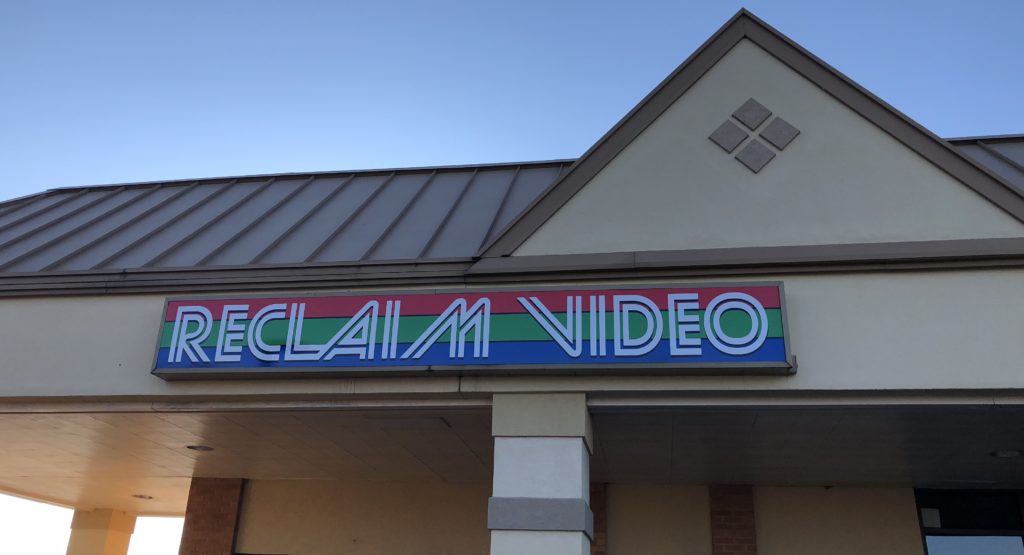
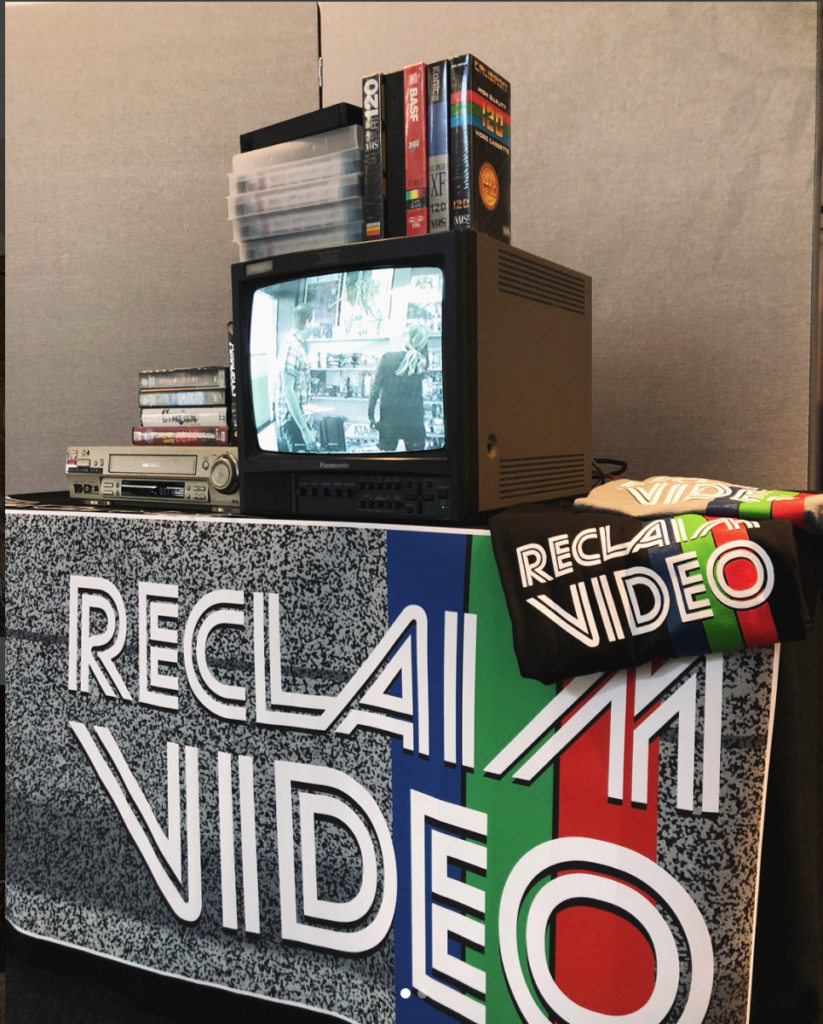
Reclaim Video Signage

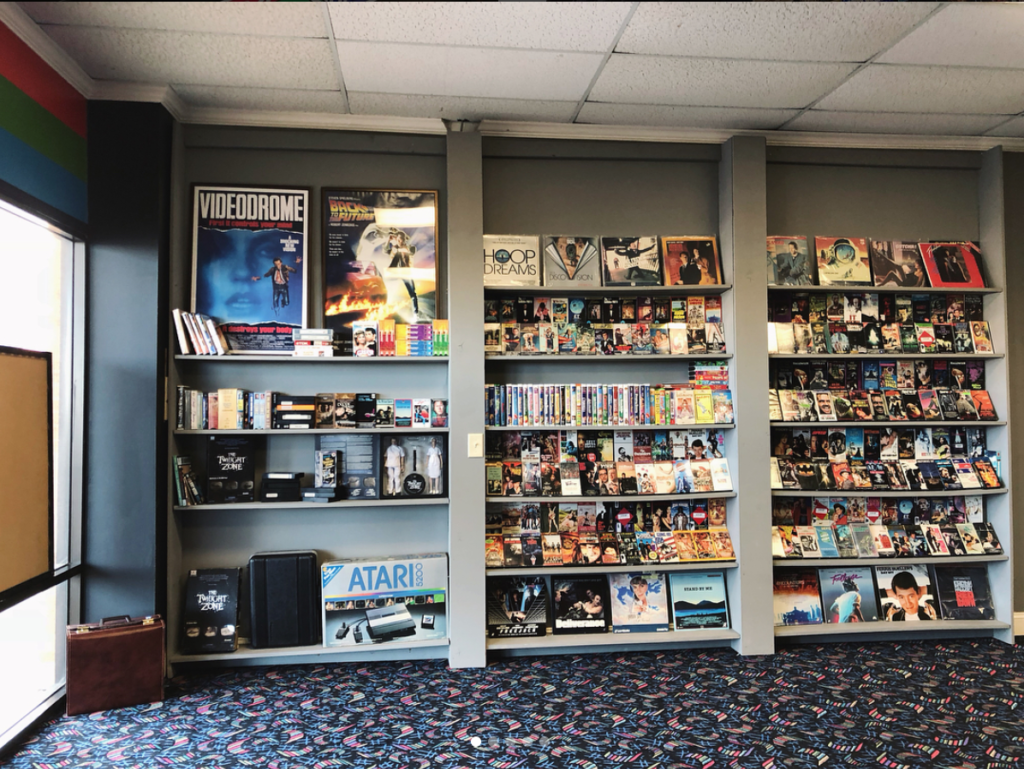
The road to Reclaim Video has been both an interesting and telling one. Less than a year ago it was still just an idea baby lurking menacingly under the surface of Crystal Lake. The “vision” was hatched while we were renovating our newly leased office space last Spring. The space is part of an 80s strip mall that effectively has two storefronts. The one we were renovating became CoWork, and the other was being used temporarily—but every time I looked at it I couldn’t help fantasizing about an 1980s video rental store. The fantasies were also inspired by the awesome experience of working on the Console Living Room exhibit we created at UMW in the Spring of 2015

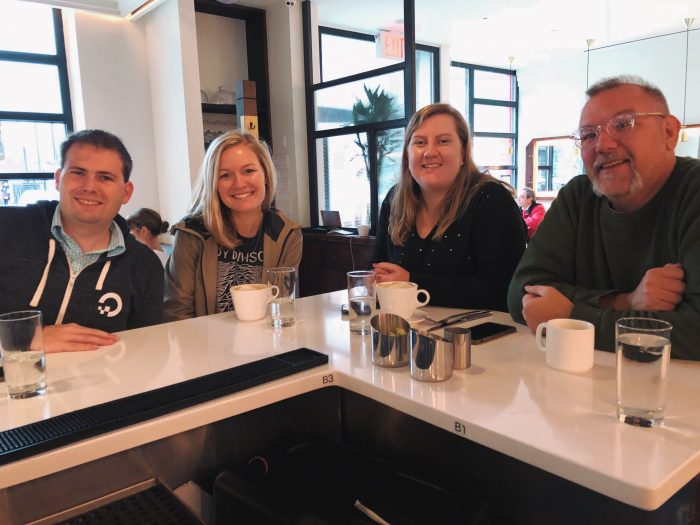
Reclaim Team in NYC Diner dreaming of VHS

I think I first articulated the dark fantasies of Reclaim Video to Tim and Lauren in some kind of thinly veiled joke as early as May, but the intense preparation surrounding the conjunction of both the opening of CoWork and the launch of our first Domains conference meant it was summarily dismissed. What’s more, it was little more then “I want to turn that space into an 80s video rental store. hahahaha.” As brilliant as the idea seems now to just about everyone, hindsight is 20/20 🙂 It was not as fleshed out as one would hope, and while I kept on returning to it over and over again throughout the summer and fall, it did not become a reality until early November (so only 6 months ago). The idea came up again while we were enjoying a Reclaim NYC trip. Tim, who was trying really hard to make heads or tails of the idea, finally made the connection between Reclaim Hosting and Reclaim Video in his mind, namely evolving the record store idea [“Video killed the radio star”] as well as being a way to host a fun marketing campaign for Reclaim Hosting. And, with that, everything moved into overdrive.  We all agreed to the idea in NYC over a delicious diner breakfast (pictured above) in early November and by March we had gutted the storefront and created a full-blown video store circa 1984—it took all of 4 months once we committed. And that last point encapsulates my experience at Reclaim Hosting for almost 5 years now. There’s really little in the way of bullshit; we are a lean, mean academic hosting machine and once we decide to do something we lock-in and get it done. #TCB4life!

We’ve documented the process of getting the store up and running over the past few months, and we now have all those blog posts aggregating to Reclaim Video’s blog Room 237. Given that, I’ll spare you re-hashing that process here so I can actually get to my point.

And what’s that, you ask? Well, our coming out party at OER18, of course! I’m not sure when, but at some point in December or January we got the notion of transforming Reclaim Hosting’s sponsorship of OER18 into Reclaim Video’s. The conceit being that this new Ed-Tech start-up, Reclaim Video, was delivering an innovative and timely disruption to the Higher Education market: VHS!!! We approached ALT’s CEO Maren Deepwell with the idea, and she was fully onboard. Those of you who know Maren will not be surprised by this, and I fell in love with the folks at ALT when I spoke at OER16 because I deeply related with how such a small, focused crew could bring so much goodness to so many. After that we decided to do our part to help fund OER17 and now OER18, but we had no interest in the usual vendor trappings—the sordid depths of which Adam Croom’s recent post about OLCInnovate highlights quite brilliantly alarmingly. So, Reclaim Video provided us a way to still do something fun and actually be part of the conversation, even if from 30 years ago 🙂

OER18 Conference

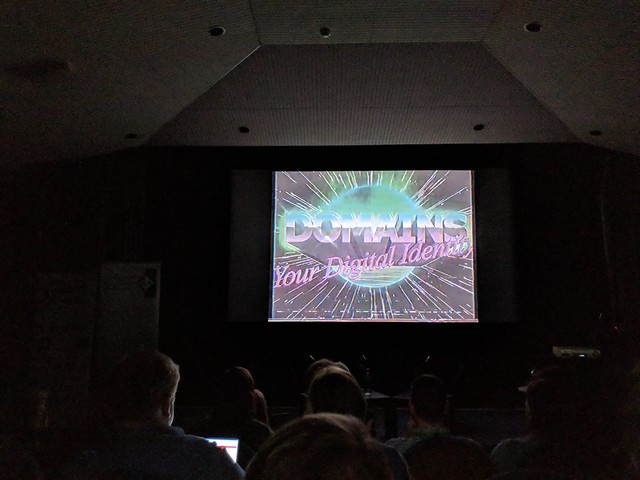
“The lights go down in Bristol for Reclaim Video”
Image credit: Daniel Villar-Rubio’s “OER18 Conference”

OER18 took place at The Watershed, an Independent Cinema  and “Creativity Centre” in Bristol, and all the presentations were in movie theaters. As luck would have it, this was perfect for what we wanted to do. We had made a mad rush to finish the Reclaim Video storefront in March so we could create a short film that we would debut at OER18. And, we did! I’m not sure what it is titled, but it provides a kind of alternative reality wherein the employees of both Reclaim Video and Reclaim Hosting find themselves in a 1980s era storefront talking VCRs and websites. Synergy baby!

And that was how OER18 started, Maren put the tape in the VCR, lights went down, and 5 minutes of magic ensued 🙂 It was fun, and the fact there really is a Reclaim Video in Fredericskburg, Virginia that will be sending folks all over the world copies of this video on VHS tape over the next 3-6 months makes me smile. Faith in a seed.

We also had a booth, and the amazing crew at Watershed supplied us with a CRT monitor and a region-free VHS player—I think they were the most excited about Reclaim Video’s presence at the conference. The booth was awesome, and it just played films like Blade Runner, Xtro, Amadeus, and more. We also had a stack of shirts and stickers for those swag-minded retrotechs.

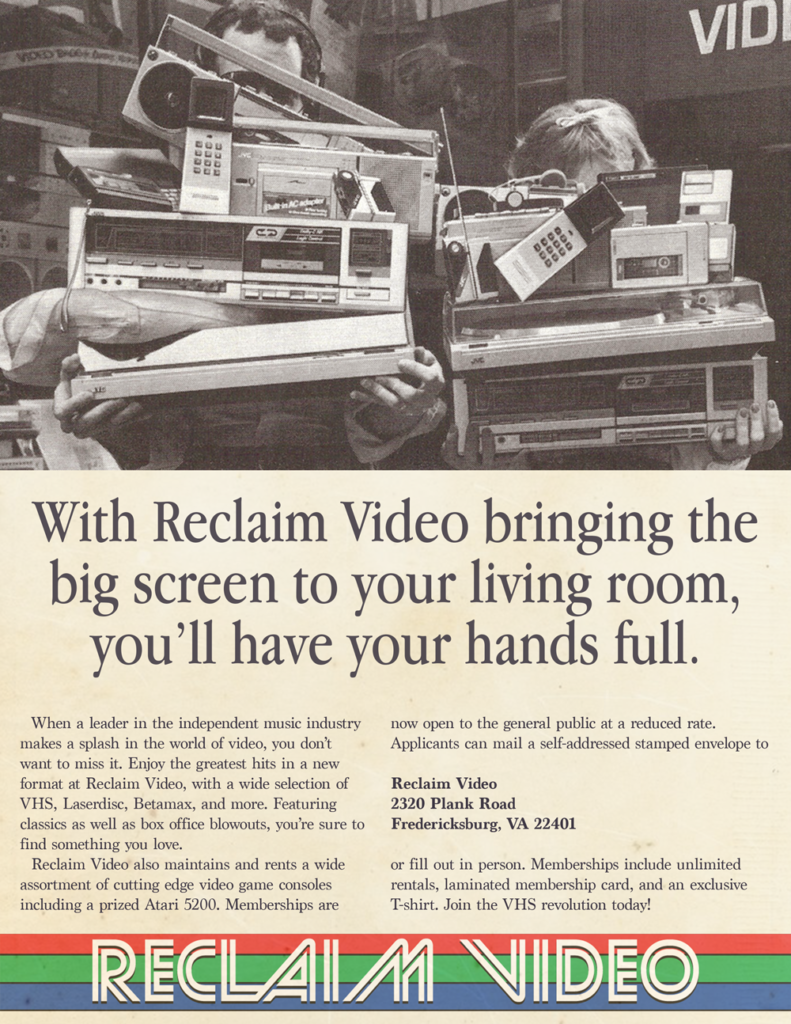
Another piece of the OER18 sponsorship was an ad in the program, and, well, we remixed some OG “OER.” 

Tim’s design prowess was responsible for the logo, and it’s amazing how much goodness can follow on a solid logo. What’s more, I already mentioned that a major reason for doing Reclaim Video was to have some fun. And, if you think about it, Reclaim Video is kind of a mashup of ds106 and the Living Room Console—which are two of my very favorite things. And while we fully understand Reclaim Video is not a viable business, its value as an indulgent, nostalgia-peppered space filled with fun and whimsy should not be underestimated. The space has already helped us all divert some of the intense work that running Reclaim Hosting requires into a joyous alter-ego company. Reclaim Video is a creative release that the good folks at OER18 did not bat an eye about incorporating into their proceedings—and that’s open education in action! To quote Yo La Tengo: “It’s a waste of time if I can’t smile easily.” Smiling at Reclaim Hosting (and now Reclaim Video) has not been an issue these last 4 years or so—and cultivating that fact should not be an afterthought to any venture

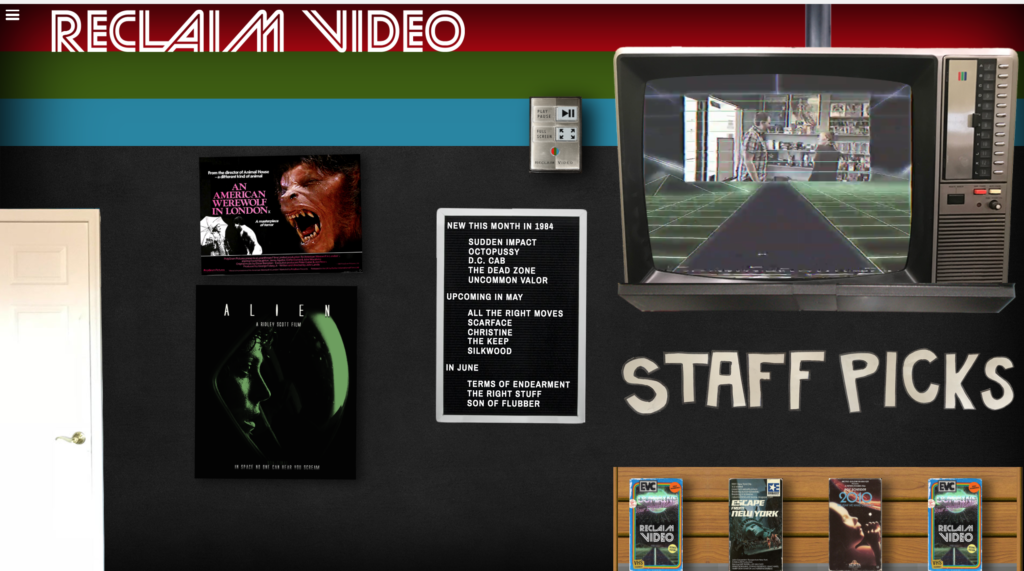
The Reclaim Video website designed by Michael Branson Smith

Oh yeah, we also launched an inspired website that will be a central node of Reclaim Video that Michel Branson Smith brilliantly put together for us. But I am saving that for my next post, cause the website is going to be an ongoing, evolving piece of Reclaim Video that I am very interested in taking some time and energy to think about here.


*This is a problem I have, fantasizing about the strip mall haunts of my past. Intensive therapy hasn’t helped.

30 Apr 02:26

Those Skinny Little Trees in Vancouver’s Central Public Plaza

image

I love trees. I talk about them all the time on this blog. Trees in public spaces have proven health benefits and have helped me in my own healing journey. I am fortunate to live in a city with the largest urban forest in the world, so you can imagine my disappointment when last year the City of Vancouver opened the renovated North Plaza - it’s only central public square in the city - and planted skinny, paltry trees along the perimeter.

These trees were meant to replace beautiful, lush trees that were there previously. Two years ago, when the plaza renovation was underway, the City of Vancouver cut down these seven trees , stating that they were either diseased or at the end their lives. They promised to add 36 new trees in their stead.

Unfortunately, the new trees are a meager replacement. It will likely be many years before the trees ever create the green canopy that was showcased in the model renderings.

image

Why was the city so miserly when it came to purchasing trees for the North Plaza? For comparisons sake, I purchased a beautiful, shade-bearing tree from a Richmond farm for $200. It looked like this after one year:

image

The city could have purchased a set of trees like this for under $10,000.  Maybe they could move the little trees in the North Plaza to a neighbourhood street and invest in some more substantial trees for Vancouver’s main public gathering place. It would be a small price to pay for beauty and nature in our downtown core.

30 Apr 02:26

Greenest City Update. Why the Yawn?

by pricetags

Councillor Andrea Reimer has Facebooked this:

Nine years ago today, the Greenest City Action Team made its first recommendations to Council. In the time since then we seen:

  • a 27% reduction in waste
  • 32% reduction in distance driven per person
  • 49% increase in green jobs
  • 42% increase in local food assets
  • 15% reduction in GHGs
  • more than half our residents now walk, take transit or bike.

At 3.9 T person, we have the lowest per capita emissions in North America and we’ve made longer range commitments to ensure we continue to get results on a range of green policy areas including transportation, green economic growth, zero emissions buildings, zero waste, access to nature, clean water, local food and air quality.


Questions: Do people care?  Will this kind of progress even get reported, much less registered in the public mind?  Have we moved on, caring more about housing to the exclusion of other agenda items?

Or do we simply discount progress, focus on the failures, and generally ignore or minimize the positives even as we raise the bar for the future.  Like this email that came in at the same time from Michael Alexander:

Time for Vancouver to leapfrog 50%?

San Francisco sets bold new goal: 80 percent of trips by sustainable modes

Last week, Mayor Mark Farrell announced a new goal to make 80 percent of all travel in San Francisco by a sustainable mode of transportation. That includes walking, biking, public transit, and carpooling. Having exceeded our former goal of 50 percent sustainable trips, San Francisco is well-poised to achieve this new goal—and we look forward to helping the city get there.

The new 80 percent goal supports another major pledge the Mayor made during Earth Month: committing San Francisco to become carbon neutral by 2050.

Learn more about San Francisco’s carbon reduction efforts.


Update:

I should clarify the purpose of the post (and why I changed the title.)

The Greenest City initiatives were an example of a government setting out priorities, establishing both vision and goals, and committing to a timeline. And then doing most of what it said it wanted to do – sometimes beyond the expectations of both advocates and critics.

The response? As far as much of the media and public: yawn. Too often Instead: cheap cynicism.

Critics are dismissive. Advocates raise the bar. Some give a quick acknowledgement and then move on – to the failures, the inadequacies, the missed opportunities.

It’s as though the achievements are inconsequential or inadequate to deal with more urgent matters.

This is not helpful at a time when we need positive examples and reinforcement to tackle the challenge, in particular, of climate change. The celebration of success is not unwarranted if earned; it’s essential if hope is to be maintained and continually renewed.

30 Apr 02:25

Jeff Bezos Banned PowerPoint in Meetings. His Replacement Is Brilliant

files/images/Jeff_Bezos.PNG

Carmine Gallo, Inc., Apr 30, 2018


Icon

This is a bit of nonsense being served to us as a three-point list by an author who doesn't recognize the irony. Carmine Gallo wants us to believe that narratives - stories - are better than bullet points, and supports this with two argument: first, that Jeff Bezos thinks this, and second, that a "prominent neuroscientist" friend of his confirmed "the human brain is wired for story." Gallo's use of Aristotle's forms of rhetoric - "ethos, logos, and pathos" - is a knowing nod to home-schoolers who still believe in things like the trivium. But "pathos" isn't 'story', pathos is experience - the senses and the passions. And the brain isn't hard-wired for narrative (though it does perceive time), it is hard-wired for recognition and metaphor. And the idea of having executives in a meeting sit and read silently for half an hour is utter idiocy. So why does a mainstream magazine publish this nonsense, and why does academia let it pass without criticism?

Web: [Direct Link] [This Post]
30 Apr 02:24

Abject apologies

by AG

For no reason that I am able to discern, I have only now received a few hundred messages you’ve been leaving for me here, some dating back to 2015.

You may be certain that I have reached out to the WordPress support team in an attempt to find out how this happened, but in the meantime please accept my sincerest apologies. You must think I’ve been terribly snide in ignoring your comments, questions and invitations all this time, and I assure you nothing could possibly be further from my intention.

Should you wish to contact me, I remain available, as always, at my initials at urbanscale dot org.

30 Apr 02:22

(via Covering the Trump White House: Inside the Intense...


(via Covering the Trump White House: Inside the Intense Environment – Variety)

Press are getting death threats for asking Trump questions.

29 Apr 04:05

WeChat mini programs are getting traction in China

by WalktheChat
Editor’s note: A version of this post first appeared on WalktheChat. WalktheChat specializes in helping foreign organizations access the Chinese market through WeChat, the largest social network on the mainland. We put together data from several mini-program reports showing impressive growth: Time spent on WeChat mini programs daily went from 1.6 minutes per day to 9.8 […]
29 Apr 04:05

On the received aesthetic of the urban commons, and transcending it

by AG
Edmund Sumner's lovely picture of Ryue Nishizawa's Moriyama House

Edmund Sumner’s lovely picture of Ryue Nishizawa’s Moriyama House: What the commons could look like, but generally does not

A few days back, my friend and colleague John Bingham-Hall gave a great talk at the Cass School of Art, Architecture and Design, as part of a series on the urban commons organized by the wonderful Torange Khonsari. John’s talk was called “Common(s) Materials,” and it took up a question that’s central to many of my own concerns: is there some necessary relationship between the social or political qualities of a space claimed for the commons, and the materials used in articulating and furnishing that space?

What I want to do here is expand on some of John’s thoughts, and perhaps develop them further. What follows is more of a free association than anything else, and certainly not a well-formed argument; while I apologize if it’s not particularly structured, hopefully you’ll find some utility in it regardless.

What do you mean when you talk about “the commons”?

Let me first clarify what I mean by “the commons,” which, for present purposes, we can simply define as territory not governed by either the market or the state, and that is in principle available and accessible to all. (I’ve previously written about why I prefer the gerund form commoning, but we can set that to the side for now.)

Sites organized as commons have been in short supply in conurbations of the developed world ever since the so-called “urban renaissance,” or rediscovery and revalorization of the central city by the middle class, which started gathering steam around 1990. This reversal in the outward flow of population that had characterized the previous few decades sent land value in urban cores worldwide to vertiginous heights, and guaranteed that the worth of such parcels would henceforth be determined by their speculative exchange value, rather than any utility they might have as a dwelling-place for human beings. At the culmination of this process, a clear consensus regarding “the highest and best use” for land emerged worldwide, in the form of luxury condominiums whose units are traded as “sky bullion” among the members of a fairly shady global investor class consisting of oligarchs, autocrats, hedge-fund traders, private-equity managers and their children.

Under such circumstances, the only sites that were by and large left to popular control were waste and interstitial spaces, sacrifice zones too steep, difficult or prone to subsidence to develop profitably, or tracts where the projects of finance capital had failed, gone into receivership or otherwise been abandoned.

In the global South, for the most part, any such site is impossible to distinguish from the broader and thoroughly informal built fabric that may constitute the absolute majority of a city’s developed land area. It’s only in the metropolitan core of the developed world that sites occupied and maintained as commons tend to stand apart, not simply in terms of their political organizing principles but of their visual identity as well.

Is there any such thing as a “commons aesthetic”?

So can we establish that there is a coherent aesthetic associated with such spaces?

As I’ve noted here before, there is a distinct mode in which urban sites claimed for the commons present themselves to their users and the world. It’s present in most of the participatory spaces I’ve been so interested in over the past decade: you can see it deployed at Grand Voisins in Paris, el Campo de Cebada in Madrid, perhaps to a lesser extent at Prinzessinnengarten in Berlin, and it’s all over the projects of collective practices like Campo designer-builders Zuloark or the intriguing spatial provocateurs raumlabor Berlin. These spaces are characterized by the use of ultra-low-cost, widely accessible commodity materials readily manipulable by the untrained: shipping pallets and the wood reclaimed from them, CMUs of various types, construction tarps and rebar.

Cheap, lightweight components of this sort emphasize the mobile, participatory and rapidly reconfigurable qualities of common space — though perhaps at the cost of inadvertently underlining just how contingent such space generally is in the global North, just how vulnerable it is to clearance by the state and recuperation by the market. As John pointed out, there is a certain invitational character to them as well. You don’t require much in the way of training or prior experience to build surprisingly durable structures with these materials, which is the same reason you’ll find them at the heart of various self-build schemes of the past half-century. (Ken Isaacs’ visionary 1974 How To Build Your Own Living Structures is exemplary in this regard, though Walter Segal’s method has to be singled out for the longevity of its influence on actually-existing lifeways.)

Together, these elements comprise what I think of as the Received Commons Aesthetic, and as the name implies, it’s fair to say that it has by now become something of a mannerism. Further, its achievement on a given site may require outlays of capital or labor that the community claiming it for the commons cannot well tolerate. For example, raumlabor Berlin’s rather clever chairs, albeit using salvaged wood, are nevertheless purpose-built and labor-intensive. (Despite my own long-nurtured hopes for an eventual alignment of the informational commons with the spatial commons, at present I think it’s clear that the use of digitally-fabricated furniture in this context, like the designs licensed by Opendesk, can only be understood as hopelessly fetishistic, and the same thing probably goes for most appearances of open hardware.)

By contrast, the overwhelming majority of actual squats and social centers I’ve ever spent time in were furnished in an eclectic style that could best be described as “adaptive reuse,” with much of the interior furnishing either inherited from the building’s former occupants, or trashpicked and therefore freegan. In my experience, anyway, such avowedly anarchist spaces tend to be cozy with rugs, spavined La-Z-Boys and thick, insulating wall-hangings, if not outright gemütlich; the idea that their inhabitants would dedicate any effort at all to the design and construction of new furniture, especially amid the profound global surplus of manufactured objects available more or less for the taking, strikes me as, uh, questionable. (John ended his talk with the provocation that the most appropriate seating for spaces of participatory democracy would be the £5 folding chair from Ikea, rather than anything intended to function as a visual signifier of the commons; the equivalent, for most of the emerging world, would of course be the ubiquitous knockoff Monobloc.)

Why does any of this matter?

In his comments, John raised the question of performative transparency, as epitomized by Norman Foster’s Reichstag dome. At the Reichstag, glass is both denotative and connotative. You can literally see through it, of course, from the observer galleries to the workings of the chamber below, and it’s therefore supposed not merely to signify but actually enact the idea that democracy is something that takes place in public: the implication is that in present-day Germany, the deliberative process itself is as accessible, available and accountable as its image.

We can certainly wonder whether this is now the case, or ever has been. But as John pointed out, these performative qualities of glass do raise the question of what is implied when we choose to use other materials in our constructions of democratic space. In particular, he asked, “Does wood symbolically trap politics in the realm of the intimate?” In other words, does the very humility of the materials that together comprise the Received Commons Aesthetic consign the active practice of democracy to the strictly local, or suggest that there are no larger scales at which participatory praxis is appropriate?

In my own flavor of politics (which, as you may have noticed here and elsewhere, I’m increasingly comfortable characterizing as “neo-Bookchinian”), this may not matter so much. My feeling is that participatory deliberative processes work best in assemblies of about the Dunbar number — not at all coincidentally, the size of a New England-style town meeting — and that effective governance in both municipalities and larger territories can be achieved by networked federations thereof. Nevertheless, it’s a question worth taking seriously.

But there’s a more troubling implication raised by the Received Commons Aesthetic, which is that is so easily recognizable, so straightforwardly characterizable and so readily replicable that it can not merely stand for participatory politics but replace it entirely. If we see the RCA in admittedly interesting hybrid spaces like the Institut for (x) in Aarhus or the R-Urban project just northwest of Paris, there is however no suggestion that these sites are owned and managed collectively, for the benefit of all. And needless to say, anything so readily reducible to pastiche can also be encountered in watered-down form, at commercial sites like Seoul’s Ssamziegil — the latter places that do not remotely constitute a commons in any way, but clearly wish to convey the sense of openness, adaptivity, porosity and invitationality we associate with liberated spaces. What such sites imply is that the presence of architecture based on pallets, CMUs, tarps and other mobile elements may perform radical inclusion and participation where they do happen to be present, but also suggest them where they are not.

Indeed, at places like Boxpark and the truly vile Artworks, the aesthetic isn’t merely emptied of meaning but actually inverted: Boxpark is nothing more than a way of turning an otherwise marginal interstitial site into a buzz- and revenue-generating minimall, while the similar Artworks is deployed where the Heygate Estate housing complex once stood, camouflaging developer Lend Lease’s deep complicity in the council’s own program of social cleansing. (Apartments at the new Elephant Park were marketed, and evidently sold, exclusively to overseas investors, while the developers failed to actually provide any of the notionally affordable units they’d committed to.)

What all this says to me is that there is great value in establishing radically participatory spatial situations that do not greatly resemble the Received Commons Aesthetic, or at the very least pushing outward our notions of what common space can look like. Here my model has always been the microurbanism of Ryue Nishizawa’s Moriyama House, a gorgeously-conceived and carefully detailed cluster of dwelling units surrounding shared service, conviviality and circulation spaces. As private property owned by a single individual, the thicket of buildings that constitutes Moriyama House is clearly in no way a commons as we’ve defined it. But in edging away from the atomized nature of life in discrete apart-ments, it points toward what it might mean to dwell in common, and perhaps suggests something about the ways in which space can help individual tenants modulate public and private as need be.

Like raumlabor’s chairs, such proposals certainly run afoul of that tendency Kurt Vonnegut once perceptively identified as one of the primary flaws in the human character: that “everybody wants to build and nobody wants to do maintenance.” There’s no doubt a great deal of justice in the idea that by the metric of sustainability, at least, the most radical thing one could possibly do is to reclaim existing spaces, leverage the material-energetic investments already sunk in them, and perhaps retrain them if necessary. By this ethic, the grandeur comes to live with the otherwise unglamorous practices of maintenance and long-term stewardship.

But there’s also something to be said for the idea that beauty, craft and rigor in design ought to be reclaimed from the market — that spaces by, of and for the people need not read as or be ad-hoc, that they might instead be marked by certain aesthetics we more often associate with luxury and the commercial high end. Dating back at least as far as Ruskin, Morris and the Arts & Crafts movement, this is not, of course, a novel suggestion. It acquires new relevance, though, in a period of increasingly democratic and high-resolution control over the distribution of matter.

Organized as housing cooperatives or community land trusts or their equivalents, there’s no reason emergent spaces in common need to partake of the Received Commons Aesthetic — especially if it is more than occasionally dishonest in what it implies about the nature of the sites marked by it. With new digital design and construction techniques becoming relatively accessible, and powerful ways of building and dwelling together becoming available to learn from, it would be disappointing if the participatory and collectively managed spaces of the future failed to transcend the visual language of those few examples that exist at present.

I personally enjoy the Received Commons Aesthetic, just as I kinda dig the funky Ken Isaacs/early Whole Earth Catalog vibe of the various, deeply clever mobile assemblies Zuloark and their collaborators have built at el Campo. But what I enjoy more is the sense I have whenever I’m lucky enough to be on that parcel of land, which at that is not so different from what I remember about Kunsthaus Tacheles, or the various squats in which I’ve ever laid my head for the night: that here is freedom, and what’s more, freedom of a kind the market cannot offer at any rate or price. And because freedom is only another word for privilege unless it’s truly shared by all, it feels necessary, now, to begin peeling away that experience of freedom from the material undercarriage that implies but only occasionally actually supports its becoming.

My sense is that the Aesthetic, and the use of the materials it’s based on to construct and articulate spaces in common, will persist for some time yet to come, for all the reasons of low cost, accessibility and invitationality we’ve discussed. I hope, though, that we can imagine a time when such spaces aren’t limited to those that can be established on the scraps from late capitalism’s table, using offcuts from its voracious machinery. We should be thinking about what the urban commons might look like in triumph, when it can truly leverage all of the organizing, funding and building capabilities this moment in history offers us — when we dare to demand something reaching beyond a minimum viable utopia, and settle for nothing less than the entire city held in common, for the use and enjoyment of all who dwell in it and bring it to life.

My thanks to John Bingham-Hall, to his co-panelists Adam Kaasa and Nicolas Fonty for their insightful presentations, and to Torange Khonsari for her generosity in putting it all together.

28 Apr 21:38

The Plain Person's Guide to Plain Text Social Science

by Kieran Healy

As a beginning graduate student in the social sciences, what sort of software should you use to do your work? More importantly, what principles should guide your choices? This article offers some answers. The short version is: you should use tools that give you more control over the process of data analysis and writing. I recommend you write prose and code using a good text editor; analyze quantitative data with R or Stata; minimize error by storing your work in a simple format (plain text is best), and make a habit of documenting what you’ve done. For data analysis, consider using a format like Rmarkdown and tools like Knitr to make your work more easily reproducible for your future self. Use Pandoc to turn your plain-text documents into PDF, HTML, or Word files to share with others. Keep your projects in a version control system. Back everything up regularly. Make your computer work for you by automating as many of these steps as you can. To help you get started, I briefly discuss a drop-in set of useful defaults to get started with Emacs (a powerful, free text-editor). I share some templates and style files that can get you quickly from plain text to various output formats. And I point to several alternatives, because no humane person should recommend Emacs without presenting some other options as well.

This is an updated and expanded version of ‘Choosing Your Workflow Applications’. The main difference is an increased emphasis on Rmarkdown, knitr, and pandoc.

28 Apr 21:38

Menschen, die auf ihr Handy starren

by Volker Weber

1f15290c29cd5e180649427bbdea7ea5

Ein Smartphone ist kein Telefon. Es ist eine Fernbedienung für unser Leben. Und dieses Leben besteht zunehmend daraus, auf das Smartphone zu starren. Das betrifft uns alle, überall. Sobald uns langweilig wird, holen wir unser Smartphone heraus und starren darauf. Und wenn wir selbst nicht auf die Idee kommen, dann benachrichtigt uns das Gerät, damit wir wieder daran denken. "Hey, jemand hat dein Instagram-Bild geliked."- "Jemand hat dich in einem Facebook-Kommentar erwähnt." Kleine Mikrobelohnungen am laufenden Band machen uns abhängig.

Man kann diesen Zirkel unterbrechen. Apps löschen, Benachrichtigungen abstellen, Newsletter-Abos kündigen, ein dummes Zweittelefon anschaffen. Ich habe einiges davon ausprobiert und es funktioniert. Wer mich trifft, der weiß, dass ich stundenlang nicht auf mein Handy schaue. Dass ich das Haus verlasse, ohne es mitzunehmen. Die Startseite auf dem iPhone ist nicht mal voll, auf die zweite Seite muss ich äußerst selten, eine Dritte gibt es nicht. Das Smartphone gibt keine Töne von sich, es vibriert nicht mal.

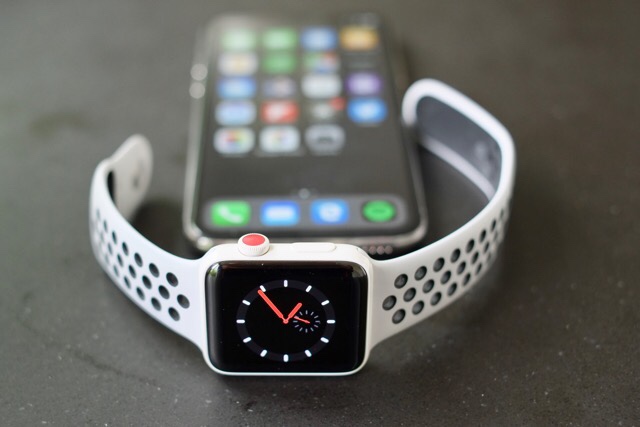
Den Durchbruch hat die Apple Watch der dritten Generation gebracht. Ich zahle monatlich 5 Euro dafür, dass ich auch ohne iPhone erreichbar bin und dass ich, wenn es wirklich nötig ist, auch jemanden anrufen kann. Nur wenige Benachrichtigungen kommen durch, auch die Uhr gibt meistens keine Töne von sich. Nur die Taptic Engine gibt mir kleine Berührungen auf das Handgelenk. Und ich weiß, was sie bedeuten, ohne hinzuschauen. So schlau die Uhr ist, sie ersetzt mir das dumme Zweithandy.

Es mag ein bisschen albern sein, wenn man in sein Handgelenk spricht, aber das waren die ersten Handys auch. Die Apple Watch ist nicht autark. Sie braucht ein iPhone, noch. Aber sie befreit mich auch davon. Und wenn man den Kopf hebt und sich umschaut, dann sieht man sie, die anderen Zombies. Die Mütter, die auf ihr Handy starren statt auf ihr Kind. Die Autofahrer, die noch mal schnell eine Nachricht lesen müssen, statt auf die Straße zu schauen.

Ich brauche Langeweile. Zeit, die ich nicht auf einen Bildschirm starre. Nur so habe ich neue Ideen oder kann etwas Neues schaffen. Mal schnell Facebook checken, mal schnell die Instagram-Benachrichtigungen? Nicht mit mir. Nicht mehr.

Die besten beiden Änderungen in Windows 10, die am Montag kommen: Timeline und Focus Mode. Timeline zeigt Dir, woran du gerade arbeitest, und was Du die letzten Tage angefasst hast. Focus Mode hält Dir die unwichtigen Benachrichtigungen vom Hals. Damit Dir wieder langweilig wird und Du was geschafft kriegst.

28 Apr 21:36

The Huawei P20 Pro Is Already the Company’s Best Selling Flagship in Western Europe

by Rajesh Pandey
The Huawei P20 Pro has been on sale for less than a month, and it has already become the company’s best-selling flagship in Western Europe. Huawei says that sales of the P20 Pro are about 316 percent higher than that of the P10 Plus from last year. Continue reading →
28 Apr 21:36

LG to begin Android Oreo update for G6 on April 30th, followed by V20 and G5

by Rose Behar
LG G6

LG has announced the first Android update plans to come out of its newly created ‘Software Upgrade Center.’

As promised, the LG G6 now has an Android Oreo launch date — at least for Korea.

The handset will begin receiving the update this Monday, April 30th. Meanwhile, the LG V20 and LG G5 — launched in 2016 — will follow the G6, though LG doesn’t specify how closely.

In addition to Oreo, LG G6 users will also receive the AI features introduced with the LG V30S ThinQ.

It’s unclear exactly when Canadian carriers will begin rolling out the updates, as each operator’s own tests tacks on a little extra time. Regardless, it’s good to know the update is on its way.

“We will continue to provide stable and continuous after-sales services such as upgrading the OS and adding new functions to existing products,” said Lee Seok-su, CEO of the Software Upgrade Center at LG Electronics in a press statement.

“LG Smartphones can be trusted by customers who believe in long- I will try to make steady efforts. ”

The physical Software Upgrade Center, situated in LG’s research and development campus in Seoul, was launched to improve the pace at which it issues major software updates.

Android 8.0 Oreo delivers performance enhancements along with features like picture-in-picture  viewing, notification dots and autofill support.

Source: LG 

The post LG to begin Android Oreo update for G6 on April 30th, followed by V20 and G5 appeared first on MobileSyrup.

28 Apr 21:36

Microsoft’s Windows 10 April update adds Timeline feature and enhanced dictation

by Brad Bennett

It looks like Microsoft’s Windows 10 April 2018 update is set to add a variety of time-saving features the company hopes will help users save more time.

The update is available to users to download on April 30th and will roll out to all Windows 10 PCs starting on May 8th.

The largest feature that’s being added to the Windows experience is called ‘Timeline.’ The new feature monitors user activity for 30 days and present it in an organized page.

The idea behind this is to make it easier for users to double check an email, or go back to look at a web page from a few days ago. The feature will work across Windows 10 along with Microsoft’s Edge browser and Office 365 on mobile devices.

Users will now be able to control their smart home gadgets with their voice directly from their computer through a new Cortana feature. The option for Windows 10 users to control some of their smart home devices has been part of the OS since mid-2017 — now it’s set to be easier with the addition of voice commands.

The company is also adding a ‘Focus Assist’ that limits the number of notifications a user views when the setting is enabled. Users will be able to add specific routines for ‘Focus Assist’ that turn on at a specific time every day, or whenever the display is being used for gaming.

The setting can turn off notifications completely, or users can create a list of ‘Priority’ notifications that they’d like to see even when ‘Focus Assist’ it turned on. When the feature is disabled users will receive a summary of all the notifications they received during the time period that the feature is turned on.

In terms of Focus, Microsoft Edge is getting a few new updates that will bring it up to modern web browser standards. Users will now be able to mute individual tabs and open PDF documents in fullscreen. Edge will be able to securely save user payment information to make it more streamlined when making online purchases.

One of the more interesting Edge updates is called ‘Grammar tools.’ With this new feature readers are able to highlight words and Microsoft’s algorithms will break them into syllables. The tool can also highlight different parts of sentences to show verbs, nouns and adjectives.

The April Update also brings enhanced dictation to the Windows platform. In Windows 10 users can hit ‘Win+H’ to start the dictation software. From there it’s as simple as talking and Windows will start transcribing your words for you.

There are a few smaller scale updates coming in this build as well, which users can check out here.

Source: Microsoft

The post Microsoft’s Windows 10 April update adds Timeline feature and enhanced dictation appeared first on MobileSyrup.

28 Apr 21:36

Facebook launches Messenger Kids ‘sleep mode’ for more parental control

by Bradly Shankar
Facebook Messenger app on phone

Facebook has begun rolling out a ‘Sleep Mode’ feature to Messenger Kids, offering parents greater control over their children’s social media use.

With sleep mode, parents can set a designated time for the Messenger Kids app to shut down and remain inaccessible during this period. Parents can control sleep mode from the Parent Control centre through their own regular Facebook accounts.

When active, sleep mode prevents kids from sending or receiving messages or video calls and from playing with the creative camera or receiving notifications. Any attempt to open Messenger Kids will be met with a message telling the child the app is in sleep mode and that they should come back later.

Parents can access Messenger Kids controls in the main Facebook app. Facebook says additional resources can be found in the dedicated Parents Portal at facebook.com/safety/parents.

In other Facebook youth messaging news, a report from last week suggested that the company is working on a Slack-like version of Messenger for students.

Source: Facebook

The post Facebook launches Messenger Kids ‘sleep mode’ for more parental control appeared first on MobileSyrup.

28 Apr 21:36

Apple reportedly developing powerful wireless VR and AR headset

by Bradly Shankar
Apple header

Apple might be getting into the world of virtual and augmented reality in a big way.

According to a new report from CNET, the tech giant is planning to release a wireless VR and AR headset sometime in 2020.

The headset, which is reportedly codenamed T288, is said to have an 8K display for each lens, which is particularly noteworthy given that high-end headsets currently barely reach 4K. Moreover, the T288 is rumoured to be connected to a box through high-speed wireless tech called 60GHz WiGig, while a 5-nanometer proprietary Apple processor powers the device.

Notably, this would be a new, as-of-yet-unreleased chip for Apple, as the most current processor adopted by Apple — the A11 Bionic in the iPhone X — utilizes 10-nanometer construction. With chips such as nanometers, the smaller the number, the faster and more power efficient a device can be.

While Apple hasn’t yet commented on the reports, the company is planning to unveil more about upcoming products at its Worldwide Developers Conference, which runs from June 4th to 8th.

Source: CNET

The post Apple reportedly developing powerful wireless VR and AR headset appeared first on MobileSyrup.

28 Apr 21:36

What streaming platforms do you subscribe to?

by Dean Daley
CraveTV and Netflix

In Canada, we don’t have access to the same video streaming services as our counterparts in the United States. That said, our streaming service selection is likely better than you think it is.

First, we have the big three that every Canadian knows about: Netflix, Amazon Prime Video and Bell Media’s CraveTV. We’ve unfortunately lost Rogers’ Shomi, though there are plenty of other platforms that have filled the void.

In terms of more niche services in Canada, we now have Shudder, a streaming service that only features horror TV shows and movies, Crunchyroll and Funimation for the anime lovers, DAZN for sports, Snackable TV, a free service for quick videos and Kanopy, a platform full of documentaries.

Alongside those services there’s also Videotron’s Club Illico and CBS’ All Access streaming platform.

So with all of that in mind, how many streaming service do you subscribe to? As well, both Disney and Warner Bros are coming out with their own streaming services soon — are you interested in these?

Let us know in the comments below as well as our polls. Also let us know if we’re missing any Canadian streaming platforms.

Take Our Poll  
Take Our Poll

The post What streaming platforms do you subscribe to? appeared first on MobileSyrup.

28 Apr 21:36

Stenciltown Update

by Brent Simmons
mkalus shared this story from The Omni Group.

We’ve updated Stenciltown — our collection of free (and awesome!) OmniGraffle stencils — with some fixes and enhancements. The detailed list is… long. (Our Stenciltown engineers have been busy!) But we can shorten it to this:

  • Laid the groundwork for OmniGraffle to show nice filenames for stencils downloaded from Stenciltown. (The second half of this fix will appear in upcoming OmniGraffle for iOS and Mac updates.)
  • Support for non-ASCII characters when searching and downloading has been much improved.
  • The search ranking system now gives name matches a higher ranking.
  • Erroneous metadata in some download headers was corrected, which fixes compatibility with some browsers.

Stencils — they’re not just for breakfast anymore. :)

28 Apr 21:35

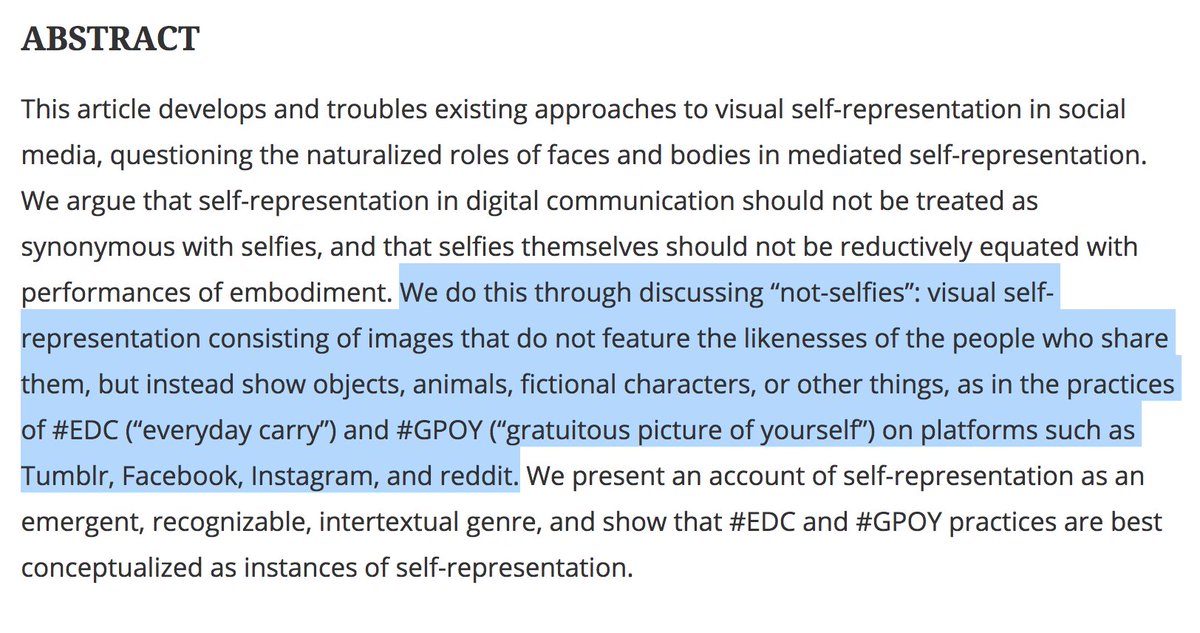
When scholars discover ("non-selfie") pictures (@aarhusuni, @tallinnuni, @uow) tandfonline.com/doi/full/10.10… pic.twitter.com/RG94qKDfbZ

by RealPeerReview
mkalus shared this story from RealPeerReview on Twitter.

When scholars discover ("non-selfie") pictures (@aarhusuni, @tallinnuni, @uow) tandfonline.com/doi/full/10.10… pic.twitter.com/RG94qKDfbZ


Posted by RealPeerReview on Wednesday, April 25th, 2018 5:57pm


71 likes, 21 retweets
28 Apr 21:35

RT @dlicj: after watching a movie on netflix please rewind it by dragging the red circle back to the beginning for the next viewer thanks

by dlicj
mkalus shared this story from shutupmikeginn on Twitter.

after watching a movie on netflix please rewind it by dragging the red circle back to the beginning for the next viewer thanks


Posted by dlicj on Friday, March 16th, 2018 9:46pm
Retweeted by shutupmikeginn on Wednesday, April 18th, 2018 12:58am


3990 likes, 821 retweets