Shared posts

01 May 06:08

The Wheel of Blame

by Dave Pollard

I don’t know who invented the “wheel of blame”. I first saw it on the refrigerator of Tree’s community house kitchen. It listed the community members and pets (eg the “scapecat”) and came with a spinner that allowed blame to be immediately and indiscriminately apportioned for anything that went wrong. The larger spaces on the wheel were labeled with those deemed most likely to be blamed, or blameable. It’s been reinvented in many different places; there’s even an app for it.

In recently thinking about our human propensity to assign blame for things, I started listing those people and things I had caught myself blaming for various upsetting and outrageous things over the years, and how my propensity for assigning blame had shifted over my life:

The first years of my life were pretty carefree. I tended not to assign blame, since nothing, it seemed, was blameworthy. But then, I entered school, where blaming seemed the predominant sport, and things went downhill from there:

At 20 I was your proverbial angry young man. My wheel of blame was probably pretty typical for hippy-socialist-long hairs in the late 60s and early 70s. I blamed “the system” while secretly worrying that the system was really “all of us”. I blamed the uneducated for their own lack of knowledge and awareness (a form, I guess, of blaming the victim). I blamed bad drivers (slow traffic, accident delays) when I was late. I put collective labels of blame on the misbehaviour of rogue individuals within the groups I was inclined to dislike, and blamed the most visible individuals in misbehaving groups for what was really a collective folly.

As I got older and more preoccupied with family life, I became more inclined to blame situations and tools, and less inclined to blame systems and political groups:

For the next couple of decades my pattern of blaming didn’t change much, except that for the first time since early childhood, I started to doubt, occasionally, that anyone was to blame:

As I started to blog (in my 50s), learning about things (complexity, culture, science, nature and human nature) I had neglected during my peak working life, my patterns of blame started to shift sharply.

So now, as a non-dualist, I am increasingly reluctant to blame anyone for anything, since blame assumes people have free will and control over their behaviours and beliefs, and non-duality asserts that they do not. Ending the blame game has also made me much less reactive and less angry than I used to be.

But I am still inclined to blame myself, though much less than I used to. And I can’t seem to stop blaming badly designed technologies (notably anything developed by Microsoft) for my online struggles. And bad drivers, until I stop and think what trauma and suffering must be driving them to so misbehave. And systems, especially everything large scale, including the education system, the financial system, and the corporatism that prevails in large capitalist enterprises, though I realize there’s no point blaming anything that is in  no one’s and no group’s control. The cause of your suffering is not necessarily to blame for it.

And of course it’s still fun to blame the lawyers. Like the rest of us, they are surely all doing their best to make their lives, and the lives of their loved ones, better, and make the world a better place in the process. Though it seems their best is particularly inadequate.

There are some groups I have never blamed for anything — although I realize they tend to be the scapegoats of large segments of the population. “Terrorists” (whatever that word means), immigrants (or “foreigners” as they have traditionally been labeled by xenophobes), the weather, the victims (blaming the poor, sick and uneducated for their predicaments), users and customers, subordinates, and “a growing lack of morality” or “declining standards” are often blamed for a host of problems, but not by me. And of course some Americans like to “blame Canada”, which I think only Canadians, who enjoy blaming themselves more than nationals of most nations, should be allowed to do.

Looking at the wheel of blame turn as my life has progressed, and as the number of objects of blame decrease for me, I get the disquieting feeling that, if I were to draw my wheel of blame at age 80, it will look very similar to the one at age 5. Except for blaming the dog or cat. From eating the homework to making that bad smell that embarrasses everyone in the room, that’s always been a bad rap.


01 May 06:08

The magical leverage of languages

by Eric Normand

If I write a straightforward solution to a problem in Clojure, it might take me a thousand lines of code to solve it. To handle all the corner cases and everything, I got a thousand lines of code. However, if I take this other approach where it’s much more indirect, or instead of solving the problem that I have in front of me, I write a language–a DSL. The DSL could take me 500 lines of code to write. That’s a fairly large DSL. Usually they’re much smaller, but it takes me 500 lines of code. Actually, writing the solution in it only takes 10 lines of code.

Transcript

Eric Normand: Hello, my name is Eric Normand and these are my thoughts on functional programming. I’ve been working on a course called Domain Specific Languages in Clojure. It’s been making me think about a phenomenon that happens frequently when I’m writing Clojure and doing domain-specific languages in little interpreters and things.

The phenomenon is this, that if I write a straightforward solution to a problem in Clojure, it might take me a thousand lines of code to solve it. To handle all the corner cases and everything, I got a thousand lines of code. However, if I take this other approach where it’s much more indirect, or instead of solving the problem that I have in front of me, I write a language.

I make a DSL to allow me to represent that problem and the evaluation of that representation is a solution. The DSL could take me 500 lines of code to write. That’s a fairly large DSL. Usually they’re much smaller, but it takes me 500 lines of code. Actually, writing the solution in it only takes 10 lines of code.

If you compare them, that’s a thousand lines of code if I just do the straightforward, just solve the problem versus 510 lines of code. 500 of those are very easily reusable if I have several problems in the same domain. It’s just weird to me that an indirect approach like that can lead to so much code savings. Obviously, it’s a very extreme example. It’s not atypical.

Another example, imagine you had to solve a fairly complex problem like developing a Web app. Just like a server-side rendered Web app. I’m not talking about ClojureScript or JavaScript, just served Web pages, but all I gave you was assembly.

At some point, and it’s very soon, you would actually be better off writing a programming language, at least an interpreter, in assembly, then, using that to implement your Web server. The magic is that it takes you so much time to write this new language, that’s represented as a very flat curve, very parallel to the axis, very low to the axis.

You’re not getting much productivity out of it because you don’t finish the language. At some point, the language becomes complete enough that you can start developing your solution. You start having this upward trend, this upward curve, and you add to the language. It gets more expressive. You just shoot straight up.

Whereas, if you just started writing it by hand directly, you’re writing a Web server in assembly. You know you’re making progress, but it’s mostly linear. Maybe it’s a little bit more than linear because you are able to reuse a lot of your code as you get going. It’s still not going to go and shoot straight. It’s not going to elbow, at least not very soon.

This is mysterious. Where does that upward shooting come from? You have a Turing complete language. You have all of the tools available to write anything you need. Yet to make the language, which is a general purpose tool, to make that and make a solution in it, takes less work, fewer lines of code. It’s more expressive. It takes less lines of code than just solving the problem.

It’s mysterious to me where that comes from. It has something to do with expressivity. It has something to do with the magic that often happens when you are solving more general problem. It’s sometimes easier to solve the general problem than it is to solve the specific problem.

Like the case of garbage collection, a garbage collector is actually pretty simple if you solve it in a general case. If you try to get clever and solve it for a specific case, it becomes a little harder. Might run faster, because you can use all of that knowledge about the specific case, but it’s going to be harder to write.

I’ve been thinking a lot about this mystery of expressivity and general problem solving being easier than the specific, and so much so that you gain this huge productivity, if you can nail that language really well.

One thing that I hear a lot as advice is, let’s say you’re a game programmer, you want to write a game, the first thing that you might think of is, “Well, I’m going to make a framework and then the games I write will be that much easier to write, because I’ll have the framework.”

The advice is do not do that. Just write your game, because you will go down the rabbit hole of frameworking. You’ll never get a game done. This is probably good advice. I’ve been down rabbit holes like that, never to return, never having produced a game, except I have all this code that seems like it might be useful one day when I do get around writing the game.

Some people do write frameworks. They are productive in them. I wonder if there just isn’t enough study of what makes a good framework and what makes a good…A language and a framework are very similar to each other. I wonder about that, whether there’s some principle there that “you should write a framework if” questions.

I know a lot of people say, “Maybe after you’ve written three games, you can pull out the common stuff.” There is that thinking which mostly is there to defer people from writing it for their first game. I don’t know if that produces better frameworks.

Maybe by the third time, they realize that they’re not going to find a good framework. Maybe what makes a good framework is just very elusive and the same with languages. The reason we have a lot of people experimenting in languages and only a few ever see the light of day, could be that it’s just hard and it is going to require a lot of failure.

In that case, you should experiment and try to write a framework first, just accept it, 99 percent of them don’t work. [laughs] They don’t give you anything that you’ll want.

Anyway, I’ve been thinking about this exponential increase in productivity when using DSLs. One of the things that you really want is to be able to make the DSL cheaply. If you do a compiler in a traditional way where you use Lex and Yacc and compile in those multi passways, that could actually be not beneficial to writing your own compiler.

If you’re using a language like Clojure or another LISP, the tools you have available are so easy and you get all the built-in data types. You’re 90 percent of the way there, compared to using Lex and Yacc. You do see a huge amount of that leverage.

I wrote an interpreter and 100 lines of code, then my solution was another 10 lines. That was 110 lines of code as opposed to writing it outright was 600 lines of code. I saved 590 lines of code. You can only do that, because writing the language was so easy in a LISP. It’s really nothing more than a function or two to write a language which is nice.

You don’t have to worry about parsing, because you already have the reader, literal data structures. You don’t have to parse. All you have to do is interpret it. You don’t need to have to write a compiler. You can if you want. It’ll be faster, but sometimes you don’t care about that. That’s really cool.

My name is Eric Normand. If you have any insights into where this extra productivity is coming from, why is it that I can write a new language and all of a sudden have an order of magnitude, decrease in my code size, let me know. It just seems so weird that the two…it’s more than some of its parts, and I don’t know where that’s coming from.

Subscribe, like, comment and please email me eric@lispcast.com if you have any insights in to how this happens. All right, see you later. Bye.

The post The magical leverage of languages appeared first on LispCast.

01 May 06:07

liberalsarecool: ‘Aunt Lydia’ Huckabee Sanders needs to...


liberalsarecool:

‘Aunt Lydia’ Huckabee Sanders needs to repent.


Sanders is a thin-skinned one, isn’t she? Didn’t she expect to be called a bald-faced liar at the White House Correspondents’ dinner? Did she expect a public service award? If anything, Michelle Wolf didn’t lay it on thick enough.

01 May 06:06

"The demagogue is one who preaches doctrines he knows to be untrue to men he knows to be idiots."

“The demagogue is one who preaches doctrines he knows to be untrue to men he knows to be...
01 May 06:06

Stupid is as Stupid does or, my Dock.io gaffe

by Reverend

So last night while exploring a service called Dock.io, I made a pretty big blunder. I was importing my Google contacts (first mistake) and unintentionally invited all of my Gmail contacts to the service (second very big mistake)—definitely not good. Beyond embarrassing—this was a blockchain identity management service after all—doing something like this shakes people’s trust. No one wants to be spammed, and we designed Reclaim Hosting around the very idea of no up-sell and no BS, so this gaffe is doubly excruciating for me. But, I did it, and it’s my bad and I have to own that and apologize to folks who got a spammy email from me yesterday.

via GIPHY

I cannot vouch for dock.io given it is a new service and I have only become to explore it myself, what’s more I’m by no means sold on blockchain as a solution to anything. But I was interested in how they’re allowing you to use their service to update your personal information across your various distributed accounts. It jives with the idea of the Personal API that we have returned to with BYU, and I wanted to get a sense of their interface and how they are doing this. What  this does remind me of, and this is something I am going to work to divest myself of a bit, is how easy it is to pull all of my Google data into another service to send spammy emails. There are many reasons why this is a huge red flag, and should have know better. Now I have some more self-flagellation to attend to..

via GIPHY

01 May 06:06

Are you using 3D Touch?

by Volker Weber

IMG 20180430 093407

3D Touch a.k.a. Force Touch gives you a different set of funtions when touching something on the iPhone display. It feels like a "push through". There are rumors that a future iPhone might drop this feature to save cost. Apple had to re-implement it for the iPhone X's AMOLED screen. I probably would not even notice when it is gone. Do you ever use 3D Touch?

01 May 06:06

Bear 1.5: New Tag Icons, Note Archiving, an Additional Export Option, and More

by John Voorhees

Bear debuted in 2016. That’s given users plenty of time to accumulate large collections of notes, which has made managing them more difficult. With Bear 1.5, Shiny Frog takes note management head-on with an update that significantly improves the way users interact with their note libraries.

One of the most popular recent additions to Bear is TagCons, icons that the app automatically associates with certain commonly-used tags in the sidebar. For example, a ‘videogames’ tag gets a Space Invaders icon, and notes tagged with ‘reading’ have a book icon.

When there isn’t an icon pre-assigned to a tag, Bear assigns a simple hashtag icon. Now though, you can switch out the hashtag and any other icon for one of 169 different icons, 80 of which are new, by long-pressing on any tag in the sidebar. It’s a simple customization feature, but in my experience, it makes finding the tag you want easier than simply scanning the app’s list of tags. Shiny Frog says additional icons are planned in the future.

Bear 1.5 includes 169 TagCons.

Bear 1.5 includes 169 TagCons.

The same long press on a tag that lets you change its icon includes an option to export all notes associated with that tag, which is a much more efficient way to export multiple notes. Bear 1.5 also adds the option to export notes as ePub files.

Today’s update addresses the problem of old notes and refines the app’s search functionality too. First, notes can now be archived. It’s a handy way to declutter your notes library while maintaining easy access to notes you don’t use frequently. Archived notes are moved to a separate Archive sidebar list that appears the first time you archive a note.

Archived notes are not editable unless moved back to the main notes list, but they can be shared or exported. Nor will archived notes show up in searches of your main notes list. To search archived notes, you need to select the archive list and search it separately.

Second, Bear includes new sub-lists of certain note types that are nested under the full notes list in the sidebar. Tap the disclosure chevron to the right of ‘Notes’ and Bear will reveal subcategories for Untagged notes, ToDo notes, which are notes that have checkboxes in them, and Today notes, which include any notes edited today. Those categories were previously accessible with the special searches ‘@untagged,’ ‘@todo,’ and ‘@today,’ but giving those categories dedicated space in the sidebar makes them easier to access.

There’s a new gesture to search your notes list in Bear 1.5 too. Swiping down on the notes list opens the search screen with the cursor active in the search field, ready for typing. It’s a nice shortcut especially on the iPhone where it eliminates the need to reach to the device’s top right-hand corner. The same gesture can also be used to dismiss Bear’s preferences screen and popover views.

Bear’s new Ayu theme.

Bear’s new Ayu theme.

Bear’s update includes a few other cosmetic changes to the iOS version and a couple of notable Mac-specific revisions to the app. iOS devices gained a new theme called Ayu, and the true-black Dieci theme that debuted on the iPhone has been added to the Mac. Any note in the Mac version of Bear can be forced to float above all other windows on your screen, which is useful for reference materials needed while working in another app. Bear also adds syntax highlighting for AppleScript, YAML, and Clojure.

Bear 1.5 makes the best use yet of its sidebar with new features that facilitate finding, accessing, and processing your notes. Users with large libraries of notes will appreciate the added flexibility as will anyone else who values customizing their apps to suit their work habits.

Bear 1.5 is available as a free update on the App Store.


Support MacStories Directly

Club MacStories offers exclusive access to extra MacStories content, delivered every week; it's also a way to support us directly.

Club MacStories will help you discover the best apps for your devices and get the most out of your iPhone, iPad, and Mac. Plus, it's made in Italy.

Join Now
01 May 06:06

Mollom: The story of my first SaaS startup

by Dries

Last month, Acquia discontinued service and support for Mollom, the spam service I started more than ten years ago. As a goodbye, I want to share the untold story of how I founded Mollom.

In 2007, I read Tim Ferriss' book The 4-Hour Work Week, and was hooked. The book provides a blueprint for how entrepreneurs can structure and build a business to fund the lifestyle of their dreams. It's based on Ferriss' own experience; he streamlined his business, automated systems and outsourced tasks until it was not only more profitable, but also took less of his time to operate. The process of automation and outsourcing was so efficient, Ferriss only spent four hours a week to run his business; this gave him time and freedom to take "mini-retirements", travel the world, and write a book. When I first read Ferriss' book, I was inspired by the idea of simultaneously having that much free time and being financially stable.

While I was reading Ferriss' book, I was also working on a website spam filter for my blog, called Mollom. I had started to build Mollom as a personal project for exclusive use on my own blog. Inspired by the 4-Hour Work Week, I was convinced I could turn Mollom into a small SaaS service with global customers, complete self-service, and full automation. This would allow me to operate Mollom from anywhere in the world, and would require just a few hours of my time each week. Because I was starting to use machine learning, I enlisted the help of one of my best friends, Benjamin Schrauwen, a professor in machine learning at the University of Ghent.

In the same year, Jay Batson and I met at DrupalCon Sunnyvale, and we had already started to explore the idea of founding Acquia. My oldest son Axl was also born in the summer of 2007, and I was working hard to finish my PhD. Throughout all of this, we were also working to get Drupal 6 released. Needless to say, it was a busy summer.

With my PhD nearly complete, I needed to decide what to do next. I knew that starting Acquia was going to have a big impact, not just on Drupal but also on my life. However, I was also convinced that Mollom, while much smaller in scope and ambition, could provide a path to the freedom and independence Ferriss describes.

Mollom's foundational years

Exciting 2007, I determined that both Acquia and Mollom were important opportunities to pursue. Jay and I raised $7 million in venture capital, and we publicly launched Acquia in November 2007. Meanwhile, Ben and I pooled together €18,000 of our own money, bootstrapped Mollom, and publicly launched Mollom in March 2008.

I always made a point to run both businesses separately. Even after I moved from Belgium to the US in the summer of 2010, I continued to run Mollom and Acquia independently. The Mollom team was based in Europe, and once or twice a week, I would get up at 4 AM to have a two-hour conference call with the team. After my conference call, I'd help my family get ready for the day, and then I was off to work at Acquia.

By 2011, Mollom had achieved the goals our team set out to accomplish; our revenues had grown to about €250,000 in recurring annual revenue, our gross margins were over 85 percent, and we could pretty much run the business on autopilot. Our platform was completely self-serviced for our users, the anti-spam algorithms self-learning, the service was built to be highly-available, and the backend operations were almost entirely automated. Not bad for a side hustle. I often joked about how I could run Mollom from the beach in Greece, with less than an hour of work a day.

However, our team at Mollom wasn't satisfied yet, so instead of sitting on the beach, we decided to invest Mollom's profits in feature development. We had a team of three engineers working on adding new capabilities, in addition to re-architecting and scaling Mollom to keep up with its growth. On average, Mollom handled more than 100 web service requests per second, and we regularly saw peaks of up to 3,000 web service request per second. In a way, Mollom's architecture was ahead of its time — it used a micro-services architecture with a REST API, a decoupled administration backend and relied heavily on machine learning. From day one, our terms of service respected people's privacy, and we never had a data breach.

Team december
A photo of the Mollom team at an offsite in 2011: it includes Daniel Kudwien, Benjamin Schrauwen, Cedric De Vleeschauwer, Thomas Meire, Johan Vos and Vicky Van Roeyen. Missing in the picture is Dries.

In the meantime, Acquia had really taken off; Acquia's revenue had grown to over $22 million annually, and I was often working 60 hour work weeks to grow the company. Acquia's Board of Directors wanted my full attention, and had even offered to acquire Mollom a few times. I recognized that running Mollom, Acquia and Drupal simultaneously was not sustainable — you can only endure regular 4 AM meetings for so long. Plus, we had ambitious goals for Mollom; we wanted to add many-site content moderation, sentiment analysis and detection for certain code of conduct violations. Doing these things would require more capital, and unless you are Elon Musk, it's really hard to raise capital for multiple companies at the same time. Most importantly, I wanted to focus more on growing Drupal and driving Acquia's expansion.

Acquia acquires Mollom

By the end of 2012, Ben and I agreed to sell Mollom to Acquia. Acquia's business model was to provide SaaS services around Drupal, and Mollom was exactly that — a SaaS service used by tens of thousands of Drupal sites.

Selling Mollom was a life-changing moment for me. It proved that I was able to bootstrap and grow a company, steer it to profitability and exit successfully.

Mollom closing
Selling Mollom to Acquia involved signing a lot of documents. A photo of me signing the acquisition paperwork with Mary Jefts, Acquia's CFO at the time. It took three hours to sign all the paperwork.

Acquia retires Mollom

By 2017, five years after the acquisition, it became clear that Mollom was no longer a strategic priority for Acquia. As a result, Acquia decided it was best to shut down Mollom by April 2018. As the leader of the product organization at Acquia, I'm supportive of this decision. It allows us to sharpen our focus and to better deliver on our mission.

While it was a rational decision, it's bittersweet. I still believe that Mollom could have continued to have a big impact on the Open Web. Not only did that make the web better, it saved people millions of hours moderating their content. I also considered keeping Mollom running as part of Acquia's "Give back more" principle. However, Acquia gives back a lot, and I believe that giving back to Drupal should be our priority.

Mollom end of life announcement
Mollom's end-of-life announcement that replaced the old https://mollom.com.

Overall, Mollom was a success. While I never got my 4-hour work week, I enjoyed successfully creating a company from scratch, and seeing it evolve through every stage of its life. I learned how to build and run a SaaS service, I made some money in the process, and best of all, Mollom blocked over 15 billion spam comments across tens of thousands of websites. This translates to saving people around the world millions of hours, which would otherwise be devoted to content moderation. Mollom also helped to protect the websites of some of the world's most famous brands; from Harvard, to The Economist, Tesla, Twitter, Sony Music and more. Finally, we were able to offer Mollom for free to the vast majority of our users, which is something we took a lot of pride in.

If you were a user of Mollom the past 10+ years, I hope you enjoyed our service. I also want to extend a special thank you to everyone who contributed to Mollom over the past 11 years!

Rest in peace, Mollom! Thank you for blocking so much spam. I'll think about you next time I visit Greece.

01 May 06:04

What's Interesting

by Stephen Downes
We have a new organization and a new manager, and one of the questions we as staff are being asked is "what's interesting?" with responses to be at least one sentence and less than one page. This is my submission.


When asked, I tell people that I work at the intersection of four disciplines: media, education, IT, and philosophy. These four – and in particular the convergence of these four - are also a fair representation of what I find interesting as well.

Media – by ‘media’ I mean journalism (as opposed to, for example, multimedia, though I am an avid photographer, a podcaster, have built online games, and enjoy virtual experiences). I have run my own newsletter for the last 20 years, have been blogging even longer, created a community newspaper co-op when I lived in Moncton, and have been in the field since my days as a student journalist in the 1980s. Today this translates into an interest in social networks, copyright issues, truth (and ethics) in media, and the practical matter of helping communities communicate with each other and externally.

Education – I am recognized as a leading authority in online and distance learning; I built a learning management system in the 1990s for Assiniboine Community College, built and conducted the world’s first massive open online course (MOOC), and have contributed to the fields of open education, learning network, and learning theory throughout my career. Today my focus is on ‘personal learning’ (not to be confused with AI-assisted ‘personalized learning’) and specifically on ways to help learners manager information, engage in community learning activities, and manage their own personal learning records.

IT – I write my own software, including everything for my website. Most recently this includes my newsletter software, an always-under-construction personal learning environment (PLE) called gRSShopper, and a small toy blockchain module for Perl. I think software should be distributed and open source, especially when produced by a government agency, as we can do much more good (and generate much more national wealth) this way. I want to continue to develop the PLE or to continue to contribute to international efforts to promote learning technology standards and open educational resources.

Philosophy – my degrees are in philosophy and I specialize in epistemology and the philosophies of science and of mind. I was a connectionist back in the 1990s (nice to see the world catch up to the idea of neural-net based AI) and have based my work in media, education and IT on these core philosophies and the concept of distributed self-organizing networks. I am interested in writing more about the idea of the core critical literacies required to work in a complex and changing work and learning environment.

I would prefer in general that my work in the public service focus less on those who are already successful (such as large corporations and commercial interests) and more on technologies and issues that benefit those in need (including especially international development, access to education, and community self-organization). I prefer to work openly (not in secret) and for the public good.
30 Apr 02:36

Das Pentagon zieht in die Cloud. Und die Cloud heißt ...

mkalus shared this story from Fefes Blog.

Das Pentagon zieht in die Cloud. Und die Cloud heißt … JEDI. Joint Enterprise Defense Infrastructure. Ja nee, klar. Wie sonst würde das Imperium seine Cloud nennen?!
30 Apr 02:36

French town of Vittel suffering water shortages as Nestle accused of 'overusing' resources

mkalus shared this story .

Nestlé says it is understands the need to reduce water consumption and has cut its usage by 20 per cent over the past 10 years.

Christophe Klotz, head of Agrivair, a Nestlé subsidiary, said the company was prepared to make further reductions. “We have offered to voluntarily reduce the quota allocated to us by 25 per cent,” he told France 2 television. “This is a very substantial effort.”

However, Nestlé acknowledged in a statement that the reduction “will not be enough to compensate for the shortfall” and said it was seeking “a durable solution” with local officials.

Jean-François Fleck, head of a local environmental group, Vosges Nature Environnement, said: “There has been a shortfall in water regeneration since the 1970s, when the water deficit was about 2.5 million cubic metres a year. Today it has stabilised at about 800,000 cubic metres, which is equivalent to Nestlé’s current usage.”

If nothing is done to halt the fall, residents used to having Vittel spring water on tap may be forced to rely on water piped in from the village of Lerrain, 12 miles away.

Installing pipelines could cost up to €50 million (£43.6m). “The work would be funded out of people’s water bills so very clearly we are going to be paying so that Nestlé can continue taking and exporting our water,” Mr Schmitt said.

30 Apr 02:33

Purism and UBports officially collaborate to offer Ubuntu Touch on Librem 5

by Jeff

Crowdfunded Librem 5 ramps up development to now offer users three fully free and open mobile operating system options

San Francisco, California – April 24, 2018 — Purism and UBports are partnering to offer Ubuntu Touch as a supported operating system on Purism’s Librem 5 smartphone.

Being able to work with Purism and focus on the Librem 5 hardware platform ensures that the Ubuntu Touch mobile operating system developed by UBports will be well supported, tightly integrated, and that future compatibility will remain. When the Librem 5 is delivered to pre-order customers, it will become one of just a few smartphones that support the free and open source operating system.

Leveraging the sizable interest generated from the 2013 Ubuntu Edge campaign that fell well short of its astronomical crowdfunding goal, Purism, the manufacturer building and delivering high-quality freedom-respecting laptops, successfully raised over $2 million last Fall, allowing the company to begin building the first fully free and open modern smartphone: the Librem 5.

While the Librem 5 will ship with Free Software Foundation-endorsed PureOS by default, utilizing GNOME across all devices, Purism will support customers who want to easily install Ubuntu Touch offering great diversity for users around the world. In addition to UBports, Purism is working with GNOME and supporting KDE Plasma Mobile, rounding the user choices to three options come January 2019 when the Librem 5 will be shipping to customers:

  • Librem 5 with PureOS
  • Librem 5 with PureOS (KDE Plasma Mobile)
  • Librem 5 with Ubuntu Touch
Marius Gripsgård

“Having Ubuntu Touch working by default on a mobile phone such as the Librem 5 is an ideal approach to offer ease-of-use to people while increasing our install base” says Marius Gripsgård founder and chairman of the board of UBports. “Partnering with Purism will allow us to advance UBports for well supported commercial devices for the first time. The Librem 5 will be the ideal hardware for Ubuntu Touch, particularly as it will not require an Android subsystem.”

Ricardo Mendoza

“Having early access to Purism’s Librem 5 hardware platform is a huge step for advancing Ubuntu Touch,” says Ricardo Mendoza, deputy chairman of the board at UBports. “Ubuntu Touch was developed with the goal of being an Android-free OS alternative for the mobile ecosystem. We believe the future of mobile is away from Android, and the Librem 5 with Ubuntu Touch presents the perfect platform to spark this revolution.”

“Having Ubuntu Touch shed Android entirely and utilize our hardware is a win for users,” says Todd Weaver, CEO of Purism. “While we develop, support, and recommend PureOS, allowing an alternative to users that is supported by Purism can only help the cause of improving digital rights for users.”

About UBports and Ubuntu Touch

Ubuntu Touch is a mobile version of the popular Ubuntu desktop operating system that was originally created by Canonical. With the support of the UBports Foundation, Ubuntu Touch is now completely developed and maintained by its community, which is made up of people who are passionate about privacy, freedom, and helping others. These ideals factor into the development process at every level. The ultimate goal of Ubuntu Touch is a converged device experience by having a phone/tablet, laptop and desktop on a single, privacy-oriented device.

About Purism

Purism is a Social Purpose Corporation devoted to bringing security, privacy, software freedom, and digital independence to everyone’s personal computing experience. With operations based in San Francisco (California) and around the world, Purism manufactures premium-quality laptops and phones, creating beautiful and powerful devices meant to protect users’ digital lives without requiring a compromise on ease of use. Purism designs and assembles its hardware by carefully selecting internationally sourced components to be privacy-respecting and fully Free-Software-compliant. Security and privacy-centric features come built-in with every product Purism makes, making security and privacy the simpler, logical choice for individuals and businesses.

Media Contact

Marie Williams, Coderella / Purism +1 415-689-4029 pr@puri.sm See also the Purism press room for additional tools and announcements.

The post Purism and UBports officially collaborate to offer Ubuntu Touch on Librem 5 appeared first on Purism.

30 Apr 02:24

Is too much emphasis in Artificial Intelligence given to Deep Learning?

by Mark Watson, author and consultant
Deep learning has revolutionized the way we do Natural Language Processing, image recognition, translation, and other very specific tasks. I have used deep learning most days at work for about four years. Currently, I do no work in image recognition but I still use convolutional networks for NLP, and in the last year mostly use RNNs and GANs.

While I agree that deep learning is important in many practical use cases, a lot of data science still revolves around simpler models. I feel that other important techniques like probabilistic graph models (PGM) and discrete optimization models (the MiniZinc language is a good place to start) don't get the attention in universities and industry that they deserve.

On a scale of 1 to 10, I estimate the hype level of deep learning to be approximately 15.

I started working in the AI field in 1982 (back then, mostly "symbolic AI" and neural networks) and to me artificial intelligence has always meant a very long term goal of building flexible intelligent systems that can learn on their own, be full partners with human knowledge workers, and reliably take over job functions that can be safely automated.

I don't know what will get us to my (and many other people's) view of truly flexible and general purpose intelligent systems. My gut feeling is that a solution will require many techniques and technologies, perhaps including:
  • Efficiency and scalability of differentiable models running on platforms like TensorFlow
  • Formal coding of "common sense knowledge." There have been good attempts like ConceptNet and Cyc/OpenCyc but these are first steps. A more modern approach is Knowledge Graphs, as used at Google (what I used when I was a contractor at Google), Facebook, and few other organizations that can afford to build and maintain them.
  • A better understanding of human consciousness and how our brains work. The type of flexible intelligence that is our goal does not have to be engineered anything like us but brain inspired models like Hierarchical Temporal Models are useful in narrow application domains and we have to keep working on new model architectures and new theories of consciousness.
  • Faster "conventional" hardware like many-core CPUs and GPU like devices. We need to continue to lower hardware price and energy costs, increase memory bandwidths.
  • New hardware solutions like quantum systems and other possibilities likely no one has even imagined yet.
  • Many new ideas, many new theories, most not leading to to our goal.

Given my personal goals for flexible and general AI, you can understand how I am not pleased with too much emphasis on deep learning models and not optimizing our engineering efforts enough for our longer term goals.


30 Apr 02:24

Rent-A-Family in Japan

by Matt

Elif Batuman, who was recently a Pulitzer finalist for her novel The Idiot, has a stunning story in the New Yorker on Japan’s Rent-a-Family Industry, “People who are short on relatives can hire a husband, a mother, a grandson. The resulting relationships can be more real than you’d expect.”

You think from the title it’s going to be one of those gee-whiz stories or vaguely condescending toward Japanese, but what follows is actually an incredibly poignant and powerful view of society through a lens I had never imagined before. It’s a #longread but I hope you take the time to sit with it this weekend. You may need a swordsman.

30 Apr 02:24

Remembering TodaysMeet

by James Socol

Nearly 10 years ago, I launched a small chat tool.

Somehow, through a lot of luck, and a bunch of hard work, it managed to become popular among classroom teachers as a way to enable new kinds of conversations.

Now it's time to say goodbye and move on.

The Beginning

In early 2008, social media was a vastly different place.

Twitter was barely over a year old—and lacked many of the features we take for granted today, like real search, and built-in hashtag support—but already making an impact on education. My father had seen the news about audiences "live tweeting" talks at South by Southwest, and asked me one day if I knew a good way to have a live stream of tweets with a given hashtag he could project on a wall during a class he was teaching.

Twitter's main search was still an external tool called Summize and it tended to lag behind real-time by a bit (Summize would be acquired by Twitter in mid-2008 and integrated shortly after that). "But," I said, "I've been playing around with real-time comments for blogs. I could get rid of the blog post and put it on a website for you." And that's the origin of TodaysMeet.

"TodaysMeet" was first name we thought of that sounded reasonably close and the .com domain was available. I wrapped the prototype I'd been building in my best attempt at a user interface, and put it on the web for the fall of 2008.

There were a few early experiments. At one point you could import tweets with a given hashtag into your room (at the time, Twitter was much more open about how tweets were displayed). But for the most part, TodaysMeet ran on a single server hosting a number of other projects, and I didn't think about it too much.

The Middle

During the next few years, without me really noticing, TodaysMeet was gaining some traction among teachers. Those students in my dad's class all went into education. They brought TodaysMeet to conferences and into their classrooms. They shared it on their blogs and even in a couple of books. TodaysMeet owes all of its success—and I personally owe so much—to those early, eager, curious users.

Until, in 2012, I went to a Presidential debate party at a friend-of-a-friend's apartment. By the time I'd gotten to the party, my phone had already blown up with alerts that TodaysMeet was struggling under a huge increase in use! I spent most of the debate in the kitchen, on a laptop borrowed from the host, editing TodaysMeet live, hoping to keep it mostly available.

Over the next few months, I rebuilt TodaysMeet from the ground up and relaunched it in May 2013.

The new iteration allowed me to add a few features teachers had been clamoring for, and in response, more and more teachers used and shared it. A year later, by spring 2014, TodaysMeet had grown significantly—and was costing me a decent amount to run—so I left my job to concentrate on TodaysMeet full-time.

2014 saw a series of huge changes to TodaysMeet: it became possible to sign in to manage your own rooms and moderate the comments. Rooms became embeddable. And the biggest: a premium subscription option called Teacher Tools. For the first time, TodaysMeet could sustain itself financially.

TodaysMeet has always been just me. I've done everything from answer the emails and tweets to design and build new site features to answer a pager when it goes down. While I cannot even begin to express how much I appreciate the opportunity the users have given me to build a product that meant so much to so many—I am humbled to be part of hundreds of thousands of classrooms and impact the lives of literally millions of students—it has been tough, at times, to keep up with it. TodaysMeet makes enough money to keep itself going and pay for the occasional vacation, but not enough to make it my full-time job. And having no one else has meant I have been on-call essentially 24/7 since 2012. (For example, I haven't traveled without a laptop since then, and even so, there has been downtime while I was on a plane.)

So, in 2015, I went back to work full-time and TodaysMeet became a nights-and-weekends project again. The pace of changes definitely slowed down. I have a huge backlog of projects, small and large, that I'd hoped to build.

The End

Protecting the privacy of the students' who use TodaysMeet has always been one of my highest principles. At the same time, teachers need both accountability and ease of use, which has required an incredibly difficult balancing act. And it must be done while adhering both to the letter and the spirit of the law, whether it be COPPA or state laws in the US or, now, the GDPR in Europe. I have been an advocate for privacy and user control of data in general, but when dealing with the youngest users, it takes on a whole new urgency.

The GDPR is an important step in the evolution of our rights of privacy and over our data on the internet—even if there are issues with some of the details. However, for TodaysMeet, it has put me in an impossible position.

If TodaysMeet could ever be made compliant with the GDPR, it would require completely re-imagining how it works and how participants interact with it. Compromises that were possible to comply with COPPA would no longer be suffice. The ease of use that has made TodaysMeet so popular would almost certainly have to change. And doing all of this would require more time and effort than I have to give right now.

TodaysMeet is also an anonymous chat tool in an era of the internet I never anticipated. Periodically I've been called upon by schools to help with incidents of amazingly hurtful, abusive, and downright violent language. I have removed some really unbelievable material and I know that there's more out there that hasn't been found or reported. Every time it's a reminder how critical that accountability is, and it has made me wonder if TodaysMeet is actually a force of good in the world. I'm still not sure. I think it certainly was, for a while.

Thank You

TodaysMeet has taught me more than anything else I have ever done. I have done product work, design, development, operations, database administration, security, business ops, customer service, social media, marketing, and more (with varying levels of success, of course). It is an incredible privilege to have had this opportunity, even it has sometimes felt like an obligation.

I'm incredibly proud of a lot of the work I've done within TodaysMeet and hope to be able to leverage or open source a lot of the technology, and blog about parts that are more practice than code.

30 Apr 02:23

Some utopian thoughts

by Doug Belshaw

In all the excitement of turning my weekly Thought Shrapnel newsletter into a regular Patreon-supported blog, I’ve neglected this space. I’d like to rectify that.

While I still post my weeknotes here, they’re not ruminations on the state of the world as I see it. Using other people’s work as a provocation is great (and the basis of Thought Shrapnel) but, now that’s established, I’d like to return to thinking about the way things are and how they should be.

Last week, at a conference I attended, a woman from CUNY in Brooklyn stood up and introduced herself. In the process of doing so, she explained that her area was ‘utopian studies’, which got me thinking. I’ve been finding solace recently in describing things as they are, rather than how they ought to be. But, in order to live a life dedicated to the improvement of self and society, I’m not sure that’s enough.


So, what would utopia look like for me?

First, it’s important to note that there’s nothing like regular travel to different countries to disabuse you of the notion of there being simple solutions to human problems.

Second, for me at least, this question cannot be meaningfully answered at an abstract level until I’ve answered it at the local, specific level. In a nutshell, I’d like to live in a world that values human connections, respects the planet we inhabit, and uses technology to improve our mental and physical well-being.

Third, utopia is usually seen as unobtainable, with one definition being “an impractical, idealistic scheme for social and political reform“. Another definition, however, and one that I prefer, is “an ideally perfect place, especially in its social, political, and moral aspects“. Just as we should all have an answer to the question, “What do you want to do with your life?” so we should be clear on the world towards which we’re striving.

Fourth, words are cheap. It costs nothing to promise to do something or to write a manifesto. The important work is putting your own words, or those with which you agree, into action.

Fifth, structures are more important than promises. It’s great that we live in a world where companies, both for-profit and non-profit, have mission statements. However, it’s structural issues than enable or prevent change.

Sixth, follow the money. This works on an individual, local, national, and global level. People spend money on things they deem important — either in an attempt to change things, or to shore up an established position. Any thoughts of utopia, therefore, need to balance up competing claims.

Seventh, and finally, as the Scottish philosopher Thomas Carlyle stated, “Culture is the process by which a person becomes all that they were created capable of being.” Our focus as a society, or as a collection of societies, should be on human flourishing.


These were just some idle thoughts on a lazy Sunday morning. I’d love to read your (slow, considered) replies. Perhaps in your own blog? Or we could have a chat on Mastodon?

I’m going to be reading Utopia for Realists soon. We should start a book club.

30 Apr 02:22

Bugs Keep Me Humble

by Eugene Wallingford

Joshua Bloch, in this oldie but goodie:

The general lesson that I take away from this bug is humility: It is hard to write even the smallest piece of code correctly, and our whole world runs on big, complex pieces of code.

Having just written a small interpreter for my programming languages course, I, too, am feeling humble. Even in code that couldn't possibly go wrong, I had a small bug that bedeviled me for fifteen minutes. (You have to dereference those bindings in order to get the cells you want to mutate...) The experience is good preparation for a couple of software projects I hope to do this summer and for my compiler course this fall.

Oh, and Bloch's old post reminds me that it may be a good time to work through "Programming Pearls" again. It's been a while.

30 Apr 02:22

Diva (1981)


Frédéric Andréi and Wilhelmenia Fernandez in Diva (1981)


Frédéric Andréi and Thuy An Luu in Diva (1981)


Frédéric Andréi and Dominique Pinon in Diva (1981)


Richard Bohringer and Thuy An Luu in Diva (1981)

Diva (1981)

30 Apr 02:22

remash: la congiunta ~ peter märkli A place where time slows.


la congiunta ~ peter märkli | photo © kalle söderman


la congiunta ~ peter märkli | photo courtesy of hidden architecture


la congiunta ~ peter märkli | photo © philip van der heckuizen


la congiunta ~ peter märkli | photo courtesy of hidden architecture


la congiunta ~ peter märkli | photo © kalle söderman


la congiunta ~ peter märkli | photo courtesy of hidden architecture


la congiunta ~ peter märkli | © stefan jäggi

remash:

la congiunta ~ peter märkli


A place where time slows.

30 Apr 02:21

I want to burn this place down


I want to burn this place down

30 Apr 02:21

SotD: Ain’t No Sunshine

So sad, Charles Neville of The Neville Brothers died. I’ve been wanting to do a song from the Brothers but I went looking for good live video and turned up their superb take on Ain’t no Sunshine which obviously deserves a spot, so really today belongs to Bill Withers, but I’m going to use that Nevilles video’ which, appropriately, features Charles.

People don’t appreciate how totally great they were. So many wonderful songs, live and recorded, their concerts sold out, particularly anything at home in New Orleans, and they sold quite a few records; but were never really big stars. OK, enough of that, I’ll really try to throw them a Song of the Day before this series runs out of gas.

Charles Neville playing Ain’t No Sunshine

Charles Neville playing the big break
for the Brothers on Ain’t No Sunshine.

Back to Ain’t no Sunshine. Wow, it turns out Bill Withers is apparently still alive at 79. He’s another ace musician who was never a big star, although he sold a ton of records starting with Sunshine in 1971. His story is interesting; he had a blue-collar job at an aircraft plant when he struck musical gold, and was reluctant to give it up because he had a (well-justified) negative opinion of the music business. Eventually, he walked away from that business in 1985.

The song’s got a history; Withers was inspired by the movie Days Of Our Lives starring Lee Remick and Jack Lemmon. The original version was produced by Booker T. Jones and the band included Duck Dunn and Stephen Stills. It’s been covered by, and sold a lot of records for, lots of singers. The ethnic angle is sort of amusing; written by a black guy inspired by a super-white movie, the music is totally middle-of-the-road pop, could be by basically any American songwriter; and then almost all the musicians who covered it were black too, including Michael Jackson and Ladysmith Black Mambazo.

Ain’t No Sunshine is absolutely one of the greats; an arching, aching melody, Bill’s voice pleasingly rich and raw, with the producer keeping that all-star band way back behind it and deftly deploying a small string section. And then the “I know, I know, I know…” break; there’s just nothing like that anywhere else.

This is number 118 in the Song of the Day series (background).

Links

Spotify playlist. This tune on Spotify, Amazon, iTunes. As for video, I’m not crazy about Bill Withers live; he takes the song too slow and tries to apply “styling” but man, this tune just needs you to get out of the way. So let’s give the stage to the Neville Brothers; I love Charles’ break but even more his steady pulse behind Aaron’s vocals. Bye, Charles.

30 Apr 02:21

On Not Blogging

From time to time, people chide me for not blogging the way I used to blog. I plan to write a little more here, but I suppose I ought first to explain why I cut back.

First, when I started this back around the turn of the century, everyone in my field had a blog. We had productive arguments between weblogs. We had productive arguments between weblog networks: the Scandinavian Hypertext Feminists were a thing. Those blogs mostly collapsed and have been largely forgotten, but they shouldn't be forgotten. The Great Battle between Ludic and Narrativist Game Theory was conducted almost entirely on weblogs, and almost all of the participants are still on speaking terms. The later conflagration known as Gamergate was conducted almost entirely through Twitter, Facebook, and email harassment on the one hand, and conventional journalism on the other. Almost none of the combatants are on speaking terms, and many allies aren’t, either. (One of the prominent Wikipedia Gamergaters adversaries has been in prison lately, but I don’t think we’d be having lunch even if he were at liberty on Thursday.) Weblogs promoted conversation. I warned (at Blogtalk Downunder) that comments kill weblogs, and I was right. Facebook and Twitter are platforms for comments that dispense with the weblog; they give us all the disadvantages and keep all the profit.

Second, people got busy. They got tenure. They got book contracts. They had kids. A number of key figures were rewarded with valuable administrative positions, leaving them little time for anything else.

Third, many scholars deeply misunderstand popular media. The mark of an open mind has long been a willingness to learn from pop culture, but this led in the late age of postmodernism to a fascination with box office. Some scholars stopped trying to learn from pop culture and instead grew obsessed with the star-making machine. If something was making money, they were for it, and if something else was making even more money over there, they were trotting down the road.


And then, 2016 happened. It started early for me — exactly a year before Trump’s inaugural, Gamergate took over Wikipedia, part of a trial run for the whole megillah.

I’ve been more politically active in my old age; I never kept politics completely out of the weblog, but I write for colleagues in Melbourne, Southampton and Bergen more than for the folks down the block and I didn’t really want to bore people with American parochialism. That changed when Trump won; now, clearly, we all had an emergency on our hands.

But all politics is local politics: in our current catastrophe, a lot of the people who live in my little city have been deeply disappointing. We have people who think (and write on Facebook) that our main problem is all the half-civilized Asians who have moved nearby. We have people who think (and write on Facebook) that it would be a good thing if someone would shoot some famous Jewish financiers. We have people — retired elected officials! — who thought it a great idea to catechize a Muslim who was running for school committee: does she renounce Sharia? Is she, or has she ever been, a terrorist? It’s one thing to disagree about parking rules or signage regulations; when actual Nazis want to hunt down the people who live next door, it puts all that into perspective.

Or, it should: the local Democrats just won’t take a stand for immigrants, for Muslims, for real Democrats running for office, or for anything else. (The local Republicans seem to be scouring Facebook in search of the Russian Recruiting Office.) Sure, plenty of them work har

d for this candidate or that cause, but it’s supposed to be a Party. It’s one thing in normal times to have elected representatives who are decent folk even if they are a little squishy, a bit too beholden to the status quo. When we may be counting on those folk to stop a mass deportation or end a pogrom — well, we know what happened in our parents’ and grandparents’ day.

Mike Dukakis says it was worse in the 50s, that Joe McCarthy and George Wallace were more frightening than Trump and Pence. I want to believe him.

I’ve been too angry to write about politics, and when writing about anything else, I have to ask myself whether that’s playing into the hands of the Nazis. I don’t write well when I’m angry, but it’s hard to be funny when the stakes are so high.

This has been good for Tinderbox — it’s work I can do, and it’s work that I have to do if it’s going to get done. I think we had our best year last year, whether you measure in terms of finances, of engineering, or of art. But things have been quiet here. Perhaps too quiet.

30 Apr 02:21

On Neighbors

All politics is local.

Three years ago, I’d have told you that we no longer tolerate racists and anti-Semites. Sure, a few people still had awful opinions, but they kept those opinions to themselves. Three years ago, I was delighted to find that people no longer tolerated casual misogyny and gay-bating.

Then the disaster happened, and now, here we are. Our local Facebook opinion group has become a den of white-supremacist cant. Right now, the hot topic is how the Council On American Islamic Relations (CAIR) is responsible for taking down statues of Confederates. There’s also a lot of talk contrasting the members’ sainted ancestors who immigrated legally and today’s “illegals,” people who didn’t (or couldn’t) obey the laws that those sainted ancestors erected to keep Jewish scum and evil Chinamen out.

Wikipedia is now fighting (not very successfully) against a concerted effort to whitewash the WWII German officer corps. Klansmen burn swastikas, and the president says there are good people on both sides.

What should we do locally to oppose local malice and prevent local evil?

We’re inclined to listen, to argue, to try to understand, to seek to persuade. That’s good. But enough is enough: some people like to be bigots. Some of our neighbors, having thought things over, have gone nuts and gone Nazi. In better times, we’d ignore them, treat them as doddering old fools. But these are not better times; those doddering old fools may lead us into catastrophe.

Public shunning might help. If you know of a local social media clique that’s become a meeting place for kooks, let them have a piece of your mind. And tell your friends and neighbors to do that, too. Not once, not twice, but often. For as long as it takes.

Private shaming might help. Talk to their parents. Talk to their grown children. Talk to their friends, if they have any, and tell them why they ought not to be friends anymore.

We might be entering boycott territory. If your mechanic is a white supremacist or wants immigrants to go back where they belong, you can find a new mechanic. So can all your friends, and all the decent people in your community.

This is a kindness. After the emergency, we’re going to have an aftermath. People are going to prison. If this gets as bad as I fear — mass deportations or worse — a lot of people are going to prison. Not just national politicians: repairing the damage after Vichy meant a lot of mechanics and a lot of Nazi pals found themselves in very hot water.

30 Apr 02:21

"To abandon facts is to abandon freedom. If nothing is true, then no one can criticize power because..."

“To abandon facts is to abandon freedom. If nothing is true, then no one can criticize power...
30 Apr 02:21

"I did have a lot of jokes about cabinet members. But I had to scrap all of those because everyone..."

“I did have a lot of jokes about cabinet members. But I had to scrap all of those because...
30 Apr 02:21

Week Notes #17

by Ton Zijlstra

A short working week, due to a national holiday and some travel.

  • Did first quarter book keeping and VAT returns for my 3 and E’s companies
  • Several interesting conversations with contacts and leads
  • Diving into the work of our intern working on the ethics of data and my agency model
  • Hand-over session to a newly appointed open data steward at a client
  • Seeing the European Commission impact assessment on the PSI Directive published, which I worked on late last year and January
  • Read a lot, wrote a lot, and further shaped my rss reading diet. Feels like writing is becoming a habit again.
  • Congratulated a friend with becoming a Knight in the order of Orange-Nassau
  • Spent an evening in Switzerland to celebrate a dear friend’s 50th birthday. We’ve known each other for 29 of those 50.
  • Reworked some of my daily routines


Enjoyed a brief visit to Lake Zug this weekend

30 Apr 02:20

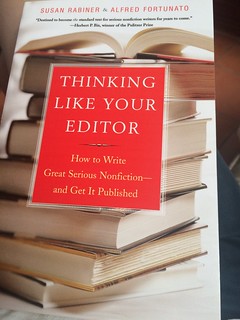
Thinking Like Your Editor (Rabiner & Fortunato) – my reading notes

by Raul Pacheco-Vega

Thinking Like Your Editor (Rabiner & Fortunato)One of the things I’ve learned through the years is that there is no single panacea for anything. In the line of research I do (comparative public policy), I always find that there are so many different ways of getting governments and individuals to do things and achieve certain goals that there is no single public policy instrument to solve all society’s ailments. The same is true of academic writing. By now, I have read probably a dozen or so books on how to improve scholarly prose, and how to produce better text at a faster rate. I’ve pored over workbooks, short volumes and reference texts in order to find That Magical Piece of Advice on How To Publish More, Higher, and Better. You can find several blog posts that summarize my Reading Notes of each one of these books, under my Resources website tab. The truth is that panacea, information that will make books automagically appear DOES NOT EXIST.

At the very least, it does NOT exist in the form we would like it to exist.

One of the books I’ve recently acquired, and I did so because I have a few books on the go (as in, writing, completing, finishing up), is the Rabiner and Fortunato volume “Thinking Like Your Editor: How to Write Great Serious Non-Fiction and Get It Published.“.

There are a number of books for when you want to publish a scholarly book (like William Germano’s Getting It Published), when you want to edit your doctoral dissertation to make it into a university press or scholarly, more general book (like Germano’s From Dissertation to Book), but Rabiner and Fortunato’s volume is specifically for academic trade books.

It’s important to decide which one you want to write (or when revising your dissertation to become a book, which book you want to produce). I really enjoyed that Rabiner and Fortunato showcase acquisitions editors’ thinking and decision-making processes.

For anyone who wants to write a book proposal, having the answers (and good responses, specifically!) to The Big Five is fundamental.

Something I noted in a Twitter thread on publishing I posted a couple of weeks ago that Rabiner and Fortunato make clear: your book proposal should tell what’s different.

How does your book change our thinking about something?

Why are previous treatments of the subject insufficient to provide a fuller picture?

One of the best ways to learn how to write the answers to these questions is, as I’ve noted in this thread, to read book introductions.

As I’ve noted in earlier threads, you should read A TON of book introductions to see the stylistic manoeuvring that comes with showing a gap. For example, as I noted on Twitter, this would be a way to write about how a book on subnational Mexican water laws improves our understanding of water governance above and beyond what we already know.

“Gomez and Gonzalez showcase how Mexican water laws evolved. However, their analysis lacked subnational comparisons, which I do here”.

As I noted on Twitter, I love that Rabiner & Fortunato provide so many concrete examples that they work the reader and prospective author through, asking them “now, YOU go and do it“. Academic writers need LOTS of examples, and at least I can say I learn better when shown how I should be doing things.

Something disappointing from books about academic writing, as I noted on Twitter and here too, is that there isn’t a book about How To Write A Book. They all compress lessons.

I was also impressed by the abundance of examples and walk-throughs that Rabiner and Fortunato offer. For me the most impressive of them all was their Full Sample Submission Package. Germano does this too, in both of his books, but I found Rabiner and Fortunato’s submission package really useful to think about mine.

Truth be told, I am beginning to understand why the market for books on academic and non-fiction (and fiction!) writing keep getting sold. There’s always SOMETHING that you can learn from each one. In this case, I learned A LOT from Rabiner and Fortunato for the kind of books I want to publish later in my career (academic trade books). Definitely worth reading.

30 Apr 02:20

Perennial Cycle Pastry Ride

by jnyyz

Perennial Cycle is a bike shop that I’ve wanted to visit for many years. Back when I was living in Michigan, I’d occasionally things from them since they carried many unique items for recumbents, such as Radical Designs panniers. This past weekend, I had the opportunity to stay in Minneapolis and so I finally got to see the shop in person. Even better: on Saturday they were running one of a series of Pastry Rides to promote #30daysofbiking during April.

DSC02339

DSC02340

Not quite knowing what to expect, my buddy Steve and I arrived at the shop at about 9 am. Quite a large crowd had already gathered.

IMG_8322

We borrowed bikes for the occasion. Where else in North America are you going to find a bike shop where the rentals are Bromptons? Mine was a superlight with dynamo lighting and a third party midrise bar. Quite an upgrade from my own number.

DSC02293

Steve talks to a fellow Brompton rider.

DSC02294

Yuba bikes was sponsoring today’s ride. This Supermarché was put to work hauling coffee from Peace Coffee. Note the Brompton shipping cartons.

DSC02295

All shapes and sizes of bikes and riders were in evidence.

DSC02296

Retrogrouch representation.

DSC02298

Mark and Mary were riding this Vision tandem with OSS and IPS.

DSC02299

Martha gets us organized just before we start.

DSC02300

Our lead off rider was on a Brompton.

DSC02301

Here we go.

DSC02302

Stopped on Humboldt at Lake.

DSC02305

Turning east on the Midtown Greenway.

DSC02306

This section has a pedestrian section marked by a white line on the right.

DSC02307

Here the pedestrian path is slightly separated.

DSC02309

The offramp towards Nicollete.

DSC02310

Going north on Nicollette Ave.

DSC02312

DSC02313

Arriving at the Minneapolis Institute of Art.

DSC02315

Group picture. There were about a hundred of us.

DSC02316

DSC02317

And now pastries and coffee. Pastry from the Salty Tart.

DSC02318

Steve and I.

IMG_8323

Lots of fun talking with like minded cyclists. Minnesotans are very friendly! Since I happened to be riding a Brompton, there was lots of Brompton related chat as well.

Selfie with shop owner Luke Breen, who is a good guy.

IMG_8324

Luke is now giving away raffle prizes. If you go on one of their rides, be sure to sign up; there were some pretty nice things being given away.

DSC02319

At this point, we decided to leave a bit early. Mark and Mary were kind enough to lead us back on their tandem. Here’s glimpse of a separated bike lane on 26th.

DSC02320

Here on the greenway, we pass some Department of Transportation staff who were demonstrating an Autonomous shuttle. They yelled out that we should stop to check it out, but I responded that we preferred human power which drew a chuckle.

DSC02321

Back at the shop, it was time to take a look around. I really liked this mini bike rigged up to demonstrate dynamo lighting.

DSC02292

The colorway on this bike is clearly meant for adults, not kids.

DSC02289

Here is their rack of Bromptons. The gray ones on the bottom row are rentals.

DSC02322

A good selection of Catrikes.

DSC02323

Recumbents, long tails, and commuter bikes.

DSC02324

Of course I couldn’t leave empty handed. Among the things that I got were a SpedDial clamp set, and a Radical carrying bag that got a rave review on their website.

DSC02325

Thanks so much to Luke and his staff for their hospitality. If you want to visit a great bike shop that carries all manner of bikes that are not for the MAMIL set, you should definitely check it out.

Also thanks to the Salty Tart for their treats. Here is their stand at MSP.

IMG_8330

An additional shout out to Martha who apparently wants to visit this shop in Toronto that is just around the corner from where I buy most of my groceries.

#itsasmallworld #supportindependentbusiness

IMG_8335

Update: Perennial Cycle has posted their photo album here.

Just a few more pictures:

Just around the corner from the bike shop is a bike share station. It looks like it is run on the same platform as Toronto’s system.

DSC02291

There were a variety of bike racks around town. These didn’t look that space efficient.

DSC02326

This was was better.

DSC02336

30 Apr 02:18

The weirdest thing I've learned from criticising capitalism online is a large number of people seem to just flat out deny that workers are subordinate to capital. You'd think they'd realize when they show up to work and have to start taking orders from this guy called "boss".

by existentialcoms
mkalus shared this story from existentialcoms on Twitter.

The weirdest thing I've learned from criticising capitalism online is a large number of people seem to just flat out deny that workers are subordinate to capital.

You'd think they'd realize when they show up to work and have to start taking orders from this guy called "boss".


Posted by existentialcoms on Saturday, April 28th, 2018 5:43pm


2108 likes, 478 retweets
30 Apr 02:18

For thousands of years humanity was just going about its business, then suddenly someone was like, "wait wtf? How does any of this shit even work?" And thus philosophy was invented.

by existentialcoms
mkalus shared this story from existentialcoms on Twitter.

For thousands of years humanity was just going about its business, then suddenly someone was like, "wait wtf? How does any of this shit even work?"

And thus philosophy was invented.


Posted by existentialcoms on Sunday, April 29th, 2018 12:37am


1906 likes, 498 retweets