Rolandt
Shared posts
Solving the Knapsack Problem in Go for my real-life carry-on bag
Made my first commit to GitHub, posting an Appl...
Made my first commit to GitHub, posting an Applescript I tinkered on the past few days. (I noticed I have had a github account since 2012, not sure why)
Top 10 Android app stores in China in Q1 2018
New Video – The Strangest Of Things
Here’s a thing I haven’t posted in a while – a new video up on YouTube, called the Strangest Of Things (for reasons that may become apparent when you hear it.)
 The other day, I got a new pedal – it’s one I’ve been wanting to try for a LOOOONG time, so I was excited to sit down and get some experimenting time in with the Pigtronix Mothership 2 Analog Synth. Those of you who’ve been following things here fro a while will know that I view pedals and processing as part of my instrument – change a pedal and it fundamentally changes what my instrument is. I don’t view it as processing a bass guitar, but building an instrument that makes a range of sounds in a number of ways. So sticking something as radically sound-altering as a synth pedal in there has all manner of amazing possibilities.
As you can maybe see from the pic, there’s a TON of control over the sound – meaning you can either get a very specific sound you want and leave it (the other video I posted yesterday to Instagram was more of that kind of approach, trying to get Bernie Worrell’s keyboard bass sound from Flashlight…) or you can have it at hand-height and tweak it the way you would a modular synth.
So, here’s the video:
I’m running my Elrick Gold Series SLC signature fretless 6 into a signal path that includes the Aguilar Tone Hammer, Pigtronix Philosopher compressor, Jule Monique tube preamp, MOD Duo running a wide stereo chorus, EQ and a cab sim, and then the MXR Reverb for those trapped chords in the middle. The fretless seems like the perfect instrument for experimenting with synth, as it gives you a second way to control the portamento on the notes – the Mothership 2 has a ‘glide control’ – you can hear that towards the end, where the notes start swooping up and down in insane ways – but I can control that glide as well on the fretless just by sliding 
The cut-up effect at the beginning is all done in the Looperlative LP1 – the effect is ‘quantise replace’, and I’m swapping out 1/16th of the loop each time, sometimes with a block that’s an octave higher (by changing the speed of the replaced bit) and sometimes it’s pitch-shifted (but slowing down the loop by a particular fraction while the replace is happening) – it starts chaotic, and suddenly this amazing glitchy beautiful ostinato emerges! The filter at the end is the Kaoss Pad Mini – the drums and the glitch-line are on different tracks in the LP1, so I can route that synth part to the aux out which has the KP Mini after it.
The glitchy drum sounds are a sample set I assembled from various sources in FL Studio played in on the Quneo. The whole thing is improvised live and unedited.
I love this stage of getting ideas together with new parts to my instrument – it’s slightly Jackson Pollock-esque in that you get to throw ideas at the canvas and see what happens. How well defined the canvas is depends on how cavalier you are with the rest of the parameters. Here, I’m pretty familiar with that quantise replace function on the Looperlative, though as this is a completely redesigned version of the software (running on the first of the new hardware boxes! yay!) it does actually respond slightly differently… But it’s in 4/4, and it wasn’t to hard to work out what the key centre was once the glitchy line was running (though I can’t fully predict what the notes will be with the pitch shifted replace function! I mean, I could work it out, but I like the madness of it  ) – so this is experimental stage 0.1 – definitely in Beta mode. Some of the synth stuff has wonky squirrelly pitch, though that does feel more like a 70s thing, given how unpredictable the original voltage controlled synths were…
More soon!!
Online learning isn’t as inclusive as you may think

Erin Clow, Klodiana Kolomitro,
University Affairs,
May 07, 2018

I will agree that inclusivity is more than just access, pace and choice of learning paths. But I push back against the idea that "a sense of isolation and a lack of community for both students and faculty" are unique to online learning. I've seen it in in-person classrooms. For example, the authors write that "community guidelines in a 'traditional' in-person classroom are often set through a collaborative process where both students and faculty are actively engaged." Maybe. Sometimes. But more often, in my experience, these guidelines are simply dictated by the instructor or professor. Yes, we need to model "values of fairness, empathy, acceptance, kindness, respect, and responsibility." But this is as true offline as online, and is no easier in person than digitally.
Web: [Direct Link] [This Post]An analysis of Twitter’s screwup (with comments from Melissa Agnes)
Twitter screwed up and wrote everybody’s passwords to a file in plaintext. Then (of course) they apologized. Can we do better with these apologies? And what’s the fallout from this incident? Here’s an analysis and a conversation with Crisis Communication expert Melissa Agnes, author of Crisis Ready. This is getting routine. And that’s the problem. At … Continued
The post An analysis of Twitter’s screwup (with comments from Melissa Agnes) appeared first on without bullshit.
Motordom Goes Big with SUVs, Sheds Sedans

Hitting the news feeds these days is some pick-up of a new, disturbing trend in the automobile sector.
The Vancouver Star reports the major car manufacturers are now cutting down the variety of motor vehicle models available to the consumer.
As reporter Michael Lewis points out, ten years ago sedans were almost 40 per cent of the American market; SUVs sat in the number two position at 29 per cent, with pick-up trucks at 13 per cent.
That’s all changed.
Sport utility vehicles now command 43 per cent of the market, with sedans at less than 28 per cent. The Ford Company has decided to stop all their North American vehicle production except for the Mustang and a Focus ‘crossover hatchback’.
Ultimately, sedans are disappearing, and ‘buyer preference’ is for ‘bigger ride drives’ like light trucks and SUV’s; it appears to be yet another sign of a major cultural shift.
Imagine the implications — the idea of a utilitarian family car that carries kids, dogs, and groceries is kind of last century. Other automakers are also reducing production of sedan-like automobiles.
Perhaps the most telling statement, however, is made by auto historian John Wolkonowicz: “This is going to be disappointing to a lot of people, but most of those people are over 50. This is about making money. This is what Wall Street demanded.”
The “go big” trend in motor vehicles was helped along by the current American president’s promise to roll back the fuel efficiency standards. And so now it’s no surprise that, even with higher fuel prices in the last sixty days, people are still buying SUVs.
And don’t think we are more ecologically aware in Canada, where light trucks were 71 per cent of sales in March 2018. Sedan car sales fell over 12 per cent in the same month. Better fuel efficiency and more efficient engines have assisted in sales of the larger sized vehicles. There is still almost a 30 per cent differential in fuel use between small and large vehicles, but consumers are embracing the shift up into bigger, heavier vehicles.
The car companies are looking at hybrid fuel systems or plug-ins. Ford plans to release a hybrid Escape, Explorer and Bronco in 2020.

Seattle: The single-family zoning lock-up
Another backgrounder on the housing dilemma from the Seattle Times. And just so you know, it’s estimated that 80 percent of residential land in Vancouver is zoned for ‘single-family’ — a misleading term, since it doesn’t define family, and almost every sf-home in Vancouver can have multiple units via secondary suites and lane houses. But you get the idea — they’re low-density, separated and super-expensive.
Rapidly growing Seattle constrains new housing through widespread single-family zoning
This is the second edition of real-estate reporter Mike Rosenberg’s new housing column, which takes a deeper dive into the booming housing market and answers reader questions. Read the first instalment here.
In Seattle, 69 percent of residential plots of land are occupied by single-family houses, according to Attom Data Solutions, which has an extensive nationwide property database and ran the numbers for me. That’s about average when looking at the 50 biggest cities in the country. But compared to other peer cities with expensive housing, Seattle generally devotes a lot more of its housing to single-family homes:
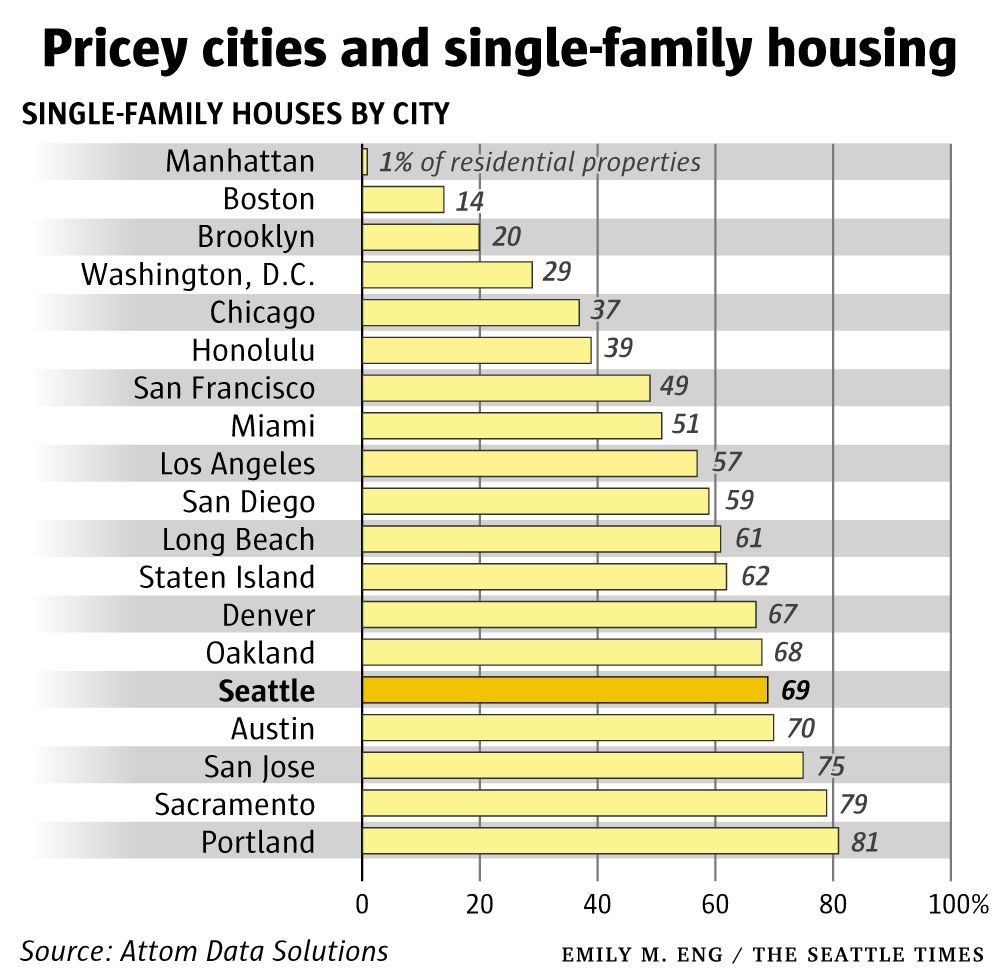
… In Seattle, tall, dense buildings are generally allowed in the greater downtown region and in outlying areas near transit (think downtown Ballard or the West Seattle Junction). The majority of land – everything in yellow in this map – is restricted exclusively to single-family homes:

… Last year, 88 percent of the city’s new housing was crowded into dense neighborhoods that make up just 18 percent of the city’s residential land area (the pink zones here):

… On average, it takes at least seven new homes on one property before each one is cheaper than the older, single house it replaced, the Sightline Institute found. …. Essentially Seattle has managed to get the bad parts of a luxury housing boom without reaping any of the benefits of a housing-supply boom.
To have a real impact on affordability, Seattle would need to build a lot more of these smaller homes in taller buildings – a complete overhaul to neighborhoods that existing homeowners (the majority of city voters) are likely to oppose. This is why the city has only tiptoed around relatively small changes to single-family neighborhoods (a few years ago, a proposal to add much more density to single-family zones was so poorly received by homeowners it was dropped in a matter of weeks). …
Even now, all the upzones the city has proposed and is considering enacting in the coming months would affect just 6 percent of the city’s single-family zones – the current plan would generally just allow taller buildings in areas where some density is already allowed.
Homeschooling over time
I keep on thinking how needs of a homeschooling family change over time. No data-based generalisations here, just observations.
In the beginning it’s all about role-models and information. Finding people, who made the choice, and figuring out how to fit it in in the own circumstances. Vision (why and what) and boundary conditions.
Once the choice is made the need for acceptance and like-minded people becomes very strong: at the beginning the stress from explaining and defending “deviation from the norm” is very high and it helps a lot to be with people who share your views.
Than come practicalities: finding or creating a social space where kids can see others (because all their peers go to school), do things together and learn how to learn. At the same there is a strong need to learn and to talk to other parents, because this is when educational choices are being made, practices are tried out and replaced with something that works better for particular family and specific kids. These are also the challenges of building an environment to support the basics – rhythm, space, materials, learning to facilitate, getting into reading, writing, math, working with resources, managing questions and time.
And then there is plateau. Friends are found, choices made, routines are working. Foundation is there and the big question is what exactly are you building there. The moment than the vision that started it all becomes the reality. And a big question, can you actually build something what would make all this effort of “doing things differently” worth the trouble.
We are now at that stage. Defences are not needed, basics are covered and the playing field is open. Curious to see what it brings.
Slow Slow Slow Your Bike
Here’s a fun and gentle way to persuade people on bikes to slow down at the busy bike/ped intersection near Science World in Vancouver.
As usual, click an image to see a larger version slideshow of both.


Note a few things that make the message both light-hearted and prominent.
- Lane divider made from the bright fiberglass hull of — what? Too big for a Dragon Boat? But very much in keeping with the nautical activity nearby on False Creek.
- Paddle-shaped sign bearing an adaptation of the ancient nursery rhyme we all know: “Slow slow slow [your bike]” on one side, and on the other side the rhyme morphs into the standard, mellow exhortation about attitude and style: “Gently down the stream“…
Retrobatch Public Beta
Retrobatch is the name of my new MacOS app, and it's in public beta right now.
Retrobatch is a node based (not the JS language) batch image processor. A bit like Quartz Composer, and a bit like Audio Hijack. But for images. Lots and lots of images (or maybe a few or even one).
For years, people have wanted me to add batch processing of some kind to Acorn. It's been possible to automate things with JavaScript or AppleScript or Automator in Acorn, but it's never been super easy to set up and you needed to know a bit of programming to get anything really useful done. So I always had ideas in the back of my head for what it would look like.
But to do it right, it would need to be a new app. And then sometime late last summer, I decided it was time and I started working on Retrobatch.
But why node based? Every batch image processor I've come across was linear. You put images in one end, and out they came the other side. But that's so limiting! What if it was possible to take a folder of images and then operate on them twice with the same workflow? What if you could create branches where one would resize images to 50%, and another write out PNG files with the @2x suffix added to the file name? What if you had a workflow that referenced multiple folders which combined into a single output?
And all the possibilities! What if you could read an image from the clipboard, apply a filter to it, and write it to a folder and to the clipboard? What if you had a way to separate out PNG images of a certain size from a folder and only do an operation to those? What if you could script the application in response to new images being added to a shared folder? What about if it could capture all the open windows of your favorite application as images, then apply a filter to those, and then write out a layered PSD of those windows? What if you wanted to apply a machine learning model against your images, to figure out which contains pictures of hotdogs in them, and then perform some action based on that?
There's like, a trillion possibilities. Probably more. Beta testers have been surprising me with interesting workflows.
Anyway, you can do all that with the Retrobatch beta today with a free trial.
When it finally hits 1.0, fingers crossed, there will be two versions of Retrobatch- Regular and Pro. Pro will have all the nodes you see today, including advanced features such as machine learning, changing bit depths and color profiles, processing with AppleScript and shell scripts, rules, and advanced metadata entry. The Regular version will allow you to do the basics like cropping, resizing, watermarks, and so on. And there will be two prices as well. But right now, while it's in beta, you can purchase Retrobatch Pro at a reduced price.
Charging for a beta app? Yep- Retrobatch is very useful in its current state and people have been wanting to give me money already. So who am I to argue? In addition to that, bundles are back at the Flying Meat webstore. If you purchase multiple copies of Retrobatch, or a copy of Retrobatch and Acorn, or any of the above, you'll get a nice discount.
So go grab a beta copy of Retrobatch and send us feedback to help shape what it looks like in the future, or chat about it in the new Retrobatch forums.
And finally, here's a quick video showing off a workflow for making @1x and @2x images with Retrobatch.
May 4th, Remembrance Day
Today is Remembrance Day in the Netherlands. In a few minutes, at 20:00, traffic and public transport will come to a standstill, and the entire country will observe 2 minutes of silence, with flags everywhere at half mast. To remember all victims of WWII and all victims of war since then.

Apart from participating in remembrance events in our former home town, the two most impressive May 4ths in my memory are once when I was driving and once on Amsterdam Airport. While driving with a friend we parked the car in time. Behind us on the motorway itself trucks slowed down traffic in all lanes and came to a halt right at 20:00. The parking lot was filled with people, all strangers, standing still beside their cars. Then after two minutes of silence, we nodded to the people around us, and all went on their way again. At the airport I once arrived from abroad shortly before 20:00, and I had just entered Arrivals while Remembrance Day was announced in four languages. At 20:00 everyone just suddenly stopped walking and stood still. Except for a few very confused people from far abroad, who wandered around a bit and then not knowing what to do also stopped walking.
The KM Pipeline won’t lower gas prices
The idea that somehow expanding the TransMountain pipeline will lower prices at gas pumps in Greater Vancouver is actually nuts. This info graphic from The Wilderness Committee explains why.


Apple’s iPhone X was the world’s top selling smartphone in first three months of the year, says report

Sales speculation surrounding Apple’s iPhone X has been interesting to track.
First, prior to the phone’s release, it was assumed that Apple’s 10-year anniversary device would be a hot, difficult-to-purchase commodity. Next, when reports of sales expectations not being met began to emerge, many — especially YouTube personalities — framed the iPhone X as a disaster of epic proportions for Apple.
While Apple doesn’t break out specific sales numbers for iPhone models in its official earnings reports, we do know that the tech giant’s smartphone sold 52.2 million iPhones in Q2 2018. Now, a new study from Strategy Analytics is shedding light on specifically how many iPhone X smartphones the company sold in the first three months of year, giving us a window into how well the smartphone has performed in the sales department.

Apple’s iPhone X captured a 4.6 percent market share of all smartphone models shipped during the quarter, with 16 million units shipping in the three months ending on March 31st. This is a sizeable number compared to other iPhone models, with the iPhone 8 and 8 Plus shipping 12.5 million and 8.3 million units each. The iPhone 7, Apple’s 2016 smartphone, shipped 5.4 million units, according to Strategy Analytics.
In terms of the Android market, the study indicates that Samsung’s Galaxy S9+ shipped 5.3 million units in the first quarter of 2018.
“For the second quarter running, the iPhone X remains the world’s most popular smartphone model overall, due to a blend of good design, sophisticated camera, extensive apps, and widespread retail presence for the device,” said Juha Winter, senior analyst at Strategy Analytics, in a press release.
During Apple’s recent earnings call Tim Cook, the company’s CEO, spoke highly of the iPhone X in response to questions concerning the expensive phone’s sales performance.
“Customers chose iPhone X more than any other iPhone each week in the March quarter, just as they did following its launch in the December quarter,” said Cook.
Apple surpassed expectations with its Q2 2018 earnings despite expectations that iPhone sales would begin to dwindle.
While Apple may discontinue the iPhone X soon, the smartphone’s key features, including Face ID and Animoji, will almost certainly trickle down to upcoming iterations of Apple’s smartphone.
Source: Strategy Analytics Via: CNBC
The post Apple’s iPhone X was the world’s top selling smartphone in first three months of the year, says report appeared first on MobileSyrup.
Canada’s hottest streetwear brand is… No Frills

No Frills is using its iconic yellow and black branding to create a line of streetwear-inspired clothes.
The brand is called Hauler and the shirts can be previewed right now at Hualer.com. So far there are two short-sleeved T-shirts and a long-sleeved tee in bright banana yellow and a lone black hoodie.
There are no prices yet, but there is an Instagram account that showcases the clothing out in the real world.
According to the Instagram account, the shirts will drop on May 7th and they can be bought online. It also seems like the shirts will be available in some physical locations, since they have a list of cities on the back along with a few Instagram posts that share some store names — so keep your eyes peeled and you might see a pop-up shop in your local No Frills on the 7th.
Below, find my fashion critiques.
 While I was never a No Frills employee myself, I had tons of friends who worked at the local Sterling’s No Frills and they would would call this look “pushing carts and breaking hearts.”
This look kind of confuses me because it looks like something an actual No Frills worker would wear, but I am a sucker for the twist on the “thank you for shopping” slogan. Gonna be honest here, the fact that No Frills created a streetwear brand and didn’t put a single banana anywhere was throwing me off but the more I’ve looked at the shirts I can only congratulate them on their bravado. This is almost as courageous as Apple dropping the headphone jack, except this move might actually pay off.
This isn’t the first group that has capitalized on No Frills branding. The Parkdale Life group created some No Frills inspired streetwear shirts that sold out in 45 minutes when they went on sale in 2017. The proceeds from the Parkdale Life shirts were all donated to the Parkdale Food Bank, so it will be interesting to see what happens with the profits from the the Hauler-branded clothing.
Image credit: Hauler
Source: Hauler, Toronto Star
The post Canada’s hottest streetwear brand is… No Frills appeared first on MobileSyrup.
Chrome OS is getting a little closer to Android

Chrome OS has had the ability to support some Android apps for a while and it looks like the integration between these apps is getting a little better with the addition of ‘app shortcuts.’
‘App shortcuts’ are what happens when a user presses down on a home screen application to reveal some quick setting or other options.
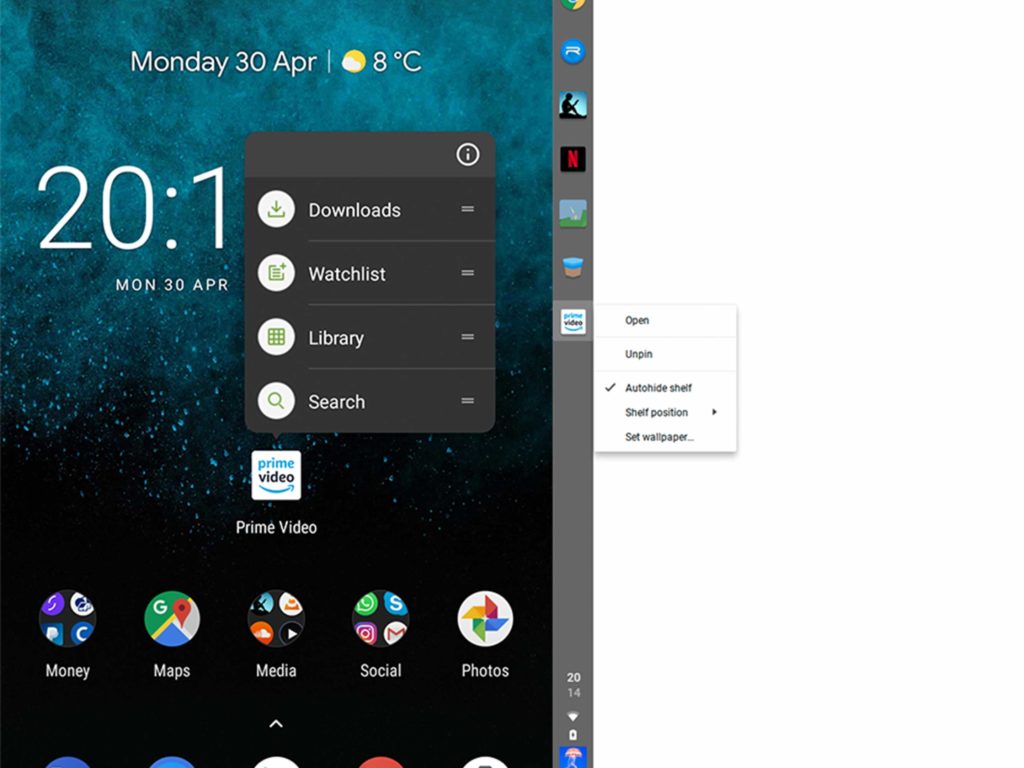
To access an ‘app shortcut’ on Chrome OS a user simply has to right-click on an Android app and if the app has shortcuts on Android, they’ll be available on Chrome OS too.
So far the code for ‘app shortcuts’ is still a work in progress according to XDA Developers, but it’s still good to know that Google is working to bring more support to Android apps on Chromebooks.
Image credit: XDA Developers
Source: XDA Developers
The post Chrome OS is getting a little closer to Android appeared first on MobileSyrup.
Pocket Casts Acquired
Pocket Casts, one of the most popular cross-platform podcast clients (and among the top ones listeners use to download episodes of AppStories), has been acquired by a consortium of public radio stations and podcast companies. Here's Shifty Jelly's Russel Ivanovic, writing on the company's blog:
Today we’re excited to announce a partnership with some of the biggest producers of podcasts in the world to take Pocket Casts to the next level. We’ve had a lot of companies in the past contact us about acquiring us and or Pocket Casts and we’ve always had one simple answer for them: thanks, but no thanks. In talking to each of them it was obvious that they didn’t have the best interests of our customers or us at heart and as much as cashing out and walking off into the sunset is a nice ideal, it’s a crummy outcome for all of you and in turn for us. You see we care so damn deeply about what we’ve built and our relationship with each and every one of you that we know deep down inside that would just eat away at us. That’s why when a combined group comprised of WNYC, NPR, WBEZ and This American Life approached us with the goal of partnering for the good of the entire podcast industry, we knew that this opportunity was something else entirely. Everything from their not for profit mission focus, to their unwavering belief that open and collaborative wins over closed walled gardens resonated deeply with us. Together we have the passion, scale and laser focus needed to achieve some truly great things. We’re not ready to talk about what those are just yet but we do want to quickly cover some questions you might have.
According to Ivanovic, Pocket Casts will remain a standalone, open, and premium podcast client in the short term. I'm curious to see how Pocket Casts will change over the next several months though. Large radio stations and podcast companies seem to have a certain affinity for locked-in ecosystems and proprietary listening features at the expense of the open nature of podcasting. I won't be surprised if Pocket Casts eventually prioritizes programming by the companies that own the app. However, I also hope that the folks at Shifty Jelly will be able to continue making the open, elegant, and powerful podcast app I've used over the years.
See also: Chris Welch's story at The Verge.
→ Source: blog.shiftyjelly.com
Seventeen Minutes From Tweet To Package
Earlier today, @noamross posted to Twitter:
#rstats #lazyweb What's the R/httr/curl equivalent of
curl -F "file=@somefile.html" https://t.co/abbugLz9ZW
— Noam Ross (@noamross) May 3, 2018
The answer was a 1:1 “file upload” curl to httr translation:
httr::POST(
  url = "https://file.io",
  encode = "multipart",
  body = list(file = httr::upload_file("/some/path/to/file")),
)
but I wanted to do more than that since Noam took 20 minutes out his day this week (with no advance warning) to speak to my intro-to-stats class about his work and R.
The Twitter request was (ultimately) a question on how to use R to post content to https://file.io. They have a really simple API, and the timespan from Noam’s request to the initial commit of a fully functional package was roughly 17 minutes. The end product included the ability to post files, strings and R data (something that seemed like a good thing to add).
Not too long after came a v0.1.0 release complete with tests and passing CRAN checks on all platforms.
Noam also suggested I do a screencast:
You should do a screencast of your process for this.
— Noam Ross (@noamross) May 3, 2018
I don’t normally do screencasts but had some conference call time so folks can follow along at home:
That’s not the best screencast in the world, but it’s very representative of the workflow I used. A great deal of boilerplate package machinations is accomplished with this bash script.
I wasn’t happy with the hurried function name choices I made nor was I thrilled with the package title, description, tests and basic docs, so I revamped all those into another release. That took a while, mostly due to constantly triggering API warnings about being rate-limited.
So, if you have a 5 GB or less file, character vector or in-memory R data you’d like to ephemerally share with others, take the fileio package for a spin:
devtools::install_github("hrbrmstr/fileio")

fileio::fi_post_text("TWFrZSBzdXJlIHRvIEAgbWUgb24gVHdpdHRlciBpZiB5b3UgZGVjb2RlIHRoaXM=")
##   success    key                   link  expiry
## 1    TRUE n18ZSB https://file.io/n18ZSB 14 days
(bonus points if you can figure out what that seemingly random sequence of characters says).
Review – Scrum: The Art of Doing Twice the Work in Half the Time
 Scrum: The Art of Doing Twice the Work in Half the Time. Jeff Sutherland and JJ Sutherland
There’s a rule of thumb in software development circles that the best programmers can be ten times as productive as average programmers. This is the underlying argument for why organizations seek to find and hire the best people. There is research to support this disparity in productivity. There is similar research on the relative productivity of teams. There, the range in productivity between the best and the rest is closer to two orders of magnitude; as much as a 1,000 times more productive.
Jeff Sutherland makes the case that the practices that collectively make up “Scrum” are one strategy for realizing those kinds of payoffs.
Sutherland is a former fighter pilot, a software developer, one of the original signatories of the Agile Manifesto, and the inventor of Scrum. This is his story of how Scrum came to be, what it is, and why it’s worthwhile. The particular value of the book is its focus on why Scrum is designed the way it is and why that matters.
Scrum’s origins and primary applications have been in the realm of software development. Sutherland builds an argument that Scrum’s principles and methods apply more broadly. Although he doesn’t make this argument directly, this wider applicability flows from evolutionary changes in the the organizational environment. Changes in the pace and complexity of organizational work simultaneously make conventional approaches less effective and Scrum more so.
Scrum is a collection of simple ideas; it’s a point of view about effective problem solving more than a formalized methodology. That’s important to keep in mind because like too many solid ideas, the essence can get lost in the broader rush to capitalize on those ideas. There appear to be an unlimited supply of training courses, consultants, and the usual paraphernalia of a trendy business idea; you’re better off spending time reading and thinking about what Sutherland has to say first. That may be all you need if you’re then willing to make the effort to put those ideas into practice.
Sutherland traces the roots of Scrum to the thinking underlying the Toyota Production System. He also draws interesting links to John Boyd’s work on strategy embodied in the OODA Loop and to the martial arts. Scrum is built on shortening the feedback between plans and action. It is a systematic way of feeling your way forward and adapting to the terrain as you travel over it.
Sutherland draws a sharp contrast with more traditional management techniques such as Waterfall project management approaches and their well-worn trappings such as Gantt charts and voluminous unread and unreadable requirements documents.
Understanding the managerial appeal and limitations of these trappings is key to grasping the contrasting benefits of Scrum. Waterfalls and Gantt charts appeal to managers because they promise certainty and control. They can’t deliver on that promise in today’s environment. In the software development world, they never could and in today’s general organizational environment they also come up short.
Understanding that appeal and why it is misplaced clarifies the strengths of Scrum. There was a time when managers came from the ranks of the managed. They had done the work they were now responsible for overseeing and were, therefore, qualified to provide the direction and feedback needed to pick a path and follow it. Management was primarily about execution and not about innovation.
The illusion in waterfall and other planning exercises is that what we are doing next is a repeat of what we have done before. If we have built 100 houses, we can be confident of what it will take to build the 101st. If we are building a new road or a new bridge, then what we have learned from the previous roads and bridges we’ve built can provide a fairly precise estimate for the next.
This breaks down, however, when we are building in new terrain or experimenting with new designs. The insights and experience of those who’ve built in the past don’t transfer cleanly to this more dynamic environment. The world of software has always been new territory and we are always experimenting. The terrain is always in flux even when the technology is temporarily stable. Now, it is those who are doing the work who are best positioned to plan and manage as we move into new territories and terrain.
Scrum comes into play when we are moving into territory where there are no roads and are no maps. If you are moving into new territory you can only plan as far ahead as you can see. There are no maps to follow. Sutherland puts it thus:
Scrum embraces uncertainty and creativity. It places a structure around the learning process, enabling teams to assess both what they’ve created and, just as important, how they created it. The Scrum framework harnesses how teams actually work and gives them the tools to self-organize and rapidly improve both speed and quality of work.
There’s a terminology and a set of techniques that make up Scrum. Sutherland covers the basics of such notions as scrum masters, product owners, backlog, sprints, retrospectives, communication saturation, continuous improvement, and stand up meetings. But he’s no fan of turning these into dogma.
Scrum runs the risk of being viewed as no more than the latest management fad. Sutherland is a true believer and has evidence to support his belief. There are lots of true believers but only a few are willing to bring substantive evidence to back up that belief. That earns Sutherland the right to offer his own closing argument:
What Scrum does is alter the very way you think about time. After engaging for a while in Sprints and Stand-ups, you stop seeing time as a linear arrow into the future but, rather, as something that is fundamentally cyclical. Each Sprint is an opportunity to do something totally new; each day, a chance to improve. Scrum encourages a holistic worldview. The person who commits to it will value each moment as a returning cycle of breath and life.
The heart of Scrum is rhythm. Rhythm is deeply important to human beings. Its beat is heard in the thrumming of our blood and rooted in some of the deepest recesses of our brains. We’re pattern seekers, driven to seek out rhythm in all aspects of our lives.
What Scrum does is create a different kind of pattern. It accepts that we’re habit-driven creatures, seekers of rhythm, somewhat predictable, but also somewhat magical and capable of greatness.
When I created Scrum, I thought, What if I can take human patterns and make them positive rather than negative? What if I can design a virtuous, self-reinforcing cycle that encourages the best parts of ourselves and diminishes the worst? In giving Scrum a daily and weekly rhythm, I guess what I was striving for was to offer people the chance to like the person they see in the mirror.
The post Review – Scrum: The Art of Doing Twice the Work in Half the Time appeared first on McGee's Musings.
The Best Basic Smoke Alarm

After more than 65 hours researching fire safety, interviewing five experts, and reading well over a hundred pages of smoke-alarm data, we recommend the First Alert SA511CN2-3ST Smoke Alarm with Voice Location as the primary alarm in a comprehensive whole-home fire-protection system.
Our Looming Tower – 6
Vancouver House is near its maximum height. And it’s changing colour from the ground up.

As seen from Burrard Bridge.
I remember the remarks of a resident of the south shore who opposed the loss of views as the new towers were going up in the Beach neighbourhood (between the Burrard and Granville bridges).
In particular, he was appalled at the height of James Cheng’s 888 Beach Ave, the white and green high-rise immediately left of Vancouver House.
“It’s as tall as the Black Tower,” he said, referring to the TD building on the southwest corner of Granville and Georgia. (That building holds a special place in the urban history of Vancouver. It was so reviled that a black tower has not since been built. Maybe it’s the reason why we went to that pale green.)
In any event, the aforementioned resident was right. It was one of the tallest condo towers at the time (1993), but few would have imagined that, a quarter century later, it would be overlooked by another looming tower.

Where is this?

Another shot of SkyTrain from MetroTower 3, with the extended station in the centre foreground.
As the landscaping matures, the original greenway in the right-of-way takes on a more important role, given the surrounding towers that now edge it — a necessary relief.
Note how the green flows into Burnaby’s Central Park, and how the residential setback on the left ends a block before the station. The intent, I assume, is to distinguish the purely residential area to the west from the more mixed-use commercial blocks closest to the station.
Fitbit: Sinkender Umsatz trotz Smartwatches
mkalus
shared this story
from  heise online News. heise online News.
|
Fitbit setzt große Hoffnungen auf die Smartwatch Fitbit Versa.
(Bild: Fitbit)
Rund 18 Prozent Umsatzeinbuße muss Fitbit im ersten Quartal 2018 hinnehmen. Der Hersteller leidet darunter, dass Smartwatches den Fitness-Trackern immer stärker den Rang ablaufen, die eigenen Smartwatches aber noch nicht gut genug am Markt ankommen.
Im ersten Quartal 2018 hat der Hersteller von Fitness-Trackern und Smartwatches Fitbit einen Umsatzrückgang von insgesamt etwa 18 Prozent auf 247,9 Millionen US-Dollar, umgerechnet etwa 207 Millionen Euro, hinnehmen müssen. Das teilte das Unternehmen am Dienstag mit. Im Vorjahresquartal hatte der Umsatz noch 298,9 Millionen US-Dollar, etwa 249,6 Millionen Euro, betragen.
Fitbit konnte im ersten Quartal lediglich 2,2 Millionen Geräte absetzen, neben Fitness-Trackern auch Smartwatches wie Fitbit Ionic und die vor kurzem vorgestellten Fitbit Versa. Analysten hatten einen Absatz von 2,33 Millionen Wearables erwartet, im ersten Quartal 2017 hatte Fitbit noch rund 3 Millionen Geräte verkauft. Nach Unternehmensangaben sollen Fitbits Smartwatches bereits 30 Prozent des Umsatzes ausmachen. Durch die Einführung der Smartwatches sei der durchschnittliche Preis eines verkauften Fitbit-Gerätes auf 112 US-Dollar gestiegen.Trotzdem reicht dies nicht aus, die Verluste durch die sinkende Nachfrage nach Fitness-Trackern zu kompensieren.
Partnerschaft mit Google
"Wir haben im ersten Quartal wichtige Fortschritte beim Umbau unseres Geschäfts gemacht und werden uns weiterhin dem wandelnden Wearable-Markt anpassen", sagte Fitbit-Chef und Mitgründer James Park. Fitbit setzt neben der neuen Fitbit Versa Smartwatch im laufenden Jahr auch auf verbesserte Software und Services. Mit Google hatte das Unternehmen jüngst eine Partnerschaft geschlossen und nutzt künftig deren Cloud und Cloud Healthcare API, um Gesundheitsdaten auszutauschen. Außerdem sieht die Vereinbarung vor, die Machine Learning API in der Google Cloud zu benutzen, um aufgezeichnete Daten analysieren und für Fitbit-Nutzer bessere Services schaffen zu können.
Für das laufende Quartal rechnet Fitbit mit weiteren Einbußen durch den Nachfragerückgang bei Fitness-Trackern, bei gleichzeitig höherem Umsatzanteil seiner Smartwatches. Fitbit erwartet für das zweite Quartal einen Umsatz zwischen 275 und 295 Millionen US-Dollar.
(olb)
Mapping a diverse but segregated America

Aaron Williams and Armand Emamdjomeh for The Washington Post delve into diversity and segregation in the United States. The boiling pot continues to get more ingredients, but they’re not mixing evenly.
Some 50 years ago, policies like the Fair Housing Act and Voting Rights Act were enacted to increase integration, promote equity, combat discrimination and dismantle the lingering legacy of Jim Crow laws. But a Post analysis shows that some cities remain deeply segregated — even as the country itself becomes more diverse.
I like how you can easily toggle between diversity and segregation. It allows for a quick comparison of metrics that aren’t always clear-cut.
Scroll to the end to see how diversity and segregation compare in your area.
Tags: diversity, race, Washington Post
New Sonos hometheater speaker to be announced on 6 June 2018

Sonos just invited the press to an event where they will announce their new hometheater speaker. I was wrong. This is coming faster than expected. Since the new speaker comes with farfield microphones and HDMI it woll have more control over the screen. Consider this an Alex warning re: Playbase or Playbar purchases.
UPDATE: Oh Lucy! A darkly funny movie that asks: Can learning English in Japan change a woman’s life? The answer…..
Oh Lucy! has been doing so well in it’s Japan release, that the distributors, for one night only, will be showing the English subtitled version. May 17th, from 18:50 at the Eurospace Theater in Shibuya.
Shinobu Terashima is one of the few Japanese actresses who plays hardball, consistently choosing roles that blow holes in the cardboard stereotype of the Japanese woman. We all know this woman: saintly, supportive, long-suffering AND a wildcat in bed. Yawn.

作品名:『オー・ルーシー!』
公開表記:4月28(土) ユーロスペース、テアトル新宿 他にてロードショー
配給:ファントム・フィルム
コピーライト:(c) Oh Lucy,LLC
While Terashima (the thoroughbred scion of veteran actress Junko Fuji and the late Kabuki actor Onoe Kikugoro) can probably do sexy wildcat with both her hands in cuffs and wearing a straitjacket (wait a minute, maybe this is TOO sexy) she’s far less accommodating when it comes to the saintly and long-suffering bit.
Shinobu Terajima is a perfect fit for the role of Setsuko aka “Lucy,” in a funny, sardonic and ultimately warm-hearted film called “Oh Lucy!” Directed by Atsuko Hirayanagi who first penned the screenplay as a graduation project for NYU’s Tisch School of the Arts, said she was actually taken aback by the movie’s success. “Oh Lucy!” was nominated for two awards in last year’s Cannes Film Festival – a first for a Japanese director – besides winning the NHK award at the Sundance Film Festival. “I was never really interested in portraying a heroic woman, or a beautiful woman or any of that. I guess I was really tired of seeing those types up there on the screen,” said Hirayanagi. “I needed to see someone different, and came up with the idea of Lucy. She’s not young or cute but she’s really, really watchable.”

Atsuko Hirayanagi penned the screenplay to this highly rated film.
Indeed, it’s hard to tear your eyes away from Terashima as Setsuko, a 43 year old Tokyo OL (Office Lady) with just the right amount of inner venom and outward politeness, neatly balanced on the scale of Japanese womanhood. Setsuko, whose name means restraint and saving money, divides her time between a dreary office in a small company and an apartment packed to the gills with her stuff. Tokyo media has stories galore about single Japanese women of a certain age who can’t stop hoarding, and Setsuko’s little room is straight out of this urban folklore. Then one day Setsuko gets a call from her niece Mika (Shiori Kutsuna), and invited to attend an English conversation class. “The teacher is friendly and very nice,” assures Mika and Setsuko decides to go, not least because she had witnessed a suicide on the train tracks that morning. For a few minutes she had felt the chill hand of death on her shoulder, and well, life is too short to spend it being miserable, right? She may as well try something new. And new it is, with a vengeance. The drop-dead handsome English teacher, John (Josh Hartnett), makes her wear a blonde wig, pushes a ping pong ball in her mouth to correct her pronunciation, and tells Setsuko that from that moment on, her name is Lucy. Then John gives Lucy a big, tight hug. Cue, Setsuko, I mean Lucy’s swooning face.
Unfortunately, her new-found happiness is destroyed overnight. The next day she goes to class and John has left for LA, accompanied by Mika who it turns out, is his girlfriend. Setsuko/Lucy PTSDs for awhile before springing to action and books a flight to LA. That she ends up boarding the plane with her prim, correct sister Ayako (Kaho Minami) who is Mika’s mom and direly worried about her daughter – can only be described as a typically Japanese female predicament. Every time one wants to do something totally crazy, a prim correct female relative appears to drag you back to sanity. No wonder so many women remain single in this country.
Every time one wants to do something totally crazy, a prim correct female relative appears to drag you back to sanity. No wonder so many women remain single in this country.
Hirayanagi’s understanding of this particular terrain (English conversation classes, being a single woman in Tokyo, the uniformity and blandness that come with being Japanese) is frighteningly accurate. “I think being able to speak English will change a Japanese person in the most unexpected ways,” she said. “The Japanese language is just not conducive to self-expression, whereas English is all about expressing yourself, your needs, your emotions. Setsuko discovers after landing in LA that in the US, life isn’t about getting by and being right, it’s all about survival. You have to speak up, you have to make your needs known and you have to convince people of your worth. Otherwise, it’s over. It’s as simple as that.” Hirayanagi herself has been living the sink-or-swim scenario since the age of 17 when she first went to LA as a language student. After this stint, she wrangled a student visa, enrolled in San Francisco State University and launched an acting career in LA while waitressing at “Nobu” in Malibu. “Back then, I loved the anything-goes mentality of LA,” she said. “I went to every audition I could get, hustled and worked and generally lived the life of an almost-actor in LA. There are thousands and thousands of people like me. But in the end, I knew that I wasn’t really cut out for acting. I would much rather stand behind the camera, work on screenplays and make something on my own.”
Josh Hartnett even shows up playing a modern-day Charisma Man
Looking back, Hirayanagi added that her experience as an actor has proved invaluable to her filmmaking career.
“I know what actors go through, what they’re up against, their joys and struggles. I also know my way around a film set, so I could establish a rapport with the actor and crew right away.” Indeed, Hirayanagi has a reputation for being wonderful to work with – no less a personage than Kaori Momoi starred pro bono, in the short film version of “Oh Lucy!” and Josh Hartnett consented to play John because he loved the vibe of her screenplay. “They say that a director loses a limb every time s/he makes a film,” laughed Hirayanagi. “I believe that. But I think this space is where I want to be. It’s never going to get easy but at least I have the conviction that I belong here.”

作品名:『オー・ルーシー!』
公開表記:4月28(土) ユーロスペース、テアトル新宿 他にてロードショー
配給:ファントム・フィルム
コピーライト:(c) Oh Lucy,LLC
Setsuko/Lucy isn’t so lucky. The trip to LA turns out to be a journey of self-discovery as she learns some unsavory aspects of her personality and forced to admit that John – stripped of the Charisma-man status he enjoyed in Tokyo – is actually a loser. Mika had dumped him in short order and is nowhere to be found. Toxic animosity with her sister comes bubbling up to the surface. Unwanted and unhappy, Setsuko must dig deep in her heart to unearth what it is she really wants. Her life may be banal but her pain and struggle is real, and sure to strike a chord with women everywhere. More importantly, in the end she’s a different woman from the one she left behind in that monstrously cluttered apartment. Maybe learning English IS the cure-all antidote. Hey, I’m sold.
作品名:『オー・ルーシー!』
公開表記:4月28(土) ユーロスペース、テアトル新宿 他にてロードショー
配給:ファントム・フィルム
コピーライト:(c) Oh Lucy,LLC
監督・脚本:平栁敦子
出演:寺島しのぶ 南果歩 忽那汐里 ・ 役所広司 ・ ジョシュ・ハートネット
プロデューサー:ハン・ウェスト、木藤幸江、ジェシカ・エルバーム、平栁敦子
エグゼクティブ・プロデューサー:ウィル・フェレル、アダム・マッケイ
共同脚本:ボリス・フルーミン
音楽:エリク・フリードランダー
2016年サンダンス・インスティテュート/NHK脚本賞受賞作品
(2017年/日本・アメリカ合作/5.1ch/ビスタ/カラー/原題:OH LUCY!/95分)
My minimalist phone

The Verge is looking for a good minimalist phone and cannot find it. It's right here, on my wrist.
Google secretly working on a social mobile gaming startup called ‘Arcade’
Rolandtj

Google is reportedly working on creating a mobile social-gaming startup, according to a report published by Bloomberg.
The founder and co-owner of the internal Google company, reportedly called Arcade, is Michael Sayman, a 21-year-old that started at Facebook as an intern at 17. He then left the social network to join Google’s parent company, Alphabet, last year.
Arcade’s first project is set to release later this summer, with speculation indicating it will be trivia focused in some way. Given the popularity of HQ Trivia, as well as the game’s efforts to create a social network within the experience, it makes sense for Google to opt for a similar strategy when it comes to Arcade’s first title.
In an interview with Bloomberg, a Google spokesperson confirmed Arcade exists, emphasizing that the studio is focused on “mobile gaming with friends.”
The project is part of Google’s Area 120 initiative, a division of the company that allows employees to work on startups that operate inside Google.
Arcade’s games won’t be linked to social networks with Google instead aiming to create a network out of the game itself. Google’s attempt at creating a Facebook Clone, Google Plus, never really took off, though it still remains online today.
Google is also rumoured to be working on a console gaming hardware device called Yeti. The system is reportedly capable of streaming games from the cloud, though little is known about the often-rumoured project currently.
Source: Bloomberg
The post Google secretly working on a social mobile gaming startup called ‘Arcade’ appeared first on MobileSyrup.
Samsung’s Galaxy S10 is reportedly codenamed ‘Beyond’

South Korean news publication The Bell is reporting that the Samsung Galaxy S10 is codenamed ‘Beyond.’
As this is Samsung’s 10th-year anniversary smartphone, it makes sense that the name would be something that points to company reaching new heights.
Samsung reportedly codenamed the S9, ‘Star,’ the S8, ‘Dream,’ the Note 8, ‘Great’ and the Note 9, ‘Crown.’ Clearly Samsung has a lot of faith in many of its products given their confident codenames.
Previous reports suggest the Galaxy S10 and S10+ will feature a 5.8-inch and 6.3-inch Infinity Display respectively, with an in-display fingerprint sensor that’s set to be introduced with the Note 9.
Additional rumours point to the device featuring a 3D camera for improved facial recognition and the ability to make video calls with digital avatars.
We’re still a number of months away from Samsung revealing S10, though it looks like the company may release the Note 9 earlier than last year.
Source: The Bell
The post Samsung’s Galaxy S10 is reportedly codenamed ‘Beyond’ appeared first on MobileSyrup.
Huawei P20 and P20 Pro are now up for pre-order in Canada

The Huawei P20 and P20 Pro are now up for pre-order at Rogers and Fido.
According to Rogers, the P20 will be $0 down on the company’s Premium+ Tab two-year plan, while outright it costs $749 CAD.
Meanwhile, the P20 Pro will cost $249 on Rogers’ Premium+ Tab two-year term, with no term pricing amounting to $999.
Rogers is also offering a Huawei MediaPad T3 for free with the purchase of either a P20 or P20 Pro on select two year plans. The MediaPad T3 is an 8-inch tablet with 3GB of RAM and a 4800mAh battery.
The pricing is relatively the same at Fido, except for the small differences between Fido’s Extra Large plan compared to Rogers’ Premium+ Tab.
The P20 series will also be available at Telus, Koodo, Videotron, Bell and Virgin Mobile, however, it’s not yet available to pre-order at the aforementioned carriers.
Previous reports indicate that Huawei will release the P20 series on May 17th.
The Huawei P20 features a 5.8-inch display IPS LCD display with a 1080 x 2240 pixel resolution, with 4GB of RAM and 128GB of internal storage and a Kirin 970 processor.
The Huawei P20 Pro also features the company’s Kirin 970 chipset, alongside 6GB of RAM and 128GB of onboard storage. Further, it sports a 6.1-inch AMOLED display with a 1080 x 2240 pixel resolution and nearly a 19:9 aspect ratio.
Additionally, the P20 Pro is the first ever smartphone with a triple rear camera setup, with 40,20 and 8-megapixel sensors.
Both phones come with the aesthetically pleasing iPhone X-inspired notch.
Check out MobileSyrup’s review of the Huawei P20 Pro here.
The post Huawei P20 and P20 Pro are now up for pre-order in Canada appeared first on MobileSyrup.