mkalus
shared this story
from  xkcd.com. xkcd.com.
|
Rumors have it that Canon and Nikon will both introduce full frame mirrorless cameras later this year. I believe those rumors to be true. That would put Canikon almost exactly five years behind Sony's original A7/A7R full frame mirrorless camera introduction.
…

Android Things, Google’s IoT platform for smart devices, is set to soon ship inside consumer devices.
After launching to developers at the end of 2016, Android Things has hit its 1.0 release. Google says that the first devices set to feature the technology are smart displays from LG, Lenovo and JBL, as well as smart speakers from LG and iHome. The first devices that feature Android Things are set to be released later this summer, though it’s unclear exactly how many devices will support the platform — as well as if they’ll even be released in Canada.
Google is positioning Android Things as a development platform designed to make it easier for hardware companies to manufacture various IoT gadgets. The platform allows Google to handle the bulk of the device’s software and intelligence features, while letting manufacturers code their device using Android tools they’re already familiar with.
It’s unclear if this will actually be the case, but if a device is already going to feature Google Assistant and Cast functionality, Android Things likely speeds up the development process to some extent by making both features easier to implement. That said, just because these devices are based on Android Things, it doesn’t mean that it’s necessarily going to be considered an Android accessory.
Google has also said that it plans to support the platform with regular stability and security patches that are automatically provided and enabled by default.
Source: Google
The post Android Things is finally ready to ship inside consumer gadgets appeared first on MobileSyrup.
We have so much memory now, compared to the 1970s, that it often seems like we have memory to burn. I misspoke in a previous episode where I made it seem like I’m in favor of wasting memory. But what did I mean instead?
Do I believe that we should be wasting memory? We’ve got so much memory these days. What’s the point of conserving it? What’s the point of trying to find a more efficient way of doing it? Shouldn’t we just be throwing it away?
My name is Eric Normand and these are my thoughts on functional programming. Those are the questions I’m going to answer right now. In a few episodes back I think I mentioned something about wasting memory and how we have so much of it these days. I probably didn’t express myself very clearly.
I probably said something about how we have so much. We’re still treating it like we’re living in the ’70s when we had much less memory. It was very expensive. Why not just waste it, right? Why not just use it without trying to conserve it and make it efficient? That’s not really the intention I meant.
What I meant was we’ve got a situation where a lot of our systems and our software development practices were created at a time when we did have much less memory than we have now.
One of the ways to work around that was to use a lot of mutable state and to make our records in our databases, stuff that’s supposed to be persisted to a permanent medium, like a disk or a tape, we would make that mutable as well. What I really didn’t express well was that we waste so much memory already.
We waste it, mostly because we can. We just bloat everything with huge stacks of abstractions. We’re just bad at it now in a way that you couldn’t even have imagined back then because we didn’t have the same. While we’re doing all that waste, we still throw away our records. We still overwrite stuff. We still use mutable state as if we didn’t have the memory.
“While we’re doing all the memory waste, we still throw away our records. We still overwrite stuff. We still use mutable state as if we didn’t have the memory.”https://t.co/sM72TjkflP
— Eric Normand (@ericnormand) June 8, 2018
My main point is when we develop an information system outside of the computer, you want to track some paperwork, you want to…for instance, a good example is in a doctor’s office. They’re legally required to keep good records. At least here in the US we have to do that.
Part of keeping your license is keeping your records up to a certain standard, keeping them archived for a long time, having them ready if someone asks you for them, and keeping them private. There’s this whole ethics around the records and maintaining them.
You see this over and over. Information systems in the real world have put a lot of effort into maintaining the records for, basically, forever in perpetuity. It seems nuts that we would allow our digital records to be done in a way that just throws them away or overwrites them willy-nilly.
We spend so much time keeping our paper archival quality. Acid-free pens are not going to fade. The ink isn’t going to fade. We scan it. We make a backup. Then our database, if someone is fired or they leave a job, we just erase their row in the database.
I’m sure professional systems don’t do this. Enterprise-grade software does not just throw away a row because someone leaves the company. They do overwrite stuff all the time. I remember I had to do some work on PeopleSoft once. PeopleSoft is like an enterprise-grade employment software system.
It’s supposed to keep employee records — who gets paid, what their benefits are, all that stuff. You can just go in and change someone’s name in the system. It would just be like it was never different. There’s no record, no trace that that name had been changed. Change the field in the database and the person’s name is different. It’s like it had always been different.
That’s really what I meant. That it’s crazy that we are simultaneously wasting our memory like we have so much that we don’t really need to conserve it, even though we probably do. At the same time, we are not using the memory for the good thing that it could give us, which is permanent records, which we work so hard to do outside of the computer.
[pause]
Eric: One of the benefits of having immutable records is that they’re very good for sharing, for concurrency. You could think of it as a shared resource. If it’s immutable, then any number of threads could share that piece of data at the same time and none of them would unexpectedly see a change.
One of the hard parts of parallel programming is that you have to do locks around shared resources so that only one thing is changing something at a time, and that no one is seeing an inconsistent write. You avoid that whole problem entirely by not letting anybody write, basically. This is a different issue from making data permanent forever.
“One of the hard parts of parallel programming is that you need locks around shared resources so that only one thing is changing something at a time. You avoid that whole problem entirely by not letting anybody write.”https://t.co/nJjQnycalD
— Eric Normand (@ericnormand) July 22, 2018
This is simply that they’re in memory. While data is being processed, you also want it to be immutable. It’s very related because you write it to disk and it gets read in later. It’s still in process. It goes back to that definition of data that we had for functional programming, which is that data is a fact about an event that you can use for a later computation.
It’s a fact about an event. Whether it’s accurate information or not, it is a fact that I read this. The sensor could be malfunctioning, but I read this from the sensor at this time, or the sensor has a certain margin of error, but this is the reading I read at that time. It’s the same with a file on a disk. This is what I read from the disk at that time.
It says that it is what was read at a previous time from a user input. It was saved. If you think of your data like that, you actually gain a shift in perspective, a shift up in perspective. It’s no longer, “I know the user’s name. I have captured this information. I know their name.”
"If you think of your data as a fact about an event, you actually gain a shift up in perspective. It’s no longer, 'I know the user’s name.” Instead, it’s “I received this name change command in a web request authenticated as the user.'"https://t.co/2aNB4hzsNm
— Eric Normand (@ericnormand) December 18, 2018
No, what you know is what was written to disk in the last measurement of their name, which was what was captured from a web request, which was what, presumably, was typed into their browser and submitted as part of a form, which came from their memory and their typing. There’s all these levels of translation and potential sources of error in that chain of stuff.
To model that as an information system, that is what we’re trying to do. You’re not saying, “Oh, their name was wrong. Let me correct it in the system.” What you’re saying is, “I got a new piece of information. The name that the system is reporting because of the chain of data that led to this system having this last piece of data as the name.”
I’m getting new information that says the name is wrong. Here is the correct name from this other person or the same person who’s correcting. To think of data in that way, you’re starting toward this model of an information system. It’s less of a computer program and more of an information system.
All right. I don’t have much more to say today on the nature of information systems. As homework, I’d love for you, dear listeners, to think about precomputing information systems that you might know of. I’ll give you two examples, and I’ll leave it at that.
The first is that one I talked about before. The medical records are a complete information system that allows for doctors to be wrong. They make a diagnosis and often it’s not right. Then there has to be a way of correcting it. What they don’t do is cross out or throw away the paper where they made the wrong diagnosis.
“Medical records are a complete information system that allows doctors to be wrong. They make a diagnosis and often it’s not right. Then there has to be a way of correcting it. What they don’t do is throw away the paper where they made the wrong diagnosis.”https://t.co/7dmwAejncC
— Eric Normand (@ericnormand) October 11, 2018
They have some other mechanism, which is usually to add another paper that says this other one was wrong. They made another measurement. That diagnosis was wrong. The second one is accounting, where you want to keep track of every transaction that happens, and sometimes you make a mistake.
There’s all sorts of stuff about, “Well, this transaction happened, but we didn’t record it until later, so we have to backdate it.” There’s all sorts of processes for adding transactions to the register out of order, or making corrections, or dealing with inconsistencies called reconciliations.
This is a complete information system. This is the kind of thing that functional programming moves toward when you’re dealing with bigger software problems. All right. Thank you so much. I’ll see you later. Bye.
The post Should we waste memory? appeared first on LispCast.

Zwei große Entwicklerkonferenzen hat die Woche zu bieten: Microsoft Build und Google I/O. Ein Hafengeburtstag, eine Marxismus-Konferenz und eine Veranstaltung für den solventen Herrn.
 Seit Mai 2006 habe ich über das Thema „Mobile“ geschrieben. Es war immer spannend, lehrreich und ich habe so viele interessante und inspirierende Menschen durch das Bloggen kennen gelernt. Das möchte ich niemals missen. Doch [...]

Die Scheffin liebt zwar den Oasis, aber zum Lesen taugt ein Kindle Paperwhite genauso. Nur den ganz einfachen Kindle würde ich nicht empfehlen; dort fällt das Display zu sehr ab. Ein Paperwhite für 85 € - immerhin 35 € billiger - ist ein guter Deal. Weniger sollte man nicht ausgeben.
Ebenfalls im Angebot sind diese Woche mehrere Echos. Hier kann ich den Echo Spot, aktuell 25 € günstiger, empfehlen. Das Display macht ziemlich viel aus.
A decentralized alternative to today’s social media platforms. A community-built air quality monitor to thwart pollution in Buenos Aires. An open-source investigative tool for journalists in Hungary.
These are just three of nearly 150 projects from 24 countries participating in the 2018 Global Sprint, Mozilla’s fifth-annual distributed hackathon. Each year, coders, scientists, artists and activists gather online and in person for 48 hours to collaborate on open-source projects. This year’s Global Sprint is happening Thursday, May 10 and Friday, May 11.
“The Global Sprint is a way for the open-source community to swap code and ideas and energize their latest projects,” says Zannah Marsh, Mozilla’s Learning Strategist who helps lead the hackathon. “But the Sprint has a bigger mission, too. It introduces more people to the value of open-source approaches. And so many of the people and projects participating address the biggest issues online today — erosion of privacy, centralization of power, disenfranchisement. In the Sprint’s 48 hours, solutions to these issues take a big step forward.”
Here’s a snapshot of some of the projects, people, and places participating:

In Accra, Ghana, Yannick-Noël Aka is rallying coders from Nigeria, Kenya, South Africa and Cote d’Ivoire to participate. Learn more»

In Portland, OR, neuroscientists and civic hackers are working shoulder-to-shoulder on issues like disaster resilience and open protocols. Learn more»
Parliamentary Debates Open is seeking coders and designers to further expand the tool, a resource for investigative journalists in Hungary. Learn more»

The Commons Platform is seeking feedback on its model, a decentralized and cooperatively-owned social media destination. Learn more»
Want to participate in the Global Sprint? View all projects, and browse all sites. See you there!
The post Mozilla’s 48-Hour Hackathon for a Better Internet appeared first on The Mozilla Blog.
This is Julee Cruise singing the Twin Peaks Theme, composed by Angelo Badalamenti; David Lynch gets a songwriting credit so I suppose he contributed lyrics. Like Audrey Horne said, “I love this music; isn’t it too dreamy?” Some dreams are nightmares.
The sky is still blue
The clouds come and go
Yet something is different

I work in a building in downtown Vancouver that makes a visual statement; its lobby is full of light and soaring timber, and there’s a Fazioli piano that I hear cost $300K and anyone can play; usually pretty anodyne stuff. But one time I came back from lunch and this guy was playing the Twin Peaks Theme, the piano melody going up and up into the light and space; it was almost unbearably intense. I went and sat near him while he finished, and then I said “so cool”, surprising him; he gave me a big smile and we shared a moment.
I never watched the Twin Peaks reboot, but I watched it all the way through the first time — on actual TV, with commercials. What a piece of work.
This is part of the Song of the Day series (background).
Spotify playlist. This tune on Amazon, iTunes, Spotify. There’s no live video of Ms Cruise singing this, but I think anyone who knows this music will appreciate the official video. All these years later, and some of the soft-focus clips of fresh-faced young people romancing still make me shudder.
A.K.A. the Pink Snow problem.

Click to enlarge
Benjamin Mayo on the state of iconography in Apple’s built-in iOS apps:
My gripe is there is no consistency, no structure or logic to this. Apps introduced later sometimes use rounded icons, sometimes not, sometimes create all-new custom glyphs of their own. Incredulously, you could open flagship apps like Messages, Mail and Safari and have no idea Apple was even playing with bold icons as a conceptual change. These apps adopted the iOS 11 large bold navigation bar title formats, but their icons and glyphs have stagnated for more than four years at this point.
Mayo uses eight examples of Apple’s action icon to emphasize the design inconsistencies.
Since iOS 7, each revision of iOS has felt like a tentative design experiment, with icons in a handful of apps moving in different directions. The trouble is, Apple doesn’t seem to have settled on a clear winner among the several options tested, which has begun to make the UI feel directionless. Although rumors seem to indicate that a design refresh of iOS is at least another year off, I hope we’ll start to see indications of where iOS design is going this year at WWDC.
→ Source: benjaminmayo.co.uk

Newton rethinks email from the ground up. That starts with a rock-solid foundation. Newton works with all your email accounts whether they’re based on IMAP, Gmail, iCloud, Office 365, or another platform and syncs with all your devices.
Built on top of that foundation are cutting-edge features you expect from a modern email client. You can also schedule messages to be sent later and let Newton clean up your inbox by putting things like newsletters to the side until you have time to look at them. Other key functionality includes calendar integration, the ability to save email messages to Evernote, Trello, Todoist, Pocket, and other apps, read receipts, undo send, snoozing messages, and sender profiles, so you know more about the people with whom you interact.
With its latest update, Newton is taking email to a new level by re-imagining the inbox. Traditional email’s folder system meant you had to leave your inbox and go to the Sent folder to find the latest messages you’d sent. With True Inbox, Newton treats sent messages more like chat apps displaying them in your inbox even before someone responds to you. Conversations are sorted by activity when you reply too, so they float to the top of your inbox. Finally, every message can be found in just one place.
Harness the power of Newton to get control of your email once and for all. Download Newton today and start your free 14-day trial immediately.
Thanks to Newton for sponsoring MacStories this week.
Club MacStories offers exclusive access to extra MacStories content, delivered every week; it's also a way to support us directly.
Club MacStories will help you discover the best apps for your devices and get the most out of your iPhone, iPad, and Mac. Plus, it's made in Italy.
Join NowI’m excited to announce that Chris Lin is joining us today as our new Vice President of IT.
Chris will work closely with me to scale our impact and optimize operational efficiency. He will be responsible for the strategy, execution and operations of Mozilla’s business technology, information security, data management, network and infrastructure services.
“I am honored to join Mozilla at such an exciting juncture and work with the IT team to support the organization as we develop and grow our business and technical expertise,” said Chris Lin, Mozilla VP of IT. “Mozilla is a truly mission-driven organization with great products and technologies while also promoting internet health including privacy, security, openness, decentralization, digital inclusion, and web literacy. It’s wonderful to be part of Mozilla and contribute to our mission.”
Chris Lin joins Mozilla with a vast wealth of experience in IT, infrastructure, product management and cloud services. Chris was most recently at Facebook where he was Director of Enterprise Platform Infrastructure overseeing software-centric platform engineering, infrastructure services, applications operations, and data operations for Facebook business. Chris previously held other leadership roles in the industry including Vice President of Infrastructure AutoDesk, VP of Engineering & Infrastructure Operations at Symantec, and Principal of Architecture Services at VeriSign. Chris is also the founder and former President and CEO of iDini Corporation, a provider of scalable network computing for carrier-grade cloud services serving mobile devices.
Join me in welcoming Chris to Mozilla!
Denelle
The post Welcome Chris Lin, our new Vice President of IT appeared first on The Mozilla Blog.
Today is the early May bank holiday in England and Wales, a public holiday, and while this blog rarely rests, the Pi Towers team does. So, while we take a day with our families, our friends, and/or our favourite pastimes, I thought I’d point you at a couple of features from HackSpace magazine, our monthly magazine for makers.
To my mind, they go quite well with a deckchair in the garden, the buzz of a lawnmower a few houses down, and a view of the weeds I ought to have dealt with by now, but I’m sure you’ll find your own ambience.
Make anything with pencils – HackSpace magazine
If you want a unique piece of jewellery to show your love for pencils, follow Peter Brown’s lead. Peter glued twelve pencils together in two rows of six. He then measured the size of his finger and drilled a hole between the glued pencils using a drill bit.
First off, pencils. It hadn’t occurred to me that you could make super useful stuff like a miniature crossbow and a catapult out of pencils. Not only can you do this, you can probably go ahead and do it right now: all you need is a handful of pencils, some rubber bands, some drawing pins, and a bulldog clip (or, as you might prefer, some push pins and a binder clip). The sentence that really leaps out at me here is “To keep a handful of boys aged three to eleven occupied during a family trip, Marie decided to build mini crossbows to help their target practice.” The internet hasn’t helped me find out much about Marie, but I am in awe of her.
If you haven’t wandered off to make a stationery arsenal by now, read Lucy Rogers‘ reflections on making a right mess of things. I hope you do, because I think it’d be great if more people coped better with the fact that we all, unavoidably, fail. You probably won’t really get anywhere without a few goes where you just completely muck it all up.

Never mind. We can always line a plant pot with them.
“In Pieces” by dusk-photography / CC BY
This true of everything. Wet lab work and gardening and coding and parenting. And everything. You can share your heroic failures in the comments, if you like, as well as any historic weaponry you have fashioned from the contents of your desk tidy.
The post Whimsical builds and messing things up appeared first on Raspberry Pi.

Tony Hirst,
OUseful.Info,
May 07, 2018

This post reports on SageCell filter for Moodle "that lets you embed an executable code cell powered by Sage Cell Server... in a Moodle content page... Sage Cell Server provides a stateless was of executing SageMath, R or Python code." It works by having the page import some Javascript and CSS, then using it to populate a page area (specifically, a 'div'). This is a very common way to create functionality for web pages (including the interface I'm using to type this post) but generally won't work for email (because of email client security) so I can't demonstrate it here.
Web: [Direct Link] [This Post]
It looks like the next version of Google’s Chromecast — which could be revealed at I/O 2018 later this week — will feature Bluetooth support, unlike the last two iterations of the streaming device.
A revamped second-generation Chomecast has appeared on the FCC’s website, according to 9to5Google. The listing indicates the streaming stick now features 2.4Ghz Bluetooth support, along with legacy Bluetooth low energy functionality.
This means that the next Chromecast will likely be compatible with gamepads, external remotes and more importantly, Bluetooth audio devices — including external Bluetooth compatible speakers.
“For clarity, devices bearing FCC ID A4RNC2-6A5 will not receive the software update to enable legacy Bluetooth operations,” reads an excerpt of the filing sent to the FCC by Google.
Apart from this change, the new Chromecast seems to be identical to the version of the device that launched back in 2015. In 2016 Google released a 4K compatible version of its streaming stick called the Chromecast Ultra.
An Android-branded TV stick that features a Chromecast-inspired design also leaked a few weeks ago. It’s expected that we’ll likely get our first glimpse of this device at I/O this week.
Source: FCC Via: 9to5Google
The post Google’s next Chromecast will reportedly feature Bluetooth support appeared first on MobileSyrup.

The Firefox browser’s new tab page is getting sponsored content to help Mozilla fund its business and prove a point.
According to a blog post from Pocket CEO and founder Nate Weiner, the feature will be rolled out as part of the Firefox 60 update, due out May 9th. Pocket, a read-it-later service, was acquired by Mozilla in early 2017.
Firefox’s new tab page has showcased reading suggestions from Pocket for some time now. Firefox began testing the sponsored content in its beta and nightly builds on April 30th. The sponsored content resides among the other suggested stories on the new tab page.
Firefox is hoping to set itself apart from Facebook’s and Google’s advertising initiatives. The company claims to focus on privacy and quality content. Weiner wrote in his blog post that the sponsored content will be personalized client-side. This means Firefox won’t be sucking up your personal information to feed its content suggestion algorithms.
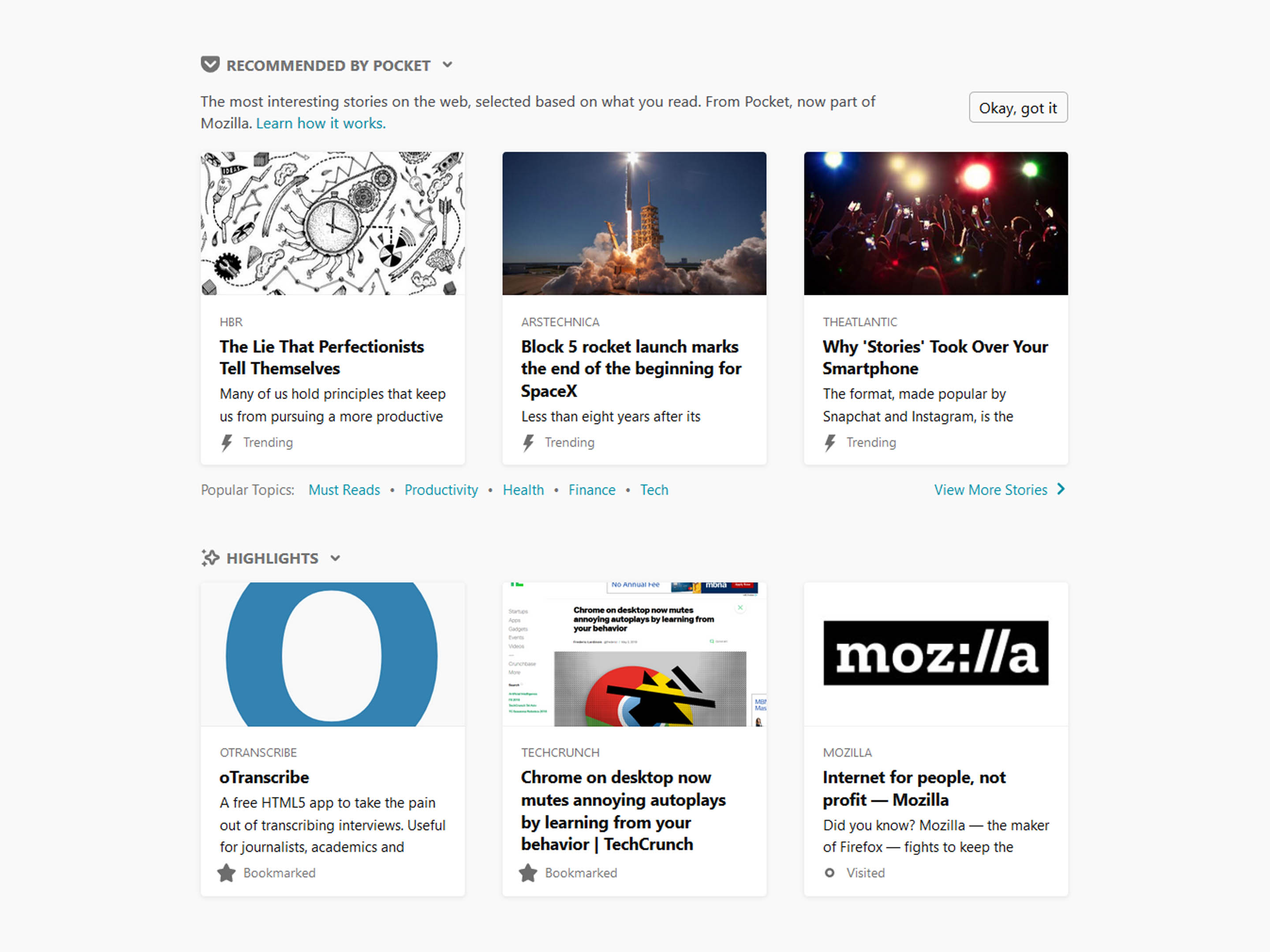
Because Firefox is opensource, the code is available for anyone to see. This means that users can go to sites like GitHub to see exactly what Firefox collects and how. This is another way that Weiner says Firefox is different. It’s open about how its data-collection and advertising works.
“We’ve come to accept a premise around advertising today that users need to trade their privacy and data in exchange for personalized, high quality experiences. Our experiments over the last few months have proved that this isn’t true,” writes Weiner.
Weiner also boasts a commitment to quality content — things you will actually want to read, not click-bait. Part of that means it’s easy to hide content you don’t want to see and you can disable sponsored content altogether.
Mozilla likely won’t make as much from its advertising venture as Google or Facebook, but profits aren’t really the point. The company’s motto is “internet for people, not for profit” after all.
Weiner hopes that this model will be an example to other online advertises of how they can promote content without jeopardizing privacy. “We are indeed able to create personalized sponsored content that provides value to users without jeopardizing their privacy. This is an exciting result because it promises to create a more user-centered model for supporting content on the web.”
The post Firefox gets sponsored content to prove online ads aren’t that bad appeared first on MobileSyrup.

Markham, Ontario is proclaiming itself the (possible) future home of Amazon’s second headquarters.
The city’s Twitter account tweeted early this morning that signs are going up today.
Signs are popping up all over Markham today… #ChooseMarkham pic.twitter.com/qZ9cAa8gKw
— City of Markham (@cityofmarkham) May 7, 2018
The city is part of the Toronto-wide bid for Amazon’s new headquarters. Toronto was the only Canadian city to make it to the shortlist for the headquarters. Amazon started with 238 applicants and Toronto is one of 20 to move on to the next stage of selection.
The headquarters would bring up to 50,000 jobs and an investment of $5 billion USD in the city.
Markham mayor Frank Scarpitti got in on the Twitter action as well. Scarpitti posited the city’s position to compete globally and included a website to view for those who need more reasons to choose Markham.
Markham is a part of the Toronto-wide bid for @amazon‘s HQ2. We are proud to be a part of the bid which demonstrates our strength as a region to compete globally. Need more reasons to #ChooseMarkham? Visit https://t.co/FyqcrVQinZ. pic.twitter.com/z7znMXH1AO
— Mayor Frank Scarpitti (@frankscarpitti) May 7, 2018
The city’s website lists a number of reasons why Amazon should choose Markham, from its diverse, highly-skilled workforce to the more than 1,500 technology companies already located in the city. The site even includes six video testimonials from companies like Huawei and GE about why they chose Markham.
Along with this, the city’s YouTube channel posted a video to woo Amazon.
Unfortunately for Markham, an analysis released by Sperling’s BestPlaces late last year suggests Amazon isn’t interested in a Canadian city. The analysis suggests that Atlanta, Georgia will be the location for the new headquarters, with Boston and Chicago close behind. Toronto wasn’t even in the top ten.
But then again, maybe Canada shouldn’t want Amazon here in the first place.
The post Markham uses signs to woo Amazon, get new headquarters appeared first on MobileSyrup.

Cameron Summerson,
How-To Geek,
May 07, 2018

According to this article, Rich Communication Service (RCS) "is the future of 'texting' on your phone" and for internet messaging in general. While the impact on e-learning technology is a few years away, it's useful to be aware of the coming changes. "This is going to turn text messaging into more of a full chat experience—assuming both users have RCS support.... the Universal Profile (v1.0 237 page PDF; v2.1 289 page PDF)... lays out a general set of features and functionality that RCS is to support."
Web: [Direct Link] [This Post]It would make me really happy to be able to
yellow-list
Google web ads in Privacy Badger.
(Yellow-listed domains are not blocked, but
have their cookies restricted in order to cut
back on cross-site tracking.) That's because
a lot of news and cultural sites use DoubleClick for
Publishers
and other Google services to deliver legit,
context-based advertising. Unfortunately, as
far as I can tell, Google mixes in-context
ads with crappy, spam-like, targeted
stuff. What I want is something like Doc Searls
style
ads: Just give me ads not based on tracking me.
Until now, there has been no such setting. There could have been, if Do Not Track (DNT) had turned out to be a thing, but no. But there is some good news. Instead of one easy-to-use DNT, sites are starting to give us harder-to-find, but still usable, settings, in order to enable GDPR-compliant ads for Europe. Here's Google's: Ads personalization settings in Google’s publisher ad tags - DoubleClick for Publishers Help.
Wait a minute? Google respects DNT now?
Sort of. GDPR-compliant terms written by Google aren't exactly the same as EFF's privacy-friendly Do Not Track (DNT) Policy All these different tracking policies are reminding me of open source licenses for some reason. but close enough. The catch is that as an end user, you can't just turn on Google's European mode. You have to do some JavaScript. I think I figured out how to do this in a simple browser extension to unlock secret European status.
Google doesn't appear to have their European mode activated yet, so I added a do-nothing "European mode" to the Aloodo project, for testing. I'm not able to yellow-list Google yet, but when GDPR takes effect later this month I'll test it some more.
In the meantime, I'll keep looking for other examples of hidden European mode, and see if I can figure out how to activate them.

We are launching an AI lab. The goal is to learn unsupervised learning through Robotics (Cobots)
Long seen as a poor cousin to supervised learning - with Variational autoencoders, Reinforcement learning and Generative-Adversarial networks , unsupervised learning techniques have moved beyond the limitations of autoencoders.
From Oct 2018 to March 2019 , we are running a pilot. The lab will be focused on Open Source and possibly as a future B corp (social enterprise)
The lab will be launched as an educational venture. It provides a way to work with projects and to experiment with innovation.
Build and demo to group i.e. build a repository i.e. github portfolio
When
Starting in Oct To March
Membership only
Limited places - London only initially
Technical goals
To explore AI through Cobots – Collaborative robots (specifically the dobot) using unsupervised learning – specifically Variational autoencoders, Reinforcement learning and Generative-Adversarial networks
All code in Open source (Apache v2 code)
Focused on AI models for robotics (NLP, Reinforcement learning, CNN, Computer Vision etc) and also ROS (Robot operating system). Exploring complex problems like training of intelligent agents through simulation engines
Who
A few of the meet-up members have volunteered to be part of the Tech advisory. Many thanks to the group!
Tech leadership team comprises
UK
Ajit Jaokar
Dan Howarth
Dr Saed Hussain
Cheuk Ting Ho
Andy Bovey
Dr Ahmad Abd Rabuh
Barend Botha(as signacore)
Outside the UK
Dr Amita Kapoor (New Delhi)
Dr Daria Shamrai (St Petersburg – Russia)
Also pleased to collaborate for the Pilot in with eOffice – same as our office in London(Pier Paolo Mucelli, Oscar Chu Ortega)
Project leaders to be announced soon
Commercials
Small fee (400 GBP/6 months)
Where
Evenings eOffice
Weekends TBC
Under 18s?
In near future
Will be considered at no cost (but accompanied)
Coding
Python + Tensorflow using colab
Future
Berlin and Milan
Comments welcome. Please email me if you want to join this initiative info at futuretext.com
mkalus
shared this story
from  The Omni Group. The Omni Group.
|
People have been asking two main questions:
We’ve been working on the Mac app. As we finish up the iOS app, we’ll be able to turn our team’s attention to the Mac version.
We don’t have anything more specific than this year yet — but, once we do, we’ll share it.
We will be doing a beta program. Once we have more details, we’ll post them on this blog. We’ll be using the same sign-up page that we used for iOS testing — and, if you’ve signed up previously, you don’t need to sign up again.
Yes, as long as you’re using the latest version of the Mac app and you have migrated your database.
The Mac app doesn’t use some of the new features in OmniFocus 3: the first tag is used as a context, for instance. It doesn’t understand the new custom perspective rules.
But you can still sync your data: it ignores, but otherwise continues to sync, things it doesn’t do.
Back in 2013 I wrote a post about how long I thought my SSD would last based on the amount of data I write to the drive on a daily basis. Back then my daily write rate was 10 GB a day and based on a calculation method of Anandtec I estimated the lifetime of my SSD to be at least 14 years. In the meantime others have done practical tests of how many write cycles SSDs really endure before they die so I came back to the topic once more with my usage scenario.
Things are a bit strange on my system as depending on where I look I get different numbers. On the file system level there’s the following command to get the number of bytes written to a partition:
sudo tune2fs -l /dev/xxx [replace xxx with the partitions of a drive]
The second one looks like this and should give the same result:
cat /sys/fs/ext4/sdaXXX/lifetime_write_kbytes [replace xxx with the partitions of a drive]
In my case the accumulated file system level values show that 36 TB of data were written to the two main partitions I use on my SSD over 2 years. That would be 46 GB a day. That’s a lot more than the 10 GB I measured a couple of years ago but it does not seem to be out of the ordinary according to this article on Heise (in German).
At first I had no idea what could possibly write 46 GB a day to my SSD so I had a closer look at the block level write counter for a couple of days with the following command:
# data written to sda since the last reboot in GB
awk '/sda/ {print $3"\t"$10 / 2 / 1024 / 1024}' /proc/diskstats
Here, I still get the 10 GB a day on average. Once a week however, a TRIM is made, which makes this counter jump tremendously. Mystery solved. Probably, TRIMs do not count towards the data written to the SSD but since I’m not entirely sure, let’s assume the worst case and include it. Fortunately it turns out that even if my usage is 5 times higher than measured on the block level without TRIMs, I’m still on the safe side. Samsung says that my 1 TB 850 Evo drive has a write endurance of 150 TB. And the Heise article already linked to above says that even this is a gross understatement, as the predecessor of my SSD was guaranteed by Samsung to endure 70 TB of data written to it and in reality only failed after writing over 1200 TB of data to it.
So if I take Samsung’s number I’m good with my 850 Evo for at least 8 years, and far more than 60 years if I take the Heise numbers. Both values are reassuring as I hope that at least in another 5 years, SSDs will have become cheaper again so I can upgrade from my 1 TB to at least a 2 TB drive. I’d do it today but the price for a 2 TB SSD is still around €600 where it has been for several years now. Not that I would have much of a choice in 5 years anyway as by then I expect that most notebooks will no longer support 2.5″ drives and instead have fully migrated to the m.2 format.
Over the years there have been several things I’ve automated in my workflow. This week it was posting from Evernote to WordPress, saving me over 60 minutes per week. Years ago I automated starting a project, which saves me about 20 minutes each time I start a new project (of whatever type), by populating my various workflow tools with the right things for it. I use Android on my phone, and my ToDo application Things is Mac only, so at some point I wrote a little script that allows me to jot down tasks on my phone that then got send to Things. As Things now can process email that has become obsolete. I have also written tiny scripts that allow me to link to Evernote notes and Things items from inside other applications.
I’m still working to create a chat based script in my terminal that takes me through my daily starting routine, as well as my daily closing routine. This to take the ‘bookkeeping’ character away, and make it easier for me to for instance track a range of lead-indicators.
I know many others, like Peter Rukavina or Frank Meeuwsen also automate stuff for themselves, and if you search online the sheer range of examples you can find is enormous. Yet, I find there is much to learn from hearing directly from others what they automate, how and why it is important to them, as the context of where something fits in their workflow is crucial information.
What are the things you automate? Apart from the the full-on techie things, like to start a new virtual server on Amazon, I mean. The more mundane day to day things in your workflow, above key board shortcuts? And have you published how you do that somewhere online?
Gestern kamen liebe Freunde zum Abendessen. Es gab diese Spargel-Quiche (Link zum Rezept) und als Dessert Grießpudding mit Rhabarberkompott und Amarettinibröseln, nach einem abgewandelten Rezept von Chili und Ciabatta: Grießpudding mit Heildelbeerkompott und Amarettini. Optisch machen Heidelbeeren mehr her, aber geschmeckt hat es auch mit dem Rhabarber sehr gut!

Im Foto fehlt noch die letzte Schicht Amarettini-Brösel, die erst kurz vor dem Servieren draufkamen, damit sie knusprig bleiben.
Well, there has to be something here from Led Zep, and I’m picking this because, when I was sixteen and just feeling my way into the mysterious forest of popular music, someone said “Hey I got this new record” (that would be Led Zep III) and he dropped the needle on Immigrant Song, and in that instant I became a hard-rock fan; and I’ll be proud to die one. It’s a totally great tune.

I try to keep the Song of the Day a little off the beaten track and I was thinking of going with Kashmir instead because the guys in the band say it’s their favorite Led Zep song, and I like it a lot. I can’t claim Immigrant Song is obscure in the slightest. That’s OK because any day you listen to it your blood will run a little faster and your hindbrain will boogie with your medulla oblongata. I’m not going to talk about the riff (great), the vocals (great), the drumming (wow), the lyrics (kinda dopey, but effective). OK, I’ll drop in a quote about the lyrics which sort of excuses them.
We weren’t being pompous… We did come from the land of the ice and snow. We were guests of the Icelandic Government on a cultural mission. We were invited to play a concert in Reykjavik and the day before we arrived all the civil servants went on strike and the gig was going to be cancelled. The university prepared a concert hall for us and it was phenomenal. The response from the kids was remarkable and we had a great time. Immigrant Song was about that trip and it was the opening track on the album that was intended to be incredibly different.
You know, these days, when I’m driving around and Zeppelin comes on the radio, all I can hear is that drumming. Nobody’s ever sounded like Bonham.
This is part of the Song of the Day series (background).
Spotify playlist. This tune on Spotify, iTunes, Amazon. As for live video this performance is said to be from Australia in 1972. I’m not 100% sure that the video is really actually of this live performance — there are continuity issues — but it’s a fine performance, and the video has some better-than-average-for-Zep moves on it.
