Shared posts

11 May 05:16

That study about using two spaces after a period? It’s bullshit.

by Josh Bernoff

The Washington Post reported on a study showing that adding two spaces after a period improves readability. Now all the use-two-spaces philistines are using this to justify their depraved practices. But the study proves nothing. Three researchers at Skidmore College, Rebecca L. Johnson, Becky Bui, and Lindsay L. Schmitt, published a paper called “Are two spaces … Continued

The post That study about using two spaces after a period? It’s bullshit. appeared first on without bullshit.

11 May 05:16

Tech’s Two Philosophies

by Ben Thompson

Even though Apple’s developer conference is still a few weeks away, I think it’s safe to say that the demo of Google Duplex at yesterday’s Google I/O keynote will go down as the most impressive of the tech conference season. If you haven’t seen it, it is a must-watch:

Once I picked my jaw up off the floor, though, what struck me about Google CEO Sundar Pichai’s presentation was how he opened the segment:

Our vision for our assistant is to help you get things done.

And how he closed it:

A common theme across all this is we are working hard to give users back time. We’ve always been obsessed about that at Google. Search is obsessed about getting users to answers quickly and giving them what they want.

In Google’s view, computers help you get things done — and save you time — by doing things for you. Duplex was the most impressive example — a computer talking on the phone for you — but the general concept applied to many of Google’s other demonstrations, particularly those predicated on AI: Google Photos will not only sort and tag your photos, but now propose specific edits; Google News will find your news for you, and Maps will find you new restaurants and shops in your neighborhood. And, appropriately enough, the keynote closed with a presentation from Waymo, which will drive you.

The Google and Facebook Philosophy

Rewind a week, and there was a specific section in Mark Zuckerberg’s keynote at the Facebook F8 conference that stuck out to me:

I believe that we need to design technology to help bring people closer together. And I believe that that’s not going to happen on its own. So to do that, part of the solution, just part of it, is that one day more of our technology is going to need to focus on people and our relationships. Now there’s no guarantee that we get this right. This is hard stuff. We will make mistakes and they will have consequences and we will need to fix them. But what I can guarantee is that if we don’t work on this the world isn’t moving in this direction by itself.

Zuckerberg, as so often seems to be the case with Facebook, comes across as a somewhat more fervent and definitely more creepy version of Google: not only does Facebook want to do things for you, it wants to do things its chief executive explicitly says would not be done otherwise. The Messianic fervor that seems to have overtaken Zuckerberg in the last year, though, simply means that Facebook has adopted a more extreme version of the same philosophy that guides Google: computers doing things for people.

The Microsoft and Apple Philosophy

Earlier this week, while delivering Microsoft’s Build conference keynote, CEO Satya Nadella struck a very different tone; after describing how computing was becoming invisible, because it is everywhere, Nadella said:

That’s the opportunity that we have. It’s in some sense endless, but we also have responsibility. We have the responsibility to ensure that these technologies are empowering everyone, these technologies are creating equitable growth by ensuring that every industry is able to grow and create employment. But we also have a responsibility as a tech industry to build trust in technology.

In fact Hans Jonas was a philosopher who worked in the 50s, 60s, and he wrote a paper on technology and responsibility…he talks about act so that the effects of your action are compatible with permanence or genuine life. That’s something that we need to reflect on, because he was talking about the power of technology being such that it far outstrips our ability to completely control it, especially its impact even on future generations. And so we need to develop a set of principles that guide the choices we make because the choices we make is what’s going to define the future…

This opportunity and responsibility is what grounds us in our mission to empower every person and every organization on the planet to achieve more. We’re focused on building technology so that we can empower others to build more technology. We’ve aligned our mission, the products we build, our business model, so that your success is what leads to our success. There’s got to be complete alignment.

This is technology’s second philosophy, and it is orthogonal to the other: the expectation is not that the computer does your work for you, but rather that the computer enables you to do your work better and more efficiently. And, with this philosophy, comes a different take on responsibility. Pichai, in the opening of Google’s keynote, acknowledged that “we feel a deep sense of responsibility to get this right”, but inherent in that statement is the centrality of Google generally and the direct culpability of its managers. Nadella, on the other hand, insists that responsibility lies with the tech industry collectively, and all of us who seek to leverage it individually.

The Bicycle of the Mind

This second philosophy, that computers are an aid to humans, not their replacement, is the older of the two; its greatest proponent — prophet, if you will — was Microsoft’s greatest rival, and his analogy of choice was, coincidentally enough, about transportation as well. Not a car, but a bicycle:

Steve Jobs was exceptionally fond of this analogy: there are multiple clips of him making the point in mostly the same way; I usually link to this one because by the time this video was recorded1 Jobs had his delivery perfectly honed.

Interestingly, though, the earliest known clip of Jobs telling this story, from 1980, doesn’t include the famous phrase “Bicycle of the Mind”; it’s worth watching, though, all the same:

The best analogy I’ve ever heard is Scientific American, I think it was, did a study in the early 70s on the efficiency of locomotion, and what they did was for all different species of things in the planet, birds and cats and dogs and fish and goats and stuff, they measured how much energy does it take for a goat to get from here to there. Kilocalories per kilometer or something, I don’t know what they measured. And they ranked them, they published the list, and the Condor won. The Condor took the least amount of energy to get from here to there. Man was didn’t do so well, came in with a rather unimpressive showing about a third of the way down the list.

But fortunately someone at Scientific American was insightful enough to test a man with a bicycle, and man with a bicycle won. Twice as good as the Condor, all the way off the list. And what it showed was that man is a toolmaker, has the ability to make a tool to amplify an inherent ability that he has. And that’s exactly what we’re doing here.

This is precisely what Nadella was driving at: “to empower every person and every organization on the planet to achieve more” is to “amplify an inherent ability” those people and organizations have; the goal is not to do things for them, but to enable them to do things never before possible. And, I would hasten to add, Apple remains very much on the same side of this philosophical divide.

The Chicken and Egg Question

There is certainly an argument to be made that these two philosophies arise out of their historical context; it is no accident that Apple and Microsoft, the two “bicycle of the mind” companies, were founded only a year apart, and for decades had broadly similar business models: sure, Microsoft licensed software, while Apple sold software-differentiated hardware, but both were and are at their core personal computer companies and, by extension, platforms.

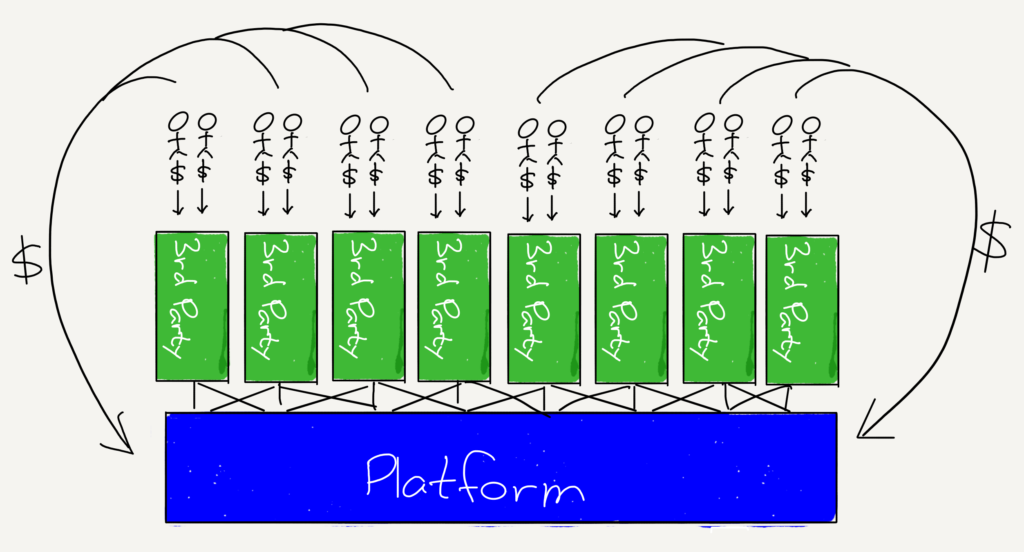
In a platform business model 3rd parties attract customers

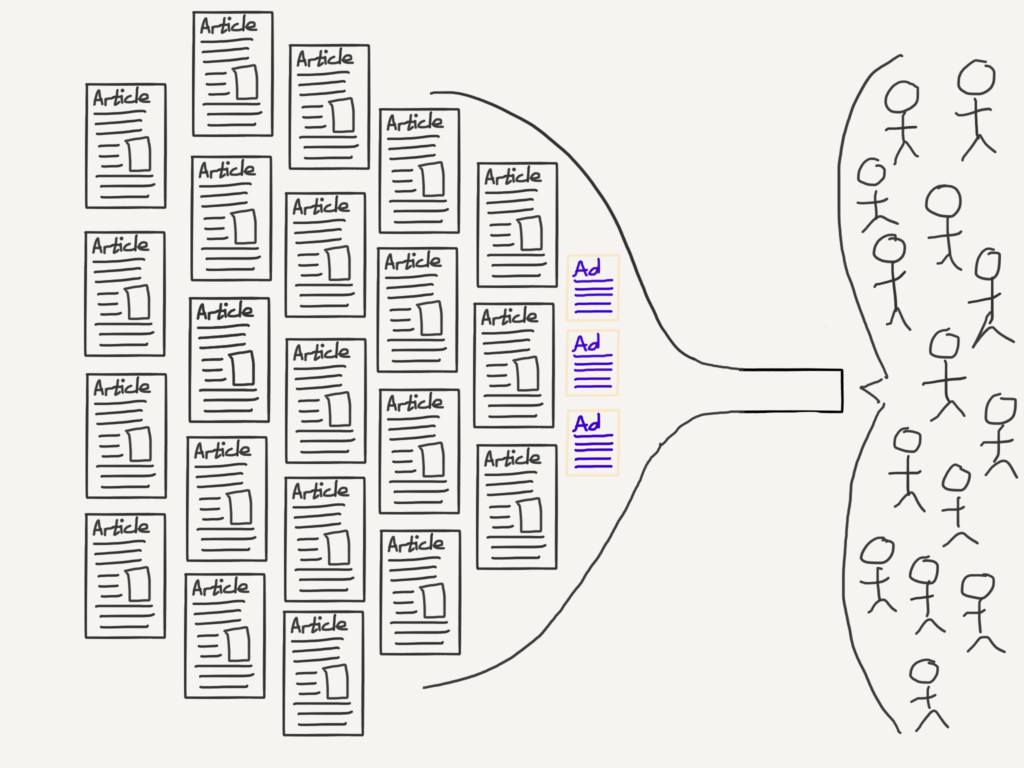
Google and Facebook, on the other hand, are products of the Internet, and the Internet leads not to platforms but to aggregators. While platforms need 3rd parties to make them useful and build their moat through the creation of ecosystems, aggregators attract end users by virtue of their inherent usefulness and, over time, leave suppliers no choice but to follow the aggregators’ dictates if they wish to reach end users.

In the aggregator business model the aggregator owns customers and suppliers follow

The business model follows from these fundamental differences: a platform provider has no room for ads, because the primary function of a platform is provide a stage for the applications that users actually need to shine. Aggregators, on the other hand, particularly Google and Facebook, deal in information, and ads are simply another type of information.2 Moreover, because the critical point of differentiation for aggregators is the number of users on their platform, advertising is the only possible business model; there is no more important feature when it comes to widespread adoption than being “free.”

Still, that doesn’t make the two philosophies any less real: Google and Facebook have always been predicated on doing things for the user, just as Microsoft and Apple have been built on enabling users and developers to make things completely unforeseen.

Tech’s Yin and Yang

That there are two philosophies does not necessarily mean that one is right and one is wrong: the reality is we need both. Some problems are best solved by human ingenuity, enabled by the likes of Microsoft and Apple; others by collective action. That, though, gets at why Google and Facebook are fundamentally more dangerous: collective action is traditionally the domain of governments, the best form of which is bounded by the popular will. Google and Facebook, on the other hand, are accountable to no one. Both deserve all of the recent scrutiny they have attracted, and arguably deserve more.

That scrutiny, though, and whatever regulations that result, must keep in mind this philosophical divide: platforms that create new possibilities — and not just Apple and Microsoft! — are the single most important economic force when it comes to countering the oncoming wave of computers doing people’s jobs, and lazily written regulation that targets aggregators but constricts platforms will inevitably do more harm than good.

The truth is that the Divine Discontent that I wrote about last week is not only an antidote to low-end disruption, but also a reason for optimism: companies like Apple and Amazon can, as I noted, win in the long run by offering a superior user experience, but more importantly, the dividend of discontent is a greenfield of opportunities to build new businesses and new jobs alleviating that discontent. For that we need platforms on which to build those businesses, and yes, we will need artificial intelligence to do things for us so we have the time.

I wrote a follow-up to this article in this Daily Update.

  1. 1990 I believe, but I’m not certain
  2. As I’ve written in the past, this is why mobile saved Facebook: the company desperately wanted to be a platform but being “just an app” left Facebook no choice but to be self-contained and thus a better ad company
11 May 05:16

Changing Destructive Thoughts

by Kim

Everyone has bouts of low mood and excessive worrying. Thankfully, these are often temporary. For some, however, the feelings don’t go away on their own and more structured help is needed.

One very effective treatment is cognitive-behavioural therapy (CBT). CBT is a form of psychotherapy that helps treat problems by modifying our unhealthy thoughts, emotions and behaviors and has been shown to be as effective as medication in the treatment of anxiety and depression in some people.

Whether it’s a job interview, a date or just walking into a meeting, many of us carry our own negative inner voice amplifying small feelings of self-doubt into full on landslides.

Here are a couple of accessible CBT tips which you can employ the next time you are feeling stressed or anxious:

Focus on how these feelings will pass

It can be very calming to remember that feelings, and fears, are fluid and transitory. So when you feel yourself starting to feel overwhelmed by news or an event, try focusing on how you will feel once this initial sense of panic passes.

Write down those expected changes in a few words. For example, if you are a nervous wreck about an impending job interview or an exam, think about how calm and relieved and accomplished you will feel when you walk out the door afterwards! How you will have the rest of your day ahead of you and the anxiety will have dissipated.

Trick anxiety by “acting normal”

Anxiety is a survival response which kicks in when you sense a perceived threat. The key word here is “perceived”, because anxiety can be a little over-protective and tends to over-react! Let’s think of it like a protective lioness – determined to protect her cubs at any cost.

One way to train anxiety to be selective and not pounce into action at the slightest sound or movement is to calmly give it feedback to let it know that its help isn’t currently required and that “you got this”.

If you try and act calmly and without responding physically, anxiety will not be further roused and will follow your example and begin to fade. Talk to yourself softly and calmly, salivate, breathe deeply and try to smile (not always easy, we know!).

By behaving this way we alter the feedback to our fear response system. We are sending our anxiety a message that things aren’t as bad or as scary as they seem so they can “stand down” and this helps dial back the feeling of stress.

The Canadian Mental Health Association’s Bounce Back® program is founded on CBT principles provides and teaches effective skills to help individuals (aged 15+) overcome symptoms of mild to moderate depression or anxiety, and improve their mental health. Participants can learn skills to help combat unhelpful thinking, manage worry and anxiety, and become more active and assertive.

Available for free across BC, Bounce Back® has been shown to help reduce symptoms of depression and anxiety by half, and over 90% say they would recommend it to a friend or family member. Bounce Back® is also available in regions of Ontario and Manitoba.


For more information on Bounce Back®: https://cmha.bc.ca/programs-services/bounce-back/


The post Changing Destructive Thoughts appeared first on London Drugs Blog.

11 May 05:16

Michael Pollan Has Lost His Mind

by Dave Pollard


Painting by Cristobal Ortega Maila CC0 from pxhere.com

Michael Pollan, famous for his books on cooking, food and nutrition (“Eat food. Not too much. Mostly plants.”), is about (May 15th) to release his latest book How to Change Your Mind: What the New Science of Psychedelics Teaches UsMichael gave a long and wide-ranging interview about the book to the less-annoying-than-usual Tim Ferriss, and Tim’s podcast and interview notes are the basis for this article.

The book describes the parallel changes in both the medical and social communities in attitudes toward psychedelics, a word that literally means “mind-loosening”. He urges the medical and regulatory community to be open-minded and humane in allowing research on and subsequent use of psychedelics as a managed therapy for a host of mental illnesses (including depression, anxiety, phobias, obsessions, addictions and PTSD). These diseases, he says, have in common that they occur when “the default mode network” (a series of connections in various parts of the brain that usually launch our thinking and reacting processes) becomes overly rigid, and caught in repetitive loops. Drugs found in plants such as psilocybin mushrooms, ayahuasca, 5-MeO-DMT, and synthetics such as LSD have been shown to quieten this network and its pathways and lead to powerful, long-term healing of these diseases, even with only a few doses.

There are of course dangers: people with already-disrupted default mode networks (those with psychoses, schizophrenia etc) can react badly to these drugs, and bad trips for anyone can be very unpleasant and have serious consequences. For this reason, Michael advocates avoiding the carelessness with which these drugs were used in the 60s, and wants us to develop secular community-based support groups with people experienced at guiding people safely through trips (“flight instructions”) and helping people to integrate and interpret them afterwards, before rushing into full legalization.

Michael describes his own personal trips as well as findings from many others he spoke with, as leading to the dissolution of the ego, ie “non-dual” realization and the “merging with something larger than you”.

When asked about Michael Pollan’s earlier description of this dissolution, Tony Parsons (at a meeting of his I attended last year in Wales) seemed to dismiss it as “probably just another experience”. Tony asserts that any “experiences” are experiences of an individual (self/ego) and hence nothing like the true falling away of the self and the seeing of natural reality. I’m inclined to believe him, though Michael’s description certainly matches at least the “glimpses” that have led many (including me) to believe that the self is an illusion (and “a useless bit of software” that arose as a consequences of the emergence of large brains).

What is remarkable to me is the degree to which Michael’s description of the discoveries and ideas that came from these experiences or events parallel the messages and insights into the nature of reality of many people in a wide array of disciplines — so-called “spiritual teachers” (Eckhart Tolle, Adyashanti, Rupert Spira etc), philosophers (John Gray in Straw Dogs: “We act in the belief that we are all of one piece, but we are able to cope with things only because we are a succession of fragments. We cannot shake off the sense that we are enduring selves, and yet we know we are not.”), scientists (Stewart & Cohen, Richard Lewontin), and artists (Jim Carrey, Terence Stamp, etc).

Tony has commented that the likely reason there are so few articulating this message is that (a) the loss of the self is not really an experience or event (it’s a realization that the self never existed), (b) it just isn’t in most people’s nature to question or to speak publicly about inexplicable “life-changing” events that leave no trace, and (c) it’s really impossible to put into words, since language is an invention specifically to facilitate communication between acknowledged separate “selves”.

Michael says this is reflected in the gushy, inane, often incoherent descriptions of many people who have “experienced” this (though it isn’t an experience). It’s impossible to describe. It’s not “higher consciousness” (in fact there is generally a quieting rather than a focusing or concentration of the mind). It’s not “consciousness” or “awareness” or “presence” at all — it’s absence, loss. Liberation, from the affliction of the self.

If Michael is right, and presuming we don’t extinguish human life on this planet before it happens, it might theoretically be possible to treat and even cure what I have called Civilization Disease” (including all of the aforementioned mental illnesses, and likely many related chronic physical illnesses and the general anxiety most of us have come to accept as “life”). If that were to happen, we might see a sudden large-scale walking away from our ruinous global industrial civilization, which depends utterly on our culture’s stranglehold over our “separate selves”. If enough of us “lost our selves”, how might the trajectory of the human species then shift? Would we learn, once again, how to live in community as one with everything around us?

If Tony is right, this won’t be possible; psychedelic drugs might enable us to glimpse, and to long for, oneness, but they won’t enable us, in any functional or enduring way, to “lose our selves” and just be, as we were before our selves arose in early childhood.

My guess is that Tony is probably right — the self has too strong and too established a grip on the creatures it inhabits to be shaken by medicines that briefly short-circuit the brain that gave rise to it. Sometimes I even question whether post-civilization societies, living without the stresses and barrage of information and distraction and propaganda that characterize the era of human civilizations, will escape the affliction of separateness and self-hood. We might be just inherently, as a species, too smart for our own good.

Still, the idea of separation and self-hood as a mental illness that might be treated by medicines that “loosen the mind” — liberating us from most mental and chronic physical illnesses in the process — is intriguing.

But I’m deeply skeptical. We are complex creatures, we humans, and every body is different. We may have a deeply transformative experience under the influence of these medicines, and some may find they heal some of the ailments that have defied all other attempts at treatment, at least for a while, maybe longer, and that’s wonderful. But what then? Things are the way they are for a reason, and I wonder if we are already too damaged, and if our propensity to do things that don’t seem healthy for us can ever be “cured”. We may briefly escape the damage that the self inflicts on us. But that will not destroy the self.

There is nothing to destroy, after all.

11 May 05:15

Bremner Speaks to Cambie Report

by Ken Ohrn

After he was rejected by the NPA Board as a potential mayoral candidate, NPA City of Vancouver councilor Hector Bremner has given an interview to the Cambie Report.

My on-the-fly grab of topics and opinion follows.  Lots to read, especially between the lines.

Bremner Speaks (28:42)

Large-scale doo-doo-in-the-fan event. Bremner denied chance to compete for NPA mayoral nomination.

Board’s exercise of raw power, to override Green Light Committee.

Bremner speaks:

Concerted smear via many means; tar and feather effort
Anti-housing narrative evident in his opponents
With twice the number of members of anyone else (~2000), Bremner felt new energy pushing NPA forward, which has attracted new people to NPA. Now are frustrated.
Q: Paths forward: councilor, independent, new party?
Concerned about effect on newly energized people in politics. Doesn’t want abdication – look at what’s left behind if he and his followers abdicate.
Q: the #Lets FixHousing banner (Crook, Prieto). What’s up?
They’re frustrated and angry (lots of contact). They take politics seriously and want to improve lives, including their own. This doo-doo event hits them personally. Bremner remains hopeful. Cheap attacks and dirty politics won’t be the end of his commitment and that of his followers.
Q: join Vision?? Not likely.

Don’t underestimate this change to the political dynamic. Notes the by-election win as evidence. Raises housing as an issue. And this is his ground – presenting a clear solution. People are ignoring traditional party lines, looking for answers amid frustration. This election will see a profound shift.

Podcaster reaction:

Bremner isn’t done; he’s too calm.
He has run afoul of certain groups – attracted toxic messaging. Many practitioners are Chernen supporters.
Signs of simple answers for anger-raising problems (see Swanson & Bremner as change candidates)
NPA reaction to Bremner’s new membership vs. older land-owning membership
Call to NPA leaves feeling that NPA Board is uninterested in caller’s opinion (re: housing); little regard for the opinion of its members
Bremner rejection looks like a sleazy backroom deal. Non-transparent. Sure to attract a firestorm. Student-union-level politics.
Watch the froth and excitement in the next few days. And watch for more desertions from the ranks of under-50 NPA candidate hopefuls and members.

11 May 05:15

A plaza, some people and a bit of perspective

by pricetags

This will be the first real summer with the completed North Plaza at the Vancouver Art Gallery. The test for any public space: How good is the people-watching?


What makes this plaza interesting — if not necessarily successful — is the sheer amount space available, encouraging not only walk-throughs (diagonally between Howe and Hornby) and the chance to throw things like frisbees, but also the opportunity for spontaneous performance.

There’s seating in chairs, benches and stairs. And without curbs or obstacles, cyclists can be playful too without annoying other users.  It’s how I took these pictures in motion.

11 May 05:15

Riding through a Vancouver Park

by Ken Ohrn

Tenth.Ave.Greenway
This is 10th Avenue in Vancouver; people on bikes use this traffic-calmed bikeway in droves, especially this stretch of East 10th Ave passing through China Creek South Park at Clark Drive.

Presumably, at one time, 10th Avenue here was open to motor vehicles, bisecting the park.

Tenth.Ave.Greenway

Click to enlarge

The design reminds me of that section of the Seaside Greenway at the new traffic-calmed Point Grey Road where a bike lane runs between Tatlow Park and Volunteer Park, once the location of a busy commuter motor vehicle arterial.

It also looks like the Union Bikeway, one of Vancouver’s busiest, which runs through Strathcona Linear Park at Union St. near Hawks Ave. and is part of traffic-calming on Union St.

11 May 05:15

Downtown Hudson’s Bay Store Sells for $675 Million to Offshore Buyer

by Sandy James Planner

97121e8b03512253c9a35569665017d9

Late last year, Price Tags reported on the potential sale of Vancouver’s downtown  Hudson’s Bay store, the iconic white terra-cotta building located at the corner of Granville and Georgia Streets.

Built in 1927 the 650,000 square foot building was assessed at $59.7 million, but potential sale prices were suggested to be as high as $900 million.

As reported in the Financial Post  “Canadian department store owner Hudson’s Bay Co and joint venture partner RioCan REIT have signed a conditional agreement to sell HBC’s flagship store in downtown Vancouver for about $675 million (US$524.4 million) to an Asian buyer, a person familiar with the matter told Reuters.”

The Hudson’s Bay Company had previously leased their New York City store location to WeWork, a shared workspace business, setting the stage for a suggested change in the ownership (and purpose) for the Vancouver store, which arguably is on one of the most important heritage sites in the city, a block away from the Vancouver Art Gallery, and right beside the Canada Line.

The new buyer owns a real estate company but his or her identity will not be disclosed until the sale is final. “Hudson’s Bay is expected to sign a 20-year lease with the new owner, according to the person familiar with the matter. As part of the WeWork deal, the shared office space operator also agreed to lease the top floors of the Vancouver and other Hudson’s Bay stores.”

The Hudson’s Bay Company has been in Vancouver since 1887, first operating out of a storefront on Pender Street. The current store at Granville and Georgia is a Vancouver landmark.

Does the shifting of the top floors of the Hudson’s Bay store to shared use office show the decline in storefront department store retail?

Will the retail nature of this store — with its 91-year history — be retained?

Or is redevelopment looming for this building?

hudsons-bay-department-store-corner-of-granville-and-west-georgia-streets-vancouver-bc-canada-joe-foxPhoto: Fine Art America

11 May 05:15

Google Duplex Puts AI Into a Social Uncanny Valley

files/images/i-3-google-just-remade-its-brand-again.jpg

S.A. Applin, Motherboard, May 12, 2018


Icon

The headlines today are being made by Google through a series of announcements at its IO conference. More interesting items include a new human-sounding Google Duplex AI interface, a new camera-based scavenger hunt (try it here), and a new interface design with Material Theming. Or you could just go for the obligatory cool stuff overview.

Web: [Direct Link] [This Post]
11 May 05:15

This is a really lovely Raspberry Pi tricorder

by Helen Lynn

At the moment I’m spending my evenings watching all of Star Trek in order. Yes, I have watched it before (but with some really big gaps). Yes, including the animated series (I’m up to The Terratin Incident). So I’m gratified to find this beautiful The Original Series–style tricorder build.

Star Trek Tricorder with Working Display!

At this year’s Replica Prop Forum showcase, we meet up once again wtih Brian Mix, who brought his new Star Trek TOS Tricorder. This beautiful replica captures the weight and finish of the filming hand prop, and Brian has taken it one step further with some modern-day electronics!

A what now?

If you don’t know what a tricorder is, which I guess is faintly possible, the easiest way I can explain is to steal words that Liz wrote when Recantha made one back in 2013. It’s “a made-up thing used by the crew of the Enterprise to measure stuff, store data, and scout ahead remotely when exploring strange new worlds, seeking out new life and new civilisations, and all that jazz.”

A brief history of Picorders

We’ve seen other Raspberry Pi–based realisations of this iconic device. Recantha’s LEGO-cased tricorder delivered some authentic functionality, including temperature sensors, an ultrasonic distance sensor, a photosensor, and a magnetometer. Michael Hahn’s tricorder for element14’s Sci-Fi Your Pi competition in 2015 packed some similar functions, along with Original Series audio effects, into a neat (albeit non-canon) enclosure.

Brian Mix’s Original Series tricorder

Brian Mix’s tricorder, seen in the video above from Tested at this year’s Replica Prop Forum showcase, is based on a high-quality kit into which, he discovered, a Raspberry Pi just fits. He explains that the kit is the work of the late Steve Horch, a special effects professional who provided props for later Star Trek series, including the classic Deep Space Nine episode Trials and Tribble-ations.

A still from an episode of Star Trek: Deep Space Nine: Jadzia Dax, holding an Original Series-sylte tricorder, speaks with Benjamin Sisko

Dax, equipped for time travel

This episode’s plot required sets and props — including tricorders — replicating the USS Enterprise of The Original Series, and Steve Horch provided many of these. Thus, a tricorder kit from him is about as close to authentic as you can possibly find unless you can get your hands on a screen-used prop. The Pi allows Brian to drive a real display and a speaker: “Being the geek that I am,” he explains, “I set it up to run every single Original Series Star Trek episode.”

Even more wonderful hypothetical tricorders that I would like someone to make

This tricorder is beautiful, and it makes me think how amazing it would be to squeeze in some of the sensor functionality of the devices depicted in the show. Space in the case is tight, but it looks like there might be a little bit of depth to spare — enough for an IMU, maybe, or a temperature sensor. I’m certain the future will bring more Pi tricorder builds, and I, for one, can’t wait. Please tell us in the comments if you’re planning something along these lines, and, well, I suppose some other sci-fi franchises have decent Pi project potential too, so we could probably stand to hear about those.

If you’re commenting, no spoilers please past The Animated Series S1 E11. Thanks.

The post This is a really lovely Raspberry Pi tricorder appeared first on Raspberry Pi.

11 May 05:15

Illuminated Loops II out now

by Steve

 10 Months on from vol 1, Illuminated Loops II has just been released to my Bandcamp subscribers. The Bandcamp subscription is still my main mechanism for releasing (and funding) the music I make – when you sign up, you now get 40 releases straight away. And you also get the next 12 months of music. All for your first year’s subscription. It’s a crazy deal, designed to invite people who are interested in what I’m doing now to get some context and discover where it has come from. And so far that’s the only place to get the two Illuminated Loops recordings… There’ll be a LOT more recording from this project coming up later in the year… Sign up now at stevelawson.bandcamp.com/subscribe, to make sure you get it all as soon as it is released.

This album, Illuminated Loops II, is the music from our Feb 25th 2018 show at Tower Of Song in Birmingham. As before, this recording is in some ways just a relic of the show itself – that it works so well as a standalone musical experience raises all kinds of questions about whether the fact that something is enjoyable affects what it actually is… if the music made no sense without the art happening at the same time, would it cease to be music, or at least worthwhile music? The art as a static entity is in the same precarious position – it’s beautiful and intriguing to look at, all the moreso if you know its origins, but the static version is just what’s leftover after the show. The unfolding, the interaction, the experience of before/during/after – the consequential nature of it all, of it coming into being – that’s ‘the work’, the show, the full experience.

But, having said all that, don’t let it stop you enjoying the music! I’ve been saying for a while that making music in the context of Illuminated Loops results in work that is significantly more interesting to me than anything else that I do as a solo artist. Obviously because it’s not really solo – all of this is co-credited to Poppy and I because the music as it is wouldn’t exist without her. You can definitely hear my vocabulary in there, my musical accent, but the script is one that is developed between us as we go along. The fact that the music I make serves a dual purpose – the music as a journey through time, and the sound as trigger for Poppy’s synaethesia gives me a license to go to new places… The 2nd set here begins with a looped two note bass line played in on the Quneo – I’ve never used the Quneo for bass parts before, and hadn’t planned to this time! The whole soundtrack is littered with strange and surprising sounds that are meshed together via my long-developed ‘unfolding’ aesthetic… And, in listening back to it now as I write, I remember that when I mixed it, I left in all the crackles and pops and artifacts that were present in the audio on the gig, because they were part of what Poppy would’ve ‘seen’ and therefor drawn… In a pure ‘album recording’ setting, I’d have probably edited some or processed them in other ways, but here, they’re all there as part of the sonic canvas (in case you want to do your own synaesthetic representations and draw from the same source!)  There is some video from this show around, so hopefully we’ll get that into a publicly releasable form soon, so you can see a little more of how it works!

I love this project so much, and I hope you get some sense of what’s happening from this. And if you’re lucky, you’ll get to see it live soon – we really need to do more of it (weirdly, the thing that’s holding it up is me getting clearance for the research bit of my PhD from the ethics department at the Uni!) keep an eye out, and hopefully see you at a show soon.

You can also read more about the Illuminated Loops project from Poppy’s perspective on her website – poppyporter.co.uk


11 May 05:15

Why DIY videos are easier than you think

files/images/diy_video.PNG

Raymond Steinmetz, eSchool News, May 12, 2018


Icon

The core message here is that it's not difficult to create video lessons, especially if you follow a few simple guidelines. The first is to have a plan - your video should have a point and you should have some idea why you're creating it. Next is to keep it simple - "Start simple with a screencast of you explaining a problem or introducing an idea and go from there. Also, don’t make any videos longer than 2-3 minutes." Don't worry about making mistakes. " Your students aren't going to care if you make a mistake and correct yourself on a video. Just keep going!" And use the proper device - "doing math with a computer touch mouse is punishment... use a tablet and a stylus." Need more? There are many videos to help you out.

Web: [Direct Link] [This Post]
11 May 05:14

SOLD! Vancouver Real Estate Podcast

image

Some conversation topics are like dodging landmines. In America, you don’t talk about religion and politics, and in Vancouver, you don’t talk about real estate.

If you follow the #VanRE hashtag on Twitter, you will see how heated the topic has become. The sky rocketing cost of housing is dramatically changing the landscape of this beautiful city. My friends and family are leaving. It has become uncomfortable to even disclose that you own a home, as people view you with a combination of envy and wonder at how you did the impossible.

We didn’t get here overnight. Vancouver’s real estate market has been inflating for years, and CBC and its Early Edition radio host, Stephen Quinn, just launched a podcast on this topic to explore in his words, “why did this happen and why weren’t people asking the hard questions back then?”

SOLD! delves into fascinating and challenging issues in the Vancouver real estate debate. Some of the topics are listed here:

‘Winning?’  - Could foreign investment in B.C. real estate be good for the people who live and work here? Beyond the wealth accumulated by fortunate home owners, can the win-fall generated by a booming housing industry benefit us all?

Dirty money

- Casinos. Corruption. Money Laundering. Loan Sharking. Fraud and fentanyl. The tentacles of illicit foreign funds reach deep into the heart of Vancouver’s housing market.

Selling B.C. - How politicians, realtors, and developers marketed British Columbia to the world. They wanted us to be a ‘world class’ destination for investors. Now we are. Was it a mistake to woo international money into the Vancouver market?

Rather than making explosive statements or airing grievances, the podcast provides a balanced view of how Vancouver became one of the most expensive housing markets in the world. You can have a listen below at the following links:


ApplePodcasts: http://ow.ly/6tAc30jM43Q

cbcpodcasts: http://ow.ly/yNuG30jM3Me

11 May 05:12

Knapsack problem algorithms for my real-life carry-on knapsack

by hello@vickylai.com (Vicky Lai)
The knapsack problem I’m a nomad and live out of one carry-on bag. This means that the total weight of all my worldly possessions must fall under airline cabin baggage weight limits - usually 10kg. On some smaller airlines, however, this weight limit drops to 7kg. Occasionally, I have to decide not to bring something with me to adjust to the smaller weight limit. As a practical exercise, deciding what to leave behind (or get rid of altogether) entails laying out all my things and choosing which ones to keep.
11 May 05:12

What does it mean for Actions to be first-class?

by Eric Normand

In Functional Programming, everything needs to be first class? But what does that mean? And why is it important? I discuss the idea of composing Actions and Calculations dynamically.

Why does everything in functional programming need to be first-class? What does it even mean to be first-class? That’s what I’m going to be talking about today, my name is Eric Normand, and these are my thoughts on functional programming.

Before I talked about how there are the three domains of functional programming — there’s data, calculations and actions. I mentioned that one of the minimum requirements to do functional programming, is that you can make those three things first-class.

I didn’t go into very much about what that means. What does it mean to be first-class? Really it means that you should be able to have, in one sense a pointer or a reference to the thing.

Use it as a value that you can pass the calculations. That you can store a data. That you can return from calculations. This is the foundation of it. Just like you can pass an integer around, or you can pass a string around to functions in your language or the methods.

You need to be able to make an action and pass that to a function that is stored in a variable, something like that. Put it in a collection. You need to be able to have a handle on that. That is what allows for functional programming to be, to do composition.

Let me back up. In an imperative paradigm, when everything is a sequence of actions to take, a list of steps. The way you compose is by, in the code writing Do X. Then under that you write Do Y. Under that you write Do Z — those three things in order.

The main way of composing is through sequencing those actions. Even if you have multiple threads, you’ll have a step that starts a thread. That’s an action. Then things start happening in parallel but each thread is sequenced. The sequence is steps.

The thing is that’s not first-class, because those steps are not something that you can have a pointer to. I’m not talking about a pointer to the code. I’m talking about making it an object in memory that you can use somewhere else.

A classic example is that in Java or JavaScript, most languages really, the IF statement is not first-class. It’s just some syntax in your language that gets compiled into some machine code. That’s the end of it. In a language like Smalltalk, the conditional was actually a method on an object.

An object was the thing you were testing. For instance, the TRUE, the object that represented the value TRUE would be called — If TRUE on it, it will call the first block that you’ve passed it. That’s the THEN. If TRUE on FALSE, if it ignore the THEN and call the ELSE.

In that way, it was a method that you could then refer to somewhere else. You could say that IF, the conditional was first-class. There was nothing in Smalltalk besides message passing. In a functional language, you need to be able to make stuff first-class.

Usually, a language already has first-class constructs. As an example, in JavaScript, functions are the savior of the language in terms of doing functional programming, because you can always wrap non-first-class stuff up in a function. In JavaScript, the plus operator, addition is not first-class. Multiplication is not first-class. There’s no way to further that plus symbol except in a mathematical expression.

You can’t pass it to a function. You can’t return plus. It’s invalid syntax. You can take that plus and wrap it up in a function. You can do function P-L-U-S and then two arguments, A and B, and then return A+B. Now, you’ve recreated the plus as a function.

It does the same thing as the plus operator. It’s identical like a function, but you can pass that around or return it, whatever. It’s first-class. The same thing happens with actions. You have an action like print to the terminal, or send an HTTP GET request. Those actions could be wrapped in a function.

The function has zero arguments. When you invoke that function, it will send out the GET request. You don’t have to invoke it. You can choose when to invoke it. It’s just bundled up in this function ready to go.

We talked before about the problems in languages like JavaScript and Clojure where the language doesn’t help you so much in determining what is an action, what is a calculation. You have functions representing both your actions and your calculations.

Those can get confusing. The same rules apply, the conceptual rules that two actions, when you compose them, make a new action. A calculation and a calculation make a calculation, but an action and a calculation make an action. We’ve talked about this before that actions infect the other stuff.

Calculations infect data as well. Why do we need to make stuff first-class? The real reason is you need to do real functional programming in the sense of getting past the trappings of immutable data and data transformation and stuff like that. That’s very important. You don’t get to the next level unless you have higher-order functions.

Higher-order functions simply means functions that are operating on other functions. Speaking loosely, I’ll also include calculations that operate on calculations and actions. What does this mean? It means that instead of an imperative way, the way you compose actions is just through sequencing it in a code.

You can actually have two actions and pass them to a function that makes a new action that sequences them. Everything has to be first-class to do this. If you don’t have a way of passing the actions to a function, then you don’t have any way of returning a new action.

There’s no way to do this. This lets you do interesting higher-order stuff. You don’t have to write every function out. JavaScript is a bad example because you can always wrap an action up in a function.

In a language like C, or Basic is maybe even a better example, when you’re creating these actions, there’s no way to pass an action to a function and have it return a new thing that sequences the two actions. You have to write out every sequence that you want. Now you can do it hierarchically. You can have subroutines and stuff like that, but still you’re writing it all out.

Whereas in a functional language where you have higher-order operations, those things can be done dynamically. You can have sequences of actions that were never written in code. You have code that generates those sequences. What’s an example? You could have a program generate every possible action. I’ll use my hands. Let’s say this is a million different possible actions.

Filter them for the ones that are valid. OK, so now it’s only 10. Then run those in sequence. How does it determine if it’s valid? Well, it’s got information about the environment that it’s in now. You’re dynamically generating this list of 10 actions that are valid. Then you can run them in sequence. You can’t do that unless it’s first-class.

Those are some of the things that we do in functional programming all the time. I should mention monads. A lot of languages use monads. Scala uses monads. They are a way of composing actions. That’s not the only thing monads do. In the I/O type, which is the action type in Haskell, that is how things get sequenced. They are a special type that is recognized by the run time as these are actions.

You could think of it as there’s one part of the language that it just sees this as another data type that happens to implement monad. When you use what’s called the DO notation, which is a way of writing out monadic code, this is a shorthand like a syntactic sugar for writing out monad operations.

This is getting deep into Haskell. I don’t know if I wanted to get this deep into monads right now. Monads are a way of composing values together. Haskell uses I/O, which has a monad instance. You can use it like a monad. You’re actually composing actions together that way in Haskell.

In Clojure, in JavaScript, even if you’re writing in a functional style inside of a Clojure function or a JavaScript function, you can always list steps. Very often we just have one expression in there, but you could list steps. They would happen in sequence. In Haskell there is no way to do that. There’s no way to list steps. What you do is you use monadic composition to sequence steps.

That’s all I wanted to say, that Haskell has this notion of first-class actions and a way to compose them up. Monads is one of the ways of composing them up. That’s all I have to say about first-class values. It’s very important to have first-class values. You want to be able to get to a higher-order. That’s where a lot of the benefit of functional programming comes from.

You’re writing code that composes sequences of actions. I didn’t mention this, but higher-order functions can also take functions. You can have a calculation that takes calculations. A common example, map. Another one, filter. Another one, reduce. These are your three workhorses of functional sequence transformation. They all take functions as their arguments.

They let you reason at a higher level, write code that separates concerns out very well. You’re separating out the iteration through a list and what you do to each element of the lists, how you build up your list. You’re passing into map the function that says what to do to each item, or you’re passing into filter the function that says which items to keep.

The filter logic can be done once, written one time, and used in many, many cases. The same for map, this idea of building a new list based on an old list with all the elements transformed. That can be written once and reused many times.

This allows us to have code that is reusing stuff that, in a language without that first-class, you would be writing inline every single time, like a four-loop or something.

Oh, how many times have you written a four-loop that takes one list and changes the elements of the list in the same way for each element in the list? It’s such common code. There’s almost no way to get rid of that unless you bring it up to a higher level where you can pass in that body of the loop as a function, as a calculation.

All right, so that’s the other part of being first-class, is getting to higher-order functions. Not just ability to dynamically sequence actions but also to have higher-order functions. There’s plenty to talk about about higher-order functions, which I’ll get to in another episode.

If you want to hear about that, please do subscribe. Like it. Star it. Heart it. Thumbs-up it. Plus-one it. Do what it says.

Favor it. What else is there? I don’t know. High five? Does anyone use a high five? Do that one, too. Anyway, this has been a pleasure. My name is Eric Normand. These have been my thoughts on functional programming. See you later.

The post What does it mean for Actions to be first-class? appeared first on LispCast.
11 May 05:12

Hi, I’m a machine!

by Rui Carmo

We’ve spent the past couple of years drumming up passive/reactive assistants that do little more than pattern matching, so no wonder placing them into roles that mimic initiative makes people uneasy.

But they’re still glorified state machines. I found the Google I/O demo to be a bit whimsical, but the capability is undeniably there, and it’s going to be interesting to see how this pans out, especially since it is the ultimate API—in short, all the talk about digital transformation, exposing APIs for customer service, etc., does not scale out (or down) this far, and Duplex has the potential for doing that.

11 May 05:11

Bike to Work Week in BC — Registration Open

by pricetags

Over 50,000 people will bike to work and school in British Columbia beginning May 28th, as part of Bike to Work and Bike to School Weeks, hosted by Metro Vancouver’s HUB Cycling and GobyBikeBC.

It’s 100% free, including the trip tracking app, which allows you to create workplace teams and compete for prizes, plus active transportation bragging rights between companies. Every year, about one in five participants is a first-time bicycle commuter.

It’s a great way to start.


The key is the network — at least in Vancouver and the surrounding region. With more routes built with reasonable accommodation for casual cyclists, working men and women, and youth, there’s more cycling, which leads to more corporate and municipal support for the event. Last year, there were over 80 ‘celebration’ stations in many of the two dozen Metro Vancouver municipalities. Mostly pop-up tents and tables, with local volunteers and businesses — including a bike shops and their pros — providing free coffee, snacks and bike supplies, plus tune-ups, maps and advice. Every city should do this. Any city could do this.

And everybody comes out for Bike to Work Week in Vancouver. In the metro area alone, ten thousand people will log about half a million kilometres this spring.

Bike to Work Week runs May 28 – June 3

Registration for Metro Vancouver

Registration for 60+ communities – rest of BC

Prizes include:

11 May 05:11

Initial Sketch – Searching Jupyter Notebooks Using lunr

by Tony Hirst

Coming round as it is to that time of year for updating, testing and freezing/”gold mastering” the TM351 VM that we distribute to students for the October presentation of our Data Analysis and Management course,  I’ve been thinking about how we can make the VM more useful for students, and whether the things we’re looking at might also be useful in an Institute of Coding context (I’m on a workpackage looking at infrastructure to support coding education: please get in touch if you’re up for a conversation around such matters:-)

One of the things I’ve been pondering is how to search across notebooks – a lot of the TM351 teaching material is in notebooks and there’s no obvious way of searching over them. (There’s also no obvious way of printing them all out in one go, or saving them to a merged document – I’ll post more about that in separate post…)

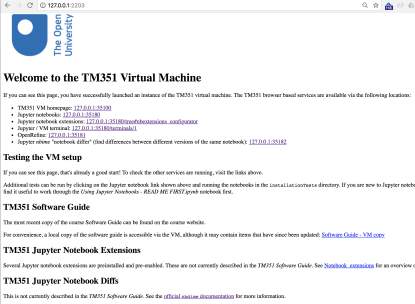
In my sketches for the new VM, I’ve added a simple python webserver that exposes a homepage that links to the various services running inside the VM. (Ideally, there’d also be indicator lights showing whether the associated Linux service is running or no: anyone know of a simple package to help with that?)

This made me think that it might be useful to provide simple search tool over the notebooks in the (shared) directory that the VM shares with the host.

One way of doing this might be to put the notebook content into a simple sqlite database and serve it using datasette, or query it via a Scripted Form style UI. SQLite has a full text search extension (FTS3-5) and some support for fuzzy matching (eg spellfix1), although I’m note sure how well it would fare as a code search engine.

But I also came across a lightweight Javascript search engine called lunr“[a] bit like Solr, but much smaller and not as bright” – and an example of How [Matthew Daly] Added Search to [His] Site With Lunr.js so I thought I’d give that a go…

At the moment, I’m only testing against a couple of notebooks. The search results are at the markdown cell level, so if a cell contains a lot of text, the whole cell will be displayed, which may not be optimal. I’m rendering the cell markdown as HTML in the browser using the Showdown Javascript package although this could be disabled to show just the raw markdown. My guess is that any relatively linked images embedded in the markdown will show as broken.

The search terms are supposed to be highlighted using mark.js, but while I had it working in a preliminary sketch, it seems to be borked now and I’m not sure where I’m setting it up incorrectly or using it wrong.

It strikes me that if a markdown cell in the results contains a lot of text, it might be worth trying to identify where in the text the query terms appear and then prune the result text around them.

I’m making no attempt to search code cells, though I did think about trying to extract lines of comment text using a crib along the lines of if LINE.strip().startswith('#').

I’m generating the lunr index using lunr.py and saving it along with a store of the cell content in a JSON file that’s loaded into the search page. Whilst I’m testing the search paged served from a simple Python httpserver, it struck me that it could also be served along a /view path in the Jupyter notebook context. When I first tried this, using JSON data loaded in to the search page using JQuery as a JSON object, I got a CORS error. Rather than waste too much time trying to solve that (I wasted a little!) I worked around it instead and loaded my lunr.json search index and store in to the page as JSONP instead.

One thing I need to do is provide an easy to use tool to generate the search index and lookup store from a set of notebooks. (In the TM351 VM context, this would be in the context of the mounted /shared notebooks folder that the notebook server runs at the top of.)

There still needs to be some clear thinking about what to link to – my initial thought is to link to the notebook running in the VM. If anchors are in the original markdown cell text it should be be possible to deeplink to those. It might also be possible to link to an HTML render of the notebook. This could be done via nbconvert (although I am not currently running this as a service in the VM) or perhaps as an in-browser rendering of the .ipynb JSON using something like Notebook.js / nbpreview. (FWIW, I also note react-jupyter).

But if nothing else, this is a thing that can be used and poked around to find out where it’s most painful in use and how it can be improved. A couple of things that immediately come to mind in terms of Jupyter integration, for example:

  • Jupyter notebook classic UI could come with a ‘Search notebooks’ tab and maybe a search indexer running in the background as and when notebooks in scope are saved);
  • JupterLab could be extended with a lun based notebook search plugin.

Code for my initial pencil sketch of a lunr Jupyter notebook markdown cell search tool can be found in this gist.

PS via Grant Nestor on the Jupyter Google group:

grep –include=’*.ipynb’ –exclude-dir=’.ipynb_checkpoints’ -rliw . -e ‘search query’

This will search your Jupyter server root recursively for files that contain the whole word (case-insensitive) “search query” and only return the file names of matches.

More info: https://stackoverflow.com/questions/16956810/how-do-i-find-all-files-containing-specific-text-on-linux

11 May 05:11

Ask a Planner: What would you re-do, and would it have made a difference?

by pricetags

What good questions. Bethany Lindsay of CBC asked it of three of our past planners:

We prepared a precis of their answers, and added our own take.

Ann McAfee:

We were so busy patting ourselves on the back, we probably should have been much more serious about what senior government programs, investor programs meant for the city, she said.

It’s only now we’re talking about speculator taxes and taxes on non-resident ownership. That discussion should have happened in the 1980s, early 90s, when those programs were starting to encourage money to come in, she said.

The city should have also pushed harder against the federal government when it backed away from funding co-op and non-profit housing in the 1980s, and lobbied the provincial government for more help, McAfee said.


Larry Beasley:

We had all done the calculations on how much wealth was being created as you allow people to go from industrial development to high density housing…. And we scratched our heads and we said, well, what else is it that the public might need? he said. 

The city settled on requiring contributions toward amenities like libraries and public spaces, as well as sites for low-income housing.

What we should have said in those meetings: Why don’t we try some middle income housing as well as low income housing? Beasley said.


Ray Spaxman:

Spaxman said it would have been impossible during his years in city hall to predict where things were heading. The federal government was still in the housing business and foreign money was a relative non-factor.

His real regret is what he sees as a lag in long-term planning for housing needs — and the lack of information provided to the public about the latest research on the housing crunch.

“One of the purposes of the planning department is to look ahead … and report on what appears to be happening,” Spaxman said.

“The planners, they don’t have sole control over what they look at. They make a report to our community leaders, who are the councillors, and our community leaders give them [the planners] the direction as to what they can do, he said.

Full story here; note that article’s comments section has been closed. Yours are welcome here.

Gord Price’s response:

As one of those councillors who was in power during the tenure of these three planners, I regret there’s not much in their recommendations that would have been doable by the City — or made much of a difference.

Speculator taxes, taxes on non-resident ownership, and continuation of senior-government housing programs? Not in our jurisdiction. And as one who attended a meeting in Ottawa to convince the Martin government not to abandon the housing file, we saw that their overriding priority was deficit reduction. The City of Vancouver took every remaining housing dollar we could get from the Province and required land be set aside in the mega-projects for funding in the future (it’s still there), but it wasn’t remotely enough.

CACs for middle-income housing? The pushback would have been extraordinary and seen by most residents as an unnecessary and unfair ‘subsidy,’ especially if it was thought to bump other opportunities for amenities.

The council I was on did intervene when Hong Kong investment was seen to exclude opportunity for Vancouverites to participate. Gordon Campbell, within a day, talked to Victor Li (son of Li Ka-Shing, who had purchased the Expo site) on a condo project that was being developed on the South Shore of False Creek and offered for sale first in Hong Kong. That stopped immediately.  

Nor was there a problem with the Concord Pacific project being bought up predominately by Chinese. Indeed, many of the newcomers preferred single-family housing, there was a drop in condo prices in the 1990s, and the development of seven mega-projects simultaneously (Concord Pacific, International Village, Coal Harbour, Bayshore, Collingwood Village, Fraser Lands and Arbutus Gardens), plus the re-zonings of Downtown South and Triangle West, provided more than sufficient supply to offset expanded demand and took pressure off the rental neighbourhoods like the West End.

I don’t remember anyone predicting the dilemma we face today in a way that would justified the interventions that now seem necessary. Nor would taxation policies have been politically possible without the ‘unexpected consequences’ that inevitably become the focus of criticism — even today.

But Ray Spaxman is right: all levels of government and the political class in general failed to monitor, predict, plan and discuss the problems related to rising housing costs. The fear of xenophobia, contradictory explanations, the need for high-risk interventions and split jurisdictions all combined to create a silence that was filled by anecdote, excuse and ultimately anger.  

And so here we are.

11 May 05:11

What's changing in property and the thought process behind working with a couple of startups in the recent program

The accelerator finished last week and my latest cohort of startups has flown the nest. Insert shedding-a-tear emoji here. I'm super proud. And a personal milestone: that makes 20 startups I'm connected with, either directly or via R/GA Ventures.

Campaign magazine did a great write-up and video of pitch day. Campaign noticed that five of our nine startups were pitched by women founders. A shift towards normality after last year's male-skewed cohort, but still not representative of the real world: ignore the presenters themselves and look at the companies in their entirety. Only five of the nine startups have women in the founding teams. It should be all nine. There's work to be done.


Here's a puzzle. What connects these two startups, both in the 2018 program:

  • Beringar which measures and helps optimise productivity in commercial real estate (like offices and hospitals) using sensors on the ceiling and a machine learning back-end. The business model is hardware-enabled SaaS.
  • CupClub which is on a mission to eliminate single-use food packaging, starting with coffee cups. Initial customers are businesses with internal cafés, and they pay a competitive per-drink price for reusable cups and a wash/return service.

The rationale I gave to the R/GA Ventures investment committee was the same in both cases.


The logic goes something like this...

Commercial real estate is changing. The days of the 25 year lease are over. We're seeing the WeWork-isation of everything. By which I mean, instead of long leases, we see not 5 or even 3 years, but companies moving to annual or month-by-month leases. This provides flexibility (reduced risk, ability to grow) plus access to pooled services normally only available to much larger firms.

Why is this happening? We can guess. My hunch is that it's to do with Ronald Coase and the internet. In 1937 Coase asked why firms exist. If the free market is so great, why bundle together everything from finance to marketing to tech inside one company; why not do everything by contracting out to the market? The answer is that the free market isn't free. There's a cost associated, and firms exist to make everything inside them cheaper.

But then the internet happened. Transaction cost dropped precipitously. Now firms can be smaller than ever before. Consider startups: everything is outsourced except core activities. Finance, HR, marketing operations, customer support, etc. Tons has been taken over by software (or rather, by the people at external firms who provide the software).

(Here's me rambling about Coase in 2014.)

So firms are smaller and more nimble than ever.

Aside: I think the same dynamic is responsible for the fact that some firms are more_gigantic_than ever. There's a bimodal distribution. Another effect is the growth of freelancers as a mode of employment, and what is either called the sharing or gig economy depending on the class of the worker: "sharing" if it's rich people renting out their homes on Airbnb; "gig" if it's working class people renting out their bikes and their sweat.

These firms pop into and pop out of existence. They don't want 25 year leases. They don't want to do fit-out, or manage their own office services.

This trend (here's my guess) is only going to continue.


Assuming this is true, what are the implications?

One shift I think we're seeing is that property owners are no longer planning (as much) on making their profit from rent. Instead rent should get them merely to break-even. Profit comes from selling services to their tenants.

These services have healthier margins than property, and they're charged on a recurring basis. Services like the usual ones: gas, electricity, cleaning, security. Then also higher-level services... like office productivity, and coffee. Bingo.


The shift is parallel to what happened in the consumer space. FMCG (fast-moving consumer goods) used to sell to consumers via supermarkets, unit by unit. Marketing was focused on keeping consumers loyal to the brand. We're in the middle of a shift to subscriptions--look at my oft-referred-to purchase of subscription shaving supplies co Dollar Shave Club by trad FMCG giant Unilever for $1BN. Marketing is now focused on customer acquisition, and highly targeted.

As it is in the consumer product space, and as it happened in the software space (from boxed software to SaaS) and also media (from DVDs to Netflix), so (I believe) it's happening in the property space. A shift to a services model.


What Beringar and CupClub have in common, for me, is that they are both beneficiaries--and will continue to be beneficiaries--of this property trend.

  1. They are both services targeting businesses, charged on a recurring basis
  2. They are likely to be resold by property owners to their tenants. That is, for both startups, landlords are channel

There were other reasons to invest, to be sure, but I made this same argument for both of them, and I get a kick out of that.


Is this all correct? Honestly? Who knows. It's a hunch.

It's useful to have a hunch about the bigger picture, because then my hunch-making muscles get some feedback. I have a similar hunch about all of the startups I've worked with. Sometimes it's obvious, sometimes it's not. Once you have a hunch you can build models and do research to check assumptions. Hopefully over time my hunches will get better.

I'm guessing that to proper investors (I just play one on TV, as they say) this kind of thinking is painfully obvious, so apologies for talking about how to suck eggs.

11 May 05:11

The Third Los Angeles

by pricetags

KCET, the #2 public television station in the US, airs Artbound, an art and culture series now in its ninth season.

Urban planner Michael Gordon recommends this episode from season 8 (just under one hour) on ‘The Third Los Angeles,’ presented by Christopher Hawthorne, who was at the time urban and architecture critic for the Los Angeles Times; he is now the City’s Chief Design Officer.

Here, Hawthorne looks at “the future of Los Angeles by examining its architecture, urban planning, transportation and changing demographics, giving us a glimpse of Los Angeles as a model of urban renewal for the nation and the world.”

10 May 14:25

An Enterprising Future

by Mike Kaply

Firefox 60 was released today with support for enterprise policies, including Windows Group Policy. If you’ve followed me or my blog for any length of time, you know that advocating for Firefox in the enterprise has been something that I’ve been doing a very long time.

My first post about Firefox in the enterprise was published on March 15, 2007 and was about Firefox 2.

The first version of the CCK Wizard was released on May 11, 2006 and was for Firefox 1.5

So, to say that I’m happy about this particular release would be an understatement. I’m absolutely ecstatic that Mozilla decided that adding support for enterprise features was important.

But I have to admit something; over the years in my zeal to get enterprise support into Firefox, I’ve encouraged just about every method possible to get customizations into Firefox. As a result, I know there are many installations of Firefox that use methods that are definitely not recommended anymore, especially now that we have real policy support. So, I want to take a moment to encourage everyone:

Please investigate using the new policy manager to replace any method you’ve used in the past, including the distribution directory, AutoConfig and CCK2. If you find things that you are not able to do with the policy engine, please let us know. There’s a possibility that some of these methods might not work in the future, so we’d like to find out now what we need to do to make things working.

If you find bugs or have feature requests, please report them on Github or in Bugzilla.

A couple other notes that might be useful:

  1. Updates to the policy code and additional policies are being allowed on the ESR. You will not be stuck with the existing implementation until the next major ESR. As we implement policies, they will be uplifted into the next minor ESR update.
  2. We are continuing to update the policy code to bring it as close as we can to CCK2 functionality.
  3. We are working on better support for macOS and Linux. We are investigating Managed Preferences on macOS and we are looking into reading the policies.json file from a different location on Linux (etc/opt/firefox).
  4. MSI is on our radar, but we’re not making any commitments at this time.

So now, let’s address the elephant in the room – CCK2.

First off, to support Firefox 60, I released a new version of the CCK2 yesterday. It’s not perfect, but it fixes some of the major issues (bookmarks and error popups). You should get automatically updated to this release. You’ll need repackage your configurations to get these fixes.

But what about the future?

CCK2 uses AutoConfig as the underlying technology to customize Firefox. We currently have plans to sandbox AutoConfig on Rapid Release starting with Firefox 62. This will mean the CCK2 will definitely not work with Rapid Release starting with Firefox 62.

On the ESR, I plan to keep CCK2 working, but I will not be implementing any new features except as they relate to making it easier to migrate to the policy manager. One example of that is providing the ability to remove all bookmarks added by CCK2. Once Firefox 52 is out of support, I will probably migrate CCK2 to use the policy manager internally. To enable that, we are investigating allow policies to be specified via AutoConfig as JSON files.

I always knew there would come a time when the CCK2 would not work anymore. My biggest concern was that there wouldn’t be a replacement. But I’m confident with the policy management support that we’ve implemented that we can make things even better.

I appreciate the support and encouragement folks have given me over the years with regards to the CCK2. I’m glad that the work that I’ve done will live on in the new policy manager on Firefox.

One final note. You will start to see a lot of my older blog posts disappear. This because I don’t want to recommend people use those methods anymore. The official place to get documentation and support is support.mozilla.org.

10 May 14:24

The Best Trackballs

by Thorin Klosowski
The Best Trackballs

After spending more than 120 hours testing eight trackballs during weeks of work, we found that the best trackballs are the finger-operated Kensington Expert Mouse Wireless Trackball and the thumb-operated Logitech MX Ergo Wireless Trackball. We also have budget picks—the Kensington Orbit Trackball with Scroll Ring and the Logitech M570 Wireless Trackball—if you don’t mind sacrificing build quality and a couple of features for a more affordable trackball.

10 May 14:23

Google Home Max is launching in Canada on May 16th for $499

by Patrick O'Rourke
Google Home Max

Google has announced that the Google Home Max, the Mountain View, California-based tech giant’s high-end speaker designed for audiophiles, is set to make its way to Canada on May 16th for $499 CAD.

The Max is significantly larger than the Google Home, features two tweeters, two subwoofers, a standard 3.5mm headphone jack and a USB Type-C connector that’s compatible with a wired ethernet dongle. Google’s new high-end speaker also includes Bluetooth connectivity and Google Cast support.

“It’s really a premium sounding speaker for music lovers,” said Google senior product manager Raunaq Shah, during an interview with MobileSyrup.

Similar to Apple’s HomePod — which still hasn’t been released in Canada — the Home Max is also capable of tuning itself to the acoustics of the room its placed in by using a machine learning process Google calls ‘Smart Sound.’

Google Home Max

Google says that Smart Sound works whether you’re listening to a song, podcast or even taking a phone call. Further, the speaker automatically adjusts its volume level depending on the the ambient noise present in the room.

The Home Max can  be flipped on its side, and is able to stand upright using a magnetic base that prevents it from accidentally toppling over. Google says that this base — which is included with the Max — is also designed to prevent the high-end speaker from damaging wooden surfaces, an issue Apple has encountered with the HomePod.

Home Max was first released in the U.S. back in December 11th, 2017, following its October 4th reveal during the company’s Pixel event.

The Home Max is set to release on May 16th in Canada and will be sold directly through Google’s online store, as well as at Best Buy. In the Canadian market the Home Max is priced at $499, making it one of the more expensive smart speakers available north of the U.S. boarder. When it comes to colours, the Max is set to be available in ‘Chalk’ and ‘Charcoal’ variants. In comparison the Home Max is priced at $399 USD in the United States.

To put the Max’s price tag in perspective, Amazon’s competing Echo Plus comes in at $149, while the Sonos One is priced at $249. This makes the Home Max a pricey speaker in the Canadian market, despite its arguably higher-end specs.

“With Max it has clean bass, but also I’m able to distinguish the vocals. That’s something we were really striving for when we engineered the hardware. You can hear the instruments and you can hear the vocals and it’s really a clean sound,” said Shah.

Google Home Max

While I only spent a brief amount of time testing out Google’s Home Max, the speaker outputs impressively full sound, offering surprisingly clear treble on the high-end, along with deep bass that filled the room

The speaker also offers identical functionality to the standard Google Home and the Home Mini, including deep Google Assistant integration and the ability to control supported smart home products via voice commands. That said, unlike the standard Home, when a song that features right or left channel audio mixing is playing, the Max is able to output music to individual speakers — but only when paired to an additional Max Spseaker.

Both rooms I was able to hear Google Home in were relatively small, so it will be interesting to see how well the high-end smart speaker is able to fill larger spaces.

We’ll have more on Google’s Home Max in the coming weeks including a full review of the speaker.

The post Google Home Max is launching in Canada on May 16th for $499 appeared first on MobileSyrup.

10 May 14:23

Android P updates are coming to Android TV as well

by Brad Bennett

Android P isn’t just coming to phones, Android TV devices will be receiving an update as well.

There will be a few design tweaks to the way that the interface works and looks, but more improvements will be noticeable during the setup process and in the back-end.

The first glimpse of the interface improvements can be seen in the new JBL Link soundbar trailer. It looks like there will now be some kind of app drawer button, which is great because there are currently far too many unused apps cluttering the home screen on my Sony Android TV. It also looks like the new version of Android TV will display Google Assistant information in a much cleaner way following the update.

Additionally, there will be a streamlined setup so it’s easier for users to use their TV with their Google account. If the TV is able to detect an Android phone in its vicinity the phone will receive a notification that prompts the user to start the TV setup the from their phone. Google has also made it easier to set up TVs by using iOS and the web.

Google also added an app selection screen as part of the set-up process. This makes it quicker for users to start using their TVs right after the setup. Some apps that are already installed on a user’s phone will automatically install on the TV too, if the same Google account is used on both devices.

The new update will help improve performance on low-end devices so ideally Google will be able to ship cheaper devices with Android TV once this update becomes available. This could place Google in a more head-to-head competition with Amazon and Roku who are both also trying to ship operating systems on cheaper TV sets.

Google finished off its presentation by sharing that the first devices to work with Android P TV will be the JBL Link Bar and the developer only ADT-2 device according to 9to5Google

Source: 9to5Google

The post Android P updates are coming to Android TV as well appeared first on MobileSyrup.

10 May 14:23

How to get bottom, top and corner notches on your Android P beta device

by Dean Daley

We’re now on day two of Google I/O and while at yesterday’s keynote the company didn’t mention anything about notches, the Android P public beta and the Android P developer preview 2, include an option that allows you to switch on a notch at the bottom, top or even in the corner of a device.

If you had the Android P developer preview 1, this might be old news, but if this is your first venture into Android P, here’s a comprehensive guide that bring notches to your Pixel — or any of the other 12 devices on the beta eligibility list.

Note: the first several steps relate to enabling developer mode in your phone — if you’re already a developer, you can skip ahead.

Begin by navigating to the settings app. Following that, swipe down and open the ‘System’ menu.

Next, navigate to the ‘About phone’ menu (you may skip the next step if you already have developer options enabled)

Then go down until you see the ‘Build number’ and tap on this seven times, or as many times as it takes until you see a message that reads ‘You are now a developer.’

Now that you’re a developer, go back to the ‘About Phone’ menu and you should see ‘Developer options’ (if you don’t see it there should be an ‘Advanced’ pull down menu).

Tap on ‘Developer Options’  and swipe down until you see ‘Simulate a display with a cutout.’ Tap on that option and it’ll open a pop up allowing you to enable a ‘corner display cut out,’ ‘double display cutout’ and a ‘tall display cutout’

Double display cutout will put a notch on the top and the bottom of the device, similar to the ZTE prototype the company revealed a less than a month ago. The corner display cutout will cut out a pit of the display in the top edge of the smartphone’s screen.

The corner is where the Xiaomi Mi Mix 2S was initially rumoured to have its camera (though this turned out be false).

Lastly, the tall display places the cutout near the top making it more vertical than horizontal.

While it’s interesting that you can do this, putting notches on your Pixel is completely unnecessary. Still, it’s a fairly strong indication that the Pixel 3 will adopt the notch.

The post How to get bottom, top and corner notches on your Android P beta device appeared first on MobileSyrup.

10 May 14:23

Android Auto’s new design language shown off at Google I/O

by Brad Bennett
Android Auto

Google started teasing the next variant of Android Auto’s design language right before the company’s annual I/O developers’ conference, and the company used the event to provide more details on the upcoming changes.

One of the big things Google showed off was its phone-less integration with Volvo and what it could look like if other car manufacturers started using this technology as well.

Google also discussed the way the company is building Android Auto’s backend to support a variety of different display sizes. An example of this could be running the music app and maps app at the same time on an ultra-wide or tall screen.

The only app that was shown off at I/O was Spotify, and it does look a lot more like the mobile app instead of the list-dominated apps that are part of the current Android Auto design philosophy.

Google also stated that it wants to integrate Android Auto into the design language of more cars. The company wants to do this by making the operating system’s visual langue represent the infotainment console of the car, according to TechCrunch.

Source: TechCrunch

The post Android Auto’s new design language shown off at Google I/O appeared first on MobileSyrup.

10 May 14:23

The world’s most downloaded iPhone app isn’t a social media one

by Bradly Shankar
Tik Tok

iPhone users sure do like music and selfies.

A new report from app analytics firm Sensor Tower reveals that for the first quarter of 2018, the most downloaded app on iPhone was Chinese music platform and social network Douyin (known outside of China as Tik Tok).

The app, developed by Beijing-based Bytedance and launched in late 2016, lets users create short ‘musical selfies’ that can be enhanced with various effects.

According to Sensor Tower, Tik Tok was downloaded over 45 million times on iPhones around the world, surpassing download figures for Facebook’s various social media apps.

After Tik Tok, the most downloaded apps on the worldwide App Store were PUBG Mobile, YouTube, Whatsapp and Facebook Messenger.

Source: Sensor Tower Via: Quartz

The post The world’s most downloaded iPhone app isn’t a social media one appeared first on MobileSyrup.

10 May 14:22

Peloton’s connected spin bike is coming to Canada this fall

by Bradly Shankar
Peloton bikes

Peloton has announced that its connected spin bike will release in Canada and the UK this fall.

The bike, which will cost $2,595 CAD, offers streaming to fitness classes through an attached screen.

Peloton has previously only done business in the U.S., making this the company’s first international expansion.

It’s important to note that Peloton requires a monthly subscription to get access to classes and full use of its bikes. No Canadian pricing has been revealed for the membership as of yet, although Americans currently pay $39/month (approximately $50 CAD) for the service.

Peloton says it also plans to open a retail location in Toronto, although there’s no word yet on where in the city this would be located.

Image credit: Peloton

Via: Engadget

The post Peloton’s connected spin bike is coming to Canada this fall appeared first on MobileSyrup.

10 May 14:22

Apple Cancels Data Center Project in Ireland

by John Voorhees

In 2015, Apple announced plans to build a data center in Athenry, Ireland. The facility was designed to run on renewable energy like other data centers Apple operates around the globe. However, the Irish project ran into problems from the start.

According to TechCrunch, concerns about the center’s environmental impact and effect on the electrical grid slowed the project down. Then, after Apple received the approval of the Galway County Council to begin building, individual objections were lodged and the disputes wound up in the Irish courts. With the prospect of appeals that would continue to prevent it from commencing construction, Apple decided to cancel the project.

In a statement to TechCrunch, Apple said:

“We’ve been operating in Ireland since 1980 and we’re proud of the many contributions we make to the economy and job creation.  In the last two years we’ve spent over €550 million with local companies and, all told, our investment and innovation supports more than 25,000 jobs up and down the country.  We’re deeply committed to our employees and customers in Ireland and are expanding our operations in Cork, with a new facility for our talented team there,” the company said in a statement provided to TechCrunch. “Several years ago we applied to build a data centre at Athenry. Despite our best efforts, delays in the approval process have forced us to make other plans and we will not be able to move forward with the data centre. While disappointing, this setback will not dampen our enthusiasm for future projects in Ireland as our business continues to grow.”

A second facility in Denmark that was announced at the same time the Irish data center is nearly complete. Apple has not announced any details about its ‘other plans’ referenced in its statement to TechCrunch.

→ Source: techcrunch.com