Shared posts

11 May 22:57

Google to demand regular Android security patches from OEMs

by Volker Weber

Dave Kleidermacher who leads mobile security at Google:

We’ve also worked on building security patching into our OEM agreement. Now this will really lead to a massive increase in the number of devices, and users, receiving regular security patches.

Dave used to Work for BlackBerry and put them on a monthly patch cycle (which they are struggling to serve). It is unclear what kind of update schedule Google will demand for licensing Android.

11 May 22:53

Is Toronto a smart city? MBA students say it could be smarter when it comes to bike lanes

by dandy


Image by Dave Murray for dandyhorse from issue 6.

How MBA students turn the bike lane issue on its head

By Gideon Forman

As Toronto strives to build a network of separated bike lanes throughout the city, some local business owners continue to raise objections.

Some claim the lanes — which can require parking spots to be removed — make it less convenient for drivers to access restaurants and stores, resulting in lost sales. Others complain the lanes impede delivery trucks, making it more difficult for merchants to receive supplies. Still others suggest the new road configuration exacerbates congestion.

The claims aren't always true. City of Toronto data suggest the Bloor lane, for example, has not harmed sales, but the perception remains among some owners that bike lanes threaten their establishments.

So when new routes are proposed — on Danforth Avenue, for example — shopkeepers can be oppositional. In April, a team of MBA students at the Rotman School of Management released a paper on attitudes toward bike lanes by Danforth businesspeople from Broadview to Pape Avenue. Based on an informal survey, it suggests all merchants have concerns about the lanes' impact on parking, with 82 per cent worried about deliveries and 64 per cent about sales. The report is troubling because bike advocates need to find common ground with the commercial sector to expedite cycle tracks' expansion.

What can advocates do? The Rotman students propose a novel solution. What if the issue could be turned on its head? What if the threat were presented not as bike lanes' presence but as their absence?

The students argue that Toronto is becoming a "smart city" featuring projects, such as Google's Quayside pilot, in which active transportation is central. If Danforth merchants want to prosper they need to be part of this trend and embrace the infrastructure of tomorrow.

Bike lanes help neighbourhoods become attractive, people-centred destinations. To reject the lanes is to remain in the past and suffer opportunity costs. The students urge cycling boosters to "position the introduction of bike lanes and transformation of the street as an opportunity to revitalize Danforth that is not to be missed."

Matthew Gaetz, one of the students who wrote the report, says the team's insight occurred when it started contemplating the nature of cities. "City planning is about thinking far into the future," he explains. "When councillors review a proposal, they think in terms of the next 50 years. It clicked for us that cities will be far different then. And at least some businesses have thought of this. So we wondered: can we shift the 'loss' scenario [from parking and sales] to not being included in this new, cool opportunity."

Another of the report's authors, Angela Morcos, agrees: "When we talked about removing parking, the businesses weren't interested. But when we suggested they're behind other neighbourhoods that have bike lanes and are more advanced, they felt they were missing out."

The students also recommend cycling advocates pair businesses whose streets have received bike lanes with businesses whose streets haven't. That could mean connecting a restaurateur on Bloor with one on Danforth. The former might have first-hand experience of the bike lane installation process and could, if the experience were positive, allay colleagues' fears.

Gaetz says this peer-to-peer approach can be superior to one in which businesses are lobbied by advocacy groups. "People are much more likely to respond to those who are like them," he argues. "A businessperson would paint a realistic picture of the bike lanes' introduction. If the Suzuki Foundation says positive things about bike lanes, a businessperson may be skeptical."

Adds Morcos: "When we talked to business owners we found the main people they trust is other businesses. Their peers actually went through the bike lane implementation so they know what they're talking about. Real life experience is valued more than statistics or theories."

The MBA students are telling advocates that, to get business buy-in for cycling infrastructure, they need to reframe the issue.


Photo by Yvonne Bambrick from issue 7.

The narrative needs to move from parking to building a forward-looking community; it's about the losses that ensue if we don’t and the gains that emerge if we do. And advocates need to shift from being lobbyists to facilitators whose job is to get supportive and nervous merchants into the same room and talking among themselves.

Gideon Forman is a transportation policy analyst at the David Suzuki Foundation.

Related on dandyhorsemagazine.com:

Bike Spotting Danforth Businesses

New Chief Planner says Danforth good candidate for bike lanes

Bike Plan Plods: Request for meeting about Danforth Corridor study still pending

Bikes are Good for Business

The Danforth Stripes Back

A Doable Danforth

Report: Businesses are flourishing on Bloor with new bike lane


11 May 21:35

Making useless things

by Nathan Yau

Simone Giertz, bringer of joy and self-described expert in shitty robots, makes machines that succeed in failing. In her TED talk, Giertz talks about her path from “useless” things to expert. It’s all the more relevant after she found out she has a brain tumor.

Giertz’ talk resonates a lot.

During the early years of FlowingData, when there was a comment section on every post, graphics I made would occasionally gain traction over the interwebs. In my own version of Godwin’s law, if a comment thread grew long enough, someone eventually would chime in: “Cool. Someone must have a lot of time on his hands.”

I was in graduate school at the time, with a dissertation staring me in the face, so I didn’t actually have much time. But I made time, because I didn’t know what I was doing, and that was fun for me.

I grasped on to the “cool” part of the comment and discarded the rest in my head. Someone liked something I made enough to tell me so! That turned out to be a great decision.

Tags: exploration, fun, lunch talk, Simone Giertz, TED

11 May 21:34

Using Your Photocopier to Share Data…

by Tony Hirst

Via Charles Arthur’s Overspill, an interesting story about Digital Photocopiers Loaded With Secrets, telling a tale of how you can buy scrapped photocopiers for their hard drives and then trawl them for data, as you might do with old office computers, or phones…

A quick skim of the Xerox website turns up a photocopier product line listing that includes details of whether a photocopier includes a hard drive, along with some general guidance information:

Security Features

Jobs may be written to nonvolatile memory (e.g. to a hard drive) during processing. Generally, when a job finishes, this data is deleted, but may still be recoverable using forensic tools. Image overwrite is effective at eliminating this job data from the hard drive once the data is no longer needed. Xerox also scrambles the data with the user data encryption feature.

This further protects data at rest from unauthorized access. Xerox recommends that the following features be enabled.

Fortunately, countermeasures are built into products to reduce this risk.

• Immediate Job Overwrite or Immediate Image Overwrite is a feature that deletes and overwrites (with a specific data pattern) disk sectors that temporarily contained electronic image data. Products that use hard disk drives to store job data initiate this process at the completion of each job. … This should be enabled (and is by default on many products).
• On Demand Image Overwrite is a manually initiated (can also be scheduled) feature that deletes and overwrites (with a specific data pattern) every sector of any partitions of the hard drive that may contain customer job data. The device will be offline for a period of 20 minutes to one hour while this completes. [Makes me think of coffee machine self-clean cycles, –Ed.]
• Disk or User Data Encryption is a feature which encrypts all partitions of the hard drive that may contain customer job data with AES encryption. This should be enabled (and is by default on many products). Encryption can be used in combination with either overwrite feature.

Hard Disk Drive Retention Offering

If the security features built into Xerox products do not meet your security requirements, Xerox offers another alternative.
Hard Drive Retention Offering is a service that can be requested by a customer who wants to retain a hard drive for security reasons. A Xerox technician will remove the hard drive and leave it with the customer.

Things to Remember
• Not all products have hard disk drives.
• Some products have hard disk drives, but do not use the hard disk drive to save document images.
• If a Xerox product is powered off before an Overwrite operation completes, there may be remnants of data left on the drive. A persistent message will appear on the device indicating the incomplete overwrite operation. In this event, it is recommended that an On Demand Image Overwrite be performed.
• Image overwrite features are available for hard drive equipped devices only. Currently it is not possible to overwrite images on solid-state nonvolatile memory.

• NOTE: Xerox strongly recommends the default Administrator password be changed on all devices to prevent unauthorized access to configuration settings.

Xerox does not offer sanitization or cleansing services for returned disk drives.

Many photocopiers nowadays are intended to be accessed over a network (they double up as network printers), and may incorporate a webserver to facilitate that. Which means they may also be a network security hazard. Which is why photocopiers should be regarded as part of the IT estate so that IT can be responsible for regularly checking a vendor’s photocopier security bulletin. (As computers, photocopiers are also susceptible to hardware/processor vulnerabilities.)

PS think also connected vending machines ?!

11 May 21:34

Generating Printable MS Word Versions of Merged Jupyter Notebooks

by Tony Hirst

One of the issues we know students have with the Jupyter notebooks that we provide as part of the course is that there is no straightforward way of printing them them all out for offscreen reading / annotation. (As well as code, there is a certain amount of practical and code related explanatory material in the notebooks.)

One of the things I started to doodle with last year was a simple script to merge several notebooks than then render the result as a Microsoft Word doc. This has a dependency on pandoc, though not LaTeX and requires that the conversion takes place via HTML: ipynb is converted to HTML using nbconvert , then from HTML to docx. If there are image files transcluded into the notebook, this also means that the pandoc conversion process needs to be executed in the same directory as the notebook so that the image paths are correctly recognised. (When running nbconvert with the html_embed output, pandoc fell over.)

Having to run pandoc in a local, image path respecting directory is a pain because it means I can’t run it over a merged notebook file composed of notebooks from multiple directories. Which means that I have to generate a separate docx file for the notebooks in each separate directory. Whilst I could more this into the same directory to make accessing them all a bit easier, it still means students have to print out multiple documents. I did try using a python package to merge the Word docs, but it borked on the images.

There are Python packages that can merge PDF documents in a more reliable way, but I am having issues with getting a sensible PDF workflow together. In the first case, for pandoc to render documents to  PDF seems to require the texlive-xetex package, which adds considerable weight to the VM (and I don’t know the dependency voodoo required to get a minimum viable LaTeX distribution in place). In the second, my test notebooks included a pymarkdown inline element that embedded a pandas dataframe in a markdown cell and this seemed to break the pandoc PDF conversion at that point.

One thing I haven’t done yet is look at customising the output templates so that we can brand the exported documents. For this, I need to look at custom templates.

My initial sketch code for the ‘export merged notebooks in a directory as docx’ routine is available via this gist. One thing I need to do is wrap it in a simple CLI command. Comments / suggestions for improvement, or links to better alternatives, more than welcome!

11 May 21:33

Samsung Galaxy Note 9 spotted on Geekbench with Snapdragon 845 and 6GB of RAM

by Dean Daley
Note 8

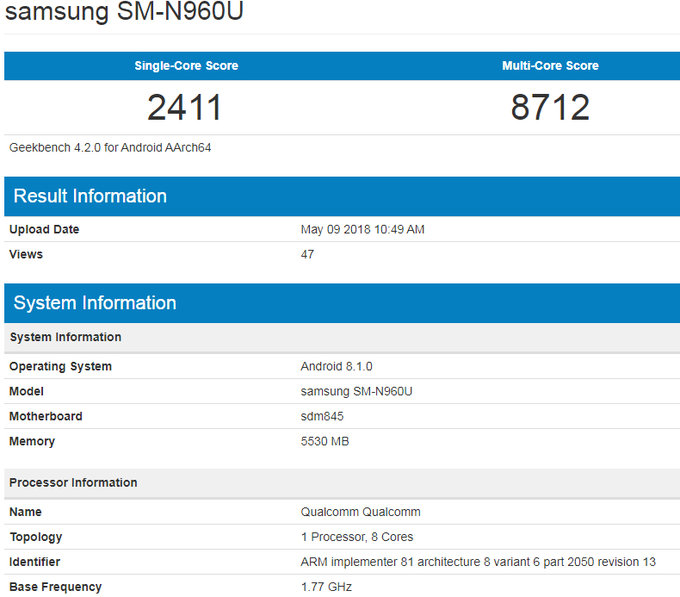
The Samsung Galaxy Note 9 has been spotted on Geekbench’s database, revealing a Snapdragon 845 chipset.

The listing was discovered by Trusted Reviews who says this isn’t the first time device has shown up on the benchmarking platform.

In fact, the 6GB of RAM device running Android 8.1 Oreo reportedly achieved a lower multi-core score than it did back in March, when it was first spotted.

The device achieved a multi-core score of 8712 which is 94 points lower than the first test. Meanwhile, it scored a single core score of 2411, 211 points higher than its first test, according to Trusted Reviews.

The reason for the drop is unclear, however, it’s important to keep in mind that the phablet is running unstable pre-production software. Further, benchmark tests can be fickle. In my personal experience running benchmark tests, I’ve received different completely different scores on the same smartphone only minutes apart.

Either way, this will be one fast smartphone.

Source: Trusted Reviews

The post Samsung Galaxy Note 9 spotted on Geekbench with Snapdragon 845 and 6GB of RAM appeared first on MobileSyrup.

11 May 21:31

When the Macintosh was Apple's financial lifeline

by Dries

How the iMac was Apple's financial lifeline
© Asymco

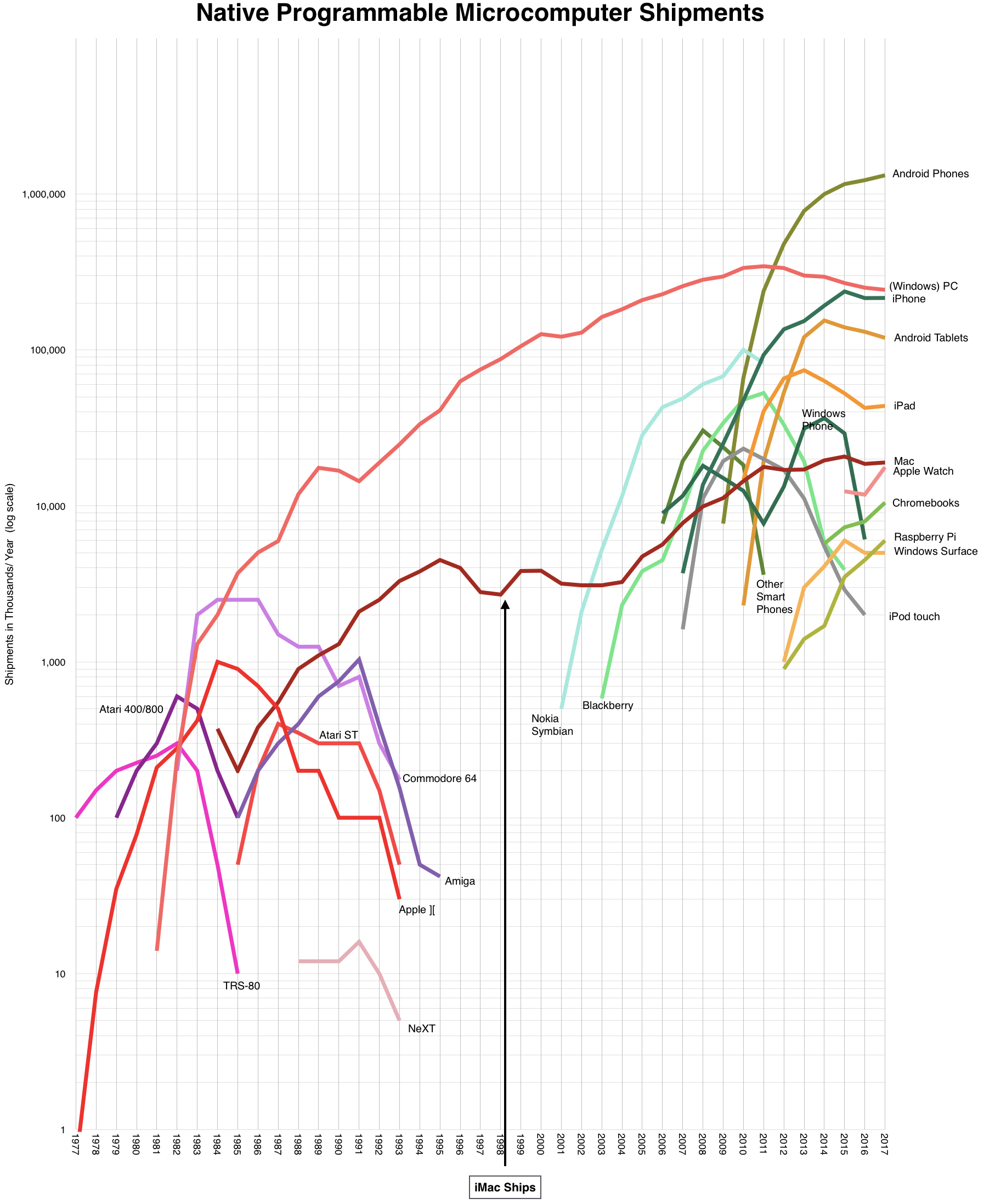
I love this graph. It shows that for some time, Apple's primary source of revenue was the sale of the Macintosh computer. The Macintosh provided Apple with a bridge between the desktop era and the mobile era, represented by the two clusters on the graph. That bridge was a financial lifeline. Without it, Apple might not have survived.

11 May 21:30

Google Has Three Pixel Branded Wear OS Watches in the Work, Snapdragon Wear 3100 Platform Detailed

by Rajesh Pandey
Yesterday, @evleaks revealed that Google is working on a Pixel branded smartwatch due to be released in fall this year. The leak came just a few hours after Qualcomm confirmed that it is indeed working on new chipset for the Wear OS platform. Now, more details about this new Wear chipset and Google’s smartwatch have been detailed. Continue reading →
11 May 21:30

Google’s human-like AI phone call ‘Duplex’ technology will tell you its a robot

by Patrick O'Rourke
Google I/O 2018

Duplex, Google’s eerily human-sounding Assistant feature that’s capable of making phone calls to local business for users, seems a little too impressive to actually exist at any point in the near future.

While Duplex could end up being the latest example of in a long line of I/O-related vapourware, it’s undeniably impressive. Following a backlash focused on the ethics of AIs pretending to be humans, Google has started to stress the transparency features built directly into the technology powering Duplex.

“We are designing this feature with disclosure built-in, and we’ll make sure the system is appropriately identified,” said a Google spokesperson in an emailed statement to various publications. “What we showed at I/O was an early technology demo, and we look forward to incorporating feedback as we develop this into a product.”

It’s still unclear how Google intends to handle this disclosure, but it would likely need to take place before the call starts. Otherwise, if Duplex actually works how Google demoed the technology at I/O, the person on the other end won’t know whether they’re talking to a robot.

In Google’s Duplex demo, the AI assistant made a real call to book an appointment at a hair salon, with the entire conversation sounding extremely lifelike. A second call was also made that went a little off the rails, with Duplex keeping its cool and continuing to carry on the conversation in a way that made sense.

Duplex sounded extremely natural during the demo and even threw in filler words like “hmm” and “umm,” making the conversation seem that much more real.

This has lead to a discussion surrounding the ethics of an AI powered robot essentially making a phone call for you. Google CEO Sundar Pichai welcomed the discussion surrounding Duplex’s ethics in a recent blog post.

“It’s clear that technology can be a positive force and improve the quality of life for billions of people around the world. But it’s equally clear that we can’t just be wide-eyed about what we create,” he wrote in a blog post.

“There are very real and important questions being raised about the impact of technology and the role it will play in our lives. We know the path ahead needs to be navigated carefully and deliberately—and we feel a deep sense of responsibility to get this right.”

Source: GoogleCNET

The post Google’s human-like AI phone call ‘Duplex’ technology will tell you its a robot appeared first on MobileSyrup.

11 May 21:29

The Best USB Headset for Your Computer

by Ray Aguilera and Daniel Varghese
The Best USB Headset for Your Computer

After putting in more than 50 hours of research and testing 17 different headsets, we’ve identified the Jabra Evolve 40 as our pick for the best USB headset for the office. It has the best sound quality—thanks to an excellent microphone and good headphones—of all the models we tested, and it’s comfortable enough to wear for a full workday filled with long conference calls due to soft, well-padded earpieces that don’t put pressure on your ears.

11 May 21:28

Writing a book with Google Docs, Google Sheets, and Google Drive

by Josh Bernoff

I’ve been working on a collaborative book project with two other authors. On this project, I’m the principal writer; they are my clients. Here are a few things I learned about the superiority of Google Docs and Google Sheets for collaborative authoring. Using Google Drive for shared access to research My collaborators and I work … Continued

The post Writing a book with Google Docs, Google Sheets, and Google Drive appeared first on without bullshit.

11 May 21:22

Microsoft ‘willing to work’ with Apple on bringing iMessage support to Windows

by Sameer Chhabra
Microsoft Edge Browser

A Microsoft executive told The Verge that the company would be interested in working with Cupertino computing giant Apple to bring iMessage support to Windows devices.

According to Microsoft general manager Shilpa Ranganathan — responsible for the Android Microsoft Launcher, as well as Microsoft’s cross-device experiences — the Redmond computing behemoth is “willing to work with Apple” to bring iMessage to Windows through its recently announced ‘Your Phone’ app.

“Apple does make it a tad harder for messages, but we’re very willing to work with Apple,” Ranganathan told The Verge. “I want to do this in a supported way with a respect for the ecosystem we’re building on and at the same time make it a delightful experience.”

“Messages is one where we’re not currently where we need to be compared to Android, but we need to work with Apple.”

According to The Verge, Microsoft has not yet approached Apple to see if Cupertino would be interested in working with Redmond on such a project.

Your Phone is a mobile-to-desktop app aimed at connecting user devices to Windows 10 computers.

Users will be able to access their messages, photos and notifications directly through their PCs.

Microsoft is still working on building the Your Phone app, but the company previously stated it plans on rolling it out to Windows Insider Program members soon.

Source: The Verge

The post Microsoft ‘willing to work’ with Apple on bringing iMessage support to Windows appeared first on MobileSyrup.

11 May 21:16

Twitter Favorites: [Planta] I was born here, but I'd still like to have a citizenship certificate.

Joseph Planta @Planta
I was born here, but I'd still like to have a citizenship certificate.
11 May 21:16

Twitter Favorites: [codeknitter] When you are feeling mother of dragons, but are actually mother of fluffballs https://t.co/Zsr2qoxi15

its Erin not Eric @codeknitter
When you are feeling mother of dragons, but are actually mother of fluffballs pic.twitter.com/Zsr2qoxi15
11 May 21:16

Twitter Favorites: [termie] #pycon2018 I'm now officially an informed individual https://t.co/NZbbRoYl7G

termie @ PyCon @termie
#pycon2018 I'm now officially an informed individual pic.twitter.com/NZbbRoYl7G
11 May 21:15

Google Photos team explains what happened to object removal feature

by Bradly Shankar
Google object removal

During its 2017 I/O keynote, Google revealed a remarkable Photos feature that could automatically remove objects that are obscuring the main subject of an image.

As an example, Google CEO Sundar Pichai presented a photo of a girl playing baseball, with the object removal feature wiping way the chainlink fence in front of her to offer a more clear picture of her at bat.

Unfortunately, despite Pichai stating at the time that feature would be “coming very soon,” it hasn’t since arrived at all — even after the tech giant has already held another I/O event.

The reason for this, according to members of the Google Photos team, is because the feature was only meant to be a tease of what Google’s machine learning capabilities.

In an interview with XDA, David Lieb, product lead for Google Photos, and Ben Greenwood, product manager for Google Photos, explained that while such object removal tech is available and can be deployed, the Google Photos team is ultimately building their product by prioritizing what’s “most important” for people.

Further, when asked by 9to5Google about availability of the feature, Greenwood said “I wouldn’t say it’s coming very soon.”

Given these statements, it’s currently unclear when (or even if) the Google Photos object removal feature will ever make its way to the public.

That said, users digging around a late 2017 Google Photos update discovered bits of code from the object removal feature, so hopefully it will come out at some point in the future.

The feature is one of several announcements made at I/O over the years that never panned out, including Allo and Doze.

Source: XDA

The post Google Photos team explains what happened to object removal feature appeared first on MobileSyrup.

11 May 21:15

Google announced 100 things at I/O this year

by Brad Bennett

Google I/O is finally over and the company has shared a list of all 100 announcements that happened at the event.

To check out our coverage on some of these announcements keep reading.

Google Assistant is getting six new voices. Moreover, John Legend will soon lend his voice the personal assistant. The six new voices are available now but John Legend’s voice still isn’t ready.

Continued conversations are coming to make talking to Google Assistant even easier. This feature will let users chain questions together.

Google announced some new smart displays that will launch along with Youtube TV. To take on Amazon’s similarly smart displayed devices.

The scariest Google feature ever was announced and it’s called Google Duplex. It lets users use Assistant voice to book them appointments over the phone.

AI is coming to Gmail so users can smart compose emails.

The Android P beta arrived on multiple phones and users have been finding tons of new features.

App slices were shown off and they should let users go into their apps from Google Search.

Google launched a new initiative called Digital Wellbeing that comes with a variety of tweaks will help users monitor their phone use.

The JBL link soundbar is a new device that Google announced that combines a smart speaker and an Android TV into a soundbar.

The next version of Android TV was shown off along with an Android TV dongle to help developers make apps for the device.

There was a new version of Android Auto shown off at the show and it involved a very interesting Volvo Android Auto partnership.

A few new features were announced for Google Maps called ‘For You’ and ‘Your Match.’ 

Another really cool Google Maps feature was shown off called walking directions with AR

Google took a revamped approach to Google News and it should be available soon.

To check out Google’s full list of announcements click here.

Source: Google

The post Google announced 100 things at I/O this year appeared first on MobileSyrup.

11 May 21:15

Everything Is a Subscription Now and It’s Too Much

files/images/xIMG_3623-picsay.jpg.pagespeed.gpjpjwpjwsjsrjrprwricpmd.ic._hNnlD4IGp.jpg

Justin Pot, How-To Geek, May 14, 2018


Icon

The conversion from a sales model to a subscription model may well have worked for software vendors, but as the trend has taken hold it is becoming clearer that it is unsustainable. "Netflix. Spotify. Newspapers. Office365. Dropbox. Everything is a subscription now, but how many services can people afford?" This (very) short article suggests that bundles may be the answer ("Microsoft, Google, and Apple seem intent on copying the Amazon Prime model, likely for this reason: they want to be the one subscription their customers pay for." But I can't imagine that this is what customers want.

Web: [Direct Link] [This Post]
11 May 21:14

Twitter Favorites: [bmann] Or we can understand that forestry has already been eclipsed as the largest employer or contributor to revenue, and… https://t.co/sg6xLhn94N

Boris Mann @bmann
Or we can understand that forestry has already been eclipsed as the largest employer or contributor to revenue, and… twitter.com/i/web/status/9…
11 May 21:14

Twitter Favorites: [sonyaellenmann] Maybe I should go all-in on Pinboard instead... but it's not quite perfect in other ways. Harrumph.

Sonya 🌐 Mann @sonyaellenmann
Maybe I should go all-in on Pinboard instead... but it's not quite perfect in other ways. Harrumph.
11 May 21:14

Twitter Favorites: [carnivorous8008] Increasingly impatient with people who aren't on-call but have ops opinions nevertheless "You can just do this man… https://t.co/Jma9caT0qE

M̵̟̜̬̭̜a̦̥̭͈͟t̴̫t̶̫̖̤ ̼͓͝O͕̻̭̥̬̮ͅḷ̗̳͘so̖̫͠n @carnivorous8008
Increasingly impatient with people who aren't on-call but have ops opinions nevertheless "You can just do this man… twitter.com/i/web/status/9…
11 May 21:14

Twitter Favorites: [DenimAndSteel] Spotting @counti8 up to her usual work of bringing people into thinking and doing to improve city life. 👋 https://t.co/97SKqWYOIj

Denim & Steel @DenimAndSteel
Spotting @counti8 up to her usual work of bringing people into thinking and doing to improve city life. 👋 twitter.com/MitchellReardo…
11 May 21:14

Twitter Favorites: [Sean_YYZ] Spadina Crab! Spadina Crab! Spadina Crab! Packs quite a jab! I need confirmation of my information of my transportation of my crustacean!

Sean Marshall @Sean_YYZ
Spadina Crab! Spadina Crab! Spadina Crab! Packs quite a jab! I need confirmation of my information of my transportation of my crustacean!
11 May 05:10

Scientific debt

by David Robinson

A very useful concept in software engineering is technical debt.

Technical debt occurs when engineers choose a quick but suboptimal solution to a problem, or don’t spend time to build sustainable infrastructure. Maybe they’re using an approach that doesn’t scale well as the team and codebase expand (such as hardcoding “magic numbers”), or using a tool for reasons of convenience rather than appropriateness (“we’ll write the DevOps infrastructure in PHP since that’s what our team already knows”). Either way, it’s something that seems like it’s working at first but causes real challenges in the long-term, in the form of delayed feature launches and hard-to-fix bugs.
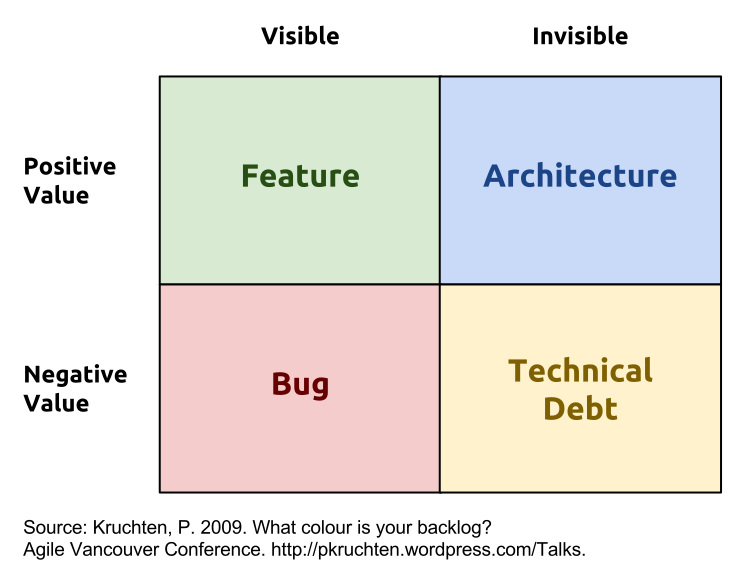
In my new job, I’ve been thinking about the role of data science within a business, and discussing this with other professionals in the field. On a panel earlier this year, I realized that data scientists have a rough equivalent to this concept: “scientific debt.”

Scientific debt is when a team takes shortcuts in data analysis, experimental practices, and monitoring that could have long-term negative consequences. When you hear a statement like:

  • “We don’t have enough time to run a randomized test, let’s launch it”
  • “To a first approximation this effect is probably linear”
  • “This could be a confounding factor, but we’ll look into that later”
  • “It’s directionally accurate at least”

you’re hearing a little scientific debt being “borrowed”.

Example: WidgetCorp

Most engineers have a sense of what it’s like for a company to struggle with technical debt. What would a company struggling with scientific debt look like?

Imagine a small startup WidgetCorp is developing a B2B product, and deciding on their sales strategy. One year they decide to start focusing their sales efforts on larger corporate clients. They notice that as they take on this new strategy, their monthly revenue increases. They’re encouraged by this, and in the following years hire half a dozen salespeople with experience working with large clients, and spend marketing and design effort building that as part of their brand.

Years later, the strategy doesn’t seem to be paying off: their revenue is struggling and the early successes aren’t repeating themselves. They hire an analyst who looks at their sales data, and finds that in fact, it had never been the case that they’d had a higher return-on-investment selling to large companies. In that early year, their revenue had been rising because of a seasonal effect (the demand for widgets goes up in the fall and winter), which was compounded with some random noise and anecdotes (e.g. “SmallCompany.com was a waste of our time, but we just closed a huge deal with Megabiz!”)

WidgetCorp took on too much scientific debt.


Some ways this might have happened:

They made irreversible decisions based on flawed analyses. It’s reasonable to take a quick look at metrics and be happy that they’re going in the right direction. But once the company made product, sales and marketing changes, it became difficult to reverse them. Before making a major shift in business, it’s worth making sure that the data supports it: that they’ve accounted for seasonal effects and applied proper statistical tests.

Lack of monitoring. Early on, there may not have been enough data to tell whether larger clients were a better investment. But as more data was collected, it would be worth continually testing this assumption, in the form of a dashboard or a quarterly report. If this isn’t tracked, no one will notice that the hypothesis was falsified even once they have the data.

Lack of data infrastructure: Maybe early in the company the leads were locked in a sales CRM, while accounting data was stored in Excel spreadsheets that were emailed around. Even if there were a dedicated analyst within the company, they may not have easy access to the relevant data (linking together sales sucess and company size). Even if it were theoretically possible to combine the datasets with some effort, schlep blindness might have made everyone avoid the analysis entirely. This is an area where technical debt and scientific debt often appear together, since it takes engineering effort to make scientific problems easy to solve.

Spreading inaccurate lore. Suppose that the WidgetCorp CEO had given a series of company-wide talks and public blog posts with the message “The future of WidgetCorp is serving big companies!” Product teams got into the habit of prioritizing features in this direction, and every failure got blamed on “I guess we weren’t focused enough on big clients”. This kind of “cultural inertia” can be very difficult to reverse, even if the executive team is willing to publicly admit their mistake (which isn’t guaranteed!)

Just about every experienced data scientist has at least a few of these stories, even from otherwise successful companies. They are to scientific debt what the Daily WTF is to technical debt.

Is scientific debt always bad?

Not at all!


I often take shortcuts in my own analyses. Running a randomized experiment for a feature launch is sometimes too expensive, especially if the number of users is fairly small or the change pretty uncontroversial (you wouldn’t A/B test a typo fix). And while correlation doesn’t imply causation, it’s usually better than nothing when making business decisions.

The comparison to technical debt is useful here: a small engineering team’s first goal is typically to build an minimum viable product quickly, rather than overengineer a system that they think will be robust in the distant future. (The equivalent in scientific debt is typically called overthinking, e.g. “Yes I suppose we could control for weather when we examine what sales deals succeed, but I’m pretty sure you’re overthinking this”). And the comparison to financial debt is meaningful too: companies typically take on debt (or, similarly, give up equity) while they’re growing. Just like you can’t build a company without borrowing money, you can’t build a company while being certain every decision is thoroughly supported by data.

What’s important in both technical and scientific debt is to keep the long-term cost in mind.

Wrong decisions are expensive, and not paying attention to data is a risk. We can do a cost-benefit analysis of whether the risk is worth it, but we shouldn’t write it off as “data scientists always find something to complain about”.

Why even call it “debt”?

To a data scientist or analyst, this post might sound pretty obvious. Of course there are downsides to ignoring statistical rigor, so why bother giving it a “buzzword-y” name? Because it puts the concept in terms executives and managers can easily understand.

Again, let’s go back to technical debt. There are lots of reasons individual engineers may want to write “clean code”: they appreciate its elegance, they want to impress their peers, or they’re perfectionists procrastinating on other work. These reasons don’t generally matter to non-technical employees, who care about product features and reliability. The framing of technical debt helps emphasize what the company loses by not investing in architecture: the idea that even if a product looks like it’s working, the flaws have a long-term cost in actual dollars and time.


Engineer: It bothers me that different internal projects use different naming conventions.

CTO: Sorry it annoys you, but code is code, I don’t see why you should waste time on this.


Engineer: Our inconsistent naming conventions are technical debt: they make it harder for new developers to learn the system.

CTO: I’ve been looking for ways to reduce our onboarding time! Great idea, let me know what you need to fix it.


Similarly, scientists, especially from an academic background, often have a particular interest in discovering truths about reality. So the idea of “I’d like to analyze whether X is a confounding factor here” can sound like an indulgence rather than an immediate business need. Statisticians in particular are often excited by finding flaws in mathematical methods. So when a data scientist says something like “We can’t use that method, Jones et al 2012 proved that it is asymptotically inconsistent,” non-technical colleagues might assume they’re overthinking it or even showing off. Framing it in terms of what we’re actually risking helps communicate why it’s worth spending time on.

How can we manage scientific debt well?

  • Let data scientists “pay interest” on it. Just as not every engineering project will lead to a new feature, not every analysis will lead to an exciting discovery or novel algorithm. Some time needs to be spent confirming or invalidating existing assumptions. Jacqueline Nolis has a great article about prioritizing data science work, where she describes this quadrant as “providing proof”.

  • Build data engineering processes: As described earlier, one reason a company might fall into scientific debt is that analysts may not have easy access to the data they need. It could be locked away in a platform that hasn’t been ingested, or in Google sheets that are edited by hand. Ingesting relevant data into a data warehouse or a data lake makes it more likely data scientists can make relevant discoveries.

  • Revisit old analyses: One common reason early-stage companies go into scientific debt is that they don’t yet have enough data to draw robust conclusions. Even if you don’t have enough data yet, that doesn’t mean you should forget about the problem. Sometimes I put time on my calendar to run an analysis once I expect enough data to be available, even if it’s a few months away. This can also help confirm an important analysis is still relevant: just like you’d keep track of a KPI over time, you want to keep track of whether a conclusion remains true.

  • Have data expertise spread throughout the company. Just as someone who can’t program may not recognize technical debt, someone who doesn’t have experience analyzing and understanding data may not recognize scientific debt. This is yet another reason to democratize data science within your company, as we do at DataCamp.

11 May 05:10

Ethics are not enough

by Tom MacWright

ethics aren't enough

Ethics are not enough to fix the technology industry. We need regulation and laws to draw bright lines around what is and isn’t acceptable, in terms of privacy, competition, risk, and health.

The movement to introduce ethics into computer science education is well-intentioned and will likely succeed at raising personal awareness. But the idea of actual regulation has been missing from the conversation. I think that the omission stems from tech culture, which has long shunned any government involvement, and from tech leaders, whose are economically motivated to minimize oversight. The current norm, in which companies are able to make public promises and break them without consequence, is the best possible scenario for business.

Focusing solely on individual ethics is a seductive trap because the technology industry treats startups as collections of workers, not like the faceless corporations of the past. That has never been true. Technology companies are corporations, and corporations are designed to take risks and make decisions that no individual would make alone.

And the drive for ethical oaths misses the point. They reference the Hippocratic Oath, which has been taken by physicians for hundreds of years, and swears them to uphold ethical standards. But when a doctor commits medical malpractice, it’s a legal matter, usually as negligence. Violating a symbolic oath is the least of their worries.

Oaths are useful for daily self-guidance, but where there are severe consequences, we’ve supplemented them with laws. Privacy is encouraged by the Hippocratic Oath, but enforced by HIPAA: a federal law.

The tech industry has suggested that there should be more regulation than presently exists, but less than any law has proposed - with the exception of net neutrality. We’ve seen the tech industry rally behind net neutrality laws in the last few years. Maybe we can see the same enthusiasm for common-sense user protections.

We, people who make technology, who have a stake in the future, should know and care about ethics, but we should also rally for smart regulation. It’s time for a wider range of digital wrongdoing to become illegal, not just unethical.


Footnotes

The need for regulation doesn’t invalidate or devalue the push for ethics. We need both. A useful historical reference is the rise of interest in business ethics which, combined with deregulation, hasn’t especially worked.

Regulation is not necessarily positive, and many past examples have missed the mark. But if techno-futurists can imagine worlds where cars drive themselves, they should be able to fathom a world where technology is required to meet a basic level of privacy and equity.

11 May 05:10

Librem 5 design report #5

by François Téchené

Hello everyone! A lot has happened behind the scenes since my last design report. Until now, I have been reporting on our design work mainly on the software front, but our effort is obviously not limited to that. The experience that people can have with their physical device is also very important. So in this post I will summarize some recent design decisions we have made both on the software side and the hardware product “experience” design.

Thinking about the physical shell

Our goal with the Librem 5 is to improve the visual identity of the Librem line while staying close to the minimalist and humble look that characterize the existing Librem line.

The main challenge of case design is the need to balance aesthetics, ergonomics, convenience, and technical limitations.

As you know, the Librem 5 is a special phone that will not integrate the same CPU and chipsets as usually implemented in the vast majority of smartphones in the market. Power consumption is a very important factor to take into account, but so is battery capacity and printed circuit board arrangements, and we don’t want to sacrifice battery life for a few millimeters of thickness. Therefore:

  • We are now aiming for a 5.5″ to 5.7″ screen with a 18:9 ratio that would let us incorporate a larger battery without affecting the shape of the phone.
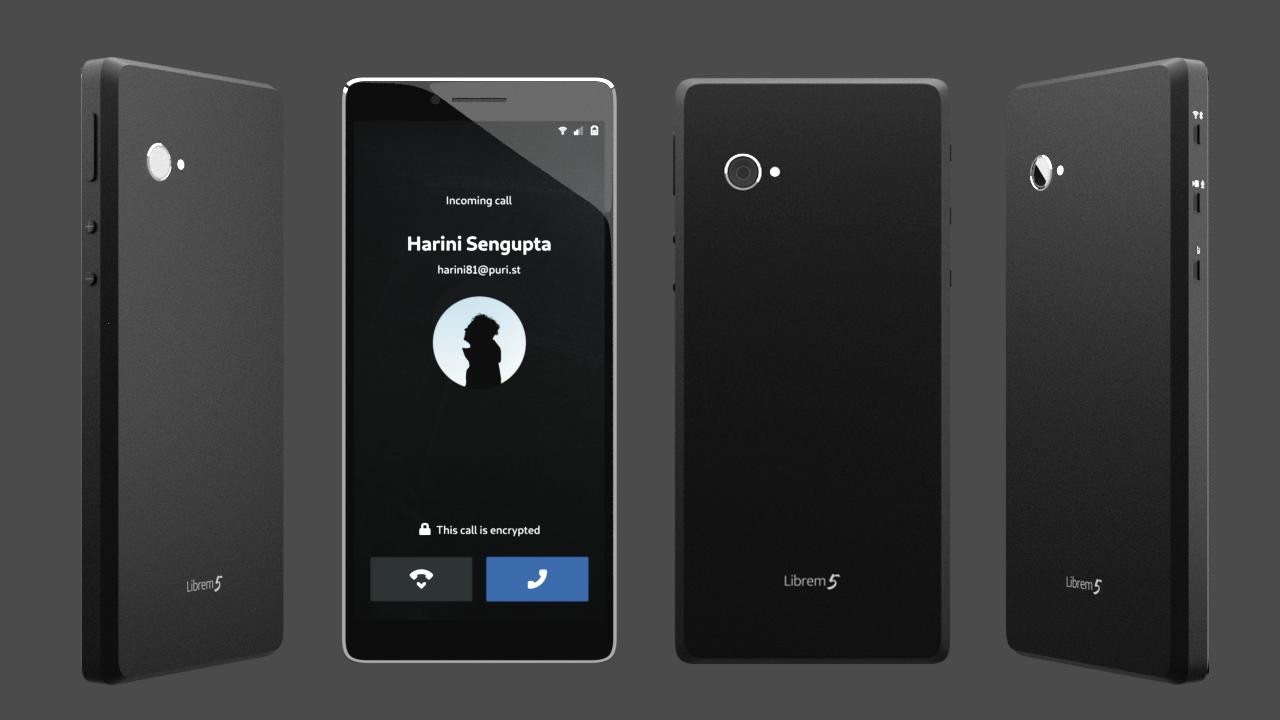
  • We are also opting for a shape with chamfered edges (as pictured below), instead of the usual rounded ones. Not only do we think it looks elegant, the general shape would provide a better grip and it give us a bit more room inside for components.

Simplifying the UI shell

As the implementation of the Librem 5 goes on, we are quite aware that time is limited given our January 2019 target, and we are therefore focusing on robustness and efficiency for the first version of the mobile UI shell (“phosh”), which we wish to push upstream to become the GNOME mobile shell. As you may recall from our technical report from early March, we had discussed with GNOME Shell maintainers, who recommended this clean-slate approach.

We revisited the shell features and decided to split the design and implementation into several phases.

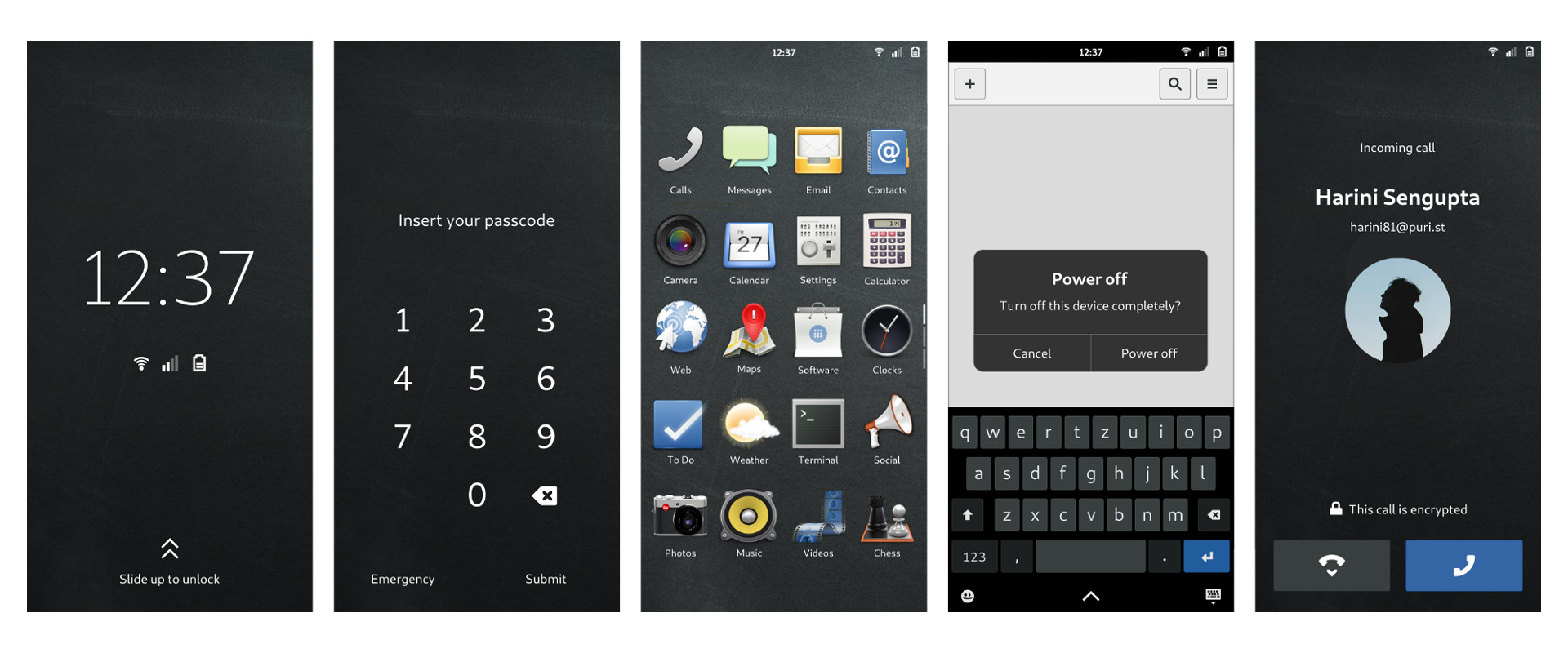
Phase 1 defines a shell that is at its simplest state in term of features and usability. This is the shell that should ship with the Librem 5 in January 2019.

This shell includes :

  • A lock screen.
  • A PIN-based unlock screen for protecting the session.
  • A home screen that displays a paginated list of installed applications.
  • A top bar that displays useful information such as the time, battery level, audio level, network status…
  • A bottom bar that simulates a home button (only visible when opening an application).
  • A virtual keyboard.
  • Incoming call notifications.

The “call” app is indeed a special case application on a phone, and that’s why we’re prioritizing it for the notifications feature: it has to work from day one, and it has some requirements like the ability to interact directly on the lock screen (to answer an incoming call, or to place an emergency services call).

Multitasking UI workflows, search and more flexible app notification features/APIs should be implemented during phase 2, available a bit later.

While “phase 1” might not be the all-you-can-eat features buffet some may be accustomed to, we think that this minimalist shell will be extremely simple to learn, use and will favor a quick and painless adoption. And it’ll be a great starting point.

Designing the Contacts application

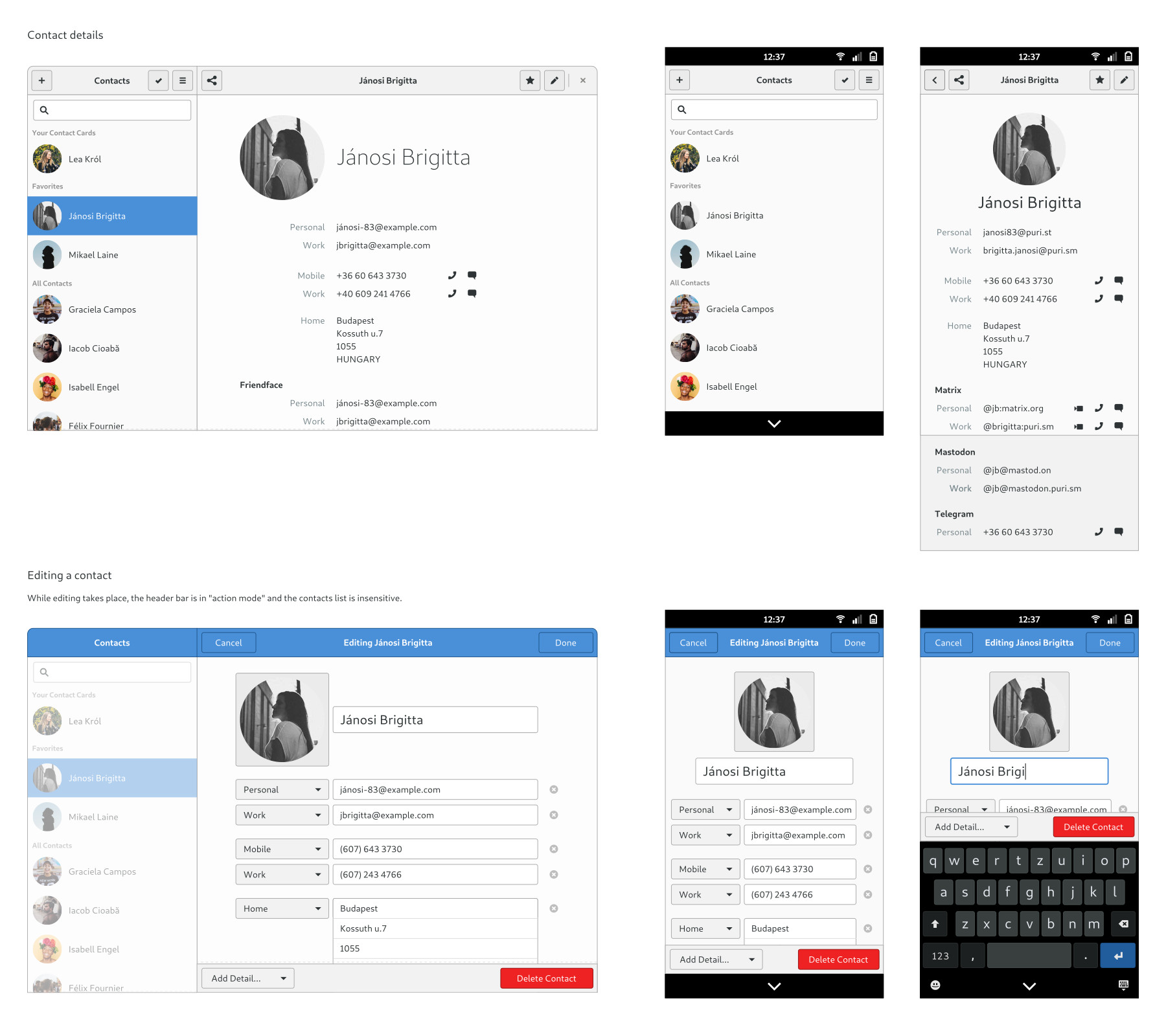
The Contacts application will be at the center of the communication features. It is the application that will handle the contacts management that other applications such as Calls or Messages will rely on.

For that matter, we are adapting the existing Contacts application by designing its mobile layout and adding extra fields that will be required by the different communication applications.

Librem 5 & Fractal team hackfest in Strasbourg

This week, a few members of the Librem 5 team (including myself) are attending the 2018 Fractal design hackfest in Strasbourg, with the goal of helping the Fractal team to make a beautiful and secure Matrix-based IM application to be used on both the desktop and mobile platform. I hope to do a report on the communication features of the Librem 5 in a future post where I will talk about what happened at the Fractal hackfest.

The post Librem 5 design report #5 appeared first on Purism.

11 May 05:08

Huawei P20 Lite will be exclusive to Rogers and Fido

by Dean Daley

Huawei’s P20 and P20 Pro will soon arrive at a number of carriers, including Bell, Telus, Rogers, Virgin Mobile, Koodo, Fido and SaskTel.

The company’s pared-down P20 Lite, however, will only be available at Rogers and Fido.

The Huawei P20 Lite will become available starting May 17th, similar to the P20 and the P20 Pro. Canadian pricing for the device has yet to be released, however, we’ll update story as soon as we get it.

The Huawei P20 Lite features a 5.84-inch LCD display with a  19:9 aspect ratio and a 1080 x 2280 pixel resolution. The phone sports the company’s Kirin 659 chipset, with up to 64GB of internal storage and 4GB of RAM.

Further, the phone features a dual camera setup with 16-megapixel and 2-megapixel sensors, alongside a 16-megapixel selfie shooter.

The P20 Lite is powered by a 3,000mAh battery and hosts a rear facing fingerprint sensor.

The post Huawei P20 Lite will be exclusive to Rogers and Fido appeared first on MobileSyrup.

11 May 05:08

Canada’s privacy commissioner shares his view on autonomous vehicles

by Brad Bennett
Waymo self driving car

Canada’s privacy commissioner Daniel Therrien presented his views on the privacy implications of autonomous and connected vehicles at a House of Commons transportation committee meeting on May 9th.

Therrien appeared before the Standing Committee on Transport, Infrastructure and Communities (TRAN), in response to a study that was released in January of this year.

The study pointed to five key areas to help the government better prepare for a self-driving car-filled future.

Among these was a recommendation that the “government should put forward legislation to empower the Office of the Privacy Commissioner to proactively investigate and enforce industry compliance with privacy legislation.”

Therrien began by mentioning that modern vehicles can be likened to “smartphones on wheels,” suggesting that users will need to start becoming aware of what data these vehicles gather about drivers and passengers.

“This information is not strictly about the car; it can be associated with the car’s driver and occupants, and used to expose patterns or make inferences about those people for a number of purposes not all related to the functioning of the vehicle or safe transportation,” said Therrien.

The Commissioner also expressed concern with the fact that data flows in connected vehicles are very complex and, as a result of this fact, are not transparent.

Therrien did mention that the arrival of autonomous cars will have many benefits for Canadians but he worried that Canadians won’t trust these cars until the “appropriate balance is reached between information flow and privacy protection.”

He touched on how his office has been looking to improve consent for users data by trying to find ways to give “individuals the ability to make decisions about their data.”

Although Therrien did say that this hasn’t been happening since, “organizations still need to do a better job of explaining what they propose to do with the personal information they collect.”

Therrien said that “industry code of practice, privacy by design and strong organizational accountability” will help connected car manufacturers better respect Canadians privacy rights.

Ideally, Therrien would like to see an amendment to the law that would allow the privacy office to “independently confirm that the principles in our privacy laws are being respected – without necessarily suspecting a violation of the law.”

Source: The Office of the Privacy Commissioner of Canada

The post Canada’s privacy commissioner shares his view on autonomous vehicles appeared first on MobileSyrup.

11 May 05:08

Google promises from past I/O keynotes that never actually happened

by Jonathan Lamont
Google I/O logo on Pixel

Google I/O and other major tech conferences have a knack for showing off big, crazy features.

Take the insane Duplex stage demo at this year I/O, for example. It was so far beyond anything that exists in our world — Duplex was straight out of science fiction.

However, sometimes those features don’t actually make it to the public. Others do — and flop spectacularly. Lets take a trip back to previous Google I/Os and remember the announcements that never quite made it.

I/O 2017

This was the year Google showcased the AI tool that would magically remove objects in photos.

Google baseball kid

The company showcased the feature on stage, showing a photo of a child playing baseball where the chain link fence magically vanished. It garnered the same reaction as the Duplex demo. It was promised “soon” but never came.

Some digging in a Google Photos update later that year revealed bits of code from the object removal feature, but we still haven’t seen a release of this feature.

I/O 2016

Remember Allo? The chat app and its sister, video calling app Duo, were announced at I/O 2016 to much hoopla. The app had Google Assistant baked in, featured private and encrypted chats and was full of emojis and custom stickers.

A lot of people thought it would be the iMessage of Android.

However, Allo never really lived up to the hype. The chat platform lacked critical features like SMS support. One of its most touted features, sending an Allo message to someone without Allo installed, also only sort of worked.

Allo

If you had an Android device, tapping the notification opened the chat in an Allo-like window and prompted you to download the app. On iOS, you got a spammy-looking text with a link to the app.

Google recently put the project on hold, choosing to focus on its new RCS standard instead.

I/O 2015

2015 brought us Android Doze and Google Now On Tap. While not monumental flops, both of these apps came with impressive claims and have since disappeared into other features.

Doze was supposed to be a major battery saving feature that used motion detection to discern when the device wasn’t in use in order to consume less data running in the background.

However, Doze didn’t kick in if the device was moving. For those of us who put our phones in our pockets, that meant no Doze. Google later adjusted Doze to fix that. However, the feature seems to have been entirely replaced by Adaptive Battery. The new feature, announced at I/O 2018, learns which apps you care most about and reduces background data use for the apps you don’t spend that much time with. It’s no longer a motion based system.

As for Google Now On Tap, it was the fancy new tool that scanned your screen and provided information based on what you were looking at.

In practice, it wasn’t all that useful. The feature was relegated to an Assistant action. You can access it by long-pressing the home button and tapping “what’s on my screen?”

What does it mean for Duplex?

Well, Google is planning to do more testing with it in the summer. Right now, Duplex can only carry out natural conversations it has trained for.

Duplex is the goal for Google Assistant. In a blog post from May 8th, the company said it wants people to interact naturally with Google Assistant.

Duplex might disappear for a while, but it is definitely part of Google’s long-term plans for Assistant. It probably won’t see a fate like Doze or Allo.

The post Google promises from past I/O keynotes that never actually happened appeared first on MobileSyrup.

11 May 05:08

Chrome version 68 extension enables picture-in-picture video on desktop

by Dean Daley
Google Chrome

Reddit user ‘kasik96‘ has shared a way to enable picture-in-picture on the desktop version of Google Chrome.

To get this feature you need Chrome version 68 or beyond and a specific PiP extension. You can check out ‘kasik96’s’ instructions on how to enable the function here.

The extension works similarly to a PiP API in previous versions of Chrome, according to XDA. However, due to the Chrome team not pushing out the API to the live client, it’s likely that there are some bugs.

Picture-in-picture (PIP) is a feature that allows videos on devices to be squished down into a small square on your screen allowing you to text, search the web and play games while viewing videos.

The feature is natively available on devices with Android 8.0 Oreo. It’s unclear when Google will officially launch the desktop version.

Note Chrome 68 will not be officially pushed out until July. This user must have been using an Alpha version of the browser.

Source: kasik96 Via: XDA Developers 

The post Chrome version 68 extension enables picture-in-picture video on desktop appeared first on MobileSyrup.