I've been a big fan of Tangerine for a while, it's a bank that doesn't charge fees and does what I need to do. They used to have a great app and website and then it all went a bit wrong.
It's now a HTML app for Desktop and mobile. This isn't the fault of the tools used, but there's some terrible choices in the app across both.
Notifications
On my phone I get the notification number on my app screen. So, I open up the app and I get this little message:
But, you can't click on it. It's not a link, to find your notifications you have to go to Profile & Settings, scroll down to Inbox and then you can access the notifications. If notifications that are that important, how about you put a way to access them somewhere obvious.
Here's a notification:
Space
When you open the app, a full 1/3 of the screen is an advert:
Let's dismiss that:
Oh come on Tangerine. I'm not logging into my phone to get "Insights", otherwise known as "Advertising". Stop taking up space with this crap.
Cancelling
Pop quiz. You are cancelling this transaction. What does the Cancel button do?
The Cancel button cancels the cancelling. The highlighted option Confirm actually continues the cancelling. You know what would be clearer? Yes or No.
Cluttered
Supposing I wanted to see my transactions on an account. There's about one half of the screen to scroll down. The black text Posted Transactions doesn't actually do anything. The transaction list is an infinite scroll. So instead they've put everything at the top of the page, such as Search, Transaction Breakdown and so on.
Then there's another title Transactions. Do you get the idea that in those 5 boxes saying Transactions, this might be about...
Overall
The overall feel of the app is that its full of spinners, far too cluttered and just to confusing. Hey not everything I've built is perfect, but even I can spot some real problems with this app. I pretty sure Tangerine can do better than this.
And yes, I'm writing this while drinking a beer I recently bought, as shown on my transaction page.
I'd still recommend Tangerine and their credit card. If you want to open an account, use my key: 20790922S1 to give get yourself a bonus.
Privacy Policy is updated and you can see it here. I will update it as and when required1. This site is not big enough to have GDPR, but I think GDPR is a good thing to happen to web. I am trying to follow it as much as possible.
This is off Enya’s
Watermark album, which sold a zillion copies and put Orinoco Flow on a few
people’s can-never-hear again list because every radio in the freaking world played it all the time in 1988-89. Even if
you’re one of those, there are lots of other things on this record to like, and this one I like especially.
Now, Enya would never ever let a rough edge or a raw tone creep into her creations, and the artifacts on her recordings could
never ever be performed live because they are the result of prodigious over-tracking and other studio wizardry; although perhaps one
should say witchery?
You may like this record but unless you’re an audiophile with speakers that can get down below 30Hz, you’ve never actually heard
it properly. You’ll notice a big bass-drum that punctuates the song, and it is superbly recorded. There are relatively few speakers
in the world that can really come close to that drum, and you know, it’s a perfectly fine song even on ordinary songs. But if you
ever happen to be in the company of speakers that can do the trick, see if you can cue up The Longships; the huge soft
thunder of the drumbeats complete the song in a way I lack words to describe.
The Tech Museum of Innovation in San Jose was filled on Thursday with visitors experiencing new takes on the issue of fake news by artists using mixed reality, card games and even scratch and sniff cards. These installations were the results of Mozilla’ Reality Redrawn challenge. We launched the competition last December to make the power of misinformation and its potential impacts visible and visceral. Winners were announced in February.
One contributor, Australian artist Sutu was previously commissioned by Marvel and Google to create Tilt Brush Virtual Reality paintings and was the feature subject of the 2014 ABC documentary, ‘Cyber Dreaming’. For Breaking News at the Tech, he used AR animation to show the reconstruction of an article in real time and illustrate the thought process behind creating a fake news story. Using the AR app EyeJack, you can see the front page of the New York Times come to life with animation and sound as the stories are deconstructed and multiple viewpoints are presented simultaneously:
Breaking News, by Sutu (Photography by Nick Leoni)
Visitors on opening night of this limited run exhibition also enjoyed conversation on stage around the topic from Marketplace Tech Host Molly Wood, Wired Contributing Editor Fred Vogelstein, BBC North America Technology Correspondent Dave Lee and our own Fellow on Media, Misinformation and Trust, Renée DiResta. There was a powerful message by video from the Miami Herald’s reporter Alex Harris. She found herself the target of a misinformation campaign while reporting on the tragedy at Marjory Stoneman Douglas High School in Parkland, Florida.
Reality Redrawn is open until June 2 at the Tech and admission is included with entry to the museum. Follow the link to find out more about ticket prices for the Tech. If you’re visiting the Bay Area soon I hope you’ll make time to see how it’s possible to make some sense of the strange journeys our minds take when attacked by fake news and other misinformation.
Jeffrey Tumlin, a strategist at San Francisco-based transportation consultancy Nelson/Nygaard, and interim head of the Oakland department of transportation, predicts that self-driving cars could become vehicles for prostitution services — essentially fitted out to be self-driving brothels.
Putting aside for a moment the very serious questions a sex-on-demand robot car raises about safety and human trafficking, think about the mess. Perhaps these vice cars will specialize.
But even so, it’s still not a stretch to imagine that people—teenagers, adulterers, or other couples caught up in the moment—will avail themselves of the perceived privacy of a driverless car during a standard trip.
Do you really want to be picked up by a self-driving taxi that has someone’s used condom on the floor?
More fun and astute predictions from Jeff Tumlin here.
Every year around this time, I notice two things about Vancouver’s landscape. First, the fresh new growth — what a friend called “virgin green.” Also known as spring.
And how the city’s urban forest appears so much more lush than I remember, filling in the streets from top to sides with all that virginity.
Question: Is it really more lush than last year? Answer: Why, yes it is.
Stuff grows fast here, especially the deciduous trees – and the rhododendrons that aspire to outgrow them.
Food trucks are the real deal these days. The best ones serve a specialized menu really well, in a small, focused space. The Washington Post delves into the insides of several of these trucks and how they make the food with very specific equipment.
The other shoe has dropped. Facebook "announced on Monday that it has found at least 200 other apps that had access to user data in the same way that the app behind the infamous Cambridge Analytica leak did." You may also have read reports that Cambridge Analytica went bankrupt, but there was no real penalty as "the key players behind it have reportedly created a similar company called Emerdata." Meanwhile, Equifax made money from its data breach last year. The GDPR notwithstanding, the surveillance society is already well-entrenched (nobody asked you and nobody cares). Where is it heading? See this video from Google for what the Verge says is " a stunningly ambitious and unsettling look at how some at the company envision using that information in the future."
In diesem YouTube-Video wird in 3 Minuten 30 erklärt, warum ich nicht bei Versandapotheken bestelle – weder rezeptpflichtige noch rezeptfreie Medikamente. Ich finde es wichtig, dass die Apotheken vor Ort bestehen bleiben, und dazu müssen sie genug Kunden und genug Umsatz haben.
Ich möchte nicht dazu auffordern, die verlinkte Petition zu unterzeichnen (zumal fraglich ist, ob sie etwas bringt), sondern zum Nachdenken und bewussten Einkaufen von Medikamenten.
Two links in the feed this morning had me thinking about democracy, participation and local governance.
Duncan Green provides a review of the new book How to Rig an Election, by Nic Cheeseman and Brian Klaas. There are many ways to hack a democracy, including gerrymandering electoral districts, influencing or straight out hacking of polls, manipulating voter registration and making it difficult to vote. The authors in this new book point out an important truth:
Leaders are most likely to try and stay in power when they believe that their presence is essential to maintain political stability; in cases when they are less committed to plural politics; when they have engaged in high-level corruption and/or human rights abuses; when they lack trust in rival leaders and political institutions; when they have been in power for a longer period of time; and when they control geostrategically important states with natural resources, effective security forces, weak institutions and high levels of distrust.
Threats to the voting system are global, affecting every country and every level of government. Many of the characteristics of these governments and leaders are present and increasing in Canada and we have already seen election irregularities over the past decade in Canada, including, targeted misinformation campaigns,allegations of identity theft, and cyber security threats.
But democracy is not simply about voting. While the voting process is important, it is what happens in-between elections that shows the mark of a mature democracy. How are you involved in your local governments? Do you have the ability to participate in decisions beyond sending in petitions, protesting or writing to your representatives? Do your governments conduct “sell and tell” sessions disguised as consultation? Does your participation have a meaningful impact?
Most of us simply move from election to election without much participation at all in governance and citizen participation. This lack of involvement leads to apathy and makes it easier for elections to be manipulated and for government policy making to be overtaken by other interests. Witness last week’s agreement between Nestle and Kinder Morgan to move the proposed path of the TransMountain pipeline so that it wouldn’t pose a risk to an aquifer that Nestle uses to produce bottled water. Kinder Morgan was accommodating of the request, but the Coldwater First Nation, who had the same request with the same concerns that its community water system would be imperilled by the pipeline received the cold shoulder. Who is making policy? Where are the levels of government that are supposed to be protecting the rights of citizens? The decision making process is too opaque, and not enough people know or care, so decisions get made every single day that affect citizens’ rights in favour of commercial interests. In this case, neither company is even Canadian and yet they are divvying up local aquifers, while actual local governments can’t get any attention at all, on exactly the same issue.
The essence of democracy is not voting, it is participation. To leave you with hope, take some time to read about the work being done in Cali, Colombia, and Bologna, Italy with respect to inclusion of citizens in urban planning, deliberation and experimentation as they work to build civic culture, belonging and identity. These projects are easy to design and implement but they require effort and they require local councils to take an interest in what citizens have to say and to provide them with the tools to build the communities they want to live in. Such participation in the long term increases voter participation, knowledge of governance processes and collective responsibility for the health of democracies.
Arthur Miller's first, and I think, only novel, Focus,
was, in my opinion, every bit as good as his first produced
play, All My Sons. I once asked him why, if he was
equally talented in both forms, he chose to write plays. Why
would he give up the total control of the creative process
that a novel provides to write instead for communal control,
where a play would first go into the hands of a director and
then pass into the hands of a cast, set designer, producer,
and so forth? His answer was touching. He loved seeing what
his work evoked in others. The result could contain revelations,
feelings, and ideas that he never knew existed when he wrote
the play. That's what he hoped for.
Writing software for people to use is something quite different
from writing a play for audiences to watch, but this paragraph
brought to mind experiences I had as a grad student and new
faculty member. As a part of my doctoral work, I implemented
a expert system shells for a couple of problem-solving styles.
Experts and grad students in domains such as chemical
engineering, civil engineering, education, manufacturing, and
tax accounting used these shells to build expert systems in
their domains. I often found myself in the lab with these
folks as they used my tools. I learned a lot by watching them
and discussing with them the languages implemented in the tools.
Their comments and ideas sometimes changed how I thought about
the languages and tools, and I was able to fold some of these
changes back into the systems.
Software design can be communal, too. This is, of course, one
of the cornerstones of agile software development. Giving up
control can help us write better software, but it can also be
a source of the kind of pleasure I imagine Miller got from
working to bring his plays to life on stage.
Some of the press coverage about The Developers Union uses words like “angry” and “fed up.” These aren’t accurate characterizations at all. Nobody’s mad here!
But here‘s the deal: Apple controls the App Store and its economics. The system could be set up better to support high-quality apps, by indies, that last for years.
Apple doesn’t have to, of course. But we can ask! It’s totally okay to ask, so we are.
We think that an important first step would be a standardized, App-Store-supported way of offering free trials. (And where, once purchased, Family Sharing works.)
Trial versions have worked great for years for indie Mac developers, before the App Store, and we think it would benefit indies on the iOS and Mac App Stores.
And the platform would get better — and more sustainable — apps. Everyone wins!
If you agree, you can sign up. Add your name. Add your app.
I realize you might be worried about doing a thing that could upset powerful people inside Apple. I strongly doubt that that worry is actually well-founded — but, then again, that’s part of why this is a big list.
* * *
I should note that I’m not doing this as part of Omni. I’m not even doing it for my side projects — they’re all free, and it’s quite possible that none of them will ever appear on any App Store at all.
Instead, I’m thinking of my friends, of developers I admire, of up-and-coming developers I haven’t even heard of yet. I — quite selfishly! — want them to thrive. I want to see what great stuff they could make. I want everybody to have the opportunity I’ve had.
I’ve been lucky, and I’ve done well — and my experience should not be rare.
Way back in the Songs of the Day, in February
I wrote about a Joe Walsh tune and added “If I keep doing
this, he’ll get a rocker into Song of the Day.” I have, and now he has: Seems to me / You don’t want to talk about it / Seems to
me / You just turn your pretty head and walk away. Great stuff.
You know, there was some bad James Gang karma back in the day. When I was sort of in the biz, as the resident house manager
for all the rock concerts at a Canadian University, I’d talk to roadies and there was this epithet: “James Gang Roadie”. It was a
bad thing to say to a practitioner of the trade.
But then earlier this week, a friend at work told me that he’d been to the current Eagles tour, good seats, and I asked “Is Joe
Walsh still with the band?” and he said yes, and he was the liveliest, most entertaining member. Say what you will about Joe, he’s
been playing a lot of good music for a lot of years.
I have another funny story about this song. Back sometime in the Seventies, in connection with that University gig, I
stage-managed our first-ever punk-rock show, a Canadian band called
Teenage Head. I was fairly astonished when they opened up with
Walk Away, but I’ve been permanently in love with punk ever since that night.
Facebook just released their first standalone VR headset, the Oculus Go. It doesn’t require a computer connection (or a smartphone installed in the headset) and is fully self-contained aside from using a smartphone to do the initial set up. It comes in 32gb or 64gb internal memory options (with no expandability possible).
I’ve used countless Google Cardboard (and similar) headsets that use a smartphone as the display (which have felt more gimicky than useful or compelling) and I’ve had many opportunities to try out the bigger, full room size VR set ups before but was never compelled to get my own.
The reason was mostly cost. Aside from required the head mounted display (HMD), you also needed a high end gaming PC to run the software, a lot of room to flail around play and honestly, I simply wasn’t impressed with the state of the art of the displays inside the HMD to justify the cost of entry. I also wasn’t sure the content was there to justify them unless I was actively gaming or developing for the platform.
What made the Go compelling to me was that it was truly standalone (it’s basically a mid-range Android device built into the HMD), it’s inexpensive ($199US for a 32gb model) and seemed built for content consumption rather than strictly gaming. In particular, I wanted a better way to experience the 360 photos and videos I’ve been shooting with various cameras and my drone. Being able to shoot a 360 panorama from up high with my drone and then being able to experience that output in a truly immersive way (using the Go) was worth the price of admission alone.
What surprised me though, was how comfortable it is to wear and how good it sounds and looks. So much so that I wanted to try watching an entire movie in VR. I’ve actually watched entire movies inside the headset now and once you get settled in, found it to be very comfortable and not unlike going to the theatre. It can be a little tricky reaching for and taking a drink while wearing the headset though. I also found it a little strange to be sitting on my couch with my cat curled up beside me but couldn’t see her in VR when I looked over at her while watching a movie.
A nice feature that I also wasn’t expecting is that the Go automagically discovered my media server on my wifi network and let me view any photos or video I had stored on it. I could also share directly from my iPhone, view media on Facebook and just about any website via the built in browser. Youtube has some great 360 content that streams really well via the fullscreen browser. You can also run the Plex server app on your computer to share that content directly to the Go via wifi. I’ve also stored some of my favourite content on the device itself by connecting directly to my MacBook and browsing the file system using Android File Transfer which is also the easiest way to get screenshots and captured video off the Go.
The media viewers (first and third party) all have multiple viewing methods where you can watch 2D content in a traditional home theatre (with a giant screen), a large, empty movie theatre, on the moon or simply in a black void without any other distractions. There are also media viewing apps where you can watch the same content with a friend (both via your own VR headset). Netflix also has an app so you can binge your favourite shows too.
The Go has surprisingly great spatial audio which really helps with the immersive experience.
What’s in the box?
Along with the HMD, you also get a bluetooth controller (and AA battery), a micro-usb charge cable and an extender to make it easier to wear glasses while wearing the Go. I’ve been using the Go daily and seem to get about 2 hours of battery life but also have used it while charging. The controller’s battery seems to have great battery life and is still at around 60% after a week of use.
I’m just starting to wade into some of the gaming content and so far it’s been hit and miss but will only get better as more developers make their content available for the Go.
The World War II flight sim, Overflight was on sale and is pretty fun to play.
I also really enjoyed Bait! which is a pretty relaxing fishing sim.
Unfortunately, the screen capture controls aren’t the easiest to use and some apps don’t seem to let you capture their visuals (and no sound with the video capture) – it would be great to have a second screen streaming option (you can live stream a low resolution version to Facebook but it’s delayed) or even capture the full 360 experince to a local video file…I realize it may be tricky to stream all that data to a file but hopefully it will get better (and include sound) in a future update.
You can also pair a bluetooth controller to the Go to play some games. In particular, the Oculus Arcade app won’t even launch unless you have a paired (gaming) controller connected. But once I did, it was a very fun way to play some old school retro games on a virtual arcade cabinet in VR…you can even hear and see the joystick and pushbuttons being pressed when you’re playing a game.
The HMD has a face sensor and has a habit of turning itself on if the strap gets too close (triggering the sensor)…like when you’re putting it away. Fortunately, 3D printing to the rescue with this combination lens cover and controller holder available on Thingiverse
The Go seems to hit the sweet spot between cardboard/smartphone VR headsets and much more expensive rigs without sacrificing much content wise. I suspect it will be very popular when it’s more widely available and bring more people (like me) into the VR world.
I ordered my 32gb model directly from Oculus and it was $269 Cdn all in shipped via free UPS (ground shipping that took a week to get to me). It’s also available on Amazon.com and in store at US Best Buys with more outlets coming soon. As of this writing it’s not available at retail in Canada.
Update: After reading a suggestion online, I ordered this portable travel router, the RAVPower Filehub Plus, to use with the Go:
The RAVPower FileHub Plus
Aside from being a useful travel router, it also contains a huge 6000mah battery (huge capacity although it’s a small device) and more importantly, the ability to be a portable media DLNA server by simply putting your media onto either a USB drive or SD card. It shows up as a connected server on the Go when you connect to the RAVPower’s wifi.
This effectively allows me to offload all movies from the Go’s internal memory and allowing me to stream from the device wirelessly to the Go when, um, on the go. I’ve got a 64gb sd card that lives inside the router (it sits flush in the slot) that expands the storage and makes it easy to add more content by simply updating the sd card or plugging in a thumbdrive. Another nice benefit is that I can quickly view images or videos from my DSLR or drone as well as copy them to my smartphone or laptop without needing a card reader.
Update #2: The Go will be available on Amazon.ca as of June 26th so you can preorder now. It’s likely cheaper getting it directly from Oculus though as I didn’t pay any taxes or duties with free shipping.
So, a 17-year-old shot ten people in a school in Texas. Liberals for gun control are saying the same thing as before about banning assault weapons. Nothing is different, so nothing will change. Donald Trump is saying what he said last time about background checks, no guns until age 21, and arming teachers. Nothing is … Continued
Are you an existing Google Play Music subscriber and confused about the launch of the upcoming YouTube Music and YouTube Premium launch as to what it would mean for your existing subscription?
Continue reading →
Smartphone manufacturers are slowly doing away with the venerable headphone jack, so if you want to stay ahead of the curve by purchasing your own pair of Bluetooth earbuds, there’s no better time to shop around than now. Unfortunately, despite new wireless earbuds being brought to market, prices remain high. As it so happens, you can snag a pair of N1 Bluetooth Wireless In-Ear Headphones on sale for 33% off, driving it’s already affordable price down to $51.33 CAD [$39.99 USD].
The N1 provides all of the pros that wireless earbuds have to offer. Its lightweight design and neckband make it ideal to use on-the-go, whether at the gym or during your morning commute. It has a 120mAh battery provides up to 8 hours of playback time on a single charge, and charges within 2 hours. The N1’s biggest highlights, however, are the built-in magnets within each earpiece, which eliminates dreaded tangling and keeps the earpieces out of the way until you need to use them.
The N1 Bluetooth Wireless In-Ear Headphones will normally set you back $77 CAD, but you can buy them today at the discounted rate of $51.33 CAD [$39.99 USD], or 33% off.
Google Chrome is going to remove the security indicator that highlights websites that are secure.
This is part of Chrome’s move towards a more secure web by making the Hyper Text Transfer Protocol Secure (HTTPS) — a secure protocol that encrypts communication — the default over Hyper Text Transfer Protocol (HTTP), which doesn’t encrypt data.
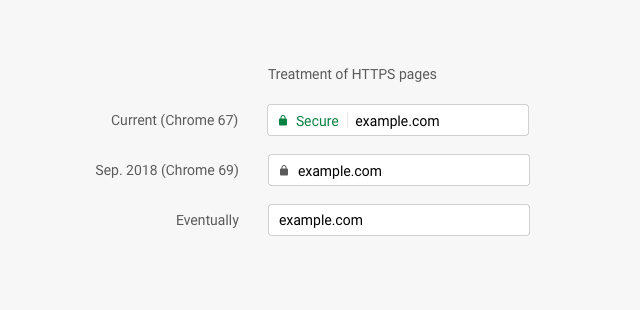
Since HTTPS sites will be the default in the future, Chrome reasons that it won’t need to reassure users about those sites. Come September with Chrome 69, HTTPS pages will no longer show the green secure tag. Instead users will get a small grey lock icon. Eventually, that grey icon will disappear as well.
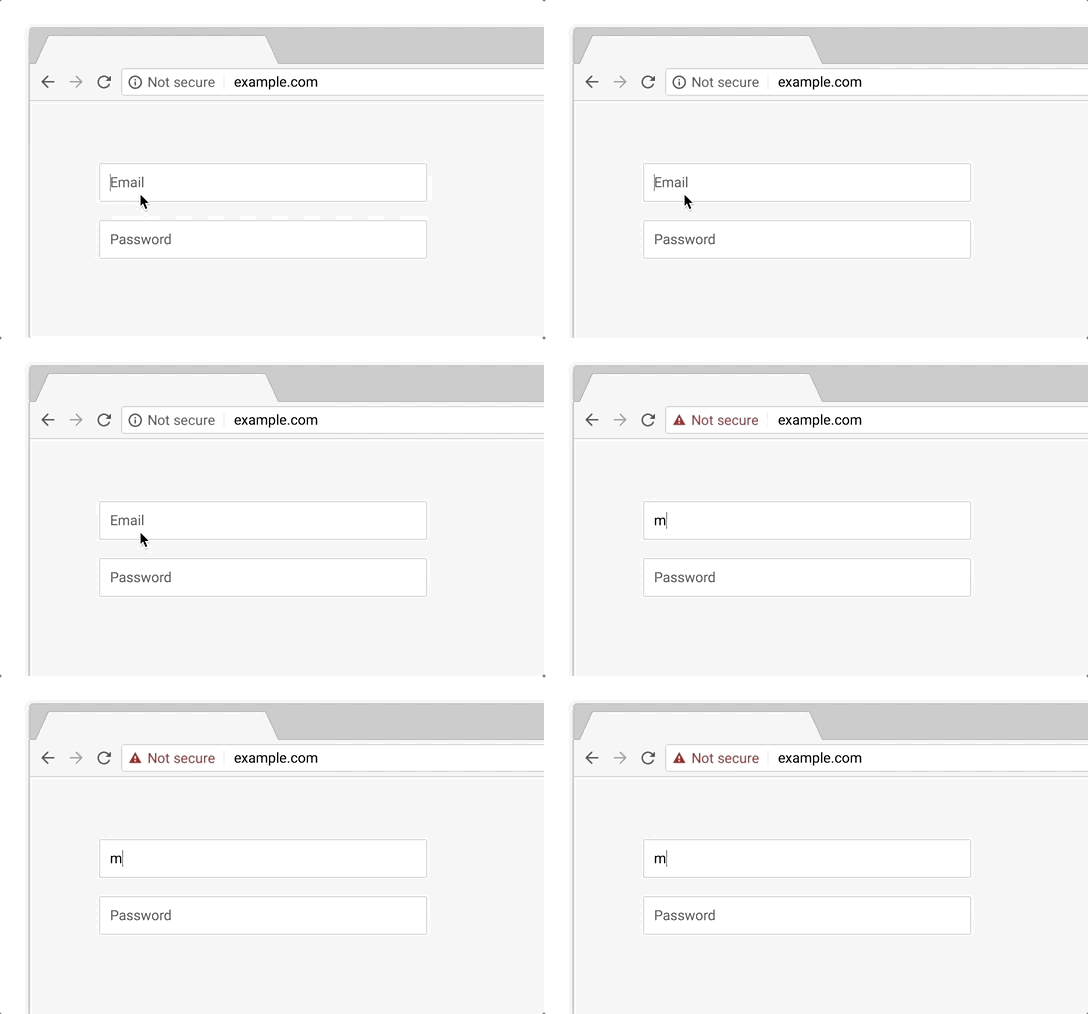
Additionally, as of July’s Chrome 68 update, all HTTP pages will be marked with “Not Secure.”
When Chrome 70 arrives in October, the team will implement the final stage of their master plan. All HTTP sites will be marked with a red “Not Secure” tag.
Why is this happening?
According to a blog post from Emily Schechter, the product manager of Chrome Security, too many sites still used HTTP to implement the change until now. But with over half the web using a secure connection now, it’s time to implement the change.
The goal for the Chrome team is a web that’s safe by default. That’s part of the reason the team is removing the green secure tag. Users shouldn’t need to be informed that a site is secure — it just should be. The other part is a hope that highlighting unsecured sites will make users pay more attention to their browsing.
It remains to be seen how much this change will affect users. However, Chrome’s changes have definitely influenced websites.
We have a more secure web now. HTTPS isn’t perfect, but it’s better than nothing.
Google is reportedly developing an augmented reality headset powered by a Qualcomm chip, according to documents obtained by Winfuture.
The German tech site reports that the headset is in the early stages of development with Taiwanese computer maker Quanta.
The headset, which is said to be codenamed the ‘Google A65,’ is reportedly similar to Microsoft’s HoloLens mixed reality device.
In fact, Winfuture reports that the A65 will use Qualcomm’s QSC603 four-core chips, which are also expected to be incorporated into Microsoft’s next iteration of the HoloLens. The A65 is similarly intended to be self-contained, rather than tethered to another device.
However, the A65 is apparently still in the prototype stage, meaning there isn’t a release window set for it yet.
The A65 wouldn’t be Google’s first AR headset, as the tech giant has also had its Google Glass device on the market since 2013. However, the device drew significant criticism for a variety of reasons, including privacy concerns, price and a lack of features. Even Google executives agreed that there were many shortcomings to the device.
Should the A65 report pan out, it will be interesting to see how Google approaches augmented reality this time around.
We’re going full steam ahead with Ulysses 13. So, what can you expect? Until release, we’re revealing more and more details of the forthcoming features.
Technical writers and developers, listen up again! The next version will not only significantly improve code blocks; to cap it all off, these code blocks will come with syntax highlighting! Ulysses will be able to recognize over 40 different programming languages and color their syntax. This works in both the editor and during export. The color palette – you know it from GitHub – is available in two versions for light and dark editor themes. For export, you’ll be able to adapt it to your needs by tweaking a Ulysses style sheets or CSS file.
Regardless of how the great Trans Mountain pipeline dispute is finally resolved, regardless of which side wins, the path to a final outcome will be forever marked by the bitterness and recriminations that the project created.
There seems little question now that relations between British Columbia and Alberta will fundamentally change, at least for a while. If for some reason the pipeline was not to get built, the war between the two provinces would drag on for years.
Premier Jason Kenney, were that scenario to arise in a year’s time, would stoke anti-B.C. anger inside his province to unforeseen heights. The counter-resentment it would cause is unimaginable. The crisis it would create for the country is difficult to overstate.
Story continues below advertisement
This week, the temperature in the dispute was ratcheted up a notch. The Alberta government introduced Bill 12 – the benign-sounding Preserving Canada’s Economic Prosperity Act – which was another shot across the bow of the B.C. government. Under the legislation, Alberta could effectively turn off the gas and oil taps to B.C., creating untold economic havoc.
The B.C. government said it was unconstitutional. The Alberta government said: Get stuffed.
Meantime, Ottawa announced that it was prepared to take a financial stake in the pipeline, if nothing else to make the troubled project more attractive to a buyer should Kinder Morgan decide to cut its losses and sell. In announcing the move, Finance Minister Bill Morneau had harsh words for B.C. Premier John Horgan, whom he accused of essentially holding the project hostage.
Meantime, back in B.C. …
While polls indicate that a majority of residents believe the pipeline should be built, a majority are equally worried about the impact a spill could have, about the risk the province is taking on. They also appreciate the impassioned fight Mr. Horgan has mounted in defence of those concerned about a catastrophic spill.
It is a resistance that was first enunciated by former B.C. premier Christy Clark, in her five conditions for pipeline development. Those conditions changed many things.
People in Alberta can laugh at the Left Coast, and deride the tree huggers and the café socialists loitering in coffee shops that dot the Vancouver landscape, but refusing to understand the environmental sensibilities of your neighbour isn’t helpful.
Story continues below advertisement
Story continues below advertisement
I dare say Calgary Mayor Naheed Nenshi, who called Mr. Horgan one of the worst politicians in Canada, wouldn’t be thrilled about the prospect of double-hulled barges on the Bow River transporting bitumen. In fact, no one in Calgary would, including the suits in the oil and gas towers downtown.
I realize that’s a fabulous scenario, but it does drive home the point that Alberta is assuming zero risk here. None. It’s furious at a Premier who is sticking up for his province, which is ironic. As this debate has raged, Alberta politicians and provincial commentators have regularly summoned the name of the late, great Peter Lougheed, the former premier who once famously curtailed the supply of oil to the East in response to the infamous National Energy Program.
What was Mr. Lougheed doing? He was sticking up for his province.
I understand there are differences. I understand that Mr. Horgan is trying to exert control over an area that is federal jurisdiction. But at the end of the day, he is trying to do what he thinks is in the best interests of his province. I don’t necessarily agree with his tactics, but I appreciate his willingness to go to battle for his cause, in the face of a torrent of threats and abuse.
I‘ve said before, I think this pipeline should be built. I also think it should be the last. I still believe that somehow, some way, it will get constructed. But no one should underestimate the damage this process will have done to relations between two provinces that once considered themselves friends.
I’m sure some will say, after it’s all over, all is fair in love and war. That is not the case here. The bad feelings this controversy has created will not dissipate once the oil starts flowing. Not a chance.
Story continues below advertisement
It feels like there’s something far more fundamental and profound occurring. It feels like the tectonic plate that runs under the two provinces is shifting and creating irrevocable change in the process.
Many party leaders spend years trying to perfect every aspect of their pitches to voters, only to be doomed by a single mistake or sudden shift in mood.
Doug Ford had a couple of months to prepare for his first election leading Ontario’s Progressive Conservatives. He lacks a coherent message and is constantly on the defensive, but will likely wind up premier of Canada’s most populous province anyway.
The Tories’ support may be eroding slightly, but every poll still shows them leading, with Andrea Horwath’s New Democrats some distance back and Kathleen Wynne’s governing Liberals in third.
Story continues below advertisement
But this 29-day campaign, more sprint than marathon, must feel endless to Mr. Ford’s team. It’s plainly in survival mode, trying to make it to the finish line without losing the lead it was gifted at the start by virtue of being the most obvious alternative to an unpopular government.
Nobody could reasonably have expected Mr. Ford to put together a well-oiled machine, given the state of the party he inherited in March. And much of the recent trouble – such as the strange, developing story of a PC candidate in Brampton stepping aside amid reports of alleged involvement in a breach of toll-road commuter data – appears to be fallout from the way the PCs were run under Patrick Brown.
But Mr. Ford has not exactly signalled a bold new era of sound judgment. Among the headaches this week was news that he violated Ontario’s campaign-finance rules by attending a political fundraiser, which party leaders are not allowed to do. (Mr. Ford said he was misinformed about the event’s nature.)
Meanwhile, after overturning a couple of the more contentious local nominations from Mr. Brown’s time, Mr. Ford created his own. That included kiboshing a competitive nomination campaign in London to appoint Andrew Lawton – a former Rebel Media contributor whose past comments about women, Muslims and gay people are fodder for the Tories’ opponents provincewide.
As with cleaning up the PCs’ organization, Mr. Ford had little time to put together a policy platform. But what seemed to be his strategy for that – running on a few big commitments – has given way to something weirdly unfocused.
Mr. Ford is constantly announcing new promises. Some, such as an income-tax cut and billions for transit, are drawn from Mr. Brown’s old platform. On top of those, Mr. Ford has added big ones, including cuts to corporate and fuel taxes. He has not announced a single specific idea for how he intends to pay for any of this, while eliminating the province’s existing deficit, without the carbon-tax revenues that Mr. Brown’s calculus rested on. This encouraged speculation about which promises he would break or surprise cuts he would make.
There are various explanations floating around for why he is promising so much. Among them is that his team wants to constantly give him a new script because he is not the sort of leader who can be trusted to stick to the same message daily.
Story continues below advertisement
Story continues below advertisement
That points to a third issue, beyond party and platform: Mr. Ford has not been campaigning very well, personally. He was visibly nervous in the first leaders’ debate, is uncomfortable answering journalists’ questions and is largely being shielded from scrutiny.
If all this adds up to ostensibly losing the air war, Stephen Harper’s frequently joyless federal campaigns showed that’s not always at odds with an effective operation – if a party is doing good below-the-radar stuff such as mobilization of its supporters through direct targeting. But the Tories aren’t blowing anyone out of the water that way, either. Their digital messaging is not terribly sophisticated and their voter-profiling, according to sources familiar with it, is less advanced than the Liberals’.
Other than lack of preparation time, a common explanation for the stumbles from inside the Tories’ world is that Mr. Ford’s campaign team is factionalized, especially between long-time loyalists and political professionals recently brought in. There are frequent battles for Mr. Ford’s ear, which might explain the campaign’s unusual about-faces, such as Mr. Ford taking opposite positions on the province’s Greenbelt on consecutive days.
In another campaign, such flip-flops might be held up as pivotal moments at which front-runners’ fortunes turned for the worse.
Like everything else in this one, they don’t seem to matter – maybe because voters’ minds were made up beforehand, or many consider the PCs the least of three evils, or Mr. Ford’s supporters see a superseding common touch.
Still, some Tories were expressing relief to reach a long weekend in which a royal wedding will dominate attention. By the time it’s over, there will be little more than two weeks to hope their problems – the ones Mr. Ford inherited, and the ones he has made himself – don’t catch up with them.
I like inexpensive, easy-to-read, fast-paced, nimble books. Writing the Doctoral Dissertation: A Systematic Approach by Davis, Parker and Straub is exactly that kind of volume. My only complaint with it is that precisely because it’s so thin (150 single-spaced pages, regular font size), it misses a lot of trees in order to provide an overview that looks like a forest.
Gordon et al are extraordinarily honest and they won me over in the first 10 pages: "we've worked with PhD students at all program stages" pic.twitter.com/kSPVmKQ7u7
— Dr Raul Pacheco-Vega (@raulpacheco) May 18, 2018
The fact that Davis et al are almost apologetic about not having all the answers in their volume made me really feel happy about having spent my hard earned money on this. Do note, the author’s last name is not Gordon, but I was exhausted last night as I live-tweeted my reading notes of this book.
They're all like "this is a systematic approach and like any generalized piece of advice, YMMV" Davis et al say a PhD process isn't linear pic.twitter.com/0u3qyE6hlV
— Dr Raul Pacheco-Vega (@raulpacheco) May 18, 2018
I’m still uncomfortable with books on how to write a doctoral dissertation or how to manage the PhD process that focus so much on productivity, pages written, output produced. But at the same time, I understand that a doctorate should be completed within a certain time frame, so I suppose there’s value to the productivity approach this and other books take.
While WAY more moderate than "Complete your PhD in 2 Semesters", Davis et al focus on concept of productivity. This makes me queasy. pic.twitter.com/WsdxmpsV8a
— Dr Raul Pacheco-Vega (@raulpacheco) May 18, 2018
Admittedly, writing the doctoral dissertation IS producing text and data and analyses and results, but I’m not sure we ought to treat the work as three 40 pages’ papers plus an introduction and a conclusion and WHAM BAM we have a PhD dissertation. I think there’s more to life as a doctoral student than producing pages.
Ideal student-advisor relationship. I think I have this relationship with my advisees. This is actually a reasonable set of expectations. pic.twitter.com/PzGlWywRcP
— Dr Raul Pacheco-Vega (@raulpacheco) May 18, 2018
One of my doctoral students did 18 months of fieldwork for three case studies. And he was super fast, and came back to do analysis/write.
— Dr Raul Pacheco-Vega (@raulpacheco) May 18, 2018
This book is very easy to read, because these authors’ writing is super agile and nimble. Perhaps their core competency is a discussion of how to choose the right topic and how to “fill a gap in the literature”, an issue that many doctoral students face and it’s hard to deal with.
This list of strategies to choose doctoral dissertation topics reminds me of @mchorowitz 's 2×2 matrix (Michael, do you have it handy?) pic.twitter.com/WthtpKwS0M
— Dr Raul Pacheco-Vega (@raulpacheco) May 18, 2018
Actually reading the next two pages totally reminds me of @mchorowitz 's smart 2×2 table. New data, old theory, new theory, new data. pic.twitter.com/Rci4d77OUc
— Dr Raul Pacheco-Vega (@raulpacheco) May 18, 2018
Overall, this book is super good for what it attempts to do (make it easier for a PhD student to finish their doctoral dissertation), but still is not enough to be used stand-alone, in my view. At least, I wouldn’t assign it to my advisees without providing additional support, either through my own mentoring, or by reading other complementary books.
At 150 pages and 12 chapters, Davis et al rushed through major parts of the PhD process "WHAM BAM, file for defence and WOWZA you're a PhD!"
— Dr Raul Pacheco-Vega (@raulpacheco) May 18, 2018
Bolker and/or Dunleavy for whole PhD process description, help walking through the process. This is disappointing. No single book does it
Exposure (2010), the 25 meter high, 44 tons of steel statue, by Antony Gormley at the start of the dam running right across the IJsselmeer, former Southern Sea, from Lelystad to Enkhuizen. Saw it yesterday from the venue of the event I spoke at. Turns out it’s made by the father of someone I know.
Arguably the most critical functionality in a phone is the ability to make and receive calls through the Public Switched Telephone Network (PSTN), that is normal cellular calls using phone numbers. While at Purism we are eager to implement communication systems that enable much greater privacy and security than one can expect from PSTN calls, the PSTN is still the most ubiquitous network and for the time being we can’t very well go around selling a phone that isn’t able to make PSTN calls.⁰
My task has been to develop a dialer and call handler for PSTN calls. Like all of our work on the Librem 5, this is intended to make use of existing code wherever possible and also target the GNOME platform which our PureOS defaults to. There is currently no GNOME PSTN dialer so we intend to contribute our program to the GNOME project.
Initial ideas
After some research, the initial goal was to use the Telepathy framework, the idea being that we could write a Telepathy PSTN dialer and get a SIP dialer for free because Telepathy has both PSTN and SIP connection managers. What’s more, the PSTN connection manager, telepathy-ring, is used in shipped phones. And, while it has its issues, in my opinion Telepathy is pretty awesome
Furthermore, my colleague François Téchené wrote a blog post describing a “feature”-based approach rather than an application-based approach to the phone UX. Telepathy could provide the technical underpinnings of such an approach.
It’s worth noting however, that Telepathy is a contentious framework. There are a number of voices within the GNOME project who would seemingly have it die a fiery death. Telepathy is a complex system and is notorious for the difficulty of making changes to the framework itself. To do so, one must synchronise changes to formal D-Bus API specifications and a multitude of distinct software components. A long discussion of Telepathy and possible replacements took place on GNOME’s desktop-devel mailing list in August and September 2017.
Wider discussions
After starting to work on some preliminary Telepathy code, given that our goal is for the dialer to be GNOME’s dialer, and the intention to use the contentious Telepathy framework, I checked in with the GNOME desktop-devel mailing list again to see what they thought.
Discussion ensued of both Telepathy and general issues around consolidating different communication systems. The main take away from this discussion was that creating a consolidated system like our “feature”-based approach is difficult to say the least. Like the previous discussion in 2017, a Telepathy-NG was touted. This is future work for us to take on once the basic phone functionality is in place. For now though, there was no major push-back against the idea of creating a PSTN dialer using Telepathy.
I also spoke to Robert McQueen, one of the original guys behind Telepathy, on IRC. The telepathy-ring connection manager makes use of a mobile telephony framework called oFono. Given the complexity of writing a Telepathy client, Robert suggested that a good approach might be to create a UI with a thin abstraction layer, first implementing a simple oFono backend and then afterwards implementing a more complex Telepathy backend. We’ve taken on Robert’s suggestion and our dialer program has been built using this approach.
Introducing Calls
Our program is named Calls. It has a GTK+ 3 user interface and makes use of oFono through a thin abstraction layer. We also make use of our libhandy for the dialpad widget.
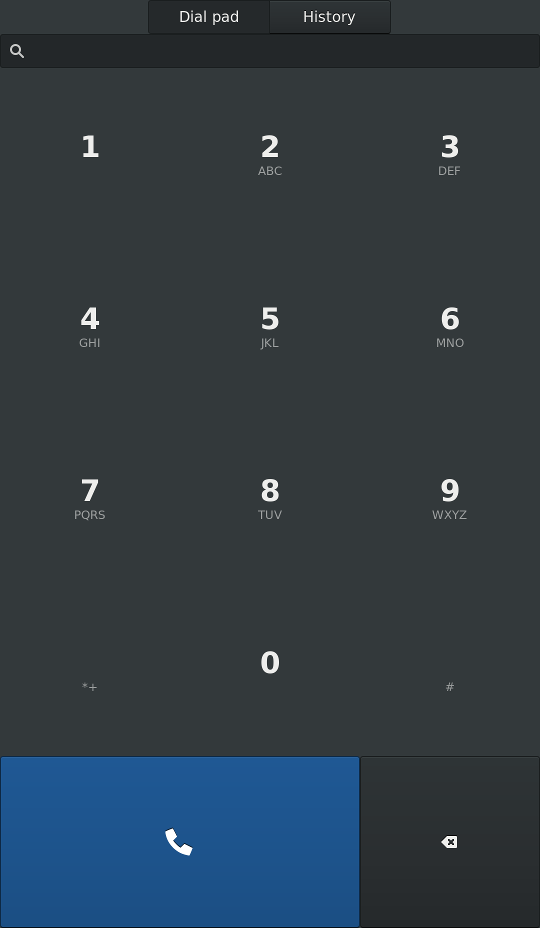
“Can it make a phone call?!”
Yes, it can!
Internals
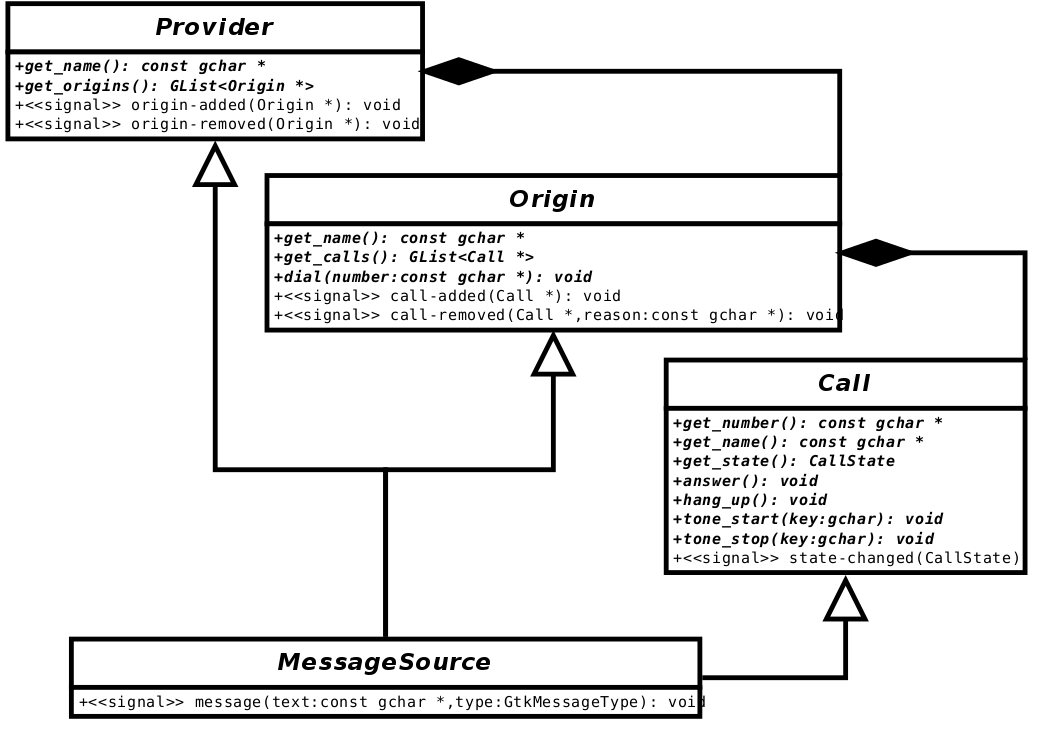
The following diagram shows a UMLish representation of the abstraction layer underlying the architecture of Calls:
The classes are actually GInterfaces. To give a better understanding of the semantics behind each interface, here is a table of objects that possible implementations could make use of:
Interface
Example implementation objects
Provider
oFono Manager, Telepathy Account Manager
Origin
oFono Modem/VoiceCallManager, Telepathy Account
Call
oFono VoiceCall, Telepathy Channel
The name “Origin” was chosen because it is an object which “originates” a call.
The MessageSource super-interface is used to issue messages to the user. The abstraction layer is intended as a very thin layer to the user interface so implementations are expected to report information, including error messages, warnings and so on, in a manner suitable for presentation to the user. Hence, methods usually do not return error
information but instead rely on the implementation issuing appropriate message signals.
The source code is available in our community group in GNOME’s gitlab.
Modems, oFono and ModemManager
The demo above is using a SIM7100E modem from SIMCom which you may be able to see mounted on the prototype board, with the red top border, to the bottom right of the display. Like many cellular modems, this modem supports both AT commands and QMI.
When the SIM7100E was first plugged in, oFono didn’t recognise it. However, there is a different mobile telephony framework, ModemManager which did recognise the modem and could make calls, send SMS messages and make data connections out of the box. We considered using ModemManager instead of oFono but unfortunately ModemManager’s voice call support is rudimentary and it has no support for supplementary call services like call waiting or conference calling.
Meanwhile, QMI is preferable to AT commands but oFono has no support for voice calls using QMI. Hence, to get voice calls working, we needed a new driver for the SIM7100E using AT commands. This driver has been upstreamed.
Where next
We’ve done a decent amount of work so far but there’s still some way to go before we have a dialer that you can stick in your pocket and use every day. Here are some of the things we have to work on:
Add ringtones. At present, the program doesn’t play any sound when there’s an incoming call. It would also be good to play DTMF noises to the user when they press digits in the dial pad.
Implement call history and integration with GNOME Contacts. At present Calls makes no records of any kind so we need suitable record storage and a UI for it. Similarly, we need to be able to search for contacts from within Calls and add phone numbers from call records to contacts.
The UI is currently basic but functional. It is a far cry from the polished beauty our designers have envisioned. A lot of effort will be needed to rework and polish the UI.
Implement phone settings in GNOME Settings. We need a new page for phone settings like selecting the mobile network to connect to and so on and so forth.
Deal with multiple SIMs and bringing the modem online. At present, Calls is a pretty dumb frontend on top of oFono D-Bus objects and only makes use of modems that are already in a usable state. There needs to be some mechanism to configure which modems Calls should make use of and to bring them online automatically when the device starts. Similarly, there need to be mechanisms for configuring and selecting between multiple SIMs.
Implement the Telepathy backend so we can get SIP calls and calls with whatever else supports Telepathy.
The final choice of modems has not been made yet so we’re not investing too much effort in developing support for the SIM7100E; just enough to test Calls as it is. Assuming we do choose the SIM7100E, we could implement QMI voice call support in oFono. In fact, as I write this post I see there is a discussion on the ofono mailing list about doing just that so QMI voice call support may be done for us. Alternatively, we could implement support for supplementary services in ModemManager, which is more closely aligned with the GNOME platform.
Add support for supplementary services and complex call operations. Just as ModemManager has rudimentary support, so does Calls in its present state. We want to ensure that our dialer has complete support for mobile telephony standards and call control operations.
That’s all for now, stay tuned for further updates!
⁰ There was a company who shall remain nameless and they sold a GNU/Linux-based phone that wasn’t able make PSTN calls when it shipped. Some five or so years later, I acquired one of these phones and took it to my local LUG. And of course, what was the first question asked: “can it make a phone call?! haha!” Such was the reputation garnered from shipping a phone that couldn’t make phone calls!








 Are you an existing Google Play Music subscriber and confused about the launch of the upcoming YouTube Music and YouTube Premium launch as to what it would mean for your existing subscription?



 Ulysses Blog.