Readers will know I was in Colombia a couple of weeks ago so this story is fresh on my mind. This article underscores the umportance of, and the diffioculty of, the work to be done. Says one person, "I have many friends who regularly go hungry because they cannot find work. Who is going to employ a 50-year-old man who can only just read and write but has no other skills? The issue is not giving us education. The issue lies with giving us the skills to work so we can rejoin society. Otherwise peace will be impossible."
As web applications have evolved from static pages to application-like experiences, end-users' expectations of websites have become increasingly demanding. JavaScript, partnered with effective user-experience design, enable the seamless, instantaneous interactions that users now expect.
The Drupal project anticipated this trend years ago and we have been investing heavily in making Drupal API-first ever since. As a result, more organizations are building decoupled applications served by Drupal. This approach allows organizations to use modern JavaScript frameworks, while still benefiting from Drupal's powerful content management capabilities, such as content modeling, content editing, content workflows, access rights and more.
While organizations use JavaScript frameworks to create visitor-facing experiences with Drupal as a backend, Drupal's own administration interface has not yet embraced a modern JavaScript framework. There is high demand for Drupal to provide a cutting-edge experience for its own users: the site's content creators and administrators.
JSON API is a widely-used specification for building web service APIs in JSON. We are working towards adding JSON API to Drupal core as it makes it easier for JavaScript developers to access the content and configuration managed in Drupal. There is a central plan issue that lists all of the blockers for getting JSON API into core (comprehensive test coverage, specification compliance, and more). We're working hard to get all of them out of the way!
2. Improve our JavaScript testing infrastructure
Drupal's testing infrastructure is excellent for testing PHP code, but until now, it was not optimized for testing JavaScript code. As we expect the amount of JavaScript code in Drupal's administrative interface to dramatically increase in the years to come, we have been working on improving our JavaScript testing infrastructure using Headless Chrome and Nightwatch.js. Nightwatch.js has already been committed for inclusion in Drupal 8.6, however some additional work remains to create a robust JavaScript-to-Drupal bridge. Completing this work is essential to ensure we do not introduce regressions, as we proceed with the other items in our roadmap.
3. Create designs for a React-based administration UI
Having a JavaScript-based UI also allows us to rethink how we can improve Drupal's administration experience. For example, Drupal's current content modeling UI requires a lot of clicking, saving and reloading. By using React, we can reimagine our user experience to be more application-like, intuitive and faster to use. We still need a lot of help to design and test different parts of the Drupal administration UI.
4. Allow contributed modules to use React or Twig
We want to enable modules to provide either a React-powered administration UI or a traditional Twig-based administration UI. We are working on an architecture that can support both at the same time. This will allow us to introduce JavaScript-based UIs incrementally instead of enforcing a massive paradigm shift all at once. It will also provide some level of optionality for modules that want to opt-out from supporting the new administration UI.
5. Implement missing web service APIs
While we have been working for years to add web service APIs to many parts of Drupal, not all of Drupal has web services support yet. For our React-based administration UI prototype we decided to implement a new permission screen (i.e. https://example.com/admin/people/permissions). We learned that Drupal lacked the necessary web service APIs to retrieve a list of all available permissions in the system. This led us to create a support module that provides such an API. This support module is a temporary solution that helped us make progress on our prototype; the goal is to integrate these APIs into core itself. If you want to contribute to Drupal, creating web service APIs for various Drupal subsystems might be a great way to get involved.
6. Make the React UI extensible and configurable
One of the benefits of Drupal's current administration UI is that it can be configured (e.g. you can modify the content listing because it has been built using the Views module) and extended by contributed modules (e.g. the Address module adds a UI that is optimized for editing address information). We want to make sure that in the new React UI we keep enough flexibility for site builders to customize the administrative UI.
All decoupled builds benefit
All decoupled applications will benefit from the six steps above; they're important for building a fully-decoupled administration UI, and for building visitor-facing decoupled applications.
Useful for decoupling of visitor-facing front-ends
Useful for decoupling of the administration backend
1. Stabilize the JSON API module
✔
✔
2. Improve our JavaScript testing infrastructure
✔
✔
3. Create designs for a React-based administration UI
✔
4. Allow contributed modules to use React or Twig
✔
✔
5. Implement missing web service APIs
✔
✔
6. Make the React UI extensible and configurable
✔
Conclusion
Over the past three years we've been making steady progress to move Drupal to a more API-first and JavaScript centric world. It's important work given a variety of market trends in our industry. While we have made excellent progress, there are more challenges to be solved. We hope you like our next steps, and we welcome you to get involved with them. Thank you to everyone who has contributed so far!
SEAN ORR@seanorr
Just a reminder I'm turning 40 on Friday so you can all remember to pre-order your condolences flowers. I'll remind… twitter.com/i/web/status/9…
Joseph Planta@Planta
Has anyone actually obtained the express written consent of an organisation so they can rebroadcast part of the spo… twitter.com/i/web/status/9…
JavaScript is now part of the toolkit of most working developers. What if network effects push it into being the first-ever truly dominant programming language?
Around a decade ago, a big part of coding culture changed.
What had often been a solitary pursuit, or one where collaboration happened with a defined set of colleagues within a company or open source project, burst open into a much more intrinsically social experience. Everything from how we share code to how we find answers to how we discover new technologies became far more linked to the attitudes and actions of other programmers.
In short, the people who make software got networked just like their computers had been in the preceding decades.
The Networks
The impact of network effects on coding culture has manifested itself in many ways, but some of the most visible are worth examining:
For knowledge about coding issues, and answers to common questions, Stack Overflow rose and quickly became a dominant source of reliable information about programming. (Requisite disclaimer: I’m on the board of Stack Overflow, though my experience here is based on being a coder who just relies on it for useful answers.) Though the barriers to participation in the Stack Overflow community are well-known, there’s no doubt that its enabling of a network of knowledge around coding answers amplified the discoverability of programming information, and accelerated the idea of social signal being a strong component of technology adoption. A framework or toolkit that has its own, actively answered tag on Stack Overflow is much more likely to get new adopters.
A similar pattern followed for collaborating around code: GitHub rose a decade ago as a powerful platform for sharing each commit to a project. Though its value was presented as being about popularizing the then-nascent distributed version control tool Git, the social value of GitHub has extended to being a signal of the value or reliability of software hosted on the platform. Counting the number of stars or forks or watchers on a project acts as a proxy for how much the code can be trusted. GitHub has real barriers, like the difficulty of learning git or the obtuseness of organizing around changes to a project, rather than the project itself, and all of these factors can make it difficult for some users to participate in the network. But despite those barriers, social signals on GitHub deeply shape the adoption of tools and technologies by developers.
Finally, there are the networked information sources for news and discussion, primary among them being Hacker News. Though it’s notoriously the most hostile of these large, networked coder communities, it inarguably helps promote and elevate new technologies and new ideas around how to create software. Hacker News’ amplification of tools often helps them reach critical mass in adoption, and discussion of a product is another form of social signal that many in the coding world use to judge a particular platform. To a lesser degree, more product-focused communities like Product Hunt also fulfill some of this function. (And Product Hunt does this while being far more welcoming.)
In each of these cases, if we look past the flaws of the communities that enable them, we see a deeper pattern: software being evaluated based on its social success and social merits, rather than just some ostensibly “objective” technical merit.
Technology has always existed in a social context, and evaluations of the risk or reliability of a tech platform have always relied on social indicators. But the acceleration of these patterns, and the extending of the social networks around code to include the majority of working coders, means that institutional indicators (like “which company funds its development?”) now come second to community-based signals.
Similarly, top-down indications of technical maturity like documentation (often an artifact of outside investment in making a technology accessible to a new audience) are complemented, or even eclipsed, by bottoms-up indicators like how many people have bookmarked a framework, or how many people answer comments about a toolkit. Even purely social factors like the number of participants in a Gitter or Slack chat room about a project, or the number of people who follow a project on social media, are all weighed when we look at new technology.
Then There’s The Law
Though nearly everything he shares on social media these days makes me want to smash my head into my desk, longtime software blogger Jeff Atwood has had a number of valuable insights over the years. Perhaps none was more prescient than the insight captured in his eponymous law:
[A]ny application that can be written in JavaScript, will eventually be written in JavaScript.
Jeff’s inspiration lay in the insightful “principle of least power” as articulated by Tim Berners-Lee, father of the web. But especially back when Jeff wrote that blog post, JavaScript was still considered something of a toy (for example, Node.js wouldn’t be invented for another 2 years), and the idea of everything being ported to the language seemed a bit absurd. Naturally, the internet being the internet, almost a dozen years later, there’s an entire community dedicated to documenting things being ported to, or rewritten in, JavaScript.
But Atwood’s law speaks to the ability to re-implement nearly any other code in JavaScript. Given that any Turing-complete language should be able to implement functionality written in other languages, that makes this observation amusing, but not particularly revelatory about what kinds of behaviors might emerge as a result. Atwood’s law says nothing about adoption of JavaScript, just its potential to express ideas implemented in other languages.
But What If JavaScript Is A Network?
There are a lot of things that are considered “JavaScript” these days. There’s the open language described in the ECMAscript standard. There are adjacent languages like TypeScript that offer niceties to coders in exchange for compatibility with the JavaScript ecosystem. There are environments like Node. There’s the power of instant access to years of coding effort through package management tools like npm. There is a nearly-infinite amount of infrastructure around the language, and even more infrastructure using the language to provide build tools or automation for other languages. And then there’s the ubiquity of JavaScript being interpreted within the web browsers on billions of devices around the world.
This breadth of contexts accounts for the popularity and dominance of JavaScript. Indeed, the most recent Stack Overflow survey of developers lists nearly 70% of them claiming JavaScript as one of the languages they use. (As above, some of the obstacles for participation in the Stack Overflow community can skew this kind of survey, so we should be mindful of those distortive effects, but the overall trend here is clear even if we account for those concerns.) And the percentage of coders using JavaScript keeps increasing, increasing by about 15% in just the last few years, even as other languages like Python keep growing as well.
What this suggests is that JavaScript may be reaching escape velocity as a network, and as an ecosystem of related technologies. To be clear, there’s no winner-takes-all here — domain-specific languages will always have their uniquely valuable areas of focus. But for general-purpose coding? Everything from spreadsheet macros to Internet of Things hardware seems to default to having JavaScript be one of the primary ways to make things programmable.
It’s impossible to say if this idea of evaluating a programming language as a social network is a valid way to judge the technology. But every indication is that the feedback loop around the JavaScript ecosystem is increasing in strength. Though most “serious” developer tools are insistently polyglot (and indeed, every indication is that most working coders do make use of more than one language in their work), it may make sense for forward-looking platforms to disproportionately invest in JavaScript for their futures.
Glitch ❤ JavaScript
Of course, I work on Glitch all day long, so you know our team has got an opinion on this. Don’t worry: Glitch can run code in almost any common language. We’ve got Python and PHP and Ruby projects happily running in the community.
But we’ve chosen JavaScript (and Node) as our primary platform for Glitch, the one we feature in our work. There are lots of reasons for this (I mean, have you seen the full-stack debugging that Glitch lets you do?!) but one of them is that we’re a small team and we want to make sure we’re betting on the technology that will provide the most value for our community. And we think our investment in the JavaScript ecosystem will only become more valuable over time.
We also look at the network value of apps, libraries, modules, and code snippets that live in the Glitch ecosystem, and we think focusing our attention will yield dividends as we start to build more tooling for coders and apply newer developments in machine learning to help make coding easier. Picking a domain helps ensure that the things we create are valuable and applicable and immediately useful, instead of diffuse efforts to serve all languages without really picking one to be great at.
Now, this isn’t carved in stone. If Haskell comes out of nowhere and gets baked into a billion browsers and they start teaching it to kids in grade school, Glitch is gonna be there. And there are definitely folks on the Glitch team who wish we could offer as great an experience on other languages as we do on JavaScript. But with trends where they are right now, we wanted to explain our rationale behind making a bigger bet on JavaScript and on Node, rather than just saying “we’re language-agnostic”. There’s theory, and thought, and a little bit of history, and a pretty good amount of data, and all of those signals indicate that something special is going on here.
The truth is, we’ve never seen one open language become a nearly-universal programming language for coders. We don’t know what kind of benefits might accrue if the majority of coding effort starts to happen in one language, unless there’s a particular reason to use a domain-specific language that insists we do otherwise.
We just might be on the precipice of an era in coding that’s unprecedented, where we might actually see something new in the patterns of adoption and usage of an entire programming language. That potential has us excited, and waiting with bated breath to see how the whole ecosystem plays out. But even more than that, we’re excited that all of these developments will allow the Glitch community to make apps that are even more expressive and meaningful, while being even easier to realize in code.
Custom emoji in Slack are small picture files that you upload to your workspace. It’s best to use simple icon-like images that look good at a small size — any image that you can reduce down to 128 pixels by 128 pixels will work. And it’s quite alright if you’re not a designer used to creating or cropping images. Sites like Mojician and The Noun Project offer custom emoji readily available to download and add to your own workspace.
Here are some ideas for emoji that you can make and upload, whether to move projects along or to add a dollop of delight to everyday conversations.
Vote on new ideas and volunteer your skills
Among the most popular kinds of custom emoji that people upload to their Slack workspace are little heads of their coworkers and bosses. Many teams use them when reacting to messages in Slack as a way of “tagging” themselves or others.
Say someone posts a new idea to a channel: You can add your own emoji face to volunteer to work on the idea. On the flip side, if someone is looking for a person with a specific skill set to help on a project, you can recommend someone by adding their emoji face as a reaction to that message (and be sure to drop them a Direct Message to let them know, in case they missed it).
We’ve heard from other teams that creating emoji versions of coworkers helps them feel included. People have also told us that they use custom emoji to mark their “vote” on ideas posted to a channel and to celebrate big wins, too.
And some teams just prefer to put their own spin on things and use their custom emoji to illustrate highly specific reactions.
@SlackHQ we use the funniest faces of our co-workers. coz that's the best way to elicit a response :)
Custom emoji plus setting a custom status makes for a really powerful combo in Slack.
A custom status lets everyone know your coworker Carmen is in the NYC office today.
When your company is distributed across multiple locations, uploading numbers as custom emoji (to show, say, which floor of a building you work on) or flags and airport codes (like YVR or SFO) to denote geographic office locations helps people discern not only where you are but which time zone you’re in — so they’ll know when to expect a response.
For teams that visit customers often, uploading clients’ logos as emoji means sales staff can indicate when they’re off-site at the Acme Corporation. Company logo emoji can also be useful for people who work at agencies and need to show which accounts they’re currently working on.
Capture and channel internal knowledge
Slack’s Reacji Channeler is a useful tool that automatically reposts messages to a specific channel of your choosing. You can use it to do all sorts of things, like keeping track of important announcements in a company-wide #news channel or sending bug reports and new feature ideas to specific teams within your organization.
Or sometimes, as in the following case, you can use the Reacji Channeler to track the funniest things people say across your entire workspace.
Slack’s own internal #airhorn channel
While the Reacji Channeler works with any emoji in Slack, in order to prevent false positives — pulling irrelevant information into your channel because someone used that emoji for a different reason — you’ll want to use a custom emoji for it or pick an obscure one that’s used infrequently.
To make your work life just a little easier, we offer a set of downloadable custom emoji that do things like help you track company news, mark major decisions, collect epic jokes, and repost announcements about free food.
Your own weird internal fun
Groups of people working closely together will eventually come up with their own shared culture of silly in-jokes and callbacks to things that have happened, and that often manifests in custom emoji.
We do a lot of thinking at Slack
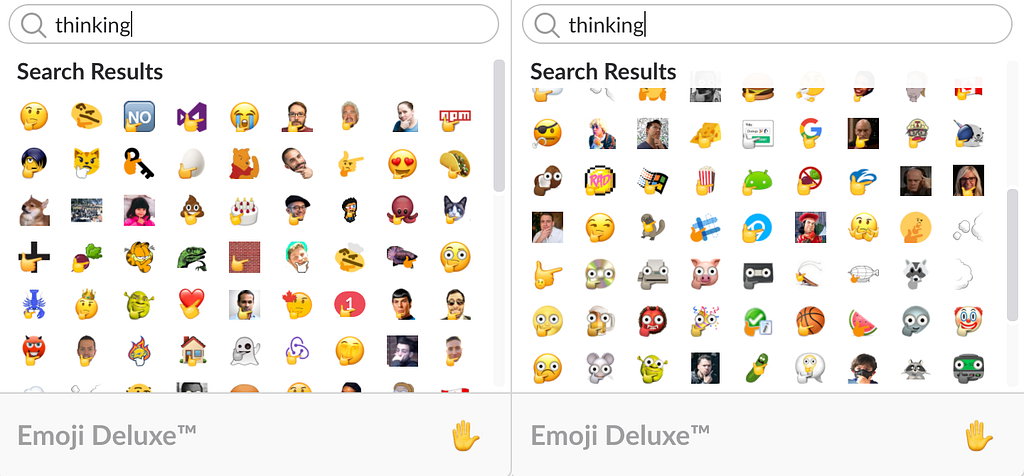
At Slack, one of our favorite emoji to use is the 🤔 (:thinking:) emoji, which either conveys “Huh?” or “That’s thought-provoking.”
Someone then thought to add the hand from the thinking emoji to other pictures and gave them a whole new meaning. If this tickles your fancy, there’s an online tool that lets you add thinking hands to any uploaded image.
Another popular emoji in our workspace is 🎉 (:tada:) which we use liberally to celebrate achievements. But when we needed something for when things went sour, we made one without any confetti or streamers and called it :tadont:. Here’s a good example of it in action.
If you already have custom emoji on your team and you’d like to punch them up a bit, Total emojis as a service! offers a one-stop shop with more than 20 options for turning any small image into something that moves, spins, shakes, or has various images overlaid on top. Try a few out and see what interesting new versions you come up with.
Give custom emoji a whirl
Emoji make up an ever-growing picture language that helps people convey meaning to one another in text-based communication. They’re both fun and useful, and we’re always finding new ways to use them in Slack to help streamline our work.
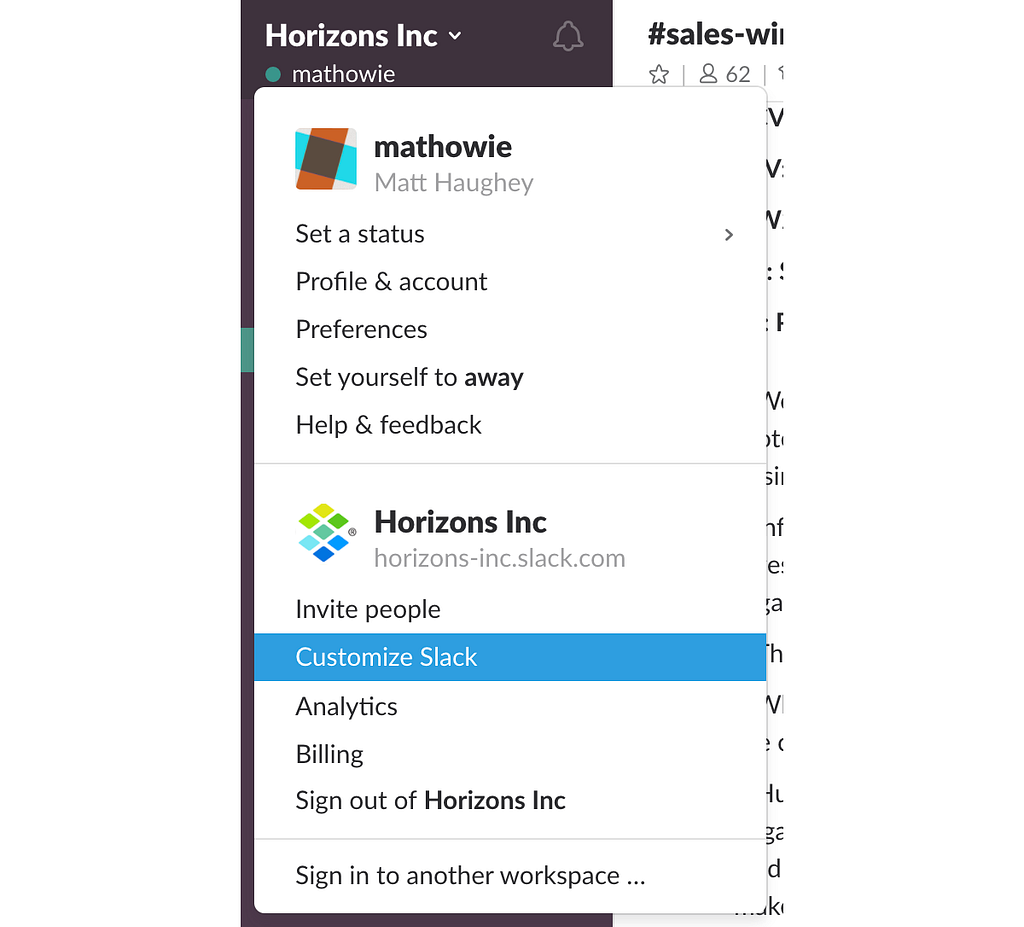
Give it a go. Hit the Customize Slack option in your workplace settings to start adding custom emoji to your team. They can be small artifacts that have a big impact on your team’s culture while simultaneously moving your work forward.
Matt Haughey pretty much uploads a dozen to two dozen commonly used custom emoji from online comics and memes to every workspace he joins.
Denim & Steel@DenimAndSteel
This is incredible design work: simple, evocative, profound, and hits you all at once. It’s not overstatement to sa… twitter.com/i/web/status/9…
I am learning the art of a sysadmin is not so much knowing how to do something, but rather how to do something quicker via command line I transferred a cPanel account the other day from one domain to a different domain, and I needed to update all the URLs across 3 or 4 different WordPress sites. Traditional I would export the database, do a copy and paste in TextWrangler, then re-upload the SQL file. For four different WordPress sites that begins to get laborious. But then I remembered the trick Tim showed me when we were doing the UNLV migration a little while back. WordPress now has a command line interface (CLI) tool, and Tim showed me how to use it to do a find and replace on the database. You would need to be in the root directory of the WordPress site when running the following:
The above command would replace all instances of jimgroom.net in the WordPress database with jimgroom.com. I ran this command 4 times in about 5 seconds and more than 1000 URLs were instantly updated. It would have taken me 10-15 minutes minimum to exporting, find & replace, and then import the databases for 4 sites—and let’s face it, doing it in a few seconds firing off some command line code just makes me look more serious. Kinda like Timmmmyboy playing the sysdmin in Adam Croom’s Hair game
One thing that astounded me when reading the 4G specs for the first time many years ago was that there was no separation anymore between attaching (registering) with the network after power-on and activation of a default bearer (getting an IP address). It looks like this will change again in the 5G core network.
From a mobile network point of view combining the two procedures was novel. In 2G and 3G networks, these processes were separate and especially in the early days it was not uncommon for a mobile to register to the 3G network but not request an IP address right away. These were the days when mobile networks were still circuit switched voice and SMS focused. Only a few years later with the rise of Android and the iPhone did it become natural for devices to perform both procedures at the same time as Internet connectivity became the norm rather than a fancy exception.
From an ‘Internet’ perspective it also seems pretty normal that connecting to the network also implies getting an IP address straight away. After all, there is little use to connect to a network if you can’t communicate in it. 4G LTE specs also went along this line of thinking which created quite a bit of confusion and trouble up to present days as many people got used to thinking that being registered and having a context (IP address) are two different concepts. Event today some people still talk about ‘packet calls’ when they talk about ‘Internet connectivity’.
So to my great surprise I noticed that in the 5G core specification, the registration procedure and the session establishment procedure are again two separated procedures! To compare, have a look at figure 5.3.2.1-1 in TS 23.401 where the LTE attach and create session procedures are clearly combined into a single process. In 5G, however, they are completely separate and are even separated in the specification document by dozens of pages. Registration is described in 3GPP TS 23.502, Chapter 4.2.2 while creating a PDU session (the same as establishing a Default Bearer in LTE, i.e. getting an IP address) is described in Chapter 4.3.2.
So the way I read this is that in 5G it is possible again to be registered to the network but not to have an IP address. Hm, I wonder why the concept was changed again, did a ghost of the past attend a 3GPP meeting?
Amazon has announced that it’s picking up The Hunt, a new series from Get Out writer-director Jordan Peele’s Monkeypaw Productions. The show focuses on a Nazi hunter in 1977 New York City, according to Variety.
Variety says The Hunt is written by David Well, who will also work as the show’s executive producer. Though little has been released about the TV series’ plot so far, we know that it follows a group of high-ranking Nazi officers who are planning to create a Fourth Reich in the U.S.
This is Prime Videos’ first scripted series since Jennifer Salke became the head of Amazon Studios following Roy Price resigning from the position last October after allegations of sexual harassment.
Peele is working on a series focused on Jim Crow-era America for HBO called Lovecraft Country. Further, he’s also writing and directing an upcoming horror film called Us featuring Lupita Nyong’o from Star Wars: The Force Awakens and Black Panther.
Get Out, Peele’s directorial debut, won the Academy Award for best original screenplay, and was nominated for Best Picture, Best Director and Best Actor for Daniel Kaluuya.
The Android P-esque dark mode system tray is coming to Chrome OS.
A Reddit user named r/JebusCL has found that in the Chrome OS developer preview and some beta builds of the operating system, there is now a dark themed system tray.
The tray looks similar to the Android P notifications shade with hints of blue and white buttons. There’s also a new function that will let users shrink the tray just like how Android notifications have a condensed and expanded state.
To enable this colour scheme, users in the Chrome OS beta channel need to activate the ‘#enable-system-tray-unified’ flag. To turn on the flag simply search ‘chrome://flags’ in your browser and then turn on the specific flag.
There are a few other tags to activate as well. The ‘#enable-message-center-new-style-notification’and ‘#enable-new-app-menu-icon’ should make Chrome OS look a bit different as well.
Naturebytes are making their weatherproof Wildlife Cam Case available as a standalone product for the first time, a welcome addition to the Raspberry Pi ecosystem that should take some of the hassle out of your outdoor builds.
Weatherproofing digital making projects
People often use Raspberry Pis and Camera Modules for outdoorprojects, but weatherproofing your set-up can be tricky. You need to keep water — and tiny creatures — out, but you might well need access for wires and cables, whether for power or sensors; if you’re using a camera, it’ll need something clear and cleanable in front of the lens. You can use sealant, but if you need to adjust anything that you’ve applied it to, you’ll have to remove it and redo it. While we’ve seen a few reasonable options available to buy, the choice has never been what you’d call extensive.
The Wildlife Cam Case is ideal for nature camera projects, of course, but it’ll also be useful for anyone who wants to take their Pi outdoors. It has weatherproof lenses that are transparent to visible and IR light, for all your nature observation projects. Its opening is hinged to allow easy access to your hardware, and the case has waterproof access for cables. Inside, there’s a mount for fixing any model of Raspberry Pi and camera, as well as many other components. On top of all that, the case comes with a sturdy nylon strap to make it easy to attach it to a post or a tree.
Order yours now!
At the moment, Naturebytes are producing a limited run of the cases. The first batch of 50 are due to be dispatched next week to arrive just in time for the Bank Holiday weekend in the UK, so get them while they’re hot. It’s the perfect thing for recording a timelapse of exactly how quickly the slugs obliterate your vegetable seedlings, and of lots more heartening things that must surely happen in gardens other than mine.
If it’s been months since you had a day where you feel good—
If you hate getting out of bed in the morning because that means you’ll have to go to work—
If your job is tiring you out so much you can’t get through the day without a nap—
It’s time to quit your shitty job.
It’s time to quit your shitty job and go someplace better, a job where a good night’s sleep is all you need.
A job where you’re valued.
A job where people don’t shout at each other, or demean you, or destroy the project you’ve put all your energy into.
But quitting can be difficult: you have a sense of commitment, the fear of change, the indecision about whether your job is really that shitty.
So to help you make your decision, and quit in the best possible way, in the rest of this post I will cover:
Identifying a shitty job.
Whether you should quit (spoiler: yes).
Preparations you should make before quitting: legal, bureaucratic, social.
When to quit.
How you should quit.
(Note that some of this will be US-centric, since that’s where I live and what I know best.)
Identifying a shitty job
Shitty jobs can be surprisingly hard to identify.
Sometimes this is because you don’t have a reasonable baseline, or the shittiness has become normalized through exposure.
I’ve heard of companies with the following symptoms, for example, and I would consider either grounds for immediately starting a search for a better job:
People shouting at each other during meetings on a regular basis.
Getting paid late.
Money for working hours is the basic contract of employment: if you’re paid late more than once you’re being told that contract isn’t important.
Another reason you might not notice you have a shitty job is a subtle shift over time.
A good job slowly gets worse, and your existing relationships and loyalty blind you to the symptoms—for a while, anyway.
You might be forced to reconsider due to:
Layoffs, especially while the company still continuing to hire.
Managers being hired without being interviewed by their future direct reports.
I could go on with other examples, but there are two core themes here:
Your company doesn’t value its employees.
You don’t trust company management in the aggregate.
Again, this may not always have been the case.
You may trust many of your managers, and know that they value you and your coworkers.
But things change, and not always for the better: what matters is the way the company is now, and who has power now, not the way it used to be.
Should you quit your shitty job?
Yes.
But you should do so at the right time, and with a little preparation.
When should you quit your shitty job?
Ideally, you should have another job lined up before you quit.
I once had to give notice of quitting unexpectedly, without prior planning.
A more observant coworker gave notice the same day, but they had started looking a couple months before, when we had a round of layoffs.
So while I spent a couple months not getting paid, they moved straight on to another job.
The lesson: it pays to look for early signs of shittiness, so that you can leave in the best possible way.
Once you realize you have a shitty job, you should start interviewing elsewhere.
Having an existing job improves your negotiation position, since you always have the implicit alternative offer of staying where you are.
Two offers you can play against each other, or “I’m far along in interview process with another company” is better, but lacking that you need to downplay how shitty your current job is.
You’ll want a break to catch your breath and relax in between jobs: you can easily negotiate a couple of weeks time off in between jobs.
A month shouldn’t be much harder to get.
In practice, your job may be so awful that it leaves you with no time or energy to look for another job.
In this case you might be forced to quit without a new job lined up.
You can prepare for this by living below your means and saving some money.
Preparing for quitting
Here are some things you should do before quitting any job:
Get non-work contact details for all your coworkers.
Maximize any benefits you can.
When I quit a job with a 401k and donation matches, I maxed those out early in the year.
Note that in small enough companies HR might notice when you change 401k contributions.
Try to get continued access to your company’s open source projects that you might want to work on after you leave.
Often asking is sufficient: I once asked the VP of engineering after I gave notice, and was told I could keep commit access (presumably because I was effectively offering to do work for free).
Write down details about your work that can help make your resume look better: specific numbers you improved (sales, performance, costs), and the like.
If the company has an overly broad definition of proprietary information you might not be able to put them on your resume—but the company might fold one day, so it’s good to have a reminder of what you did.
At a shitty job you may also need to make copies of some documents: specifically, any emails or other documents where promises are made to you re pay, benefits, and so on.
Once you’ve been paid what you’re owed and you’ve left your job, you won’t need those anymore and they should be deleted or shredded.
But when it’s your last day at work and you’re trying to get the back pay they owe you, you want to make sure you have documentation.
Speaking of back pay, if you work for a company that has an “unlimited vacation” policy, take some vacation before you quit.
You’re not going to get paid for those vacation days you haven’t taken.
(In general, if a company has “unlimited vacations” I recommend taking lots of vacation throughout the year, since it’s use or lose it.)
How to quit
It’s a shitty job, and you may be utterly relieved at leaving it, but—you should quit politely.
Your management may simply be misguided, or suffering under pressures you don’t understand (VCs in cover-your-ass mode can be quite destructive).
Your manager might grow as a person.
Your co-workers might end up working with you again.
So just give your notice, with the smallest possible amount of time you have to stay there.
You can tell close coworkers why you’re leaving (they probably already know).
And on your last day of work just leave, quietly and politely.
For a while you will feel sad: those projects will never get finished.
But mostly you will feel relief.
It’s time—
—time to quit your shitty job.
As I mentioned above, I once made the mistake of hanging on when I shouldn’t have, unlike a more clued-in coworker. (You can hear the whole story by signing up for my Software Clown newsletter, where I share 20+ years of my mistakes so that you can avoid them.)
Don’t make my mistake.
I had to quit anyway, and without the benefit of advance planning or having a job lined up.
Start looking for a new job now, while you’re still able to hold on—your job probably probably won’t be getting any better.
It's Friday afternoon. You just can't write another line of code—but you're still stuck at the office...
Educate Your Child by Gabrielle LaMarr LeMee uses census data and the school selection process to simulate the steps you might take in choosing your kid’s first school in Chicago.
The Chicago public school system has a high level of school segregation as a result of parent’ residential and school choices as well as policy decisions that do not encourage integrated neighborhoods and schools.
In this game, you are a parent of a 5-year-old child and now you have to make some decisions. Explore how your choices can have an impact on your child’s education and on the overall education of the city’s children.
There should be more games like this based on census data. It seems to be a good way for an individual to latch on to data points while still getting a view of the grand scheme of things.
San Francisco (May 17, 2018) – Purism, the social purpose corporation which designs and produces security focused hardware and software, has announced today that they are partnering with Nitrokey, maker of Free Software and Open Hardware USB OpenPGP security tokens and Hardware Security Modules (HSMs) to create Librem Key, Purism’s own OpenPGP security token designed to integrate with its hardware and software. Librem Key embodies Purism’s mission to make security and cryptography accessible where its customers hold the keys to their own security and follows on the heels of their announcement of a partnership with cryptography pioneer and GnuPG maintainer Werner Koch.
Purism customers will be able to purchase a Librem Key by itself or as an add-on with a laptop order. For add-on orders, Purism can pre-configure the Librem Key at the factory to act as an easy-to-use disk decryption key and ship laptops that are pre-encrypted. Customers will be able to insert their Librem Key at boot and decrypt their drive automatically without having to type in a long passphrase. Customers will also be able to replace the factory-generated keys with their own at any time.
Librem Key will also be a critical component in Purism’s tamper-evident boot protection. Purism will tightly integrate Librem Key into their tamper-evident boot software so that customers will be able to detect tampering on their hardware from the moment it leaves the factory.
Enterprise customers have long used security tokens for easy and secure key management from everything from email encryption to code signing and multi-factor authentication. With Librem Key, IT departments will have an integrated solution out of the box for disk and email encryption, authentication, and tamper-evident boot security that’s easy to use.
“Often security comes at the expense of convenience but Librem Key provides a rare exception. By keeping your encryption keys on a Librem Key instead of on a hard drive, your keys never leave the tamper-proof hardware. This not only makes your keys more secure from attackers, it makes using your keys on multiple devices more convenient. When your system needs to encrypt, decrypt, or sign something, just insert your Librem Key; when you are done, remove it and put it back in your pocket.” — Purism CSO Kyle Rankin
“We’re pleased to be working with the Purism team, who are very aligned with our commitment to open hardware and free software. The possibilities of this partnership are exciting, especially given the growing importance of secure key storage on hardware smart cards and Purism’s important work on tamper-evident protection.” — Nitrokey CEO Jan Suhr
“We are long-time fans of Nitrokey as they are the only smart card vendor that shares our commitment to open hardware and free software. Their company and security products are a perfect complement to Purism’s belief that ethical computing means privacy and security without sacrificing personal control over your devices.” — Purism CEO Todd Weaver
About Nitrokey UG
Founded as an open source project in 2008 and turned into a full corporate entity in 2015, Nitrokey develops and produces highly secure open-source hardware and software USB keys that provide cryptographic functions for protecting; emails, files, hard drives, server certificates, online accounts and data at rest, preventing against identity theft and data loss.
About Purism
Purism is a Social Purpose Corporation devoted to bringing security, privacy, software freedom, and digital independence to everyone’s personal computing experience. With operations based in San Francisco (California) and around the world, Purism manufactures premium-quality laptops, tablets and phones, creating beautiful and powerful devices meant to protect users’ digital lives without requiring a compromise on ease of use. Purism designs and assembles its hardware in the United States, carefully selecting internationally sourced components to be privacy-respecting and fully Free-Software-compliant. Security and privacy-centric features come built-in with every product Purism makes, making security and privacy the simpler, logical choice for individuals and businesses.
Since 2014, we’ve spent 71 hours brewing in 19 coffee makers to find our top home brewer. After tasting hundreds of pots of coffee, we think the OXO On 9-Cup Coffee Maker is the best automatic drip coffee maker for most people. It’s fast and convenient, with a programmable start time and a well-insulated carafe, and it makes a good pot of coffee.
While there’s been no shortage of stories about the untidiness of dockless bike-share, information about how useful the new systems are has been hard to come by.
1. Dockless bike-share is growing fast, but it’s not getting much use.
Dockless bike-share companies added 44,000 bikes to American streets in 2017, according to NACTO, compared to 14,000 bikes for station-based systems. …
But looking at ridership paints a different picture. Dockless bike-share carried just 4 percent of all bike-share trips in 2017, according to NACTO’s estimates, despite accounting for 44 percent of all shared bikes. …
One qualification: Dockless bike-share companies still don’t make much trip data available. …
It’s possible to provide dockless systems that also have well-built equipment, reliable maintenance, and operations that don’t skimp on rebalancing — and maybe systems like that will get more use. We just haven’t seen one yet, at least not at scale.
Dockless bikes — 44,000 of them — are now in 25 U.S. cities. But ridership has been low. Photo: NACTO
2. Large station-based bike-share systems account for an overwhelming majority of trips
Overall bike-share ridership grew 25 percent last year, but only a few cities have bike-share networks that are genuinely useful for transportation. …
3. Low ridership could spell bigger problems for dockless bike-share
… Even in China, where dockless bike-share systems do account for a large number of trips, the industry is undergoing convulsions, with high-profile bankruptcies provoking questions about the long-term sustainability of the business model.
I heard you want to write one of these “x is the best country to live in” articles. With a ranking of the best countries to which we should all move to. You know what’s perfect for that? An index is perfect for that! Let’s build one ourselves, to understand what they are:
First, we’ll define “good life”. In social sciences, indices are defined as composite statistics. So for each country, we can throw multiple variables together in a pot: Maybe “a good life” means to be healthy, to have enough money to spend and to have a good education? Then we would choose numbers for life expectancy, GNI per capita and the mean years of schooling. These are the variables the Human Development Index chose.
Second, we’ll stir our variables together. For each pot country, we do some number magic (aka aggregating) to make one number out of three. And voila, we have an index. One single number for each country, that we can compare easily with other countries.
If we feel like it, we can add a third step and rank the countries according to the final score. That’s what I did for the three indices and the results from the one survey in this table:
We will find lots of “9999” entries in the table: They indicate countries for which specific indices were not calculated. We can see that none of the indices exist for every single country. Meaning, most rankings can’t tell us that “x is the best country to live in” (sorry), but only that country x is better than all the countries for which indices were calculated.[1]
Chart Choices
You may have noticed that this week’s Weekly Chart is a table. (In fact, it’s the first Datawrapper long table that we show in a Weekly Chart.) Why did I choose this chart type? It’s a combination of reasons:
Tables can handle a lot of information, and that’s what we have: Four variables, for almost all countries on this planet. And yes, other chart types like the scatterplot are great for showing tons of data as well. But there’s more:
Tables allow readers to sort number – and in our table, sorting is essential to compare how different indices rank countries differently.
If our tables have a search option, readers can quickly find themselves in the data; comparing the variables for their company, their city, or – in our case – their country.
And last but not least: A table shows missing values well (the many “9999”). If a value is missing in a bubbly scatterplot, we would probably not display the bubble at all. Here, the missing data makes an important point. It’s part of the statement I want to make about indices.
Massive tables can be a great choice for our data. They don’t communicate insights but can work well if we have lots of data that readers are supposed to dig into themselves and quickly find the data of the country they live in.
Datawrapper offers two tables: The long table and the short one. Are you confused about when to use which one? I wrote an Academy article that might help you with this decision. The summary: Use short tables if you want to make a point with the data; use a long table if you want readers to explore the data themselves. I’ll see you next week!
Here are two more of the most obvious problems with indices: 1. Indices are biased and arbitrary. To the problems of measuring all initial indicators in each country, we’ll add our personal bias when it comes to deciding which ones to select and how to weight them. 2. Indices are intransparent. Their name doesn’t tell readers what they entail (“Life expectancy in years” is a clearer-sounding measure than a “Where-to-be-born Index”) or how the indicators are weighted. ↩
OnePlus warns users who have little to no experience with software development or flashing custom ROMs to proceed at their own risk when installing Android P.
The company notes that OnePlus 6 owners need to make sure their device’s battery is above 30 percent and has at least 3GB of available storage space.
OnePlus also announced that device trees and kernel sources for the OnePlus 6 are now available now on the OnePlus Github page.
For more on the OnePlus 6, check out MobileSyrup‘s hands-on impressions of the phone. Canadian pricing and availability, meanwhile, can be found here.
Sidewalk Labs’ Toronto Transit Explorer project is now open-source.
Sidewalk Labs announced the open source move through a May 16th, 2018 tweet. The tweet also included a link to the project’s Github page.
This is the second project that Sidewalk Toronto has made open source, the first being the Old Toronto project. Old Toronto was put on Github just before the second Sidewalk Toronto public roundtable.
In keeping with our belief that @SidewalkToronto should embrace open digital infrastructure, we have made Toronto Transit Explorer fully open-sourced. If you're a researcher, civic hacker, or local developer, check out our R5 fork on Github! https://t.co/mbDnkii9Dypic.twitter.com/v79GjhUNUY
The web app, available both on desktop and mobile, pulls data from various open data sources to create an interactive map of transit in Toronto.
Sidewalk Labs also encourages developers to play around with the code and see what they can do with it, similar to its Old Toronto project.
The Transit Explorer app makes it easy to see how accessible specific areas in Toronto are using various forms of transit, from bikes to buses. The app also features a compare mode that lets users compare, for example, whether a place is easier to travel to by bike or bus.
Its good to see Sidewalk Labs embracing this open mindset and making these projects available for local developers to work with. Projects like these have a lot of potential and it’ll be exciting to see what comes from them.
That being said, data privacy was the big topic at the second Sidewalk Toronto roundtable. As interesting as these projects are, it’s important to keep those data concerns at the forefront. Open access to transit data is beneficial, but not all data should be so readily available.
You can check out the Toronto Transit Explorer for yourself here.
An artificial intelligence researcher has stated that the upcoming Samsung Galaxy Note 9 will feature the second-generation of the company’s virtual assistant Bixby.
Gray G. Lee, the head of the AI Centre under Samsung Research, has confirmed in an interview with the Korean Herald that thecompany’s next phone will feature an advanced Bixby platform.
The new version of Bixby is supposed to come with an updated natural language process, improved noise resistant capabilities and quicker response times.
The first phone to feature this new tech will be the Note 9, according to Lee. It’s unconfirmed if this new version of Bixby will make its way to other Samsung smartphones at a later date. The Note 9 is set to be revealed sometime in August, so more will likely be shown off then.
We can build and switch as they're playing and not have to ask them to be patient, when they're in a whole world of having to be patient, Scroggs said. They'll say, ‘I used to be a gamer,' and we'll say, ‘No, no, you are a gamer and we're going to figure this out.' I think that's one of the biggest things it's done for us.
And the controller's $99.99 price puts it within reach of gamers who might not be able to afford other typically pricey adaptive technologies, Muston-Firsch said.
Price point was a big deal when Microsoft was talking to us about this controller. Having something affordable is huge, she said.
On a recent Thursday evening, half a dozen patients at Craig Hospital gathered in the hospital's therapy gym for its weekly gaming night. As his mom, Wendy, looked on, 22-year-old Hamilton Coke played “Madden NFL 16.” A gamer since getting his first Xbox at age 6, Coke played regularly until February, when he injured his spine in a ski accident.
When I got hurt, I was literally laying in the snow thinking about all the things that I wouldn't be able to do, he said. At one point in ICU I was thinking, I probably won't be able to ski or surf again, but I really hope I can get my fingers back so I can still play video games.
Coke has been playing with the Xbox Adaptive Controller and appreciates how easy it is to hit the buttons. It's very helpful, he said. It's pretty cool.
Nearby, Snead was taking down enemies in Call of Duty, with Muston-Firsch providing scoping assistance using Copilot, while her family members cheered her on.
We just got done saving the president! she announced, chuckling.
One of Snead's brothers, Exzavier Harris, who frequently plays with her at home, was impressed by the new Xbox controller. He liked its lightness and shape. He liked how it sat easily on a lap. Most of all, he liked what he saw it doing for the gamers.
With that controller, they're having fun, he said, watching the patients play. I see how it's making my sister happy, and I like that.
Published on May 16, 2018. Original photography by Andrew Kist, Brian Smale, Daniel Victor & Swanson Studio.
U.S-based crafts e-retailer Etsy has announced that Toronto will be the site for the company’s first international machine learning centre.
In a May 17th, 2018 media release, Etsy announced that it plans on open its Toronto site sometime during fall 2018.
“Etsy is dedicated to creating opportunities for creative entrepreneurs across Canada, and the addition of the Machine Learning Center of Excellence will deepen Etsy’s roots in Toronto’s robust tech community,” said Mike Fisher, Etsy CTO, in the same May 17th media release.
“We are excited to add more world-class talent from Canada to Etsy’s engineering team so that we can continue to make our marketplace the best destination for buying and selling unique and special goods.”
According to Etsy, Canada represents one of the company’s largest international markets, with “over two million items listed by Canadian sellers.”
Etsy currently has two other machine learning centres — one in Brooklyn and one in San Francisco.
This past January Bell Media announced that will launch all seven seasons of hit HBO series Game of Thrones on CraveTV. Bell Media has separated the launches of the seasons kicking things off with seasons one, two and three.
After a several month wait, season four, five and six are now available.
Bell Media says that season seven will be available sometime in 2018, allowing viewers to get caught up before the launch of season eight in 2019.
Google seems to have an affinity for constantly rebranding its products, and today is the latest example of that. Soon, YouTube Red will be replaced by the more costly $11.99/month YouTube Premium service – the good news is that Premium members will get all the benefits of YouTube's new Music service thrown in too. And if you're an existing Red subscriber, or sign up quickly before Premium launches, you can lock in the existing $9.99 monthly rate and still get all the benefits of Premium and Music.
YouTube Music is Google's attempt at taking on streaming services like Apple Music and Spotify directly. Launching May 22nd, YouTube Music will have both a free tier and a paid, $9.99/month option. The main focus here is the paid plan though, as it will be the only way to enable background listening – a pretty important feature for music. Paid subscribers will also benefit from downloads and ad-free listening.
YouTube Music will launch with a new mobile app and desktop player, and use Google's intelligence to power advanced search capabilities and an aggregation of different song versions you may not find elsewhere. In a confusing move, Google Play Music will continue to exist as a separate service from YouTube Music, but if you're a subscriber to the former, you get the latter service at no extra cost.
As someone who uses YouTube regularly, but not enough to justify a Red subscription, the new Premium plan definitely seems like a more attractive all-around product, despite the price hike: you get a full-fledged music streaming service, YouTube Originals, and a better viewing experience on the largest video source in the world thanks to downloads, no ads, and background playback, all for $11.99. Spotify and Apple Music subscribers may be content with their chosen services for now, but if YouTube Music truly does become a legitimate contender in the streaming market, it will be hard to resist the allure of YouTube Premium for all the extra perks it offers.
At launch, YouTube Music and Premium will be available in the United States, Australia, New Zealand, and Mexico, and they'll arrive shortly thereafter in Austria, Canada, Denmark, Finland, France, Germany, Ireland, Italy, Norway, Russia, Spain, Sweden, Switzerland, and the United Kingdom.
Support MacStories Directly
Club MacStories offers exclusive access to extra MacStories content, delivered every week; it's also a way to support us directly.
Club MacStories will help you discover the best apps for your devices and get the most out of your iPhone, iPad, and Mac. Plus, it's made in Italy.
While there’s been no shortage of stories about the untidiness of dockless bike-share, information about how useful the new systems are has been hard to come by.
1. Dockless bike-share is growing fast, but it’s not getting much use.
Dockless bike-share companies added 44,000 bikes to American streets in 2017, according to NACTO, compared to 14,000 bikes for station-based systems. …
But looking at ridership paints a different picture. Dockless bike-share carried just 4 percent of all bike-share trips in 2017, according to NACTO’s estimates, despite accounting for 44 percent of all shared bikes. …
One qualification: Dockless bike-share companies still don’t make much trip data available. …
It’s possible to provide dockless systems that also have well-built equipment, reliable maintenance, and operations that don’t skimp on rebalancing — and maybe systems like that will get more use. We just haven’t seen one yet, at least not at scale.
Dockless bikes — 44,000 of them — are now in 25 U.S. cities. But ridership has been low. Photo: NACTO
2. Large station-based bike-share systems account for an overwhelming majority of trips
Overall bike-share ridership grew 25 percent last year, but only a few cities have bike-share networks that are genuinely useful for transportation. …
3. Low ridership could spell bigger problems for dockless bike-share
… Even in China, where dockless bike-share systems do account for a large number of trips, the industry is undergoing convulsions, with high-profile bankruptcies provoking questions about the long-term sustainability of the business model.















 I transferred a cPanel account the other day from one domain to a different domain, and I needed to update all the URLs across 3 or 4 different WordPress sites. Traditional I would export the database, do a copy and paste in TextWrangler, then re-upload the SQL file. For four different WordPress sites that begins to get laborious. But then I remembered the trick Tim showed me when we were doing the














 Price Tags.


