
A friend of mine is interested in a "programming for dilettante's" kind of book: She's not interested in actually d… twitter.com/i/web/status/1…


You’ve just started a new job and you’re not productive yet: you get stuck, you need help, you don’t know enough. You need to learn a new codebase, a new set of conventions, a new set of business problems. You might even need to learn a new programming language.
And so now you feel anxious—
Are you doing well enough?
Are you producing enough code?
How is your manager feeling about your progress?
It’s natural to make yourself feel more comfortable by working overtime. You’re showing your manager that you’re trying, at least, and by working long hours you might get a little bit more done. You don’t want to work overtime in the long run, of course, but you can worry about that in the future.
Unfortunately, working long hours is—as you might suspect—the wrong solution: at best it won’t help, and it might even make your situation worse. Let’s see why overtime isn’t helpful, and then move on to a better solution: a solution that will make you more productive and make you look good to your manager.
Working overtime might make you feel a little better. Unfortunately it’s also a bad solution in the short run, and a big problem in the long run.
In the short run, you’re not actually going to get more done. Long hours will just tire you out, won’t help you learn any faster, and pretty much are never the solution to producing more (here’s some research if you don’t believe me). Even worse, you might end up giving your manager the wrong impression: you’re working long hours and you’re still not productive yet?
In the long run, you’re setting bad expectations about your work hours. If you have a mediocre manager, let alone a bad one, they will often expect you to keep working those long hours. You need to set boundaries from the start: “here are my work hours, I won’t work more outside of emergencies.”
There’s a better solution: focusing on your real goal, which is learning everything you need to know about your new project.
You have two core problems:
You can solve both problems at once with the following process:
If you follow this process:
And of course, no overtime required.
Want more suggestions for getting started on your best foot? Last time I started a new programming job I created a personal checklist: all the things I should be doing on my first few days at work. If you’d like to read it, you can download it here.
Photo: Apple
Alle Qualitätsmedien gerade so:
Wir haben keine Ahnung, was Apple heute Abend in der Keynote zeigen wird, aber wir können aus dem Kaffeesatz der letzten Jahre lesen und ein bisschen über die Probleme philosophieren, die Apple so plagen. Dabei fällt uns aber vor allem Hardware ein, die man viel besser machen könnte. Da Apple in den letzten Jahren keine neuen iPhones vorgestellt hat, jedenfalls nicht Anfang Juni, können wir einfach annehmen, dass sie es dieses Jahr auch nicht tun werden. Außerdem haben wir im Internet gelesen, dass ein Analyst der Ansicht ist, Apple könnte einen billigeren Heimlautsprecher zeigen, weil der bisherige ja so viel teurer sei als die anderen Heimlautsprecher. Ansonsten hat Apple dieses Jahr so dichtgehalten, dass wir vorab keine Fotos neuer Geräte finden konnten, die Apple auch immer wieder mal bei Events zeigen, bei denen es eigentlich um Software-Entwicklung geht. Da wir zwar keine Ahnung haben, was Apple heute Abend so zeigen wird, aber dringend die Klicks brauchen, die eine Meldung über eine Apple Keynote einbringt, schreiben wir halt eine. Und heute Abend können Sie sich dann live in unsere Berichterstattung einschalten, bei der wir ihnen aufschreiben, was Sie auch einfach in Apples kostenlosem Livestream sehen können.Hier läuft das anders. Ich schaue mir an, was Apple heute Abend zeigt. Dann denke ich zwei Stunden nach. Und dann schreibe ich auf, was ich verstanden habe.
Links: Nokia Camera App. Rechts: Google Camera App von https://t.co/m9ZLK2oWGb pic.twitter.com/lyZexJGIY6
— ᖽᐸᓍᘿᕼᘉᖶᓍᕵᕵ (@koehntopp) June 4, 2018
This is an impressive comparison of two different camera apps on the very same hardware. Camera reviews have a very short half-life.
 In a move that’s bound to surprise many, Asus — known primarily for its PC components and laptops, today unveiled the ROG Phone. The gaming phone packs beastly specs and is aimed at gamers with an equally aggressive design to go along with it.
Continue reading →
In a move that’s bound to surprise many, Asus — known primarily for its PC components and laptops, today unveiled the ROG Phone. The gaming phone packs beastly specs and is aimed at gamers with an equally aggressive design to go along with it.
Continue reading →
| mkalus shared this story : | |
| Every year...... |
T-shirt weather may have arrived in the Lower Mainland, but a local search and rescue group is warning hikers that's not the case on much of the North Shore mountains.
Curtis Jones, a volunteer with North Shore Rescue, said warmer weather over the last few weeks has prompted hundreds of hikers to seek outdoor adventure.
But Jones said he's come across several hikers in the last few days who were woefully unprepared for the snowy, icy conditions that remain on many popular trails.
"It would not be an understatement to say that pool of potential search and rescue customers was expansive," Jones wrote in a recent blog post on the organization's website.
Running shoes and shorts are no match for icy snow on trails like St. Mark's Summit on Vancouver's North Shore, Jones warned.
Jones said the misunderstanding about local hiking conditions is compounded by "the social media effect," with people posting pictures of trails in perfect summer conditions.
"This, unfortunately, is highly and unintentionally misleading," he said.
Jones is encouraging those who do go out to the mountains to be prepared for local conditions.
His other tips include:














Who printed it?
Newspaper Club in the UK. www.newspaperclub.com I have always liked Newsprint and Newspaper Club was an easy choice. I uploaded my layout to their website and they turned it around fairly quickly.
Who designed it?
I designed it myself. My wife, who is an artist, helped me with editing the images. My priority was to make it simple and make it all about the images. And more importantly, I wanted the process of making the promo to be quick and easy. Once, I had the final images, going to press went quickly.
Tell me about the images?
The Images are part of an editorial story originally commissioned by British Airways High Life Magazine. I went to Mexico City to document the art scene; photographing established and up and coming artists, gallerists, galleries, museums and the city itself. It was a fantastic assignment.
How many did you make?
I had 150 printed. Sent to my favorite editorial and advertising clients.
How many times a year do you send out promos?
I actually have not sent a promo out myself in years. My previous agent handled it for me and that worked out well. I am not a big promo person and not because I don’t want to do it, sometimes I just get too ambitious in the design phase that it takes too long and I never gets done. I am sure most photographers are guilty of doing the same thing. So, I am trying to change that this year, hence the simple design of the “Angeles Journal” promo. I am planning to print 4 of the Angeles Journal during the year, a quarterly. And using my favorite commissioned and personal stories per issue. A big reason for this promo is that I love to share these stories the way I visualize it with my own edit after it comes out in the magazine version. To be able to lay out my own version is always exciting.
Do you think printed promos are effective for marketing your work?
I think printed promos are effective if you make it personal. And that is very subjective. I am also a big believer in sending to smaller client list instead of sending out thousands. Pick your favorite your clients, keep it small. I established myself at the beginning of my career as a magazine photographer, so I love print. I think printed promos if done right is the most personal way to share your work, hopefully, that makes if the most effective.
------------------------
Visit our sponsor Photo Folio, providing websites to professional photographers for over 9 years. Featuring the only customizable template in the world.
------------------------
mkalus
shared this story
from  Fefes Blog. Fefes Blog.
|
Das, liebe Leser, ist die Antwort, wieso ich nie meinen Code bei Github hochgeladen habe. Oder auf sonst einen Server, der nicht mir gehört.
Ich bin mal gespannt, wie lange es dauert, bis Github fett in das Telemetry-Geschäft einsteigt. Sieht man dann wahrscheinlich nicht so, weil das im Hintergrund abläuft.
GitHub will retain its developer-first ethos and will operate independently to provide an open platform for all developers in all industries. Developers will continue to be able to use the programming languages, tools and operating systems of their choice for their projects — and will still be able to deploy their code to any operating system, any cloud and any device.NA DANN IST JA ALLES GUT!!1!
Fühlt sich jetzt eigentlich jemand von euch betrogen oder verraten? Migriert ihr jetzt eure Projekte da weg? Wie, geht nicht? Weil ihr euch da mit Lock-In-Features verzahnt habt? TJA! Hätte uns doch nur jemand gewarnt!!1!
Ich hörte, bei Gitlab knallen die Korken und es gibt einen größeren Incoming-Peak.
Update: Check out Kayleigh’s more comprehensive post on this at the Outlandish blog!
I wanted to take a moment to record a great twist that Outlandish made to the now-classic Google Ventures design sprint.
The week-long process, as documented in The Sprint Book, requires a ‘decision-maker’ with authority to sign things off. The reasoning?
Without a Decider, decisions won’t stick. If your Decider can’t join the entire sprint, have her appoint a delegate who can
On the very first day of the recent MoodleNet design sprint, Outlandish introduced us to a way of making decisions without recourse to a single person. That process is sociocracy (or ‘dynamic governance’) and something that, as a co-operative, Outlandish uses on a daily basis.
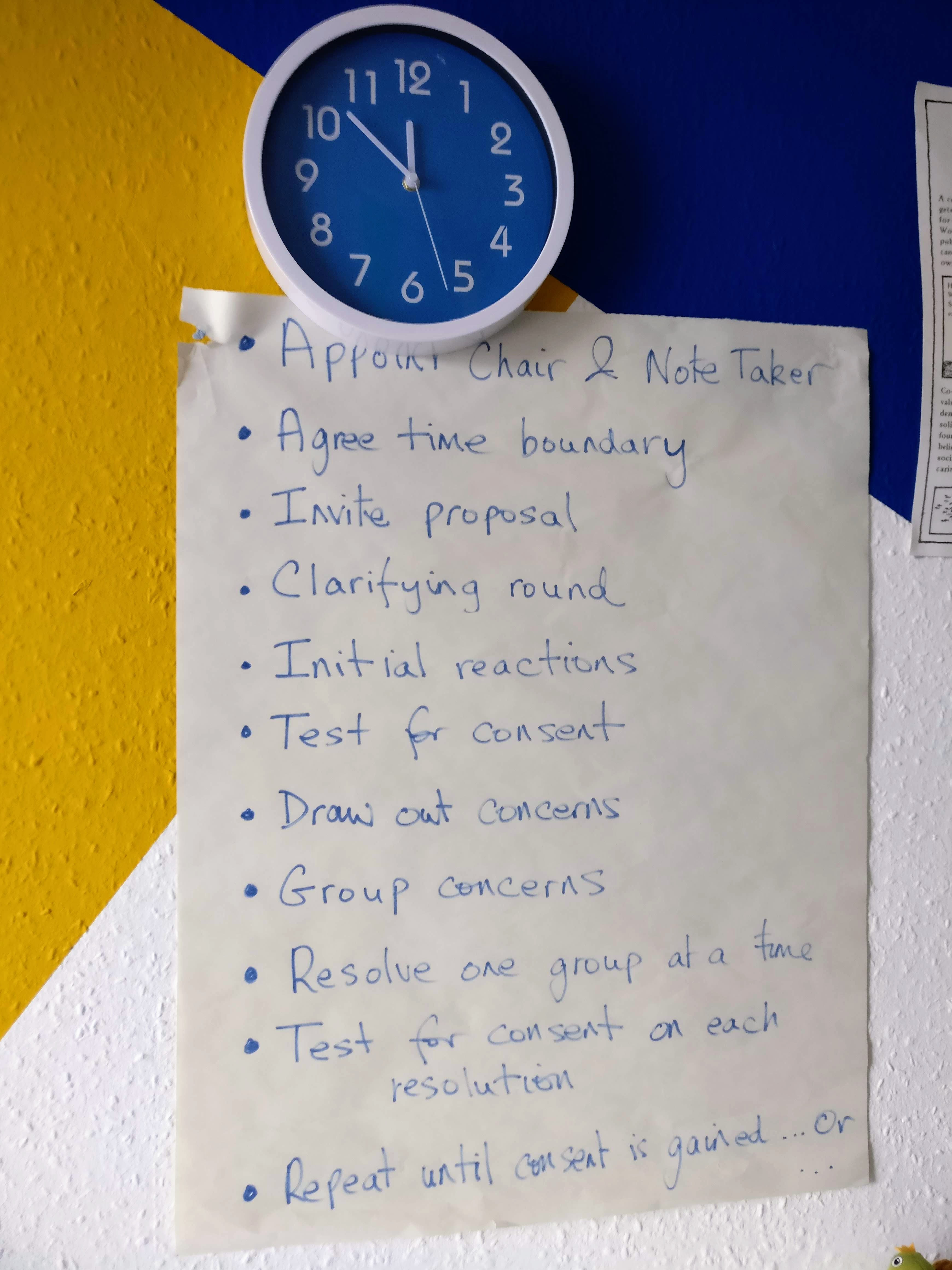
Here’s how it works:
In practice, over the week-long design sprint, it was more like:
There are several benefits to this process, which becomes quicker and more natural the more times you do it:
I’ve read quite a bit about sociocracy in theory, but it was so good to see the approach working in practice. Not only did it make the week more democractic, but it actually accelerated things! The Outlandish team got us testing on Thursday instead of Friday, which meant we spent a day iterating and focusing on next steps.
Easlier this year I had to split a Koa/SPA app into two separate apps. As part of that I switched from webpack to Neutrino.
Through this work I learned a lot about full stack development (frontend, backend and deployments for both). I could write a blog post per item, however, listing it all in here is better than never getting to write a post for any of them.
Note, I’m pointing to commits that I believe have enough information to understand what I learned.
Npm packages to the rescue:
Node/backend notes:
Neutrino has been a great ally to me and here’s some knowledge on how to use it:
Heroku was my tool for deployment and here you have some specific notes:
Fujifilm today announced the X-T100. This new camera is mostly the X-A5 internals coupled with an EVF and the three-way tilting LCD from the more DSLR-like Fujifilm bodies.

Let's get one thing out of the way fast: I love the X-A5's images. …

Microsoft is set to acquire leading software development platform GitHub for $7.5 billion in stock.
The deal should close by the end of the year, subject to customary closing conditions and regulatory review.
“Microsoft is a developer-first company, and by joining forces with GitHub we strengthen our commitment to developer freedom, openness and innovation,” said Microsoft CEO Satya Nadella.
Both Nadella and current GitHub CEO Chris Wanstrath stressed that GitHub has to and will remain open. GitHub is the ‘home’ of developers around the world. During a conference call this morning, Microsoft’s corporate vice president Nat Friedman said that GitHub is where developers go to be developers.
“GitHub is stronger the bigger it is,” he said. Friedman will be taking over as CEO of GitHub when the deal goes through. He also stressed that GitHub will remain independent and continue its commitment to openness. That means anyone can use it with any language, any cloud service for any project.
Wanstrath will be moving over to Microsoft to take on the role of technical fellow. He’ll be reporting to executive vice president Scott Guthrie. Technical fellow is a high-level advisory role. Wanstrath said in this morning’s conference call that he’s excited for the role. He’ll be working with Guthrie on strategic software initiatives.
Microsoft’s CFO Amy Hood expects both the U.S. and the E.U. to approve the purchase by the end of the year.
Additionally, Nadella said that every company is becoming a software company. The need for a developer community like GitHub is present and growing.
GitHub is the world’s most popular platform for open source projects and software innovation. Additionally, Microsoft is one of the biggest users with some 15,000 contributors to its projects.
Microsoft also wants to see increased use of GitHub at the enterprise level. Furthermore, Microsoft is bringing all its developers tools to the GitHub marketplace.
The post Microsoft to purchase development platform GitHub for $7.5 billion appeared first on MobileSyrup.
The title of this blog post comes from a recent Platformonomics article that analyzes how much Amazon, Google, Microsoft, IBM and Oracle are investing in their cloud infrastructure. It does that analysis based on these companies' publicly reported CAPEX numbers.
Capital expenditures, or CAPEX, is money used to purchase, upgrade, improve, or extend the life of long-term assets. Capital expenditures generally takes two forms: maintenance expenditure (money spent for normal upkeep and maintenance) and expansion expenditures (money used to buy assets to grow the business, or money used to buy assets to actually sell). This could include buying a building, upgrading computers, acquiring a business, or in the case of cloud infrastructure vendors, buying the hardware needed to invest in the growth of their cloud infrastructure.
Building this analysis on CAPEX spending is far from perfect, as it includes investments that are not directly related to scaling cloud infrastructure. For example, Google is building subsea cables to improve their internet speed, and Amazon is investing a lot in its package and shipping operations, including the build-out of its own cargo airline. These investments don't advance their cloud services businesses. Despite these inaccuracies, CAPEX is still a useful indicator for measuring the growth of their cloud infrastructure businesses, simply because these investments dwarf others.
The Platformonomics analysis prompted me to do a bit of research on my own.
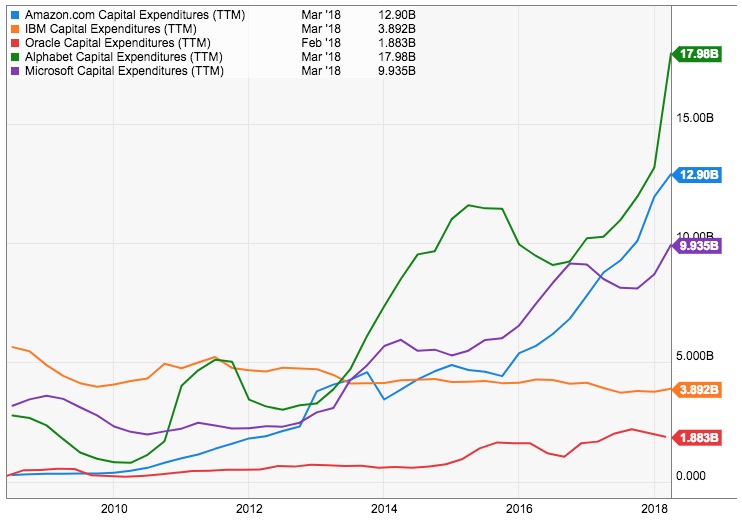
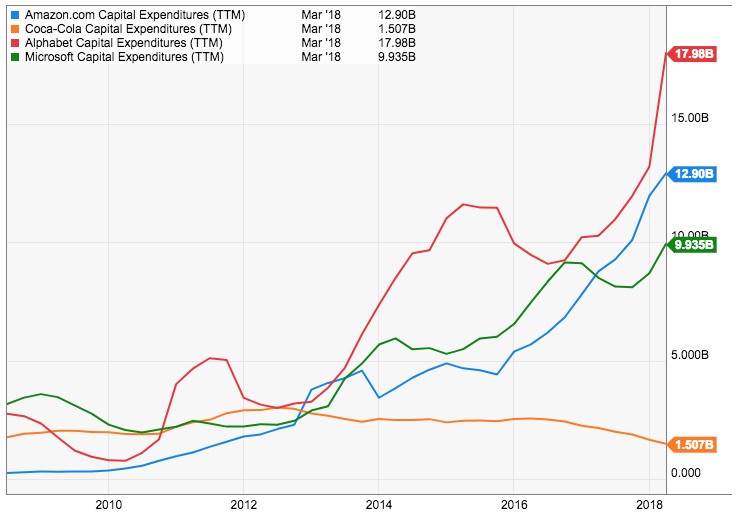
The graph above shows the trailing twelve months (TTM) CAPEX spending for each of the five cloud vendors. CAPEX don't lie: cloud infrastructure services is clearly a three-player race. There are only three cloud infrastructure companies that are really growing: Amazon, Google (Alphabet) and Microsoft. Oracle and IBM are far behind and their spending is not enough to keep pace with Amazon, Microsoft or Google.
Amazon's growth in CAPEX is the most impressive. This becomes really clear when you look at the percentage growth:
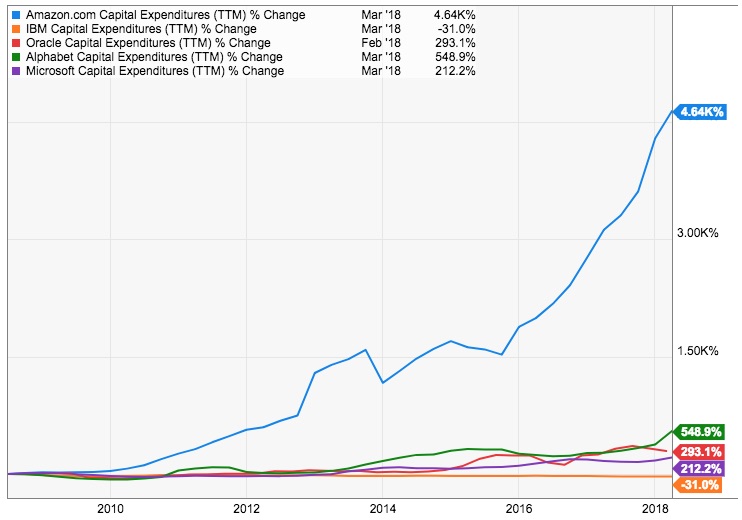
Amazon's CAPEX has exploded over the past 10 years. In relative terms, it has grown more than all other companies' CAPEX combined.
To put the significance of these investments in cloud services in perspective, in the last 12 months, Amazon and Alphabet's CAPEX is almost 10x the size of Coca-Cola's, a company whose products are available in every grocery store, gas station, and vending machine in every town and country in the world. More than 3% of all beverages consumed around the world are Coca-Cola products. In contrast, the amount of money cloud infrastructure vendors are investing in CAPEX is hard to grasp.
 |
sillygwailo
shared this story
from  blogTO. blogTO.
|

Toronto's transit system is in the midst of a transformation that will make our streetcars more powerful, agile and reliable — but you won't be able to see a difference unless you look up.
As the TTC rolls out more and more of its new Flexity Outlook streetcars, the agency is also upgrading the technology used to power its vehicles from overhead.
Say goodbye to elaborate "crossing frogs" over major intersections, and wave hello to pantographs (but only on Harbourfront and Spadina. For now.)
Pantograph on Spadina, @bradTTC/@TTCStuart, it's the most beautiful thing I've seen all day!!! 😍 Please say it's permanent and coming to all the other lines, too! #transitnerd
— David Lussier (@d_a_f_f_y_d) May 14, 2018
cc: @TTCnotices pic.twitter.com/6atUbt4xus
Most Toronto streetcars currently have a "trolley pole" — a long, straight rod that sticks out from the top of the car and connects it to power lines above.
This is considered old school and less effective when using cars as long as the new Bombardier Flexity.
Streetcars with trolley poles are more prone to "dewiring" (aka breaking down) and more complicated to make turns with than their more-modern counterparts, according to experts. They also lead to gross, oily build-up on the back windows of new streetcars.
Pantographs, on the other hand, can maintain contact with overhead wires even when they're not perfectly centred, as well as during ice storms and under low-clearance bridges. They also pull in a lot more power, allowing for higher speeds.
As of today, @TTChelps 510 Spadina is operating using pantographs. This is the second streetcar to to convert from trolley poles, after the 509 Harbourfront. #Toronto pic.twitter.com/uBgyvuhBOY
— Alex Glista (@AlexanderGlista) May 14, 2018
The new Bombardier streetcars all come equipped with these roof-mounted, spring-loaded pantographs, but Toronto's overhead wire network isn't quite ready for all of them yet.
This will change, slowly but surely, as the TTC works to convert its overhead contact system and carhouses to accommodate the new technology.
You may already have seen some pantographs in action on the 509 Harbourfront route, where they've been powering cars since September.
Pole and pantograph pass each other on #TTC Toronto Flexity cars operating along Queen's Quay just west of York Street on September 28, 2017. Photo: @jamesbow https://t.co/TCgd21glwj pic.twitter.com/c7PXGJJQHw
— Transit Toronto (@transittoronto) December 11, 2017
Now, as of Monday, you can see them on the 510 Spadina route as well.
"Indeed, Spadina is the next route being converted followed by other lines in the network," wrote TTC spokesperson Stuart Green on Twitter in response to local transit buff David Lussier.
"This is so exciting," said Lussier. "Pantographs are MUCH sexier and they don't get the rear of streetcar all greasy."
True say!
I think I must have been about eighteen when I started getting migraines.
I’d applied and got through the first few stages for having the Royal Air Force sponsor me through university. In return, I would have to agree to ‘sign up’ for sixteen years after graduation. It’s a fact that I’m reminded of as it’s only now, as a 37 year-old, that I would be returning to civilian life.
After a successful interview with the Wing Commander at RAF Linton-on-Ouse, he asked if anything had changed with my application since filling it in some six months prior to our meeting. It was a routine question, but one I felt I had to answer honestly.
I disclosed that I’d just started suffering from migraines with visual disturbances (‘aura’). He raised an eyebrow, walked over to a cabinet and pulled out a large binder. Finding the relevant entry, he read it to me. I already knew that I couldn’t be an RAF pilot after needing corrective lenses from the age of seventeen. Now, he told me, because every type of migraine can be triggered by stress, a position in Fighter Control was now also out of reach.
Given my feelings about war and nationalism these days, I suppose that I ‘dodged a bullet’ there (so to speak). At the time, though, I was bitterly disappointed. So began my life as a migraineur.
In today’s Observer, Eva Wiseman writes about migraines after news that the American FDA has approved a potential ‘cure‘ to migraines:
The newly-approved drugs follow a much more targeted approach [to previous efforts]. Back in the 1980s, researchers investigating migraines’ root causes zeroed in on the CGRP, a molecule that regulates nerve communication and helps control blood vessel dilation. Scientists found that those with migraines had markedly more CGRP molecules than those without. They also found that if they injected CGRP into people who were known to get migraines, that alone would trigger one. People without a history of migraines could get the same injection without experiencing a headache.
However, like Wiseman, I’m a little skeptical about all this; I’m not sure migraines can be fully separated out from the migraineur:
My personality is curled around the knowledge of a migraine, like the fruit of an avocado and its pit.
It’s difficult to explain what it’s like to have a migraine to someone who has never had one. They’re whole-body experiences and, although people often point to the crushing headaches, it’s actually impossible to separate them out as a distinct ‘event’. They come at you like waves, gentle at first, but increasing in ferocity.
It was quite by accident that I came across a book a few years ago that had a direct and lasting effect on my life. The late Oliver Sacks’ book Migraine made me realise that, for better or worse, migraines are just part of who I am. He draws on clues from history about migraines, as well as his own clinical experience:
“You keep pressing me,” he said, “to say that the attacks start with this symptom or that symptom, this phenomenon or that phenomenon, but this is not the way I experience them. It doesn’t start with one symptom, it starts as a whole. You feel the whole thing, quite tiny at first, right from the start.… It’s like glimpsing a point, a familiar point, on the horizon, and gradually getting nearer, seeing it get larger and larger; or glimpsing your destination from far off, in a plane, having it get clearer and clearer as you descend through the clouds.” “The migraine looms,” he added, “but it’s just a change of scale—everything is already there from the start.”
Curiously, there are significant benefits to being a migraineur. These include mild synaesthesia, the ability to see more visually things like historical dates that others find more abstract, and being finely attuned to the weather. There’s also some evidence that migraineurs are less likely to have huge egos.
Sacks writes that:
Transient states of depersonalisation are appreciably commoner during migraine auras. Freud reminds us that “… the ego is first and foremost a body-ego … the mental projection of the surface of the body.” The sense of “self” appears to be based, fundamentally, on a continuous inference from the stability of body-image, the stability of outward perceptions, and the stability of time-perception. Feelings of ego-dissolution readily and promptly occur if there is serious disorder or instability of body-image, external perception, or time-perception, and all of these, as we have seen, may occur during the course of a migraine aura.
Yet these various upsides for the migraineur can’t be separated from the huge downsides: visual disturbances, the loss of muscle tone, crushing headaches, and an unshakeable feeling of anxiety and depression.
It took me years to pinpoint the triggers for my migraines. Can you imagine the process that I had to go through to discover that the natural food colouring Annatto is guaranteed to bring on an episode? No Coca-Cola, cheap custard, or Red Leicester cheese for me! One time, when I was working as a teacher, my wife had to pick me up and take me home after I confiscated a bag of sweets from a child, ate one, and within minutes started seeing huge jagged shapes in my peripheral vision.
Karma.
These days, I’m more clued-up on the small changes that happen to my mind and body in the 24-36 hours before my first visual disturbance: I notice my body losing muscle tone; I start biting my nails; I want to be alone. It’s no coincidence that I’m writing this blog post in a room by myself with chewed-off nails. I’m expecting the aura anytime soon.
Wiseman describes her visual disturbances as:
[A] flickering blind spot in the centre of my vision. It starts small, a spinning black penny in the middle of a page. I slump in my seat as it spreads darkly over my sight like jam, and I can’t see, or think, or entirely understand speech. It’s the film melting in my projector – it’s a bit like falling.
My migraines are nowhere near as frequent or intense as they used to be. I avoid triggers such as specific food and drink, stay away from fluorescent lighting, ensure I get enough sleep, and make sure I drink enough.
When I worked at a university, my migraines were bad enough to find myself on the disability register. These days, they’re much more manageable, for three reasons:
However, as the RAF Wing Commander correctly noted, stress is always a trigger of migraines. So, in a sense, I’m quite glad that my body has a very obvious system to force me to rest. I’ve had to come to terms with the fact that intense, high-stress environments aren’t places where I can thrive.
I want to finish with a quotation from Eva Wiseman’s article:
Half of me knows my life would be simpler if I concentrated harder on looking inwards, and took on the part-time job of doctors’ appointments and pills. But the other half, the one that enjoys the sleepy curiosity of life with a migraine and those three long days of magical thinking, is less willing to try and define what is migraine, and what is me.
We’re often told to listen to our bodies, but in a very real sense, I don’t have much option. I’m not sure where my migraines end, and I begin.
Image by Lizzie at Unsplash
Enjoyed cycling along the Eem river to Soest today, having lunch with the three of us in what used to be Queen Emma‘s waiting room at Soestdijk’s railway station.


... from my morning reading.
First, a sentence from Bryan Caplan, about one of his influences, philosopher Michael Huemer:
I think what's great about this book, and really all of Mike's work, is he always tries to start off with premises that make sense to people who don't already agree, and then try to get somewhere.
I value people who take the time to construct arguments in this way. It's surprisingly rare in academic discourse and public discourse. Teachers usually learn pretty quickly, though, that the most effective way to teach is start where your students are: recognize the state of their knowledge and respect their current beliefs. I try to remind myself of this principle regularly during a course, or I'm likely to go off track.
Second, the closing exchange from a 1987 interview with Stanley Kubrick. Kubrick has been talking about how the critics' views of his films tend to evolve over time. The interviewer wrapped up the conversation with:
Well, you don't make it easy on viewers or critics. You create strong feelings, but you won't give us any easy answers.
That's because I don't have any easy answers.
That seems like a pretty good aspiration to have for teaching, that people can say it creates strong feelings but doesn't give any easy answers. Much of teaching is simpler than this, of course, especially in a field such as computer science. A closure is something that we can understand as it is, as is, say, an algorithm for parsing a stream of tokens. But after you learn a few concepts and start trying to build or understand a complex system, easy answers are much harder to come by. Even so, I do hope that students leave my courses with strong feelings about their craft. Those feelings may not match my own, and they'll surely still be evolving, but they will be a product of the student engaging with some big ideas and trying them out on challenging problems.
Maybe if I keep reading interested articles on the exercise the bike and making connections to my craft, I can get this computer science thing down better.

Last week I was asked to pull together a short 5 minute provocation around the future for digital learning for departmental away day. Luckily for me Sian Bayne and Michael Gallagher from the Centre for Digital Education at the University of Edinburgh had just published two short, but very useful (openly licensed) papers: Future Trends: Education and Socitey, Future Trends: Science and Technology. You can access them both here.
These were the perfect reference point for me and summarised many of the things I had in one of the many lists in my head. A couple of points were really relevant for discussion with my colleagues (as we are a department of Academic Quality and Development) – unbundling and new degree models (e.g. graduate level apprenticeships) and their discussion about new forms of value (for example blockchain) and the potential to use more distributed networks to store, accredit, pay and share qualifications. This brings with it the potential for the accreditation of awards to be “opened up” aka commercialised.
The arrival of graduate level apprenticeships (the most current form of unbundling here in the Scotland ) and the potential revenue they bring, are a very direct concern for my colleagues from both the academic quality and development point of view. We need to maintain the former and ensure that the latter is appropriate and that we are not just doing a bit of enhanced traditional day release. With all universities (particularly in Scotland where we don’t have the same fee revenue from undergraduate fees as other parts of the UK), chasing the money can all too often be the driving force, and the key “business focus”. The reality of the business of learning and teaching doesn’t get quite as much attention. The neoliberalisation of education marches on apace, as Michael and Sian point out
Some critics foreground its decentralising, individuating reduction of all learning to exchangeable value, aligning it with the ideologies of ‘neoliberalism, libertarianism, and global capitalism’ (Watters 2016). Others challenge its vast carbon footprint (Holthaus 2017), and some see it merely as a solution in search of a problem.
On Friday I also spotted via twitter that Anglia Ruskin have appointed a marketing agency to “define and deliver the future experience for the university’s students and staff.”
The agency will:
partner with Anglia Ruskin to help shape its digital strategy, as well as providing long term support with service design and modern digital development capability. Alongside working with ARU to clarify their longer-term ambition for the target customer experience, Friday are expected to start immediate work on two key projects; a website redesign and re-platforming, as well as re-imagining the applicant and onboarding experience.
A representative from the agency is quoted as saying:
Good digital, done well, has the potential to improve lives. Education, and digital’s ability to support it, is something we’re extremely passionate about. So Anglia Ruskin, with their ambition for digital to materially improve the student experience, is an ideal partner for us – we’re thrilled to be working with them.
“good digital”- now there is a phrase and half, a real wtf statement if ever I saw one. Digital is particularly on my mind just now, as I am currently writing and researching about “the digital” in relation to universities for a book I’m writing with Keith Smyth and Bill Johnston – our deadline is the end of the month so I probably shouldn’t be writing this post!
I see digital as a complex code word, one that has many different meanings, and an equal number of assumptions. It is equally powerful and meaningless , as I think the quote above exemplifies. As our OER18 presentation highlighted we are looking particularly at critical pedagogy as a theoretical basis for our work and see human understanding and contextualistaion of “the digital” as being key. It is only through people really understanding and challenging socio-political contexts that the potential of digital technologies can be utilised. This is completely contrary to neoliberal trends of unbundling and onboarding the student experience.
We need to fight back from the oppression of phrases (and assumptions) such as “good digital”. Unsurprisingly I have been reading the work of Antonia Darder of late, and in particular her article Teaching as an Act of Love: Reflections on Paulo Freire and his contributions to our lives and work (2011).
Isn’t it time that we all demanded less “good digital” and more love and struggle? I leave you with some words of wisdom and reflection from Antonia.
If there was anything that Freire consistently sought to defend, it was the freshness, spontaneity, and presence embodied in what he called an “armed loved—the fighting love of those convinced of the right and the duty to fight, to denounce, and to announce” (Freire, 1998, p. 42). A love that could be lively, forceful, and inspiring, while at the same time, critical, challenging, and insistent. As such, Freire’s brand of love stood in direct opposition to the insipid “generosity” of teachers or administrators who would blindly adhere to a system of schooling that fundamentally transgresses every principle of cul- tural and economic democracy . . I want to write about political and radicalized form of love that is never about absolute consensus, or unconditional acceptance, or unceasing words of sweetness, or endless streams of hugs and kisses. Instead it is a love that I experienced as unconstricted, rooted in a committed willingness to struggle persistently with purpose in our life . ..

Around two years ago, a high-ranking exec turned to me at a dinner party and asked me what the heck I was doing at Microsoft with my OpenSource background and (I quote) “actual tech experience”.
I’m prone to wondering that myself sometimes, but stuff like this gives me heart.
On the other hand, it feels totally unreal. It’s as if a million repositories suddenly cried out…
Ah well. Let’s see how things pan out.
mkalus
shared this story
from  Remains of the Day. Remains of the Day.
|
Again, not everyone is like this, some psychopaths who are comfortable sharing their thoughts no matter the size of the audience, but these people are often annoying, the type who dive right into politics at Thanksgiving before you've even spooned gravy over your turkey. This leads to a form of adverse selection where a few over-sharers take over your News Feed.
[Not everything one shares gets distributed to one's entire friend graph given the algorithmic feed. But you as the one sharing something have no idea who will see it so you have to assume that any and every person in your graph will see it. The chilling effect is the same.]
Another form of diseconomy of scale is behind the flight to Snapchat among the young, as outlined earlier. A sure way to empty a club or a dance floor is to have the parents show up; few things are more traumatic then seeing your Dad pretend-grind on your Mom when "Yeah" by Usher comes on. Having your parents in your graph on Facebook means you have to assume they're listening, and there isn't some way to turn on the radio very loudly or run the water as in a spy movie when you're trying to pass secrets to someone in a room that's bugged. The best you can do is communicate in code to which your parents don't own the decryption key; usually this takes the form of memes. Or you take the communication over to Snapchat.
Another diseconomy of scale is the increasing returns to trolling. Facebook is more immune to this thanks to its bi-directional friending model than, say, Twitter, with its one-way follow model and public messaging framework. On Facebook, those wishing to sow dissension need to be a bit more devious, and as revelations from the last election showed, there are means to a person's heart, to reach them directly or indirectly, through confirmation bias and flattery. The Iago playbook from Othello. On Twitter, there's no need for such scheming, you can just nuke people from your keyboard without their consent.
All of this is to say I suspect many of Facebook's more fruitful vectors for rekindling their value for socializing lie in breaking up the surface area of their service. News Feed is so monolithic a surface as to be subject to all the diseconomies of scale of social networking, even as it makes it such an attractive advertising landscape.
The most obvious path to this is Groups, which can subdivide large graphs into ones more unified in purpose or ideology. Google+ was onto something with Circles, but since they hadn't actually achieved any scale they were solving a problem they didn't have yet.
Where is Instagram's invisible asymptote? This is one of the trickier ones to contemplate as it continues to grow without any obvious end in sight.
One of the advantages to Instagram is that it came about when Facebook was broadening its acceptable media types from text to photos and video. Instagram began with just square photos with a simple caption, no links allowed, no resharing.
This had a couple of advantages. One is that it's harder to troll or be insufferable in photos than it is in text. Photos tend to soften the edge of boasts and provocations. More people are more skilled at being hurtful in text than photos. Instagram has tended to be more aggressive than other networks at policing the emotional tenor of its network, especially in contrast to, say Twitter, turning its attention most recently to addressing trolls in the comment sections.
Of course photos are not immune to this phenomenon. The "look at my perfect life" boasting of Instagram is many people's chief complaint about the app and likely the primary driver of people feeling lousy after looking through their feed there. Still, outright antagonism with Instagram, given it isn't an open public graph like Twitter, is harder. The one direct vector is comments and Instagram is working on that issue.
In being a pure audio-visual network at a time when Facebook and most other networks were mixed-media, Instagram siphoned off many people for whom the best part of Facebook was just the photos and videos; again, we often, as with Twitter, over-estimate the product-market fit and TAM of text. If Facebook just showed photos and videos for a week I suspect their usage would grow, but since they own Instagram...
As with other social networks that grow, Instagram broadened its formats early on to head off several format-based asymptotes. Non-square photos and videos with gradually lengthening time limits have broadened the use cases and, more importantly, removed some level of production friction.
The move to copy Snapchat's Stories format was the next giant asymptote avoided. The precious nature of sharing on Instagram was a drag on posting frequency. Stories solves the supply-side issue for content several ways. One is that since it requires you to explicitly tap into viewing it from the home feed screen, it shifts the onus for viewing the content entirely to the audience. This frees the content creator from much of the guilt of polluting someone else's feed. The expiring nature of the content further removes another of a publisher's inhibitions about littering the digital landscape. It unlocked so much content that I now regularly fail to make it through more than a tiny fraction of Stories on Instagram. Even friends who don't publish a lot now often put their content in Stories rather than posting to the main feed.
The very format of Stories, with its full-screen vertical orientation, cues the user that this format is meant for the native way we hold our devices as smartphone photographers, rather than accommodating the more natural landscape way that audiences view the world, with eyes side-by-side in one's head. Stories includes accoutrements like gaudy stickers and text overlays and face filters that aren't in the toolset for Instagram's main feed photo/video composer, perhaps to preserve some aesthetic separation between the main feed and Stories.
There is a purity about Instagram which makes even its ads perfectly native: everything on the service is an audio-visual advertisement. I see people complain about the ad load in Instagram, but if you really look at your feed, it's always had an ad load of 100%.
I just opened my feed and looked through the first twenty posts, and I'd classify them all as ads: about how great my meal was, for beautiful travel destinations, for the exquisite craft of various photographers and cinematographers, for an actor's upcoming film, for Rihanna's new lingerie line or makeup drop, for an elaborate dish a friend cooked, for a current concert tour, for how funny someone is, for someone's gorgeous new headshot, and for a few sporting events and teams. And yes, a few of them were official Instagram ads.
I don't mean this in a negative way. One might lobby this accusation at all social networks, but the visual nature of Instagram absorbs the signaling function of social media in the most elegant and unified way. For example, messaging apps consist of a lot of communication that isn't advertising. But that's exactly why a messaging app like Messenger isn't as lucrative an ad platform as Instagram is and will be. If ads weren't marked explicitly, and if they weren't so obviously from accounts I don't follow, it's not clear to me that they'd be so jarringly different in nature than all the other content in the feed.
The irony is that, as Facebook broadened its use cases and supported media types to continue to expand, the purity of Instagram may have made it more scalable a network in some ways.
Of course, every product or service has some natural ceiling. To take one example, messaging with other folks is still somewhat clunky on Instagram, it feels tacked on. Considering how much young people use Snapchat as a messaging app of choice, there's likely attractive headroom for Instagram here.
Rumors Instagram is contemplating a separate messaging app make sense. It would be ironic if Instagram separated out the more broadcast nature of its core app from the messaging use case in two different apps before Snapchat did. As noted earlier, it feels as if Snapchat is constantly fighting to balance the messaging parts of its app with the more broadcast elements like Stories and Discover, and separate apps might be one way to solve that more effectively.
As with all social networks which are mobile-phone dominant, there are limits to what can be optimized for in a single app, when all you have to work with is a single rectangular phone screen. The mobile phone revolution forced a focus in design which created billions of dollars in value, but Instagram, like all phone apps, will run into the asymptote that is the limits of how much you can jam into one app.
Instagram has already had some experience in dealing with this conundrum, creating separate apps like Boomerang or Hyperlapse that keep a lid on the complexity of the Instagram app itself and which bring additional composition techniques to the top level of one's phone. I often hear people counsel against launching separate apps because of the difficulty of getting adoption of even a single app, but that doesn't mean that separate apps aren't sometimes the most elegant way to deal with the spatial design constraints of mobile.
On Instagram, content is still largely short in nature so longer narratives aren't common or well-supported. The very structure, oriented around a main feed algorithmically compiling a variety of content from all the account you follow, isn't optimized towards a deep dive into a particular subject matter or narrative like, say, a television or a streaming video app. The closest to long-form on Instagram is Live, but most of what I see of that is only loosely narrative, resembling more an extended selfie than a considered narrative. Rather than pursue long-form narrative, it may be that a more on-brand way to tackle the challenge of lengthening usage of the app is better stringing together of existing content, similar to how Snapchat can aggregate content from one location into a feed of sorts. That can be useful for things like concerts and sporting events and breaking news events like natural disasters, protests, and marches.
In addition, perhaps there is a general limit to how far a single feed of random content arranged algorithmically can go before we suffer pure consumption exhaustion. Perhaps seeing curated snapshots from everyone will finally push us all to the breaking point of jealousy and FOMO and, across a large enough number of users, an asymptote will emerge.
However, I suspect we've moved into an age where the upper bound on vanity fatigue has shifted much higher in a way that an older generation might find unseemly. Just as we've moved into a post-scarcity age of information, I believe we've moved into a post-scarcity age of identity as well. And in this world, it's more acceptable to be yourself and leverage social media for maximal distribution of yourself in a way that ties to the fundamental way in which the topology of culture has shifted from a series of massive centralized hub and spokes to a more uniform mesh.
A last possible asymptote relates to my general sense that massive networks like Facebook and Instagram will, at some point, require more structured interactions and content units (for example, a list is a structured content unit, as is a check-in) to continue scaling. Doing so always imposes some additional friction on the content creator, but the benefit is breaking one monolithic feed into more distinct units, allowing users the ability to shift gears mentally by seeing and anticipating the structure, much like how a magazine is organized.
To fill gaps in a person's free time, an endless feed is like an endless jar of liquid, able to be poured into any crevice in one's schedule and flow of attention. To demand a person's time, on the other hand, is a higher order task, and more structured content seems to do better on that front. People set aside dedicated time to play games like Fortnite or to watch Netflix, but less so to browse feeds. The latter happens on the fly. But ambition in software-driven Silicon Valley is endless and so at some point every tech company tries to obtain the full complement of Infinity Stones, whether by building them or buying them, like Facebook did with Instagram and Whatsapp.
I started with Amazon, but it is worth revisiting as it is hardly done with its own ambitions. After having made such massive progress on the shipping fee asymptote, what other barriers to growth might remain?
On that same topic of shipping, the next natural barrier is shipping speed. Yes, it's great that I don't have to pay for shipping, but in time customer expectations inflate. Per Jeff's latest annual letter to shareholders:
One thing I love about customers is that they are divinely discontent. Their expectations are never static – they go up. It’s human nature. We didn’t ascend from our hunter-gatherer days by being satisfied. People have a voracious appetite for a better way, and yesterday’s ‘wow’ quickly becomes today’s ‘ordinary’. I see that cycle of improvement happening at a faster rate than ever before. It may be because customers have such easy access to more information than ever before – in only a few seconds and with a couple taps on their phones, customers can read reviews, compare prices from multiple retailers, see whether something’s in stock, find out how fast it will ship or be available for pick-up, and more. These examples are from retail, but I sense that the same customer empowerment phenomenon is happening broadly across everything we do at Amazon and most other industries as well. You cannot rest on your laurels in this world. Customers won’t have it.
Why only two-day shipping for free? What if I want my package tomorrow, or today, or right now?
Amazon has already been working on this problem for over a decade, building out a higher density network of smaller distribution centers over its previous strategy of fewer, gargantuan distribution hubs. Drone delivery may have sounded like a joke when first announced on an episode of 60 Minutes, but it addresses the same problem, as does a strategy like Amazon lockers in local retail stores.
Another asymptote may be that while Amazon is great at being the site of first resort to fulfill customer demands for products, it is less capable when it comes to generating desire ex nihilo, the kind of persuasion typically associated more with a tech company like Apple or any number of luxury retailers.
At Amazon we referred to the dominant style of shopping on the service as spear-fishing. People come in, type a search for the thing they want, and 1-click it. In contrast, if you've ever gone to a mall with someone who loves shopping for shopping's sake, a clotheshorse for example, you'll see a method of shopping more akin to the gathering half of hunting and gathering. Many outfits are picked off the rack and gazed at, held up against oneself in a mirror, turned around and around in the hand for contemplation. Hands brush across racks of clothing, fingers feeling fabric in search of something unknown even to the shopper.
This is browsing, and Amazon's interface has only solved some aspects of this mode of shopping. If you have some idea what you want, similarities carousels can guide one in some comparison shopping, and customer reviews serve as a voice on the shoulder, but it still feels somewhat utilitarian.
Amazon's first attempts at physical stories reflect this bias in its retail style. I visited an Amazon physical bookstore in University Village the last time I was in Seattle, and it struck me as the website turned into 3-dimensional space, just with a lot less inventory. Amazon Go sounds more interesting, and I can't wait to try it out, but again, its primary selling point is the self-serve, low-friction aspect of the experience.
When I think of creating desire, I think of my last and only visit to Milan, when a woman at an Italian luxury brand store talked me into buying a sportcoat I had no idea I wanted when I walked into the store. In fact, it wasn't even on display, so minimal was the inventory when I walked in.
She looked at me, asked me some questions, then went to the back and walked back out with a single option. She talked me into trying it on, then flattered me with how it made me look, as well as pointing out some of its most distinctive qualities. Slowly, I began to nod in agreement, and eventually I knew I had to be the man this sportcoat would turn me into when it sat on my shoulders.
This challenge isn't unique to Amazon. Tech companies in general have been mining the scalable ROI of machine learning and algorithms for many years now. More data, better recommendations, better matching of customer to goods, or so the story goes. But what I appreciate about luxury retail, or even Hollywood, is its skill for making you believe that something is the right thing for you, absent previous data. Seduction is a gift, and most people in technology vastly overestimate how much of customer happiness is solvable by data-driven algorithms while underestimating the ROI of seduction.
Netflix spent $1 million on a prize to improve its recommendation algorithms, and yet it's a daily ritual that millions of people stare at their Netflix home screen, scrolling around for a long time, trying to decide what to watch. It's not just Netflix, open any streaming app. The AppleTV, a media viewing device, is most often praised for its screensaver! That's like admitting you couldn't find anything to eat on a restaurant menu but the typeface was pleasing to the eye. It's not that data can't guide a user towards the right general neighborhood, but more than one tech company will find the gradient of return on good old seduction to be much steeper than they might realize.
Still, for Amazon, this may not be as dangerous a weakness as it would be for another retailer. Much of what Amazon sells is commodities, and desire generation can be offloaded to other channels who then see customers leak to Amazon for fulfillment. Amazon's logistical and customer service supremacy is a devastatingly powerful advantage because it directly precedes and follows the act of payment in the shopping value chain, allowing it to capture almost all the financial return of commodity retail.
And, as Jeff's annual letter to shareholders has emphasized from the very first instance, Amazon's mission is to be the world's most customer-centric company. One way to continue to find vectors for growth is to stay attached at the hip to the fickle nature of customer unhappiness, which they're always quite happy to share under the right circumstances, one happy consequence of this age of outrage. There is such a thing as a price umbrella, but there's also one for customer happiness.
One way to identify your invisible asymptotes is to simply ask your customers. As I noted at the start of this piece, at Amazon we honed in on how shipping fees were a brake on our business by simply asking customers and non-customers.
Here's where the oft-cited quote from Henry Ford is brought up as an objection: “If I had asked people what they wanted, they would have said faster horses," he is reputed to have said. Like most truisms in business, it is snappy and lossy all at once.
True, it's often difficult for customers to articulate what they want. But what's missed is that they're often much better at pinpointing what they don't want or like. What you should hear when customers say they want a faster horse is not the literal but instead that they find travel by horse to be too slow. The savvy product person can generalize that to the broader need of traveling more quickly, and that problem can be solved any number of ways that don't involve cloning Secretariat or shooting their current horse up with steroids.
This isn't a foolproof strategy. Sometimes customers lie about what they don't like, and sometimes they can't even articulate their discontent with any clarity, but if you match their feedback with good analysis of customer behavior data and even some well-designed tests, you can usually land on a more accurate picture of the actual problem to solve.
A popular sentiment in Silicon Valley is that B2C businesses are more difficult product challenges than B2B because products and services for the business customer can be specified merely by talking to the customer while the consumer market is inarticulate about its needs, per the Henry Ford quote. Again, that's only partially true, and so many consumer companies I've been advising recently haven't pushed enough yet on understanding or empathizing with the objections of its non-adopters.
We speak often of the economics concept of the demand curve, but in product there is another form of demand curve, and that is the contour of the customers' demands of your product or service. How comforting it would be if it were flat, but as Bezos noted in his annual letter to shareholders, the arc of customer demands is long, but it bends ever upwards. It's the job of each company, especially its product team, to continue to be in tune with the topology of this "demand curve."
I see many companies spend time analyzing funnels and seeing who emerges out the bottom. As a company grows, though, and from the start, it's just as important to look at those who never make it through the funnel, or who jump out of it at the very top. If the product market fit gradient likely differs for each of your current and potential customer segments, and understanding how and why is a never-ending job.
When companies run focus groups on their products, they often show me the positive feedback. I'm almost invariably more interested in the folks who've registered negative feedback, though I sense many product teams find watching that material to be stomach-churning. Sometimes the feedback isn't useful in the moment; perhaps you have such strong product-market fit with a different cohort that it isn't useful. Still, it's never not a bit of a prick to the ego.
However, all honest negative feedback forms the basis of some asymptote in some customer segment, even if the constraint isn't constricting yet. Even if companies I meet with don't yet have an idea of how to deal with a problem, I'm always curious to see if they have a good explanation for what that problem is.
One important sidenote on this topic is that I'm often invited to give product feedback, more than I can find time for these days. When I'm doing so in person, some product teams can't help but jump in as soon as I raise any concerns, just to show they've already anticipated my objections.
I advise just listening all the way through the first time, to hear the why of someone's feedback, before cutting them off. You'll never be there in person with each customer to talk them out of their reasoning, your product or service has to do that work. The batting average of product people who try to explain to their customers why they're wrong is...not good. It's a sure way to put them off of giving you feedback in the future, too.
Even absent external feedback, it's possible to train yourself to spot the limits to your product. One approach I've taken when talking to companies who are trying to achieve initial or new product-market fit is to ask them why every person in the world doesn't use their product or service. If you ask yourself that, you'll come up with all sorts of clear answers, and if you keep walking that road you'll find the borders of your TAM taking on greater and greater definition.
[It's true that you also need the flip side, an almost irrational positivity, to be able to survive the difficult task of product development, or to be an entrepreneur, but selection bias is such that most such people start with a surplus of optimism.]
Lastly, though I hesitate to share this, it is possible to avoid invisible asymptotes through sheer genius of product intuition. I balk for the same reason I cringe when I meet CEO's in the valley who idolize Steve Jobs. In many ways, a product intuition that is consistently accurate across time is, like Steve Jobs, a unicorn. It's so rare an ability that to lean entirely on it is far more dangerous and high risk than blending it with a whole suite of more accessible strategies.
It's difficult for product people to hear this because there's something romantic and heroic about the Steve Jobs mythology of creation, brilliant ideas springing from the mind of the mad genius and inventor. However, just to read a biography of Jobs is to understand how rare a set of life experiences and choices shaped him into who he was. Despite that, we've spawned a whole bunch of CEO's who wear the same outfit every day and drive their design teams crazy with nitpick design feedback as if the outward trappings of the man were the essence of his skill. We vastly underestimate the path dependence of his particular style of product intuition.
Jobs' gift is so rare that it's likely even Apple hasn't been able to replace it. It's not a coincidence that the Apple products that frustrate me the most right now are all the ones with "Pro" in the name. The MacBook Pro, with its flawed keyboard and bizarre Touch Bar (I'm still using the old 13" MacBook Pro with the old keyboard, hoping beyond hope that Apple will come to its senses before it becomes obsolete). The Mac Pro, which took on the unfortunately apropos shape of a trash can in its last incarnation and whose replacement hasn't shipped in years (I'm still typing this at home on an ancient cheese grater Mac Pro tower and ended up building a PC tower to run VR and to do photo and video editing). Final Cut Pro, which I learned on in film editing school, and which got zapped in favor of Final Cut X just when FCP was starting to steal meaningful share in Hollywood from Avid. The iMac Pro, which isn't easily upgradable but great if you're a gazillionaire.
Pro customers are typically ones with the most clearly specified needs and workflows. Thus, their products are ones for whom listening to them articulate what they want is a reliable path to establishing and maintaining product-market fit. But that's not something Apple seems to enjoy doing, and so the mis-steps they've made on these lines are exactly the types of mistakes you'd expect of them.
[I was overjoyed to read that Apple's next Mac Pro is being built using extensive feedback from media professionals. It's disappointing that it won't arrive until 2019 now but at least Apple has descended from the ivory tower to talk to the actual future users. It's some of the best news out of Apple I've heard in forever.]
Live by intuition, die by it. It's not surprising that Snapchat, another company that lives by the product intuition of one person, stumbled with a recent redesign. That a company's strengths are its weaknesses is simply the result of tight adherence to methodology. Apple and Snapchat's deus ex machina style of handing down products also rid us of CD-ROM drives and produced the iPhone, AirPods, the camera-first messaging app, and the Story format, among many other breakthroughs which a product person could hang a career on.
Because products and services live in an increasingly dynamic world, especially those targeted at consumers, they aren't governed by the immutable, timeless truths of a field like mathematics. The reason I recommend a healthy mix of intuition informed by data and feedback is that most product people I know have a product view that is slower moving than the world itself. If they've achieved any measure of success, it's often because their view of some consumer need was the right one at the right time. Product-market fit as tautology. Selection bias in looking at these people might confuse some measure of luck with some enduring product intuition.
However, just as a VC might have gotten lucky once with some investment and be seen as a genius for life (and the returns to a single buff of a VC brand name is shockingly durable), just because a given person's product intuition might hit on the right moment at the right point in history to create a smash hit, it's rare that a single person's frame will move in lock step with that of the world. How many creatives are relevant for a lifetime?
This is one reason sustained competitive advantage is so difficult. In the long run, endogenous variance in the quality of product leadership in a company always seems to be in the negative direction. But perhaps we are too focused on management quality and not focused enough on exogenous factors. In "Divine Discontent: Disruption’s Antidote," Ben Thompson writes:
Bezos’s letter, though, reveals another advantage of focusing on customers: it makes it impossible to overshoot. When I wrote that piece five years ago, I was thinking of the opportunity provided by a focus on the user experience as if it were an asymptote: one could get ever closer to the ultimate user experience, but never achieve it:

Apple’s World Wide Developer Conference (WWDC) starts on Monday, June 4th in San Jose, California.
The Keynote begins at 1pm ET/10am PT and is scheduled to run until 3pm ET/12pm PT.
Users can watch the presentation live on Apple.com, or download the WWDC app on an iPhone, iPad or Apple TV.
While the event is underway, make sure to follow along with MobileSyrup on Facebook and Twitter to get breakdowns of all the most significant announcements from the keynote.
If you’re wondering what we’ll see at this year’s WWDC, check out our ‘What to expect at WWDC 2018‘ roundup of rumours and speculation surrounding Apple’s annual developers conference. Also, here are what some notable Canadian developers are hoping to get get out of WWDC 2018.
The post How to watch Apple’s 2018 WWDC keynote appeared first on MobileSyrup.

From Google to Apple , a variety of smartphone leaks surfaced this past week.
Here’s a breakdown of almost every smartphone from the last couple of days. The leaks below encompass news from May 26th to June 1st.
Google is reportedly working with Foxconn to develop its Pixel 3 handsets. The handsets are to feature stereo speakers meaning the Pixel 3 will continue to have larger than the 2018 average top and bottom bezels. Meanwhile, the Pixel 3 XL is rumoured to have a notch with a dual camera setup flanking the upper speaker grill. Further the rumours point to the devices will sport the Snapdragon 845 chipset.
For more on the Pixel 3 and Pixel 3 XL leaks, click here. For more on the original Google Pixel 3 XL notch leak, click here.
Leaks and rumours indicate that Apple will put the iPhone X-style notch onto the 4-inch iPhone SE 2. This leak comes from a screen protector for the allegedly upcoming iPhone handset.
For more information on the iPhone SE screen protector, click here.
Recent reports from South Korean publisher, ET News, points to iPhone launching three iPhone handsets all with OLED displays. While previous reports claimed that the larger 6-inch iPhone handset would feature a LCD screen, Apple has seemed to change things up.
For more on the OLED iPhone devices, click here.
The LG Watch is incoming according to a credible tipster. The watch was recently passed through the U.S. Federal Communications Commission documentation, and while not much was learned from the documentation it likely means the watch will be unveiled sooner than later.
For more on the LG Watch, click here.
Dell is reportedly working a dual-screen Windows 10 device. The device, is reportedly sport the rumoured Qualcomm 850 ARM chipset.
For more on the dual-screen device, click here.
Motorola will finally unveil a notched smartphone, according to this week’s rumours. The Motorola One Power will reportedly feature an iPhone X-style notch combined with a dual camera setup.
For more on the Motorola One Power, click here.
Vivo may unveil two Apex FullView variants. One of the variants may feature a camera on the bottom bezel, while the other, may feature a pop-cup camera, that pops out from behind the display.
For more on the Vivo Apex FullView handsets, click here.
The post Here are the Google Pixel 3, iPhone SE 2 and Vivo Apex FullView leaks from last week appeared first on MobileSyrup.


