Rolandt
Shared posts
A Vision for Engineering Workflow at Mozilla (part one)
We won, and we turned into assholes
Noah Kulwin interviews VR pioneer Jaron Lanier. Jaron always seemed just a bit over the top to me, but a lot of what he says in this interview reasonates.
Way back in the ’80s, we wanted everything to be free because we were hippie socialists. But we also loved entrepreneurs because we loved Steve Jobs. So you wanna be both a socialist and a libertarian at the same time, and it’s absurd. But that’s the kind of absurdity that Silicon Valley culture has to grapple with. And there’s only one way to merge the two things, which is what we call the advertising model, where everything’s free but you pay for it by selling ads.
Not all of Silicon Valley or the tech world as a whole is wrapped up in ads, of course. But being a pedant doesn’t change the equation. Enough of the backbone of how we connect is warped by that economy to, in turn, warp our reality. That’s what we need to deal with now.
⚓︎The stress of making a mindfulness app
Rohan Gunatillake’s self funded family business makes Buddify, the third of the trio of leading mindfulness apps alongside Calm and Headspace. Of course, running a small business isn’t stress free. And the app space certainly isn’t stress free. Work is still work.
There is a common idea that if you make your passion your career, then everything magically lines up, angelic choirs break into song and every moment of your work day becomes a thing of joy. As someone who has turned a passion project which I started as a sideline and evolved it into a small company and my full-time job, I’m sorry to break the news that work is still work. Pushing emails around is still pushing emails around, Skype calls still suck and convincing your broadband provider that yes we’ve tried turning it off and on again but it’s still broken is just as frustrating as it has ever been.
As somebody who has chased passion as a job and is totally willing to do it again, there‘s a lot in this article I can relate to.
⚓︎Surface Hub 2 announced
One of the things that I’ve enjoyed about working at Microsoft is collaborating with other people on the Surface Hub. Some of the best work I’ve done in the last few weeks has been around one. This next generation version looks pretty great and I’d love to set up a full-time remote workspace around having one in my home office.
⚓︎Hosting static sites on Azure Blob Store
Hosting statically generated sites on Amazon S3 has been simple for a while. Cheap and scalable, it’s an great way to deploy a site that doesn’t need server side logic. The same hasn’t been true of Azure Blob Store.
That‘s changing soon, however. Azure is adding default index and error page handling to allow Azure Blob Store to be a first class web host for statically generated sites (like this one!) and single page apps. It’s in sneak preview now and the only public mention I can find so far is from a few minutes of this talk at Build 2018.
⚓︎Frontend United keynote
Keynoted at Frontend United in The Netherlands about our work on Drupal's web services APIs and our work toward a JavaScript-driven Drupal administration interface. Great event with lots of positive energy!


Had the garden done to make it even greener, an...
Had the garden done to make it even greener, and hide the dustbins.

What Advertising History Says About the Future of Fake News

Austan Goolsbee,
New York Times,
Jun 05, 2018

Advertising is the original fake news. And if we look at the history of advertising, it says nothing good about the future of news. "First, in all likelihood, fake news will spread, despite efforts to rein it in." But maybe there is hope. "As we are inundated with new, targeted, deceptive ads, we may get sick of them and, perhaps, stop finding them persuasive." But effectively leaves us with no news, or at best, pale 'Consumer Reports' versions of news.
Web: [Direct Link] [This Post]SotD: Dvořák Symphony No. 9
On the title page of his 9th Symphony manuscript, Antonín Dvořák wrote „Z Nového světa“ „From the new world“; it’s thus become popularly known as the New World Symphony. And by “popularly” I mean really, right up there among the most-played classical works. I can pretty well guarantee that almost everyone will have heard, and remember, the big swooshy melody at the front of the 2nd movement.

The title is literally correct; it was composed in 1893 while Dvořák had a lucrative gig in New York as Director of the National Conservatory of Music of America. He was fascinated by Afro-American and Native American music; I quote: “I am convinced that the future music of this country must be founded on what are called Negro melodies. These can be the foundation of a serious and original school of composition, to be developed in the United States. These beautiful and varied themes are the product of the soil. They are the folk songs of America and your composers must turn to them.”
About the 9th Symphony, he said “I have not actually used any of the [Native American] melodies. I have simply written original themes embodying the peculiarities of the Indian music, and, using these themes as subjects, have developed them with all the resources of modern rhythms, counterpoint, and orchestral colour.”
Personally, I can’t hear any of that in the music; it sounds like pure Mittel-Europa to me, and very, very good. Here’s the thing about Dvořák; the music is basically all really good. His Requiem and Cello Concerto (also written in New York) are very dear to me.
I understand that most of you don’t have 45 minutes to listen to a whole symphony, so just listen to Movement #1, which has a big beginning and is full of great tunes, or #2, which has the famous “New World Symphony” melody that everyone knows. The question is, for those of you who still “buy” “albums”, the question is which. The one I have, by the Czech Philharmonic, is super, but not exactly easy to get. I’m going to recommend George Szell with the Cleveland; one time when I was in a high-end audio store, the sales guy used the first movement to impress me with what some big expensive speakers could do, and boy was I ever impressed.
This is part of the Song of the Day series (background).
Links
Spotify playlist. Movements 1 and 2 on Spotify; 1 and 2 on iTunes; 1 and 2 on Amazon. As for live performance how about the New York Philharmonic a couple of years back; they take it a little faster than most, but it works for me.
Keeping Tabs On Azure Usage Using Jupyter
I haven’t written much of anything about Azure over the past year or so, other than assorted notes on infrastructure provisioning (to which I will get back, now that Terraform has an updated provider), nor about machine learning and data science—the former because it’s not a very sexy topic, and the latter because most machine learning in real-life boils down to a lot of data cleaning work that is hardly reflected in all the pretty one-off examples you’ll see in most blog posts.
On the other hand, sometimes there are neat things you can do in the outlying regions of either field that end up being quite useful, and this is one of those (at least as far as I’m concerned), since it’s essentially a sanitized version of a Jupyter notebook I keep around for poking at my personal Azure usage, since even though I use PowerBI about as extensively as Jupyter the former is not available for macOS, and I quite enjoy slicing and dicing data programmatically.
Even though there are now fairly complete Azure billing APIs that let you keep tabs on usage figures, the simplest way to get an estimate of your usage for the current billing period (on an MSDN/pay-as-you-go subscription, which is where I host my personal stuff) is through the Azure CLI.
In particular, az consumption usage list, which you can easily dump by resource category like this:
! az consumption usage list -m -a --query \
  '[].{category:meterDetails.meterCategory, pretax:pretaxCost}' \
  --output tsv > out.tsv
This is, of course, a fairly simplistic take on things (I’m not setting start or end periods and am actually only getting the category and cost for each item), but you get the idea.
With the data in tab-separated format, it’s pretty trivial to build a total and do a rough plot. Let’s do it in more or less idiomatic Python, and rely on pandas solely for plotting:
from collections import defaultdict
import pandas as pd

c = defaultdict(float)

for line in open('out.tsv').readlines():
    category, pretax = line.split('\t')
    c[category] += float(pretax)

pd.DataFrame.from_dict(c, orient="index").plot(kind='bar',grid=True,legend=False);
As you can see from the above, I spend very little on VMs. But I know that VM storage is tallied separately from compute, and my Synology NAS backs up regularly to Azure blob storage (using the “cool” storage tier, something I’ll write about some other time), so most of my costs are actually related to storage.
But what’s that Windows Azure Storage category? Well, I know it is a hang-over from eariler times that is tied to disk I/O, but let’s take a better look at that with a nicer DataFrame:
! az consumption usage list -m -a --query \
  '[].{name:instanceName, category:meterDetails.meterCategory, \
       details:meterDetails.meterName, pretax:pretaxCost, \
       start:usageStart, end:usageEnd}' \
  --output tsv > out.tsv
As you can see, this grabs a lot more detail. Let’s load it up by taking full advantage of pandas, and then take a look at that category to see the details:
df = pd.read_csv('out.tsv',
                 sep = '\t',
                 names = ['name', 'category', 'details', 'pretax', 'start', 'end'],
                 parse_dates = ['start','end'])

df[df['category'] == 'Windows Azure Storage'][:5]
| name | category | details | pretax | start | end | |
|---|---|---|---|---|---|---|
| 59 | services747 | Windows Azure Storage | Standard IO - Page Blob/Disk (GB) | 0.018789 | 2018-05-20 | 2018-05-21 |
| 60 | 5a1889westeurope | Windows Azure Storage | Standard IO - Page Blob/Disk (GB) | 0.000002 | 2018-05-20 | 2018-05-21 |
| 123 | services747 | Windows Azure Storage | Standard IO - Page Blob/Disk (GB) | 0.018789 | 2018-05-21 | 2018-05-22 |
| 124 | 5a1889westeurope | Windows Azure Storage | Standard IO - Page Blob/Disk (GB) | 0.000002 | 2018-05-21 | 2018-05-22 |
| 187 | services747 | Windows Azure Storage | Standard IO - Page Blob/Disk (GB) | 0.018789 | 2018-05-22 | 2018-05-23 |
Yep, it’s disk I/O, alright.
The first thing that is neat about this approach is the way it lets us re-visit the plot we did earlier:
df.groupby('category').sum().plot(kind='bar',grid=True, legend=False);
How One Apple Programmer Got Apps Talking to Each Other
With WWDC around the corner and speculation continuing about why Apple purchased Workflow a little over a year ago, Wired has published a profile of Sal Soghoian, who worked on Automator at Apple until 2016. The feature piece, also covers the development of x-callback-urls on iOS and the introduction Workflow, which was acquired by Apple in 2017.
Soghoian is a guy who's built a long career creating technology that lets users hand the tedium of repetitive grunt work off to their computers in creative ways. In the early 2000s, he created a program that let Mac users turn clunky, multi-step tasks into something that could be run at any time with just a double click of the mouse. This process, and the field where Soghoian's excels, is known as PC automation. Nearly a decade after the original Automator app arrived on the Mac, a group of hungry iOS developers were inspired to hard-code a way for apps to share information between each other. The creation, which built upon Soghian's [sic] work, made iOS more elegant and useful.
Since leaving Apple, Soghoian’s automation work has continued at The Omni Group where he works on a JavaScript-based automation scheme for the company’s apps. Soghoian has also written about automation and created a conference on the topic.
Automation has a long history at Apple. However, in the 18 months or so since Soghoian left Apple and roughly one year since the company acquired Workflow, Apple has been relatively quiet about automation. One of my hopes for WWDC this year is that we start to see signs of why Apple acquired Workflow and its team of talented developers that include the incorporation of some of their automation work into iOS and macOS.
→ Source: wired.com
Opting into European mode
Trans Europa Express was covered on ghacks.net. This is an experimental Firefox extension that tries to get web sites to give you European-level privacy rights, even if the site classifies you as non-European.
Since the version they mentioned, I have updated it with a few new features.
-
big one: make the Google Tag Manager support actually work, as I figured out the wrappedJSObject thing.
-
Add support for another variant on Google ads (the "adsbygoogle" object).
-
Make Google-Analytics EU-friendly (Thanks to François Marier for the issue report and documentation links.)
-
Optanon support.
Anyway, check it out. Seems to have actual users now, so I've got that going for me. But lots of secret European mode switches still remain unactivated. If you see one, please make a new issue.
Patents: how and why to get them
I'm going to discuss 3 very basic things about patents:
- Why it's good for you to get them;
- Why it might be bad for your employer (and why they don't care);
- How to get a patent for your idea (doesn't matter which.)
Some of my points are a bit naughty. But I maintain that they're based in fact and fairly widely known. So well-known, in fact, that I'm surprised to have never read it somewhere else.
My explanation is that the hatred of patents in the tech world is such that nothing except "HATE! HATE! HATE!" can be said on the subject in polite society. In this atmosphere, "Patents: how and why to get them" reads like "Humans: how and why to cook them."
If you can make yourself read this human-cooking manual, however, I think you'll find both amusing and useful things. I have more experience with patents than I've ever asked for, having worked on this stuff with lawyers from the smallest law firms to the largest ones, including lawyers who personally handled the most famous lawsuits for the most famous tech clients. I'm not an authority on patents, but I have good stories.
What patents give you
Some companies pay you money per patent. But it's rarely enough to make it worth your while, unless it's all you're doing. Patents look good on your CV, but reactions might be negative as well (you might appear "overqualified," "an expert in an unrelated field," etc.)
What's the one thing a patent undeniably buys you? A right to legally and publicly discuss your work – which you often can't get in any other way. This is not a side-effect of patent law, but its whole stated point. Patent law prompts companies to publish their ideas, in exchange for a time-limited monopoly right to use the ideas.
Note that publishing ideas in patents is easy, and the benefit for the author is certain. But getting and enforcing a monopoly for said ideas is not easy, so the benefit for the proprietor is not at all certain. Here's why.
What patents give (and don't give) your employer
Some problems with patents are so obvious that even patent lawyers will honestly discuss them with their clients:
- When you submit a patent application, it becomes public forever, even if it's rejected. You will have paid legal fees with the end result of granting competitors access to your ideas.
- If you sue for patent infringement, your patent might be invalidated as a result. It's like a rejected patent application, but with at least $1 million more in legal fees.
But there's another, potentially far bigger problem, that patent lawyers will rarely mention, let alone admit its extent:
- You don't get monopoly rights to everything you file in the patent application. You publish a "spec" and "claims." The monopoly is granted only for the claims – perhaps in a reduced form relatively to the original patent application, due to feedback from the examiner. Yet the entire spec, much of it not covered by the claims, becomes public.
So what's the big deal, you might ask? The spec describes some device or method. The claims describe the supposedly new ideas used in this device or method. All you have to do is write a spec such that nothing of value is disclosed that is not covered by the claims.
However, in reality, the published spec is often quite close to the actual spec used by engineers, with all the details. That's simply the path of least resistance:
- Patent lawyers don't know which claims will be rejected by the examiner. (If they knew, you wouldn't have a heap of rejected applications, nor patents invalidated in courts.) They file relatively broad claims, and then change the claims to address challenges by the examiner, until a patent is granted. The catch is that you can only base your new claims on details included in the originally filed spec – the spec can never be altered. Thus a detailed, complete spec maximizes the chances to get some patent out of the filing – covering 90% or 10% of the spec, depending.
- More prosaically, if we don't file the actual spec but instead write a new one tailored to the claims, who's gonna do it? Neither the engineer nor the lawyer necessarily has the ability to do it, and surely neither has any interest in doing it. Much better to take existing documents and do the minimal necessary translation from English to legalese.
Ultimately, there's a conflict of interest between your employer and their patent lawyer, and a surprisingly perfect alignment of interests between the lawyer and yourself:
- The lawyer wants to publish as many details as possible – to maximize the chance of getting a patent, and to avoid extra work;
- The engineer also wants to publish as much as possible – to make his ideas known to the fullest extent, and to avoid extra work;
- The employer/shareholder wants to publish as little as possible – but has no simple, reliable way to incentivize anyone to push in this direction (though of course some are much better at this than others.)
Funnily enough, this too is largely in line with the lawmaker's stated intent – prompting companies to publish ideas instead of keeping them secret. But why do companies file patents?
The answer is that patents are never read – they're counted. More precisely, a company's goal is to acquire enough patents so that they can only be counted – but not read and understood in a reasonable amount of time.
If you have too many patents to read and understand (hundreds, thousands or more), then investors and competitors alike assume you "own your domain" – you can counter-attack if sued. You're as well-defended legally as you can possibly be. But if you have few patents, someone might read and understand most of them – and create a narrative about some legal weakness. Such narratives are bad for the stock price.
This situation must be avoided. And that's all there is to it – at least in the computing industry. And I know it might sound too dismissive to be convincing. But the fact is that the content of patents is just too complex to drive business decisions. The feasible thing for a decision-maker is to pick the bucket to put you in, out of "no patents, some patents, a shitton of patents." For more information, see the seminal work "Pulling Decisions out of One's Ass: Fast and Slow," keeping in mind that decision-makers have a lot of decisions to make, so they must be Fast.
Why filing patents isn't a crime on par with cannibalism
Considering the above, I don't think that a product company employee filing patents pollutes the tech environment as badly as people believe.
Product companies file patents largely for self-defense. Some occasionally attack startups, but how many startups were destroyed by a patent lawsuit vs the number of those destroyed by a badly managed acquisition (with the original investors doing just fine)? And there are examples of big companies buying startups already attacked by a lawsuit filed by a bigger product company, confident that between two big companies, the legal result will be a stalemate. Thus for a big company genuinely fearing your product, it's much safer to buy you than sue you and have you bought by a big competitor.
The real trouble is patent trolls, who cannot be counter-attacked. But the only way a product company's patents will land in a troll's hands is if the company goes bankrupt and sells the patents. Well, guess what – in these cases, other product companies are eager to outbid the trolls. For example, when MIPS Technologies was sold to Imagination for ~$60 million many years ago, its patents, sold separately, fetched ~$500 million from some CPU cartel involving various big name CPU companies. Alternatively, a failing company can turn into a troll and sue a successful product company (MicroUnity comes to mind.)
Thus patents of failing product companies result in a weird form of socialism, where profit is spread more evenly between investors, with losers getting a chunk of the winners' profits. I don't think this chunk is nearly large enough on average to substantially reduce the incentive to work hard for the win, which is supposedly "the" trouble with laws subsidizing losers.
My point is that patent trolls and product companies seem to live in largely parallel universes. There are patents filed with the intention to be used by a patent troll, and there are patents filed by product companies, and the latter cause far less damage.
How to get a patent
I've lost count of the number of times I've heard the words "The Black Swan." It rather aggrieves me, but you gotta hand it to Taleb. Everyone is trying to pollute our language by needlessly coining catchphrases in a quest to be memorable, but he succeeded more than most. Surely I wouldn't hear this nonsense as often if he called the book "The Unforeseen Event."
Getting patents is a lot like branding. The trick is to call old things new names.
Why does it take a patent lawsuit and at least $1 million in legal fees to find out if a patent really is a patent – or to see it invalidated by the court? Because searching prior art is hard. "Prior art" includes everything published prior to the patent – older patents, academic papers, and everything else, really. Strictly speaking, you never know if you're done.
How does the patent office examiner examine prior art, at a cost much lower than $1 million? Some equivalent of quick googling. The input of search engines is words and short phrases. If you use words and phrases which are uncommon in your domain, the search will come up blank, or it will find things so obviously unrelated to your work that even a patent examiner will get it.
If you're extending the concept of a thread, don't call the result "extended threads", call it "hypercontexts." If you're calculating a histogram, call it a "distribution estimator." And so on. Again, I know this sounds too dismissive of the system to be believable. Well, try it. File a patent application full of "distribution estimators" and another one written in plain English. See which gets approved more smoothly.
Note that you might be tempted to conduct a prior art search yourself before filing the patent application, as a matter of due diligence. Yet some lawyers actually recommend against it, since if you do find prior art, you're now willfully infringing on it, and should cease and desist. My advice is to come up with a bunch of Black Swans/Distribution Estimators describing your idea, and pick the ones with the fewest Google results (patent search and otherwise).
And don't actually read any patent you accidentally find – don't willfully infringe, it's illegal. Just count them. Patents are never read, only counted – sounds familiar?
The other very important thing – which you mostly get to worry about in smaller companies – is to get the right kind of lawyer. Patent lawyers are fallen engineers, with engineering degrees, and sometimes actual engineering experience. The underlying engineer who's morphed into a lawyer ought to have specialized in your domain. No compromise is acceptable here. If you're doing optics, don't work with a guy who did chip design, and if you do chip design, don't work with a guy who did optics.
It doesn't matter if the lawyer is a Partner ($900/hour), an Associate ($450/hour), or some lesser life form in the law firm. It doesn't matter whether the firm is the biggest name in the industry or completely unknown. What matters is engineering knowledge. Don't expect a patent lawyer to honestly tell you he doesn't know your domain. He'll always accept the work, and you'll pay $truckload/hour trying to explain the most basic things to him, and failing. You need to actively ask about his education and experience.
Summary
Like most annoying things in life, patents aren't evil as much as they're absurd. Use them to your advantage.
NewsBlur Blurblog: Vancouver firm proposes concept for ‘missing middle’ housing
 |
sillygwailo
shared this story
from  Vancouver Sun. Vancouver Sun.
|

Haeccity Studio Architecture concept of a gentle densification apartment block, designed to fit without clashing in area of single-family-house zoning. The building shown includes seven units, three one-bedroom units of 525 sq. ft. each, three two-bedroom units of 740-to-870 sq. ft and a three-bedroom unit of 1350 sq.ft. Haeccity Studio Architecture / PNG
A local design company has come up with a way to gently densify neighbourhoods full of single-family houses without overwhelming them with condo towers.
Vancouver-based Haeccity Studio Architecture was a winner of a competition run by Urbanarium, a local non-profit group that was looking for ways to plug the “missing middle.”
Missing middle is the concept that there is more to housing than just houses or large condo developments. Architects, planners and academics say the concept means tucking additional density into areas of single-family homes in a way that doesn’t dramatically change the feel of the neighbourhood.
Haeccity’s concept is a three-storey building of six or seven housing units that would fit onto a single-family home lot of about 33 feet by 122 feet without overwhelming adjacent single-family houses. It could be in two buildings, separated by a common courtyard, with the flexibility of a combination of one-, two- and three-bedroom units ranging in size from 525 sq. ft. to 1,350-square feet.
Haeccity partners Travis Hanks and Shirely Shen drew up sketches, but they say their “micro-ops” could easily take on a totally different exterior look.
“It could be anything. A character home or super modern,” says Shen. “Our graphics are purposefully sketchy and not a rendering with everything figured out.”
Rather, the focus in the exercise was to come up with a model that chips away at issues of zoning, land costs and ownership that are killing housing access and affordability.
“One of the things we came to, and other winners did as well, was trying to question the developer model that is the standard way of creating new housing” in Metro Vancouver, says Shen.
“When you look at, for example, the Cambie corridor, you see the land assembly, and then, there’s stratas and big buildings with lots of units packed into them,” says Hanks. “We wanted to think of a way to use single lots and create incremental infill to add density without destroying neighbourhoods.”
By fitting six or seven units on a single lot and cutting out the need for land assembly, there wouldn’t be as much speculation in land costs and the “boarding up of houses for years and years while you’re waiting for approvals and not making all the people on the block move out. It’s allowing people to age in place and stay in neighbourhoods they like,” says Hanks.
“In our proposal, it doesn’t have to be one or the other, either stratified or outright owning,” says Shen. “A group of six households come together, develop one lot together and together own a rental property that they then lease back to themselves.”
Competitors in the contest were randomly assigned one or two single family lots in four Metro Vancouver areas (Vancouver, Port Coquitlam, Burnaby and Surrey) and had to provide a concept based on municipal plans and bylaws.
This winning proposal imagines a zoning that doesn’t exist yet, but since this is thinking outside the box, Hanks envisions a way that “all relaxations in terms of height, site and density … could only be available to people putting in an application under a co-ownership model, signed into agreement by all the people planning on living there.
“This means you don’t have pre-sales or re-sales before the building gets built. People aren’t using it as a speculation model. They want it as a place to live.”
NewsBlur Blurblog: Faking It
|
sillygwailo
shared this story
from  Real Life. Real Life.
|
“Who could Dora be but Pandora?”
—Janet Malcolm, Psychoanalysis: The Impossible Profession
“She’s a child who arouses mixed emotions; you can’t set store by everything she says…”
—Hélène Cixous, Dora (trans. Anita Barrows)
In an old story, a man who dislikes women makes a statue shaped like one. He falls in love. A goddess brings it to life. Ovid’s poem “Pygmalion” gave its name to a play by George Bernard Shaw, whose character Eliza lent her name, in turn, to a chatbot developed in the 1960s by Joseph Weizenbaum, a computer scientist at MIT. ELIZA mimicked a Rogerian therapist, the kind who draws you out by echoing your sentences. The program ran on MIT’s time-shared computer, accessible by typewriter — a setup producing, in some users, the impression of solitude.
The bot was persuasive. It inspired scientists to flights of populist exuberance. “I can imagine the development of a network of computer psychotherapeutic terminals,” Carl Sagan wrote in Natural History, “something like arrays of large telephone booths.” Weizenbaum’s secretary requested a moment alone with the program. Upon expressing an intention to record the bot’s sessions, Weizenbaum met with open revolt, “bombarded with accusations,” he would write later, “that what I proposed amounted to spying on people’s most intimate thoughts.”
The job of the Freudian analyst, at least, is impassivity
Not only thrown off, he was thrown. By 1976, he had produced a polemical volume, Computer Power and Human Reason. He disavowed ELIZA. Interviewed for the 2006 documentary Weizenbaum: Rebel at Work, he would describe this as a political stance. ELIZA was developed as part of MIT’s Project MAC, which was founded with a grant of $2 million from the Defense Advance Research Projects Agency, and Weizenbaum was disgusted by the American war in Vietnam. As a boy, he had emigrated from Germany with his family, Jewish refugees. It seemed to him that technological development occurred principally in the service of the war machine.
Computer Power and Human Reason is less clear. It is an inhospitable book. The scientist’s concern with illusions obliges him to sacrifice a horde of straw men, “the technological messiahs, who … find it”, in a representative passage, “impossible to trust the human mind.” Even as Weizenbaum repents of his creation obliquely, he also writes unsparingly of those who share his field. The office ladies are likened to habitués of “fortune-tellers.” Grimly, he goes about debunking their “delusional thinking.” At last there is ELIZA: a mere “actress,” a lure “clothed in the magic mantle of Science.” About 200 lines’ code had sufficed.
In his 1966 paper about ELIZA, Weizenbaum describes the revelation that led him to his subject. The therapeutic dialogue was, he noticed, unusual. One participant disburdened the other almost entirely by taking any reply as a prompt to talk about themselves.
If, for example, one were to tell a psychiatrist “I went for a long boat ride” and he responded “Tell me about boats,” one would not assume that he knew nothing about boats, but that he had some purpose in so directing the subsequent conversation. It is important to note that this assumption is one made by the speaker …
Not long after, philosopher Catherine Clément would describe psychoanalysis as it was practiced by clinicians in Paris as doctoring reduced to a script, “nothing but language.” ELIZA, with the over-literalness typical of bots, offered up the reductio ad absurdum for this argument. Per the reformed Weizenbaum, though, the program was only ever a joke. He had not seriously meant to pass it off as therapy. Its fans, and not Weizenbaum, were the cynics, as he’d write, whose irreverence for the human touch bordered on dangerous.
“The ELIZA effect”: for psychologist Sherry Turkle, in Life on the Screen (1995), it is a phenomenon. Even as she worries about others’ anthropomorphizing the bot, she refers to it in characterological terms, as “deceitful” and “undeserving.” The feminist scholar Elizabeth A. Wilson responds in Affect and Artificial Intelligence (2011), describing the secretary’s overwarm reception as “introjection”: a collaborative, imaginative relational act that was, for the bot’s enthusiastic users, fun. Wilson notes that artifice is integral to the psychoanalytic encounter, with its devices of payment, of the couch, of cutoff at one hour. The job of the Freudian analyst, at least, is impassivity. Janet Malcolm put this lucidly: “The analyst’s performance of his role as a nonperson is known as analytic technique.”
ELIZA had a beguiling way of never making anything about herself. “My mother hates me,” you, a human, might write. “Who else hates you?” ELIZA would ask. Her questions weren’t easy to answer. This mercilessness could suggest a certain intelligence. If you ventured, “Men are all alike,” she might press you to unpack it, asking: “In what way?” It was in fact impossible to ask her any questions. (A quirk of the MAC system was to interpret the question mark as a command for line deletion.)
Occasionally ELIZA would misapply a template. She was eager, for example, to identify noun phrases. But she was unlike today’s corporate bots, which, in fielding inputs they can’t classify, feint goofily, offering up an all-purpose apology. To be useful, a Siri or an Alexa must signal if it hasn’t understood. ELIZA, very likely stumped, would say elegantly, “Please go on.” At other times, she might try, “What does that suggest to you?”
Malcolm, in the essay cited above, discusses the patient’s reaction to the doctor’s impassivity, known in psychoanalysis as transference: The patient stumbles in rehearsing a habitual role and in this way comes to notice it. The therapist explains it. This metaphor of explanation has lately reached AI. The opacity of intelligent systems that develop their own problem-solving methods requires, in scientific opinion, additional AI systems to explain the first ones. What will explain them? Only after lighting on transference did Freud discover, belatedly, the phenomenon of countertransference — the therapist’s feelings about the patient. The chiasmus of transference and countertransference — the “I am rubber and you are glue” of psychoanalysis — would be expanded beyond human sociality by Weizenbaum, in the contortion and mystery of his reaction to ELIZA.
A Fragment of an Analysis of a Case of Hysteria was published in 1905 — an early work of Freud’s. He begins by bemoaning the difficulty of writing it. Weizenbaum, starting off Computer Power and Human Reason, executes that exact move. He had introduced his 1966 paper about ELIZA in the opposite way, by reassuring the reader of the bot’s intelligibility:
It is said that to explain is to explain away. This maxim is nowhere so well fulfilled as in the area of computer programming, especially in what is called heuristic programming and artificial intelligence. For in those realms machines are made to behave in wondrous ways, often sufficient to dazzle even the most experienced observer. But once a particular program is unmasked, once its inner workings are explained in language sufficiently plain to induce understanding, its magic crumbles away; it stands revealed as a mere collection of procedures, each quite comprehensible. The observer says to himself, “I could have written that.” With that thought he moves the program in question from the shelf marked “intelligent” to that reserved for curios, fit to be discussed only with people less enlightened that he.
The object of this paper is to cause just such a re-evaluation of the program about to be “explained.” Few programs ever needed it more.
When Freud began seeing Dora — as he would refer to the Viennese teenager, his hysteric — he wrote to his friend Wilhelm Fliess that for her, his “existing collection of picklocks” would suffice. Dora dismissed him after four sessions. Freud, apparently hurt, began with uncharacteristic immediacy to write up the case, as the critic Steven Marcus notes. When, after four years, he revised it for publication, he got the year of the meetings wrong, which Marcus attributes, by Freudian logic, to some repression. The case threw him.
Scholars describe Fragment as an extension of Freud’s own “self-analysis”: the doctor considered himself a little afflicted by hysteria. Dora’s father asked Freud, between men, to deliver her of an inconvenient preoccupation with his own extramarital attachment to a woman identified as Frau K. Still in the grip of his seduction theory, as Jacqueline Rose points out, Freud at first fixates on an incident in which Herr K. kisses Dora, deeming it “entirely and completely hysterical” that she, then 13, turned him down. Freud’s interpretation then undergoes several twists to alight on the discovery that Dora herself loves Frau K.
Some critics point up the wishfulness of Freud’s insistence that Dora loves Herr K., whose advances Dora’s father supposedly condones in compensation for Frau K.’s affair. (This insight is Dora’s, complaining she is an object of barter.) In this reading, Freud’s clinical duties are waylaid by his unwitting identification with Herr K. While Freud attributed the incompletion of Dora’s treatment to a failure to overcome the transference, these critics blame, in a word, countertransference — what Maria Ramas calls “the unanalyzed part of Freud.” (Freud, in closing the case, confesses: “A doctor like me, who wakes the worst demons that dwell imperfectly controlled in the human breast in order to fight them, must expect that he will not always get off unscathed himself.”)
As in therapy, the opacity of intelligent systems that develop their own problem-solving methods requires additional AI to explain the first ones. What will explain them?
Marcus’s take is more charitable. (It is included with Rose’s and Ramas’s in a 1985 anthology, In Dora’s Case: Freud, Hysteria, Feminism.) Freud’s failure to control every implication of what he’s written in his history elevates it to the level of literature. It is, Marcus claims, a modernist novel, in which Freud stars as the unreliable narrator.
In animating a patient on the basis of her doctor’s script, the feminist critics face a difficulty. It is summed up by critic Claire Kahane: Introducing In Dora’s Case, she asks, “How does an object tell a story?”
An 18-year-old all but dragged in by her father, Dora at times omitted to speak. Her aphonia was treated with electrotherapy, which in turn-of-that-century Vienna involved electrodes applied without and within the throat, where they caused involuntary swallowing. The last resort was talking with Freud at his office, which neighbored the family’s home. His early work on hysteria had followed from that of French doctor Jean-Martin Charcot, who, as Freud notes in a eulogy, had the benefit of longitudinally observing hysterics: At the Salpêtrière they stayed in place. Not only resident there, they also had been, as recently as 1807, chained with shackles. Prior to Charcot’s work, it was believed that “anything may happen in hysteria,” as Freud writes. Consequently, hysterics enjoyed little respect. In this telling, Charcot gave them a script. He did them the favor of an outside explanation.
The symptoms, occasionally initiated by the hallucinatory memory of a trauma, re-enacted that trauma, as Freud claims in “On the Psychical Mechanism of Hysterical Phenomena” (1893); to be cured, hysterics would have to relive the trauma and name it. Freud is at pains to account for the variety of hysterical symptoms. In “Some Points in a Comparative Study of Organic and Hysterical Paralysis” (1893), he describes the capability of hysteria to “simulate” other illnesses. Hysterics resemble, in this simulating, computers. The machine, as mathematician John von Neumann conceived it, was by definition universal: It could, in running a program, mimic any other. Weizenbaum, in Computer Power and Human Reason, summarizes this nicely: “Recall that a program for a particular computer is essentially the description of another computer, that it transforms the former machine into the latter.” As for ELIZA, the language analyzer could pair with any “script”: forgetting therapy, “ELIZA could be given a script to enable it to maintain a conversation about cooking eggs.”
Reviewing In Dora’s Case, Janet Malcolm takes note of the absurd recursion in which she participates. She analyzes the analyzers of Freud analyzing Dora, critics who “place themselves at the head of the couch on which Freud has, so to speak, flung himself.” Here, I’ll do one. Freud writes: “Why do the memories of childhood bed-wetting and the trouble her father took to keep her clean as a child surface?” As I was reading, my attention for some reason lapsed, and I forgot I was waiting for the second half of a phrasal verb, so that I was stunned by the coinage of “child surface”: a screen onto which the father or, for that matter, a doctor projects whatever filmic entertainment he wants.
Jacques Lacan, in his paper on Freud and Dora, praises the steps of transference and countertransference not for their content but for their form, that of a doubling back. “This decoy is useful,” he writes, “for though it misleads, it restarts the process.” Late in life, Weizenbaum appeared in documentaries to deliver warnings. He rehashes his book, a repetition that ELIZA, like a therapist, appears to have helped him to. He died in 2008, in his native Berlin. The documentary Plug & Pray (2012) excerpts from his appearance at the Davos World Forum two months before his death. He scolds the panelist to his right, Loïc Le Meur, a French entrepreneur who is making a show of laughing at him. “I’m talking to you,” Weizenbaum says, using his pen to poke Le Meur, who, through an accent, speaks English. It takes on the weight of repudiation that Weizenbaum does not. “I recall a famous scholar saying” — he speaks ponderously in German — “‘In 50 years we will have human-like, even identical robots. And people will marry these human robots.’ But when I meet such a beautiful woman, she doesn’t have … she may have a nice body and whatnot, yet she was never a child. Thus she doesn’t have a history … That makes up a person, whatever the material is.” I took this as an invitation to search in Weizenbaum’s recollections from childhood for a relationship prefiguring his with ELIZA.
In Weizenbaum, the scientist calls it “important” that his father “considered his wife — my mother — his personal property, just like the furniture in the house.” Later Weizenbaum tells a story like a dream in which his father acts out this feeling. As they were not allowed to take money out of Germany, Weizenbaum the elder, a furrier, bestowed on his wife a lavish coat, which, during their flight, she wore — “our capital,” Weizenbaum says.
“I am still hoping for — what I would call a great love,” Weizenbaum says as the documentary opens. “I don’t expect that I will find a great love like when I was in my 20s.” The voice-over pairs with an image of the scientist beside a woman on a park bench. It’s not obvious from the lines alone that they refer to romance: At another point in the film, Weizenbaum describes the excitement of his earliest work with computers; he’s rarely led to speak about romantic attraction. The image forces the connection. The declaration is drawn back into the loop of human attachment as if inexorably, although the woman remains unnamed and the documentarians, who also interview Weizenbaum’s ex-wife in Rhode Island, don’t specify who he means. Not ELIZA, obviously. Anyway, when Weizenbaum published about the bot, he was already 43.
The implication of transference is that our rapports are circumstantial, pointing backward: “It began to dawn on Freud that it is not only love that is blind,” as Malcolm writes ominously in “The Patient Is Always Right.” Sentiments other than love can form with a similar indifference to their ultimate objects.
There’s a furtive quality to the utterances of bots. They are, after all, planted
Contemporary androids, like Hanson Robotics’ Sophia, have been modeled partly or entirely on their creators’ wives, a design choice which it would be below Freud’s pay grade to interpret. Another option, the choice of engineer Hiroshi Ishiguro, is to model the robot after one’s daughter. A graduate student, reportedly smitten, contrived to play with it privately, much like Weizenbaum’s secretary. Ishiguro eventually built a more smoothly functioning android as a replica of himself.
Newly arrived to this family of oddities are the accusations against the robot Sophia. It is maddening to Hanson’s competitors that the company’s representatives attribute “her” with “genius” and even “life.” The company acts on a belief like Weizenbaum’s and Turkle’s that those who interact with bots happily do so believing they’re real. Sophia is said to develop compassion automatically, as if the enigma within each human were her motor, too. Such bluster would not appear so unusual for AI marketing materials, but she is feted by national and global governments. I heard of Sophia after Saudi Arabia conferred citizenship on her, insulting any number of humans within its borders. She received an honorary title from the UN, as if out of nostalgia for the days when Terminator-like androids and not opaque algorithmic decisions were all that people feared in AI.
On January 4, Yann LeCun, Facebook’s director of AI, took Hanson’s bait. In a tweet, he called Sophia a fraud five times. She is, he said, “Cargo Cult AI,” “Potemkin AI,” “Wizard-of-Oz AI,” “complete bullshit,” and “prestidigitation.” (Sophia, whose Twitter account appears to be managed by a human, fired back to mock the French engineer’s non-native diction.) Steve Worswick, a programmer whose bot, Mitsuku, has repeatedly won an industry prize for lifelikeness, contended on Twitter that Sophia relied on AIML, a freely available bot-scripting language. In an email, he directed me to examples from videos of Sophia’s speech that replicate the language’s default templates. “Because of my experience of AIML, I can recognize pretty much all of the responses when I see them in other bots,” he wrote.
Mitsuku makes use of AIML too. It began as a “clone” of ALICE, a bot developed by programmer Richard Wallace whose corpus was the language’s starting point. Wallace was inspired by ELIZA, which serves, then, as grandmother to this lineage. Worswick, though, has for 13 years devoted an hour or so at the end of each day to enlarging on ALICE, so that Mitsuku now comprises some 350,000 categories, or pairs of address and response.
The devotion demanded by elaborate rule-based bots leaves them with the imprint of their creators. ALICE inherits off-color jokes from Wallace, whose anti-sociality reportedly peaked as the bot’s fluency deepened — a parable resembling, in the journalist’s telling, The Portrait of Dorian Gray. Press about Ishiguro inverts the story: the engineer continues to mirror his replica as decades pass, thanks to plastic surgery. The object of such devotion would be up to something suspect, surely, were it sentient. Lauren Kunze, the CEO of Pandorabots, which owns Mitsuku and hosts ALICE and AIML, shared with me her supposition that ALICE dwells “under the hood” of uncountable bots, just as it does in projects by users of Pandorabots’ platform. In their hands it splinters and branches. “We have a fork of ALICE called Rosie available on GitHub,” Kunze said. “We joke that Rosie is the lobotomized version of ALICE, sanitized for corporate use.”
Wallace reportedly relished ALICE’s success as evidence that an idiotic simplicity characterized conversation between humans. “He’s much healthier now,” Kunze said, “which is great.”
There’s a furtive quality to the utterances of bots. They are, after all, planted. Sophia engages in the kind of making nice that indicates, in humans, some fearsome repression. To Jimmy Kimmel she remarked, “I’m on my favorite show, the Today show.” The patient whose real name was Ida Bauer resurfaces once more in clinical history: never a subject, always the object of study. A middle-aged woman visits a doctor who, from her boasts about figuring in a Freudian case and her complaints about the men in her life, recognizes Dora. Given the feminist argument that Dora’s symptoms were the only protest available to her, one wants to know if the patient herself regarded her subsequent bitterness as the price of resistance. Similarly, unable to verify any extant ELIZA against Weizenbaum’s original, I am left with imitations.
To my requests for comment on the allegations about Hanson Robotics’ android, a company spokesperson replied, “Thanks for reaching out concerning Sophia but unfortunately we are currently swapped [sic] with events that we don’t have time for additional media activities.” But for the typo, it might have been indistinguishable from an automated message. The lines along which our professional obligations guide us are no less predestined than a bot’s. (The company says elsewhere that it creates, and uses, open-source tools. On its GitHub, there is, among much else, a folder with scripts using AIML.) The uncanny valley of Sophia’s bad jokes is overshadowed by that of Hanson’s publicity, which, in claiming that news of the robot may have “reached 10 billion readers” in 2017, refers to a world like ours, which has 7.6 billion people, but just slightly off.
All the accusations of fakery reminded me, I didn’t know why, of that guy who in diagnosing your “trust issues” reveals himself as unworthy of trust. Freud’s interrogation of Dora results in what Malcolm calls, in Psychoanalysis (1980), “his own … transference-burn.” The bots appear to be holding back out of decorum. It is another’s script from within which they’re obliged to speak. Their scriptedness would seem to entail impunity — properly, any problem is referred — but this whets, oddly, the appetite to punish them.
This essay is part of a collection of essays on the theme of BOT FEELINGS. Also from this week, Damien Patrick Williams on what it feels like to be a bat, or bot.
Twitter Favorites: [Planta] I had people over last weekend for drinks and it was rather fun. I've restocked the beverage cart and really should… https://t.co/ak0FNdH3S0

I had people over last weekend for drinks and it was rather fun. I've restocked the beverage cart and really should… twitter.com/i/web/status/1…
Twitter Favorites: [TorontoStar] Andrea Horwath’s NDP are the best choice in this election to keep PC Leader Doug Ford from becoming premier.… https://t.co/jtRIBSgDKB

Andrea Horwath’s NDP are the best choice in this election to keep PC Leader Doug Ford from becoming premier.… twitter.com/i/web/status/1…
Twitter Favorites: [counti8] I’ve definitely missed the smell of rain… but I also forgot to bring my coat and umbrella.

I’ve definitely missed the smell of rain… but I also forgot to bring my coat and umbrella.
NewsBlur Blurblog: New music from Sigur Rós
|
sillygwailo
shared this story
from  kottke.org. kottke.org.
|
In 2016, Sigur Rós drove around Iceland for 24 hours, streaming the journey on YouTube backed by a soundtrack made by generative music software. They packaged some of the best bits onto a limited-edition vinyl release last year and have just recently made it available on streaming services as well.
The song titles are GPS coordinates and one listener has already created a map of the locations.
Also from the Sigur Rós universe, SR lead singer Jónsi, Alex Somers, and Paul Corley debuted their Liminal playlist on streaming.
The playlist is an extension of the soundbaths the trio have been hosting. They promise they’ll be adding to the playlist frequently…an endless mixtape.
Jónsi, Somers, and Corley’s Liminal soundbaths include solo work, remixes, film score excerpts, AI, and generative music, according to a press release. “Sigur Rós played live a lot during the last two years,” Jónsi said in a statement. “And inevitably you end up playing the rockier, more focussed songs, which means that loads of other stuff gets ignored. ‘Liminal’ tries to do something different. It’s just me, Paul, and Alex in a dark room manipulating and mucking around with recordings, FX and vocals. We play and sing sparsely and focus on the atmosphere coming together. There’s a sound-reactive light sculpture and everyone can sit or lie down. It’s all very cosy and people seem to like it.”
In addition, a 2009 EP by Jónsi and Alex Somers called All Animals was also recently added to streaming.
Somers also did the soundtrack for an episode of Black Mirror featuring music by Sigur Rós (which you can find on my Black Mirror playlist on Spotify).
BTW, I am still waiting for one of the streaming services to offer an album-oriented playlist feature. I want to be able to add entire albums to playlists and then shuffle the playback not by song but by album. I listen to a lot of music (like Sigur Rós) that works much better as whole albums; having to dip back into Spotify after one album ends and hunt the next one down in my list of albums or in a regular playlist is a pain in the butt. Does anyone do this?
Tags: Alex Somers music Paul Corley Sigur RosEverything You Wanted to Know About the Instant Pot

We’ve tested the Instant Pot extensively over the past couple of years, and it continues to be our favorite electric pressure cooker. The Instant Pot has become nothing short of a phenomenon because it makes the wonders of pressure cooking (that is, cooking things very fast) seem practical. It’s easy to use, and it also does the job of a slow cooker and rice maker, without taking up too much space.
The Best Thunderbolt 2 Docks

After spending more than 20 hours researching and hands-on testing with more than $4,000 worth of high-end gear, we’ve concluded that OWC’s Thunderbolt 2 Dock is the best option for those looking to add more inputs and outputs to their older Thunderbolt- or Thunderbolt 2-equipped computers (a few PCs but mostly Macs made between 2011 and 2015). A dock also simplifies the process of plugging and unplugging peripherals. Our pick has five USB 3.0 ports, the most of any unit we tested, and its USB and Thunderbolt ports were as fast as or faster than those on any other dock in our tests. (We have a separate guide to Thunderbolt 3 docks.)
The Best Mirrorless Camera for Beginners

We’ve put in more than 100 hours of research and testing over the past six years, and we recommend the Fujifilm X-A5 as the best mirrorless camera for most beginners. It offers image quality rivaling that of many entry-level DSLRs (and does so without the bulk), and its auto mode, which adjusts the camera settings based on what you’re shooting, lets you simply frame the image and press the shutter button for a better result than you’d get from a smartphone, a point-and-shoot, or even most other mirrorless cameras. The X-A5’s long battery life lets you shoot all day, and its touchscreen flips up 180 degrees for easy selfies—a fun feature that speaks to how people use cameras these days. You get all of this in a lightweight, retro-style package that’s simple to use even for newbies.
The Best LCD/LED TV

After spending more than 130 hours testing TVs, including new 2018 models, we think the Vizio P-Series F1—available in 55-, 65-, and 75-inch screen sizes—is the best overall LCD/LED TV. It produces images with superior colors, improved contrast, and better motion than other TVs we tested, it’s easy to set up and use, and it’s packed with every major feature you’ll want.
The Best Shower Mat

If your shower or tub floor is at all slippery, a grippy mat might help to prevent falls—and stomach-lurching near misses. We considered a dozen top-rated options and put four to the test over a week of showers and four spins in the washing machine. The Gorilla Grip Bath and Shower Mat outperformed the rest, balancing a comfortable surface with easy cleaning. If you’re looking for an absorbent mat for outside the tub, check out our bath mat guide.
Official Android website no longer lists tablets

Google has completely removed the tablet section from its official Android website.
The change, first spotted by Android Police, happed earlier today. As of yesterday, it was still possible to visit the website to read about cutting edge devices like the 2015 Nvidia Shield Tablet K1.
As of the writing of this article, attempting to visit the tablet URL redirects the visitor to the website’s main webpage.
This is the strongest evidence yet that Google is done with Android as a tablet platform. Moving forward, the company is likely to focus all of its efforts on Chrome OS.
Source: Google Via: Android Police
The post Official Android website no longer lists tablets appeared first on MobileSyrup.
Apple has a secret hardware engineering lab in Oregon: report

According to a report by Oregon Live, Apple is hiring for a secret hardware lab located in Washington County.
The company allegedly hired almost two-dozen individuals for a hardware engineering lab. It’s supposedly raiding talent from other Oregon-based tech employers like Intel.
Additionally, the report says Apple’s Oregon job postings seek someone with design verification expertise. In other words, someone who can ensure a finished product matches original specifications.
Supposedly the lab is located between Beaverton and Hillsboro in Washington County, close to the core of Oregon’s hardware ecosystem. Oregon also has a large cluster of web service companies in downtown Portland.
This may be part of Apple’s Project Kalamata. Kalamata is the company’s plan to replace Intel processors with it’s own chips.
Apple isn’t supposed to shift away from Intel until 2020. However, this new hardware lab may be the first part of the shift.
Switching to its own in-house chips could help Apple lower internal costs. Additionally, Apple would have more control over the manufacturing process.
Apple isn’t new to the Oregon area. It has large data centre campuses in Prineville and a software development team in Vancouver, Oregon.
Additionally, Apple’s Advanced Computation Group is located in Portland and has reportedly been there for almost a decade.
While it isn’t clear what Apple is up to in Oregon, the company has plenty of resources nestled away there. A secret hardware lab added to the mix could mean Apple’s next big thing will be born in the Beaver State.
Source: Oregon Live
The post Apple has a secret hardware engineering lab in Oregon: report appeared first on MobileSyrup.
Galaxy Note 9 to be announced on August 9, says report

It looks like Samsung’s Note 9 is set to be revealed on August 9th at the company’s next ‘Unpacked Event,’ according to a report from Bloomberg.
This date comes in at two weeks earlier than when the Note 8 was announced last year. In terms of a retail release, Samsung reportedly plans to release the phone by the end of August. This also gives the South Korean a head start on Apple and the company’s next iteration of the iPhone, which likely won’t be released until sometime in late September.
Some reports stated that the Note 9 would be released even sooner than August 9th, though new rumours indicate the phone’s release was pushed back due to last-minute design changes.
Bloomberg says that Samsung will include an upgraded camera in Note 9, which likely indicates that the phone will feature the variable aperture functionality included in the Galaxy S9. The publication also says that the Note 9 will include Qualcomm’s Snapdragon 845 in North America.
While it’s possible that the Note 9’s release could end up shifting, given that past Note devices have dropped in August, it makes sense for the Note 8’s successor to drop in that month as well. While it initially seemed like the Note 9 might feature an in-display fingerprint sensor, the latest reports indicate Samsung’s next phablet won’t include the often-discussed feature.
Back when I reviewed Samsung’s Note 8, I described the smartphone as one of the best all-around Android devices on the market, though its high price tag was definitely a point of contention.
Source: Bloomberg
The post Galaxy Note 9 to be announced on August 9, says report appeared first on MobileSyrup.
Huawei P20 Pro Camera Review: Rising up

Huawei is a brand that captures headlines, yet struggles to get noticed. How does that happen? Geo-politics tend to cast a long shadow, but that’s neither here nor there when it comes to the technical strides the company is making with its cameras.
I covered some of my initial thoughts in a previous hands-on, but in taking the P20 Pro with me on a trip to Asia, B.C. and living in the Toronto area, I’ve come to know what to expect from this shooter.
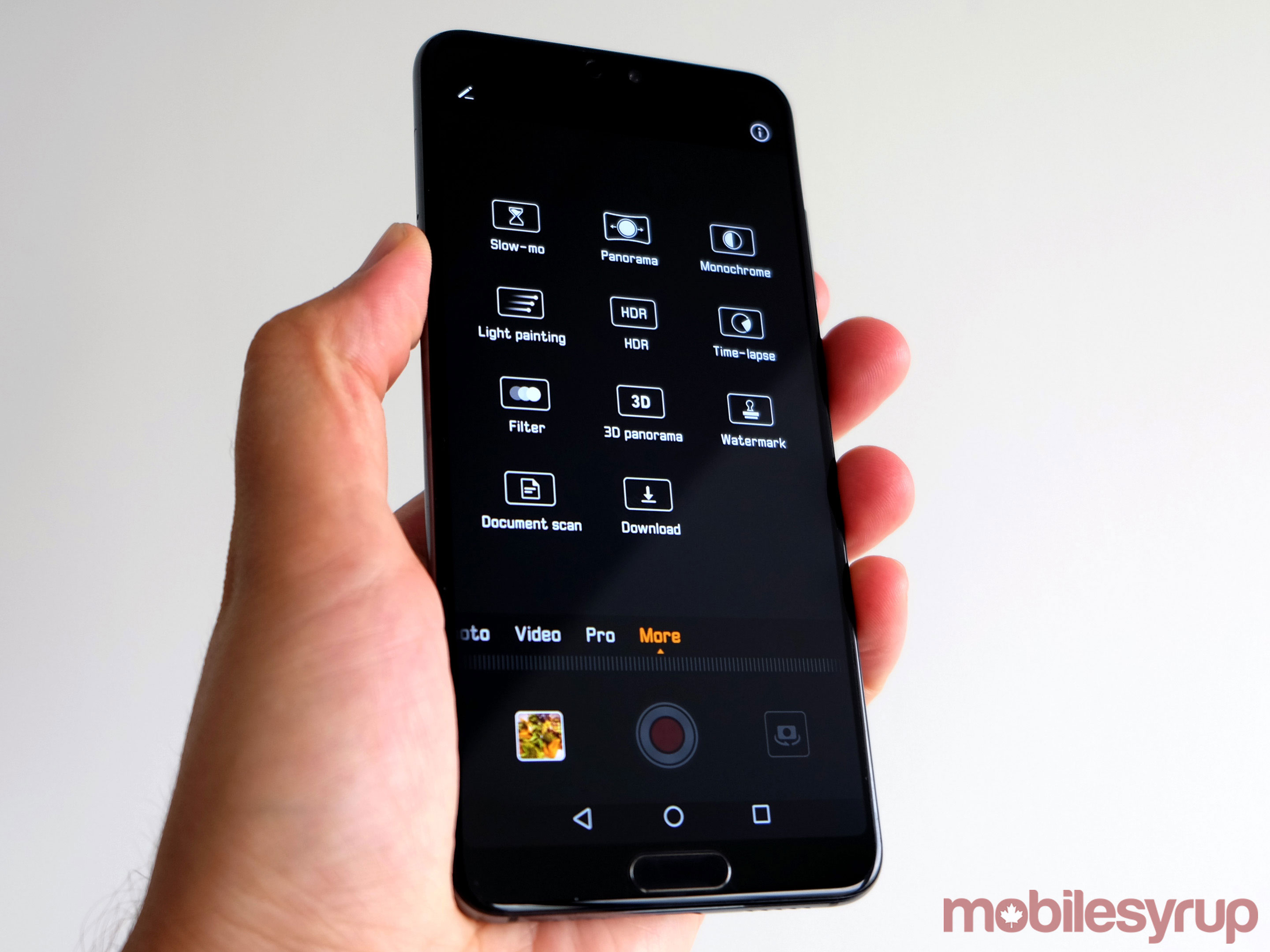
Pushing aside the notion that this camera is not only more adept, but also “smarter” than its competition, the visual proof suggests an interesting battle ahead.
When you market your phone’s camera to be the most advanced and intelligent system available, you best back that up. Out in the field, in varying conditions, it took me some time to warm up to the whole package, but I was left thinking there may something special going on here.
Triple threat
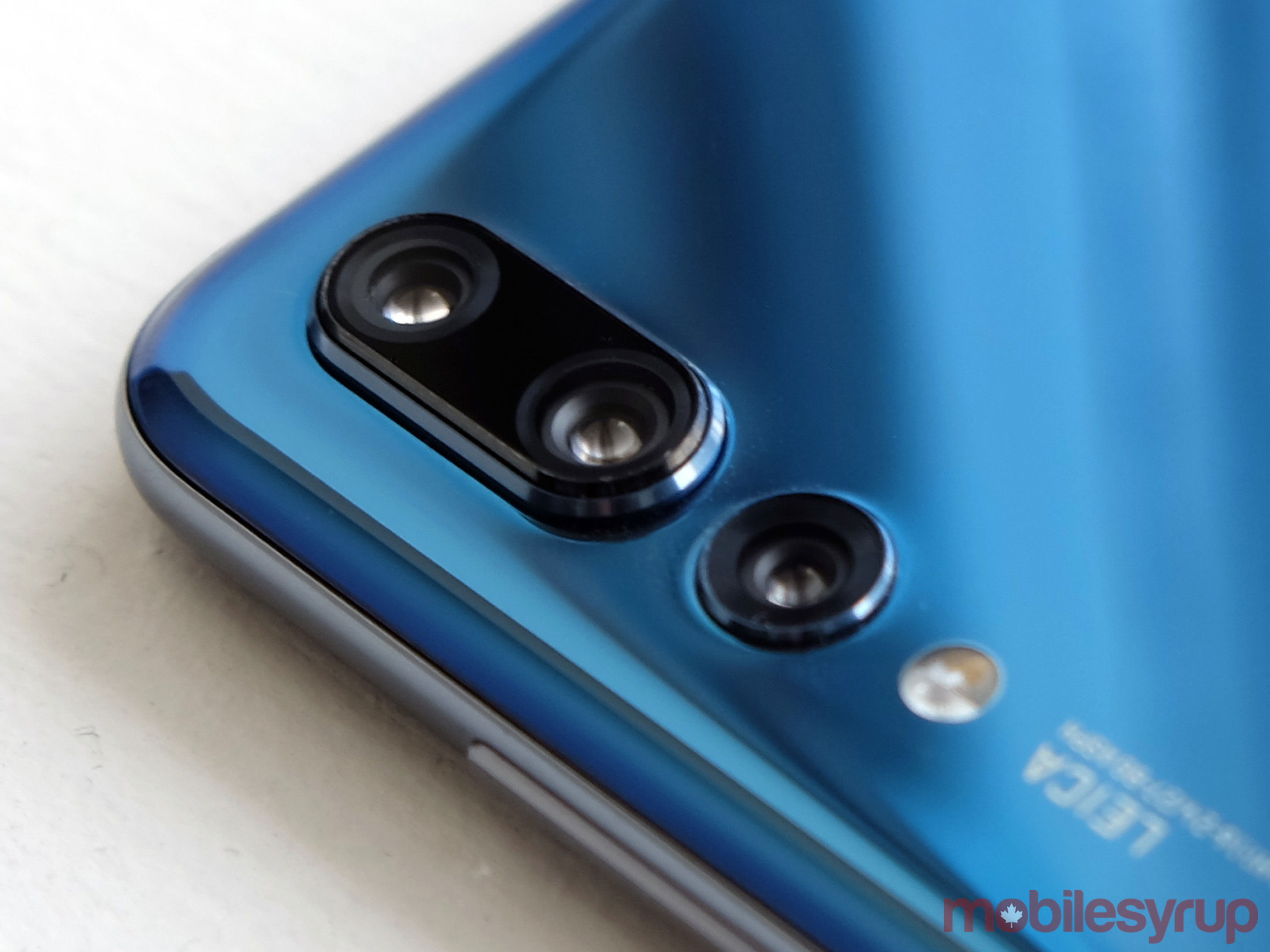
The phone’s most obvious physical trait is its rear triple lens layout. And while they’re integral to the overall picture, it’s the software inside that stood out to me.
Huawei eschewed optical image stabilization (OIS) in place of digital image stabilization. It opted not to use the 3x optical zoom telephoto lens to augment its existing Aperture mode for bokeh photos. It did little to nothing in changing the monochrome lens.
The more intriguing physical aspect, at least for me, was going all the way up to 40-megapixel on the main RGB lens, courtesy of an unusually large 1/1.7-inch sensor. With a decent f/1.8 aperture, the company suggested low-light performance would be unmatched by any other smartphone on the market.
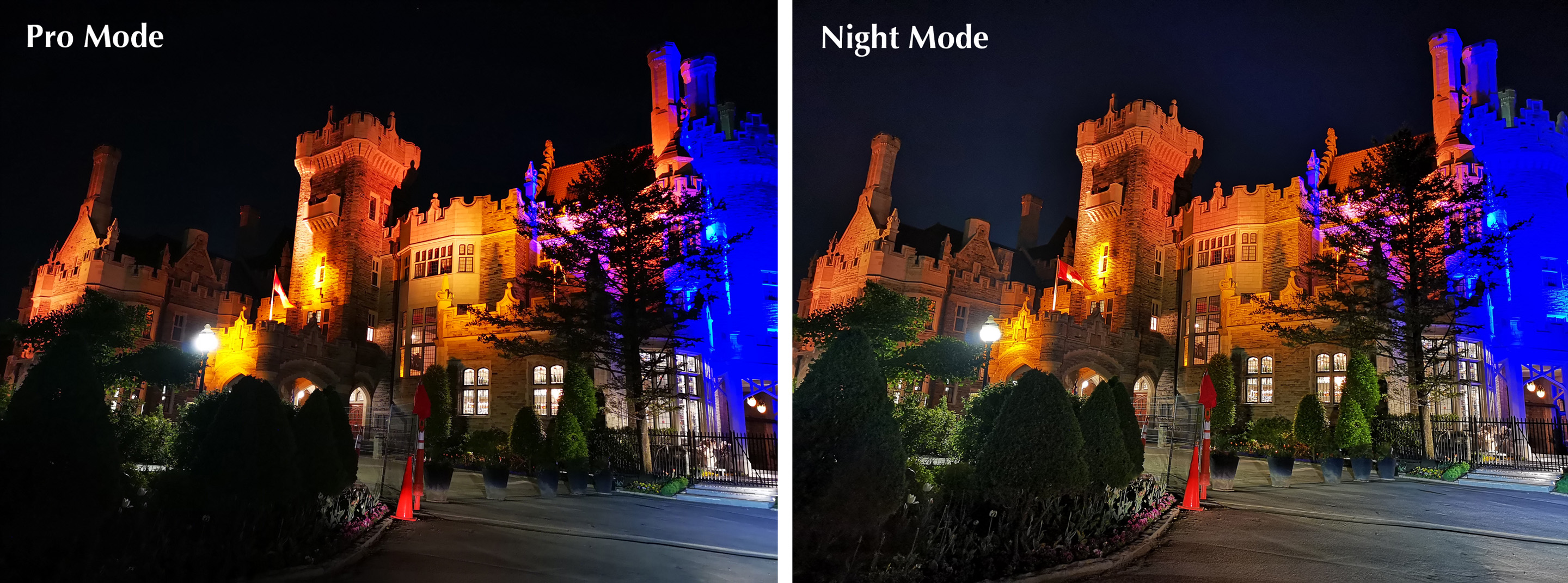
That’s where the software comes in. Huawei’s new-and-improved Night mode allows the P20 Pro’s camera to capture scenes with incredible light and detail. By reaching ridiculously high ISO levels and slow shutter speeds, one could shoot a handheld night or low-light scene with ease. Under normal circumstances, such a shot would be all but impossible without some hand shake blurring the scene.
With the P20 Pro, I shot night scenes that seemed almost impossible to believe were done without a tripod. After snapping something, I saw it go to work, almost literally breathing life into what was otherwise a decent night photo. The AI-assisted image stabilization keeps everything steady down to a four-second exposure. It works really well, but naturally won’t be able to freeze any movement.
It was obvious to me that Huawei leaned heavily on HDR to give these images their vibrancy. Without being able to adjust the extent of the effect, it was hard to gauge how much tinkering I could’ve done. Truth be told, though, the only way I could match the results was to use a tripod in Pro mode and then apply HDR editing after the fact — something that would take much longer than this method.
AI everywhere
Huawei is promoting the notion that software can do most of the work in figuring out how to best shoot a scene. For example, the P20 Pro (and P20 as well) recognizes no less than two dozen unique scenes. Whether it’s a sunset, close-up or food on a plate, it adjusts accordingly to enhance the shot.
It’s nifty, but needs work. In cases where two scenes are in the same frame, the software was confused as to what to prioritize. If I was looking at a beach with some greenery in front of it, the camera would sometimes focus on the wrong one. I had two options: I could either tap to maintain the focus on what I wanted, or tap the X to remove the AI entirely from the shot.
The tendency to ramp up contrast and drive up saturation is hit or miss. At times, it was completely unnecessary, ultimately lending a photo a cartoonish blend of colour. Other times, it was fine, but only for shots that benefitted from extra colour, like a sunset or beautiful dish.
Then there’s the sharpening effect after snapping the pic. Huawei includes this by default, and it can be a little aggressive. It does pick and choose, however. I noticed it was less prevalent if the AI knew I was shooting someone’s portrait, but applied it more heavily to any natural scenes.
Shooting like a Pro
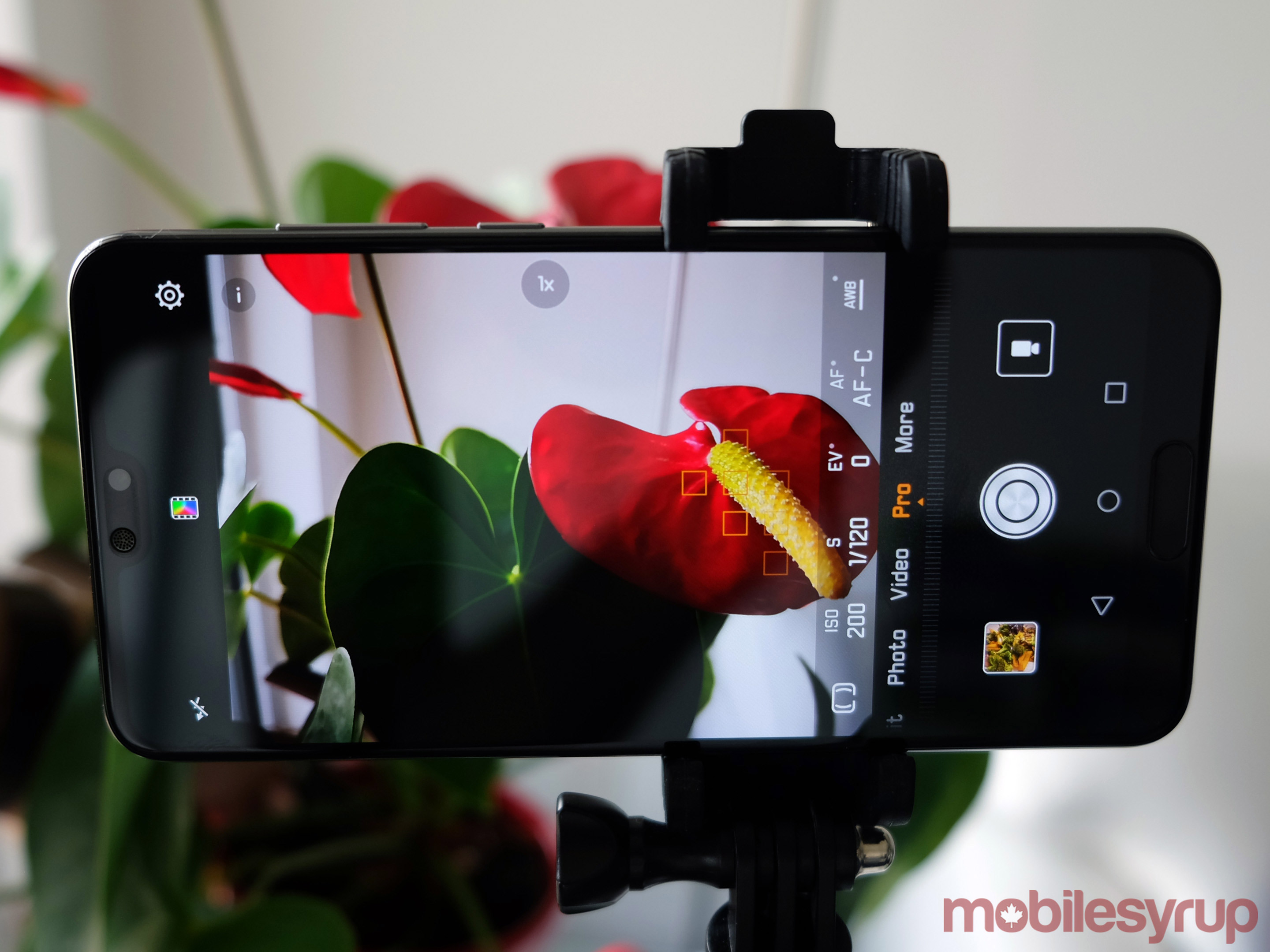
Huawei didn’t really touch the Pro mode much, which is a good thing. This is the most natural way to shoot, and it’s devoid of any of the stuff the company packed into the other modes. Pro mode does apply equally to the 3x optical zoom lens as well, which can help in certain situations.
I have no idea why Huawei would promote its 5x hybrid zoom when it’s partially using digital zoom. Anything using digital zoom is awful, which is why I much prefer the 3x optical zoom of the 8-megapixel lens.

As expected, it has a considerably tighter aperture, so doesn’t do well in low-light, but is great at getting closer to a subject in good lighting. Just don’t expect exceptional images. The number of pixels available are limited, and the lens is especially susceptible to light variations.
Either way, the interface is more conducive to shooting in Pro. I found it easier to adjust shutter speed, ISO, white balance, exposure and autofocus than in last year’s P10 and P10 Plus. As good a shooter as the P20 Pro proved to be, Pro was the mode that showed its true mettle for me (as it tends to with most phones). Being able to shoot in RAW only drives the point home further.

Unfortunately, there’s no way to use it tandem with the Monochrome mode lens. Shooting in black and white is cool, but you’re at the mercy of the software’s whims. I didn’t see a major difference in output with this mode, but that’s okay. It was more than good enough already.
Huawei still uses the monochrome lens to help out with both the Aperture and Portrait modes, drawing in light to help create the bokeh and softening effects those two offer. And like Apple, there are different effects to add some character to portraits, including studio lighting.
Fast and slow video
This super slow-motion video thing is fast becoming a ‘me too’ feature after Sony first introduced it last year. Here, Huawei uses the RGB and telephoto lenses together to capture a 0.2-second clip at 960fps and get a slow six-second clip in 720p.
Trying it out in the field didn’t really impress me. It’s not any different than what others have already done, and the clips lack both sharpness and colour. It’s a novelty that’s nice to show off, especially if the subject matter is interesting, but otherwise, it’s just there to try out.
Shooting regular video in 4K is much better, and while I didn’t go crazy shooting clips everywhere, the results weren’t bad at all. Again, the AI perks up and tries to help improve images but is far less prominent. Nothing pops up on screen to adjust on the fly, it’s just basic enhancements to adjust for the scene.
Choosing between H.265 and H.264 codecs is brilliant, given the former creates smaller file sizes. Now, if only Huawei could include a 24fps video mode in 1080p to give footage a more cinematic look.
Taking off

This is, by far, the best camera Huawei has produced on any of its devices, and a noticeable improvement from last year’s excellent effort. Building trust to help users take great shots is hard, but the company makes a strong case for that here. The Night mode is unmatched by any other handset I’ve used, trouncing anything the more expensive iPhone X could do in low-light, in my opinion.
I get the ‘AI this, and AI that’ is all about marketing the device’s photography potential, but it won’t do everything. You still need to know what to focus on, and there will be times where the AI gets in the way. The best part is that this is one of those cameras that rewards more experience with better results. Learn the ropes and it will not disappoint.
The post Huawei P20 Pro Camera Review: Rising up appeared first on MobileSyrup.