Shared posts

10 Jun 18:03

3D Printing (in) a Spectrum TV commercial

by John

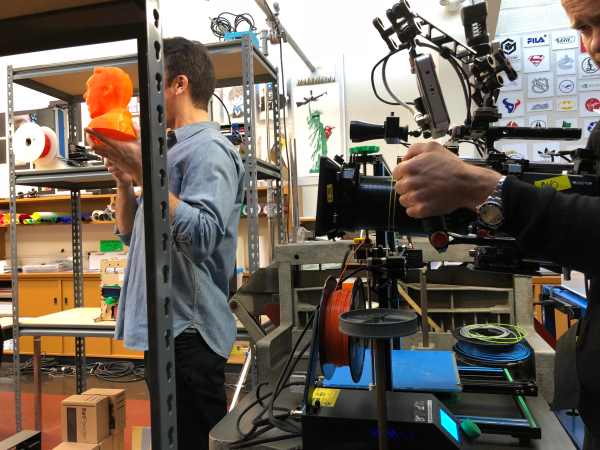
Last December I worked on a television commercial for Spectrum, an American tv/internet/voice service provider. I was asked to assist with props for a commercial that featured a ‘makerspace’ type lab and they wanted a bunch of 3D printers. They also wanted a printed scan of the featured actor that would be used on screen.

I printed the scan of the featured actor…which took about 20 hours (prior to filming) and they wanted it in a specific shade of orange:

I ended up bringing my CR-10 and a couple of DittoPros in addition a few others that had been arranged by others.

After a number of set ups, they decided the CR-10 would be the ‘hero’ printer and shot multiple angles through the printer:

I’m not entirely sure when spot first aired but it’s now on YouTube. Don’t blink or you’ll miss the first 7 seconds that takes place in the lab we shot in for 8 hours.

This is the 30 second version of the spot. It’s kind of fun that Ellen does the voiceover. Spectrum seems to have a number of similar commercials that are longer but so far they haven’t posted a longer version.

What’s missing from this version is the 10+ takes of me sitting on the floor, just below camera, with my laptop to make the printer move (basically an X/Y homing) on command to simulate that the head had just finished printing and the actor was taking it hot off the printer.

All in all it was a fun and interesting day. I’d definitely do this kind of work again if anyone needs a printer in a commercial.

The post 3D Printing (in) a Spectrum TV commercial appeared first on johnbiehler.com.

10 Jun 18:03

Paradroid Today

by Martin

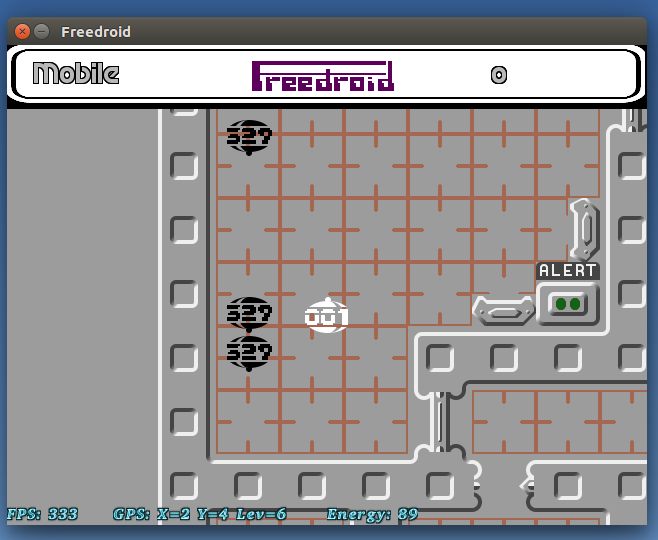
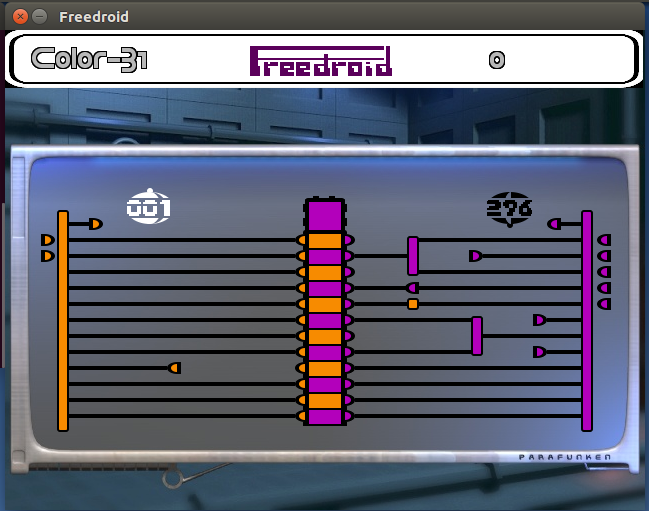
FreedroidBack in the 1980s, I had, like many other teenagers, a home computer and, yes, I also used it for playing games. Recently, when I listened to episode 170 of Retro Computing Roundtable, they were talking about ‘Paradroid’ on the C64. It must have only been a side note because it didn’t even make it into the show notes and I had no immediate recollection of how the game looked like back then or how it worked. However, I instantly knew that I was really addicted to this game back then. I couldn’t visualize it anymore, I didn’t remember how the game was played but I still remembered that I spent hours playing it. Strange how the brain works.

freedroid logic battleFortunately there is the Internet and it’s easy to find information and screenshots, for example over here on Wikipedia and over here on Youtube. Even only looking at a single screenshot instantly brought back an avalanche of 30 year old memories. And what’s even better, there are Linux, Windows and Mac versions of the game that can still be played today without having to get out the original C64 that sits on my cabinet. The screenshots above show the open source version ‘Freedroid’ that looks pretty much the same as the original. The music and sound effects, however, are different. I didn’t notice it at first until I saw the original being played on Youtube. Again it felt strange to hear the original sound and instantly knowing again, that yes, this was the original sound and that Freedroid’s music and sound effects are not the original.

So what can I say, I haven’t played a game in years, not because I don’t like playing computer games, but because there are some many other exciting things to do. However, after seeing this and installing Freedroid out of the Debian software repository (sudo apt install freedroid) I was immediately hooked again and played it for several hours late into the night. Darn addictive…

10 Jun 18:03

Unsolved killings mapped

by Nathan Yau

Thousands of homicides. Some cases result in an arrest. Many end up unsolved. The Washington Post mapped areas in major cities to show the contrast between the two types of homicide cases.

The data looks noisy at first, but when you compare cities like Baltimore with low arrest rates against cities like Atlanta with high arrest rates, you start to wonder.

Tags: arrests, homicide, law, Washington Post

10 Jun 18:03

Bill Gates schenkt jedem Absolventen dieses Buch

by Volker Weber

2171474f6ef1c8e4d5573165bff40d76

Bill Gates:

If you’re getting a degree from a U.S. college this spring, I have a present for you.

It’s a book. (No surprise there. Books are my go-to gift.) It’s called Factfulness, by the late global-health expert and noted sword swallower Hans Rosling, and it is packed with advice about how to see the world clearly. Although I think everyone should read it, it has especially useful insights for anyone who’s making the leap out of college and into the next phase of life.

So I am giving Factfulness to everyone who’s getting a degree from a U.S. college or university this spring. If you’re being awarded an associate’s, bachelor’s, or post-graduate degree, download your free copy of the book below. (Unfortunately, because of international publishing rights, it is available only to graduates from U.S. schools.)

Die Kindle Edition kostet gerade mal zehn Euro >

10 Jun 18:03

Looking forward to catching up with Lilia Efimo...

by Ton Zijlstra

Looking forward to catching up with Lilia Efimova and Nancy White. Nancy is visiting here from Seattle. In Nancy’s words we’ve been ‘imaginary friends’ (i.e. online friends) since a very long time, at least since 2004.

10 Jun 18:02

SotD: High

High by Sir Sly (cool name) will be the last 2018 Song Of The Day in the current-hit category. The usual thing: I heard it on the car radio and it sounded good and then kept sounding good even on heavy rotation. While there’s a serious problem with this work, it’s still a masterful piece of songwriting.

Sir Sly

Did I say there was a problem? Well, yeah… as the title might suggest, it’s totally about getting all whacked out on drugs, and I’m thinking not just nice wholesome herb either. But I kind of suspect that my readership here is lacking in impressionable young folk who will be driven to a life of dissolution by a single pop song, and I’m pretty sure that a few of you are in the Been There Done That camp, and might actually be amused.

It’s a tuneful tune with amusing lyrics and a really super-clever arrangement, the kind that’ll have you dancing in your seat as you drive along: It feels good to be running from the devil / Another breath and I'm up another level / It feels good to be up above the clouds / It feels good for the first time in a long time now

As for Sir Sly, they’re from LA, they’re young, they seem to care about their presentation, if they put out a few more good songs over the years they might eventually be interesting.

This is part of the Song of the Day series (background).

Links

Spotify playlist. This tune on Amazon, iTunes, Spotify. Here’s a pretty sharp live performance from Coachella.

10 Jun 18:02

Say the Hard Thing

by rands

The majority of people-related disasters I’ve created originate with my choice to not say the hard thing. On my short list of critical leadership skills, the ability to “say the hard thing” is right after “delegate until it hurts.”

I didn’t give feedback when behavior was off because the person was new and I told myself, “Give them time to adjust. They’re new.” A month later and the unchecked behavior has grown (because I hadn’t said anything) and I didn’t give feedback again because, ya’know, in a month we’re doing formal feedback so I’ll just give it then, right?

The difficulty with saying the hard thing is you know how it will feel to hear the hard thing. You’re projecting yourself into the mind of the receiver and literally feeling their reaction. Thank you for being an empathic leader. However, your job, the work you should value the most, is the growth of your team. Compliments and recognition are one way to highlight exceptional work but saying the hard thing always gets their attention.

The Voice in Your Head

There’s a constant voice in your head. That voice is saying each of the words you read here right now. You have mapped this voice to what you consider the Rands voice to be, but it’s not the Rands’ voice. It is what you want the Rands voice to sound like and it’s entirely your creation.

Hi. You’re awesome.

This voice works in your favor. It translates everything you experience into digestible constructs that you can understand and it often biases these constructs towards your hopes and dreams. It is optimistic. This is well researched and normal. We are all the heroes of own story. This voice tells the story of the world from your perspective – passed through the sum total of your experiences, translated into information, morphed into judgment, and often resulting in the creation of incremental wisdom.

This voice is often wrong or just misinformed especially when you fail.

You’re embarrassed or ashamed when you fail. Maybe you’re mad, but after the initial emotion churn passes, you protectively rationalize. You find a narrative from the failure that is acceptable to what you currently know. What did you learn? How will you proceed? What story will you tell others about this failure? All of this is defined by how you process your failure.

You are missing critical data when all you consult is yourself. It’s not that your inner dialog has a devious plan to prevent you from learning, it’s that it’s operating with an incomplete and biased set of data. The humans around, watching you act, have both the context and the experience to tell you important observations about both your successes and failures.

We exacerbate the problem because we don’t want to say the hard thing because we have the same voice in our head telling them, “It would be hard for me to hear this, so I don’t want to say it.” Worse, in the manager/employee relationship, the historic professional incentives are designed to prevent saying the hard thing. Your voice cautiously advises you, “She writes your review. She sets your compensation. You can not tell her that. She will be mad.”

Let’s fix this. There are two practices: Learning to say the hard thing followed by actively hearing the hard thing.

Saying the Hard Thing

A good place to start practicing feedback is with new employees. Once we’re past the getting to know phase of a working relationship, a month or two in, I start giving feedback. I start with lightweight feedback (“In this meeting, you said this thing. Is this what you meant to say?”) and at the end of each 1:1, I ask the same question, “Do you have any feedback for me?”

They never do. That’s ok. It can take months. It took a former CEO a year before they took me up on my incessant feedback request. Feedback is about building trust and we humans are extremely slow to trust. It’s cool. Take your time. I am patient because I understand what is at stake. It’s the health of our working relationship.

Each 1:1, I keep providing feedback (“During that presentation for your team, you were acting this way. Is this what you were meaning to portray?”). Same drill as before, I ask, “Do you have any feedback for me?” Finally, weeks after I’ve given them the opportunity, they realize I’m not going to stop asking so they give me feedback and it’s a test because they want to see how I am going to react.

“You weren’t prepared for that all hands.”

I wasn’t.

Hearing the Hard Thing

The first time someone gives you critical feedback, it’s a test for everyone involved. The sender is taking a risk because you’re the boss and the sender has seen prior bosses lose their shit when they’ve received feedback. Now, hopefully for well-intentioned reasons, they are now giving this gift to you – the receiver – with the hope it is useful.1

There are three classes of feedback: No Big Deal, Slow Burn, and Just Plain Hard.

No Big Deal feedback is no big deal. You hear it, you accept it, you update your priors, and you move along with your slightly altered worldview. Your goal in life is to make all feedback in all directions no big deal. This is hard.

Slow Burn feedback feels like No Big Deal until you’re driving home from work and realize there is unexpected depth to the feedback. There is critical feedback in what felt easy to understand and with time you realize it’s…

Just Plain Hard feedback. In many cases, I can tell when hard feedback is about to arrive. There could be sudden change in the tone of the conversation, it’s a one-off meeting that doesn’t normally happen, or it’s simply a strange new expression. Whatever the leading indicator, my brain quickly predicts a complex moment arriving and moves into high alert mode. I am literally preparing for hand to hand combat in my head.

Hard feedback, critical feedback, is distilled truth.2 In days and weeks full of vapid “How ya doing?”, “Great jobs”, 👍, and high fives, hard feedback represents a rarely seen report on the state of your ability. When the feedback is hard, there is another two-step process for making sure you don’t miss anything.

Step 1: No matter how critical the feedback, listen for just a glimpse of understanding. Why only a glimpse? I’m glad you asked.

Remember. Brain. High alert. You’re going to instinctively want to respond, to react, to do something to protect yourself from the fight, but at this point, you don’t actually know how to react. You haven’t unpacked the feedback, so most reactions are emotional and pointless. You must listen to each word and seek a neutral understanding even with the hard feedback pointed directly at your face.

I was unprepared for the all-hands? DO YOU KNOW HOW MUCH TIME I SPENT ON THAT DECK? I HAVEN’T SLEPT IN TWO NIGHTS BECAUSE I WAS SO NERVOUS AND BY THE WAY…

The yelling is your brain defending its poorly informed reality, but the yelling distracts you from hearing anything. It has taken years, but the moment I hear the beginning of hard feedback, I adopt the position: crossed legs, folded hands, and head slightly tilted. This is my “I am listening” position. It reminds me to listen.

Listen for what? One simple insight. One realization. Here’s one example, “Why are they choosing to give me this feedback right now?” The trick is to engage your rational brain, the part of your brain that likes to solve problems versus the part that wants to scream because the part of your brain that wants to scream is exceptional at demonstrating tremendously poor judgment.

Sometimes the feedback shocks you so much that understanding is impossible which is leads us to our second step.

Step 2: Repeat what you heard.

You will be shocked by the usefulness of this simple advice. See, even if you achieve pure listening zen prescribed in Step 1, you are still building your version of the narrative regarding what they are saying and when the feedback is shocking, your narrative is somewhere between slightly to completely wrong. So, repeat what you heard. This both clarifies and acknowledges the feedback.

Me: “Just so I’m clear what you’re saying, you’re saying that I didn’t perform well at the all hands?”

Them: “No, I didn’t say that. You’re a delight to watch speak, but you weren’t prepared. The narrative didn’t hold up and I think you think being eloquent is making up for the fact that your thesis wasn’t sound.”

Me: Oh.

Your Goal in Life

Your goal in life is to make feedback in all directions no big deal. You and your team never start in this state, they earn it. They start with small spoken observations that slowly turn into more useful feedback. They watch to see if each other are listening to the feedback and eventually acting on it.3 Once everyone has seen that feedback is both shared and acted on, they begin to feel more comfortable sharing large, more complex, and harder feedback. Why? Trust.

Feedback is an incredibly valuable social transaction. They take their time to observe an aspect of you. They have other things to do, but today they are investing in you. You think you’ve got it all figured out, but you don’t. You take the time to both clearly hear the feedback, ask clarifying questions, and hopefully adjust the way you work.

All the constituent parts of the act of giving and receiving feedback is an opportunity to build trust in a relationship.


  1. It always is. Even if it’s misinformed or outright untrue, it’s useful. 
  2. Ok, sometimes it’s a complete lie, but the fact that this person is choosing to tell you this lie is interesting information all by itself. 
  3. I’ve left the hardest part of this practice out: the processing and, if appropriate, acting on the feedback in a timely fashion. Sorry. That’s another article. 
10 Jun 18:02

Myths of Priority and Unity in Mathematics Learning

files/images/education-08-00085-g002-550.jpg

E. Paul Goldenberg, Cynthia J. Carter, Education Sciences, Jun 11, 2018


Icon

I have in the past challenged the presumption that certain topics are instances of 'foundational' learning but suggesting that concepts like succession and substitution might be more basic in math than addition and multiplication. This article (12 page PDF) makes that case in a much more convincing form. It attacks "a false assumption: that mathematics is a fixed, linear sequence of skills that must be acquired ... building block by building block." And it argues against the idea "that topics are unitary things." And here's the point: "assumptions about pedagogical priority based on the structure of mathematics can create barriers to children’s learning, as can using statistical prevalence to make claims about cognitive necessity." What we call 'foundational' might be statistical or conventional, but it is not indispensable. Related: Jeannine Diddle Uzzi, We should teach math like it's a language.

Web: [Direct Link] [This Post]
10 Jun 18:02

The Vast Potential for Blockchain in Libraries

files/images/IMG_5228.JPG

Eric Hellman, Go To Hellman, Jun 11, 2018


Icon

There is no such potential, writes Eric Hellman. " All the good attributes ascribed to magical 'blockchain technology' are available in 'git', a program used by software developers for distributed version control," he explains. "The folks at GitHub realized that many problems would benefit from some workflow tools layered on top of the git, and they're now being acquired for several billion dollars by Microsoft, which is run by folks who know a lot about that digital crypto stuff." The details are complex, but yes, he's right, to a point: "if you have a problem where you need to reach consensus (or disagreement) about information by the usual (imperfect) ways of humans, git repos are possibly the Merkle trees you need."

Web: [Direct Link] [This Post]
10 Jun 17:59

0.2%Mageddon in Vancouver and the Fourth Estate

by Ken Ohrn

The well-connected and prolific Gary Mason wonders in the Globe and Mail just why in heaven we are paying any attention to the howling from those who’ve won Vancouver’s home lottery.

Sarcasm drips from the page, as he calls them “. . . these poor, poor multi-millionaires“.

People sitting on massive, sweat-free and tax-free capital gains don’t seem to merit a whole lot of compassion and sympathy. They’re certainly getting all the coverage.

But is it the coverage they really want? 

So yeah, they have to pay a new surtax. I get that nobody likes new taxes.

However, in comparison, I look at those hurting from the housing affordability crisis — and my sympathies are immediately engaged. When contrasting the few wealthy homeowners with the hardworking, struggling — and anxious — young people I hang around with on occasion, I too wonder about our priorities and our hearts.

Mr. Mason doesn’t say it directly, but it seems that much of his thinking and subsequent anger is directed towards our media.

Housing issues, for all their actual complexities, seems to boil down to a quick, lazy shot of a protest placard and some angry faces. The situation cries out for more perspective than that; there are real people, lots of them, feeling real pain. Whereas the phony pain — the rage and entitlement — is hard to condone.

But at present, we have only Mr. Mason as perspective’s voluble champion.

Another week, another protest rally held by multimillionaires on the west side of Vancouver who are upset they are going to have to pay a 0.2-per-cent property surtax on that portion of their home assessed at over $3-million.

For many, it may cost a whole $1,500. I’m sure some of you reading this are now shaking in rage, too. Not in sympathy, but in anger at their pettiness. Even with the small increase, these outraged residents will be paying far less in property taxes than homeowners in major cities across the country. . .

Benjamin Tal, an economist at CIBC, sounded the alarm a couple of years ago when it comes to the retirement prospects for millennials. He said, given the trend toward lower savings rates and reduced private pension coverage, they face as much as a 30 per cent drop in their standard of living upon retirement.

But, hey, let’s not worry about them. They’ll figure it out, I’m sure. Let’s turn our attention to the homeowners in Vancouver whose $3-million-plus abodes face a minor tax hike. Although they can defer it until after they sell, many don’t want to. So, let’s everyone get together and figure out how we can help these poor, poor multimillionaires.

Here’s the fallout that has descended on Mr. Mason, and his bemused reaction.

Perhaps things will change as the October 20th civic election rolls into the battle-of-the-issues phase in Vancouver (and many other municipalities experiencing conflict), and we see just how the champions of density and rezoning are received by the voting public.

10 Jun 17:54

Anker is building portable battery packs for Nintendo Switch

by Brad Bennett

Consumer electronics brand Anker has released two new battery packs as part of a new partnership with Nintendo.

Both battery packs have USB-C ports and they’re optimized for the Switch.

Anker claims that its new battery packs can charge the Switch faster than regular external batteries.

The larger of the two devices is called the PowerCore 20100. It features a 20100 mAh battery. That’s enough power to recharge the Switch two-and-half times. The battery itself can recharge in three hours with Anker’s fast charge technology.

The smaller device is called the PowerCore 13400. It’s once again named after how big the battery inside of it is. Anker says that it can charge the Switch just over one-and-a-half times. Oddly enough, the smaller device takes half-an-hour longer to charge to full than its higher capacity sibling.

The larger battery costs $89.99 USD, while the smaller costs $69.99 USD. Both batteries are up for pre-order and should start shipping in July.

So far they are only available to pre-order in the U.S. store but MobileSyrup has reached out to see if these devices will be available in Canada as well.

Source: The Verge

The post Anker is building portable battery packs for Nintendo Switch appeared first on MobileSyrup.

10 Jun 17:54

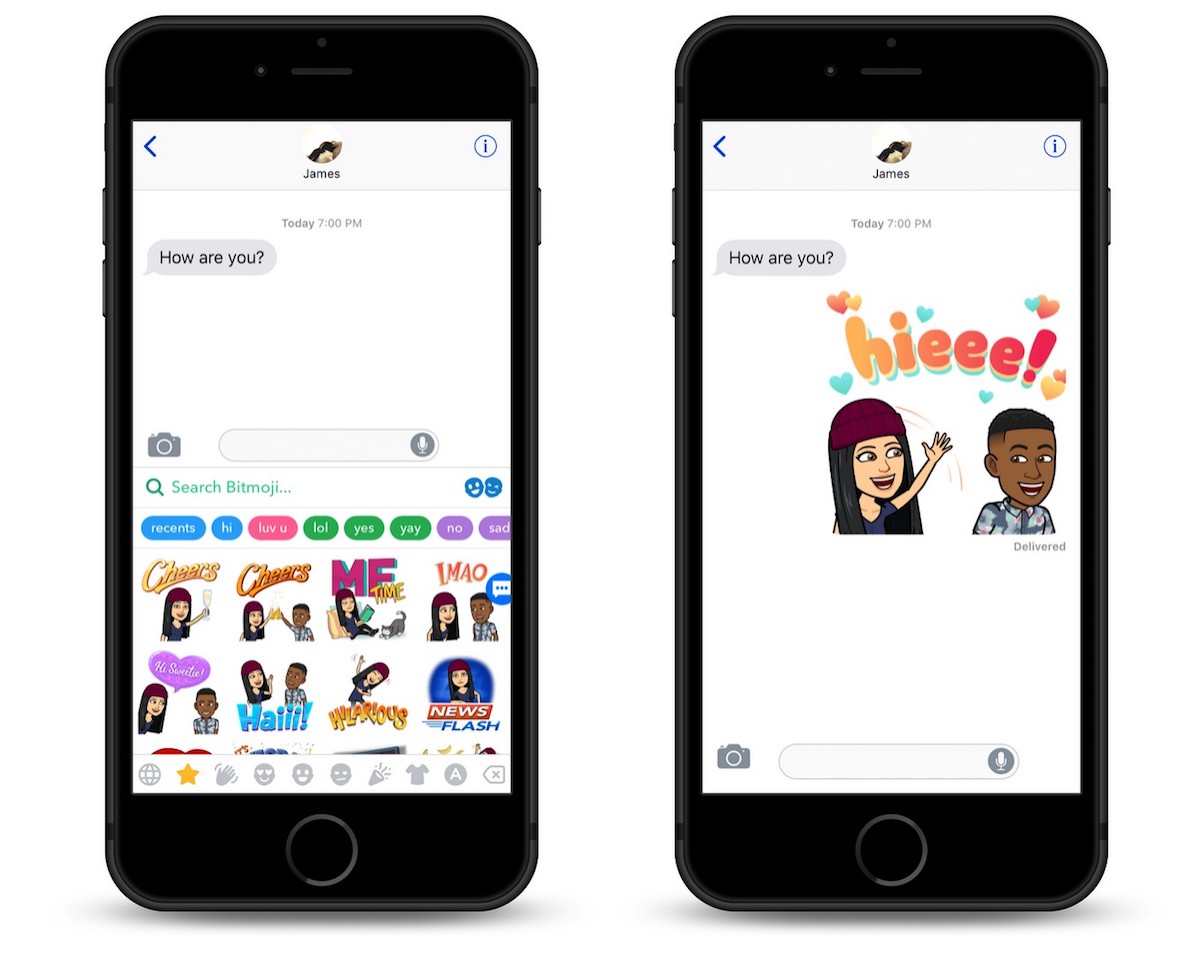
Snapchat is bringing Friendmojis to Apple’s Messages app

by Brad Bennett

Snapchat’s personalized Friendmojis are soon going to become stickers in the iOS Messenges app.

This update hasn’t rolled out to everyone yet, but when it does it will allow users to send a variety of stickers that incorporate their friend’s Bitmoji.

If users have the Bitmoji app installed they’ve had the ability to send personalized stickers for a while but the update will allow them to incorporate a friend’s Bitmoji as well.

Once users start getting the update they’ll see a small friends icon in the corner of the Bitmoji keyboard. If their app is linked with Snapchat then they’ll have access to their friend’s Bitmoji characters as well.

Bitmoji is the product if the Toronto-based studio called Bitstrips. The company was bought by Snapchat during July of 2016.

Bitmojis are really popular on Snapchat and Apple’s Memoji seems to be trying to get in on the personalized emoji/sticker hype.

Memoji are only going to be available on iPhones that have FaceID technology so there is a slim chance that Apple’s product takes over Bitmoji anytime soon, but the company will have to keep finding new ways to incorporate its stickers into new products and platforms.

Source: Mac Rumors

The post Snapchat is bringing Friendmojis to Apple’s Messages app appeared first on MobileSyrup.

10 Jun 17:53

Rogers hires former Telus, Apple exec Brent Johnston to run wireless division

by Sameer Chhabra
Rogers

National telecom service provider Rogers has hired Brent Johnston to run the company’s wireless division.

According to a Rogers spokesperson, Johnston will begin his tenure as president of Rogers Wireless on Monday, June 11th, 2018.

“We’re excited to have Brent join our team. He’s a terrific executive — he’s team-oriented with deep industry experience and a proven track record, and he brings a relentless focus on the customer,” said Rogers, in an email statement to MobileSyrup.

An alumnus of both Princeton and Stanford, Johnston has served in a number of roles at national carrier Telus, beginning as vice president of channel marketing, moving to vice president of mobility solutions, and concluding his tenure as senior vice president of consumer marketing.

Following his time with Telus, Johnston took on the role of senior managing director at Apple Canada in February 2016.

The news of Johnston’s new position was first reported by Cartt.

The post Rogers hires former Telus, Apple exec Brent Johnston to run wireless division appeared first on MobileSyrup.

10 Jun 17:53

Calgary and Edmonton will test self-driving shuttles this year

by Rose Behar

Alberta will trial two self-driving shuttle lines this year, municipal government officials for Edmonton and Calgary have announced.

In Calgary, the free shuttle will run between the Calgary Zoo and the Telus Spark Science Centre, according to a June 8th Transport Canada funding announcement.

In Edmonton, the route has yet to be finalized, but will be announced this summer and enter into operation in October, according to a City of Edmonton spokesperson cited by the CBC.

The projects are expected to operate for up to one month, with the possibility for extension if reception is positive.

The shuttle that will be in use in both projects is the fully-electric EasyMile EZ10, or ‘ELA’ as it’s also known. The 4G-connected vehicle travels at speeds of roughly 12 km/h on roadways where there are no other vehicles, bikes or pedestrians.

Currently, the ELA is in permanent use in Singapore and Arlington, Texas, and in testing in several other markets.

The trials are the result of a partnership between industry, post-secondary institutions and municipal, provincial and federal governments.

Slow-speed, A-to-B autonomous shuttle buses and driver assist features like those provided by Tesla currently represent the highest levels of commercial self-driving possible, but automakers are looking forward to a future with fully-autonomous cars that can self-drive anywhere at any time.

As the Canadian government walks the line between investment and cautious policy planning, transport minister Marc Garneau announced funding for the Calgary shuttle, a study on how automated vehicles might impact pedestrians with sight loss and a connected vehicle test-bed in Calgary on Thursday.

The total funding came to $390,000 CAD.

Source: CNW Via: CBC

The post Calgary and Edmonton will test self-driving shuttles this year appeared first on MobileSyrup.

10 Jun 17:53

New code suggests Google plans to integrate Android Messages with Chrome OS

by Igor Bonifacic
Android Messages

Newly committed code in Chrome OS’s codebase suggests Google plans to integrate some form of Android Messages functionality into its laptop, tablet and detachable operating system.

Android Messages is the default SMS and RCS client that ships with most Android smartphones. The search giant recently stopped development of Allo to focus its efforts on Android Messages.

The code, spotted by XDA Developers, doesn’t provide too many details on how integration between the two platforms will work, other than the fact that the pairing process between a smartphone with Android Messages and a Chrome OS device will be handled “in the browser process.”

What’s unusual about the commit is that we already know Google is developing an Android Messages web client.

On the surface at least, it doesn’t seem to make much sense for Google to develop a separate Chrome OS Android Messages experience when it’s already working on a web browser client. Perhaps Google has something special planned for the Chrome OS? We’ll just have to wait and see.

Source: XDA Developers

The post New code suggests Google plans to integrate Android Messages with Chrome OS appeared first on MobileSyrup.

10 Jun 17:53

Google releases seven AI principles, promises to avoid pursuing AI weapons

by Sameer Chhabra
Google HQ

Mountain View search giant Google has released a list of seven core principles that will inform the company’s future artificial intelligence (AI) research and development efforts.

Among Google’s principles are accountability, privacy, scientific excellence, safety and the avoidance of bias.

“These principles set out our commitment to develop technology responsibly and establish specific application areas we will not pursue,” reads an excerpt from Google’s AI principles website.

It’s interesting to note is that, in addition to the seven guiding principles, Google also established that it will not pursue AI research in four specific areas.

Google will not build “technologies that cause or are likely to cause overall harm”; “weapons or other technologies whose principal purpose or implementation is to cause or directly facilitate injury to people”; “technologies that gather or use information for surveillance violating internationally accepted norms”; and “technologies whose purpose contravenes widely accepted principles of international law and human rights.”

Immediate contradictions

In effect, Google has stated that it won’t allow its AI technology to negatively impact the lives of others.

It’s important to note, however, that Google’s AI principles don’t specifically rule out military applications, nor do the principles explicitly state that Google will not allow government or law enforcement entities to use its AI technology to police citizens.

Interestingly enough, in a Google Blog post attributed to Google Cloud CEO Diane Greene, the company reaffirms its commitment to supporting the U.S. “government, the military and our veterans.”

“For example, we will continue to work with our government organizations on cybersecurity, productivity tools, healthcare and other forms of cloud initiatives,” said Greene, in a June 7th, 2018 Google blog post.

Greene further elaborated on a specific contract between Google and the U.S. Department of Defence’s (DOD) Maven initiative.

“This contract involved drone video footage and low-res object identification using AI, saving lives was the overarching intent,” said Greene.

Greene added that Google will continue to honour its contract with the DOD, but that the company will not pursue further contracts with the Maven project.

Source: Google Via: The Verge

The post Google releases seven AI principles, promises to avoid pursuing AI weapons appeared first on MobileSyrup.

10 Jun 17:53

Gmail on Android update adds customized swipe gesture options

by Bradly Shankar
Gmail app on Android phone

Google has updated its Gmail app for Android to allow users to customize swipe gestures with up to two actions.

As spotted by Android Policeusers can visit Gmail’s general settings to select a custom action for a left and right swipe each.

Both are set to ‘archive’ by default, but users can change these functions to either ‘Delete,’ ‘Mark as Read/Unread,’ ‘Move to,’ ‘Snooze’ or ‘None.’

The swipe feature is available as part of Gmail version 8.5.20 on Android, although as 9to5Google notes, it’s a server-side change, meaning it may not be live to all users yet.

The post Gmail on Android update adds customized swipe gesture options appeared first on MobileSyrup.

10 Jun 17:53

Google app code hints at upcoming Google Podcasts app

by Jonathan Lamont
Icon of Google's web-based podcast app

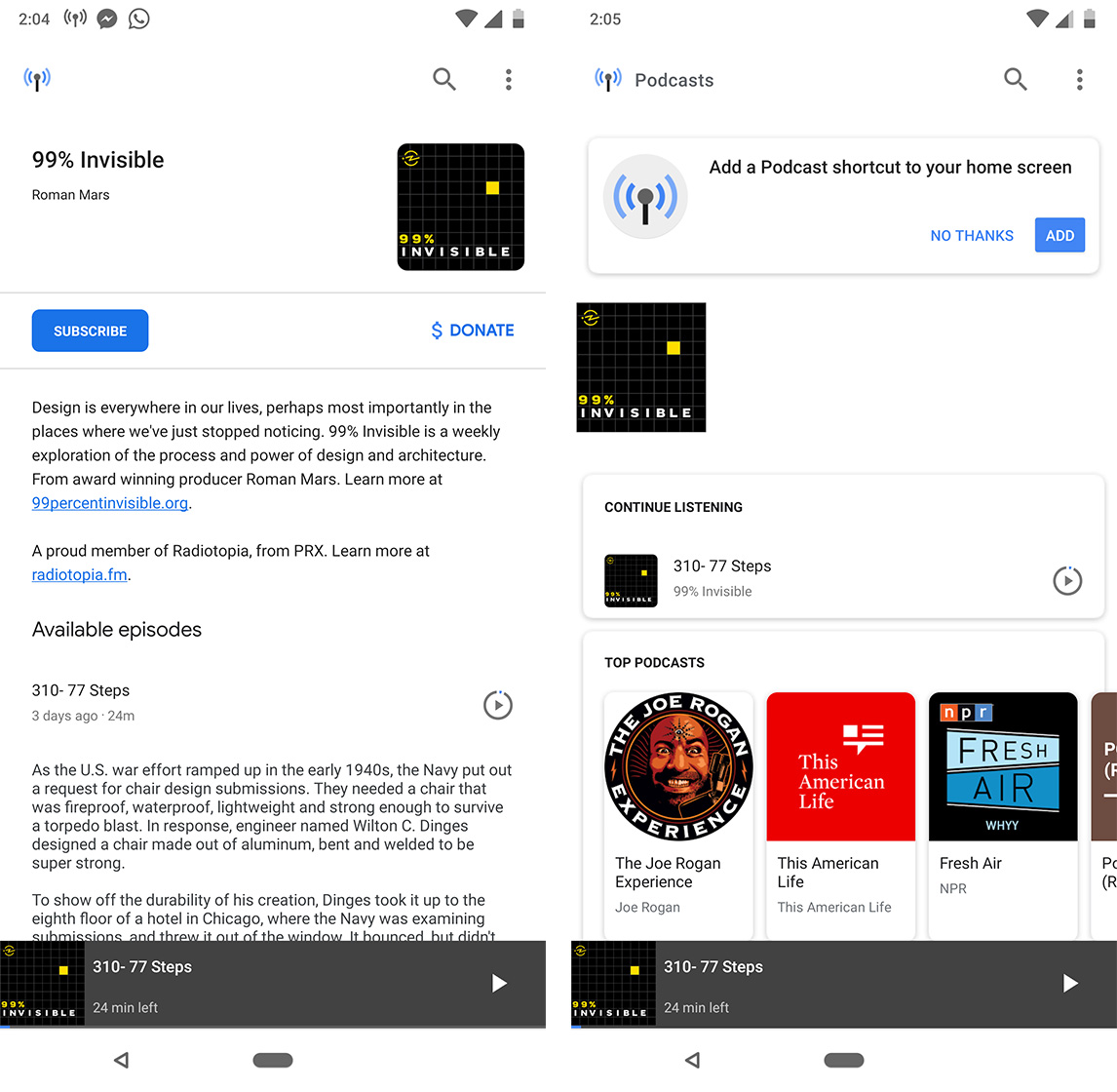
A snippet of code in the Google app hints at an impending podcasts app.

The snippet shows up in version 8.7 of the Google app as part of an inactive prompt. The prompt says “Get the Google Podcasts app.”

Right now, there isn’t an official Google Podcasts app. However the search giant has two options for podcast listeners. The first is Google Play Music, which has podcast support built into it. However the addition is cumbersome at best.

Podcasts section in the Google app

Google also has a podcast section built into the Google app. However it’s hard to find. Users can access it by searching for a podcast on Google. Supported podcasts will feature a list of episodes. Playing one will take users to the podcast section.

Furthermore, when users go to the podcast section of the Google app, they’re prompted to add it to the home screen. Doing so summons up a shortcut icon for you.

There’s some speculation that the upcoming podcast app from Google may be no more than a shortcut.

Right now Google has a few ‘apps’ on the Play Store that just link into the Google app. On my device, if I look up Google Lens or Google Assistant on the Play Store, it says I don’t have either app installed. However, my device has both — it’s a Pixel 2 XL, after all. I can access either app through the Google app. Installing the ‘apps’ from the Play Store just gives me a shortcut to the feature.

This functionality may be different on other devices. Ultimately it looks like the Google Podcasts app may just be another one of these glorified shortcuts. Only time will tell.

If you do have an itch for a podcasts app, check out the one in the Google app. It’s not bad. Plus, it syncs up with Google Home so users can ask their smart speaker to continue playing a podcast from where they left off on their phone.

Source: 9to5 Google

The post Google app code hints at upcoming Google Podcasts app appeared first on MobileSyrup.

10 Jun 17:53

More affordable Surface Pro to use Lex codename: report

by Dean Daley
Microsoft

If you’ve ever thought the Microsoft Surface Pro was too expensive, the company might be in the process of resolving that issue.

A twitter that goes by the username ‘Walking Cat’ has discovered an internal codename called Lex, which is believed to refer to Microsoft’s often-rumoured, more affordable Surface Pro tablet. This was first spotted by Windows Latest.

The device is expected to be smaller and lighter than the current Surface Pro models. It may also feature LTE connectivity and a USB Type-C port.

Walking Cat also says that the codename for a type cover is Gibs. That said, the Twitter user is uncertain if the Gibs type cover is for the Lex tablet.

This isn’t the first instance we’ve heard of this more affordable Surface Pro. Bloomberg reported on the smaller tablet’s existance back in May. The publication claims the device will retail for $400 USD (approximately $517 CAD).

  1. It’s currently unclear when exactly Microsoft may launch this device, though rumours indicate the release could be in the latter half of 2018.

Source: WalkingCat Via: Windows LatestCNET

The post More affordable Surface Pro to use Lex codename: report appeared first on MobileSyrup.

08 Jun 02:55

What’s wrong with bots is they’re not ours

by Doc Searls

In Chatbots were the next big thing: what happened?, Justin Lee (@justinleejw) nicely unpacks how chatbots were overhyped to begin with and continue to fail their Turing tests, especially since humans in nearly all cases would  rather talk to humans than to mechanical substitutes.

There’s also a bigger and more fundamental reason why bots still aren’t a big thing: we don’t have them. If we did, they’d be our robot assistants, going out to shop for us, to get things fixed, or to do whatever.

Why didn’t we get bots of our own?

I can pinpoint the exact time and place where bots of our own failed to happen, and all conversation and development went sideways, away from the vector that takes us to bots of our own (hashtag: #booo), and instead toward big companies doing more than ever to deal with us robotically, mostly to sell us shit.

The time was April 2016, and the place was Facebook’s F8 conference. It was on stage there that Mark Zuckerberg introduced “messenger bots”. He began,

Now that Messenger has scaled, we’re starting to develop ecosystems around it. And the first thing we’re doing is exploring how you can all communicate with businesses.

Note his use of the second person you. He’s speaking to audience members as individual human beings. He continued,

You probably interact with dozens of businesses every day. And some of them are probably really meaningful to you. But I’ve never met anyone who likes calling a business. And no one wants to have to install a new app for every service or business they want to interact with. So we think there’s gotta be a better way to do this.

We think you should be able to message a business the same way you message a friend. You should get a quick response, and it shouldn’t take your full attention, like a phone call would. And you shouldn’t have to install a new app.

This promised pure VRM: a way for a customer to relate to a vendor. For example, to issue a service request, or to intentcast for bids on a new washing machine or a car.

So at this point Mark seemed to be talking about a new communication channel that could relieve the typical pains of being a customer while also opening the floodgates of demand notifying supply when it’s ready to buy. Now here’s where it goes sideways:

So today we’re launching Messenger Platform. So you can build bots for Messenger.

By “you” Zuck now means developers. He continues,

And it’s a simple platform, powered by artificial intelligence, so you can build natural language services to communicate directly with people. So let’s take a look.

See the shift there? Up until that last sentence, he seemed to be promising something for people, for customers, for you and me: a better way to deal with business. But alas, it’s just shit:

CNN, for example, is going to be able to send you a daily digest of stories, right into messenger. And the more you use it, the more personalized it will get. And if you want to learn more about a specific topic, say a Supreme Court nomination or the zika virus, you just send a message and it will send you that information.

And right there the opportunity was lost. And all the promise, up there at the to of the hype cycle. Note how Aaron Batalion uses the word “reach” in  ‘Bot’ is the wrong name…and why people who think it’s silly are wrong, written not long after Zuck’s F8 speech: “In a micro app world, you build one experience on the Facebook platform and reach 1B people.”

What we needed, and still need, is for reach to go the other way: a standard bot design that would let lots of developers give us better ways to reach businesses. Today lots of developers compete to give us better ways to use the standards-based tools we call browsers and email clients. The same should be true of bots.

In Market intelligence that flows both ways, I describe one such approach, based on open source code, that doesn’t require locating your soul inside a giant personal data extraction business.

Here’s a diagram that shows how one person (me in this case) can relate to a company whose moccasins he owns:

vrmcrmconduit

The moccasins have their own pico: a cloud on the Net for a thing in the physical world: one that becomes a standard-issue conduit between customer and company.

A pico of this type might come in to being when the customer assigns a QR code to the moccasins and scans it. The customer and company can then share records about the product, or notify the other party when there’s a problem, a bargain on a new pair, or whatever. It’s tabula rasa: wide open.

The current code for this is called Wrangler. It’s open source and in Github. For the curious, Phil Windley explains how picos work in Reactive Programming With Picos.

It’s not bots yet, but it’s a helluva lot better place to start re-thinking and re-developing what bots should have been in the first place. Let’s start developing there, and not inside giant silos.

[Note: the image at the top is from this 2014 video by Capgemini explaining #VRM. Maybe now that Facebook is doing face-plants in the face of the GDPR, and privacy is finally a thing, the time is ripe, not only for #booos, but for the rest of the #VRM portfolio of unfinished and un-begun work on the personal side.]

08 Jun 02:55

KnowRoaming offers new 2-day, 10-day unlimited data packages

by Sameer Chhabra

Toronto-based KnowRoaming has announced that it’s offering new data roaming deals as part of a slew of summer deals.

Not only is KnowRoaming offering new two-day and 10-day unlimited data packages, but the company is also offering 1GB and 5GB data packs ranging from $10 USD to $25 USD, depending on the region.

According to a June 6th, 2018 media release, KnowRoaming customers can save 25 percent with the new 2-day unlimited data package, while they can save 25 percent with the new 10-day unlimited data package.

KnowRoaming is also offering 50 percent of a 1-day unlimited data package in Russia.

The complete list of KnowRoaming packages can be viewed at the company’s website.

Source: KnowRoaming

The post KnowRoaming offers new 2-day, 10-day unlimited data packages appeared first on MobileSyrup.

08 Jun 02:55

Autopilot was engaged during deadly Tesla crash in March

by Brad Bennett
Tesla Autopilot render

Investigators blame a mistake made by Tesla’s Autopilot system for a mistake that killed Wei “Walter” Huang in a Tesla car crash.

The National Transportation Safety Board (NTSB) in the States released data extracted from the car involved in the March 23rd crash.

According to the NTSB, the car was following another car in front of it using Tesla’s Autopilot system until about seven seconds before the impact.

The data claims that seven seconds before the crash, the car started veering to the left. At four seconds before the crash, the car was no longer following the lead vehicle and at three seconds the cars speed increased from 100 Km/h to 114 Km/h.

The data also shows that Huang’s hand were only on the steering wheel for 34 seconds total in the 60 seconds leading up to the crash. In the six seconds leading up to the crash, the car did not detect his hands at all.

According to The Verge, Tesla has no statement on this new report but chose to reuse its original statement instead. The statement claims that Huang had “five seconds and 150 metres of unobstructed view” of the road’s divider before his car crashed.

Huang’s family has retained a law firm and is exploring their legal options against Tesla, according to The Mercury News.

Source: National Transportation Safety Board Via: The Verge

The post Autopilot was engaged during deadly Tesla crash in March appeared first on MobileSyrup.

08 Jun 02:54

Communications Divides Within the Organization; Look to Homer

by Jim

HomerHave you ever wondered what’s behind the conflict between geeks and suits? Sure, they think differently, but what, exactly, does that mean? A Jesuit priest who passed away in 2003 at the age of 90 may hold one clue.

Walter Ong published a slim volume in 1982 titled “Orality and Literacy: The Technologizing of the Word” that explored what the differences between oral and literate cultures suggest about how we think.

Remember Homer, the blind epic poet credited with “The Iliad” and “The Odyssey”? If we remember anything, it’s something along the lines of someone who managed to memorize and then flawlessly recite book-length poems for his supper.

The real story, which Ong details, is more interesting and more relevant to our organizational world than you might suspect. Homer sits at the boundary between oral culture and the first literate cultures.

In an oral culture, what you can think is limited to what you can remember and tell—without visual aids. Ong’s work shows that oral thinking is linear, additive, redundant, situational, engaged, and conservative. The invention of writing and the emergence of literate cultures allows a new kind of thinking to develop: literate thinking is subordinate, analytic, objectively distanced, and abstract. It’s the underlying engine of science and the industrial revolution.

While this may be interesting for a college bull session, it’s particularly relevant to organizations. For all their dependence on the industrial revolution, organizations are human institutions first. Management is fundamentally an oral culture and is most comfortable with thought organized that way. Historically, leadership in organizations went to those most facile with the spoken word.

At the opposite extreme, information technology is a quintessentially literate activity with a literate mode of thought. In fact, IT cannot exist without the objective, rational, analytical thinking that literate culture enables.

How does the nature of this divide complicate conversations between IT and management? Can understanding the differing natures of oral and literate thought help us bridge that divide?

IT professionals have long struggled with getting a complex message across to management. In our honest and unguarded moments, we talk of “dumbing it down for the suits.” But the challenge is more subtle than that. We need to repackage the argument to work within the frame of oral thought. The easy part of that is about oratorical and rhetorical technique. The more important challenge is to deal with the deeper elements of oral culture; of being situational, engaged, and conservative. The right abstract answer can’t be understood until it is placed carefully within its context.

What management recognizes in its fundamentally oral mind is that organizations and their inhabitants spend most of their time in oral modes of thought. The oral mind is focused on tradition and stability because of how long it takes to embed a new idea. The techniques of change management that seem so obtuse to the literate, engineering mind are not irrational; they are oral. They are the necessary steps to embed new ideas and practices in oral minds.

Repeating a calculation or an analysis is nonsense in a literate culture. Management objections to an analytical proposal rarely turn on objections to the analysis. Walking through the analysis again at a deeper level of detail will not help. What needs to be done is to craft the oral culture story that will carry the analytical tale. It’s not about dumbing down an argument, it’s about repackaging it to match the fundamental thought processes of the target audience.

That might mean finding the telling anecdote or designating an appropriate hero or champion. Suppose, for example, that your analysis concludes it’s time to move toward document management to manage the files littering a shared drive somewhere or buried as attachments to three-year old e-mails. Analytical statistics on improved productivity won’t do it. A scenario of the “day in the life” of a field sales rep would be better. Best would be a story of the sales manager who can’t find the marked up copy of the last version of the contract.

These human stories are much more than the tricks of the trade of consultants and sales reps. They are recognition that what gets dressed up as the techniques of change management are really a bridge to the oral thinking needed to provoke action.

Seen in this light, what is typically labeled resistance to change is better understood as the necessary time and repetition to embed ideas in an oral mind.

Management understands something that those rooted in literate thinking may not. Knowing the right answer analytically has little or nothing to do with whether you can get the organization to accept that answer. What literate thinkers dismiss as “politics” is the essential work of translating and packaging an idea for acceptance and consumption in an oral culture.

The critical step in translating from a literate answer to an oral plan of action is finding a story to hang the answer on. The analysis only engages the mind; moving analysis to action must engage the whole person. Revealing this truth to the analytical minded can be discomforting. It’s equivalent to explaining to an accountant that the key to a Capital Expenditure proposal is theater, not economics. You might want to check out Steve Denning’s book, “The Springboard: How Storytelling Ignites Action in Knowledge-Era Organizations,” for some good insights into how to craft effective stories inside organizations.

In addition to helping the analytically inclined see the value of creating a compelling story, you need to help them see how and why story works differently than analysis. The best stories to drive change are not complex, literary, novels. They are epic poetry; tapping into archetypes and cliché, acknowledging tradition, grounded in the particular. You need to bring them to an understanding of why repetition and “staying on message” is key to shifting an oral culture’s course, not an evil invention of marketing.

Assume you teach the literate types in your IT organization how to repackage their analyses for consumption. They’ve now learned how to pitch their ideas in ways that will stick in the organization. What might you learn from their literate approach to thought? Is there an opportunity if you can get more of your organization and more of your management operating with literate modes of thinking?

Being able to write things down done permits you to develop an argument that is more complex and sophisticated. On the plus side, this makes rocket science possible. On the negative side, you get lawyers.

On the other hand, if you are operating in an environment whose complexity demands a corresponding complexity in your organizational responses, then encouraging more literate thinking by more members of the organization is a good strategy.

What would such an organization look like compared to today’s dominant oral design? The mere presence of e-mail and an intranet is insufficient. E-mail tends to mirror oral modes of thought, particularly among more senior executives. Intranets tend to be over-controlled and, to the extent they contain examples of literate thinking, are rooted in an organizational culture that strives to confine the literate mind to the role of well-pigeonholed expert. The presence of particular tools, then, isn’t likely to be a good predictor, although their absence might be.

What of possible case examples? A few knowledge management success stories hold hints. Buckman Labs used discussion groups successfully to get greater leverage out of its staff’s knowledge and expertise. Whether this success built on literate modes of thought or simply on better distribution of oral stories is less clear. The successes of some widely distributed software development teams are worth looking at from this perspective.

Although it’s a bit too early to tell, the take up of blogs and wikis inside organizations may be a harbinger of management based on literate thinking skills. They offer an interesting bridge between the oral and the literate by providing a way to capture conversation in a way that makes it visible and, hence, analyzable. As a class of tools, they begin to move institutional memory out of the purely oral and into the realm of literate.

The post Communications Divides Within the Organization; Look to Homer appeared first on McGee's Musings.

08 Jun 02:54

Apple launches Business Manager in U.S., available in 65 countries by end of June

by Sameer Chhabra
Apple logo

Cupertino computing giant Apple has launched a web-based portal to streamline enterprise devices.

Dubbed the ‘Apple Business Manager,’ the service allows IT departments to “streamline Apple device enrollment, purchase apps and books and assign necessary privileges to admin team members,” according to Apple.

Apple Business Manager can also manage App Store purchases and cross-company licenses.

The service is available in the U.S. today, and will be available in 65 countries — including Canada — by the end of June 2018.

The post Apple launches Business Manager in U.S., available in 65 countries by end of June appeared first on MobileSyrup.

08 Jun 02:53

Twitter Favorites: [shawnmicallef] If only Ontario could generate electricity off the hated the Liberals and NDP have for each other.

VOTE @shawnmicallef
If only Ontario could generate electricity off the hated the Liberals and NDP have for each other.
08 Jun 01:04

What’s wrong with bots is they’re not ours

files/images/vrmcrmconduit.png

Doc Searls, Jun 10, 2018


Icon

That's probably not all that's wrong with bots, but it's certainly part of the problem. After all, the reason why it's creepy if a bot is listening to your conversation is that it belongs to Amazon or Apple or whomever. And the key question o ask, as Searls does here, is "Why didn’t we get bots of our own?" What we needed were bots that help us communicate with companies, but what we got were bots that allow companies to blast messages to us. Advertising. To fix this, Searls proposes a bot network based on the 'pico'. " The current code for this is called Wrangler. It’s open source and in Github. For the curious, Phil Windley explains how picos work in Reactive Programming With Picos."

Web: [Direct Link] [This Post]
08 Jun 01:04

He’s In, He’s Out; He Can Turn on a Dime

by Ken Ohrn

In a twist that’s highly circular, Hector Bremner (current NPA Vancouver City Councillor) has made an overture to the party that denied him a chance at their mayoral nomination.

On it’s face, this has a really low probability of success, but there may be more here than meets the eye.

Mr. Bremner has offered to rejoin the NPA if they’ll do a runoff vote for mayoral candidate between him and recently nominated Mr. Sim. While the NPA might decide to do this, it’s got about as much chance as a Canucks’ Stanley Cup victory in 2019.

Could this be an obtusely angled way of branding Mr. Bremner more clearly (The Big, the Only, Housing Guy), and defining the NPA as being out of step?

Not to mention headlines, tweets and so on — name recognition, dont’cha know.

‘If he [Sim] would be willing to have a runoff, that would be great. That would make me reconsider,’ Bremner went on.

‘And if they were willing to run on a bold plan to fix housing in Vancouver,’ Bremner added. ‘But it seems to me at the moment that the NPA is choosing the status quo. I think it looks like they want to face the future with fear, and I say we need to face it with hope and a plan. . . .

Again speaking in connection with the slight prospect of working again with the NPA and Sim, Bremner said: ‘If he was willing to run on policies on a platform that is strong on housing and strong on fixing Vancouver, and…getting outside of the status quo and incrementalism. But you know to this point, I’ve heard nothing but status quo and incrementalism.’

[Many thanks to Carlito Pablo in the Georgia Straight].

08 Jun 01:04

No CGI can (poorly) hide Superman star Henry Cavill’s love of the Pixel 2

by Bradly Shankar
Henry Cavill Justice League

Holy smartphone wars, Batman!

There’s conflict within the Justice League once again — while Wonder Woman star Gal Gadot (controversially) uses an iPhone, Henry Cavill, none other than Superman himself, seems to prefer the Google Pixel.

A group of curious and dedicated Redditors dug through some of Cavill’s 257 Instagram posts to see which phone the English actor uses. While many of Cavill’s pictures and videos of recent months chronicle the rise-and-fall of his Mission Impossible: Fallout moustache — which infamously had to be removed rather unconvincingly through CGI for his Superman appearances in Justice League — he can also be seen in some posts using Google’s Pixel phone, as well as the Pixel Bud headphones.

#DoItForDurrell @TheDurrellChallenge

A post shared by Henry Cavill (@henrycavill) on

Redditors also found a tweet from May that showed Cavill using a second-generation Pixel.

“It’ll be cool to know if Superman does use a Pixel,” wrote original Reddit poster RJvXP on his search for Truth (and Justice and the American Way). “You don’t hear many celebrities using phones outside of an iPhone unless its a promotion.”

“It’s a real shame that we gotta hunt people that use Pixels,” lamented user Valyrious_. “We are drowned by people that use only two phones. iPhones or Android iPhones (aka Samsungs). Disappoints me that people still don’t realize there’s plenty of unique experiences out there.”

“A superhero on and off screen,” added Reddit user AsphyxiatingMacbeth.

“thats a beautiful man [sic]” exclaimed tekthebeast.

Unfortunately, while Redditors are all in favour of Cavill’s mobile preferences and dashing good looks, it seems like Batman v. Superman-level of fighting might happen all over again. Doing a bit of further digging reveals that Ben Affleck, the current Dark Knight, appears to be more of an iPhone guy himself.

Whether he was out shopping in between bulking up for Batman or chatting with a cancer patient on FaceTime, Affleck’s phone of choice for years has been the iPhone, putting him at odds once again with the Man of Steel.

Worse still, Affleck and Cavill’s mothers don’t actually share the same name, so it doesn’t look like there’s any way out of this fight.

Are you on team Batman and Wonder Woman and use an iPhone, or do you side with Superman and the Legion of Pixel Users? Let us know in the comments below.

Image credit: IMDB

Source: Reddit

The post No CGI can (poorly) hide Superman star Henry Cavill’s love of the Pixel 2 appeared first on MobileSyrup.

08 Jun 01:03

Vancouver’s Cultural Dilemma: Heritage and Reconciliation

by Gordon Price


It was interesting timing; the May 14th announcement by Ian Campbell, Hereditary Chief of the Sḵwx̱wú7mesh Úxwumixw (Squamish Nation), that he would seek the Vision Vancouver mayoral candidate nomination, and the following announcement.

Via GlobeNewsWire:

On May 15, 2018, City of Vancouver Council unanimously approved the Policy Statement for the Heather Street Lands. The Policy Statement sets direction for how the land will be used, providing 2,000 homes in the growing Cambie Corridor, including 400 units of affordable housing.

Here’s where the cultural dilemma enters the picture.

This approval represents a major milestone for the Joint Venture of Canada Lands Company and the MST Partnership (Musqueam, Squamish and Tsleil-Waututh), which owns the Heather Street Lands.

When developed, this 21-acre parcel will include: 20% of housing set aside as workforce housing, such as for first responders and teachers; four acres of new park space; a new 15,000-20,000 square foot cultural centre; a one-acre elementary school site; and enhanced connections for walking and cycling in the neighborhood.

What it won’t include is this:

This is the Fairmont Building, previously used as RCMP headquarters. It also happens to sit in the top spot of Heritage Vancouver’s 2018 Top10 Watch List of endangered heritage resources, acknowledged in the site history within the draft policy statement:

The 1914 ‘Fairmont building’ at 4949 Heather Street is listed on the Vancouver Heritage Register in the ‘A’ evaluation category for its architectural value as an outstanding example of the Tudor Revival style, and its association with architect Samuel McClure.

Previous visions for the area assumed or specified that the building should be retained. But, as The Daily Hive reports, the current plan recommends that it be removed:

Vancouver’s massive 1920s-built Fairmont Building could be moved to another site. The City told Daily Hive that the consortium has requested the removal of the 1920s-built, Tudor-revival style building from the site as it goes against reconciliation given that ‘it (the building) represents a difficult era for the First Nations people in Vancouver, when customs and culture was oppressed and the Nations peoples were shifted off their traditional lands.’

A demolition of the 30,000-sq-ft building was previously suggested by the First Nations, but the municipal government is looking into a relocation instead given the value of the building’s heritage and unique architecture.

The question, one which candidate Campbell could reasonably be asked to comment on — and which would certainly challenge any newcomer to Vancouver’s political scene, let alone one with his unique perspective — is whether removal or demolition are the only options on the road to reconciliation?

Could the building itself be used as a way to meet the intention of reconciliation as articulated in the draft?

Storytelling – Heather Lands redevelopment will reflect a diversity of perspectives and all the layers of history including 20th century uses, and the time before. Incorporating stories in the design of the lands will enable continued learning and shared understanding which are essential to reconciliation.

Healing – Together, we can begin to heal by acknowledging our shared history, by strengthening our relationships, and by charting a new path forward.  ….

Welcoming – By design, the Heather Lands will welcome people from all cultures. Public spaces and community buildings will be inviting for local residents as well as the surrounding community and Nations members living beyond the site. Spaces for community use, display, and gathering will be provided.

Legacy – Our shared vision is to create a legacy that both respects the past and celebrates the future.

(emphasis ours)

If handled with mutual respect, as called for in the report, it may be possible to begin to address the pain and grievances of First Nations, and acknowledge the now-backwards beliefs, attitudes, policies and actions that were the cause of such a dark period in our collective past…even if only to ensure we do not repeat it.

Additionally, a further outcome could be the preservation of a heritage building of some significance, one that can serve a positive and productive purpose for future generations; perhaps, even, a cultural centre that could honour both the legacy, and the continued presence, of our First Nations brothers and sisters.

If Campbell the candidate wants to cut his teeth on addressing issues in ways that simultaneously acknowledge his people’s past, and look towards a common future for all people collectively (think Mandela, or Obama — the scale may be different, but it’s not that far out there), he could do no worse than wading into discussion of the future of the Heather Lands, and this landmark building.

08 Jun 01:00

An interview with Dara Sheridan about her Ride to Conquer Cancer

by Average Joe Cyclist

Find out more about the Ride to Conquer Cancer, including details of the ride in your province!I interviewed Dara Sheridan, who is about to do the Ride to Conquer Cancer for the third time. The Ride to Conquer Cancer is an annual ride in which participants raise funds to support organizations that are advancing the fight against cancer. Dara leads a dedicated team, RyGuy, who collectively raise many thousands of dollars to beat the scourge of cancer. Dana got started when cancer took the life of her cousin Ryan Stevenson, at a tragically young age. Read about how Dana trains and fund-raises, and be inspired!

The post An interview with Dara Sheridan about her Ride to Conquer Cancer appeared first on Average Joe Cyclist.