Shared posts

18 Jun 22:00

What is PureOS and how is it built?

by Zlatan Todorić

PureOS is a general purpose operating system that is based on the Linux kernel and is focused on being an entirely Free (as in freedom) OS. It is officially endorsed by the Free Software Foundation. We adhere to the Debian Social Contract and the GNU FSDG.

PureOS aims to match and surpass mainstream operating systems (such as Windows and macOS) by striking the balance between security and usability, to provide the best possible out-of-the-box experience paired with the best privacy, security, and software freedom protections possible. The idea is to make it easy to feel safe and secure with an operating system you can trust from the ground up and with appropriate tools.

PureOS comes bundled with a few desktop apps preinstalled for users, but its software library contains thousands of other apps they can install. All apps are Free Software.

For developers,  PureOS tries to be a nice base platform that will help extend and improve the reach of the Free & Open-Source software community. Before we dive into the community aspect, lets first explain how PureOS is built.

Debian—the best parent one can have

PureOS is a Debian based rolling release distribution. To be more precise, PureOS merges packages from the Debian “testing” main archive (and only main, since the Debian main archive is the one containing only Freedom respecting software) into a suite called landing. For those familiar with Debian and how some Linux distros are built, imagine PureOS landing as Debian’s unstable.

In order to facilitate maintenance and contributions, we have designed the PureOS technical architecture with a very innovative approach, and the infrastructure and technologies allowing this are developed and funded by Purism. One important example is Laniakea, an integrated suite of tools layered on top of the Debian Archive Kit (dak) to manage many aspects of the OS building process. These managed aspects include building packages, performing package QA, synchronizing them with Debian, creating live images, etc. Much of the code is written in the D programming language and Python, using PostgreSQL as the database (replacing MongoDB that was used before) and ZeroMQ for message passing.

How PureOS differs

From our Debian roots, we push additional PureOS-specific changes into “landing”, such as:

  • applying general kernel patches to improve the user experience or security;
  • modifying desktop default settings;
  • adding freedom respecting patches (e.g. removing offending add-ons from various packages and removing recommendations on non-free code);
  • enabling sudo by default;
  • modifying the system’s default PATH;
  • adding a lot of customizations to how we build our live images and how our installation process works (based on the Calamares installer framework and GNOME Initial Setup);
  • adding new artwork;
  • setting GRUB to run in fastboot mode;
  • Wayland-based GNOME desktop session by default (PureOS was among the first distributions to adopt that technology as default for the desktop user session, a couple of days faster than Fedora even);
  • AppArmor enabled by default (as a great security practice that doesn’t break everyday usage);
  • PureBrowser (our fork of Firefox with added extensions for improving security and privacy, and additional changes to make it FSF FSDG-compliant) provided as the default browser;

…and many more changes that we think will improve the usability of the system, make it more free (by the FSF’s definition of free software), or improve security. For example, the usage of torsocks is also being researched as a possible new default way to run network-oriented applications. We may also apply additional kernel patches or make general system improvements as the need arises.

Testing the landing changes before they go green

In order for packages to move from the initial “landing” suite into the “green” suite (what our users actually run), certain criteria needs to be met that are set in what is called a “migration policy”. The policy includes an urgency-dependent timer (typically, the new package upload has to stay in “landing” for 4 to 10 days) and also pass some basic quality checks (e.g. must be installable and check for other packages that need to migrate to “green” first).

While PureOS currently has a very basic QA process on package migrations (future infrastructure will be extended with openQA), it does benefit from a lot of work done by Debian and additional tests run for Debian on Debian infrastructure. It is rare that critical bugs find their way into Debian testing because most of them get caught before a package reaches testing. Catching these defects before they get into Debian testing occurs for several reasons. Besides the fact that every package has at least one human maintainer and that Debian has a massive pool of developers and users that that report bugs, Debian also has:

  • dependency checks;
  • dose checks (e.g. non-installable packages, missing conflicts);
  • piuparts (testing of installation, removal or upgrade of packages);
  • archive rebuilds (to find Fails To Build From Source (FTBFS) packages);
  • custom rebuilds (to test breakage of toolchain versions);
  • lintian checks (to ensure a package follows Debian’s technical policy and packaging guidelines);
  • a couple of continuous integration tools (some with autopkgtest);
  • security trackers;
  • etc.

Being based on Debian is a good choice, but people often ask, “Why is PureOS based on the testing suite of Debian in particular?” The answer is simple: it is a middle ground for development, stability, and freshness of packages; nice for everyday usage while still giving freedom to explore fresh new things. Today, there is also the need for a phone development platform, and staying on Debian “stable” would simply not be possible for such a fast-moving project relying on many core packages being closer to more recent upstream releases.

After packages have migrated from the “landing” stage to “green” and are available to users via regular updates, there is still the possibility that an issue has slipped through our QA—since there is of course no such thing as ultimate perfect stability, anywhere—that much is clear if you recall recent Windows update issues (updates working, not working, breaking usage etc.) and, even in the Linux distros world, Ubuntu sometimes pulled off its ISO images due to installer bugs. So, presuming that perfect stability and bug-free software does not exist, PureOS has a transparent bug tracking system where users can report bugs and help resolve them. Just visit tracker.pureos.net and join the community! Additionally, a large part of the PureOS infrastructure is visible at master.pureos.net. In the future it will be easy to search online for packages at software.pureos.net. These are the basic steps and a basic overview of PureOS and its infrastructure. Next stop: PureOS and its community.

PureOS as a community project

Purism acknowledges that PureOS is a community project that needs to be able to stand on its own and Purism absolutely wants to encourage community development. Besides currently funding the entire infrastructure and development, Purism will soon create dedicated mailing lists for community members who want to help with the development of PureOS itself. The motto of PureOS development is very simple: create the best possible everyday mainstream OS while pushing for the best security, freedom, and privacy features. So any such feature that will enhance the user experience and not break the everyday workflow is going to be discussed and can make its way into the PureOS defaults. Of course PureOS can include patches to make it run better on Purism’s Librem devices but it will never be locked down, so that it can always be used on any hardware that supports entirely Freedom-oriented operating systems.

As you know, PureOS is based on Debian with its own set of defaults. While it will most likely always be different and carry patches specific to it (sometimes more, sometimes less), the goal is to not maintain a huge and unnecessary number of deltas (changes) relative to Debian. That is why PureOS developers are encouraged to try to implement their (reasonable) changes directly into Debian. This already has happened on multiple occasions; a few PureOS-related patches are now in Debian and thus PureOS dropped those patches for itself (making the life of its maintainers easier).

Future plans and community involvement

With the Librem 5 now in development, PureOS is also looking into Librem 5-specific image builds so that besides the ARM64 architecture we are also researching usage of OSTree, Flatpak, and a couple of other new technologies to use by default in PureOS on the desktop and/or the phone.

There are a lot of features in the FLOSS world that could be implemented in PureOS but this always requires time and manpower. Anyone willing to suggest improvements and to contribute to the work effort is encouraged to do so by reporting and assigning such tasks to themselves while coordinating with the current core team. We plan to expand the core team outside of the Purism staff and, as things progress, hope that a majority of PureOS devs will be individuals from the community. We believe that PureOS is also great for upstream developers and maintainers since it is easier to include patches—so there is more room to make changes and try out new things.

Also, with the emerging importance of Flatpaks, PureOS is planning to host its own Flathub instance (dedicated to Freedom, of course) so upstream developers can just package their app and submit it to PureOS’s flathub if they don’t want to trouble themselves with system-wide dependencies. Flatpaks have downsides as well, especially regarding the case of potentially slow upstream security patches (at least in theory), but it is not an issue specific to the FLOSS world.

PureOS (and Purism) also acknowledges that apps are a major factor in the adoption of an OS. While the look and feel is very important, the most important thing for the OS is to stay out of the way and enable apps to do the work.

  • The GNU/Linux desktop has caught up with Windows and macOS, and is even more advanced in some respects, but what often turns people off is the absence of apps they are familiar with or can easily transition to, or problems with existing apps.
  • In general, the GNU/Linux world has very powerful tools, yet in some areas they are missing user interface refinements, require some additional features, and more often than not there is a lack of public funding to sustain the development of those pieces of software.
  • We hope to develop an ethical app store that will provide users with an option to donate, “pay what you want”, or “subscribe” (support as a patron) the apps you use. This way, we believe we could play a part in a more sustainable Free Software society and economic system; after all, these projects are a “public good” and we should ensure they have a sustainable future. Globally, this approach should encourage the development of ethical software applications to replace the walled gardens we see today on proprietary app platforms.

Also while PureOS currently defaults to GNOME, it is no stranger nor hesitant to adapt and use other default collections and configurations of software. For example, we already have experimental builds of a PureOS Plasma spinoff—a technology that excites us greatly—so that users would have even more options for default installations. That said, there are no walls in the FLOSS world—you can already install Plasma alongside GNOME today (and vice versa) on PureOS!

The post What is PureOS and how is it built? appeared first on Purism.

18 Jun 22:00

Fake co-ops!

by William

As I have traveled around North America, I have had the opportunity to visit many co-operatives and credit unions. I have gotten to know how they operate and make decisions around their strategy and operations. It’s only in the last few years that I have become more interested in governance.

Governance wasn’t something I was interested in, or even understood very well until fairly recently. I took it for granted, governance was something that happened in the background and I never dwelled on its importance.

Visiting a social co-op employing people with disabilities.

In Bologna, we have seen many types of coops: consumer co-ops selling goods and services in which the customers are the members; worker co-ops where the member-owners are the employees; social co-ops often organized as worker coops where the focus is meeting a societal need such as helping refugees or people with disabilities; and producer co-ops where people who produce things such as grapes can work collectively to create more value by co-operatively turning their grapes into branded and marketed wines earning them all greater returns than they would earn individually selling grapes directly to the market.

I have heard people here call some local co-ops “fake coops” and they do so for two main reasons.

Some worker co-ops can be fake co-ops. A worker co-op usually has some employees who are not worker-owners and others who are. In Italy, if a co-op dips below 50% of all employees being worker-owners, they are no longer considered to be “mutually prevalent” and lose certain tax benefits encouraged to increase the number of people who mutually own the firms in which they work. Having a high prevalence of mutuality or worker-ownership at a firm promotes things that the State cares about such as higher wages, greater inclusivity in the workforce and more democratic practices. Most worker co-ops in Emilia-Romagna have 70% of staff buying in as worker-owners and only 30% being strict employees. Some people call worker co-ops who have a small number of their employees as worker-owners to be fake coops. They are set up as a co-op, but the benefits are not widely shared, and are concentrated in the hands of a few, like in traditional firms.

Another way in which a co-op can be fake is when the bond between members is very small and meaningless. Consumer co-ops, a very prevalent model in North America, are at constant risk of becoming fake co-ops, as the bond between members is shallow, the commitment needed to join is often low and the benefits of membership are limited. For example, you join a food co-op for $25, a fairly low amount, you get some discounts, vote for the board, but what’s asked of you is minimal. These co-ops have to work harder to compete in a non co-operative market and retain and promote their principles and mission.

Compare that to a worker co-op, where you may be spending hundreds or thousands of dollars to in order to buy a share and become a worker-owner. While voting rates at consumer co-ops tend to be 2-5% of members, at worker co-ops 80-100% is more typical because they’re voting for a board which directs their work-life and the strategic direction of the firm where they are a co-owner.

As I work with co-ops and credit unions, I am amazed by how many don’t have active democratic practices. They limit the number of candidates who can run in board elections and seriously screen their candidates, so that board directors are acclaimed instead of elected. They don’t promote to their members that they can run for the board. In BC, credit unions have seen a shift where our regulator requires credit unions to recommend certain candidates who best represent the skills a regulated, complex financial institution requires today. But there are practices I see in play at credit unions who still operate democratically, including Vancity, such as having a Nominations & Elections Committee made up mostly of members-at-large (who aren’t on the board) and only a couple of sitting board members. This is done so the existing board can’t control who can stand for elections. Allowing all members in good standing to run, whether they are recommended or not, and having more recommended candidates than there are open seats so there is still an open election among the recommended candidates as well as all candidates are important practices to keep a co-operative democratic and real.

If you work for a co-op or are a member of a co-op consider how democratic your organization is. Are control and benefits shared broadly, or concentrated? No co-op is perfect, but all should be striving to live out their principles as best as possible and share benefits broadly.

18 Jun 22:00

Nazis, Goebels, His Secretary and Nippon. An Austrian Documentary Reminds Us Of Japan’s Failure To Reconcile History

by Kaori Shoji

She’s old, really old. You could describe her as an ancient relic. But at 103 years old, Brunhilde Pomsel seems strong, confident, even blase. Pomsel is the centerpiece of the stunning documentary, A German Life (released in Japan as Goebbels to Watashi ) in which she recounts the years she spent in the employ of the Third Reich, as a personal secretary to Joseph Goebbels. Shot in a gradations of black and gray, A German Life, highlights her still soft hair and the brightness of her eyes. What you’ll notice however, are the deep crevices crisscrossing her face, an incredibly creasy visage that make her look like some kind of exotic deepwater fish. Only once does her confidence falter, and that’s when she’s asked to recall whether she was aware of the existence of the concentration camps. “I didn’t know it,” she says but her voice lacks conviction. “I wasn’t guilty of that, but if I was, then the whole of Germany during the reign of the Third Reich – was guilty.”

The film will resonate with many viewers in Japan, not least because Germany was an Axis partner in WWII, but for the radical difference in the way the two nations have dealt with their wartime legacies of shame and humiliation. For many Japanese, the war years are a receding memory, most often romanticized and tinged with sentiment, as in The Eternal Zero. The stories told in the media or retold by our elders, have always varied little, summed up in a singular theme that combines victimization and valor. In this theme, the atrocities committed by the military in Asia, are glossed over. After all, the Japanese starved, Japan went through unspeakable deprivation, was relentlessly firebombed and then the Japanese people had two nuclear bombs dropped right on their heads for good measure. Whatever terrible things the Japanese military did in China and Southeast Asia, was paid for with our own suffering. We’ve checked off the items on our rap sheet of atonement. So let’s agree to sweep all that stuff under the futon and get on with the business at hand, shall we?

A German Life, which tells the story of Goebbel’s secretary and seems to explain how Germany allowed the Nazis to rise up and get away with what they did, opens on June 16th in Japan.

This particular logic (or lack thereof) has come to define the collective memory in the 7-plus decades after the Japanese surrender. It wasn’t really our fault, but the fault of the entire era, and the unstoppable war machine! Compare this mind-set to Germany. They also suffered from the air raids and bombings and went through hell. But they are also a people unafraid to rub their faces in the shit pile of defeat. To this day, they are still examining what exactly happened, and why. New revelations of Nazi atrocities are being unearthed all the time, to be dissected and discussed. The Germans have not averted their gaze from the past, rather they’ve been pretty relentless in their cause to track down and then lay bare the gruesome details of their own crimes. Consider the meticulously categorized displays at the Auschwitz Memorials. The unforgiving precision that characterize the guided tour of those Memorials. The sheer number of movies and documentaries that have come out about the camps and the Third Reich. Or the revived public interest in Sophie Scholl, the young political activist who was guillotined for her fierce anti-Nazism.

“For all that, I believe that Germany is experiencing an eerie deja vu of the Nazi years,” said Florian Weigensamer, one of the four-man directorial team behind A German Life. Weigensamer was in Tokyo to promote the film, along with another director Christian Krones, who is also the founder of Blackbox Films and Media Productions. Blackbox engineered the whole endeavor that is this movie and other award winning documentaries. Krones and Weigensamer have been colleagues and friends for over 20 years and they’ve dedicated a good chunk of their professional lives to the excavation of some of humanity’s most complex problems. (One of their recent projects is a documentary called Welcome to Sodom that examines Ghana’s burgeoning waste problem, born of discarded home appliances.)

Krones is the oldest and most experienced member of Blackbox but he stresses that there’s no corporate hierarchy at work. “I like to take a democratic approach to filmmaking. No orders are issued top-down. There are no one-man decisions. We hold extensive meetings and discuss the film process every step of the way, like a real democracy.” And he added with a chuckle, “We do this because the film industry tends to be very dictatorial and we are very sensitive to anything that smacks of dictatorship!”

The directors of “A German Life”

Blackbox is an Austrian company as are Krones and Weigensamer. Because they don’t carry German passports, the pair say that their gaze on WWII and the Nazi atrocities are a little distanced. “We were both born many years after the war,” said Weigensamer. “And growing up, I remember my own family didn’t really talk about the war unless it was to say that we were victimized. In this way, I guess we are a lot like the Japanese.” In 1938, Austria was forcibly annexed to Germany in what was known as the Anschluss, and according to Krones, it “laid the groundwork for turning a blind eye to Nazi atrocities. The Nazis held Austria in a grip of terror and the Austrians felt powerless. They descended into denial, and most people just tried to make it through the war years without getting killed.” Weigensamer nodded in assent, but said, “And now we are seeing the rise of neo-Nazis, and the end of tolerance for refugees and outsiders.” Indeed, Krones said, “When we first started filming ‘A German Life,’ I thought, we would be talking about something that was past and over with. Now I feel like I’ve gone back in time, and traveled to a future where the nightmare is beginning all over again.”

As for Brunhilde Pomsel, she comes off as neither a tragic heroine or an evil monster but a woman with exceptional secretarial skills and a breathtakingly banal personality. Astonishingly, before taking up her duties for the Third Reich, Pomsel had worked in a Jewish insurance company in Berlin while having a side gig in the afternoons working for an official in the Nazi Party. Her lover and fiance was half Jewish. (In the film, she has a silver band around her ring finger.) He was killed in Amsterdam in 1942. Her best friend was a young Jewish woman named Ava, who died in one of the camps. All around her, Jewish people were being taken away, ostensibly to a place of “re-education,” and she didn’t think to question what this may really mean. Her take on Joseph Goebbels is that he was “so dapper, so dashing! The cut of his suits was perfect.” Pomsel even remembered how Goebbels’s children would come to pick him up at lunchtime so that they could all walk home together for the midday meal.

Pomsel apparently compartmentalized all that into her life, and shut out whatever she deemed unworthy of attention. She never stopped to examine the contradictions of her thoughts or her actions. She simply wanted to perform her duties well, and then go home.

“The thing is, she was very likable,” described Weigenhamer. “She was articulate, self-sufficient and loved going to the theatre. She took very good care of herself and liked to have a good time. At first I thought I liked this woman but the more time I spent with her, the more I got to hate her.” Krones said: “What struck me was her incredible selfishness. I honestly got the feeling that she was alone because she didn’t want to share her life with anybody. She enjoyed living. But as in the war years, she wanted her life to be hers alone. And this mentality, this wish to shut out others – is part of what made Hitler successful.”

Brunhilde Pomsel died last year, at the age of 106.

The film opens in Japan on June 16th. Editor’s note: ironically, the current government of Japan doesn’t only have a desire to revise history and bury Japan’s war crimes, the Prime Minister and his cabinet have a great fondness for the Nazi Party and their political strategies. History does repeat itself.


18 Jun 21:58

Then and Now: Architectural Perspectives by Vancouver Photographer at Venice Biennale

by colinmstein

Architectural photographer Andrew Latreille, a Melbourne native based in Vancouver, has just returned from Venice for the launch of the architectural exhibition of the 2018 Venice Biennale (running now through November 25th).

The exhibition features a selection of photographs from Latreille’s exhibit THEN and NOW, which pairs photographs, made in Vancouver and the Yukon, that illustrate stories of the making of architecture, showing moments in construction, and moments when the architecture is complete.

You can see the stunning photographs — including one of new Vancouver House being built that you won’t soon forget (you may even seek out this view for yourself) — in his photo gallery here.

Latreille noted to Price Tags the variety of architects, artists, photographers and academics from all around the world participating in the Biennale. “Feedback from those in Venice was fantastic and very supportive of the notions highlighted in my photography and of the architecture being designed here in Vancouver.”

Of special note is the Palazzo Mora, where THEN and NOW is housed; a 400 year old building with uneven terrazzo flooring and an exposed beam ceiling, the perfect location, perhaps, for visitors to contemplate ideas of time, space and existence in relation to architecture and the spaces they inhabit on a day to day basis.

“I’ve always been interested in how this process of making architecture is intertwined with the future of our cities, their societies, and economies,” continues Latreille. “The existence of the process juxtaposed with the finality of a completed project is what I am continually exploring and wanted to bring to the audience in Venice.”

“My experience at the Biennale showed me I’m not alone in my desire to uncover the journey of a building’s design and construction. The way spaces and light in architecture change during the process of its making is an element of the craft we’re all experiencing.”

Some other thoughts from Andrew below; be sure to also check out this video on this captivating topic, featuring Kitsilano’s Rough House.

21st Century society is captivated by knowing where things come from and or how things are made. I’d go as far as calling it the 21st C craft movement. We shop at farmers markets, order handmade products on etsy over something mass produced, care about free trade, craft beer, the 100 mile diet, etc etc.

People want confidence and authenticity in their life. But they don’t take this into understanding the spaces the live or work in.

In this manner Then and Now brings the making of Architecture to the fore. It asks people to rethink these spaces and to question how they were made, and who or how many people made them.

18 Jun 21:58

Urbanist Abroad: Day 11 – Tokyo

by colinmstein

On Gordon Price’s last full day in Tokyo, we get a few more shots of that Tokyo colour (and pattern) that seems to follow him wherever he goes.

He also passes along some anecdotal statistics, which lead to a surprising trail of empirical support from various internet sources:

And on that note, a farewell look at Tokyo.

Instagram Photo

Instagram Photo

Instagram Photo

Instagram Photo

Instagram Photo

Instagram Photo

Instagram Photo

18 Jun 21:58

Om Malik on blogging: They are incomplet...

Om Malik on blogging:

They are incomplete and by nature more mysterious, more episodic, and thus more interesting. Blogs are meant not to leave you with everything. The whole idea is to think to deliberate, and to come back again and again, to finish what was started a long time ago. But there is no end, just a pause, for a voice to start, talking again.

I love that.

I never became the Hemingway or Fitzgerald type of writer that I wanted to be when I was young. No short stories, no novel, no cover of Life magazine.

But I have written a blog for almost 19 years — and that’s something. It‘s still a new medium, and it’s new to have blogs hitting (and even passing) the 20-years-mark.

Here’s a provisional thought (all thoughts on a blog are provisional) — to read a good blog is to watch a writer get a little bit better, day after day, at writing the truth.

18 Jun 21:56

Of Scaling, TV, Salons, and the Invisible Hand of Networks

by Ton Zijlstra

Yesterday at State of the Net I showed some of the work I did with the great Frysklab team, letting a school class find power in creating their own solutions. We had a I think very nicely working triade of talks in our session, Hossein Derakshan first, me in the middle, and followed by Dave Snowden. In his talk, Dave referenced my preceding one, saying it needed scaling for the projects I showed to alter anything. Although I know Dave Snowden didn’t mean his call for scale that way, often when I hear it, it is rooted in the demand-for-ever-more-growth type of systems we know cannot be sustained in a closed world system like earth’s. The small world syndrom, as I named it at Shift 2010, will come biting.

It so often also assumes there needs to be one person or entity doing the scaling, a scaler. Distributed networks don’t need a scaler per se.
The internet was not created that way, nor was the Web. Who scaled RSS? Some people moved it forwards more than others, for certain, but unconnected people, just people recognising a possibility to fruitfully build on others for something they felt personally needed. Dave Winer spread it with Userland, made it more useful, and added the possibility of having the payload be something else than just text, have it be podcasts. We owe him a lot for the actual existence of this basic piece of web plumbing. Matt Mullenweg of WordPress and Ben and Mena Trott of Movable Type helped it forward by adding RSS to their blogging tools, so people like me could use it ‘out of the box’. But it actually scaled because bloggers like me wanted to connect. We recognised the value of making it easy for others to follow us, and for us to follow the writings of others. So I and others created our own templates, starting from copying something someone else already made and figuring out how to use RSS. It is still how I adopt most of my tools. Every node in a network is a scaler, by doing something because it is of value to themselves in the moment, changes them, and by extension adding themselves to the growing number of nodes doing it. Some nodes may take a stronger interest in spreading something, convincing others to adopt something, but that’s about it. You might say the source of scaling is the invisible hand of networks.

That’s why I fully agree with Chris Hardie that in the open web, all the tools you create need to have the potentiality of the network effect built in. Of course, when something is too difficult for most to copy or adapt, then there won’t be this network effect. Which is why most of the services we see currently dominating online experiences, the ones that shocked Hossein upon returning from his awful forced absence, are centralised services made very easy to use. Where someone was purposefully aiming for scale, because their business depended on it once they recognised their service had the potential to scale.

Dave Winer yesterday suggested the blogosphere is likely bigger now than when it was so dominantly visible in the ‘00s, when your blogpost of today could be Google’s top hit for a specific topic, when I could be found just on my first name. But it is so much less visible than before, precisely because it is not centralised, and the extravagant centralised silos stand out so much. The blogosphere diminished itself as well however, Dave Winer responded to Hossein Derakshan’s talk yesterday.

People still blog, more people blog than before, but we no longer build the same amount of connections across blogs. Connections we were so in awe of when our writing first proved to have the power to create them. Me and many others, bloggers all, suckered ourselves into feeling blog posts needed to be more like reporting, essays, and took our conversations to the comments on Facebook. Facebook, which, as Hossein Derakshan pointed out, make such a travesty of what web links are by allowing them only as separate from the text you write on Facebook. It treats all links as references to articles, not allowing embedding them in the text, or allowing more than one link to be presented meaningfully. That further reinforced the blog-posts-as-articles notions. That further killed the link as weaving a web of distributed conversations, a potential source of meaning. Turned the web, turned your timeline, into TV, as Hossein phrased it.

Hoder on ‘book-internet’ (blogs) and ‘tv-internet’ (FB et al) Tweet by Anna Masera

I switched off my tv ages ago. And switched off my FB tv-reincarnate nine months ago. In favour of allowing myself more time to write as thinking out loud, to have conversations.

Adriana Lukas and I after the conference, as we sat there enjoying an Italian late Friday afternoon over drinks, talked about the Salons of old. How we both have created through the years settings like that, Quantified Self meetings, BlogWalks, Birthday Unconferences, and how we approached online sharing like that too. To just add some of my and your ramblings to the mix. Starting somewhere in the middle, following a few threads of thought and intuitions, adding a few links (as ambient humanity), and ending without conclusions. Open ended. Just leaving it here.

18 Jun 21:56

Vancouver Mural – 20 W Hastings

by colinmstein

Michael Alexander, one of Gordon Price’s travel partners on the east Asian urbanist study sojourn, took this photograph last month.

A new mural at 20 West Hastings, next to the Hastings Urban Farm and site of new housing. In many ways, compared to what we’ve seen of Hong Kong and Tokyo, this seems very Vancouver, to the core.

18 Jun 21:56

SotD: O vis aeternitatis

Ladies, gentlemen, and others, welcome to the 2018 Song of the Day closing sequence. This has been a lot of work and I thought I should try to end it with more than just a set of random tunes, so I picked a theme: Worship, the sacred, and the divine. To start, from Hildegard von Bingen, the oldest song to appear, first sung sometime in the years around 1150: O vis aeternitatis means “The Power of Eternity”.

Hildegard was a remarkable person; reading her Wikipedia entry makes me want to find out more. Normally, upon discovering an interesting ancient I’d go looking for their own writings in translation. But the snippets of Hildegard I’ve read seem to show her as coming from another planet, living inside a spirituality that I can’t begin to grasp.

Which brings us to the subject of The Divine, to which I am profoundly grateful. No, not to any individual divinity, because I don’t believe in any; I mean to the broader notion, which has inspired so much beautiful music, for as long as music has been made. O vis aeternitatis is a fine example, the voice soaring up and up and up, serene as an eagle over the Pacific.

The world Hildegard inhabited, of faith made real in cloisters and their communities, is as remote as that lived by the characters in the sci-fi I enjoy reading. Sometimes a conservative commentator waxes nostalgic for the passing of the stern simple faiths of feudal times, and lament the current loss of grip on Divine Truth. But I like the modern flavor of truth better; a thing contingent on evidence and argument, difficult to establish but worth the effort. Particularly in our troubled twenty-first century, a time when truth is seen as an enemy in the corridors of power. But still, those voices echoing under the high stone curves in the candle-lit dimness.

Riesencodex 466 R

Above, a manuscript of O vis aeternitatis, probably prepared in Hildegard’s lifetime, from the Riesencodex, a compendium, published shortly after her death, of almost all of her works — musical, epistolary, and theological — a huge 15-kg tome held in Wiesbaden. You can leaf through it, starting here; the above is from page 466 R. The musical notation is not modern.

I’ve long loved a recording called A Feather on the Breath of God; music by Hildegard, performed by Gothic Voices and the wonderful Emma Kirkby. But you can’t stream it and it doesn’t have O vis aeternitatis. Since Hildegard is best consumed an hour or so at a time, I recommend Canticles of Ecstasy, which has really nice arrangements.

This is part of the Song of the Day series (background).

Links

Spotify playlist. This tune on Amazon, iTunes, Spotify. I found a really special live performance, lit by candles in an ancient-seeming art gallery in Perm, in the heart of Russia.

Thanks to, uh, Whoever for the fact that not believing in Whoever doesn’t get in the way of appreciating the effects of believing in Whoever by those who do.

18 Jun 21:55

Fixing 3D Touch

by Federico Viticci

Eliz Kılıç:

I should start with the obvious. 3D Touch is broken! The user experience is far from great. Apple introduced 3D Touch and its new related interactions Peek and Pop in 2014. It’s been almost 4 years since its first introduction, yet people don’t know/use 3D Touch. Why would they? Even tech-savvy users don’t know which buttons offer 3D touch. Let alone regular users.

What would happen if we decide to make all links same color and style as the regular text? People would not know what to click on right? Why is 3D Touch be any different? We rely on our vision to decide actionability before anything else. If you can’t distinguish 3D Touchable buttons from those that are not, how are you supposed to know you can press on them? Look at this screenshot and see if you can tell which of the buttons can be 3D Touched.

I couldn't agree more with the idea of "decorating" buttons with 3D Touch visual cues.

Here's the thing: I use 3D Touch a lot, and I love the fact that it's the modern equivalent of a contextual click, but, anecdotally speaking, I've never seen any of my friends or relatives use it. Not the quick actions on the Home screen, not peek and pop. It's like 3D Touch just isn't there for them. It's hard to say whether the very concept of 3D Touch is flawed or if iOS' design prevents discovery of this unique interaction. However, the argument that an interface with little depth doesn't lend itself well to a gesture built around pressing into UI elements is a compelling one. It'll be interesting to see what happens with future iPads and iPhones, too.

→ Source: medium.com

18 Jun 21:55

Trivial Static Websites On Azure Blob Storage

by Rui Carmo

At the risk of never getting around to picking up Kotlin, I’ve been revisiting other topics this weekend, namely updating last week’s Terraform example and figuring out the new features for static hosting on Azure, which I need to set up a little app I’m doing.

As it turns out, a preview of static websites on Azure storage was actually announced in this Build 2018 video. It was a fairly low-key affair, which I only noticed earlier in the week.

But since it’s public, you can get started using it right away–all you need to do is log in to the Azure Portal through aka.ms/staticwebsites, and you should have access to it.

Provisioning

The service is still only available in US West Central, so you should create a storage account in that region. Once you do that, you get a new Static website (preview) option in the portal settings blade:

portal settings
All the essentials

Publishing

To publish your site, all you need to do is upload your files to the newly created $web container. The canonical way to do so with a GUI is usually through Azure Storage Explorer, but I’m using Mountain Duck because it provides a virtual volume on the Mac, which is much nicer (if a trifle less efficient):

Finder window with storage account mounted locally and JavaScript files
It just works

I also tried to use the blobfuse FUSE adapter for Azure Storage (which would be a great way to automate site builds on Linux), but there is a niggling issue that I hope will be sorted out soon.

Pro Tips

To add a Cloudflare-managed CNAME to the storage account, you should first set the record to DNS only in the Cloudflare dashboard until it’s validated. Otherwise it obviously won’t resolve properly back to Azure.

Once you’ve bound the new domain name to the storage account, it then works exactly like you’d expect. I’ve had zero issues with CORS, content types and related stuff up until now, but I’ve barely gotten started with the app (it’s a simple single-page app that renders selected Azure metrics, something that I’ll write about at a later date).

This opens up a lot of possibilities for this site (I’ve been meaning to get it off a VM for a while), but in between fiddling with REST APIs and the need to fix a maven build, I’ll get back to exploring that some other weekend…

18 Jun 21:52

Cryptocurrencies Make Their Way to Campus, Bringing Flexibility and Risks

files/images/Lightcome_StudentApp.jpg

Erin Brereton, EdTech, Jun 18, 2018


Icon

The headline pretty much says it all. The big risk (aside from wildly fluctuating currency values) is currency-mining malware. "If ransomware was the scourge of 2017, cryptocurrency mining could be the problem to watch this year — especially in higher education. In a recent Vectra analysis of the five industries showing cryptocurrency mining attacks, higher education had the majority of activity by far (85 percent)."

Web: [Direct Link] [This Post]
18 Jun 21:47

Dank Learning: Generating Memes Using Deep Neural Network

files/images/memes.PNG

Abel L. Peirson V, E. Meltem Tolunay, arXiv, Jun 19, 2018


Icon

I have a longstanding interest in memes as alternative forms of communication, and this paper demonstrating AI generated memes takes the conversation forward another step. The researchers fed the AI a series of images and associated captions, and the AI generated new captions. They are hard to distinguish from the original. Memes follow a set of implicit rules, and the AI learned the rules without explicitly representing them. So what's next? The AI will be about to generate memes at a rate far greater than humans can, and the AI could be tweaked to tilt the memes in a certain political direction just as social media has been tweaked in the last few years. Students will need to learn to read memes just as they read social media, and to be able to detect bias in both.

Web: [Direct Link] [This Post]
18 Jun 21:47

Management alone can’t drive open culture change

files/images/BIZ_ManagementModel3.png

Laura Hilliger, Jun 19, 2018


Icon

All this is true: "targeted learning around how a non-hierarchical governance model practically works in a global organisation is required. This, in and of itself, is a learning expedition that needs to be highly personal. We have to be retrained to fail forward and without fear. We have to learn to criticize constructively, even our bosses. We also have to rethink things like typical management activities, job security and career pathways. Above all, we have to feel safe inside our organizations and that requires trust." It's the kind of culture change we need in  our offices (and that, I think, I

Web: [Direct Link] [This Post]
18 Jun 21:27

The Best Stereo Receiver

by Brent Butterworth
The Best Stereo Receiver

After considering 10 models and performing more than 70 hours of testing, we think the Sony STR-DH190 is the best affordable stereo receiver—a great way to get started in vinyl and a simple solution for getting excellent stereo sound. It does have its limitations, but with Bluetooth and a phono preamp built in (plus an honest 100 watts per channel), it’s a great deal overall.

18 Jun 15:43

Recommended on Medium: How the “lukewarm” zone between extremes is used as an excuse for not providing support to people…

How the “lukewarm” zone between extremes is used as an excuse for not providing support to people who need it

My friends got a dog. Or rather, a chihuahua. “Not much of a dog”, someone might say. “Couldn’t they find a rat that was big enough?” Ouch. A bit mean, isn’t it. But imagine they had actually got a rat instead. That conversation wouldn’t even happen. Unless the rat was very, very big. “Why didn’t they get a dog instead? A dog would do a better job at scaring people away.” Do rats and dogs exist on a spectrum? Where on that spectrum would a chihuahua live? Maybe somewhere in the middle, in the lukewarm gray zone?

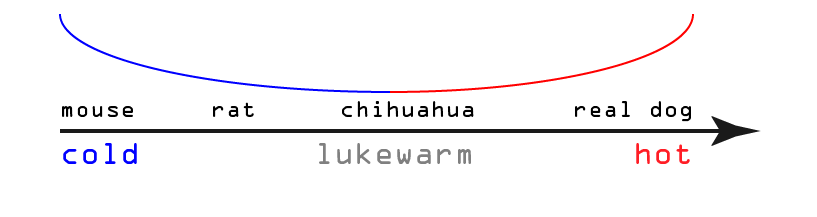
Illustration 1: Chihuahua as “lukewarm” dogs/mice on a scale going from “mouse” to “real dog”

Autism used to be scary. Unfortunately it still is, to some people. Apparently the fear of the foreign kicks in when they are confronted with, for example, a child making loud noises while holding their ears. Even though we’ve known for a long time that it’s a coping mechanism for dealing with certain intense feelings, similar on some level to how a person might play with a pen or close their eyes when they are nervous or overwhelmed, it is often seen as something worth suppressing or fixing. But hey, what have I just done there? How can I say that those two things are similar? “Autistic people have it much harder and you shouldn’t trivialize their struggles!”, I hear someone say. Am I trivializing them?

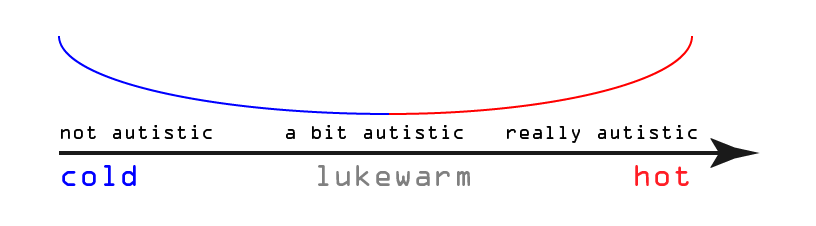
Maybe you’ve met people who are “on the autism spectrum”, but you are confused as to what exactly that means. “So, like, are you, like, really autistic, or just a little bit? Because… to be honest I don’t notice anything weird about you.” No answer. Just a sigh. “Can we talk about something else?” The conversation moves on, but the question doesn’t go away and eventually the person who asked it (being selectively unaware of a searchable internet) constructs their own model of “the autism spectrum”, which looks approximately like this:

Illustration 2: The autism spectrum as imagined by some neurotypicals, going from “not autistic” on the left to “really autistic” on the right, with “a bit autistic” in the lukewarm gray zone between the two extremes

But then one day it happens. You were out spending time with a group of friends, including the person who you think of as “a bit autistic”. You’re at this hip new restaurant and everybody is ready to order. Except that when it’s your friend’s turn, they don’t seem to be able to order and just stare at the menu quietly. They look like they are about to cry, but they don’t. “What’s the matter? Are you okay?” No answer.

Did your empathy evolve with the person it was intended for?

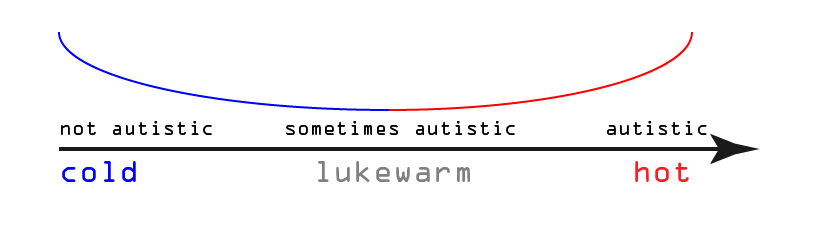
The next day you internally take out your little model of “the autism spectrum” and adjust your friend’s position to “sometimes autistic”.

Illustration 3: A refined “autism spectrum” as imagined by a neurotypical person, going from “not autistic” to “autistic” with “sometimes autistic” in the lukewarm gray zone between the two extremes

Will it change the way you look at them from now on? Will you change anything about your behavior towards them? If so: how exactly?

Humans tend to purify the concepts they use to make sense of the world. “A real man”. “A real dog”. “A real autistic person.” We are attracted to simple categories because they are effective at helping us orient ourselves in a highly complex world, most of the time.

But sometimes they fail. And when they do fail, rarely are we willing to take the step to fundamentally adjust our model. Instead, we create hybrids to bridge the gap between extremes. The extremes remain stable and are even solidified by instating them as reference points for explaining experiences in the lukewarm gray zone “between” them.

The threat of trivialization is mainly a threat to a model that relies on extremes to be stable reference points.

“Sometimes” is one of those qualifiers that are used to maintain the purity of extremes. If there is a temporal dimension to something, then it doesn’t qualify as an essential property of a person, does it?

I’ve been wearing glasses since I was eight (or so). I switched to contact lenses a few years ago, so some people might not realize that I have poor eyesight. Does my poor eyesight make me disabled? Is there a spectrum of disability where on one side we have “normal” people, “healthy” people, “non-disabled” people, and on the other side we have “very disabled” people? Would I be trivializing the struggles of “real disabled” people if I considered my poor eyesight a disability? If I lose my contact lenses, does that make me “more disabled”, until I have them back?

What if I got in an accident and, instead of staying at home in my bed for a few months, I used a wheelchair to get around. Would I be “temporarily disabled”? Is a wheelchair fundamentally different than glasses or contact lenses? How so?

The threat of trivialization is mainly a threat to a model that relies on extremes to be stable reference points.

I am trans. That means that I don’t identify with the gender I was assigned with. “So what are you going to do about it? Are you considering surgery? Or hormone replacement therapy?” No, neither. I think my body is okay the way it is and I can live with the current level of harassment I experience.

“So you are not really trans — not like this person I know who has been on hormones for two years and is now considering facial feminiziation surgery…”

Welp. Let’s stop this series of examples here and think about the more general pattern and about intentions and effects.

“How can I support you?”

What is the effect of mentally putting people on a spectrum where on one end (usually the “normal” end) there is you, and on the other end, there is some extreme that doesn’t quite match the person you are categorizing?

The effect is that it provides a plausible reason for ignoring their specific needs, which might differ from your own needs in potentially very unintuitive ways.

Your friend who is “a little bit autistic sometimes”—a misconception as discussed earlier—has different needs than you. For practical reasons, let’s ignore all these clean-cut categories for the moment. In fact, let’s ignore the concept of a “spectrum”. Let’s instead think about the person’s needs. Did you anticipate their behavior at the restaurant? Did you understand what was happening when it happened? Did your empathy evolve with the person it was intended for? If it didn’t, then “the spectrum” might be partially at fault. Forget categories, including “the spectrum”, if it prevents you from building conscious empathy. And conversely, use categories, if they help you build conscious empathy, for example by reminding you that you need to listen and learn. It doesn’t matter so much how we achieve conscious empathy, but it matters that we do achieve it.

Let’s think about that non-binary trans person you know: do you know what they get anxious about and why? When do they need you the most? How can you be supportive?

And the person you know who uses a wheelchair: does their use of a tool that enables them to be more mobile make them “a disabled person”, someone who is somehow fundamentally in a different category of people? If it feels that way, you might need to let go of the category of “disability”, at least temporarily, and focus instead on needs and support. Do they need your support? Maybe. Maybe not. Maybe they have their life figured out much more than you. Maybe they need your support in ways that you can’t imagine yourself.

Conscious empathy is important, because humans are social beings that generally have a hard time surviving in isolation. Empathy can be developed by observing, listening, learning. If the neat and simple categories we use to make sense of the world act as a barrier to supporting each other, let’s drop the categories, at least for the moment.

Of course it is much easier to keep constructing hybrids and use them as an excuse for not going through that learning process. Unfortunately it is only easier for those whose support is needed, not those who depend on it.

And we can take this line of thought even one step further: it is actually common for people to be in both categories, those who need support and those who can provide it, at least sometimes, or in certain aspects. So maybe those categories, while helping me make the previous point, are themselves also ultimately a barrier. But they can still act as a general reminder that our experiences as humans are varied, and learning and listening are more important than knowing.

18 Jun 15:43

Twitter Favorites: [simplic10] @sonyaellenmann @vgr She thinks the dynamic here is teacher/student, he thinks it's peer/peer. Common mismatch @St_Rev made me notice.

the normie whisperer @simplic10
@sonyaellenmann @vgr She thinks the dynamic here is teacher/student, he thinks it's peer/peer. Common mismatch @St_Rev made me notice.
18 Jun 15:35

Three essentials

by Volker Weber

f3c18a7a38309a9c4ff496560efbf867

I usually have three pieces of technolgy thar I cannot or would not replace with anything else. In number of hours I use them each day they are:

- Apple Watch with LTE
- Microsoft Surface Pro
- Apple iPhone X

And my greatest affection belongs to that watch. I wear it 23 hours each day. Not on the same level, but quite important is Surface Pro. And the iPhone X stands for any dual camera iPhone (7 Plus, 8 Plus or X). You have to have an iPhone for Apple Watch. I could go with a 2016 7 Plus, but not an older watch without LTE. I also keep trying other computers than Surface Pro but always come back.

18 Jun 15:34

It’s the I Ching. The changes of three coins, head or tails,...


It’s the I Ching. The changes of three coins, head or tails, lead to eight states.

18 Jun 15:33

Today the cloud is the central metaphor of the internet: a...


Today the cloud is the central metaphor of the internet: a global system of great power and energy that nevertheless retains the aura of something numinous, almost impossible to grasp. | James Bridle, Rise of the machines: has technology evolved beyond our control?

Actually, I think ‘the platform’ will become the central metaphor going forward, since it includes human mass dynamics, and not just the infrastructure that platformizes our economy.

18 Jun 15:33

mapsontheweb: Claims to Antarctica if the “Frontage Theory” was...


mapsontheweb:

Claims to Antarctica if the “Frontage Theory” was universally applied.

The Frontage Theory states that sovereignty over each point in Antarctica properly belongs to the first country whose non-Antarctic territory one would reach when travelling north in a straight line from such a point.

18 Jun 15:28

A group of Pebble users are trying to keep the platform alive

by Brad Bennett

The online Pebble community is working hard to ensure Pebble owners can still use their watches after Fitbit shuts down the servers that support the platform.

Fitbit bought Pebble in 2016 and since then Pebble services have been on their way out. However, an internet community called Rebble is working to keep Pebble’s web services alive.

Rebble is replacing large chunks of code and taking over the responsibility of keeping Pebble’s apps running smoothly.

In its latest blog post, the group says they’ve started moving users over to Rebble accounts. Users need to make an account so they can access Rebble’s web services. The web services are how Rebble plans to support Pebble users after Fitbit ends official support.

Rebble isn’t going to have all of Pebbles services ported over to its platform by June, but if users want to keep their watches ticking they need to sign up.

It’s really simple to port over an account. Users need to first create a Rebble account, which can be done here and then log into their old Pebble account. Once these steps are done their two accounts will be linked.

So if you’re a Pebble user and you want to keep using the smart functionality of your watch make sure to switch your account over by the end of June.

The post A group of Pebble users are trying to keep the platform alive appeared first on MobileSyrup.

18 Jun 15:28

Apple Maps reportedly experiencing widespread outages [Update: back online]

by Sameer Chhabra

Apple Maps is reportedly experiencing widespread outages.

According to a number of users on Twitter — and verified using a MobileSyrup iPhone 7 smartphone — Cupertino computing giant Apple’s GPS application is not providing directions for users.

While Apple Maps is able to geo-locate users’ current locations, the application displays a “Directions Not Available” message whenever users attempt to search for directions.

MobileSyrup has reached out to Apple for comment. This story will be updated with a response.

In the interim, let us know in the comments section if Apple Maps is not working for you.

Update – 1:15pm: Apple Maps is now back in action and fully operational.

The post Apple Maps reportedly experiencing widespread outages [Update: back online] appeared first on MobileSyrup.

18 Jun 15:28

Instagram will no longer alert users if someone screenshots their Story

by Jonathan Lamont
Instagram app on Android

Instagram is returning power to the lurkers by no longer alerting users when someone takes a screenshot of their Stories.

The feature was released earlier this year to a limited set of users as part of a beta test. Screenshot notifications are a popular feature on ephemeral picture-sharing app Snapchat. Like other Snapchat features, Instagram shamelessly copied it.

However, Instagram told BuzzFeed News that it has now officially stopped testing the feature.

The screenshot feature was only available for a small number of users, however, users couldn’t tell who had or didn’t have the feature. It made screenshotting a Story quite risky.

This is either great or terrible news, depending on how you use Instagram. Users who loyally post to their Story on Instagram will likely be upset. Losing the feature means their impermanent documentation of their lives won’t be so impermanent.

The flipside of this is it’s great for all the lurkers out there. Now they can screenshot with abandon — no fear who might know. However the feature was never perfect. Users found a number of workarounds, from taking a screenshot in airplane mode to using the website on a computer.

Whatever camp you’re in, the change should clear up some confusion around who has the feature. It will be interesting to see if the social media network is working on a different version of the feature based on the testing.

Source: BuzzFeed News

The post Instagram will no longer alert users if someone screenshots their Story appeared first on MobileSyrup.

18 Jun 15:28

Network sharing with Freedom is ‘not good for Rogers at this time’: CFO Tony Staffieri

by Sameer Chhabra
rogers

Rogers CFO Tony Staffieri reiterated his belief that network sharing is not economically viable for Canada’s largest telecom service provider, at a recent Scotiabank media conference.

At the June 13th, 2018 Scotiabank Telecom, Media and Technology Conference, Staffieri said that Rogers simply doesn’t see the economics of network sharing “working out in our favour.”

“As we evolve into 5G, more and more, we think about us having our own network nationally as being a competitive advantage,” said Staffieri.

“It is a competitive advantage to own our network and not have to rely on another party for something that’s critical to wireless industry.”

Staffieri also spoke about potentially sharing a network with Freedom Mobile, adding that the company continues to view “network sharing as not good for Rogers at this time.”

In terms of Rogers’ sharing partnership with Quebec-based regional carrier Videotron, Staffieri said that both companies will “continue to evaluate it and make sure that it makes sense going forward.”

“The Videotron arrangement was struck many years ago — seven or eight years ago now, in a world of 3[G] and 3.5G that evolved to 4[G]” said Staffieri.

“As we evolve that arrangement to 5G, both of us, Rogers and Videotron, will look to what’s going to work for us economically on both sides of the partnership.”

Rogers and Videotron signed a 20-year agreement in May 2013 to expand LTE coverage in Quebec and Ottawa.

The terms of the agreement saw that Rogers and Videotron would share the costs of LTE expansion in the region, while maintaining business independence.

The post Network sharing with Freedom is ‘not good for Rogers at this time’: CFO Tony Staffieri appeared first on MobileSyrup.

18 Jun 15:28

Hidden setup page points to upcoming Android Messaging desktop client

by Jonathan Lamont
Better Together setup screen

Google Chrome’s messaging integration with Android may be closer than we think.

A Reddit user discovered a shortcut in Nova launcher today that points to the upcoming feature and hints it will be called ‘Better Together.’

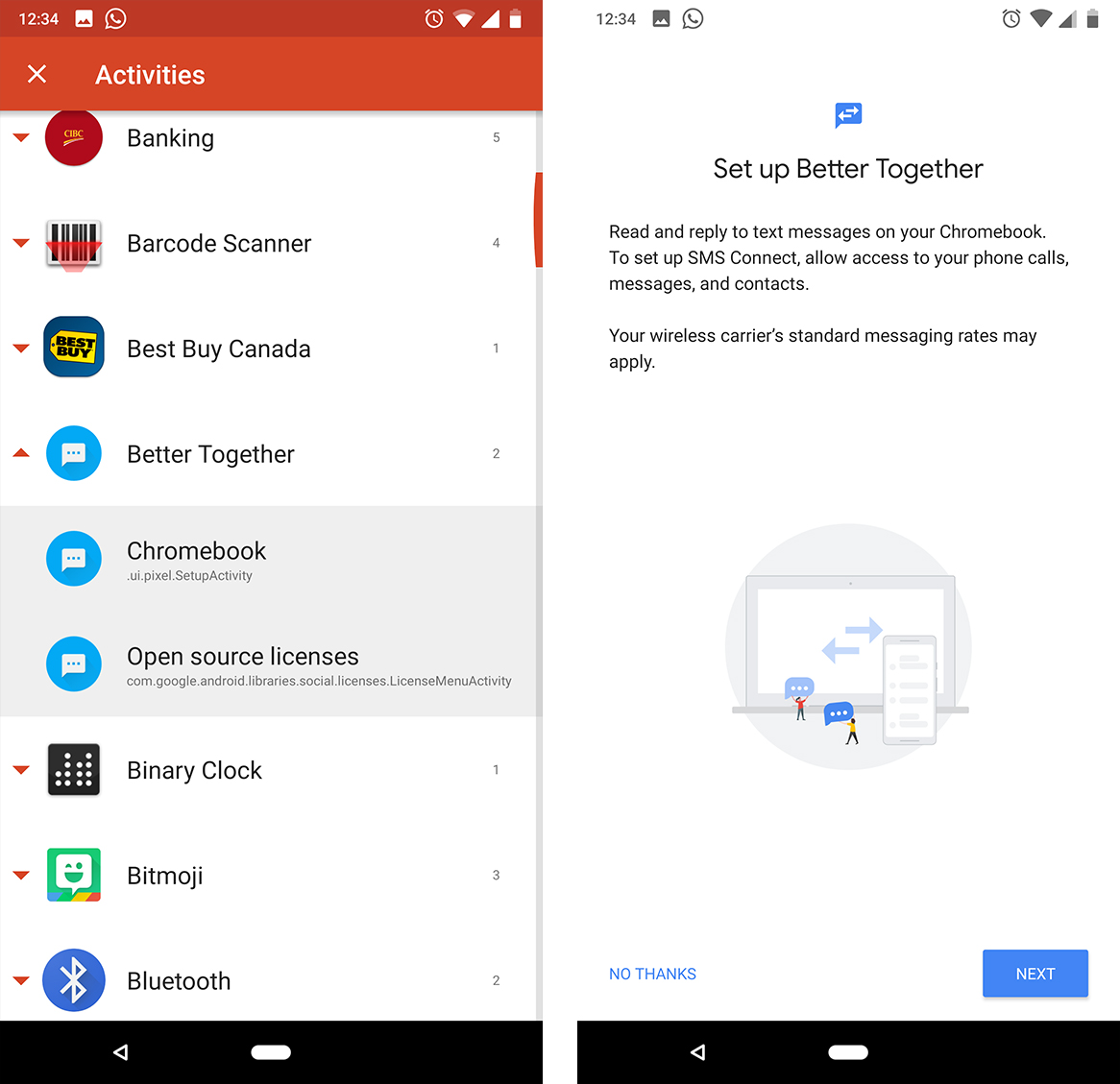
User Skychronicles found the ‘Better Together’ feature inside the activity shortcuts in Nova.

Activity shortcuts are specific actions that users can add to their home screen in Nova. For example, you can add an activity shortcut that will take you directly into the settings of you Messaging app.

One of these shortcuts was labeled ‘Better Together.’ Expanding that option gives two further options: ‘Chromebook’ and ‘Open source licenses.’

Better Together shortcut

‘Open source licenses’ opens a screen with a list of — you guessed it — licenses. However, things really get exciting when you open ‘Chromebook.’

The hidden Better Together setup page

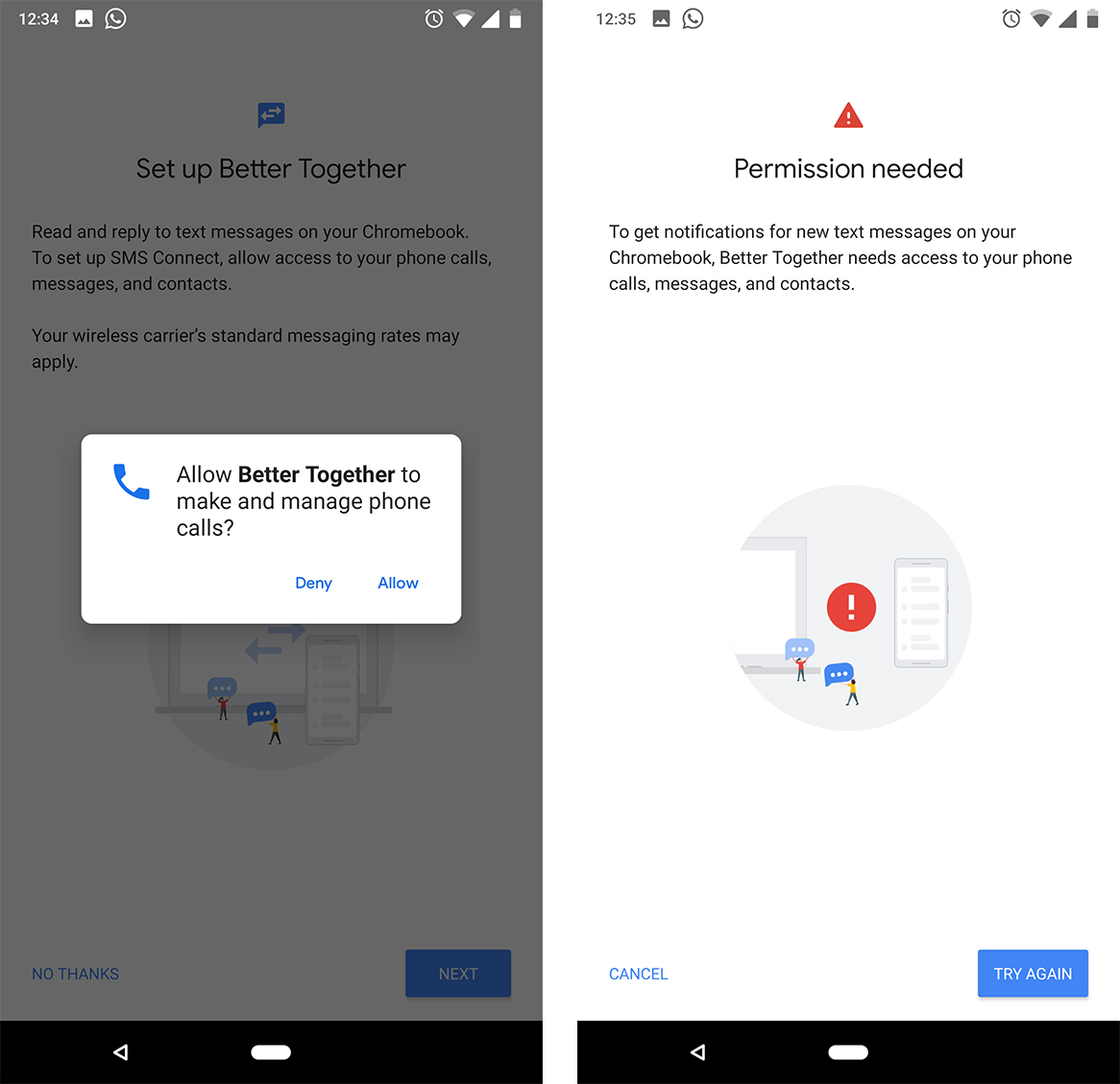
‘Chromebook’ leads into a page to set up Better Together. According to the setup page, Better Together will allow users to “read and reply to text messages on your Chromebook.” It also says that your wireless carrier’s standard messaging rates may apply. Furthermore, it asks you to allow access to your phone calls, messages and contacts to setup ‘SMS Connect.’

Better Together permissions

Tapping ‘Next’ causes a window to pop up asking for your permission. However, granting permission doesn’t work and the setup page ask you to do it again. Tapping ‘Try again’ bounces you to the app information page. From this page, users can check the permissions but only one is available. The ‘Phone’ permission is present and enabled.

Nevertheless the app doesn’t recognize the permission is granted. The feature is likely still being worked on and it isn’t clear when it will be ready.

It also appears to be part of Android P. I was able to find the activity shortcut using my Pixel XL 2 running Developer Preview 3. However other devices we tested running Android 8.0 didn’t have the shortcut in Nova.

Source: Reddit

The post Hidden setup page points to upcoming Android Messaging desktop client appeared first on MobileSyrup.

18 Jun 15:28

Postal worker union proposes banking services in post offices across Canada

by Bradly Shankar
Image showing a Canada Post office

A new research report from the Canadian Union of Postal Workers (CUPW) states that Canadians would benefit from banking and financial services at post offices.

The report, titled “It’s Time for a Postal Bank for Everyone,” notes that many rural communities have seen their local branches close down, while some areas no longer even have a bank machine.

Specifically, CUPW says that 1,774 bank branches have been closed between 1990 and 2017, a trend that is continuing nationwide. Further, the report states that less than 10 percent of Indigenous communities have a bank or credit union.

CUPW’s solution is to offer banking services in Canada Post offices, which are already available in most of these communities.

“This report underscores what we have been advocating for years,” said Mike Palecek, national president of CUPW in a press statement. “The big banks are abandoning our communities. Canadians deserve accessible financial services and the post office is more than ready and capable of providing them.”

The report points to other countries that have installed banking services into their respective postal offices, such as France and Italy, which each brought in millions of dollars in profits.

On June 19th, the House of Commons will hear CUPW’s final arguments and vote on a NDP motion, M-166, to study how postal banking in Canada could be implemented.

The full report can be viewed here.

The post Postal worker union proposes banking services in post offices across Canada appeared first on MobileSyrup.

18 Jun 15:28

Apple won’t ship full OLED iPhone lineup until 2020: report

by Igor Bonifacic

Contrary to recent reports, Apple will not ship three OLED display iPhone models in 2018, according to a new report from the Wall Street Journal.

Earlier this May, South Korea’s ETNews published a report that said Apple planned to use OLED panels across its entire 2018 iPhone lineup. This was in contradiction to past reports, which had maintained Apple planned to announce two iPhone X-style OLED display iPhones and one low-cost LCD model.

“Industry executives with direct knowledge of production plans said Apple initially wanted roughly equal production of the two screen types,” writes the WSJ. “Now, they say Apple plans to make more of the LCD model, anticipating that consumers would lean toward the cheaper model.”

The Wall Street Journal goes on to reiterate what we’ve heard in past: Samsung is currently the only OLED panel supplier that can meet Apple’s quality and scale requirements.

Citing analysts, the publication says Apple will continue to sell a LCD iPhone model into 2019 and beyond.

Apple is not expected to shift to an full OLED lineup until 2020 at the earliest.

Source: Wall Street Journal

The post Apple won’t ship full OLED iPhone lineup until 2020: report appeared first on MobileSyrup.

18 Jun 15:28

Public Mobile offers $40/4GB plan at 3G speeds with unlimited nationwide calling

by Jonathan Lamont
Public Mobile

Telus-owned Public Mobile launched a $40/4GB promotional plan today.

The offer is a 30-day plan with unlimited Canada-wide talk, text and picture messaging. The 4GB of data is capped at 3G speed.

The plan is available for both new and existing customers across Canada. Additionally, it’s eligible for Public’s Refer a Friend program. The program gives the referrer $1 per referral every 30 days as long as the friend stays with Public Mobile. The referee gets a $10 account credit to cover the cost of their SIM card.

New customers will have to purchase a sim card and then go to the activation website in order to sign up. During the activation process you can select the $40/4GB plan.

Existing customers can switch to the plan using the Self Serve website. Under the ‘Plans and Addons’ section users can select ‘Change Plan.’ Users can either change the plan immediately, which will reset their payment cycle. Users can only do this if they have enough funds on their account to cover the cost of the new plan. Public Mobile doesn’t prorate plans either.

Otherwise, you can choose to update the plan on your next payment date. Auto-pay will switch over to the new plan automatically. Additionally, any rewards related to your account will transfer on the next renewal after the plan change.

The deal is on for a limited time, though Public Mobile doesn’t list how long it will be available.

Source: Public Mobile

The post Public Mobile offers $40/4GB plan at 3G speeds with unlimited nationwide calling appeared first on MobileSyrup.

18 Jun 15:28

‘Doubtful’ Sonos will update existing speakers to support Dolby Atmos: CEO

by Igor Bonifacic

It’s “doubtful” Sonos will update its existing home theatre speakers, including the recently announced Sonos Beam, to support Dolby Atmos, according to the company’s CEO Patrick Spence.

Spence revealed this tidbit of information in an interview with The Verge.

Atmos is Dolby’s latest surround sound standard. It creates a more immersive movie watching experience by adding height channels to a traditional 5.1 and 7.1 setup. Since Atmos broke into the mainstream, companies like Samsung and Yamaha have shipped Dolby Atmos-compatible soundbars.

Spence said Sonos doesn’t think there’s much benefit to adding Dolby Atmos to a soundbar.

“The primary driver at the end of the day is ‘Hey, how do we create the best sound possible in the room?’ And not get too caught up in what’s the flavour of the day from an audio technology perspective,” Spence said in his interview with The Verge‘s editor-in-chief Nilay Patel. “And so sometimes we’ll do things where, yeah, it frustrates some of the people that are a little bit more into the space in terms of what are the standards and what’s the new stuff.”

“But look, if something emerges that’s really experience-defining, we have no hesitation in building that into our products.”

Check out the full interview, which includes a variety of other interesting tidbits, on The Verge.

Source: The Verge

The post ‘Doubtful’ Sonos will update existing speakers to support Dolby Atmos: CEO appeared first on MobileSyrup.