Shared posts

09 Mar 17:16

Mountains matter in digital sovereingty

by swardley

I'm going to explain a few things that don't matter in order to explain one thing that does. So let us start.

First, I invented a method of mapping competitive landscapes. This not only includes physical activities but practices, data, knowledge and even ethical values. I used such a map to map culture.

A map of culture


The map of culture is not important except I'll note that collectives (groupings of people) are differentiated by our values (i.e. beliefs) and the behaviours we exhibit. Those collectives are in competition with each other and that competition (the act of "seeking together" whether seeking some knowledge or some resource) can take many forms including co-operation ("working together"), collaboration ("labouring together") or even conflict ("fighting together").

When we talk about physical sovereignty (I italicise as we rarely mention the physical word) then we tend to use a map of the territory and mark out where our collective (and our values and our behaviours) exist surrounded by a border which demarcates the "outside".

Physical sovereignty


We can create a map of competitive spaces (see the above mention that I invented a way of doing this) then we can apply patterns (discovered through mapping) to anticipate potential future states. For example, this was a map created in the DVLA around 2014 of the future automotive industry. A number of its anticipations have already started to happen but that's not interesting for this discussion nor is the map itself.

Future of the automotive industry


What is mildly interesting is that we can bring elements of the culture map onto our competitive spaces. For example, we can show how a collective can embed their values in simulation systems for intelligent agents (AI). When we export products based upon this, we're also exporting our values to other collectives but then we've been doing this with film, music, games and art in general for a long time. It's a form of non kinetic warfare.

Embedding values within commercial systems.


As I said, most of this stuff in unimportant. What does matter and what I want you to think about is when we discuss digital sovereignty then we should be talking about where our borders are on those maps i.e. what are the bits we wish to protect for our collective, our behaviours and our values?

Digital sovereignty


So, why does this matter?

Imagine listening to a conversation on physical sovereignty where no-one has any maps and therefore no-one can discuss borders but everyone wants to talk about the importance of mountains or hills or lakes or forests or roads. You would probably think it's gibberish or at the least utterly hopless. Those are simply components that exist in a landscape and are mostly irrelevant on their own to the discussion at hand.

Well, this is exactly the conversation that is happening today in digital sovereignty. Few (in western Governments it seems) have maps of their competitive landscapes and as a consequence we not only poorly understand our supply chains but we have no idea where our borders should be in the competitive space. So, instead of trying to map the environment, we've replaced it with an entire conversation on the importance of mountains (clouds) or hills (cybersecurity) or lakes (data) or forests (AI) or roads (networks). It is utterly hopeless bordering on gibberish.
13 Dec 08:20

Notes on newsletters

by Benedict Evans

Email newsletters are older than the web, and paid newsletters are older than the internet. Fred Hickey has been writing the High Tech Strategist since 1987, when he sent it by fax, and ‘newsletters’ themselves are almost as old as print. 

Meanwhile, there’s been a steady flow of people scaling personal email newsletters and blogs into media companies - Dany Levy sold Daily Candy for $125m back in 2008, Rafat Ali built and sold Paidcontent and Imran Amed has built Business of Fashion to ~100 people. Morning Brew sold for $100m last December.

But it is somewhat new for individual writers to be able to get to tens or hundreds of thousands of dollars of revenue from selling the writing itself, without scaling up into a company, without building ecommerce, events or speaking, and, crucially, charging $5 or $10 a month for hundreds or thousands of subscribers instead of thousands of dollars a month for hundreds of subscribers. (There are plenty of individual analysts, like Fred Hickey, selling professional information and analysis for that or more.)

In the past, there were always two constraints around the one-writer business. First, meaningful ad revenue on the web needs more traffic and therefore generally more writing than any single (normal) person can produce. You can make ads work on one-person traffic only if you have a very specific high-value niche, and at that point ecommerce or events also become relevant (A Collected Man's watch business is a great example of this), but that’s not a generalisable model. Second, no-one ever really managed to make mass-market paid blogs a generalisable model either - my own theory was that, again, you couldn’t really write enough by yourself to justify $5 or $10 a month when the Economist or New Yorker paywall cost much the same for vastly more. 

Somehow, though, it’s easier to pay for an email than a web page. Perhaps an email is a piece of tangible value - something that you’re given every week, that you can keep, whereas a blog post disappears in the firehose, and you never remember to visit, and can’t be bothered to log in (and RSS died, and Facebook is a lottery). More practically, while some 'newsletters' are really long-form writing delivered by email, many (like mine or Ben Thompson’s) are actual newsletters, driven by what just happened, which makes keeping up the volume much easier - you don’t need to generate a big original idea every day.

Ben Thompson started a newsletter at roughly the same time that I started mine, back in 2013. He decided to charge directly, and send it multiple times a week (which helps the value prop and, again, is easier if it’s driven by newsflow) whereas my business model was to get a job at Andreessen Horowitz, a media company that monetises through venture capital. At that time, making any kind of newsletter required a fair amount of technical knowledge, since the tools in the market were mostly designed for companies and marketers. Making it paid was and is a lot harder - you need to plug together a website, a membership management system, an email platform and a payment processor, with a bunch of integrations and ‘code’. That sounds trivial if you’re an engineer - it’s not trivial for anyone else. 

That’s the first problem Substack solved - it made publishing easy and charging easy. You pay 10% (plus Stripe’s 3-6% - the invisible percentage on half the cool new internet stuff today) and Substack handles the rest, whereas Memberful, which Ben and I use, charges 5% and leaves you to set everything up. 

The other problem, though, is how you get readers. If you already have a big free audience you can try to convert it - I have a free newsletter with over 150k subscribers that took 8 years to build up, and 300k twitter followers that took longer. Many of the high-profile new Substack writers have drawn a salary somewhere else while building up a social media presence over the last decade that they can now monetise - someone called Substack 'Twitter’s pay wall'. 

But what if you don’t already have that audience? You can spend years slowly building up a base from zero, if your employer lets you or you can afford to wait. Mailchimp, Wordpress, Memberful and Squarespace don’t give you readers - they’re tools, and they don’t have leaderboards. But Substack fits Chris Dixon’s theory of ‘come for the tool and stay for the network’, or might do - it’s a user-facing brand, and has real-estate to drive recommendations and discovery, if it can work out how it wants to do that. This is also what Medium tried to do - an easier publishing tool with a discovery layer on top, but that was always much more diffuse and there isn’t the same direct physicality of subscribing that email seems to have. Medium also aggregated writers into one paid subscription - does Substack try to do that? How many lists can we all sign up to, after all? And who owns the reader?

The most striking thing for me, though, is that the history professor making $1m from her Substack (and note that ‘her Substack’ is their brand, not hers) looks so much like the developer who put a Tetris clone on the iPhone app store in 2008 and made a fortune. Good luck trying that now. In every new, empty channel, the first people to offer something good are easy to find, and can get rich. Once the channel fills up, the dynamics change. This happened to SEO, SEM, Facebook, Instagram, podcasts, D2C, Youtube, Tiktok and now newsletters. This is the cycle of life on the internet - any tool that makes it easy for everyone to create and reach an audience also means you're competing with all the other everyones.

So, what does any content platform do when it has 100m users and 1m creators? The leader boards break, and search probably breaks too. Now what? Apple’s app store was paralysed by that for years. Yahoo's directory was replaced by search. FB built algorithms. Now see Substack. How does discovery work at scale? That isn't just a high-quality problem - 'what happens when there is more stuff on your platform than anyone can look at?' is an essential, existential question. It can define the whole of what your product really means. What happens when email fills up - where does Substack's own reader fit in?

This is where the network comes in, and it’s also where Substack’s 10% comes in. I’ll pay you 10% if you can get me readers, or get me more. So how far is this is a brand, a network and a channel, with control, that can drive traffic and shape what you see, and how far is it a tool? And are there going to be thousands of writers each with thousands of subscribers, driven by recommendation algorithms or editorial choices, or merely dozens? What content do you block?

You could, theoretically, build Substack again as a set of NFTs on a blockchain (sorry - ‘web3’), but that wouldn’t necessarily answer those questions so much as add new ones. Would it be a network or a tool? Could I take my list and leave? Are you paying Substack for a tool, or is Substack paying you for your content - is the take-rate 90% or 10%? Is Mailchimp’s take-rate 100% or zero? In early 2000 I wrote a piece of equity research (another revenue model for writing), that I titled 'Who owns the customer?' - exactly the same applies here. You can own your content, but that’s trivial - it’s the network that matters.

A version of this essay was sent to premium subscribers to my newsletter earlier this year. Find out more here.
13 Dec 08:20

The biggest misconception in data visualization

by Nick Desbarats

tl;dr: When designing a chart, most people try to come up with the ‘best way to visualize the data’. This often results in charts that are unobvious or useless to readers, though. Instead, we should try to design charts that best answer a specific question or that best communicate a specific insight about the data, even though such charts don’t answer all questions that readers might have about the data.

Like any field, data visualization has some common misconceptions floating around in it. There’s one, though, that I think has done more damage than any other, which is the assumption that…

“When designing a chart, the goal is to find the overall best way to visualize the data.”

“WTF are you talking about?”

How can that be a misconception? Am I suggesting that your goal should be to find a bad way to visualize the data? Obviously not. What am I saying, then?

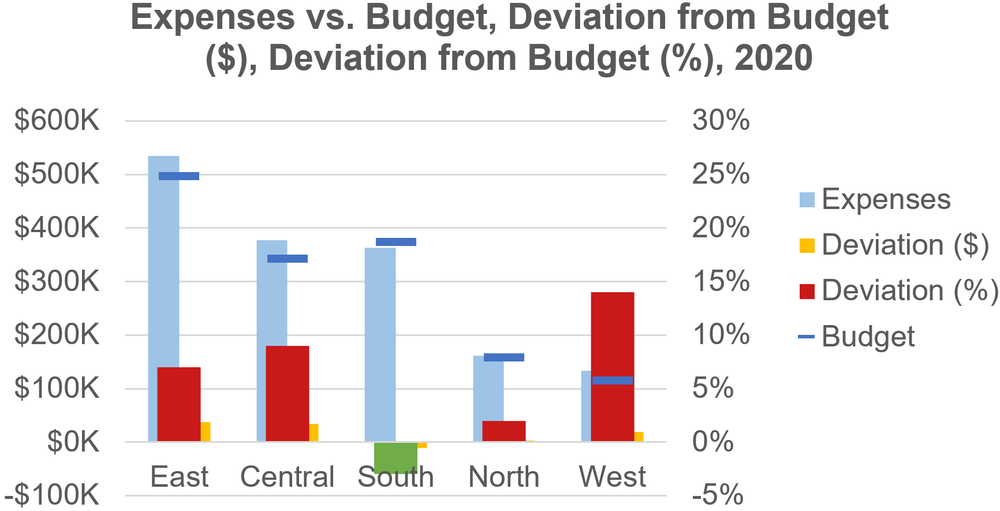
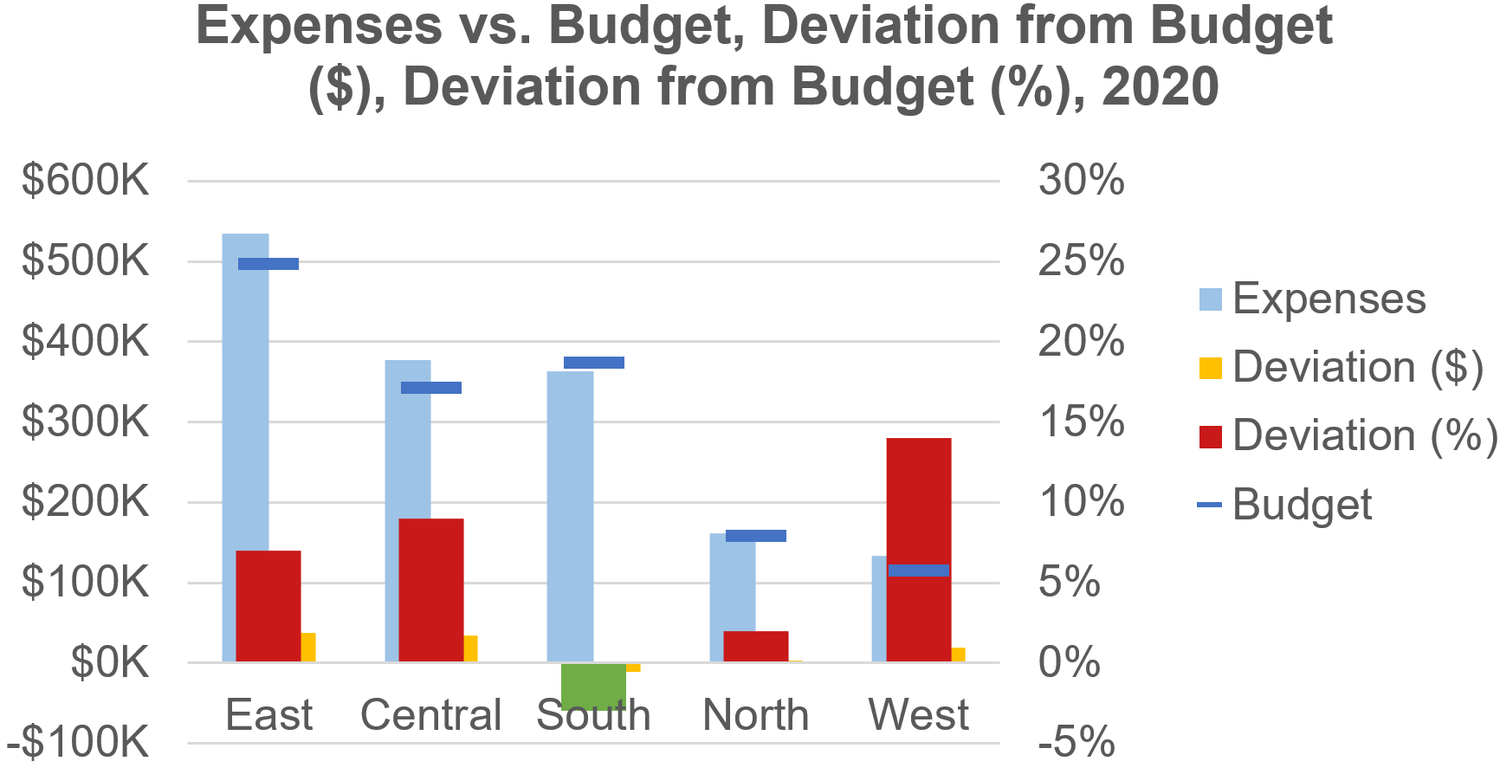
Well, have a look at the data in the table below and three potential ways of visualizing it for our company’s CEO. Which of the three graphs do you think is the best way to visualize this data, graph A, B, or C?

The answer, of course, is that any one of these graphs could be ‘the best way to visualize this data’, depending on what, specifically, we need to say about the data:

  • If the CEO needs to know which regions have the highest expenses, then Graph A is ‘the best way to visualize this data’.

  • If the CEO needs to know which regions are doing a better or worse job of sticking to their budget, then Graph B is ‘the best way to visualize this data’.

  • If the CEO needs to know which regions are contributing most to the company’s overall budget overage, then Graph C is ‘the best way to visualize this data’.

Is any one of these graphs the ‘overall best way to visualize this data’, or the ‘truest representation of this data’? How would we even go about determining that? All three—and many other possible variations—are potentially ‘the best way to visualize this data’, depending on what, specifically, we need to say about the data. None of them is the ‘overall best way to visualize this data’, or ‘the best representation of this data’. In fact, there’s never a single, ‘overall best way’ to visualize any dataset; there are only ‘best ways to say different things about the data’, such as which regions have the highest or lowest expenses, or which regions are doing a better or worse job of sticking to their budgets.

That’s the harsh reality of data visualization that few people seem to realize: Charts never ‘show the data’, they always just say a few specific things about the data. Different ways of visualizing the same dataset make different insights about that data more obvious, less obvious, and not visible at all. Yes, it would be awesome if we could make charts that ‘just show the data’, i.e., that make all possible insights obvious or that answer all possible questions that readers might have about the data, but those charts don’t exist.

“Why not?”

Well, if we try to create a chart that makes all possible insights obvious or that answers all possible questions that readers might have about the data, we’ll always end up with a ‘spaghetti chart’:


Even this doesn’t answer every question that the CEO might have about this data, though. For example, if the CEO wanted to quickly see what fraction of total expenses each region represents, or how these expenses compare to those of the previous year, we’d need to add even more clutter. Indeed, we’d never stop adding clutter to our chart in a quest to ‘just show the data’ because there’s always a virtually unlimited number of things that we could say about any dataset.

“Why don’t we just use a table, then?”

Well, tables do ‘just show the data’ without saying anything about the data. Indeed, tables don’t make any insights obvious at all. For example, based on the table alone in the scenario above, is it obvious which regions are doing a better or worse job of sticking to their budget? Or what fraction of total expenses each region represents? Sure, the reader can get those insights, but they’re going to have to work for them and possibly do some calculations, and they’re far less likely to notice interesting or unexpected patterns or relationships in a table of numbers than in a graph.

Tables are also many times slower to consume than graphs and require a lot more cognitive effort to process, which substantially increases the risk that readers won’t get the insights they need from a table—or will just skip over it altogether—because it requires too much cognitive effort to consume. In most situations, then, saying a few things about the data (i.e., showing a graph) is far more useful than saying nothing about the data (i.e., showing a table).

“So, what does all this mean when it comes to actually designing charts?”

The next time you sit down to create a new chart, instead of asking yourself, “What’s the best way to visualize this data?”, ask yourself, “Do I know why I’m creating this chart?”, i.e., do you know what specific insight or answer you need the chart to communicate about the data? If the answer to that question is “no” (which it will be surprisingly often), you need to step away from the charting software and go find out. Perhaps you’ll need to do some exploratory analysis, or speak more with the target audience but, one way or another, you need to figure out what, specifically, your chart needs to say about the data. If you don’t, many of your design choices (chart type, color palette, etc.) will be quasi-random guesses, and the chances that the audience will get what they need from your chart will be low.

Once you’ve figured out what, specifically, your chart needs to say about the data, the next step is to accept that whatever design you come up with is going to communicate that specific insight or answer that specific question clearly (hopefully, anyway…), but there will be many other potentially interesting questions and insights that won’t be obvious in your chart, or possibly not visible at all. Not only is that O.K., it’s the only way it can work (unless you give your audience a spaghetti chart).

What happens if, try as you might, you can’t find out specifically why the audience needs to see a particular dataset or needs to see a chart? For example, perhaps the CEO has simply asked for “expenses for each department” and you don’t have the opportunity to ask them why they need that information because they’re too busy to meet with you. These are unpleasant situations to be in, but they do happen. In my Practical Charts course, we discuss strategies for increasing the odds that we end up giving the audience something that will be at least somewhat useful to them, but these strategies will have to be a topic for a future article since this one’s already longer than I’d like it to be. The bottom line, though, is that our chart probably won’t be as useful to the audience as it could be if we design it without knowing specifically what it needs to communicate about the data.

“So, are you also saying that…”

No. I want to be clear about a few things that I’m not saying:

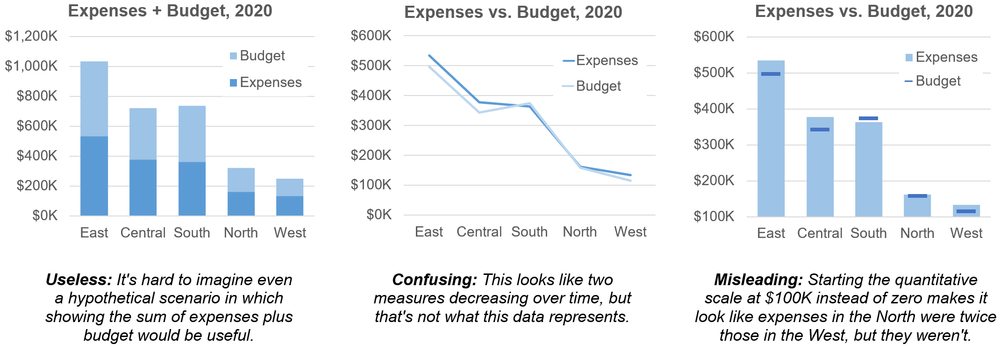
  • I’m not saying that all the ways to visualize a given dataset are ‘potentially best’ ways. For any dataset, there are plenty of ways to visualize it that aren’t useful in any plausible scenario, that are fundamentally confusing, or that are just plain misleading:

Outside of obviously bad ways such as these, though, there are always many ‘best ways’ to visualize any dataset.

  • I’m not saying that, because there’s never a single ‘overall best way to visualize this data’, that whether one chart is better than another comes down to personal opinion or preference. For any given scenario (the nature of the data + what we need to say about that data + knowledge of the audience), different chart designs will be objectively better or worse ways to visualize that data for that scenario. How could we know if one chart design is objectively better than another for a given scenario? We could recruit representative members of our target audience and run an experiment to test the different chart designs to determine which one most effectively answers the question at hand or communicates the insight we need to communicate, and that ultimately best achieves whatever effect we want to have on the target audience.

    Of course, we usually don’t have the time or resources to run such experiments, so part of learning data visualization involves getting good at making educated guesses about which chart designs would perform best, were we to test them experimentally with members of our target audience. Having some knowledge of major findings from data visualization research studies is helpful and can make those guesses more educated, but research findings generally aren’t specific enough to point to the best chart in a specific scenario.

    Whether we have the resources to determine which chart design is objectively better or not, though, the fact remains that one of the designs is always objectively better than the others. It’s not an inherently subjective assessment.

  • I’m not saying that, as long as you know specifically what you need to say about the data, you’ll automatically be able to design an effective chart. It takes a fair amount of skill to take some data, a specific reason why the audience needs to see that data, and knowledge of the target audience (level of dataviz sophistication, current concerns, etc.), and turn all that information into an effective chart. The chart creator has to know how to choose chart types, chart arrangements, color palettes, scale formatting, and how to make many other types of design decisions. These are the skills that I teach in my Practical Charts course, and it’s 14 hours long…

“Umm, this seems kind of obvious…”

The fact that there isn’t a single ‘overall best’ way to visualize a given dataset may seem obvious to some when it’s spelled out like this, but getting out of the mindset of ‘trying to find the best way to visualize this data’ and into the mindset of ‘designing the chart that best communicates a specific insight or best answers a specific question’ requires a fundamental shift in thinking that relatively few people seem to have made. I regularly hear even well-known experts discussing which chart design ‘best represents the data’ without even mentioning what, exactly, the chart is supposed to do. As I see it, though, that’s like arguing about whether a hammer or a screwdriver is ‘the best tool’ without ever mentioning if we need to pound in a nail or tighten a screw.

“But is this really the biggest misconception in data visualization?”

I think so, yes…

  • It’s very widespread. While some people have fully internalized the idea of trying to find the best way to answer a specific question or communicate a specific insight, most still try to find ‘the best way to visualize this data’, without considering the specific reason why the audience needs to see that data in the first place.

  • It’s caused innumerable arguments regarding which of two (or more) chart designs is ‘better’, which could have been instantly resolved if everyone involved had realized that one chart design would be ‘the best chart’ in one scenario, and the other chart design would be ‘the best chart’ in a different scenario.

  • If we design a chart by trying to find ‘the best way to visualize this data’, there’s a dramatically higher risk that the target audience will find the resulting chart to be too unobvious—or possibly even useless—because many of our design choices (chart type, color palette, highlighting, etc.) will be guesses since they won’t be geared around communicating a specific insight or answer.

  • Trying to find ‘the best way to visualize this data’ makes designing effective charts a lot harder than it needs to be. Once we realize that all charts just say a few things about the data, it becomes a lot easier to choose chart types, color palettes, scale formats, etc. in light of the specific insight or answer that we need to communicate. We’re no longer trying futilely to design charts that anticipate every possible question that the audience might have about the data, or trying to find some ‘overall best’ representation of the data that doesn’t actually exist.

Let me know your thoughts in the comments, though. Do you have a different take on this idea?

By the way...

If you’re interested in attending my Practical Charts or Practical Dashboards course, here’s a list of my upcoming open-registration workshops.

13 Dec 08:19

On Using Stack Overflow Comment-Edit Pairs to Recommend Code Maintenance Changes

Have you ever developed any software without the help of Stack Overflow? In just 13 years, Stack Overflow has become an essential platform to get programming help. It has also become a source of data for researchers to solve many software engineering problems. However, Tang2021 are the first to evaluate whether Stack Overflow comments and edits can help solve the software maintenance problems. Their main goal was to find out how useful Stack Overflow comment-edit pairs are in making tools for code maintenance tasks like program repair and code recommender systems.

The authors used SOTorrent to automatically mine edits of code blocks in answers and marked the comment that invoked the edit. The answers were selected from five popular tags---Java, JavaScript, PHP, Python and Android---and the edit-invoker comment was selected based on three conditions:

  1. the comment has been made before the edit;
  2. the comment contains a code term that has been added to or removed from a code snippet in the edit; and
  3. the editor and the commenter are different users.

The authors evaluated the effectiveness of their automated process by comparing it to a manual analysis, and gave priority to finding more actual pairs of comment-edit, rather than having all possible pairs in the dataset. They also explored comment-edit pairs for tangled change, which they defined as a single edit that changes code to resolve multiple issues raised in multiple comments. Tangled changes reduce the usability of the comment-edit pairs as the comment for which a part of the edit occurred becomes untraceable. Their overall findings were:

  • The automated comment-edit mapping algorithm performs considerably well (78% precision).
  • Edits in the comment-edit pairs are rarely tangled (11% are tangled).
  • Nine of the comment categories identified by a previous study are applicable for edit-invoking comments; the most common of these is fixing an error.

Unfortunately, only 27% of comment-edit pairs are useful because many edits add new code blocks or the comments are contextual. (To evaluate usefulness, the authors manually changed the code of 15 GitHub repositories and submitted pull requests, of which 10 were accepted.)

Tang2021 Henry Tang and Sarah Nadi: "On Using Stack Overflow Comment-Edit Pairs to Recommend Code Maintenance Changes". Empirical Software Engineering, 26(4), 2021, 10.1007/s10664-021-09954-8.

Code maintenance data sets typically consist of a before version of the code and an after version that contains the improvement or fix. Such data sets are important for various software engineering support tools related to code maintenance, such as program repair, code recommender systems, or Application Programming Interface (API) misuse detection. Most of the current data sets are typically constructed from mining commit history in versioncontrol systems or issues in issue-tracking systems. In this paper, we investigate whether Stack Overflow can be used as an additional source for building code maintenance data sets. Comments on Stack Overflow provide an effective way for developers to point out problems with existing answers, alternative solutions, or pitfalls. Given its crowd-sourced nature, answers are then updated to incorporate these suggestions. In this paper, we mine commentedit pairs from Stack Overflow and investigate their potential usefulness for constructing the above data sets. These comment-edit pairs have the added benefit of having concrete descriptions/explanations of why the change is needed as well as potentially having less tangled changes to deal with. We first design a technique to extract related comment-edit pairs and then qualitatively and quantitatively investigate the nature of these pairs. We find that the majority of comment-edit pairs are not tangled, but find that only 27% of the studied pairs are potentially useful for the above applications. We categorize the types of mined pairs and find that the highest ratio of useful pairs come from those categorized as Correction, Obsolete, Flaw, and Extension. These categories can provide data for both corrective and preventative maintenance activities. To demonstrate the effectiveness of our extracted pairs, we submitted 15 pull requests to popular GitHub repositories, 10 of which have been accepted to widely used repositories such as Apache Beam (https://beam.apache.org/) and NLTK (https://www.nltk.org/). Our work is the first to investigate Stack Overflow commentedit pairs and opens the door for future work in this direction. Based on our findings and observations, we provide concrete suggestions on how to potentially identify a larger set of useful comment-edit pairs, which can also be facilitated by our shared data.
13 Dec 08:13

Assigning a custom subdomain to a Fly app

by Simon Willison

I deployed an app to Fly and decided to point a custom subdomain to it.

My fly app is https://datasette-apache-proxy-demo.fly.dev/

I wanted the URL to be https://datasette-apache-proxy-demo.datasette.io/ (see issue #1524).

Relevant documentation: SSL for Custom Domains.

Assign a CNAME

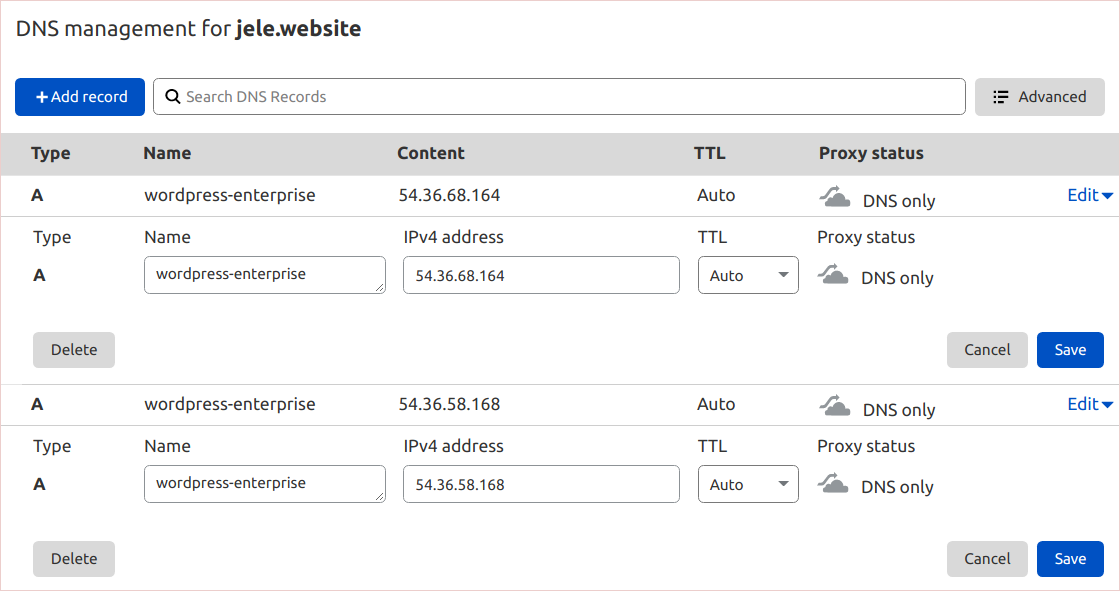
First step was to add a CNAME to my datasette.io domain.

I pointed CNAME of datasette-apache-proxy-demo.datasette.io at datasette-apache-proxy-demo.fly.dev. using Vercel DNS:

image

Issuing a certificate

Fly started serving from http://datasette-apache-proxy-demo.datasette.io/ as soon as the DNS change propagated. To get https:// to work I had to run this:

% flyctl certs create datasette-apache-proxy-demo.datasette.io 
Your certificate for datasette-apache-proxy-demo.datasette.io is being issued. Status is Awaiting certificates.

I could then run this command periodically to see if it had been issued, which happened about 53 seconds later:

apache-proxy % flyctl certs show datasette-apache-proxy-demo.datasette.io
The certificate for datasette-apache-proxy-demo.datasette.io has been issued.

Hostname                  = datasette-apache-proxy-demo.datasette.io

DNS Provider              = constellix

Certificate Authority     = Let's Encrypt

Issued                    = ecdsa,rsa

Added to App              = 53 seconds ago

Source                    = fly
13 Dec 08:12

Ratchets in software development

Blog » So there's a thing we use at work which I call a ratchet. In our codebase, there are "patterns" which we used to use all the time, but we decided to stop using them, but removing all of the existing instances at once is too much work. We want to remove all of these instances eventually, and in the meantime we want to make absolutely sure that they don't proliferate via copy-and-paste. So what we have is a ratchet, a script which runs at source code linting time and counts all of these "pattern" instances across the codebase. If the script counts too many instances, it raises an error, explaining why we don't want more of that "pattern". If it counts too few, it also raises an error, this time congratulating you and prompting you to lower the expected number. This script is intentionally extremely simple. The expected numbers are hard-coded in the script itself. The "patterns" for which it scans our code are not advanced, abstract Gang of Four-style software design patterns but plain ...
13 Dec 08:11

More memory leaks in Monterey 12.0.1

by Rui Carmo

I have as yet been unaffected by any of these since I don’t use custom cursors or rely on the Finder search for anything of consequence, but I suspect the only reason I’ve escaped the Control Center one is that I turn off my machines every day.

Either way, I don’t see any of them as acceptable in a mature operating system that should be tested up the wazoo by now, let alone one where system frameworks and language design have always made programmers superlatively aware of all kinds of resource allocations.


13 Dec 08:11

Yesterday Once More

by Grafton Tanner

In 2012, Joan Serrà and a team of scientists at the Artificial Intelligence Research Institute of the Spanish National Research Council confirmed something that many had come to suspect: that music was becoming increasingly the same. Timbral variety in pop music had been decreasing since the 1960s, the team found, after using computer analytics to break down nearly half a million recorded songs by loudness, pitch, and timbre, among other variables. This convergence suggested that there was an underlying quality of consumability that pop music was gravitating toward: a formula for musical virality.

These findings marked a watershed moment for the music discovery industry, a billion-dollar endeavor to generate descriptive metadata of songs using artificial intelligence so that algorithms can recommend them to listeners. In the early 2010s, the leading music-intelligence company was the Echo Nest, which Spotify acquired in 2014. Founded in the MIT Media Lab in 2005, the Echo Nest developed algorithms that could measure recorded music using a set of parameters similar to Serrà’s, including ones with clunky names like acousticness, danceability, instrumentalness, and speechiness. To round out their models, the algorithms could also scour the internet for and semantically analyze anything written about a given piece of music. The goal was to design a complete fingerprint of a song: to reduce music to data to better guide consumers to songs they would enjoy.

Eventually, listeners may start to resemble the models streaming platforms have created

By the time Spotify bought the Echo Nest, it claimed to have analyzed more than 35 million songs, using a trillion data points. That data helped give Spotify extraordinary recommendation powers to track users’ listening habits and suggest new music accordingly, integrating data collection, analysis, and predictive intervention in a closed loop. 

Philosopher of science Catherine Stinson describes such loops like this: 

The sequence of events is a loop starting with a recommendation step based on the initial model, then the user is presented with the recommendations, and chooses some items to interact with. These interactions provide explicit or implicit feedback in the form of labels, which are used to update the model. Then the loop repeats with recommendations based on the updated model.

The result is that users keep encountering similar content because the algorithms keep recommending it to us. As this feedback loop continues, no new information is added; the algorithm is designed to recommend content that affirms what it construes as your taste.

No streaming platform can accurately predict taste; humans are too dynamic to be predicted consistently. Instead, Spotify builds models of users and makes predictions by recommending music that matches the models. Stuck in these feedback loops, musical styles start to converge as songs are recommended according to a pre-determined vocabulary of Echo Nest descriptors. Eventually, listeners may start to resemble the models streaming platforms have created. Over time, some may grow intolerant of anything other than an echo. 

Before there were Echo Nest parameters, the 20th century music industry relied on other kinds of data to try to make hits. So-called “merchants of cool” hit the streets to hunt for the next big trend, conducting studies on teenage desire that generated tons of data, which was then consulted to market the next hit sensation. This kind of data collection is now built into the apparatus for listening itself. Once a user has listened to enough music through Spotify to establish a taste profile (which can be reduced to data like songs themselves, in terms of the same variables), the recommendation systems simply get to work. The more you use Spotify, the more Spotify can affirm or try to predict your interests. (Are you ready for some more acousticness?) 

Breaking down both the products and consumers of culture into data has not only revealed an apparent underlying formula for virality; it has also contributed to new kinds of formulaic content and a canalizing of taste in the age of streaming. Reduced to component parts, culture can now be recombined and optimized to drive user engagement. This allows platforms to squeeze more value out of backlogs of content and shuffle pre-existing data points into series of new correlations, driving the creation of new content on terms that the platforms are best equipped to handle and profit from. (Listeners will get the most out of music optimized for Spotify on Spotify.) But although such reconfigured cultural artifacts might appear new, they are made from a depleted pantry of the same old ingredients. This threatens to starve culture of the resources to generate new ideas, new possibilities.

Although such reconfigured cultural artifacts might appear new, they are made from a depleted pantry of the same old ingredients

Outside the platform environment, social interaction is often generative; ideas are shared or generated collaboratively, people influence each other in unpredictable ways. But within platforms, we are catalogued as data and compared with other people’s profiles in the system, a process known as collaborative filtering. Titles are recommended based on both a user’s taste profile and the profiles of others who consume similar content. Users then provide feedback in the form of clicks, and filtering algorithms adjust their recommendations accordingly. This may have the effect of broadening one’s exposure to different content, but on the platform’s terms and along the lines of its computational predictions. The platform flashes a mirror before you, which reflects back not just yourself but how you have been merged with many other people.

If you want to freeze culture, the first step is to reduce it to data. And if you want to maintain the frozen status quo, algorithms trained on people’s past behaviors and tastes would be the best tools. They “repeat our past practices,” as Cathy O’Neil said in a 2017 talk. A culture that thinks like an algorithm also “projects a future that is like the past,” James Bridle explains, because “that which is gathered as data is modelled as the way things are, and then projected forward — with the implicit assumption that things will not radically change or diverge from previous experiences.” In a world reliant on computation to make sense of things, “that which is possible becomes that which is computable.”

As greater efforts are made to break down music into parameters legible to computer algorithms, sonic differentiation in Western mainstream popular music may be reduced further, as the data of the analog years is re-injected into the present. Many new songs will be crafted as optimized rearrangements of the old ones, seeking to tap into the correlations detected and implemented by algorithmic analysis. If our tastes slightly change, the algorithm adapts, or it can try to nudge our tastes incrementally by force-feeding us the content it has calculated that we’d be most likely to engage with. Either way, the goal of a recommendation algorithm isn’t to surprise or shock but to affirm. The process looks a lot like prediction, but it’s merely repetition. The result is more of the same: a present that looks like the past and a future that isn’t one. 


Nostalgia, then, is no longer just a matter of being “homesick” for the past but is actively abetted in modified forms today by the intervention of algorithms. Not only does this new nostalgia stem from a world rendered as data; it becomes bait to keep producing data. 

Initially, platforms counted in part on an extrinsic nostalgia to bring users in: what might be called “retrobait.” When Instagram launched in 2010, it attracted users with the aura and limitations of analog photography, as did its early competitor Hipstamatic (and as new entrant Dispo is trying to do now). Instagram’s array of filters allowed users to coat their digital images in the haze of analog photographs before posting them and thereby turn mere moments into memories. It’s a strategy similar to embedding Easter eggs in new works that call back to older pop culture references, as with the recent movies Space JamReady Player One, and Ralph Breaks the Internet. 

As social media became more entrenched and ubiquitous, nostalgia began to be shaped directly by the nature of the platforms themselves, as with Timehop, which digs through old posts and shows users what they posted in the past, and the other similar algorithmic memory features that resurface content on its “anniversary.” 

Streaming platforms, which blend and rebalance old and new content in their attempt to attract and hold users, frequently make recourse to retrobait, jockeying to secure the rights to coveted old content like The Office or Friends, for example. But at the same time, they also produce original content that recombines elements of past shows (much like the Echo Nest broke down songs into supposedly detachable core components) — a sort of refined retrobait. 

Not only does this new nostalgia stem from a world rendered as data; it becomes bait to keep producing data

On Netflix, one can find numerous examples, like Stranger Things, a series about a group of young kids in a fictional 1980s town that must battle the forces of evil, and House of Cards, which Netflix developed by studying the taste profiles of its subscribers. Likewise, Disney’s streaming platform Disney+ has played up the sitcom nostalgia in WandaVision, which paid homage to shows like The Dick Van Dyke Show, The Brady Bunch, Full House, Malcolm in the Middle, and Modern Family. And then of course there are the innumerable reboots, prequels, or sequels. In the music industry, the retrobait tendency has manifested as “streambait” or “Spotifycore,” music genres that rely on simple songwriting formulas stuffed with nostalgic references for algorithms to easily recommend — “the cheapest high in music,” according to music critic Jeremy Larson. 

Independent social media accounts, following the incentives built into platforms, can achieve high visibility by producing their own retrobait. One can follow numerous “nostalgic aesthetics” accounts, like @publicschoolpizza, @rerunthe80s, and @vintage.cheese, that specialize in posting pop culture from the 20th century, from 1980s television commercials to vintage softcore pornography. Sometimes these accounts post content that imitates the styles of the past. There are dozens of “retrowave” or “synthwave” accounts on Instagram that mix old content with new content that just appears old, a valuable tactic for a brand like General Mills looking to synergize its retro marketing with social media. If I scroll through retrobait accounts on Instagram, the app will show me posts from retrobait accounts on my Explore page, and the feedback loop continues: nostalgia in, nostalgia out.

Old content under copyright is highly valuable to investment firms looking to cash in on nostalgia’s virality on social media. Funds like Hipgnosis and Primary Wave will purchase the rights to songs, promote them across social media, and then collect streaming royalties. After Fleetwood Mac’s “Dreams” went viral on TikTok in September 2020, Stevie Nicks, Lindsey Buckingham, and Mick Fleetwood sold their rights to a specialist fund, and soon after we got a new TikTok challenge.

Not that consumers want nothing but nostalgic content forever. But novelty is often circumscribed with the familiar: producers will write inclusivity into reboots (as with the 2016 Ghostbusters), film universes are expanded (from the MonsterVerse to the Marvel Cinematic Universe ), old canons are abolished for new ones (like the 2018 Halloween reboot, which ret-conned all films in the series save the original), and ever-more niche micro-trends of the past are revived (like the Y2K coconut girl aesthetic). These gestures refresh the intellectual property of yesterday for algorithms to amplify and give corporations new angles to market nostalgia. 

Nostalgia has become a template for the serial production of more content, a new income stream for copyright holders, a new data stream for platforms, and a new way to express identity for users. And there’s so much pop culture in the past to draw from, platform capitalism will seemingly never run out. We’re told our data is collected in an attempt to predict what we want, but this isn’t quite true. In attempting to predict our tastes, streaming services work to produce them in its image. Since algorithms are trained on the past, they aren’t merely transmitting nostalgia through neutral channels; they’re cultivating nostalgic biases, seeking to predispose users to crave retro. 

Meanwhile, Big Tech speaks the rhetoric of futurity, promising immersive experiences and digital solutions with their technologies. But even as Silicon Valley positions itself as progressive, its algorithms are stuck in the past.


Predictive algorithms don’t really predict anything; they just make certain kinds of pasts repeatedly reappear. These tend to privilege specific understandings of history (ones that confirm biases or stereotypes, rendering the existing distribution of power as nostalgically justified), while downplaying or outright obscuring perspectives (ones that center the experience of marginalized people). They are generally the profitable versions of history drawn from media representations and starring the IP of the largest media conglomerates: Marty McFly inventing rock and roll; the Summer of Love without 1960s progressive movements; Pentagon-approved Marvel superheroes; drag races where no one dies, not even James Dean. 

Such depictions of the past are quasi-“official” records that serve state power or launder existing privilege as with the whitewashing of the Atlantic slave trade; the progress narratives that privilege “great men” like Christopher Columbus and Robert E. Lee; or the Santa Clausification of Martin Luther King Jr. They erase shades of nostalgia that do not conform to what Badia Ahad-Legardy calls the “monolithic understanding of nostalgia”: that is, the hegemonic strain of nostalgia that circulates white, normative, consumerist yearnings. 

Predictive algorithms don’t really predict anything; they just make certain kinds of pasts repeatedly reappear

The data of the past is often violent and imperial — a “colonial mathematics,” as historian Theodora Dryer writes. They are the numbers of historical racism and intolerance. Algorithmic recommendation attempts to transform this data into nostalgia, into the repetition of stories that rationalized oppression. But it draws on the same sorts of biased information that posits crime where it has happened before, naturalizes wealth disparities, or reinscribes stereotypes because they are already too familiar. As James Bridle writes of predictive algorithms, “To train these nascent intelligences on the remnants of prior knowledge is thus to encode … barbarism into our future.” 

At scale, algorithmic determinism locks people and events in repeating loops, a homogenizing process that mirrors a larger homogenization of society itself: the flattening of unique places into anonymous nonplaces and the consolidation of media corporations. With mounting hype for the metaverse, a new era of nostalgic hegemony is promised. Silicon Valley has long dreamed of virtual reality, and virtual reality narratives like Ready Player One and the Black Mirror episode “San Junipero” often promise nostalgic fulfillment in hypothetical digital heavens — another recombination of old and new. Outside, society is crumbling, but a virtual universe provides hopeless people with an escape: a managed environment where they can adopt avatars, hang out on Minecraft World, and climb Mount Everest with Batman. 

Although the technology hasn’t yet caught up with the dream, the metaverse is already being hailed as a digital realm where intellectual properties can intermingle. You can be a superhero, or a giant robot, and you can spend your life hunting for pop culture Easter eggs. The metaverse promises to be a world for us, like all virtual reality discourses do, but it will be premised on and financed by the extraction of consumer data, and it will train its algorithms to promote the intellectual property of Disney and Warner Bros. while neutralizing any form of social change.

Reducing culture and consumers to data will continue to produce the same representations of nostalgia for backward-looking algorithms to recommend. Those who worship the power of digital technology may believe that we are on track to a utopia where people can escape from the future we’ve made. But if we let algorithms predict the future for us all, we will find there is nowhere to go but back. 

13 Dec 08:11

"The Stubborn Commuter"

by peter@rukavina.net (Peter Rukavina)

Josh MacFadyen published an article in NiCHE earlier this month, The Stubborn Commuter, that dwells in the heart of a whole big bunch of things I’m passionate about: cycling, active transportation, land use, urban planning, maps, GIS.

This is what keeps me stubbornly commuting to work. Between my PhD in early 2010 and today, I’ve been fortunate to find work at UPEI, Western, Saskatchewan, Arizona State, and now UPEI, again. I have bought exactly zero semesters of parking passes from any of those universities. My wife and I have fought the urge to get a second vehicle, or to “put another one on the road” as they say in PEI. It’s a challenge with a busy and relatively large family. It means we run a house with exactly 0.16 cars per person. Our bike fleet fluctuates, but it is usually closer to 1.5 bikes per family member. 

13 Dec 08:10

Negative Lab Pro – a slam dunk for negative conversion

by admin

In the book Digitizing Your Photos, I outline a method to convert negatives using Lightroom’s curves. I’ve been very happy with the B&W conversions I get, and moderately happy with the color ones. As of this month, I’ve switched over to the Negative Lab Pro (NLP) Lightroom plugin for all my negative conversions. I like it so much that I’ve gone back to reconvert 50,000 negative scans.

Why I love it

There are three main advantages to using NLP for your conversions.

  • It makes a really nice conversion.
  • It has auto-analysis on an image-by-image basis, and performs color, contrast and exposure compensation for thousands of files with a single command.
  • The adjustment tools don’t work in reverse like the curve-flipping method. So when you want to fine tune animate, it’s much more intuitive.

In addition to the items above, it has some other of my requirements. It’s non-destructive, so you can go back and further optimize files at any point in the future. It works entirely inside Lightroom, and does not require a trip out to another software package like with Silverfast.
And, as much as anything, I love the fact that Nate just keeps making it better. The most recent version added some really great stuff from a workflow standpoint.

What about all the previous conversions?

As I’ve said from the beginning, we know that it will be possible to make better conversions in the future than we can do today. (Still true, BTW). And one huge advantage of Lightroom-based scanning is the ability to make these improvements “penalty-free.” You can go back and reconvert the original one-at-a-time or in bulk.

Here’a quick outline of the process I used to migrate to NLP.

  1. Use the filter bar to find all files without existing NLP conversions.
  2. Make a preset that can remove all settings (except crop) and take the file back to a default setting.
  3. Make sure that all files are white balanced to neutral.
  4. Run them through NLP in batches. I started with a few dozen at once, then a few hundred, and eventually more than 10,000 files at a time.
  5. Review highly rated files and make tweaks to these important images.

Why now?

I’ve been using NLP on an ad-hoc basis for a couple years now. And while the original versions produced nice conversions, there were some workflow issues that have been addressed in later versions.

In addition, Adobe has updated the Lightroom processing engine in some pretty big ways. So it was either figure out new workflows, or go with NLP.

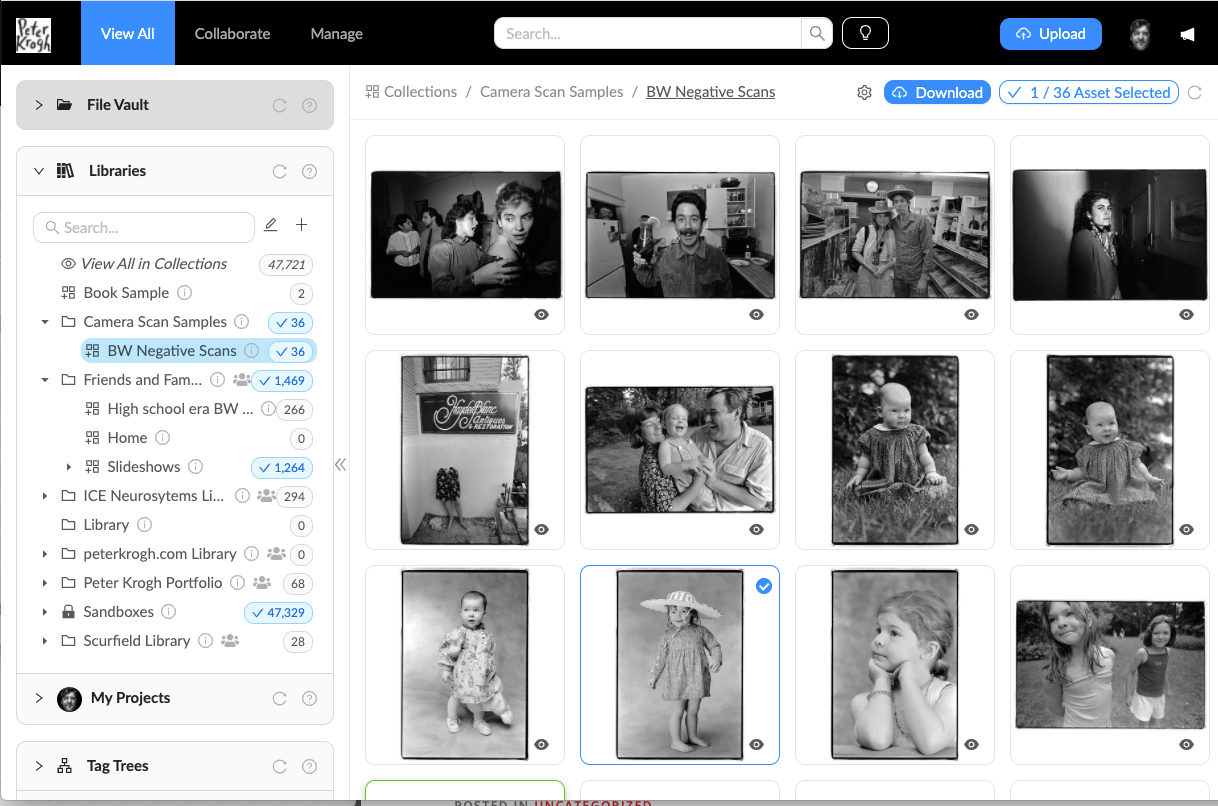
And finally, the thing that made me migrate this week was the availability of the TV3 Lightroom plugin (not yet released, but in final prep). As part of my testing, I’ve uploaded 50,000 scans through the plugin. Since I knew I would be migrating to NLP eventually, it made sense to do it now. You can take a look at some of the files by clicking this link. (And if you are interested in TV3, click here to set up a demo or to set up your own trial account.

The post Negative Lab Pro – a slam dunk for negative conversion appeared first on The DAM Book.

13 Dec 08:10

Quick Hits

by Eugene Wallingford

It's been another one of those months when I think about blogging a lot but never set aside time to write. Rather than wait for the time to finish a piece I'm writing, about the process of writing a demo code generator for my compiler students, I thought I'd drop a few tidbits now, just for fun. Maybe that will break the ice for writing this holiday week.

• Two possible titles for my next blog: Dear Crazy Future Eugene and Eugene Wallingford's Descent Into Madness. (Hey to Sheldon Cooper.)

• A nice quote from one of my daughters' alumni magazines: A biology major who is now an executive at a nonprofit agency was asked about the value of having majored in science.

When science is taught the right way, she said, "it is relevant in just about every situation".
Everyone can benefit from thinking like a scientist, and feeling comfortable with that mode of thinking. (Hey to Chad Orzel and Eureka: Discovering Your Inner Scientist.)

• Dan Wang on the US's ability to be a manufacturer of batteries:

Batteries are hard to ship and tend to be developed for particular automakers. So they're made close to the site of auto assembly. The US could be a big battery maker if only it built the charging network and offered subsidies on the scale of Europe and China, it's not hard.
The worlds of manufacturing and big industry are different in fundamental ways from software. I learn a lot from Wang's deep dives into process knowledge and investment. A lot of his ideas apply to software, too.
13 Dec 08:09

Not What I Set Out to Do

Software Design by Example Using JavaScript is now available on Leanpub, and printed copies will soon be available as well. I’m glad it’s finally out, and I hope you find it useful, but it has fallen short of my original hopes in two different ways.

The first is that there’s been no interest in the book among people who teach software design and software engineering. I taught a course called “Software Architecture” several times at the University of Toronto in the early 2000s; while lots of textbooks had those two words in their title, none of them spent more than a few pages describing the designs of actual systems. My frustration with that led to Beautiful Code and The Architecture of Open Source Applications, but as popular as they were among working programmers, only a handful of teachers used them in class. The chapters were written at very different levels and used many different programming languages, which meant they required far more background knowledge than most undergraduates had.

SDXJS fixes that by tackling problems at more or less the same level, in a domain that software engineering students will be familiar with (programming tools), and by using a single language that most potential readers will already have encountered. Despite all that, and being free, none of the software engineering faculty I’ve reached out to have shown interest in using it.

But that’s the lesser of my disappointments. (Like all authors, I’ve become very good at cataloguing and ranking disappointments…) I never wanted to write this book myself: instead, my plan was to write a few chapters to get the ball rolling and then invite people who aren’t yet well known, but should be, to contribute a chapter each. When I look at Beautiful Code now, what strikes me is how homogeneous the contributors were: while a quarter of the people we reached out to were women, 35 of the final 36 contributors were men (and almost all of them were white). AOSA wasn’t quite as bad, but I wanted SDXJS to be better because I want computer science and the tech industry to be better.

Because here’s the thing: you’re not reading this because I program—you’re reading this because I write. Thanks to a few lucky accidents (like my father being a high school English teacher) I can put words together better and faster than most people. Whatever clout I have is a result of that, not my middling-good ability to code in C or Python, and I figured that if it worked for me by accident then maybe it could be made to work for other people by design.

When I started work on SDXJS three years ago, my plan was to invite people from groups our industry has marginalized or excluded to write chapters, and to turn those chapters into conference talks, to help raise their profiles. Of the people I contacted, though, only three agreed to, and none of them delivered. I understand why not: if you’re not a straight white or Asian male then you already have to do a lot of extra work to get ahead in tech. Doing even more work on the off chance that it will lead to something else is a bad investment, and being asked to do extra work without pay—again—is just wearying.

I’m pleased with the book itself: there are still some formatting glitches, some of the diagrams could be clearer, and I still don’t think I’ve explained JavaScript promises well, but it’s not bad for a first release. If I could wind the clock back to 2018, though, I wouldn’t have started it. Designing things well matters to me—thinking and talking about it reminds me of my brother—but fixing our broken industry matters more. I still hope to see it adopted in courses, and I still think a second volume with contributions from people who deserve to be on stage just as much as I ever did might make a difference, but looking at it now, I think I could have helped more people with those hours by doing something else.

Footnote: I received two messages within minutes of publishing this post. The first told me not to be so down on myself to which I replied that I need to decide whether to put in a hundred hours to finish Building Software Together; if I don’t reflect on this project, I’m unlikely to do better with the next.

The second told me, “Don’t be such a bleeding heart. If diversty [sic] hires don’t want to work hard to get ahead they don’t deserve to.” I’m willing to bet those “diversity hires” have worked harder than the person who wrote that message has ever had to; I’m also willing to bet that he’ll never let himself see that.

13 Dec 08:04

Darn Tough Socks

by peter@rukavina.net (Peter Rukavina)

I had a hard morning, and resolve to piggyback my way to happiness on the back of buying some new socks.

My go-to sock dealer is Proude’s Shoes, and so that’s where I headed, thinking I might pick up a few pairs of the Wigwam socks they’ve been carrying for awhile (I own three pairs, and my day is always 10% better when they come up in the sock rotation).

When I arrived, I found Wigwam socks in short supply, and learned from personable manager Kevin Proude that it’s a line they’re phasing out, in favour of Darn Tough socks from Vemont.

Kevin then proceeded to give me a thorough overview of the Darn Tough selection, in a way that only Kevin can (the difference between shopping at Proude’s and shopping at a shoestore chain is like the difference between having a personal chef and eating in a cafeteria).

I walked away with two pairs of Darn Tough, a couple of pairs of Wigwam for old time’s sake, and a warm feeling about the fact that stores like Proude’s continue to thrive.

The socks, by the way, are guaranteed for life:

Our socks are guaranteed to be the most comfortable, durable, and best fitting socks you can buy. In a nutshell, if you wear a hole in them, we will replace them free of charge, for life. Things that generally are not covered—disappeared in the dryer, the dog ate them, too close to a campfire, theft by friend or foe, etc., etc. However, all claims made in good faith will be considered.

I would buy the socks based on those two sentences alone.

If your feet are cold or wet, or, like me, if you just need a piggyback ride to happiness, drop by and have Kevin give you the down-low.

13 Dec 08:03

A Simple Tweak To Asking Questions

by Richard Millington

I’m noticing in a few client communities recently that the community manager (and members) often don’t structure their questions to get the best (or most) responses.

Here is one simple tweak you can make. If you want more people to respond to questions, ask them to talk about themselves.

Compare two questions

Question 1: “What metrics are most useful for measuring [x]?”

Question 2: “What metrics do you use to measure [x]?”

Question 2 will usually get a bigger response. The reason is simple. People love to talk about themselves. Not only that, the response will usually be more valuable. People aren’t speculating about metrics anymore, they’re sharing what they actually do.

Consider another example:

Question 1: “What resources are most useful to newcomers to [x]”?

Question 2: “What resources most helped you when you were a newcomer to [x]”?

People are more likely to respond to the second one and the quality of responses will be better.

One more example:

Question 1: “What is the best way to solve [problem]?”

Question 2: “How did you solve [problem]?”

Now you’re getting responses from people who have actually solved the issue instead of people speculating about how to solve the issue.

Try it on Twitter/LinkedIn if you like, you might be surprised.

The post A Simple Tweak To Asking Questions first appeared on FeverBee.

13 Dec 08:03

The joke isn't funny anymore

by Chris Grey
There’s a palpable sense that Boris Johnson’s reputation has reached an inflexion point. For years it seemed as if however dishonest and incompetent he was he could do nothing wrong in the eyes of his supporters. Suddenly, he can do nothing right. We know that he has reached such a point because almost every newspaper columnist and editorial writer tells us so, and in this case conventional wisdom is reliable because what else can reputation consist of other than what is reputed to be?

As the political sociologist William Davies puts it, Johnson is like a financial asset that has lost the confidence of the market. And he is more vulnerable than most politicians to changing sentiment because he has so little substance in terms of policy agenda or ideological belief, which in turn means that there is no loyal group of ‘Johnsonites’. His politics are solely those of reputation and people buying in to that reputation, whether it be as ‘a character’ or, relatedly, as an election winner.

Labour’s increasingly effective attack line that “the joke isn’t funny anymore” acutely captures that vulnerability because it highlights that whilst Johnson hasn’t changed, the collective view of him has. So the man who first came to public prominence as a droll panelist on HIGNFY this week suffered the indignity of being openly mocked by Ant and Dec on I’m a Celebrity.

Of course there’s still scope for contrarian investors to keep faith with Johnson. Although his personal approval ratings have fallen considerably, and voter support for the Conservatives in opinion polls slightly, he might very well win a General Election if one were held tomorrow. And he has a track record of bouncing back from adverse headlines and scandals. However, It is significant that so many within his own party are now openly critical of him.

Most importantly, what seems different this time is the range of issues over which he is being criticized, from sleaze and cronyism, through specific policies such as rail building, sewage management and social care, to his ludicrously shambolic speech to the CBI this week, and the way that these are being knitted into a single narrative about his personal and political failures.

The marriage of Johnson and Brexit

This inevitably links to Brexit. The Guardian columnist Jonathan Freedland captures something of this in a recent article about the multiple dishonesties of Johnson’s government. He writes that “the mother and father of these dishonesties remains Brexit, still the organizing principle of this government and the adhesive that binds Johnson to his party”. I think that’s right, but the inextricable linkages of Brexit and Johnson’s administration are complicated.

Johnson might well have become Prime Minister even if Brexit never happened, and Brexit might well have happened without his support. So they are only contingently related. But it and his premiership are indelibly marked by each other.

On the one hand, when he did come to power it was not only on the back of Brexit but on the basis that he would be a ‘harder’ Brexiter than Theresa May. On the other hand, whilst the case for Brexit was always based on dollops of fantasy and hefty doses of dishonesty, it was Johnson’s fraudulent boosterism that gave Vote Leave its most compelling public face. He also supplied it with the bogus political rationality of what may well be the entirety of his personal and political credo, the proposition that it is possible to ‘have one’s cake and eat it’ or ‘cakeism’.

Cakeism has become a cliché and a joke, but its significance and its appeal as an idea shouldn’t be underestimated. It suggests that choices are free of consequences and decisions can be made without regard for trade-offs. With Brexit, that was an enabler of using ‘Project Fear’ to discredit any assessment of costs and risks. Even worse, it set up the paradoxical yet pervasive idea that Brexit was a crucial change, and yet, somehow, nothing much would really change at a practical level. From this frankly infantile view of the world grew the far more toxic way that as the costs and negative changes have transpired, they have invariably been ascribed to EU punishment or remainer treachery rather than being entailed by Brexit.

Johnson continued to maintain the doctrine of ‘cakeism’ even as he agreed the Trade and Cooperation Agreement (TCA), which he actually called “a cakeist treaty” and claimed that it proved his critics wrong as they had said there could be no free trade with the EU without obeying EU law. But of course this was a lie: critics of cakeism had said that the UK couldn’t have the advantageous terms of trade of a single market member without being a member. The TCA demonstrated that. From this, and the associated non-tariff barriers to trade, which he also dishonestly said had been avoided, flowed almost all the problems that have since bedeviled UK-EU trade.

Exactly the same bogus rationality is evident in the ongoing situation as regards the Northern Ireland Protocol (NIP), which now looks set to drag into the new year. Here, the cakeist proposition was that there needed to be a border and yet there didn’t need to be a border. Ultimately, that led to the disgraceful idea that the UK could make an agreement but that didn’t mean that it had agreed to it, which is exactly the knot that has tied up UK-EU relations ever since. Again, it is also what leads to the charge that the UK is the victim of EU ‘inflexibility’ or ‘legalism’ in applying what was agreed.

However, although Johnson’s own irresponsibility and dishonesty were well-suited to those of the Brexit project it would be wrong to conflate the two. It was a marriage of convenience for him and a polyamorous one for the Brexiters. Johnson, as is well known, might not have backed Brexit at all had he calculated that supporting remain would have advantaged him more. Meanwhile, Brexiters like David Davis, with his claim that there was a form of trade agreement that yielded the “exact same benefits” as single market and customs union membership, were perfectly capable of cakeism without any help from Johnson.

From Brexit to ‘Brexitification’

What can be said is that, by the time he became Prime Minister, Johnson and hard Brexit were inseparable. He made Brexit loyalty the sole defining test for ministerial office, and surrounded himself with ideologues from Vote Leave and associated groups to advise him. He also made ‘Brexitism’ his government’s modus operandi meaning, in particular, the hostility to and disdain for established norms associated with both the Vote Leave nihilists and the ERG Jacobins. That was immediately evident in the attempted prorogation, and has continued in the form of contempt for parliament, the civil service, the judiciary, universities, the media, and for the rule of national and international law. Thus Johnson’s is a Brexit government in the double sense of Brexit being its defining policy and of presiding over a ‘Brexitification’ of British politics.

It is therefore no coincidence that the proximate cause of his current fall from grace was the ill-fated attempt to save arch-Brexiter Owen Paterson from punishment, nor that the means of doing so was to propose to rip up the parliamentary procedures and also to smear the independent Commissioner for Standards as biased against Brexiters (£). Nor is it a coincidence that the government is engulfed in accusations of cronyism, because this grows from what in a post last April I called the “anti-ruleism” that defines the Brexit government. It is all the more toxic for its interconnections with the sense of privileged entitlement that has long characterized the Conservative Establishment, to which it adds the bizarre Brexit twist that anyone who objects is part of the ‘remainer elite’.

This Brexitification – I know it isn’t a word but it really should be, if only because it is so appropriately ugly – is not just about contempt for rules, norms and laws. It is also about the importation of the political rationality of cakeism into policy-making as a whole. Writing on the Conservative Home website this week, former Justice Secretary David Gauke suggests that across the board what we are seeing is the dysfunctionality of a politics which doesn’t accept the complexity and trade-offs of political reality and thinks that “a bit of oomph and optimism” will overcome them. I assume the Brexiters would dismiss this analysis because it comes from Gauke, one of the 21 rebels who lost the Conservative whip in 2019 for opposing no-deal Brexit. If so, that in itself is an example of Brexitification in that it views everything through the prism of Brexit tribalism. Yet, in general terms, it’s the same critique that many pro-Brexit Tory MPs are making of the government’s careless handling of policy detail.

Johnson as architect and prisoner of Brexit

If Brexitification has infected the wider policy arena, it also continues to shackle government policy towards Brexit itself. Hence it was not just that Johnson’s CBI speech was bizarre in content and inept in delivery. It was also, as a scathing editorial in The Times complained (£), that it had nothing to say about “post-Brexit skills shortages and trade barriers” nor about the poor performance of the FTSE-100 ever since the referendum. It was not “a serious speech for serious times”, whereas Sir Keir Starmer’s, which included commitments to improve on the TCA and to improve the tone of relations with the EU, was reported favourably.

Johnson isn’t in a position to make the kind of suggestions Starmer did, because he is both the architect and the prisoner of the problems Brexit is bringing daily to almost every sector from hospitality to construction to social care to financial services to touring performers. The terms of the TCA, which is up for review in 2026, could fairly easily be improved even within the restrictive parameters of hard Brexit – for example through increased regulatory alignment and a mobility chapter. Averting the as yet postponed but soon to come business nightmare of the ‘independent’ UKCA mark would also be a pragmatic step (see my post of last August for discussion). Dropping the endless antagonism towards the EU despite having left would be another, and indeed the precondition for substantive improvements in the relationship.

It is not inherent in Brexit for such modest initiatives to be impossible. But they would incite the wrath of the Brexit Ultras and be incompatible with the ‘Betamax’ approach of David Frost who has virtually sole charge of Brexit policy (Johnson having lost interest and the Foreign Office appearing simply to ignore the EU altogether). Even the very slight improvement in mood that seems recently to have appeared in the NIP talks has already been denounced as Frost “crumbling” to EU pressure. This is possibly why he has now started talking up post-Brexit tax cuts and vague regulatory reforms, these being the sort of things to get the Ultras salivating and the lack of which is one reason for their growing disaffection with Johnson. Indeed this is the main reason why the government is stuck with no serious post-Brexit policies: it can neither satisfy the Ultras nor can it ditch them.

That, too, goes a long way to explaining the inadequacy of the government’s response to Covid, especially in England, because of the very strong connection between pro-Brexit and anti-lockdown (or anti-restriction) theology. Notably, Frost’s speech also celebrated the lack of vaccine passports and mask-wearing compulsion. We also learned this week how planning for a no-deal Brexit materially damaged pandemic planning so, again, both Brexit and Brexitification have deformed policy-making in ostensibly non-Brexit areas. And, again, this intersects with Johnson’s cakeist approach in his reluctance to accept hard choices, as if it is possible both to defeat Covid and to avoid the inconveniences of tackling it. It’s as if his hero Churchill had promised to fight on the beaches so long as it didn’t disturb anyone’s dinner plans.

Vile

On the subject of beaches, nowhere is the linkage of Johnson’s waning reputation, Brexit, and Brexitification clearer than in the nationalistic panic about cross-channel migrants. As with Brexit itself, Nigel Farage is playing a key role in promoting this vile agenda. For the time being he no longer has a political party, but his media platform is enough. Thus for well over a year he has taken to hanging around grubbily on the English coast spying on migrant boats, rather like a leering suburban Peeping Tom bedecked in topless trousers and sweatily hoping for a glimpse of mottled flesh through his next-door neighbour’s steamed-up bathroom window.

His pains have been rewarded. Inevitably Johnson’s government has embraced rather than challenged Farage and the more general media viciousness about refugees and asylum seekers. After all, this was in part the fetid midden from which Brexit itself grew – recall the ‘Breaking Point’ poster - and the current discourse is entirely Brexitified. It has the same recourse to garbled, technical-sounding but false claims, notably ‘under international law they’re obliged to seek refuge in the first safe country they reach’ (cf. ‘GATT Article XXIV’), the same subliminal yet always denied racism, and the same objectification of migrants. And it has the same Brexiter simplism, reducing complex issues to tough-sounding but ineffectual slogans, whilst shifting blame to the EU or France and presenting Britain as the put-upon victim of an ‘invasion’ caused by its own ‘generosity’ (warning: the latter link contains some truly despicable claims).

It is also directly linked to Brexit given that welcoming anything like a remotely fair share of refugees and asylum seekers is deemed a betrayal of Brexit promises. As Sir Edward Leigh spluttered pucely this week, we were meant to have “taken back control of our borders” (even if not as yet going so far as Leigh’s own solution of taking back control of Calais, lost in 1558). Yet here is an obvious case of the failure of Brexiters to understand that choices have consequences. For if, as they think desirable, Britain wants to send asylum seekers back to EU (and EFTA) countries it can no longer do so using the Dublin Regulations, from which it voluntarily exited as part of Brexit.

Meanwhile, the UK’s preferred approach of creating bilateral agreements with EU countries for the same purpose has come to nothing, and any idea of such an agreement with France, in particular, looks unlikely given the parlous state of Anglo-French relations post-Brexit. The latter issue perhaps also reveals the consequences of hiving off UK-EU relations to Frost with his default setting of pugnacity and insistence on sovereignty at all costs. That hardly helps when you suddenly discover that you need cooperation and goodwill. Nor does Johnson’s long history of jibes at the French, as suggested by this morning’s news that his latest intervention, regarded by France as “unacceptable”, has prompted the withdrawal of an invitation to Home Secretary Priti Patel to discuss the situation.

At all events, far from being a solution, Brexit has added to the supposed problem and certainly done nothing to avert the horror that happened in the Channel this week which is all too likely to be repeated despite – indeed in part because of - Patel's crocodile tears. This creates another policy area in which Johnson is failing, and it’s an inevitable consequence of seeking to appease rather than challenge the Faragist narrative. Such appeasement is bound to lead to failure because it refuses to recognize the real problems and their possible solutions and also because whatever the government did wouldn’t be enough for Farage.

At the other end of the migration spectrum, a scheme announced by Patel six months ago to attract Nobel Prize winners and other field-leading figures to the UK has this week been revealed to have had precisely zero applications. It’s hardly a surprise considering how post-Brexit Britain appears to the outside world, something to which Brexiters are entirely oblivious. That includes the vileness of attitudes to refugees, of course. For whilst Brexiter politicians may purr about welcoming ‘the brightest and the best’, the general climate they have created means it’s by no means fanciful to imagine anyone who did come under the scheme being spat at, abused and told to ‘go back where you came from’, or worse.

It’s also another example of the boosterish but insubstantial nature of Brexitified politics. As Professor Andre Geim of Manchester University, himself a Nobel Laureate, put it, the scheme suffered from the “verbal diarrhoea of optimism”. Building and maintaining a science base, like many other policies, requires long patient slog to build capacity, not gimmicks or endless rhetoric about being ‘world-leading’.

After Johnson

If it’s the case that Johnson is the joke that isn’t funny anymore, it doesn’t follow that Brexit is similarly discredited. For one thing, for all that Johnson may have sold it as a larky adventure, Brexit has never been remotely amusing. More important is to recall that the connection between Johnson and Brexit is contingent rather than necessary.

This means that his demise, when it comes, will not reverse Brexitification (and, of course, will certainly not reverse Brexit). It’s all but unthinkable that his successor as Tory leader will not be an ardent Brexiter, and probably a more convinced one than Johnson. Nor is it clear that a UK government under any other party will be able, or will even necessarily try, to undo the toxic effect of Brexitificaton.

The tragedy of that will linger long after the joke has ended.

13 Dec 08:02

640 Days Later

by Rui Carmo

A little over a month since my last update on how COVID is panning out in Portugal, I think it’s time to have another look at things.

This series began 50 days after the start of the pandemic and has had irregular updates 120, 200-ish, 250-ish, 300-ish, 320-ish, 333, one year, 420, 500 and 600 days later

Yes, we're back where we were at the end of Summer. Or worse.

We should have had these discussions 30 days ago. New cases quadrupled since then.

The only saving grace here is that vaccination does work (at least in preventing ICU overrun), and that we’re already doing boosters for 65+ folk.

The number of hospital beds in use keeps climbing steadily, but fortunately not as much as last year.

But even there we should be doing more, and we lack data on the number of people who are both vaccinated and infected with milder symptoms–which is kind of essential to understanding the way the pandemic is evolving.

So yep, unfortunately I was right in the sense that we’re going to have a reprise (albeit minimized) of last year’s holiday season bumbling. Buckle up, it’s not going to be easy.


13 Dec 07:55

WordPress Multi-Region on Reclaim Cloud

by Reverend

First there was WPMu, then WPMS, and now WPMR!

Image of WordPress cluster diagram

Read more about the Multi-Region WordPress setup on Jelastic’s blog (click image)

WordPress Multi-Region is more a hosting than application specific feature, and to be clear this functionality is possible for applications beyond WordPress. But Jelastic, our Cloud Provider for Reclaim Cloud, has created a one-click application for installing a multi-region WordPress cluster that can replicate across various data centers in real-time. There are a few elements of this that are exciting as hosting providers:

  • With a one-click installer it’s easy to spin-up a complex WordPress infrastructure across numerous regions
  • It has the ability to route traffic so folks get less latency being able to access the instance closest to them
  • It bakes in fail over so that if one server in one region goes down the traffic is immediately redirected to another available datacenter to avoid downtime

These are all good reasons, but the last may be the most exciting because sites go down. Data centers catch fire, DDoS attacks happen, and servers will crash; it’s not a matter of if, only when. So, as more and more edtech infrastructure has become mission critical there needs to be options to route around that painful reality, and failover is just that: it replicates a single server setup across various data centers across various regions (US-West, Canada, UK, etc.) to ensure there isn’t one point of failure for a enterprise-level service. That’s pretty exciting given this is something we’ve been dreaming about at Reclaim Hosting for a while, and given we manage quite a few large WordPress instances, this could be an immediate options for folks that want to ensure uptime.

Image of Jelastic WPMR installer

The dialogue for the 1-click WordPress Multi-Region installer on in Reclaim Cloud’s marketplace

So, that’s the logic behind WordPress Multi-Region clusters, and while in Nashville for the Reclaim Hosting team retreat Tim started playing with this setup to test fail over. It worked in theory while we set it up, and then again in practice last week when our UK Cloud server had issues in the early morning. That reminded me that I was planning to play around with a WPMR setup for this modest standalone WP bava blog—cause the bava should never, ever go down … ever.  After that, I’ll see if I can make ds106 a multi-region setup over the winter break to get a sense of how it works with a fairly intense WPMS instance. So everything hereafter will be jotting down my progress over the last two days.

Diagram of an Maria DB Asynchronous Primary/Replica setup

I started with spinning up a multi-region cluster to host bavatuesdays. It was a 3-region cluster (US-East, US-West, and UK) and after figuring out permissions to rsync files across environments in Reclaim Cloud (it was harder than it should’ve been, thanks for the assist Chris Blankenship!) the migration was fairly straight forward. The Multi-Region setup across 3 regions has one primary cluster and two secondary clusters, and you rync the files to the primary application environment as well as import the database to that environment. Soon after that it syncs with the secondary environments, and like magic the replica clusters have all the files and database settings, posts, comments, etc., imported to the primary cluster. The replication happens in less than 60 seconds, so it might say asynchronous, but it ‘s all but immediate for my purposes.

image of bavatuesdays blog running on bavafail-1 .us cluster

bavatuesdays blog running on bavafail-1.us cluster

I did get bavatuesdays.com running in a WPMR setup for several hours yesterday while experimenting, but had to revert to the stand-alone instance given I ran into an issue creating new posts that I’m still investigating. But as you can see above the blog is running on the domain bavafail-1.us.reclaim.cloud, and there was another instance at bavafail-2.wc.reclaim.cloud, and a third at bavafail-3.uk.reclaim.cloud. You can see from the URLs they are in different regions, US (East coast), WC (US West Coast), and the UK. These all worked perfectly, and the way to have them all point to bavatuesdays.com was to add the public IP from the load balancer for each of the different regional clusters as an A record in your DNS zone editor.

Example from Jelastic's blog about adding A record for each WPMR cluster public IP address in Cloudflare

Example from Jelastic’s blog about adding A record for each WPMR cluster public IP address in Cloudflare

Reclaim Cloud provisions the SSL certificates, and after clearing the cluster’s cache the 3 sites were loading as one, with failover and regional traffic routing working well. It was pretty awesome, but there was one small issue, I could not create new posts, which is kind of a deal breaker for a blog. So I had to revert to the old server environment until I figured that issue out.* I was using the failover and routing baked into Jelastic’s setup seamlessly, but wanted to test out Cloudflare’s load balancing as well, but I’ll save those DNS explorations for another post. That said, Jelastic lays out the possibilities in their post on DNS load balancing for WordPress clusters quite well.

After setting up the A records and issuing SSL certs the bava was beaming across 3 regions. And when I turned one of the three regional clusters off, the site stayed online—so failover was working! The one issue that was also the case when Tim tested in Nashville is that when the Primary cluster goes down the secondary clusters are supposed to let you write to them. In other words, the WP authoring features accessed at /wp-admin should only work on the Primary cluster by default, but if it were to go down one of the other two secondary clusters should allow you to write.  This would not only keep the site online, but also allow posting to continue without issue, all of which should then be synced seamlessly back to the primary cluster once it comes back online. I was not able to get this functionality to work. After stopping the primary cluster, the secondary clusters would throw 500 internal server errors when trying to access /wp-admin -so that is another issue to figure out.

I have since spun down the bavafail 3-region test instance after hosing the application servers trying to downgrade PHP from 8.0.10 to 7.4.25 to test out a bad theory, so the first attempt of operation bavafailover with WPMR is dead on the operating room table. Although hope springs eternal at the bava, so I have plans to resuscitate that WPMR setup given I believe it’s a permissions issue—which means I’ll be bothering Chris again.

Image of bava.rocks failover test site

bava.rocks failover test site

In the interim, however, I’ve spun up a two-region WPMR setup using the domain bava.rocks as a way to ensure adding new posts works on a clean instance (it does), and also to see if you can access the secondary clusters to write to the database when the primary is down (you can’t), so there is still definitely more work to do on this, but it is really exciting that we are just a couple of issues away from offering enterprise-level traffic routing and fail over for folks that need it. Reclaim Cloud is the platform that just keeps on giving in terms of next-level hosting options, and I love it.

________________________________________________

*I was running into the same critical error that folks mention in this forum post, but after downgrading PHP versions from 8.0.10 to 7.4.25 on the WPMR cluster everything broke. I then tested PHP 8.0.10 on my LEMP environment for bavatuesdays (not a WPMR setup) and that worked fine. So not sure if it is specific to the WPMR setup in Jelastic, which uses LiteSpeed whereas my current blog uses Nginx, but this is something I am going to have to revisit shortly.

13 Dec 07:53

NFTs are sucking the air out of everything

It’s a secret to everyone! This post is for RSS subscribers only. Read more about RSS Club.

Twitter has been fever-pitched about Web3, blockchain, and NFTs. It’s made it an unenjoyable place for me as more and more people I follow chase the money over to Web3. Everything is getting an NFT feature: Twitter, Discord, Reddit, Disney+, Star Trek; it’s exhausting.

I spent a lot of time and emotional well-being last month thinking (aka “doing my own research”) about Web3 and NFTs. I’m not morally opposed to ledger-like problems that blockchain can solve and DAOs even sound great; but the surface area for criminal activity, unregulated markets, no consumer protection, fake scarcity to drive up values, low-quality art being cheaply made selling at inflated values, thousands of 500 watt GPUs glowing in a basement in Iowa destroying the environment for a profile picture… Ugh.

NFTs are sucking the air out of everything… both literally and figuratively.

Two weeks ago I uninstalled Twitter from my devices. Waking up in the morning I’m no longer greeted with a million angry voices. No faux conservative outrage, no reactive liberal outrage. It can all be undone in an instant, but right now I’m unplugged from the infernal machine and it feels unsettingly quiet.

13 Dec 07:53

Sort Of

by peter@rukavina.net (Peter Rukavina)

I had coffee this week with an emissary from Toronto, someone considering a move to the Island now that COVID times have rendered the big city lifeless and crowded, with none of the old upsides.

She brought word of a new CBC show, Sort Of, a show well-summarized by John Doyle in The Globe and Mail (paywall):

So far, while the series has been on CBC Gem, there’s been glowing attention to the fact that CBC has a series with a queer, brown, gender-fluid star at its core. But that’s not the sum and total of it. What makes it truly special is the energy, vitality and the fact that the tone is beautifully judged. The series is a very urban contemporary comedy, a wry portrait of the power plays in romantic relationships – of all types – and amounts to a humane, messy tale of sexual and artistic self-discovery.

You’ll come for the gender-fluidity, but you’ll stay for the performances, the writing, and the Toronto energy that, lifeless and crowded or no, remains alluring to those of us on the fragile edge.

The show is streaming on CBC Gem in Canada, and has been picked internationally. I encourage you to seek it out.

13 Dec 07:33

Bookmarked Dust Rising: Machine learning and th...

by Ton Zijlstra

Bookmarked Dust Rising: Machine learning and the ontology of the real (by David Weinberger)

I am looking forward to reading this. Will need to put aside some time to be able to really focus, given the author, and the amount of time taken to write it.

…an article I worked on for a couple of years. It’s only 2,200 words, but they were hard words to find because the ideas were, and are, hard for me. … The article argues, roughly, that the sorts of generalizations that machine learning models embody are very different from the sort of generalizations the West has taken as the truths that matter.

David Weinberger

13 Dec 07:33

When I wrote about outlining last weekend, I me...

by Ton Zijlstra

When I wrote about outlining last weekend, I mentioned Dave Winer’s blog being an outline document. Yesterday, in the context of Drummer he referred to a 2013 posting “Two ways of looking at an outliner“. In it he goes into detail how outliners aren’t only creating files (a single outline, saved in a file), but can be viewed as file systems as well. At the end of that posting he talks about how his entire blog is an outline, all stored in a single opml file. When I mentioned how Dave Winer seems to blog by starting an outline each day, I was partly right. He’s starting a new branch (i.e. a day file) in a month branch (i.e. a folder), in a year branch (i.e. a folder), in the entirety of his blog that is a single OPML file.

13 Dec 07:26

Weeknote 47/2021

by Doug Belshaw

The highlight of this week has been celebrating my mother’s 70th birthday. She doesn’t become a true Aged P. until next week, but this weekend was the best time to herd the familial cats, as it were. Despite Storm Arwen bringing trees down and snow to some parts of the country, Team Belshaw managed to make it both to the Stadium of Light to see England Women beat Austria 1-0, and then to Solberge Hall to for afternoon tea with the rest of the family.

Both my parents are only children, so there were only 10 of us in total around a huge table. My mother loved her presents, and my sister (who really should be a contestant on GBBO) made a Raffaelo-style cake which was delicious. After an overnight stay, a few of us went to Fountains Abbey and then had wonderful Sunday dinner at the Black Bull Inn at Moulton.


Work-wise, I published a post on the evolving badges and credentials ecosystem, and recorded the ICoBC Symposium panel keynote with Kerri Lemoie and Phillip Long. It was a great conversation, and we’ve invited Kerri onto The Tao of WAO podcast. Talking of the podcast, Laura edited and posted two episodes we recorded on remote work. We should be recording the final episode of Season 2 next week with another guest, and then our co-op colleagues have given us the go-ahead for a Season 3 in the new year.

Wednesday saw a co-op half-day which was a bit of a celebration in that John has given notice at the full-time job he’s been doing for the past few years, and so will be able to play more of a role in WAO work in 2022. We’ve a number of contracts and agreed bits of work going into the first quarter of next year, which is nice. We discussed a potential asset lock for our co-op but decided that we’re going to wait until we absolutely need one, as it could potentially cause more problems than it solves.

In other news, I heard that the Dutch National Libraries conference is being rearranged to the end of March, which should be good. It’s for the best given the increasing lockdowns coming into force.


Last Sunday, I hurt my back running in the cold weather. I’m not sure whether it was my poor warm-up or I just tweaked my (suspected) slipped disc from earlier this year, but I didn’t run or go to the gym all week as a precaution. Sure enough, when I went back this afternoon (and a couple of hours after a large Sunday dinner) it was hard work.

The only other thing to mention is that I wrote a blog post that arrived pretty much fully-formed as I lay half-awake and half-asleep in the early hours of Tuesday morning. Entitled That silent disappointment face, the one that I can’t bear it’s a reflection on the role disappointment plays both as a pedagogical, and to some extent philosophical tool in our interactions with others.


Next week, we need to finish off the internal part of the digital strategy work we’ve been doing for Julie’s Bicycle, and work towards finishing off this year’s set of deliverables for Participate. I’ve really enjoyed the Keep Badges Weird project we’ve done with them so far. I’m also hoping that something comes of the conversation I had with Ellie Hale and Debby Mulling from Catalyst about cohort-based digital transformation programmes.


Image based on an original photo I took inside the Cellarium at Fountains Abbey.

The post Weeknote 47/2021 first appeared on Open Thinkering.
12 Dec 06:59

How long is the list of draft postings in your ...

by Ton Zijlstra

How long is the list of draft postings in your CMS? I had about 30 from the past 3 years. This morning I went through them and moved those that still look like a posting could come from them into my Obsidian notes. I have a writing folder there, and I find it easier to write there than in the back-end of WordPress, where I still do most of my blogwriting (including this post). Those drafts that had no actual content or were very much connected to a specific moment in time (today we went…) I deleted. About a dozen drafts remain and now live in my notes. Let’s see if having those drafts in an environment where I can encounter them more regularly leads to finishing them. In the past weeks I’ve done my weeknotes postings in Obsidian first as a note, and noticed how it increased the speed of writing. (Afterwards I still need to add links and images in WP though, it’s not a micropub editor.)

03 Dec 00:53

British Water

by Stephen Rees

This morning I got an email from The Guardian, a British newspaper that I subscribe to. This is a lightly edited extract from their newsletter – about how they get “scoops”.

<blockquote>… reporter Sandra Laville came across something rather curious that made her think ‘that’s funny’. In her case, it was a statistic. 

“I came across this figure that only 14 percent of waters in English rivers were of good ecological standard,” she recalls. “I thought ‘that’s really low’.”

She started asking questions – of officials, scientists at the Environment Agency, and crucially of campaigners determined to improve the quality of their local environment. 

The big breakthrough came when she secured data from water companies on when and where sewage had been released into rivers. When she totted up the answers it came to a total of 1.5m hours of dumping in a single year

“I remember swimming in the sea 25 years ago when there was a big scandal about sewage being poured into the ocean,” Sandra tells me. “I couldn’t believe this was happening in rivers too.” 

The revelations have put pressure on the authorities to come clean on the locations and instances of sewage discharge; on the water companies to take action and invest; and on the regulator to ensure that everyone improves their game. “Nothing will change overnight – this is a massive underinvestment in infrastructure,” Sandra says. “But this has really exposed what they have been doing.” 

</blockquote>

One of the leading reasons why I came to Canada was that I no longer wanted to be an Economic Adviser to the British Government. We were shared between the Department of Transport and the Department of the Environment, and I was going to be moved from looking at London Underground investments to Water Privatisation. And I did not want any part of it. In 1988 water in the UK was controlled by a network of Regional Water Authorities. They were very effective and a distinct improvement over the earlier patchwork quilt of Water Boards. In fact the reorganisation of those was also a significant factor in my earlier career at British Waterways Board in the early 1970s but that isn’t relevant.

Mostly I wanted to work on public transport issues. There did not seem to me to any justification for the privatisation of water. Indeed, it seemed to me that the only way it could be justified was that it would reduce “public spending” (i.e. using taxation revenues) and rely of private funding. For the private sector to make money they would need to find a way to create a profit margin in what was, at the time, absent as it was not needed by the public sector. It simply did not occur to me then that new water companies would seek to cut costs by dumping untreated wastewater in rivers and the sea – but that is what they have been doing.

One of the remarkable shifts in recent years has been the steady rejection of Hayek’s philosophy pursued by Margaret Thatcher and other right wing ideologues. Nearly every policy change introduced in the name conservatism has been shown to be fallacious. The claimed outcomes of better services at lower cost are never achieved in reality – though there has always been quite a bit of “clever” bookkeeping to make it look good. But it also seems that no matter how strong the evidence, when ostensibly left leaning, “progressive” parties get into power they fall into the same mire. Both BC NDP and federal Liberals are pursuing policies that are obviously designed to benefit the few over the broader public interest. This is most clearly true in the case of energy policies. Instead of picking the cleaner, more economically affordable renewable options, our governments are still choosing to support fossils – coal, oil and fracked gas. In transportation we still opt for more freeways and road expansions even though it is clear that this has never ever cured traffic congestion and can’t due to simple geometry. That we still have a mid twentieth century commitment to extending urban sprawl indefinitely which experience shows simply increases costs in general and “externalities” that we mostly try to ignore.

Today we heard the Throne Speech from Ottawa. What we needed to hear was that as a country we are going to change direction in view of the clear and present danger now posed by the climate crisis. For a long time governments at all levels have refused to face up to this challenge and pretend that business as usual can continue. We saw exactly that at COP26 in Glasgow. We got more of the same today from Justin Trudeau. The CG did not announce the end of fossil fuel subsidies and the cancellation of TMX. There was no mention of the export of US thermal coal through Canadian ports – which only happens because no local port community in the US will allow it. Canadian ports are only lightly managed – and that is a federal jurisdiction where local concerns account for nothing. There is a lot about cleaning up the most recent messes – but not very much about what needs to be done to cope with future issues which will inevitably be even worse, as the greenhouse gases that cause these disasters have already been emitted. Too many tipping points have already passed. Too little has been achieved through carbon capture and storage – except increasing the production of oil and gas. There are no offshore wind farms around here, very little geothermal power generation (despite huge potential) and not much in the way of energy storage or improvements to the grid to accommodate renewables. And there won’t be any time soon.

How bad does it have to get to see changes in policy? It has taken Britain 50 years to acknowledge that shutting down railway branch lines was short sighted and ineffective. The mess of water privatisation has also taken a similar amount of time to be acknowledged. In Canada our governments seem even more determined to refuse to change. But then we are still digging up asbestos to export – even though its use here is banned.(Even so, asbestos is still the number one cause of claims for worker compensation in BC.) We know what we are doing is not working. There was no major announcement about reductions of oil and gas extraction so now we know that big business is still calling the shots and humanity is doomed.

As Seth Klein just tweeted: “This #ThroneSpeech was an opportunity post-election, post-COP, post-floods to announce additional climate emergency initiatives & measures. The government took a pass. An exceptionally boring speech.”

03 Dec 00:52

Introducing Firefox Relay Premium, allowing more aliases to protect your identity from spammers

by Mozilla

Today, Firefox Relay, a privacy-first and free product that hides your real email address to help protect your identity, is available with a new paid Premium service offering. The release comes just in time for the holiday season to help spare your inbox from being inundated with emails from e-commerce sites, especially those sites where you may shop or visit a few times a year.

In real life you have a phone number where family and friends can call and reach out to you directly. You likely have it memorized by heart and it’s something you’ve had for years. In your online life your email address is like your phone number, it’s a personal and unique identifier. Your email address has become the way we login and access almost every website, app, newsletter, and hundreds of other interactions we have online every single day. That means your email address is in the hands of hundreds, if not thousands, of third parties. As you think more about your email address and the places it’s being used, Firefox Relay can help protect and limit where it’s being shared.

Firefox Relay is a free service available at relay.firefox.com where you’ll get five email aliases to use whenever you sign-up for an online account. Over the last year, the team has been experimenting with Firefox Relay, a smart, easy solution that can preserve the privacy of your email address. Firefox Relay was initially rolled out to a beta phase for early adopters who like to test new products. We heard back from beta testers who provided feedback where we improved the free service and added a new paid Premium service that we’re introducing today.

How Firefox Relay works 

Firefox Relay will send and forward your email messages from your alias email addresses to your primary email address. We do not read or keep any of the content in your messages, and all email messages are deleted after they’re sent and delivered to you. 

With Firefox Relay, you’ll get five free email aliases and up to 150 kb attachments. You can sign up for Firefox Relay through our site or download it as an add-on. Additionally, we’ve added the ability for labels to be synced across devices. Labels allow you to add information like an account name or a description so it’ll be easier for you to know which sites you are using the alias for. With this new syncing, you’ll be able to see these labels on all your devices, including mobile. 

To bring protection to more people, Firefox Relay will now be available in the following languages: Chinese, Dutch, French, English, German, Greek, Italian, Portuguese, Slovak, Spanish, Swedish, Ukrainian and Welsh.

Here’s how Firefox Relay works:

Step 1: Go to relay.firefox.com

Step 2: Sign in with your Firefox Account or sign up for a Firefox Account (this takes less than two minutes and it’s worth it!)

Step 3: Once you’re signed in you can generate up to five free random email aliases to use. If you need more than five email aliases, you can sign up for a Premium paid service.

Step 4: Then, when you sign up for a new online account you can go to the Firefox Relay dashboard to generate an email alias or you can click the Firefox Relay button that may appear in the login box to use one of those email aliases. Then, Firefox Relay will forward emails from the alias to your real inbox, keeping your actual email address hidden.

Sign up through our website or as an add-on

Want more email address aliases? Try Firefox Relay Premium

During the beta testing phase, we heard from many users who wanted more email address aliases. So, we decided to offer a Premium service where subscribers will receive one subdomain alias to create unlimited email aliases, for example coffeestore@yourdomain.mozmail.com or yourfavoriteshoestore@yourdomain.mozmail.com; a summary dashboard of your email aliases; the option to use your email aliases to reply to emails directly; and customer support through our convenient contact form. Premium subscribers will also receive the 150 kb attachment that is currently available to free subscribers. 

For a limited time, we will be offering a very low introductory price of $0.99 a month (available in Canada, United States, United Kingdom, Malaysia, Singapore and New Zealand) and 0.99 EUR/1.00 CHF in Europe (Austria, Belgium, France, Germany, Ireland, the Netherlands, Spain and Switzerland).

A summary dashboard of your email aliases

Thank you Firefox community and beta testers 

We appreciate the thousands of beta testers who participated in the early beta testing phase since we started this journey. It’s their voice and impact that have motivated and inspired us to continue to develop this product. Thanks to their support, we’re happy to graduate the Firefox Relay product and provide a Premium offering. 

To learn more about our other Mozilla products, check out these:

The post Introducing Firefox Relay Premium, allowing more aliases to protect your identity from spammers appeared first on The Mozilla Blog.

03 Dec 00:51

Earflaps discussion

by jnyyz

At the opening of the new bike lanes in Ward 13, one of the things that I noticed was the spiffy knitted earflaps that Brian was wearing. I’ve noted in the past that earflaps are awesome.

They looked much fancier than my fleece earflaps.

so I posted both pictures to Facebook, which resulted in this long discussion.

https://www.facebook.com/groups/TorontoCyclists/?multi_permalinks=4319277998181376

(note that this is a private FB group, and so you will have to join first)

One of the things that came out of that discussion is that a local person was willing to knit some earflaps out of reflective yarn.

I acquired a pair today. You can see from this flash picture that although the yarn colour is nominally dark grey, the reflective yarn shows up nicely in a flash photo.

These seem much warmer than my fleece ones, but part of that impression could be from the fact that it warmed up to 12°C while I was riding home.

At any rate, thanks Patti for the new earflaps. If you want a pair you can track her down from the Facebook post above. I might order another pair with one slight tweak: having the button lower, i.e. just about an inch above the bottom. At present, the button doesn’t do much to keep the flaps from shifting down below my ears.

As an alternative, you can always cut a pair from any fleecy fabric using this pattern.

03 Dec 00:49

Proviz Reflect 360 CRS Jacket final update

by jnyyz

Following my initial review, and my update from last year, I’ve decided that it is the end of the line for my Proviz 360 CRS Jacket. The zipper failed last week.

This in itself is not fatal and I’ve had a zipper replaced on jackets before, but the fabric has also literally started to come part in some areas.

I’m now left with a decision on whether to replace the jacket with something similar as winter descends. I will note that my previous Proviz Reflect 360+ plus jacket lasted three years, and this one only lasted two years. Santa might have some thoughts on this.

03 Dec 00:48

First snow on ground 2021

by jnyyz

Just barely qualifying for first snow on ground. We might get something more substantial on Sunday. Of course roads are still clear.

03 Dec 00:48

Census Mapper, a tool to visualize population and racial shifts

by Nathan Yau

Pitch Interactive and the Census 2020 Data Co-op, supported by the Google News Initiative, made a tool that lets you easily map population shifts since 2010. It’s called Census Mapper.

Built with journalists in mind, you can zoom in to the tract level and select any set of racial groups. The map updates. Once you’ve found what you’re looking for, you can embed the tool on a website. You can only embed the entire tool for now, as opposed to just the map of a specific geographic area and level, but it looks promising.

Tags: census, Google News Initiative, Pitch Interactive, population, race

02 Dec 18:56

Quoting Rasmus Lerdorf

htmlspecialchars was a very early function. Back when PHP had less than 100 functions and the function hashing mechanism was strlen(). In order to get a nice hash distribution of function names across the various function name lengths names were picked specifically to make them fit into a specific length bucket. This was circa late 1994 when PHP was a tool just for my own personal use and I wasn't too worried about not being able to remember the few function names.

Rasmus Lerdorf