Shared posts

24 Jun 18:30

Discussion: Is Vancouver Truly ‘Making Room’ for More Affordable Housing for All?

by colinmstein

Amidst the ongoing housing affordability crisis in the Vancouver region, and just four months before municipal elections, City of Vancouver council earlier this week unanimously approved a new financial strategy for the Housing Vancouver strategy.

Intended to support the addition of 72,000 new homes across Vancouver over the next 10 years — half of which will serve households earning less than $80k/year, and two-thirds of which will be for renters — this is just one among a number of decisions made by Council supporting their Making Room program, including:

  • creating Affordable Housing Endowment Fund
  • allocation of first $8M of Empty homes tax revenue to support co-ops, rent bank and SRO upgrades
  • amendments that would: allow triplexes, quadplexes and other multi-unit forms in low density neighbourhoods; set maximum unit sizes in low-density neighbourhoods; reduce or eliminate parking requirements; provide greater support for projects with community benefit, such as new rental, co-ops, co-housing or land trusts; and, in some circumstances, reduce or eliminate setback requirements and design guidelines that limit housing options.

All of Wednesday’s actions are summarized in this press release from the city.

Some critics have expressed concern that increasing allowable density on sites without significant changes to the rezoning and development permit process will just recreate the same affordability crisis we are in today, thus “kicking the can down the road”.

Are we sure this will bring affordability and sufficient options to the city? We asked some regular Price Tags contributors what they thought.

Photo: Lanefab Design/Build. Check out their #NoAssemblyRequired collection on Pinterest: “Built Examples of Small Lot Multifamily Housing”.

Ian Robertson, m.arch.

In business, when a stock becomes too expensive to be well traded on the market, companies will often engage in a ‘stock split’ that does nothing to change overall value, but that does break the stock into more approachable pieces.

Allowing more density in single family areas is simply a manifestation of this idea brought to property. It won’t magic instant affordability for those in dire need, but it does create a class of more affordable housing, that may help many.

Is 3 or 4 units per lot enough of a split to help enough people? Perhaps in East Vancouver, but it will split West Side properties insufficiently to be helpful for much of the city. It will be interesting to see what is meant by ‘other multifamily’ and where it is intended for that ‘other multifamily’ to go.

This will be a massive service to simplifying what can be built throughout the city, as at the moment the micro-segmentation of zones is cumbersome at best. I worry, though, that unwritten and secret rules will still fight against any additional apparent zoning simplicity.

The $8m will do some help, but will run out quickly unless augmented substantially by additional funding measures.

It will be very beneficial to the cost of building if parking requirements are adapted to reflect realistic actual parking ownership. There will be a report released later this year which will give even better data for this.

Stuart Smith – Abundant Housing Vancouver

The biggest benefit to allowing significantly more buildable (not necessarily built!) square feet of floorspace throughout the city, and throughout the region, is to limit the ability of landowners to extract monopoly prices and rents per unit of floorspace.

We have only one built form that can add housing (measured however you wish, floorspace, bedrooms, homes) to a city that cannot expand, and a region that doesn’t want to drive 3 hours per day or build a freeway: multifamily.

Tiny homes are great and should be legal. Laneways are great and should be legal. Collective houses are great and should be legal. Multiple conversions are great and should be legal. Basement suites are fine and should be legal too. Every form of housing should be legal, on every lot, in every neighbourhood.

But the biggest bang (# of sqft of floorspace, bedrooms, homes) for the buck (time, construction cost, construction externalities) is going to be a wood frame apartment building without parking.

However, land that’s legal to build multi-family on is extremely constrained (by law, not reality or physics), and after 90 years of concentrating all population growth on it, mostly already has higher than average density.

So in the status quo, the only way to add housing is to demolish an old apartment build a newer, larger one. This has been the cycle for 90 years since zoning was invented – push new housing on top of the already dense, usually lower income areas.

Owners of this multifamily land know that buyers have few options but to buy their land, so they can and do ask for the moon. And remember, they are pricing in terms of buildable floorspace, not dirt. So doubling the density on just one single piece of land doesn’t reduce the land cost per home or per sqft of floorspace – the landowner will be demanding a given $ per unit floorspace and will just double their price.

However, doubling (or 10x’ing!) the density on every piece of land has the opposite effect, creating far more buildable sqft chasing the same amount of consumers — buyers or renters.

By opening up more land to build multifamily on, the landowners of existing multifamily land lose negotiating power. If they ask for too much, the buildings go elsewhere. The rate of construction isn’t going to change radically. But where buildings go and how much unit land cost is can change a lot.

By opening up land that is low density and high income, we minimize risk of displacement.

Positive steps, but as long as the type of housing average buyers/renters are able to afford are illegal on most of the land, we are a long way from any sort of equitable land use policy.

Michael Mortensen, ma, mcip, rpp – Liveable City Planning

A basic financial analysis indicates that duplexes do not go far enough towards a more affordable housing form in Vancouver’s suburbs.

Our RS-1 neighbourhoods occupy around 85% of our land base, but accommodate less than 75% of our population. Suburban homes in these areas priced at $1.5M or more are affordable to less than 15% of our households, and require down-payments north of $380,000.

Allowing 4 or more smaller units per lot and relaxing parking just makes sense in this day and age. This form of gentle multi-family infill is not what the luxury market is looking for, but it is vastly more affordable — and accessible to a wider cross-section of Vancouver families — than the existing Single Detached or Duplex paradigm.

24 Jun 18:30

The Best USB-C Battery Packs and Power Banks

by Mark Smirniotis
The Best USB-C Battery Packs and Power Banks
Photo: Mark Smirniotis

After more than 40 hours researching 23 USB-C power banks and testing 14 of them, we found that the ZMI USB PD Backup Battery & Hub is the best option to power any USB-C device when you’re away from an outlet: Its 45 W output can charge smartphones, tablets, and even laptops. Plus it can act as a USB adapter and hub, meaning that there’ll be one less thing to carry in your laptop bag when you’re away from your desk.

24 Jun 18:28

State of Mozilla Support: 2018 Mid-year Update – Part 1

by Michał

Hello, present and future Mozillians!

As you may have heard, Mozilla held one of its All Hands biannual meetings, this time in San Francisco. The support.mozilla.org Admin team was there as well, along with several members of the support community.

The All Hands meetings are meant to be gatherings summarizing the work done and the challenges ahead. San Francisco was no different from that model. The four days of the All Hands were full of things to experience and participate in. Aside from all the plenary and “big stage” sessions – most of which you should be able to find at Air Mozilla soon – we also took part in many smaller (formal and informal) meetings, workshops, and chats.

By the way, if you watch Denelle’s presentation, you may hear something about Mozillians being awesome through helping users ;-).

This is the first in a series of posts summarizing what we talked about regarding support.mozilla.org, together with many (maaaaaany) pages of source content we have been working on and receiving from our research partners over the last few months.

We will begin with the summary of quite a heap of metrics, as delivered to us in by the analytics and research consultancy from Copenhagen – Analyse & Tal (Analysis & Numbers). You can find all the (105!) pages here but you can also read the summary below, which captures the most important information.

The A&T team used descriptive statistics (to tell a story using numbers) and network analysis (emphasizing interconnectedness and correlations), taking information from the 11 years of data available in Kitsune’s databases and 1 year of Google Analytics data.

Almost all perspectives of the analysis brought to the spotlight the amount of work contributed and the dedication of numerous Mozillians over many years. It’s hard to overstate the importance of that for Mozilla’s mission and continuous presence and support for the millions of users of open source software who want an open web. We are all equally proud and humbled that we can share this voyage with you.

As you can imagine, analyzing a project as complex and stretched in time as Mozilla’s Support site is quite challenging and we could not have done it without cooperation with Open Innovation and our external partners.

Key Takeaways

  • In the 2010-2017 period, only 124 contributors were responsible for 63% of all contributions. Given that there are hundreds of thousands of registered accounts in the system, there is a lot of work to do for us to make contributions easier and more fun.
  • There are quite a few returning contributors who contribute steadily over several years.
  • There are several hundreds of contributors who are active within a short timeframe and even more very occasional helpers. In both cases, making sure long-term contributing is appealing to them.
  • While our community has not shown to be worryingly fragile, we have to make sure we understand better how and why contributions happen and what can be done to ensure a steady future for Mozilla’s community-powered Support.
  • The Q&A support forums on the site are the most popular place for contributions, with the core and most engaged contributors present mostly there.
  • On the other hand, the Knowledge Base, even if it has fewer contributors, sees more long-term commitment from returning contributors.
  • Contributors through Twitter are a separate group, usually not engaged in other support channels and focusing on this external platform.
  • Firefox is the most active product across all channels, but Thunderbird sees a lot of action as well. Many regular contributors are active supporting both products.
  • Among other Firefox related products, Firefox for Android is the most established one.
  • The top 15 locales amount to 76 percent of the overall revisions in the Knowledge Base, with the vast majority of contributions coming from core contributors mostly.
  • Based on network analysis, Russian, Spanish, Czech, and Japanese localization efforts are the most vulnerable to changes in sustainability.

What’s Next?

Most of the findings in the report support many anecdotal observations we have had, giving us a very powerful set of perspectives grounded in over 7 years’ worth of data. Based on the analysis, we are able to create future plans for our community that are more realistic and based on facts.

The A&T team provided us with a list of their recommendations:

  • Understanding the motivations for contributing and how highly dedicated contributors were motivated to start contributing should be a high priority for further strategic decisions.
  • Our metrics should be strategically expanded and used through interactive dashboards and real time measurements. The ongoing evolution of the support community could be better understood and observed thanks to dynamic definitions of more detailed contributor segments and localization, as well as community sustainability scores.
  • A better understanding of visitors and how they use the support pages (more detailed behaviour and opinions) would be helpful for understanding where to guide contributors to ensure a both a better user experience and an enhanced level of satisfaction among contributors.

Taking our own interpretation of the data analysis and the A&T recommendations into account, over the next few weeks we will be outlining more plans for the second half of the year, focusing on areas like:

  • Contributor onboarding and motivation insights
  • A review of metrics and tools used to obtain them
  • Recruitment and learning experiments
  • Backup and contingency plans for emergency gaps in community coverage
  • Tailoring support options for new products

As always, thank you for your patience and ongoing support of Mozilla’s mission. Stay tuned for more post-All Hands mid-year summaries and updates coming your way soon – and discuss them in the Contributors or Discourse forum threads.

24 Jun 18:26

A continent on the rise

Last week, we saw that German streets will be filled with less and less young people. This will affect the size of the German population: In 2100, Germany will have 15% fewer inhabitants than it has these days (according to the UN).

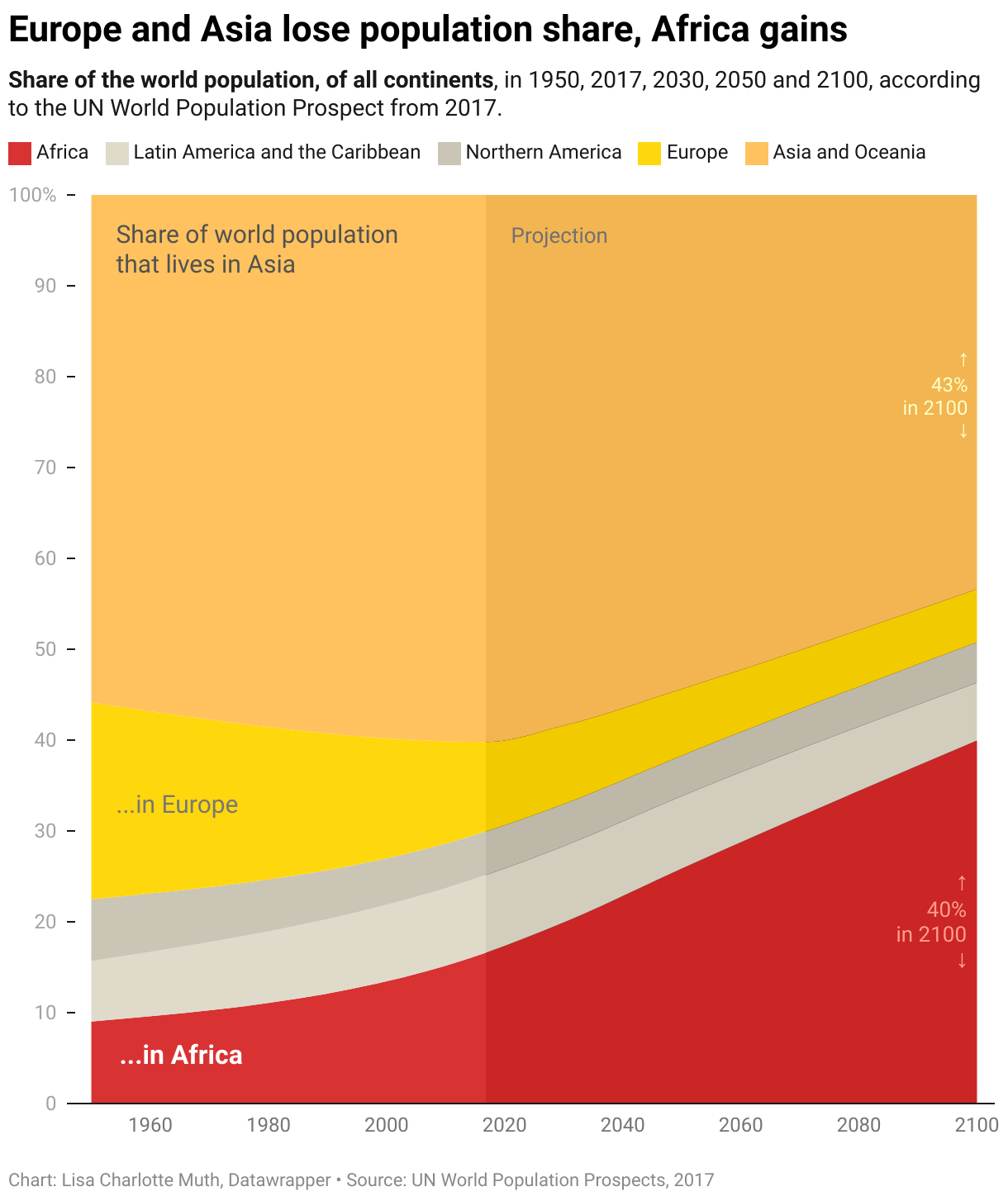
But while lots of (mostly European countries) shrink, there are many countries where the population grows rapidly. You might think of Asian countries like India. But when it comes to the share of the human population on each continent, Asia might reach its peak in the coming years:

Africa will be huge. The UN predicts that in 2100, the world will be populated by almost as many Africans as Asians. Let’s set this growth in context: In 1950, more Europeans and North Americans were alive than Africans. In 2100, there will be four times as many Africans as Europeans and North Americans together. [1]

However, let’s remind ourselves that these are projections. The further we go into the future, the more uncertain it becomes. Wikipedia makes that uncertainty clear when talking about world population projections: “Longer-term speculative scenarios over the next two centuries can predict anything between runaway growth to radical decline (36.4 billion or 2.3 billion people in 2300)".

Chart choices

I actually wanted to create a Stacked Bar Chart with this data, but I’m glad I listened to my colleague Gregor in the last minute and created an Area Chart. Area Charts have axes with continuous scales, so it’s perfect for time data like our one. The years in our data are not evenly spaced (1950, 2017, 2030, 2050, 2100), and the x-axis of our chart will show the data in the right intervals (hover over the chart to see what I mean!).

The most important decision you can make while working with Area Charts is the order of your stack. Sorting the countries from smallest to largest share would not have been the best idea. It’s easiest for humans to estimate the size of the data that’s at the bottom of the chart, resting on the straight axis line. That’s why I put Africa there. It’s the most important continent in our data, so let’s make sure that we can read the values of it well.

Because Africa is so important for the statement I want to make, it also gets the most aggressive color. Basically, I can lead the eye of readers with colors: I want them to look at Africa first (super red it is!), then Asia and Europe (yellow and orange), then North and South American (they’re really not important for my statement, so they get a subtle grey).


In the last four weeks, we’ve been talking about age. Since that’s getting a bit old (pun definitely intended), we’re changing topics next week. Have a good week!


  1. Why is that? “Oh I know,” you might say, “that’s because the fertility rate in many African countries is so high. Africans will continue to have many kids.” But the “UN World Population Prospects” report makes clear that the foundation for this growth is already laid today: “…the population of Africa will continue to increase in future decades even if the number of births per woman falls instantly to the … ‘replacement-level fertility’” (That would be 2.1 children per woman. In many African countries, the current fertility rate is 5 children per woman or higher.) There are so many young Africans these days, that once they grow up, “their childbearing will contribute to a further increase of population even assuming that they will bear fewer children on average than their parent’s generation”. from https://esa.un.org/unpd/wpp/Publications/Files/WPP2017_KeyFindings.pdf, page 4

24 Jun 18:26

Vancouver Biennale: Paradise Has Many Gates

by Ken Ohrn

A mosque is rising at Vanier Park in Vancouver. It’s part of the 2018-2020 Vancouver Biennale, which has brought public art to Vancouver since 1998.

The artist is Ajlan Gharem, a graduate from King Khalid University. A public school mathematics teacher in Riyadh, Gharem is also co-founder of Gharem Studio, along with his brother.

On Tuesday, June 26, the unveiling of Gharem’s “Paradise Has Many Gates” will be the official launch event for the 2018 – 2020 Vancouver Biennale. The artist will be on site.

Tuesday, June 26:

  • 10:00-10:30am: Welcoming from First Nations.
  • 10:30-11:00am: Opening Remarks including Park Board, Mauro Vescara (CEO of MOV), et al.
  • 11:00am-1pm: Press Interviews, General Questions and Dialogue with Ajlan Gharem.

Wednesday, June 27 (6 -9:22 pm)

From the Vancouver Biennale:

Ajlan Gharem is a multidisciplinary artist who explores how Saudis articulate their culture…in a world of increasing globalization and constantly changing power dynamics.

In a climate of rapid development across the Gulf and a cautious Saudi response, Ajlan’s work focuses on the balance of power between the individual and the state and on his generation’s ability to create change.

24 Jun 18:26

Centipede Reclaimed

by Reverend

Not only did I achieve on of my life goals by helping to run a Video Rental Store while back in Fredericksburg last week, but I also checked off another bucket list item: owning a classic 80s video game cabinet. That’s right CoWork is now the home to a gorgeous 1980 Centipede cabinet that works perfectly and is all original. 

Beautiful, indeed! The high scores were not registering, but Tim has already figured out the issue (a bad electrically alterable read only memory (EAROM) chip) and swapped it out which fixed it! I wanted the game cause I love this crap, but what we didn’t realize was how welcome an addition it was to our co-working space. The volume can be turned down, and folks will randomly get up and just play a game, and it is so fun. It is an object of shared attention at times, and it only makes me want another 🙂 Tim has been tossing out the idea of giving whoever has the high school at the beginning of the month free membership for that month. I love that idea, although productivity may go way down, and we might need to charge quarters to afford it 🙂

Another thing worth noting is the gorgeous artwork on the cabinet, it is really a standalone art piece apart from the awesome rollerball gameplay.

And then Grant Potter, as he is wont to do, drops this AMA Reddit thread in Twitter featuring the Centipede programmer, Dona Bailey, who donated her Centipede machine “to the VA hospital where the author Ken Kesey worked when he was a student in the writing workshop at Stanford.” The life of a Reclaimer is always intense!

24 Jun 18:26

So You Want to Be Vancouver’s Mayor?

by Ken Ohrn

As Vancouver’s 2018 civic election gets closer (October 20), mayoral candidate Wai Young has sounded off with policy positions on a major city responsibility:  transportation.

And it’s drawn a few caustic responses.  Here’s one, from Charlie Smith in Vancouver’s Georgia Straight.

Memo to Wai Young: Bike lanes save lives—and crackpot transportation policies jeopardize the economy.

As more people make the same choice as I did—to cycle rather than drive—this facilitates the movement of goods and services around the city. It makes the roads less cluttered, which means less traffic congestion and less air pollution.

But there’s a new mayoral candidate who doesn’t like separated bike lanes.

Wai Young wants to stop developing new bike lanes so that people like me make the choice to drive rather than cycle. . .

She wants people like me in my car, where I will be more of a menace to pedestrians and other cyclists.

The upshot of this approach is a city with more emissions, slower-moving traffic, and more deaths on the roads.

That’s not going to help the economy.

I can hardly wait for Ms. Young’s upcoming housing policy, sure to be as clearly thought out. This from a mayoral candidate who told CBC’s Stephen Quinn this morning that bike lanes were the number one concern in Vancouver, according to her followers.

24 Jun 18:23

Ways to think about machine learning

by Benedict Evans

We're now four or five years into the current explosion of machine learning, and pretty much everyone has heard of it. It's not just that startups are forming every day or that the big tech platform companies are rebuilding themselves around it - everyone outside tech has read the Economist or BusinessWeek cover story, and many big companies have some projects underway. We know this is a Next Big Thing.

Going a step further, we mostly understand what neural networks might be, in theory, and we get that this might be about patterns and data. Machine learning lets us find patterns or structures in data that are implicit and probabilistic (hence ‘inferred’) rather than explicit, that previously only people and not computers could find. They address a class of questions that were previously ‘hard for computers and easy for people’, or, perhaps more usefully, ‘hard for people to describe to computers’. And we’ve seen some cool (or worrying, depending on your perspective) speech and vision demos. 

I don't think, though, that we yet have a settled sense of quite what machine learning means - what it will mean for tech companies or for companies in the broader economy, how to think structurally about what new things it could enable, or what machine learning means for all the rest of us, and what important problems it might actually be able to solve. 

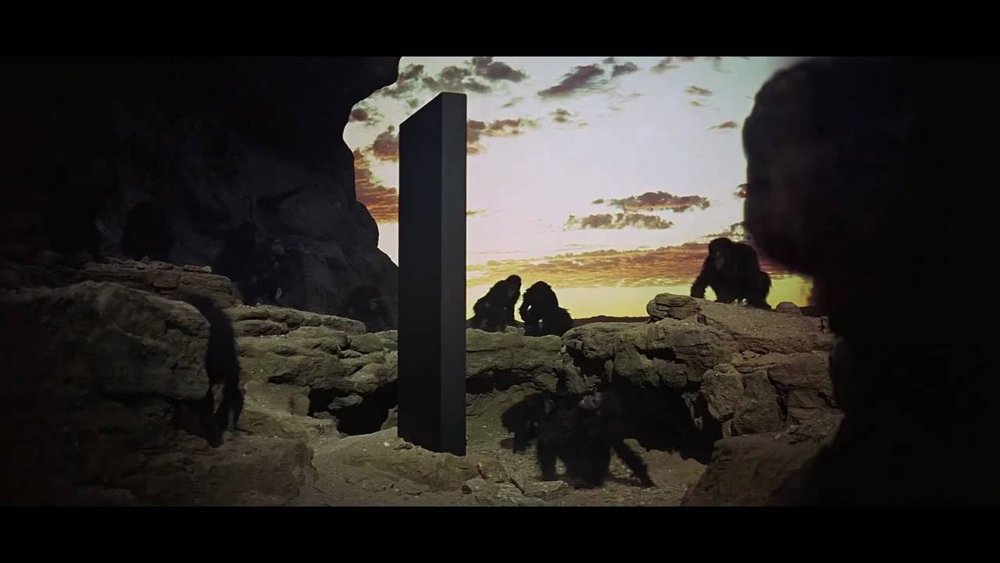
This isn't helped by the term 'artificial intelligence', which tends to end any conversation as soon as it's begun. As soon as we say 'AI', it's as though the black monolith from the beginning of 2001 has appeared, and we all become apes screaming at it and shaking our fists. You can’t analyze ‘AI’. 

maxresdefault.jpg

Indeed, I think one could propose a whole list of unhelpful ways of talking about current developments in machine learning. For example:

  • Data is the new oil

  • Google and China (or Facebook, or Amazon, or BAT) have all the data

  • AI will take all the jobs

  • And, of course, saying AI itself.

More useful things to talk about, perhaps, might be: 

  • Automation

  • Enabling technology layers

  • Relational databases.

Why relational databases? They were a new fundamental enabling layer that changed what computing could do. Before relational databases appeared in the late 1970s, if you wanted your database to show you, say, 'all customers who bought this product and live in this city', that would generally need a custom engineering project. Databases were not built with structure such that any arbitrary cross-referenced query was an easy, routine thing to do. If you wanted to ask a question, someone would have to build it. Databases were record-keeping systems; relational databases turned them into business intelligence systems. 

This changed what databases could be used for in important ways, and so created new use cases and new billion dollar companies. Relational databases gave us Oracle, but they also gave us SAP, and SAP and its peers gave us global just-in-time supply chains - they gave us Apple and Starbucks. By the 1990s, pretty much all enterprise software was a relational database - PeopleSoft and CRM and SuccessFactors and dozens more all ran on relational databases. No-one looked at SuccessFactors or Salesforce and said "that will never work because Oracle has all the database" - rather, this technology became an enabling layer that was part of everything.

So, this is a good grounding way to think about ML today - it’s a step change in what we can do with computers, and that will be part of many different products for many different companies. Eventually, pretty much everything will have ML somewhere inside and no-one will care. 

An important parallel here is that though relational databases had economy of scale effects, there were limited network or ‘winner takes all’ effects. The database being used by company A doesn't get better if company B buys the same database software from the same vendor: Safeway's database doesn't get better if Caterpillar buys the same one. Much the same actually applies to machine learning: machine learning is all about data, but data is highly specific to particular applications. More handwriting data will make a handwriting recognizer better, and more gas turbine data will make a system that predicts failures in gas turbines better, but the one doesn't help with the other. Data isn’t fungible. 

This gets to the heart of the most common misconception that comes up in talking about machine learning - that it is in some way a single, general purpose thing, on a path to HAL 9000, and that Google or Microsoft have each built *one*, or that Google 'has all the data', or that IBM has an actual thing called ‘Watson’. Really, this is always the mistake in looking at automation: with each wave of automation, we imagine we're creating something anthropomorphic or something with general intelligence. In the 1920s and 30s we imagined steel men walking around factories holding hammers, and in the 1950s we imagined humanoid robots walking around the kitchen doing the housework. We didn't get robot servants - we got washing machines.

Screen Shot 2017-11-02 at 4.44.52 PM.png

Washing machines are robots, but they're not ‘intelligent’. They don't know what water or clothes are. Moreover, they're not general purpose even in the narrow domain of washing - you can't put dishes in a washing machine, nor clothes in a dishwasher (or rather, you can, but you won’t get the result you want). They're just another kind of automation, no different conceptually to a conveyor belt or a pick-and-place machine. Equally, machine learning lets us solve classes of problem that computers could not usefully address before, but each of those problems will require a different implementation, and different data, a different route to market, and often a different company. Each of them is a piece of automation. Each of them is a washing machine. 

Hence, one of the challenges in talking about machine learning is to find the middle ground between a mechanistic explanation of the mathematics on one hand and fantasies about general AI on the other. Machine learning is not going to create HAL 9000 (at least, very few people in the field think that it will do so any time soon), but it’s also not useful to call it ‘just statistics’. Returning to the parallels with relational databases, this might be rather like talking about SQL in 1980 - how do you get from explaining table joins to thinking about Salesforce.com? It's all very well to say 'this lets you ask these new kinds of questions', but it isn't always very obvious what questions. You can do impressive demos of voice recognition and image recognition, but again, what would a normal company do with that? As a team at a major US media company said to me a while ago: 'well, we know we can use ML to index ten years of video of our talent interviewing athletes - but what do we look for?’ 

What, then, are the washing machines of machine learning, for real companies? I think there are two sets of tools for thinking about this. The first is to think in terms of a procession of types of data and types of question:  

  1. Machine learning may well deliver better results for questions you're already asking about data you already have, simply as an analytic or optimization technique. For example, our portfolio company Instacart built a system to optimize the routing of its personal shoppers through grocery stores that delivered a 50% improvement (this was built by just three engineers, using Google's open-source tools Keras and Tensorflow).

  2. Machine learning lets you ask new questions of the data you already have. For example, a lawyer doing discovery might search for 'angry’ emails, or 'anxious’ or anomalous threads or clusters of documents, as well as doing keyword searches,

  3. Third, machine learning opens up new data types to analysis - computers could not really read audio, images or video before and now, increasingly, that will be possible.

Within this, I find imaging much the most exciting. Computers have been able to process text and numbers for as long as we’ve had computers, but images (and video) have been mostly opaque. Now they’ll be able to ‘see’ in the same sense as they can ‘read’. This means that image sensors (and microphones) become a whole new input mechanism - less a ‘camera’ than a new, powerful and flexible sensor that generates a stream of (potentially) machine-readable data.  All sorts of things will turn out to be computer vision problems that don’t look like computer vision problems today. 

This isn’t about recognizing cat pictures. I met a company recently that supplies seats to the car industry, which has put a neural network on a cheap DSP chip with a cheap smartphone image sensor, to detect whether there’s a wrinkle in the fabric (we should expect all sorts of similar uses for machine learning in very small, cheap widgets, doing just one thing, as described here). It’s not useful to describe this as ‘artificial intelligence’: it’s automation of a task that could not previously be automated. A person had to look.  

This sense of automation is the second tool for thinking about machine learning. Spotting whether there’s a wrinkle in fabric doesn't need 20 years of experience - it really just needs a mammal brain. Indeed, one of my colleagues suggested that machine learning will be able to do anything you could train a dog to do, which is also a useful way to think about AI bias (What exactly has the dog learnt? What was in the training data? Are you sure? How do you ask?), but also limited because dogs do have general intelligence and common sense, unlike any neural network we know how to build. Andrew Ng has suggested that ML will be able to do anything you could do in less than one second. Talking about ML does tend to be a hunt for metaphors, but I prefer the metaphor that this gives you infinite interns, or, perhaps, infinite ten year olds. 

Five years ago, if you gave a computer a pile of photos, it couldn’t do much more than sort them by size. A ten year old could sort them into men and women, a fifteen year old into cool and uncool and an intern could say ‘this one’s really interesting’. Today, with ML, the computer will match the ten year old and perhaps the fifteen year old. It might never get to the intern. But what would you do if you had a million fifteen year olds to look at your data? What calls would you listen to, what images would you look at, and what file transfers or credit card payments would you inspect?

That is, machine learning doesn't have to match experts or decades of experience or judgement. We’re not automating experts. Rather, we’re asking ‘listen to all the phone calls and find the angry ones’. ‘Read all the emails and find the anxious ones’. ‘Look at a hundred thousand photos and find the cool (or at least weird) people’. 

In a sense, this is what automation always does; Excel didn't give us artificial accountants, Photoshop and Indesign didn’t give us artificial graphic designers and indeed steam engines didn’t give us artificial horses. (In an earlier wave of ‘AI’, chess computers didn’t give us a grumpy middle-aged Russian in a box.) Rather, we automated one discrete task, at massive scale. 

Where this metaphor breaks down (as all metaphors do) is in the sense that in some fields, machine learning can not just find things we can already recognize, but find things that humans can’t recognize, or find levels of pattern, inference or implication that no ten year old (or 50 year old) would recognize. This is best seen Deepmind’s AlphaGo. AlphaGo doesn’t play Go the way the chess computers played chess - by analysing every possible tree of moves in sequence. Rather, it was given the rules and a board and left to try to work out strategies by itself, playing more games against itself than a human could do in many lifetimes. That is, this not so much a thousand interns as one intern that’s very very fast, and you give your intern 10 million images and they come back and say ‘it’s a funny thing, but when I looked at the third million images, this pattern really started coming out’. So, what fields are narrow enough that we can tell an ML system the rules (or give it a score), but deep enough that looking at all of the data, as no human could ever do, might bring out new results? 

I spend quite a lot of time meeting big companies and talking about their technology needs, and they generally have some pretty clear low hanging fruit for machine learning. There are lots of obvious analysis and optimisation problems, and plenty of things that are clearly image recognition problems or audio analysis questions. Equally, the only reason we’re talking about autonomous cars and mixed reality is because machine learning (probably) enables them - ML offers a path for cars to work out what’s around them and what human drivers might be going to do, and offers mixed reality a way to work out what I should be seeing, if I’m looking though a pair of glasses that could show anything. But after we’ve talked about wrinkles in fabric or sentiment analysis in the call center, these companies tend to sit back and ask, ‘well, what else?’ What are the other things that this will enable, and what are the unknown unknowns that it will find? We’ve probably got ten to fifteen years before that starts getting boring. 

24 Jun 18:23

Phil Keoghan’s Amazing BIKE Race – Coming Soon!

by Average Joe Cyclist

Phil Keoghan’s Amazing BIKE Race: Phil Keoghan with fellow cyclist. Photo by Doug JensenPhil Keoghan, host of CBS's ten-time Emmy Award-winning show The Amazing Race, is just about to release his all new documentary, Le Ride. Le Ride is an epic recreation of the first English-speaking team to take on the toughest sporting event on Earth, The Tour de France. Le Ride will hit all major VOD platforms in the USA, Canada, UK and Ireland on June 25th.

The post Phil Keoghan’s Amazing BIKE Race – Coming Soon! appeared first on Average Joe Cyclist.

24 Jun 18:22

Apple Will Replace Faulty MacBook Keyboards Free of Charge

by John Voorhees

It wasn’t long after Apple changed the mechanisms of its MacBook keyboards that reports of sticky keys and other problems surfaced. Over time as anecdotal evidence mounted, it became apparent that the problem was widespread, but of course, only Apple knew exactly how common the issues were.

Now, in response to the keyboard problems, Apple has begun a keyboard service program to fix or replace keyboards with faulty butterfly switch mechanisms. From Apple’s support page about the program:

Apple has determined that a small percentage of the keyboards in certain MacBook and MacBook Pro models may exhibit one or more of the following behaviors:

  • Letters or characters repeat unexpectedly
  • Letters or characters do not appear
  • Key(s) feel "sticky" or do not respond in a consistent manner

The program covers MacBooks and MacBook Pro models from 2015 onward. Service is free of charge for four years after the first retail sale of the computer. To check if your model is covered, visit Apple’s support page for a complete list of eligible models.

My MacBook Pro’s keyboard hasn’t failed, but I know several people whose keyboard has, and I’ve had a few occasions where keys would become sticky for a short period. If my keyboard ever fails, I expect it will be at the most inopportune time, but at least that hassle and frustration won’t come with a big price tag too.


Support MacStories Directly

Club MacStories offers exclusive access to extra MacStories content, delivered every week; it's also a way to support us directly.

Club MacStories will help you discover the best apps for your devices and get the most out of your iPhone, iPad, and Mac. Plus, it's made in Italy.

Join Now
24 Jun 18:22

Apple Starts Fixing MacBook Keyboards

by Rui Carmo

Took them long enough, and covers a bunch of models. On the other hand, this is an encouraging sign for future hardware revisions–maybe they will actually care about keyboard quality over thinness.

(Personally, I’m a bit miffed that typing on my MacBook Pro makes enough noise to be heard across an office, and find the feel much worse than on the MacBook One, but am glad to have had only marginal, transient issues so far that I was able to fix with a blower.)

24 Jun 18:22

The shiny redesign of our landing page

redesign of our website

Today we announce two changes that make us very happy:
  1. We have a redesigned landing page! 🎉 🎉 🎉
  2. Even if you’re logged in, you can visit this new landing page at www.datawrapper.de. You will find the Datawrapper app at app.datawrapper.de.

app.datawrapper.de

Let’s talk about that second change first. Maybe you’re one of our users who is always logged in. And you are used to typing “datawrapper.de” in your browser to get to your chart dashboard. Starting today, that changes: You will need to type “app.datawrapper.de” instead. But here are the good news: Datawrapper will become faster! Especially the loading times of our landing page, but also of the app will be shorter thanks to their new separation.

Ok, now on to the other big news:

www.datawrapper.de

…looks different. We redesigned it from the ground up, as we did with our blogs a few weeks ago. We’re saying hi to:

  • New colors & typeface: The blue became a bit darker and greener and is accompanied by a bright peppermint green and its less bright buddy. And the new font “Bitter” brings a bit of newspaper atmosphere into our website and joins our other font “Roboto.”

  • Chart examples from Datawrapper users: The great peeps from The Times, NZZ, El País, ZEIT Online, CBS, The Conversation, De Tijd, Fortune and swissinfo.ch allowed us to use their charts to show what Datawrapper is capable of. (Thank you so, so much!) You can see the charts when you hover over the chart type icons in the first part of the landing page. And you can find out how these charts were made exactly: Click on “Try this chart” and you’ll arrive right in the chart creation process. redesign of our website

  • New text, everywhere: We’re trying to explain better what Datawrapper is about and what people can expect once they use it. (If you think we did a bad job, please let me know.)

The sad news: The video at the top is gone. A hand is coming into the picture, creating a simple bar chart, next to a sophisticated Saul Bass book…good old times. We fondly called it “The Creepy Hand”. And because of our admiration for The Hand, we don’t want to see it vanish into the void of the internet forever. Here is our attempt to preserve it:

And here’s the “before - after” comparison:

24 Jun 18:22

The End Of The Internet As We Know It…Could It Happen?

files/images/The-End-Of-The-Internet-As-We-Know-It.jpg

Deirdre O’Donnell, Evolving Science, Jun 26, 2018


Icon

Over the years news media publishers in Europe have tried repeatedly to end the practice of people linking to their stories. Their reasoning (I think) is that readers should come to the newspaper websites directly. Currently legislation being proposed is the closest yet to accomplishing this. " Article 11 of the proposal would require anyone who wants to share a link, even containing a short line from a news story or headline, from a publisher who provides such content, will need a specific license from the said publisher before doing so." Obviously that's not possible for me with OLDaily. So I'm hoping the legislation is unsuccessful. More: ZDNet explores the impact of the proposelaw on open source.

Web: [Direct Link] [This Post]
24 Jun 18:21

Twitter Favorites: [bmann] It’s a long story. All I can say is that 1 BorisCoin = 1 BorisCoin. (Glad that I can be “participating” in… https://t.co/kKnoiyMzbc

Boris Mann @bmann
It’s a long story. All I can say is that 1 BorisCoin = 1 BorisCoin. (Glad that I can be “participating” in… twitter.com/i/web/status/1…
24 Jun 18:20

If one is lucky, one's hair turns white early; ...


If one is lucky, one's hair turns white early; if -- as in old Chinese poetry -- one is indulging oneself, one dreams of old age. For in old age the Whileawayan woman -- no longer as strong and elastic as the young -- has learned to join with calculating machines in the state they say can't be described but is most like a sneeze that never comes off. It is the old who are given the sedentary jobs, the old who can spend their days mapping, drawing, thinking, writing, collating, composing. In the libraries old hands come out from under the induction helmets to give you the reproductions of the books you want; old feet twinkle below the computer shelves, hanging down like Humpty Dumpty's; old ladies chuckle eerily while composing The Blasphemous Cantata (a great favourite of Ysaye's) or mad-moon cityscapes which turn out to be do-able after all; old brains use one part in fifty to run a city (with checkups made by two sulky youngsters) while the other forty-nine parts riot in a freedom they haven't had since adolescence.
Joanna Russ -- The Female Man


This entry was originally posted at https://graydon2.dreamwidth.org/260244.html
24 Jun 18:20

Catching Up With Reclaim Hosting

by Reverend

I have been trying to capture as much of my latest stint back at Reclaim Hosting’s HQ as possible given it was so awesome. Everything from the Reclaim Video Grand Opening and Summer Movie Nights to a special visit from Michael Branson Smith to Centipede to the day-to-day video store awesomeness. That said, I have written little to nothing about the Reclaim Hosting core crew, although the goodness is everywhere apparent in my previous posts. But I imagine spelling that out a bit is never a bad thing. 

I wrote less than a year ago about our intention to build capacity at Reclaim, and I think this year we have definitely done that and more. We are a tight, streamlined crew of four, and while we could probably afford to grow over the coming year, we are holding off for the time being. We are all but done with our infrastructure migration to Digital Ocean—which has taken a fair amount of energy over the last year or so—and once we are finished that will be a major undertaking behind us. More than anything, Lauren and Meredith have been crucial to our steady growth and success, and we all agree it’s time for them to take on more responsibility and grow according to our needs. We did our yearly review while I was back, and it was a very good experience. We don’t pull any punches; we try and be honest about what is and isn’t working. I think that helps everyone know where they are at and what we need to be doing. It also helps that everyone starts from a basic level of intense badassery.

Tim and I run a pretty casual office environment overall, but there are extremely high expectations of support and responsiveness that has really set us apart, and it’s clear that everyone at Reclaim takes pride in that fact—not to mention how much the Reclaim Faithful appreciate it. That is not going away, but we did realize we might be able to organize that process a bit better, so we’ll be experimenting with that over the next few months.

Lauren has also been instrumental in thinking through how we can better attend to our Domain of One’s Own schools’ needs. She and I will be dividing up the account management and I’m really looking forward to this because I have no doubt the schools that run their hosting infrastructure through Reclaim will be the better for it. Lauren already talked about our clean-up and streamlining of this process, and there will be much more to come.

We also had the opportunity to dream about next steps for Reclaim Hosting’s Domain of One’s Own offering. Our vision is to free up Tim as much as possible this coming year to pursue a quite compelling vision he has mapped out for what the next generation of Domain of One’s Own might look like, and given the various requests we have been getting from schools, he may be on to something truly groundbreaking. It’s too early to over promise, but Domains 2.0 might be a big deal on the ed-tech internet 🙂

Also, the co-working space Reclaim Hosting works from and operates, CoWork, has been taking off as of late (another post I am piggy-backing on from Lauren). It was pretty packed during my time back, and folks are renting the various available spaces on the regular. It is rewarding to see CoWork begin to live up to its potential, and I think we may even consider overhauling the last untouched area as a kind of all-purpose incubator space that might second as a TV studio for a project I have burning a hole in my cerebellum.

In short, things have been super solid at Reclaim Hosting. It’s like running DTLT without all the meetings and institutional bullshit—I love it. Reclaim Hosting is now a team that I would put up against the best of ed-tech groups. We still have some growing to do, but our core is super tight, and we are #4life! I could not be happier with the chance Tim and I took on venturing out 3 years ago, and so much of that has to do with the slow, steady building of a group based on the basics: above-and-beyond support of and for faculty and students who need help exploring the web. 

24 Jun 18:20

Kicky, der Fahrradkicker

by noreply@blogger.com (Christine Lehmann)
mkalus shared this story from Radfahren in Stuttgart.

Es gibt Café-Räder, die Maultaschenrikscha und dieses Kickerrad. 

Leichter als damit kann man wohl kaum einen kompletten Kickertisch durch die Stadt transportieren, um ihn bei einer Veranstaltung aufzustellen.

Dieses Fahrrad eignet sich auch noch als Werbeträger. Es ist immer wieder in Stuttgart zu sehen, wenn irgendwo etwas los ist.  Für echte Kicker-Spieler war allerdings der Tisch selber zu instabil, weil er sich mit den Vorderrädern hin und her drehte. Ausleihen kann man das Teil, so viel ich weiß, beim Freien Lastenfahrrad.
24 Jun 18:20

Job Opening: Kitchen Coordinator

by Brent Simmons
mkalus shared this story from The Omni Group.

We need someone to help feed us! We have a decades-long tradition of wonderful food — of happy lunches and dinners — and we need help to keep that going.

We’re hiring a Kitchen Coordinator to serve two family-style meals a day, Monday through Friday, at our office in South Lake Union in Seattle. It’s a full-time position, with no nights or weekends required, and it comes with our complete benefits package.

See our jobs page for the list of qualifications and duties and for how to contact us.

If this job isn’t for you, that’s fine — but maybe you know somebody you could tell about it? Thanks! It’s a good job, and everyone here is nice. :)

24 Jun 18:19

President Trump, Deal Maker? Not So Fast | Peter Baker

President Trump, Deal Maker? Not So Fast | Peter Baker: Peter Baker pokes holes in the central claim...
24 Jun 18:18

Of Course Trump Backed Down on Family Separations | David Graham

Of Course Trump Backed Down on Family Separations | David Graham: The media has Trump all wrong: he...
24 Jun 18:18

Word of the Day: Etiolated

e·ti·o·lat·ed/ˈēdēəˌlādəd/adjective(of a plant) pale and drawn out due to a lack of...
24 Jun 18:18

via ASOS’s “Triple Waistband” Jean Proves the...


via ASOS’s “Triple Waistband” Jean Proves the Weird Jean Trend Isn’t Dead | Teen Vogue

If our decisions about what we consume don’t seem to communicate much about ourselves anymore, why not just choose to not make them?

| Kyle Chayka, Style Is an Algorithm 

24 Jun 18:17

Photo


24 Jun 18:17

diocletianscabbagefarm:The Onion’s on fire Priceless. Just...


diocletianscabbagefarm:

The Onion’s on fire


Priceless. Just remember: there is no immigration crisis, immigrants are less likely to commit crimes, and crime is dropping in the US.

24 Jun 18:17

"The world’s reserve currency is the US dollar and it strongly influences all other national..."

“The world’s reserve currency is the US dollar and it strongly influences all other national...
24 Jun 18:17

(via Opinion | The Snake Oil of the Second-Act Industry - The...

24 Jun 18:08

Toronto man files small claims case against Apple over scratched Apple Watch

by Igor Bonifacic
Apple Watch Series 3

A Toronto man has decided to take one of the world’s largest corporations to court over what he claims is false advertising.

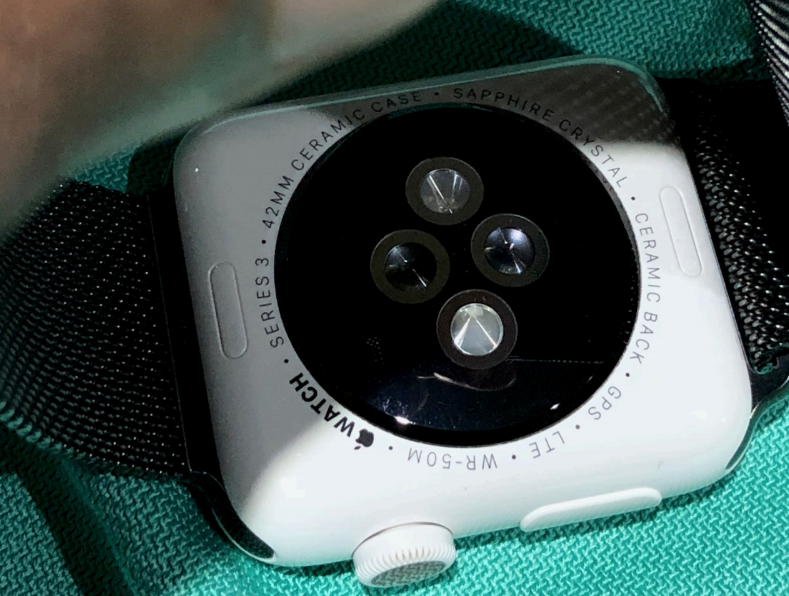
In a court claim application obtained by iPhone in Canada, 21-year old Dean Lubaki of Toronto, Ontario claims Apple’s Watch Series 3 marketing, wherein the tech giant bills its latest wearable as “brilliantly scratch-resistant,” is false.

The claim details Lubaki’s recent experience with his white ceramic Watch Edition smartwatch.

In September, Lubaki bought the wearable alongside a silver Milanese Loop and AppleCare +. All three items are priced at $2,097 before tax.

In April, Lubaki visited the Apple Store at Yorkdale Shopping Centre to request Apple replace his watch due a number of scratches that had developed on both the watch face and underside of the device.

Dean Lubaki's scratched Apple Watch

He says he was denied a replacement after an employee told him that Apple does not replace devices that have only suffered cosmetic damage. When Lubaki asked to speak to a manager, the employee allegedly told him he didn’t have one. After asking several more times to speak to a manager, one reportedly appeared and reiterated the company’s policy.

In a letter addressed to the Yorkdale Apple Store and Apple CEO Tim Cook, Lubaki complained of Apple’s claim that the white ceramic Watch Edition comes “with a refined finish that won’t scratch or tarnish.”

“The fact that the back of the Apple Watch attracts the Loop and creates abrasion without action for [sic] the consumer is a design flaw,” he wrote in his letter. “Same abrasion can occur on the screen when the strap is removed to change straps. Again, nowhere Apple says that the loop may damage the watch.”

Apple did not respond to Lubaki’s letter.

The underside of Dean Lubaki's scratched Apple Watch

Here I’ll also note that there’s a subtle but important difference between “scratch-resistant” and “scratch-proof.” The former does not mean the Apple Watch, nor any other device claiming scratch-resistance, won’t scratch.

Earlier this month, Lubaki filed his court claim application with the Ontario Superior Court of Justice. Included in Lubaki’s court filing are images of his scratched Apple Watch (seen above).

Lubaki is asking that Apple refund him his Watch Edition smartwatch and AppleCare+ warranty plan, as well as pay him additional compensatory and punitive damages for “mental stress” suffered during the experience. Lubaki says the entire episode put him under “additional strain” during his final exams.

Lubaki told iPhone in Canada that he was contacted by Apple after he mailed his claim. The company reportedly offered to replace his Apple Watch and give him a free accessory for his trouble.

Lubaki rejected the offer.

He plans to represent himself in small claims court. According to Lubaki, Apple has until June 26th, 2018 to file a response to his claim.

Stick it to the man, Dean.

Source: iPhone in Canada

The post Toronto man files small claims case against Apple over scratched Apple Watch appeared first on MobileSyrup.

24 Jun 18:08

Samsung Galaxy S10 to feature in-display fingerprint sensor and face recognition, says report

by Dean Daley
The Galaxy S9 in pink

Korean publication The Bell is reporting that Samsung will ditch its current iris scanner technology in favour of an in-display fingerprint sensor and facial recognition for the Galaxy S10.

The South Korean company will invest in an Israeli-based firm called Mantis Vision to develop 3D facial recognition technology.

The 3D facial recognition should be faster and more accurate than the company’s existing iris tech.

Further, the phone’s in-display fingerprint sensor may also double as a sensor for blood pressure and heart rate measurements.

Previous rumours have also indicated that Samsung will skip including an in-display fingerprint sensor with the Galaxy Note 9 and will instead put the technology in the S10 and S10 Plus.

Source: The Bell Via: GSMArena

The post Samsung Galaxy S10 to feature in-display fingerprint sensor and face recognition, says report appeared first on MobileSyrup.

24 Jun 18:05

Kiwi is a super quick Chrome-based web browser for Android devices

by Brad Bennett

There’s a new browser on the market, and its focus is speed.

Kiwi is built off of the Chromium web browser framework that loads webpages faster and is more secure than regular Google Chrome.

The browser launched on the Google Play Store on April 4th 2018. Since then it has been quietly making its way to the top of the trending app chart.

The app looks very similar to the mobile version of Google Chrome but it has a few tricks hidden up its sleeve.

First of all, the team says it has created a super fast web page rendering engine so webpages load even faster than they do in regular Chrome.

The team also built a dark theme into the browser that can change the white background on some websites into a dark grey, a feature that makes reading the web at night a lot less straining on the users eyes.

Lastly, the team has added a few security options to the app, as well. Kiwi comes preloaded with a native ad blocker that automatically accepts cookie permissions and, of course, blocks ads.

The app is available on Android for free, here.

Source: Kiwi Via: XDA Developers 

The post Kiwi is a super quick Chrome-based web browser for Android devices appeared first on MobileSyrup.

24 Jun 18:05

Top Canadian mobile stories from the past week

by Ian Hardy

Every week we bring you the latest in Canadian mobile news. Listed below is a quick overview of the top stories from the past seven days.

  • HomePod Review: The best smart speaker for Apple users [Read here]
  • Waze and Ford Sync 3 Review: Too late to arrive? [Read here]
  • Payfone and EnStream partner on password-less authentication mobile app [Read here]
  • One in eight Canadians pirated movies in the past month [Read here]
  • Here’s what’s coming to Netflix Canada in July [Read here]
  • Recreational cannabis will be legal in Canada on October 17, 2018 [Read here]
  • Ontario premier Doug Ford may scrap electric vehicle rebates [Read here]
  • 53% of Canadians with home internet subscribe to Netflix [Read here]
  • Canadian pricing and availability for the BlackBerry KEY2 [Read here]
  • Ontario is scrapping its $100 smart thermostat rebate [Read here]
  • Consumer groups propose ‘Flex Plan’ to counter Canadian carriers’ data-only plans [Read here]
  • Bell fastest overall internet service provider in Canada [Read here]
  • CWTA report suggests 5G could add $40 billion to Canada’s GDP by 2026 [Read here]
  • Federal government kicks off national consultations on data privacy and the digital economy [Read here]
  • Uber now notifies users if they’re driving in an electric vehicle in Montreal [Read here]
  • YouTube Picture in Picture is now available in Canada with YouTube Premium [Read here]
  • Videotron wants to ‘position itself as an alternative’ in Ottawa wireless market [Read here]
  • LG G7 ThinQ Review: Safe and sound [Read here]
  • SaskTel offers 3 months of free unlimited data with new smartphone purchase [Read here]
  • McGill University partners with industries to develop VR training tech for spinal surgery training [Read here]
  • Bell and Virgin add 46 destinations to Roam Better, Roam Sweet Roam programs [Read here]

The post Top Canadian mobile stories from the past week appeared first on MobileSyrup.