Shared posts

26 Jun 17:10

Today is the Summer Solstice!

by noreply@blogger.com (VeloOrange)
by Adrian

This year's Summer Solstice falls on June 21st, 2018 - today! So happy Summer Solstice to you all!


Though it's been feeling like Summer for a hot minute here (pun 100% intended), today is the first official day of Summer in the Northern Hemisphere. Today we experience the most hours of sunlight of the whole year, when the Sun reaches both its highest and northernmost points in the sky. This of course means we have the most daylight hours to play outside!

From the Old Farmer's Almanac I learned something about the Summer Solstice I never realized. "The word “solstice” comes from Latin solstitium—from sol (Sun) and stitium (standing), reflecting the fact that on the solstice, the Sun appears to stop moving in the sky as it reaches its northern- or southernmost point. After the solstice, the Sun appears to reverse course and head back in the opposite direction." So it reaches it's pinnacle, and heads back home. Let's all try to live up to this notion today.

I always associate summer with a time to both relax, and ramp up your adventuring. The weather's nice, there's typically less rain, and nights are warm enough to comfortably sleep under the dome of your own tent - wherever you may choose to pitch it. Summer is when I plan out my longest cycling routes, typically at least one with two weeks of mostly camping.


Tonight we're celebrating the solstice in an entirely new fashion, by camping for the first time with our 7 month old son. Adventuring doesn't need to be contrived - just get outside and have fun. Whether you're in the middle of an epic tour, finishing up the RAAM here in Annapolis, MD (congrats to Christoph Strasser who finished yesterday with 5 wins to tie the record for most wins!), or simply going to a cruise after work, enjoy every minute of it!


Maybe it's time to be a bit more carefree. In the summer rides don't need to be so planned out. There's less clothes requirements, and many more things to do outside. Why not grab your bike, see where it takes you, and enjoy the ride. Here's one way you can cool off after a hot summer ride:


Happy Riding!

26 Jun 17:10

Documents Adds WiFi File Transfer

by John Voorhees

Documents by Readdle has been on the App Store a long time. Before Apple released its Files app, Documents filled the gap with features that made it indispensable for accessing files on iOS devices and doing things like unzipping an archived folder. Although the stock Files app has taken over many of my day-to-day needs for file handling, Documents continues to evolve and adapt, providing tools that aren’t in Files.

Today, for instance, Readdle added WiFi file transfers between a Mac and iOS device to Documents. The system is easy to use and more flexible than AirDrop, making it something to keep in mind, especially when you are moving large numbers of files between a Mac and iOS device.

The WiFi transfer functionality is located in the Services tab of Documents. Tapping that option opens a camera view with instructions to open docstransfer.com on your computer. There, you’ll find a QR code. Scan it, and Documents creates a local WiFi connection between your computer and iOS device. To maintain the connection, Documents must remain open on your iOS device.

Once connected, you'll see all the files you have stored in Documents in a tab of your browser.

Once connected, you'll see all the files you have stored in Documents in a tab of your browser.

In your browser, you’ll see all the files you have stored in Documents on your iOS device. Drag in files to add them to your iOS device or select one or more files in your browser to download them to your computer. With Chrome, you can also drag whole folders into Documents.

The system works with a Mac or PC and over a lightning cable as well as WiFi. In fact, Documents can also transfer files between two iOS devices.

In my tests over a couple of days, I found Documents’ WiFi transfer functionality to be fast and reliable. To test the speed of WiFi transfers, I used it to move 16 RAW images from my Mac to my iPhone X, which together were about 250 MB of data. The process took roughly one minute with Documents. I tried the same files with AirDrop too, which was a little faster, but not much.

With AirDrop available on iOS devices and Macs, you may wonder what the benefit of Documents’ WiFi transfer is. The primary advantage of Documents, as with so many of its features other features, is flexibility. Unlike AirDrop, Documents can move files over a cable, it works with PCs, and it can handle different file types at the same time.

That last point is the one I foresee using Documents for the most. If you try airdropping a collection of mixed file types, the action fails with an error. In the same situation, Documents works like a champ moving any arbitrary collection of files you want.

I’ve become a regular user of Files and find it does the trick most of the time, but I’m glad utilities like Documents are available for those occasions when my needs fall outside the mainstream that Apple’s app covers. If you’ve ever found yourself frustrated by the process of moving files around on iOS, take a look at Documents’ new WiFi transfer system; it’s very well done.

The Documents update, which is scheduled for release today, is available on the App Store as a free download.


Support MacStories Directly

Club MacStories offers exclusive access to extra MacStories content, delivered every week; it's also a way to support us directly.

Club MacStories will help you discover the best apps for your devices and get the most out of your iPhone, iPad, and Mac. Plus, it's made in Italy.

Join Now
26 Jun 17:10

Americans believe two-thirds of news on social media is misinformation

files/images/graph202_0.png

Taylor Blatchford, Poynter, Jun 24, 2018


Icon

This will be presented differently depending on where you get the news, which I guess is part of the point. Here's how API summarizes it: "Americans believe 39 percent of news in newspapers, on TV or on the radio is misinformation and 65 percent of news on social media is made up or can’t be verified as accurate." Personally, I think this is probably a fairly accurate assessment. Part of the reason why there is so much mistrust in institutions these days is that these institutions have become untrustworthy.  There's probably no way to legislate trustworthiness, so don't worry, I'm not promoting a Tanzanian solution. But institutions - the media, universities, publishers, governments - need to find ways to regain that trust. This in turn help the rest of us establish credibility on social media. "The full reports on bias and inaccuracy, and views of misinformation, are available on the Knight Foundation's website."

Web: [Direct Link] [This Post]
26 Jun 17:10

Annotation-powered apps: A “Hello World” example

by Jon Udell

Workflows that can benefit from annotation exist in many domains of knowledge work. You might be a teacher who focuses a class discussion on a line in a poem. You might be a scientist who marks up research papers in order to reason about connections among them. You might be an investigative journalist fact-checking a claim. A general-purpose annotation tool like Hypothesis, already useful in these and other cases, can be made more useful when tailored to a specific workflow.

I’ve tried a few different approaches to that sort of customization. For the original incarnation of the Digital Polarization Project, I made a Chrome extension that streamlined the work of student fact-checkers. For example, it assigned tags to annotations in a controlled way, so that it was easy to gather all the annotations related to an investigation.

To achieve that effect the Digipo extension repurposed the same core machinery that the Hypothesis client uses to convert a selection in a web page into the text quote and text position selectors that annotations use to identify and anchor to selections in web pages. Because the Digipo extension and the Hypothesis extension shared this common machinery, annotations created by the former were fully interoperable with those created by the latter. The Hypothesis client didn’t see Digipo annotations as foreign in any way. You could create an annotation using the Digipo tool, with workflow-defined tags, and then open that annotation in Hypothesis and add a threaded discussion to it.

As mentioned in Annotations are an easy way to Show Your Work, I’ve been unbundling the ingredients of the Digipo tool to make them available for reuse. Today’s project aims to be the “Hello World” of custom annotation-powered apps. It’s a simple working example of a powerful three-step pattern:

  1. Given a selection in a page, form the selectors needed to post an annotation that targets the selection.
  2. Lead a user through an interaction that influences the content of that annotation.
  3. Post the annotation.

For the example scenario, the user is a researcher tasked with evaluating the emotional content of selected passages in texts. The researcher is required to label the selection as StrongPositive, WeakPositive, Neutral, WeakNegative, or StrongNegative, and to provide freeform comments on the tone of the selection and the rationale for the chosen label.

Here’s the demo in action:

The code behind the demo is here. It leverages two components. The first encapsulates the core machinery used to identify the selection. The second provides a set of functions that make it easy to create annotations and post them to Hypothesis. Some of these provide user interface elements, notably the dropdown list of Hypothesis groups that you can also see in other Hypothesis-oriented tools like facet and zotero. Others wrap the parts of the Hypothesis API used to search for, or create, annotations.

My goal is to show that you needn’t be a hotshot web developer to create a custom annotation-powered app. If the pattern embodied by this demo app is of interest to you, and if you’re at all familiar with basic web programming, you should be able to cook up your own implementations of the pattern pretty easily.

To work with selections in web pages, annotation-powered apps like these have to get themselves injected into web pages. There are three ways that can happen, and the Hypothesis client exploits all of them. Browser extensions are the most effective method. The Hypothesis extension is currently available only for Chrome, but there’s a Firefox extension waiting in the wings, made possible by an emerging consensus around the WebExtensions model.

A second approach entails sending a web page through a proxy that injects an annotation-powered app into the page. The Hypothesis proxy, via.hypothes.is, does that.

Finally there’s the venerable bookmarklet, a snippet of JavaScript that runs in the context of the page when the user clicks a button on the browser’s bookmarks bar. Recent evolution of the browser’s security model has complicated the use of bookmarklets. The simplest ones still work everywhere, but bookmarklets that load helper scripts — like the HelloWorldAnnotated demo — are thwarted by sites that enforce Content Security Policy.

It’s a complicated landscape full of vexing tradeoffs. Here’s how I recommend navigating it. The HelloWorldAnnotated demo uses the bookmarklet approach. If you’re an instructional designer targeting Project Gutenberg, or a scientific developer targeting the scientific literature, or a newsroom toolbuilder targeting most sources of public information, you can probably get away with deploying annotation-powered apps using bookmarklets. It’s the easiest way to build and deploy such apps. If the sites you need to target do enforce Content Security Policy, however, then you’ll need to deliver the same apps by way of a browser extension or a proxy. Of those two choices, I’d recommend a browser extension, and if there’s interest, I’ll do a follow-on post showing how to recreate the HelloWorldAnnotated demo in that form.

26 Jun 17:10

Vancouver 2018 Cargo Bike Championships

by Ken Ohrn

A few pix from the Annual Cargo Bike Championships, now in its 4th year. A fun Vancouver event, and a practical demonstration of what can be lugged around on a bike.

As usual, click any image to see a slide show of larger versions.

Many thanks to our friends Melissa and Chris Bruntlett at Modacity for organizing and running this event.

26 Jun 17:10

“The Trump administration implemented this policy by choice and could end it by choice.”

by Andrea

The Washington Post: The facts about Trump’s policy of separating families at the border.

“The doublespeak coming from Trump and top administration officials on this issue is breathtaking, not only because of the sheer audacity of these claims but also because they keep being repeated without evidence. Immigrant families are being separated at the border not because of Democrats and not because some law forces this result, as Trump insists. They’re being separated because the Trump administration, under its zero-tolerance policy, is choosing to prosecute border-crossing adults for any offenses.

This includes illegal-entry misdemeanors, which are being prosecuted at a rate not seen in previous administrations. Because the act of crossing itself is now being treated as an offense worthy of prosecution, any family that enters the United States illegally is likely to end up separated. Nielsen may choose not to call this a “family separation policy,” but that’s precisely the effect it has.

Sessions, who otherwise owns up to what’s happening, has suggested that the Flores settlement and a court ruling are forcing his hand. They’re not. At heart, this is an issue of prosecutorial discretion: his discretion.”

NYmag Daily Intelligencer: Trump Ends Family Separations by Ordering Family Detentions.

“In effect, Trump has switched from holding children hostage to congressional action to holding entire families hostage instead.

So in the very narrowest sense Trump is complying with demands that he end family separations at the border, but only by way of creating the equally large problem of large-scale family detentions at the border, and ignoring the more obvious option of abandoning the whole “zero tolerance” posture until such time as the system can be overhauled. The president’s allies will try to sell us on his compassion for kids and his extreme flexibility in modifying his administration’s procedures without, of course, giving up its devotion to The Law. The real question is whether the sights and sounds from the border that turned the cruel Trump-Sessions policy into a political disaster will get that much better now that children are no longer suffering on their own.”

Links via MetaFilter.

26 Jun 17:10

History of the word ‘data’

by Nathan Yau

Sandra Rendgen describes the history of “data” the word and where it stands in present day.

All through the evolution of statistics through the 19th century, data was generated by humans, and the scientific methodology of measuring and recording data had been a constant topic of debate. This is not trivial, as the question of how data is generated also answers the question of whether and how it is capable of delivering a “true” (or at least “approximated”) representation of reality. The notion that data begins to exist when it is recorded by the machine completely obscures the role that human decisions play in its creation. Who decided which data to record, who programmed the cookie, who built the sensor? And more broadly – what is the specific relationship of any digital data set to reality?

Oh, so there’s more to it than just singular versus plural. Imagine that.

Tags: data, history, words

26 Jun 17:10

Summer Saturdays~Street Theatre in Steveston Village

by Sandy James Planner

Steveston-Fishing-Village

Steveston Village in Richmond is a wonderful old fishing village and cannery, so much so that was featured for seven seasons as the fictional seaside town of Storybrooke in ABC’s hit television series Once Upon a Time.

Steveston has its own unique history, and is now offering a unique dramatic experience in the historic village. With talented actors from Hugh McRoberts Secondary School as guides in period costume, Alive! Walking Tour Vignettes takes guests back to 1917 in a one-hour walk around Steveston, revealing the historical fabric of the place and  some of the stories and characters that lived in that period.

During the walk there are five “pop-up mini-plays” featuring stories of early Steveston.

As Sarah Glen the executive director of the Steveston Historical Society observes:

These fun and engaging characters reimagine what life and work was like here over a century ago…There’s an extremely colourful and vivid history here with its own quirks and shocking tidbits—and most people don’t realize it when they just stroll around.

Steveston’s history tells a bigger Canadian story of multicultural communities persevering through hardship and pride in their accomplishments. The Vignettes reflect this but they also show that issues from a century ago are still relevant today. We hope our audiences are encouraged into a deeper understanding of our past—and also discover a new appreciation for what influenced the community we live in.

The Steveston Alive! Walking Tour Vignettes runs every Saturday at 1:00 p.m. and 3:00 p.m. throughout June and July, departing from the Steveston Museum and Visitor Centre on Moncton Street.

Tickets are $10 and kids under 12 are free. Book well ahead of time, as tours are sure to sell out — they did last summer.

slideshow-1

26 Jun 17:10

Embedded photos as platforms for information or commerce

by admin

This post is adapted from The DAM Book 3.0. In that book, I describe the ways that connectivity is changing the way we use visual images. In this post, I outline how embedded media can enable new kinds of connections between people, ideas and commerce. 

As connected images become more essential for communication and engagement, image embedding creates a new opportunity to gather and disseminate information. A traditional web page uses images packaged up as JPEGs and sent out as freestanding files. But images can also be displayed using embedding techniques. Embedded images (like embedded videos), reside on a third party server and are displayed in a frame or window on another site’s web page.Embedded media offers a direct connection from the server, through the web page or application all the way to the end user. This can provide a two-way flow of information, as well as the ability to customize the embedded media to suit the needs of the end user with updates, custom advertising or other messaging.

Let’s call these embedded objects, because they are actually more complicated than freestanding images. A YouTube video embedded on a web page is an example of an embedded object. The web page draws a box and asks the YouTube media server to fill that box with a video stream.

There is a live link which runs through the webpage, between the viewer’s device and the YouTube server. Because there is a link between YouTube and the viewer, there is a two-way
flow of data back and forth. This allows YouTube to gather all kinds of information, and it allows YouTube to also push out customized information through the window.

The media server can know who sees an image, how they got there, what they are interested in, who they interact with, what other sites they go to, what they search on and more. And the media server can present customized information to the end viewers based on what it knows about them. Remember, these windows are basically open pipelines that serve up the media on-demand.

Once only for video, now for still images too
Of course, the practice outlined above has been part of the business model for video services for a long time. Videos on web pages have historically been hosted by third-party servers, and we have been accustomed to YouTube ads for a decade. But it’s relatively new for still images, which could always be easily and cheaply added to web pages as JPEGs. The most significant marker for change was the introduction of free embedding by Getty Images.

When the stock photography giant decided to make vast numbers of images available for free embedding, it signaled that embedded objects were going to be an important part of its strategy moving forward. Getty has opened up millions of individual pipelines through blogs and other web pages, with the ability to collect and serve information in service of new business strategies.

The use case for images as platforms for two-way communication should be favorable moving forward. Mobile devices increasingly rely on photos instead of text headlines, and methods for connectivity are improving. In the last few years, we’ve seen several companies hang their business models on embedded image objects.

At this writing, Getty has gotten the most traction in such a service, but others are trying. Retailers are using embedded images as mini storefronts, and mission-driven organizations can use them to spread their messages in a viral manner.

What can you do with Embedded objects?
There are several valuable things you an do with embedded objet that are much harder or impossible with standard JPEGs.
• You can add a level of copyright protection that disables right-click saving.
• You can enable deep zoom features that are managed by the server.
• You can add purchase buttons or “more info” links directly onto the image.
• You can update the image when something changes (e.g. product updates.)

Okay, I’m interested – now what?
Making use of embedded media for still photos is an emerging capability. Several companies have taken a run at it, but none has fully cracked the code yet (and even Getty has not publicly disclosed how they intend to monetize the technology).  SmartFrame is offering this embedding as a service that bolts on to your DAM. The thing I like about their business model is that it works in service of the image owner, not the middleman like Getty and YouTube do.

SmartFrame can help you with security, sharing, tracking and monetizing.

And the International Image Interoperability Framework is also building around this concept. (“Come for the deep zoom, stay for the great metadata interchange.”) I’ll have more on this project in another post.

I’m keeping close watch on this capability, and I’ll report as more information comes in. I first wrote about this topic in 2013 in this post.


The post Embedded photos as platforms for information or commerce appeared first on The DAM Book.

26 Jun 17:08

Come at me, bro — what’s fair game on this blog

by Josh Bernoff

This is not a politics blog, but politics is part of my subject matter. So here’s what I hope is a very clear statement of my principles. I write about anything associated with writing quality, analytical thinking, truth, and influence. These are “meta-analyses.” I’m generally writing about how people think and communicate, not whether those … Continued

The post Come at me, bro — what’s fair game on this blog appeared first on without bullshit.

26 Jun 17:08

Amplification

by Eric Karjaluoto

TL;DR: It’s hard to tap into someone else’s audience. You might fare better by growing your own (in spite of how long it takes).

Successful marketing involves two parts: awareness and trust. If people aren’t aware of you, they can’t buy from you. And if they don’t trust you, they won’t buy from you. This makes content marketing appealing. Well crafted content can attract new audiences, and show your credibility.

…But no one’s listening

The challenge with content marketing is that there’s so much of it. This means that even if yours is exceptional, it might still go unheard. This is frustrating. It’s so much so that you might give up on content marketing altogether.1

I compare this to a musician playing a song that the audience can’t hear. Eventually, he’d start asking what he could use to make his music louder.2 For the sake of this metaphor, let’s make our subject a struggling musician named Otto. He works at a gas station to cover rent, and has little money left over.3

Go big, or go home

Otto wants to make a big splash. He knows his songs are amazing, because his friends tell him so. He isn’t willing to wait any longer. He wants to go straight to Sasquatch Music Festival, where he can plug into their PA system.

But, no one from Sasquatch returns his calls. While they certainly have amplification, they’re unwilling to share it with him. In a perfect world, they’d appreciate Otto’s genius, and offer him a spot. However, so many “Ottos” contact their festival that they no longer even check their messages.

The music festival represents the “media”, as most call it. These are TV stations, newspapers, magazines, and radio stations. Many content marketers beg for their attention—without success. This is because the media, too, is in business. Their business is to amplify what people already want to hear.4

So, until you are what the people want, the media (or music festival) won’t take your calls—or let you use their amplifier. Bummer.

Bring the noise

Realizing the big guys won’t let him use their amplification, Otto visits the music shop. He sees a beautiful amp, mixing boards, sound equipment, and a lighting setup. He asks how much it will cost to rent this gear for the weekend. Although doing so is expensive, he knows he can blow the crowd away. With that done, he’ll be flush with cash, and amplification will no longer be a concern.

The show goes fine. Those in the audience hear Otto’s music. That said, no one calls to offer him another gig. Now, Otto’s out of money. He also needs to take extra shifts at the gas station, just to cover his rent. This leaves Otto unhappy. He drinks a lot, and binge watches episodes of iCarly.

This setup represents paid promotion of your content5.With it you only rent access to someone else’s equipment. Unlike the newsroom, the ad department will happily take your calls, and rent to you. That said, every time you use their gear, it’ll cost you. Basic arithmetic: If the cost of the renting attention gets you another—more profitable—opportunity, you’re fine. If it doesn’t, though, you’ll run out of money.6

One fan at a time

Otto’s remaining option is to buy a small amp, of his own. This seems like a compromise. It eats his last few dollars. Worse yet, it’s only loud enough for him to play to a few people at a time. But, as he’s exhausted the other two routes, he figures he doesn’t have much to lose.

At his next gig, Otto plays to a tiny audience. Only 9 people show up, but he plays well, and his music is audible—even above all the chatter. The following week, the same people show up. This time they bring friends. The audience count hits 14. With each gig, his playing improves. He also grows more comfortable interacting with the listeners. He makes jokes, learns what they like, and gets to know his audience.

Eventually, Otto plays the neighboring town. He also busks at the metro, and is asked to perform at a small folk festival. Every time, he plays a little better, sees familiar faces, and grows his audience a tiny little bit. This isn’t easy. In fact, it’s painfully slow. But, it’s forward movement—and he had almost lost hope in that.

Back to you…

Tired of my metaphor, yet? Fair enough. However, I still think it’s something worth reflecting on.

That last example represents a pattern I’ve seen countless times. Some content marketers dream of bright lights and banners. When the press/public doesn’t shower their stories with attention, they give up and retreat. Others think they can shortcut the process by using someone else’s amplification. They soon run out of money, and have little to show for it.

The ones that succeed exhibit patience. They want to achieve big things for their businesses, but know it can’t happen overnight. So, they don’t fret their slow progress. Instead, they keep showing up. In doing so, they connect with the audience that is there. They also use this time to hone their message and what the produce.

Ask any successful content marketer about their journey. I bet that most will tell you the same story. At first, no one cared about anything they said/made. They’ll also tell you that it took years of writing, posting, speaking, making videos, and what-have-you, before anyone paid them any attention.

You can fantasize about someone else lending you their audience. Few are eager to share theirs, though. It took them a long time to cultivate it. Nope. You’ll need to do the work, and attract your own audience. The upside? Now’s a great time to get started.

Homework

Pick one challenging topic that you (or your company) is uniquely qualified to address. Then write on that topic, giving the most useful information you can. Don’t expect anything in return; just be of service. Repeat.

  1. For some, avoiding content marketing is advisable. Some are ill-suited for it. It’s time consuming. And, in many situations, relationship marketing is more fruitful.
  2. As an aside, this always seems a bit painful to me. Most turn to content marketing as means of amplifying what they do. They later realize that they also need a way to amplify their content marketing. 😖
  3. This is a good comparison to the average startup founder. They both dream of great things, but face very real restrictions.
  4. The media does have a soft spot for novelty stories. They also like ones that offer immediate interest to their audience. Leveraging one of these approaches is one of the few ways a small company can attract their attention. We achieved this with Campnab. This occurred because people were furious about sold-out campsites. Our app offered a way to hack that problem. (Within 20 minutes of posting our app on Reddit, we had provincial interest in the story. Shortly thereafter, it went country-wide.)
  5. This also applies to social networks. Some of them offer free amplification. This often comes at the cost of the network owning your audience/list. For example, Medium lets you tap into their audience, but they keep any audience you grow. This limits you from interacting directly with your audience, or moving your show to another venue. Meanwhile, networks like Facebook are now pay-to-play advertising platforms.
  6. Another way to look at this is by considering cost per acquisition (CPA) and customer lifetime value (CLV). If your CPA is higher than your CLV, you’re in trouble. A surprising number of funded startups mess up this equation.

The post Amplification appeared first on Eric Karjaluoto.

26 Jun 17:08

Last week I sent all Dutch Members of the Europ...

by Ton Zijlstra
Last week I sent all Dutch Members of the European Parliament (MEP) a message to voice my opposition to both Article 11 and 13 of the proposed new Copyright Directive. It is telling that only MEPs opposing those articles have responded to me. No one in favour of it bothered to let me know their reasoning.
26 Jun 17:08

Urbanist Abroad: Day 17 – Kyoto and Hiroshima

by colinmstein

In less than two hours and at speeds up to 285-km/h, Gordon Price travelled from Kyoto to Hiroshima on Thursday, via Japan’s Shinkansen “bullet train” line.

The destination was the Hiroshima Peace Memorial; the main draw here is the former Hiroshima Prefectural Industrial Promotion Hall, now commonly called the Genbaku Dome, or Atomic Bomb Dome.

The building was the only structure left standing near the hypocentre of ‘Little Boy’, the first atomic bomb ever used in war, which dropped on August 6th, 1945. It delivered near-instant death to 70,000, with another 70,000 to later die as a result of radiation poisoning. Injuries and related horrors took many more, to say nothing of the tens of thousands to perish three days later in Nagasaki. Today, Genbaku Dome is a UNESCO Heritage site.

From the train, Gordon took many photographs of the urban world that has cropped up along the rail line (including the photograph above of sunset over Kyoto), with his usual engaging commentary.

Instagram Photo
Instagram Photo
Instagram Photo
Instagram Photo
Instagram Photo
Instagram Photo
Instagram Photo
Instagram Photo
Instagram Photo
Instagram Photo
Instagram Photo
Instagram Photo
Instagram Photo
Instagram Photo
Instagram Photo

26 Jun 17:08

Colour in the City

by colinmstein

From friend of Price Tags Matt Rubin, a striking shot of The Charleson, the new 43-storey residential tower on the eastern corner of Pacific Boulevard and Richards, in downtown Vancouver.

The coloured facade was just unveiled yesterday. He thinks they’re porcelain or granite slabs; whatever they are, they certainly weren’t in the marketing video.

26 Jun 17:08

What Makes People the Most Happy

by Nathan Yau

It's in the details of 100,000 moments. I analyzed the crowd-sourced corpus to see what brought the most smiles. Read More

26 Jun 17:08

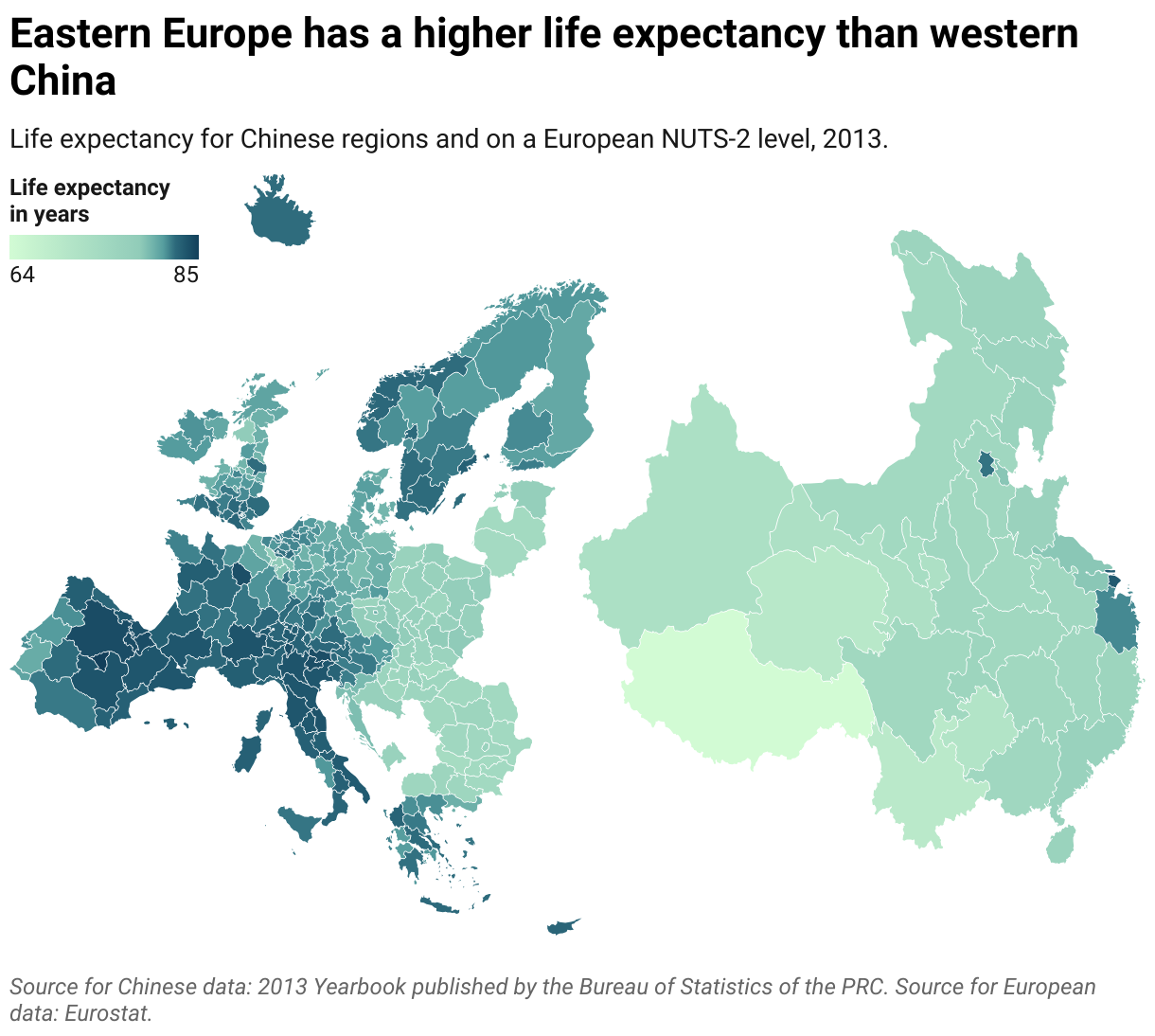
China begins just east of Finland

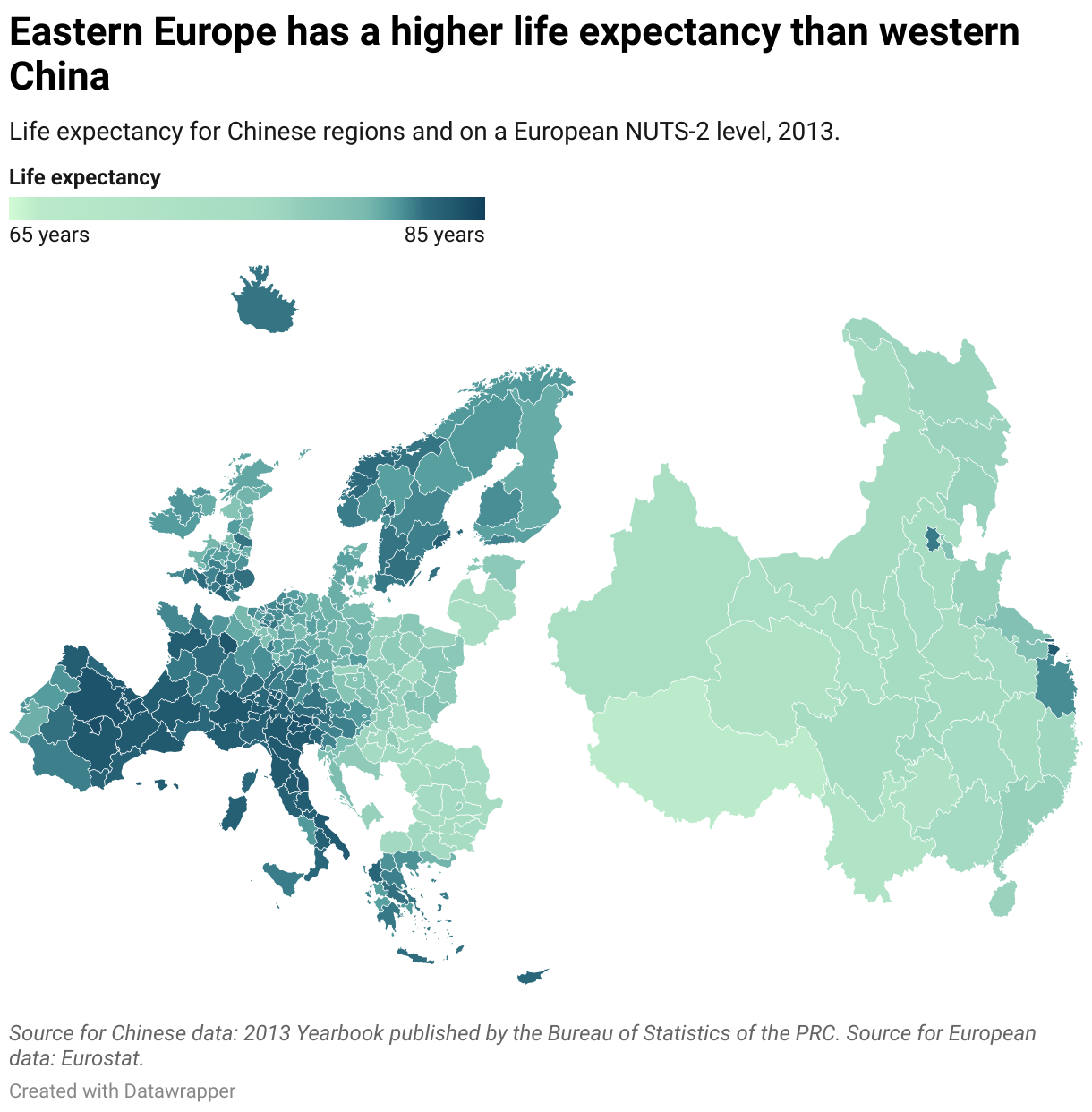
After the last three longer-than-usual Weekly Charts about log scales, this week’s Weekly Chart is a simple one: It’s a map, once again. It shows the low life expectancy in the west of China and the east of Europe. And that, according to the data sources, the life expectancy in Beijing and Shanghai is higher than in Berlin or Vienna:

Sooo…yes, I admit it. There’s something new here. Until today, I would have needed to create two maps in Datawrapper, one for Europe and one for China. But today my coworker Ivan published what he had in the making for weeks: It’s now possible to get your own GeoJSONs & TopoJSONs into Datawrapper.

So to create this direct comparison between China and Europe, I opened the maps of both Europe and China with the geo software QGIS and boldly moved China a huge chunk closer to Europe. Then I uploaded the creation into Datawrapper. Visit the announcement article by my co-worker Ivan to see another fun map we created with this feature!


This was a short one, as promised! I admit that this is also due to some traveling & workshop/talk preparations these days. Today I came back from the European Data and Computational Journalism conference in Cardiff, Wales (you can find my Workshop slides here). And at the end of next week, I’ll be at the German Netzwerk Recherche conference in Hamburg. It’s gonna be good! Maybe see you there? In any case, you can look forward to another rather short Weekly Chart edition next week.

26 Jun 17:08

Introducing custom map uploads

Today we’re introducing a new feature: you can now upload your own map files in Datawrapper to create Choropleth and Symbol maps. So now you can create a map like this:

We already have over 600 high quality maps that you can use right now and our map creator Anna is working hard to further expand our collection. You can always get in touch with us at support@datawrapper.de if you would like a specific map to be added to the list. If we think the map would be a useful addition, we will try to add it as quickly as possible.

However you might want to visualize data on a map which is highly tailored to your needs, for example to show your regional administrative areas which are not available as a map in our collection. This is a perfect case for the new custom map upload feature. You can create your map, upload it and use it to visualize your data.

Preparing your map

Before uploading your map, you (evidently) need a map file. You can use applications such as Mapshaper or QGIS to create and export the map. Some experience with these applications will come in handy.

To upload the map, it needs to be in TopoJSON or GeoJSON format. There are some further requirements, for example the file size may not exceed 2MB and the map should use the WGS-84 Coordinate System[1]. Please read the Academy article for detailed information on how to create a map and ensure that it works well as an upload.

Uploading a custom map

To upload, first choose a map type and then select your map file by clicking on the “Upload Map” button. Once uploaded, the map will appear in the preview and you can proceed to fill it with data in the next step, then refine it and finally publish it in the same way as you would with one of our built-in maps.

Custom upload

You might be asking yourself: will the uploaded map be automatically added to the public list of Datawrapper maps? The answer is: No. If you upload your own map file, only you will be able to use it. The next time you want to create a map using the same map file, you can upload the TopoJSON or GeoJSON again.


Map files are difficult to parse because geographical data can be structured in many different ways. We try to account for all possibilities, but there is a chance that your map might not get rendered 100% correctly. Please refer to the Academy article if you are experiencing problems when preparing and uploading your map. Also write to us at support@datawrapper.de or in the comments below if you have any comments or feedback – we’d love to hear what you think of this feature!

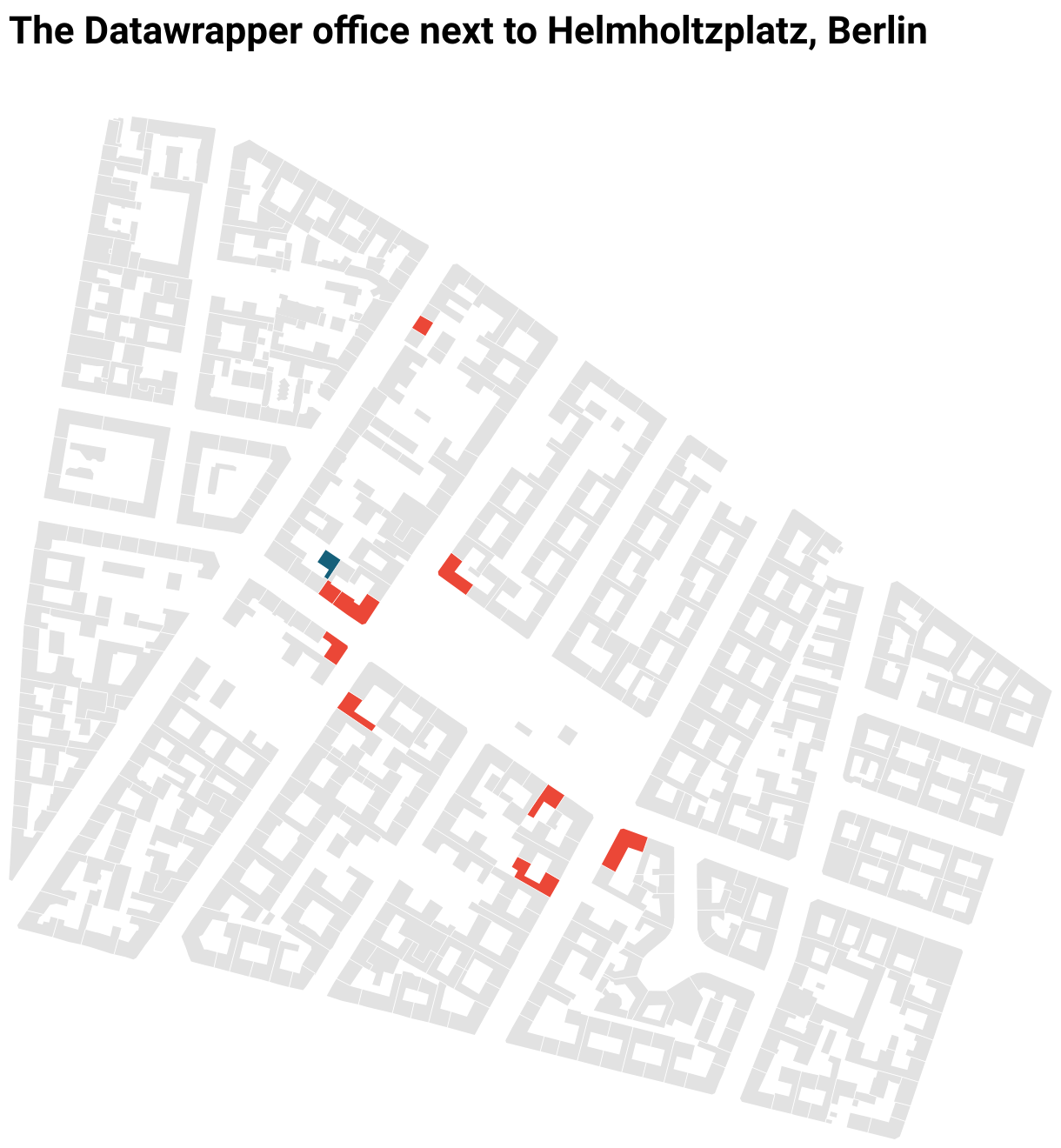
We hope that this feature will let you create exactly the maps you’ll need. Your imagination is your limit. Here’s a map we created of the neighborhood around the Datawrapper office:

Try out the custom map upload here and happy mapping!


  1. WGS-84 is a Geographic Coordinate System (a system which defines real world location points on a 3 dimensional digital surface) that uses longitude and latitude units of decimal degrees. WGS-84 is the current standard specification of GeoJSON format.

26 Jun 17:06

Edu-business as usual—market-making in higher education

files/images/nido-building.jpg

Ben Williamson, Code Acts in Education, Jun 24, 2018


Icon

Good article on what Pearson is doing in education with a great cover photo. And I really like the analysis of what it is exactly that Pearson is doing in education. Beginning from the precept that " markets do not simply appear," Ben Williamson focuses on an argument that shows "how the formerly non-market space of higher education has been reframed and re-made as an ‘education services market’, and subsequently how these HE markets work." The offering of goods and services that higher education might purchase is only the first step of the process. It wants to reshape that market, and "it has established itself as a distinctive market provider which is ‘transforming higher education’." Ultimately, though, by reshaping the market, "Pearson is seeking to build and maintain the market for its products to ensure its long-term stability and profitability."

Web: [Direct Link] [This Post]
24 Jun 18:37

Wai Young — Vancouver Mayoral Candidate

by Ken Ohrn

This one’s too good to make you click for more.

Accompanied by a violin, Coalition Vancouver candidate Wai Young spoke to the media and public today about her platform. Fascinating stuff leading into the October 2018 Civic Election.

Free car parking on Sunday.

No new bike lanes, unless an existing one is ripped out. Bike lanes are a private roadway system for a select group. And dangerous, too. With thanks to Jen St. Denis.
No more “radical, agenda driven, war on transportation”. A portentious phrase.

Speaking of no agendas, she would rip out existing bike lanes. Including the 12-foot one being imposed on families and children in Kits Beach [Ed: plenty of plans and talk, but no bike lane approved there].

And by the way, the NPA and Vision can’t fix Vancouver, because they’ve agreed on virtually every issue. Thanks to Justin McElroy.

And, finally, from Ms. Young’s Twitter feed:

[Ed: Homeliness is not a crime. Seems like she’s subtley throwing shade at people without mirrors.]

Tactically, the anti-bike pro-car vote exists, but it’s been NPA turf — so the likely outcome here is to siphon off a segment of a sub-set of right-leaning voters from the NPA candidate. This segment is noisy but historically too small to swing an election, even before it’s split.

But this is a harbinger of a vote-split on the right, just like the left is facing. If both left and right are split, doesn’t this leave a mythical middle wide open for some candidate? Perhaps someone independent of a partisan songbook? (Hello Shauna Sylvester and Kennedy Stewart).

24 Jun 18:36

888 West Broadway

by ChangingCity

This is already the location of a hotel; The Park Inn. This rezoning proposal would see two new buildings, one replacing the adjacent Fairview Pub, and one the existing hotel. Together there would be 438 hotel units (258 short-term and 180 long-term stay).

The design, by Arno Matis Architecture, is typically bold, with retail and commercial uses proposed at grade (including, no doubt, at least one restaurant), and towers above of 10 and 12 storeys over six levels of parking.

24 Jun 18:36

KEY2 :: What makes a proper BlackBerry?

by Volker Weber

IMG 3688

What makes a BlackBerry a BlackBerry? I think the most defining property is the keyboard. The second defining property is software and security. But although there are three generations of software on these nine phones, they are all proper BlackBerrys. Let's zoom out for a moment:

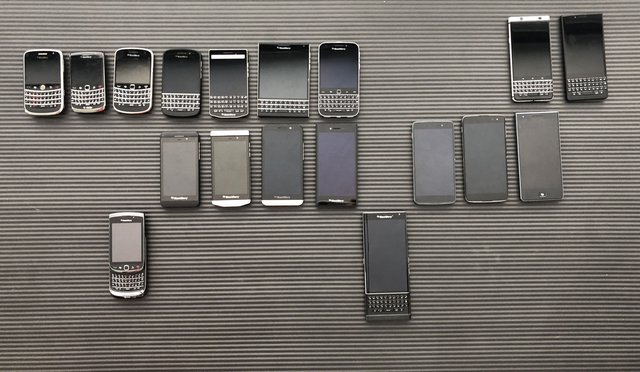
IMG 3694

Yes, these are a lot of phones. And it's not even the complete collection. The first one on the left is the legendary BlackBerry Bold. It defined the category of the executive messaging phone. The last one on the right is the latest KEY2, and I will look at it in a couple of posts.

First row, third phone is the Bold 9900. People loved this thing, even when iPhones had taken over. BlackBerry made some attempts with touch devices, but none of them succeeded. They were buggy and late. The slider in the third row was an honest effort to deliver a larger screen, but it was top heavy and I found it inferior to the Bold 9900. So did everybody else. Why did people love love love the Bold 9900?

IMG 3696

It was the keyboard.It's hard to see but the keys are ever so slightly sculpted and you could write on this thing without looking. To this day I know how to write an @-sign. Hold down the alt key and hit the p. It's pure muscle memory.

Unfortunately, the software was completely outdated. Those weren't really smartphones and it was really hard to write software for different formfactors. So BlackBerry set out to build a new operating system, that was extremely well done, but failed to find customers. For many reasons, one of them being, that they started with a keyboardless Z10 and and only followed up with the keyboard Q10. Those are in the fourth column. The sixth phone in the first row is the Passport, which I still consider one of the best phones ever made.

IMG 3695

The seventh one is the Classic, where BlackBerry tried to recreate the Bold 9900, only with BB10, down to the trackpad that was missing on previous BB10 devices. It addressed the muscle memories of people still holding on to their Bold 9900. BB10 failed for many reasons. You had to set up new infrastructure (BES 10) and it had a huge app gap. You just could not get as many apps as on iOS or Android.

For that reason, BlackBerry switched to Android and launched the quite expensive PRIV and chose to build a slider, the least popular form factor for a BlackBerry. Sales of the PRIV were disappointing and BlackBerry started to get out of the handset business. TCL took two of their reference designs and the Android distribution made for the PRIV and manufactured the DTEK50 and DTEK60 for BlackBerry. Since this collaboration worked out OK, BlackBerry had an escape route to get out of the handset business. DTEK50 was moderately successful, despite having no keyboard. DTEK60 was not.

Now TCL set out to make proper BlackBerry phones with a keyboard. Thy licensed the name, set up shop as BlackBerry Mobile and launched the KEYone, to be followed up by the keyboardless Motion. Again the KEYone was more attractive to BlackBerry buyers and TLC started to build a successor..

IMG 3697

They KEYone got it almost right, but the design was a bit too flashy, it had medioce hardware (SD625, 3 GB RAM, 32 GB storage) and the keyboard was too small. Enter the KEY2, which doubles both RAM and storage (there is an option to go to 128 GB storage) and upgraded the chipset to SD660. Most importantly however, they improved the keyboard with taller keys that are easier to hit. And while my muscle memory still works perfectly, they also added a new key, pictured here next to the sym key. It's a shortcut key which allows for two sets of 26 speed keys to launch apps or functions. Hold down this key and then either short or long press on one of the 26 letter keys.

And what about the software? KEY2 ships with Android 8.1 on the May security update. That is already one month down, as are the KEYone and the Motion. Those two should get an upgrade to 8.1 soon, either in July or August. I believe that development resources are stretched out already. Only the PRIV has dropped out of support and nobody talks about upgrading DTEK50 and DTEK60 from Android 6. Even though TCL built them, these are not their phones.

It would probably be easier to recommend the KEY2 if it ran on AndroidOne. But that does not seem to be inline with customer demand from enterprise clients. They want the extra layer of security BlackBerry adds as well as their enterprise ready apps.

What makes a BlackBerry a proper BlackBerry? The keyboard. You know when you want one. It's that old muscle memory.

24 Jun 18:31

O’Reilly FluentConf 2018

by princiya

Oh really! I spoke at FluentConf last week in San Jose, California. Here are my slides. Here is the video.

Screen Shot 2018-06-22 at 12.53.17
Rebuilding a browser extension for Privacy

Here is the talk trailer. I spoke about web tracking, browser extensions, D3.js force layout,  Lightbeam and my Outreachy experience.

Screen Shot 2018-06-22 at 14.36.31

Motivation

JavaScript – The Good Parts‘ has been my all time favourite book. My main motivation to speak at an O’Reilly conference comes from this book. When my talk submission was accepted, I was extremely happy. And there was Brendan Eich (creator of JavaScript) himself on stage!

Congratulations! Your proposal has been accepted for O’Reilly Fluent Conference in San Jose 2018

 At the conference

I was honoured to be a part of this conference, and I will let pictures speak on my behalf. More pictures here.


IMG_7115
The speaker hotel

40978231010_10b70c70db_o
The EXPO Hall

40978314990_f3b8e53d91_o
The diversity lunch panel which was amazing

42789006631_464867d9ee_o
Lots of food in the evening at San Pedro Square Farmers’ Market

42789073661_476be9cc0e_o
Maggie‘s keynote was so motivational

42809447141_300e6098bd_o
Seeing this trio together on stage was so much pleasure

Screen Shot 2018-06-22 at 13.00.45
FluentConf’s fempire

42092011594_5ab55ec307_o.jpg
There was so much swag, but these pillows were my favourite

Some more pictures…

Click to view slideshow.


24 Jun 18:31

Call for Feedback! Draft of Goal-Metrics for Diversity & Inclusion in Open Source (CHAOSS)

by Emma

open source stars — opensource.com CC BY-SA 2.0


In the last few months, Mozilla has invested in collaboration with other open source project leaders and academics who care about improving diversity & inclusion in Open Source through the CHAOSS D&I working group. Contributors so far include:

Alexander Serebrenik (Eindhoven University of Technology) , Akshita Gupta (Outreachy), Amy Marrich (OpenStack), Anita Sarma (Oregon State University), Bhagashree Uday (Fedora), Daniel Izquierdo (Bitergia), Emma Irwin (Mozilla), Georg Link (University of Nebraska at Omaha), Gina Helfrich (NumFOCUS), Nicole Huesman (Intel) and Sean Goggins ((University of Missouri).

Our goals are to first establish a set of peer-validated goal-metrics, for understanding diversity & inclusion in FOSS ; Second, to identify technology, and research methodologies for understanding the success of our interventions in ways that keep ethics of privacy, and consent at center. And finally, that we document this work in ways that communities can reproduce the report for themselves.

For Mozilla this follows the recommendations coming out of our D&I research to create Metrics that Matter, and to work across Open Source with others projects trying to solve the same problems. I am very excited to share our first draft of goal-metrics for your feedback.

D&I Working Group — Initial set of Goal — Metrics

Demographics

Communication

Contribution

Events

Governance

Leadership

Project Places

Recognition

Ethics

Please note that we know these are incomplete, we know there are likely existing resources that can improve, or even disprove some of these — and that is the point of this blog post! Please review and provide feedback either — via a Github issue, pull request, or by reaching out to someone in the working group, or by joining our working group call (next one July 20th, 9am PST) — which you can find the video link here.

You can find one or more of us at the following events as well:

FacebookTwitterGoogle+Share

24 Jun 18:31

Urbanist Abroad: Day 18 – Tokyo

by colinmstein

And so we wrap up our coverage of Gordon Price’s study trip, covering Hong Kong, Tokyo and Kyoto over the past three weeks. You can see all his posted pics on his Instagram account.

In his last full day, he shares some additional musings on high-speed rail logistics (and cityscapes), ‘Little Differences’ between Japanese and North American urban culture, and some final thoughts on economic and demographic change in Japan over the past generation that will yield further discussion upon his return. Enjoy…
Instagram Photo
Instagram Photo
Instagram Photo
Instagram Photo
Instagram Photo
Instagram Photo
Instagram Photo
Instagram Photo
Instagram Photo
Instagram Photo
Instagram Photo
Instagram Photo
Instagram Photo

24 Jun 18:24

Twitter Favorites: [pt] Introducing the concept of OKRs to my kids. A big organizational goal this quarter is smoother bedtimes, so we’re aligning to this.

parker @pt
Introducing the concept of OKRs to my kids. A big organizational goal this quarter is smoother bedtimes, so we’re aligning to this.
24 Jun 18:24

NewsBlur Blurblog: Third Time Lucky (with Real Estate) or Tom Vu Had It Right Afterall

sillygwailo shared this story from Young{ish} and Retired.

By Ray Shimizu

When I told people we were retiring, they always said the same things:

You’re too young to retire:

  • I guess time will tell. After four+ months, we aren’t bored or broke yet, so we’re going to ride it out and see what happens.

What are you going to do with all your time?

  • Our plan is to travel for the majority of each year in places that have a fairly low cost-of-living. We’re still figuring out some of the details, but for now, we are on permanent vacation.

How can you afford it?

  • None of your damn business! Haha. Just kidding. Read on to find out our secret to squirrelling away a nice, big nest egg.

================================================================

NOTE: In very simple terms, you need to figure out what your expenses will be in retirement, then save up enough to have roughly twenty times that amount in investments (assuming a 5% annual return, factoring in inflation on expenses and income, blah, blah, blah).   Our financial advisor used a program to figure it out in detail, so don’t even think about asking me to figure it out for you.

================================================================

We can afford retirement because we got lucky with real estate, and we had the freedom to take risks.

We have been very lucky to have bought into the Lower Mainland real estate market prior to 2003. Since then, property values have risen at a ridiculous rate. When housing prices double every five to seven years, it’s easy to make money.

Our New West home, just before we sold it

Our first house doubled in value in the five years we owned it. We weren’t savvy speculators. We didn’t have a crystal ball. We just happened to be in the market for a house just before prices started to rise, although even then, we couldn’t believe how much we were spending on a house. We were LUCKY. After maintaining a century-old house, and doing yard work on a large lot, we decided it wasn’t for us and was time to sell it.


We then invested in US real estate just after the housing market crashed down there. It helped that the Canadian dollar was above par for the first time in forever and that the money from the sale of the house was making very little interest. This was the first time we invested in real estate strictly as an investment, and it was a bit nerve-wracking due to the size of the investment and the unknowns involved. It was also a bit of a hassle dealing with property managers, lawyers, accountants, and most of all, the IRS (I would call them a gang of nincompoops, but that would reflect poorly on nincompoops). In the end, it was a worthwhile investment. In four years, the housing market down there rebounded by 40% and the dollar dropped back to 80 cents US, so we decided to sell those properties. This is probably the only “savvy” property investment we ever made. It was a bit risky, but the upside to both the real estate market and the exchange rate far outweighed the risks.

After being renters for four years, Marce decided that we wanted to buy an apartment and renovate it. I was against the idea because I was still waiting for the market to correct, and because “you never get a good return on apartments vs. houses.” I was wrong on both counts – thank God Marce won that argument. In the last few years, apartments in the Lower Mainland have seen unprecedented increases in value. Our apartment building was 25 years old in a desirable location in the West End. It was fairly spacious for downtown, and was nicely renovated. It was a good apartment, but nothing spectacular, and it didn’t have a view. But when units in our building started selling around a million dollars, we were in disbelief. We contacted our financial advisor to see how much sooner we could retire if we sold our apartment. We then called our real estate agent and put our unit on the market. Two weeks later, we got the price we wanted and began making plans for our early retirement.


Because we wanted to keep a toehold in the market, we purchased a small condo that also generates some rental income. We do plan to move back to Vancouver eventually and when we do, we’ll sell the rental and buy downtown (if we can afford it).

BTW, I’m STILL waiting for the market correction.

Singapore Harbour

We have made the majority of our wealth through this ridiculous real estate market over the past 15 years. It would’ve taken us forever to make as much by saving and investing in stocks and bonds. We were also willing to take the occasional leap of faith and do something crazy, like invest in US real estate (when we don’t know much about it) or sell our home and go gallivanting around Southeast Asia. Not having children also gave us the freedom to move where and when we wanted.

One final note. If you own real estate in the Lower Mainland, you are sitting on a huge amount of money. I think prices have been so high, for so long, it has distorted our sense of reality. The income/mortgage ratios are now laughable. I recently read an article in Macleans that claimed 85% of Vancouverites’ incomes are for housing (85% for a house, 50% for a condo). I wonder how many people are dangerously over-leveraged? If the market crashes, they could be financially ruined. We found it hard to accept that we were allotting that much of our net worth in housing, so we cashed out and downsized. If you’re in the same position, you might want to consider doing the same, and join us in early retirement. We’ll save you a spot on the beach.


Additional info:

Maclean’s article

Our awesome real estate agent:  Kevin Hardy @ Sotheby’s International

Attending one of Ozzie Jurock‘s seminars helped to convince us to invest in Phoenix (thanks Liesl for that connection!)

For you young ‘uns who have never heard of Tom Vu, check out one of his infomercials or his appearance on Family Guy


24 Jun 18:19

"The important thing to understand is that the atrocities our nation is now committing at the border..."

“The important thing to understand is that the atrocities our nation is now committing at the...
24 Jun 18:09

New report details Apple AirPower charging mat delay

by Igor Bonifacic
AirPower charging pad

When Apple announced the iPhone X last September, the tech giant also previewed its first-ever wireless charging accessory, the AirPower charging mat.

We’ll forgive you if you’ve forgotten about it. After all, it’s been more than 282 days since Apple first previewed the accessory at its most recent fall iPhone event.

In short, the AirPower charging mat is, as mentioned above, the company’s first foray into creating a wireless charging accessory. Unlike other inductive charging mats, it’s designed to wirelessly charge multiple devices at the same time. When Apple showed off the accessory, it promised iPhone owners would be to not only charge their smartphone, but their Apple Watch and AirPods, as well.

The company hasn’t publicly discussed the accessory since it first showed it off.

In a new report, Bloomberg‘s Mark Gurman says multiple technical challenges have delayed the accessory’s launch. Specifically, concerns related to the potential for overheating and the complexity of designing a charging mat that can charge multiple devices simultaneously have delayed the project.

Unlike the crop of inductive charging mats that are currently available on the market, the AirPower charging mat includes multiple different sized components that overlap across the mat. Achieving this engineering feat requires that Apple integrate multiple charging sensors, something that Gurman says has proven to be an engineering challenge.

Additionally, the accessory is set to feature custom silicon that will run a stripped down version of iOS, a feature that’s not present in the majority of charging mats. The company’s engineers are reportedly extra time to ensure the silicon’s firmware ships with as few bugs as possible.

According to Gurman, Apple plans to ship the charging mat before the end of September at the latest. The company sees the accessory as important step toward creating a future in which the iPhone doesn’t have any physical ports or buttons.

Source: Bloomberg

The post New report details Apple AirPower charging mat delay appeared first on MobileSyrup.

24 Jun 18:08

Google’s AR Measure app is now available on all ARCore phones

by Rose Behar

Google is now rolling out its ‘Measure’ augmented reality (AR) measurement app to a broader swath of Android users.

Originally a part of Google’s Project Tango, which represented the tech giant’s first foray into AR, version 2.0 of Measure is now compatible with Google’s ARCore platform.

This change brings the app to all the devices that work with ARCore, from the Google Pixel to Samsung’s Galaxy S9. With Tango, only certain devices with specialized cameras and sensors could be used for AR purposes (which didn’t work so well for the platform’s overall popularity).

The Measure app lets users measure length and height using the imperial or metric system by viewing your surroundings through a camera interface, dragging an on-screen tool and snapping a photo once a user is content with the measurement.

However, the app is not exactly a walk in the park to use at the moment. There’s little instruction, and it can be difficult to scan items, leading to a middling score on the Google Play Store so far.

Google’s tool is in competition with Apple’s Measure app, which was revealed at WWDC this year.

When two apps are so closely competitive that they literally have the same name, there’s added pressure on both to live up to consumer hype. Apple’s Measure will come standard on iOS 12, at which point it’ll be interesting to see how this battle of the measurement apps plays out.

Source: 9to5Google

The post Google’s AR Measure app is now available on all ARCore phones appeared first on MobileSyrup.

24 Jun 18:08

Tesla is reportedly closing over a dozen solar panel facilities in restructuring plan

by Brad Bennett
Tesla solar roof

Tesla’s choice to restructure the company and layoff nine percent of its workforce has also affected its solar business.

Tesla bought its solar division in 2016 for $2.6 billion USD.  It was previously called SolarCity and was founded by two of Elon Musk’s cousins.

The cuts will result in around 13 solar panel installation facilities closing down and the company’s partnership with Home Depot being halted, according to internal company documents that were obtained by Reuters

The Home Depot partnership is ending because the company would rather sell its solar panels through its own Tesla branded retail stores and online, according to Reuters. The 60 remaining solar facilities will stay open.

Another former employee said that the Home Depot partnership was expensive for Tesla but it accounted for about half of the company’s total solar panel sales.

“We continue to expect that Tesla’s solar and battery business will be the same size as automotive over the long term,” said a Tesla spokesperson in an email to Reuters.

Some now ex-employees of Tesla’s solar division said that in 2015, 15,000 people worked for the company. Since it was bought by Tesla apparently thousands of employees have been let go.

Source: Reuters

The post Tesla is reportedly closing over a dozen solar panel facilities in restructuring plan appeared first on MobileSyrup.