Rolandt
Shared posts
Instapaper Liked: The Bullshit-Job Boom
Memorial Ride for Colin Patrick Sztronga
Colin Patrick Sztronga was killed by a van last week on Elgin Mills Rd in Markham, just east of Kennedy. He leaves behind his wife and son, and many family and friends. He was 47. Tonight was his ghost bike ride starting from the Unionville GO station.

Joey makes some announcements to get us started.

Off we go.


Through central Unionville on Main St.

Two boys rode: Marco (Colin’s son) in blue, and a nephew.

Crossing Major Mac.

Turning from Kennedy onto Elgin Mills.

Approaching the crash site.


Colin’s wife, Janet, and son Marco. His mother, Sharon, in white to the left.

For logistical reasons, the ghost bike was driven up to the crash site. Thanks to David for doing this, and Hamish for providing the ghost bike this time.

Setting up the ghost bike.


A minute of silence.


In the foreground of this picture, you can see the skid mark left by the van as it went off the road after it hit Colin.

Signs and flowers added to those that were already there.

Even with it being just past summer solstice, the sun must set eventually.

As dusk falls, we get ready to ride back. The boys were determined to ride back as well.

They turn off to Janet’s house, whereas those of us from downtown continue south on Kennedy.

After meeting back up at the Unionville GO station to chat with those who drove in from out of town, a few of us head back towards Finch station.

Deepest condolences to family and friends. The large turnout from out of town make it clear that Colin was well loved. May he rest in peace.

Thanks to all those who joined us. Extra points to Angela and Michael who rode up from downtown with Joey.
That’s four ghost bikes (a typical year’s worth) in nine days. Please no more.
The Datawrapper Roadmap for 2018
With a freshly opened office in Berlin and a bigger team it was about time to figure out the direction for the Datawrapper development over the next six months. That’s what this post is about.
If you’re in a hurry, here’s the tl;dr:
- We want to make Datawrapper run faster than ever and speed up chart rendering by letting you embed charts without iframes.
- We’re going to fix all outstanding bugs! (Watch us!)
- We’re building a new, more flexible chart editor!
Let’s look into the points in more detail.
Priority 1: Performance
Performance is our top priority right now. Over the past years, new features have been added to Datawrapper and the user base has been growing, while the core platform code essentially remained untouched. Now is the time to get the house back in order. It’s no fun to work with a tool that feels like it is slowing you down.
We already made some progress towards that goal over the past weeks. We migrated our database to a bigger server and optimized our code to reduce the overall database load per request. The effect of these changes on Datawrapper is so remarkable that we want to show you the plot:
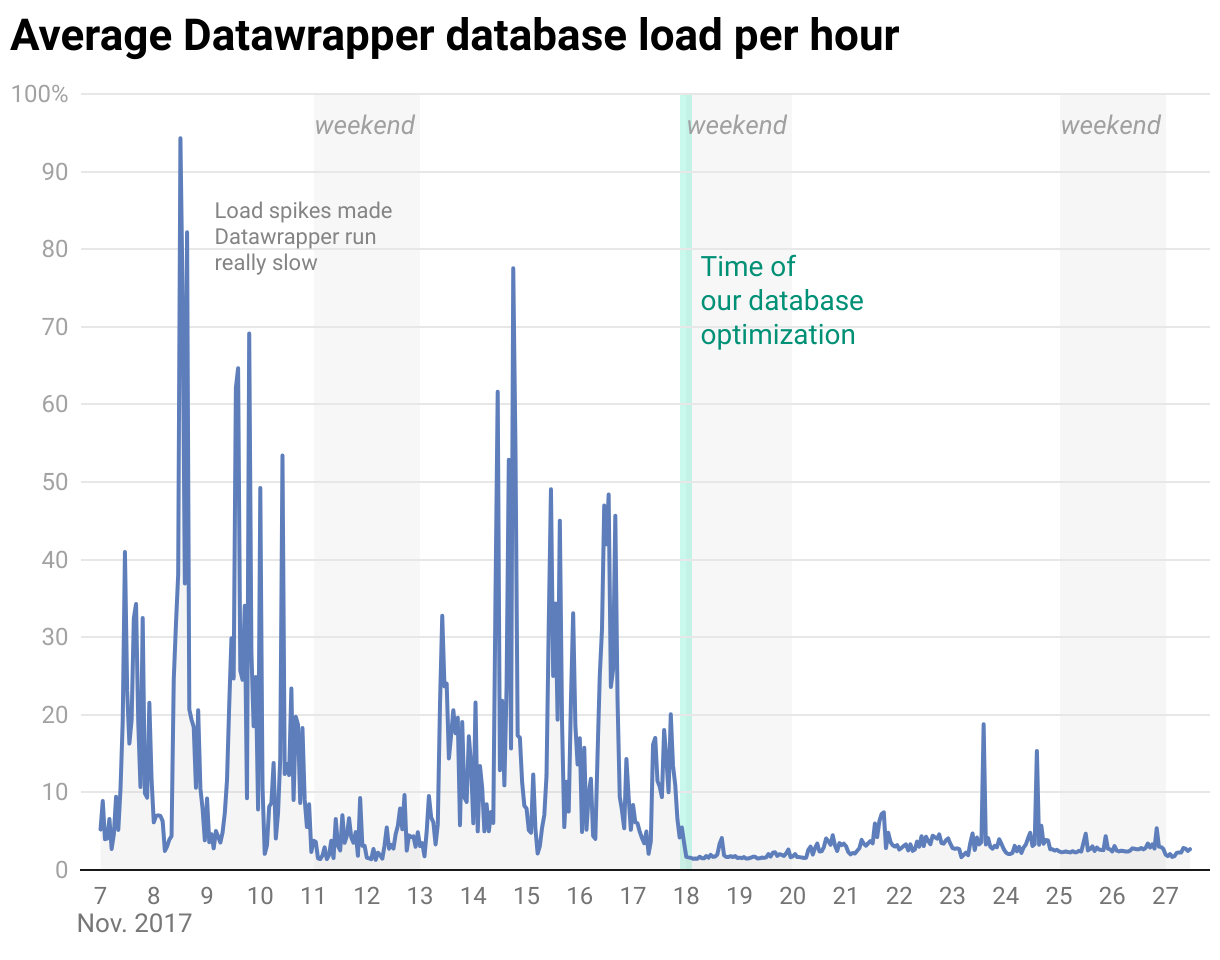
For our users, this means that Datawrapper should feel at least twice as fast now! Of course, there are still some parts that need to be faster (the “My Charts” page, for instance!), so we’ll keep pushing in that direction.
Speeding up the chart rendering
Another important part of performance is the chart rendering. While iframes are a great technology to bring Datawrapper charts into many places on the internet, they always tend to feel a little slow to load.
Part of this is because browsers effectively open the iframed content in a new browser window. So going on a page with four iframes can feel like loading (and waiting for) five websites at the same time.
That’s why our next big goal is to provide a new way for embedding Datawrapper charts without iframes. This step will simplify responsive embedding significantly and also fix a few iframe-related bugs.
We aim for the first quarter in 2018 for this feature, so we have enough time to make sure our charts don’t accidentally break the embedding web page or vice versa. To increase compatibility, we will still offer the iframe embedding.
Priority 2: Bug fixes, bug fixes, bug fixes
Bug fixing is one of the less fun things to do in software development, especially if the code base is a couple of years old. Developers just want to rewrite everything from scratch to start fresh. Or just ignore the bugs and work on shiny new features instead.
That’s sort of what we did the last few years. The most pressing bugs got fixed, of course, but with a small team and thousands of users with a lot of different use cases, many of the smaller bugs have been left unfixed in our issue tracker.
Meanwhile our support team (Mirko and David) has been helping our users through this time of darkness, providing workarounds and promised that there is light at the end. And now it’s time to deliver and actually fix the bugs. All of them!
That’s why in our office we introduced bug-fix Friday. The rule is simple: every Friday, every developer must do nothing but fixing bugs.
To make it easier for our users to follow along this process we just launched the new Datawrapper changelog where we are compiling an up-to-date list of all bug fixes and major and minor changes as we release them.
Priority 3: Single page chart editor
Finally, third big priority until summer 2018 will be the very heart of Datawrapper: our chart editor. While we all love our good old 4-step process, there is no need to spread it all across different pages. Moving back and forth between the chart editor and the data table feels like too much work, so we move the steps together on one single page.
This will also allow us to be more flexible with how we structure the editor for different chart and map types. A workflow that works fine with bar charts might not be ideal for maps or tables. We already started going in this direction with the updated map editor we launched last year.
And what about new features?
If you were hoping for hot new feature announcements, don’t worry! We have a lot of exciting new features lined up, and we can’t wait to get there and tell you about it. But first things first.
The Numbers Behind Monument Valley 2’s First Year
Once an app has spent a while on the App Store, it's difficult from a user perspective to know just how well or poorly the app has done. It's unusual for developers to share detailed financial figures, though it does happen every now and then. One team that's led the charge in this area is ustwo, creators of the Monument Valley series of games. For the first Monument Valley, ustwo shared comprehensive statistics for the game's performance in its first and second years. Today, year one of Monument Valley 2 has received the same open treatment. Head of studio at ustwo games, Dan Gray, writes:
I’ve heard this kind of data has really helped some developers get a handle on what they might expect from a successful premium launch, and given that it’s bloody hard making premium mobile games nowadays, if there’s anything we can do to help other teams to succeed then we’re going to do it. Admittedly Monument Valley is a bit of a unicorn in this space with regards to how well it’s performed over the years (succeeding on a level we could never have expected or predicted), but we hope this latest set of data might help others to set a yard stick for something towards the top end of profitability.
Monument Valley 2 had a unique launch that almost no other apps could hope for, debuting on-stage during last year's WWDC keynote. However, after the success of the first game, the sequel was certainly bound to get off to a great start no matter how it launched.
→ Source: medium.com
Better Together: Why Networks Are the Future of Learning

Tom Vander Ark,
Getting Smart,
Jun 28, 2018

This post is marketing for a book, so be forewarned. The reasonable point it makes is that " Requiring (and even allowing) individual teachers and schools to develop new learning models is a lousy way to do R&D. We can’t and shouldn’t rely on individual teachers building and delivering lessons for diverse groups of learners." This is something I think we already knew. The article lists some networks - Future Ready Schools, the League of Innovative Schools, New Tech Network or NAF (this list isn't random and at least one is associated with the book author). Here's the thing - a network isn't the same as a group. You can both allow individual teachers to develop their own working models and have them work together in a network - indeed, it works better than way, where you're not trying to coordinate them. And individuals, not organizations (like schools) should be the members of a network.
Web: [Direct Link] [This Post]GE AHP08LX: Finally, a Promising Smart AC

If you don’t have central air conditioning, you’re probably used to arriving home to a steamy house during the summer—or to running your window AC all day, even when you’re out. The GE AHP08LX smart window air conditioner is one attempt at fixing these issues. It has some kinks, but comes closer to succeeding than any previous smart air conditioner we’ve tested because it’s the first to support all three major voice-control platforms (Amazon Alexa, Apple HomeKit, and Google Assistant).
Distraction~A Problem with Drivers, Not Pedestrians
City narrows roads because you won't stop texting while walking https://t.co/ekIgbliSid pic.twitter.com/mXf2GVL50Y
— NJ.com (@njdotcom) June 24, 2018
The title said it all in this tweet from NJ Advance Media, host of NJ.com and publisher of the Star-Ledger and other New Jersey media sites: “City narrows roads because you won’t stop texting while walking“.
But the correct reframing of this should instead be: “City narrows crossing distance at intersection to make pedestrians safer”.
This whole thing about pedestrians being crashed into by vehicle drivers because they’re looking at their phones is a bit odd. Drivers of vehicles hit, maim and kill pedestrians. What are the three main reasons for this? Driver speed, driver impairment (drugs/alcohol), and driver distraction.
In the United States, pedestrian mortalities have increased over the last thirty years, and there has not been a major campaign to change driver behaviour or awareness of the vulnerability of active transportation users.
Alissa Walker, urbanism editor at Curbed, tackles the pedestrian distraction fable head on:
Compelling new research reveals that pedestrians probably aren’t texting themselves to death. While the term ‘distracted walking’ has become a way to pin the blame on pedestrians for supposedly looking at their devices instead of the sidewalk, there hasn’t been much evidence provided to prove smartphone-using walkers are at fault when collisions occur. In fact, most states don’t even include pedestrian behavior as a factor in crash reports.
Among research conducted in this area, engineering professors at Northern Arizona University looked at the use of crosswalks in New York City and Flagstaff, Arizona, by over 3,000 individuals; of those in the study, 86.5 per cent did not show any distracted type of behaviour. The study also found that most pedestrians walk within the demarcated pedestrian crossing lines, with only 16 per cent walking outside them.
Among all demographic groups, men were most likely to commit violations while walking. People using phones were slightly more likely to travel outside the crosswalk, but not more likely to cross against the ‘Walk’ signal.
And what about driver distraction? The Centre for Disease Control has a study showing that 31 per cent of American drivers said they had texted while driving in the last 30 days. Texting while driving has been compared to driving while impaired because of the level of distraction and safety risk.
Educating pedestrians or, in the case of Honolulu, fining a pedestrian for even looking at a cell phone while crossing a street is not going to make streets safer. Driver distraction needs to be criminalized, not the pedestrian use of crosswalks.
Price Tags has already written about ‘leading pedestrian intervals’ being used successfully in New York City; for a nominal cost per intersection (about $1,200), crossing signals are reprogrammed to give pedestrians a seven to ten second start to crossing the road before motor vehicle traffic is allowed to proceed through the crosswalk.
The use of 104 leading pedestrian intervals in New York City resulted in a 40 per cent decline in pedestrian and cyclist injuries, and a decline in actual deaths.
To be serious about encouraging walkability and pedestrian safety, it’s time to seriously consider policies — as well as actual street design solutions — that prioritize walkers over cars.
Here’s a YouTube video on how the Leading Pedestrian Interval works.
Five-word movie review: “Annihilation”
Freaky. Beautiful. Unexpected. Frustrating ending.
Mass Unsubscribe Mailchimp
I’m a huge fan of Mailchimp, but dang does the service get abused by folks aggressively opting you into mailing lists. I have a very early, very generic Gmail address that people put as a filler address into every possible service and it gets tens of thousands of list and spam mails. A good trick to find and unsubscribe from all the Mailchimp lists you’re on is to search for mcsv.net and then select all, report as spam, and unsubscribe. Gmail doesn’t deal well when the unsubscribe list is taller than your screen, so you may need to hit command + - a few times to make it all fit. Also according to this post, “you can also get in touch with our compliance team directly at compliance@mailchimp.com with the email address you would like to remove from all lists and they will be happy to further assist you there as well.” I will try that as well.
Can You Trust Amazon Vine Reviews?

If you love bananas and online shopping, you may have stumbled upon something on Amazon called Barnana Banana Brittle, a salty vegan treat made of “upcycled bananas.” If you wanted to know what an upcycled banana tasted like, you may have scrolled down and noticed that 20 of the 21 Amazon reviews at the time were labeled “Vine Customer Review of Free Product.” And if you’re like most people, you may have wondered what exactly that meant.
According to Amazon, the Vine program offers a way for vendors to provide free samples to select reviewers to increase the quantity and quality of customer reviews of those products. This program sounds similar to an “incentivized review” arrangement, in which reviewers receive free samples in exchange for a review of the sample—a practice Amazon explicitly prohibits on its platform outside of the Vine program. The ban makes sense given that ReviewMeta’s June 2016 analysis of 7 million Amazon reviews suggests that the average rating in incentivized reviews skews more positive, by a 0.38-star difference.
That doesn’t sound like much, but Columbia University business school professor Assaf Zeevi, who is not affiliated with Amazon but has in the past researched product recommendations and Amazon data, noted that in a scale that functionally ranges from three to five stars, even that slight bump can have a huge impact. The difference is often enough to push a product from a middling 50th percentile rating to the coveted 90th percentile. And to outside observers, it’s not clear why the Vine program shouldn’t also be subject to some suspicion of bias. In other words, does Barnana Banana Brittle live up to its four-star hype?
To reduce bias in this kind of system, Zeevi theorizes, Amazon must oversee a large base of reviewers who each review a small number of products. In an interview, Zeevi explained that a larger population of reviewers would ensure a level of averaging—meaning reviews likely wouldn’t skew too high or too low—that would help the program remain impartial. And limiting the number of products would theoretically increase the time each reviewer spends using the product and writing the subsequent review.
To figure out whether Vine met those criteria, I interviewed longtime members of the program to learn how it worked, what they liked and disliked about it, and what it took to give an honest review.
How Vine works
At its core, Vine is simply an incentivized review program: Reviewers receive free samples in exchange for reviews of said samples. But in practice, checks and balances at every step of the way help ensure that the reviews produce actually useful information for their readers.
For starters, not just anyone can become a Vine Voice member. If you take Amazon at its word, Vine reviewers are the cream of the crop, people who have taken the time to review products they’ve bought and have already submitted higher-quality, more-useful reviews as judged by the “helpful” votes system—which is to say that they were already good reviewers before joining the program.
And although manufacturers get to choose what they offer for review and how many units to distribute, Amazon has greater control over who does the reviewing. Products remain up for grabs for 28 days, or until the manufacturer-designated supply runs out, according to a FAQ page about the Vine program (PDF) published in 2017. Vine offers each member a rolling, targeted queue of Amazon items based on their review history and the demographic questionnaires Vine members fill out upon joining the program.1 “This allows time to read the product description and consider if this is something that I can properly review,” said Vine member Sean Logue. In theory, it helps ensure that the reviews that members write are relevant to their areas of expertise. In practice, the targeting could work better: “As a single guy in his 40’s I often get offered dog food (I have no dogs), women’s underwear, sanitary napkins, bras,” an anonymous Viner told me in an interview.
Most Vine members said they chose items based on what they would legitimately use in their life. Adam Shields, who is a stay-at-home parent, often reviews toys, baby clothes, and diapers. Gina Pera decides which items to review based on four things: if she needs it, if she could use it, if she would enjoy it, and how much she would pay in tax.
As it turns out, the free samples received through Vine are often not actually free. In a previous iteration of the Vine program, members never technically owned the items they reviewed, instead “borrowing” them from Amazon for testing purposes, according to a report by NPR’s Planet Money. In practice, however, Amazon never asked any of the seven Vine members we interviewed to return their items. The program has changed since, according to current Vine member Darcia Helle: Samples start out as product loans, but ownership transfers to the reviewer after six months. Starting in 2016, Amazon began issuing form 1099-MISC to all Vine members who received products totaling $600 or more during the calendar year, according to a representative from the company. To regulate this new policy, Amazon revised Vine members’ existing contracts to include the new tax rule. Members had to agree to the change to continue reviewing with the program, according to a Vine member who uses the handle Kort. Amounts less than $600 still represent taxable income, but the IRS mandates that companies issue the form only to contractors who hit the $600 threshold. Consequently, if Vine reviewers aren’t careful and get carried away with “free” items, they can get walloped by the tax bill.2
One Vine member who asked to remain anonymous said that he remembered many Vine members saying they would quit the program after Amazon changed the tax policy in 2016, which he learned about after logging in to his Vine account and reading the announcement. He said Amazon used to host internal discussion boards where Vine members could interact and ask management questions about the program, but the site shuttered the boards in late 2017 without explanation. “Word on the forums prior to their demise was that VINE members had been assured via e-mails from Amazon customer support that our particular forum would either not close, or would later be reinstated,” he said. “Neither happened.”
But many of the Vine members I spoke with said that, after the initial shock, they’ve carried on more or less as they used to, though some now think twice before receiving high-ticket items. “I tend to completely avoid expensive items that I will either never use and/or have little to no resale value,” a Vine member who wished to remain anonymous said. “But I’m getting useful, functional items that I would otherwise have to pay full price for.” Shields paid $800 in taxes for his Vine-review items in the past calendar year. “In the end I think I got more than $800 in value, but I am not sure I think I actually made anything from the Vine process,” Shields said.
If Vine reviewers aren’t careful and get carried away with “free” items, they can get walloped by the tax bill.
As far as members know, there are no concrete requirements to stay in the program. For example, there are no deadlines, minimum word counts, or limits to the number of items you can have for review. “It is pretty much understood that those who finish their reviews faster and have less items checked out tend to get better offers, though,” our anonymous Vine member source said. Vine members are held to the same standards as anyone else who wants to submit a product review on Amazon, standards that prohibit activities such as self-promotion, impersonation, and hate speech.
Are the reviews honest?
Vine members I interviewed insisted that they did not let the perk of getting a product for free influence their reviews. “While there are some people in the program that take advantage of the situation and don’t write comprehensive reviews, I’d like to think that most ‘Viners’ have a sense of self-respect and duty to provide the best review possible,” Kort said. Vine member Gina Pera explained that she even took the extra step of anticipating her readers’ concerns: “I try to qualify criticisms if others justifiably might not share them. For example, if a makeup foundation accentuates every wrinkle on my face, I will consider if that’s a product flaw or if the product is better suited to smoother and younger faces.” Indeed, most Vine reviews I’ve come across provide a greater level of detail than non-Vine reviews and are frequently marked as being among the most helpful.
However, when it comes to the star ratings, there’s data to suggest at least some slight positive bias. A November 2016 ReviewMeta survey of 30 million Amazon reviews found that among products that had at least 10 Vine reviews and 10 regular reviews—in a controlled sample of 921 products that fit the bill—Vine star-rating averages skewed more positive than those for non-incentivized reviews. ReviewMeta concludes, “On average, the regular reviews rated the products 4.24 stars, while the Vine reviews rated the same products 4.39 stars, which is a .15 star increase!” This suggests that discerning shoppers should take the star ratings from Vine reviews with a grain of salt.
The real value of Vine reviews becomes clear when you compare them against the largest source of review bias that potential buyers contend with: Truly fake, paid-for reviews. According to another ReviewMeta report, these reviews have been slowly taking over product listings since June 2017. And a recent Buzzfeed Tech investigation by Nicole Nguyen declares that “Amazon is all but powerless to stop it.” According to Nguyen, the rise of fake reviews is being driven by private, closed communities hosted on various private Slack chats, Facebook groups, and subreddits. Through these networks, anyone who wants to make a quick buck or two can find someone willing to pay them to write a fraudulent review. Even a “Verified Purchase” tag can deceive due to the ease of reimbursement via PayPal or Venmo. At least with a Vine review, you know what the potential biases are. And the Vine member’s descriptions of and thoughts on the product will inform you much more than a somewhat arbitrary designation of three or four stars.
Columbia professor Assaf Zeevi expressed similarly cautious praise for the Vine program in its current incarnation: “I think it’s not a perfect solution, but it’s an important improvement to what existed before.” ReviewMeta’s Vine analysis similarly concludes that “it’s objectively better than the 3rd party review clubs which were getting completely out of hand.” When you see a “Vine Customer Review of a Free Product” tag, you know what you’re getting: a review from a tax-paying person, vetted by Amazon, who actually used the product in question and was obligated to report on their experience by accepting the sample. Furthermore, my interviews with these reviewers suggest that they take their duties seriously—which is to say that “Top 50 Reviewer Vine Voice” KC’s assessment that a “strong flavor of coconut and banana permeate these chips” is more informative than Barnana’s own claims that the brittle is made of “more of the good and less of the bad,” regardless of the accuracy of that review’s five-star rating.
Footnotes
1. Items that aren’t selected by their targeted reviewer go into a “Vine For All” section that other Viners can pick from on a first-come, first-serve basis.
Jump back.
2. Although the IRS requires payers to issue the 1099-MISC form only if income is greater than $600, Vine members would still technically owe Social Security and Medicare taxes on any amount of 1099-MISC income received. These taxes don’t apply to consumable products that cannot be resold, such as food, drink, and cosmetics.
Jump back.
Programming Paradigms and Beyond

Kathi Fisler, Shriram Krishnamurthi,
Brown University,
Jun 28, 2018
This is a really good but conceptually difficult essay with an important point to make: there's no one best way to teach computer programming. There's no natural ordering of concepts from foundational to advanced. What we may think are basic concepts are actually very complex. The choice of computer language can impact a student's mental model of what computing is (their 'notional machine'). "The overarching take-away for researchers is to think more deeply about linguistic assumptions and how they interact with pedagogy of prior and current courses. For teachers, we must remember that we choose not just the syntax and IDE in which we will teach; we also choose the pedagogy, problems, and notional machine through which students experience our chosen language." Image: UCL, The principle programming paradigms.
Web: [Direct Link] [This Post]The Machine Fired Me

Ibrahim Diallo,
ID,
Jun 28, 2018

It takes a while to figure out what actually happened, as this employee found himself fired with no person having actually done the firing. Hence the title. In fact, his contract had been allowed to elapse by a laid-off employee and an automatic termination routine had kicked in. So he found himself fired with no explanation. The fact that there was a simple and mundane explanation, though, didn't really make up for the fact that the firing was all-encompassing and without appeal. This is the sort of scenario we need to avoid in the automated education and work environment.
Web: [Direct Link] [This Post]Dispelling the misconceptions of online education

Jeff Vaklance, Barbara Wilson-Keates,
University Affairs,
Jun 28, 2018

This is a back-and-forth between Athabasca University and University Affairs magazine. In the original “Online learning isn’t as inclusive as you may think,” University Affairs authors Erin Clow and Klodiana Kolomitro argue that in online learning things like netiquette are set by the instructor, while "community guidelines in a 'traditional' in-person classroom are often set through a collaborative process where both students and faculty are actively engaged." I have never actually seen that in an in-person classroom, but that's what they say. Anyhow, the Athabasca University authors reply that "Virtual learning environments have continued to grow over the last decade and what may have been considered difficult before has now changed."
Web: [Direct Link] [This Post]Apple launches MacBook Pro ‘Butterfly Keyboard’ replacement program in Canada

Apple has finally acknowledged that the ‘Butterfly Keyboard’ mechanism featured in its most recent MacBook products, including the Pro and standard MacBook, is experiencing issues.
Apple announced on Friday the launch of the replacement program for the keyboard featured in its laptop line because “a small percentage of keyboards in certain MacBook and MacBook Pro models,” are experiencing issues that cause letters to repeat unexpectedly, or to not appear at all.
MobileSyrup has confirmed with Apple Canada that this replacement program is also available in the Canadian market.
“Last Friday we launched a keyboard service program for our customers that covers a small percentage of keyboards in certain MacBook and MacBook Pro models which may exhibit one or more of the following behaviours: letters or characters that repeat unexpectedly or don’t appear when pressed or keys that feel ‘sticky’ or aren’t responding in a consistent manner,” said Apple Canada in a statement to MobileSyrup.
“Apple or an Apple Authorized Service Provider will examine the customer’s device to verify eligibility and then perform the service free of charge. Service may involve the replacement of one or more keys or the whole keyboard.”

All models of the MacBook that utilize the company’s low-travel Butterfly Keyboard, ranging from the 2015 12-inch Retina MacBook, to 2017’s 15-inch MacBook Pro — which features the second-generation of this keyboard tech — are covered under Apple’s new service plan, according to the company.
Apple’s Butterfly Keyboard mechanism is designed to reduce key travel, allowing the company to make its MacBook Pro thinner, replacing the standard ‘scissor’ keys that have been around in other manufacturer’s laptops for a number of years. Apple also designed the Butterfly Keyboard switch to be more reliable, though that doesn’t seem to have panned out for the company.
Many disliked the first-generation Butterfly keys because the sensation of actually pressing a key is almost completely removed. The second-generation keyboard featured additional key travel, as well as a more pronounced and satisfying click when pressed. Still, many weren’t fond of the keyboard featured in Apple’s newer MacBook models.
The issue with the Butterfly mechanism lays in the fact that small specs of dust can easily cause keys to become unresponsive. I’ve had this happen a few times since switching over to the 2015 MacBook, then the 2016 MacBook Pro without Touch Bar and finally, the 2017 MacBook Pro with Touch Bar just a few months ago. Whenever I encountered this problem I was able to get the laptop’s keyboard to respond as expected again by sliding a thin piece of paper under the key and shuffling it around, coupled with spraying an ample amount of compressed air.

Apple says that the replacement program covers the MacBook and MacBook Pro for four years after the original date of purchase. The manufacturer also notes that the program does not extend the overall standard warranty of the MacBook and MacBook Pro.
It’s unclear if the new Butterfly key mechanisms Apple is replacing faulty MacBook keyboards with feature an altered hardware design that actually solves the issue permanently. Reports indicate that an out-of-warranty fix ranges in the $800 CAD range. It’s unclear how long repairs are set to take or if MacBook Pro laptops suffering from the issue will be able to be fixeddirectly at an Apple Store.
Apple Canada also notes that if a customer has paid for a repair at an Apple Authorized Service Provider prior to the launch of this replacement program, they can contact Apple in order to get a refund for the service cost.
Below is a full list of MacBook laptops supported by Apple’s new keyboard replacement program.
- MacBook (Retina, 12-inch, Early 2015)
- MacBook (Retina, 12-inch, Early 2016)
- MacBook (Retina, 12-inch, 2017)
- MacBook Pro (13-inch, 2016, Two Thunderbolt 3 Ports)
- MacBook Pro (13-inch, 2017, Two Thunderbolt 3 Ports)
- MacBook Pro (13-inch, 2016, Four Thunderbolt 3 Ports)
- MacBook Pro (13-inch, 2017, Four Thunderbolt 3 Ports)
- MacBook Pro (15-inch, 2016)
- MacBook Pro (15-inch, 2017)
For more details on the replacement program, follow this link.
The post Apple launches MacBook Pro ‘Butterfly Keyboard’ replacement program in Canada appeared first on MobileSyrup.
Samsung Galaxy Note 9 hits FCC a month earlier than last year’s Note 8

The Samsung Galaxy Note 9 has officially passed FCC certification.
Passing the FCC indicates that the Note 9 is quickly approaching. Last year,the Galaxy Note 8 didn’t pass the FCC until the end of July. Meanwhile, the Samsung S9 passed the FCC in January, exactly a month before the unveiling.
The FCC listing may indicate that the phone is coming out before the end of July, earlier than previous rumours claims.
The listing for the device is A3LSMN960F, which reveals the SM-N960F model number.
Samsung’s Galaxy Note 9 will feature Bluetooth, NFC and MST for Samsung Pay, according to earlier rumours.
Source: FCC Via: Droid Life
The post Samsung Galaxy Note 9 hits FCC a month earlier than last year’s Note 8 appeared first on MobileSyrup.
Xiaomi acknowledges environmental risks in its supply chain
The #1 Most Important idea in Computer Science
The idea of the Universal Turing Machine is incredibly important. But does your language support both properties?
Transcript
Eric Normand: What is the number one most important idea in computer science? Hello, my name is Eric Normand. These are my thoughts on functional programming. This isn’t exactly a functional programming idea, but I’m a functional programmer and this is the thing I think about.
Somehow, I guess that makes sense. This is my opinion on the most important ideas in computer science. This is the number one important idea which is the idea of the universal Turing machine.
I’m actually reading a book. It’s an annotated version of Turing’s paper that introduced the Turing machine. It’s quite a good book. I recommend it to everyone. I’ll have a link. I can’t even remember the name. It’s like — that’s it — The Annotated Turing.
The Annotated Turing. I’ve just been reading it. I don’t look at the cover. It was recommended to me by Schmudde. You should check him out. He’s an artist doing some cool work with the history of computing. It’s awesome stuff. Link to him, too.
The number one idea is the universal Turing machine. I don’t think we appreciate nowadays how significant this idea is and what we do every day. I’m going to break up the universal Turing machine into two parts.
 Eric Normand@ericnormand
The number one idea is the universal Turing machine. I don't think we appreciate nowadays how significant this idea is and what we do every day.
Mon Dec 17 20:01:57 +0000 20180
1


The first part is the idea that you can have a machine that can compute anything that is computable. It’s actually the definition of computability in the paper, in Turing’s paper. That’s part one. Nothing can compute something.
Let me say if the program is computable, it can be computed by a Turing machine. Anything that can compute anything is equivalent to a Turing machine. The Lambda calculus is equivalent to a Turing machine. That’s cool.
A lot of people will use this argument of Turing completeness to dismiss discussions about what language is better. Like, “Oh should I use C or Java? Well, it’s all just Turing complete anyway. I can do anything in my language that you can do in your language.”
It’s used as this last resort just to shut down the conversation. There’s a second part that’s often overlooked, which is that the universal Turing machine is a Turing machine definition that can run other Turing machines. Not only is it complete, but it can actually run itself [laughs] which is mind-blowing.
This part of the universal Turing machine is amazing because what it means is, is that any language can be the implementation language of any other language. You can write a universal program to run, or you can write a program to run any other language. This also has implications like, we’re writing software.
Eric Normand@ericnormandThe Universal Turing machine is amazing because what it means is that any language can be the implementation language of any other language. You can write a program to run any other language. We buy one computer and we can run different software on it.
Wed Sep 19 19:01:33 +0000 2018
We buy one computer and we can run different software on it. In essence, our computers are universal Turing machines that run software just data on the disk that gets fed to the processor. It can do anything.
We’re living in a world of software. Think of the implications. This means that if I buy a computer, I don’t have to worry that it’s not going to be able to run some piece of software. It can run anything.
It’s a computer. It’s a universal computer that is running as a universal Turing machine. It can do anything that can be done, obviously, if your machine can run it my machine can run it. That’s pretty cool. We don’t have to worry about that.
That’s like saying, “If your pipe can transfer water, my pipe can transfer the same water.” That’s awesome. It makes the computer itself a commodity and what’s important is the software we run on it.
In 1958, John McCarthy published a paper that introduced LISP. It was meant to just be a notation for talking about computer software. It wasn’t ever meant to be a programming language, not at that time. In the paper, he defines the semantics of LISP in terms of LISP.
Eric Normand@ericnormandIn 1958, John McCarthy published a paper that introduced LISP. It was meant to just be a notation for talking about computer software. It wasn't ever meant to be a programming language, not at that time. In the paper, he defines the semantics of LISP.
Fri Aug 31 19:03:35 +0000 2018
What he did was he basically invented the first LISP interpreter by writing it in LISP which didn’t run by the way. He had to write it, pretend it hardly existed and then show how to make it work. It’s screwy. It’s screwing with my head that he could bootstrap it like that.
Of course, it didn’t work. Someone had to actually write the interpreter and assembly so that he could run code in LISP. Notice at the start of LISP, it had a proof that it was universal because it could run itself just like a universal Turing machine can run a representation of other Turing machines.
You don’t have that in a language like C or Java. No one said, “This is how Java works” by writing an interpreter for it in Java. No one did that for C. What I find is that yes, every language has the first property of the Turing machine which is that it’s complete.
Eric Normand@ericnormandYou don't have full Turing Universality in a language like C or Java. No one said, "This is how Java works" by writing an interpreter for it in Java. No one did that for C. Every language has the first property of the Turing machine, Turing Completeness.
Mon Oct 22 19:01:58 +0000 2018
It can calculate anything that’s calculable. All of the languages are like that. What they don’t have is a second property which is that it’s universal or, at least, it’s not very easy to make it universal. Could you imagine writing an interpreter for C in C? It’d be pretty hard or an interpreter for Java in Java?
Pretty hard, it’s a big language. There’s a lot to do, whereas LISP is something, a LISP like the simple List that he defined in 1958. That’s something pretty easy these days. It’s like a weekend project, I would say.
If you’ve done it before, you could probably do it in a couple of hours. This is something I think it’s special. Just like with the bootstrapping nature of it, the recursive defining in itself in itself, it’s hard to wrap my head around what it actually means.
Is it that significant? I think it is. I think that without tapping into this most important idea in computer science that other languages are missing out on something important. That it’s not just I can run software written in your language, it’s I can define new languages quickly that run software.
I can define a Turing complete language on top of my language in a couple of hours and be running a different language. At the end of the day if we’re all Turing complete, if every language is Turing complete, you’ve got to bring something to the table.
The thing that we call it is expressivity. People talking about how many lines of code it takes to do this? How many lines of code it takes to do that? My friend, Will Byrd, said it best that LISPs are humble because they’re the only programming languages that recognize that they don’t know the best way to solve every problem.
They give you tools to write new languages or extend the language in. In most languages, we don’t take advantage of this. We stay low level. We stay at the level the language gives us. We don’t build up a new language that gives us more expressivity to solve the problems.
It’s not about whether it takes 10 lines of code to solve some problem in a language. You can always find a language that does that. In fact, you can always find a language, not always, but you can often find a language where there’s a library built in to just do the thing you want. It’s one line of code.
What’s important is to be able to define a new language easily in a small number of lines of code so that you can solve that problem over and over. It’s not the 10 lines that matter. It’s the hours. It’s the month. It’s the years of work that it takes to actually build a product.
If you can get a huge leg up, a lot of leverage and expressivity with even a significant amount of code, that will give you a huge advantage when you’re coding something important for the business.
You probably disagree with me. Maybe, you agree. I’d love to hear about it. I love talking with my audience. It is the thing that keeps me going on this thing. Please get in touch with me.
I’m Eric Normand on Twitter. Also, eric@lispcast.com. Find me at lispcast.com, my website. Along with other episodes, please rate and review me. I love it when other people find out about me. If you think this is valuable, you should help them find it, too. Thank you so much. Bye.
The post The #1 Most Important idea in Computer Science appeared first on LispCast.
Nostalgia for Permanence
There are three shoeboxes tucked under my bed, each wrapped in plain brown paper, housing an archive of sentimental objects I will never need again but want to keep. The bus transfers from 2003, broken friendship bracelets from the fourth grade, letters from my grandmother that say the same thing. The value of these objects doesn’t come from their economic worth or utility. Instead, they are deeply tied to memories and experiences entirely my own. Each is a reminder of who I was — a young girl uprooted, yearning for elsewhere and other people — and each has the power to reconstitute how I understand myself to be in the present. These relics, or tokens of the past, orient me to myself.
To feel overwhelmed by the possibilities for, and manifestations of one’s own selfhood is nothing new, but living online has tended to concretize this sense of disorientation. Online, I exist through 280-character messages that enact a certain side of my character, a certain tone, and an Instagram feed that aims to give my life a certain consistent visual palette and color. These are distant offshoots of the person who used Blogger at age 13 to imagine a life better than her own. Each medium demands something different from us, and considering the many ways we choose to present ourselves simultaneously can create a paradoxical feeling of self-division. But leaving an archive can help. Early in the development of social media, online diaries like Livejournal and Blogger gave an impression of permanence and continuity. In time they became relics, too.
Each medium demands something different from us, which can create a paradoxical feeling of self-division
Every imprint we leave online carries its own motives. Not only do different personas coincide, but different intentions: communicating through separate channels complicates which self we are living as, which one we identify with. These days, the logs we keep of ourselves are increasingly ephemeral, even as the personas they represent remain, lingering and ghostlike. Stories and other sharing functions allow us to broadcast moments of our lives for only brief intervals. This can feel liberating, like a severing of ties; but when the evidence we leave of ourselves disappears, the very cadence of who we are — our interests, our relationships, our understandings of the world — can begin to seem ephemeral. With such unpredictable archives — or in the absence of any archive at all — how do we remember ourselves?
Blogs from the early to mid-2000s were once logs of private life and tools of self-creation; today they hold an allure in their abandonment. They are unused, like the things collecting dust in my closet and under my bed that I still can’t throw away.
In the terms of philosopher Bill Brown, these moribund digital traces are “objects” in the process of becoming things. In “Thing Theory,” Brown argues that an object holds within it a particular “discourse of objectivity” — it is an object because people have assigned it value and purpose. A glass is a glass because we understand it as a vessel that holds our beverages. Brown argues that the transformation of an object to a thing occurs when this understanding is interrupted. When an object breaks or becomes misused (or unused), it sheds its socially encoded value, or the value assigned to it by consumer culture, and becomes present in new ways.
When objects cease their practical and strategic function, we relate to them no longer as tools but as souvenirs, and their function to us is existential
“The story of objects asserting themselves as things, then,” he writes, “is the story of a changed relation to the human subject and thus the story of how the thing really names less an object than a particular subject-object relation.” The glass suddenly becomes more than just a glass, more than a vessel for our beverages but instead of history, lineage, genealogy. Like a grandmother, an aunt, a home. The transformation is not physical, but metaphysical.
When such objects cease their practical and strategic function, what they narrate to us changes. In a way, such objects have entered into subjecthood themselves, holding the essence of a person. We relate to them no longer as tools but as souvenirs, and their function to us is existential rather than pragmatic. They become records of worlds beyond the present — a way to anchor our past, our sense of time, and our sense of self to something concrete — because they exist outside of us.
The internet is home to both objects and things. Unused blogs, outdated tweets, archived YouTube videos, and old low-resolution photos have ceased to commodify their users. They have fallen out of the cycle of self-definition and self-branding. Their value is thus removed from capital, either monetary or social: Instead, they obtain a personal, private, and sentimental worth to both their writers and readers.
We measure time by the evidence it leaves. The way it stains, creases, fades and tears. My baby-blue diary from the age of 11 is barely holding itself together; the handwriting is that of an 11-year-old. More than its contents, its faux-fur coating reminds me of the excesses of girlhood, of Claire’s Accessories; it embodies the world I moved through then, and the 12 years of life that have passed since. In much the same way, the very thing-ness of retired blogs lies in the cues of their obsolescence: the out-of-date interfaces signals that they belong to a different world from what we know now. As retired blogs capture a record of time and place in stasis, they also leave us with an impression of something lasting, something beyond ourselves. The act of archiving allows for the concept of a past that tempers the branding strategies we are immersed in.
As retired blogs capture a record of time and place in stasis, they allow for the concept of a past that tempers branding strategies we are immersed in
“Stories” features, across different platforms, give us new means of self-narration that transcend archives, giving moments an immediacy that can feel more intimate and personal. They do not, however, transcend the expeditious nature of cultural capital formation: They are merely new means of branding ourselves, another way commodifying ourselves in the moment. The document’s passing can feel like a loss. The object never gets to become a thing, never gains its autonomy; we never get to know ourselves against it. Without souvenirs, the past can feel unformed, and ourselves undifferentiated.
To delete something from the internet feels often like an erasure. Like a purging, it feels oftentimes a way to exhume ourselves from the detritus of the past that feels uncharacteristically us. How liberating it is to think of how easy it is to disappear. It’s an idea that some days I revel in, wondering what would happen if I deleted my blog, my Twitter, my Instagram, all the present and past versions of myself. And yet, I still find myself unable to let go of all the scrapbooked text posts, the images, the memes, and the captions. They give evidence of a present and a past in which I exist and continue to.
Motorola Moto G6 Review: A fantastic mid-range smartphone

Lenovo-owned Motorola’s Moto G6 is yet another winning mid-range smartphone. With a sleek, metal-and-glass body, dual rear-facing cameras and a bigger battery than last year’s Moto G5, the Moto G6 is the perfect smartphone for most daily users.
While it’s easy to recommend the Moto G6, an almost $100 CAD price increase compared to last year’s model and incredibly limited Canadian availability make the Moto G6 something of a tough sell.
Design that screams premium quality
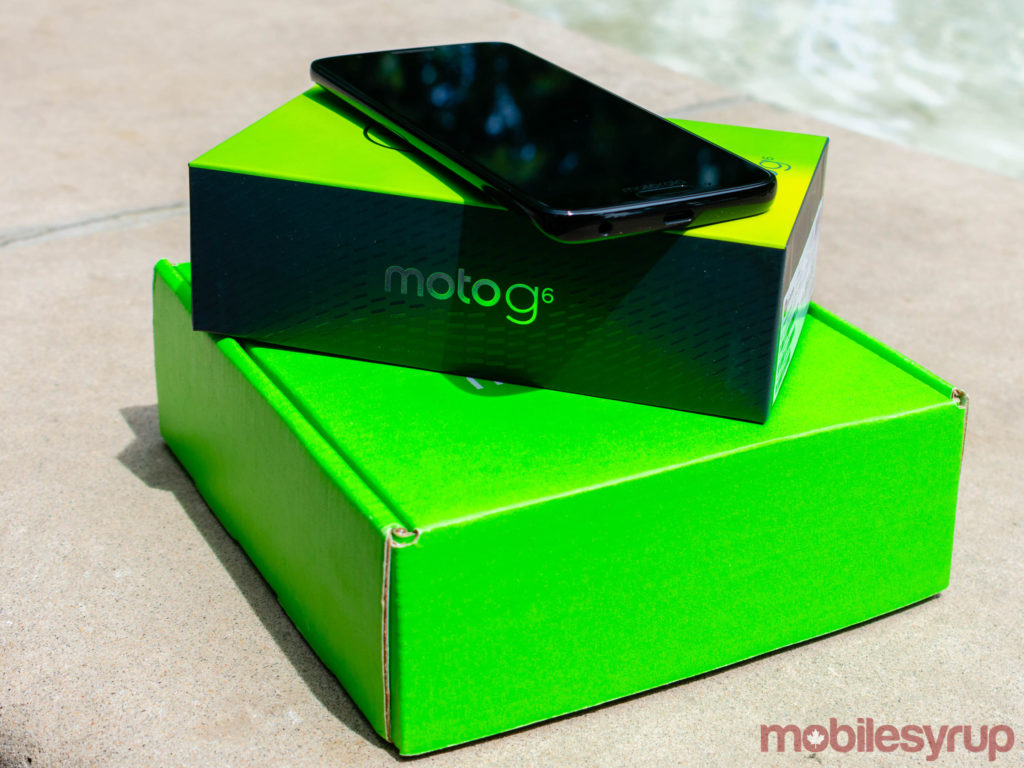
In my hands-on for the Moto G6, I emphasized that the device represents a truly premium evolution from the Moto G family’s usual sub-premium aesthetic.
That’s all to say that the Moto G6 looks like and feels like a smartphone that should cost quite a bit more than its $349.95 outright price — an increase of almost $100 compared to the $250 Moto G5.
The phone’s front and back are wrapped in curved 3D Gorilla Glass 3, the sides are made of smooth aluminum, and the Moto G family’s trademark forehead and chin have been replaced with top and bottom bezels that are sleek and slim.
The volume rocker and power buttons are also well-placed and clicky, while the phone’s thin front fingerprint sensor is both quick and responsive.

The device’s 5.7-inch, 1080 x 2160, Max Vision display with its 18:9 aspect ratio provides a satisfying viewing experience and reproduces colours accurately. The Moto G6’s screen isn’t going to win any awards, but it’s certainly good enough for gaming, YouTube and Netflix.
In spite of the lacklustre screen, this is undeniably the most attractive Moto G smartphone that Motorola has ever built, and there isn’t a single aspect of the device’s physical appearance that isn’t designed to be eye-catching. Even the Moto G6’s camera bump — a new addition, since the Moto G5 didn’t have such a bump — is built in a way that accentuates the phone’s curves and contours.
The phone is also coated in P2i liquid repellent nano-coating technology, which means that the Moto G6 is splash-resistant, but not water-resistant or waterproof. That is to say, you can use the phone in the rain and you can spill a shallow glass of water on it, but you absolutely can’t take it swimming or diving.

If there’s any single point of complaint, it’s the inclusion of a gaudy and irremovable Conformité Européenne (CE) sticker on the back of the phone. Why Motorola chose to slap on a CE sticker rather than etching the CE marking into the phone is beyond me. The sticker adds an elevated layer that takes away from the phone’s seamless fit in a user’s hand, and is perhaps the only physical blemish on an otherwise exquisitely manufactured mid-range smartphone.
As a final point regarding the phone’s physical design, the Moto G6 has a 3.5mm headphone jack.
Stock Android with minimal flourishes — the way it should be
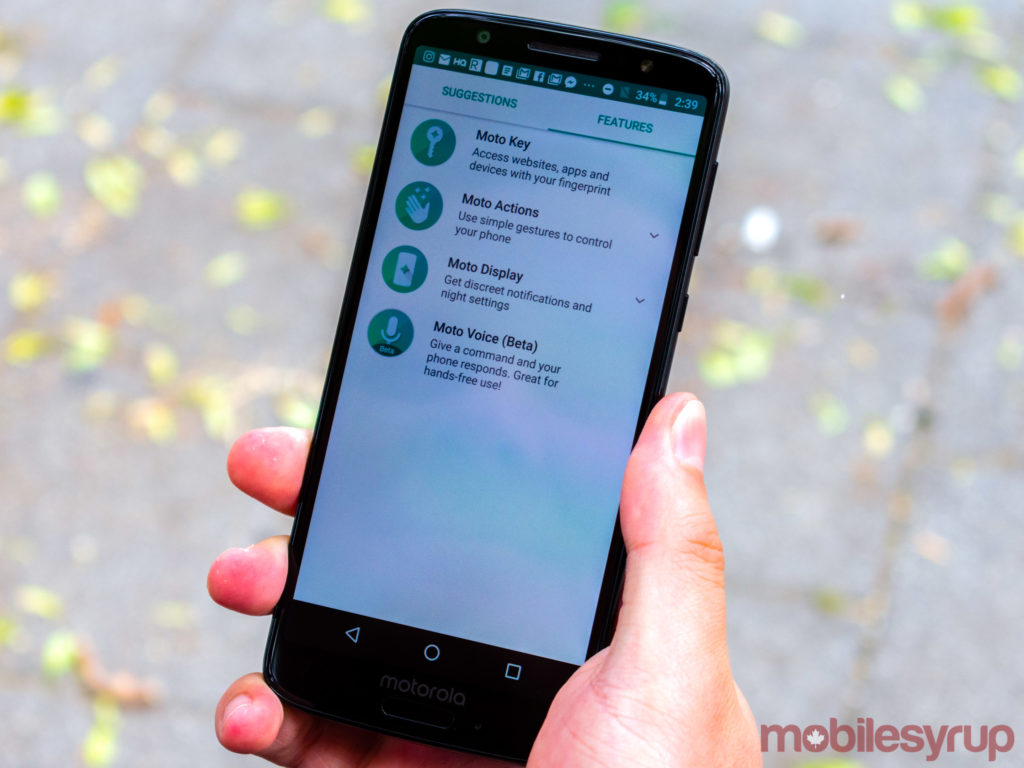
Of course, all of those hardware flourishes would be completely wasted if the Moto G6’s operating system was headache-inducing. Thankfully, Motorola has once again chosen to provide users with a near-stock Android experience that not only keeps everything great about the operating system, but adds a few welcome tweaks that can be ignored if one so chooses.
The Moto G6 runs a stock version of Android 8.0 Oreo that doesn’t include any Motorola-themed duplicates of Google apps. Instead, returning to the Moto G6 are the full suite of Moto Actions, including chopping twice to activate the flashlight, twisting the phone to activate the camera and the ability to maximize the phone’s screen real estate by navigating using the device’s fingerprint sensor rather than onscreen navigation keys.

Moto Actions remain an integral part of the Motorola smartphone experience, but as more and more Android hardware manufacturers incorporate their own Moto Action-style tweaks — like double-tapping the power button to activate the device’s camera — into their devices, Moto Actions continue to be a less-than-convincing attraction.
The phone also comes with a face unlock feature that uses the phone’s front-facing selfie camera. Face unlock is snappy and effective and I was unable to fool it using a photo on a phone or laptop, but users should still be wary of facial recognition as a security tool. Face unlock is a fun feature to try out, but I quickly switched back to using my fingerprint for security.
A zippy phone with an unimpressive battery
The Moto G6 features a Qualcomm Snapdragon 450 processor, 3GB of RAM, 32GB of internal storage (upgradable to 128GB with an external microSD card) and a 3,000mAh battery.
The Snapdragon 450 is Qualcomm’s second-lowest class of mobile processor and was designed to be included in lower-tier mid-range handsets. One would, therefore, be excused for assuming that processor’s performance — indeed, the Moto G6’s performance — would be less than adequate.
However, thanks to the Moto G6’s stock Android operating system — and the phone’s minimal software flourishes — the Snapdragon 450 is able to do its job without being burdened by weighty launcher skins, duplicate apps and unnecessary background processes.
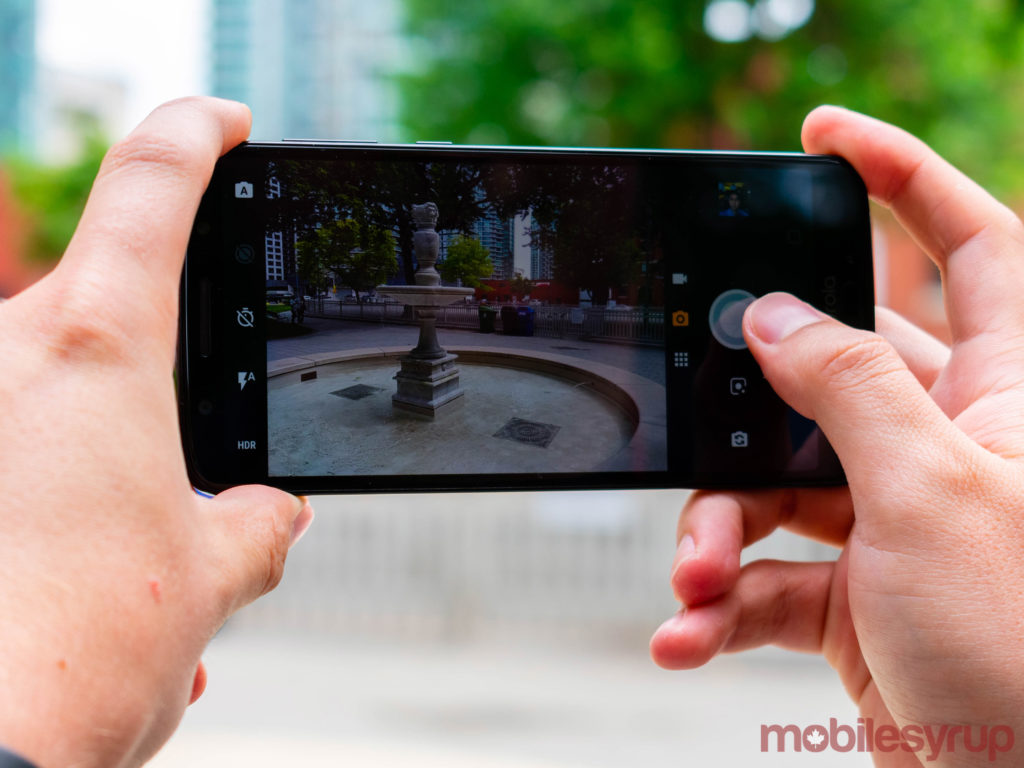
Case in point, I was able to stream music over LTE, play Pokemon GO, respond to SMS and other messages without any of the associated apps stuttering or crashing.
Of course, the Moto G6 isn’t able to handle these multiple processes as speedily as something like the Xperia XZ2 with its Snapdragon 845 processor, but the Snapdragon 450 isn’t designed to rival the Snapdragon 845 in the first place.
What might disappoint, however, is the handset’s 3,000mAh battery. The phone is able to get through almost a full day of emails, texts, phone calls, web browsing, music streaming over data, video streaming over Wi-Fi and approximately 45 minutes of Pokemon GO, but not without some effort on my part to conserve the phone’s battery.
The Moto G6 will survive an average day of use, but power users who rely on their smartphones as secondary computers will not be impressed by the phone’s battery. Thankfully, the phone can be charged quickly with compatible chargers — including the TurboPower charger included in the box — but that doesn’t change the fact that the phone’s battery is a little underwhelming.
An unimpressive camera made interesting thanks to impressive software

Equally underwhelming are the phone’s 12-megapixel and 5-megapixel dual rear-facing cameras. The cameras produce passable, unspectacular images that will be welcome on social media and almost nowhere else.
Colours are dull, image quality is adequate, and zooming in on photos reveals a distinct lack of sharpness. Additionally, the camera performs poorly in low-light conditions. Take the Moto G6 to a room without a lot of natural light and the phone’s camera is incapable of shooting a great photo.
The Moto G6 can also record Full HD video at 30 and 60 frames per second. Once again, while the camera is able to record video appropriate for Facebook or Instagram, the Moto G6 most likely won’t be used to record Steven Soderbergh’s next feature-length film.
What makes the Moto G6 camera interesting, however, is that Motorola chose to include a number of novelty camera modes, almost intended as a way to add more vivacity to the kinds of photos taken with the smartphone.
Among those novelty modes is a portrait mode; a timelapse mode; Snapchat-like face filters for both photographs and videos; as well as a spot colour mode that allows users to isolate the colours of a subject while turning the background black and white.

The Moto G6 also includes a text scanner that works best with business cards and street signs without a lot of additional design elements, and proprietary object recognition. On the subject of object recognition, Google Lens is also now built into the Moto G6’s camera. However, both Motorola’s own smart camera and Google Lens are unable to provide anything more than cursory details about an object.
For instance, the smart camera can recognize a laptop — sometimes even a MacBook — but fails to identify obvious landmarks like the CN Tower.
Canadian pricing and availability
The Moto G6 costs $349.95 CAD outright, but is available at Quebec-based regional carrier Videotron for either $0 or $99.95, depending on the plan.
Additionally, the Moto G6 is available on Amazon.ca for $369.72.
The post Motorola Moto G6 Review: A fantastic mid-range smartphone appeared first on MobileSyrup.
Twitter Favorites: [shawnmicallef] Toronto civil service. Internal audit is in the house!! https://t.co/jPBAWlOwrW

Toronto civil service. Internal audit is in the house!! pic.twitter.com/jPBAWlOwrW

Two Keyboards at a Bar
INT. EVENING. CUPERTINO, CALIFORNIA. BJ’S RESTAURANT AND BREWHOUSE. A RECENT FRIDAY NIGHT
The bar is full. Two keyboards sit at the bar: APPLE EXTENDED II and MACBOOK PRO. The front door opens, TOUCHBAR looks around, sees the two keyboards at the bar, grins, and heads their direction. Skipping.
APPLE EXTENDED II sits at the bar nursing a Macallan 18. Next to him is MACBOOK PRO who has not taken a sip of his glass of water.
APPLE EXTENDED II: Lonely times, man. Lonely times. First, it was scissors then butterflies. Do you want to know what I miss? Electric Alps switches. That was the dream, right?
MACBOOK PRO (nervous, staring at the bar, napkins in both hands): Did you clean up before I sat down? It looks clean, but…
APPLE EXTENDED II (interrupting): Kids today. They don’t appreciate the reliable, credible haptic feedback of a single healthy keystroke. It’s all hunt, peck, and swipe swipe swipe.
TOUCHBAR (arrives): Hey! Nobody told me we were going out to drinks  . This is great!
APPLE EXTENDED II: Wait, who invited him?
MACBOOK PRO: Sorry, we’re a package deal. It’s not…
TOUCHBAR (interrupting): Kind’a loud in here, you don’t mind if I turn up the volume a bit? Ok? Great. That’s better, right? I’m helping!
MACBOOK PRO: … an ideal situation.
APPLE EXTENDED II (glaring at TOUCHBAR): This a keyboard meeting. You’re not a keyboard.
TOUCHBAR: Not a keyboard? Just look at me I’m…
SIRI (appears in a puff of colorful smoke): Hey, can I help with anything? No? Ok.”
SIRI vanishes. APPLE EXTENDED II drops his face into his hands.
TOUCHBAR: … more than a keyboard, I am chock full of buttons.
The bartender approaches noticing TOUCHBAR’s arrival.
BARTENDER: Can I get you something?
TOUCHBAR: Can I get a Blue Hawaiian?
APPLE EXTENDED II: And nachos.
MACBOOK PRO: NACHOS? Wait, WHOA WHOA. You didn’t say we’d be eating food. I’ve got work tomorrow, and a single bit of chip, a smear of cheese, or a bit of jalapeño and I’m screwed.
APPLE EXTENDED II: Right, ok. Hold on the nachos. Back to you faux-keyboard. Do you know what you’re great at? TouchID. It’s a wonder because it simplifies a standard action. It transforms the process of typing a long secure password into a single click. That is legit magic, but TouchID is a button, and a button is always in the same location, it has a discernible shape you can feel with your finger, and when you press it, you feel the action of it being pressed. You are a touch screen.
TOUCHBAR: What about IPHONE?
IPHONE (three martinis in, across the bar): Leave me out of this!
APPLE EXTENDED II (standing up, pointing furiously at IPHONE): You’re the problem! You’re the problem! You showed them a world without real buttons, and now we get him!
IPHONE (also standing): My feedback is haptic!
APPLE EXTENDED II: It sure is except when I accidentally take a random screenshot of whatever is on my screen.
IPHONE: You’re a loud annoying dinosaur! We can hear every single one of your keys click-clacking all the way across town at the mothership.
MACBOOK PRO: Heyeveryonecalmdownwe’reallonthesameteam.What?
APPLE EXTENDED II: Your space bar is dead again, Pro.
MACBOOK PRO: Itis?Areyousure?
APPLE EXTENDED II: I’m sure. Screw this. Check, please.
BARTENDER: That’ll be $700. Wait no, this one’s on me.
City of Richmond Doubling Down on Transit

Richmond’s vintage Lansdowne Centre Mall, age 41, is getting a facelift, but maybe not the type you’d assume for its location — smack dab in the middle of a downtown not typically known for its active transportation facilities, or lifestyle.
But it’s true: for this future development, cars are out; transit is in. Even bikes feature in the planning docs and related literature. For residents and visitors alike, this is big.
As usual, click an image to see a larger version.


A few thoughts come to mind.
First: Goodbye to acres of asphalt, as a car-oriented shopping mall is replaced with a fairly dense, transit-oriented mixed-use development, including housing, retail, commercial and public park space. The transformation is due to start in late 2019 or early 2020, with the mall itself closing in 2025. A startlingly positive proposition.
Second: This, and a nearby sister development, are good models for the upcoming Jericho Lands transformation on Vancouver’s west side, which will be nearly twice the size. And the Heather Lands, too. But hey, you exclaim, doesn’t Lansdowne already have a transit station?
Third: Yes, but not so fast. That nearby sister development area is at Capstan Way, where the City of Richmond is putting up $28 million for a new Canada Line station. It’s a model for transit-oriented density. It’s true that funding a new Canada Line transit station at Heather Lands might be a bit of a squeeze, but at 92 acres the Jericho project seems like an appropriate place for a stop on the Broadway Extension. There’s also an opportunity to partner up with UBC on the west-of-Arbutus section.
But back to Richmond — the Lansdowne project appears to be a real take-the-bull-by-the-horns approach in an ever-densifying city.
Further south in the area around Sea Island Way and Capstan Way along the No. 3 Road corridor, developers such as Concord Pacific, Pinnacle International, Yuanheng, and Polygon are behind redevelopments that will create dozens of buildings to house up to 16,000 people. These projects are also funding the $28-million cost of building the Canada Line’s new station at Capstan Way. . . .
During a media event last week, Richmond mayor Malcolm Brodie credited the Canada Line for being the catalyst for the developments that are providing Richmond with a well-defined urban downtown core.
“You just have to look at Richmond to see the effect on urban development and redevelopment that a very effective transportation system will have,” said Brodie. “We have refocused and redeveloped our downtown core, and it is all based around the Canada Line.
With thanks to Kenneth Chan in the Daily Hive.
PDF Expert for Mac lets you easily edit any PDF file

PDF is a venerable document format that is used for just about every readable document under the Sun. College papers; infographics; job applications; you name it! Unfortunately, as versatile as PDFs are, Mac users cannot edit them with standard software.
As a Mac user, if you come across a nagging error in your documents, you would usually have to use an app on a different OS to fix it. Luckily, PDF Expert for Mac gives you all the editing tools you need for OS X; you can find it on our store for $33.27 CAD [$24.99 USD].
Not only can you view PDF files through PDF Expert, but you’ll also be able to edit text, images, links, and outlines. Additionally, PDF Expert has advanced features that let you annotate PDFs, merge PDFs, sign documents, and even fill out forms like taxes and applications. Users may share their PDFs to other Apple devices remotely. PDF Expert’s wide range of uses earned it recognition as Top Paid App in the Mac App Store.
PDF Expert for Mac will normally cost you $79.86 CAD [$59.99 USD]. However, our store is running a deal for 58% off, driving the final cost down to $33.27 CAD [$24.99 USD].
The post PDF Expert for Mac lets you easily edit any PDF file appeared first on MobileSyrup.
Counted the books I read this half year. 32 in ...
Qualcomm’s leaked Snapdragon 1000 chipset is purpose built for ARM laptops

Qualcomm’s unconfirmed Snapdragon 1000 will be designed for PCs, according to a report from WinFuture.
Much like Qualcomm’s always-connected PCs, the chipset is expected to be ARM-based. In this case, the SDM1000 is expected to use ARM’s next-generation Cortex-A76 architecture.
The chipset has a larger design than most ARM-based mobile chipsets, coming in at 20mm x 15mm and will reportedly have a power draw of up to 12W, making it comparable to (and in direct competition with) Intel’s low-power Core processors in the Y and U series.
Additionally, a leaked reference design suggests the specs consumers should expect from a device running on the platform.
There’s 16GB of RAM and 128GB of internal storage, as well as gigabit WLAN and a socketed processor design. Socket processors are standard in desktops and servers, but rare for mobile chipset-based devices — though this could just be for Qualcomm’s testing processes.
The report is further backed up by a LinkedIn job description found by WinFuture, in which a former Qualcomm employee states that they oversaw and managed “all test operations on Qualcomm Snapdragon premium tier chipset SDM845 and SDM1000 for desktop, andromeda and Hololens AR/VR/mixed reality products in audio, video, display and camera.”
Note that some of the above-mentioned products have still yet to be publicly announced by Microsoft, including Andromeda, which is expected to be a PC, smartphone and laptop hybrid. This suggests a partnership with Microsoft that will last long into the foreseeable future.
Qualcomm has been making moves into the PC space for some time. Alongside Microsoft and select manufacturers (including Asus and HP), it forged a new attempt at ARM-based Windows laptops in December 2017.
Since then, Qualcomm has revealed the Snapdragon 850, a mobile chipset dedicated to its above-mentioned always-connected PCs.
Source: WinFuture Via: Engadget
The post Qualcomm’s leaked Snapdragon 1000 chipset is purpose built for ARM laptops appeared first on MobileSyrup.
"It’s very hard to see us fixing the climate until we fix our democracy"
Pushing e-bikes will not result in mass cycling
How to write the introduction of a book manuscript
I am a member of the Public Outreach Committee of the International Studies Association’s Environmental Studies Section (ESS of ISA). At ISA 2018, recently held in San Francisco, I participated in a Publishing Roundtable organized by Dr. Beth DeSombre as part of our Speed Mentoring Series, which is organized by the Public Outreach Committee.

I was asked to participate because I do a lot of writing on academic prose, and because of my experience publishing journal articles, book chapters, and editing journals, so I was thrilled to contribute to these mentoring sessions, as they’re intended to help graduate students and early career scholars, but also established and seasoned academics. Over the course of the session, we all shared our own tips with doctoral students, postdoctoral researchers and assistant and associate professors who were writing book manuscripts and/or wanted to publish journal articles.
All participants shared lots of pearls of wisdom, but perhaps the one that stuck the most with me was that coming from the commissioning editor of Oxford University Press for politics, Angela Chnapko.
She suggested that we should read published books, particularly their introductions, to see how we could craft our book proposals and in turn, our own manuscripts. This piece of advice has stuck with me, and now that I’ve read about 45 books in the past 3 months, I’ve come to realize why she said what she said.
Thread on key piece of advice provided by an @OUPAcademic at the #ISA2018 Speed Mentoring table on Scholarly Publishing (thanks to my fellow Outreach Committee member Dr. @BethDeSombre for organizing and @ESS_of_ISA for sponsoring the session). The advice: READ BOOK INTRODUCTIONS
— Dr Raul Pacheco-Vega (@raulpacheco) April 14, 2018
Reading the introduction to a published book gives you amazing insight into why an author undertook the project, how they went about the research, fieldwork, data analysis, etc., and what the book’s implications are for the specific body of scholarship we try to contribute to, for the field, and the discipline, as well as society at large.
Intuitively, I understood this. William Germano indicated it in his two books, From Dissertation to Book and Getting It Published, but it wasn’t until Angela said it that it all clicked in my head.
Read the book’s introduction.
While I am writing my own book manuscripts, I would not feel comfortable showcasing my own work as an example for how you should write so what I did was take examples from a few books I had at my Mom’s house or that I was travelling with. These five examples are just a few, but the basic lesson stands: READ OTHER BOOKS’ INTRODUCTIONS IN ORDER TO LEARN HOW TO WRITE YOUR OWN.
In my thread, I provided an overview of three books’ introductions (the three I had purchased during AAG 2018). The first one was “Resigned Activism” by Anna Lora-Wainwright.
First example is Dr Anna Lora-Wainwright (@troverex) 's ethnography of pollution in 3 villages in rural China, "Resigned Activism" @mitpress pic.twitter.com/7vlUrI8Izc
— Dr Raul Pacheco-Vega (@raulpacheco) April 14, 2018
Read how @troverex describes a) current state of affairs b) how her work connects w broader themes c) how her work contributes 2 scholarship pic.twitter.com/VrIWG6ggJ3
— Dr Raul Pacheco-Vega (@raulpacheco) April 14, 2018
Note how, rather masterfully, @troverex situates her work within similar works to her, HOWEVER she makes explicit how she contributed pic.twitter.com/gwvOR5CUDd
— Dr Raul Pacheco-Vega (@raulpacheco) April 14, 2018
I also read an edited volume (”Untapped”) to show how the editors made it clear to the reader what’s the common thread throughout the book.
With Untapped, Chapman and coauthors explore the question of "what is sociological about beer?" pic.twitter.com/tVcf069LRm
— Dr Raul Pacheco-Vega (@raulpacheco) April 14, 2018
Note how the table of contents makes it explicit that the book does have a coherent thread that crosses throughout the edited volume. pic.twitter.com/88kUCyF0gG
— Dr Raul Pacheco-Vega (@raulpacheco) April 14, 2018
Chapman et al (editors) use a 3 part Introduction model. Firstly, they set up the stage by explaining the emergence and relevance of craft beer global and local markets. Secondly, they explain what is sociological and cultural about beer. Thirdly, they explain the book structure.
— Dr Raul Pacheco-Vega (@raulpacheco) April 14, 2018
The third book whose introduction I read and suggested be used as a model was Elizabeth Hoover’s The River Is In Us, an excellent multidisciplinary examination of pollution in a community with Indigenous heritage.
3rd example of great introduction is @bluefancyshawl 's excellent (and interdisciplinary) examination of Akwesasne's fight against pollution pic.twitter.com/5aQyGNvPEo
— Dr Raul Pacheco-Vega (@raulpacheco) April 14, 2018
Note how it takes @bluefancyshawl less than 5 pages to fully explain 1) the case study's context 2) the research methods she used 3) the literatures she dialogues with and borrows from to build an interdisciplinary framework 4) her main intent with the book (including new ideas!)
— Dr Raul Pacheco-Vega (@raulpacheco) April 14, 2018
… a new way of writing and engaging with the local community that you're studying. As @bluefancyshawl writes, "what and for whom we learn" (Hoover 2017, p. 5). Dr. Hoover's introduction is an excellent model for historians, sociologists, anthropologists, urban studies scholars.
— Dr Raul Pacheco-Vega (@raulpacheco) April 14, 2018
In my Twitter thread I also wrote about Diane Coffey and Dean Spear’s “Where India Goes” and Josh Lepawsky’s “Reassembling Rubbish”. You can go back to the thread by clicking on any of the tweets shown above. I hope this post helps those who are writing their first books or transforming their dissertation into a book manuscript, or even editing their first volumes.
A rusting fountain of youth in Germany
In the first week of this mini-series, we found out that Germany has a surprisingly high median age. Last week, we saw that this is especially the case in rural areas in East Germany. Today, let’s see where we’re heading: What does the trend say? Did Germans reach peak-elderly and from now on, we’re going into a young future?
Oh, oh no. No no no. Definitely not. Look at this chart:
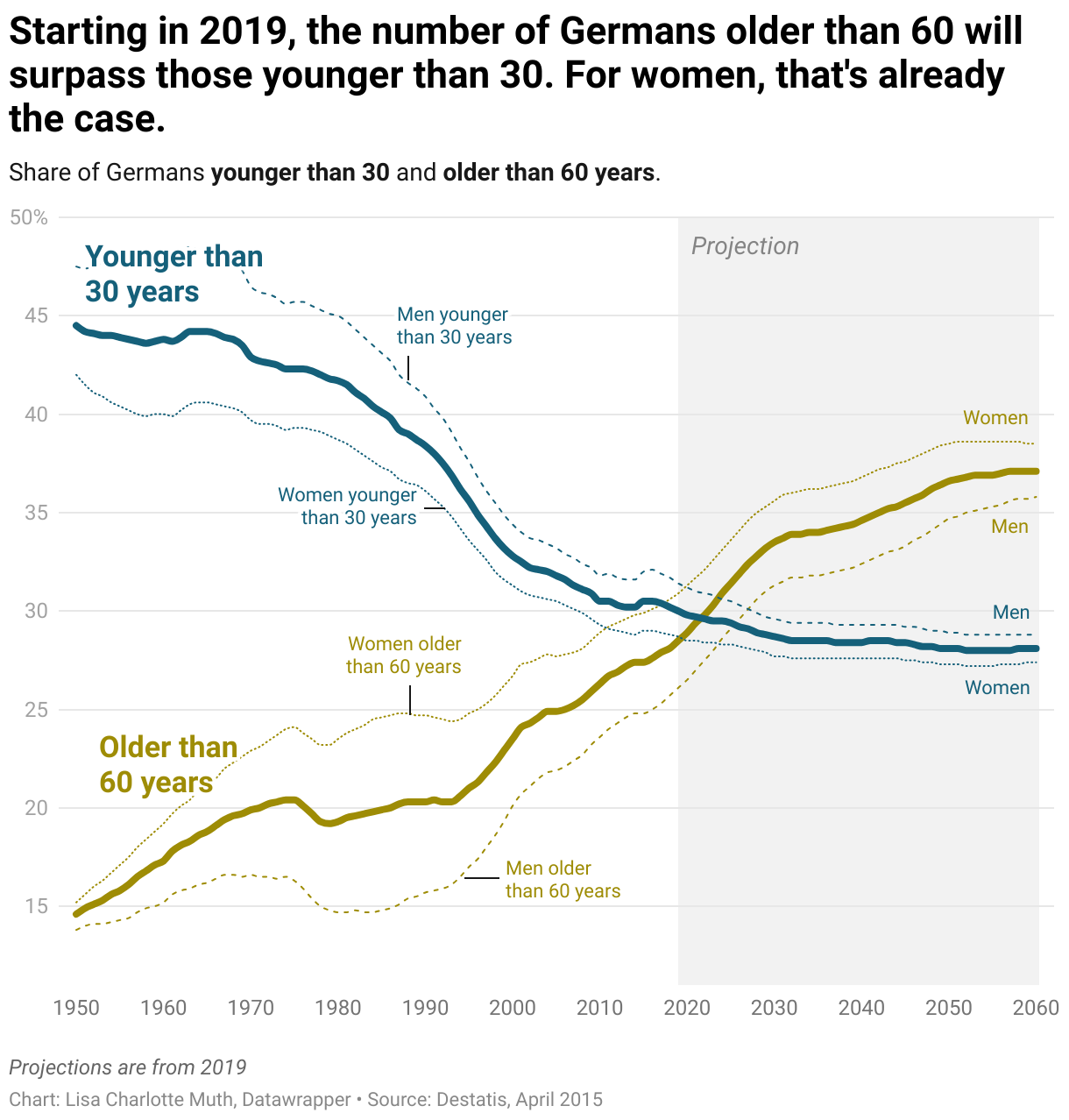
I’m one of these people younger than 30 years. 1950 we made up 45% of the German population. These days we only make 30% of the population. We’re getting chased by the elderly: In 1950, 15% of Germans were 60 years or older. Today, more than 25%. In 2050, almost 40%.[1]
In 2050, I will become one of these 40%. I can see myself being a proud senior, laughing at the imprudence of the few young people who still dare to step a foot on the streets that we rule with our rollators. What a time to be (still) alive. Jokes aside: Such an overhang of old people will bring huge challenges to a welfare state like Germany. Just to name two: Health insurance costs increase; pensions are going down. (I’m a bit afraid.)
It’s worth noting that the current projections were made in 2015 and do not include the effects of recent changes in in-bound immigration. It’ll be exciting to see the next projections by the German Statistical Office Destatis, which are scheduled for next year. Maybe I don’t need to be afraid so much after all.
Chart choices
Since I’m showing shares over time, the obvious choice for this data is a stacked bar chart or area chart. I could show the 0-30 year olds on the bottom, the 30-60-year-olds in the middle and the over-60-year-olds at the top. But that wouldn’t be the obvious choice for the kind of statement I want to make: That there will be MORE people over 60 than under 30. Showing shares of the same total as line charts is a great way to see when one share is becoming greater than the other. The drawback of line charts for shares is that it’s not intuitive: People don’t immediately see that the data are shares; they need to read the legend to understand it.
Next week, we’ll look into the future again. We’re zooming out to look at the bigger impact of age structure: What does it mean for the size of a continent? Have a nice week!
Let’s compare this with the world: In 2015, 12% of the entire human race was older than 60 years. In 2050, it will be 21%. ↩