Shared posts

27 Jun 21:28

What skills improve pattern recognition?

files/images/feature-jun2418.jpg

Steven Forth, TeamFit, Jun 29, 2018


Icon

Knowledge is recognition, but what leads to greater skill in recognition. This post considers that question. " Pattern recognition depends on the ability to see what is the same and the ability to see what is different. Further, it depends on being able to make connections between different types of information and on being able to apply transformations to different types of data... Pattern recognition skills can be built up by actively working with patterns of different types. There are several approaches to this. The six modular operators help one work with many basic organizational patterns (split, substitute, exclude, augment, invert, port)." Interesting. Worth noting.

Web: [Direct Link] [This Post]
27 Jun 21:28

You can now protect your Twitter account with a physical security key

by Patrick O'Rourke
Twitter

If you’re concerned about your Twitter account’s security and don’t feel a password doing the job, there’s another option.

It’s now possible to lock up a Twitter account with a physical security key, according to Twitter’s official safety account, @TwitterSafety.

Physical security keys, such as a YubiKey for example, can be plugged into a computer via USB, or you can also opt to use an Android device’s NFC chip, in order to authenticate your Twitter account with a physical token.

The physical key then acts as an additional layer of security on your account since it’s required to gain access to your Twitter profile.

Twitter isn’t alone with this additional level of authentication either, with other services like Facebook and even web browser Firefox also featuring support for physical security keys.

If you’re interested in setting up a security key for your Twitter account, the social network has a handy step-by-step guide featured on its website.

Source: @TwitterSafety 

The post You can now protect your Twitter account with a physical security key appeared first on MobileSyrup.

27 Jun 21:27

Nokia says machine learning will play a major role in making 5G work

by Jonathan Lamont
5G image on phone

Nokia thinks it has some machine learning solutions for problems with the upcoming 5G networks.

A lot of the technology behind 5G is more complex than current 4G technology and may need more complex solutions.

Nokia’s head of advanced wireless solutions, Rajeev Agrawal, spoke about how Nokia is applying machine learning to some of these problems at a 5G summit at Computex. According to Agrawal, machine learning could boost network performance and reduce costs.

Agrawal presented three examples of how machine learning could do this. The examples were taken from internal studies but there hasn’t been a research paper published yet.

Scheduled beamforming

While it sounds like something out of science-fiction, beamforming is a very important part of 5G networks. 5G relies on multiple-input multiple-output (MIMO) technology which multiplies the capacity of a transmission by using multiple transmission and receiver antennas. The upside to MIMO is it can send more data. The downside is that all these extra signals can interfere with one another.

Beamforming processes the signals and allows antenna base stations to send targeted beams of data to specific users. This reduces interference and makes more efficient use of radiofrequencies.

The main challenge with a system like this is scheduling the beams. Nokia has a system with 128 antennas working in tandem to form 32 beams. The company wanted to schedule four of the beams in a specified amount of time with the highest spectral efficiency — a measure of how many bits per second a base station can send to a set of users.

There are 30,000 possible ways to schedule four of 32 beams. That’s where the AI comes in. Nokia was able to train a neural network how to find the best schedule offline and then later predict the best schedules on demand.

Indoor positioning

An efficient way to make use of 5G networks is to install miniature base stations that can provide wireless service close to where users are physically located. A side benefit of this is that it can help carriers find the location of indoor objects, like smart speakers or sensors.

GPS signals aren’t that accurate, especially indoors. Signals can generally identify an object’s location no more accurately than within about 50 metres when indoors (which isn’t enough to pinpoint smaller items).

However, AI can be trained to use an algorithm to accurately infer the location of an object based on its relation to network base stations. Nokia’s approach was to measure the received signal strengths from each base station in a room and form a map. The maps train the AI to predict the location of a device based on the strength of a signal it receives from a nearby base.

Controlling uplink and downlink

A smartphone’s uplink control panel is crucial. It provides feedback on the quality of a cellular network. This is doubly integral with 5G networks, which will utilize beamforming. Accurate information from phones will help networks beamform better.

The problem is that the more data transmitted through the uplink channel to ensure better quality, the less spectrum is available for the actual data transmission.

The proposed AI solution would use machine learning to determine the best uplink and downlink settings would be based on the user’s device. This would allow for optimal data transmission in a variety of scenarios.

Source: Spectrum

The post Nokia says machine learning will play a major role in making 5G work appeared first on MobileSyrup.

27 Jun 21:27

Marzipan as a Path to ARM Based Macs

Jason Snell and Myke Hurley on the Upgrade Podcast #198: The Mac Is Dead, Long Live the Mac:

"Apple has said that it’s not merging iOS and macOS, but that sneak peek of iOS apps coming to macOS opens up a lot of questions about just what the Mac might look like in five years. Jason’s optimistic, but Mac users may be in for the biggest changes to the platform since the introduction of Mac OS X nearly two decades ago."

It's an interesting discussion, and I really do hope we see things from iOS move to the Mac, touch and Pencil support in particular. And the idea that "folks don't want to use touch on the Mac" is pretty dumb when you realize Apple sells a hardware keyboard for the iPad which works exactly the same way as a touch Mac would.

There are a couple of things that I was surprised the discussion didn't cover though. And what follows below are my half baked thoughts on what those are.

OpenGL and OpenCL were deprecated this past year, but Apple can't really get rid of those frameworks anytime soon because of legacy apps that aren't going to be updated to use Metal. It's a tough spot to be in.

Apple has dropped legacy frameworks very easily in the past though. But how exactly did that happen?

CPU changes. Once when MacOS went from PPC to Intel, and then once when MacOS went from 32 bit to 64 bit. Each time that transition happened Apple was able to say "OK, this legacy stuff just isn't going to be there on the new architecture". And since you had to recompile apps anyway to make them run on the new architecture, developers kind of shrugged and said "Well, yea. That's what I would have done too". It made sense.

So are we about to see 128 bit Intel processors anytime soon, to facilitate this change? I doubt it.

OK then, what about a new architecture?

Oh. Hello 64 bit ARM.

OK, so now we've got a new processor architecture for the Mac and now we need apps recompiled for them. Nimble indie shops and apps like Acorn and Retrobatch would most be certainly there on day one (just like we were for PPC to Intel and 64 bit), but then you've got the giants like MS and Adobe who usually have to be dragged kicking and screaming into the future. What's Apple to do about them?

Well, what if they made it easier for other apps to possibly take their place or at least fill in the gaps until the giants can ship something? Where can we find a billion other developers that already have a codebase that's ready to be compiled on another architecture, because they don't have decades of legacy code to clean up?

And if you look at from this angle, UIKit for MacOS makes perfect sense. Even if it's only to potentially help with a transition, that may or not actually happen. It gives Apple leverage.

And since UIKit on the Mac has already existed for years (presently contained in the iOS simulator), it's probably not as big of an investment on Apple's part as you'd think it would be. For sure, AppKit engineers have performed heroics to make it work as well as it does- but it's not like UIView wasn't already compiling on 64 bit Intel processors. It's there today. It was there 10 years ago.

This could go completely off the rails too.

What if MacOS on ARM only ran these new UIKit apps?

That's a scary thought for this MacOS developer.

But then again, we already have this and it's called iOS on the iPad. And maybe, just maybe, and remember these are half baked thoughts, but maybe Apple is wondering if some Pro users might be better served by MacOS Touch 1.0 running on ARM.

27 Jun 21:27

Working together to promote Drupal

by Dries

The Drupal community has done an amazing job organizing thousands of developers around the world. We've built collaboration tools and engineering processes to streamline how our community of developers work together to collectively build Drupal. This collaboration has led to amazing results. Today, more than 1 in 40 of the top one million websites use Drupal. It's inspiring to see how many organizations depend on Drupal to deliver their missions.

What is equally incredible is that historically, we haven't collaborated around the marketing of Drupal. Different organizations have marketed Drupal in their own way without central coordination or collaboration.

In my DrupalCon Nashville keynote, I shared that it's time to make a serious and focused effort to amplify Drupal success stories in the marketplace. Imagine what could happen if we enabled hundreds of marketers to collaborate on the promotion of Drupal, much like we have enabled thousands of developers to collaborate on the development of Drupal.

Accelerating Drupal adoption with business decision makers

To focus Drupal's marketing efforts, we launched the Promote Drupal Initiative. The goal of the Promote Drupal Initiative is to do what we do best: to work together to collectively grow Drupal. In this case, we want to collaborate to raise awareness with business and non-technical decision makers. We need to hone Drupal's strategic messaging, amplify success stories and public relation resources in the marketplace, provide agencies and community groups with sales and marketing tools, and improve the Drupal.org evaluator experience.

To make Promote Drupal sustainable, Rebecca Pilcher, Director of MarComm at the Drupal Association, will be leading the initiative. Rebecca will oversee volunteers with marketing and business skills that can help move these efforts forward.

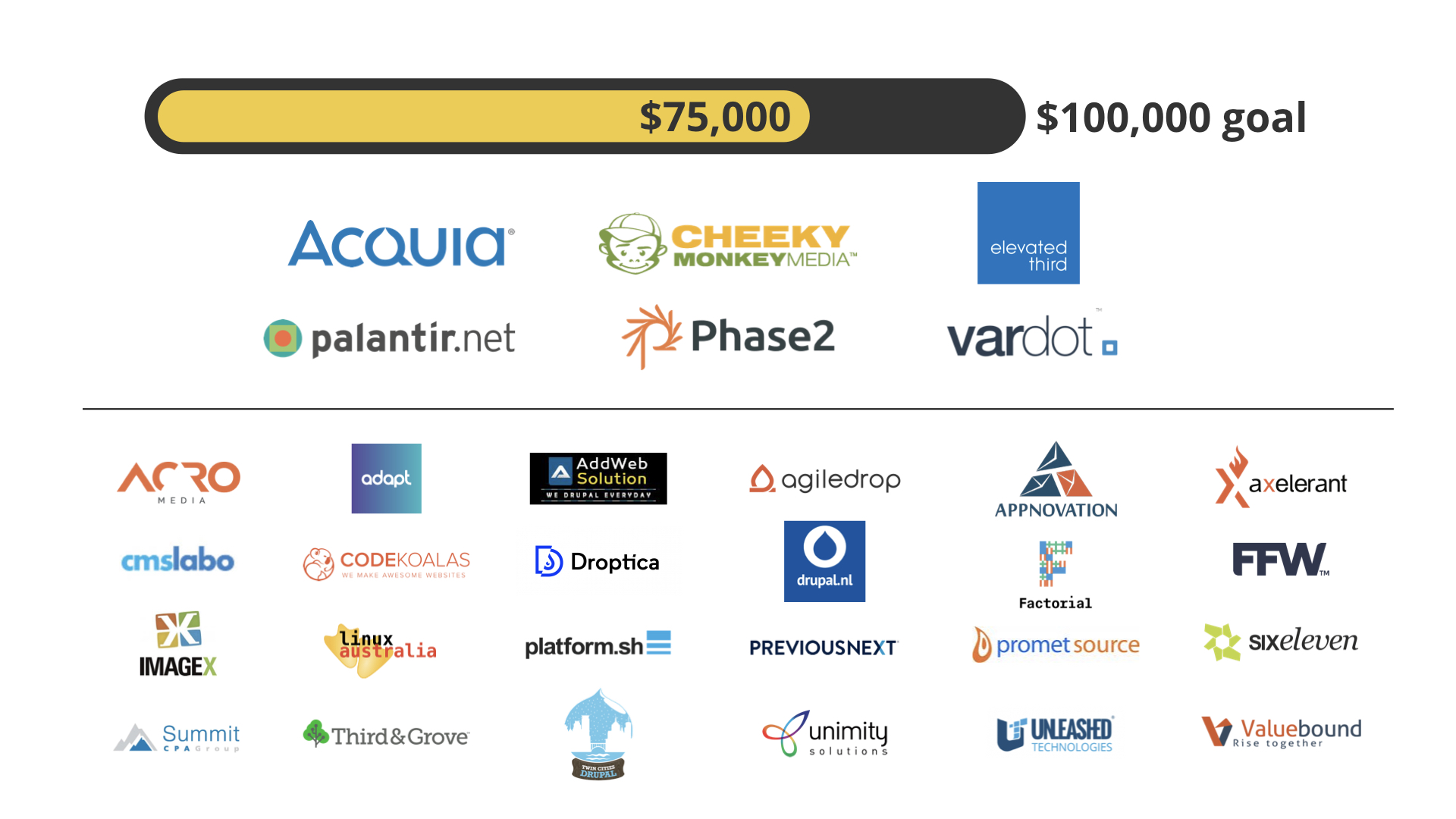
Promote Drupal Fund: 75% to goal

At DrupalCon Nashville, we set a goal of fundraising $100,000 to support the Promote Drupal Initiative. These funds will help to secure staffing to backfill Rebecca's previous work (someone has to market DrupalCon!), produce critical marketing resources, and sponsor marketing sprints. The faster we reach this goal, the faster we can get to work.

I'm excited to announce that we have already reached 75% of our goal, thanks to many generous organizations and individuals around the world. I wanted to extend a big thank you to the following companies for contributing $1,000 or more to the Promote Drupal Initiative:

Thanks to many financial contributions, the Promote Drupal Initiative hit its $75k milestone!

If you can, please help us reach our total goal of $100,000! By raising a final $25,000, we can build a program that will introduce Drupal to an emerging audience of business decision makers. Together, we can make a big impact on Drupal.

27 Jun 21:27

Dear Twitter, help, I need a job.

Every week, I see at least 10 tweets from job seekers asking for jobs. And every time I see these tweets, I think to myself, will I hire this person? These tweets, most times seek to be sympathy based instead of value based. There’s also an interesting pattern to these tweets and it goes thus -

“I graduated with first class in X. I am looking for a job. Please RT, my potential employer may be on your TL.”

The first thing that comes to mind when I see this kind of tweet is why should I hire you? Should I just hire you based on the fact that you made the first class? I, for one, don’t think that’s a strong enough reason for me(as a potential employer) to make that hiring decision.

Today, I saw another of this kind of tweet and I decided to make a mini Twitter thread out of it.

Let recap the thread in this post.

  1. Instead of saying “I have a 1st class in X, please RT my employer may be on your TL.” Why not say “I have an experience in customer service. I took a team of 2 agents and grew it to 10 over a period of 12 months and during this time, we reduced complaints by 20%”
  2. “We improved our SLA from 24hrs to 2hrs, thereby improving customer satisfaction and this had a net positive impact on our NPS.” You can also add your volunteering activities - “I volunteered as the coordinator for our CDS game day. With a budget of x, we staged the best game day in our service year.”
  3. “I have an excellent communication skill - verbal and written.” “I had also functioned in the capacity of a HOD when my manager was out for 3 months due to maternity leave.”

In the tips above, have you seen how I didn’t mention a degree or its class? Instead, I focused on listing achievements and skill set. What you have just done here is to prove that you can bring something to the table. Honestly, these days, no one really cares about your 1st class. We have enough today.

With what I described above, you have shown organizational skills, leadership skills and you have a firm understanding of stakeholders management. You have also proven to us that you’re an independent thinker and you understand business metrics.

Bonus tip: Convert your resume into PDF and put it in a public Dropbox folder then attach it to your tweets. Make that resume short and engaging too.

Good luck with the job search.

27 Jun 21:27

Supreme Court’s Decision to Uphold Trump’s Travel Ban is a Disappointment

by Denelle Dixon

We are deeply disappointed by today’s Supreme Court 5-4 ruling which provides a legal basis for the Trump Administration to prohibit individuals from Libya, Iran, Somalia, Syria, Yemen, North Korea and Venezuela from entering the United States. We agree with the four dissenting Justices that the majority ignored key facts that overwhelmingly showed that this is a religious ban that “masquerades behind a facade of national-security con­cerns.”

At issue is the Trump Administration’s third Executive Order on immigration, which differed from the original January 2017 and March 2017 orders by the removal of Iraq and Sudan, and the addition of three non-muslim majority countries. Five Justices held that the President has broad discretion to protect national security, and irrespective of Trump’s personal beliefs or statements, his action was justified because he consulted with other agencies and officials on whether people from certain countries posed security risks.

This was harshly criticized in the two dissenting opinions as a highly abridged account that ignores:

  • repeated anti-muslim statements without apology by Trump and some of the officials with whom he consulted;
  • public statistics showing that people eligible to receive a waiver under the very terms of the Order are being denied;
  • weak analysis and preparation done in the agency review;
  • lack of exemptions for people in need, such as asylum seekers; and
  • efforts to edit the Executive Orders to make them more justifiable based on territory than religion

Cumulatively, the dissenting justices believed there was enough evidence to hold the Executive Order unlawful. Unfortunately, history will not reflect that.  Since Trump issued his first travel ban, Mozilla and 100+ tech companies filed several “friend of the court” briefs warning against its adverse consequences and reminding the Court of the importance of diversity.

The internet is built, maintained, and governed through a myriad of global civil society, private sector, government, academic, and developer communities. Travel across borders is central for their cooperation and exchange of ideas and information. It is also necessary for a global workforce that reflects the diversity of the internet itself.

Today’s opinion turns “a blind eye to the pain and suffering the Procla­mation inflicts upon countless families and individuals.” We will continue our fight to protect the internet. Countries may arbitrarily close their borders, but the internet must remain open and accessible to everyone.

The post Supreme Court’s Decision to Uphold Trump’s Travel Ban is a Disappointment appeared first on The Mozilla Blog.

27 Jun 21:26

Twitter Favorites: [doriantaylor] loooool https://t.co/sZBednvFmI https://t.co/USq5qfiWlS

27 Jun 21:26

The Modular Kingdom: Why the developer of a new type of vehicle believes China is the future

by Frank Hersey
A global mobility startup has its sights on China as the first market to adopt modular vehicles. And whether the general population even knows what modular cars are is not really an issue, as all the signs are there to show that it won’t be individuals buying the cars. Open Motors has already secured Chinese […]
27 Jun 21:26

Stephen Fry on Oscar Wilde

by peter@rukavina.net (Peter Rukavina)

I challenge you to tear yourself away from this captivating holding forth by Stephen Fry at Oxford once you start watching it.

Among the things you will learn is the backstory to Oscar Wilde’s visit to Charlottetown.

Fry speaks for 45 minutes without stopping for air. And those are just his introductory remarks before being interviewed.

27 Jun 21:26

June 2018 Recap

by brandon

June is generally known as being the gateway to summer. All around the world, people are trading out their jackets for tank tops and sandals, or lathering themselves in sunscreen to prepare for their months-long blast of vitamin D. Sounds great to us, but typically far from how things happen in San Francisco.

This is where we’d probably insert that cheeky Mark Twain quote everyone says about “The coldest winter I ever spent was a summer in San Francisco.” but he in fact never actually said that. Sorry if that's a rough one for some of you San Franciscans to stomach.

Regardless of what Twain may or may not have said, we took this June as an opportunity to shake things up around here...

Flavor of the month:

Early in June, a batch of our limited “flavor of the month” bikes made their way through the pipeline and got built up just in time for summer riding.

You might remember we released the Sunkissed Orange colorway as a free upgrade during the month of May.

The fully built results were stunning…

Like the idea of building up your very own limited run colorway bike but weren’t exactly feeling the Sunkissed Orange?

Stay tuned cause we’ve got another limited edition summer color coming at you for August 1st, and it's a real attention getter.


San Francisco Design Week:

The biggest event(s) by far this month can be attributed to our participation in San Francisco Design Week 2018. We’ll admit it was a lot of work to pull off, but all the love we were feeling from the design community made every bit of effort worth it.

The week started off strong with opening night at Pier 27, where the official bike of SFDW made its big debut to a packed house.

Next up was our Design Cycle tour of San Francisco, where we lead 40+ designers around the city by bike on a tour of beautifully designed public sculptures and architecture. We covered about 12 miles and 10 different stops, educating locals and visitors alike on how a wide variety of design features made their way into our city.

After a ride like that, you can't end it by telling people to just head home, so we wrapped things up by throwing an afterparty at Black Hammer Brewing in the SOMA, where beers, snacks, and good times were had by all.

Finally, with the week winding down, we invited designers from all disciplines to come through our HQ at 766 Valencia to collaboratively come up with bike designs throughout the evening.

For the grand finale of the evening, we dramatically drew the winner of the SFDW collab bike raffle with a drum roll provided by our studio crawl crowd. Although hundreds purchased tickets, it was Jason Bolton whose lucky ticket got pulled for the bike. From our perspective, however, everyone is a winner in the end because the raffle itself managed to raise nearly $3k for the San Francisco Design Week's nonprofit!

Most Modest pop-up:

In keeping with the spirit of great design, we decided to shake things up in the shop and enlisted the help of our good friends at Most Modest design studio to do a pop-up in our shop at 766 Valencia St. through early July.

Their incorporation of poppy colors in simple, straightforward, and beautifully designed goods manages to draw parallels both visually and idealistically to what we do for bikes here at Mission Bicycle Company.

In short, we love what they do and think you will too. Be sure to stop by and check out their pieces before the pop-up is popped-down and gone.


Sofar Sounds:

Last but so very far from least, we hosted a Sofar show in the bike shop, and had musical acts play from as far across the globe as New Zealand! 

Everyone was great, and we can't tell you guys enough about how amazing Sofar Sounds is as a community. They throw secret shows all around the world, and have such a community of respect for the artists as well as venues they perform in. 

Take a peek at their calendar and maybe the next show you attend in the Mission will be right here in the shop! 


27 Jun 21:26

Qualcomm Unveils Snapdragon 632, 439, and 429 Mobile Platforms For Mid-Tier and Budget Smartphones

by Rajesh Pandey
Qualcomm today unveiled three new chipsets for its mid-tier and budget platforms: the Snapdragon 632, Snapdragon 439, and Snapdragon 429. Aimed at mass-market smartphones, they feature enhanced AI capabilities along with improved connectivity, GPU performance, and power efficiency. Continue reading →
27 Jun 21:26

Facebook Canada launches third-party fact-checking program

by Bradly Shankar
Facebook Android app

Facebook Canada has launched a third-party fact-checking program in collaboration with Agence France-Presse (AFP).

The program is part of Facebook Canada’s larger Elections Integrity Initiative, which aims to combat the spread of fake political news on the social network. Specifically, Facebook has been working to make its platform safer and more secure leading up to the 2019 Canadian federal election in response to reports that foreign agents may attempt to influence the democratic process.

AFP fact-checkers, which are based in Canada and certified by a non-partisan International Fact-Checking Network, will be responsible for reviewing Canadian news stories on Facebook in both English and French to rate their accuracy. When necessary, fact-checkers may write articles providing additional information to a news story. These articles will appear immediately below the original story in the News Feed.

Based on the fact-checkers’ ratings, Canadians on Facebook will then be informed if the stories they have shared are false. Meanwhile, Pages on Facebook that are identified as repeated sources of false news will be seen less often in users’ News Feeds.

“We are committed to fighting the spread of false news and misinformation on multiple fronts, employing a variety of tools and tactics. Working with AFP on the third-party fact-checking program is a continuation of our Canadian Elections Integrity Initiative, and one of the ways we hope to better identify and reduce the reach of false news that people share on our platform,” said Kevin Chan, head of public policy at Facebook Canada, in a press statement.

“In addition to the fact-checking program, our tactics include disrupting financial incentives, taking action against fake accounts, applying machine learning to help diminish spam, reducing the posts people see that link to low-quality web pages, and providing people with easier access to additional perspectives and information.

“We are delighted with this new contract which is testament to AFP’s expertise and credibility in the verification of information,” said Michèle Léridon, global news director at AFP. “At a time when false news and misinformation is proliferating widely, this project with Facebook touches directly on the agency’s founding mission and the work being done by our network of journalists every day to provide a reliable and high quality verified news service.”

Outside of fact-checkers, Facebook has also been working with digital and media literacy not-for-profit group Media Smarts to help protect politicians and political parties from any possible outside threats.

The post Facebook Canada launches third-party fact-checking program appeared first on MobileSyrup.

27 Jun 21:26

Respect your readers’ time

Sometimes, I give workshops. They are mostly introductions to data visualization. And if you’ve ever visited one of these workshops, you’ve seen this chart before:

It’s a chart by the New York Times graphics editor Derek Watkins from 2.5 years ago, showing the “Yearly fluctuations in area of Arctic covered by ice.” Go ahead and visit this chart in its natural habitat on nytimes.com.

I love this chart. I love it so much. It’s one of my favorite charts out there. I’m getting excited every time I have the chance to talk about it.

Why is that? I’m glad you asked. That’s why: I feel like this chart respects my time as a reader.

There three reasons for that:

  1. I feel like I get the whole picture. There’s no part of the story I’m missing out on. Derek tells me what’s important about the chart. He tells me what he wants me to see.
  2. I feel oriented. I understand what each element is supposed to represent immediately. My eyes are not flickering from one object to another; searching for grip and clarity. I don’t need to eye-travel long distances.
  3. I feel clear about the content. I understand what’s going on. I understand what the chart is about, and what I see. Derek reminds me again and again what I’m looking at.

Here I’ll try to explain these three ways to save your readers’ time in detail:

1. Tell readers what you want them to see

Why do you want your audience to look at your charts? Maybe because you find them interesting yourself. Maybe because they prove a point you make with your article. Maybe because you want to explain something that’s better explained visually than with text.

In any case, you want readers to understand one or several things with your chart. And yes, it’s a great idea to show the data in a way that readers can see the important bits themselves. But if you want to make sure that they don’t miss your points, don’t just show them: Tell them.

On this chart, Derek tells us. He wants readers to understand the cycle of artic ice: How the ice cover shrinks and how it grows over the year. So he writes: “Arctic ice cover usually reaches an annual maximum around March” and “Ice cover usually shrinks to its minimum in September” Could readers have figured that out themselves? Yes, because they see the timeline, and they see where the size of the ice peaks. But Derek writes it down anyway. To make sure that his readers get it.

Highlighted in green: things that readers could figure out by themselves, but were written out anyway.

Writing out the points you want to make is great for readers: They understand what you want them to understand, even if they don’t have the muse to spend 10min exploring your chart. And you make sure that they don’t misinterpret the data.[1]

But as a nice side effect, you will also need to think about the points you want to make with this chart yourself. What is it you actually want to show? (I wrote about the power of asking that question before.)

2. Don’t let readers eye-travel long distances

I’m sure you’ve seen graphics like that: Where the color key is in one corner and the lines or bars with these colors in the other. And your eyes go back and forth between them: “Wait, what did red represent?” (The interactive chart from the National Snow & Ice Data Center with the same data is a good example of that.)

If you want to read a whole novel just on this point, read Eugene Wei’s “Remove the legend to become one”.

Don’t be the person who creates these charts; I beg you. Bring elements and their explanations as close together as possible.[2] Reduce eye-traveling. Your readers will be thankful for that.

Derek does that everywhere in the chart. Here’s the explanation of the green lines and the grey line at the top, for example (he gets bonus points for using the same color for the label as for the element itself!):

Labels close to their elements.

3. Remind readers again and again what they’re looking at

Make your chart descriptions redundant. Ok, yes, it’s important to have a good description of your chart, and this chart has such a description in the top-right corner: “Yearly fluctuations in area of Arctic covered by ice”. But Derek didn’t stop there.

I’m not sure about you, dear reader, but I don’t read a chart description until I need to – meaning, until I notice that I absolutely can’t figure out what’s going on in the chart by myself. Descriptions are my plan B. They’re boring, and I avoid them. When I saw Derek’s chart for the first time, I didn’t say “Wait, Lisa! Before you can look at it, you need to read the description.” Instead, I dove right in.

That’s why it makes me so happy that on Derek’s chart, I don’t need to read the description. The phrase “ice cover” (and its synonyms) appear six times in the chart itself. The words “sq. km” and “size” on the y-axis give extra hints that this chart is about area (instead of, e.g., temperature). I don’t need to actively look for these kinds of information in the description; I get pushed towards them while I’m browsing the chart anyway.

Highlighted in green: mentions of “artic ice”/“sea ice”

In the best case, you’re using different phrases to describe the chart (like Derek did!). Readers will understand the graphic better if you do so. Sure, it feels like a chore when creating the chart: “Ugh, what’s another word for ice extent?”. But with every synonym, you’re reaching more (different) people. For example: As a non-native English speaker, maybe the phrase “ice cover” is part of my vocabulary, but “ice extent” isn’t. But for some of the native readers, it might be the other way round, and “ice extent” awakes more associations than “ice cover” does.


I explained three ways this chart saves me time: It tells me what I should pay attention to, makes sure my eyes don’t need to search for far-away color keys, and it makes descriptions redundant. Coming back to the feelings I explained at the beginning: When I look at this chart, I feel safe. I feel not even a little bit confused. That’s what I admire so much about this chart, among others. [3]

Making a chart that makes a reader like me feel so good about is hard. It needs time.

But the more time you invest in making your chart understandable, the less time your readers need to understand it. Let me repeat that: The extra time you spend making a better chart is the time you save your readers deciphering it.


P.S.: In 2017, the New York Times published an updated and interactive version of this chart:

New NYT version from September 2017

It’s not built in Illustrator anymore (the tool that Derek used for his chart), but in d3.js. Annotations are gone, but now the chart is more responsive and there is a sweet animation. I asked Derek about it, and he said:

Nowadays we probably tend to put fewer annotations on our charts. I suspect some of that is due to the pressures of designing for mobile and desktop, and the shift towards designing mobile-first. For example, if you shrink the window down and look at the mobile version of that chart, most of the things you like about it disappear. One thing that’s interesting to me is how you can use animation to communicate some of the same information that you lose by having fewer annotations.

Animation is a relatively new technique for the dataviz community. To me, it feels like we just started to explore its possibilities. I’m looking forward to seeing if and how dataviz becomes more and more animated in the following years. But for now, I still prefer Derek’s version. Which one do you like? Let me know in the comments.


  1. The disadvantage of spelling out everything you want the reader to get is the lost learning effect: We remember things better when we discover them ourselves, instead of reading about them or seeing them. I think there’s even at least one study about the effect of discovery on memorizing the content of a data vis 🤔. If you know studies done in that realm, let me know, and I’ll add them here!

  2. If you’re working with Datawrapper, try turning off the automatically generated legend the next time you build a line chart. Then place annotations by hand directly on the lines.

  3. There are more things this chart does right: For example, Derek chose three different colors for the lines (and not more!) The boldest color (black) for the current year; the 2nd most striking color (blue) for the last ten years; the rest in grey. The priorities are exactly what they should be. Also, how big is 18 million square km? Nobody knows. Derek made the dimensions of the ice area relatable through comparing them to the size of known areas (Canada, California) directly on the y-axis. I’m a fan.
    Such a great achievement doesn’t come out of nowhere. Derek told me: “I’m indebted to Jonathan Corum’s work. That chart was basically the result of me trying as hard as I could to make a Jonathan Corum graphic. (Which, now that I think of it, isn’t a bad rule of thumb in general.)” Check out Jonathan Corum’s work on his website 13pt.com.

27 Jun 21:26

Seems to me in my thinking about blogging and t...

by Ton Zijlstra
Seems to me in my thinking about blogging and the web, I’ve come full circle to stuff I wrote in 2003-2006. New is a stronger sense of urgency, and extending the same ideas to any technology and method, not just the open web.
26 Jun 20:45

Davidoff on the Economic Policy Change We Need: A Tax on One, the Other (or Both) of Your Houses

by colinmstein

As is widely acknowledged, single family homes are now unaffordable to most new home buyers in Metro Vancouver.

Even with a downpayment of $150,000 — plus bi-weekly payments, and an amortization period of 30 years — one would need to spend $72,000 in after-tax dollars annually to service the mortgage on an average-priced home of about $1.5 million.

The median total income for households in Metro Vancouver in 2015 was $72,662. A shift in the economic and supply dynamic is very obviously required, and with a strong dose of foresight and political will.

Another reason for change — many of these single family home neighbourhoods are near town centres, employment centres and mass transit, and could otherwise be comprised of the many families and young wage earners who want to both live in Metro Vancouver, and avoid motor vehicle ownership, long commutes, and the social costs of congestion.

One potential remedy to this problem, much-debated in its breadth and scope, is change zoning policies to allow for greater densification, so more people have more housing options per square foot in more neighbourhoods.

But it’s also not so simple; the many people who occupy single family homes still own these properties lawfully, such as single families, extended families, renters, and sometimes or one or two people (including seniors, who would be thrust into a changing real estate market).

And in some cases, as we’re learning, nobody lives in these houses at all.

Changes to zoning policy is not the only measure to be considered or, in the case of the City of Vancouver and the Province of British Columbia, proposed and enacted in a variety of ways.

A new video, sent to us by Price Tags contributor Tom Durning, dives deeply into the other big measure: taxes. New ones, and increases to existing ones.

“That’s my baby, so I can tell you what the reasoning was,” says Tom Davidoff, associate professor from UBC’s Sauder School of Business.

He does, and as Durning says, “If someone would have told me 5 years ago that this dialogue would even take place, I wouldn’t believe them.”

Davidoff has been called the driving force behind a series of new tax initiatives launch by the City of Vancouver and Province of British Columbia over the past 18 months.

Veteran local broadcast journalist Stuart McNish spoke to Davidoff as part of his series Conversations that Matter; a partial transcription from that video is excerpted below, which you can watch in full on YouTube (23 min).

So I got here from California, and California is a low property tax environment. I opened up my property tax bill, saw the number, and I said, “Oh that must be for the month.”

That was my annual bill. Then I paid my income taxes, and I said, “Ah – that’s how everything is funded.” Very high income taxes if you’re a high earner, very low property tax rates.

So I happen to write a paper with a colleague…it said, in places where it’s hard to build, where most of the value in the property is land, that’s where you want high property tax rates. In a place like Winnipeg or Dallas, all the value’s in the structure. You put a high property tax in place there, the building’s going to run away.

So relative to the rest of the world, in a place where people are lined up out the door of the permitting office begging to build, we ought to have high property taxes, ’cause it doesn’t really mess with the economy.

But we have a delicate productive economy. if you tax firms when they sell stuff, if you tax workers when they work, the skilled workers and the firms, they may not come here.

What if we had a special economic zone with no income tax, no sales taxes, and we finance everything through a property tax? It would be more attractive to be rental housing, rents would be higher, prices would be lower, we’d see a lot more density — it would be a great economy. But we’ll never get there directly.

Why? Because voting is dominated here, like everywhere else, by older homeowners. They’ve already paid their income taxes, and most of the sales tax, and now they’re reliant on their home, and property taxation is painful.

So you can’t tax voters to raise property taxes. But we saw the concern about empty homes, vacation homes, pied-a-terre, Airbnb, a lot of uses where there’s no voter in the address. So what are you giving them a low property tax for if they’re not even contributing?

Look, if somebody’s already paid a lot of income tax, you don’t want to give them a double whammy on property tax, but you’re not using the property to live and work — give me a break.

So the idea was raise property taxes. We said one and a half percent. So you’d be at a total rate of around two percent, which would be on the high end of North American property tax rates, where we ought to be. And then you’re paying two percent total property tax, I don’t think you have anything to complain about, because that’s a suitable property tax. And most of the time this is not a voter.

Now, there will be some second homeowners hit. I think that’s appropriate in a place like Vancouver. We suggested that you opt in — so if you have municipality that’s really a tourist destination you don’t want to kill the goose that laid the golden egg…telling Whistler to tell Americans get out of your condo…you’ll kill the economy.

But when the workforce can’t find a place to live, what we said is raise property taxes, but only for people who aren’t either landlords or paying income tax. So that’s the idea.


26 Jun 20:45

"Politically speaking, it is that under conditions of terror most people will comply but some people..."

“Politically speaking, it is that under conditions of terror most people will comply but some...
26 Jun 20:45

"The ancient and eternal values of human life — truth, unity, goodness, justice, beauty, and love —..."

“The ancient and eternal values of human life — truth, unity, goodness, justice, beauty, and...
26 Jun 20:45

Instagram is the latest social network to add video chat

by Brad Bennett

Instagram has been slowly working towards evolving into a more all-encompassing social network over the last few months.

The latest new feature to hit the social network is video chat. Video chat is being added to the platform along with a new Explore tab.

Users can go into the direct message section of the app and click on the camera in the top right of the conversation to initiate a video chat. Instagram has added one-on-one videos and group chat for up to four people.

The social network is the latest in a long line of apps that have included a way for users to video chat, as well as the second video chat option available from a Facebook-owned platform.

Users can only video chat with people who already following them on the social network.

There have been a lot of updates to Instagram lately. The recent IGTV update from June 20th has better positioned the app to take on YouTube.

Source: Instagram

The post Instagram is the latest social network to add video chat appeared first on MobileSyrup.

26 Jun 20:44

So I’m watching the live stream of the Indie We...

by Ton Zijlstra

So I’m watching the live stream of the Indie Web Summit, and all of a sudden after some tech talk they invite William Hertling to the stage to talk about his book Kill Process. The book is about decentralised platforms and indieweb applications, in response to silos that become abusive to their users. I just started reading that book this week (having read his other works). Serendipity. Also another example of how near future SF, such as e.g. Walkaway, and current tech dev are mutually influencing each other.

26 Jun 20:43

Spending a Morning on the Indie Web

by Ton Zijlstra
When Hossein Derakshan came back on-line after a 6 year absence in 2015, he was shocked to find how the once free flowing web ended up in walled gardens and silo’s. Musing about what he presented at State of the Net earlier this month, I came across Frank Meeuwsen’s posting about the IndieWeb Summit starting today in Portland (livestream on YT). That send me off on a short trip around the IndieWeb and related topics.

I came across this 2014 video of Tantek Celik. (he, Chris Messina and Andy Smith organised the first ever BarCamp in 2005, followed by a second one in Amsterdam where I met the latter two and many other fellow bloggers/techies)

In his talk he looks back at how the web got silo’d, and talks from a pure techie perspective about much the same things Hoder wrote about in 2015 and talked about this month. He places ‘peak open web’ in 2003, just before the web 2.0 silos came along. Those first silo’s (like Flickr, delicious etc) were ‘friendly silo’s’. We knew the people who built them, and we trusted their values, assumed the open web was how it was, is and would remain.

The friendly silos got sold, other less friendly silos emerged.
The silos have three things that make them hugely attractive. One ‘dark pattern’ which is adding functionality that feeds your dopamine cravings, such as like and heart buttons. The other two are where the open web is severely lacking: The seamless integration into one user interface of both reading and writing, making it very easy to respond to others that way, or add to the river of content. And the ability to find people and walk the social graph, by jumping from a friend to their list of friends and so on. The open web never got there. We had things like Qumana that tried to combine reading and writing, but it never really took off. We had FOAF but it never became easy.

So, Tantek and others set out in 2011 to promote the open web, IndieWeb, starting from those notions. Owning your data and content, and federating to participate. In his slides he briefly touches upon many small things he did, some of which I realised I could quickly adopt or do.
So I

  • added IndieAuth to my site (using the IndieAuth WP plugin), so that I can use my own website to authenticate on other services such as my user profile at IndieWeb wiki (a bit like Facebook Connect, but then from my own server).
  • added new sharing buttons to this site that don’t track you simply by being displayed (using the GDPR compliant Sharrif plugin), which includes Diaspora and Mastodon sharing buttons
  • followed Tantek’s notion of staying in control of the URLs you share, e.g. by using your own URLs such as zylstra.eu/source/apple-evernote-wordpress to redirect to my GitHub project of that name (so should GitHub be eaten alive after Microsofts take-over, you can run your own Gitnode or migrate, while the URLs stay valid).
  • decided to go to IndieWeb Camp in Nuremburg in October, together with Frank Meeuwsen

My stroll on the IndieWeb this morning leaves me with two things:

  • I really need to more deeply explore how to build loops between various services and my site, so that for all kinds of interactions my site is the actual repository of content. This likely also means making posting much easier for myself. The remaining challenge is my need to more fluidly cater to different circles of social distance / trust, layers that aren’t public but open to friends
  • The IndieWeb concept is more or less the same as what I think any technology or method should be to create networked agency: within control of the group that deploys it, useful on its own, more useful federated, and easy enough to use so my neighbours can adopt it.
26 Jun 20:43

It’s Not Just Code, It’s a Network

files/images/gitQ.jpeg

Anil Dash, Glitch, Medium, Jun 29, 2018


Icon

Why would Microsoft buy GitHub? Anil Dash looks at "the cost of acquiring developers for a platform" as one explanation and suggests that "the far greater value comes from radically increasing the number of people who can create software, while improving the quality of software." Both are good reasons but my explanation is a bit different. It's this: Microsoft has finally acquired its social network technology, so it can challenge Facebook and Twitter, but crucially, it's also a distributed consensus mechanism for creating works collaboratively. Git is a directed acyclic graph (DAG) that has been used and tested over time. It creates an ordering of contents, and also creates a way for contents to converge with each other. This is really important, and in my view if properly applied gives Microsoft the core technology it needs to compete in social networks - and more.

Web: [Direct Link] [This Post]
26 Jun 20:43

To Learn, Stop Believing Everything You Think

files/images/co_0627_delusion-1024x717.jpg

Tim Rahschulte, Chief Learning Officer, Jun 29, 2018


Icon

This is a really good piece of advice that, so far as I know, doesn't show up in a traditional educational curriculum anywhere. The advice is simple: don't believe everything you think. That voice inside your head sometimes lies, sometimes fools itself, and is sometimes simply wrong. This article talks about overconfidence bias but the lesson applies to underconfidence as well - that voice may be saying you can't do it, but that voice could be wrong. That voice could be saying other people are so much better than you, but that voice doesn't know any more than you do. When you think something - think again. Subject your own thoughts to a sober second opinion. Trust yourself - but verify.

Web: [Direct Link] [This Post]
26 Jun 20:42

Designing Learning Experiences in an Evidence-Informed Way

files/images/ei_4_table.png

Mirjam Neelen, Paul A. Kirschner, 3-Star Learning Experiences, Jun 29, 2018


Icon

Paul A. Kirschner and Mirjam Neelen aren't too shy to accuse people of being eduquacks, and they base this assessment on their own fidelity to what they call "evidence-informed learning design". They're not wrong, but they're not exactly right either. To a degree they recognize the difficulty in our field: it "doesn’t usually deliver the quality of evidence that clinical practice does. This is simply because we’re dealing with so many variables that are extremely hard to (all) control. Literally, what worked with a class today at 9 AM won’t necessarily have the same effects on a different class at 3 PM." True. But even worse, while there are generally accepted accounts of what might be called 'healthy', our views on what constitutes 'educated' are very different. And because of this, it becomes very difficult to compare evidence from one theory against another; they are, literally, incommensurate.

Web: [Direct Link] [This Post]
26 Jun 19:56

The LG V40 May Feature Five Cameras

by Evan Selleck
Smartphone companies are working diligently to put as many cameras in their smartphones as possible, with Huawei leading the charge with three cameras on the back of the P20 Pro. Continue reading →
26 Jun 18:25

Toronto needs protected intersections now

by dandy

Why Toronto needs protected intersections now

Story by Robert Zaichkowski 

This year has been a tragic one on Toronto’s roads with seventeen pedestrians and four cyclists killed during the first six months of this year. Many of these tragedies – including the recent collision killing 58-year-old Dalia Chako at Bloor and St. George – happened at intersections. If the city is serious about acting to make our roads safe, intersections are a good place to start.

Example of a protected intersection - Via Alta Planning

An intersection like Bloor and St. George presents an opportunity for Toronto to try something new to improve the safety of people who walk and bike. This solution – which originated from the Netherlands and is recently gaining popularity in North America – is known as the “protected intersection.”

Imagine a protected bike lane such as the one found on Bloor. People riding bicycles there have noticed the use of plastic flexi-posts and other barriers have helped (sometimes) to keep motor vehicles out of bike lanes. This helped played a role in making Bloor one of Toronto’s most popular cycling routes with over 5200 people riding that street per day. However, these barriers found on protected bike lanes disappear at intersections, where the majority of collisions involving people walking or biking happen.

Now imagine if that protection can be extended into the intersection itself. This can be done by adding four corner safety islands with minimal impact to existing road capacity. For people riding bikes, these corner islands give them an advance stop line for greater visibility, reduced crossing distances, and a waiting area to make two-stage left turns.

Protected intersections have also been proven to improve the safety of people on the sidewalk, including those with disabilities. With the bike lane shifted to the right, the pedestrian crossing is placed further back to help reduce crossing distances. Crossing distances can be shortened even further by adding pedestrian waiting areas between the protected bike lane and the roadway.

People who drive stand to benefit with this improved intersection design. The corner islands lead to drivers crossing protected bike lanes at a 90-degree angle, which helps them make eye contact with anyone crossing by foot or bicycle and reduce the risk of “right hook” collisions. Buses and trucks (which should be required to have side guards) can be accommodated with the use of corner aprons to allow them to mount the corner islands while keeping overall vehicle speeds low.

Bathurst and Adelaide intersection - Via Robert Zaichkowski

Fortunately, Toronto is already recognizing the need to improve intersections. While bike boxes have been around for a few years, Toronto installed its first bicycle-focused intersection improvements last summer at Bathurst and Adelaide Streets with Peter-Queen-Soho and Woodbine-O’Connor also expected to get intersection improvements soon. Now, Toronto needs to take road safety to the next level by installing protected intersections at Bloor and St. George, as well as at other places where bike lanes intersect.

A growing number of North American cities have already adopted protected intersections including Vancouver and Montréal, while Ottawa is planning to install them on Dynes Road. If other North American cities can build protected intersections, there is no reason Toronto cannot do the same.


NOTE: A similar article about cyclist-friendly intersections has been written recently by Gilbert Ngabo in the Toronto Star.

---

Robert Zaichkowski is a Board Member with Cycle Toronto, an accountant, and author of the “Two Wheeled Politics” bike blog.

...

Related on dandyhorsemagazine.com

A city for everyone by Chimo Chan


26 Jun 18:09

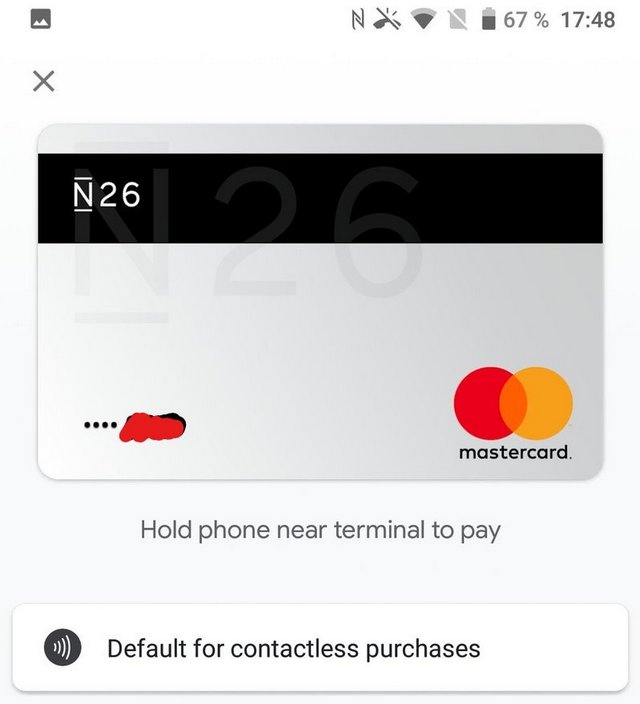
Google Pay startet in Deutschland

by Volker Weber

InkedDgoPWq3X4AYcfnC LI

Wen darf ich einladen, ein Zweitkonto bei N26 zu eröffnen? Ich mache darüber alle Internet-Zahlungen, sozusagen als Firewall. Wenn nicht mehr genug Geld drauf ist, überweise ich dort was hin.

Und jetzt bitte noch Apple Pay.

26 Jun 18:09

LG V40 will have five cameras, according to report

by Rose Behar

LG’s V30 successor, the V40, will feature five cameras, according to a source that spoke with Android Police. 

The publication says two cameraswill be on the front (supporting a face unlock feature that potentially uses 3D mapping), while the other three will be on the rear.

While having three shooters on the rear has been done before with the Huawei P20 Pro, five total cameras is exceptional for a premium handset from a mainstream manufacturer.

According to AP, one of the three rear cameras will be a standard wide lens, another will be LG’s ultra-wide lens and a third will work towards an “as-yet undetermined purpose.” AP notes this could be a zoom lens, or it could be dedicated to depth-of-field effects, both common applications on modern smartphones.

Of course, whether all of this will result in better quality images, is yet to be seen — and will partially be dictated by LG’s image processing software.

Additionally, the publication stated LG’s next major smartphone will have a notched display and the design of a “scaled-up G7.” Qualcomm’s Snapdragon 845 will power the device, and LG’s Quad digital-to-analog converter (DAC) for Hi-Fi audio plus a dedicated Google Assistant button will also feature.

The fingerprint sensor will remain on the back, says AP.

While the publication did not indicate when the phone would launch apart from “later this year,” last year’s V30 was revealed in late August, so if LG follows that cadence, we may see the finished product by the end of the summer.

Source: Android Police

The post LG V40 will have five cameras, according to report appeared first on MobileSyrup.

26 Jun 17:04

New Firefox Releases Now Available

by Nick Nguyen

Even though summer is here in the northern hemisphere, we’re not taking any breaks. Firefox continues our focus on making a browser that is smarter and faster than any other, so you can get stuff done before you take that much needed outdoor stroll.

Key highlights for this update include:

  • Add Search Engines: users can now more easily add custom search engines to the location bar in Firefox enabling quicker and more streamlined search functionality. Imagine searching an actor’s name, now with Firefox you can automatically search through IMDB in the location bar.
  • Tab Warming: speedier response times are now available when switching between tabs because Firefox is preemptively loading tabs when you’re hovering over them.
  • Retained Display Lists: access to the pages you frequently visit quicker, thanks to retained display lists. This new functionality locally remembers content that has been visited previously, so it doesn’t need to be reloaded each time you go to the site.
  • Accessibility Tools Inspector: ability for creators and developers to now easily make pages for users with accessibility requirements. Firefox is committed to a stronger, more accessible browser and this new tool supports that mission.
  • WebExtension Tab Management: Sometimes you’re listening to music in a tab, but you don’t really want that tab taking up space as you browse the web. In today’s new release, WebExtensions can now hide tabs as well as manage the behavior of the browser when a tab is opened or closed, so you can expect to see exciting new extensions that take advantage of these features in the near future.

For additional information on developer news in today’s update, visit here.  For more details on all of today’s news, you can review our release notes here.

Check out and download the latest version of Firefox Quantum available here.


The post New Firefox Releases Now Available appeared first on The Mozilla Blog.

26 Jun 17:04

Instagram Explore tab gets refresh, features new topic channels

by Jonathan Lamont
Instagram Explore tab

Instagram’s ‘Explore’ tab refresh is starting to work its way out to users.

The new Explore tab was announced at Facebook’s F8 conference earlier this year.

Tapping one of the channels produces a tiled list of curated posts like the one you’re used to seeing on the Explore page. The difference is that all the posts are matched to the topic. Furthermore, users can scroll through a banner of related hashtags at the top of the channel if they’re looking to dive deeper into a topic.

Channel topics

  • Art
  • Travel
  • Nature
  • Architecture
  • Music
  • Humour
  • TV & Movies
  • Style
  • Fitness
  • Gaming
  • Sports
  • Décor

Along with all the channel topics, there’s a ‘For You’ page. That page gives you a curated list of posts based on your interests and past behaviour on Instagram.

Instagram's Explore tab channels

Additionally, Instagram announced video and group video chat at F8. The chat also featured an option to allow users to continue browsing the app while chatting. However, those features haven’t come out yet.

Last week Instagram released its new vertical video platform. The new app is designed to take on Snapchat and YouTube. Dubbed IGTV, the new platform is shaping up to be a more creator-focused video platform.

Along with the launch of IGTV, Instagram announced it has one billion users. Analysts now think the photo-sharing app is worth $100 billion USD and could make $10 billion in revenue over the next 12 months.

The update is rolling out slowly and could take a few days to show up in your app.

Via: 9to5 Mac

The post Instagram Explore tab gets refresh, features new topic channels appeared first on MobileSyrup.