Shared posts

13 Sep 20:51

Step

Use Step to get a more precise understanding of how code executes.

You see a code listing. You click on the part of the code that you think will execute next. Then you click on the part of the code that you think will execute after that. And so on.

This is just a proof of concept. You can’t enter your own code, but I plan to change that.

Try it out


02 Jul 19:15

Week 176 of chemo complete: My 3 options when I need to change treatment

by tyfn

In March my Myeloma Specialist/Hematologist provided me with 3 options, should we need to change my chemo. My current treatment is Pomalyst + Ninlaro, which are chemo pills. At the time, my cancer levels (m-protein) had been stable for the previous 3 months at 13. Last month my cancer levels spiked from 20 to 25.

This knowledge was very much appreciated as it allowed me to leisurely think about the advantages and disadvantages of each, without pressure. I feel better prepared and confident that when necessary, I’ll make the right decision – in consultation with my Myeloma Specialist.

Option 1: Velcade (high-dose chemo injections) + Cyclophosphamide (chemo pills) + low dose Dexamethasone (steroid pills)

Advantages:
Back in 2013, I had 9 months of treatment followed by 8 months of complete remission, meaning my myeloma was undetectable. So Velcade had previous success.

Disadvantages:
Velcade excited the myeloma cells in the bone marrow of my t7 vertebrae causing immense pain as it slowly collapsed. Although Velcade shortened my height, I feel fortunate not to be paralyzed.

Treatment Setting: Hospital

Option 2: Pomalyst (chemo pills) + low dose Dexamethasone (steroid pills)

Advantages:
This was my treatment from Feb 2015 – July 2017. I believe this combination is likely to lower my cancer levels and keep them low and stable, because that is what was happening before we stopped Dexamethasone.

Disadvantages:
Recall that I was on Dexamethasone with my current Pomalyst treatment from Feb 2015 until July 2017. My Myeloma Specialist stopped it after my Glaucoma Specialist found that Dexamethasone increased my eye pressure. I was prescribed eye drops, which have kept my eye pressure normal, however the Dexamethasone caused right eye damage. As my eyes are steroid sensitive to Dexamethasone, renewing this treatment could result in further eye damage. I would have to find an Ophthalmologist to monitor my eye pressure monthly.

Treatment Setting: Home

Option 3: Pomalyst (chemo pills) + Darzalex (high dose IV targeted treatment)

Advantages:
I would remain on Pomalyst, which doesn’t seem to have any major side effects for me. Combined treatment may be more effective that just Pomalyst or Darzalex alone. As targeted treatment (this is a monoclonal antibody), Darzalex attaches directly to my myeloma cells to kill them and/or allow my immune system to destroy them. This option would be an opportunity to try something new and different.

Disadvantages:
It is unknown what side effects I may experience and there are always general concerns with any IV treatment.

Treatment setting: Hospital

Everything is going to be alright. When I think positive, positive things will happen.

Photo:
These fruit represent my 3 treatment options. The Granny Smith apple is Option 1. It is a common fruit that I’ve had before. I know what I’m getting and what it tastes like. Similarly I know what Velcade + Dexamethasone treatment will be like and the side effects I should experience.

The navel orange symbolizes Option 2. I’ve eaten navel oranges before and know how they taste. Comparably, I know what to expect from Pomalyst + Dexamethasone treatment and the side effects likely to occur.

Option 3 is the Asian pear (front). I have never had an Asian pear before so eating one would be something novel. It is a different colour and shape from what I’d expect a pear to look like. Likewise, Darzalex would be a new experience for treating my multiple myeloma.

Week 176 of chemo complete: My 3 options when treatment change needed

To recap: On Sunday, June 24th, I completed Cycle 44 Week 4. I have multiple myeloma and anemia, a rare cancer of the immune system. Multiple myeloma affects the plasma cells, a type of immune cell that produces antibodies to fight infection. These plasma cells are found in the bone marrow. As a blood cancer, it is incurable, but treatable. Since February 9th 2015, I have been on Pomalyst and Dexamethasone chemo treatment (Pom/Dex). On July 16th 2017, my Dexamethasone treatment ended, due to eye damage, reported by my Glaucoma Specialist, from long-term use. On January 9th I began Ninlaro chemo to combat steadily rising cancer levels.

Weekly chemo-inspired self-portraits can be viewed in my flickr album.

No lawn to mowMay 2014: Coal Harbour – Vancouver

The post Week 176 of chemo complete: My 3 options when I need to change treatment appeared first on Fade to Play.

02 Jul 19:15

"We’re America, Bitch:" White House Official Defines Trump Doctrine

mkalus shared this story from The Atlantic.

“What is it?” I asked. Here is the answer I received:

“The Trump Doctrine is ‘We’re America, Bitch.’ That’s the Trump Doctrine.”

It struck me almost immediately that this was the most acute, and attitudinally honest, description of the manner in which members of Trump’s team, and Trump himself, understand their role in the world.

I asked this official to explain the idea. “Obama apologized to everyone for everything. He felt bad about everything.” President Trump, this official said, “doesn’t feel like he has to apologize for anything America does.” I later asked another senior official, one who rendered the doctrine not as “We’re America, Bitch” but as “We’re America, Bitches,” whether he was aware of the 2004 movie Team America: World Police, whose theme song was “America, Fuck Yeah!”

“Of course,” he said, laughing. “The president believes that we’re America, and people can take it or leave it.”

“We’re America, Bitch” is not only a characterologically accurate collective self-appraisal—the gangster fronting, the casual misogyny, the insupportable confidence—but it is also perfectly Rorschachian. To Trump’s followers, “We’re America, Bitch” could be understood as a middle finger directed at a cold and unfair world, one that no longer respects American power and privilege. To much of the world, however, and certainly to most practitioners of foreign and national-security policy, “We’re America, Bitch” would be understood as self-isolating, and self-sabotaging.

I’m not arguing that the attitude underlying “We’re America, Bitch” is without any utility. There are occasions—the 1979 Iran hostage crisis comes to mind—in which a blunt posture would have been useful, or at least ephemerally satisfying. President Obama himself expressed displeasure—in a rhetorically controlled way—at the failure of American allies to pay what he viewed as their fair share of common defense costs. And I don’t want to suggest that there is no place for self-confidence in foreign policymaking. The Iran nuclear deal was imperfect in part because the Obama administration seemed, at times, to let Iran drive the process. One day the Trump administration may have a lasting foreign-policy victory of some sort. It is likely that the North Korea summit will end, if not disastrously, then inconclusively. But there is a slight chance that it could mark the start of a useful round of negotiations. And I’m not one to mock Jared Kushner for his role in the Middle East peace process. There is virtually no chance of the process succeeding, but the great experts have all tried and failed, so why shouldn’t the president’s son-in-law give it a shot?

But what is mainly interesting about “We’re America, Bitch” is its delusional quality. Donald Trump is pursuing policies that undermine the Western alliance, empower Russia and China, and demoralize freedom-seeking people around the world. The United States could be made weaker—perhaps permanently—by the implementation of the Trump Doctrine.

02 Jul 19:15

Twitter Favorites: [nobert] Which text editors other people use is such a weird thing to get upset about*. The program I use to save what I typ… https://t.co/zWlqQ4qIOd

Alex Nobert @nobert
Which text editors other people use is such a weird thing to get upset about*. The program I use to save what I typ… twitter.com/i/web/status/1…
02 Jul 19:14

Twitter Favorites: [stateofthecity] Yadda yadda street cafes. Fine long weekend blog reading, h/t @Richard_Florida https://t.co/7cpm2cmCEf

Brian F. Kelcey @stateofthecity
Yadda yadda street cafes. Fine long weekend blog reading, h/t @Richard_Florida marginalrevolution.com/marginalrevolu…
02 Jul 19:13

Twitter Favorites: [sarah_edo] I miss the useless web. I miss your grandpa’s blog. I miss weird web art projects that trolled me. I miss fan pages… https://t.co/7PoFxoOQRG

Sarah Drasner @sarah_edo
I miss the useless web. I miss your grandpa’s blog. I miss weird web art projects that trolled me. I miss fan pages… twitter.com/i/web/status/1…
02 Jul 19:12

Twitter Favorites: [MobyDickatSea] Chowder for breakfast, and chowder for dinner, and chowder for supper, till you began to look for fish-bones coming through your clothes.

Moby Dick @MobyDickatSea
Chowder for breakfast, and chowder for dinner, and chowder for supper, till you began to look for fish-bones coming through your clothes.
02 Jul 19:01

Toronto VS Everybody Bike Month edition

by dandy

Photo by Gary Davidson from the story Dykes on Bikes Bring Pedal Power to World Pride, in our 2014 print issue.

Toronto vs. Everybody the Bike Month wrap edition

By Tammy Thorne

Something strange happened to me on Bike to Work Day this year.

My boss told me to I had to get my driver’s license.

Bike to Work Day kicks off Bike Month in many places around the world. It’s largely symbolic – a way for a city to show it supports cycling, at least in theory – and my magazine, dandyhorse, has religiously covered it every year because of its symbolic importance. For me, Bike to Work Day is pretty much every day.

But this year on Bike to Work Day, I was summoned by my bosses to the boardroom to go over my qualifications for my marketing job.

I was told that in my role I was required to not only have a driver’s license, but also a car.

I recently moved to a small city (population under 100k) northeast of Toronto where cycling to work is not something that people really do. There’s a great class divide happening everywhere in North America, but it’s quite stark here. And as we now know, cyclists are often affluent people – cycling is the new golf they say. Cyclists are downtown latte-sipping elites, according to our new premier.

But here, people who bike around downtown are more likely to have bags on their handlebars full of empties. It’s a different socioeconomic bracket than what you see in the big city. The empty plastic clank clank whirrrr of an e-bike scooter rolling over a pothole is a much, much more common sound here than the gentle clicking whir of a spinning freewheel.

Don’t get me wrong, there are MAMILs (middle-aged men in lycra) galore in this region due to the decent collection of off-road trails and routes. In fact, the cycling club here is the largest club per capita in Canada. But all these guys, they drive to work.

This city does have a few bike lanes and received a big chunk of funding to do more – but they haven’t gotten around to it yet.

And in the meantime, I feel like I’m having a flashback to 1999. “Did you ride in again today?” is something I now get asked every day. The day that it rained and I brought a change of clothes, well, I thought we might have to have another meeting in the boardroom with to explain.

I consider my commute short. My coworkers, on the other hand (many of whom are young and healthy), think my commute is “admirable” and epic.

It’s 15 minutes.

Even though there are many lovely off-street bike trails here, none take me to work. In fact, there are no bike lanes downtown that actually connect you to destinations. (Just like the early days in Toronto’s bike lane development.)

When I rode to work to U of T from Parkdale in the 2000s, other people were riding to work, sure, but there were still always those who asked, “Did you ride today?” But that’s all changed. Tens of thousands of people who live in or near downtown Toronto now bike to work and school. There are protected bike lanes in the core that fill up to the brim (to the bollards?) every day to the point where there is now bike congestion in Toronto.

Sure, the city still has a long way to go to become bike-friendly, but Toronto has grown its bicycle culture to the point where it is a fully accepted form of transportation downtown.

By moving merely an hour or so away, I’ve effectively travelled back in time.

Now that my commute requires that I ride next to pick-up trucks going 50 km/h (if they're doing the speed limit) on “downtown” streets, I am missing the crowded, bike-lane-filled city that I called home for over two decades. When I started biking everywhere in Toronto it felt like it was pretty much just me and the bike couriers (and the Layton clan) – but now it feels like everyone is doing it.

In my new town, with fast moving cars and trucks all around me and a deadly combination of new student drivers (both schools are on the outskirts and only one has a bike trail to it) and so many retiree drivers (we have the second largest population of people over 65 in Canada) – I miss the predictably congested streets of Toronto, as crazy as that sounds. As we know, slower speeds are safer speeds.

One big problem we have here that Toronto had in the early days of the bicycle revolution is building bad bike lanes, like bike lanes in the door zone (College Street anyone?) or ones that start nowhere, and go nowhere.

The surprising part is that census data for my new home city shows that walking or cycling to work is more common here than in any other city in the Greater Golden Horseshoe Area. A Toronto Centre for Active Transportation book on the topic even put this city’s bike-laned mainstreet on the cover.

Here’s the rub though, that bike lane is one of the most dangerous bike lanes I’ve ever ridden in: It’s in the door zone between busy on-street parking and a fast-moving, two-lane, one-way traffic. They're extending it so it connects to destinations and other bike lanes this year, which is great, but it's still in the door zone with no barrier, and no intersection treatments, on a very fast moving street. It's better than nothing (as we used to say in Toronto in the early days when the City's transportation department proposed things like sharrows.)

When I moved here about a year ago I wrote a story for a local paper about how great the cycling was based on the trails I’d been on and the city’s plans to build at least four new bike lanes and make existing ones longer, connected and buffered. I was thinking, wow, we could be the Boulder, Co., of Canada. But, a year later and none of what municipal officials told me was happening has happened. There’s one person who manages the entire portfolio here and everyone says what a “great job” she’s doing and how nice she is. Criticizing this person is pretty much tantamount to kicking a kitten. So I won’t.

Another thing I won’t do?

I won’t be getting my drivers license any time soon.

And even if I do, I’ll still be riding my bike to work every day.

Tammy Thorne is publisher and editor of dandyhorse magazine, founded in 2008. She does not have a gym membership.

...

Related on dandyhorsemagazine.com:

Die in at City / Bike to Work Day in Toronto

Dykes on Bikes Bring Pedal Power to World Pride (from 2014)

The Bike Plan Plods 

Elsewhere:

Bike lane update for Peterborough (Electric City July 2018)


02 Jul 18:58

How do you read RSS? RSS seems to be in a bit o...

by Ton Zijlstra
How do you read RSS? RSS seems to be in a bit of a revival. What’s your current practice?
02 Jul 18:56

The #2 most important idea in Computer Science

by Eric Normand

In my opinion, the #2 most important idea is something that came directly out of computing. But I’m not so sure. Do you know? Let me know, too!

Transcript

Eric Normand: What is the second most important idea in Computer Science? Hello, my name is Eric Normand, and these are my thoughts on Functional Programming.

I’m not too sure about whether this is actually a Computer Science idea, but I sure think it’s important. I’m going to just assume it is a Computer Science idea for the remainder for this episode. But if you know different, if you know that it is not a Computer Science idea, I would love to be corrected because I assume it is. I presume it is.

The idea is this. You can build a reliable system out of unreliable parts. That’s the second most important idea in Computer Science. Traditionally, you would build systems to be reliable mainly in two ways.

One, is make the parts more reliable, make them work better for longer, make them out of better materials to greater and greater tolerances, make sure that they follow the spec even more than you would because they have to work as a system.

You just keep making sure all the parts are working better and better. When you put them together, the whole, in theory, works better and better. In general, that’s the case.

The other way is redundancy which is have a secondary support for any kind of function of your system so that if one of them fails — which is inevitable — if one of them fails, you can fall over to the backup.

Now, what I believe is new in Computer Science and computing, in general, is the idea of building a reliable system on top of an unreliable system. There’s two examples I want to talk about.

The first one is the Internet, the idea of a self-routing packet network. Instead of having a network that is super reliable, meaning, every packet gets delivered to a very high rate of failure or have — I’m sorry, rate of success — meaning like 99.999, seven nines of packets actually make it to their destination.

What we have is a network that assumes that packets won’t get there. That they won’t be delivered quickly, that they won’t…that they’ll get lost, they’ll get dropped, and that the network itself, the lines, the wires that make up the network, and the nodes on the network, they’re all going to fail.

What you want is a network that can peal itself, that can reroute dynamically all the packets that fail, and then you can build protocols on top of the unreliable packet system to increase the reliability.

Eric Normand profile image
Eric Normand
@ericnormand
twitter logo

The internet is built with failure at the bottom. The basic unit, the packet, is unreliable. Yet by layering on a good protocol, we can make the system reliable. A reliable system out of unreliable parts.

ed.gr/vyfv

Mon Sep 24 19:02:36 +0000 2018
Twitter reply actionTwitter retweet action2Twitter like action4

If you have something like TCP, it’s build on top of IP. IP is just the protocol for sending packets, TCP has a whole protocol built out of IP about sending packets, and having a handshake, and having acknowledgment packets that, “Yes, I got it” or “I missed one,” and out of order, it came in out of order, reordering stuff, all of that is part of TCP.

I’ve looked for ways of doing this that predate computing, but I haven’t found it. It’s not to say that no one did it, but I haven’t found it. Please correct me if I’m wrong.

The second example I want to mention is Erlang. Erlang has built into its core this assumption that things will fail. The assumption is that if you want to build something reliably, you have to assume that the parts are going to fail in an unknown way. That informs how you construct your software because if things are going to fail you need to build in the reliability at every level.

Erlang systems, if they’re well built, it can have something like seven nines of up-time which is crazy when you think about it. That’s so reliable. But this is why nodes are failing, networks are failing, the software itself has bugs in it.

Eric Normand profile image
Eric Normand
@ericnormand
twitter logo

Erlang systems, if they’re well built, it can have something like seven nines of up time which is crazy when you think about it. That’s so reliable. But this is while nodes are failing, networks are failing, the software itself has bugs in it.

ed.gr/vyfx

Wed Jul 11 19:00:16 +0000 2018
Twitter reply actionTwitter retweet action1Twitter like action4

How is it possible that that happens? Well, there’s a number of things you can do to build reliability on top of unreliable parts, and that’s the whole Erlang E fails. I think that this is a remarkable idea that you can use cheap parts and through architecture and correct design, build something super reliable.

All right. My name is Eric Normand. If you agree or disagree, please let me know. I’m not an expert in this particular super reliable systems field. If you come from some other background and know that this was happening, in Masonry or something, and I just didn’t know about it, please let me know.

Anyway, I’m Eric Normand. This has been a thought on Functional Programming, and I’ll see you later.

The post The #2 most important idea in Computer Science appeared first on LispCast.

02 Jul 18:55

#4277

by Ton Zijlstra

Thank you Chris, for the feedback. Yes, I added WebMention earlier this year, as a replacement for pingback. Just yesterday came across Webmention.io to deal with legacy pingbacks, so will add that too.

02 Jul 18:55

Of Scale, Audience, and Networks

by Ton Zijlstra

Slate saw their traffic from Facebook drop by 87% in a year after changes in how FB prioritises news and personal messages in your timeline. Talking Points Memo reflects on it and doing so formulates a few things I find of interest.

TPM writes:
Facebook is a highly unreliable company. We’ve seen this pattern repeat itself a number of times over the course of company’s history: its scale allows it to create whole industries around it depending on its latest plan or product or gambit. But again and again, with little warning it abandons and destroys those businesses.” …”Google operates very, very differently.”..”Yet TPM gets a mid-low 5-figure check from Google every month for the ads we run on TPM through their advertising services. We get nothing from Facebook.”..”Despite being one of the largest and most profitable companies in the world Facebook still has a lot of the personality of a college student run operation, with short attention spans, erratic course corrections and an almost total indifference to the externalities of its behavior.

This first point I think is very much about networks and ecosystems, do you see others as part of your ecosystem or merely as a temporary leg-up until you can ditch them or dump externalities on.

The second point TPM makes is about visitors versus ‘true audience’.
“we are also seeing a shift from a digital media age of scale to one based on audience. As with most things in life, bigger is, all things being equal, better. But the size of a publication has no necessary connection to its profitability or viability.” It’s a path to get to a monopoly that works for tech (like FB) but not for media, the author Josh Marshall says. “…the audience era is vastly better for us than the scale era”

Audience, or ‘true audience’ as TPM has it, are the people who have a long time connection to you, who return regularly to read articles. The ones you’re building a connection with, for which TPM, or any newsy site, is an important node in their network. Scaling there isn’t about the numbers, although numbers still help, but the quality of those numbers and the quality of what flows through the connections between you and readers. The invisible hand of networks more than trying to get ever more eye-balls.

Scale thinking would make blogging like I do useless, network thinking makes it valuable, even if there are just 3 readers, myself included. It’s ‘small b’ blogging as Tom Critchlow wrote a few months ago. “Small b blogging is learning to write and think with the network“. Or as I usually describe it: thinking out loud, and having distributed conversations around it. Big B blogging, Tom writes, in contrast “is written for large audiences. Too much content on the web is designed for scale” and pageviews, where individual bloggers seem to mimick mass media companies. Because that is the only example they encounter.

02 Jul 18:55

Automating the Battlefield

by Tony Hirst

Another year, another robot heavy military exercise. Eighteen months or so ago, it was Unmanned Warrior, a marine based large scale demonstration of unmanned and autonomous systems led by the Royal Navy  (previously blogged as Drone War Exercises).

Next up is Autonomous Warrior, the 2018 Army Warfighting Experiment. Apparently:

Autonomous Warrior will test a range of prototype unmanned aerial and ground cargo vehicles which aim to reduce the danger to troops during combat.

The British Army is set to launch the four-week exercise on November 12, with a Battlegroup from 1 Armed Infantry brigade providing the exercising troops and taking responsibility of command and control.

I wonder if the exercise is building on early results from the autonomous last mile resupply that was launched by the Defence and Security Accelerator last year with the following timeline:

In passing, the testing / performance criteria for competition entries provides a handy checklist of key considerations:

  • Non stop range
  • System lift capacity (mass)
  • Payload size and shape (volume)
  • Speed
  • Turn around time and effort
  • Terrain types
  • Operator control requirements / autonomy levels (eg Automatic route planning, obstacle avoidance, tasking)
  • Contested environment (eg no GPS)
  • Physical Environmental conditions (eg wind)
  • Supportability and Interchangeability

Spend on military robots for deployment  also seems to be increasing, in the US at least. For example, Bloomberg reported recently (The U.S. Army Is Turning to Robot Soldiers) that:

In April, the [US] Army awarded a $429.1 million contract to two Massachusetts companies, Endeavor Robotics of Chelmsford and Waltham-based QinetiQ North America, for small bots weighing fewer than 25 pounds. This spring, Endeavor also landed two contracts worth $34 million from the Marine Corps for small and midsized robots. … In October, the Army awarded Endeavor $158.5 million for a class of more than 1,200 medium robots, called the Man-Transportable Robotic System, Increment II, weighing less than 165 pounds.

In the air, UK use of aerial drones is in accordance with the the 84 page Joint Doctrine Publication Unmanned aircraft systems (JDP 0-30.2); for a full list of joint doctrine publications see the Joint Doctrine Publication (JDP) collection.

I’m not sure if there’s a reserve force that specifically recruits volunteers with skills in robotics, but I notice there is one for techies interested in matters relating to cyber-warfare/cyber-defence: Joint Cyber Reserve Force (CRF). You should probably read the JDP Cyber Primer first, though…

02 Jul 18:54

Twitter Favorites: [Amywalshharris] Our house has finally sold! We are moving from Toronto to the country. We love Toronto but since we have a youn… https://t.co/Vao7lBlbI0

Amy Walsh-Harris @Amywalshharris
Our house has finally sold! We are moving from Toronto to the country. We love Toronto but since we have a youn… twitter.com/i/web/status/1…
02 Jul 18:54

Founder of Alibaba Cloud says smart cities can’t solve problems caused by China’s rapid urbanization

by Jiefei Liu
By utilizing real-time city data, Alibaba Cloud’s ET City Brain platform optimizes urban public resource allocations. City Brain has already cooperated with local governments in downtown Hangzhou, Xiaoshan District of Hangzhou, and Suzhou. According to the official site, it’s mostly applied in public transportation. With the aid of traffic cameras and big data, it reported […]
02 Jul 18:54

In Datasette ClusterMap Plugin – Querying UK Fo...

by Tony Hirst

In Datasette ClusterMap Plugin – Querying UK Food Standards Agency (FSA) Food Hygiene Ratings Open Data I showed how the datasette cluster map plugin could be used to display a map with clustered markers showing the location of results on an interactive map from a datasette query that returned latitude and longitude columns.

Since then, datasette has added support for SpatiaLite, a SQLite extension that supports spatial queries. In the previous posts on this topic, (Trying Out Spatialite Support in Datasette and Working With OpenStreetMap Roads Data Using osmnx), I’ve started trying to get my head round how to make use of this more powerful tool for managing geo-related data, in particular grabbing Ordnance Survey shapefiles that can be used to filter queries about the UK road network made to OpenStreetMap using the incredibly power osmnx Python package.

It’s been a hard slog so far – I’m not really up to speed on geo-tools, what they can do, and what representations work with what – but I’m slowly starting to get there. (Maybe I should have read a book, or done a course, rather than just trying to learn by doing!)

The notebook that contains the code described in this post can be found here. In particular, I’ve been looking at how to run SpatiaLite within() queries to find points within an area, as well as looking a bit more at some the the utility functions osmnx exposes.

To start with, let’s grab some data. I’m going to use the Food Standards Agency food hygiene ratings again:

One thing I should probably do is look at having a variant of that datagrabber that grabs the data into a SpatiaLite database. The original data contains latitude and longitude co-ordinates. We can create a suitable geometry column in the same table and then add a WKT description of the location. (I think the columns should actually be in the order ‘Latitude’ || ‘Longitude’?)

The locations are given using the lat/long (WGS84 / EPSG 4326) projection. However, the Ordnance Survey boundaries I obtained via the OS BoundaryLine dataset are in the OSGB (EPSG 27700) projection. But being a spatial database, SpatiaLite can help when it comes to applying the transformation between those projections:

As I’m trying to build workflows/tools around the datasette API to the database, here’s a first attempt at a crude wrapper for it:

Here’s how part of the FSA data table looks now:

One of the issues I noticed with running queries searching for locations within an area delimited by a shapefile is that they can take a long time to run. However, we can create an index on a shapefile that describes a bounding box for the shapefile which we can use as a first pass to find points broadly within an area:

We can then use a query on the index / bounding box as a subselect before running the slower query to check that a point actually lies within the possibly ragged region:

We can now use the data in the dataframe as the basis for a map display, in this case using marker clusters (the screenshot shows an exploded cluster):

The FSA data seems to use postcode centroids as the geolocation co-ordinates (at least, I’m guessing so from the overlaps). The folium/leaflet package I’m using to display maps overlays markers that are colcated so you only see the last one. There is a leaflet plugin to handle this, but it’s not currently available via folium, so for now, let’s just randomly perturb markers a bit so that we can see colocated ones:

To check that the markers are located inside the desired boundary, we can also plot the boundaryline on the map:

One of the things that I noticed from OpenStreetMap is that it actually geocodes the locations of points of interest (POIs) more accurately. The osmnx package includes a handy utility for geocoding an address, so I should be able to use this to improve the geolocation data of the FSA rated establishments?

The osmnx package also lets us search for POIs within boundary area, presented as a Shapely geometry object. We can generate such an object directly from a GeoJSON shapefile:

We can then use this as the basis for a query onto OSM by amenity tag:

There are lots of different amenity tags supported, so this could provide quite a useful lookup tool. For example, I wondering about what sorts of amenity it might be handy for parish councillors to be able to lookup via a hyperlocal / parish council geo-service?

02 Jul 00:02

Mi Casita Bakery & Deli [Flickr]

by vanderwal

vanderwal posted a photo:

Mi Casita Bakery & Deli

I'm at Mi Casita Bakery & Deli! 4sq.com/1LHyTmv

01 Jul 23:41

What I’ve learned from home-swapping.

by William

For the last few years, when my family takes vacations we have been swapping homes with people in the cities we visit. We did our first home swap a few years ago in San Francisco, last year we swapped with a couple in Paris, and this summer we’re swapping with families in Hamburg and Bergen, Norway.

It’s an amazing way to travel. Free accommodations mean that we can stay in expensive cities for longer. Being in a home means more space for us to enjoy than a hotel room affords, and we enjoy neighborhoods in cities we would not otherwise spend time in. We feel more like locals when we’re far from home.

Home-swapping makes me think of my early enthusiasm for the Sharing Economy. I still love the idea of sharing the idle capacity of things you own with other people, and owning things collectively through a co-op-like structure. This form of sharing creates reciprocal relationships and community, and reduces the need for so much stuff to be produced and consumed.

In the early days of the Sharing Economy, I was a major proponent of what this could mean for communities, for greater equity and environmental sustainability. I was surprised by how quickly the sharing economy gave way to value-extracting businesses like Uber and AirBnB.

I spend a lot of my working hours trying to ensure that we have a more equitable and sustainable local economy. I think about the velocity of money within a local economy so money recirculates and has a multiplier effect, creating more equitable distribution. Companies like Uber do provide work, but it is contract work, lacking the benefits that allow people a higher quality of life. In addition, profits are extracted out of local economies and into maximizing shareholder of people well outside where the work takes place.

I don’t use AirBnB anymore because I see the devastating effect it has on cities like Vancouver which have a housing crunch and near zero rental vacancy rates. I see in my own neighbourhood of Strathcona in Vancouver the rental units that used to provide stable, long-term rental to individuals and families get permanently taken off the market and turned into more profitable AirBnB accommodation. This isn’t having a healthy effect on the livability and viability of our city. (Vancouver has a vacancy rate near zero and 6.2% average annual rental rate increases.) That isn’t a form of sharing I recognize as ethical or desirable.

I sit on the board of Modo Co-operative, which allows 20,000 drivers to share over 600 cars. As a co-operative, there is no private ownership, those cars are a community asset. If Modo were to dissolve, the assets would be bequeathed to another community-owned organization like a not-for-profit. I work for Vancity, where half a million member-owners pool their money for local reinvestment. It is now a $26.4 Billion pool owned by the community, not private ownership. No one profits inequitably from those community resources. That is more in line with what I originally loved about the sharing economy.

So we have discovered home-swapping as a way of truly living out the early (and unfortunately false) promise of the sharing economy. No money changes hands, trust is required and reciprocity is created. I recommend it highly if you need your faith in humanity restored.

01 Jul 23:41

Here are the Samsung Galaxy S10+, Google Pixel 3 XL and LG V40 leaks from last week

by Dean Daley
Pixel 2 XL

From Google to Samsung, a variety of smartphone leaks surfaced this past week.

Here’s a breakdown of almost every smartphone leak from the last few of days. The leaks below encompass news from June 23rd to June 29th.

Samsung

Samsung’s S10+ will reportedly feature a 6.44-inch display. This display is reportedly larger than the rumoured Note 9, the S9+ and the Samsung Galaxy Mega.

For more on the S10 +’s display, click here. 


The Samsung Galaxy Note 9 passed the FCC this past week. The phone will launch August 9th, according to Samsung.

For more on the Note 9 hitting FCC, click here.


Google

A new leak from of the Google Pixel 3 XL, and Pixel 3, once again shows off its iPhone X-inspired notch. In the image the Pixel 3 looks similar to the Samsung Galaxy A8, almost exact, if it wasn’t for the larger bezels.

For more on the Pixel 3 series leaks, click here.


LG

The LG V40 is set to reportedly have five cameras. Two will be on the front, potentially for a face unlock feature, while having three on the rear, similar to the Huawei P20 Pro.

For more on the LG V40, click here.


Motorola

Leaked images of the Motorola One have surfaced online. The phone looks mostly similar to the One Power, but is smaller.

For more on the Motorola One, click here.

The post Here are the Samsung Galaxy S10+, Google Pixel 3 XL and LG V40 leaks from last week appeared first on MobileSyrup.

01 Jul 15:47

Stepping up my photography to make a cookbook

by Dries

We're going on a two-week vacation in August! Believe it or not, but I haven't taken a two week vacation in 11 years. I'm super excited.

Now our vacation is booked, I'm starting to make plans for how to spend our time. Other than spending time with family, going on hikes, and reading a book or two, I'd love to take some steps towards food photography. Why food photography?

The past couple of years, Vanessa and I have talked about making a cookbook. In our many travels around the world, we've eaten a lot of great food, and Vanessa has managed to replicate and perfect a few of these recipes: the salmon soup we ate in Finland when we went dog sledding, the hummus with charred cauliflower we had at DrupalCon New Orleans, or the tordelli lucchesi we ate on vacation in Tuscany.

Other than being her sous-chef (dishwasher, really), my job would be to capture the recipes with photos, figure out a way to publish them online (I know just the way), and eventually print the recipes in a physical book. Making a cookbook is a fun way to align our different hobbies; travel for both of us, cooking for her, photography for me, and of course enjoying the great food.

Based on the limited research I've done, food photography is all about lighting. I've been passionate about photography for a long time, but I haven't really dug into the use of light yet.

Our upcoming vacation seems like the perfect time to learn about lighting; read a book about it, and try different lighting techniques (front lighting, side lighting, back lighting but also hard, soft and diffused light).

The next few weeks, I plan to pick up some new gear like a light diffuser, light modifiers, and maybe even a LED light. If you're into food photography, or into lighting more generally, don't hesitate to leave some tips and tricks in the comments.

01 Jul 15:46

Orange and white uprights pop up in Kelowna: city launches new bike-share | CBC News

mkalus shared this story .

180 bikes have been placed across the city's downtown core

CBC News ·
The city of Kelowna partnered with Dropbike to offer a dockless bike-sharing program. (Dropbike/Phillipe Roberge)

Orange and white bikes have been popping up around Kelowna as the city introduced a bike-sharing program called Dropbike.

In its first week of existence, the program, which already operates in Ontario and Quebec, clocked about 500 individual rides and 1,000 trips.

"We think it's going really well," said Matt Worona, the city of Kelowna's active transportation coordinator. "It's showing some really good signs."

Unlike Mobi in Vancouver, Dropbike bicycles don't require docking stations. Users log onto their smartphone app to unlock the bike's back wheels. When a rider is done their trip, they park it in one of a number of designated downtown locations called havens.

The pilot project is a joint venture between Dropbike and the city. Kelowna provides the space for the havens and Dropbike operates the rest, as well as covers the costs.

Because the city hasn't had to contribute public funds, it's more flexible in its expectations.

"We don't really have an investment to return on," said Worona to Daybreak South host, Chris Walker. "What we want to see is lots of use for not a lot of disorder in our public spaces."

Worona said the city has the infrastructure to add more bikes, but any more growth depends on how much people use the program.

The city is also looking at the possibility of expanding the project outside of Kelowna's downtown.

Although there is no timeline yet, Dropbike and the city intend to run the program up until the snow starts to fall.

Listen to the full interview below.

Daybreak South
Dropbike
00:00 05:42
Share Audio
Playback Status: ready
Assigned test group: None
Identifier: mediaId 1267330627833
Asset: Undetermined
Bitrate: Undetermined
Streaming URL:
Events Log:
Active Transportation Coordinator for the city of Kelowna, Matt Worona, spoke with Daybreak South host, Chris Walker, about the new bike sharing system Dropbike. 5:42
01 Jul 15:46

Top 10 Reasons You’re Wrong About Everything

by toptenznet
mkalus shared this story from toptenznet's YouTube Videos.

From: toptenznet
Duration: 22:03

Support our efforts to make videos about what we want: https://www.patreon.com/toptenz/overview

Check out the BrainFood podcast: https://itunes.apple.com/us/podcast/the-brainfood-show/id1350586459?mt=2
(Or search your favorite podcast app for “BrainFood”)

→Subscribe for new videos every day! https://www.youtube.com/user/toptenznet?sub_confirmation=1

Find more lists at: http://www.toptenz.net

Entertaining and educational top 10 lists from TopTenzNet!

Subscribe to our Facebook: https://www.facebook.com/TopTenz/

Business inquiries to admin@toptenz.net

Other TopTenz Videos:

Top 10 Jobs That Robots Will DOMINATE Within 20 Years
https://youtu.be/uXOw5eFqdTA?list=PLQ4d2-ByGhnL-cPEY5RatLLt_FtJKFkNC

Top 10 Science Fiction Technologies Becoming Reality in the Near Future
https://youtu.be/0oM_2-TkkRU?list=PLQ4d2-ByGhnL-cPEY5RatLLt_FtJKFkNC

Text version: https://www.toptenz.net/top-10-reasons-youre-wrong-everything.php

Coming up:

10. Your Lizard Brain
9. Threat Perception
8. Authority
7. Binary Thinking
6. The Internet
5. Distorted Memories
4. Aging
3. Groupthink
2. Conditioning
1. Narrative Thinking

Source/Further reading:

http://www.scientificamerican.com/article/how-has-human-brain-evolved/
https://www.psychologytoday.com/blog/where-addiction-meets-your-brain/201404/your-lizard-brain
https://www.psychologytoday.com/blog/out-the-darkness/201402/the-psychology-death
http://www.urbandictionary.com/define.php?term=fuck-marry-kill
http://www.nizkor.org/features/fallacies/appeal-to-authority.html
http://www.nytimes.com/2000/08/11/sports/sports-psychology-it-isn-t-just-a-game-clues-to-avid-rooting.html?pagewanted=all&src=pm
http://www.rand.org/pubs/papers/P8014/index2.html
http://www.ncbi.nlm.nih.gov/pmc/articles/PMC3341652/
http://www.alz.org/alzheimers_disease_early_onset.asp
https://www.mpg.de/4612546/Preschool_Peer_Pressure
http://psychology.about.com/od/cindex/g/condresp.htm
http://cogweb.ucla.edu/crp/Papers/Steen_Paradox.html
https://upload.wikimedia.org/wikipedia/commons/a/a4/The_Cognitive_Bias_Codex_-_180%2B_biases%2C_designed_by_John_Manoogian_III_%28jm3%29.png
https://get.pxhere.com/photo/hand-finger-distance-arm-height-size-capacity-dimension-penis-format-spread-content-saying-thumb-sexuality-expansion-width-sign-language-intensity-degree-sense-extent-human-action-allusion-thickness-penis-envy-order-of-magnitude-929719.jpg
https://commons.wikimedia.org/wiki/File:Blausen_0102_Brain_Motor%26Sensory_(flipped).png
https://commons.wikimedia.org/wiki/File:PSM_V46_D167_Outer_surface_of_the_human_brain.jpg
https://commons.wikimedia.org/wiki/File:Cerebral_cortex,_side_view.svg
https://cdn.pixabay.com/photo/2017/04/16/21/13/brain-2235831_960_720.png
https://commons.wikimedia.org/wiki/File:Neuronal_activity_DARPA.jpg
https://cdn.pixabay.com/photo/2016/09/27/03/19/decision-1697537_960_720.jpg
https://get.pxhere.com/photo/writing-person-thinking-sitting-write-interior-design-image-brainstorming-brainstorm-human-positions-human-action-1391073.jpg
http://www.creative-commons-images.com/highway-signs/images/excuses.jpg

01 Jul 15:46

Building Relationships with Other Team Leaders

by Cliff Gilley

No product leader should be surprised how much their new job features coffee meetings and impromptu chats. There will be plenty of leaders at your level (sales, support, success, marketing, etc.) and while you may be the one given domain over the roadmap, your stakeholders take these peers’ opinions of your work into serious account. How do you build solid, open relationships with these key...

Source

01 Jul 15:45

Back to the Blog, 2018 H1

by Ton Zijlstra
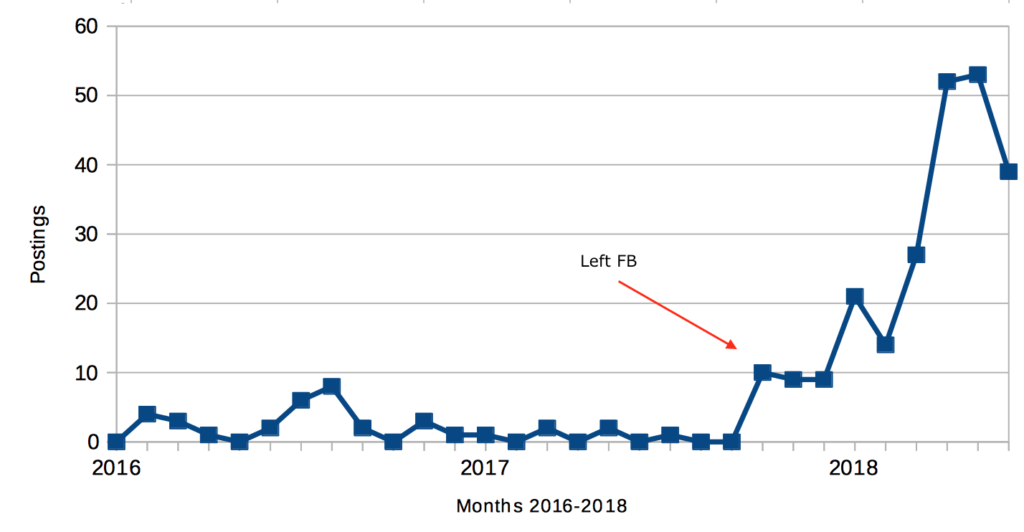
Back in April I wrote how my blogging had changed since I reduced my Facebook activity last fall. I needed to create more space again to think and write, and FB was eroding my capacity to do so. Since my break with FB I wrote more than since a long time, and the average weekly activity was higher than ever in the past 16 years. In april I wondered how that would keep up in the second quarter of this year so here are the numbers of the first half of 2018.

First, the number of postings was 203 this first half of 2018, or an average of 7 to 8 per week. Both as total number and as weekly average this is more than I have ever blogged since 2002 on even a yearly basis. (see the graphs in my previous posting Back to the Blog, the Numbers).

Mid April I added a stream of micro-postings to this blog, and that helps explain part of the large jump in number of postings in the first graph below. What microblogging helps do however is get the small bits, references and random thoughts out of my head, leaving more space to write posts with more content. I’ve written 84 ‘proper’ blog posts the last 6 months, of which 50 since adding the microblog mid April, so it has pushed up all my writing.


Blogposts 2018 per month. It shows July as week 26 ends July 1st, which had 2 postings


Blogposts 2018 per week, the micro blog started week 15

Let’s look at how that compares to previous months and years.


Number of posts per month since 2016. Leaving FB in October 2017 started a strong uptick.

I feel I have found back a writing rhythm. So tracking the number of postings moving forward is likely mostly of interest in terms of ‘proper’ postings and the topics covered, and less to see if I blog at all. My steps away from FB have paid off, and reconfiguring my information strategies for more quality is the next phase.

01 Jul 15:42

No, you don't need ML/AI. You need SQL

A while ago, I did a Twitter thread about the need to use traditional and existing tools to solve everyday business problems other than jumping on new buzzwords, sexy and often times complicated technologies.

The thread did pretty well, eventually making it to the number one spot on Hackernews. The aftermath of its mini popularity was that it sparked some interesting conversation. With a camp agreeing with what I said and another not agreeing entirely with what I said to those who called me stupid and delusional. Well, the internet can be a wild wild west.

My attempt with this article isn’t to convince you to use my approach, rather, I intend to unpack what exactly I was saying in my initial Twitter thread.

You see, as the years go by, some interesting technologies and concept spring forth — machine learning, the blockchain, artificial intelligence, virtual reality, augmented reality, etc — while some existing ones take the back seat. It’s not uncommon to hear these days about people building fantastic products today backed by blockchain. I have seen blockchain backed e-commerce services, social networks and properties. The list goes on. I hear these days for you to close that funding round quickly and early enough, you must throw in “Blockchain” even if it has no relevance in the grand scheme of things.

A while ago, it was Machine learning and Artificial Intelligence. Everybody and their mother that had a landing page with a “join the waitlist” field had ML/AI on that page. Heaven forbids you put up that initial page and there was no mention of AI. Seriously, are you really in business? But honestly, this doesn’t have to be the case. One technology I am still bullish about to this day is the SQL (Structured Query Language). This over 40 years old technology is as relevant today as it was when it first appeared in 1974. While it has gone through some refining over the years, it’s still as powerful as ever.

I have spent all of my career in technology and I spent a good part of it working in e-commerce and I saw first hand how this technology allowed us to grow and scale the business. We used this technology to our advantage, as it allowed us to explore some interesting information from the data we gathered. These data included but not limited to consumer behaviours, shopping pattern and habits. It even allowed us to predict what stock keeping unit(SKU) we should be holding and what we shouldn’t. It even allowed us to delight our customers and re-engage with those that fell along the way. Let me tell you how we did it and how you too can.

It’s always fun when I speak to founders and potential founders and they are quick to tell me how they want to use AI/ML to improve customer retention and improve lifetime value(LTV). The truth is, they don’t even need machine learning or any of those fancy stuff. A properly written SQL is what they need. In a former life, I used to write SQL queries to extract valuable information and insights from the data we generated. One time, we needed to know who the customer of the week was, the idea was to 1) recognize them and 2) reward them. This simple and unexpected gesture the company displayed toward its customers always left people super delighted and it turned them into an evangelist. It wasn’t uncommon to see messages on social media like “Wow, Konga just rewarded me with N2,000 voucher for being the customer of the week. I didn’t expect this. Thanks, guys, you are the best.”

Do this proved more effective than spending that money on advertisement, don’t get me wrong, traditional advertising still has its place, but nothing beats word of mouth from a trusted friend. Surprisingly, getting this information wasn’t that difficult. No fancy technology was needed other than the good old SQL. To get the customer of the week, we basically wrote an SQL that selects from orders table where basket size is the biggest for that week. When we get this information, we will email a nice thank you note to the customer and attach a small coupon/voucher. Guess what? 99% of these people became repeat customers. We never needed ML. We just wrote a simple SQL and got this information.

One time we needed to reconnect with customers that hadn’t shopped in a while. Since I was responsible for this, I wrote a SQL query that gathered all the customers whose last shopped date was 3 months or more. The query, yet again, was surprisingly simple. I will write a query like select from order table where last shop date is 3 or more months. When we get this information, we will send a nice “we miss you, come back and here’s X Naira voucher” email. The conversation rate for this one was always greater than 50%. And there was always a flurry of messages on social media too. In my opinion, these two strategies were and still is a lot more effective than spending on Google and Facebook ads.

We applied this same thinking to newsletters. I mean, why send a generic newsletter to everyone when you could attempt to personalize it? Solution? I wrote SQL queries to check basket content and extract individual items. From these items, we could build a newsletter off it and target relevant content. For instance, say a person bought a pair of shoe, sunglasses and a book. For their newsletter, we will show include shoes, sunglasses and books. This was a lot more relevant than sending random stuff. I mean, why send a letter with breast pumps to a man that just bought a pair of sneakers? It doesn’t even make sense. The typical open rate for most marketing emails is anywhere between 7 - 10%. But when we did our work well, we saw close to 25 - 30%.

This is three times more than the industry standard. Another nice touch for those emails was that we addressed people by their names. No Dear Customer. It was always Dear Celestine, Dear Omin, etc. It brought a human touch to the whole game. It showed we cared. All of these happened courtesy of the good old SQL, not some fancy machine learning.

For those customers who couldn’t complete their orders for one reason or another, we didn’t let them drop off too. For as long as they added an item to their cart, that suggests that they had intentions of buying. To get them to check out, I wrote a nice SQL script, paired it with a CRON job and this combination fired an email to customers whose carts had a last updated period of 48 hours or more. Guess what? It worked. Because we could track these emails, we could tell people came back to complete their orders based on those emails. Yet again, the SQL for this was super simple. It selected from the cart where the state is not empty and last update period was more than or equal to 48hrs. We set the CRON to run at 2 AM every day, this was period with less activity and traffic. Customers will then wake up to emails reminding them about their abandoned carts. Talk about reengagement. Nothing fancy here, just SQL, Bash and CRON in action.

Since payment on delivery(POD) was big and still is a thing, SQL yet again came in handy. Customers that will cancel orders three consecutive times, we placed them under a high alert bucket. Next time they made an order, we called and made sure they actually needed the order. This way, we saved time and unnecessary stress. Altogether, POD can be disabled for these customers and the only payment method will be a card or a wallet. In e-commerce, logistics is expensive, so it made sense to focus on serious customers. We didn’t need ML or some fancy AI for this problem. Again, well-written SQL was all we needed.

For orders that weren’t delivered during our SLA window, we used SQL queries to manage customer expectations too. We selected from orders where status is not delivered and order date >= 7 days. As this is the standard delivery period. We paired this with a CRON job that fires email and SMS to customers. While customers didn’t immediately jump and clapped for us. At the very least, it reassured them that we actually cared and were working to solve the problem. Nothing is as annoying as delayed orders.

This particular solution also had a dramatic effect on our NPS. Again, good old SQL + Bash saving the day.

Bonus: Sift Science is doing an amazing job with fraud prevention. But SQL can come in handy too. If a person tries to checkout with 3 different cards at the same time and these cards bounced, something funny is happening. The first and obvious thing to do here is to block their account temporary for a while. You will be saving the potential card owners a lot of headaches. You don’t need to store card details, just store card checkout attempt for a particular order number and you will be fine. These are low hanging fruits that need no ML but a well-written SQL.

I am knocking on ML/AI. These technologies have their place, if anything, Amazon has proven their effectiveness. But if you’re running a small online store with between 1,000 - 10,000 customers, then you can still very much live on SQL. Besides, the ML/AI talents aren’t a dime a dozen.

You run an e-commerce store and you need help on any of these? Reach out, I am always happy to listen to your problem.


01 Jul 15:41

Monzo’s story of the Ticketmater breach

From the department of data science is good for more than just suggesting products to consume, Natasha Vernier at Monzo writes about how they detected signs of the Ticketmaster breach back in early April:

After investigating, our Financial Crime and Security team noticed a pattern: 70% of the customers affected had used their cards with the same online merchant between December of last year and April this year. That merchant was Ticketmaster. This seemed unusual, as overall only 0.8% of all our customers had used Ticketmaster.

Two months later, Ticketmaster established that they had been breached and disabled the malware running in their customer support services.

⚓︎
01 Jul 15:41

Two more substitutions for the Brompton

by jnyyz

Just two more part swaps for the Brompton: a better saddle, and a generic Ti seat post from eBay.

I’m going to use a slotted Brooks Cambium. We’ll give it a try on some long rides this weekend. If I have doubts, I’ll bring along the Selle Anatomic saddle that I used on STP two years ago. The Cambium is slightly lighter than the stock 2017 saddle.

The seatpost was from this vendor on eBay.

Screen Shot 2018-06-27 at 9.59.14 PM

They didn’t have the black one in standard length in stock at the time I ordered, so I just went for the plain colour.

The weigh scale shows that I’m saving about 125 g.

Here is everything installed. I’ll update with a ride report after I’ve put some distance on the new seat and post.

IMG_9036

One slight disappointment is that after all the part swaps, the weight of my bike went up slightly.

Here is the stock bike.

IMG_7127

and now the bike as it is currently.

IMG_9040

I did add a rack, ez wheels, and bar ends. The nominal weight of the rack is 458 g with the EZ wheels, so that is about a pound of weight added. I guess that coming in at just 0.4 pounds heavier is not too bad.


01 Jul 15:41

Twitter Favorites: [sonyaellenmann] Montréal has beautiful architecture. Mix of eras and styles (brutalism! French colonial!), lots of terraces and pre… https://t.co/TL86jSboI8

Sonya 🌐 Mann @sonyaellenmann
Montréal has beautiful architecture. Mix of eras and styles (brutalism! French colonial!), lots of terraces and pre… twitter.com/i/web/status/1…
01 Jul 15:41

Twitter Favorites: [MrSteveTweedale] I only just realized that the Montreal Expos logo is a stylized M. Don't ask me what I thought was going on there f… https://t.co/RwVZRKobPy

Stephen Tweedale @MrSteveTweedale
I only just realized that the Montreal Expos logo is a stylized M. Don't ask me what I thought was going on there f… twitter.com/i/web/status/1…
01 Jul 15:40

Moving The Blog To A Virtual Machine

by Martin

Two years ago, I moved this blog from Typepad, a blog hosting service I used for over a decade but who didn’t deliver value for money anymore to a web hosting provider and WordPress as a publishing platform. Now, it was time to move once again, for different reasons, however, from a web hoster to a virtual machine.

Not that it would have been absolutely necessary but I like to do as many things as possible when it comes to my infrastructure. So I decided to take the next step and move my WordPress installation into a virtual machine hosted by Hetzner, a cloud service provider in Germany. In addition to control over WordPress, I’m now also in control of the server itself to a certain degree, remember, it’s still a hosted VM, and, of course, over the web server. Yes, the cool kids probably use nginx these days but since I know my way around reasonably well in Apache, I decided to stick with that.

Unlike two years ago, when the exercise was quite painful as the blog hosting service (Typepad) did not offer a way to migrate easily, the latest move only took two hours. I regularly take backups of my WordPress installation and the Mysql database of the system, so applying that on a VM after installing Apache only took around half an hour. Once everything was setup up and working to my liking, which took around 2 hours in total, I switched the DNS entry and things were done.

So I’ve moved down the software stack one more step once again. Improvements are always possible, e.g. I could host the blog on a virtual machine at home rather than at a cloud provider. I wouldn’t save any money though as I need that cloud hosted VM for other purposes as well. Also, as my DSL line at home is probably not as stable as a VM at a cloud provider, I would loose some reliability and uptime. I’m not quite prepared yet to do that trade, however.