Shared posts

22 Jul 16:18

Build an oscilloscope using Raspberry Pi and Arduino

by Rob Zwetsloot

In this tutorial from The MagPi issue 71Mike Cook takes us through the process of building an oscilloscope using a Raspberry Pi and an Arduino. Get your copy of The MagPi in stores now, or download it as a free PDF here.

The oscilloscope is on the wish list of anyone starting out with electronics. Your author used to tell his students that it was your eyes, making electricity visible. Unfortunately, they are quite expensive: from a few hundred pounds to up to £5000 and beyond. However, by using an Arduino and some software on the Raspberry Pi, you can make a passable beginner’s oscilloscope.

Raspberry Pi Arduino oscilloscope magPi 71

Last September, in The MagPi #61, there was an article outlining the way the Raspberry Pi and the Arduino could be used together. We at the Bakery have been doing this for some time: we first had a major project in the Raspberry Pi Projects books by Andrew Robinson and Mike Cook. The big advantage of the Arduino from a signal processing point of view is that there is minimal interruption from the operating system and you can gather data at a constant uninterrupted rate. This is just what we need for making an oscilloscope. The idea is that the Arduino gathers a whole heap of voltage samples as fast as it can and stores it in memory. It then transfers that memory to the Raspberry Pi, again as fast as possible. The Pi plots the data and displays it, then the software allows measurements to be made on the samples.

So you can measure the time and voltage difference, known as a delta, between any two points on the samples. You can even display the frequency that the ‘time delta’ corresponds to by taking its reciprocal. These are features found in expensive oscilloscopes. We have also built in a trigger function; this is to synchronise the onset of the rapid data gathering with the occurrence of a positive transition on the input signal through a specified voltage. The result is that regular waveforms can look stable on the display.

The hardware

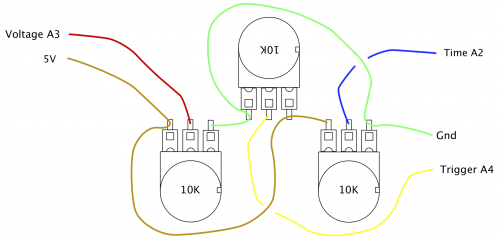
The schematic of the Arduino data acquisition module is shown in Figure 1.

Raspberry Pi Arduino oscilloscope magPi 71

Figure 1: Schematic of the Arduino acquisition module

You will notice that it is quite simple. It consists of three potentiometers for the oscilloscope’s controls and an AC coupled biased voltage input.

The capacitor ensures that no DC components from the input get through and gives a modicum of protection against overvoltage. The reference voltage, or ground, is similarly biased as +2.5V above the Pi’s ground level.

The use of a BNC socket for the input ensures that you can use this with proper oscilloscope probe leads; these normally have an X10 switchable attenuator fitted, thus allowing voltages of +/- 25V to be measured. Full construction details can be found in the numbered steps.

Raspberry Pi Arduino oscilloscope magPi 71

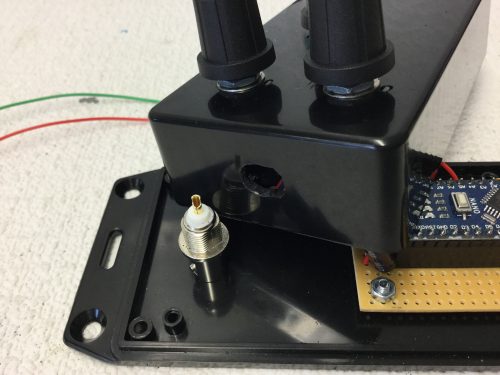
The BNC socket has a flat on each side of the thread to prevent it rotating with the twisting force it will be subjected to upon connecting any probe. We did this by first drilling an 8mm hole for the flats and then enlarging the hole with a circular file on each side to allow it to fit. An 8×12mm hole was filed opposite the USB connecter to allow access.

Arduino software

The software, or sketch, you need to put into the Arduino is shown in the Gather_A0.ino listing, and is quite simple. Normally an Arduino of this type will take samples at a rate of 10 000 per second — or as we say, a 10k sample rate. This is not too good for an oscilloscope, but we can increase this sample rate by speeding up the A/D converter’s clock speed from the default rate. It does not appear to affect the reading accuracy too much. By making this change, we can speed up the sample rate to 58k. This is much better and allows useful measurements to be made in the audio range.

Raspberry Pi Arduino oscilloscope magPi 71

We used an Arduino Nano and soldered the header pins to it. Then we took a 14 hole by 19 strips piece of stripboard and drilled some holes to fix it to the base of the box. You might want to make this longer than 19 strips if you are not using surface-mount resistors on the underside. Fit header sockets to the stripboard and break the tracks on the underside between the two rows.

So, first, the trigger function is optionally called and then the samples are gathered in and sent to the Pi. The trigger function has a time-out that means it will trigger anyway after one second, whether it sees a transition on the input signal or not. Then the three pots are measured and also sent to the Pi. Note here that the samples are ten bits wide and so have to be sent as two bytes that get joined together again in the Pi’s software.

Also note the use of the double read for the pots, with a bit of code between each. This ensures a more stable reading, as the input capacitor of the Arduino’s sample and hold circuit needs time to charge up, and it has less time than normal to do this due to the speeding up of the D/A. It does not affect the waveform samples too much, as in most waveforms one sample voltage is close to the previous one.

Raspberry Pi Arduino oscilloscope magPi 71

We then drilled three holes for the pots, and added the small slots for the anti-rotation lugs. Then we fitted the pots and wired them up using the diagram above. This is the view from inside the lid of the box; if you’re worried about touching the side of the box with your soldering iron, consider soldering them before attaching them to the box.

At the end of the transfer, the Arduino sits in a loop waiting for an acknowledge byte from the Pi so it can start again. This acknowledge byte also carries the information as to whether or not to use a trigger on the next sample.

Raspberry Pi Arduino oscilloscope magPi 71

Add the resistors and capacitors to the stripboard and wire up the BNC socket. Solder this up before mounting, otherwise you will melt the plastic. Remember to thread the central wire through the ground washer, crinkle washer, and nut before soldering it. Add labels Trigger, Time, and Volts to the knobs.

Finally, before each buffer full of data is gathered, pin 13 on the board is lit, and turned off after. This is so that we could time the process on a commercial oscilloscope to find the sample rate — something you will not have to do if you use the recommended AVR-type Arduinos running at 16MHz.

Pi software

The software for the Raspberry Pi is written in Python 3 and used the Pygame framework. It proved to be a lot more tricky to write than we first imagined, and is shown in the Scope.py listing. Python 3 uses Unicode characters by default, and allowed us to display the delta (Δ) and mu (μ) Greek characters for the difference and the time. The code first sets up the non-display part of the window; this is only drawn once, and then parts of it are updated when necessary. Depending on what type of Arduino you have, it can show up as a different USB port; we found that ours showed up as one of two ports. Comment out which one is not applicable when defining the sampleInput variable at the start of the listing.

Finally, we cobbled together a 168×78 pixel logo for the top-left corner, using a piece of clip art and fashioning the word ‘Oscilloscope’ from an outlined version of the Cooper Black font. We called it PyLogo.png and placed it in an images folder next to the Python code.

Using the oscilloscope

The oscilloscope samples at 58 kHz, which in theory means you can measure waveforms at 29 kHz. But that only gives you two samples per cycle, and as the samples can be anywhere on the waveform, they do not look very good. As a rough guide, you need at least ten points on a waveform to make it look like a waveform, so that gives a top practical frequency of 5.8 kHz. However, by using the Time Magnify options along with the Freeze function, you can measure much higher frequencies. The time and voltage cursor lines let you find out the values on any point of the waveform, and by clicking the Save functions, the current cursor is replaced by a dotted line that is fixed, and measurements can be made relative to that. The oscilloscope in action can be seen in Figure 2.

Raspberry Pi Arduino oscilloscope magPi 71

Figure 2: Taking measurements on a swept signal

Note that pressing the S key on the keyboard produces a screen dump of the display.

Taking it further

There are lots of ways you can take this project further. A simple upgrade would involve you having a second data buffer to allow you to display a saved waveform to compare against the current live one. You could also add a lower-speed acquisition mode to see slower waveforms. You can go the other way and use a faster Arduino so you can see the higher frequencies. This oscilloscope is AC coupled; you could add a DC coupling option with a switch potential divider and amplifier to the front end to extend the range of voltages you can measure. All these improvements, however, will need changes to the software to allow the measuring to take place on these wider-range parameters.

Finish the project

For the complete project code, download the free PDF of The MagPi issue 71, available on The MagPi website.

The post Build an oscilloscope using Raspberry Pi and Arduino appeared first on Raspberry Pi.

22 Jul 16:18

A simple way to explore the Four Fold Practice of the Art of Hosting

by Chris Corrigan

The Art of Hosting is predicated on a very simple set of practices which we call the Four Fold Practice. This framework emerged from a conversation in the late 1990s between Toke Moeller,  Monica Nissen, Carsten Ohm and Jan-Hein Nillson about what patterns make for a meaningful conversation. After talking about it for days, the clarity that arose was that people experience meaningful conversations when they are present, when they participate, when they are hosted and when they co-create something. Simple.

The next question then became, what if these four patterns were actually practices that could be cultivated both by individual leaders/facilitators and by groups? What would that be called?

The answer was, “That would be called the art of hosting.” And so a collective inquiry was born that has spread around the world and been taken up by tens of thousands of people working in all forms of leadership, organization, and community.

I sometimes feel that the four fold practice doesn’t get the attention it deserves. Sometimes people can confuse the Art of Hosting with the methods we use or the way we harvest conversations or the tools that help us design things. But that’s not what it is.  The Art of Hosting, at its deepest essence, is these four practices.

Today we are beginning an Art of Hosting workshop with some community foundations in British Columbia and tonight we began by introducing the four fold practice in some depth, because when all else fails, coming back to these practices will at least remind you how to invoke patterns that make engagement and dialogue meaningful.  We began by telling the story of the practice and where it came from (you can learn a bit about that here) and then we led people in a simple exercise to explore it.

Getting into pairs we asked people to spend 5 minutes on the question “Which of these practices are you strongest on, and what’s a story about that?” We heard a bit in plenary about what was strong with folks, and there are lots of assets and experiences in the room

Then we asked people to talk about which of these practices they were weakest on and what they were eager to learn about. These learning questions were captured on index cards and placed in our centre where we will use them to focus our teaching and inquiry over the next three days.

It’s a simple way to dive into these practices, acknowledge that there are lots of ways to come into an Art of Hosting workshop, and build on the strengths that people have. And it allows us to discover the learning agenda in the room and tie it to the practice.  It’s a rich harvest.

22 Jul 16:14

Browser privacy improvements and anti-fraud

(Update 18 Aug 2018: Fix an error to be consistent with the source quoted.)

(I work for Mozilla. None of this is secret. None of this is official Mozilla policy. Not speaking for Mozilla here.)

The good news is that interesting competition among web browsers is back, not just because of ongoing performance improvements in Firefox, but also because of Apple Safari's good work on protecting users from some kinds of cross-site tracking by default. Now the challenge for other browsers is to learn from the Safari work and build on it, to even more accurately implement the user's preferences on sharing their personal information. According to research by Tini Sevak at YouGov, 36% of users are more likely to engage with adverts that are tailored to them, while 55% are creeped out by personalized ads. The browser has to get its data sharing settings right for the individual user, while minimizing the manual settings and decision fatigue that the user has to go through.

A short-term problem for sites, though, is that the current price for highly tracked ad impressions facilitated by cross-site tracking is still way above the price of impressions delivered to users who choose to protect themselves. Tim Peterson, on Digiday, covers the natural experiment of GDPR consenters and non-consenters:

If an exchange or SSP declines to sign the agreement, it is limited to only selling non-personalized ads through DBM. Those generic ads generate less revenue for publishers than personalized ads that are targeted to specific audiences based on data collected about them. Some publishers that are heavily reliant on DBM have seen their revenues decline by 70-80 percent since GDPR took effect because they were limited to non-personalized ads, said another ad tech exec.

(‘It’s impossible’: Google has asked ad tech firms to guarantee broad GDPR consent, assume liability - Digiday)

In the medium to long term, better browser privacy settings will give an advantage to high-reputation sites for two reasons:

  • ads on high-value content have signaling value

  • users are more likely to share information with a site they trust

But in the short term, what can browsers do to help address the market dislocation from the user data crunch?

One possibility is to take advantage of an important side effect of browser privacy improvements: better anti-fraud data.

Today, unprotected browsers and fraudbots are hard to tell apart. Both maintain a single "cookie jar" across trusted and untrusted sites. For fraudbots, cross-site trackability is not a bug as it is for a human user's browser—it's a feature. A fraudbot can only produce valuable ad impressions on a fraud site if it is somehow trackable from a legit site.

As browser users start to upgrade to nightly releases that include more protection, though, a trustworthy site's real users will start to look more and more different from fraudbots. Low-reputation and fraud sites claiming to offer the same audience will have a harder and harder time trying to sell impressions to agencies that can see it's not the same people. This does require better integration with anti-fraud tools, so it's something sites and anti-fraud vendors can do in parallel with the brower release process.

Can the anti-fraud advantages of browser privacy improvements completely swamp out the market effects of reducing cross-site trackability? Depends on how much adfraud there is. We don't know.

22 Jul 16:13

Zuckerberg’s Holocaust conundrum — and how Facebook can escape from it

by Josh Bernoff

Mark Zuckerberg got himself in hot water by explaining why he couldn’t kick Holocaust deniers off of Facebook. That sounds indefensible until you try to figure out how you’d do it. It’s a hard problem, but I have a solution. Here’s what Mark Zuckerberg told Recode in an interview with Kara Swisher: Zuckerberg: I’m Jewish, … Continued

The post Zuckerberg’s Holocaust conundrum — and how Facebook can escape from it appeared first on without bullshit.

22 Jul 16:13

5 traits that distinguish high-performing teams

by Rebecca Hinds

Update 7/24 at 6:30pm PT
A Harvard Business Review article about this study published on July 20th contained multiple factual errors. The way the study and its methodology were initially presented created confusion and serious concern about how user data was shared and analyzed. We want to sincerely apologize for this. One of our company values is to be worthy of trust, and to us, this means safeguarding our users’ data, first and foremost.

We’d like to emphasize that neither the Northwestern Institute on Complex Systems (NICO) nor Dropbox researchers ever had access to any user content. Dropbox anonymized any data that was shared with NICO.

Here’s our statement regarding this study:

In 2016, Dropbox formally enlisted NICO to help study shared folder collaboration at universities in order to better understand how effective research teams work. The study used anonymized data from May 2015 to May 2017, consisting of aggregated sharing activity data as well as publicly available information provided by NICO that resulted in a dataset of 16,000 researchers. At no time did NICO or Dropbox researchers have access to any user content.

Throughout the study, Dropbox took steps to protect the privacy and confidentiality of our users. Before sharing the activity data with NICO, we randomized or hashed the dataset and grouped it into wide ranges to further ensure that no identifying information could be derived. In addition, our research partners at NICO are bound by strict confidentiality obligations. We designed the study to fall within the scope of our Privacy Policy, which provides that Dropbox and its trusted third parties can analyze sharing activity to “provide, improve, protect, and promote our Services.”


What’s the secret to a high-performing team? A star player? Veteran experience? In a joint study by Dropbox and the Northwestern Institute on Complex Systems (NICO), we set out to answer questions like these by analyzing Dropbox collaboration at the top 100 universities in the world (based on the 2017 Center for World Universities Rankings) and cross-referencing academic citations according to the Web of Science database. To protect our users’ privacy, all data was anonymized and information like university ranks and number of citations were grouped into ranges.

For our study, we defined a “team” as a group of researchers collaborating within the same Dropbox shared folder. What sort of actions—like adds, edits, and number of collaborators—were typical of the “highest performing” teams? We measured team performance using two metrics: university rank and number of citations among the users. Teams with higher university ranks and higher numbers of citations among team members were deemed to be higher performing overall.

1. The highest performing teams have a mix of both old and new collaborators

Unsurprisingly, when the team members had never worked together in the same Dropbox shared folder before, the team wasn’t high performing. But the same was true of overly familiar teams: When every team member had already worked together in a past shared folder, performance was not necessarily higher. The data suggests that a mix of the two is the best choice—for example, a duo of familiar collaborators matched with two fresh faces.

2. Smaller teams perform better

High-performing teams tended to be between three and five people. Lower performing teams were larger on average and correlated with fewer citations and lower university rankings.

3. Equality of effort is key

In high-performing teams every member contributed a similar amount—adding, editing, and sharing files at similar rates. Teams where certain members did significantly more than others tended to be lower performing. This suggests that, generally speaking, a star player can’t overcome the deficiencies of a less motivated team. This also might help explain why larger teams tended to do worse: Teams with more freeloaders tended to be correlated with lower results.

4. Some experience is critical

The highest performing teams had at least one team member with a strong track record—in this case, a history of highly cited work. Teams with less established researchers underperformed in comparison. That said, there was no statistical advantage in teams with all veterans, suggesting that teams with mostly inexperienced members can still do well, so long as they have access to one or two experienced collaborators.

5. Great teams take more time

Among teams that checked all the boxes above, there was a final factor that separated the good from the great. Specifically, the best teams took a bit more time within shared folders—sharing, editing, and adding for a longer period of time than most other teams. This suggests if your team already has good chemistry and a strong sense of motivation, it’s probably worth sweating the details one last time.

Note that these takeaways apply specifically to teams at these universities. It’s possible that we’d see different results in other industries or settings. Secondly, keep in mind that these trends reflect correlation, rather than causation. It’s likely that some of these takeaways were influenced by other factors not present in the study. Still, at least some of these trends may hold for many team-based research projects—something you might keep in mind for your next company project or presentation.

22 Jul 16:12

How Unity Is Building its Future on AR, VR, and AI

files/images/edustar.PNG

Rob Marvin, PC Magazine, Aug 01, 2018


Unity has been around for a while - I've written about it before. It's "a democratized 3D creation tool for developing immersive content. There are Free, Plus, and Pro versions you can buy for monthly subscription fees, and it's royalty-free. So what you build with Unity is yours." As augmented and virtual reality become more mainstream, its importance is increasing. If you aren't aware of the basic concept of Unity and where it is headed, and if you are interested in learning technology, you should review this article to get the lay of the land, and in particular, how adding AI to the mix will have a significant impact in the future.

Web: [Direct Link] [This Post]
22 Jul 16:12

Tracking Disinformation by Reading Metadata

files/images/Capture.PNG

Amelia Acker, Data & Society, Medium, Aug 01, 2018


It's still pretty easy to distinguish between human spammers and bots (which is why the excuses given by Facebook and Twitter ring hollow). For example, "'Joey' has tweeted more than 500 times every day for three years." Pretty clearly a bot. A bot, in fact, that was one of the army of bots influencing the U.S. election. And a bot that remained, as of the writing of the article, still online on Twitter. As I write this post, I can still link to @Joe_America1776. In the future, it will be a lot harder to detect the bots. So the social media companies' reluctance to act even in the face of obvious evidence is worrisome, and it shows me pretty clearly that we need an alternative mechanism for online interaction and discourse.

Web: [Direct Link] [This Post]
22 Jul 16:12

Dear Mr. Ford…

files/images/at-tout-img.1.jpg

Doug Peterson, doug — off the record, Aug 02, 2018


This is the title of one link in Doug Peterson's weekly wrap-up but all of the posts reflect, in one way or another, on the sea change in Ontario education being caused by the new government. It's not just about curriculum change - consider the segment where he talks about different things stressing different people (contra the old instructivist model of everything). Consider the discussion of taking different approaches to solve math problems. Same sort of thing. And, of course, there are the topics that need to be covered in 2018 that just didn't exist in 1998.

p.s. and as a complete aside, I've been noticing how much language online is presented in the form of a command. I get this in email a lot (as in Facebook saying "you need to update your page listing" or LinkedIn "tell us whether so-and-so is a friend." I saw some in Peterson's post - that's what made me think of it. "Show some blog loving to Gerry and check in," he says in a tone that I perceive as demanding compliance. And "Make sure that you're following these great bloggers on Twitter." I wonder how much more we're ordering each other about these days, and I wonder how much of that is influenced by commercial online discourse.

Web: [Direct Link] [This Post]
22 Jul 16:12

The Thing About Jetpacks

Here’s a collection of essays I wrote together with Jon Bell a while ago: The Thing About Jetpacks.


If you require a short url to link to this article, please use http://ignco.de/764

22 Jul 16:12

artisticstuffetc: World is nothing without art (blog)...


artisticstuffetc:

World is nothing without art (blog) trans-chandra:
anafenza:

analog electronics are obviously less efficient and usually clunky but… via Tumblr

22 Jul 16:12

"I’m not anti-social; I’m pro-solitude."

“I’m not anti-social; I’m pro-solitude.” - Beth Buelow (via onlinecounsellingcollege)
22 Jul 16:11

Anatomy of a Butterfly (Keyboard)

by Rui Carmo

A little more detail on how the new membrane protects the butterfly mechanism, with empirical testing (and more closeup photos).

I’m a bit sad that this can’t be retrofitted onto the older models – I might have to consider selling mine and upgrading.

22 Jul 16:11

Code Prediction with a Neural Network

by Rui Carmo

This is very neat, and reminds me that I need to spend less time messing around with Azure internals and more time building useful stuff on top of it.

22 Jul 16:11

"A country that does not respect the rights of its own people will not respect the rights of its..."

“A country that does not respect the rights of its own people will not respect the rights of...
22 Jul 16:11

The farewell note: A senior city-hall employee goes to work for a major developer

by Frances Bula

Lots of praise for Bill Aujla, the head of real-estate services who is going off to be vice-president of real estate with the Aquilini Group.

This move, though, is raising questions for some.

From: Johnston, Sadhu
Sent: Tuesday, July 17, 2018 3:31 PM
To: All Staff (COV) – DL
Subject: Staffing Changes in City Manager’s Office


Greetings all,


I regret to announce that after six years at the helm of the Real Estate and Facilities Management Team, Bill Aujla will be leaving the City. He has contributed so much to the City during his thirteen years with us. While I am sad to say goodbye to Bill, he isn’t going far as he will be joining the Aquilini Investment Group as Vice President of Real Estate.


Bill has added immense value to the City; he was the lead on the successful negotiations with Canadian Pacific Railway for the City’s purchase of the Arbutus Corridor, and he represented the City’s interests in complex city issues, including CAC (Community Amenity Contributions) negotiations with developers. Bill has led a great variety of projects on behalf of the City, including the purchase of St. James Community Square, the development of the Killarney Seniors Centre, the seismic upgrading of the West Annex, the development of the Taylor Manor Housing Project and many others.


Bill also oversaw the Olympic Village development, including Canada’s first residential multi-unit Net Zero Affordable Housing Project, Habitat Island (a constructed island off the west shore of the Village), and the restoration of a heritage building (Salt Building). Additionally, Bill led the consolidation of Facilities Services, building a team, each of whom play an integral role in the everyday running of a successful department.


Bill Aujla has tendered his resignation effective at the end of August. He will be on vacation starting August 13. Recruitment for a new GM will begin immediately, and Lisa Prescott, Director, Strategic Operations Planning & Program Management will step-in until a new GM has been selected. Lisa has been with the City since 2010. Previous to her Director role in Real Estate and Facilities Management, she was Manager of Recreation Services in Park Board, and Manager of Performance Management and Business Transformation in FRS.


Gil Kelley, GM, Planning Urban Design and Sustainability, will be taking over the CAC negotiations. Over the last year we have been moving towards the transformation of the CAC program to less negotiated CACs and more fixed rates, which Gil will continue.


Bill leaves his department in a very strong position for the future and we sincerely thank him for his contribution and leadership during his tenure as GM.  We’ll all really miss Bill and we wish him a successful future as he progresses his career.


Best,

Sadhu


22 Jul 16:11

| Umberto Eco, Ur-Fascism


| Umberto Eco, Ur-Fascism

22 Jul 16:11

Last Strawberries

by peter@rukavina.net (Peter Rukavina)

There is a story that I tell myself that in my childhood we had fresh strawberries in April. This is clearly apocryphal: even though the growing season is expanding and contracting, Ontario has never had an April strawberry season.

Ontario does, however, have strawberries in early June; I know this because we stopped at a roadside stand in Queenston and bought some when we were there in the second week of this early June.

Prince Edward Island’s strawberry season was late this year and there were rumblings that there wouldn’t be a season at all; fortunately this proved to be untrue, and we’ve been enjoying local berries for the last three weeks.

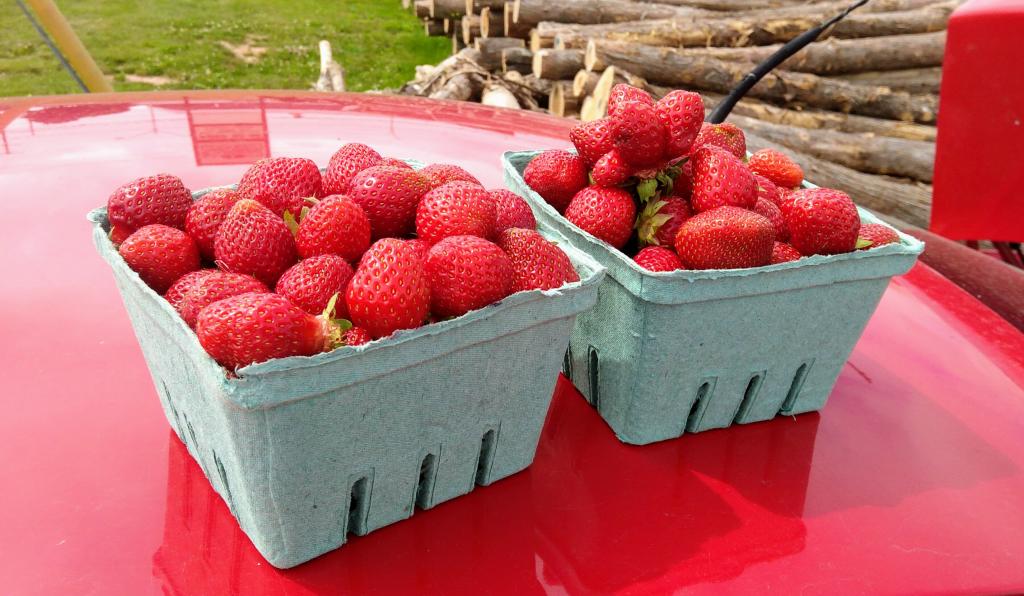
This morning at Riverview Country Market we were warned that this will likely be the last week, and so we bought two quarts so as to have one last strawberry blowout.

They will be missed.

22 Jul 16:11

My Best Stuff

by Dave Pollard


The inimitable Rev. Michael Dowd (bio) recently asked me to distill my list of some 80 “best posts” (on my right sidebar) down to my 10 best, since he and his wife Connie Barlow wanted to record audio versions of some of them to post on their sustainability page, alongside those of other writers about eco-collapse and sustainability such as John Michael Greer, Paul Kingsnorth, Theo Kitchener, Ronald Wright, Richard Heinberg, Joanna Macy and Jim Kunstler, and many other luminaries I greatly admire and have written about on these pages.

I of course agreed to do so. I wanted to focus on the ones that readers suggested they found most useful, educational, inspiring or interesting. About half of these would also be on my ‘favourites’ list because they were fun to write or because researching them taught me a great deal. But ultimately at least half of my ‘favourite’ posts are creative works. They’re the hardest to do, and often the least popular. But I’ve become quite fond of the recurring characters in my short stories, and three of my free-verse works would be at or near the top of my favourite writings.

So I provided Michael with some of both, and I list below, in no particular order, the 30 posts that I think comprise my ‘best’ writing, marked with a †  and/or my personal ‘favourites’ (marked with an *). For non-fiction articles the thesis or subject of each post is shown below the article name.

I hope this list points you to some of my work you might have missed. Comments are closed for older articles to fend off spam, but feel free to comment below or email me.


Ten Things I Wish I’d Learned Earlier (May 2017)†*
The 10 most important things I’ve learned since I started blogging

 A Future Without Us (Nov 2017)†
Life for humans after civilization’s collapse might well be joyous, sustainable and amazingly diverse

 The Mushroom at the End of the World (Jan 2017) (Long) (Book review/summary)†*
How economies really work and how we could prepare for the economy that will emerge after civilization’s collapse 

Complexity and Collapse (updated Jun 2016) (Long) (originally published in SHIFT magazine)†
How complex systems work and how they are leading to the inevitable collapse of our economic, affordable energy and ecological systems

Too Many Rats in the Cage: Civilization Disease (May 2013)†
Civilization has unintentionally made us all ill

Do We Really Want To Know? (Nov 2009)†
Industrial agriculture and other modern industries depend on our human desire not to know the unpleasant details of how the things we want are produced

The Dark and Gathering Sameness of the World (Apr 2006) (Book review/summary)†
The increasing homogeneity of our world threatens our survival and diminishes our lives

The End of Philosophy (May 2005) (Book review/summary)†*
We cannot and shouldn’t want to “save the world” from the rapacity and foolishness of the human species

The Problem With Systems (Jul 2016)†
We can’t “fix” society’s broken systems because they don’t really exist

The Admission of Necessary Ignorance (updated Jun 2016)†
A humbler, more equanimous approach to science and other human endeavours might serve us, and our world, well

 Several Short Sentences About Jellyfish (2014)†*
A research report on the world’s most amazing and enduring creature

The Rogue Animal and Gaia Consciousness (May 2005) (Book review/summary)†
Somehow the human species, attempting to make a better world, created a prosthetic, disconnected one instead

Manifesto (Mar 2010)†
A whimsical rant against our society’s uncritical acceptance of conformity and propaganda

The Value of Conversation (Mar 2010)†*
Skilled, thoughtful discourse is essential to human connection, health and survival

Ten Things to Do When You’re Feeling Hopeless (Sep 2010)†*
Ways of coping in a seemingly ever-worsening world

A Culture of Dependence (Oct 2010)†*
We can’t hope to change a culture whose systems we’re utterly, helplessly dependent on

A Harvest of Myths (Jul 2014)†*
The dubious assumptions on which we base our beliefs, stories and actions (notes from a Dark Mountain conference)

Several Short Sentences About Learning (Apr 2015)†*
How we actually learn and why we often don’t

Cultural Acedia: When We Can No Longer Care (Jul 2018)†
Before every cultural collapse, there is a period of acedia that portends it; we’re now in that period

All There Is, Is This (Apr 2016)*
The essence of radical non-duality and the non-existence of the separate self

On the Shoulders of Giants (Feb 2018) (Short Story)*
A father and daughter banter about the nature of free will

 Conjurer (2009) (Satire in verse)*
A lament on expectations

The Horses’ Bodies (Feb 2014) (Poem)*

Invisible (Nov 2016) (Poem)*

Calling the Cage Freedom (Nov 2017) (Short Story)*

Speaking Grosbeak (Jun 2015) (Short Story)*

Flywheel (Aug 2014) (Short Story)*

A Conversation (Jul 2009) (Short Story)*

Against Hope (Sep 2015) (Video)*
My PechaKucha presentation, a mix of light and dark; embedded at top of this post

Interview with Dean Walker (Jun 2018) (Video)*
Dean asks me about my evolving views on collapse, grief, and non-duality; a light and enjoyable conversation

22 Jul 16:11

Stream to Sonos’s AirPlay Hardware With Airfoil for Mac 5.8

by Paul Kafasis

We’ve got big news for Airfoil today: Sonos compatibility! With the new Airfoil for Mac 5.8, you can stream any audio from your Mac to all of Sonos’s AirPlay-compatible devices. That means Airfoil can now help you play audio to even more devices. Whatever mix of AirPlay, Bluetooth, and Chromecast devices you have, Airfoil can help you stream audio in sync to all of them at once.

Currently, Sonos’s AirPlay-compatible hardware lineup consists of the Sonos One, Beam, Playbase, and second-generation Play:5. If you’ve already got one of these AirPlay-compatible Sonos device, make sure its firmware is up to date, then update to Airfoil for Mac 5.8 to start streaming any audio from your Mac all around your house.

Of note for users with older Sonos hardware, you need just one AirPlay-compatible Sonos device to enjoy audio on your entire system.

From Sonos’s announcement:

Even though AirPlay 2 is only supported on Sonos One, Beam, Playbase, and Play:5, with any one of these speakers you can listen via AirPlay on your entire home sound system. That means that even non-AirPlay compatible speakers like Playbar or Play:1 can reap the sonic benefits of our AirPlay 2 integration, provided they’re grouped with one of our newer, AirPlay-friendly devices in the Sonos app.

That means that if you have an older Sonos system, you can just add a single new device to get AirPlay compatibility going throughout your home. The Sonos One is a very worthy HomePod competitor, and its $199 price tag is just slightly more than half the cost of Apple’s smart speaker.


More Compatible Devices Coming Soon

Sonos’s recent update made them the first third-party vendor to ship AirPlay 2 compatible speakers, but they won’t be the last. There are many more AirPlay 2 devices coming from Denon, Libratone, Marantz, and more. Much of this hardware is already available for purchase, and firmware updates to enable AirPlay on these devices are due at various points later this year.


More compatible outputs coming soon!

Like the Sonos hardware, we expect these devices will be compatible with Airfoil, once their firmware is updated. We’re excited for Airfoil to power audio streaming to even more great hardware!

Get Airfoil for Mac 5.8 Now

For over a decade, Airfoil has helped stream audio from your Mac to outputs all around your house. With today’s update, it supports more outputs than ever before. If you’re new to Airfoil, learn more on its product page. You can download the free trial, then purchase right through our store.

Owners of Airfoil for Mac 5 can update to version 5.8 free of charge, by selecting “Check for Update” from the Airfoil menu. If you’re an owner of Airfoil 4 or lower, you’re still eligible to upgrade to version 5 at a great discount.

Stay Tuned, Airfoil for Windows Users

Fear not, Windows users. We’re hard at work on an update which will add Sonos compatibility to Airfoil for Windows as well. Stay tuned for more news in the near future!


Update (September 13th, 2018): With version 5.6, you can now stream to Sonos devices with Airfoil for Windows as well! Be sure to update to the latest version.

22 Jul 16:11

You Think You Want Media Literacy… Do You?

by zephoria

The below original text was the basis for Data & Society Founder and President danah boyd’s March 2018 SXSW Edu keynote,“What Hath We Wrought?” — Ed.

Growing up, I took certain truths to be self evident. Democracy is good. War is bad. And of course, all men are created equal.

My mother was a teacher who encouraged me to question everything. But I quickly learned that some questions were taboo. Is democracy inherently good? Is the military ethical? Does God exist?

I loved pushing people’s buttons with these philosophical questions, but they weren’t nearly as existentially destabilizing as the moments in my life in which my experiences didn’t line up with frames that were sacred cows in my community. Police were revered, so my boss didn’t believe me when I told him that cops were forcing me to give them free food, which is why there was food missing. Pastors were moral authorities and so our pastor’s infidelities were not to be discussed, at least not among us youth. Forgiveness is a beautiful thing, but hypocrisy is destabilizing. Nothing can radicalize someone more than feeling like you’re being lied to. Or when the world order you’ve adopted comes crumbling down.

The funny thing about education is that we ask our students to challenge their assumptions. And that process can be enlightening.

The funny thing about education is that we ask our students to challenge their assumptions. And that process can be enlightening. I will never forget being a teenager and reading “The People’s History of the United States.” The idea that there could be multiple histories, multiple truths blew my mind.Realizing that history is written by the winners shook me to my core. This is the power of education. But the hole that opens up, that invites people to look for new explanations…that hole can be filled in deeply problematic ways.When we ask students to challenge their sacred cows but don’t give them a new framework through which to make sense of the world, others are often there to do it for us.

For the last year, I’ve been struggling with media literacy. I have a deep level of respect for the primary goal. As Renee Hobbs has written, media literacy is the “active inquiry and critical thinking about the messages we receive and create.” The field talks about the development of competencies or skills to help people analyze, evaluate, and even create media. Media literacy is imagined to be empowering, enabling individuals to have agency and giving them the tools to help create a democratic society. But fundamentally, it is a form of critical thinking that asks people to doubt what they see. And that makes me nervous.

Most media literacy proponents tell me that media literacy doesn’t exist in schools. And it’s true that the ideal version that they’re aiming for definitely doesn’t. But I spent a decade in and out of all sorts of schools in the US, where I quickly learned that a perverted version of media literacy does already exist.Students are asked to distinguish between CNN and Fox. Or to identify bias in a news story. When tech is involved, it often comes in the form of “don’t trust Wikipedia; use Google.” We might collectively dismiss these practices as not-media-literacy, but these activities are often couched in those terms.

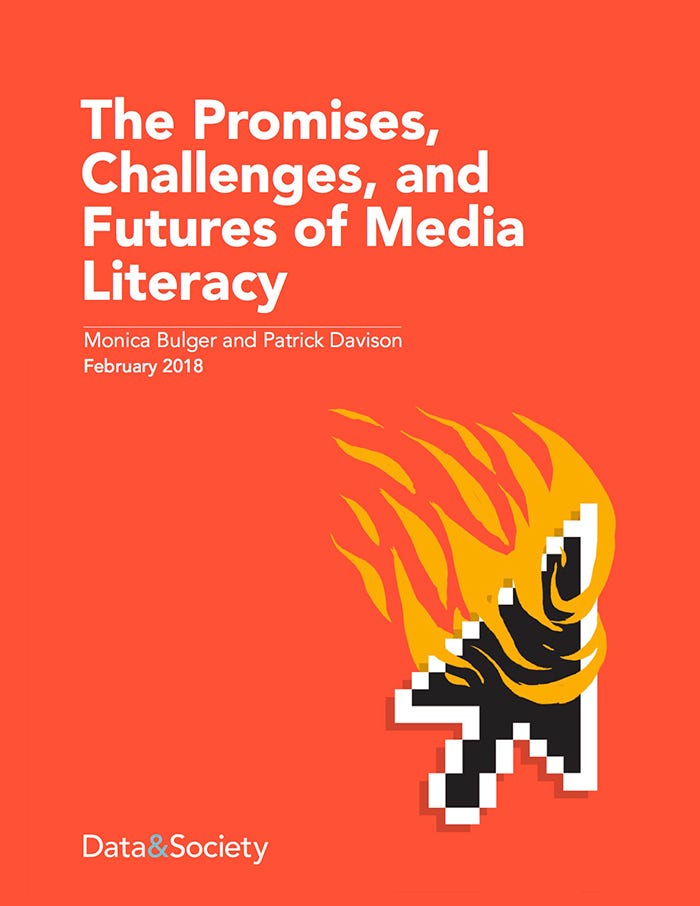
I’m painfully aware of this, in part because media literacy is regularly proposed as the “solution” to the so-called “fake news” problem. I hear this from funders and journalists, social media companies and elected officials. My colleagues Monica Bulger and Patrick Davison just released a report on media literacy in light of “fake news” given the gaps in current conversations. I don’t know what version of media literacy they’re imagining but I’m pretty certain it’s not the CNN vs Fox News version. Yet, when I drill in, they often argue for the need to combat propaganda, to get students to ask where the money is coming from, to ask who is writing the stories for what purposes, to know how to fact-check, etcetera. And when I push them further, I often hear decidedly liberal narratives. They talk about the Mercers or about InfoWars or about the Russians. They mock “alternative facts.” While I identify as a progressive, I am deeply concerned by how people understand these different conservative phenomena and what they see media literacy as solving.

I get that many progressive communities are panicked about conservative media, but we live in a polarized society and I worry about how people judge those they don’t understand or respect. It also seems to me that the narrow version of media literacy that I hear as the “solution” is supposed to magically solve our political divide. It won’t. More importantly, as I’m watching social media and news media get weaponized, I’m deeply concerned that the well-intended interventions I hear people propose will backfire, because I’m fairly certain that the crass versions of critical thinking already have.

New Data & Society report on media literacy by Monica Bulger and Patrick Davison

My talk today is intended to interrogate some of the foundations upon which educating people about the media landscape depends. Rather than coming at this from the idealized perspective, I am trying to come at this from the perspective of where good intentions might go awry, especially in a moment in which narrow versions of media literacy and critical thinking are being proposed as the solution to major socio-cultural issues. I want to examine the instability of our current media ecosystem to then return to the question of:what kind of media literacy should we be working towards? So let’s dig in.

Epistemological Warfare

In 2017, sociologist Francesca Tripodi was trying to understand how conservative communities made sense of the seemingly contradictory words coming out of the mouth of the US President. Along her path, she encountered people talking about making sense of The Word when referencing his speeches. She began accompanying people in her study to their bible study groups. Then it clicked. Trained on critically interrogating biblical texts, evangelical conservative communities were not taking Trump’s messages as literal text. They were interpreting their meanings using the sameepistemological framework as they approached the bible. Metaphors and constructs matter more than the precision of words.

Why do we value precision in language? I sat down for breakfast with Gillian Tett, a Financial Times journalist and anthropologist. She told me that when she first moved to the States from the UK, she was confounded by our inability to talk about class. She was trying to make sense of what distinguished class in America. In her mind, it wasn’t race. Or education. It came down to what construction of language was respected and valued by whom. People became elite by mastering the language marked as elite. Academics, journalists, corporate executives, traditional politicians: they all master the art of communication. I did too. I will never forget being accused of speaking like an elite by my high school classmates when I returned home after a semester of college. More importantly, although it’s taboo in America to be explicitly condescending towards people on the basis of race or education, there’s no social cost among elites to mock someone for an inability to master language.For using terms like “shithole.”

Linguistic and communications skills are not universally valued. Those who do not define themselves through this skill loathe hearing the never-ending parade of rich and powerful people suggesting that they’re stupid, backwards, and otherwise lesser. Embracing being anti-PC has become a source of pride, a tactic of resistance. Anger boils over as people who reject “the establishment” are happy to watch the elites quiver over their institutions being dismantled. This is why this is a culture war. Everyone believes they are part of the resistance.

But what’s at the root of this cultural war? Cory Doctorow got me thinkingwhen he wrote the following:

We’re not living through a crisis about what is true, we’re living through a crisis about how we know whether something is true. We’re not disagreeing about facts,we’re disagreeing about epistemology. The “establishment” version of epistemology is, “We use evidence to arrive at the truth, vetted by independent verification (but trust us when we tell you that it’s all been independently verified by people who were properly skeptical and not the bosom buddies of the people they were supposed to be fact-checking).”

The “alternative facts” epistemological method goes like this: “The ‘independent’ experts who were supposed to be verifying the ‘evidence-based’ truth were actually in bed with the people they were supposed to be fact-checking. In the end, it’s all a matter of faith, then: you either have faith that ‘their’ experts are being truthful, or you have faith that we are. Ask your gut, what version feels more truthful?”

Let’s be honest — most of us educators are deeply committed to a way of knowing that is rooted in evidence, reason, and fact. But who gets to decide what constitutes a fact? In philosophy circles, social constructivists challenge basic tenets like fact, truth, reason, and evidence. Yet, it doesn’t take a doctorate of philosophy to challenge the dominant way of constructing knowledge. Heck, 75 years ago, evidence suggesting black people were biologically inferior was regularly used to justify discrimination. And this was called science!

In many Native communities, experience trumps Western science as the key to knowledge. These communities have a different way of understanding topics like weather or climate or medicine. Experience is also used in activist circles as a way of seeking truth and challenging the status quo. Experience-based epistemologies also rely on evidence, but not the kind of evidence that would be recognized or accepted by those in Western scientific communities.

Those whose worldview is rooted in religious faith, particularly Abrahamic religions, draw on different types of information to construct knowledge. Resolving scientific knowledge and faith-based knowledge has never been easy; this tension has countless political and social ramifications. As a result, American society has long danced around this yawning gulf and tried to find solutions that can appease everyone. But you can’t resolve fundamental epistemological differences through compromise.

No matter what worldview or way of knowing someone holds dear, they always believe that they are engaging in critical thinking when developing a sense of what is right and wrong, true and false, honest and deceptive. But much of what they conclude may be more rooted in their way of knowing than any specific source of information.

If we’re not careful, “media literacy” and “critical thinking”will simply be deployed as an assertion of authority over epistemology.

Right now, the conversation around fact-checking has already devolved to suggest that there’s only one truth. And we have to recognize that there are plenty of students who are taught that there’s only one legitimate way of knowing, one accepted worldview. This is particularly dicey at the collegiate level, where us professors have been taught nothing about how to teach across epistemologies.

Personally, it took me a long time to recognize the limits of my teachers. Like many Americans in less-than-ideal classrooms, I was taught that history was a set of facts to be memorized. When I questioned those facts, I was sent to the principal’s office for disruption. Frustrated and confused, I thought that I was being force-fed information for someone else’s agenda. Now I can recognize that that teacher was simply exhausted, underpaid, and waiting for retirement. But it took me a long time to realize that there was value in history and that history is a powerful tool.

Weaponizing Critical Thinking

The political scientist Deen Freelon was trying to make sense of the role of critical thinking to address “fake news.” He ended up looking back at a fascinating campaign by Russian Today (known as RT). Their motto for a while was “question more.” They produced a series of advertisements as teasers for their channel. These advertisements were promptly banned in the US and UK, resulting in RT putting up additional ads about how they were banned and getting tremendous mainstream media coverage about being banned. What was so controversial? Here’s an example:

“Just how reliable is the evidence that suggests human activity impacts on climate change? The answer isn’t always clear-cut. And it’s only possible to make a balanced judgement if you are better informed. By challenging the accepted view, we reveal a side of the news that you wouldn’t normally see. Because we believe that the more you question, the more you know.”

If you don’t start from a place where you’re confident that climate change is real, this sounds quite reasonable. Why wouldn’t you want more information? Why shouldn’t you be engaged in critical thinking? Isn’t this what you’re encouraged to do at school? So why is asking this so taboo? And lest you think that this is a moment to be condescending towards climate deniers, let me offer another one of their ads.

“Is terror only committed by terrorists? The answer isn’t always clear-cut. And it’s only possible to make a balanced judgement if you are better informed. By challenging the accepted view, we reveal a side of the news that you wouldn’t normally see. Because we believe that the more you question, the more you know.”

Many progressive activists ask whether or not the US government commits terrorism in other countries. The ads all came down because they were too political, but RT got what they wanted: an effective ad campaign. They didn’t come across as conservative or liberal, but rather a media entity that was “censored” for asking questions. Furthermore, by covering the fact that they were banned, major news media legitimized their frame under the rubric of “free speech.” Under the assumption that everyone should have the right to know and to decide for themselves.

We live in a world now where we equate free speech with the right to be amplified. Does everyone have the right to be amplified? Social media gave us that infrastructure under the false imagination that if we were all gathered in one place, we’d find common ground and eliminate conflict. We’ve seen this logic before. After World War II, the world thought that connecting the globe through financial interdependence would prevent World War III. It’s not clear that this logic will hold.

For better and worse, by connecting the world through social media and allowing anyone to be amplified, information can spread at record speed.There is no true curation or editorial control. The onus is on the public to interpret what they see. To self-investigate. Since we live in a neoliberal society that prioritizes individual agency, we double down on media literacy as the “solution” to misinformation. It’s up to each of us as individuals to decide for ourselves whether or not what we’re getting is true.

Figure 1

Yet, if you talk with someone who has posted clear, unquestionable misinformation, more often than not, they know it’s bullshit. Or they don’t care whether or not it’s true. Why do they post it then? Because they’re making a statement. The people who posted this meme (figure 1) didn’t bother to fact check this claim. They didn’t care. What they wanted to signal loud and clear is that they hated Hillary Clinton. And that message was indeed heard loud and clear. As a result, they are very offended if you tell them that they’ve been duped by Russians into spreading propaganda. They don’t believe you for one second.

Misinformation is contextual. Most people believe that people they know are gullible to false information, but that they themselves are equipped to separate the wheat from the chaff. There’s widespread sentiment that we can fact check and moderate our way out of this conundrum. This will fail. Don’t forget that for many people in this country, both education and the media are seen as the enemy — two institutions who are trying to have power over how people think. Two institutions that are trying to assert authority over epistemology.

Finding the Red Pill

Growing up on Usenet, Godwin’s Law was more than an adage to me. I spent countless nights lured into conversation by the idea that someone was wrong on the internet. And I long ago lost count about how many of them ended up with someone invoking Hitler or the Holocaust. I might have even been to blame in some of these conversations.

Fast forward 15 years to the point when Nathan Poe wrote a poignant comment on an online forum dedicated to Christianity: “Without a winking smiley or other blatant display of humor, it is utterly impossible to parody a Creationist in such a way that someone won’t mistake for the genuine article.”Poe’s Law, as it became known, signals that it’s hard to tell the difference between an extreme view and a parody of an extreme view on the internet.

In their book, “The Ambivalent Internet,”media studies scholars Whitney Phillips and Ryan Milner highlight how a segment of society has become so well-versed at digital communications — memes, GIFs, videos, etc. — that they can use these tools of expression to fundamentally destabilize others’communication structures and worldviews. It’s hard to tell what’s real and what’s fiction, what’s cruel and what’s a joke. But that’s the point. That is howirony and ambiguity can be weaponized. And for some, the goal is simple:dismantle the very foundations of elite epistemological structures that are so deeply rooted in fact and evidence.

Many people, especially young people, turn to online communities to make sense of the world around them. They want to ask uncomfortable questions, interrogate assumptions, and poke holes at things they’ve heard. Welcome to youth. There are some questions that are unacceptable to ask in public and they’ve learned that. But in many online fora, no question or intellectual exploration is seen as unacceptable. To restrict the freedom of thought is to censor. And so all sorts of communities have popped up for people to explore questions of race and gender and other topics in the most extreme ways possible. And these communities have become slippery. Are those taking on such hateful views real? Or are they being ironic?

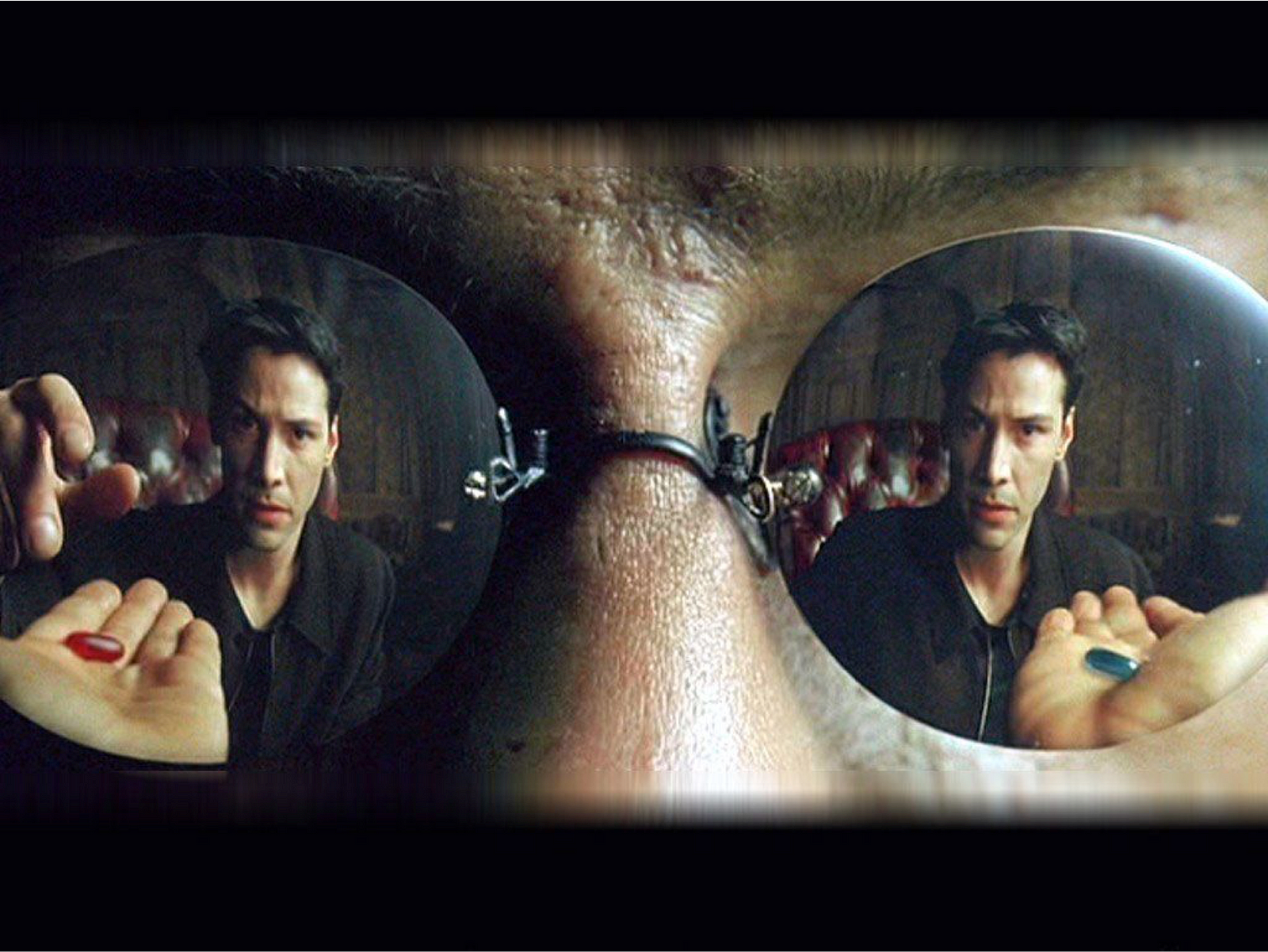
In the 1999 film The Matrix, Morpheus says to Neo: “You take the blue pill,the story ends. You wake up in your bed and believe whatever you want. You take the red pill, you stay in Wonderland, and I show you how deep the rabbit hole goes.” Most youth aren’t interested in having the wool pulled over their head, even if blind faith might be a very calming way of living. Restricted in mobility and stressed to holy hell, they want to have access to what’s inaccessible, know what’s taboo, and say what’s politically incorrect. So who wouldn’t want to take the red pill?

Image via Warner Bros.

In some online communities, taking the red pill refers to the idea of waking up to how education and media are designed to deceive you into progressive propaganda. In these environments, visitors are asked to question more. They’re invited to rid themselves of their politically correct shackles. There’s an entire online university designed to undo accepted ideas about diversity, climate, and history. Some communities are even more extreme in their agenda. These are all meant to fill in the gaps for those who are opening to questioning what they’ve been taught.

In 2012, it was hard not to avoid the names Trayvon Martin and George Zimmerman, but that didn’t mean that most people understood the storyline.In South Carolina, a white teenager who wasn’t interested in the news felt like he needed to know what the fuss was all about. He decided to go to Wikipedia to understand more. He was left with the impression that Zimmerman was clearly in the right and disgusted that everyone was defending Martin. While reading up on this case, he ran across the term “black on white crime” on Wikipedia and decided to throw that term into Google where he encountered a deeply racist website inviting him to wake up to a reality that he had never considered. He took that red pill and dove deep into a worldview whose theory of power positioned white people as victims. Over a matter of years, he began to embrace those views, to be radicalized towards extreme thinking. On June 17, 2015, he sat down for an hour with a group of African-American church-goers in Charleston South Carolina before opening fire on them, killing 9 and injuring 1. His goal was simple: he wanted to start a race war.

It’s easy to say that this domestic terrorist was insane or irrational, but he began his exploration trying to critically interrogate the media coverage of a story he didn’t understand. That led him to online fora filled with people who have spent decades working to indoctrinate people into a deeply troubling, racist worldview. They draw on countless amounts of “evidence,” engage in deeply persuasive discursive practices, and have the mechanisms to challenge countless assumptions. The difference between what is deemed missionary work, education, and radicalization depends a lot on your worldview. And your understanding of power.

Who Do You Trust?

The majority of Americans do not trust the news media. There are many explanations for this — loss of local news, financial incentives, hard to distinguish between opinion and reporting, etc. But what does it mean to encourage people to be critical of the media’s narratives when they are already predisposed against the news media?

Perhaps you want to encourage people to think critically about how information is constructed, who is paying for it, and what is being left out. Yet, among those whose prior is to not trust a news media institution, among those who see CNN and The New York Times as “fake news,” they’re already there. They’re looking for flaws. It’s not hard to find them. After all, the news industry is made of people in institutions in a society. So when youth are encouraged to be critical of the news media, they come away thinking that the media is lying. Depending on someone’s prior, they may even take what they learn to be proof that the media is in on the conspiracy. That’s where things get very dicey.

Many of my digital media and learning colleagues encourage people to make media to help understand how information is produced. Realistically, many young people have learned these skills outside the classroom as they seek to represent themselves on Instagram, get their friends excited about a meme, or gain followers on YouTube. Many are quite skilled at using media, but to what end? Every day, I watch teenagers produce anti-Semitic and misogynistic content using the same tools that activists use to combat prejudice. It’s notable that many of those who are espousing extreme viewpoints are extraordinarily skilled at using media. Today’s neo-Nazis are a digital propaganda machine. Developing media making skills doesn’t guarantee that someone will use them for good. This is the hard part.

Most of my peers think that if more people are skilled and more people are asking hard questions, goodness will see the light. In talking about misunderstandings of the First Amendment, Nabiha Syed of Buzzfeedhighlights that the frame of the “marketplace of ideas” sounds great, but is extremely naive. Doubling down on investing in individuals as a solution to a systemic abuse of power is very American.

22 Jul 16:10

The Messy Fourth Estate

by zephoria

(This post was originally posted on Medium.)

For the second time in a week, my phone buzzed with a New York Times alert, notifying me that another celebrity had died by suicide. My heart sank. I tuned into the Crisis Text Line Slack channel to see how many people were waiting for a counselor’s help. Volunteer crisis counselors were pouring in, but the queue kept growing.

Celebrity suicides trigger people who are already on edge to wonder whether or not they too should seek death. Since the Werther effect study, in 1974, countless studies have conclusively and repeatedly shown that how the news media reports on suicide matters. The World Health Organization has adetailed set of recommendations for journalists and news media organizations on how to responsibly report on suicide so as to not trigger copycats. Yet in the past few years, few news organizations have bothered to abide by them, even as recent data shows that the reporting on Robin Williams’ death triggered an additional 10 percent increase in suicide and a 32 percent increase in people copying his method of death. The recommendations aren’t hard to follow — they focus on how to convey important information without adding to the problem.

Crisis counselors at the Crisis Text Line are on the front lines. As a board member, I’m in awe of their commitment and their willingness to help those who desperately need support and can’t find it anywhere else. But it pains me to watch as elite media amplifiers make counselors’ lives more difficult under the guise of reporting the news or entertaining the public.

Through data, we can see the pain triggered by 13 Reasons Why and the New York Times. We see how salacious reporting on method prompts people to consider that pathway of self-injury. Our volunteer counselors are desperately trying to keep people alive and get them help, while for-profit companies reap in dollars and clicks. If we’re lucky, the outlets triggering unstable people write off their guilt by providing a link to our services, with no consideration of how much pain they’ve caused or the costs we must endure.

I want to believe in journalism. But my faith is waning.

I want to believe in journalism. I want to believe in the idealized mandate of the fourth estate. I want to trust that editors and journalists are doing their best to responsibly inform the public and help create a more perfect union.But my faith is waning.

Many Americans — especially conservative Americans — do not trust contemporary news organizations. This “crisis” is well-trod territory, but the focus on fact-checking, media literacy, and business models tends to obscure three features of the contemporary information landscape that I think are poorly understood:

  1. Differences in worldview are being weaponized to polarize society.
  2. We cannot trust organizations, institutions, or professions when they’re abstracted away from us.
  3. Economic structures built on value extraction cannot enable healthy information ecosystems.

Let me begin by apologizing for the heady article, but the issues that we’re grappling with are too heady for a hot take. Please read this to challenge me, debate me, offer data to show that I’m wrong. I think we’ve got an ugly fight in front of us, and I think we need to get more sophisticated about our thinking, especially in a world where foreign policy is being boiled down to 140 characters.

1. Your Worldview Is Being Weaponized

I was a teenager when I showed up at a church wearing jeans and a T-shirt to see my friend perform in her choir. The pastor told me that I was not welcomebecause this was a house of God, and we must dress in a manner that honors Him. Not good at following rules, I responded flatly, “God made me naked. Should I strip now?” Needless to say, I did not get to see my friend sing.

Faith is an anchor for many people in the United States, but the norms that surround religious institutions are man-made, designed to help people make sense of the world in which we operate. Many religions encourage interrogation and questioning, but only within a well-established framework.Children learn those boundaries, just as they learn what is acceptable insecular society. They learn that talking about race is taboo and that questioning the existence of God may leave them ostracized.

Like many teenagers before and after me, I was obsessed with taboos and forbidden knowledge. I sought out the music Tipper Gore hated, read the books my school banned, and tried to get answers to any question that made adults gasp. Anonymously, I spent late nights engaged in conversations on Usenet, determined to push boundaries and make sense of adult hypocrisy.

Following a template learned in Model UN, I took on strong positions in order to debate and learn. Having already lost faith in the religious leaders in my community, I saw no reason to respect the dogma of any institution. And because I made a hobby out of proving teachers wrong, I had little patience for the so-called experts in my hometown. I was intellectually ravenous, but utterly impatient with, if not outright cruel to the adults around me. I rebelled against hierarchy and was determined to carve my own path at any cost.

I have an amazing amount of empathy for those who do not trust the institutions that elders have told them they must respect. Rage against the machine. We don’t need no education, no thought control. I’m also fully aware that you don’t garner trust in institutions through coercion or rational discussion. Instead, trust often emerges from extreme situations.

Many people have a moment where they wake up and feel like the world doesn’t really work like they once thought or like they were once told. That moment of cognitive reckoning is overwhelming. It can be triggered by any number of things — a breakup, a death, depression, a humiliating experience.Everything comes undone, and you feel like you’re in the middle of a tornado, unable to find the ground. This is the basis of countless literary classics, the crux of humanity. But it’s also a pivotal feature in how a society comes together to function.

Everyone needs solid ground, so that when your world has just been destabilized, what comes next matters. Who is the friend that picks you up and helps you put together the pieces? What institution — or its representatives — steps in to help you organize your thinking? What information do you grab onto in order to make sense of your experiences?

Contemporary propaganda isn’t about convincing someone to believe something, but convincing them to doubt what they think they know.

Countless organizations and movements exist to pick you up during your personal tornado and provide structure and a framework. Take a look at how Alcoholics Anonymous works. Other institutions and social bodies know how to trigger that instability and then help you find ground. Check out the dynamics underpinning military basic training. Organizations, movements, and institutions that can manipulate psychological tendencies toward a sociological end have significant power. Religious organizations, social movements, and educational institutions all play this role, whether or not they want to understand themselves as doing so.

Because there is power in defining a framework for people, there is good reason to be wary of any body that pulls people in when they are most vulnerable. Of course, that power is not inherently malevolent. There is fundamental goodness in providing structures to help those who are hurting make sense of the world around them. Where there be dragons is when these processes are weaponized, when these processes are designed to produce societal hatred alongside personal stability. After all, one of the fastest ways to bond people and help them find purpose is to offer up an enemy.

And here’s where we’re in a sticky spot right now. Many large institutions — government, the church, educational institutions, news organizations — are brazenly asserting their moral authority without grappling with their own shit.They’re ignoring those among them who are using hate as a tool, and they’re ignoring their own best practices and ethics, all to help feed a bottom line. Each of these institutions justifies itself by blaming someone or something to explain why they’re not actually that powerful, why they’re actually the victim. And so they’re all poised to be weaponized in a cultural war rooted in how we stabilize American insecurity.And if we’re completely honest with ourselves, what we’re really up against is how we collectively come to terms with a dying empire. But that’s a longer tangent.

Any teacher knows that it only takes a few students to completely disrupt a classroom. Forest fires spark easily under certain conditions, and the ripple effects are huge. As a child, when I raged against everyone and everything, it was my mother who held me into the night. When I was a teenager chatting my nights away on Usenet, the two people who most memorably picked me up and helped me find stable ground were a deployed soldier and a transgender woman, both of whom held me as I asked insane questions. They absorbed the impact and showed me a different way of thinking. They taught me the power of strangers counseling someone in crisis. As a college freshman, when I was spinning out of control, a computer science professor kept me solid and taught me how profoundly important a true mentor could be. Everyone needs someone to hold them when their world spins, whether that person be a friend, family, mentor, or stranger.

Fifteen years ago, when parents and the news media were panicking about online bullying, I saw a different risk. I saw countless kids crying out online in pain only to be ignored by those who preferred to prevent teachers from engaging with students online or to create laws punishing online bullies. We saw the suicides triggered as youth tried to make “It Gets Better” videos to find community, only to be further harassed at school. We saw teens studying the acts of Columbine shooters, seeking out community among those with hateful agendas and relishing the power of lashing out at those they perceived to be benefiting at their expense. But it all just seemed like a peculiar online phenomenon, proof that the internet was cruel. Too few of us tried to hold those youth who were unquestionably in pain.

Teens who are coming of age today are already ripe for instability. Their parents are stressed; even if they have jobs, nothing feels certain or stable. There doesn’t seem to be a path toward economic stability that doesn’t involve college, but there doesn’t seem to be a path toward college that doesn’t involve mind-bending debt. Opioids seem like a reasonable way to numb the pain in far too many communities. School doesn’t seem like a safe place, so teenagers look around and whisper among friends about who they believe to be the most likely shooter in their community. As Stephanie Georgopulos notes, the idea that any institution can offer security seems like a farce.

When I look around at who’s “holding” these youth, I can’t help but notice the presence of people with a hateful agenda. And they terrify me, in no small part because I remember an earlier incarnation.

In 1995, when I was trying to make sense of my sexuality, I turned to various online forums and asked a lot of idiotic questions. I was adopted by the aforementioned transgender woman and numerous other folks who heard me out, gave me pointers, and helped me think through what I felt. In 2001, when I tried to figure out what the next generation did, I realized thatstruggling youth were more likely to encounter a Christian gay “conversion therapy” group than a supportive queer peer. Queer folks were sick of being attacked by anti-LGBT groups, and so they had created safe spaces on private mailing lists that were hard for lost queer youth to find. And so it was that in their darkest hours, these youth were getting picked up by those with a hurtful agenda.

Teens who are trying to make sense of social issues aren’t finding progressive activists. They’re finding the so-called alt-right.

Fast-forward 15 years, and teens who are trying to make sense of social issues aren’t finding progressive activists willing to pick them up. They’re finding the so-called alt-right. I can’t tell you how many youth we’ve seen asking questions like I asked being rejected by people identifying with progressive social movements, only to find camaraderie among hate groups. What’s most striking is how many people with extreme ideas are willing to spend time engaging with folks who are in the tornado.

Spend time reading the comments below the YouTube videos of youth struggling to make sense of the world around them. You’ll quickly find comments by people who spend time in the manosphere or subscribe to white supremacist thinking. They are diving in and talking to these youth, offering a framework to make sense of the world, one rooted in deeply hateful ideas.These self-fashioned self-help actors are grooming people to see that their pain and confusion isn’t their fault, but the fault of feminists, immigrants, people of color. They’re helping them believe that the institutions they already distrust — the news media, Hollywood, government, school, even the church — are actually working to oppress them.

Most people who encounter these ideas won’t embrace them, but some will. Still, even those who don’t will never let go of the doubt that has been instilled in the institutions around them. It just takes a spark.

So how do we collectively make sense of the world around us? There isn’t one universal way of thinking, but even the act of constructing knowledge is becoming polarized. Responding to the uproar in the news media over “alternative facts,” Cory Doctorow noted:

We’re not living through a crisis about what is true, we’re living through a crisis about how we know whether something is true. We’re not disagreeing about facts, we’re disagreeing about epistemology. The “establishment” version of epistemology is, “We use evidence to arrive at the truth, vetted by independent verification (but trust us when we tell you that it’s all been independently verified by people who were properly skeptical and not the bosom buddies of the people they were supposed to be fact-checking).”

The “alternative facts” epistemological method goes like this: “The ‘independent’ experts who were supposed to be verifying the ‘evidence-based’ truth were actually in bed with the people they were supposed to be fact-checking. In the end, it’s all a matter of faith, then: you either have faith that ‘their’ experts are being truthful, or you have faith that we are. Ask your gut, what version feels more truthful?”

Doctorow creates these oppositional positions to make a point and to highlight that there is a war over epistemology, or the way in which we produce knowledge.

The reality is much messier, because what’s at stake isn’t simply about resolving two competing worldviews. Rather, what’s at stake is how there is no universal way of knowing, and we have reached a stage in our political climate where there is more power in seeding doubt, destabilizing knowledge, and encouraging others to distrust other systems of knowledge production.

Contemporary propaganda isn’t about convincing someone to believe something, but convincing them to doubt what they think they know. Andonce people’s assumptions have come undone, who is going to pick them up and help them create a coherent worldview?

2. You Can’t Trust Abstractions

Deeply committed to democratic governance, George Washington believed that a representative government could only work if the public knew their representatives. As a result, our Constitution states that each member of the House should represent no more than 30,000 constituents. When we stopped adding additional representatives to the House in 1913 (frozen at 435), each member represented roughly 225,000 constituents. Today, the ratio of congresspeople to constituents is more than 700,000:1. Most people will never meet their representative, and few feel as though Washington truly represents their interests. The democracy that we have is representational only in ideal, not in practice.

As our Founding Fathers knew, it’s hard to trust an institution when it feels inaccessible and abstract. All around us, institutions are increasingly divorced from the community in which they operate, with often devastating costs.Thanks to new models of law enforcement, police officers don’t typically come from the community they serve. In many poor communities, teachers also don’t come from the community in which they teach. The volunteer U.S. military hardly draws from all communities, and those who don’t know a solider are less likely to trust or respect the military.

Journalism can only function as the fourth estate when it serves as a tool to voice the concerns of the people and to inform those people of the issues that matter. Throughout the 20th century, communities of color challenged mainstream media’s limitations and highlighted that few newsrooms represented the diverse backgrounds of their audiences. As such, we saw the rise of ethnic media and a challenge to newsrooms to be smarter about their coverage. But let’s be real — even as news organizations articulate a commitment to the concerns of everyone, newsrooms have done a dreadful job of becoming more representative. Over the past decade, we’ve seen racial justice activists challenge newsrooms for their failure to cover Ferguson, Standing Rock, and other stories that affect communities of color.

Meanwhile, local journalism has nearly died. The success of local journalismdidn’t just matter because those media outlets reported the news, but because it meant that many more people were likely to know journalists. It’s easier to trust an institution when it has a human face that you know and respect. Andas fewer and fewer people know journalists, they trust the institution less and less. Meanwhile, the rise of social media, blogging, and new forms of talk radio has meant that countless individuals have stepped in to cover issues not being covered by mainstream news, often using a style and voice that is quite unlike that deployed by mainstream news media.

We’ve also seen the rise of celebrity news hosts. These hosts help push the boundaries of parasocial interactions, allowing the audience to feel deep affinity toward these individuals, as though they are true friends. Tabloid papers have long capitalized on people’s desire to feel close to celebrities by helping people feel like they know the royal family or the Kardashians. Talking heads capitalize on this, in no small part by how they communicate with their audiences. So, when people watch Rachel Maddow or listen to Alex Jones, they feel more connected to the message than they would when reading a news article. They begin to trust these people as though they are neighbors. They feel real.

No amount of drop-in journalism will make up for the loss of journalists within the fabric of local communities.

People want to be informed, but who they trust to inform them is rooted in social networks, not institutions. The trust of institutions stems from trust in people. The loss of the local paper means a loss of trusted journalists and a connection to the practices of the newsroom. As always, people turn to their social networks to get information, but what flows through those social networks is less and less likely to be mainstream news. But here’s where you also get an epistemological divide.

As Francesca Tripodi points out, many conservative Christians have developed a media literacy practice that emphasizes the “original” text rather than an intermediary. Tripodi points out that the same type of scriptural inference that Christians apply in Bible study is often also applied to reading the Constitution, tax reform bills, and Google results. This approach is radically different than the approach others take when they rely on intermediaries to interpret news for them.

As the institutional construction of news media becomes more and more proximately divorced from the vast majority of people in the United States, we can and should expect trust in news to decline. No amount of fact-checking will make up for a widespread feeling that coverage is biased. No amount of articulated ethical commitments will make up for the feeling that you are being fed clickbait headlines.

No amount of drop-in journalism will make up for the loss of journalists within the fabric of local communities. And while the population who believes that CNN and the New York Times are “fake news” are not demographically representative, the questionable tactics that news organizations use are bound to increase distrust among those who still have faith in them.

3. The Fourth Estate and Financialization Are Incompatible

If you’re still with me at this point, you’re probably deeply invested in scholarship or journalism. And, unless you’re one of my friends, you’re probably bursting at the seams to tell me that the reason journalism is all screwed up is because the internet screwed news media’s business model. So I want to ask a favor: Quiet that voice in your head, take a deep breath, and let me offer an alternative perspective.

There are many types of capitalism. After all, the only thing that defines capitalism is the private control of industry (as opposed to government control). Most Americans have been socialized into believing that all forms of capitalism are inherently good (which, by the way, was a propaganda project). But few are encouraged to untangle the different types of capitalism and different dynamics that unfold depending on which structure is operating.

I grew up in mom-and-pop America, where many people dreamed of becoming small business owners. The model was simple: Go to the bank and get a loan to open a store or a company. Pay back that loan at a reasonable interest rate — knowing that the bank was making money — until eventually you owned the company outright. Build up assets, grow your company, and create something of value that you could pass on to your children.

In the 1980s, franchises became all the rage. Wannabe entrepreneurs saw a less risky path to owning their own business. Rather than having to figure it out alone, you could open a franchise with a known brand and a clear process for running the business. In return, you had to pay some overhead to the parent company. Sure, there were rules to follow and you could only buy supplies from known suppliers and you didn’t actually have full control, but it kinda felt like you did. Like being an Uber driver, it was the illusion of entrepreneurship that was so appealing. And most new franchise owners didn’t know any better, nor were they able to read the writing on the wall when the water all around them started boiling their froggy self. I watched my mother nearly drown, and the scars are still visible all over her body.

I will never forget the U.S. Savings & Loan crisis, not because I understood it, but because it was when I first realized that my Richard Scarry impression of how banks worked was way wrong. Only two decades later did I learn to seethe FIRE industries (Finance, Insurance, and Real Estate) as extractive ones.They aren’t there to help mom-and-pop companies build responsible businesses, but to extract value from their naiveté. Like today’s post-college youth are learning, loans aren’t there to help you be smart, but to bend your will.

It doesn’t take a quasi-documentary to realize thatMcDonald’s is not a fast-food franchise; it’s a real estate business that uses a franchise structure to extract capital from naive entrepreneurs. Go talk to a wannabe restaurant owner in New York City and ask them what it takes to start a business these days. You can’t even get a bank loan or lease in 2018 without significant investor backing, which means that the system isn’t set up for you to build a business and pay back the bank, pay a reasonable rent, and develop a valuable asset.You are simply a pawn in a financialized game between your investors, the real estate companies, the insurance companies, and the bank, all of which want to extract as much value from your effort as possible. You’re just another brick in the wall.

Now let’s look at the local news ecosystem. Starting in the 1980s, savvy investors realized that many local newspapers owned prime real estate in the center of key towns. These prized assets would make for great condos and office rentals. Throughout the country, local news shops started getting eaten up by private equity and hedge funds — or consolidated by organizations controlled by the same forces. Media conglomerates sold off their newsrooms as they felt increased pressure to increase profits quarter over quarter.

Building a sustainable news business was hard enough when the news had a wealthy patron who valued the goals of the enterprise. But the finance industry doesn’t care about sustaining the news business; it wants a return on investment. And the extractive financiers who targeted the news business weren’t looking to keep the news alive. They wanted to extract as much value from those business as possible. Taking a page out of McDonald’s, they forced the newsrooms to sell their real estate. Often, news organizations had to rent from new landlords who wanted obscene sums, often forcing them to move out of their buildings. News outlets were forced to reduce staff, reproduce more junk content, sell more ads, and find countless ways to cut costs. Of course the news suffered — the goal was to push news outlets into bankruptcy or sell, especially if the companies had pensions or other costs that couldn’t be excised.

Yes, the fragmentation of the advertising industry due to the internet hastened this process. And let’s also be clear that business models in the news business have never been clean. But no amount of innovative new business models will make up for the fact that you can’t sustain responsible journalism within a business structure that requires newsrooms to make more money quarter over quarter to appease investors. This does not mean that you can’t build a sustainable news business, but if the news is beholden to investors trying to extract value, it’s going to impossible. And if news companies have no assets to rely on (such as their now-sold real estate), they are fundamentally unstable and likely to engage in unhealthy business practices out of economic desperation.

Untangling our country from this current version of capitalism is going to be as difficult as curbing our addiction to fossil fuels. I’m not sure it can be done, but as long as we look at companies and blame their business models without looking at the infrastructure in which they are embedded, we won’t even begin taking the first steps. Fundamentally, both the New York Times and Facebook are public companies, beholden to investors and desperate to increase their market cap. Employees in both organizations believe themselves to be doing something important for society.

Of course, journalists don’t get paid well, while Facebook’s employees can easily threaten to walk out if the stock doesn’t keep rising, since they’re also investors. But we also need to recognize that the vast majority of Americans have a stake in the stock market. Pension plans, endowments, and retirement plans all depend on stocks going up — and those public companies depend on big investors investing in them. Financial managers don’t invest in news organizations that are happy to be stable break-even businesses. Heck, even Facebook is in deep trouble if it can’t continue to increase ROI, whether through attracting new customers (advertisers and users), increasing revenue per user, or diversifying its businesses. At some point, it too will get desperate, because no business can increase ROI forever.

ROI capitalism isn’t the only version of capitalism out there. We take it for granted and tacitly accept its weaknesses by creating binaries, as though the only alternative is Cold War Soviet Union–styled communism. We’re all frogs in an ocean that’s quickly getting warmer. Two degrees will affect a lot more than oceanfront properties.

Reclaiming Trust

In my mind, we have a hard road ahead of us if we actually want to rebuild trust in American society and its key institutions (which, TBH, I’m not sure is everyone’s goal). There are three key higher-order next steps, all of which are at the scale of the New Deal.

  1. Create a sustainable business structure for information intermediaries (like news organizations) that allows them to be profitable without the pressure of ROI. In the case of local journalism, this could involve subsidized rent, restrictions on types of investors or takeovers, or a smartly structured double bottom-line model. But the focus should be on strategically building news organizations as a national project to meet the needs of the fourth estate. It means moving away from a journalism model that is built on competition for scarce resources (ads, attention) to one that’s incentivized by societal benefits.
  2. Actively and strategically rebuild the social networks of America.Create programs beyond the military that incentivize people from different walks of life to come together and achieve something great for this country. This could be connected to job training programs or rooted in community service, but it cannot be done through the government alone or, perhaps, at all. We need the private sector, religious organizations, and educational institutions to come together and commit to designing programs that knit together America while also providing the tools of opportunity.
  3. Find new ways of holding those who are struggling. We don’t have a social safety net in America. For many, the church provides the only accessible net when folks are lost and struggling, but we need a lot more.We need to work together to build networks that can catch people when they’re falling. We’ve relied on volunteer labor for a long time in this domain—women, churches, volunteer civic organizations—but our current social configuration makes this extraordinarily difficult. We’re in the middle of an opiate crisis for a reason. We need to think smartly about how these structures or networks can be built and sustained so that we can collectively reach out to those who are falling through the cracks.

Fundamentally, we need to stop triggering one another because we’re facing our own perceived pain. This means we need to build large-scale cultural resilience. While we may be teaching our children “social-emotional learning”in the classroom, we also need to start taking responsibility at scale.Individually, we need to step back and empathize with others’ worldviews and reach out to support those who are struggling. But our institutions also have important work to do.

At the end of the day, if journalistic ethics means anything, newsrooms cannot justify creating spectacle out of their reporting on suicide or other topics just because they feel pressure to create clicks. They have the privilege of choosing what to amplify, and they should focus on what is beneficial. If they can’t operate by those values, they don’t deserve our trust. While I strongly believe that technology companies have a lot of important work to do to be socially beneficial, I hold news organizations to a higher standard because of their own articulated commitments and expectations ...


22 Jul 16:09

Twitter Favorites: [piptal] On a happier note, I got some good photos. https://t.co/PUtdLeCY2y

Alexis @piptal
On a happier note, I got some good photos. pic.twitter.com/PUtdLeCY2y
22 Jul 16:08

Twitter Favorites: [shawnmicallef] Radiohead is maybe what the Cure was 25-30 years ago: weird art band that can fill arenas.

Shawn Micallef @shawnmicallef
Radiohead is maybe what the Cure was 25-30 years ago: weird art band that can fill arenas.
22 Jul 16:08

T'aanuu ll­na­gaay

On Friday July 13th I was sitting under trees looking at the ocean and I thought “This is maybe the nicest place I’ve ever been.” The beach was at Tanu (T'aanuu llnagaay in the Haida language), which is here. In front of me, the Hecate Strait, much hated by West Coast mariners. Behind me, the old Haida village site, with interesting memento mori: a mass grave of fifty or so smallpox victims, and the beautiful modern gravestone of Bill Reid. Flowing over me, a breeze of what struck me as the freshest, cleanest, nicest air I have ever breathed. This was on the last day of our Haida Gwaii, uh, let me see, I can hardly call it an adventure after all that. But it sort of was.

Haida Gwaii is a waterspout-shaped triangle of Islands 70km off Canada’s left coast right up where it meets the Alaska Panhandle, a two-hour puddlejumper flight from Vancouver. Mostly it’s cool and grey and wet and stormy; but we soaked up five days of mild breezes, mostly sunlit, and came back with pictures, but words have been hard to come by, they seem inadequate.

I’ve pictures enough for a few entries, so I’ll talk about logistics and photography and so on later; today just Tanu.

Trees and beach at Tanu

Pixel 2, 1/2300 sec at f/1.8, ISO 54

Tanu is in Gwaii Haanas (officially: Gwaii Haanas National Park Reserve and Haida Heritage Site); one of five Haida village sites where there’s a watch house staffed by Haida Watchmen, who’ll welcome you, give you a tour, and stamp your visitor book. Some of the watchmen are women and all the ones we met were awfully nice.

One of them at Tanu had her little niece visiting, a high-energy girl with a lovely native-flavored name; here she is with my daughter.

Girls at Tanu

Fuji X-T2, XF35mmF1.4R, 1/200 sec at f/1.8, ISO 200

The Haida story, like that of darker-skinned aboriginal peoples wherever my pale ancestors showed up, is pretty sad: Disease, oppression, proselytization, expropriation. I’ve heard it said, by white urbanites like me, that today the Haida nation is generally better off than many other First Nations; but don’t take my word for it.

Here’s part of the old village site; house beams under that moss. Because of the mass smallpox grave, some of the Haida Watchmen don’t like to work here; there are ghost stories. Bill Reid’s family requests that his grave not be photographed, but it’s a fine, modest, unassuming piece of work.

Part of the Tanu village site

Fuji X-T2, XF35mmF1.4R, 1/220 sec at f/5.0, ISO 200

Should you ever visit Tanu (and you should if you get the slightest chance), here’s a tip. Walk down to the right (facing the sea) end of the beach, where there’s a little mossy rise with a few trees.

At the south end of the beach at Tanu

Fuji X-T2, XF35mmF1.4R, 1/105 sec at f/8.0, ISO 200

Even better, take your sweetie along for some private time.

For me the main attraction of Gwaii Haanas is the wonderful, wonderful trees and their forest-floor neighbors. Many of my pictures are about their huge scale, but they’re striking in the small as well. Everything has moss on it.

Mossy tree at Tanu

Fuji X-T2, XF35mmF1.4R, 1/80 sec at f/4.0, ISO 200

I’ll sign off with the same picture twice.

Ferns in context

Fuji X-T2, XF35mmF1.4R, 1/200 sec at f/4.0, ISO 200

Ferns in sun

Fuji X-T2, XF35mmF1.4R, 1/60 sec at f/8.0, ISO 500

Really, if you’re anywhere near the top left corner of the New World you should go visit Haida Gwaii. Next time out I’ll explain how.

22 Jul 16:07

How To Visit Haida Gwaii

It looks remote on the map and it is, but it’s not that hard to get to. The big reason to go is Gwaii Haanas, the huge southern Canada/Haida-Nation park. It is really hard to get to and, since it’s a large expanse of rocky islands, hard to get around in. But you can do it.

The rest of Haida Gwaii

I mean, outside the park. It’s beautiful and has roads and bridges and ferries so you can drive around and see it. We only allowed a single day and that was a mistake; you need two. We spent it driving from Sandspit, where the flights from Vancouver land and the tours to Gwai Haanas jump off, taking the ferry from Moresby to Graham islands, north through Skidegate and Tlell and Masset to Tow Hill, a huge chunk of volcanic rock with a nice boardwalk to the top. Here it is:

Tow Head, Haida Gwaii

Fuji X-T2, XF35mmF1.4R, 1/300 sec at f/5.6, ISO 200

Those are big trees. Which is to say, it’s a big rock! Here are views looking down, then south, then north; in the last, you can see the Alaska panhandle on the horizon.

Looking down from Tow Hill, Haida Gwaii

Fuji X-T2, XF55-200mmF3.5-4.8, 95mm, 1/280 sec at f/5.6, ISO 200

Looking south from Tow Hill, Haida Gwaii

Pixel 2, 1/3900 sec at f/1.8, ISO 53

Looking north from Tow Hill, Haida Gwaii

Pixel 2, 1/3900 sec at f/1.8, ISO 68

Tow Head is great, and we enjoyed the rural old-fashioned-ness of Masset, and stopped a couple of times at really beautiful places on the way up and back. Also, someone had left the Beatles’ White Album 2nd CD in the rental car, so that was nice. But getting from Sandspit up to the top of the island and back took the whole day. So we didn’t get to take in the Museum and Haida Heritage Centre, which everyone says is fabulous; and it might have given us a little context for our conversation with the Haida people we met in the park.

The park

There are basically three ways to visit the park. First, if you’re a super-athletic, super-skilled, super-courageous ocean kayaker, you can camp on any random beach and get about as close as possible to nature. We saw several parties of kayakers, and I’m in awe of what they’re doing. Second, if you’re wealthy enough to have a boat that can make it across the 70 scary km of the Hecate Strait from the mainland, and competent enough to drive it and moor it, that looks like a good option.

But what most people do, and what we did, was take a guided tour, in our case guided by Moresby Explorers (the pictures on the front page of their Web site are nicely representative of what you see). Normally I’m not much for guided tours, but this was great; in a four-day outing we saw a whole lot of the park. And also our guide Marilyn Deschênes was beyond awesome. Her knowledge of boat piloting, geology, birds, fish, trees, and Native culture, along with her energy, was effectively infinite. Moresby’s price, which included three nights lodging and all the meals, seemed very reasonable. Here was our route.

Our route through Gwaii Haanas

Zodiac touring

Here’s how it works. First, you put on a T-shirt and shirt and fleece and raincoat; then Moresby gives you heavy waterproof overalls and coat and gumboots. Then you climb on to a 12-seat open-top Zodiac, and after your pilot has warmed things up, she cranks it up to 30 or 40 knots (in the 60km/h or 40mph range) and you blast away across the Pacific. Even on a warm day you totally need all those layers. Of course, you feel sort of like the Michelin Man, and every time you stop you have to budget ten minutes for climbing out of the waterproofs and back in. The Zodiac has a reasonably comfy padded bench to sit on which doubles as waterproof storage for your overnight stuff.

In between visits to Haida village sites and their Watchmen, there are stops at random beaches for lunch, snacks, or just to visit an interesting tree. Basically every one of these stops is breathtakingly beautiful. Here’s a picture of our Zodiac pulled up, people still in Michelin-Man mode; then a couple of random shots from places where we pulled up for snacks or whatever.

Walking up a beach in Gwaii Haanas

Pixel 2, 1/2300 sec at f/1.8, ISO 51

Lushness behind a beach in Gwaii Haanas

Fuji X-T2, XF35mmF1.4R, 1/1250 sec at f/5.6, ISO 5000

Trees behind a beach in Gwaii Haanas

Pixel 2, 1/4700 sec at f/1.8, ISO 78

When you’re blasting around on the Zodiac, you see lots of beautiful scenery:

Big rocks in Gwaii Haanas

Pixel 2, 1/7800 sec at f/1.8, ISO 83

Small wooded island in Gwaii Haanas

Fuji X-T2, XF55-200mmF3.5-4.8, 110mm, 1/680 sec at f/5.6, ISO 200

Tidelines in Gwaii Haanas

Pixel 2, 1/730 sec at f/1.8, ISO 51

Check out the tide-lines on that bottom picture; there are 10m of tide!

The other thing you see is wildlife. Let’s start with an eagle, of which there are plenty up there; this picture is mostly about the trees.

Eagle in Haida Gwaii

Fuji X-T2, XF55-200mmF3.5-4.8, 95mm, 1/210 sec at f/5.0, ISO 200

Next, a little island full of Steller Sea Lions. They were fun to watch, but what struck me hardest was the sound and the smell. Anywhere within a couple of hundred meters, the melodious rough-edged basso bellowing was a continuous flow; then as we maneuvered around their rock, Marilyn said “we don’t want to stay downwind too long” and indeed, the smell was as multidimensional as the sound; phew!

Steller Sea Lions in Gwaii Haanas

Fuji X-T2, XF55-200mmF3.5-4.8, 190mm, 1/2200 sec at f/4.8, ISO 250

And then, humpback whales, of which we saw at least three. My big take-away here is the swooshy “Ooooooh” they make breathing, audible a long way off. Sorry, the pictures aren’t up to much, because there was some sort of marine-food flurry going on with a horde of seagulls circling and squawking; those whales were too busy chowing down to show off.

Humpback whale fins in Gwaii Haanas

Fuji X-T2, XF55-200mmF3.5-4.8, 200mm, 1/2900 sec at f/5.6, ISO 250

Humpback whale back in Gwaii Hanas

Fuji X-T2, XF55-200mmF3.5-4.8, 200mm, 1/3000 sec at f/5.6, ISO 200

And finally, a fried egg jellyfish (Phacellophora camtschatica); these things are freaking immense, the best part of a meter across.

Fried egg jellyfish in Gwaii Haanas

Fuji X-T2, XF55-200mmF3.5-4.8, 78mm, 1/450 sec at f/5.6, ISO 200

The white things are cloud reflections.

We stayed for two nights at Moresby Explorers’ floating lodge in Crescent Inlet; a fine comfy place where they gave us a delicious, hearty, meal; that jelly above was just off the porch. Here’s the view from that porch as the sun sets, right side up and then reflected.

Crescent Inlet, Moresby Island, Haida Gwaii

Fuji X-T2, XF35mmF1.4R, 1/210 sec at f/5.6, ISO 200

Crescent Inlet, Moresby Island, Haida Gwaii

Fuji X-T2, XF35mmF1.4R, 1/210 sec at f/3.6, ISO 200

It’s a peaceful place.

22 Jul 16:03

Google announces 2018 Android Dev Summit

by Igor Bonifacic

Google will host the 2018 Android Dev Summit starting on November 7th, the company announced on Thursday.

The two-day event will take place at the Computer History Museum in Mountain View, California. The developer summit will be a more intimate affair than the company’s recent I/O 2018 developer conference, and will feature fireside chats, office hours and more, all in an effort to help third-party developers get a better sense of the future direction of Android.

As Android Police notes, this isn’t the first time Google has planned to host a second developer-focused event in a calendar year. However, it is the first time the search giant will hold the Android Dev Summit since 2015.

Google promises it will share more details about the upcoming event in the coming days and weeks via the @AndroidDev Twitter account.

Source: Google Via: Android Police

The post Google announces 2018 Android Dev Summit appeared first on MobileSyrup.

22 Jul 16:03

1Password on iOS adds support for rich text secure notes, Messages sticker pack

by Igor Bonifacic
1Password app icon on iOS

Toronto-based developer AgileBits has updated its popular 1Password password manager app on iOS to add support for rich text secure notes and Messages stickers.

With the addition of rich text support to secure notes, users can create notes with headers, bold and italic text, tappable links and more using Markdown. AgileBits first added this feature to 1Password when it launched 1Password 7 for Mac earlier this year.

Stickers, meanwhile, allow 1Password users to have fun in Messages by sending specially designed by the developer.

The update also includes a variety of bug fixes and performance improvements. Good stuff.

Download 1Password from the iOS App Store.

Earlier this month, BGR published a report that said Apple was in talks to acquire AgileBits. In a statement issued on Twitter, the developer denied the report, humorously writing: “Rumours of my acquisition are completely false. My humans and I are happily independent and plan to remain so.”

Source: AgileBits

The post 1Password on iOS adds support for rich text secure notes, Messages sticker pack appeared first on MobileSyrup.

22 Jul 16:02

Samsung might get rid of its plus-size S series handsets

by Dean Daley

Samsung might be getting tired of its plus-size S-series models.

According to South Korean publication The Bell, Samsung will retire its plus-size flagships after the Galaxy S10+. Instead, the company will merge the plus models with its Galaxy Note lineup.

The Bell says this move is to adjust its flagship model lineup to overcome losses in profitability caused by over-saturation in the smartphone market. Further, merging the two devices would lower the cost of research and development.

This is likely a smart move for Samsung, as the Galaxy Note and Plus-size S series smartphones are both quite similar. In fact, the Galaxy S10+ is rumoured to have a 6.44-inch display, which is larger than any other Note devices. Meanwhile, leaks indicate the Note 9 will feature a 6.4-inch panel.

Within the last few years the only main difference between the Note series and the Plus-size S series has been the S Pen.

Source: The Bell

The post Samsung might get rid of its plus-size S series handsets appeared first on MobileSyrup.

22 Jul 16:02

Google Earth’s Measure Tool is now available on iOS

by Dean Daley

Google Earth on iOS has received an interesting new update that lets iOS users measure distances in the app.

Announced in a blog post by iOS engineer, Nate Schmitz, this new feature comes a month after the same update on Chrome and Android.

To use the measuring feature on iOS, make sure the Google Earth app on your device is up-to-date via the App store. Then, long-press the map or open the overflow menu to access the tool. The app allows users to measure distances anywhere on the planet.

There are many ways of using the measuring app. Google suggests it’s a useful tool for teachers or people looking to move, however, it can also just be used for fun.

To download Google Earth on iOS, click here.

Source: Medium.com 

The post Google Earth’s Measure Tool is now available on iOS appeared first on MobileSyrup.

22 Jul 16:02

Rolls-Royce is working on snake and insect-like robots for engine repair [Sticky or Not]

by Rose Behar

Imagine, if you will, a plane engine, writhing and swarming with robotic snakes and insects.

No, you aren’t conceiving of a scene from some post-apocalyptic steampunk horror film — you’re just bringing to mind Rolls-Royce’s recently announced vision for engine maintenance.

The vehicle manufacturing company outlined its ideas at the Farnborough Airshow, stating it is teamed up with academics from the University of Nottingham and Harvard University to work on a range of concepts.

Most evocative are the snake and insect robots mentioned above — projects named ‘FLARE’ and ‘SWARM’ respectively.

The FLARE robots are a pair of snakes flexible enough to travel through an engine and carry out patch repairs to damaged thermal barrier coatings. The first snake would enter through a combustion chamber, inspect damage and remove debris, while the second would deposit a temporary patch repair.

The SWARM robots, meanwhile, are collaborative, cockroach-like robots about 10mm in diameter that would ride into the engine on a snake robot and perform visual inspections by crawling through hard-to-reach places with small cameras that provide live video feedback to an operator.

Rolls-Royce talked about two other robots as well — ‘INSPECT’ robots, which are really just a network of periscopes permanently embedded in the engine for surveillance of maintenance issues and remote ‘boreblending’ robots, which would be bolted on to an engine and then controlled remotely by a skilled worked.

The boreblending robot is already in development, according to CNBC, though there’s no schedule for when the other robots will be released into the world.

Verdict: Sticky and not.

Are these robots terrifying? Of course.

Are they also very cool? Of course.

Thus the conundrum I experience every time I write about robots. They’re scary and cool. They have potential for great utility and could have a positive effect on society, industry and health — but they’re innately dangerous, too.

Any tech has it’s danger, but it’s hard not to consider the potential danger of rogue robotic snakes and cockroaches. Beyond that, though, there’s the more down-to-earth concern of job loss.

Depending on how we deal with that issue as a society, the impact of robotics could be profoundly felt by manufacturing workers.

So ultimately, these robots are sticky and not — one thing is for sure, though. Fending off a bunch of mechanical creatures in the depths of a machine would make for a great action movie scene.

Note: This post is part of an ongoing series titled Sticky or Not in which News and Telecom Editor Rose Behar analyzes new and often bizarre gadgets, rating them sticky (good) or not (bad).

The post Rolls-Royce is working on snake and insect-like robots for engine repair [Sticky or Not] appeared first on MobileSyrup.