Shared posts

01 Aug 02:47

A sexist Mass TLC attempts to recover

by Josh Bernoff

The Massachusetts Technology Leadership Council (Mass TLC), a Boston-area trade group, annually presents awards to local leaders for Best CEO, Best CMO, and the like. All of this year’s nominees were men. After some local tech luminaries called them out on it, they re-opened the process and asks for women nominees. Now they have to … Continued

The post A sexist Mass TLC attempts to recover appeared first on without bullshit.

01 Aug 02:47

Synesthiser, an accessible electronic music instrument

by Alex Bate

A Raspberry Pi is the beating heart of this accessible musical instrument, built by South Korean maker Jaewon “J. One” Choi to enable more people with hearing impairments to create music:

synesthiser.

experimental musical instrument, 2018 Raspberry Pi, Arduino, Pure Data, Python

Making music more accessible

J. One’s latest project, synesthiser, produces vibration alongside sound, and is an exploration into music production and performance for hearing-impaired people.

Its main objective is to make music producing/performing more accessible for those who have a hearing impairment. By producing not only vibration but also audible wave, it could widen the opportunity of designing sound for handicapped and non-handicapped people equally.

synesthiser

The build’s interface is a round surface that reacts to pressure and rotation. By turning it with the flat of their hand, users of synesthiser alter the frequency of sounds; by pressing on it, they manipulate the amplitude and modulation of the waveform.

J. One raspberry Pi synesthiser

A transducer within the unit provides vibrations that resonate throughout the entire device to let people with hearing impairments experience its sound via touch. And hence the project’s title, a portmanteau (or mashup!) of ‘synesthesia‘ and ‘synthesiser’.

Seoul

seoul.

installation / media art, 2017 Max 7, p5.js, Swift, Raspberry Pi filmed by Jaewon Choi special thanks to Gayeong Baek, Jongmin Jung The atmosphere of Seoul is sophisticated. A cold wind of the dawn, endless traffic, people yelling each other, and the rhythm of the footsteps. Everything vaporises to the noise.

You can find more of J. One’s projects on their website, including Seoul, a Raspberry Pi–powered sound exhibit that allows visitors to incorporate their own sounds into layers of real-time noise of Seoul.

Build a synth with Raspberry Pi

Musicians and Raspberry Pis make beautiful music together. This much we know to be true, and a quick search of the interwebs will confirm it for you. We and our community have created Raspberry Pi projects for even the most novice of programmers to try out.

Start with our guide to building a GPIO music box if you’re unsure how to hit the high notes with music and code, and then move on to our introduction to Sonic Pi, the open-source live coding environment.

And for a truly sensational music-based digital making project, have a look at the beautiful mix of sound and aesthetics that is Toby Hendricks’ Raspberry Pi Looper-Synth-Drum…Thing.

Toby Hendricks Raspberry Pi looper

Yes, that’s its actual name.

And if you’re more classically inclined, why not implement this Pi-powered AI algorithm to accompany you on the piano?

The post Synesthiser, an accessible electronic music instrument appeared first on Raspberry Pi.

01 Aug 02:47

Research Reasons for Avoiding All Caps

files/images/all-caps.PNG

Courtney Felton, Canvas LMS Community, Aug 08, 2018


Icon

This is one of the funniest threads I've read in a while and it nonetheless addresses a serious question: Courtney Felton writes, "I have a faculty member who puts all Assignment, Discussion, and Content Page titles in all caps. In terms of netiquette, this is discouraged. I find it personally distracting and more difficult to read (maybe trying to focus on too much at one time??), but I cannot find any adequately cited resources that provide convincing arguments regarding best practice. Can anyone help me out?" The answer, mostly, was "no" but there are some references, mostly to blogs, and one about 20 responses in points to this post which cites some real research.

Web: [Direct Link] [This Post]
01 Aug 02:47

Journalism programs struggle to adapt to changing times

files/images/UA-AugSep2018-Journalism-Schools_644X374.jpg

Soraya Roberts, University Affairs, Aug 08, 2018


Icon

Journalism runs in my blood. At the age of 10 I started my first newspaper - The Eagle Report - and in university I was editor of the student newspaper. And as journalism has changed over the years, so have I. Hence my latest effort, this newsletter. I never went to j-school and this might have been a good thing, as journalism programs were slow to change and the people they trained are today among the third of journalism jobs in Canada that were lost between 2010 and 2017. This article chronicles that decline and how the schools are responding to the new digital era. I will say this: the best place to learn journalism is in a newsroom, doing journalism, and this remains as true today as in the days of cub reporters, and that's why we see the many collaborations between journalism schools and new media outlets reported in this article.

Web: [Direct Link] [This Post]
01 Aug 02:45

Microsoft sends strong message about GitHub's independence

by Dries

On the heels of Microsoft acquiring GitHub for $7.5 billion, Google has partnered with Microsoft to provide a continuous integration and delivery platform for GitHub. While I predicted Microsoft would integrate build tools into GitHub, I didn't expect them to integrate with Google's as well. Google and GitHub probably partnered on this before the Microsoft acquisition, but I'm pleasantly surprised that Microsoft has decided to offer more than Azure-based solutions. It sends a strong message to anyone who was worried about Microsoft's acquisition of GitHub, and should help put worries about GitHub's independence to rest. Satya Nadella clearly understands and values the Open Source movement and continues to impress me. What an interesting time to be a developer and to observe the cloud wars!

01 Aug 02:44

What On Earth Is A MOOC-Based Degree Path?

files/images/mooc_student.jpg

Derek Newton, Forbes, Aug 08, 2018


Icon

I didn't appreciate the tone of this article as it uses phrases like "no more academic weight than the McDonald’s dollar menu" and "has the academic and employment standing of a dryer sheet" to describe MOOC credentials. Derek Newton is very sure. "There simply is no 'viable alternative' to a degree that does not include a degree. Much of the time, degree alternatives such as certificates and credentials are essentially worthless," he says, citing himself. The article as a whole is a hatchet job intended to take down Carolyn McIntyre, the founder and CEO of MOOCLab, which in turn offers MOOC resources and refers people to courses offered by Udacity, Coursera, and the rest. There's no reason for it, and no reason to believe the story being told in this article. (Readers' Note: Forbes blocks its articles with an adblock detector. I use uBlock Origin as a browser plugin to remove these and other malware on websites.)

Web: [Direct Link] [This Post]
01 Aug 02:44

Calgary malls use facial recognition to track shoppers' age, gender without consent

files/images/chinook_facial_recognition.jpg

Sarah Rieger, CBC News, Aug 08, 2018


Icon

This is just a quick update to note that facial recognition technology is becoming mainstream. In this case, it is being used by a shopping mall in Calgary. As it becomes more widely used, expect it to become prevalent in schools. "The use of facial recognition software in retail spaces is becoming commonplace to analyze shopper behaviour, sell targeted space to advertisers, or for security reasons like identifying shoplifters." The owners say they're not storing the images, but who knows whether we should believe them? CBC News doesn't link to the original thread and photo on Reddit (of course, because who needs original sources?) but here they are.

Web: [Direct Link] [This Post]
01 Aug 02:44

Mapping the ocean undisturbed by humans

by Nathan Yau

Researchers recently published estimates for the amount of area undisturbed by humans — marine wilderness — left on the planet. Kennedy Elliot for National Geographic mapped the results.

Tags: environment, ocean

01 Aug 02:44

State of Mozilla Support: 2018 Mid-year Update – Part 3

by Michał

Hello, present and future Mozillians!

We are continuing our series of mid-year posts regarding the state and future of Mozilla Support. If you missed the previous posts, part one and part two are still online. This time we are going to talk a bit more about (Support) Localization and the plans for the second half of the year.

Over the years, localizer activity on the Support site went up and down, influenced by Firefox popularity, new released on different platforms, and general localization needs across Mozilla. Peaking at over 200 people around three years ago, it is now oscillating at 40-50% of that number.

While Mozilla keep continuously shipping new Firefox releases and experimenting with new ideas, the global audience will keep increasing in numbers and languages – and we want to make sure that the site stays relevant and informative to as many users out there as possible.

Design update of the site

The Support site has long been overdue to get a facelift that would make it on par with the modern and clean look of mozilla.org. Recently, we have seen the first (preview & github issue) steps towards that.

At the moment, the preview is not fully localized, but once the updated English wording and new layout are finalized, we will be promoting

You could argue that this is only tangentially related to localization, but it may actually have a significant impact on the site’s usability for speakers of different languages. Therefore, reporting any issues found on the non-English versions of the site is very important for a successful visual refresh of support.mozilla.org. We will also keep tracking site usage and interactions by users around the globe to make sure the changes have not negatively impacted site traffic.

Knowledge Base clean-up

With over 700 individual pieces of content in the Knowledge Base at the moment of writing, it is one of the biggest repositories of useful product information around Mozilla – and probably the most useful one for users of Firefox (and not only) around the world.

Changes to Mozilla’s product strategy and line-up have naturally affected the Knowledge Base and its localization profile over time. Experiments or projects become products, products become obsolete, etc. – and the content we present to the users should be displayed accordingly and evolve with the changes.

This means you can expect (or have already seen) some content going away into the archive (we do our best never to delete anything) – and new products or projects popping up as well. One of the bigger near future additions to the Knowledge Base, for example, will be the Pocket support content, at the moment hosted here.

Locale clean-up

Similarly to products, languages come and go, by popularity. While we do aim to maintain as many languages available as possible, very often the amount of content to be localized across Mozilla is already a big challenge for smaller communities around the world. You can read more about the idea and reasons behind it here. As of the writing of this post:

Locales with a “Top 100” goal before the end of 2018

Bengali
Hindi
Gujarati
Bosnian
Slovak
Arabic
Tamil
Telugu

Locales that need wider community support to not be archived before the end of 2018

Albanian
Greek
Thai
Yoruba

Locales that will be archived before the end of 2018

Hebrew
Estonian
Croatian
Kazakh
Norwegian
Romanian
Vietnamese
Serbian
Sorbian (Lower/Upper)
Euskara
Gaelic
Lithuanian
Malay
Swahili

Localization request & community communication optimization

At the moment, because of the distributed nature of product development, marketing, and support, almost all of the requests for each of those separate areas come separately and are not reviewed or prioritized as a unified part of internationalization efforts at Mozilla.

This localization “request firehose” may work for separate teams or tools, but definitely does not make it easier for localization coordinators and localizers in distributed communities. Missing a single “source of truth” for localization needs for each bigger release or project introduces confusion, false expectations, and difficulties in organizing local communities around localization sprints.

Optimizing the way localization requests are filed (including new or updated Support content) through a unified process should, in turn, make it easier for localization coordinators to message contributors around the world using a single, reliable channel (for example, the Localization blog). This could also influence the way resources for organizing localization events are requested (making it easier for everyone to track and handle such requests), and have a positive impact on transparency, expectations, and timely content localization.

In short, less should be more. Less noise and confusion = more fun and better results.

Conversely, it may also mean that in some cases, the localization work for the Support site might be contracted through paid localization agencies in order to expedite the process – but we will never close contribution options for Mozillians around the world.

As all localization coordinators around Mozilla are increasingly working together on streamlining the process, we will be announcing smaller and bigger tweaks to the way localization happens at Mozilla.

The “daily stuff” and the “unplanned future”

Other that the points made above, there is quite a lot of the daily and mundane that will be happening, depending on timing, community engagement and developer support. To name a few:

Support-specific & common resources for localizers

Learning materials for new localizers, global locale style guides, best practices, cool tricks, tweaks to existing tools… and the list can go on. We already have some of these in place, while others still need to be identified, defined, discussed, and experimented with.

Modernized metrics dashboards for Support

Together with the Open Innovation team, we hope to set up an easy to maintain collection of dashboards for the Support site, using Bitergia’s open source software. If the project takes places (pending resource and timing allocation, just like anything else around Mozilla), localization will definitely be a part of it.

Recognition of your work

Always a hot topic across Mozilla, it is no different for localization. Swag goes only so far (and some of you don’t necessarily like t-shirts or stickers, which we can absolutely understand), so a bit of experimentation and soul-searching on our side may be required to make sure we show how much we appreciate your involvement in all the languages that Mozilla speaks, thanks to you.

That’s it, then (more or less)! Please, stay tuned for more updates from the world of Support and localization – and remember that your work to make Mozilla happen in so many languages does not pass unnoticed. Thank you for being there for the millions of users who can experience the internet in an open source way thanks to you all :)


01 Aug 02:44

Blockchain for creators?

by admin

There have been a flurry of companies producing white papers on the way that blockchain applications can help to solve the challenges of independent creators. These range from new distribution networks to services that claim to solve the attribution/ownership issues.

In response to a tweet by my friend Leora Kornfeld, I launched a little fusillade at her, explaining why I think that all of the proposals I have seen are worse than worthless – they actually provide negative benefit to independent creators. Here is that tweet storm in paragraph form.

________

I come at this as a person who makes the bulk of his income by selling intellectual property – photos, books and videos – print, DVD and download. None of the challenges I face are going to be helped by blockchain.

The main challenges are, in this order:
1. Making content worth buying
2. Developing, maintaining and expanding an audience
3. Find technical solutions to make the production and sale of materials possible and profitable

There is a database problem in this task set, primarily the audience relationship management. But this task is not going to be helped by using a public, immutable, distributed database. (GDRP anyone?)

We have a valuable long-term relationship with my readers. We need to keep records of what they bought, how to contact them, what their communication preferences are, whether we’ve done seminars with them, what problems they encounter, whether they are nice (almost all are).

This calls for Filemaker (or some other dedicated contact/customer management tool), not a blockchain.

Okay, so maybe blockchain is not going to help you sell, but can’t it help protect your stuff? Put it in the blockchain and it’s protected…somehow.

In the US at least, putting something in a blockchain gets you exactly zero protection. If you want to protect your stuff, you need to register it with the Copyright office. (A blockchain app might do the registration, but the blockchain part does not get you any benefit.)

And it’s basically impossible to use a blockchain “fingerprint” for any enforcement (unless it’s accompanied by a copyright registration – the real lever).

The “fingerprint” of any digital image or video will change each time it’s uploaded to a new service and recompressed. So the “immutable record” turns into “this might be the same photo/video”, but only if you have other matching software running separately from the blockchain.

So, in the end, what is left for the blockchain? Payment? How will that be better than Visa, Paypal or Venmo? These can all be converted to local currency nearly anywhere in the world. We sell directly to customers in dozens of countries. Shopify handles most of these transactions seamlessly for a 2% transaction fee.

But wait, it gets worse. The investment in blockchain vaporware takes money and focus away from real solutions.

This could include small claims copyright remedies, new distribution channels that have a chance of functioning, international agreements, new methods to monetize owned content, etc.

As a metadata and asset management nerd, I think in data structures. I’m always looking for new paradigms, new uses. But I just can’t find a good structural use for a blockchain.

Since you’re reading this, you might want to talk a look at my books. They deal with the intersection of digital technology and visual media. https:theDAMbook.com

But there is no blockchain in them…

The post Blockchain for creators? appeared first on The DAM Book.

01 Aug 02:43

Number 8 Wellington

by peter@rukavina.net (Peter Rukavina)

An excellent story from JP Arsenault, whose blog I just connected with (thank you to James Randall at the Institute of Island Studies, where JP has just joined the Advisory Committee for that connection):

Anyone who has moved knows how challenging it can be to deal with the little things, like changes of address.  During six months of homelessness, we’ve had no place but a P.O. Box to send mail.  For most of the 25 or so organizations, government agencies, and businesses we deal with, not a problem.  For a couple, however, the bank for example, it’s: “Sir, we need to have a physical address.”  So I make something up; could be City Hall or the Lieutenant Governor’s Residence for all they care.

It reminds me of the day in September 1971 when I registered for my first term at the University of New Brunswick in Fredericton.  The clerk at the Registrar’s Office took down all my particulars, then asked me for my phone number: “8”, I replied.  “8?  8 what?”  “Number 8 Wellington”, I said proudly.  “There’s no such number”, says she.  “Give me the phone and I’ll call my mother”, says I.  So I did, and let her say hello to Yvonne.  Another of life’s tiny triumphs for a kid from the sticks.

The Institute will be well-served by JP’s counsel.

01 Aug 02:43

Permit me to convince you to get a library card

by Tom MacWright

Library card

A library serves many purposes: in DC, I used the library’s incredible Fab Lab for its 3D printers and tools. Back at William & Mary, I used the library’s recording studio for my first album. Libraries are also great common spaces - also in DC, I attended quite a few punk shows and political talks that used the sort-of-beautiful MLK Jr. Library as a venue.

But let’s think broader: if you live in SF, how can you immediately start using the library to make your life better? It’s pretty simple, and - as a tech snob - much more polished than you might expect.

Get a library card

It’s really simple: there’s an online application and the only document you need is a photo ID. Then head to a local branch and give them the verification number from that application (or, probably, your name), and you’ll get a card right there and then.

Install Libby

A few years ago, the digital library experience was sub-par for most libraries that used ‘Overdrive’, the most popular management system. But that has changed, dramatically: the Libby app and SF’s online catalog is nearly on par with just using Amazon.

Stop buying books from Amazon

Libby lets you borrow ebooks and audiobooks. I use a Kindle Voyage to read books - not because I wanted a fancy kindle, but because I’ve broken so many of the cheaper ones - and the workflow for borrowing books from the library is just as easy as buying them from Amazon - perhaps even easier. The Libby app links over to a single page on Amazon.com that sends the book to your device.

Cancel your Audible subscription

Given Audible’s weird and expensive pricing model, audiobooks are maybe even a bigger win. The Libby app itself handles playing audiobooks, and it’s very well-polished. Even compared to established apps like Overcast, the design, usability, and stability is admirable.

Cancel your New York Times & The New Yorker subscriptions

It’s a little less polished than the Libby experience, but - yep: it works. The library provides members with a magic link that gives 72 hours of access unlimited times. So just use it whenever your access runs out, and skip the subscription cost of the NYT.

And - yep, the New Yorker too. That one you can get through RBdigital, a system similar to Libby with its own app but dedicated to magazines.

Cancel Netflix and only watch classic films on Kanopy

One of the library’s two sites for watching films and documentaries is Kanopy, which includes 50 Criteron Collection films. It’s really a quality-over-quantity alternative to film streaming sites with lots of algorithmically guided look-alike shows.


In exchange for a little gruntwork, a library card saves you money and supports de-commoditized media. It’s easy to lose hope in the current environment of subscription-based, tightly controlled services, but using your library is a simple, easy way to opt out.

Don’t live in San Francisco? Your city’s library likely has similar - or perhaps even better - services. Check it out.

01 Aug 02:43

Introverts, collaboration, and creativity

files/images/rawpixel-678089-unsplash-800x467.jpg

Doug Belshaw, Thought Shrapnel, Aug 08, 2018


Icon

This is often how I feel. "Collaboration... generally 'reduced creativity due to the tendency to incrementally modify known successful designs rather than explore radically different and potentially superior ones.'” Working with a team on the personal learning environment I certainly felt we were trying to increment on previous designs rather than (as I wanted) build something fundamentally new. Of course, what I wanted might have been wildly impractical - creativity has its risks.

Web: [Direct Link] [This Post]
01 Aug 02:43

Moodle and Blackboard Cut Ties

files/images/Moodle_july27-1.png

Michael Feldstein, e-Literate, Aug 09, 2018


Icon

As reported in this article, "Moodle just announced that Blackboard 'will transition out of Moodle’s Certified Moodle Partner program in the coming months.'" The most immediate impact is that Blackboard's Moodle platforms will have to stop using the word 'Moodle' to describe themselves (though of course they can still use the open source Moodle platform). There's some analysis of the financial implications.

Web: [Direct Link] [This Post]
01 Aug 02:42

The FDroid Store Compiles Apps Itself!

by Martin

For quite some time now, I do not only use LineageOS (previously CyanogenMod) on my smartphone but, for very few exceptions, I also only use open source applications from the F-Droid app store. What I only recently learned, however, was that all applications offered via F-Droid are compiled by F-Droid out of their respective repositories.

The F-Droid app developer FAQ states the following:

Will my app be built from source?
Yes. In all but a very few cases (for technical or historical reasons), we build all applications directly from the source code. This guarantees that the source code is available for the version people have installed. While we’re not suggesting that your source code is incomplete, not published or out of date, this happens a lot.

So this is the reason why sometimes, apps appear in other app stores (e.g. Google Play) a few days earlier as they just use the pre-compiled apk, To me the extra wait is well worth it, as knowing that an independent party has compiled the app confirms that the code that’s on Github or somewhere else is actually the real thing.

01 Aug 02:42

"There are more bystanders than heroes in times of oppression."

“There are more bystanders than heroes in times of oppression.” - | Roger Cohen, Nelson...
01 Aug 02:42

Motherhood in the Age of Fear | Kim Brooks

Motherhood in the Age of Fear | Kim Brooks: We now live in a country where it is seen as...
01 Aug 02:42

Progressivity, not Productivity

by Stowe Boyd

We aren’t really designing tools or practices to increase output, per se, despite using the term ‘productivity’ so liberally. We are really seeking to improve outcomes, which is something different altogether.

I’ve been struggling with the ‘productivity’ term for years, especially regarding the collection of capabilities or tools that help people coordinate, communicate, and cooperate at work. Historically, this has been characterized as ‘collaboration’, but that term has become too generalized, too widely applied, and too stripped of affect to really draw a sharp focus on tools and their critical role in helping us get things done.

Microsoft, for one, has adopted the term ‘productivity’ for such tools, and for the goal underlying their purpose. But ‘productivity’ is off-kilter: the original and subliminal meaning is the rate of output per unit of input, and which implicitly stresses increasing output. As I recently commented at a dinner party, the term ‘productivity’ has a bit of barbed wire in its deeper associations.

We aren’t really designing tools or practices to increase output, per se, despite using the term ‘productivity’ so liberally. We are really seeking to improve outcomes, which is something different altogether. And that distinction is critical, because it opens the door to incorporating innovation, creativity, and the emergent value of people cooperating toward mutual ends.

So, I am advocating the term ‘progressivity’ in this way, as a replacement for ‘productivity’. The definition is derived from progressive:

favoring or advocating progress, change, improvement, or reform, as opposed to wishing to maintain things as they are.

And the only conflict in common usage is that the term ‘progressivity’ is most often used with regard to tax laws. But that won’t conflict and won’t confuse, I don’t think.

So, you will see me talking about Microsoft’s ‘progressivity apps’ where in the past I might have said ‘productivity’.

Try it. You’ll like it.

Originally published on www.stoweboyd.com 2016.11.07


Progressivity, not Productivity was originally published in Work Futures on Medium, where people are continuing the conversation by highlighting and responding to this story.

01 Aug 02:42

An overview of this summer’s community conferences

by Jeff

This summer, we have been kept busy with a number of things. As you can see with the many blog posts from the Librem 5 phone development team (many more are scheduled to be published in the coming days and weeks), we have been heavily focused on preparing the software platform for the phone, as well as designing the hardware to be manufactured for the development kits and the components that will be used for the production phone.

However, our work does not happen in isolation, hence why many of us attend FLOSS conferences as part of our collaborative development model. Whenever and wherever possible, we aim to supplement our attendance with sponsorship of those important Free Software events.

  • The GUADEC 2018 conference attendees

    Some of you might already have met multiple Librem 5 developers who attended GUADEC at the beginning of the month, where we sponsored a coffee break to offset some of the costs of organizing the conference.

  • This week, our PureOS developers are attending the Debian conference, starting with “Debcamp” this week and then the core conference days this upcoming week. Like GUADEC, we are also supporting debconf by sponsoring the event in addition to sending team members there. You can see Zlatan, Jonas, Matthias and Chris Lamb roaming the venue, so make sure to say hi to them!
  • Shortly after debconf, some of us will be attending Akademy 2018, the KDE conference, which we are sponsoring at the bronze level.

Those are the essential conferences we’re attending this summer season. While we are careful with our travel and sponsorships this year with the significant investments that our R&D efforts require, we hope to continue to support such events close to our technological stack and communities, and to broaden our presence in the future.

The post An overview of this summer’s community conferences appeared first on Purism.

01 Aug 02:42

This Week

by russell davies

Matt seems to be saying I invented weeknotes. Yay me. (Or maybe I incepted* them)

Probably means I should write some.

And Phil made a good point somewhere, that I can't now find, suggesting it's a good way to make blogging easier - bundling your week up so it amounts to something bloggable. I like that.

So, this week:

Cabin

I had a week off so we started in a cabin in Wales. Well, on the border. It was lovely but the bed was way too small so we migrated to a fancy hotel in Bristol.

Then to Weston Super Mare and a brilliant cafe

The Regent Restaurant and Coffee Lounge - Weston-super-Mare

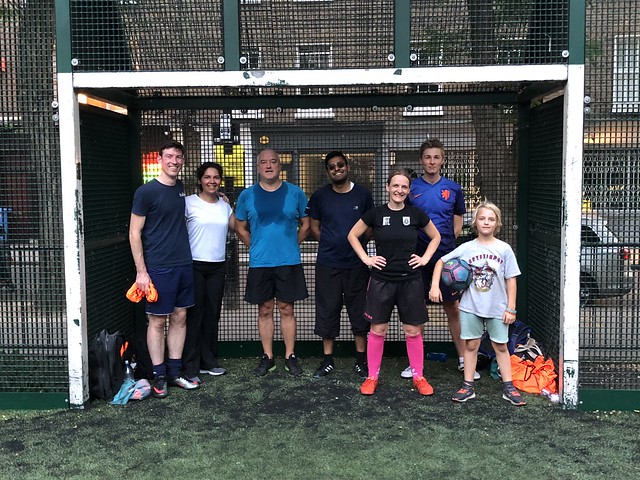
Thursday night we had an Old Fitzrovian's game. It was excellent though my knee begs to differ. I'm so broken down that even Walking Football is too much for me now.

OFFC

And then, on Thursday night, it finally rained

Beautiful rain

Blessed relief

*Remember when people said that?

01 Aug 02:42

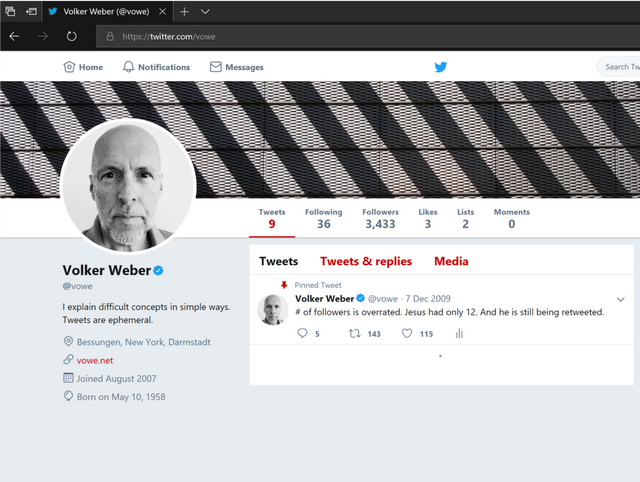
Tweets are ephemeral

by Volker Weber

Sketch

I have no use for old tweets. So I delete them often. I would like to make this automatic without using any of the services that want access to my Twitter. Is anybody running a script on Lambda maybe?

01 Aug 02:41

Three Things I Read This Morning

by Eugene Wallingford

Why I Don't Love Gödel, Escher, Bach

I saw a lot of favorable links to this post a while back and finally got around to it. Meh. I generally agree with the author: GEB is verbose in places, there's a lot of unnecessary name checking, and the dialogues that lead off each chapter are often tedious. I even trust the author's assertion that Hofstadter's forays beyond math, logic, and computers are shallow.

So what? Things don't have to be perfect for me to like them, or for them to make me think. GEB was a swirl of ideas that caused me to think and helped me make a few connections. I'm sure if I read the book now that I would feel differently about it, but reading it when I did, as an undergrad CS major thinking about AI and the future, it energized me.

I do thank the author for his pointer (in a footnote) to Vi Hart's wonderful Twelve Tones. You should watch it. Zombie Schonberg!

The Web Aesthetic

This post wasn't quite what I expected, but even a few years old it has something to say to web designers today.

Everything on the web ultimately needs to degrade down to plain text (images require alt text; videos require transcripts), so the text editor might just become the most powerful app in the designer's toolbox.

XP Challenge: Compilers

People outside the XP community often don't realize how seriously the popularizers of XP explored the limitations of their own ideas. This page documents one of several challenges that push XP values and practices to the limits: When do they break down? Can they be adapted successfully to the task? What are the consequences of applying them in such circumstances?

Re-reading this old wiki page was worth it if only for this great line from Ron Jeffries:

The point of XP is to win, not die bravely.

Yes.

01 Aug 02:39

Events and high temperatures. Keep cycling through it all.

by David Hembrow
July has been warmer and drier than usual for the Netherlands, starting off warm and slowly heating up until the last couple of days in which we've seen 37 C locally and slightly higher temperatures further south. Cycling of course continues through all weather, hot and cold. Here's a round-up of what's been going on in Assen over the last month. The TT More than anything else, Assen is famous
01 Aug 02:39

Five-word movie review: “Mission Impossible: Fallout”

by sheppy

Exciting and just funny enough.

01 Aug 02:23

Twitter Favorites: [DenimAndSteel] It’s easy to understand the sentiment behind demand for ride hailing services (not ride sharing, that’s carpooling)… https://t.co/RuCBhCHyfe

Denim & Steel @DenimAndSteel
It’s easy to understand the sentiment behind demand for ride hailing services (not ride sharing, that’s carpooling)… twitter.com/i/web/status/1…
27 Jul 15:32

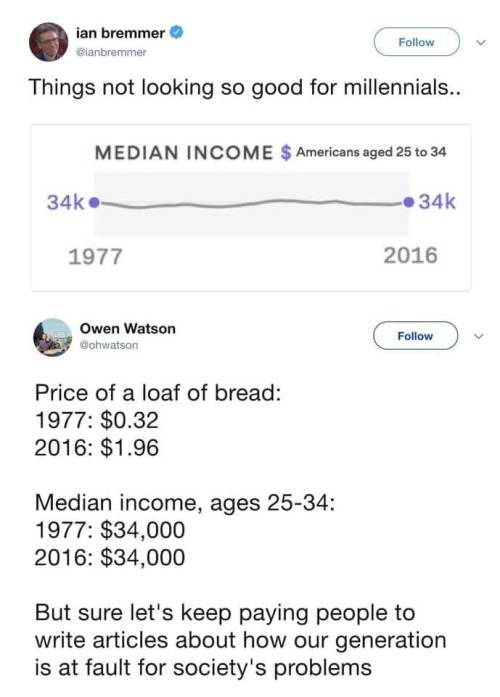
sallyyates: Tweet 1: Things not looking good for Millennials....


sallyyates:

Tweet 1:

Things not looking good for Millennials. A chart shows that the average income for people between the ages of 25 and 34 have made only $34,000/per year from 1977 until present day.

Tweet 2:

The price of a loaf of bread in 1977 was 32 cents. The price of a loaf of bread in 2016 was $1.96. But sure. Let’s keep paying people to write articles about how out generation is at fault for society’s problems.

27 Jul 15:30

Calculating wind drag in the cycling peloton

by Nathan Yau

When cyclists ride in that big pack during a race — the peloton — the ones that aren’t leading get to ride with a reduced wind resistance. Researchers found out the magnitude of the reduction.

Joshua Robinson for The Wall Street Journal:

According to a new study published in the Journal of Wind Engineering and Industrial Aerodynamics, riders in the belly of a peloton are exposed to 95% less drag than they would experience riding alone. Which explains the sensation all riders describe of being sucked along by the bunch while barely having to pedal.

Tags: cycling, peloton, Wall Street Journal

27 Jul 15:29

@stoweboyd

@stoweboyd: The temperature reached a record of almost 106 degrees Fahrenheit at a city outside...
27 Jul 15:29

@stoweboyd

@stoweboyd: Olive oil provided 1/3rd of the calories for peasants in ancient Italy....
27 Jul 15:25

Railyards Were Once So Dangerous They Needed Their Own Railway Surgeons

mkalus shared this story from Atlas Obscura - Latest Articles and Places.

To work for a 19th-century railroad, it helped to be fearless, tireless, and a little reckless. Railway workers spent long shifts maintaining tracks, coupling and decoupling cars with swift and practiced moves, or unloading goods in train yards, and throughout all those exhausting hours one unlucky moment could cost them a hand, or a leg, or more. “They suffer as if they were fighting a war,” said Congressman Henry Cabot Lodge, in 1892. In the United States, in 1889, one in every 35 railway workers was injured each year, and in the more dangerous “running trades” that put some of them in close proximity to trains, that rate jumped to one in 12. Fatalities were common, too. One out of every 117 workers died on the job. In Britain, railway accident reports contain more than one incident where the body of a man struck and killed by a train flies through the air to hit and injure a coworker.

Railway work was so dangerous that an entire medical specialty developed to deal with it. In the United States in the late 19th and early 20th centuries, companies hired “railway surgeons” to staff private hospital and health care systems. An on-call doctor could rush to the scene of an accident, or be ready to receive a bleeding, injured worker sent to them by train. They were pioneers in emergency medicine and specialized in amputations and prosthetics. Some consider them the world’s first trauma surgeons.

In the 1800s, it was generally rare for a private company to take such an interest in its employees’ well-being, but railway surgeons were not celebrated figures. Workers resented having their wages garnished to pay the surgeons’ salaries, while other doctors scorned them as lackeys of the railroads. Today, even in a world still full of railroad enthusiasts and obsessives, they have been all but forgotten.

“I’ve been to railway museums all over the country and very seldom do you see anything connected to railway surgeons,” says Robert Gillespie, a pediatric nephrologist and founder of the online Railway Surgery Historical Center.

Even in the railroads’ heyday, the problem of worker injuries went relatively unremarked upon. Dramatic crashes made the papers, but not the daily grind of injuries resulting in disability or death—even as those numbers added up. In Britain, in the years before World War I, for example, for every one passenger casualty, there were nine among workers. “The worker cases, they’re not news. They fade into the background,” says Mike Esbester, a senior lecturer at the University of Portsmouth, whose project, Railway Work, Life and Death, is gathering accident reports in a database. “It’s almost as if there hasn’t been anything to forget, because people haven’t been so aware of it.”

The database shows just how dangerous a railroad career could be. Volunteers from the National Railway Museum in York have been logging handwritten reports created by the Railway Inspectorate from 1911 to 1915, building a database of around 4,000 accidents so far. These inspection reports represent only about three percent of all incidents in those years, and it’s not entirely clear how inspectors chose which cases to document or investigate; they range from fatalities to “someone who pinched their thumb,” Esbester says.

But the reports include vivid accounts. A platelayer was hit by a train twice in three weeks. A carriage cleaner died trying to save a colleague from being hit. A man was crushed between two wagons 18 hours into a 26-hour shift. They also show how some continued to work after serious injuries: a man who needed new artificial kneecaps every four to six months, or a “good driver” of “excellent character” with a wooden peg leg.

“People were being asked to work in dangerous situations,” says Esbester. “The companies, which were profit-oriented, didn’t have the same concept of safety culture as we do now. If workers died or were injured, there was some compensation payable, but my hunch is, there was a trade-off, in the minds of management, between the cost they had to pay out when someone was killed at work and the costs of changing a particular mode of working.” In Britain, the companies encouraged their workers to learn first aid, and sometimes funded local hospitals. But for the most part, they didn’t bear the full cost of the dangerous nature of the work.

In the United States, starting around 1849, railroads began to hire doctors, and took a slice of employees’ wages to help fund their salaries. By the 1890s, there were around 6,000 railway surgeons across the country, 1,500 of whom were members of the National Association of Railway Surgeons. Their patients were often in bad shape, according to accounts that Gillespie dug up—“tied up with rope, old rags, soiled handkerchiefs, or anything else lying about.” By the time the patient arrived, an injured limb might look “like nothing but bloody rubbish,” and the patient would be likely to bleed out. If the doctor could make it to the scene of an accident, he or she might have to work in the woods, on a back porch, or in a hotel room.

Railway surgeons might not have earned the admiration of their peers, but they had a sense of purpose about their work. “We are the selected servants of the great railway companies of the whole continent, honored by them with the special appellation, ‘Railways Surgeons,’” said one orator at the annual conference, to which the surgeons traveled on discount railway passes. “Our mere summons to service carries with it the thought of a mighty and restless mangling force.”

“They really had to make do with what they had, and they had a sense of pride in that,” says Gillespie. “They felt what they were doing was harder than what most hospitals were doing.”

Because of the type of traumatic injuries they were dealing with, railway surgeons developed new techniques and methods. They made their own portable emergency kits, and they were on the forefront of using sterilized gauze and other instruments. They designed hospital cars that could travel to the scene of an accident, which served as models for ambulance train cars used during World War II. In The Railway Surgeon, the journal of the national association, they wrote about foot and spinal injuries, heart surgery, skin grafting, infected fingers, and other, more gruesome insults to the human body. (Once these journals were so rare that Gillespie rejoiced to find a set on eBay. Now a few are available on Google Books and the New York Academy of Medicine holds copies for anyone interested in digging deeper.)

Other medical societies were critical of the surgeons for accepting salaried positions from the railroads, but they were curious enough about the work that they sent spies to the railway surgeons’ conference. Some of the techniques railway surgeons pioneered would appear later in the pages of the Journal of the American Medical Association, the most prestigious medical publication in the country.

The surgeons did consider the question of their obligation to both their employers and their patients, and concluded that they could serve both, even when they were called upon to testify at legal hearings related to accident compensation. Nineteenth-century employers and workers had a different understanding of workplace safety and liability than we have today. The carelessness of workers was often cited as the cause of any accident—they should have checked to see if a train was coming before stepping on that track! In the United States, judges usually accepted the idea that workers had agreed to shoulder the risks of dangerous workplaces when they took jobs. Over the decades when railway surgeons worked, though, primarily from the 1880s to the 1920s, that began to change. In 1908, a new U.S. law made railroads responsible for compensating employees for injury, if a company was found to be at least partially at fault.

But both workers and surgeons exhibited a dedication to their jobs because they believed in the role of the railroads in society. At one time, trains were modern marvels, the height of transportation technology, and the people tasked with keeping them running took their work seriously. “Workers bought into the idea of public service,” says Esbester. “They knew that if they couldn’t get the work done on time, it would cause a delay, and they might take a shortcut. I think it’s important that there’s some agency for the workers involved. They took active decisions very often for really really good reasons, but that had very bad consequences.”