Shared posts

01 Aug 02:39

Modeling the Future of Marketing — Part 1

by Stowe Boyd

Looking at marketing through the work futures lens.

If you were asked to describe various alternative futures for your business or marketplace, or even — at the most grandiose — the shape of the world in 2030, how would you start? What approach would you take to distinguish and contrast different possible futures? Would you draw a picture? Tell stories? Clip images on Instagram? Start with what you’d like the future state to be, and work back to the present, aspirationally?

Answering that question — or trying to — is the stock in trade of the futurist. Those who try to think systematically about the future generally are not involved in trying to ‘tell the future’ like some carnival fortune teller. In fact, the questionable practice of ‘forecasting’ that has led many to avoid the term ‘futurist’ altogether, and to be suspicious of those who do. (Personally, I consider myself an anthropologist of the future, which is a convoluted way of sidestepping the ‘futurist’ term, but holding on to the magic involved with ‘the future’.)

Still, we do need to explore alternative futures, and to try to understand the qualitative differences between them, and across a set of potential futures one of the most accessible dimensions to apply is the likelihood of the various alternatives. This way of thinking lines up naturally with the way that our minds are inclined, so we don’t need to create some futures calculus (or invent the crystal ball) to spin stories about the music business of 2030, why autonomous cars will change the world’s transport systems, or the impact of a hypothetical Chinese pharmaceutical platform on the US health care system.

When my long-time friend Marshall Kirkpatrick asked me to get involved in his Future of Work in Marketing project at Sprinklr, I was happy to do so. And when we spoke about what he wanted to do it came as no surprise that he proposed an approach that involves what futurists call the Futures Cone: a model to wrestle with varying levels of potential for different conjectured futures.

The Futures Cone

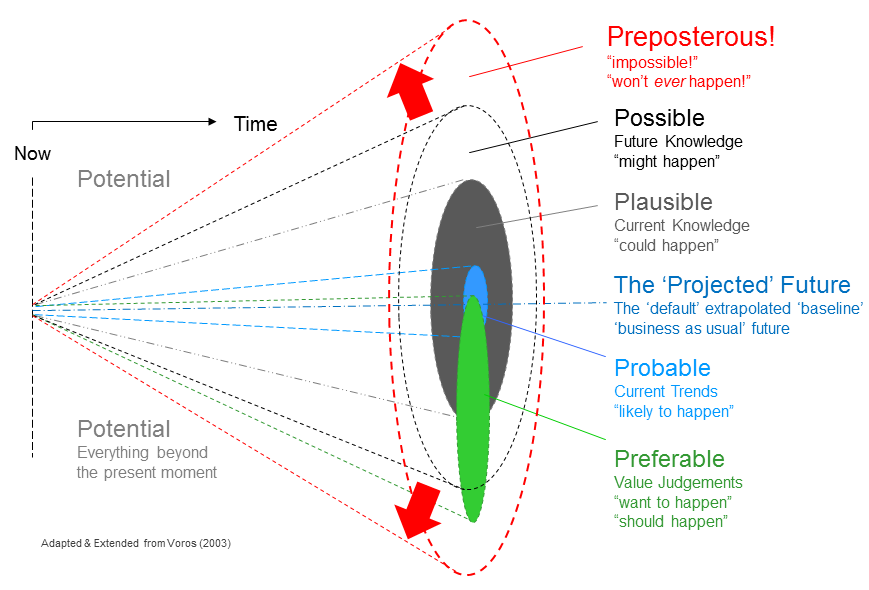
Joseph Voros’ Futures Cone

Joseph Voros is perhaps the best-known modern popularizer of the Futures Cone model as a tool to explore and discuss alternative futures.

As he describes the background of the idea in The Futures Cone, use and history,

Futurists have often spoken and continue to speak of three main classes of futures: possible, probable, and preferable (e.g., Amara 1974, 1981; Bell 1997, and many others). These have at times lent themselves to define various forms of more specialised futures activity, with some futurists focusing on, as it were, exploring the possible; some on analysing the probable; and some on shaping the preferable, with many related variations on this nomenclature and phraseology (e.g., again, Amara 1991, and many others). It is possible to expand upon this three-part taxonomy to include at least 7 (or even 8) major types of alternative futures.

Voros, (after some vacillation about whether or not to include a ‘predicted’ future in the cone) settled on the model as captured in the graphic above.

In the Cone, time is represented as extending from some starting point at the left — in this case starting at Now, but in many cases it is more helpful to start in the past to capture trends or events that have come before the present — and continuing steadily to some point in the future. The overall futures cone is visualized and conceptualized as having stratified subcones. Across all potential futures the subcones range from the projected future (with the highest likelihood of happening), through probable, plausible, possible, and preposterous futures. An added wrinkle is defining a region of the cone as being preferable from the perspective of an individual, organization, demographic, or nation based on a set of value judgments, and perhaps independent of the degree of possibility involved: an aspirational future.

Against a Time Frame

The range of possibility — projected, probable, plausible, possible, and preposterous — can be arrayed against a time frame. The way the world is accelerating time seems compressed, so it’s best to slice time pretty fine. For this project I selected these successive time periods: now (2018), soon (2020), later (2025), and the future (2030). I have a hard time considering anything outside that time frame (although I spun some scenarios for Wired through 2050 in What Will a Corporation Look Like in 2050).

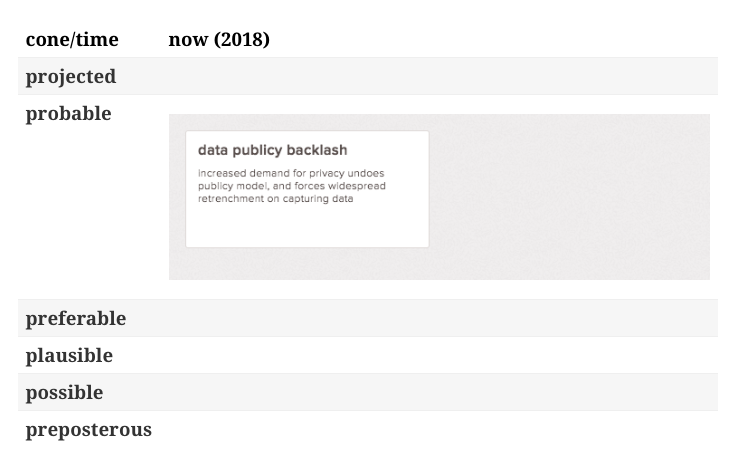
As a matrix, this looks like this (before adding any topics):

Marshall’s List of Questions

The third axis of the Futures Cone is some set of questions or premises that have to be examined, using the thinking and models outlined above. I used a tool, Cardsmith, that allows users to create a matrix like the one above, and to place digital ‘post-it’ notes in the various cells, and making comments on them as well. This is a great technique for collaborating, and capturing the insights of a team of researchers.

I’ll examine Marshall’s questions and where I think the possibilities line up in the next sections.

Now (2018)

Marshall posed a topic, triggered by the Facebook/Cambridge Analytica mess:

A data privacy backlash sends everything back to the tried and true when it comes to targeting and marketing in general

I recouched that as a backlash against data ‘publicy’ — the opposite of privacy — and said that backlash is happening now. All the other topics wind up to be farther down the line, in my analysis.
Now (2018)

Soon (2020)

Most of the issues raised by Marshall fall into this timeframe.

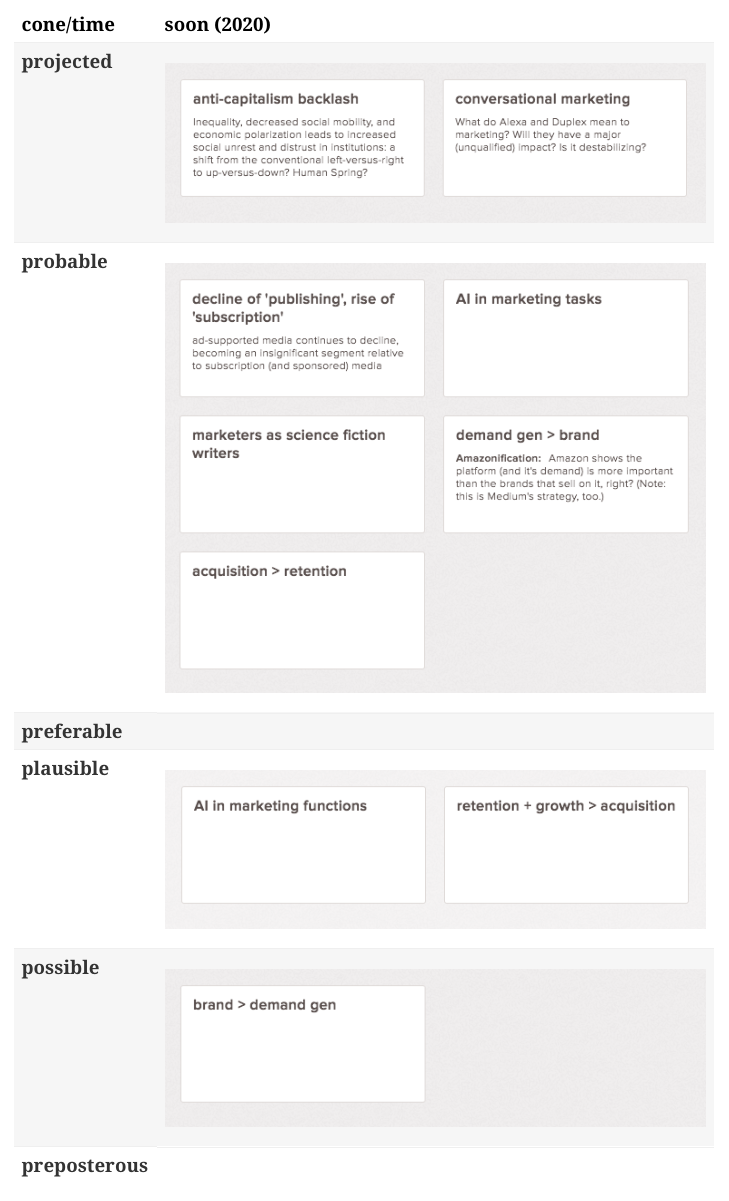
I interpreted one of Marshall’s questions as ‘Anticapitalist backlash’, arising from Inequality, decreased social mobility, and economic polarization, which I deem as projected. Likewise, I believe ‘conversational marketing’ is coming soon, based on tools like Alexa and Google’s Duplex demo.

A great number of the topics we discussed fall into the probable cone, I believe. I feel the ‘decline of ‘publishing’, rise of ‘subscription’’ is starting already, but will become more mainstream in the next few years.

Marshall wondered if marketers would have to operate like science fiction writers, telling plausible stories about user experiences that may be totally novel, since things are changing so fast. I agree with him.

I believe it is probable than markers will put more value on acquiring new customers than retaining old ones, which is perhaps another result of the rapid change and innovation in many industries.

I think it is probable we will see AI used to augment people at the task level by 2020.

I use the term Amazonification to characterize the increased value of platforms to create demand and the decreased value of brands in such a climate. This is probable, I think.
Soon (2020)

I think it is plausible that AI may be fulfilling entire marketing functions by 2020 (definitely probable by 2025, projected by 2030). Note that the shift of what is plausible soon to what is probable later is a general case for all of these trends, and I won’t explicitly state that shift for other trends. It is implicit. It’s plausible that ‘retention and growth is more valuable than acquisition’ in this timeframe, but I think that varies by the sort of products being marketed.

It’s possible, I think, that some marketers will find success focusing on brand over generation of new demand. Some luxury brands may be able to command high margins, for example, while selling new products to existing customers, even in a world of Amazon-like platforms.

Later (2025)

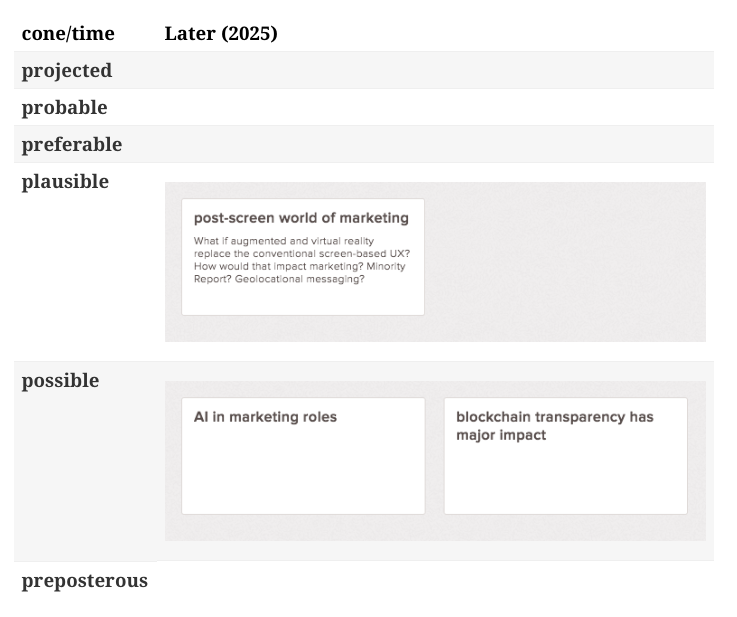
I offered up the theme of a ‘post-screen world of marketing’, based on the idea that augmented and virtual reality might replace conventional screen-based user experience of PCs and smartphones. I think that is plausible in this time frame.

Similarly, I think it’s possible that, by 2025, some marketing roles could be filled entirely by AI, for example running a social media marketing campaign. It’s also conceivable that blockchain might have a major impact by this time, although there’s a lot of moving pieces for that to come together.
Later (2025)

The ‘Future’ (2030)

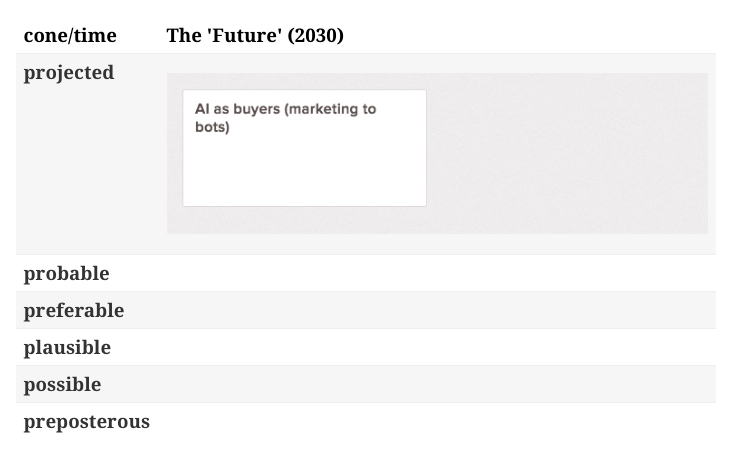
I guess that Marshall’s themes aren’t so far out that many of them are delayed to the ‘future’ of 2030. But one did: marketing to His, which I think is highly likely by 2030 (and possible in an earlier time frame). If we have His running hedge funds and deciding who to hire in 2018, they will be buying things for corporations by 2030.
The ‘Future’ (2030)

Conclusions and Takeaways

I wanted to take you through one of the most commonly used tools that futurists use to help their clients think systematically about the ‘future’, and I think this has accomplished that. Perhaps you’ll be able to adopt the Futures Cone as a technique to use in your own organization, to think about your markets, competitors, and the trends that shape our world.

Remember:

  1. There is no one ‘future’. There are a many possible outcomes for any trend or event, and trying to assign probabilities is a great technique for groups to discuss alternatives.
  2. The Futures Cone approach only requires a whiteboard and some post-it notes, and a room full of people. Try it.
  3. There are a long list of other techniques that futurists use, but across the board they rely onlmost without exception on making up plausible stories about people in the future: people in aggregate, in organizations, or individuals. If you can tell a story about, for example, what a customer in your market might be doing in 2020 when they decide to buy something, you are practicing futurism!

Marshall and I will be returning to the themes in this post on 21 June 2018 in a webinar, The Future of Work in Marketing. Hope you can attend.


Modeling the Future of Marketing — Part 1 was originally published in Work Futures on Medium, where people are continuing the conversation by highlighting and responding to this story.
01 Aug 02:38

Modeling the Future of Marketing — Part 2

by Stowe Boyd

The trouble with market research is that people don’t think how they feel, they don’t say what they think, and they don’t do what they say. | David Olgivy

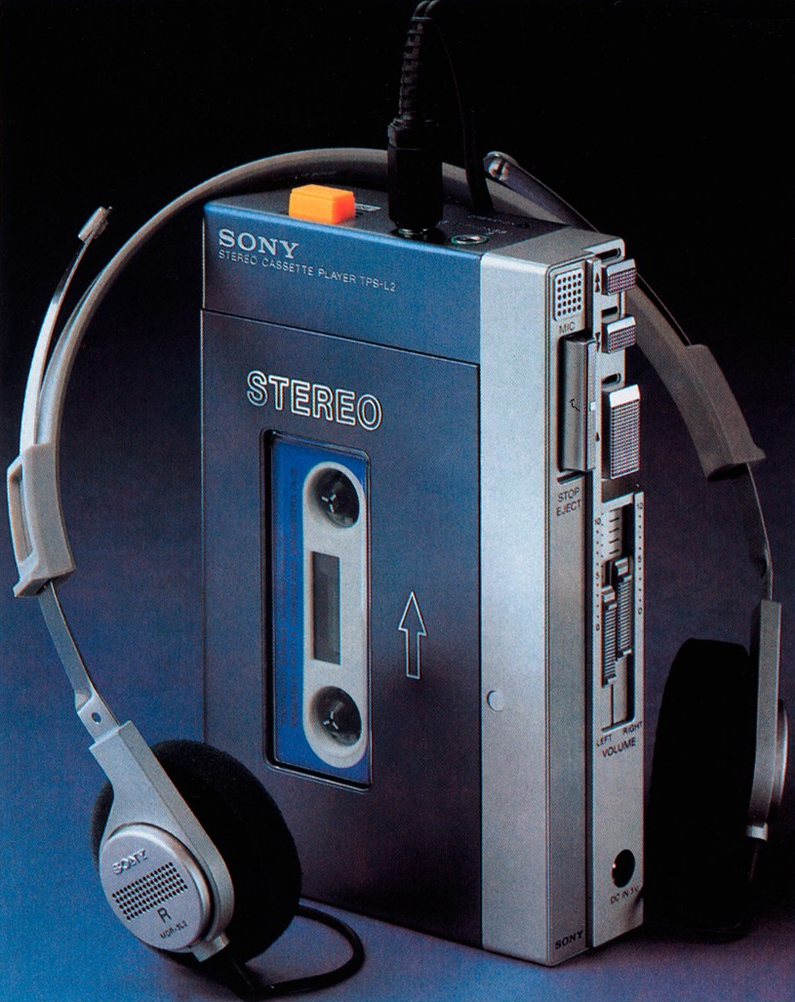
David Olgivy’s famous line about the difficulty of market research makes the case for doing something other than just polling potential customers about their wants, needs, and desires. Sony conducted extensive research on the market for a portable music cassette player and found zero — yes, zero — demand. Nonetheless, Sony co-founder Masaru Ibuka brought the Sony Walkman to market with enormous success, and started the trend that eventually led to the iPod, and (indirectly) the iPhone. They believed in a future scenario where all sorts of people would walk around listening to music played on portable devices wearing headphones, even when the people involved didn’t know how to feel about that, yet. As Steve Jobs said,

A lot of times, people don’t know what they want until you show it to them.
Sony Walkman

This just shows the potential value of adopting futures practices to consider alternative scenarios for change in a market, industry, or political context, and not relying on classical market research, alone.

Last week, I posted the first of a two part series, Modeling the Future of Marketing — Part 1, subtitled ‘Looking at marketing through the work futures lens’. This is the companion to that, both sponsored by Sprinklr.

In part 1, we looked at the Futures Cone as a modeling approach to differentiate trends by the probability and time frame.

I broke time into four periods: Now, Soon (2020), Later (2025), and The ‘Future’ (2030), and distributed a bunch of topics against the probability versus time fram matrix:

That’s useful for structuring a first-order discussion about the various topics that Marshall Kirkpatrick of Sprinklr raised at the outset of this project on the Future of Work in Marketing.

However, there is a critical third dimension, which perhaps is more important that probability: impact. Even a low probability trend has to be considered deeply if it threatens to have an enormous, disruptive impact. And conversely, an event of low impact can be shrugged off even if it is extremely probable.

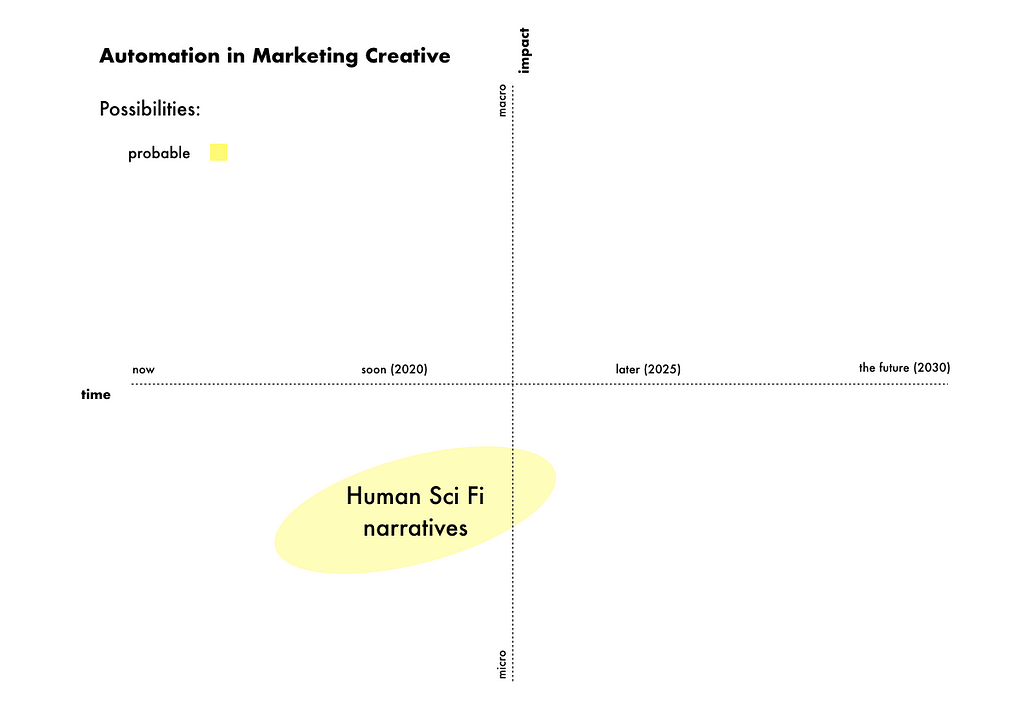
Automation in Marketing Creative

In preparation for the recent Adweek webinar that Sprinklr sponsored and developed, The Future of Work in Marketing: Insights from Workplace Futurist Stowe Boyd, I created a set of graphic models incorporating impact as the third dimension.

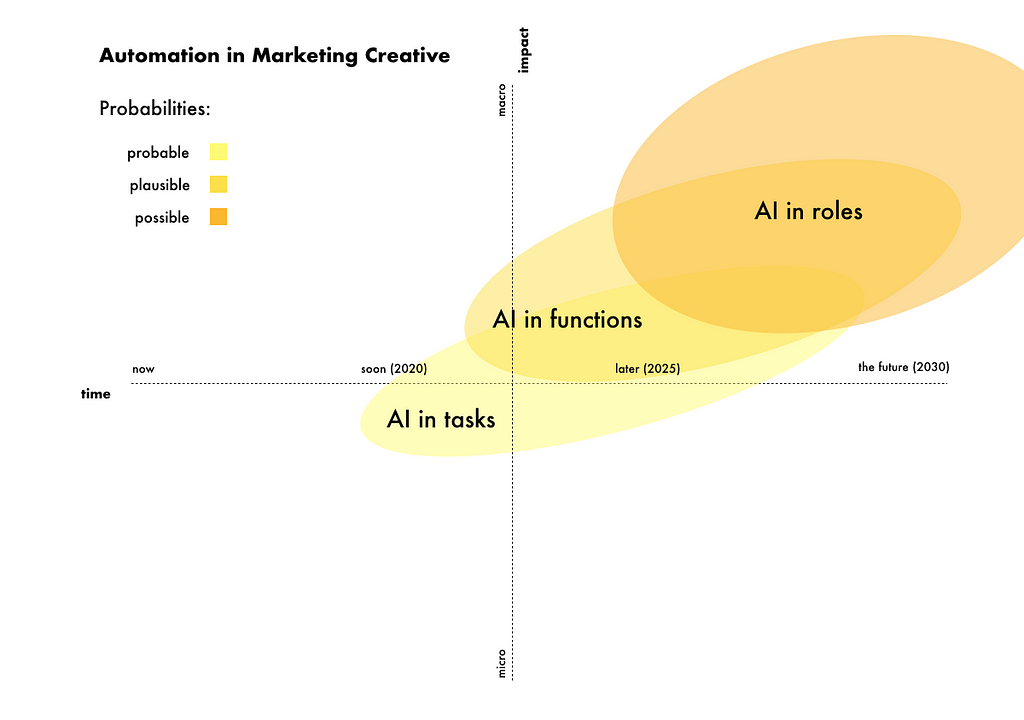
As you see in the chart below, I have taken three related trends — AI in tasks, functions, and roles — and distributed them as blobs according to what their impact might be. The probabilities in this graphic are color coded as shown in the key.

As you can see, we believe AI will have an enormous impact on marketing, in a stepwise fashion:

  1. First, it is highly probable that specialized tasks will be automated, by 2020. As a specific example, marketing via Alexa and Google Duplex will set the stage for trends below.
  2. Second, it’s plausible that entire functions — eg, running a social media marketing campaign — will be botified by 2025
  3. Third, with the most sweeping impact, entire roles will be impacted, where large percentages of market staff could be replaced, by 2025 or 2030. I rated this only possible in this graphic, but I feel the urge to say this is more like plausible, after living with the model for an extra week.

Also note the blobs are moving upward and toward the right: over time, their impact will increase.

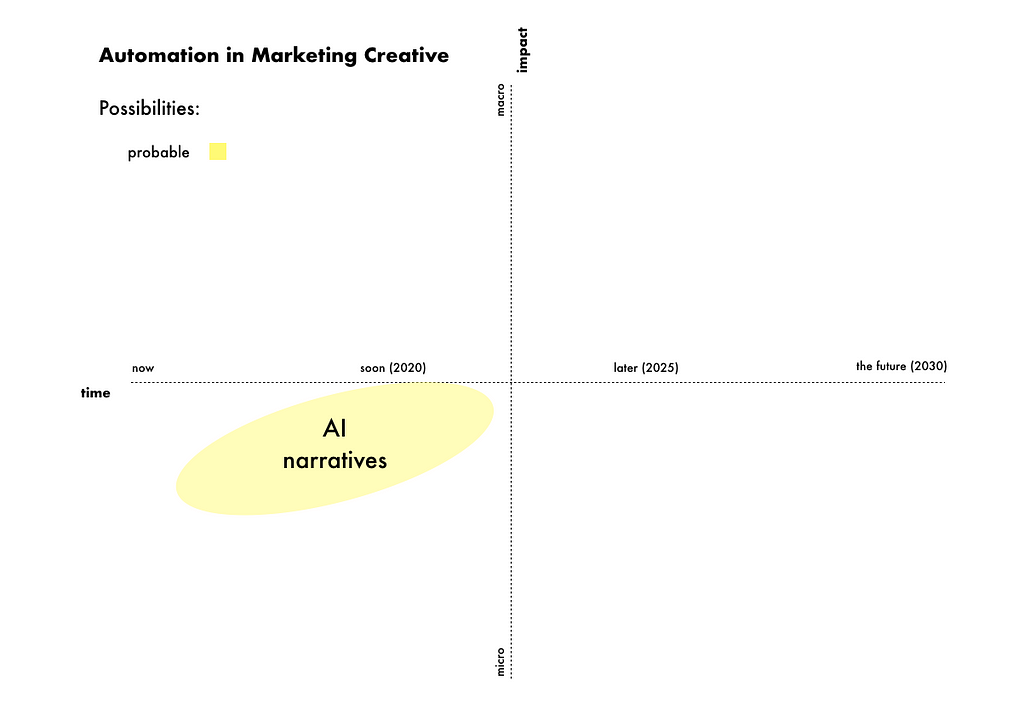
The graphic above represents a probable but relatively low impact scenario: AI Narratives where entire story arcs are outlined by AI. This is an example of a task being automated.

Larger scale and farther in the future is AI Content Creation, which represents a function — or perhaps even a role — being automated. This is much higher impact: an example of the depeopling of marketing that AI will probably be a reality by 2025.

I included Human Sci Fi Narratives, as shown, where marketing folks develop narratives that feel more like science fiction tropes than conventional marketing content. This is already happening and is even becoming commonplace, but is unlikely to have a large impact: at least nothing like the impact of the others earlier in the list.

Takeaways

The biggest takeaway from this exercise is that developing scenarios about potential futures can be a very helpful exercise for many purposes, such as examining challenges for an organization, an industry, or an occupation.

This does not have to be a one time exercise: for example the marketing team at your company mighty update a set of scenarios on a regular basis, say quarterly, or add new scenarios as new innovations or threats appear in the marketplace. You’re working at a car company, and the emergence of electric scooters in major metros across the world is happening: what’s your assessment of its impact on private car ownership, taxis, public transport, and ride-hailing services?

In our project, we focused on the ways that trends generally associated with the discourse around the future of work could impact the business of marketing: like automation, economic platforms (like Amazon, eBay, and Uber), and the larger macroeconomic context (like growing distrust in institutions, and polarization arising from economic inequality).

I hope to return to those topics in later posts, either as part of this Sprinklr-sponsored series, or independently. In particular, we spent a great deal of time looking into ‘Amazonification’, where the importance of brand may be significantly degraded as companies come to rely on commerce platforms (Amazon, Boxed, JD.com, etc.) as a major source of sales. Their impact has already been enormous: platform commerce is changing the world, and internal and external platforms for work (Upwork, Uber, etc.) are doing the same for business operations.

Just remember, you don’t need to go off and get a certificate or a degree in futures work to apply these techniques. All you need is a white board, post-it notes, a lively imagination, and a small group of diverse minds. Feel free to steal my approach, or to get me involved if you want an obstreperous mutant to help guide a workshop on making sense of an uncertain future.

Get going! The world won’t wait.

This work was sponsored by Sprinklr.


Modeling the Future of Marketing — Part 2 was originally published in Work Futures on Medium, where people are continuing the conversation by highlighting and responding to this story.
01 Aug 02:36

Deleting my tweets after 10 days

by Volker Weber

Sketch

So far I have manually deleted old tweets to keep my tail short. Today I made this an automatic process handled by my Raspberry Pi. For that I modified existing code:

  1. Install two modules into existing Node.js: npm install twit and npm install dotenv
  2. Install the script with git clone https://github.com/JacksonBates/tweet-delete-bot
  3. Create .env file with consumer API keys, access token and access token secret
  4. Change twitter name in src/screen_name.js
  5. Write a small bash script to run node /home/pi/tweet-delete-bot/index.js from /etc/crontab

This will now delete all tweets older than ten days.

poll

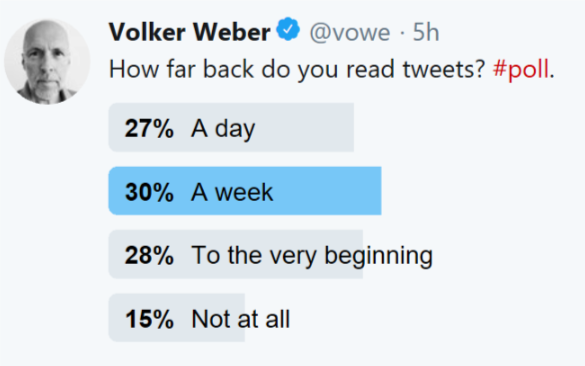
Ten days seem to be a reasonable time to keep them.

01 Aug 02:36

That’s beyond ouch

by Stowe Boyd

That’s beyond ouch

01 Aug 02:36

"Sentence structures are not simply sentence structures, of course — they are miniature philosophies...."

“Sentence structures are not simply sentence structures, of course — they are miniature...
01 Aug 02:36

ggplot “Doodling” with HIBP Breaches

by hrbrmstr

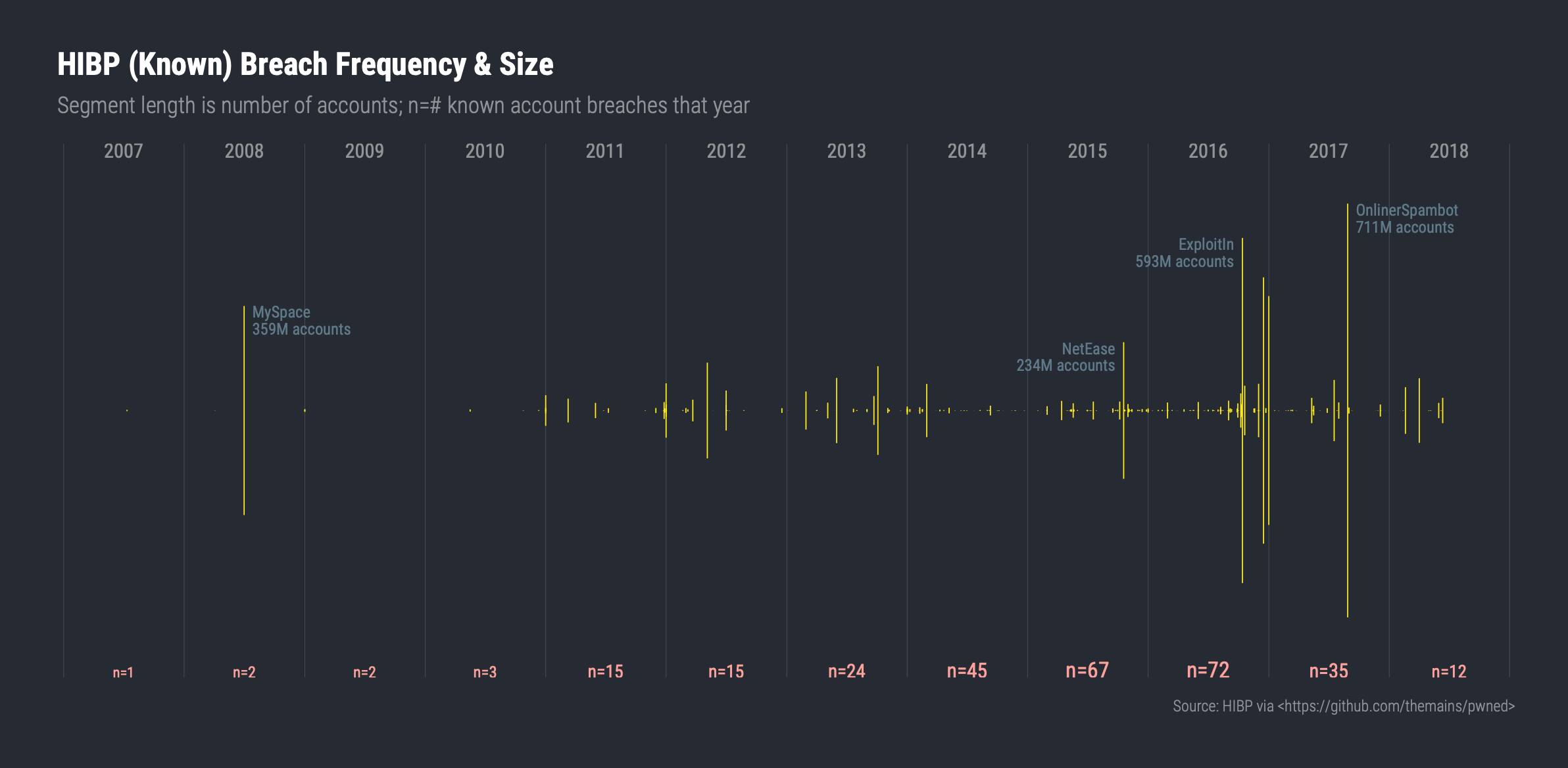
After reading this interesting analysis of “How Often Are Americans’ Accounts Breached?” by Gaurav Sood (which we need more of in cyber-land) I gave in to the impulse to do some gg-doodling with the “Have I Been Pwnd” JSON data he used.

It’s just some basic data manipulation with some heavy ggplot2 styling customization, so no real need for exposition beyond noting that there are many other ways to view the data. I just settled on centered segments early on and went from there. If you do a bit of gg-doodling yourself, drop a note in the comments with a link.

You can see a full-size version of the image via this link.

library(hrbrthemes) # use github or gitlab version
library(tidyverse)

# get the data

dat_url % 
  mutate(BreachDate = as.Date(BreachDate)) %>% 
  tbl_df() -> breaches

# selected breach labels df
group_by(breaches, year = lubridate::year(BreachDate)) %>% 
  top_n(1, wt=PwnCount) %>% 
  ungroup() %>% 
  filter(year %in% c(2008, 2015, 2016, 2017)) %>% # pick years where labels will fit nicely
  mutate(
    lab = sprintf("%s\n%sM accounts", Name, as.integer(PwnCount/1000000))
  ) %>% 
  arrange(year) -> labs

# num of known breaches in that year for labels
count(breaches, year = lubridate::year(BreachDate)) %>% 
  mutate(nlab = sprintf("n=%s", n)) %>% 
  mutate(lab_x = as.Date(sprintf("%s-07-02", year))) -> year_cts

mutate(breaches, p_half = PwnCount/2) %>% # for centered segments
  ggplot() +
  geom_segment( # centered segments
    aes(BreachDate, p_half, xend=BreachDate, yend=-p_half), 
    color = ft_cols$yellow, size = 0.3
  ) +
  geom_text( # selected breach labels
    data = labs, aes(BreachDate, PwnCount/2, label = lab),
    lineheight = 0.875, size = 3.25, family = font_rc,
    hjust = c(0, 1, 1, 0), vjust = 1, nudge_x = c(25, -25, -25, 25),
    nudge_y = 0,  color = ft_cols$slate
  ) +
  geom_text( # top year labels
    data = year_cts, aes(lab_x, Inf, label = year), family = font_rc, 
    size = 4, vjust = 1, lineheight = 0.875, color = ft_cols$gray
  ) +
  geom_text( # bottom known breach count totals
    data = year_cts, aes(lab_x, -Inf, label = nlab, size = n), 
    vjust = 0, lineheight = 0.875, color = ft_cols$peach,
    family = font_rc, show.legend = FALSE
  ) +
  scale_x_date( # break on year
    name = NULL, date_breaks = "1 year", date_labels = "%Y"
  ) +
  scale_y_comma(name = NULL, limits = c(-450000000, 450000000)) + # make room for labels
  scale_size_continuous(range = c(3, 4.5)) + # tolerable font sizes 
  labs(
    title = "HIBP (Known) Breach Frequency & Size",
    subtitle = "Segment length is number of accounts; n=# known account breaches that year",
    caption = "Source: HIBP via "
  ) +
  theme_ft_rc(grid="X") +
  theme(axis.text.y = element_blank()) +
  theme(axis.text.x = element_blank())
01 Aug 02:36

Federated paywalls and consent bits

Today’s web advertising is mostly a hacking contest. Whoever can build the best system to take personal information from the user wins, whether or not the user knows about it. Publishers are challenging adfraud and adtech hackers to a hacking contest, and, no surprise, coming in third.

The near future of web advertising is likely to be much different.

  • Mainstream browsers, starting with Apple Safari, are doing better at implementing user preferences on tracking. Most users don't want to be "followed" from one site to another. Users generally want their activity on a trusted site to stay with that trusted site. Only about a third of users prefer ads to be matched to them, so browsers are putting more emphasis on the majority's preferences.

  • Privacy law—from Europe, to California, to India, is being updated to better reflect user expectations and to keep up with new tracking practices.

As users get the tools to control who they share their information with (and they don’t want to leak it to everyone) then the web advertising business is transforming from a hacking contest into a reputation contest. The rate-limiting reactant for web advertising isn't (abundant and low-priced) user data, it's the (harder to collect) consent bits required to use that data legally. Whoever can build the most trustworthy place for users to choose to share their information wins. This is good news if you're in the business of reporting trustworthy news or fairly compensating people for making cultural works, not so good news if you're in the business of tricking people out of their data.

Federated paywall systems are not just yet another attempt at micropayments, but also have value as a tool for collecting trust. The user's willingness to pay for something is a big trust signal. A small payment to get past a paywall can produce a little money, but a lot of valuable user data and the consent bits that are required to use that data.

The catch is to figure out how to design federated paywalls so that the trusted site, not the paywall platform, captures the value of the data, and so that the platform can't leak or sell the user's data consent outside the context in which they gave it. In the long run, a consent system that tries to hack around user data norms to rebuild conventional adtech is going to fail, but not before a lot of programmers lose a lot of carpal tunnels on privacy vs. anti-privacy coding, and a lot of users face a lot of frustrating consent dialogs. Browser improvements and court cases will filter deceptively collected consent bits out of the system.

Consent bits are a new item of value that needs new rules. The web ad business is not going to be able to sell and and sync consent bits the same way that it handles tracking cookies now. Consent bits are not a "data is the new oil" commodity, and can really only move along trust networks, with all the complexity that comes with them. New tools such as federated paywalls are an opportunity to implement consent handling in a sustainable way.

01 Aug 02:36

A Definitive Solution to Drive-in + Heat + Bugs: Screen and Magnets

by peter@rukavina.net (Peter Rukavina)

Window screen plus magnets plus Jetta.

The magnets are in aisle 10 at Canadian Tire in Charlottetown, where the nuts and bolts are displayed; personally I would have put them with the Velcro or the glue, but I can see their logic just as well.

Postscript: it worked like a charm. Not only were we cool (and cooler as the night wore on), but we didn’t have to run the fan from time to time to defog the windshield. It felt weird being at the drive-in with the windows “open,” as we’ve always had to keep them closed to keep the bugs out. The cart next to us was a VW Beetle convertible that kept its top down throughout the film, and dealt with the bugs via bug spray; this mean we also had to be quiet(er).

01 Aug 02:36

Above Avalon Podcast Episode 130: What's a Computer?

by Neil Cybart

Episode 130 is dedicated to discussing how Apple has become comfortable in accepting, and even embracing, the awkwardness that exists between the iPad and Mac. The discussion begins with a closer look at the fascinating juxtaposition between Apple's recent Mac campaign and its iPad ads from earlier this year. We go over what the ads tell us about Apple's thought process regarding the iPad and Mac. Things then turn to how the iPad vs. Mac juxtaposition hasn't been static over the years. After briefly recapping the post-PC era debate, the episode concludes with my thoughts on where Apple will bring the iPad and Mac platforms and why the company faces a large screen paradox.

To listen to episode 130, go here

The complete Above Avalon podcast episode archive is available here

01 Aug 02:36

The Boulder Park Goes Hipster

by peter@rukavina.net (Peter Rukavina)

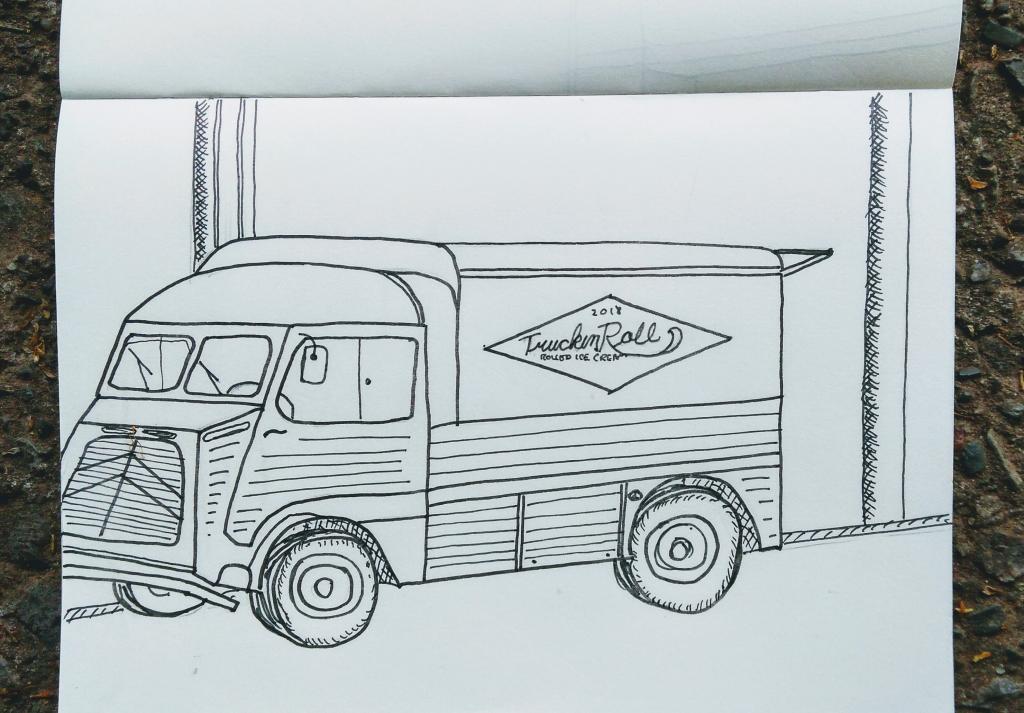
Our neighbourhood has been graced by a new high-end ice cream truck called Truckin’ Roll. It’s parked on Church Street, on the edge of the (suddenly-burgeoning hipster hangout) Charlottetown Boulder Park. Ice cream, prepared before your very eyes, costs $8.25.

The ice cream truck is housed in a 1950s French postal truck that’s a remarkable piece of vehicular architecture, irresistible for someone with a sketchbook. I managed to drive it off the side of the page, despite my best intentions.

01 Aug 02:36

Bad at whiteboard puzzles? You can still get a programming job

Practicing algorithm puzzles stresses you out: just looking at a copy of Cracking the Coding Interview makes you feel nervous.

Interviewing is worse. When you do interview you freeze up: you don’t have IDE error checking and auto-completion, you can’t use a search engine Google like a real programmer would, there’s a stranger staring you down. You screw up, you make typos, you don’t know what to say, you make a bad impression.

If this happens to you, it’s not your fault! Whiteboard puzzles are a bad way to hire programmers.

They’re not realistic: unless you’re Jeff Goldblum haxoring the alien mothership’s computer just in time for Will Smith to blow up some invaders, you’re probably not coding on a 5-minute deadline.

And the skills they’re testing aren’t used by 95% of programmers 95% of the time. I recently had to do a graph traversal in dependency order—which meant I was all prepared to find my algorithms text book from college. But then I found this library already had a utility called toposort, and vague memories of classes 19 years ago reminded me that this was called a “topological sort”. I didn’t actually have to implement it, but if I did would have done it with textbook in hand, over the course of a couple of hours (gotta write tests!).

Unfortunately, many companies still use them, and you need a job. A programming job. What should you do?

Here are some ideas to help you find a job—even if you hate whiteboard puzzles.

1. Interview at companies with a better process

Not all companies do on-the-spot programming puzzles. The last three companies I worked at didn't—one had a take-home exercise that wasn’t about algorithms (a decision I was involved in, and which I now regret because of the burden it puts on people with no free time). Two others just had talking interviews: I talked about myself, they talked about the company, all very relaxes and civilized.

To find such companies:

  1. Here’s one list of 500+ companies that don’t do whiteboard puzzles.
  2. The invaluable Key Values job board also tells you about the interview process at the covered companies (see the column on the right when looking at a particular company).

2. Offer an alternative

If you are interviewing at a company with whiteboard puzzles, you don’t have to accept their process without pushing back. Just like your salary and working hours, the interview process is also something you can negotiate.

If you have some code you’ve written that you’re particularly proud of and have the ability to share, ask the company if you can share it with them in lieu of a whiteboard puzzle. I once made the mistake of only suggesting this during the interview, and the guy who was interviewing me said he would have accepted it if I’d asked earlier. So make sure to suggest this before the day of the interview, so they have time to review the code in advance.

3. Take control of the process

If all else fails and you’re stuck doing a puzzle, there are ways to take control of the process and make a good impression, even if the puzzle is too hard for you. I cover this in more detail in another post.

4. Don’t give up

Finally, remember whiteboard puzzles have nothing to do with actual programming, even when the work you’re doing is algorithmic. They’re a hazing ritual you may be forced to go through, but they in no way reflect on your ability as a programmer.


It’s Friday afternoon. You just can’t write another line of code—but you’re still stuck at the office...

What if every weekend could be a 3-day weekend?

01 Aug 02:35

The Ice Cream Postal Truck

by peter@rukavina.net (Peter Rukavina)

Our neighbourhood has been graced by a new high-end ice cream truck called Truckin’ Roll. It’s parked on Church Street, on the edge of the (suddenly-burgeoning hipster hangout) Charlottetown Boulder Park. Ice cream, prepared before your very eyes, costs $8.25.

The ice cream truck is housed in a 1950s postal truck that’s a remarkable piece of vehicular architecture, irresistible for someone with a sketchbook. I managed to drive it off the side of the page, despite my best intentions.

01 Aug 02:34

Love Story

by Dave Pollard


Humans are obsessed with stories. Most of our communications are stories. Most of our entertainments (film, music, theatre, reading) are stories. Our cultures are mostly about the shared stories we have come to believe. And often our primary concern when anything happens is deciding what it ‘means’, which in most cases is about how it fits into the ‘story of us’.

Thomas King famously wrote that stories are all we are. Yet, when we look at our stories closely, we can’t help but conclude that they are fictions, even lies. That’s true on several levels: they are necessarily oversimplifications, necessarily biased, necessarily ignorant (of what we don’t know), and necessarily omit many important details. And at a deeper level they are merely imaginings, pattern-making, re-conceptions of a small part of what seemingly happened. The map is not the territory; the story is not what really happened. And at an even deeper level, time itself is (many scientists now acknowledge) merely a human construct, an invention, so any story ‘set’ in time is necessarily an invention also. All ‘we’ are are stories, which are fictions, so ‘we’ are fictions too. And indeed non-dualists and not a few neuroscientists would say that is the case: there is no ‘we’. Though perhaps that is just their story.

But there is much more to our stories than what we believe. Everything we observe we make up a story about; that is how we make sense of it. Without our stories we would be useless (in fact, radical non-dualists would argue ‘we’ are completely useless, and that the characters ‘we’ seem to inhabit would function just fine without ‘us’, our separate selves). So when we watch a bird we concoct a story about its separateness, its colours and behaviours, its movement through time and space, and imagine things beyond that such as its history, its volition, its feelings. Each morning when ‘we’ awaken ‘we’ quickly recreate our own story, return to the bookmark where ‘our’ apparent life left off, and reinstate our beliefs about ourselves — ‘our’ separateness, ‘our’ equivalence with our bodies, ‘our’ attributes and moral and appropriate behaviours, ‘our’ movements, and begin again to grab on to the thoughts and feelings that arise in the brain and body and identify them as ‘ours’. We recreate and add to our own fiction every day. We cannot do otherwise. This is all ‘we’ are.

Although ‘we’ cannot actually realize that ‘we’ are a fiction (any more than a character in a dream can understand that it’s in a dream, and wake up from it), it is possible to grasp this intellectually. The idea of this — that the bodies we believe we inhabit would function perfectly without ‘us’, and that ‘we’ actually don’t do anything, beyond rationalizing and identifying with what happens to and in that body and its brain — is philosophically quite elegant (it explains a lot, and defies logical refutation, and believe me I’ve tried to argue against it). It’s also quite comforting — it frees ‘you’ from the responsibility for ‘your’ apparent actions and gives you some distance and perspective which are both healing and useful. It also inevitably increases your equanimity and acceptance of everything, and reduces your expectations and judgements.

But because we have been enculturated from the start both to believe ‘we’ are responsible, and enculturated to have expectations and to make judgements, it makes living in the world with this new perspective (I prefer that word ‘perspective’ — ‘way of looking at things’ — to ‘philosophy’) positively full of cognitive dissonance. It’s as if someone whispered in your ear that some distressing news item that everyone around you is discussing furiously and passionately was actually just a joke, a made-up story. You can totally understand the vehemence of everyone’s arguments, while also realizing that, since it’s all  a fiction, none of it matters. Others will suddenly find you detached, disturbingly dispassionate. But you can’t let on that it’s all a joke, that none of it matters. Radical non-duality is at once a wonderful perspective and a terrible secret.

When I was young, I was fiercely idealistic and fiercely romantic. I wrote poems full of anger and despair, dreamt of impossibly perfect romances, cried while singing love songs, raged against the machine, and plotted to change, or at least escape, the hopelessly-flawed world in which I lived. I loved more profoundly, more overwhelmingly, than I ever have since. And yet I hugely distrusted sex and lust, which seemed to me a distraction, an aberration, an impurity that diminished ‘true’ love.

What was going on there?

At a ‘purely physical’ level, nature/evolution was driving me to procreate. I’ve written before about the chemicals Gaia uses to do this. It’s a complex cocktail, but it’s evolved to work really well — no language or conversation or thinking or rationalization needed. In a way, despite my previous writing parsing this chemistry into intellectual, emotional, sensual and erotic components, this seems to be neither intellectual or emotional, but rather purely a physical/chemical/instinctual phenomenon. That’s not to say it doesn’t give rise to thoughts and feelings, but only that it requires no separate ‘self’ to take up and identify with those thoughts and feelings, for love to be profoundly felt.

Had I, at that age, not been afflicted with a self (and that self was, at that point, just coming out of its shell and beginning to flex its unexercised muscles), this ‘falling-in-love-ness’ would, I think, have manifested itself very differently, but, at least at first, wouldn’t have appeared much different to the casual observer. It was only when my self took ownership of this being-in-love-ness that it went from being just simply wondrous to being, at least for me, at best a bittersweet experience.

My idealism was an expression of many years of repression, and I’d guess that for most people, regardless of their political, philosophical or spiritual bent, idealism is an expression of repression — a deep wanting for things to be otherwise that, whenever it gets the chance to be expressed, comes out as fixed, inflexible, and black-and-white. Idealists, of course, can quickly switch allegiances to some very different ideal which they’ll hold just as tenaciously. That can be very destructive, both to the body politic in which the idealist holds clout, and to the individuals who care about the idealist and have to try to live with, and live up to, those ideals. My distaste for sexuality was part of that idealism — my remembered, long-ago sensations of love, before I locked my feelings away for fear of being hurt, had been more-or-less non-sexual, so these new, more complex, messier sensations struck the idealist in me as abhorrent, impure, dilutive and, I confess, less exclusive.

This idealism was and is, of course, an attribute of my ‘self’, not something inherent in the body/brain which ‘I’ presume to inhabit. Wild creatures are not idealistic because they are not attached to the thoughts and ideas that arise in their brains. They see thoughts and embodied feelings for what they are — fleeting conceptions and reactions that are unreal, invented, and ‘meaningless’, a by-product of (evolutionarily useful) intuitive reactions. And not “theirs”. Wild creatures probably feel them more deeply than we do (since they lack the filter of the self judging them), but probably for a much briefer time (since they don’t take ownership of them).

Now I have to be a little more precise in defining what I mean by ’emotion’. When a bird notices a cat, or another bird of its species, there will be an instinctive reaction — fear in the case of a cat, something else in the case of a bird (perhaps joy if the bird is recognized as part of the flock, love if it’s perceived as a potential mate, and anger if it’s perceived as a threat). These are profound feelings with deeply engrained evolutionary advantage, but they are not emotions in the sense a separate self feels emotions, in that there is no intellectual judgement or ownership of the feeling. The bird, based on its embodied and enculturated conditioning, will do what it will do in response to this reaction — flee, sing, flirt, or fight. But then, once the encounter (however long it lasts) has ended, the feeling will be ‘forgotten’ (while the learning will be retained as part of its enculturation). There is no evolutionary advantage to holding on to the feeling itself. The self, however, does hold on to feelings, because it believes they ‘mean’ something.

So when I speak of ’embodied feelings’ I’m referring to the instinctive, reactive feelings (love, joy, fear, anger, sadness etc) that we share with wild creatures (though wild creatures may feel them more profoundly than we do). When I speak of ’emotions’ I’m referring to the self’s internalizations that come from either ’embodied feelings’ or thoughts when the self takes ownership and attaches meaning to them (self-identified love, personal or compersive joy, chronic anxiety, enduring anger, inconsolable grief etc). We tend to use some of the same words for both, because ‘we’ don’t distinguish clearly between our selves’ emotions and the feelings that arise within the bodies we think we inhabit. It is telling, I think, that the ‘negative’ emotions that ‘we’ feel seem to last longer (thanks to our brain’s reinforcement of them, what Eckhart Tolle has called the reinforcing cycle of the egoic mind and the emotional pain-body) than the ‘positive’ ones. ‘We’ can resurrect anger over some long-ago slight for years, while we struggle to recall the purely positive feelings of a first kiss or other long-ago experience of love or joy.

When it comes to love, then, there is the embodied feeling of love, and then, some time later, there is the emotion of love. And there’s the rub. The embodied feeling is real; the emotion is a story. This story begins as a tale of all-consuming joy, but quickly the plot thickens: Does this other person, this other, separate self with free will and choice, love me in return? How can I prove my love and show my self to be deserving of the other self’s love? Suddenly there is a new story of ‘me’ and, even worse, a new (and impossible) story of who I imagine (and want) this other person to be. And a story of our idyllic future together, forever.

What is behind this ghastly and impossible story-building? The separate self is always longing for wholeness, always trying to escape the prison of the self. Falling in love holds out the promise to the self of a better story, an escape from the confines of one’s own story. Romanticism and idealism reveal themselves most diabolically in each newly concocted love story: a story in which life is more interesting, and more beautiful. A story in which the narrator is loved, admired, listened to, appreciated, and, by the narrator’s standards, very successful, and in which the narrator’s beliefs and actions are validated by the Other. A story in which the world, finally, makes sense, works well, and is under control. It is a story of impossible expectations, the ultimate fiction.

Starting with that disastrous premise, the story unfolds. Soon, expectations are lowered, and then lowered again. For those (including many idealists and romantics) whose selves have suffered a lot, the resulting disappointment may be too much to bear, and they will go in search of another person to fall in love with, in the hope a better story can at last be found with them. For those who are more equanimous, whose selves need less healing, the relationship may endure with the acknowledgement that no love story is true, and theirs could have been worse.

No one has control over any of this. ‘You’ cannot change your story. Your embodied and enculturated nature and conditioning, under the particular circumstances of the moment, may lead to an apparent change of direction in the ‘story of you’. But it is still only a story. Life is still life, love is still love, the world is still the world, and they are wondrous and wonderful. It’s only ‘our’ stories about them that are, in the long run, mostly painful, immiserating, terrible, and ultimately unsatisfying. And our stories, like ‘us’, are just fictions. There is no consolation in understanding that, yet somehow it is comforting. Although nothing has changed, it’s good to be in on the secret.


Speaking of secrets, I have confess that despite my distrust of them, I love well-written stories. Especially quirky love stories, though even these are dangerous. The image above is from a wonderful romantic subplot in the old TV series Sports Night.

One of my favourite projects was researching the 7 qualities of a great story. They (still) are:

  1. It gives pleasure, emotional connection, often through imagery.
  2. It provides some fresh understanding, “some fresh understanding of the familiar, or the expression of something we have experienced but have no words for, which enlarges our consciousness or refines our sensibility.” (TS Eliot)
  3. Every sentence must pay: “If you write a sentence that isn’t poignant, touching, funny, intriguing, inviting, etc., take it out before you finish the work.” (Frederick Barthelme)
  4. It takes a camera view: It lets the action and conversation tell the story and convey the ideas and thoughts and feelings of the characters. No asides or “… he thought”, please.
  5. It respects the audience’s intelligence. No manipulation, no incoherence, no deus ex machina.
  6. It leaves space for the audience. It allows them to fill in details from their own experience or imagination.
  7. It must in some way be really clever, imaginative or novel. The writer has to reach down and come up with something that tickles, that the reader would never have thought of, that’s a total surprise, astonishment, wonder. Something that makes you say “wow”.
01 Aug 02:30

Garmin Edge 520 vs 520 Plus GPS Bike Computers

by Average Joe Cyclist

Garmin Edge 520 vs 520 PlusThis post gives you all the information you need to choose between the Garmin Edge 520 and the brand new Edge 520 Plus. First I have a chart that highlights the key differences between these two bike computers. Then I discuss these key differences. Then I offer some advice on which Garmin Edge to buy, based on your needs and preferences. I also include a useful Bottom Line that attempts to cut through all the technical details and simplify the choice, for those of you who are in a hurry!

The post Garmin Edge 520 vs 520 Plus GPS Bike Computers appeared first on Average Joe Cyclist.

01 Aug 02:30

What does it mean to compose in functional programming?

by Eric Normand

We talk a lot about composition, but what does it mean? Each domain (action, calculation, data) has its own way to compose. In this quick episode, I explain each one.

Transcript

Eric Normand: What do we mean when we talk about composition about composing things? My name is Eric Normand. These are my thoughts on functional programming.

Just one little note, behind me, what you’re seeing is Portland, Oregon. I’m in town for a conference. Just thought you might want to know.

What is composition? Someone was asking me today because I used the term without defining it. I’ve been thinking about how to explain it, explain what I mean. I think it means different things depending on the kind of thing you’re composing. Let’s start with the easy ones. When you compose actions, there’s really just two ways I think, to compose two actions.

Composition is really a binary operation. You take two things and you put them together. When we have two actions and we put them together there’s two ways to do it. One is you can run them in order in a sequence. You do one action and then the other action.

The other thing is you could run them in parallel. You can run them both at the same time and when you run them in sequence you can make it so that the results of one action…

Let’s say reading from the file system is passed to the next action as an argument and that lets you do different things depending on what the results of the first one was. Now, when you’re running in parallel, one thing you could do is get both of the answers back in something like a tuple if there are results that you need to do.

Otherwise, you could just run them in parallel and compose them that way. You can see you can compose up things in sequence and then have two things that you compose up running parallel. You have two different timelines running with different sequences going. You build it up, you compose it up, two things at a time.

Of course, we talked about how two actions, when you compose them, give you a new action. If you compose up only actions, you only have actions.

Now, what about calculations? There’s a thing in math called function composition and it’s similar. I think that it’s more general than the one thing called function composition. That function composition is you run a function and the only reason to run a function is to get its return value. It’s to get the result of that calculation.

You run a calculation, you get the result and then you pass that result to another calculation as one of the arguments. Then you get another result. You’re taking two calculations and you’re running one first and then running the next one on the results of that.

Again, it’s binary. It takes two calculations and returns a new calculation. That calculation runs the first one, gets the output of it and passes it to the second one as one of its argument. The function composition that mathematicians talk about is one where the second function has one argument and that’s the thing that the output goes to.

I really think that’s a very limited view. You could have other arguments in there. That’s function, that’s composing calculations.

Now, what about data? Data is actually the more complex here because in data you can compose in so many different ways. It really depends on the data structure. Whatever structure you’re using, tells you how you can compose. If you’re using a list, you can compose a new thing on to that list using append or maybe you are adding to the front.

You could be adding to the front, you can be adding to the end. You’re composing in that way, you start with an empty one in you compose on a new thing. Now, if you’re using something like a set, you’re composing without order or you have this item potency thing that your compose operation is idempotent.

If you add the same thing twice, it doesn’t add it the second time. It only remembers one time or if you have something like a HashMap or, associative array or whatever you want to call that, the semantics are that you need to keep value pair so, you composed using that.

When you compose data, it’s really about the same thing as a binary operation. You’re taking two pieces of data and you’re putting them together in a new piece of data. How that works depends on the two pieces of data and their semantics. That’s why it’s more complex.

It’s more complicated because data represents relationships and there are a lot of different relationships that you need to represent. There’s different shapes of data with different properties for those shapes.

I think that explains it pretty well. It’s a pretty general concept of composing things together. I should explain it obviously because I talk about it a lot.

If you have any questions or you want to get in touch, I love getting this question. Please feel free to get in touch with me on Twitter, I’m @ericnormand. My email is eric@lispcast.com. I love getting emails and responding to them. Please get in touch with me there.

As always, these were my thoughts on functional programming. Please subscribe and like it. I’ll see you later. Bye.

The post What does it mean to compose in functional programming? appeared first on LispCast.

01 Aug 02:29

Just Randomness?

by Michael Marder

In 1979, by an overwhelming majority decision grounded in the Fourth Amendment, the U.S. Supreme Court ruled that police had no right to stop drivers at random. These stops, it argued, “violate the constitutional guarantee against unreasonable seizures.” Today, almost 40 years after the Supreme Court ruling, the TSA “randomly” selects some passengers for additional security screening, such as a pat-down by an officer. But what has changed in the intervening period? Why are random traffic stops by police largely impermissible, whereas random detailed searches at airports are authorized and even explicitly written into the rulebook?

The answer is obvious: passengers identified for additional airport screening are picked by a computer program, which creates the illusion of control for the human factor operative in police activities. According to this line of thought, the problem is that even apparently haphazard human choices are not random enough, and therefore not disinterested or impartial enough. Algorithms are implicitly and rather automatically interpreted as corrective measures here. Ostensibly impersonal and indifferent to whomever they are applied to, they are deemed to live up to the exigencies of justice by seeming “more random.” 

Excessive reliance on algorithms not only masks the persistence of bias, but also threatens to make human experience itself appear totally random

In the ancient world, sortition and the casting of dice or lots (procedures grouped under the heading of cleromancy) were in use at some of the most important points in personal and political life. Election by lots was an integral part of the democratic process in ancient Greece — above all, in Athens. In the Hellenic and Hebraic paradigms alike, the randomness of the outcome was seen as an expression of divine will, which could take care of the future much better, more successfully and wisely than humans with their finite knowledge. Chance stood for a higher necessity, inaccessible to our faulty reasoning and dim awareness of causes and their effects. The Roman goddess Justitia, who later became Lady Justice, was depicted blindfolded, suggesting not freedom from prejudice but that only divine indifference could neutralize the biases as well as the familial, affective, and other attachments that inevitably persist in human decision-making. 

One can imagine a modern instantiation of sortition in public life: electoral tie-breaks decided by casting lots, for instance, or the randomization of waiting lists for organ donations. More often, however, our hopes of deliverance from bias are transferred onto algorithmic decision-making systems, which have been broadly implemented across contemporary societies, ostensibly in hopes of making employment, financial, legal, and other decisions fairer. Many human resource managers, for instance, now resort to data-driven algorithms in order to sift through the pools of job candidates and make appropriate hiring decisions. The gods of old have been carried over into the present and the future in the shape of computational thinking, artificial intelligence, and technological innovation. Though many critics have pointed out how algorithmic systems often conserve rather than eradicate bias, stubborn faith in their superhuman ability to correct an essential flaw in our human condition persists. They allow people to “recuse” themselves from decision-making processes and avoid making sense of causal relationships and phenomena when these are too complex to parse. As a result, human actors believe they have mitigated their biases, as though prejudiced thinking could not be transmitted to and engrained in an automated process.

Excessive reliance on algorithms not only masks the persistence of bias, but also threatens to make human experience itself appear totally random. It is as though the milestones of your existence, such as getting a job or receiving a rejection letter, befell you out of the blue, with no rhyme or reason, with no one to blame, to praise, or to hold responsible. Would you like to live in a world where everything happened without a why and a because? How would life feel, were you to perceive it, including every major and minor occurrence it was woven of, as part of a strange lottery? How would you string together the story of such a life? What, if anything, would there be to narrate? Where would the descriptors “good” and “bad,” “just” and “unjust,” belong in this mess? Does justice have any meaning outside of human deliberation?


Despite “randomization” techniques in security screenings at airports, passengers deemed “high-risk” are often subject to discrimination on the basis of their ethnicities, nationalities, religious affiliations, or even names. This is, of course, because the parameters for a computer program are set by human programmers. Algorithmic bias preserves sexist, racist, and other problematic attitudes, and may actually amplify already existing prejudices. AI is also prone to learning to be sexist and racist through repeated interactions with humans espousing such attitudes. Although such structural flaws are widely publicized, they persist, perhaps because they displace the responsibility for biased conduct onto an ostensibly impersonal system.

If scientific experiments use randomization, why shouldn’t experiments in living together do the same?

Introducing true randomness into our social, political, and legal realities would dovetail with the quintessential dream of modernity to reorganize human institutions on a scientific foundation. If chaos theory applies to the universe at large, then why should it not have a bearing on the legal system? If scientific experiments use randomization, why shouldn’t experiments in living together do the same? Religious faith, which in the course of the European Enlightenment has mutated into a faith in reason, is now imperceptibly passing into a faith in technology. Technocratic solutions to the nearly universal problems of human existence and coexistence are the legatees of these multifarious mutations at the ideological level.

By attempting to prevent selection bias, randomization techniques in clinical trials (allocation concealment, blinding, etc.) unclutter cause-effect relations in the assessment of experimental treatments. They ensure that (1) the tested subjects in various groups are not “systematically different,” and (2) no prior knowledge of group assignment, capable of influencing the outcome, exists. But transferring a similar logic to legal and political systems (say, by blinding persecutors to the defendants’ race) would not reduce selection bias so much as transmute an actual suspect into a neutral, genderless, raceless, classless, and ultimately abstract, context-free individual, befitting a technocratic outlook. Unlike in the life and medical sciences, “blinding” — assuming such a thing were possible — neither respects the diverse fabric of social life nor gives way to the transparency of knowing the cause, if only a probable one, behind a determinate effect. Lady Justice’s blindfold stays on past its due. 

The idea that a “random” system could be just fuels the development of sociopolitical algorithms and the emphasis on quantification that they require. To achieve equal treatment under the law through randomization, each citizen must be first converted into a number, giving equality a strictly numeric, mathematical, or statistical expression and undermining its substantive dimension. Human relations are missing from its purview, not only at the level of causes and effects but also at the level of community, which is reduced to an amorphous pool of individuals from which aleatory samples are drawn for various social proceedings, as in jury pools.

The price we pay for efficiency is exorbitant; the bill arrives in the form of utter blindness to singularity

Instead, randomness (whether genuine or misconstrued) enables efficiency to override other concerns. At its source in the Old French randon, the word random itself means “swiftness,” a “great rush,” from the verb randonner, “to run fast.” In terms of time efficiency, overviewing everything quantitatively is quicker than going into painstaking details of diverse cases and circumstances. The price we pay for efficiency is exorbitant; the bill arrives in the form of utter blindness to singularity, the blindness that flips justice around into injustice.

And yet, the kind of technologically mediated “randomness” such systems offer also harks back to the difficulties we face in attributing causality. We live in an age when direct attributions of causes and effects are exceptionally difficult, because the former grow more and more distant from the latter in space and in time. Randomness may then be perceived as the overarching principle of events experienced as though coming from nowhere, happening as effects of effects untraceable to a cause. Given this state of affairs, reliance on randomization procedures may be more palatable, compared with arguments from necessity that secure beyond a shadow of doubt the link between a cause and its effects.

The ancient worldview again proves instructive here. In the Book of Job, the divine punishments that befall Job are not the effects of a cause found in his moral conduct; what he undergoes is a purely random experience. But the cause is not absent — god has his reasons — it is simply beyond human understanding. An analogous sentiment today makes the prima facie “randomness” of algorithmic systems become more acceptable. Given the opacity of iterative machine learning and the massive scale of data combed for correlations, it appears that an algorithm’s output is as “random” as god appears to be in the Book of Job. The current technological state demands a faith in the god-like algorithms that seem to operate beyond understanding. The carryover of past theological beliefs shorn of their original context, then, makes us all too willing to accept the framework of justice without justifications.

The ends of justice — the aims and goals it pursues — are sacrificed to the smooth functioning of the means when we introduce randomness into the equation. The loss of a why and a because makes it a dubious foundation for justice, for legal and political procedure, or, broadly, for human co-existence. On the ideally level playing field of equality before the law posited by a purely quantitative approach, a choice appears just when, randomly generated, it eludes a narrative justification.


The ideal of randomness and an algorithmic shaping of social reality undercut the very possibility of ordering and reordering the world, along with the ongoing search for meaning. Whether or not our latest weltanschauung represents the universe as a chaotic mess, shattered at the extreme into an infinite number of pluriverses, a meaningful life unfolds with a modicum of (a flexible, adjustable or suspendable, mutable) order.

Rather than a correctly or incorrectly implemented set of procedures, justice is entwined with the view of what reality actually is and of the way things should be in the best of possible scenarios. In pluralistic societies, where such views frequently clash, ongoing discussions, deliberations, and sensible explanations for decision-making are indispensable. Bypassing these elements under the cover of randomness and algorithmic solutions serves only to mask — not to resolve — the underlying conflicts of interpretation corresponding to frictions between different ways of life or basic worldviews.

The issue, as I see it, is not the use of inevitably biased algorithms or the ideal of randomness that provides an alibi for them, but the worship of algorithms without considering substantive, qualitative, causal, and other concerns. The danger is that, with overreliance on automated decision-making systems, there will be no need for thinking (and perpetually rethinking) justice either in its general outlines or in its application to particular cases. Computerized calculation will take the place of deliberation and will be responsible for further concealing the unjust intentions programmed into the “algorithms of justice.” And few things are more harmful to our vital ability to seek the meaning of the world and of our place in it than that.

01 Aug 02:29

Automatic mazes with Raspberry Pi and recursive backtracking

by Alex Bate

Engineerish is back with another Raspberry Pi–based project that you didn’t know you needed until now.

PRINT MAZES WITH RASPBERRY PI

Don’t already have a device around your home that, at the press of a button, prints something cool? Build one! Mine prints randomly generated mazes but why stop there? Thermal printer: https://www.adafruit.com/product/597 Source code: https://github.com/mattiasjahnke/rpi-maze-printer Recursive backtracking algorithm: https://en.wikipedia.org/wiki/Maze_generation_algorithm#Recursive_backtracker ———— Consider subscribing to the channel so you don’t miss out!

Printed mazes

Mattias Jahnke, better known as Engineerish to his online followers, was asked by his nephew to draw labyrinth mazes for the youngster to complete. While the task was fun to do by hand, Mattias soon found himself wondering what code and technology he could use to automate it. He soon hit upon the idea of using a Raspberry Pi, a thermal printer, and the recursive backtracking algorithm to produce mazes.

What is recursive backtracking?

Engineerish offers a simplified explanation of recursive backtracking in the video above, and you can learn even more about this algorithm here, here, and here.

The latter of these links provides the following summary of backtracking:

Backtracking problems are solved one step at a time. Literally!  Here’s the general algorithm:

1) Is where I am a solution?
2) No. OK, where can I go from here? If I can go somewhere, choose a place to go.
3) Go there.
5) Was that a solution? If yes, return true!
5) If there are remaining places to go, choose one and go to #3.
6) Out of places to go. Return false.

Building an automated maze printer

To fit the Raspberry Pi and printer, as well as an arcade button and a power supply, Engineerish built a custom wooden box.

This is me – only seconds away from realizing how mankind first discovered how to make a fire. They’ve must have been trying a cut a whole in a wooden box with a Dremel for a maze-generating raspberry pi project.

492 Likes, 17 Comments – Engineerish (@engineerish) on Instagram: “This is me – only seconds away from realizing how mankind first discovered how to make a fire….”

The arcade button is wired to GPIO pin 16, and pressing it starts a Python script that runs the recursive backtracking algorithm and lets the thermal printer produce the finished maze.

Endless fun for the whole fam! Randomly generated mazes with adjustable difficulty at the click of a button. Even though that “button” is currently an ssh connection to a raspberry pi, the execution of two python scripts with passed process arguments to set difficulty and nanoing source code to set the maze size. I’ll try to go full Windows Vista on the user friendlyness another day. For now – it works!

689 Likes, 40 Comments – Engineerish (@engineerish) on Instagram: “Endless fun for the whole fam! Randomly generated mazes with adjustable difficulty at the click of…”

Engineerish has provided the complete code for the project on his GitHub account, allowing everyone to try their hand at printing (and completing) these awesome mazes.

Engineerish

If you’d like to see more from Engineerish, be sure to subscribe to his YouTube account and follow him on Instagram.

Engineerish recursive backtracking raspberry pi mazes

And be sure to also check out his Raspberry Pi Binary Clock, which we covered here on the blog in January.

The post Automatic mazes with Raspberry Pi and recursive backtracking appeared first on Raspberry Pi.

01 Aug 02:29

Soulver: A Notepad Calculator for Doing Calculations and Figuring Stuff Out [Sponsor]

by MacStories Team

If you’ve ever sat down with a pen and piece of paper to work out calculations, you’ll understand the power of Soulver immediately. The Mac and the iOS apps are part text editor, part calculator and work the way you think by letting you combine text and numbers on the same page.

For anyone who spends more time in a text editor than a spreadsheet app, Soulver is perfect. By mixing text and figures, a Soulver document becomes a roadmap making it easy to retrace your steps when you revisit your work later. Instead of guessing what all the numbers on a page mean, you can give each a descriptive label and add other text providing context. Writing calculations in plain English is faster than using a spreadsheet too because you don’t have to stop to consider what formulas to apply to which cells.

Best of all, Soulver approximates how you’d solve the same problems with a pen and paper, making it intuitive, but also better because the calculator is built right into the page. As you type on the left side of a document, Soulver keeps track of the math on the right-hand side with syntax highlighting that makes the calculations simple to follow.

Soulver is smart too. It keeps a running total of all lines in a document, and it can look up currency conversion rates, stock prices, and commodity values for things like gold and oil. The app handles all sorts of conversion rates too from weights to cooking units and much more. Students and programmers will appreciate features like the built-in trigonometry functions as well as the ability to calculate values in binary and hex.

To learn more, check out Soulver’s website or download both versions today from the Mac App Store and iOS App Store.

Our thanks to Soulver for sponsoring MacStories this week.


Support MacStories Directly

Club MacStories offers exclusive access to extra MacStories content, delivered every week; it's also a way to support us directly.

Club MacStories will help you discover the best apps for your devices and get the most out of your iPhone, iPad, and Mac. Plus, it's made in Italy.

Join Now
01 Aug 02:29

On Leaving the Bay Area

by John Battelle


I first moved to the Bay area in 1983. I graduated from high school, spent my summer as an exchange student/day laborer in England (long story), then began studies at Berkeley, where I had a Navy scholarship (another long story).

1983. 35 years ago.

1983 was one year before the introduction of the Macintosh (my first job was covering Apple and the Mac). Ten years before the debut of Wired magazine. Twenty years before I began writing The Search, launching Web 2.0, and imagining what became Federated Media. And thirty years before we launched NewCo and the Shift Forum. It’s a … long fucking time ago.

According to my laptop’s backup program, which daily and plaintively reminds me of my nomadic existence, it’s been 35 days since I left my home in Marin for good. For the past five weeks  (and the next three) my wife, my youngest daughter and I have lived out of suitcases; in hotels and Airbnbs, across ten or so cities: Boulder, Cincinnati, Florence, New Orleans, Middletown (RI), Tisbury, and of course a few visits to New York and the Bay (mainly to see our two older kids, who live in Berkeley now). It’s actually been rather thrilling, to be without an address or a home. But even as we embarked, we knew where we’d eventually end up: We’re moving to New York City.

In the past few weeks we’ve found a home (in West Chelsea, near the High Line), and on August 15th we’ll become eager, anxious, and excited residents of Manhattan.

Taking stock of 35 years is exhausting. Moving from a home that’s borne the weight of your collective memories for so long… well, it forces reckoning, it shakes you by the shoulders, it demands repair. If you’ve been wondering why I’ve not been writing much, why I’ve been relatively quiet after months of nearly daily posts… here you have it.

I can’t explain in a headline, or even a few sentences, why we decided to leave the Bay. But if you’ll bear with me, I’ll do what I do, which is write till I’m done, and hope to explain myself to the extent you might care to know.

First things first: My wife is from New York, and when I courted her from out in California (and I really did court her), I promised that once this Wired thing played out (I foolishly thought it’d be a few years, if that), we’d move back to her home state. Her mother and brother live in New York, and I always have wanted to live there as well. If you’re at heart a writer, a thinker, and a creator of stuff, you have to live at least once in the most vibrant city in the world.

But as things turn out, three years in California stretched to five, then our first child was born, and we moved to a place we loved: Marin.  Replete with a truly majestic mountain, a community of extraordinary humans, and a lifestyle built for sending down roots, Marin lulled us into near senescence. Five more companies and two more children came, and with them a commitment to schools, to people we came to love, to the companies we struggled to build.

But even with all that, over the past five or so years, I’ve felt that the industry which once challenged, thrilled, and engaged me was … missing something. A few things actually. NewCo was, in a small way, my attempt at identifying those things and responding to them. Identifying and celebrating companies that valued mission and purpose over profit and growth, in cities around the world, not just in the Bay area…that seemed the right thing to do five years ago. And while NewCo was not a barn burning success as a business, it thrived as an idea, and along the way my founders and I met incredible leaders, thinkers, and fellow travelers.

But after more than three decades and six companies started in San Francisco, I’m ready to take a break from the West, from the Bay, and from the Valley. Truth be told, the place is starting to annoy me a bit more than I’m comfortable with.

I can rationalize San Francisco’s adolescent fits – it’s trying to grow up, and it’s terrible at it – and it seems our industry is trying to press past its bro culture and blinkered focus on tech for tech’s sake. But to be honest, it’s the lack of networked, lateral thinking that’s left me wanting. It feels like nearly everyone in the Bay area is so busy making companies (guilty), they don’t have time to have conversations about much more than … making companies.

I’ve spent my career chasing essentially one story: the impact of technology on society. Whenever I travel to New York, I find a different approach to that narrative. Sure, folks want to talk shop, but they also want to find connection points to culture, to social issues, to politics, to ideas and to the rest of the world. I feel like a lot of the Valley is habitually talking to itself about things that aren’t that interesting anymore. There’s a much bigger story to chase, and the density of connection and dialog about that story feels way more present in NYC. So I’m headed there, to see what might come of it.

That said, there are thousands of amazing minds in the Valley who are also fascinated by the story I’m chasing. It’s just hard to connect the dots, given how spread out the damn place is – Marin to San Jose can be a two hour slog, both ways. I’ll be back, frequently, but now as a reporter of sorts, with a mission of understanding tech from an outsider’s point of view. I’ve been in NYC at least once a month for the past few decades. Now I’ll be just flipping the bit, as it were.

How does this effect my current work with NewCo and Shift? Not much, truth be told. NewCo’s festivals around the world are now all run by wonderful partners who have them well in hand. The Shift site is moving to a open web domain, and keeping the Medium site as well, so our readers there can stay in touch with us. And Shift Forum will continue, but probably be a bit later than usual this coming year, given the disruption this move has driven through my life. I’m in remarkable conversations with a number of folks about what else I might do in New York, and as those conversations yield news, I’ll keep you guys informed about them here.

So for now, goodbye, Bay area, and thank you for making me who I am. And hello, New York – I’m a bit nervous about what you have in store, but I’m jumping in without reservation. If you live there, let me know. I look forward to the conversation.

01 Aug 02:29

Despite the Hype, the Work Chat Wars are not over

by Stowe Boyd

Klint Finley comes to the wrong conclusions about the acquisition of Atlassian’s work chat products — HipChat and Stride — by Slack. Finley writes at Wired,

The Office-Messaging Wars are Over. Slack Has Won

Uh, no. As I wrote the other day in an issue of Work Futures Daily, Learning the Lessons of History,

Market-defining work chat leader Slack has acquired Atlassian’s work chat solutions, HipChat and Stride. Atlassian has given up on competing with Slack, and negotiated a stock deal in exchange for — in essence — HipChat and Stride customers. And of course, Microsoft’s rapid growth in the space through its Teams offering for Microsoft Office 365 was making Atlassian’s efforts even more difficult.
I never understood why Atlassian built Stride instead of just adding more functionality to HipChat, but whatever the motivation it didn’t jell.
So, it’s clearly a head-to-head competition between challenger Microsoft, leader Slack, and Facebook Workplace a distant third.

Although Finley acknowledges that Microsoft’s Teams has grown to over 200,000 companies using it in two years since the launch (compared to Slack’s 500,00), he fails to mention that Microsoft’s Office 365 has over 150 million business users, and very active plans to get them using Teams.

Ultimately, Slack is likely to be acquired by an internet giant if it wants to effectively fight with Microsoft. Stewart Butterfield may want to go it alone, but he’d be a natural fit for Google’s competitive plans with G-Suite. And there’s always the Amazon wild card. But this war isn’t over, just a battle in which Atlassian surrendered to Slack. And the real war continues, with Facebook’s Workplace a distant third.

Originally published at workfutures.org.


Despite the Hype, the Work Chat Wars are not over was originally published in Work Futures Institute on Medium, where people are continuing the conversation by highlighting and responding to this story.
01 Aug 02:29

What’s the Data Telling Us? Data Storytelling’s Limits and Imagining in Spite of Them

by Nathan Ferguson

At the end of May our local police department released a statement on city traffic stops, a day ahead of the attorney general’s annual report covering all stops made across the state. “Black drivers continue to be overrepresented in Columbia Police Department traffic stops” as a local newspaper summed it up, “and the numbers are even worse than in 2016.” Despite Black residents making up less than 10% of the city’s population, Black drivers were over 4 times more likely to be stopped than White drivers, as one city council member noted at the end of a public comment session where several local residents spoke out on the issue. From the statistical data, to residents’ critical comments, including one Black resident’s direct experiences being routinely followed and stopped, racial profiling by seemingly all accounts remains the norm, and overall appears to be getting steadily worse.

By all accounts, well, except for the police and the city manager’s anyway. “We continue to look at data and we have not seen an apparent pattern of profiling…,” the city manager assured. “[H]owever, we acknowledge that some community members have experiences with officers that make them have negative feelings and perceptions about police.” His assurances, among other things, sound eerily close to the police chief’s own statements last year about the previous year’s report: “We will vigilantly continue to look for additional data we can collect that would give our community a fuller picture of the reason each traffic stop is conducted” (emphasis mine). But if a “disparity index of 3.28 for African American drivers, an increase from 3.13 in 2016” doesn’t signify a pattern, what would? According to our officials, the answer is the same as it was a year ago: more data and/or analysis is needed to say for sure what the data is telling them. Meanwhile, the dissonance between what they say and what the data shows continues to grow. Indeed, it almost seems as though these two things exist in parallel dimensions from one another.

Watching city officials apparently disregard the data that they themselves cite as valid is infuriating and perplexing. It feels like watching bad TV. You asked me to suspend my disbelief for this and yet here is a glaring plot hole in your story. Not only for the obvious ways that it downplays the well-known and common negative interactions people of color and Black people in particular experience from heightened policing. But also, for the ways that it disturbs our implicit faith in statistical analysis, both as a check on power and as the basis of a supposedly fairer, less biased form of civic governance. More upsetting than the mixed messages from city leaders, then, is what it implies about our reliance on statistics and data-driven analysis in the first place.

“Statistics are never objective,” as Jenny Davis put it here. “Rather, they use numeric language to tell a story, and entail all of the subjectivity of storytelling.” Both the CPD’s statement and the attorney general’s comprehensive report epitomize this subjective, data storytelling, even if they come dressed in the authority of objective fact. The data can be inconsistent, contain “deficiencies” of reporting or “may not accurately portray relevant rates,” according to the attorney general’s neutral-sounding language, but it can’t ever be biased. The higher rate at which police stop Black drivers, as rendered in a disparity index and spelled out in the report, thus serve not as evidence of profiling, but proof of the state’s transparency and impartiality. Don’t take our word for it, in other words, look at the data and draw your own conclusions.

Though statistical storytelling is often leveraged by the powerful to “discount the voices of the oppressed,” as Davis argues, this fact doesn’t preclude marginalized groups from using statistics to counter power’s universalizing narratives. Drawing on Candace Lanius’s point, that demands for statistical proof of racism are themselves racist, Davis argues for “making a distinction between objects and subjects of statistical demand.” “That is, we can ask,” Davis says, “who is demanding statistical proof from whom?” By backing personal stories with statistical facts, this tactic “assumes that the powerful are oppressive, unless they can prove otherwise,” and so “challenges those voices whose authority is, generally, taken for granted.” The same data used by the powerful to mollify or defuse dissenting voices, then, can be turned into a liability, one that organizers and activists may exploit to their advantage.

Local groups and community members have applied this tactic in my city to visible effect. Through public pressure at city council meetings, numerous op-eds and social media word of mouth, racial justice groups and informed residents have shaped local media coverage and public conversation in their favor. These efforts led the city council to enact a community engagement process last year, and have pushed the city manager and police chief into defensive apologia. Perhaps the most substantive outcome of all has been in fostering greater public skepticism of everyday policing practices and community interest in alternatives.

These accomplishments speak to statistical data’s efficacy as a tool for influencing governance and encouraging political participation. But without taking anything away from this success, like every tactic it has limits. As many people directly involved will point out, the City has yet to pass meaningful policy changes to reverse the excessive policing of Black residents, nor has it adopted a “community-oriented” model that many are calling for. Indeed, the worsening racial disparity figures reflect this lack of material progress. Statistical storytelling isn’t less necessary, but it can only go so far.

This point was made acute for me after a regular council speaker and member of racial justice group Race Matters, Friends shared an analysis of the issue as it existed under slightly different leadership in 2014. And aside from marginally less bad numbers at the time, the analysis only seems more relevant to the present moment:

But while the results of the attorney general’s study seem to show an unequivocal bias against [Black people], the response to the report from the police, the community and researchers has been a mixed bag. The debate over what to make of the numbers, or even whether anything should be made of them, has done more to muddle the issues surrounding racial disparities in policing than to clarify them.

Instead of “muddling” the issue, we might revise this to say statistics have arguably augmented and entrenched each party’s positions. This is not to imply that “both sides” hold similar authority, merit or responsibility however. The point is that each side has applied the data to bolster their respective narratives.

Statistical storytelling can force a conversation with power, but it can’t make it listen. The fact a 4-year-old analysis resonates even more with today’s situation may show City leaders’ intransigence, but it also offers us an opportunity to reassess the present moment and how recent history might inform future efforts. Because if my city’s recent past is an indicator, swaying local leadership (let alone policing outcomes) has been hard fought but incremental, and still leaves a lot more to be desired.

A thorough reassessing of the present would ideally engender a concerted and ongoing effort amongst constituents of local marginalized communities, organizers, scholars and activists. Note: cops and elected officials don’t make the list. A key form that this could take might be a renewed engagement in the sort of political education that veteran organizer Mariame Kaba suggested recently, “where people can sit together, read together, think together over a period of time.” “And the engagement matters as much as the content,” Kaba says, because “It’s in our conversations with each other that we figure out what we actually know and think.”

From free brake light clinics and community bail funds to grad student organizing and ICE protests, concrete efforts are abundant and provide a form of implicit, hands-on education for their actors. At the same time, sustaining these and other actions is often a struggle, with a bulk of the work falling on the same core group of organizers and activists. Indulging in more explicit political education, as a conscious practice, could be a way to garner and retain the broader participation that’s needed. Besides its functional utility for recruitment, though, perhaps political education’s most immediate draw is the innate and self-edifying experience it can bring us in the moment. Where dire news and a stream of reactive commentary drains us, learning with each other can restore our stamina, providing a creative outlet for “unleashing people’s imaginations while getting concrete,” to quote Kaba again.

It would be a mistake to try and define exactly how this collective learning would look, but we can think of some ways to cultivate it. For instance, we can avoid “placing hopes in a particular device or gadget (e.g. a technological fix), or in a change in a policy or formal institution (e.g. a social fix),” as David Banks argues here. Instead, we might pursue a “culture fix” as Linda Layne defines it, which as Banks writes, “focuses on changing the perceptions, conceptualizations and practices that directly interact with technologies.” Technologies here being systems like policing, for example, as mechanisms of social control. Or the techniques local municipalities like mine employ, such as soliciting feedback to better funnel and restrain public outcry.

Pursing a culture fix, as it entails shifting perceptions and practices, implores meaningful participation too, without constricting our imaginative horizons to the current order. “What the world will become already exists in fragments and pieces, in experiments and possibilities,” as Ruth Wilson Gilmore said. Reading Gilmore, Keguro Macharia writes, “I think she wanted to arrest how our imaginations are impeded by dominant repressive frameworks, which describe work toward freedom as “impossible” and “unthinkable.” She wanted to arrest the paralysis created when we insist that the entire world must be remade and, in the process, void the quotidian practices that we want to multiply and intensify.” From the expanded viewpoint that political education affords, we can imagine beyond pressing elected officials to reform how the police operate, and envision a world without police altogether. In this vein, I hope this post serves as one singular and partial stab at the type of political education alluded to above.


Image Credit: D-brief/Discover Magazine

Nathan is on Twitter

01 Aug 02:29

Building digital backpacks for Syrian refugees

by Dries
Digital backpack

I recently heard a heart-warming story from the University of California, Davis. Last month, UC Davis used Drupal to launch Article 26 Backpack, a platform that helps Syrian Refugees document and share their educational credentials.

Over the course of the Syrian civil war, more than 12 million civilians have been displaced. Hundreds of thousands of these refugees are students, who now have to overcome the obstacle of re-entering the workforce or pursuing educational degrees away from home.

Article 26 Backpack addresses this challenge by offering refugees a secure way to share their educational credentials with admissions offices, scholarship agencies, and potentials employers. The program also includes face-to-face counseling to provide participants with academic advisory and career development.

The UC Davis team launched their Drupal 8 application for Article 26 Backpack in four months. On the site, students can securely store their educational data, such as diplomas, transcripts and resumes. The next phase of the project will be to leverage Drupal's multilingual capabilities to offer the site in Arabic as well.

This is a great example of how organizations are using Drupal to prioritize impact. It's always inspiring to hear stories of how Drupal is changing lives for the better. Thank you to the UC Davis team for sharing their story, and continue the good work!

01 Aug 02:26

The Dark Ages of Share on Ovi

by peter@rukavina.net (Peter Rukavina)

Ten years ago I was an active and enthusiastic Nokia fan: I’d purchased a Nokia N95 in April (at the time, the cat’s pajamas of a mobile device), Plazes, which I was doing some contract work for, had just been purchased by Nokia, and Nokia was doing interesting things with maps and other web services. If you were interested in mobile devices and the web, Nokia was it.

Starting on July 10, I switched from posting photos on Flickr to, instead, posting them on Share on Ovi, both to support the home team, and to allow me to experiment with writing code that integrated with Ovi services.

Six months later, in November 2008, I moved back to Flickr.

Nokia subsequently shut down its Ovi services after its acquisition by Microsoft, and as a result of this, the photos I embedded in 52 blog posts here are missing.

Starting on July 10, 2008 with Interlude Open on Saturdays and ending on September 28, 2008 with Sneaky Ghost Cats, Nudity, etc., there are grey holes where the images should be, like this:

Screen shot of blog post with a grey box where the image should be

My reason for moving to Share on Ovi prompted me to think about the resiliency of my photo storage routine; as I wrote on July 11, 2008 in the post Decentralized Social Photo Management?:

Recently, though, I got skittish: when faced with the notion that, if Microsoft were to acquire Yahoo!, my photos would be part of an evil empire, I started to think about alternatives. My experimenting with Share on Ovi, Nokia’s social photo alternative to Flickr, only reinforced my misgivings (I like Ovi, especially the one-click upload from my phone, but it suffers from the same “walled garden” qualities that Flickr does).

Which got me thinking: is it necessary to store and manage the actual bits of my photos in the same place as my photos exist as social objects? While it’s obviously in corporate best interests to have the two wedded — there’s nothing like photo-lock-in to build “customer loyality” — it’s not necessarily in my best interests, no matter how enlightened the outsourcer or rich their community.

Ironically, given what I wrote then, Flickr’s still here, and Share on Ovi is long gone.

It’s been a while since I embedded photos where from third-party services. This is partly because of privacy concerns–Flickr started including a bit of tracking JavaScript with its embed code a few years ago–but mostly to address the resiliency issues I’d been thinking about for more than a decade.

Unfortunately it looks like there’s no easy way back from the dark ages that resulted from Share on Ovi’s demise: the site wasn’t archived by the Internet Archive. I likely have the photos themselves stored locally, though, and by going through each of the 52 blog posts in question and figuring out which photo should go where, I should be able to recreate the posts.

In the meantime, though, it’s all a helpful cautionary tale about the dangers of relying on “free” services to provide essential roles of a personal publishing regime.

01 Aug 02:26

How designers collaborate with musicians to build a live show

by Liz Armistead
Photo of Future Classic event on building a live show
Photo by Maddie Cordoba

Recently, Future Classic hosted their first “creative incubator” event at their new studio in L.A. The event featured a panel moderated by FC Founder/CEO Nathan McLay. This month, the guests included three designers who’ve made a career of producing stunning live shows in collaboration with some of the most influential musicians of our time.

Martin Phillips went from cobbling stage effects out of club lights to pushing the limits of technology for artists such as Nine Inch Nails, Bush, and Soda Stereo. As the co-founder of Bionic League, he worked with Kanye West, Lady Gaga, and The Weeknd. He’s also known for iconic imagery for Daft Punk and Deadmau5 that has spread beyond stadium walls and into pop culture.

Photo of Martin Phillips at the Future Classic event on building a live show.
Martin Phillips (Photo by Maddie Cordoba)

Abby Portner is an artist, filmmaker, and production designer who may be best known for her collaborations and set designs for Animal Collective. She’s also worked as a festival production and stage designer for Coachella, directed music videos for John Cale, created puppets for Jim Henson Studios, and had exhibitions of her sculptures, interactive designs, and projection work presented all over the world.

Matthew Davis is an audio-visual producer, programmer, and musician who has spent years inventing show control systems for live music and interactive platforms. In addition to playing electronics for the LA Philharmonic, he has programmed shows for Drake, Bassnectar, The Glitch Mob, designed AV interactive systems for Disney Imagineering, and produced game engine experiences for Intel.

Here’s what we learned from them about what it takes to build a successful live show.

Photo of Abby Portner and Nathan McLay at the Future Classic event on building a live show
Abby Portner and Nathan McLay (Photo by Maddie Cordoba)

Concerts are a musician’s lifeblood

Live shows have become more important than ever. They’re not only a musician’s main source of revenue, they’re a continuation of the artist’s brand.

“The attitude towards music has changed so drastically in the past few years. The idea of music being free, it’s a lot more considered now than it was 10-15 years ago. But the idea of going to a show is something that they understand they would pay for.”—Martin

Translating the artist’s vision

Artist and designer bring different plans, goals, and limitations to the table. The challenge is uniting those individual creative impulses to build something cohesive.

“Performance is about communication…What is the person trying to communicate in the form of performance? How do they play? We can work with that and figure out how to get data from that or use your performance to drive an element [of your performance]” – Matt

“Everybody knows what they don’t want, which is a great starting point [part of our job is] asking, what do you want? …More often than not, the answer is ‘I know it when I’ll see it’… which is the bane of our existence as designers”—Martin

Balancing creativity and practicality

Juggling the competing needs for creative expression and practical restrictions is an important role—and it’s mostly handled by the production manager.

“[With] Animal Collective, their production is so important to them. But every time we design a new tour, it starts so crazy and it’s so expensive… You just have to cut back to what works for their budget.”—Abby

Designing around the artist’s style and vision

One of the key themes of night was the need to structure a show around what the performing artist does on stage.

“Sometimes [in the process] there’s a musical direction element of ‘This works with this’ musically and sometimes you’re working with people that may… have a great sense of what works in the studio, but not what works live… It’s our job as live show people to bridge that gap.”—Matt

Photo of audience at the Future Classic event on building a live show.
Photo by Maddie Cordoba

Clearly defining roles and expectations

The designers also pointed out the importance of having large directional decisions come from a centralized place, so everyone on the team has a specific role and knows what that is.

“There has to be a unifying creative idea from someone that everyone is contributing to… There has to be someone at the top of the pile”—Martin

As the Future Classic x Dropbox Studio continues to grow their community of artists, we’ll continue reporting on all the collaborative events happening here on the front lines of creativity. Stay tuned!

For tips on powering collaboration on your team, download our eBook, Flow Together.

Flow Together banner for Dropbox Business

01 Aug 02:23

Instapaper Liked: Ken Burns's 'The Vietnam War' Is on Netflix and It Will F—k You Up

I used Shazam to discover "Ken Burns's 'The Vietnam War' Is on Netflix and It Will Fuck You Up" by @knguyen https://t.co/EK725MHWmb — Rob Dubbin (@robdubbin)…
01 Aug 02:22

Twitter Favorites: [codeknitter] @sillygwailo Happy completion of another circle around the sun!!! https://t.co/YnGussjvzV

its Erin not Eric @codeknitter
@sillygwailo Happy completion of another circle around the sun!!! pic.twitter.com/YnGussjvzV
31 Jul 18:01

Hyundai Genesis (2019) Infotainment Review: Room for growth

by Ted Kritsonis

Infotainment in vehicles that hit luxury territory are the ones you have to be the most careful with, and that’s because they don’t always get the best features and integration first.

Few other vehicles I’ve test driven have confounded passers-by more than this one. The Hyundai Genesis G70 is a slick-looking vehicle but it always surprised people that it was, in fact, a Hyundai model.

The luxury of this mid-sized sedan belies a surprising dichotomy in the cabin, which is that everything looks fabulous, yet it’s still missing some important pieces. To be clear, this isn’t the BlueLink infotainment system that pervades the automaker’s other models.

The Genesis system is supposed to stand on its own. There is some overlap between the two brands, but some of the integrative innovation appears to be trickling up, not down.

The basics

Hyundai Genesis G70 home screen

Being my first foray into infotainment a la Hyundai, I wasn’t entirely sure what to expect, though I did believe that what was available would be comparable to other vehicles in a similar price range. The Genesis G70 starts at $42,000, so it’s not the cheapest ride out there.

Overseeing all of the onboard tech is the 8-inch touch display, with a 15-speaker Lexicon sound system making sure everything is audible. So as to offer drivers the best of both worlds, a number of physical buttons, including a volume knob, are laid out to offer full control.

Hyundai Genesis G70 all menus

There is no other fancy input method like those seen in other vehicles. No touchpad, rotary dial, gesture control or something along those lines. That approach does pay some dividends, which I’ll get to later, but in all trims, the Genesis doesn’t throw anything unique in from that perspective.

Hyundai prioritizes safety features more than actual smartphone integration when marketing the Genesis. It makes sense, given the income bracket these cars are looking to hit, but paying a little extra should ideally also deliver something cutting edge on other fronts. Here, the Genesis system borrows from BlueLink.

Connections and layout

Hyundai Genesis G70 CarPlay

Both Apple CarPlay and Android Auto are standard on the system, regardless of trim. However, there is no in-car LTE or Wi-Fi hotspot to add an extra level of connectivity. But there is a SIM card inside, primarily for the connected services Hyundai offers under the Genesis brand.

Bluetooth is standard, as always, and up to a handful of phones can be stored in its memory. Two phones can also be paired at once, but I’m not clear that it will allow one to stream, while the other can take incoming phone calls, for example.

Siri Eyes Free and Google Assistant both work via Bluetooth, with a long press of the steering wheel’s voice button triggering either assistant. A quick press still brings up Hyundai’s own voice recognition, which even at the best of times, is limited.

The primary USB port for phones is in the bottom of the dash, next to the 12-volt socket and Aux-In jack. Next to that is a Qi wireless charging pad nestled inside, with a rubberized cover that comes off to make it easier to clean.

Hyundai Genesis G70 climate

Here, too, there is not a wide array of connections. Two USB ports adorn the bottom of the dash, both of which can be used to connect to the SLDA. A 12-volt socket and Aux-In port round out an otherwise unsurprising — though important — set of options.

Unfortunately, there’s no wireless charging, thus negating any chance of wirelessly connecting to either CarPlay or Android Auto without plugging in.

This particular G70 trim came with in-car navigation, somewhat negating the need to use Google Maps or Waze. Well, to a degree, anyway. Real-time traffic is one of the keys to those two platforms, as is the accuracy in delivering turn-by-turn directions. For iOS users, on the other hand, Apple Maps’ enduring slide as a viable option is somewhat offset by having satellite-based navigation in the car.

CarPlay and Android Auto

Hyundai Genesis G70 quick guide

Adding these two platforms immediately changes the whole dynamic of using an iPhone or Android device in the car. That’s not just the narrative for Hyundai, it’s the reality throughout the auto industry.

Here, both acclimate well to the general setup. While the 8-inch display is touch-enabled, Hyundai has included basic buttons to control music playback. It’s also very easy to switch between either platform and the Genesis system as well. I found it easy to go from listening to Spotify on CarPlay and over to a station on SiriusXM and terrestrial radio.

Their presence looms larger when it comes to hands-free usage. Bluetooth is fine for phone calls, and even sending a quick text to someone by voice. But when it came to listening to messages, it was simply easier to do it through CarPlay or Android Auto.

The same is true with music and podcasts. The Genesis system offers no app integration, so the only way to get deeper into menus and option is to go with either platform. Again, while the basic navigation principles apply well enough, there’s no room for browsing or selecting different things.

It’s a shame because the Genesis has a nice-looking layout. The ability to see some of the safety features, vehicle diagnostics, and even a quick guide to learn how to use it. Having both ‘Connected Services’ and ‘Data Services’ icons suggests there would be in-car Wi-Fi, but instead, it’s simply about connecting to the car when away from it.

Connected Services

Hyundai Genesis G70 connected services

The Connected Services iOS app works with the features offered in the vehicle. That allows drivers to remotely start, lock, unlock, turn on lights and honk the horn. Moreover, they can track the car’s location at all times, which is a nice anti-theft feature.

Vehicle health and diagnostics are readily available with monthly reports. There’s also a direct line to roadside assistance. Getting all this requires a subscription after the first three years.

Then there’s Alexa and Google Home. The Genesis G80 and G90 have worked with Alexa thus far, but it wasn’t available on the G70 I tested. Pushing information to the car via Google Assistant is also coming, but doesn’t appear to be an option in Canada yet. My review model didn’t show anything about that.

When it works, drivers can tell the car to store a destination address remotely, as well as confirm whether doors are locked or not.

The post Hyundai Genesis (2019) Infotainment Review: Room for growth appeared first on MobileSyrup.

31 Jul 18:01

Samsung Galaxy Note 9’s S Pen versus Note 8’s S Pen: report

by Dean Daley

A new image has surfaced online revealing the Samsung Galaxy Note 9’s S Pen. In the photo, the Galaxy Note 9’s S Pen is placed side-by-side with the Galaxy Note 8’s S Pen.

In the image the Note 9’s S Pen features two colours, though rumours indicate that’s only the case with the blue Galaxy Note 9, whereas the black, purple and brown S Pens will be monochromatic, similar to the Note 8’s.

The Note 9’s S Pen appears a little shorter than the Note 8’s. Apart from these differences, the S Pens seem quite similar.

Previous leaks claim that the S Pen will feature Bluetooth this time around. Many speculate that Samsung will use the Bluetooth S Pen as a capture button for the Note 9’s camera, or a play/pause button either for music or when recording.

Samsung will unveil the Galaxy Note 9 on August 9th.

For more Galaxy Note 9 rumours, follow this link.

Source: SamMobile

The post Samsung Galaxy Note 9’s S Pen versus Note 8’s S Pen: report appeared first on MobileSyrup.

31 Jul 18:01

2018 iPad Pro will be smaller, won’t feature a headphone jack: report

by Patrick O'Rourke

A new report from Japan’s Macotakara suggests that Apple plans to refresh the iPad Pro by making it smaller and sleaker, as well as removing the standard 3.5mm headphone jack.

Dimension wise, the rumour indicates that this year’s 10.5-inch iPad will measure in at 247.5mm high, 178.7mm wide, and 6mm thick (the current 10.5-inch iPad Pro is 250.6mm high, 174.1mm tall and 6.1mm thick), while the larger 12.9-inch version will reportedly come in at 280mm tall, 215mm wide and 6.4mm thick. The bigger 12.9-inch iPad Pro currently measures in at 305.7mm tall, 220.6mm wide, and 6.9mm thick.

Corroborating a previous report, Macotakara also says the new iPad Pro will feature Apple’s new Face ID facial recognition technology. This means that the latest version of the iPad likely won’t include Touch ID, similar to Apple’s iPhone X.

The report also mentions that the rumoured 6.1-inch LCD iPhone will feature something called a ‘full active’ display that includes narrow bezels, along with a price tag that’s lower than last year’s iPhone X.

Since the release of the iPhone 7 and 7 Plus Apple’s smartphone has controversially not included a 3.5mm headphone jack in favour of Lightning headphones and the company’s wireless AirPods.

It’s likely that we’ll catch our first glimpse of the iPad Pro at Apple’s upcoming hardware launch event in September.

Source: Macotakara Via: 9to5Mac

The post 2018 iPad Pro will be smaller, won’t feature a headphone jack: report appeared first on MobileSyrup.

31 Jul 18:01

ecobee introduces ‘Peak Relief’ to help customers save during peak electricity hours

by Jonathan Lamont
ecobee4 press photo

Toronto-based smart thermostat company ecobee has introduced a new feature to help users save money on electricity.

Dubbed ‘Peak Relief,’ the feature tries to save customers money by running heating and cooling off of peak hours.

Currently, the feature only works for customers on Time of Use rates — rates that increase during the day’s peak hours. Additionally, ecobee is currently piloting the in Ontario, California and Arizona. If live outside of those places, you can sign up for ecobee to notify you when it’s available in your area.

Peak Relief takes a number of factors into account in order to heat or cool your home efficiently. It considers things like electricity rates, your comfort preferences, your home’s energy efficiency and the local weather. It then runs your heating and cooling before peak times to avoid extra charges and keep the right temperature during peak hours.

Furthermore, by not running during peak hours, ecobee helps reduce strain on a community’s electricity grid.

Customers in select areas can test out the feature. To enable it, navigate to Peak Relief in the main menu, under Comfort Settings. Furthermore, customers can choose how much they save. Customer can choose to have ecobee stick to comfort preferences, or they can allow ecobee to depart from those settings slightly during peak hours.

You’ll know when Peak Relief is running by glancing at the app or at the thermostat. Both will display an icon indicating Peak Relief is in effect.

Finally, to take advantage of the feature, customers need an iOS device and either an ecobee 3, 3 lite or ecobee 4 smart thermostat. Additionally, Peak Relief requires customers to have an electric heating and/or cooling system.

Source: ecobee

The post ecobee introduces ‘Peak Relief’ to help customers save during peak electricity hours appeared first on MobileSyrup.