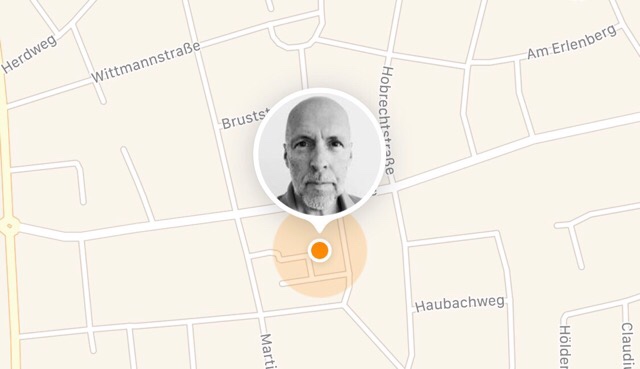
Heute bin ich gefragt worden, ob man vielleicht einen Demenzkranken über seine Apple Watch finden kann, wenn er verloren geht. Ich wusste es nicht, aber ich habe nachgeschaut (und mir drei Kaffee verdient):
Wenn du deinen Standort über ein iPhone teilst, das mit einer Apple Watch Series 3 (GPS + Cellular) gekoppelt ist, wird dein Standort über deine Apple Watch geteilt, wenn du dich außerhalb der Reichweite deines iPhone befindest und du deine Apple Watch am Handgelenk trägst.
Mit anderen Worten, ja, es geht. Auch wenn die Person ihr iPhone zurücklässt und die Watch über eine Mobilfunkverbindung erreichbar ist, dann sieht man den Standort der Uhr und nicht die des iPhone. Vorausgesetzt man darf, etc. pp.
Auch wenn ich nicht dement bin, so bin ich doch froh, dass die Scheffin mich jederzeit finden kann!
Doin’ Vancouver stuff the other night and strayed purposefully to check out two sculptural pieces and a film event from the 2018 Vancouver Biennale. See the pix below.
One piece and the film event were in poor lonely Leg-In-Boot Square, normally empty, but buzzing then:
We love the Jabra Elite Active 65t. These headphones sound great for music and calls, they fit comfortably, and because they have no wires, they stay secure and completely out of your way during rigorous workouts. With an IP56 rating, they should withstand abuse, sweat, and moisture when used properly, plus they’re backed by a two-year warranty. And they beat out over 200 other pairs that we tested.
Marco Arment has revisited MacBook Pro battery life tests that he first ran in 2015 to see how his new 2018 13-inch MacBook Pro with a 2.7 GHz i7 processor and his 2015 2.2 GHz 15-inch MacBook Pro would fare under similar conditions. In 2015, Arment used an app called Turbo Boost Switcher to disable Turbo Boost on his laptop. This time around, he replicated disabling Turbo Boost on his 2015 MacBook, but on his 2018 model, he also limited the laptop’s power consumption using Volta.
the gain in battery life is about as large as the loss in heavy-workload performance. That’s a trade-off I’d gladly make when I need to maximize runtime.
The best bang-for-the-buck option is still to just disable Turbo Boost. Single-threaded performance hurts more than with wattage-limiting, but it’s able to maintain better multi-threaded performance and more consistent thermals, and gets a larger battery gain relative to its performance loss.
Running an app like Turbo Boost Switcher is worth considering when you have work to get done because it can mean the difference between your MacBook’s battery making it through a long flight or not. However, I’m with Arment – I’d prefer to run an iOS-like Low Power Mode for Macs that is implemented at the OS level and makes intelligent choices about what activities to stop or slow down. To get an idea of the sorts of things that might be throttled in a macOS Low Power Mode, check out the long list compiled by Arment.
This is a set of four weeks of content (and a catch-up week) on the idea of creating a domain of one's own. It's an introductory course (though even the experienced will learn a thing or two) but more to the point it covers content completely skipped over in this era of living in online silos like Facebook and Twitter. It's based around cPanel, which is widely used by internet hosting services, and looks at things like landing pages, setting up your own email address, and other applications. It's a course that should be widely taught at the high school level or earlier.
According to this article, "women scholars rely on three levels of support: the first level includes personal and social support...; the second includes organizational... technological... and sectoral... support; and, the third includes larger cultural and social attitudes and discourses." The key point here is that typically all three types of support are required, especially in an environment of of online abuse and harassment toward women scholars.
Google’s Beijing offices in 2010, when the company decided to stop censoring its results and exit the market.
I’ve been covering Google’s rather tortured relationship with China for more than 15 years now. The company’s off again, on again approach to the Internet’s largest “untapped” market has proven vexing, but as today’s Intercept scoop informs us, it looks like Google has yielded to its own growth imperative, and will once again stand up its search services for the Chinese market. To wit:
GOOGLE IS PLANNING to launch a censored version of its search engine in China that will blacklist websites and search terms about human rights, democracy, religion, and peaceful protest, The Intercept can reveal.
The project – code-named Dragonfly – has been underway since spring of last year, and accelerated following a December 2017 meeting between Google’s CEO Sundar Pichai and a top Chinese government official, according to internal Google documents and people familiar with the plans.
If I’m reading story correctly, it looks like Google’s China plans, which were kept secret from nearly all of the company’s employees, were leaked to The Intercept by concerned members of Google’s internal “Dragonfly” team, one of whom was quoted:
“I’m against large companies and governments collaborating in the oppression of their people, and feel like transparency around what’s being done is in the public interest,” the source said, adding that they feared “what is done in China will become a template for many other nations.”
This news raises any number of issues – for Google, certainly, but given the US/China trade war, for anyone concerned with the future of free trade and open markets. And it revives an age old question about where the line is between “respecting the rule of law in markets where we operate,” a standard tech company response to doing business on foreign soil, and “enabling authoritarian rule,” which is pretty much what Google will be doing should it actually launch the Dragonfly app.
A bit of history. Google originally refused to play by China’s rules, and in my 2004 book, I reviewed the history, and gave the company props for taking a principled stand, and forsaking what could have been massive profits in the name of human rights. Then, in 2006, Google decided to enter the Chinese market, on government terms. Google took pains to explain its logic:
We ultimately reached our decision by asking ourselves which course would most effectively further Google’s mission to organize the world’s information and make it universally useful and accessible. Or, put simply: how can we provide the greatest access to information to the greatest number of people?
I didn’t buy that explanation then, and I don’t buy it now. Google is going into China for one reason, and one reason alone: Profits. As Google rolled out its service in 2006, I penned something of a rant, titled “Never Poke A Dragon While It’s Eating.” In it I wrote:
The Chinese own a shitload of our debt, and are consuming a shitload of the world’s export base of oil. As they consolidate their power, do you really believe they’re also planning parades for us? I’m pretty sure they’ll be celebrating decades of US policy that looked the other way while the oligarchy used our technology (and that includes our routers, databases, and consulting services) to meticulously undermine the very values which allowed us to create companies like Google in the first place. But those are not the kind of celebrations I’m guessing we’d be invited to.
So as I puzzle through this issue, understanding how in practical terms it’s really not sensible to expect that some GYMA pact is going to change the world (as much as I might wish it would), it really, honestly, comes down to one thing: The man in the White House.
Until the person leading this country values human rights over appeasement, and decides to lead on this issue, we’re never going to make any progress.
Google pulled out of China in 2010, using a China-backed hacking incident as its main rationale (remember that?!). The man in the White House was – well let’s just say he wasn’t Bush, nor Clinton, and he wasn’t Trump. In any case, the hacking incident inconveniently reminded Google that the Chinese government has no qualms about using data derived from Google services to target its own citizens.
Has the company forgotten that fact? One wonders. Back in 2010, I praised the company for standing up to China:
In this case, Google is again taking a leadership role, and the company is forcing China’s hand. While it’s a stretch to say the two things are directly connected, the seeming fact that China’s government was behind the intrusions has led Google to decide to stop censoring its results in China. This is politics at its finest, and it’s a very clear statement to China: We’re done playing the game your way.
Seems Google’s not done after all. Which is both sad, and utterly predictable. Sad, because in today’s political environment, we need our companies to lead on moral and human rights issues. And predictable, because Android has a massive hold on China’s internet market, and Google’s lack of a strong search play there threatens not only the company’s future growth in its core market, but its ability to leverage Android across all its services, just as it has in Europe and the United States.
Google so far has not made a statement on The Intercept’s story, though I imagine smoke is billowing out of some communications war room inside the company’s Mountain View headquarters. Will the company attempt some modified version of its 2006 justifications? I certainly hope not. This time, I’d counsel, the company should just tell the truth: Google is a public company that feels compelled to grow, regardless of whether that growth comes at a price to its founding values. Period, end of story.
…companies like Yahoo and Google don’t traffic in sneakers, they traffic in the most powerful forces in human culture – expression. Knowledge. Ideas. The freedom of which we take as fundamental in this country, yet somehow, we seem to have forgotten its importance in the digital age – in China, one protesting email can land you in jail for 8 years, folks.
…Congress can call hearings, and beat up Yahoo, Google and the others for doing what everyone else is doing, but in the end, it’s not (Google’s) fault, nor, as much as I wish they’d take it on, is it even their problem. It’s our government’s problem….Since when is China policy somehow the job of private industry?
Until that government gives (the tech industry) a China policy it can align behind, well, they’ll never align, and the very foundation of our culture – free expression and privacy, will be imperiled.
For someone who says we have to "rewire education" John Couch says a lot of things that sound like the same old thing. Apple’s former vice-president of education is plugging his new book Rewiring Education: How Technology Can Unlock Every Student's Potential. "I think there are parts," he says. "There's the iTunesU portion which allows you to distribute curriculum all over the world. There's a new application called Classroom, which allows a teacher to monitor the classroom. There's iBooks. If I were still calling the shots today, it would be about, “How do I take those individual functionalities and [put] them all together in a dynamic learning environment that's well integrated.” It's sort of the holy grail."
Good news for all of you who want a better way to bring scattered content together and help your team focus on what really matters. Starting today, if you’ve got PDF, Microsoft PowerPoint, and Adobe Illustrator files stored in Dropbox, you can customize how they show up in Paper. Here’s how it works.
Collaborate in one place
Sometimes, it’s hard to present your ideas the way you want because your content—and all the conversations around it—can get scattered in different places. Now you and your team can seamlessly collect and customize the way you display content from different tools. So everyone can easily give and get feedback, all in one place, right within your Paper doc.
Keep files in sync
Exporting files and taking screenshots can be a grind when you need to make a little edit. That’s especially true for collaborative or iterative work, like a working doc, where an image can get outdated, irrelevant, and frustrating very quickly. But with Paper, you can link to files stored in your Dropbox, and the previews in Paper will always stay up to date.
Customize what you share
Now Paper makes it easy to display only the important parts of the files you add—whether it’s a page, slide, or artboard. When you paste a shared link into a Paper doc, you’ll see a new option that will let you select specific pages from that file. You can then zoom in on specific sections of those pages.
Dropbox files are better with Paper—because Paper can turn your stored data into active collaborations. Every time you add an image or a video or a graph, you add important context that helps you tell your story. And every time your collaborators add feedback, they can help you refine your ideas and move them closer to the finish line, whether that’s an internal presentation or an external distribution.
Stay tuned. Our team is continually working on new integrations and new ways to help you share content in Paper. To see how our integrations can help you bring creation and coordination together in one place, check out this new feature in Dropbox Paper.
It is shaping up to be an interesting municipal election year with the main hot topics being polarizing, and forming camps “for” or “against”.
Here’s an example. There appears to be a grittiness that is translating to people being either “for” affordable accessible housing, or “against”. And Vancouver City Council contributes to this polarization in their recent last-minute decision to approve a 400 foot tower containing 40 storeys~but only if it contains rental housing.
Otherwise the developer can build the same amount, but in a lower building size. The height would be capped at 300 feet and does not pierce the view cones that provide mountain views from various points on Cambie Street and from Queen Elizabeth Park. The developer can also build market condo apartments with no fettering rental implications from Council by respecting the view corridor height limit.
Frances Bula in the Globe and Mail describes Council’s decision to “jut 100 feet into one of the city’s 27 designated “view cones” – provided the tower was rentals only – was a clear illustration of the pressure civic politicians are facing as an election looms and the housing crisis continues.”
The Mayor called the piercing of the view cones “a reasonable trade-off” and chided citizens who rallied against the tall towers as the same people who cut trees down for views, or complain about traffic lights blocking views. That seems to be a reference to a few residents living in expensive condos or single family housing forms that participated in a few distasteful one-off events a decade ago.
Journalist Justin McElroy’s tweet below contains the audio clip of the Mayor’s remark.
Here is Gregor Robertson, getting a little bit snarky at people who are against the PavCo tower at False Creek because it intrudes on a viewcone on Cambie Street pic.twitter.com/zL31iHYBjs
Why are we concentrating on building high density towers on the downtown peninsula which is less than 5 per cent of Vancouver’s total land area? This city has extraordinary mountain and ocean views that tie this place into nature, and has policy in place that has tried to protect these views for decades.
Green Party Councillor Adriane Carr called the decision the beginning of “death by a thousand cuts” for Vancouver views. Others scoffed at the mayor for making it sound as though the city had no other choice. “This was pure political posturing, with Vision Vancouver trying to make it seem like it was affordable housing versus views,” said Melody Ma, an activist who started a group called Save Our Skyline that ended up getting more than 1,000 supporters for its petition, including previous city planners.
Vancouver is known as one of the first cities globally to establish a view corridor policy to ensure that the stunning vista views were protected for citizens in perpetuity. Vancouver City Council has expressed a willingness to trade that view in exchange for rental housing. Further public hearings will consider whether two more 400 foot towers adjacent to the current site can also proceed. While the overall density being suggested for this area are approximately 20 per cent over the suggested density in the guidelines, the intent is to cram this into the area to provide housing affordability and to pay “the heavy cost to the city of taking down the viaducts in the area~another trade-off”
While one city official released a list of ten buildings that had violated the view cones in the past decades, view corridor advocates noted that those towers penetrated view cones because of technical error or had different criteria having met another policy of higher architectural design performance. Others state that there are optics that the privatization of public views for condos is for sale at the city at a certain price.
The polarization of having rental housing (there’s no indication of what the rental costs would be) versus mountain views will also be issues in the next phase of this area’s development. Is there a way to have both in Vancouver?
Andres Marti studied fine arts and design at the Pontificia Universidad in Bogota, Colombia. Six years ago, he co-founded the art brand Comes Cake and design studio Whatever Works allowing him to work within various realms of art including advertising, design, fashion, music, and photography. His work within the field of photography has caught quite a lot of attention due to its ironic uniqueness. Andres uses a mix of different techniques to acquire the desired result which is often “difficult to put a label on”. The photo below is a great example, but also one of his personal favorites.
The entirety of the piece looks as if it was painted, but in fact, the model is human. Andres shot this image in Santiago de Chile in an abandoned pool. The model happens to be photographer Christian Corocca, an underground DJ that Andres met through Flickr. This type of composition does not come easy, and during a typical week, it takes 2 hours of shooting and 8 hours of editing at the computer. Essentially, it’s a collage composed of post-production makeup, natural and artificial light, real and digital elements. Andres says “I seek to immerse the character in a timeless universe that plays between reality and fiction.”
His latest personal photography project is titled “Otredad” or “Otherness.” It’s the expression of himself through a portrait series of individuals he met on the street, of friends and acquaintances. The one thing each portrait has in common is the coloring of their noses and eyelids in a ruby red, similar to Rembrandt paintings, “physically expressing vulnerability of these beings,” but also a vulnerability in himself.
Andres described his project title in depth as he said: “I named them that way because the idea of otherness serves to keep in mind that we live in collective society and we are part of a complex whole. In the concept of ‘otherness,’ we can appreciate a certain personal unfolding. It shows us that identity goes beyond us. It is me and the other, at the same time.”
Although his work may be pinned as abstract, he believes it’s much more. Because he feeds on art to create these images, his work is a mix of “baroque, renaissance, pop art and things that I see in my life. From there I take out elements such as colors, textures, forms, rhythms, compositions, to create the image.” When explaining the intention behind their composition, he says: “It is a cathartic process, that through the image and all the elements that make it up—the model, the light, the colors, the expression, the composition, the look—, I can transmit the feeling that invades my mind into something I can express.”
If you’re interested in seeing more of his work, check out his Flickr account! A book with the first season of Otredad is available for purchase through his Instagram @6marti6. Currently, Andres is preparing for his first solo exhibition which will premiere at the end of 2018.
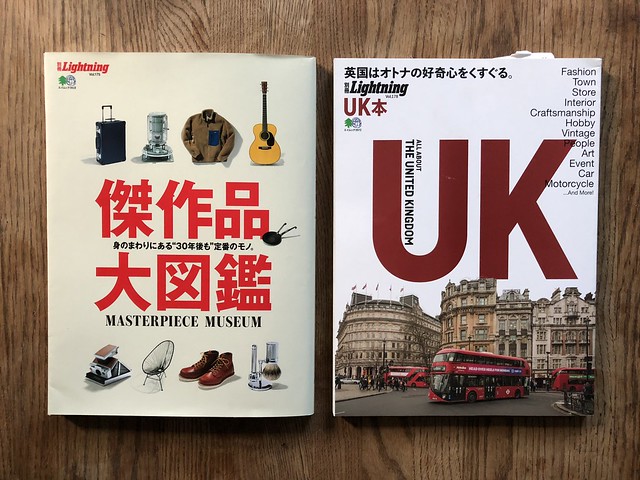
I'm increasingly stuck in my own bundle of interests. Not noticing new things, but noticing connections between the old ones. I don't really know how to write about those things, so I'm going to start noting down the fragments and then maybe do some sort of cyber crazy wall essay later. This might be for a bit of wall labelled - Fashion & Authenticity
“IN AUGUST 1969, JUST DAYS AFTER THE WOODSTOCK MUSIC festival, illustrator Yasuhiko Kobayashi and Heibon Punch editor Jir Ishikawa walked into a Doubleday bookstore in New York City, where they came upon an entire wall covered with a single magazine. Its cover photograph showed a “blue marble” Earth floating above the moon in the blackest of outer space. The title read: “Whole Earth Catalog, access to tools.”
“Unbeknownst to the two men upon their first encounter, this magazine would not just shape Japanese fashion for the 1970s, but forever change the look of all Japanese magazines.”
Here's an example of that sort of thing:
Not as catalogue-y as some of them but you can see what it's like. I love these magazines. I used to buy all the US/UK mens style press but I never read the articles or looked at the photo spreads. I just loved the little pictures of things that had been deemed by someone the best example of that thing. Japanese people apparently took inspiration from the Whole Earth catalogue and made whole magazines out of those pages. And you feel like they really do their homework. They've actually chosen the best thing.
It reminds me of a William Gibson quote from You Can Find Inspiration In Everything. I can't find it now, but it's something like: if you want to know what's good about what your country makes, look at what the British and Japanese import.
We commend the Argentine G20 Presidency for continuing to build momentum around the G20 digital process and look forward to seeing the Declaration and the progress made to that end following the Digital Ministerial on August 24.
However, we can’t ignore the lack of transparency and the step back from multistakeholder engagement that was championed under last year’s G20 Presidency by Germany. Mozilla appreciated the invitation to attend the G20-B20 workshops on July 30, which allowed for providing input into the Digital Declaration. But inviting pre-selected organisations to an unofficial side event on comparatively short notice is not sufficient for a meaningfully transparent and inclusive process.
Assuming responsibility in the digital age also means that governments have to cater to the complexities of existing and upcoming challenges by including different stakeholders for their expertise and various experiences.
We cannot reinstate trust in the development of our digital societies if we close the doors to meaningful engagement and inclusive participatory processes.
Faro Digital, ITS Rio, and Mozilla reiterate as part of a much broader coalition of 80 stakeholders from across the world that a positive, forward-looking digital agenda must support a healthy web ecosystem and put people and their individual rights first, by providing meaningful access, strong privacy and data protection rights, freedom of expression, collaborative cybersecurity, and increased competition.
This article focuses mostly on the anatomy lab at Case Western Reserve University which is focused on providing virtual reality simulations rather than cadavers. It's also a bit of an advertisement for Microsoft's HoloLens. The virtual experience is arguably better than the real: " when students learn about human anatomy using a cadaver, they do not get the experience of looking at the living colors or textures, or seeing how organs function, or learning how blood actually flows." It's easy to over-hype the new technology, and we shouldn't, but this is again one more instance in which new learning technology goes a long way to replace the lecture and the textbook.
Narrative podcasts have their predecessors on radio newsmagazine shows and I've heard a bunch of them on CBC shows such as The Doc Project, Out in the Open, Now or Never, and Podcast Playlist. "They tend to lean more heavily on production effects, such as the use of music and sound effects, as well as narrative storytelling techniques such as multiple characters, scene setting, backstory, hooks, framing devices, and cliffhangers." I hate them because they're really hard to do well and so often not done well. They fall so easily into tropes - the present-tense narration, the mood music, and the magnification of personal issues and domestic drama. The thing, too, with narrative podcasts is that they're not for remembering things (despite what the 'research' in this article says). They can be very powerful - but for things like framing, developing attitudes, setting norms, and challenging assumptions.
I think we see the same trends in education, especially where education overlaps with development, as in the case of OER. What trends? These: "the continued obsession with finding the new 'what works' solution may be quickly trumped by decision-makers’ tendencies to back solutions based on who surfaces them rather than what the evidentiary basis says about the same solution." The authors call for fewer flashy pilot projects, better bases in research, and more grounding for innovators in the social and political realities on the ground. Fair enough, but the same recipe serves also to block innovation before it can start.
Yesterday, Vox ran a story about changes in food consumption patterns in the United States over the past few decades. It featured this graph:
Vox Time Series
When I saw it, one of those little bells went off in my head:
As a rule, when you see a sharp change in a long-running time-series, you should always check to see if some aspect of the data-generating process changed—such as the measurement device or the criteria for inclusion in the dataset—before coming up with any substantive stories about what happened and why. This is especially the case for something susceptible to change over time, but not to extremely rapid fluctuations. A sudden fifteen-pound-per-person-per-year uptick just seems unlikely. And while such shifts are not impossible, of course, you also have to tap the instruments, so to speak, to make sure everything’s OK.
In this case, it took Jon Mellon a few minutes to track down the table the graph was based on, and sure enough, there it was:
The fault, my dear Brutus, is not in ourselves
In 2000, the number of firms reporting vegetable oil production increased, leading to the spike in the graph. Your theory of the avocado-based transformation of the American diet is invalid. As Tom Smith, the director of the General Social Survey, likes to say, if you want to measure change, you can’t change the measure.
Relatedly, as the graph itself makes clear—but the original article finesses a bit—the availability of fats (as measured through food production) is rather different from the consumption of fats in people’s actual diets. The two are clearly closely related, but they’re not the same.
In any case, a central part of looking at your data means using it as an opportunity to understand where the measures you’re using come from and what they mean just in methodological terms.
Although the “trader” deadline has long since passed (there are 33 of us in total, as of this morning’s count), the event is open to the public (of all ages), and there will be music from Todd MacLean, snacks, and a cash bar.
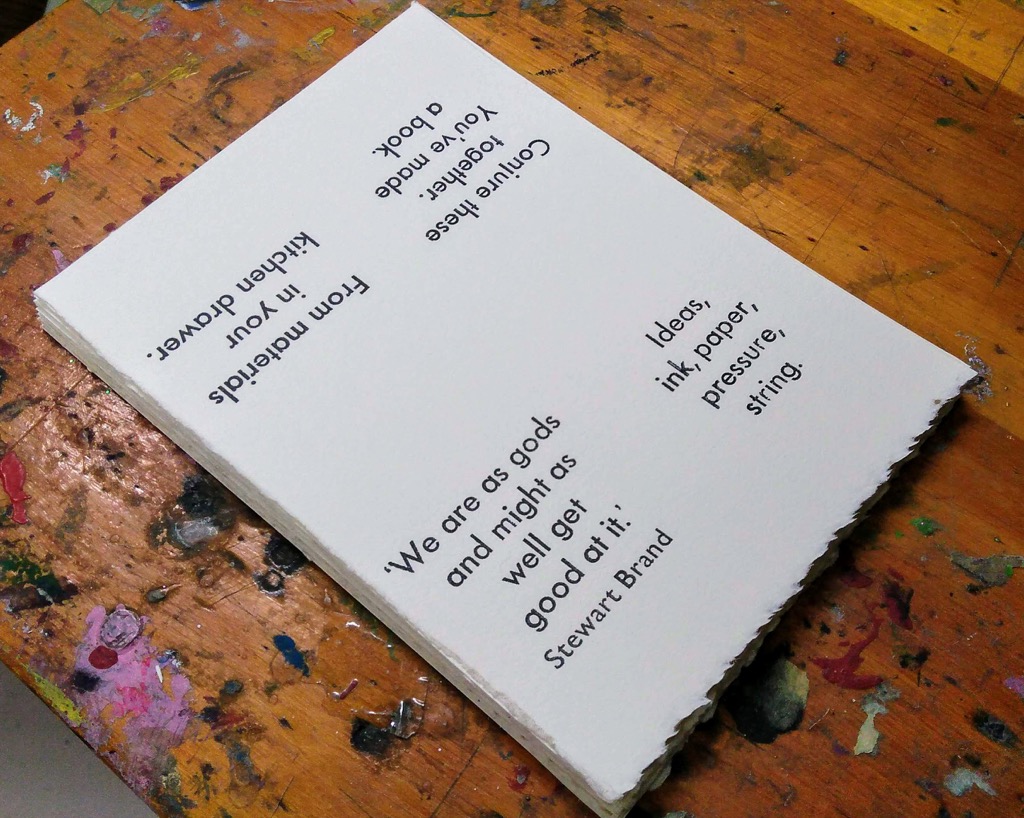
I wasn’t content to make a simple “card” this year, so I made a single-signature book plus cover, printed on my letterpress; it is an “interactive card,” where traders will assemble the book themselves, either during the trading round or, more likely given the lightning-fast timing thereof, during the mingling time afterwards.
Thus the assembling of the book allows the themes of the book to spring to life; and in doing so also provides cover for traders not skilled in the mingling arts to have a distracting activity in which to engage while everyone else is networking, canoodling, kibbitzing, etc.
“I love walking around the city. I catch the Metro North train at 11:40 every morning. I go to the same gym that I’ve been going to for forty years. Then I just start walking. If you take big strides it really stretches you out. And there are millions of other people walking around. You never feel alone. People smile at you. On weekends I’ll bring my granddaughters with me and we’ll tour different neighborhoods. We’ve seen ten or twelve so far. Sometimes I get to borrow them for the whole afternoon. But they’re at sleep away camp right now so I’m missing them a lot. And that’s about it. I do a little shopping at the thrift store. I stop and read the paper. I eat at outdoor restaurants. It’s simple but I found what makes me happy and I’m doing it. And when I’m heading home at night, sometimes I think: ‘I just had the best day of my life.’”
Quite possibly, my favourite Humans of New York post so far. Walking is the best way to experience the city and the perfect medicine for your mental and physical health. This man is living proof!
OmniFocus for the Web is getting close to testing — and you can sign up to help! Log in to your Omni Sync account, and then scroll down to the “OmniFocus for the Web Test” section to join the testing group.
Look for the testing icon:
Once it’s ready, we’ll notify you and let you know how to get started.
A few important notes:
It’s a web app that runs in your browser (Safari, Chrome, etc.) — it’s not an app that you download
It’s a companion to OmniFocus 3 for iOS or Mac — it’s not a standalone app
This early version requires that you have OmniFocus 3 for iOS
It’s designed for people who need OmniFocus access while on a Windows or Linux computer (at work, for instance)
It’s not currently designed for Android or any other devices with a touch interface
For more about OmniFocus for the Web, read the section at the end of the Omni Roadmap 2018 about it, or listen to the episode of The Omni Show with CEO Ken Case where he talks about the roadmap.
Darius Kazemi@tinysubversions
I am at the Decentralized Web Summit today only -- open to talking about basically anything but I am right now spen… twitter.com/i/web/status/1…
QueensParkfashun@QPfashun
When Lisa Macleod announced an overhaul of Ontario’s social assistance programs yesterday, she did it wearing a mod… twitter.com/i/web/status/1…
Michael Labbé@frogtoss
I did an hour of productive coding while waiting for an appointment on my iPad Pro + keyboard with Blink SSH, Tmux… twitter.com/i/web/status/1…
Darius Kazemi@tinysubversions
I'm not mad, Twitter, I'm just disappointed. Your website used to allow fun software toys with no business model to… twitter.com/i/web/status/1…
Mozilla established one of the first modern security bug bounty programs back in 2004. Since that time, much of the technology industry has followed our lead and bounty programs have become a critical tool for finding security flaws in the software we all use. But even while these programs have reached broader acceptance, the legal protections afforded to bounty program participants have failed to evolve, putting security researchers at risk and possibly stifling that research.
That is why we are announcing changes to our bounty program policies to better protect security researchers working to improve Firefox and to codify the best practices that we’ve been using.
We often hear of researchers who are concerned that companies or governments may take legal actions against them for their legitimate security research. For example, the Computer Fraud and Abuse Act (CFAA) – essentially the US anti-hacking law that criminalizes unauthorized access to computer systems – could be used to punish bounty participants testing the security of systems and software. Just the potential for legal liability might discourage important security research.
Mozilla has criticized the CFAA for being overly broad and for potentially criminalizing activity intended to improve the security of the web. The policy changes we are making today are intended to create greater clarity for our own bounty program and to remove this legal risk for researchers participating in good faith.
There are two important policy changes we are making. First, we have clarified what is in scope for our bounty program and specifically have called out that bounty participants should not access, modify, delete, or store our users’ data. This is critical because, to protect participants in our bug bounty program, we first have to define the boundaries for bug bounty eligibility.
Second, we are stating explicitly that we will not threaten or bring any legal action against anyone who makes a good faith effort to comply with our bug bounty program. That means we promise not to sue researchers under any law (including the DMCA and CFAA) or under our applicable Terms of Service and Acceptable Use Policy for their research through the bug bounty program, and we consider that security research to be “authorized” under the CFAA.
You can see the full changes we’ve made to our policies in the General Eligibility and Safe Harbor sections of our main bounty page. These changes will help researchers know what to expect from Mozilla and represent an important next step for a program we started more than a decade ago. We want to thank Amit Elazari, who brought this safe harbor issue to our attention and is working to drive change in this space, and Dropbox for the leadership it has shown through recent changes to its vulnerability disclosure policy. We hope that other bounty programs will adopt similar policies.
An honest web is one in which the overwhelming majority of the code and assets downloaded to a user’s computer are used in a page’s visual presentation, with nearly all the remainder used to define the semantic structure and associated metadata on the page. Bullshit — in the form of CPU-sucking surveillance, unnecessarily-interruptive elements, and behaviours that nobody responsible for a website would themselves find appealing as a visitor — is unwelcome and intolerable.
Turing Space Industries is the smartphone manufacturer responsible for devices like the Knight Icefyre the Dark Wyvern and the Pharaoh. Now the company is looking to launch another odd device called the HubblePhone — named after the telescope.
The smartphone isn’t necessarily a foldable handset, though it does feature an upper display that the company calls the ‘Upper Deck,’ while the main display is called the ‘Main Deck.’
One of the Upper Deck’s purposes is act as a viewfinder while using the phone’s main camera, similar to a camcorder. However, there are many ways to use the upper deck, and when closed the device’s Upper Deck sits on top of the Main Deck.
Think of it as a display flip phone, with the upper display being able to turn horizontally.
This strange smartphone also features a 60-megapixel main camera, with 15x optical zoom, within a cylindrical section on the side of the device.
However, if 60-megapixels aren’t enough, the phone also has five more cameras. The HubblePhone sports a dual 12-megapixel camera setup with two variable apertures (f/1.5-f/2.4) on the upper deck within a side notch. It also supports another side notch on the flipside of the upper deck which hosts a single 12-megapixel module.
While on the main deck, the HubblePhone features another dual rear-camera module with 12-megapixel sensors and additional variable aperture lenses (f/1.5-f/2.4).
The phone also has a scroll wheel and a programmable button.
The handset is IP68 water and dust proof, HDR10 compliant, and hosts 256GB of storage on the Upper Deck and 256GB on the Main Deck.
It appears Turing plans on providing its phone with two still-unannounced Snapdragon 855 chipsets, one on the Upper Deck and one on the Main Deck, as well as two dual-SIM card trays, two octa-core CPUs each with 8GB of RAM, two Adreno 630 GPUs, two batteries — one 2,800mAh and another 3,300mAh — and a single 5G modem.
Turing also says the device will use an “Emotional Machine Intelligence Chip” that’s designed to provide a “next-gen mobile gaming experience.” The company says that the device will come out during Q1 of 2020 for $2,749 USD (approximately $3,573.29 CAD).
Turing filed bankrupt earlier this year but clearly that hasn’t stopped the company.
While Turing’s goal is obviously to actually release this phone, it’s so futuristic I wouldn’t be surprised if it never sees the light of day.
Android P is on the horizon, bringing a wealth of changes for users. For many, the most important shift will come in the form of battery life. Android engineers Benjamin Poiesz and Tim Murray joke that “P is for Power.”
Poiesz, a group product manager for the Android Framework, and Murray, a seniour staff software engineer, sat down with Ars Technica for an interview about the changes in Android P.
Cores, big and small
Since 2015, most multi-core CPUs ran on a ‘big.LITTLE’ platform, according to Murray. Essentially, that platform means there are a number of large, high-power fast cores and a number of small, low-power slow cores.
Initially the team only restricted background apps and processes to the little cores.
In P, Murray’s team took things further. They looked at what ran on the big cores when the screen was off and found a lot of things related to the system.
“We looked at how many of these were performance critical and it turns out, not many — when the screen is off at least,” Murray said. ”
Now these processes operate on a restricted CPU stack with only the small cores. It saves some battery, but it also makes battery life more predictable.
If the system is going to use power when the screen is off now, it draws less because the small cores are much smaller.
We’re all A/B testers
Considering how much impact a change can have on power metrics, Murray and Poiesz took to the best metrics database they had.
You know when you’re setting up a phone for the first time and you see that ‘usage and diagnostics’ toggle? It sends data about your device and app usage to Google.
Murray and Poiesz are able to look at metrics of power in a dashboard, among other stats. It does so at a high level so they can’t see anything they shouldn’t. What they can see is trends in usage.
For example, Murray points out Christmas time. “The battery life that people see around Christmas is amazing because nobody’s using their phone, nobody’s sending email, and nobody’s doing any of these things.”
That variance makes studying power particularly difficult. It can be hard to tell what’s affecting battery. Is it a change in population — like no one using phones at Christmas — or is it the effect of a software change?
Murray and Poiesz narrow this data-set down to just the people running the Developer Previews. Then they A/B test. Some people have noticed really great battery life on Android P — others haven’t. These discrepancies could be the result of battery tests.
Power and predictions
The last thing the duo learned in their work on P was that power savings don’t add up as expected.
An app keeping a device awake to do tasks — a wake lock — draws power, but reducing the number of wake locks doesn’t help.
Going from no wake lock to one wake lock is a significant step. The CPU moves from an idle state to an active state. However, adding other wake locks doesn’t increase power draw. The CPU is already awake and working.
From that perspective, Murray and Poiesz took a strategy of delay. Android P delays processes until a device wakes up or is charging. Delaying a process until the device is awake doesn’t necessarily save power, but it reduces usage when the device is idle. The real power saver is delaying until the device is being charged.
If a process is delayed from 10am to 11am, the power needed to run it isn’t saved. If that process is delayed until your phone is plugged in, then that power is saved.
However, that means waking up the device uses more power. This is where the prediction comes in — it’s all about figuring out whether its more efficient to remain in idle or shut everything down.
Android P is about balance. It’s about figuring out what the users wants and needs at a given moment and working to deliver that efficiently.
Alle Verkehrsteilnehmer müssen einander mit Respekt begegnen und den Raum zugestehen, den sie brauchen. Einfach gesagt, aber zwischen Radfahrenden und Autofahrenden eine Illusion.
Wie gleichberechtigt sind eigentlich Radfahrende und Autofahrende unterwegs, fragt The Converssation in einem Artikel über Australien. Gleichberechtigung auf der Straße ist ein fataler Mythos. Das Auto dominiert. Die meisten Radfahrer müssen nicht daran erinnert werden, ein zwei Tonnen schweres Fahrzeug, das mit Tempo 80 nur wenige Zentimeter vom Ellbogen entfernt vorbeifährt, mit großem Respekt zu behandeln. Radfahrer haben nicht die Macht, den Platz, den ein Autofahrer beansprucht, nicht zu respektieren. Autofahrer umgekehrt aber sehr wohl. Wir Radler haben keinen Blechpanzer um uns herum, wir bewegen keine zwei Tonnen Überbreite, sondern vielleicht hundert Kilo ohne jeglichen Schutz für Haut und Knochen. Wir sind ohnmächtig. Wir haben de facto nicht die gleichen Rechte wie Autofahrer, denn wir können sie nicht durchsetzen. Es herrscht ein deutliches Machtgefälle.
Unsere Sicherheit liegt nicht in unseren Händen, sondern weitgehend in den Händen der Autofahrer. Das Einzige, was wir für dafür tun können, dass wir nicht von Autos verletzt werden, ist, so vorausschauend zu fahren, dass wir die Fahrfehler und das Dominanzgebaren von Autofahrern vorhersehen und einem Konflikt, allemal einem Zusammenstoß, ausweichen.
Autofahrer stellt sich so hin, dass ich nicht rechts vor zur Haltelinie fahren kann.
Die tägliche Erfahrung, dass der Respekt der Menschen in großen, schweren Fahrzeugen uns gegenüber geringer ist als unserer ihnen gegenüber führt dazu, dass etliche Radler auf Gehwege flüchten oder an Ampeln schon bei Rot starten, nur um dem Platzgerangel Auto gegen Fahrrad zu entkommen.
Politik und Medien verleugnen die tatsächliche Verantwortung für unser Sicherheit, die dem Autofahrer zukommt, gern und bauen die Fiktion einer Gleichheit der Verantwortung auf. Sie fordern Helme und Schutzwesten, so als hänge es eben doch von uns ab, ob wir Opfer aggressiver oder schusseliger Autofahrer/innen werden oder nicht. Sie fordern von uns "auch mal zu bremsen", "auch mal nachzugeben". Wenn ein Autofahrer über rechts über den Radweg abbiegt, ohne zu gucken, ist das meine einzige Überlebenschance. Wenn man uns zu Selbstschutzmaßnahmen auffordert ist das einerseits das Eingeständnis, dass wir nicht die gleichen Rechte haben wie Autofahrende, und andererseits der der Versuch, ein Teil der Verantwortung doch wieder auf uns abzuwälzen, so als müssten wir selbst mehr tun, um zu unverletzt durchzukommen. So als liege es in unserer Hand. So wird der Autofahrer von der Verantwortung für sein Handeln entlastet.
Rechtsabbieger schneidet Radlerin
Das Gerede von gleichen Rechten und Pflichten ist gerade im Straßenverkehr zynisch. In diesem Zusammenhang wird dann immer gern gefordert, Radfahrer müssten sich endlich und überhaupt und erst einmal an die Verkehrsregeln halten. Ja und dann? Ist das etwa die Bedingung dafür, dass man uns respektieren könne und werde. Immerhin geht es hier um unsere Gesundheit und unser Leben. Das klingt, als müssten wir uns Respekt (und Rücksicht) gewissermaßen erst verdienen durch besonders braven Regelgehorsam. Dann wären vielleicht die Autofahrenden etwas gnädiger.
Lkw auf dem Radfahrstreifen
Klar, dass das nicht funktioniert. Das Verhalten von Autofahrenden habe ich ja nicht in der Hand. Mit keinem Mittel kann ich verhindern, dass ein Autofahrer, ein Busfahrer oder ein Lkw-Fahrer mich im Abstand von 30 cm überholt. Oft nicht einmal dann, wenn ich platzbehauptend mitten auf der Fahrbahn radle.
Es gibt keine Gleichberechtigung auf unseren Autostraßen. Die meisten Radler/innen verhalten sich in dem Gerangel grundsätzlich defensiv und kooperativ. Sie akzeptieren die Hierarchie, weichen Konflikten aus. Es gibt aber in asymmetrischen Verhältnissen immer auch einige, die die Rolle der Unterlegenen nicht akzeptieren, sondern den Machtkampf aufnehmen (meistens junge Männer). Die nennen wir dann gern Kampfradler. Sie verhalten sich aber nur entsprechend der Rolle, die der Autoverkehr ihnen zuweist, nur dass sie sie nicht akzeptieren, sondern sich demonstrativ dagegen stellen, durch Missachten von Regeln, die sie als Benachteiligung empfinden, und durch Geschrei oder Gewalt gegen das Auto. Sie sind ganz unmittelbar ein Produkt des Machtgefälles auf der Straße.
Parken auf dem Radfahrstreifen
Weder die australischen Straßen (auf die sich der Artikel bezieht), noch die deutschen sind also ein neutraler Ort des gleichberechtigten Nebeneinanders. Vielmehr beherrscht das Auto den öffentlichen Raum. In Australien (und bei uns kaum weniger) sind mit dem Auto Vorstellungen von Autonomie, Freiheit und Dominanz verbunden. Hinzu kommt bei uns, dass wir der Autoindustrie ein Gutteil unseres Wohlstands verdanken, also so eine Art wirtschaftliches Vorrecht des Autos.
Wenn Radfahrer und Autofahrer sich auf der Straße treffen, dann sind sie nur ganz theoretisch oder fiktiv gleiche Individuen, die sich in einem demokratischen und eindeutig geregelten öffentlichen Raum begegnen. Aber eben nur, wenn der Autofahrer es so will und so macht. Wenn Autofahrer nicht wollen, dann befinden sich Radfahrende in einer stark asymmetrischen Beziehung, sowohl physisch als auch kulturell.
Freedom Mobile ushered in a new wave of competition for data-hungry Canadian customers when the carrier unveiled its ‘Big Gig’ data plan in late 2017.
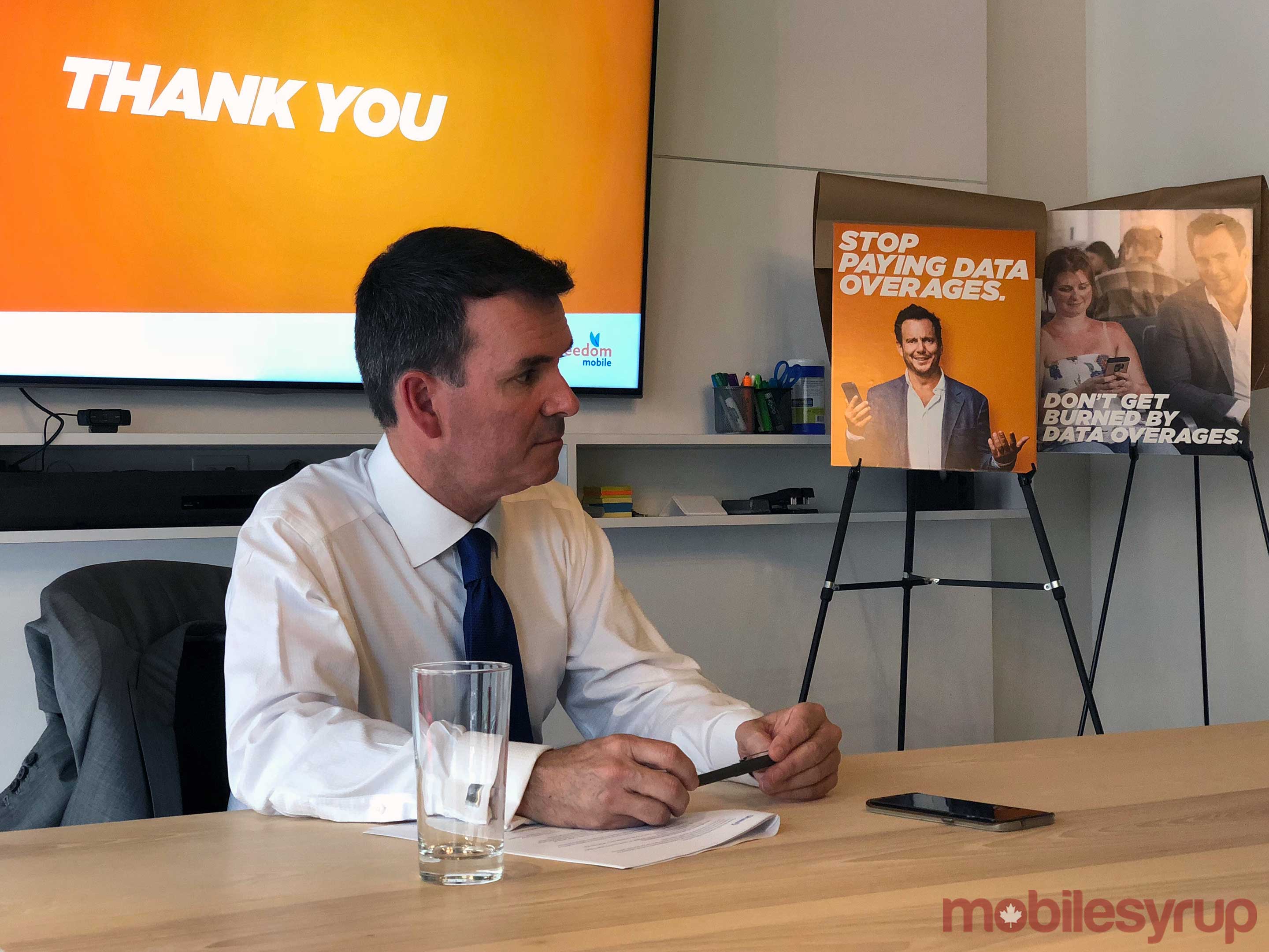
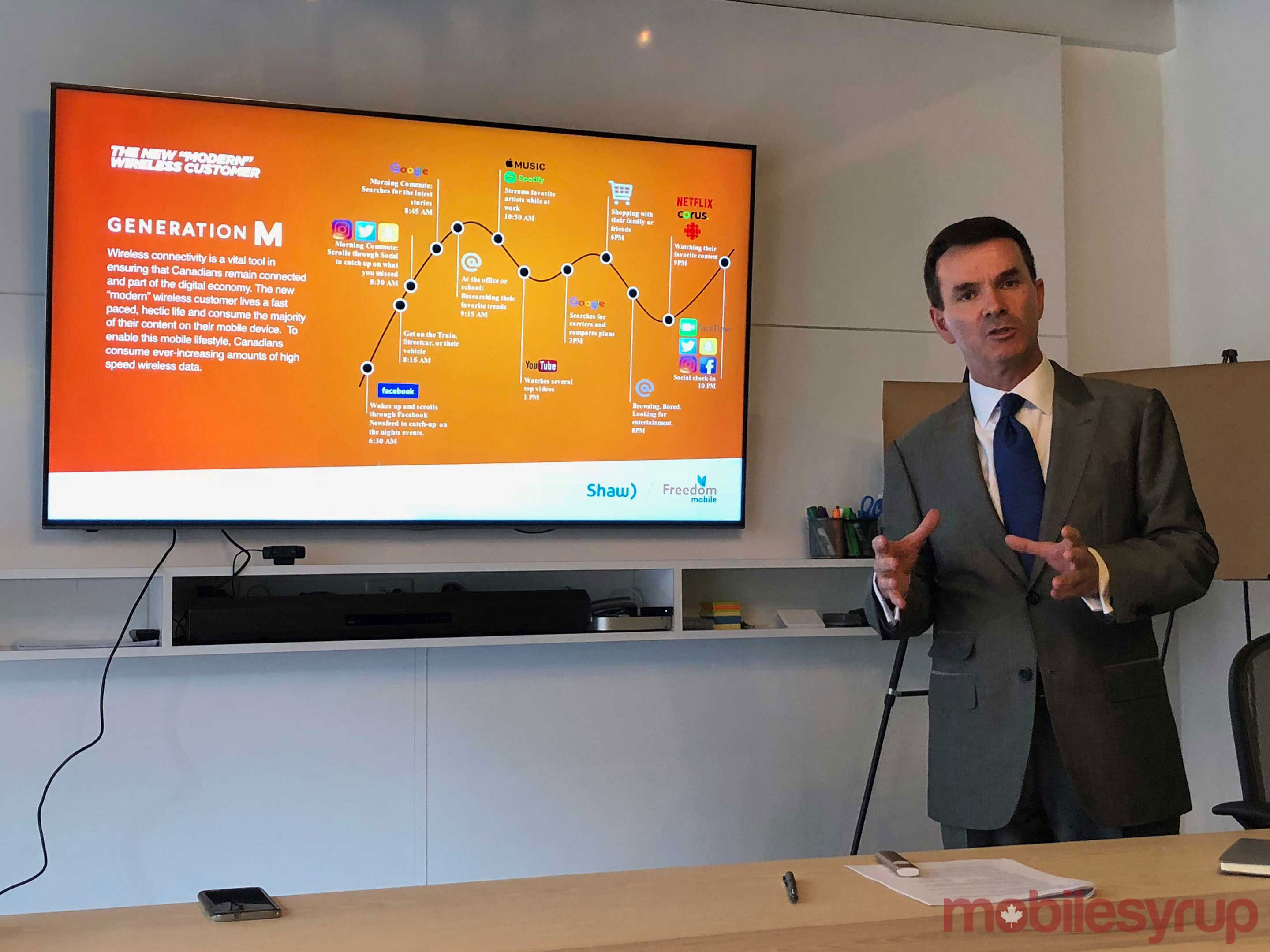
One of the reasons Freedom launched its 10GB for $50 offering was because the carrier saw customers increasingly using more data than talk and text. In a recent round table interview with MobileSyrup, Paul McAleese, president of wireless at Shaw Communications, stated that the “Mobile Generation (Generation M)” is exceedingly connected and wants to live a “mobile life from the moment they wake up to the time they go to bed.”
“We spend an enormous amount of time talking with customers.”
Soon after the launch of the Big Gig, most Canadian wireless carriers started offering a similar 10GB offering, with specific stipulations, though customer service departments weren’t able to handle the influx of demand for the sought-after plans.
“We spend an enormous amount of time talking with customers. In the field, online, or any of our contact points, to make sure that the voice of the customer resonates with everything we do. That is what constructed Big Gig back in October and it’s constructing the next wave,” said McAleese.
Competitor ‘Family Share’ plans are “starting to fracture”
Freedom announced today that Canadian-born actor Will Arnett will be the face of the carrier’s new marketing campaign, giving Freedom a much-needed new look and feel that’s dramatically better than its Freddy the Freedom Bear campaign from 2017.
McAleese spent time discussing data packages, honing in specifically on how Freedom’s competitors are structuring ‘Family Plans.’
“The construct of Family Plans is starting to fracture in this country, much like it did in the United States. Family plans were originally designed to increase the number of lines and enhance retention. The challenge with this model is that it puts the customer in a fighting position with each other in terms of data. Then you’re put into a situation to learn who the worst offender is. It turns into a constant battle. Every month you are dealing with significant overages on your bill. We want to solve for Canadians this ongoing stress that resides within their households,” said McAleese.
Data overage charges in Canada range from $70 to $100 per GB. According to the latest CRTC Communications Monitoring Report, Canadian wireless carriers reported $1.2 billion in revenue from data overage charges in 2016.
“Canadians are still dissatisfied with what they pay for data. The data overage charges in this country are astonishing. I’m surprised there is not more of a revolt on that. The Canadian consumer, perhaps because they don’t know of any other options, know they are paying up to $100 per GB,” said McAleese.
‘Unlimited’ data plans but heavily throttled
McAleese said that Freedom Mobile will never charge customers for data overages, but he was also careful not to label the carrier’s plans as ‘unlimited’ — mainly because Freedom throttles from LTE to 3G speeds when customers hit a specific data cap.
“I think we are cautious around ‘unlimited’ because we do throttle. Maybe taking a bit of a diversion from what the American carriers do where most of them do 20GB to 25GB data and then throttle. We felt it was the more conservative and practical approach not to use that. We throttle data but still highly usable and you are not really seeing a major reduction in quality but we think it’s important to distinguish,” said McAleese.
“I think we are cautious around ‘unlimited’ because we do throttle.”
“Our customers get notified at various stages along the way. I believe 75, 90 and 100 percent of their data allotment. The customer then has the ability to buy more high-speed data, or ignore that and get throttled down, which is 128/256 kbps.”
What about a premium wireless brand called Shaw Wireless or bundling Shaw services?
Back in September, several Canadian trademarks filed by Shaw suggested the company planned to launch a “Shaw Mobile,” “Shaw Mobility,” or possibly “Shaw Wireless” brand.
When asked about the possibility of Freedom utilizing the Shaw brand, McAleese emphasized the carrier’s “standalone success.”
“We are really fortunate to have the heritage that we have with Shaw. With that heritage comes three or four significant blessings that we could deploy. The Shaw brand is first and foremost, along with its customer relationships, is something that we have not tapped into at all. Any success that you’ve seen us have over the last number of quarters is a standalone Freedom success, rather than something that’s been built off the back of Shaw’s accomplishments,” said McAleese.
“We have within our arsenal the ability to use the Shaw name and distribution channel, the ability to sell into the Shaw base. Those things remain in our portfolio. When we choose to use them we will probably be simply a matter of when we feel the need for them. At this point we like our growth rate and we are hugely flattered by the impressions we are seeing. Canadian consumers are certainly loving what they are getting from Freedom. If we think [a new brand] can be needed then we will proceed with it but it’s not imminent for us.”
This interview has been edited and condensed for clarity.































 The Omni Group.







 Radfahren in Stuttgart.