From the summary of this video: " Here is a video describing the power of webmentions in #edu5222. My students are amazed that they do all their learning from their own domain but their replies show up on each other’s post and our rss feed magically slurps up everything they write. One thing to note you dn’t need a reply post-kind for your webmention to work. You can just mention somebody’s url in you post or or link to a specific page or post on their website in any post-kind at it will work as well. "
In retrospect, it should have been obvious that the commercial social network services would use the scourge of fake news to increase the barriers around their own silos. For example, "Facebook is shutting off API access to publish to profiles tomorrow." Others will probably follow. "From here on out," writes Ben Werdmuller, "I'm going to stop automatically syndicating anything, and will revert to manually posting... it's long past time to stop building code on top of centralized silos of content." I stopped using Facebook nearly two years ago, of course, though I still send OLDaily posts to Twitter. If and when that breaks, I probably won't try to fix it.
According to this post, "Medium, Twitter, Facebook and others are edge services for your content, they are the platforms where you will find — unfortunately — more readers that on your own URL." This is actually what I do (though my dedication to doing it wavers a bit). The 'home' for my articles is here, downes.ca. But you can also find them on Blogger, LinkedIn and Medium (my last article on OERs was posted on all four). What I'm noticing: each geterates its own audience - the Blogger and LinkedIn posts perform pretty well, Medium has almost zero readers (if you're not promoted by Medium head office, you're nowhere), and downes.ca is somewhere in between. I still do this manually. I'm writing code to automate it (ie., push a button to "publish to...").
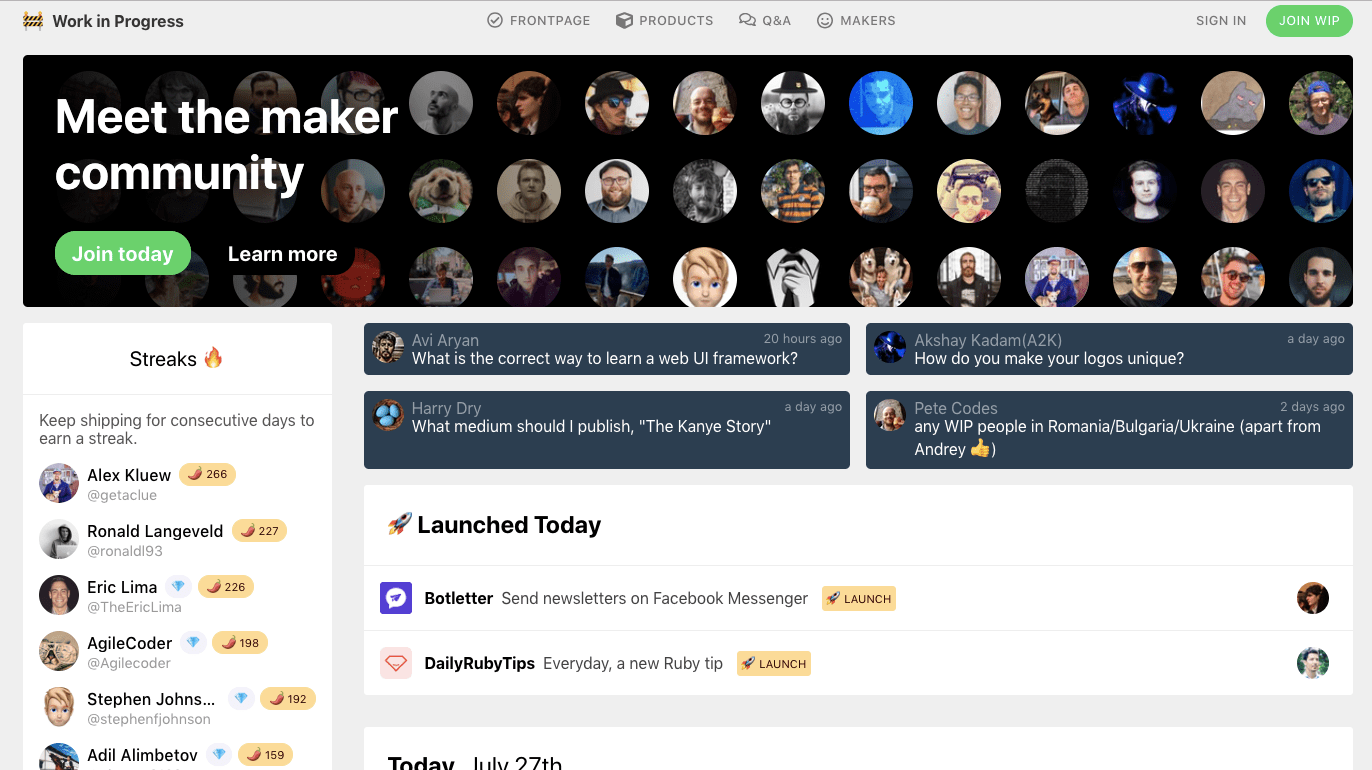
Work in Progress is one of my favourite new communities. Members can share what they’re working on, get help from others, and be accountable to other members to keep their streaks going (were it not for the membership fee, they would have tens of thousands of members by now).
The community began as a tiny Telegram group with a few friends sharing what they had done or were working on. The accountability part took off and has now morphed into an entire community for people to share what they’re working on. They can earn streaks for posting several days in a row.
Work in Progress serves as an important lesson too about the range of possibilities for building a brand community today. It’s a place where you share your current projects, get help from others, and see projections in motion rather than the completed set.
Three lessons here are important.
First, test any concept in a small group first. If you can’t get the behaviors here, don’t build the community yet.
Second, if you want to enter a very competitive space, another forum-based platform doesn’t cut it. You’re going to need to build your own technology.
Third, communities that produce end results (actions) are better than members simply talking. Once you go beyond discussions as the main goal, you have an infinite number of possibilities for what the community can be.
There is no sector, even technology (by far the most popular sector for building communities) that’s too competitive to build a community. If you can identify the right use case, you can build a community that no-one has even tried to build before.
You can see the cauliflower ancestry in Caulilini Sweet Stem Cauliflower, a new vegetable with a delicate, lacy ivory crown. Caulilini is grown by Mann Packing in Salinas, Calif., and is now in New York stores. Mild in flavor and acceptable raw, caulilini will be tender after a five-minute steam and an ice-water shock. Bathe whole clusters of the flower-topped stems in butter or marinate them in a vinaigrette. Use small clusters of the flower tops to garnish a soup, like a cold cauliflower velouté.
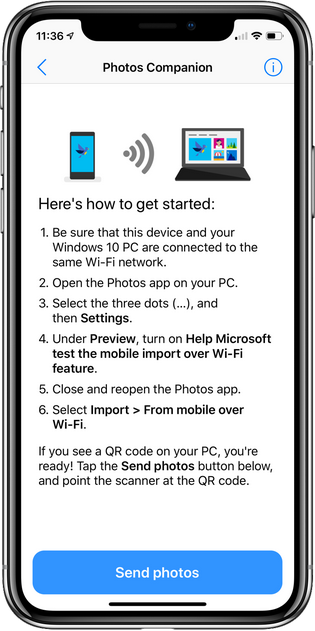
The Microsoft Garage Project Photos Companion lets you send photos from your camera roll to the Photos app on Windows 10. No pairing necessary. They just need to be on the same Wifi and you scan a QR code on your PC to establish the connection. Transfer is blazingly fast.
Die Spatzen pfeifen es von den Dächern, Apple Pay kommt "later this year" nach Deutschland. Welche Banken? Ich würde sagen, alle die nicht total verblödet sind. Die innovativen sowieso, aber sicher auch die Big Mäcks, wie Deutsche etc.
Warum? Apple Pay ist sensationell einfach. Nicht erst eine spezielle App laden, sondern mit Doppelklick aufwecken, mit Touch ID oder Face ID anmelden und das Terminal antippen. Bei der Apple Watch ist es noch einfacher: Taste unter der Krone doppelt drücken und Uhr ans Terminal halten.
Aktuell wird das Verfahren, mit dem man eine Bank- oder Kreditkarte hinzufügen kann, in Deutschland noch nicht angeboten. Wer ein ausländisches Konto einer unterstützten Bank hat, wechselt einfach in den Einstellungen in dieses Land und kann dann seine Karte hinzufügen und danach problemlos auch an Kassen in Deutschland einsetzen, wenn sie kontaktloses Zahlen erlauben. Rewe, Aldi, Tankstellen, etc.
Warum jetzt erst in Deutschland? iOS 12 bringt anscheinend Support für die in Deutschland weiter verbreiteten EC-Karten. Deshalb auch "later this year". Erst iOS 12, dann Apple Pay.
In Change the old or build the new?Lee Bryant muses on the role that technology may play in the difficult work of organizational change, He points out that there are three main models for changing hierarchical organizations into something flatter: a ‘benevolent dictator’ like Zhang Riumin or Riccardo Semler introduces sweeping change from above, a company hits the wall and the ‘surviving pieces’ can be smooshed together into something better than before, and a third sort, where change begins from below and ‘becomes the new normal’.
Bryant captures the dissociative identity of change agents in these organizations-in-flux, how they can feel like outsiders when tinkering at the DNA of slow-to-move organizations. But his final vision perfectly matches by belief in the role of platforms to paradoxically liberate organizations more organically through technology:
Rather than focussing on changing every aspect of the old organisation, which is sometimes impossible, it often makes sense to build out, connect and map a new organisational infrastructure that is natively digital, networked and service-oriented, rather than just an adjunct to a ‘manual’ process-driven organisation. But this will require a new approach to organisational technology, one that aims to create operating systems that can coordinate work better than hierarchical management, rather than just tired old enterprise software that calcifies and makes permanent the worst aspects of command and control management thinking.
Yes, platforms that do not just pave the cowpaths, but reanimate and rechannel people’s commitment to their work, their connections to each other, to suppliers, partners, and customers: finding place and purpose in the ecosystem that platforms underlie and engender. Platforming change may be the simpler, and more direct trajectory to a new business operating system.
Bryant has some other great links in his post, too.
On Platforming Change was originally published in Work Futures Institute on Medium, where people are continuing the conversation by highlighting and responding to this story.
Logo used for education and illustrative purposes. This is not an official publication and I am not an agent of the OLA.
In an effort to keep informed and politically active I’m watching the proceedings of our new provincial government here in Ontario. This is new for me. The closest I got to reading about governance was skimming a copy of Robert’s Rules of Order to help me chair meetings while I was President for three years of the anime club in University.
Yes, your nerd alert is working just fine.
Anyhoo, given my newness to all this please forgive as I belabour explanations or express confusion of long-held parliamentary weirdness. I’ll try to confine them to procedural notes so they aren’t too bothersome.
So, following the Ontario General Election in June, we ended up with the 42nd Parliament comprising a majority government of 76 Members of Provincial Parliament (MPPs) from the Progressive Conservative Party of Ontario (PC), the official opposition of 40 MPPs of the New Democratic Party of Ontario (NDP), and eight independents: seven from the Liberal Party of Ontario and one from the Green Party of Ontario.
Procedural Note: How are the Liberal MPPs and the Green MPP at the same time members of political parties (and having amongst them the heads of their parties, no less) but listed as independent? Governing the Legislative Assembly of Ontario are rules and regulations including Standing Orders. Standing Orders govern Members of the House differently if they are part of a “recognized party” (defined as a caucus of eight or more members). Since neither the Liberals nor the Greens have eight members, they are not “recognized parties” and are thus independent. This means they have some restrictions placed on their participation in legislative business. For instance they don’t have a right to as many questions as they’d like to field during Question Period (current practice is to give one member one question and one supplemental question each period), and they have much less time to do things like debate the Throne Speech and make inaugural remarks and other Statements.
As the party with the most number of MPPs the PC Party formed the government. Since they have a majority and we have strong party discipline in Ontario, they will not be defeated by a lack of confidence and instead will (barring unusual events) remain in power for their full term of four years and will likely implement their party’s platform citing a strong mandate from the people.
Procedural Note: With 76 of 124 seats it would seem that the PC mandate is strong, but Ontario is a First Past the Post system of representative democracy (each district elects a member to represent that district using a plurality vote). This results in some disproportionality. The Ontario General Election in 2014 had a Gallagher Index of 12.46 (the Canadian Government’s 2016 Special Committee on Electoral Reform recommended the reform of the federal electoral system to choose a method with a typical index less than 5). The election this past June had a Gallagher Index of 17.75, so it isn’t exactly proportional, but the PC Party did receive the highest proportion of the votes.
Even before the 42nd Legislature sat on July 12, the new government took action. Controversially they hired for $1M an ex-head of the PC Party known for underfunding and then shutting down hospitals to oversee an advisory panel charged with helping improve healthcare province-wide. This has featured in many Statements of Members and Questions, which is why I bring it up.
Eventually on July 12 the new government gathered to sit in Queen’s Park in Toronto to start official business. There’s technically a first Bill read and passed by the legislature, the pro forma “Bill 1” that shows we don’t need the Crown in order to legislate, but things really start going with the Throne Speech.
In Monarchies the Throne Speech is the Monarch handing down the priorities for their government to focus on in the coming years. In a Constitutional Monarchy like Canada, the Throne Speech is written by the Cabinet Ministers of the Government and is just read by the representative of the Crown. This was particularly interesting as Ontario’s representative of the Crown, Lieutennant Governor the Honourable Elizabeth Dowdeswell, is a staunch environmental conservationist (has been since the 80s) and she was given a speech to read that announced the end of carbon taxes and cap-and-trade without any particular replacement to keep polluting industries in check. This was commented upon by the Opposition.
The Throne Speech was just about what was expected from the Election. The priorities of the Government will be to: “reduce gas prices”, “lower your hydro bills”, “provide… tax relief to parents, small businesses and the working poor”, “scrapping the cap-and-trade carbon tax”, “make sure Ontario’s best interests are reflected in the NAFTA negotiations”, “reducing the regulatory burden”, “[call] a commission of inquiry into the financial practices of government”, “[perform] a thorough line-by-line audit of all government spending”, “return Ontario to a balanced budget”, “15,000 new long-term-care beds over the next five years and a historic new $3.8B investment in mental health and addictions”, “[replace] failed ideological experiments in the classroom with tried and true methods that work” (here meaning “discovery math” and the current sex-ed curriculum), “build a world-class transit system [in the Greater Toronto Area]”, “[cancelling] green energy contracts [imposed on rural municipalities]”, “freeing [police officers] from onerous restrictions that treat [them] as subjects of suspicion and scorn”, “expand the sale of beer and wine to convenience stores, grocery stores and big box stores”
Notable absence: Reconciliation with Indigenous Peoples.
Some of these priorities can be enacted through general Government business, but most of the big stuff will require legislation. And that’s where I expect to focus most of my time unless something from the Hansard (the parliamentary transcripts) sticks out.
So, Bill 1 was pro forma and we can ignore it.
Bill 2 is titled “Urgent Priorities Act, 2018” and is an omnibus Bill (a Bill that deals with more than one thing) of three parts:
1. “Hydro One Accountability Act, 2018” will require Hydro One reform and publish executive compensation amounts subject to the wills of the Treasury Board (which is now chaired by Peter Bethlenfalvy who sharp-eyed readers might remember as co-president of DBRS Ltd. when it decided to downgrade Ontario’s debt ratings in 2009). These provisions expire at the beginning of 2023 for some reason.
2. “White Pines Wind Project Termination Act, 2018” requires that the nine-turbine wind generation project in Prince Edward County be scrapped mid-construction. This’ll cost around $100M, and may result in lawsuits (despite clauses in the legislation that hope to curtail legal action).
3. “Back to Class Act (York University), 2018” appears to be standard back-to-work legislation for the teachers at York who have been striking since March.
Bill 2 received Royal Assent on July 25 (with division, meaning that not everyone was happy with this), so these things are happening. Schedule 1 is a big ol’ shrug from me… it will discourage Hydro One from being able to hire competent leadership to replace the ones that are being ousted, but I don’t really have a problem with the publication requirements. Honestly I think we’d be better served with a return to public ownership. Schedule 2 is a sad waste of money and will cost us in contractor trust (would you accept a contract knowing the last one was scrapped without consultation?) and in forwarding our green energy plans (we need something to replace the 18% of our electricity generated by burning gas/oil). Schedule 3 isn’t my circus, so I don’t have an opinion on it.
Bill 3 is titled “Compassionate Care Act, 2018” and is general government business instructing the Ministry of Health and Long-term Care to set out a framework for hospice care with reporting requirements. No members dissented the readings and it has been referred to committee for implementation.
Bill 4 is titled “Cap and Trade Cancellation Act, 2018” and is a straight-up repeal of “Climate Change Mitigation and Low-carbon Economy Act, 2016”. The only nod to environmental caution is that the government must now set new targets for greenhouse gas reduction, and must develop a plan to meet them. There are no timelines on those requirements. The outstanding cap and trade credits will be bought by the government at some cost. First reading was completed July 25 (with division).
Bill 5 is titled “Better Local Government Act, 2018” and messes with the wards of the City of Toronto and how the heads of councils of Regional Municipalities are selected: Muskoka, Niagara, Peel, and York will now be appointed. Durham, Halton, and Waterloo by general vote. This confuses me. Why mess with these things? Is Premier Ford still tied up in how he couldn’t win the Toronto City election? Why bother with this at all? First reading was completed July 30 (with division).
In addition to the big-ticket Bills, we also have Motions. They can be of the Government, or they can be of private Members.
The Government Motions of the month are fairly boring. Most are procedural (including the creation of Standing Committees), there’s one fast-forwarding the acceptance of Bill 2 by limiting debate and division (which may give political leverage later if these things blow up, which White Pines may do), and there’s one expressing the opinion of the House that it has a clear mandate of the people (grandstanding on the Party Platform).
Strangely of more interest are the Private Members’ Motions. Many of these are filed and ignored, some of them are passed. The ignored ones fell in three camps: there were a flurry of them asking that Bill 2 be paused until the extent of financial and legal liability under the bill might be assessed, which were all ignored. Bill 4 was also asked a few times to be sent back until it can be found in compliance with the Environmental Bill of Rights, 1993 (which provides many rights to citizens to challenge bills like Bill 4). We’ll see if any of those stick before Second Reading. Similarly, Bill 5 was challenged on the grounds of needing public consultation. To me this seems a weaker argument of challenge, but maybe the Opposition is building a case that the “Government For the People” really isn’t that interested in the people as much as they claim.
Of passed motions there were two: one from Mrs. Fee (PC of Kitchener South — Hespeler) expressing the opinion of the House that the Federal Government owes $200M related to the costs of illegal border crossers. (that choice of language is atrocious both morally and grammatically). The other was Jill Dunlop (PC of Simcoe North) moving that the Government of Ontario should “expedite the creation of sufficient skilled trades people to make skilled labour a competitive advantage for Ontario”, which carried without division (and I can see why as this is the reality we face).
The most circus-like aspect of the Legislative Assembly of Ontario is the Question Period where the Opposition is given an opportunity to call the Government into account, and the Government answers the questions by speechifying, reiterating talking points, and failing to answer the question. The Government also asks itself questions as an opportunity to do the same without having to think on its feet. All this grandstanding results in several standing ovations and lots of failure to keep to temperate language, remember to address comments through the Speaker, and maintain the decorum of the House. A recent illustration of this came on July 31 when the Speaker had to call a Recess early in Question Period. Relevant portion is 25:50 to 35:28:
At 27:57 the sound mix was adjusted so we could only hear the Speaker, but what happened (as the Speaker tells us at 34:43) is that something may have been said that caused general uproar in the House including the Premier and the Leader of the Opposition. The Speaker couldn’t get the House to order by asking so called a 5-min Recess (from 29:00 to 34:43). And from then on the Government refused to answer the Opposition’s questions under Standing Order 37(h) which simply states “A minister may, in his or her discretion, decline to answer any question.”
Reading of later answers by the Government paints that they heard a comment mocking the Member for Mississauga East–Cooksville (the one asking the question) from Gilles Bisson, the Official Opposition’s House Leader. Specifically I think the comment heard was to do with diversity or the Member’s Pakistani heritage since the Government’s House Leader keeps reiterating the Member’s ethnicity and the PC’s diversity of Members.
The Opposition continue on with Question Period gamely. Mr. Bisson denies the charge and as a point of order references Standing Order 23(h) and (i) which states you can’t make “allegations against another member” and impute “false or unavowed motives to another member”.
We’ll see if this continues in August 1st’s Question Period.
And that’s the extent of government business this month. The Opposition’s current points are extremist views are behind repealing the sex-ed curriculum, short-sightedness is behind Hydro One meddling, cronyism is behind everything, and the Premier’s insecurities are behind the municipal election meddling. The Government’s current points are respecting the taxpayer, respecting the ratepayer, Toronto needs provincial meddling to break its political deadlocks, cap-and-trade costs taxpayers, smaller government at all levels, and a little bit of gloating that they have a majority and the NDP doesn’t.
Some general governing, some truly annoying failure to answer questions, some truly peculiar nonsense, and just enough bad ideas to remind you why 60% of Ontarians voted against the Progressive Conservatives.
Should free-speech gun advocate Cody Wilson be able to provide you with shape files and instructions to create a 3D-printed plastic gun? That’s a question that forces freedom-loving people to think hard about which freedoms they support. Wilson and his company Defense Distributed sued the government, which was blocking his plan to put the gun … Continued
Elon Musk has tweeted out that an upcoming update will allow Tesla owners to use the vehicle’s power when parked.
In 2017 the electric car manufacturer released an update lets users keep climate control running while the car is parked.
This new update seems to take that concept to the next level and to all of Tesla’s vehicles, with the Roadster being the only exception.
We’re adding a “party & camper mode” soon to S/3/X, so your car can maintain air flow, temp, selective lights, music & power devices for 48 hours or more while parked. Big batteries rock …
As Musk’s tweet outlines, the update will allow Tesla owners to use their car’s battery while it’s in park in order to power the vehicle’s speakers, lights, climate control and what seems to be USB ports.
This is going to be extremely helpful for people who like to go camping or might find themselves sleeping in their car due to other circumstances.
It’s worth noting that there are already workarounds that allow Tesla owners to utilize their car’s power when it’s parked. A user on Reddit claims that they were able to sleep in their car by putting the vehicle in neutral and engaging the parking brake.
It will be interesting to see what exactly the update does given that it seems like vehicles will only be able to run select features when parked. Ideally this means it’s going to use a lot less battery than when the car is driving.
Musk claims that the new mode runs for 48 hours. Does this mean that after that time period the vehicle’s battery is dead? While this seems unlikely, there’s a number of questions that need to be answered once this new feature starts rolling out.
This is lovely. Quirk is a quantum computing circuit simulator. It takes me back to my days of doing machine language programming on silicon computers - except all the commands are different. Weird. You'll want to watch the introductory video before messing around with the simulation. For the enthusiasts, the code is on GitHub. (This, by the way, is how we learn advanced concepts in technology now - forget classes and textbooks - give me a simulation, intro video and code any day. And a Stack discussion channel to niggle about it.
I wonder what the number would be globally. As this article reports, "In April, a research study commissioned by Credential Engine counted at least 334,114 credentials in the U.S." Credential Engine is a non-profit trying to get a handle on the proliferation of educational credentials. I think they've found a pain point. Because there are so many credentials, it's easy for people to fake credentials, or to qualify for bogus credentials. We can go in one of two directions: we can manage credentials in such a way as to ensure that they are trustworthy. Or we can find a more trustworthy was of assessing qualifications directly. I prefer the latter.
In this discussion of two market-research based studies of online learning we have this comment: "what appears to be absent in this construction of students as data generators is any appreciation of emotion and, perhaps, a humanistic perspective of learning as a personal, agentive or transformative experience for learners." This shows the difference between the idea, encapsulated in market studies, of students as consumers, and the transformational role learning (and educational attainment) actually plays in a student's life. This article is an extended discussion of this theme, and made for interesting reading.
China’s leading smartphone manufacturer and communication giant Huawei stands firmly as the world’s second largest in terms of global smartphone shipment volume and market share in the second quarter of this year, International Data Corporation (IDC) said yesterday. Samsung remains as the leader with Apple placing itself in the third place. Huawei overtook Apple in […]
Had lunch with my friend Buzz Bruggeman, CEO of ActiveWords, this week. Got a chance to look at some of the improvements in the pipeline. Not quite enough to persuade me to move back to Windows, but I do wish there was something as clever and powerful for OS X.
It led me to thinking about what makes some people more effective leveraging their tools and environment. Most of the advice about personal technology seems to focus on micro-productivity; how to tweak the settings of some application or how to clean up your inbox.
ActiveWords, for example, sits between your keyboard and the rest of your system. The simple use case is text expansion; type “sy” and get an email signature. Micro-productivity. If you’re a particularly slow or inaccurate typist and send enough email, perhaps the savings add up to justify the cost and the learning curve.
Watching an expert user like Buzz is more interesting. With a handful of keystrokes, he fired up a browser, loaded the New York Times website, grabbed an article, started a new email to me, dropped In the link, and sent it off. Nothing that you couldn’t do with a some mouse clicks and menu choices, so what’s the big deal? I’m a pretty fair touch typist; how much time can you really expect to save with this kind of tool? Isn’t this just a little bit more micro-productivity?
There’s something deeper going on here. What Buzz has done is transform his computer from a collection of individual power tools into a workshop for doing better knowledge work. It’s less about the tools and more about how you apply them collectively to accomplish the work at hand.
How do you study knowledge work with an eye toward turning out better end results?
We know how to do this for repetitive, essentially clerical, work. That’s the stuff of the systems analysis practices that built payroll systems, airline reservation systems, and inventory control systems. Building newer systems to take orders for books, electronics, and groceries still fall into the realm of routine systems analysis for routine work.
Most of this, however, isn’t really knowledge work; it’s factory work where the raw material happens to be data rather than steel. So the lessons and practices of industrial engineering apply.
What differentiates knowledge work from other work is that knowledge work seeks to create a unique result of acceptable quality. It is the logic of craft. One differentiator of craft is skill in employing the tools of the craft. Watching Buzz work was a reminder that craft skill is about how well you employ the tools at your disposal.
How do we bring that craft sensibility into our digital workshops? How do we create an environment that encourages and enables us to create quality work?
The way that Buzz employs ActiveWords smooths transitions and interactions between bigger tools. It also shifts attention away from the specifics of individual tools and towards the work product being created.
Consider email–a constant thorn for most of us. You can treat each email as a unique entity worthy of a unique response. You can perform an 80/20 analysis on your incoming email flow, build a half dozen boilerplate responses, program a bot to filter your inbox, and hope that your filters don’t send the wrong boilerplate to your boss.
Or, there is a third way. You can perform that 80/20 analysis at a more granular level to discover that 95% of your emails are best treated as a hybrid mix of pure boilerplate, formulaic paragraphs that combine boilerplate and a bit of personalization, and a sprinkling of pure custom response. Then you can craft a mini-flow of tools and data to turn out those emails and reduce your ongoing workload.
I can visualize how this might work. The tools are an element, but I’m more intrigued by how to be more systematic about exploring and examining work practices and crafting effective support for knowledge work.
Have others been contemplating similar questions? Who’s doing interesting things worth exploring?
Facebook removed 32 pages and accounts involved in ‘inauthentic behaviour’ from both the Facebook and Instagram platforms.
The move comes as part of the social network’s ongoing battle against bad actors. These malicious groups use the social network to mislead others. While it’s still early in the company’s investigation, Facebook released information the platform gathered to the public and law enforcement agencies.
Facebook discovered that more than 290,000 accounts followed at least one of the pages. The actors created the first page in March 2017 and the most recent in May 2018.
The pages had more than 9,500 organic posts and one post on Instagram.
Additionally, the pages ran about 150 ads for approximately $11,000 on both platforms. The ads were paid for in American and Canadian dollars. Ads ran between April 2017 and June 2018.
Finally, the pages created about 30 events since May 2017. The largest event had roughly 4,700 accounts interested in attending and 1,400 who said they would attend. About half the events had fewer than 100 accounts interested in attending.
Facebook also says the bad actors were most careful to cover their tracks. This is likely due to actions Facebook took to prevent this kind of abuse. Some behaviour is consistent with the Russian-based Internet Research Agency (IRA) behaviour preceding and following the 2016 U.S. elections.
Furthermore, the social network found connections between some disabled IRA accounts and these accounts.
One of the accounts created a Facebook event for a protest in Washington, DC. Inauthentic admins from the page connected with five admins from legitimate pages to co-host the event. Without knowing it, these five admins helped build interest in the event, as well as posted information about transportation, materials and locations so people could get to the event.
Facebook disabled the event and will inform the approximately 2,600 users interested in the event about what happened.
The social network is still working to learn more about these bad actors and who they are. Facebook says it will release more information as it learns more.
This is a solid change for the company. It’s good to see the company working to shut down bad actors and abuse on the platform instead of failing to remove it.
While Google is building notch support into Android P, a recent developer blog post states that the tech giant is limiting the number of notches a single device is capable of featuring.
That limit is, unsurprisingly, to only two notches per phone.
The blog post, written by Android UI product manager Megan Potoski, says that the company is working with manufacturers to create requirements for app compatibility purposes, with one of these specific app requirements being related to notches.
This means that any handset running Android P can’t feature more than two cutouts. Further, it explains that notches can only be located at the top or bottom or a smartphone.
While we’ve seen rumoured phones with two notches, thankfully no device at this point has been released that features dual notches.
Most apps will expand the status bar on the screen — seen with Android smartphones where you’re able to hide the notch — and won’t cut off part of the app. However, developers will have the choice of allowing their app to wrap around the notch.
This is a feature already present in apps like Android Messages, Google Maps and Gmail.
According to Google, there are currently 16 Android phones with notches from 11 different companies. That number is almost certainly set to increase in the coming year.
Android P will likely be released before the end of the summer.
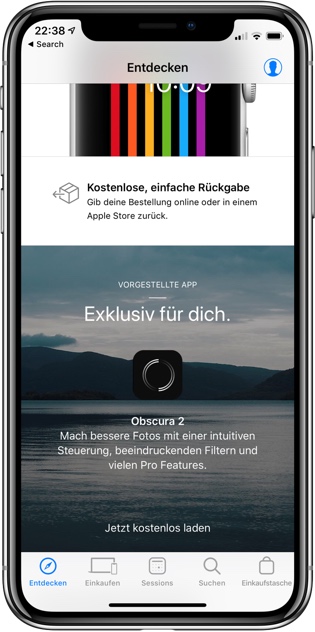
In der Apple Store App, nicht im App Store, gibt es aktuell einen Gutschein, mit dem man Obscura 2 kostenlos (statt für 5,49 ) erwerben kann. Keine Registrierung oder ähnliche Fallstricke.
'We’re thrilled to report Apple’s best June quarter ever, and our fourth consecutive quarter of double-digit revenue growth,' said Tim Cook, Apple’s CEO. 'Our Q3 results were driven by continued strong sales of iPhone, Services and Wearables, and we are very excited about the products and services in our pipeline.'
Telus has activated cellular coverage between Hope and Princeton on British Columbia’s Highway #3.
Residents have been calling for cellular coverage in this area for well over a year now. Without the ability to call for help, highway travellers involved in accidents have frequently had to hope that strangers passing by would be able to assist them. In fact, one driver died in March 2017 after being trapped in his overturned truck on a steep embankment below the highway for two days.
The Manning Park Resort, which is located along the highway and says it frequently helps in nearby accidents, says it’s happy about the added cellular service. “We are supportive of bringing cell service along the highway, as many people have safety concerns about driving Highway #3,” said Vern Schram, general manager of Manning Park Resort. “We are hoping that this will alleviate apprehensions about driving it.”
Schram estimates that the coverage will reach about 500 metres on either side of the highway around his resort. However, coverage is not expected to reach beyond the highway corridor. Therefore, travellers are advised to remain cautious when travelling in the backcountry of E.C. Manning Park.
It’s also important to note that recent re-paving efforts from Sumallo Flats to Allison Pass on Highway #3 are also nearing completion.
What Weight Watchers teaches us about motivation I’ve had to keep an eye on my weight since my first (medically supervised) diet at age 13 (13 year olds aren’t supposed to have high blood pressure). My mom (also a nurse) helped my follow a Weight Watchers inspired diet and it worked. Now flash forward a […]
I spent a couple of hours this morning at a roundtable discussion
listening to area tech employers talk about their work and their
companies' needs. It was pretty enjoyable (well, except perhaps
for the CEO who too frequently prefaced his remarks with "What
the education system needs to understand is ..."). To a company,
they all place a lot of value on the projects that job candidates
have done. Their comments reminded me of
an old MAA blog post
in which a recent grad said:
During the fall of my junior year, I applied for an
internship at Red Ventures, a data analytics and
technology company just outside Charlotte. Throughout
the rigorous interview process, it wasn't my GPA that
stood out. I stood out among the applicants, in part,
because I was able to discuss multiple projects I had
taken ownership of and was extremely passionate about.
I encourage this mentality in my students, though I think
"passionate about" is too strong a condition (not to mention
cliché). Students should have a few projects that they
are interested in, or proud of, or maybe just completed.
Most of the students taking my compiler course this fall won't
be applying for a compiler job when they graduate, but they will
have written a compiler as part of a team. They will have met a
spec, collaborated on code, and delivered a working product.
That is evidence of skill, to be sure, but also of hard work and
persistence. It's a significant accomplishment.
The students who take our intelligent systems course or our
real-time embedded systems will be able to say the same thing.
Some students will also be able to point to code they wrote for
a club or personal projects. They key is to build things, care
about them, and "deliver", whatever that means in the context of
that particular project.
I made note of one new piece of advice to give our students,
offered by a former student I mentioned in
a blog post
many years ago who is now head of a local development team for
mobile game developer
Jam City:
Keep all the code you write. It can be a GitHub repo, as
many people now recommend, but it doesn't have to be. A simple
zip file organized by courses and projects can be enough. Such
a portfolio can show prospective employers what you've done, how
you've grown, and how much you care about the things you make.
It can say a lot.
You might even want to keep all that code for Future You. I'm old
enough that it was difficult to keep digital copies of all the
code I wrote in college. I have a few programs from my undergrad
days and a few more from grad school, which have migrated across
storage media as time passed, but I missing much of my class work
as a young undergrad and all of the code I wrote in high school.
I sometimes wish I could look back at some of that code...
Most tech trends, one way or another, eventually make their way to Canada. The latest, if recent investments by Uber and Google Ventures are any indication, is in electric scooter rentals – a craze currently sweeping across SF like a virus in an anti-vaxxer (the social antibodies are doing their best, however).
What’s the reason? Is it a deep-seeded hunger for “new modalities” covering that “last mile” of transportation? The continued embracing of trends led by Chinese entrepreneurs? Maybe it’s something more simple than that.
Take the ‘transit pod’, for example. It’s a new product in development by Lime – an enclosed, electric vehicle that would drive on city streets at up to 64 kilometres an hour. When is a car not a car? When it’s built to skirt a city’s laws, regulations, and good sense. True disruption!
Speaking of disruption, Dell (CanCon’s presenting sponsor!) recently hosted its annual DWEN conference in Canada for the first time. Along with it came a new report outlining how Toronto can disrupt the status quo and better support women entrepreneurs. Sarah Stockdale joins the CanCon crew to explain why We Need to Talk About This.
OmniFocus for the Web is getting close to testing — and you can sign up to help! Log in to your Omni Sync account, and then scroll down to the “OmniFocus for the Web Test” section to join the testing group.
Look for the testing icon:
Once it’s ready, we’ll notify you and let you know how to get started.
A few important notes:
It’s a web app that runs in your browser (Safari, Chrome, etc.) — it’s not an app that you download
It’s a companion to OmniFocus 3 for iOS or Mac — it’s not a standalone app
This early version requires that you have OmniFocus 3 for iOS
It’s designed for people who need OmniFocus access while on a Windows or Linux computer (at work, for instance)
It’s not currently designed for Android or any other devices with a touch interface
For more about OmniFocus for the Web, read the section at the end of the Omni Roadmap 2018 about it, or listen to the episode of The Omni Show with CEO Ken Case where he talks about the roadmap.
Ontario Place was a jewel on the Toronto waterfront for 40 years before declining attendance caused the government to shut it down in October 2011 for the last time. Plans were immediately announced that major renovations were planned and the park would re-open in time for Canada 150 in July 2017. This didn’t happen and a change of provincial governments threatens to derail the project further. I decided to take a walk around the park and see what is going on these days.
Ontario Place was designed by Toronto architect Eberhard Zeidler. A large part of the concept for Ontario Place came from the idea to have large display pods built over the water. The idea likely was inspired by Expo 67 where Pods were built over the Saint Lawrence River in Montreal. Three artificial islands were created in the harbour that are connected to the mainland by three bridges. The central bridge connects to the set of pods which make up the middle island. The five elevated pods are interconnected as they stand above Lake Ontario. Each pod is a three story structure that encloses 743 square metres of space. Originally used for multimedia exhibitions, they were intended to be flexible and accommodate other uses over the years.
This is the seventh season that Ontario Place has been largely abandoned although it does appear to be open as I was not challenged by the staff I passed on the bridge. The entire time that I spent walking through the park I met less than twenty other people. It truly felt like walking through a ghost town.
In the 1980’s over 3 million people per year visited the park but by 2010 the number was down to only 10% of that. The log fume on the west island was always sure to soak the riders, a welcome treat on a hot day.
The park was in a continual state of development with new attractions being added as the years went by. The original pods were not the raving success that was envisioned but the idea of showcasing the northern part of the province was seen as a way of potentially attracting professionals to relocate north where there was a shortage of people. In 1980 silos were constructed that resemble farm silos that stand across rural Ontario. The wildlife displays didn’t do as well as expected and the silos were eventually converted into additional rides.
The Cinesphere showcased the world’s first permanent IMAX projector on a screen that was 24 metres wide and 18 metres high. The dome is 35 metres wide and when it opened in 1971 it became the icon of Ontario Place. It was so successful that there was a regular line-up to get in. On a school trip we saw a movie called Snow Day in which it felt like we were in a school bus running out of control on snowy roads. A good choice for kids who had arrived via school bus. Cinesphere was closed in 2012 along with the rest of the park but in 2014 the dome was given a cultural heritage designation. As of 2017 the theater is open again on a full time basis with state of the art equipment.
March of 1969 saw the first activity in the building of Ontario Place and it opened just over two years later on May 22, 1971. Construction of the Cinesphere and the pods is seen in this 1970 photograph from the Toronto Archives.
The design called for display pods suspended over the water to display the scientific and technological wonders of Ontario. Constructing the pods over open water became an engineering problem and the costs mounted to the point of consuming the budget. To reduce the costs a protective break wall was designed using three obsolete lake freighters. They were sunk and filled with concrete to create a safe harbour for a marina. The ships can be walked out to the end where one of the bridges is open for exploration. The three ships anchors are also preserved on the third ship. The picture below shows the outline of two of the ships where they meet.
The 1970 photo below shows the three ships, reported to be the The Shaw, The Houghton and The Victorious in their positions with the west island being formed out of lake fill.
The pods are now underutilized and the iconic sets of stairs on the outside are peeling and no longer ring with the sounds of crowds filled with laughter.
The water park covered much of the east island and went under the name Soak City. A series of coloured water slides was installed in the 1990’s and was a popular attraction until the park closed. The slides remained in place until May of 2016 when they were disassembled to prevent a potential injury to people who insisted on climbing up and even rollerblading down them. Today the central support tower is all that’s left except for a few abutments to mark the site of the water park.
Trillium Park, containing the William G. Davis Trail is the first part of Ontario Place to get a completely new lease on life. This area was formerly a 7.5 acre parking lot. Today it has been converted into a lush green space with a 1.3 kilometre trail named after Bill Davis who was premier on Ontario in 1971 when Ontario Place first opened. The trail passes through an artificial ravine and contains the Moccasin Marker. The carvings on either side of the ravine are intended to remind us of those who were here before us.
I picked a good time to visit as the Indy was on and parts of Lakeshore Avenue were closed for the race. I decided to park at Budapest Park and walk part of the Martin Goodman Trail to reach Ontario Place. I used the Bruce Trail App to track my walk which came out to 10.4 kilometres. By parking at Ontario Place you can explore the area with three or four kilometres worth of walking. Be sure to make the walk along along the three sunken ships that is represented by the tail extending out into the lake on the map below.
Having visited the park in 1972 or 1973 with my aunt and uncle, both of whom have passed on, I have fond memories of an Ontario Place that was vibrant and full of people. It’s sad to see what has become of our waterfront park especially when there is no clear timeline for completion of the renovations.
As a parting thought, would you have wanted this job building the Cinesphere?
Starting in 1959 the Bruce Trail was conceived and developed with the northern terminus being unveiled in 1967. The trail covers 890 kilometers between Tobermory and Queenston.
For those in the GTA we are lucky because the Bruce Trail runs across our doorstep with large parts being accessible within an hour from midtown Toronto. The Toronto Section covers 50 kilometers of main trail and 55 additional ones of side trails between Kelso and Cheltenham. Exact maps of this section can be purchased from the Bruce Trail maps covering maps 11-14 and a more general overview is seen below. For slightly more than the price of four maps you can buy the Bruce Trail App for your phone. It does pretty much everything except hike the trail for you. The annual section end to end hike is scheduled for September 8-9, 2018 and covers an area that has been explored both in terms of the trail and local history in a number of stories. Hiking the GTA has put together a series of links to these local treasures along the trail.
The trail section starts at Kelso if you are hiking from the south toward the north. The conservation area has many of it’s own trails and the area was once home to a lime industry. Two kilns remain near the main trail.
Just a short distance north of the 401 the Hilton Falls side trail runs for 9.2 km and let’s you visit the falls with the remaining portions of the original mill.
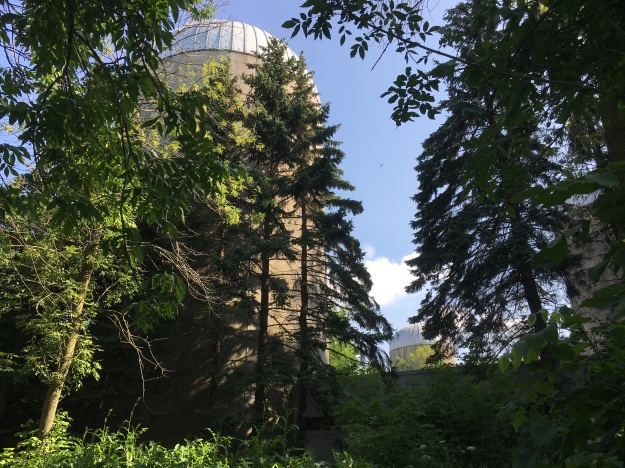
The trail follows the edge of the escarpment and passes The Gap created by Dufferin Quarries in 1962 to allow extraction of aggregates from an open pit mine. The trail crosses the gap on a bridge allowing you to see the restoration efforts that will eventually turn this area into a parkland. The aptly named Restoration Side Trail will let you have a view of the restoration process in a closed section of the pit.
After passing through the Scotch Block the trail leads to Speyside. This little community has one of Ontario’s only heritage trees. In 1937, to celebrate the coronation of King George VI on May 12th, acorns from Windsor Park in England were sent all across the commonwealth. The Royal Oak Of Speyside was planted by the local school children.
Several side trails extend from the main trail over the next few kilometres. One of these, The Canada Goose Side Trail, leads through an old homestead and along the edge of another one of Dufferin Quarries limestone extraction operations.
The next heritage site along the trail is found at Limehouse where the remains of several lime kilns have been preserved. This area became well known for the production of lime used in the construction industry. One of the interesting artifacts is the restored powder house where the blasting powder was stored.
From Limehouse the trail continues north using a combination of trails and sections of roads until it reaches Silver Creek and Scotsdale Farm. One of the defining features of Fallbrook is the stone arch bridge that was built in the 1870’s. The stone for the bridge was taken from the decommissioned saw mill just downstream.
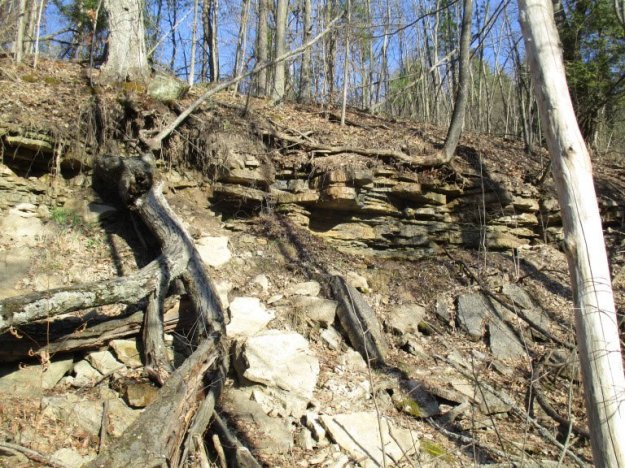
Silver Creek Conservation area is also home to the Irwin Quarry Side Trail. This trail leads to one of the 50 small quarries that have come and gone along the escarpment. The quarry was successful because the layer of soil on top of the limestone was very shallow allow for easy extraction.
The Credit Valley Footpath is another side trail that runs for almost 10 kilometres and leads to two historical sites. The Barber Paper Mills in Georgetown dates back to 1837 but unfortunately it is suffering from demolition through neglect.
A couple of kilometres farther downstream the Barbers erected the first dynamo in Canada to generate electricity and transmit it over wires to power a mill.
Meanwhile, the main trail carries on through the Terra Cotta Conservation Area. This park has many of its own trails and is home to a 12-metre plunge waterfall on Roger’s Creek.
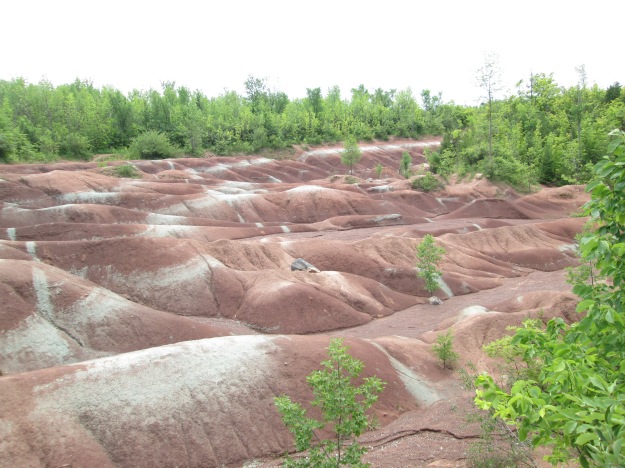
The Toronto Section of the Bruce Trail ends near the Cheltenham badlands. This area of Queenston Shale was exposed to erosion in the 1930’s and was crossed by the main trail until recently. The area had been closed for a few years because people wouldn’t stay on the trail and were increasing the erosion. A new parking lot and boardwalk have been installed this year to allow people to check it out up close.
The Toronto Section of the Bruce Trail, along with all the side trails, provide people in the GTA with quick access to some great hiking with plenty of views and historical artifacts.
Google Maps Links for the stories are included within the links.
Check out all three of our Greatest Treks compilations here: One, Two, Three
A teardown of the newest version of Google’s ARCore app revealed support for a number of upcoming devices, as well as support for the augmented reality (AR) platform’s first Chrome OS device.
Along with support for the Acer Chromebook Tab 10, Android Police‘s ARCore version 1.4 teardown revealed that AR compatibility is set for Google’s upcoming Pixel 3 and 3 XL smartphones.
One important note with teardowns: they dig into compiled files and code in an APK file. APKs are Android’s application packages and contain the information necessary for an app to run.
Teardowns look at these files and extrapolate information about upcoming features. Some of this information can be ephemeral and much of it can change at any time.
In the case of this particular teardown, the supported devices were listed by codename, and it was up to Android Police to match known codenames to upcoming and rumoured devices.
While the addition of codenames to the ARCore app doesn’t mean that support for that device is currently operational, it’s still a good sign.
Upcoming devices in ARCore 1.4
In addition to Acer’s new Chromebook for education — likely the most interesting device of the bunch, considering no other Chromebook has ARCore support — and the Pixel 3 and Pixel 3 XL, some Chinese manufacturers made the ARCore list as well.
Huawei made an appearance with its upcoming Nova 3 phone and another unknown device.
Vivo popped up with its NEX A and NEX S phones, as well as another device labeled Vivo 1805.
Finally, Xiaomi made the list, with its Mi 8 SE phone and a rumoured phone called Pocophone F1.
Devices manufactured by Japanese electronics giant Sony also made an appearance. The Xperia X Compact, Xperia X Performance, Xperia XZ2, the rumoured Xperia XZ3 and another unknown device were all included in the ARCore version 1.4 teardown.
Additionally, Lenovo-owned Motorola’s Moto X4, HMD-owned Nokia’s Nokia 8 and the rumoured ‘Phoenix,’ as well as RED’s Hydrogen One all made appearances.
Last but not least, South Korean electronics giant Samsung popped up with its Galaxy A6 and the rumoured Galaxy Tab S4.
While we may not see some of these devices for a while, Android Police’s teardown is further confirmation that new phones from a number of global device manufacturers are coming soon.
Back in May at Facebook’s F8 conference, the social networking giant announced that group voice and video calls were coming to WhatsApp — now the feature has finally arrived.
The update allows up to four people to chat simultaneously via video or audio. WhatsApp says the feature is built to work all over the world regardless of the speed of the user’s data connection. The new video calling feature is also end-to-end encrypted.
With users already spending over 2 billion minutes a day using WhatsApp for calling, that number is expected to increase significantly.
Apple’s financial results for the third quarter of 2018 reveal that the company posted quarterly revenue of $53.3 billion USD ($68 billion CAD), an increase of 17 percent over the same period a year ago.
In terms of specific device sales, Apple says that 41.3 million iPhones, 11.5 million iPads and 3.7 million Macs were sold this quarter. Compared to the same period last year, iPhone and iPad sales are only up one percent, while Mac sales are down 13 percent.
Further, the Cupertino, California-based tech giant states that international sales accounted for 60 percent of the company’s quarterly revenue.
Apple also posted $9.55 billion USD ($12.43 billion CAD) in software and services revenue for the third quarter, surpassing estimates of $9.21 billion ($11.98 CAD) and resulting in a 37 percent increase year-over-year. In Q3 2017, Apple’s services earnings amounted to $7.2 billion.
The tech giant expects fourth-quarter revenue to fall somewhere between $60 billion ($78 billion CAD) and $62 billion ($80 billion).
“We’re thrilled to report Apple’s best June quarter ever, and our fourth consecutive quarter of double-digit revenue growth,” said Tim Cook, Apple’s CEO, in a statement sent to MobileSyrup. “Our Q3 results were driven by continued strong sales of iPhone, Services and Wearables, and we are very excited about the products and services in our pipeline.”













 Had lunch with my friend Buzz Bruggeman, CEO of





 The Omni Group.


 Hiking the GTA.