Shared posts

14 Aug 21:02

Anchor Launches Listener Support, Helping Podcasters (and Itself) Get Paid

by Ryan Christoffel

As an app and service, Anchor is a compelling product that I'm personally a big fan of. It's the best way to podcast from an iPad, the most mature and accessible platform for new podcasters, and it includes innovative features like transcribed video generation for sharing clips on social media.

My one area of hesitation with Anchor has been its business model. The service is entirely free, and the company has never before shared its plans for any sort of monetization strategy. Today that changes, however, as Anchor is launching a Patreon-style listener support feature.

Starting now, any Anchor podcaster can choose to activate listener support for their show, which enables listeners to sign up for automatic monthly payments of $0.99, $4.99, or $9.99 to support the show. The implementation here is important, and Anchor is making it very accessible: a podcast support link will be automatically added to the show notes for each episode, making the link available no matter which podcast app a user listens through. This link takes users to the support page on a podcast's Anchor profile, with payments processed by Stripe and available via Apple Pay on iOS and Mac, or Google Pay on Android.

All support funds are subject to Stripe's standard fees, plus Anchor's own 4.5% cut, but the overwhelming majority of funds end up in podcasters' hands.

I think listener support is an interesting development for Anchor in two main ways. First, after working to democratize podcasting with its easy-to-use tools, it makes sense that Anchor now has its sights set on democratizing the payment of podcasters. Any podcaster with a decent following could use a third-party service like Patreon to get paid – and many do. And while Patreon isn't too much more complicated for listeners wanting to pledge support, it definitely brings more complexity to the side of podcasters. Using Anchor, a podcaster can flip a switch enabling any present and future listeners to offer support. Ultimately, complexity is diminished for both parties.

The second thing making this news significant to me is that it's the first sign of a monetization strategy for Anchor. It's very possible the service will still introduce an ad platform in the future, but whether that happens or not, this is a thoughtful first move. It's respectful to both podcasters and listeners alike, and as such it feels like a good fit for the service and its goals.

While I certainly don't want to see podcasting dominated by a single platform, the way video is owned by YouTube, I nonetheless continue to be impressed by Anchor. Whatever the company's future holds, it's a good thing making podcasting more accessible, and a good thing for podcasters to be rewarded for their work.

Anchor users can activate listener support from their dashboard on anchor.fm.


Support MacStories Directly

Club MacStories offers exclusive access to extra MacStories content, delivered every week; it's also a way to support us directly.

Club MacStories will help you discover the best apps for your devices and get the most out of your iPhone, iPad, and Mac. Plus, it's made in Italy.

Join Now
14 Aug 21:02

Two-Faced

by Daniel Joseph

In 2013, I decided that I would unload the surplus of “weapon skins” I had amassed playing Counter-Strike: Global Operations. These weapon skins — basically a different paint job for the guns used in the game — had become sellable on Steam, a platform for the digital distribution of games. Steam, which launched in 2003 as a tool to streamline updates for Valve Corporation’s games, is now the biggest distributor of PC games in the world, with a sizable monopoly on the market. Not only does it coordinate updates for games across millions of machines — increasingly important for games played online — but it functions somewhat like an app store, as a central repository for titles from a host of developers and as a tollgate mechanism that discourages piracy. It isn’t too surprising that the platform would eventually move into the complementary business of hosting marketplaces for in-game objects.

A few of my weapon skins were worth a few dollars; most went for less than a quarter. In selling them, it didn’t seem like I was entering into an especially consequential market. Rather it seemed a fairly straightforward and somewhat parochial matter of buying and selling an imaginary product tied to a specific game. But these products are, in every sense of the word, a real commodity and not the functionally useless digital cosmetics they might seem. They satisfy a human desire, and as Marx argued, whether “they spring from the stomach or from fancy makes no difference.” They are no less real than money (as the skins’ use in gambling schemes and money laundering proves).

Online platforms aren’t simply replacing stores by replicating their function. Instead they are making themselves gatekeepers capable of controlling and regulating commerce

The world of digital goods and games are utopian but contradictory spaces, readily subject to corruption and all the worst dynamics we know capitalism produces. Steam’s marketplace, far from being marginal or innocent, is a canary in the coal mine for broader shifts that are taking place in consumerism. In a 2013 talk at the University of Texas, Gabe Newell, the co-founder of Valve, discussed how Steam was a test bed for the future of commerce. Newell’s dream saw all digital creativity fully subsumed into an elaborate system of customized, personally tailored products delivered at lightning-fast speeds. Before Steam, the games industry had long tried to prevent fans and mod makers from profiting off developers’ intellectual property. The Steam marketplace reversed this, experimenting with profit-sharing schemes with outside creators of in-game items. Valve began to think of their games less as intellectual properties than as platforms — sites for commerce and consumerism, as with the Counter-Strike skins market. Steam has since harmonized this approach across the industry. It remains one potential future for capitalism, fully enmeshed in the logic of digital commerce.

Games have long been a laboratory of capital. Years before Steam launched, Julian Dibbel wrote in Wired about the “unreal estate boom” in Ultima Online, an early multiplayer online game that allowed for economic crossover between the game and the outside world. The teaser line for the article stresses digital economies could be organized to exploit labor just as easily as any other mode of commodity production: “Welcome to virtual paradise, where a carpenter can live in the castle of his dreams — if he doesn’t mind an 80-hour workweek double-clicking pig iron and hoarding digital dung.” Counter-Strike’s weapon skins, as well as  the commodities in other games (such as Team Fortress 2) available in the Steam Community Marketplace all intensify the process pioneered in Ultima Online. The dynamics were there, but Steam brought them all together.


These economic experiments are a harbinger of wider trends in global capitalism and consumerism, including for old-fashioned retail. The way that digital marketplaces have changed conventional retail may seem fairly obvious. Some market reports suggest that up to 25 percent of malls will close in the next five years as online retail continues to eat into the market share of anchor stores. Amazon’s Prime Day, with sales in its first year eclipsing Black Friday’s, also testifies to digital shopping’s seemingly unstoppable rise. In the next few years, Credit Suisse expects that online retail in the U.S. will represent more than a third of all transactions.

But thinking of online and conventional retail or digital and nondigital commerce as distinct will lead you to miss more significant changes. Not only have those distinctions have been porous from the start (Whole Foods’s integration with Amazon Prime and brick-and-mortar retailers staging Instagram-able displays suggest how complementary they can be), but it has masked how networked computing has brought about a broader platformization of commerce.

Online platforms aren’t simply replacing stores by replicating their function. Instead they are making themselves gatekeepers capable of controlling and regulating commerce — just as Steam regulates the weapon skins market — playing a decisive role in which sellers continue to exist and which workers get to show up to work tomorrow. Culture is constrained and warped by this gatekeeping dynamic, which not only maintains the existing monoculture — in which a few popular titles dominate markets — but intensifies it.

This is not a matter of goods or marketplaces being digital, but how digitality proves conducive to monopolistic domination. In Monopoly Capital (1966), Paul A. Baran and Paul M. Sweezy define what they call “epoch-making” technologies: those which radically reshape space and time — that “shake up the entire pattern of the economy and hence create vast investment outlets in addition to the capital they directly absorb.” The automobile — the third epoch-making technology they identify, after the steam engine and the railroad — was central to the postwar period in the 20th century, prompting a massive construction boom in North America and Europe centered on highways, suburbs, shopping malls, and later Walmarts and other big-box stores. Many consumers in this period shifted their shopping to malls because it was “the modern way to consume,” as historian Lizabeth Cohen has shown.

In the 21st century, networked computing and phones have superseded autos as the epoch-making technology. If the previous age of monopoly capitalism was defined by cars, suburban landscapes, and regular trips to the department store, then our new age is defined by ride-sharing apps, gentrified landscapes, Prime Day sales, and the fulfillment centers that make it possible. Online connectivity — virtual assistants like Alexa, PCs with internet browsers, smart TVs with streaming services, and phone apps — all reduced the space and time consumers had to traverse to engage in commerce, but at the same time it has centralized it.

The resulting new monopoly capitalism has produced a new kind of consumerism — if not a new way of life, at least a new intensity of it — that passes principally through the gates of Amazon, Paypal, Venmo, Salesforce, Steam, Shopify, the iOS App Store, and other platforms. Amazon, for instance, is now larger by valuation than virtually all other retailers combined. Together, these platforms plug us into a more “frictionless” system of commerce: In exchange for a modest increase of speed and convenience, they etch themselves into our collective consciousness as we etch ourselves into their databanks as consumer profiles. The platform starts to loom over us as a governing structure, an implicit civics, such that disgraced YouTuber Logan Paul could try to mount his comeback on declarations like “I am sorry I brought shame upon the platform.” You half-expect the word platform to be capitalized, like some Platonic ideal.

As commerce has consolidated into digital platforms, digital commodity production — which best suit the platforms’ economic advantages — has ramped up: skins in Counter-Strike and Fortnite and Twitch.tv’s “Cheer chat” badges, along with conventional digital products like games and Adobe’s software suites. These are capable of near-instant delivery and are more amenable to platform-sustained content restrictions: DRM, paywalls, subscriber access, and other forms of intermediate fees. The consolidation of retailing into platforms has also triggered the development of dropshipping — when a entity sells products it doesn’t have in stock and has them shipped from a third party directly to the consumer. As Alexis Madrigal reported, there are Instagram brands that don’t buy or sell goods but exploit aspirational lifestyle imagery and the platform’s advertising algorithms to lure customers. They simulate manufacturing and professional branding but exist only as social media accounts. All this may seem to diversify economic participation — so many products! so many retailers! — but the profits still flow to the a single monolithic place.

More broadly, there has been what David Nieborg and Thomas Poell have described as the “platformization of cultural production”: “the penetration of economic, governmental, and infrastructural extensions of digital platforms into the web and app ecosystems, fundamentally affecting the operations of the cultural industries.” Netflix and Spotify are perhaps the most obvious examples of this, but so also is Buzzfeed, which positions its otherwise conventional-seeming content as “platform native” — that is, tailored for platforms’ algorithmic delivery and optimized for sharing.

At almost every level of cultural engagement people are consuming content created with platforms in mind, shaping the landscape of our imaginations. The idea of “fake news” offers an example. Recent research by Alice E. Marwick demonstrates how platforms exploit what establishment media continues to misunderstand: that “truth” often has nothing to do with what people share, which has more to do with demonstrating their pre-existing political commitments. Platforms facilitate different epistemological realities and incentivizes content creation to sustain them. In the end, platforms see content as no different from any other consumer good. This is because platforms are theorized not as communication technologies, but as marketplaces.


To understand the logic of how platforms are designed and why they have taken over, it helps to examine what economists and management theorists call “multisided” or “two-sided” market theory. Platforms are all versions of a multi-sided market, which gives them an economic advantage over conventional retailing. Mainly this is because platforms are monopolies that can produce consumers who don’t know the true costs of their participation.

Platforms see content as no different from any other consumer good. This is because platforms are theorized not as communication technologies, but as marketplaces

Conventional retail is a one-sided market: a direct interaction between a buyer and seller of a commodity. In classic liberal economics, that means (putting it reductively) that both parties pursue their own self-interest in price negotiation, leading to an “equilibrium” price that can be seen as “just,” determined between two equals with corresponding incentives. Multisided markets are fundamentally different: They are mediated by a third party that owns the market, which profits by charging access and transaction fees. Credit-card processing is a classic example: On one side are businesses that sign contracts with companies like Mastercard, Visa, and American Express to ensure that customers can use these cards in their store. On the other side are credit card users, who are charged interest rates for the privilege to carry a balance. In the middle is the credit-card company, which owns the infrastructure and manages both customer bases, adjusting prices to try to maximize participation on both sides.

How do you draw either side into the market if nobody is initially participating? How did Facebook reach the point where it could sell itself by claiming “everyone you know is on Facebook”? At the theoretical level, a multisided market must solve this chicken-and-egg problem, and only specific historical circumstances offer a solution. Usually this involves seizing opportunistically on implicit monopoly dynamics to gain control over both sides of the market they seek to administer. Game consoles like the Nintendo Entertainment System or the Playstation 2 — some of the original “platform-native” technologies — offer an example. Console manufacturers, going back to the 1970s, sat at the center of a multisided market between developers (who pay for the opportunity to develop games) and consumers (who own consoles and want more games). This gives the console makers incredible leverage, which they may abuse. In 1991 the FTC accused Nintendo of price fixing, pressuring retailers to keep prices on their consoles and games high. The company denied this but agreed to a settlement that involved mailing out $25 million in rebates.

Multi-sided market theory explicitly discusses how platforms can use their position to engage in anti-competitive behavior. As Jean-Charles Rochet and Jean Terole wrote in 2003, “The quest for ‘getting both sides on board’ makes no sense in a world in which only the total price for the end-user interaction, and not its decomposition, matters.” In other words, because most platforms put the weight of the “cost” on one side — for most tech companies, that means the advertisers’ side — consumers are generally unfamiliar with any of the costs of using platforms. This gives the platforms considerable leverage in their interactions with a enormously large pool of users that either misunderstand or do not care about how their labor (the data they produce that is sold to advertisers) or their commerce (the in-platform purchases they make) is commodified.

This results in monopolistic domination: when the large corporations in control reshape markets in their own image, ensuring winner-take-all dynamics. As noted above, this is most obvious in cultural industries like television, film, games, or apps where a few titles dominate and capture the majority of sales, leaving the rest to drown in obscurity. It’s no secret that a structural monoculture is sculpted out of this. The kind of stories we tell and hear overwhelmingly represent the voices of the already well-off white men who also happen to profit from them.

At the same time, the effects are felt in more mundane markets: Retailers struggling to stand out on platforms must become even more ruthless, as David Zax’s depiction of the mattress business in this Fast Company article illustrates. One or two manufacturers selling functionally identical products now fight their battles at new levels of scale and intensity through affiliate marketing networks and payola bloggers.

Despite the recognized potential harms of multisided markets, the U.S. Supreme Court nevertheless made a ruling that will grant those markets’ administrators more leeway in exercising their leverage. On June 25, the court ruled in favor of American Express in a case brought against the company by the state of Ohio. Amex has been forbidding merchants from saying things to customers like, “If you use American Express, it will cost us about $3 extra to process — could you use a different card instead?” Ohio’s suit against the company argued that such “anti-steering provisions” violated antitrust law and forced merchants to keep the prices high, making them unable to compete on price alone. (This is a classic structural dynamic of monopoly capitalism.) In a 5-4 ruling, the U.S. Supreme Court rejected this reasoning, because the plaintiffs failed to provide evidence that consumers had been directly affected.

This ruling makes it considerably easier for platform holders (and the monopolies they work hand in hand with) to choose business models that put pressure on one side of the two-sided market to better exploit the other. That is, it allows online platforms to place burdens, costs, and restrictions on developers and publishers to subsidize the expenses of securing users. As Lina Khan noted at Vox, “Google might be able to impose exclusionary contracts on advertisers and significantly boost the prices it charges them. Amazon, meanwhile, can continue to squeeze the suppliers and retailers reliant on its platform with little worry about being charged with the abuse of monopsony power.”

Multisided market theory is hardly Marxism, but even it admitted the inevitability of monopolies in multisided markets and the necessity of anti-trust laws as a corrective. The court however dispensed with the need for such a corrective, opening the field for even further domination by platforms, with further reinforcement for the cultural changes they have already wrought.


It’s hard not to feel overwhelmed and cynical about the state of the digital economy right now. In return for what mainly amounts to small measures of consumer convenience, massive economic control has been ceded to platforms. But this consolidation has also changed the configuration of capital and the terrain of class struggle, as I discussed in a previous essay for Real Life.

It’s important not to turn this reconfiguration into a desire for what Gavin Mueller has describes as “digital Proudhonian” solutions, which overemphasize a critique of monopolies from the perspective of “creatives” and artists at the expense of class struggle in solidarity with the “noncreative” workers (think Uber drivers and warehouse workers) whose socialized, collective labor makes platform-based monopolies possible. If such solidarity is to challenge capital’s endless bloody appetite, we will have to understand how these platforms work and where they are most vulnerable. As platforms centralize commerce and labor, this makes them nodal points that, with the right organization, can be disrupted by militant labor action. The strike called by Spanish workers for a consumer and worker boycott of Amazon on Prime Day is just one example of the early rumblings of this.

Consumerism promises to fill a void created by the profound lack of democracy and political participation many feel in their day-to-day lives. Platforms are the means by which tech companies have sold us the empty calories of consumption cloaked in the rhetoric of freedom. So-called multisided markets promise an endless buffet of culture and commerce with no strings attached because they are designed to hide their real costs. But in prior periods of struggle, new forms of organization and resistance arose to meet it. Any realistic political project that could move us beyond this new age of monopoly consumerism that has taken hold will necessarily take platforms as its object and its opportunity.

14 Aug 21:02

Slack and the Future of Work Platforms

Dom Nicastro asked me (and some other market watchers) about the recent acquisition of...
14 Aug 21:02

2018 Vancouver Mural Festival — In Progress 3

by Ken Ohrn

Old pieces, new pieces, and the place they’re in. All in the alleys south of E 7th between Ontario and Main.

14 Aug 21:00

How trolls divide America and what you can do about it

by Josh Bernoff

It’s clear that Russians interfered in our elections. But their objective was not primarily to elect Donald Trump — it was to make us hate each other. And they’re succeeding. New information on Russian troll activity is now available, including a corpus of 3 million tweets from Russian trolls who were part of a foreign … Continued

The post How trolls divide America and what you can do about it appeared first on without bullshit.

14 Aug 21:00

Time to Stop the Destruction of the Agricultural Land Reserve

by Sandy James Planner

farm-house-alr

farm-house-alr

Finally the Agricultural Land Reserve’s independent committee  has stepped in on the ongoing repurposing of the best agricultural land in Canada to privately owned gated estates, many in numbered companies and owned offshore for multi-millionaire elite.

Richmond City Council is in complicit in this destruction, allowing mansions of almost 11,000 square feet to be built on Class one agricultural land, and also allowing a 3,200 square foot additional house for the “help” on larger properties. Richmond has 61 applications they are now processing as the supposedly protected Class 1 agricultural land is busily carved up for short profit developer gain, exempt from foreign buyer’s tax, and getting property tax breaks by producing a rock bottom minimal “profit” on the land.

On Wednesday, the eight-member group submitted a report to the agricultural minister with 13 recommendations for legislative and regulatory change that would better protect B.C.’s Agricultural Land Reserve (ALR). The reserve was set up in 1973 to protect the province’s best farmland from development and now represents about five percent of B.C.’s total landmass. One key recommendation was that the province establish a maximum floor size for all primary residences built on ALR properties, noting the government’s current suggestion of almost 5,400 square feet as a good starting point.

It came up all the time, people felt that it was an abuse of the ALR and increased the levels of speculation on the land,” said committee chair Vicki Huntington, a former independent MLA from Delta South. “They felt that it was detrimental to the preservation of the capacity of the land to be saved for farming, so we felt that it was one of the primary recommendations that we had to make.We’ll see if the government feels that it’s a worthwhile one.”

A Globe and Mail investigation in 2016 looked at the loopholes that has turned farmland into a residential cash cow.  The  Provincial opposition Liberals did themselves no favour by speaking out against the Agricultural Land Reserve, saying that decision-making was being taken away from farmers. That’s too little too late, as the wholesale destruction of the best farmland in Canada has morphed into a get rich quick scheme for exploiting tax loopholes for the super rich, and making multi-million dollar profit for the estate developers. It is time to respond to the wholesale destruction of farmland as if food security and the need for a farming future truly was important.


1800_ALR_HOTEL-PKG_VAF0DEGV_Mezz_848x480_1179067971877

1800_ALR_HOTEL-PKG_VAF0DEGV_Mezz_848x480_1179067971877


14 Aug 21:00

The Trillion Dollar Question

Recently, Apple’s stock price rose to the point where the company’s market valuation was above $1 trillion, the first U.S. company to reach that benchmark. Subsequently, numerous articles were published describing Apple’s journey to this point and why it got there. Most people describe Apple as a technology company. They make technology products: iPhones, iPads, Macs, etc. These are all computing devices. But there is another way to think of Apple and what kind of company they are as well as how they became so successful.

Neil Cybart, an analyst over at Above Avalon, likes to describe Apple as a design company focused on building useful tools for people. Of the latest round of profiles on Apple reaching a $1 trillion market valuation, he writes:

Despite supposedly being about chronicling how Apple went from near financial collapse in the late 1990s to a trillion-dollar market cap, a number of articles did not include any mention of Jony Ive [Apple’s Chief Design Officer], or even design for that matter. To not include Jony Ive in an article about Apple’s last 20 years is unfathomable, demonstrating a clear misunderstanding of Apple’s culture and the actual reasons that contributed to Apple’s success. Simply put, such profiles failed in their pursuit of describing Apple’s journey to a trillion dollars. Apple is where it is today because of design – placing an emphasis on how Apple products are used. Every other item or variable is secondary. [emphasis added]

As long as I have followed computers people have complained that Apple’s hardware is substandard. Other companies like Dell, Gateway, Acer, and Lenovo, had long been making computers that were “better” than Apple’s hardware. Apple’s value has always been selling good hardware coupled with premium software. But for a long time that was not appreciated by the market and Apple almost went bankrupt as a result.

The “Speeds and Feeds” Era for Data Analysis

When I was growing up, computers were all about so-called “speeds and feeds”. The only things people talked about were the megahertz of their processor or how many megabytes of RAM a computer had. A computer with a higher megahertz CPU was by definition better than a computer with a lower megahertz CPU. More RAM was better than less RAM and more disk space was better than less disk space. It was easy to compare different computers because we had quantitative metrics to go by. The hardware itself was a commodity and discussion about software was nonexistent because every computer ran the same software: Windows.

We are very much in the “speeds and feeds” era for data analysis right now. There is tremendous focus on and fascination with the tools and machinery underlying data analysis. Deep learning is only one such example, along with an array of related machine learning tools. Web sites like Kaggle promote a culture of “performance” where the person who can cobble together the most accurate algorithm is a winner. It’s easy to compare different algorithms to each other because there is often a single metric of performance that we can easily agree to compare.

Serious investment is being made in improving algorithms to make them more accurate, efficient, and powerful. We need these algorithms to be better so that we can have self-driving cars, intelligent assistants, fraud detection, and music discovery. Even the hardware itself is being optimized to improve the performance of these specific algorithms. This is the call of “more gigahertz, more RAM, more disk space” of our time. As easy hardware wins are fading into the past (as shown by Intel’s struggle), the focus is on improving the performance of machine learning software running on top of it.

All of this is necessary if we want to reap the benefits of machine learning algorithms in our daily lives. But if the computing industry has anything to teach the data science industry, it’s that perhaps the more interesting stuff is yet to come. Furthermore, it suggests that the companies (and perhaps individuals) with the best speeds and feeds will not necessarily be the winners.

What Comes Next?

Today, it could be argued that the most profitable “computer” in the world is the iPhone, which to be sure, has better “speeds and feeds” than any computer from my childhood. But it is by no means the fastest computer today. Nor does it have the most RAM, the most disk space, or the best graphics. How can that be?

Of course, the focus of computing changed from desktop to laptop to mobile, in part due to the great advancement in chip technology and miniaturization. So the benefit was not in greater speeds and feeds, but rather in smaller sizes for the same speeds and feeds. With these smaller, more personal, devices, the software and the design of the system became of greater importance. People were not using these devices to “crunch numbers” or do complex, but highly specialized, tasks. Rather, they were using them to do everyday tasks, like checking email, surfing the web, and communicating with friends. These were not business machines; they were for the mass market.

Arguable, the emphasis that Apple places on design has made it the most successful computer company of today because design is what creates the best user experience today in the mass market. Data science remains a niche area of work today even though its popularity and application has exploded over just a few years. It’s difficult for me to see how it might move into a mass market position, but I can see more and more people doing and consuming data analysis in the future. As the population of data analysis consumers grows, I think people will become less focused on accuracy and prediction metrics and more focused on whether a given analysis achieves a specified goal. In other words, data analyses will have to be designed to accomplish a certain task. The better individuals are at designing good data analyses, the more successful they will be.

14 Aug 21:00

How Jack Daniel’s created an iconic brand by staying true to itself

by Liz Armistead
Photo of Liz Armistead and Phil Epps at The Gathering
Liz Armistead and Phil Epps at The Gathering

Earlier this year, we traveled to The Gathering in Banff, Canada to meet with marketing leaders from the world’s most-coveted brands and learn how they guided their companies to cult status. While we were there, Liz Armistead, Head of Brand and Influencer Partnerships at Dropbox, sat down with Phil Epps, Vice President, Global Brand Director at Jack Daniel’s Tennessee Whiskey, to find out why giving people permission to fail can help fuel their creative energy.

Liz Armistead: How important is collaboration to you? How did it help you get to where you are today?
Phil Epps: The company I work for, Brown-Forman, is a fairly conservative company. We’re not big risk takers. The way that we work is all about collaboration. It’s all about team work. We’re not the kind of brand that will go out and say, “You have to do this.” My boss said, “The thing you need to figure out, is how to influence without authority.” It’s kind of in my job description. We have all of these brand teams all over the world. My role is to try and influence them, build relationships, and convince them what might be the right thing to do. Luckily, quite often, they figure it out on their own. But collaboration is vital.

At Dropbox, we’ve been talking about the idea of creative energy that comes from doing meaningful work you enjoy. What does creative energy mean to you?
I think it’s more than just creative, honestly. I think it’s energy in general. Everyone within the company who touches the brand, we feel completely privileged to be working on it. The brand has been around for so long, it has this iconic nature. It has this authenticity that when you get asked to work on it, it feels like a privilege. I think the energy naturally comes from that. We try and help fuel that creative energy by giving people guidelines on what might be right or what might be wrong. On Jack, a lot of people think they know it very quickly, but actually takes a long time to truly get under the skin of the brand. Sometimes we see things in market that to us isn’t right, but consumers probably wouldn’t notice. We try and minimize those things wherever we can by trying to encourage and give guidelines at the same time.

“The way we [foster creative energy] is to give people permission to fail.”

How do you foster that creative energy with your team?
The way that we try and do that is to give people permission to fail. We don’t want them to fail, [we want] to give them the safety net that they have the autonomy to go and do things… as long as they then go and learn from whatever it is that they may have done. I know that that’s helped me in my career when I’ve had bosses that have allowed me to go and be creative without risk of failure. I think you get the best results. To be there, to support them, and if things don’t work out, you’re not gonna throw them under the bus. Make sure that you’re there to support them and you can learn from things and make things better.

What are some examples of Jack Daniel’s being truly innovative out in the world?
We did our first VR thing a couple of years ago. I think we’re one of the first alcohol brands to get into that. We felt good about that, but we’re never going to be the first ones on Snapchat. We weren’t the first ones on Instagram. We definitely weren’t the first on Facebook. I think the way that we’ve been innovative is actually by staying true to ourselves.

In the presentation, I talked about how we balance Makers World and Drinkers World. Makers World being everything that we do in Lynchburg, the people, the process, the place. We then have Drinkers World, which is very different. We’re ultimately trying to convince 20-something year olds to drink Jack Daniel’s. Their lives are very different to that of what we see in Lynchburg. I think the fact that we’re able to stay true to what we call our Makers World, while still being able to encourage them—there’s something unique about that. I think it shows a brand that is confident and stays true to itself.

Jack Daniel’s is a masculine brand. It’s that square bottle, black and white label. With how the culture and the environment is at the moment, what role can Jack play with that masculine voice? What can we add to that conversation? We’re looking to see how Jack can comment on things in a way that might make people take notice of us. I think what will happen is it might end up redefining what masculinity means to us as a brand.

Switching gears a little to your creative process—when do you feel most in flow?
That’s a good question. I think it comes from where there’s high trust levels. We work with an advertising agency… And we’re at a really good place with them where there’s high levels of trust, there’s high levels of communication. We’re in that flow. I think flow is a great word. We haven’t always had it. Sometimes, we hit road blocks along the way. But I think when the communication is good, trust levels are high, you are able to have those difficult conversations, it’s all good.

For tips on helping your team stay in flow, download our eBook, Flow Together.

How to power teamwork, from collaboration experts.

14 Aug 21:00

2018 Vancouver Mural Festival — In Progress 4

by Ken Ohrn

Older pieces, located near E Cordova and Hawks.

14 Aug 20:59

Slack and the Future of Work Platforms

by Stowe Boyd

Dom Nicastro asked me (and some other market watchers) about the recent acquisition of Atlassian’s HipChat and Stride by Slack, and that’s been published at CMSWire. Nicastro picked some of the things I said, but I thought I’d share my full comments, and add a new topic at the end, regarding Slack’s unique opportunity as a work platform, more than as a work chat product.

A platform for work

Nicastro asked for my thoughts on July 31:

Nicastro: Obviously there was the big shakeup with Atlassian bowing to Slack and selling their collaboration tools. Did this move surprise you? Why? Why not?
Boyd: I was surprised that Atlassian had approached Slack in the way they did, but not surprised that HipChat and Stride were losing in the head-to-head competition with Slack.
Nicastro: Do you expect Atlassian users to just make the move to Slack or is it an opportunity for Teams to swoop in and steal some of them?
Boyd: My bet is that users of the Atlassian tools who had not already defected to alternative solutions will use the time before the tools are shut down to evaluate all the options. Slack has the opportunity to build some export/import bridgework, or to offer Atlassian users some discounts. But ultimately I bet the users will move to Slack, Microsoft Teams, Facebook Workplace, and other alternatives in about the same proportions as others in the marketplace do, with perhaps a slight lean in the direction of Slack. But remember, they could have defected to Slack a month ago if they liked Slack so much.
Nicastro: What does this mean for practitioners as they entertain a central hub for collaboration in their enterprises? Is it a Slack vs. Teams world? Or is that something manufactured by people like me who like big headlines?
Boyd: Yes, Atlassian surrendering to Slack is the final battle of one war, but the bigger war is still going: Slack versus Microsoft Teams. And Microsoft has 150 million business users for Office 365, and it has the inside track on converting those to Teams users.
My prediction is that Slack needs to line up with an internet giant to out-market Microsoft, so an acquisition by Google or Amazon is predictable. However, Slack is an unusual case: it has grown very quickly, and is the market-defining product for work chat. So the company is likely to go it alone until its growth slows. Honestly, though, the fit with Google’s G-Suite is compelling, and would be a good use of $10 billion.
Nicastro: What do large organizations need out of enterprise collaboration tools today? What’s most important?
Boyd: Work chat is the hot, high growth element of the larger domain of work technologies. That’s used best for small teams that communicate frequently to coordinate work. There are well known issues with scaling work chat to effectively support the communications and coordination at scale larger than teams, however, a great proportion of work is the work of small teams.
Other tools are also critical. Email is still the default mechanism to communicate with those we do not work with as teammates. Task, work, and project management tools — like Asana, Trello (acquired by Atlassian), Basecamp, Smartsheet, and many others — are also in broad use in the enterprise. And of course, companies stil rely on documents, even if they don’t get printed out as much anymore, so tools like Google Drive (with Docs, Sheets, and Slides), Dropbox and Dropbox Paper, and Microsoft Office 365 (Word, Powerpoint, and Excel) — which used to be called ‘productivity’ tools — are still essential. Note that Google and Microsoft are big players in this last category, ‘productivity tools’, and Slack has no horse in that race, as yet. Also, Microsoft and Google both have task management offerings, which Slack has opted to simply integrate with all comers.
Nicastro: Who right now has the most compelling story out there to offer these things?
Boyd: Slack has the best pure play work chat story, Microsoft (trailed by Google pretty aggressively) have the best work technology suites, ranging from email to ‘productivity’.
Nicastro: What advice would you give practitioners/orgs in the digital workplace looking at this news and wondering what’s best for them in their enterprises — in other words, what should we be using to collaborate — what are some good steps they can take to help themselves figure out what’s best?
Boyd: That’s a huge question. I don’t think there is a one-size-fits-all answer. A 20,000 person law firm with offices in three countries has very different needs from a 300 person design firm in one city, and again different from a 50 person software company with a largely remote workforce.
I’d suggest any company start with a simple assessment: what is the center of gravity in the company’s work activities? Is it project coordination with many external clients, like the design firm might be? Start by getting a good work/project management platfom established, and accept the inevitability of email-based communications. Is it internal communication by small teams? Start with work chat, and then decide what secondary considers matter to help pick the right work chat solution. I bet the law firm is document-centric, and relies on a solution like Sharepoint of Google Drive, so the obvious option is to pick one of those first, and adopt the other tools in the suite.
Nicastro: Anything else I didn’t ask you’d like to add, feel free!
Boyd: One last observation: There is an interesting trend that is gaining steam, which I call ‘work processing’. A new generation of document-centered tools — like Quip, Notion.io, Slite, Nuclino, and others — support shared documents with styled text, embedded objects (tables, videos, images), tasks and checklists, and social affordances: threaded comments, internal notifications, and messaging. In this approach documents are not just dumb files with styled text, sitting in a cloud file system. Instead of relying on work chat communications, which are only structured by channels and search, work processing relies on a system of documents to structure company information and discourse. This can also be integrated with work chat, or may include work chat internally. A trend to keep an eye on!

We covered a lot of ground, but the heart of our discussion was largely inward-looking, focused on the conventional idea of internal ‘collaboration’: a company’s employees communicating, coordinating, and cooperating among themselves, principally.

However, companies are being rapidly remade, as hierarchies are being eroded by the tectonic changes in the economy, and as companies move toward increasingly autonomous teams operating horizontally, and increasingly working with ‘outsiders’ on company operations. The adaptations to an accelerating marketplace require companies to become more agile and flexible, to work more closely with customers, partners, and suppliers, and to pull diverse, distributed task forces together to innovate and deliver greater value to customers.

This has major ramifications across the enterprise — on leadership, operating principles, decision-making, and, well, everything. But pertaining to Slack and the role of work technologies this means a new set of requirements.

Instead of simply supporting communications with the company, work chat and related tools will have to support increasingly critical multiorganizational use. When all involved are using the same technologies — say Slack — the cross-company integration is relatively straightforward, and might involve a cross-authentication between the two companies’ Slack accounts.

However, when company A wants to coordinate work with company B, and they are using different tools — say Slack and Teams, for example — things become more complex. There would have to be a common protocol between vendors of work chat solutions for that to work, or at least a one-to-one agreement between Slack and Microsoft. (Or not: we could have a standoff like we did with instant messaging services back in the day, but that’s a different history lesson.)

Slack has become the market leader for a number of reasons, but it has clearly staked its claim to being the most oriented toward easy integration with other tools, such as help desk, document systems, task management solutions, and so on. I am wagering that they will be the first to move aggressively toward full distributed platform support, just as businesses realize that their futures rely on reorienting their operations toward the horizontal, and move to convert themselves into business platforms. For companies to become full-on business platforms they will need to rest upon foundational work platforms — technology that will include work chat and other work management tools, as well as close integration with other necessary enterprise software.

This realignment of business operations toward the horizontal is the most obvious motivation for my claim that Slack will ultimately align itself with an internet giant, like Google or Amazon, because we can expect that these horizontal work platforms for business will naturally emerge on top of the cloud computing platforms that the giants will command.

Maybe we will be writing about platform-as-a-service, soon, with Slack as one important element in that stack.

Originally published at stoweboyd.com.


Slack and the Future of Work Platforms was originally published in Work Futures Institute on Medium, where people are continuing the conversation by highlighting and responding to this story.

14 Aug 20:59

Gerald Weinberg Has Passed Away

by Eugene Wallingford

I just read on the old Agile/XP mailing list that Jerry Weinberg passed away on Tuesday, August 7. The message hailed Weinberg as "one of the finest thinkers on computer software development". I, like many, was a big fan of work.

My first encounter with Weinberg came in the mid-1990s when someone recommended The Psychology of Computer Programming to me. It was already over twenty years old, but it captivated me. It augmented years of experience in the trenches developing computer software with a deep understanding of psychology and anthropology and the firm but gentle mindset of a gifted teacher. I still refer back to it after all these years. Whenever I open it up to a random page, I learn something new again. If you've never read it, check it out now. You can buy the ebook -- along with many of Weinberg's books -- online through LeanPub.

After the first book, I was hooked. I never had the opportunity to attend one of Weinberg's workshops, but colleagues lavished them with praise. I should have made more of an effort to attend one. My memory is foggy now, but I do think I exchanged email messages with him once back in the late 1990s. I'll have to see if I can dig them up in one of my mail archives.

Fifteen years ago or so, I picked up a copy of Introduction to General Systems Thinking tossed out by a retiring colleague, and it became the first in a small collection of Weinberg books now on my shelf. As older colleagues retire in the coming years, I would be happy to salvage more titles and extend my collection. It won't be worth much on the open market, but perhaps I'll be able to share my love of Weinberg's work with students and younger colleagues. Books make great gifts, and more so a book by Gerald Weinberg.

Perhaps I'll share them with my non-CS friends and family, too. A couple of summers back, my wife saw a copy of Are Your Lights On?, a book Weinberg co-wrote with Donald Gause, sitting on the floor of my study at home. She read it and liked it a lot. "You get to read books like that for your work?" Yes.

I just read Weinberg's final blog entry earlier this week. He wasn't a prolific blogger, but he wrote a post every week or ten days, usually about consulting, managing, and career development. His final post touched on something that we professors experience at least occasionally: students sometimes solve the problems we et before them better than we expected, or better than we ourselves can do. He reminded people not to be defensive, even if it's hard, and to see the situation as an opportunity to learn:

When I was a little boy, my father challenged me to learn something new every day before allowing myself to go to bed. Learning new things all the time is perhaps the most important behavior in my life. It's certainly the most important behavior in our profession.

Weinberg was teaching us to the end, with grace and gratitude. I will miss him.

Oh, and one last personal note: I didn't know until after he passed that we shared the same birthday, a few years apart. A meaningless coincidence, of course, but it made me smile.

14 Aug 20:59

The Dissertation ‘Two Pager’: A strategy to sustain a “big picture” view of a doctoral thesis

by Raul Pacheco-Vega

When I was in graduate school, I took several courses with Professor Anthony (Tony) Dorcey, Professor Emeritus with the School of Community and Regional Planning at The University of British Columbia. Perhaps unbeknownst to everyone but only those closest to me, my first interest was in water planning and governance using multistakeholder processes. Professor Dorcey was an expert precisely in this field, and he taught me a method that I have adapted for my own doctoral students, the Dissertation Two Pager (DTP).

Literature Road Mapping

The way Tony Dorcey taught me to write a DTP was basically to summarize my dissertation in a narrative form within the constraints of a 2 pager. I couldn’t find a link on his website to draw upon, and I only found one version of a similar document here, by Lynne Roberts. Anyways, a two pager is a document whose maximum length is precisely 2 pages, single-spaced, 12 point Times New Roman. Tony asked that his students maintained a DTP throughout their studies, and I now do the same with my own doctoral trainees. I have obviously adapted Tony’s approach to my own, particularly because not everyone can write the narrative from scratch, and I ask my students specific questions that help them guide how they think about their research problem.

As I mentioned on Twitter, DTPs evolve through time. I wouldn’t expect a first year doctoral student to know exactly what they want to answer. But I still ask them to write a DTP. I would characterize four types of DTP:

  1. A pre-comprehensive exams’ DTP. In this case, the student is still doing coursework and hasn’t written his/her doctoral exams. At this point, I would expect DTPs to be still draft forms of research questions, methods and expected outcomes.
  2. A post-comprehensive exams’, pre-proposal defense DTP. At this stage, I would expect the student to know his/her/their field well enough that he would have a very clear outline of what he/she/they plan to do and within what time frame. I would expect that my students would use their DTP to formulate their proposal.
  3. A post-proposal defense, fieldwork-focused DTP. At this stage, I would expect that the trainee would be incorporating results from what he/she/they have found in their research. It’s likely that by this point, one or more of their papers would be submitted to a journal.
  4. A pre-doctoral defense DTP. At this stage, I would expect the student to have dominated every single element of his doctoral research, and therefore his/her/their DTP would be an extended version of their thesis’ abstract.

A DTP for Stages 1 and 2 would include, in my view, the following elements (I pay particular emphasis on the gap in the literature and how the dissertation contributes):

For a DTP at Stage 3 and 4, I would expect them to be able to answer all the items I mentioned in this blog post.

As I mentioned on Twitter, my students’ DTP change every semester, and they notice the difference. I wrote my doctoral dissertation as a book, but I’ve mentored students to write 3 papers’ theses. That’s why I find the DTP such a useful tool: you can synthesize all three (or four) papers, show The Throughline (main argument), or you can summarize all chapters in the thesis, and still be able to show The Throughline. I also insist that my students write their DTP in a positive, assertive voice. “In this dissertation, I show how A, B and C variables impact Y phenomenon. Using a combination of text-as-data, social network analysis and ethnographic fieldwork strategies, I demonstrate Z“.

This last item is perhaps the one that is the most overlooked when I read doctoral dissertations for external examination. Students are hesitant about what they found. By the time you’re done with your PhD thesis, YOU are the expert. You should write as such. Hopefully my adaptation and version of the Dissertation Two Pager technique will help many students keep seeing the forest while focused on the trees.

14 Aug 20:59

The challenges of visualizing climate change

Summer in Germany used to be nice. One used to hear “Oh, it’s so warm today! So nice!” exclamations on warmest days. One used to hear complaints about the rainy days in July and August.

My friends, these days are over. The warmth decided to switch to the dark side. It also changed its name: It’s not warm anymore. It’s hot. It’s really, really hot. The summer became our enemy. When did that happen?

Temperatures are data, and since temperatures are such a big topic these days, the data teams in newsrooms are on it. Quartz shows the consequences of the “global heat wave” visually and the Berliner Morgenpost and ZEIT Online both published pieces about the rise of temperatures in Germany. Here is my take on this same data[1]:

weekly chart

weekly chart

For each month, I calculated the temperature average of the first 10 years in the dataset (1881-1891) and the most recent 10 years (2008-2018). Then I created an arrow plot with the two averages for each month.

It’s a simple chart that shows how the average temperature rose every month, compared with 120 years ago. For example, we can see that on a ten-year-average, it’s now hotter in August than it was in July back then.

Chart Choices: Visualizing slow change

I see two challenges in communicating the increase of temperature that we experience thanks to climate change:

  1. Small temperature increases of a few degrees Celsius are a huge deal for us in the long-term, but not in the short-term. We are used to temperature ranges of -10 to +30 degrees Celsius and now some researchers and politicians are telling us that an increase of 2 tiny degrees celsius is a big problem. These tiny 2 degrees fight for attention in charts in which we also show the big temperature increases and decreases that humans are used to.
  2. Normal temperature fluctuations make it hard to see the trend. The months get warmer as a multiple-year-average each year – but it’s not always warmer this year than last year. This year, it is actually warmer. If next year’s summer will be cooler again, nobody will care about climate change anymore, although the danger is still there. Climate change is a slowly creeping long-term development, although it’s existence is obfuscated by it’s many ups and downs.

These two challenges are illustrated by the temperature data looking like this:

Here we can see the years 1881-2018 from left to right, and each month from January to December from bottom to top. (Have a look at the data yourself here.) I color-coded the average monthly temperatures in Germany. We can see the seasons and very cold (=blue) and warm (=dark red) outliers, but we can’t really see the temperature change over the years.

The same happens when we plot the monthly data as a line/bar chart instead of encoding it with colors. Here’s a chart from the ZEIT Online article:

The line doesn’t really show us a trend upwards – we are too distracted by the many ups and downs. But the great peeps at ZEIT Online did something smart: They highlighted the years in which each month was at its coldest 🔵 and warmest 🔴 since 1881. The labels make us see that there has not been a cold record for quite some while.

I tried a different trick to show how Germany warms up: I got rid of almost 120 years. If we can’t see the average temperature increase because of the ups and downs and the many years it takes, let’s remove the ups and downs and the many years. The chart at the top of the article doesn’t look at the slow increase. It asks: If we lived at the end of the 19th century, would we have the same average monthly temperature? (No. No, we wouldn’t.)

In general, I think it’s important to show many perspectives on the same data. The ZEIT Online article does just that. It’s important to show the ups and downs to communicate that they are normal, and it’s important to show the general trend.


Stay cool, my fellow summer-haters. I’ll see you next week!


  1. One can download the data from the German Meteorological Office (“Deutscher Wetterdienst”), but to save some time, I took the data directly from the ZEIT Online article. I used a Google Chrome extension called D3 Deconstructor: With it, you can right-click on a D3.js graphic to get its underlying data.

14 Aug 20:59

Twitter Is Caught In The Engagement Trap (and you probably are too)

by Richard Millington

Twitter removed the first bundle of bots recently and it’s share price DROPPED by 20%.

It still has the same number of (real) people, just now they have less spam and fake news to contend with.

But investors don’t care. All they see is the number of active Twitter users is down. This does make sense. It’s the same number Twitter has aggressively pushed to justify its value.
Now Twitter is discovering it’s very hard to switch to driving outcomes that matter because investors are used to measuring Twitter by simpler engagement metrics.

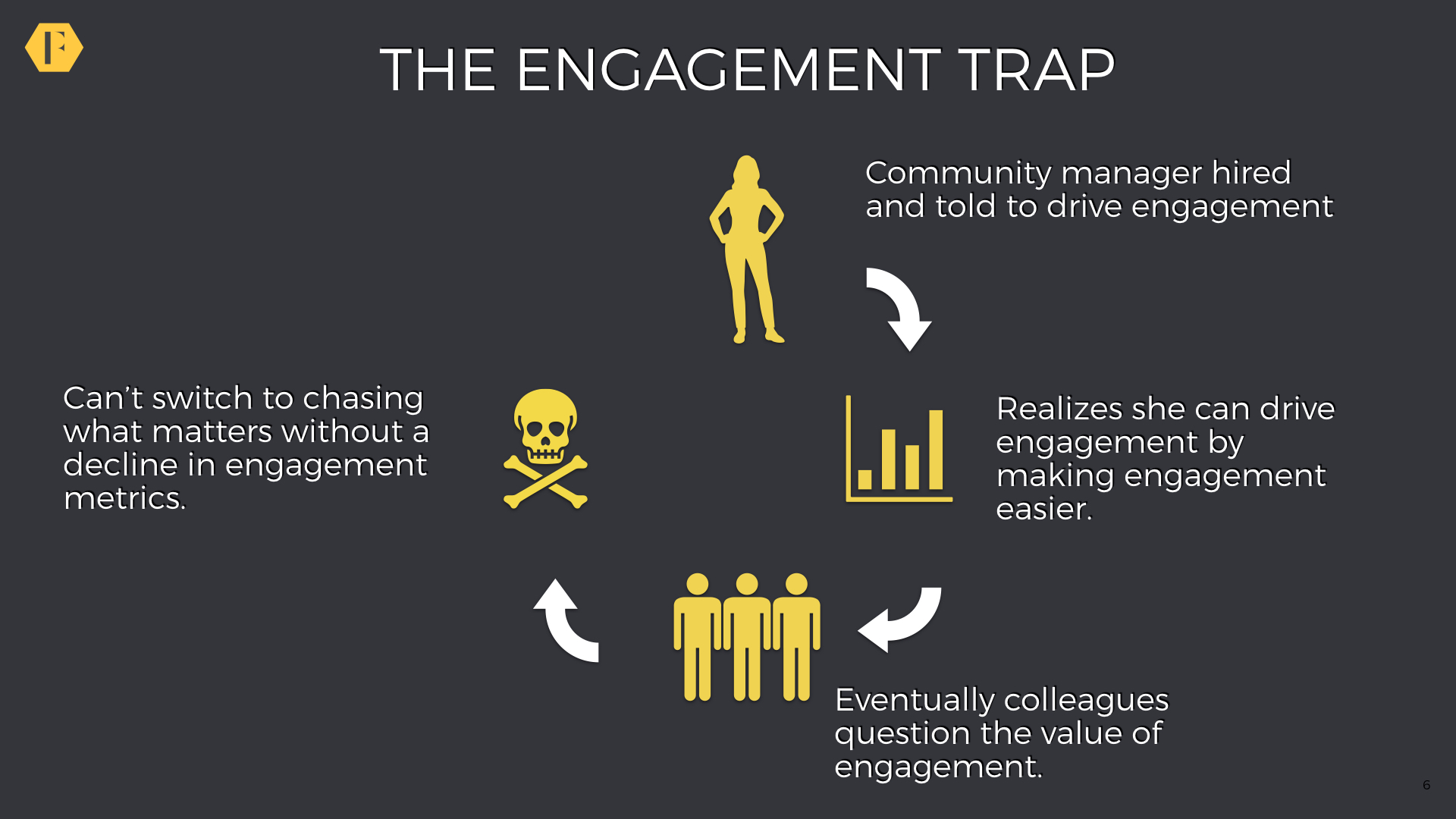
This is a classic engagement trap. If you’re measured by engagement metrics, it’s almost impossible to build a community that matters.

You’re probably caught in the engagement trap too. It looks like this:

This is why you should never report engagement metrics to your boss. It might sound like a good idea today, but it will kill you tomorrow. You can’t build a great community when you’re forced to chase metrics that don’t matter.

14 Aug 20:57

2018 Is Shaping Up to Be the Fourth-Hottest Year. Yet We’re Still Not Prepared for Global Warming. | Somini Sengupta

2018 Is Shaping Up to Be the Fourth-Hottest Year. Yet We’re Still Not Prepared for Global Warming. |...
14 Aug 20:54

There’s Waldo! Finding the elusive traveller using AI

by Alex Bate

Let me start by stating that here in the UK, we call Waldo Wally. And as I’m writing this post at my desk at Pi Towers, Cambridge, I have taken the decision to refer to the red and white-clad fellow as Wally moving forward.

Just so you know.

There’s Waldo is a robot that finds Waldo

There’s Waldo is a robot built to find Waldo and point at him. The robot arm is controlled by a Raspberry Pi using the PYARM Python library for the UARM Metal. Once initialized the arm is instructed to extend and take a photo of the canvas below.

The magical mind of Matt Reed

Both in his work and personal time, Matt Reed is a maker. In a nutshell, he has the job we all want — Creative Technologist — and gets to spend his working hours building interesting marketing projects for companies such as Redbull and Pi Towers favourite, Oreo. And lucky for us, he uses a Raspberry Pi in many of his projects — hurray!

Where’s Waldo Wally

With There’s Waldo, Matt has trained the AutoML Vision app, Google’s new image content analysis AI service, to recognise Wally in a series of images. With an AI model trained to recognise the features of the elusive traveller, a webcam attached to a Raspberry Pi 3B snaps a photo and the AI algorithm scans all faces, finding familiarities.

Matt Reed on Twitter

model is predicting WAAAYYY better than expected as this webcam image here wasn’t even part the training set. You can run from #ai but apparently can’t hide from #GoogleCloud

Once a match for Wally’s face is found with 95% or higher confidence, a robotic arm, controlled by the Pyarm Python library, points a comically small, plastic hand at where it believes Wally to be.

Deep learning and model training

We’ve started to discover more and more deep learning projects using Raspberry Pi — and with the recent release of TensorFlow 1.9 for the Pi, we’re sure this will soon become an even more common occurrence.

Adrian Rosebeck deep learning pokemon pokedex

For more projects using deep learning and the Raspberry Pi, check out Adrian Rosebrock’s deep learning Pokédex, and his Santa Detector.

And for more projects from Matt Reed and the redpepper team, you can follow Matt’s Twitter, visit his website, and check out his community profile in The MagPi.

The post There’s Waldo! Finding the elusive traveller using AI appeared first on Raspberry Pi.

14 Aug 18:25

Twitter Favorites: [PortmanDoe] We saw each other on OKCupid but were too intimidated to write each other. Met at a party a year later. A year afte… https://t.co/LoVuQmn45N

Portman Doe @PortmanDoe
We saw each other on OKCupid but were too intimidated to write each other. Met at a party a year later. A year afte… twitter.com/i/web/status/1…
14 Aug 18:23

Visualizations using Play-Doh

by Nathan Yau

We usually visualize data on computers, because it’s where the data exists and it’s a more efficient process. But as long as you can make shapes and use colors, you can use just about any material. Amy Cesal, as part of a 100-day creative project called Day Doh Viz, is using Play-Doh.

Ever since my son shifted his art station to my office, I’ve been drawn to his crayons, markers, and masking tape. The manual labor of it forces a shifted thought process that’s less technical and more about what you want to show. It also feels more like playing. Recommended. [via Visualising Data]

Tags: medium, physical, Play-Doh

14 Aug 18:23

✚ Detailed Intentions of a Map, When Everything Leads to Nothing, Designing for Misinterpretations

by Nathan Yau

The New York Times published an election map. A lot of people did not like the map, arguing that it was an inaccurate representation. Those who did like the map argued that one must consider intent before throwing a map to the flames. What happens when intended use and actual use do not match up? Read More

14 Aug 17:46

Arrogance Peaks in Silicon Valley

14 Aug 17:46

Samsung Galaxy Note 9 Unveiled with 6.4-inch QHD+ Display, Massive 4,000mAh Battery, More

by Rajesh Pandey
Samsung today unveiled the Galaxy Note 9 at its Unpacked event. The handset is Samsung’s 2018 last major flagship release and comes after the launch of the Galaxy S9 earlier this year. Continue reading →
09 Aug 14:07

There are three main categories of existence: 1. Things that exist, like dogs. 2. Things that only exist in the mind, like Clifford the Big Red Dog. 3. Things that don't exist at all, like good billionaires.

by existentialcoms
mkalus shared this story from existentialcoms on Twitter.

There are three main categories of existence:
1. Things that exist, like dogs.
2. Things that only exist in the mind, like Clifford the Big Red Dog.
3. Things that don't exist at all, like good billionaires.


Posted by existentialcoms on Wednesday, August 8th, 2018 8:59pm


2336 likes, 536 retweets
09 Aug 14:07

How the Five Day Work Week Became Popular

by TodayIFoundOut
mkalus shared this story from TodayIFoundOut's YouTube Videos.

From: TodayIFoundOut
Duration: 05:13

If you happen to like our videos and have a few bucks to spare to support our efforts, check out our Patreon page where we've got a variety of perks for our Patrons, including Simon's voice on your GPS and the ever requested Simon Whistler whistling package: https://www.patreon.com/TodayIFoundOut

→Some of our favorites: https://www.youtube.com/playlist?list=PLR0XuDegDqP10d4vrztQ0fVzNnTiQBEAA
→Subscribe for new videos every day!
https://www.youtube.com/user/TodayIFoundOut?sub_confirmation=1

Never run out of things to say at the water cooler with TodayIFoundOut! Brand new videos 7 days a week!

More from TodayIFoundOut

Charles Dickens' Sledge Hammer for the Poor Man's Child
https://youtu.be/UMQj_fnyJd8

In this video:

On September 25, 1926, the Ford Motor Company instituted a five-day, 40-hour work week for its factory employees. While Ford wasn’t the first to do this, they were arguably one of the most influential.

Want the text version?: http://www.todayifoundout.com/index.php/2016/09/five-day-work-week-became-popular/

Sources:

https://www.amazon.com/My-Life-Work-Autobiography-Henry/dp/149428300X/ref=as_li_ss_tl?ie=UTF8&qid=1473026645&sr=8-1&keywords=autobiography+of+henry+ford&linkCode=ll1&tag=vicastingcom-20&linkId=1e9dd17a60514f85c34f3961d221f9f8
http://www.history.com/this-day-in-history/ford-factory-workers-get-40-hour-week
https://www.yahoo.com/autos/bp/sept-25-henry-ford-makes-five-day-week-125810651.html
https://worldhistoryproject.org/1926/9/25/henry-ford-announces-5-day-work-week

Image Credit:

https://commons.wikimedia.org/wiki/File:Ford_assembly_line_-_1913.jpg
https://uk.m.wikipedia.org/wiki/%D0%A4%D0%B0%D0%B9%D0%BB:Ford_Motor_Company_assembly_line.jpg
https://commons.wikimedia.org/wiki/File:Eldorado_IL_Grand_1939.jpg
https://commons.wikimedia.org/wiki/File:LongBeachFord.jpg
https://commons.wikimedia.org/wiki/File:Edsel_Bryant_Ford.jpg
https://www.bigstockphoto.com/ru/image-243287125/stock-photo-alcoholism%2C-alcohol-addiction-and-people-concept-close-up-of-male-alcoholic-drinking-beer-and-smoking-cigarette-at-night
https://www.bigstockphoto.com/ru/image-185883724/stock-photo-close-up-of-salary-text-on-small-chalk-board-with-increasing-coin-stack-on-wooden-table
https://www.bigstockphoto.com/ru/image-233445973/stock-photo-sales-increase-on-pocket-watch-face-with-close-view-of-watch-mechanism-time-concept-film-effect
https://www.bigstockphoto.com/ru/image-212412250/stock-photo-productivity-improvement-concept-businessman-help-to-speedily-increase-productivity-represented-by-spaceship
https://www.bigstockphoto.com/ru/image-90648536/stock-photo-give-me-a-job
https://www.bigstockphoto.com/ru/image-155318714/stock-photo-close-up-of-old-english-dictionary-page-with-word-ignore

Music from Jukedeck - create your own at http://jukedeck.com.

09 Aug 14:06

More details revealed on Google’s search engine for China

by Masha Borak
The report also found that Google has been working with sampled search queries from 265.com, a Chinese-language web directory service based in Beijing and owned by Google.
09 Aug 14:06

How is a cook like functional programming?

by Eric Normand

We look at a metaphor to explain the three domains in functional programming: actions, calculations, and data. I hope the metaphor makes some things clearer and can help people explain fp better to others.

Transcript

Eric Normand: How is a cook like functional programming? Hi, my name is Eric Normand and these are my thoughts on functional programming.

I’ve been thinking about this superpower of being able to distinguish the different domains of functional programming — the actions, calculations, and data. Often, when you’re teaching, it’s really helpful to have a metaphor to show how these things interrelate. I came up with one.

Imagine a cook in the kitchen, cooking. This cook is doing all three — actions, calculations, and data. The actions are the cook’s hands. They’re what affect the world, hands. It could be other parts of the body, but just whatever the cook is doing in the world.

Eric Normand profile image
Eric Normand
@ericnormand
twitter logo

Imagine a cook in the kitchen. This cook is doing all three—actions, calculations, and data. The actions are the cook's hands. They're what affect the world. In the cook's head are the calculations. The data is the recipe, the mental notes, the order slip.
ed.gr/xx7d

Sun Jan 06 16:01:31 +0000 2019
Twitter reply actionTwitter retweet action0Twitter like action0

In the cook’s head are all the calculations. The calculations are, “I need to double this recipe because I’m having twice as many guests over as the recipe calls for,” or the cook needs to make a calculation of what ingredients they need from the fridge when they are planning their next trip to the fridge.

The stuff that is affecting the world is often like the more obvious stuff. It’s the email that got sent. It’s the file we got written to disk. That stuff is obvious. We often forget about all the things that are happening in someone’s head to get to that point so that they can actually be effective.

Eric Normand profile image
Eric Normand
@ericnormand
twitter logo

The stuff that is affecting the world is often like the more obvious stuff. It's the email that got sent. It's the file we got written to disk. That stuff is obvious. We forget about the things that are happening in someone's so that they can be effective.
ed.gr/xx7f

Wed Aug 29 15:00:58 +0000 2018
Twitter reply actionTwitter retweet action0Twitter like action1

When you’re programming, if you’re not a functional programmer, you forget that there’s all these little calculations you’re doing all the time to actually have the right effect on the world or to set up the things so that you know what to do. This idea that it’s stuff that’s invisible — because it’s not having an effect on the world, you don’t notice it.

Then there’s the data. The data is the recipe that they’re following. The data is the mental note that I need a carrot to do the next thing. Next time I visit the fridge, I’m going to grab a carrot. There’s all these little bits of data that are just kind of floating around, that are being used in calculations.

Even your plan, the plan for what to cook next, that could be a piece of data. You generated that plan from calculations. You thought, “I’m going to do X, Y, Z, so I’m going to need do X first, and then the Y.” You’re making a plan. The plan might be data, but the planning, the process, is calculation because it’s not having an effect on the world.

Eric Normand profile image
Eric Normand
@ericnormand
twitter logo

Even the plan for what to cook next, that could be a piece of data. You generated that plan from calculations. You thought, "I'm going to do X, Y, Z." You're making a plan. The plan might be data, but the process is calculation.

ed.gr/xx7n

Mon Aug 20 19:01:22 +0000 2018
Twitter reply actionTwitter retweet action0Twitter like action0

All right, I just came up with this metaphor. It’s the first time I’ve really expressed it. I hope to tighten it up and make it a little bit clearer. If you see some cool stuff in there that I’m missing, like other correspondences between the three domains and the metaphor, let me know because this could be really important for helping people understand the distinctions I’m trying to make.

Awesome. If you need to get in touch with me, you can find me on Twitter, @ericnormand with a D. If you want to email me, I love that, too. Please get in touch with me. I’m eric@lispcast.com. All right, see you next time.

The post How is a cook like functional programming? appeared first on LispCast.

09 Aug 14:06

Twitter Favorites: [DuaneStorey] This is why I've always thought that AMP is a horrible idea. It mostly just benefits Google, not site owners and on… https://t.co/C1KL1PFdbE

Duane Storey @DuaneStorey
This is why I've always thought that AMP is a horrible idea. It mostly just benefits Google, not site owners and on… twitter.com/i/web/status/1…
09 Aug 14:05

Nokia 7 Plus on Android Pie

by Volker Weber

Screenshot 20180809-142137 Screenshot 20180809-142128

Nope, this is not the release. Still Developer Preview 4, but that is very close to release. No surprises so far. With its gestures it feels more like an iPhone X. I like.

[Thanks for the heads up, Peter]

09 Aug 14:05

BlackBerry Security Summit in London

by Volker Weber

unnamed

I did not make it to London last year, since I was just out of the hospital. But I will make it this year.

And I am so happy, when events are in Europe and I don't have to travel to the US.

More >

09 Aug 13:59

Here’s 9 features coming to Android Pie that will change how you use your phone

by Brad Bennett
Android Pie logo

Android Pie, which launched on Monday, August 7th, brings a number of new features and AI improvements to many aspects of Google’s mobile operating system. Overall though, the update makes Android a little easier to use.

Google shared many of these features at I/O back in May, but now they’ve been finalized in the public version of Android P. Currently Google Pixel and Essential phone owners can download the update and try out the software for themselves. Other devices that are part of the Android P Beta will will be able to get the update soon, says Google.

Digital Wellbeing

Google is getting ready to ride the next trend in smartphone use with Android P’s ‘Digital Wellbeing’ suite of features. The idea behind this feature set is to help individuals use their phones in a more responsible way by tracking when they interact with their device.

The main feature set to launch this fall, says Google, is called Android Dashboard.

It tracks how long the user spends in each app, as well as how long they’ve been using their device. Moreover, users can go back and look at their phone usage from the past. The dashboard also shows how many times the user has unlocked their device in a day.

In addition to all of the usage tracking, the dashboard lets the user set limits on their apps so they don’t overuse them.

Some of other new features fall under the Digital Wellbeing umbrella too, but the most important one is the Dashboard. Apple has a similar feature called ‘Screen Time’ that’s coming out in the fall alongside iOS 12.

Ambient Display

Android Pie Ambient Display

With Android Pie, Google has also updated the Pixel lineup’s ambient display functionality. The new version displays the phone’s battery percentage along the bottom of the screen so users don’t have to wake the phone to check if it needs a charge.

The update also adds location-based weather and a single upcoming calendar event to the screen. This gives users some contextual information about their day.

It’s unclear if this little tweak will roll out to other phones. Since the manufacturer’s sometimes make changes to this feature, it’s going to be hard to tell until more manufacturers support Pie.

Adaptive Battery

Android Pie Adaptive Battery

While it may not be a feature you’ll often directly interact with, Adaptive Battery may just be the most important advancement in Android Pie. Adaptive Battery utilizes a number of techniques to optimize battery life on Android devices.

App Standby Buckets, for example, use AI to categorize your apps based on usage. Apps you use more often can access more system resources, whereas apps you don’t use often are restricted. This can contribute to better battery life.

Additionally, Android engineers worked on a number of under-the-hood improvements. These small changes add up to big battery savings. You can read more about what they specifically did here.

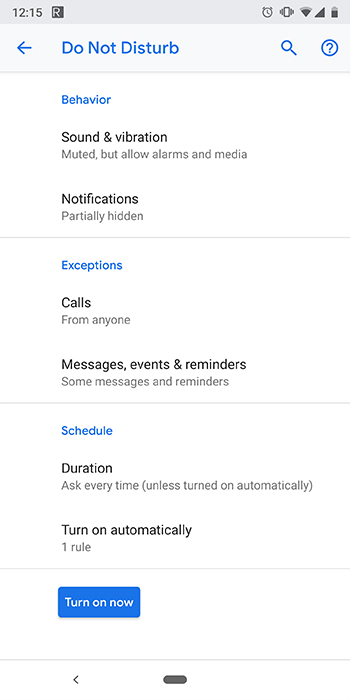
Do Not Disturb

Android Pie Do Not Disturb settings

Android’s Do Not Disturb has seen a number of tweaks and changes through the last few iterations of the operating system. However, Android Pie really nailed it this time.

DND now features a number of handy tweaks to really customize the experience. Along with more robust scheduling options, DND features new controls for sounds and media as well as notification options.

For example, users can mute notifications but allow alarms and media. Users can also mute media sounds.

For notifications, you can select from some pre-made options or customize your own restrictions. Users can choose to hide notification icons from the status bar or even hide them from the notification shade entirely.

Overall, the new DND is incredibly powerful and useful for getting rid of distractions.

Slices

Slices are small sections of apps that help the users do things without changing apps. An example of this feature would be booking a hotel directly from Google search.

These ‘Slices’ work similarly to Google’s instant app framework, but they’re overlaying the apps technology with Google’s design. This idea is really exciting since it should make accomplishing tasks a lot quicker and better looking.

This feature isn’t launching until the fall similarly to the Digital Wellbeing dashboard, but when it does might be one of the most notable features added to Android this year.

App Actions

Android Pie App Actions

Actions are smaller bits of information that Google can search for inside of apps. If a user looks up the name of a movie in Google Search then they’ll get presented with some predictive search results, along with options to buy movie tickets from Fandango or to watch a trailer on YouTube.

What makes this different than regular search results is these app actions will link into the users app, or maybe even an app Slice, instead of just a website.

Actions also show up as shortcuts in the app drawer for common things you do. These can be direct links to someone you message frequently or part of an app you use often.

This should make it easier for people to utilize Google Search on their phones since it will now search through apps on the phone instead of just web results online.

Volume Slider

Android Pie volume slider

Android Pie features a number of small but useful changes too. For example, Google adjusted the volume control slider. It shows up on the right side of the screen now, right next to the physical volume buttons. This makes the slider easier to use.

Furthermore, it adjusts the media volume by default, with quick options for mute, switching between ring, vibrate and silent, as well as a button to go to the settings menu.

Screen Rotation

Android Pie text zoom

Android Pie also updates how rotation works. Even if you lock the rotation of your device, you can still turn the screen. For example, if you turn your phone sideways to watch a video, a rotation button pops up beside the home button. If you tap it, your screen will rotate. This handy feature lets you have more control over when your phone rotates.

Text Selector

Android Pie text zoom

Editing text has never been easy on Android and for all of us that can’t spell, editing a tweet or a text message using Android’s old cursor design was a nightmare.

Google is attempting, once and for all, to solve this problem with Android Pie. The update changes the cursor from a little button you had to tap and drag around to a magnifying glass.

The control scheme to select text hasn’t changed, but Android users will start to see a magnifying glass appear above or below the text they’re selecting so it’s a little easier to see what you’re doing.

The post Here’s 9 features coming to Android Pie that will change how you use your phone appeared first on MobileSyrup.

09 Aug 06:42

Watch Samsung Galaxy Note 9 Launch Event Live

by Rajesh Pandey
Later today, Samsung will be unveiling the Galaxy Note 9 at an Unpacked event in New York. Almost every detail about the Note 9 has already leaked but if you are still interested in the device, you can watch the event live right from the comfort of your couch.  Continue reading →