Rolandt
Shared posts
WeChat mini programs are luxury brands’ new trick for cashing in on Chinese Valentine’s Day
Don’t Answer Every Question, You’re Not Customer Support
I recently met with a small community management team whom spend around 80% of their time responding to their members’ product questions.
This isn’t community management, it’s customer support.
Your job isn’t to answer question yourself. Every minute you spend responding to a member’s question is a minute you can’t spend getting another member to respond to that same question.
Your job is to get your members (or colleagues) to answer these questions. You need to spend your time creating the right conditions for experts to be identified, nurtured, and provide rapid responses to questions.
Your members will answer questions when the reward for answering a question exceeds the cost of creating an answer.
The best rewards are those which only a community can offer. It’s when members feel a unique sense of joy from helping others, feel like an expert within the field, or a feeling of belonging or rising stature among their peers.
Stop trying to answer every question yourself. Instead begin looking for members who have received answers or contributed posts on the most popular topics and reach out to them. Ask what brings them to the community and test different appeals (helping others, become an expert, build your reputation) and see what clicks best. Then design rewards which help this group achieve those benefits in the most powerful way.
Trust me, it will pay off a lot better over time.
Unilever to leverage JD.com’s logistics networks in China
The Best Tripod

After spending 40 hours researching tripods and 15 hours testing four, we found the Vanguard Alta Pro 2+ 263AB100 kit to be the most versatile platform for challenging shooting situations. It has the tallest maximum height and the most flexible range of positions of the tripod models we tested, and it’s very stable. It’s also easy to set up and break down, and built to withstand years of use.
Optical illusion shows our messed up lightness perception
A gray piece of paper moves along a gradient. You won’t believe your eyes.
A demo of lightness perception pic.twitter.com/BSVpgcuIw1
— Akiyoshi Kitaoka (@AkiyoshiKitaoka) August 12, 2018
Tags: illusion, perception
A Return To The Centre For Computing History
Back in December last year I could spend a few hours at the Centre for Computing History in Cambridge and loved the experience. A few days ago I was again in the area for a couple of days and fortunately, could spend some quality time in the museum yet again. A major plus there is that a lot of the exhibits are still in working condition and can be used by museum visitors. So I focused my attention on 3 machines this time around, as two of them were important devices in my personal computing history.
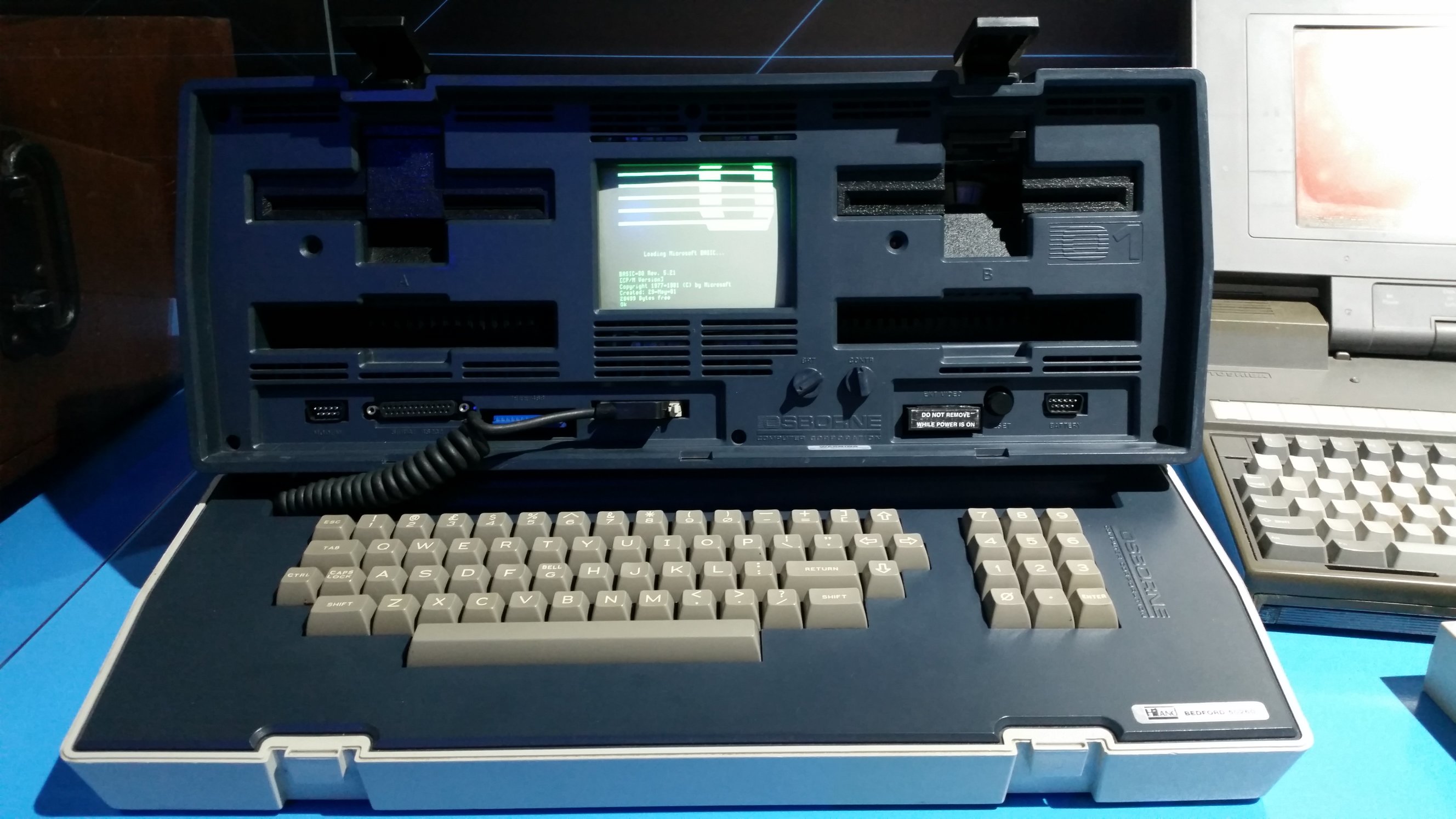 The first machine I experimented with a bit was the Osborne 1, the first successful portable microcomputer. It’s a legendary device from a legendary company that quickly went bust because of the rising dominance of IBM and by announcing future products too early which resulted in sales of the current product to fall of a cliff. It’s also known as the Osborne effect today.
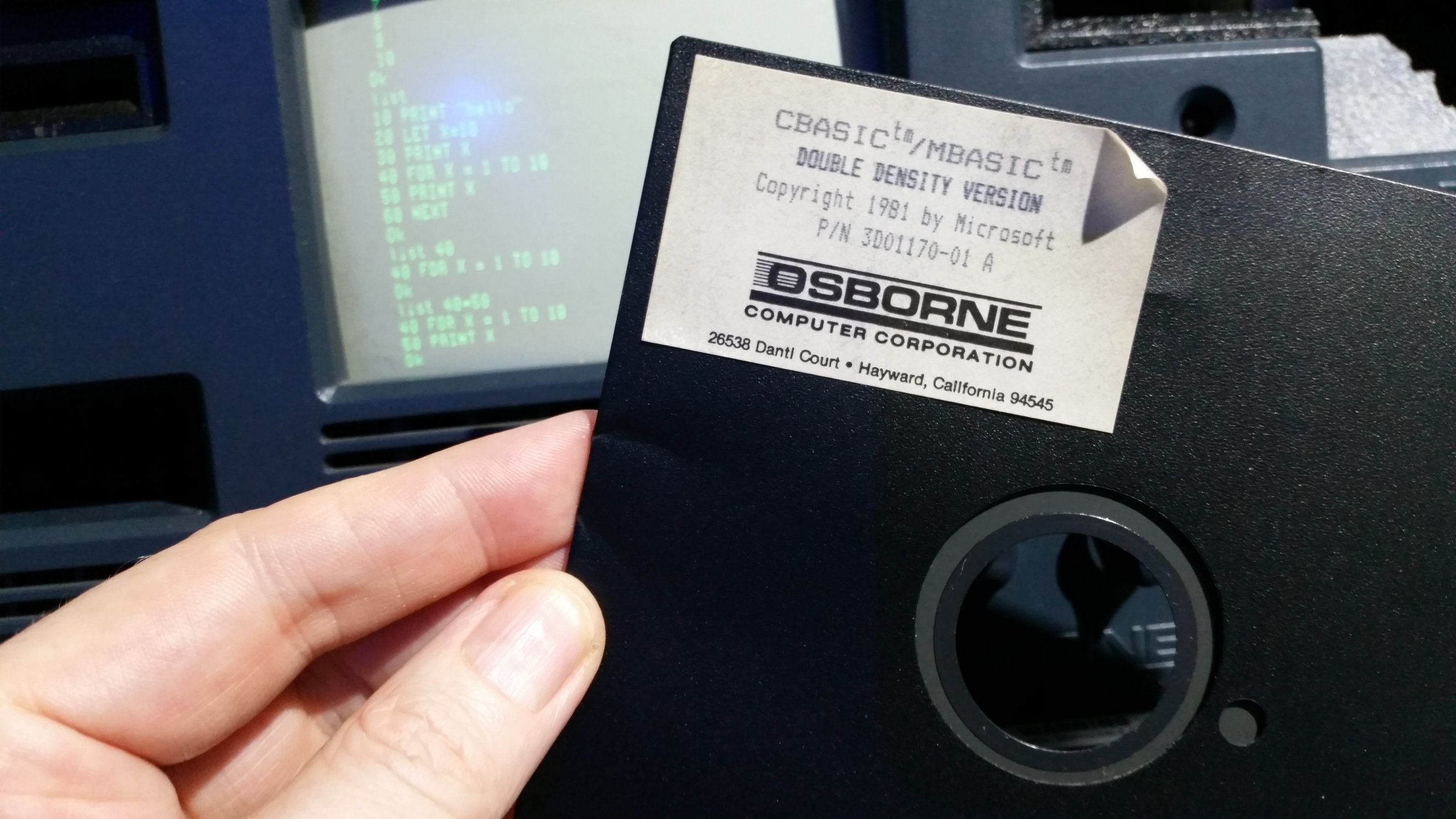 The first pictures on the left show the Osborne 1 at the museum and me holding a 5.25″ floppy disk with… Microsoft Basic on it. And just for the fun of it I wrote a 5 line basic program to calculate and print the squares of all numbers from 1 to 100. In Georgina Ferry’s book on the Leo computer (more about that in a future post) I read that this was a popular bring up test to check the proper operation of computers in the 1950s. At the time it was of course not written in Basic but assembly language but it’s the thought that counts.
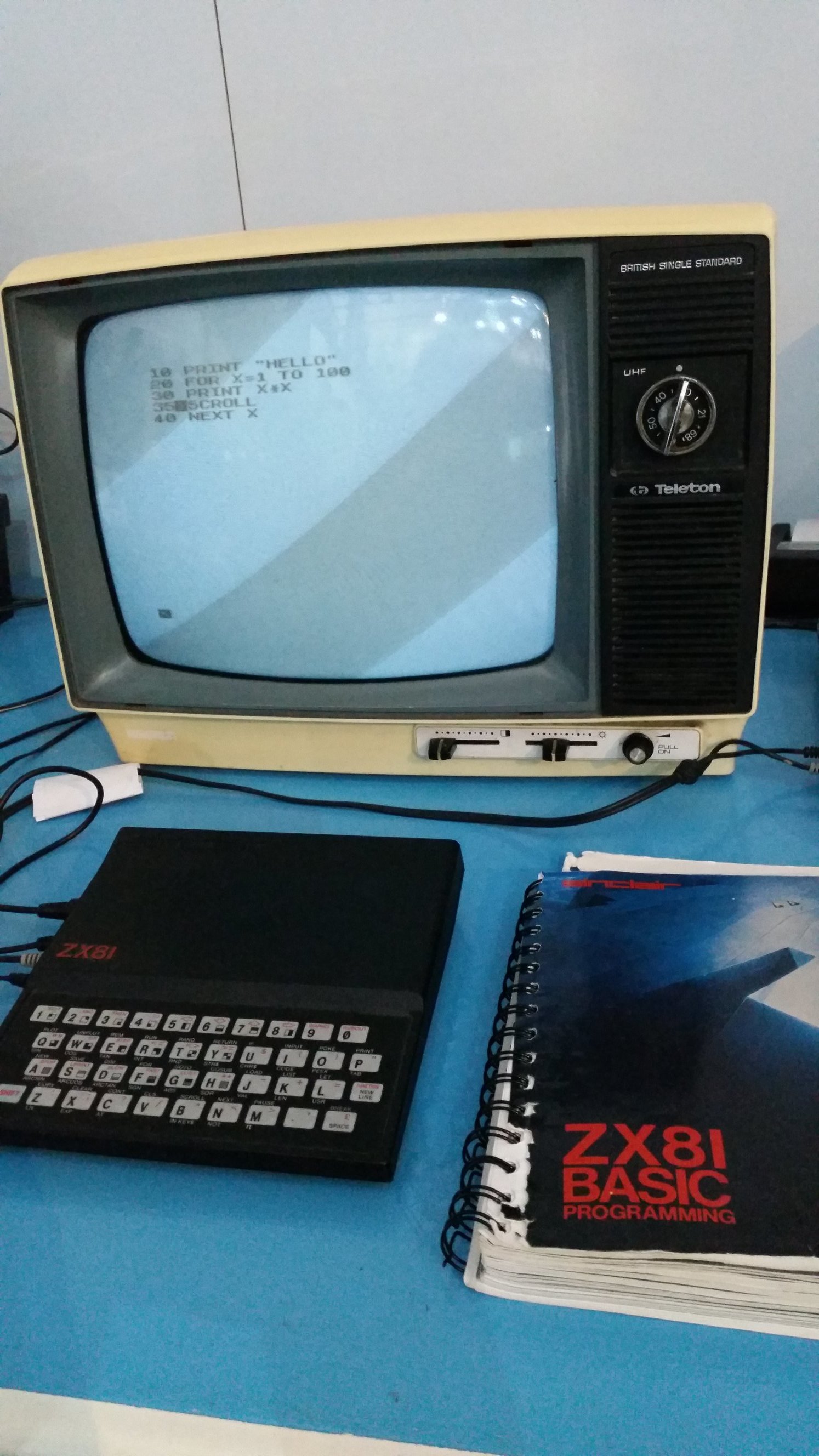 The next computer I experimented with a bit was a Sinclair ZX81. It’s predecessor the ZX80, which is quite hard to find these days, was not the first computer I owned in the mid-1980s but it was the first computer I used and programmed at a friends house at the time. 1 KB of RAM but with a Basic interpreter and lots of quirks. Again, that square root basic program proved that the one one display in the museum was still working fine. Not surprising given the quite different price tags but interesting to see was how much slower it ran compared to the Osborne. Both computers, by the way, had a Z80 processor!
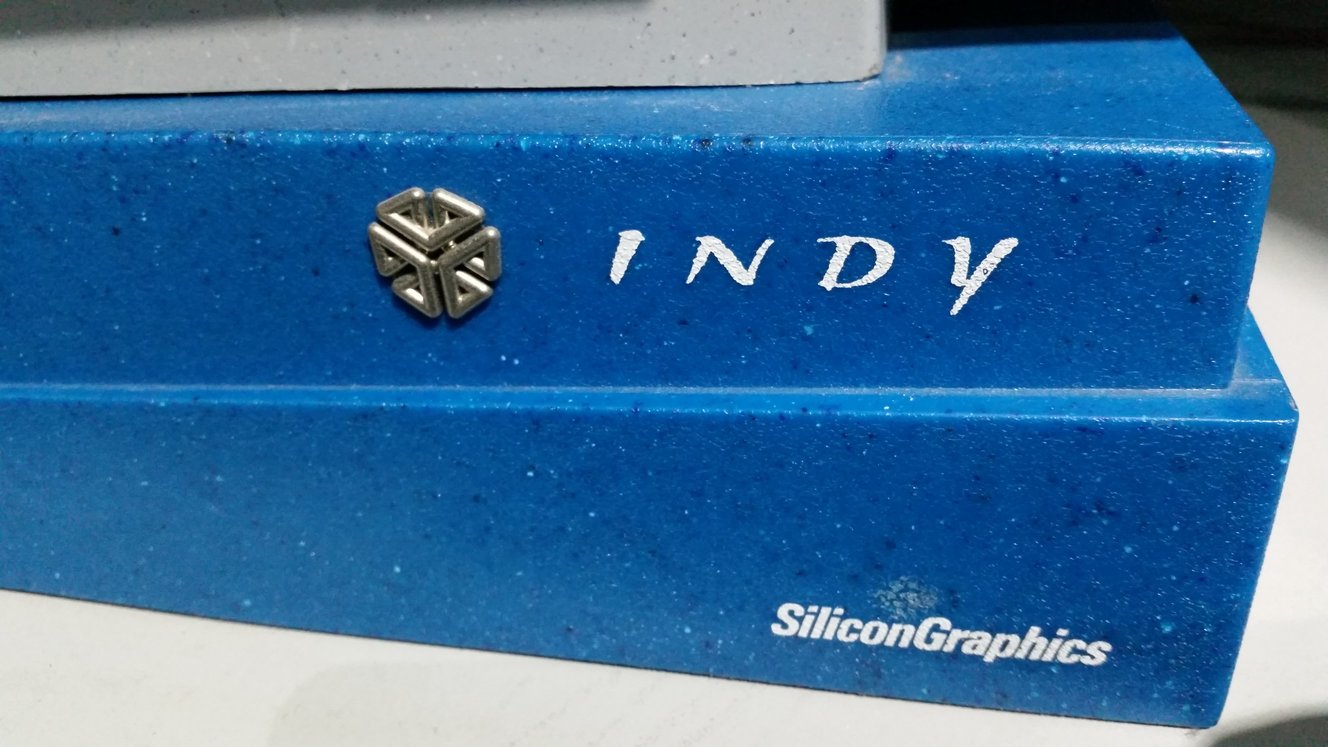
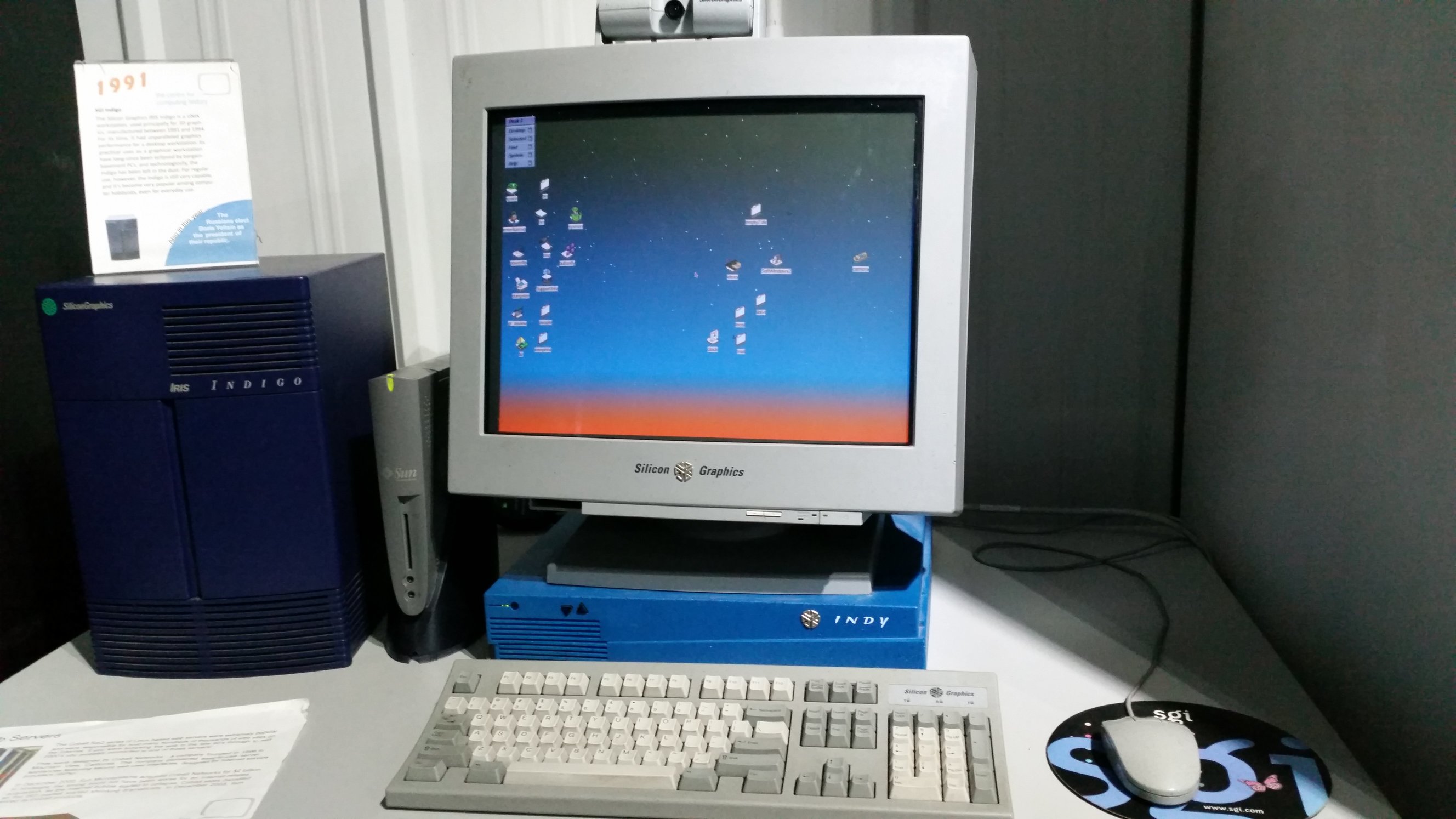 And the third computer I had the pleasure to experience once again after 20+ years was a Silicon Graphics Indy workstation from the mid 1990’s. This one has a special place in my heart for two reasons: First, it was the first Unix workstation I ever worked with and second, it was the first machine that was connected to the Internet to which I downloaded a video to from some server on the other side of the planet. Downloading a video over the Internet what a stunning thing to do back in the 1990s! I still remember it well, it was a trailer of the then brand new Star Trek Voyager series. It couldn’t have been more geeky than that in the 1990s.
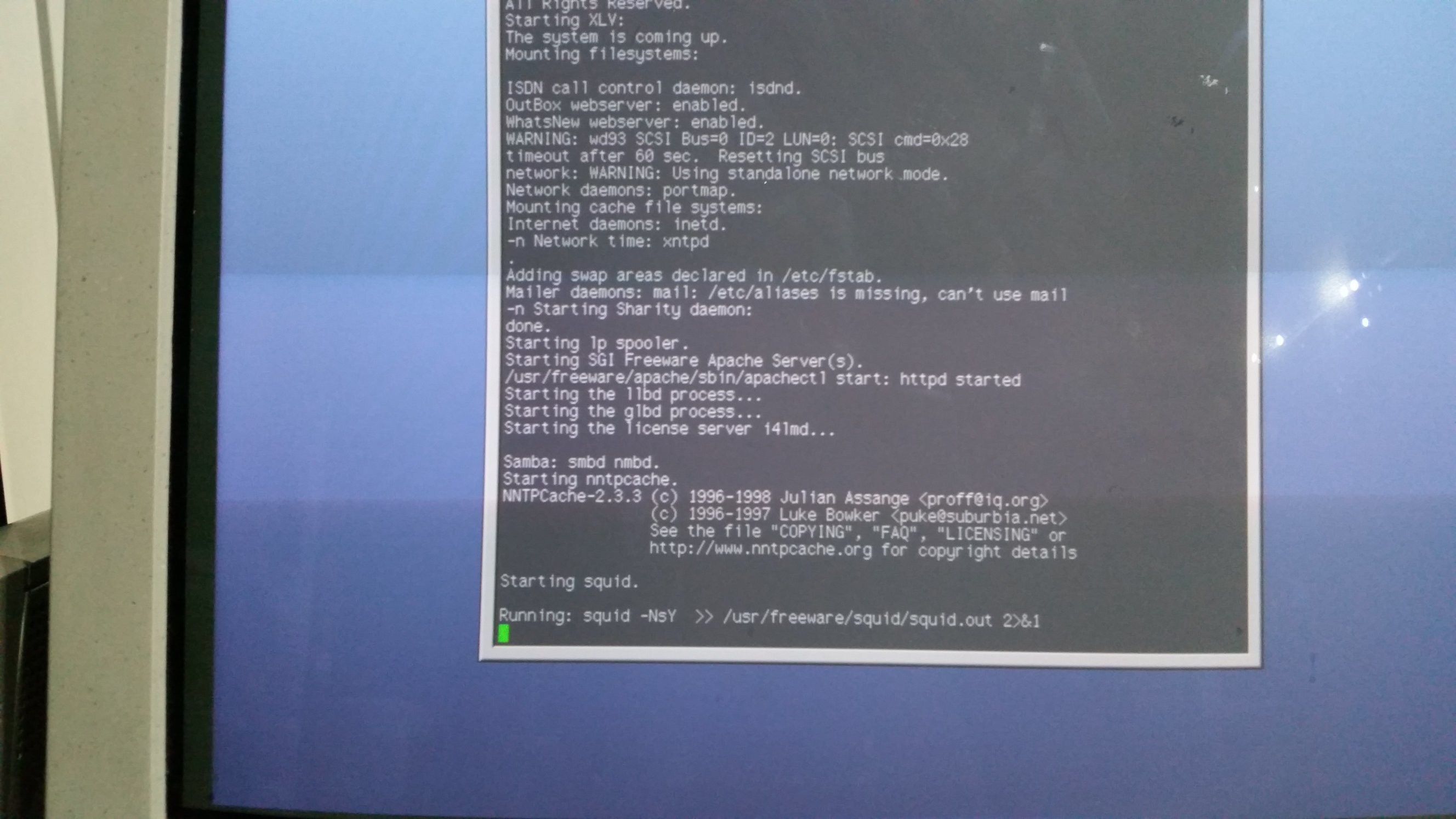 While booting that Indy I made an interesting discovery on the boot screen. Click on the picture on the left that shows the boot screen to enlarge it and have a closer look! At first I thought it was a hoax but a quick search on Wikipedia revealed that he’s actually done that!
So much for walking down memory lane for today and connecting to the present!
How much do Chinese netizens care about data privacy?
Cartography Playground

Map-making is a tricky business with many variables to consider that can directly change how someone interprets the land and people in a location. The Cartography Playground is a simple site to test these variables interactively. Learn about algorithms, mess with appearance, and toggle through representations.
Tags: algorithms, cartography
The Hidden Economics of Ideas
Ideas are getting harder and harder to find
There is a widely held view in Silicon Valley and within the zeitgeist of entrepreneurialism that good ideas are commonplace, and that execution of ideas is what matters for business success. However, there is compelling evidence that knocks that conventional wisdom off its pedestal.
A group of economists, Nicholas Bloom, Charles Jones, John Van Reenen, and Michael Webb, have released a working paper — Are Ideas Getting Harder To Find? — that argues the opposite:
Across a broad range of case studies at various levels of (dis)aggregation, we find that ideas — and in particular the exponential growth they imply — are getting harder and harder to find.
The authors use Moore’s Law as the pivotal example of the increasing numbers of researchers needed for continuation of historic rates of productivity increase. Moore’s Law is named for Intel cofounder Gordon Moore, who mentioned in 1965 that the number of transistors on integrated circuits had doubled every year. It has been somewhat rejiggered to focus on computer processing speeds, which double every two years.
Such doubling corresponds to a constant exponential growth rate of around 35% per year, a rate that has been remarkably steady for nearly half a century. As we show, this growth has been achieved by putting an ever growing number of researchers to work on pushing Moore’s Law forward. In particular, the number of researchers required to achieve the doubling of chip density today is more than 75 times larger than the number required in the early 1970s. At least as far as semiconductors are concerned, ideas are getting harder and harder to find. Idea TFP in this case is declining sharply, at a rate that averages about 10% per year.
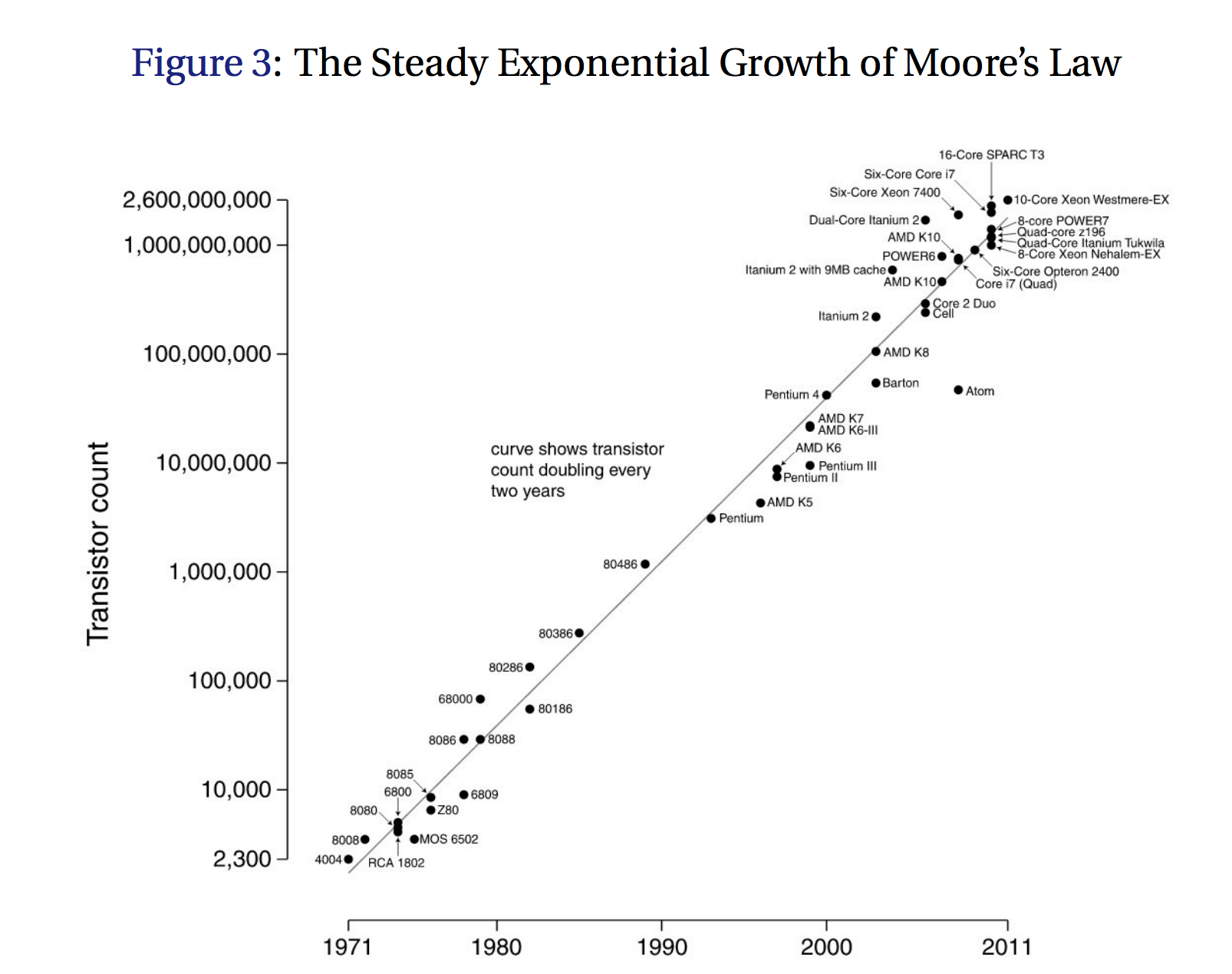
Moore’s Law 1971–2011
They offer a simple equation to concisely get this general case across (but note for Moore’s Law, the growth rate isn’t 2%, it’s something like 63% annually, to get the doubling every two years).

TFP is total factor productivity, the ‘portion of output not explained by the amount of inputs used in production’, which equates to how efficiently resources are used. So, idea TFP is a measure of how efficiently ideas are being applied, and that factor is falling.
The authors also looked at agricultural productivity, cancer mortality rates, and elsewhere. To summarize, they write:
We find substantial heterogeneity across firms, but idea TFP is declining in more than 85% of the firms in our sample. Averaging across firms, idea TFP declines at a rate of 12% per year.
[…]
We find that idea TFP for the aggregate U.S. economy has declined by a factor of 48 since the 1930s, an average decrease of more than 5% per year.
These are staggering observations, and are corroborated by other researchers:
Griliches (1994) provides a summary of the earlier literature exploring the decline in patents per dollar of research spending. Gordon (2016) reports extensive new historical evidence from throughout the 19th and 20th centuries. Cowen (2011) synthesizes earlier work to explicitly make the case. Ben Jones (2009) documents a rise in the age at which inventors first patent and a general increase in the size of research teams, arguing that over time more and more learning is required just to get to the point where researchers are capable of pushing the frontier forward.
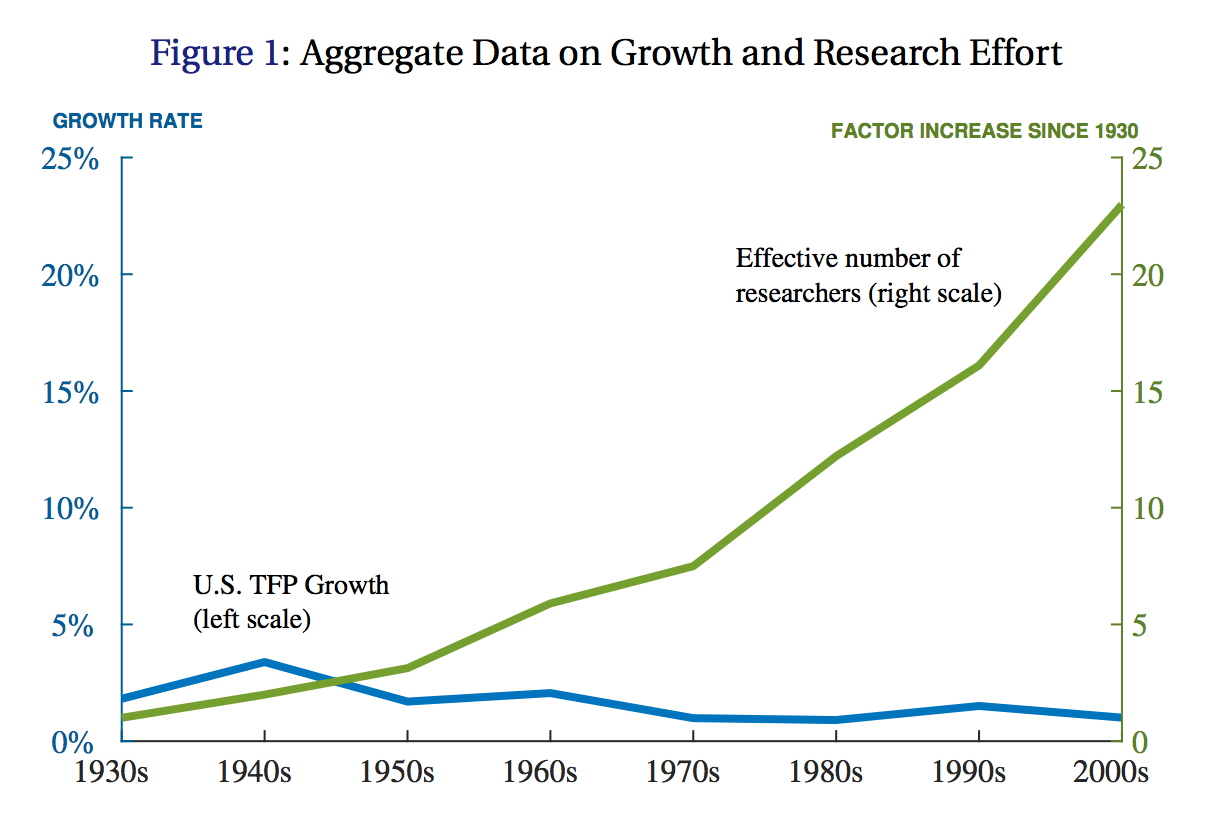
US TFP Growth v Researchers
The researchers believe they have answered the question: can a constant level of research effort generate constant exponential growth in the entire economy or in specific economic niches? The answer seems to be ‘no’. Turned around, constant exponential growth requires a growing number of researchers.
One of the seemingly paradoxical outcomes of this economic understanding¹ is that idea TFP is declining most quickly in those sectors with the fastest growth rates, like semiconductors. The paradox is explained by the general purpose value of faster semiconductors. As the authors put it:
Demand for better computer chips is growing so fast that it is worth suffering the declines in idea TFP there in order to achieve the gains associated with Moore’s Law.
The lasting takeaway from this research on the growing investments needed in research is this: idea TFP is falling fast everywhere, across the economy.
Taking the U.S. aggregate number as representative, idea TFP falls in half every 13 years — ideas are getting harder and harder to find. Put differently, just to sustain constant growth in GDP per person, the U.S. must double the amount of research effort searching for new ideas every 13 years to offset the increased difficulty of finding new ideas.
One simplistic way of looking at those stats: we will have to employ at least twice as many researchers 13 years from now just for the economy to keep growing at the current rate, or make a lesser number of researchers significantly more productive.
A final observation: when people wonder why productivity growth has slowed, there is a simple reason. We aren’t investing enough in research.
- Known as a a semi-endogenous growth model.
Originally published at workfutures.substack.com.
The Hidden Economics of Ideas was originally published in Work Futures Institute on Medium, where people are continuing the conversation by highlighting and responding to this story.
Samsung Unveils the World’s First 5G Modem, the Exynos Modem 5100
 Samsung today announced the world’s first 5G modem, the Exynos Modem 5100. The modem is fully compliant with the 3GPP specification of 5G-NR and is built on the 10nm fabrication process to make it power efficient.
Continue reading →
Samsung today announced the world’s first 5G modem, the Exynos Modem 5100. The modem is fully compliant with the 3GPP specification of 5G-NR and is built on the 10nm fabrication process to make it power efficient.
Continue reading →
Wired interviews Nick Millington :: Head of Product at Sonos
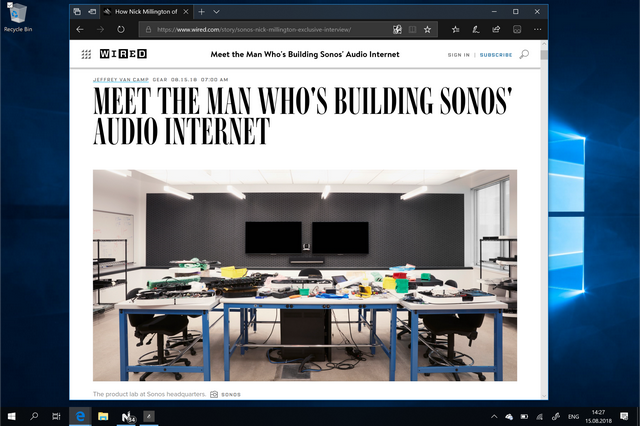
This is a fantastic interview with Nick Millington. I had the opportunity to speak with Nick Millington, Andy Schulert, John MacFarlane, and Patrick Spence at the tail end of 2015, and I find this interview to be very accurate. There is only one minor thing: the Play:5 saw the light of day as ZonePlayer S5 and was later rebranded. I was in the beta program for that speaker in 2009. It's also funny that Nick mentions the Russian iPod, which was a term invented here, picked up by Thomas (Meyer) and John and then made popular inside the company. The part I like best is when Nick calls John "a guy who lives three or four years in the future, and he takes for granted things that don't actually exist yet".
Wer sucht eine Playbar?

Mein Nachbar hat eine Playbar abzugeben. Wurde letztes Jahr auf Garantie von Sonos ausgetauscht und ist wie neu. Verschicken ist ein bisschen doof, wenn man keinen Karton hat. Ich schlage vor, nur Selbstabholung in Darmstadt. Neu kostet sowas 800 Euro, diese soll 500 kosten. Einfach hier auf :: email :: klicken und melden.
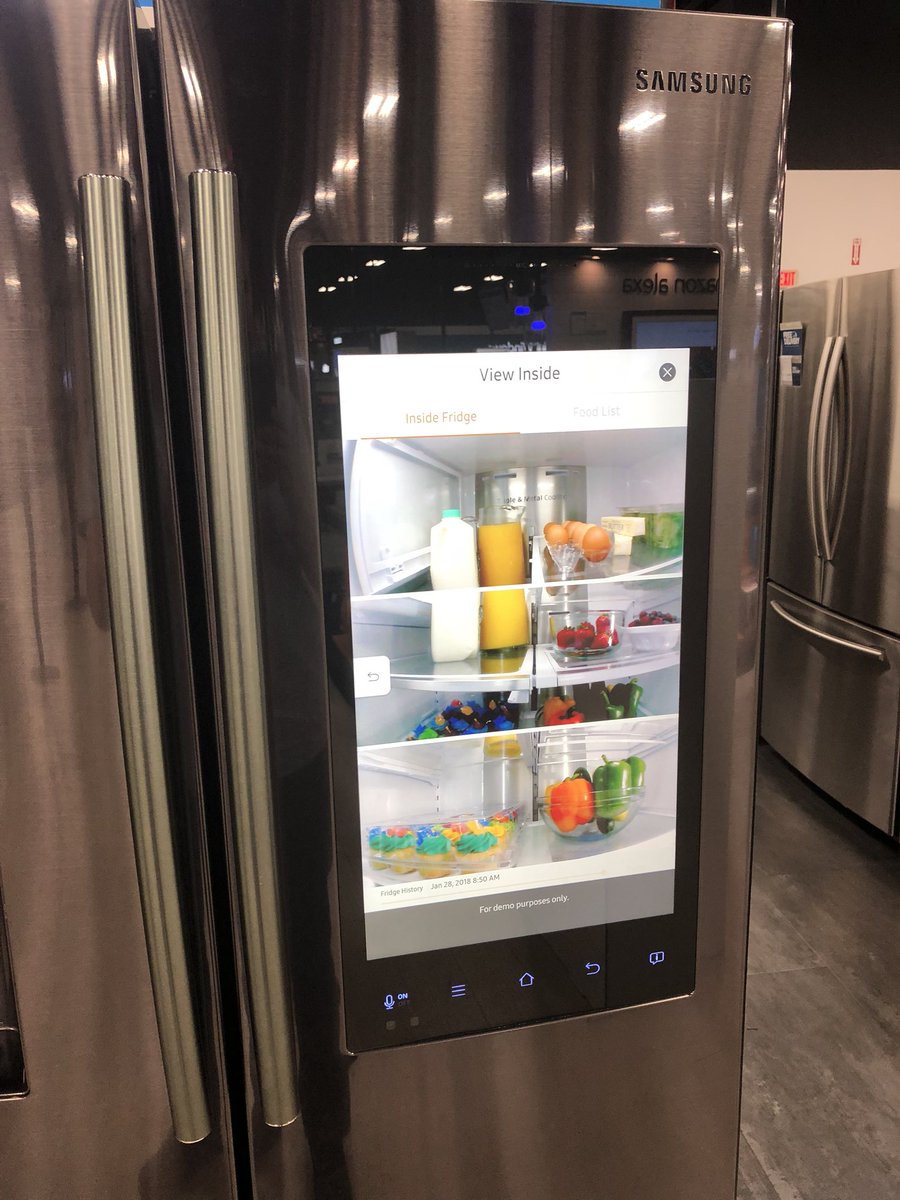
RT @shanselman: All this tech. LCDs, ARM processors, gigs of RAM, WiFi, VMs, just so I can avoid opening the fridge door? https://t.co/7hJD…
mkalus
shared this story
from  internetofshit on Twitter: internetofshit on Twitter:
|
|
| *slow clap* Now where's the robot that cooks the dinner and does the dishes? |
All this tech. LCDs, ARM processors, gigs of RAM, WiFi, VMs, just so I can avoid opening the fridge door? pic.twitter.com/7hJDXXC62w
 shanselman
on Tuesday, August 14th, 2018 7:20pm
shanselman
on Tuesday, August 14th, 2018 7:20pm internetofshit
on Wednesday, August 15th, 2018 10:00am
internetofshit
on Wednesday, August 15th, 2018 10:00am1943 likes, 642 retweets
Some of the best bicycle projects for #CycleToWorkDay
Avid followers of our Raspberry Pi Twitter account may be aware of just how bike-loving the residents of Pi Towers are. From the weekend cyclists to Cambridge-London-Cambridge racers, the flat land around our office calls us to jump on a bike and explore the fenlands.
#CycleToWorkDay
In celebration of #CycleToWorkDay, we’ve brought together a collection of some of our favourite bike-themed Raspberry Pi projects, perfect for those of you who enjoy a bike ride — or a pint!
Bicycle-powered beer dispenser
The Glaswegian company Bright Signals was tasked with a tasty project: create something for Menabrea that ties in with the Giro d’Italia cycle race passing close to the beer brewery in Biella, Northern Italy.
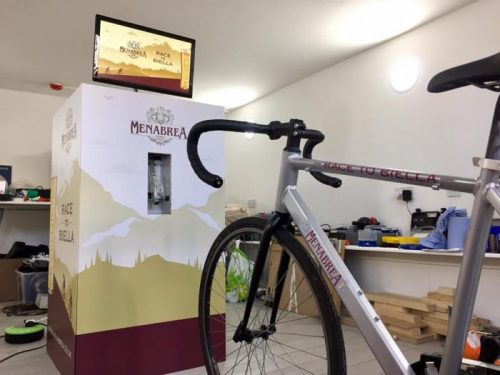
The result? This pedal- and Pi-powered beer dispenser that went on a 4-week celebratory tour ending in Glasgow.
You can learn more about this project here.
A rather dandy Pi-assisted Draisine
For a minute in the 1800s, before the introduction of pedal power, the balance bike, or Draisine, was the fun new way of getting from A to B.
Draisine 200.0
Uploaded by ecomentode on 2017-06-08.
A team at Saarland University, Germany, headed by Prof. Holger Hermanns modernised the Draisine, bringing this old vehicle up to date with power assistance thanks to the Raspberry Pi.
Read more about this Draisine here.
Raspberry Pi–powered cycle helmet
Jen Fox’s Raspberry Pi safety helmet prototype uses an accelerometer and a Raspberry Pi Zero to monitor impact force, notifying the cyclist whether or not the impact of their fall deserves medical attention.
Make an Impact Force Monitor!
Check out my latest Hacker in Residence project for SparkFun Electronics: the Helmet Guardian! It’s a Pi Zero powered impact force monitor that turns on an LED if your head/body experiences a potentially dangerous impact. Install in your sports helmets, bicycle, or car to keep track of impact and inform you when it’s time to visit the doctor.
While you should always seek medical attention if you have a bike accident, the notification LED on the helmet is a great way of reminding stubborn cyclists that their accident was more than just a tumble.
Learn more about Jen’s build here!
Matt’s smart bike light
This one comes up in conversation A LOT at Pi Towers. Matt Richardson’s smart bike light project uses a Raspberry Pi and hall effect sensor to determine the speed you’re cycling at; a project displays your speed in front of the bike.
Raspberry Pi Dynamic Bike Headlight Prototype and Test
Here’s the first prototype of the Dynamic Bike Headlight. I managed to get it out onto the street to try it out, too! My previous video about it: http://www.youtube.com/watch?v=UzRAcZq0imM View other videos on the vlog: http://www.youtube.com/playlist?list=PLOPvnSRDf2EuIYj18l7iBdgt-27ZnOAdP&feature=view_all Subscribe here: http://www.youtube.com/subscription_center?add_user=mrichardson23 Visit my site: http://mattrichardson.com/
For those who know Matt Richardson, we hope you appreciated this blast-from-the-past, beardless Matt. In fact, we know you did.
Find out more about this bike light here.
The Bicrophonic Sonic Bike
British sound artist Kaffe Matthews has created a new type of cycling experience. The cyclist divides a virtual map into zones, and the Bicrophonic Sonic Bike plays back music to the rider based on which zone they are in, courtesy of an on-board Raspberry Pi with GPS dongle and speakers.
What is Bicrophonics?
Bicrophonics is about the mobility of sound, experienced and shared within a moving space, free of headphones and free of the internet. Music made by the journey you take, played with the space that you move through. The Bicrophonic Research Institute (BRI) http://sonicbikes.net
As you can see from the video, the sound played can range from the calming peace of the countryside to the rather loud, disturbing buzz of the city.
Learn more about the tech behind the project here.
Hacked Kindle bike computer
David Schneider’s bike computer displays speed, distance, time and more on a Kindle he hacked with the help of a Raspberry Pi.
DIY: Build A Better Bike Computer
A Raspberry Pi and Kindle make vital information about your bicycle journey readable. Read more: http://spectrum.ieee.org/video/geek-life/hands-on/video-build-a-better-bike-computer
The experimental browser on the Kindle displays a web page hosted on the Raspberry Pi. And the glare-free E Ink display makes the screen easy to view regardless of light conditions — perfect for sunny weekend bike rides.
Find out more here.
Any others?
Have you hacked your cycling experience with a Raspberry Pi? Do you have a pedal-powered project in the works? Or would you simple like to boast about your bike and cycling achievements? Let’s get the cycle conversation going in the comments below. I’ll start!
The post Some of the best bicycle projects for #CycleToWorkDay appeared first on Raspberry Pi.
Lessons from the plain, damning grand jury report on priests in Pennsylvania
A grand jury in Pennsylvania accused more than 300 priests of sexually abusing more than 1000 children, over a period of decades. The grand jury’s 1356 page report is an amazing document, a model for clarity of description in an emotionally charged environment. I don’t clearly understand who writes documents like this or how. I’m … Continued
The post Lessons from the plain, damning grand jury report on priests in Pennsylvania appeared first on without bullshit.
Backup important folders to OneDrive
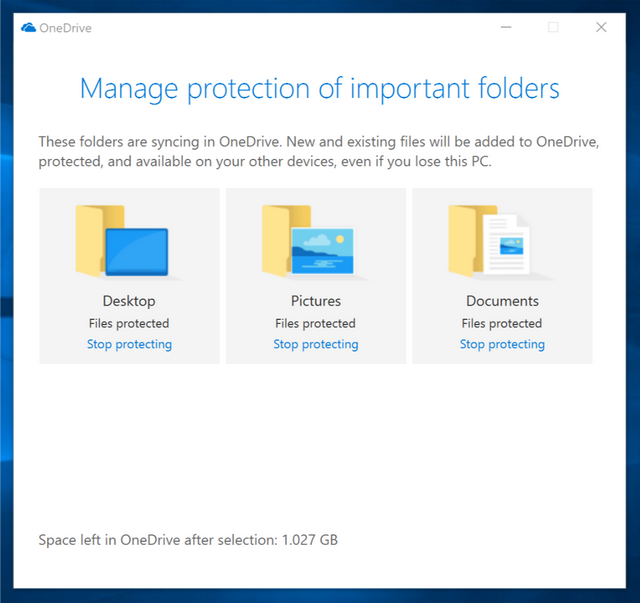
This is a big upgrade to the consumer version of OneDrive. You can now automatically save your desktop, your pictures and your documents folders to OneDrive. If you have Office 365, you also have a terabyte of online storage you can put to good use here. If your PC gets lost or hit by ransomware, you still have your files available to you. OneDrice protects you against ransomware by letting you roll back to previous versions.
How do you enable this? Hit the OneDrive icon, click More and then Settings. It's on the Autosave tab.
In Berlin gibt es gerade eine lustige Geschichte über ...
mkalus
shared this story
from  Fefes Blog. Fefes Blog.
|
In Berlin gibt es gerade eine lustige Geschichte über eine Zivilstreife der Polizei, die von einem privaten Unternehmen abgeschleppt wurde. Die Cops haben dann da angerufen und die Firma hat sich geweigert, zu sagen, wo sie das Auto hingeschleppt haben, bis die Polizei 321 Euro zahlt. Nun haben die Cops das Auto auch ohne Hilfe der Firma orten können, weil da ein peilbares Funkgerät drin war. Nicht nur ein Funkgerät übrigens, auch ein Haufen beschlagnahmte Drogen.
Aber wie so häufig: Wenn die Staatsgewalt selbst betroffen ist, ändert sich die Perspektive plötzlich grundlegend. Die Polizei fand erst, sie habe Sonderrechte für ihre Fahrzeuge. Das Auto stand stundenlang in einer Feuerwehrzufahrt, sagt die Abschleppfirma. Money Quote:
Dem Vernehmen nach seien 20 Meter entfernt freie Parkplätze gewesen. „Die Beamten waren einfach zu faul zum Laufen.“ Und besonders clever sei es nicht, Drogen in einem abgestellten Auto zu deponieren.Aber jetzt der größte Perspektivwechsel:
Wie berichtet empfahl das Justiziariat der Polizei intern sogar ein strafrechtliches Vorgehen gegen die Abschleppfirma: „Mit Verweigerung der Herausgabe des Abstellortes liegt der Anfangsverdacht der Erpressung vor.“Oh, ach?
Wie berichtet nörgelt die Polizei auch an den 321 Euro herum, nur „eine niedrige zweistellige Summe“ sei vorstellbar.ACH NEE! Das sind ja ganz neue Töne!
Android Oreo now rolling out to BlackBerry KEYone devices in Canada

After a seemingly endless wait, Android Oreo is finally available on the BlackBerry KEYone.
TCL Communication will roll out 8.0 to BlackBerry KEYone devices in Canada starting today, the company announced on Wednesday in an email sent to MobileSyrup.
According to TCL, the update will start rolling out at 9am ET, and will be available on both unlocked and carrier devices. In addition, the Oreo update that Rogers is pushing to KEYone devices on its network adds Wi-Fi calling, as well.
If you don’t see a notification prompting you to update your KEYone, launch Android’s Settings app, and navigate to the “System updates” sub-heading to manually update the device.
The post Android Oreo now rolling out to BlackBerry KEYone devices in Canada appeared first on MobileSyrup.
Microsoft’s ‘Your Phone’ app now available for Windows 10 users

Microsoft’s ‘Your Phone’ app is out of testing and available for Windows 10 users now.
Anyone with the latest April 2018 Update can install Your Phone from the Microsoft Store.
Initially, the app was only available for Windows Insiders. However, that testing period appears to have finished.
You will need an Android phone running version 7.0 or later to use Your Phone. Microsoft has promised support for iPhones, although support will be limited compared to Android. Furthermore, the app doesn’t currently support iPhone.
When you first run the app on your PC, it asks for a phone number. Microsoft texts a link to that number, which takes you to the Play Store page for the Microsoft App.
Once you download and sign into the Microsoft app, your PC will inform you it’s connected. Furthermore, it will tell you to update your PC, if necessary, in order to access features.
Additionally, Your Phone says that if your PC doesn’t have the RS5 update — which is due out in the fall — only some features are available. For example, the app says you can still send links to your PC through the share function in you phone’s browser.
Ultimately, the goal with Your Phone is to enable a seamless connection between your smartphone and computer. This link will allow you to drag and drop photos, answer texts messages and more. However, only the photo features are available now.
Source: The Verge Via: Engadget
The post Microsoft’s ‘Your Phone’ app now available for Windows 10 users appeared first on MobileSyrup.
Instagram now lets users send polls through direct messages

Instagram has announced that users can now send private polls to one another through direct messages.
Previously, polls were only available publicly through stories by using the poll sticker feature added in October 2017.
Starting today, you can send a poll privately in Direct. Update your app to choose who you want to poll – whether it’s everyone in a big group thread or just your very best friend. Update your app now to try it! pic.twitter.com/Lfr6pwPDzI
— Instagram (@instagram) August 14, 2018
When adding the poll sticker to a story, a new option will be available to send the story directly to a private message. Everyone in the chat will be able to view the poll results in real time.
Private polls are rolling out now to Instagram users on both Android and iOS.
The new feature is part of a larger recent effort from Instagram to increase engagement between users on the platform. In May, the social media giant introduced an emoji slider to let users rate their specific feelings on various subjects through emoji. Last month, Instagram also added a ‘Questions’ sticker to let users create Q&A’s in stories.
Via: The Verge
The post Instagram now lets users send polls through direct messages appeared first on MobileSyrup.
HTC may use an ODM to design and manufacture the U12 Life

It looks like HTC won’t be manufacturing or designing the U12 Life.
According to HTC leaker Llabtoofer, the U12 Life will be built by another manufacturer.
Imagine Life (Allegedly U12 Life) will be shipped with Android 8.1 on board.
Interesting fact about it, this device will be ODM manufactured…— LlabTooFeR (@LlabTooFeR) August 13, 2018
This is an odd move for the Taiwan-based company as, unlike companies like Google, HTC typically manufactures its own smartphones. However, with its recent losses over the years and with Google purchasing a part of its phone-making business, the company is likely trying to save money wherever it can.
The HTC U12 Life reportedly features a 6-inch display with a 2,160 x 1,080 pixel resolution, a 636 snapdragon processor, 4GB of RAM and 64GB of storage. Further, rumours point to the phone including a dual camera setup with an iPhone X-style notch.
It’s possible HTC may not build or design its next flagship either.
Source: LlabTooFer
The post HTC may use an ODM to design and manufacture the U12 Life appeared first on MobileSyrup.
Publish Static Websites, Docker Containers or Node.js Apps Just by Typing: now
A few days ago, in the latest episode of the Reclaim Today video show (any chance of an audio podcast feed too?) Jim Groom and Tim Owens chatted about Zeit Now [docs], a serverless hosting provider.
I’d half had an opportunity to get on on on the call when the subject matter was mooted, but lacksadaisicality on my part, plus the huge ‘sort my life out’ style “what did I/didn’t say say?” negative comedown I get after any audio/video recording means I missed the chance and I’ll have to contribute this way…
First up, Tim already knows more about Zeit Now than I do.
Once you install the Zeit Now client on your desktop, you can just drag a folder onto the running app icon and it will be uploaded to the now service. If there’s a Dockerfile in the folder, a corresponding container will be built and an endpoint exposed. If there’s no Dockerfile, but there is a package.json, a node.js application will be created for you. And if there’s no Dockerfile and no package.json file, but there is an index.html page, you’ll find you’ve just published a static website.
As well being able to drag the project containing folder on to the now icon, you can cd into the folder on the command line and just type: now. The files will be pushed and the container/node.js app/website created for you.
If you prefer, you can put the files into a Github repo, and connect the repo to the Zeit now service; whenever you make a commit to the repo, a webhook will trigger a rebuild from the repo of the service running on now.
This much (and more) I learned as a direct consequence of Reclaim Today and a quick read around, and it’s way more powerful than I thought. Building node apps is a real bugbear for me – node.js always seems to want to download the internet, and I can never figure out how to start an app (the docs on any particular app often assume you know what to type to get started, which I never can). Now all I need to do is type: now.
But… and there are buts: in the free plan, the resource limits are quite significant. There’s a limit on the size of files you can upload, and in the Docker case there seems to be a limit on the image size or image build size (I couldn’t see that in the pricing docs though, although the Logs limit looked to be the same as the limiting size I could have on a container?
It looks like you can run as many services as you want (the number of allowed deployments is infinite, where I think a deployment equates to a service: static web app, node.js app, Docker container) although you can hit bandwidth or storage caps. Another thing to note is that in the free plan, the application source files are public.
If anyone would like to buy me a coffee towards a Zeit Now subscription, that would be very nice:-). The Premium plan comes in at about a coffee a week…
Prior to watching the above show, my engagement with Zeit Now had been through using datasette. In the show, Tim tried to install datasette by uploading the datasette folder, but that’s not how it’s designed to be used. Instead, datasette is a Python package that runs as a command-line app. The app can do a several things:
- launch a local http server providing an interactive HTML UI to a SQLite database;
- build a local Docker container capable of running a local http server providing an interactive HTML UI to a SQLite database;
- create a running online service providing an interactive HTML UI to a SQLite database on *Zeit Now* or *Heroku*.
So how I had used datasette with Zeit Now was through the following – install the datasette python package (once only):
pip install datasette
And then, with the Zeit Now app installed and running on my local computer:
datasette publish now mydb.sqlite
This is then responsible for pushing the necessary files to Zeit Now and displaying the URL to the running service. Note that whilst the application runs inside a docker container on Zeit Now, I don’t need Docker installed on my own computer.
It struck me last night that this is a really powerful pattern which I complements a workflow pattern I use elsewhere. To whit, many Python and R packages exist that create HTML pages from templates for displaying interactive charts or maps. The folium package, for example, is a Python package that plays nicely with Jupyter notebooks that can create an embedded map in a notebook. What’s embedded is an HTML page that is generated from a template. The folium package can also add data to the HTML page from a Python programme, so I can load in a location marker or shapefile datasets into python and then push it into the map without needing to know anything about how to write the HTML or javascript needed to render the map. In the R world, things like R‘s leaflet package do something similar.
This pattern – of Python, or R, packages that can create HTML assets – is really useful: it means you can easily create HTML assets that can be used elsewhere form a simple line or two of Python (or R) code.
This is where I think the datasette publish pattern comes in: now we have a pattern whereby a package generates not only an HTML application (in fact, an HTML site) but also provides the means to run it, either locally, packaged as a container, or via an online service (Zeit Now or Heroku). It should be easy enough to pull out the publish aspects of the code and use the same approach to create a python package that can run a Scripted Form locally, or create a container capable of running it, or push a runnable Jupyter notebook scripted API to Zeit Now.
On a related point, the Reclaim Today video show mentioned R/Shiny. As Tim pointed out, R is the programming language, but Shiny is more of an HTML application development framework, written in R. It provides high level R functions for creating interactive HTML UI interfaces and components and binding them to R variables. When one of the running HTML form elements is updated, the value is passed to a corresponding R variable; other R functions can respond to the updated value and generate new outpuys (charts, filtered datatables etc) which are then pass them back to shiny for display in the HTML application. As with things like folium the high level R functions, in this case, are responsible for generating much of the HTML / Javascript automatically.
Thinks: a demo of the datasette publish model for a Shiny app could be quite handy?
A couple more things that occurred to me after watching the video…
Firstly, the build size limits that Zeit Now seems to enforce. Looking at the Dockerfile in the datasette repo, I notice it uses a staged / multi-stage build. That is, the first part of the container builds some packages that are then copied into a ‘restarted’ build. Building / compiling some libraries can require a lot of heavy lifting, with dependencies required for the build not being required in the final distribution. The multi-stage build can thus be used to create relatively lightweight images that contain custom built packages without having to tidy up any of the heavier packages that were installed simply to support the build process. If a container intended for Zeit Now breached resource requirements because of the build, that could block the build, even if the final container is quire light (I’m not sure if it does work like this, just let me think this through as if it does…) One alternative would be to reduce the multi-stage build to a single stage Dockerfile, replacing the second stage FROM with a set of housekeeping routines to clear out the build dependencies (this is what multi-stage presumably replaces?) but this may still hit resource limits in the build stage. A second approach would be to split the multistage build into a first stage build that creates, and tidies up, a base container that can be imported directly into a standalone second stage Dockerfile. This is fine if you can create and push your own base container that the second stage Dockerfile could pull on. But if you don’t have Docker installed, that could be difficult. However, Docker Hub has a facility for building containers from github repos (Docker hub automated builds) in much the same way Zeit Now does. So I’m wondering – is there a now like facility for pushing a build directory to Dockerhub and letting Dockerhub build it without resource limitation in the build step, and then let Zeit Now pull on the finally built, cleaned up image? Or is the fallback to build the base (first stage) build container on Docker hub from Github repo? (Again, there is the downside that the build files will be public.)
The second point to mention is one that relates to next-generation hosting (consider Reclaim’s current hosting offering where users can run prepackaged applications from CPanel as first generation; as far as publishing running containers goes, the current generation model might be though of as using something like Digital Ocean to first launch a server, and then running a container image on that server.).
The Zeit Now model is essentially a serverless offering: end users can push applications to a server instance that is automatically created on their behalf. If I want to run a container in the cloud using docker from my desktop, the first thing I typically need to do is launch a server. Then I push the image to it. The Zeit Now model removes that part of the equation – I can assume the existence of the server, and not need to know anything about how to set it up. I can treat it simply as a Docker container hosting service.
The Zeit Now desktop tools make it really easy to use from the desktop, and the code is available too, but the Github linked deployment is also really powerful. So it’s perhaps worth trying to pick apart what steps are involved, and what alternative approaches are out there, if Reclaim was to pick up on this next generation approach.
So let’s find some entrails… It seems to me that the Zeit Now model can be carved up in several pieces:
- source files for your website/application need to be somewhere (locally, or in Github)
- if you’re running an application (node.js, Docker) then the environment needs setting up or building – so you need build files
- before running an application, you need to build the environment somewhere. For Docker applications, you might want to build a base container somewhere else, and then just pull it in directly in to the *Zeit Now* environment.
To deploy the application, you need to fire up an environment and then add in the source files; the server is assumed.
So what’s needed to offer a rival service is something that can:
- create server instances on demand;
- create a custom environment on a server;
- allow source files to be added to the environment;
- run the application.
An example of another service that supports this sort of behaviour is Binderhub, an offshoot of the Jupyter project. Binderhub supports the build and on-demand deployment of custom environments / applications built according to the contents of a Github repository. Here’s an example of the TM112 environment running on MyBinder  and here’s the repo.) An assumption is made that a Jupyter environment is run, but I’m guessing the machinery allows that assumption to be relaxed? Binderhub manages server deployment (so it supports a next generation hosting serverless model) as well as application build and deployment.
Supporting tooling includes repo2docker which has some of the feel of datasette‘s local container build model in that it can build a docker container locally if docker is installed from a local directory, but will also build a container from a Github repository. A huge downside is that a local Docker install is required. A --push switch allows the locally built container to be pushed to Docker hub automatically. (The push is managed using the docker desktop application, which requires the installation of docker – which may be tricky for some users. What would be handy would be a standalone dockerhub CLI which would support remote, automated builds from a source directory pushed to Docker hub, as per Zeit Now and as already mentioned above). Hmmm… seems like someone has been working on a Docker hub CLI but it looks like it’s just file listing operations that are supported; the remote build may not be possible from the Docker hub side unless we could find a way of co-opting how the automated build from github pulls work?
One of the things I am trying to lobby for in the OU is a local Binderhub service (it would also be nice if there was a federated Binderhub service where separate organisations could volunteer compute resource in accessed from a single URL…) One thing that strikes me is that it would be nice to see a localrepo2binder service that could push a local directory to a Binderhub instance, rather than require Binderhub to pull from a github repo. This would then mimic Zeit Now functionality…
PS this looks handy – exoframe (about) – like a self-hosted Zeit Now. As with many nodejs apps I’ve tried to try, I can’t seem to be able to install an appropriate nodejs version properly enough to run the (client) app:-(
A transforming river seen from above

The Padma River in Bangladesh is constantly shifting its 75-mile path. Joshua Stevens for the NASA Earth Observatory shows what the shifting looked like through satellite imagery, over a 30-year span.
Kasha Patel:
The upper section of the Padma—the Harirampur region— has experienced the most erosion and shows the most notable changes. The river has become wider at this section by eroding along both banks, although most activity occurred on the left bank. Using topographic, aerial, and satellite imagery, scientists found that the left bank shifted 12 kilometers towards the north from 1860 to 2009 and developed a meandering bend. The river left a scar where the water once flowed, as you can see in the 2018 image.
See also the dramatic shifts of the Ucayali River in Peru.
Tags: environment, NASA, satellite imagery, water
Squirrel cop!
Deutsche Welle: Baby squirrel chases man so relentlessly he calls police. “A man in Germany felt so besieged by a rodent that he called the police emergency number. The baby squirrel has been taken to an animal sanctuary.”
Update: Baby squirrel who captivated Germany is safe — and female. “”Pippilotta” stole the headlines last week after following a man “relentlessly” through the streets of Karlsruhe. According to animal control officers, this is common for squirrels who have lost their mothers.”
This story reminds me of one of my favorite This American Life stories: Squirrel Cop, which is also available on YouTube in two parts – one, two.
Open Logic Project
University of Calgary,
Aug 29, 2018
As noted in today's "Four Short Links" from O'Reilly, "The Open Logic Project is a collection of teaching materials on mathematical logic aimed at a non-mathematical audience, intended for use in advanced logic courses as taught in many philosophy departments." Nice. Though as Tony Hirst comments, " the TeX source does mean you need a (La)TeX environment to run it (and the project does bundle some of the custom .sty style files you need in the repo, which is handy)." More on the project.
Web: [Direct Link] [This Post]What Late Summer Brings With It Now
Smoke and filtered light.


The haze softens the city with a yellow flush. It’s just on this side of other-worldly. It’s another indicator that the early stages of climate change are already consequential, regardless of how they are disregarded, dismissed or denied among the decision-makers. Philip Dick: “Reality is that which, when you stop believing in it, doesn’t go away.”
Summer hazes may go away, but the reason they’re here will not.


HQ Trivia is now available on the Apple TV

Popular live mobile trivia game HQ Trivia is now available on the Apple TV.
The game initially launched last year on the iPhone and iPad before eventually makes its way to Android devices.
While the live trivia game frequently experiences spikes in popularity when a larger than normal cash prize is involved, there hasn’t been much buzz surrounding the game show over the last few months.
It’s likely HQ Trivia is hoping bringing the app to the Apple TV will result in a spike in popularity.
Today we launched our Apple TV app where you can play HQ right on your
Download it from the App Store today! pic.twitter.com/ZwllXmxZAM
— HQ Trivia (@hqtrivia) August 14, 2018

HQ Trivia revealed the recently released tvOS app on Twitter earlier today. The app is compatible with the 4th-Generation Apple TV as well as the Apple TV 4K, complete with support for the iOS Remote app when it comes to voting. This feature will come in handy given how frustratingly inaccurate and difficult to control the Apple TV’s Siri remote can sometimes be.
While the live trivia show’s schedule often shifts, HQ Trivia typically broadcasts daily at 9pm and 3pm ET during the week.
HQ Trivia is available on iOS, tvOS and Android.
The post HQ Trivia is now available on the Apple TV appeared first on MobileSyrup.
Oppo’s R17 might be our first glimpse of the OnePlus 6T

If you’re already thinking about the OnePlus 6T, Oppo might have a clue what it’ll look like.
OnePlus tends to borrow designs from it’s parent company Oppo. For example, the Oppo R15 and the OnePlus 6 are nearly identical.
As such, the new Oppo R17 may be a great example of what the 6T will look like. And if it is, we should be excited.
The device sports a nearly bezel-less display that looks bright and vibrant. It measures in at 6.4-inches at 2280 x 1080 pixels.
The R17 still sports a notch, but it’s a decidedly better notch. It’s much smaller than other notches and features a subtle curved shape. I think it looks really nice — especially in comparison to this behemoth.
However, tiny notches and bezel-less screens aren’t the only nice thing about the R17. The phone also features an in-display fingerprint sensor.
On the inside there’s 8GB of RAM, 128GB of storage and a Snapdragon 670. While the mid-range chip design is standard for Oppo’s R series, OnePlus typically bumps it up to the latest Snapdragon 800 series.
The OnePlus 6T may shape up to be a very nice looking phone. If it keeps that in-display fingerprint scanner from the R17, it could be a very intriguing upgrade option.
Source: Android Police
The post Oppo’s R17 might be our first glimpse of the OnePlus 6T appeared first on MobileSyrup.
Spotify brings its song credits feature to iOS

Spotify started adding some song credits to it desktop app in February 2018 and now credits are rolling out to iOS users.
Desktop users can right click on a song to see credits for ‘Performed by,’ ‘Written by,’ ‘Produced by’ and a track’s record label.
Things work pretty much the same way on iOS. Users just tap on the three-dot menu attached to a song and choose ‘See Credits’ from the list of options.
Not every song has credits and a lot of them only show the performer, but in the future, music publishers and artists will be able to submit their verified information.
A post shared by Alfons Karabuda (@content_is_king) on
Song credits is something that Tidal has had for a while, and it was an advantage for the smaller streaming service. Now that Spotify is starting to roll out the feature to more of its platforms, Spotify is starting to corner in on Tidal’s pool of users.
It will be interesting to see how this move works out for the company’s partnership with the website Genius.com.
Spotify partnered with Genius in 2016 to provide its users with lyric and contextual song information from the site.
Genius is one of the largest sites in the world for people to learn about song information like the meaning of lyrics or song credits. If this information is in Spotify’s app, users will have two fewer reasons to visit Genius’s platform.
This isn’t the end of the world, since users will most likely still look up credits online since Spotify’s credit feature is buried in a menu.
Source: Instagram Via: The Verge
The post Spotify brings its song credits feature to iOS appeared first on MobileSyrup.
I’m usually happy to speak at events. Yet, two ...
I’m usually happy to speak at events. Yet, two weeks notice for an event in South-Africa is too short. So had to say no, not in the least because it coincides with our own event. I did accept a speaking invitation received before the summer, at an event taking place in Serbia in September, for the Association of European Regions.