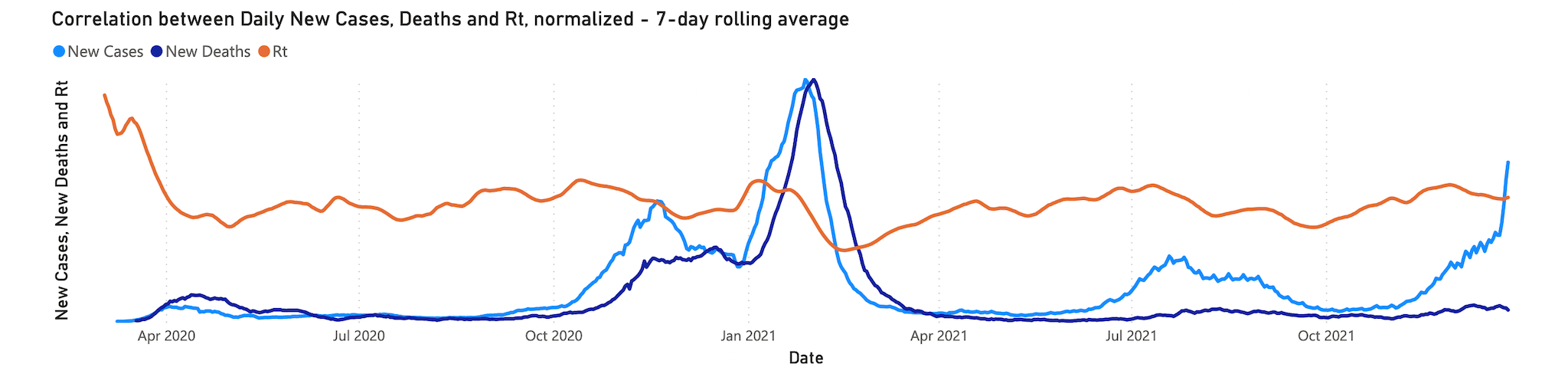
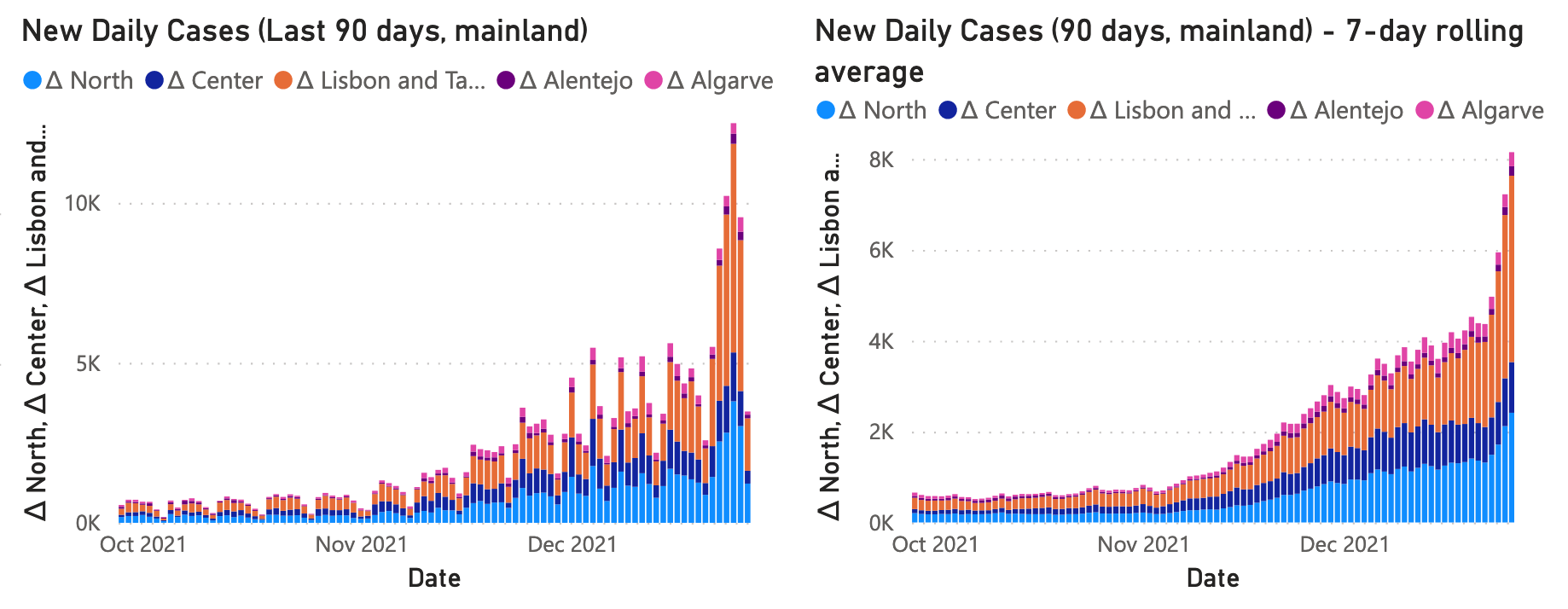
Now that Christmas has come and gone (with varying results as people scrambled to test centers to figure out whether it was safe), I think another short update on the COVID situation in Portugal is warranted as the Omicron variant takes a firm hold.
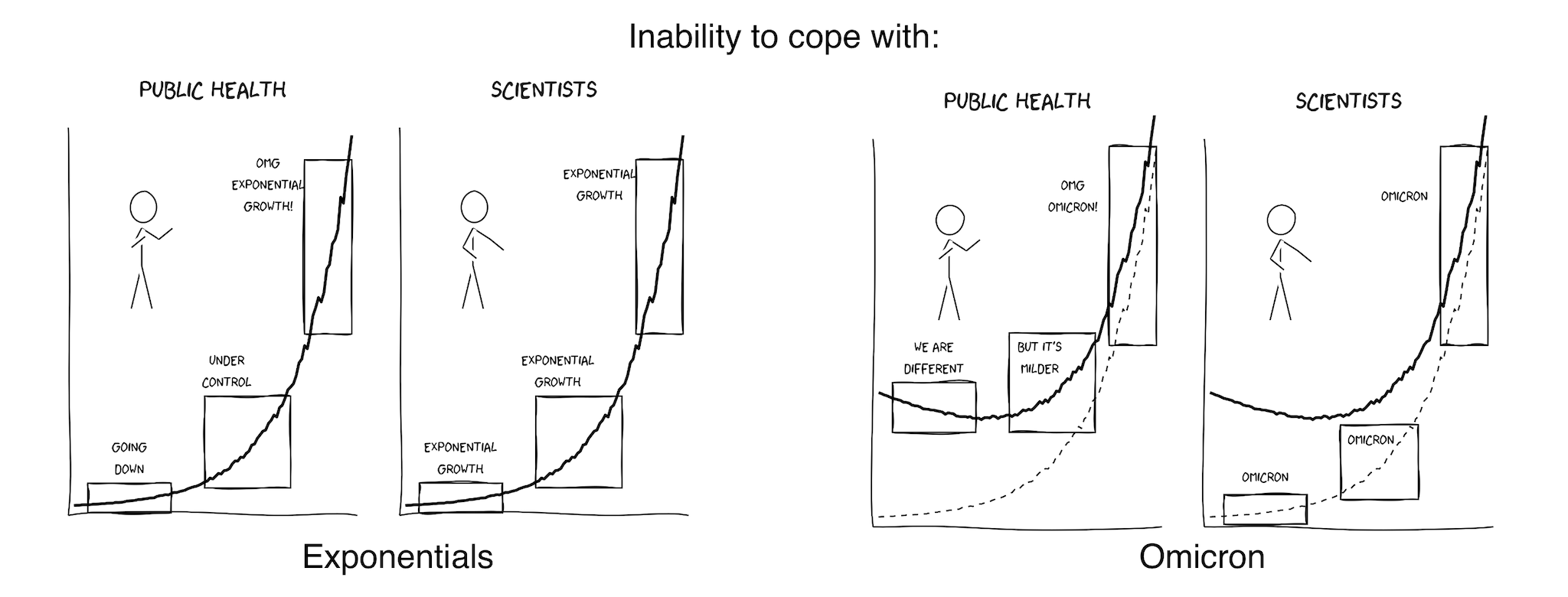
In a move that surprised exactly no-one in terms of both belatedness and short-sightedness, the government issued restrictions that include mandatory remote work, school closures and closing nightclubs starting on Christmas day, which is exactly the kind of delayed, completely ineffective reaction that demonstrates their utter inability to learn from past mistakes and wishful thinking regarding lessening economic impact.
The slowness and inadequacy of the response reminded me of this XKCD parody that is, unfortunately, too accurate:
Politicians simply do not understand maths (source)
They did that on the 22nd of December, after nearly three weeks of fumbling, and instead of going back to confinement during the festive season merely made testing mandatory for multiple scenarios (hotels, events, sports venues, restaurants etc.).
So this is nothing more than moving an already planned “buffer” week from post-New Year to post-Christmas, and it’s pretty obvious that it not enough even now.
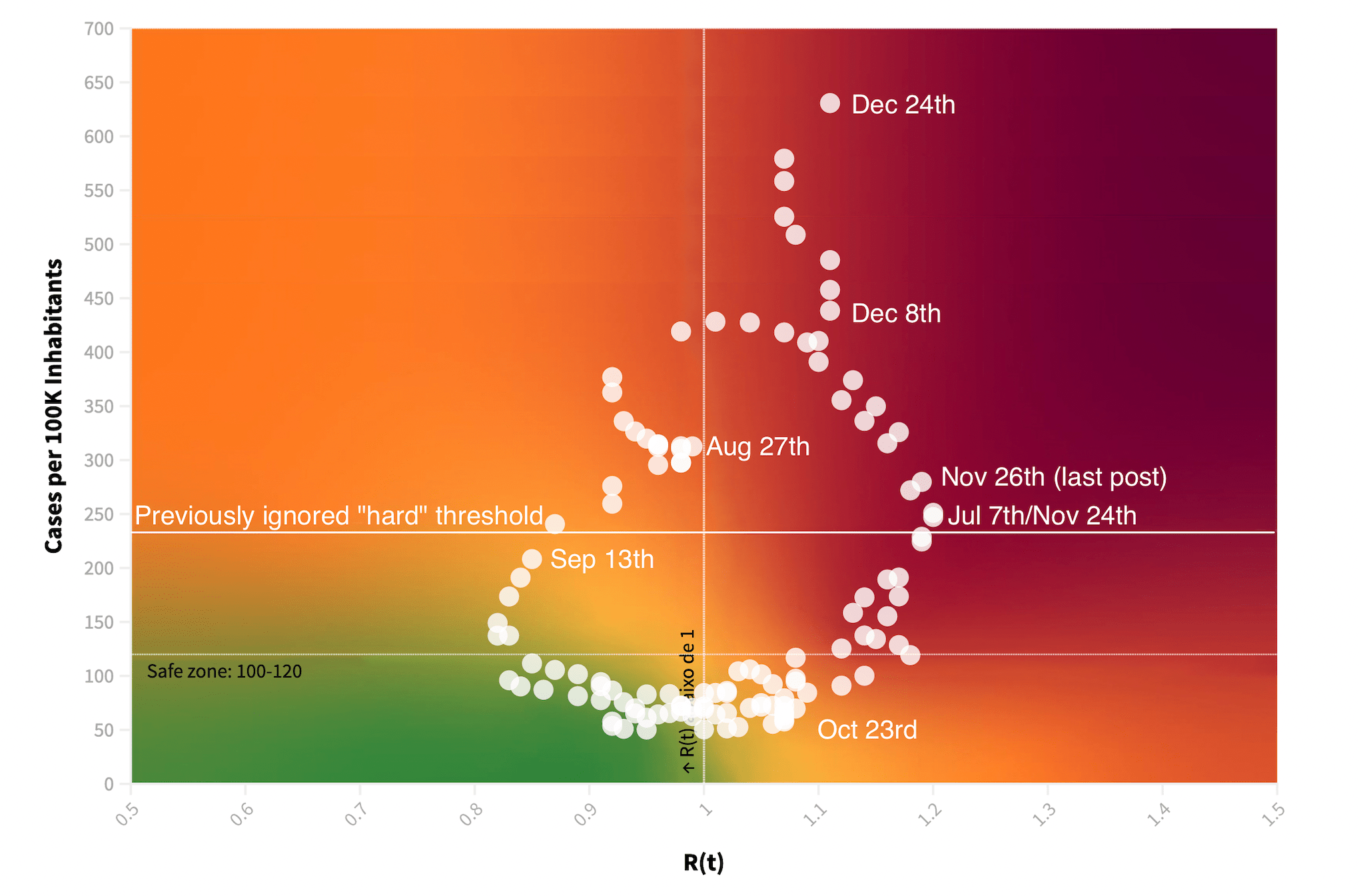
Looking back, it bears reminding that none of the strict measures that were supposed to come to pass when multiple “red lines” on the chart below were crossed (many more than once), so none of this is surprising.
The official risk matrix, annotated. In many ways, this is the worse it's ever been.
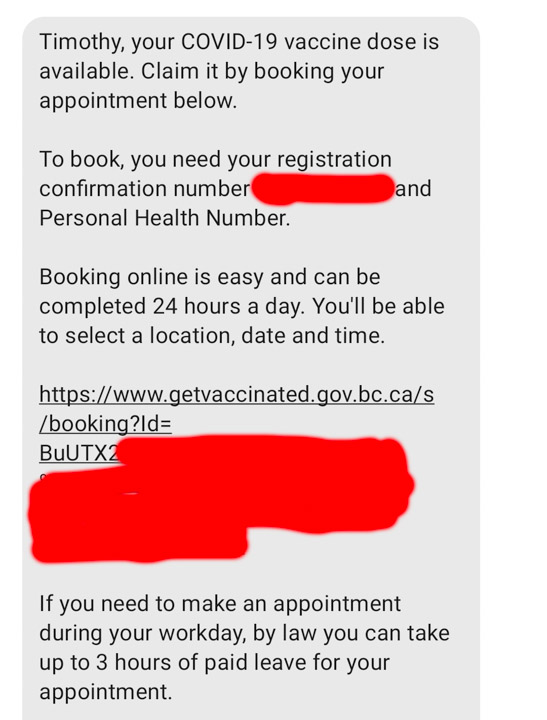
The government also issued a press release on the 23rd finally announcing that a booster is recommended for 40+ (as well as younger people at risk), but without set dates for the boosters themselves, which is great timing considering that many vaccination centers have been shut down and that the remaining ones will entail longer trips in ever worsening weather.
What fascinates me is that this was completely obvious a month or so ago, and that it takes almost 2 weeks of various public and political consultations for the government to do anything at all.
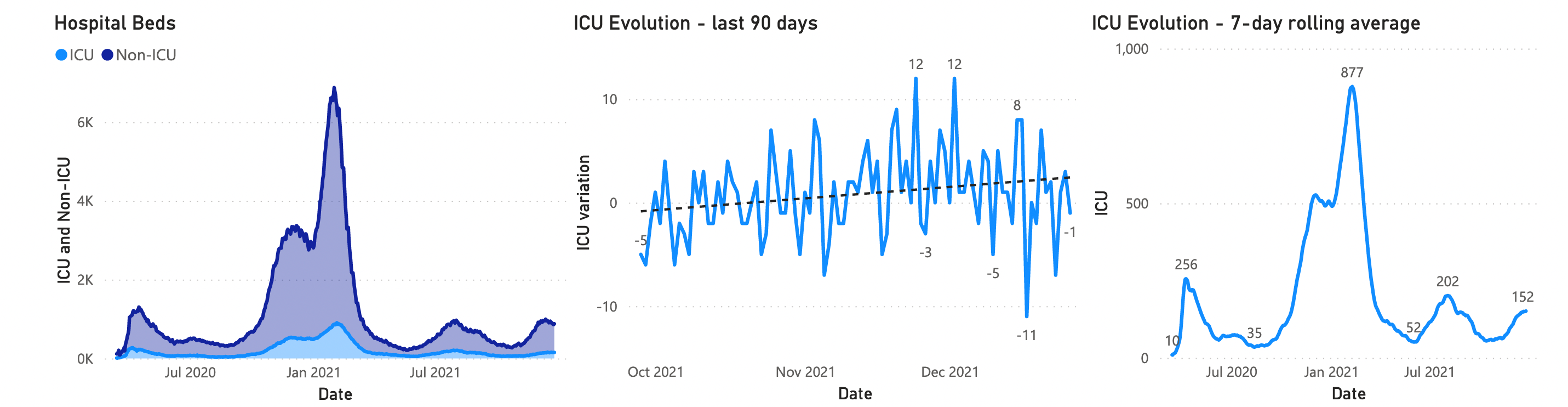
Taking away the usual spate of minor scandals surrounding fake vaccination certificates, unlicensed parties, and plain and simple idiocy from block-headed friends, family and colleagues who refuse to acknowledge the risks or get tested, one thing’s for sure: vaccines have definitedly made a difference when compared to last year, even though ICU admissions are trending up again.
This is still worrisome, but not so much as last year.
With many children vaccinated and older people having already taken their booster shots, I’m really tooking forward to getting mine ASAP–it’s the only thing that has any real effect.
During 2021 I sent around 100 emails whose first line started something like: “I have been reading your interesting blog post…”, followed by some background information, and then a request for software engineering data. Sometimes the request for data was specific (e.g., the data associated with the blog post), and sometimes it was a general request for any data they might have.
So far, these 100 email requests have produced one two datasets. Around 80% failed to elicit a reply, compared to a 32% no reply for authors of published papers. Perhaps they don’t have any data, and don’t think a reply is worth the trouble. Perhaps they have some data, but it would be a hassle to get into a shippable state (I like this idea because it means that at least some people have data). Or perhaps they don’t understand why anybody would be interested in data and must be an odd-ball, and not somebody they want to engage with (I may well be odd, but I don’t bite :-).
Some of those who reply, that they don’t have any data, tell me that they don’t understand why I might be interested in data. Over my entire professional career, in many other contexts, I have often encountered surprise that data driven problem-solving increases the likelihood of reaching a workable solution. The seat of the pants approach to problem-solving is endemic within software engineering.
Others ask what kind of data I am interested in. My reply is that I am interested in human software engineering data, pointing out that lots of Open source is readily available, but that data relating to the human factors underpinning software development is much harder to find. I point them at my evidence-based book for examples of human centric software data.
In business, my experience is that people sometimes get in touch years after hearing me speak, or reading something I wrote, to talk about possible work. I am optimistic that the same will happen through my requests for data, i.e., somebody I emailed will encounter some data and think of me
What is different about 2021 is that I have been more willing to fail, and not just asking for data when I encounter somebody who obviously has data. That is to say, my expectation threshold for asking is lower than previous years, i.e., I am more willing to spend a few minutes crafting a targeted email on what appear to be tenuous cases (based on past experience).
In 2022 I plan to be even more active, in particular, by giving talks and attending lots of meetups (London based). If your company is looking for somebody to give an in-person lunchtime talk, feel free to contact me about possible topics (I’m always after feedback on my analysis of existing data, and will take a 10-second appeal for more data).
Software data is not commonly available because most people don’t collect data, and when data is collected, no thought is given to hanging onto it. At the moment, I don’t think it is possible to incentivize people to collect data (i.e., no saleable benefit to offset the cost of collecting it), but once collected the cost of hanging onto data is peanuts. So as well as asking for data, I also plan to sell the idea of hanging onto any data that is collected.
You probably had a tough year. Perhaps you were cooped up with kids under pressure. Maybe someone you care about got very sick. Maybe inflation squeezed your paycheck. As we stumble towards the end of the year, here are a few things that Americans might want to feel good about. The speed with which researchers … Continued
Facebook CEO Mark Zuckerberg explains his “Metaverse” virtual world concept, which he says is about “connecting with people.” pic.twitter.com/24YZk5ag5J
I don’t usually do this, but as I graded my annual predictions for the year, I ended up creating a pretty dense, link-filled syllabus of Facebook’s terrible 2021. I thought it deserved its own entry in the database of intentions, so herewith I present to you the full accounting of my 2021 prediction on the company: Facebook’s chickens come home to roost…2021 will be a dismal year for Facebook.
Oh my, was it ever. Facebook’s year was so terrible, the company decided to change its name as a result. Because I took notes all year, here’s a brief review of Facebook’s 2021:
January: Facebook kicks off the year with a WhatsApp privacy disaster, sparking outrage both inside and outside the company. Apple CEO Tim Cook pounces, leveraging his bully pulpit to pummel Zuck & Co. Also in January, Facebook outsources the single most important decision it’s ever made- de-platforming a sitting President – to its “oversight board.” (PS, the Board essentially kicked the decision back to Facebook).
February: Facebook decides to down-rank political news, which as many pointed out, is itself a deeply political act. This does not have the intended effect, instead driving even more insanity into its poorly considered “Groups” feature.
August: Facebook is taken to task for its practice of silencing its employees. This is before the publication of the Facebook Files/Papers – Facebook’s most damaging leak – next month. Oh, and the company’s ads business is busted for allowing promotion of ivermectin. Never one to misplay a comms response, Facebook continues its PR offensive by releasing internal studies on “widely used content.” Turns out, it cherry picked which report it decided to release, and buried the one it didn’t like.
October: The Facebook platform goes down, for everyone – the company’s worst outage ever. Meanwhile, the think pieces based on Haugen’s revelations begin to seep into public conversation: “Facebook is Weaker Than We Knew” is one of an endlessbarrage of chin stroking, most of it negative. The company’s own “oversight board” rebukes Facebook for the XCheck debacle. The Facebook Files expand into the Facebook Papers, as Haugen’s redacted documents are leaked, and the Post carries the Journal’s work into fresh allegations of indefensible behavior by the company. The FTC gets into the action. Clearly, a pivot is in order. And by the end of this horrific month, Facebook changes the conversation, and its name, to Meta.
November/December: No one seems to appreciate the new name, and Zuck’s performance in the roll out is widely ridiculed. Employee defections are rife. Tik Tok overtakes Facebook and Google as the most visited domain in the US. To cap it all off, Facebook is voted “The Worst Company of the Year” by readers of …Yahoo! Finance. Now that’s meta.
I’ve left off dozens of ugly narratives while compiling this list – and admittedly, I’ve also left off a fair number of pro-Facebook responses as well. But overall, I think this particular prediction was pretty spot on. Let’s call it a win and move on…
We’re now two years into a (still) evolving pandemic with entirely too many plot twists, but life goes on and I’ve been trying to push that into the background. And given the season, I think I should put together another list of noteworthy things that came to pass in much the same vein as last year.
So I guess I’m in the “right” place given my telecommunications background, my longtime interest in embedded hardware and the current wave of 5G hype spreading throughout the industry, but (and yes, there’s a but) I’ve been so inured by the various waves of 3G/4G hype that I’m still trying to figure out exactly where, when and how I can make a difference.
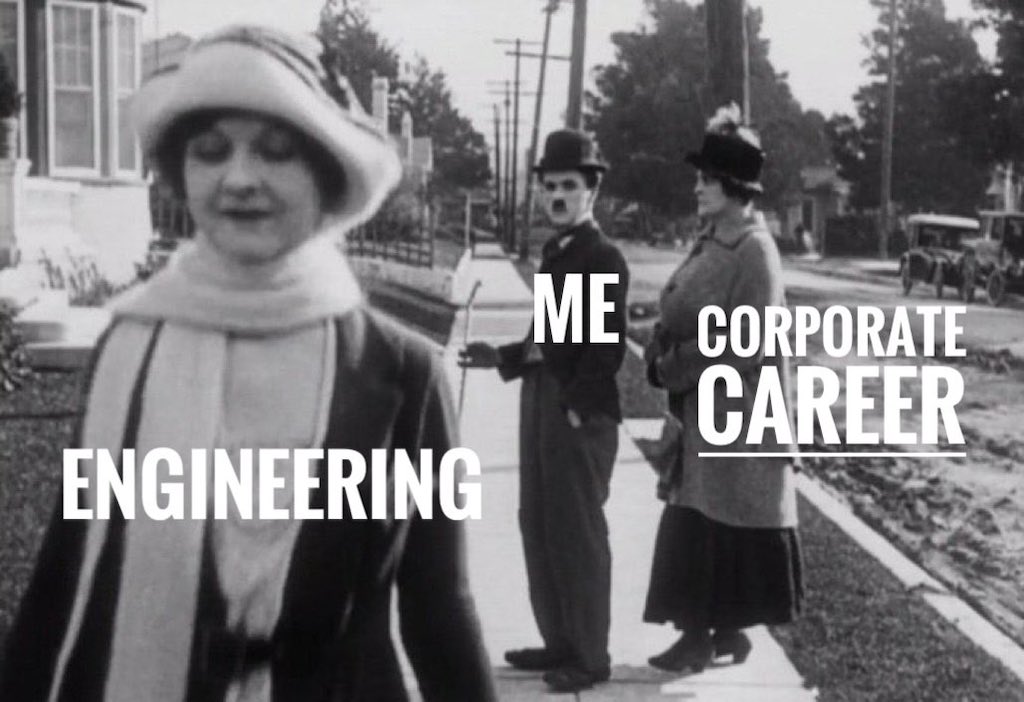
The biggest change for me is that after years of being a very experienced technology generalist with business acumen, I’m now a bit further away from the business itself but in a more focused context. It’s still not engineering, but it does afford me more insights (and a degree of control) over product and services delivery, but it’s now moved beyond effectively practice management and into people development.
I must say that so far, work-wise and process-wise, it feels much more focused than the strategic consulting business I was embedded in, both scope-wise and from a time management perspective1.
There are still not enough hours in the day, but at least I’m diving deeper into things (and there is a huge cloud transformation angle, since the telco business is dogmatic to the point of obsolescence in many regards).
The weird part is that I sort of got my wish (which is rather typical at Microsoft): I’m in that “smaller”, more focused context I wanted last year, except that it just happens to be a corporate priority.
My new role is worldwide rather than just EMEA (although there is a natural alignment with my timezone), which affords me some extra focus time in the mornings at the expense of more late meetings–but I’m still happy about working remotely, and extra happy that the company culture accounts for fully remote work throughout my organization.
But whereas the pandemic curtailed consulting trips last year, this year it is making it hard for team and management meetings to take place normally–I’m not keen on traveling either way, but the issue keeps coming up enough to be a concern.
There’s still a gap that needs filling here (I’m not feeling especially accomplished just yet), but things are looking up. And given the way my career is going, I really shouldn’t complain, right?
I think this is still an adequate depiction of my current circumstances.
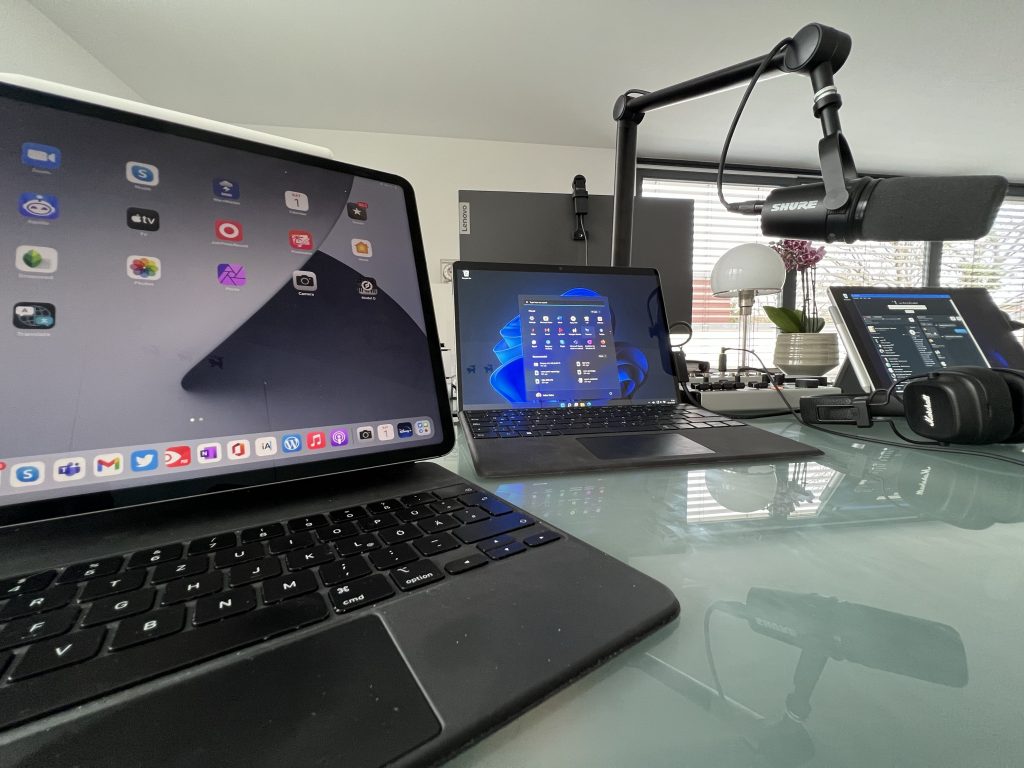
Both my new monitor and my switch from a desktop setup to a new laptop have had a definite effect in my work habits in that I’ve used my standing desk a lot less after Summer, so I have been feeling antsy and with a pressing need to do some changes around the office.
The biggest is surely going to be getting a single, big combo sit/stand desk, but I’ve held off on it until I could simplify my computer setup (done) and get rid of a lot of extra clutter in the office (still nowhere near done).
But there just aren’t any pre-built desks I can use (they’re all too small), so I’ll need to build my own. That will take time (and space) I don’t have readily handy, and another change in my personal habits has also contributed to the delay: I now spend a lot less time in my office on weekends and prefer to hack on my personal projects from a dedicated laptop, or fiddle with my various hobbies anywhere from the couch to the dinner table.
Although my Lenovo wasn’t really bought (or even classifies) as a gaming machine, it’s been pretty useful for me to unwind a bit as I haven’t had enough room to strap on our Oculus Quest regularly.
But it’s worthwhile to note that we’ve kept using an NVIDIA Shield to play on xCloud throughout the year, culminating on a weekend spent playing Halo Infinite–although that’s been put on hold for the moment as I prefer exploring No Man’s Sky or the creepy corridors of Control to getting stuck on frustrating boss battles (which I think is the weakest point of the Halo campaign altogether, and a major put-off for me).
I don’t think getting a (physical) Xbox is on the cards, but I wouldn’t be surprised if one popped up next year.
What did pop up this year (as a Christmas present) is an Ambernic RG351MP, which is a pretty decent portable retro console emulator where I’ve already loaded PICO-8 and They Started It to great effect.
I plan to use it to reminisce a bit and play ancient Spectrum and ScummVM games as well (for which its 4:3 aspect ratio is critical), and PICO-8 support is just icing on the cake.
I’ve been meaning to do a write-up of the “private cloud” setup I’ve mentioned last year (and it will eventually pop up one rainy afternoon), but it bears noting that my Raspberry Pi cluster is now gone.
There is only so much you can do with Pi 2 boards these days, and I might rebuild it with newer hardware next year, but right now I can do so much more (and faster) with KVM (or LXD on a Pi 4) that it just isn’t worthwhile to have standalone nodes.
It’s been an interesting year in that I’m still deep in the throes of “gear acquisition syndrome”, but not just for myself–I’m also trying to get my kids excited about music.
I think I’m done with buying new gear for a while, especially given that everything we have available right now affords me more opportunity to fiddle and explore than I could possibly have time for.
So my priorities for personal gear are essentially getting rid of old stuff, and I still have to either repair, sell or give away my wonky iMac (which, if it worked, would make for a great standalone DAW)2.
I’ve made a conscious effort to spend more time relaxing, and it’s fortunately become a family thing to watch some awesome TV series like Ted Lasso and The Expanse after dinner, as my kids are now old enough to watch and enjoy classic TV and movies. That’s something that has eaten into my hobby time–but which I don’t regret in the least.
I’ve also gone back to my usual pace of reading 30+ books a year. As usually that’s mostly Sci-Fi to wolf down and tune out from the world before bed, but it’s time well spent.
I’m not keeping track of technical books (of which there were something between 5-10) because I sometimes just skim them and usually don’t read them cover to cover, but I probably should write about one or two of them sometime.
The site is now effectively twenty years old any way you look at it (although a few chunks of the early content are gone), and has been running completely off Azure storage for nine months now, in what I hope will be one of its last engine/architecture changes (it’s been six or seven already, ever since I set up the first PHPWiki instance back in 2002).
The next milestone is converting all the site content to Markdown, and right now I’m pretty much halfway there but it’s going to be a long stretch even with semi-automated conversions, and I might well do a new redesign to simplify the markup even further while I’m at it.
The end goal is to make sure it can last essentially forever (to a degree) and that I can, if necessary, simply archive it away for a few years with zero maintenance.
Over the past couple of years, my kids have been getting into Unity and PICO-8 (which is a terrific standalone environment to teach programming concepts, by the way), and I’ve been keeping tabs on things myself to the extent where we’ve all got PICO-8, Blender and now Godot installed.
I can’t spare the time to do more than help out and test their projects, but I like the occasional dip into 3D graphics and the idea of spending time in a more satisfying, resource-constrained (and let’s face it, more creative) form of coding, so here’s to hoping this plays a bigger role in my hobbies next year.
I’ve also been trying to rationalize what tech I use for my personal projects, and spent a good portion of the year doing various small experiments in Clojure, Fennel, JanetRust, .NET, and Go in search of my next “forever language” (besides Python, which is still the first thing I reach for).
Since I want to focus on performance, maintainability and tight memory footprints, I have a feeling I will end up going with either Go or C++, because those are now likely to be around forever regardless of what happens.
Everyone in the family is vaccinated, which what has made the year bearable even if constant quasi-confinement over the last two years has taken somewhat of a toll3.
Regarding the stuff I can control, and thanks to my recent role change, I now have a new daily routine that has improved my mood and stamina but which is still not enough to match the times when I was out and about constantly and walked everywhere–which is the only thing I miss regarding my current occupation.
All things considered, the latter half of this year was indeed an improvement over 2020, so I hope things keep improving.
i.e., I’m still storming castles, but the moat is deeper instead of merely crocodile-infested and with turbulent rapids. ↩︎
Still no decent songs, though. Maybe next year. ↩︎
I now realize that I’ve been to a restaurant a grand total of one time this year and can’t remember the last time before that, even if we did visit a few malls earlier in the year, and that I really miss walking about on a regular basis, although daily school runs and short neighborhood shopping runs help considerably. ↩︎
I fully expect Trump, unconstrained by the people that surround him in the
White House today, to become even more unhinged and try to inspire even more
violent acts of terrorism.”
I wrote that two weeks before Jan 6th.
I also wrote about the roots of that violence as a loss of power:
And the majority of these were from leftist groups, in an age when the country
had started to take a turn to the right. My theory is that the political
violence is a reaction from people that know the popular opinion has turned
against them; it was leftists during the 70s and it will be right-wingers, nee
Trumpists, in the 2020s.
In the CPOST polls, only one other statement won overwhelming support among
the 21 million committed insurrectionists. Almost two-thirds of them agreed
that “African American people or Hispanic people in our country will
eventually have more rights than whites.” Slicing the data another way:
Respondents who believed in the Great Replacement theory, regardless of their
views on anything else, were nearly four times as likely as those who did not
to support the violent removal of the president.
And:
Pape drew an analogy to Northern Ireland in the late 1960s, at the dawn of the
Troubles. “In 1968, 13 percent of Catholics in Northern Ireland said that the
use of force for Irish nationalism was justified,” he said. “The Provisional
IRA was created shortly thereafter with only a few hundred members.” Decades
of bloody violence followed. And 13 percent support was more than enough, in
those early years, to sustain it.
In my 2021 article I quoted from Time: The Bombings
of America That We Forgot to point out the violence that left-wing
extremists had visited upon America as they were losing power:
In a single eighteen-month period during 1971 and 1972 the FBI counted an
amazing 2,500 bombings on American soil, almost five a day.
I don’t expect things to improve in 2022, in fact, I believe they will only get
worse.
For example, if the GOP does win back the House in the mid-terms you can fully
expect them to dismantle the Jan 6th committee and do their best to expunge any
memory of that day.
But there’s a chance they may lose, and I know this is a real concern for the
GOP because I keep seeing them emphasize how “the opposing party always wins
the mid-terms”, anticipating a loss they are priming another “stolen election”
narrative. Imagine Jan 6th style attacks, but this time at a dozen state houses
across the country.
Similarly, you might hold out hope for Trump being jailed for offenses in NY,
and while that would stop him from be able to hold rallies, the faithful will
only point to his incarceration as political oppression, and no doubt that will
be used to feed their fear and violence.
Covid
Omicron looks like it will be the last major wave of Covid as it becomes an
endemic part of everyday life.
The massive effort spent on fighting Covid will provide benefits for years to
come as it accelerated mRNA development by a decade or two, pushed even more R&D
into anti-virals and cytokine storms, and will probably trigger a whole new wave
of students that want to go into related fields of study. But we’ll have to wait
for those benefits, 2022 will be mostly focused on mopping up the mess.
Supply Chain
Over the last 40 years an incredibly efficient international trade and transport
system has been built. The problem is that “efficient” is the opposite of
“robust”, and in the face of Covid the lack of robustness came to the surface.
I expect that over the course of the year that bottlenecks will be resolved, but
I don’t hold out much hope for concerted efforts to increase the robustness of
the system, which is unfortunate, as global warming will only increase the
chances of further disruptions going forward.
Climate Change
Global warming won’t get any better in 2022. We’ll see incremental improvements
in solar cell efficiency, and battery storage, and many more EVs will roll off
production lines, but barring some breakthrough in fusion energy or the eruption
of a volcano large enough to affect the climate (which would bring along its own
set of problems), I only see us spending more time and money on accommodating
climate change, ala supply change disruptions I alluded to above.
Don’t get me wrong, the incremental improvements are the way we win on the long
run, but in the short run I expect the effects of global warming to only get
worse.
Remember: 2021 was the coldest year on record for the next 100 years.
I borrowed a friend’s Tesla 3 yesterday. About 5 minutes into the ride, the windshield started fogging up. I couldn’t find the defroster on the large control screen Teslas are so famous for. In desperation, I tapped the CAR icon but that took me to the settings screen which ended up being a dead end. […]
I saw this post back in 2008 and was blown away by the visualization of a resume by Greg Dizzia Let me be transparent. I hate my resume, and I never really found many resumes to be of great value. I thought about making my own visual resume but never got around to it. Still, … Continue reading Visualizing Our Identity
Organizations email individuals all the time. The sender is often something like “do-not-reply@organization.com.” That’s a massive “screw you” to the customer, and it doesn’t have to be. Why do those “Do Not Reply” emails exist? There are lots of reasons that companies send emails from a “do not reply” address. The main one is some … Continued
Note: This was originally published as the daily newsletter at the Columbia Journalism Review, where I am the chief digital writer
On Tuesday, Vox Media and Group Nine announced that they have agreed to merge their operations, in what Jim Bankhoff—Vox’s co-founder and CEO—told Axios will create “the fastest-growing company of scale in media.” Vox controls a suite of websites, including the eponymous Vox, as well as The Verge, Eater, and SB Nation, while Group Nine owns a number of niche interest sites such as NowThis, The Dodo, PopSugar, and Thrillist. The merger comes on the heels of a number of media-related deals, including BuzzFeed’s merger with a special-purpose acquisition company (SPAC), which gave the company a public listing and a theoretical value of $1.5 billion, and Axel Springer’s acquisition of Politico, in a deal valued at $1 billion. Donald Trump has also hitched a ride on the SPAC train by merging his media venture with an entity in a deal valued at $2 billion.
The idea of achieving something called “scale” is often referred to when deals like the Vox-Group Nine merger are announced, but the definition of that term is surprisingly hard to pin down. For example, Group Nine acquired PopSugar less than two years ago for $300 million, and yet, according to some sources who spoke with the New York Post, the Vox merger deal values all of Group Nine at less than $300 million—a little over half what the entire company was valued at in 2016, when it got a $100 million investment from Discovery. The current deal reportedly values Vox at $672 million, substantially less than the $1 billion it was theoretically valued at in 2015, during its last funding round, despite the growth the company has reported in the years since that investment.
In a similar vein, BuzzFeed’s SPAC deal originally valued the company at about one and a half billion—less than what it was theoretically worth in 2016, when it got a two hundred million dollar investment from NBCUniversal. Since BuzzFeed merged with the SPAC—and subsequently acquired Complex Networks, a global content network targeting millennials, which itself had a theoretical market value of three hundred million dollars—the new entity’s market capitalization has plummeted by close to forty percent, to the point where it is worth less than eight hundred million dollaes, or less than half what it was supposedly worth when it got the NBCUniversal funding. BuzzFeed had seventy-two million unique visitors in May of this year, according to Comscore; even after the merger with Complex Networks, it will only be slightly larger than Vox (by that measure, at least).
What all this suggests is that the definition of sufficient scale is a constantly shifting target—especially if the companies merging or being acquired are shrinking in valuation at the same time, as virtually everything in the mainstream media industry has been doing for a number of years, with the exception of a few standouts. (As the Red Queen said in Alice in Wonderland, “It takes all the running you can do, to keep in the same place. If you want to get somewhere else, you must run at least twice as fast!” Brian Morrissey, the co-founder and former editor of Digiday, wrote that “‘scale matters’ is still the message,” but many legacy digital publishers are still trying to catch up to giants like Google, Facebook, and Amazon on the monetization front. “Citing Comscore [traffic numbers] is a red flag that you’re fighting the last war, not the next one or even the current one,” he added.
In some of these cases, the justification of merging for “scale” may be just one goal among several. At BuzzFeed, for example, the company’s investors had reportedly been pushing it to come up with an exit strategy for some time—a way for NBCUniversal and others to get out some of the money they put in. The merger with a SPAC was seen by some as a desperation move to allow the company to go public at any cost;the aftermath of the deal suggests that at least some investors are not encouraged that BuzzFeed will achieve some kind of “scale” that will enable it to prosper. In the days leading up to the finalization of the merger, the funders behind the SPAC pulled almost all of their money out of the vehicle, leaving BuzzFeed with much less than it had hoped for when it originally announced the deal.
At Recode, which is part of Vox Media, Peter Kafka boiled down the pitch that Vox and Group Nine and BuzzFeed and others are making. “The optimistic version of that pitch: Combining equals more reach, more efficiency, more awesomeness,” Kafka wrote. “The flip side: If we don’t combine, we may not make it.” Left unspoken, of course, is the possibility that even if they do combine, they still might not make it.
Here’s more on media deal-making:
Hopes dashed: When BuzzFeed went public,The New Yorker reports, “ex-staffers learned something alarming: they were unable to sell the stock that they had waited years to trade.” Employees watched as the stock fell by as much as forty percent, erasing much of the gains they had hoped to lock in by selling during the public offering. “Hopes of windfalls, large and small, were dashed. Some former employees are now asking whether they were cut out of trading owing to incompetence, or deliberately misled.” Jonah Peretti, co-founder and CEO of BuzzFeed, said in internal Slack messages that he was “very upset” by the way the merger and public issue were handled.
SPAC excitement: Bryan Goldberg, who controls Bustle Media Group and a stable of websites such as Bustle and Input, said earlier this year that he was interested in pursuing a merger with a SPAC as a route to a public offering and expanding the company’s scale. “As we’ve spent a lot of time in the market speaking with SPACs, there’s a lot of excitement about a digital-media roll-up strategy,” Goldberg told the Wall Street Journal in July. “So while [Bustle’s acquisition of Spider Studios] is being done while both companies are still private, it is very much being done with an eye towards the public markets.”
Food and decor: Axios reported that TCG, the investment arm of The Chernin Group, is putting eighty million dollars into Food52, a cooking and home goods brand, including forty-eight million dollars to pay for the acquisition of Schoolhouse, a home decor company. According to Axios, the deal values Food52 three times higher than its one hundred million-dollar valuation in September 2019, when TCG purchased an eighty-three million dollar majority stake. Food52 was founded in 2009 by former New York Times journalists Amanda Hesser and Merrill Stubbs. Prior to its deal with TCG, it raised thirteen million dollars from venture and strategic investors.
Other notable stories:
A freelance photojournalist in Myanmar has died in military custody after being arrested last week while covering protests. “Soe Naing is the first journalist known to have died in custody since the army seized power in February, ousting the elected government of Aung San Suu Kyi,” the Guardian reports. “More than 100 journalists have been detained since then, though about half have been released.” Soe Naing was arrested Friday when he and a colleague were in downtown Yangon taking photos during a “silent strike” called by opponents of military rule.
The Associated Press has asked the Department of Homeland Security to explain why it has used government databases designed for tracking international terrorists to investigate as many as 20 American journalists, including an AP reporter. “In a letter to DHS Secretary Alejandro Mayorkas, AP Executive Editor Julie Pace urged the agency to explain why the name of Pulitzer Prize-winning investigative reporter Martha Mendoza was run through the databases and identified as a potential confidential informant during the Trump administration,” the AP reported.
Alden Global Capital, a hedge fund that has acquired and downsized a number of local news companies, is suing Lee Enterprises after Lee’s board of directors voted to reject Alden’s hostile takeover bid, according to a report from Axios. Alden argues that the Lee board “infringed on company bylaws when it denied Alden’s request to nominate three members to its board.” The claim says Lee has “breached the fiduciary duties they owe [to Alden Global] in an effort to prevent the stockholders from having a say on Lee’s future through the election of directors at the Company’s next annual meeting.”
Joe Nocera, a former Bloomberg columnist who was fired by the company, is suing for a share of the proceeds from a TV show called “The Shrink Next Door,” which was adapted from a popular podcast of the same name that Nocera created while he worked at Bloomberg. “According to his lawsuit, when Nocera inquired with the company about his earnings from the deal after he was fired, he was told that Bloomberg’s stance was that journalists were not entitled to a share of advertising revenue generated by an adaptation,” the Washington Post reported. Nocera claims that his deal with Bloomberg specifically included a share of the revenue that might be generated from the material.
Google has offered the French government’s antitrust regulators a set of commitments to pay news publishers for their content, in the hope that it can avoid a costly fine, TechCrunch reports. “In July, France’s Autorité de la Concurrence slapped the tech giant with a fine of half a billion euros over a series of suspected breaches in how it negotiated with news publishers to remunerate them for reuse of their content,” the site notes. Like other European countries, France has been adapting its copyright laws to new EU rules that were first adopted in 2019, which cover news excerpts posted by aggregators.
Reuters reports that Smartmatic and Dominion, two manufacturers of voting machines, are asking a court to give them personal communications from both Rupert Murdoch, chairman of Fox, and his son Lachlan, the company’s CEO, to help them in their attempt to prove that Fox News either knew statements it aired about the companies’ voting machines were false, or else acted with reckless disregard for whether they were true or false. “Fox News has moved to dismiss the lawsuits, saying it reported on matters of paramount public concern, and that this coverage is protected by the First Amendment of the U.S. Constitution,” according to Reuters.
Darryl Holliday writes in CJR about the need to build public infrastructure for journalism. “Ivory-tower journalism has failed. It’s time we focus on building public infrastructure where everyone can find, factcheck, and produce civic information,” he writes. “This is not a problem that journalists can solve on our own. The best response to the current crisis in journalism is to get more people involved, at a level at which everyone is willing and able to participate. Not just as news consumers, but as distributors and—most importantly—producers of local information.”
Following Ben Werdmüller and Laura Ritchie, two members of a small eclectic Mastodon community I belong to, I am using the turn of the calendar to look forward and not backward.
And honestly, the main thing I am hoping for is to finish 2023 in continuing good health and spirits. It's something pretty easily taken for granted, but at the age of 63 I'm counting every good day as a gift. Some of those days I live to the fullest, some of them I rest, but not a one goes by without me taking note of how fortunate I have been in life.
Not surprisingly, then, it is the thing I hope for most for other people as well, for my family, community, friends and strangers met and unmet around the world. In my 40s and 50s I was privileged to be able to travel all over the world, and the main lesson for me was in recognizing our common humanity. Not that everyone was the same - far from it - nor that everyone was nice and friendly. Many were, some weren't. Doesn't matter. I wish the best for them all.
So to the pandemic, then, which I hope ends for everyone, but also the many ills and afflictions existed before Covid and doubtless will linger on after. I hope that some of the good that may come out of our relentless research will be greater advances on diseases like HIV-AIDS, HPV, the flu, meningitis, and the many other viral afflictions. And though it may be too late to turn back the impact it is having on our family, I'd like to see progress against dementia.
And it may be surprising but I feel there may be wider successes on the health care front precisely because we've seen first hand the cost of leaving people uninsured and untreated. Sure, this is counting on a very selfish urge on the part of the wealthy, but perhaps they will be convinced again, as they have in the past, that the health of one is the health of all. There may be a day perhaps sooner than people think that single-payer health insurance will arrive in the U.S., and this will free a generation of people to take risks, live freely, and grow beyond corporate health plans and HMOs.
The other way we're seeing how all our destinies are bound together is with the growing reach of climate change and associated ills, sometimes all in one place. Each year I look for small things - like the return of the monarch butterfly - and fear the big things - floods, fires, storms, drought, disease, devastation. Any of these could touch home, and all of these will touch someone this year. I have always tried to keep my footprint small and - even with air travel - mostly succeeded.
Perhaps this will be the year we hold some of those large companies and institutions to account. Not just oil companies - though they are certainly complicit - but the financial and political infrastructure that continues to prioritize making rich people richer over the health and welfare of the rest of us. In truth, it doesn't matter how small my economic footprint is (much less the nearly zero footprint of those billions of people around the world living in poverty). It's the wealthy who are causing climate change. And so what matters is changing the behaviour of the rich and powerful. Maybe that starts to happen this year.
And I want each person to experience agency and impact in their lives. Ben expresses this through advocacy of women's rights, Laura through self-efficacy and getting to yes I can. The best I can be is an ally for women, for black lives, for indigenous rights, for my friends in the gay, lesbian and trans community, and for the rest (and as always I'm trying to find that fine balance between recognizing them and saying their name by listing them, and not leaving out equally valid and important movements by not listing them). You won't see me out there on the barricades leading the way, but when you need it, I'll have your back.
This is also the spirit in which I approach education. I know that for many proponents education is the great leveler, the way people can advance in their lives, obtain more gainful employment,and provide for themselves and their families. I'm under no such illusion. True, educated people earn more, which is a good argument for education, but it has also positioned the need for an education as a barrier standing in the way for many others. So long as we have a mechanism favouring some and penalizing others then we in the education system are perpetuating the harms we wish to eliminate. Unless and only until education fulfills the aspirations of people, and not merely the conditions of their servitude, it will not emancipate.
That is why I am an advocate, first, of free learning. Free in every sense, and not just in terms of cost. It is not hard to imagine a world where, when you're young, society gives you the means to pursue your own passion, and then continues to support that passion throughout life. What else is society for, if not that? The purpose of employment is not, and has never been, to support the objectives of the company or institution or the captain of industry, it is to support each member of the workforce in their own endeavours. The purpose of any enterprise is to support its employees. The money we spend on labour is a benefit, not a cost, of business.
The great resignation of 2021 was probably overstated, but I think it may represent for many a new recognition of this real role of employment. If your job's not working for you, why are you there? If it's endangering your life, why are you there? I know, people have families, people have expenses, and living without money is not an option. That's probably the only reason many people are at many of these jobs at all. And in 2022 maybe people will begin to see how they can meet these obligations while living more free and fulfilled lives.
My fear is that our corporate masters won't let us go, and that they'll do this by making it harder and harder to sustain ourselves. We are already hearing concerns being expressed about inflation caused by supply chain disruption. They say, for example, there's a shortage of drivers - something that could be easily addressed with higher wages. But I fear they'll respond to inflation by raising interest rates. Yes, this would reduce demand, but only by wrecking the economy and undermining government finances. I'd rather see them reduce demand by taxing the wealthy, especially at the point where they spend their money on frivolous luxuries - yachts, first class air travel, expensive cars, mansions, the usual. I won't say I'm hopeful. But I do hope governments recognize that the old approaches will not work.
My own efforts are - as always - on how we can organize ourselves and our technology more effectively to make an aspirational future possible.
I'm trying really hard not to be that old guy who has a passion project he has been working on for years forever hoping it will suddenly catch on and become the next Facebook. I've seen too many of them and I know that this isn't what happens. On the other hand, I'm not going to stop playing with gRSShopper because it really has become a thing where I can try out my ideas, if only to learn about what sorts of problems are faced by people actually trying to implement them. Doing this in any realistic way means that I have to be constantly learning. I can't imagine that I'll stop in 2022, but at some point I'll stop, and I'll be sad when I hang up my tools.
But right now I am loving the challenge. I know it's impossible to keep up with everything, and I don't even try. At the same time, this means I can simply pursue my passions, wherever they lead, and there will be something new and interesting and really useful to someone. And I have so much background now that I'm at the point where I can study something hard for a year and be where it would take someone younger ten years to get to. I can't simply 'pass on' this knowledge - but I can model the attitude and approach that has gotten me to the point where I am, and that's what I'm doing. So I'll continue to post 'Stephen Follows Instructions' videos, so people can see how the sausage is made.
In the same vein, I want to continue with Ethics, Analytics and the Duty of Care. Through the fall I created something like 80 videos, as well as a similar number of slide presentations, and a bunch of other resources. The people following this process can probably be counted on one hand, and I can't really offer a good reason why I've fixated on this project like this. There probably isn't one. But I'd like to see it through to its end, which means converting all that work into something bookish (not 'a book' because it's just too small and too corporate a container for what I want to do).
I am also going to work on data literacy. I wish I could rope Doug Belshaw into this, but I can't find a way to pay him (it's just way too complicated from my government office). But I want to think broadly about literacy without losing my grip on reality. This came about as a result of a small project last year, after which I said "I'd like to explore this more properly" and there was some funding to make it possible. Would I have done it anyway? Yes, but my focus would have been broader, because to me 'literacy' means 'critical literacies'. That's both the value I can bring but also the source of my need to stay grounded.
That's enough for one year, though as Ben Werdmüller says 2022 could be the year web3 becomes real. Web3 was my one-year passion project for 2019 - I built a blockchain and ran a MOOC and made what I thought were huge conceptual leaps in how we would think of some fundamental things in the future - things like democracy and identity and community and learning. Ben talks about how much fun people building blockchains are having - it's hard to ignore this Matt Damon spot - and we're one good application away from all of this becoming reality (and this, btw, goes hand in hand with the great resignation).
In the meantime, I want to focus on having great experiences. I was going to say "I hope to travel again", and I do, but I should not forget that I went on an epic 3-week bikepacking trip last summer. I still think about that experience every day. It was in preparation for something I am calling 'Project Anticosti' - a plan to bikepack the length of Anticosti Island and back, a total distance of 500 km - a lot less than I cycled last summer - but on a northern and essentially uninhabited wilderness island. I still have some work to do to get the bike and myself in shape, but I've done the basics.
And for the rest of it, I want to make sure I visit family and do things with Andrea - we have season's tickets for the RedBlacks next year and we'll be returning to Mont Tremblant once or twice, pandemic willing. Andrea would like to live up there one day and I'd like to make it possible.
I wrote that post at a time when Twitter was proposing to turn its previously “raw” feed into an algorithmically-curated one. It completely spoiled the social network for me, and my use of it has dwindled since 2014. It’s also had nefarious effects, amplifying hate and disinformation — as we’ve seen with countless examples around the world. Our democratic institutions are at stake.
Listening to the latest episode of It’s Not Just In Your Head, a podcast from two mental health professionals exploring how capitalism, I was fascinated by their most recent guest’s insights. Dr. Alfie Bown, a lecturer in Digital Media Culture and Technology at Royal Holloway in London, and author of a number of books, spoke eloquently about gamification in our everyday lives.
Gamification is the strategic attempt to enhance systems, services, organizations, and activities in order to create similar experiences to those experienced when playing games in order to motivate and engage users This is generally accomplished through the application of game-design elements and game principles (dynamics and mechanics) in non-game contexts. (Wikipedia)
What I found particularly interesting was Bown’s inclusion of social media in his tallying-up of everyone who plays “video games” around the world. As he points out, the feedback loops and rewards for certain types of behaviour on social networks certainly mesh with what we’d consider to be video game mechanics.
I’m a gamer, and have been most of my 41 years on this earth. The games I see my kids playing, though, are quite different to the ones I used to play at their age. There’s a very positive angle to this, as they’re a lot more positive and social than many of the ones I played when I was younger. But there’s downsides as well, and that’s what I want to talk about here.
As an example, I’ve played the FIFA football (soccer) game series ever since the very first one came out over 25 years ago. Over the last few iterations, instead of just being a particular team and playing against another player or the computer, it’s possible to create your own ‘Ultimate Team’. Having experimented with this again recently, I was shocked at how little time I ended up actually playing a football game, and how much time I was spending ‘grinding’ — i.e. doing things to unlock or upgrade things.
As Dr. Alfie Bown pointed out in the podcast episode, everything is gamified these days, from work to dating to shopping. It’s like everyone’s competing in a slightly-different ARG. So this post is a marker and a reminder for me that I can choose to gamify my own life, or have it gamified for me.
There are multiple ways to do this. One very simple one that I’ve found to be unreasonably effective is to use Loop Habit Tracker to define habits that I want to build over time. They could be exercise or nutrition-related, or something else entirely. Right now, I’m trying to do each of the following at least twice a week:
Go to the gym
Go for a run
Go on the exercise bike
Each time I succeed, I put a tick in the box under that day and activity, and it strengthens the habit.
Gamification is not something that is good or bad, in and of itself. For me, it’s all to do with whether you’re being controlled or manipulated into acting in a way which is in alignment with your values and goals in life. For example, I’ve found Duolingo useful for language-learning, and it includes a lot of gamification techniques.
As we enter a new year, I’m on a bit of a mission to remove unhelpful gamified elements from my life, and to add in ones which will help me flourish as the human being I want to be.
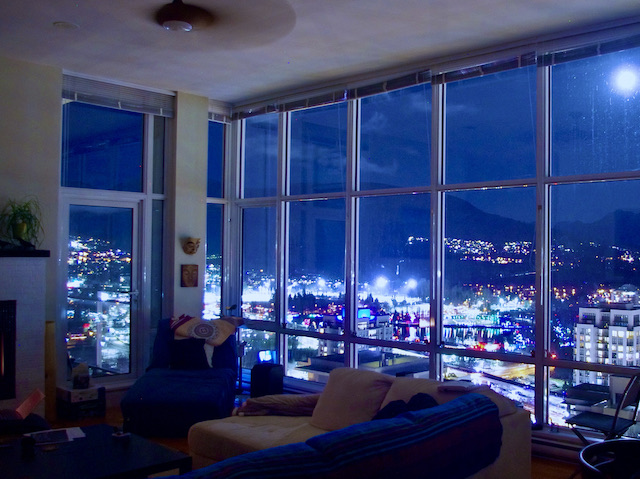
So I go out for a walk, in the moonlight. There’s still some snow on the lawns of the houses I pass. I make my way to the river path, and wander along the river, heading north. The full moon is so bright I can see my way along the unlit path, and see my breath, without needing my flashlight.
It’s never terribly quiet here, in the city, even at night, but in some ways that’s comforting. I’m much more aware of, and dismissive of, my many anxieties and fears that crop up regularly, than I used to be. But that does not prevent them arising, for absurd and inappropriate reasons, and occasionally transporting me away from my more usual state of equanimity. So the presence of the constant hum of the city, its sense of normality in the face of everything, seems preferable to the quiet isolation of my former home, where every sound stood out.
I wonder whether my incessant anxieties are a function of the lack of real distress in my life, so that, lacking practice in dealing with real issues as they arise, and moving on, I am more prone to get distressed by worries that are entirely of my own invention. Worst possible cases that never actually arise.
So there’s the anxiety arising, and then the rationalization and dismissal with the realization of its foolishness, and then the shame of not being able to control my reactions anyway. The feelings of foolishness and helplessness. Fears of suffering, of loved ones suffering, of things being out of control, of failure, of ridicule, of unexpected loss. I am so fortunate — “the world’s most blessed agnostic” — but knowing that doesn’t change anything.
The guy who used to run the hot dog stand in the cove used to spend the coldest six months each year in a small town in México, living with a family he’d met during a visit to a resort there, offering them a monthly rent for their small extra room, a rent that was an enormous amount to them, but a tiny fraction of the monthly rent he paid for his Canadian house. One year the owners of the hot dog stand decided to staff it with others, and the guy just disappeared. Someone said he and his wife had moved to México year-round.
I wondered if I could do that — go and live somewhere where life was cheap and warm but in some ways very precarious, where if something happened, you were pretty much dependent on your own resources, and on the support of people you knew. Such a different precarity from that of most Canadians, with our ‘health and social security net’, yet completely dependent on centralized systems, imported goods, a steady income, and specialists who do everything for us that, in many cases, we used to know how to do ourselves. I’m a slow learner, uncoordinated and not very good with my hands, so I suspect trying to live that way would be humbling and difficult.
But some times I long to try — to just walk away from everything here that seems so vulnerable to “system shocks”, so efficient instead of effective, so absurdly and ever-more expensive, and such an unnatural way to live. I often look at maps to see where I might ‘walk away’ to, to escape civilization’s bar-less Prison of the Privileged. Somewhere that, if my experience in a less-civilized world really went badly, would leave me the option of returning to the Prison, chastened and resigned to stop looking for something else.
Of course, there is no place that looks like an obvious choice — all my anxieties about despotic governments, unknown languages and ways of doing things, third world police and gangs, being surrounded by grinding poverty, human and other animal suffering, and my own inadequacies at being able to look after myself, and the fears, shame and grief those anxieties incite, immediately have me spinning the globe to seek some safer, less terrifying alternative.
Maybe it’s enough to at least get out and walk in the moonlight, where I can hear the creek gurgling beside me, and the occasional rustling of sleeping creatures. Maybe it’s enough that I know my life, with all its anxieties, superficial comforts, incapacities and incongruities, makes no sense. That in many ways I’m really only half alive, compared to those who live ‘less civilized’ lives, but perhaps that sheltered, anxious, inexperienced life suits me, my disposition, my conditioning, my perception of what is, and why.
Maybe it’s enough to have a theory about why things, and behaviours, make no sense, and yet they don’t seem to change much. We seem to spend most of our lives hoping and looking for something better, yet never either finding it or giving up the search. Seems like a recipe for unhappiness. The reason I describe myself as a ‘joyful pessimist’, I suppose, is because my life is so much better, easier, than I can imagine it could be or could have been. If I didn’t have such a ghastly imagination, I might be a much more unhappy person.
Human selves seem programmed, or conditioned, to strive constantly for something better, to never be entirely satisfied, and to never give up even when things are awful and seem destined to only get worse. That seems to me to be a tragic and unhealthy condition, one that suggests that human selves represent a serious and tragic evolutionary failure. But we can’t seem to help ourselves.
Pretty funny, when you think of it. Like the finger trap, that only squeezes tighter the harder you try to extract yourself from it.
Still, glad to be alive, apparently. The moon is full and bright, and its light shining through the trees and off the river’s surface gives everything a surreal, magic glow. I walk back to the apartment, which is called Oasis, stamp my feet at the door, wander into the elevator, and take off my hat and gloves as my fogged-up eyeglasses slowly clear. Home, is what it’s called. For now, anyway.
Computing history: I flicked through a bunch of re-reads and picked up a few that were new to me.
The Soul of a New Machine (1981) tells the story of the development of a single minicomputer, and the era means it seems irrelevantly archaic and simultaneously like seeing the modern world under a microscope, the fine detail of both the technology and the kind of people who work with it, traced out like trails in a particle collider.
Tools for Thought (1985) is another dive back, most interestingly (to me) to the big thinkers - Doug Engelbart, Alan Kay, Brenda Laurel, Ted Nelson - and their perspective on what computing is for. I think in the 1980s you can say that the frontier had been opened, but software hadn’t yet eaten any of the world, and so the perspectives of these individuals are unblinkered and all the more valuable for that.
The idea that it’s possible to decompose “thinking” to fundamental units that can be enhanced by computing, such that it’s possible to create a “tool for thought” (Rheingold’s term) or a “fantasy amplifier” (Kay)… well, we’re missing that vision today imo.
Rise of the Machines is a history of cybernetics and that undersells it. I’ve read a lot about cybernetics and its role as a cross-discipline language to cross-pollinate ideas and invent new ones. But this account is special for two reasons:
Thomas Rid is intensely realist. Norbert Weiner isn’t the hero, the Macy conferences aren’t central. Cybernetics itself is treated with scepticism, and individuals who talk (like Weiner) are on the sidelines compared to implementations and solutions.
This drums home how much the history of technology in the 20th century in the west is a military history. Yes, we kinda acknowledge that military research funded development of ideas in feedback systems, and computers etc, but I’ve never read the story in as much detail. Or the role of the US air force in developing 3D virtual reality. Or (in a chapter of original research) how seriously cyberwar was being taken in the early 1990s.
Computing history seems to be told in one of two ways: either a history of ideas, “great men” typically. Or a sequence of landmark inventions: the transistor, the PC, etc – enabling technologies but independent of the people.
But Rise of the Machines is neither of these, and is as close to a material culture approach as I’ve seen. It’s a history of built technology in use and how people respond and then what else they build. Excellent and full of great nuggets.
Two books about jobs.
Inspired is a field manual for the product role (at many levels): where it fits in organisations, what it has to achieve, and how to do it. “Product” itself is a fascinating development, a new role borne of startup culture, non-existent when I started in the industry. And I’m into it: synthesis, scouting, and sequencing.
Where the product role coalesced, the design role diversified – the designer’s approach and skills found a home in strategy, research, product, marketing, invention, and more and at all levels. It’s hard to directly measure the impact of design but you couldn’t do without it. Org Design for Design Orgs is about how to build and manage the design function.
Both excellent books. I recommend pairing them.
One Million A.D. is an anthology of sci-fi novellas based in the far, far future. Tangent magazine delivers a run-down of the stories.
All cracking fun, but pick up this collection for the Greg Egan bit: a story of two lovers who have enjoyed 10,000 years of marriage and have gone through every worthwhile experience. They are now ready to let themselves die…
2021 has flown by and honestly my attention is shot.
Aside from the above and a bunch of comfort re-reads, I’ve struggled finish even books that are gripping me.
Four notables from the uncompleted stack:
The History of Magic: From Alchemy to Witchcraft, from the Ice Age to the Present [Bookshop.org], Chris Gosden. With the premise of a “triple helix” of equals - science, religion, magic - this is a methodical history of magic in cultures worldwide over the last 10,000 years.
Art in Revolution: Soviet Art and Design since 1917, Hayward Gallery London, exhibition catalogue (1971); here’s the show on Google Arts & Culture. An attempt to describe and show Soviet constructivism as an art movement, political philosophy, and (total) social approach, while being uncritical of communism.
Everything I Know About Life I Learned From PowerPoint [author site], Russell Davies. It’s a guide to presenting, it’s a history, it’s a life philosophy. I haven’t finished yet but it’s brilliant, and also a gorgeously designed object. Get the print edition.
What I liked about my reading this year is that none of the books really offered up a conclusion, or made a single argument. Just: well-researched (and often exhaustive) descriptions of systems, stories, occurrences, history. In quantity, enlightening.
Welcome to year nineteen of these annual predictions, which means….holy cow, twenty years of writing at this site. Searchblog has been neglected of late, running a media startup during a pandemic will do that to thoughtful writing. I hope to change that in 2022, starting with this bout of chin stroking. If you’re an old timer here, you know I don’t really prepare to write this post. Instead I sit down, summon the muse of flow, and let it rip in one go. Let’s get to it.
Crypto blows up. 2022 will be a chaotic year for crypto – both the decentralized finance and social token/NFT/gaming portions of the industry, which will grow massively but be beset by fraud, grift, and regulatory uncertainty, as well as an explosion of new apps based on scaleable blockchains such as Solana and Avalanche. Most of these apps will fade (much as early dot com stocks did), but the overall space will be markedly larger as a result. And while 2021 was the year most of the world learned about crypto, 2022 will be the year crypto dominates the tech narrative. I’m holding off on calling a crash – ’22 feels a bit more like ’98 or ’99 than the year 2000, which is when “web1” topped out. But that first top is coming, and when it crests, look the f*ck out. Crypto is a far more integrated into the global economy than we might suspect. In fact, I’ll toss in a corollary to this first prediction: In 2022, a major story will break that exposes a major state actor has been manipulating the crypto markets in a bid to destroy US financial markets.
Oculus will be a breakout hit, but it’ll immediately be consumed in the same controversies besetting the rest of Facebook’s platforms. The company throws money and lobbyists at the problem, including enough advertising budget to mute mainstream press outrage. Apple will try to capitalize on all of this FUD as it introduces its own VR play. Regardless, the Oculus division becomes a meaningful portion of Meta’s top line, which starts the change the narrative around Facebook’s surveillance capitalism business model.
Twitter changes the game. I have no particular insight into new CEO Parag Agrawal, but the company has had a long suffering relationship with its true value in the world, and I think the table is set for an acceleration of its product in ways that will surprise and even delight its most ardent fans (I count myself somewhat reluctantly among them). How might this happen? First, look for a major announcement around how the company works with developers. Next, deeper support and integration of all things crypto, in particular crypto wallets like MetaMask. And last (and related), a play in portable identity, where your Twitter ID brings value across other apps and environments.
Climate has its worst – and best – year ever. Worst because while 2021 was simply awful (I mean, the year ends with a winter draught, then a historic fire in… Boulder?) things can always get worse, and they will. Best, because finally, the political will to do something about it will rise, thanks mainly to the voice of young people around the world, and in particular in the United States.
The return of the office. Yes, I know, everything’s changed because of the pandemic. But truth is, we work best when we work together, and by year’s end, the “new normal” will be the old normal – most of us will go back to going into work. A healthy new percentage of workers will remain remote, but look for trend stories in the Post and Times about how that portion of the workforce is feeling left out and anxious about missing out on key opportunities, connections, and promotions. One caveat to this prediction is the emergence of some awful new variant that sends us all back into our caves, but I refuse to consider such horrors. I REFUSE.
Divisions in the US reaching a boiling point. I hate even writing these words, but with the midterms in 2022 and a ’24 campaign spinning up, Trump will return to the national stage. He’ll offer a north star for Big Lie-driven tribalism, a terrifying rise in domestic terrorism and hate crimes, all fueled by torrents of racial and economic anger. I really, really hope I’m wrong here. But this feels inevitable to me.
Big Tech bulks up. Despite a doubling down in anti-trust saber rattling from the EU and the Biden administration, Big Tech companies must grow, and they’ll look toward orthogonal markets to do it. Meta and Apple will buy gaming companies, Amazon will buy enterprise software companies, and Google will buy a content library. Google’s always been a bit confused about what its entertainment strategy should be. YouTube is so damn big, and its search business so bulletproof, the company hasn’t really had to play the game the way Meta, Amazon, and Apple have. That likely changes in 22.
The streaming market takes a pause. The advertising business has yet to catch up with consumer behavior in the streaming television market, and as I’ve written elsewhere, the consumer experience is fracking awful. In 2022, those chickens will come home to roost. There’s only so much attention in the world, and with more than $100 billon to invest in content in 2022, something’s gotta give. Plus, if we get through Omicron and back out into the world, consumers might just find themselves doing something besides binging forgettable, algorithmically manufactured programming. I’m not predicting that streaming crashes, but just that the market will have a year of consolidation and, I hope, improvements in its consumer experience and advertising technology stack.
Tik Tok will fall out of favor in the US. Everyone is predicting that 2022 will be The Year Of Tik Tok, but I think they’re wrong in one big way: This won’t be a positive story. First off, the public will wake to the possibility that Tik Tok is, at its core, a massive Chinese PsyOp. Think I’m crazy? I certainly hope so! But you don’t have to wear a tin foil hat to be concerned about the fact that the world’s most powerful social algorithm is driven by a company with a member of the Chinese Communist Party on its board. And second, US-based competitors are already learning, fast, what makes Tik Tok tick. YouTube, Insta, Snap and others will take share all year long.
Trump’s social media company delivers exactly nothing. Hey, I needed one sandbag in the mix – and this one comes with a heaping side of schadenfreude. The company will become mired in legal fights, and Trump, having grifted a billion or so from favor-currying investors, will move on to ever more ruinous pursuits.
Well, that’s ten, and I wanted to keep this year’s version under a thousand words. Have a wonderful New Year’s, dear readers. I hope I see you out there in the real world, and soon.
Over the last four or five offerings of my compiler course, I have
been making progress in how I teach code generation, with teams
becoming increasingly successful at producing a working code
generator. In the 2019 offering, students asked a few new questions
about some low-level mechanical issues in the run-time system. So I
whipped up a simple one the night before class, both to refamiliarize
myself with the issues and to serve as a potential example. It was
not a great piece of software, but it was good enough for a quick
in-class demo and as a seed for discussion.
Jump ahead to 2021. As I mentioned in
my previous post,
this fall's group had a lot more questions about assembly language,
the run-time stack, activation records, and the like. When I pulled
out my demo run-time system from last time, I found that it didn't
help them as much as it had the previous group. The messiness of the
code got in the way. Students couldn't see the bigger picture from
the explanatory comments, and the code itself seemed opaque to them.
Working with a couple of students in particular, I began to refine the
code. First, I commented the higher-level structure of generator more
clearly. I then used those comments to reorganize the code bit, with
the goal of improving the instructional presentation rather than the
code's efficiency or compactness. I chose to leave some comments in
rather than to factor out functions, because the students found the
linear presentation easier to follow.
Finally, I refined some sections of the code and rewrote others
entirely, to make them clearer. At this point, I did extract a helper
function or two in an attempty not to obscure the story the program
was telling with low-level details.
I worked through two iterations of this process: comment, reorganize,
rewrite. At the end, I had a piece of code that is pretty good, and
one that is on the student's path to a full code generator.
Of course, I could have designed my software up front and proceeded
more carefully as I wrote this code. I mean, professionals and
academics understand compiler construction pretty well. The result
might well have been a better example of what the run-time generator
should look like when students are done.
But I don't think that would have been as helpful to most members of
my class. This process was much more like how my students program,
and how many of us program, frankly, when we are first learning a
new domain. Following this process, and working in direct response
to questions students had as we discussed the code, gave me insights
into some of the challenges they encounter in my course, including
tracking register usage and seeing how the calling and return sequences
interact. I teach these ideas in class, but my students were seeing
that material as too abstract. They couldn't make the leap to code
quite as easily as I had hoped; they were working concretely from the
start.
In the end, I ended up with both a piece of code I like and a better
handle on how my students approach the compiler project. In terms of
outcomes assessment, this experience gives me some concrete ideas for
improving the prerequisite courses students take before my course,
such as computer organization. More immediately, it helps me improve
the instruction in my own course. I have some ideas about how I can
reorganize my code generator units and how I might simplify some of
my pedagogical material. This may lead to a bigger redesign of the
course in a coming semester.
I must admit: I had a lot of fun writing this code -- and revising
and improving it! One bit of good news from the experience is that
the advice I give in class is pretty good. If they follow my practical
suggestions for writing their code, they can be successful. What
needs improvement now is finding ways for students to have the relevant
bits of advice at hand when they need them. Concrete advice that
gets separated from concrete practice tends to get lost in the wind.
Finally, this experience reminded me first hand that the compiler
project is indeed a challenge. It's fun, but it's a challenge,
especially for undergrads attempting to write their first large piece
of software as part of a team. There may be ways I can better help
them to succeed.
The one thing I want share about 2021 is this was a year where I really had to make conscious choices.
There was great challenge and adversity both personally and in the community as a whole. There was also opportunities for tremendous learning, growth, and for building resilience.
I’ve never seen the level of community anxiety and concern that I saw this year. The question I ask myself about this is “what do we do with this?”.
There is generally speaking, for me, a path of light and a path of darkness.
Many wise people, for thousands of years, have been thinking on this question and there is a full, robust, and very effective and helpful body of human knowledge that helps us take a path of light.
Unfortunately, it is not the path that gets the most attention.
For today, I wanted to share with you a quote from the great Parker Palmer. I’ve thought a lot about these words this year.
“Suffering breaks our hearts, but the heart can break in two different ways. There's the brittle heart that breaks into shards, shattering the one who suffers as it explodes, and sometimes taking others down when it's thrown like a grenade at the ostensible source of its pain. Then there's the supple heart, the one that breaks open, not apart, the one that can grow into greater capacity for the many forms of love. Only the supple heart can hold suffering in a way that opens to new life.”
― Parker J. Palmer, On the Brink of Everything: Grace, Gravity, and Getting Old”
I try hard to continue to cultivate an open heart. This year, sometimes, that has been as hard as it has ever been. And this difficulty thankfully has caused in me the desire to redouble my efforts, knowing I will sometimes fail. It feels so wonderfully amazing to live in open heartedness.
Much love everyone! Wishes for a happy and healthy 2022!
I was surprised to see my name pop up in Stephen Downes’ latest post which summarises some of his hopes for the year to come. Given that he also references two other people for whom I have a lot of respect, I thought perhaps I could do something similar.
Looking back
Unlike Stephen, however, I am going to look back first. This has been an incredible year. We’ve rolled out vaccines, in the western world at least, in a way that might give us a way out of the pandemic. We’ve also started to address the climate crisis; it’s no longer a thing that people can deny. Now we just need to work on vaccine and climate justice.
On the work front, we’ve rebuilt the co-op this year with Laura and I being the engine room. Anne, Laura’s neice has come onboard as an intern and provided a burst of energy, and John quit his job so that he can spend more time with us. Given that this time last year I didn’t think WAO was going to exist for much longer (given the drama of late 2020) this is a huge achievement.
There more detail in my weeknote review of 2021, but one thing I will say is that I miss travelling. We’ve managed to go to a few places as a family, but it’s nothing like going to completely new places and experiencing different cultures. While I won’t be flying anywhere, I would like to get to visit somewhere other than Brexit Britain by train, boat, or car in 2022.
Team Belshaw have succeeded despite all of the odds this year. Hannah, my wife, switched careers in the middle of a pandemic and started a new job in the same week as her mother passed away. Both of our children are flourishing both academically and sportingly. Teenagers will be teenagers with our eldest, but I’d rather have battles over devices than over anything more serious…
Looking forward
‘Hope’ is a funny word. It’s the kind of thing you ascribe to things outside of your control, I guess. Given that I try and focus on things within my control, it’s not a word I use often.
So, instead of talking about hope, these are the things in my control this coming year which I intend to change:
Family — moving house is a priority this year, not only for the usual reasons (size, rooms, location) but leaving our current terraced house would mean we could get a dog and a charging point for an electric vehicle. We’ll miss our neighbours, though.
Work — I’m looking to inject more creativity and rest into my work in 2022. This last year I worked between 20 and 25 hours most weeks. This year, I’m looking to experiment with upping that to more like 30 hours, but taking April, August, and December off. I need to talk it through with others, but I feel like this will fit in with the rhythms of my kids’ major school holidays better and allow me to work in 12-week chunks.
Health and wellbeing — I want to help our family be as healthy as possible. We’re being cautious with Covid, but we also recognise that school is the major transmission vector for us. Personally, I’m reasonably fit at the moment but I’d like to shed at least half a stone in weight, and ideally a full stone. One way to do that is to start swimming again. I probably also need to start meditating, but not sure whether using an app for that is the best approach. I’ve heard that it can be pretty brutal once you get a couple of steps down the path…
Hobbies — I’m considering taking up piano lessons. It’s a long time (32 years!) since I did Grade 4 and, to be honest, I’m not looking to do anything other than play for fun. I’m also looking forward to spending even less time on social media and more time being creative with the various Korg synths I bought during lockdown. I’m also going to do more wild camping next year. It was really fun, especially the September series.
Personal development — I spent a week last year taking a course on climate leadership. I’d like to do another one, not necessarily on the same subject, this year. I enjoy learning things via platforms such as Futurelearn, but there something about the experience of being with other learners as part of a cohort that I find useful.
I can’t control when the pandemic will end or any of the political decisions that may help or hinder that. By the time we get to this time next year, however, I can live in a different house, be fitter, be doing interesting work and tinkering with cool side projects / hobbies, and learning new stuff.
The above doesn’t sound like too much of a stretch but, of course, we’re living during a pandemic when everything seems mentally and physically harder than it needs to do. It’s like a ‘Covid tax’ on doing anything other than sitting in a chair consuming content. But that is no way to live a life, and I for one intend to never stay still for too long.
Das Smartphone ist für viele Menschen die Fernbedienung fürs Leben und der einzige Computer, den sie brauchen. Und wenn es ein Computer sein muss, dann am liebsten ein Laptop. Meine Empfehlung ist einfach: iPhone plus MacBook Air. Beide sind derart ausgereift, dass man nichts falsch machen kann. Beide sind langlebig und Apple hat bei den aktuellen Geräten zurück zu alten Tugenden gefunden.
Bei mir passt der Laptop leider nicht mehr. Sonst hätte ich wohl auch so einen Air. Ich bin ein Tablet-Typ. Ich mag das iPad, am liebsten als großes iPad Pro mit Magic Keyboard. Ich komme damit auch ziemlich weit, aber nichts bis ins Ziel. So wie ich im letzten Jahrtausend OS/2 brauchte, um im Hintergrund meine Mailbox betreiben zu können, fehlt mir beim iPad das letzte Quäntchen Flexibilität. Ich brauche Audio-Routing über mehrere Kanäle, eine externe Webcam, will einen Mixer mit mehr als zwei Kanälen anschließen. Ich muss gleichzeitig mehrere Sachen im Hintergrund laufen lassen.
Von der Hardware her ist der iPad Pro für mich perfekt*, aber ich brauche einfach viel mehr Software, die Apple in dieser Form nicht hat. Was kommt dem iPad Pro am Nächsten? Ein Surface Pro. Ich mag Windows 11. Nicht das Windows, das von der IT mit Policies und Systemsoftware verkrüppelt wurde, sondern so wie es Microsoft gebaut hat. Ich habe einen Behringer Flow 8 angeschlossen und kann dort mit drei Stereo-Kanälen rein und dem fertigen Mix zurück zum Surface. Ich habe eine Tastatur, ein Trackpad, einen Stift und einen Touchscreen. Wenn ich den Dock Connector abziehe, wird es zu einem einfachen Tablet. Am Dock hängt noch eine Logitech BRIO, am Mixer ein seriöses Mikrofon. Der Sound kommt per Kabel aus dem Marshall Major IV, den ich beim Garantie-Austausch behalten durfte.
So oder so, ich bin ein Tablet-Typ.
*) Die Kamera gehört wie beim Surface an die lange Seite.
It’s six months since my second Covid shot (team AZ/Moderna) and thus booster time. Which I found out this
morning via SMS from my local (BC, Canada) Centre for Disease Control. The registration process was fast and painless.
This is exactly the sort of thing we thought we were building the Internet for, and has lessons to teach.
On my phone, I tapped the link in the SMS, which took me (more or less instantly) to a bone-simple browser form with two
fields, my reference number (pre-filled-in) and my Personal Health Number (had to open my wallet to look at the
card). Helpfully, that field switched to numeric-input mode.
One more tap took me (instantly, once again) to a list of vaccination facilities. I picked the one closest to my house and
(without delay) saw that dates were available the day after tomorrow. Another tap popped up an appointment-time chooser, and the
last one yielded “confirmation on the way by SMS and email”; they arrived within seconds.
Each achievement in the following list is modest but above the bar for typical public-facing systems both from government and
the private sector:
A single tap on my phone screen took me to the right place.
I accomplished the task without failures or errors.
The service requested minimal information.
That information was made easy to enter.
Interactions were fast and smooth, with no waiting.
Things that were not observed:
Graphical decoration.
Popups.
Animations.
Marketing.
What is shocking isn’t that a level of government managed to deliver an essential service with this level of graceful
attention to detail. It’s that so many of them fail to do so.
This kind of thing couldn’t be accomplished without the Internet. It’s more important than any dozen Bay-Aryan unicorns and
social-media MegaCorps put
together.
[Of course, it also helps that in Canada, healthcare is provided for free as a consequence of citizenship.]
Another year of life and biking under COVID. My major goal was to do a ride every day, just so that I would never have to keep such a streak going again. Here is the summary of the year as rendered by veloviewer.
January:
The year started off with a new craze about monoliths popping up around the world. I took advantage of low lake levels to visit the 2nd monolith that appeared in Toronto. You can see that my ride went out onto the breakwater.
Sadly, long time cycling advocate Wayne Scott passed away after a long battle with cancer. It is due to his efforts that bike messengers are able to write off a portion of their food costs on their taxes.
February:
This review of a mask by Oakley has become one of my all time most popular posts. At least for me, it did not solve the problem of fogging up my glasses during winter riding.
Ports Toronto decided that the single track trails on the Leslie St spit that had been built up over a period of ten years were dangerous and announced that they would be bulldozed at the end of the month. I headed out there to take one last ride.
This post shows what the trails looked like post destruction.
April weather being unpredictable, this year we got the combination of sakura and snow.
There was a rally on wheels held in support of Laurentian University which was forced into a form of bankruptcy that was more appropriate for a corporation. An uneasy combination of cars and bikes circled Queen’s Park. I helped marshall the cyclists.
ActiveTO road closures happened again this year, but unfortunately the most popular route, Lakeshore West, was only closed for a few weekends out of the whole summer.
Toronto Ride of Silence had to be virtual again this year. Thanks to all those who sent in pictures of their inidividual visits to ghost bikes.
Public consultation on bridging the gap in the Humber River Trail just north of Lawrence Ave. It is particularly complicated since there is a rail line and also a patchwork of land ownership, including a private golf course. The preferred option would infringe on the golf course on the West Bank.
Ghost bike installation for Darren Williams. He was killed up in Muskoka, but the family wanted the ghost bike installed near where he ran the first indigenous owned bike courier company.
Growling Beaver 2021. Still had to walk up a portion of Sideroad 7B. I’m pictured below with Evan Siddall, founder of the event that raises money for Parkinsons Canada.
Closing out December with one last ride on behalf of FoodshareTO and the Bike Brigade. That’s 19 for the year, which is nothing compared to what fellow Haul a Day owner Chad did.
As we speak our friend and bike briagdier Chad is delivering 150 meals by bike on this 50th bday from @CAMHnews to @seedsofhopeto! Our partner orgs are incredible and so to our our cyclist volunteers! His brigade friend Jaime in the background on escort duties #BikeTOpic.twitter.com/xHzr45QVHN
Total mileage was more or less in line with last year, but with fewer long rides. The only ride above 100 km this year was the Growling Beaver. I’m determined to get out for more gravel riding next year.
Eight ghost bike installations for the year, although only two of them in the city of Toronto. This shows that safe biking infrastructure is needed across the GTA.
Sept 17 Ignacio Viana Lower Base Line West and 6th Line, Milton
May 4 Rayyan Ali Hurontario and Evans, Mississauga
On the plus side, the Active TO bike lanes on the following streets were voted to be made permanent:
Bayview Avenue (Rosedale Valley Road to River Street)
Bloor Street E
Danforth Avenue
Dundas Street E
Huntingwood Drive
University Avenue / Queen’s Park Crescent
Wilmington Avenue
Plus there are plans to expand the cycling network significantly over the next three years. Notably, an extension of the Bloor bike lanes westward to Kipling is on the table. You can read about the details on Cycle Toronto’s site, or on Rob Z’s blog.
Hoping for a better 2022 for everyone. Ride on and ride safe!
Data on hundreds of millions of Americans’ races, genders, ethnicities, religions, sexual orientations, political beliefs, internet searches, drug prescriptions, and GPS location histories (to name a few) are for sale on the open market, and there are far too many advertisers, insurance firms, predatory loan companies, US law enforcement agencies, scammers, and abusive domestic and foreign individuals (to name a few) willing to pay for it. There is virtually no regulation of the data brokerage circus.
Now, Gary Greaves, Apple's vice president of acoustics, has spoken to What HiFi to reflect on the company's latest headphones. While the conversation touched on several subjects, what was perhaps most notable was when Bluetooth came up.
When asked whether Bluetooth was “holding back” the AirPods hardware and “stifling sound quality," Greaves gave a diplomatic but revealing answer.
“Obviously the wireless technology is critical for the content delivery that you talk about, but also things like the amount of latency you get when you move your head, and if that’s too long, between you moving your head and the sound changing or remaining static, it will make you feel quite ill, so we have to concentrate very hard on squeezing the most that we can out of the Bluetooth technology, and there’s a number of tricks we can play to maximize or get around some of the limits of Bluetooth. But it’s fair to say that we would like more bandwidth and… I’ll stop right there. We would like more bandwidth."
Beyond that, Greaves and Apple Product Marketing Team's Eric Treski spoke at length about the general design of the AirPods 3, which Graves says uses custom-made components.
They also discussed Adaptive EQ, which adjusts audio in real-time depending on the AirPods fit in the user's ear. This feature was introduced with the AirPods Pro and included with the AirPods 3.
Pins for Pinboard@GetPinsApp
SwiftUI makes it super easy to prototype relatively simple UI. Next on my feature list: Experimental “Pinboard sear… twitter.com/i/web/status/1…