Shared posts

14 Jan 07:08

Standards Slip Slowly At First, Then Rapidly

by Richard Millington

A while back, a concierge of my apartment building was caught breaking into a neighbour’s apartment and rummaging through their possessions.

It’s easy to take necessary disciplinary measures against the individual and consider the matter settled.

It’s far more effective to look at the system which enabled this to happen. Once you look at the system, you can begin to notice how the standards have steadily fallen when enabling this to happen. This includes:

  • Salaries of staff members not keeping pace with inflation. This both encourages theft and high-rates of churn.
  • Failing to replace staff members quick enough leading to stressed out staff.
  • Deteriorating relationships between staff and residents (due to the above two factors).
  • Shortcuts were increasingly taken to save time (notably with spare keys being kept in the mailroom accessible by all staff instead of locked in a safe accessible only by the building manager).
  • Not undertaking a proper background check on staff.
  • Failing to properly follow-up on past concerns by residents of missing valuables.

Sure, it was the rogue concierge who committed the crime, but it was a slow erosion of high standards which created the environment for this to happen. Simply recruiting a new staff member doesn’t solve the underlying problem.

This happens in communities too. A major ‘blow-up’ is rarely the result of a single unexpected incident. It’s almost always the result of standards that have declined rapidly over time. These standards often begin with recruiting but continue with how members are engaged, treated, and concerns acted upon.

It’s easy to dismiss the minor things, like grumbles from members about how they’re treated. But these are usually the first warning signs that your standards are slipping. Better to deal with it now than later.

The post Standards Slip Slowly At First, Then Rapidly first appeared on FeverBee.

14 Jan 07:07

Alex Warning für das Voyager 5200

by Volker Weber

Das Voyager 5200 von Plantronics, nun Poly, ist eine kleine Wundermaschine. Es gibt viele Nachbauten, aber keine schafft das, was das Voyager kann: Auch im größten Lärm löste es die Stimme sauber aus den Hintergrundgeräuschen. Ob Presslufthammer oder Dyson-Staubsauger, stets bleibt man verständlich. Das gilt selbst für den Fahrtwind auf dem Fahrrad. Je nach Umgebungslärm geht das auf Kosten der Stimme aber nicht der Verständlichkeit. Ich kenne viele Leute, die auf dieses Headset schwören.

Diese unbedingte Empfehlung musste ich in den letzten Jahren zurücknehmen, weil die neueren Voyagers auf einmal nicht mehr so funktionierten wie ich das gewohnt war. Im Sommer haben wir eine größere Messreihe gemacht, um das Problem einzukreisen. Dabei wurde deutlich, dass es nicht an der Software liegt. Mein altes Voyager funktionierte, neuere mussten regelmäßig aus- und eingeschaltet werden, bei identischer Software. Dass man plötzlich nicht mehr verstanden wird, passierte nur “draußen”, egal ob in der Botanik oder im Auto.

Voyager 5200

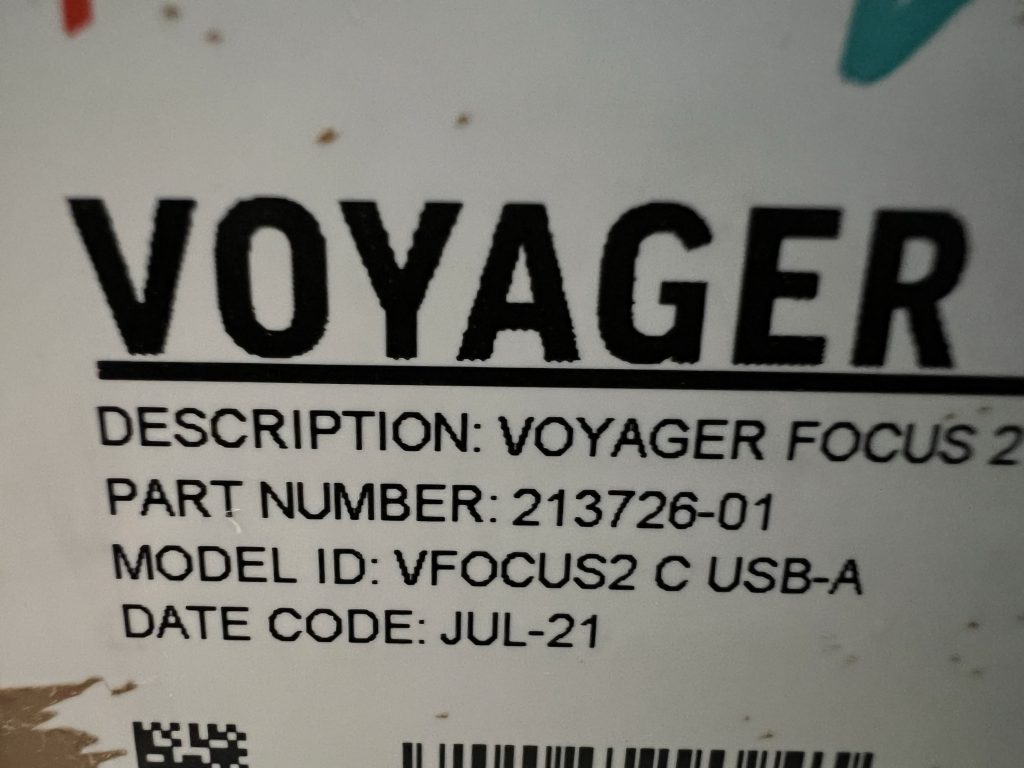
Ich kann jetzt eine vorsichtige Entwarnung geben. Die aktuellen Geräte mit dem Date Code FEB-22 scheinen nicht mehr aus dem Tritt zu kommen. Man findet den Date Code auf dem Verpackungsaufkleber. Dieser Code liegt immer drei Monate in der Zukunft, damit die Garantieabwicklung einfacher ist. Das erklärt auch, warum Poly sehr kulant ist, wenn die Garantiezeit nur wenig überschritten ist.

Date Code auf einer Poly-Verpackung

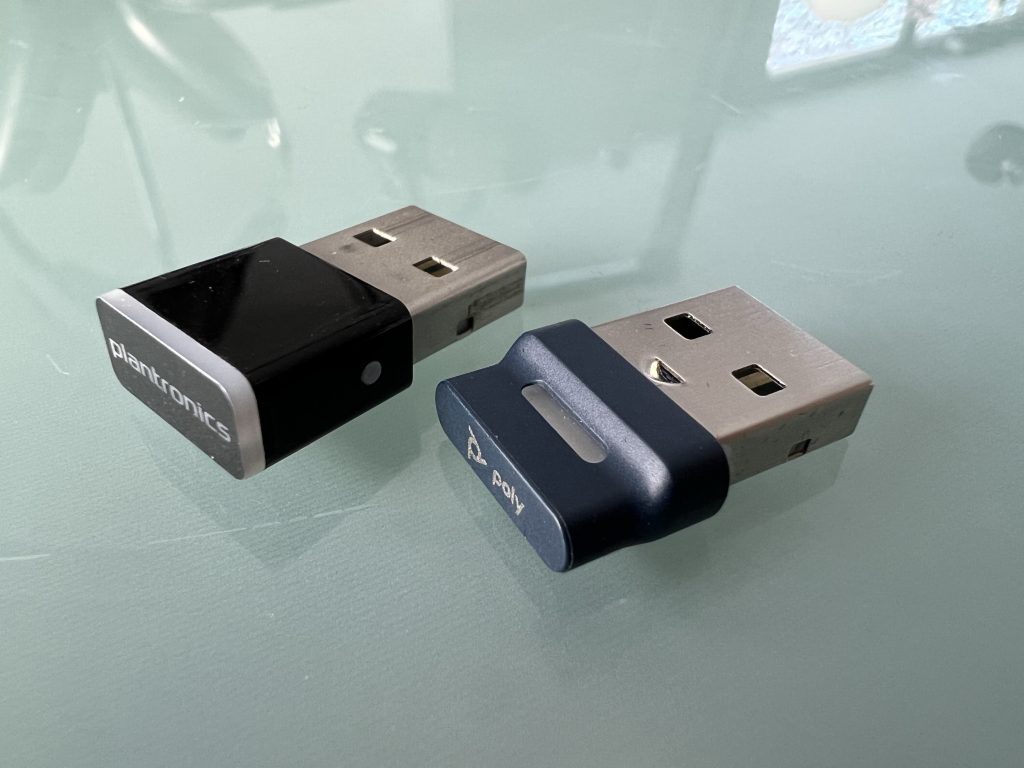
Ich möchte zusätzlich eine Alex Warning aussprechen. Die 5200 sind in die Jahre gekommen und werden immer noch mit dem alten BT600 ausgeliefert, wo es doch längst einen Nachfolger gibt. Aktuell sind alle Produkte bei Poly in der Überarbeitung. Das Focus zwei wird bereits mit dem BT700 ausgeliefert. Dort ist die Änderung einfach, bei 5200 wird man aber das Case anpassen müssen, sonst kriegt man den Dongle nicht raus. 🙂

Plantronics BT600 und Poly BT700

Meine Empfehlung: Wartet ein bisschen, bevor Ihr ein Voyager 5200 kauft. Ich erwarte keine großen Änderungen, so perfekt das Gerät ist. Aber die kleinen würde ich mitnehmen.

14 Jan 07:07

Show off your work to the world! Submit to Your Best Shot 2021 now.

by Leticia Roncero

We’re at over 6,000 submissions and counting for Your Best Shot 2021! Check them out here. If you’re still deciding on what photo to submit (or what brand new category to submit to), you’ve got until January 4, 2022. 

This year, six category winners and a “People’s Choice” award winner will each receive a Peak Design Backpack, a Capture One Pro 22 license, a 1-Year Flickr Pro subscription, and lots of exposure on Flickr social media channels. 

Keep in mind, the sooner you submit to the group, the more exposure your photos will get! All December long, we’ll be curating themed galleries of Your Best Shot 2021 submissions to celebrate our brand new categories!

Salto al 2020

What’s new in 2021: 

Categories: Choose one of SIX categories to submit to, each with its own prize package. Learn more at the Group FAQs.

Photo Critique: An opportunity for Flickr Pros to get a photo critiqued by experts on an upcoming episode of SmugMug Live! View the thread here.

People’s Choice: An additional prize package for a crowd favorite photo selected by Flickr Pros.

Have questions about how we’re celebrating with your photos? Visit our FAQs page and read the contest rules before submitting.

Looking forward to celebrating your best!

14 Jan 07:07

The Books That Have Influenced Me Most

by Dave Pollard


the quote is attributed to “Jo Godwin”

In Beyond Civilization, Daniel Quinn says:

People will listen when they’re ready to listen and not before. Probably, once upon a time, you weren’t ready to listen to an idea than now seems to you obvious, even urgent. Let people come to it in their own time. Nagging or bullying will only alienate them. Don’t preach. Don’t waste time with people who want to argue. They’ll keep you immobilized forever. Look for people who are already open to something new.

It’s been eight years since I updated my ‘Save the World Reading List‘, so I guess I’m overdue. Of course, since I know there’s no saving the world, its title seems a bit of an over-promise.

So instead, here’s a list of the books that have most helped me understand human nature, the more-than-human world, our culture and civilization, complexity and collapse, the nature of reality, and how the world really works.

Most of these books run counter to what most people believe, and want to believe, is true about these subjects. They run counter to what I once believed on most of them. In some cases I wasn’t ready to listen to their messages on first read, and set them aside, only to come back to them later.

These aren’t necessarily my favourite books — I enjoy memoirs and insightful personal stories, thoughtful, non-manipulative fiction, and provocative ‘big idea’ books like Elizabeth Warren’s The Two-Income Trap, Laura Kipnis’ Against Love, Joe Bageant’s Deer Hunting With Jesus, and James Surowiecki’s The Wisdom of Crowds. I read, as often as possible, for fun.

In contrast, few of the books on this list were enjoyable to read, and most were hard slogging. But something draws me to books with well-researched, novel ideas about the big questions: What might become of us? How does the world work, and how did it get so fucked up? What might we learn from other cultures and creatures about living comfortably and usefully and sustainably in this world? And underneath it all, do we have free will, and what is the nature of ‘reality’ anyway? How are we to make sense of this world, in all its staggering and terrible beauty?

Over the years I have outgrown books with prescriptions. The books on this list appreciate complexity and don’t presume to tell us how we should live or what we should do. They’re listed in roughly the order I first encountered them; links are mostly to my synopses of them:

Dave’s ‘Making Sense of the World’ Reading List

Title Author Subject
1 Full House Steven Jay Gould Evolution, complexity, and the nature of reality
2 Beginning Again David Ehrenfeld Collapse
3 Rogue Primate John Livingston Human nature
4 Extinction Michael Boulter Evolution and extinction
5 The Other Side of Eden Hugh Brody Indigenous cultures
6 The Wealth of Man Peter Jay Prehistoric cultures
7 The Long Emergency James Kunstler Collapse
8 An Elephant Crack-up and The Wauchula Woods Accord Charles Siebert The more-than-human world under stress
9 Figments of Reality Ian Stewart and Jack Cohen Human nature, reality, the self and free will
10 Beyond Civilization and The Story of B Daniel Quinn Human nature, culture and collapse
11 A Language Older Than Words Derrick Jensen Human nature, trauma and civilization
12 The Spell of the Sensuous David Abram The more-than-human world
13 The Triple Helix and Biology as Ideology Richard Lewontin Evolution, human nature and the nature of reality
14 Biomimicry Janine Benyus The more-than-human world
15 Requiem for a Species Clive Hamilton Collapse
16 Against the Grain Richard Manning Evolution, agriculture and collapse
17 The Logic of Sufficiency Thomas Princen Alternative economies
18 A Short History of Progress Ronald Wright Evolution, human nature, civilization and collapse
19 Straw Dogs  and The Silence of Animals John Gray Human nature, culture, evolution and collapse
20 The Dark Mountain Manifesto Dougald Hine and Paul Kingsnorth Human nature, culture, art, and collapse
21 H is for Hawk Helen Macdonald Human nature, and the more-than-human world
22 The Origin of Consciousness Julian Jaynes Human nature, the self, evolution, and free will
23 Learning to Die in the Anthropocene Roy Scranton Human nature and collapse
24 The Secret History of Kindness Melissa Holbrook Pierson Human nature, the self, free will, conditioning, evolution and the more- than-human world
25 The Mushroom at the End of the World Anna Lowenhaupt Tsing Evolution, collapse and alternative economies
26 Behave Robert Sapolsky Human nature, evolution, free will, the self, and the more-than-human world
27 Caste Isabel Wilkerson Human nature, evolution, culture, and hierarchy
28 (on Managing Complexity) —videos 1 and 2 Dave Snowden Complexity and sensemaking
29 (on Effective Thinking and Dialogue) — video Daniel Schmachtenberger Critical thinking, sensemaking, and dialogue
30 (on Radical Non-duality) — video transcripts 1 and 2 Tony Parsons Self, free will and the nature of reality

I am in the process of reading The Dawn of Everything by David Graeber and David Wengrow, and may well add it to this list.

I am aware that all but five of these books are by white males, and I’m not sure what to make of that except to ponder whether, and why, white males seem most prone to write (and read) difficult, pessimistic books on ‘big arc’ subjects we can do nothing about.

I am hoping that one day soon books will replace the videos on the subjects in the last three slots on this list, but for now the videos will have to be the placeholders.


14 Jan 07:07

Pixelmator Photo for iPhone: First Impressions

by John Voorhees

Pixelmator Photo has long been one of my favorite iPad photo editing apps. The app makes great use of the iPad’s large screen, which provides space for tools alongside the image you’re editing. Reducing that experience to even the largest model of iPhone is a tall order, but from my preliminary testing, it looks as though the Pixelmator team has pulled it off.

Pixelmator Photo on the iPad offers an extensive suite of editing tools that strike a nice balance. The app makes it simple to apply the app’s machine learning-based tools for quick editing and sharing, but it also includes fine-grained controls for when you want to more finely tune a photo. The same is true on the iPhone, but the design tilts in favor of quick access and edits, which I think is appropriate on a device like the iPhone. The deeper tools are still there, just beneath the surface and easy to access when you need them, but on the iPhone the emphasis is on accessing frequently-used tools quickly.

The Pixelmator team says there are over 30 tools in total, and if there are any missing compared to the iPad app, I haven’t found them yet. However, keep in mind that I’ve only had a little more than a day to poke around in Pixelmator Photo on the iPhone, so there may be a few subtle differences.

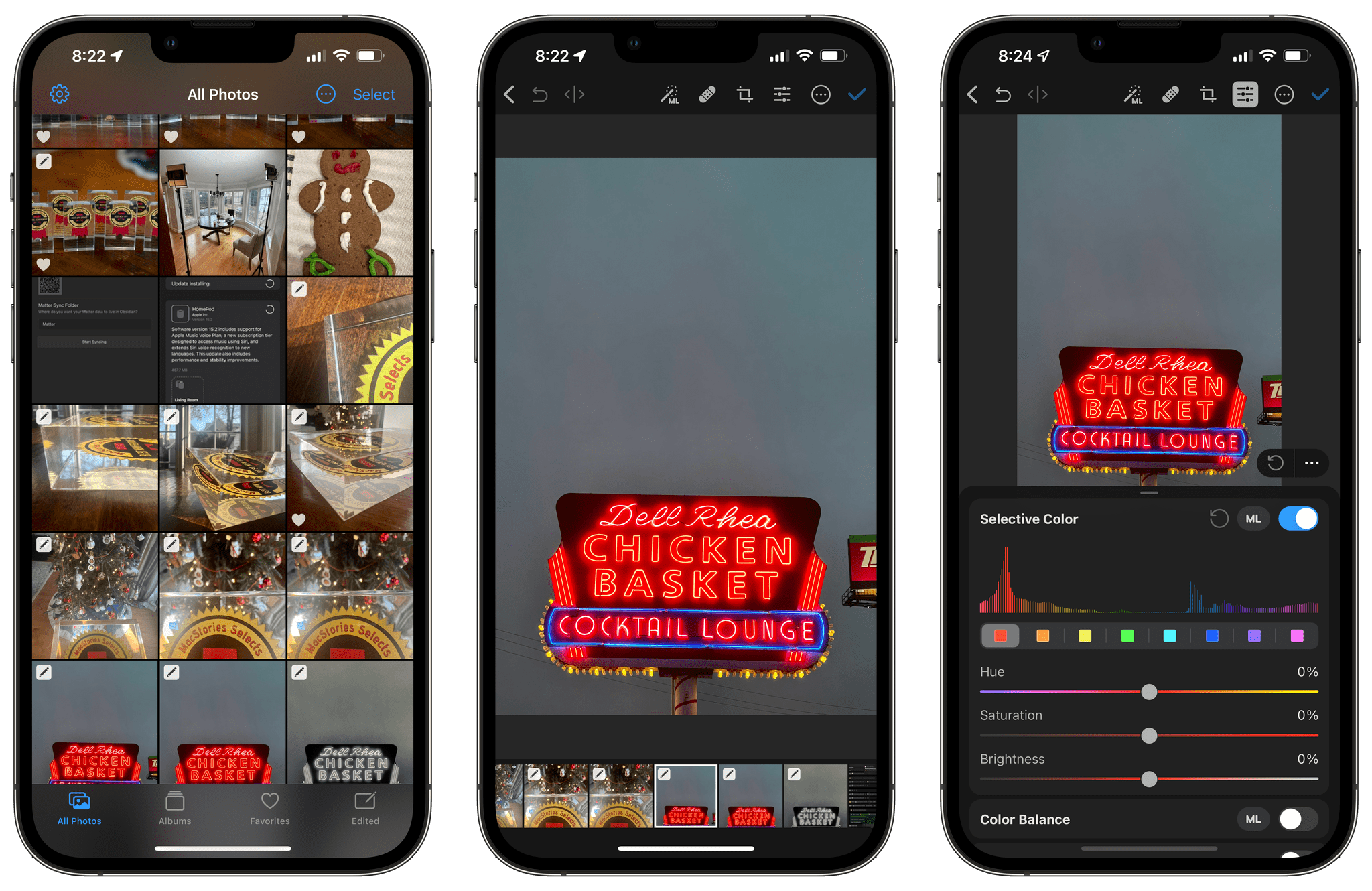
On the iPhone, it takes one fewer taps to get to Pixelmator Photo’s top-level editing tools. By default, your images are arranged in a grid of squares when you first open the app, which crops part of many images in favor of showing more photos per screen. If you prefer to see your full photos in their original aspect ratio, there’s an option to change to that view behind the three-dot button in the top toolbar.

Using the healing tool.

Using the healing tool.

Tap on an image, and the machine learning-based magic wand, healing, and cropping tools are all available in the top toolbar. Along the bottom of the screen, you’ll find a filmstrip of the images in your photo library. If you want to dig deeper into Pixelmator Photo’s editing tools, tap the button in the top toolbar with the sliders. The filmstrip at the bottom will switch to Pixelmator’s presets, and if you swipe up on the presets, the rest of the app’s image adjustment tools that you’d find in the panel on the right on an iPad are revealed in a card-like interface reminiscent of apps like Maps.

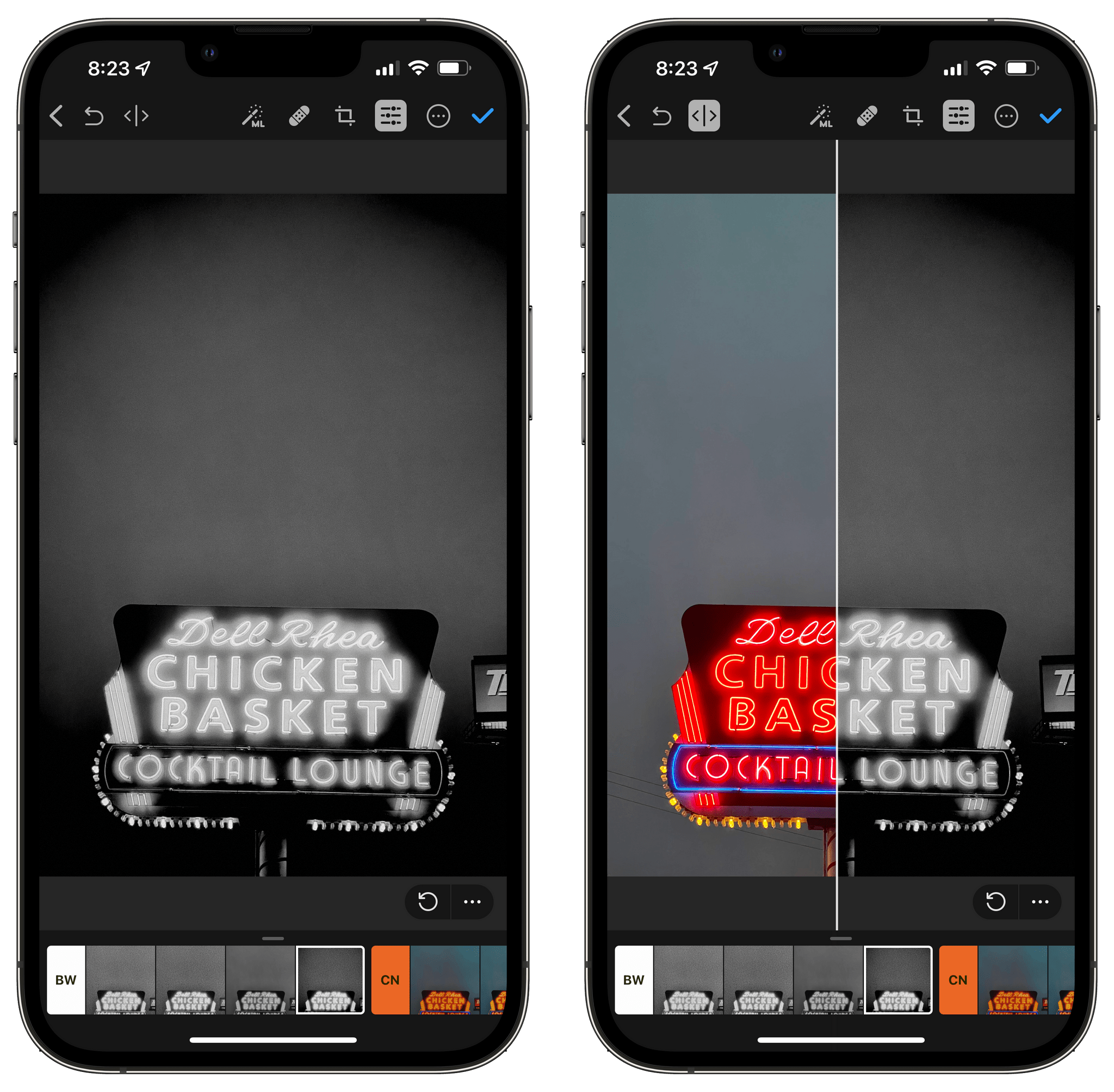
The before-and-after slider.

The before-and-after slider.

The before-and-after slider is even available on the iPhone, which is I love when I’m considering edits I’ve made. The iPhone version also includes the custom workflow system that allows you to batch edit photos by applying the same set of multiple adjustments to each image. Pixelmator Photo also supports RAW, Apple ProRAW, and its edits are entirely non-destructive.

My time with Pixelmator Photo on the iPhone has been limited, but I got up to speed with it quickly because so much of the app is familiar. Functionality has been moved around to accommodate the smaller screen, but it’s all there. I didn’t have any trouble finding the tools I wanted. It’s an impressive feat to pack so much onto an iPhone.

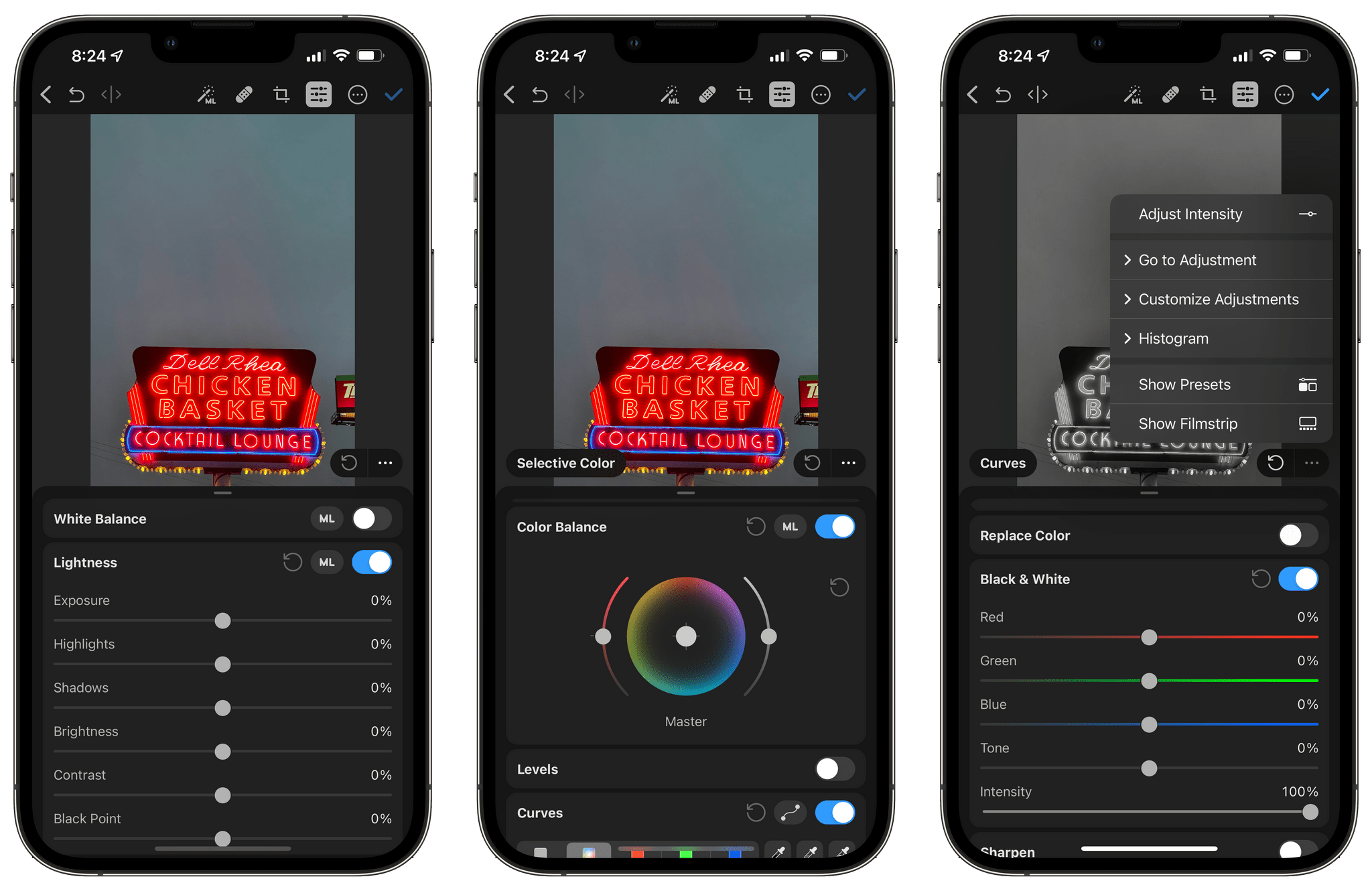
Some of Pixelmator Photo's extensive image editing tools.

Some of Pixelmator Photo’s extensive image editing tools.

Even more important, though, is the simple fact that Pixelmator Photo is now available on the same device where I take my photos. As much as I appreciate the big screen of an iPad for photo editing, the reality is that a lot of my editing happens on an iPhone. I make some minor adjustments and share an image with someone. That reality significantly reduced the amount I used Pixelmator Photo before. Now, I expect to get a lot more use out of the app.

My only disappointment with Pixelmator Photo is that it hasn’t integrated with Shortcuts. Pixelmator Pro, the Mac app that includes a broader set of image editing and creation tools, added a fantastic set of Shortcuts actions on the Mac this fall. Pixelmator Photo’s custom workflows feature is excellent, but it’s confined to the four corners of the app itself. I’d really like to see some of the same power integrated with Shortcuts where it could be leveraged alongside actions from other apps too.

That said, Pixelmator Photo for the iPhone is a fantastic photo editor. It’s an uncompromised version of the app that greatly increases its utility simply by being available more often. I’m looking forward to spending a lot more time in Pixelmator Photo in the months ahead.

Pixelmator Photo is available as a universal purchase on the iPhone and iPad from the App Store.


Support MacStories Directly

Club MacStories offers exclusive access to extra MacStories content, delivered every week; it’s also a way to support us directly.

Club MacStories will help you discover the best apps for your devices and get the most out of your iPhone, iPad, and Mac. Plus, it’s made in Italy.

Join Now
14 Jan 07:06

Weeknotes: Trapped in an eternal refactor

I'm still working on refactoring Datasette's table view. In doing so I spun out a new plugin, datasette-pretty-traces, which improves Datasette's tooling for seeing the SQL that was executed to build a specific page.

datasette-pretty-traces

I love tools like the Django Debug Toolbar which help show what's going on under the hood of an application (see also the Tikibar, a run-in-production alternative we built at Eventbrite).

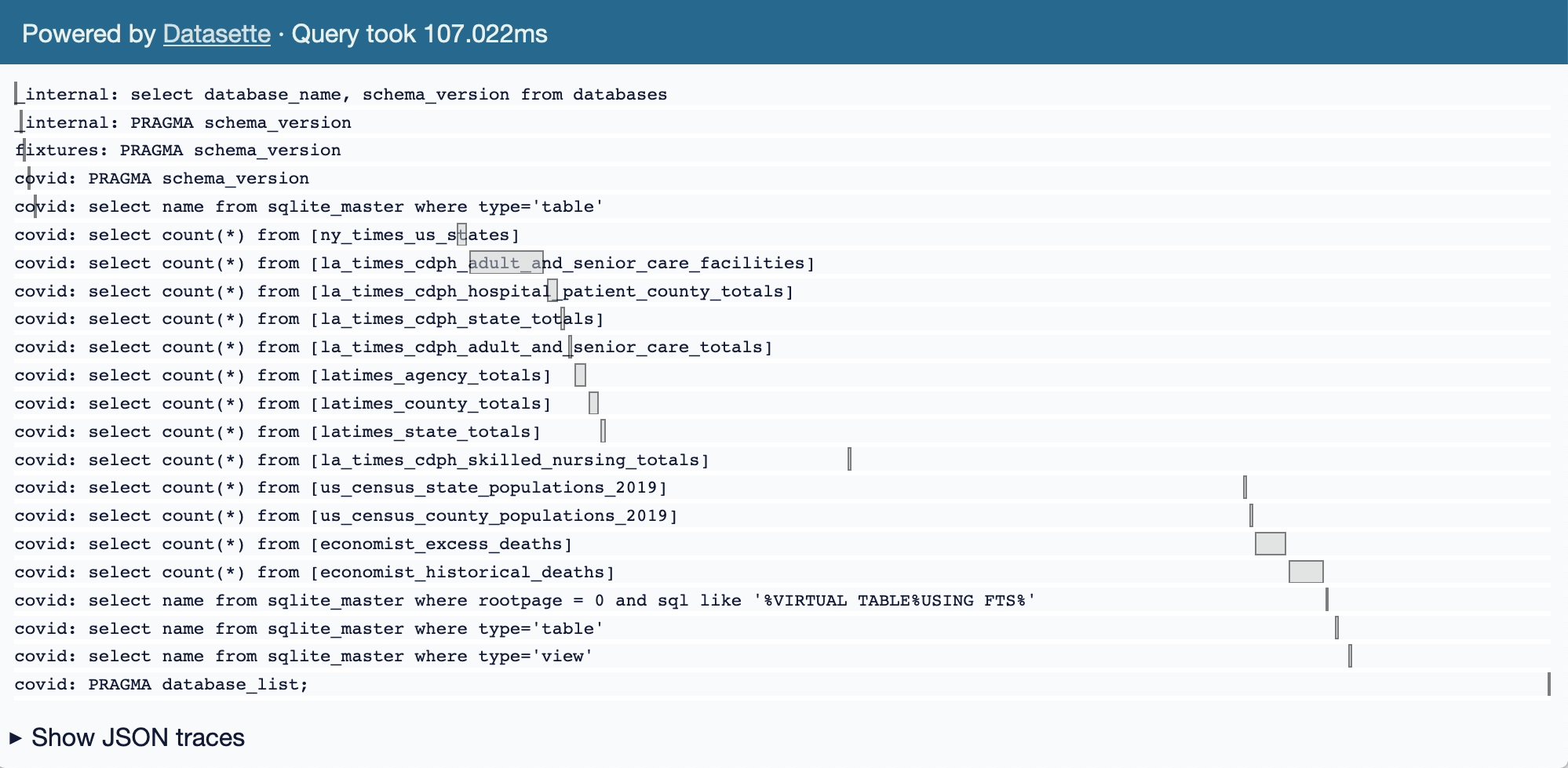
Datasette has long had a ?_trace=1 option for outputting debug information about SQL queries executed to build a page, but the output is a big block of JSON in the page footer, example here.

For the table view refactor project I decided it was time to make this more readable, so I built a plugin that runs some JavaScript to spot that output and turn it into something a bit more legible:

A screenshot of the new trace output, showing the SQL queries and with a visual indication of how long they ran for and at what point in the generation of the page.

You can try it out here.

I'm becoming increasingly comfortable with the idea that it's OK to ignore all of the current batch of JavaScript frameworks and libraries and just write code that uses the default browser APIs. Browser APIs are pretty great these days, especially given things like backtick literals for multi-line strings!

I'll probably merge this into Datasette core at some point in the future, but a neat thing about having plugin support is I can dash out initial versions of things like this without needing to polish them up and include them in a formal release of the parent project.

Progress on the eternal refactor

Issue 1518, split from issue 878, is the all-consuming refactor.

Datasette's table view is the most important page in the application: it's the interface that lets you browse a table, filter it, search it, run faceting against it and export it out as other formats.

It's the nastiest code in the entire project, having grown to over a thousand lines of Python. While it has very thorough tests, the actual code itself is unwieldy enough that it's slowing down progress on all kinds of things I want to get done before I ship Datasette 1.0.

So I'm picking away at it. I've broken the underlying tests up into two modules (test_table_api.py and test_table_html.py) and I've made some small improvements, but I've also spun up some not-yet-committed prototypes both against my experimental asyncinject library and a new experiment that involves something that, if you squint at it, looks a tiny bit like a new ORM. I do not want to build a new ORM!

I'm not happy with any of this yet, and it's definitely blocking my progress on other things. I'll just have to keep on chipping away and see if I can get to a breakthrough.

Releases this week

TIL this week

14 Jan 07:06

We’re puttin’ the Band back together

by Guido Günther

Calls, Chatty, Phosh, Phoc and Squeekboard started their band in a somewhat long gone gitea instance. They had little infrastructure to rely on and mostly borrowed equipment from here and there but they had a line up: Calls: vocals Chatty: vocals and rhythm guitar Phosh: bass guitar Squeekboard: synthesizer / keyboard Phoc: drums and a […]

The post We’re puttin’ the Band back together appeared first on Purism.

14 Jan 07:06

Video Editing with Linux: Dialing in the Framerate

by Purism

Next in our video editing series for the Librem 14, Gardiner Bryant dives into standard frame rates and when to use which rate. You’ll learn how to make a video feel quick or slow things down for a cinematic shot. This video will help those looking to level up their overall video production. We hope to do similar projects like this […]

The post Video Editing with Linux: Dialing in the Framerate appeared first on Purism.

14 Jan 07:06

Sorry! The lifestyle you ordered is out of stock

by Doug Belshaw
Banksy artwork saing "Sorry! The future you ordered is currently out of stock"

From where I sit, the day after having my booster jab, I’m more than a little bit concerned about the level of anti-vaxxer disinformation swirling around me. Yes, I wrote my doctoral thesis on ‘digital literacy’ and I think there’s a level of digital illiteracy involved in all of this. However, there’s a confluence of a few things going on here.

The world is complex, so any simple ‘answer’ to what’s driving particular behaviours are likely to be at best incomplete. For example, I’ve noticed in my interactions with vaccine-hesitant or straight-out ‘anti-vaxxer’ middle-aged white men that there are certain metaphors and tropes that tend to be used.

The rabbithole goes deep, and quickly. It’s likely to be different for varying groups in society, but for those middle-aged white guys I’ve mentioned, there’s at least some pent-up economic frustration going on. I think they also may feel an overall decline in power. At the same time, with the Black Lives Matters movement, increasing equality for women, and wars/climate chaos causing migration, there are culprits for them to pin the blame on.


As a former teacher of the subject, I certainly felt that, until recently, history was the battleground. That’s still the case to some degree, but instead of arguing over representations of the past, we now seem to be arguing over the nation of current reality. Conspiracy theories are rife, and not limited to that weird guy in the pub that you sidle away from after he’s had a few.

If we can’t agree on the past and present, then I’m not sure how we’re going to agree on the future and what it can and should look like. There’s a modicum of consensus that we need to do something about the environment and biodiversity, but how that is going to be acted upon in a period of intense political turmoil is yet to be seen.


Looking back at my TEDx Talk from early 2012 with almost a decade of hindsight, it seems obvious that what started out as playful memes could and would be weaponised for division and political factionism. While my focus at that time was on learning and the technology that can enable it, I feel that I may have been naïve not to see what could have been coming next.

Yet, here we are. Digital literacy is low, political engagement is high. That’s a dangerous and explosive combination, as we saw with the attack on the Capitol building in January 2021. My concern is that we will reap what we have sown and that Big Tech, perfecting algorithms that “give us more of what we want”, will essentially tell us that the lifestyle that we ordered is out of stock, and this will fuel catastrophic rifts in society.

In the face of this, what I can do personally is small and seems insignificant. The same is true of the climate emergency. But individual actions can make a difference, when added together, and we shouldn’t avoid taking small steps just because we can’t take large ones. So, in 2022, having IRL rational and respectful conversations with anti-vaxxers and conspiracy theorists may be just as important as taking climate action.

The post Sorry! The lifestyle you ordered is out of stock first appeared on Open Thinkering.
14 Jan 07:04

Unbundling the office

Here’s a startup idea for anyone who wants it: outsourced, at-home video call support. Sounds really boring. Isn’t.

If you run a big internal event, and you’re at a sufficiently large company, there will be an AV (or IT) support team that comes round to make sure that the projector is plugged in, the mics work, etc.

If you run a big virtual internal event, and you’re at a sufficiently large company, AV support will do the same only remotely. They’ll call up your external speakers and attendees, and make sure they have Microsoft Teams, Chrome, etc, installed and happily working with their webcam and so on. This is good!

BUT

There are now a bunch of services which are delivered over video, to members of the public, by companies where tech support is not a core competency. I’m thinking of…

  • Medical practices doing consultations over video
  • Courts dialling in witnesses
  • Schools and universities – teaching generally

And if the video call fails - for whatever reason - the service can’t be delivered and time is wasted.

So the startup should work like this:

  • Ahead of a call (being a consultation or an event), the client company (like a school) enters the emails of everyone included, together with the software platform they’re using
  • 24 hours ahead of the event, our fictional startup contacts all internal and external attendees and takes them through a foolproof, automatic setup test for the exact software configuration
  • Any problems are escalated to a human and they get on the phone to sort it out
  • The event/consultation/parent-teaching-meeting/etc goes off without a hitch.

If there’s actually going to be a permanent shift to doing things remotely, we’ll need a service like this. Simply from a cost perspective… it doesn’t make sense to have the expert nurse or teacher debugging any connection problems when it can be done by somebody cheaper with economics of scale.


(If the government really wanted to keep the economy going, while people were being furloughed they would have been building this service to offer at cost to the public and private sector. By the time the life support money ran out, there would have been a gangplank for companies that could to transition to a WFH future. As it is, everyone is tackling the same problems but separately.)


Big picture, this is about unbundling the office.

What is the office for? Yes it’s a place to work, but also

  • It’s a place for collaboration
  • It’s a place where a company can provide perks, like snacks
  • It makes it possible to ensure health and safety in the workplace, because chair heights can be checked and electrical items tested
  • Information security can be guaranteed
  • People who don’t work together can run into each other.

That last one is important. From the New York Times last year about working from home, a piece about weak ties: the people with whom you rarely communicate, perhaps 15 minutes a week or less.

When the pandemic hit: contact with weak ties dropped by 30%.

Oops:

But Waber contends that it’s those weak ties that create new ideas. Corporations have historically seen some of the biggest new ideas emerge, he says, when two employees who usually didn’t talk suddenly, by chance, connected. But Waber contends that it’s those weak ties that create new ideas. Corporations have historically seen some of the biggest new ideas emerge, he says, when two employees who usually didn’t talk suddenly, by chance, connected.

– NY Times, What If Working From Home Goes on … Forever? (June 2020)

It’s handy that the office is a single physical location such that facilities is able to reach everyone in a cost-effective manner. But there’s no essential reason that all these jobs of the office actually have to be bundled up in the office.


Newspapers and magazines got unbundled. Banks are getting unbundled.

Offices are being unbundled.

I talked about remote working perks last year and asked at the time: is there remote work facilities management that can come set up my desk and give me a sound baffle/backdrop for my video calls?

It turns out there is! Hofy is a remote facilities management startup to give WFH employees chairs and monitors.

So this unbundling is why I don’t really buy virtual office approaches like Facebook’s VR-based Horizon Workrooms: Facebook’s Metaverse is a VR Meetaverse (Wired). Sure it might work for collaboration, but maybe there are better software approaches for collaboration… and what about the rest of the office? What about the nice chairs? Embrace the unbundling!

The most interesting part of the unbundling of the office is that it allows companies to get smaller by divesting of in-house IT, in-house facilities, long-term leases, etc. Anything that allows companies to get smaller is interesting.


The oddest part of hybrid working, for me, is that I tend to spend my mornings in a co-working spaces to be face-to-face with whichever teammates happen to be around (ad hoc weak tie connections, see), and my afternoons at home on Zoom for scheduled meetings.

Which means I commute over lunch, and mostly eat on trains.

So I choose my food based on what I can hold while I’m also on my phone while I’m also maybe standing up.

Cornish pasties have a crust “handle” because they were traditionally eaten by tin miners with dirty hands. What does my commute pasty look like?

14 Jan 07:03

ARTISTS, ARTISANS & ENTREPRENEURS BREATHE NEW LIFE INTO CASPERIA’S CENTRO STORICO

by lamiasabina.blogspot.com
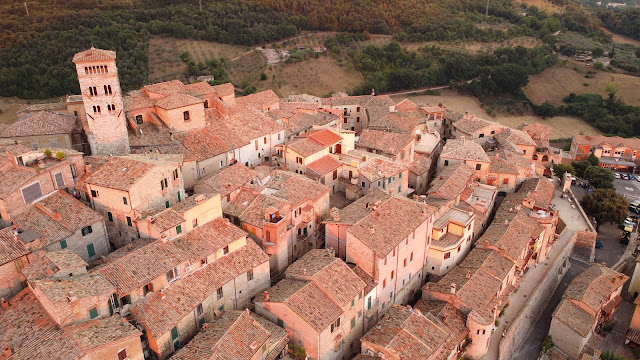
Aerial view of Casperia courtesy of Fabrizio Gherardi

Great News! After many decades of absence, artistic and commercial activity is slowly starting to reassert itself inside Casperia’s 13th century stone walls. Well up until the 1980s Casperia’s historic centre was home to a surprising number and variety of businesses, including alimentari (foodstores), macellerie (butcher shops), tabaccherie (tobacconists), mercerie (haberdasheries), negozi di ferramenta (hardware stores), falegnamerie (carpenter shops), negozi di elettrodomestici (electrical appliance shops), calzolai (cobblers), stagnai (tinsmiths), fabbri (blacksmiths), bottai (barrel makers). There were barbieri (barbershops), parruchiere (beauty shops), negozi di frutta e verdure (fruit and vegetable shops), a lattaio (milk shop), notai (notary offices), a post office, bars, restaurants, an inn, also a travel agency and on Casperia’s Piazza Municipio there was even a bank.

In February of 1956, disaster struck central Italy in the form of a terrible late winter freeze that killed most of the olive and fruit trees in the region. Imagine Sabina left without a proper olive harvest for years. This event forced a lot of residents who had been self-sufficient farmers to look for employment in Rome and elsewhere. This accelerated the post war pattern of migration to the cities that slowly depopulated Sabina’s hill towns and undermined the traditional local economy. This depopulation trend increased with each following decade. Families that maintained a toehold in Casperia’s historic centre were often here only on the weekends and many families that did not make the move to the city moved out into new houses they built in the surrounding countryside. With the shift in demographics and changes in technology, many of the businesses that had once flourished inside Casperia’s castle walls either closed shop or relocated outside the centro storico. The last hold out business to leave was a beauty parlour located on Via Massari which moved outside the walls at the end of April, 2010.

Happily, thanks to the optimism, courage and efforts of the following artists and entrepreneurs, this trend is being reversed. What follows is a list of the studios, ateliers and shops currently operating inside Casperia’s historic centre. 

We will start our tour on the black sampietrini-paved Via Tomassoli, just inside the Porta Romana. A quick note: If you ever get lost in Casperia, all you need to do is find one of the streets paved with black basalt cobbles known as sampietrini. Descending any of these black paved streets will take to you one of Casperia's two main gates, either the Porta Romana or the Porta Reatina.


Casperia, by Richard Burel

Laboratorio d’Arte di Richard Burel
Via Tomassoli, 4
Hours: Usually open weekends and on holidays
Tel: 342 747 6679
Web: www.richardburelart.com
Facebook: www.facebook.com/richardburelart
Instagram: @richardburelart

Richard Burel is celebrated for his humorous and colourful townscapes and his original and highly recognisable style. Each scene has a simple narrative which is brought to life by figures and structural details that have amused him or fired his imagination. Employing a technique of layering paint and collage, Richard incorporates rich, jewel-like colours and creates an extravagant visual treat. Using a variety of tools, he adds pastels, inks and gold leaf to his vibrant collages creating a sense of depth that draws the viewer in to his world of vivid colour and quirky charm.

Born in 1974 in Rouen in France, Richard is a self-taught artist. His work has been warmly received in exhibitions at many leading British Art Galleries.

💚⚪️❤️

Immediately next door to Richard's studio is another popular stop on the Casperia shopping route, the Bancarella of Maria Rita Polverini


La Mia Bancarella di Maria Rita Polverini

Jewellery, Accessories, Arts & Crafts
Via Tomassoli, 6
Hours: Generally open weekends and holidays and upon request
Tel: 3493935519
E-mail: mrp26358@gmail.com
Facebook: www.facebook.com/laMiaBancarellaRita

This small stall was born for two fundamental reasons, first the intent to offer a touch of colour and liveliness to those who enter the main door of the town, the other, more personal, was the desire to give life to the objects I create (both in leather, costume jewellery, sewing and more), which until now were only for me or made following requests from friends and acquaintances.

Artist's Statement:
I am a person curious to learn a lot more, in particular the execution of jobs that require manual skills. I consider myself an eclectic woman who likes to range between different arts, DIY, leather, painting, costume jewellery, embroidery, sewing, and much more. I also like to measure myself with things I don't know how to do and I always accept new challenges and new projects.

💚⚪️❤️

Proceeding a few steps up Via Tomassoli, we come to our third shop, the newly opened Coleotterolab


Coleotterolab di Viola Nocciola
Decorative Artisanal Lamps, Bijoux, Accessories
Via Tomassoli, 10
Hours: At the time of writing the shop is open on the weekend from Friday to Sunday with continuous hours but still to be defined.
E-mail: info@coleottero.com
Web: www.coleottero.com
Facebook: www.facebook.com/Coleotterolab
Instagram: @coleotterolab

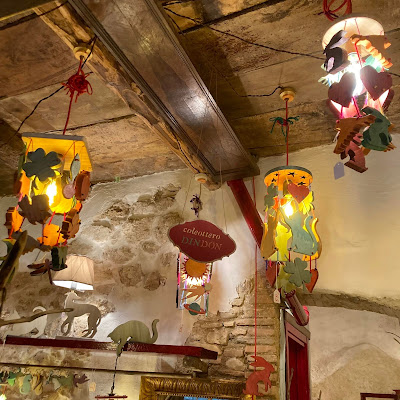
Coleottero was born from the desire to combine in a single container the proposals of Susanna and Viola, mother and daughter, both born in Venice. Susanna initially embarked on a career as an illustrator for advertising in Milan, then she preferred to use her talent in the design of high fashion bijoux, collaborating with the most important Italian fashion brands. Viola started working with Susanna as soon as she finished school. After moving to Sabina, she first began to make her lamps (Coleottero Arborea), and then devoted herself to various wooden furnishing accessories, such as bowl holders for dogs and cats, animalier lamps, and "light theatres" (Coleotterolab).

They moved to Sabina after falling in love with the beauty of the place, wanting a better quality of life, surrounded by nature, but conveniently close to the capital and other towns of central Italy. Now they work on joint projects such as children's games, looking for craftsmen in the future to enrich their site and make it grow.


💚⚪️❤️


Continuing up the steps you arrive at a Piazza Umberto I with its monumental fountain, spectacular panoramic view and the popular restaurant and bar, Osteria Vigna. This is a great place to come to enjoy a sunset aperitivo or meal. Heading north along the piazza you see Via Rivellini which runs atop Casperia's once crenellated ramparts. Proceeding a hundred metres along Via Rivellini you arrive at La Cantina nel Borgo of Loredanna Muscatiello which is open irregularly but always worth a visit. 


La Cantina nel Borgo di LoreMus
Handmade Jewellery & Accessories/Casperia Wedding Planner
Via Rivellini, 22
Hours: Irregular and by appointment
Tel: 347-7981262
E-mail: loremus@fastwebnet.it 


The owner, Loredana Muscatielli, besides selling her handcrafted jewellery and accessories organises and creates everything needed for couples wanting to hold their wedding in Casperia, including bomboniere—traditional Italian wedding favours. People come from as far away as Japan, Russia and Argentina to get married in Casperia.

💚⚪️❤️

Returning along Via Rivellini to Piazza Umberto I turn left and continue up Via Tomassoli. As a point of interest, just before you head through the arch of Casperia's second gate, check out the window immediately to the left of the gate. The room you see, beautifully illuminated at night, was one of a number of different olive oil mills which once operated inside Casperia's walls. Note the antique pottery as well as the bank of massive terracotta olive oil containers along the wall to the right.
Once through the gate, Via Tomassoli winds to the left and you come to one of Casperia's most interesting and important new commercial activities, the Bottega di AnTeAs.  This commercial space started out as a Dazio or excise tax office. Note the heavy grilled window with the specially designed section through which people exchanged money. Later on this space was used as a fruit and vegetable store and later an organic produce shop.

The Anteas shop and showroom is located just below the massive ivy.

Bottega di AnTeAs – Animus Terrae Asprae
Via Tomassoli, 20
Hours: Saturday & Sunday, 10:00-13:00, 14:00-18:00
Tel: 380 738 6351
E-mail: anteas.casperia@gmail.com
Facebook: www.facebook.com/Anteas.Casperia
Instagram: @anteas_casperia

AnTeAs is a showcase of the world of Casperia; a set of excellences, people, places, stories, energies, events, services, products and attractions that make Sabina, with its wide array enchanting small medieval villages, unique and unforgettable.
AnTeAs is an investment of energy and creativity whose aim is to promote the economic viability of Casperia and work to prevent the depopulation of the town, thus safeguarding the life of the village itself and its precious beauties. Our aim to be part of a large, united and responsible community, an example to imitate in winning our battle against this pandemic.

Our main activities:
AnTeAs provides exhibition spaces at their "Bottega di AnTeAs" in order to give visibility to local excellences. AnteAs sells local art in all its forms, souvenirs of Casperia and typical products of Sabina working to maintain and renew Sabine traditions. The "Studio di AnTeAs" multipurpose room at Via San Rocco, 14 is available to independent professionals working in the health, wellness, arts and related sectors. AnTeAs works to promote tourism to Casperia by organizing events, workshops, fairs and markets, conferences, workshops, training courses, tastings, competitions, press meetings, and conferences as well as making available brochures and other information about local tourism attractions and services. AnTeAs also provides a Mountain Bike rental service.

💚⚪️❤️

La Cantina di Gran Burrone
is the name of the very busy workshop of Casperia's multi-talented and very creative Elisabetta "Betta" Orsini. Some years back she began to experiment with wood burning art, also known as pyrography. From there she branched out into wood carving and creating furniture, unique shelving and garden accessories from recycled wood pallets. 
More recently she has turned to creative talents toward glass etching creating beautiful, personalised etched wine glasses and ashtrays. Her workshop located at Via San Rocco, 43  is not necessarily open to the public but she is glad to show off what she is currently working on to and interested passers by. People interested in commissioning Betta to make a piece of pyrographed art, etched glass or any other of her creations can contact her at the numbers below. You can find her creations for sale at AnTeAs and at the monthly artisans market at Piazza Umberto I.


La Cantina di Gran Burrone – Elisabetta Orsini
Via San Rocco, 43
E-mail: orsinibeth@gmail.com
Tel: 338 976 3736
Facebook: www.facebook.com/lacantinadigranburrone

💚⚪️❤️

Turning left on Via Cola di Rienzo, immediately to your left is the Slow Living show room and shop of Stefania Pochesci. This prized commercial space has an interesting history. It was once a women's clothing shop, then a fabric shop, then a haberdashery, an artist's studio and most recently the much loved bio-boutique Naturalmente.  


Stefania Pochesci Slow Living
Art, Fashion and Nature Held Together By The Thread Of Kindness 
Handcrafted, Cruelty Free Collections for Colourful Souls Made In Italy 
Via Cola di Rienzo, 24
Tel: 0765 1897153
Web: www.stefaniapochesci.com/en
Instagram: @stefaniapochesci


Philosophy: The idea naturally stems from the desire to combine eco-sustainability, fashion, graphics and art and at the same time bring it back to the territory and he desire to “create” as an expression of love for nature, design, craftsmanship: art, fashion and nature held together with the thread of kindness. 

We create Slow Fashion collections of high manufacturing and design starting from fabrics of vegetable origin, made unique by personalized, eco-sustainable, cruelty-free and Made in Italy designs. The fabrics are vegetable in origin with certified printing. Our production is responsible, our quality is high, our care is infinite, 

Packing is kept to a minimum. We believe that the real experience is the product, in fact we have chosen a compostable envelope printed with certified and compostable inks too. With the packaging of cardboard boxes, when necessary, we support reforestation efforts through the “Plant a Tree” project which always ensures to plant more trees than those used to make packaging. The tailoring workshops are all close to Casperia. We promote the work ethic and mutual respect with a view to constructive collaboration with all our collaborators.


Bio: Graduated from the Academy of Fashion and /costume, with a past as a graphic and motion designer for TV, Stefania has a real passion for fabric design. She has a study in the Sabine countryside surrounded by nature and one showroom in Casperia’s medieval historic centre. She believes in the power of dreams and that starting from small actions we can change things for the better and she is convinced that meaningful change can can also start from wardrobes.


💚⚪️❤️


Returning to the black basalt cobbles of Via Tomassoli, take a left turn at the monumental nail-studded wooden door of Palazzo Perrini and half way up the street to your left you will find the studio of the very talented artist, interior decorative painter, fresco restorer and art teacher, Giovanna Somai. Her studio is located in what was once a butcher shop.


Monte Soratte, by Giovanna Somai

Studio Arte di Giovanna Sommai
Artist, Visual Arts, Interior Decorative Painting, Jewellery & Painting Lessons
Via Tomassoli, 28
Tel: 333 650 9116
E-mail: giosomai@gmail.com
Web: https://www.flickr.com/photos/giovannasomai/
Facebook: www.facebook.com/giosomaiarte/
Instagram: @giosomai

Artist's Statement: I love painting, using brushes and palette knives, colours but also black and white. I like to experiment with different subjects and painting techniques. Interior decoration on walls gives me satisfaction. For me, abstract art is the most intimate form of pictorial expression.


💚⚪️❤️

Continuing up the steps past Giovanna's atelier you arrive at Casperia's Piazza Municipio where you will find the Town Hall and Rosita's very popular Al Solito Posto Pub, and the Fendi school of haute couture, the Accademia Alta Sartoria Massoli which occupies the old bank location. Proceeding parallel in front of the Town Hall you cross the piazza and come to another black basalt san pietrini-paved street, Via Garibaldi which will take you down to Casperia's back gate, the Porta Reatina, also known as the Porta Santa Maria, as it faces the provincial capital of Rieti, but also is the gate you need to exit to got to the historic hamlet of Santa Maria in Legarano. Just as you pass the intersection with Via Tito Tazio you will see on your right the entrance to the last gift shop on your itinerary which is located in a former cobbler shop.


Il Profumo dei Colori di Marzia Taormina
Ceramic Art and Gift Shop

Via Garibaldi 46 (near the intersection with Via Mazzini)
Tel: 392 843 4369
E-mail: taormina.marzia@gmail.com
Facebook: www.facebook.com/ceramicandoceramicando/
Instagram: @martao_77
Hours: The atelier is open on weekends and by appointment during the week.

Artist's Statement: I am a master ceramist and have been working in the artistic ceramic field for about 20 years. I have a workshop in Rome where I teach both adults and children. I lived in Casperia and had the honour of being able to do two projects for the town. The first was the external rose window of the Church of San Giovanni Battista depicting the baptism of Jesus and the second is the ceramic Crucifixion just inside the Porta Romana entrance to the town.

I love the world of art and nature, which is why I wanted to open an atelier that could combine these two passions of mine and what better place than the beautiful Casperia. All the objects inside the atelier are produced in a completely handmade way and I can do custom work to order.


💚⚪️❤️


Finally, this last artist does not have an atelier open to the public, per se, but his work is well loved in Casperia and abroad and is for sale at AnTeAs, the monthly Mercatino which usually takes place once a month on Piazza Umberto I, and by appointment or commission.


I Colori di Nicola - Andrei Nicolae Stroia
Mixed Media Artist/Pebble Art
Instagram: @icoloridinicola

Andrei Nicolae Stroia is a long time resident of Casperia. For years, his whimsical creations mixing painted stream pebbles and wood have been popular among visitors to Casperia's monthly artisans' market at Piazza Umberto I. You will find his art featured inside almost every restaurant, bar and home here in Casperia and many a tourist has carried his whimsical renderings of our little hill town in wood and stone as a souvenir to their homes overseas.

💚⚪️❤️

14 Jan 07:00

A Look Back at 2021 and What's to Come in 2022!

by noreply@blogger.com (VeloOrange)

by Igor

2021 was another fantastic year for VO: we moved to a new facility, hired a couple more employees, are trucking along with new projects, made new connections for suppliers, and are making more investments in inventory. 

Before we dive into what we've been up to this year, a quick holiday announcement. To give our staff time with their friends and families, VO will be closed from December 24th through January 2nd, and will reopen on January 3rd. If you need your order to go out before we close, please place it before 2pm ET on December 23rd.

The Move

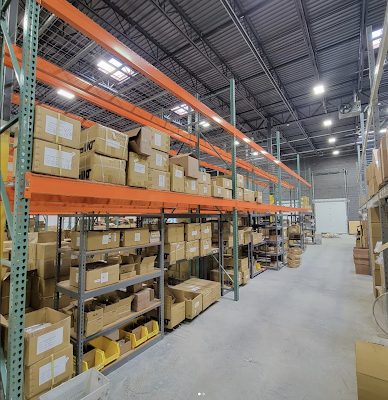
The big one this year was our move! We went from 7500 sqft to almost 15,000, with 11,000 dedicated to just warehousing. It means we can keep more inventory on hand and provide consumers and shops with more product availability and cool, new designs.

New Products

1x Cranksets - these are a great solution for those wanting to change to a 1x drivetrain, but will still work with single speed drivetrains.

Next Gen Crazy and Seine Bars - We teased these last winter but took a while to actually get them in due to raw material delays. But we're getting a LOT more early in 2022.

1x Sensah Components - I've explored Sensah components before and have heard good things. So when we experienced supply chain shortages, we decided to take things into our own hands and made connections over at Sensah to bring in their SRX and CRX 1x11 components. They've sold well, so we're going to bring in more offerings next year.

Diamond Polyvalents - While I think the Low Kicker design is perfect for many people's needs, the Diamond frame variant does have the classic lines and big main triangle look many people like.

Biggish Bag - Not too big, not too small, we designed the Biggish Bag to be the perfect size for all of your sport touring adventures, city errands, day-long gravel rides, and everything in between.

Pistachio Neutrino - The builds I see online based on the Neutrino frameset continue to inspire and impress me. I've seen Rohloffs, singlespeeds, ebikes, drop bars with carbon rims, bikepacking rigs, and even fixed gear builds. Here's Josie's build, it's a favorite of mine.

https://www.instagram.com/p/CW7HuuKFU46/

Projects

Rando


I'm not the best at keeping secrets secure at VO BadgerWorks. It really comes down to me being excited and wanting to put a stake in the ground so at least someone outside of VO knows what we have in store. I also think rumors are fun in the bicycle industry. 

The Rando is coming along. We are doing one more round of prototypes to adjust some geometry and clearances, especially on the smaller sizes.

We picked a color and it is spectacular - it isn't the above one. To be honest, the one we selected was more of an "Eh, it is kinda cool, let's see how it is on a frame", but when we saw it in person, on a frame, it was a hit. It was everyone's pick out of the line up of colors. Picking the colors out of the paint book from a postage stamp size is a sort of try and see process. Dark colors are often darker when painted, and light colors are lighter. Then you have metallic, pearl, gloss, etc... Basically, we got a bunch of colors to try out. Some we go with for production and others might go on future frames. We'll show you the final selection when the final Randos go into production.

Raw materials are ordered up and hopefully that will speed up the timeline for production once the protos are ok'd.

Cranks


We've been testing samples of the 2-piece cranks. They need a bit of tweaking to get all of the tolerances just right. The samples are completely CNC'd since we want to make sure everything is correct before we invest in forging dies. We're also working on some neat chainring designs since we aren't necessarily tied to a certain BCD. There are some neat 80s automotive wheel designs I love that would be cool to implement on a chainring.

Materials of the future!

We're working with some materials besides steel and aluminum alloy. So far I am impressed and pleased. I'm keeping this one close but will release details when we finalize prototypes.

Granola Moose Bars


As much as I like the integrated clamp, we're changing it to a regular height clamp. They'll work with a ton more bikes, especially those old ATBs that use threaded headsets and threadless adaptors.

Odds and Ends

While we always have big projects going, there are smaller projects that we work on, too! We have some less flashy endeavors like nice headset spacers, single leg kickstands, smaller cargo nets, linear pull rim brakes, and some others that are still in the ether. And now that we have the space, we can explore all sorts of projects without worrying about where to put them all!

In conclusion, 2021 has been another wild ride. Between supply chain shortages and moving, we're weathering well and VO continues to be strong. We absolutely have an optimistic outlook for 2022. We want to wish everyone a Happy Holiday Season and a fantastic New Year.

14 Jan 07:00

Explore New Tools

by Richard Millington

I have a confession, I only began using Calendly this year.

Before that, my (fab) assistant Clare handled scheduling. The process seemed to work well enough, so I didn’t change it for 6+ years.

But once I switched to Calendly, I realised how cumbersome the previous process had been. I’d connect Clare with the person(s) I wanted to speak with and she would negotiate a time that worked for everyone. The back and forth took time.

Simply sending someone a link with all my (and my colleagues’) available times (which show up in the recipient’s time zone) reduces all this down to a click or two. In hindsight, it’s such an obvious move.

It makes you wonder what obvious moves you might be missing.

I recently recommended exploring a Zapier integration to an acquaintance. She replied, “I don’t have time to explore new tools”.

Understandable perhaps. But keeping your head down and ignoring the technology changes all around you is also a sure-fire way to become a digital dinosaur. Staying abreast of technological developments would appear to be a pretty important part of the community building process.

p.s. Maybe the reason you’re so busy is that you never invest the time to become more efficient?

The post Explore New Tools first appeared on FeverBee.

14 Jan 06:59

Helping social studies teachers to teach data literacy with Teaspoon languages

by Mark Guzdial

Last year, Tammy Shreiner and I received NSF funding to develop and evaluate computational supports for helping social studies teachers to teach data literacy and computing(see post here). We’re excited about what we’re doing and what we’re learning. Here’s an update on where we’re at on the project.

Teaspoon Languages

We have a chapter in the new book by Aman Yadav and Ulf Dalvad Berthelsen Computational Thinking in Education: A Pedagogical Perspective. This is the publication where we introduce the idea of Teaspoon Languages. Teaspoon languages are a form of task-specific languages (TSP => Teaspoon — see?). Teaspoon languages:

  • Support learning tasks that teachers (typically non-CS teachers) want students to achieve;
  • Are programming languages, in that they specify computational processes for a computational agent to execute; and
  • Are learnable in less than 10 minutes, so that they can be learned and used in a one hour lesson. If the language is never used again, it wasn’t a significant learning cost and still provided the benefit of a computational lesson.

We say that we’re adding a teaspoon of computing to other subjects. The goal is to address the goal of “CS for All” by integrating computing into other subjects, by placing the non-CS subjects first. We believe that programming can be useful in learning other subjects. Our primary goal is to meet learning objectives outside of CS using programming. Teachers (and students eventually) will be learning foundational CS content — but not necessarily the content we typically teach in CS classes. All students should learn that a program is non-WYSIWYG, that it’s a specification of a computational process that gets interpreted by a computational agent, that programming languages can be in many forms, and that all students can be successful at programming.

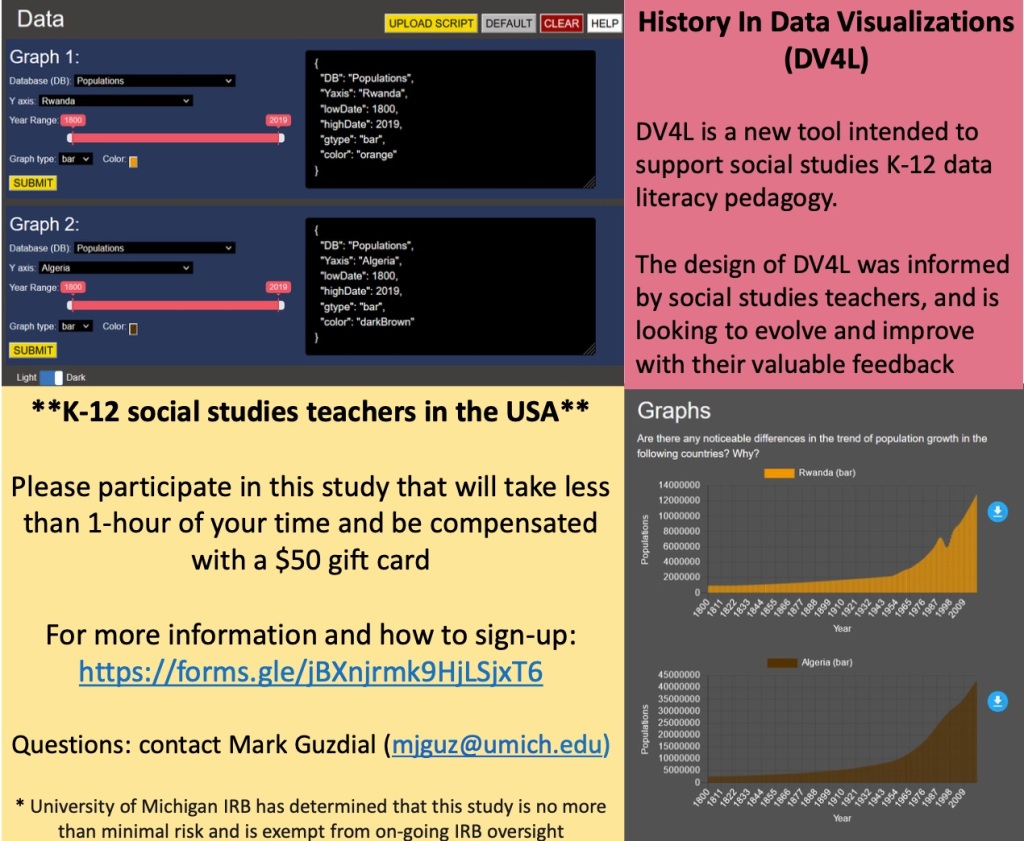
Our chapter, “Integrating Computing through Task-Specific Programming for Disciplinary Relevance: Considerations and Examples” (see link here) offers two use cases of how we imagine teaspoon languages to work in classrooms (history and language arts in these examples). The first use case is around DV4L, our Data Visualization for Learning tool. The second is around a chatbot language that we developed —- and have long since discarded.

We develop our teaspoon languages in a participatory design process, where teachers try our prototypes in authentic tasks as design probes, and then they tell us what we got wrong and what they really want. Our current iteration is called Charla-bots and is notable for having user-definable languages. We have a variety of Charla-bot languages now, with English, Spanish, and mixed keywords.

Our vision for teaspoon languages is a contrast with the “Hour of Code” approach. The “Hour of Code” is a one hour programming activity that many schools use in every grade, typically once a year during CS Ed Week (in early December). The great idea is to build familiarity and confidence in programming by showing students real computer science every year. The teaspoon languages approach is to imagine one or two little learning programming activity in every social studies, language arts, and mathematics class every year. Each of these languages is tiny and different. The goal is that by the time that US students take a CS class (typically, in high school or undergraduate), they will have had many programming experiences, have seen a variety of types of programming languages, and have a sense that “programming isn’t hard.”

Meeting the Needs of Social Studies Teachers

The second paper, “Using Participatory Design Research to Support the Teaching and Learning of Data Literacy in Social Studies” (see link here) was just presented in October by Tammy at CUFA, the College and University Faculty Assembly 2021 of the National Council of the Social Studies. (We have a longer form of this paper that we have just submitted to a journal.) This is an exciting paper for me because it’s exactly addressing the critical challenge in our work. We can design and implement all kinds of prototype Teaspoon languages, but to achieve our goals, teachers in disciplines other than CS have to see value and adopt them.

The paper is about our workshops with practicing social studies teachers. Tammy has a goal to teach social studies teachers how to teach data literacy. She has built a large online education resource (OER) on teaching data literacy in social studies. Learning data literacy involves being able to read, comprehend, and argue with data visualizations, but also being able to create them. That’s where we come in. Her OER links to several tools for creating data visualizations, like Timeline JS, CODAP, and GapMinder. Most of them were not created for social studies teachers or classes. When we run these workshops, our tools are just in-the-mix. We offer scaffolding for using all of them. These are our design probes. The teachers use the tools and then tell us what they really want. These are our data, and we analyze them in detail —- as in this paper.

Let’s jump to the bottom line: We’re not there yet. The teachers love the OER, but get confused about why should do in their classes. They find the tools for data visualization fascinating, but overwhelming. They like DV4L a lot:

One pre-service teacher explained that they preferred our prototype over other tools because “(with the prototype DV4L) I found myself asking questions connected to the data itself, rather than asking questions in order to figure out how to work the visual.”

Recently, I held a focus group with some social studies teachers who told me that they won’t use any computational tools —- they believe in teaching data visualization, but all created with pencil and ruler. That’s our challenge: Can we be more powerful, more enticing, and easy enough to beat out pencil and ruler? Our tool, DV4L, is purpose-built for these teachers, and they appreciate its advantages — and yet, few are adopting. That’s where we need to work next.

Opportunities for Social Studies Teachers to Get Involved

If you know a social studies teacher who would want to keep informed about our work and perhaps participate in our workshops or studies, please have them sign up on our mailing list. Thank you!

Often, what teachers tell us they really want suggests new features or entirely new tools. We have two ongoing studies where we are looking for design feedback from social studies teachers. If you know social studies teachers who would like to play with something new (and we’ll pay them for their time), would you please forward these to them?

Timeline Builder

We’re looking for K-12 Social Studies teachers to try out our new timeline visualization tool, TimelineBuilder. TimelineBuilder has been made with teachers and usability in mind. In it, ‘events’ are added to a timeline using a form-based interface. Changes to the timeline can be seen automatically, with events showing up as soon as they are added.

This study will consist of completing 2 surveys and 3 asynchronous activities guided by worksheets. All participants will be compensated with a $20 gift card for survey and activity completion. There is an additional option to be invited to a focus group, which will provide additional compensation.

If you are interested in participating in this study, you can complete the consent form and 1st survey here. (Plain text Link: https://forms.gle/gwxfn5bRgTjyothF6 )

Please contact Mark Guzdial (mjguz@umich.edu) or Tamara Nelson-Fromm (tamaranf@umich.edu) with any questions.

The University of Michigan Institutional Review Board Health Sciences and Behavioral Sciences has determined that this study is exempt from IRB oversight.

DV4L Scripting Study

Through our work with social studies educators thus far, we have designed the tools DV4L-Basic and DV4L-Scripting specifically to support data literacy standards in social studies classrooms. If you are a social studies middle or high school teacher, we would love to hear your feedback. If you can spare less than an hour of your time to participate in our study, we will send you a $50 gift card for your time and valuable feedback.

If you are interested but want more details, please visit/complete the consent form here: https://forms.gle/yo3yWGThQ1wnhu7g7

For questions or concerns, please contact Mark Guzdial (mjguz@umich.edu) or Bahare Naimipour (baharen@umich.edu).

References

Guzdial, M. and Tamara L. Shreiner. 2021. “Integrating Computing through Task-Specific Programming for Disciplinary Relevance: Considerations and Examples.” In Computational Thinking in Education: A Pedagogical Perspective, Aman Yadav and Ulf Dalvad Berthelsen (Eds). PDF of Submitted.

Shreiner, Tamara L., Mark Guzdial, and Bahare Naimipour. 2021. “Using Participatory Design Research to Support the Teaching and Learning of Data Literacy in Social Studies.” Presented at CUFA, the College and University Faculty Assembly 2021 of the National Council of the Social Studies. PDF

14 Jan 06:58

Transferring a GitHub issue from a private to a public repository

by Simon Willison

I have my own private notes repository where I sometimes create research threads. Occasionally I want to transfer these to a public repository to publish their contents.

https://docs.github.com/en/issues/tracking-your-work-with-issues/transferring-an-issue-to-another-repository says:

You can't transfer an issue from a private repository to a public repository.

I found this workaround:

  1. Create a new private repository. I called mine simonw/temp
  2. Transfer the issue from your original repository to this new temporary repository
  3. Use the "Settings" tab in the temporary repository to change the entire repository's visibility from private to public
  4. Transfer the issue from the temporary repository to the public repository that you want it to live in

Using the gh tool

You can perform transfers using the web interface, but I also learned how to do it using the gh tool.

Install that with brew install gh

Then you can run this:

gh issue transfer https://github.com/simonw/temp/issues/1 simonw/datasette-tiddlywiki

I used this trick today to transfer https://github.com/simonw/datasette-tiddlywiki/issues/2 out of my private notes repo.

14 Jan 06:56

“Why They Can’t Write”: John Warner’s brilliant analysis of the failure of teaching

by Josh Bernoff

Anyone who has had any interaction with education these days — as a student, a teacher, or a parent — is likely to have the feeling that something fundamental is awry. John Warner’s has some good ideas on what’s wrong and how to fix it. His book Why They Can’t Write: Killing the Five-Paragraph Essay … Continued

The post “Why They Can’t Write”: John Warner’s brilliant analysis of the failure of teaching appeared first on without bullshit.

14 Jan 06:56

Weeknotes: datasette-tiddlywiki, filters_from_request

I made some good progress on the big refactor this week, including extracting some core logic out into a new Datasette plugin hook. I also got distracted by TiddlyWiki and released a new Datasette plugin that lets you run TiddlyWiki inside Datasette.

datasette-tiddlywiki

TiddlyWiki is a fascinating and unique project. Jeremy Ruston has been working on it for 17 years now and I've still not seen another piece of software that works even remotely like it.

It's a full-featured wiki that's implemented entirely as a single 2.3MB page of HTML and JavaScript, with a plugin system that allows it to be extended in all sorts of interesting ways.

The most unique feature of TiddlyWiki is how it persists data. You can create a brand new wiki by opening tiddlywiki.com/empty.html in your browser, making some edits... and then clicking the circle-tick "Save changes" button to download a copy of the page with your changes baked into it! Then you can open that up on your own computer and keep on using it.

There's actually a lot more to TiddlyWiki persistence than that: The GettingStarted guide lists dozens of options that vary depending on operating system and browser - it's worth browsing through them just to marvel at how much innovation has happened around the project just in the persistence space.

One of the options is to run a little server that implements the WebServer API and persists data sent via PUT requests. SQLite is an obvious candidate for a backend, and Datasette makes it pretty easy to provide APIs on top of SQLite... so I decided to experiment with building a Datasette plugin that offers a full persistant TiddlyWiki experience.

datasette-tiddlywiki is the result.

You can try it out by running datasette install datasette-tiddlywiki and then datasette tiddlywiki.db --create to start the server (with a tiddlywiki.db SQLite database that will be created if it does not already exist.)

Then navigate to http://localhost:8001/-/tiddlywiki to start interacting with your new TiddlyWiki. Any changes you make there will be persisted to the tiddlywiki database.

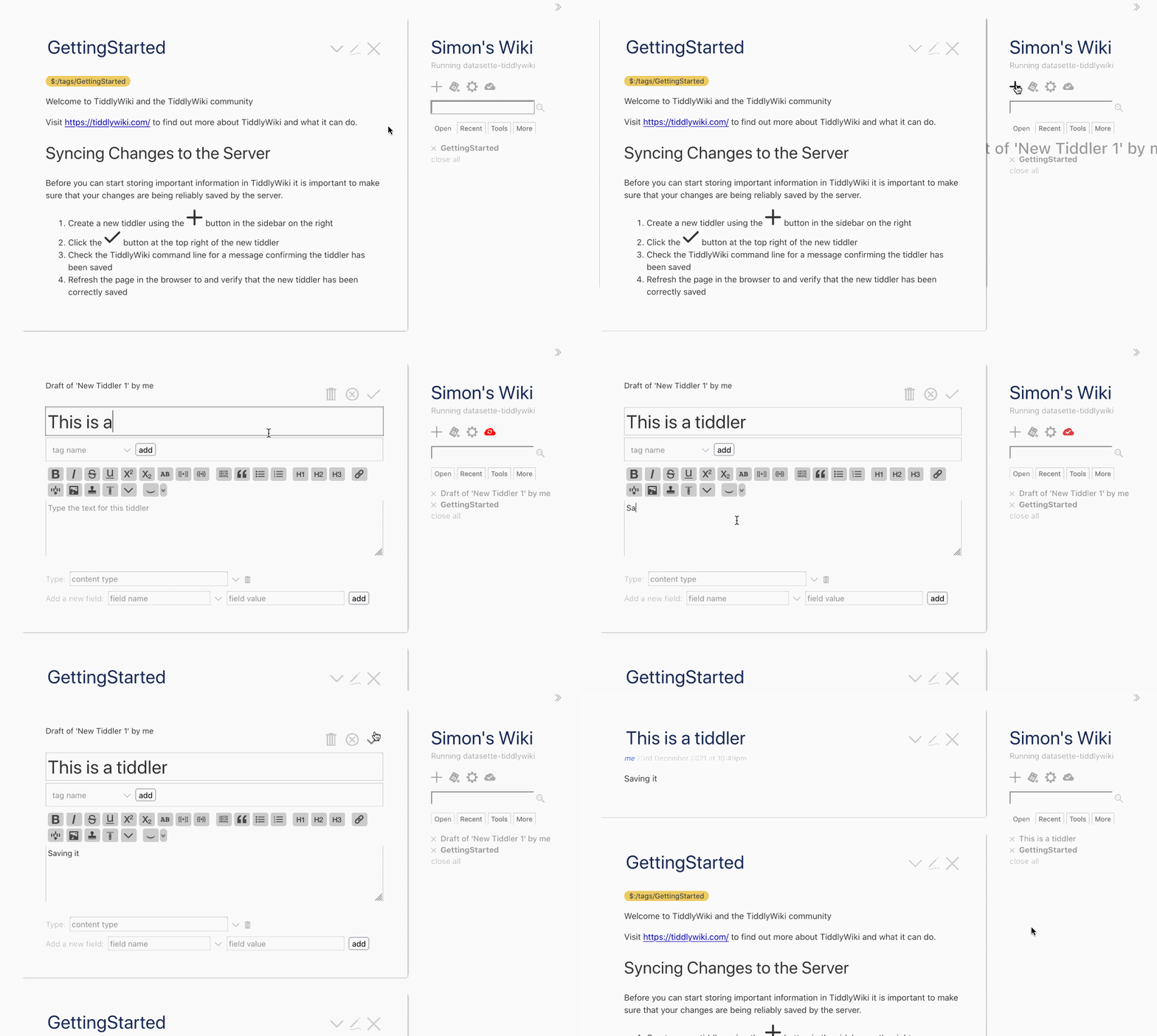
Animated demo showing creating a new tiddler

I had a running research issue that I updated as I was figuring out how to build it - all sorts of fun TiddlyWiki links and TILs are embedded in that thread. The issue started out in my private "notes" GitHub repository but I transferred it to the datasette-tiddlywiki repository after I had created and published the first version of the plugin.

filters_from_request() plugin hook

My big breakthrough in the ongoing Datasette Table View refactor project was a realization that I could simplify the table logic by extracting some of it out into a new plugin hook.

The new hook is called filters_from_request. It acknowledges that the primary goal of the table page is to convert query string parameters - like ?_search=tony or ?id__gte=6 or ?_where=id+in+(1,+2+,3) into SQL where clauses.

(Here's a full list of supported table arguments.)

So that's what filters_from_request() does - given a request object it can return SQL clauses that should be added to the WHERE.

Datasette now uses those internally to implement ?_where= and ?_search= and ?_through=, see datasette/filters.py.

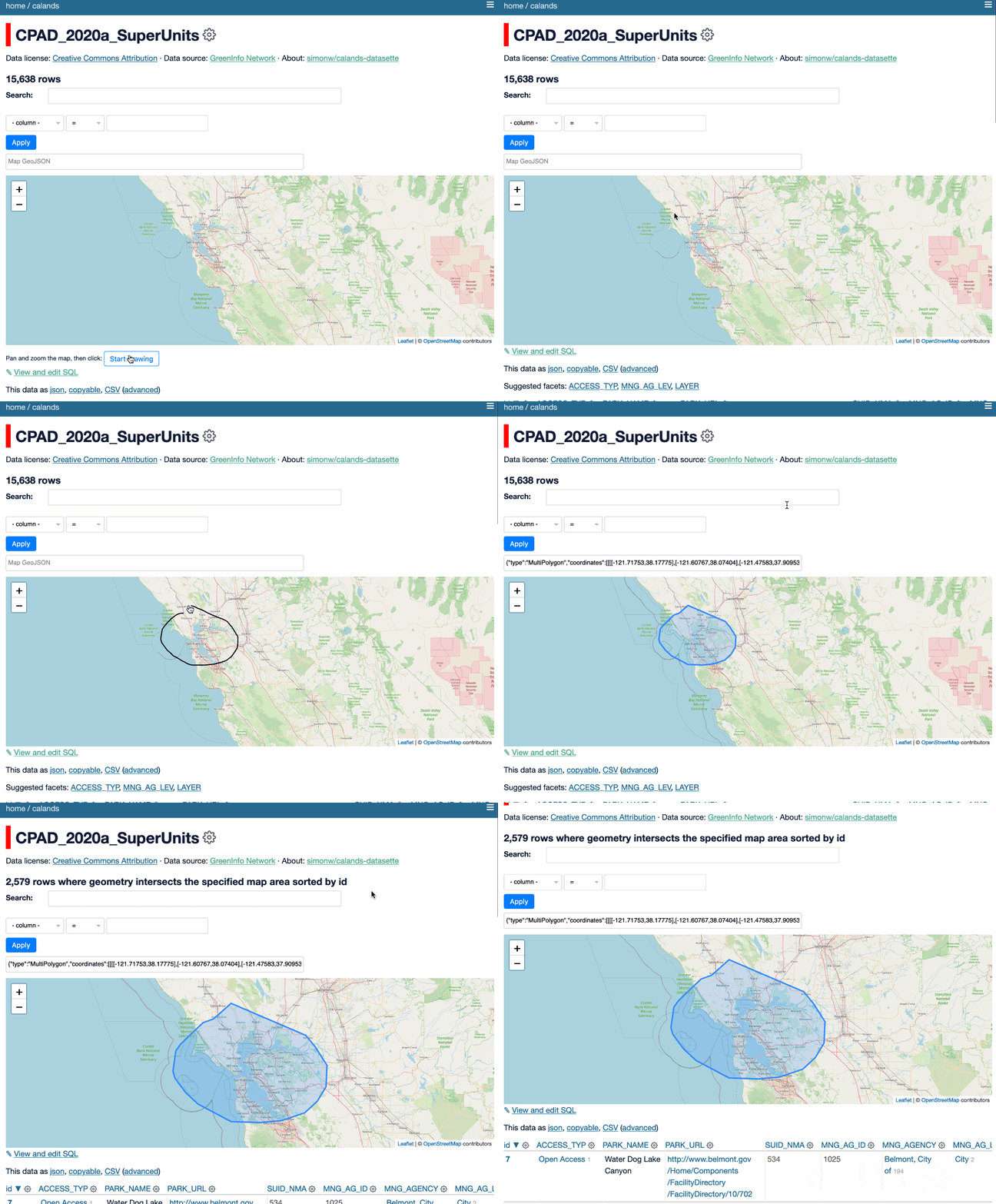
I always try to accompany a new plugin hook with a plugin that actually uses it - in this case I've been updating datasette-leaflet-freedraw to use that hook to add a "draw a shape on a map to filter this table" interface to any table that it detects has a SpatiaLite geometry column. There's a demo of that here:

https://calands.datasettes.com/calands/CPAD_2020a_SuperUnits?_freedraw=%7B%22type%22%3A%22MultiPolygon%22%2C%22coordinates%22%3A%5B%5B%5B%5B-121.92627%2C37.73597%5D%2C%5B-121.83838%2C37.68382%5D%2C%5B-121.64063%2C37.45742%5D%2C%5B-121.57471%2C37.19533%5D%2C%5B-121.81641%2C36.80928%5D%2C%5B-122.146%2C36.63316%5D%2C%5B-122.56348%2C36.65079%5D%2C%5B-122.89307%2C36.79169%5D%2C%5B-123.06885%2C36.96745%5D%2C%5B-123.09082%2C37.33522%5D%2C%5B-123.0249%2C37.562%5D%2C%5B-122.91504%2C37.77071%5D%2C%5B-122.71729%2C37.92687%5D%2C%5B-122.58545%2C37.96152%5D%2C%5B-122.10205%2C37.96152%5D%2C%5B-121.92627%2C37.73597%5D%5D%5D%5D%7D

Animated demo of drawing a shape on a map and then submitting the form to see items within that map region

Note the new custom ?_freedraw={...} parameter which accepts a GeoJSON polygon and uses it to filter the table - that's implemented using the new hook.

This isn't in a full Datasette release yet, but it's available in the Datasette 0.60a1 alpha (added in 0.60a0) if you want to try it out.

Optimizing populate_table_schemas()

I introduced the datasette-pretty-traces plugin last week - it makes it much easier to see the queries that are running on any given Datasette page.

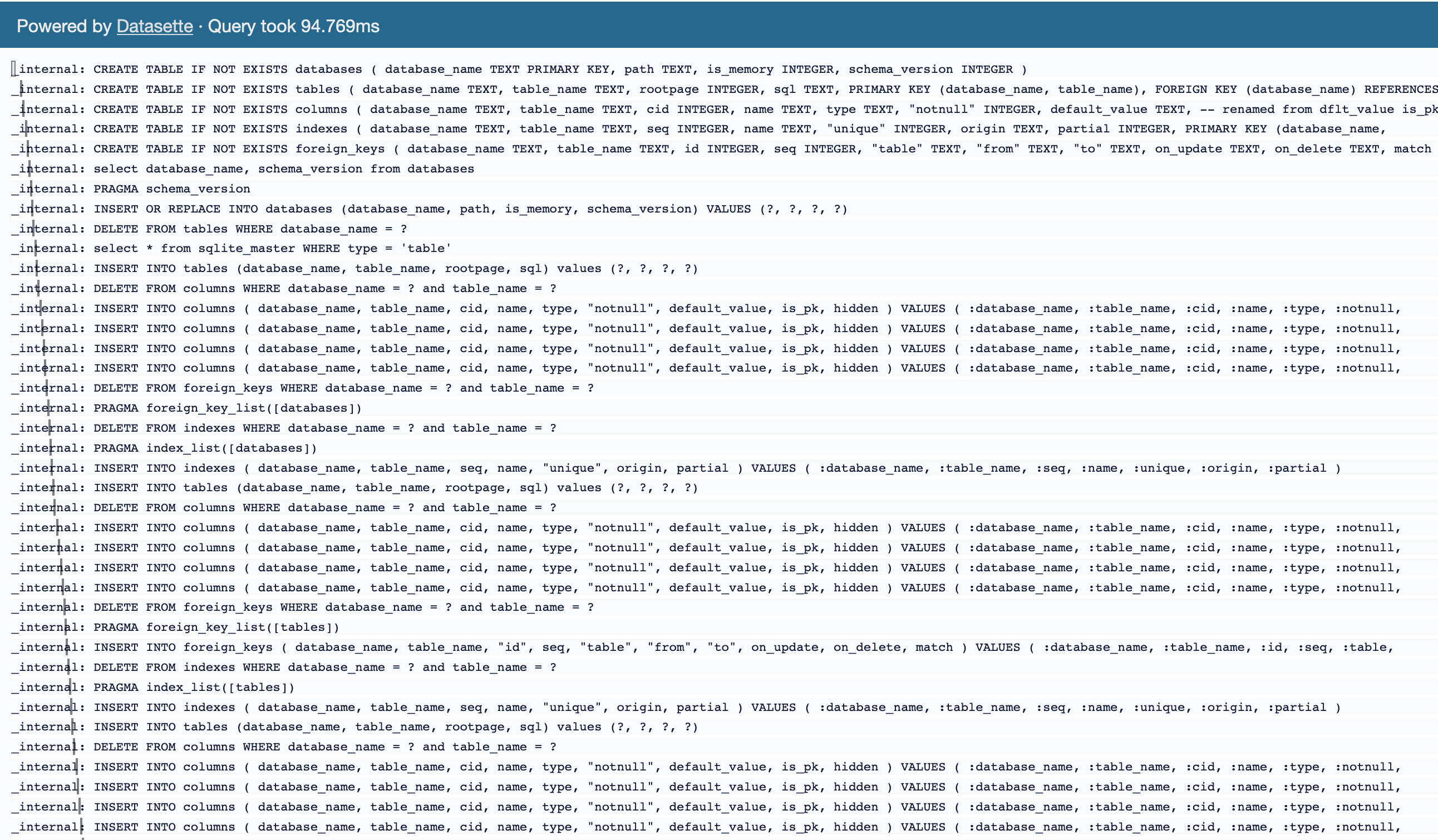
This week I realized it wasn't tracking write queries, so I added support for that - and discovered that on first page load after starting up Datasette spends a lot of time populating its own internal database containing schema information (see Weeknotes: Datasette internals from last year.)

Example trace showing a cavalcade of write SQL

I opened a tracking ticket and made a bunch of changes to optimize this. The new code in datasette/utils/internal_db.py uses two new documented internal methods:

db.execute_write_script() and db.execute_write_many()

These are the new methods that were created as part of the optimization work. They are documented here:

They are Datasette's async wrappers around the Python sqlite3 module's executemany() and executescript() methods.

I also made a breaking change to Datasette's existing execute_write() and execute_write_fn() methods: their block= argument now defaults to True, where it previously defaulted to False.

Prior to this change, db.execute_write(sql) would put the passed SQL in a queue to be executed once the write connection became available... and then return control to the calling code, whether or not that SQL had actually run- a fire-and-forget mechanism for executing SQL.

The block=True option would change it to blocking until the query had finished executing.

Looking at my own code, I realized I had never once used the fire-and-forget mechanism: I always used block=True to ensure the SQL had finished writing before I moved on.

So clearly block=True was a better default. I made that change in issue 1579.

This is technically a breaking change... but I used the new GitHub code search to see if anyone was using it in a way that would break and could only find one example of it in code not written by me, in datasette-webhook-write - and since they use block=True there anyway this update won't break their code.

If I'd released Datasette 1.0 I would still consider this a breaking change and bump the major version number, but thankfully I'm still in the 0.x range where I can be a bit less formal about these kinds of thing!

Releases this week

TIL this week

14 Jan 06:55

My year of birth is now being called up for the...

by Ton Zijlstra

My year of birth is now being called up for the booster shot. Judging by the info provided I will have to wait until end of February though, until it’s three months after having recovered from Covid.


This is a RSS only posting for regular readers. Not secret, just unlisted. Comments / webmention / pingback all ok.
Read more about RSS Club
14 Jan 06:55

Backup: 1 TB in 35 Minutes

by Martin

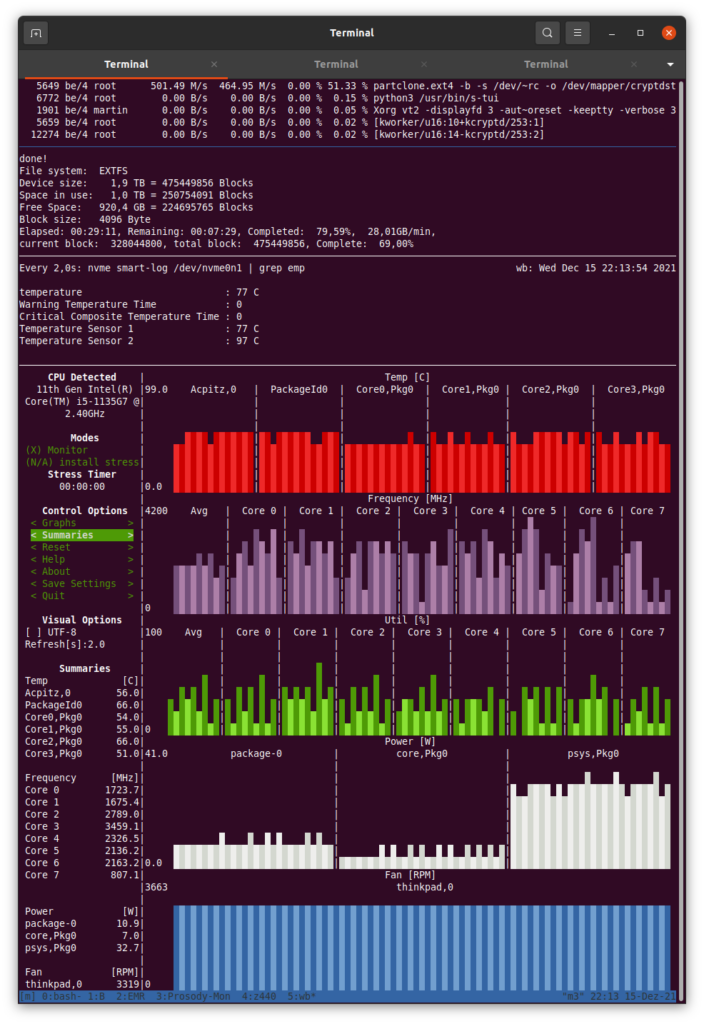
A quick post today on a personal new backup speed record: I do have a lot of data on my notebook and thus use a 2 TB SSD, which is currently about 50% full. Also, I do like to have an emergency spare drive at hand so I can quickly get operational again should anything happen with my notebook or the drive. That means that I have a 1:1 copy of my installation at hand that I keep up-to-date by rsync’ing deltas in regular intervals. This process is usually quite fast as the deltas are relatively small. Creating a new spare SSD, however, requires copying 1 TB of existing data to the new drive, which previously took many hours. But I’ve refined my hardware and technique over time. So this time around, I got 1 TB of data to a new spare SSD in around 35 minutes. The sustained transfer speed was 490 MB/s, or 28 GB per minute between the two LUKS encrypted partitions!

So here’s my setup:

The source drive was a 2 TB Samsung 860 EVO SATA SSD in a UGreen SATA to USB 3.1 Gen 2 (10 GBit/s) adapter connected to a USB 3.1 Gen 2 port of a Lenovo L14 notebook with an 11th generation Intel i5 processor. It’s not the cheapest USD/SATA adapter but it can make full use of the maximum SATA transmission speed of 6 Gibt/s. Cheaper adapters are usually limited to the standard USB 3 transmission rate of 5 GBit/s.

The target drive in my setup was a 2 TB Samsung 970 EVO Plus NVMe SSD in the L14’s internal NVMe M.2 slot. This SSD is capable of sustained write speeds well beyond of 800 MB/s if the CPU is capable of continuously shuffling data into the drive at this rate.

Previous tests have shown that rsync and even the simple cp command are unable to deliver data to a drive at such speeds. Partclone, however, which copies (used) sectors of a partition instead of looking at files can easily do this. The slight hassle with partclone and LUKS partitions is that the target partition must be of the same size or bigger than the source partition, so one has to manually start LUKS on both source and target partitions without mounting the file system. Here’s how the whole procedure works in practice:

# List block devices available
sudo lsblk

# Open LUKS (Note: Just opens but does NOT mount!!!)
sudo cryptsetup luksOpen /dev/sdbX cryptsrc
sudo cryptsetup luksOpen /dev/nvme0n1pY cryptdst

sudo partclone.ext4 -b -s /dev/mapper/cryptsrc -o /dev/mapper/cryptdst

# Close LUKS
sudo e2fsck -f /dev/mapper/cryptdst
sudo resize2fs /dev/mapper/cryptdst


sudo cryptsetup luksClose cryptsrc
sudo cryptsetup luksClose cryptdst

And to my very positive surprise, I could even surpass the 360 MB/s data transfer rate of previous copy sessions with a slightly different setup. Overall, as already noted above, the 1 TB of data was transferred at an average of 490 MB/s or around 28 GB/min, and took around 35 minutes in total. Breathtaking!

The screenshot above shows how the system behaved while copying the data. One thing that worried me a bit was, that the target SSD got quite hot in the process. Without additional cooling, the on board sensor reported a temperature of 97 degrees Celsius after a few minutes. The SSD did not slow down, however. I then decided to blow some air with a fan from below the notebook onto the target SSD. Thankfully, the Lenovo L14 has an air inlet at the bottom of the case just underneath the SSD. This reduced the temperature of the internal NVMe SSD to below 80 degrees Celsius. I’m not sure if that made the SSD feel better, but it certainly made me feel better.

So long story short, I was able to get very close to the maximum read data rate of the source SATA SSD and instead of waiting many hours, the job was done in a little bit less than half an hour. Excellent!

P.S.: The system monitor shown in the lower part of the screenshot above is ‘s-tui‘.

14 Jan 06:55

Quoting danah boyd

Many of you here today are toolbuilders who help people work with data. Rather than presuming that those using your tools are clear-eyed about their data, how can you build features and methods that ensure people know the limits of their data and work with them responsibly? Your tools are not neutral. Neither is the data that your tools help analyze. How can you build tools that invite responsible data use and make visible when data is being manipulated? How can you help build tools for responsible governance?

danah boyd

14 Jan 06:54

Effort Estimation

A month ago I wrote about Software Design by Example using JavaScript and how it fell short of what I’d hoped to create. Part of the problem is that from a teaching point of view, JavaScript is still crippled by design decisions made in haste in its early days. Python is an obvious alternative, and I hope a Python version of the book will exist some day, but Python is no longer a small language: I’m now twelve weeks into my first full-time programming job in over a decade, and I’m a little dumbfounded by how much Python now looks and feels like Enterprise Java.

It’s easy to say, “Just ignore decorators and async I/O and the := operator in class,” but that’s disingenuous. Newcomers will bump into these things as soon as they search online for help, because they actually are helpful for people who are programming in the large; that’s just not my use case.

So what about teaching with something that’s still small? Lua is the right size, and well documented, but I’m unwilling to invest in a language whose development is not open. Wren is about the right size, but its syntax will be a bit offputting for my target audience; its derivative Dictu will be more approachable, and it has the beginnings of a decent standard library.

But life is short, and always getting shorter. I’ve invested about 50 hours so far working through the second half of Nystrom’s excellent Crafting Interpreters and enhancing the source of Lox (the little language it builds) to include array and table primitives and a few other features. Based on that, and on a comparison of the size of Dictu’s source code with a need-to-have list based on SDXJS, I estimate it would take about 200 hours to turn Dictu into what I’d want to take a second run at a book on software tools (which itself would only take about another 200 hours, since I’ve already done most of the required thinking). 400 hours is pretty much all of my hobby time for 2022, and there are other things I want to do more, so reluctantly—very reluctantly—I’m probably going to have to shelve this one.

Which is a shame, because (a) I’ve been enjoying writing low-level code again, (b) I’ve been learning stuff, which I always enjoy, and (c) despite a long string of failures, I think the final product would help a lot of people. If I still had access to a pool of senior undergraduates in need of thesis projects I might reach a different answer; as it is, I think this I should mothball the repository and turn my attention elsewhere.

soundtrack

13 Jan 07:27

What’s up with SUMO – December 2021

by Rizki Kelimutu

Hey SUMO folks,

December is here. As you’re sliding off into a more cozy corner of your house surrounded by your family members, let’s see what SUMO has been up to in the last month of 2021.

Welcome on board!

Community news

  • Firefox 95 was a hectic release. We’ve got dot releases for almost every version. We couldn’t thank all of you enough for the quick turnaround on handling some of the issues that appear right after the release. Read the wiki to catch up on information and learn more about what happened.
  • We’ve been experimenting with locale-specific queues in Conversocial. A couple of years back when we migrated from Buffer Reply, we made the decision to only focus on English conversations due to our limited resources at that time. Conversocial doesn’t have a built-in language detection feature like Buffer Reply. So we have to use a list of keywords to be able to detect language that was, then, differentiated by tags. So far, we have identified keywords from the following non-English locale:
    • Germany
    • Dutch
    • French
    • Indonesian
    • Polish
    • Portuguese
    • Russian
    • Spanish
    • Turkish

Let me know if you’d like to have your own locale queue. Right now, we route all conversations from @Firefox and @FirefoxSupport Twitter accounts, as well as Google Play reviews from Firefox for Android and Firefox Focus. We’re hoping to continue to make the most of Conversocial for the Social and Play Store Support moving forward. So let us know if you have any ideas on how to make your contribution easier to do within the tool.

  • Check out the following release notes from Kitsune in December:
    • No Kitsune release notes for this month. Check out SUMO Engineering Board instead to see what the team is currently doing.

Community call

  • Watch the monthly community call if you haven’t. Learn more about what’s new in November and December!
  • Reminder: Don’t hesitate to join the call in person if you can. We try our best to provide a safe space for everyone to contribute. You’re more than welcome to lurk in the call if you don’t feel comfortable turning on your video or speaking up. If you feel shy to ask questions during the meeting, feel free to add your questions on the contributor forum in advance, or put them in our Matrix channel, so we can address them during the meeting.

Community stats

KB

KB pageviews (*)

* KB pageviews number is a total of KB pageviews for /en-US/ only

Month  Page views (per Dec 20) Vs previous period
Dec 2021 7,490,868 1.93%

Top 5 KB contributors in the last 90 days: 

  1. AliceWyman
  2. Pierre Mozinet
  3. Michele Rodaro
  4. Rowan
  5. Unixfan

KB Localization

Top 10 locale based on total page views

Locale Dec 2021 page views (per Dec, 20)(*) Localization progress (per Dec, 20)(**)
de 10.06% 99%
fr 7.08% 90%
zh-CN 6.59% 98%
es 5.48% 36%
pt-BR 4.90% 57%
ru 4.17% 88%
ja 3.73% 51%
zh-TW 2.45% 5%
it 2.31% 100%
pl 2.28% 87%

* Locale pageviews is an overall pageviews from the given locale (KB and other pages)

** Localization progress is the percentage of localized article from all KB articles per locale

Top 5 localization contributors in the last 90 days: 

  1. Michele Rodaro
  2. Artist
  3. Mark Heijl
  4. Jim Spentzos
  5. Soucet

Forum Support

Forum stats

Month (per Dec, 20) Total questions Answer rate within 72 hrs Solved rate within 72 hrs Forum helpfulness
Dec 2021 2178 71.03% 14.23% 71.84%

Top 5 forum contributors in the last 90 days: 

  1. FredMcD
  2. Cor-el
  3. Sfhowes
  4. Jscher2000
  5. Seburo

Social Support and Play Store Support

Channel Dec 2021
Total conv Conv interacted
@firefox 1454 255
@FirefoxSupport 183 165
Firefox for Android 5312 490
Firefox Focus 165 99

Top 5 contributors in Dec 2021

  1. Paul Wright
  2. Christophe Villeneuve
  3. Tim Maks van den Broek
  4. Andrew Truong
  5. Bithiah Koshy

Product updates

Firefox desktop

  • Desktop V96 (Jan 11)
    • Lockwise branding removal (Thanks Alice for getting the work started)
    • Onboarding colorways spotlight upgrade
    • More from Mozilla about:preferences experiment
    • Dark mode improvements
    • 2021 WebRTC library update

Firefox mobile (Jan 11)

There will be a version bump for Fx iOS products in the upcoming release. Fx iOS and Focus iOS will jump from V40 to V96. Consistent version numbers will make it simpler to ensure you’re using the latest version of Firefox across all devices. There will be no user impact or functionality updates related to this change.

  • Android
    • Background updates and bug fixes
  • iOS
    • Version bump from V40-V96
    • Keyboard shortcuts in Fx for iOS
  • Focus
    • iOS Version bump from V40-V96
    • Repositioning of the Settings menu so that its visible when you open the app (iOS)
    • Repositioning of Trash icon to search bar menu (Android)
    • Easier view of how many tabs a user has open (Android)
    • Total Cookie Protection (Android)
    • Smart Block (Android)

Other products / Experiments

  • Premium Relay (Dec 15)
    • Mostly backend updates
  • Premium Relay (Jan 12)
    • Custom Subdomain Education
    • Sign in with Rt-click
    • Sign in with Alias Icon
  • VPN V2.7(Jan 26)
    • Captive Portal Improvements
    • Multi-Hop (Mobile)
    • Localization of MAC (Multi-Account Containers)

Shout-outs!

  • Thanks to everyone who contributed to the Firefox 95 release. It was a bumpy one, but we’re managed to get through it together. Yay for a happy ending of 2021!

If you know anyone that we should feature here, please contact Kiki and we’ll make sure to add them in our next edition.

Useful links:

13 Jan 07:27

2021 Retrospection

by Rizki Kelimutu

This is probably a moment where we usually say to ourselves how time flies so fast. Despite the pandemic and the uncertainty that lingers this year, I’m proud and grateful that this community managed to keep being awesome and accomplished many things this year. Through this post, I’d like us to take a moment to flashback and celebrate what we’ve accomplished this year.

  • Forum:
    • Total volume: We received a total of more than 40K questions this year (very similar to 2020). That being said, there’s a slight drop in the average answered rate which got 70.96% in 2021 (compared to 73.55% in 2020) and our solved rate is 15.99% (compared to 17.31% in 2020). On the other hand, our average first response is improving from 16 hours in 2020 to 14 hours this year.
  • KB:
    • In 2021, our platform has gathered slightly more than 350 million page views (357,557,483 to be exact). This is a 28.96% drop from the overall page views in 2020 and by far the most significant downturn in the past 3 years, compared to 2019 vs 2020 (dropped only to 10.64%) or 2019 vs 2018 (19.26% drop).
  • Localization:
    • Non-English locales contributed to 57.7% of our overall traffic this year. This number reflects just how important the localization communities are for our support team. Our top 10 non-English locales in 2021 are: DE, FR, ES, zh-CN, pt-BR, RU, Ja, IT, PL, and zh-TW.
  • Social and Play Store:
    • @FirefoxSupport: We’ve got 3437 incoming conversations overall in 2021, with 84.5% of them having successfully interacted. We reached our peak in June during the MR1 release (484 incoming conversations in a day).
    • @Firefox: For the brand account, we received 33817 incoming conversations with 25% of them having successfully interacted.
    • Firefox for Android: Total incoming conversations was 103033 with only 2.4% of them having successfully interacted.
    • Firefox Focus: Incoming conversations was 1013 in total with 25% of them having successfully interacted.
    • Firefox Klar: 105 in total with 12.4% of them interacted.

Highlight of the year: 

  • Community:
    • We managed to continue working on the onboarding project by conducting survey and updating our documentation. However, due to priority, we have to again, postpone the technical implementation (hopefully until only the beginning of next year).
  • Communication:
    • We started having regular community updates in our blog. The first one was in Q1 and we continue to have it on a monthly basis.
    • We started Firefox Daily Digest newsletter to make it easier for you to get Firefox updates from Reddit, Twitter, and other news sources.
    • We started mailing groups for Social and Play Store Support groups. We want to make it easier for the community to receive program-specific updates without having to check the Contributor Forum.
    • We’ve experimented with videos! Huge thanks to Julie for driving most of the effort.
  • Tooling:
    • We moved Play Store Support from the Respond Tool to Conversocial in March. Until now, we have Firefox for Android, Firefox Focus, and Firefox Klar Google Play Store reviews connected in Conversocial.
    • Leo started to document Kitsune release notes in Discourse. This is a great thing for the community who are curious about Kitsune development progress.
    • We regain access to @SUMO_Mozilla Twitter account that was gone for a few years before. Yay! The plan is to continue using the account to communicate community-related update, while keep using @FirefoxSupport for support-related.
    • We removed the advanced search page and substitute it with a syntax system.
  • Product:
    • We release Firefox 84 – 95 within this year. There are also MR1 and MR2 in between.
    • We also started to support Microsoft Store reviews for Firefox Desktop. The launch was a huge success, and we’re at 4.8 rating currently at Microsoft Store.
    • Firefox Relay Premium was launched just before the end of the year. You can now subscribe to more services with an alias email you’ve generated from Firefox Relay!
  • Team:
    • We said goodbye to Joni and Madalina this year but on the other hand, we also welcomed Daryl, Fabi, Joe, and Abby, and of course, even more new contributors.

We can’t thank the community enough for your relentless support and commitment for Mozilla and Firefox users. To show you how grateful we are, we’ve created this board to deliver some personal messages we’ve gathered from the whole Customer Experience team about the community. We really appreciate your contribution and hope that we can continue to work together in 2022 and beyond.

If you’re a looker and interested in contributing to SUMO, please head over to our Wiki to learn more about our programs!

As always, please keep on rocking the free and helpful web!


On behalf of the Customer Experience Team, 

Kiki

13 Jan 07:22

Rage in Peace

by Doc Searls

The Cluetrain Manifesto had four authors but one voice, and that was Chris Locke‘s.

Cluetrain, a word that didn’t exist before Chris (aka RageBoy), David Weinberger, Rick Levine and I made it up during a phone conversation in early 1999 (and based it on a joke about a company that didn’t get clues delivered by train four times a day), is now tweeted constantly, close to 23 years later. (And by now belongs in the OED.)

In his book The Tipping Point, which was published the same month as The Cluetrain Manifesto (January, 2000), Malcolm Gladwell said, “the success of any kind of social epidemic is heavily dependent on the involvement of people with a particular and rare set of social gifts.” He also called this “the Law of the Few.” Among those few, one needed three kinds of people: mavens, connectors, and salespeople. Chris was all three. To different degrees so were David, Rick and myself; but Chris was the best, especially at connecting. He was the one who brought us together. And he was the one who sold us on making something happen. He moved us from one Newtonian state to another—a body at rest to a body in motion—by sending us this little graphic:

After we got that, we had to put up the Cluetrain website. And then we had to expand that site into a book, thanks to the viral outbreak of interest that followed a column about the site—and Chris especially, face and all—in The Wall Street Journal. Though a great enemy of marketing-as-usual, nobody was better than Chris at spreading a word. I mean, damn: dude got Cluetrain in the fucking Wall Street Journal! (Huge hat tip to Tom Petzinger for writing that column, and for writing the book’s forward as well. Chris Locke

Want to know Chris’s marketing techniques? Read Gonzo Marketing: Winning Through Worst Practices, which followed Cluetrain, and had the best cover ever, with bullet holes (actual holes) through a barcode, and a red page behind it. I’m sure Chris came up with that idea. His graphic sense was equally creative, sharp and—as with everything—outrageous.

Or listen to the audio version, performed by Chris in his perfect baritone voice.

Alas, Chris died yesterday, after a long struggle with COPD. (Too much smoke, for too long. Got my dad and my old pal Ray too. That cigarette smoking has become unfashionable is a grace of our time.)

Good God, what a great writer Chris was. Try Winter Solstice. One pull-quote: “We learn to love the lie we must tell ourselves to survive.”

And his stories. OMG, were they good. Better than fiction, and all true.

For example, you know how, when two people are first getting to know each other, they exchange stories about parts of their lives? I remember once telling Chris that my parents were frontier types who met in Alaska. While I thought that would take us down an interesting story hole (my parents really were interesting people), Chris blasted open a conversational hole of his own the size of a crater: “My father was a priest and my mother was a nun.” Top that.

Once, when I missed a plane from SFO to meet Chris in Denver, I mentioned that I was standing next to a strangely wide glass wall at my just-vacated gate in Terminal 1. “I know that gate well,” he said. “And that glass is a trip. I once missed a plane there myself while I was on acid and got totally into that glass wall.” I don’t remember what he said after that, except that it was outrageous (for anyone but Chris) and I couldn’t stop laughing as his story went on.

Among too many other stories to count, here is one I hope his soul forgives me for lifting (along with that picture of him) from a thread on Facebook:

on this Father’s Day I am recalling getting drunk with MY dad on Christmas Eve 1968, as was our custom back then (this month I am 34 years sober). he told me he was suicidal and i knew he meant it. so I turned him on to acid there and then. it was a bit of a rocky trip, but things were better for him after that.

btw, when the trip got really rough, I tricked him into thinking he could fall asleep. “If you want to come down, just take six of these big bomber multivitamin pills and that’ll be it.” fat chance! but he fell sound asleep. as I sat next to him marveling at the sound of guardian angel wings softly beating over us, THE PHONE RANG!!! OMG. at like 4am! and worse, it was my judgmental hyper-Catholic MOTHER!! she said…

hello, is your father over there

….yes… I said.

are you two taking LSD?

oh no! had she gone psychic??

….yes… I said, fearful of what was coming next.

THANK GOD, she said. SOMETHING had to give.

and then:

“well, have a good trip,” she said, and rang off.

I’ll leave you with this, from a post on Chris’s Rageboy blog called Dust My Boom. It was written on the occasion of an odd wind coming toward Boulder that now seems prophetic toward the future that came three days ago when a wind-driven fire swept across the landscape, eventually roasting close to 600 homes, a hotel, and a shopping center. Read the whole thing for more about the wind…

There’s so much you don’t know about me. Cannot ever, no matter how hard I try to make it otherwise. I have been places, done things impossible to recount. I remember nights of love, each different from all the rest. I have sat beside the dead in the room with the open windows. I have seen those ships on fire off Orion’s shoulder.

Yeah well. I wrote something into the cluetrain manifesto that must have raised some eyebrows among our more knowing cousins. And it went like this:

…People of Earth

The sky is open to the stars. Clouds roll over us night and day. Oceans rise and fall. Whatever you may have heard, this is our world, our place to be. Whatever you’ve been told, our flags fly free. Our heart goes on forever. People of Earth, remember.

So I should end this now, but that’s way too dramatic and drama is the wrong note to end on. I think I need to put in something ordinary here, pedestrian. A joke maybe. A duck walks into a bar…

Because, whatever it is, it’s just the normal regular passage of time. Nothing mystical. Nothing shocking. We are born. We grow old. We die. In between, we sometimes get a glimpse of something. If I knew what it was, I’d tell you in a second. I don’t know. Take this piece of writing as my prayer flag flapping out in the wind of a day that came on sideways. Who knows where it’s headed? Tomorrow I have a con-call at noon, a website to build, and forty-one phone calls to return. Possibly lunch.

What I do know is that if you’re lonely and you’re hurting, then you’re human. What am I telling you this for? Hell if I know. To cheer you up maybe. Let me know if it worked.

And remember the man who said all that, and so much more. He was here for real, and he is missed.

06 Jan 15:08

Saving the Internet

by Matt

David Pierce wrote a deep profile, over 4,000 words, for Protocol and asks the question in the headline, Can Matt Mullenweg save the internet?

Which brings to mind Betteridge’s law of headlines (née Hinchliffe’s rule), “Any headline that ends in a question mark can be answered by the word no.”

I can’t save the internet. But you know who can? A movement. A community of like-minded individuals, unified by a common philosophy, and working together to create tools of freedom.

It’s a human right to be able to see how that technology works and modify it. It’s as key to freedom as freedom of speech or freedom of religion. So that is what I plan to spend the rest of my life fighting for.

Working together we’ve created something special, unlike anything the internet has seen before, and I’m excited to continue.

Thank you to David Pierce for taking such an in-depth look at the history of WordPress and Automattic and talking to dozens of sources. Thank you to the people quoted in the article: Scott Beale, Om Malik, Toni Schneider, Russell Ivanovic, Deven Parekh, Paul Mayne, and Anil Dash. Thank you to Arturo Olmos for the photos, and Odili Donald Odita for the amazing painting behind me.

02 Jan 18:35

What works in visualization, scientifically speaking

by Nathan Yau

Steven L. Franconeri, Lace M. Padilla, Priti Shah, Jeffrey M. Zacks, and Jessica Hullman published in Psychological Science in the Public Interest an expansive review of what researchers know so far about how visualization works:

Effectively designed data visualizations allow viewers to use their powerful visual systems to understand patterns in data across science, education, health, and public policy. But ineffectively designed visualizations can cause confusion, misunderstanding, or even distrust—especially among viewers with low graphical literacy. We review research-backed guidelines for creating effective and intuitive visualizations oriented toward communicating data to students, coworkers, and the general public. We describe how the visual system can quickly extract broad statistics from a display, whereas poorly designed displays can lead to misperceptions and illusions. Extracting global statistics is fast, but comparing between subsets of values is slow. Effective graphics avoid taxing working memory, guide attention, and respect familiar conventions. Data visualizations can play a critical role in teaching and communication, provided that designers tailor those visualizations to their audience.

The paper is free to access.

I’m bookmarking this for later. It’s going to take a while to digest.

Tags: perception, research

15 Dec 04:48

"I’m no leader. Look to others for that. An effective movement is an ecosystem: lots of people..."

“I’m no leader. Look to others for that. An effective movement is an ecosystem: lots of...
15 Dec 04:48

Amazon token scam shows why you can’t trust Facebook’s AI

by Josh Bernoff

It’s been four months since Facebook first started showing ads for the “Amazon Token” cryptocurrency scam. New pages and ads continue to pop up on Facebook and eventually get yanked. It’s an easy enough pattern to spot. So why can’t Facebook block them before they go live? First, facts. The Amazon Token advertised on Facebook … Continued

The post Amazon token scam shows why you can’t trust Facebook’s AI appeared first on without bullshit.

15 Dec 04:43

Province cracks down on false proof of vaccine

mkalus shared this story .

b'

B.C. Health Minister Adrian Dix said Tuesday that hundreds of British Columbians will receive\xc2\xa0letters encouraging them to get vaccinated, after they tried to upload their records into the provincial registry and failed.

According to a media release, 1,715 people in B.C., will receive a letter this week, after their records were submitted "without success."

The province says there are strict processes in place to prevent fraud when people submit their vaccine records.\xc2\xa0

It also said any records that are suspected to be fraudulent will be reported to law enforcement.\xc2\xa0

There are a small number of people\xc2\xa0who have been vaccinated and are experiencing trouble with having their record entered into the registry, and the Provincial Health Services Authority will continue to work with them.

British Columbians\xc2\xa0are required to be fully vaccinated with\xc2\xa0a Health Canada-approved vaccine, such as Moderna, Pfizer-BioNTech, AstraZeneca and Janssen,\xc2\xa0to receive a B.C. Vaccine Card or federal proof of vaccination.

'
15 Dec 04:42

Driver who killed Daniel Bertini pleads guilty

by jnyyz

The headline says it all. News coverage from Yorkregion.com

No matter how severe the sentence for the guilty party will be, it will not bring back Mr. Bertini.

The ghost bike installation post is here.