Shared posts

04 Sep 04:27

These Weeks in Firefox: Issue 44

by mconley

Highlights

  • We added more of an explanation to the Symantec distrust cert errors.
    • The network error page for a site using a certificate issued by Symantec, with a paragraph explaining that Mozilla has withdrawn trust from that certificate provider.

      Further information about why browsers are distrusting these certificates can be found here.

  • Speaking of certificates, April King created an add-on for viewing security certificate details called Certainly Something. Requires Firefox 62+, and now works on Firefox for Android!
  • The Activity Stream team just landed the first parts of the new CFR (Contextual Feature Recommender) system. Expect some UI tweaks over the next few weeks as the team iterates on feedback.
    • We’re experimenting with making feature recommendations to Firefox users that might not know about some of its capabilities.

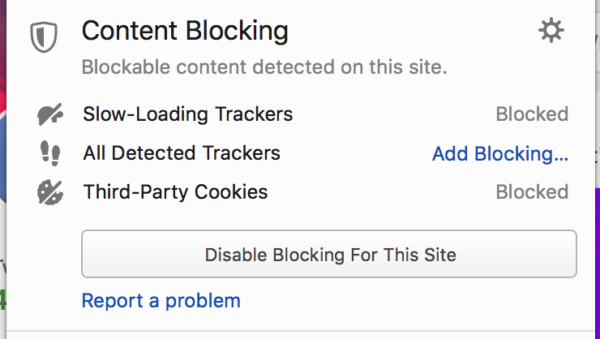
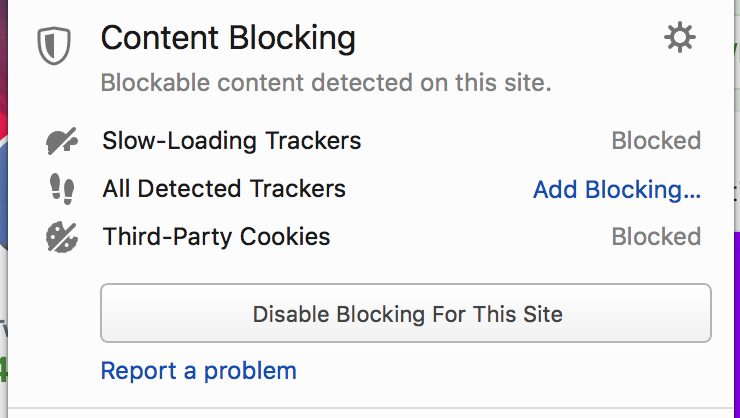
    • Have you been encountering a bunch of tracking behaviour from Facebook lately? Perhaps this will help!

    • Full design spec – for the first iteration we will recommend useful add-ons
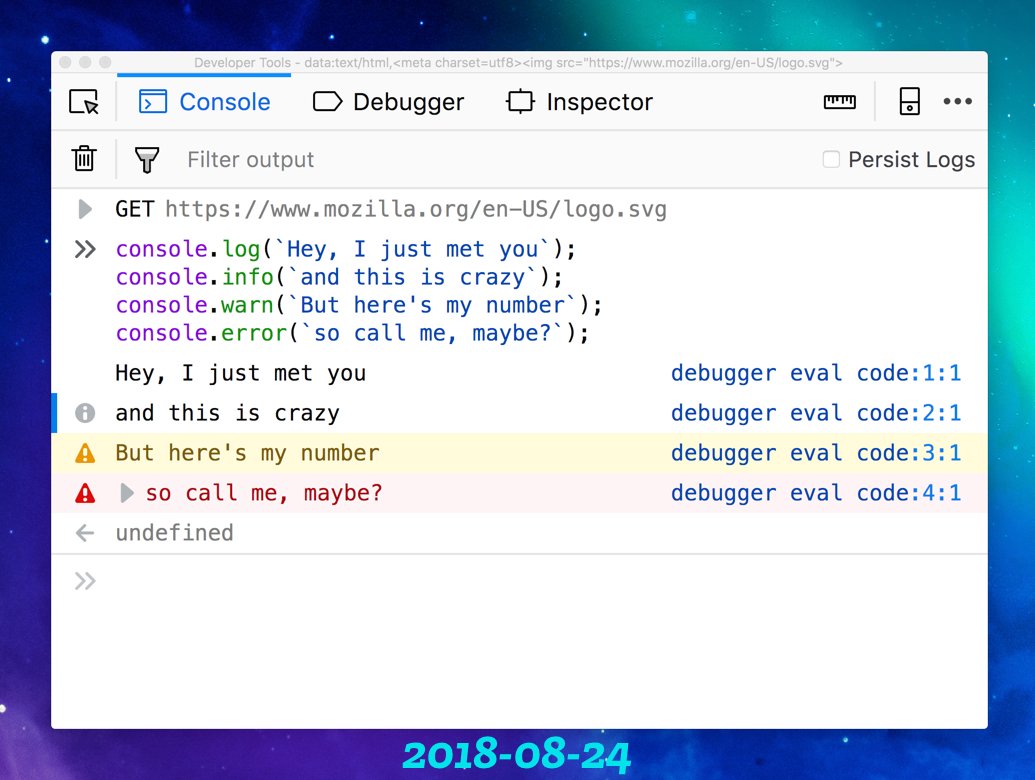
  • Thanks to nchevobbe and bgrins, we now have syntax highlighting in the Console for input and logged statements!
    • JavaScript in the DevTools console now has syntax highlighting to make it easier to read.

      Oooh, colour!

Friends of the Firefox team

  • Welcome DevTools to this meeting! DevTools contributors are now included in the lists below 🎉

Resolved bugs (excluding employees)

Project Updates

Add-ons / Web Extensions

Activity Stream

Browser Architecture

Developer Tools

Fluent

Lint

Performance

Policy Engine

  • We will soon be prioritizing new policies.
  • Autoconfig Sandbox moved behind a pref for 63, no timeline for removal yet due to  Talos dependencies

Privacy/Security

Search and Navigation

Address Bar & Search

Places

Test Pilot

  • Test Pilot server recently upgraded a ton of old dependencies
    • Discovered that non-deterministic dependency resolution can be mitigated by only using exact dependency definitions in package.json (no carats), in addition to checking in our package-lock.json
    • Depcheck was a useful tool for discovering unused and missing packages
    • Webpack 4 had many breaking changes for us, Les Orchard powered through those changes.
    • Flowtype updates forced us to fix a lot of our type definitions which exposed some bugs which were fixed in the process !!
  • Screenshots

Web Payments

04 Sep 04:27

Horrible, but important to read.

by Andrea

BuzzFeed News: We Saw Nuns Kill Children: The Ghosts of St. Joseph’s Catholic Orphanage. By Christine Kenneally.

Warning: This is a long account of many children who were abused in Catholic orphanages over decades, with detailed descriptions of their torment. The author researched these cases for four years.

Link via MetaFiter.

04 Sep 04:26

“[U]nder President Trump, the passport denials and revocations appear to be surging”

by Andrea

The Washington Post: U.S. is denying passports to Americans along the border, throwing their citizenship into question.

“Juan is one of a growing number of people whose official birth records show they were born in the United States but who are now being denied passports — their citizenship suddenly thrown into question. The Trump administration is accusing hundreds, and possibly thousands, of Hispanics along the border of using fraudulent birth certificates since they were babies, and it is undertaking a widespread crackdown on their citizenship.”

Link via MetaFilter.

04 Sep 04:26

Hierarchy is the Enemy of Learning

by Dave Pollard


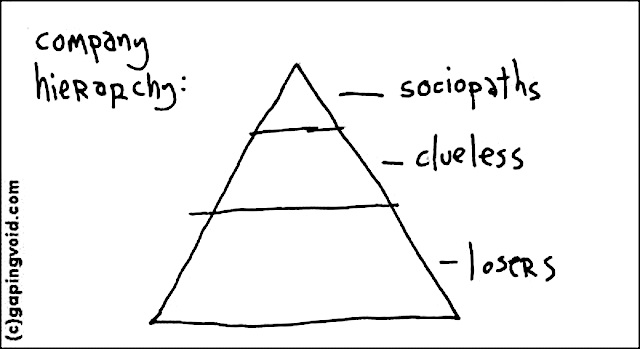
drawing by hugh macleod at gaping void 
I spent many years of my professional life advising small and medium sized businesses. My main advice to them over the years was: have iterative conversations with customers and colleagues about what you and they care about, and how things could be made better, and act on them. As I explained in my book Finding the Sweet Spot(yes, sadly, it’s now out of print) organizations that routinely do that are much more successful and resilient workplaces, and much more fun places to work.

Since retiring, I’ve often found that, in dealings with corporations and government organizations, my professional advice on how to improve products and services has been filed away by the poor underlings responsible for “customer support” or, worse, “customer engagement”. Not because they weren’t excellent ideas, but because the people I spoke/wrote to weren’t high up enough in the hierarchy to get anyone to listen to them. They were generally either new hires or specialists, without the ability to see how the idea would work, and not empowered to forward it on to anyone who could.

This has entrenched my realization that hierarchy is the enemy of learning, and that almost all the brilliant ideas that could be instituted in organizations in both the private and public sector never get heard by the people who have the knowledge to appreciate it and the capacity to implement it. In other words, the best ideas never see the light of day.

The stupidity that created and sustained such hierarchical systems probably stems back to the origins of human organization and even human language. There is considerable evidence that our ‘modern’ abstract languages date back to when humans first settled in one place and required organization to get large-scale work done: agriculture, military/defence, and later industrial processes of all kinds. Just to show how recent this is, anthropologists tell us that we’ve been making art three times longer than we’ve been using abstract languages.

Abstract languages were essentially invented to enable instructions to be passed down from the top of the hierarchy, and evidence of compliance passed back up. Our languages are inherently patriarchal: there is little nuance in our vocabulary, and few words that are without top-down agricultural, industrial or military value. (A read of all but the very best music lyrics and poetry demonstrates that. We have, for example, only one word for love.) It is excruciatingly difficult to contort our language into something that can convey feelings, passion, anything long-term — or anything but the simplest and most obvious changes to the way we do things.

In my work as an innovation consultant, I dealt with the double challenge of (1) managers and workers incapable of seeing how things might be done better differently, and (2) language that, except through the use of stories, made it extremely difficult to persuade or show how things could be improved. So the default is stasis, and the larger the organization grows and the more complex its hierarchy becomes, the more risk averse everyone becomes and the more difficult any kind of positive change becomes.

This is not anyone’s fault. It’s the system, stupid. (Though the system doesn’t actually exist.) We’re all doing our best, and non-hierarchical systems, at least in the current capitalistic economy and competitive social zeitgeist, just can’t survive at any scale. Small is beautiful, and bigger is almost always worse, but in our current industrial society even the most horribly ineffective large organizations will crush small effective ones (except those in niches too narrow for the larger companies to bother with), because the big guys have the money and power to out-advertise, out-produce, price-starve and buy out the smaller ones. Every business they buy and close is a write-off against the massive profits oligopoly guarantees them. And the religion of neoliberalism dictates that even the provision of public goods and services be centralized and made hierarchical for “efficiencies” and “economies of scale” (neither of which actually occurs), and, failing that, “privitized” (under the authority of even larger and less democratic hierarchies). That’s how the system works.

This is true not only in every consumer and industrial sector but in public sectors as well. Ever tried to institute a brilliant new idea in a school or medical organization? These are staffed and run mostly by bright, well-intentioned people, but these people are totally incapable of innovation — they haven’t been given the right opportunity to become creative or imaginative — and are, right up to the level at which they’re beholden to outside political forces, disempowered to institute anything new except on a pilot basis (pilots are good PR and offer the pretence of innovativeness without actually requiring any enduring change), and they haven’t the skills to do so anyway.

I’ve witnessed organizations whose executives knew the choice they faced was radical innovation or extinction. None of them still exists.

There are workarounds that enable front-line people, even in very large organizations, to make significant changes that are valuable to customers, without being sacked or disciplined for violating company polices and procedures that prevent good customer service from being offered. But this is exhausting, and the (mostly young) people who walk that line for a few years get worn out and quit to do work that doesn’t require lying to and disobeying the boss in order to do their job well. Sad to say, many of them face the same dilemma in every job they take, and often end up running their own small niche businesses instead, just so they can look at themselves in the mirror without shame.

As I describe in my book, these small niche enterprises don’t need hierarchy to function and are highly adaptive and (need to be) highly innovative. Everyone in them is listening carefully to customers and colleagues for ideas, and empowered to implement them. Their scale is small enough that they can change quickly. They never have to say to a customer “I’m sorry I don’t have the authority to do that”, and are never forced to shrug off possibly brilliant customer ideas because they haven’t the knowledge, skill or authority to do anything with them.

Over the last few years I’ve offered (based on my own sad customer experiences) excellent ideas to two provincial crown corporations, two of the national telcos, two large financial institutions, and three large educational institutions. They weren’t pie-in-the-sky ideas, but specific, step-by-step detailed process improvement ideas. In half of the cases it took me a half day on the phone to even identify someone willing to field my suggestions. In half of those cases, I gave up — they simply aren’t interested in interaction with customers at all, and see customers as a nuisance and distraction and hire (often offshored or outsourced) junior staff specifically to block customers from talking to anyone further up the hierarchy. None of my suggestions was seen by anyone with the authority to act on it, and mostly I got “thank you” emails telling me that they appreciated my comments while making it clear they didn’t understand them.

The only solace is knowing that these people really are doing their best with the impossible work situation they are stuck in, and that hierarchies of every kind will collapse when the military-industrial-corporatist economy that gave rise to them falls apart. That won’t take long now that real (not the fake ones governments report) inflation and unemployment numbers, massive and soaring corporate, government and personal debt levels, and artificially suppressed interest rates have reached utterly unsustainable levels. No wonder the execs are all buying up land in isolated areas to escape to. They somehow think they’ll be able to support themselves there without cheap, obedient hired workers to do all the essential work for them.

So I’m saying (probably no surprise) that it’s a waste of time trying to reform large hierarchical organizations (private, governments, education, health care included). They’ll be gone soon, bankrupt, and we have more important things to do. Most of those things entail relearning the lost art of community-building, so that, while none of us can be personally self-sufficient, innovative and resilient, our communities together just might.

At the moment, most of us are too indebted to the existing systems (financially, psychologically, and with our scarce time) to even consider anything else. But as the systems get worse (and don’t believe the fools at the NYT and your local politicians citing GDP growth as proof the economy is healthy), the organizations you now think you owe your career, your time, and your mortgage to will start to disappear, and you’ll have both the time and the need to relearn about community self-sufficiency. In most neighbourhoods, there is no cohesiveness and no local essential resources with which to build community, so those communities will eventually become ghost towns; you might want to find viable neighbourhoods that can survive as communities after economic collapse, and consider moving there and taking your loved ones with you. There aren’t many, and once you’re there you’ll start to learn how important community is and what some communities have already started to do.

Once reality sets in, and the problem of a collapsed economy is compounded by unaffordable energy and worsening climate crises, it’s going to be tough for everyone for a few decades or even a few centuries. Talk to those who lived through the Great Depression and you’ll get a taste, except this one isn’t going to end in anyone’s lifetime. Once we’re through it the small remaining human population will likely thrive, though in ways we don’t measure and probably can’t imagine.

In the meantime, when you get frustrated with hierarchy, appreciate that no one is to blame for it, and that it’s unreformable, and do your best to work around it. That’s good practice for the decades ahead. Instead of trying to help these bloated bureaucracies learn how they could do and be better, help those in your community learn what you can do, together, to thrive without the bureaucracies that, for a little while longer, we have to put up with.

04 Sep 04:26

Pride and Potential

by Richard Millington

Tomorrow, we’re raising the cost of our Strategic Community Management course from $675 to $750 USD.

However, I want to briefly explain why most of you won’t take this course.


My Biggest Obstacle

Early in my career, I was too scared to ask for help, admit there were things I didn’t know, or even get a second opinion from people much smarter than I to see what I could be doing better.

I felt forced to pretend I was an expert, even in fields in which I had no experience.

For example, until three years’ ago our entire website was hosted on an outdated Typepad blog. I told myself if the blog content was good enough, people would hire us. They wouldn’t need pesky things like case studies proving we could do what we claimed.

Once we revamped the website (several times), added our case studies, and began sharing the results of our work, business grew significantly.

Not asking for help was pure pride…and a big mistake.

Today I try to spend at least a couple of hours each week having research calls with our audience, talking to other people running a business, getting expert opinion (especially in statistics/analytics) to see what we could be doing better, or taking training courses in specific areas (public speaking, analytics, psychology etc…).

If you’ve noticed any change in how we work in the past few years, now you know why. This is what it took us to really take our work to a higher level.

I suspect this problem crops up a lot in the community space too.


Wasting $1k+ Per Day

A while back, my colleague Todd and I braved a New York snowstorm to meet with a potential client.

The meeting went well, but they decided to go it alone instead.

In the past 18 months, they’ve made a bunch of easily avoidable mistakes, from the site design to daily management of the community, and failed to gain any meaningful level of activity.

They’re still signed to a 3-year contract (for $150k per annum), hired a full-time community manager and sunk at least an additional $50k into the design of the community.

Which means they’re losing at least $1k per day on their community and will do so until their contract runs out. By that point they would have wasted over half a million dollars on a failed community project.

Around the same time, another prospect decided to go it alone too. Again, they made a bunch of almost identical mistakes (from the community concept to daily engagement tactics).

Today the only activity comes from community managers posting huge weekly @mention lists which elicit no further discussions. They’re on the same platform, signed to a 3-year contract, and will never turn the community around. That’s another half a million dollars wasted.

Pride gets expensive pretty fast.

These aren’t isolated stories. Scrolling through our list of community examples, there are hundreds of organizations repeating the same mistakes and wasting six-figure sums in the process. At any time they could have reached out to others for help, but have continued to go it alone and their communities have suffered.


Wasted Potential

At the other end of the scale are communities which are doing ok, but not achieving their potential.

Their community managers respond to activity, optimize what they can, and work with the resources they have.

But they’re barely scratching the surface of their community’s potential.

They usually don’t have a clear roadmap, are focused on a single objective (an objective which isn’t fully supported internally), haven’t developed unique member segments to target, haven’t validated member journeys, and often find themselves measuring the level of engagement instead of the end result.

Worse yet, they are often trying to execute on a dozen or more tactics per week because they can’t pinpoint the few which really move the needle on the metrics which really matter.

They’re working within their comfort zones instead of stretching both themselves and the potential of their communities.

As a result, nothing changes. They will have the same level of activity, support, and deliver the same kind of results next year as they do today. They’re completely at the mercy of external forces and trends they can’t control.


What Stops Us Taking A Community To The Next Level?

Every big leap we’ve taken has been the direct result of acknowledging we can (and should) do a lot better.

It’s this acknowledgement that lead us to seek advice or learn from the experiences of others. It’s why today we still (and hopefully always will) invest huge amounts of time learning from others in our field (and other fields).

If Usain Bolt was still getting training and advice after running faster than anyone in history, we each probably have a lot to learn too.

And whether you sign up for our course or not, I hope at the very least you invest the time and resources to be as good as you can be in this field. Your career aspirations and your community deserves nothing less.

If you want to learn more about the course, click here.

(price rises to $750 USD by the end of tomorrow)

04 Sep 04:23

Is The Little Typer the static typing book I’ve been waiting for?

by Eric Normand

Dan Friedman’s The Little Typer is coming out in September. I’m very excited about this book. It’s about dependent types, and it claims to “demonstrate the most beautiful aspects”. I can’t wait!

Transcript

Eric Normand: Is “The Little Typer” the functional programming with types book I’ve been waiting for? Hi, my name is Eric Normand and these are my thoughts on functional programming.

There’s a new little book coming out by Dan Friedman. The little books are books like “Little Schemer,” “The Season Schemer,” “The Reason Schemer,” one more, “The Little Prover.”

These are all little books. It’s a style of book that Dan Friedman writes. He always uses different co-authors. They’re just teaching functional programming stuff and is very cool style. I have a book. I’m not going to bring it out. I have two of them, but it’s like question and answer.

You can cover up the answer. You ask yourself the question and then try to answer it. Then you see the answer. You get another question and then you try to answer it. One little bit at a time, you’re developing the pathways, the thought pathways in your brain and your mind about how to reason about this code.

Scheme is a really small concise language

In The Little Schemer, it’s just scheme, very basic operations on lists and things like that. The other one I have is The Little Prover which is all about proofs. It’s very cool. This new book is coming out. It looks like it’s coming out in September, so almost here, and it’s all about dependent types.

One of the things I’ve been waiting for in typed languages is basically a structure and interpretation of computer programs. About static typing. SICP, that’s an abbreviation for “Structure and Interpretation of Computer Programs,” is a classic book teaching how Lisp works, how to implement a Lisp using an interpreter, a compiler.

It’s basically computer science through the eyes of Lisp. What’s cool is it uses Scheme which one of the authors co-developed. Scheme is a really small concise language. It’s perfect for this kind of thing. There’s not a lot of fluff to get in the way. It’s easy to implement Scheme. Because it’s so simple, it was used as a language for exploring language features.

In SICP, in the book, he started exploring, what if we add call by name instead of call by value, things like that, just messing with how things got evaluated and you get to explore how things work. Everything was so small and concise. You really got this sense of understanding the fundamentals without a lot of fluff around it.

Haskell is bigger compared to Scheme

I feel like the typed world doesn’t have anything like that. Haskell is a big language compared to Scheme, has a lot of extensions. It has a lot of libraries. It has a lot of concepts in it. The syntax is big compared to Scheme. If you compare any language to Scheme, it’s got a lot of syntax.

I’ve never seen a book that’s saying, what is the minimum type system we can have to start seeing benefits? What is the essence of it? It’s great to have lots of features, want to understand that essence, but what is the essence? What is that thing that makes it important?

I know from Dan Friedman’s other work, from The Little Schemer, from The Little Prover, the two that I’ve read, that it really is trying to get at the essence. It’s trying to find that core of what it means to be Scheme, which is basically doing a lot of consing and traversing cons cells, and recursively.

The book is going to have some core

What does it mean to do proofs? Theorem proving about your code. There’s a very small language in that comes with it that you can start to reason about code with. I’m optimistic that this book is actually going to have some core.

This is what dependent types are, and this is why they’re cool before you have to go and learn Idris, which I think is a very powerful language. It’s also a maximal language in the way that Haskell is.

What can we do with types once we have them? I want to see what’s the minimum what is that, and I’m just really looking forward to this book. It’s got a nice pedigree. I’ve been looking at the author, the co-author, David Thrane Christensen, very interesting. It’s got an afterword by Conor McBride, who is a type theorist.

I’m just really looking forward to it. I’m going to get it as soon as it comes out. I hope I don’t go into a cocoon while I’m reading it. It’s that kind of book because I still have other work to do. This could be it. This could be the book that makes types and what you can do with them makes sense to a lot of people.

First class functions

In SICP, in the first chapter, you start with a function, a mathematical function like some curve. You derive the function that takes the derivative of any function using the limit theorem of calculus, something like that. The definition of calculus of the derivative that’s using the limit, you take the limit to epsilon, to zero and anyway you choose a small epsilon and you develop a function.

That’s like first class functions in the first chapter, but in a very clear way. If you are into this stuff, you already know the calculus enough to follow along. I want to see something like that. He’s going to approach it at a very piecemeal as he usually does, just one small step at a time building up this dependent type system and what you can do with it. That’s going to be great.

Am I weird for not liking types that much?

I actually have met Dan Friedman at a couple of conferences. I spent a good two hours with him at one strange loop. I asked him about what he thought about types because I was thinking about types all the time myself. I had recently left my Haskell job. I was enjoying Clojure and just wondering, “Am I weird for not liking types that much?”

I asked him and he said, “You know, the type system like Haskell…” but I asked a bunch of people and he was one of them, he said, “With a type system like Haskell all of the claims that people make about the kinds of mistakes that you avoid.”

He said that he doesn’t make those mistakes. Meaning choosing the wrong type, like type errors. He doesn’t make the kind of mistake where I thought it was a list but it really was a string. I thought it was a number, but it turned out to be a symbol. He doesn’t make those mistakes

Dependent types

I found, for me, that was true and especially with the kinds of code that you can see him write in his work. He uses a very small subset of Scheme. It’s hardly a small language and he uses a small subset. He’s not doing higher order stuff you get in Haskell, where you need a type system because you’re doing something very abstract, like using type classes and stuff like that.

Anyway, he says he doesn’t make that kind of mistake, but he said, tomorrow there’s a talk on dependent types. I had never heard of dependent types of that time. There’s a talk about dependent types and he says their claims are mistakes that I make.

They can eliminate off by one errors. They can eliminate, you have a no terminated list, nil terminate list. You can tell whether you’ve got another element in the types. He said that that was the kind of mistake that he does find himself making, and so he was very interested in dependent types.

A few years later, here it is what The Little Typer. I’m very excited to see what he’s come up with and how to teach this, how to find the core of it. If you’re excited, let me know.

If you think that this doesn’t make any sense, also let me know. Are you going to buy the book, The Little Typer? Have you read any other little books? Get in touch with me. I’m @ericnormand on Twitter and you can also email me, eric@lispcast.com. I’ll see you later.

The post Is The Little Typer the static typing book I’ve been waiting for? appeared first on LispCast.

04 Sep 04:22

✚ Better than Default

by Nathan Yau

Defaults are generalizations to fit many datasets, which means you usually get barebone charts. For analysis, all well and good. However, data graphics for presentation require more care after the initial output. Read More

04 Sep 04:22

Take the Wheel

by Nina Horstmann

In a recent celebratory blog post from Waymo, Google’s self-driving-car offshoot, the company touts the success of its pilot program after a year of operation. “Over 400 riders with diverse transportation needs use Waymo every day, at any time, to ride all around the Phoenix area,” the PR team reports, before focusing in on a few of its driverless fleet’s “early riders.” One of these passengers, Barbara, is seeing her hometown like never before, according to the post: “Barbara says she’d do more knitting on her self-driving rides if she wasn’t so busy checking out the local sights with her husband Jim. Though she’s lived in the same neighborhood for 20 years, she missed a lot while she was focused on driving  —  even including a nearby park she never noticed before.”

Here, the driverless car is presented as a space of both relaxation and new productivity: Relieved from the burden of driving, Americans will have more choices about how they spend their time. Ironically enough, this evocation of escape and liberation is a recalibration of the rhetoric that helped establish driving as emblematic of the American way of life. Driving slotted easily into existing cultural values of freedom, individualism, and exploration. The road became a site of self-making as car manufacturers engaged in aggressive advertising campaigns to market driving as the ultimate expression of consumers’ individual preferences and identity. Physical mobility and the automobile were used as metaphors for upward social mobility and personal fulfillment.

Just as with the original car culture, enhanced mobility for some will come at the expense of embedded immobility for others

As car ownership became standard, it radically restructured American landscapes, infrastructure, employment, and routines, and contributed to suburbanization, longer commutes, and gridlock. It has become harder to conceive of taking the wheel as a pleasure in its own right, or romanticize it as an expression of individuality and autonomy. Auto marketing began to focus more on escape — think off-road SUVs climbing mountains or sports cars hitting the open highway. In Fast Cars, Clean Bodies, literary theorist Kristin Ross characterized the car as a “miraculous object” that can “offer solace from the conditions it has helped create.” And now, automakers are presenting us with an updated miracle that can free us from the drudgery and tedium that car culture has wrought: the autonomous vehicle.

The development of autonomous cars is enmeshed with contemporary debates about emerging technologies, such as the future of artificial intelligence, the automation of labor, government regulation of technology, and the ever-increasing trust in computation as the wellspring of truth and safety. Nearly every major technology company (Google, Amazon, Uber, Lyft, Intel) and almost all major automotive manufacturers (Tesla, GM, Ford, Toyota, BMW, Mercedes, VW, Audi, Volvo, Nissan and Honda) are competing to build them. Given these stakes, it’s important to ask not only whether driverless cars can work but how the technology is being domesticated. What political work is being performed to make the autonomous future seem ordinary and inevitable, a natural next step in making people’s lives more convenient?

Proponents of the driverless car have tapped into the legacy associations of autos with liberty and escapism and inverted them. For instance, John Zimmer, the co-founder of Lyft, has argued that its model for autonomous vehicle services will give us freedom from cars, liberating us from the burden of having to own an expensive, money-sucking vehicle. An Ad Age article proposes that autonomous vehicles will free Americans from their tedious commutes, turning the automobile into a space of even greater leisure, entertainment, and convenience. As passengers are ferried around by an automated chauffeur, they will have the luxury to focus on interior screens and displays.

At the same time, media coverage of autonomous vehicles has emphasized how autonomous cars will extend freedom of mobility to the elderly, the disabled, the poor, and otherwise neglected groups. In an op-ed written in the Pittsburgh Post-Gazette near the end of his presidency, Barack Obama made a similar claim. In 2016, Waymo widely publicized the first unaccompanied journey taken in its autonomous car by a legally blind man. Meanwhile, other groups — individuals who are barred from obtaining a driver’s license such as undocumented immigrants or recipients of DUIs — are overlooked: Perhaps that’s because these sorts of individuals might trouble the narrative about who deserves freedom and who should be allowed to escape. Just as with the original car culture, enhanced mobility for some will come at the expense of embedded immobility for others.


More than anything else, autonomous vehicles, we’re promised, will liberate us from bad drivers. Driverless cars will keep us safe. They will be more reliable than unpredictable and dangerous humans. “Computers don’t get drunk,” says Stephen Zoepf, the executive director of the Center for Automotive Research at Stanford. “There are a sweeping group of accidents that will go away,” he told Stanford News.

Is the purpose of human oversight to ensure safety or to provide a scapegoat?

Zoepf and other driverless car advocates hold (reckless, irresponsible) humans responsible for automotive accidents. Anthropologist S. Lochlann Jain has argued, however, that the figure of the “negligent driver,” was created by lawyers representing automakers to absorb blame for vehicular deaths. In the courtroom, Jain notes, auto accidents are framed as individuated occurrences, attributable to the specificities of unique drivers and case-by-case situations rather than the result of potential structural problems at the level of product design. Given the frequency of automobile accidents — about 30,000 fatal collisions occur in the U.S. each year — human drivers are framed as always already negligent and irresponsible. Automated driving technology is presented as the necessary, inevitable solution.

But the self-driving car is not nearly as autonomous as it sounds. It relies on a range of environmental, technical, and social infrastructures: satellite signals, sensor feedback, energy grids, fuel stations, legal frameworks, and neural networks. The rhetoric of autonomy and automation, often oversold by Silicon Valley developers seeking funding and fame, whisks these arrangements out of view, masking the infrastructural and political work required to make them run. Testing autonomous vehicles, for instance, requires new legislation to address issues of safety and liability. Politicians in Arizona, Michigan, and Pennsylvania, in particular, have embraced self-driving cars and introduced preferential legislation that favors tech developers and carmakers, granting them access to public roads without the burden of permitting and reporting requirements. Detroit and Pittsburgh, former capitals of the automotive and manufacturing industries, are especially eager to regain their foothold in the wake of declining domestic auto production. Arizona governor Doug Ducey courted autonomous vehicle developers and in 2016, according to journalist Jacob Silverman, supported the launch of a driverless car pilot program before first informing the public.

Elaine Herzberg, the first pedestrian killed by an autonomous vehicle, was struck by one of Uber’s self-driving cars in Ducey’s home state of Arizona in May 2018. According to a preliminary report by NTSB investigators, the car’s sensors had detected Herzberg, but because she was walking her bike across a crosswalk, the software first “classified her as an unknown object, then as a vehicle, and finally as a pedestrian.” Media portrayals of the event, however, attributed the cause of death to the human safety inspector’s failure to notice Herzberg and override the automated system. Similarly, this recent article from Axios concludes that “people cause most California autonomous vehicle accidents.” This reversion to blaming the human driver not only protects the machine, it also deflects blame from its programmers.

Her death, among other autonomous vehicle fatalities, casts doubt on the assumption that robot drivers are inherently safer than their human counterparts. Driverless vehicles’ purpose is overcoming human error, yet they rely on human operators to monitor and supervise them. How can these systems protect us from “human recklessness” if they’re designed by humans and draw upon human-coded data to mimic human driver behavior? Is the purpose of human oversight to ensure safety or to provide a scapegoat? In the eagerness to embrace autonomous vehicles as an escape from inconvenience, are we dodging ethics? 


In conversations about the ethics of autonomous vehicles, scholars and journalists have repeatedly raised the trolley problem as the essential hurdle driverless cars must clear before they can be widely deployed. (See, for example, this 2013 essay in the Atlantic, this 2015 article in the Guardian, this 2015 Stanford Business School case study, this 2015 piece in MIT’s Technology Review.) Originally proposed by philosopher Philippa Foot in the 1960s, it asks whether a bystander who observes a runaway trolley hurtling toward five people should pull a lever to direct it onto another track where it will kill one person instead. Built in to the question is a certain fatalism: No matter the choice, it is assumed that someone must die.

The fantasy of autonomous vehicles, as with conventional autos before them, is that gains in efficiency and convenience might outweigh lingering injustices

Autonomous vehicles will likewise encounter scenarios where they must decide between swerving to avoid pedestrians or putting their own passengers at risk. Researchers at MIT have approached the issue with the same machine-learning principles that drive autonomous vehicles’ computer vision, launching a project called the Moral Machine to gather “human opinion on how machines should make decisions when faced with moral dilemmas.” The 30-million-plus survey responses they have received will be used to train AI systems to help them learn and imitate what humans consider to be ethical behavior, just as human perception of road signs have trained the detection algorithms.

But the trolley problem maps poorly onto how ethical conundrums actually occur in daily life. As philosopher Johannes Himmelreich has pointed out, the outsize focus on the trolley problem falsely portrays ethics as a choice between two clearly delineated options with known consequences, thereby obscuring a range of other important questions, including whether it is  ethical to test self-driving cars on public streets without the knowledge and consent of pedestrians and passerby. Given the data retention and tracking of these vehicles (and the data harvesting practices of the companies who are racing to build autonomous vehicles), how can we curb the risk to individuals’ privacy? How should public safety and regulation be balanced against innovation? How many accidental deaths are acceptable in the short term in exchange for the promise of fewer car crashes in the long term? How do driverless car efforts divert attention and funding from other public goods, such as mass transit? In what ways will these technologies re-entrench economic inequality and social injustice?

The focus on the trolley problem demonstrates how the developers of driverless car have translated ethics into an engineering problem. Mimicking the structure of the conditional if-then statements that are encoded into algorithms, the trolley problem distills machine ethics into an unlikely event that imposes a binary choice between two tragic alternatives, rather than the thornier and more complex quandaries that emerge at the societal or systemic level.

But there is no easy escape from these ethical questions. As sociologist Ruha Benjamin has pointed out, “our collective imaginations tend to shrink when confronted with entrenched inequality and injustice, when what we need is just as much investment and innovation in our social reality as we pour in to transforming our material lives.”

As much as the negative social and environmental effects that the automotive age has wrought — pollution, traffic, urban sprawl, unwalkable cities, poor public transportation systems, the obesity epidemic — have been naturalized as definitive parts of American culture and life, their detrimental effects remain inescapable. Rather than considering the impact of the current transportation system that prioritizes individual journeys, the driverless car extends and entrenches this model. The fantasy of autonomous vehicles, as with conventional autos before them, is that gains in efficiency and convenience might outweigh lingering injustices.

If we consider how the self-driving car slots not only into the existing physical infrastructure (with its embedded biases) but also social infrastructures that valorize independence, individuality, and mobility, we begin to see the driverless car less as a radical future and more a modest extension of our current reality — despite Google’s characterization of the autonomous vehicle as a “moonshot technology.” If we passively accept the driverless car as a predestined future, we’ll be taking our hands off the wheel and letting ourselves be driven back to where we started from.

04 Sep 04:22

How The New York Times Gives Employees the Time and Freedom to Innovate

by Laura Prah
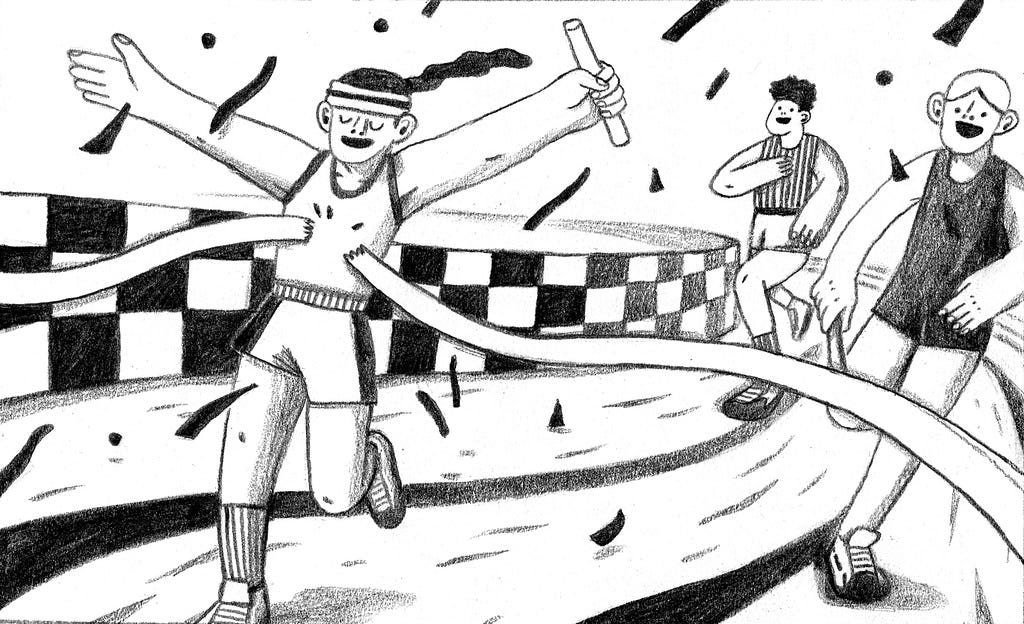
Illustration by K.L. Ricks

One of the most anticipated tech events at The New York Times is our annual Maker Week, when employees in Technology, Data, Product and Design get a full five-day work week to collaborate or work independently on innovation projects. In the weeks leading up to the event, we brainstorm, share ideas and start forming teams to make sure employees can be productive during the week.

The point of Maker Week is not to develop products for our website or apps, but to encourage a spirit of collaboration and learning. We want employees to make new connections across the company and have the breathing room to explore.

The learning culture at The Times runs deep and we hold ad hoc Maker Days throughout the year, but Maker Week allows employees to go all in. We want to give people the space and time to work outside their typical structure and teams, so we recommend that meetings and other commitments are postponed for the week. This gives employees the freedom and autonomy to experiment with new ideas, and allows them to grow in ways they might not when saddled with deadlines and directives.

The event gets a lot of support from our executive committee. Our CTO, Nick Rockwell writes, “I love Maker week because it gives everyone a chance to work on that idea that has been driving them crazy, and learn some stuff and meet some new people while we are at it!”

The success of Maker Week isn’t measured by how many projects make it to production; the success is measured in employee enthusiasm, creativity and trying to solve a problem that may not be obvious to the larger organization. We end each week with a casual show and tell, set up like a science fair, that employees can opt in to.

This year’s event happened in late July and saw a wide range of projects and workshops:

  • One team created a tool to measure gender diversity in our obit coverage
  • Developers ran hands-on workshops on technical topics like building an iOS app
  • A developer created a handheld device using Arduino, an e-paper screen and 3D-printed parts so people could play the New York Times Spelling Bee game on the go.
  • A team of product designers explored how they could mitigate concerns from subscribers about paper pile up by offering fun and practical ways to upcycle. They spent the week creating gift bows, tags, drink coasters and tote bags — all formed out of newspaper.

We’ve been running Maker Week at The Times for a few years now, and we’ve learned that giving employees the freedom to experiment and explore pays off in dividends. When employees have the time to try new things and collaborate, new connections are formed and a people learn from each other. Ultimately, the company benefits by allowing staff to have the time to make these connections, to observe, to listen, to talk and share knowledge.

We’re continually improving how we run Maker Week and Maker Days. Each year, we poll colleagues about what was successful from last year’s Maker Week and used that feedback to inform the next event. Here are some of the things we’ve learned:

  1. Form a Planning Committee: This event requires a lot of planning, a lot of coordination and a lot of input from people across the company. Our planning committee was made up of employees who volunteered their spare time to run the event. To help keep ourselves on track, we appointed a colleague to be the project manager for the event. By having a diverse planning team from members across various teams, we were able to reach out to more people and also understand pain points for participants.
  2. Create a Communication Plan (and follow it): It’s a good idea to devise a communication plan early in the planning process, because once things start rolling, it can be easy to forget to send reminders and announcements. To reduce the number of emails that hit our colleagues’ inboxes, we set up a Slack channel for the event. This way, we didn’t spam people who weren’t interested or couldn’t participate. People who were participating knew exactly where to find information about the event. When we did send emails we included a “What is Maker Week” statement to help explain the event to colleagues who might be unfamiliar with it.
  3. Offer options (like a learning track): In addition to our traditional maker track, we offered a learning track for employees who wanted to participate in Maker Week without working on a project. We invited employees to attend a two day Design Sprint workshop led by Jake Knapp. For this workshop, we assigned participants to teams and dolled out problems identified by the Maker Week team. We also had some colleagues lead pop-up workshops on technical subjects.
  4. Generating ideas: In Maker Week tradition, we held three brainstorming sessions run by different people highlighting different themes like “Diversity and Inclusion” and “Storytelling.” Each session used a different methodology and we kept a running list of ideas that were shared across the company. By offering a variety of techniques, each session felt fresh and surfaced a variety of ideas. We also held two pitch and pitch-in sessions to help people make connections they needed for their project (e.g. if they needed someone with design experience, or a JavaScript developer) or to find a project team to join.
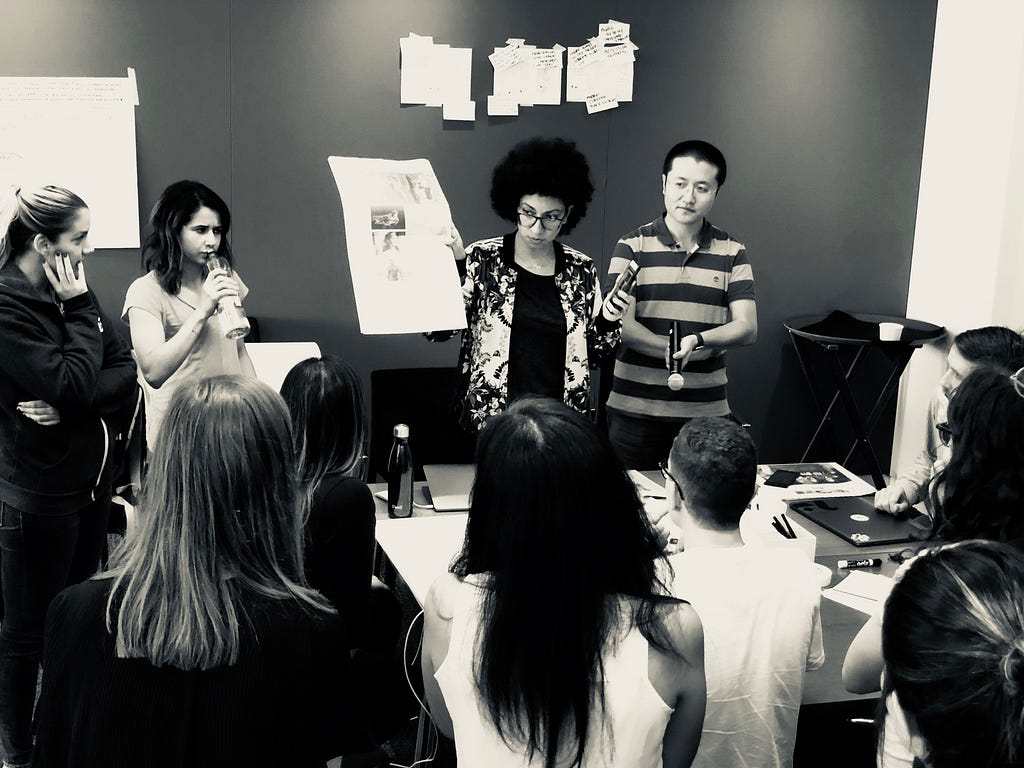
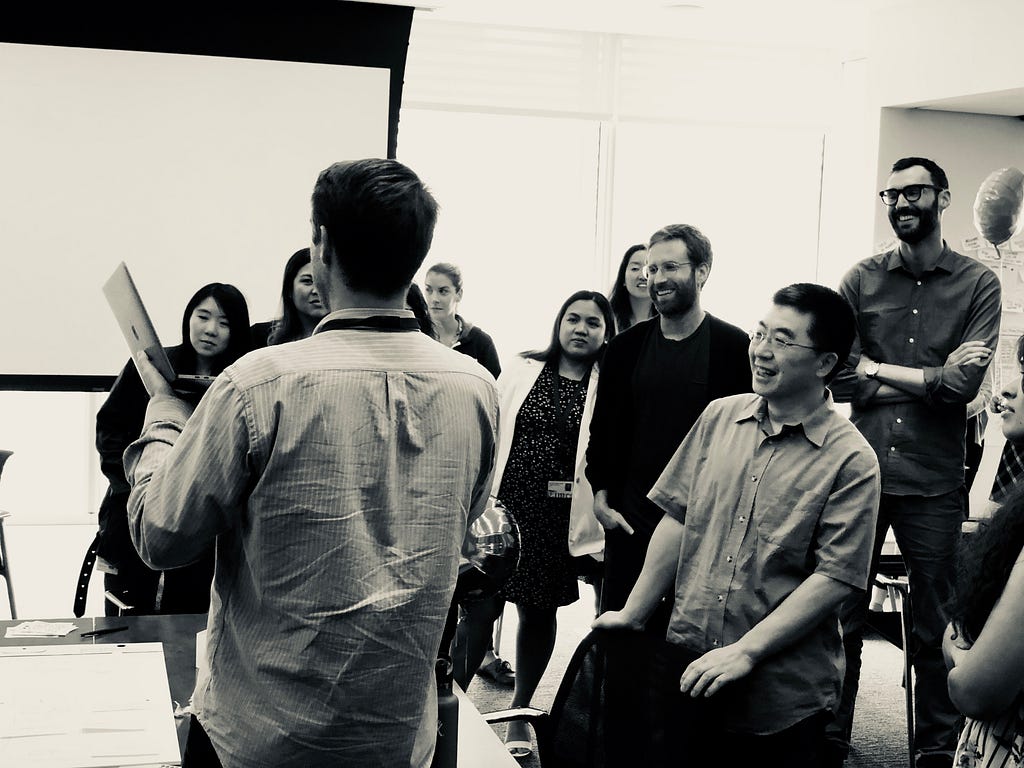
  5. Show It Off (Bragging Rights Are Nice): We end each Maker Week with a celebratory science fair show and tell. The last day is exciting as teams scramble to make their prototypes functional before they show off their creations to colleagues.

In the weeks following Maker Week, we host one or two internal lightning talks and invite participants to demo for five minutes. We invite decision makers and The Times’s leadership team to see all the good work that came out of Maker Week and hopefully help teams find a sponsor for their projects. This year we listed all projects in a Google site, which also serves as a nice record of the 2018 event — which will come in handy next year when we do this all again.

Want to learn more about Maker Week? Check out these posts:

Maker Week Roundup — Homegrown Product Development at The New York Times

How to Run 13 Design Sprints at Once: Inside Maker Week at The New York Times


How The New York Times Gives Employees the Time and Freedom to Innovate was originally published in Times Open on Medium, where people are continuing the conversation by highlighting and responding to this story.

04 Sep 04:22

How to Run 13 Design Sprints at Once: Inside Maker Week at The New York Times

by Jake Knapp
Illustration by Doris Liou

This summer I got to do a super fun project, and I thought I’d write it up. It started several months ago, when I got an email from Laura Prah, who leads culture and engagement at The New York Times.

Among other things, Laura is in charge of an event at The Times called Maker Week. Maker Week is like a hackathon. For one week every summer, folks are encouraged to step away from their regular work (as much as humanly possible at a newspaper) and experiment with new projects. They start on Monday, and on Friday they share prototypes with the company.

Laura was considering integrating the design sprint into Maker Week and she wondered what I thought. Well… I was stoked. I mean, first of all, it was The New York Times! I figured if I played my cards right, they might even invite me to visit. (Spoiler: this actually happened!)

Second, the design sprint seemed like a good fit for Maker Week. The design sprint is a step-by-step process for starting new projects — a sort of recipe for team problem-solving. In a design sprint, the team creates competing solutions, decides on the best, then builds and tests realistic prototypes, all within a single week. It was quite easy to imagine overlaying the design sprint steps over the top of what The Times was already doing.

And there was one more reason I was excited. This idea of a “Maker Week Remix” offered a chance to tinker with the traditional hackathon, which is a format I both love and hate.

Hackathons are the best and the worst

Hackathons are awesome because they offer protected time, an artificial deadline and an experimental mindset that can stick in the team culture long after the event is over. In fact, hackathons were one of my inspirations when I created the design sprint (back in 2010 while I was at Google).

But hackathons are also not awesome. Without a clear game plan, newly-formed teams can waste time and lose their way. Many hackathon projects go nowhere when the event is over. And people often exhaust themselves working super long hours — as Jason Fried noted, you might be better off with a sleepathon than a hackathon.

By combining design sprints with Maker Week, Laura and I figured we might highlight the good stuff in hackathons while fixing some of the trouble spots.

Design sprints typically have five to seven people, but Maker Week would have 65. So I had to “scale up” the design sprint to work with several teams at once. I had a few ideas, because for the last year, I’ve been running design sprint workshops that often have 100 or more people. But those workshops use a “canned” project so that every team is working on the same fictional challenge. Multiple teams working on multiple real projects is much more complex, so I was a bit stressed out.

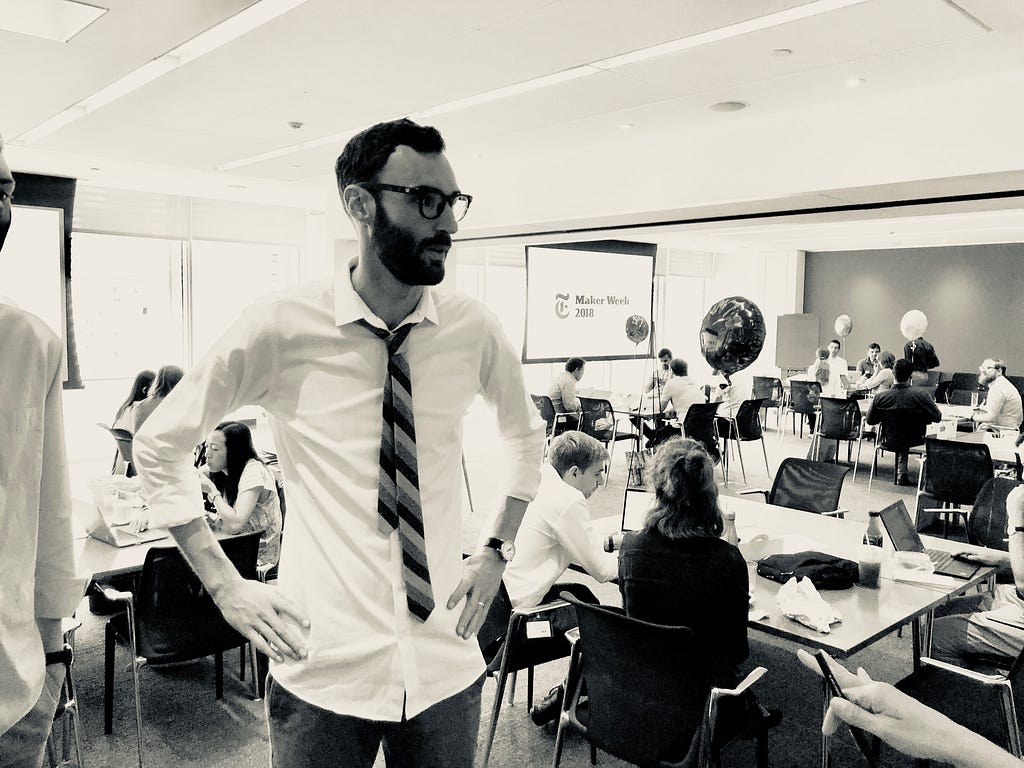
Right before Maker Week began. If I look stressed, well, I was. It turned out well in the end though… but at the time I wasn’t 100% sure it would.

Six tips for design sprints with multiple teams

In the end, it worked out even better than I hoped. If you’d like to run a similar large-scale event with lots of teams, try making these six modifications to the normal design sprint process — they really helped me.

Emcee instead of facilitate

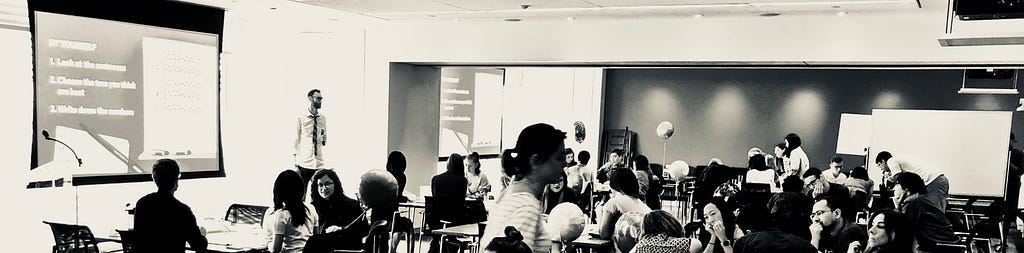
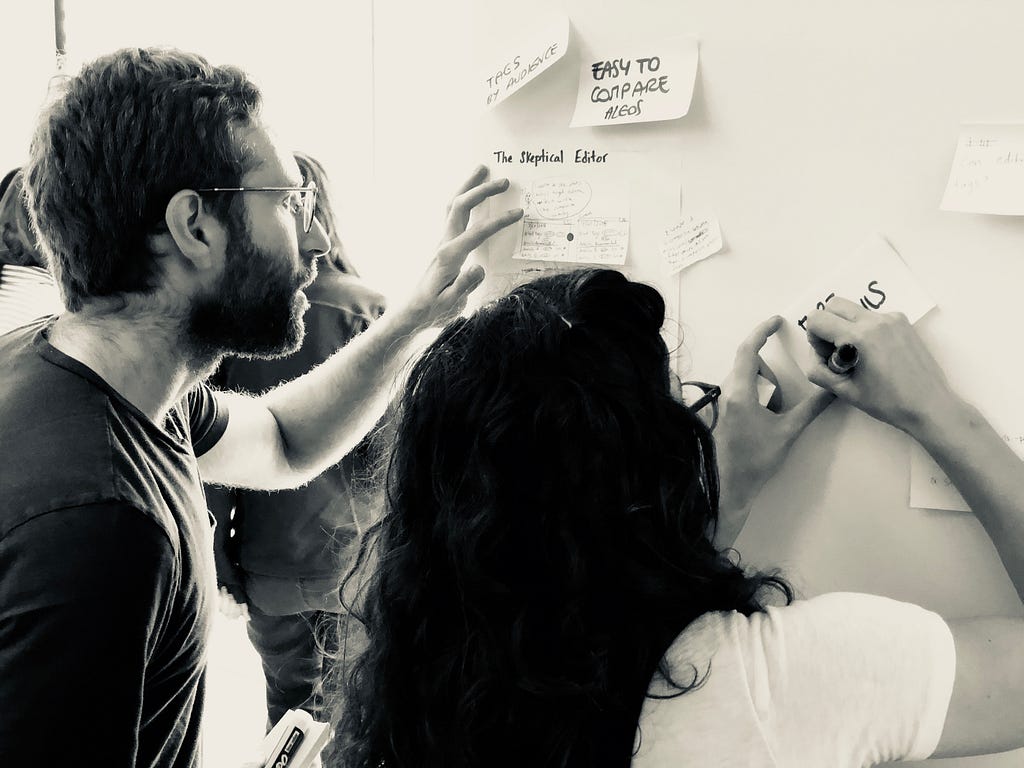
1 The design sprint is intended for one small team with one facilitator leading them through a checklist of activities. For Maker Week, I had 13 teams all together in one big room. There was no way I could rotate and coach each of the teams, so instead, I treated it like a big workshop (or yoga class) with me at the front talking everyone through the steps.

Step-by-step slides

2 With so many people, I needed more than verbal instructions. I’ve developed a slide deck for my training workshops, and I adapted those slides for Maker Week. With them, I had a visual cue to go along with each step. This helped teams move super fast and stay focused.

Some of the step-by-step slides I used for Maker Week.

Condensed schedule

3 Normally, the design sprint process takes five days. On Monday, the team creates a map of the problem and chooses a target; on Tuesday, they sketch solutions; on Wednesday, they decide which solutions are best; on Thursday, they prototype; and on Friday, they test the prototype with customers. But — knowing that not every team could take all five days off — Laura and I decided to compress Map, Sketch and Decide into just two days.

To tell the truth, I was apprehensive about getting all these different teams through the condensed schedule. I put together this spreadsheet to plan the activities minute by minute, adjusting the times as we went:

Use modified map and storyboard tactics

4For Maker Week, I used the checklist from my book Sprint along with two improved techniques: the Note-n-Map (from Stéph Cruchon in Switzerland) and Storyboarding 2.0 (from AJ&Smart in Berlin). These techniques provide extra structure for the mapping and storyboarding activities, which normally require a lot of hands-on facilitation. Both worked like a charm. Even though they didn’t have dedicated facilitators, the Maker Week teams quickly created maps and storyboards without a lot of discussion.

Roving helpers

5 I brought my buddies Jonathan and Luke to roam around and help if teams were confused about a specific step. As a bonus, Jonathan — who has run more design sprints than I have — watched the energy level of the room and helped me figure out when to speed up and when to slow down.

Music to keep the peace

6Many of the activities in the design sprint require silence, but it’s hard to enforce silence with 65 people in the room. And once one group starts murmuring, the broken focus quickly spreads. So I played some ambient music to remind people when to stay quiet and focused. (My playlist includes instrumental music by Marconi Union, Jamie xx, the Beastie Boys, Kamasi Washington, Chromatics, Dave Brubeck, Daft Punk, and others — and I used this tiny bluetooth speaker which projected sound throughout the space remarkably well.)

From zero to prototype in two days

Remember how I was nervous about squeezing three days into just two? Well, at 2 p.m. on the second day the teams were already finished with three days worth of work! So we moved on to what is normally the fourth day of the design sprint: prototyping.

From 2 p.m. to 5 p.m., the teams put their heads down and cranked out their prototypes. Then, at 5 p.m., we shared progress. This was amazing: almost every team was finished with their prototype. They had done just 15 hours of work (seven and a half on day one, seven and a half on day two) and they were already done with what normally takes all of Maker Week.

Revised plan—the teams got ahead of schedule on day 2 and had time to start AND (mostly) finish their prototypes on Tuesday afternoon.

I think there are a few reasons why the teams were able to sprint and prototype so quickly. First of all, because the hackathon projects were all new or speculative, there wasn’t a lot of background knowledge to share or politics to work out. Part of what takes time during the map step of a design sprint is working through the messy details of real, long-term projects. For better or worse, a hackathon environment avoids those details and starts with less information — so day one was a breeze.

The projects were also fairly well scoped. Laura and her colleagues Kelci Shipley and Jody Mak had supplied each team with a “How Might We?” question to seed their design sprints (for example, “How might we allow subscribers to engage directly with editors?” or “How might we allow users to track the physical delivery of their paper?”). These questions had been carefully phrased to keep the scope appropriate to Maker Week.

It also helped that the people in the room knew the app, website and editorial tools inside and out. I’m used to working with startups, who might try to define a brand and a marketing plan and a technology stack all at once. The New York Times has been around for 167 years (really) and they’ve had a website for about 142 years (not really, but it seems like it). There’s already a strong foundation and many components to work with, so when it came time to build the prototype the teams could really fly.

Finally, and I think this is important, everybody came in with the right mindset. In a design sprint, part of the facilitator’s challenge is to help a team move quickly, forget about being perfect and get into an experimental mode. Maybe it’s because Maker Week is already an institution at The Times, or maybe it’s because the digital team is used to quickly experimenting with new ideas and technologies.

A better hackathon — but still a hackathon

In the end, even a design sprint-ified Maker Week was still a hackathon. The projects were all explorations — answers to questions that the Times is curious about, but perhaps not quite ready to act on. When the dust settled, everybody went back to their real work and had to catch up. Most teams didn’t test their prototypes with target customers, and most didn’t plan to take their prototypes anywhere.

Normally this would absolutely kill me. I hate it when the projects go nowhere. I crafted every step in the design sprint to be pragmatic, each one making progress toward building something real.

And yet… fundamentally and intentionally, the Maker Week projects are short-lived experiments that are never intended to see the light of day. Laura was explicit about this from the very beginning: Sending new projects to production is not the goal. Instead, Maker Week is about practicing exploration.

So I’ll add one more suggestion for multi-team sprints:

Set clear expectations: Launch vs. practice

7 Decide in advance whether the goal is launching or practicing. And be honest, because it’s very hard to keep hackathon projects alive, and very frustrating to be told something has a chance to launch only to watch it go nowhere. If you decide to make it practice, do what Laura did and be very clear at the beginning, and remind people over and over: This is practice. The point is to flex our experimentation muscles.

It’ll take some time to know if the design sprint-ified Maker Week was a success, but I have a good feeling about it. With a little luck, The New York Times will use design sprints on more real projects (they already started last year) and… who knows, maybe one of the Maker Week experiments will defy the plan and catch on? Either way, it was good practice.

If you try a large-scale design sprint/hackathon at your company, let me know how it goes!

Photos by Jonathan Courtney and Luke Knapp

Want to learn more about Maker Week? Check out these posts:

Maker Week Roundup — Homegrown Product Development at The New York Times

Maker Week: 5 Days of Collaboration and Innovation at The New York Times


How to Run 13 Design Sprints at Once: Inside Maker Week at The New York Times was originally published in Times Open on Medium, where people are continuing the conversation by highlighting and responding to this story.

04 Sep 04:22

Late Summer Cycling and Storytelling in Toronto

by dandy

Story and photos by Robert Zaichkowski

Sunday, August 26, 2018, was a day of cycling and storytelling in the city. The Reading Line featured a book ride along the Prince Edward Viaduct (literally) bridging east and west Toronto, while BIKE MINDS held its fifth event at Todmorden Mills. Both events saw Melissa and Chris Bruntlett visit Toronto as the first stop of an eight city tour to promote their book, Building the Cycling City, out now. You can read our review here on dandyhorse.

Janet Joy Wilson leading a book ride along Danforth

Books on the Viaduct

Since 2014, I've participated in all five of The Reading Line’s Toronto rides, though there was an additional one done in Brampton earlier this year. The four previous rides criss-crossed the city along the Green Line, Bloor Street, Bathurst Street, and the Don Valley. The Viaduct was chosen this year to celebrate its 100th anniversary and promote the need for protected bike lanes on Danforth.

Some swag for the book ride

The ride – which dozens of cyclists took part – started at Central Tech near Bloor and Bathurst. Some new additions for this year’s ride include bicycle safety checks by Toronto Hustle, free Bike Share Toronto bike rentals, sign language interpreters, and a small swag package of bookmarks, Book Ride stickers, and coupons for Danforth Mosaic BIA businesses. However, I was disappointed with the lack of pizza by the time I arrived despite what was mentioned on their website.

Toronto Hustle's bicycle safety check tent

Siva Vijenthira, formerly with Cycle Toronto, discussed her work on getting newcomers and youth to bike including the startcycling.ca website and CultureLink’s Bike to School Project. Bethlehem Terrefe Gebreyohannes read from her book Fire Walkers about her family escaping Ethiopia with the help of a caravan.

Bethlehem Terrefe Gebreyohannes

Carrianne Lewis – whose book That Time I Loved You was shortlisted for the Toronto Book Awards – read a bike-related chapter about June; an eleven-year-old Chinese Canadian attracted to (and betrayed by) Bruce who rode a ten speed and did wheelies. The book also discussed suicides over the Viaduct. (The suicide preventing luminous veil was installed in 2003.) Cycle Toronto’s Sarah Bradley also briefly promoted the #BuildTheGrid campaign.

Carrianne Leung

At the next stop, Amanda O’Rourke of 8-80 Cities talked about #BuildTheVisionTO (which includes #BuildTheGrid) and the need to improve the quality of life for everyone by making places suitable for eight-year-olds and eighty-year-olds alike. Chris and Melissa Bruntlett read from the Rotterdam chapter of their book, titled “Streets Aren’t Set in Stone”, and revealed the Vancouver police no longer plan to enforce the mandatory helmet law thanks to an audience question. Ramon K. Perez talked about how his interest in comics and graphic novels developed, and handed out mini comic books from Parkdale’s Royal Academy of Illustration and Design.

Chris and Melissa Bruntlett

The ride went across the Viaduct and the group safely took the lane all the way to East Lynn Park. Marvin Macaraig promoted the work being done to establish a cycling culture in Scarborough, including the opening of a third bike hub in Agincourt and plans for a fourth in eastern Scarborough. City Council candidate Brad Bradford talked about how the Toronto Hustle bike racing team he co-founded wanted to do more, including more advocacy work.

Fabiana Bacchini

Fabiana Bacchini recounted her experience about her son Gabriel who was born premature and spent 146 days in a neonatal intensive care unit (NICU). This lead her to write the book, From Surviving to Thriving, and promote charitable causes related to NICU. Finally, Jay Pitter, who co-edited Sub Divided with Spacing’s John Lorinc, talked about the need to not view street safety issues (e.g. bike lanes, police carding, transphobia) in silos and instead take a holistic approach.

Jay Pitter

There was a children’s bike parade and a band to finish the book ride, but we had to leave early to get to Todmorden Mills for BIKE MINDS.

BIKE MINDS

While Matt Pinder and Michelle Kearns' four inaugural BIKE MINDS events sold out within an hour, this one was held in a higher capacity venue which took until the week before to sell out. Aside from some delays with Cycle Toronto getting the bike valet ready, the 100 to 150 people in attendance were treated to some inspiring stories about the ability of bikes to transform people’s lives. Before kicking things off, Jane French of Toronto Museum Services promoted the Bike City exhibit at St. Lawrence Market which covered bicycle manufacturing in Toronto, freedom on two wheels, and Toronto’s bumpy road to becoming a bike city.

Madeleine Cho

Madeleine Cho – a mental health advocate who volunteers with Charlie’s Freewheels – recalled a life of struggle including three concussions over an eight month period and losing control of her vehicle on Highway 401; leading to surgery and post traumatic stress disorder. Despite such adversity, she biked 50 kilometres for mental health and recently got her first year credits at the University of Toronto. Mahitha Thota – a newcomer from India – talked about how Bike Host helped her overcome her initial lack of enthusiasm for Canada. Coralie Bruntlett – the daughter of Chris and Melissa – gave a youth perspective on how biking made her more mature, independent, and grown up. Finally, Dean Psarras – known on Twitter as @convertdcyclist – got fed up with car commuting and taking the TTC to a point where he spent $600 on a bike and headed to Sherbourne station; only to end up biking all the way to work on York Street.

Dean Psarras a.k.a. The Converted Cyclist

Before presenting a summary of their book, headliners Chris and Melissa Bruntlett tested the audience with a quiz from Dutch consulting firm Mobycon which revealed the Netherlands has a 19-lane wide highway (!) and 880 bikes were stolen in the country every day. The Bruntletts’ presentation debunked various myths about why cycling cannot work in Canada by saying Winnipeg would have been Canada’s cycling capital if a flat city was needed, while the Netherlands had their own version of Donald Trump who did well during the last election. The Bruntletts concluded with a focus on obesity and asked the audience to think about what kind of future they wanted.

Some mingling after BIKE MINDS

The event concluded with copies of Building the Cycling City being signed (and sold) by the Bruntletts as well as the usual mingling. Congratulations to both The Reading Line and BIKE MINDS on their excellent events. Let’s keep sharing our cycling stories and continue fighting to make Toronto a true cycling city.

Robert Zaichkowski is a Board Member of Cycle Toronto, an accountant, and writes the Two Wheeled Politics bike blog.

Related on dandyhorsemagazine.com

Desmond Cole on Policing Public Space

Toronto needs Protected Intersections now

dandyhorse summer newsletter

04 Sep 04:22

The 1950’s Birth of the North American Back Yard

by Sandy James Planner

There is an exhibition currently touring from the Smithsonian titled “Patios, Pools and the Invention of the Backyard”.  Jak King has been circulating  a write-up by the Smithsonian insider which not only describes how North American culture turned from a front porch to  a “back yard” life, but also points out that this love of lawn and yard is a recent post-war development.  Noted Vancouver  artist and author Michael Kluckner observes that this exhibition adds another dimension on how conformity and consumerism were sold to a postwar society that had been under tremendous stress in the previous generation.

There were several  post-war factors that contributed to back yard culture: instead of army life, there was a growth in white-collar jobs that were limited to 40 hours a week. There was an increase in disposable income, allowing people to personalize these innovative back yards as part of post-war suburban housing tracts. Materials that would have been used in wartime were also available, allowing home owners to personalize their backyards with swing sets and pools.

dentdent

The Smithsonian exhibit describes the repurposing of aluminum, concrete and fabrics from war production to new post war uses. In David Suzuki’s Book “The Sacred Balance” he also describes how consumerism and home making became the new focus of war-time industries that needed to reboot for peaceful times. And the suburbs were perfect for in ground and above ground pools, using materials that would have been prohibitively expensive and scarce during the war.

Even suburban houses spoke to the birth of the back yard. Where previously a front porch or stoop graced the facade, new architecture stripped the facade of that adornment, meaning that socialization now happened by invitation in the private back yard, which formerly would have just had a vegetable garden and a garbage tip.

alumalum

Images: Smithsonian

Industries quickly responded to the commercialization of house and yard, creating lawn grasses which of course needed to be nurtured with pesticides and herbicides, and demanded to be individually maintained with lawn mowers and garden tools. A whole new way of life morphed wartime businesses into servicing the new subdivisions and the invention of grassed back yards. Who you were was reflected in your yard maintenance~“A pristine lawn and patio showed that you had both free time and extra money to make that open space behind your house a private oasis.”

From YouTube, here’s a 1950’s barbecue in one of those prized back yards, “where the family circle invites a few special friends for a barbecue, that holds a charm like few others in the world”.

04 Sep 04:20

Building a safe and legal rainbow crossing

by David Hembrow
My last blog post included the photo above, which no-one commented on. Many places have of course installed rainbow crossings before Assen, but some careful thought went into this which I think is noteworthy. Bear in mind that rainbow crossings have two purposes, which are not related to one another: The political purpose: A rainbow crossing indicates that the city within which it appears
04 Sep 04:20

Civic Savvy: Thirty For Thirty

by Gordon Price

“Everyone is eating away at everyone.”

So says a campaign coordinator for some of the independents.  He’s experienced, active in provincial and federal campaigns.  He has perspective. “I have seen how ugly it can be and how unqualified and power-hungry people make it to the top.”  Most of the people he sees running for council aren’t like that, he has found.  They want to make decisions based on the good of the city, not their careers.

His view is that the new financing rules have altered the political landscape with an earthquake whose magnitude is not yet clear.  But it has certainly leveled the playing field.

Hence so many independents pursuing what may be a once-in-a-lifetime political opportunity.

What about the established parties?  Don’t they have a brand advantage?

Yes – but the brand is also one of distrust and fed-up-ness.  That’s reflected in the polls which show leaders of the NPA and Vision in the bottom third of preferences, with independents puling away votes in a lot of different ways.

Young people will continue to emerge with electoral strength, he thinks, but they’re not ideologically driven; their lives make issues like housing and equality more personally relevant.  If you can get to them through their phones.

So what will if take to get elected councillor in the City of Vancouver?  Not a lot of money – say, $30,000, plus  Which may help you get 30,000 votes, maybe 50.

Thirty for thirty is the formula at the moment.

04 Sep 04:20

Come Work With Us

by Werner

We have some big plans for Things and want to expand our team.

We 👩🏻‍💻👨🏿‍💻👩🏼‍💻👨🏾‍💻👩🏽‍💻👨🏽‍💻👩🏾‍💻👨🏼‍💻👩🏿‍💻👨🏻‍💻 are 👩🏻‍💻👨🏿‍💻👩🏼‍💻👨🏾‍💻👩🏽‍💻👨🏽‍💻👩🏾‍💻👨🏼‍💻👩🏿‍💻👨🏻‍💻 hiring!

We’re currently looking for an iOS/macOS Developer and a Sync Engineer. If that sounds like you or someone you know, head over to our jobs page and learn more.

We’d love to hear from you!

Applications are open until September 16.

04 Sep 04:20

Social Media Mobs

Back in 2009 (I think; I don’t feel like checking) a whole bunch of people on Twitter turned on me all at once. It felt like a mob. The mob wasn’t in any way self-aware or coordinated — but it still felt like a single driven thing.

This wasn’t over culture or politics or social issues — it was over my own software and a mistake (actually two simultaneous mistakes) I had made. (The details are unimportant.)

Twitter was much younger then, with fewer people, and it was still a mostly-fun place.

But I went into a serious funk and for a year considered leaving the tech industry altogether. Shuttering this blog. Just quitting. Which is a consequence completely out-of-proportion to my actual mistakes, which were forgotten pretty soon as people moved on to other topics.

But I didn’t forget my experience. I never really recovered all the way — something left me, something about how I think about people, something I can’t quite name or describe, but it was a good thing and it left.

I’m lucky, of course — if anyone can come back from something like this, it’s someone as all-around fortunate as I am.

* * *

The mob never apologized. Mobs never do.

Imagine: a bad thing happens to you, which you perceive as wildly disproportionate, and, later on, the actors never say they’re sorry.

But who would an apology come from? A mob can’t apologize.

I started to wonder if I really deserved it after all. Maybe the mob discovered the truth about me, that I’m a bad person. I thought about what penance I should pay. (Eventually I did decide on a penance, and I did pay it, and that was wrong.) I wondered if I shouldn’t quit so much as accept a shunning.

For a long time after everyone forgot.

Anyway: that’s what that’s like.

* * *

And maybe this is why I’m extra-sensitive to social media mobs. What I went through is tiny compared to what other people have been through. Not worth remembering by anybody, not even me (though I can’t help it).

Then there was this thing with Wil Wheaton getting booted from a Mastodon instance. I don’t know much about Wil (I did watch Star Trek, of course) or what mistakes he may have made.

And I don’t care. The power of mobs in Mastodon reminds me of the power of mobs in baby Twitter of 2009. Which is to say: it’s entirely possible it will get worse and worse — as it did on Twitter — to the point where lives can be ruined and even threatened.

So I’m thinking about whether or not to stay.

04 Sep 04:19

August Braindump

04 Sep 04:19

July Braindump

03 Sep 18:49

Twitter Favorites: [counti8] But... but that’s my favorite thing about September! https://t.co/GdSv6J2f6h

Karen Quinn Fung 馮皓珍 @counti8
But... but that’s my favorite thing about September! twitter.com/shawnmicallef/…
03 Sep 18:48

Twitter Favorites: [Planta] Some British Columbia lapel pins. https://t.co/0FbHLAXnGW

Joseph Planta @Planta
Some British Columbia lapel pins. pic.twitter.com/0FbHLAXnGW
03 Sep 18:48

NewsBlur Blurblog: TBN Ride: “the Big Loop”

sillygwailo shared this story from Biking in a Big City.

The Big Loop is an 83 km route put together by TBN that goes up the Humber River trail from Etienne Brule, across the top paralleling the Finch Hydro corridor, and then down past Don Mills and into the Don River trail system.

map1

It was scheduled for late July, but it was cancelled by rain. I elected to load the route to my GPS to do it on my own, but noticing that today’s regularly scheduled Saturday morning ride went up to Humber College, I decided to ride along with them, and then split off at the appropriate point. Here is the crowd gathered for the ride. Chris is in the centre making announcements.

IMG_9400

Looking back at riders crossing the Humber, all walking their bikes like good citizens.

IMG_9401

After a brief stop at James Gardens, we have to take our first detour on Edenbridge out of the park because of continuing construction on the trail near Scarlett Rd.

IMG_9402

Further north, we take the usual route through a few blocks of Weston to traverse a gap in the trail. We have to stay alert on the bit where we go through a parking garage.

IMG_9403

There is a sign indicating construction on the trail past Albion Rd. The sign said that construction was due to be complete July 31, but on the other hand, the sign was still there so we elect to take the detour.

IMG_9404

Definitely appreciated safety in numbers along Albion.

IMG_9406The sections of the Humber River tail past Albion are very peaceful and scenic.

IMG_9407

At some point approaching Humber College, I had expected to turn off from the main group, but Chris informed me that due to the detour, we had bypassed the turn. I went with the main group to Humber to make a brief stop, and then I headed east to try to hook up with my original route. The difficultly was that I had erased the maps on my GPS, so it was not easy to navigate to the route. I decided to bike east along Finch until somewhere in the vicinity of York University. It was not as bad as I had feared due to relatively light traffic. There was even this pseudo bike lane in places.

IMG_9408

However, after the 400 overpass I was only too glad to get on the Finch hydro corridor trail (FHCT), at York Gate Blvd.

IMG_9410

It also turns out to have been a good move not to take the original route here as Adam had pointed out that the Rogers Cup was happening at York this weekend.

After a very short distance, I was not pleased to see no crossing at Jane St.

IMG_9411

So OK, I have to go a little south to cross.

IMG_9412

Past Sentinel Rd, I was happy to see this large area of community gardens, which made up for the fact that the trail was diverted to what was essentially a sidewalk for this stretch.

IMG_9413

A seeming dead end at Keele St, with no signage.

IMG_9414

If I had the cue sheet, I would have known to look to the right to see that the trail continues a little further south. The building on the right margin of this photo is the new Finch West subway station.

IMG_9416

This map shows that you have to make a few twists and turns to stay on the trail, which eventually straightens out, paralleling the York U. busway on the north side.

map2.5

This picture shows the trail and busway crossing tracks.

IMG_9418

The line of high buildings in the distance is Yonge St., but coming upon Dufferin St, I realize that they are still some distance off.

IMG_9419

Past G Ross Lord Park, the route takes me along Drewry Ave that becomes Cummer Ave, which was peaceful and uneventful, although the Ride with GPS route urged me to turn left at Bayview, which was not necessary.

At the end of the section on Cummer, the route turns south and then hooks up with the FHCT again. This downhill section that zigzags to the junction with the Don River trail was the most fun part of the whole ride.

IMG_9420map3

Going down the Don River trail was uneventful until it seems to end at the intersection of Leslie and Sheppard. Here you have to cross the intersection to the south east corner to find the continuation.

map4

This is what the trail entrance looks like.

IMG_9423

The trail ends again at Duncan Mill Rd, and here I met a group of lost seeming cyclists. There was a sign pointing to the right that said that the Don River trail was 2.4 km away, but again, not enough signage. It turns out that the 2.4 km involves a couple of turns on city streets before you end up back on the trail.

map5

The trail ends again, just short of York Mills, and the route map shows this.

map6

There was a bike lane westbound on this short section of York Mills, but there was too much traffic to take a picture. Cross the street at the light at Scarsdale, effectively making a left turn, and then look for a doubling back of the trail under the bridge.

IMG_9424

The trail then turns south and goes along a disused rail corridor. It is a straighter, more peaceful version of the West Toronto Railpath.

IMG_9425

Signalized crossing at Eglinton. It almost felt like I was in Vancouver for a moment. (except for the exceedingly long response time to a button push)

IMG_9426

The other thing I liked about this section was that at intersections with other trails, there was this round about like feature, with embedded sections of train track as a decorative element.

IMG_9427

Sadly, as with most bike infrastructure in TO, this cannot last, and the trail ends abruptly, and you have to make a sharp right turn on a short section of gravel that then leads to this narrow section that leads to Leslie St.

IMG_9428

map7

The short section of Leslie leading to Willett Creek park was the scariest part of the whole ride, no thanks to the many drivers that whizzed by less than a meter from my handlebars. Bastards.

From Willett Creek, the Don Trail is probably more familiar to many of you so I didn’t take many pictures. Here are the elephants.

IMG_9429

And the stop with the gargoyles just north of Bloor, where I’ve never bothered to stop before. It was good to be riding the Tamarack. Much as people rave about Bromptons, I do find it easier to ride longer distances on a standard bike.

IMG_9430

Thanks to TBN for organizing the first part of my ride, and for plotting out this nice route.

Note: for those not in TBN that want more information about the route, it is available here, at least for the moment.


03 Sep 18:48

NewsBlur Blurblog: Books & Bikes along the Bloor Viaduct

sillygwailo shared this story from Biking in a Big City.

Today was the 5th annual book ride put on by the Reading Line. This year’s theme was centred on the Bloor Viaduct, its history, the fact that it bridges different communities, and the fact that it is tied up with the experiences of different immigrants who make up the fabric of our city. We started our day in a courtyard on the grounds of Central Tech, near Bloor and Bathurst.

DSC06114

Siva Vijenthira talked to us about her current and prior work with with various organizations like Cycle Toronto and Culture Link to encourage cycling among new immigrants and school groups in the city.

DSC06119

Our first author reading was by Bethelem Terrefe Gebreyohannes who read from her debut book “Firewalkers” which is an account of her family’s escape from Ethiopia.

DSC06124

The next reading was by Carrianne Leung who read from “That that time I loved you”, a series of interconnected stories about youth in Scarborough, under the shadow of a tragic event that happened in the neighbourhood.

DSC06125

Next, Sarah Bradley from Cycle TO reminded us of the necessity for continuing advocacy for better cycling infrastructure.

DSC06128

In the mean time, lead Joey Schwartz briefs the group of volunteer bike marshalls.

DSC06122

Finally, our fearless leader Janet Joy Wilson starts getting the large crowd primed for the first segment of our ride, down Bloor to the Rosedale Valley School of the Arts.

DSC06130

Joey gets the crowd energized.

DSC06132

Lining up to leave.

DSC06134

Along Bloor.

DSC03215

DSC06135

One of our videographers was Kutaiba, who is a Syrian refugee. Motive transport was provided by Curbside Cycle, and motive power was provided by Geoffrey Bercarich.

DSC06136

Chris Brunlett of Modacity and Janet Joy.

DSC03217

I first met writer Amy Lavender Harris on the 2014 edition of the Reading Line book ride.

DSC03218

Here we arrive at our second stop, a peaceful glade just south of Castle Frank subway station, on the grounds of the Rosedale Valley School of the Arts.

DSC06139

Many of our announcements were also interpreted into ASL.

DSC06137

Amanda O’Rourke, executive director of 8-80 cities, reminded us of the importance of making it easy for all ages to travel around the city. The vision statement of 8-80 cities:

“Whether you’re 8 or 80 years old, cities should work for everyone.”

DSC06146

Chris and Melissa Brunlett told us of how they came to found Modacity, where they promote the benefits of walking, cycling and public transit. Melissa then read a short excerpt from their just released book “Building the Cycling City“.

DSC06150

I asked Chris what he thought of the ride over, in particular the section of Bloor between Avenue Rd and Sherbourne. Suffice it to say that he was not impressed, and he said that he would definitely not be happy having his 12 year old daughter ride that route.

Our final speaker at this site was Ramón Pérez, a graphic novel artist who talked about being an immigrant, and finding his tribe among like minded artists here in Toronto. Drawing an analogy to the X -Men (the second group), he said that his groups’ superpowers were art. He is part of the Raid Studio, a group that encourages the next generation of comic book artists.

DSC06153

Our next stop would be across the Bloor Viaduct, along the Danforth to East Lynn Park.

I think that the single most hazardous part of the ride is the east end of the viaduct where there is an offramp to the DVP. Here green paint is the only protection as cyclists have to navigate their way one lane over from the curb lane.

DSC03221

DSC03222

Riding along the Danforth.

DSC03225

DSC03228

I really liked the colorway of this Masi with 650b tires.

DSC03230

DSC03231

Our final stop was East Lynn Park. I arrived a bit ahead of the main group and had the pleasure of listening to the tail end of a practice session by Wilson and the Castaways.

DSC03232

DSC06156

There were many activities planned for the final stop, and some of this was made possible by “the Danny” AKA the Danforth Mosaic BIA.

DSC06155

Geoffrey cooling his feet after an afternoon of piloting a very heavy cargo bike.

DSC03233

Marvin Macaraig talked about the good work of Scarborough Cycles. I remember his talk from the last edition of the Reading Line, and one thing that stuck with me was the fact that there is only one bike shop in all of Scarborough. They run many bike related programs out of Access Point on Danforth, include community bike rides.

DSC06157

Unfortunately at this point, I had to leave, so I was not able to hear the final two readings, as well as to see the other activities planned for the rest of the day.

As always, it was a pleasure to be part of the book ride experience. The event gets richer every year. I admire both the work of the many volunteers, as well as the tremendous energy of Janet Joy Wilson, who has been the driving force behind this event.

My reports on previous book rides:

2016 was the year I missed the ride, but you can read about Books on Bathurst at Dandyhorse Magazine.


03 Sep 18:48

NewsBlur Blurblog: Lucy and I check out Open Streets TO

sillygwailo shared this story from Biking in a Big City.

Today, Lucy and I took a ride downtown. Wait a minute, something is different about Bloor today, but I can’t quite put my finger on it.

DSC03177

Today was the first of two Open Streets events, from 10 am to 2 pm.

A gathering of cargo bikes at Curbside, with some Bromptons hanging around for good measure.

DSC03179

Councillor Kristin Wong Tam has been a champion of this event. She led an official group bike ride.  Smile, Peter, smile 😉

DSC03180

This was the finest bike decorating I saw today.

DSC03182

These people were going nowhere in an awfully big hurry.

DSC03184

There was also a group dog walk put on by Toronto Animal Services, but Lucy said “no, I prefer to keep riding”.

DSC03185

Cycle Toronto had a demonstration fully protected intersection laid out at Bloor and St. George.

DSC03186

The location meant, of course, that it was within sight of the Dalia Chako ghost bike.

DSC03191

Temporary markings indicated how bicycle and pedestrian traffic should flow.

DSC03192

Ironically, since there was no car traffic at this crossing, most people were just strolling or riding through the intersection.  Sort of like the King St. pilot.

Hopefully the city will install one of these, even just as a trial. Of course Vancouver is way ahead of us, and they already have the real thing.

DkuxKGTV4AEnvbq

Parks and Rec advertised a temporary grass installation at Yonge and Bloor. 5000 square feet sounds like a lot, but when you actually look at it, it looks rather small compared to the acres of concrete and asphalt everywhere else.

DSC03188

Lucy and Yonge St. This time there wasn’t a selfie station in the centre of the intersection, which was too bad.

DSC03190

On the way home, we passed bike buddy Doug who was riding his new Wike Salamander cargo bike. Most in the bike community have met Honey the dachshund, but now Chelsea can also attend bike events as well.

DSC03196

There is going to be one more Open Streets event on Sunday, September 16. Mark your calendars!


03 Sep 17:27

Apple Announces September 12 Event

by John Voorhees

As first reported by Tim Bradshaw Apple has announced a media event for September 12, 2018 at 10:00 am. The event will be held at Steve Jobs Theater in Cupertino.

Based on widespread speculation, Apple is expected to introduce new iPhones based on the iPhone X design. Rumors also point to the introduction of new iPad Pros with smaller bezels, no home button, and Face ID, a revised Apple Watch with a larger display, and perhaps a new Mac mini and MacBook Air replacement.

In addition to hardware, Apple is expected to announce release dates for updates to its operating systems, including iOS 12, macOS Movjave, and watchOS 5. As in the past, Apple should release a Gold Master of iOS 12 and Mojave shortly after the event with a public release date within approximately 10 days.

Update: Apple has announced that the September 12th event at the Steve Jobs Theater will be live-streamed.


Support MacStories Directly

Club MacStories offers exclusive access to extra MacStories content, delivered every week; it's also a way to support us directly.

Club MacStories will help you discover the best apps for your devices and get the most out of your iPhone, iPad, and Mac. Plus, it's made in Italy.

Join Now
03 Sep 16:43

Not Just What But Who You Know Matters

Julia Freeland Fisher, Education Next, Sept 12, 2018


Icon

The major value proposition offered by top tier universities isn't knowledge. This is available anywhere. Nor is it even top-flight professors. Great teachers and researchers can be found in institutions large and small around the world.No, the value proposition is access to the network of contacts, influencers, and collaborators. Access to networks matters, and it's this gap that isn't addressed in education reform programs ignore, to the detriment of participants. As this story states, "advantageous connections, formal and informal mentors, peer networks, and exposure to professions and professionals reside in exclusive networks that children access by sheer luck of the draw. It bears noting that schools are not causing these gaps. Rather, by design they do little to resolve them." I've taken to calling this "The Yale Advantage" and one of my objectives is to render it quaint.

Web: [Direct Link] [This Post]
03 Sep 16:43

Wikipedia’s bot army - shows us the way in governance of AI

Donald Clark, Donald Clark Plan B, Sept 12, 2018


Icon

This was something I didn't know about. " There are nearly 3000 bot tasks identified for use in Wikipedia. So many that there is a Bots Approval Group (BAG) with a Bot Policy that covers all of these, whether fully or partially automated, helping humans with editorial tasks." Donald Clark reviews some of the policies that are in place and the governance system that maintains them. "Wikipedia, with its Bot Approval Group and Bot Policy, offers a good example within an open source context of good governance over data."

Web: [Direct Link] [This Post]
03 Sep 16:42

Do you have the cognitive patience to read this?

Angela Chen, The Verge, Sept 12, 2018


Icon

I just skimmed this but maybe you'll have the time to give it a closer look. This article is an interview with Maryanne Wolf, the author of Reader Come Home, which suggests that we are no longer able to read deeply because of digital text. She uses the right words, mostly, but it's hard to decide whether she misunderstands them or whether she's stretching to make the ideas comprehensible to readers. The idea of 'circuits', for example, is just misguided. A phrase like 'have a role in that function' just makes me shake my head. But yes, the networks are plastic, and yes, when new skills are learned, they are the result of new connections in existing networks. The idea of 'slower processes' maybe makes sense or maybe is an attempt to graft cognitive load theory onto this assemblage. Or maybe a blog post of an interview about a book is just the wrong way to address this whole subject.

Web: [Direct Link] [This Post]
03 Sep 16:42

Fragment: From Jupyter Notebooks to Online Interactive Textbooks

Tony Hirst, OUseful Info, Sept 12, 2018


Icon

Yes, this is a fragment, and yes, the best bit is in the headline. It should get you thinking about how we can create workflows from examples of functioning software in Jupyter Notebooks to actual textbooks. Of course, the problem is, if it's in a textbook - or even a flat HTML file - then the code samples don't actually work any more, and you have to go to another environment to run them. This sounds like a lot of overhead to me, and in my world (of distributed resources and embedded applications) the Jupyter Notebook is just a part of the (online) publication. Of course, I don't know how to make those yet... but it can't be far off.

Web: [Direct Link] [This Post]
03 Sep 16:36

MagPi 73: make a video game!

by Rob Zwetsloot

Hi folks, Rob from The MagPi here! As far back as I can remember, I always wanted to learn to code to make a video game. I’m technically working on one right now! It’s wildly behind my self-imposed schedule, though. If you too wish to learn how to make games, then check out issue 73 of The MagPi, out today!

The MagPi 73

Make video games in the latest issue of The MagPi!

Let’s play a game

There are many classifications of video games these days, and many tools to help make it easy. We take you through making a purely narrative experience on Twine, up to programming a simple 8-bit game for Pico-8 in this month’s main feature. Don’t forget our ongoing series on how to make games in C/C++ and Pygame as well!

The MagPi 73

Make games today on your Pi!

Boost your home security

If making games aren’t quite your thing, then we also have a feature for our more serious-sided readers on how to secure your home using a Raspberry Pi. We show you how to set up a CCTV camera, an IoT doorbell, and a door security monitor too.

Home security made easy with a Raspberry Pi

Maker Faire Tokyo

We also have a bumper five pages on Maker Faire Tokyo and the Japanese Raspberry Pi community! I went out there earlier this month and managed to drag myself away from the Gundam Base and the Mandarake in Akihabara long enough to see some of the incredible and inventive things Japanese makers had created.

The MagPi 73

See our report from Maker Faire Tokyo!

All of this along with our usual selection of tutorials, projects, and reviews? We spoil you.

The MagPi 73

Amazing projects to inspire!

Get The MagPi 73

You can get The MagPi 72 today from WHSmith, Tesco, Sainsbury’s, and Asda. If you live in the US, head over to your local Barnes & Noble or Micro Center in the next few days for a print copy. You can also get the new issue online from our store, or digitally via our Android or iOS apps. And don’t forget, there’s always the free PDF as well.

Rolling subscription offer!

Want to support the Raspberry Pi Foundation and the magazine? You can now take out a monthly £5 subscription to the magazine, effectively creating a rolling pre-order system that saves you money on each issue.

The MagPi subscription offer — The MagPi 73

You can also take out a twelve-month print subscription and get a Pi Zero W plus case and adapter cables absolutely free! This offer does not currently have an end date.

That’s it for now, see ya real soon!

Edit: I’m sure he’ll run out of Star Trek GIFs eventually – Alex

The post MagPi 73: make a video game! appeared first on Raspberry Pi.

03 Sep 16:26

Google Pixel 3 Caught on Camera in the Wild

by Evan Selleck
Up to this point, only one of Google’s upcoming flagship smartphones has found its way in front of the camera out there in the wild on a frequent basis. Continue reading →