Shared posts

04 Sep 04:09

Arjen Kamphuis, a Dutchman, went missing in Norway on August 20. Help find him.

by subcultureist

Arjen Kamphuis, “free software advocate, sailor, carpenter, geek and damn proud of it” was last seen in Bodø, Norway on August 20th. He has long blonde hair and glasses. He is 47-years old, 1.78m tall and has a normal posture. He was usually dressed in black and carrying his black backpack. He is an avid hiker. Arjen is a Dutch citizen and did not arrive back home in The Netherlands. If you have any information, please write:

FindArjen@gmail.com

Arjen Kamphuis ble sist sett i Bodø, Norge den 20. August. Han har langt blondt hår og briller. Han er 47 år gammel og er 1,78m lang. Han er vanligvis kledd i svart og har store med seg sin svarte ryggsekk. Arjen er nederlandske turgåere på ferie i Norge.

FindArjen@gmail.com

Arjen Kamphuis was last seen in Bodø, Norway on August 20th

04 Sep 04:09

Fighting the climate wreckers

by Stephen Rees

The article that I am going to point you to is concerned about the fight against fossil fuel companies in the United States.

“The Climate-Wrecking Industry—and How to Beat It” appears in Sierra Magazine copied from The Nation

While acknowledging that there is strength in numbers, some legal observers say the magic number for success is one: A single judgment against the oil companies would be enough to change their political calculus about the value of continued intransigence. “I think, in some respects, it’s less about how many cases are filed, [and more about] whether a judge rules in favor of a city or county or state. That will open the floodgates,” says Ann Carlson, a professor at the UCLA School of Law who has followed the climate-liability cases closely.

Well, we may just have seen that success here. The decision by The Federal Court of Appeal at long last recognises that the approval process for the Trans Mountain pipeline expansion was fundamentally flawed. The case did not, however, turn on climate change but on two other considerations – the failure to consult First Nations adequately and the impact of the project on the resident orcas of the Salish Sea. And it was not an American Company (Kinder Morgan) that lost, it was the governments of Canada and Alberta. In fact the Premier of Alberta was so angry that she withdrew her province from the federal climate plan. As though that makes any real difference.

Kinder Morgan of course is jubilant. Justin Trudeau bought their old, leaky pipeline and lumbered himself with the apparent obligation to complete an expansion which they long ago realised was not only very risky environmentally but also highly unlikely to be viable. They get pockets full of our cash and slide away from the liabilities.

Trudeau and Notley between them have both – in post decision speeches – announced their determination to proceed with pipeline expansion which immediately throws huge doubt on their ability to convince anyone that their subsequent commitments at the negotiations over First Nations rights and the long term survival of the orcas are being conducted in a fair or objective manner. It seems that they are adopting the negotiating tactic adopted by 45 over NAFTA known as Boulwarism. Whenever anyone sits down at the table to talk about the pipeline they will have to accept the precondition that the government has committed to seeing it built no matter what.

Sooner or later the realisation has to dawn in Edmonton and Ottawa that they are both wrong. There cannot be action climate change and tarsands expansion at the same time. The tarsands are one of the worst fuels in terms of emissions. Equally, just getting the dilbit to saltwater does not solve the issue of the low price that diluted bitumen achieves on the world market. There are plenty of other sources of petroleum that are easier to deal with and currently the market is over-supplied. In future the rapidly declining costs of solar and wind alone will make renewables even more attractive, and better technologies than burning liquid fuels are going to take over the transportation industry as well as many others. If other places do want heavy oils, there are better placed suppliers. After all, only relatively small vessels can load at Burnaby and get under the Second Narrows Bridge. The project plan was actually to tranship into larger vessels on the west coast somewhere – as though that were an attractive option for preserving fragile marine ecosystems.

Much of the current mainstream media is, of course, trying to play down the significance of the decision – and I am not going to point to any of it. The big players are all in the same game, and outlets like PostMedia recognise their dependence on big oil and the related organisations. These are the same people who maintain the fiction that we are dependant on fossil fuels.

the ultimate responsibility lies with the general public and its appetite for energy. The rhetorical sleight of hand perfectly captures the climate wreckers’ classic talking point: Since you can’t live without us, we’re innocent.

Actually we can live without you and many are already moving convincingly in that direction. It is sad that the Government of Canada has decided to invest so much in a pipeline that is not needed, but then governments both provincially and federally continue to subsidize fossil fuel production: we are just throwing good money after bad. Jack up the the royalties to the same level as Norway and insist on adequate protection of the sources of water that get destroyed by tailing ponds and fracking and the market would start to transform at a much faster pace. All that is happening right now is that North America is falling ever further behind the rest of the world (except Australia) which is showing us how we can tackle climate change.

We have had a terrible summer – and the fires are still mostly burning even if the local smoke has blown away for now. The ice is melting in places where we have never seen it melt before. The weather is getting worse faster than anyone predicted.  Even the oil companies themselves are asking government to commit to building dykes to protect the refineries which are actually creating the sea level rise they are worried about. Climate change is not a problem for the future, it is a major problem here, now. Yet we are currently committed to increases in greenhouse gas emissions – not the reductions we signed up for in Paris, which were anyway wholly inadequate to deal with the problem.

Perhaps the next court victory will actually deal with the broader issue of environmental protection rather than just the sorry state of the resident orcas. Because it seems clear that at the moment neither Notley nor Trudeau has a grasp on reality, and not only will the big fossil fuel companies be in court on these issues, but so will our governments.

Yes, that includes BC since we are still committed to Site C, which is designed mostly to promote LNG exports to Alberta to melt more tar.

04 Sep 04:07

Tesla, software and disruption

by Benedict Evans

“We've learned and struggled for a few years here figuring out how to make a decent phone. PC guys are not going to just figure this out. They're not going to just walk in.” - Ed Colligan, CEO of Palm, 2006, on rumours of an Apple phone

“They laughed at Columbus and they laughed at the Wright brothers. But they also laughed at Bozo the Clown.” - Carl Sagan

When Nokia people looked at the first iPhone, they saw a not-great phone with some cool features that they were going to build too, being produced at a small fraction of the volumes they were selling. They shrugged. “No 3G, and just look at the camera!” 

When many car company people look at a Tesla, they see a not-great car with some cool features that they’re going to build too, being produced at a small fraction of the volumes they’re selling. “Look at the fit and finish, and the panel gaps, and the tent!” 

The Nokia people were terribly, terribly wrong. Are the car people wrong? We hear that a Tesla is ‘the new iPhone’ - what would that mean? 

This is partly a question about Tesla, but it’s more interesting as a way to think about what happens when ‘software eats the world’ in general, and when tech moves into new industries. How do we think about whether something is disruptive? If it is, who exactly gets disrupted? And does that disruption mean that one company wins in the new world? Which one?

To begin: the idea of ‘disruption’ is that a new concept changes the basis of competition in an industry. At the beginning, either the new thing itself or the companies bringing it (or both) tend to be bad at the things the incumbents value, and get laughed at, but they learn those things. Conversely, the incumbents either dismiss the new thing as pointless or presume they’ll easily be able to add it (or both), but they’re wrong. Apple brought software and learnt phones, whereas Nokia had great phones but could not learn software. 

However, not every new technology or idea is disruptive. Some things do not change the basis of competition enough, and for some things the incumbents are able to learn and absorb the new concept instead (these are not quite the same thing). Clay Christensen calls this ‘sustaining innovation’ as opposed to ‘disruptive innovation’. 

By extension, any new technology is probably disruptive to someone, at some part of the value chain. The iPhone disrupted the handset business, but has not disrupted the cellular network operators at all, though many people were convinced that it would. (For all that’s changed, the same companies still have the same business model and the same customers that they did in 2006.) Online flight booking didn’t disrupt airlines much, but it was hugely disruptive to travel agents. Online booking (for the sake of argument) was sustaining innovation for airlines and disruptive innovation for travel agents. 

Meanwhile, the people who are first to bring the disruption to market may not be the people who end up benefiting from it, and indeed the people who win from the disruption may actually be doing something different - they may be in a different part of the value chain. Apple pioneered PCs but lost the PC market, and the big winners were not even other PC makers. Rather, most of the profits went to Microsoft and Intel. PCs themselves became a low-margin commodity with fierce competition, but PC CPUs and operating systems (and productivity software) turned out to have very strong winner-takes-all effects. Being first is not the same as having a sustainable competitive advantage, no matter how disruptive you are, and the advantage might be somewhere else anyway. 

This gives us four things to think about when looking at Tesla: 

  • First, it does have to learn the ‘old’ things - it has to learn how to make cars at scale with the efficiency and quality that the existing car industry takes for granted, preferably not in a tent, and preferably without running out of cash on the way. But, solving ‘production hell’ is just a condition of entry - it’s not victory. If it can only do this, it’s just another car company, and that’s not what has anyone excited. It’s what the cars are that matters.

  • Second, Tesla also has to be doing new things that the incumbent car OEMs will struggle to learn. This is not quite the same as doing things that the OEMs’ suppliers will struggle to learn.

  • Third, those disruptive things need to be fundamentally important - they need to be enough to change the basis of competition, and to change what it is to be a car and a car company, so that it matters if they can’t be copied.

  • Fourth, in addition to all of these there needs to be some fundamental competitive advantage, not just over the existing car industry but also over other new entrants. Apple did things Nokia could not do, but it also does things that Google cannot do.

Now, let’s talk about what’s happening in cars. This is complex, because there are several somewhat separate changes happening at the same time. 

First, batteries and motors 

Tesla has catalysed the realization that lithium batteries let us make electric cars that are as good as internal combustion engine (ICE) cars, and that if we can get the battery volumes high enough, these cars can eventually be as cheap as ICE cars. The chart below shows the result. Batteries need to get to perhaps 100 on this scale to be cost-competitive with gasoline - we're almost there. 

Screen Shot 2018-08-29 at 10.30.01 AM.png

Many car industry insiders would say that Tesla has a lead of several years in the engineering and implementation of this. However, lithium batteries and electric motors are not an exotic new technology with lots of primary IP. Nor are there any network effects or ‘winner takes all’ effects. Deterministically, it seems pretty likely that in the medium term (that is, by the time batteries are cheap enough for wholesale conversion of the industry from ICE to electric) both the batteries themselves and the motors and control systems will be mostly commodities. That does not meant there will not still be plenty of science and engineering to them, but rather that just as happened to components for smartphones or PCs (or indeed cars), which also involve a great deal of science and engineering, the entire global electronics industry will be competing to make the best parts, and will sell them to whoever wants to buy. 

In such an environment, creating great components in-house does not necessarily give you any particular advantage any further up the stack. Sony’s image sensor unit is doing very well in the smartphone business, but Sony’s smartphone unit is not doing well at all. Conversely, Apple rigorously manages close to 200 suppliers (including Sony) and designs only a small number of critically differentiated parts itself (for example, the FaceID sensor). Hence, industry insiders have opinions about who makes the best power amp or GPU, but this is mostly invisible to consumers, except in the aggregate of the choices made by the OEM. 

So, Tesla will have its battery factories (in partnership with Panasonic), and be one of the biggest suppliers, but in a decade that will be (on one estimate) perhaps 15% of global EV battery production. On one hand, that’s impressive for a new entrant, but on the other, it illustrates the fact that batteries will probably give only a limited competitive advantage. Everyone will have batteries. 

In this chart, grey is 2017, orange is 2023 and yellow is 2028

In this chart, grey is 2017, orange is 2023 and yellow is 2028

It’s probably useful here to compare batteries in particular with the capacitive multitouch screens in a smartphone. Apple was the first to popularise these screens, and arguably still implements them best, and these screens fundamentally changed how you made a phone, but the whole industry adopted them. There are better and worse versions, but everyone can buy these screens now, and making a multitouch phone by itself is not a competitive advantage.

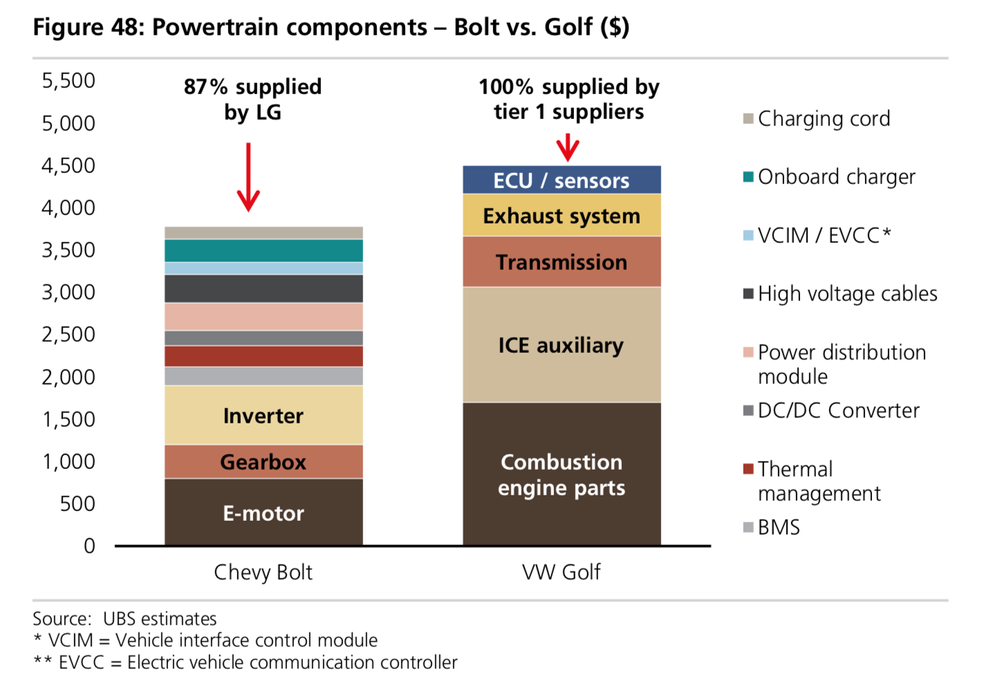
Meanwhile, electric is not just about replacing the fuel tank with a battery. Electric disrupts the internal combustion engine and everything associated with it - you remove the whole drive train and replace it with something with 5 to 10 times fewer moving or breakable parts. You rip the spine out of the car. This is very disruptive to anyone in the engine business - it disrupts machine tools, and many of the suppliers of these components to the OEMs. A lot of the supplier base will change. 
Screen Shot 2018-08-29 at 10.41.02 AM.png

This is not the same as disrupting the OEMs themselves. If the OEMs can buy the components of an electric car as easily as anyone else, then the advantage in efficient scale manufacturing goes to the people who already have a lead in efficient scale manufacturing, since they’re doing essentially the same thing. In other words, it’s the same business, with some different suppliers, and electric per se looks a lot more like sustaining innovation.   

Second, software, modularity and integration

If the components will be a commodity, integrating them may not be - at least, not necessarily. 

First, the integration of the electric drive train components themselves is not trivial, and doing it better can get you more efficiencies. This is one of the places where Tesla probably has an engineering lead, today. What’s not clear is how big that lead will be in (say) five years, and quite what competitive advantage it gives. If, for the sake of argument, Tesla has a 10% or 20% advantage on range at a given price, this matters for a touring sedan, but does it also matter for a minivan doing the school run, that drives 10 miles a day and parks in a garage with a charging point every night? How much of a competitive advantage will that be in 10 years, compared to all the other factors that people use to choose a car? Is this a margin advantage, a competitive advantage, or just a checkbox to be compared with other features? We’ll see. 

This integration question is actually much broader than just the drive train. There’s an old car industry joke that you can see the organization chart of a car company in the dashboard, and also see that the steering wheel team hates the gear stick team. A modern car has dozens of different electrical and electronic systems, and these are mostly separate and independent. The ABS has nothing to do with the blind spot detection. All of these systems are bought by different teams at the OEM from different suppliers, and the only point of integration is the switches on the dashboard. Each of these components has what the car industry calls ’software’ (“millions of lines of code!”), but this is really what Silicon Valley would call firmware, or at most device drivers (also unlike Silicon Valley, of course, these systems are also expected to last for ten years and 150k miles). 

Much of this is probably going to change. We will go from complex cars with simple software to simple cars with complex software. Instead of many stand-alone embedded systems each doing one thing, we’ll have cheap dumb sensors and actuators controlled by software on a single central control board, running some sort of operating system, with many different threads (there are a few candidates). This is partly driven by electric, but becomes essential for autonomy. 

This is clearly a challenge to the suppliers who make those separate systems, and there are also plenty of reasons why this might be hard for an incumbent car company to adapt to (most obviously, that org chart). This is also exactly the sort of thing that non-tech companies tend to think will be easy (‘we’ll just hire some developers!’), and instead make into a horrible mess, and they may have to go through a cycle of learning that they don’t do it well themselves before buying it from someone who does it better. That is, this looks a lot more like disruption than electric itself does. Tesla is of course already here, which is why it could fix a brake problem in the Model 3 over the air - the code it needed to change wasn’t in the brakes.

The question again, though, is quite what this means in the market for cars as opposed to the market for car components. There’s a useful parallel here with PCs and laptops. Apple is very specific in what components it uses and how they are optimized to work together and fit into the available space, and this produces small, light, power-efficient laptops. Conversely, a laptop from Dell, or a desktop PC, has much more flexibility and interchangeability of parts, which also means less integration and more empty space inside the case. Each approach has its benefits, and the modular PC model had perfect product-market fit in the 1990s. So, how far does this translate into reasons to buy? 

Third, Tesla’s ‘experience’ disruption

The obvious place to answer this question comes when you turn on the car, and this also takes us to the other parts of what makes owning a Tesla better, today. So far, we have been talking about the electric drivetrain itself - the ‘skateboard’. It seems more likely that this disrupts the OEMs’ supply chain than the OEMs themselves. However, there is a whole other class of aspects of a Tesla that are different, both inside the car and in things like the dealer experience. How do we think about these? 

The easiest place to see disruption from Tesla is in the dashboard of the Model 3. There are reasons discussed above why it will be organizationally difficult for a car company to put absolutely everything onto one screen. But the deeper reasons might just be how much they want to do it. The Model 3 dashboard is partly about cost saving (fewer widgets to install), but this is also a rejection of a huge number of deeply embedded beliefs about what a car should be. This is not how car people think. Car UIs today feel little like feature phones in 2006, as I wrote here last year.

Screen Shot 2018-08-21 at 1.17.23 PM.png

There are other cool things that come from the de novo model. Outside the car itself, Tesla can sell direct on a fixed price instead of going through dealers. OEM dealers often have contracts around who can install new software (so no remote updates allowed) and those dealers make most of their profits from repairs. Around half of repair spending is on things directly linked to the ICE - no ICE means no oil leaks or broken fan belts. Dealers also play an important role in setting pricing and incentives, and driving demand to specific models. These are all more things that are hard for the incumbent industry to adapt to.  

However, again, it’s unclear to me how central these things are. The counter-argument, perhaps, is that that this is comparable to things like the Apple Stores, or the on-device activation of your phone account when you buy an iPhone. These are nice, and a selling point, and hard for Samsung to match, but do we think Apple’s market share would collapse without them? 

This is of course very subjective (“how much does this cool thing matter?”), so here’s a thought experiment: if these factors were the only difference between a Tesla and a BMW or Mercedes, and the drive train, acceleration etc were all identical, would they be enough? If BMW suddenly started selling direct and doing seamless OTA firmware uptakes, would Tesla’s share price collapse? Probably not. 

Less subjectively, it’s not clear there will be winner takes all effects here. There might be a developer ecosystem on the car itself, but it’s just as likely that the proper place for apps in your car is on your phone, or in the cloud. Certainly, it’s too early to be sure. 

Finally, as really should be obvious, there will be chargers everywhere. Once the actual motivation is there, all sorts of companies will build charging stations everywhere they can. The barrier is only capital - there’s no competitive moat here.

Fourth, autonomy 

All of this takes us to autonomy. Electric is compelling but will probably be a commodity, whereas Tesla’s improvements on top of electric may not be commodities but are not necessarily decisive. Autonomy changes the world in profound ways (I wrote about this here), and it’s a fundamentally new technology that doesn’t look at all like a commodity. And Tesla is doing this, too. Sort of. 

In most of the previous conversation, I talked about how Tesla as a technology company would or would not disrupt non-tech companies. However, in autonomy, Tesla is not just competing with car companies - it’s competing with other software companies. It doesn’t have to beat Detroit at software - it has to beat all the rest of Silicon Valley at software. 

In this competition, Tesla’s thesis is that the data it can collect from its cars will give it a crucial advantage. The only reason that anyone is interested in autonomy today is that the emergence of machine learning (ML) in the last 5 years probably gives us a way to make it work. Machine learning, in turn, is about extracting patterns from large amounts of data, and then matching things against those patterns. So how much data do you have?

Hence, Tesla’s approach to autonomy has been to put as many sensors as possible into the cars it’s already selling, and collect as much data as possible from those sensors. It can do this because its cars are already built on a software platform (as discussed above) - it can ‘just’ add the sensors, in ways that the existing OEMs cannot yet do. Then, as it gets more and more levels of autonomy working, it can push that out over the air to the cars as software updates. Since it already has so many cars with these sensors on the road, this will have a self-reinforcing ‘winner takes all’ effect: it will have more data, and so its autonomy will be better, and so it will sell more cars, get more self-driven miles and so have more data. 

If this pays off, it would indeed be a profound and compelling competitive advantage for Tesla, even without thinking about all the other possibilities, such as renting your Tesla out as an autonomous taxi. 

However, this is just a thesis, and there are two basic questions underlying it: can we do autonomy with vision, and what winner takes all effects apply?

First, vision. The really obvious problem with Tesla’s autonomy plan is that today ‘as many sensors as possible’ means that Tesla is using cameras placed around the car to give a 360 degree view, plus radar that is only forward-facing (and some short-range ultrasonics). This means it must rely on vision alone to get a full 360 degree 3D model of the world around the car. 

Unfortunately, computer vision is not yet able to do this well enough. Most people in the field would agree that this will be possible at some point (after all, humans don’t have LIDAR), but it’s not possible yet. Moreover, this isn’t a question of just adding more data and getting vision to work by brute force (or at least, we don’t know that it is). This is why pretty much everyone else is using vision combined with multiple LIDAR sensors and often multiple radar units as well. Today, that adds tens of thousands of dollars of cost to each vehicle. If you’re only running an engineering testing and development fleet of at most a few dozen or hundred vehicles, this is bearable, but it’s clearly not possible to add this to every new Tesla Model 3 - the sensors would cost more than the car. (There’s also the issue that you have to add bulky, fragile and impractical lumps all over the car.) The cost and size of these sensors is falling fast (for example, there is a race to get the first solid-state LIDAR working), but we are still some years away from their being cheap enough to put on a production car. 

But meanwhile, even if you do have a sensor suite and ‘sensor fusion’ that can create an accurate 3D model of the world around the car, the rest of the autonomous puzzle isn’t working yet for anyone, nor does anyone in the field think that this is close. Bits of it work quite well - cruise control on highways, say - but the whole does not. 

Hence, Tesla’s first bet is that it will solve the problem of building a model of your surroundings using only vision before the other sensors get small and cheap, and that it will solve all the rest of the autonomy problems by then as well. This is strongly counter-consensus. It hopes to do it the harder way before anyone else does it the easier way. That is, it’s entirely possible that Waymo, or someone else, gets autonomy to work in 202x with a $1,000 or $2,000 LIDAR and vision sensor suite and Tesla still doesn’t have it working with vision alone. 

The second bet is that Tesla will be able to get autonomy working with enough of a lead to benefit from a strong winner-takes-all effect - ‘more cars means more data means better autonomy means more cars’. After all, even if Tesla did get the vision-only approach working, it doesn’t necessarily follow that no-one else would. Hence, the bet is that autonomous capability will not be a commodity. 

This takes us back to the data. Tesla clearly has an asset in the data it can collect from the 200k+ Autopilot 2 cars it’s already sold. On the other hand, Waymo’s cars have driven 8m miles, doubling in the last year or so. Tesla’s have driven more (without LIDAR, but set that aside), but how much do you need? 

This is really a question about all machine learning projects: at what point are there diminishing returns as you add more data, and how many people can get that amount of data? It does seem as though there should be a ceiling for autonomy - if a car can drive in Naples for a year without ever getting confused, how much more is there to improve? At some point you’re effectively finished. So, how many cars gathering data do you need before your autonomy is as good as the best on the market? How many companies might be able to reach that? Is this 100 or a thousand cars driving for a year, or 1 million cars? And meanwhile, machine learning itself is changing quickly - one cannot rule out the possibility that the amount of data you need might shrink dramatically. 

So: it’s possible that Tesla gets the vision-only approach to work, and gets the rest of autonomy working as well, and its data and its fleet makes it hard for anyone else to catch up for years. But it’s also possible that Waymo gets this working and decides to sell it to everyone. It’s possible that by the time this starts to go mainstream, 5 or 10 companies get it working, and autonomy looks more like ABS than it looks like x86 or Windows. It’s possible that Elon Musk’s assertion that it should work with vision alone is correct, and 10 other companies then get it working. 

All of these are possible, but, to repeat, this answer is not a question of disruption, and this is not a matter of whether software people will beat non-software people - these are all software people. 

🤔

This post began as a much shorter piece about Tesla and Netflix, comparing two companies that are using software to change other industries. But the fascinating thing about Tesla is that there are so many different things going on, and so many different kinds of innovation. I’m sure I’ve missed plenty of things. One of the issues that recurs in thinking about Tesla is that tech people don’t really know enough about cars, and car people don’t really know enough about software. 

But the history of the tech industry is full of companies where having a lovely product, or being the first to see or build the future, were not enough. Indeed, the car industry is the same - a great, innovative car and a great car company are not the same thing. Tesla owners love their cars. I loved my Palm V, and my Nokia Lumia, and my father loved his Saab 9000. But being first isn’t enough and having a great product isn’t enough - you have to try to think about how this fits into all the broader systems. 

04 Sep 04:01

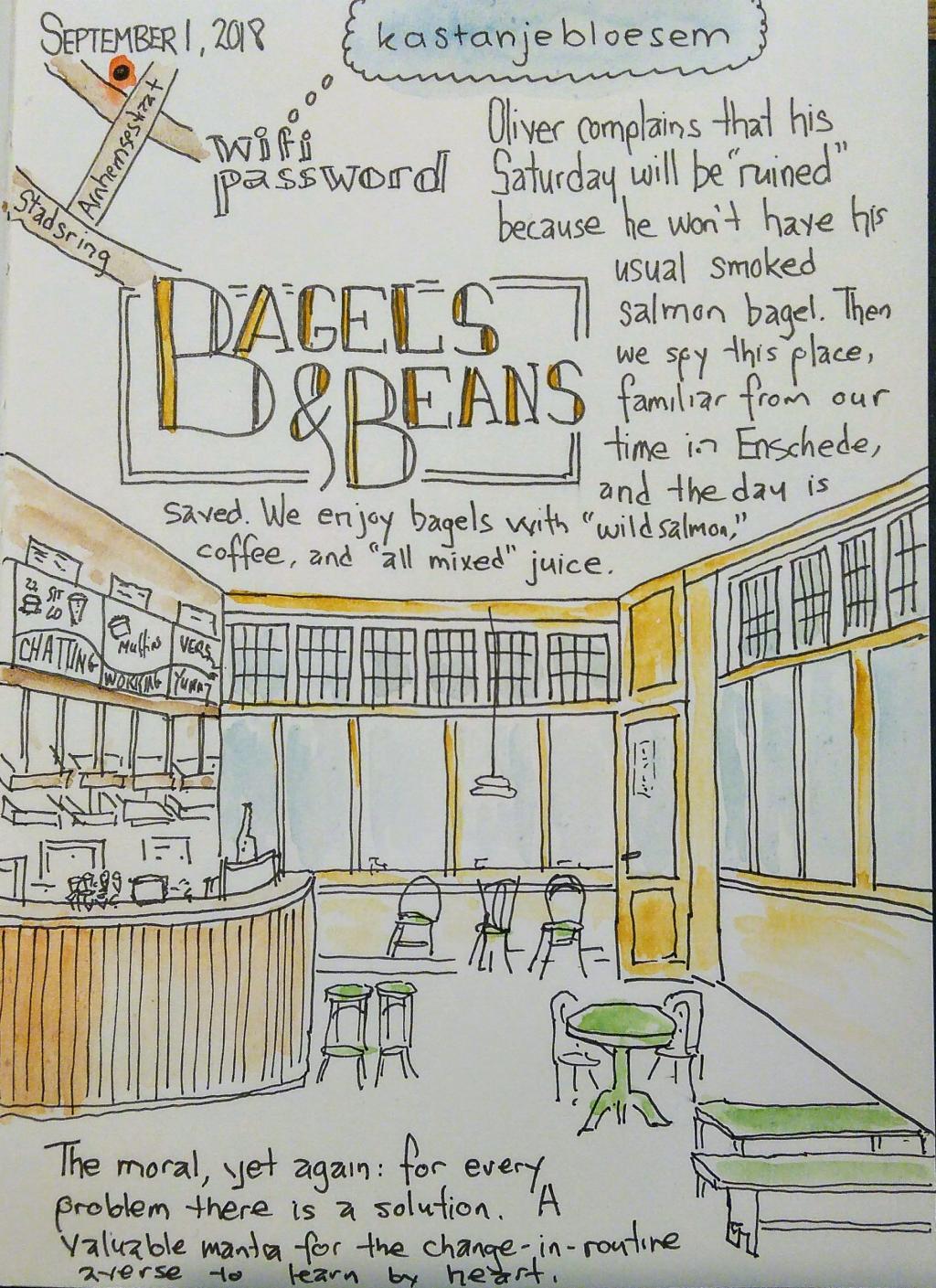
Saturday Morning in Amersfoort

by peter@rukavina.net (Peter Rukavina)
04 Sep 03:55

Playground Rules

by peter@rukavina.net (Peter Rukavina)

There is a small playground across from our flat in Amersfoort with this sign posted in front. I love the rules and how they’re communicated in words and stick figures.

04 Sep 03:54

"You cannot write about what people are really like without making a political adjudication. All our..."

“You cannot write about what people are really like without making a political adjudication....
04 Sep 03:54

AppleEvent sandboxing in macOS Mojave

by Rui Carmo

Given the amount of scripting I put together the past couple of weeks to do photo processing and what I’m currently fiddling with, this was both serendipitous and highly useful–but I suspect Mojave is going to be a pain to deal with for some people, especially those who rely on both inter-app automation and custom plugins.

It’s not going to be the usual “fallback, update and regroup” update where it regards scripting and automation—there will be some serious breakage due to new security measures.

Apple has always toed a fine line where it regards automation (with little public info towards its evolution and a lot of pessimistic kremlinology doing the rounds whenever features were cut or key people left the company), but macOS is still the best OS in terms of built-in, user-level desktop automation, and I think they know that.

Let’s see how it translates into an iOS-dominated future.

04 Sep 03:54

Thaumic Sky

Ra » Previously Vivid red lasers unzip the Earth from top to bottom, slicing it along criss-crossing spiral rhumb lines. The lasers are powerful enough to be visible to the naked eye from Pluto; with good telescopy, the light show can be seen from other star systems. One beam even plays across the Moon's face, leaving an angled scar of slag which, after freezing again, will persist for the rest of its existence. The lasers represent the smaller share of the energy. Far more is spent to physically lift the jigsaw pieces of the first crust layer into the sky, hoisting significant amounts of sky with it. The planet unfurls like an onion, individual shreds of country and rainforest unfolding themselves into thinner shreds still, absorbing further sunlight and reconstituting themselves into first-stage hosting substrate. Boosted with useful pulses of momentum from the coordinating core, the shreds radiate away into free space and align themselves against the solar wind, effecting an orbital ch...
04 Sep 03:54

NetNewsWire 5.0d1

If you’d like to run it, go to the NetNewsWire site and download the latest build.

Things to know:

  • A whole bunch of important features haven’t even been started yet
  • There are features not finished yet
  • There are bugs
  • It’s not even beta. Not even alpha!
  • It still has the Evergreen app icon

If you’re upgrading from Evergreen, you can either:

  • Start fresh, or
  • Rename the folder ~/Library/Application Support/Evergreen to ~/Library/Application Support/NetNewsWire, or
  • If you already have a NetNewsWire folder there, copy the contents of the above-mentioned Evergreen folder into that NetNewsWire folder.

Note: I’ve started a Slack group, but I don’t have a public signup form for it yet. You can email me to ask for an invitation. Just let me know if I should use an email address other than the one you used to email me. (You can find my email address at the bottom of the NetNewsWire site.)

You don’t have to be on the Slack to help. You can always contact me by whatever means, and you can post to the Issues tracker on GitHub.

04 Sep 03:53

Missed it by that much

by jnyyz

This afternoon I had a little time on my hands so I took a somewhat circuitous route home, starting from the Lawrence subway station. I wouldn’t recommend this route as it had plenty of cycling along major streets with high speed arterial traffic, such as Bayview, York Mills, Wilson and Keele.

Screen Shot 2018-09-01 at 5.11.28 PM

However, if you look at my veloviewer map, you can see that this was another tile collecting run. Here is the before map on Veloviewer which shows a 6×10 rectangle.

Screen Shot 2018-09-01 at 5.16.06 PM

Afterwards, now up to 8 x 10.

Screen Shot 2018-09-01 at 5.17.28 PM

However I see that I didn’t plan my route carefully enough because there is one square not filled in on a potential ninth row.

Screen Shot 2018-09-01 at 5.29.57 PM

If I had just turned into that little Cul-de-sac, that would have done it.

Screen Shot 2018-09-02 at 9.44.25 AM

However, as a consolation, I got to see some truly fugly houses in that neck of the woods. This was my “favorite”.

IMG_9540

I’ll have to pick up that missing square at some point, but from now on I think that I’ll let my tile collecting happen organically.

04 Sep 03:53

DSL, Vectoring and Line Length

by Martin

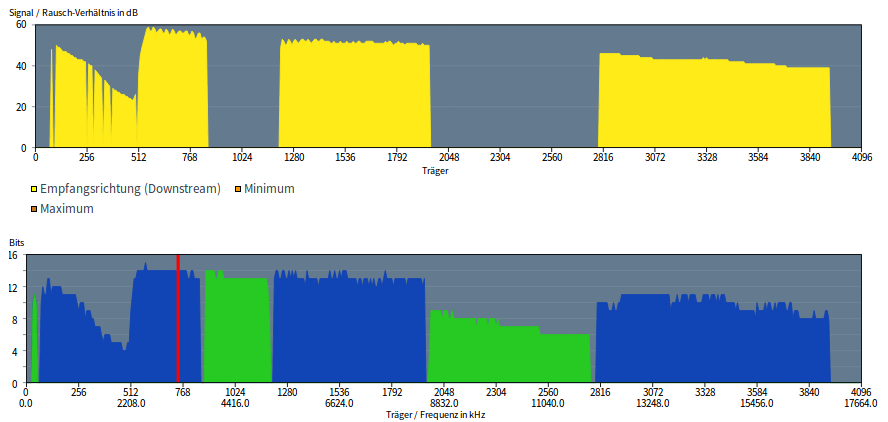
Vectoring SNRAfter the line of my neighbor has been switched to a different port in the street side DSLAM and mine followed a couple of days later, I finally have a stable DSL line again. There are many factors influencing the maximum uplink and downlink speed that can be achieved over a copper wire and since I’m pretty much as far away from the DSLAM as is possible in the center of Cologne, I think my line characteristics and performance gives interesting insights of what’s possible in densely populated areas.

So how do I know that I am at the maximum distance to the DSLAM? Well, pretty simple, when I look out the window, there is a DSLAM right in front of my house. Unfortunately, that DSLAM serves the other side of the street and the streets behind it. My side of the street is served from a DSLAM several streets away. When I measure the distance on a map it’s about 350 meters away. When the line is electrically measured, line length is shown as 460 meters. In the plans, the line length is 500 meters. In other words, not absolutely ideal for high VDSL and vectoring speeds.

Nevertheless I am getting the full 100 Mbit/s in the downlink direction and 37 Mbit/s out of 40 Mbit/s that are possible in the uplink direction. For that line length I would say this is quite spectacular, so I guess I must have quite new cables with a good diameter and not much cross talk from other lines that run alongside it.

From the screenshot above, it can be taken that once super-vectoring is activated that promises 250 Mbit/s in the downlink direction and 40 MBit/s in the uplink direction, I could get another quite significant speed boost as the signal to noise ratio and modulation at the 17 MHz cut off point is still quite o.k. As it seems, however, super-vectoring will only increase the downlink speed while the uplink speed remains the same. 37 Mbit/s in the uplink direction is not shabby, it almost rivals what I get over my fiber line in Paris. However, since I run my cloud services from home, I would rather like to get the uplink increased as well.

So let’s see how this chart looks like if/once super-vectoring is activated and the channel bandwidth increases once again, this time from 17 MHz to 35 MHz.

Note: In the screenshot, the upper graph shows the downlink signal to noise ratio (SNR) while the lower graph shows the number of bits per sub-carrier, blue for downlink, green for uplink.

03 Sep 20:54

all the friends I've not yet met

by peter@rukavina.net (Peter Rukavina)

It is a sunny Sunday in Amersfoort, and I am sitting on the tiny third floor balcony of our rented flat, looking out over the back yards of our erstwhile neighbours. Across the way and several back yards up a quartet us hanging their laundry and inspecting their garden; a neighbour two doors down shouts greetings at them, sticking his head out his third floor skylight so that they can hear him.

The clock is ticking down to our check out time at noon, but I am choosing to eke out every minute of peace before we enter into the maelstrom of Amsterdam and then home.

Oliver and I spent two very happy days with friends here in Amersfoort, a gathering catalyzed by our friend’s Elmine and Ton on the occasion of Elmine’s birthday. It is the second time we’ve joined the “birthday unconference” caravan, and even though Tom and Elmine have moved across the country in the four years since we were last here, it feels like coming home.

It seems folly to try to document what happened over these two days (although Frank has done a good job), so I will instead focus on three things that stand out.

First was Oliver’s talk.

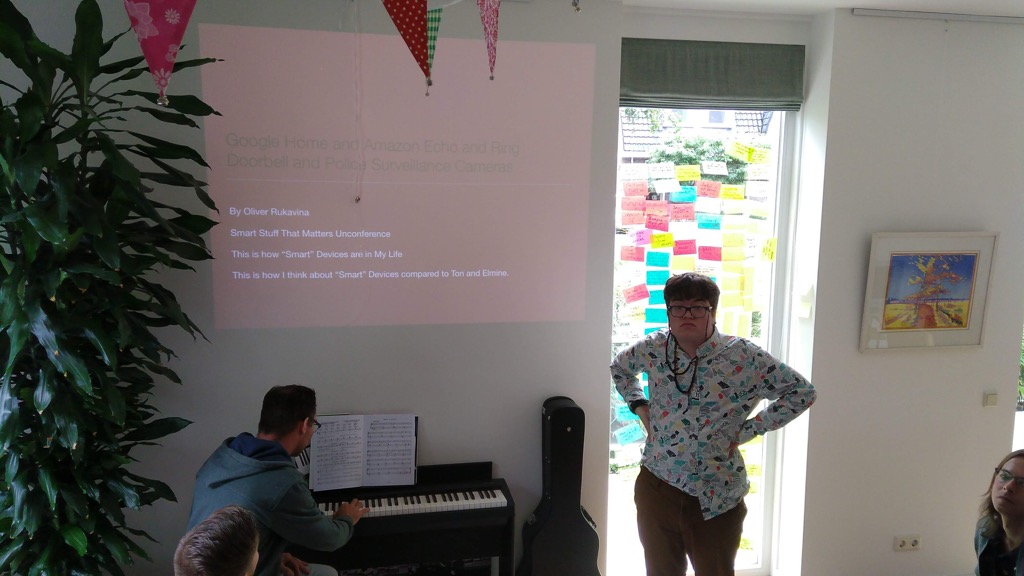
The “un” in “unconference” means “there’s no formal program, and there’s no audience: we and us form the program together.” And so Oliver stood up on the stage—a tiny step-stool—and pitched the idea of presenting “Google Home and Amazon Echo and Ring Doorbell and Police Surveillance Cameras.” He received an enthusiastic reception, and a time was set on the schedule for him.

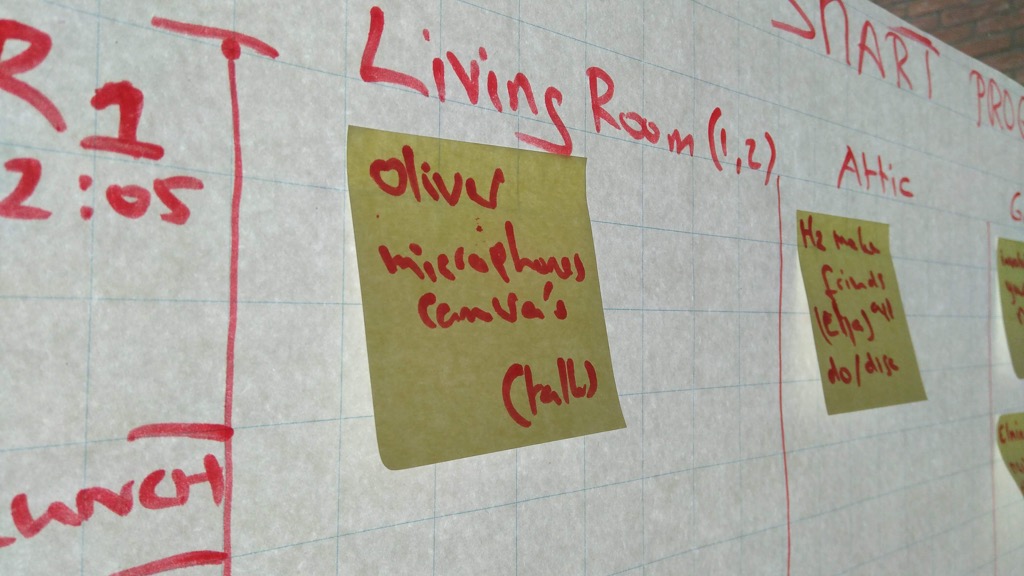
Oliver's spot on the schedule

Oliver Presenting

At the appointed hour, with me advancing the slides from the balcony, he presented his slide deck (see slides here) with confidence. The last slide in his deck was “do you have any questions for us?” and this then precipitated 45 minutes of rousing discussion on privacy, access, streaming music, and home control. I was very proud of him: the initiative was entirely of his own doing, he crafted his slides on his own, and got himself on the schedule through his own will. He is becoming a force in the world, and that is awe-inspiring to see.

The second highlight is an event that preceded Oliver’s talk, the “icebreaker” part of the day that led things off. I have always dreaded the “everybody introduce yourself” part of meetings, especially meetings of diverse people whose lives inevitably seem much more interesting than my own; this, thankfully, was dispensed with, and instead we were prompted to gather with people we didn’t yet know and to talk about our best and worst moves in life.

What proceeded from this simple prompt was a rich discussion of what it’s like to live as an expat, how difficult it is to make friends as an adult, and the power of neighbourhood connections. Oliver and I were in a group with Heinz and Elja and Martyn, and we talked for almost an hour. I have no idea what any of the others in our group do for a living, but I know that Martyn mowed his lawn this week in preparation for a neighbourhood party, that Heinz lives in an apartment block where it’s hard to get to know his neighbours, and that Elja has lived in Hungary, the USA and Turkey, and has the most popular Dutch blog post on making friends.

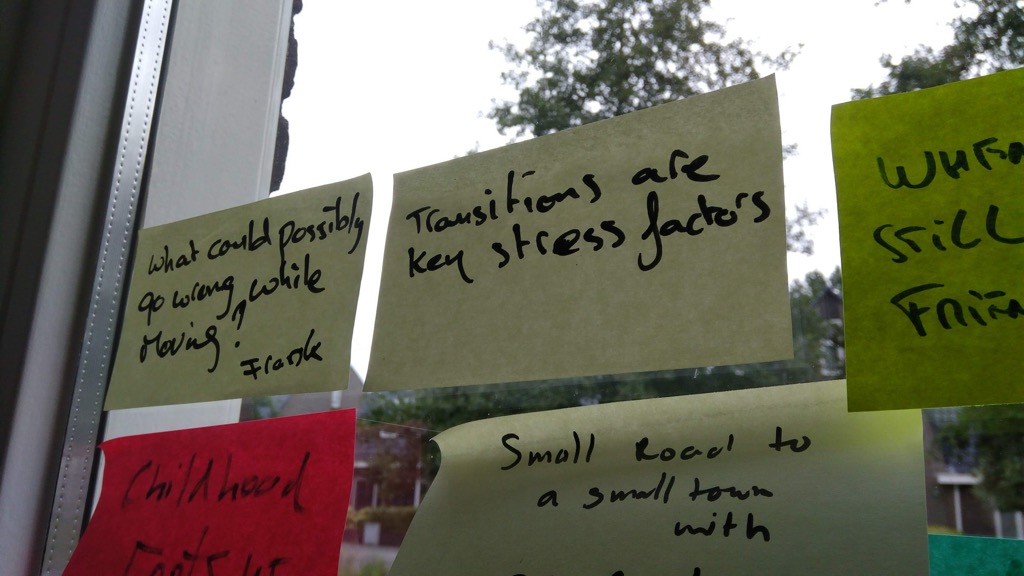
Post Its from Ice Breaker

Finally, and most deeply, I appreciated the chance to reconnect with old friends, and to make new ones.

I proposed a session on accessible housing, and through that session got reintroduced to Xavier and Simone, who I’d met four years ago.

Oliver and I rode the train from Berlin to Amersfoort with our friend Martina and this both afforded us a chance to talk more intimately than long distances have allowed, and also provided me with support when the trip took a challenging turn, and I needed someone to bear witness and to seize control over shifting logistics.

Our friend Pedro flew from Indonesia to be here and we instantly reconnected and both picked up the threads of conversations we’d left off four years ago, and shared stories of our more recent sorrows and adventures.

I sat with Johnnie, who I hadn’t seen since Reboot many years ago, on the couch in the living room for a few short minutes before lunch and our chat quickly turned to the joys of participating in projects or discussions or meetings where you have only a casual interest, and thus no hill to guard.

It was a pleasure to meet Frank, who’s joined Ton and me in an ad hoc effort to understand the Indieweb, in person, and to participate in his session on redecentralizing the web; our digital discussion will be so much more powerful now that we’ve met in the flesh.

I got to spend time–not enough–with Lilia and with Robert, also “stuff that matters” veterans from the last round, and to learn of their latest adventure, starting a new company.

Elmine’s brothers, Harmen and Siert, were both there and I got to chat with both of them, and to witness Harmen’s Olympic-level avuncularity with his niece Y., and to hear about Siert’s adventures in 3D fabrication since I heard him talk about RepRap machines at reboot a decade ago.

Ton introduced Oliver and me to Matthijs, the son of a collaborator; he is a dynamic young man considering a move to Canada, and we had a good chat about education, employment, escaping the orbit of your home culture, and what may lay ahead for him. He also gave me an excellent survey of the current state of Android phones, pointing me at models I’d never heard of.

There were almost 40 of us in total, and even more at the Saturday barbecue that formed part two of the weekend, and the chance to spend time with such a diverse and interesting bunch, in the almost-as-if-purpose-built surroundings of Ton and Elmine’s new house, was a great privilege; to have Oliver join me as a partner in the endeavour made it all the better.

The day wasn’t entirely without dipping into the hard “stuff” of “stuff that matters”: Oliver and I constructed a pneumatic tube-based messaging system that allowed notes to be sent to the garden, an activity that provided a way for us to truly to something together, but also to step away from the fray a little.

Pneumatic Tube

As the night wound down yesterday, and friends and family took leave, we found ourselves the last to depart, leaving Elmine and Ton and Martina and Pedro to recover from the whirlwind and get some sleep.

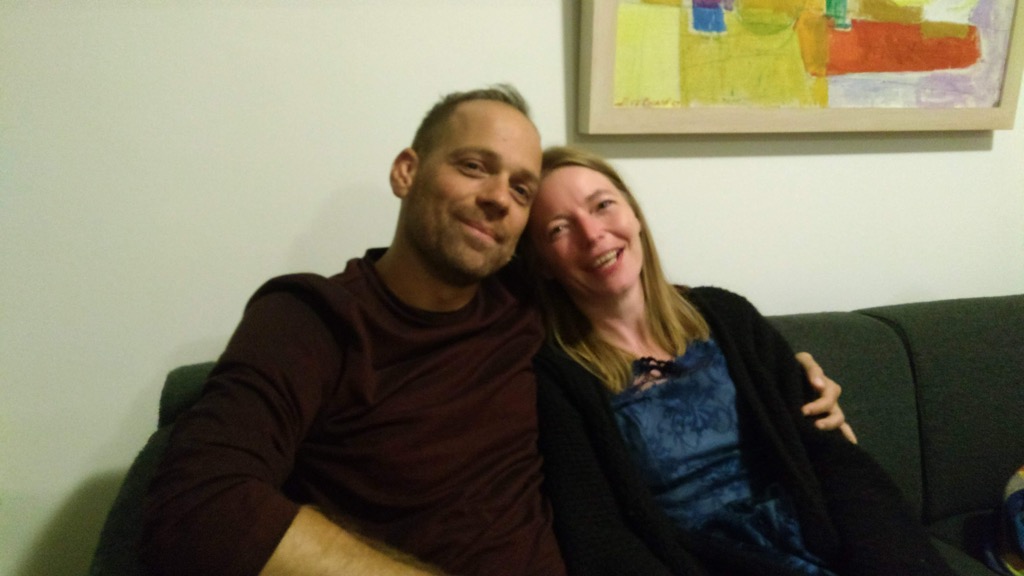
I took this photo, a little blurry alas, but heartfelt nonetheless, of Pedro and Elmine sitting on the couch; the photo is both a testament to a great friendship, but also a proxy for the feeling that washed over our time here. Ton and Elmine are courageous explorers of new social terrain; I’m so happy to be part of their merry band.

Pedro and Elmine

03 Sep 20:54

Why are you spending 75% of your automation budget on services?

by Ted Shelton
2018 is the year for workplace automation -- it has become the number one agenda item for the C-Suite of the Global 2000 and is driving real transformation across the enterprise. McKinsey in their report Four fundamentals of workplace automation wrote that
"...as many as 45 percent of the activities individuals are paid to perform can be automated by adapting currently demonstrated technologies. In the United States, these activities represent about $2 trillion in annual wages."
C-Suite excitement about the potential for using these technologies to improve business outcomes (oh, and there is that cost savings...) has made this the fastest growing enterprise software segment ever (the report is here: ...53% of the Global 2000...). One category, Robotic Process Automation (RPA), now has three "unicorn" startups -- Automation Anywhere, Blue Prism, and most recently UIPath which announced a $153 million Series "B" investment.
But despite claims by these companies that automation is fast and easy to implement and deploy, customers seeking to benefit from this new technology are finding that they need a LOT of services from external consultants -- in fact one analyst reports that spending on external services makes up 75% of automation budgets (here is that report: Robotic Process Automation Market). One large global consulting firm I sat down with showed me their sales pipeline for automation projects and it totaled over $1 billion. And that doesn't include what companies are spending internally to support these initiatives so the total cost to implement automation is much higher.
While business processes should be owned by business people, the problem with automation technologies today is the heavy IT involvement required to design, develop, deploy, and operate automations. During the past few years I managed consulting teams implementing automation for companies around the world. The development and deployment in every case required a team of technologists supported by people who understood the business process being automated. Sure - many of the automation vendors claim to be able to "record" a process, limiting the need for software development. But in practice I never saw a process that had a single "happy path" allowing it to be automated with such a recorder. Software developers have to get involved once you start to define process variations, exceptions, human coordination in the process, or simply additional connections to ingest data or deliver output.
While the expenses incurred as a result of the programming skills required to implement automation are a significant hurdle, companies run an even bigger risk by reducing the flexibility of their business to adapt processes to changing requirements. Once a process has been "locked up" in a software program, making a change requires that the programmers come back again (and again...). This should be sounding off alarms in every C-Suite even more than the initial cost of automation. It's one thing to have your IT department manage the resting place for business critical data -- but do you want them to also control every aspect of how the business processes that create that data are conducted?
A regulatory change, a difference in how you do business in one region or division vs. another, or just a good idea about how to improve a process now becomes an IT "change request" and part of a backlog of other such requests leading to a terrifying rigidity in the business as more and more of our front and back office processes "benefit" from automation.
But there is a solution - one that we have been pursuing as business people since the first person carried a personal computer with Lotus 1-2-3 through the back door of their corporate office building: buy tools that let users develop and control their own automations.
Marc Benioff in 1999 created the "Software as a Service" industry with the insight that business users wanted to control their own sales information. Now that same concept of self service that Salesforce pioneered is coming to the automation category -- companies like mine (Catalytic.com) are putting the power back into the hands of the business people. I just spent an incredible two days in a workshop with one of our customers where business people had a "hackathon" building dozens of automations of their own business processes with tools as easy to use as Microsoft Excel and now they have the tools to go back to their jobs on Monday morning and continue to bring automation into their business processes.
Allowing the business process owner to design, build, and deploy automations has immense benefits over the technology-centric approach:
  • Cost for implementing automation is reduced and automations are built and deployed more rapidly -- this significantly expands the number of use cases where automation can be used
  • Companies can embrace an "iterative" approach to automation and easily manage multiple variations on processes to meet regional or divisional requirements
  • Continuous process improvement can now be a part of a company's automation journey -- increasingly business process improvement or business process re-engineering teams can have automation tools that they use side by side with process analysis
  • A SaaS based approach provides transparency across an enterprise for all of the automations being built, supporting larger digital transformation initiatives by showing where benefits can come from connecting processes upstream and downstream and also identifying best practices amongst a set of similar processes
Finally, empowering your business people with automation tools can help us to evolve how we think about automation -- it shouldn't be solely about cost reduction. Our companies will be more successful when we can embrace automation as a tool to augment and enhance human potential. Having business process owners building automations themselves will provide us with the opportunity to automate in a way that eliminates repetitive and mindless work while making the role of people in those processes more about what people do well -- human skills such as creativity, critical thinking, and social perceptiveness. The future of workplace automation should be about eliminating drudgery not people.

03 Sep 20:53

ZOKU

by peter@rukavina.net (Peter Rukavina)
03 Sep 20:52

Check your active Bluetooth codec on macOS

by Volker Weber

ZZ3263F1AE

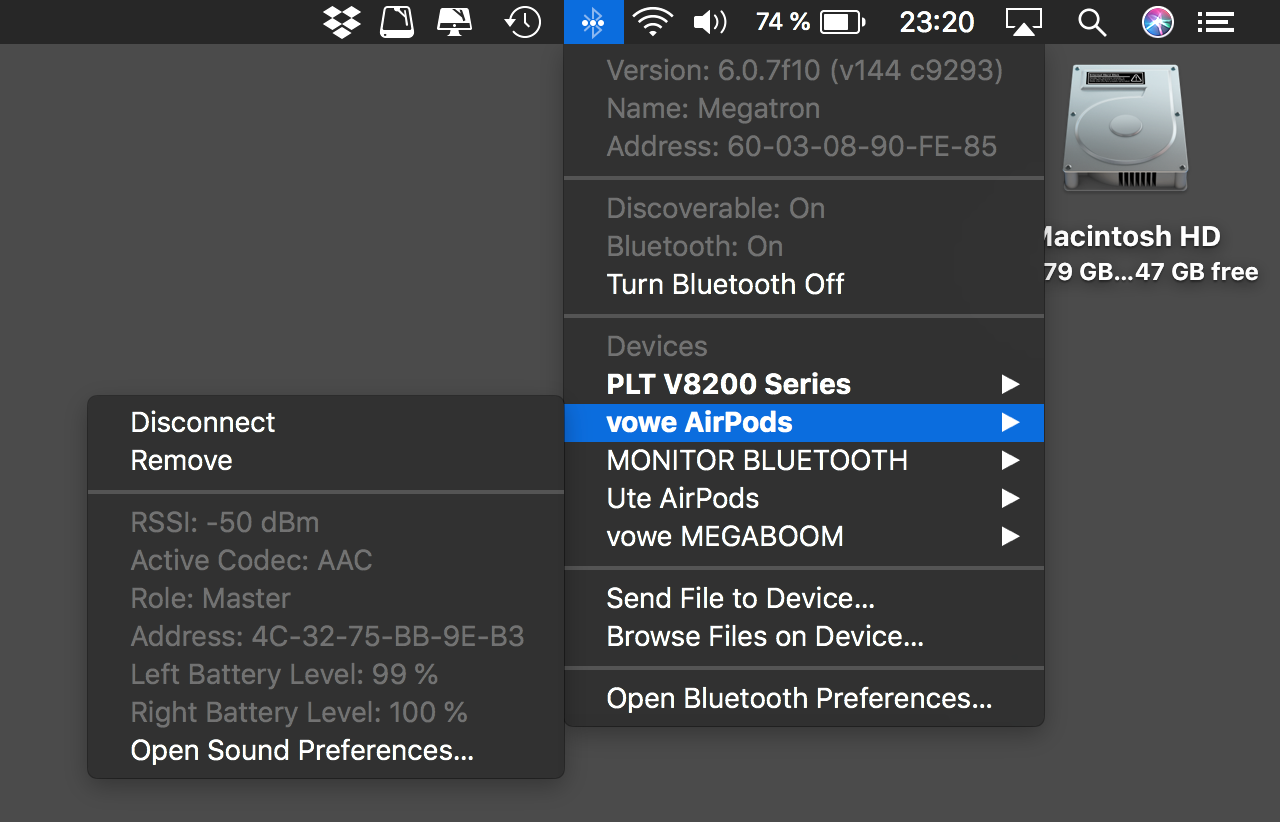
If you are playing music over your AirPods, your Mac uses AAC as the codec to transfer music over Bluetooth. I checked the same thing for my Plantronics 8200 and I was disappointed to see SBC, which is the (bad) fallback codec. Then I connected the headset to PLT hub and found there was an update which listed this fix:

Improved PC audio when also connected to a mobile phone

Installed the update and there it was:

ZZ0935F47C

While the headset was still connected to my iPhone, the PC/Mac connection changed to aptX. I don't know why macOS prefers aptX over AAC, but it does. You can check this on a Mac by holding the option key while clicking the Bluetooth menu. There is no way to check it on Windows 10 or iPhone.

ZZ59ABD199

I have a lot of headsets, but I need to check out Beats Studio 3. They have the same wireless chip like the AirPods and should be connecting via AAC as well. BTW, I am hearing good things about them. Apparently they have dropped the Hiphop sound and are less bass heavy than early Beats.

03 Sep 20:52

Small things to enjoy

by admin

Sorting out photos I find back all those small things I enjoyed this summer:

  • coming for blueberry picking and being greeted by a newspaper clip with a photo of Emily from 2016;
  • spending an afternoon in Monschau climbing hills and discovering secret codes with Anna;
  • watching Alexander doing things with other adults – helping neighbors cutting wood in the garden, peeling apples with a friend, working on a car with a friend’s father;
  • learning to use scythe with the “elders” of our vegetable garden and evening “dates” there with Robert, harvesting and making berry pergola;
  • walking forest trails with the whole family and then being slow watching kids playing in the waters of Rursee;
  • reading books – in a hammock, on the beach, in bed, in a camping chair…

Those and many other moments were definitely needed to recharge and rethink.

The post Small things to enjoy appeared first on Mathemagenic.

03 Sep 20:52

New World NetNewsWire

So much has changed since I last worked on NetNewsWire, and my thinking about it has changed too.

The big things remain the same — NetNewsWire is at the intersection of my passions: reading and writing, the open web, and Mac apps. I want to make NetNewsWire a great app with lots of users. No change there.

But so much else has changed.

In 2002, when I started NetNewsWire, there was no Facebook and no Twitter, no iPhones, and most people hadn’t heard of RSS. People got their news by visiting a few sites a few times a day. People subscribed to email newsletters. That was about it.

Since those days a whole bunch of RSS readers — most notably Google Reader — have come and gone. But, interestingly, there are probably more web-based readers these days than ever before.

But most people, it seems, get much of their news from Twitter and Facebook these days, and I believe this is unhealthy for society and for individuals. None of that existed in the early days of NetNewsWire.

Another change: the energy in app-making has moved from Mac to iOS. But I still love Mac apps, and I still believe in them as works of art that people use to get their work done.

Another change is a personal change: I don’t need to make money from NetNewsWire. While I always wanted to make NetNewsWire the best app it could be, I used to have to consider money as I made decisions. I no longer have to.

* * *

My goal used to be to make NetNewsWire a great Mac app with lots of paying users. Secondary goals were to promote reading and writing on the web, the blogosphere, and RSS and open web standards.

My goal now is to make NetNewsWire a great Mac app with lots of users. Other, no-less-important, goals are to:

  • Promote healthier news-reading via the open web and RSS
  • Promote native Mac app development by providing a good example and by making the code open source

(Yes, I’m strongly considering an iOS version, but I’m concentrating on the Mac app first.)

* * *

Let’s go back to how people get their news these days.

NetNewsWire will never be the sole news-gatherer for anybody. People use social networks. They still visit sites manually and subscribe to email newsletters. They use apps like Apple’s News app. They get news from Slack and other group and personal chat apps.

And they use other RSS readers too.

This means that NetNewsWire does not have to be designed as if it’s anybody’s only source of news. And it doesn’t have to be designed to please the maximum number of people.

My thinking, instead, is to make it fit into an ecosystem: it’s just one of a number of sources, and not even the only RSS reader.

This allows me to design more carefully. NetNewsWire used to be quite over-featured, and now I have the luxury of being able to make a leaner NetNewsWire.

I can say no to things that I would have said yes to — I can make it the app I want it to be, an app that hopefully lots of people love using, but that isn’t trying overly hard to be everybody’s friend.

It’s okay, in other words, to remember that there are other RSS readers, and it’s totally a-okay when somebody likes another one more.

In other words, NetNewsWire of the future will be more me than any previous versions were.

PS Here’s a secret: my favorite version of NetNewsWire was always NetNewsWire Lite, which was the pared-down, free version. I keep thinking that I’m designing in the spirit of NetNewsWire Lite.

03 Sep 20:51

Recently

by Tom MacWright

Joaquin Miller Park

I’m finally reading The Death and Life of American Cities by Jane Jacobs. I’m keeping pretty detailed notes, so when I post it to /books, there’ll be a pretty detailed take, but I can say for sure that I’m really enjoying it.

Prison strike

This is a solid season for music: lots of bands are releasing albums, and I’ve been finding a bunch of new albums I like.

10 Songs That Happened When You Left Me With My Stupid Heart by Darwin Deez

Darwin Deez released 10 Songs that Happened When You Left Me With My Stupid Heart. His style has changed a lot over the years: the difference in vocal mix between this and his self-titled is huge. Double Down felt like it went too far in the pop direction, but this album adds back guitar and synth edges that put his music right back squarely in my interests.

All At Once by Screaming Females

I’m really enjoying Screaming Females - and have noticed that their leader, Marissa Paternoster, is using a hip strap for guitar — a good development, in my opinion, for an instrument with lots of ergonomic problems.

Into The Trees by Zoe Keating

Zoe Keating’s music has been in my library for years, but I haven’t listened to it intently for far too long. Returning to a track like Optimist shows a sort of melodic side to it that I was missing in earlier listens, where I got the feeling that she was relying heavily on complexity and volume contrasts.

Certainty Waves by The Dodos

I have a preorder for this next Dodos album, and am really excited to see them in San Francisco in October (hit me up if you’re also going).

Tell No One by BAD MOVES

Bad Moves is keeping DC angular-happy-punk alive, and I’m very excited for their next album. Their music videos in the lead-up to release have also been great: the renaissance-people band includes Katie Park, a talented graphics editor/engineer/dataviz person, and Daod Tyler-Ameen, a writer/actor/editor/drummer.

03 Sep 20:33

Randomness Leads to Paradiso

by peter@rukavina.net (Peter Rukavina)

I had a chat with Pedro yesterday about the utility of opening yourself up to “randomness” when traveling (or, for that matter, when moving through life). Randomness, put another way, is simply not having a plan, and allowing what might happen to happen. This does not mean that it doesn’t take effort: it’s often hard not to have a plan, not to fall into established patterns, to do what is expected of someone like you in such and such a situation.

Practicing this has resulted in some of the brilliant moments of travel in our family’s life. It’s how Oliver and I ended up by ourselves at the zoo in eastern Slovakia, how I found myself falling into a hole on a construction site in Munich, and how the path led us to be the only guests in a small hotel south of Barcelona. In each case we’d left the Lonely Planet at home, and headed off to see where the road might lead. It almost always leads somewhere interesting.

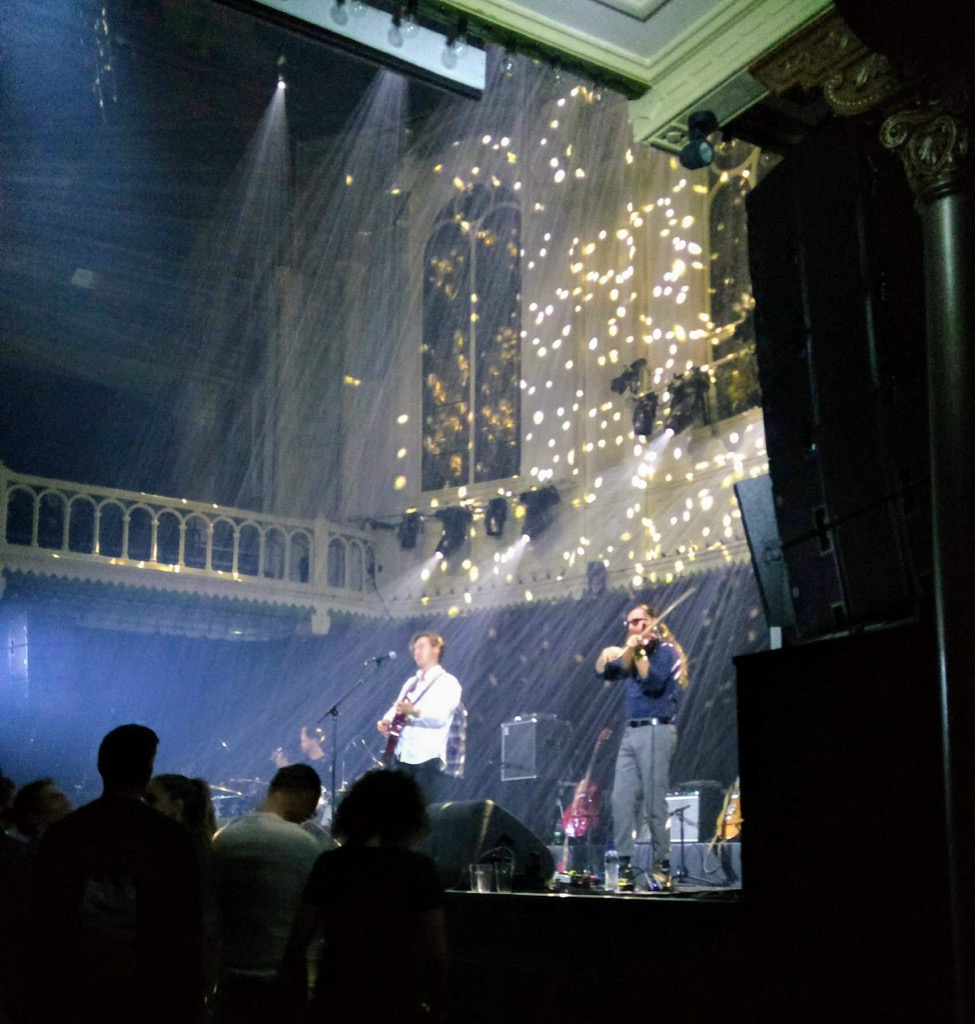
Today that interesting place was the storied Paradiso club here in Amsterdam. We hadn’t planned to go there; indeed we had no plans for this evening save perhaps to find a place for supper and to take a walk. But an accidental web search led me to learn that tonight at Paradiso was Sugar Mountain presents Tyler Childers, Parker Millsap, e.a. and that was interesting enough bill to catch my eyes; tickets were only €15 and that sealed the deal.

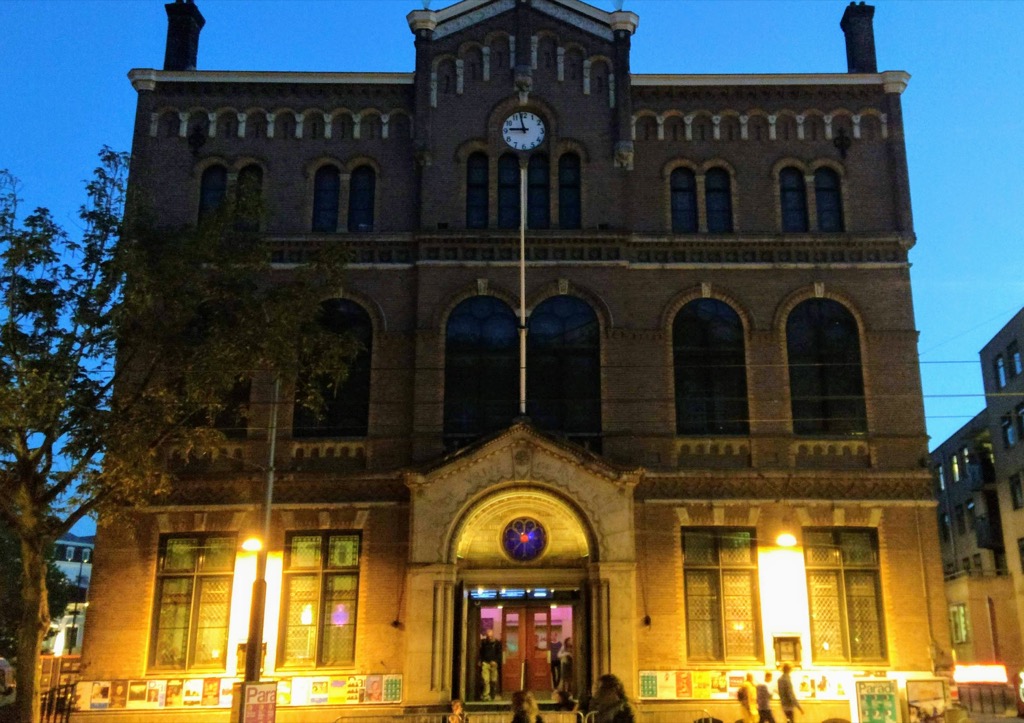
Paradiso

Paradiso is only a 20 minute walk, a straight shot parallel a series of canals, from our base here at ZOKU; between my noticing the show at 4:30 p.m. and heading out the door at 5:30 p.m. I managed to buy tickets, figure out how to use the printer in the lounge, print the tickets, and get ourselves packaged up for the evening.

As we walked into the main theatre and found a place to perch ourselves the lights came down and Parker Millsap and his band took the stage. From the first chord I realized that I was going to need ear protection to withstand the show with my 52 year old ears; fortunately the club helpfully has free foam ear plugs on offer at the door.

Millsap and his band were hard-driving country-influenced rock. They were a tight ensemble, and the played a solid set; it wasn’t particularly to my taste, but it was a good way to start the evening.

Parker Millsap and Band

Millsap’s set was only 40 minutes long; as soon as it was over we moved to the smaller second-floor hall for Ruby Boots (“e.a.” in Dutch means “and others,” and Ruby Boots, fronted by Australian Bex Chilcott, was one of the others). The band is usually a guitar-heavy Americana band; this evening it was just Chilcott on guitar and a single band mate accompanying. They did their best to approximate the volume of the full band, and, with by Chilcott’s powerful voice and skillful songwriting, it was a delightful hour-long session.

Ruby Boots

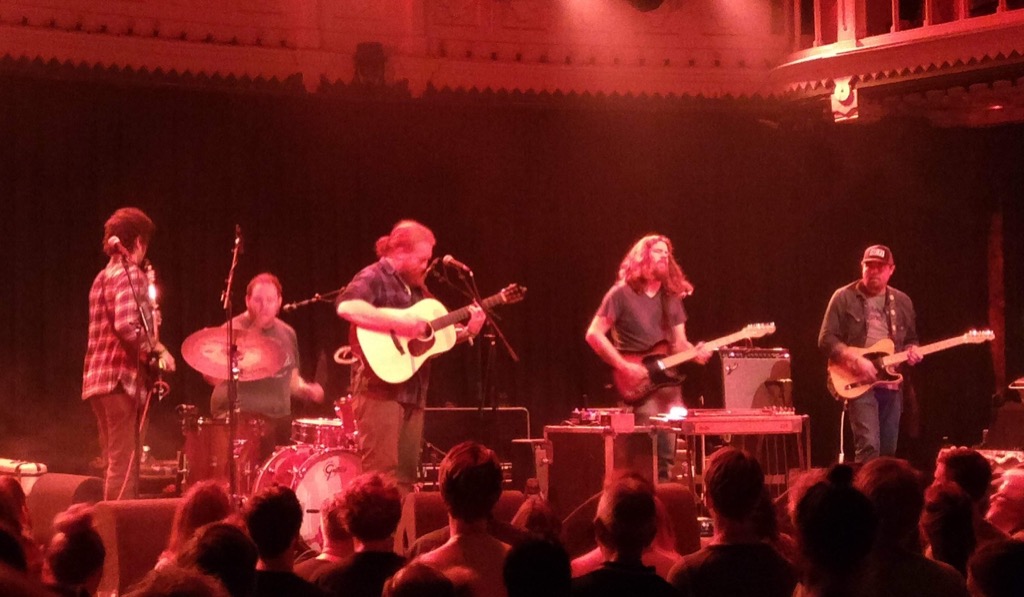
The main event was Tyler Childers, back in the main hall.

While the other acts were solid, Childers and his band were crackerjack, and transported the night from a novelty to a happening. Their Kentucky-fueled country rock was well-crafted and energetic; it’s almost impossible to believe that Childers is only 27 years old, as his songs seem written by someone with considerably more life under their belt. We stayed for the entire 75 minute set, and enjoyed every song (it’s not every Kentucky country band that inserts a cover of Kiss Me by Sixpence None The Richer into their act).

Tyler Childers and Band

Our lack of a plan served us well tonight; we’ve one more day to try the same approach again before we fly home to Canada on Tuesday.

(As should be obvious from the photos above, my aging phone’s camera is dreadful at low-light action shots; I wanted to include something to document the night, though, so I included the photos despite their fuzziness).

03 Sep 18:47

NewsBlur Blurblog: Shawn Micallef: Why Canadian cities deserve more autonomy and respect

sillygwailo shared this story from TORONTO STAR.


It’s unlikely that Toronto will secede from Ontario any time soon, but it’s far from a radical idea, writes Shawn Micallef.
03 Sep 18:46

Twitter Favorites: [counti8] My personal prohibition on using voice controlled anything continues unabated. https://t.co/Um4APfIFmH

Karen Quinn Fung 馮皓珍 @counti8
My personal prohibition on using voice controlled anything continues unabated. twitter.com/justinpickard/…
03 Sep 18:46

Instapaper Liked: Why Every Highway Sign in America Has to Change (Again)

The Society for Experiential Graphic Design America's Sudden U-Turn on Highway Fonts Kriston Capps Jan 27, 2016 Clearview is out, Highway Gothic is (back) in.…
03 Sep 17:45

Twitter Favorites: [counti8] Personal milestone: hearing a land acknowledgment in Cantonese for the first time, because I’m behind the times (but only a little).

Karen Quinn Fung 馮皓珍 @counti8
Personal milestone: hearing a land acknowledgment in Cantonese for the first time, because I’m behind the times (but only a little).
03 Sep 17:45

Twitter Favorites: [codeknitter] @sillygwailo Saturday day trip ;) https://t.co/vzkPUjMJrZ

03 Sep 17:45

NewsBlur Blurblog: Palestine – Ghost Towns of the GTA

sillygwailo shared this story from Hiking the GTA.

Saturday, August 4, 2018

The town of Palestine was founded in 1823 by Thomas Grafton.  He took the name Palestine from the Holy Land but his community never gained influence beyond a few local farms.  The town built a log school house in 1842 and replaced it with a brick structure in 1863.  Until 1870 church services were held in the school but a separate church building was constructed adjacent to it that year.  The church was closed in 1962 and torn down in 1965.  The general store was small and the town never had a post office of their own.  Today the main intersection has been taken over by city sprawl and only a couple of early farm houses remain.  We decided to hike along Etobicoke Creek through the farms that would have been the northern edge of Palestine but today are overrun by two multi-lane highways.  Kennedy Road is brown on the map below while Heart Lake Road is yellow and Dixie Road is green.  The houses featured in the story are circled and the larger circle indicates the site of the former waste water treatment plant.

Palestine Map

Toadflax, or butter and eggs, is not native to North America but has become naturalized.  Unlike an invasive plant, this one does not take over and crowd out native plants but is found in limited clusters.  Along the trail we found a comparatively large patch growing.  The plant has been used in natural remedies for centuries and is proven to have diuretic properties and is effective in reducing fevers.

IMG_5801

The Etobicoke Creek was full of life with salmon spawning in it every year when the European settlers first arrived.  It wasn’t long before dams prevented fish from getting upstream and mills dumped their waste directly into the creek disturbing the local habitat.  With the growth of Brampton the creek took on a new function with raw sewage being dumped into it.  It became so polluted that something had to be done and so Brampton became home to the first municipal waste water treatment plant in Canada.  Trunk sewer lines were built down the Credit River to the Clarkson Waste Water Treatment Plant and down Etobicoke Creek to the Lakeview Waste Water Treatment Plant making the municipal plant obsolete.  It was decommissioned and removed in the early 2000’s.  Today there is just a series of roads and the outline of the plant to mark the site.

IMG_5814

Before the opening of the 410 in 1978, Heart Lake Road was a continuous road that provided access to the water treatment plant through the driveway on the left in the picture below.  Construction of the 407 in 1997 further divided the road and left it with several names.  This section is now known as Westcreek Boulevard.  Current Etobicoke Creek Trail improvements through the valley include the development of parking lot at the end of this piece of road to allow trail users easy access.  Sketches suggest parking for about 40 vehicles.

IMG_5811

The trail passes under the 407 as it follows the creek south.

IMG_5819

The Etobicoke Creek Trail has entered into a Missing Links program which aims to build four sections of trail to link existing sections and complete the trail.  The Sherway, North and Valleywood Links each have their own timelines but the Kennedy Valley Link is currently under construction.

IMG_5820

The Etobicoke Creek winds through the area revealing evidence of much greater water flow at times in the past.  The ravine cliffs get taller as the creek approaches the lake with some shale banks of 30 metres being revealed downstream.  This far upstream the embankments are much more modest but they have cut as deep as the shale foundations below the topsoil and sand.

IMG_5831

The top of an old windmill stands above the treeline, obscured to those who are following the path to the south by a cluster of trees.  Looking north from the site of the new bridge the crumbling farm relic is easily seen.  Closer investigation reveals an open well with water inside that has no fence around it.  The pump is still down there and the tower is surprisingly solid considering the crumbling condition of the vein on the top.  I wonder how many children in the GTA are learning about alternate energy sources and could benefit from a working example in their local park.  Why not restore it and make it safe rather than demolish it to make it safe?  The story of pioneer windmills is told in greater detail in our post on The Shand Dam.

IMG_5840

The one house remaining in Palestine is that of William Reed.  His original house was replaced with this Edwardian style house around 1910.   The windmill above is on the back of this property.

Palestine

The Royal Grafton property was the original homestead in the community of Palestine.  By 1877 John Wedgewood had bought the west half of the lot and built the house featured below.  John was instrumental in the development of Palestine being involved in the erection of the shcool, temperance hall and church.  Recently the Poweraide Centre has been built on the lot and the future of the house is unknown although attempts to protect the roof are a hopeful sign.

IMG_5853

Japanese Beetles are native to Japan and appear to have found their way to North America in the early 1900’s, likely aboard ships.  They have since spread throughout the eastern parts of The United States and Canada.

IMG_5797 (2)

Our hike is outlined in yellow on this Google Earth capture.  The remnants of the wastewater treatment plant are circled in red.

Etobicoke

In the next few years the Etobicoke Creek Trail will be completed and hopefully they will put up interpretive signs for both Palestine and Mt. Charles, two of the ghost towns it will pass along the way.

Google Maps Link: Palestine.

Like us at http://www.facebook.com/hikingthegta

Follow us at http://www.hikingthegta.com


03 Sep 17:41

NewsBlur Blurblog: The Ultimate Legal Entertainment Experience of The Electric Circus (and the story of 99 Queen East)

sillygwailo shared this story from Jamie Bradburn's Tales of Toronto.

Originally published on Torontoist on February 18, 2015.

20150218ecopens

The Telegram, December 21, 1968.

For Torontonians of a certain age, the phrase “Electric Circus” conjures up the 1990s dance show on Citytv and MuchMusic. Its name paid homage to the dance club that Citytv replaced at 99 Queen Street East when the station launched in 1972. The original Electric Circus arrived in town with great hype, and ended as a newspaper auction ad.

“I believe in Toronto,” Stan Freeman, Electric Circus co-owner, declared when he announced the club in May 1968. “It’s one of the grooviest cities in the world for rock, and I’m investing $300,000 in that belief.” Along with business partner Jerry Brandt, Freeman, a Torontonian who once worked for Clairtone, promised a venue over twice the size of his flagship club in New York City’s East Village. The original’s mix of circus performers, electronic music, experimental theatre, light shows, and live bands would be imported, all for a then-stiff $4 cover charge.

The site, whose past tenants ranged from an ornamental ironworks to a Simpsons used-furniture depot, would see its 38,000 square feet of floor space reimagined into a realm designed for the groovy hipsters. Split into seven rooms, it included a strobe-lit dance hall, chambers lined with foam rubber, a boutique, and a restaurant. Unlike the NYC location, the light shows would be programmed via computer.

20150218ecads

Left: Toronto Star, January 25, 1969. Right: Toronto Life, April 1969.

Trouble plagued the project from the start. Construction costs doubled as the concept evolved and the city demanded numerous safeguards. The opening date, intended for July, was delayed for months. When the Electric Circus finally opened for a VIP-only fundraiser for the Save the Children Fund on December 20, 1968, it was far from complete. Despite staff putting in 24-hour shifts, little was truly ready for guests like John Craig Eaton, Peter Munk, and Marshall McLuhan to enjoy the full freak-out experience. Plaster dripped and wires were exposed. Carpenters hammered away. Welders sprayed sparks onto the floor. Drinks were served in paper cups because the bar glasses had been stolen. The light show was still in test mode. Amid the chaos, floor staff ran around in lab coats and sweatshirts with “HELP!” written on the back. “C’mon, honey,” one tuxedo-clad guest told his wife. “This is terrible! They can’t have a party in here!” Perhaps prime minister Pierre Trudeau was relieved when he declined his invitation.

The press found reasons for optimism. “If you’ve been mouthing McLuhanisms for the past couple of years without really knowing what things like ‘media barrage’ and ‘total environment’ mean,” the Globe and Mail observed, “you can experience them in their most intense form at the Electric Circus.” The Star’s Jack Batten predicted it would be a “groovy experience” when properly running.

The club closed for a month to complete renovations. Over 2,000 people, many armed with free passes from CKFH radio, lined up when it reopened on January 23, 1969. While the pulsating liquid patterns and strobe lights impressed patrons, many wondered what the hype was about. As one partier observed, “everything else you can do at home.”

20150218ocaball

Toronto Star, March 11, 1969.

What you actually could do at the Electric Circus, according to Star art columnist Gail Dexter, boiled down to four things: dance, eat, go nude (a practice encouraged among female patrons), and hide in a “womb room” outfitted with flashing lights. It was also utilized by the Ontario College of Art for its annual Beaux Art Ball—in the spirit of the era, its 1969 edition was named after a catchphrase from the TV series Laugh-In (“Look it up in your Funk and Wagnall”).

As 1969 wore on, the club’s troubles mounted. A Sunday night live concert series was discontinued due to performers being late or, in the case of Ten Years After, failing to show up at all. Crowds dwindled to 80 people on weeknights. Tradesmen registered liens as they waited for payment. Creditors were offered shares in the New York club. By 1970, new management contemplated providing an atmosphere that was less plastic and more conducive to young people enjoying live music. “They shouldn’t go to Massey Hall,” manager Bob Cohen told the Globe and Mail in May 1970. “I’ll make them feel at home. I’ll give them a community. I’ve got rid of most of the environmental junk we had, and I’m trying to make the Circus a place just to relax and listen to the music and groove with the other freaks.”

Pandering to draw “freaks” failed, and the Electric Circus’s groovy goods were auctioned off. Less than two years later, over $1 million of renovations transformed the site into Citytv’s first home. The station took advantage of the wiring system the club left behind, while the light-show gondola became Moses Znaimer’s office. The old club’s address is currently occupied by The Carbon Bar.

Additional material from the May 18, 1968, December 21, 1968, January 24, 1969, March 12, 1969, November 6, 1969, and May 16, 1970 editions of the Globe and Mail; and the July 27, 1968, October 19, 1968, December 20, 1968, December 21, 1968, March 1, 1969, March 11, 1969, and April 26, 1969 editions of the Toronto Star.

ADDITIONAL MATERIAL

I wrote about the history of 99 Queen East in the following article for The Grid’s Ghost City series, which was originally published in April 2013.

globe 22-10-28 meyer bros ad

The Globe, October 28, 1922.

Anyone purchasing their heating needs at the Nipissing Coal and Wood Yard in the mid-1870s never imagined that a century later 99 Queen Street East would fuel people’s quest for controversy and entertainment. By the end of the Victorian era the yard was cleared away and replaced by a building which would house a series of industrial business ranging from wrought iron fencing to laundry machines.

ts 35-11-14 star electric ad showing building

Toronto Star, November 14, 1935.

When Star Electric Fixtures moved in during the winter of 1934, it promised consumers the “most up-to-date showrooms in the Dominion of Canada.” They weren’t at the forefront for long, as a two-alarm blaze destroyed the business on Boxing Day 1935. Though a feared building collapse was avoided, firefighters contended with dense smoke and freezing temperatures which turned their streams into sheets of ice. A year of legal sparring between Star Electric and its insurers saw the company’s president refuse to answer certain questions about the incident.

After the damage was cleared, Simpson’s moved in to run a “trade-in” store specializing in used furniture. Following the department store giant’s departure in 1944, other furniture businesses occupied the premises before it was vacated during the mid-1960s.

In early 1968 Jerry Brandt and Stan Freeman, owners of the hip Electric Circus disco in New York City, announced Toronto would host the second in a planned series venues across North America designed to attract an audience in the 14-to-25 demographic. For a stiff $4 cover charge, patrons would be dazzled by a 1,500 capacity main dance floor with live and recorded music, circus acts, and light show, while side rooms offered dining, shopping, and foam rubber walls. Freeman chose 99 Queen Street East because he “liked the sound of the address.” The venue, which was intended to be alcohol- and drug-free, was billed as the “Ultimate Legal Entertainment Experience.”

ts 68-12-21 opening night

Toronto Star, December 21, 1968. Click on image for larger version.

The Electric Circus was immediately plagued with problems. Renovation issues delayed opening by six months. Constant design changes and safeguards demanded by the city caused the cost to balloon to over $500,000. When it finally opened for a Save the Children Fund benefit on December 20, 1968, attendees were underwhelmed by the unfinished space—one complained to the Globe and Mail that “they should pay us to come in here.” When the Star’s Jack Batten arrived at 10 p.m., he found “several hundred beautifully dressed people” looking “desperate and mad” as the space was “a shambles of exposed wired, dripping plaster, rough wood floors and a dozen hammering carpenters.” Light show technicians were still in test mode, while welders provided their own sparkling display. Drinks were served in paper cups after the bar glasses were stolen. Despite the hiccups Batten predicted the Electric Circus would “be a groovy experience” once it was properly running.

Finishing work closed the Electric Circus for a month. When it reopened on January 23, 1969, 2,000 people lined up. Only the strobe lights and pulsating liquid patterns impressed the crowd, many of whom had received free passes from radio station CKFH. Otherwise, as one patron put it, “everything else you can do at home.” A Sunday night concert series featuring headliners like Procol Harum and Sam and Dave was quickly curtailed, though local acts and groups like Creedence Clearwater Revival and Alice Cooper continued to grace its stage. Weeknights drew as few as 80 bodies. Construction workers registered liens against the club. While attempts were made to make the club seem less soulless, and events like the Ontario College of Art’s Beaux Arts Ball were held there, by August 1970 its items were up for auction.

ts 69-03-11 oca ball small

The full article on the OCA’s Beaux Arts Ball, Toronto Star, March 11, 1969.

In March 1972, over $1 million of renovations began to transform the space into Toronto’s newest television station. Managing director Moses Znaimer claimed the light show gondola as his office. The heavy duty wiring system the Electric Circus left behind was a blessing for the tightly-budgeted station “Somebody up there likes us,” Znaimer told the Star.

ts 72-06-10 here comes citytv 1

Toronto Star, June 10, 1972.

When Citytv debuted at 7:30 p.m. on September 28, 1972, a large cardboard poster on Znaimer’s office wall beaming “SEXY TELEVISION BEGINS SEPT. 28” crashed to the ground. “Was the Great Producer in the Sky trying to tell Znaimer that he disapproved of City’s raunchy programming policies?” joked Star columnist Alexander Ross. Sex that fueled the station’s early success thanks to the Friday night Baby Blue Movie. Despite frequent police morality squad visits regarding the airing of soft core flicks, mail praising the show flowed in. Several letters claimed the techniques demonstrated onscreen saved their marriages. By March 1973, the show drew 60 percent of the midnight audience.

Besides Citytv, the building housed one of the station’s first spinoffs, MuchMusic. Both stations honoured 99 Queen East’s heritage when, a year after they moved to 299 Queen West, a new dance show launched in 1988 bore the name Electric Circus.

Meanwhile, the old building became a mixed-use space which lost its historic address when it was integrated into the Queen Richmond Centre at 111 Queen Street East. Disney used the studio to train dancers for its cruise ships. The Grid looked into the space while it was up for rent in September 2011, noting that the location would soon be in high demand due to imminent construction in the parking lot across the street. The parking lot is still there. While the exterior offers no hint of the current tenant, a peak through the window reveals plenty of scaffolding inside.

Additional material from the December 27, 1935 edition of the Globe, the May 18, 1968, December 21, 1968, January 24, 1969, March 12, 1969 of the Globe and Mail, the September 30, 2011 edition of The Grid, the December 27, 1935 edition of the Mail and Empire, and the January 30, 1934, July 27, 1968, December 21, 1968, April 26, 1969, March 18, 1972, September 29, 1972, March 20, 1973, and May 3, 1975 editions of the Toronto Star.


03 Sep 17:41

NewsBlur Blurblog: Subways don’t always last 100 years

sillygwailo shared this story from Marshall's Musings.

IMG_7232-001
Former Toronto Mayor Rob Ford liked to claim that subways would last one hundred years, while other “inferior” forms of transit, like light rail systems, would last only thirty.

At the time, Ford was pushing for a subway extension to Scarborough Town Centre that would replace the Scarborough RT. The SRT opened in 1985 and nearly thirty years later, the line needed a major rebuild, including new equipment. The City of Toronto planned to replace the aging system with a modern LRT route, including a three kilometre extension with two new stations at Centennial College and at Sheppard and Progress Avenues in Malvern. The line would have been fully funded by the province, and the rebuild would have reduced the cumbersome transfer from the subway platforms.

Of course, Rob Ford was wrong about subways lasting 100 years. While Toronto’s subway system is over sixty years old — the original Yonge Subway opened in 1954 between Union and Eglinton Stations —  only the tunnels and station structures themselves remain from that era. The Yonge Subway is on its fourth generation of vehicles. Each of the stations have been renovated with new turnstiles, tiling, signage, and elevators. The TTC is also working on a new automated signalling system, and track replacement is an ongoing program.

Had the Scarborough RT been built as originally planned as an LRT route, there would only be the need for ongoing maintenance and new replacement vehicles. Extensions of the line would have been much easier and cheaper. The problem was that the planned route was converted — with pressure from the provincial government — to an Intermediate Capacity Transit System, a novel technology which was then being developed by the Province of Ontario. The rolling stock — nearing 30 years old — had to be replaced, and Bombardier, the successor to the provincial Urban Transportation Development Corporation, no longer built vehicles that could fit a tight turning radius between Ellesmere and Midland Stations. That’s why, after 30 years, the SRT needs a replacement.

But you don’t have to travel far to see proof that subways don’t last a hundred years. In Rochester’s case, that city’s subway lasted only twenty-nine years before abandonment.

IMG_7219-001High Falls, Rochester

Rochester, New York is an interesting city. It’s best known as the home of Kodak and Xerox, with a few attractions that make it a worthwhile place to visit, including the George Eastman Museum and estate, The Strong Museum, and the most easterly of Frank Lloyd Wright’s classic Prairie Style houses.

It also has America’s only fully-abandoned subway system.

The Rochester Subway was one of three subways planned and built in mid-sized American cities after the First World War. All three, coincidentally, were designed to permit streetcars to run under city streets using abandoned canal beds.

Cincinnati’s subway was the first to begin construction. Work began in 1919 on the path of the old Miami and Erie Canal, which once linked the Ohio River with Lake Erie at Toledo. But costs increased and construction was never completed. Today, the Cincinnati Streetcar runs on top of the abandoned subway route along Central Parkway.

IMG_5599-001Central Parkway in Cincinnati in January 2015, where new streetcar tracks run above the abandoned subway line

Rochester was the second city to build a subway line in a disused canal bed. The Erie Canal was rerouted around Downtown Rochester in 1919 and the new subway line — of which less than three kilometres was below grade — was built along the old waterway. A new downtown roadway, Broad Street. was built above the old canal. Service began in 1927 and was abandoned in 1956, as streetcar service in Rochester came to an end. Suburban growth along with population decline in old central city, and the prioritization of new interstate highways, put an end to rapid transit in that city.

Newark was the last city to build a new subway system in an old canal bed. Opened in 1935, the Newark City Subway was built between the Pennsylvania Railroad Station (which now serves Amtrak, NJ Transit commuter trains, and PATH subway trains to New York City) and northwestern suburbs. The City Subway, which operated PCC streetcars until 2001, later became the core of New Jersey Transit’s Newark Light Rail System.

IMG_7230-001

In Rochester, several sections of the abandoned subway remain visible to the public, including both tunnel portals. Stairs leading down from the Broad Street Bridge, which spans the Genesee River and once carried the Erie Canal, allow the general public to get a glimpse of the tunnel (it is also accessible from the Genesee Riverway Trail next to Blue Cross Arena without stairs), and all the graffiti lining the walls.

IMG_7238-001A public walkway from the Genesee Riverway at the Broad Street Bridge allows visitors to get a glimpse of the abandoned Rochester Subway



03 Sep 16:39

The World’s Oldest Blockchain Has Been Hiding in the New York Times Since 1995

Daniel Oberhaus, Motherboard, Sept 13, 2018


Icon

A blockchain is created by hashing the contents of one body of text and implanting it into the next body of text. In this example, has was stored for all to see in the pages of the New York Tomes. This means that in order to change the contents of the text (which would change the hash) someone would have to crecreate the entire press run of the New York Times. I like this because it shows how a blockchain can be set up in a way that has nothing o do with money or coins.

Web: [Direct Link] [This Post]
03 Sep 16:38

IndieAuth and Social Distance Dependent Content

by Ton Zijlstra

In the discussions during Smart Stuff That Matters last Friday, I mentioned a longtime demand I have of social media. The ability to on my blog have different levels of access, of presenting content. But not in the shape of having accounts on my site and corresponding overhead, but more fluid like layers of an onion, corresponding to the social distance between me and a specific reader. Where I write an article, that looks different to a random reader, compared to what e.g. Peter or Frank sees. Maybe even mark-up the content in a way that controls how specific parts of a posting are visible or not. We mused if IndieAuth might be useful here as a first step, as it at least spares me from the maintenance of accounts.

03 Sep 16:05

Here are the Google Pixel 3 and iPhone XS leaks from last week

by Dean Daley
Pixel 3

From Google to Apple, a variety of smartphone leaks surfaced this past week.

Here’s a breakdown of almost every smartphone leak from the last few days. The leaks below encompass news from August 25th to August 31st.


Google

Pictures of the Google Pixel 3 have finally emerged, with images even going so far as to reveal the final specs of the Pixel 3. The upcoming handset will sport a 5.5-inch display, 2160 x 1080 pixel resolution and a 2,915mAh battery.

For more on the Google Pixel 3, click here


Rumours surrounding the Pixel 3 point to Google announcing the handset on October 9th. This is a five-year difference compared to previous years when Google announced the Pixel and Pixel 2 on October 4th.

For more on the Pixel 3 release date, click here.


Another Russian YouTuber leaked an unboxing video of the Google Pixel 3 XL this past week.

For more on the unboxing video, click here.


Apple

Apple will reportedly reveal the iPhone XS (pronounced 10S and not XS). The report indicates that Apple will sell the handset in a new gold colour. Further, iPhone XS will come in two sizes, according to recent leaks.

For more on the upcoming iPhone, click here. 


Another Apple rumour from this week indicates that iPhone XS handsets will sport a faster and more power-efficient processor, as well as improved camera functionality.

For more on the power of the iPhone XS, click here.

Image Credit: 9to5Google

The post Here are the Google Pixel 3 and iPhone XS leaks from last week appeared first on MobileSyrup.