Rolandt
Shared posts
[RODEN] What's at Stake?
SQLLine – One CLI for connecting to Relational Databases
If you are in the Python world (or not), you probably are using dbcli/pgcli for accessing the Postgres database. pgcli is Postgres CLI with autocompletion and syntax highlighting. Similarly, there are CLIs for MySQL, SQLite, Redis, etc. If you are in the mood to explore other CLI tools, you can trey SQLLine. It's one CLI for many RDBMS.
Command-line shell for issuing SQL to relational databases via JDBC.
A fork of Marc Prud'hommeaux's sqlline project, also incorporating changes made by the LucidDB project, now modernized, mavenized and forkable in github
SQLLine
It's a single CLI that works with any database supporting JDBC connection. Almost all open-source relational databases today support JDBC.
Java Database Connectivity (JDBC) is an application programming interface (API) for the programming language Java, which defines how a client may access a database. It is a Java-based data access technology used for Java database connectivity. It is part of the Java Standard Edition platform.
Wikipedia
JDBC is somewhat similar to DB-API defined as per PEP 249 -- Python Database API Specification v2.0, in Java world. So any database provider can use this specification to build and provide their Driver. And everyone else can just use it.
Now that the definitions are out of our way. SQLLine comes as a single jar, which you can download and run. But for the database support, you will have to install the JDBC Driver jars. In general, the database providers supply them. There are also community produced JDBC drivers. Here are the quick links to the JDBC drivers of Postgres, MySQL, MariaDB, SQLite (alt), H2, Clickhouse. Once you download them, you can put them in the same folder as SQLLine. SQLLine will load them when it starts.
But I use JBang, so I run or install it using Jbang. You can run by giving JBang the Maven coordinates of SQLLine.
jbang run  \
--deps org.apache.calcite:calcite-core:1.28.0 \
--deps org.apache.calcite:calcite-avatica:1.6.0 \
--deps com.h2database:h2:2.0.204 \
--deps mysql:mysql-connector-java:8.0.27 \
--deps org.hsqldb:hsqldb:2.5.0  \
--deps mysql:mysql-connector-java:5.1.6  \
--deps mysql:mysql-connector-java:5.1.10 \
--deps org.postgresql:postgresql:42.3.1 \
--deps org.xerial:sqlite-jdbc:3.36.0.3 \
--deps org.mariadb.jdbc:mariadb-java-client:2.1.2 \
--deps ru.yandex.clickhouse:clickhouse-jdbc:0.3.1-patch \
 sqlline:sqlline:1.12.0
That should download and run SQLLine along with all the JDBC drivers. Once you get the SQLLine console, you can run a scan to see all the drivers.
sqlline version 1.12.0
sqlline> !scan
scan complete in 91ms
11 driver classes found
Compliant Version Driver Class
no        1.1     com.github.housepower.jdbc.ClickHouseDriver
no        8.0     com.mysql.cj.jdbc.Driver
no        8.0     com.mysql.jdbc.Driver
yes       0.0     org.apache.calcite.avatica.remote.Driver
yes       1.28    org.apache.calcite.jdbc.Driver
yes       2.0     org.h2.Driver
yes       2.5     org.hsqldb.jdbc.JDBCDriver
no        2.1     org.mariadb.jdbc.Driver
no        42.3    org.postgresql.Driver
no        3.36    org.sqlite.JDBC
no        0.0     ru.yandex.clickhouse.ClickHouseDriver
sqlline>
Then you can connect to a DB by using the connection string and driver class, for example, for my locally running MariaDB.
!connect jdbc:mariadb://localhost:3306 root password org.mariadb.jdbc.Driver
# That will return the promt like below
0: jdbc:mariadb://localhost:3306>
Once you get the prompt, you can run all kinds of queries and commands on the DB. Exploring them will be a full-fledged blog post. Until then, install SQLLine and run the same CLI and commands against all kinds of databases.
Inventing the Shipwreck
SYLLABUS FOR THE INTERNET is a series about single books or bodies of work written prior to the rise of the consumer internet that now provide a way to understand the web as we know it today. View the others here.
Shortly before it changed its name, the tech company formerly known as Facebook experienced what the company called an “inconvenience.” Which is a fairly mild way of describing “configuration changes on the backbone routers” that resulted in Facebook (along with the Facebook-owned platforms Instagram and WhatsApp) being unavailable for roughly six hours on October 4, 2021. The experience of the outage was not uniform: What for some was mainly an excuse to scoff at another batch of bad news for Facebook, for others was a serious loss of access to essential platforms. Once Facebook was back online, Mark Zuckerberg apologized “for the disruption,” noting “I know how much you rely on our services to stay connected with the people you care about.” And soon enough the outage was just another pothole in the rearview mirror as Facebook sped toward the metaverse.
It was not that the “disruption” was unimportant, but that (as the proverb goes) “shit happens.”
Websites become unavailable, chargers stop charging, smartphones don’t turn on, laptop keyboards inexplicably stop working, routers stop routing, applications suddenly close (taking your unsaved progress with them) — and when these things occur it is hard not to feel a twinge of panic. You can turn it off and turn it back on again, you can check for news of outages, or you can run to the store (or call IT) in the hopes that the “geniuses” or “geeks” can make it work again. Few things reveal the extent of our reliance on a particular technology quite like having that piece of technology suddenly and unexpectedly stop working. And though our days are punctuated by small and mildly annoying malfunctions, there is always the risk of more serious technological breakdowns, the sort that can truly turn our world upside down: the plane that crashes, the ship that gets stuck in the canal, the web platform outage that leaves us unsure how to communicate with the people we care about, or the power plant that melts down.
Few things reveal the extent of our reliance on a technology like having it suddenly and unexpectedly stop working
Conversations about technology tend to be dominated by an optimistic faith in technological progress, and headlines about new technologies tend to be peppered with deterministic language assuring readers of all the wonderful things these nascent technologies “will” do once they arrive. There is endless encouragement to think about all of the exciting benefits to be enjoyed if everything goes right, but significantly less attention is usually paid to the ways things might go spectacularly wrong.
In the estimation of philosopher Paul Virilio, the refusal to seriously contemplate the chance of failure can have calamitous effects. As he evocatively put it in 1997’s Open Sky, “Unless we are deliberately forgetting the invention of the shipwreck in the invention of the ship or the rail accident in the advent of the train, we need to examine the hidden face of new technologies, before that face reveals itself in spite of us.” Virilio’s formulation is a reminder that along with new technologies come new types of dangerous technological failures. It may seem obvious today that there had never been a car crash before the car was invented, but what future wrecks are being overlooked today amidst the excited chatter about AI, the metaverse, and all things crypto?
Virilio’s attention to accidents is a provocation to look at technology differently. To foreground the dangers instead of the benefits, and to see ourselves as the potential victims instead of as the smiling beneficiaries. As he put it in Pure War, first published in 1983, “Every technology produces, provokes, programs a specific accident.” Thus, the challenge becomes looking for the “accident” behind the technophilic light show — and what’s more, to find it before the wreckage starts to pile up.
Undoubtedly, this is not the most enjoyable way to look at technology. It is far more fun to envision yourself enjoying the perfect meal prepared for you by your AI butler than to imagine yourself caught up in a Kafkaesque nightmare after the AI system denies your loan application. Nevertheless, if Virilio was right to observe that “the invention of the highway was the invention of 300 cars colliding in five minutes,” it would be wise to start thinking seriously about the crashes that await us as we accelerate down the information superhighway.
Born in 1932 in Paris, the experience of growing up during World War II left a lifelong impression on Virilio — as did the student uprisings that occurred in France in May 1968. The impact of these experiences can be seen in his oeuvre, which ranges over topics including architecture (especially bunkers), cinema, speed, and warfare, as well as disasters and accidents. Though Virilio’s output consists of well over two dozen books, these volumes would not fill many shelves, as many are not particularly long. Virilio excelled at packing a dizzying number of concepts (often including numerous neologisms) into only a few pages.

Many of Virilio’s books place him in conversation with others, and these dialogic texts often feature him at his most accessible. In the introduction to 2002’s Crepuscular Dawn, a discussion with Sylvère Lotringer, the latter referred to Virilio as a “prodigious prophet of speed” and claimed that he was “undoubtedly the most important thinker of technology since Martin Heidegger.” And while Virilio’s work and thought were not strictly limited to technology, his writing continues to illuminate pathways by which technological questions can be approached. Many of these pathways can be uncomfortable to walk, but that does not make them any less worthwhile.
In considering Virilio’s thought, before we can reach the site (or the origin) of the accident, we must first get up to speed. Literally. Speed was a concept of considerable importance to Virilio and the focus of his first book, Speed and Politics, published in 1977. Just as the history of technology demonstrates that many technological shifts have been closely bound up with the wants and needs of the military, Virilio notes “history progresses at the speed of its weapons systems.” Not only does speed, and the specific networks of machines and infrastructure it requires, make it possible to keep a widely disseminated military force adequately supplied; speed itself becomes a sort of weapon, as the army that is able to strike with shocking swiftness is able to overwhelm slow defenses. (As a child growing up in Nazi occupied France, it is perhaps unsurprising that Virilio directly writes of this in terms of the Nazi blitzkrieg.)
As speed becomes a military necessity, this change in tempo is felt throughout the entire society, indeed throughout the entire world. Speed becomes synonymous with power, which links it to wealth and the accumulation of money — those who cannot keep up are to be left behind. Rather than link increasing velocity to liberated exuberance, Virilio, in Speed and Politics, suggests that “the more speed increases, the faster freedom decreases”: By the time an action is required in real time, the moment to act is already swiftly disappearing into the past. Freedom requires the time in which to deliberate and to act, and extreme speed deprives individuals of that time.

Virilio’s theoretical ruminations on speed are clearly linked to its place in World War II — the fascist worship of speed, and the use of its terminology in describing the contest to develop the most destructive nuclear armaments (the arms race). Nuclear weapons did not mean that the enemy army could arrive at the city gates at any moment, but that the apocalyptic end could be brought about any moment by the push of a button.
Nuclear weapons were not the only explosives that Virilio discussed. Alongside the atomic bomb, Virilio also warned of the “cyber” or “information bomb” (representing developments in cybernetics, computing, and the information explosion), and the “genetic bomb” (representing developments in genetic technologies by which humanity might alter itself). In using the term “bomb” to describe these dangers, Virilio suggested that these were not small or discrete threats, but rather detonations of world-shaking seriousness. As he explained to Lotringer in Crepuscular Dawn, “these three bombs are developing in parallel,” and “this catastrophic triptych is preparing a universal accident, a total accident we cannot even imagine.”
As Virilio said to Lotringer, “Speed is carrying us along, but we have yet to master it. An accident is bound to happen.” Thus, it is the steady accumulation of speed that brings us to the accident.
The term “accident” defrays some of the horror of crashes and wrecks — if it was an accident, after all, it was not meant to happen. And though Virilio makes frequent use of the word, he pushes us to consider the extent to which things going wrong is as much a part of a technology as things going right.
The accident is invented along with the device. As Virilio told Lotringer in Pure War (which was also structured as a dialogue between them), “The invention of the airplane was the invention of the plane crash.” Virilio returned to this formulation repeatedly throughout his body of work, and though the exact phrasing might differ from book to book, the gist remains the same. In a conversation with Philippe Petit, which was published in 1996 under the title Politics of the Very Worst, Virilio stated “it is necessary to determine what is negative in what seems positive.” As he explained, focusing on the exciting benefits of a new technology is all well and good for its marketers; but for those who are trying to understand the politics of that technology (to say nothing of those required to live in the world it produces), it is not enough to focus on the merits. While new technologies could often inspire a nearly religious sense of wonderment, Virilio countered that “the accident is an inverted miracle.” Rather than treating the accident as the opposite of progress, Virilio argued that it was an integral part — “the hidden face of technical and scientific progress.”
Like the invention of the car crash with the car, what future wrecks are being overlooked today amidst the chatter about AI, the metaverse, and crypto?
Virilio’s ruminations indicated a certain degree of fatalism. This did not take the form of a hyperbolic certainty that every plane is destined to crash, but of a straightforward acknowledgment that some planes unfortunately will. Within every family of technologies there will be some failures — and even the single failure (Virilio often pointed to the Challenger explosion and the Chernobyl meltdown) can have significant impacts. What makes this particularly dangerous, in Virilio’s estimation, is the growing power and complexity of technological systems, creating a steady drift away from “local” accidents (though those certainly still occur) and towards “general” accidents, the sort “that immediately affects the entire world.” Local accidents (such as car crashes) leave debris scattered by the roadside and leave private households bereaved. General accidents (such as nuclear power plant failures) scatter debris across the whole planet and result not only in mourning for individuals but for the future.
Large-scale accidents, when they occur, have a tendency to generate significant attention. Media entities that once eagerly reported on an unsinkable ship will now publish headlines about that same ship’s demise. Yet one of the challenges that Virilio faced was of warning about the accident before the accident actually occurred. Having written at great length about the problems created by constant acceleration, in 2005’s The Original Accident, he evoked the ordeal of trying to sound the alarm while keeping pace with new technology: “we have to try as fast as possible to define the flagrant nature of disasters peculiar to new technologies.” In a reference to the philosopher Hans Jonas — who had argued in his in 1979 book The Imperative of Responsibility that “the prophecy of doom is to be given greater heed than the prophecy of bliss” — Virlio wrote that “the imperative of responsibility for the generations to come requires that we now expose accidents along with the frequency of their industrial and post-industrial repetition.”
By focusing so adamantly on accidents, and the “inverted miracles” of progress, Virilio seemed quite aware that he was placing himself in a position to be ignored as a doom-monger. And yet, this recognition does not seem to have dimmed his commitment to ringing the tocsin; if anything, it seems to have strengthened his resolve. Speaking to Petit in Politics of the Very Worst, Virilio insisted, “I am not a prophet of doom.” Instead of expressing hatred for technology, he argued that to truly love something requires recognizing its good and bad sides. In conversation with Lotringer, Virilio stated “I am not what one would call a fanatic of the Apocalypse. It’s not my thing,” though shortly after making these comments he added the observation that “clearly the 20th century has an apocalyptic side to it.” And he felt this “apocalyptic side” would carry on to the 21st century.
Though Virilio tried to distance himself from accusations of apocalyptic exuberance, he was willing to cast himself in the tradition of those who try to sound the alarm, only for their prescient words to go ignored. In conversation with Petit, Virilio framed his negativity as a response to the way “most intellectuals have already become collaborators or even advertisers of the technological boom.” As a result, “I can only don Cassandra’s mask in order to show the hidden side of this technology, its negativity.” When Petit chided Virilio for his pessimism, Virilio offered the cutting retort: “I paint a dark picture because few are willing to do it.”
When engaging with Virilio’s thought it is clear how the events of his life — growing up under the Nazi occupation, the arms race, May 1968 — impacted his thinking. Yet Virilio also lived long enough to turn his thinking towards topics such as the War on Terror and the spread of the internet. As is perhaps not particularly surprising, Virilio was highly skeptical of the euphoric utopianism that ushered in the internet age. As he put it to Lotringer in Pure War, “don’t tell me that the internet will bring about world democracy. I split my sides at that. There’s nothing more ridiculous.”
In 1999’s The Information Bomb, Virilio framed the internet as “the best and the worst of things…the advance of a limitless — or almost limitless — communication; and at some point it is also the disaster — the meeting with the iceberg — for this Titanic of virtual navigation.” He returns us to the matter of accidents, and pushes us to ask: What accidents are being invented alongside digital technologies? Computers crash, but this does not convey the same sense of emergency as a train wreck. So where should we turn our attention? Hacking? Cyber-bullying? Misinformation? Environmental destruction? Reliance on a complex system that is beyond our local control? Surveillance capitalism? Algorithmic discrimination? Or perhaps all of these and many more, with new breeds of accident invented alongside every new app and internet-enabled gizmo.
As speed becomes a military necessity, speed becomes synonymous with power, which links it to wealth — those who cannot keep up are left behind
Events such as Facebook’s shutdown on October 4, 2021, as well as the Amazon Web Services outage that occurred two weeks later, are warnings from the future. To say that no one could have seen these threats coming would be false. The Year 2000 Computing Crisis (Y2K) is largely remembered today as something of a joke — but this is thanks to its successful management. At the time, many in government and IT recognized the crisis as representing the extent to which societies were at the mercy of computer systems. Computer/internet-related accidents had been provocatively explored by writers of cyberpunk science fiction since before the World Wide Web even existed. Contemporary cyberpunk fiction provides an assortment of potential “accidents” to think with: from the toxic e-waste world of Chen Quifan’s Waste Tide, to the high-tech corporate apartheid of Lauren Beukes’s Moxyland, to the world where the internet suddenly stops working of Tim Maughan’s Infinite Detail. One of the most disturbing elements of much cyberpunk fiction is the worry that these dystopias are tales of computerized systems working precisely as intended.
There is not a single “plane crash” equivalent for computers and the internet, but that only makes it more vital to imagine what multiple crashes might be. If Facebook and Amazon Web Services going down for a few hours can cause so much chaos, imagine what it might look like if they went down permanently.
The Titanic was not the only famous wreck that Virilio referenced when thinking about the internet. As he said in his conversation with Petit, “The model for our world that is emerging behind the delirium of information is Babel, and the internet is already a sign of this.” Here Virilio simultaneously captured the sense of information overload, and a symbol of humanity’s hubristic urge for more — alongside the warning of a structure that comes crashing down, resulting in the great confusion of tongues. The valorization of technological progress creates a situation in which those who do not want to be viewed as backwards must exert themselves to keep up. As Virilio described it to Bertrand Richard in The Administration of Fear, his last published work, “Promoting progress means that we are always behind: on high-speed internet, on our Facebook profile, on our email inbox.” Yet again, the close connection between speed and accidents emerge: “Our societies have become arrhythmic. Or they only know one rhythm: constant acceleration. Until the crash and systemic failure.”
To always be searching for the potential accident in every new technology will certainly result in a somewhat grim view of the world. Pessimists make poor party guests. Nevertheless, recognizing that some accidents may happen does not mean that they should be treated as inevitable. It is out of the search for accidents and the recognition that they can occur that an obligation emerges to prevent and mitigate these hazards. And yet it is impossible to prevent a crash if you are not willing to first acknowledge the possibility of a crash occurring.
At the very least, you should probably fasten your safety belt.
False positives with prenatal tests for rare conditions
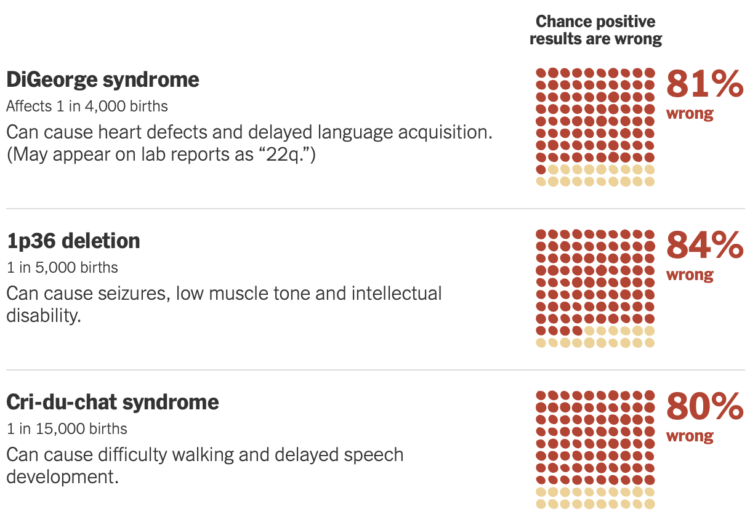
Sarah Kliff and Aatish Bhatia for NYT’s The Upshot look at the uncertainty of prenatal tests for rare conditions. For some tests, the results are more often wrong than they are right, which causes issues when expecting parents don’t know that.
Along with square pie charts, the piece goes into more detail with unit charts to explain what the percentages mean from a counts point of view. So if a reader doesn’t quite know what a false positive is before reading, they will have a better idea after.
Tags: prenatal, testing, uncertainty, Upshot
Modular CPU
I love this project - implemented a CPU using euro-rack synthesizer modules. Also introduced me to VCV Rack whish seems super cool itself.

BlackBerry OS Services End of Life

Today RIM pulls the plug on BIS and the last remaining traces of the BlackBerry relay/application services, which signals the end of an era in many ways.
As a former Product Manager for BlackBerry (and mobile e-mail) at Vodafone, I used RIM devices for many years and amassed a number of tales that I really should write up sometime.
I still wish we’d had those “I Survived the BlackBerry Storm” T-Shirts done.
It was one hell of a product launch (in short, I persuaded our CMO to only order 200 units for launch and saved us from the utter disaster that launching that device - their iPhone “killer” - turned out to be, and that was only the very tip of the tale…).
Principles for life
This page started as an email that I sent to my kids in 2013:
Dear Axl and Stan,

I'm writing this e-mail on the plane from Boston to San Francisco.  Sadly, I don't get to spend a lot of time parenting you right now, so I'm writing you this long e-mail instead.  It provides a list of things I wish I had known when I was 21.

You are still too young to read, but I hope you will read and re-read this e-mail when you're older.  Keep a copy handy.  Needless to say, I'm here to help you in person as well.

I wish I could promise you that life is going to be easy.  I can't.  However, I can promise you that it is really worth it, especially if you live by the following principles.

I love you,

Dad
I've maintained this list on since. My last edits were in January 2022.
Principles to live by daily
- Exercise your brain continuously: keep it busy. Play chess or other strategy games. Write a journal. Keep your brain buzzing.
- Travel as much as you can. My first trip to India blew my mind and changed me forever. Let's go anywhere together, especially if it gives us an opportunity to learn something new.
- Food: Learn, experiment, try out, taste all different types of foods. I find it to be one of the greatest things in life.
- Learn about finances. Even if it sounds boring, or not applicable immediately to you, learn about finances. To make money, you need to understand money. It's why I've talked to you about investing since a very early age.
- Get exercise to be part of your weekly routine. I'm still not great at this myself, but I've seen the benefit. Being busy is a poor excuse.
- Don't spend more than you earn. Start saving now. Get into the habit of saving, even if it is only ten dollars/euro every week. Try to build up 6 months of living expenses in a savings account, and invest the rest in high-quality companies or index funds.
- Embrace your emotions. Laugh when you can and allow yourself to cry when you have to. Sing out loud. Dance in the kitchen while doing the dishes. Laugh at stupid jokes until your stomach hurts. Cry. Crying doesn't mean that you are weak. Since birth, it has always been a sign that you are alive.
- Appreciate music. Listen to as many different genres as possible. Music has a healing function. If you're curious, here is a list with some of my favorite music. Most of these songs helped me in life.
- Read as much as you can. I love reading biographies, business books and academic articles. More things will make sense to you when you read often.
- Love the outdoors. The more you are out and away from your desk, the greater the chance of enjoying life. Get a good hammock or a camper van. One big enough for more than one person.
- Don't take things personally. The hurtful things people say nearly always have far more to do with their own unhappiness than anything else. I've been dealing with criticism for many years; it gets easier over time, but can still hurt.
- Seek to understand. Don't make assumptions. Don't assume you know what someone is thinking or why they're acting like they are. Ask and you'll nearly always find out that your assumption was wrong.
- Always do your best. Your best on one day, may not as good as your best on another day but always work hard. Celebrate results and outcomes, but not the hard work itself.
- Work hard but never hide in your work. When unhappy, working more will never change the outcome. I've made this mistake many times.
- Go on holiday with your friends. You'll remember these holidays forever. I still remember every holiday with friends.
- Take your time. There will be a lot of decisions and opportunities in your life. When the decision is irreversible, give yourself time and space to think it through. When the decision is easily reversible, don't overthink it.
- Spend at least one year living in a foreign country. It will change the way you look at things and make you better at everything else you'll do in life.
- It is 100% okay to be different. We need more diversity, not less.
- Learn to say "No". The earlier in life you master this, the better off you will be. Hesitate or be too courteous to say "no", and you can end up burdening yourself. I was really bad at this in my twenties and early thirties, but have come a long way.
- Deliver on your word. They say your word is worth more than your weight in gold. It is true.
- Be ambitious but realistic. Keep away from those that try to belittle your ambitions. Small people will do that. The really great people will make you believe that you too can become great.
- Success doesn't come overnight. We tend to greatly overestimate what we can achieve in the next 10 months and greatly underestimate what we can achieve in the next 10 years.
- Accept that life will f*cking suck at times. Life is not always easy. Fight for what you care about and don't give up. Things will often seem impossible until they are done. In the end, the hard experiences will make your life meaningful. Sometimes things fall apart so better things can fall together. It become worse, before it gets better.
- Your life will not turn out the way you expect it too, and in the end that is a good thing. I didn't know when I was 21 that I was going to start a company in Boston. If your future turns out exactly the way you plan, that means you're living the plan of a 21-year old, and that should give you pause.
- Don't settle. In everything you do, keep your standards high. When it comes to the important things in life, the details are not the details.
- Be real. Don't fake. When talking or writing, try to tell the deepest truth -- don't hedge with a partial truth.
- Don't be afraid of life being difficult and scary. In fact, do what scares you. Take chances. It is the best way to grow as a person.
- If you have kids yourself, work hard to give them a life that was at least as good as yours -- if not better.
- Focus on what you can control. Don't to worry about what you can't control.
- Remember that you only have one life. Waste it wisely.
- Apologize when you should. I hope you live a life that you are proud of, and that if you find that you are not, that you have the strength to apologize and start over again. Be good men.
- Find out about your parents. They are way more interesting than you think. :)
In 1953, a Telephone-Company Executive Predicts the Rise of Modern Smartphones and Video Calls

This is just a short article featuring a dead-on prediction about the future of telephones from 1953. I'm sure it's not the only one. The main point, made here by Colin Marshall, is that "in all human history, not a single piece of technology has actually come out of nowhere." That's a point worth keeping in mind the next time you read about some 'breakthrough' invention. The breakthrough is mostly in the marketing.
Web: [Direct Link] [This Post]Uni 8-in-1 USB-C hub review

1942 Letter to My Grandfather from His Father
My Dad ran across a remarkable letter and shared it with family. I volunteered to share it more widely, and Dad and his siblings agreed.
* * *
This 1942 letter was written by John Simmons to his son Donald as Donald was about to be shipped to Europe (England first). He had enlisted after the Pearl Harbor attack.
Donald Simmons was my grandfather, and I had the fortune of knowing him.
My father and his siblings knew John Simmons, their grandfather, and with this letter they are able to know him a bit better.
John was 63 when he wrote this letter to his youngest son.
* * *
You can read all three pages together as a PDF — or you can click a thumbnail for each page for the full size version.

Page 1

Page 2

Page 3
* * *
Below is the text. The original is written in cursive on Wright Aeronautical Corporation letterhead.
Aug. 20, 1942
Dear Don:
My thoughts are with you tonight so strongly that I shall drop you a note. Of course it is hard for you to go but not much harder than for us to see you go. You see we love you and are now so helpless to aid you in any way. But then you are a man now and will have to make your own way from here on. And we’re sure that you have the stuff to do it. It won’t be an easy job but then, Don, no job worth the doing is. There are bound to be dark days and darker nights but you must always remember that nothing lasts forever and in the morning it will be a new day. And you are better trained than most for the work.
You are too intelligent to be told and believe that war is anything but a tragic mess, however, we are in this not with our consent but because of a treacherous attack that we did not invite. Regardless of the causes the effect is that we simply must win. And we shall win in spite of our petty bickerings among ourselves for in the final analysis we are the greatest nation on earth. We know that this country has reached the highest degree of living for its people ever attained by any nation in the history of the world and I believe enough in God to feel that with His help all the good, the right, and the fine things must survive. Of course we feel that possibly you may not come back — there is always that possibility and, too, we may be gone when you do come back but in the very grim business of war bombs and bullets go where they are sent and we must for our own peace of mind look that fact in face. Naturally the law of averages is greatly on the side of your returning to us and please God that will be our happiest day in a life time. I am confident you will receive very good training in whatever field you are placed and that you will be adequately prepared to protect yourself.
You are entering what will probably be the greatest adventure in your life. You are going to see miserable, filthy, low, mean and degrading sights for men are like that but you will also see fine, good, self sacrificing and even heroic things for men are like that also. That you will fall into the later class we who love you and have every confidence in you have not the slightest doubt. You have the background and the spirit and will to do so. Just keep yourself so you can look yourself in the face and not be ashamed of what you see. You will come through all right.
And now, old Son, I’ll close by wishing you again the best of everything there is in any old world and all the luck that there is. I truly wish I were going with you — it is hard too to stand and wait.
John
Sgt. Donald Simmons did, of course, make it back.
Federated Bookshelves: Obsidian Notes To OPML
I have a working proof of concept to take individual book notes from Obsidian, turn them into an OPML list of books, and publish them on this webserver. As I had time off these past days I’ve allowed myself to do some code tinkering, resulting in the set-up shown in the image below.

A sketch of my set-up, made in Excalidraw within Obsidian. The blue items now exist, the grey items are still to be done.
The workflow is now as follows:
- Within Obsidian I have made a template for book notes, which has a number of inline data fields (shaped ‘field:: value’). These fields contain the same attributes that I use in my OPML files, using the data structure I made earlier. It also contains one additional field, the booklist it is part of.
- When I first create a new book note I use the template and fill out the inline data fields. If it changes status (to read, reading, read) I update the attributes if needed. Next to those data fields it can contain anything else (e.g. my Kindle hihglights and remarks end up in those book notes too.)
- I can create lists of books in Obsidian using the Dataview plugin, which can find and interpret the inline data fields.
- I can run a PHP script, on my laptop, that iterates through all the files in the folder that contains my book notes. It reads the inline data fields and turns them into OPML lines with the same attributes. It saves it in the correct OPML file using the booklist field. This means that when I move a book in Obsidian from my “anti-library” to the “currently reading” list and then to the “non-fiction 2021” or “fiction 2021” list by changing that single booklist data field, that will get reflected in the OPML as well. The OPML files are saved in a folder, and both human and machine readable.
- I have a second PHP script that also runs locally on my laptop, that iterates through the files in the folder. For each of the .opml files it finds that have changed in the past week, it will get the filename and the file content. It then sends those two data fields (and an access code) to a script on my web server as POST form data.
- The script on my web server accepts POST form data and if the access code is ok, will save the submitted file content using the submitted file name. After that the OPML files on my webserver have the same content as my Dataview overviews within Obsidian, and are fully based on the inline data fields in my individual book notes.
I’ve tested this flow and it works correctly. There’s one important improvement to still make. It currently goes through all my book notes and creates all opml files anew. I want to change that to start from the recently changed book notes and then generate the corresponding opml files. For now it is fast enough locally to not be an issue though that it iterates through the entire folder of book notes.
A second step to take is an addition: to render the same information as JSON files. Dave Winer’s OPMLpackage is likely useful here. Early on there was some discussion on which format to use, and I don’t see a need to choose. I’ve created it using my preference, but the same information can be formatted differently in parallel if it aids usage and federation.
To fully automate this, I still need to set a cron job that calls the first and second local script in turn, every other week or so.
Now that it all works, I will need to see how it goes in practice when I pick a new book, or finish one.
I also need to clean up the code (removing the tests I added in various steps) and translate some of the comments in English. Then I can share I’ve shared the scripts on GitHub, so others can use it for inspiration.
Future steps may include generating book postings in my blog here, directly based on Obsidian notes as well.
A trip down memory lane, via this blog
I recently moved this blog to a new server, so I ‘ve been reconstructing it, and in the process looking through some *really* old posts. It starts in 2005, with some columns I reposted from the newspaper I worked for (the Globe and Mail in Toronto). At the time, I thought I would create a website where I could cross-post my newspaper work, the way Malcolm Gladwell and others were doing at the time, but then I started actually blogging about “Web 2.0” and cross-posting went by the wayside. One of the first non-newspaper posts was about “the revenge of the blog-o-sphere,” sparked by a column in Forbes written by Dan Lyons (who would later write The Secret Diary of Steve Jobs, among other things) and the negative reaction from people like @om and @dangillmor.
From there on, it’s like a time capsule: posts about Yahoo integrating RSS into Yahoo Mail, about the rise of Craigslist — which had 9M unique visitors when I wrote about it in 2005, and has about 200 million now — and TiVo (remember that?), and the battle of Flickr vs Webshots. Other blasts from the past include a post about Jason Calacanis selling Weblogs to AOL, one about Google Reader and Bloglines and NewsGator, and one that pits Dave Winer against Nick Carr, Paul Kedrosky and others.
Then there’s a classic: me arguing with Dave Winer over whether a blog without comments actually qualifies as a blog or not  It seems like a lifetime ago that this is the kind of thing we spent our time worrying about! At some point, my personal blog posts were getting more traffic than the technology page of the Globe and Mail, and I tried to convince the paper to let me create a separate site, the way Kara Swisher and Walt Mossberg did with All Things Digital, but the paper balked
  Posting got light in 2009, after I became the social-media editor for the Globe — the “communities editor,” we called it — in charge of reader comments, and of getting reporters to sign up for Twitter, etc. (explaining the concept of “tweeting” to newspaper execs was so fun).
At the time, having a “social media” editor was such a new concept that no one really knew how it worked, or how it should work. I remember the new social-media editor hired by the New York Times called me to get some advice, because I was one of the first to hold that position at a major daily in North America, and I confessed that I had no idea what we were supposed to be doing, but that she should try to convince reporters and editors to get on Twitter
in 2010 — 12 years ago this month — I left the paper to join GigaOm. It seems like a hundred years ago now, not just because of COVID, but because the media landscape has changed so much in the past decade. Do I miss the old blog-o-sphere? (Yes, we actually used that term unironically). I do — mostly because even when there were the same dumb fights and interpersonal BS, they happened more slowly and with fewer participants. But it was also a very male and white and well-off world. Do I regret pushing the message that the social web could help journalism? No. Maybe that makes me a Pollyanna, but I honestly think it has led to good things — more voices, different voices, worthwhile criticism etc. — although that gets lost amid the larger dumpster fire.
Anyway, if anyone is still here, thanks for indulging me in this little trip down memory lane! It has been an interesting time — maybe a little too interesting
Filtered for deep time and stories from space
1.
An exploding comet in the sky, over the Atacama Desert, 12,000 years ago:
the immediate aftermath would have been astonishing to behold, a 50-mile line of molten sand, warped and roiling like the sea, forming spheres and waves, freezing and shattering, a road of glass disappearing with an eerie glow over the desert horizon.
This is the explanation for why twisted chunks of black and green glass lie scattered all over Chile.
Geoff Manaugh at BLDGBLOG relates the story (beautifully).
WHAT IF, he continues, humans saw this?
imagine such an event occurring in, say, the Middle East around the same time, thus forming the basis for bizarre future folklore, legendarily strange Biblical scenes, tales of molten glass roads appearing in a flash from the sky.
WELL:
A Ferocious Asteroid Strike Demolished an Ancient Middle Eastern City 3,600 Years Ago (SingularityHub).
A meteorite exploded 4km above the city now called Tall el-Hammam, 3,600 years ago. The air heated to 2,000 Celsius and the city was destroyed; the walls of Jericho fell 14 miles away.
The destruction layer also contains tiny diamonoids that, as the name indicates, are as hard as diamonds. Each one is smaller than a flu virus.
(A diamond influenza, shivering and shaking as you crystallise from the inside, sneezing clouds of diamonoid virii that refract shimmering infectious rainbows in the air.)
AND:
It’s possible that an oral description of the city’s destruction may have been handed down for generations until it was recorded as the story of Biblical Sodom.
I wonder how many events that are super-rare-for-individual-humans but probable-over-an-epoch are recorded in stories.
2.
A story about an event 37,000 years ago:
Long ago, four giant beings arrived in southeast Australia. Three strode out to other parts of the continent, but one crouched in place. His body transformed into a volcano called Budj Bim, and his teeth became the lava the volcano spat out.
Now, scientists say this tale–told by the Aboriginal Gunditjmara people of the area–may have some basis in fact.
– Science.org, Is an Aboriginal tale of an ancient volcano the oldest story ever told?
The rocks of the volcano Budj Bim have now been dated, and the dating method suggests both volcanoes formed about 37,000 years ago. What’s more, Matchan says both seem to be of a style that can grow from nothing to peaks tens of meters high in a matter of days to months.
So, maybe!
(Btw the article includes this line: the Gunditjmara community welcomes the new study
. Good. I hope that means there was permission and collaboration too.)
3.
Hey new ice just dropped.
Black, Hot Ice May Be Nature’s Most Common Form of Water (Quanta Magazine).
Superionic ice, Ice XVIII, is black, hot, heavy (4x on regular ice), and conducts electricity like a metal. It’s also stable with a high melting point (4,700 Celsius) – but only at high pressure:
Across the solar system, at least, more water probably exists as superionic ice – filling the interiors of Uranus and Neptune – than in any other phase, including the liquid form sloshing in oceans on Earth.
They made some in a lab.
It’s the ability to conduct electricity that gets me. And also the idea that it will melt into non-conducting forms of ice. Which provides a wonderful possibility of complexity.
I imagine computing circuits written into Ice XVIII which are able to rewrite their circuits from the inside, 3-dimensional circuits of Ice XVIII alloyed and filigreed by other exotic forms: directed electricity to melt and then reform the ice. It’s the ideal substrate for AI civilisations: they live running in code at the heart of Jupiter-like gas giants, the cores of these semi-stars vast thinking mountains of hot ice computronium.
4.
Near the constellation Taurus - you can see it with the naked eye - is a tight box of stars, the Pleiades. (As mentioned by Sappho.)
Whenever I’ve spotted them, my eye kind of flickers off and around them. They’re just a bit too close together and not quite bright enough to get a fix.
a.k.a. The Seven Sisters.
BUT: count them and there are only six.
Many cultures around the world refer to the Pleiades as “seven sisters,” and also tell quite similar stories about them. After studying the motion of the stars very closely, we believe these stories may date back 100,000 years to a time when the constellation looked quite different.
– SingularityHub, Astronomers Say Global Myths About ‘Seven Sisters’ Stars May Reach Back 100,000 Years
There is a similarity between Greek and Aboriginal stories.
A mystery!
It turns out that the stars are moving. Today, Pleione and Atlas look like the same star. BUT, rewind:
Pleione was further from Atlas and would have been easily visible to the naked eye. So 100,000 years ago, most people really would have seen seven stars in the cluster.
The dance of these stars over 400 light years away, 100 millenniums ago, laid down in our ancient myths like a microscopic, indestructible piece of grit - just a counterintuitive single word - and passed on and passed on and passed on through too many lives to count, across deep space and across deep time a diamonoid of story.
Long Links
For a while there I was posting a Long Links early in each month, recommending long-form pieces that I’d had the time to read, acknowledging that people who aren’t semi-retired wouldn’t have time for all of them but perhaps one or two would add value even for the busy. I fell out of that habit but now it’s 2022 and there are plenty of tabs I meant to write about, some dating back to early 2021. So… Welcome, everyone, to 2022, and let’s go long!
I bet a lot of people who read this blog play video games. I bet a lot of people also read The New Yorker. I bet they’re probably not the same people. So, for people on the left side of that Venn diagram, I recommend The Best Video Games of 2021. The list is idiosyncratic and light on AAA productions. I want to give a few of these a try!
Anyone who knows me well, or has read much of what I write, has probably encountered a rant about the irritating habit, among the rich and successful, of attributing their position solely to their own talent and energy. I’ve never believed that, simply because I know how many of my own successes have involved a lot of good luck, and because I know many people who are smarter and harder-working than I am but who struggle to get along in life. For those who agree, and especially for those who don’t, I offer Talent vs Luck: the role of randomness in success and failure by Pluchino et al, published in Advances in Complex Systems. I quote from the abstract: “In particular, we show that, if it is true that some degree of talent is necessary to be successful in life, almost never the most talented people reach the highest peaks of success, being overtaken by mediocre but sensibly luckier individuals. As to our knowledge, this counterintuitive result - although implicitly suggested between the lines in a vast literature - is quantified here for the first time.” Told ya so.
John Battelle asks, on his blog, Why Is The Streaming Experience So Terrible? Nobody really liked the era of cable TV, and streaming felt like a fresh new direction when it arrived, but today it’s starting to have that cable-TV smell, on top of becoming really expensive. I enjoyed reading this because I thought I was the only one generally grumpy about the streaming-video era. I guess I’m not.
Batteries are much in the news these days, as we embark on the first stage of the titanic shift away from a world that runs by burning fossilized micro-organisms to one that runs on renewables. There are a whole lot of issues around batteries: Cost, durability, and the environmental impact of building them. I can’t say how much I enjoyed Electric cars and batteries: how will the world produce enough? published in Nature. It addresses all the issues around batteries that I knew about and a bunch that I didn’t, is impeccably written, and, as you’d expect from this publication, armed with high-quality graphics and first-rate references.
In recent years I’ve been fascinated by the science of “Dark Matter” — I put the words in quotes because no matter how hard physicists look, they can’t find the stuff that needs to be there for galaxies to behave the way they do, according to ΛCDM, the “standard model” of cosmology. Some suggest that Dark Matter doesn’t actually exist, and offer an alternative explanation of the galactic weirdness that produces good results, but requires an adjustment to Newton’s famous gravitational formula G(m1m2)/r2, a thing that (rightly) makes physicists nervous. This alternative vision of cosmic reality is called MOND. Recently, there’s been lots of coverage of the JWST space telescope, and in his Triton Station blog, Stacy McGaugh considers What JWST will see. Because JWST will allow astronomers to establish the size of the furthest-away (and thus oldest) galaxies, and the predictions of ΛCDM and MOND on what they’ll see are very different. One waits with bated breath.
David Heinemeier Hansson (universally referred to as “DHH”) is the inventor of the popular “Rails” website-building software and a successful businessperson, with a loud voice and many interesting opinions. When I first ran across him in 2005, he was also kind of an asshole, spewing testosterone all over the blogosphere and Web-conference circuit. In recent years he’s become way more grown-up and likeable, and usually worth paying attention to, although his standing took a beating last April when a controversy about what sort of political discussion was legit on internal company channels led to a third or so of the staff bailing out. Whatever you may think of him, if you’re interested in software and in particular Open Source, I recommend I won't let you pay me for my open source. It’s a little longer than it needs to be but covers interesting territory, and lots of it, and although I certainly don’t agree with every word, I sure enjoyed reading it.
Long-form works aren’t all in words. Here’s 12 minutes of Vivaldi’s Concerto in E minor for Bassoon; super tasty stuff. The performance is from Poland and the performers almost all women. First-class music, beautifully recorded.
Let’s hope 2022 is better.
Emergency remote instruction in Ontario continues to fail our students, teachers and families

With the return of emergency remote learning here in Ontario we are once again hearing from people about how bad it is. In this post, Michelle Schira Hagerman presents herself as someone who was in favour of online learning two years ago (while at the same time writing "physical schools and teaching are essential for the vast majority of students and communities"). Today, she recants, citing an open letter from 500 Ontario doctors (out of a total of about 30,000) arguing "the harms of school closures are extensive and have impacted academic, social and emotional, and physical and mental health domains."
My own take is that I don't understand how Covid can be transmissive everywhere else (stores, restaurants, fitness centres, sports arenas) and magically not transmissive in and around schools. I do understand how 'emergency remote learning' can lead to terrible learning experiences. And that crappy internet leads to crappy internet experiences. But in the two years we've been dealing with this, nobody has fixed this because they just assume we're all going back to the way it was before, and that it was OK before. We aren't. It wasn't. The pandemic has laid bare major social problems that won't simply disappear even after schools open.
Web: [Direct Link] [This Post]Our 5yo Media Critic: The Internet, Who Writes That?
This morning when our 5 year old woke up and called me. First thing we had two little conversations starting with questions from her.
She asked me what leeches are. I told her they live in water, but not where we are in the world. Then she asked ‘so, do whales have them?’, and I realised I hadn’t specifically mentioned sweet water, and she first thought of the sea.
Immediately following that, she asked me if kangoroos are already born with their pouches. I said I didn’t know but, grabbing my phone, that we could look it up on the internet. She: On the internet? But who writes that?
I wish all of us grown-ups would more often stop and ask who writes that on the internet.
I love the perceptiveness contained in such questions she asks.
"Democracy is premised on the belief that we can trust ordinary people to make consequential..."
BMW’s latest experimental vehicle can change colours on the go

CES never seems to disappoint when it comes to products with a "wow" factor, and BMW's experimental colour-changing vehicle presentation certainly didn't.
The Germany-based luxury car manufacturer calls the vehicle the iX Flow, which is wrapped with a layer of E Ink containing several tiny microcapsules with white and black pigments. "Each capsule contains differently charged white, black or coloured particles which become visible when an electric field is applied. This creates what is known as an Electronic Paper Display (EPD)," reads BMW's CES 2022 recap post.
https://twitter.com/klwtts/status/1478531775886286848
With the push of a button, you can cause the black or white pigments in said microcapsules to rush to the top surface, allowing the car's exterior to change colours. According to BMW's presentation, the colours are currently limited to white, black and grey.
https://twitter.com/Out_of_Spec/status/1478490873121837057
BMW further stated that the change of colour wouldn't just be aesthetic and that the exterior colour black could help absorb heat during cold winter days while the white would block and deflect back sunlight on warm summer days.
BMW didn't talk about how weatherproof the outer coating is. Also, what happens when the vehicle gets scratched up or dented? I would assume that the cost to re-apply or patch such a coating would be hefty. That being said, don't expect to see these cars driving around any time soon. BMW says this is just an “advanced research and design project” which might make its way to the public sometime in the future.
Image credit: BMW
Source: BMW
Why I’m Still Worried About TikTok

News came last week that TikTok eclipsed both Google and Facebook as the most visited domain and most downloaded app in the United States. The mainstream media response can be summed up in this piece from CBS, which notes the news, then quotes a TikTok public policy executive. I wish I was making this up, but here’s the quote:
“TikTok is about entertainment and bringing joy,” TikTok’s head of public policy for North America Michael Beckerman told CBS Mornings in October. “You put a premium on authentic content, uplifting content. But like all entertainment, you want to watch with moderation, and we put tools in place, take-a-break video, screen time management, and tools for parents like family pairing to make sure that they can have conversations and do what’s right for their family and their teenagers.”
Sounds great, right? “Bringing joy”! Here comes TikTok, the “happy app” that has learned from all that bad stuff Facebook has had to deal with over the past five years. The story goes on to note that there’s been some “controversy” around the platform, like viral vandalism at schools and other “challenges.” When asked about these issues, “A TikTok representative did not respond to a request for comment.”
But nowhere in that coverage, not at the WSJ, or Cnet, or many others, is the problematic reality of TikTok’s ownership structure noted. Nor is it mentioned that Tik Tok’s parent company, ByteDance, sold a stake – and a board seat – to the Chinese government. Even before that governance story broke (in the fall of 2020), I was expressing my discomfort with what TikTok represents given its perch at the intersection of surveillance capitalism and high-stakes geopolitics. More than two years ago, in “Tik Tok, Tick, Tock….Boom”, I wrote:
- China employs a breathtaking model of state-driven surveillance.
- The US employs a breathtaking model of capitalist surveillance.
We on the same page so far? OK, great.
Now let’s consider TikTok, which is a robust combination of the two. Don’t know TikTok? Come on, you read Searchblog for God’s sake. Ok, well, fortunately for you, there’s the New York Times. Or…maybe not. I almost threw up in my mouth as I watched the paper of record run through its decades long practice of “Gee, Golly, Isn’t This Shiny New Tech Thing Culturally Significant, and Aren’t We Woke for Noticing It” journalism last weekend.
I then go on to review TikTok’s Terms of Service and Privacy Policy, which, if you read them closely, offer absolutely no assurances that the data TikTok collects won’t be shared with the Chinese government. I just re-read them, to be sure they hadn’t changed, and nope, it’s all right there in black and white. From the privacy policy:
“We may share all of the information we collect with a parent, subsidiary, or other affiliate of our corporate group.”
and
“We may disclose any of the information we collect to respond to subpoenas, court orders, legal process, law enforcement requests, legal claims, or government inquiries, and to protect and defend the rights, interests, safety, and security of TikTok Inc., the Platform, our affiliates, users, or the public. We may also share any of the information we collect to enforce any terms applicable to the Platform, to exercise or defend any legal claims, and comply with any applicable law. “
Well folks, what “government inquiries” and/or “applicable law” do you think this means, given TikTok is owned by a Chinese company? And let’s just remind ourselves, China takes a very keen interest in its Internet companies. And as the Washington Post reported, just today, “China harvests masses of data on Western targets.”
It astonishes me that US-based tech reporting doesn’t at least point out this obvious conflict of interest when covering TikTok’s domination of US internet culture. Yes, the last administration completely mishandled the issue, and perhaps nobody wants to acknowledge that maybe, just maybe Trump was actually right about something (lord knows I cringe just writing that sentence). And yes, sure, TikTok representatives will look anyone who asks directly in the eyes and declare “We do not share information with the Chinese government.” But we already know that our own social media executives have bent the truth repeatedly to the press, to Congress, and to themselves over the past ten years. Are we really going to take TikTok’s word for it?
The Department of Commerce is still working on reports detailing processes for determining whether TikTok and apps like it might be a security threat. This kind of grinding bureaucracy tends to anesthetize ongoing coverage. Meanwhile, I started checking out TikTok a few months ago. And damn, the product is impossible to look away from. It’s a brain candy rabbit hole, and media companies, including The Recount, have flocked to the platform. But I can’t help thinking we’re making the same mistake we made when we all embraced Facebook a decade ago. Sure, we can assume there’s absolutely no data TikTok could possibly gather from any of us that matters to the CCP. I certainly hope that’s right. But the history of social media has proven that comfortable assumptions are often wrong. I guess we’ll find out…eventually.
This post is something of a longer exploration of one of my annual predictions, #9, posted yesterday.
Celebrate by Writing
My birthday is coming up soon so it’s that time of the year when friends start reaching out and asking where they should fly to and how we’re going to celebrate.
After a good run in the post-vaccinated-and-boosted part of 2020 that felt relatively “normal”, including traveling almost 200k miles, I’m going back into a pretty locked-down state of things. Omicron has just been catching too many friends and loved ones, even with fairly careful measures and testing. So what’s happening on January 11th?
What I’m asking for my birthday is for people to blog!
Whether professionally on WP.com, socially on Tumblr, or privately journaling with Day One, there’s never been a better time to stop being a passive consumer of the internet and join the class of creators.
Write for a single person. Share something cool you found. Summarize your year. Set a blogging goal with reminders. Get a Gutenberg-native theme and play around with building richer posts. Start a nom de plume. Answer daily prompts on Day One. Forget the metaverse, let’s hang out in the blogosphere. Get your own domain!
If you’re a close friend that feels intimidated by the software at all or that you don’t know where to start, I’m happy to hop on a Zoom to go through everything on a screen share. That will also be a great learning for me for places we can improve things, which is also a fantastic gift!

Week Notes 21#52
This final week of the year was a week off, and I took it slow accordingly.
Tuesday after talking to our dear friend P we decided to indeed spend New Years Eve with them, visting them in their home in Switzerland. We got ourselves tested Wednesday as Switzerland currently demands a test next to proof of vaccination or recovery, and filled out the entry forms we also needed to submit. It’s been a while that traveling around Europe took this type of paperwork. Reminds me of the 70s and 80s when my dad would arrange travel insurance, traveler cheques and foreign currencies before we left for holiday travel.
Other things this week included writing and posting my annual Tadaa! list, I made good progress on a php script that can create OPML book lists directly from my markdown notes, and I bought baking powder mix for oliebollen. Oliebollen are traditionally made in the Netherlands for New Years Eve, and it’s our own little tradition that P and I make them when we’re in Switzerland at the end of year. Visiting P and B was great. Seeing them again for the first time in two years made me realise how I’d missed them.
Around noon today we said goodbye to P and B and their teenage sons, and drove from Lake Zug along the beautiful Vierwaldstättersee to the nearby city of Luzern. We rented a small 8th floor two bedroom penthouse apartment with what turned out a beautiful view of snow covered Alps, amongst which the Pilatus, Luzern’s ‘home mountain’. The apartment comes with a parking space, for which you take the car two floors down in a car sized elevator, much to Y’s (and our) surprise. This afternoon we walked around Luzern for a bit, had coffee with pastries and generally enjoyed hanging out with the three of us.
I wish you all a great and healthy 2022.
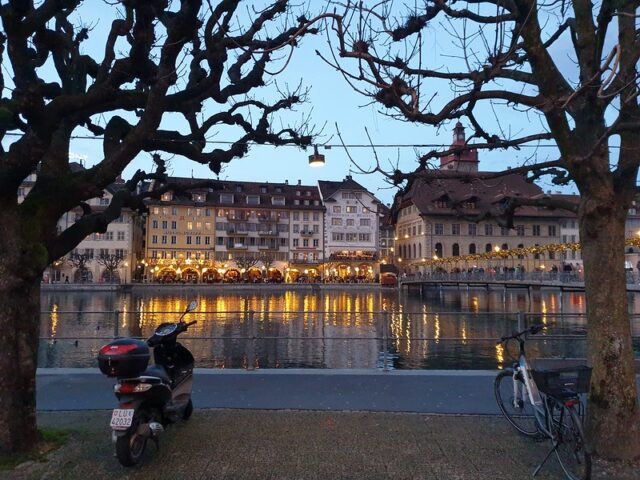 Luzern, Unter der Egg with the Rathaussteg bridge at dusk today, seen from across the Reuss.
This is a RSS only posting for regular readers. Not secret, just unlisted. Comments / webmention / pingback all ok.
Read more about RSS Club
Tech questions for 2022
Sometimes the centre of gravity in tech is very clear - everything is about PCs, or the web, or smartphones. But at other times, there are lots of things going on and none of them are The Thing, and all of them are full of questions. Of course, for some crypto people crypto is the only question and the only answer, but as we enter 2022 there are lots of areas where trillion dollar questions are wide open. These are the questions I wonder about at the moment - there are others.
Crypto
Crypto is so big and potentially important, and yet so vague and so early, that we can’t even agree what to call it, and at times the noise of both irrational, religious hype and straw-man attacks can seem overwhelming. There is a set of ideas that could in principle be as central to tech as machine learning or open source, but after that, everything is a question.
The tech itself is in a period of massively increasing sophistication and complexity, as everyone builds on an open canvas and builds capability on a simple idea - early PCs or indeed the early consumer internet looked like this. But the more layers, abstractions, building blocks and primitives are created, the harder it is to know which will resolve into things normal people can use, and, paradoxically, the more likely gatekeepers become. We’re imagining the metaverse while arguing about how TCP/IP should work and whether this new ‘WWW’ thing is just a crippled Hypertext, but when can we tell our friends to ‘install Netscape’, and without giving them an op-sec lecture?
Meanwhile, what happens when the ideological fervour of decentralisation meets gravity - the dynamics and centralising forces of real products with real users? The web is radically decentralised, but centralised search and social sit on top. Open source, another crazy, religious idea, was going to transform tech, and it did! - but Office is still a huge business 25 years later. The iPhone is full of open source, and yet it isn’t open, and yet, with millions of apps and billions of downloads, in what senses and at what layers is it ‘closed’ and ‘open’? Most of my crypto questions are not ‘if?’ or ‘what?’ but ‘where?’
So - blockchains let us build distributed, trustless computers, applications and services, based on consensus, ownership and integrated incentives, but making that real involves a lot of plumbing questions and a lot of product questions that have still only just started.
AR, VR and the metaverse
We have pretty good VR devices now, but don’t know what to do with them beyond games (though we have ideas), and we can imagine AR glasses, that can put anything into the world as though it was really there, but we don’t have the optics for that today and don’t know when we will. Facebook has sold 10m of the Quest 2 at cost, but it’s far too early to know how well this is working or how big it will be.
We can certainly hope that more Moore’s Law, more engineering and more willpower can push VR into becoming the next universal device after smartphones, and we can hope that the optics for AR can work, and then we can speculate about what we might do with all this in a decade or so. Indeed, we can fill a whole whiteboard with those speculations and label it ‘metaverse’. But we don’t know. Is the future of software making everything into tangible 3D objects that merge with the world - or have we spent the last 30 years pushing for more abstraction and new kinds of tool?
The trouble is, it’s easy to make a cool concept video, but talking about this today in any kind of detail is like making detailed predictions about the mobile internet in 1999, or even 2005. It was very clear that there would be something, but we had no real idea what, and no-one thought that smartphones would replace PCs as the centre of consumer tech (or imagined that a has-been computer company from Cupertino would dominate the whole thing). AR and VR might be the next smartphone, but they might also be the next smart watch, drone, or games console - very cool but a narrow market.
Games
Games have always been a big business, but they’ve always been a branch off the side of the tech industry. 250-350m people play console and PC games, which sounds like a lot, but is actually no bigger than Snapchat and nowhere close to the almost 5bn people using smartphones today.
Is that changing? Do games shift to more generally-appealing experiences, are smartphones unlocking a much broader audience, and do games companies look more like startups (and generate VC-type returns)? And might this merge with and reinforce VR and AR?
Perhaps. It’s a coherent thesis, with mobile game revenue now as big as PC and consoles combined and Roblox or Fortnite pointing to new creative and platform-ish possibilities. But we said that about WoW (and Second Life) too, and there’s no primary, driving mechanism (Moore’s Law, broadband) to suggest this change is inevitable.
Regulation
Every big, complex, important industry has industry-specific regulation, from railways to food to aircraft to cars, and tech is becoming a regulated industry as well. But we don’t actually regulate ‘cars’ - that’s 10 or 20 different things, from congestion charges to traffic laws to seatbelts and emissions to drink driving. Regulating ‘tech’ is just as complex and full of trade-offs as regulating cars, or indeed anything else in policy. Hence, there are lots of questions about what those rules should be, and what the trade-offs are. Very obviously, privacy rules conflict with competition rules (‘let me export data about my friends’).
Stepping back, though, it’s not clear how much regulation changes for how much of the tech industry. Much of what’s proposed is essentially a cost of doing business that lowers margins but also raises barriers to entry. Some narrow decisions might limit or close down entire business models (labour laws versus local delivery or Uber, say). But what more general structural changes might happen? Search, social and operating systems are natural monopolies, and you can’t really break up a natural monopoly, only regulate it. Even if Instagram was a separate company, it wouldn’t be any easier to compete with.
So, while there are obviously waves of tech regulation coming, it’s less obvious how much any of this would change our day-to-day experience of consumer technology (and most of it isn’t intended to anyway). Meanwhile, of course, the vast majority of the 3-5,000 actual tech companies founded each year in Silicon Valley alone don’t make platforms, social networks or adtech - and aren’t affected in any meaningful way by any of this.
Privacy
We all agree privacy is important, and a big problem, but we don’t have any settled understanding of what that means or what a solution might look like, if we set aside bumper-sticker slogans like ‘surveillance capitalism!’ and ask what we want to be built. We don’t want to be ‘tracked’ but we quite like ‘relevance’ and ‘personalisation.’ Apple, the privacy company, built a private CSMA scanner that no-one else agreed was private. We want privacy, but don’t agree on what that means.
This matters in an immediate sense because advertising & marketing is a $1tr industry, a third of it is now online, and it’s the single most important lever for ecommerce on one hand and the growth of new brands and new competitors on the other. Most of this has been based on cookies, and privacy concerns mean that cookies are now going away, in the ‘Great Cookie Apocalypse’, but we don’t know what will replace that. The industry is trying to create ways to show ads that are both relevant and private, and there’s no barrier to that in principle. Advertisers almost never actually want or need any personal information - they just want to show diapers ads to people who have babies, not show them to people who don’t, and have some idea of which ads work better. Data isn’t oil - it’s sand. But building ‘private relevance’ is hard if we don’t agree what privacy means - tech people might argue that ‘first party’ is private and ‘on-device’ is private, but it’s not clear anyone else will go for that. Meanwhile, of course, if we don’t get an answer then by default Google, Apple, Facebook and Amazon do okay and everyone else is squeezed out - privacy conflicts with competition.
There’s a much more general issue here, though. There’s an old principle that a computer should never ask a question if it should be able to work out the answer, and the more that computers become invisible parts of our lives the more that they ‘should’ be able to work out. If I ask my Apple Glasses “I met someone from Disney last week, wearing a red shirt - what was his name?” what privacy issues arise? And when does the competition regulator force Apple to give competitors API access to that? If I use a new social network that uses a public blockchain as its source of record, what data is private and what does that mean? We live in an ever-expanding automated panopticon, and privacy questions that were always theoretical, and only worked at a small scale, now become practical at a global scale. We are trying to work out what that means, and how we change it.
Cars
The car industry is shifting to electric, and that changes a lot of what a car is - there’s an order of magnitude fewer moving parts, a very different supplier base, and much of the sophistication moves to software. We go from complex cars with simple software to simple cars with complex software.
Seen from tech, this looks a lot like the smartphone take-over of mobile phones, and there’s a lot of pattern recognition, right down to the dumb old industrial companies that think software is easy and they can just hire some developers. But it’s not yet entirely clear whether this really is disruption. An electric car is a better car but an iPhone is not a better Blackberry - it’s an entirely different thing that happens to be roughly the same size. So how much does electric really rewrite car manufacturing? Bulls think Tesla is a software company (and lots of other things), but bears think that no, it’s still a car company.
Autonomy is potentially much more profound and disruptive, and really does change what a car is - a car with no steering wheel is not really a car anymore. That raises as many questions as cars themselves did (it was much easier to predict mass car-ownership than to predict Walmart), and the tech itself remains full of questions. Can Tesla boot-strap its way through to something that works well enough? Will Waymo get there first going top-down? Are there winner-takes-all effects?
But more importantly, we don’t know when, how or where any of this will work. There was a period of euphoria a few years ago when AVs looked imminent, but it may now be that autonomy is like the old joke that AI is anything that doesn’t work yet. ‘Full’ autonomy may be as many decades away as ‘general AI’ (indeed it might require general AI!) but we’ll get all sorts of much more limited automation in the meantime.
China
A billion smartphone users leapfrog the second half of the 20th century and go direct to apps in everything from grocery shopping to consumer finance, generating a torrent of new ideas, business models and applications, most of which none of the rest of us can use, test or really understand first-hand, but all of which sound very interesting. And yet, this sits behind a firewall, in a totally different market structure, run by a deeply autocratic state that, in the last year, has kneecapped some of its biggest champions. How many questions does that pose? How many would you like?
I’m not a China analyst, and I try to leave most China tech discussions to those who can actually use the products and read the language, but three sets of questions seem important from outside. First, Chinese consumer tech has become a well of ideas for other people, especially other ecommerce and social media companies in other parts of the world, to go and copy. That probably isn’t going to change. Second, can the companies themselves go global? By default no (WeChat), but sometimes yes, with the right approach (TikTok), and does the current crackdown make Chinese companies look more aggressively for less regulated foreign opportunities, or focus on their home market? (Either way the ideas and models certainly go global.) What’s the next Shein, which may now be the biggest fast fashion retailer in the USA? And third, if China really does becomes uninvestable, where else does that capital go?
Macro
I’m not a China analyst, and I’m certainly not a macro analyst, but tech has been in a macro moment for a while. On one hand the pandemic (the ‘Covid Rotation’) has crystallised and accelerated the realisation of how big and central tech has become - where winning once meant a $100m or $1bn company, now it means $100bn or $1tr. On the other, the scale of company creation and opportunity is accelerated by a decade of low interest rates and a torrent of capital looking for tech returns - most of which are now in private markets, without public markets governance.
So, Tesla’s valuation is driven to $1tr by unprecedented options trading. A16Z now has over $20bn under management, and 300 people (10x a typical venture firm), but Tiger Global probably did 300 deals in 2021. Welcome to the $100m seed round. It’s different this time, of course, but then it’s always different, until the music stops and you find out who was good and who was lucky, and people have been wondering about that for a while now. Ironically, for a brief moment people thought that Covid might be the external shock that would stop the music and instead it accelerated things. But if history teaches us anything, it’s that something will happen. Check your email retention policies.
Everything else
Most of the questions I’ve discussed so far are about the future of tech, but a central theme in the trends presentation I published last month was all the ways that industries much bigger than tech are being disrupted now by things that tech was excited about 10, 15 or 20 years ago. Across brands, consumer goods, advertising & marketing, TV, retail and ecommerce, all the old value chains break up, all the cards are thrown in the air, and no-one knows where they’ll land. Old gatekeepers and toll gates go away and new ones emerge. US pay TV subs are down by a third, Amazon’s GMV has probably passed Walmart - and yet Shopify is now 45% of the size of Amazon Marketplace.
These are big industries - global retail is over $20tr - and they’re being disrupted by tech ideas from a generation ago (“people might buy stuff online!”), but most of the questions are not tech questions. Netflix is enabled by tech, but all the questions are TV questions. The internet enables ecommerce, but the margin trade-offs of BOPIS are retail questions (and note that half of US and UK ecommerce comes from physical retailers). Does the transformation of marketing and distribution mean we’ll have far more brands (supermarkets drove a 10x increase in grocery SKUs), or far fewer? How many D2C companies will there be, and how big can they get? What happens as LVMH goes online? Bernard Arnault is richer than Jeff Bezos - which of them should I ask about Shein?
A decade ago, Uber and Airbnb represented ‘software eating the world’ - companies that used software to change the nature of a product. Airbnb doesn’t sell software to hotel companies, but changes what a hotel is. This is happening over and over again in every other industry. But Netflix or Shein might be a much more general trend - that tech changes the playing field but then the game is played by that industry.
Mad Meccano
I just picked up a grocery order from Sobeys—the fancy one across the river in Stratford. It was my first time ordering groceries online, but COVID times, and being responsible to a “steady 10” bubble, called for pivoting. I miss the familiarity of the (less fancy, but more familiar) Allen Street Sobeys, and feel pangs of promiscuity-guilt for abandoning them. But at least I didn’t shop at the Superstore.
I’ve been helping make the Internet since 1986—35 years—and in recent years I have grown cynical as I’ve seen the good, altruistic, spirit-of-sharing Internet give way to the crass, commercial, polarized Internet. It’s hard not to feel a sense of shame for my role in simply letting that happen.
But it’s good to be reminded that it remains a Meccano set that can do everything from letting me order a mango from my phone, to learning about cooking on a sailboat, to arming tenants against landlords, to reading the newspaper from 100 years ago. It is the greatest decentralized collaborative project in history; I’m going to allow myself some pride for my small role.
Several years ago I found myself in a bar on College Street in Toronto having a drink with friends. The talk turned to online dating, and Bumble, and I was able to indulge my curiosity, as two of our party had subject-matter-experience, and one had met her fiancé-now-husband through Bumble.
I was cynical: it all seemed so cold and algorithmic to let the AI robots commodify romance. While the field reports made it seem slightly less so, I remained unsold.
Until 2021.
When I woke up to being single, and came to terms with the notion that I was ready to move on to new romantic chapters after a long, cold, lonely, necessary year of grieving.
I stumbled at first. But kept at it.
I had 3 dates with C. (she ended it with a stunningly compassionate text). A lovely long distance with P. over the summer (we remain good friends). An awkward few days of chatting with A. from Halifax. A month of getting to know M. from Summerside.
Each of these were connections facilitated, one way or the other, by this Internet. And each experience, each woman, taught me something. The “valuable learning experiences” weren’t always happy at the time. But they were learning experiences nonetheless.
Then, on the second day of December, I met L. On Bumble.
We chatted, tentatively at first, less-tentatively as we progressed. Novels worth as the weeks continued. And I realized that, AI robots aside, this Internet was allowing me to use words, words that I love, that are my lingua franca, to woo and be wooed.
A month has passed.
We are getting to know each more and more each day, connecting. Building ties. It’s kind of a miracle.
The Internet opened the door to that. And so I feel an extra dollop of pride for that.
It’s some pretty mad Meccano.
Happy New Year.
Can SAD lights make a gloomy Canadian happy?

A few weeks ago, I was Googling something along the lines of "What to do this winter in Canada."
Among a slew of articles about events, New Years' celebrations, skiing spots and ice fishing, was a story about the lack of sunlight, social interaction and the overall gloominess Canadian Winters bring about. The overarching theme of the story was SAD, also known as Seasonal Affective Disorder.
As expected, I was quickly bombarded with ads about lamps that claim to help with SAD. I decided to order one and have been using it for a few weeks now.
Note: This isn't a review about a specific said lamp brand. It's about how these lamps work and their overall effectiveness. However, if you're curious, I used this lamp with 10,000 Lux of brightness from Verilux.
What exactly is Seasonal Effective Disorder?
Have you ever felt extra moody, irritated, inattentive, and that an overall lack of energy and motivation has taken over your body and soul around the time of the year when leaves turn orange? Yes? Me too.
I'm not saying that these symptoms are 100 percent caused by SAD since they often overlap with several other conditions. But, if you're a healthy individual, who eats right and squeezes in enough exercise, and see these symptoms slowly fade away as you transition from wearing thick jackets and Timberlands, to shorts and flip-flops around the spring, then you too might just be feeling SAD.
Light therapy is believed to influence your brain to produce and release chemicals associated with mood and sleep."
The Canadian Psychological Association says that SAD is believed to be influenced by exposure to sunlight. The shorter the days become, the more our body struggles with maintaining its circadian rhythm (our body's biological clock). It's also believed that less exposure to sunlight disturbs our neurotransmitters and slows down the production and release of 'feel-happy' hormones and chemicals like Serotonin and Dopamine.
This is where SAD lamps come in.
What is Light Therapy, and how to go about it?
Light therapy is the process of using a lightbox, or lamp in my case, to mimic natural outdoor light. Light therapy is believed to influence your brain to produce and release chemicals associated with mood and sleep, which in turn help alleviate some symptoms of SAD.
It is recommended that you use a lamp that can output 10,000 lux of brightness and place it about half an arm or an arm's distance away from your face, above the eye level. You're not supposed to look directly into the lamp. However, the light should be placed near you so that light from it can enter your eyes indirectly.
Also recommended is that you start your therapy early in the morning, preferably as soon as you wake up, and sit through it for 20-30 minutes. I usually 'attend' my light therapy when I start work at around 9am while sipping coffee. You are also supposed to use the lamp daily, preferably at the same time every day, if you wish to alleviate some of the SAD symptoms.
My experience
I started my light therapy in early December and jumped in the deep end right away. The first few days felt counterproductive. My eyes would usually feel a little uncomfortable towards the end of the day. They were kind of itchy, but not exactly itchy and burning, but not exactly burning. It's hard to explain, but my eyes felt tired.
It also made me feel sleepy during the day. I'm not sure if that results from my circadian rhythm resetting? But it felt weird.
Fast forward a few days, and I realized my dumbass was using the light incorrectly. I would usually keep the light on for hours on end and had it placed at an angle where the light would shine from under me, directed towards my chin area. Though I did use it at the same time every day, so at least I got something right.
"I do feel that my attention span is a little better than it was a few weeks ago."
I've been using the lamp 'correctly' for about three weeks, and I have experienced 'some' positive effects. For example, my sleep schedule has changed from an absolute disaster to something that isn't necessarily perfect but is a bit more manageable. I've found myself feeling sleepy at night around 11:30-12-ish, which, just a few weeks ago, was the time I'd be endlessly scrolling on my phone.
Since I go to bed a little earlier now, I've been able to wake up sooner as well and feel like I get a good night's sleep every night.
Mood-wise, I never really had a problem, even before I started using the light, so it's hard to say if there has been progress in that area. That being said, I do feel that my attention span is a little better than it was a few weeks ago, and I feel overall more aware, alert and attentive.
Day-time lack of energy was also never really an issue, but post using the lamp, I don't feel sleepy during the day, but that could also have to do with the fact that my sleep schedule is better now than it used to be a few weeks ago.
Of course, this progress could be a placebo effect and me just thinking the light is doing what it's supposed to do. SAD lamps are recommended to be used throughout the winter season, until mid-spring to early summer. I plan to use the lamp until then and update this story with more concrete observations as I continue to use it.
Creating and evolving a programming language: funding
The funding for artists and designers/implementors of programming languages shares some similarities.
Rich patrons used to sponsor a few talented painters/sculptors/etc, although many artists had no sponsors and worked for little or no money. Designers of programming languages sometimes have a rich patron, in the form of a company looking to gain some commercial advantage, with most language designers have a day job and work on their side project that might have a connection to their job (e.g., researchers).
Why would a rich patron sponsor the creation of an art work/language?
Possible reasons include: Enhancing the patron’s reputation within the culture in which they move (attracting followers, social or commercial), and influencing people’s thinking (to have views that are more in line with those of the patron).
The during 2009-2012 it suddenly became fashionable for major tech companies to have their own home-grown corporate language: Go, Rust, Dart and Typescript are some of the languages that achieved a notable level of brand recognition. Microsoft, with its long-standing focus on developers, was ahead of the game, with the introduction of F# in 2005 (and other languages in earlier and later years). The introduction of Swift and Hack in 2014 were driven by solid commercial motives (i.e., control of developers and reduced maintenance costs respectively); Google’s adoption of Kotlin, introduced by a minor patron in 2011, was driven by their losing of the Oracle Java lawsuit.
Less rich patrons also sponsor languages, with the idiosyncratic Ivor Tiefenbrun even sponsoring the creation of a bespoke cpu to speed up the execution of programs written in the company language.
The benefits of having a rich sponsor is the opportunity it provides to continue working on what has been created, evolving it into something new.
Self sponsored individuals and groups also create new languages, with recent more well known examples including Clojure and Julia.
What opportunities are available for initially self sponsored individuals to support themselves, while they continue to work on what has been created?
The growth of the middle class, and its interest in art, provided a means for artists to fund their work by attracting smaller sums from a wider audience.
In the last 10-15 years, some language creators have fostered a community driven approach to evolving and promoting their work. As well as being directly involved in working on the language and its infrastructure, members of a community may also contribute or help raise funds. There has been a tiny trickle of developers leaving their day job to work full time on ‘their’ language.
The term Hedonism driven development is a good description of this kind of community development.
People have been creating new languages since computers were invented, and I don’t expect this desire to create new languages to stop anytime soon. How long might a language community be expected to last?
Having lots of commercially important code implemented in a language creates an incentive for that language’s continual existence, e.g., companies paying for support. When little or co commercial important code is available to create an external incentive, a language community will continue to be active for as long as its members invest in it. The plot below shows the lifetime of 32 secular and 19 religious 19th century American utopian communities, based on their size at foundation; lines are fitted loess regression (code+data):
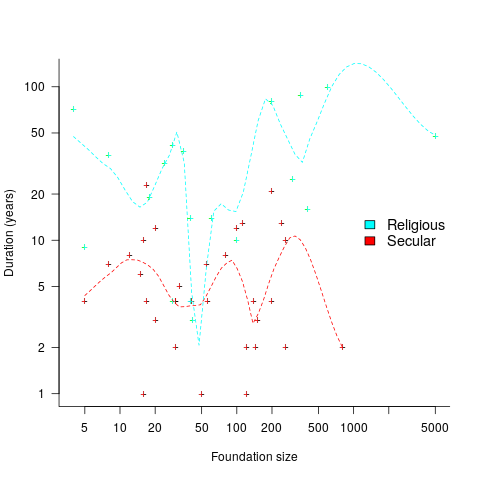
How many self-sustaining language communities are there, and how many might the world’s population support?
My tracking of new language communities is a side effect of the blogs I follow and the few community sites a visit regularly; so a tiny subset of the possibilities. I know of a handful of ‘new’ language communities; with ‘new’ as in not having a Wikipedia page (yet).
One list contains, up until 2005, 7,446 languages. I would not be surprised if this was off by almost an order of magnitude. Wikipedia has a very idiosyncratic and brief timeline of programming languages, and a very incomplete list of programming languages.
I await a future social science PhD thesis for a more thorough analysis of current numbers.
Digiconomist reports that Bitcoin consumed about as much energy in 2021 as the whole country of Argentina
Digiconomist released numbers for 2021, showing that during 2021, Bitcoin consumed 134 TWh in total—comparable to the energy consumption of Argentina. The report also claims that Bitcoin was responsible for 0.54% of global electricity consumption, and consumed about 89% more energy in 2021 than in the previous year.
202█
 |
mkalus
shared this story
from  jwz. jwz.
|
b'The date is now Friday, March 671st, 2020.
"Happy" "New" Year.
perl -e \'use Date::Parse; use POSIX; my @t = localtime; print strftime ("%a Mar ", @t) . int (1 + 0.5 + ((str2time (strftime ("%Y-%m-%d 3:00", @t)) - str2time ("2020-03-01 3:00")) /(60*60*24))) . strftime (" %X %Z 2020\\n", @t);\'
Fri Mar 671 13:41:08 PST 2020 \n
Previously, previously, previously, previously, previously, previously, previously.'
Your attention didn’t collapse. It was stolen | Psychology
|
mkalus
shared this story
from  The Guardian. The Guardian.
|
b'
When he was nine years old, my godson Adam developed a brief but freakishly intense obsession with Elvis Presley. He took to singing Jailhouse Rock at the top of his voice with all the low crooning and pelvis-jiggling of the King himself. One day, as I tucked him in, he looked at me very earnestly and asked: \xe2\x80\x9cJohann, will you take me to Graceland one day?\xe2\x80\x9d Without really thinking, I agreed. I never gave it another thought, until everything had gone wrong.
Ten years later, Adam was lost. He had dropped out of school when he was 15, and he spent almost all his waking hours alternating blankly between screens \xe2\x80\x93 a blur of YouTube, WhatsApp and porn. (I\xe2\x80\x99ve changed his name and some minor details to preserve his privacy.) He seemed to be whirring at the speed of Snapchat, and nothing still or serious could gain any traction in his mind. During the decade in which Adam had become a man, this fracturing seemed to be happening to many of us. Our ability to pay attention was cracking and breaking. I had just turned 40, and wherever my generation gathered, we would lament our lost capacity for concentration. I still read a lot of books, but with each year that passed, it felt more and more like running up a down escalator. Then one evening, as we lay on my sofa, each staring at our own ceaselessly shrieking screens, I looked at him and felt a low dread. \xe2\x80\x9cAdam,\xe2\x80\x9d I said softly, \xe2\x80\x9clet\xe2\x80\x99s go to Graceland.\xe2\x80\x9d I reminded him of the promise I had made. I could see that the idea of breaking this numbing routine ignited something in him, but I told him there was one condition he had to stick to if we went. He had to switch his phone off during the day. He swore he would.
When you arrive at the gates of Graceland, there is no longer a human being whose job is to show you around. You are handed an iPad, you put in little earbuds, and the iPad tells you what to do \xe2\x80\x93 turn left; turn right; walk forward. In each room, a photograph of where you are appears on the screen, while a narrator describes it. So as we walked around we were surrounded by blank-faced people, looking almost all the time at their screens. As we walked, I felt more and more tense. When we got to the jungle room \xe2\x80\x93 Elvis\xe2\x80\x99s favourite place in the mansion \xe2\x80\x93 the iPad was chattering away when a middle-aged man standing next to me turned to say something to his wife. In front of us, I could see the large fake plants that Elvis had bought to turn this room into his own artificial jungle. \xe2\x80\x9cHoney,\xe2\x80\x9d he said, \xe2\x80\x9cthis is amazing. Look.\xe2\x80\x9d He waved the iPad in her direction, and began to move his finger across it. \xe2\x80\x9cIf you swipe left, you can see the jungle room to the left. And if you swipe right, you can see the jungle room to the right.\xe2\x80\x9d
His wife stared, smiled, and began to swipe at her own iPad. I leaned forward. \xe2\x80\x9cBut, sir,\xe2\x80\x9d I said, \xe2\x80\x9cthere\xe2\x80\x99s an old-fashioned form of swiping you can do. It\xe2\x80\x99s called turning your head. Because we\xe2\x80\x99re here. We\xe2\x80\x99re in the jungle room. You can see it unmediated. Here. Look.\xe2\x80\x9d I waved my hand, and the fake green leaves rustled a little. Their eyes returned to their screens. \xe2\x80\x9cLook!\xe2\x80\x9d I said. \xe2\x80\x9cDon\xe2\x80\x99t you see? We\xe2\x80\x99re actually there. There\xe2\x80\x99s no need for your screen. We are in the jungle room.\xe2\x80\x9d They hurried away. I turned to Adam, ready to laugh about it all \xe2\x80\x93 but he was in a corner, holding his phone under his jacket, flicking through Snapchat.
At every stage in the trip, he had broken his promise. When the plane first touched down in New Orleans two weeks before, he took out his phone while we were still in our seats. \xe2\x80\x9cYou promised not to use it,\xe2\x80\x9d I said. He replied: \xe2\x80\x9cI meant I wouldn\xe2\x80\x99t make phone calls. I can\xe2\x80\x99t not use Snapchat and texting, obviously.\xe2\x80\x9d He said this with baffled honesty, as though I had asked him to hold his breath for 10 days. In the jungle room, I suddenly snapped and tried to wrestle his phone from his grasp, and he stomped away. That night I found him in the Heartbreak Hotel, sitting next to a swimming pool (shaped like a giant guitar), looking sad. I realised as I sat with him that, as with so much anger, my rage towards him was really anger towards myself. His inability to focus was something I felt happening to me too. I was losing my ability to be present, and I hated it. \xe2\x80\x9cI know something\xe2\x80\x99s wrong,\xe2\x80\x9d Adam said, holding his phone tightly in his hand. \xe2\x80\x9cBut I have no idea how to fix it.\xe2\x80\x9d Then he went back to texting.
I realised then that I needed to understand what was really happening to him and to so many of us. That moment turned out to be the start of a journey that transformed how I think about attention. I travelled all over the world in the next three years, from Miami to Moscow to Melbourne, interviewing the leading experts in the world about focus. What I learned persuaded me that we are not now facing simply a normal anxiety about attention, of the kind every generation goes through as it ages. We are living in a serious attention crisis \xe2\x80\x93 one with huge implications for how we live. I learned there are twelve factors that have been proven to reduce people\xe2\x80\x99s ability to pay attention and that many of these factors have been rising in the past few decades \xe2\x80\x93 sometimes dramatically.
I went to Portland, Oregon, to interview Prof Joel Nigg, who is one of the leading experts in the world on children\xe2\x80\x99s attention problems, and he told me we need to ask if we are now developing \xe2\x80\x9can attentional pathogenic culture\xe2\x80\x9d \xe2\x80\x93 an environment in which sustained and deep focus is harder for all of us. When I asked him what he would do if he was in charge of our culture and he actually wanted to destroy people\xe2\x80\x99s attention, he said: \xe2\x80\x9cProbably what our society is doing.\xe2\x80\x9d Prof Barbara Demeneix, a leading French scientist who has studied some key factors that can disrupt attention, told me bluntly: \xe2\x80\x9cThere is no way we can have a normal brain today.\xe2\x80\x9d We can see the effects all around us. A small study of college students found they now only focus on any one task for 65 seconds. A different study of office workers found they only focus on average for three minutes. This isn\xe2\x80\x99t happening because we all individually became weak-willed. Your focus didn\xe2\x80\x99t collapse. It was stolen.
When I first got back from Graceland, I thought my attention was failing because I wasn\xe2\x80\x99t strong enough as an individual and because I had been taken over by my phone. I went into a spiral of negative thoughts, reproaching myself. I\xe2\x80\x99d say \xe2\x80\x93 you\xe2\x80\x99re weak, you\xe2\x80\x99re lazy, you\xe2\x80\x99re not disciplined enough. I thought the solution was obvious: be more disciplined, and banish your phone. So I went online and booked myself a little room by the beach in Provincetown, at the tip of Cape Cod. I announced triumphantly to everyone \xe2\x80\x93 I am going to be there for three months, with no smartphone, and no computer that can get online. I\xe2\x80\x99m done. I\xe2\x80\x99m tired of being wired. I knew I could only do it because I was very lucky and had money from my previous books. I knew it couldn\xe2\x80\x99t be a long-term solution. I did it because I thought that if I didn\xe2\x80\x99t, I might lose some crucial aspects of my ability to think deeply. I also hoped that if I stripped everything back for a time, I might start to be able to glimpse the changes we could all make in a more sustainable way.
In my first webless week, I stumbled around in a haze of decompression. Provincetown is a little gay resort town with the highest proportion of same-sex couples in the US. I ate cupcakes, read books, talked with strangers and sang songs. Everything radically slowed down. Normally I follow the news every hour or so, getting a drip-feed of anxiety-provoking facts and trying to smush them together into some kind of sense. Instead, I simply read a physical newspaper once a day. Every few hours, I would feel an unfamiliar sensation gurgling inside me and I would ask myself: what is that? Ah, yes. Calm.
Later, I realised when I interviewed the experts and studied their research that there were many reasons why my attention was starting to heal from that first day. Prof Earl Miller, a neuroscientist at Massachusetts Institute of Technology, explained one to me. He said \xe2\x80\x9cyour brain can only produce one or two thoughts\xe2\x80\x9d in your conscious mind at once. That\xe2\x80\x99s it. \xe2\x80\x9cWe\xe2\x80\x99re very, very single-minded.\xe2\x80\x9d We have \xe2\x80\x9cvery limited cognitive capacity\xe2\x80\x9d. But we have fallen for an enormous delusion. The average teenager now believes they can follow six forms of media at the same time. When neuroscientists studied this, they found that when people believe they are doing several things at once, they are actually juggling. \xe2\x80\x9cThey\xe2\x80\x99re switching back and forth. They don\xe2\x80\x99t notice the switching because their brain sort of papers it over to give a seamless experience of consciousness, but what they\xe2\x80\x99re actually doing is switching and reconfiguring their brain moment-to-moment, task-to-task \xe2\x80\x93 [and] that comes with a cost.\xe2\x80\x9d Imagine, say, you are doing your tax return, and you receive a text, and you look at it \xe2\x80\x93 it\xe2\x80\x99s only a glance, taking three seconds \xe2\x80\x93 and then you go back to your tax return. In that moment, \xe2\x80\x9cyour brain has to reconfigure, when it goes from one task to another\xe2\x80\x9d, he said. You have to remember what you were doing before, and you have to remember what you thought about it. When this happens, the evidence shows that \xe2\x80\x9cyour performance drops. You\xe2\x80\x99re slower. All as a result of the switching.\xe2\x80\x9d
This is called the \xe2\x80\x9cswitch-cost effect\xe2\x80\x9d. It means that if you check your texts while trying to work, you aren\xe2\x80\x99t only losing the little bursts of time you spend looking at the texts themselves \xe2\x80\x93 you are also losing the time it takes to refocus afterwards, which turns out to be a huge amount. For example, one study at the Carnegie Mellon University\xe2\x80\x99s human computer interaction lab took 136 students and got them to sit a test. Some of them had to have their phones switched off, and others had their phones on and received intermittent text messages. The students who received messages performed, on average, 20% worse. It seems to me that almost all of us are currently losing that 20% of our brainpower, almost all the time. Miller told me that as a result we now live in \xe2\x80\x9ca perfect storm of cognitive degradation\xe2\x80\x9d.
For the first time in a very long time, in Provincetown I was doing one thing at a time, without being interrupted. I was living within the limits of what my brain could actually handle. I felt my attention growing and improving with every day that passed, but then, one day, I experienced an abrupt setback. I was walking down the beach and every few steps I saw the same thing that had been scratching at me since Memphis. People seemed to be using Provincetown simply as a backdrop for selfies, rarely looking up, at the ocean or each other. Only this time, the itch I felt wasn\xe2\x80\x99t to yell: You\xe2\x80\x99re wasting your lives, put the damn phone down. It was to yell: Give me that phone! Mine! For so long, I had received the thin, insistent signals of the web every few hours throughout the day, the trickle of likes and comments that say: I see you. You matter. Now they were gone. Simone de Beauvoir said that when she became an atheist, it felt like the world had fallen silent. Losing the web felt like that. After the rhetorical heat of social media, ordinary social interactions seemed pleasing but low volume. No normal social interaction floods you with hearts.
I realised that to heal my attention, it was not enough simply to strip out distractions. That makes you feel good at first \xe2\x80\x93 but then it creates a vacuum where all the noise was. I realised I had to fill the vacuum. To do that, I started to think a lot about an area of psychology I had learned about years before \xe2\x80\x93 the science of flow states. Almost everyone reading this will have experienced a flow state at some point. It\xe2\x80\x99s when you are doing something meaningful to you, and you really get into it, and time falls away, and your ego seems to vanish, and you find yourself focusing deeply and effortlessly. Flow is the deepest form of attention human beings can offer. But how do we get there?
I later interviewed Prof Mihaly Csikszentmihalyi in Claremont, California, who was the first scientist to study flow states and researched them for more than 40 years. From his research, I learned there are three key factors which you need to get into flow. First you need to choose one goal. Flow takes all your mental energy, deployed deliberately in one direction. Second, that goal needs to be meaningful to you \xe2\x80\x93 you can\xe2\x80\x99t flow into a goal that you don\xe2\x80\x99t care about. Third, it helps if what you are doing is at the edge of your abilities \xe2\x80\x93 if, say, the rock you are climbing is slightly higher and harder than the last rock you climbed. So every morning, I started to write \xe2\x80\x93 a different kind of writing from my earlier work, one that stretched me. Within a few days, I started to flow, and hours of focus would pass without it feeling like a challenge. I felt I was focusing in the way I had when I was a teenager, in long effortless stretches. I had feared my brain was breaking. I cried with relief when I realised that in the right circumstances, its full power could come back.
At the end of every day, I would sit on the beach and watch the light slowly change. The light on the cape is unlike the light anywhere else I have ever been and in Provincetown, I could see more clearly than I ever had before in my life \xe2\x80\x93 my own thoughts, my own goals, my own dreams. I was living in the light. So when the time came to leave the beach house and come back to the hyperlinked world, I became convinced I had cracked the code of attention. I returned to the world determined to integrate the lessons I had learned in my everyday life. When I was reunited with my phone and laptop after taking a ferry back to where they were stashed in Boston, they seemed alien, and alienating. But within a few months, my screen time was back to four hours a day, and my attention was fraying and breaking again.
In Moscow, the former Google engineer James Williams \xe2\x80\x93 who has become the most important philosopher of attention in the western world \xe2\x80\x93 told me I had made a crucial mistake. Individual abstinence is \xe2\x80\x9cnot the solution, for the same reason that wearing a gas mask for two days a week outside isn\xe2\x80\x99t the answer to pollution. It might, for a short period of time, keep certain effects at bay, but it\xe2\x80\x99s not sustainable, and it doesn\xe2\x80\x99t address the systemic issues.\xe2\x80\x9d He said that our attention is being deeply altered by huge invasive forces in wider society. Saying the solution was to just adjust your own habits \xe2\x80\x93 to pledge to break up with your phone, say \xe2\x80\x93 was just \xe2\x80\x9cpushing it back on to the individual\xe2\x80\x9d he said, when \xe2\x80\x9cit\xe2\x80\x99s really the environmental changes that will really make the difference\xe2\x80\x9d.
Nigg said it might help me grasp what\xe2\x80\x99s happening if we compare our rising attention problems to our rising obesity rates. Fifty years ago there was very little obesity, but today it is endemic in the western world. This is not because we suddenly became greedy or self-indulgent. He said: \xe2\x80\x9cObesity is not a medical epidemic \xe2\x80\x93 it\xe2\x80\x99s a social epidemic. We have bad food, for example, and so people are getting fat.\xe2\x80\x9d The way we live changed dramatically \xe2\x80\x93 our food supply changed, and we built cities that are hard to walk or cycle around, and those changes in our environment led to changes in our bodies. We gained mass, en masse. Something similar, he said, might be happening with the changes in our attention.
I learned that the factors harming our attention are not all immediately obvious. I had been focused on tech at first, but in fact the causes range very widely \xe2\x80\x93 from the food we eat to the air we breathe, from the hours we work to the hours we no longer sleep. They include many things we have come to take for granted \xe2\x80\x93 from how we deprive our children of play, to how our schools strip learning of meaning by basing everything on tests. I came to believe we need to respond to this incessant invasion of our attention at two levels. The first is individual. There are all sorts of changes we can make at a personal level that will protect our focus. I would say that by doing most of them, I have boosted my focus by about 20%. But we have to level with people. Those changes will only take you so far. At the moment it\xe2\x80\x99s as though we are all having itching powder poured over us all day, and the people pouring the powder are saying: \xe2\x80\x9cYou might want to learn to meditate. Then you wouldn\xe2\x80\x99t scratch so much.\xe2\x80\x9d Meditation is a useful tool \xe2\x80\x93 but we actually need to stop the people who are pouring itching powder on us. We need to band together to take on the forces stealing our attention and take it back.
This can sound a bit abstract \xe2\x80\x93 but I met people who were putting it into practice in many places. To give one example: there is strong scientific evidence that stress and exhaustion ruin your attention. Today, about 35% of workers feel they can never switch off their phones because their boss might email them at any time of day or night. In France, ordinary workers decided this was intolerable and pressured their government for change \xe2\x80\x93 so now, they have a legal \xe2\x80\x9cright to disconnect\xe2\x80\x9d. It\xe2\x80\x99s simple. You have a right to defined work hours, and you have a right to not be contacted by your employer outside those hours. Companies that break the rules get huge fines. There are lots of potential collective changes like this that can restore part of our focus. We could, for example, force social media companies to abandon their current business model, which is specifically designed to invade our attention in order to keep us scrolling. There are alternative ways these sites could work \xe2\x80\x93 ones that would heal our attention instead of hacking it.
Some scientists say these worries about attention are a moral panic, comparable to the anxieties in the past about comic books or rap music, and that the evidence is shaky. Other scientists say the evidence is strong and these anxieties are like the early warnings about the obesity epidemic or the climate crisis in the 1970s. I think that given this uncertainty, we can\xe2\x80\x99t wait for perfect evidence. We have to act based on a reasonable assessment of risk. If the people warning about the effects on our attention turn out to be wrong, and we still do what they suggest, what will be the cost? We will spend less time being harassed by our bosses, and we\xe2\x80\x99ll be tracked and manipulated less by technology \xe2\x80\x93 along with lots of other improvements in our lives that are desirable in any case. But if they turn out to be right, and we don\xe2\x80\x99t do what they say, what\xe2\x80\x99s the cost? We will have \xe2\x80\x93 as the former Google engineer Tristan Harris told me \xe2\x80\x93 downgraded humanity, stripping us of our attention at the very time when we face big collective crises that require it more than ever.
But none of these changes will happen unless we fight for them. Just as the feminist movement reclaimed women\xe2\x80\x99s right to their own bodies (and still has to fight for it today), I believe we now need an attention movement to reclaim our minds. I believe we need to act urgently, because this may be like the climate crisis, or the obesity crisis \xe2\x80\x93 the longer we wait, the harder it will get. The more our attention degrades, the harder it will be to summon the personal and political energy to take on the forces stealing our focus. The first step it requires is a shift in our consciousness. We need to stop blaming ourselves, or making only demands for tiny tweaks from our employers and from tech companies. We own our own minds \xe2\x80\x93 and together, we can take them back from the forces that are stealing them.
Apple reportedly set to complete silicon transition away from Intel by WWDC

Apple's debut of its in-house M1 chip in November 2020 was the first milestone in the company's transition away from its reliance on Intel chips. The tech giant had planned a two-year period to pave the road for the company to complete its transition. Now, a new report claims WWDC 2022 will see the completion of this transition period.
According to Bloomberg's Mark Gurman, Apple is developing a brand new Mac Pro, a new Mac mini, and an iMac Pro with a large screen. All three new devices are said to be backed by Apple silicon. These will prove to be the defacto finish line in the company's plan. As explained in Gurman's latest 'Power On' newsletter, the three devices could be unveiled during the first half of 2022.
"The company has a bevy of new pro Macs in the works based on the M1 Pro and M1 Max chips that are already inside the MacBook Pro. That includes a smaller Mac Pro with up to 40 CPU cores and 128 graphics cores, a new Mac mini and a large-screened iMac Pro. I'd expect Apple to finish its transition to its own silicon from Intel chips as early as June at WWDC 2022," Gurman wrote.
He also discusses the next-generation chip from Apple. Tentatively dubbed the 'M2' chip, it's said that while expected in 2022, the chip won't offer any major performance improvements but will feature "the same overall CPU core count." Apple's M1 offers four high-performance cores and four energy-efficient cores. That said, Gurman believes the M2 will feature a modestly improved GPU. The differences between the M1 and M2 are said to be comparable to the jump between Apple's annual iPhone upgrades.
The report also backs up previous claims that Apple is working on a significant refresh to its MacBook Air. It's believed that the new device will sport the M2 chip over the M1 Pro and M1 Max silicon. It's also expected that the new MacBook Air will offer the "biggest redesign in the product's history."
Apple's breakup with Intel has long been openly discussed by the iPhone maker. Rather than rely on Intel to make meaningful innovations, the company has taken ownership of its devices' processors.
Image credit: Apple
Via: 9To5Mac