


At dinner last night with my wife and our 14 year-old daughter, I noticed a circular table of four teenage girls eating alone. They were about the same age as my daughter, who wasn’t exactly thrilled to be stuck with her parents as company on her first weekend of the school year. As we ate, I paid attention to the group’s dynamics, imagining them to be a possible reflection of what my daughter would be doing once she started going out alone with friends in New York City.
The most striking characteristic of the group was how they used their phones. The default position for each of them – their resting state, if you will – was to hold their device at chin level while gazing into the blue grip of its screen. They looked away only to point out something happening on that screen – at no time during an hour or so of observation did any of them put their phones down to simply talk to one another.
I pointed this out to my daughter – I’m used to seeing kids on their phones, but this was a bit over the top. “Is that normal?” I asked her. “For sure,” she replied, looking over her shoulder at the clutch of zombified girls. “But,” I protested, “at some point they’ll put them down and just be human beings enjoying each other’s company, right?”
“Not really,” my daughter replied casually. “They’re Snapping,” she stated matter of factly, deducing the fact from the social and physical interactions particular to that app. “They’re adding their dinner to their stories.”
I ventured into old-person-yelling-from-the-porch territory. “But…they’re not going to do that the entire dinner, are they?”
“No,” she replied, “soon they’ll be taking photos of each other for Instagram.”
Within five minutes, that’s exactly what the girls were doing.
“Surely this can’t be a lasting behavior,” I rejoined. “Twenty years from now, we’re all going to look back at this era and realize what a bunch of idiots we were, right?”
My daughter looked at me, considered my statement, and without any apparent irony, agreed.
Yesterday was my fourth Gran Frondo, the last was in 2017.
The Fondo for me has become the signature event of the year. It's at the end of the season, as the days get shorter and the evenings draw closer and the rain starts to arrive. The ride provides a nice gauge for how well the training has gone and your level of fitness over the year. Also, since it's the same ride every year you can compare yourself historically to the ride.
Last year I dropped 17 minutes off my time and that made me really happy. I finished last years post by saying "I'm going to get below 4hr 30min next year". So that was my goal.
Equipment wise I got a new bike and upgraded to a Cervélo S3. It's lighter, more aero, bigger gears and faster. I love my S3. I also got a new computer and upgraded to a Wahoo to get a cadence, heart rate and speed monitor.
My riding patterns changed too, partly due to a change in jobs from Mozilla to GitHub. That meant I had no office to go to and no daily commute.
| 2017 (up to Fondo) | 2018 (up to Fondo) | |
| Time | 243h | 232h 16m |
| Distance | 5,050km | 5,279.3km |
| Rides | 198 | 136 |
So in 2018, I spent less time on the bike, but went father and did longer average rides. There was less time grinding out a commute to and from the office, which whilst good exercise, might not have been good training.
I did Mount Seymour 7 times (only made it 3 times last year). I managed quite a few 100km plus rides: including the 160km Tour De Victoria race, the challenge route of the Ride to Conquer Cancer, 150km up the Sunshine Coast to Savary Island - and 173km back, 132km up to Whistler and then back.
The theory was that those long rides would help, if I can do a race lasting 160km, perhaps a 122km race won't seem so bad. Also this year I moved up a group at Steed and rode regularly with the group 3 riders, instead of the group 4. That meant longer rides with less stopping.
Over the winter, I took up running and did my first 10km run and that helped me keep my weight under control and hopefully keep some level of cardio ability over the winter so I didn't have to start all over again.
So yesterday came and I spent a few days before hand excited and not sleeping too well. I realised that I was looking forward to and excited by this ride. Given that my weight loss hadn't been as much as I wanted and some recent times, I wasn't expecting to hit my goal of under 4h 30m. I fully expected to be similar to last year, around 4h 45m.
This year I worked my way into the 4.5 hour area instead of starting further back. Turns out this made a difference as I was able to get into a group of people going similar paces and that really helped. It set a good pace and let me do some good drafting.

Weather was mixed on the first half, some rain - there was a big downpour at Porteau Cove and rain Squamish. But I made good time on the first half. This year instead of focusing on hitting time at check points I focused on two statistics, my heart rate and my average time. Last year 4h 45m meant a speed of 25km/hr. Knowing that the hills are in the second half of the course, I tried to get my average speed high but keep my heart rate low so I had something in the tank.
There's one of the few long flats around Squamish and I got in behind someone pulling along at 38km/hr. That got my average up to 30km/hr and kept my heart rate under control.

Weather improved after Squamish and was dry from then on. My challenge was to take the hills and keep my average up and it started dropping. But I was determined to keep it up above 25 km/hr. Around Daisy Lake, I got a good draft for a while at 35km/hr pace. But had to keep on racing hard to keep that speed up. You can see the effect this had on my heart rate as it starts to climb.

The result? I ended up crossing at 4h 19m. That's 25 minutes faster than a younger version of me. I was shocked, surprised and so happy and incoherent as I crossed the finish line.
Can't believe I did it.
I've got not idea what goal to set for next year, yes I've signed up again.
On the NetNewsWire blog I’ve been publishing bits of NetNewsWire history. It’s a look at the history of our industry through the eyes of one single 16-year-old app.
Though I have my own blogging software, for the NetNewsWire blog I decided to go with Micro.blog and my own domain (nnw.ranchero.com). It’s easier to use than my own software — especially when it comes to adding pictures, and I definitely want to use a lot of screenshots on this blog.
I set it up to automatically cross-post to @NetNewsWire on Twitter. I don’t love Twitter, obviously, but I feel it’s important, when you have a product, even a free one, to be accessible wherever the users are.
(updated 14 Jan 2019: added two more examples.)
What's the best defense against surveillance marketing? In some cases, another surveillance marketer. Just like hackers lock up a vulnerable system after they break in to protect against other hackers, surveillance marketers who know what they're doing are helping to protect users from other companies' data collection practices.
Amazon: Retailers include different degrees of data in
email receipts. Amazon only emails consumers links
to their full receipts, limiting the information an
email provider can extract.
Oath gets to know
shoppers through their Yahoo emails | Digital - Ad
Age
Google: Google’s recent changes with Ads Data Hub keeps
data locked within Google Cloud and cannot be combined
outside of Google’s controlled environment. As a
result, data lakes for marketing are under threat by
recent changes by Google.
How does Google’s
Ads Data Hub Affect My Analytics? (Part III of
the Ads Data Hub Series) - Thunder Experience
Cloud
Google again: Google Demanded That T-Mobile, Sprint Not Sell Google Fi Customers' Location Data - Motherboard. (If you want to target Google's users, better pay Google.)
Facebook: Late last week Facebook announced it
would eliminate all third-party data brokers from its
platform. It framed this announcement as a response
to the slow motion train wreck that is the Cambridge
Analytica story. Just as it painted Cambridge as a
“bad actor” for compromising its users’ data,
Facebook has now vilified hundreds of companies who
have provided it fuel for its core business model,
a model that remains at the center of its current
travails.
Newco Shift | Facebook: Tear Down This
Wall.
(And Facebook even runs a Tor hidden
service.)
Real surveillance marketers play defense.
But in most cases, publishers don't. And that's Why Local Newspaper Websites Are So Terrible. What happens when news sites can play some defense of their own?
I don't know, but IMHO it will be an improvement for everybody. And the good news is that browser privacy improvements are finally making it possible.
The people who get how Facebook works are also the most likely to leave it
There’s fascinating and terrifying feature article about Facebook, Duterte, and the drug war in the Philippines, written by Davey Alba. My first trip there was actually to Davao, and having been to the country several times and met so many bloggers there it’s hard to imagine what’s described. There are definitely echoes of the Wired feature on Facebook and ethnic cleansing in Myanmar. Both are good reminders that as technologists the tools we create can be used and leveraged in ways we wouldn’t imagine in our worst nightmares.

Portable speakers are a great way to take music with you on the go, but their sound quality can sometimes leave a lot to be desired.
To help with that, Oslo, Norway-based startup Sodapop has Kickstarted an eponymous Bluetooth speaker that uses a bottle to project louder music with twice as much bass.
The plastic bottle can also serve as a membrane to push air into the speaker and create a “warmer” sound.
While the Sodapop includes a custom-made bass bottle that doubles as a protective carrying case, you’ll also be able to attach most regular plastic beverage bottles.
In terms of specs, the Sodapop includes two full-range 4-watt speakers and a 1,600mAh rechargeable battery that promises up to 30 hours of music playback. Best of all, the speaker measures in at a delightful bite-sized length of nearly six inches.

According to Sodapop, internal testing found that its bottle-equipped speaker produces louder music than several other rival miniature devices, including the Sony SRS-XB10 and the JBL Go. The Sodapop team says it worked with professionals in the music and product development industries on various prototypes of its speaker.
The Kickstarter campaign wrapped at the end of the August, with Sodapop surpassing its $24,000 USD (approximately $31,550 CAD) funding goal. Shipments are expected to start in October. Sodapop says the estimated retail price will be 550 Norwegian Krone, which works out to about $85 CAD.
It seems as though Sodapop has found a clever way to increase sound quality while also maintaining portability. I particularly like the idea that travelers can use disposable bottles that they might find along their trip, whether it’s at a hotel, beach or restaurant. Pricing also seems fairly reasonable, which isn’t always the case with crowdfunded products.
As with any Kickstarter project, though, there are various issues that could come up along the way, particularly with production or shipments. Barring any hiccups, though, the core concept seems sound (pun absolutely intended) and well worth checking out, at least.
The post This Bluetooth speaker sounds better with a pop bottle attached [Sticky or Not] appeared first on MobileSyrup.

This makes for an interesting read given the thermal envelope the i9 has and the tests Ole performed. His take on the TouchBar mis-registering touches is a complaint few have articulated so consistently, too.
 Are you doing the Whistler GranFondo? Here is an exclusive tip on a new photo app called iPOLPO that will have YOUR mid-ride photos available THE SAME DAY of the race. And get your finish line photos the next morning!
The post Check Out Photos of Yourself Doing the GranFondo Whistler 2018 TODAY with New Photo App, iPOLPO! appeared first on Average Joe Cyclist.
Today’s error comes to you from a Tulsa NBC affiliate:

Of course, this was all the rage on Twitter as well, with many smart people tweeting the USA Today story directly:

It’s a good demonstration of why representativeness heuristics fail. Here’s the story everyone fell for:

So let’s go through this — good presentation, solid source. Headline actually not curiosity gap or directly emotional. Other news stories look legit. Named author. Recognizable source with a news mission.
Now the supporters of recognition approaches will point out that in the body of the article there is some weird capitalization and a punctuation mistake. That’s the clue, right!

When we look back, we can be really smart of course, saying things like “The capitalization of Kerosene and the lack of punctuation are typical mistakes of non-native speakers.” But in the moment as your mind balances these oddities against what is right on the page, what are your chances of giving that proper weight? And what would “proper weight” even mean? How much does solid page design balance out anachronistic spelling choices? Does the lack of clickbaity ads and chumbuckets forgive a missing comma? Does solid punctuation balance out clickbait stories in the sidebar?
Your chances of weighting these things correctly are pretty lousy. Your students’ chances are absolutely dismal. When actual journalists can’t keep these things straight, what chance do they have?
Take the Tulsa news site. Assuming that USA Today was probably a better authority on whether we still capitalize “kerosene” (which was once a brand name like Kleenex), the Tulsa writer rewrites the story and transcribes the misspelling faithfully while risking their entire career:

We know looking at surface features doesn’t work. Recognition for this stuff is just too prone to bias and first impressions in everyone but an extremely small number experts. And even most *experts* don’t trust recognition approaches alone — so, again, what chance do your students have?
How do our processes work, on the other hand? Really well. Here’s Check for Other Coverage, which has some debunks now but importantly shows that there is actually no USA Today article with this title (and has shown this since this was published).

And here’s Just Add Wikipedia which confirms there is no such “usatoday-go” URL associated with USA Today.

Both of these take significantly less time than judging the article’s surface features, and, importantly, result in relatively binary findings less prone to bias concerns. The story is not being covered in anything indexed by Google News. The URL is not a known USA Today URL. Match, set, point. Done.
Can they fail? Sure. But here’s the thing — they’ll actually fail less than more complex approaches, and when they do fail (for instance if the paper is not found in Wikipedia or does not have a URL) they still put you in good position for deeper study if you want it. Or, just maybe, if they don’t work in the first 30 seconds you’ll realize the retweet or news write up can wait a bit. The web is abundant with viral material, passing on one story that is not quickly verifiable won’t kill you.
mkalus
shared this story
from  chupadados. chupadados.
|
Even if you don’t care about being chased by the latest sneaker or flight destination that you’ve recently searched for, the ongoing Facebook-Cambridge Analytica scandal has shed light on a common and disturbing practice undertaken by the world’s largest social network: the vast amount of personal data gathered about us is progressively used to shape our behavior, wishes and needs.
For many — especially women and non-binary people — this approach can be even more aggressive, reinforcing gender roles, heteronormativity and, therefore, discrimination against diversity.
Facebook uses our browsing data to infer our class, gender identity, sexuality and many other aspects of our lives. It infers whether we are up for a date or about to get pregnant (and can probably even guess with whom), if we are sad or in the mood for a party (or both). Furthermore, the increasing variety of apps that track our bodies and sexual habits - such as dating apps and period trackers — not only profit from our most intimate information, but also, very likely, even if they are not developed by Facebook, their services and databases are at least connected to Facebook through partnerships for “easy” login.
These are all valuable information to advertisers. As we have shown in our investigation about “Gendered Targeted Ads” it enables them to show you ads for cribs, baby monitors, weight loss programs. Or, if you are of a certain age, it lets them invade your timelines with fertility program ads or suggestions to freeze your eggs. Some find it quite annoying to see that Facebook is allowing advertisers to have sensitive data about you to suggest how you should be or what you should care about.
Facebook says that people can control how advertisers target them by using Facebook’s Ad Preferences page — but how effective is that? We’re uncertain whether the new ads transparency plans and privacy controls that Facebook has introduced will actually better protect our information.
That’s why we built fuzzify.me — a browser extension for Firefox and Chrome that helps people to thwart future targeted ads and gain transparency into Facebook’s ad platform.
First, you need to quickly add it to your browser:
To install it on Firefox, click here
To install it on Chrome, click here.
In case you use an adblock, please, disable it, our goal is not to block, but to see how they are targeting us. The extension also do not run if you are in a private window.
Once these steps are done, fuzzify.me starts to assemble a running list of the Facebook ads you have been exposed to. You can now see the bigger picture: how Facebook sells you to advertisers, and how Facebook has categorized you. Is that you? Do you want to be seen as that person?
Besides giving you transparency, the tool also helps you minimize data about you. While Facebook constantly assigns you ads categories and the possibility to edit them, most people don't even know it or have the time to clean out all their ad preferences one-by-one every day. Fuzzify.me makes it easier. By clicking the “Clean Ads” button on the fuzzify.me dashboard, you automatically remove all those categories that are visible to advertisers, while also getting more insight into how you are being targeted.
Over time, you can see whether the types of ads you are seeing have changed over time, according to how often you run the cleaning function of the extension. You can gain more insight not only into how advertisers are targeting you, but also whether or not the privacy controls Facebook has implemented are effective at preventing ad targeting.
Here’s a short video of fuzzify.me in action cleaning your ads categories:
(I work for Mozilla. None of this is secret. None of this is official Mozilla policy. Not speaking for Mozilla here.)
Johnny Ryan writes, in ePrivacy: Over-regulation or opportunity?
[A]n ad tech lobby group called ‘IAB Europe’ published a new research study that claimed to demonstrate that the behavioural ad tech companies it represents are an essential lifeline for Europe’s beleaguered publishers....the report claimed that behavioural advertising technology produces a whopping €10.6 billion in revenue for Europe’s publishers.
Surely, the ad tech lobby argued, Parliament would permit websites to use “cookie walls” that force users to consent to behavioural ad tech tracking and profiling their activity across the Web. The logic is that websites need to do this because it is the only way for publishers to stay in business.
We now know that a startling omission is at the heart of this report. Without any indication that it was doing so, the report combined Google and Facebook’s massive revenue from behavioural ad tech with the far smaller amount that Europe’s publishers receive from it.
The IAB omitted any indication that the €10.6 billion figure for “publishers” revenue included Google and Facebook’s massive share too.
That's not the only startling omission. The most often ignored player in the ePrivacy debate is adtech's old frenemy, the racket that's the number two source of revenue for international organized crime and the number three player in targeted behavioral advertising—adfraud.
And ePrivacy, like browser privacy improvements, is like an inconveniently placed motion detector that threatens to expose fraud gangs and fraud-heavy adtech firms.
The same tracking technologies that enable the behavioral targeting that IAB defends are the tracking technologies that make adfraud bots possible. Bots work by visiting legit sites, getting profiled as a high-value user, and then getting tracked while they generate valuable ad impressions for fraud sites. Adfraud works so well today because most browsers support the same kind of site-to-site tracking behavior that a fraudbot relies on.
Unfortunately for those who perpetrate fraud, or just tolerate it and profit from it, browser privacy improvements are making fraud easier to spot. Changes in browsers intended to better implement users' privacy preferences (as Ehsan Akhgari explains in On leveling the playing field and online tracking) have the helpful side effect of making a human-operated browser behave more and more differently from a fraudbot.
And regulations that make it easier for users to protect themselves from being followed from one site to another are another source of anti-fraud power. If bots need to opt in to tracking in order for fraud to work, and most users, when given a clear and fair choice, don't, then that's one more data point that makes it harder for adfraud to hide.
Publishers pay for adfraud. That's because adfraud is no big secret, and it's priced into the market. Even legit publishers are forced to accept a fraud-adjusted price for human ad impressions. I'm sure that not every adtech firm that opposes ePrivacy or browser privacy improvements is deliberately tolerating fraud, but opposing privacy regulations and privacy technologies is the position that tends to conceal and protect fraud. That's the other omission here.
What Apple’s Intelligent Tracking Prevention 2.0 (ITP) Means for Performance Marketing
Who left open the cookie jar? A comprehensive evaluation of third-party cookie policies
Why we need better tracking protection
GDPR triggers many European news sites to reassess their use of third-party content
WE ARE IN AN EFFICIENCY BUBBLE
GDPR: Getting to the Lawful Basis for Processing
If you haven’t already switched to Firefox, do it now
The Long Goodbye (To Facebook)
Changing Our Approach to Anti-tracking
Policing third-party code is essential to digital vendor risk management
War reporters like me will cease to exist if the web giants aren’t stopped | Sammy Ketz
That did not take long. Since Sonos has opened up the Cloud Control API, you can now control your Sonos via IFTT without any ugly hacks. And since you can trigger IFTTT actions from almost anything else, the sky is the limit. Go play.
Friday is the day that the team hits the road. Here is an update of what the team has been up to in preparation for WHPSC over the last month or so.
One of the challenges that we have is that the space that we work in is shared by many different engineering student groups. This can occasionally lead to problems, such as when the large room is being used to prepare packages for 2000 new engineering students this fall.

We will be running Eta prime as a single rider vehicle this year. Last year it was crashed on the last day, and this has required some repairs. There was only marginal damage to the frame.

However, we needed a new front wheel. Here are both wheels for Eta prime.

Just as a reminder, this tree shows the infamous bladed spoke wheels that were used for the first year that Eta showed up. People forget that it did not run very fast that year.

Eta Prime’s shell required some touch ups.

This year Calvin is not satisfied with the surface finish that he gets with spray bombs in the parking lot behind the Civic Centre at Battle Mountain. I would question his choice of attire while he is painting, though.

Late breaking news: the team has decided to resurrect Bluenose which was damaged heavily last year.

Frame has been repaired, and the drivetrain rebuilt. Extensive work is being done on the shell. Here Bill and Bruce are working on reinforcing the shell. Alumnus Bruce was good enough to come in during Labour Day weekend to help out, even though he has a real job now.

Looks like we need a new front wheel fairing.

Fun fact: Bluenose has always run with a drum brake on the rear wheel. We just don’t hook it up for WHPSC.

Of course, we are not busy enough prepping bikes to do some other fun stuff. Here is Bill participating in the parade of new first year engineers.

These students have a slightly different interpretation of human powered vehicles.

Here is part of the team who spent the summer working on potentially starting up a company making a lightweight electric vehicle. Here they are making a pitch to some judges and some potential funders.

Bill with the new front wheel fairing for Bluenose, laid up Thursday night.

Laying everything out this morning.

Getting Eta prime ready for loading.

Bad day for the freight elevator not to be working.

Loading up the van.


We’ll be running on a bit of a skeleton crew basis this year. This is the before picture just before the team hit the road.

And now some updates from the other teams:
Adam Ince has updated his trike, bringing the rear wheels inside the fairing. Let’s see if that gives him the extra 7 mph he needs to get a hat.

The Mexican team revealed their bike IK 3. Looks like the same drive system as last year?

Various european teams have already arrived at or in the vicinity.
IUT Annecy

Andrea Gallo is already in town.

In the meantime, this landshark has been seen cruising around a small town in California.

(Photo Bas de Meijer)
Finally the weather forecast:

No rain in the forecast! Compare this to last year:

Last year, half of Monday evening, and all of Tues and Thursday nights were rained out.
On a side note, my buddy Danny might not make it as he is camped out at his father’s home in Northern California that is currently being threatened by wildfire. That means no big van at timing, and none of his pretty sky pictures as well.

(photo D. Guthrie)
Safe travels, and see you soon in Battle Mountain.
Update:
Apparently Paula has been nice enough to put in a new parking lot just across the street from timing.

This means that one of our tripods will be right in the middle of…. oops.

Tesla is working on a software feature that makes its giant console display less distracting.
A Tesla owner tweeted at Elon Musk asking if the screen could only show the car’s current speed in the upcoming Tesla software version 9. Musk responded by saying his company “will add a fade mode with only essential info.”
Will add a fade mode with only essential info
— Elon Musk (@elonmusk) September 7, 2018
Since the exchange happened briefly over Twitter there aren’t many details, but it can be assumed critical information like driving speed and battery percentage will remain visible. It could act similarly to the ambient-display feature that is prominent in many Android Phones, which would be a really nice touch.
Engadget is reporting that the ‘Fade mode’ is coming in software version 9, but just a few weeks ago Musk stated that it would be publicly released towards the end of the summer. He even tweeted on September 5th claiming that the update will roll out more broadly by the end of the month.
Am running it in my car, but it’s not right yet. Hopefully, will release to advanced early access users in a week or two, then more broadly towards end of month.
— Elon Musk (@elonmusk) September 5, 2018
A Tesla owner named Jason Huges leaked images of version 9 after being able to get it up and running in his car. Some beta testers are also running the new software, so it must be close to completion.
Since it’s launching so soon its hard to tell if the display feature will be ready in time for version 9, despite Musk’s claims.
The post Tesla is adding an ambient display-like feature to its cars’ dashboard units appeared first on MobileSyrup.

In the run up to the ALT conference next week as it’s the 25th anniversary of ALT I thought it might be fun to share 25 things I’m looking forward to at the conference. As my little brain was trying to think of a good way to organise these things, the alphabet sprang to mind. Now I know what you are thinking, dear reader, there are 26 letters in the alphabet . . . however, it seems that sometimes 25 can be 26 and who am I not to follow the example of my co-chair.
So, here are 25 things I’m looking forward to at the #altc conference 2018.
Given the implications, this story should have been on the front page:


A B.C. Supreme Court justice has awarded three Cambie Street merchants more than $180,000 as compensation for financial hardship experienced during Canada Line construction between 2005 to 2009. …
“I can find nothing in the evidence to suggest that the loss of profitability in fiscal 2007 and 2008 was due to any other factor than the work,” Justice Christopher Grauer wrote in his judgment.
“What made the construction intolerable, resulting in unreasonable interference, was the extended time over which access was restricted.” …
TransLink has been ordered to pay Schein $128,880, Dubberley $44,560 and Gautam $7,600. …
Here`s the kicker: “The ruling sets a potential precedent for other judgments.”
You bet it does: probably for every public works project that has any peripheral impact – mostly all of them, and certainly for projects like Surrey’s light-rail, already affected by escalating budgets for land purchase. (Thanks, BC Liberals, for the delay caused by the referendum.)
What additional amounts will now have to be estimated for Broadway, even if a bored tunnel? Station excavation is hugely impactful too, as this shot in Yaletown for the Canada Line illustrates:


You can bet that any business or residence seemingly affected by any public works will be lawyering up to make a case for compensation. And it’s not just the prospect of extra costs that will likely make some projects dubious; it’s the uncertainty. How many, how much, how long?
BTW, I see that Metro Vancouver is planning to replace a main waterline for the region in front of my building. There’ll be noise for months. Restrictions on our parking, Looks like they’ll close off the bike route. I feel a headache coming on.


Can I get the compensation in advance?

Google’s experimental podcast app ‘Shortwave’ could be designed to deliver personalized snippets of podcasts, according to leaked images.
The Mountain View-based search giant recently confirmed that its Area 120 experimental product lab has a podcast app in the works. However, we didn’t know much about it beyond its name: Shortwave.
Recently discovered design experiments shine some new light on the mystery of Shortwave. An ex-Google designer posted the documents on their personal website, according to 9to5 Google.
The documents include a brand statement, app mockup and logo designs.
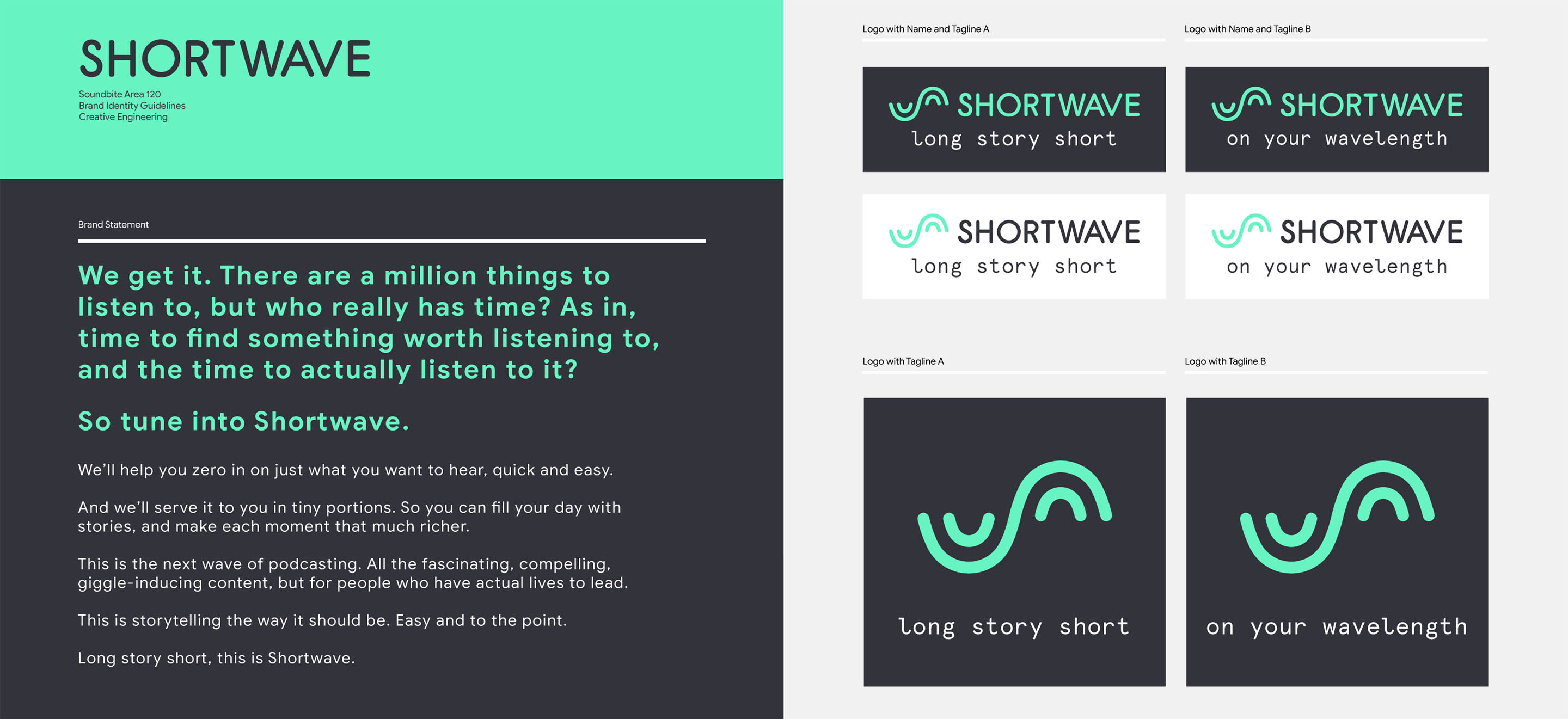
However, Google told 9to5 Google in a statement that the documents are from an exploratory concept and don’t represent the current project.
“The language here is a long-outdated artifact of early exploratory concept work, and not representative of the product now. In true Area 120 fashion, teams are constantly experimenting and iterating, so unfortunately, the Shortwave team has long ‘waved’ goodbye to this approach,” said the Google spokesperson.
Despite this, the description of Shortwave provided by the design documents fits with Google’s recent moves.
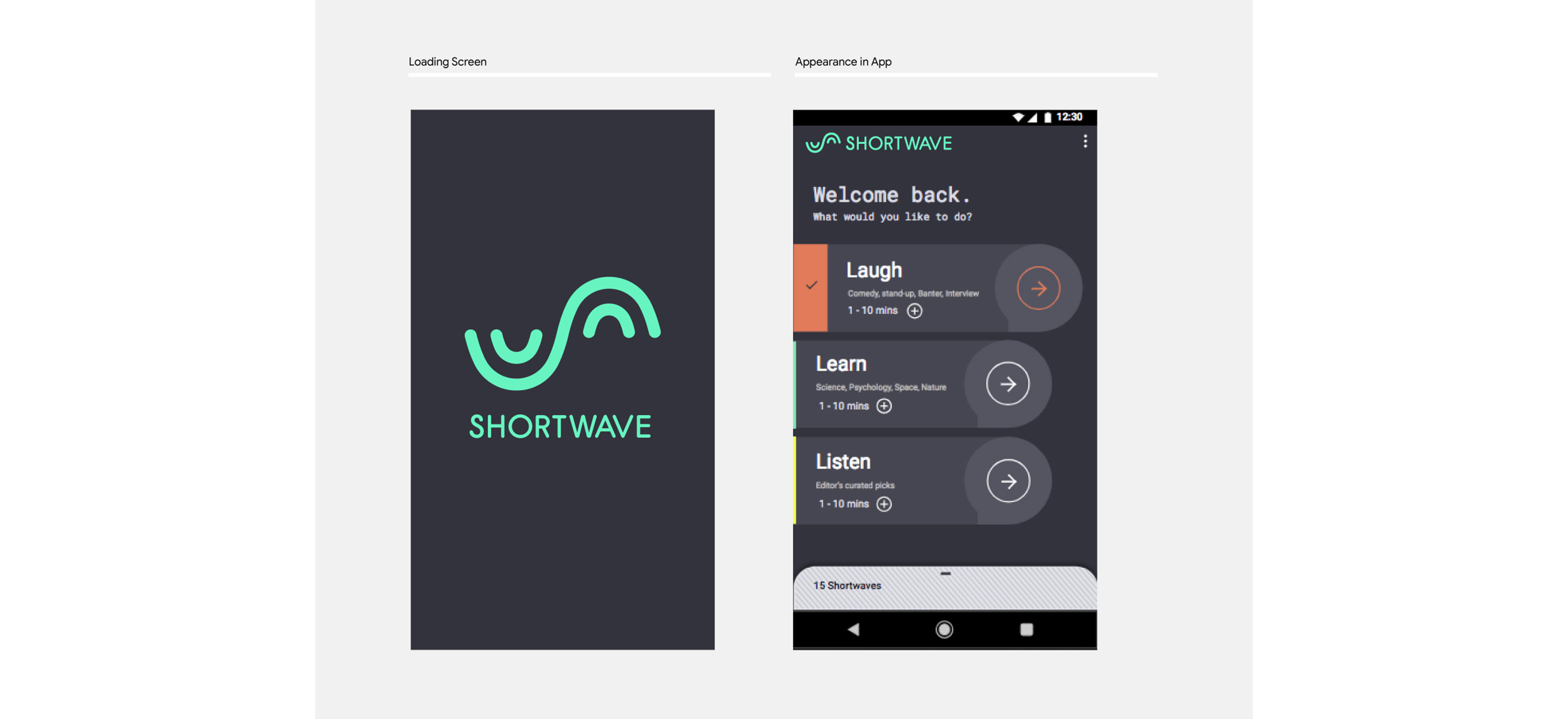
The document describes Shortwave as a solution to the issue of having too much to listen to. This indicates the app would somehow curate podcasts and distill them into short segments.
The design mockups, for example, show three sections labelled ‘Laugh,’ ‘Learn’ and ‘Listen.’ Beneath these sections is a small drawer that looks like it can be dragged up. The drawer is labelled ’15 Shortwaves.’
The three main sections suggest a length of one to 10 minutes. Additionally, the ‘Listen’ segment indicates the app is curated by editors, while the other sections aren’t.
Considering Google’s push for artificial intelligence, Shortwave would likely accomplish this curation using AI.
AI curation would also help set Shortwave apart from other podcast apps, including Google’s own Podcasts app. Shortwave could also serve as a sort of testbed for the features before bringing them over to Podcasts.
Regardless, Google says these documents aren’t representative of what Shortwave currently is. I’m not too sure how much truth their is to this statement.
What Shortwave is trying to accomplish fits too well with Google’s penchant for AI tech.
Images: 9to5 Google
Source: 9to5 Google Via: Engadget, Android Police
The post Leaked documents hint at what Google’s ‘Shortwave’ podcast app could be appeared first on MobileSyrup.
Shadow DOM and Web Components are enabled by default in Firefox 63 and the Developer Tools are ready for them ! If you are using Web Components in your project, or want to experiment, download Nightly, and check out how we integrated these new technologies into the Inspector and Debugger 🙂
<template> elements, which are useful to create the internal Shadow DOM structure of a custom element, can now be inspected as you would inspect other types of nodes.
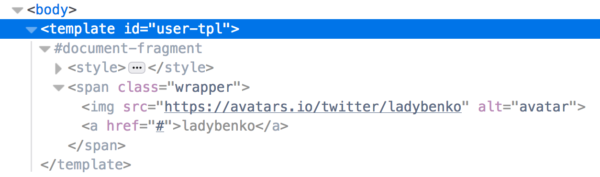
The Shadow DOM inside an element can also be inspected. Look for a #shadow-root node in the Inspector –and note that the mode (closed or open) it was created with is indicated as well.
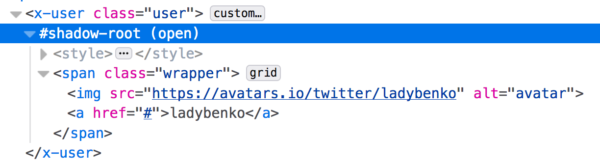
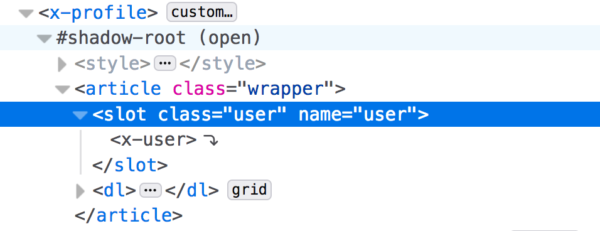
If your Shadow DOM contains slots, you can inspect those as well!
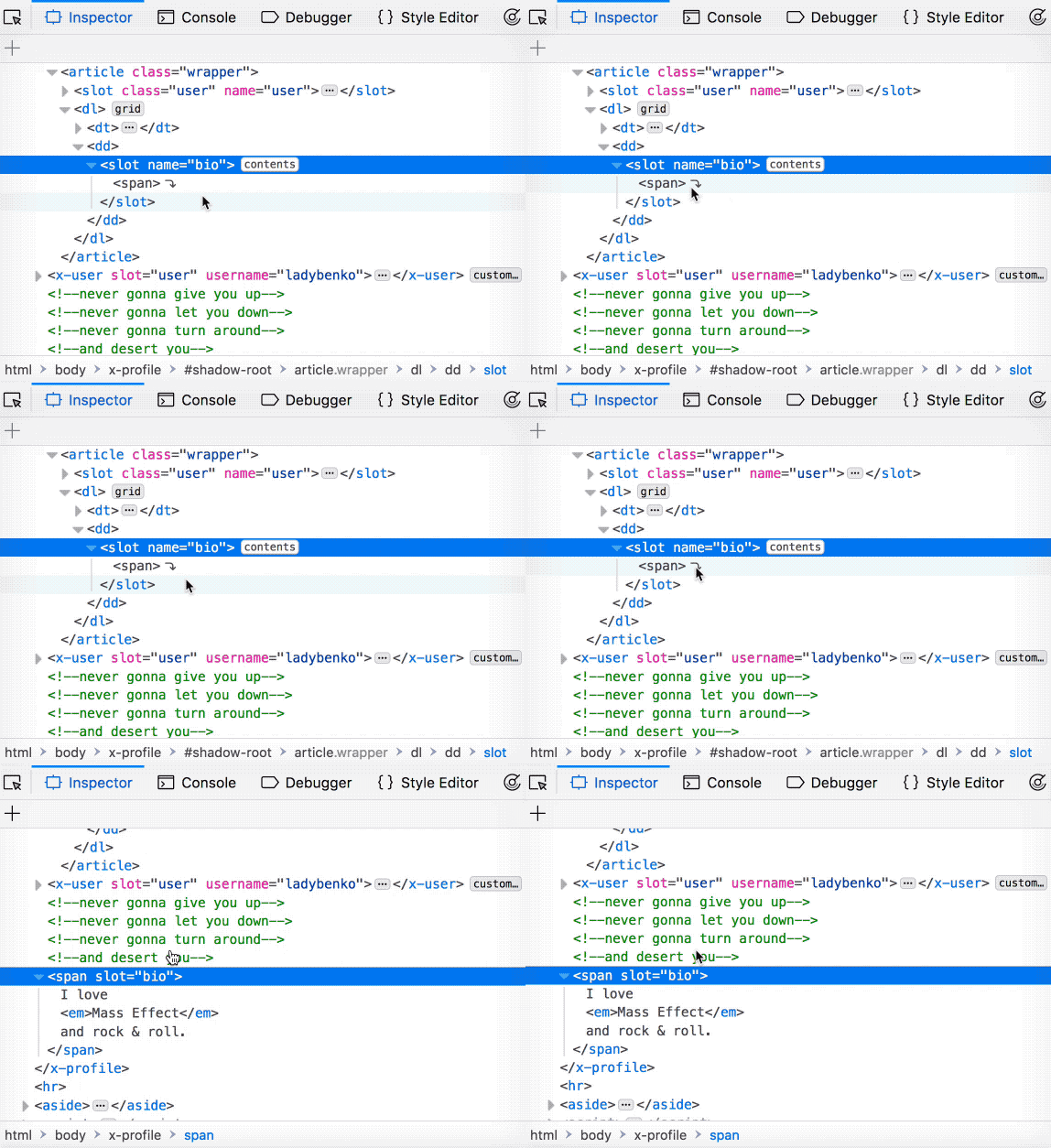
And as a nice bonus, if you click on the arrow icon on a slotted node, you will jump to the location of the original node:
And speaking of jumping, if you would like to jump from a custom element in the Inspector to its definition in the Debugger, you can do it by clicking the custom… badge besides the element:
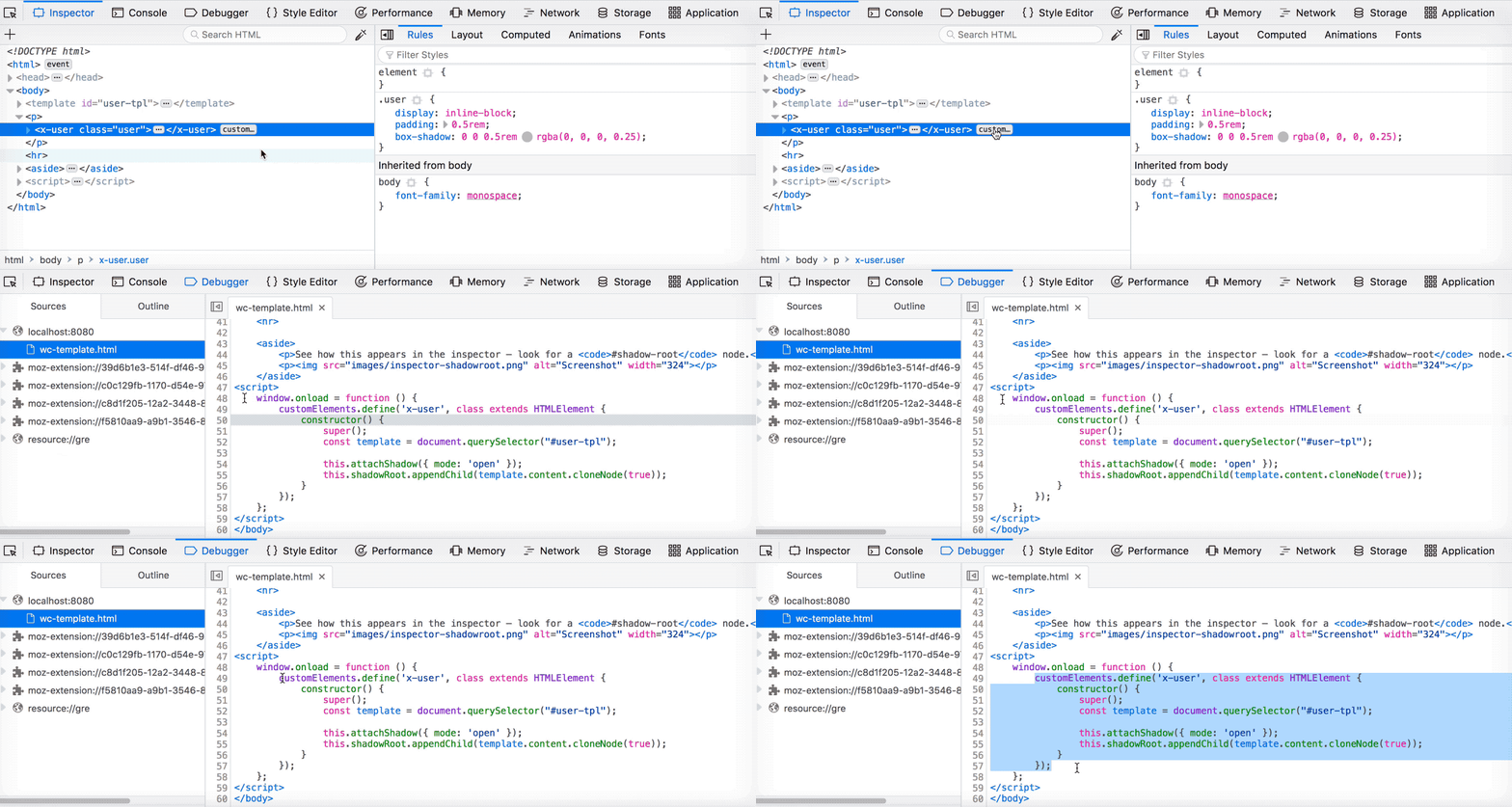
Lastly, you can see how the CSS cascade affects the Shadow DOM, modify styles, inspect the layout, etc. in the CSS pane on the right side of the Inspector.
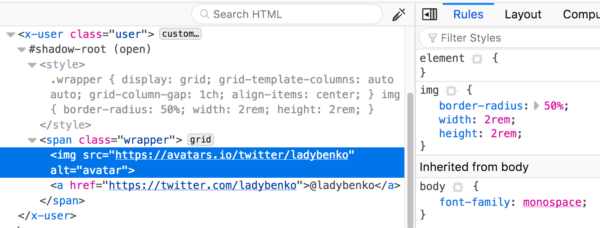
We hope that helps you with your Web Components work. As always, we are trying to improve the Developer Tools –you can peek at what is coming next here. And if you find a bug, or have some suggestions or feedback, you will be more than welcome to share them in DevTools’ Slack community or IRC channel.
Happy coding!
Here's something new for your lazy August September* morning: Retrobatch 1.1 is out.
What's new and awesome? Well, Retrobatch now has some great scripting goodness in the form of a new Automator action which will run a workflow for you (and create Automator droplets), a new JavaScript node*, and the ability to run Retrobatch workflows from the terminal.
We've added a handful of new nodes such as Dither, Auto Enhance, Instant Alpha, and Color Posterize. New options to existing nodes have also shown up, such as "Only scale smaller" for the Scale node.
And an interesting idea that I've had folks ask about a number of times- it's now possible to run an image through a machine learning classifier, and then have the classification written to metadata such as the image title, or keywords. This was done by adding token support to the Set Specific Metadata node. This also means you can use other tokens such as the Current Year in metadata fields. Awesome? We think so.
The full release notes are available, and if you have ideas or questions- make sure to poke around on the forums or write us: support@flyingmeat.com. We've got lots of ideas for future releases, but if you'd like something specific in there make sure to let us know.
Anthony Heddings,
How-To Geek,
Sept 19, 2018

It's funny to read that "YouTube’s live streaming support has gotten much better and is now a solid competitor to Twitch" but I guess it's true. I've been exploring the game-streaming world using YouTube with xSplit for the last few years. That's how I stream my talks. This article recommends an open source application called Open Broadcaster Software (OBS). Haven't used it; can't vouch for it, but the core idea here is that you use an application to capture the video feed and broadcast it to YouTube (or Twitch, or wherever) much the way a Digital Signal Porcessor (DSP) captures and sends audio signals for web radio. Twitch is probably blocked in your office (it is in mine) but this sort of technology has a bright future in e-learning.
Web: [Direct Link] [This Post]
David Raths,
Campus Technology,
Sept 21, 2018

When I'm thinking of 'making textbooks more interactive' these days I'm either thinking of using them to connect with a community, or to work with editable programs and live data, or both. But I think the idea of 'interactive' in this article takes us back to the days in the 1990s when 'interactive' meant 'you can push a button to play a video' or some such thing. Anyhow, all this 'interactivity' requires an Apple platform to operate. " iComp was created in Apple's iBooks Author, with tools such as Adobe's Premiere and After Effects used to enhance and edit video clips and Apple's Keynote used to create interactive widgets." :facepalm:
Web: [Direct Link] [This Post]
mkalus
shared this story
from  internetofshit on Twitter. internetofshit on Twitter.
|
We just bought a TV for the new house, having not owned a TV for a decade. This thing is seriously beautiful, but it takes like two minutes to boot. What did you assholes do?!
 stephentyrone
on Thursday, September 6th, 2018 8:05pm
stephentyrone
on Thursday, September 6th, 2018 8:05pm internetofshit
on Friday, September 7th, 2018 6:26am
internetofshit
on Friday, September 7th, 2018 6:26am
Android 9 Pie has barely arrived on the vast majority of mobile devices, but Google is already hard at work on Android Q.
This should come as no surprise, really. Development doesn’t stop just because a new Android version is released to the public.
According to XDA Developers, which spotted a new Android feature on the Android Open Source Project (AOSP) Gerrit, developers are reportedly working on a feature that would reduce ringtone volume when you’re holding the phone to your ear.
Gerrit is a collaborative tool for developers that allows them to share and work on code together.
The new feature’s codecommit was recently merged into the AOSP Gerrit, which means it’s destined for the next big Android update — likely Q.
Based on the description attached to the commit, it appears that Android Q-powered devices will use existing sensors — like proximity sensors — to determine whether a phone is held up to a user’s ear. If it is, the software will suppress the ringtone for incoming calls.
The reasoning is that there’s a chance a call may come through when users place the current call on hold. If the device is still held up to an individual’s ear, a loud ringtone could damage long-term hearing.
While an interesting addition to Android, I’m not sure how necessary this potential feature really is. Most people probably take their phone away from their ear so they can use the screen when a phone call is on hold. In that case, there’s little worry of a loud ring hurting your ear.
Still, some people will probably welcome the change, which will likely come with Android Q sometime next year.
Source: AOSP Gerrit Via: XDA Developers
The post Android Q feature reduces ringtone volume so you won’t hurt your ear appeared first on MobileSyrup.
Hilary Parker and I just released part 2 of our book club discussion of Nigel Cross’s book Design Thinking and it centers around a profile of designer Gordan Murray, who spent his career designing Formula One race cars. One of the aspects of his job as a designer is taking a “systems approach” to solving problems. Coupled with that approach is his role in balancing the various priorities of members of his team. He describes himself as both dictator and diplomat in doing this aspect of the job.
When designing a complex object like a race car, there will be many people contributing who have specific expertise. It is their job to focus on what they think is the highest priority, but it is the designer’s job to put the whole car together and, on the way, raise some priorities and lower other priorities. The designer is at the center of activity and must have good relationships with every member of the team in order for everything to come together on time and on budget.
A mentor once told me that in any large-ish coordinated scientific collaboration there will usually be regular meetings to discuss the data collection, data analysis, or both. Basically, a meeting to discuss data. And that these meetings, over time, tend to become the most important and influential meetings of the entire collaboration. It makes sense: Science is ultimately about the data and any productivity that results from the collaboration will be a function of the data collected. My mentor’s implication was that as a statistician directing the analyses of the group, these data meetings were an important place to be.
I have been in a few collaborations of this nature (both small and large) and can echo the advice that I got. The data-related meetings tend to be the most interesting and often are where people get most animated and excited. For scientific collaborations, that is in fact where the “action” occurs. As a result, it’s important that the data analyst running the analyses know what their job is.
If these meetings are about data analysis, then it’s important to realize that the product that the group is developing is the data analysis. As such, the data analyst should play the role of designer. Too often, I see analysts playing a minor role in these kinds of meetings because it’s their job to “just run the models”. Usually, this is not their fault. Meetings like this tend to be populated with large egos, high-level professors, principal investigators, and the like. The data analyst is often a staff member for the team or a junior faculty, so comparatively “low ranked”. It can be difficult to even speak up in these meetings, much less direct them.
However, I think it’s essential that the data analyst be at the center of a meeting about data analysis. The reason is simply that they are in the best position to balance the priorities of the collaboration. Because they are closest to the data, they have the best sense of what information and evidence exists in the data and, perhaps more importantly, what is not available in the data. Investigators will often have assumptions about what might be possible and perhaps what they would like to achieve, but these things may or may not be supported by the data.
It’s common that different investigators have very different priorities. One investigator wants to publish a paper as quickly as possible (perhaps they are a junior faculty that needs to publish papers or they know there is a competitor doing the same research). Another wants to run lots of models and explore the data more. Yet another thinks that there’s nothing worth publishing here and yet another wants to wait and collect more data. And there’s always one investigator who wants to “rethink the entire scientific question”. There’s no one thing to be done here, but the analyst is often the only one who can mediate all these conflicts.
What happens in these situations is a kind of “statistical horse trading”. You want a paper published quickly? Then we’ll have to use this really fast method that requires stronger assumptions and therefore weakens the conclusions. If you want to collect more data, maybe we design the analytic pipeline in such manner that we can analyze what we have now and then easily incorporate the new data when it arrives. If there’s no time or money for getting more data, we can use this other model that attempts to use a proxy for that data (again, more assumptions, but maybe reasonable ones).
Managing these types of negotiations can be difficult because people naturally want to have “all the things”. The data analyst has to figure out the relative ordering of priorities from the various parties involved. There’s no magical one-liner that you can say to convince people of what to do. It’s an iterative process with lots of discussion and trust-building. Frankly, it doesn’t always work.
The analyst, as the designer of the ultimate product, the data analysis, must think of solutions that can balance all the priorities in different ways. There isn’t always a solution that threads the needle and makes everyone happy or satisfied. But a well-functioning team can recognize that and move forward with an analysis and produce something useful.
Vox: Read the full transcript of Obama’s fiery anti-Trump speech. “This is not normal.”
“People ask me, what are you going to do for the election? No, the question is what are you going to do? You’re the antidote. Your participation and your spirit and your determination, not just in this election, but in every subsequent election and in the days between elections. Because in the end, the threat to our democracy doesn’t just come from Donald Trump or the current batch of Republicans in Congress or the Koch brothers and their lobbyists or too much compromise from Democrats or Russian hacking. The biggest threat to our democracy is indifference. The biggest threat to our democracy is cynicism.
Cynicism led too many people to turn away from politics and stay home on Election Day. To all the young people who are here today, there are now more eligible voters in your generation than in any other, which means your generation now has more power than anybody to change things. If you want it, you can make sure America gets out of its current funk. If you actually care about it, you have the power to make sure what we see is a brighter future. But to exercise that clout, to exercise that power, you have to show up. […] This whole project of self-government only works if everybody’s doing their part. Don’t tell me your vote doesn’t matter. “
Link via MetaFilter.
Each week, I gather a wide variety of links to education and education technology articles. All this feeds the mammoth review I write each December on the stories we are told about the future of education. I’ve probably missed a few of those stories this week as I am on vacation. But look how dutiful I am, still writing this list of shitty things that keep happening despite all the warnings I give.

US Secretary of Education Betsy DeVos is one of the various administration officials who insists she is not the author of anonymous op-ed in the The New York Times criticizing President Trump. But come on. No one actually thought it was her, right?
Via Vanity Fair: “‘I’m Tired of America Wasting Our Blood and Treasure’: The Strange Ascent of Betsy DeVos and Erik Prince.”
Speaking of terrible people with too much power, there’s this gem from Mediaite: “Clarence Thomas’ Wife Hired Ex-TPUSA Staffer Known For Saying ‘I Hate Blacks’.”
Via The Chronicle of Higher Education: “Scholars Describe ‘Incalculable Loss’ as Museum in Brazil Goes Up in Flames.”
NPR asks, “Whatever Happened To… The Millennials Who Started A School For Boko Haram Escapees?”

Via The New York Times: “California Lawmakers Pass Nation’s Toughest Net Neutrality Law.”
Chalkbeat with some news from Chicago: “What Mayor Rahm Emanuel’s decision to not seek re-election means for schools.”
Chalkbeat with some news from NYC: Schools chancellor Richard “Carranza is ready to approve an integration plan for Brooklyn middle schools. Here’s a guide to the potential changes.”
And Chalkbeat with the NYC data: “Find out what your New York City school spends per student.”
“Are your school’s employees armed?” asks the Argus Leader. “For some S.D. parents, the answer is unclear.” (S.D. is South Dakota.)
Via Chalkbeat: “Chicago Schools’ background checks send many teachers into limbo just as school sets to open.”
Via The Wall Street Journal: “China Protest Over Cash-Strapped City’s School Plan Turns Violent.” The city in question: Leiyang. The plan: forcing some students to attend private schools.
Via NPR: “Catholic Schools And Parents Grapple With Whether To Address Abuse Report.”
Edsurge writes about “How Crowdfunding Is Matching Teacher Requests to District Tech Policies.” Personally, I’d say we should rethink how taxes support schools and how democratic practices support policies rather than being guided by these private entities and their evangelists.

Via The Texas Tribune: “Texas won’t pay to educate migrant kids in shelters. Now two charter schools are scrambling.” (The schools are located inside shelters.)
Via Inside Higher Ed: “Judge Keeps DACA in Place.”
Via ProPublica: “As Months Pass in Chicago Shelters, Immigrant Children Contemplate Escape, Even Suicide.”

Via Inside Higher Ed: “Reports: Free College Programs Don’t Benefit Low-Income Students.”

Via Edsurge: “Purdue Global Drops Requirement That Professors Sign Nondisclosure Agreements.”
Via Inside Higher Ed: “The Federal Trade Commission has reached agreements to shut down several copycat military websites that targeted people looking to join the armed services and then used their personal information to market for-profit colleges, the commission announced Thursday.”
A working paper from NBER on for-profit higher ed, by Charlie Eaton, Sabrina Howell, and Constantine Yannelis: “When Investor Incentives and Consumer Interests Diverge: Private Equity in Higher Education.”
There’s another NBER working paper in the “labor and management” section above. And there’s more research on the effects of attending a for-profit college on one’s future earnings down in the “research” section below.

“Elon Musk’s secretive LA private school doesn’t just teach spelling and math -- it also asks students ethics and critical thinking puzzles you usually don’t see elsewhere,” says Business Insider. I bet you didn’t know that ethics and critical thinking are not taught anywhere else but in an elite private school founded by a guy who likes LSD and science fiction. Apparently this curriculum comes from ClassDojo, which screams something about “ethics,” I reckon.
Edsurge writes about e-scooters, one of the “hot new trends” out of Silicon Valley, and how these companies are defying the rules of college campuses in order to build up a new customer base there.
“Today’s College Students Aren’t Who You Think They Are,” says NPR.
Via Buzzfeed: “Most Fraternities Are Banning Hard Alcohol In Response To A Series Of Drinking-Related Deaths.”
Via Inside Higher Ed: “New Jersey 2-Year Colleges Pursue Merger.” That is, Cumberland County College and Rowan College at Gloucester County.
Also via Chalkbeat: “Newark charter school faces firestorm after kicking out students for dress code violations.”

Via The New York Times: “Wander the Halls, Say Hello: A New Approach to School Safety.”
There’s a story about surveillance, school shootings, and suicide prevention in the Betteridge’s Law of Headlines section below.

The New York Times on the SHSAT: “The Test That Changed Their Lives.”
Via Inside Higher Ed: “The SAT Mess That’s Not Going Away.”
From the Khan Academy blog: “School district reports test scores rise with mastery learning on Khan Academy.”
Speaking of test prep, there’s more news from Princeton Review down in the “labor and management” section below.

Via The Chronicle of Higher Education: “College of the Ozarks Drops Nike for Using Colin Kaepernick in Ad Campaign.”

Via The Guardian: “How I survive: American teachers and their second jobs – a photo essay.” See also: how a small number of young white women teachers make money as Instagram stars. Story above.
Edsurge has a new guide on the ed-tech job market, with articles including “Diversity in Hiring Doesn’t Start With Hiring” and “Optimizing Your LinkedIn Profile for Your Edtech Job Hunt.” Not clear who’s sponsoring this narrative…
Via Inside Higher Ed: “Is having a chief diversity officer linked to significant gains in faculty diversity? Not really, says a new working paper published by the National Bureau of Economic Research.”
“What Is Missing From Our Curricula?” asks Edsurge – work-based learning, apparently. Honestly, I would have gone with “anti-racist history and literature” or “civics,” but that’s me.
Oh. My. God. Speaking of Edsurge, spot the misinformation and disinformation and invented history in this article on coding bootcamps.
Via EdWeek Market Brief: “Princeton Review Weathers Layoffs, Changes in Test-Prep Market.”
Nope.

Via The New York Times: “The Hot College Gig: Online Brand Promoter.”
Via e-Literate: “Expansion of OPM-Derivative Model: Disney covers online degrees for hourly employees through Guild Education.”

“Could Monitoring Students on Social Media Stop the Next School Shooting?” asks The New York Times.
“Do Corporate-Style NDAs Have a Place in Higher Ed?” asks The Chronicle of Higher Education.
“College students say they want a degree for a job. Are they getting what they want?” asks Jeffrey Selingo.
“Is NYTimes Correct That College Students Don’t Read Books?” asks Joshua Kim.
(Reminder: according to Betteridge’s Law of Headlines, “Any headline that ends in a question mark can be answered by the word no.”)

Via Buzzfeed: “Teachers Are Moonlighting As Instagram Influencers To Make Ends Meet.” I have many thoughts on this, and if I wasn’t on vacation right now, you would hear an earful. There’s a related story on teachers’ second jobs – none of whom are raking in $200K a year like these Instagram stars, mind you – down in the “labor and management” section below.
Speaking of Instagram, The Verge says that “Instagram launches a new parent portal to help them talk to their kids about online life.” I hope parents have fun talking about their teachers’ online lives on Insta.
It’s time for the back-to-school articles touting this-and-that ed-tech trends. Via Edsurge: “10 Inspired Tech Trends Every Teacher Should Know About.” Via the Getting Smart blog: “What Do Broad EdTech Trends Mean for Your School District?”
“What is Blockchain and How Can it be Used in Education?” asks MDR Education. Let me tell you (although this doesn’t seem to be what the article says): it’s a hype machine baked with a hot molten core of alt-right ideology and anti-Semitism. How can it be used? Well, by con artists, I reckon, it can be used quite deftly for any number of techno-magical things.
“Hearables are hear to stay in learning – podcasts, learning, language learning, tutoring, spaced-practice and cheating in exams!” according to Donald Clark.
Via Techcrunch: “Amazon launches kid-friendly FreeTime service in Spanish.” “Kid-friendly.”
“How Do We Know If Technology Is the Solution or the Problem?” asks Edsurge. Related, from IHE’s Joshua Kim: “What If Digital Is Antithetical to Learning?” JFC. “I am part of the resistance inside the ed-tech industry” or something like that.
A dispatch from Techcrunch’s “Disrupt SF” conference: e-cigarette maker “Juul says it will use technology to help you quit e-cigarettes, too.” LOL. Please tell me there’s a “mindfulness” curriculum component too.
Via Pacific Standard: “The Future of Podcasting Is Educational.”
Via Publishers Weekly: “Penguin Random House Changes Library E-book Lending Terms.”
The Prof Hacker blog is leaving its current URL at The Chronicle of Higher Education and will be indie once again.

“Kadho debuts Kidsense A.I., offline speech-recognition tech that understand kids,” Techcrunch claims.
Via Wired: “This Hyper-Real Robot Will Cry and Bleed on Med Students.”
Via Edsurge: “Applying Artificial Intelligence to the Search for EdTech: An SRI-EdSurge Collaboration.”
Donald Clark makes the case for chatbots in education being a “gamechanger in learning.” I mean, we’re well into Year 50 of chatbots in education, so I’m sure the game will be changed any day now.

Via Chalkbeat: “Mark Zuckerberg’s education giving so far has topped $300 million. Here’s a list of where it’s going.” (I will update my list of CZI investments accordingly.)
Via Inside Philanthropy: “‘Local Context.’ The New Gates K–12 Strategy is Coming Into Sharper Focus.” I’m sure it’s a good strategy this time.

I’m not sure I’ll include this investment in my monthly calculations of ed-tech funding, since I’m not sure how educational this really is. But it’s fairly close to being framed as such, so here it is: Roblox, “which allows kids to create 3D worlds and games” per Techcrunch, has raised $150 million in Series F funding from Index Ventures, First Round Capital, Greylock Partners, Tiger Global Management, Meritech Capital Partners, and Altos Ventures. The company has raised $251.6 million total.
I’m also never sure whether or not to include investment in private schools in my ed-tech calculations. Regardless, Sanyu Education just raised $250 million for its private chain of kindergartens from Legend Holdings.
MasterClass has raised $80 million from IVP, Javelin Ventures, NEA, Advancit Capital, Atomico, and Evolution Media. The company, which offers online courses “taught” by celebrities, has raised $136.4 million total.
Makeblock has raised $44 million from CICC ALPHA, Yuexiu Industrial Investment Fund, GX Capital, and Everest Capital. The educational robotics company has raised $79.9 million total.
Open Assessment Technologies has raised an undisclosed amount of money from ACT, whose CEO tells Edsurge “Besides just being an assessment company, we’re also becoming a learning and navigation company.” Oh.
Carnegie Learning has raised an undisclosed amount of funding from the private equity firm CIP Capital. It will merge with New Mountain Learning, already owned by CIP Capital, but keep the Carnegie Learning brand name, because brand name.
VitalSource has acquired Acrobatiq.
Via Reuters: “Brazilian learning systems company Arco Platform should raise up to $200 million in an initial public offering on Nasdaq expected in September, one source with knowledge of the matter said on Friday.”

Well, let’s all be sure to look forward to IBM’s work on “personalizing education” with this story from The Intercept in mind: “IBM Used NYPD Surveillance Footage to Develop Technology That Lets Police Search by Skin Color.”
There’s a story about surveillance, school shootings, and suicide prevention in the Betteridge’s Law of Headlines section above.
Via The Register: “Victoria’s educational apps-for-students let creeps contact kids.” That’s the Victorian Department of Education in Australia.

Via funding.hackeducation.com: “The Business of Ed-Tech: August 2018 Funding Data.”
There’s more “research” on free college up in the “free college” section above. There’s more “research” on how Khan Academy improves test scores up in the “testing” section above. There’s more research on for-profit higher ed in the for-profit higher ed section above.
Via Inside Higher Ed: “Attending a for-profit college widens the earnings gap between rich and poor students, new research finds. Enrolling at a selective college does the opposite.”
Via Edsurge: “Report: ‘Colleges Need to Better Inform Students of Tradeoffs Between Working and Learning’.”
Via Inside Higher Ed: “Marijuana Use Still High Among College Students.”
Via the ACLU: “Federal Data Shows Public Schools Nationwide Are a Hotbed of Racial Injustice.” A hotbed of racial injustice, surveillance technologies, e-cigarettes and accompanying mindfulness curriculum, and e-scooters. God bless ed-tech.
Icon credits: The Noun Project
Dan Meyer,
dy/dan,
Sept 21, 2018

"Conceptual understanding refers to an integrated and functional grasp of mathematical ideas" of of the ideas underlying a discipline in general. You could not be said to 'know' a discipline unless you have conceptual understanding. Yet, as discussed here (and here, and here) the idea that students should just learn formulae by rote appears over and over again. "There must be something deeply attractive about the idea that children’s math success can simply be forced upon them," writes Emma Gargroetzi.
Web: [Direct Link] [This Post]

