My knowledge of bitcoin is basic. I’m no expert on extortion, either. But Google is convinced I’m an authority on Bitcoin blackmail. This has made me wonder when crowds are, in fact, smarter than individuals. On April 10, I posted about the letter I received suggesting I should pay $8,350 in Bitcoin or have my secrets … Continued
Airfoil for Windows just got another big update, to version 5.6. This update brings support for the new AirPlay-2 compatible 7.8 firmware for Apple’s AirPort Express.
There’s bigger news than that, however. With this update, Airfoil for Windows can now stream audio to all of Sonos’s AirPlay-compatible devices. That means Airfoil can now help stream audio to even more devices. Whatever mix of AirPlay, Bluetooth, and Chromecast devices you have, Airfoil can help you stream audio to all of them at once.
Sonos’s current lineup of compatible AirPlay Hardware
Currently, Sonos’s AirPlay-compatible hardware lineup is the Sonos One, Beam, Playbase, and second-generation Play:5. Of note for Sonos users with older hardware, you need just a single AirPlay-compatible Sonos device to enjoy audio on your entire Sonos system! For full details, see the instructions on this page.
Even More Compatible Devices Coming Soon
With their recent update, Sonos became the first third-party vendor to ship AirPlay 2 compatible speakers, but they won’t be the last. Indeed, updates from Denon, Marantz, and others are now available, and there are many more AirPlay 2 devices coming soon. Much of this hardware is already available for purchase, and firmware updates to enable AirPlay on these devices are due at various points later this year.
More compatible outputs coming soon!
Like the Sonos hardware, these devices are also compatible with Airfoil once their firmware is updated. We’re excited for Airfoil to power audio streaming to even more great hardware!
Get Airfoil for Windows 5.6 Now
With today’s update, Airfoil for Windows supports more outputs than ever before. If you’re new to Airfoil, learn more on its product page. You can download the free trial, then purchase right through our store.
Owners of Airfoil for Windows 5 can update to version 5.6 free of charge, by selecting “Check for Update” from the Airfoil menu. Owners of older versions of Airfoil for Windows are still eligible to upgrade to version 5 at a great discount.
Logo used for education and illustrative purposes. This is not an official publication and I am not an agent of the OLA.
I’ve been lax in preparing this update as I had to travel for work in August and I wasn’t expecting anything of substance to happen until the Legislative Assembly reconvened around September 24.
I was wrong about that, but that’ll be a subject for a subsequent update. For now let’s focus on what the Ontario Legislative Assembly did in the two weeks (7 meeting days) it pursued its business in August.
We left off with the Government in a snit about who may have said what and the Opposition trying gamely to carry on but I found no one bothering to bring it up again on August 1st so I guess the matter must have been settled out of the chamber. So let’s talk about Bills.
Bills 6, 7, 8, 10, 12, and 13 have all stalled at First Reading. The Government didn’t move forward on the post of Poet Laureate, regulating gas prices, publishing large health care salaries, making firefighter training safer, closing an employment standards loophole for the auto sector, and imposing minimum standards of daily care for Long-Term Care Homes.
Bill 9 and 11 were referred to committee, so PTSD Awareness Day and regulations requiring that movable soccer goals be firmly attached to the ground should go ahead in a timely fashion, once committees have a chance to meet.
Also of marginal note are Bills 14 through 23, 25 through 27, and 29. All of these bills are about counting the invasive Zebra Mussel populations in Ontario waterways, handfuls of waterways in each bill.
The Second Reading hasn’t completed and the debate is ongoing. The terms of the debate seem to be:
Opposition: “Climate Change is real. Cap and Trade sucks, but it’s better than the nothing the Government aims to replace it with.”
Government: “We agree that Climate Change is real. Cap and Trade is worse than nothing since it grants large polluters free passes and harms people who drive.”
Despite the Speaker asking for the debate to adjourn after 6 and a half hours (!!) across all the days of debate, the PC Minister for Education Thompson asks that the debate continue.
Which is peculiar to me. If cap-and-trade is so bad, why aren’t they just ramming it through legislature without debate? They have a majority, they can just do it. I mean, look at the omnibus Bill 2 which was proposed and passed in a little over a week.
On the final day before recess, and a scant two months and one week before election day in Toronto, Bill 3 carried on division and received Royal Assent. This reduced the number of Toronto City Wards down from 47 to 25.
There was an immediate court challenge that attacked the bill on a couple of fronts. The first was that the previous law said no amendments or changes were to be made without public consultation (which in this case was not done). The NDP was quick to point out that the Government was quick to bring up lack of sufficient consultation in terms of the sex-ed curriculum (we’ll get there) to which the Government rejoined that the NDP was only whining because they stood to lose some councillors in the election. The second was that it infringed the Charter of Rights and Freedoms both for the Right to Free Expression of the candidates currently trying to be elected and for the Right to Representation of the electorate, whose individual votes suddenly decreased in weight.
Didn’t realize Toronto City Councillors had party affiliation. Interesting.
I’ll devote a whole post to the snafu that came out of this, but for now it’ll suffice to note the Government position that this will save money and make Toronto city governance more efficient, and NDP position was that it was a vindictive personal attack by the Premier and would have neither of those effects.
Establish a research commission to advise the government annually about how to adjust the rates of provincial financial assistance from the Ontario Works Act and ODSP based on the cost of living in different geographical regions of Ontario.
I like that, of members in the the commission, at least one must be or must have been receiving “basic financial assistnace” under OWA, and another must be or must have been receiving ODSP. I’d have gone for two of each, making “people who know what it’s like” a smooth four out of the nine spots… but I guess we want more space for economists in there, too. Seems like standard governmental business, so long as the geographical regions end up being broad enough that this can’t be used to funnel money away from or towards specific ridings.
First reading carried on August 9. I don’t expect too much motion on this too quickly, going by the speed of other Bills.
Allow owners of agricultural land to set aside parts of their land to lie fallow and return to a natural state, or to act as a windbreak or other natural feature.
Not sure why we need legislation to allow farmers to not farm their land. Maybe this way it doesn’t exempt them from some sort of tax benefit proportional to the number of acres of agricultural land they farm?
First reading carried on August 13. I don’t expect too much motion on this too quickly, going by the speed of other Bills.
Allows municipalities to prohibit sale or delivery of handgun ammunition within municipal limits.
Not sure whether this is a good idea. Prohibition can lead to bootlegging, if the supply is easy enough to come by. If this is supposed to reduce overall ammunition purchasing I’d have thought a better mechanism would be taxing the sale as a vice (like tobacco).
First reading carried on August 14.
Sex-ed Curriculum
Without needing a bill the Government through the Ministry of Education required the teaching of the 1998 Health Curriculum (partially revised in 2010) in all public and catholic elementary and middle schools starting this September.
I’ve read some of the reissued curriculum. It isn’t bad, but it doesn’t contain the word “consent”, and the mentions of the word “Internet” are mostly using it as an informational resource (like CDs and DVDs) with one mention of the dangers of being predated upon and one mention of privacy and security concerns. The solution to the dangers of the Internet in the curriculum is to always tell an adult “when you’re on the Internet”.
Because in the early 2000s it was possible to not be on the Internet all the time.
These aspects concern me, as does the invitation from the Government for parents to snitch on teachers found to be teaching the 2015 curriculum instead. I was going to talk to my daughter’s teacher about how he was going to handle the situation but I couldn’t ask him to expose himself to the risk of other parents tattling on him to the Government.
I should remember to tell him that I would bring up any concerns I have with material with him first and with the principal second, to hopefully put his mind at ease about us… and I’ll see if I can get him to promise to teach the kids the meaning of consent. Y’know, in English class. Words have meanings.
Other Stuff
There’s a lot of other motions and business. Mr. Piccini wants more people to elect to be organ donors, Mr. Kramp wants a monument for the CAF’s sacrifices in the war in Afghanistan, Mr. Walker wants Ontario to use the Modified International Symbol of Access for new accessible parking spaces, Miss Taylor wants the Ontario basic income pilots to be uncancelled, …
It’s really surprising how many words get output by the Assembly each day it is in session, but how little actually gets done. Committees haven’t had a chance to more than determine their organization, let alone scribe proper copies of the bills referred to them.
All the time seems spent talking past each other in a large wood-panelled room, and the Government doing what they want at the speed they want it done. Which makes me question why I’m bothering to look into this. Why am I writing these thousands of words and spending time reading and watching and becoming ever more frustrated over matters over which my last influence was exerted in June?
I should look into what step comes after “Get informed”.
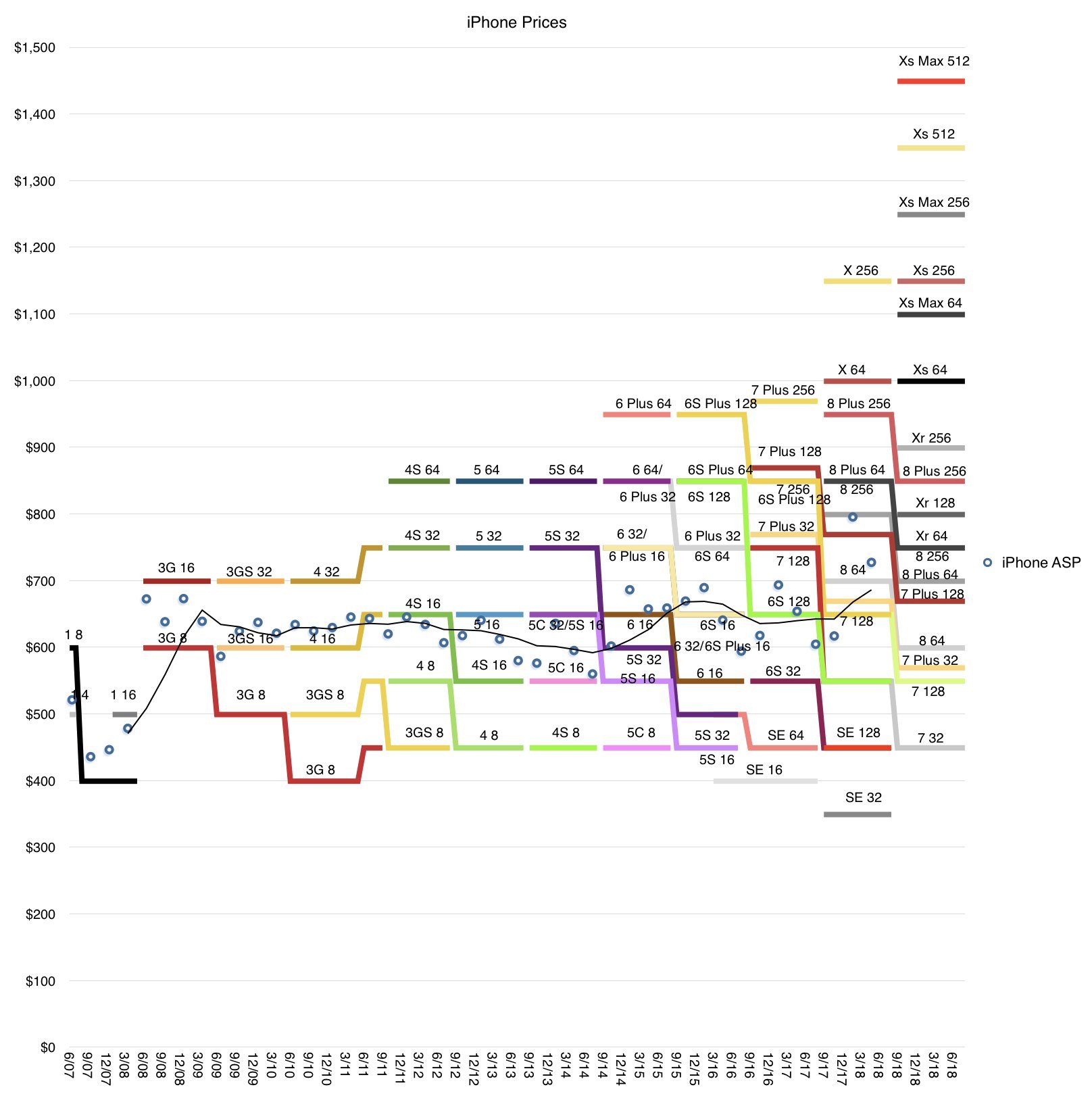
This is a brilliant chart by @asymco that shows where prices are heading. It shows how the Xs Max drives prices up to new heights, and it shows that iPhone 7, 8, and Xr can be relatively affordable, if you don't opt for the large storage option.
More and more, as Ethereum co-founder Gab Would says, we are seeing that "the internet today is broken by design." It is centralized, it is driven by "the greedy, the megalomaniacs, or the plain malicious," and it provides no defense against fake news, cyber-attacks and surveillance. Hence the need for what is being called web 3.0 (backed by a suite of applications called web3). "Web 3.0 is an inclusive set of protocols to provide building blocks for application makers," writes Would, " empowering users to act for themselves within low-barrier markets, we can ensure censorship and monopolization have fewer places to hide." Now maybe the new web won't quite be the "executable Magna Carta " Would says it will be. That seems a bit much. But it's certainly not going to continue in the model of Facebook and Twitter either.
At the current rate of installation, the City of Toronto is on track to complete its 10-year bicycle plan in 24 years --- by 2049 instead of 2025. (See our tracking chart here: Bike Plan Tracking Chart Sept 2018.) Considering the spate of deaths on the city's streets this summer, the city should be accelerating the installation of infrastructure to make our streets safer --- not dragging its feet.
Toronto’s 10-year plan includes a total of 335 centreline kilometres of bike lanes and boulevard level paths. The best case scenario for this year is the installation of about 13 kilometres of on-street cycling facilities. The Thorncliffe and Flemingdon Parks and York University projects – mainly along internal roads – make up almost half of this total.
There is some good news, including the filling of key gaps such as a 50-metre bi-directional cycle track on Dufferin St. – linking the Florence and Waterloo contraflow routes – and a 2.4 kilometre extension of the Eglinton West trail next to the Mississauga Transitway. A further 250-metre extension to the Etobicoke Creek Trail and the existing Eglinton trail in Mississauga is also expected this year, or early next year.
Eglinton West Trail next to Mississauga Transitway. Photo by Robert Zaichkowski.
In addition, construction has already started on protected bike lanes at the the Six Points intersection at Bloor, Dundas, and Kipling, with work to be completed by 2020. Finally, an 800-metre path along Unwin Ave. on the waterfront is to be completed by the end of the year; the final piece of the Martin Goodman Trail stretching from the Humber River to the eastern beaches.
Over 40 years after the waterfront trail was started the last gap is to be filled along Unwin Ave. this year. Photos by Albert Koehl.
The 13 kilometres of forecasted installations for this year would be an improvement over the 2016 and 2017 installations of seven and 10 kilometres respectively. However, the 30 kilometre total translates to only 6% of the 535 kilometres called for in the 2016-2025 bike plan or only 15% of Cycle Toronto’s 2014 Minimum Grid ask of 200 kilometres of protected bike lanes and bicycle boulevards.
Even if the installations from 2015 are included in our tally – including extensions to Richmond-Adelaide and Queen’s Quay – the total installations during the current city council term is unlikely to be more than 25% of the Minimum Grid ask. If that wasn’t bad enough, New York City installed 77 miles (124 kilometres) of bike lanes in 2017 alone including 25 miles (40 kilometres) of protected bike lanes. (See the below video by Ryerson University’s City Building Institute.)
This year’s most significant project – a 2.6 kilometre bike lane on Port Union Road from Kingston Road to the Waterfront – is being delayed, although it’s worth noting that project itself is motivated more by a planned road widening than cyclists’ safety. On Bloor Street, the Sherbourne to Church stretch was supposed to have bike lanes installed last year, but the City now says there will be a further delay to 2021 due to conflicts with other road work. During the City Council meeting in March, a decision on REimagaining Yonge from Sheppard to Finch Avenues – for which staff had recommended protected bike lanes – was deferred until after the election.
Fortunately, there is good news to report on other bicycle fronts. Bike Share Toronto has done a further expansion to 3,750 bikes and 360 stations with new stations added in the east end (Beaches, East York) and near Yonge and Eglinton. Toronto City Council also approved the start of a complete streets study on Danforth Avenue, which will hopefully bring us one step closer to bike lanes on Danforth.
In addition, City Council approved a $22 million increase in Vision Zero funding in response to the widespread media attention on vulnerable road user deaths. To date, 25 pedestrians and 4 cyclists have been killed (see Toronto Star collision map), while many more families have to deal with life-altering injuries to their loved ones. The three memorial rides in June alone sparked renewed calls for a real network of bike lanes in the city.
This funding increase includes the construction of ten “complete intersection” pilots, which we hope will mean protected intersections. To help build awareness of protected intersections, Cycle Toronto hosted a demonstration during Open Streets on August 19 and will be doing another demo on September 16.
Protected intersection demo at Open Streets. Image by Robert Zaichkowski.
With six weeks left until the election, we encourage people to ask their council candidates to support accelerating the bike plan, relaunching the major corridor studies put on hold and ensuring that local projects in their wards get built. The need is especially strong in areas outside the downtown where most traffic fatalities have taken place.
The challenge now is for cyclists is to build the necessary political support at city council, and to ensure that staff get the resources they need to build a grid of bike lanes.
Robert Zaichkowski is an accountant and a Board Member of Cycle Toronto.
Albert Koehl is an environmental lawyer and founder of Bells on Bloor.
At the tail end of our trip to Europe at the end of August, on the flight home, Oliver and I talked about the value of creating a list of what went well (so we can remember to do it again) and what didn’t (so we can avoid or work around it). We weren’t talking about macro issues, like “go back to Amsterdam again!” (which is a good idea in its own right), but rather things like “remember that you need to have €20 of balance on your Dutch transit chip card to be able to take the train.”
The idea mirrors the practice of we programmers to add comments to our code as a guide to others (and to our future selves): here be dragons, watch out for this pothole, this might seem like it won’t work, but it does. And so on.
So here’s the list from our trip.
Halifax Airport
Getting There
Every time I book air travel to Europe I thrash about trying to avoid driving to Halifax to save money (which is almost always possible because of cheaper flights from there as opposed to Charlottetown). And every time I end up giving up and booking a flight from Halifax. It turns out that the drive over and the drive back isn’t such a pain in the ass as I think it will be, and, especially on the return trip, serves as a kind of pleasant segue back into regular life. So, next time don’t sweat it.
The Quality Inn Halifax Airport is a dreadful looking tired old hotel with three great benefits: 14 days of free long-term parking with any reservation, very comfortable beds, and a quick and helpful airport shuttle; if you need parking, this is the place to stay. And don’t be put off by how the hotel looks from the outside.
At the Airport
Having loads of time at the airport is way, way better than not having loads of time. Arrive three hours before the flight and things will be much calmer.
After checking baggage and before security, if you have time to kill, head over the pedway to the lobby of the Alt Hotel: it’s much more pleasant there than anywhere else at the airport, has acceptable coffee, comfortable chairs, outlets for power devices, and clean washrooms.
Delay going airside until as late as possible, as there’s almost nowhere calm and peaceful once you pass security, especially in the international departures area.
Ask the triage agent at the entrance to security to use the special services lane: things will go much faster, and the agents there know to expect the unexpected.
Condor Transatlantic Flight
On the Airplane
The regular economy seating is very tight; Premium Economy might be worth it for this reason alone.
Purchasing the €9 “premium entertainment voucher,” either on-board or in advance, is a good idea; without it, the seat back entertainment system’s free offerings are just a couple of older movies and a lot of German documentaries about the cities that Condor serves.
The “premium food” is really just “special meals” by another name (vegetarian, etc.). No need to order it.
There’s USB power in the seat back, next to the video screen.
The morning snack offered just before landing isn’t substantial and you might want to take a little something extra to take the edge off.
Frankfurt Airport
Connections
Depending on the gate you arrive at, and the gate you’re departing from, you may unexpectedly have to clear security while in transit. There are resources online that can smooth the way if you know your starting point and destination; there was some suggestion that an A-B transfer through the “passenger tunnel” was a good way to bypass security, and this proved true for us on the return flight.
The security screening at Frankfurt uses the “stand in this awkward position for a few seconds” scanners, which can be challenging; request a physical search instead.
At the Airport
The airport will seem more chaotic than you think it will after a sleepless night flying from Canada; pace yourself, take breaks, find a quiet spot.
There are many areas in the airport that have so-called Silent Chairs, which screen out noise, and allow you to plug-in a headphone jack to your device to beam sound at yourself (and nobody else). They proved an excellent distraction and way to relax.
The Movie World, which seemed so promising, turned out to be filled with people flaked out and trying to sleep.
There are many, many places to eat and get good coffee; most of them are clustered in the hub of the hub-and-spoke terminals.
Almost every Lufthansa gate has a coffee machine that accepts credit cards and Euro coins if you’re in a pinch for coffee.
There’s free, fast wifi all through the airport.
Copenhagen Airport to Malmö
Transportation
There’s a bank of ticket machines to your left as you approach the entry to the trains that usually has much shorter lines.
The trains to Malmö leave from Track 1, the entrance to which isn’t immediately obvious: it’s the first entrance you come to, before you get to the forest of ticket machines.
The trains to Malmö aren’t necessarily labeled “Malmö,” as they may be continuing on to other destinations; look for Malmö in the tinier list of cities below the main destination on the video displays.
Getting off the train at the Triangeln station can make a lot of sense if your destination is in a neighbourhood farther from the downtown core.
There are two exits from Triangeln: the north (norra) exit, comes up in front of St. Johannes Church and the Triangeln shopping mall; the south (södra) exit comes up close to the hospital district and nearer Carl Gustafs väg; it’s also the closer exit to Möllevångstorget.
The easiest way, by far, to pay for public transit is with the Skånetrafiken mobile app: it’s well designed, can be connected to your overseas credit card, and has a built-in timetable. You can buy tickets right inside the app; you then “pay” by holding your phone on the scanners just inside the front door on buses (hold the phone horizontally up against the glass). There are older scanners for the stored value “Jojo” cards closer to the front of the bus; don’t use those for the app.
Transit works on the timed ticket system: your ticket entitles you to unlimited travel, in any mode, anywhere in the city, for an hour. You can even change directions and go back to where you came from.
Every bus we rode on had free on-board wifi.
Commerce
The practice at cafés, even if you order at the counter, is to order, sit, eat, then pay; generally it seems you can take a seat on your own, and expect a server to come around to take your order.
Some restaurants don’t take cash.
Old problems with overseas credit cards not being accepted appear to have been solved: my Mastercard was accepted everywhere, and usually with a “tap” not requiring a PIN.
Drewex is a good place for art supplies, stationery, etc. Mattonbutiken is also good (and is beside a hardware store).
Danish Trains
First Class
First class is worth the difference in cost (as long as it’s not exorbitant) for access to the lounge in Copenhagen (spartan, but quiet), and for the quiet seating and access to snacks. Seating was 2-1, and book two window seats facing each other in the “1” side is best.
Power and Wifi
There’s good free wifi in the station, and bad free wifi on the trains. First class seats have power points, but they are above you, and don’t easily hold a Mac power brick, so having an extension cord would help next time.
Connections
There’s no problem changing trains in Fredericia, even though the connection time looks tight: they’re waiting for you across the platform.
German Trains
First Class
First class is hit or miss: on a modern carriage it can be quiet pleasant, but on an older train you can be sandwiched into a compartment for six people, off a tight hallway, while those in second class are actually enjoying more room.
The first class DB Lounge isn’t Shangri-La, and it can be noisy, but there are good washrooms, access to coffee and drinks and a few snacks.
Power and Wifi
Sometimes there’s wifi on the train, sometimes there’s not.
Power points are down low, under or beside the seat.
On the Train
The snackbar car is fun to hang out it.
Berlin
Transportation
The S-Bahn leaves from the top floor of Berlin Hauptbahnhof, platforms 15 and 16. This isn’t immediately obvious.
Taking an intercity train from Berlin Ostbahnhof can be easier than from Hauptbahnhof: the Ostbahnhof station is smaller, less crowded, and is walking distance from Kreuzberg. If you’re going west, you might find that your train starts at Ostbahnhof anyway, meaning you’ll board earlier and be settled by the time the crowds descend at Hauptbahnhof.
The best bet for transit is to buy an A-B day pass for unlimited access to U-Bahn, S-Bahn, trams and buses in the A and B zones (which is likely anywhere you’ll be going).
Transit works on the honour system: there are no gates, you simply are required to demonstrate that you have a ticket if an inspector asks to see it.
There are ticket machines on most U-Bahn and S-Bahn platforms that accept credit cards and dispense single-use and day tickets.
Commerce
Credit card acceptance is less than elsewhere in Europe still, and cash will often be the only way to pay.
Modulor is the best stop for stationery, art supplies, and really almost anything.
Amersfoort
Transportation
The best bet for transit, both in Amersfoort and across the entire country, is to buy an “anonymous OV-chipkaart” from a machine in a bus or train station. This is a stored-value card that can be used on buses, trams and trains. The card itself costs money–€7,50 in summer 2018–and then you top it up with machines using a credit card.
The way you insert a credit card into the OV-chipkaart machines isn’t immediately obvious: there’s an unusual “slide in horizontally and then push forward” mechanism. You’ll get used to it.
To use an OV-chipkaart on a train requires a minimum €20 balance on the card; to use it on a bus or tram requires a minimum €4 balance; if you don’t have the minimum balance, scanners at the gates won’t let you in, and you will be very confused.
Transit works on the tap in, tap out system: you tap your card on a reader when you get on the bus (or when you enter the train station), and then tap your card again when you exit the bus or train station; your fare is then calculated based on your departure and arrival points, and value deducted from your card. If you are left with a negative balance, you can “top up” at a special machine made for this purpose beside the exit gates in the station.
It is possible to walk through Amersfoort station from one side to the other, but you need to “check in” at the machine on one side to “purchase” a free right to tap in and tap out in the same station. It’s weird, but it works.
Commerce
Pippos is a good place to get paper, pens, craft supplies, and similar items.
Frozen waffles appear to be unheard of in grocery stores.
Stroopwafels are not waffles as you know them: they are a sugary dessert item, not one you’d want to eat for breakfast.
Bagels with smoked salmon can be found at Bagels & Beans.
The little convenience shop inside the train station entry gate is a good place for a quick breakfast or refreshment; your credit card will work in the self-checkout machine.
Amsterdam
Transportation
Don’t assume that going to Central Station is the best way to come into the city; there are many interconnections between trains and the metro, and you can avoid crowds by looking for more direct routes.
There are bicycle rental shops almost everywhere; some of the larger ones offer cargo bikes and tandem bikes.
Commerce
The practice at cafés, even if you order at the counter, is to order, sit, eat, then pay; generally it seems you can take a seat on your own, and expect a server to come around to take your order.
Almost everywhere accepts credit cards, but a few cafés we visited were cash-only.
It’s quick and cheap to get to the airport by public transit.
Negotiating the way from the train station to the departure area can be tricky: the way is not well-signed, and you are starting from an area that looks more like a shopping mall. Stop, take a deep breath, and take it slow.
At the Airport
If you have a DPNA number (for “passenger with intellectual or behavioural impairments”), which you can get assigned by your airline’s medical office, you can visit an Assistance Desk in the airport (there are several, they are well-signed and well-staffed) and they will assign someone to accompany you through check-in and security. This can be a huge help for negotiating the way through the airport.
There isn’t much in the way of coffee or food once you pass through security to Schiphol’s “B” wing.
There’s free, fast wifi all through the airport.
There are coin- or credit-operated massage chairs in the “B” wing, just as you enter. They are only €2 for a good long massage, and Oliver enjoyed this.
Halifax Airport
Arrival
Making a list, on the airplane, of everything we purchased, along with its value in Canadian dollars, was a good idea, and was appreciated by the Border Services agent. Remember to get the current conversion rates before boarding the airplane to avoid a last minute panic.
There is a “Crew and Special Services” lane to the far left in the customs arrival hall; take that lane.
Getting Home
Staying overnight near the airport on returning from Europe is a no-brainer: you will be too tired, after a long day of getting to the airport in Europe and then spending 7 hours sitting on an airplane, to even think about driving back to PEI.
It’s a good idea to duck into Halifax for coffee and a good meal before driving home: getting into Halifax isn’t nearly as troublesome as you think it will be.
Stopping at the Cranewood Bakery in Sackville on the way home is a good idea; it seems crazy to stop when you’re on the final stretch home, but it means arrival home will be relaxed, not stressed.
Even if you’re well-rested the day after arriving home, you will be jet-lagged and more prone to forgetfulness even in your best hours; take heed, and make sure you remember your wallet, child, etc.
The simmering furore over birth tourism in the Vancouver region is heated by the assumption that the Chinese women flocking to deliver their little bundles of Canadian citizenship are somehow gaming the system.Even if they are complying with the letter of the law – which grants citizenship to anyone born in Canada, regardless of the status of the parents – the intent of the law, and the intent of officials in charge of Canada’s borders and immigration rules, must surely lie elsewhere when it…
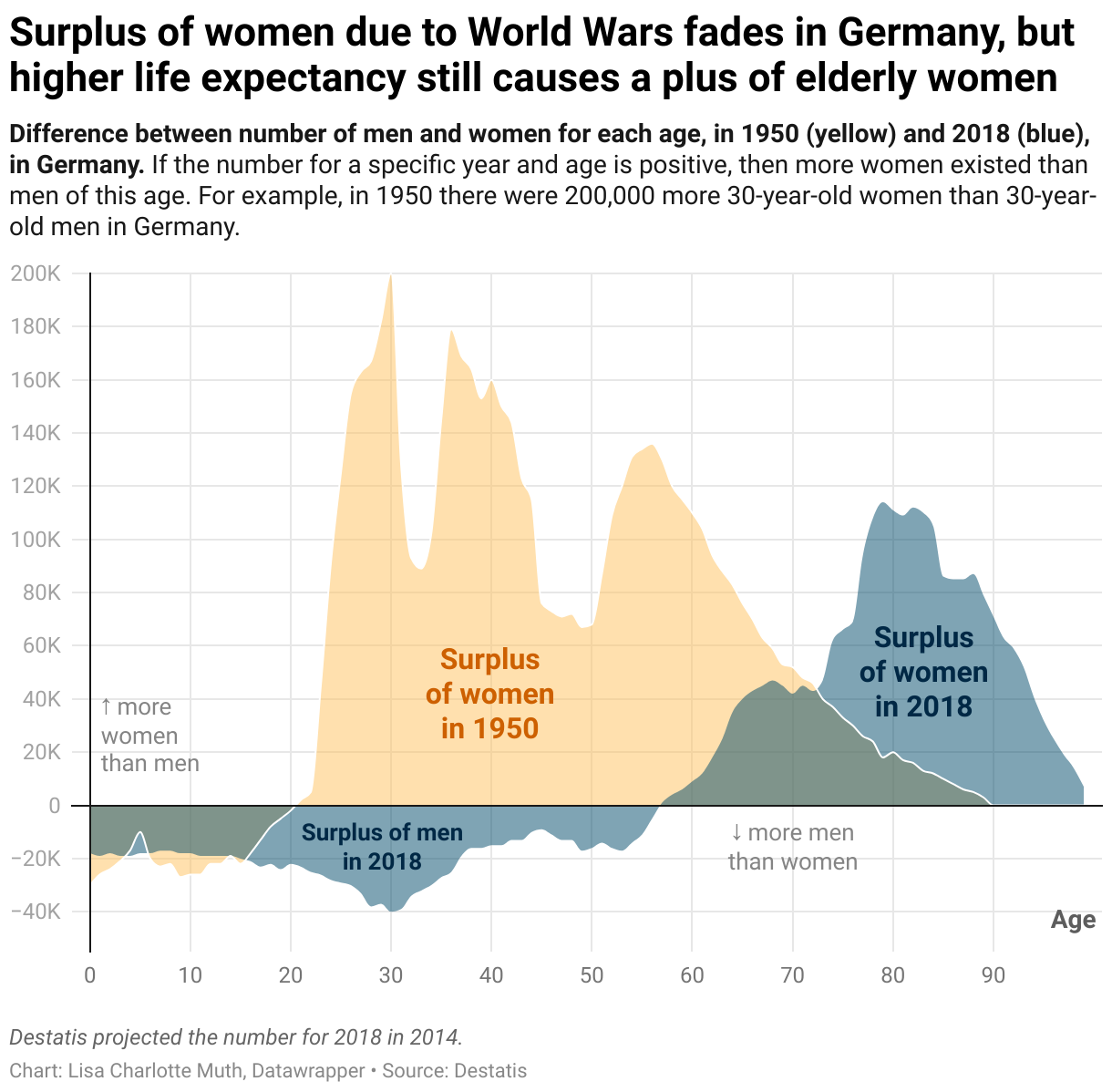
We can take away many things from this chart: For example there are more boys than girls born in Germany (and indeed everywhere). There is a big surplus of elderly women thanks to their higher life expectancy. It is also possible to see that women did not become as old in 1950 as they did in 2018. And since the blue area above zero is bigger than the blue area below zero, we can see that there are more women than men in Germany these days.
Chart Choices
Yesterday, I used the German population numbers to write a new Academy article on how to create a population pyramid with Datawrapper. A population pyramid always looks iconic, but it’s hard to actually compare its left and right side (the numbers of men and women) with each other.
But then I remembered a chapter of Tamara Munzner’s “Visualization Analysis & Design” about derived (calculated) data. And yes, of course, I’m mentioning this book to talk about the Data Vis Book Club again that happened yesterday, in which Tamara herself answered all our questions about this very book 😍. She writes in her book: “When you are faced with a dataset, you should always consider whether to simply use it as it is, or to transform it to another form.” So I did just that. I considered that I was interested in comparing the number of males and females in Germany in 2018 with each other. To do so, a population pyramid wasn’t the best choice. Instead, I calculated the difference; to make one number out of two. And since I only showed one number per age for 2018 instead of two, I had space in my visualization to compare this year with another one.
Edit: Here’s a GIF of the surplus between all years between 1950 and 2060:
If you’re interested in reading Tamara Munzner’s book, you can still join for the data vis book club about the second half of the book. We’ll decide on a date tomorrow – follow @datavisclub to hear it there first.
The web you thought you knew is getting ready for some major changes. "The proponents of the so-called decentralised web – or DWeb – want a new, better web where the entire planet’s population can communicate without having to rely on big companies that amass our data for profit and make it easier for governments to conduct surveillance." DWeb, or Web 3.0 (as it's also called in today's OLDaily) is coming. It's necessary. It has been building momentum for a couple of years now and is getting ready for prime time.
I will be offering a MOOC called "E-Learning 3.0" this fall, launching at the Global Online Learning Summit | Online Learning 2018 in mid-October. The course will explore some of the major themes underlying what has been called Web 3.0 or DWeb and how they will impact online learning. My focus, as always, is educational technology, but of course technology can only be discussed in terms of the social, cultural and economic environment in which it is applied. The page linked here is a tentative outline for the course - please feel encouraged to add comments or suggestions. There's no sign-up form or anything like that - I will ask for information only if it's needed either to provide services (like email newsletters) or for research purposes (purely voluntary & with full disclosure).
In
an interview
at The Great Discontent, designer John Gall is asked, "What kind
of legacy do you hope to leave?" He replies:
I have no idea; it's not something I think about. It's
the thing one has the least control over. I just hope
that my kids will have nice things to say about me.
I admire this answer.
No one is likely to ask me about my legacy; I'm just an ordinary
guy. But it has always seemed strange when people -- presidents,
artists, writers, film stars -- are asked this question. The
idea that we can or should craft our own legacy like a marketing
brand seems venal. We should do things because they matter,
because they are worth doing, because they make the world better,
or at least better than it would be without us. It also seems
like a waste of time. The simple fact is that most of us won't
be remembered long beyond our deaths, and only then by close
family members and friends. Even presidents, artists, writers,
and film stars are mostly forgotten.
To the extent that anyone will have a legacy, it will decided in
the future by others. As Gall notes, we don't have much control
over how that will turn out. History is full of people whose
place in the public memory turned out much differently than anyone
might have guessed at the time.
When I am concerned that I'm not using my time well, it's not
because I am thinking of my legacy. It's because I know that
time is a precious and limited resource and I feel guilty for
wasting it.
About the most any of us can hope is that our actions in this life
leave a little seed of improvement in the world after we are gone.
Maybe my daughters and former students and friends can make the
world better in part because of something in the way I lived. If
that's what people mean by their legacy, great, but it's likely to
be a pretty nebulous effect. Not many of us can be Einstein or
Shakespeare.
All that said, I do hope my daughters have good things to say
about me, now and after I'm gone. I love them, and like them a lot.
I want to make their lives happier. Being remembered well by them
might also indicate that I put my time on Earth to good use.
A year ago, the richest man in the world asked Twitter for suggestions on how he should most efficiently and charitably spend his wealth. And today, Jeff Bezos unveiled a few details about his plans – other than funding space travel, that is. His new philanthropic effort, The Day 1 Fund, will finance two initiatives: the Families Fund will work with existing organizations to address homelessness and hunger; and the Academies fund “will launch an operate a network of high-quality, full-scholarship, Montessori-inspired preschools in underserved communities.”
“We’ll use the same set of principles that have driven Amazon,” Bezos wrote in a note posted to Twitter. “Most important among these will be genuine intense customer obsession. The child will be the customer.”
The child will be the customer.
Bezos then went on to cite a phrase that is so often misquoted and misattributed in those shiny, happy motivational PowerPoint slides – you know the ones – that people like to post to social media: “Education is not the filling of a pail but the lighting of a fire.” W. B. Yeats never said this, for the record, but words get so easily twisted, history so easily co-opted.
The assurance that “the child will be the customer” underscores the belief – shared by many in and out of education reform and education technology – that education is simply a transaction: an individual’s decision-making in a “marketplace of ideas.” (There is no community, no public responsibility, no larger civic impulse for early childhood education here. It’s all about private schools offering private, individual benefits.)
This idea that “the child will be the customer” is, of course, also a nod to “personalized learning” as well, as is the invocation of a “Montessori-inspired” model. As the customer, the child will be tracked and analyzed, her preferences noted so as to make better recommendations to up-sell her on the most suitable products. And if nothing else, Montessori education in the United States is full of product recommendations.
There’s another piece to all this, not mentioned in Bezos’s note about building a chain of preschools that “use the same set of principles that have driven Amazon”: Amazon’s own labor practices. The online retail giant is a notoriously terrible place to work – the pay, particularly in the warehouses, is so low that many employees receive government assistance. The working conditions are dangerous and dehumanizing. “Amazon has patented a system that would put workers in a cage, on top of a robot,” read the headline in last week’s Seattle Times. And it’s not so great for the white collar workers either. “Nearly every person I worked with, I saw cry at their desk,” one employee in books marketing told The New York Times back in 2015.
The majority of the early childhood educators in the US are already very poorly paid; many preschools have incredibly high turnover rates. As research has demonstrated that preschool has a lasting positive effect on children’s educational attainment, there have been efforts to “raise the standards,” demanding for example that preschools be staffed by more qualified teachers. But that demand for more training and certification hasn’t brought with it better pay or benefits. The median pay for preschool teachers, according to the Bureau of Labor Statistics, is less than $30,000 a year. Even those with Bachelor’s degrees earn only about $14.70 an hour, about half of the average wages for all those with the same level of education.
This is a field in which a third of employees already qualify for government assistance. And now Jeff Bezos, a man whose own workers also rely on these same anti-poverty programs, wants to step in – not as a taxpayer, oh no, but as a philanthropist. Honestly, he could have a more positive impact here by just giving those workers a raise. (Or, you know, by paying taxes.)
Bezos is not alone in eyeing the early education “market,” which has received quite a bit of attention from ed-tech investors in recent years. So far this year, three companies have raised venture capital to help people run preschools and childcare facilities in their homes: Wonderschool, WeeCare, and Procare Software. Last year, VCs poured millions into similar sorts of companies, including Tinkergarten, Sawyer, and Kinedu. Investors in these startups include some of the “big money” names in Silicon Valley: Omidyar Network, the Chan Zuckerberg Initiative, and Andreessen Horowitz, among others. (One of these companies, WeeCare, says it’s also planning to train and license childcare providers, and it wouldn’t surprise me to see the micro-certificate, online education, nanodegree folks also jump on this bandwagon. “Uber for Education” or something.)
Ostensibly, there’s no shortage of potential “customers” for these private preschool software startups – the demand for childcare is high, and many families live in what the Center for American Progress has called “child care deserts,” that is places where there are no options for affordable, high-quality early childhood education.
But are private preschool chains really the path we want to pursue, particularly if we believe that access to excellent early childhood education is so incredibly crucial? Can the gig economy and the algorithm ever provide high quality preschool? For all the flaws in the public school system, it’s important to remember: there is no accountability in billionaires’ educational philanthropy.
And, as W. B. Yeats famously never said, charity is no substitute for justice.
You can constantly tweak the titles of member posts to attract better SEO traffic.
Members are prone to posting a question as quickly as possible rather than trying to craft a title which is distinctive, clearly describes the question, and is unique compared with previous questions.
Over time, search engines tend to punish communities with 50+ discussions titled “iPhone problem” or “flight“.
So the obvious solution is to tweak the titles (or nudge members to do so). You can make any title distinctive, unique, and merge related discussions into one. It’s a lot of work, but if search drives most of your traffic it usually makes sense.
But you can go beyond this too. You can add related images and videos to the solution to search up in media search results too. You can add more detailed information from elsewhere and ensure the most popular discussions are frequently updated with new information. You can add step by step bullet point information too.
Trying to attract greater search traffic is a perfectly valid goal, but if you’re going to do it…take it to the best possible level.
(p.s. a draft version of this post went out by email, sorry!).
Seven months ago, Matthew Grasmick published an article describing how hard it is to install Drupal. His article included the following measurements for creating a new application on his local machine, across four different PHP frameworks:
Platform
Clicks
Time
Drupal
20+
15:00+
Symfony
3
1:55
WordPress
7
7:51
Laravel
3
17:28
The results from Matthew's blog were clear: Drupal is too hard to install. It required more than 15 minutes and 20 clicks to create a simple site.
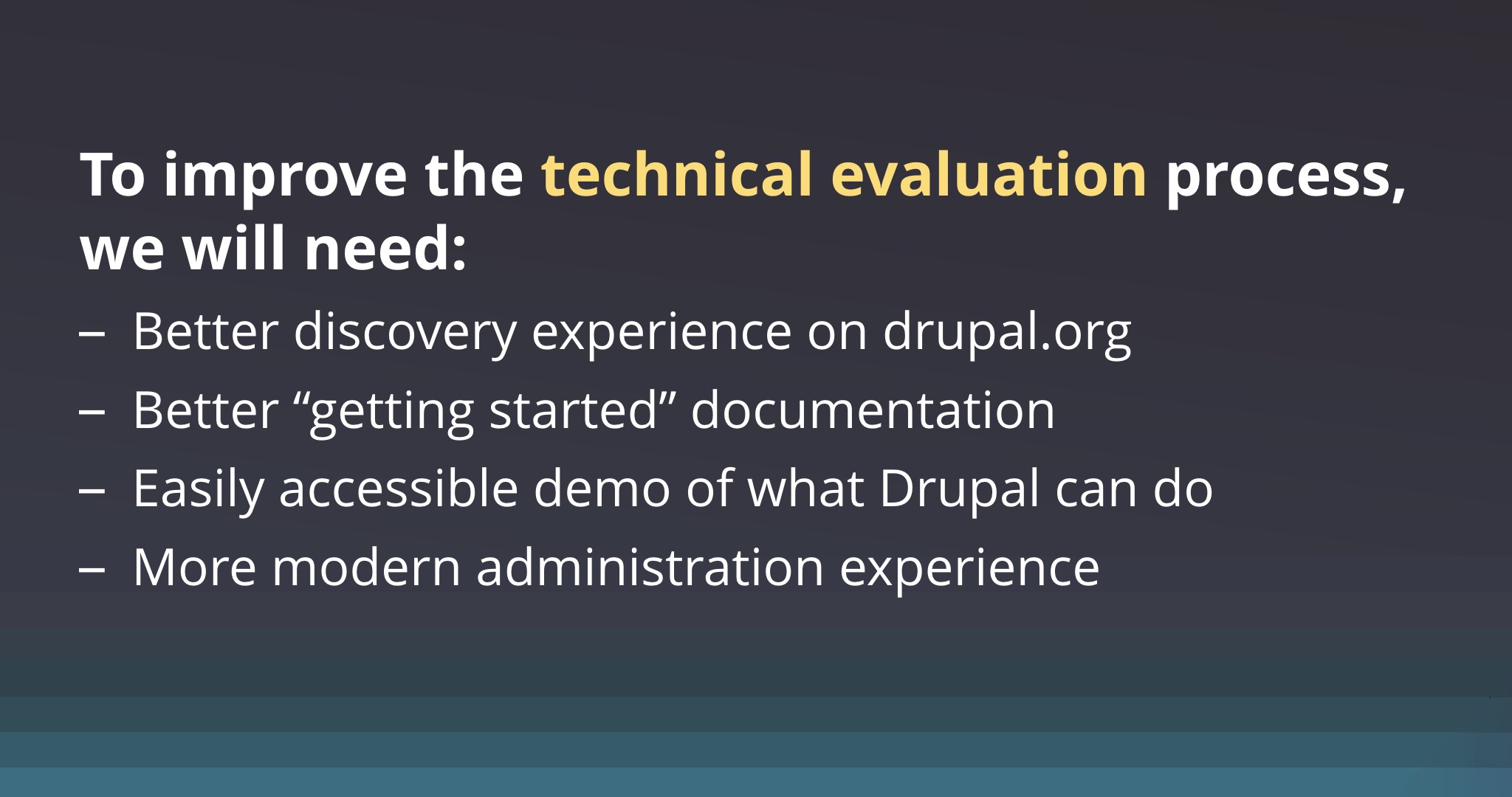
Seeing these results prompted me to launch a number of initiatives to improve the evaluator experience at DrupalCon Nashville. Here is the slide from my DrupalCon Nashville presentation:
A lot has happened between then and now:
We improved the download page to improve the discovery experience on drupal.org
We started working on a more modern administration experience (in progress)
You can see the result of that work in this video:
Thanks to this progress, here is the updated table:
Platform
Clicks
Time
Drupal
3
1:27
Symfony
3
1:55
WordPress
7
7:51
Laravel
3
17:28
Drupal now requires the least time and is tied for least clicks! You can now install Drupal in less than two minutes. Moreover, the Drupal site that gets created isn't an "empty canvas" anymore; it's a beautifully designed and fully functional application with demo content.
Copy-paste the following commands in a terminal window if you want to try it yourself:
mkdir drupal && cd drupal && curl -sSL https://www.drupal.org/download-latest/tar.gz | tar -xz --strip-components=1
php core/scripts/drupal quick-start demo_umami
Recognising the need to surround itself with experts in disability so as to consider and create a global accessibility policy, from the outset of the project, the Mucem formed a committee bringing together Marseille-based associations representing disability. Together, they considered the physical, sensory and cognitive accessibility of the museum.
The museum includes a “tactile and sensory” route through its galleries:
The objects selected for this tour convey the fundamental points of the exhibition’s main themes. In addition, its tactile, sensory dimension allows all visitors to comprehend the objects, through both their intellects and their senses.
I wish all institutions placed such emphasis on meeting all of their patrons where they stand.
The reason why we prefer government support rather than charity for critical infrastructure like roads, hospitals and schools is to ensure stability, access and public benefit. That's the opposite of what Jeff Bezos is proposing. As Audrey Watters writes, "There is no community, no public responsibility, no larger civic impulse for early childhood education here. It’s all about private schools offering private, individual benefits." I appreciate that Jeff Bezos wants to do good with the money he has accumulated. Watters has two suggestions, both of which I heartily endorse: first, pay the workers more, so they don't need to depend on government assistance to survive. Second, pay your taxes. All of them.
“The clues for the future are when you can have a high degree of confidence that you personally are connected to the Net — not your phone, you,” said Ive.
The addition of a cellular radio to the Series 3 made a big difference in freeing the Watch from the iPhone. This year, I expect the difference will be felt more on the software side as developers implement apps that take advantage of the new watchOS 5 APIs.
Despite the Series 3’s cellular radio, I almost always took my iPhone with me for runs because I wanted to listen to podcasts. More than anything else, the ability to listen to my favorite shows untethered has the potential to free me from my iPhone.
A new all-electric transportation service called Wroute has launched in southeastern Ontario.
Starting September 22nd, the company will offer high-frequency, non-stop trips between the transit hub at Kitchener’s Fairview Park mall and the central station in downtown Guelph. Wrote says each of its trips will be able to carry up to six passengers and two bicycles.
To achieve this, Wroute has put together a fleet of 10 all-electric Tesla Model X SUVs, as well as a team of 18 full-time employees and counting.
Additionally, the company aims to have its vehicles depart the two transit stations every 15 minutes, seven days a week. Service is set to start at 5am on weekdays and 8am on weekends and winding down to 11pm from Sunday to Thursday and 2am on Saturday and Sunday.
Each one-way trip will cost $20 CAD (taxes included), while Wroute is considering a reduced price for daily users as the service grows. Wrote says travelers will be able to reserve and pay for a car online. Drivers are paid salaries so no tipping will be required.
Jason Hammond, president of Wroute, told The Record that the company wants to offer travelers a more eco-friendly means of transportation. He cited a University of Toronto transportation survey that found there are 25,000 weekday trips in each direction between Waterloo Region and Guelph. However, most people take these trips with regular cars that can pollute the air, according to Hammond.
Tech analysts and reporters have some interesting things to say about Apple’s new “low-cost” iPhone XR.
Some reports indicate the XR will account for over half of new iPhone shipments. Other reports suggest the XR will be more important in 2020.
The first report comes via DigiTimes. According to the Taiwan-based news site, the iPhone XS, XS Max and XR are expected to pass 85 shipments million in the latter half of 2018.
That estimate is based on supply-chain information and Apple’s past iPhone sales history.
Further estimates expect total shipments, including older iPhones, to pass 127 million units in the second half of 2018. Finally, iPhone revenue is expected to pass $100 billion U.S. in the same time frame.
Thompson’s argument is that the XR features the best parts of the XS and a premium look that will make it appealing. He contrasts the new offering with Apple’s previous ‘budget’ option, the iPhone 5c.
Essentially, Thompson thinks that Apple’s ‘trickle-down’ product strategy will make the XR one of the best low-cost phones in the next two years.
Apple has used that strategy for some time. Essentially, every year when the company releases a new iPhone, the previous year’s flagship gets a price reduction. The older models become the low-cost entry options for people who don’t want to splurge on the newest phones.
Apple has effectively set up a low-cost entry that will be incredibly far ahead of phones released two years from now.
The XR is full of industry-leading features
According to Thompson, the A12 Bionic chip is so far ahead of the industry that it’ll remain competitive with the best Android smartphones in two years. The XR shares that chip with the XS.
Additionally, Thompson points to premium features like Face ID and the high-end camera — both of which are industry leading.
Finally, Thompson acknowledges what’s left out. There’s no 3D Touch, but Haptic Touch accomplishes the same goal. And who actually uses 3D Touch anyway?
Thompson also points out that the XR likely won’t cannibalize XS sales. Last year’s iPhone X proved that price is no object for Apple’s best customers.
That’s doesn’t mean the ones who buy a new iPhone every year, according to Thompson. It’s the people who only want the best new iPhone.
Even if the XS doesn’t sell as well, Apple will be more than okay. The company managed to raise the average selling price of its whole line of iPhones. Even the ‘good deal’ iPhone XR is $100 more than the 8 was at launch.
Regardless of when and why the XR succeeds, people are talking about it. The iPhone XR is one of the most compelling iPhones to date and will likely be a popular upgrade option.
Legacy automaker Aston Martin is nearing completion on the Rapid E, its first 100 percent electric car, and has started to tease the car’s design.
The Rapid E is an electric version of the regular Rapide S. The gas-powered vehicle is one of Aston Martin’s high-performance luxury sedans.
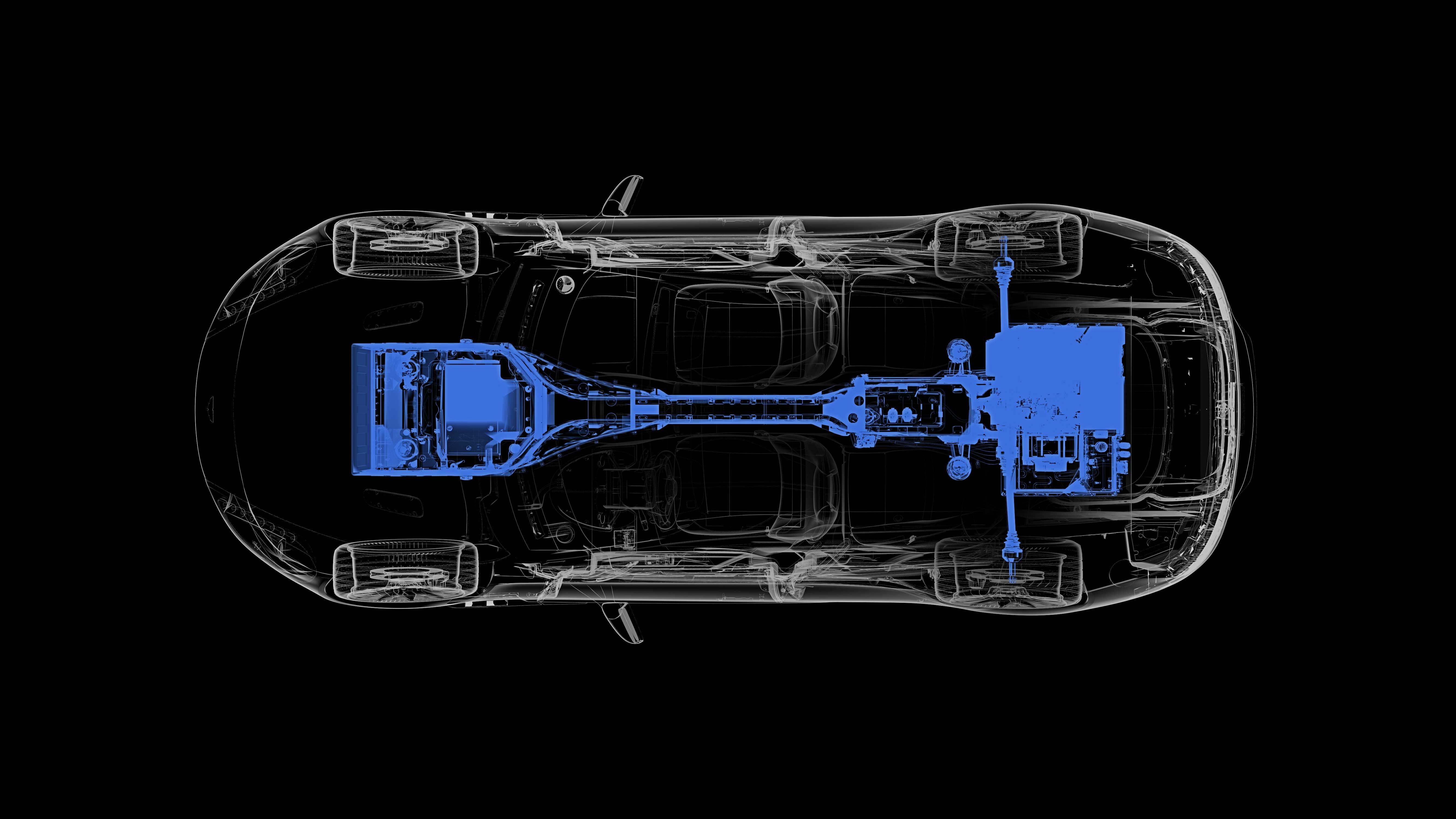
The Rapide E has an 800 V battery that powers two electric motors. The motors can output 610PS (602 horsepower) and 950Nm of torque.
The car’s range is around 200 miles (roughly 321 Km), and it can charge at a maximum rate of 310 miles of range per hour using an 800V outlet, though most users will probably charge at the standard 185 miles of range per hour by using a 400V 50kW charger.
Since it’s an Aston Martin, the car’s built with performance in mind. It has been redesigned so it’s more aerodynamic than its gas-guzzling counterpart, and it’s projected top speed is 155 mph (roughly 249 Km/h). It does 0-60 in less than 4 seconds, and the company made sure to mention that these speeds can be reached at almost any time, not just when the battery is full.
As it gets closer to release Aston Martin is spending time tuning the sedan so it drives similarly to the V12 Rapide. The company thinks that a range of adjustments to the chassis and powertrain along with some additional software can recreate the handling of the petrol-powered version.
A drawing depicting the Rapid E’s powertrain.
The company hasn’t been doing all this on its own either. Williams Advanced Engineering (WAE) has been a development partner in helping Aston Martin adjust to using batteries. WAE is another UK-based company that focuses on unique engineering challenges across a variety of industries.
There’s currently no release date for the sedan, but Aston Martin is only releasing 155 units since it’s using this car as a first step in revitalizing its Lagonda brand as an all-electric luxury car company.
A newly discovered security flaw compromises data stored on nearly all computers.
Security researchers from F-Secure, a Finnish IT security company, published their findings this week. The company’s principal security consultant, Olle Segerdahl, told TechCrunch the vulnerability put “nearly all” laptops and desktops at risk. This includes both Mac and Windows.
The exploit is based on a traditional ‘cold boot’ attack, which attempts to retrieve data from a computer that’s turned off. Most modern computers overwrite their memory when powered down. This scrambles the data so attackers can’t read it.
However, Segerdahl and his colleague Pasi Saarinen were able to disable that process.
It takes a few extra steps and requires access to the computer. Furthermore, the F-Secure team has already built a proof-of-concept that prevents firmware from clearing secrets from memory. Then, the researchers will scan for disk encryption keys, which they can use to mount the protected volumes.
Attackers can steal anything the computer has stored in its memory as well, like passwords and network credentials.
There’s little Microsoft or Intel can do
F-Secure shared its findings with Microsoft, Apple and Intel before releasing them.
However, none of those companies can really fix the problem because the flaw is based in the PC manufacturer’s firmware.
According to Segerdahl, Microsoft can’t do anything to remedy the issue. Furthermore, Intel is limited as they provide a reference platform for manufacturers to extend and build new models on.
Manufacturers and companies are “on their own,” according to Segerdahl.
Apple, however, has said it is looking into measures to protect Mac computers. It’s worth noting that Macs with a T2 chip, like the iMac Pro and 2018 MacBook Pro models, are not affected by the flaw.
Microsoft says that using pre-boot authentication like a PIN or startup key can mitigate cold boot attacks. However, this isn’t available for Windows Home users.
Ultimately, the best thing you can do right now is to ensure you’re the only one who can physically access your computer. Furthermore, plan for the possibility of being hacked, rather than assume attackers can’t compromise your device.
With Google set to officially unveil its new Pixel handsets on October 9th, the company has launched a Japanese teaser webpage that hints at the possible colour variants that may make up the lineup.
In English, the webpage declares “Coming Soon” and displays the familiar outline of a Pixel device. When viewed on mobile, the webpage allows visitors to cycle through three different landing pages by tapping on the centre of the phone. It’s also possible to tilt the image by tilting your device.
On the first of the three webpages, we see a two-tone white phone with a neon mint inner outline. It’s likely the inner outline alludes to the accented power button that’s become a hallmark of Google’s smartphone design. This is backed up by the white models that have leaked in the past few weeks; they all featured a mint coloured power button.
Next up is a model that corresponds to the current ‘Really Black’ Pixel 2 XL. Like that colour variant, this one appears to feature a two-tone black back with a plain black power button.
The final colour variant, which hasn’t appeared in leaks, appears to be a two-tone mint model with matching mint power button. In a nice touch, should you wait long enough, confetti will start floating down from the top of the screen while viewing this page.
For which colour variant are you most excited? Let us know in the comments.
Apple won’t officially release IOS 12 until Monday, September 17th, but that hasn’t stopped leakers from extracting and sharing the wallpapers that come with the new iPhones.
The new backgrounds are titled ‘Bubbles’. Users can download them now. One leaker has shared the three iPhone XS and iPhone XS Max wallpapers. Another has a few Bubble variants with more colour to go alongside the iPhone XR.
One of the more interesting aspects of the backgrounds is that they’re Live Wallpapers, meaning that users can touch and hold on the lock screen to see them animate.
9to5Mac notes that there’s currently no way to extract a Live Wallpaper file in its full resolution, but users can grab a low-res copy here.
The iPhone XS and XS Max are reportedly coming with some of the old Live Wallpapers too. According to 9to5Mac, the ‘Ink’ wallpapers that shipped with the iPhone 6S are still around. However, Apple has removed the ‘Sand’ wallpaper and iPhone X marketing images.
Either way, the stark contrast between the bubble and the black background should look great on any phone screen, not just a new OLED iPhone.
Samsung has announced that it will hold ‘A Galaxy Event’ on October 11th. The invitation promises an unannounced phone that is “four times the fun,” likely indicating that Samsung will launch a four-camera smartphone.
DJ Koh, Samsung’s mobile chief, has indicated that the South Korean company plans to place its innovations on mid-range smartphones before they make it onto the flagship handsets. Therefore, it’s likely that this is a Samsung Galaxy A offering.
The invite also says, “Samsung’s newest Galaxy device is bringing more ways to express yourself than ever before. Capture the fun with Samsung as the company celebrates the launch of the new device with A Galaxy Event on October 11th, 2018.”
There seems to be an emphasis on the ‘A,’ further cementing the Galaxy A smartphone theory.
In a recent interview, Koh also mentioned that Samsung plans to reveal more about the foldable Galaxy smartphone before the end of the year. It’s possible that Samsung will either unveil or release more information about the unannounced Galaxy F on the 11th.
Those interested can live stream the event on October 11th on Samsung’s website here.
Amazon CEO Jeff Bezos confirmed that the company will reveal the location of its second headquarters before the end of 2018.
Amazon’s sole headquarters has been in Seattle, Washington since the company was founded in July 1994.
In total, Amazon has received 238 headquarter proposals from cities across North America. Several Canadian cities pitched Amazon, including Toronto, Vancouver, Halifax and Calgary. Amazon was specifically eyeing cities that showed great enthusiasm and promised significant tax breaks.
In the end, Toronto was the only Canadian location to make Amazon’s top 20 list of cities in the running, which also includes the likes of New York City, New York; Los Angeles, California; Atlanta, Georgia; and Chicago, Illinois.
Amazon plans to invest $5 billion USD into whichever city it ends up choosing for ‘HQ2,’ which is expected to create 50,000 new jobs.
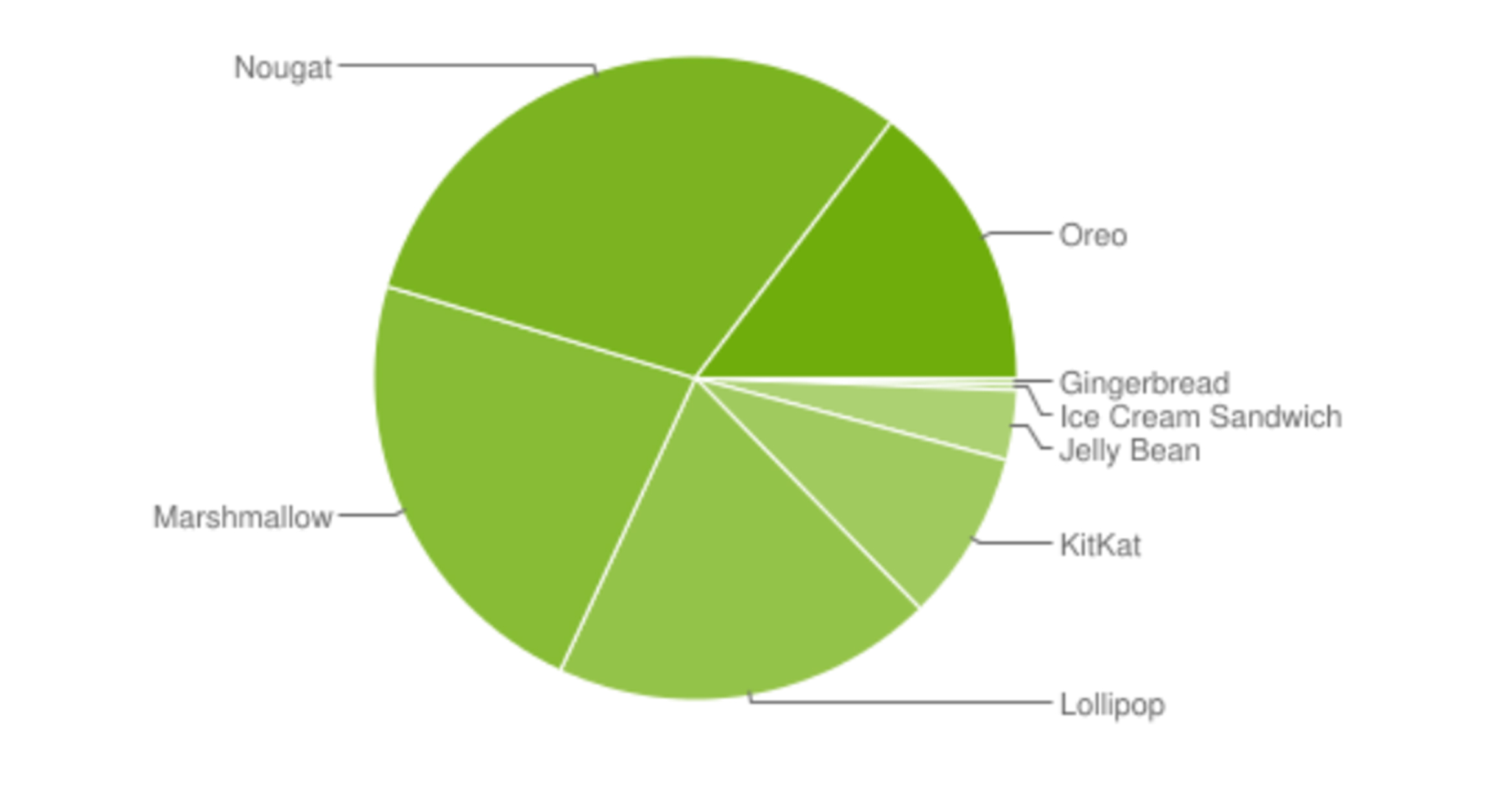
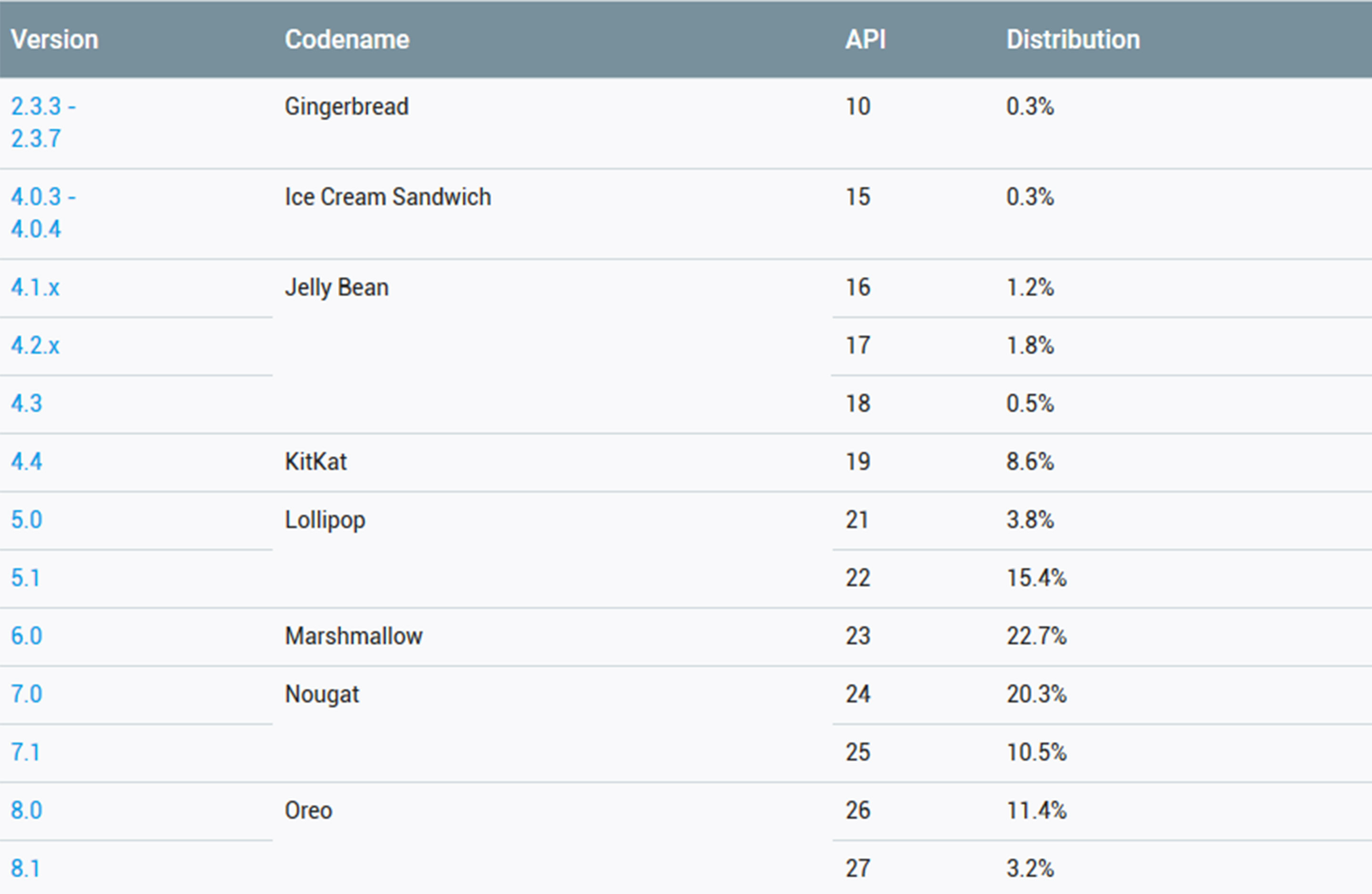
Unfortunately, the numbers haven’t really changed. Despite over a month of availability, Android Pie isn’t included in the distribution data.
Interestingly, while 6.0 Marshmallow has the highest distribution at 22.7 percent, Nougat takes the cake if you combine the distribution numbers for both of its 7.0 and 7.1 release versions.
Android 8.0 Oreo is still at a measly 11.4 percent — 14.6 percent if you include 8.1.
Even 5.0 Lollipop is ahead of that.
The data is based on Android devices that accessed the Play Store during a week-long period ending on September 13th.
It’s worth noting that the Android Developer Blog says that Android versions with less than 0.1 percent of the distribution aren’t shown.
That could be a reason why the data doesn’t include Android Pie yet. The newest OS is only available on The Pixel phones and the Essential Phone. Other manufacturers are still working on bringing Pie to their phones.


 With today’s update, Airfoil for Windows supports more outputs than ever before. If you’re new to Airfoil, learn more on its















 On the first of the three webpages, we see a two-tone white phone with a neon mint inner outline. It’s likely the inner outline alludes to the accented power button that’s become a hallmark of Google’s smartphone design. This is backed up by the