Shared posts

23 Sep 19:26

Nouveau Randonneur and Curvy Handlebars Have Landed

by noreply@blogger.com (VeloOrange)
by Igor

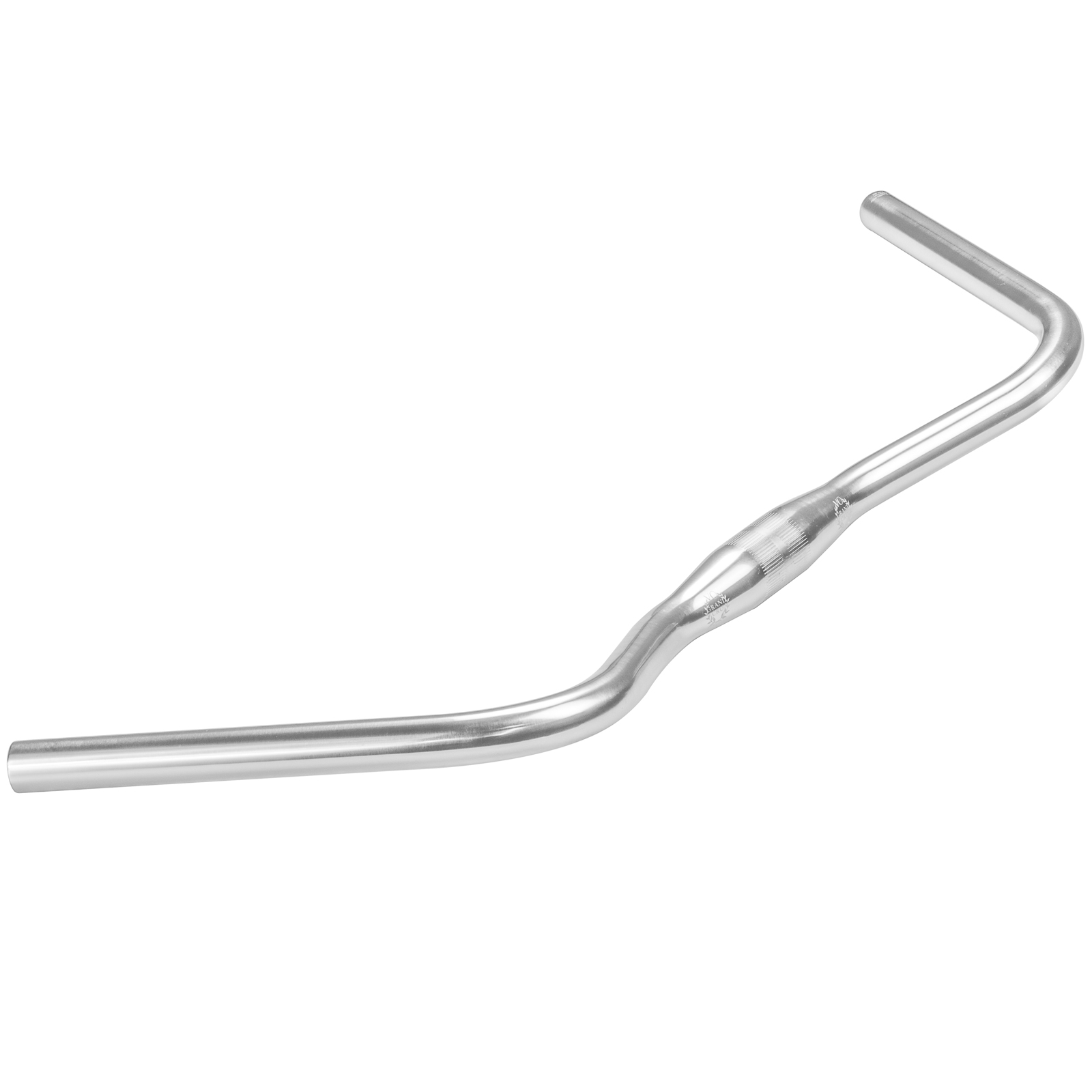
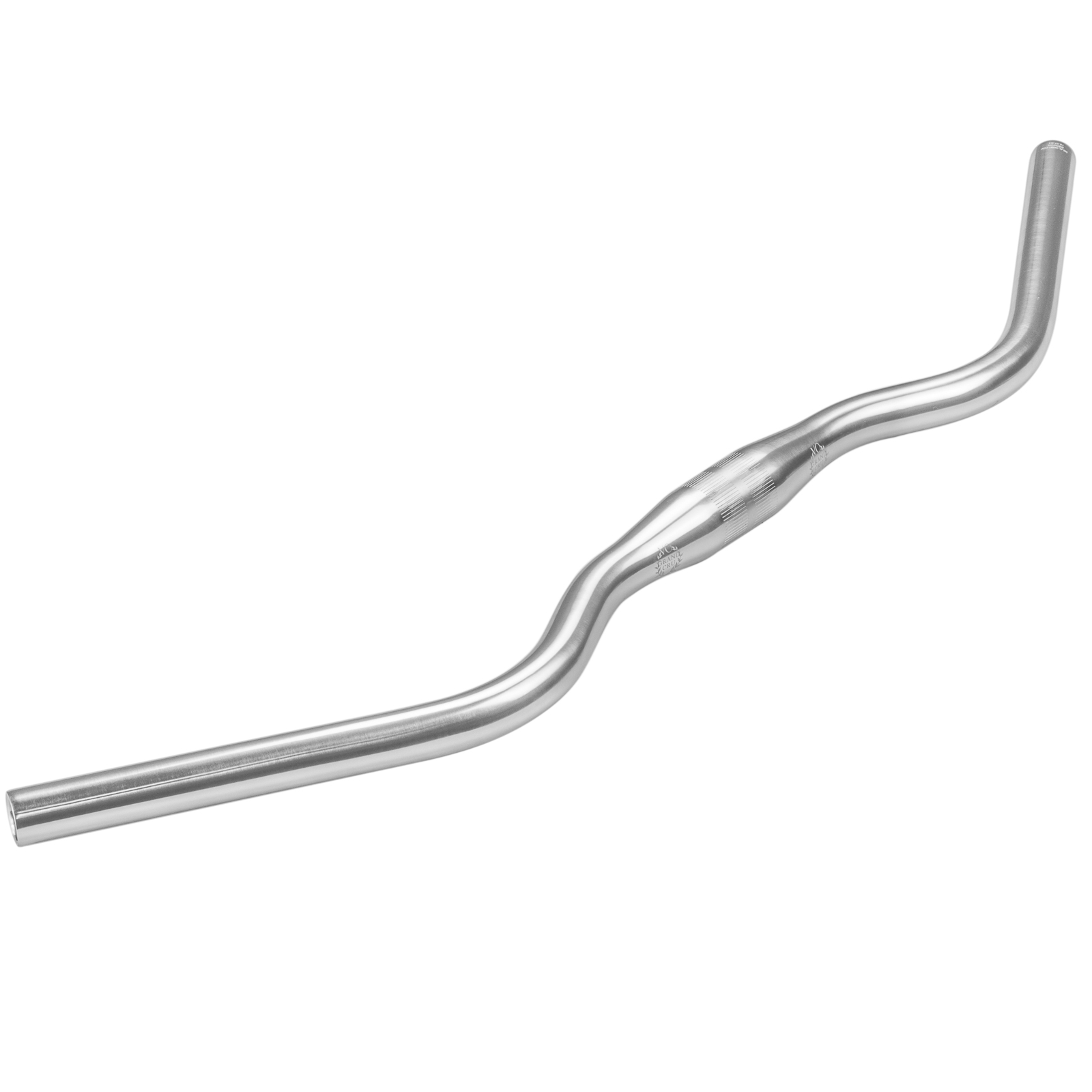
We are super excited to launch three new handlebar shapes to appease even the most discerning cockpit aficionado. The Nouveau Randonneur Bar is our take on a modern rando bar designed for riders using integrated shifters and aero brake levers. The Curvy One Bar is an updated city and touring bar with more than enough room for modern sized grips, brake levers, and shifters. Finally, the Curvy Too Bar is a flat and not-quite-as-Curvy handlebar designed those who want a more spirited position. Enjoy!


First, let's start with a bit of background. Traditional Randonneur Bars have always had an easily recognizable shape: round bends, long ramps, deep drops, and up-sweeping tops. It makes sense. Non-aero levers are fairly small, so you have more real estate on the ramps and drops as you change your position throughout the day and terrain. You can get the bars up a bit more without resorting to a riser stem with upward bends by the stem clamp. With the proliferation of integrated shifters making their way onto touring, randonneuring, and now gravelling bikes, these traditional shapes are not always conducive to a comfortable on-the-hood position - ergonomically speaking, where your hands would spend much of their time. The ramps are often too long, even paired with a short stem and the ramps on vintage Italian-style road bars simply do not match the curves of these modern shifters and levers. The design of the tops, ramps, hooks, and drops all make the Nouveau Randonneur Handlebar an absolutely lovely abode for all-day riding.

The most visible difference from a traditional bar is the shape of the tops. They are ovalized and sweep back ever so slightly from the stem clamp. An ovalized section makes for a bigger area upon which your hands can rest. A wider palm base means road vibrations and impacts are distributed better and not centralized into a specific spot. Additionally, the sweep lends itself better (than a straight top) to your hands' natural resting position.


Measuring the reach of this bar is a bit tricky. The ramps are 105mm in length, but since the tops sweep back, the traditional reach measurement (originating from the stem clamp to the edge of the ramp) is more like 85mm. In total, this means the ramps are long enough for a resting position behind the shifter hood for cruising, but short enough to easily reach the hood for shifting, braking, and out-of-the-saddle efforts without resorting to extreme stem lengths which could affect handling.


Reaching down from your hood's perches to the drops is not extreme. The drop length is roughly 128mm. Deep enough to obtain some aero advantages as well as cornering stability, but also not so deep your back will curse at you in the morning.

At the hooks, there is 12 degrees of flare. It opens your chest, makes the bike more stable, and means your forearms won't hit the bars when making out-of-the-saddle efforts. The ends are also reamed to fit regular bar-end shifters.


The Curvy One is our take on a traditional city and touring bar while retaining the elegant lines and curves that are often lost in many of today's modern offerings. Width is a cool 650mm and rise is generous at 30mm. With 60 degrees worth of sweep, you'll have a fairly upright position with a ton of control. The grip area (22.2mm) is more than enough for modern grips, brake levers, and shifters at 180mm in length. The clamp diameter is 31.8mm and the grip diameter is 22.2mm.


The Curvy Too is a wider version of our Postino that fits modern accouterments. It's very lightweight at 273g, has no rise and drop, and is perfect for those converting roadies into a more comfortable, albeit, spirited position. With a width of 680mm and sweep of 30 degrees, it's ready to make those stoplight sprints and treks off the beaten path!

Bonus: The Curvy Too is also MTB rated, so it's a great option for your bikepacking rig.

23 Sep 19:26

Controlled Measures

by R. Joshua Scannell

The Italian surgeon Cesare Lombroso developed his theory of “physiognomy” — that physical traits expressed inborn criminality — in the most tech-startup way possible. In the 1860s, while Lombroso was working as a psychiatry professor at the University of Pavia, a local Italian worker died in prison, where he had been incarcerated for 20 years for stealing food. A trained physician, Lombroso was asked to perform the postmortem autopsy, during which he had a realization: The criminal, and in fact all criminals, looked to his eyes like apes. What if, Lombroso reasoned, this meant that criminality was both a natural-born trait and, as leading scientists of his era were proposing for all sorts of human failings, connected to “racial degeneration”?

Prevailing logics of late 18th and 19th century criminal justice held that crime was a by-product of human nature and a consequence of rational decision-making. People committed crime because they thought it made sense in context, which meant that punishment should work as a deterrent, increasing the cost of being caught. To prevent crime, the state had to make it a bad option. But deterrence, trials, and reactive enforcement were slow and cumbersome and didn’t seem to effectively make people more law-abiding. So Lombroso — looking at a dead and butchered day laborer — imagined a different way.

What if, he thought, it was possible to streamline criminal justice by just looking at a person? What if their face could tell you whether or not they were prone to criminality? Even better, what if you could systematically measure a person’s face and use that process to determine their level of “criminal atavism”? This would be more efficient and socially beneficial than counting on deterrence to control the barbarous masses (and being constantly disappointed).

Here was a way to use science and some apparent common sense to make the world safer, more rational, and more efficient. This objective measurement scheme would force inefficient judicial institutions to abandon ineffective approaches and help law enforcement and lay citizens alike to know who to hold in suspicion. It would, in short, make the world a better place. The problem was that this approach, in trying to map the coordinates of human nature onto an “objective” matrix, merely reinscribed colonial and imperial racial and sexual logics, as well as an endemic bourgeois hatred of the working classes. Lombroso, of course, didn’t think of it that way. Substituting his best intentions for serious inquiry, he imputed a value system designed to stratify people through biology.

All types of Victorian theorizing, often translated into more contemporary languages so animate research and product development that the tech industry is “automating inequality”

Physiognomy was eventually debunked, but its legacy of what Cedric Robinson calls racial thinking has lived on in Silicon Valley’s cultural imaginaries. Lombroso’s theory was, like a great deal currently coming out of the world of tech, an engineering “solution” in search of a problem. It’s no surprise that all types of Victorian theorizing, often translated into more contemporary languages (think “genetics” instead of “racial atavism,” or “evolutionary psychology” and Jordan Petersen’s lobster tales instead of the “feminine sphere” or the “weaker sex”) so animate research and product development that, to quote Virginia Eubanks, the tech industry is “automating inequality.” Physiognomy and related bunk sciences like phrenology have never truly left, and the heavily capitalized project of turning the world into a datafied engineering project means that it is more central than ever before.

In the past two years, a pair of machine-learning studies caused an uproar, stoking concerns that physiognomy and phrenology are “back.” In the first case, “Automated Inference on Criminality Using Face Images,” researchers trained neural nets on mugshots from an undisclosed police department in China to try to determine whether there were physiological bases for “criminality.” In the second, “Deep Neural Networks Are More Accurate Than Humans at Detecting Sexual Orientation From Facial Images,” researchers trained software on profile pictures and found that it did better than humans at guessing a person’s sexual orientation from their face.

Neither study’s methodologies, conclusions, or ethics held up well under scrutiny. In fact, both are now “basic” case studies for the online Calling Bullshit course, which is dedicated to debunking overheated data-science claims.

First among those studies’ failures was their suspicious ethical premises. It’s not clear what good is served by further building out and capacitating the contemporary tech-assisted carceral surveillance state and targeting it at human souls. And in a country where LGBTQ people routinely are harassed, suffer professional punishments, and worse, it is indefensible to create an algorithm that could theoretically out people at scale.

But there were also a number of more basic methodological problems with the studies. For instance, the criminality study’s training data compared convicted people’s ID cards against others’ publicly available profile pictures, raising the question of whether anyone would like their character judged by a state ID photo over a curated headshot. Too, the decision to use photos of convicted people to denote criminals begged the obvious question of whether the algorithm was finding a signal about “criminality” or about how men most likely to be convicted by the existing system look.

As interesting as the studies’ glaring failures, though, is what the popular commentary about them revealed. Many commentators have characterized the digitized “return” of phrenology and physiognomy as a problem of “bad science” and “bad ethics” that place such studies as these as beyond the pale. For example, an article at Splinter on the criminality study starts like this:

“In ancient Greece, the philosopher Aristotle once said that ‘it is possible to infer character from features.’ Through the 1800s, scientists took his cue, pushing theories that bad people could be identified through their looks alone. Then, of course, science happened, and Aristotle’s comment was taken with a mountain of salt” [Emphasis added.]

“Science” here functions as a corrective for those technologists who seek to push possibilities too far. “Better” science and “better” ethics do not ask too much of their technologies. This posits digital physiognomy as overreaching, redeeming the more sober mundanities of biometrics in general.

To talk about phrenology “reappearing” in contemporary technologies misses the fact that its underlying logic never left. To the extent that “science” debunked the most egregious elements of physiognomy, it did so by driving the same premises of deducing character from physical characteristics deeper into the body. Rather than look for a person’s essential nature in their face, research looked for it in DNA, in hormone levels, in imperceptible but nonetheless determinate physical materials. This process, often against the aims of the researchers, has had the predictable effect of re-encoding racial taxonomies in genomic studies, rigidifying sexuality as “genetic,” and legitimating class exploitation as a product of physiological inheritance. The widely derided criminality and the sexuality studies both rely (spuriously) on this type of “legitimate” research to justify their claims.

Most refutations of the criminality study included as part of their argument an explanation that “criminality” is likely driven by a combination of biological and environmental conditions. In particular, testosterone levels have been shown to contribute to the type of “risky” behavior that leads to criminality. This correlation between testosterone and behavior seems to hold across a number of animal species, but animals do not commit crimes. Testosterone levels might be correlated with certain types of behavior, but the biological tells us literally nothing about “crime,” a category of human social organization.

If we’re looking for a real “root cause” of “criminality,” we should look not to biological factors but to politics, which organizes how a society decides what is and is not a crime and how punishment is to be administered. The sort of risk taking and violence associated with testosterone is, after all, just as often lauded or ignored as it is considered dangerous. Politicized attitudes about race, class, and sex tend to determine whether biological factors are seen in one way or another.

Arguing that physiognomy and phrenology were dominant until “of course, science happened” is a misrepresentation. It wasn’t “science” that happened; it was the civil rights movement. The root problem with the recent phrenology and physiognomy studies is their political implications: that they could give a scientific-seeming alibi for monitoring, impoverishing, or incarcerating people, much like earlier social Darwinism helped legitimate racial regimes. If that is the main problem with the “pseudosciences” of phrenology and physiognomy, we need to consider how biometrics in general — routinized facial recognition, gait recognition, and “behavioral” biometrics to list just a few performs these same core functions.


Depending on how you interpret the history, biometrics traces back to one of a few origin points, none of them particularly proud. The most common lineage traces back to Alphonse Bertillon, the 19th century French police officer who trailblazed anthropometry — the study of measuring the human body — and institutionalized the mug shot as a means of rationalizing the identification and classification of “criminals.” The French government adopted the approach to enroll Roma peoples en masse into its proto-database to better surveil and contain them. Bertillon was also the “expert witness” whose testimony landed Albert Dreyfus, a Jewish military officer falsely accused of treason, on Devil’s Island. Bertillon claimed to have developed a handwriting identification system that incontrovertibly proved Dreyfus’s treason. It was later found to be bunk — not the last time that dubious forensic science would be used to wrongfully incarcerate someone from a marginalized population.

Biometry can also be traced to the British colonial government in India. In the aftermath of the 1857 Indian War of Independence, the British decided that they needed a scientific technology with which to differentiate Indian subjects. As Joseph Pugliese, author of Biometrics: Bodies, Technologies, Biopolitics, puts it, “the technology of fingerprint biometrics was developed in order to construct a colonial system of identification and surveillance of subject populations in the face of British administrators who ‘could not tell one Indian from another.’ ” As Bithaj Ajana points out in Governing Through Biometrics: The Biopolitics of Identity, the technology that emerged out of that effort was not successful, and it fell to Francis Galton — the originator of eugenics — to develop the first workable fingerprinting system.

Ajana notes that “anthropometry and fingerprinting were enlisted not only to identify individuals but also to ‘diagnose’ disease and criminal propensity, define markers of heredity and correlate physical patterns with race, ethnicity and so on.” Every metric is also a graphic, a point of contact in which the body is reorganized according to institutional norms and demands. In Galton’s case, the fingerprint’s mark doubled as a tool to categorize the supposed gradations of human beings’ humanness. Fingerprints became agents in an ongoing social project of determining what sorts of bodies still registered as “beings of an inferior order” with “no rights which the white man was bound to respect.”

We can see the process of measurement as inscription at work systematically in older colonial practices, particularly in the technologies of the middle passage. In her book Laboring Women, historian Jennifer Morgan details how early European slavers used the shape and size of women’s breasts as a key metric to determine which peoples were fit for enslavement or for “civilization.” And drawing the connection between the present and the past, sociologist Simone Browne points to The Book of Negros, probably the first systematic biometric document. When the British colonial army fled from New York in 1783, black people made to flee with them. To speed adjudication in the event that a white person came to claim someone, officers recorded the physical characteristics of the black population of New York.

It wasn’t “science” that happened to physiognomy and phrenology; it was the civil rights movement

Here, again, the particular contours of the body work to reproduce a social structure that depends on the “scientific” principle that there is a difference in kind between peoples and that this difference is written on the skin. Taking this with the work of the brand, a tool designed to produce biometric markers, Browne shows that inscription and description have always twinned on the black body as a fundamental apparatus for maintaining white supremacy. Hortense Spillers takes this point further and argues that the ideographic violence of white supremacy is the basis for the totality of the American “symbolic order” — the entire system of semantics that make Americans intelligible to one another.

Of course, contemporary techniques of biometric inscription and description do not correspond directly to our historical practices. After all, biometrics manages things as mundane as opening a phone. But here, too, is a transfiguration of a body into a specific collection of data points primed for extractable value: “I” transform into a qualitative assemblage that is gatekept and circulated through productivity matrices designed to capacitate, in this case, the Apple corporation. In “knowing” me, Apple re-presents my body to me as a technical object happily in cahoots with the maintenance and expansion of the corporation. And this process has only become more literal over time, as Apple showed in its recent product launch event, in which it promoted its new Watch series by touting its real-time biometric monitoring capabilities as a self-improvement bonus. It comes with a digital coach! But like phrenology before it, this hinges “self-help” on dissolving the distinction between bodily integrity and surveilled commodity for the aspirational class of consumers Apple targets.

The terms and conditions are changed in the contemporary blending of body and digitality, but as with physiognomy and phrenology, the body remains the gateway to the soul. And it is a “soul” organized by the effective extraction of value from the rudiments of flesh.


Biometrics has never been merely about identifying people but about identifying people in particular institutional contexts for the specific purpose of expediency or bureaucratic lubrication. That is, they are conceived not as abstract, objective measures but are tailored to specific institutional purposes.

This means its applications can feel intuitively convincing, as when in a courtroom scene in a movie a fingerprint definitively identifies a murderer. But in practice, it means these technologies never been neutral; they have always been fully integrated with the aims of those agencies that actively work to produce, reproduce, and stabilize regimes of dispossession and violence. They are weapons built for hunting.

This is particularly true in the case of policing and criminal trials. Historically, biometric techniques were slow, specialized, expensive, and bound to tightly controlled laboratory conditions. This made them impractical to use in the field, where conditions are unstable, portability is crucial, and speed is of the essence. Instead, they were largely deployed as forensic evidence during the adjudication process. Prosecutors have tended to overstate the accuracy of biometric evidence (especially DNA evidence), in spite of many documented cases of laboratory errors, false positives, and contamination. Other forensic techniques like bite-plate matching have been found, by and large, to be junk science.

But these findings have not stopped the adoption of biometric techniques. They have instead fueled demand for “improving” them, further automating and mathematizing the techniques as a more robust and reliable alternative to relying on lab specialists. This has accelerated the digitalization of forensic matching and the growing reliance on “multimodal” biometrics — that is, biometric identification systems that depend on more than one type of identifier (for instance facial recognition and fingerprint) and that can combine physiological and behavioral techniques (for instance, iris recognition and voice recognition). More research has been addressed to “soft” biometrics — ambiguous and not concretely measurable traits, such as one’s gait, voice, or nonconscious bodily movements (called “behavior” in the industry).

Historically, the distinction between “hard” biometrics (measurable and tracked to particular individuals, like fingerprints and faces) and “soft” was clear. But contemporary machine learning has essentially eliminated this distinction, rendering “soft” biometric markers into quantifiable identifiers. This is normalizing their use and distribution through social space. In other words, the turn toward digitization and the consequent changes in funding patterns is why gait matching software is integrated into cameras throughout New York City. Remote fingerprint detection and facial recognition have become increasingly common tools in police officers’ kits. Officers use phones and devices with integrated biometric apps in mundane interaction with the public, like traffic stops.

This has moved biometric analysis out of the realm of the forensic and the judicial and into the zone of policing and enforcement. Contemporary police forces increasingly have access to biometric databases that house an array of identifying information, including facial recognition, fingerprint identification, voice recognition, gait matching, and more. Companies like Morpho market devices that allow officers to match fingerprints remotely, in real time, to criminal histories, outstanding warrants and associated files in facial-recognition databases. Or, as the Intercept recently reported, IBM worked directly with the NYPD for almost a decade to develop object-recognition camera technology that allows users to search for people by race and ethnicity, among other identifiers. It’s on the market as Intelligent Video Analytics 2.0, and it’s optimized for use with body cameras.

Every metric is also a graphic, a point of contact in which the body is reorganized according to institutional norms and demands

The information that populates these databases is often collected without the knowledge or consent of the public — sometimes automatically or passively through generalized surveillance. The mass registration of biometric data into open databases creates what the Georgetown Center on Privacy and Technology calls a “perpetual lineup,” which generalizes legal precarity.  It’s the realization of Bertillon’s apparent dream: an opaque, automated police cataloging system to be mainly used against socially marginalized populations.

Biometric companies also enfold the forensic laboratory into the algorithm. In the past, police and prosecutors had to take their forensic evidence into laboratories. There, trained technicians would bring professionalization and specialization to bear on expertly “reading” the truths of the biological evidence. They would then translate that information back into evidence for police and the courts. But automation has disrupted that space of verification and validation. Information captured by cameras and scanners is digitally broken down, analyzed, and evaluated by algorithms instead. This distributes “the lab” throughout social space and effectively credentials non-specialists with “expert” knowledge just through having access to these technologies. A police officer that runs a remote fingerprint scan during a traffic stop and flags a facial match, criminal history, and outstanding warrant report is effectively conducting an automated forensic investigation.

This swaps one form of occulted knowledge (the lab technician) for another (the app). Companies that sell biometric analysis products tend to hide their algorithms behind trade secrets and patent protections, which has in some cases made it near impossible for defendants to challenge the biometric evidence that ties them to crime scenes or investigations.

And that, of course, is the point. Getting the tech “right” — which is to say eliminating “bias” from tools like facial recognition — will not rearrange the structural relationships between race, class, sex, and “crime” that plague of the American criminal justice system. In fact, it presents the perverse condition in which “good” tech forecloses critique and reform because it normalizes the ways police and courts in particular go about their work in what David Theo Goldberg theorizes as the “racial state”: a state that functions only as long as it generates, rationalizes, and bureaucratizes racial difference and then modulates life chances accordingly.

The biometric encounter at the fingerprint scanner integrates flesh into the order-maintenance mission of the carceral state, compelling its active collaboration in the reproduction of structures of extraction and inequality. It is a moment of marking in which the context of contact comes to stand for the “truth” of the body. By incorporating a body into a surveilling apparatus, the fingerprint scanner marks flesh as corporeality manifest on the “wrong side of the law” and patterns it in kind. As the biometric databanks of the racial state expand, so too do the somatic patterns of oppression translate into a digital, searchable, analyzable archive of “natural” criminality. If a body is out of step racially, or sexually, or ably, it flags. What side is the right side of the law?

Joseph Pugliese, in an article discussing the consistent failure of biometric technologies to recognize nonwhite bodies, argues that such moments of “Failure to Enroll” (FTE) show the degree to which biometric technics operate from a position of “infrastructural whiteness and the racialized zero degree of nonrepresentation.” For Pugliese, nonwhite bodies do not go unrecognized by biometric technologies because of technical problems but because of the centrality of whiteness to the state and social milieu in which biometric technologies operate. Drawing on Shoshana Magnet, we might argue that rather than understand this as failure, it should instead be seen as the technology doing its job, recognizing those bodies that are socially presumed to be full and representable while literally making racialized bodies invisible.

This critique is often articulated in this kind of framework: In recognition of our humanity, to increase transparency, and to ensure accountability, these technologies need to stop using whiteness as a baseline, and fairly recognize us all. Fair enough — if the state is going to surveil us, they should at least be able to surveil all of us equally well.  But tracking back across the history of biometrics, it does not seem that the interests that reproduce racialized FTE are denying humanity to certain groups. Rather they are working in a tradition in which the nature of differential humanity is up for debate and that the value of bodily identification scales directly with the degree to which “individuals” are believed to be known through the body. It is not so much that the sometime excision of nonwhite, non-cisgendered bodies from the normative function of the biometric surround represents a failure to recognize their humanity. It is rather a failure to make sense of that humanity — a humanity that has historically been framed as existing outside the bounds of knowability.

In place of the question that supposedly drives biometrics — who are you? — measurement presents a statement at the moment of recognition: This is what you are. But in the case of the Failure to Enroll — a failure that disproportionately impacts queer people and people of color — biometrics clarifies its relationship to the unrecognized body presented before it. To tweak Paisley Currah and Lisa Jean Moore’s discussion of the history of sex designation in New York City’s birth certificates: Rather than the formulation “this is who you are,” the blinded apparatus makes an injunction We do not know what you are.

From this point unfolds the world-building of metric governance. “We do not know what you are” takes an unrecognizable identity to the infrastructurally white social apparatus and transforms it into surveillance and “risk” mitigation. “We do not know who you are” becomes a mission: We must know what you are. This sets the stage for the extractive and open-ended demand placed on the body-that-fails-to-register to surrender its qualities to the interrogative apparatus. The concept of race transforms biometrics systems’ failures into successes, because the point of race and of the heterosexual matrix is precisely to produce recognition failure as a point of entry for control.

Biometric accountability, accuracy, and fairness matter. But, following artists Zach Blas and Martine Syms, the organizer and technologist Nabil Hussein, and a great many others, it is not at all clear that biometric accountability, accuracy, and fairness are mechanisms for achieving justice, or even a baseline common humanity. That is not what biometric systems do. Instead, they reflect the institutional demands of the entities that employ them — demands that are always intended to sort people into those with access or without; secured by or made insecure by the state; capacitated or incapacitated by a credit score. To survive the inquisitional drives of state and capital, a great many bodies are always made to hide.

It is worth remembering that phrenology was never explicitly a project of explaining racial difference and justifying racial rule. It was primarily considered a means for the self-improvement of the white middle and working classes. Phrenology clubs throughout the United States would seek to identify physically expressed shortcomings and would set goals and work to improve those faculties. Self-measuring the body was a useful means of tracking one’s progress and structuring one’s life goals. Today we might categorize it as something like “wellness” or “self-care.” But of course, the entire structure of phrenology’s utility to the aspiring classes was premised on the systematic exclusion of those populations that were and would continue to be denied participation in American civil society. Aspiration was built on the security of hierarchy. Perhaps technology excised whole groups of people from the human family, but so much the more opportunity for those who could strive and gain. And at any rate, better to be sure of one’s place.

And this, then, is the point. It is convenient to point to the dangerous rise of the newest iteration of the ancient project to mathematize the body and its capacities and call it a new set of clothes for a debunked way of thought. But the reality is that the structure of our biometric surround is always already doing the work that we would prevent the new phrenology from accomplishing. Biometrics have always been in collusion with racial-sexual hierarchies of cisgendered heterosexist white supremacy because they constitute a technique for making some bodies a problem, a question, a mystery, and a pretense for control. And at the same time, they allow other bodies to exist with a greater sense of security and convenience, confident — as Lombroso hoped they would be — that they’re safeguarded from the imagined degenerate and atavistic masses that threaten and surround them. As such, bad studies like those we started with are a scapegoat for biometrics, which perform the work of phrenology regardless.

23 Sep 19:25

How to mod your Etch A Sketch, or Toy Story in real life

by Alex Bate

We’d like to file this under ‘things we wish we’d had when we were younger’. Who else is envious of the kids of today and all the cool things they can make with our old classic toys?

Etch A Sketch Robot – Elephant

Read about how this works on my blog! http://sunnybala.com/2018/09/10/python-etch-a-sketch.html

To a wave of upvotes and comments, Sunny Balasubramanian shared their Etch A Sketch project on Reddit, including all the information and code you need to build your own. Thanks, Sunny!

Dismantling the toys of our childhoods

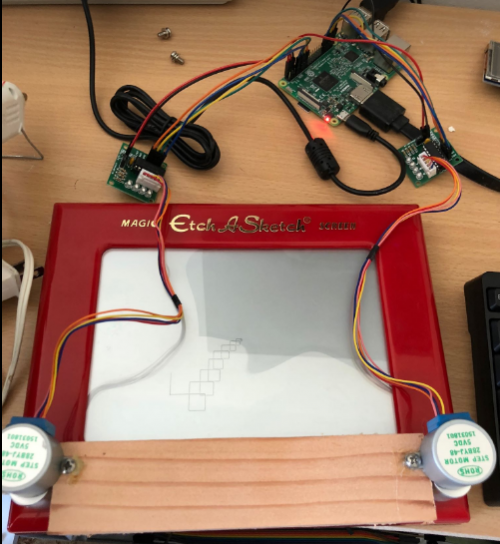
The physical set up of the automated Etch A Sketch is pretty simple: motors attached to couplers replace the original plastic nobs, and a connected Raspberry Pi 3 controls the motors as directed by the code.

Etch a Sketch modded with a Raspberry Pi

For stability, Sunny attached a wooden block to the plastic housing that keeps the motors in place.

Coding new life into an Etch A Sketch

Sunny explains:

There’s a few different ways to go about this portion of the project. When I started out, I googled to see if anyone had done things like this before. A few projects popped up. They seemed to approach the drawing in one of two ways. I wanted to do it in a fully automated way where the only input is a picture and the output is a cleanly drawn image.

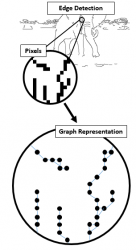
The code Sunny ended up using first takes an image and simplifies it into a line drawing using Canny edge detection. It then turns each pixel to a node and draws a path between the nodes, connecting them one by one. So that the Etch A Sketch draws the picture, the Raspberry Pi then directs the motors to follow the connections and create uncannily precise sketches.

Raspberry Pi Etch-a-sketch Raspberry Pi Etch-a-sketch

Head to Sunny’s website for more information about their project, and download the full code from GitHub.

Two down, more to go…

With this automated Etch A Sketch, and this talking Fisher Price Chatter Telephone, the Raspberry Pi community is well on the way to recreating the entire Toy Story cast, and we are fully on board with that!

A GIF of Toy Story characters

So what’s next? A remote-controlled Slinky? A falling with style flying Buzz Lightyear? What would you build?

The post How to mod your Etch A Sketch, or Toy Story in real life appeared first on Raspberry Pi.

23 Sep 19:25

3-D view inside Typhoon Mangkhut

by Nathan Yau

Typhoon Mangkhut went through the northern end of the Phillipines a few days ago. At least 25 people died. The New York Times provides a scrolling 3-dimensional view using data collected by NASA satellites.

Tags: 3-d, New York Times, typhoon, weather

23 Sep 19:25

Oh God Not This Again

Every now and again there’s a thing about the tragedy of RSS. Ugh.

I want to make a few points.

One is that, as Greg Reinacker once said, RSS is plumbing.

Another is that millions of mainstream users rely on it — for podcasting, especially, but also because it powers other things that they use. They don’t know that there’s RSS under the hood, and that’s totally fine.

Another is that it’s not necessary for RSS readers to become mass-market, mainstream apps. I’m sure I never said they would be, and I don’t remember anyone else from the early days of RSS saying they would be, either.

It’s totally fine if RSS readers are just used by journalists, bloggers, researchers, and people who like to read. Yes! It’s a-okay.

But note that everyone who uses Twitter and whatever else, and who follows those people, are benefiting indirectly from RSS. RSS is, often, where the links come from in the first place before they show up on social networks.

(Sometimes it’s even automated. For instance, posts to my @NetNewsWire account on Twitter come from the blog’s feed. In other words: Twitter itself is an RSS reader.)

In a nutshell: judging RSS itself because RSS readers are not mainstream is to miss everything that RSS does. And judging RSS readers for not being mainstream is to judge them against expectations set by some hype artists more than a decade ago — but not by me or anybody else actually doing the work.

I don’t expect to see RSS readers running on every Mac and iOS device. This does not make it a failure.

It’s 2018, and I think by now we’re allowed to have things that some people like, but that not everybody uses.

* * *

From 2011: What we talk about when we talk about RSS

From 2013: Why I love RSS and You Do Too

From 2018: Some Hope

23 Sep 19:25

Tech Diversity

When Blogger came out, we all got on Blogger. When Flickr came out, we all got on Flickr. Later there was Twitter and Facebook, and we all got on.

(Okay. Not every single person, but you get my drift.)

In those days, for a thing to be important, for it to be a success, it had to get the attention of much of the internet.

It was a lot like TV used to be. There were just a few networks, and for a show to be a hit it had to have some significant percentage of viewers watching it.

Times have changed, and the internet is more mature and diverse. As my friend Kelly Guimont says, the internet is “sort of like TV” these days, and “you can have a successful show and not have half of America watching.”

Like Game of Thrones. It doesn’t have half of America watching it, but it’s still a success.

I argue that the same is true of apps and app categories: we’ve (finally!) entered a period of tech diversity, and Mastodon and Micro.blog and RSS readers and blogging systems and so on do not have to capture the attention of the entire internet to be successful and important.

In fact, those days are gone. TV changed, and so did the internet.

23 Sep 19:25

Things 3.7 Brings Support for Shortcuts, Siri Watch Face, iPhone Landscape Mode, and More

by Ryan Christoffel

Today Cultured Code launched the latest update to Things, version 3.7, on iPad, iPhone, and Apple Watch. The app's headline feature is full support for Siri shortcuts, but it also brings welcome improvements in a few other areas: integration with the Apple Watch's Siri face, landscape support on iPhone which includes the iPhone X, dynamic notifications, and more. Taken together, it's a broad set of enhancements that takes full advantage of all the latest APIs Apple has to offer.

Shortcuts

If there's a productivity app that could have possibly gotten by without immediate shortcuts support, it's Things. My reasoning is that, even before shortcuts came along, Things already had strong features in the areas of Siri and automation that most other apps don't. Last year Things adopted SiriKit intents to enable full Siri support for task creation, list viewing, and more; it has also long had built-in actions in Workflow, which are now carrying over to the Shortcuts app. Even if the team at Cultured Code hadn't written any new code this summer, Things would have still included strong Siri support and integration with the Shortcuts app – what more could a user ask for?

Fortunately, I'm glad Cultured Code recognized that users can and do ask for a lot more, and they've answered that request. Continuing its reputation for day one adoption of major OS features, Things includes a variety of shortcut options that put fine-grained automation tools in the hands of its users.

As Federico shared in the Shortcuts chapter of his iOS 12 review, Apple has designed shortcuts to be system-generated based on actions you regularly take. For example, if you tend to open the Today view in Things every day at 9:00am, iOS will recognize that habit and begin suggesting the option as a shortcut that can save you a step or two. But as is true with other systems that work invisibly and take configuration out of users' hands, sometimes things would be easier if you could still take care of certain setup options yourself. That's why I appreciate what Cultured Code and other developers have done in providing shortcut creation tools inside their apps' settings screens.

In Things, visiting Settings ⇾ Siri & Shortcuts presents the option to configure shortcuts in two categories: Add To-Do and Show List. These options may seem simple and overly limited, but fortunately Things provides a wealth of depth behind each one.

Under the banner of 'Add To-Do', shortcuts enable creating new to-dos that are either saved in the background without opening Things at all, or that will serve as a new task template of sorts. Tasks created in the background need to have all their details pre-set ahead of time, with one exception. Template shortcuts, on the other hand, will pre-fill certain parameters of a task, such as default tags and lists, while leaving other things like the task's title blank and asking you to fill them in when the shortcut runs.

One of the neat power features Things offers is the ability to use the clipboard as input for 'Add To-Do' shortcuts. Clipboard import is available for Title, Notes, and Checklist sections, meaning that even with shortcuts which run entirely in the background, the clipboard enables creating to-dos that vary each time the shortcut is run, rather than being limited to an entirely pre-determined to-do for background shortcuts.

When it comes to Things' 'Paste from Clipboard' option for shortcuts, there are a couple nice details worth mentioning: if your shortcut uses the clipboard to fill a Checklist, separate lines copied to the clipboard will paste to your new to-do as separate checklist items; also, shortcuts that employ the clipboard for both Title and Notes fields will have the first copied line used as the task's title, while everything below that line will go under Notes. For my personal uses, both of these options are great when paired with Apple Notes. I'll often jot down a quick list of to-dos in Apple's app that I later wish was in my task manager, and shortcuts make that transfer extremely easy. Similarly, if I take notes on a topic that later needs to be made into a task, a quick ⌘A then ⌘C, followed by running a shortcut, will give me the new task I need along with all relevant information saved in the Notes field.

Outside of creating new tasks, Things' second main category of shortcut types involves loading specific list views. You can create a shortcut that shows you a particular list, such as Today, Someday, or one of your areas or projects, and that list can be filtered by tag so that you only see the exact to-dos you need at that moment. Because of the tag filtering feature, this shortcut option resembles a saved search: if you often want to jump to viewing only tasks from a certain project that contain a couple specific tags, you can create that shortcut and access it from something like the Shortcuts app's widget, thus saving you a few steps in finding those tasks each time.

While I've enjoyed trying out Things' shortcut options, there's one major issue I've run up against: because Things comes in separate iPhone and iPad versions rather than being a universal app, the shortcuts you create on one platform won't transfer to the other. Instead, you'll need to set up each of your shortcuts twice, once on iPhone and once on iPad. Also, since the system sees iPhone and iPad versions of Things as two separate apps, it will have a harder time tracking your behavior and suggesting relevant shortcuts in places like Search and the lock screen. If, for example, you open your Upcoming view every day around 5:00pm to get a peek at tomorrow's work, iOS will only know that if you consistently perform the action on the same device; if you bounce back and forth between iPhone and iPad, your habit will be lost on the system.

If nearly all of your task management is done on a single device, Things' shortcomings in this area won't be an issue for you. But if like me you frequently employ both iPhone and iPad with Things, this limitation is something to be aware of.

All the Rest

Siri face integration on Apple Watch. Things can now add content to the Siri face in watchOS, though it's not quite in the way I expected. The Siri face is all about providing you with relevant information throughout the day, so I expected that if, for example, I had one task due at 11:00am and another due at 4:00pm, those times would be displayed on the Watch and would be sorted as separate cards into the appropriate spots of the watch face. That's how Reminders has worked since it debuted on the Siri face last year. Instead, Things keeps it a lot more simple: the app provides a single card on the Siri face, which will display the title of the first task in your Today list, along with a count of how many other tasks are due today. I understand the appeal of this approach, since not everyone wants to see all their tasks on their wrist, but I would have at least appreciated the option to have more cards spread throughout the day as needed.

Landscape support on iPhone. Just in time for the launch of new iPhones later this week, Things is adding support for landscape mode on iPhone. I'm not a big landscape iPhone user personally, but if you are, you'll be happy to find that your task management duties can be handled in any orientation.

Dynamic notifications. Notifications are seeing a big upgrade in iOS this year, with the ability to offer dynamic responses based on user input. What this means specifically for Things is that when one of your tasks becomes due, the previous option on its notification to Snooze now comes with a set of options. Instead of just hitting Snooze and wondering when the task will reappear, now that button press will expand the Snooze option into three new buttons: Snooze for 10 minutes, for 30 minutes, or for 1 hour.

Password AutoFill adoption. Cultured Code has adopted Apple's best practices for Password AutoFill, so whether you're changing your password for Things Cloud, or setting up a new account altogether, the process is entirely pain-free.


Cultured Code should be applauded for its strong history of supporting new OS features on day one. It's great being able to depend on an app to always take advantage of Apple's latest initiatives, and that level of reliability is certainly true of Things.

Overall, Things 3.7 is a strong update, albeit marred by shortcuts being unable to sync between device versions, and a limited Siri face integration. Nonetheless, there's a lot to like here: shortcut setup is made simple and easy thanks to Things' 'Siri & Shortcuts' screen, and improvements to notifications are appreciated, as is the newly-offered landscape support. The changes may not bring in new customers, but they should satisfy existing users.

Things 3.7 for iPhone and iPad is available on the App Store.


Support MacStories Directly

Club MacStories offers exclusive access to extra MacStories content, delivered every week; it's also a way to support us directly.

Club MacStories will help you discover the best apps for your devices and get the most out of your iPhone, iPad, and Mac. Plus, it's made in Italy.

Join Now
23 Sep 19:24

Overcast 5: Redesigned Now Playing Screen, Search, Siri Media Shortcuts, and More

by Federico Viticci

Overcast, Marco Arment's popular podcast client for iPhone and iPad, received a major update today to version 5. While I've long praised Apple's work on their built-in Podcasts app for iOS – particularly since getting three HomePods and leveraging Podcasts' support for AirPlay 2 – I also recognize the appeal of Overcast's advanced features and powerful audio effects. Sprinkled throughout Overcast's release history are design details and enhancements big and small that make it a sophisticated, versatile client for podcast aficionados who don't want to settle for a stock app. From this standpoint, despite welcome improvements to Podcasts in iOS 12, changes in Overcast 5 make it an even more attractive option that has caused me second-guess my decision to embrace Apple's native app.

Redesigned Now Playing

The most notable difference between the old Overcast and the updated version is the redesigned Now Playing screen. Page indicators and hidden gestures to navigate show notes and chapters are gone, replaced by a carousel of swipable cards containing effects, podcast artwork, show notes, and chapters (if available).

Left: Overcast 4. Right: Overcast 5.

Left: Overcast 4. Right: Overcast 5.

These multiple pages – which are somewhat reminiscent of Apple's old Control Center design for iOS 10 – are clearly indicated in the interface with pulling controls that are consistent with the iPhone X's Home indicator and the iPad's Split View. Each page acts as a self-contained entity that can be scrolled (in the case of show notes or a chapter list) or interacted with independently from playback controls in the lower half of the screen.

The new pages in Overcast 5's Now Playing screen.

The new pages in Overcast 5's Now Playing screen.

Overcast's new Now Playing screen design is interesting and, I believe, successful for a variety of reasons. From a mere interaction perspective, it fixes one of my longtime gripes about Overcast – the hidden nature of audio effects and show notes, whose existence was only communicated visually with three small "page dots" that were easy to miss (and if an episode had chapters, the page dots would be hidden altogether). By comparison, Overcast 5's cards are boringly obvious: they flank podcast artwork, which isn't edge-to-edge anymore to hint at the presence of multiple pages.

Furthermore, using the redesigned Now Playing screen simply feels nice in practice. When you tap on the minimized player to reveal Now Playing in full-screen, you feel a subtle tap on your iPhone. This is part of a series of haptics that Arment added throughout Overcast to reinforce key interactions with the app. For instance, playback controls generate a thud with the same intensity of opening/closing the Now Playing screen, but you'll feel slightly lighter taps when swiping across pages. When used judiciously, haptics can add a new dimension to apps' UIs, and I think Overcast 5 is a great new example of a third-party app leveraging the Taptic Engine in a meaningful way.

There's also an argument to be made for this Now Playing design enabling a more comfortable interaction with Overcast predicated upon the idea of sloppy swiping. Now in addition to pulling the Now Playing screen up and down with the flick of your thumb, you can also swipe horizontally anywhere on the screen to navigate between cards. The empty areas around playback controls make for good swiping spots in Overcast 5; even if you're planning on getting one of Apple's massive 6.5" iPhones, rest assured the new Overcast won't force you to reach pages at the top of the screen to move between them.

Even though I don't use it often, I should also mention the updated Overcast app for iPad, which now uses a split-screen layout for playlists/episode lists and the Now Playing screen.

Overcast 5 uses a new split-screen layout on iPad.

Overcast 5 uses a new split-screen layout on iPad.

When Overcast is running in a regular size class on iPad, it'll display the main and Now Playing views simultaneously. This is a nice way to take advantage of the device's larger display, and it makes it easier to multitask inside Overcast without having to constantly dismiss the player. I wish more entertainment apps on iPad offered a similar approach to watch media and continue browsing lists of episodes.

As someone who actually didn't hate Apple's attempt at splitting Control Center into multiple widgets, I'm a fan of Overcast's redesigned Now Playing screen. I'm always in favor of surfacing functionality to users in an obvious way without hiding key features behind undiscoverable pages or swipe gestures. Overcast 5's Now Playing redesign succeeds in making interactions more intuitive and pleasant, improving one of the app's most recognizable screens without alienating existing users.

Media Shortcuts

The main reason I've been enjoying using Overcast again for the past several weeks is its excellent support for Siri shortcuts in iOS 12. Overcast 5 comes with the best implementation of media shortcuts I've tested to date, with only one caveat upon which hangs my indecision between Arment's app and Apple's Podcasts.

Thanks to media shortcuts in iOS 12, you can now start playback in Overcast in the background (i.e. without launching the app) from Siri, the Search screen, or the new Shortcuts app. As I explained in my iOS 12 review, media shortcuts don't qualify as full-on support for third-party audio sources in Siri; you can't just install Overcast 5 and say "Hey Siri, resume playback in Overcast", as you would with Apple Music or Podcasts. You have to configure a shortcut from inside the Overcast app first, give it a custom Siri phrase, then trigger it from Siri.

Overcast 5 is one of the many apps that has adopted a dedicated Siri Shortcuts section in its built-in preferences to expose all the shortcuts users can configure. These shortcuts are organized in three categories (controls, playlists, and podcasts) but they can be fundamentally described as two types of commands: you can either toggle an Overcast-specific feature as a shortcut (such as turning Smart Speed on, recommending an episode, or skipping chapters) or start playback of the most recently played or first unplayed item in a list of episodes.

Overcast 5 supports a vast selection of app-specific shortcuts and media shortcuts.

Overcast 5 supports a vast selection of app-specific shortcuts and media shortcuts.

You can trigger Overcast features with Siri shortcuts as well.

You can trigger Overcast features with Siri shortcuts as well.

From Overcast's settings, you can tap on any of the available shortcuts to add it to Siri with a personalized phrase; otherwise, you'll be able to find Overcast's donated and recently used shortcuts in the main Settings app, as suggestions or results in Search, and in the Shortcuts app under the 'Overcast' section.

As I also noted in my review of iOS 12, the media shortcut API lends itself to being used to start playback of collections of items rather than individual episodes. Because every shortcut needs to be assigned a custom phrase by the user to be invoked from Siri, it's more convenient to install shortcuts to resume playback for a whole playlist rather than a specific episode of a show. This, combined with the ability to recommend episodes and toggle audio effects, is exactly how I've been using Overcast with Siri in iOS 12, and I love it.

By asking Siri to "play my Overcast episodes", iOS 12 can resume playback of my Queue playlist in Overcast from where I left off. Similarly, saying "videogame episodes" plays my Games playlist, while "world's greatest show"1 resumes playback of the latest episode of Connected. I can trigger these shortcuts from Siri on my iPhone, HomePod, and Apple Watch without being taken into the Overcast app; while I'm listening, I can say "star episode" to recommend it or "enable voice boost" to toggle the effect. Everything happens in the background via the phrases I created; actions are executed in less than two seconds from inside Siri.

Once you accept the barrier (imposed by Apple, not Arment) that every Overcast action has to be a pre-assigned shortcut rather than an arbitrary search command, controlling Overcast via voice is a remarkable experience. Media shortcuts kick off background audio playback in a couple of seconds (even if the app had been previously force quit), and other actions (such as chapter navigation or recommending an episode) execute reliably. Even better though, because shortcuts in iOS 12 can appear in multiple locations, this means you can set up custom shortcuts in the Shortcuts app to control Overcast from, say, a widget or through dictation without having to trigger them with a custom Siri phrase.

The first custom shortcut I created for Overcast is a simple menu that lets you choose whether you want to skip to the previous or next chapter in the episode you're listening to. Because menus are natively supported in the Shortcuts widget, and because Overcast's native shortcuts run in the background, you can just swipe over to the widget view while listening and navigate chapters without opening Overcast or talking to Siri.

The second shortcut is a more advanced one that combines the widget and shortcuts with dictation and conditional blocks.

This is best explained with a video of it in action:

Essentially, I wanted to have a widget that would ask me if I wanted to listen to my Overcast queue or a specific podcast. Only instead of building a menu with multiple options, I used the 'Dictate Text' action, which Shortcuts can run inside the widget itself. Then it was just a matter of adding conditions for text parsed by dictation and using different native shortcuts for each show. A screenshot tells you everything you need to know about this.

Combining menus, dictation, and If blocks in Shortcuts to work around the lack of user interaction for native app shortcuts.

Combining menus, dictation, and If blocks in Shortcuts to work around the lack of user interaction for native app shortcuts.

While I've been enjoying Overcast's Siri integration and newfound automation capabilities via Shortcuts, I'm still not sure whether I want to make the jump from Apple's Podcasts app because of the HomePod and AirPlay 2 support. On one hand, I really like Overcast's new Now Playing screen and shortcuts, and I prefer the way episodes sound thanks to its audio effects. On the other though, Overcast still doesn't integrate with AirPlay 2, which means its media shortcuts will always play audio through the iPhone's speakers; in theory, if Overcast supported AirPlay 2, invoking a media shortcut via the HomePod would instantly start audio playback through the HomePod itself.

Once Overcast gets native AirPlay 2 support, I'm fairly sure I'm going to switch back from Podcasts; for now, I'm still on the fence about it because I have three HomePods, and I like using Siri to start podcast playback. It's funny how, just when I thought I was out and nicely settled with Apple Podcasts, Arment always finds a way to pull me back in.

Other Changes

There are three other notable changes in Overcast 5 I want to highlight.

Search. This is a feature I've long wanted to see in Overcast, and Arment's implementation doesn't disappoint. You can now search in Overcast for specific words contained in episode titles, descriptions, or show notes. This is supported in two separate areas of the app: from the home screen, you can search for content matched in your active episodes across all podcasts; alternatively, you can search in a show's individual page, which will download metadata for all episodes from the server on demand to match your query.

Searching for active episodes in Overcast 5 (left) vs. searching for old episodes in a show's back catalogue.

Searching for active episodes in Overcast 5 (left) vs. searching for old episodes in a show's back catalogue.

I've been using Overcast's search in two ways. When I want to search for a topic in shows that are waiting in my queue, I search from the home screen; for example, last week I typed "Apple event" and Overcast returned results about Apple's September event, matching my query across episode titles, descriptions, and show notes. If I remember having heard of a specific product or article in an old episode of a specific show, I hit up the podcast's own page and search. This is also a great way to quickly find episodes for recurring topics of a podcast, such as JRPGs on Kotaku Splitscreen, or photo management on Connected. Server-based results are returned instantly as you type, and I like how tapping one seamlessly transitions to selecting the episode in the show's archive. I'm going to be using Overcast's search a lot in the future.

Podcast frequency details. This new feature is a classic example of Arment's love for the podcast community and desire to make it easy for people to listen to their favorite shows. Underneath the title on a podcast's page, you'll now find a small icon and text label that tells you when new episodes usually drop. For instance, you may see details such as "Monday afternoons", "Weekly", or "Every other Wednesday".

Podcast frequency details in Overcast 5.

Podcast frequency details in Overcast 5.

This small detail is based on an ingenious system that looks at a show's last episodes and calculates the totals of which weekday, time-of-day, and interval from the last episode each one was published on. Depending on the release schedule of each podcast, you may see more or less granularity – I see "Monday afternoons" for AppStories because we always publish on Monday around my 1 PM. The other nice detail is that the frequency label is based on your locale, so US-based listeners of AppStories may see "Monday mornings", while those in Australia will read "Monday evenings" in there.

Episode frequency is the kind of feature that makes complete sense once you think about it – wouldn't it be nice if your podcast client gave you an idea of when to expect a new episode of a show? As a podcast producer, I like seeing a granular frequency label because it means we're delivering new shows on a regular schedule; as a listener, I find the extra information useful, particularly when considering subscribing to a new show.

Standalone Watch playback. I saved the best for last, but also because I don't have an Apple Watch with cellular capabilities (yet). Overcast 5 comes with a reworked Watch app that now supports standalone playback with episodes transferred to the Watch itself.

Overcast isn't the first podcast app for the Watch to support playback independent from the iPhone (Outcast had this feature for a while), but Arment's take on it brings a variety of Overcast-specific advantages.

For one, transfers can be managed from Overcast for iPhone: by default, the app will try to transfer episodes you're likely to listen to next (such as episodes in your queue) automatically to the Watch, but you can also start transfers manually by selecting 'Send to Watch' from an episode's action menu. Transfers are shown in the Downloads screen under a 'Sending to Watch' section and, at least in my experience, they can be slow if you're wearing the Watch.

To be fair, Overcast warns you about this with a message that says "Transfers are fastest when your Apple Watch is on its charger". Sure enough, Overcast 5 managed to transfer several episodes in a few minutes without issues when my Watch was charging. Due to technical limitations of watchOS 5, you should treat the episode transfer feature as something that happens when the Watch is charging. I didn't have any other problems once I realized that episode transfers were more reliable when I wasn't wearing my Watch.

The new Overcast Watch app.

The new Overcast Watch app.

Once episodes are transferred to the Watch, using the new Overcast app for watchOS is a delightful experience. The app is organized in three separate screens for your playlists and podcasts, episodes, and Now Playing. On the first page, you'll find two large buttons to switch the primary source device from your iPhone to the Watch; selecting the Watch will show you all the episodes that have been transferred locally, which you can then play through connected audio devices such as AirPods or Beats Studio directly from the Watch. It couldn't be easier. Even better, Smart Speed is supported when listening on the Watch, and, if you're a Premium subscriber, you can transfer file uploads – such as large audiobooks – to the Watch as well; additionally, you can use the Digital Crown to control volume for both Watch and iPhone playback.

As I mentioned above, I haven't really tested standalone playback with Overcast on the Watch yet because my Series 3 isn't a cellular model, and I can't leave my house without the iPhone. However, from what I've seen so far, the feature works well, is easy to setup, and is supported on all Watch models that can update to watchOS 5. If you use Overcast and have a cellular Apple Watch, I bet you're going to love what Arment did with standalone episode playback.

Overcast 5

I've been using Apple's Podcasts app full-time since getting my first HomePod earlier this year. Testing Overcast 5 for the past few weeks reminded me how much I appreciate Arment's attention to detail, thoughtful approach to building features for podcast producers and listeners, and tendency to push the boundaries of what is possible to achieve on Apple's platforms.

Overcast's new Now Playing screen looks great and is easier to operate, but it's the adoption of shortcuts, search, and release frequency that make the app genuinely more useful and valuable for regular podcast listeners. If you're an existing Overcast user, you're in for a treat with the upgrade to version 5; but if you, like me, haven't checked out Overcast in a while, now's a great time to take it for a spin again.

Overcast 5 is available on the App Store.

Overcast Chapters

Skip to the previous or next chapter in Overcast using the app's shortcuts in a menu. Best used as a widget.

Get the shortcut here.

Overcast Play Menu

Start playback of a specific show or playlist in Overcast 5 using dictation. Best experienced as a widget.

Get the shortcut here.


  1. It's pointLiss to argue, Casey. ↩︎

Support MacStories Directly

Club MacStories offers exclusive access to extra MacStories content, delivered every week; it's also a way to support us directly.

Club MacStories will help you discover the best apps for your devices and get the most out of your iPhone, iPad, and Mac. Plus, it's made in Italy.

Join Now
23 Sep 19:24

Endangered species that could fit in a train car

by Nathan Yau

There are endangered species where the remaining few in the world could fit on a single car train. Mona Chalabi for The Guardian imagined such a scenario.

Usually when we talk about scale and putting numbers into perspective, it’s about imagining the large ones. What does a million look like? A billion? Chalabi’s illustrations take it the other direction.

Tags: animals, endangered, Guardian, scale

23 Sep 19:22

The fate of private social networks

by Doug Belshaw

I knew this had been coming for the last few years, really, but today I discovered that Path, the social network I use with my family, is shutting down. We’ve been using it since 2010 to share photos of our children growing up, and to keep each other up-to-date with family life.

Last year, I started paying for Path, as a small effort towards making it sustainable. Obviously not enough people were doing so. To be honest, the value proposition for paid versus free accounts wasn’t exactly awesome. After all, there’s only so many sticker packs you can use!

So my family will be looking for something that replaces Path. This turns out to be something that’s both of personal and professional interest to me at the moment, as I’m leading the MoodleNet project.

My first port of call when I’m looking for an alternative to some software is alternativeto.net. Their crowdsourced list of apps that could replace Path doesn’t quite do the job, unfortunately. I’ve been trying to think about why that is, so fired up Google Slides and created image at the top of this post. You can remix it if you want.

My point here is to show that there’s many kinds of social interactions. I’m focusing on what my family uses, so haven’t put MoodleNet on there, but if I had, I think we’d be looking at it being right in the middle. The small grey arrows show the direction of travel I think that each app is, or has been, on.

It would be easy to look at this and conclude that we’re living in a world where everything’s moving to being more synchronous and public, but I’m not sure that’s true. Ideally, I reckon we want the option to communicate with one another in all four quadrants here.

What do you think? Is there anything out there which would replace Path? We’ve been trying out a private Google+ community, but it’s somehow not as… fun.


Update: after a quick dalliance with Google+ we’re currently trying out Vero.

23 Sep 19:22

1Password Extends into the iOS QuickType Keyboard with Password AutoFill

by Ryan Christoffel

This year's WWDC must have been a wild roller coaster ride for 1Password's developers, Agile Bits. Anxieties were surely at a high as Apple shared news of iCloud Keychain's expanded capabilities in iOS 12 – the system now offers seamless new password creation, security code AutoFill, and more. Those segments seemed to signal Apple's intent to make third-party apps like 1Password unnecessary for most users. Yet not long after Apple's Keychain announcements, a new API was discovered that told an entirely different story. As I wrote in my iOS 12 overview earlier this summer:

One advantage Apple's own iCloud Keychain has had over third-party password managers like 1Password is that it can populate relevant account info inside the QuickType keyboard. That level of convenience is hard to beat, no matter how much more full-featured third-party apps may be. Fortunately, in iOS 12 a new Password Manager API will enable the same type of feature to be adopted by third parties.

The team at Agile Bits wasted no time getting to work implementing this Password Manager API, and it's launching today in 1Password alongside iOS 12.

AutoFill is a keyboard feature that's grown increasingly more powerful each year. As a result, this past year I began moving away from using 1Password as often, and instead relied on iCloud Keychain for most of my login needs. Though 1Password's action extension has always been a great way to access account info, it takes several taps and doesn't work within most apps, only Safari; by contrast, iCloud Keychain takes only a single tap and is persistently accessible systemwide from the standard iOS keyboard. As someone who works on iOS devices all day, every day, it's hard to ignore speed and convenience advantages for repetitive tasks like entering passwords.

With the latest version of 1Password, however, the excellent third-party password manager now has all those advantages that were once exclusive to Apple.

To get started, visit iOS' Settings app ⇾ Passwords & Accounts ⇾ AutoFill Passwords and tap 1Password to enable it. You can keep both 1Password and iCloud Keychain active simultaneously, or activate only one. If you were hoping to add a third password manager though, iOS 12 doesn't allow that.

Once 1Password is active as an AutoFill source, any text box recognized as a login field will present data in the QuickType keyboard's suggestion row that comes directly from 1Password – this behavior is identical to that held by iCloud Keychain in the past. Also, if you'd like to access additional login options, tapping the key icon to the right of the QuickType keyboard will present a full list of relevant logins from your active AutoFill sources in a list view.

Though iCloud Keychain is gaining new features in iOS 12 that keep it ahead of 1Password in some ways (while remaining behind it in others), Password AutoFill is so impactful that it truly breathes new life into 1Password. The action extension was a solid solution for several years, but its usefulness was starting to wane as the platform around it kept evolving. AutoFill is the successor 1Password needed, and it works perfectly.

There's one other key feature made possible in 1Password thanks to iOS 12: if you use 1Password to store single-use codes for an account's two-factor authentication setup, the password manager will automatically copy the relevant code to the clipboard at the time you need it. This is far superior to the old dance of switching to 1Password, copying the code, then switching back to the original app to paste. Since 1Password now has a deeper integration with iOS' keyboard, it can detect when you're on a site or in an app with two-factor configured, and a push notification informs you that the code you need has been copied to the clipboard. It's the type of behind-the-scenes magic that iOS usually prevents with its strict sandboxing and resource management, but it's a very valuable feature.


At a time when I was starting to fear for 1Password's future, Apple has extended an olive branch of sorts with iOS 12's Password Manager API. The API doesn't enable everything iCloud Keychain can do now – such as creating new logins straight from the keyboard – but it does the most important things, like making your full set of 1Password logins more accessible than ever before. Add to this the great new support for two-factor authentication codes, and 1Password for iOS is set up to continue being an invaluable tool for a long time to come.


Support MacStories Directly

Club MacStories offers exclusive access to extra MacStories content, delivered every week; it's also a way to support us directly.

Club MacStories will help you discover the best apps for your devices and get the most out of your iPhone, iPad, and Mac. Plus, it's made in Italy.

Join Now
23 Sep 19:22

The Best Toolbox

by Doug Mahoney
The Best Toolbox

We had three carpenters test 10 toolboxes and bags, and we found that the best is the Milwaukee 13″ Jobsite Work Box. Simply put, it’s the most efficient, portable, and organized toolbox we could find.

23 Sep 19:22

Pages, Keynote, and Numbers Add Siri Shortcuts Support and More

by Ryan Christoffel

Released today in version 4.2, Apple's iWork suite of Pages, Keynote, and Numbers now supports Siri shortcuts in iOS 12. Additionally, each app scored a handful of new features and improvements, many of which are available across all three apps, while others are app-specific, such as animated drawings in Pages and Smart Categories in Numbers.

Shortcuts

The main way shortcuts have been adopted in iWork is for creating new documents from different templates. Each of the existing templates across all three apps will provide their own shortcuts, so you can, for example, save a shortcut for creating a new Note Taking document in Pages, Formal presentation in Keynote, or Schedule spreadsheet in Numbers.

Another helpful shortcut I've discovered enables playing a presentation from Keynote. Shortcuts are specific to different presentations, so after you've hit the play button on your 'iOS 12 Talk' presentation, you should see a shortcut suggestion in Settings and the Shortcuts app to play that same presentation again.

Apple unfortunately hasn't publicly documented the full list of supported shortcuts in iWork, so new document creation and presentation playback are the only types I've discovered so far. Hopefully there are more out there that will be found with additional use of the updated apps, but for now the shortcuts support seems relatively light.

Everything Else

Aside from shortcuts, all three iWork apps benefit from the new ability to easily export drawings to Photos, Files, or any other app via the share sheet. They also all support Dynamic Type for the first time, and as has become custom for recent updates, a variety of new shapes have been added too.

Numbers includes a big new feature called Smart Categories. This enables you to categorize your data in a way that makes it easier to view and understand. Each table can have one main category and up to four subcategories, which can be created by selecting a table, hitting the filter icon in the top-right corner, then choosing 'Add a Category.' With categories your data is sorted in a way that can easily be collapsed and hidden, making for a cleaner spreadsheet that's easier to navigate. I rarely have a need for spreadsheets, but heavy spreadsheet users should definitely give Smart Categories a try.

Pages' biggest standalone improvement in version 4.2 centers around drawings. In addition to being able to save drawings, you can now make your drawings animate. After creating a drawing, select it and tap the brush icon, then toggle the 'Animate Drawing' switch. From here you'll see a couple new options to adjust the animation's duration or play it in a loop. Once you've animated a drawing, hit the large 'Play Drawing' button that appears whenever the drawing is selected. Animated drawings document the creation of your drawing from inception to completion, showing a replay of every step of your drawing process. It's not a must-have feature by any means, but it's a nice addition that could be great for education environments especially. The only other Pages-specific change is improved Smart Annotation.

Keynote is the odd app out this update cycle, with its only solo improvement being the addition of two new options for presenters: adjusting text size for presenter notes, and inverting colors while presenting.


Today's update for iWork is relatively minor compared to the kind of updates usually shipped alongside a major new version of iOS, but it still includes a handful of useful improvements that move Apple's productivity suite in the right direction. I'm especially happy about shortcuts support being added on day one; I'm hopeful there are more shortcuts available that I haven't discovered yet, but even if not, it's nice not having to wait for a later update to start benefiting from shortcuts.


Support MacStories Directly

Club MacStories offers exclusive access to extra MacStories content, delivered every week; it's also a way to support us directly.

Club MacStories will help you discover the best apps for your devices and get the most out of your iPhone, iPad, and Mac. Plus, it's made in Italy.

Join Now
23 Sep 19:22

An Oral History of Apple’s Former Headquarters

by John Voorhees

Steven Levy spent more than a year talking to past and present Apple executives and employees about the company’s former headquarters at One Infinite Loop in Cupertino, California. As Levy describes it:

Infinite Loop was the place where Apple’s leaders and engineers pulled off a historic turnaround, and it will always be the source of stories and legends—many of them untold. Until now.

It’s hard to pick among the anecdotes in Levy’s history, but one of my favorites is this from Phil Schiller because it captures the tough choice that had to be made when Steve Jobs returned to Apple and his empathy for customers:

Schiller: We’re like, “Steve! Newton customers are picketing! What do you want to do? They’re angry.” And Steve said, “They have every right to be angry. They love Newton. It’s a great product, and we have to kill it, and that’s not fun, so we have to get them coffee and doughnuts and send it down to them and tell them we love them and we’re sorry and we support them.”

There are fascinating details about Apple’s history in Levy’s piece that you won’t find anywhere else, and he’s done an excellent job weaving them into a cohesive, chronological narrative that shouldn’t be missed.

→ Source: wired.com

23 Sep 17:12

Public Art, Public Space

by Ken Ohrn
Community Skate Spot, Pender & McLean

While out doing something else, I rode by this place. It’s in a Vancouver alleyway south of Red Dragon Apparel at E. Pender and McLean Drive. It refers to itself as a Community Skate Spot, a.k.a. “The RDS Barriers”.

It’s a clever and community-minded combination of public space creation (what was once exclusively a parking lot) and business promotion.

17 Sep 15:44

iOS 12: The MacStories Review

by Federico Viticci
After years of unabated visual and functional changes, iOS 12 is Apple's opportunity to regroup and reassess the foundation before the next big step – with one notable exception.
17 Sep 15:44

iOS 12 Review Extras: Audiobook, Shortcuts, eBook, and Making Of

by Ryan Christoffel

It's a big week ahead for Apple fans, with the company launching the next major versions of iOS, watchOS, and more later today, plus the arrival of the iPhone XS/XS Max and Apple Watch Series 4 in a few days time. It's also a big week for MacStories, with coverage planned for many exciting app updates and the publishing of Federico's iOS 12 review.

Over the last few years, Federico's annual iOS review has grown into the center-point of our September Apple coverage, and as such we always enjoy providing a variety of extras to accompany the review. Here's what we have in store for this year.

Audiobook

2017 marked the first time we offered an audiobook version of the iOS review, and that option was so well received that we're happy to report the debut of this year's iOS 12 review audiobook. Narrated once again by Myke Hurley, the co-founder of Relay FM, the audiobook is a fantastic way to experience the review, whether as a supplement to Federico's written words or a replacement for them entirely.

When it comes to listening to the audiobook, as well as the exclusive episode of AppStories Unplugged I'll detail shortly, there are several options available on the App Store. The podcast client Castro recently added a sideloading feature which makes it extremely easy for Castro Plus subscribers to add external MP3 files to the app, then benefit from features like chapter navigation; Overcast offers a similar feature to Premium members via its web uploader. Another app option I'd recommend is Doppler, the music player I reviewed earlier this summer. It includes the ability to import MP3 files directly from Safari, offering perhaps the easiest way to get the audiobook download into a convenient player. The only drawback of Doppler is that, since it's designed primarily as a music player, you won't be able to browse or navigate through review chapters in it.

Left: Castro; right: Doppler.

Left: Castro; right: Doppler.

Pricing for this year's audiobook remains the same as last year: $9.99 (plus VAT for EU customers), or available at the heavily discounted price of $3.99 if you're a Club MacStories member. Instructions on obtaining the exclusive Club promo code are available in the member Downloads area. Whether you use a Club discount or stick with the regular price, the audiobook is available for purchase here.

If you aren't already a Club member, there's no time like the present to join. The cost is $5/month or $50/year, and in addition to receiving the audiobook at 60% off, Club members have limited-time access to a slate of exclusive discounts for over 50 apps and services, they receive additional free content surrounding the review, such as an eBook and special episode of AppStories Unplugged, and of course, the heart of a Club subscription is access to our newsletters, MacStories Weekly and the Monthly Log. We send about 60 newsletters per year to Club members, and each issue features our favorite iOS and Mac apps, tips and in-depth automation tutorials, exclusive stories, interviews, and more. And no matter when you join, all Club members receive access to the full backlog of newsletters. A sample issue of MacStories Weekly is available here.

Shortcuts

A major portion of this year's iOS review is dedicated to Shortcuts, the reborn version of Workflow debuting this week, as well as system Siri shortcuts that are baked into iOS 12. Whether you're reading the review via the site or eBook version, or listening to the audiobook, Federico dedicated a lot of time to providing an in-depth, yet accessible exploration of shortcuts. The Shortcuts chapter of his review will undoubtedly be an invaluable reference point for many iOS automation users, myself included, for a long time to come.

In the review's Shortcuts chapter, you'll find a section dedicated to providing actual shortcuts created by Federico that are shared with readers for use in the Shortcuts app. These include shortcuts for creating a morning routine, having Siri read you tech news headlines, filtering reminders by text input, and more. While most shortcuts are available free to all readers, a few are exclusive to Club MacStories members, and provide a taste of the type of shortcuts Federico creates regularly to share in MacStories Weekly.

eBook

Apple Books in iOS 12 is a beautiful reincarnation of iBooks, and whether you're a big reader or not, one great way to try out the new app is by reading the eBook version of Federico's iOS review. In it you'll find all the great images, links, and footnotes found on the site, as well as embedded videos that can be played in-line within the book.

The eBook is available exclusively as a free download for members of Club MacStories. It can be accessed from the member downloads page.

Making Of

The creation of each year's iOS review involves a heavy dose of testing, researching, writing, and editing. This project requires a host of different tools and processes, many of which change from year to year. As has become tradition, the full behind-the-scenes details of the iOS review will be shared by Federico with Club MacStories members this week.

First up, coming this Tuesday, a special episode of AppStories Unplugged will be published and made available on the aforementioned Club downloads page. In this exclusive AppStories episode, Federico shares with John about the different approach he took to this year's review, including details on the automation that saved him countless hours, the tools he used, and more. It's going to be a great listen.

[audio_player src="https://traffic.libsyn.com/appstories/AppStories_Unplugged_Ep._3_excerpt.mp3" mime_type="audio/mpeg" total_duration="00:02:54" caption="An excerpt from AppStories Unplugged."]

Following AppStories Unplugged, on Saturday when we send the next issue of MacStories Weekly to Club members, that newsletter will contain Federico's written explanation of the review creation process. Each year his detailed account of making the review serves as an informative inside look into tackling a big, multifaceted creative project on iOS, including all kinds of detailed screenshot and word count statistics thrown in for fun.


As I said at the start, this is a special time of year for fans of Apple, and here at MacStories it's our goal to supplement the excitement of Apple's busiest season with content that can only be made because of your continual support. We appreciate each one of you, and depend on you to help us keep doing what we love. We hope our coverage through MacStories, Club MacStories, and AppStories this month, including all the extras I've outlined above, add a bit of joy to this fun time of year for you all.


Support MacStories Directly

Club MacStories offers exclusive access to extra MacStories content, delivered every week; it's also a way to support us directly.

Club MacStories will help you discover the best apps for your devices and get the most out of your iPhone, iPad, and Mac. Plus, it's made in Italy.

Join Now
17 Sep 15:44

Cycle Superhighways In London

by Ken Ohrn
People on bikes in London

This video (below – it runs 8:47) tells quite a story about what happens when you get ambitious about encouraging people riding bikes.  And when real money follows the big plan, and it’s all about making possible a radical change in transportation choices.

This 40 mile network of AAA infrastructure in London has the helped the daily count of people riding bikes rise to around 730,000.  As in Vancouver, along with the quantity increase, there’s also a demographic change — more women, children and seniors.

They’re starting to badge these streets, and traffic-calmed neighbourhood streets, as “healthy streets”.

Many thanks to Streetfilms.

17 Sep 14:36

Android 9 Pie, thoroughly reviewed

by Rui Carmo

I’ve said this a couple of times before, but mobile UX is definitely converging. Were it not for the ragtag Android app ecosystem and Google’s foibles and chaotic relationship with hardware manufacturers, and I could see myself switching to Android full-time (I carry around a company-issued Galaxy 8 these days and hate its default UX with the fire of a thousand suns, and having a vanilla Google experience would be beyond amazing).

17 Sep 14:36

iPhone Xr looks like the real winner here

by Volker Weber

Sketch

I still have to touch an iPhone Xr, but I am pretty sure it is the winner this year. Unlike the iPhone 5C, which was a cheaper option with last year's specs, it is the real deal. All new iPhones are share the same specs. They come in different sizes, the Xs models have a zoom lens, 3D touch and a more expensive display, but overall they are just the same.

Sketch1

You can buy more storage for the Xs models (64/256/512) vs the Xr (64/128/256) but I have had difficulties filling up the 256 of my X. What they all get is a faster chipset which speeds up the neural engine 9-fold. That means they can put more power behind the computational photography and perform depth mapping without a second lens. The Xr has to have slightly larger bezels, because it houses the LCD backlight you don't need on the AMOLED displays on the Xs.

Sketch2

Xr will have the longest battery life and that does make a difference. And of course, it is way cheaper. That is money you can put towards an Apple Watch with LTE.

17 Sep 14:29

This week 7

by russell davies

After last week's post a correspondent sent me this splendidly comprehensive piece about Crossrail. It included a fantastic observation about organisations and the 'thermocline of truth'.

"One of the questions that will need to be asked of TfL is the timeline that led up to the decision to delay. We will tackle the validity of that decision shortly, but its timing – and suddenness – suggests that they may have been some element of the ‘thermocline of truth’ in play. This is something to which large rail projects – most notably GTR’s new timetable rollout – have repeatedly shown they are susceptible to. It is the principle that bad news tends to accrue at a lower management level, because no one wants to be the person who moves a project risk marker from ‘yellow’ to ‘red’ on a RAG chart. As a result, pessimism and a belief that the project will overrun ‘bubbles up’ to a certain decision-making level but never beyond, as if hitting the thermal layer that exists in the ocean. Eventually, the issues reach critical mass and force their way through, leaving senior management wonder why everything ‘suddenly’ went wrong, when in fact the signs that the project was troubled existed at a lower level for some time."

More, in IT land. In oceans

The YouTube algos threw this Gail Anne Dorsey interview at me. She's extraordinary. And somewhere in there she mentions Well Red, which gave me a joyous burst of nostalgia. They were great and I guess, now, pretty obscure.

Well Red - Yes We Can

This week's episode of 41256 includes a bit about deja vu. Apparently it declines as you age. I'm now well past peak deja vu. That's a shame. I used to like that.

I love the sound of sport. I used to love driving around the States listening to baseball. I didn't understand a word of it but the rhythms, textures and syntax were hypnotic. I'm the same with poker. I don't understand a word these people are saying, but I could listen to them say it all day:

And then there's the Whistle of the North. Gorgeous.

And that's all I've got.

17 Sep 14:29

#NowReading

by Volker Weber
17 Sep 14:24

Twitter Favorites: [knguyen] It’s me, the idiot that brought two books and a kindle on a two-day trip and then bought two more books.

Kevin Nguyen @knguyen
It’s me, the idiot that brought two books and a kindle on a two-day trip and then bought two more books.
17 Sep 14:16

Learning IndieWeb Protocols

by Ton Zijlstra

I plan to dedicate some learning time in the coming 12 weeks to better understand the protocols that drive the independent web, or IndieWeb. During our STM18 birthday unconference Frank Meeuwsen presented his experiences on the IndieWeb. Frank, Peter and I have formed an impromptu triade to explore the IndieWeb in the past months. In one of his slides Frank conveniently listed the relevant protocols. I’ll plan for 24 hours to explore 6 protocols. Some of them I already understand better than others, so I’ll start with the ones I feel less knowledgeable about.

The ones I want to explore in more detail, in planned order, are:

  • ActivityPub / OStatus, a decentralized networking protocol (as this ties into my Mastodon experiments as well, this comes first)
  • Micropub, publish on your own domain with 3rd party tools
  • Microsub, own your feed-subscriptions (although I already run my own TinyTinyRss instance)
  • Microformats, markup for data, text, people, events (already used on my blog, but curious to see how I can extend that to more types of data)
  • Indieauth, federated login protocol to sign in with your own domain on other services (already active on my blog, but interested in where else I could use it)
  • Webmentions, respond to a blogpost through your own site (already active on my site, but strongly wish to better format and style it on my site)
17 Sep 14:16

How does FP achieve reuse?

by Eric Normand

Functional programming gets its reuse by creating small components that are very well-defined. Small means they’re probably generally useful (like lists). Well-defined means they are easy to build on top of.

Transcript

Eric Normand: How does functional programming achieve reuse?

Hi, my name is Eric Normand. These are my thoughts on functional programming. I think that the way functional programming achieves reuse is a different way from how we would traditionally think of reuse. It’s that we are aiming for very small components.

I think what happens in a lot of programmers, this happens to me, I’ll frame it in the first person.

I really love it when I get to reuse a huge thing for some other purpose. It feels like making something more complex with more conditionals, more IF statements makes it more reusable. This function has so many parameters, I can use it for so many things.

It feels like you’re reusing all of this code, but the truth is that it becomes harder to reuse with more parameters, with more configuration, with more methods if it’s a class. It becomes harder to reuse because each one is adding complexity and each one is making the thing more fit for more and more specific purpose.

Eric Normand profile image
Eric Normand
@ericnormand
twitter logo

When you reuse something big, it feels like you’re reusing lots of code, but the truth is that it becomes harder to reuse with size because each one is adding complexity and making it more fit for a specific purpose.

ed.gr/1578

Wed Nov 28 16:01:39 +0000 2018
Twitter reply actionTwitter retweet action0Twitter like action1

What functional programmers tend to do, this is totally possible in object-oriented programming, by the way. It just doesn’t seem to be the trend that people are following. Until FP start…We’ll talk about that in a second. What FP people do is, they make tiny little things.

I’m talking about super tiny, like the count cell. It’s got two fields and it’s got basically two operations, two getters. It just like the first and the rest. It has a constructor and that’s it. Now with that, you can create a whole host of data structures, or we’ll look at something like this sequence abstraction in Clojure.

Eric Normand profile image
Eric Normand
@ericnormand
twitter logo

What functional programmers do is they make tiny little things like the cons cell. It’s got two fields and it’s got basically three operations: a constructor and two accessors. You can build a host of data structures out of it.

ed.gr/158e

Wed Nov 21 20:01:33 +0000 2018
Twitter reply actionTwitter retweet action1Twitter like action0

That creates a whole…It’s very simple. It’s like a count cell except it’s more of an abstraction. That creates a whole ecosystem of things that abide by this tiny little protocol or the tuple. The tuple is so simple. It’s so reusable because it does almost nothing.

What happens in object-oriented programming, and this is…Here’s the thing, when I talk about object-oriented programming, in the back of my mind there’s a little avatar of Alan Kay. He says, “Wait, that’s not what I meant.” I’m not talking about what Alan Kay meant. I’m talking about how people practice it today.

What you see is things getting bigger and bigger. Classes have more parameters for configuration. They have more methods instead of getting smaller. You have these things like a giant-person class that your company uses.

This is supposed to be used across all these software at your company but it becomes harder to use, less reusable, less usable by the different parts of your software because it’s been customized to each department. The way you make something more reusable is actually by making it simpler. By making it have fewer moving parts.

Eric Normand profile image
Eric Normand
@ericnormand
twitter logo

It feels awesome when you find a new use for a giant thing because you're reusing so much! But it’s rarer; it’s harder to reuse a big thing. A smaller thing can be reused more. It just doesn't have that big endorphin payoff.

ed.gr/158j

Wed Oct 10 19:02:05 +0000 2018
Twitter reply actionTwitter retweet action0Twitter like action2

This is why functional programming at the moment is having a big influence because we’re actually the ones who are showing, “Look, you don’t need this whole like abstract class hierarchy with all these single method classes or interfaces. All you need really is a function, right? A lambda.”

Java has added that in. If you look at a lot of the classes that came along with Java 8 were very simple. The interfaces that came with it were just so simple. They were just like, “This is what we need.” A function of two arguments, a string and a number. It returns a string. You just have this very granular approach. You start with these little pieces at the bottom and you can build them up.

Eric Normand profile image
Eric Normand
@ericnormand
twitter logo

The interfaces that came Java 8 with it were just so simple. A function of two arguments, a string and a number. It returns a string. A very granular approach. You start with little pieces and you build them up.

ed.gr/158i

Wed Nov 07 20:01:40 +0000 2018
Twitter reply actionTwitter retweet action1Twitter like action3

That’s how it works. Here’s the thing. This is why it works. It feels really good. [laughs] This is why it doesn’t work, why the O-O approach doesn’t work. It feels so good to take this thing and reuse it. This giant thing.

It feels awesome when you found a new use for this big thing because you say, “Oh, I just use this whole thing.” The thing is, it’s more rare, it’s harder to do. It feels more like you’re a master of the thing and you’re getting more effectiveness out of it. Except, it happens more rarely.

Whereas, think of something like the tuple. You use that all the time or a simple HashMap, you can use that all the time. It doesn’t even feel special. It’s such a small little thing you don’t…but then, when you look at how much code you’re reusing, it is significant.

The reuse happens. The way it works is, it’s logarithmic. It’s a tree. You have these little tiny things on the leaves of the tree. You build something a little bit bigger out of these two simple parts and that thing is still pretty simple in itself. That’s reusable.

Eric Normand profile image
Eric Normand
@ericnormand
twitter logo

Imagine your code as a tree, with stuff at the top built out of stuff one level down. That stuff is built out of stuff one level down, etc. In that scenario, reuse is logarithmic. Stuff at the bottom is reused all the way up the tree.

ed.gr/158g

Fri Dec 14 16:01:11 +0000 2018
Twitter reply actionTwitter retweet action0Twitter like action2

The thing at the top is reusing this huge tree of stuff. Whereas in object-oriented programming, you make one big class and hope to reuse it. It’s not made out of those little parts. What’s the likelihood that you’ve got that class right? It’s one level. It’s like one giant thing as opposed to thousands of little things that get put together.

What’s the probability that you’re going to be able to reuse that giant thing versus this very simple thing with one use with one purpose? It’s very unlikely that you’ll get to reuse this big thing. Even if it’s like at the top of your tree in a functional programming with this tree of stuff built out of simpler parts and simpler parts and simpler parts.

The top of the tree might be wrong because it’s so big. Look how big it is. If it’s wrong, you can just go down one level of the tree and all those things are a little bit more likely to be right for their purpose. You go down one level again, those things are even more likely to be right for their purpose.

Even if you get it wrong, you can just go down a level and you’re at a better place to find reusable parts.

I’ve been ranting too much about this. Let me know what you think. I’m @ericnormand on Twitter. You can also email me at eric@lispcast.com.

It’s all about the reuse. That’s how you gain efficiencies of scale. As your code base gets bigger, you want more stuff to be able to reuse. You don’t want to slow down.

Get in touch with me. Follow me on Twitter. Email me. I’ll see you later. Bye.

The post How does FP achieve reuse? appeared first on LispCast.

17 Sep 14:15

VDSL and G.Fast Coexistence

by Martin

A few days ago, there’s been a great talk about G.Fast at the Local Chaos Computer Club chapter (C4, Cologne) by Stefan Förster of NetCologne. Here’s a link to the video of the talk (in German). I was particularly interested, because NetCologne recently announced that they have finished their G.fast trial (using the existing telephony copper wiring in buildings) and are about to start commercial service. This sounds like great news and I had quite a number of questions in my mind, including how G.fast can coexist with VDSL Vectoring that the the national incumbent offers in Cologne today.

I was particularly anxious to learn how G.fast and VDSL vectoring can coexist in the same cable harness in the building, because vectoring and G.fast are both about cancelling cross-talk to achieve high speeds. Having two systems running side by side not knowing of each other would be kind of counter productive.

It looks like already today, NetCologne uses Fiber to the Building (FTTB) to connect their customers to the Internet. Cologne has many 5 to 6 floor buildings and their fiber cable terminates in the basement. Over the years, they have installed small DSL DSLAMs to provide up to 100 Mbit/s in the downlink direction and 50 Mbit/s in the uplink direction. For their step to G.fast, they are now replacing the current generation of mini-DSLAMs in the basements with new G.fast capable equipment. Coexistence in the building’s cable harness with DSL Vectoring that is provided by the incumbent from street side cabinets is achieved by G.fast NOT using the first 17.7 MHz in case of VDSL Vectoring, or by NOT using the first 30 MHz of bandwidth in the cable to coexist with VDSL Super-Vectoring. G.fast then uses spectrum up to 106 MHz in the current generation of G.fast and to 212 MHz in the next hardware generation. This way, VDSL (Super-) Vectoring from the street side cabinet and G.fast from the basement will not get in each others way, at the expense of G.fast, as the in-house system will not be able to use 17 – 30 MHz of prime spectrum in the cable.

Speed

Still, NetCologne says they can provide 500 MBit/s in downlink and 100 Mbit/s in the uplink direction to the large majority of their customers with the current incarnation of G.fast. Today, G.fast goes up to 106 MHz in the cable, which works well, as the average line length is around 30 meters. Compare this to the length of my line to the street cabinet, which is over 300 meters. The next generation of G.fast will go up to 212 MHz in the cable and there are already plans for G.mgfast that will go up to 424 MHz.

TDD Uplink and Downlink Separation

Another thing I found quite interesting is that while VDSL Vectoring uses frequency multiplexing to separate uplink and downlink, G.fast uses time division multiplexing that can be dynamically adapted. I don’t know how quickly and dynamically this works in practice. Also, the ratio has to be the same for all G.fast modems behind a G.fast DSLAM in the basement. It didn’t become quite clear if NetCologne intends to use this feature to dynamically adapt the uplink downlink ratio depending on the changing traffic of all subscribers, so this remains to be seen.

What Kind of Fiber?

So what kind of fiber access technology does NetCologne use to connect their DSLAMs in the basements? According to the talk, GPON is used today and XGS-PON is an option once the 2.5 Gbit/s in the downlink and 1.25 Gbit/s in the uplink of a single GPON link that can serve one or more G.fast DSLAMs in the basement gets saturated. The G.fast DSLAMs that go into basements seem to be quite small. In a first instance, they will use DSLAMs with 8 and 16 G.fast ports and a version with 24 ports will become available next year. These sizes are quite reasonable for Cologne, with most buildings in Cologne not exceeding 5 or 6 floors with 3 or 4 households per floor. Oh, and by the way, did you know that G.fast offers an option to power the DSLAM from the modems on the other side? This seems to have been standardized to allow G.fast micro DSLAMs to be deployed in cable ducts outside buildings where power is not available.

An Alternative To Fiber To The Home (FTTH)?

So these were my takeaways from the talk. So far, G.fast does not seem to have a lot of traction, but for Germany and perhaps other countries, it could be an interesting alternative in the medium-term before finally getting FTTH directly into apartments. And there’s a good reason. In my Paris flat I have FTTH for quite some years now but it seems to be much simpler for a Telco there to show up and to literally just ‘nail fiber’ to the stairway walls. Unthinkable in Germany…

So this is all nice and well except for one problem I would have, should I get the choice between VDSL Vectoring the I have today and G.fast from NetCologne: They don’t give out public IPv4 addresses for private lines! As I host my cloud services at home, I require a public IPv4. Yes, I could use a redirection but that’s a kludge. And yes, they offer business lines with a fixed public IPv4 address but unfortunately, pricing compared to what I have today is not competitive. But being the optimist, who says that this can’t change at some point?

Overall it looks like competition works and it remains to be seen what the national incumbent will do once a competitor can offer data rates far exceeding their own.

17 Sep 14:15

Here Traffic Dashboard

by Volker Weber

Traffic Frankfurt

Sehr faszinierendes Dashboard. Das hier ist die wöchentliche Verteilung der Verkehrsdichte um Frankfurt. Was man klar erkennen kann: Die ganzen Freelancer fahren Donnerstag abends nach Hause und kommen Freitag morgen nicht zur Arbeit.

More >

17 Sep 14:14

Removed Microblog Category

by Ton Zijlstra

For a few months I used an additional category ‘microblog’ to share small status updates on this blog, next to having ‘front page’ blog posts and ‘Day to day’ timeline like postings. Those microblog postings were als shared to micro.blog/ton The separation felt a little contrived, as I mention in a comment discussing it.

So I decided to undo the separation between Day to Day and Micro. Already a few weeks ago I changed my micro.blog/ton to use the full RSS-feed of this blog, not just the feed for the micro category. Today I also went in to the database behind this WordPress blog, and moved all the 100+ postings in the microblog category to the day-to-day category. I first searched for the correct numbers of both the day-to-day and micro categories in the table wp_terms column term_id. Then I changed all the posts having the micro category to the day-to-day one.

The single mysql statement I used for this is
UPDATE `wp_term_relationships` SET `term_taxonomy_id`= numberfordaytoday WHERE `term_taxonomy_id`= numberformicro;

I bumped into a few postings that already had both categories. Through the phpmyadmin back-end I simply deleted the microblog category for those postings.

With this done, I then removed the reference to Micro in the main menu, and deleted the category in the WordPress dashboard. So now there’s just 2 types of postings on this blog, the ones presented on the front page which are more professional interest related, and the ones in the Day to Day timeline which are about more personal things, or small observations etc. Within the Day to Day postings I can choose to use a standard or status-update style posting type, which adequately reflects how I originally intended to use the microblog category. The RSS-feed contains all postings as before, it is just a distinction to influence the way content is presented to website visitors.

16 Sep 18:58

Non-Duality Dude: A One-Act Play

by Dave Pollard

image from Pixabay, CC0

(Scene One: Mid-afternoon, summer. The main floor of a small, open concept house. A forest is visible through the picture window; the sound of surf can be heard in the background.)

(Characters: Darien, an aging hippie, taken to wearing cutoffs and sandals. Seville, Darien’s (step-)daughter.)

(Darien is standing in the kitchen, looking at some pages on the counter.)

DARIEN: (reading aloud) “Great inequalities of wealth, of health, of power, of voice, of security and of opportunity are unsustainable and inhuman; they must end. The poor, the sick, the threatened, the ignored, the helpless, the uneducated, the uninformed, the misinformed, and those living without hope did not choose to be that way. They are preyed upon by a system that exploits and intensifies their misery and inexorably increases these inequalities. That system is untrammelled, unregulated, undemocratic, oligarchic, unsustainable industrial capitalism. That system is destroying our environment, our social fabric, and our very civilization. We have no option but to strive urgently to find a better way to live and to be.” (raises his eyebrows)

(Seville enters, heads for the refrigerator and pulls out the makings of a peanut butter sandwich)

SEVILLE: Hey! You found my speech. I wrote it for Bernie Sanders. But you have to read it with more conviction than that.

DARIEN: Hmm. Sadly, you may have actually found a way to make him even more unelectable than he already was. But it would be a great speech. Ground-breaking.

SEVILLE: Thanks. (beat) I was doing stretches after my run in the forest, and this woman came up to me and told me that the meaning of life rests in “the Five W’s”. I think she was high.

DARIEN: Huh. You mean Who What When Where and Why? Must be a journalist. You have to be high to do a job like that these days.

SEVILLE: No, not those Five W’s. She was pretty cool but also kinda scary. She sat down in front of me and started making marks in the sand with a stick, and telling me that it was important to understand that until humans learn to pay attention to the Five W’s there is no hope for us. She acted like she was a shaman imparting secret wisdom. You wanna know that the Five W’s are?

DARIEN: (shrugging) Sure. Enlighten me.

SEVILLE: Sit down, grasshopper, and I will tell you the eternal knowledge of the grandmothers. Or one stoned grandmother anyway.

(he sits; she takes a bite of her sandwich, and takes five glass beads from a dish on the table, placing them in a line and moving each as she speaks.)

SEVILLE: The first W is Water. Without it there can be no life. We are polluting it, wasting it, and running out of it, using it for mining and irrigation and concrete and cooling electrical generators (40% of it is used for that alone), almonds, walnuts and meat products. Flushing and washing and drinking is just a tiny portion of our water use.

The second W is Woods — forests. Without them there can be no life. They are essential to many species on which we depend, and are part of the respiratory and hydrological systems that all life needs. And we need them for our health, physical and psychological. They were our home for our first million years.

The third W is We. Humans are not meant to live or do anything alone. We are social creatures, and we have lost our sense of community, of belonging.

The fourth W is Wellness. Not just being well, but doing things well, becoming competent at things essential to our well-being.

And the fifth W is Wonder. Not “wondering why” but just having a sense of wonder, appreciation, awareness and attention.

That’s what she told me.

DARIEN: (looks impressed) That’s awesome. You remembered all that from what she said? You should have invited her over.

SEVILLE: She was high, Dad. And yes, I remembered it all. It’s all a matter of paying attention, listening. You can remember a lot if you want to. (Exaggerated grin.) You should try it sometime.

(Darien returns the exaggerated smile, gets up and puts on a kettle.)

SEVILLE: I’ve made a first pass at the ‘Elevator Pitch’ to explain non-duality to our unsuspecting and cynical world. I wrote it mainly for you, since I’m not as convinced as you are that it’s true. Instead of having to explain it over and over, I thought it might be easier if you just had a one-minute script that laid it all out.

DARIEN: Thanks. Look forward to reading it.

SEVILLE: You have to memorize it. You can do it. It’s important to you, so if there ever was a time to learn a script by heart, this is it. And by the way, I want to go with you when Non-Duality Dude comes to town. I mean, philosophers like Daniel Dennett seem so smart, but they don’t seem to get the idea that determinism and compatibilism are completely irrelevant to the question of free will if you acknowledge that there’s no ‘one’ to have free will and that all causation is just appearance. Yet Daniel blithely dismisses radical non-duality as ‘mad-dog reductionism’, and then goes on to tie himself in knots every bit as complicated as the ones Sam Harris does — both of them desperate to justify the moral argument that we are ‘kind of’ responsible, to some degree or other, for our actions, even though we have no free will. Why can’t they see how ridiculous those arguments are? (She retrieves a sheet of paper from her backpack) I mean, listen to this from Sam Harris: (reading)

Consciousness is already free of the feeling that we call “I.” However, a person must change his plane of focus to realize this. Some practices can facilitate this shift in awareness, but there is no truly gradual path that leads there. Many longtime meditators seem completely unaware that these two planes of focus exist… . I used to be one of them.

I’d stay on retreat for a few weeks or months at a time, being mindful of the breath and other sense objects, thinking that if I just got closer to the raw data of experience, a breakthrough would occur. Occasionally, a breakthrough did occur: In a moment of seeing, for instance, there would be pure seeing, and consciousness would appear momentarily free of any feeling to which the notion of a “self” could be attached. But then the experience would fade, and I couldn’t get back there at will. There was nothing to do but return to meditating dualistically on contents of consciousness, with self-transcendence as a distant goal.

However, from the non-dual side, ordinary consciousness—the very awareness that you and I are experiencing in this conversation—is already free of self. And this can be pointed out directly, and recognized again and again, as one’s only form of practice. So gradual approaches are, almost by definition, misleading. And yet this is where everyone starts. In criticizing this kind of practice, someone like Eckhart Tolle is echoing the non-dualistic teachings one finds in traditions such as Advaita Vedanta, Zen (sometimes), and Dzogchen. Many of these teachings can sound paradoxical: You can’t get there from here. The self that you think you are isn’t going to meditate itself into a new condition. This is true, but it’s not always useful. The path is too steep.

SEVILLE: Pffft! Talk about pretzel logic. And they’re all the same, these old white guy philosophers and theoretical scientists and dilettantes — Daniel and Sam and David Chalmers and Ian Stewart and Jack Cohen and John Gray and Michael Pollan and David Foster Wallace and Robert Sapolsky, saying on the one hand there is no real ‘self’ and no free will but somehow there is still responsibility and control and a ‘you’ that has them and can ‘kind of’ choose to exercise them. What’s with these guys? Why do they have to make it more difficult than it is? Why are they so invested in a barren and bankrupt line of thinking? Deep-rooted moral upbringing? Desperation to be ‘useful’? (exasperated sigh) Sorry, I just expect better of the world’s supposed leading thinkers.

DARIEN: (beat) My head is spinning. (He comes back to the table with 2 cups of tea.) Context please.

SEVILLE: (reaching into her bag and pulling out a file which she puts in front of him)  Daniel Dennett’s critique of Sam Harris’ book Free Will. You’ll hate it. 

DARIEN: Actually, I’ve read it. It wasn’t any worse than any of the other attempts to reconcile determinism with a ‘kind of’ free will. Futile, of course, but they’re sincere.

SEVILLE: That’s why I want to go with you to meet Non-Duality Dude. I don’t want sincere, I want uncompromising. If my whole worldview is going to be turned upside-down, I don’t want half-baked reassurances. I want the truth. And that new article by that quantum theorist guy Sean Carroll you pointed me to last week about why the universe is the way it is, that provides five possible answers, and then concludes that his current favourite is that “the universe just is”, I liked that! (she pulls out more papers from her bag) Especially this part: (reading)

You want to know why the universe is, you’re not going to get a satisfactory answer. You’re not going to be happy. The universe just is. You have to accept it. You have to learn to deal with it. There’s nothing further there. I like this. I mean I don’t like it sort of you know in terms of again scratching explanatory itches. But I think it’s the one that is most courageous, most brave. It faces up to the reality of it. All of these other attempts hit this little kid problem of saying, ‘Well, if that’s true, why is that true? Why is that true? Why is that true?’ And here you’re saying, nope. There is one level at which you just say, that’s how it is. There is nothing other than that. This is what Bertrand Russell was trying to say. I think this is probably the right answer. And I know that people don’t like it, but whether we like it or not, is not part of how we should judge a theory of why the universe is the way it is.

SEVILLE: The scientists are ahead of the philosophers, which is amazing since they have so much more to lose. This is a huge step forward from Sean’s multiverse theory, and he was so invested in that. He’s a theoretical physicist, and he’s largely debunked string theory, and now he’s saying “the universe just is”? It’s positively non-dualist.

DARIEN: Maybe. I wonder if he’s just tweaking his theoretical physics colleagues to come up with something better. One of the main criticisms of string theory is that it’s unprovable, and useless. The same criticism could, and probably will, be levelled at non-duality. Just as in Copernicus’ day, no one will care about any theory, no matter how astute, that doesn’t either substantiate their experience or give them solace. Science is built on the former, and spirituality on the latter. Radical non-duality offers neither.

SEVILLE: Radical non-duality also says people can’t choose what they want or believe or do. And they generally tend to burn heretics. But heliocentrism eventually proved a very useful theory, since it turned out to represent reality better than geocentrism. It only took a century. I think non-duality will eventually prove to be useful. Not to science and technology, but to those who have outgrown spirituality and are looking for a better representation of reality than gods and quarks and strings. We’re all inveterate searchers, you know. (beat) Now, (pulling a paper from her bag) here’s the Elevator Pitch on non-duality for you to memorize.

DARIEN: (flips the paper back and forth and looks astonished) I’m going to memorize all this?

SEVILLE: (exasperated) It’s two pages, for god’s sake. Try. I’ll help you with it. Actors have to memorize a hundred times this much. I even put it in “Several Short Sentences” style, ’cause I know you like that, and you can learn the lines by number. (beat) (rises) Gotta go — meeting Kari at the Coffee Cup and taking KT for a walk.

(Seville picks up her backpack and leaves)

DARIEN: (sighs, then reads)

  1. There is no ‘you’, no ‘person’, nothing separate.
  2. ‘This’ is everything, timeless, limitless, eternal.
  3. Our sense of identity and separation is ephemeral, illusory. It appears to arise in creatures with large complex brains that have (perhaps as an extension of the survival instinct) evolved the capacity to create a model of reality that includes a ‘self’ at the centre of that reality, and then to mistake that representation for the ‘real’ reality. It mistakes the map for the territory.
  4. That sense of separation emerges in humans at a very young age and is then reinforced by others suffering from the same illusion of separateness, for their entire life.
  5. It’s a very compelling and enduring illusion, since human brains are largely dedicated to try to make sense of everything they perceive and quickly get into shortcut “default settings” in their beliefs of what is and what is happening.
  6. This sense-making by separate selves entails the creation, as part of the representation of reality, of the ideas of space and time (here and now and elsewhere and past and future). That sense-making is what we call ‘experience’. But all ‘experience’ is, is imagined occurrences within the representation of reality dreamt up by the brain, as it tries to make sense of ‘this’, of everything.
  7. It can happen that the model, the simplified representation of reality conjured up by the brain with its invented separate self, can fall away, though there is no path to that happening, and it doesn’t happen in time, or to any ‘one’ .
  8. When that happens, nothing actually changes — it was all imagined. The apparent character or body continues to behave seemingly exactly as it did before, based on its embodied and cultural conditioning. The appearance of self-control, choice, and free will is simply an after-the-fact rationalization within the mental model of what was already going to occur, and that choice never existed in ‘real’ reality.
  9. When the sense of a separate self is no more, the only thing that might really change is that some of the energy that emerged as neurotic embodied and conditioned behaviour in the character, due to the self’s anxiety-creating belief it has control and free will, may begin to dissipate, since there is no longer a separate self to take ownership of the neurotic thoughts and feelings.
  10. But otherwise no one is likely to notice any change in the no longer self-afflicted character. It is as if a pervasive long-term hallucination suddenly no longer haunts the character.
  11. All that is left is ‘this’, everything, and the sense of wonder that its realization evokes, but in no one.
  12. There is only ‘this’, no thing apart, nothing separate, no time or space, no purpose or meaning, no life or death. Nothing is needed, nothing is missing, nothing actually ‘happens’.
  13. The separate self cannot imagine or realize this because it cannot conceive of its own absence, other than when the body and brain, which it presumes to inhabit, cease to function.
  14. But there may be ‘glimpses’ where there is, briefly, no self, no separateness, no time passing, just everything. When that’s seen, it’s awesome, unconditional, and unquestionably true. 
  15. That is what the separate self longs for, seeks hopelessly to find for itself, through therapy or religion or spiritual practices, and can never find.
  16. This is not to say that there is no reality external to our selves, our brains. In fact everything real is external to our brains; ‘all there is’ has no need of ‘consciousness’.
  17. But real reality is not what we perceive: it has no separate objects with boundaries where they end and something else begins, no colours or sounds or smells or tastes as we perceive them, no time or space in which anything happens. It is just an infinite, eternal, empty field in which everything apparently happens, wondrous and unperceivable by, and indescribable to, the separate self.
  18. How do I ‘know’ this? ‘I’ don’t. Some instinct inside me, some remembering in glimpses, makes it completely clear, obvious even, that this is true.
  19. But obviously, ‘I’ cannot hope to convince anyone else of its truth. But it’s what just about everyone who claims to be ‘enlightened’ or ‘liberated’ is clearly describing, in different ways.
  20. The only difference is that they mostly believe it’s something that individuals — selves — can attain. But they cannot.

(he puts his hands over his eyes)

(fade to black)


(Scene Two: A few days later; evening. Seville is lying on the couch watching a movie through a 3D headset. Darien is staring out the window at the forest.)

SEVILLE: Dad, can I ask you a question?

DARIEN: (beat) Huh? Sorry, I thought you were watching a movie.

SEVILLE: I am watching a movie. But I have the sound off. It’s how I always watch movies now. They have amazing special effects, and the UHD is awesome, as are the sets and costumes, but the writing and the acting and the music — pffff! — are invariably manipulative, predictable, derivative crap. So I just watch the picture and make up my own dialogue and soundtrack. Waaay better than anything the hacks could come up with. You should try it. You’ve got a great imagination. Right now, in my movie, Mackenzie Foy and Anne Hathaway are explaining quantum gravity and complexity theory to Matthew McConaughey. The actual plot is utterly ridiculous, but when you substitute lines from McConaughey’s quirky character in True Detective, for the lines he says in this sad little film, it gets quite interesting. Like, remember when McConaughey as Rust does the no-self monologue? (faking a Southern male accent) “I think human consciousness is a tragic misstep in evolution. We became too self-aware. Nature created an aspect of nature separate from itself — we are creatures that should not exist by natural law. We are things that labor under the illusion of having a self; an accretion of sensory experience and feeling, programmed with total assurance that we are each somebody, when in fact everybody is nobody.” (back to normal voice) Awesome. (she removes the 3D visor) Anyway, I have a question for you.

DARIEN: OK, shoot.

SEVILLE: The question is, Do you really believe Non-Duality Dude’s message, or do you just want to believe it?

DARIEN: (looking puzzled) (beat) Not sure I understand. What do you mean? I can appreciate it on an intellectual level, but I don’t pretend that I really get it, or that ‘I’ ever can.

SEVILLE: What I mean is, is this world just so fucked-up that you want to believe in the message because it makes all the horror and suffering moot, relieves you of responsibility and assuages your guilt and fear about what what people have done to this planet — and what is to come? Is it just your way of inuring yourself from the pain of Civilization Disease? I’m asking because you’ve described these glimpses of non-self, and they seem compelling, but my self has never fallen away to allow a glimpse, as far as I know. Maybe the glimpse was just a moment of quiet bliss that you wanted to be a glimpse?

DARIEN: Hmmm. I’ve considered that. It’s possible. I certainly do want to believe the radical non-duality message is true. But at the time the glimpse was ‘obviously’ more than just a moment of bliss. It was an ‘aha’ moment, a moment of true realization, and enormous relief. It made what was intuitive to me suddenly absolutely clear — that it just didn’t make sense that the world was so full of fear, violence, suffering, struggle and sorrow, and there had to be another explanation for the way things are. I know people who have suddenly become religious, and it wasn’t like that at all. It’s not a breaking down or a giving up or a letting go, it’s a seeing through. So yes, it’s possible, but at this point it seems unlikely that it’s just wishful thinking. (beat) You said you want to come to the meeting with ‘Non-Duality Dude’. What are you hoping will come out of that?

SEVILLE: (beat) Well, I don’t have any specific questions to ask. Whenever I think about the questions I have, I realize I already know the answers to them. The message is actually pretty simple. So I think a meeting of radical non-dualists might be kinda like a support group for me. It’s hard being the only one in my crowd who believes something everyone else can’t even fathom. Present company excepted, of course.

DARIEN: I’m afraid you may be disappointed. It’s likely most of the people in the room will just be seeking more satisfying answers than the ones their gurus, teachers, priests and other spiritual advisors have given them. They’ll probably ask really elementary questions that will make you groan, questions that you already know the answers to.

SEVILLE: Hah! As if I’m not used to that. (beat) I get the intuitive thing, that it doesn’t make sense the world would be so awful. I appreciate the non-duality message’s simplicity and completeness and elegance and the fact that scientists and philosophers are converging on the same mind-boggling realizations that non-duality has been asserting for a long time. I love being ahead of that curve. But while I really want to believe the non-duality message, and I’m ‘clear’ on it, my dissatisfaction and impatience is more than just my self’s resistance. On the one hand, I am afraid of living my whole life as a lie, a story, a dream, behind the veil of the self; and on the other hand I’m just as afraid of losing the intellectual, emotional and sensual ‘highs’ of new discoveries and sensations and experiences and falling in love with another person, damn it, and having them love me, too, this person, illusory or not. I don’t want to miss out, you know. I’m too young to be a monk. (grim face)

DARIEN: Except… there is no you. No you to miss out, no you to fall in love, no you to suffer or feel joy. If that was realized, seen, then there would still be love and joy and fear and anger and sorrow, but it wouldn’t be personal, wouldn’t be an experience. But it would be no less wondrous for that. You don’t have to be a monk. You don’t have to change anything. In fact, you can’t. What the amazing character called Sevi will do and be, she will do and be, and ‘you’ actually have no say in the matter. ‘You’ are just in the way of the wonder of that amazing character simply being who she is.

SEVILLE: (sighs) Non-Duality Dude says the self can’t do anything but seek, and in the process struggle and suffer except for brief moments of happiness. It’s one thing to be clear on that. It’s another thing entirely to live by and with that knowledge. Maybe it would be better not to know. (beat) Nah, ‘I’ just have to know. It’s in my conditioning. (beat) I thought I was a phenomenologist until Non-Duality Dude came along. Remember reading Spell of the Sensuous together? (she pulls a sheet out of her bag) Remember when it was simple as believing this? (reads)

Tribal cultures and other creatures appear to see, feel, and perceive the world in a fundamentally different, and more profound way, than we do in our modern Western culture. The invention of the written alphabet, and through it the invention of the concepts of absolute space and separate, linear time, and our conception of the air which surrounds us as merely empty space — allowed Western man to create a separate, thoroughly plausible, abstract reality, that, in the civilized world, with its need for hierarchy, laws, instructions, rules, and restrictions, was (and is) a more useful reality than the ‘real’ one. Over time, this abstracted reality and its artefacts have dulled our sensitivity, our awareness of and ability to reconnect with the ‘real’ world, the sensual world of which we are inextricably a part, and upon which our survival utterly depends, but which we are ever more unaware of, indifferent to, and detached from…

Today the speaking self looks out at a purely ‘exterior’ nature from a purely ‘interior’ zone, presumably located somewhere inside the physical body or brain. Within alphabetic civilization, virtually every human psyche construes itself as just such an individual ‘interior’, a private mind or consciousness unrelated to the other minds that surround it, or to the environing earth. For there is no longer any common medium, no reciprocity, no respiration between the inside and the outside. There is no longer any flow between the self-reflexive domain of alphabetized awareness, and all that exceeds or subtends this determinate realm. Between consciousness and the unconscious. Between civilization and wilderness.

SEVILLE: Pretty good description of the affliction of the separate self, huh? David Abram thinks we can sense our way back, re-open ourselves, and re-become “animal”. Non-Duality Dude would say that’s just another type of seeking for another experience. Do you think tribal cultures at some point were free of selves?

DARIEN: No idea. Human cultures, even the earliest ones with a written record, seemed pretty preoccupied with the individual and with responsible behaviour. Human species are a million years old, human art is at least 100,000 years old, and abstract language merely 30,000 years old. If art is ‘self’-expression, then the illusion of self is pretty old. It really doesn’t matter. David’s take on being “animal” seems pretty consistent with what Eckhart Tolle and Adyashanti and all the others describe as being “enlightened”, and unlike ‘Non-Duality Dude’ they all believe and preach that there’s a path to getting there. So, pick your poison I suppose. It’s all the same message.

SEVILLE: (beat) (raises eyebrows and shrugs) And on that cheerful note I’m going back to my movie. (smiles) Thanks for the chat!

(Seville re-dons the VR headset and lies down on the couch)

(the phone rings; Darien answers it)

DARIEN: Hello? (beat) Oh, hi Dad, yes we’re fine. (beat) I told you, Dad, non-duality is not a cult and it’s not something I would, or could, force your granddaughter to believe. (beat) No, it’s not nihilistic and Sevi isn’t going to go out and commit murder and mayhem just because she believes we have no free will. I gave you the book and video list; didn’t that reassure you that there is ‘nothing’ to be concerned about? (smiles to himself)

(Seville on the couch smiles and waves one raised hand)

DARIEN: Sevi waves hi. (beat) No, I don’t know who she’s dating. But she’s safe, and wiser than I’ll ever be. (beat) What if I summarized for you what the message of non-duality really is; would that help you appreciate that it’s not a cult and that everything is fine? (beat) OK, here goes. It takes about two minutes to explain, and just stop me if you want anything clarified. OK?

(Darien begins saying the Elevator Pitch that Seville gave him; he’s memorized it. He interjects some reassuring words and a few hesitations, but gets through the whole list. As he finishes, Seville raises her hand with a ‘thumbs up’.)

(fade to black)


(Scene Three: A few days later: early afternoon. Darien is drinking tea and doing a crossword puzzle. Seville walks in, clearly agitated)

SEVILLE: Holy… Fuck!

(Darien watches her pace around the room but says nothing)

SEVILLE: I… just… don’t… fucking… believe… it! (surprised happy face and turned up hands)

DARIEN: Don’t tell me… They impeached the bastard!?

SEVILLE: A glimpse! I had a glimpse! On the beach! I mean… there was a glimpse; there was no ‘me’ to have it. You know what I mean. It happened!

DARIEN: Tell me more.

SEVILLE: I was just… Kari and I had… Well, we’d been making out and as usual Kari immediately fell asleep, and I was just lying there on the beach, in a kind of post-make-out bliss, staring at the waves. And suddenly, there was no me! There was no time! There was (beat) ‘only this’! (quietly) Only this. And it was so obvious. I mean, how could I not have seen it before? And I knew that it was the real reality, and that it was eternal and, how do I say this, it would ‘wait for me’ until my self was gone. And I remembered, if that is the word, other glimpses, from when I was really little, like when you took me to that ancient village with the hobbit-style houses and the eight-foot-high hedges, and the fluffy snowfall one night under the streetlight when there was no sound, no movement other than the snow, and all the other times. It was completely different from a blissed-out state. It was crystal clear, absolutely true. And it was, like, completely unlike what I had expected. It wasn’t a state. It wasn’t an experience. It wasn’t going anywhere. ‘I’ wasn’t there. It was just… everything! It was “seeing through”. Amazing and wondrous and… wow!

DARIEN: (nods and smiles) Sounds a bit familiar. So now what?

SEVILLE: (beat) Now, nothing I guess. Everything’s changed, but everything’s still the same. ‘I’ am back, but not feeling bad about that, though I might later, if it doesn’t happen again. (beat) And now I’m asking myself the same question I asked you last week: Was this a real glimpse, or did ‘I’ just want to believe it was? Was I just so desperate for a glimpse that I invented one? There was no ‘dark night of the soul’ happening for me, so why did it happen then? Did I just dream it, or did it show me that ‘my’ whole life is just a dream?

DARIEN: Really good questions. Alas, I have no answers. Maybe there aren’t any.

SEVILLE: (beat) (sighs) So now what?

DARIEN: I don’t know. Lunch? Play the Glass Bead Game? Show me how that VR thingy works? Lie down in front of the pipeline workers’ bulldozers? Tell me whether or not you’re in love with Kari?

SEVILLE: (gives Darien a hug) Lunch. Maybe burritos and veggies. I’m not in love. (beat) And the rest we’ll just have to take one step at a time. (beat) Oh, and that woman with the Five W’s? She is a shaman, or at least she says she is. And she was high. I ran into her again and she says she can guide me through a psilocybin trip. Want to do it with me? Might answer your Michael Pollan questions.

DARIEN: What if I let you do it first and then when I do it you can be my shaman, my guide. Seems kinda fitting, don’t you think?

SEVILLE: You’re just scared.

DARIEN: That too.

SEVILLE: But… there’s no ‘you’ to be scared! (sarcastic smile)

DARIEN: Right. But I’m well-conditioned. I have no control over what I feel.

SEVILLE: Hmmm. Somehow there’s a total logic disconnect there. OK, would you acknowledge that new knowledge can affect your conditioning?

DARIEN: Seems plausible.

SEVILLE: So for example, since I was little, new knowledge has changed what you think about whether we can prevent civilization’s collapse and climate change, and changed what you think about the nature of the human ‘self’, right?

DARIEN: Yeah.

SEVILLE: And that has changed your behaviour — for example, what you write about on your blog, right?

DARIEN: I guess, sure.

SEVILLE: So it’s possible that the knowledge that there’s no you and no free will might eventually change your fear-driven behaviour, no?

DARIEN: Not so sure. Maybe. Knowing something intellectually, when you’re bombarded with claims that your knowledge makes no sense, makes it  lot less likely you’re going to change your behaviour, I would think.

SEVILLE: What are you scared of, exactly?

DARIEN: Hah. Do you want a list? It’s a long one.

SEVILLE: Underneath everything in the list, what is it you’re afraid of, and ‘who’ is it that’s afraid?

DARIEN: Suffering, I suppose. Yours, mine, other people’s…

SEVILLE: I’ve seen you suffer. You’re a bit loud, but you handle it pretty well when it happens. Geez, kidney stones, colitis attacks… You didn’t seem at all scared when they happened.

DARIEN: I guess when you’re in the middle of it, the fear gets replaced with coping with things in the moment.

SEVILLE: So let’s drill down a bit. So it’s the anticipation of suffering that underlies your fear. Right? You’ve said you’re not afraid of dying, as long as it’s not painful. You’ve said you’re afraid of being trapped, but that’s never really happened to you, has it? Even awful social events with strangers, even horrible work situations, when they happen you really cope with them quite well. “It wasn’t as bad as I thought” could be your mantra. So what is it that you’re really afraid of?

DARIEN: Well, doctor, I suppose it’s the fear of not knowing what’s going to happen and not being in control of the situation.

SEVILLE: But no one is in control, and ‘knowing’ is just the self’s pattern-making, sense-making. There is no real knowing and no control.

DARIEN: Well, exactly. That why everything is so scary. Anything awful could happen. It’s the anxiety underlying the fear that is unbearable.

SEVILLE: So who is it that’s anxious? (beat) I’m not trying to do a Byron Katie on you here, but who exactly is anxious about not knowing what’s going to happen and not being in control?

DARIEN: OK, it’s my ‘self’ that’s anxious. It’s my self that still thinks it knows things and is in control. My real fear is my self’s reaction to a possible unwanted situation.

SEVILLE; No wonder you want to believe so desperately that there is no self. If it would go away, everything would be perfect.

DARIEN: I guess. Though I already know intellectually that there is no self, and that everything is perfect.But that doesn’t overcome my conditioning, at least until or unless that self drops away.

SEVILLE: So you’re saying that your self is like a hallucination, that you know is not really real, but seems to be so you can’t ignore it?

DARIEN: Maybe. The self seems more profound than a hallucination. But you could be right.

SEVILLE: OK, other fears. Every once in a while you get really angry, and you’ve said anger is usually a mask for fear. What makes you angry?

DARIEN: These days, it’s mostly psychopaths in positions of power. Trump, Ford, Peterson, you know, scary guys with influence who do and say crazy things.

SEVILLE: So they’re ‘scary’. What are you afraid they’ll do?

DARIEN: Mmmm… Take away our freedom. Wars, fascist brownshirts, gulags, death squads, you know. It’s happened before.

SEVILLE: But ‘you’ have no freedom. You know that. (beat) Suppose the hippies had done everything they wanted last century, so we all lived in Eden. You’re not living in anguish afraid that some despot would take that freedom away and we’d be stuck with what we have today, are you? So what you’re really angry and afraid of losing is just something you imagine, something that never actually was or will be.

DARIEN: Huh. I think you’re too smart for me. I have no idea. I know my anger and fears and anxieties and anguish are unwarranted, but I can’t let go of them. My conditioning is too strong. I can’t not feel or think what I feel and think. My life is full of cognitive dissonance. That terrifying hallucination, conjuring up terrible imaginings of what might be, is just too present, too pervasive, for ‘me’ to ignore. I can’t will it or think it away. No reassurance makes it vanish. It’s triggered by all kinds of situations. And that hallucination kinda is me. That hallucination, that conditioned anxious seemingly-vulnerable self, and its reactions, is what I’m really afraid of.

SEVILLE: Remember when your brother took that Fear of Flying course and made it through one flight before the fear returned, and the pilot who ran the course admitted their success rate was next to zero? I guess that’s the same kind of hallucination, the same kind of unreal but un-ignorable ghost. So you think we’re just stuck with our ghosts, until the ‘self’ behind them disappears, or we die?

DARIEN: I guess. No one really dies, of course. There is no time. So there is no hope. But there is no self, either. They’re all ghosts, inventions, dreams.

SEVILLE: Well, I think we’ve made peace with ours better than most people. I suppose we’re fortunate in that sense. For some people, the ghost probably haunts them every moment of their lives.

DARIEN: I’m sure that’s true. Perhaps David Foster Wallace just found that ghost too unbearable, too pervasive, to live with. I’m sure the ghost is a lot less of a factor in my life than it was in the years before you were in my life. My self was really hard on me, and really scared, back then. Maybe Civilization Disease is just the affliction of the self, and some of us get it worse than others. And some of us heal somewhat, and a few are liberated from it entirely.

SEVILLE: So is there a question in all this for Non-Duality Dude when we go meet him? Or are we just going to go and compare symptoms with the other self-diagnosed people there? And listen to them ask him hopeless questions we already know the answers, or non-answers, to?

DARIEN: I don’t suppose we actually have any say in the matter.

SEVILLE: Uh uh. That’s a cop-out answer. My question is, given the state of your conditioning and the current circumstances as we understand them, will the character infected by your conditioned self apparently ask a question, and/or hobnob with the other participants, or just sit in the back row silently and be a smug silly bugger?

DARIEN: Smug silly bugger! I can identify with that! I think I’d be quite good at it.

SEVILLE: No you wouldn’t. You know too much and you care too much. I know what I’d like to see happen to you, whether or not non-duality helps or not. You ready? (she pulls out another piece of paper from her bag)

DARIEN: Always and never ready for your perceptive insights.

SEVILLE: (reading) 1. I’d like to see you as happy as you were in the year after you retired and let go of being an environmentalist. It was like you were weightless, and you took joy in everything. 2. I’d like to see you get past your fake misanthropy. Except for a lucky few like me, you shun people, on the basis you say they are ignorant and uninteresting. But underneath you know better. I think you’re scared of caring too much. And 3. I’d like to see you spend more time just paying attention, with all your senses. I think you’re scared of feeling. If radical non-duality helps you be happier, more caring, and more attentive, sign me up. If it doesn’t, let’s find something else. If I’m going to be an adult soon, I want you to be one too. (sad smile) (beat) So what would you like to see happen to me?

DARIEN: Hah! You’re already any father’s dream. What do I want to see happen to you…? I guess mostly I want you to be free. In the deepest and every sense of the word. Free to be, free to do, free of and from anything that constrains you and makes you unhappy. Come to think of it, that’s pretty much another way of saying what you want for me. Perhaps today’s ‘glimpse’ might have given you a sense of what that freedom might be like. Although I’m not sure the meeting with ‘Non-Duality Dude’ and the other attendees will make any difference to that. (beat) Seriously, if I were to write a play that had you as a character, just as you are, no one would believe that character could possibly be real.

SEVILLE: Um, what would the play be about? Hopefully not 45 minutes of the two characters talking about non-duality? — booooooooring!

DARIEN: You’re the one who watches movies with the sound off. Maybe it would be a play where the actors walk around a gesture and do things but don’t make a sound. The audience could make up the dialogue and the plot to suit themselves.

SEVILLE: I don’t think you have to go that far. What was it that Aaron Sorkin said made for great characters?

DARIEN: (counts the points off with his fingers) Show what your character wants or needs and how they overcome obstacles to get it. Have your characters fail early. Make sure your characters aren’t too good, that they have weaknesses and foibles. Make them driven, have them show that they really care. Have them find a creative, unorthodox, interesting way to overcome the obstacle. Use dialogue not action to convey the confrontations and power struggles. Have characters succeed, but at an unexpected cost. Have them learn something important about what matters in life. (beat) I think that was it.

SEVILLE: Yeeesh. Makes ’em sound like puppets. That list seems like a pretty cheap, lazy way to manipulate the audience into caring for the characters. Aaron’s earlier characters, like on Sports Night, were quirky, fun, clever, complex, and their problems were not terribly serious. You just wanted to be with them. God knows there’s enough struggle and suffering in the world without writers having to invent more of it. (beat) Hey! I have an idea. What if the play, instead of just being non-dualists blathering, was a play with characters who say they couldn’t write a play about characters like them? A recursive play about the ‘recursive self’?

DARIEN: Naaah. Too clever by half. Hmmm… The idea’s cute: Life is a script that the self gets only at the last minute, line by line, so write a play about characters who, in the script, are aware that their lives are just scripts that they get, only at the last minute, line by line. (beat) But the idea of dream-within-a-dream has been done, usually badly.

SEVILLE: But the difference here is that there is only the dream. There is ‘nothing’ (smiles) to wake up to. I think it has possibilities.

DARIEN: OK, I’ll play. It could start out with… me stumbling upon your speech for Bernie Sanders. And then there’d be some thoughts about the non-existence of the self and of free will, raising the cognitive dissonance between that and supporting an old idealistic politician as a kind of tension. (beat) And then maybe later… you could come in exclaiming that you’d had a glimpse… or at least that there had been a glimpse and that ‘you’ had briefly disappeared. And then the characters could acknowledge that they’re not real, just characters playing roles in a play, and have no control over the script, or even of what they’re going to say or do next. And they could tell the audience they’re not real either.

SEVILLE: Now that’s too clever by half.

DARIEN: But what’s the point? As you noted in your Elevator Pitch, I cannot hope to convince anyone else that any of this is true. Even though it’s what just about everyone who claims to be ‘enlightened’ or ‘liberated’ is clearly describing, in different ways. So what’s the point of annoying people by getting them to read or watch a play about something they can’t and won’t possibly believe?

SEVILLE: Yet Eckhart Tolle and Adyashanti and all those people don’t annoy people; they give them hope and inspiration.

DARIEN: And they do so sincerely and with the best of intentions, I know. But it’s cruel to give people hope that they can realize this, this disappearance of separation and self. They can’t realize it. There is no enlightenment or liberation for individuals.

SEVILLE: True. But it doesn’t matter that people won’t understand or believe you. You still have to tell them, deliver this preposterous, annoying message, don’t you? That’s your conditioning. It’s the only thing you can do. And when they read, or watch, they’ll do the only thing they can do, based on their conditioning. None of it matters. There are no minds to change. There is no one, either to give or to hear this message. There is nothing separate, no time. There is nothing happening. And yet it’s wondrous, amazing, this apparent life, even if ‘we’ are just characters reading our lines, playing our roles, not knowing what they’re going to say or do next until the script unfolds.

DARIEN: (beat) This character craves a chai, and, um… cole slaw, and raspberries over cashew ice cream.

SEVILLE: You making?

DARIEN: I have no choice in the matter.

SEVILLE: Then you have no choice but to make the same for me. And burritos.

DARIEN: (rises) Coming up.

SEVILLE: Apparently so. (reaching into her bag and taking out a file) (beat) I’ve written a play. Want to act in it?

DARIEN: As long as I don’t have to play myself.

SEVILLE: Promise. You don’t.

(fade to black)

16 Sep 18:56

Bike the Night — A Vancouver Tradition

by Ken Ohrn

A few pix from a rapidly-growing event:  HUB’s Bike the Night.  Aside from being highly social and fun, it’s a way to introduce people to riding outside their comfort zone.  Families, goofy hats and blinking bikes make it all the more fun.

The sponsor list is impressive:  MEC; Translink; LaFarge; Richards, Buell, Sutton; YVR Airport Authority; and many more. From this, you can get an impression of big community support for people riding bikes.  The attendees alone could go a long way towards putting bike-friendly candidates into the Mayor’s office and city council in the upcoming 2018 Vancouver civic election.