Shared posts

23 Sep 16:26

Leadership as Liability

by Jonathan Libov

Solvent

Venture investment in blockchain has involved a great deal of retrofitting. It’s not obvious how a venture investor participates in a token-based economy and to some it’s not obvious why they’re needed to begin with.

While capital hasn’t been scarce in a world where a protocol organization can raise hundreds of millions from retail investors, venture investors do offer two things that are relatively scarce: counsel and compliance. Both of these things enable a young founder to compensate for his or her inexperience in developing an organization and treating the organization’s users and staff well.

Without counsel and compliance to offer, venture investors would have little to no leverage in participating in a token-based economy at a discount to retail prices. Hence SAFT’s and other instruments that retrofit token-based fundraising to Silicon Valley style venture investing.

Similarly, a venture investor requires that a network has founders. No founders, no counsel or compliance to sell for a discount on tokens. Were founder-less entities like Bitcoin, Monero and Mimblewimble to become the dominant model, venture investors wouldn’t lose some leverage; they’d have nothing to leverage.

It’s worth distinguishing, for a moment, what it means to be a founder, as everyone would agree that Bitcoin, Monero and Mimblewimble have had various very influential people leading the projects but not founders. Satoshi might best be described as the Creator of Bitcoin, and Bitcoin has been better having an anonymous Creator than a Leader/Founder; the worst thing that could happen to Bitcoin would be for Satoshi to reveal himself and take on the role of Messiah, much as the most disruptive thing that could happen to Christianity would be for Jesus to come back and start meddling.

Monero and Mimblewimble/Grin have and have had more prominent leaders, but they’re not founders by any stretch, and it’s not a coincidence that these networks eschewed pre-mines or ICO’s. A founder has privileged access to equity in the venture, and generally has skin in the game by dint of what he or she would have if he or she capitulated: A higher salary at another company or cash from an acquisition. The creators/leaders of Bitcoin, Monero and Mimblewimble are merely advantaged by being close to and having belief in the network. They have skin in the game by dint of the capital they could invest as a miner (or, in other networks, a staker).

Yet founder-driven, ICO-funded networks like Ethereum, and founder-driven, venture-supported networks all seek the same end-state: a network that lives and thrives beyond the influence of dominant leaders. Networks are not truly decentralized when they’re so influenced by the vision and commits of so few people. More pragmatically, highly concentrated networks are also not compliant with the guidance provided by the SEC. The two most interesting points from the SEC’s guidance are that:

  1. Tokens look less like securities when a concentrated few exert outsized influence on the network
  2. Tokens look less like securities when there’s already a functioning network to use

It’s in this light that the tension around Silicon Valley/venture style founders of decentralized networks actually becomes fairly clear: Whereas leadership is an asset in the centralized world, founder-style leadership of a decentralized network is a liability. Like the most common form of liability—debt—it’s an instrument that can help create some escape velocity, but you need to pay it down to create something viable.

In the parlance of liability, one might say that Bitcoin, which has escaped the oversight and influence from its primary leader, is “Leadership Solvent". Whether Monero or MimbleWimble/Grin leadership-solvency will actually help those networks win out over leadership-driven (“leadership leveraged"?) networks like Zcash is beyond my ken, though I’m inclined to bet on a network with founders/leaders as seemingly benevolent as Zooko, a fair (but not necessarily ideal) founder-incentivization structure, and an appetite for real community governance.

After all, leadership is a good thing. Linux, Git and Bitcoin would never have pervaded without Linus, Linus and Satoshi. (As something of an aside, I think the most powerful form of censorship-resistance enabled by blockchain networks is the fact that the decentralized firm can’t censor anyone from hitching their wagon to a luminary’s star the way, say, Facebook could “censor" participation in the value created by Facebook by choosing who to hire.) But leadership is good so long as part of that leadership is building an organization that can thrive without the founder. I’m skeptical that Ethereum can wean itself off its effectively centralized leadership, to its detriment. In other words, like Tesla skeptics, I’m skeptical that Ethereum can ever pay down its (leadership) debt.

So if leadership is good, and the wealth of knowledge and experience accumulated by Silicon Valley venture investors would be helpful to those leaders/founders, what are the right incentives?

Let’s say that for a successful traditional venture-funded company, a founder might expect this kind of trajectory for his personal wealth:

Wealth accrual to founders of private companies Wealth accrual to founders of successful private companies

And Bitcoin or Monero, which confers no privilege to its creator/leaders beyond proximity to the ideas that would lead one to mine or buy, would look like this:

Wealth accrual to founders of Bitcoin-like networks Wealth accrual to creators to or early contributors of sale-less networks like Bitcoin or Monero

Tokenless (dYdX) or profit-uncertain protocols (such as 0x)—see Eric Meltzer’s recent writeup on this—where creators/founders might only make money by starting a separate business capitalizing on the protocol. It’s very unclear if this could reasonably produce a large business, but, similar to a mined coin with no pre-mine and no sale, there’s no privilege beyond proximity to the protocol:

Wealth accrual to founders of tokenless networks Wealth accrual to founders of token-less protocols, or protocols where the token carries highly uncertain value

At last, let’s turn to founder-driven organizations, It’s uninteresting to discuss this in the context of take-the-money-and-run ICO’s. We know that abundant wealth, let alone shortcuts to abundant wealth, demotivate founders from creating value. But let’s be extremely generous and imagine a big ICO that’s sufficiently liquid early on and actually finds product market fit. The trajectory of the founders’ wealth would look something like this:

Wealth accrual to founders of ICO'd companies Generous treatment of wealth accrual to founders of networks launched via ICO

It bears repeating: This is an extremely generous projection because early abundant wealth will almost always fail to sufficiently incentivize a founder/leader.

Zcash’s Founders Reward is a compelling attempt to make rewards to leadership and early supporters (not least their venture investors) more native, as the reward is baked into the protocol. This makes the reward transparent to all, unlike privately executed contracts like SAFT’s. Moreover, and more importantly, the vesting schedule incentivizes Zcash’s leaders to create a valuable product across several years:

Wealth accrual to founders of Zcash Wealth accrual for the founders and early supporters/investors of ZCash

Yet Zcash’s Founders Reward is fairly agnostic as to what Zcash is liable for—creating a valuable network that derives robustness and innovation from a diverse and meritocratic set of developers and leaders. In other words, a network that is leadership-solvent.

Nick Grossman of USV has addressed this indirectly in “The Path to Decentralization: Self-Destructing Companies". I know of at least one investor that is structuring agreements to provide liquidity to founders only once the founders have unseated themselves. The reward model would look something like this, more in line with what we’re used to from traditional venture-funded startups:

Wealth accrual to founders of "self-destructing" companies Wealth accrual for the founders of networks where the company, or leadership group, “self-destructs"

In contrast to the ways we’ve seen traditional investors retrofit blockchain investments, this seems like a unique and compelling attempt to refit incentives around a new kind of solvency. It aligns well with both the spirit of a decentralized network — it can thrive in the absence of centralized leadership — and SEC guidance — it doesn’t provide outsized reward to the founders until they’re no longer promoters. It’s worth noting that this represents yet another underplayed form of censorship-resistance: If you don’t have active leadership, who are regulators even going to communicate with? In other words, a better way to achieve censorship-resistance than convincing regulators that you're decentralized is to not have anyone who can answer the call from regulators.

The latter form of blockchain network investment is one of the more intriguing things that I've seen of late, and gives me some optimism that Silicon Valley venture can meet decentralized networks where they are, rather than the other way around. If anyone else is familiar with similarly new models, I'd be happy to append them to this post.

23 Sep 16:26

Fanduel offers bullshit excuses for not paying for its own mistakes

by Josh Bernoff

Anthony Prince placed a $110 bet on FanDuel that, according to posted odds, should have paid off $82,000. But FanDuel said the odds were posted in error and wouldn’t pay. Now it’s paying what it should . . . but its statement allows it to weasel out of future similar payments. I call bullshit. How … Continued

The post Fanduel offers bullshit excuses for not paying for its own mistakes appeared first on without bullshit.

23 Sep 16:26

How Apple Made Its New Apple Watch Faces

by Ryan Christoffel

Apple has a variety of new watch faces built into watchOS 5. A couple are exclusive to the new Series 4 Watch, but older models will still have access to faces like Fire and Water, Vapor, and Liquid Metal. What you may not know about these faces is that they were all created using practical effects. Josh Rubin at Cool Hunting writes:

Talking to Alan Dye, Vice President of User Interface Design at Apple, about this particular project he shared that “it’s more of a story about the design team. We could have done this digitally, but we shot this all in a studio. It’s so indicative of how the design team works—bringing our best and varied talents together to create these faces.” Surely it would have been cheaper to just render fire, water, liquid metal and vapor, but this is what makes Apple special—putting in the time and effort to do something right and real might only be noticed directly by a few, but is certainly felt by all.

To see this watch face project in action, check out the behind-the-scenes video below.

→ Source: coolhunting.com

23 Sep 16:26

Jobs Jar — Digital Journalist, Vancouver

by Ken Ohrn
Data-driven journalist? PostMedia wants you!

Wanna work for PostMedia in Vancouver?  HERE’S a chance.

The Vancouver Sun and The Province are seeking an experienced digital reporter with a strong background in data-driven reporting and visual journalism to join our talented newsroom team.

This reporter will be required to multi-task in a deadline-driven environment, collaborate with colleagues on rich multimedia content across departments, and assist with newsroom training. An ability to generate and pitch creative ideas aligned with our news brands is essential.


23 Sep 16:26

Brompton basket

by jnyyz

I wanted to get a Brompton basket, but I consulted the internet to see if it would fold enough so that I could suitcase it with my bike. I got a variety of responses from the facebook collective, and from that information I decided to go for it.

Here is the basket on my bike. I am very happy with it.

IMG_9625

It was pointed out to me that unlike the previous model of the basket, it doesn’t fold flat. However, it was easy to remove the aluminum frame from the rest of the bag.

IMG_9620

Having done that, then it was easy to tuck the bent aluminum frame in a corner of my B&W case.

IMG_9619

Here is a picture of my entire load: the brompton (with rack), a small saddle bag, some sneakers, and my helmet. With a tool kit as well, the whole thing came to 50.0 lbs. Perfect.

IMG_9618

23 Sep 16:23

Is the podcast bubble bursting?

Columbia Journalism Review, Oct 03, 2018


Icon

We may hear a lot about the "short attention span culture" but my favorite podcast runs more than an hour and other faves two hours long. And I don't think the fact that Slate and Buzzfeed have laid off podcasting staff means the podcast bubble is over - I don't think there ever was a bubble, just some hype that didn't pan out for some profit-takers. As long as people do things that require their primary attention - like driving, say, or writing posts in OLDaily - audio will remain a potent medium. And hence, so will podcasting. The fact that it's hard to commercialize just makes it more attractive.

Web: [Direct Link] [This Post]
23 Sep 16:22

Blockchain Pixie Dust

Jonathan A. Poritz, Inside Higher Ed, Oct 03, 2018


Icon

If there's anything more predictable than the starry-eyed technology hype article, it's the deeply sceptical tech criticism article that follows, on cure, a week later. Case in point: this article on why blockchain isn't some sort of magical miracle. Cue the outrage: " I fear putting more of our economy -- and even our educational systems -- 'on the blockchain' hardwires an extremist neoliberal worldview into the very code of our society." I don't think so, at least, I don't think it will be so any more than it is currently in the financial and stock markets we already have. Moreover, it's difficult to do business on the blockchain without being accountable for what you've done, which is actual an advance over what we have today. As usual, the greater familiarity we have with the tech, the more we see it is both good and bad at the same time, and both part of the solution and part of the problem.

Web: [Direct Link] [This Post]
23 Sep 16:22

Education at a Glance 2018

OECD, Oct 03, 2018


Icon

The OECD's Education at a Glance report for 2018 is more like a steady gaze, weighing in as a 463 page PDF. You won't need to download the whole thing at once, though, as individual sections and country reports are available as separate documents. The focus of this year's report is on equity in education, and the authors report that parental socioeconomic status continues to be a predictor of education outcome, that while women are making gains in education, men are still favoured in the workforce, and that education for immigrant and refugee populations continues to be a challenge. Canada fares very well internationally, but is not without its challenges, as there continue to be disparities, especially in indigenous communities.

Web: [Direct Link] [This Post]
23 Sep 16:22

Never use the word "User" in your code

You’re six months into a project when you realize a tiny, simple assumption you made at the start was completely wrong. And now you need to fix the problem while keeping the existing system running—with far more effort than it would’ve taken if you’d just gotten it right in the first place.

Today I’d like to tell you about one common mistake, a single word that will cause you endless trouble. I am speaking, of course, about “users”.

There are two basic problems with this word:

  1. “User” is almost never a good description of your requirements.
  2. “User” encourages a fundamental security design flaw.

The concept “user” is dangerously vague, and you will almost always be better off using more accurate terminology.

You don’t have users

To begin with, no software system actually has “users”. At first glance “user” is a fine description, but once you look a little closer you realize that your business logic actually has more complexity than that.

We’ll consider three examples, starting with an extreme case.

Airline reservation systems don’t have “users”

I once worked on the access control logic for an airline reservation system. Here’s a very partial list of the requirements:

  • Travelers can view their booking through the website if they have the PNR locator.
  • Purchasers can modify the booking through the website if they have the last 4 digits of the credit card number.
  • Travel agents can see and modify bookings made through their agency.
  • Airline check-in agents can see and modify bookings based on their role and airport, given identifying information from the traveler.

And so on and so forth. Some the basic concepts that map to humans are “Traveler”, “Agent” (the website might also be an agent), and “Purchaser”. The concept of “user” simply wasn’t useful, and we didn’t use the word at all—in many requests, for example, we had to include credentials for both the Traveler and the Agent.

Unix doesn’t have “users”

Let’s take a look at a very different case. Unix (these days known as POSIX) has users: users can log-in and run code. That seems fine, right? But let’s take a closer look.

If we actually go through all the things we call users, we have:

  • Human beings who log in via a terminal or graphical UI.
  • System services (like mail or web servers) who also run as “users”, e.g. nginx might run as the httpd user.
  • On servers, there are often administrative accounts shared by multiple humans who SSH in using this “user” (e.g. ubuntu is the default SSH account on AWS VMs running Ubuntu).
  • root, which isn’t quite the same as any of the above.

These are four fairly different concepts, but in POSIX they are all “users”. As we’ll see later on, smashing all these concept into one vague concept called “user” can lead to many security problems.

But operationally, we don’t even have a way to say “only Alice and Bob can login to the shared admin account” within the boundaries of the POSIX user model.

SaaS providers don’t have “users”

Jeremy Green recently tweeted about the user model in Software-as-a-Service, and that is what first prompted me to write this post. His basic point is that SaaS services virtually always have:

  1. A person at an organization who is paying for the service.
  2. One or more people from that organization who actually use the service, together.

If you combine these into a single “User” at the start, you will be in a world of pain latter. You can’t model teams, you can’t model payment for multiple people at once—and now you need to retrofit your system. Now, you could learn this lesson for the SaaS case, and move on with your life.

But this is just a single instance of a broader problem: the concept “User” is too vague. If you start out being suspicious of the word “User”, you are much more likely to end up realizing you actually have two concepts at least: the Team (unit of payment and ownership) and the team Members (who actually use the service).

“Users” as a security problem

The word “users” isn’t just a problem for business logic: it also has severe security consequences. The word “user” is so vague that it conflates two fundamentally different concepts:

  • A human being.
  • Their representation within the software.

To see why this is a problem, let’s say you visit a malicious website which hosts an image that exploits a buffer overflow in your browser. The remote site now controls your browser, and starts uploading all your files to their server. Why can it do that?

Because your browser is running as your operating system “user”, which is presumed to be identical to you, a human being, a very different kind of “user”. You, the user, don’t want to upload those files. The operating system account, also the user, can upload those files, and since your browser is running under your user all its actions are presumed to be what you intended.

This is known as the Confused Deputy Problem. It’s a problem that’s much more likely to be part of your design if you’re using the word “user” to describe two fundamentally different things as being the same.

The value of up-front design

The key to being a productive programmer is getting the same work done with less effort. Using vague terms like “user” to model your software will take huge amounts of time and effort to fix later on. It may seem productive to start coding immediately, but it’s actually just the opposite.

Next time you start a new software project, spend a few hours up-front nailing down your terminology and concepts: you still won’t get it exactly right, but you’ll do a lot better. Your future self will thank you for the all the wasteful workaround work you’ve prevented.


There’s always too much work to do: too many features to implement, too many bugs to fix. And working evenings and weekends won’t help.

The real solution: you need to work fewer hours.

23 Sep 16:21

Ten Jobs That Should Be Safe From Automation

Sarah Gonser, The Hechinger Report, Oct 03, 2018


Icon

I hate to say this, but I don't think that the ten jobs in question are at all safe from automation. Here's the list from the embedded video: musicians, art therapists, watch repairers, manufactured building installers, and manicurists and pedicurists. The article also includes technicians, therapists and teachers. You can see the line of thinking - if it involves a hands-on approach, it will resist automation. But, first, I don't think hands-on jobs will be safe - we will find that robots are able to perform highly technical tasks far more competently and efficiently than humans. But more to the point, many of the jobs simply won't be necessary in the future. Why would we need watch repairers? With self-driving electric vehicles, how much demand will there be for mechanics?

Web: [Direct Link] [This Post]
23 Sep 16:19

Generalized Presentation

by nobody@domain.com (Cal Henderson)

Building a Turing Machine in PowerPoint, without using macros, a truly an amazing feat.

23 Sep 16:19

May I Ask a Question?

by Dave Pollard

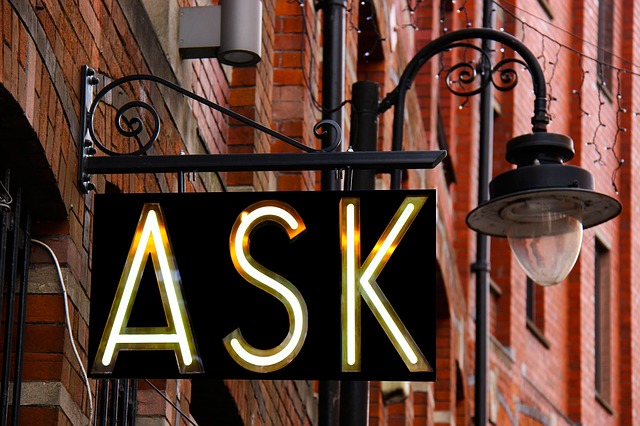
Image from pixabay by Dean Moriarty, CC0

My friend Ben Collver recently loaned me a book called A More Beautiful Question, by Warren Berger, that arose from some ideas in Warren’s blog. The book is specifically focused on questions that spark business innovations, and his key questions boil down to “Why, What If, and How Might questions that can’t be answered with facts”.

Earlier this year I wrote a post about questions to ask to really get to know people better. And I’m familiar with the value of Appreciative Inquiry type questions.

So I’ve started thinking whether there is some larger question set and question criteria that might, in a broad range of circumstances:

  • Identify the qualities that make for a good question
  • Identify the benefits of asking questions (and when asking a question is most effective and interesting)
  • Identify the types of questions that can best achieve these benefits

Over the past few weeks I’ve read everything I could get my hands on on this subject, and I think I’ve been able to synthesize the results down into something useful.

Building on and generalizing my earlier post, I think the 6 most important Qualities of a good question are:

  1. They elicit honest, thoughtful answers rather than clever, safe, automatic or socially acceptable ones.
  2. They are not so personal, so complicated, or so distressing to think about that they make people hesitant to answer, but they are personal enough, challenging enough, and provocative enough that they elicit sufficient consideration, focus and passion to produce interesting, revelatory and possibly ‘useful’ responses.
  3. They don’t (for most people) require an enormous (ie discouraging) amount of time and energy to ponder to come up with a considered response.
  4. They encourage follow-up questions and deeper explorations into the answers and reasons for them.
  5. The responses to them achieve one or more of the six Benefits listed below.
  6. Both the question and the responses help us learn, and provide knowledge, ideas, perspectives, insights, and/or a deeper relationship with someone, that otherwise wouldn’t have been achieved.

And the 6 most important Benefits of asking, thinking about and responding to high-quality questions are that they help us:

  1. Understand why things are the way they are
  2. Appreciate what we don’t know, need to know, and/or can’t hope to know
  3. Imagine novel alternatives
  4. Iteratively move an idea or process forward or deeper
  5. Learn important and/or interesting things about ourselves and others
  6. Encourage people to articulate and share what they know and care about

Building on Warren’s three types of questions to spark business innovation, I looked through several hundred examples of ‘beautiful’ questions that seemed to have the 6 Qualities, and discovered that they generally had similar syntaxes, depending on the purpose (and hence on the Benefit they potentially delivered). While a few offered more than one of the 6 Benefits, most were clearly designed to offer just one of the 6, so I’m listing them below, sorted by Benefit. Key Question Types:

  1. To understand why things are the way they are
    • Why is it this way? What’s really going on here?
    • Why isn’t it that way? Why has no one (else) done… ?
    • What’s working, and what’s not working, and why?
    • Tell me a story about when things went really well.
  2. To appreciate what we don’t know, need to know, and/or can’t hope to know
    • What’s the ‘problem’ we’re trying to solve (and is it real and do we really care about it)?
    • Tell me a story about when things went badly.
    • What do we need to find out?
    • What are the risks of not knowing… ?
    • Who else should we be talking with or involving in this?
    • What are we missing?
  3. To imagine novel alternatives and workarounds
    • What if we… ?
    • What if things were different in that… ? Can we imagine a better state and then figure out how to get there?
    • How might we… ?
    • How might we begin to… ? What would be the first step forward?
  4. To iteratively move an idea or process forward or deeper
    • What if we… ?
    • Is this really true? Is this really important and useful? Is it actionable?
    • What’s happening here?
    • What are we missing?
  5. To learn important and/or interesting things about ourselves and others
    • What would you do if… ?  Imagine that you… ? What if you could… ?
    • What do you wish… ?
    • What do you think/believe… ?
  6. To encourage people to articulate and share what they know and care about
    • What do you think about this?
    • How do you feel about this?
    • What are your instincts telling you about this?
    • What are we missing?

We should recognize that we’re not all good at coming up with good questions, and we don’t all have the imaginative and creative skills needed to come up with interesting or breakthrough answers. That means assessing who’s good at asking, and who’s good at answering certain types of questions, and drawing on those strengths — and building our own competencies.

Some of the above questions (eg What if we…?) may require great imagination to move beyond the incremental. And answering some of the other questions (eg How might we…?) may require a rare level of imaginative thinking to answer affirmatively at all. Poor questions and unimaginative or ignorant answers are of no value at all.

So here are a few scenarios where asking (and answering) questions might be of particular value, and some sample questions (of the appropriate Type) that might help. I’ve provided one scenario to address each of the potential Benefits (though obviously in any real situation more than one Benefit might be achieved by asking questions, so questions of many Types might be appropriate).

What’s particularly interesting is that sometimes just asking the (right) question confers some, or even most of, the value.


Scenario: You, and someone you love and also work with, have recently been at constant loggerheads, disagreeing about what’s true, what’s good and bad, and what to do. You’re constantly triggering each other, resulting in anger, fear, tears and withdrawal.

Some Benefit 1 Question Types: Why has this been happening? What’s behind it? What’s really going on here? Why aren’t things smooth and easy and any upsets effectively and dispassionately resolved? What are we handling well, and why? What are we not handling well, and why? Tell me a story of when we were at our best. [then you’d move on to Benefit 2-3 question Types]


Scenario: You and your family are entrepreneurs worried about climate change and the state of the economy. You are thinking of moving to a more sustainable place, but there seem practical obstacles to any of the ones you’ve identified, especially with your fledgling business.

Some Benefit 2 Question Types: What’s the real problem we’re trying to solve here? What do we need to find out to make an informed decision? What are the risks of moving, and of staying put, that we might not have contemplated? Who can we talk with to get a better understanding of the situation and options? What are we missing here?


Scenario: You just learned that a new competitor for your small business is using cheap overseas labour and exploiting poor environmental standards overseas to offer products and services possibly comparable to yours for half the price. You have to innovate or your business may not survive. [In such a scenario, different types of questions might help achieve all six Benefits, but I’ve just listed some Benefit 3 & 4 Question Types.]

Some Benefit 3 & 4 Question Types: What if we did nothing? How might we create products and services that no offshore competitor could match? Is it true that this new company threatens us; is there anything we can really do anyway? What if the new competitor didn’t exist; what would we do differently? What are we missing here?


Scenario: You and three other people with complementary skills have recently been approached about a potentially exciting new social enterprise opportunity. None of you know each other, and you’ve convened to see whether you think you might get along well together in such an operation, and personally.

Some Benefit 5 Question Types: (this is one of Ben’s brilliant questions, after seeing the work of a portrait photographer who often placed objects of note in her subject’s hands:) If you were getting a portrait taken, and the photographer asked you to hold something in your hand that told viewers something important about you, what would it be? (the famous Peter Thiel question:) What do you believe that no one else does? (and another famous question) What would you do if you knew you couldn’t fail? (and from my earlier post:) What do you wish you’d learned earlier in life? Of the people you’ve known in your life but fallen out of touch with, who would you most like to reconnect with, and why? If you had to write 200 words that summarize your worldview or philosophy of life, what would they be?  (and finally, a few adapted from Arthur Aron’s famous 36 questions:) Given the choice of anyone living in the world, who would you want as a dinner guest? What would you like to be renowned for? What are you most grateful for? What would you most like to know about your true self, or about your future? What’s on your bucket list, and what’s holding you back? If you knew you were going to die soon, what would you do with your remaining time?


Scenario: Your small enterprise is dealing with a new challenge, but at your meeting a small number are dominating the conversation, and others are clearly feeling unwilling or incapable of proffering their thoughts.

Some Benefit 6 Question Types: (for the wallflowers) What are your thoughts and feelings on this (“Let’s go around the circle.”)? What are your instincts telling you? What’s your sense of what’s going on here? Are we missing something?


There is, unfortunately, no straight-forward checklist of questions, and no easy way to know exactly what to ask. Everything depends on context. And the art of divining and asking the right question, and asking it the right way, can require almost as much imagination as answering the most wicked and challenging question. But perhaps a ‘roadmap’ like the one above might be useful in getting you started and pointed in the right direction. What’s your objective in asking a question in a particular context (ie what Benefits are you striving for)? What Types of questions might achieve that objective and achieve those Benefits? And, once you’ve arrived at what you think are the right questions, before you ask them, ask yourself if they meet the 6 Qualities of a great question.


(Thanks to Ben and to Tree Bressen for their contributions to this synthesis.)

23 Sep 16:19

Die Größe macht den Unterschied

by Volker Weber

20180922 085024

Alles Geschmacksache, sprach der Affe und biss in die Seife. Manche Leute mögen kleine Handys, ich mag große. Beim iPhone X haben wir lange diskutiert, ob das Display genauso groß wie das des iPhone Plus ist, und dann kam raus, dass es zwar mehr Diagonale hat, aber letztendlich doch weniger Pixel, weil das Format schlanker war. Jetzt aber gibt es das Xs Max, und das ist definitiv größer als beide. :-) Und ob man eher ein Xs oder ein Xs Max hat, kann man nicht nach dem Datenblatt entscheiden. Man muss sie in die Hand nehmen. Bei mir eine klare Sache: Das große Display gewinnt. Das gilt sowohl für das iPhone als auch die Apple Watch.

Die Display-Größe ist der einzige signifikante Unterschied zwischen Xs und Xs Max. Das war bei den Plus-Modellen noch anders. 7 Plus und 8 Plus hatten die bessere Kamera. Jetzt kann man einfach entscheiden, ob man lieber das größere oder das kleinere Gerät haben will. Groß sind sie beide. Kleine gibt es nicht mehr. Die Apple Watch hat übrigens nun mehr Pixel als das Original iPhone.

Auch die Apple Watch fühlt sich für mich richtiger an. Bis zur Series 3 war der Bildschirm rechteckig, in einem abgerundeten Gehäuse. Nun folgt der Bildschirm der Kontur des Gehäuses. Das sieht nicht nur besser aus, sondern ist auch besser lesbar. Apple hat viele Details im User Interface an die größeren Bildschirme angepasst. Das hilft meinen alten Augen.

23 Sep 16:19

Apple Watch 4 is a proper phone

by Volker Weber

f66e8a4e764bd9f746a212db5fdb2b6b

I have been using Apple Watch 3 as a phone on LTE before. It's a nice way to receive a call when you are not close to your iPhone. But Apple Watch 4 is changing the game. When I call you on Watch 4, you cannot tell the difference between Watch and iPhone. Why is that? Apple has moved the microphone to the other side and made the speaker louder.

23 Sep 16:19

“I never told anyone for decades — not a friend, not a boyfriend, not a therapist, not my husband when I got married years later.”

by Andrea

The Washington Post: I was sexually assaulted. Here’s why I don’t remember many of the details. By Patti Davis, author and daughter of President Ronald Reagan.

“It’s important to understand how memory works in a traumatic event. Ford has been criticized for the things she doesn’t remember, like the address where she says the assault happened, or the time of year, or whose house it was. But her memory of the attack itself is vivid and detailed. His hand over her mouth, another young man piling on, her fear that maybe she’d die there, unable to breathe. That’s what happens: Your memory snaps photos of the details that will haunt you forever, that will change your life and live under your skin. It blacks out other parts of the story that really don’t matter much.”

Link via MetaFilter.

23 Sep 16:19

Oliver's Turning 18

by peter@rukavina.net (Peter Rukavina)

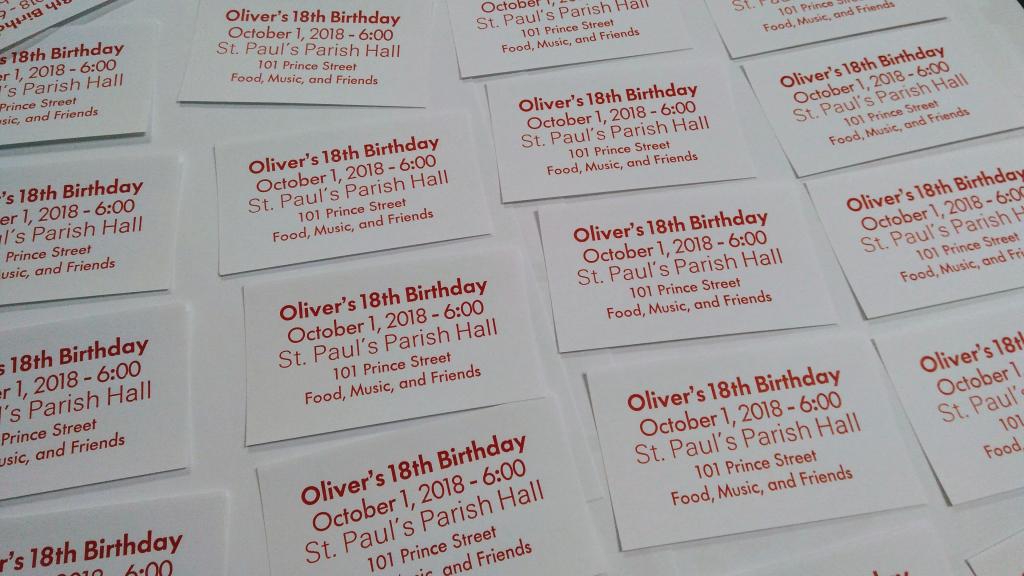
For the past year (or more), Oliver’s been focused intensely on October 1, 2018, the day he turns 18 years old and becomes an adult.

A big part of this has involved organizing a birthday party that includes people that have been a part of his life to date. What we’ve discovered this week is that’s a lot of people: schoolmates, daycare workers, teachers, farmers’ market vendors, politicians, childhood friends, and the doula that was there at the very moment of his birth.

We’ve rented the St. Paul’s Parish Hall for the evening, organized a meal of vegetarian chili, and booked a cross-section of musical acts that have touched on Oliver’s life.

It promises to be a barn-burner of an event. If your life has overlapped with Oliver’s and somehow the reach of his invitation blanket had missed you, please come.

23 Sep 16:18

iPhone Xs camera is very impressive

by Volker Weber

3b1d0d322da3cab39f702c69f3142cf8

Portrait mode is now on point. You can change the virtual aperture after the fact, dialing in the background, or blurring out everything out that is not in the same focal distance as the eyes.

3119621a27029a280fd62f64613f7114 a410ee6828b985589586c8528ef715de

The other big improvement is night shots. Night still looks like night, but there is very little noise in the blacks.

5f2ef6860d0c2aa67af0e7e84be63f40

This is way beyond good enough.

23 Sep 16:18

The Bingo Drum of Fate — 2018 Vancouver Civic Election

by Ken Ohrn
Randomizing the ballot for October’s civic election

The October 20, 2018 Vancouver civic election will present voters with a really big, but name-randomized ballot.  This eliminates the small advantage that seems to have gone to candidates whose names were at the “A” end of the alphabet.

Check out the results for mayor, council, school and park HERE, and find out whose name is furthest from it’s alpha-method location. Many thanks to Christopher Porter (a.k.a. canadianveggie), who compiled this spreadsheet for viewing on Google docs.

23 Sep 16:18

browser.fastblock.timeout and browser.fastblock.limit

(update 24 Sep 2018: add link to a FastBlock description on Bugzilla)

What's the difference between Firefox browser.fastblock.timeout and browser.fastblock.limit?

  • browser.fastblock.timeout: When Fastblock starts working (in milliseconds, default 5000 = 5s)

  • browser.fastblock.limit: When Fastblock stops working (also in ms, default 20000 = 20s).

FastBlock only works if browser.contentblocking.enabled and browser.fastblock.enabled are both true.

Starting browser.fastblock.timeout ms after the page starts loading, FastBlock will stop loading new third-party resources that are on the Tracking Protection list.

  • FastBlock does not affect third parties that are not on the Tracking Protection list.

  • FastBlock does not cancel third-party requests that are already loading.

Then, starting at browser.fastblock.limit ms after the page starts loading, FastBlock stops having any effect.

More on Fastblock here

The sole focus of the Fastblock feature is to restrict the loading of trackers. It monitors trackers waiting for the first byte of data since the start of navigation of the current tab’s top level document. If this is not received within 5s, the request is canceled. If any bytes are received, the 5s timer is stopped. In some of the experimental branches, a few tracker requests are whitelisted, and do not have this monitoring. These include resources known to cause breakage, such essential audio/video, and commenting platforms.

Here's the code.

Fastblock plus European mode

Just going by basic economics, ads placed with more information about me are going to carry less signal and more deception than ads placed only by what page they're on. Now I'm wondering how well "slow loading ads" correlate with "deceptive ads". Are slow loading ads slow because they depend on a bunch of complex RTB stuff? Can less creepy ads be faster?

By combining FastBlock with a brower extension to turn on Google's documented but underrated European mode, I should be able to get a better class of web ads all around. I'll give it a try and follow up with how it goes.

This post is a work in progress. I'll update as needed to fix errors and update with current browser behavior.

23 Sep 16:17

Twitter Favorites: [violasong] Life purpose: anytime someone calls themself stupid for getting blocked by a software issue, I say on behalf of the… https://t.co/C40aHX7N0y

Victoria Wang @violasong
Life purpose: anytime someone calls themself stupid for getting blocked by a software issue, I say on behalf of the… twitter.com/i/web/status/1…
23 Sep 16:16

Twitter Favorites: [skinnylatte] I asked for a pride flag on my bank card, I got one with an American flag. I am going to use it coz it’s so ridiculous.

Adrianna Tan @skinnylatte
I asked for a pride flag on my bank card, I got one with an American flag. I am going to use it coz it’s so ridiculous.
23 Sep 16:12

Wie in Detroit Fahrräder aus Stahl gemacht werden

by Ronny
mkalus shared this story from Das Kraftfuttermischwerk.

Ich gehe davon aus, dass Fahrräder industriell anders hergestellt werden, aber wenn bei Detroit Bikes Räder aus Stahl gebaut werden, ist das noch Handarbeit. Und die Konstruktion zum Schweißen des Rahmens ist ziemlich beeindruckend.


(Direktlink, via Core 77)

23 Sep 15:56

Twitter informing users about bug that sent private messages to developers

by Sameer Chhabra
Twitter on iPhone X

U.S.-based microblogging giant Twitter is sending out messages to users about a bug that may have sent private messages to unauthorized developers.

According to a number of Twitter users posting screenshots of the notification, the company identified a bug on September 10th, 2018 that may have sent direct messages or protected tweets “to Twitter developers who were not authorized to receive them.”

Twitter said that the bug has been around since May 2017, but that the company “resolved it immediately upon discovering it.”

The bug itself was part of Twitter’s Account Activity API (AAAPI), which allows registered developers to “better support businesses and their communications with customers on Twitter.”

A tweet from the Twitter Support account added that the company hasn’t come across an instance where data actually was sent to the wrong person, but that the company also can’t “conclusively confirm it didn’t happen, so we’re telling potentially impacted people about the bug.”

The bug reportedly affected fewer than one percent of Twitter users.

Source: Twitter

The post Twitter informing users about bug that sent private messages to developers appeared first on MobileSyrup.

23 Sep 15:56

APK teardown reveals possible Google Pixel Stand animation in action

by Dean Daley
Pixel 2 XL

An animation for a Google-made phone dock has surfaced online.

The animation, first spotted by 9to5Google following a teardown of the latest version of the Google app, reveals that the tech giant is working on a charging dock of some sort.

9to5Google suggests that the Pixel Stand could be a wireless charging accessory, though that doesn’t seem to be clear from the uncovered animation.

It appears users will be able to check messages and calendar notifications, as well as change music and hear set alarms while the phone is on the dock. Additionally, the dock will include some sort of ‘Daydream’ mode that cycles through photos on the user’s handset.

Recently, an APK teardown revealed that when the phone is on the Google-made stand, Assistant will continue to function, even if the device is locked.

Previous leaks revealed that the Pixel 3 series could feature wireless charging. If true, it’s likely 9to5 is correct and the Pixel Stand includes wireless charging functionality. Google will likely confirm this at its upcoming Pixel event on October 9th in New York City. 

Source: 9to5Google

The post APK teardown reveals possible Google Pixel Stand animation in action appeared first on MobileSyrup.

23 Sep 15:56

Here’s how much GoPro’s new Hero 7 action cameras cost in Canada

by Brad Bennett

GoPro announced a new suite of action cameras on September 20th, and they’re launching in Canada on September 27th.

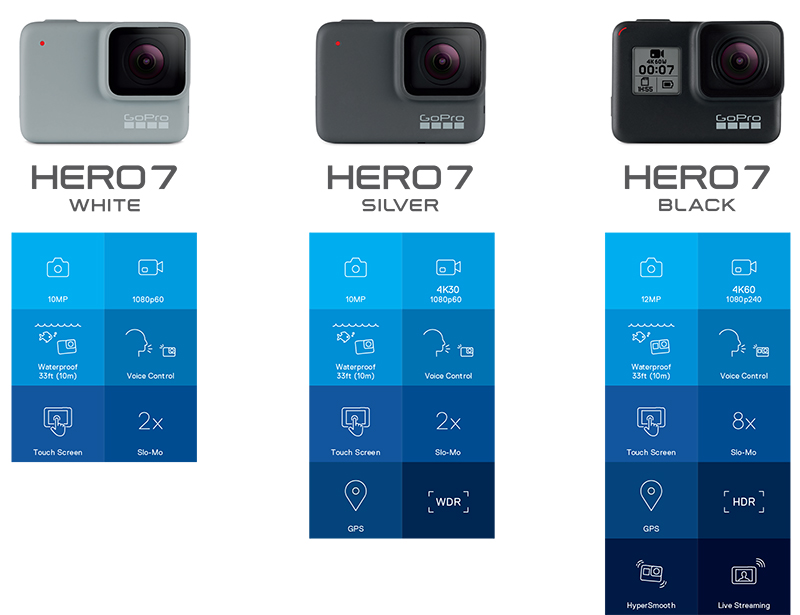
There are three new cameras. The top of the line Hero 7 Black, the mid-range Hero 7 Silver and the entry-level Hero 7 White.

All three of the cameras are waterproof for up to a depth of 10m, they each have a 2-inch touchscreens, voice controls, auto image offloading, time-lapse video, Wi-Fi, Bluetooth and more. No matter which one of the cameras you buy, they’re filled with  a lot of features and technology.

On a basic level, these cameras are similar, but the Black and Silver models have a few extra bells and whistles to justify their hefty price tags.

The Black model’s most significant feature is its advanced stabilization engine. The company is calling it ‘HyperSmooth’ and claims that it works as well as a gimbal. The new tech only uses digital image stabilization instead of true optical image stabilization that’s found in some smartphones and high-end camera lenses.

Don’t knock the tech though, because the footage that GoPro’s shared so far looks phenomenal. In addition to the stabilization, the Black Hero 7’s 12-megapixel sensor has high dynamic range, tone mapping and noise reduction.

The Black shoots video in 4K at 60 fps which is higher than the Silver’s 4K at 30 fps and higher still than the White’s 1080p at 60 fps capture. The new high-end model also has a removable battery. The battery is the same as last year’s Hero 6, so it works with the new action camera.

None of the cameras have a new design so they should be compatible with the same accessories that worked with the Hero 6 and Hero 5.

All of this isn’t cheap, the Hero 7 Black costs $529 CAD. The Hero 7 Silver is a little less expensive at $399, and the White is the most affordable, coming in at $269. All of the units can be pre-ordered from BestBuy.ca or GoPro’s website. It’s worth noting that the GoPro throws in a free 32GB Sandisk Extreme SD card.

Source: GoPro

The post Here’s how much GoPro’s new Hero 7 action cameras cost in Canada appeared first on MobileSyrup.

23 Sep 15:56

AirPower isn’t dead yet: charging pad referenced in iPhone XS packaging

by Patrick O'Rourke
AirPower

It looks like Apple’s almost mythical multi-device charging pad isn’t quite dead yet.

References to the AirPower are present in the iPhone XS, and iPhone XS Max’s physical ‘getting started guide,’ according to Twitter user Gave Stephens ‘@ccgavind.’

“Place iPhone with screen facing up on AirPower or a Qi-certified wireless charger,” reads the setup guide.

Further, there are also references to the AirPower charging pad in the latest version of Apple’s mobile operating system, iOS 12.1. 9to5Mac notes the following regarding what the publication uncovered in the latest build of iOS:

“The component of iOS responsible for managing the charging interface that appears when using AirPower has been updated, which means that Apple is still actively working on the project…”

While this doesn’t necessarily mean that Apple plans to reveal its AirPower charging pad soon, it seems that it’s at least still in development in some capacity.

Rather than take advantage of established Qi-certified wireless charging, the AirPower aims to build on this technology by allowing wireless charging from any location on the pad, as well as through its tight integration with iOS.

The AirPower is capable of charging the Apple Watch, iPhones compatible with wireless charging, including the recently released iPhone XS and XS Max and Apple’s Airpods through a still unreleased wireless charging case.

While Apple announced the AirPower back at its September 2017 keynote, the anticipated charging device hasn’t been seen since and was a no-show at Apple’s 2018 recent fall presentation. It’s possible Apple could be saving revealing the AirPower’s release date for its rumoured October keynote.

Recent reports indicate that AirPower’s complexity has resulted in a series of problems for Apple’s engineers, likely resulting in the charging pad’s delayed release.

Source: Twitter (@ccgavind) Via: 9to5Mac

The post AirPower isn’t dead yet: charging pad referenced in iPhone XS packaging appeared first on MobileSyrup.

23 Sep 15:55

Toyota is reportedly going to begin supporting Android Auto

by Brad Bennett
Toyota steering wheel controls

Japanese automotive manufacturer Toyota has been notably stubborn when it comes to adding Android Auto to its vehicles, but now it seems like the feature is finally on the way.

Bloomberg reports that someone close to the project has confirmed that Toyota plans to add Android Auto to its vehicles.

The company currently has five car models on the market that feature Apple’s CarPlay platform: the 2019 Avalon, Camry, C-HR, Corolla and Sienna.

Instead, Android Auto drivers used SmartDeviceLink, a technology developed by Ford that runs Android and iOS through its proprietary system.

There’s no word on if it’s just the same two cars that are getting CarPlay or if it will only start appearing in the next vehicles the manufacturer announces.

Partnering with Toyota is a significant move for Google since the tech giant finally gets to use its software inside the third-largest automaker’s vehicles. Adding this on top of the deal the search giant made with the Renault-Nissan-Mitsubishi Alliance, Android Auto is set to be in all three of the largest automotive manufacturers’ vehicles.

It’s unclear if the Toyota agreement will be similar to the deal with the Alliance. It seems unlikely that Toyota would want to give up control of the technology that runs its head-units since it has stood so strongly by it for years. It’s more on-brand for Toyota to use the regular phone compatibility mode where users run their phone from their car’s screen.

Google has been making a lot of moves in the automotive sector recently, and if it’s actually getting on Toyota’s good side, this could be a tremendous win for the company.

Source: Bloomberg

The post Toyota is reportedly going to begin supporting Android Auto appeared first on MobileSyrup.

23 Sep 15:54

Apple Watch owners are experiencing issues activating on Rogers

by Jonathan Lamont
Apple Watch Series 4

Several Rogers customers are having issues connecting cellular Apple Watches to their Rogers accounts due to errors.

The self-enrollment program went live on September 17th. It allows Apple Watch owners to activate with Rogers through their iPhone. However, owners found the usually simple set-up process wasn’t so simple after all. Whether they had an Apple Watch Series 3 or already got their hands on a Series 4, the set-up ended in error.

The typical cellular Apple Watch set-up involves scanning a pattern on the device with the Watch app on an iPhone. Then the phone and watch communicate. During that set-up, the iPhone will send carrier data to the Apple Watch.

Users are then prompted to tap the ‘Set Up Cellular’ option. However, this is where many users encountered their first error.

Your account isn’t eligible

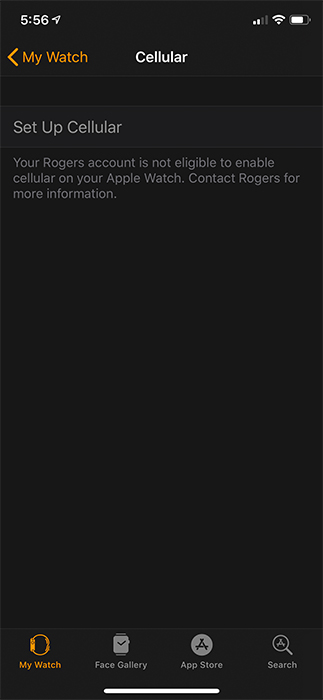
Several reports on the Rogers help forums indicate that this option was greyed out. Worse, below the prompt, it reads “Your Rogers account is not eligible to enable cellular on your Apple Watch. Contact Rogers for more information.”

Apple Watch set-up issue

Unfortunately, users who called into support for more information report that it’s rather sparse right now. Some have opened support tickets, but those tickets have reportedly not received updates in days.

Another more common problem was an error code labelled “WS300.” Customers have reported other error codes as well, but WS300 appears most often. All errors seem to appear at the same point in the set-up.

After the final verification step, when the user enters address information for 911 services, the error pops up. The app kicks user back to the beginning of the set-up process after the issue.

One other important note: it appears that the Rogers system reserves a line for your Apple Watch during set-up. However, the system keeps the reserved line even if the activation fails. Some users reported that trying to activate a watch multiple times caused them to hit their line cap and they had to call into Rogers to remove the reserved lines.

You’ll have to be patient for now

If you’re a Rogers customer hoping to activate your new Apple Watch, I’d recommend that you keep your eye on the company’s support forums for updates.

It’s not entirely clear what’s causing these problems. However, techs are working to sort it out. MobileSyrup has reached out to the carrier for more information and will update the article accordingly. Currently, there is no timeline on a resolution.

Right now, the best solution is patience. Customers who have spoken with Rogers support report that that’s the advice given. The company will hopefully have a resolution soon.

Source: Rogers Community Forums

The post Apple Watch owners are experiencing issues activating on Rogers appeared first on MobileSyrup.

23 Sep 15:53

Follia VR and iStaging are showing off its tech at the VR/AR Global Summit in Vancouver

by Ian Hardy

When it comes to finding a house, buyers and renters in the frothy Vancouver market know all about the frustrations — forced into a bidding war for a place you’re not that keen on, or worse, haven’t even seen, exorbitant rents for ramshackle digs, and a foreign buyers’ tax adding to the price tag for those coming from overseas.

So the western Canadian city is a perfect place for two Taiwanese tech companies to pitch their virtual reality solutions to the problems that bewitch all those who have struggled to buy, sell or rent a place to call home. And no, neither one involves an alternate reality where housing is affordable and plentiful and all your neighbours are friendly and not weird.

Similar to XR Express TW, Follia VR and iStaging are in town for the VR/AR Global Summit taking place this Friday and Saturday, with each of the companies offering a way to improve life for the residents, property-owners and realtors of this city and others all around the world.

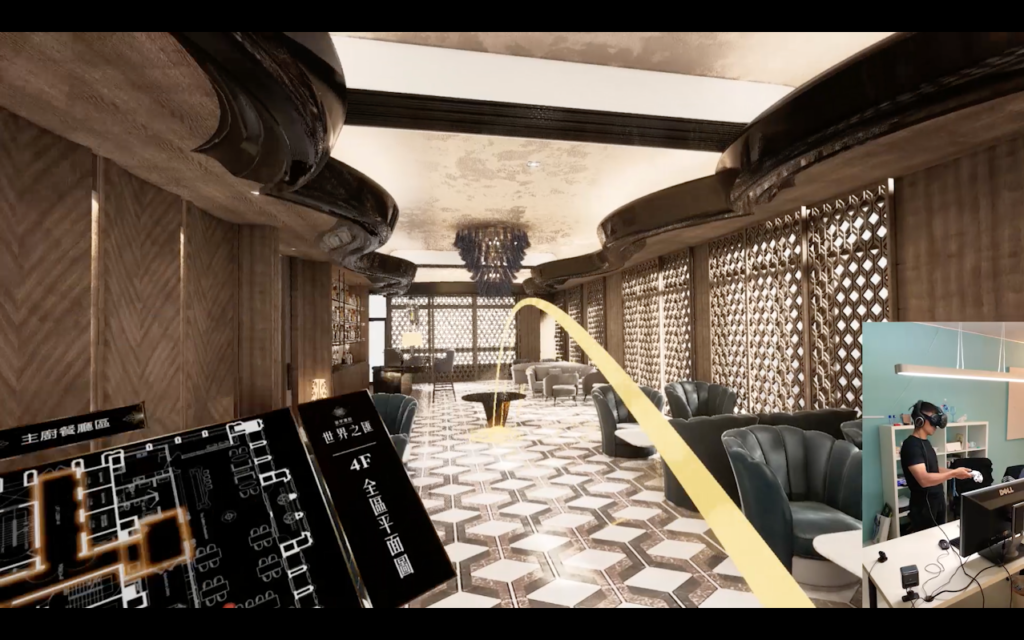
Follia says it can teleport users to their “dream space from the future” in real-time, using ray-tracing technology to produce highly accurate renderings which can be adjusted with a choice of 5,000 items of furniture and building materials.

Picky customers don a headset and can see what the kitchen will look like in marble or granite or pore over whether their want a Nordic pine or mahogany table until their heart’s content. Being able to turn around in the space and walk through it makes it easier to understand the house plan, and if the VR model is provided time information it will show what your creation looks like in the early morning, with a late afternoon glow, or as dusk comes on.

“We want to emphasize that home is an important place for us to rest our minds and bodies and to regain energy,” said Follia founder Sung Yu Lin. “For us, it’s our mission to help people to find their dream houses.”

The company says its product can help construction companies start selling two or three months earlier, save 90 percent of the costs of model homes, photo rendering and printouts, and increase their chances of closing a deal.

iStaging is meanwhile making it more likely that you’ll be able to see a virtual walkthrough of a prospective property by putting the power to create virtual reality in the pockets of realtors and stagers.

“While many existing VR capture solutions rely on expensive services or costly third-party hardware, iStaging has focused on maximizing convenience and affordability by leveraging technology people already use: their mobile phones,” the company said in a statement to Mobile Syrup. “Anyone can now capture, edit, and share immersive 8K iStaging LiveTours of spaces with anyone in the world.”

The company was founded in 2014 and is based in Taipei with satellite offices in San Francisco, Shanghai and Paris.

The two companies will be speed-dating and workshopping with some of the most virtual reality focused executives, thinkers, investors and inventors at the global event.

The post Follia VR and iStaging are showing off its tech at the VR/AR Global Summit in Vancouver appeared first on MobileSyrup.

23 Sep 15:53

Here are the Google Pixel 3, Galaxy S10 and Huawei Mate 20 Pro leaks from last week

by Dean Daley

From Google to OnePlus, a variety of smartphone leaks surfaced this past week.

Here’s a breakdown of almost every smartphone leak from the last few days. The information below encompasses news from September 15th to September 21st.


Google

Alleged press renders of both the Google Pixel 3 and 3 XL have surfaced online. The renders reveal the phone in Google’s official fabric cases.

For more on the Pixel 3 and 3 XL renders, click here.


Pixel 3 teaser source code reveals that there is a fourth Pixel 3 colour. While the source code indicates the colour pink, the colour is yet to be guaranteed, and pink is solely a possibility.

For more on the Pixel 3 colours, click here.


Samsung

Samsung’s Galaxy S10 series is rumoured to adopt a different design when compared to previous S-series handsets. Further, the company is expected to release phones with more colour options with the upcoming S10 lineup.

For more on the S10 design change, click here.


Samsung is also expected to launch four S10 variants in 2019. The lowest S10 option is tipped to feature a flat 5.8-inch display, while the other reportedly comes equipped with an edged 5.8-inch panel. Meanwhile, the larger variants will both sport a 6.44-inch displays, with the difference being that one will include a 5G capable modem, while the other doesn’t.

For more on the four Galaxy S10 variants, click here.


OnePlus

Roland Quandt posted a leak regarding the OnePlus 6T. The image used shows half of the OnePlus 6 with the other half being OnePlus 6T, in order to compare the handsets side-by-side. The 6T is slightly larger and lacks a fingerprint scanner on the rear. Further, Quandt confirms the 6T will not feature a triple rear-camera.

For more on the OnePlus 6T, click here.


Huawei

Images of the Mate 20 Pro have surfaced online. The photos show off the Pro’s sizable notch, as well as tall display. The leak also revealed that users can charge Huawei’s Freebuds 2 Pro earbuds by lying the case down on the Mate 20 Pro.

For more on the Huawei Mate 20 Pro, click here.


LG

The LG V40’s specs have surfaced online. The specs indicate the phone will feature a 6.4-inch QHD+ display with a 3,120 x 1,440 pixel resolution, 3,300mAh battery, 8GB of RAM and 128GB of internal storage.

Alongside a selfie shooter setup with 8-megapixel and 5-megapixel sensors and a triple rear-facing camera setup with a 16-megapixel main shooter, sits a 12-megapixel wide-angle lens and an 8-megapixel telephoto lens, according to the leak.

For more on the LG V40, click here.

Image credit: Mobile-Review

The post Here are the Google Pixel 3, Galaxy S10 and Huawei Mate 20 Pro leaks from last week appeared first on MobileSyrup.