Shared posts

14 Jan 06:47

Dave’s Preposterous Predictions 2022-2025

by Dave Pollard

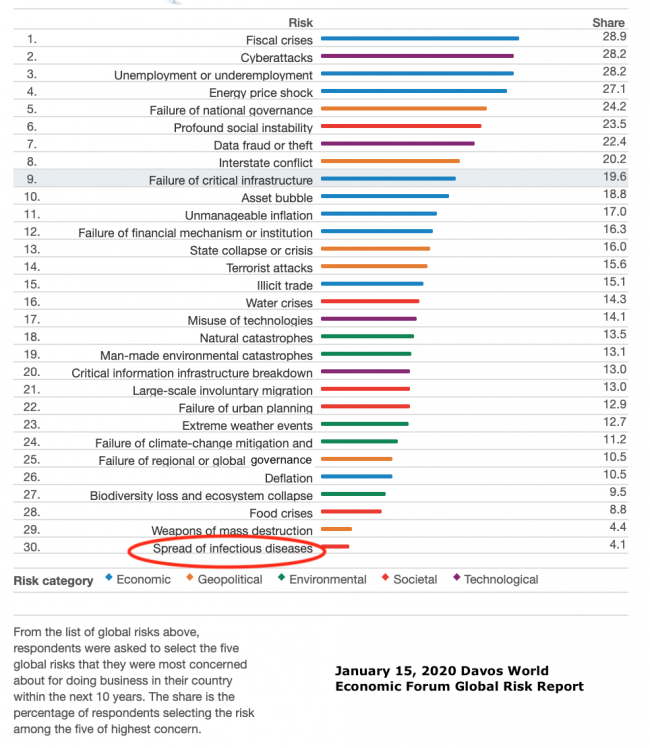
In late 2019, the Swiss gnomes in Davos were asked to rank 25 global risks in order of their assessment of the probability of them occurring over the following ten years. As shown above, they rated the risk of a pandemic dead last.

Everyone’s predictions, including mine, have been so utterly incorrect over the past few years that most people, fearing ridicule, seem to have given up making predictions at all. Fortunately, as someone who doesn’t actually exist, and as someone with an appreciation that there is nothing actually happening and no time or space within which anything can happen, I harbour no such fears.

So here are my wildly improbable predictions for the next four years (even I’m not foolish enough to predict things over a shorter time horizon than that):

  1. Pandemic’s end: The omicron variant will turn out to be much less virulent than its predecessors, perhaps even in line with the IFR of seasonal flu. So even though we’ll still hear about CoVid-19 as outbreaks continue in some places, by mid-2022 it will be endemic and cease to make headlines. However, by 2025 there will be at least one new major pandemic, probably an HxNx virus emerging from confined animals, most likely poultry.
  2. US political upheaval: Democrats will lose Congress in 2022 and the White House in 2024. They will, in the process or as a result, either (a) move hard left and embrace a truly progressive agenda, or (b) the entire left-of-centre wing of the party will break away, start a third party, and take most of the under-25 voters with them. But it may take years before the old Democratic party is subsumed and the new party again takes power.
  3. Ecological collapse: Each year 2022-25 will see more and more ecological crises, and not just those related to climate collapse, but also biodiversity collapse, loss of arable soils, water loss, droughts, and a host of other currently-ignored ecological crises. Ecological collapse, in this broadened sense, will finally be taken seriously, but only by the fed-up citizens as a whole (through many movements of large-scale direct action), not by governments (which will remain paralyzed and incompetent) or corporations (which will remain obstinate).
  4. Major war(s): There will be at least one major war involving the real danger of nuclear weapons use and/or biological weaponry. People who thought the existential risk of nuclear annihilation was history, will think again.
  5. Market turbulence: Inequality, speculation, rising inflation, and oppressive debt levels will combine to produce a series of market crashes over the next few years that will significantly reduce stock and real estate prices and keep them well below their current absurd levels for years to come. But the start of the ‘Big One’ — the permanent collapse of our industrial economy over several decades, will be pushed off by endless maneuvering, probably until the end of this decade or so. Expect headlines about ‘The End of Growth’, and finally some reckoning of what that means.
  6. New measures of well-being: The absurdity of policies designed to increase average/global GDP will finally dawn on the citizenry, and then the media and politicians, and that will be precipitated by data showing the start of a permanent decline in life expectancy, and in healthy life expectancy. So the new measures will be about well-being and the quality of life.
  7. New understanding of the nature of the universe: Breakthroughs in science will lead to the abandonment of the Big Bang theory and other unsatisfactory models, and usher in some challenging and revolutionary new ideas about our universe, matter and reality. Sadly, they will be both unfathomable and uninteresting to most people.
  8. UBI gets its chance: The first national experiments with a Universal Basic Income will be launched (probably in Scandinavia), and others will follow suit, when it becomes clear that this is by the far the simplest and most effective ways to address a host of social and economic problems.
  9. The collapse of advertising and corporate social media: As mountains of data make it increasingly obvious that advertising is largely a waste of money (and an unaffordable luxury when the economy crashes), media and businesses that rely on advertising revenues will collapse, and be replaced by media that use a non-hierarchical, non-corporate membership-based model instead. These will be local and diverse but they will be well networked, so we’ll get much more functionality, more tailoring to our information needs and preferences, and much less crap.
  10. More black swans: The crisis that most dominates the headlines and creates the most disruption over the next four years will be one that isn’t even on the radar in 2022. And no, I’m not going to guess what that might be.

Stay safe, everyone. More of the ‘new normal’ wild ride ahead.

14 Jan 06:26

Are AirTags Causing Stalking or Making Us More Aware of It?

by John Voorhees

The problem of AirTags being used to stalk people has been in the news ever since they were released last spring, but a recent story in The New York Times has brought the issue to the forefront again. AirTags are fantastic when used as intended to keep track of your keys, luggage, and other personal items, but stalking is a serious problem that Apple should do everything it can to prevent.

Apple is also in a unique position given the vast size of its Find Me network. That puts the company in a different league than competitors like Tile, which carries greater responsibility with it.

In a story on Peer Reviewed, Matt VanOrmer puts a finger on something I’ve been wondering for a while: Are AirTags contributing to the problem of stalking or merely making us more aware of it because of the unique stalking countermeasures built into the device? It’s a classic causation/correlation question that is worth reflecting on. As VanOrmer explains:

I think the increase in news stories about AirTag stalking situations are less indicative of AirTags causing more stalking, and more indicative of how frequently stalkings already occur — with AirTags’ anti-stalking features simply bringing more of these horrible situations to light. These stories may be a classic example of the Baader-Meinhof phenomenon (AKA the “Frequency Illusion”) — in which increased awareness of creeps using AirTags to stalk women creates the illusion that it is happening more often, or even that AirTags are responsible for this illusory increase in incidence.

As VanOrmer rightly points out, Apple should do everything it can to prevent AirTags from being used to track people, which includes improving the tools available to Android users for whom Apple has made an app that is generally viewed as insufficient. This is also a topic where some added transparency about what Apple is doing to address concerns about stalking would help observers decide whether it’s enough instead of having only anecdotal news reports to go on. However, given the wide-reaching impact of the Find My network, which affects people who aren’t even Apple customers, I think a third-party audit of how Apple is handling the security and privacy implications of AirTags is warranted.

→ Source: peerreviewed.io

14 Jan 06:26

OpenSea, Web3, and Aggregation Theory

by Ben Thompson

This was originally sent as a subscriber-only Update.

From Eric Newcomer:

The NFT-marketplace OpenSea is in talks to raise at a $13 billion valuation in a deal led by Coatue, sources tell me. Paradigm will also co-lead the $300 million funding round, according to a spokesperson for the firm. Kathryn Haun’s new crypto fund, which is currently operating under Haun’s initials “KRH,” is also participating in the funding round, sources tell me. Dan Rose at Coatue is spearheading the round and may take a board observer seat.

OpenSea confirmed the news on their blog:

In 2021, we saw the world awaken to the idea that NFTs represent the basic building blocks for brand new peer-to-peer economies. They give users greater freedom and ownership over digital goods, and allow developers to build powerful, interoperable applications that provide real economic value and utility to users. OpenSea’s vision is to become the core destination for these new open digital economies to thrive, building the world’s friendliest and most trusted NFT marketplace with the best selection.

This is, of course, a story about NFTs, at least in part, and by extension, a story about the so-called Web 3 née crypto economy that its fiercest advocates say is the future. But there are two other parts of this story that are very much at home on the Internet as it exists in the present: $13 billion, and “core destination.”

OpenSea’s Value

First, two more OpenSea stories from over the break. From Be In Crypto:

NFT marketplace OpenSea has frozen $2.2 million worth of Bored Ape (BAYC) NFTs after they were reported as being stolen. The NFTs on the marketplace now have a warning saying that it is “reported for suspicious activity.” Buying and selling of such items are suspended…

Meanwhile, there is a bit of a squabble happening over OpenSea over the Phunky Ape Yacht Club (PAYC). The NFT platform banned this NFT series because it was based on the Bored Ape Yacht Club NFTs. PAYC is virtually identical to BAYC, except for the fact it is mirrored.

This excerpt isn’t technically complete: buying and selling of the stolen NFTs — or of the PAYC NFTs — are suspended on OpenSea. The fact of the matter is that (references to) NFTs are, famously, stored on the blockchain (Ethereum in this case), and once those BAYC NFTs were transferred, by consent of their previous owner or not, the transaction cannot be undone without the consent of their new owner; said owner can buy or sell the NFTs to someone else, but not on OpenSea. It’s the same thing with with the BAYC rip-offs: they exist on the blockchain, whether or not OpenSea lists them for sale or not.

This, according to crypto advocates, is evidence of the allure of Web 3: because the blockchain is open and accessible by anyone, the stolen BAYC NFTs and the PAYC rip-offs can be sold on another market, or if one cannot be found, in a private transaction (leave aside, for the sake of argument and the brevity of this update, the question as to whether the fact that these transactions are irreversible is a feature or a bug).

Here’s the thing, though: this isn’t a new concept. What is the first answer given to anyone who is banned from Twitter, or demonetized on YouTube — two of the go-to examples Web 3 advocates give about the problem of centralized power on the Internet today? Start your own Twitter, or start your own blog, or set up a Substack. These answers are frustrating because they are true: the web is open.

Indeed, if this frustration sounds familiar, it is because it is the frustration of the regulator insisting that Aggregators are monopolies, that Google is somehow forcing users to not use Bing like some sort of railroad baron extorting farmers simply seeking to move grain to market, or that Facebook has a monopoly on social networking, ignoring the fact that we have far more ways to communicate than ever before.

In fact, what gives Aggregators their power is not their control of supply: they are not the only way to find websites, or to post your opinions online; rather, it is their control of demand. People are used to Google, or it is the default, so sites and advertisers don’t want to spend their time and money on alternatives; people want other people to see what they have to say, so they don’t want to risk writing a blog that no one reads, or spending time on a social network that because it lacks the network has no sense of social.

This is why regulations focused on undoing the control of supply are ineffective: the marginal cost nature of computing and the zero distribution cost of the Internet made it viable for the first time — and far more profitable — to control demand, not by forcing people to act against their will, but by making it easy for them to accomplish whatever it is they wished to do, whether that be find a website, buy a good, talk to their friends, or give their opinion. And now, to buy or sell NFTs.

This, then, is the reason that OpenSea received its $13 billion valuation: it is by far the dominant market for NFTs; should the market exist in the long run, the most likely entryway for end users will be OpenSea. This is a very profitable position to be in, even if alternatives are only a click away. It’s not like that reduces the profitability of a Google or a Facebook.

It is also why OpenSea’s bans have some amount of teeth to them: as I noted, you can still buy and sell these stolen and rip-off NFTs, just as you can still go to a website that is not listed in Google, communicate with a friend kicked off of Facebook, or state your opinions somewhere other than Twitter. The reduced demand, though, lowers the price, whether that price be traffic, convenience, or attention. Or, in the case of NFTs, ETH: not having access to OpenSea means there is less demand for these NFTs, and less demand means lower prices.

In short, OpenSea has power not because it controls the NFTs in question, but because it controls the vast majority of demand.

Crypto’s Aggregators

One of the reasons that crypto is so interesting, at least in a theoretical sense, is that it seems like a natural antidote to Aggregators; I’ve suggested as such. After all, Aggregators are a product of abundance; scarcity is the opposite. The OpenSea example, though, is a reminder that I have forgotten one of my own arguments about Aggregators: demand matters more than supply.

To that end, which side of the equation is impacted by the blockchain? The answer, quite obviously is supply. Indeed, one need only be tangentially aware of crypto to realize that the primary goal of so many advocates is to convert non-believers, the better to increase demand. This has the inverse impact of OpenSea’s ban: increased demand increases prices for scarce supply, which is to say, in terms that are familiar to any Web 3 advocate, that the incentives of Web 3’s most ardent evangelists are very much aligned.

The most valuable assets in crypto remain tokens; Bitcoin and Ethereum lead the way with market caps of $874 billion and $451 billion, respectively. What is striking, though, is that the primary way that most users interact with Web 3 are via centralized companies like Coinbase and FTX on the exchange side, Discord for communication and community, and OpenSea for NFTs. It is also not a surprise: centralized companies deliver a better user experience, which encompasses everything from UI to security to at least knocking down the value of your stolen assets on your behalf; a better user experience leads to more users, which increases power over supply, further enhancing the user experience, in the virtual cycle described by Aggregation Theory.

That Aggregation Theory applies to Web 3 is not some sort of condemnation of the idea; it is, perhaps, a challenge to the insistence that crypto is something fundamentally different than the web. That’s fine — as I wrote before the break, the Internet is already pretty great, and its full value is only just starting to be exploited. And, as I argued in The Great Bifurcation, the most likely outcome is that crypto provides a useful layer on what already exists, as opposed to replacing it.

Moreover, as I explained in a follow-up to The Great Bifurcation, this view of crypto’s role relative to the web places it firmly in an ongoing progression away from technical lock-in and towards network effects:

Technical lock-in has decreased while network lock-in has increased

This is a dramatic simplification, to be clear, but I think it is directionally correct; the long-term trend, all of the hysteria around tech notwithstanding, is towards more openness and less lock-in. At the same time, this doesn’t mean that companies are any less dominant; rather, their means of dominance has shifted from the technical to the sociological.

Crypto, still largely valued on nothing more than the collective belief of its users, is the ultimate example to date of the power of a network, in every sense of the word. That that collective belief is a point of leverage for companies that can aggregate believers is the most natural outcome imaginable, even if it means that the lack of technical lock-in will likely prove to be more of an occasionally invoked escape hatch (and a welcome one at that) as opposed to the defining characteristic for the majority of users.

14 Jan 06:26

Some European carriers are blocking Apple's Private Relay

by Rui Carmo

This is hardly surprising if you consider many telcos are terrified of becoming dumb pipes and rely on traffic inspection (and zero rating) of various kinds to manage access to things like media streaming services (which they throttle), their own self-care systems (which rely on manipulation of HTTP headers in transparent proxies rather than doing authentication in a truly secure way) and keeping track of DNS requests for profiling (there are a lot of privacy concerns that telcos skirt every now and then for the sake of “securing their network”).

So it’s no wonder they’re throwing up FUD, lobbying and outright blocking the service due to “technical limitations” rather than letting customers use it and bypass all the spaghetti they put together since the WAP days of walled gardens.

It’s not going to be a nice, happy little service roll-out, and the telcos will never own up to being on the wrong side of the matter–or of history.


14 Jan 06:25

Damaged Vancouver seawalls will be a massive repair job, prompt re-think of how to deal with shores as tides and sea levels rise

by Frances Bula

My first story of the new year. I hope it’s not going to be a year of just one disaster after another.

After a severe winter storm that crumbled portions of Stanley Park’s seawall and hurled logs and other debris across area beaches last week, the Vancouver Park Board says it has no idea how much time or money it will take to undertake repairs of long stretches of waterfront.

The damage from the king-tide surge that coincided with high winds last Friday is prompting the city’s park commissioners to consider what to prioritize as they expect a multimillion-dollar repair bill. Those choices include delaying or abandoning a planned restoration of the Jericho Pier on the Kitsilano shore, which had been closed already because of previous storm damage.

It will likely also lead to a longer conversation about how the park board should plan for all of its shoreline, given the likelihood of even bigger king tides and damage as climate change accelerates and sea levels rise.

“People are going to have to have patience. It’s going to take some time to get the seawall open again and think what we can do to mitigate climate change,” said Stuart Mackinnon, the Green Party commissioner who is the park board chair. “And we’re going to have to take a good look and consult with the public about what amenities are important.”

“We’re in for some tough years,” added Green Party commissioner Dave Demers.

John Coupar, a commissioner with the minority Non-Partisan Association, said he thinks the repair period could be a good time to spend the money on upgrading the Jericho Pier, as has been planned for years.

But Mr. Mackinnon said there will be questions about that. “Do we want to reinvest in the pier?”

The shore and infrastructure have been damaged at a time when there is acknowledgment from all levels of government that cities will need to come up with a plan to accommodate rising sea levels. But there is a debate about how to do that.

Federal and provincial strategy plans in the past have suggested raising seawalls and dikes as one option.

However, others say that hard walls are an ineffective solution and also damage the ecology of both the ocean and the shore. Instead, they argue for a “build back softer” approach by creating shoreline pathways that are adapted to being underwater sometimes, as well as working on other ways to mitigate storm and king-tide damage.

STORY CONTINUES BELOW ADVERTISEMENT

Those are the kind of measures that B.C. towns such Gibsons and Campbell River are doing, says Alison Shaw, the executive director of Simon Fraser University’s Action on Climate Team.

People have said, through surveys, that they’d rather have a more natural-feeling shoreline than a big, moat-worthy seawall that would be an obstruction, she said.

Those lower-impact walkways could be somewhat protected through engineering strategies, like having large boulders, other artificial breaks, or netting placed close to the shore, along with efforts to enhance shorelines by encouraging natural vegetation.

The problem with hard seawalls and dikes is that they create surging and violent water sloshing that erodes the beach in front of them, eradicating the possibility of regular sea life that might exist in a calmer environment. “It’s destroyed intertidal marine systems in the Lower Mainland,” Prof. Shaw said.

In the meantime, engineers and consultants are out looking at the Vancouver and West Vancouver damage figuring out what to do.

“I’m going to stay away from an estimate,” said Ian Stewart, the board’s manager of park development.

He also wouldn’t give a projected time for reopening. “The engineers are out right now and were working over the weekend.”

Mr. Stewart said there was very heavy damage around Third Beach, in the middle of the closed stretch that goes from Sunset Beach near the Aquatic Centre to where the seawall passes under the Lions Gate Bridge.

The seawall in front of Kitsilano Pool was damaged but fortunately, Mr. Stewart said, water didn’t get into the pool’s mechanical room, even though the tide flooded into the pool itself.

He also expressed concerns about the cost of repairing the Jericho Pier, which had already suffered damage after two storms in 2021 in January and November.

The last storm took out railings and substructure and more. “This caused heavy, heavy damage.”

In West Vancouver, a spokesperson said crews are also out trying to figure out the scope of the damage and cost of repairs.

“As the cleanup moved along, more damage was found than had been originally suspected, so we know we need to wait until cleanup is complete before we can accurately estimate damage,” Donna Powers said an e-mailed statement.

The seawall is closed from 19th to 25th avenues. Workers are removing logs and garbage, moving granite blocks back into position and repairing and rewiring lights. The district’s two piers are closed. Two facilities on the waterfront were spared significant damage because the district puts Tiger dams (inflatable bolsters filled with water) around them.

Like Vancouver, West Vancouver is also looking at long-term planning for climate change.

Richmond, which is a set of islands in the Fraser River, did not report any damage to its dikes and Metro Vancouver said the main shoreline damage it saw was on Sea Island.

“The entrance road into Iona Beach Regional Park suffered erosion due to storm surges and king tides, causing a road closure on Friday,” said an e-mailed statement from Richard Wallis, supervisor of park operations in Metro’s west. Emergency repairs started Friday and are continuing this week.

14 Jan 06:22

Combining columns in Pandas

by kchodorow

Suppose we have a dataframe with a couple of columns and we’d like to merge them into one column with some delimiter. For instance, let’s take a restaurant with orders to fill:

        dinner	dessert
patron		
Alice	Steak	None
Bob	Fish	Cake
Carol	None	Pie

And we want to combine the columns into:

         patron
Alice    Steak     
Bob      Fish, Cake
Carol    Pie

Note that this is made more difficult by the missing values: if everyone would just order dinner and dessert, it would be much simpler. However, users gonna user so there are a couple of ways of doing this in Pandas. If we weren’t picky about formatting, we could simply do:

df['dinner'].fillna('') + ', ' + df['dessert'].fillna('')
patron
Alice   Steak,
Bob     Fish, Cake
Carol   , Pie

Ew. However, easy enough to fix! Add an str.strip:

(df['dinner'].fillna('') + ', ' + df['dessert'].fillna('')).str.strip(', ')
patron
Alice   Steak
Bob     Fish, Cake
Carol   Pie

This is probably the most straightforward way of getting the formatting we want. However, this is a long messy line and gets worse as we add more columns (what about drinks? Appetizers?). We can get more elegant using aggregation to ignore the missing values, instead of having to fill them in and then strip them out at the end. First, we stack up the two columns into one:

df.stack()
patron
Alice   dinner   Steak
Bob     dinner   Fish
        dessert  Cake
Carol   dessert  Pie

This creates a multiindex on name and part of meal. Now we can group by person and join on ‘,’ for any foods they list:

df.stack().groupby(level=0).agg(', '.join)
patron
Alice    Steak
Bob      Fish, Cake
Carol    Pie

:Chef’s kiss:

14 Jan 06:21

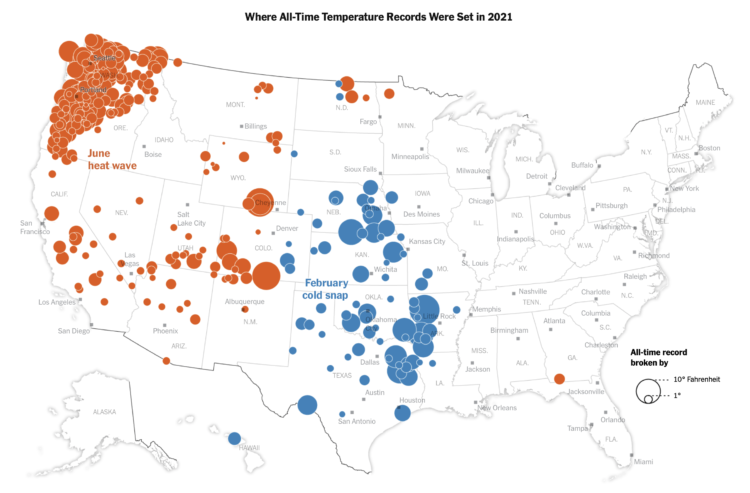
All-time temperature records broken in 2021

by Nathan Yau

Using data from NOAA, Krishna Karra and Tim Wallace for The New York Times mapped all-time temperature records set in 2021. Red indicates an all-time high, and blue indicates an all-time low. Circle size represents the degree difference from the previous record.

Tags: climate change, New York Times, temperature

14 Jan 06:21

Self-Sovereign Identity: The Ultimate Beginners Guide!

Tykn, Jan 13, 2022
Icon

Self-sovereign identity is like a digital wallet. It contains credentials issued by governments and other agencies. You hold your wallet and show your credentials only when you want to. The credentials are digitally signed and registered so they can't be forged. This is a pretty comprehensive guide, though it is not written as clearly as it could be. For example, "Personal Data is not stored on centralised servers. Meaning that for hackers to steal 50 million digital identity records they would have to hack those 50 million people individually. Considerably more difficult." Written properly, this would be clearer. The same is true for the article as a whole. But it's still worth passing along, because the information is valuable and relevant. But don't pay money for any of this yet. Wait for the government-backed credentials to come onstream. Via Kieran Forde.

Web: [Direct Link] [This Post]
14 Jan 06:19

Members of a DAO hoping to build an Ethereum city in Wyoming are scammed out of around $100,000

Neon green illustration of a city on black

Crypto investors who have bought 40 acres of land in Wyoming in hopes of "building a city on the Ethereum blockchain" have lost $92,000 and counting to a Discord hack. Some clever social engineering and questionable security measures on Discord's part allowed scammers to gain control of a CityDAO Discord moderator's account, then send out fake announcements about a fake "land drop". So far the scammer has received 29.67 ETH (about $92,000).

14 Jan 06:18

Writing A Book Is Nonsense

by Ton Zijlstra

I find that I feel writing a non-fiction subject oriented book is nonsense for non-academics. I feel a strong aversion to the idea of writing a non-fiction book, as people have suggested to me occasionly since university.

Different elements are part of that aversion:

  • There’s a plethora of non-fiction books that to me seem 300 to 400 pages of anecdotal padding around a core idea that would fit on the backflap. Many such books lack tables of content and indexes, seemingly to better hide that one or few core ideas, so you need to go through all pages to find them.
  • The motivation for non-fiction writers to write a book I often find suspect. Aimed at marketing and PR, in support of selling themselves as consultant for instance. Written not to serve an audience, or even find one, but as a branding prop. That makes the actual content often even thinner. Such as taking something anecdotal like “I had this great project I enormously enjoyed doing” and anointing it as the new truth, “Organise all your projects like this, it’s a universal method!”
  • I equally find my own favourite topics suspect as material for writing a book. I don’t think any of the topics I work on, and have been working on, are deep enough or have enough solid foundation to stand on their own as a book. It could only become a range of anecdotes around ideas that themselves fit in a sentence or two. In my activities context and environment are key in working out how an idea can be made to work for a client, and that’s the work. That’s a good source of anecdotes, but not more. See the first bullet. A book about it would be a collection of opinions, and in my eyes would take a rather large amount of work to give those ideas a more solid footing.

In a conversation with E about this a few months ago, she said that’s a very arrogant stance towards authors (they have nothing to say), as well as belittling myself (I have nothing to say). I think those are both the same things, that most people, including me, don’t have enough to say to fill a book, to spend tens of thousands of words on. Many have enough to say on enough moments to at that time fill a great blogpost, article, a pamphlet (like the one about birthday unconferences shown in the right hand column), or an essay. But not a book, an artefact that seems such a heavyweight creation and production process in comparison. There are those who write a book by collating material that was previously written as blogposts, or as internal notes, and then somewhat rearranged. I see that as case in point more than counter argument.

As stated at the top, I make exceptions for academic books, explaining or introducing a field or actual research and their popular science counterparts, and for non-subject non-fiction, that e.g. describes a journey (geographically, or through life for instance, ‘true stories’, the history of a topic and how we ended up in the current situation, that sort of thing).
I also don’t mean fiction. Fiction’s role is very different, and any story that makes you read the next sentence and the next and the next is not what I mean here.
In that sense I very much appreciate the work of Cory Doctorow, who writes articles, essays, columns and blogposts about the topics he cares about, and writes fiction books to explore those same topics along different and novel routes.

Yet, our house holds many non-fiction books. A stack of books that keeps ever growing. So, why is that? Is it that there is more value in the whole, the collection of books read, and those unread, as opposed to the lack of value I perceive in any singular book in itself? Or maybe I don’t understand what writing a non-fiction book is, and what it is for. There are people reading my blog who have written non-fiction books. What were your motivations and aims? Why a book?

14 Jan 06:17

A Quick Follow-Up on What Next

by Eugene Wallingford

My recent post on what language or tool I should dive into next got some engagement on Twitter, with many helpful suggestions. Thank you all! So I figure I should post a quick update to report what I'm thinking at this point.

In that post, I mentioned JavaScript and Pharo by name, though I was open to other ideas. Many folks pointed out the practical value of JavaScript, especially in a context where many of my students know and use it. Others offered lots of good ideas in the Smalltalk vein, both Pharo and several lighter-weight Squeaks. A couple of folks recommended Glamorous Toolkit (GToolkit), from @feenkcom, which I had not heard of before.

I took to mind several of the suggestions that commenters made about the how to think about making the decision. For example, there is more overhead to studying Pharo and GToolkit than JavaScript or one of the lighter-weight Squeaks. Choosing one of the latter would make it easier to tinker. I think some of these comments had students in mind, but they are true even for my own study during the academic semester. Once I get into a term (my course begins one week from today), my attention gets pulled in many directions for fifteen or sixteen weeks. Being able to quickly switch contexts when jumping into a coding session means that I can jump more often and more productively.

Also, as Glenn Vanderburg pointed out, JavaScript and Pharo aren't likely to teach me much new. I have a lot of background with Smalltalk and, in many ways, JavaScript is just another language. The main benefit of working with either would be practical, not educational.

GToolkit might teach me something, though. As I looked into GToolkit, it became more tempting. The code is Smalltalk, because it is implemented in Pharo. But the project has a more ambitious vision of software that is "moldable": easier to understand, easier to figure out. GToolkit builds on Smalltalk's image in the direction of a computational notebook, which is an idea I've long wanted to explore. (I feel a little guilty that I haven't look more into the work that David Schmüdde has done developing a notebook in Clojure.) GToolkit sounds like a great way for me to open several doors at once and learn something new. To do it justice, though, I need more time and focus to get started.

So I have decided on a two-pronged approach. I will explore JavaScript during the spring semester. This will teach me more about a language and ecosystem that are central to many of my students' lives. There is little overhead to picking it up and playing with it, even during the busiest weeks of the term. I can have a little fun and maybe make some connections to my programming languages course along the way. Then for summer, I will turn my attention to GToolkit, and perhaps a bigger research agenda.

I started playing with JavaScript on Tuesday. Having just read a blog post on scripting to compute letter frequencies in Perl, I implemented some of the same ideas in JavaScript. For the most part, I worked just as my students do: relying on vague memories of syntax and semantics and, when that failed, searching about for examples online.

A couple of hours working like this refreshed my memory on the syntax I knew from before and introduced me to some features that were new to me. It took a few minutes to re-internalize the need for those pesky semicolons at the end of every line... The resulting code is not much more verbose than Perl. I drifted pretty naturally to using functional programming style, as you might imagine, and it felt reasonably comfortable. Pretty soon I was thinking more about the tradeoff between clarity and efficiency in my code than about syntax, which is a good sign. I did run into one of JavaScript's gotchas: I used for...in twice instead of for...of and was surprised by the resulting behavior. Like any programmer, I banged my head on wall for a few minutes and then recovered. But I have to admit that I had fun. I like to program.

I'm not sure what I will write next, or when I will move into the browser and play with interface elements. Suggestions are welcome!

I am pretty sure, though, that I'll start writing unit tests soon. I used SUnit briefly and have a lot of experience with JUnit. Is JSUnit a thing?

14 Jan 06:17

Announcing Parcel CSS: A new CSS parser, compiler, and minifier written in Rust!

Announcing Parcel CSS: A new CSS parser, compiler, and minifier written in Rust!

An interesting thing about tools like this being written in Rust is that since the Rust-to-WASM pipeline is well trodden at this point, the live demo that this announcement links to runs entirely in the browser.

14 Jan 06:15

Three More Months of Not Sheltering In Place

by Richard

The COVID-19 pandemic continues, and since I last checked in, I travelled back to British Columbia twice, once in late October to say goodbye to my dying mother, and another for the Christmas holidays. The first trip was a no-brainer, as she only had days to live, and after her passing I spent some time in Vancouver seeing people I didn't think I'd ever see again.

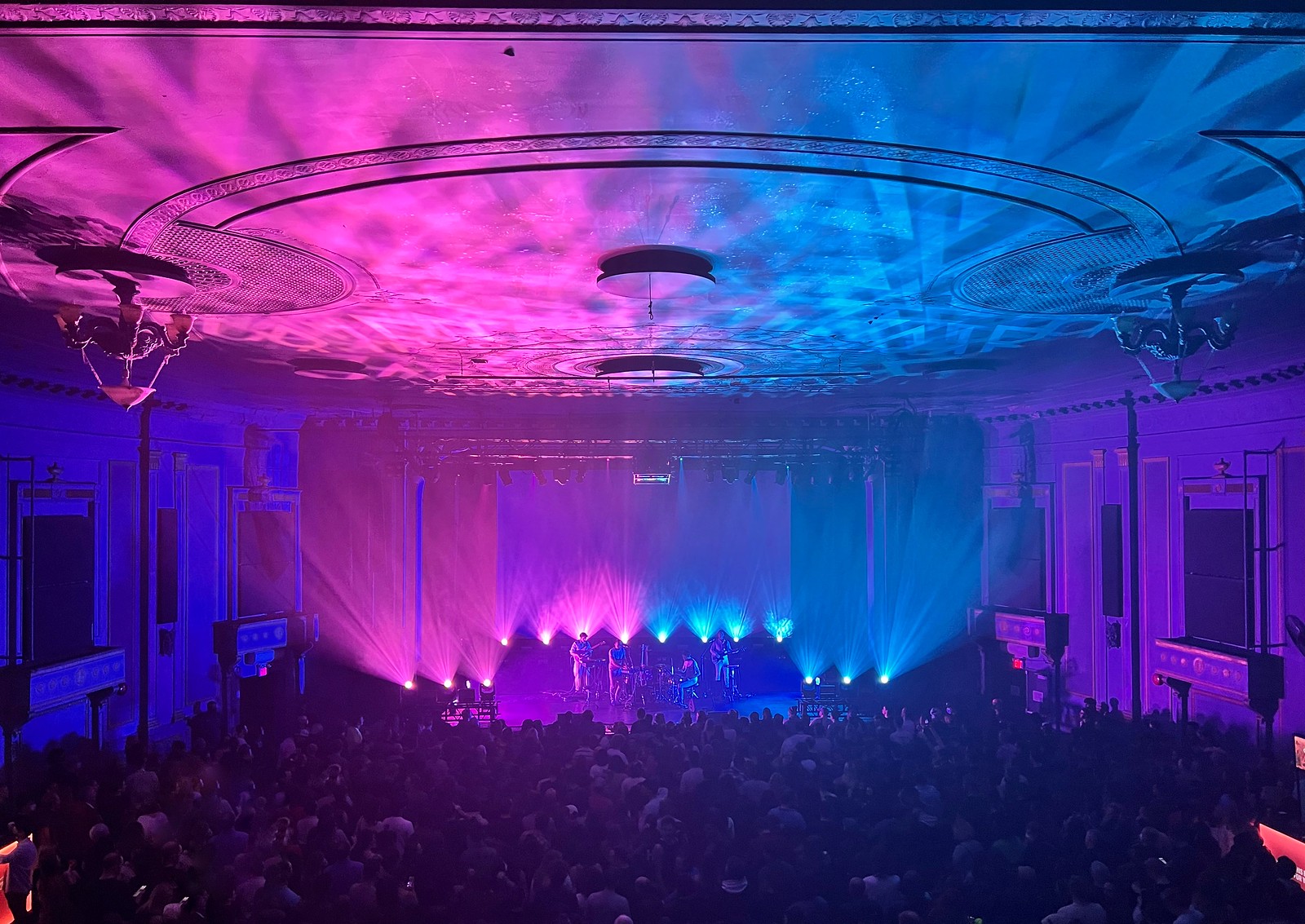
I returned to Toronto, and attended 3 performances by Caribou, a concert sponsored by the Icelandic tourism industry before hunkering down again. (I would later learn that I'm related to one of the participants of the junket that travelled to promote the Land of Fire and Ice.)

Caribou at the Danforth Music Hall

The Christmas holidays trip felt a lot more optional. The Omicron variant of the virus that causes COVID-19 was starting to assert itself, and the holidays were very much centered around Mom. The family kept some traditions alive (like Pizza Hut on Christmas Eve) and retired others (like the gift exchange). I saw family friends, stomped in the snow from the rare snowstorms B.C. experienced in the lead-up to my arrival, and otherwise relaxed at the family home for a week and a half.


Toronto, as of early January, is currently in a state of lockdown where indoor dining is not permitted and many venues on their own have decided to cancel events. It still doesn't feel as bad as the early days of the pandemic, but the city is noticeably quieter than the days in November and December 2021. January has been a month of more or less sheltering in place, in part because the outside temperatures are minus something Celsius, but also because there's nothing to do again. We just got word that that may be the case until the end of the month.

14 Jan 06:14

Dogwood Designs Pogies

by jnyyz

I’ve mentioned that I’m a fan of pogies to keep my hands warm for winter bike rides. I’ve also known about the pogies by Dogwood Designs ever since I spotted a pair on a past coldest day of the year ride. Santa was very kind and finally provided me with a pair. Given that it was -18°C this morning, I figured it was a good time to give them a try. This was also my first ride of the season with balaclava and goggles.

This is what the new pogies look like compared with one from rockbros.

This is what they look like on the bike.

Like most pogies, they are really intended for straight bars, in which case people have said that they extend a decent distance back towards the elbows. My winter bike has swept back bars and so the coverage is considerably less; just about 4 inches back of the end of the handlebar. Here is a picture of part of my handlebar, also showing the buttom placement for my hornit horn. Bells don’t work that well inside a pogie.

So how did they do this morning? I’ll preface my comments by saying that my commute is about 9 km, and that on a cold day like today it takes me about 40 minutes. I was wearing a pair of light gloves inside the pogies. For the first five or ten minutes my impression was that the pogies weren’t that much better than the rockbros. However, once my hands warmed up the air trapped inside the pogies, then they were just fine for the remainder of the ride.

Outstanding.

The real difference with these pogies, aside from the large volume, is that there is an adjustable shock cord that makes a good seal against your arm.

Compare this with the rockbros that does have a fabric barrier, but with loose elastic.

I do recognize that the dogwood designs item is much more expensive, given that it is sewn in Alaska, but if you are looking for the ultimate in pogies, I would recommend them. The rockbros item is available online and gives probably about 75% of the performance, and they are perfectly fine down to at least -10°C.

Just a couple more notes about the ride in. One thing was that I was trying out a new pair of goggles, but at this time I found that they suffer from severe enough fogging that I had to take them off after about 10 minutes.

I’ll have to do a comparison with the ski goggles that I’ve used in the past.

Otherwise, I was using my usual gear for cold but not super cold weather, including:

  • a wool T shirt
  • a wool shirt
  • Proviz jacket (could be any windproof jacket)
  • fleece lined pants
  • thick wool socks in Blundstones on flat pedals.
  • bike helmet earmuffs from this vendor

14 Jan 06:10

2022-01-11 General

by Ducky

Variants

This preprint says that Omicron is less virulent than Delta:

  • ~50% less likely to get admitted to hospital from the emergency room;
  • ~75% less likely to go to the ICU;
  • ~70% shorter hospital stay.

Note that something I’m seeing is people not seeing a shorter hospital stay in the UK, e.g. in this tweet. There’s some speculation that it’s being countered by hospital-acquired infections (HAIs).

Transmission

This preprint says that SARS-CoV-2 virions in aerosols die off pretty quickly: 90% within 20 minutes. Note, though, that I see skepticism on Twitter (e.g. this thread); more people are saying, “wait for the peer review!” than I am used to.


This preprint says (if I understand correctly) that PCR scores don’t always correlate well with true infectiousness (as measured by how well you can grow the virus in test tubes of human cells). They found:

  • Higher PCR scores but lower infectious cultures in COVID Classic than in Delta.
  • With Delta, breakthrough patients had similar PCR scores as unvaxxed patients, but the vaccinated patients had lower infectious cultures and cleared faster.
  • Omicron and Delta grew about equally well in test tubes, meaning it’s something else which makes Omicron more transmissible than Delta.

Long COVID

Cancer patients frequently report “chemo brain” — a type of brain fog which is very similar to the Long COVID brain fog. Previously, a team found that certain cytokines and chemokines (types of signaling protein) were elevated in the central nervous system, causing microgilal cells (central nervous system macrophages which eat defective cells) to go out of control, causing inflammation. This preprint says that they found the same inflammation and same cytokines/chemokines elevated in mice that they’d infected with COVID-19, and in humans with brain fog (but not with Long COVID symptoms without brain fog).

This is a big deal. It does not give a treatment, but it gives a place to start looking.

13 Jan 07:32

A special suit for thinking like a winter’s day and other psychoactive uniforms

I popped out this morning to pick up milk and eggs (as the only Covid-negative person in this house) and it was one of those beautiful winter days you get in England when the air is crisp, and the low sun is yellow with a touch of warmth when you’re standing in it.

So I was intensely aware of my skin and of nothing else: the cold only enough to draw my attention just to that sensation, yet not cold enough to be unpleasant. And, like that, I walked to the shops listening to music, mind wonderfully empty. Bliss.

Later I remembered Jason Kottke posting about freediving, that sport where divers hold their breath for upwards of five minutes – and it turns out that much of it is about mental strategies to “be with” the feelings that come from having empty lungs.

Here’s Kottke’s post: Attention Deconcentration and the Secrets of Freediving. (He links to a couple of articles in this post. Both are long, poetic.)

Attention deconcentration? It means distribution of the whole field of attention – you try to feel everything simultaneously.

I asked if it was like meditation.

“To some degree, except meditation means you’re completely free, but if you’re in the sea at depth you will have to be focussed, or it will get bad. What you do to start learning is you focus on the edges, not the center of things, as if you were looking at a screen. Basically, all the time I am diving, I have an empty consciousness. I have a kind of melody going through my mind that keeps me going, but otherwise I am completely not in my mind.”

– The New Yorker, The Deepest Dive (2009)

Something similar happens when I’m driving I think? I can glimpse just the tiniest edge of attention deconcentration by remembering being totally in the zone when driving – hyperaware of everything in all directions, but not frantically; in control and responsive. Yet mind empty.

And there are places your mind can reach only when you’re driving, or only when you’re running, or only when you’re dancing. I don’t mean emotional states, necessarily. I remember particularly one time solving a particularly stubborn differential equation a couple of hours into dancing; it was as if the search algorithm in my head had changed, and new branches had opened up, allowing me to find a solution.


(Incidentally: one of the articles Jason links to mentions the mammalian diving reflex, which is activated when the nerves in the face come into contact with water, most effectively with cold water. I went to a party where this came up in conversation so we tried it. Hold your breath and time it. Then splash your face with really cold water and suddenly you can hold your breath for longer. It works!)


This hollow body consciousness: free divers enter it deliberately.

Walking in the cold, it’s the same but in reverse? The state of consciousness is induced by the environment. Microdosing weather.


So I wonder how much of this we’re all doing the whole time, without really putting a name to it: solving a problem by having a shower or going for a walk is such a trope but maybe if we were to be more rigorous about describing the mechanism, we could instead say that the bodily action or sensation induces a mental state that is required to solve a problem.

Like, we’re content to say that we need a quiet environment in order to concentrate on demanding and detailed work.

Could we also one day be content to say that we need an environment that induces attention deconcentration in order to, I don’t know, think poetically.

Or something.


All of which means the problem solving arrow goes something like this:

I need to solve a problem AND SO I seek the environment which will induce the required mental state AND SO I achieve that mental state AND SO I solve the problem.

No different from seeing something on a high shelf, then seeking a chair to stand on, then standing on the chair and reaching the object.

We loop the environment into meeting our intentions.


And if the problem solving arrow goes something like that, then maybe I shouldn’t have to wait for a cold, crisp day in January to think like this?

Maybe these mental states need not be subject to the weather?

There’s a passage in Red Mars, Kim Stanley Robinson’s wonderful sci-fi classic about colonising Mars, describing a walk on the surface… (Martian gravity is 38% of ours.)

She was just as strong as ever, but weighed only thirty kilos! And the forty kilos of the suit… well, it threw her off balance, that was true. It made her feel that she had gone hollow. That was it: her center of gravity was gone, her weight had been shifted out to her skin, to the outside of her muscles rather than the inside.That was the effect of the suit, of course.Inside the habitats it would be as it had been in the Ares.But out here in a suit, she was the hollow woman.With the aid of that image she could suddenly move more easily, hop over a boulder, come down and take a turn, dance!

– Kim Stanley Robinson, Red Mars [Bookshop.org]

Robinson captures that hollowness, hyperawareness and freewheeling thought coupled with embodiment, elation.

Maybe such a suit doesn’t need to be confined to Mars and confined to fiction?


Could you make a attention deconcentration suit to wear here on Earth?

I’m imagining something weighted such that the locus of your attention is shifted to the periphery.

Perhaps it wicks the heat away quickly so you’re cold, just enough, so that you can feel the breeze and the pavement underfoot.

The internal voice deconcentrated.

Perhaps the helmet is weighted, just enough, such that the tiny unconscious movements of your head as you (quite naturally) look around are amplified, as with a dowsing rod, swinging your head just a touch more, and you end up looking more up, around, taking it all in.

All of those sensory changes combining to induce a state of mind which is, well, broad and easy, one that usually belongs to a walk outdoors on a crisp, blue-skied winter’s day.


Perhaps a whole room of psychological suits, all lined up! One for free-wheeling thinking, another to consider head-on difficult and emotionally charged issues, another to ruthlessly cut to the heart of things, another to do your taxes, and so on.

And I wonder whether other uniforms are similarly psychoactive? Does the tight collar and tie of the stereotypical salaryman reduce blood flow to the brain and create a persona more easily subsumed to the corporation? Does the heavy crown of a king or wig of a judge require turning the head slower, giving more time to think, that extra fraction of a second opening up the possibility of wiser considerations?

13 Jan 07:30

A Bluetooth adapter will no longer be necessary

by Volker Weber

Bluetooth quickly became ubiquitous in mobile phones and smartphones and is now known for its “just works” simplicity.

The same was never true when using a Bluetooth headset directly with a computer. Users would have to jump through hoops ensuring they had the correct drivers, firmware, software, etc. before discovering that the audio quality was inadequate. Poly solved these problems with its own USB Bluetooth adapter.

Thanks to Poly and Intel® the end is now in sight for the USB Bluetooth Adapter with supported laptops.

I have been banging the same drum for years on end. People have no idea how bad they sound in conferences. If you ever talked to somebody who has paired his AirPods with a PC, you know what I mean.

Wideband Audio is just one issue. The other once is call control and integration in softphones. That is why I recommend using the Bluetooth dongle that came with your business headphones.

The first Poly Bluetooth headsets to support Intel® Engineered for Evo™ accessories program will be the Voyager Focus 2 and Voyager 4300 Series (through a firmware update). Look for the Intel® Evo™ platform brand on select premium 11th and 12th Gen Intel® Core™ processor-based laptops from a variety of manufactures.

What Poly describes here will be coming to other headphones as well. I am looking forward to trying this out. I have a Focus 2 and will get a 4300 soon.

More >

13 Jan 07:29

The Formative Future: AI, standardised testing and student outcomes

Marten Roorda, The PIE News, Jan 12, 2022
Icon

Here's the take-home message: "AI can now predict with over 90% accuracy a student's test score, identifying their weakness and strengths with about 10 minutes of interaction." If this is true (and I have my doubts) then I have to ask why we're even giving students tests. Are we just using them as data to train AI of the future? Ah, well, it seems that maybe the AI is depending on, um, tests. "The assessment itself becomes formative. It’s not just a conclusive, one-test value judgment. It becomes part of the learning process during which we micro assess the learner, with low stakes, multiple times throughout a school semester or school year." Maybe many small tests are better than one big one. But you don't need an AI for that.

Web: [Direct Link] [This Post]
13 Jan 07:27

Twitter Favorites: [krippopotamus] The introvert/extrovert binary sucks and I would like to propose the "introvert/extrovert--social/solitary" quadran… https://t.co/SLkS9eywgL

Kelsey Krippaehne @krippopotamus
The introvert/extrovert binary sucks and I would like to propose the "introvert/extrovert--social/solitary" quadran… twitter.com/i/web/status/1…
13 Jan 07:21

Revisiting why hyperlinks are blue

by Elise Blanchard

Why we need to revisit the origin of blue hyperlink

While musing over my recently published article, Why are hyperlinks blue, I was left feeling a bit blue myself. Yes, it could have been the fact that I was evacuated and Hurricane Ida was destroying my home, I’ll admit. Besides that, I was also bothered by the fact that even though I was able to determine that Mosaic was indeed the first browser to use blue hyperlinks, I was not much closer to determining why the hyperlinks themselves were blue. 

Black hyperlinks had been the standard for many years, but why the sudden shift to blue? One can assume that it is because RGB phosphorescent monitors were becoming more readily available in comparison to monotone phosphorescent monitors that could only produce one color. Okay then, with a palette of colors to choose from, why blue? Why not green? Microsoft 3.1 had used green for hyperlinks. Surely there must have been something to support or inspire Marc Andreessen and Eric Bina on April 12, 1993 to make the hyperlinks blue, but what was it?

I simply didn’t know, so I published the article anyway and hoped the internet would do as it always does: thrill in pointing out when someone is wrong, in the hope that someone would know the true answer. 

I published the first article, a hurricane destroyed my home, and now two months later I’m once again sitting in my now gutted home with the miracle of the internet once again restored, and I’m back on the case.

Sifting for the golden nugget

I found myself enjoying my morning coffee, reading through hate mail from my first article, as one does. I sifted through this dung heap as a prospector pans for gold, scanning for the faintest hint of gold to help me continue my journey to the true origin of the blue hyperlink.

Don Hopkins, or a commenter who goes by the same name, knew the answer, and pointed me towards Ben Shneiderman. In short, it is Prof. Ben Shneiderman whom we can thank for the modern blue hyperlink. At the time, however, I didn’t yet know this. I found the professor online, and contacted him, and went about my day. He so kindly reached out to me, and as he spoke, it was an epiphany – all of these disassociated pieces of applications, history and anecdotes suddenly fit together like a marvelous great puzzle. 

Below is the timeline based on our conversation, the documentation Prof. Shneiderman provided to me, and the information I had already gathered in my previous research. I hope that this all together can help prove a direct link between the work Ben Shneiderman and his graduate students were doing at the University of Maryland in the mid to late 1980s and the blue hyperlink found in Mosaic in 1993.

I’m a cyan fan

1985 – University of Maryland: Human-Computer Interaction Lab

Ben Shneiderman developed the highlighted selectable light blue link, which was implemented by graduate student Dan Ostroff. In doing so, they, as well as other students, tested many versions in controlled experiments. 

“Red highlighting made the links more visible, but reduced the user’s capacity to read and retain the content of the text… blue was visible, on both white and black backgrounds and didn’t interfere with retention,” Shneiderman shared with me.

1982 – HyperTIES

Created in 1982, HyperTIES was an early hypertext authoring system, made commercial available by Cognetics Corporation. After research concluded at the University of Maryland, blue links were then built into HyperTIES. This is the first instance of a blue hyperlink. 

April 1986 – Communications of the ACM

Koved and Shneiderman published their research in Communications of the ACM, an industry magazine. 

Koved, L., & Shneiderman, B. (1986). Embedded menus: Selecting items in context. Communications of the ACM, 29(4), 312-318.

November 13-15, 1987 – The Hypertext Conference, Chapel Hill, North Carolina

At the first Hypertext conference, Ben Shniderman presented in a panel session, “User interface design for the Hyperties electronic encyclopedia.” Of the conference, Professor Shniderman wrote:

“We conducted approximately 20 empirical studies of many design variables which         were reported at the Hypertext 1987 conference and in array of journals and books. Issues such as the use of light blue highlighting as the default color for links, the inclusion of a history stack, easy access to a BACK button, article length, and global string search were all studied empirically.” 

July 1988 – Communications of the ACM

Ben Shneiderman’s team took on the project of producting a HyperTIES disk for the ACM called “Hypertext on Hypertext”, which contained the full text of eight papers. These papers were published in the July 1988 issue of Communications of the ACM.

The leap to Lee

In 1989, Tim Berners-Lee wrote Information Management: A Proposal, in which he discussed many topics. Of interest to the blue hyperlink, he does discuss the work being done at universities centered around human interface design, and a nod to commercial success of a product using hypertext: 

An increasing amount of work is being done into hypermedia research at universities and commercial research labs, and some commercial systems have resulted. There have been two conferences, Hypertext ’87 and ’88, and in Washington DC, the National Institute of Standards and Technology (NST) hosted a workshop on standardisation in hypertext, a followup of which will occur during 1990.

The Communications of the ACM special issue on Hypertext contains many references to hypertext papers. A bibliography on hypertext is given in [NIST90], and a uucp newsgroup alt.hypertext exists. I do not, therefore, give a list here.

Much of the academic research is into the human interface side of browsing through a complex information space. Problems addressed are those of making navigation easy, and avoiding a feeling of being “lost in hyperspace”. Whilst the results of the research are interesting, many users at CERN will be accessing the system using primitive terminals, and so advanced window styles are not so important for us now.”

While still an assumption, it is a fair assumption that Tim Berners-Lee was aware of the blue highlight hyperlink color because he was aware of “research at universities”, “Hypertext ‘87”, and the “ACM special issue on Hypertext,” all instances where the blue highlight color research was presented. Berners-Lee did mention that the “results of the research are interesting.” It is also interesting to note that WWW, the browser he was creating at the time, did not use blue hyperlinks. 

January 16-18, 1990 – Hypertext Standardization Workshop 

Tim Berners-Lee, as well as many others, participated in the hypertext standardization workshop, yet there was no mention of the use of color to denote hypertext in the report. However, readability of hypertext was identified as a research objective in the workshop report (PDF).

“​​Measuring hypertext “readability.” … Hypertext extensions to readability metrics might include measures of the “goodness” of links based on similarity between linked units. Readability measures for alternative hypertext designs for the same text will go far toward making hypertext design an engineering discipline.” (Page 35)

August 1990 – Dynamic Characteristics of Hypertext

Following up on the workshop, I assume this is the resulting paper (PDF) to come out of the hypertext standardization workshop. Published by Richard Furuta & P. David Stotts, this paper argues that dynamic characteristics of hypertext are required to achieve hypertext’s true purpose. In the excerpt below we can see the authors discuss color’s role in hypertex, and the foundations of active, visited and focused states:

“Dynamic representation of context may also be useful. For example, consider the representation of an anchor that changes over time. The anchor may be represented by a highlighted region whose color, size, or location changes over time to draw more attention to itself. Alternatively, the anchor might be represented by a small animation.” – Page 2

Blue’s clues

In the late 1980s, industry workshops and conferences brought people together to share ideas, discuss trends and standardize ways of making the web work. What are the results of this sharing of knowledge? Well, hypertext starts to turn blue. At the time, hypertext was more than what we now know as hyperlinks, but also included user interface elements such as the close icon, navigating back and forth between sections, and printing. As we see above, there were arguments from industry leaders to make hypertext dynamic, so active states must be included as well. 

October 21, 1991 – Macintosh System 7

Apple began adding hints of blue to icons and text background when selected. 

April 6, 1992 – Windows 3.1

Microsoft began using blue for interactions to “highlight” text when selected.

1992 – HyperTIES

Created for the HP LaserJet4 User Manual, even using HyperTies creators began using the darker blue hyperlink on a button as well as the light blue (cyan) for hyperlinks.

December 1992 – Framaker 3.0 (Windows Version)

Framemaker was created for making and maintaining large documents, and is also the first instance I uncovered of the dark blue hyperlink. In 1992, not all versions were in color, but Framemaker v3.0 for Windows did support color monitors. Huge shoutout to Dan Connolly for letting me know about this application, and to a colleague of mine for opening it in an emulator to get this screenshot.

On Wednesdays we wear blue

So what inspired the blue links in Mosaic; whose blue hyperlinks went on to set the industry standard we are following even today? Well, we do know that Marc Andreessen and Eric Bina were inspired by ViolaWWW and decided to create Mosaic after seeing it. Perhaps they were aware of the same inspirations and research as Tim Berners-Lee, or they simply saw the blue trend happening in their industry.

In truth, it doesn’t matter what specific application or article inspired them. The decision to make hyperlinks blue in Mosaic, and the reason why we see it happening in Cello at the same time, is that by 1993, blue was becoming the industry standard for interaction for hypertext. It had been eight years since the initial research on blue as a hyperlink color. This data had been shared, presented at conferences, and printed in industry magazines. Hypertext went on to be discussed in multiple forums. Diverse teams’ research came to the same conclusion – color mattered. If it didn’t inspire Marc Andreessen and Eric Bina directly, it inspired those around them and those in their industry. We can see evidence of this inspiration by looking at the work of Macintosh, Microsoft, HyperTIES, LaserJet, Framemaker and Cello. These companies and products created work before or during Mosaic, and all use blue hyperlinks, selection colors or blue typography. Though this was still a time of experimentation, the visual language of blue for interaction was beginning to be defined years before Mosaic was created. 

I love knowing that the original blue was chosen with care and through testing, that this research and knowledge was shared through a community, and that the spirit of open source sharing still lives on here at Mozilla. I am very thankful to the developer community for their comments which led me to the right people so that I could find the answer to this question which has long plagued my mind and the minds of countless others. I hope that we continue to choose to use the internet as a place for good and communication, and that we use blue hyperlinks to connect with and help one another. 

After Publication

Updated January 12, 2022

After publishing the article, Ben Shneiderman and I continued to connect, in which he informed me that Lee and himself were colleagues who connected several times.

Shneiderman informed me that Lee had cited his work from the ACM for the Macintosh or PC, and that Lee had used the idea of light blue links from Shneiderman’s work. From this we can infer that the blue hyperlink was indeed inspired by the research done at the University of Maryland.

Also, from the comments on my first article, Why Hyperlinks are Blue, the user SeanLuke found bug fixes for WorldWildWeb on the NeXT that hinted at color support as early as 1991.

Firefox browser logo

Get Firefox

Get the browser that protects what’s important

The post Revisiting why hyperlinks are blue appeared first on The Mozilla Blog.
13 Jan 07:20

Apple removes multiple Wordle clones from the App Store

by Bradly Shankar
Wordle

Apple has quietly removed a number of games from its App Store that blatantly copy Josh Wardle's "Wordle" daily puzzle game sensation.

The company didn't make any public statement about the move, but The Verge notes that games that clearly listed themselves as "Wordle" with the same rules have been delisted. While some "clones" still remain, they don't use the name "Wordle."

https://twitter.com/waxpancake/status/1480990948972658689?ref_src=twsrc%5Etfw%7Ctwcamp%5Etweetembed%7Ctwterm%5E1480990948972658689%7Ctwgr%5E%7Ctwcon%5Es1_&ref_url=https%3A%2F%2Fkotaku.com%2Fembed%2Finset%2Fiframe%3Fid%3Dtwitter-1480990948972658689autosize%3D1

But it was the copycat app made by developer Zach Shakked, which was released on January 10th, that garnered the most attention. His version took Wardle's game --  free-to-play, unmonetized and featuring five-letter puzzles -- and added six- and seven-letter word options, as well as an unlimited play mode for $30 USD/year (about $37.50 CAD).

Shakked spent the days since launch bragging about well "his" game was doing and how all he wanted to do was “make tons of fucking money.” People were quick to point out how shameless he was, as well as hypocritical, given a previously deleted tweet that his own app was copied. That Wardle originally only made the game for his partner to play, and then opened it up to everyone for free without a desire to monetize it, just made Shakked's brazenness stand out all the more.

Eventually, Shakked did issue what would seem to be his attempt at an apology in a Twitter thread:

https://twitter.com/zachshakked/status/1481129425706143746?ref_src=twsrc%5Etfw%7Ctwcamp%5Etweetembed%7Ctwterm%5E1481129425706143746%7Ctwgr%5E%7Ctwcon%5Es1_&ref_url=https%3A%2F%2Fkotaku.com%2Fembed%2Finset%2Fiframe%3Fid%3Dtwitter-1481129425706143746autosize%3D1

After a few tweets defending himself, he said "I realize I crossed a line. And I surely, surely will never do anything remotely close to this again. I fucked up." However, he notably never actually apologized to Wardle himself.

Further, Shakked's more recent tweets have either shifted the blame to Wardle or boasted about other ways he can get rich quickly, without any need for actual talent or originality. He also complained that "Apple is unilaterally removing apps without any recourse," and that lawyers apparently said " claim to ‘Wordle’ was highly dubious."

While the point about lawyers is harder to verify, Shakked is outright wrong about the app removal. As Apple's App Store own guidelines explicitly state, “Don’t simply copy the latest popular app on the App Store, or make some minor changes to another app’s name or UI and pass it off as your own.” Clearly, Shakked did not comply with that.

It's important to note, though, that it doesn't seem that Wardle would have any legal recourse. As Shakked notes, the name isn't trademarked, and Wordle itself does draw inspiration from many other games. That said, that doesn't exonerate Shakked from the court of public opinion, and it's clear that many people have (rightfully) condemned him.

Follow this link to find the official version of Wordle.

Via: The Verge

13 Jan 07:19

Watch the music video for Cheats' new single, 'Hakbang' - NME

13 Jan 07:19

New Year’s Day

In Vancouver, we have a tradition of going for a walk on New Year’s Day, no matter how foul the weather, if only to prove to Other Canadians that the thing is possible. 2022 too, despite its being an extremely low-expectations year. And it wasn’t the worst New Year’s Day beachwalk ever, so maybe it won’t be the worst year ever. And it leaves me with advice for the world. But first…

The traditional Polar Bear Swim, in which hordes of howling Vancouverites, half hungover and the rest inebriated, charge pell-mell into the hostile waters of English Bay, was Covid-scotched like so much else good in life. But that didn’t deter everyone; here and there an espontáneo shed their garments and made made a singleton splash. There was a bored burly bearded lifeguard not getting in the way, happy to chill with passers-by.

Solo Vancouver polar-bear swimmer, 2022

Hmmm, do those clouds look… a little weird? Yes, and not just a little. I don’t think there was a temporal vortex behind that mountain waiting to vomit city-eating chthonic lifeforms over its peak, but if I were a production designer for a city-eating-chthonic-lifeforms movie, that’s how I’d fill in the clouds around the mountain they were lurking behind.

Weird clouds over Vancouver’s Mount Cypress

Let’s look West, where the Blessed Lands would be if there were any, but in fact it’s just Vancouver Island and then Japan. But yeah, those clouds.

Looking west across English Bay on New Year’s Day 2022

See the ships? Those are the “supply-chain issues” that are screwing things up. Every ship parking spot out there is occupied, every time I go and look.

Looking west across English Bay on New Year’s Day 2022

That snow wasn’t melting because it was pretty damn chilly. So our walk didn’t go on for that long. But of course we couldn’t pass up Vancouver’s major new talking point, Marge the Barge.

Cargo barge washed up on English Bay beach

This big sucker blew up on this very-downtown beach in a big windstorm last November that unfortunately combined with a super-high tide, and it’s not coming off any time soon. A little bird told me that its bottom is severely damaged by those rocks it’s hitched up on and if the tide got high enough to float it off, it’d sink again. Another little bird told me that it was sloppily and amateurishly tied up to the barge buoy out there when the windstorm came along and disposed of its moorings in about fifteen minutes.

The city’s kind of adopted it, as though we had any choice. I particularly admire that mooring line someone’s tied up to it.

Barge tied up to a rock on the Vancouver waterfront

Now, that’s a damn expensive piece of rope. And I don’t know (but admire) how the hell they got it around that rock. The effect, of course, is purely symbolic. If Marge decides to float away via some accident of tide and wind, without immediately sinking, the rope isn’t going to help. But it’s stylish.

The scene by the barge was pretty cheery; everyone had a story to tell. There were toddlers sledding on the unaccustomed snow. The rent-a-cop down by the barge totally ignored the people checking it out. Every photographer was looking for their own special angle. Strollers and longboards and spaced-out hippies shared the paths, reasonably amicably. Everyone who wasn’t talking to the person walking with them was talking to their phone.

Advice

Covid sucks. Politics sucks. The weather sucks (and is a hideous harbinger of worse to come). But, don’t stay home. Go outside anyhow. Take pictures. Tell stories. Laugh at the laughable. Tune out the jerks. Nobody promised there’d be a tomorrow so do today today.

Happy New Year!

13 Jan 07:16

Substacking the deck | Canada's National Observer: News & Analysis

mkalus shared this story from National Observer.

b'

Both Sarah Hagi and Canadaland\xe2\x80\x99s Jesse Brown have delivered pretty decisive blows to new media star Tara Henley\xe2\x80\x99s credibility, but we\xe2\x80\x99re not done yet.

Henley, the former CBC producer who recently resigned over perceived stifling political correctness, declared in an explosive Substack debut column that the public broadcaster\xe2\x80\x99s new fixation with anti-racism emerged from a \xe2\x80\x9cradical political agenda that originated on Ivy League campuses in the United States.\xe2\x80\x9d

You have to hand it to her.

Get top stories in your inbox.

Our award-winning journalists bring you the news that impacts you, Canada, and the world. Don\'t miss out.

It takes a laser focus to ignore the slaughter of Muslims at prayer in Quebec City, an incel rampage through the streets of Toronto, violent attacks on Chinese-Canadians in COVID\xe2\x80\x99s wake, the arrest and handcuffing of a Black retired judge in a Vancouver park, Quebec\xe2\x80\x99s removal of an observant Muslim teacher, the arrest and handcuffing of a 12-year-old Indigenous girl and her grandfather who tried to open a bank account, or the revelation of over a thousand unmarked graves of Indigenous children at Canadian residential schools mere months ago. To name just a few.

The suggestion that increased racial sensitivity by Canada\xe2\x80\x99s public broadcaster is the effect of elite American liberal posturing is flatly bizarre.

If anything, it is Henley herself, rather than the CBC, who has been overtaken by American influencers. The entree of an obscure broadcast producer to online self-publishing was heralded by no less than social media giants Glenn Greenwald, Matt Taibbi and Bari Weiss, among others.

Surely it\xe2\x80\x99s pure coincidence that Henley also had a side gig as a books columnist for the Globe and Mail. And that she profiled these same writers at length in a 2,200-word long-form piece about Substack.

What people are reading

Or that Henley\xe2\x80\x99s first podcast guest, Batya Ungar-Sargon, is by chance the author of Bad News: How Woke Media is Undermining Democracy, also reviewed in her most recent Globe books column.

It\xe2\x80\x99s possible to imagine an entire lineup of American Substack interviewees all culled from Henley\xe2\x80\x99s Globe books column over the last year:

  • John McWhorter, Woke Racism: How a New Religion Has Betrayed Black America
  • Ben Burgis, Canceling Comedians While the World Burns: A Critique of the Contemporary Left
  • Catherine Liu, Virtue Hoarders: The Case Against the Professional Managerial Class
  • Michael Lind, The New Class War: Saving Democracy from the Managerial Elite
  • Dan Kovalik, Cancel This Book: The Progressive Case Against Cancel Culture

Indeed, since the beginning of 2021, Henley\xe2\x80\x99s Globe and Mail books column has covered books by 54 writers, of whom 34 are Americans \xe2\x80\x94 and overwhelmingly white. Of the racialized American writers Henley reviewed in the Globe, most \xe2\x80\x94 like McWhorter and Liu \xe2\x80\x94 took direct aim at \xe2\x80\x9cwoke\xe2\x80\x9d liberalism.

Opinion: The suggestion that increased racial sensitivity by Canada\xe2\x80\x99s public broadcaster is the effect of elite American liberal posturing is flatly bizarre, writes columnist @Garossino. #CBC #cdnmedia

In a year when Canadians were confronted with the residential school burials, the exhausting challenges of COVID, the two Michaels, China\xe2\x80\x99s crackdown on Hong Kong, the collapse of local media and devastating climate impacts that killed hundreds of British Columbians, Henley\xe2\x80\x99s Globe book reviews blissfully ignored it all.

Well, except for COVID, where she strikes a curious note, given everything that\xe2\x80\x99s been written and what is known about the virus.

Last July, as Canada\xe2\x80\x99s vaccine rollout was in full swing, Henley reviewed The War Against Viruses: How the Science of Optimal Nutrition Can Help You Win, an Aileen Burford-Mason book on using nutrition to combat COVID. Then last week, as Omicron ravaged populations everywhere, she reviewed Laura Dodsworth\xe2\x80\x99s A State of Fear, about how the U.K. government overpowered the British public with fear over the pandemic.

Dodsworth is a professional photographer turned right-wing media darling. She gained fame through a previous project documenting male and female genitalia, and has now emerged as a vocal opponent of mask and vaccine mandates.

Dodsworth can now be seen on Twitter retweeting the infamous extremist Paul Joseph Watson and Jack Posobiec, as well as Florida Gov. Ron DeSantis.

Dodsworth may seem like a nut, but it\xe2\x80\x99s the Globe and Mail that amplified her book through Henley\xe2\x80\x99s column.

The CBC can, of course, always use improvement. In many ways, what\xe2\x80\x99s been lacking in this country is a media voice that can truly speak to all of us across the divides of personal experience.

That\xe2\x80\x99s not going to be the same old CBC we\xe2\x80\x99ve long been familiar with. Increasing racial sensitivity is important, but it\xe2\x80\x99s also just part of the story and the beginning of an evolution.

As local media collapses, all our communities need news and coverage of the issues that matter in their own lives, as well as big-picture stories.

What we don\xe2\x80\x99t need is second-rate analysis handed down from American observers who know nothing and care less about this country.

And that, in a nutshell, is what Tara Henley is selling.

'
13 Jan 07:11

Help Wanted: Python Web Services Engineer (Early 2022)

by Cabel
mkalus shared this story from Panic Blog.

b'
\n

\n
\n\n\n\n

Hello!!

\n\n\n\n

Panic has a job opening for a Web Services Engineer on our award-winning team.

\n\n\n\n

Panic does a lot of interesting things, from developing Mac and iOS software (like Nova, Transmit, and Prompt), to publishing video games (like Untitled Goose Game and Firewatch), to developing our own handheld gaming system from scratch with a full SDK (Playdate).

\n\n\n\n

We’re looking for a Python developer with Django experience to help us maintain some of our existing web services and write some new ones.

\n\n\n\n

While we are mostly located in Portland, OR (and would be happy to pay for your relocation here if interested) we are open to remote work for this position. We have a number of remote workers and have, like most companies, been entirely remote since, oh, right around 2020. We hope to return to the office in a hybrid fashion, for those who are interested, whenever that is possible.

\n\n\n\n

What kind of web services work?

\n\n\n\n

Panic, as you might imagine, has an incredible amount of web infrastructure. In addition to good old fashioned self-hosted websites, there’s our solid and reliable Panic Sync service used by Transmit and Nova, our homegrown store platform for direct app sales which recently added sales tax calculations, our Playdate account management and game distribution system WOPR, etc. We currently have just one web services engineer, and we need your help with any number of these projects.

\n\n\n\n

You’ll call a lot of shots, you’ll own a lot of things, and with any luck, it will feel rewarding. Sound interesting?

\n\n\n\n

We think the person that would do best in this position will have Django or Python experience, but perhaps you currently use another modern web framework. You will need to be self-directed and care about good documentation. More than any degrees, we will want to see your past work, and hear about your experiences.

\n\n\n\n

One other thing

\n\n\n\n

Also, a standard and important Panic note about our job postings. If you read our qualifications, and feel like you’re really really close to hitting them all, but you’re missing one \xe2\x80\x94 or maybe you aren’t super confident or are prone to imposter syndrome and a voice is telling you to walk away \xe2\x80\x94 please consider pushing through and applying. None of us here are perfect geniuses or have it together 100% \xe2\x80\x94 we’re all just doing the best job we can, and I’m confident you can do that too.

\n\n\n\n

We really look forward to hearing from you.

\n\n\n\n

Click here to apply to our Web Services Engineer (Early 2022) job. Applications close February 1st, 2022.

'
13 Jan 07:10

Tesla adds Road-Rage Mode to their murderbots

by jwz
mkalus shared this story from jwz.

b'Why Tesla Can Program Its Cars to Break Road Safety Laws:

Putting a Tesla in "assertive" mode will effectively direct the car to tailgate other motorists, perform unsafe passing maneuvers, and roll through certain stops ("average" mode isn\'t much safer). All those behaviors are illegal in most U.S. states. [...]

Regulators, though, have so far had a hard time reining in AV companies that fail to prevent their customers from flouting roadway rules -- never mind ones like Tesla, which actively enable their customers who would use automation in service of their personal convenience and speed, rather than to enhance collective safety.

That\'s in part because, by and large, U.S. law tends to favor penalizing individual drivers for breaking the law, rather than penalizing car manufacturers whose vehicle designs make breaking those laws easy. No automobile company has ever been prosecuted for installing an engine that can propel a car more than 100 miles an hour, for instance, even though such speeds aren\'t legal on any road in America; nor have companies been held accountable when their customers use cruise control to speed, even though technology to automatically stop all speeding has existed for decades. [...]

"The way it\'s worked, historically, is that [the National Highway Traffic Safety Administration] is in charge of vehicle safety, and individual states have been in charge of the safety of human drivers," he said. "But it gets complicated when the car starts assuming the responsibility of the human driver... Stopping at a stop sign is not a federal law; it\'s a state law. Sure, NHTSA can say your car design is unsafe because it\'s breaking a lot of state laws, but they can\'t enforce those laws themselves."

Many states are pursuing legislation that would hold AV companies accountable for deploying vehicles that can violate roadway rules with the touch of a button -- though others, under pressure from industry lobbyists, are passing bills aimed at encouraging AV testing on public roads, and to shield their manufacturers from legal action when their safety software fails.

Previously, previously, previously, previously, previously, previously, previously.'

13 Jan 07:10

Why Tesla Can Program Its Cars to Break Road Safety Laws – Streetsblog USA

mkalus shared this story from Streetsblog USA:
#FuckMusk

b'

Thousands of Teslas are now being equipped with a feature that prompts the car to break common traffic laws \xe2\x80\x94 and the revelation is prompting some advocates to question the safety benefits of automated vehicle technology when unsafe human drivers are allowed to program it to do things that endanger other road users.

In an October 2021 update its deceptively named \xe2\x80\x9cFull Self Driving Mode\xe2\x80\x9d beta software, the controversial Texas automaker introduced a new feature that allows drivers to pick one of three custom driving \xe2\x80\x9cprofiles\xe2\x80\x9d \xe2\x80\x94 \xe2\x80\x9cchill,\xe2\x80\x9d \xe2\x80\x9caverage,\xe2\x80\x9d and \xe2\x80\x9cassertive\xe2\x80\x9d \xe2\x80\x94 which moderates how aggressively the vehicle applies many of its automated safety features on U.S. roads.

The rollout went largely unnoticed by street safety advocates until a Jan. 9 article in The Verge, when journalist Emma Roth revealed that putting a Tesla in \xe2\x80\x9cassertive\xe2\x80\x9d mode will effectively direct the car to tailgate other motorists, perform unsafe passing maneuvers, and roll through certain stops (\xe2\x80\x9caverage\xe2\x80\x9d mode isn\xe2\x80\x99t much safer). All those behaviors are illegal in most U.S. states, and experts say there\xe2\x80\x99s no reason why Tesla shouldn\xe2\x80\x99t be required to program its vehicles to follow the local rules of the road, even when drivers travel between jurisdictions with varying safety standards.

\xe2\x80\x9cBasically, Tesla is programming its cars to break laws,\xe2\x80\x9d said Phil Koopman, an expert in autonomous vehicle technology and associate professor at Carnegie Mellon University. \xe2\x80\x9cEven if [those laws] vary from state to state and city to city, these cars knows where they are, and the local laws are clearly published. If you want to build an AV that drives in more than one jurisdiction and you want it to follow the rules, there\xe2\x80\x99s no reason you can\xe2\x80\x99t program it up to do that. It sounds like a lot of work, but this is a trillion-dollar industry we\xe2\x80\x99re talking about.\xe2\x80\x9d

Video description: A Tesla Vlogger demonstrates the \xe2\x80\x9cchill,\xe2\x80\x9d \xe2\x80\x9caverage,\xe2\x80\x9d and \xe2\x80\x9cassertive\xe2\x80\x9d profiles on Tesla\xe2\x80\x99s Full Self Driving beta software. At the 2:00 minute mark, the driver praises the \xe2\x80\x9cassertive\xe2\x80\x9d mode for automatically steering away from a cyclist, but admits that he \xe2\x80\x9cmight have slowed down just a little bit\xe2\x80\x9d from its automated 40 mile per hour speed. At the 8:48 minute mark, the \xe2\x80\x9cassertive\xe2\x80\x9d car illegally enters an intersection midway through a yellow light, while the other two modes are able to safely perform a complete stop.\xc2\xa0

Tesla fans were quick to defend the new Full Self Driving features, pointing out that when when the company says its cars will perform rolling stops in \xe2\x80\x9cassertive\xe2\x80\x9d and \xe2\x80\x9caverage\xe2\x80\x9d modes, it probably \xe2\x80\x9cdoesn\xe2\x80\x99t mean stop signs, but optional stops, such as pulling out of a driveway or parking lot,\xe2\x80\x9d as one fan blogger noted.

The problem, though, is that even parking lot stops aren\xe2\x80\x99t actually optional, and failing to complete them can have deadly consequences. The National Safety Council estimates that 500 people die and 60,000 are injured in vehicle crashes in U.S. parking lots and garages every year, many of whom are pedestrians or motorists on their way to and from their cars. Moreover, Full Self Driving beta testers have recorded numerous videos of their Teslas rolling through stop signs and red lights \xe2\x80\x94 and experts say that it matters that the company is building tech that makes it easy to ignore stopping laws, even if not every Full Self Driving fail will result in an injury.

\xe2\x80\x9cOf course, some people will say, \xe2\x80\x98Well, a rolling stop is OK if no one\xe2\x80\x99s there,\xe2\x80\x9d said Koopman. \xe2\x80\x9cBut personally, I think it\xe2\x80\x99s still a bad idea for a lot of reasons. One is that you\xe2\x80\x99re assuming the car will actually see all the vulnerable road users who could be hurt. It can\xe2\x80\x99t; what if someone pops out from behind the bush? What if there are defects in your own vehicle software? Full Self Driving is still in beta; we know\xc2\xa0there are defects. Why on earth is [Tesla] pushing the boundaries of the law when we already know it\xe2\x80\x99s not perfect? How do you develop trust with the public while you\xe2\x80\x99re doing that? How do you develop trust with regulators?\xe2\x80\x9d

Those regulators, though, have so far had a hard time reining in AV companies that fail to prevent their customers from flouting roadway rules \xe2\x80\x94 never mind ones like Tesla, which actively enable their customers who would use automation in service of their personal convenience and speed, rather than to enhance collective safety.

That\xe2\x80\x99s in part because, by and large, U.S. law tends to favor penalizing individual drivers for breaking the law, rather than penalizing car manufacturers whose vehicle designs make breaking those laws easy. No automobile company has ever been prosecuted for installing an engine that can propel a car more than 100 miles an hour, for instance, even though such speeds aren\xe2\x80\x99t legal on any road in America; nor have companies been held accountable when their customers use cruise control to speed, even though technology to automatically stop all speeding has existed for decades.

Koopman adds that advanced vehicle automation falls into an even murkier gray area between federal and state roadway laws, neither of which were designed to assign liability when a human driver and a vehicle computer are sharing the burden of executing more complex driving tasks.

\xe2\x80\x9cThe way it\xe2\x80\x99s worked, historically, is that [the National Highway Traffic Safety Administration] is in charge of vehicle safety, and individual states have been in charge of the safety of human drivers,\xe2\x80\x9d he said. \xe2\x80\x9cBut it gets complicated when the car starts assuming the responsibility of the human driver\xe2\x80\xa6Stopping at a stop sign is not a federal law; it\xe2\x80\x99s a state law. Sure, NHTSA can say your car design is unsafe because it\xe2\x80\x99s breaking a lot of state laws, but they can\xe2\x80\x99t enforce those laws themselves.\xe2\x80\x9d

Many states\xc2\xa0are\xc2\xa0pursuing legislation that would hold AV companies accountable for deploying vehicles that can violate roadway rules with the touch of a button \xe2\x80\x94 though others, under pressure from industry lobbyists, are passing bills aimed at encouraging\xc2\xa0AV testing on public roads, and to shield their manufacturers from legal action when their safety software fails. NHTSA, meanwhile, is initiating several investigations into Tesla for vehicle safety concerns, though it\xe2\x80\x99s unlikely that \xe2\x80\x9cassertive mode\xe2\x80\x9d will prompt a recall anytime soon.

Given that regulatory landscape and the soaring stock prices that have accompanied the roll out of \xe2\x80\x9cFull Self Driving,\xe2\x80\x9d Koopman says Tesla doesn\xe2\x80\x99t have much financial or legal incentive to make its drivers \xe2\x80\x9cchill\xe2\x80\x9d out behind the wheel. But that doesn\xe2\x80\x99t mean the company doesn\xe2\x80\x99t have an ethical responsibility to do it.

\xe2\x80\x9cIf people behave dangerously while using your product, and you know they predictably do this, it\xe2\x80\x99s not a question of whether you should do something about it: it\xe2\x80\x99s a question of how much you should do,\xe2\x80\x9d added Koopman. \xe2\x80\x9cDoing nothing is not acceptable.\xe2\x80\x9d

'
13 Jan 07:09

Doctors Demand Spotify Puts an End to Joe Rogan's Covid Lies

mkalus shared this story .

b'

As an infectious disease epidemiologist and research fellow at Boston\xe2\x80\x99s Children\xe2\x80\x99s Hospital who debunks health misinformation on Instagram \xe2\x80\x94where she has more than 380,000 followers \xe2\x80\x94 Jessica Malaty Rivera regularly receives tips from her followers about viral content to debunk. A few weeks ago, her followers started sending her a link to an episode of the Joe Rogan Experience, the most popular podcast in the world. The episode was an interview with Dr. Robert Malone, a virologist who touts himself as one of the architects of mRNA technology.

Rivera was familiar with Rogan, as well as Malone. She knew that Malone had been banned from Twitter for promoting Covid-19 misinformation, and that he had been making the rounds in conservative media circles undermining the efficacy of the vaccine. When she watched the interview, she was horrified to see that he\xc2\xa0espoused various conspiratorial and baseless beliefs, from the idea that \xe2\x80\x9cmass formation psychosis\xe2\x80\x9d is responsible for people believing in the efficacy of vaccines; to the claim popular among anti-vaxxers that hospitals are financially incentivized to falsely diagnose Covid-19 deaths. The episode featuring Malone went viral, and was shared widely in right-wing media circles as well as on Facebook, where the link on Spotify has been shared nearly 25,000 times, according to CrowdTangle data.

\n\n

Yet Rivera was even more horrified to discover that people in her life, whom she considered to be \xe2\x80\x9cquite wise and discerning,\xe2\x80\x9d were hoodwinked by Malone\xe2\x80\x99s patina of academic credibility, considering his views on the vaccine legitimate. \xe2\x80\x9cWhen I saw they were falling victim to this, I spoke to some colleagues and we said something has to be done at this point,\xe2\x80\x9d she says.\xc2\xa0

Rivera is one of 270 doctors, physicians, and science educators who signed an open letter calling on Spotify, which obtained exclusively streaming rights to the Joe Rogan Experience in a reported $100 million deal, to take action against misinformation on the platform, such as that contained in the interview with Malone. \xe2\x80\x9cWith an estimated 11 million listeners per episode, JRE, which is hosted exclusively on Spotify, is the world\xe2\x80\x99s largest podcast and has tremendous influence,\xe2\x80\x9d the letter reads. \xe2\x80\x9cSpotify has a responsibility to mitigate the spread of misinformation on its platform, though the company presently has no misinformation policy.\xe2\x80\x9d

The letter was initially appended with a lengthy fact-check of all of the claims presented in Malone\xe2\x80\x99s interview with Rogan, from the \xe2\x80\x9cmass formation psychosis\xe2\x80\x9d supposition to Malone\xe2\x80\x99s claim that the Biden administration is suppressing evidence supporting the efficacy of ivermectin as a Covid-19 treatment. \xe2\x80\x9cPeople who don\xe2\x80\x99t have the scientific or medical background to recognize the things he\xe2\x80\x99s saying are not true and are unable to distinguish fact from fiction are going to believe what [Malone is] saying, and this is the biggest podcast in the world. And that\xe2\x80\x99s terrifying,\xe2\x80\x9d says Dr. Ben Rein, a neuroscientist at Stanford University who co-authored the letter with Rivera and other doctors and educators.\xc2\xa0

The Malone segment is far from the first time Rogan has been accused of platforming misinformation on his podcast. In an April 23, 2021 episode, for instance, Rogan actively discouraged young people from getting the vaccine, saying in a conversation with comedian Dave Smith, \xe2\x80\x9cif you\xe2\x80\x99re like 21 years old, and you say to me, \xe2\x80\x98Should I get vaccinated?\xe2\x80\x99 I\xe2\x80\x99ll go no.\'\xe2\x80\x9d

Rogan has also promoted taking ivermectin to treat Covid-19 symptoms, despite the fact that there is no evidence to support ivermectin\xe2\x80\x99s efficacy as a treatment and that ingesting it can lead to such side effects as dizziness and uncontrolled vomiting. \xe2\x80\x9cThis doctor was saying ivermectin is 99 percent effective intreating Covid, but you don\xe2\x80\x99t hear about it because you can\xe2\x80\x99t fund vaccines when it\xe2\x80\x99s an effective treatment,\xe2\x80\x9d he said on the same April episode of his podcast, as Rolling Stone previously reported. \xe2\x80\x9cI don\xe2\x80\x99t know if this guy is right or wrong. I\xe2\x80\x99m just asking questions.\xe2\x80\x9d Rogan has also platformed many discredited physicians and academics who have spoken out against the vaccine, such as Dr. Peter McCullough, a cardiologist who inaccurately claimed that COVID-19 vaccines are \xe2\x80\x9cexperimental\xe2\x80\x9d and that the pandemic was \xe2\x80\x9cplanned.\xe2\x80\x9d

\n\n

Katrine Wallace, PhD, an epidemiologist at University of Illonis Chicago School of Public Health, says that she considers Rogan \xe2\x80\x9ca menace to public health\xe2\x80\x9d for continuously platforming anti-vaccine ideology to his enormous audience. \xe2\x80\x9cHaving things like this on the Joe Rogan podcast gives a platform to these people and makes it a false balance. This is what really bothers me,\xe2\x80\x9d she tells\xc2\xa0Rolling Stone. \xe2\x80\x9cThese are fringe ideas not backed in science, and having it on a huge platform makes it seem there are two sides to this issue. And there are really not. The overwhelming evidence is the vaccine works, and it is safe.\xe2\x80\x9d\xc2\xa0

Although many have criticized Spotify for hosting Rogan on its platform, the open letter to Spotify does not request that Rogan\xe2\x80\x99s show be taken off Spotify, nor does it demand that Spotify remove the Malone episode in particular. Rather, it is calling on Spotify to develop a comprehensive policy prohibiting misinformation. \xe2\x80\x9cAny podcast that platforms dangerous people, people spreading dangerous ideas and misinformation, should\xc2\xa0 not be allowed to go unchecked on the Spotify platform,\xe2\x80\x9d says Abbie Richards, a researcher specializing in misinformation. Richards gave Rein the idea of penning an open letter to Spotify when he approached her with his concerns over the Malone episode. \xe2\x80\x9cWe\xe2\x80\x99re not focused on something as small as just one episode or Rogan. They need to implement a policy and carry it out.\xe2\x80\x9d

Though Spotify does not appear to have a clear policy regarding misinformation in its terms of service, in the past the platform has removed episodes containing misinformation regarding vaccines. \xe2\x80\x9cSpotify prohibits content on the platform which promotes dangerous false, deceptive, or misleading content about Covid-19 that may cause offline harm and/or pose a direct threat to public health. When content that violates this standard is identified it is removed from the platform,\xe2\x80\x9d it said in a statement to the Verge last April. But it has been reluctant to take action against Rogan\xe2\x80\x99s podcast, which reaches an estimated 11 million people per episode; nor does it include a warning label regarding potential misinformation on any podcast episodes. Spotify did not immediately return\xc2\xa0Rolling Stone\xe2\x80\x98s requests for comment.

\n\n

Considering the size of Rogan\xe2\x80\x99s audience, as well as the staggering reported value of his contract with the platform, not everyone involved with the open letter is convinced that Spotify will ever be willing to take a stand on his content. Yet Rivera believes Spotify has an enormous ethical obligation to do so. \xe2\x80\x9cConsidering their role in society is disseminating content, there is a responsibility in a global public health emergency to not exacerbate the problem,\xe2\x80\x9d she says. \xe2\x80\x9cWe have an infodemic going on that is prolonging the pandemic and it is causing people to make bad choices and actually die. These are preventable illnesses that folks like Joe Rogan and Dr. Robert Malone are directly responsible for.\xe2\x80\x9d

'
13 Jan 07:09

2022-01-12 General

by Ducky

Transmission

Yesterday in the BC blog post, I gave a bunch of evidence for Omicron being a very “pointy” wave, fast up and fast down. Wastewater evidence from the eastern USA is also pointing to fast-up/fast-down. From this tweet, the wastewater SARS-CoV-2 surveillance in Boston:

And from this tweet, the surveillance in New Haven, CT:

If you look at a coarser scale, however, wastewater incidence is still going up, so we aren’t out of the woods yet. From the USA’s Nationwide Wastewater Monitoring Network:

Treatments

No shit, this preprint says that cannabinoids can treat COVID-19.


This press release says that Novartis’ new treatment, ensovibep, is 78% effective at preventing hospitalization for COVID-19 patients.

Vaccines

This study found that Pfizer in 12 to 18 year-olds was hella effective, even though the study was in the Delta timeframe: 94% against hospitalization, 98% against ICU, and 100% against death. Let me remind you that this is compared to unvaccinated teens, so for every 100 unvaxxed teens who were hospitalized, only two vaxxed teens were hospitalized.

Long COVID

This preprint tells how dogs can be trained to sniff out Long COVID. They correctly alerted on about half of the Long COVID samples, and did not alert on any of the non-Long COVID samples.

NB: there was a paper recently which said that Long COVID had two distinct clusters of symptoms, so maybe the dogs can sense one type of Long COVID but not the other?


There was a tweet today that monoclonal antibodies helped one person with their Long COVID. This got the attention of at least one very smart virologist. Interesting idea!

Recommended Reading

This article is on the development of pandemic babies. Tl;dr: their development is behind where it should be.

13 Jan 04:04

2022-01-12 BC

by Ducky

Transmission

This article says that two schools had to close due to too many staff illnesses.


This Twitter thread shows that SARS-CoV-2 in Metro Van wastewater looks like it is going down!

Assholes

This article says that anti-vaxxers have been paying vulnerable people to get vaccinated under other people’s names.


This article says that RCMP arrested five people and issued 40 tickets at an anti-mask protest at a grocery store.

Statistics

Today: +2,859 cases, +6 deaths, +3,193 first doses, +1,835 second doses, +53,932 other doses.

Positivity rate of 19.3%, which is up. 🙁

Currently 500 in hospital / 102 in ICU, 36,641 active cases, 246,693 recovered.

first doses second doses third doses
of adults 92.6% 90.0% 29.9%
of over-12s 92.2% 89.5% 27.9%
of over-5s 88.9% 83.2% *
of all BCers 86.5% 81.0% 25.4%

Charts

From this Twitter thread:


From this Tweet: