Shared posts

24 Oct 23:31

Happy Fourth Birthday To my Bandcamp Subscription!

by Steve

Today is the fourth anniversary of the launch of my subscription!

It’s easily been the best decision of my entire recording career to move away from the idea that each 45-60 minute chunk of recorded work requires me to press 1000 CDs, do a massive marketing campaign (‘massive’ is a relative term 😉 ) and then ‘tour’ those tunes.

steve lawson bandcamp subscription releases from 2018


As an improvisor, the result of 20 years of continuous revision of my approach and the equipment that makes it possible, as well as the opportunities I’ve had to play with some truly world class, astonishing musicians, means that I have hours and hours of remarkable music piled up that needs an outlet. And the subscription gives me the ‘headroom’ to release it all.

Click here to see everything that’s on offer in the subscription!


The number of subscribers who avidly consume everything I put out the moment it’s released is pretty small – people’s lives don’t accommodate that, which is why it’s only £30, not some £200 a year uber-exclusive club for obsessives. It’s pitched so that people who want to dip in and out can do so at a price that makes it easier than buying individual albums, that gives them access to video and the occasional eBook or transcription that otherwise aren’t available…


The subscribers are a truly amazing and beautiful part of this experiment to see another way of making and sharing music in a sustainable way online. What does the internet make possible that previous models didn’t? This is one exploration of that, and I want to give a massive thank you and a virtual hug to everyone who’s been a part of this so far – every collaborator, every subscriber, current or lapsed (I explicitly chose Bandcamp so people had the choice to unsubscribe and still keep all the music – this is not a ‘rental’ scheme to trap people, I’d rather feel the motivation to continue making it valuable for existing subscribers year on year…)


Here’s to the next four years!!


(massive shout out to Andy Edwards, Phi Yaan-Zek, Bryan Corbett, Corey Mwamba, Robert Logan, Rich Brown, Poppy Porter, Pete Fraser, Julie Slick, Jem Godfrey and Michael Manring for their contributions/collaborations and general awesome musical magique! 🙂 )

24 Oct 23:31

AndroidOne software updates disappoint

by Volker Weber

IMG 5109

I find it quite disappointing when new Android phones come out with AndroidOne and are so far behind the curve on software updates. This is a Motorola One that launched with 8.1 and it it is still on the August patch level, towards the end of October. No September patch, no October patch. Disappointing.

I sideloaded Android 9 Pie on the Nokia 7 Plus, because I got tired of waiting. That's a huge win over 8.1, but there still is no October patch. If by Xmas those phones are not on Pie December patch, something is very wrong.

24 Oct 23:31

Twitter Favorites: [joe_cressy] To the residents of Spadina-Fort York, thank you. From the bottom of my heart, thank you. Downtown Toronto is a tru… https://t.co/95w4JvtNKL

Joe Cressy @joe_cressy
To the residents of Spadina-Fort York, thank you. From the bottom of my heart, thank you. Downtown Toronto is a tru… twitter.com/i/web/status/1…
24 Oct 23:31

Twitter Favorites: [Sean_YYZ] By my preliminary assessment, we’re looking like a 10 progressive, 5 swing, and 10 conservative councillors. And a… https://t.co/hTCzFXYYWg

Sean Marshall @Sean_YYZ
By my preliminary assessment, we’re looking like a 10 progressive, 5 swing, and 10 conservative councillors. And a… twitter.com/i/web/status/1…
24 Oct 23:31

Weg mit den Scheuklappen

by Johannes Ceh
Silobildung beginnt in unserem Kopf. Genauso wie wahrhaftes Interesse und Zusammenarbeit. Wieso es aus unternehmerischer wie persönlicher Sicht wichtig ist, das Schubladendenken abzulegen. Neben „Disruption“ ist „Silodenke“ wohl einer der am häufigsten benutzen Begriffe der [...]
24 Oct 23:31

Latest Firefox Rolls Out Enhanced Tracking Protection

by Nick Nguyen

At Firefox, we’re always looking to build features that are true to the Mozillia mission of giving people control over their data and privacy whenever they go online. We recently announced our approach to Anti-tracking where we discussed three key feature areas we’re focusing on to help people feel safe while they’re on the web. With today’s release, we’re making progress against “removing cross-site tracking” with what we’re calling Enhanced Tracking Protection. To ensure we balance these new preferences with the experiences our uses want and expect, we’re rolling things out off-by-default and starting with third-party cookies. You can learn more details about our approach here.

What’s a tracking cookie and why do I need to block them?

Cookies have been around since almost the beginning of the web. They were created so that browsers could store small bits of information, like remembering that you’ve already logged into a site. Like any technology, cookies have many uses, including ones that aren’t so easy to understand. These include the use of cookies to help track your behavior across the internet, a technique known as cross-site tracking, mostly without your knowledge. We go more in-depth about this in our Firefox Frontier blog post.

We’ve all had the experience of seeing ads change based on browsing, even across multiple websites. These ads are often for things that you have no interest in purchasing, but the economics of the internet make it easy to cast a wide net cheaply. Maybe this seems like no big deal, but we think that you should have a say in how this data is used. After all, it’s more than just an annoying pair of shoes following you around, it’s data that can be used to subtly shape the content you consume or even influence your opinions.

At Firefox, we believe in giving control to the people, and hence giving users the choice to block third-party tracking cookies and the information collected in them.

Introducing Firefox’s Enhanced Tracking Protection

With today’s Firefox release, users will have the option to block cookies and storage access from third-party trackers. This is designed to effectively block the most common form of cross-site tracking.

To find this new option, go to your Firefox Options/Preferences. On the left-hand menu, click on Privacy & Security. Under Content Blocking click the checkbox next to “Third-Party Cookies” and select “Trackers (recommended)”:

Block cookies and storage access from third-party trackers

You might see some odd behavior on websites, so if something doesn’t look or work right, you can always disable the protection on a per site basis by clicking on the Shield Icon in the address bar, and then clicking “Disable Blocking For This Site”.

Disable the protection on a per site basis

We’ll continue to test this feature and hope to release it by default early 2019. Developers and site owners can read about the specifics of the functionality here.

Additional features we’re introducing in today’s Firefox release include:

  • Search Shortcuts – First, we know people primarily use the web to search for information. Second, who doesn’t love saving time to get to the places they want to go, like taking city local streets instead of back-to-back freeway traffic? We combined these two to bring you Search Shortcuts. We pinned the top two sites people use to search, Amazon and Google, to the New Tab page. Currently, this will only be available in the US. To learn more about this feature visit our Firefox Frontier blog post.
  • Adapting to your Windows Dark/Light Color Settings – Firefox will now match the dark or light theme you’ve chosen in your Windows settings to provide the perfect harmony in making you feel right at home.
  • Siri Shortcuts for Firefox for iOS – Starting with today’s release, people can now open a new tab in Firefox using a voice command. This is the first of several shortcuts that will be added in the coming months.
  • For developers, we’ve got tools to help you in the latest release. Visit our Hacks blog post for more detailed information.

We’re continuing to work hard in delivering the features to give people greater control while on the web. Watch this Mozilla blog for more updates in the coming months.

In the meantime, check out and download the latest version of Firefox Quantum available here. For the latest version of Firefox for iOS, visit the App Store.


The post Latest Firefox Rolls Out Enhanced Tracking Protection appeared first on The Mozilla Blog.

24 Oct 23:28

Concluded that I need to start tracking the twe...

by Ton Zijlstra

Concluded that I need to start tracking the tweaks I make to this site. To be able to see what might go wrong when wordpress, a plugin, or a theme changes. Not sure entirely how best to do that. I’d want it on my own domain, so for now maybe as part of the static pages here, like this. And mark the changes in the files I change (child theme, and ‘child’ plug-in)

24 Oct 23:26

iamdanw: SPIRAL TOWER by Peter Barber: Imagine a  5 storey...


iamdanw:

SPIRAL TOWER by Peter Barber:

Imagine a  5 storey spiral tower  with a little shop on the ground floor….. A friendly stepped path dropping into a cobbled street winding up the outside of the building to little landings…. neighbours  pausing for a chat. A more generous spot  with a sunny settle…. widening in places into a garden terraces, front doors open, a natter, some DIY, a bike on the railings, an al fresco fag, familiarity, friendship even… shades of old Porto where I remember houses ranged along steeply stepped alleys dipping down to the Douro.


I want to live there.

24 Oct 23:26

"“I don’t make the soy sauce. The microorganisms make it. I just create an environment where they can..."

““I don’t make the soy sauce. The microorganisms make it. I just create an environment where...
24 Oct 22:42

Google plans to fix Android camera saving bug soon

by Igor Bonifacic

In the coming weeks, Google will roll out a software update to address the Pixel 3’s recently discovered photo saving bug.

In a statement to MobileSyrup, a spokesperson for the company said, “We will be rolling out a software update in the coming weeks to address the rare case of a photo not properly saving.” Google says that the update is rolling out for the Pixel 3 first, followed by the Pixel 2 and original Pixel.

Google did not specify what’s causing the bug. However, given that it affects a variety of smartphones, including older Pixel and Nexus devices, as well as smartphones from LG and Samsung, the issue is likely to require a more far-reaching solution than a simple update to the Pixel’s camera app.

With files from Patrick O’Rourke. 

The post Google plans to fix Android camera saving bug soon appeared first on MobileSyrup.

24 Oct 22:42

iOS 12.1 will fix iPhone XR and iPhone XS skin-smoothing photo bug

by Patrick O'Rourke
iPhone XR camera

Along with bringing new features to the iPhone XS and iPhone XR like dual-SIM support, Apple has confirmed that iOS 12.1 also solves an issue with the smartphones’ smart HDR camera system that results in smoother-looking photos.

This effect, which has been commonly referred to as ‘skin-smoothing,’ adds a Samsung-like processed quality to images shot with the XS, XS Max and XR.

The left image was taken with the iPhone XS Max, while the right image was snapped with the iPhone X. In this photo pairing, smart HDR is turned on with the iPhone XS Max.

According to The Verge, Apple’s Smart HDR feature is selecting the “wrong base frame for HDR processing” when taking a selfie. Instead, the feature should be choosing a frame “with a short shutter speed to freeze motion and preserve detail.”

Since neither phone features optical image stabilisation in its front-facing camera, this resulted in blurrier shots and a loss in detail that resembles a skin-smoothing effect, according to Apple.

The left image was taken with the iPhone XS Max, while the right image was snapped with the iPhone X. In this image pairing, smart HDR is turned on with the iPhone XS Max.

While I’ve encountered this issue frequently, I’ve found that it affects both the rear and front-facing camera, though Apple only seems to have explained why the problem is occurring with the XR and XS’ selfie shooter. Further, it remains to be seen if this new update, which is set to select the sharpest base frame when taking selfies, will also solve the skin-smoothing problem with the rear-facing camera.

iOS 12.1 is expected to drop next week during Apple’s August 30th fall keynote, where the company is expected to reveal a new iPad Pro as well as possibly a revamped version of the MacBook Air.

Source: The Verge 

The post iOS 12.1 will fix iPhone XR and iPhone XS skin-smoothing photo bug appeared first on MobileSyrup.

24 Oct 22:42

Google limits Pixel 3 to 5W charging standard for third-party wireless chargers

by Dean Daley
Pixel 3

The Pixel 3 and 3 XL are the first of Google’s handsets to include Qi wireless charging.

With the Pixel Stand, Google’s new smartphone charges at 10W. However, it seems Google is limiting the Pixel 3’s charging speed to 5W with all third-party wireless chargers.

According to an Android Police reader, even with a 10W Anker wireless charger, the Pixel 3 still only receives a maximum of 500mA with the charger.

Android Police also reached out to Google who told the publication, due to a “secure handshake,” the Pixel 3 charges at 10W on the Pixel Stand, but that third-party wireless chargers are limited to 5W.

The Pixel 3 will also continue to say ‘rapid charging,’ even when connected to a third-party wireless charger.

This seems misleading as the device takes longer to charge with the third-party wireless charger. This is unfortunate because with the Pixel Stand, the phone already takes over two hours to charge.

So if you want to rapid charge your Pixel, the Pixel Stand costs a pricey $109 CAD.

Source: Android Police

The post Google limits Pixel 3 to 5W charging standard for third-party wireless chargers appeared first on MobileSyrup.

23 Oct 08:12

Yes, Change Is Hard. So What?

by Stowe Boyd

We equate hard with likely failure, working with the un-self-aware, PwC’s new training program, Uber Works, Jason Fried debunks ‘creating culture’, students collaborating, Centigo: a bossless organization

Beacon NY — 2018–10–21 — More research about innate bias holding us back, in this case Nick Tasler looks into our bias toward believing things that are hard to accomplish are likely to fail, and if someone succeeds it must be a fluke.

I confess that I find that bias in myself. What about you?

If you’re getting this you probably signed up at workfutures.org (or one of its predecessors) or stoweboyd.com. If someone forwarded this to you, sign up here.

Consider making a donation. We appreciate your support.

Long Takes

Stop Using the Excuse “Organizational Change Is Hard” | Nick Tasler outlines research that confirms what you may have suspected: we are biased toward equating things that are hard — like organizational or operational changes — with the likelihood they will fail:

During nearly every discussion about organizational change, someone makes the obvious assertion that “change is hard.” On the surface, this is true: change requires effort. But the problem with this attitude, which permeates all levels of our organizations, is that it equates “hard” with “failure,” and, by doing so, it hobbles our change initiatives, which have higher success rates than we lead ourselves to believe.
Our bias toward failure is wired into our brains. In a recently published series of studies, University of Chicago researchers Ed O’Brien and Nadav Klein found that we assume that failure is a more likely outcome than success, and, as a result, we wrongly treat successful outcomes as flukes and bad results as irrefutable proof that change is difficult.

Tasler uses the example of the mythical 70% failure rate of change efforts, which has been repudiated over and over, but never seems to go away. It has been traced back to Michael Hammer’s Reengineering the Corporation, despite Hammer later trying to stamp it out, saying

In Reengineering the Corporation, we estimated that between 50 and 70 percent of reengineering efforts were not successful in achieving the desired breakthrough performance. Unfortunately, this simple descriptive observation has been widely misrepresented and transmogrified and distorted into a normative statement…There is no inherent success or failure rate for reengineering.

Indeed, Tasler observes recent McKinsey research reveals that a third of execs say

their change initiatives were total successes, and another third believed that their change initiatives were more successful than unsuccessful. But only “about one in ten admit to having been involved in a transformation that was ‘completely’ or ‘mostly’ unsuccessful.”

So, we need to change the thread of our discussion about change. Yes, it is hard, but so is everything worth doing.

I am reminded of Rebecca Solnit’s characterization about the hopeful, and how they differ from pessimists and optimists [emphasis mine]:

Hope locates itself in the premises that we don’t know what will happen and that in the spaciousness of uncertainty is room to act. When you recognise uncertainty, you recognise that you may be able to influence the outcomes — you alone or you in concert with a few dozen or several million others. Hope is an embrace of the unknown and the unknowable, an alternative to the certainty of both optimists and pessimists. Optimists think it will all be fine without our involvement; pessimists adopt the opposite position; both excuse themselves from acting. It is the belief that what we do matters even though how and when it may matter, who and what it may impact, are not things we can know beforehand. We may not, in fact, know them afterwards either, but they matter all the same, and history is full of people whose influence was most powerful after they were gone.

Short Takes

Working with People Who Aren’t Self-Aware | Tasha Eurich has researched self-awareness, and finds that the un-self-aware can cut ‘a team’s chance of success in half’.

PwC staves off disruption with immersive emerging tech training | Ron Miller profiles a PwC program to allow employees to get reskilled, investing 18 months to two years to do so. Really a radical commitment.

Uber takes a detour with plan to provide temporary staff | Uber is diversifying by creating a new short-term staffing operation for events and corporate functions. Uber Works has been underdevelopment in Chicago for months, and in LA before that.

Jason Fried debunks the conventional wisdom about ‘creating culture’:

You can’t create a company culture. A culture always exists, even before a company is officially formed. You can only adjust the culture you have. You can adjust it a little or a lot, but you’re always starting from the current position. | Jason Fried (via Twitter)

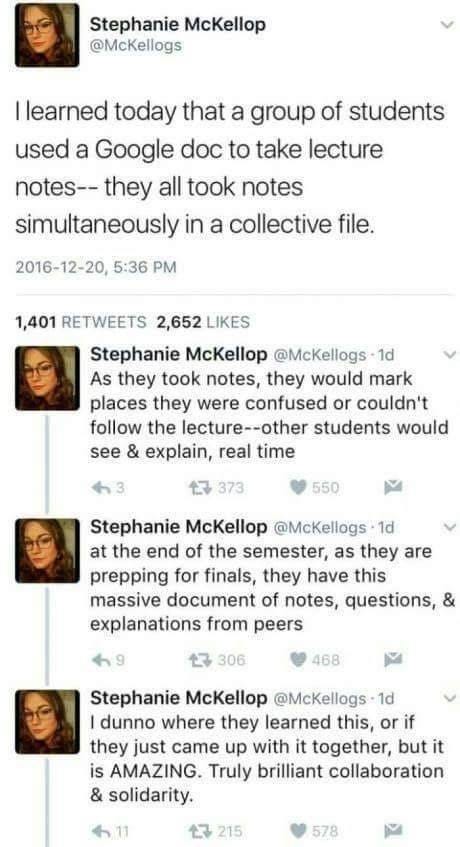
Stephanie McKellop tweeted about students sharing a Google Doc cooperating around note-taking:

via John Robb.

From the Archives

Work Futures Daily — AI is Everywhere | But there is no agreement on the impact of AI-driven automation — from April 2018

Work Futures Daily — Work, Work, Work | Stress, surveillance, and a shorter life: all in a day’s work — from April 2018

Quote of the Day

You cannot change what you are, only what you do.

| Philip Pullman

Crossposted from workfutures.org.


Yes, Change Is Hard. So What? was originally published in Work Futures Institute on Medium, where people are continuing the conversation by highlighting and responding to this story.

23 Oct 08:11

Are transgender people people?

by Josh Bernoff

Someone you know is transgender. They deserve to be treated like a human. Look. My job here is normally to pick apart public statements by people, to show you how things can be written better. I try not to get into taking political positions. But I am making an exception today. If this bothers you, … Continued

The post Are transgender people people? appeared first on without bullshit.

23 Oct 08:11

McGee’s Musings turns 17

by Jim

The experiment continues. The first post here came in 2001. This post is somewhere north of 1500. The number is inexact because portions of the earliest postings here aren’t easily tracked down.

The past year has seen a bit of a reboot here in terms of posting frequency., For those of you who’ve been following along, what would you like to see more of? What would you like to see less of?

The post McGee’s Musings turns 17 appeared first on McGee's Musings.

23 Oct 08:10

Well Played

by Vicky Osterweil

Video games have been around as a form of mass culture for just over 40 years, but only recently have they become so prevalent and so embedded in our lives — socially, politically, economically — that they could be fully taken for granted. In spring 2018, Fortnite reached a level of total cultural saturation in the U.S. that’s usually reserved for TV shows, movies, or Harry Potter. The game appears in virtually every classroom, bus stop, and teenage bedroom in the country and has achieved a level of ubiquity that sees professional athletes and pop stars appear on livestreams with star gamers, and teens doing the floss while they wait at crosswalks.

In the past, even as video games steadily wove their way deeper into the fabric of American culture, they tended to breach the national consciousness only as crazes (Pac-Man Fever) or controversies (the graphic violence of Doom or Grand Theft Auto). Video games were covered as a specialist hobby, and when a game would spark a moral panic, people in gaming circles would more or less accurately point out that the vast majority of people talking about games had never played any and had no idea what they were about. In other words, the rare moments when games become noteworthy also reinforced their marginality — and the subcultural prestige of gamers.

Fortnite is not marginal nor is it being marginalized. It’s a megahit cultural product, like a blockbuster movie or hit single

But lately the grounds have shifted. It’s becoming increasingly indisputable that video games are just a part of mainstream American life, an established cultural medium in their own right, as central as any of the other major entertainment industries. The money doesn’t lie: In 2014, the video game industry was making more money annually than the film and music industries combined. Last year the industry was valued at $116 billion, putting it in the same ballpark as global sports revenue, which is estimated between $130 billion and $150 billion. If growth patterns continue, video games will eclipse that by 2020.

Video games are often seen as a subdevelopment in the broader revolutions in information and communications technology that have marked the “digital age.” And while games have played a crucial role in driving mass adoption and affection for phones and techno-culture more generally, they have also superseded cinema and TV to be the dominant visual medium of our time.

And so games are increasingly breaking through into mainstream discourse. The rise of Fortnite is illustrative: It has become massively popular without controversy or even much moral panic beyond some pro forma “this new thing teens like, surely it’s bad?!?” coverage. The fact of Fortnite’s game-ness is rarely mentioned: that there would be such a hubbub over a video game is not considered a story. With Fortnite, video games have achieved one form of full cultural maturity, namely, ubiquity to the point where mainstream media explanation is beside the point. Fortnite is not marginal nor is it being marginalized. It’s just a megahit cultural product, like a blockbuster movie or hit single.

Given video games’ newly taken for granted prominence, it’s imperative to analyze how they fit into the mainstream of contemporary economic practices and ideology. Why have video games emerged in this moment, growing as the earlier visual media forms have stagnated, losing audiences and drifting toward the margins of culture? What has the medium’s material role been under capitalism? How has it reflected or shaped the specific ways capitalism has developed since 1973, when the series of crises that would lead to the neoliberal era began? (Incidentally, the first mass-market video game, Pong, was released in 1972.)

This monthly column will be aimed toward addressing these questions. They are meant to be openings for debate rather than comprehensive and conclusive statements — there will be obvious exceptions and contradictions. But the intent will be to trace the relationship between video games as a medium and the socioeconomic structure in which they have emerged, and how these have mutually influenced each other.

To perpetuate their own existence, mass media must succeed at representing the violent coercion of capitalist systems as natural laws

However, this account will treat video games specifically and culture more generally as a reproductive technology. That means that their major role in capitalist society is not simply to produce profit — although of course they must do that — but also to re-create the order required for this society’s perpetuation. This column engages seriously with feminist and anti-racist traditions — known broadly as social reproduction theory — that go beyond the pure economy-focused analyses of capitalism and instead looks at all the forms of care, desire, excess, hate, violence, and oppression that do not immediately or directly produce profit on their own but are no less crucial to maintaining current social relations.

Any society must have means for reproducing itself: it must not only be able to physically produce the means for people’s survival (food, shelter, etc.), but it also must produce the ideas by which that production is organized and the rationale for its legitimacy. Where once perhaps mythology, indigenous relationships to habitat or tightly knit communities provided that rationale, under capitalism, mass media — alongside forms of political participation, law, and ownership — have played the role of legitimation. That is, they facilitate the reproduction of class society in general and individual workers in particular. They teach people to know their place and possibly even embrace it.

The main task of mass culture is to create, reproduce, and manage particular kinds of subjects — workers, consumers, individuals, citizens —required for current conditions. To perpetuate their own existence, mass media must succeed at representing the violent coercion of capitalist systems as natural laws: Of course you have to pay rent to live inside; of course you have to buy food to eat; of course you have to work if you want to survive. The production of a fungible, disposable and migratory working class requires the alienation and atomization of communities into individuals, which involves destroying the village, kinship structures, indigeneity, and many other previous forms of meaning-producing structures, leaving a gap which ideology must fill.

While the fundamental structures of domination — racism, patriarchy, heterosexuality, etc. — form the bedrock of this ideological apparatus, the complexity of the always expanding and changing capitalist system requires an equally flexible set of subsidiary tools capable of rapidly adjusting ideology en masse. In general, media emerge not to meet the demands or desires of individual users but to accommodate what the predominant mode of production requires. For example, cinema — a dark place of rest and contemplation away from streets and factories — emerged at the turn of the century not merely because it was a novel way to reproduce moving pictures but because it served to redefine and unify the crowds produced through industrialization and the concentration of population in cities. Without a collective sensibility, these crowds would (and still often did) form their own modes of culture based in older forms of collectivity and knowledge that showed no respect for the norms of the factory or the city. But the cinema gave them a sense of shared culture and identity across the alienated and impersonal urban spaces that had replaced the village for many. Films made city life and, crucially, earning a wage seem attractive while offering accessible and glamorous fantasies of a better life to be won through bourgeois living. By selling the fantasies necessary for coping with modern life, movies themselves became a profitable product.

Then, in the 1950s, as post-war wage growth in the colonial center meant that personal consumption could become the engine of capitalist growth, the far more personalized and intimate medium of television emerges. Where cinema formed crowds, TV justified nuclear families. Cinema is a technology of cities; TV of suburbs. If cinema unified a mass proletariat, TV defined from within that mass a middle class of consumers and salaried homeowners. The television, along with the automobile, became not only engines of consumerism but prized possessions in their own right.

Video games are a safe, controlled space of growth, learning, and repetition: a desirable fantasy version of the fractured, precarious, ever shifting workplaces most of us find ourselves in

Video games have come to fruition as that middle class — and the social safety nets and capital-labor bargains that defined it — has begun to collapse. Automation, globalization, financialization, just-in-time production, precarious and part-time labor and the rise of service economies mean workplaces are constantly shifting and workers, even white collar ones, need to constantly hop from job to job, technology to technology, trying to stay one step ahead of automation and obsolescence. Workers have been forced to bear more economic risk as individuals, and they have been placed into more direct competition with each other, working ever increasing hours and monetizing more aspects of their lives to try to make ends meet. Often this is disguised as a kind of “entrepreneurship” because it involves desperate self-exploitation.

Video games emerge as workers need to engage creatively in the most mundane of tasks to get an edge over fellow workers, glamorizing the violence of competition and the otherwise mundane process of learning arbitrary information and gestures through play. The arc of most games involves getting better and better at recognizing a particular set of patterns and deploying a particular set of skills — activated by button presses — to the point where the actual controls become second nature and the player experiences the fantasy of seamlessly inhabiting the character or scenario she plays with. Often once this mastery is achieved, a game is nearly over, its pleasure nearly spent: Major studio games are frequently criticized for being too long, padded out with senseless repetitions that merely delay the conclusion of that learning arc.

Workers also need to constantly manage their increasingly anxious and fractured mental health. For this, video games provide a soothing domain of control, power, guaranteed progress, order, and orderly narrative in a world of work and daily life where such guarantees are in short supply. Good game design usually involves rewards being directly accrued by time put in — progress is basically guaranteed for effort, as reflected in leveling up, new areas, skills and achievements unlocking, new bosses encountered, and so on. No other cultural medium could support the idea of pleasurable “grinding” in which you play a particular section of a game over and over again, purely to watch your numbers and stats tick up enough to advance to the next section. (Marathoning a particular TV program — another innovation of the current era and a transformation of the way TV is consumed — only approximates this.) Video games are a safe, controlled space of growth, learning, and repetition: a desirable fantasy version of the fractured, precarious, ever shifting workplaces most of us find ourselves in.

Video games, then, are the (highly profitable) media of consolation specific to neoliberalism. They reinforce a vision of a world entirely grounded in competition, and they provide the gratification of experiencing that framework as satisfying, just — we get to win with it, we get to escape through it, we get to experience a sense of mastery even as our lives are even more shaped by larger and larger forces and increasingly unfathomable networks.

23 Oct 08:09

A handle for my Brompton, a headache for degrowth

by AG

I’m not sure if it’s entirely discernible from the things I’ve written here, but my political sentiments these past few years have taken a reasonably sharp turn toward the position known as degrowth: the acceptance that, in Edward Abbey’s words, economic “growth for its own sake is the ideology of the cancer cell”; the belief that collective prosperity and wellbeing are possible in the absence of such growth, indeed orthogonal to it; and the commitment to a way of life where value has ever less to do with the production and consumption of market goods.

These are things I believe and try to live by, not without some struggle, and I’m going to be writing more about that struggle in short order, both here and elsewhere. But before I do any of that, I want to acknowledge the staggering magnitude of the challenge involved in degrowing the economy wisely, responsibly and with care and solidarity for all, given our present sociotechnical circumstances. And I’m going to do so in the first instance by invoking a concrete practical example: the handle I recently bought for my Brompton bicycle.

As a convivial tool, I have to imagine the Brompton is all but unrivaled.* Both mechanically self-explanatory and human-scaled, it is par excellence a machine for urban mobility. Like all bicycles, of course, I can use it to get around town. But unlike most bicycles, I can collapse it in a few quick folds, so I can take it with me on the bus, or wheel it into a cafe or bar rather than locking it up outside exposed to the weather and the risk of theft. As a manufactured object and a way of moving through a real city both, it has self-evidently been cannily, cleverly and thoughtfully designed.

Every good designer, though, knows that bringing anything complex into being necessarily involves tradeoffs and compromises. And one of the tradeoffs most noticeable in the design of the Brompton is that the very moves necessary to make it fold elegantly produce a rather unwieldy package in its collapsed configuration. That the Brompton specifically is considerably more wieldy than competing folding bikes is surely one of the primary reasons for its success: it’s been devised in such a way as to let it function as sort of a trolley when folded, with all the greasy mechanicals safely tucked away on the inside. You can haul it around supermarket aisles and the like on the almost-vestigial little wheels mounted to the fender and the frame for just this purpose. But none of that means it’s particularly light or pleasant to carry in this mode…and that really tells when you’re doing something like rushing across a crowded concourse to catch the last train home.

Enter the Fahrer carrying handle. By fusing together some carefully-trimmed nylon webbing, a strip of Velcro and an off-the-shelf, commodity plastic grip, this clever little aftermarket accessory allows the rider to lift the folded Brompton from something much closer to its center of gravity. It’s a godsend for the harried urban cyclist, and a middle finger for all the chiropractors and physiotherapists one imagines cleaning up on yoiking Brompton-sore spines and shoulders back into shape.

But it’s also, dig, the fruit of an unprecedented ramification and refinement in the global product-innovation ecosystem. Combine the extraordinary democratization of digital design tools and rapid-prototyping capability; low-cost, generally Pearl River Delta-based fabrication, as well as the well-lubricated global logistics network and Chinese state policies that allow these factories to price and move goods as though they were made next door; and not least a designer’s ability to raise capital through crowdsourcing platforms, market through viral social media, and bring the things they make to market at scale via platforms like Amazon, and you wind up with two things: a dizzying cornucopia of mostly wonderful new things in the world, most of which are necessarily shortly bound for the landfill, and (/therefore) a near-insuperable challenge to the idea of putting brakes on the use of Earthly resources to make things for sale.

Maybe the Fahrer handle itself didn’t come about in exactly this way, but it might as well have. For all intents and purposes, these days just about any one of the few hundred million people sufficiently privileged to make use of that ecosystem can perceive a need not currently being addressed by the market and mount a response — generally, a response framed in terms of that market, and thereby extending its dominion. What previous generations might have thought of as garage or garden-shed tinkerers willy-nilly become capitalists now, entrepreneurs, self-conscious “innovators.” By the same token, though, an ever-greater amount of material-energetic investment is invoked to produce things of ever-lower marginal utility, as just about any passing want results in a manufactured solution, and each manufactured product catalyzes its own downstream explosion of model-specific bolt-ons, clip-ons, accessories and enhancements — many of them in fact originally user-produced, in the way I’ve described here.

This isn’t to harsh on the handle in and of itself. It’s hard to put in words, in fact, just how much I appreciate it, and with a negligible amount of maintenance it’ll last as long as the bike it’s mounted to will. It’s equally hard to imagine anyone wanting to return to a world in which only a very few, relatively centralized and hierarchical organizations had the power to determine what got made and what did not, least of all me. But if the sunk material-energetic investment in my handle can at least be plausibly defended, the same can’t necessarily be said about dozens of other things I have strewn around the house, or tens of thousands of things on sale in the neighborhood shopping center on Kingsland Road, or a hundred million things for sale on Amazon and Alibaba. Here indeed is an empire of things, the ecosystem responsible for their existence functioning de facto as a massively distributed, more or less entirely unfunded R&D lab for the major manufacturers, as well as a massive generator of signals relating to desire and agency in its fulfillment.

Every single last aspect of this situation is fascinating to me, worth unpacking at some length, and when I hoist my bike by its new handle it is all quite literally present at hand for me. In its own curious way, this handle stands as an object lesson as to why we desperately need to degrow “the economy,” and, at the very same time — at least for anyone possessed of intellectual integrity — a very good argument for the precisely opposite position. Whenever I wrap my hand around it, it makes me acutely aware of the tremendous and growing tension between the gorgeous, entirely laudable desire to ensure that the highest possible number of human beings are able to express themselves materially and the way we presently arrange to attend to that desire. More: it makes me painfully conscious that we have yet to realize anything like the full cost of that arrangement.

*I fully acknowledge that the Brompton both suffers in this regard from, and would most likely be impossible as a commercial proposition without, its reliance on proprietary, noncommodity, non-industry standard components. A fully convivial folding bicycle — designed as thoughtfully as the Brompton, but engineered from the wheels up to use components even the least well-equipped bikeshop will have in stock or which are otherwise user-serviceable — is certainly something worth thinking about.

23 Oct 08:07

Feed Reading Strategies and Tools

by Ton Zijlstra

Sebastiaan at IWC Nürnberg last weekend did some cool stuff with visualising feeds he follows, as well as find a way of surfacing stuff from outside his feeds because those in his feeds talk about it or like it. That is very exciting to me as it creates a peripheral view, and really puts your network to use as a filter. He follows up with a good posting on readers.

Towards the end of that posting there’s some discussion of how to combat ways of feed overwhelm.
That Sebastiaan, reminds me of what I wrote about my feedreading strategies in 2005 (take a look at the images there, they help in understanding the text that follows).

I think it is useful to think not just of what you yourself consume in terms of feeds, and how to optimise that, but also in terms of the feedback loops you need/want back to the authors of some of your feeds.

Your network is a filter, and a certain level of feedback is needed to be able to spot patterns that lift signals above the noise, the peripheral vision you described. Both individually and collectively. But too much feedback creates echo-chambers. So the overall quality of your network / network’s feeds and interaction is part of the equation in thinking about feed overwhelm. It introduces needs for alternating and deliberate phases of divergence and convergence, and being able to judge diversity and quality of your network.

It’s in that regard very important to realise that there’s a key factor not present in your feeds that is enormously useful for filtering: your own personal knowledge about the author of a feed. If you can tag feeds with what you know of their authors (coder, Berlin, Drupal, e.g.), and how you perceive the social distance between you and them (from significant other to total stranger), you can do even more visualising by asking questions like “what are the topics that European front-end developers I know are excited about this week”, or by visualising what communities are talking about. Social distance also is a factor in dealing with overwhelm: I for instance read a handful of people important to me every day when they have posted, and others I don’t read if I don’t have time, and I therefore group my feeds by social distance.

Finally, overwhelm is more likely if you approach feeds as drinking from a tap. But again, you know things that are not present in your feeds: current interests you have, questions you have, things you’re working on. A listener more likely hears those things better that are close to them. This points to less a river-of-news approach, and more to an active interrogation of feeds based on your personal ‘agenda’ at a time of your choosing.

Fear of missing out is not important, especially not when the feedback loops, that I mentioned above, between authors exist. If it is a signal of some sort, and not noise, it will bounce around your network-as-a-filter for a while, and is likely to be there in some form still, when you next take a look. If it is important and you overlooked it, it will come up again when you look another time.

Also see my posting about my ideal feedreader, from a few months ago.

23 Oct 07:40

Samsung is Teasing its Foldable Smartphone Again Ahead of November Debut

by Evan Selleck
Samsung has a major developers conference scheduled to take place in November, where it will likely talk about whatever it has been working on in the software department for its Tizen operating system, along with efforts with Android. Continue reading →

23 Oct 07:40

Morning of amazing dance

by Liz

Sleepily flicking through Instagram this morning I got a glimpse of an amazing looking dance and had to look up the full video. I saw Loyalty Dance Team at the International Hip Hop Dance Fest in San Francisco a couple of years ago (doing their stunning 101 Dalmations number). This is their Black Panther – 6 and a half minutes of pure shining talent – Fantastic choreography!

Here’s their Instagram if you want to follow!

I am now feeling very energized!!

Bonus video because I LOVE BIG FREEDIA SO MUCH

23 Oct 07:40

Connectivity and complex systems: learning from a multi-disciplinary perspective

Laura Turnbull, et.al., Applied Network Science, Nov 01, 2018


Icon

Theodore Hoppe recommended this article, which appears to be open access from Springer (49 page PDF). It surveys new approaches based on connectivity found in a number of disciplines, including systems biology, neuroscience, computational neuroscience, geomorphology, ecology and social sciences. Each investigation looks at the problem of identifying the basic unit, understanding emergent behaviour, and measuring connectivity. There's a lot of detail and it's a slow read, but good for a deep understanding of come of the commonalities of connectivity across disciplines.

Web: [Direct Link] [This Post]
23 Oct 07:40

It’s Over, Sim Concedes — 2018 Vancouver Civic Election

by Ken Ohrn
Next vote please, the civic election is over.

Having evidently found no compelling evidence of hanky-panky, blunders or malfeasance — the NPA concedes the mayor’s chair to Kennedy Stewart. With thanks to Justin McElroy.

23 Oct 07:36

New renders show what to expect from Apple’s 2018 iPad Pro refresh

by Igor Bonifacic

With Apple’s ‘There’s more in the making‘ event little more than a week away, Hungarian industrial designer Victor Kádár has shared renders of the 2018 iPad Pro based on all the reports that have come out ahead of the tablet’s reveal.

The renders allow one to easily visualize how the new 12.9-inch and 11-inch will look, showcasing both devices’ slimmer bezels.

Like the iPhone X, iPhone XS and iPhone XS Max, the new iPad Pros are expected to feature Face ID. Unlike Apple’s smartphones, however, neither of the new iPads is expected to include a display cutout. What’s more, Face ID will reportedly work in both portrait and landscape orientation on the 2018 iPad Pro.

Apple will also reportedly do away with the iPad Pro’s Lightning socket, and will instead add a USB-C port to facilitate functionality like 4K display output. Unfortunately, there’s also speculation the new iPad Pro also won’t include an analog headphone jack.

MobileSyrup will be on the ground in New York City next Tuesday to bring you all the latest from Apple’s second fall hardware event.

Source: Victor Kádár Via: 9to5Mac

The post New renders show what to expect from Apple’s 2018 iPad Pro refresh appeared first on MobileSyrup.

23 Oct 07:36

Apple starts selling refurbished 2018 MacBook Pro models in Canada

by Igor Bonifacic
MacBook Pro 2018 15-inch

For the first time since it released the 2018 15-inch MacBook Pro, Apple has started to offer refurbished models of its flagship macOS laptop.

First spotted by MacRumors, initial stock of the refurbished models, which are discounted by 15 percent compared to the price of a new unit, quickly sold out. However, more stock is likely to come. If you’re interested in purchasing a refurbished model, you can use Refurb Tracker to receive a notification when Apple restocks its supply.

While Apple hasn’t officially confirmed this to be the case, it’s believed the company redesigned the 2018 model’s butterfly keyboard mechanism to address the reliability issues with past models.

Like new model MacBook Pros, refurbished models come with a one-year warranty from Apple. Consumers can extend the warranty to three years by purchasing AppleCare+ within the first year of buying their new computer. In Canada, AppleCare+ for the 15-inch MacBook Pro is priced at $379.

Source: Apple Via: MacRumors

The post Apple starts selling refurbished 2018 MacBook Pro models in Canada appeared first on MobileSyrup.

23 Oct 07:34

The Guardian view on the Tories and Brexit: rage against the facts | Editorial | Opinion

mkalus shared this story from The Guardian.

If Theresa May wants to deliver a Brexit deal, she must compromise with the EU and with the majority in the Commons. That’s why Tory rightwingers are so angry

To observe the Conservative party at Westminster on Monday was to watch a party that seems closer than ever to falling apart over Brexit. Paradoxically, however, nothing in the politics of Britain’s planned departure from the European Union had actually changed since last week. Theresa May still leads a minority government and a divided party, as she did before the weekend. Talks with the EU remain stalled over the Northern Ireland backstop arrangement, just as last week. Meanwhile Labour remains just as neuralgic about giving leadership to anti-Brexit concerns in the country as before. Many of the essentials remain unchanged, yet something has changed all the same.

That something seems to be the confidence of rightwing Brexiter Conservative MPs that they will get the destructive and comprehensive break with the EU that they crave and are working for. The evidence for this altered mood came in multiple guises. The most chilling was the unusually vicious language which rightwing and Europhobic Tory MPs used over the weekend, under cover of anonymity, to attack Mrs May – that she would be “dead soon”, that the knife would be “stuck in her front and twisted”, that she was “in the killing zone” and that she should “bring her own noose”. These are the words of Tory MPs – male Tory MPs, it can safely be assumed – who have lost sight of propriety and proportion as they rage, not against her but against their own political powerlessness.

There were other signs too. In defiance of the reality of their own lack of numbers and the absence of a unifying Tory leadership candidate other than Mrs May herself, there was renewed talk of a vote of no confidence by Tory MPs against her. A group of Brexiters led by the serially disloyal Iain Duncan Smith chose this otherwise inexplicable moment to travel to Brussels to pretend that they speak for Britain when they do not. Back in the Commons, the pro-Brexit schemer Steve Baker, having put down an amendment to the Northern Ireland bill which aimed to kill the backstop, later had to withdraw it for lack of support. Meanwhile the anti-European MP John Redwood and the pro-European Dominic Grieve, two men who barely seem to belong to the same party any longer, each attacked the government’s approach to Brexit from their diametrically opposed standpoints.

The Tory right and left are both running out of trust in the government’s handling of Brexit. But it is the Tory right where nerves are stretched furthest. There are two contextual reasons for this. The first is Saturday’s enormous march in support of a second vote on the Brexit terms. The size and good sense of that march sent a message that both main parties needed to hear, but which is a particularly lethal threat to rightwing Conservative claims to speak for the public will. The second is the verdict of the most recent YouGov opinion poll. Although the Tories lead Labour in that poll and Mrs May’s ratings are better than Jeremy Corbyn’s, there is little comfort on Brexit, since only 1% of voters think the negotiations are going “very well”, with only 17% saying they are going “fairly well”. Some 71% of the public judge that the talks are going badly. When a government has staked so much of its authority on its ability to deliver Brexit, as Mrs May’s has, that 1% is a doom-laden verdict on the public’s lack of confidence.

Mrs May came to the Commons herself late on Monday to try to restore some calm. She was thorough and dogged in her usual way. But the Tory benches were subdued and sullen. Her MPs sat with stony faces. Her backbenchers asked awkward questions that revealed only anxieties and resentments. Mrs May delivered her well-trailed lines that the finishing line is in sight and that 95% of the Brexit deal is sorted. But she had few supporters. The divisions in the Tory party remained glaring. The fundamentals – that the EU will not agree to her selective Chequers approach and that she lacks the numbers in her party to deliver that kind of deal – remain as true now as before. If she is to deliver a Brexit, Mrs May will have to cave in to the EU and to compromise with the rest of the Commons. The message of this week is that the Tories cannot deliver.

23 Oct 07:34

Vancouver mayor-elect throws support behind city-approved pot shops

mkalus shared this story .

The election of Kennedy Stewart as mayor of Vancouver has given some pot shop owners and compassion club operators in the city hope that they will be grandfathered into the new legal framework around recreational cannabis.

Stewart says he thinks the 19 operators previously granted business licences in Vancouver should be given priority because they have been playing by the rules — but it's still unclear how soon new licences will be issued.

Speaking to reporters after the election, Stewart said it will take discussions with the province to determine how many licensed recreational marijuana retailers the city will have.

Pot shops require approval by both the province and the city in the new legalization framework, which came into effect Oct. 18. 

Pre-legalization, only 19 Vancouver locations had fully complied with City of Vancouver licensing requirements. 

Another 46 locations had received land-use approval from the city but no business licence. A further 75 were operating in contravention of the city licensing framework.

So far, the government operated B.C. Cannabis Store in Kamloops is the only legal retailer in the province. 

Public Safety Minister Mike Farnworth has regularly pointed to the municipal election as a reason for the licensing delay.

With files from Canadian Press

Read more from CBC British Columbia

23 Oct 07:33

The Gray Market's Impact on iPhone Pricing

by Neil Cybart

The expanding gray market for refurbished and previously-owned iPhones continues to gain legitimacy and influence. According to my estimate, approximately 150M iPhones in use passed through the gray market. This means that nearly 20% of iPhones in the wild, including hand-me-down iPhones, were previously owned by someone else. Along with helping Apple expand its user base, the gray market is also impacting Apple’s iPhone pricing strategy in an unexpected way: by driving iPhone average selling price (ASP) higher.

iPhone ASP

A few years ago, consensus was convinced that Apple would need to lower iPhone pricing due to competitive pressures. The iPhone 5c and iPhone SE, while very different from each other, were positioned by many as attempts by Apple to address lower-priced market segments.

However, things changed in a big way in 2017. Apple became more aggressive at the high-end of the iPhone line. The iPhone X’s $999 starting price was one of the most talked about Apple topics last year. Apple also increased pricing for iPhone 8 and 8 Plus. Management expanded on its high-end iPhone pricing strategy last month with iPhone XS Max, the highest-priced iPhone to date. In what ends up being a sign of how far Apple’s iPhone pricing has changed, Apple’s “low-cost” flagship, the iPhone XR, is priced $50 higher than the iPhone 8.

Given higher-priced flagship iPhones, it shouldn’t come as a surprise that iPhone ASP has been on the rise. As seen in Exhibit 1, which tracks iPhone ASP on a trailing twelve months basis, a notable upward trajectory in ASP began in 1Q18 with the iPhone X launch.

Exhibit 1: iPhone Average Selling Price (ASP)

Screen Shot 2018-10-22 at 2.18.03 PM.png

The rise in iPhone ASP has led some to conclude that Apple must have shelved its strategy for growing iPhone sales and the user base by lowering prices. Instead, Apple is said to be milking existing iPhone users with higher-priced models. This school of thought ends up ignoring how the expanding market for refurbished iPhones is contributing to new user growth and a higher iPhone ASP.

Gray Market Impact

A tenet of Apple’s iPhone pricing strategy has been selling older flagship iPhones at lower prices. For example, along with selling iPhone XS Max, XS, and XR, Apple continues to sell iPhone 8, 8 Plus, 7, and 7 Plus. Apple is even selling older models such as the iPhone SE and 6s Plus in select markets. The company is able to run with lower prices for these older flagship models due to economics of scale and improved production and assembly costs.

Traditionally, older iPhone models accounted for as much as 30% of overall iPhone sales. Having such a significant portion of unit sales going to lower-priced iPhone models kept a lid on iPhone ASP. However, things are changing. In 3Q18, non-flagship iPhone models likely represented just 20% of overall iPhone unit sales. As the number of customers buying refurbished and pre-owned iPhones through the gray market increases, Apple is seeing less demand for the lowest-priced iPhones in its lineup. Customers in lower price brackets have additional iPhone purchasing options at their disposal thanks to the gray market.

Despite weaker demand for lower-priced iPhones, Apple continues to see modest growth in iPhone sell-through demand. This tell us that demand for new flagship iPhones has not subsided. Instead, demand for higher-priced iPhones is growing. The shift in iPhone sales momentum from lower-priced, older flagships to higher-priced iPhones is contributing to higher iPhone ASP.

Gray Market Ingredients

Three key ingredients are needed to sustain a functioning gray market for iPhone.

  1. Good device durability and usability. Simply put, iPhones need to hold up over time. A phone that can barely last after two or three years of usage is not conducive to a vibrant used market.

  2. Strong demand for refurbished iPhones. Many of Apple’s competitors lack a vibrant gray market given the lack of customer demand for refurbished products from that brand. In addition, other brands directly address lower-priced segments. However, given Apple’s iPhone pricing strategy and the company’s aspirational brand, there is a considerable amount of interest and demand for refurbished iPhones at lower prices.

  3. Steady supply of gently-used iPhones. Services like early upgrade plans offered by mobile carriers and Apple’s iPhone Upgrade Program are resulting in a stream of gently-used, year-old iPhones being turned in by customers. This supply of used iPhones is needed to satisfy the demand for lower-priced iPhones.

Durability and Usability

At last month’s iPhone and Apple Watch event, Lisa Jackson, Apple VP environment,
policy and social initiatives, unveiled Apple’s latest environmental goal to eliminate the need to mine new materials from the earth. In order to stop mining new materials, Apple will focus on three things:

  1. Find new ways to make products with recycled or renewable materials.

  2. Make products last as long as possible.

  3. Recycle products properly.

Increased durability doesn’t just allow existing customers to use Apple products for longer. The products can also enter the gray market and eventually be used by more people over time.

When it comes to durability, Jony Ive and Apple’s Industrial Design group have been focused for decades on the topic as it relates to product design. Good product durability is one reason there is already a strong gray market for iPhone. It is true that Apple designers sometimes find themselves between a rock and a hard place in terms of durability. Mobile batteries are a prime example. The fact that iPhone users can’t easily replace batteries is a durability trade-off in order to achieve other usability goals. However, Apple’s embrace of an iPhone battery replacement program speaks to management’s desire to elevate device durability within its iPhone strategy.

Meanwhile, Apple’s focus on having iOS 12 support older iPhone models highlights management’s motivation to improve usability. By supporting iPhone models going back to the 5s, Apple is able to keep tens of millions of devices, many of which have likely passed through the gray market, running the latest software. This proves beneficial when it comes to keeping these iPhones in circulation.

Strong Demand

Apple has the most popular smartphones in the market. This popularity translates to strong demand for iPhones, even at higher prices. The reason iPhone sales are a fraction of overall smartphone sales is that Apple is only playing in certain market segments. Such a decision ends up providing a huge boost to the iPhone gray market as there is unfilled demand for lower-priced iPhones.

The gray market allows Apple to reach customers who may not otherwise be in the company’s traditional target market. While iPhones sold in the gray market aren’t included in Apple’s revenue, the company does benefit if sales are to new users. Apple is able to sell services and additional hardware to these new users over time. This cycle becomes that much more impactful assuming an iPhone ends up being passed on to three or four owners over its lifetime, with each ownership change occurring at a lower price.

Steady Supply

Services like early upgrade plans offered by mobile carriers and Apple’s iPhone Upgrade Program are made possible by a functioning gray market. Robust residual values make it financially feasible for users to turn in gently-used iPhones after making 12 monthly payments and walk away with the newest iPhone. Many of these gently-used iPhones that are turned in are then recirculated in the market to find a new home. This creates the supply the iPhone gray market needs to sustain itself.

Exhibit 2 highlights iPhone residual value as a percentage of original launch price. After the first year, iPhone residual value is approximately 40%. This means that an original iPhone 8 / 8 Plus owner trading in the device after a year can expect to receive 40% of the device’s original cost. The percentages come from iPhone trade-in values offered through Gazelle. It is important to note that iPhone users may find better trade-in values elsewhere, such as store credit through Apple.

Exhibit 2: iPhone Residual Value Percentage

Note: Trade-in values are for unlocked iPhones in “good condition” and for the lowest storage configuration.

Note: Trade-in values are for unlocked iPhones in “good condition” and for the lowest storage configuration.

iPhone depreciation appears to be high in the first year (62% on average). The rate of depreciation slows to 13% in the second year and 11% in the third year. All of these iPhone depreciation rates appear to be lower (iPhone has stronger residual values) than the rates of Samsung smartphones.

My theory regarding these residual value/depreciation rates is that iPhone trade-in programs offered by some mobile carriers are beginning to result in a supply of gently-used iPhone 8 and 8 Plus iPhones entering the market. This may be leading to some weakness in trade-in offers for these models from sites like Gazelle. Interestingly, the higher-priced iPhone X has a better residual value percentage than does the lower-priced iPhone 8 and 8 Plus. This could be due to the iPhone X launch taking place in November 2017. Meanwhile, there appears to be a better supply/demand environment for customers trading in two and three year old iPhone models, as seen by lower depreciation rates.

As the gray market for refurbished iPhones grows, it would not be surprising to see iPhone residual values improve slightly over time as demand for pre-owned iPhones increases.

Stronger Flagship iPhone Sales

Earlier this year, the WSJ published an article positioning the gray market as “a culprit to blame for slumping [smartphone] sales.” The scenario painted by the WSJ was that current iPhone users were turning to the gray market when buying iPhones. This was said to result in less demand for higher-priced flagship iPhones.

The problem for the WSJ is that their thesis was built on the theory that iPhone X sales were weak. In reality, Apple sold 60M iPhone X units since launch, which is an impressive feat. The WSJ’s factually incorrect stance ended up being widely held in the press, despite Apple management declaring quarter after quarter that the iPhone X was the best-selling iPhone.

While it may seem counterintuitive, a healthy iPhone gray market can boost sales for higher-priced flagship iPhones. A functional gray market makes it possible for services like mobile carrier upgrade plans and Apple’s iPhone Upgrade Program to exist. As the number of iPhone users take advantage of these upgrade services, Apple sees a growing stream of annual iPhone upgrades. In a market in which the overall iPhone upgrade cycle is getting longer, annual iPhone upgrades, even if representing a small percentage of sales, can play a role in stabilizing iPhone demand and boosting iPhone ASP.

Looking Ahead

Apple will continue to sell lower-priced, older iPhones in in select markets, like India. However, as the gray market for refurbished iPhones continues to expand, Apple will face less pressure to come out with lower-priced iPhones with fewer features in developed markets. This dynamic bodes well for the idea of higher iPhone ASPs over time.

In 3Q18, Apple reported a $724 iPhone ASP, a record-setting $118 higher than the $606 iPhone ASP reported in 3Q17. It will be difficult for Apple to report a similar jump in iPhone ASP in FY2019. Instead, the more likely scenario is that the long-term average for iPhone ASP gradually increases. Over the past 10 years, the mean iPhone ASP was $640. It is possible that this mean ASP will move towards $700 over time.

The iPhone gray market is turning into a long-term tailwind for iPhone ASP. A major implication from such a development is that iPhone ASP is more resilient and sustainable than it may appear at initial glance.

Receive my analysis and perspective on Apple throughout the week via exclusive daily updates (2-3 stories per day, 10-12 stories per week). Available to Above Avalon members. To sign up and for more information on membership, visit the membership page.

23 Oct 07:32

Briefing: Supermicro examines motherboards for Chinese malware chips “despite lack of proof”

by Christopher Udemans
Analysts have said that the placement of the chips is plausible, but raise doubts about the likelihood.
23 Oct 07:32

Apple bets over 65% of iPhone XR inventory on Chinese market

by Emma Lee
The iPhone XR is almost half the cost of the XS Max.
23 Oct 07:31

Community & Staff Training

by Richard Millington

As your community team grows, it makes sense to increase their skillset through training/courses etc.

But is the community team the only team interacting with the community? (or should it be?)

Shouldn’t far more staff members at least know how to:

  • Post and get responses in the community (using the right tone of voice and personality).
  • Test their content ideas in the community.
  • Solicit feedback on products.
  • Respond to product-related questions.
  • Collect and analyze community data for their needs.
  • Spot potentially big problems and escalate them to people who can resolve the issue?
  • etc…

Now, what about people that create content? Shouldn’t they also know how to:

  • Communify their content. Make it palatable for a broader audience.
  • Host Q&As, AMAs, and share short snippets about their work in the community?
  • Respond to questions about their content.

A growing part of FeverBee’s work this year is training larger groups of non-community staff to participate in the community and harness its value.

If you only train the community team to participate in the community, don’t be surprised when only they do participate in the community.