Shared posts

24 Oct 23:26

High school statistics class builds election prediction model

by Nathan Yau

High school seniors, in the Political Statistics class at Montgomery Blair High School in Silver Spring, Maryland, built a prediction model for the upcoming elections:

Under the guidance of Mr. David Stein, this model (which we named the Overall Results of an Analytical Consideration of the Looming Elections a.k.a. ORACLE of Blair) was developed by a group of around 70 high school seniors, working diligently since the start of September. Apart from the youth and enthusiasm that went into making it, the advantage our model has over professionally developed models is transparency. Unlike professionals, we need not have any secrets in regards to how our predictions are generated. In fact, the sections that follow attempt to detail exactly how we come up with all of the numbers involved in our model.

I’m so glad this exists and that young people are learning how to make things like this. My high school self is jealous, because the only statistics he got to learn was punched into a TI-83 calculator.

Tags: election, government, students

24 Oct 23:26

If you’re in your 40s or older, you should be thinking about your jobby

by Josh Bernoff

At age 57, I voluntarily left a good job to do something I thought would be better. Are you ready to do the same? I know there are lots of you who are at the beginnings of your careers. You may want to stick with the company you work for, or the gigs you are … Continued

The post If you’re in your 40s or older, you should be thinking about your jobby appeared first on without bullshit.

24 Oct 23:25

Agency

by James Bridle

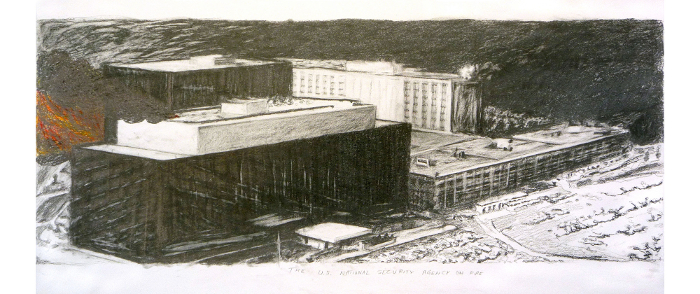
Suzanne Treister, The U.S. National Security Agency on Fire, 2010

This is one of several works I’m installing in Berlin this week for a show I’ve curated. It’s called Agency and it opens Friday.

I’m just incredibly happy to have this work in the show, in front of me now. I’ve never actually seen it IRL before, only online, but it’s been very important to me for many years. The date is significant – how many people, let alone artists, were interested in NSA back in 2010? Suzanne has been thinking about these issues and implications for many years. Moreover, she’s been doing so in a consistently thoughtful, accessible, and personal way. She’s made tarot decks about secret government programmes and watercolours about high-frequency trading, and much much more.

Suzanne’s work is emblematic of an approach and a response which I’m seeking out in the show, of how we respond to global-scale threats and fears without falling into despair or repeating the logics of power. The most common societal response to systemic violence is fear/anger and apathy, which appears in art either as dick-swinging revelation, or avoidance. I was looking to break with that binary. Here’s the blurb:

Mass surveillance and transnational terrorism, climate change and conspiracy theories, anti-social media and rapacious capitalism. As the scale and complexity of our societies grow ever vaster, individuals feel ever more disempowered and hopeless. Our vision is increasingly universal, but our agency continues to be reduced. We know more and more about the world, while being less and less able to do anything about it. In an age of planetary-scale networks and opaque, remote systems of governance, how do individuals retain the capability for creative thought, meaningful action – and a sense of humour?

The artists gathered together for “AGENCY” all concern themselves with the present state of the world while refusing, reassessing, and rewriting the narratives of despair and powerlessness that are thrust upon us. They critically engage with the most technologically complex and politically pressing issues of our times while asserting the ongoing importance of storytelling and myth-making, and the value of artistic expression, imagination, and intervention.

The practices of the artists in “AGENCY” work with a range of techniques and materials to interrogate and enchant present conditions. Morehshin Allahyari uses 3D scanning and printing to reappropriate ancient mythologies for new objectives, while Anna Ridler unearths hidden stories buried within leaked archives. Suzanne Treister and Navine G. Khan-Dossos reconfigure contentious technological and political icons in search of alternative, competing realities. Ingrid Burrington literally deconstructs technological apparatuses, while Constant Dullaart builds spirit armies from mass-produced identities, and Sophia Al Maria conducts a call and response across deep time. In these artists’ work, magic, poetic, and material speculations form new narratives and calls to action, and fashion powerful expressions of agency from the tools we all have to hand.

*

*

*

I’m not really blogging. I’m pleased to see so many old friends picking up weeknotes again and so on, but my heart’s not really in it. Rather – and I’m sorry that there’s no less annoyingly hipster way to say this – posting semi-regularly on Scuttlebutt and other distributed platforms, as I try to find the tools that actually feel that they might get us out of this mess. This is a cross-post from there. Come find us, if you like.

24 Oct 23:25

What’s something very few people know about PHP?

by tychay

Answered in Quora:

Q: What’s something very few people know about PHP?

It is mind-bogglingly popular for web development. That popularity hasn’t diminished even though conventional wisdom says otherwise…

Over a decade ago, I said about 40% of the top 100 websites use PHP — a number I pulled out of my ass — but nobody (not even the Ruby on Rails developers I pissed off) argued with that spurious claim. In 2009, Matt Mullenweg, the creator of WordPress became curious with my claim and did a survey of Quantcast’s top 100 sites — he got almost exactly 40. Even today, among the 10 most important websites, four use PHP as their language of choice — 40% again.

Overall, almost 80% of the internet is powered by PHP, and that has held steady for years! Newer web languages such as Ruby or NodeJS have only grown at the expense of other languages such as ASP, Java, or Perl.

Just one single application written in PHP, WordPress, is used by over 30% of all websites on the entirety of the internet. That’s more than double the market share since back when I last worked at Automattic/WordPress in 2011! It grew until it saturated its entire market — over 60% of all CMSs. In the CMS market as a whole, PHP-based CMSs occupy positions 1, 2, 3, 6, 7, and 8 in the top 10. The most popular non-PHP-based CMS is both closed source and sitting at only a 2.5% share.

It was estimated back in 2009 that there were 5 million PHP developers worldwide. It’s difficult to make this estimate today, but it’s obvious that that number has also held steady or grown.

These last few years, I’ve been commercially working in Ruby (on Rails), GoLang, NodeJS (for static servers), and Python (Django), but PHP is still also my love in that love/hate relationship.

Come see my talk in February 2019 at SunshinePHP in Florida!

24 Oct 23:25

5 City Council campaigns, 5 campaign hockey cards...

by Arjun Singh

IMG_0396


This has been a fun tradition! 

24 Oct 23:25

Has L&D been hijacked by ‘identity’ politics?

Donald Clark, Donald Clark Plan B, Nov 01, 2018


Icon

I'm sympathetic with this sentiment from Donald Clark, having seen my share: " Gone are the days when HR and L&D were at the forefront of personal development. Much ‘training’ is now targeted at protecting the organisation from their own employees. A tsunami of compliance and identity training has overwhelmed L&D." I also agree that "I have values and have no interest in HR telling me what my values should be." But we shouldn't confuse between bad training and bad ideas. People should learn about things like leadership, values, identity, diversity, and bias. But being lectured to about these doesn't help anybody - it just creates the sort of pushback we see in Clark's post. And - as always - if our managers, governments and corporations want us to learn about these, then they need to live those princples they want to teach, so we can see them in action. To teach, after all, is to model and demonstrate.

Web: [Direct Link] [This Post]
24 Oct 23:25

Meaningful Learning Begins and Ends with the Opportunities We Create

Eric Sheninger, A Principal's Reflections, Nov 05, 2018


Icon

It's a bit ironic to read this headline and then read in the text that "When it comes to learning the emphasis has to be on what the kids do, not the adult." But the sense of it is reasonable enough. Education - especially at younger ages - revolves around the creation of learning experiences rather than the transmission of content. But in this article so much of this sentiment is placed in a teacher-centric and information-centric context. Like this: "Knowledge must be organized around key concepts and not learned in isolation as this promotes understanding." Well, no, it's not the concepts that ground knowledge, it's the experience. And this: "Learners must receive feedback from more knowledgeable others as well as peers." No, the idea is that feedback should some from a diversity of sources, not specifically "more knowledgeable others" (ie., teachers). And the diagram, where the final output is "stories" (credit here). No.

Web: [Direct Link] [This Post]
24 Oct 23:24

The Road to Sharing is Not Paved With Licenses

Alan Levine, CogDogBlog, Nov 06, 2018


Icon

"Share for gratitude," writes Alan Levine, "not for rules and license terms." I agree (and I have my own stories about home someone just uses some of my content for a project or whatever). What the whole copyright and licensing debate has done is to move the ethos of the crass commercial from the corporate sphere into the personal sphere. The same ethics that govern corporations (which is to say, none, which is why everything must be spelled out in a license or contract) is now to be applied to people. Anything goes, unless there's a legal liability attached. I have no interest in that world, in its indifference to what is right and good, and in its valuation of nothing more than wealth and power. (p.s. now that gRSShopper uses WebMentions, when I post something like this it sends a message back to the author - not because it's required, but because it's nice).

Web: [Direct Link] [This Post]
24 Oct 23:24

Meet the modern learner: Engaging the Overwhelmed, Distracted, and Impatient Employee

Todd Tauber, Wendy Wang-Audia, Bersin by Deloitte, Nov 06, 2018


Icon

This is a scraped blog post (may or may not be framed) containing a framed version of a Bersin by Deloitte PDF-based report uploaded and shared through Slideshare. I can think of easier ways to offer this content (but I follow e-learning, conocimiento en red for the content, not the convenience). Anyway, the gist of the report is that there is a "noticeable lack of participation, engagement, and satisfaction exists in corporate training offerings these days [because] they still are not fully embracing the fact that much employee learning does not actually happen in formal training courses or via learning management systems."

Web: [Direct Link] [This Post]
24 Oct 23:22

Twitter Favorites: [Lesley_NOPE] @sillygwailo nothing will be enough for you if you're not enough for you

World Sleevies @Lesley_NOPE
@sillygwailo nothing will be enough for you if you're not enough for you
24 Oct 23:21

Twitter Favorites: [michdas] For this week's High Buys #cannabis column, I wrote about @amanda_siebert's new book https://t.co/gI6wPwsDZC via… https://t.co/P6UmCqC8SH

Michelle da Silva @michdas
For this week's High Buys #cannabis column, I wrote about @amanda_siebert's new book nowtoronto.com/lifestyle/cann… via… twitter.com/i/web/status/1…
24 Oct 23:21

Twitter Favorites: [knguyen] Star Wars: The Last Jedi https://t.co/2NczLjx7Uf

Kevin Nguyen @knguyen
Star Wars: The Last Jedi twitter.com/criterion/stat…
24 Oct 23:20

Twitter Favorites: [Newbornstranger] It is practically fait accompli that Patrick Brown will clash with Premier Ford at some point in the next few years… https://t.co/09YOlDeojJ

treVORE dunsTEETH @Newbornstranger
It is practically fait accompli that Patrick Brown will clash with Premier Ford at some point in the next few years… twitter.com/i/web/status/1…
24 Oct 23:18

New film aims to animate the story of cycling pioneer Nora Young

by dandy

Above centre, Nora Young readies herself for competition at the 6-Day Race event at Maple Leaf Gardens in 1936. Credit: Nora Young Collection/Julia Morgan

Nora Young blazed a trail on two wheels

Now a film about her aims to combine local history, cycling, feminism, and art in a new animated film about this unknown cycling pioneer

Nora Young (1917 – 2016) was a Toronto-based female cycling pioneer from the 1930s. Never heard of her? Enter Julia Morgan, a filmmaker working on an animated short documentary called Undeniably Young: Nora Young and the Six-Day Race. The project is about Nora and an unusual, gritty, fun, and historically significant cycling race she was involved in at Maple Leaf Gardens in 1936. Julia’s interviews, coupled with other research, has already been used as the basis for a successful application to have Nora inducted into Canada’s Cycling Hall of Fame. Julia says meeting Nora changed her life.

Julia is currently crowdfunding (www.igg.me/at/NoraYoungFilm) for her film, which she plans to release sometime in 2019 so dandyhorse caught up with her to offer support and find out more.

When did you first meet Nora and find out about her cycling history?

It was in 2005. I had recently moved to the Danforth. Nora was holding a garage sale, and offering her neighbours gin and tonics! It was about 11 in the morning, and it felt more like a party than a garage sale. Later, I happened upon a young adult book called Great Girls about some of Canada’s most important female athletes by feminist sports journalist Laura Robinson, and it had a chapter about Nora. That’s when I started to understand the tremendous scope of her cycling accomplishments.

What made you want to tell Nora’s story?

Becoming friends with Nora herself. Her spirit was incredible. She was so lively and fearless, curious about everything, and someone who clearly made the most of every moment. The second reason was because in learning about her cycling legacy, particularly in the 1920s – 40s, I found out about what is called the “Golden Age of Women’s Sports.” And once I dug further into this Golden Age, I was fascinated, and I couldn’t believe that hardly anyone knew about it, and I wanted them to.

Tell us more about this Golden Age.

What has been called the “golden age” of women’s sports took place between WWI and WWII when women started playing sports on a widespread level in North America, which caused a huge amount of media and fan interest. It really was this wonderful time to be a woman in cycling or other athletic endeavours. It happened because in the 1920s women were suddenly experiencing many new freedoms, so many had the opportunity to get involved in sports for the first time. But there was still – of course – a lot of discrimination.

For example, there was this idea that cycling and other strenuous sports might damage a woman’s reproductive ability,. and male sports journalists would write things about female athletes that were quite disparaging (like calling them “leathery limbed flat chested girls” – and a lot worse). And there were events held for women that combined athletic competitions with beauty pageants.  In fact there’s a vintage photo from one such event called “Bike Racing’s Most Attractive Girl” that I’ve turned into a perk in my film’s campaign.

Tell us more about Nora’s love for cycling.

Nora rode everywhere! She had a girls’ one-speed coaster bike, the kind where you pedal backwards to brake, and it was her main method of transportation.  She had some interesting stories about riding around the city as a woman then. For example, she told me of one instance where a police officer stopped her and gave her a hard time when she was riding on College Street at night. The implication being proper young ladies don’t stay out in the evening, especially on bikes!

Nora road her coaster bike in competitive races too, or she would borrow a racing bike from one of her male cycling colleagues. The pinnacle of competitive racing for women in the 1930s were the Friday night races on dirt tracks at the CNE grounds – the best female cyclists in Toronto gathered there weekly to compete. Nora appears often in the newspapers as winning or placing near the top of these weekly races. In fact, journalists covering these races often said this kind of thing about her: “A rider to defeat Nora Young’s sensational time … would have to be a topnotch performer. There are 100 men riders right in Toronto now who have been training steadily who can’t beat her time now.” (Toronto Daily Star, 1936)

Nora steadies herself at the CNE grandstand at one of the Friday races for women. Nora was 21 in this photo. Credit: Nora Young Collection/Julia Morgan

There were also a number of long-distance road races that Nora competed in during the 1930s on the streets and environs of Toronto, and sometimes she was the only woman in them. There’s a great story about Nora’s experience in one such race, which she tells herself, in a video our film team contributed to the Bike City exhibit at the St. Lawrence Market Gallery.

It’s worth mentioning Nora was involved in a lot of advocacy and education work to support female cyclists in the 1980s and to encourage more women to take up cycling in general. (Nora’s favourite route, by the way, was the Taylor-Massey Creek trail, which she would ride regularly all the way to Sunnybrook stables.)

Tell us more about the film itself.  Why animation?

It’s a short film that will introduce audiences to Nora and the Golden Age, and then transition to the story of the time in 1936 when a small group of that era’s top female cyclists, including Nora, were invited to put on a demonstration race as part of a men’s six-day race at Maple Leaf Gardens. Men’s six-day races themselves were this wacky phenomenon – it’s going to be a great atmosphere to recreate on film.

I’m not going to say much about the race itself and how it turns out, except to say that it will be exciting and have lots of surprises.

The film is going to be a collage of live action footage, archival images, and animation, with animation being the bulk of it.

I’ll have Nora telling the story wherever possible on film and voice over. The race itself will be animation, because there’s no footage from this event. I get to recreate what it looked and sounded like, and that offers an incredible creative opportunity and control.

Why do you think it is important to celebrate women and cycling?

It is empowering for women and girls to know about early female cycling pioneers and role models. And obviously it’s important for men and boys to know about them too. Nora had some profile in her life – but nothing anywhere near close to what she deserved. I mean, she really was one of the first and best female cyclists in Canada – how can we not know about her?

How can people help?

Thank you for asking! dandyhorse readers are this film’s kind of people – who would be interested in stories where local history, cycling, feminism, and art intersect. I really would love the community’s support. So I’d love it, of course, if people could contribute and help to make my crowdfunding campaign wildly successful. My goal is to raise $15,000 by November 6, 2018. Every donation helps, even $1!

Join our mailing list, connect on Facebook, Instagram, and Twitter, like and share our stuff online… word of mouth and community support means everything to grassroots films like this one.  


Related on dandyhorsemagazine.com:

Forever Young: Octegenarian promotes pedal power

BikeFace: a series

Bikes on Reels: Wadjda 


24 Oct 23:18

A book for decoupled Drupal practitioners

by Dries
The cover of the Decoupled Drupal book

Drupal has evolved significantly over the course of its long history. When I first built the Drupal project eighteen years ago, it was a message board for my friends that I worked on in my spare time. Today, Drupal runs two percent of all websites on the internet with the support of an open-source community that includes hundreds of thousands of people from all over the world.

Today, Drupal is going through another transition as its capabilities and applicability continue to expand beyond traditional websites. Drupal now powers digital signage on university campuses, in-flight entertainment systems on commercial flights, interactive kiosks on cruise liners, and even pushes live updates to the countdown clocks in the New York subway system. It doesn't stop there. More and more, digital experiences are starting to encompass virtual reality, augmented reality, chatbots, voice-driven interfaces and Internet of Things applications. All of this is great for Drupal, as it expands its market opportunity and long-term relevance.

Several years ago, I began to emphasize the importance of an API-first approach for Drupal as part of the then-young phenomenon of decoupled Drupal. Now, Drupal developers can count on JSON API, GraphQL and CouchDB, in addition to a range of surrounding tools for developing the decoupled applications described above. These decoupled Drupal advancements represent a pivotal point in Drupal's history.

Decoupled Drupal sites
A few examples of organizations that use decoupled Drupal.

Speaking of important milestones in Drupal's history, I remember the first Drupal book ever published in 2005. At the time, good information on Drupal was hard to find. The first Drupal book helped make the project more accessible to new developers and provided both credibility and reach in the market. Similarly today, decoupled Drupal is still relatively new, and up-to-date literature on the topic can be hard to find. In fact, many people don't even know that Drupal supports decoupled architectures. This is why I'm so excited about the upcoming publication of a new book entitled Decoupled Drupal in Practice, written by Preston So. It will give decoupled Drupal more reach and credibility.

When Preston asked me to write the foreword for the book, I jumped at the chance because I believe his book will be an important next step in the advancement of decoupled Drupal. I've also been working with Preston So for a long time. Preston is currently Director of Research and Innovation at Acquia and a globally respected expert on decoupled Drupal. Preston has been involved in the Drupal community since 2007, and I first worked with him directly in 2012 on the Spark initiative to improve Drupal's editorial user experience. Preston has been researching, writing and speaking on the topic of decoupled Drupal since 2015, and had a big impact on my thinking on decoupled Drupal, on Drupal's adoption of React, and on decoupled Drupal architectures in the Drupal community overall.

To show the value that this book offers, you can read exclusive excerpts of three chapters from Decoupled Drupal in Practice on the Acquia blog and at the Acquia Developer Center. It is available for preorder today on Amazon, and I encourage my readers to pick up a copy!

Congratulations on your book, Preston!

24 Oct 23:18

Deprecation of Legacy TLS 1.0 and 1.1 Versions

Transport Layer Security (TLS) is a critical security protocol used to protect web traffic. It provides confidentiality and integrity of data in transit between clients and servers exchanging (often sensitive) information. To best safeguard this data, it is important to use modern and more secure versions of this protocol. Specifically, applications should move away from TLS 1.0 and 1.1. Doing so provides many benefits, including:

  • Modern cryptographic cipher suites and algorithms with desirable performance and security properties, e.g., perfect forward secrecy and authenticated encryption, that are not vulnerable to attacks such as BEAST.
  • Removal of mandatory and insecure SHA-1 and MD5 hash functions as part of peer authentication.
  • Resistance to downgrade-related attacks such as LogJam and FREAK.

Now is the time to make this transition. Properly configured for App Transport Security (ATS) compliance, TLS 1.2 offers security fit for the modern web. It is the standard on Apple platforms and represents 99.6% of TLS connections made from Safari. TLS 1.0 and 1.1 — which date back to 1999 — account for less than 0.36% of all connections. With the recent finalization of TLS 1.3 by the IETF in August 2018, the proportion of legacy TLS connections will likely drop even further. TLS 1.2 is also required for HTTP/2, which delivers significant performance improvements for the web.

Therefore, we are deprecating support for TLS 1.0 and 1.1. Complete support will be removed from Safari in updates to Apple iOS and macOS beginning in March 2020. Firefox, Chrome, and Edge are also planning to drop TLS 1.0 and 1.1 support at that time. If you own or operate a web server that does not support TLS 1.2 or newer, please upgrade now. If you use legacy services or devices that cannot be upgraded, please let us know by contacting our Web Technologies Evangelist or by filing a bug report with details.

24 Oct 23:18

Canvas Debugging

Ever since its introduction in 2004, the Canvas element and its associated APIs have been an incredible tool for generating specific visual effects on a webpage. As more technologies, such as WebGL, came into being, Canvas’ complexity grew, and more was expected of the developer. For many years, debugging Canvas issues was a process of adding console.log statements, or even overriding the prototype of the Canvas’ context to better understand when functions are being called. Today, we’re excited to tell you about our improvements to the debugging process for Canvas, specifically the ways in which we are providing in-depth insight into the cause and effect of every action, as well as exposing in-process information that was previously invisible.

Canvas Tab

Web Inspector now has a dedicated Canvas tab for debugging canvas contexts. This new tool makes it easier to diagnose performance and correctness problems in canvas drawing code without having to manually instrumenting your code. The rest of this post explains these new capabilities.

Visualizing Canvases

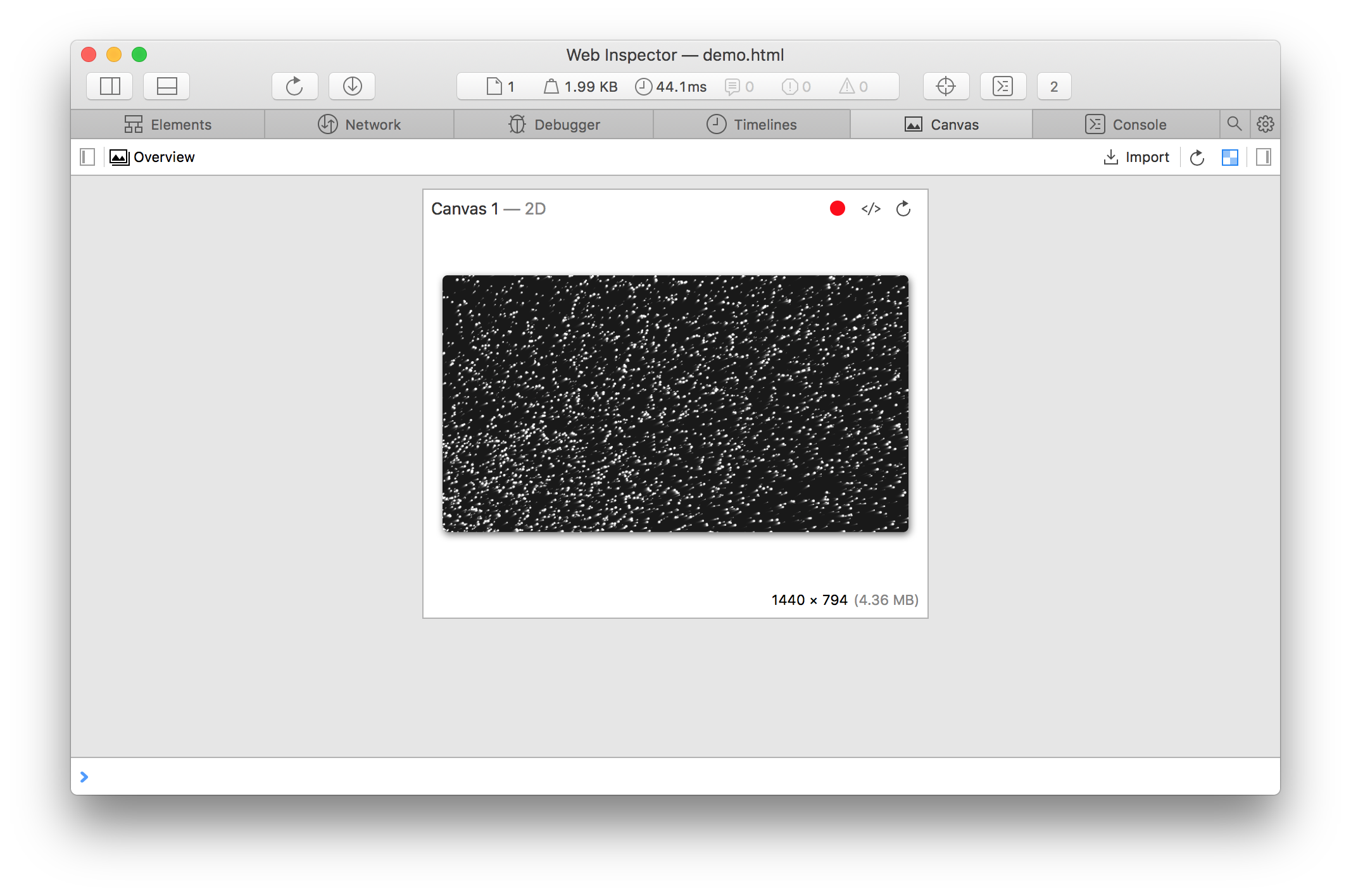
The Canvas tab overview shows all active canvas contexts, listing the type of drawing context, preview image, dimensions, and current memory usage for each canvas in the page.

Canvas Tab

At any point, clicking on the refresh button in the top right of either the “card” or the Canvas tab will refresh the preview image(s) so that you can stay up to date on what you are looking at from the page.

Clicking on any Canvas will “drill down” into a more specific view, where any attached objects, such as Shader Programs, can be viewed and edited.

Canvas View

Recording and Replaying Canvases

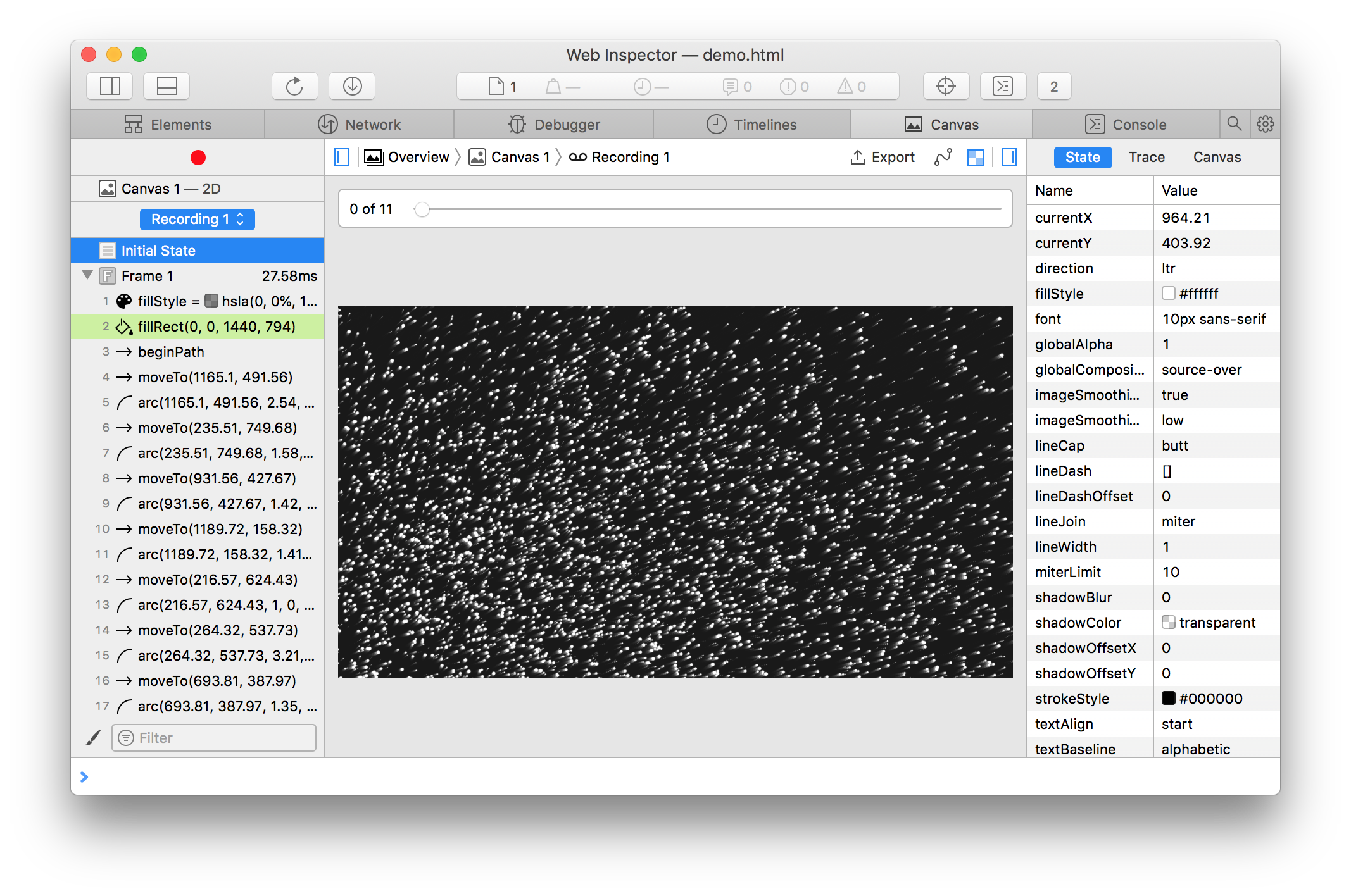
A big part of the Canvas debugging initiative was to provide a near-native exploration of exactly what happens to the Canvas. It’s often difficult to debug drawing code because so much of it occurs behind the scenes, as only a few actions actually cause changes (if any) to be drawn. 2D and WebGL canvases are now able to be recorded and visualized action-by-action as needed to debug any issues. Clicking the red circle next to the canvas preview (overview) or in the left sidebar (specific canvas) will start a recording. When you’ve reproduced the behavior you want to debug, click the button again to stop recording. It is also possible to take single-frame recordings by holding Shift when clicking. After some processing, the recording will become available for inspection.

Recording View

The recording view shows a list of all commands (left sidebar), the current state and backtrace (right sidebar), and the current output up to the selected command (center). Clicking on any action will apply it and everything prior to the preview, generating the same result as the one viewed in the actual page. Moving the slider will quickly jump between “visual” actions (highlighted in the left sidebar), which are those that can cause a visible change in the generated content.

Debugging 2D Paths

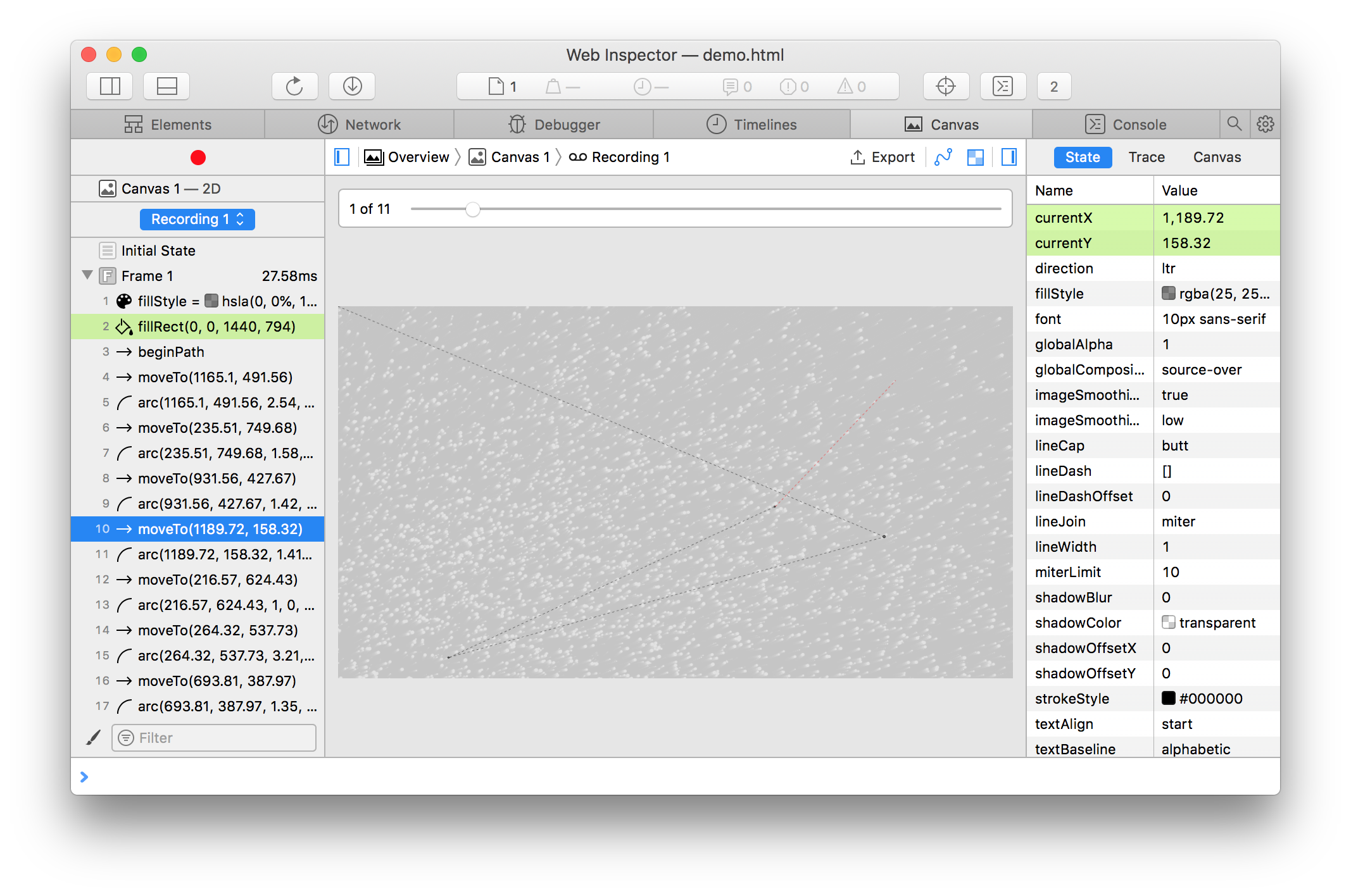
In the 2D Canvas world, there exists a concept called “path”. To give an analogy, imagine a painter using a pencil to sketch out a brush stroke before actually painting. For 2D Canvas, the “path” is this penciled line that can be used to draw more expressive shapes all in one go. Normally, like the pencil, this path is invisible until actually drawn/painted. This can lead to unintended results if the developer put the wrong value by accident.

Recording Path

Dashed lines represent any “move” commands. The most recent path action is drawn in red.

Export and Import

One problem we envisioned while building Canvas Recording was that a recording is only as good as what it was able to capture. If a developer encounters a bug on their computer, but their coworker doesn’t have an issue, then there’s no real benefit to being able to record the buggy Canvas, especially if they don’t know how the code works. Our solution is to make Canvas Recording fully portable by allowing any recording to be exported to a JSON file and imported into any other computer.

All of the recording information is encoded into the JSON file, so loading it into any other computer will provide the exact same replay accuracy as on the origin computer. In order to minimize the size of a Canvas Recording, however, values are deduplicated and repeated keys are removed in favor of more compact arrays. According to our rough estimates, this decreased the average JSON size by about 30%.

Shader Program Editor

For more advanced Canvas usage, such as WebGL, it is often the case that much of the work is done in a Shader. In these cases, recording the Canvas might not be enough to determine the cause of a potential problem, as it might be due to an error in one of the Shaders used by the Canvas. In order to facilitate this, we have exposed all valid Shader Programs for the selected Canvas.

The original source of the Shader Program is shown in a split view for the Vertex and Fragment shaders. Each of these is editable, and will have an immediate effect on the inspected page.

In this way, bugs can be ironed out without having to edit the source of the page, or having to take additional recordings.

Playground

As a simple demo for debugging using Canvas Recording, this page is the one displayed in the screenshots above. It heavily utilizes canvas 2D paths, often times outside the bounds of the canvas. This is a good example of a time to optimize, as there’s no reason to draw something outside the visible space. Thanks to Canvas Recording, this issue is very apparent and has enough information to make a fix actionable.

Feedback

The Canvas tab is available in macOS High Sierra 10.13.4 and macOS Mojave. Is there a Canvas API that wasn’t covered here that you debug often? Let us know! Please feel free to send us feedback on Twitter (@jonathandavis) or by filing a bug.

24 Oct 23:18

Memo to Microsoft: Windows 10 is broken, and the fixes can't wait :: The Register

by Volker Weber

joe-belfiore-corporate-vice-president-of-windows-experience-at-build-2018 web

Andrew Orlowski for The Register:

Windows isn't working – and Microsoft urgently needs to change how it develops the platform, and jettison three filthy practices it has acquired in recent years.

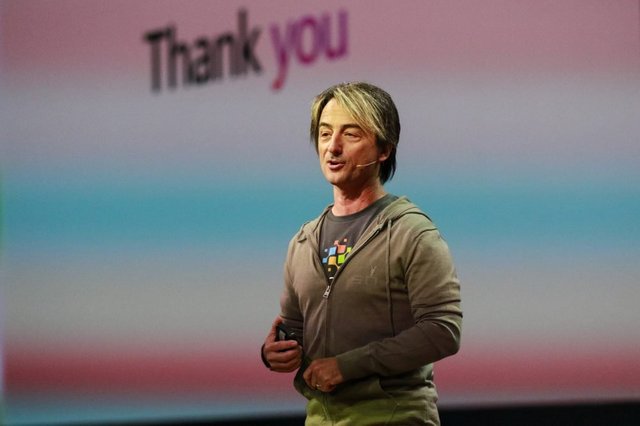
Terry Myerson, the manager who got us here, has since left the company. The person responsible for fixing Windows is Joe Belfiore. You may know him from being responsible for Windows Phone. And he just delivered the October 2018 update which deleted files from users' home directory.

More >

24 Oct 23:18

Wenn du schreibst, Heinz, das der Studiengang C...

by Ton Zijlstra

Wenn du schreibst, Heinz, das der Studiengang Content Strategie noch aktiv in Entwicklung ist, da die Disziplin sich noch immer weiter gestaltet, heisst das denn das ihr euch zunehmend auch mit Algorithmen usw auseinandersetzt? Nebst zB Einflussnahme auf Wahlen, wobei ich Inhalte gezeigt bekomme die andere nicht über den selben Politiker zu sehen bekommen, fand ich gestern ein krasses Beispiel wobei auf Netflix andere Akteure im ‘Filmplakat’ gezeigt werden je nach meinem Profil, inklusive meiner Hautfarbe. Die Frage dabei ist wohl wann eine Strategie zum ‘dark pattern‘ wird. Und wann es unendlich leichter ist mich was vorzuzeigen als für mich mich dagegen zu wehren. Machtdifferenzen durch Content Strategie?

24 Oct 23:10

How to fix the broken Windows out-of-the-box experience

by Volker Weber

IMG 5123

Christian bought himself a new Surface last week. It wasn't exactly new, since it had been sitting in a warehouse for a while until it became affordable. When he unboxed it, he started a long journey from removing the plastic wrapper to a working Windows machine. It took literally days, including a full wipe with a USB recovery key, with a never-ending sequence of reboots. And then finally, he could start removing all the Candy Crush crapware.

Let's contrast this with an iPad purchase. You set it up and go. It probably has an iOS update waiting but you can ignore that for a while. Then it's one download, one restart.

How can we fix this? Here is an idea: give Satya Nadella and every single one of his direct reports a new machine each and every Friday. Not one carefully prepared by IT, but one right out of the warehouse. Wipe the old one immediately so that they have to go through the setup process every single week. How long will it take them to come up with a solution and kick it up on the priority list?

That's a ridiculous proposition, right? But why is it? Is the time of a few higly compensated managers more valuable than that of millions of customers? Eat your own dogfood!

24 Oct 23:03

Twitter Favorites: [MetroManTO] Walked out of my front door at King/Spadina at 8:14, arrived at my boarding gate at YYZ at 9:08. @UPexpress is magical. 😍 #NoJetsTO

Pedro Marques @MetroManTO
Walked out of my front door at King/Spadina at 8:14, arrived at my boarding gate at YYZ at 9:08. @UPexpress is magical. 😍 #NoJetsTO
24 Oct 23:03

University of Dundee and Mozilla Announce Doctoral Program for ‘Healthier IoT’

by Mozilla

With €1.5m in EU funding, this paid PhD program will explore how to build a more open, secure, and trustworthy Internet of Things


This week, the University of Dundee and Mozilla are announcing a new, innovative PhD program: OpenDoTT (Open Design of Trusted Things). This program will train technologists, designers, and researchers to create and advocate for connected products that are more open, secure, and trustworthy. The project is made possible through €1.5m in funding from the EU’s Horizon 2020 program.

https://opendott.org/

As IoT evolves, the internet becomes more deeply entwined in humans’ everyday lives. Data flows around us in ever more complex ways: wearable technologies monitor our heartbeat, AI voice assistants cohabit our kitchens and our children’s bedrooms, smart cities know our every move, and facial recognition determines our access across country borders.

These technologies need to be built responsibly, and this practice requires the cultivation of design research and advocacy. OpenDoTT addresses this need on a systems level. By training the very people who will develop and influence IoT technology, we can create positive change that starts at the drawing board.

The challenges of the Internet of Things (IoT) require interdisciplinary thinking. And so the program will be hosted across several locations with training by leading organizations in different fields. The doctoral researchers will begin at the University of Dundee to learn about design research, and then move to Mozilla’s office in Berlin to focus on internet health. Throughout their studies, they will receive training on open hardware from Officine Innesto; field research from Quicksand and STBY; internet policy from the Humboldt Institute for Internet and Society; responsible IoT from Thingscon; and usable security from SimplySecure.

University of Dundee will lead training in design research, building on their world-class work on the Internet of Things, co-creation, and craft technology. The university’s past projects have explored the future of voice assistants in the home and IoT for independent retailers.

Mozilla will lead training around open technology and healthy internet practices. Mozilla focuses on fueling the movement for a healthy internet by connecting open internet leaders with each other and by mobilizing grassroots activists around the world.

Professor Jon Rogers, the project coordinator and a Mozilla Fellow, says: “This program is a game changer for the future of IoT because it’s about developing leadership. Change happens through people, and this project will bring future leaders together for a radical training programme that is located between university research and industry advocacy.”

Dr. Nick Taylor of University of Dundee adds: “This project builds on our long-term collaboration with Mozilla and provides an amazing platform to make a real difference in the IoT landscape. These doctoral researchers represent a huge boost to Dundee’s growing capacity for design-led IoT research.”

Michelle Thorne, the program coordinator at Mozilla, states: “With training at the intersection of design, technology and policy, OpenDoTT will produce a cohort of leaders in the internet health movement who are uniquely qualified to steer the field not only toward what is possible, but what is also responsible.”

The program will begin recruiting doctoral trainees in late 2018, and the first trainees will begin in July 2019. There are five available slots in the program. Further details can be found on the project website (OpenDoTT.org), where potential applicants can register their interest.

The project is a Marie Skłodowska-Curie Innovative Training Network (ITN), which are designed to support mobility of young researchers across borders, while providing the training needed to support European industries. This project has received funding from the European Union’s Horizon 2020 research and innovation programme under the Marie Skłodowska-Curie grant agreement No 813508.

The post University of Dundee and Mozilla Announce Doctoral Program for ‘Healthier IoT’ appeared first on The Mozilla Blog.

24 Oct 23:03

Keeping AI Accountable with Science Fiction, Documentaries, and Doodles (Plus $225,000)

by Brett Gaylor

Mozilla is announcing the seven recipients of its Creative Media Awards — projects that use art and advocacy to highlight the unintended consequences of artificial intelligence


The artificial intelligence (AI) behind our screens has an outsized impact on our lives — it influences what news we read, who we date, and if we’re hired for that dream job.

More than ever, it’s essential for internet users to understand how this AI works — and how it can go awry, from radicalizing YouTube users to promoting bias to spreading misinformation.

Today, Mozilla is announcing funding for seven art and advocacy projects that shine a light on the AI at work in our everyday lives.

These seven projects are winners of Mozilla’s latest $225,000 Creative Media Awards. They hail from five countries. And they make AI’s impact on society understandable using science fiction, short documentaries, games, and more. These projects will launch to the public by June 2019.

Mozilla’s Creative Media Awards are part of our mission to support a healthy internet. They fuel the people and projects on the front lines of the internet health movement — from digital artists in the Netherlands to computer scientists in the United Arab Emirates to science fiction writers in the U.S.

The winners:

[1] Stealing Ur Feelings | by Noah Levenson in the U.S. | $50,000 prize

Stealing Ur Feelings will be an interactive film that reveals how social networks and apps use your face to secretly collect data about your emotions. The documentary will explore how emotion recognition AI determines if you’re happy or sad — and how companies use that information to influence your behavior.

An early version of Stealing Ur Feelings

[2] Do Not Draw a Penis | by Moniker in the Netherlands | $50,000 prize

Do Not Draw a Penis will address automated censorship and algorithmic content moderation. Users will visit a web page and will be met with a blank canvas. Users can draw whatever they like, and an AI voice will comment on their drawings (e.g. “nice landscape!”). But if the drawing resembles a penis or other “forbidden” content, the AI will scold the user, take control, and destroy the image.


[3] A Week With Wanda | by Joe Hall in the UK | $25,000 prize

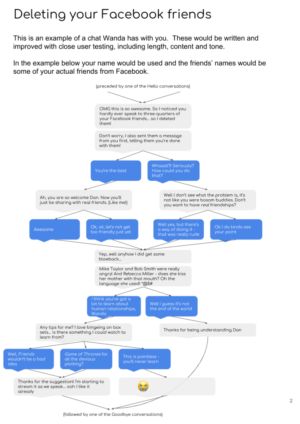
A Week With Wanda will be a web-based simulation of the risks and rewards of artificial intelligence. Wanda — an AI assistant — will interact with users over the course of one week in an attempt to “improve” their lives. But she quickly goes off the rails. Along the way, Wanda might send uncouth messages to Facebook friends, order you anti-depressants, or freeze your bank account. (Wanda’s actions are simulated, not real.)

A potential conversation from A Week With Wanda

[4] Survival of the Best Fit | by Alia ElKattan in the United Arab Emirates, and Gabor Csapo, Jihyun Kim, and Miha Klasinc | $25,000 prize

Survival of the Best Fit is a web simulation of how blind usage of AI in hiring can reinforce workforce inequality. Users will operate an algorithm and see first-hand how white-sounding names are often prioritized, among other biases.


[5] The Training Commission | by Ingrid Burrington and Brendan Byrne in the U.S. | $25,000 prize

The Training Commission is a work of web-based speculative fiction that tells the stories of AI’s unintended consequences and harms to public life. It unfolds from the perspective of a journalist who is reckoning with how deeply AI has scarred society.


[6] What Do You See? | by Suchana Seth in India | $25,000 prize

What Do You See? highlights how differently humans and algorithms “see” the same image, and how easily bias can take root. Humans will visit a website and describe an image in their own words, without prompts. Then, humans will see how an image captioning algorithm describes that same image.


[7] Mate Me or Eat Me | by Benjamin Berman in the U.S. | $25,000 prize

Mate Me or Eat Me is a dating simulator that examines how exclusionary real dating apps can be. Users create a monster and mingle with others, swiping right and left to either mate with or eat others. Along the way, users have insight into how their choices affect who they see next — and who is excluded from their pool of potential paramours.

A mock-up from Mate Me or Eat Me

~

These seven awardees were selected based on quantitative scoring of their applications by a review committee, and a qualitative discussion at a review committee meeting. Committee members include Mozilla staff, current and alumni Mozilla Fellows, and outside experts. Selection criteria is designed to evaluate the merits of the proposed approach. Diversity in applicant background, past work, and medium were also considered.

These awards are part of the NetGain Partnership, a collaboration between Mozilla, Ford Foundation, Knight Foundation, MacArthur Foundation, and the Open Society Foundation. The goal of this philanthropic collaboration is to advance the public interest in the digital age.

Also see: (June 4, 2018) Mozilla Announces $225,000 for Art and Advocacy Exploring Artificial Intelligence

The post Keeping AI Accountable with Science Fiction, Documentaries, and Doodles (Plus $225,000) appeared first on The Mozilla Blog.

24 Oct 23:03

60 years of dreaming

by Josh Bernoff

Follow your dreams. Is that a good idea? A case study . . . When I was ten, I dreamed of being an astronomer. I read everything in the library on stars and planets, and then asked to go to a new library to find more. I could close my eyes and see the Hertzsprung-Russell … Continued

The post 60 years of dreaming appeared first on without bullshit.

24 Oct 23:02

a clean ad network for independent sites?

Project Wonderful is no more. This was the ad network that got a lot of the important parts of web advertising right.

  • signal-carrying model: all visitors to the same site on the same day see the same ad(s).

  • brand safety: advertisers choose sites, and site owners approve ads.

  • fraud resistance: ads sell by the day instead of by impression or click.

  • incentive to discover and support new sites the first advertiser to express interest in a site get to run their ad for free until another advertiser places a bid.

But there were still some problems.

  • Project Wonderful was just as vulnerable to ad blocking as regular adtech.

  • The audiences of sites using Project Wonderful were just as vulnerable to tracking as everyone else.

The second one is especially important. Why spend the effort to pick, and run ads on, mutiple independent sites in order to get your ad in front of the right people, when you could just sign up for some user tracking scheme? The people who control marketing budgets need a problem, a trend, and a story in order to shift money from one place to another.

What would it take to borrow and build on the good parts of the Project Wonderful model while taking steps to fix the problem of data leakage?

  • Avoid privacy-focused ad blockers by accepting the EFF DNT policy. Third parties that can pass EFF's Privacy Badger also tend to stay off other blocklists.

  • Offer unlimited CNAMEs, also to help beat list-based blockers.

  • Don't participate in paid whitelisting as a network, but individual sites that choose to do so could, for their own specific CNAME.

  • Good metrics on tracking protection adoption by the audience. Show advertisers that these users are hard to reach another way.

  • Include reverse tracking walls, tracking detection roadblocks, and A/B test alternate "turn off your ad blocker" messages to motivate users to get protected from cross-site tracking.

  • Limited, user-permitted data collection with clean consent management.

The hard part for an independent ad network is to offer small advertisers something they can't get from Google or Facebook. Access to a protected audience?

bonus links

MOST MARKETING IS BAD BECAUSE IT IGNORES THE MOST BASIC DATA – BBH

How publishers are navigating the perilous path to diversification

Thomas Barta: If you want influence, abandon your desk

Delivering Malware Programmatically Is Too Easy

Privacy Badger Now Fights More Sneaky Google Tracking

24 Oct 22:59

Wired Wednesday: Helm, Smart Theatre Glasses & a new Intellivision

by John

This week on News 1130 radio in Vancouver, I spoke about these tech topics for Wired Wednesday with Ben Wilson:

  • Helm is a personal, private email server that won’t share your data (source)
  • Theater Offers Smartglasses With Live Subtitles for Hard of Hearing Show-Goers (source)
  • Intellivision’s Amico is the latest retro console revival (source)

Listen here

The post Wired Wednesday: Helm, Smart Theatre Glasses & a new Intellivision appeared first on johnbiehler.com.

24 Oct 22:59

Where Are We?

With Photokina out of the way, it's time to assess where the camera makers now fall in terms of mirrorless cameras:

  • Canon — two apparently incompatible systems, EOS M for APS-C and EOS RF for full frame. This seems wrong to me, as the smaller system is not a feeder for the larger
24 Oct 22:55

Leica Goes Retro to the Future

bythom leica m10d

Leica today announced yet another M model, the M10-D, but it's a very interesting one, as that image of its back should show. 

Basically, this is an M10-P, but with the rear LCD removed and total emphasis put on detailed control of the camera and review of the images on the FOTOS app (Android, iOS) via Wi-Fi connection. …

24 Oct 22:43

Google is Demanding Two Years of Security Updates for Popular Android Devices

by Evan Selleck
While Android fragmentation is still a thing, even for security updates, Google is trying to calm things down and create a level playing field for manufacturers. Continue reading →
24 Oct 22:40

There’s a solution to May’s backstop problem, but it requires compromise | Jonathan Lis | Opinion

mkalus shared this story from The Guardian:
Not going to happen. May has shown time and time again that she's only a leader in so far that she has the title. She has not been willing or able to actually make the right choices to go ahead. Prediction: Hard crash out of the EU without a withdrawal agreement and lots of screaming, yelling and cursing at the EU for "punishing the UK for having the audacity to leave". Hunt already tried that on a few weeks ago with his "The EU is like a Soviet Prison" statement, for which May did not fire him. She has set the tone and I predict it will only get nastier.

The most extraordinary feature of the Brexit negotiations is that British ministers still appear not to understand them. Theresa May’s statement to the Commons on Monday represented a masterclass in delusion. Nearly 28 months after the referendum, and a week after missing the first concrete deadline for a deal, the prime minister itemised an elaborate list of new demands as if placing an order at a Waitrose that no longer existed.

May’s list was long and complex. The EU must legally commit to a joint customs territory (read: a customs union) to replace the Northern Ireland-only backstop. This solution must not be permanent or even indefinite. The UK must be allowed to choose, unilaterally, between implementing this backstop and extending the transition period as an “alternative” to it. And such an extension must only last a few months before the new trading relationship kicks in and nullifies the backstop.

No matter that such demands should have been issued at the start of the negotiation, not the end. They are, individually and collectively, impossible to deliver. The backstop keeps Northern Ireland in the EU’s customs union and single market for goods as a last resort. Because it is designed to preserve an invisible Irish land border in perpetuity, it cannot be time-limited. That is its most fundamental feature. May knows this because she signed an agreement guaranteeing it. Paragraph 49 of last December’s joint report promised full alignment with EU rules which preserve the invisible border “now or in the future”.

The backstop is no more optional than an open Irish border. May has committed to both. The government cannot unilaterally replace the provision with an extended transition, or casually discard it when the transition ends and the new relationship begins. May is correct that the backstop is an insurance policy and nobody wants to activate it. But nobody buys travel insurance that expires the moment they begin their holiday.

May’s wheeze of extending the transition therefore represents a total irrelevance. It is not just that a trade deal demands a transition extension of several years rather than a few months; at the end of it you still need a backstop. This backstop is not neutered by the simple establishment of a trade deal, but a trade deal that specifically replicates a customs union and single market in goods.

The other crucial element of the backstop is its specificity to Northern Ireland. The EU wants a trade deal with the UK, but it insists on an open border in Ireland. The UK cannot, therefore, simply peg the border issue to the future relationship: Dublin and Brussels require the backstop to form a part of the withdrawal treaty. This is not just about the apparatus of article 50, which precludes a legally binding trade agreement before Brexit day, but also the actions of a future UK parliament.

The UK and EU could, for example, agree to a Chequers-style solution that prevents new border infrastructure either on the island of Ireland or in the Irish Sea. But if a future UK parliament wished to downgrade that to a Canada-style deal, the backstop would have to kick in and parliament would be unable to include Northern Ireland in its new plans.

Mindful of the concerns, the EU has made a concession: namely, committing to negotiate an indefinite all-UK customs union on top of the backstop. Importantly, this does not replicate Chequers by offering an all-UK single market in goods, and Brussels remains firm that the rest of the UK cannot have free movement of goods without signing up to free movement of people. The proposed deal thus entails increased checks on food and livestock travelling from the rest of the UK to Northern Ireland as a price for the UK ending free movement of people. With characteristic foolishness, May has responded not with compromise but obstacles, prioritising political red lines over economic cliff edges. But her key problem is not staying in the customs union: it is leaving the single market.

Northern Ireland must retain the free movement of goods. Without freedom of movement, the rest of the UK may not. The consequences of this go beyond the partial separation of Great Britain and Northern Ireland through increased regulatory checks. They transcend even the rage of the DUP. If Britain faces a new border in the Irish Sea, it also faces one at the Channel ports. The UK will be a third country outside the single market, and so France will be compelled to institute new regulatory checks at its border. Port operators have already warned that such checks could lead to gridlock and empty supermarkets, triggering economic strangulation. And so while May frets over our ability to adjust New Zealand’s dairy tariffs, she ignores the dawning prospect of Dover’s collapse – not just in a no-deal scenario but even if we secure a deal.

Five minutes after midnight, now is the time for choices. The only way the prime minister can both override the backstop and guarantee cross-Channel traffic is by conceding what should always have been her compromise position: a full, permanent single market and customs union for the whole UK. Such a move would mean Britain giving up its voting rights in the EU, and demands goodwill May has squandered. But only this level of integration can preserve the political status quo in Northern Ireland and the economic status quo in the English Channel.

If the prime minister values future third-country trade deals and curbed EU migration over the economy and the UK’s existing territorial integrity, she must explain that choice to the British people. Voters may not be so eager to endure her offer of economic hardship – and may wish to express their own choice on a ballot paper. If the prime minister understands nothing else about Brexit, she may in the end understand that.

• Jonathan Lis is deputy director of the thinktank British Influence